Cambridge A Level Drama 9482 — 2022 Oct/Nov Paper 1 · Variant 3
9482/13/O/N/22 · 60 marks · ≈68 min
The question paper and its mark scheme, free to read here and free to download. This is Cambridge’s own paper, exactly as it was sat.
Question paper8 pages


Mark scheme29 pages
Answers below. Sit the paper first if you are practising.
Paper as text
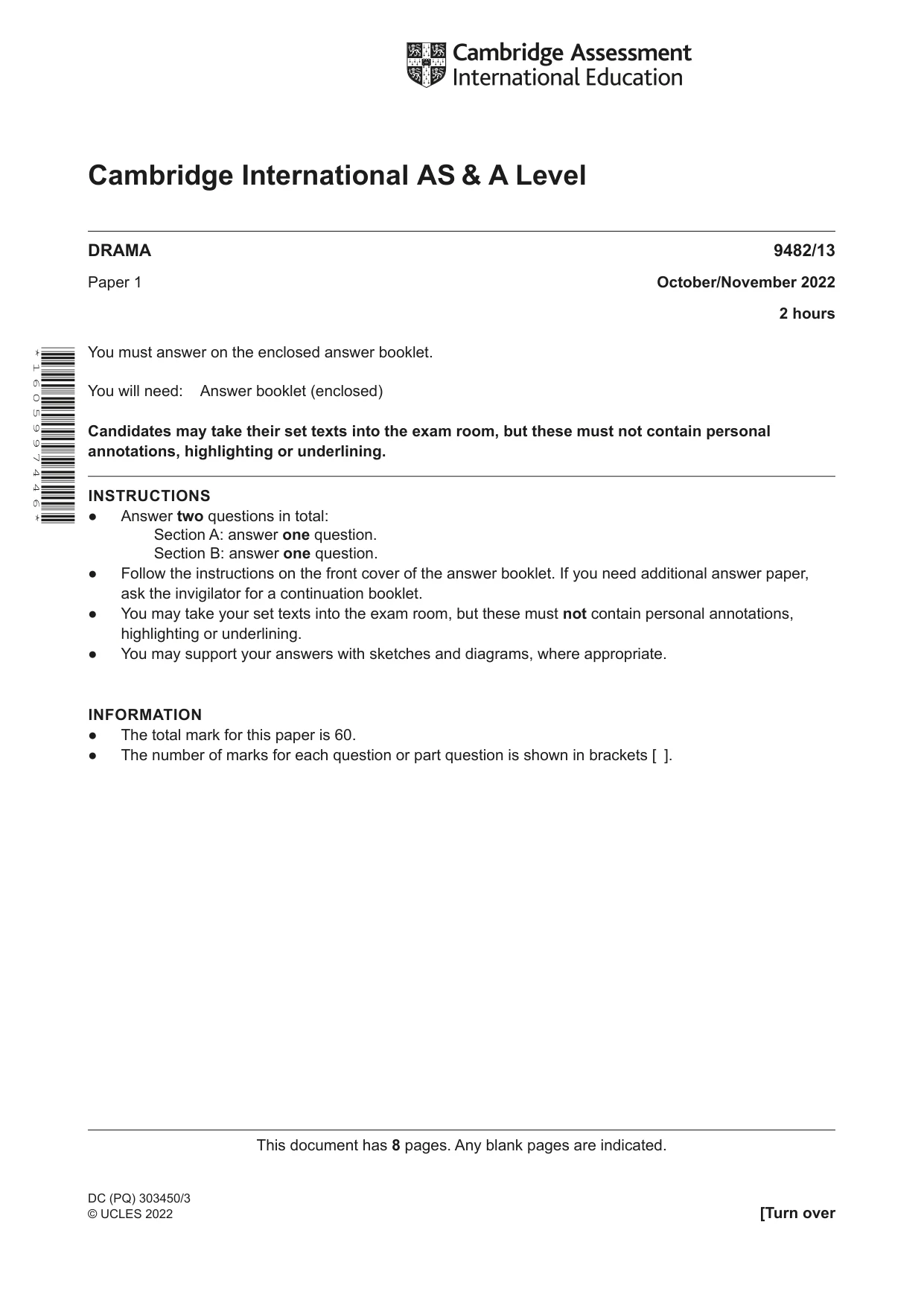
Question paper, page 1
This document has 8 pages. Any blank pages are indicated. [Turn over Cambridge International AS & A Level * 1 6 0 5 9 9 7 4 4 6 * DC (PQ) 303450/3 © UCLES 2022 DRAMA 9482/13 Paper 1 October/November 2022 2 hours You must answer on the enclosed answer booklet. You will need: Answer booklet (enclosed) Candidates may take their set texts into the exam room, but these must not contain personal annotations, highlighting or underlining. INSTRUCTIONS ● Answer two questions in total: Section A: answer one question. Section B: answer one question. ● Follow the instructions on the front cover of the answer booklet. If you need additional answer paper, ask the invigilator for a continuation booklet. ● You may take your set texts into the exam room, but these must not contain personal annotations, highlighting or underlining. ● You may support your answers with sketches and diagrams, where appropriate. INFORMATION ● The total mark for this paper is 60. ● The number of marks for each question or part question is shown in brackets [ ].
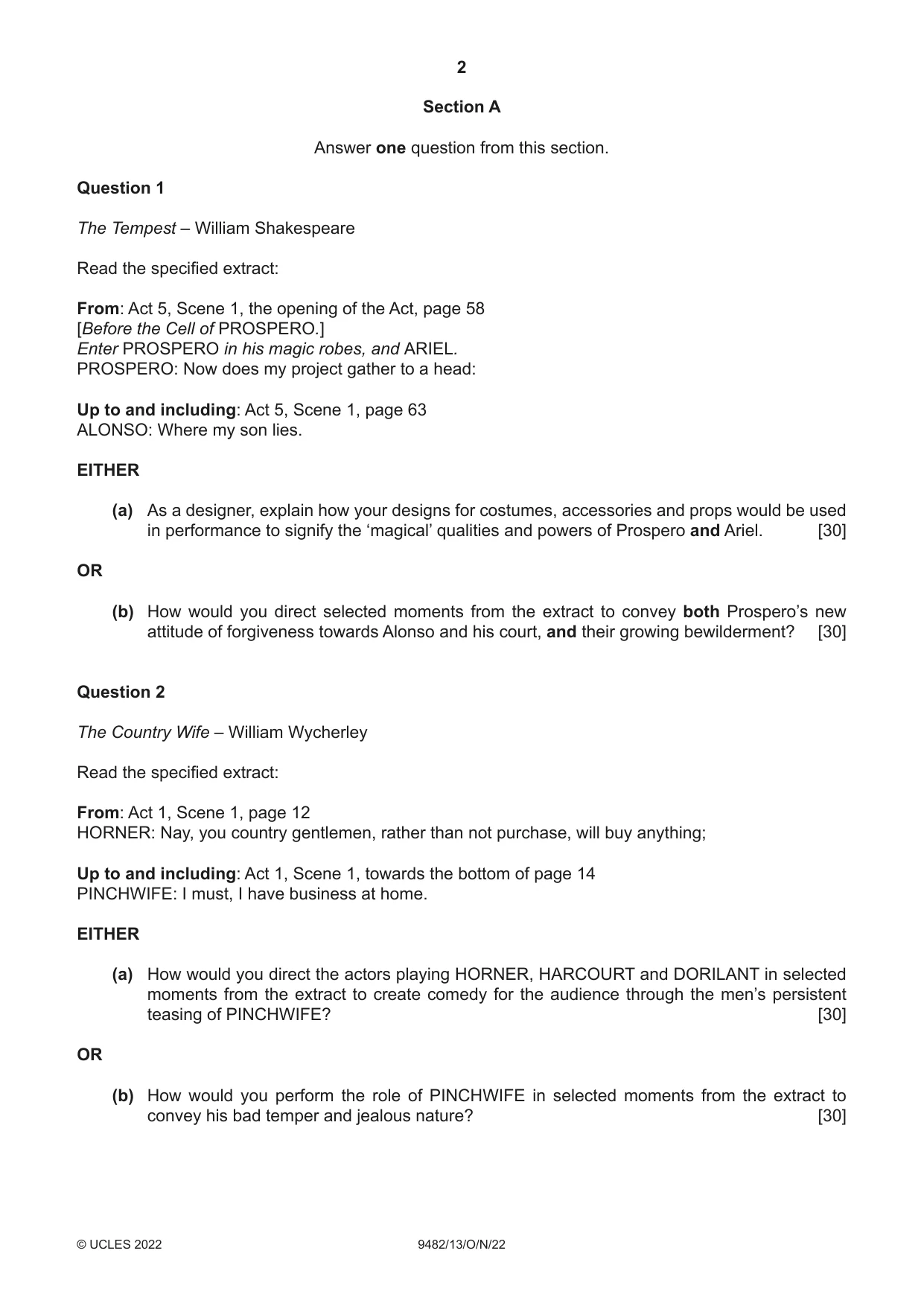
Question paper, page 2
2 9482/13/O/N/22 © UCLES 2022 Section A Answer one question from this section. Question 1 The Tempest – William Shakespeare Read the specified extract: From: Act 5, Scene 1, the opening of the Act, page 58 [Before the Cell of PROSPERO.] Enter PROSPERO in his magic robes, and ARIEL. PROSPERO: Now does my project gather to a head: Up to and including: Act 5, Scene 1, page 63 ALONSO: Where my son lies. EITHER (a) As a designer, explain how your designs for costumes, accessories and props would be used in performance to signify the ‘magical’ qualities and powers of Prospero and Ariel. [30] OR (b) How would you direct selected moments from the extract to convey both Prospero’s new attitude of forgiveness towards Alonso and his court, and their growing bewilderment? [30] Question 2 The Country Wife – William Wycherley Read the specified extract: From: Act 1, Scene 1, page 12 HORNER: Nay, you country gentlemen, rather than not purchase, will buy anything; Up to and including: Act 1, Scene 1, towards the bottom of page 14 PINCHWIFE: I must, I have business at home. EITHER (a) How would you direct the actors playing HORNER, HARCOURT and DORILANT in selected moments from the extract to create comedy for the audience through the men’s persistent teasing of PINCHWIFE? [30] OR (b) How would you perform the role of PINCHWIFE in selected moments from the extract to convey his bad temper and jealous nature? [30]
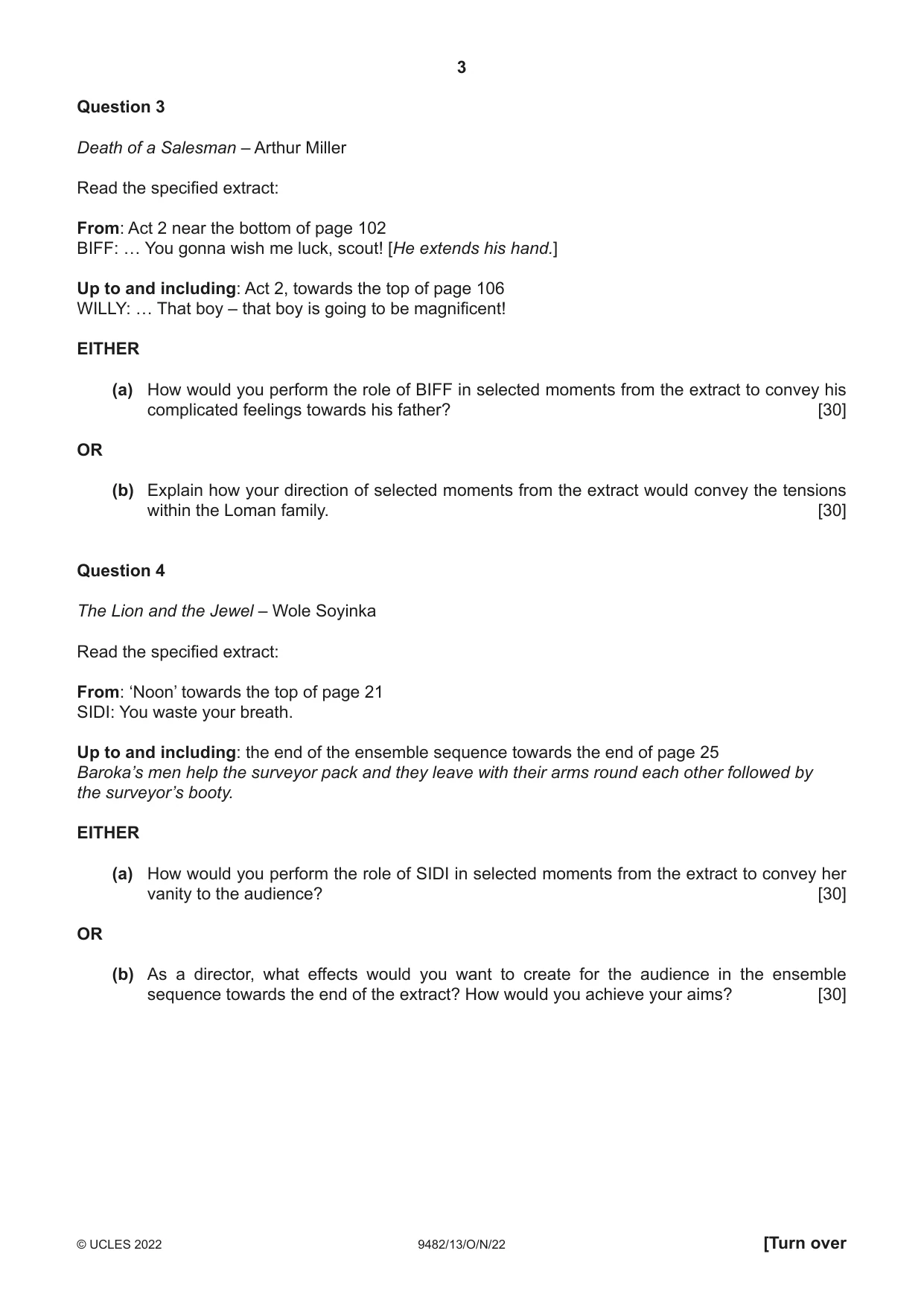
Question paper, page 3
3 9482/13/O/N/22 © UCLES 2022 [Turn over Question 3 Death of a Salesman – Arthur Miller Read the specified extract: From: Act 2 near the bottom of page 102 BIFF: … You gonna wish me luck, scout! [He extends his hand.] Up to and including: Act 2, towards the top of page 106 WILLY: … That boy – that boy is going to be magnificent! EITHER (a) How would you perform the role of BIFF in selected moments from the extract to convey his complicated feelings towards his father? [30] OR (b) Explain how your direction of selected moments from the extract would convey the tensions within the Loman family. [30] Question 4 The Lion and the Jewel – Wole Soyinka Read the specified extract: From: ‘Noon’ towards the top of page 21 SIDI: You waste your breath. Up to and including: the end of the ensemble sequence towards the end of page 25 Baroka’s men help the surveyor pack and they leave with their arms round each other followed by the surveyor’s booty. EITHER (a) How would you perform the role of SIDI in selected moments from the extract to convey her vanity to the audience? [30] OR (b) As a director, what effects would you want to create for the audience in the ensemble sequence towards the end of the extract? How would you achieve your aims? [30]
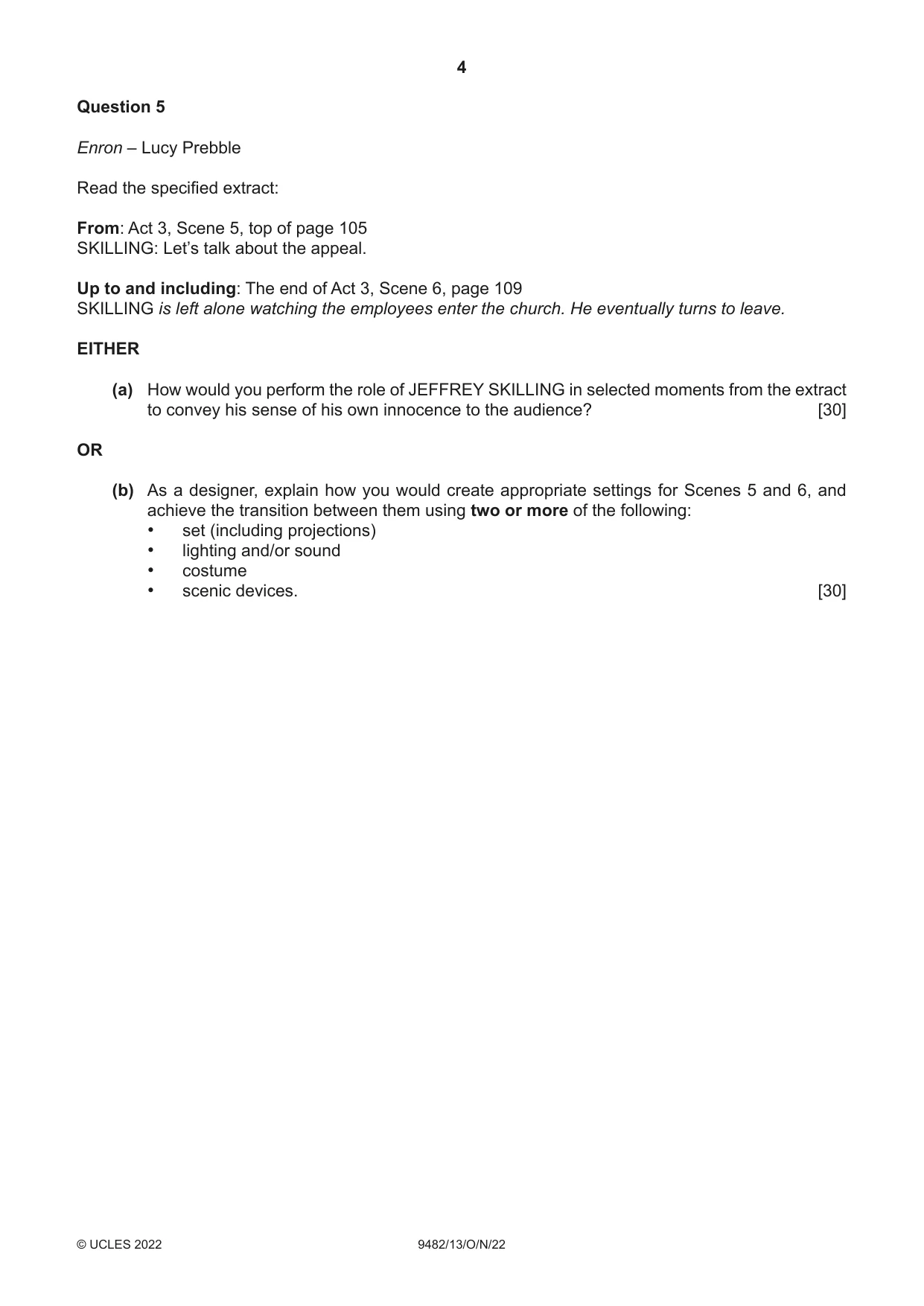
Question paper, page 4
4 9482/13/O/N/22 © UCLES 2022 Question 5 Enron – Lucy Prebble Read the specified extract: From: Act 3, Scene 5, top of page 105 SKILLING: Let’s talk about the appeal. Up to and including: The end of Act 3, Scene 6, page 109 SKILLING is left alone watching the employees enter the church. He eventually turns to leave. EITHER (a) How would you perform the role of JEFFREY SKILLING in selected moments from the extract to convey his sense of his own innocence to the audience? [30] OR (b) As a designer, explain how you would create appropriate settings for Scenes 5 and 6, and achieve the transition between them using two or more of the following: • set (including projections) • lighting and/or sound • costume • scenic devices. [30]
Question paper, page 5
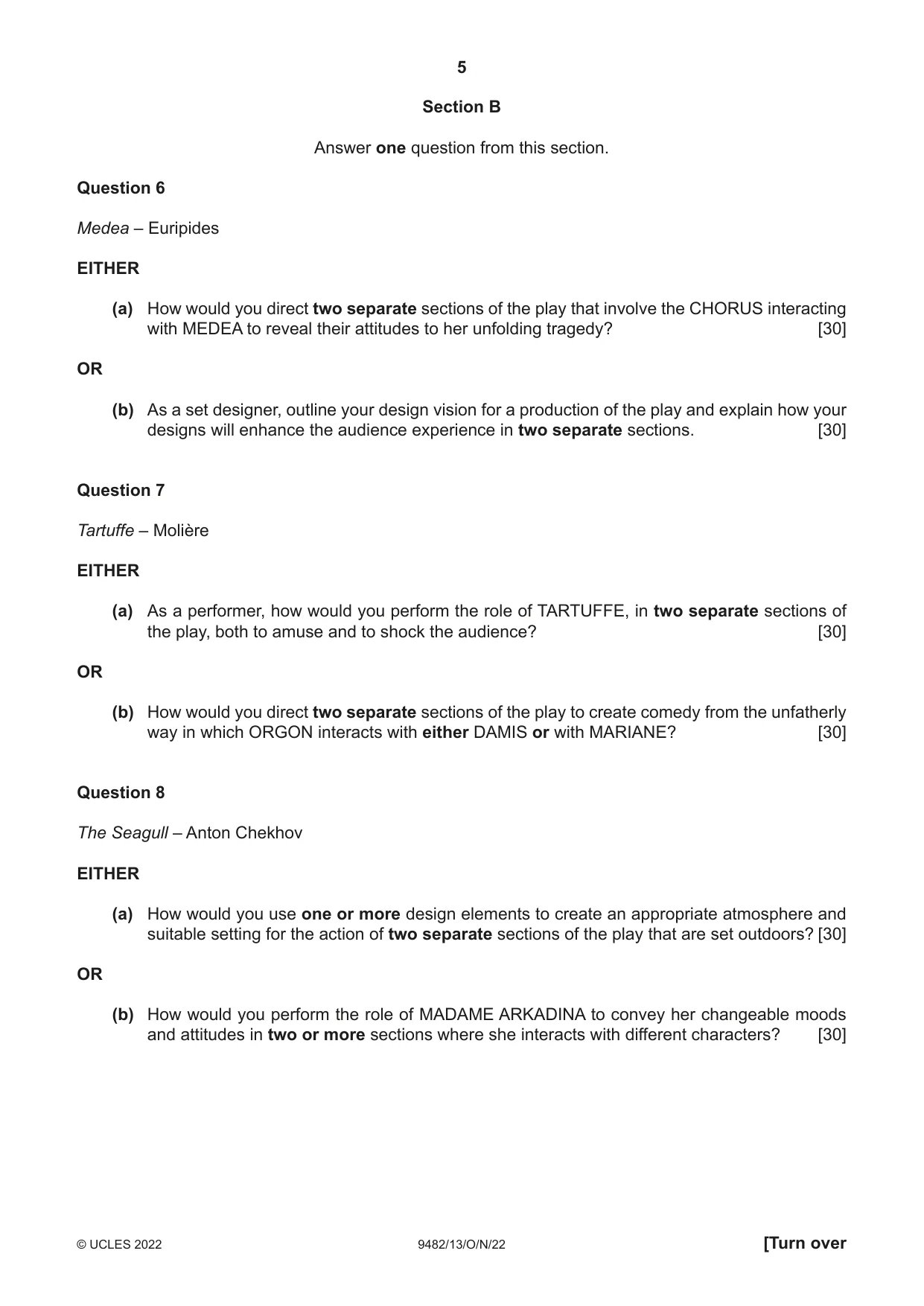
5 9482/13/O/N/22 © UCLES 2022 [Turn over Section B Answer one question from this section. Question 6 Medea – Euripides EITHER (a) How would you direct two separate sections of the play that involve the CHORUS interacting with MEDEA to reveal their attitudes to her unfolding tragedy? [30] OR (b) As a set designer, outline your design vision for a production of the play and explain how your designs will enhance the audience experience in two separate sections. [30] Question 7 Tartuffe – Molière EITHER (a) As a performer, how would you perform the role of TARTUFFE, in two separate sections of the play, both to amuse and to shock the audience? [30] OR (b) How would you direct two separate sections of the play to create comedy from the unfatherly way in which ORGON interacts with either DAMIS or with MARIANE? [30] Question 8 The Seagull – Anton Chekhov EITHER (a) How would you use one or more design elements to create an appropriate atmosphere and suitable setting for the action of two separate sections of the play that are set outdoors? [30] OR (b) How would you perform the role of MADAME ARKADINA to convey her changeable moods and attitudes in two or more sections where she interacts with different characters? [30]
Question paper, page 6
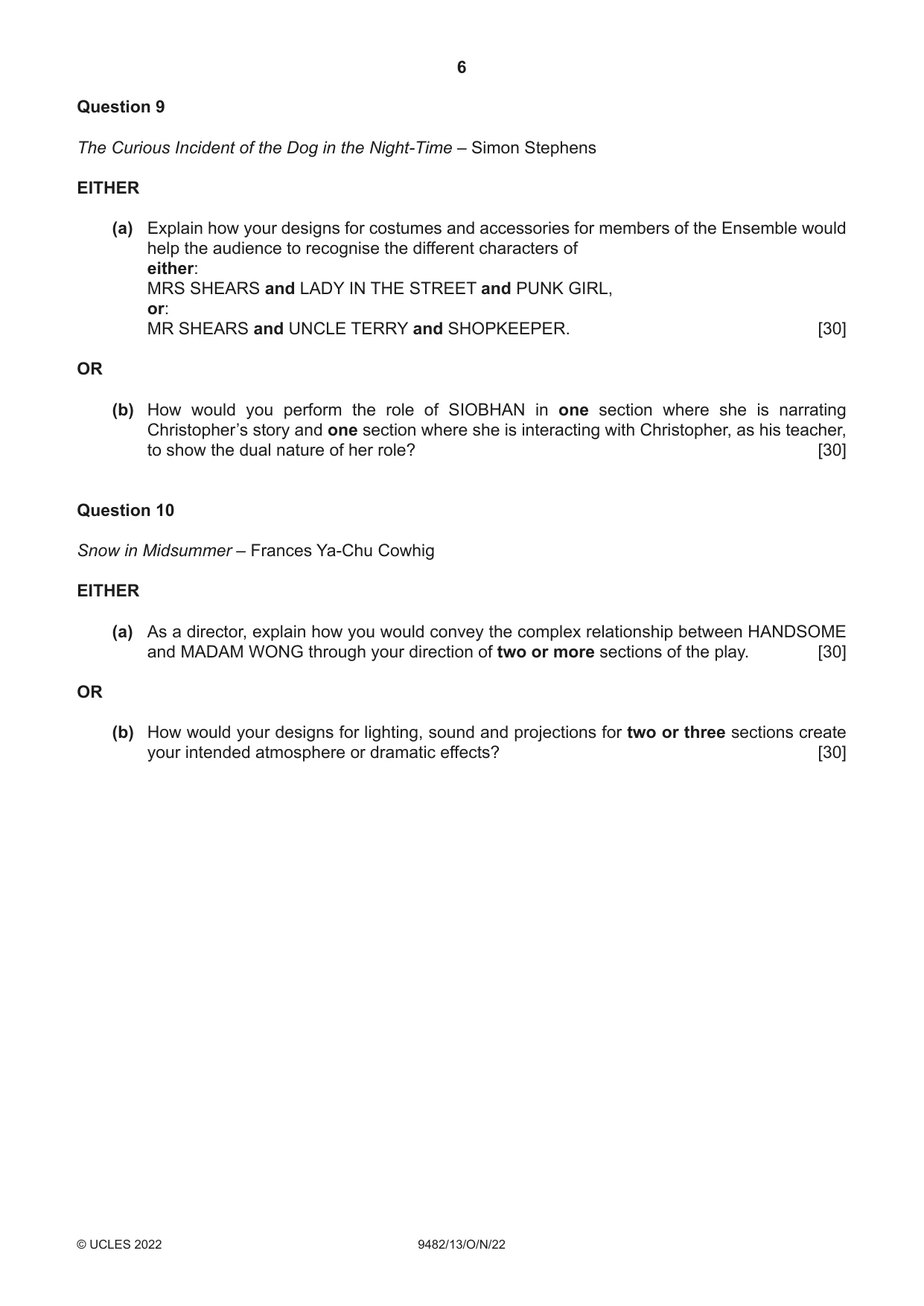
6 9482/13/O/N/22 © UCLES 2022 Question 9 The Curious Incident of the Dog in the Night-Time – Simon Stephens EITHER (a) Explain how your designs for costumes and accessories for members of the Ensemble would help the audience to recognise the different characters of either: MRS SHEARS and LADY IN THE STREET and PUNK GIRL, or: MR SHEARS and UNCLE TERRY and SHOPKEEPER. [30] OR (b) How would you perform the role of SIOBHAN in one section where she is narrating Christopher’s story and one section where she is interacting with Christopher, as his teacher, to show the dual nature of her role? [30] Question 10 Snow in Midsummer – Frances Ya-Chu Cowhig EITHER (a) As a director, explain how you would convey the complex relationship between HANDSOME and MADAM WONG through your direction of two or more sections of the play. [30] OR (b) How would your designs for lighting, sound and projections for two or three sections create your intended atmosphere or dramatic effects? [30]
Question paper, page 7
7 9482/13/O/N/22 © UCLES 2022 BLANK PAGE
Question paper, page 8
8 9482/13/O/N/22 © UCLES 2022 Permission to reproduce items where third-party owned material protected by copyright is included has been sought and cleared where possible. Every reasonable effort has been made by the publisher (UCLES) to trace copyright holders, but if any items requiring clearance have unwittingly been included, the publisher will be pleased to make amends at the earliest possible opportunity. To avoid the issue of disclosure of answer-related information to candidates, all copyright acknowledgements are reproduced online in the Cambridge Assessment International Education Copyright Acknowledgements Booklet. This is produced for each series of examinations and is freely available to download at www.cambridgeinternational.org after the live examination series. Cambridge Assessment International Education is part of Cambridge Assessment. Cambridge Assessment is the brand name of the University of Cambridge Local Examinations Syndicate (UCLES), which is a department of the University of Cambridge. BLANK PAGE
Mark scheme, page 1
This document consists of 29 printed pages. © UCLES 2022 [Turn over Cambridge International AS & A Level DRAMA 9482/13 Paper 1 Open-Book Written Examination October/November 2022 MARK SCHEME Maximum Mark: 60 Published This mark scheme is published as an aid to teachers and candidates, to indicate the requirements of the examination. It shows the basis on which Examiners were instructed to award marks. It does not indicate the details of the discussions that took place at an Examiners’ meeting before marking began, which would have considered the acceptability of alternative answers. Mark schemes should be read in conjunction with the question paper and the Principal Examiner Report for Teachers. Cambridge International will not enter into discussions about these mark schemes. Cambridge International is publishing the mark schemes for the October/November 2022 series for most Cambridge IGCSE™, Cambridge International A and AS Level components and some Cambridge O Level components.
Mark scheme, page 2
9482/13 Cambridge International AS & A Level – Mark Scheme PUBLISHED October/November 2022 © UCLES 2022 Page 2 of 29 Generic Marking Principles These general marking principles must be applied by all examiners when marking candidate answers. They should be applied alongside the specific content of the mark scheme or generic level descriptors for a question. Each question paper and mark scheme will also comply with these marking principles. GENERIC MARKING PRINCIPLE 1: Marks must be awarded in line with: • the specific content of the mark scheme or the generic level descriptors for the question • the specific skills defined in the mark scheme or in the generic level descriptors for the question • the standard of response required by a candidate as exemplified by the standardisation scripts. GENERIC MARKING PRINCIPLE 2: Marks awarded are always whole marks (not half marks, or other fractions). GENERIC MARKING PRINCIPLE 3: Marks must be awarded positively: • marks are awarded for correct/valid answers, as defined in the mark scheme. However, credit is given for valid answers which go beyond the scope of the syllabus and mark scheme, referring to your Team Leader as appropriate • marks are awarded when candidates clearly demonstrate what they know and can do • marks are not deducted for errors • marks are not deducted for omissions • answers should only be judged on the quality of spelling, punctuation and grammar when these features are specifically assessed by the question as indicated by the mark scheme. The meaning, however, should be unambiguous. GENERIC MARKING PRINCIPLE 4: Rules must be applied consistently, e.g. in situations where candidates have not followed instructions or in the application of generic level descriptors. GENERIC MARKING PRINCIPLE 5: Marks should be awarded using the full range of marks defined in the mark scheme for the question (however; the use of the full mark range may be limited according to the quality of the candidate responses seen). GENERIC MARKING PRINCIPLE 6: Marks awarded are based solely on the requirements as defined in the mark scheme. Marks should not be awarded with grade thresholds or grade descriptors in mind.
Mark scheme, page 3
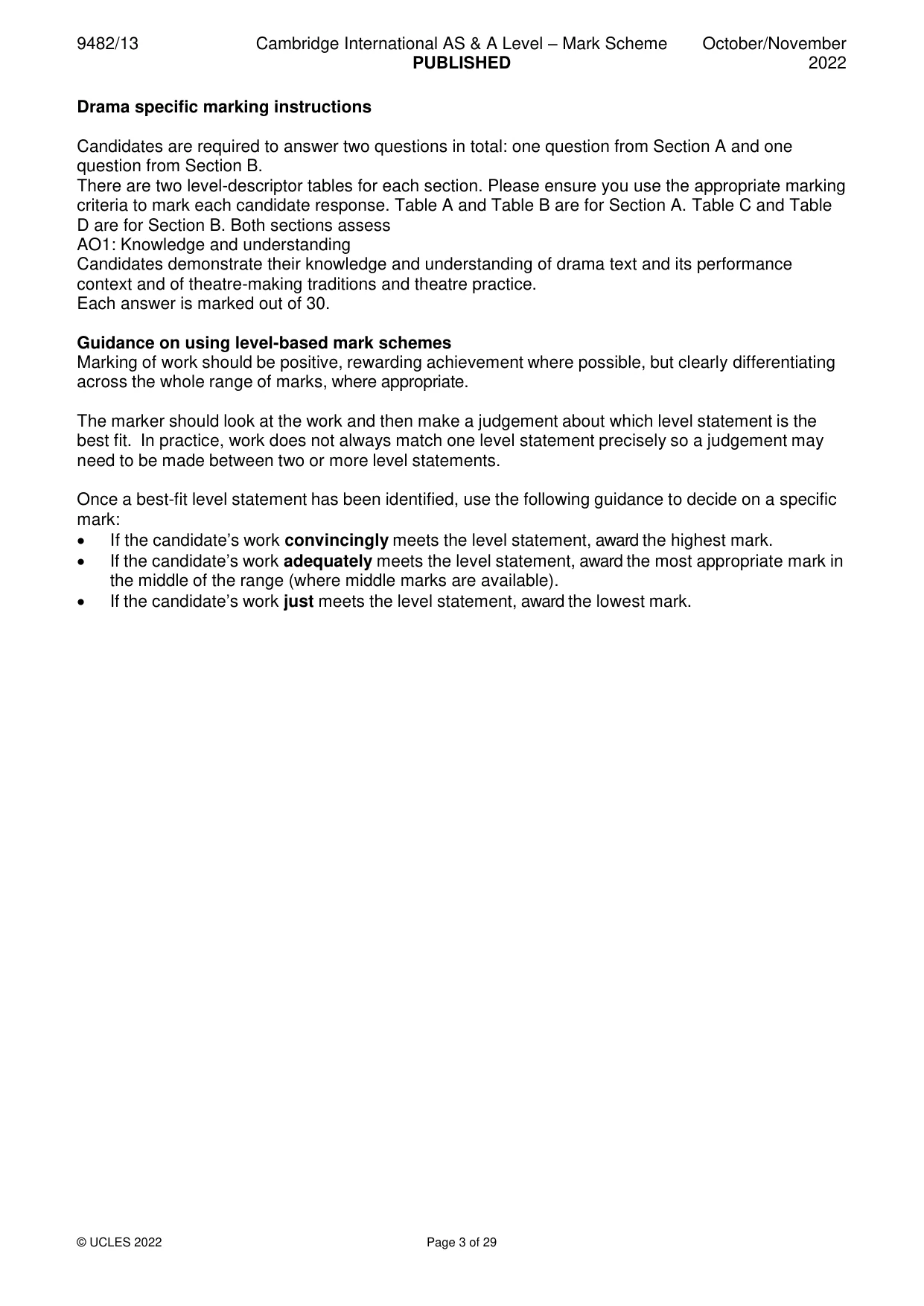
9482/13 Cambridge International AS & A Level – Mark Scheme PUBLISHED October/November 2022 © UCLES 2022 Page 3 of 29 Drama specific marking instructions Candidates are required to answer two questions in total: one question from Section A and one question from Section B. There are two level-descriptor tables for each section. Please ensure you use the appropriate marking criteria to mark each candidate response. Table A and Table B are for Section A. Table C and Table D are for Section B. Both sections assess AO1: Knowledge and understanding Candidates demonstrate their knowledge and understanding of drama text and its performance context and of theatre-making traditions and theatre practice. Each answer is marked out of 30. Guidance on using level-based mark schemes Marking of work should be positive, rewarding achievement where possible, but clearly differentiating across the whole range of marks, where appropriate. The marker should look at the work and then make a judgement about which level statement is the best fit. In practice, work does not always match one level statement precisely so a judgement may need to be made between two or more level statements. Once a best-fit level statement has been identified, use the following guidance to decide on a specific mark: • If the candidate’s work convincingly meets the level statement, award the highest mark. • If the candidate’s work adequately meets the level statement, award the most appropriate mark in the middle of the range (where middle marks are available). • If the candidate’s work just meets the level statement, award the lowest mark.
Mark scheme, page 4
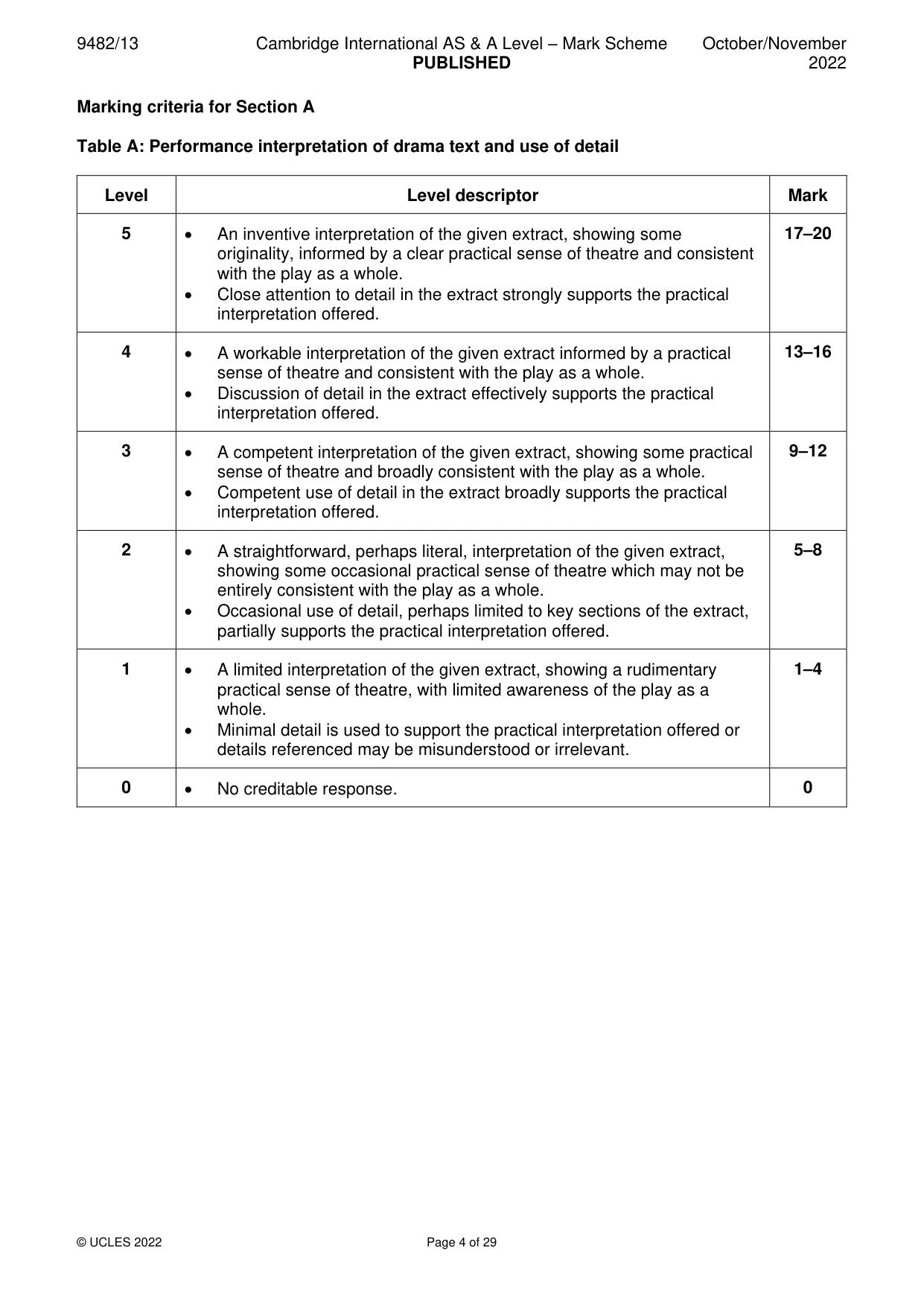
9482/13 Cambridge International AS & A Level – Mark Scheme PUBLISHED October/November 2022 © UCLES 2022 Page 4 of 29 Marking criteria for Section A Table A: Performance interpretation of drama text and use of detail Level Level descriptor Mark 5 • An inventive interpretation of the given extract, showing some originality, informed by a clear practical sense of theatre and consistent with the play as a whole. • Close attention to detail in the extract strongly supports the practical interpretation offered. 17–20 4 • A workable interpretation of the given extract informed by a practical sense of theatre and consistent with the play as a whole. • Discussion of detail in the extract effectively supports the practical interpretation offered. 13–16 3 • A competent interpretation of the given extract, showing some practical sense of theatre and broadly consistent with the play as a whole. • Competent use of detail in the extract broadly supports the practical interpretation offered. 9–12 2 • A straightforward, perhaps literal, interpretation of the given extract, showing some occasional practical sense of theatre which may not be entirely consistent with the play as a whole. • Occasional use of detail, perhaps limited to key sections of the extract, partially supports the practical interpretation offered. 5–8 1 • A limited interpretation of the given extract, showing a rudimentary practical sense of theatre, with limited awareness of the play as a whole. • Minimal detail is used to support the practical interpretation offered or details referenced may be misunderstood or irrelevant. 1–4 0 • No creditable response. 0
Mark scheme, page 5
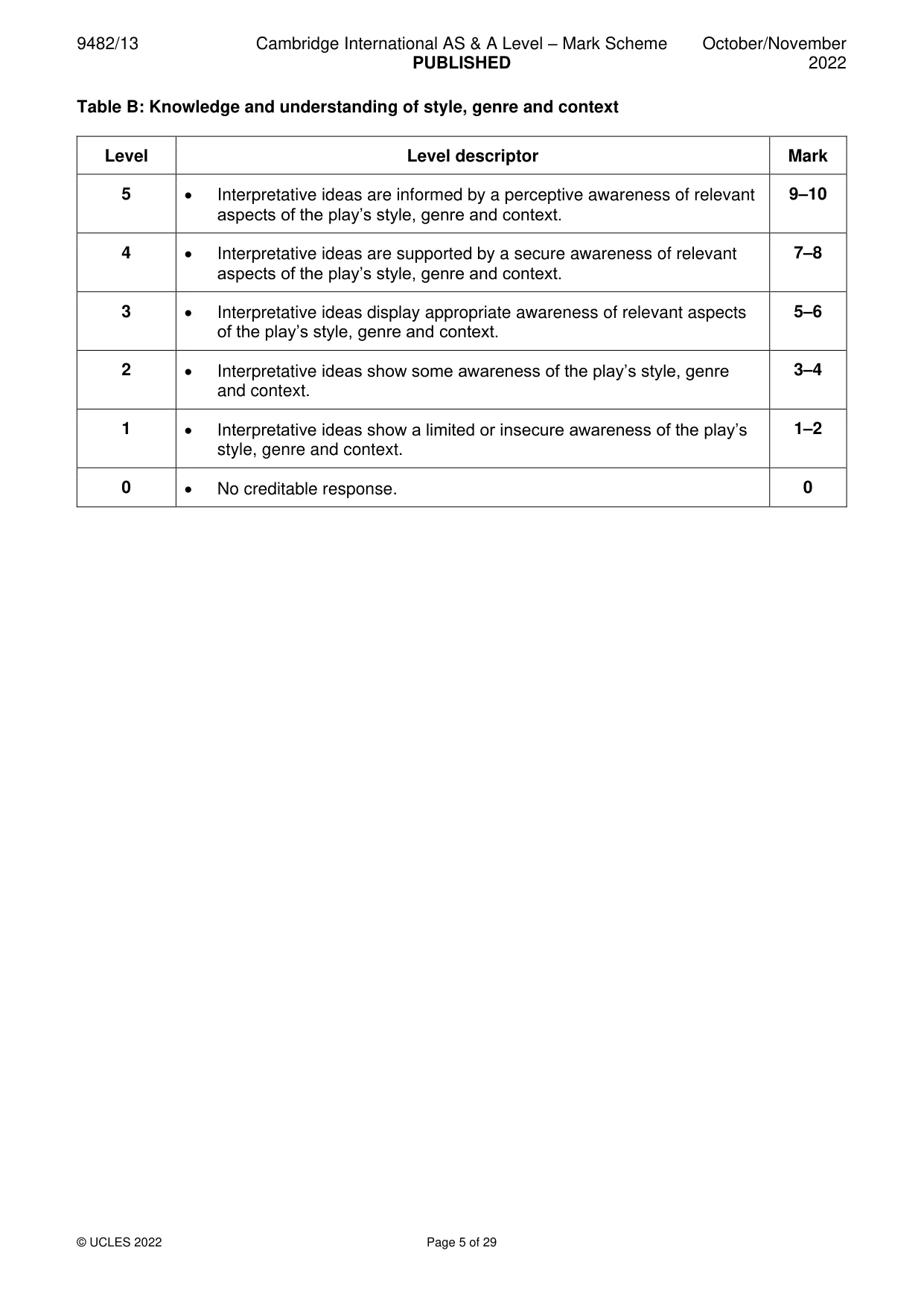
9482/13 Cambridge International AS & A Level – Mark Scheme PUBLISHED October/November 2022 © UCLES 2022 Page 5 of 29 Table B: Knowledge and understanding of style, genre and context Level Level descriptor Mark 5 • Interpretative ideas are informed by a perceptive awareness of relevant aspects of the play’s style, genre and context. 9–10 4 • Interpretative ideas are supported by a secure awareness of relevant aspects of the play’s style, genre and context. 7–8 3 • Interpretative ideas display appropriate awareness of relevant aspects of the play’s style, genre and context. 5–6 2 • Interpretative ideas show some awareness of the play’s style, genre and context. 3–4 1 • Interpretative ideas show a limited or insecure awareness of the play’s style, genre and context. 1–2 0 • No creditable response. 0
Mark scheme, page 6
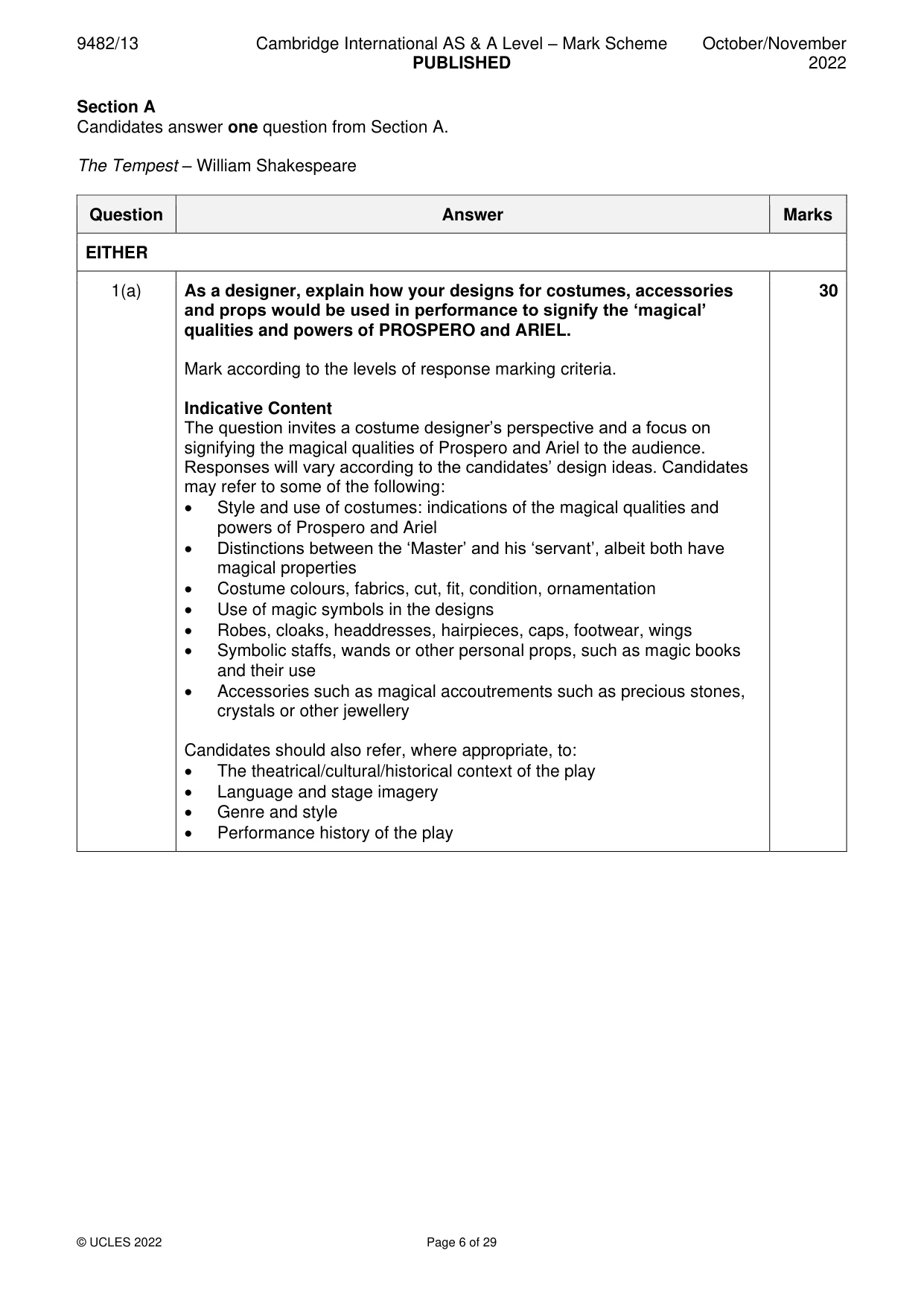
9482/13 Cambridge International AS & A Level – Mark Scheme PUBLISHED October/November 2022 © UCLES 2022 Page 6 of 29 Section A Candidates answer one question from Section A. The Tempest – William Shakespeare Question Answer Marks EITHER 1(a) As a designer, explain how your designs for costumes, accessories and props would be used in performance to signify the ‘magical’ qualities and powers of PROSPERO and ARIEL. Mark according to the levels of response marking criteria. Indicative Content The question invites a costume designer’s perspective and a focus on signifying the magical qualities of Prospero and Ariel to the audience. Responses will vary according to the candidates’ design ideas. Candidates may refer to some of the following: • Style and use of costumes: indications of the magical qualities and powers of Prospero and Ariel • Distinctions between the ‘Master’ and his ‘servant’, albeit both have magical properties • Costume colours, fabrics, cut, fit, condition, ornamentation • Use of magic symbols in the designs • Robes, cloaks, headdresses, hairpieces, caps, footwear, wings • Symbolic staffs, wands or other personal props, such as magic books and their use • Accessories such as magical accoutrements such as precious stones, crystals or other jewellery Candidates should also refer, where appropriate, to: • The theatrical/cultural/historical context of the play • Language and stage imagery • Genre and style • Performance history of the play 30
Mark scheme, page 7
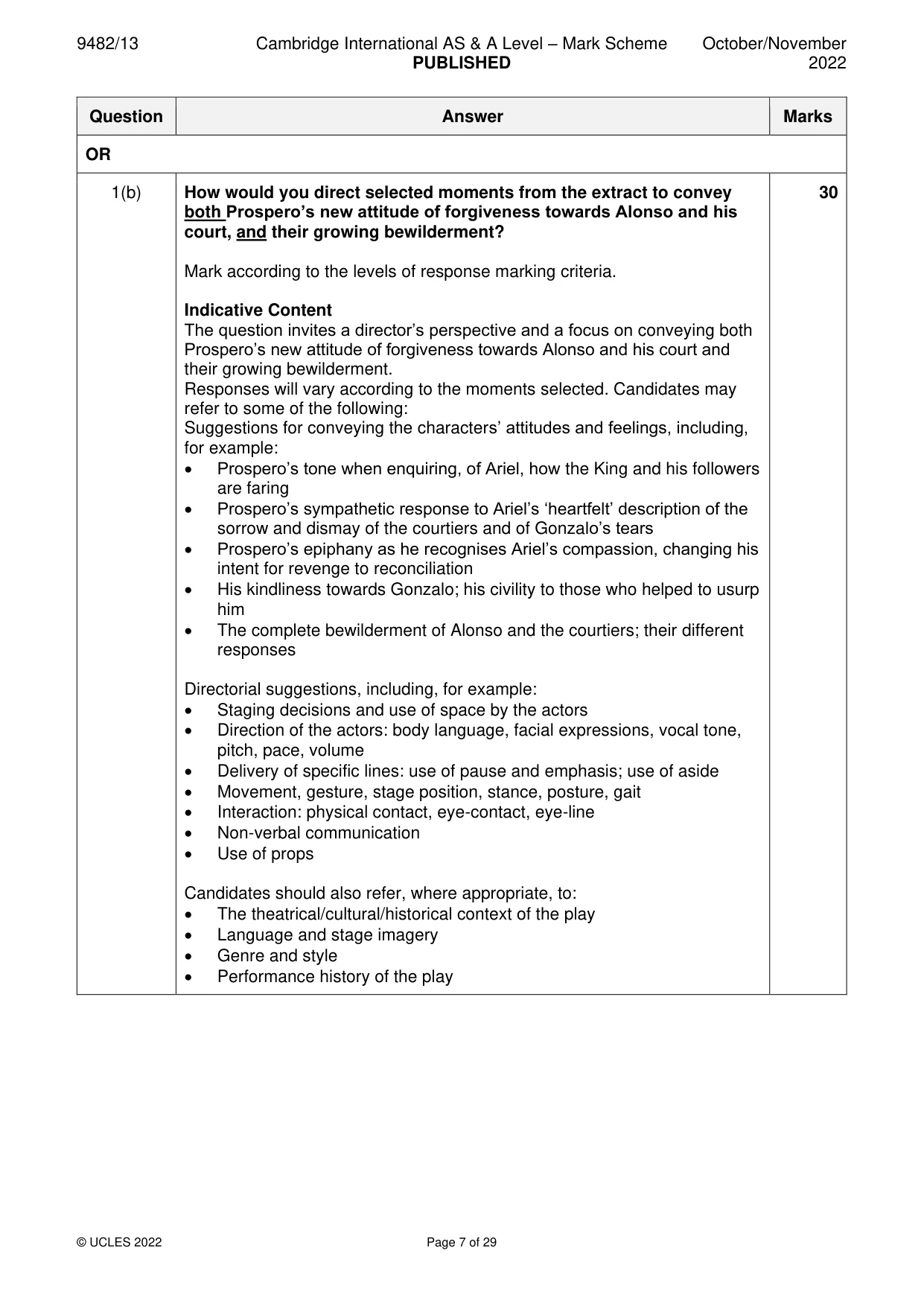
9482/13 Cambridge International AS & A Level – Mark Scheme PUBLISHED October/November 2022 © UCLES 2022 Page 7 of 29 Question Answer Marks OR 1(b) How would you direct selected moments from the extract to convey both Prospero’s new attitude of forgiveness towards Alonso and his court, and their growing bewilderment? Mark according to the levels of response marking criteria. Indicative Content The question invites a director’s perspective and a focus on conveying both Prospero’s new attitude of forgiveness towards Alonso and his court and their growing bewilderment. Responses will vary according to the moments selected. Candidates may refer to some of the following: Suggestions for conveying the characters’ attitudes and feelings, including, for example: • Prospero’s tone when enquiring, of Ariel, how the King and his followers are faring • Prospero’s sympathetic response to Ariel’s ‘heartfelt’ description of the sorrow and dismay of the courtiers and of Gonzalo’s tears • Prospero’s epiphany as he recognises Ariel’s compassion, changing his intent for revenge to reconciliation • His kindliness towards Gonzalo; his civility to those who helped to usurp him • The complete bewilderment of Alonso and the courtiers; their different responses Directorial suggestions, including, for example: • Staging decisions and use of space by the actors • Direction of the actors: body language, facial expressions, vocal tone, pitch, pace, volume • Delivery of specific lines: use of pause and emphasis; use of aside • Movement, gesture, stage position, stance, posture, gait • Interaction: physical contact, eye-contact, eye-line • Non-verbal communication • Use of props Candidates should also refer, where appropriate, to: • The theatrical/cultural/historical context of the play • Language and stage imagery • Genre and style • Performance history of the play 30
Mark scheme, page 8
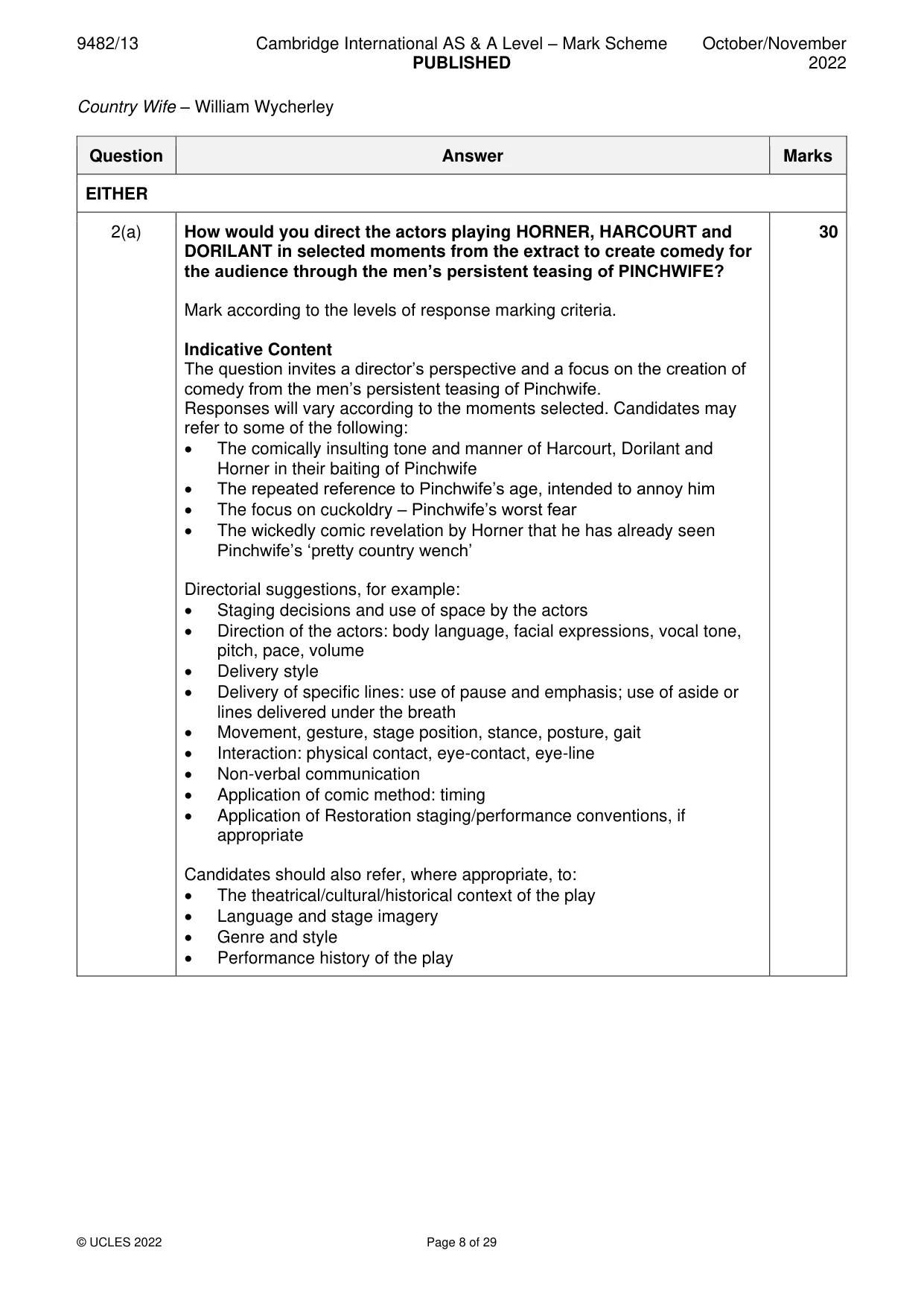
9482/13 Cambridge International AS & A Level – Mark Scheme PUBLISHED October/November 2022 © UCLES 2022 Page 8 of 29 Country Wife – William Wycherley Question Answer Marks EITHER 2(a) How would you direct the actors playing HORNER, HARCOURT and DORILANT in selected moments from the extract to create comedy for the audience through the men’s persistent teasing of PINCHWIFE? Mark according to the levels of response marking criteria. Indicative Content The question invites a director’s perspective and a focus on the creation of comedy from the men’s persistent teasing of Pinchwife. Responses will vary according to the moments selected. Candidates may refer to some of the following: • The comically insulting tone and manner of Harcourt, Dorilant and Horner in their baiting of Pinchwife • The repeated reference to Pinchwife’s age, intended to annoy him • The focus on cuckoldry – Pinchwife’s worst fear • The wickedly comic revelation by Horner that he has already seen Pinchwife’s ‘pretty country wench’ Directorial suggestions, for example: • Staging decisions and use of space by the actors • Direction of the actors: body language, facial expressions, vocal tone, pitch, pace, volume • Delivery style • Delivery of specific lines: use of pause and emphasis; use of aside or lines delivered under the breath • Movement, gesture, stage position, stance, posture, gait • Interaction: physical contact, eye-contact, eye-line • Non-verbal communication • Application of comic method: timing • Application of Restoration staging/performance conventions, if appropriate Candidates should also refer, where appropriate, to: • The theatrical/cultural/historical context of the play • Language and stage imagery • Genre and style • Performance history of the play 30
Mark scheme, page 9
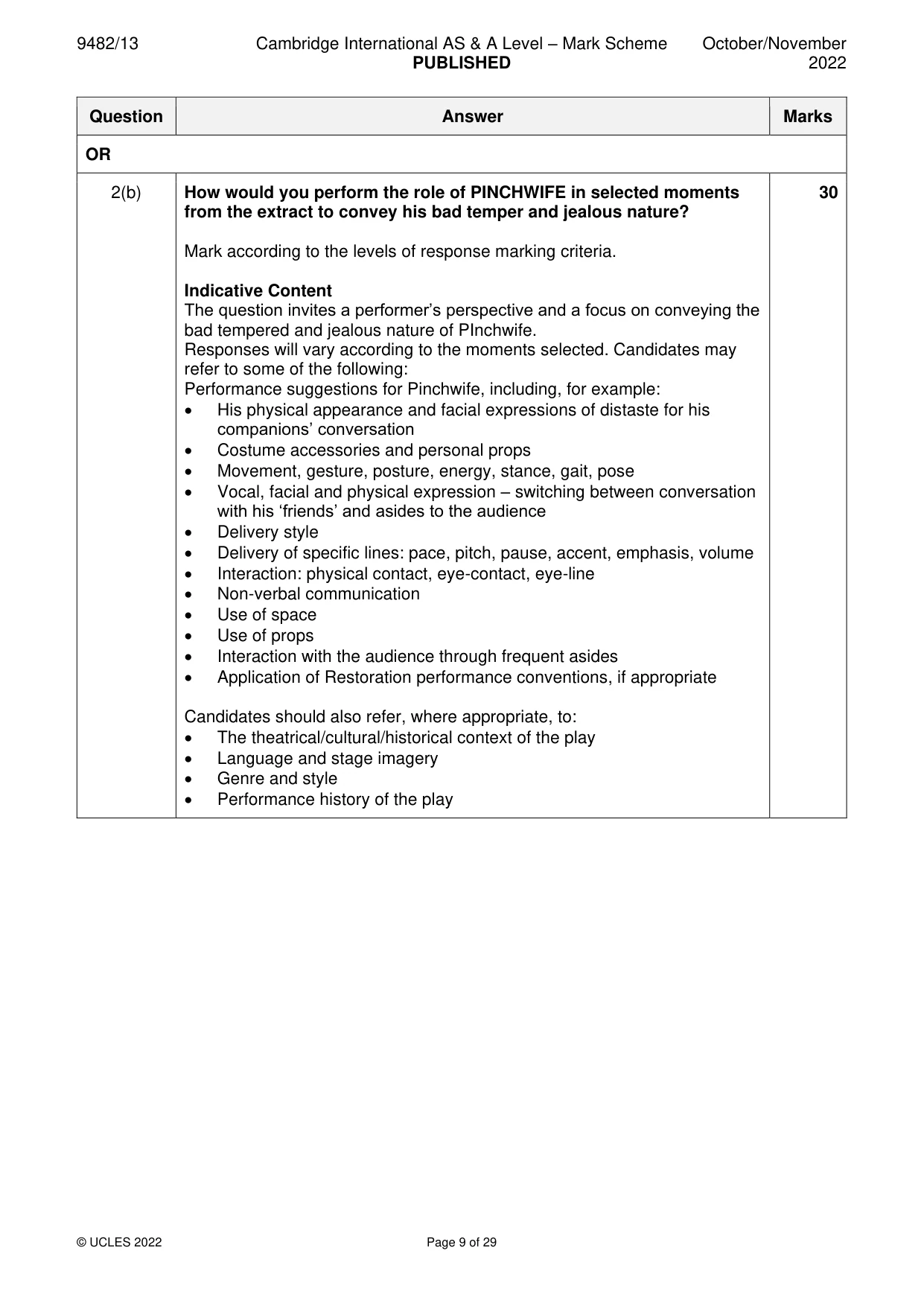
9482/13 Cambridge International AS & A Level – Mark Scheme PUBLISHED October/November 2022 © UCLES 2022 Page 9 of 29 Question Answer Marks OR 2(b) How would you perform the role of PINCHWIFE in selected moments from the extract to convey his bad temper and jealous nature? Mark according to the levels of response marking criteria. Indicative Content The question invites a performer’s perspective and a focus on conveying the bad tempered and jealous nature of PInchwife. Responses will vary according to the moments selected. Candidates may refer to some of the following: Performance suggestions for Pinchwife, including, for example: • His physical appearance and facial expressions of distaste for his companions’ conversation • Costume accessories and personal props • Movement, gesture, posture, energy, stance, gait, pose • Vocal, facial and physical expression – switching between conversation with his ‘friends’ and asides to the audience • Delivery style • Delivery of specific lines: pace, pitch, pause, accent, emphasis, volume • Interaction: physical contact, eye-contact, eye-line • Non-verbal communication • Use of space • Use of props • Interaction with the audience through frequent asides • Application of Restoration performance conventions, if appropriate Candidates should also refer, where appropriate, to: • The theatrical/cultural/historical context of the play • Language and stage imagery • Genre and style • Performance history of the play 30
Mark scheme, page 10
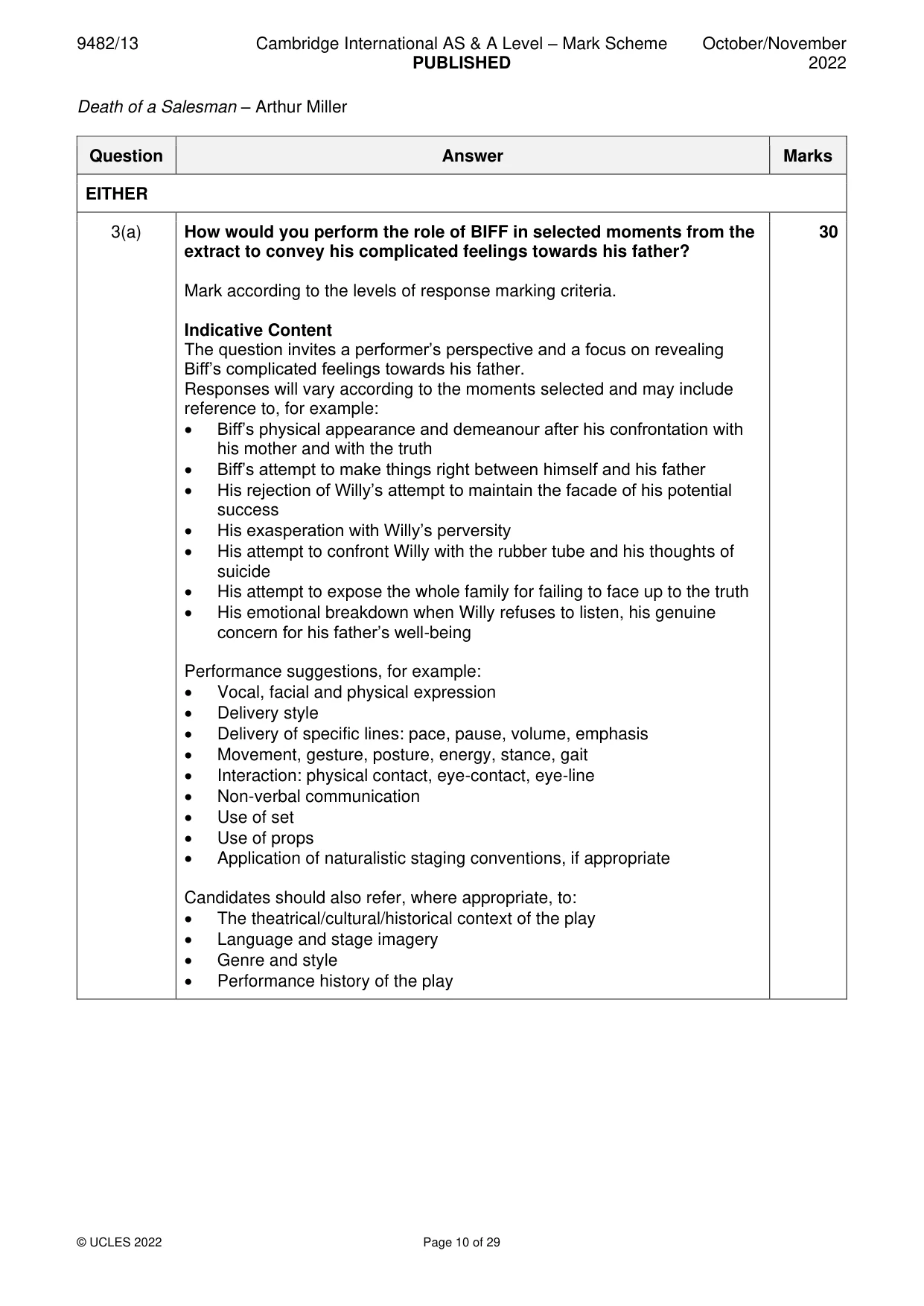
9482/13 Cambridge International AS & A Level – Mark Scheme PUBLISHED October/November 2022 © UCLES 2022 Page 10 of 29 Death of a Salesman – Arthur Miller Question Answer Marks EITHER 3(a) How would you perform the role of BIFF in selected moments from the extract to convey his complicated feelings towards his father? Mark according to the levels of response marking criteria. Indicative Content The question invites a performer’s perspective and a focus on revealing Biff’s complicated feelings towards his father. Responses will vary according to the moments selected and may include reference to, for example: • Biff’s physical appearance and demeanour after his confrontation with his mother and with the truth • Biff’s attempt to make things right between himself and his father • His rejection of Willy’s attempt to maintain the facade of his potential success • His exasperation with Willy’s perversity • His attempt to confront Willy with the rubber tube and his thoughts of suicide • His attempt to expose the whole family for failing to face up to the truth • His emotional breakdown when Willy refuses to listen, his genuine concern for his father’s well-being Performance suggestions, for example: • Vocal, facial and physical expression • Delivery style • Delivery of specific lines: pace, pause, volume, emphasis • Movement, gesture, posture, energy, stance, gait • Interaction: physical contact, eye-contact, eye-line • Non-verbal communication • Use of set • Use of props • Application of naturalistic staging conventions, if appropriate Candidates should also refer, where appropriate, to: • The theatrical/cultural/historical context of the play • Language and stage imagery • Genre and style • Performance history of the play 30
Mark scheme, page 11
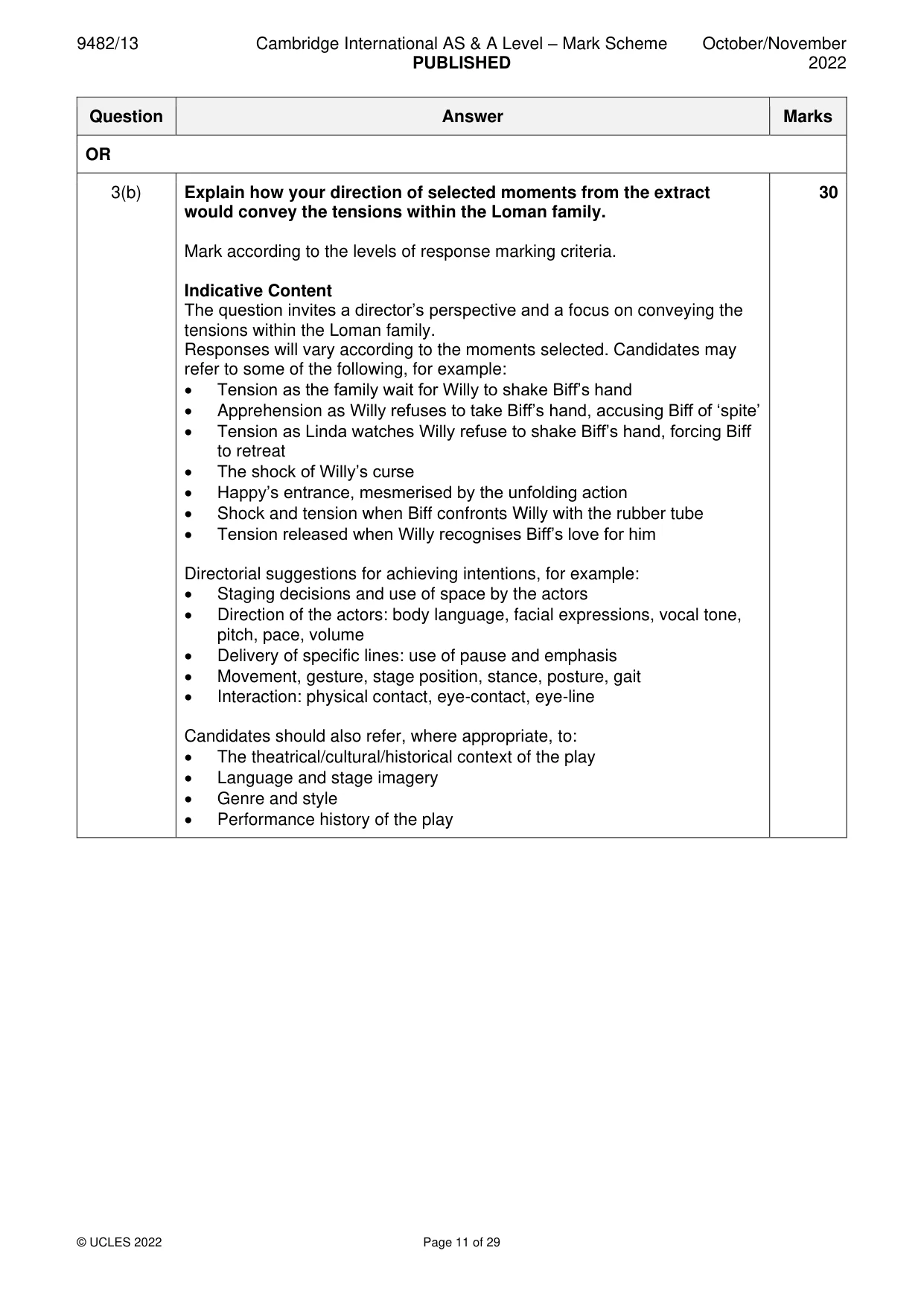
9482/13 Cambridge International AS & A Level – Mark Scheme PUBLISHED October/November 2022 © UCLES 2022 Page 11 of 29 Question Answer Marks OR 3(b) Explain how your direction of selected moments from the extract would convey the tensions within the Loman family. Mark according to the levels of response marking criteria. Indicative Content The question invites a director’s perspective and a focus on conveying the tensions within the Loman family. Responses will vary according to the moments selected. Candidates may refer to some of the following, for example: • Tension as the family wait for Willy to shake Biff’s hand • Apprehension as Willy refuses to take Biff’s hand, accusing Biff of ‘spite’ • Tension as Linda watches Willy refuse to shake Biff’s hand, forcing Biff to retreat • The shock of Willy’s curse • Happy’s entrance, mesmerised by the unfolding action • Shock and tension when Biff confronts Willy with the rubber tube • Tension released when Willy recognises Biff’s love for him Directorial suggestions for achieving intentions, for example: • Staging decisions and use of space by the actors • Direction of the actors: body language, facial expressions, vocal tone, pitch, pace, volume • Delivery of specific lines: use of pause and emphasis • Movement, gesture, stage position, stance, posture, gait • Interaction: physical contact, eye-contact, eye-line Candidates should also refer, where appropriate, to: • The theatrical/cultural/historical context of the play • Language and stage imagery • Genre and style • Performance history of the play 30
Mark scheme, page 12
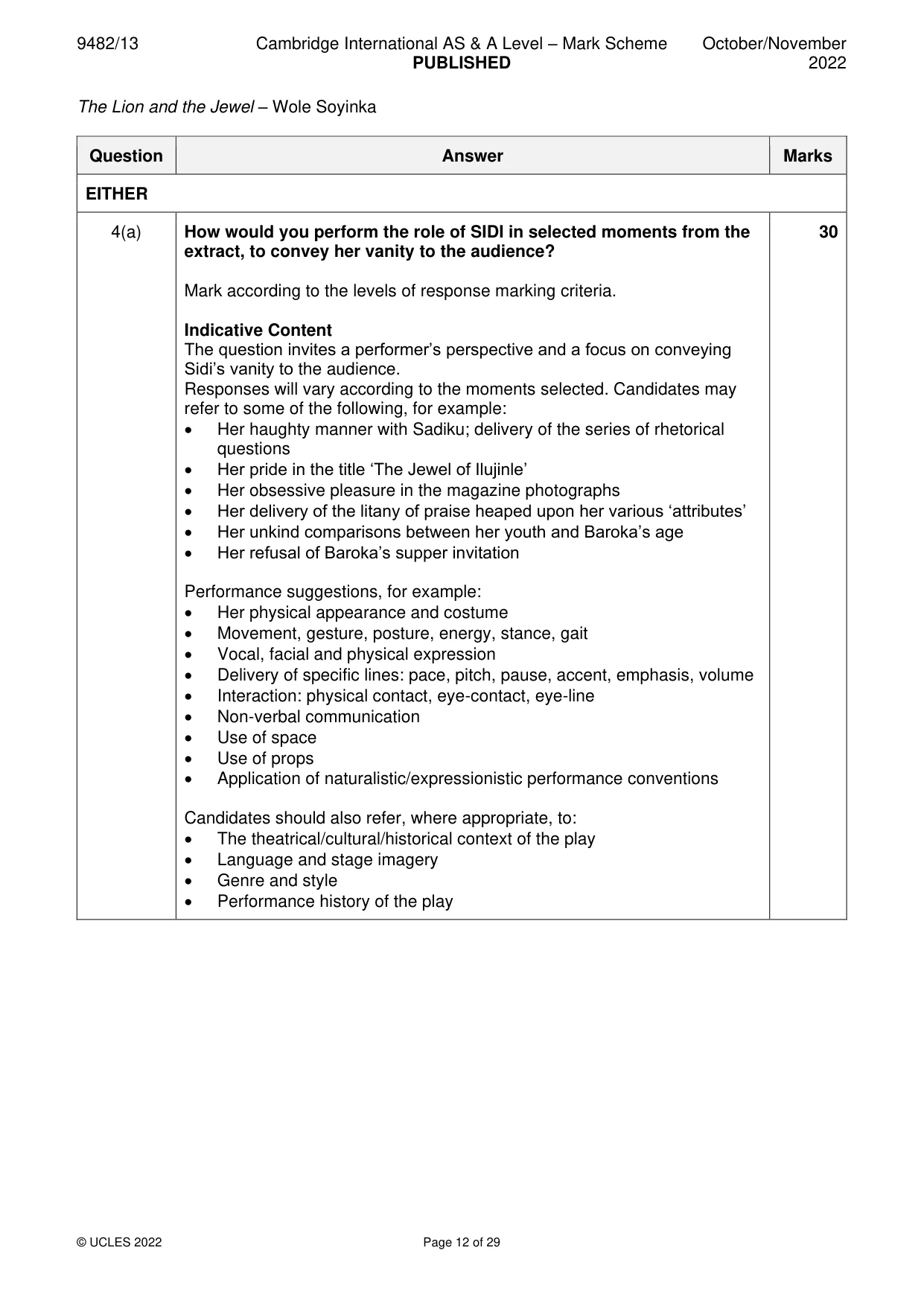
9482/13 Cambridge International AS & A Level – Mark Scheme PUBLISHED October/November 2022 © UCLES 2022 Page 12 of 29 The Lion and the Jewel – Wole Soyinka Question Answer Marks EITHER 4(a) How would you perform the role of SIDI in selected moments from the extract, to convey her vanity to the audience? Mark according to the levels of response marking criteria. Indicative Content The question invites a performer’s perspective and a focus on conveying Sidi’s vanity to the audience. Responses will vary according to the moments selected. Candidates may refer to some of the following, for example: • Her haughty manner with Sadiku; delivery of the series of rhetorical questions • Her pride in the title ‘The Jewel of Ilujinle’ • Her obsessive pleasure in the magazine photographs • Her delivery of the litany of praise heaped upon her various ‘attributes’ • Her unkind comparisons between her youth and Baroka’s age • Her refusal of Baroka’s supper invitation Performance suggestions, for example: • Her physical appearance and costume • Movement, gesture, posture, energy, stance, gait • Vocal, facial and physical expression • Delivery of specific lines: pace, pitch, pause, accent, emphasis, volume • Interaction: physical contact, eye-contact, eye-line • Non-verbal communication • Use of space • Use of props • Application of naturalistic/expressionistic performance conventions Candidates should also refer, where appropriate, to: • The theatrical/cultural/historical context of the play • Language and stage imagery • Genre and style • Performance history of the play 30
Mark scheme, page 13
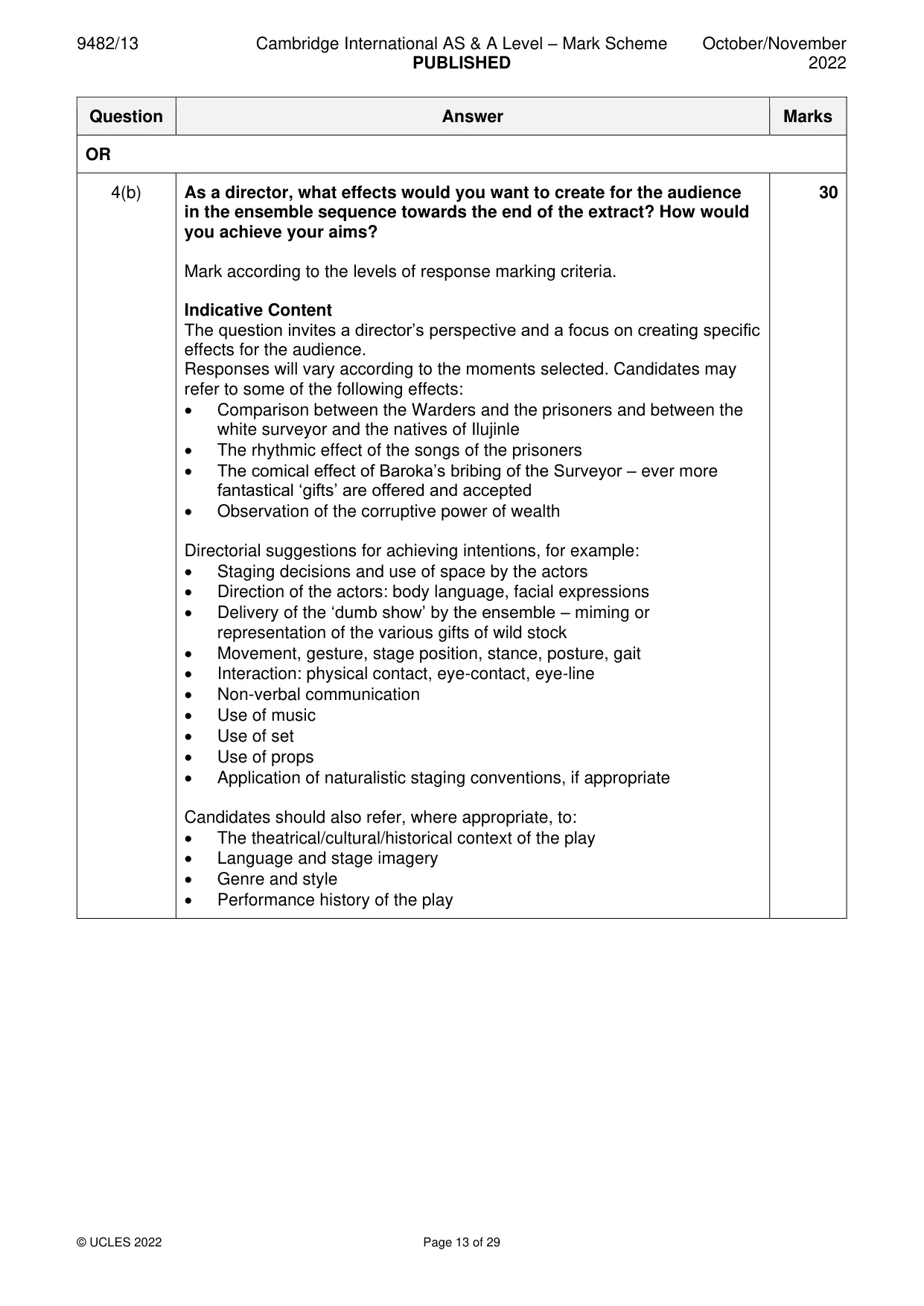
9482/13 Cambridge International AS & A Level – Mark Scheme PUBLISHED October/November 2022 © UCLES 2022 Page 13 of 29 Question Answer Marks OR 4(b) As a director, what effects would you want to create for the audience in the ensemble sequence towards the end of the extract? How would you achieve your aims? Mark according to the levels of response marking criteria. Indicative Content The question invites a director’s perspective and a focus on creating specific effects for the audience. Responses will vary according to the moments selected. Candidates may refer to some of the following effects: • Comparison between the Warders and the prisoners and between the white surveyor and the natives of Ilujinle • The rhythmic effect of the songs of the prisoners • The comical effect of Baroka’s bribing of the Surveyor – ever more fantastical ‘gifts’ are offered and accepted • Observation of the corruptive power of wealth Directorial suggestions for achieving intentions, for example: • Staging decisions and use of space by the actors • Direction of the actors: body language, facial expressions • Delivery of the ‘dumb show’ by the ensemble – miming or representation of the various gifts of wild stock • Movement, gesture, stage position, stance, posture, gait • Interaction: physical contact, eye-contact, eye-line • Non-verbal communication • Use of music • Use of set • Use of props • Application of naturalistic staging conventions, if appropriate Candidates should also refer, where appropriate, to: • The theatrical/cultural/historical context of the play • Language and stage imagery • Genre and style • Performance history of the play 30
Mark scheme, page 14
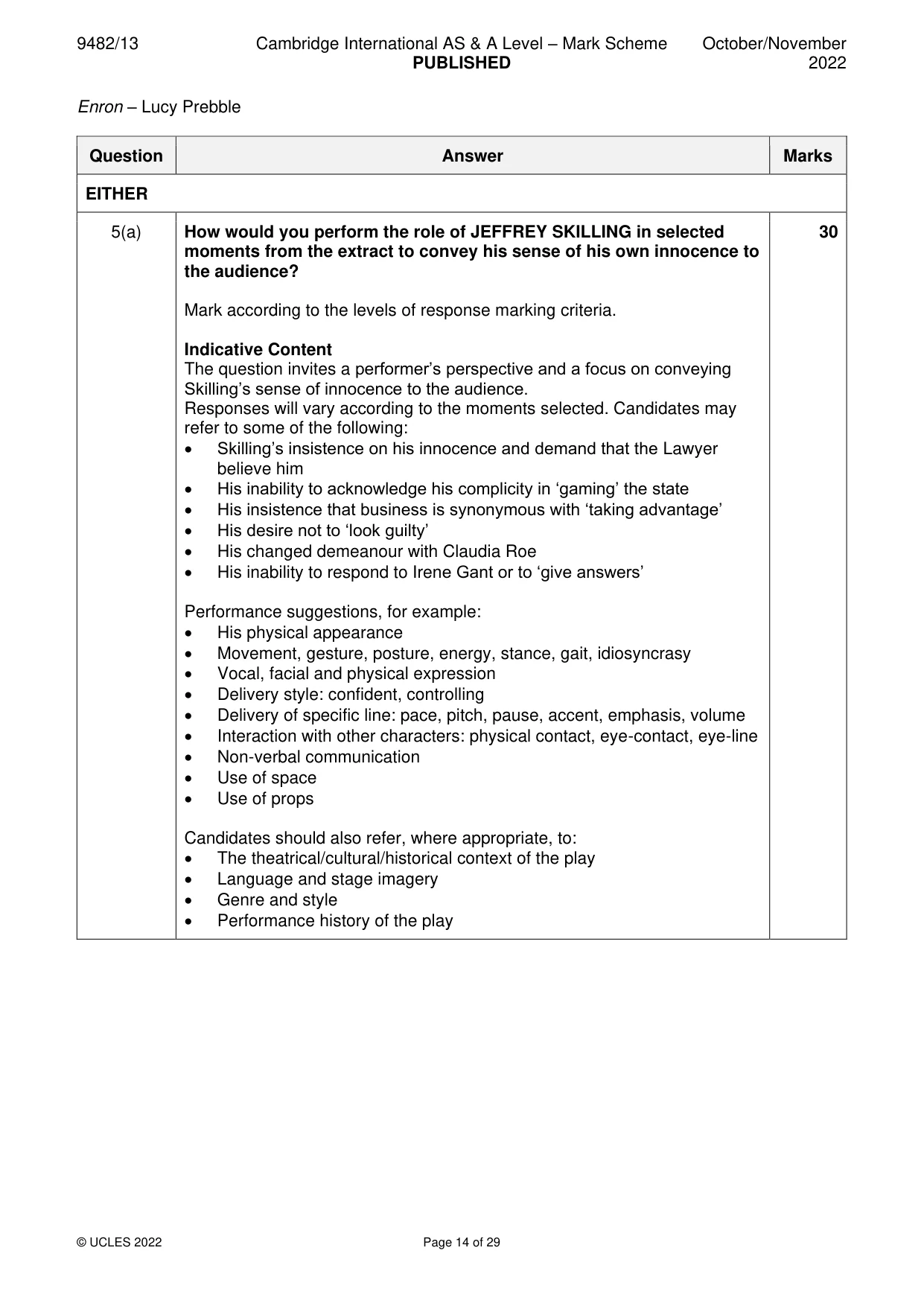
9482/13 Cambridge International AS & A Level – Mark Scheme PUBLISHED October/November 2022 © UCLES 2022 Page 14 of 29 Enron – Lucy Prebble Question Answer Marks EITHER 5(a) How would you perform the role of JEFFREY SKILLING in selected moments from the extract to convey his sense of his own innocence to the audience? Mark according to the levels of response marking criteria. Indicative Content The question invites a performer’s perspective and a focus on conveying Skilling’s sense of innocence to the audience. Responses will vary according to the moments selected. Candidates may refer to some of the following: • Skilling’s insistence on his innocence and demand that the Lawyer believe him • His inability to acknowledge his complicity in ‘gaming’ the state • His insistence that business is synonymous with ‘taking advantage’ • His desire not to ‘look guilty’ • His changed demeanour with Claudia Roe • His inability to respond to Irene Gant or to ‘give answers’ Performance suggestions, for example: • His physical appearance • Movement, gesture, posture, energy, stance, gait, idiosyncrasy • Vocal, facial and physical expression • Delivery style: confident, controlling • Delivery of specific line: pace, pitch, pause, accent, emphasis, volume • Interaction with other characters: physical contact, eye-contact, eye-line • Non-verbal communication • Use of space • Use of props Candidates should also refer, where appropriate, to: • The theatrical/cultural/historical context of the play • Language and stage imagery • Genre and style • Performance history of the play 30
Mark scheme, page 15
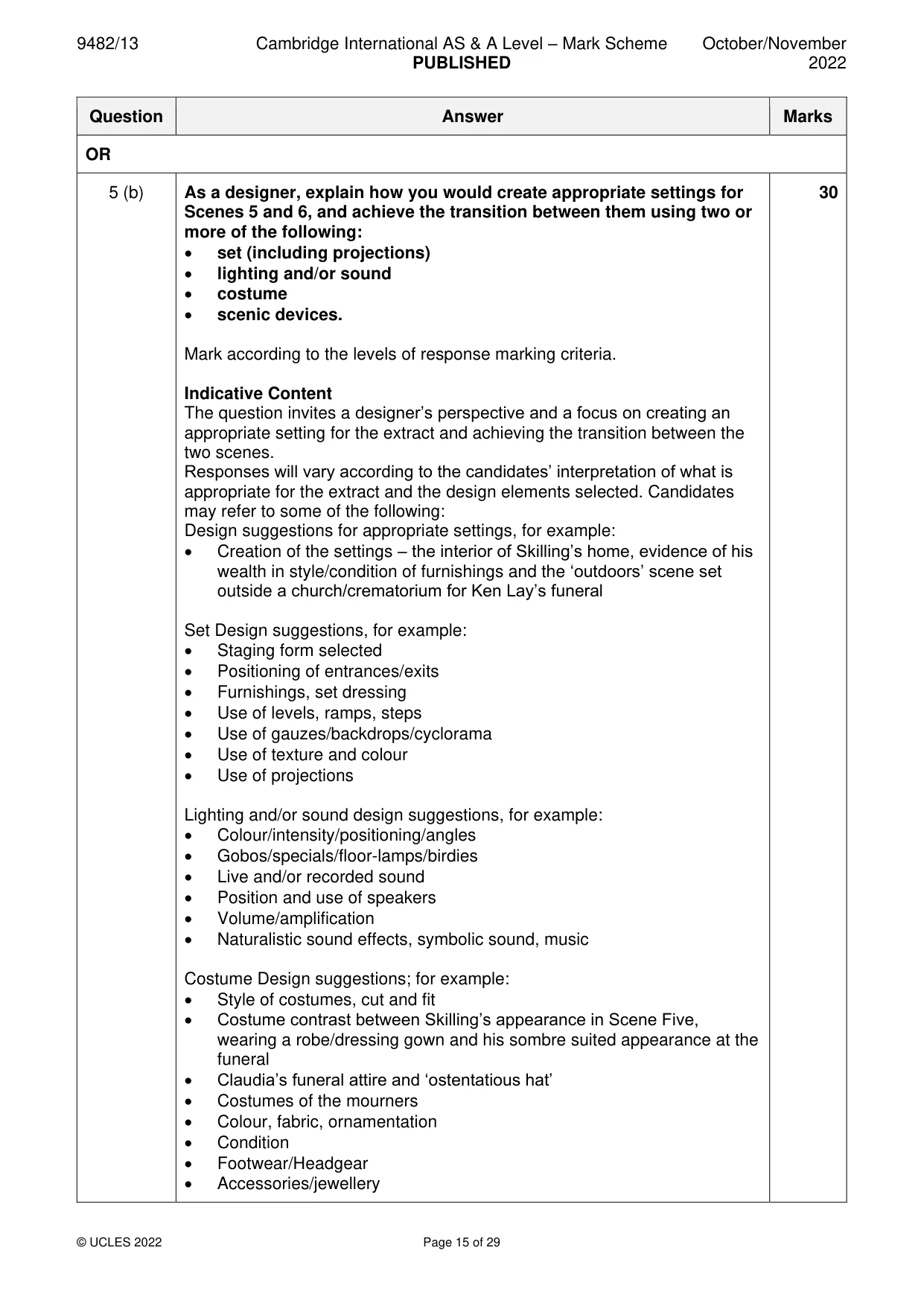
9482/13 Cambridge International AS & A Level – Mark Scheme PUBLISHED October/November 2022 © UCLES 2022 Page 15 of 29 Question Answer Marks OR 5 (b) As a designer, explain how you would create appropriate settings for Scenes 5 and 6, and achieve the transition between them using two or more of the following: • set (including projections) • lighting and/or sound • costume • scenic devices. Mark according to the levels of response marking criteria. Indicative Content The question invites a designer’s perspective and a focus on creating an appropriate setting for the extract and achieving the transition between the two scenes. Responses will vary according to the candidates’ interpretation of what is appropriate for the extract and the design elements selected. Candidates may refer to some of the following: Design suggestions for appropriate settings, for example: • Creation of the settings – the interior of Skilling’s home, evidence of his wealth in style/condition of furnishings and the ‘outdoors’ scene set outside a church/crematorium for Ken Lay’s funeral Set Design suggestions, for example: • Staging form selected • Positioning of entrances/exits • Furnishings, set dressing • Use of levels, ramps, steps • Use of gauzes/backdrops/cyclorama • Use of texture and colour • Use of projections Lighting and/or sound design suggestions, for example: • Colour/intensity/positioning/angles • Gobos/specials/floor-lamps/birdies • Live and/or recorded sound • Position and use of speakers • Volume/amplification • Naturalistic sound effects, symbolic sound, music Costume Design suggestions; for example: • Style of costumes, cut and fit • Costume contrast between Skilling’s appearance in Scene Five, wearing a robe/dressing gown and his sombre suited appearance at the funeral • Claudia’s funeral attire and ‘ostentatious hat’ • Costumes of the mourners • Colour, fabric, ornamentation • Condition • Footwear/Headgear • Accessories/jewellery 30
Mark scheme, page 16
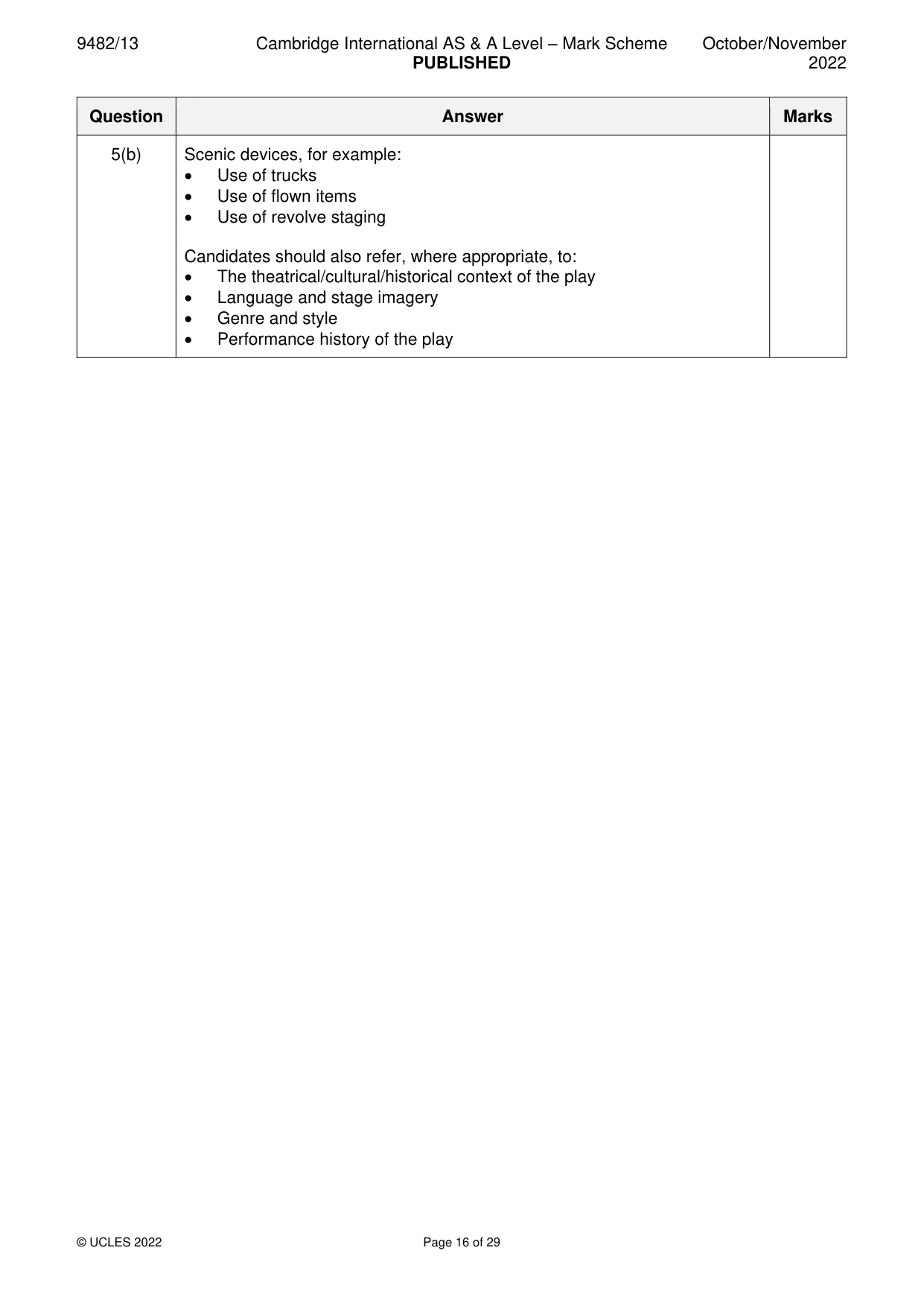
9482/13 Cambridge International AS & A Level – Mark Scheme PUBLISHED October/November 2022 © UCLES 2022 Page 16 of 29 Question Answer Marks 5(b) Scenic devices, for example: • Use of trucks • Use of flown items • Use of revolve staging Candidates should also refer, where appropriate, to: • The theatrical/cultural/historical context of the play • Language and stage imagery • Genre and style • Performance history of the play
Mark scheme, page 17
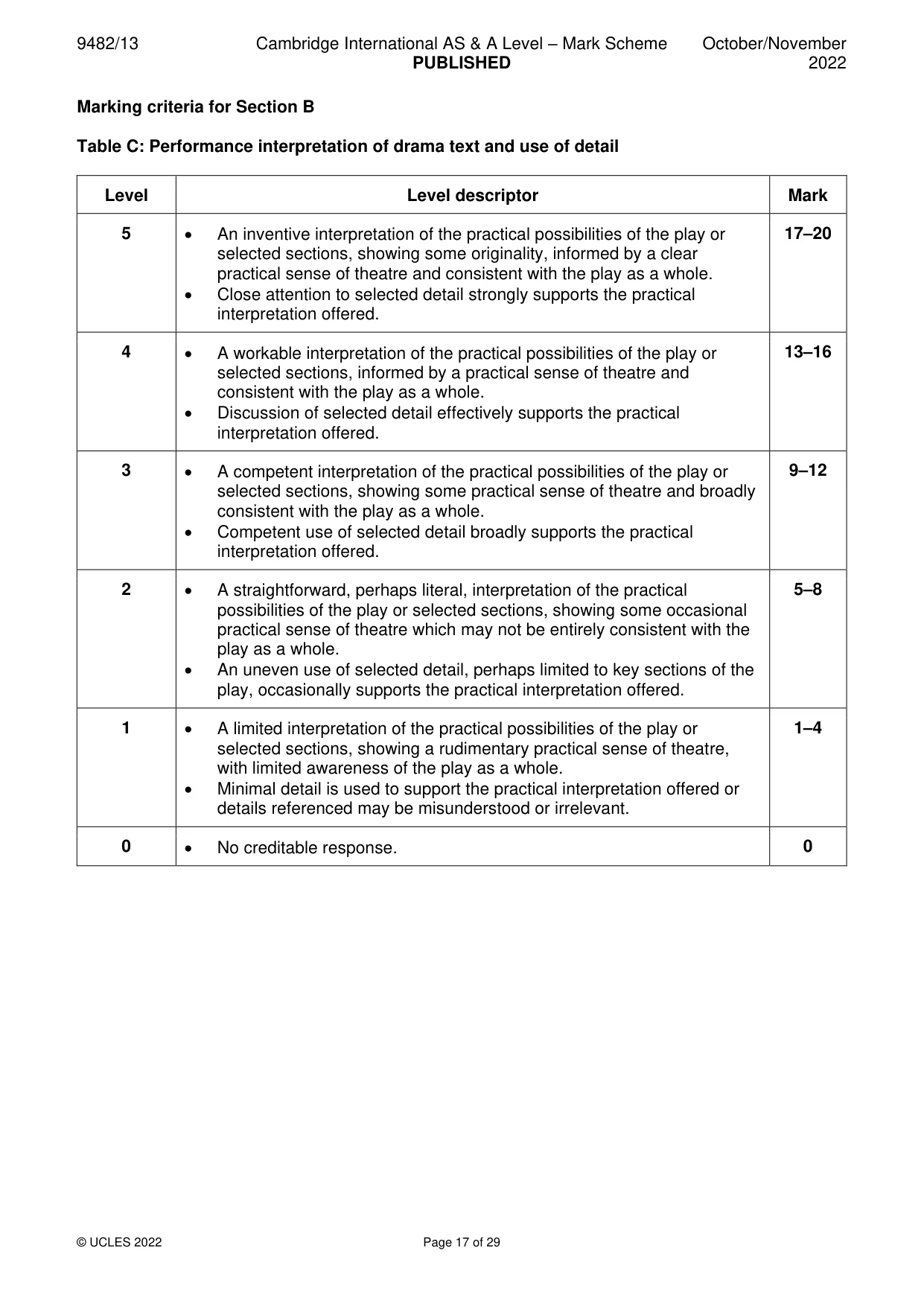
9482/13 Cambridge International AS & A Level – Mark Scheme PUBLISHED October/November 2022 © UCLES 2022 Page 17 of 29 Marking criteria for Section B Table C: Performance interpretation of drama text and use of detail Level Level descriptor Mark 5 • An inventive interpretation of the practical possibilities of the play or selected sections, showing some originality, informed by a clear practical sense of theatre and consistent with the play as a whole. • Close attention to selected detail strongly supports the practical interpretation offered. 17–20 4 • A workable interpretation of the practical possibilities of the play or selected sections, informed by a practical sense of theatre and consistent with the play as a whole. • Discussion of selected detail effectively supports the practical interpretation offered. 13–16 3 • A competent interpretation of the practical possibilities of the play or selected sections, showing some practical sense of theatre and broadly consistent with the play as a whole. • Competent use of selected detail broadly supports the practical interpretation offered. 9–12 2 • A straightforward, perhaps literal, interpretation of the practical possibilities of the play or selected sections, showing some occasional practical sense of theatre which may not be entirely consistent with the play as a whole. • An uneven use of selected detail, perhaps limited to key sections of the play, occasionally supports the practical interpretation offered. 5–8 1 • A limited interpretation of the practical possibilities of the play or selected sections, showing a rudimentary practical sense of theatre, with limited awareness of the play as a whole. • Minimal detail is used to support the practical interpretation offered or details referenced may be misunderstood or irrelevant. 1–4 0 • No creditable response. 0
Mark scheme, page 18
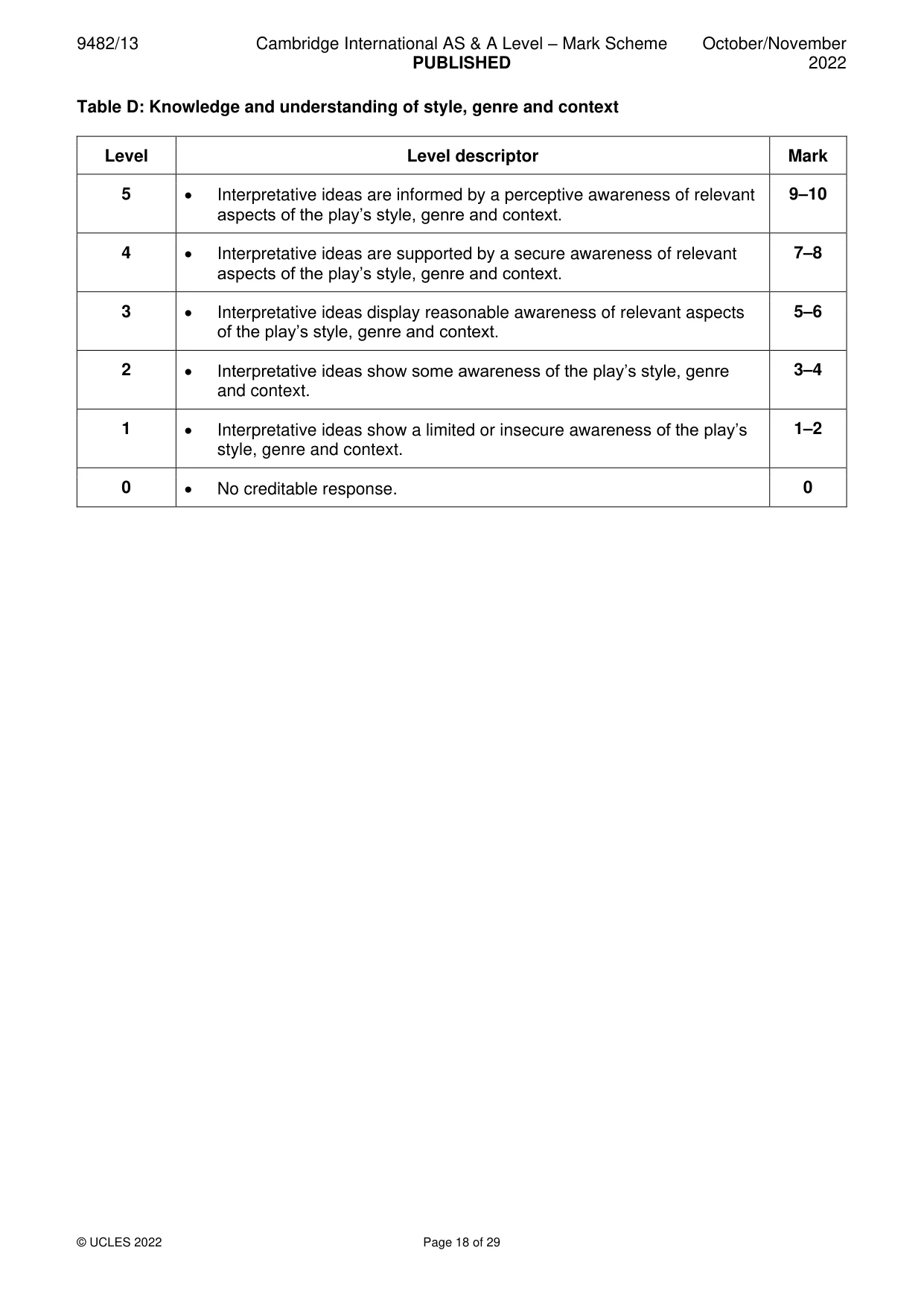
9482/13 Cambridge International AS & A Level – Mark Scheme PUBLISHED October/November 2022 © UCLES 2022 Page 18 of 29 Table D: Knowledge and understanding of style, genre and context Level Level descriptor Mark 5 • Interpretative ideas are informed by a perceptive awareness of relevant aspects of the play’s style, genre and context. 9–10 4 • Interpretative ideas are supported by a secure awareness of relevant aspects of the play’s style, genre and context. 7–8 3 • Interpretative ideas display reasonable awareness of relevant aspects of the play’s style, genre and context. 5–6 2 • Interpretative ideas show some awareness of the play’s style, genre and context. 3–4 1 • Interpretative ideas show a limited or insecure awareness of the play’s style, genre and context. 1–2 0 • No creditable response. 0
Mark scheme, page 19
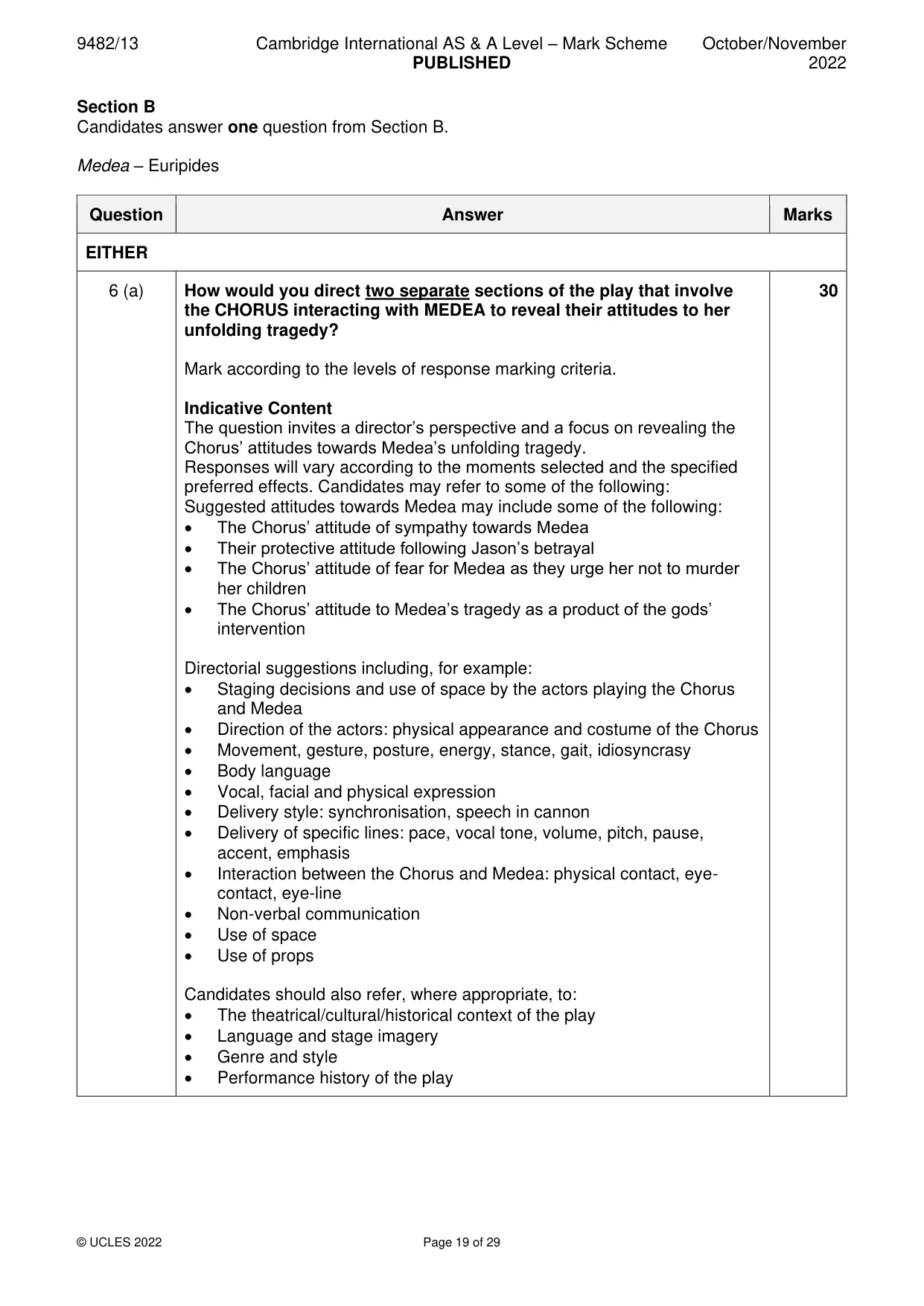
9482/13 Cambridge International AS & A Level – Mark Scheme PUBLISHED October/November 2022 © UCLES 2022 Page 19 of 29 Section B Candidates answer one question from Section B. Medea – Euripides Question Answer Marks EITHER 6 (a) How would you direct two separate sections of the play that involve the CHORUS interacting with MEDEA to reveal their attitudes to her unfolding tragedy? Mark according to the levels of response marking criteria. Indicative Content The question invites a director’s perspective and a focus on revealing the Chorus’ attitudes towards Medea’s unfolding tragedy. Responses will vary according to the moments selected and the specified preferred effects. Candidates may refer to some of the following: Suggested attitudes towards Medea may include some of the following: • The Chorus’ attitude of sympathy towards Medea • Their protective attitude following Jason’s betrayal • The Chorus’ attitude of fear for Medea as they urge her not to murder her children • The Chorus’ attitude to Medea’s tragedy as a product of the gods’ intervention Directorial suggestions including, for example: • Staging decisions and use of space by the actors playing the Chorus and Medea • Direction of the actors: physical appearance and costume of the Chorus • Movement, gesture, posture, energy, stance, gait, idiosyncrasy • Body language • Vocal, facial and physical expression • Delivery style: synchronisation, speech in cannon • Delivery of specific lines: pace, vocal tone, volume, pitch, pause, accent, emphasis • Interaction between the Chorus and Medea: physical contact, eye- contact, eye-line • Non-verbal communication • Use of space • Use of props Candidates should also refer, where appropriate, to: • The theatrical/cultural/historical context of the play • Language and stage imagery • Genre and style • Performance history of the play 30
Mark scheme, page 20
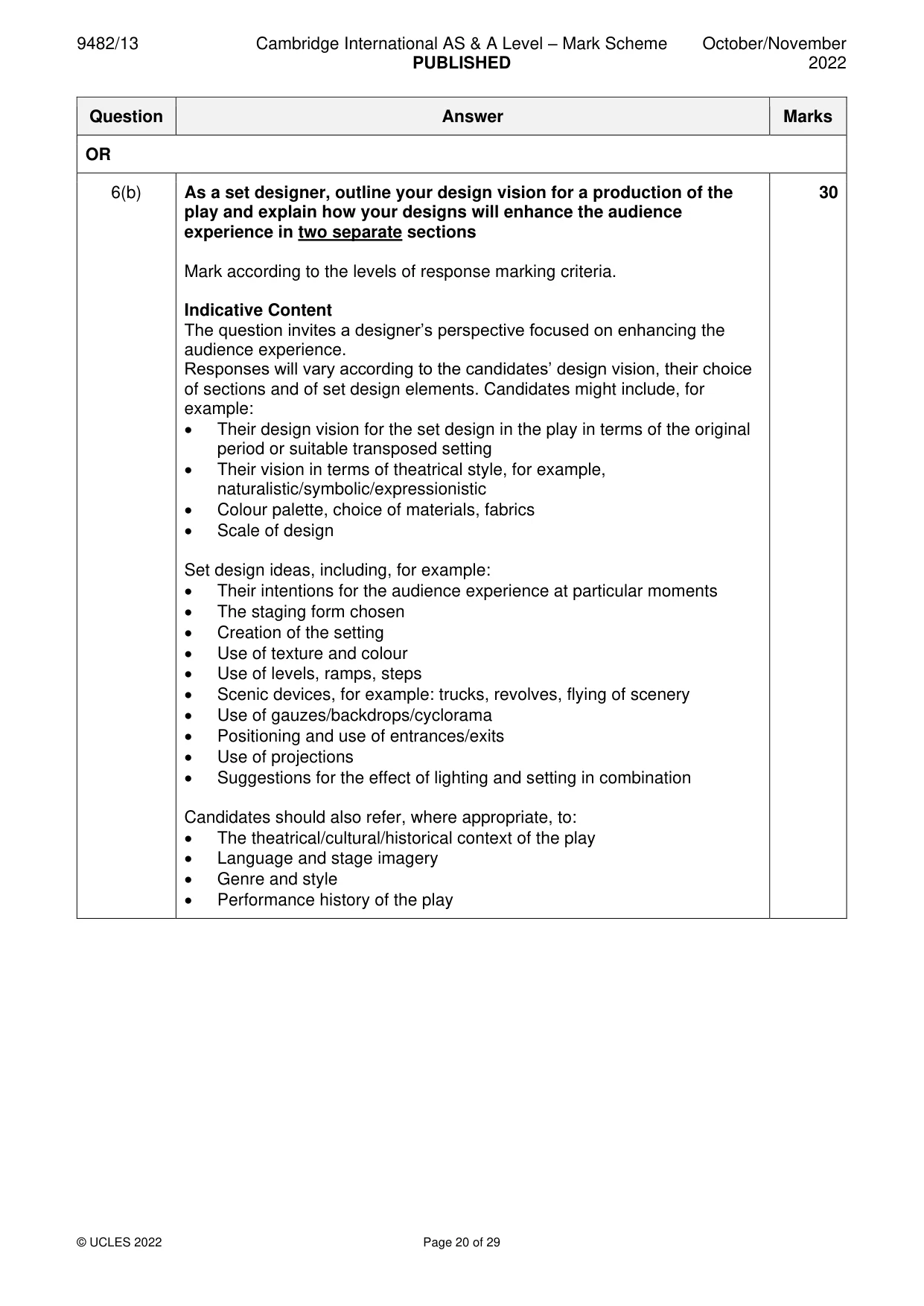
9482/13 Cambridge International AS & A Level – Mark Scheme PUBLISHED October/November 2022 © UCLES 2022 Page 20 of 29 Question Answer Marks OR 6(b) As a set designer, outline your design vision for a production of the play and explain how your designs will enhance the audience experience in two separate sections Mark according to the levels of response marking criteria. Indicative Content The question invites a designer’s perspective focused on enhancing the audience experience. Responses will vary according to the candidates’ design vision, their choice of sections and of set design elements. Candidates might include, for example: • Their design vision for the set design in the play in terms of the original period or suitable transposed setting • Their vision in terms of theatrical style, for example, naturalistic/symbolic/expressionistic • Colour palette, choice of materials, fabrics • Scale of design Set design ideas, including, for example: • Their intentions for the audience experience at particular moments • The staging form chosen • Creation of the setting • Use of texture and colour • Use of levels, ramps, steps • Scenic devices, for example: trucks, revolves, flying of scenery • Use of gauzes/backdrops/cyclorama • Positioning and use of entrances/exits • Use of projections • Suggestions for the effect of lighting and setting in combination Candidates should also refer, where appropriate, to: • The theatrical/cultural/historical context of the play • Language and stage imagery • Genre and style • Performance history of the play 30
Mark scheme, page 21
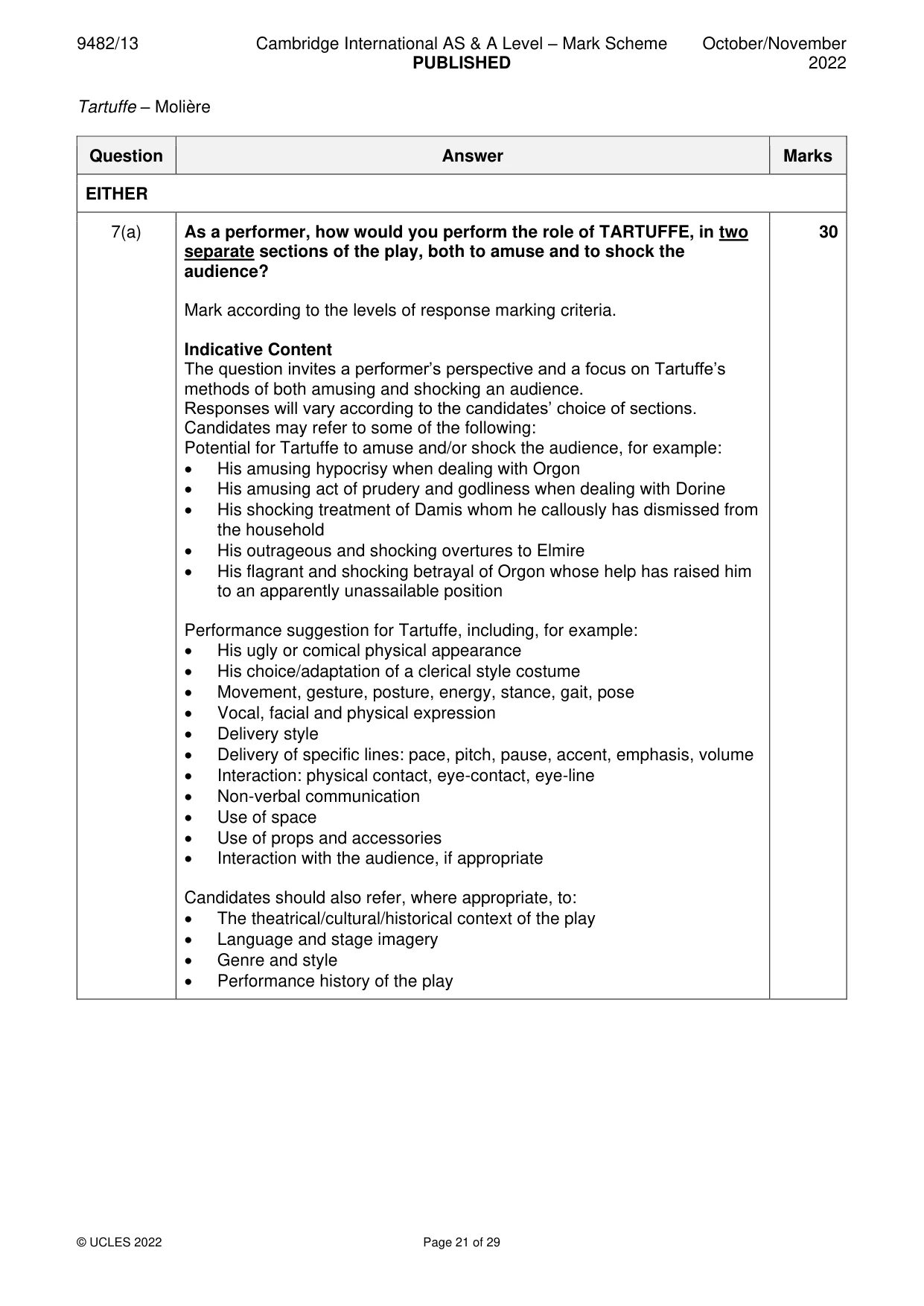
9482/13 Cambridge International AS & A Level – Mark Scheme PUBLISHED October/November 2022 © UCLES 2022 Page 21 of 29 Tartuffe – Molière Question Answer Marks EITHER 7(a) As a performer, how would you perform the role of TARTUFFE, in two separate sections of the play, both to amuse and to shock the audience? Mark according to the levels of response marking criteria. Indicative Content The question invites a performer’s perspective and a focus on Tartuffe’s methods of both amusing and shocking an audience. Responses will vary according to the candidates’ choice of sections. Candidates may refer to some of the following: Potential for Tartuffe to amuse and/or shock the audience, for example: • His amusing hypocrisy when dealing with Orgon • His amusing act of prudery and godliness when dealing with Dorine • His shocking treatment of Damis whom he callously has dismissed from the household • His outrageous and shocking overtures to Elmire • His flagrant and shocking betrayal of Orgon whose help has raised him to an apparently unassailable position Performance suggestion for Tartuffe, including, for example: • His ugly or comical physical appearance • His choice/adaptation of a clerical style costume • Movement, gesture, posture, energy, stance, gait, pose • Vocal, facial and physical expression • Delivery style • Delivery of specific lines: pace, pitch, pause, accent, emphasis, volume • Interaction: physical contact, eye-contact, eye-line • Non-verbal communication • Use of space • Use of props and accessories • Interaction with the audience, if appropriate Candidates should also refer, where appropriate, to: • The theatrical/cultural/historical context of the play • Language and stage imagery • Genre and style • Performance history of the play 30
Mark scheme, page 22
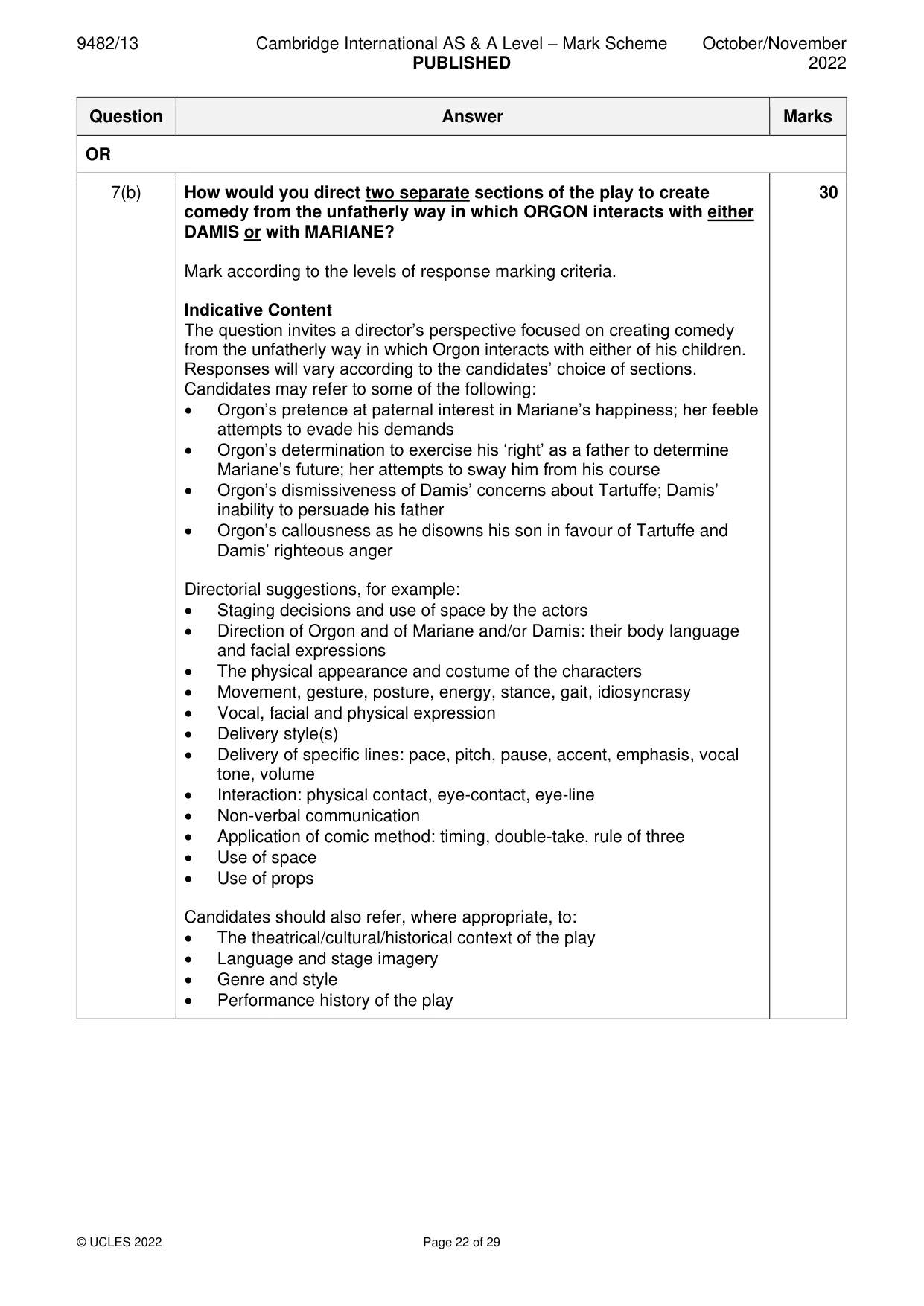
9482/13 Cambridge International AS & A Level – Mark Scheme PUBLISHED October/November 2022 © UCLES 2022 Page 22 of 29 Question Answer Marks OR 7(b) How would you direct two separate sections of the play to create comedy from the unfatherly way in which ORGON interacts with either DAMIS or with MARIANE? Mark according to the levels of response marking criteria. Indicative Content The question invites a director’s perspective focused on creating comedy from the unfatherly way in which Orgon interacts with either of his children. Responses will vary according to the candidates’ choice of sections. Candidates may refer to some of the following: • Orgon’s pretence at paternal interest in Mariane’s happiness; her feeble attempts to evade his demands • Orgon’s determination to exercise his ‘right’ as a father to determine Mariane’s future; her attempts to sway him from his course • Orgon’s dismissiveness of Damis’ concerns about Tartuffe; Damis’ inability to persuade his father • Orgon’s callousness as he disowns his son in favour of Tartuffe and Damis’ righteous anger Directorial suggestions, for example: • Staging decisions and use of space by the actors • Direction of Orgon and of Mariane and/or Damis: their body language and facial expressions • The physical appearance and costume of the characters • Movement, gesture, posture, energy, stance, gait, idiosyncrasy • Vocal, facial and physical expression • Delivery style(s) • Delivery of specific lines: pace, pitch, pause, accent, emphasis, vocal tone, volume • Interaction: physical contact, eye-contact, eye-line • Non-verbal communication • Application of comic method: timing, double-take, rule of three • Use of space • Use of props Candidates should also refer, where appropriate, to: • The theatrical/cultural/historical context of the play • Language and stage imagery • Genre and style • Performance history of the play 30
Mark scheme, page 23
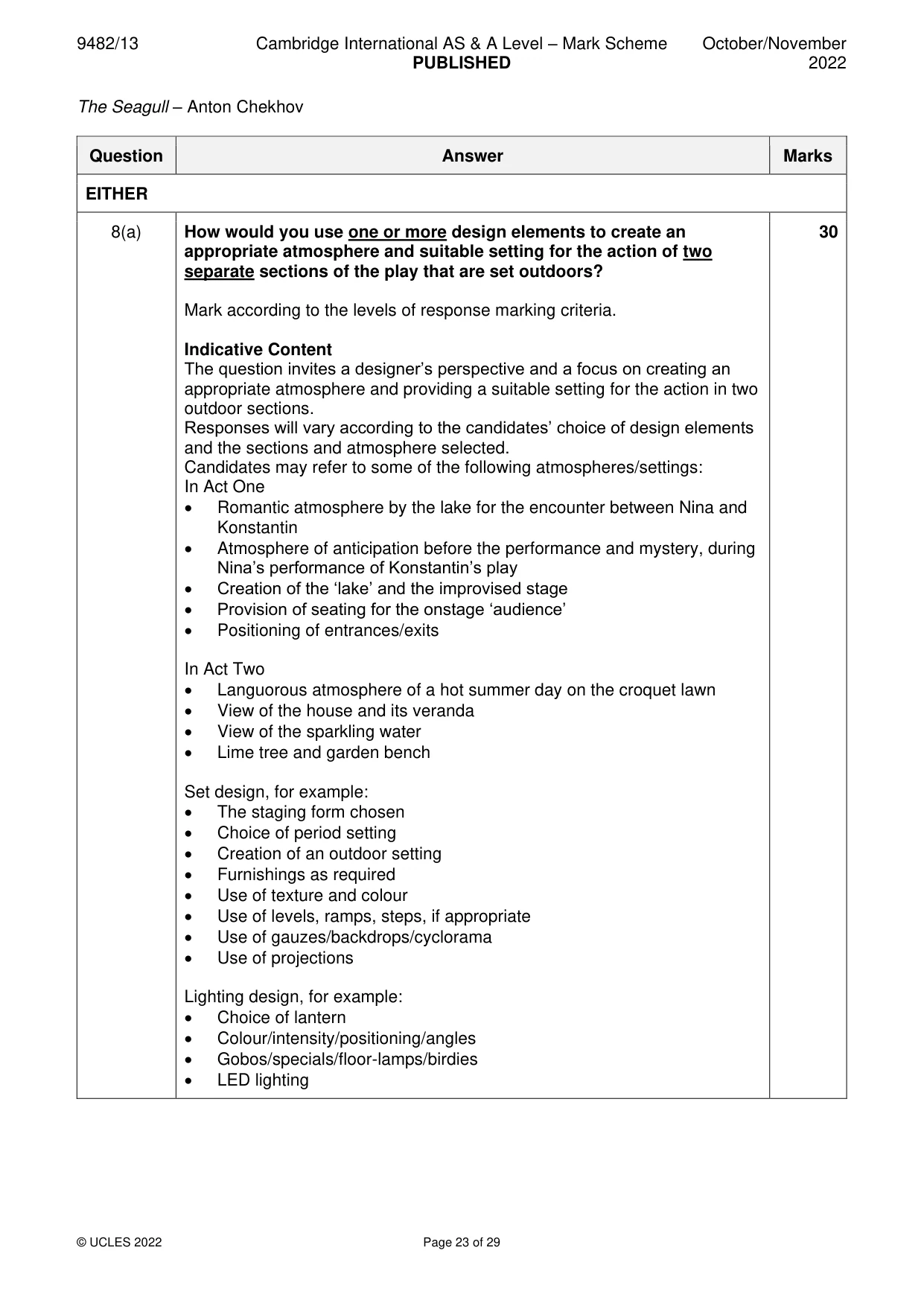
9482/13 Cambridge International AS & A Level – Mark Scheme PUBLISHED October/November 2022 © UCLES 2022 Page 23 of 29 The Seagull – Anton Chekhov Question Answer Marks EITHER 8(a) How would you use one or more design elements to create an appropriate atmosphere and suitable setting for the action of two separate sections of the play that are set outdoors? Mark according to the levels of response marking criteria. Indicative Content The question invites a designer’s perspective and a focus on creating an appropriate atmosphere and providing a suitable setting for the action in two outdoor sections. Responses will vary according to the candidates’ choice of design elements and the sections and atmosphere selected. Candidates may refer to some of the following atmospheres/settings: In Act One • Romantic atmosphere by the lake for the encounter between Nina and Konstantin • Atmosphere of anticipation before the performance and mystery, during Nina’s performance of Konstantin’s play • Creation of the ‘lake’ and the improvised stage • Provision of seating for the onstage ‘audience’ • Positioning of entrances/exits In Act Two • Languorous atmosphere of a hot summer day on the croquet lawn • View of the house and its veranda • View of the sparkling water • Lime tree and garden bench Set design, for example: • The staging form chosen • Choice of period setting • Creation of an outdoor setting • Furnishings as required • Use of texture and colour • Use of levels, ramps, steps, if appropriate • Use of gauzes/backdrops/cyclorama • Use of projections Lighting design, for example: • Choice of lantern • Colour/intensity/positioning/angles • Gobos/specials/floor-lamps/birdies • LED lighting 30
Mark scheme, page 24
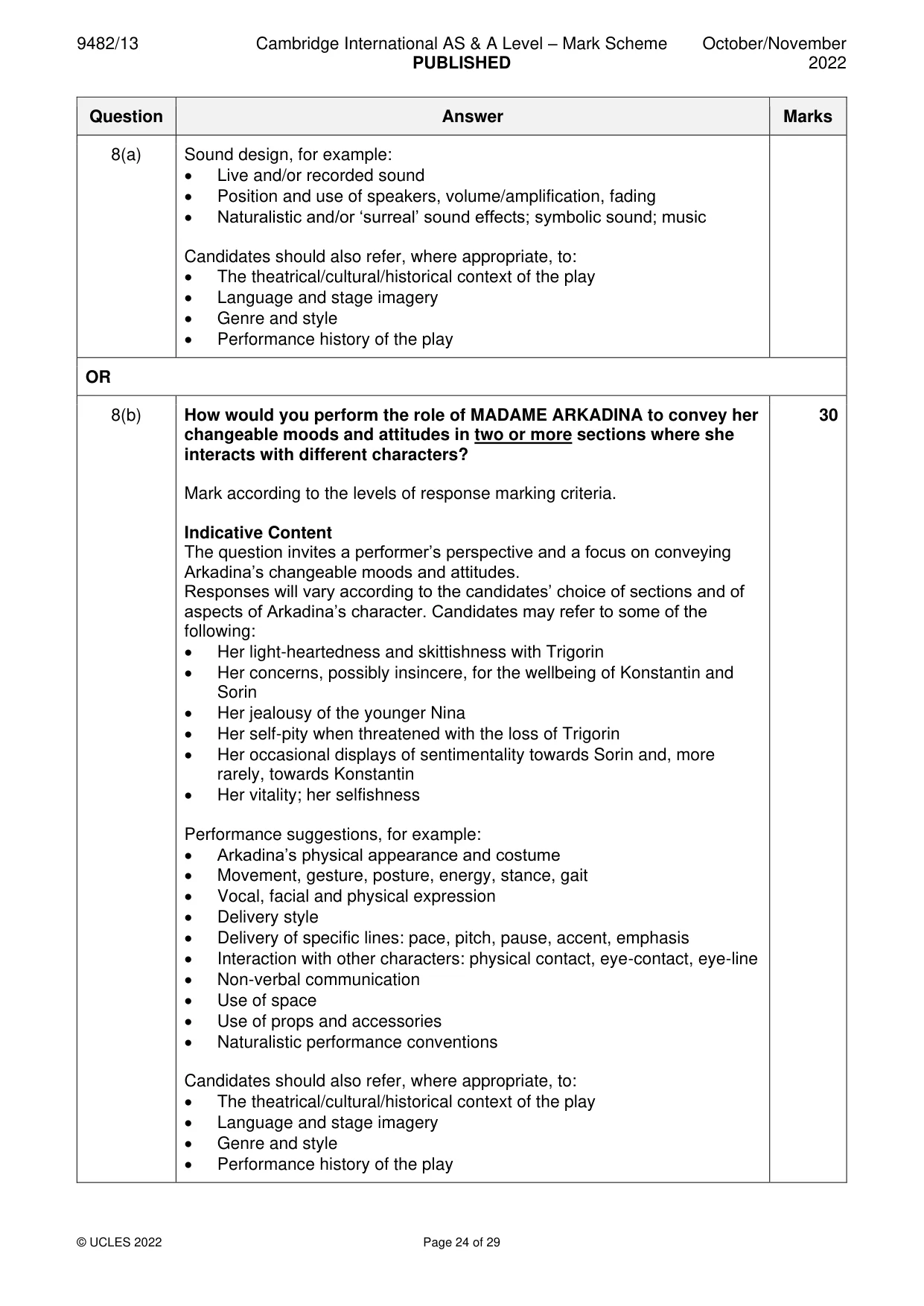
9482/13 Cambridge International AS & A Level – Mark Scheme PUBLISHED October/November 2022 © UCLES 2022 Page 24 of 29 Question Answer Marks 8(a) Sound design, for example: • Live and/or recorded sound • Position and use of speakers, volume/amplification, fading • Naturalistic and/or ‘surreal’ sound effects; symbolic sound; music Candidates should also refer, where appropriate, to: • The theatrical/cultural/historical context of the play • Language and stage imagery • Genre and style • Performance history of the play OR 8(b) How would you perform the role of MADAME ARKADINA to convey her changeable moods and attitudes in two or more sections where she interacts with different characters? Mark according to the levels of response marking criteria. Indicative Content The question invites a performer’s perspective and a focus on conveying Arkadina’s changeable moods and attitudes. Responses will vary according to the candidates’ choice of sections and of aspects of Arkadina’s character. Candidates may refer to some of the following: • Her light-heartedness and skittishness with Trigorin • Her concerns, possibly insincere, for the wellbeing of Konstantin and Sorin • Her jealousy of the younger Nina • Her self-pity when threatened with the loss of Trigorin • Her occasional displays of sentimentality towards Sorin and, more rarely, towards Konstantin • Her vitality; her selfishness Performance suggestions, for example: • Arkadina’s physical appearance and costume • Movement, gesture, posture, energy, stance, gait • Vocal, facial and physical expression • Delivery style • Delivery of specific lines: pace, pitch, pause, accent, emphasis • Interaction with other characters: physical contact, eye-contact, eye-line • Non-verbal communication • Use of space • Use of props and accessories • Naturalistic performance conventions Candidates should also refer, where appropriate, to: • The theatrical/cultural/historical context of the play • Language and stage imagery • Genre and style • Performance history of the play 30
Mark scheme, page 25
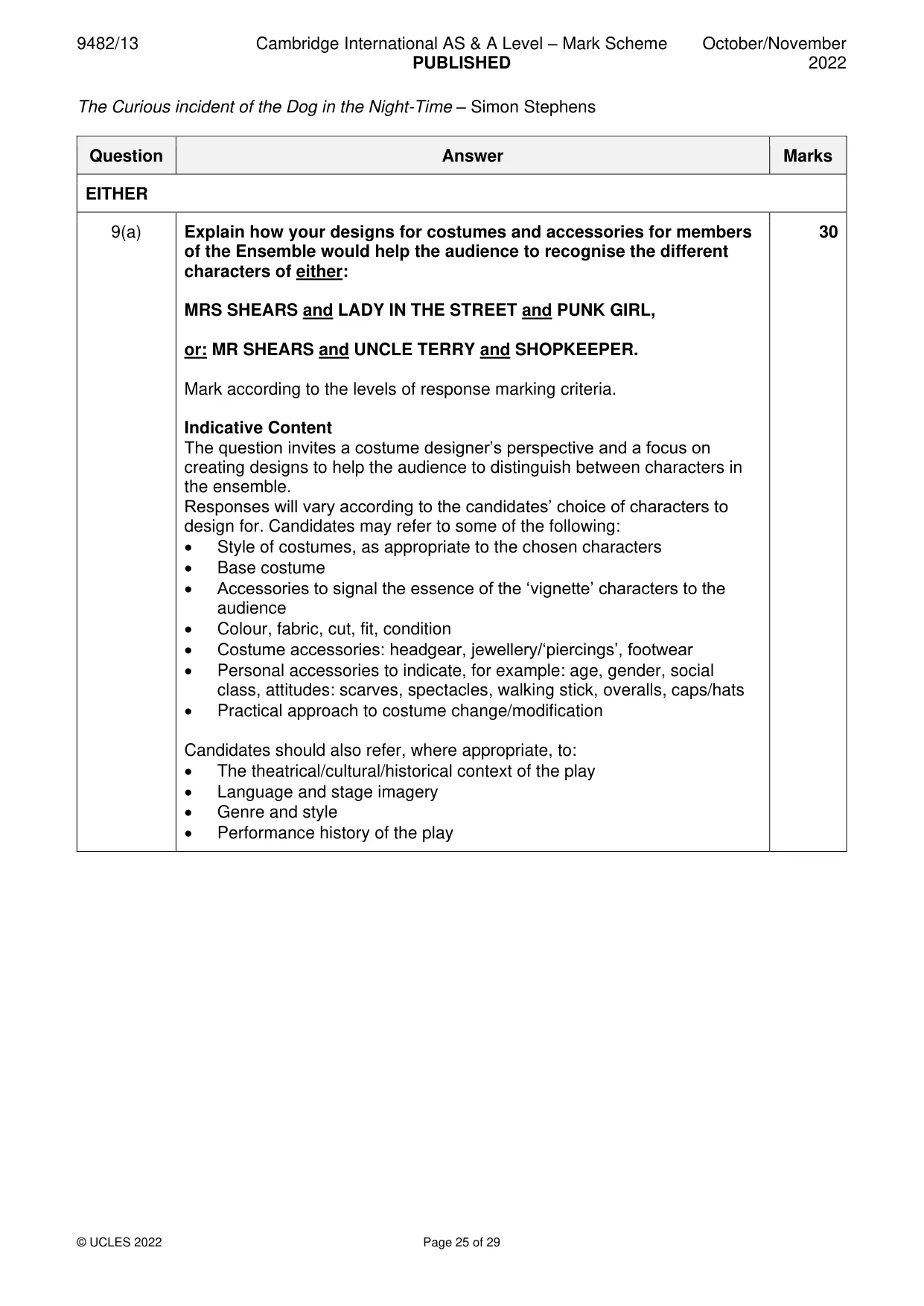
9482/13 Cambridge International AS & A Level – Mark Scheme PUBLISHED October/November 2022 © UCLES 2022 Page 25 of 29 The Curious incident of the Dog in the Night-Time – Simon Stephens Question Answer Marks EITHER 9(a) Explain how your designs for costumes and accessories for members of the Ensemble would help the audience to recognise the different characters of either: MRS SHEARS and LADY IN THE STREET and PUNK GIRL, or: MR SHEARS and UNCLE TERRY and SHOPKEEPER. Mark according to the levels of response marking criteria. Indicative Content The question invites a costume designer’s perspective and a focus on creating designs to help the audience to distinguish between characters in the ensemble. Responses will vary according to the candidates’ choice of characters to design for. Candidates may refer to some of the following: • Style of costumes, as appropriate to the chosen characters • Base costume • Accessories to signal the essence of the ‘vignette’ characters to the audience • Colour, fabric, cut, fit, condition • Costume accessories: headgear, jewellery/‘piercings’, footwear • Personal accessories to indicate, for example: age, gender, social class, attitudes: scarves, spectacles, walking stick, overalls, caps/hats • Practical approach to costume change/modification Candidates should also refer, where appropriate, to: • The theatrical/cultural/historical context of the play • Language and stage imagery • Genre and style • Performance history of the play 30
Mark scheme, page 26
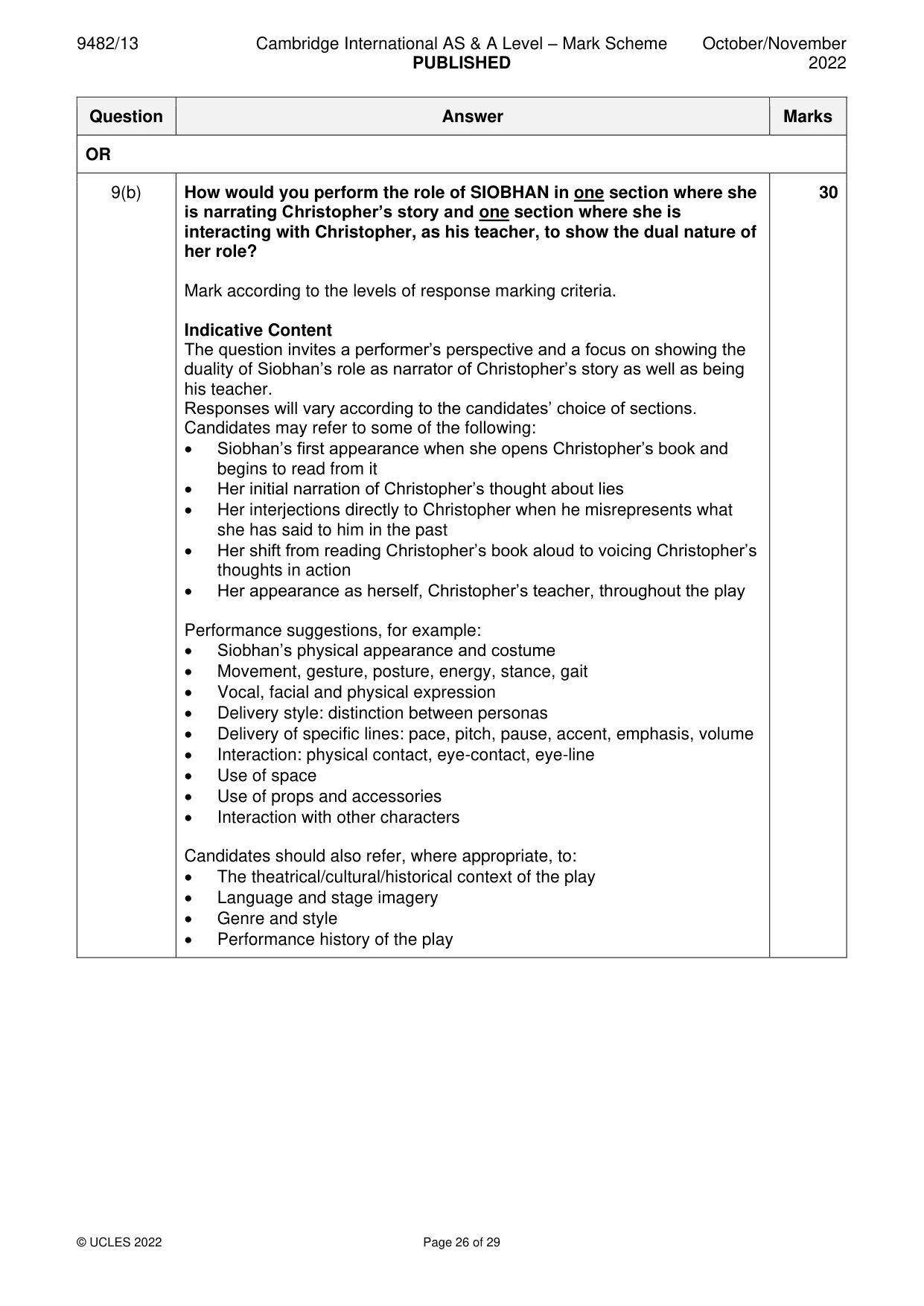
9482/13 Cambridge International AS & A Level – Mark Scheme PUBLISHED October/November 2022 © UCLES 2022 Page 26 of 29 Question Answer Marks OR 9(b) How would you perform the role of SIOBHAN in one section where she is narrating Christopher’s story and one section where she is interacting with Christopher, as his teacher, to show the dual nature of her role? Mark according to the levels of response marking criteria. Indicative Content The question invites a performer’s perspective and a focus on showing the duality of Siobhan’s role as narrator of Christopher’s story as well as being his teacher. Responses will vary according to the candidates’ choice of sections. Candidates may refer to some of the following: • Siobhan’s first appearance when she opens Christopher’s book and begins to read from it • Her initial narration of Christopher’s thought about lies • Her interjections directly to Christopher when he misrepresents what she has said to him in the past • Her shift from reading Christopher’s book aloud to voicing Christopher’s thoughts in action • Her appearance as herself, Christopher’s teacher, throughout the play Performance suggestions, for example: • Siobhan’s physical appearance and costume • Movement, gesture, posture, energy, stance, gait • Vocal, facial and physical expression • Delivery style: distinction between personas • Delivery of specific lines: pace, pitch, pause, accent, emphasis, volume • Interaction: physical contact, eye-contact, eye-line • Use of space • Use of props and accessories • Interaction with other characters Candidates should also refer, where appropriate, to: • The theatrical/cultural/historical context of the play • Language and stage imagery • Genre and style • Performance history of the play 30
Mark scheme, page 27
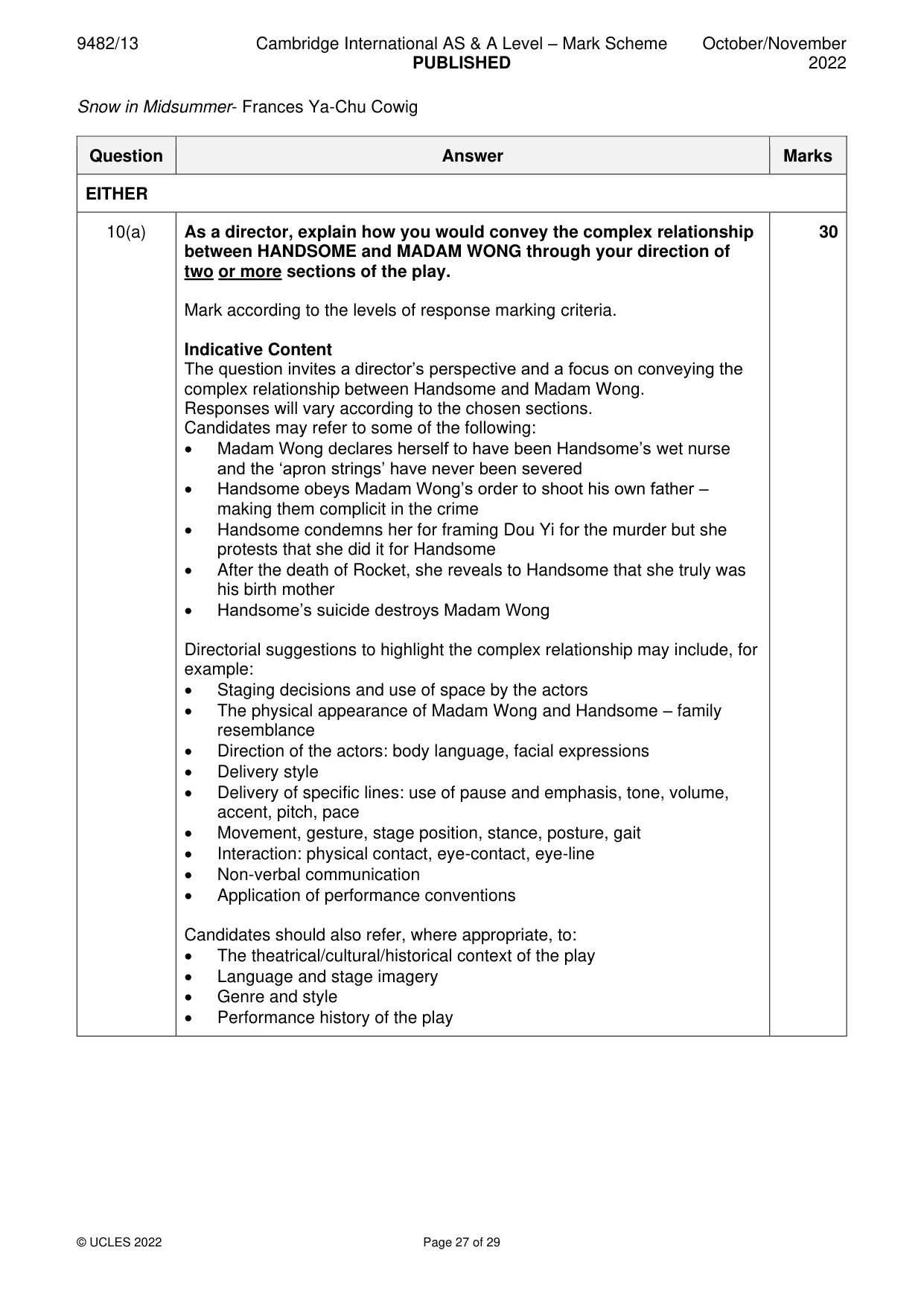
9482/13 Cambridge International AS & A Level – Mark Scheme PUBLISHED October/November 2022 © UCLES 2022 Page 27 of 29 Snow in Midsummer- Frances Ya-Chu Cowig Question Answer Marks EITHER 10(a) As a director, explain how you would convey the complex relationship between HANDSOME and MADAM WONG through your direction of two or more sections of the play. Mark according to the levels of response marking criteria. Indicative Content The question invites a director’s perspective and a focus on conveying the complex relationship between Handsome and Madam Wong. Responses will vary according to the chosen sections. Candidates may refer to some of the following: • Madam Wong declares herself to have been Handsome’s wet nurse and the ‘apron strings’ have never been severed • Handsome obeys Madam Wong’s order to shoot his own father – making them complicit in the crime • Handsome condemns her for framing Dou Yi for the murder but she protests that she did it for Handsome • After the death of Rocket, she reveals to Handsome that she truly was his birth mother • Handsome’s suicide destroys Madam Wong Directorial suggestions to highlight the complex relationship may include, for example: • Staging decisions and use of space by the actors • The physical appearance of Madam Wong and Handsome – family resemblance • Direction of the actors: body language, facial expressions • Delivery style • Delivery of specific lines: use of pause and emphasis, tone, volume, accent, pitch, pace • Movement, gesture, stage position, stance, posture, gait • Interaction: physical contact, eye-contact, eye-line • Non-verbal communication • Application of performance conventions Candidates should also refer, where appropriate, to: • The theatrical/cultural/historical context of the play • Language and stage imagery • Genre and style • Performance history of the play 30
Mark scheme, page 28
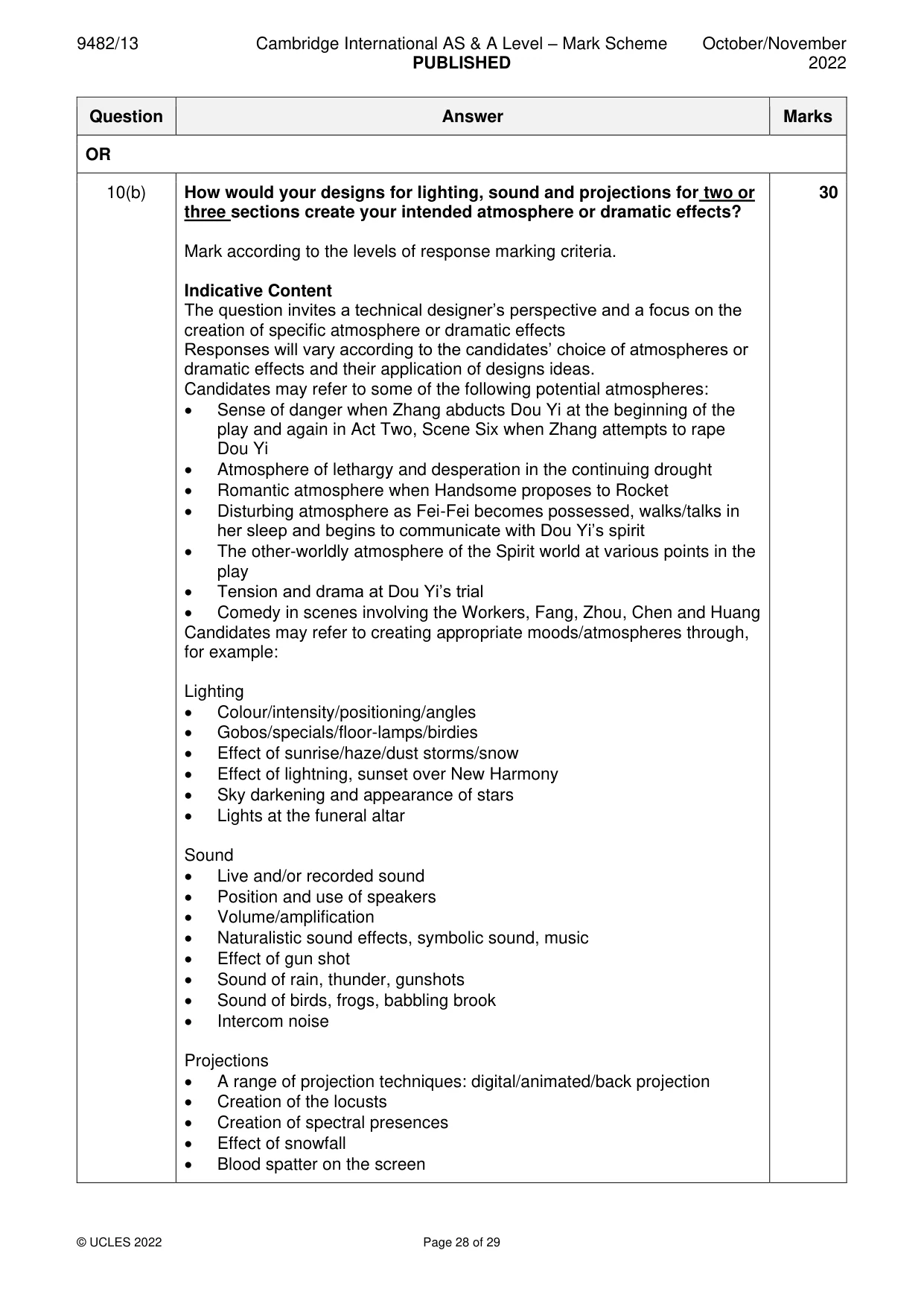
9482/13 Cambridge International AS & A Level – Mark Scheme PUBLISHED October/November 2022 © UCLES 2022 Page 28 of 29 Question Answer Marks OR 10(b) How would your designs for lighting, sound and projections for two or three sections create your intended atmosphere or dramatic effects? Mark according to the levels of response marking criteria. Indicative Content The question invites a technical designer’s perspective and a focus on the creation of specific atmosphere or dramatic effects Responses will vary according to the candidates’ choice of atmospheres or dramatic effects and their application of designs ideas. Candidates may refer to some of the following potential atmospheres: • Sense of danger when Zhang abducts Dou Yi at the beginning of the play and again in Act Two, Scene Six when Zhang attempts to rape Dou Yi • Atmosphere of lethargy and desperation in the continuing drought • Romantic atmosphere when Handsome proposes to Rocket • Disturbing atmosphere as Fei-Fei becomes possessed, walks/talks in her sleep and begins to communicate with Dou Yi’s spirit • The other-worldly atmosphere of the Spirit world at various points in the play • Tension and drama at Dou Yi’s trial • Comedy in scenes involving the Workers, Fang, Zhou, Chen and Huang Candidates may refer to creating appropriate moods/atmospheres through, for example: Lighting • Colour/intensity/positioning/angles • Gobos/specials/floor-lamps/birdies • Effect of sunrise/haze/dust storms/snow • Effect of lightning, sunset over New Harmony • Sky darkening and appearance of stars • Lights at the funeral altar Sound • Live and/or recorded sound • Position and use of speakers • Volume/amplification • Naturalistic sound effects, symbolic sound, music • Effect of gun shot • Sound of rain, thunder, gunshots • Sound of birds, frogs, babbling brook • Intercom noise Projections • A range of projection techniques: digital/animated/back projection • Creation of the locusts • Creation of spectral presences • Effect of snowfall • Blood spatter on the screen 30
Mark scheme, page 29
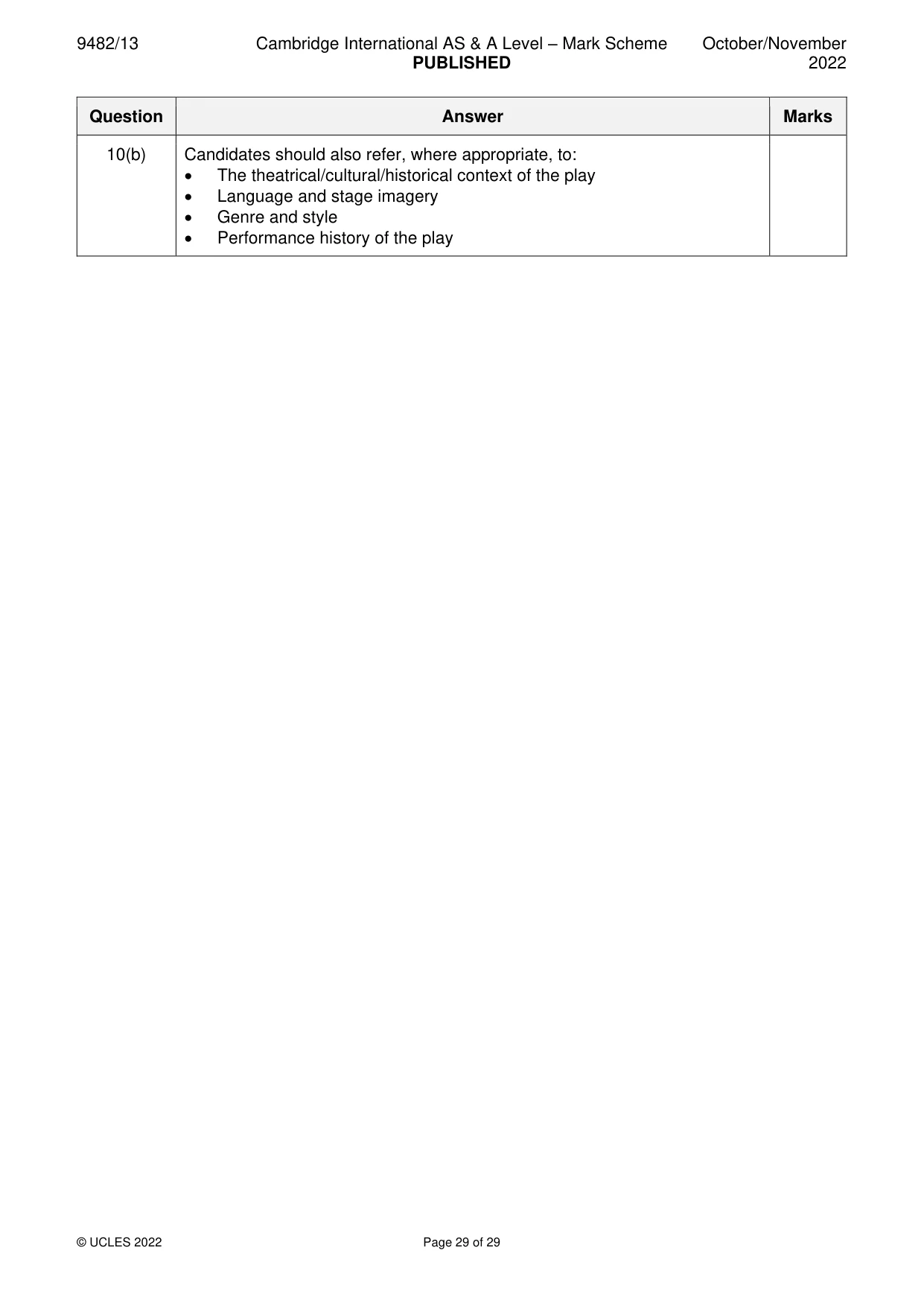
9482/13 Cambridge International AS & A Level – Mark Scheme PUBLISHED October/November 2022 © UCLES 2022 Page 29 of 29 Question Answer Marks 10(b) Candidates should also refer, where appropriate, to: • The theatrical/cultural/historical context of the play • Language and stage imagery • Genre and style • Performance history of the play
What you needed in this session
Cambridge’s own grade thresholds for 2022 Oct/Nov, Paper 1 · Variant 3. A higher threshold means an easier paper — the bar moves with how the cohort did.