Cambridge A Level Drama 9482 — 2022 Oct/Nov Paper 1 · Variant 2
9482/12/O/N/22 · 60 marks · ≈68 min
The question paper and its mark scheme, free to read here and free to download. This is Cambridge’s own paper, exactly as it was sat.
Question paper8 pages


Mark scheme28 pages
Answers below. Sit the paper first if you are practising.
Paper as text
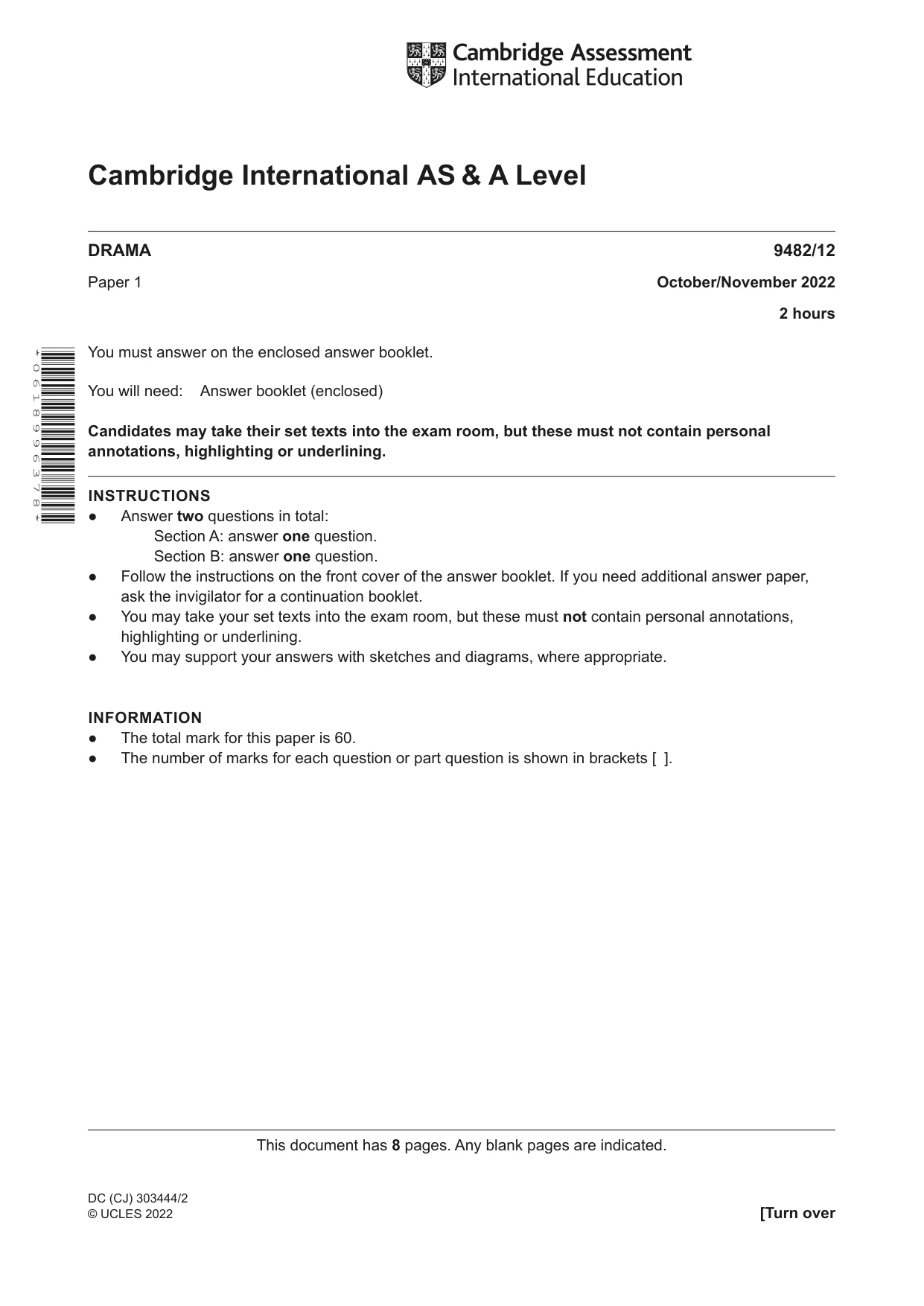
Question paper, page 1
This document has 8 pages. Any blank pages are indicated. [Turn over Cambridge International AS & A Level DRAMA 9482/12 Paper 1 October/November 2022 2 hours You must answer on the enclosed answer booklet. You will need: Answer booklet (enclosed) Candidates may take their set texts into the exam room, but these must not contain personal annotations, highlighting or underlining. INSTRUCTIONS ● Answer two questions in total: Section A: answer one question. Section B: answer one question. ● Follow the instructions on the front cover of the answer booklet. If you need additional answer paper, ask the invigilator for a continuation booklet. ● You may take your set texts into the exam room, but these must not contain personal annotations, highlighting or underlining. ● You may support your answers with sketches and diagrams, where appropriate. INFORMATION ● The total mark for this paper is 60. ● The number of marks for each question or part question is shown in brackets [ ]. * 0 6 1 8 9 9 6 3 7 8 * DC (CJ) 303444/2 © UCLES 2022
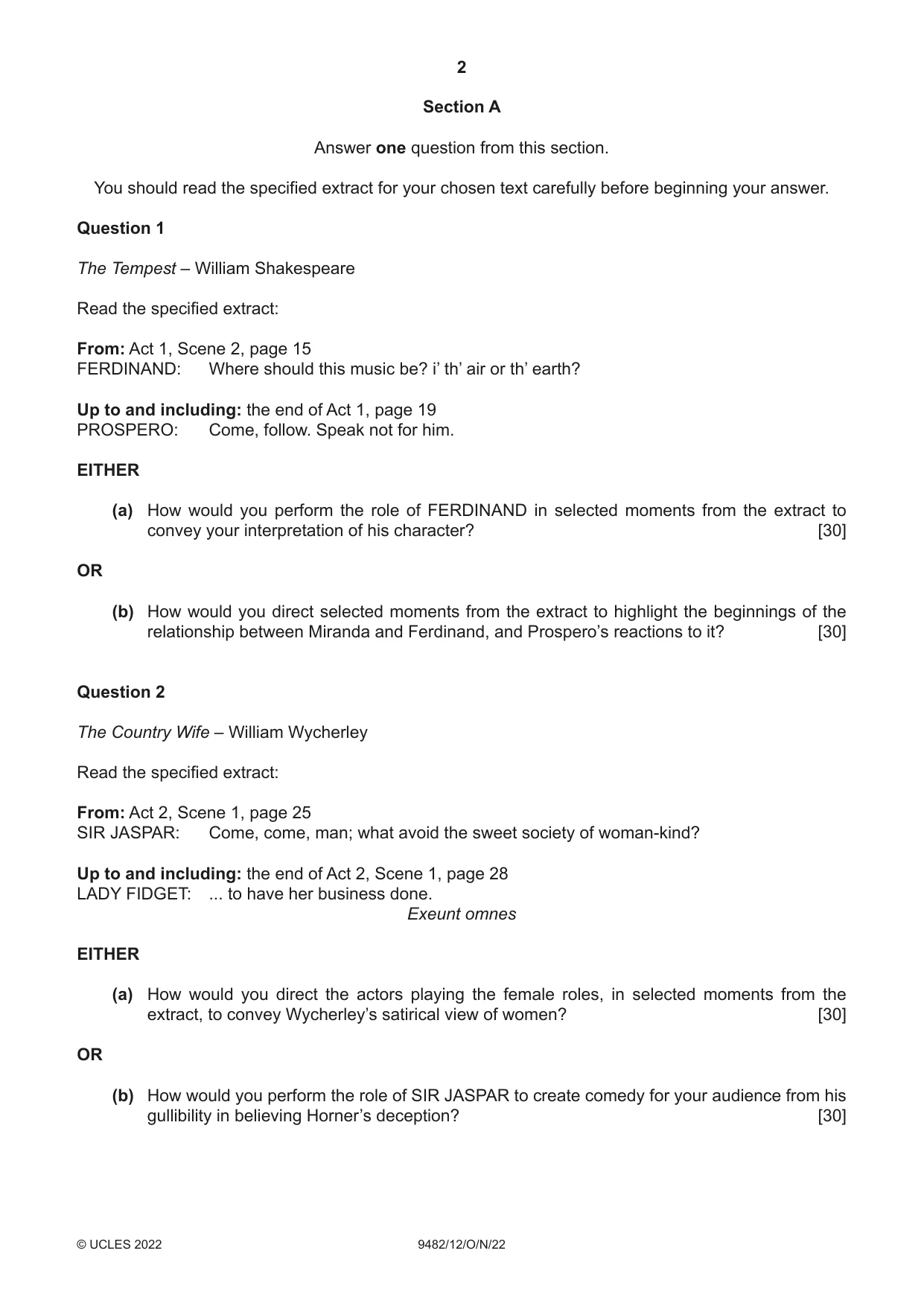
Question paper, page 2
2 9482/12/O/N/22 © UCLES 2022 Section A Answer one question from this section. You should read the specified extract for your chosen text carefully before beginning your answer. Question 1 The Tempest – William Shakespeare Read the specified extract: From: Act 1, Scene 2, page 15 FERDINAND: Where should this music be? i’ th’ air or th’ earth? Up to and including: the end of Act 1, page 19 PROSPERO: Come, follow. Speak not for him. EITHER (a) How would you perform the role of FERDINAND in selected moments from the extract to convey your interpretation of his character? [30] OR (b) How would you direct selected moments from the extract to highlight the beginnings of the relationship between Miranda and Ferdinand, and Prospero’s reactions to it? [30] Question 2 The Country Wife – William Wycherley Read the specified extract: From: Act 2, Scene 1, page 25 SIR JASPAR: Come, come, man; what avoid the sweet society of woman-kind? Up to and including: the end of Act 2, Scene 1, page 28 LADY FIDGET: ... to have her business done. Exeunt omnes EITHER (a) How would you direct the actors playing the female roles, in selected moments from the extract, to convey Wycherley’s satirical view of women? [30] OR (b) How would you perform the role of SIR JASPAR to create comedy for your audience from his gullibility in believing Horner’s deception? [30]
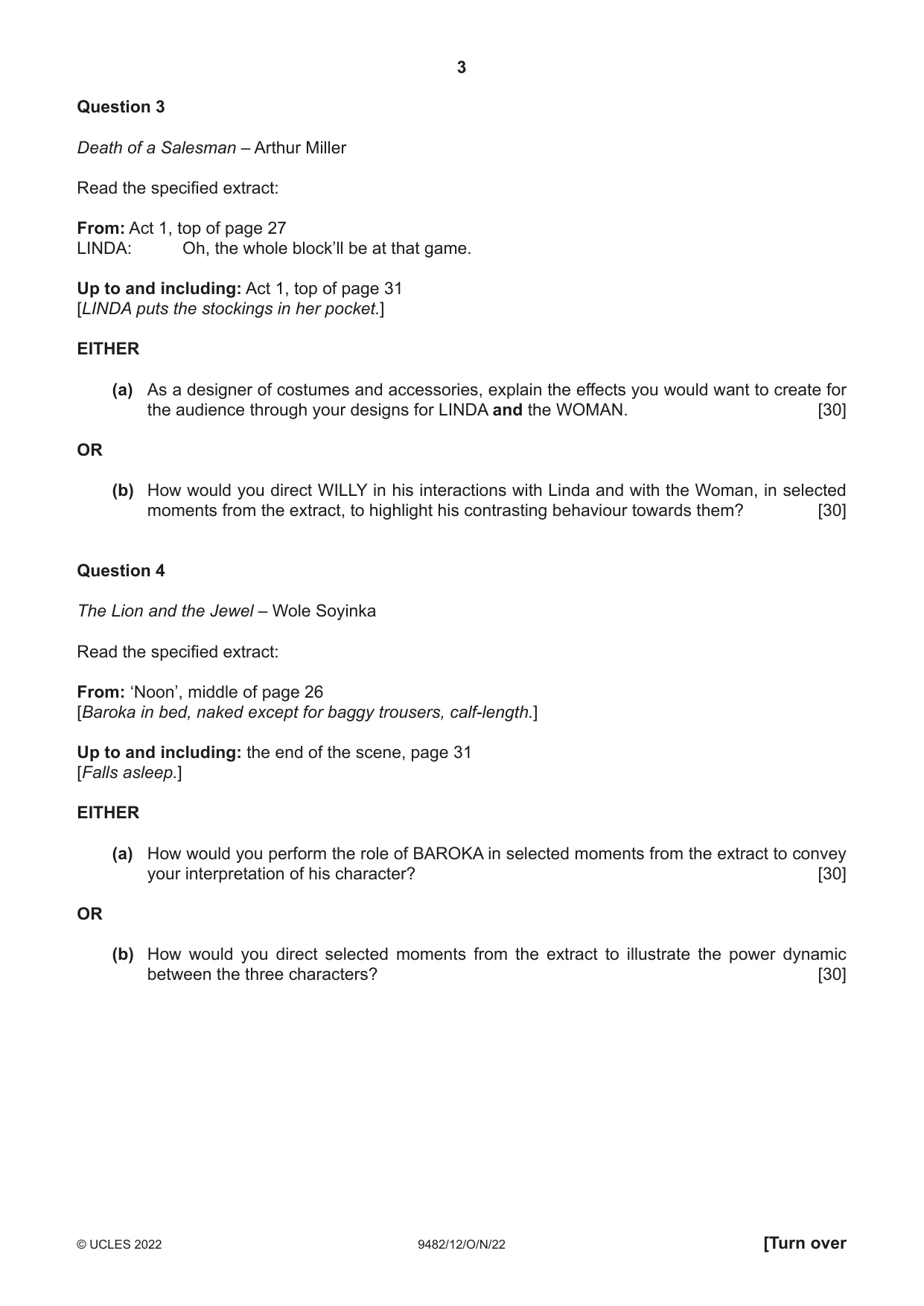
Question paper, page 3
3 9482/12/O/N/22 © UCLES 2022 [Turn over Question 3 Death of a Salesman – Arthur Miller Read the specified extract: From: Act 1, top of page 27 LINDA: Oh, the whole block’ll be at that game. Up to and including: Act 1, top of page 31 [LINDA puts the stockings in her pocket.] EITHER (a) As a designer of costumes and accessories, explain the effects you would want to create for the audience through your designs for LINDA and the WOMAN. [30] OR (b) How would you direct WILLY in his interactions with Linda and with the Woman, in selected moments from the extract, to highlight his contrasting behaviour towards them? [30] Question 4 The Lion and the Jewel – Wole Soyinka Read the specified extract: From: ‘Noon’, middle of page 26 [Baroka in bed, naked except for baggy trousers, calf-length.] Up to and including: the end of the scene, page 31 [Falls asleep.] EITHER (a) How would you perform the role of BAROKA in selected moments from the extract to convey your interpretation of his character? [30] OR (b) How would you direct selected moments from the extract to illustrate the power dynamic between the three characters? [30]
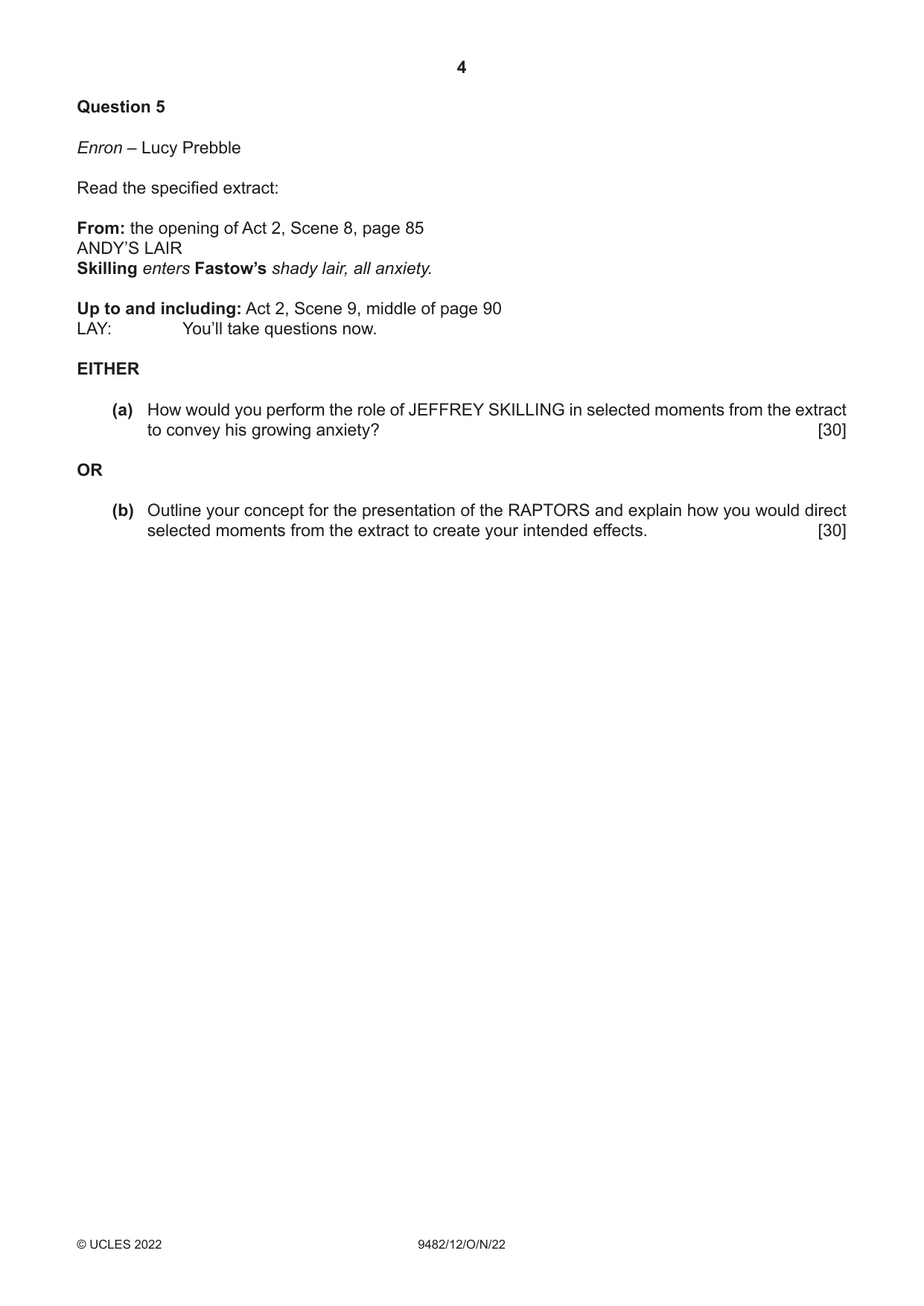
Question paper, page 4
4 9482/12/O/N/22 © UCLES 2022 Question 5 Enron – Lucy Prebble Read the specified extract: From: the opening of Act 2, Scene 8, page 85 ANDY’S LAIR Skilling enters Fastow’s shady lair, all anxiety. Up to and including: Act 2, Scene 9, middle of page 90 LAY: You’ll take questions now. EITHER (a) How would you perform the role of JEFFREY SKILLING in selected moments from the extract to convey his growing anxiety? [30] OR (b) Outline your concept for the presentation of the RAPTORS and explain how you would direct selected moments from the extract to create your intended effects. [30]
Question paper, page 5
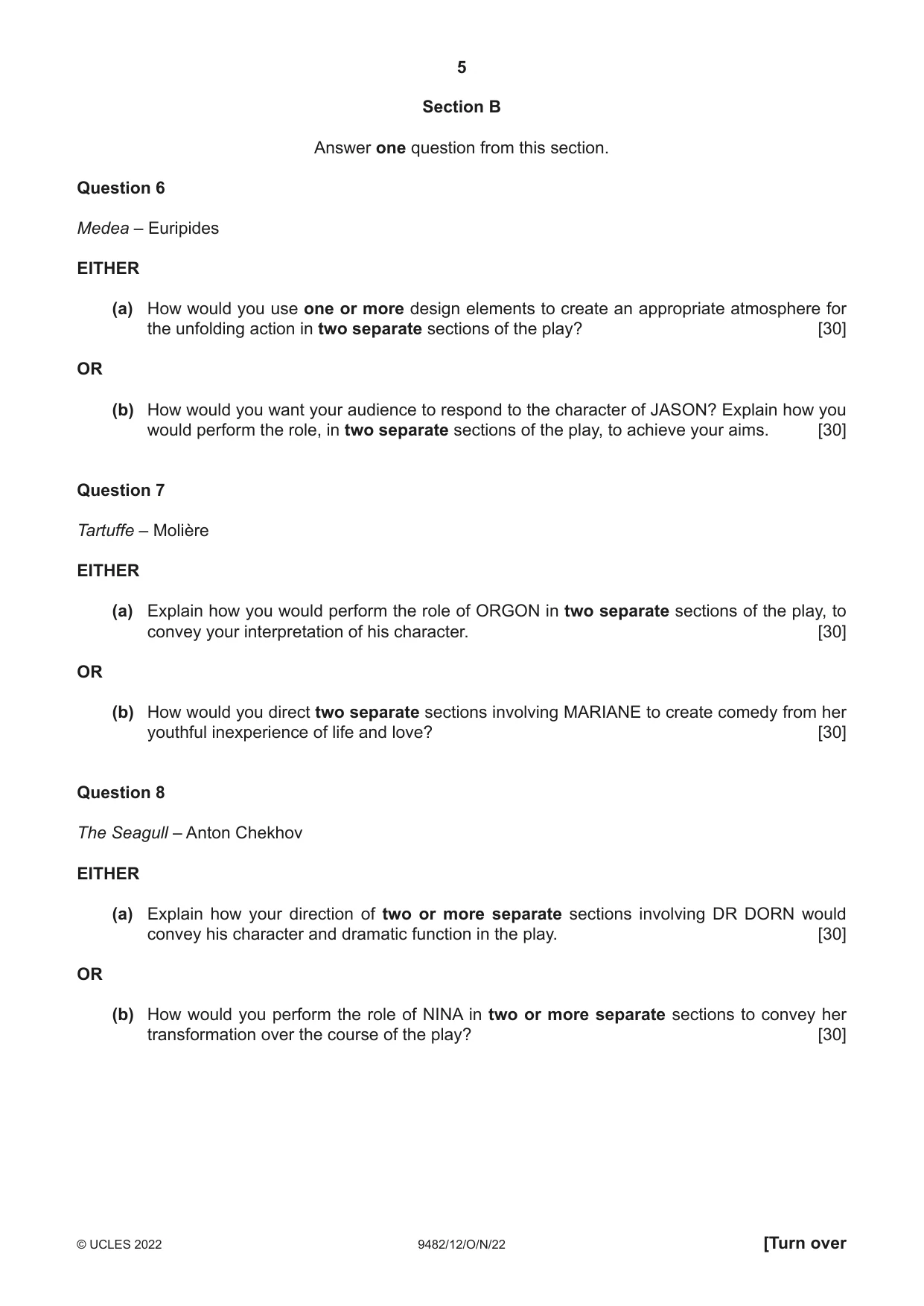
5 9482/12/O/N/22 © UCLES 2022 [Turn over Section B Answer one question from this section. Question 6 Medea – Euripides EITHER (a) How would you use one or more design elements to create an appropriate atmosphere for the unfolding action in two separate sections of the play? [30] OR (b) How would you want your audience to respond to the character of JASON? Explain how you would perform the role, in two separate sections of the play, to achieve your aims. [30] Question 7 Tartuffe – Molière EITHER (a) Explain how you would perform the role of ORGON in two separate sections of the play, to convey your interpretation of his character. [30] OR (b) How would you direct two separate sections involving MARIANE to create comedy from her youthful inexperience of life and love? [30] Question 8 The Seagull – Anton Chekhov EITHER (a) Explain how your direction of two or more separate sections involving DR DORN would convey his character and dramatic function in the play. [30] OR (b) How would you perform the role of NINA in two or more separate sections to convey her transformation over the course of the play? [30]
Question paper, page 6
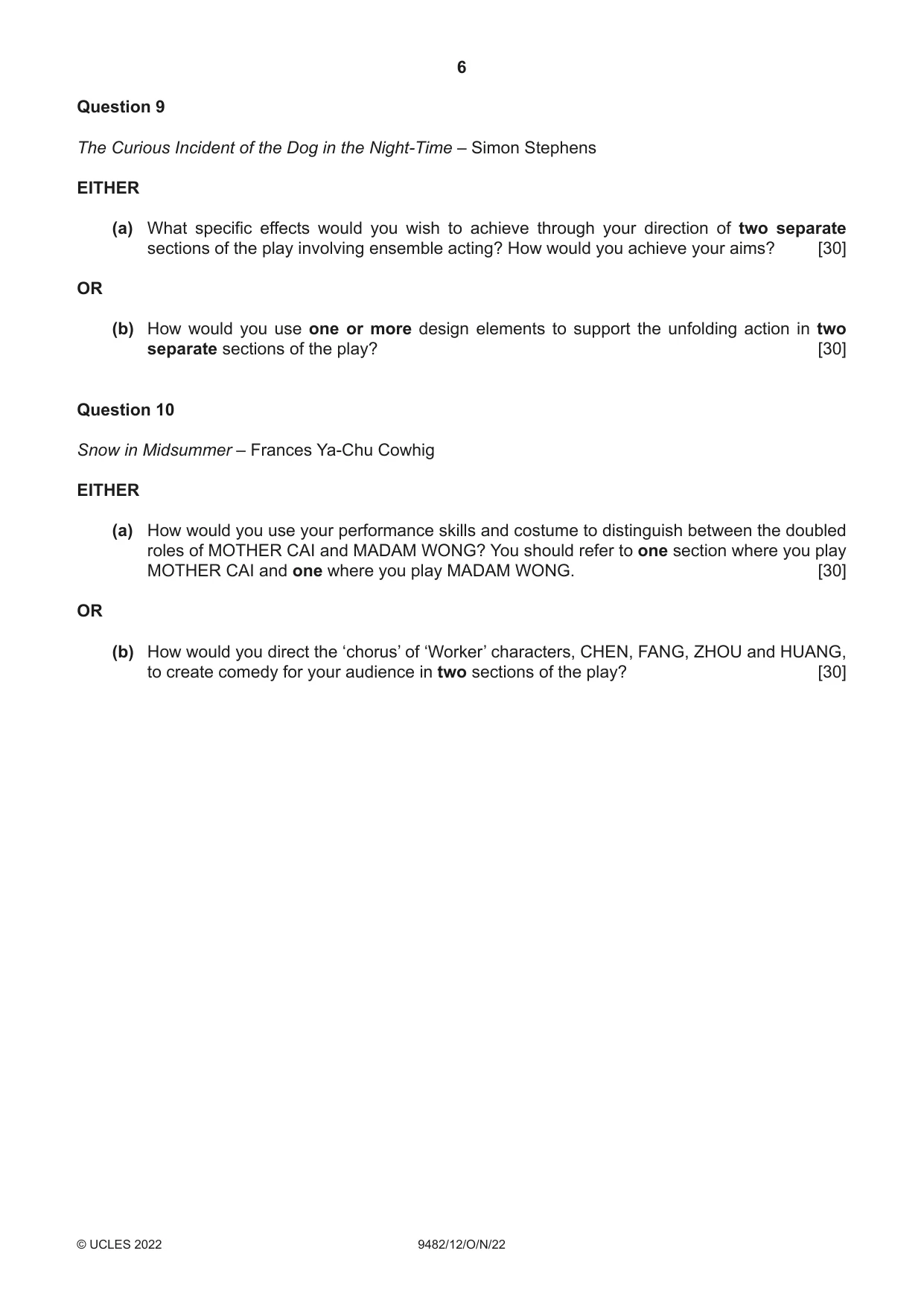
6 9482/12/O/N/22 © UCLES 2022 Question 9 The Curious Incident of the Dog in the Night-Time – Simon Stephens EITHER (a) What specific effects would you wish to achieve through your direction of two separate sections of the play involving ensemble acting? How would you achieve your aims? [30] OR (b) How would you use one or more design elements to support the unfolding action in two separate sections of the play? [30] Question 10 Snow in Midsummer – Frances Ya-Chu Cowhig EITHER (a) How would you use your performance skills and costume to distinguish between the doubled roles of MOTHER CAI and MADAM WONG? You should refer to one section where you play MOTHER CAI and one where you play MADAM WONG. [30] OR (b) How would you direct the ‘chorus’ of ‘Worker’ characters, CHEN, FANG, ZHOU and HUANG, to create comedy for your audience in two sections of the play? [30]
Question paper, page 7
7 9482/12/O/N/22 © UCLES 2022 BLANK PAGE
Question paper, page 8
8 9482/12/O/N/22 © UCLES 2022 Permission to reproduce items where third-party owned material protected by copyright is included has been sought and cleared where possible. Every reasonable effort has been made by the publisher (UCLES) to trace copyright holders, but if any items requiring clearance have unwittingly been included, the publisher will be pleased to make amends at the earliest possible opportunity. To avoid the issue of disclosure of answer-related information to candidates, all copyright acknowledgements are reproduced online in the Cambridge Assessment International Education Copyright Acknowledgements Booklet. This is produced for each series of examinations and is freely available to download at www.cambridgeinternational.org after the live examination series. Cambridge Assessment International Education is part of Cambridge Assessment. Cambridge Assessment is the brand name of the University of Cambridge Local Examinations Syndicate (UCLES), which is a department of the University of Cambridge. BLANK PAGE
Mark scheme, page 1
This document consists of 28 printed pages. © UCLES 2022 [Turn over Cambridge International AS & A Level DRAMA 9482/12 Paper 1 Open-Book Written Examination October/November 2022 MARK SCHEME Maximum Mark: 60 Published This mark scheme is published as an aid to teachers and candidates, to indicate the requirements of the examination. It shows the basis on which Examiners were instructed to award marks. It does not indicate the details of the discussions that took place at an Examiners’ meeting before marking began, which would have considered the acceptability of alternative answers. Mark schemes should be read in conjunction with the question paper and the Principal Examiner Report for Teachers. Cambridge International will not enter into discussions about these mark schemes. Cambridge International is publishing the mark schemes for the October/November 2022 series for most Cambridge IGCSE™, Cambridge International A and AS Level components and some Cambridge O Level components.
Mark scheme, page 2
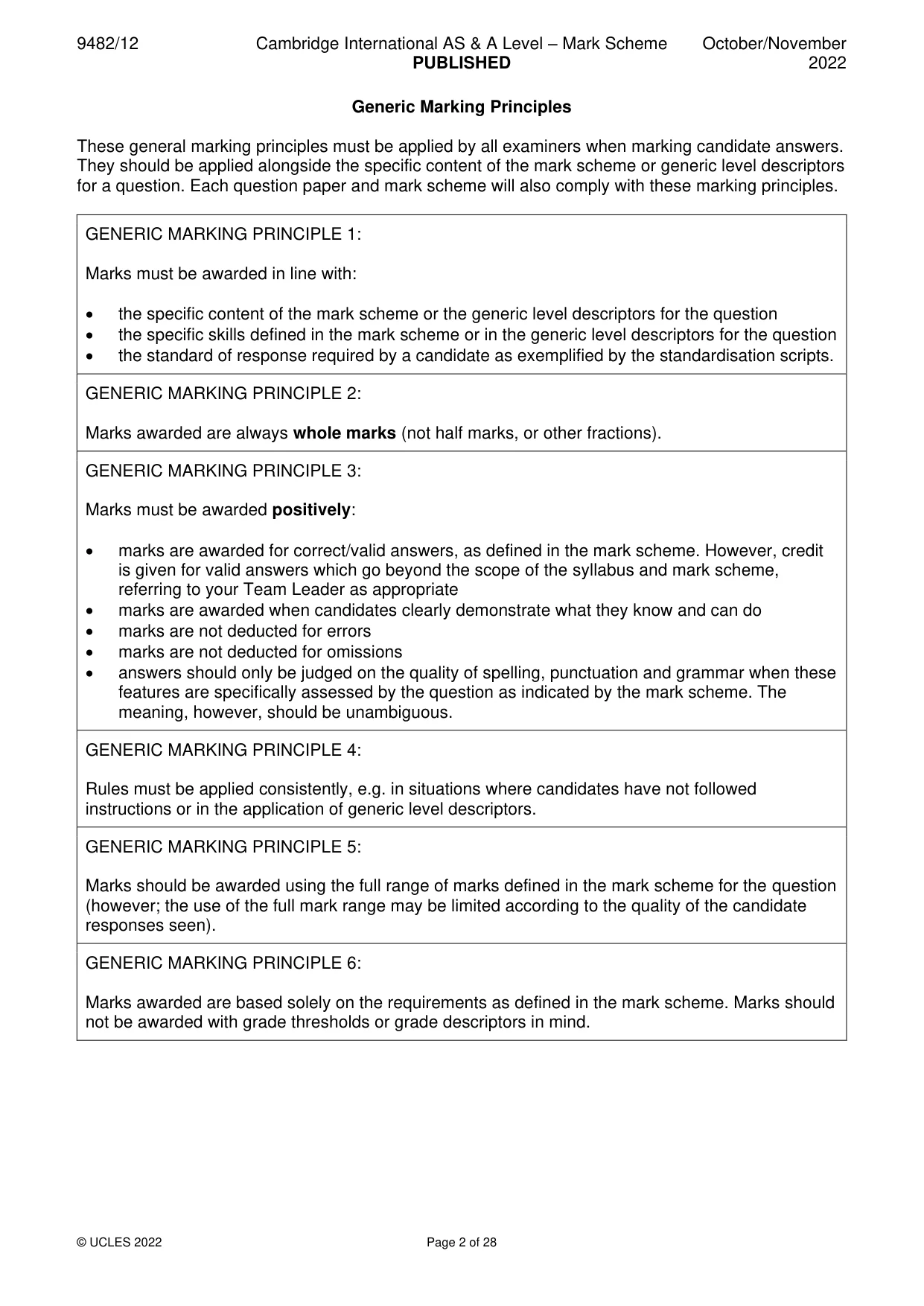
9482/12 Cambridge International AS & A Level – Mark Scheme PUBLISHED October/November 2022 © UCLES 2022 Page 2 of 28 Generic Marking Principles These general marking principles must be applied by all examiners when marking candidate answers. They should be applied alongside the specific content of the mark scheme or generic level descriptors for a question. Each question paper and mark scheme will also comply with these marking principles. GENERIC MARKING PRINCIPLE 1: Marks must be awarded in line with: • the specific content of the mark scheme or the generic level descriptors for the question • the specific skills defined in the mark scheme or in the generic level descriptors for the question • the standard of response required by a candidate as exemplified by the standardisation scripts. GENERIC MARKING PRINCIPLE 2: Marks awarded are always whole marks (not half marks, or other fractions). GENERIC MARKING PRINCIPLE 3: Marks must be awarded positively: • marks are awarded for correct/valid answers, as defined in the mark scheme. However, credit is given for valid answers which go beyond the scope of the syllabus and mark scheme, referring to your Team Leader as appropriate • marks are awarded when candidates clearly demonstrate what they know and can do • marks are not deducted for errors • marks are not deducted for omissions • answers should only be judged on the quality of spelling, punctuation and grammar when these features are specifically assessed by the question as indicated by the mark scheme. The meaning, however, should be unambiguous. GENERIC MARKING PRINCIPLE 4: Rules must be applied consistently, e.g. in situations where candidates have not followed instructions or in the application of generic level descriptors. GENERIC MARKING PRINCIPLE 5: Marks should be awarded using the full range of marks defined in the mark scheme for the question (however; the use of the full mark range may be limited according to the quality of the candidate responses seen). GENERIC MARKING PRINCIPLE 6: Marks awarded are based solely on the requirements as defined in the mark scheme. Marks should not be awarded with grade thresholds or grade descriptors in mind.
Mark scheme, page 3
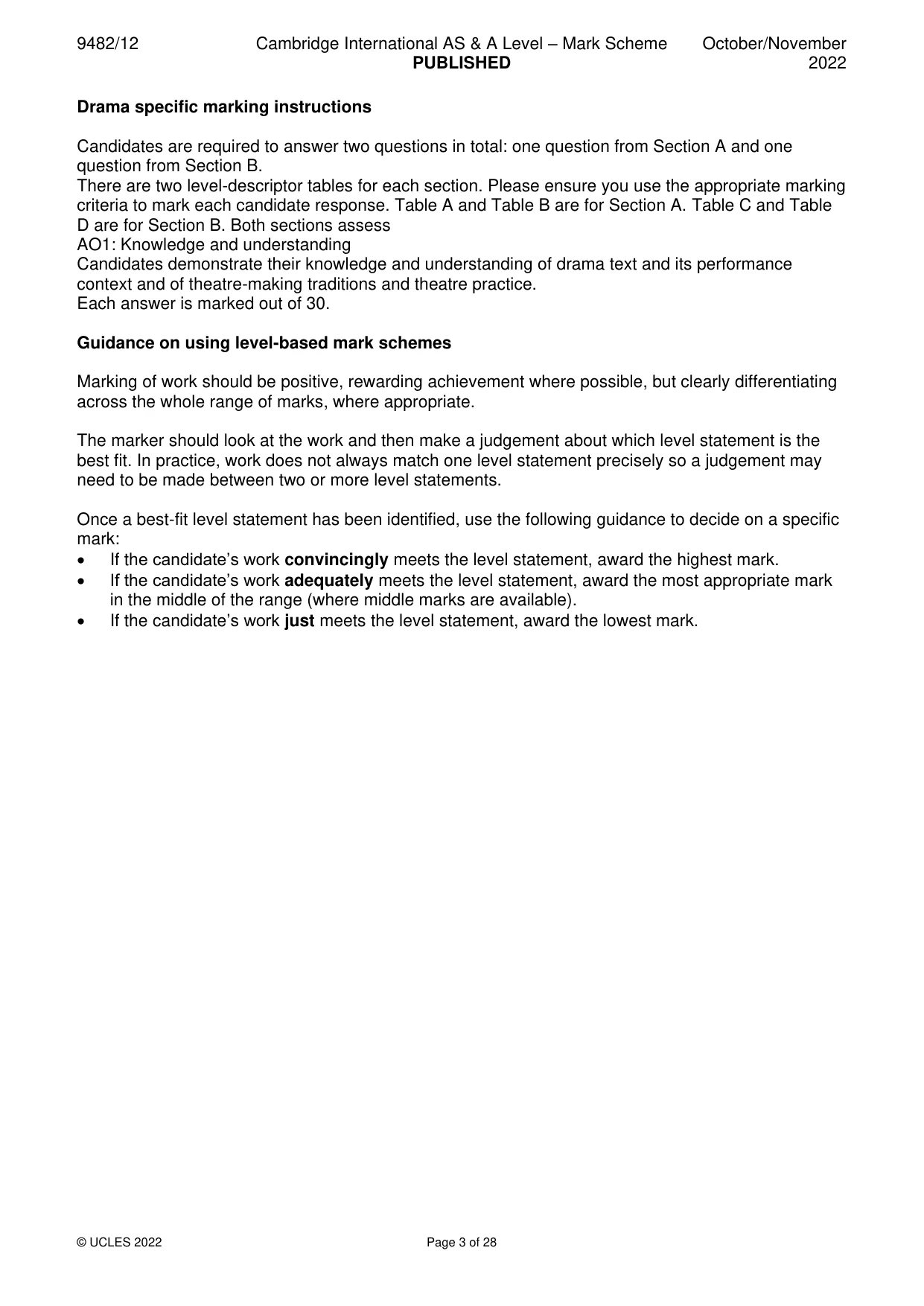
9482/12 Cambridge International AS & A Level – Mark Scheme PUBLISHED October/November 2022 © UCLES 2022 Page 3 of 28 Drama specific marking instructions Candidates are required to answer two questions in total: one question from Section A and one question from Section B. There are two level-descriptor tables for each section. Please ensure you use the appropriate marking criteria to mark each candidate response. Table A and Table B are for Section A. Table C and Table D are for Section B. Both sections assess AO1: Knowledge and understanding Candidates demonstrate their knowledge and understanding of drama text and its performance context and of theatre-making traditions and theatre practice. Each answer is marked out of 30. Guidance on using level-based mark schemes Marking of work should be positive, rewarding achievement where possible, but clearly differentiating across the whole range of marks, where appropriate. The marker should look at the work and then make a judgement about which level statement is the best fit. In practice, work does not always match one level statement precisely so a judgement may need to be made between two or more level statements. Once a best-fit level statement has been identified, use the following guidance to decide on a specific mark: • If the candidate’s work convincingly meets the level statement, award the highest mark. • If the candidate’s work adequately meets the level statement, award the most appropriate mark in the middle of the range (where middle marks are available). • If the candidate’s work just meets the level statement, award the lowest mark.
Mark scheme, page 4
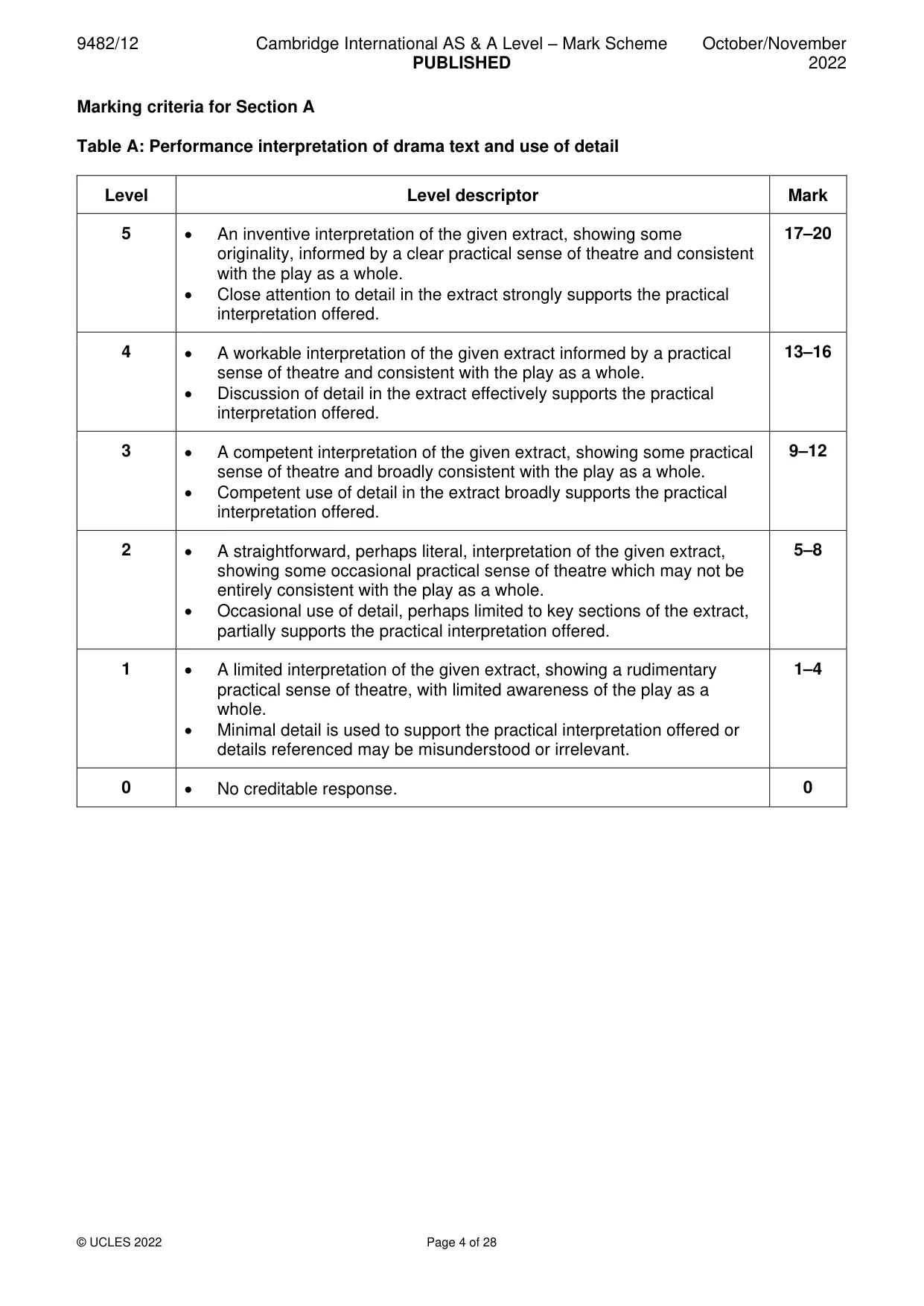
9482/12 Cambridge International AS & A Level – Mark Scheme PUBLISHED October/November 2022 © UCLES 2022 Page 4 of 28 Marking criteria for Section A Table A: Performance interpretation of drama text and use of detail Level Level descriptor Mark 5 • An inventive interpretation of the given extract, showing some originality, informed by a clear practical sense of theatre and consistent with the play as a whole. • Close attention to detail in the extract strongly supports the practical interpretation offered. 17–20 4 • A workable interpretation of the given extract informed by a practical sense of theatre and consistent with the play as a whole. • Discussion of detail in the extract effectively supports the practical interpretation offered. 13–16 3 • A competent interpretation of the given extract, showing some practical sense of theatre and broadly consistent with the play as a whole. • Competent use of detail in the extract broadly supports the practical interpretation offered. 9–12 2 • A straightforward, perhaps literal, interpretation of the given extract, showing some occasional practical sense of theatre which may not be entirely consistent with the play as a whole. • Occasional use of detail, perhaps limited to key sections of the extract, partially supports the practical interpretation offered. 5–8 1 • A limited interpretation of the given extract, showing a rudimentary practical sense of theatre, with limited awareness of the play as a whole. • Minimal detail is used to support the practical interpretation offered or details referenced may be misunderstood or irrelevant. 1–4 0 • No creditable response. 0
Mark scheme, page 5
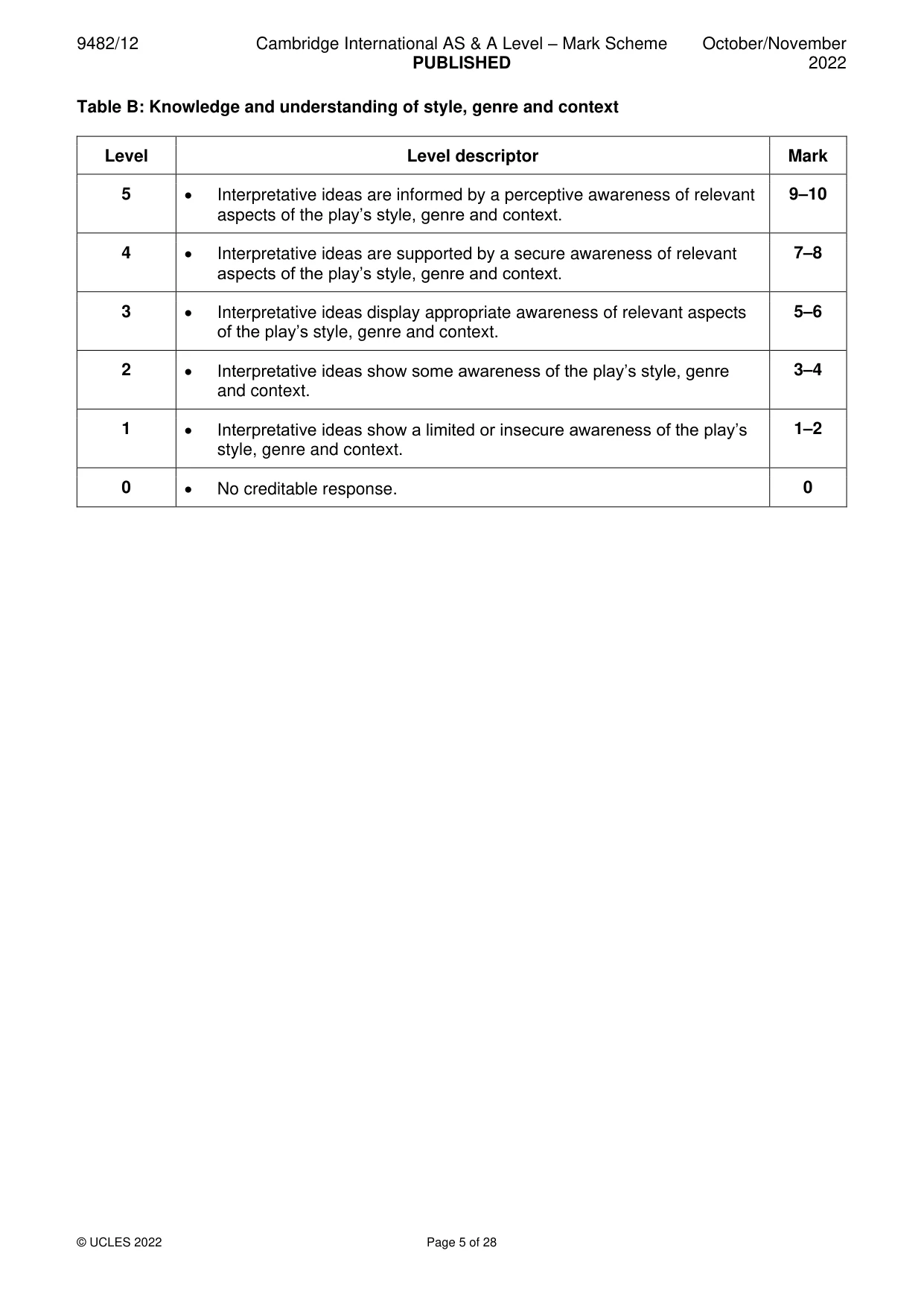
9482/12 Cambridge International AS & A Level – Mark Scheme PUBLISHED October/November 2022 © UCLES 2022 Page 5 of 28 Table B: Knowledge and understanding of style, genre and context Level Level descriptor Mark 5 • Interpretative ideas are informed by a perceptive awareness of relevant aspects of the play’s style, genre and context. 9–10 4 • Interpretative ideas are supported by a secure awareness of relevant aspects of the play’s style, genre and context. 7–8 3 • Interpretative ideas display appropriate awareness of relevant aspects of the play’s style, genre and context. 5–6 2 • Interpretative ideas show some awareness of the play’s style, genre and context. 3–4 1 • Interpretative ideas show a limited or insecure awareness of the play’s style, genre and context. 1–2 0 • No creditable response. 0
Mark scheme, page 6
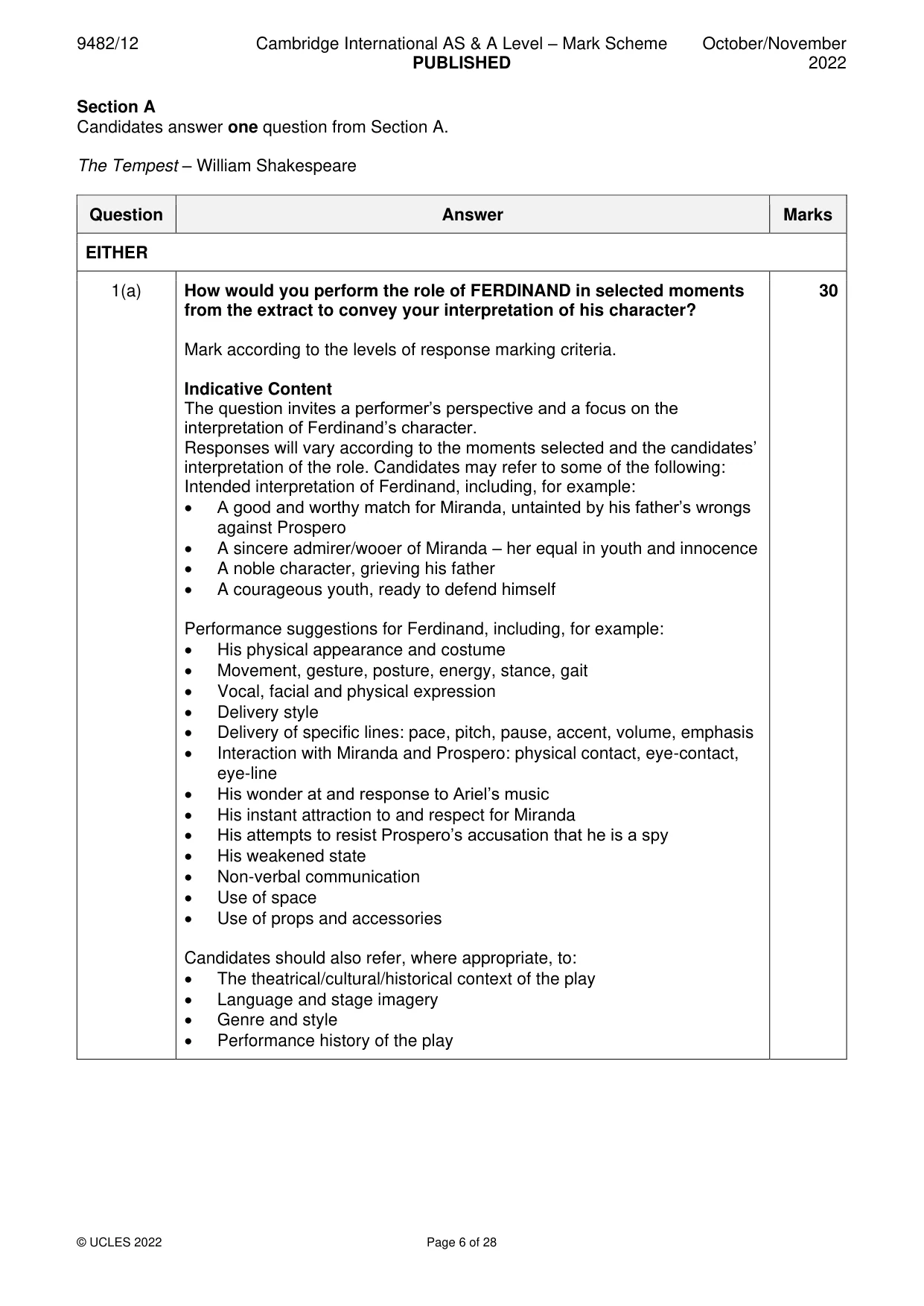
9482/12 Cambridge International AS & A Level – Mark Scheme PUBLISHED October/November 2022 © UCLES 2022 Page 6 of 28 Section A Candidates answer one question from Section A. The Tempest – William Shakespeare Question Answer Marks EITHER 1(a) How would you perform the role of FERDINAND in selected moments from the extract to convey your interpretation of his character? Mark according to the levels of response marking criteria. Indicative Content The question invites a performer’s perspective and a focus on the interpretation of Ferdinand’s character. Responses will vary according to the moments selected and the candidates’ interpretation of the role. Candidates may refer to some of the following: Intended interpretation of Ferdinand, including, for example: • A good and worthy match for Miranda, untainted by his father’s wrongs against Prospero • A sincere admirer/wooer of Miranda – her equal in youth and innocence • A noble character, grieving his father • A courageous youth, ready to defend himself Performance suggestions for Ferdinand, including, for example: • His physical appearance and costume • Movement, gesture, posture, energy, stance, gait • Vocal, facial and physical expression • Delivery style • Delivery of specific lines: pace, pitch, pause, accent, volume, emphasis • Interaction with Miranda and Prospero: physical contact, eye-contact, eye-line • His wonder at and response to Ariel’s music • His instant attraction to and respect for Miranda • His attempts to resist Prospero’s accusation that he is a spy • His weakened state • Non-verbal communication • Use of space • Use of props and accessories Candidates should also refer, where appropriate, to: • The theatrical/cultural/historical context of the play • Language and stage imagery • Genre and style • Performance history of the play 30
Mark scheme, page 7
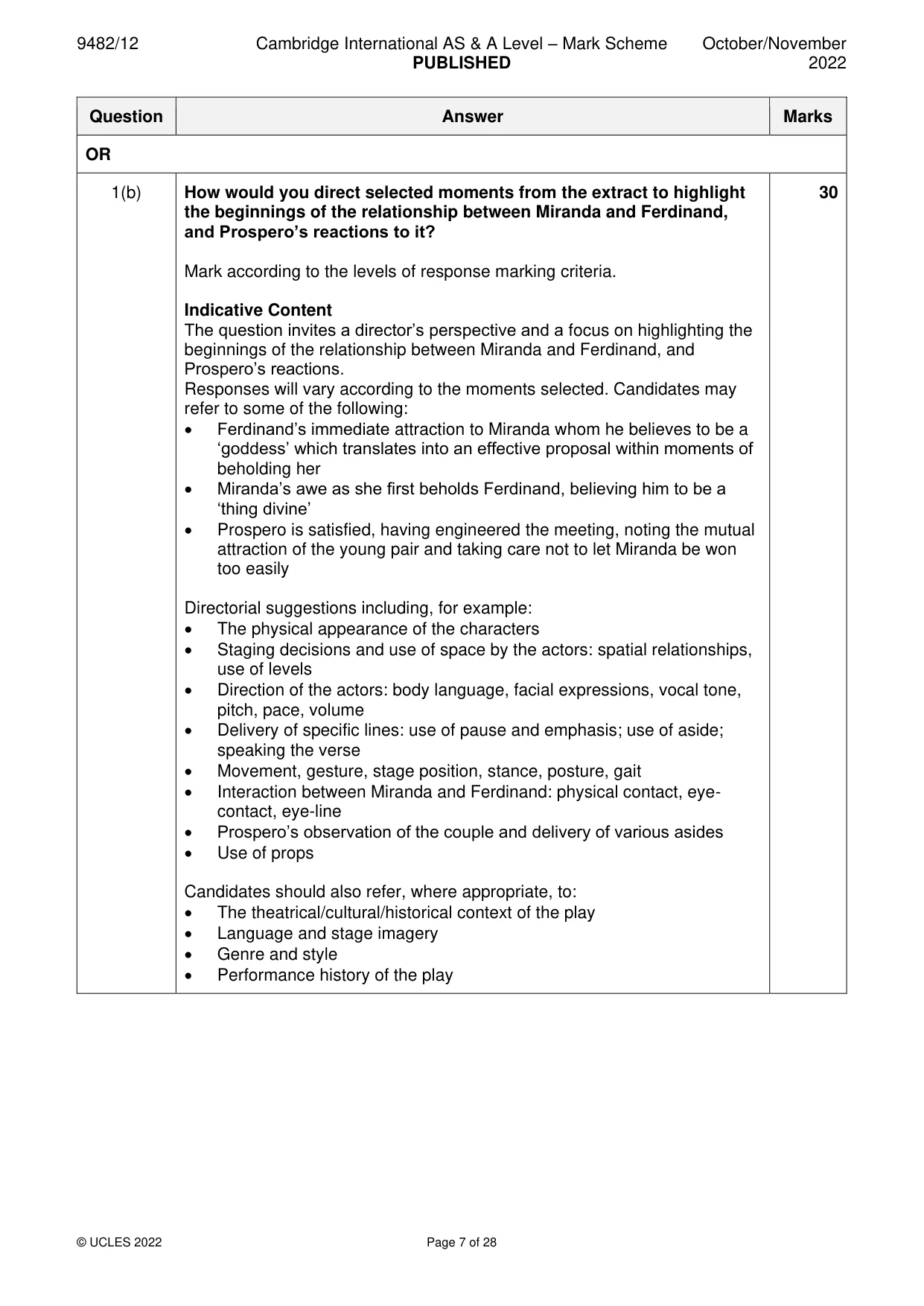
9482/12 Cambridge International AS & A Level – Mark Scheme PUBLISHED October/November 2022 © UCLES 2022 Page 7 of 28 Question Answer Marks OR 1(b) How would you direct selected moments from the extract to highlight the beginnings of the relationship between Miranda and Ferdinand, and Prospero’s reactions to it? Mark according to the levels of response marking criteria. Indicative Content The question invites a director’s perspective and a focus on highlighting the beginnings of the relationship between Miranda and Ferdinand, and Prospero’s reactions. Responses will vary according to the moments selected. Candidates may refer to some of the following: • Ferdinand’s immediate attraction to Miranda whom he believes to be a ‘goddess’ which translates into an effective proposal within moments of beholding her • Miranda’s awe as she first beholds Ferdinand, believing him to be a ‘thing divine’ • Prospero is satisfied, having engineered the meeting, noting the mutual attraction of the young pair and taking care not to let Miranda be won too easily Directorial suggestions including, for example: • The physical appearance of the characters • Staging decisions and use of space by the actors: spatial relationships, use of levels • Direction of the actors: body language, facial expressions, vocal tone, pitch, pace, volume • Delivery of specific lines: use of pause and emphasis; use of aside; speaking the verse • Movement, gesture, stage position, stance, posture, gait • Interaction between Miranda and Ferdinand: physical contact, eye- contact, eye-line • Prospero’s observation of the couple and delivery of various asides • Use of props Candidates should also refer, where appropriate, to: • The theatrical/cultural/historical context of the play • Language and stage imagery • Genre and style • Performance history of the play 30
Mark scheme, page 8
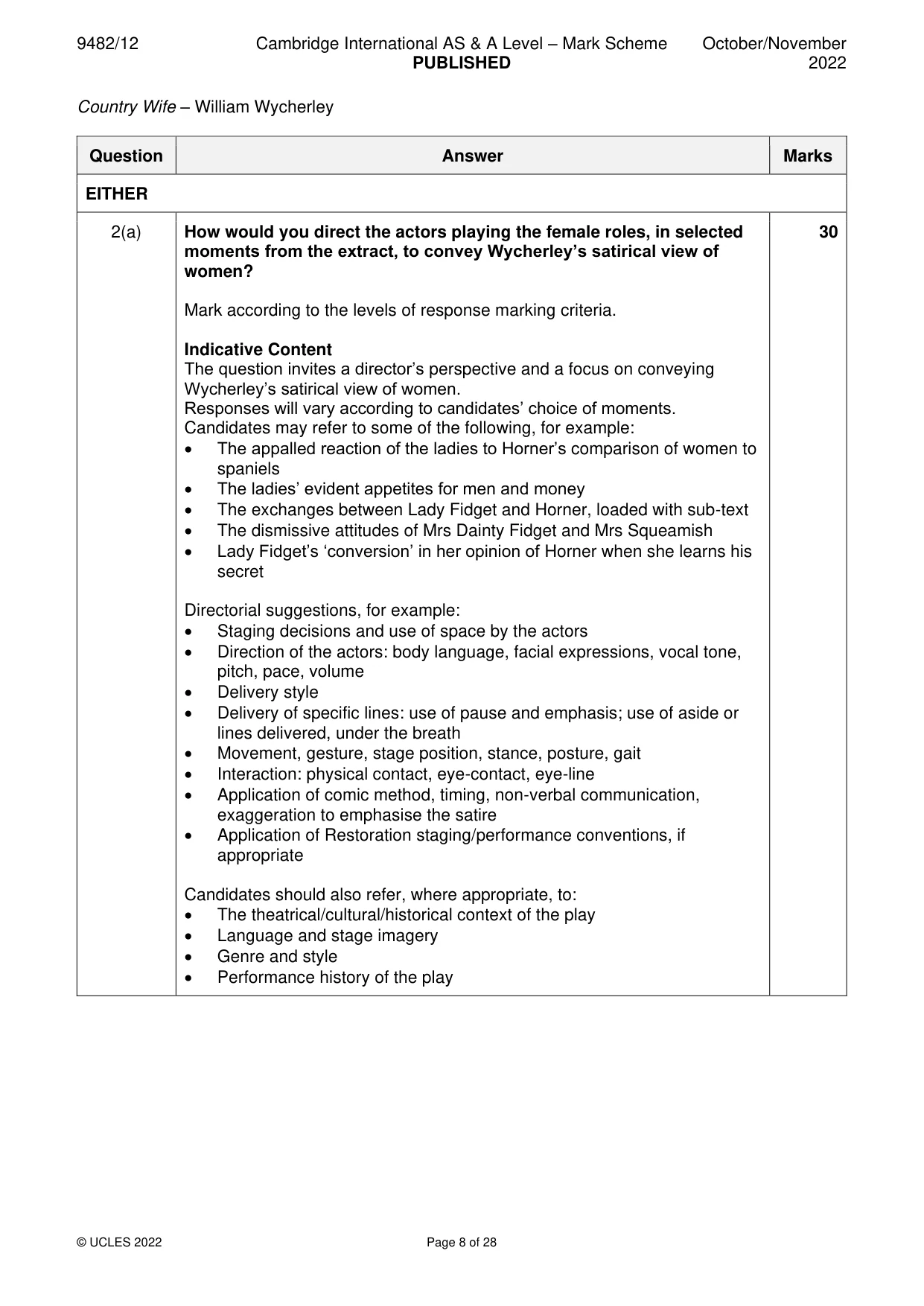
9482/12 Cambridge International AS & A Level – Mark Scheme PUBLISHED October/November 2022 © UCLES 2022 Page 8 of 28 Country Wife – William Wycherley Question Answer Marks EITHER 2(a) How would you direct the actors playing the female roles, in selected moments from the extract, to convey Wycherley’s satirical view of women? Mark according to the levels of response marking criteria. Indicative Content The question invites a director’s perspective and a focus on conveying Wycherley’s satirical view of women. Responses will vary according to candidates’ choice of moments. Candidates may refer to some of the following, for example: • The appalled reaction of the ladies to Horner’s comparison of women to spaniels • The ladies’ evident appetites for men and money • The exchanges between Lady Fidget and Horner, loaded with sub-text • The dismissive attitudes of Mrs Dainty Fidget and Mrs Squeamish • Lady Fidget’s ‘conversion’ in her opinion of Horner when she learns his secret Directorial suggestions, for example: • Staging decisions and use of space by the actors • Direction of the actors: body language, facial expressions, vocal tone, pitch, pace, volume • Delivery style • Delivery of specific lines: use of pause and emphasis; use of aside or lines delivered, under the breath • Movement, gesture, stage position, stance, posture, gait • Interaction: physical contact, eye-contact, eye-line • Application of comic method, timing, non-verbal communication, exaggeration to emphasise the satire • Application of Restoration staging/performance conventions, if appropriate Candidates should also refer, where appropriate, to: • The theatrical/cultural/historical context of the play • Language and stage imagery • Genre and style • Performance history of the play 30
Mark scheme, page 9
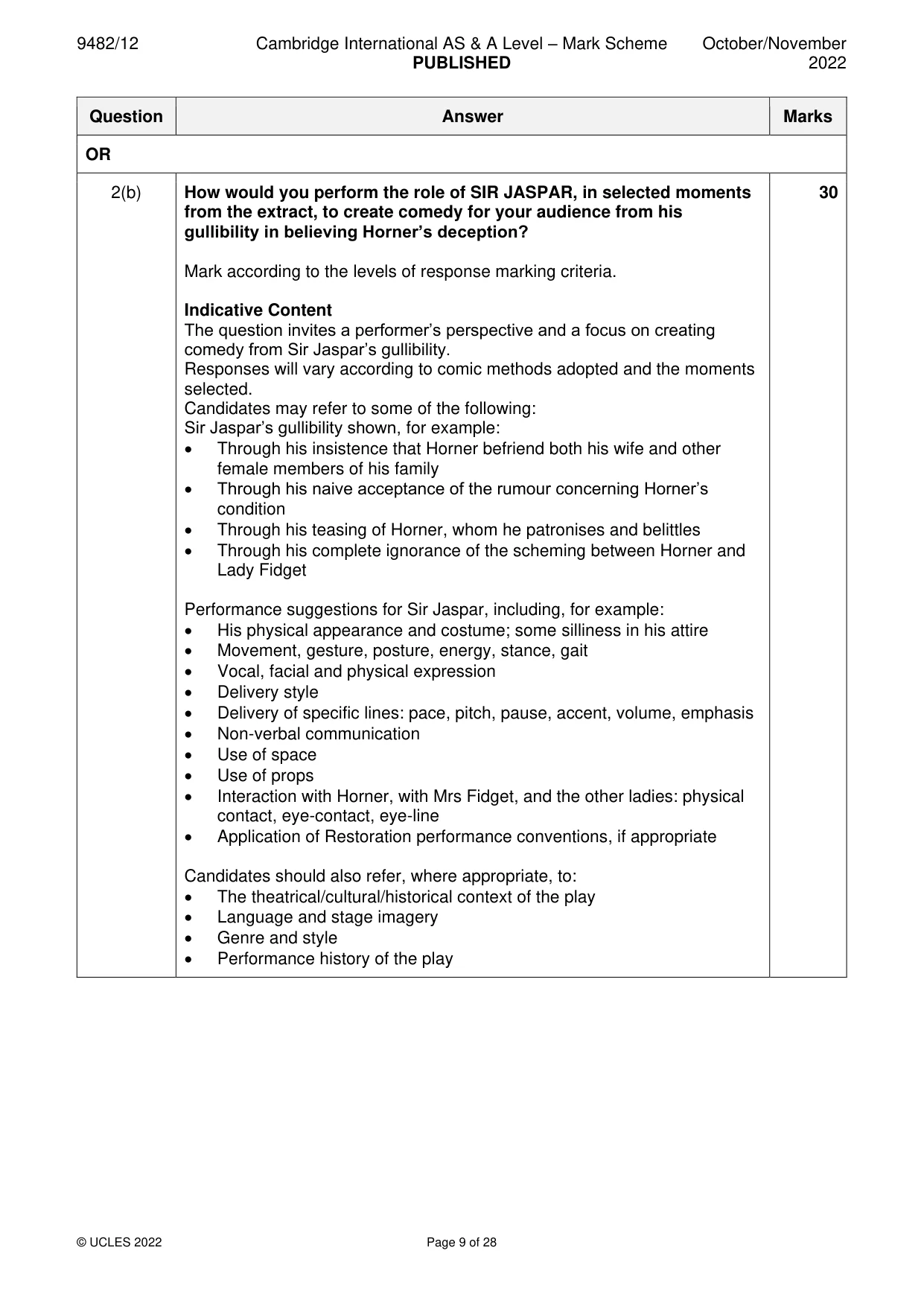
9482/12 Cambridge International AS & A Level – Mark Scheme PUBLISHED October/November 2022 © UCLES 2022 Page 9 of 28 Question Answer Marks OR 2(b) How would you perform the role of SIR JASPAR, in selected moments from the extract, to create comedy for your audience from his gullibility in believing Horner’s deception? Mark according to the levels of response marking criteria. Indicative Content The question invites a performer’s perspective and a focus on creating comedy from Sir Jaspar’s gullibility. Responses will vary according to comic methods adopted and the moments selected. Candidates may refer to some of the following: Sir Jaspar’s gullibility shown, for example: • Through his insistence that Horner befriend both his wife and other female members of his family • Through his naive acceptance of the rumour concerning Horner’s condition • Through his teasing of Horner, whom he patronises and belittles • Through his complete ignorance of the scheming between Horner and Lady Fidget Performance suggestions for Sir Jaspar, including, for example: • His physical appearance and costume; some silliness in his attire • Movement, gesture, posture, energy, stance, gait • Vocal, facial and physical expression • Delivery style • Delivery of specific lines: pace, pitch, pause, accent, volume, emphasis • Non-verbal communication • Use of space • Use of props • Interaction with Horner, with Mrs Fidget, and the other ladies: physical contact, eye-contact, eye-line • Application of Restoration performance conventions, if appropriate Candidates should also refer, where appropriate, to: • The theatrical/cultural/historical context of the play • Language and stage imagery • Genre and style • Performance history of the play 30
Mark scheme, page 10
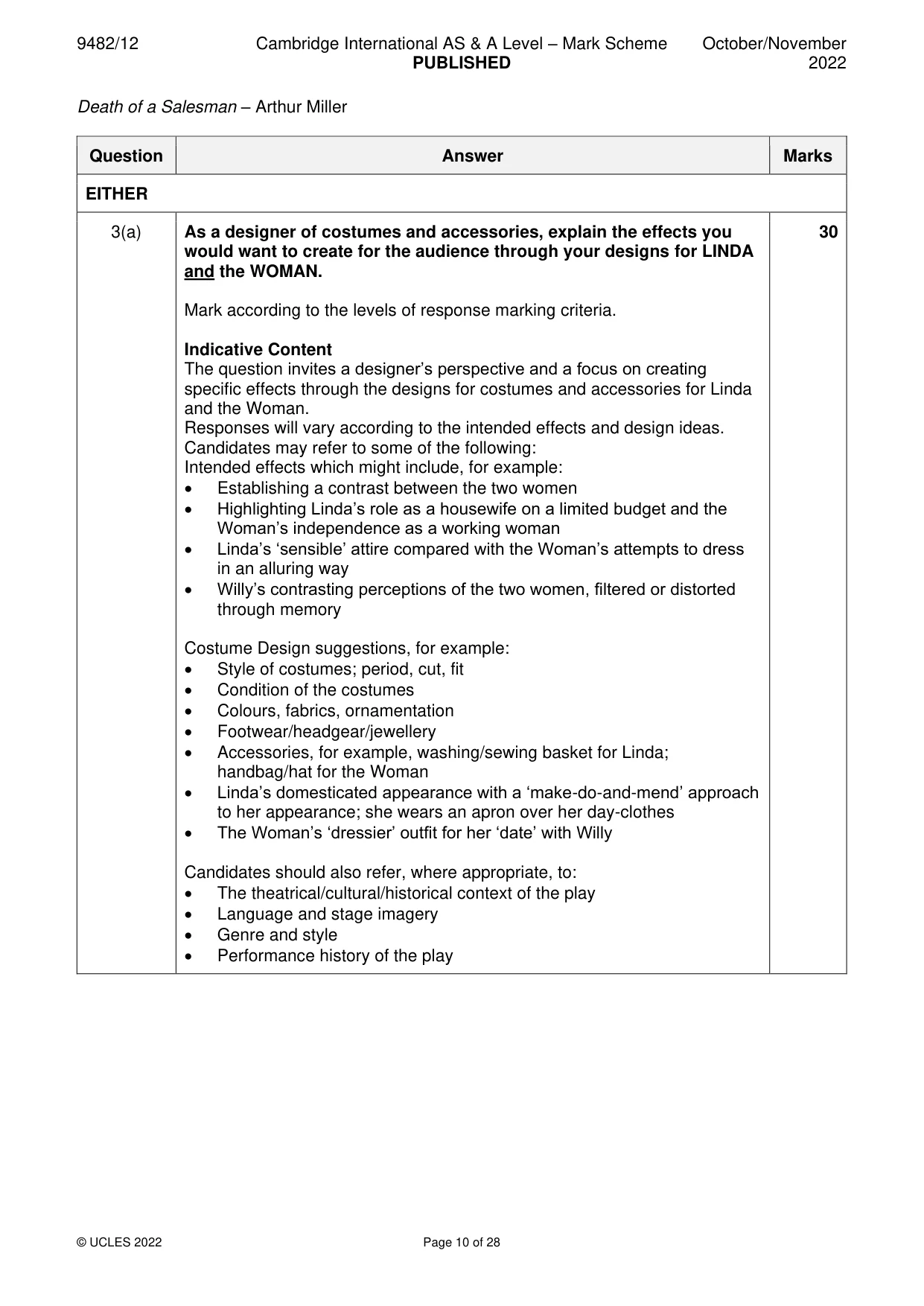
9482/12 Cambridge International AS & A Level – Mark Scheme PUBLISHED October/November 2022 © UCLES 2022 Page 10 of 28 Death of a Salesman – Arthur Miller Question Answer Marks EITHER 3(a) As a designer of costumes and accessories, explain the effects you would want to create for the audience through your designs for LINDA and the WOMAN. Mark according to the levels of response marking criteria. Indicative Content The question invites a designer’s perspective and a focus on creating specific effects through the designs for costumes and accessories for Linda and the Woman. Responses will vary according to the intended effects and design ideas. Candidates may refer to some of the following: Intended effects which might include, for example: • Establishing a contrast between the two women • Highlighting Linda’s role as a housewife on a limited budget and the Woman’s independence as a working woman • Linda’s ‘sensible’ attire compared with the Woman’s attempts to dress in an alluring way • Willy’s contrasting perceptions of the two women, filtered or distorted through memory Costume Design suggestions, for example: • Style of costumes; period, cut, fit • Condition of the costumes • Colours, fabrics, ornamentation • Footwear/headgear/jewellery • Accessories, for example, washing/sewing basket for Linda; handbag/hat for the Woman • Linda’s domesticated appearance with a ‘make-do-and-mend’ approach to her appearance; she wears an apron over her day-clothes • The Woman’s ‘dressier’ outfit for her ‘date’ with Willy Candidates should also refer, where appropriate, to: • The theatrical/cultural/historical context of the play • Language and stage imagery • Genre and style • Performance history of the play 30
Mark scheme, page 11
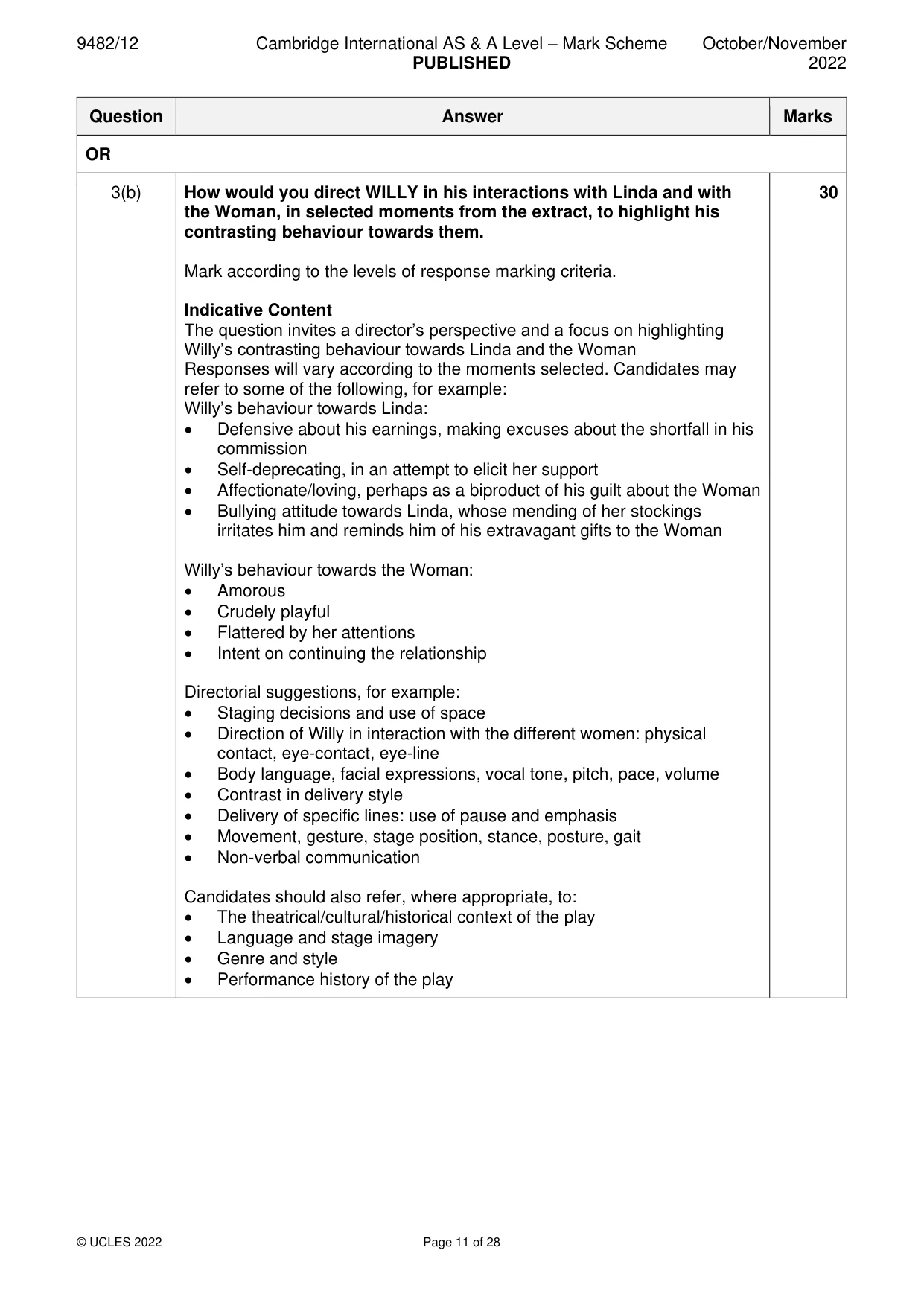
9482/12 Cambridge International AS & A Level – Mark Scheme PUBLISHED October/November 2022 © UCLES 2022 Page 11 of 28 Question Answer Marks OR 3(b) How would you direct WILLY in his interactions with Linda and with the Woman, in selected moments from the extract, to highlight his contrasting behaviour towards them. Mark according to the levels of response marking criteria. Indicative Content The question invites a director’s perspective and a focus on highlighting Willy’s contrasting behaviour towards Linda and the Woman Responses will vary according to the moments selected. Candidates may refer to some of the following, for example: Willy’s behaviour towards Linda: • Defensive about his earnings, making excuses about the shortfall in his commission • Self-deprecating, in an attempt to elicit her support • Affectionate/loving, perhaps as a biproduct of his guilt about the Woman • Bullying attitude towards Linda, whose mending of her stockings irritates him and reminds him of his extravagant gifts to the Woman Willy’s behaviour towards the Woman: • Amorous • Crudely playful • Flattered by her attentions • Intent on continuing the relationship Directorial suggestions, for example: • Staging decisions and use of space • Direction of Willy in interaction with the different women: physical contact, eye-contact, eye-line • Body language, facial expressions, vocal tone, pitch, pace, volume • Contrast in delivery style • Delivery of specific lines: use of pause and emphasis • Movement, gesture, stage position, stance, posture, gait • Non-verbal communication Candidates should also refer, where appropriate, to: • The theatrical/cultural/historical context of the play • Language and stage imagery • Genre and style • Performance history of the play 30
Mark scheme, page 12
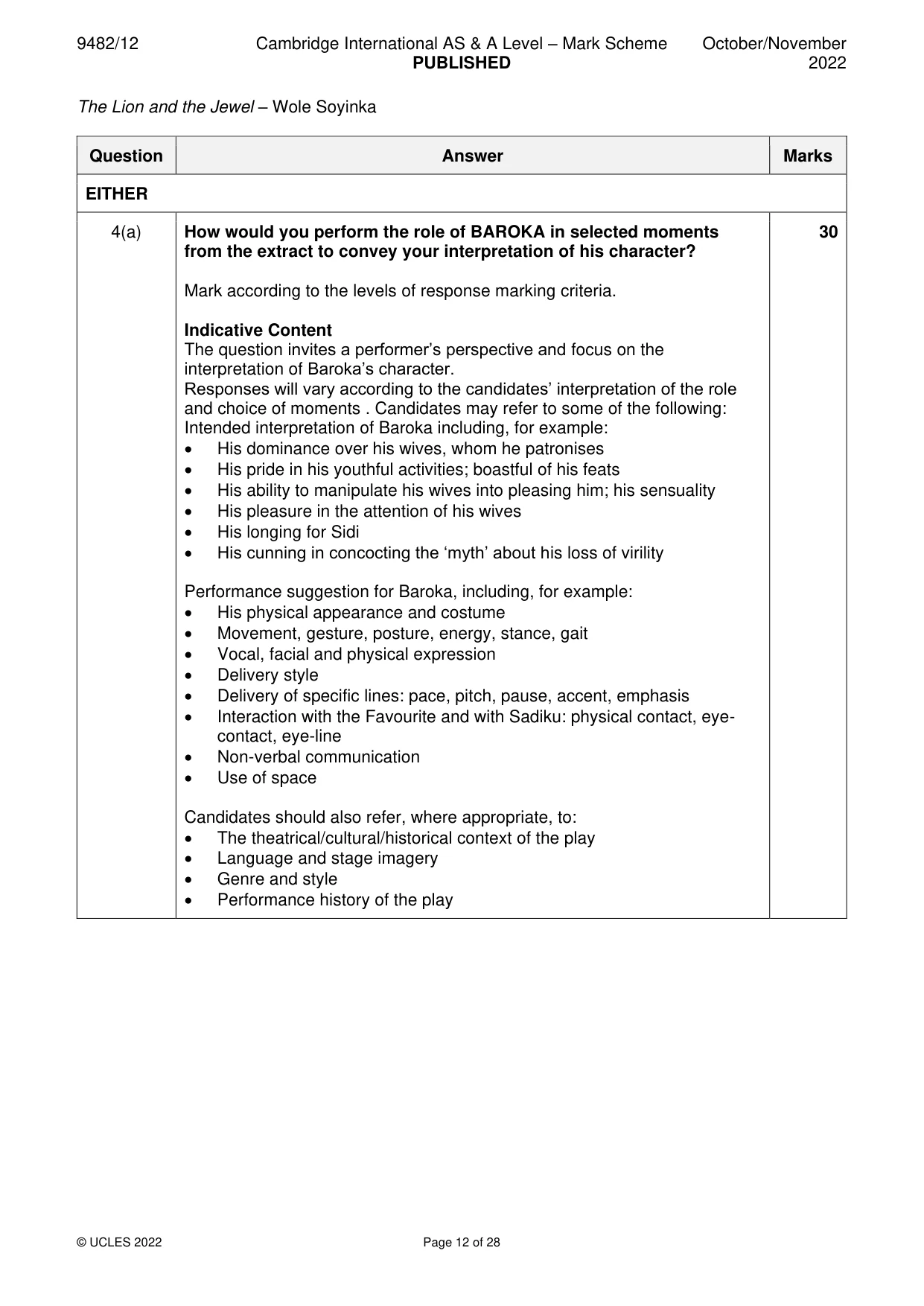
9482/12 Cambridge International AS & A Level – Mark Scheme PUBLISHED October/November 2022 © UCLES 2022 Page 12 of 28 The Lion and the Jewel – Wole Soyinka Question Answer Marks EITHER 4(a) How would you perform the role of BAROKA in selected moments from the extract to convey your interpretation of his character? Mark according to the levels of response marking criteria. Indicative Content The question invites a performer’s perspective and focus on the interpretation of Baroka’s character. Responses will vary according to the candidates’ interpretation of the role and choice of moments . Candidates may refer to some of the following: Intended interpretation of Baroka including, for example: • His dominance over his wives, whom he patronises • His pride in his youthful activities; boastful of his feats • His ability to manipulate his wives into pleasing him; his sensuality • His pleasure in the attention of his wives • His longing for Sidi • His cunning in concocting the ‘myth’ about his loss of virility Performance suggestion for Baroka, including, for example: • His physical appearance and costume • Movement, gesture, posture, energy, stance, gait • Vocal, facial and physical expression • Delivery style • Delivery of specific lines: pace, pitch, pause, accent, emphasis • Interaction with the Favourite and with Sadiku: physical contact, eye- contact, eye-line • Non-verbal communication • Use of space Candidates should also refer, where appropriate, to: • The theatrical/cultural/historical context of the play • Language and stage imagery • Genre and style • Performance history of the play 30
Mark scheme, page 13
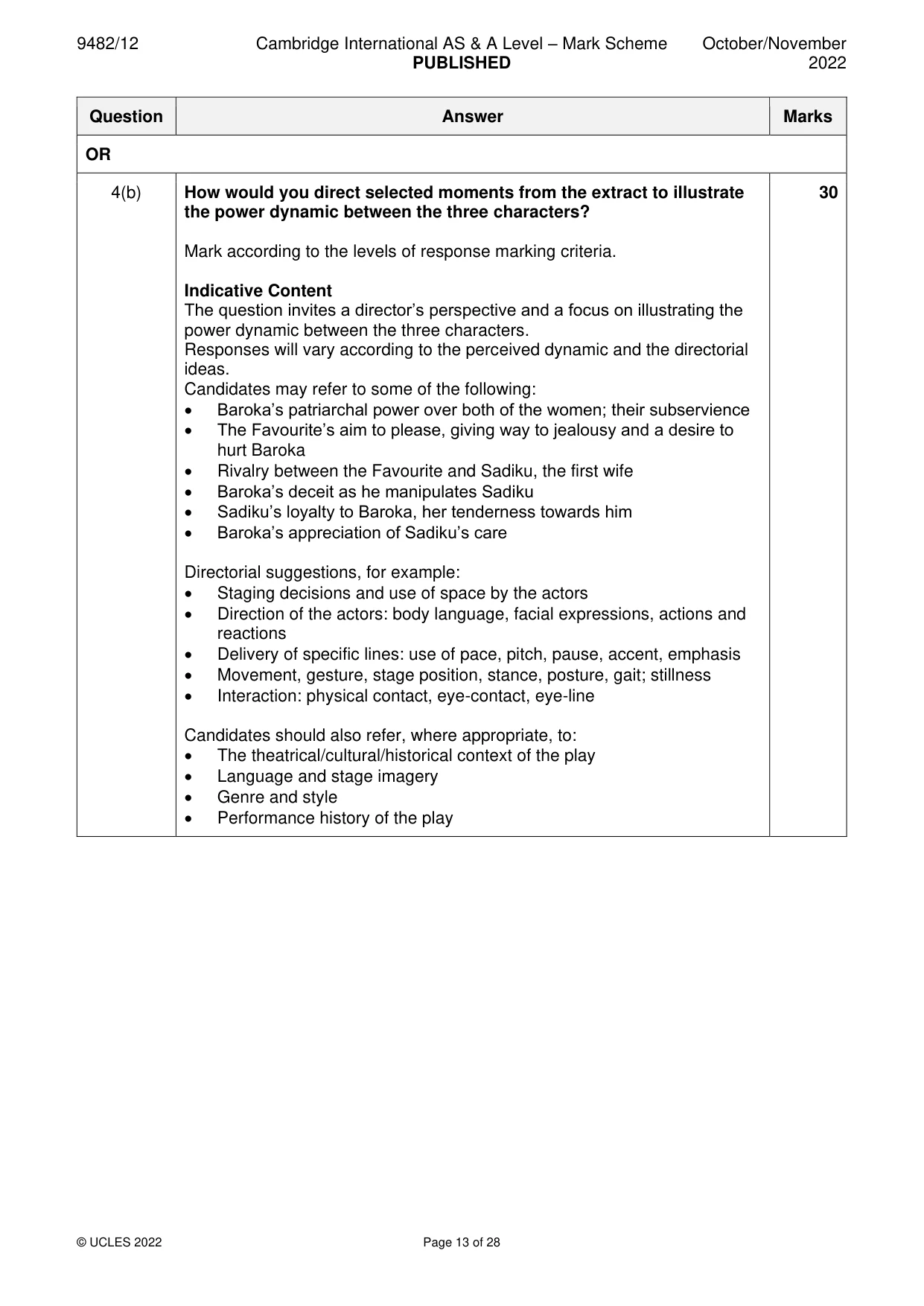
9482/12 Cambridge International AS & A Level – Mark Scheme PUBLISHED October/November 2022 © UCLES 2022 Page 13 of 28 Question Answer Marks OR 4(b) How would you direct selected moments from the extract to illustrate the power dynamic between the three characters? Mark according to the levels of response marking criteria. Indicative Content The question invites a director’s perspective and a focus on illustrating the power dynamic between the three characters. Responses will vary according to the perceived dynamic and the directorial ideas. Candidates may refer to some of the following: • Baroka’s patriarchal power over both of the women; their subservience • The Favourite’s aim to please, giving way to jealousy and a desire to hurt Baroka • Rivalry between the Favourite and Sadiku, the first wife • Baroka’s deceit as he manipulates Sadiku • Sadiku’s loyalty to Baroka, her tenderness towards him • Baroka’s appreciation of Sadiku’s care Directorial suggestions, for example: • Staging decisions and use of space by the actors • Direction of the actors: body language, facial expressions, actions and reactions • Delivery of specific lines: use of pace, pitch, pause, accent, emphasis • Movement, gesture, stage position, stance, posture, gait; stillness • Interaction: physical contact, eye-contact, eye-line Candidates should also refer, where appropriate, to: • The theatrical/cultural/historical context of the play • Language and stage imagery • Genre and style • Performance history of the play 30
Mark scheme, page 14
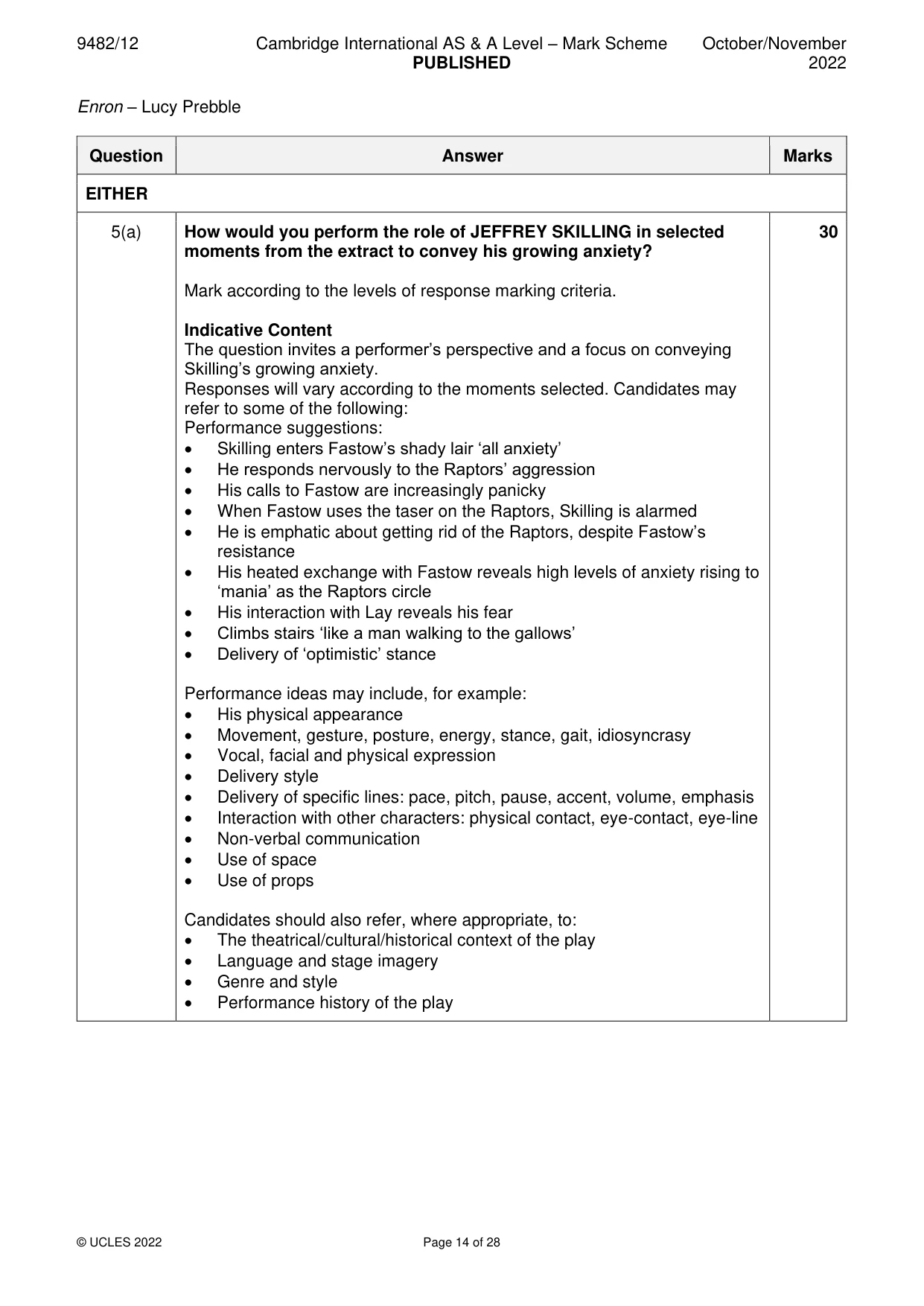
9482/12 Cambridge International AS & A Level – Mark Scheme PUBLISHED October/November 2022 © UCLES 2022 Page 14 of 28 Enron – Lucy Prebble Question Answer Marks EITHER 5(a) How would you perform the role of JEFFREY SKILLING in selected moments from the extract to convey his growing anxiety? Mark according to the levels of response marking criteria. Indicative Content The question invites a performer’s perspective and a focus on conveying Skilling’s growing anxiety. Responses will vary according to the moments selected. Candidates may refer to some of the following: Performance suggestions: • Skilling enters Fastow’s shady lair ‘all anxiety’ • He responds nervously to the Raptors’ aggression • His calls to Fastow are increasingly panicky • When Fastow uses the taser on the Raptors, Skilling is alarmed • He is emphatic about getting rid of the Raptors, despite Fastow’s resistance • His heated exchange with Fastow reveals high levels of anxiety rising to ‘mania’ as the Raptors circle • His interaction with Lay reveals his fear • Climbs stairs ‘like a man walking to the gallows’ • Delivery of ‘optimistic’ stance Performance ideas may include, for example: • His physical appearance • Movement, gesture, posture, energy, stance, gait, idiosyncrasy • Vocal, facial and physical expression • Delivery style • Delivery of specific lines: pace, pitch, pause, accent, volume, emphasis • Interaction with other characters: physical contact, eye-contact, eye-line • Non-verbal communication • Use of space • Use of props Candidates should also refer, where appropriate, to: • The theatrical/cultural/historical context of the play • Language and stage imagery • Genre and style • Performance history of the play 30
Mark scheme, page 15
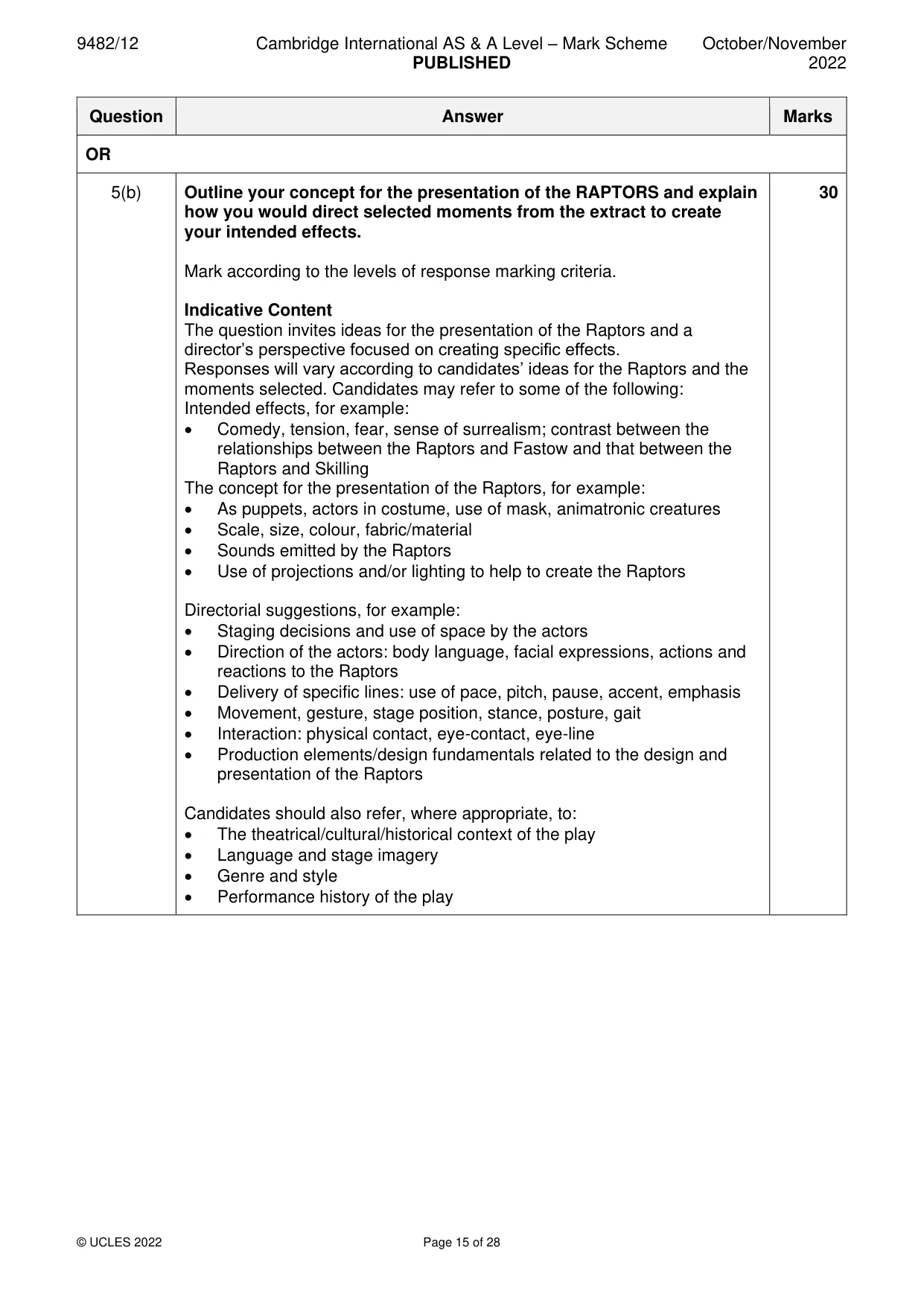
9482/12 Cambridge International AS & A Level – Mark Scheme PUBLISHED October/November 2022 © UCLES 2022 Page 15 of 28 Question Answer Marks OR 5(b) Outline your concept for the presentation of the RAPTORS and explain how you would direct selected moments from the extract to create your intended effects. Mark according to the levels of response marking criteria. Indicative Content The question invites ideas for the presentation of the Raptors and a director’s perspective focused on creating specific effects. Responses will vary according to candidates’ ideas for the Raptors and the moments selected. Candidates may refer to some of the following: Intended effects, for example: • Comedy, tension, fear, sense of surrealism; contrast between the relationships between the Raptors and Fastow and that between the Raptors and Skilling The concept for the presentation of the Raptors, for example: • As puppets, actors in costume, use of mask, animatronic creatures • Scale, size, colour, fabric/material • Sounds emitted by the Raptors • Use of projections and/or lighting to help to create the Raptors Directorial suggestions, for example: • Staging decisions and use of space by the actors • Direction of the actors: body language, facial expressions, actions and reactions to the Raptors • Delivery of specific lines: use of pace, pitch, pause, accent, emphasis • Movement, gesture, stage position, stance, posture, gait • Interaction: physical contact, eye-contact, eye-line • Production elements/design fundamentals related to the design and presentation of the Raptors Candidates should also refer, where appropriate, to: • The theatrical/cultural/historical context of the play • Language and stage imagery • Genre and style • Performance history of the play 30
Mark scheme, page 16
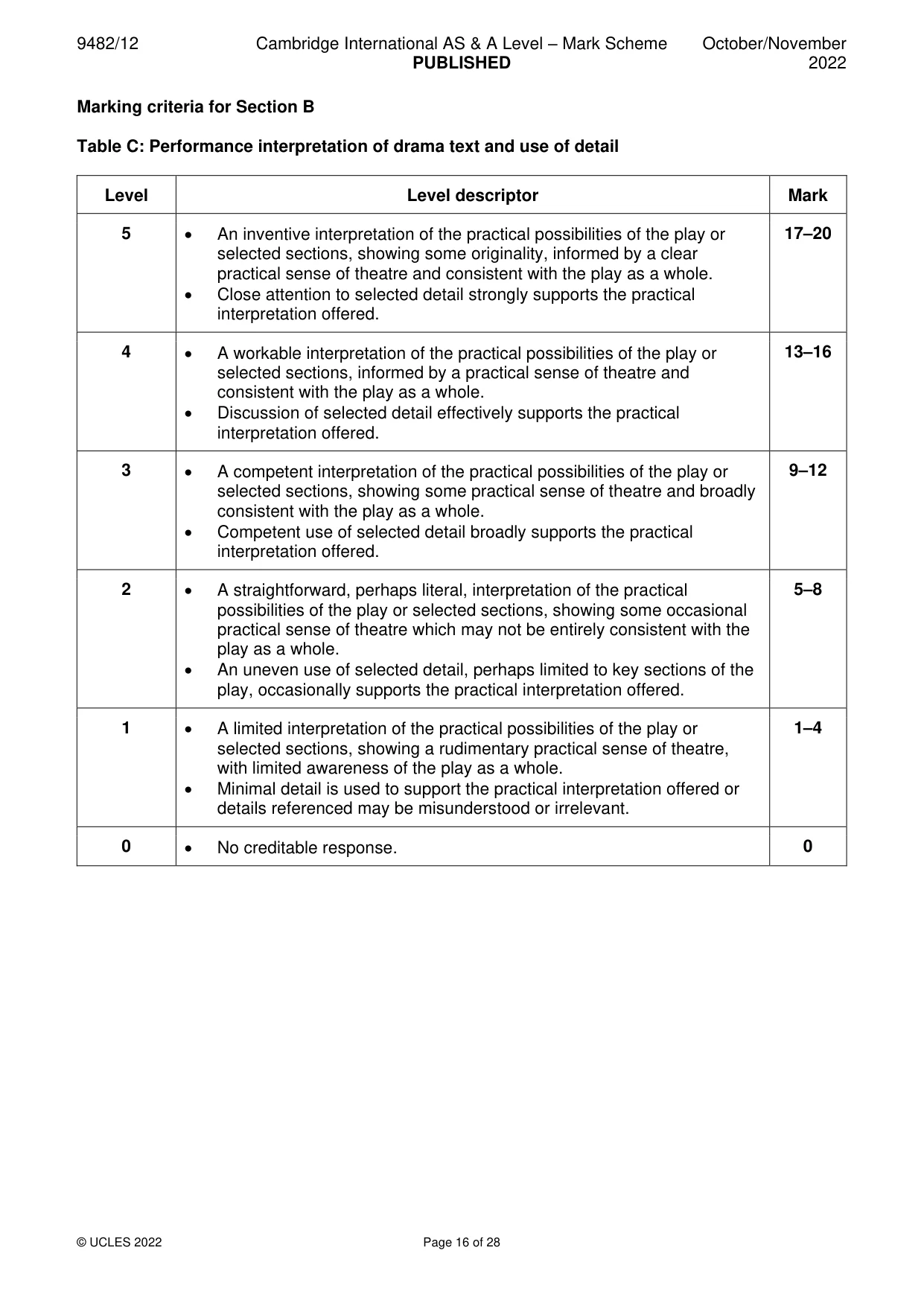
9482/12 Cambridge International AS & A Level – Mark Scheme PUBLISHED October/November 2022 © UCLES 2022 Page 16 of 28 Marking criteria for Section B Table C: Performance interpretation of drama text and use of detail Level Level descriptor Mark 5 • An inventive interpretation of the practical possibilities of the play or selected sections, showing some originality, informed by a clear practical sense of theatre and consistent with the play as a whole. • Close attention to selected detail strongly supports the practical interpretation offered. 17–20 4 • A workable interpretation of the practical possibilities of the play or selected sections, informed by a practical sense of theatre and consistent with the play as a whole. • Discussion of selected detail effectively supports the practical interpretation offered. 13–16 3 • A competent interpretation of the practical possibilities of the play or selected sections, showing some practical sense of theatre and broadly consistent with the play as a whole. • Competent use of selected detail broadly supports the practical interpretation offered. 9–12 2 • A straightforward, perhaps literal, interpretation of the practical possibilities of the play or selected sections, showing some occasional practical sense of theatre which may not be entirely consistent with the play as a whole. • An uneven use of selected detail, perhaps limited to key sections of the play, occasionally supports the practical interpretation offered. 5–8 1 • A limited interpretation of the practical possibilities of the play or selected sections, showing a rudimentary practical sense of theatre, with limited awareness of the play as a whole. • Minimal detail is used to support the practical interpretation offered or details referenced may be misunderstood or irrelevant. 1–4 0 • No creditable response. 0
Mark scheme, page 17
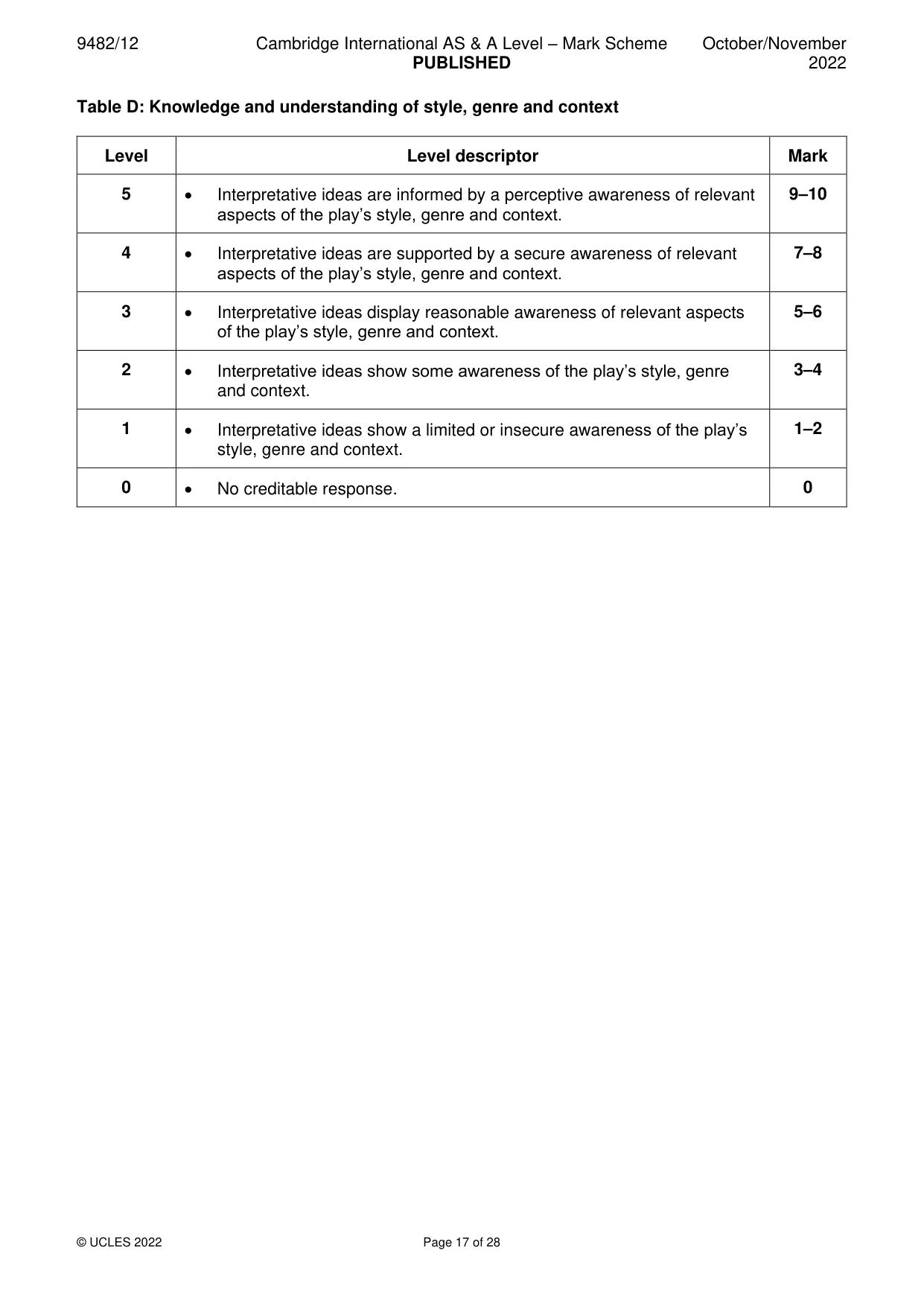
9482/12 Cambridge International AS & A Level – Mark Scheme PUBLISHED October/November 2022 © UCLES 2022 Page 17 of 28 Table D: Knowledge and understanding of style, genre and context Level Level descriptor Mark 5 • Interpretative ideas are informed by a perceptive awareness of relevant aspects of the play’s style, genre and context. 9–10 4 • Interpretative ideas are supported by a secure awareness of relevant aspects of the play’s style, genre and context. 7–8 3 • Interpretative ideas display reasonable awareness of relevant aspects of the play’s style, genre and context. 5–6 2 • Interpretative ideas show some awareness of the play’s style, genre and context. 3–4 1 • Interpretative ideas show a limited or insecure awareness of the play’s style, genre and context. 1–2 0 • No creditable response. 0
Mark scheme, page 18
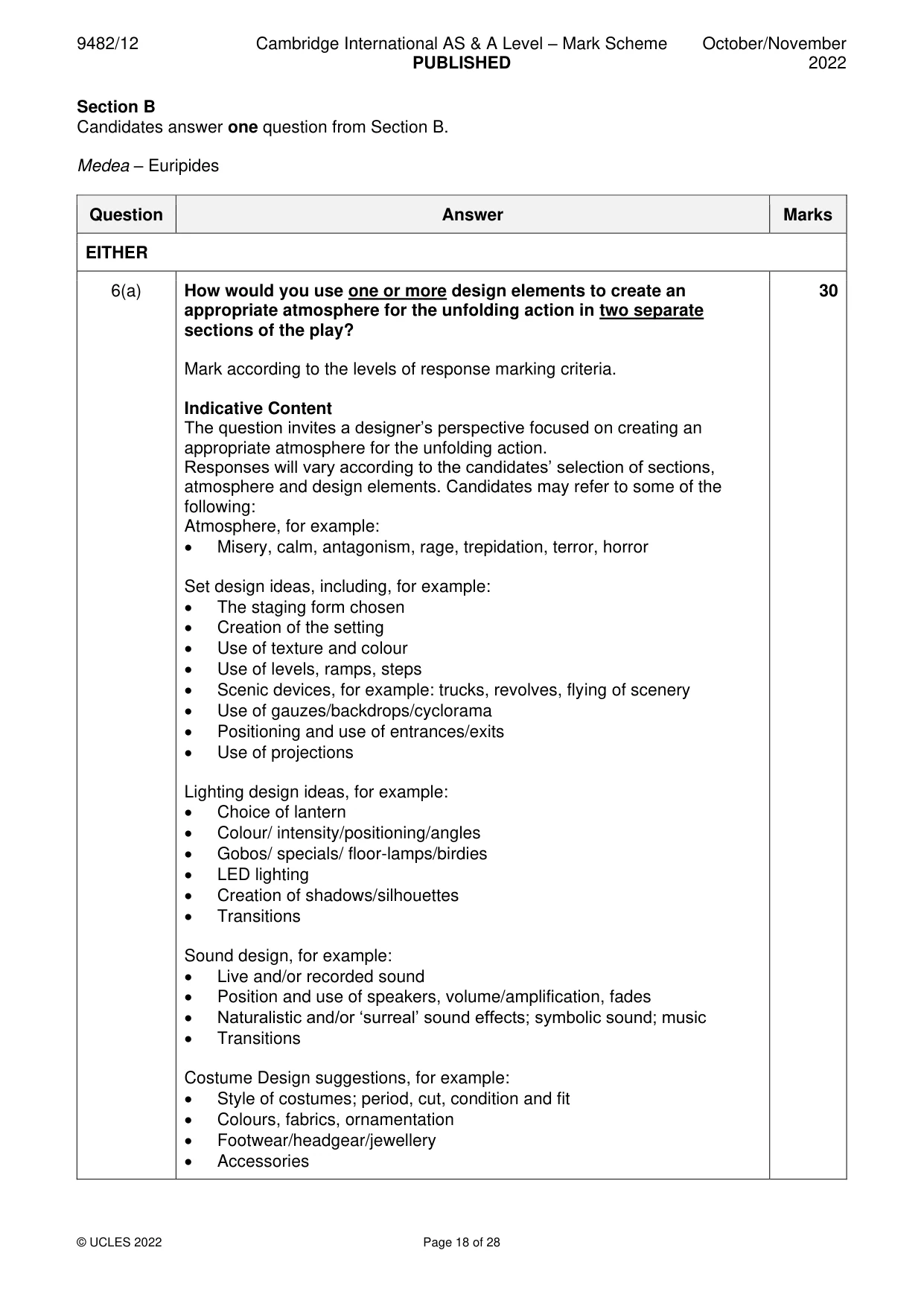
9482/12 Cambridge International AS & A Level – Mark Scheme PUBLISHED October/November 2022 © UCLES 2022 Page 18 of 28 Section B Candidates answer one question from Section B. Medea – Euripides Question Answer Marks EITHER 6(a) How would you use one or more design elements to create an appropriate atmosphere for the unfolding action in two separate sections of the play? Mark according to the levels of response marking criteria. Indicative Content The question invites a designer’s perspective focused on creating an appropriate atmosphere for the unfolding action. Responses will vary according to the candidates’ selection of sections, atmosphere and design elements. Candidates may refer to some of the following: Atmosphere, for example: • Misery, calm, antagonism, rage, trepidation, terror, horror Set design ideas, including, for example: • The staging form chosen • Creation of the setting • Use of texture and colour • Use of levels, ramps, steps • Scenic devices, for example: trucks, revolves, flying of scenery • Use of gauzes/backdrops/cyclorama • Positioning and use of entrances/exits • Use of projections Lighting design ideas, for example: • Choice of lantern • Colour/ intensity/positioning/angles • Gobos/ specials/ floor-lamps/birdies • LED lighting • Creation of shadows/silhouettes • Transitions Sound design, for example: • Live and/or recorded sound • Position and use of speakers, volume/amplification, fades • Naturalistic and/or ‘surreal’ sound effects; symbolic sound; music • Transitions Costume Design suggestions, for example: • Style of costumes; period, cut, condition and fit • Colours, fabrics, ornamentation • Footwear/headgear/jewellery • Accessories 30
Mark scheme, page 19
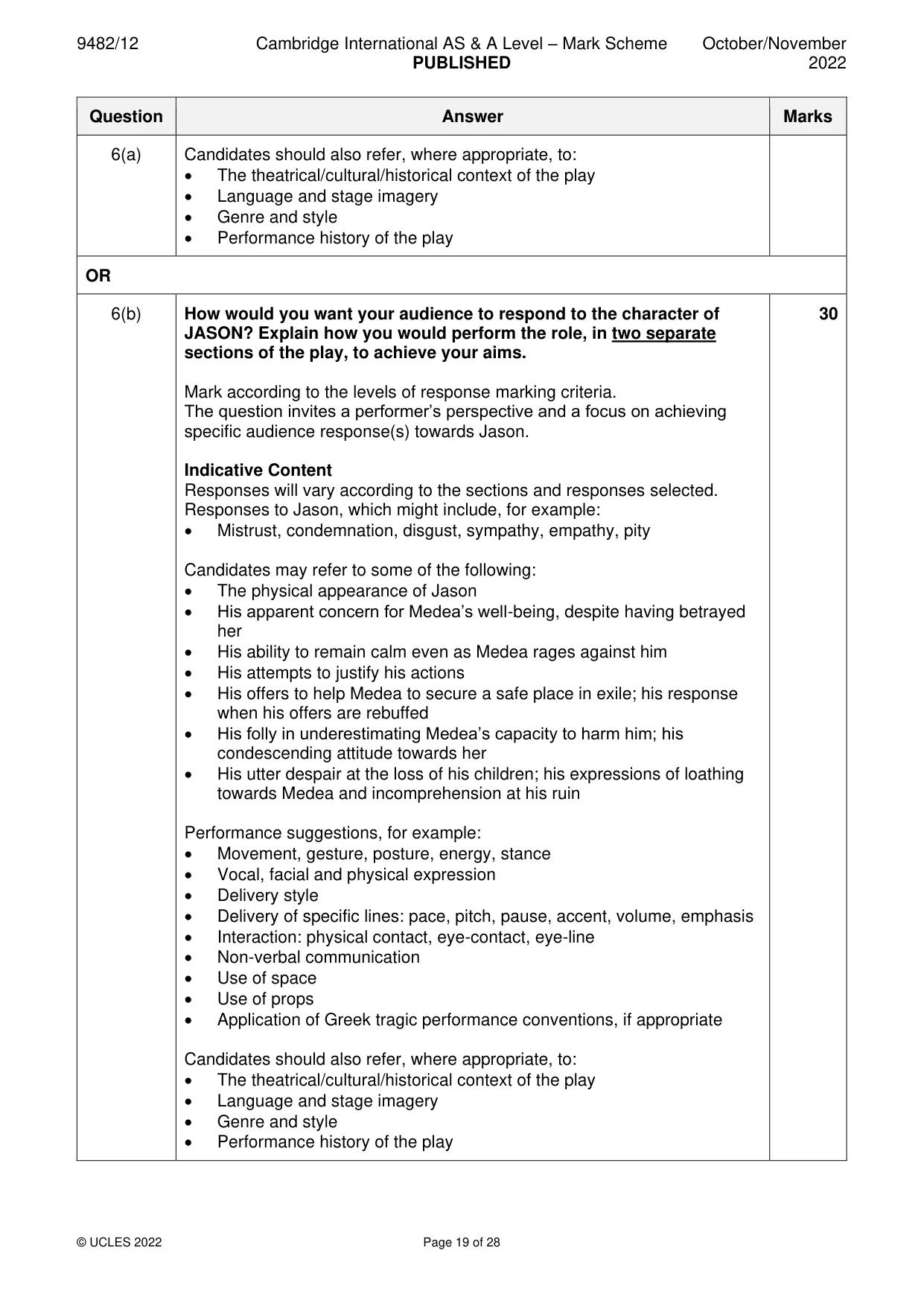
9482/12 Cambridge International AS & A Level – Mark Scheme PUBLISHED October/November 2022 © UCLES 2022 Page 19 of 28 Question Answer Marks 6(a) Candidates should also refer, where appropriate, to: • The theatrical/cultural/historical context of the play • Language and stage imagery • Genre and style • Performance history of the play OR 6(b) How would you want your audience to respond to the character of JASON? Explain how you would perform the role, in two separate sections of the play, to achieve your aims. Mark according to the levels of response marking criteria. The question invites a performer’s perspective and a focus on achieving specific audience response(s) towards Jason. Indicative Content Responses will vary according to the sections and responses selected. Responses to Jason, which might include, for example: • Mistrust, condemnation, disgust, sympathy, empathy, pity Candidates may refer to some of the following: • The physical appearance of Jason • His apparent concern for Medea’s well-being, despite having betrayed her • His ability to remain calm even as Medea rages against him • His attempts to justify his actions • His offers to help Medea to secure a safe place in exile; his response when his offers are rebuffed • His folly in underestimating Medea’s capacity to harm him; his condescending attitude towards her • His utter despair at the loss of his children; his expressions of loathing towards Medea and incomprehension at his ruin Performance suggestions, for example: • Movement, gesture, posture, energy, stance • Vocal, facial and physical expression • Delivery style • Delivery of specific lines: pace, pitch, pause, accent, volume, emphasis • Interaction: physical contact, eye-contact, eye-line • Non-verbal communication • Use of space • Use of props • Application of Greek tragic performance conventions, if appropriate Candidates should also refer, where appropriate, to: • The theatrical/cultural/historical context of the play • Language and stage imagery • Genre and style • Performance history of the play 30
Mark scheme, page 20
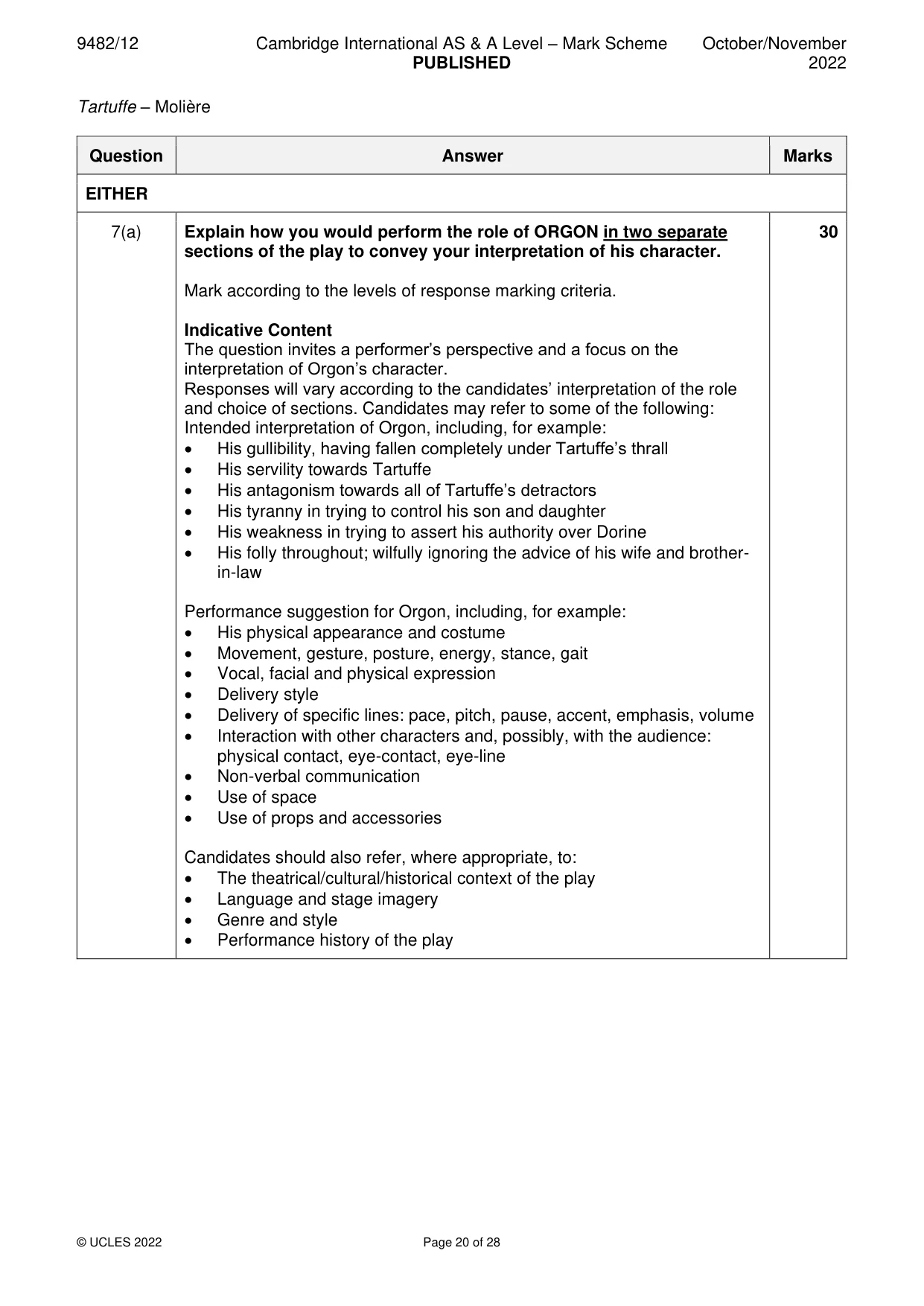
9482/12 Cambridge International AS & A Level – Mark Scheme PUBLISHED October/November 2022 © UCLES 2022 Page 20 of 28 Tartuffe – Molière Question Answer Marks EITHER 7(a) Explain how you would perform the role of ORGON in two separate sections of the play to convey your interpretation of his character. Mark according to the levels of response marking criteria. Indicative Content The question invites a performer’s perspective and a focus on the interpretation of Orgon’s character. Responses will vary according to the candidates’ interpretation of the role and choice of sections. Candidates may refer to some of the following: Intended interpretation of Orgon, including, for example: • His gullibility, having fallen completely under Tartuffe’s thrall • His servility towards Tartuffe • His antagonism towards all of Tartuffe’s detractors • His tyranny in trying to control his son and daughter • His weakness in trying to assert his authority over Dorine • His folly throughout; wilfully ignoring the advice of his wife and brother- in-law Performance suggestion for Orgon, including, for example: • His physical appearance and costume • Movement, gesture, posture, energy, stance, gait • Vocal, facial and physical expression • Delivery style • Delivery of specific lines: pace, pitch, pause, accent, emphasis, volume • Interaction with other characters and, possibly, with the audience: physical contact, eye-contact, eye-line • Non-verbal communication • Use of space • Use of props and accessories Candidates should also refer, where appropriate, to: • The theatrical/cultural/historical context of the play • Language and stage imagery • Genre and style • Performance history of the play 30
Mark scheme, page 21
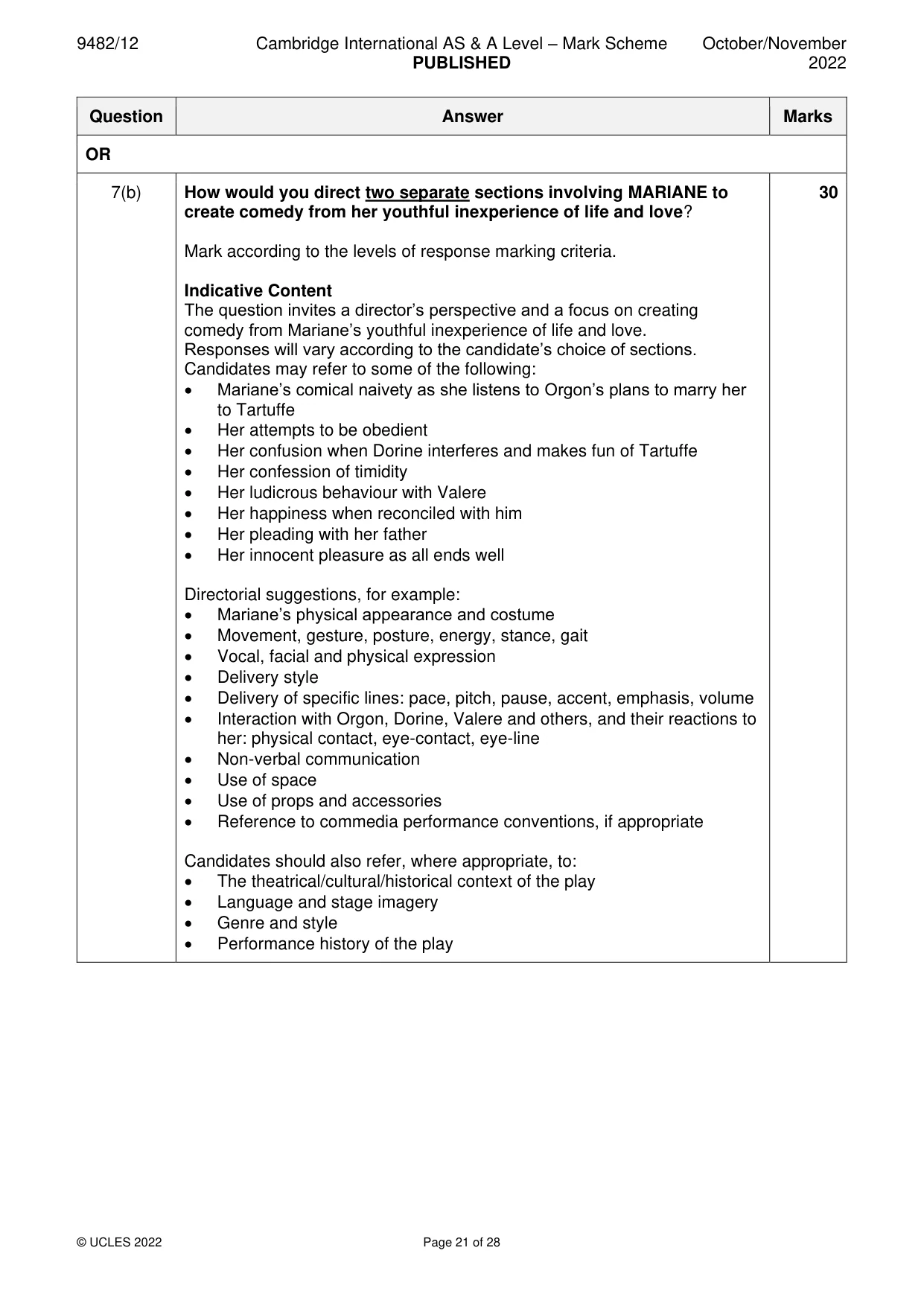
9482/12 Cambridge International AS & A Level – Mark Scheme PUBLISHED October/November 2022 © UCLES 2022 Page 21 of 28 Question Answer Marks OR 7(b) How would you direct two separate sections involving MARIANE to create comedy from her youthful inexperience of life and love? Mark according to the levels of response marking criteria. Indicative Content The question invites a director’s perspective and a focus on creating comedy from Mariane’s youthful inexperience of life and love. Responses will vary according to the candidate’s choice of sections. Candidates may refer to some of the following: • Mariane’s comical naivety as she listens to Orgon’s plans to marry her to Tartuffe • Her attempts to be obedient • Her confusion when Dorine interferes and makes fun of Tartuffe • Her confession of timidity • Her ludicrous behaviour with Valere • Her happiness when reconciled with him • Her pleading with her father • Her innocent pleasure as all ends well Directorial suggestions, for example: • Mariane’s physical appearance and costume • Movement, gesture, posture, energy, stance, gait • Vocal, facial and physical expression • Delivery style • Delivery of specific lines: pace, pitch, pause, accent, emphasis, volume • Interaction with Orgon, Dorine, Valere and others, and their reactions to her: physical contact, eye-contact, eye-line • Non-verbal communication • Use of space • Use of props and accessories • Reference to commedia performance conventions, if appropriate Candidates should also refer, where appropriate, to: • The theatrical/cultural/historical context of the play • Language and stage imagery • Genre and style • Performance history of the play 30
Mark scheme, page 22
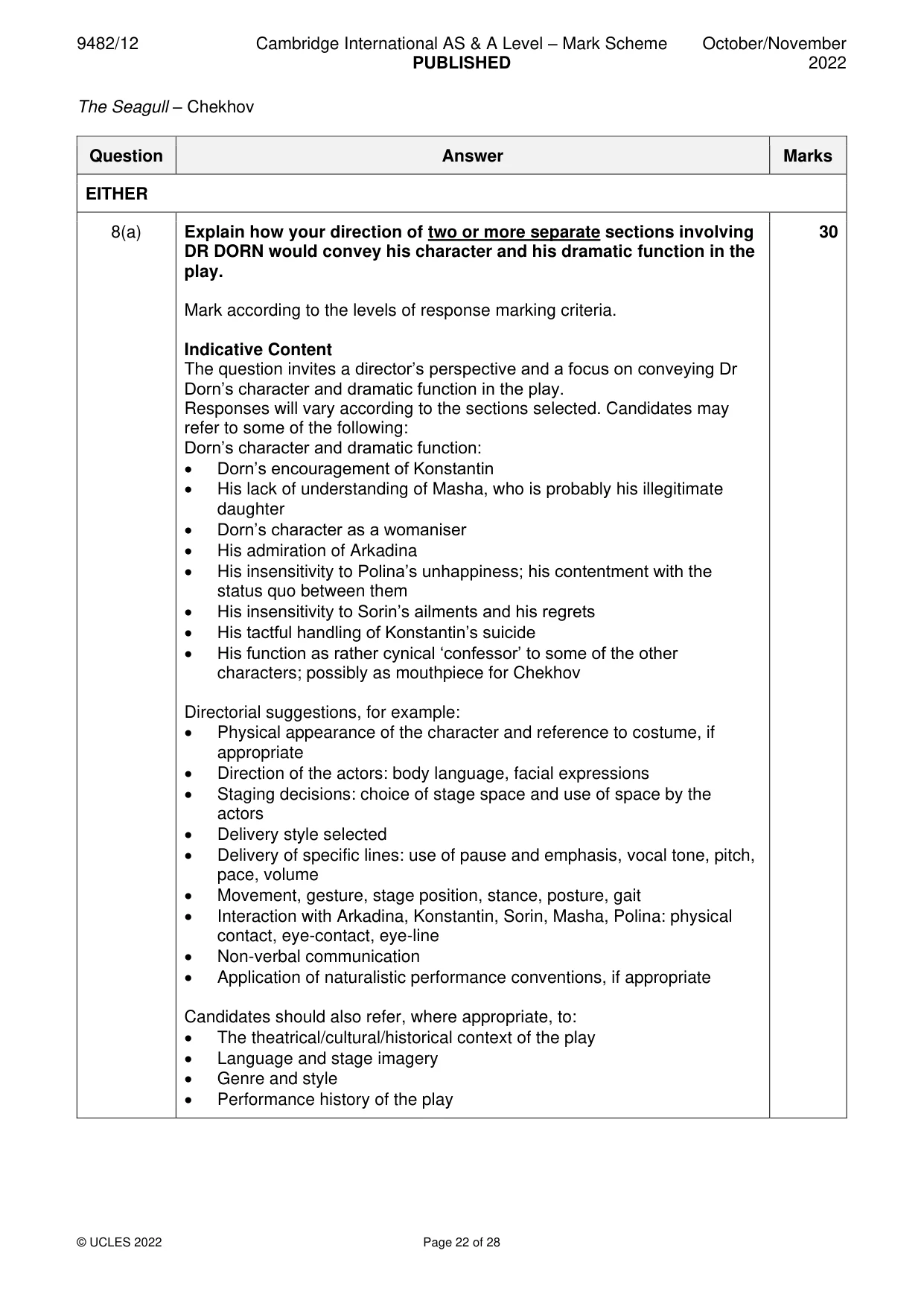
9482/12 Cambridge International AS & A Level – Mark Scheme PUBLISHED October/November 2022 © UCLES 2022 Page 22 of 28 The Seagull – Chekhov Question Answer Marks EITHER 8(a) Explain how your direction of two or more separate sections involving DR DORN would convey his character and his dramatic function in the play. Mark according to the levels of response marking criteria. Indicative Content The question invites a director’s perspective and a focus on conveying Dr Dorn’s character and dramatic function in the play. Responses will vary according to the sections selected. Candidates may refer to some of the following: Dorn’s character and dramatic function: • Dorn’s encouragement of Konstantin • His lack of understanding of Masha, who is probably his illegitimate daughter • Dorn’s character as a womaniser • His admiration of Arkadina • His insensitivity to Polina’s unhappiness; his contentment with the status quo between them • His insensitivity to Sorin’s ailments and his regrets • His tactful handling of Konstantin’s suicide • His function as rather cynical ‘confessor’ to some of the other characters; possibly as mouthpiece for Chekhov Directorial suggestions, for example: • Physical appearance of the character and reference to costume, if appropriate • Direction of the actors: body language, facial expressions • Staging decisions: choice of stage space and use of space by the actors • Delivery style selected • Delivery of specific lines: use of pause and emphasis, vocal tone, pitch, pace, volume • Movement, gesture, stage position, stance, posture, gait • Interaction with Arkadina, Konstantin, Sorin, Masha, Polina: physical contact, eye-contact, eye-line • Non-verbal communication • Application of naturalistic performance conventions, if appropriate Candidates should also refer, where appropriate, to: • The theatrical/cultural/historical context of the play • Language and stage imagery • Genre and style • Performance history of the play 30
Mark scheme, page 23
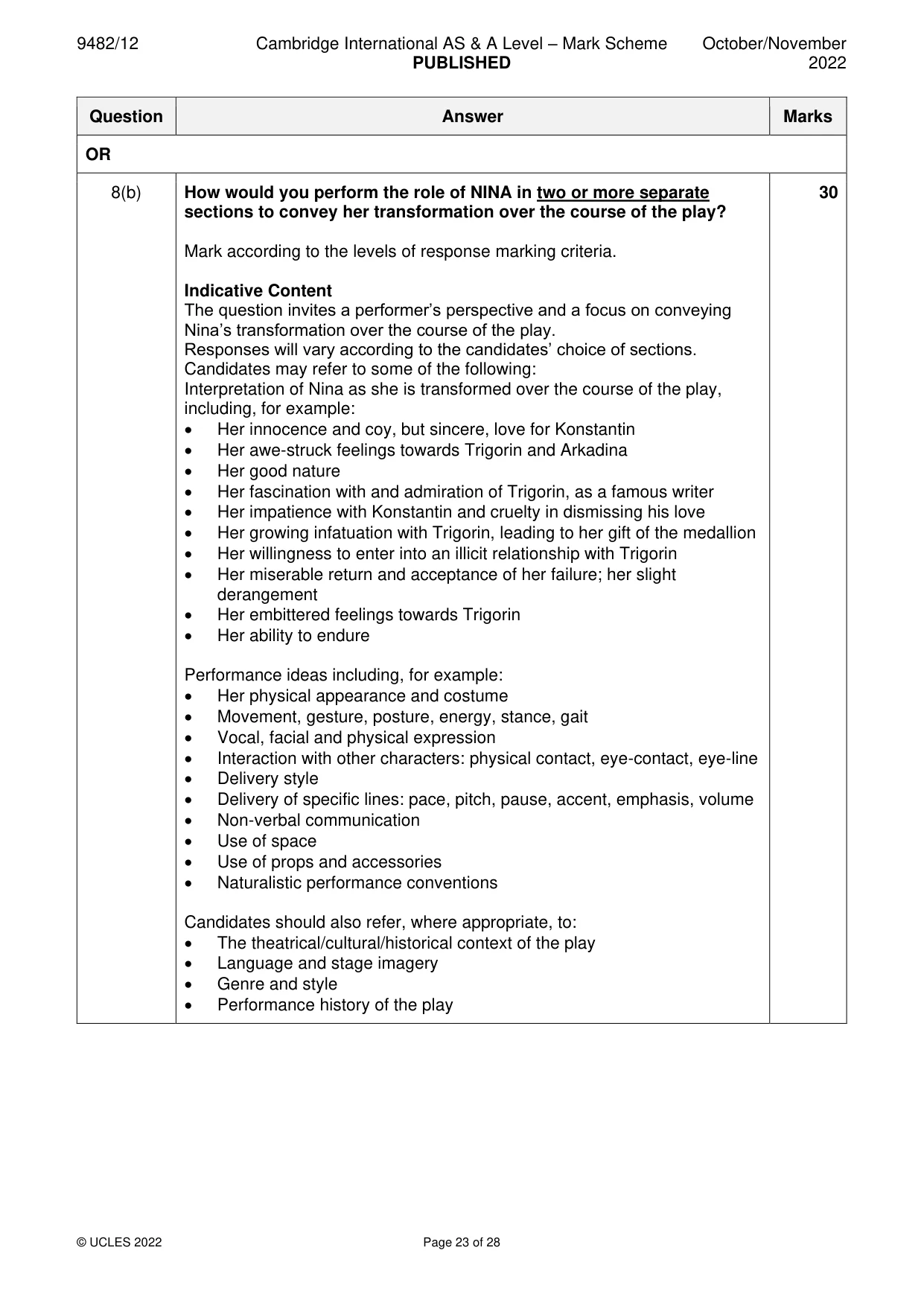
9482/12 Cambridge International AS & A Level – Mark Scheme PUBLISHED October/November 2022 © UCLES 2022 Page 23 of 28 Question Answer Marks OR 8(b) How would you perform the role of NINA in two or more separate sections to convey her transformation over the course of the play? Mark according to the levels of response marking criteria. Indicative Content The question invites a performer’s perspective and a focus on conveying Nina’s transformation over the course of the play. Responses will vary according to the candidates’ choice of sections. Candidates may refer to some of the following: Interpretation of Nina as she is transformed over the course of the play, including, for example: • Her innocence and coy, but sincere, love for Konstantin • Her awe-struck feelings towards Trigorin and Arkadina • Her good nature • Her fascination with and admiration of Trigorin, as a famous writer • Her impatience with Konstantin and cruelty in dismissing his love • Her growing infatuation with Trigorin, leading to her gift of the medallion • Her willingness to enter into an illicit relationship with Trigorin • Her miserable return and acceptance of her failure; her slight derangement • Her embittered feelings towards Trigorin • Her ability to endure Performance ideas including, for example: • Her physical appearance and costume • Movement, gesture, posture, energy, stance, gait • Vocal, facial and physical expression • Interaction with other characters: physical contact, eye-contact, eye-line • Delivery style • Delivery of specific lines: pace, pitch, pause, accent, emphasis, volume • Non-verbal communication • Use of space • Use of props and accessories • Naturalistic performance conventions Candidates should also refer, where appropriate, to: • The theatrical/cultural/historical context of the play • Language and stage imagery • Genre and style • Performance history of the play 30
Mark scheme, page 24
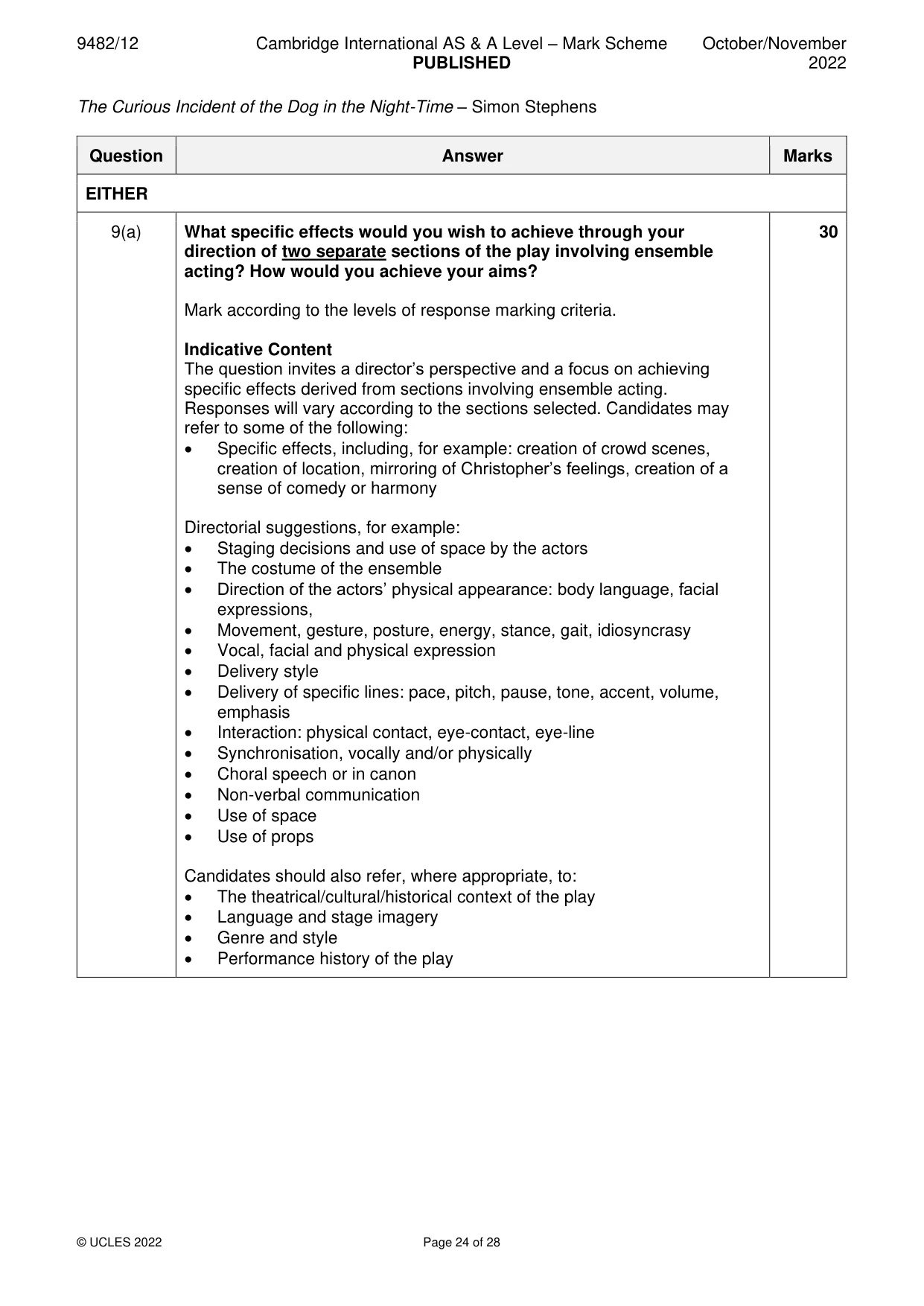
9482/12 Cambridge International AS & A Level – Mark Scheme PUBLISHED October/November 2022 © UCLES 2022 Page 24 of 28 The Curious Incident of the Dog in the Night-Time – Simon Stephens Question Answer Marks EITHER 9(a) What specific effects would you wish to achieve through your direction of two separate sections of the play involving ensemble acting? How would you achieve your aims? Mark according to the levels of response marking criteria. Indicative Content The question invites a director’s perspective and a focus on achieving specific effects derived from sections involving ensemble acting. Responses will vary according to the sections selected. Candidates may refer to some of the following: • Specific effects, including, for example: creation of crowd scenes, creation of location, mirroring of Christopher’s feelings, creation of a sense of comedy or harmony Directorial suggestions, for example: • Staging decisions and use of space by the actors • The costume of the ensemble • Direction of the actors’ physical appearance: body language, facial expressions, • Movement, gesture, posture, energy, stance, gait, idiosyncrasy • Vocal, facial and physical expression • Delivery style • Delivery of specific lines: pace, pitch, pause, tone, accent, volume, emphasis • Interaction: physical contact, eye-contact, eye-line • Synchronisation, vocally and/or physically • Choral speech or in canon • Non-verbal communication • Use of space • Use of props Candidates should also refer, where appropriate, to: • The theatrical/cultural/historical context of the play • Language and stage imagery • Genre and style • Performance history of the play 30
Mark scheme, page 25
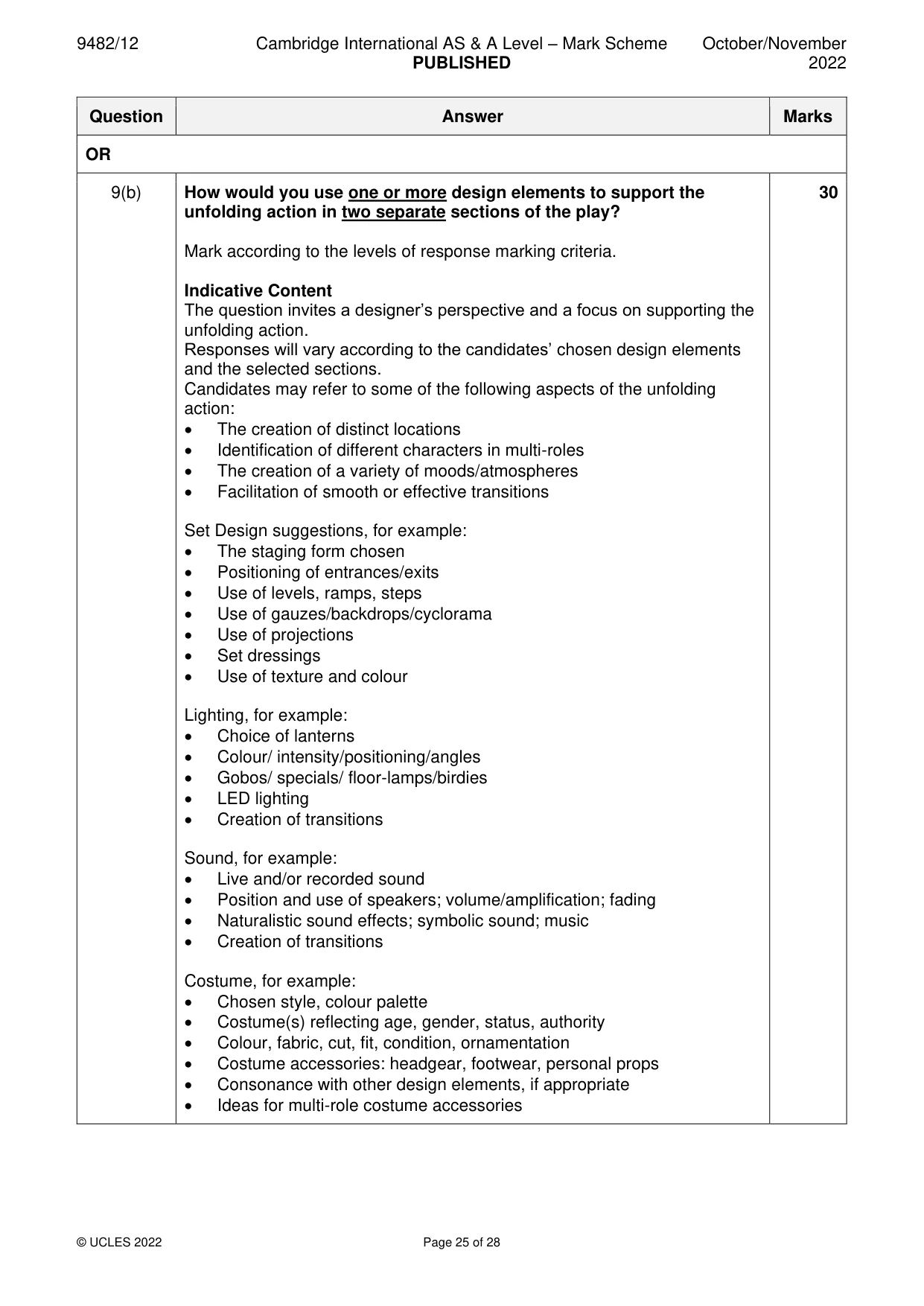
9482/12 Cambridge International AS & A Level – Mark Scheme PUBLISHED October/November 2022 © UCLES 2022 Page 25 of 28 Question Answer Marks OR 9(b) How would you use one or more design elements to support the unfolding action in two separate sections of the play? Mark according to the levels of response marking criteria. Indicative Content The question invites a designer’s perspective and a focus on supporting the unfolding action. Responses will vary according to the candidates’ chosen design elements and the selected sections. Candidates may refer to some of the following aspects of the unfolding action: • The creation of distinct locations • Identification of different characters in multi-roles • The creation of a variety of moods/atmospheres • Facilitation of smooth or effective transitions Set Design suggestions, for example: • The staging form chosen • Positioning of entrances/exits • Use of levels, ramps, steps • Use of gauzes/backdrops/cyclorama • Use of projections • Set dressings • Use of texture and colour Lighting, for example: • Choice of lanterns • Colour/ intensity/positioning/angles • Gobos/ specials/ floor-lamps/birdies • LED lighting • Creation of transitions Sound, for example: • Live and/or recorded sound • Position and use of speakers; volume/amplification; fading • Naturalistic sound effects; symbolic sound; music • Creation of transitions Costume, for example: • Chosen style, colour palette • Costume(s) reflecting age, gender, status, authority • Colour, fabric, cut, fit, condition, ornamentation • Costume accessories: headgear, footwear, personal props • Consonance with other design elements, if appropriate • Ideas for multi-role costume accessories 30
Mark scheme, page 26
9482/12 Cambridge International AS & A Level – Mark Scheme PUBLISHED October/November 2022 © UCLES 2022 Page 26 of 28 Question Answer Marks 9(b) Candidates should also refer, where appropriate, to: • The theatrical/cultural/historical context of the play • Language and stage imagery • Genre and style • Performance history of the play
Mark scheme, page 27
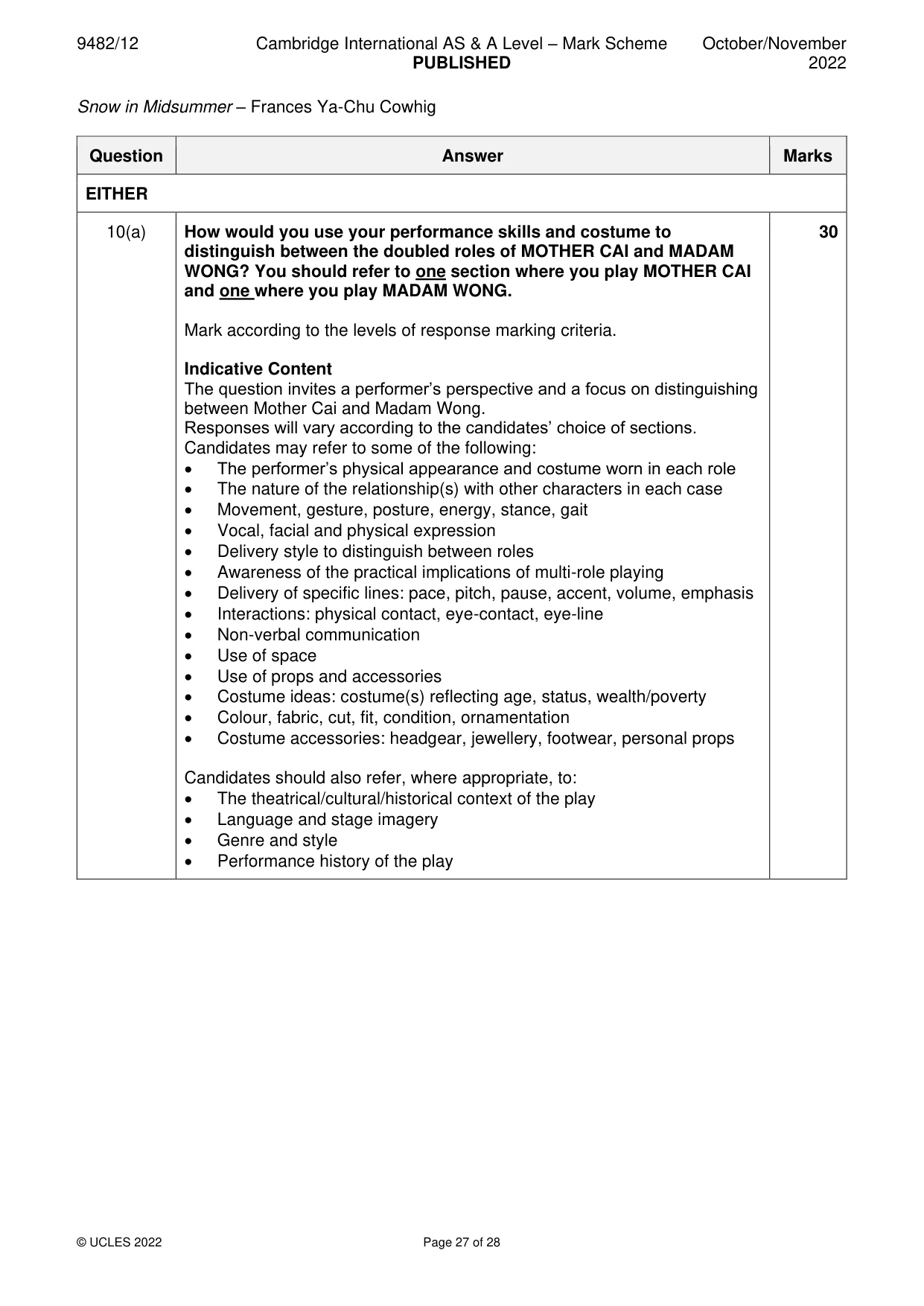
9482/12 Cambridge International AS & A Level – Mark Scheme PUBLISHED October/November 2022 © UCLES 2022 Page 27 of 28 Snow in Midsummer – Frances Ya-Chu Cowhig Question Answer Marks EITHER 10(a) How would you use your performance skills and costume to distinguish between the doubled roles of MOTHER CAI and MADAM WONG? You should refer to one section where you play MOTHER CAI and one where you play MADAM WONG. Mark according to the levels of response marking criteria. Indicative Content The question invites a performer’s perspective and a focus on distinguishing between Mother Cai and Madam Wong. Responses will vary according to the candidates’ choice of sections. Candidates may refer to some of the following: • The performer’s physical appearance and costume worn in each role • The nature of the relationship(s) with other characters in each case • Movement, gesture, posture, energy, stance, gait • Vocal, facial and physical expression • Delivery style to distinguish between roles • Awareness of the practical implications of multi-role playing • Delivery of specific lines: pace, pitch, pause, accent, volume, emphasis • Interactions: physical contact, eye-contact, eye-line • Non-verbal communication • Use of space • Use of props and accessories • Costume ideas: costume(s) reflecting age, status, wealth/poverty • Colour, fabric, cut, fit, condition, ornamentation • Costume accessories: headgear, jewellery, footwear, personal props Candidates should also refer, where appropriate, to: • The theatrical/cultural/historical context of the play • Language and stage imagery • Genre and style • Performance history of the play 30
Mark scheme, page 28
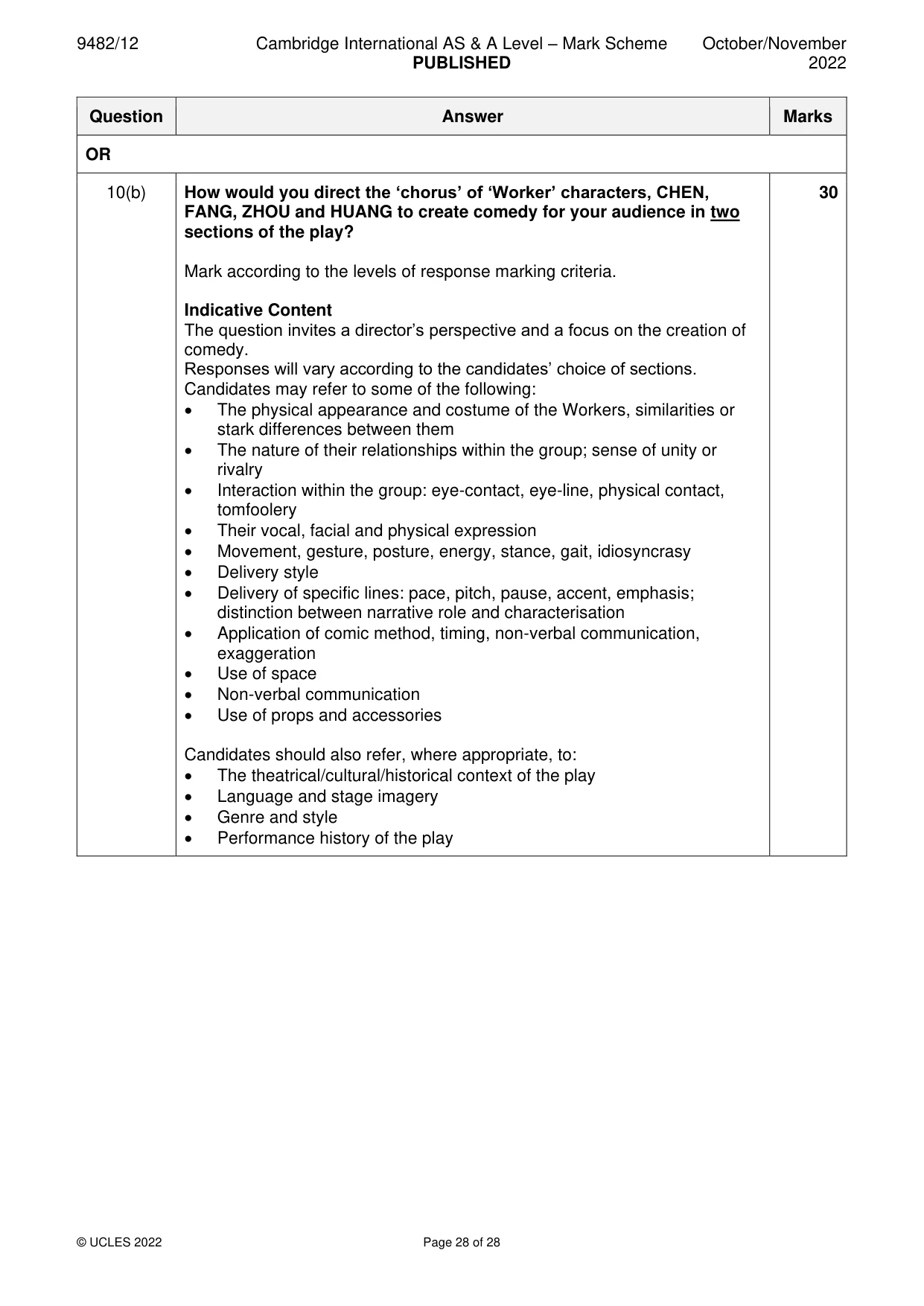
9482/12 Cambridge International AS & A Level – Mark Scheme PUBLISHED October/November 2022 © UCLES 2022 Page 28 of 28 Question Answer Marks OR 10(b) How would you direct the ‘chorus’ of ‘Worker’ characters, CHEN, FANG, ZHOU and HUANG to create comedy for your audience in two sections of the play? Mark according to the levels of response marking criteria. Indicative Content The question invites a director’s perspective and a focus on the creation of comedy. Responses will vary according to the candidates’ choice of sections. Candidates may refer to some of the following: • The physical appearance and costume of the Workers, similarities or stark differences between them • The nature of their relationships within the group; sense of unity or rivalry • Interaction within the group: eye-contact, eye-line, physical contact, tomfoolery • Their vocal, facial and physical expression • Movement, gesture, posture, energy, stance, gait, idiosyncrasy • Delivery style • Delivery of specific lines: pace, pitch, pause, accent, emphasis; distinction between narrative role and characterisation • Application of comic method, timing, non-verbal communication, exaggeration • Use of space • Non-verbal communication • Use of props and accessories Candidates should also refer, where appropriate, to: • The theatrical/cultural/historical context of the play • Language and stage imagery • Genre and style • Performance history of the play 30
What you needed in this session
Cambridge’s own grade thresholds for 2022 Oct/Nov, Paper 1 · Variant 2. A higher threshold means an easier paper — the bar moves with how the cohort did.