Cambridge A Level Drama 9482 — 2021 Oct/Nov Paper 1 · Variant 3
9482/13/O/N/21 · 60 marks · ≈68 min
The question paper and its mark scheme, free to read here and free to download. This is Cambridge’s own paper, exactly as it was sat.
Question paper8 pages


Mark scheme25 pages
Answers below. Sit the paper first if you are practising.
Paper as text
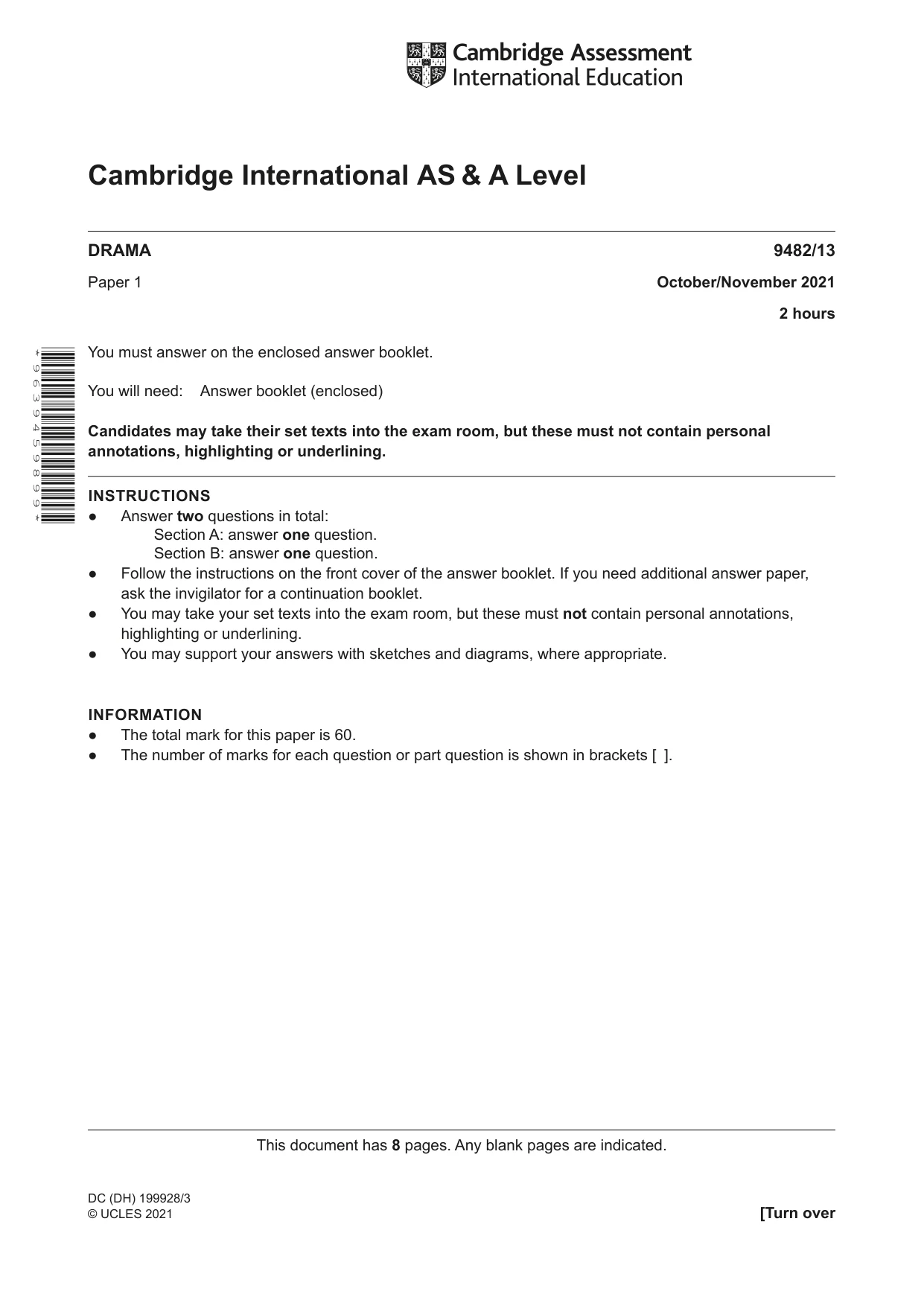
Question paper, page 1
This document has 8 pages. Any blank pages are indicated. Cambridge International AS & A Level DC (DH) 199928/3 © UCLES 2021 [Turn over * 9 6 3 9 4 5 9 8 9 9 * DRAMA 9482/13 Paper 1 October/November 2021 2 hours You must answer on the enclosed answer booklet. You will need: Answer booklet (enclosed) Candidates may take their set texts into the exam room, but these must not contain personal annotations, highlighting or underlining. INSTRUCTIONS ● Answer two questions in total: Section A: answer one question. Section B: answer one question. ● Follow the instructions on the front cover of the answer booklet. If you need additional answer paper, ask the invigilator for a continuation booklet. ● You may take your set texts into the exam room, but these must not contain personal annotations, highlighting or underlining. ● You may support your answers with sketches and diagrams, where appropriate. INFORMATION ● The total mark for this paper is 60. ● The number of marks for each question or part question is shown in brackets [ ].
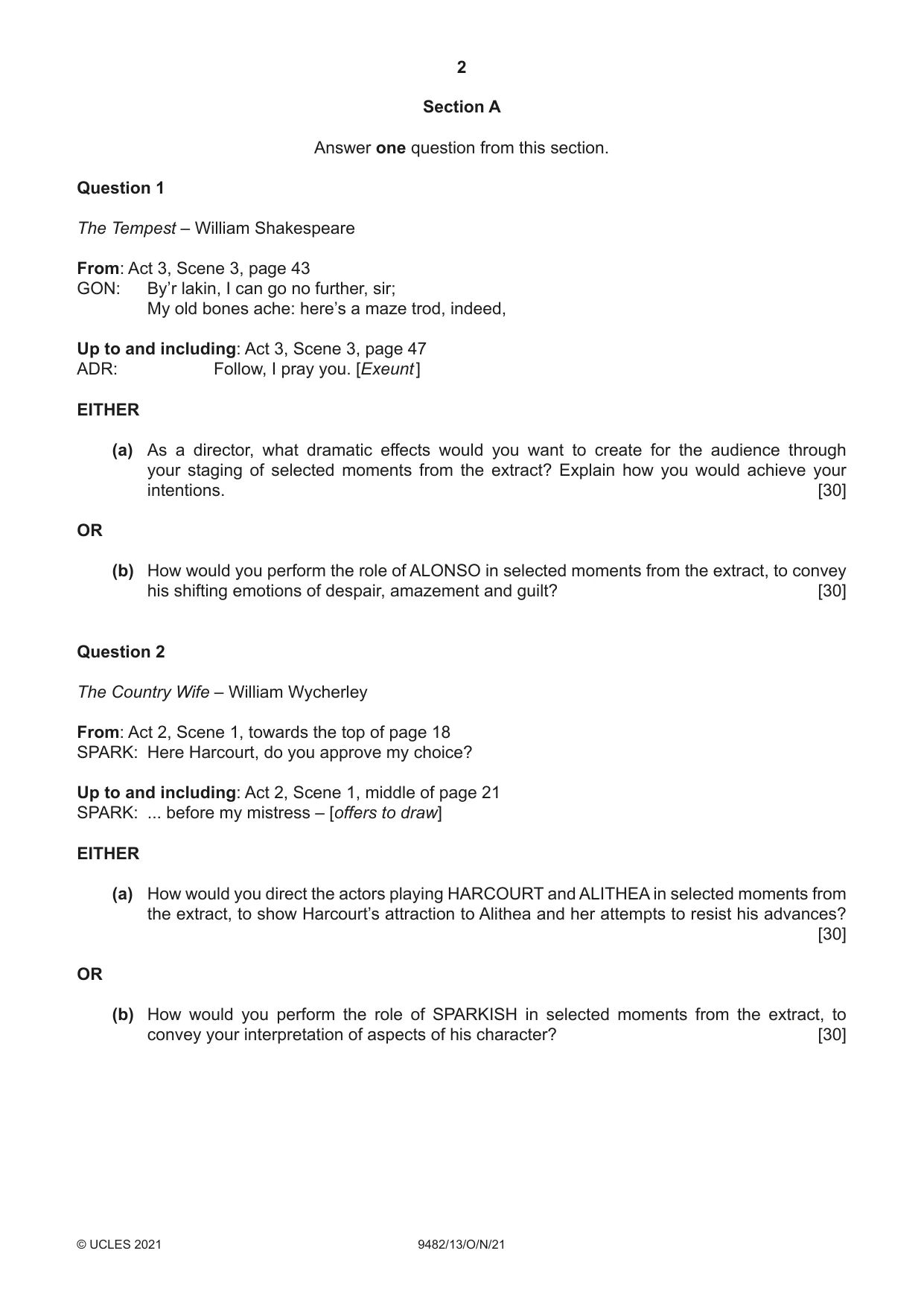
Question paper, page 2
2 9482/13/O/N/21 © UCLES 2021 Section A Answer one question from this section. Question 1 The Tempest – William Shakespeare From: Act 3, Scene 3, page 43 GON: By’r lakin, I can go no further, sir; My old bones ache: here’s a maze trod, indeed, Up to and including: Act 3, Scene 3, page 47 ADR: Follow, I pray you. [Exeunt ] EITHER (a) As a director, what dramatic effects would you want to create for the audience through your staging of selected moments from the extract? Explain how you would achieve your intentions. [30] OR (b) How would you perform the role of ALONSO in selected moments from the extract, to convey his shifting emotions of despair, amazement and guilt? [30] Question 2 The Country Wife – William Wycherley From: Act 2, Scene 1, towards the top of page 18 SPARK: Here Harcourt, do you approve my choice? Up to and including: Act 2, Scene 1, middle of page 21 SPARK: ... before my mistress – [offers to draw] EITHER (a) How would you direct the actors playing HARCOURT and ALITHEA in selected moments from the extract, to show Harcourt’s attraction to Alithea and her attempts to resist his advances? [30] OR (b) How would you perform the role of SPARKISH in selected moments from the extract, to convey your interpretation of aspects of his character? [30]
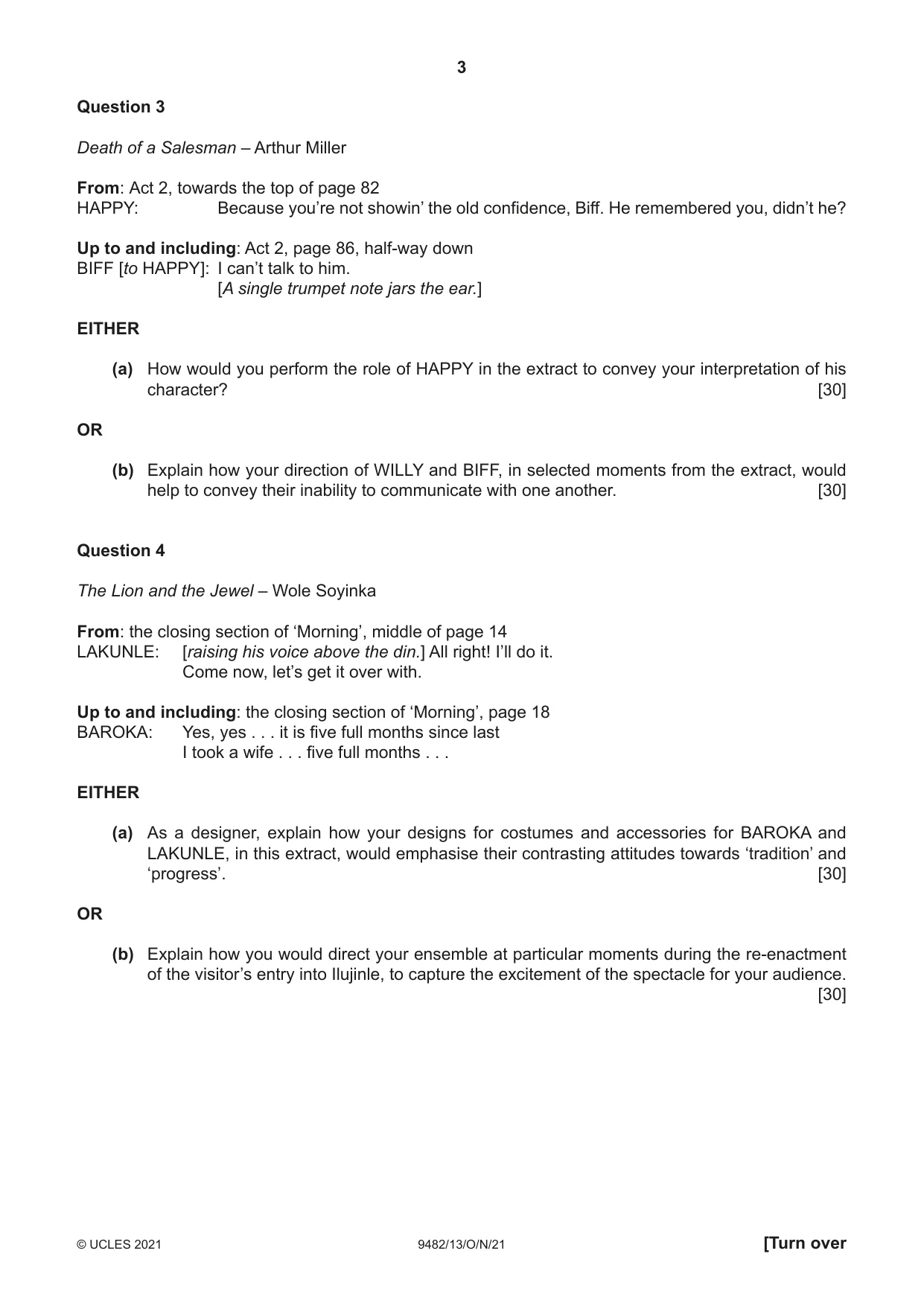
Question paper, page 3
3 9482/13/O/N/21 © UCLES 2021 [Turn over Question 3 Death of a Salesman – Arthur Miller From: Act 2, towards the top of page 82 HAPPY: Because you’re not showin’ the old confidence, Biff. He remembered you, didn’t he? Up to and including: Act 2, page 86, half-way down BIFF [to HAPPY]: I can’t talk to him. [A single trumpet note jars the ear.] EITHER (a) How would you perform the role of HAPPY in the extract to convey your interpretation of his character? [30] OR (b) Explain how your direction of WILLY and BIFF, in selected moments from the extract, would help to convey their inability to communicate with one another. [30] Question 4 The Lion and the Jewel – Wole Soyinka From: the closing section of ‘Morning’, middle of page 14 LAKUNLE: [raising his voice above the din.] All right! I’ll do it. Come now, let’s get it over with. Up to and including: the closing section of ‘Morning’, page 18 BAROKA: Yes, yes . . . it is five full months since last I took a wife . . . five full months . . . EITHER (a) As a designer, explain how your designs for costumes and accessories for BAROKA and LAKUNLE, in this extract, would emphasise their contrasting attitudes towards ‘tradition’ and ‘progress’. [30] OR (b) Explain how you would direct your ensemble at particular moments during the re-enactment of the visitor’s entry into Ilujinle, to capture the excitement of the spectacle for your audience. [30]
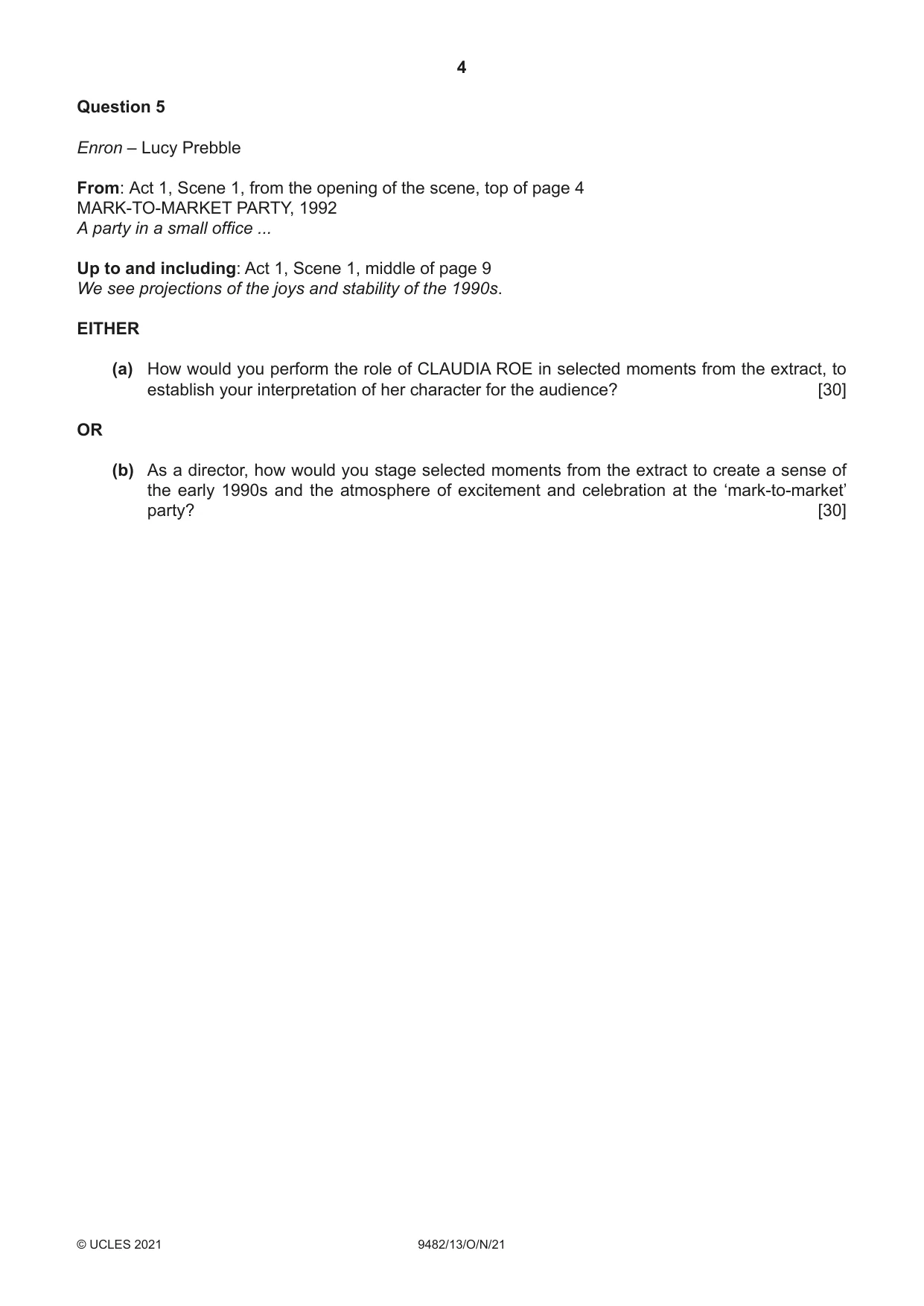
Question paper, page 4
4 9482/13/O/N/21 © UCLES 2021 Question 5 Enron – Lucy Prebble From: Act 1, Scene 1, from the opening of the scene, top of page 4 MARK-TO-MARKET PARTY, 1992 A party in a small office ... Up to and including: Act 1, Scene 1, middle of page 9 We see projections of the joys and stability of the 1990s. EITHER (a) How would you perform the role of CLAUDIA ROE in selected moments from the extract, to establish your interpretation of her character for the audience? [30] OR (b) As a director, how would you stage selected moments from the extract to create a sense of the early 1990s and the atmosphere of excitement and celebration at the ‘mark-to-market’ party? [30]
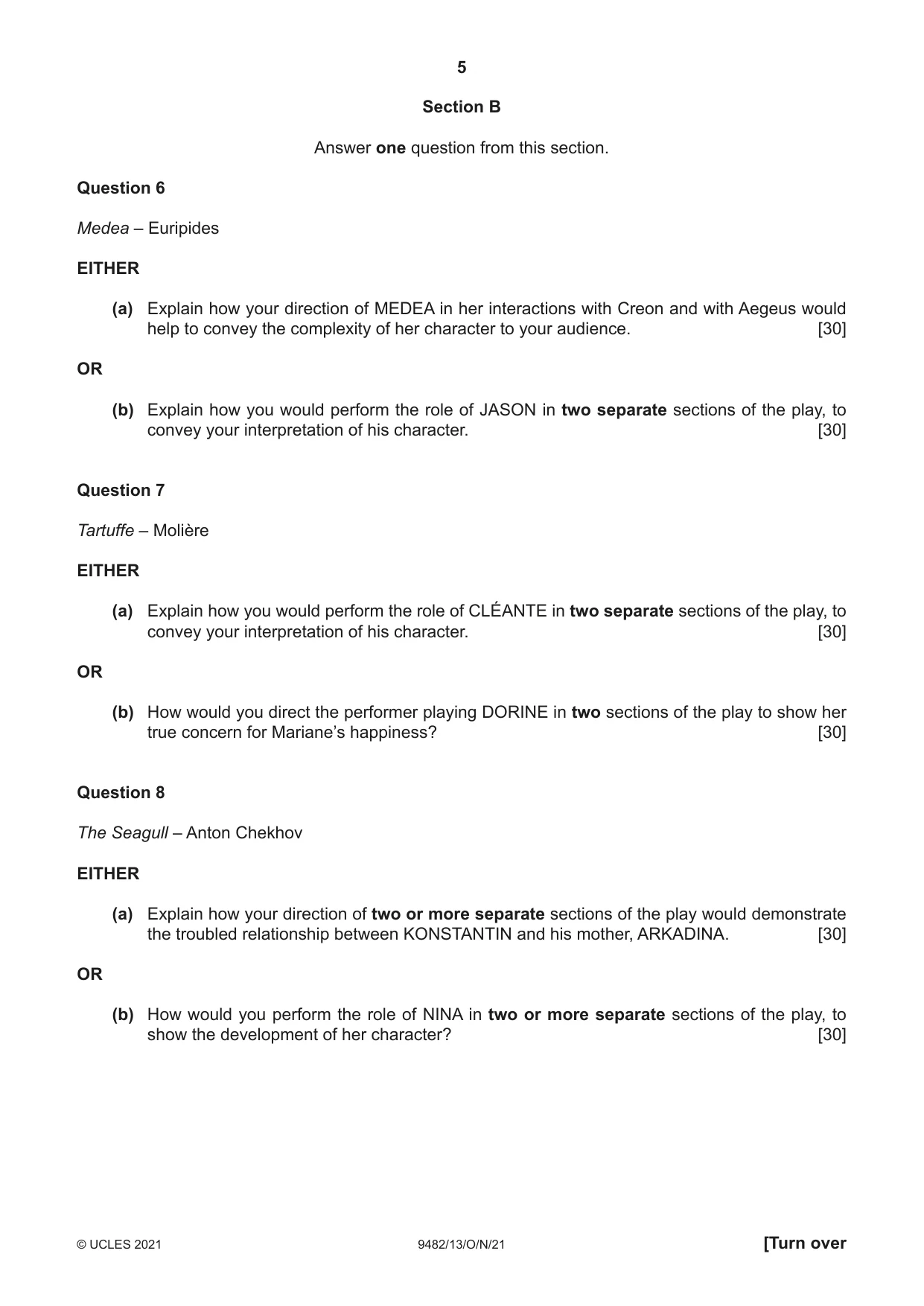
Question paper, page 5
5 9482/13/O/N/21 © UCLES 2021 [Turn over Section B Answer one question from this section. Question 6 Medea – Euripides EITHER (a) Explain how your direction of MEDEA in her interactions with Creon and with Aegeus would help to convey the complexity of her character to your audience. [30] OR (b) Explain how you would perform the role of JASON in two separate sections of the play, to convey your interpretation of his character. [30] Question 7 Tartuffe – Molière EITHER (a) Explain how you would perform the role of CLÉANTE in two separate sections of the play, to convey your interpretation of his character. [30] OR (b) How would you direct the performer playing DORINE in two sections of the play to show her true concern for Mariane’s happiness? [30] Question 8 The Seagull – Anton Chekhov EITHER (a) Explain how your direction of two or more separate sections of the play would demonstrate the troubled relationship between KONSTANTIN and his mother, ARKADINA. [30] OR (b) How would you perform the role of NINA in two or more separate sections of the play, to show the development of her character? [30]
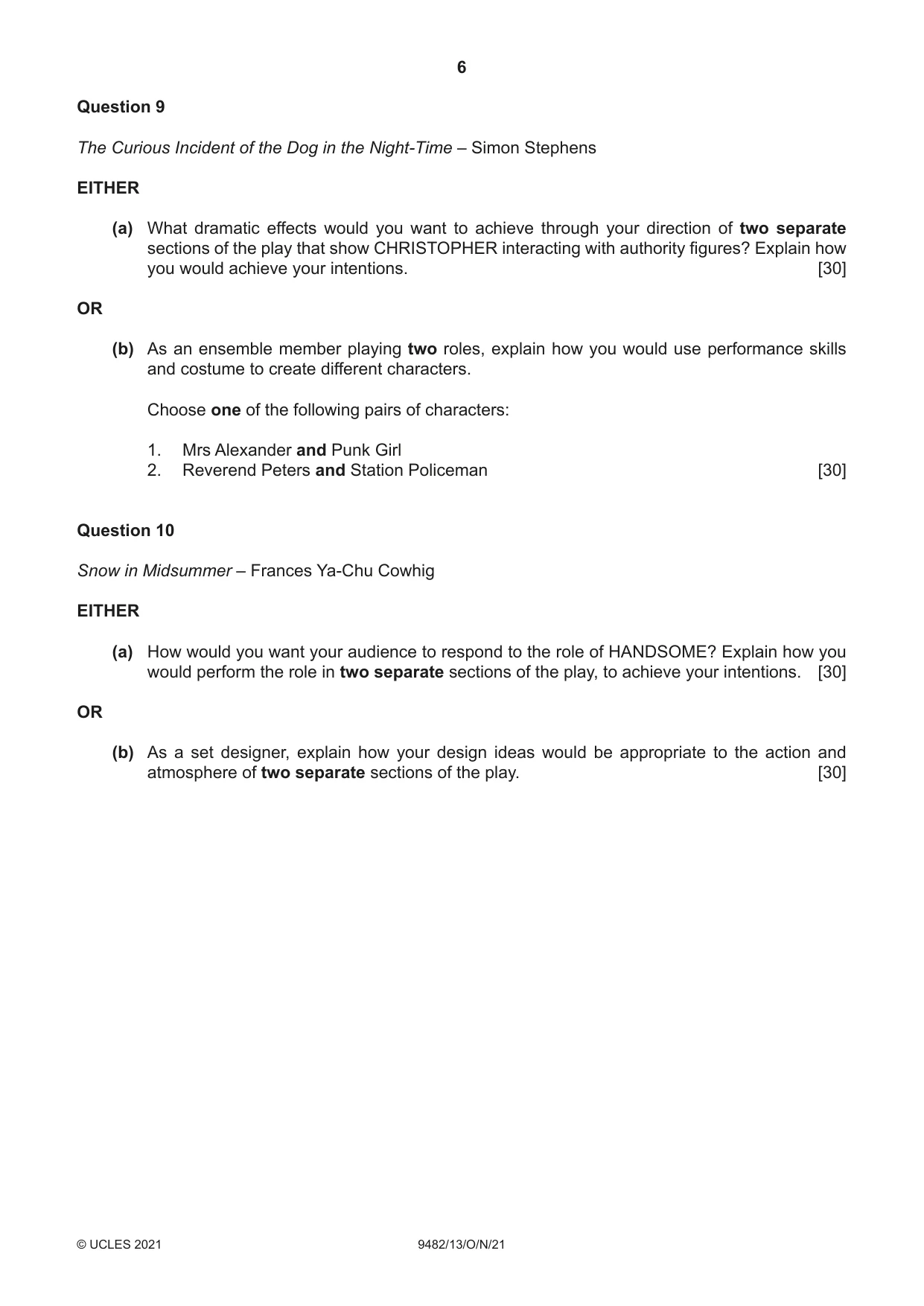
Question paper, page 6
6 9482/13/O/N/21 © UCLES 2021 Question 9 The Curious Incident of the Dog in the Night-Time – Simon Stephens EITHER (a) What dramatic effects would you want to achieve through your direction of two separate sections of the play that show CHRISTOPHER interacting with authority figures? Explain how you would achieve your intentions. [30] OR (b) As an ensemble member playing two roles, explain how you would use performance skills and costume to create different characters. Choose one of the following pairs of characters: 1. Mrs Alexander and Punk Girl 2. Reverend Peters and Station Policeman [30] Question 10 Snow in Midsummer – Frances Ya-Chu Cowhig EITHER (a) How would you want your audience to respond to the role of HANDSOME? Explain how you would perform the role in two separate sections of the play, to achieve your intentions. [30] OR (b) As a set designer, explain how your design ideas would be appropriate to the action and atmosphere of two separate sections of the play. [30]
Question paper, page 7
7 9482/13/O/N/21 © UCLES 2021 BLANK PAGE
Question paper, page 8
8 9482/13/O/N/21 © UCLES 2021 Permission to reproduce items where third-party owned material protected by copyright is included has been sought and cleared where possible. Every reasonable effort has been made by the publisher (UCLES) to trace copyright holders, but if any items requiring clearance have unwittingly been included, the publisher will be pleased to make amends at the earliest possible opportunity. To avoid the issue of disclosure of answer-related information to candidates, all copyright acknowledgements are reproduced online in the Cambridge Assessment International Education Copyright Acknowledgements Booklet. This is produced for each series of examinations and is freely available to download at www.cambridgeinternational.org after the live examination series. Cambridge Assessment International Education is part of the Cambridge Assessment Group. Cambridge Assessment is the brand name of the University of Cambridge Local Examinations Syndicate (UCLES), which itself is a department of the University of Cambridge. BLANK PAGE
Mark scheme, page 1
This document consists of 25 printed pages. © UCLES 2021 [Turn over Cambridge International AS & A Level DRAMA 9482/13 Paper 1 Open-Book Written Examination October/November 2021 MARK SCHEME Maximum Mark: 60 Published This mark scheme is published as an aid to teachers and candidates, to indicate the requirements of the examination. It shows the basis on which Examiners were instructed to award marks. It does not indicate the details of the discussions that took place at an Examiners’ meeting before marking began, which would have considered the acceptability of alternative answers. Mark schemes should be read in conjunction with the question paper and the Principal Examiner Report for Teachers. Cambridge International will not enter into discussions about these mark schemes. Cambridge International is publishing the mark schemes for the October/November 2021 series for most Cambridge IGCSE™, Cambridge International A and AS Level components and some Cambridge O Level components.
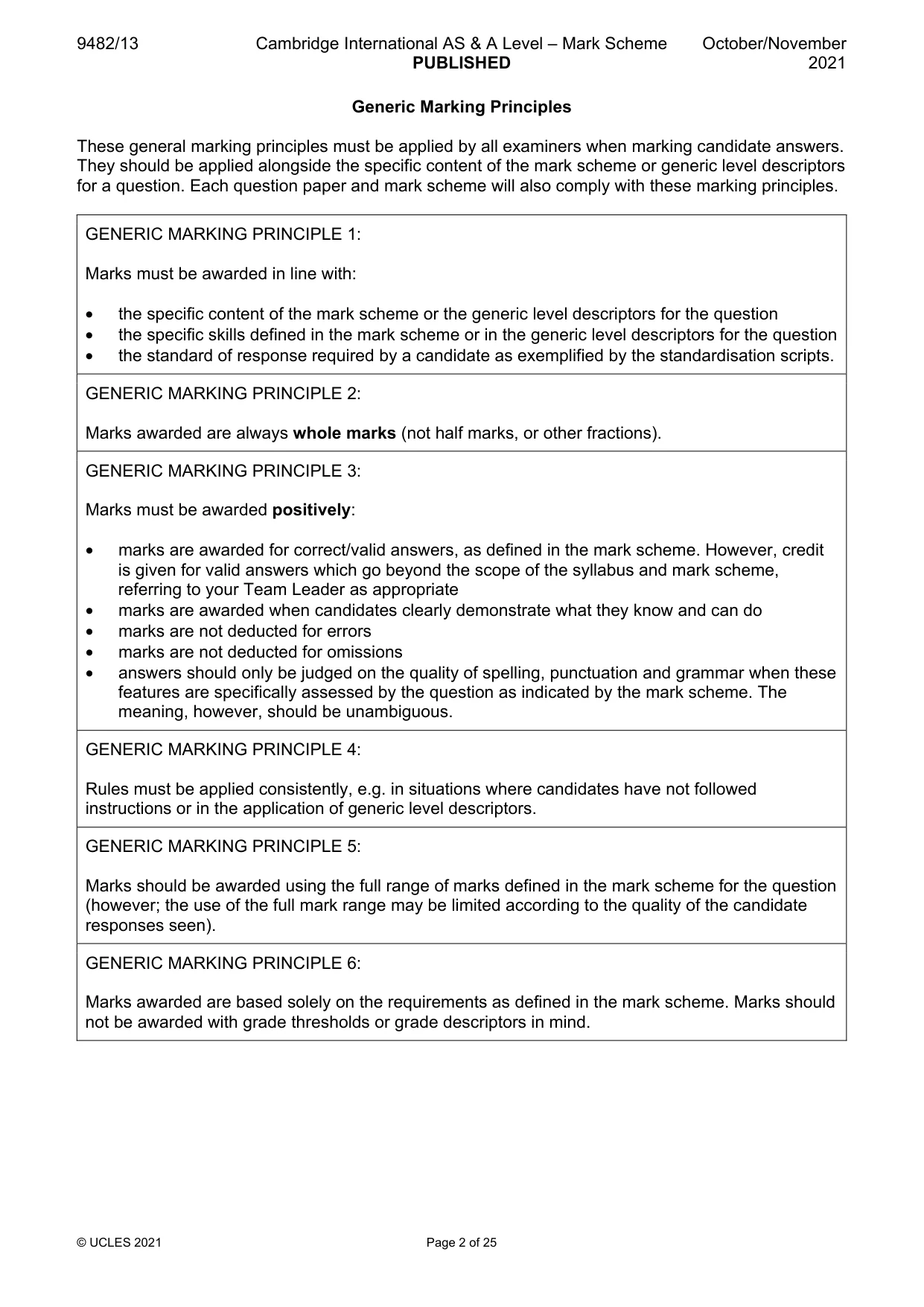
Mark scheme, page 2
9482/13 Cambridge International AS & A Level – Mark Scheme PUBLISHED October/November 2021 © UCLES 2021 Page 2 of 25 Generic Marking Principles These general marking principles must be applied by all examiners when marking candidate answers. They should be applied alongside the specific content of the mark scheme or generic level descriptors for a question. Each question paper and mark scheme will also comply with these marking principles. GENERIC MARKING PRINCIPLE 1: Marks must be awarded in line with: • the specific content of the mark scheme or the generic level descriptors for the question • the specific skills defined in the mark scheme or in the generic level descriptors for the question • the standard of response required by a candidate as exemplified by the standardisation scripts. GENERIC MARKING PRINCIPLE 2: Marks awarded are always whole marks (not half marks, or other fractions). GENERIC MARKING PRINCIPLE 3: Marks must be awarded positively: • marks are awarded for correct/valid answers, as defined in the mark scheme. However, credit is given for valid answers which go beyond the scope of the syllabus and mark scheme, referring to your Team Leader as appropriate • marks are awarded when candidates clearly demonstrate what they know and can do • marks are not deducted for errors • marks are not deducted for omissions • answers should only be judged on the quality of spelling, punctuation and grammar when these features are specifically assessed by the question as indicated by the mark scheme. The meaning, however, should be unambiguous. GENERIC MARKING PRINCIPLE 4: Rules must be applied consistently, e.g. in situations where candidates have not followed instructions or in the application of generic level descriptors. GENERIC MARKING PRINCIPLE 5: Marks should be awarded using the full range of marks defined in the mark scheme for the question (however; the use of the full mark range may be limited according to the quality of the candidate responses seen). GENERIC MARKING PRINCIPLE 6: Marks awarded are based solely on the requirements as defined in the mark scheme. Marks should not be awarded with grade thresholds or grade descriptors in mind.
Mark scheme, page 3
9482/13 Cambridge International AS & A Level – Mark Scheme PUBLISHED October/November 2021 © UCLES 2021 Page 3 of 25 Drama specific marking instructions Candidates are required to answer two questions in total: one question from Section A and one question from Section B. There are two level-descriptor tables for each section. Please ensure you use the appropriate marking criteria to mark each candidate response. Table A and Table B are for Section A. Table C and Table D are for Section B. Both sections assess AO1: Knowledge and understanding Candidates demonstrate their knowledge and understanding of drama text and its performance context and of theatre-making traditions and theatre practice. Each answer is marked out of 30. Guidance on using level-based mark schemes Marking of work should be positive, rewarding achievement where possible, but clearly differentiating across the whole range of marks, where appropriate. The marker should look at the work and then make a judgement about which level statement is the best fit. In practice, work does not always match one level statement precisely so a judgement may need to be made between two or more level statements. Once a best-fit level statement has been identified, use the following guidance to decide on a specific mark: • If the candidate’s work convincingly meets the level statement, award the highest mark. • If the candidate’s work adequately meets the level statement, award the most appropriate mark in the middle of the range (where middle marks are available). • If the candidate’s work just meets the level statement, award the lowest mark.
Mark scheme, page 4
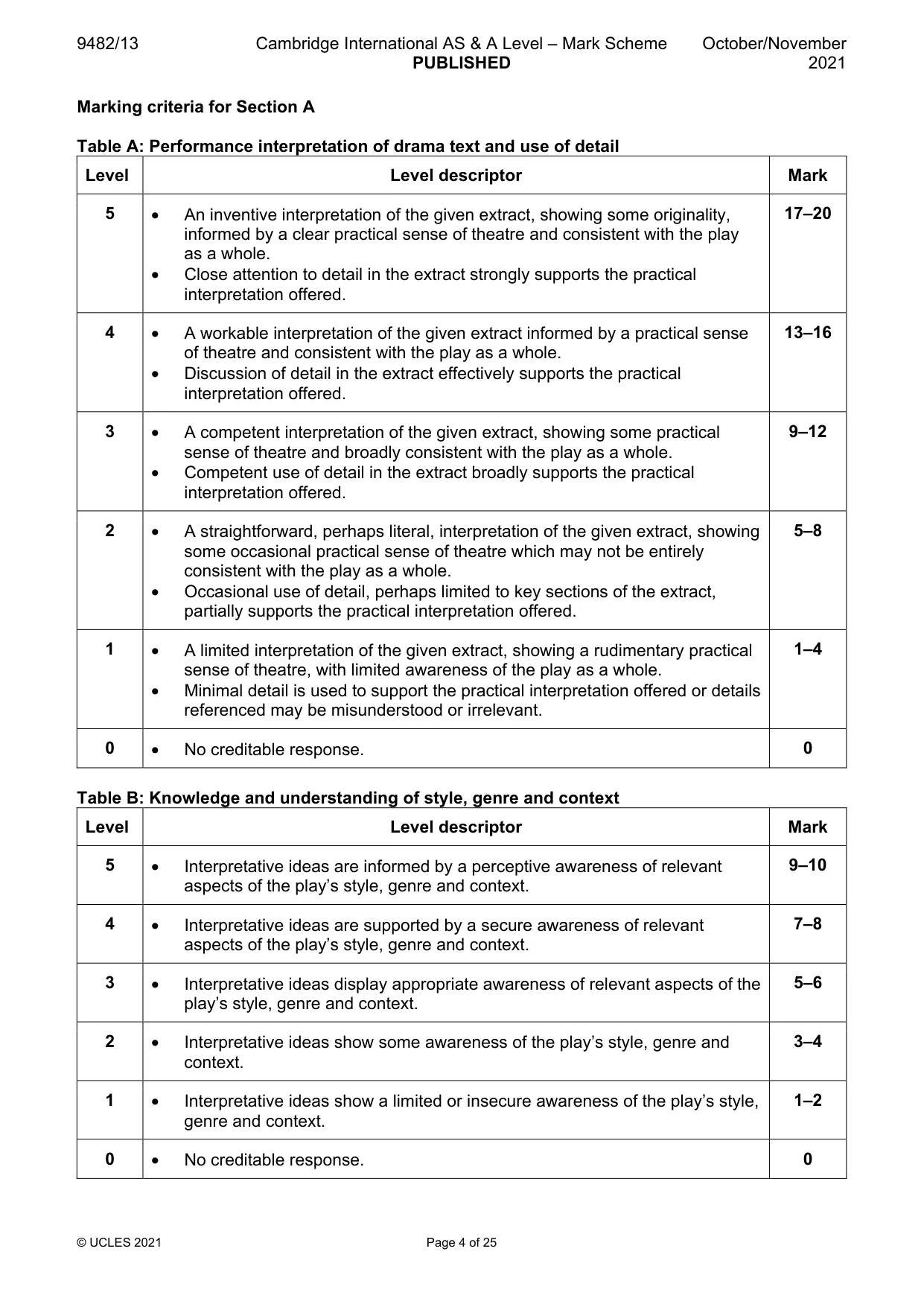
9482/13 Cambridge International AS & A Level – Mark Scheme PUBLISHED October/November 2021 © UCLES 2021 Page 4 of 25 Marking criteria for Section A Table A: Performance interpretation of drama text and use of detail Level Level descriptor Mark 5 • An inventive interpretation of the given extract, showing some originality, informed by a clear practical sense of theatre and consistent with the play as a whole. • Close attention to detail in the extract strongly supports the practical interpretation offered. 17–20 4 • A workable interpretation of the given extract informed by a practical sense of theatre and consistent with the play as a whole. • Discussion of detail in the extract effectively supports the practical interpretation offered. 13–16 3 • A competent interpretation of the given extract, showing some practical sense of theatre and broadly consistent with the play as a whole. • Competent use of detail in the extract broadly supports the practical interpretation offered. 9–12 2 • A straightforward, perhaps literal, interpretation of the given extract, showing some occasional practical sense of theatre which may not be entirely consistent with the play as a whole. • Occasional use of detail, perhaps limited to key sections of the extract, partially supports the practical interpretation offered. 5–8 1 • A limited interpretation of the given extract, showing a rudimentary practical sense of theatre, with limited awareness of the play as a whole. • Minimal detail is used to support the practical interpretation offered or details referenced may be misunderstood or irrelevant. 1–4 0 • No creditable response. 0 Table B: Knowledge and understanding of style, genre and context Level Level descriptor Mark 5 • Interpretative ideas are informed by a perceptive awareness of relevant aspects of the play’s style, genre and context. 9–10 4 • Interpretative ideas are supported by a secure awareness of relevant aspects of the play’s style, genre and context. 7–8 3 • Interpretative ideas display appropriate awareness of relevant aspects of the play’s style, genre and context. 5–6 2 • Interpretative ideas show some awareness of the play’s style, genre and context. 3–4 1 • Interpretative ideas show a limited or insecure awareness of the play’s style, genre and context. 1–2 0 • No creditable response. 0
Mark scheme, page 5
9482/13 Cambridge International AS & A Level – Mark Scheme PUBLISHED October/November 2021 © UCLES 2021 Page 5 of 25 Section A Candidates answer one question from Section A. The Tempest – William Shakespeare Question Answer Marks EITHER 1(a) As a director, what dramatic effects would you want to create for the audience through your staging of selected moments from the extract? Explain how you will achieve your intentions. Mark according to the levels of response marking criteria. Indicative Content The question invites a director’s perspective and a focus on the creation of intended effects for the audience in particular moments from the extract. Responses will vary according to the moments selected. Candidates may refer to some of the following: Intended dramatic effects, for example: • A sympathetic portrayal of Gonzalo, the innocent old man • Delight and/or amazement at the arrival of the strange Shapes and the banquet • Anticipation of Prospero’s revenge; amazement at his power • Shock at the thunder and lightning and appearance of the ‘Harpy’ • Satisfaction in seeing the effects of the spectacle on the guilty men • Concern for Alonso’s mental state Directorial suggestions for achieving intentions, including, for example: • Staging decisions and use of space by the actors; spatial relationships; use of levels to accommodate the banquet and present Ariel and Prospero above the others • Direction of the actors: body language, facial expressions, vocal tone, pitch, pace, volume • Creation of magical effects using staging/ technical elements • Delivery of specific lines: use of pause and emphasis; use of aside • Movement, gesture, stage position, stance, posture, gait • Interaction: physical contact, eye-contact, eye-line Candidates should also refer, where appropriate, to: • The theatrical/cultural/historical context of the play • Language and stage imagery • Genre and style • Performance history of the play 30
Mark scheme, page 6
9482/13 Cambridge International AS & A Level – Mark Scheme PUBLISHED October/November 2021 © UCLES 2021 Page 6 of 25 Question Answer Marks OR 1(b) How would you perform the role of ALONSO in selected moments from the extract, to convey his shifting emotions of despair, amazement and guilt? Mark according to the levels of response marking criteria. Indicative Content The question invites a performer’s perspective and a focus on conveying Alonso’s shifting emotions of despair, amazement and guilt. Responses will vary according to the moments selected. Candidates may refer to some of the following: Performance suggestions, for example: • His physical demeanour to reflect the range of emotions, his continuing despair at the loss of his son and regret at the remoteness of his daughter; his amazement at the illusions created by Prospero; his frenzy at being accused of betraying his brother; his guilt • Movement, gesture, posture, energy, stance, gait • Vocal, facial and physical expression • Delivery style • Delivery of specific lines: pace, pitch, pause, accent, volume, emphasis • Interaction: physical contact, eye-contact, eye-line • Non-verbal communication • Use of space • Use of props • Application of naturalistic performance conventions, if appropriate to the interpretation Candidates should also refer, where appropriate, to: • The theatrical/cultural/historical context of the play • Language and stage imagery • Genre and style • Performance history of the play 30
Mark scheme, page 7
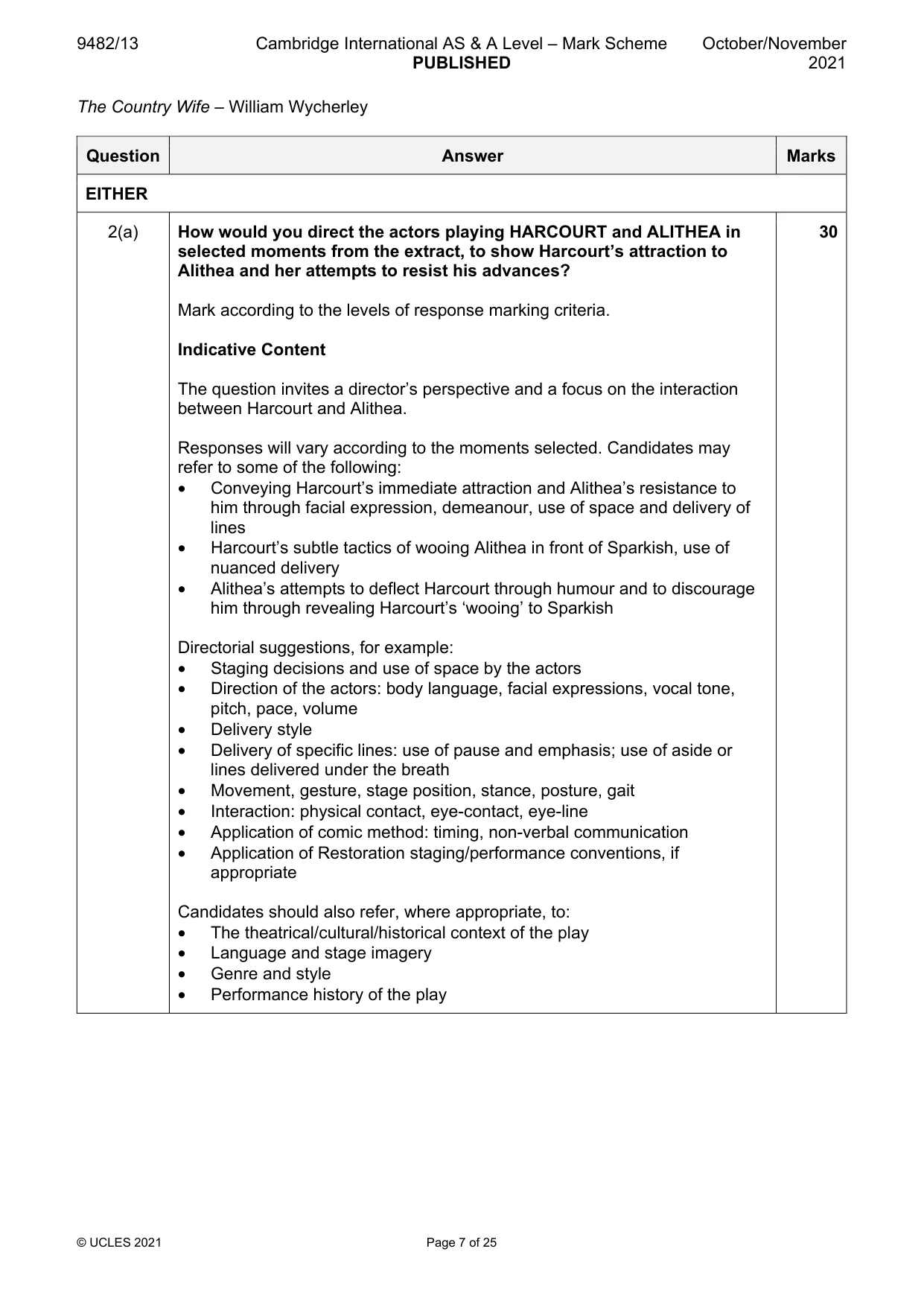
9482/13 Cambridge International AS & A Level – Mark Scheme PUBLISHED October/November 2021 © UCLES 2021 Page 7 of 25 The Country Wife – William Wycherley Question Answer Marks EITHER 2(a) How would you direct the actors playing HARCOURT and ALITHEA in selected moments from the extract, to show Harcourt’s attraction to Alithea and her attempts to resist his advances? Mark according to the levels of response marking criteria. Indicative Content The question invites a director’s perspective and a focus on the interaction between Harcourt and Alithea. Responses will vary according to the moments selected. Candidates may refer to some of the following: • Conveying Harcourt’s immediate attraction and Alithea’s resistance to him through facial expression, demeanour, use of space and delivery of lines • Harcourt’s subtle tactics of wooing Alithea in front of Sparkish, use of nuanced delivery • Alithea’s attempts to deflect Harcourt through humour and to discourage him through revealing Harcourt’s ‘wooing’ to Sparkish Directorial suggestions, for example: • Staging decisions and use of space by the actors • Direction of the actors: body language, facial expressions, vocal tone, pitch, pace, volume • Delivery style • Delivery of specific lines: use of pause and emphasis; use of aside or lines delivered under the breath • Movement, gesture, stage position, stance, posture, gait • Interaction: physical contact, eye-contact, eye-line • Application of comic method: timing, non-verbal communication • Application of Restoration staging/performance conventions, if appropriate Candidates should also refer, where appropriate, to: • The theatrical/cultural/historical context of the play • Language and stage imagery • Genre and style • Performance history of the play 30
Mark scheme, page 8
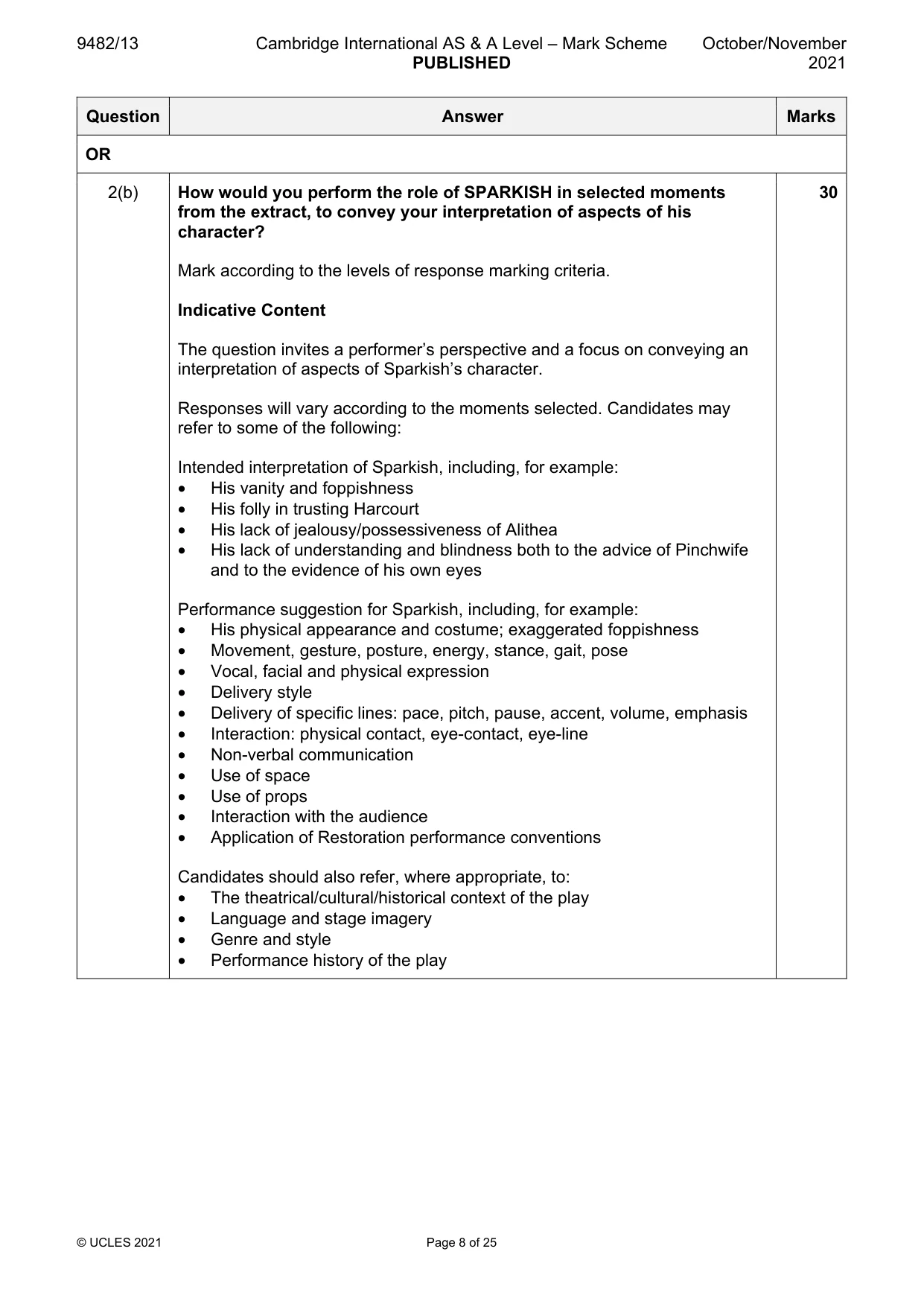
9482/13 Cambridge International AS & A Level – Mark Scheme PUBLISHED October/November 2021 © UCLES 2021 Page 8 of 25 Question Answer Marks OR 2(b) How would you perform the role of SPARKISH in selected moments from the extract, to convey your interpretation of aspects of his character? Mark according to the levels of response marking criteria. Indicative Content The question invites a performer’s perspective and a focus on conveying an interpretation of aspects of Sparkish’s character. Responses will vary according to the moments selected. Candidates may refer to some of the following: Intended interpretation of Sparkish, including, for example: • His vanity and foppishness • His folly in trusting Harcourt • His lack of jealousy/possessiveness of Alithea • His lack of understanding and blindness both to the advice of Pinchwife and to the evidence of his own eyes Performance suggestion for Sparkish, including, for example: • His physical appearance and costume; exaggerated foppishness • Movement, gesture, posture, energy, stance, gait, pose • Vocal, facial and physical expression • Delivery style • Delivery of specific lines: pace, pitch, pause, accent, volume, emphasis • Interaction: physical contact, eye-contact, eye-line • Non-verbal communication • Use of space • Use of props • Interaction with the audience • Application of Restoration performance conventions Candidates should also refer, where appropriate, to: • The theatrical/cultural/historical context of the play • Language and stage imagery • Genre and style • Performance history of the play 30
Mark scheme, page 9
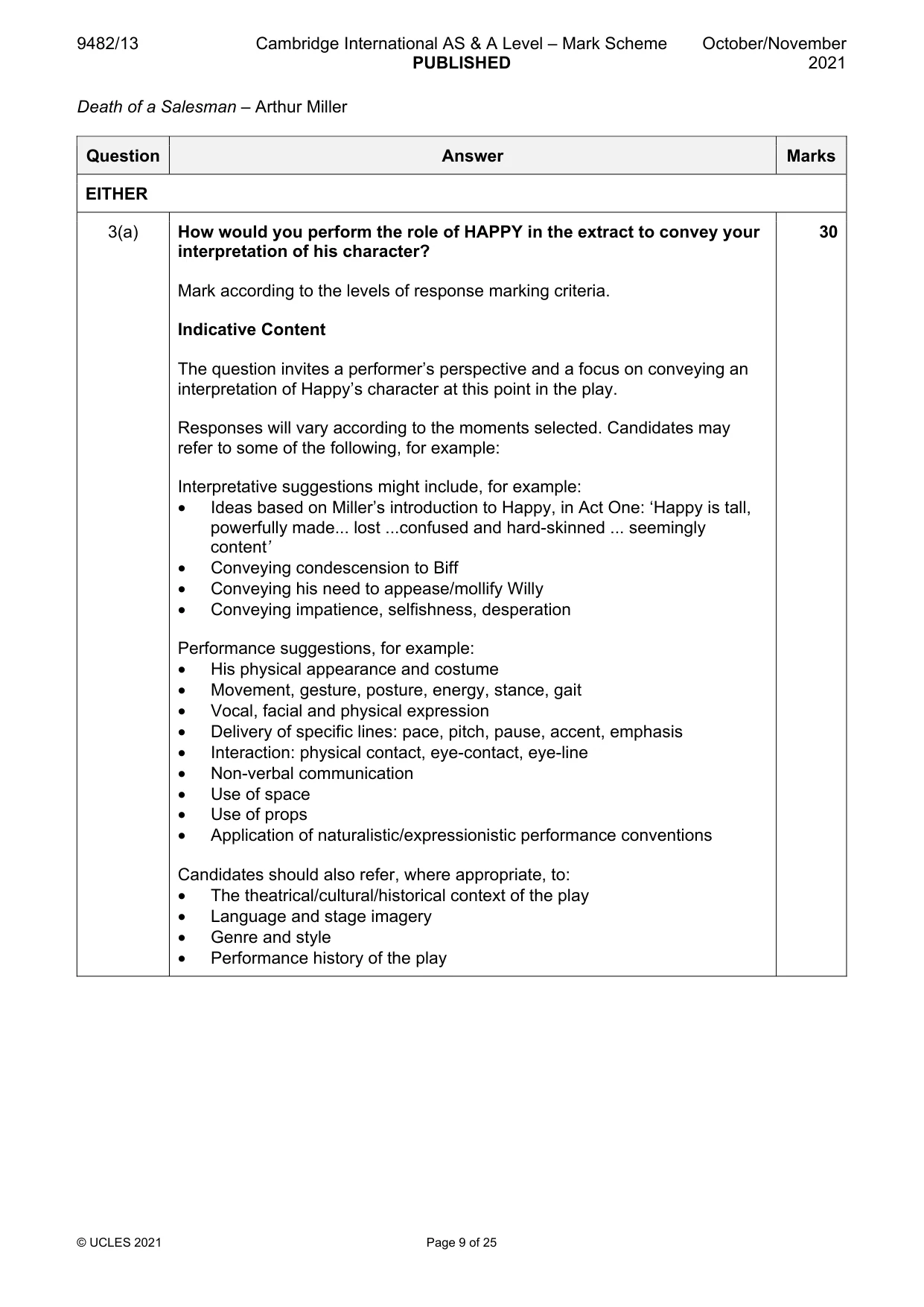
9482/13 Cambridge International AS & A Level – Mark Scheme PUBLISHED October/November 2021 © UCLES 2021 Page 9 of 25 Death of a Salesman – Arthur Miller Question Answer Marks EITHER 3(a) How would you perform the role of HAPPY in the extract to convey your interpretation of his character? Mark according to the levels of response marking criteria. Indicative Content The question invites a performer’s perspective and a focus on conveying an interpretation of Happy’s character at this point in the play. Responses will vary according to the moments selected. Candidates may refer to some of the following, for example: Interpretative suggestions might include, for example: • Ideas based on Miller’s introduction to Happy, in Act One: ‘Happy is tall, powerfully made... lost ...confused and hard-skinned ... seemingly content’ • Conveying condescension to Biff • Conveying his need to appease/mollify Willy • Conveying impatience, selfishness, desperation Performance suggestions, for example: • His physical appearance and costume • Movement, gesture, posture, energy, stance, gait • Vocal, facial and physical expression • Delivery of specific lines: pace, pitch, pause, accent, emphasis • Interaction: physical contact, eye-contact, eye-line • Non-verbal communication • Use of space • Use of props • Application of naturalistic/expressionistic performance conventions Candidates should also refer, where appropriate, to: • The theatrical/cultural/historical context of the play • Language and stage imagery • Genre and style • Performance history of the play 30
Mark scheme, page 10
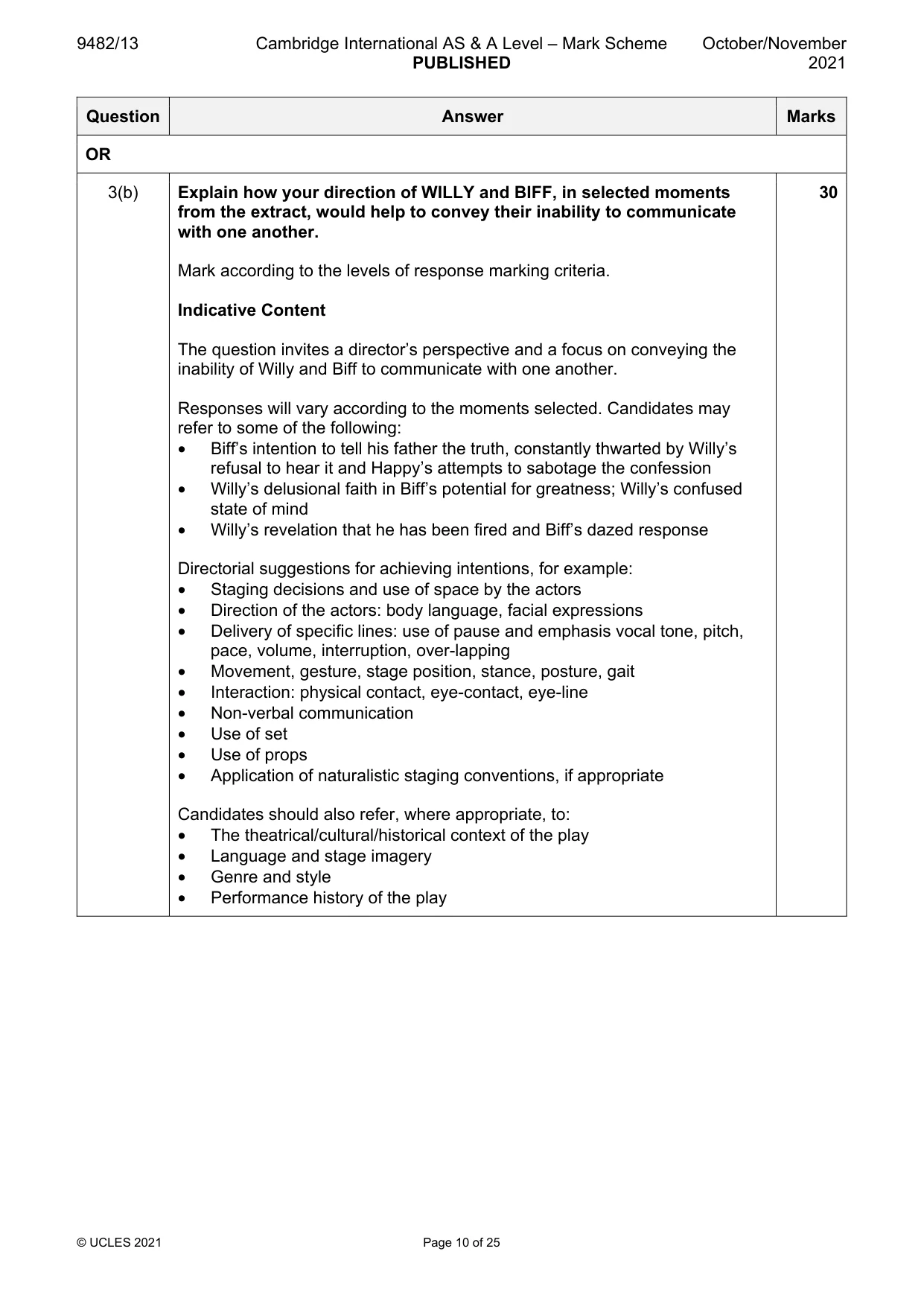
9482/13 Cambridge International AS & A Level – Mark Scheme PUBLISHED October/November 2021 © UCLES 2021 Page 10 of 25 Question Answer Marks OR 3(b) Explain how your direction of WILLY and BIFF, in selected moments from the extract, would help to convey their inability to communicate with one another. Mark according to the levels of response marking criteria. Indicative Content The question invites a director’s perspective and a focus on conveying the inability of Willy and Biff to communicate with one another. Responses will vary according to the moments selected. Candidates may refer to some of the following: • Biff’s intention to tell his father the truth, constantly thwarted by Willy’s refusal to hear it and Happy’s attempts to sabotage the confession • Willy’s delusional faith in Biff’s potential for greatness; Willy’s confused state of mind • Willy’s revelation that he has been fired and Biff’s dazed response Directorial suggestions for achieving intentions, for example: • Staging decisions and use of space by the actors • Direction of the actors: body language, facial expressions • Delivery of specific lines: use of pause and emphasis vocal tone, pitch, pace, volume, interruption, over-lapping • Movement, gesture, stage position, stance, posture, gait • Interaction: physical contact, eye-contact, eye-line • Non-verbal communication • Use of set • Use of props • Application of naturalistic staging conventions, if appropriate Candidates should also refer, where appropriate, to: • The theatrical/cultural/historical context of the play • Language and stage imagery • Genre and style • Performance history of the play 30
Mark scheme, page 11
9482/13 Cambridge International AS & A Level – Mark Scheme PUBLISHED October/November 2021 © UCLES 2021 Page 11 of 25 The Lion and the Jewel – Wole Soyinka Question Answer Marks EITHER 4(a) As a designer, explain how your designs for costumes and accessories for BAROKA and LAKUNLE in this extract, would emphasise their contrasting attitudes towards ‘tradition’ and ‘progress’. Mark according to the levels of response marking criteria. Indicative Content The question invites a costume designer’s perspective and a focus on emphasising the contrast between Baroka’s traditional and Lakunle’s progressive attitudes. Responses will vary according to the candidates’ interpretation of the characters’ attitudes, but candidates may refer to some of the following: • Baroka’s status as Bale of the village and upholder of tradition in Ilujinle • Lakunle’s status as village schoolmaster, an educated man and advocate of Western values and ‘progress’ Costume Design suggestions; for example: • Style of costumes, condition, cut and fit • Costume to distinguish between Baroka and Lakunle • Baroka’s regalia as Bale of the village: impressive robes (agbada) or loose shirt (buba) with loose fitting trousers (sokotos) • Lakunle’s attempt at Westernisation in his garb as schoolmaster • Colours, fabrics, ornamentation • Footwear/headgear • Accessories: woven belts, pouches, spectacles • Body paint/jewellery Candidates should also refer, where appropriate, to: • The theatrical/cultural/historical context of the play • Language and stage imagery • Genre and style • Performance history of the play 30
Mark scheme, page 12
9482/13 Cambridge International AS & A Level – Mark Scheme PUBLISHED October/November 2021 © UCLES 2021 Page 12 of 25 Question Answer Marks OR 4(b) Explain how you would direct your ensemble at particular moments during the re-enactment of the visitor’s entry into Ilujinle, to capture the excitement of the spectacle for your audience. Mark according to the levels of response marking criteria. Indicative Content The question invites a director’s perspective and a focus on capturing the excitement of the re-enactment for the audience at particular moments from the extract. Responses will vary according to the moments selected. Candidates may refer to some of the following, for example: • An atmosphere of excitement and revelry • A sense of improvised action or of well-rehearsed routines • Lively music and dance – a colourful spectacle • The excitement and joy of the participants; the execution of the mime of the motor-car • Sidi’s delight in her role in the ‘play’ • Lakunle’s growing enthusiasm for the performance • Shift of mood when Baroka appears and the entertainment is interrupted and then resumed • The introduction of tension/rivalry between Baroka and Lakunle • The villagers’ homage to Baroka • Musical accompaniment Directorial suggestions for achieving their intentions; for example: • Staging decisions and use of space by the actors • Direction of the actors: body language, facial expressions, vocal tone, pitch, pace, volume • Delivery of specific lines: use of pause and emphasis • Movement, gesture, stage position, stance, posture, gait • Interaction: physical contact, eye-contact, eye-line Candidates should also refer, where appropriate, to: • The theatrical/cultural/historical context of the play • Language and stage imagery • Genre and style • Performance history of the play 30
Mark scheme, page 13
9482/13 Cambridge International AS & A Level – Mark Scheme PUBLISHED October/November 2021 © UCLES 2021 Page 13 of 25 Enron – Lucy Prebble Question Answer Marks EITHER 5(a) How would you perform the role of CLAUDIA ROE in selected moments from the extract, to establish your interpretation of her character for the audience? Mark according to the levels of response marking criteria. Indicative Content The question invites a performer’s perspective and a focus on establishing Claudia Roe’s character for the audience. Responses will vary according to the moments selected. Candidates may refer to some of the following: Interpretation of Claudia Roe’s character, including, for example: • Confident, controlling, self-aware • Falsely modest, pushy, no-nonsense approach • Her dominant attitude towards male colleagues Performance suggestions, for example: • Her physical appearance • Movement, gesture, posture, energy, stance, gait, idiosyncrasy • Vocal, facial and physical expression • Delivery style: confident, controlling • Delivery of specific line: pace, pitch, pause, accent, volume, emphasis • Interaction with other characters: physical contact, eye-contact, eye-line • Non-verbal communication • Use of space • Use of props Candidates should also refer, where appropriate, to: • The theatrical/cultural/historical context of the play • Language and stage imagery • Genre and style • Performance history of the play 30
Mark scheme, page 14
9482/13 Cambridge International AS & A Level – Mark Scheme PUBLISHED October/November 2021 © UCLES 2021 Page 14 of 25 Question Answer Marks OR 5(b) As a director, how would you stage selected moments from the extract to create a sense of the early 1990s and the atmosphere of excitement and celebration at the ‘mark-to-market’ party? Mark according to the levels of response marking criteria. Indicative Content The question invites a director’s perspective and a focus on creating the 1990s setting and the party atmosphere through staging ideas. Responses will vary according to the moments selected. Candidates may refer to some of the following: • Staging decisions and use of space by the actors • Direction of the actors: body language, facial expressions, actions and reactions • 1990s costumes • Party sound-scape, for example, laughter, celebration, clinking glasses, 1990s music • Movement, gesture, stage position, stance, posture, gait, dancing • Interaction: physical contact, eye-contact, eye-line • Delivery style • Delivery of specific lines: pace, pitch, pause, accent, volume, emphasis • Party atmosphere: drinks, balloons, poppers, crackers, party clothes • Lighting: special effects, glitter ball • Dancing, flirting, kissing • Application of physical theatre staging conventions, if appropriate Candidates should also refer, where appropriate, to: • The theatrical/cultural/historical context of the play • Language and stage imagery • Genre and style • Performance history of the play 30
Mark scheme, page 15
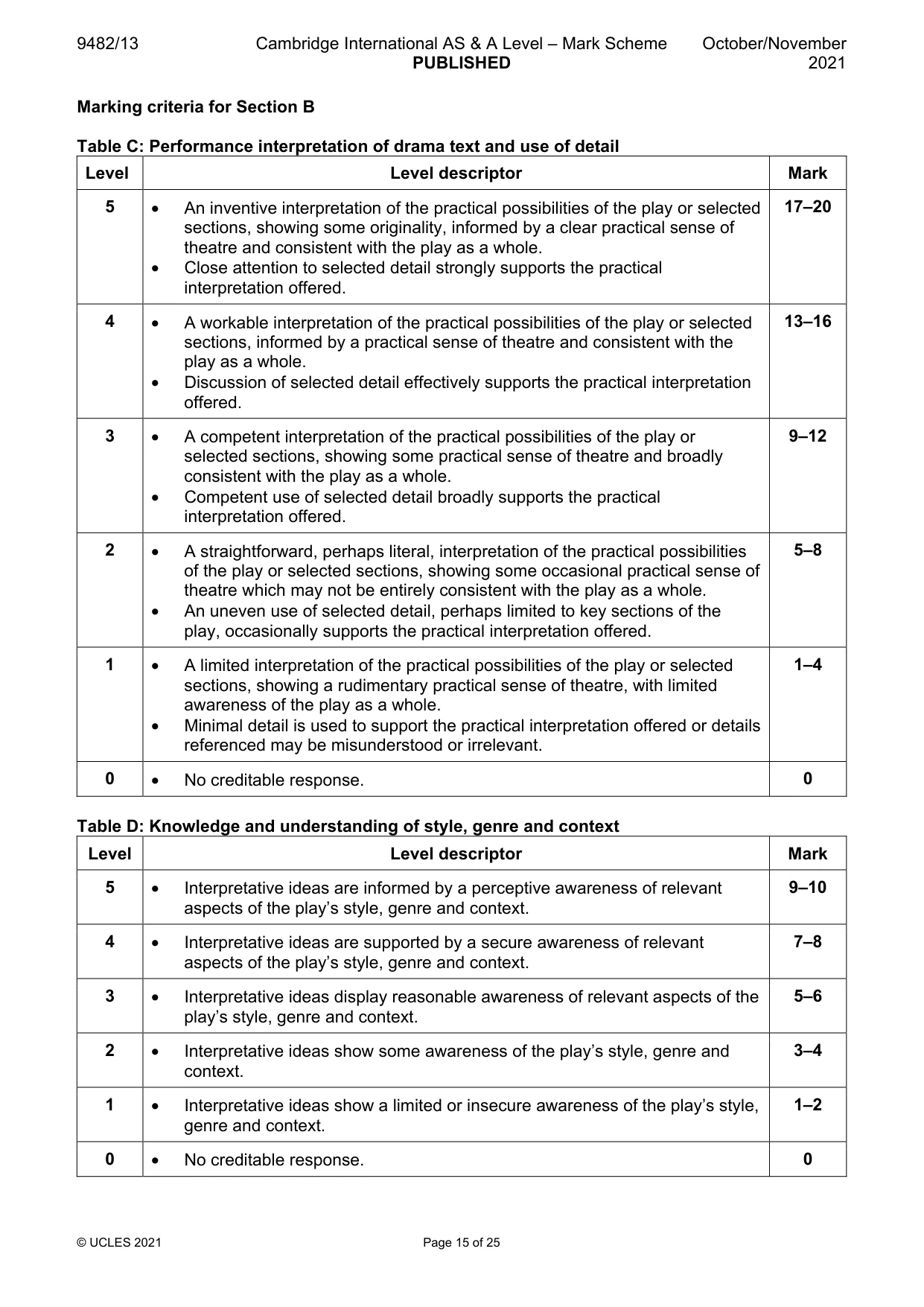
9482/13 Cambridge International AS & A Level – Mark Scheme PUBLISHED October/November 2021 © UCLES 2021 Page 15 of 25 Marking criteria for Section B Table C: Performance interpretation of drama text and use of detail Level Level descriptor Mark 5 • An inventive interpretation of the practical possibilities of the play or selected sections, showing some originality, informed by a clear practical sense of theatre and consistent with the play as a whole. • Close attention to selected detail strongly supports the practical interpretation offered. 17–20 4 • A workable interpretation of the practical possibilities of the play or selected sections, informed by a practical sense of theatre and consistent with the play as a whole. • Discussion of selected detail effectively supports the practical interpretation offered. 13–16 3 • A competent interpretation of the practical possibilities of the play or selected sections, showing some practical sense of theatre and broadly consistent with the play as a whole. • Competent use of selected detail broadly supports the practical interpretation offered. 9–12 2 • A straightforward, perhaps literal, interpretation of the practical possibilities of the play or selected sections, showing some occasional practical sense of theatre which may not be entirely consistent with the play as a whole. • An uneven use of selected detail, perhaps limited to key sections of the play, occasionally supports the practical interpretation offered. 5–8 1 • A limited interpretation of the practical possibilities of the play or selected sections, showing a rudimentary practical sense of theatre, with limited awareness of the play as a whole. • Minimal detail is used to support the practical interpretation offered or details referenced may be misunderstood or irrelevant. 1–4 0 • No creditable response. 0 Table D: Knowledge and understanding of style, genre and context Level Level descriptor Mark 5 • Interpretative ideas are informed by a perceptive awareness of relevant aspects of the play’s style, genre and context. 9–10 4 • Interpretative ideas are supported by a secure awareness of relevant aspects of the play’s style, genre and context. 7–8 3 • Interpretative ideas display reasonable awareness of relevant aspects of the play’s style, genre and context. 5–6 2 • Interpretative ideas show some awareness of the play’s style, genre and context. 3–4 1 • Interpretative ideas show a limited or insecure awareness of the play’s style, genre and context. 1–2 0 • No creditable response. 0
Mark scheme, page 16
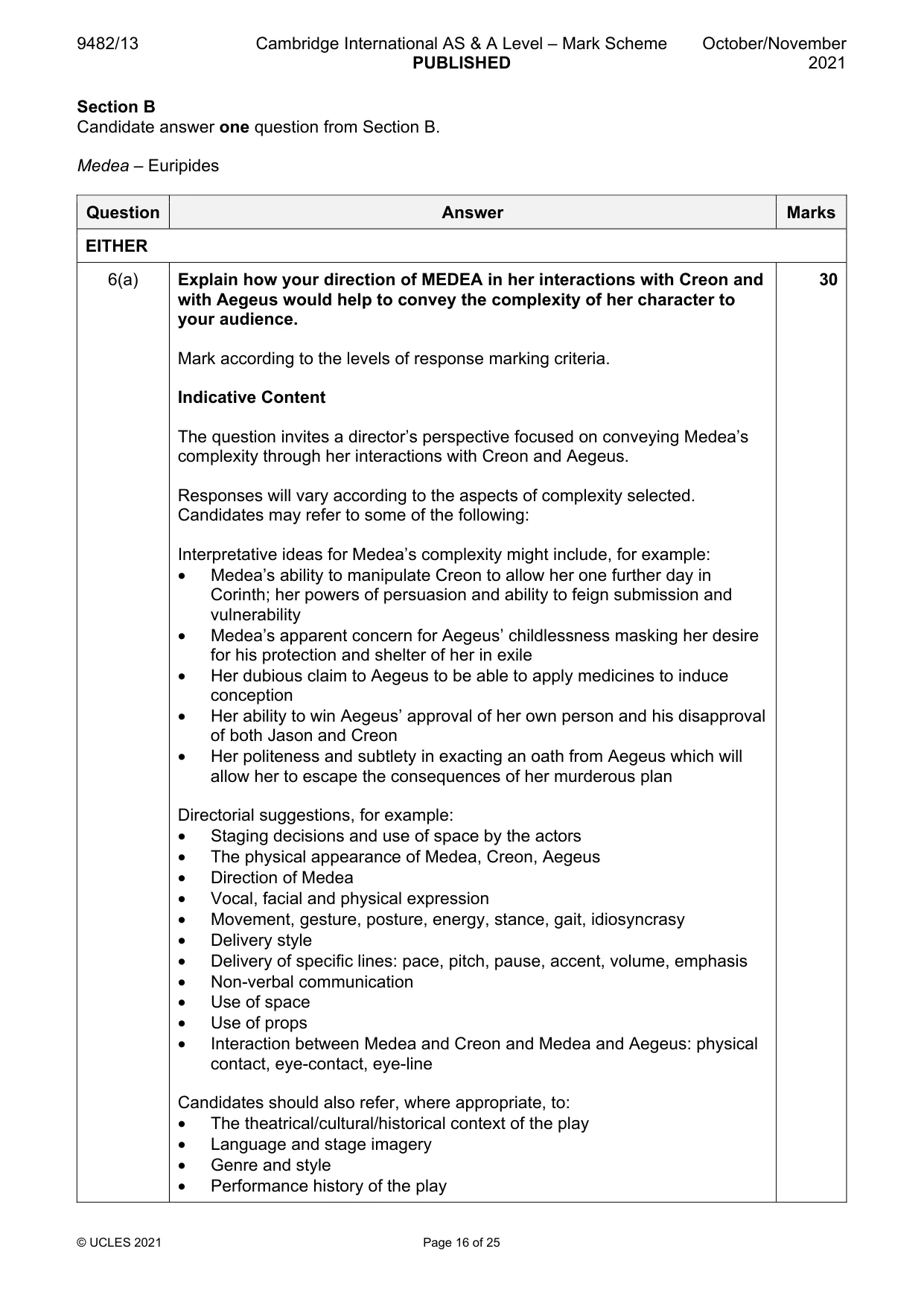
9482/13 Cambridge International AS & A Level – Mark Scheme PUBLISHED October/November 2021 © UCLES 2021 Page 16 of 25 Section B Candidate answer one question from Section B. Medea – Euripides Question Answer Marks EITHER 6(a) Explain how your direction of MEDEA in her interactions with Creon and with Aegeus would help to convey the complexity of her character to your audience. Mark according to the levels of response marking criteria. Indicative Content The question invites a director’s perspective focused on conveying Medea’s complexity through her interactions with Creon and Aegeus. Responses will vary according to the aspects of complexity selected. Candidates may refer to some of the following: Interpretative ideas for Medea’s complexity might include, for example: • Medea’s ability to manipulate Creon to allow her one further day in Corinth; her powers of persuasion and ability to feign submission and vulnerability • Medea’s apparent concern for Aegeus’ childlessness masking her desire for his protection and shelter of her in exile • Her dubious claim to Aegeus to be able to apply medicines to induce conception • Her ability to win Aegeus’ approval of her own person and his disapproval of both Jason and Creon • Her politeness and subtlety in exacting an oath from Aegeus which will allow her to escape the consequences of her murderous plan Directorial suggestions, for example: • Staging decisions and use of space by the actors • The physical appearance of Medea, Creon, Aegeus • Direction of Medea • Vocal, facial and physical expression • Movement, gesture, posture, energy, stance, gait, idiosyncrasy • Delivery style • Delivery of specific lines: pace, pitch, pause, accent, volume, emphasis • Non-verbal communication • Use of space • Use of props • Interaction between Medea and Creon and Medea and Aegeus: physical contact, eye-contact, eye-line Candidates should also refer, where appropriate, to: • The theatrical/cultural/historical context of the play • Language and stage imagery • Genre and style • Performance history of the play 30
Mark scheme, page 17
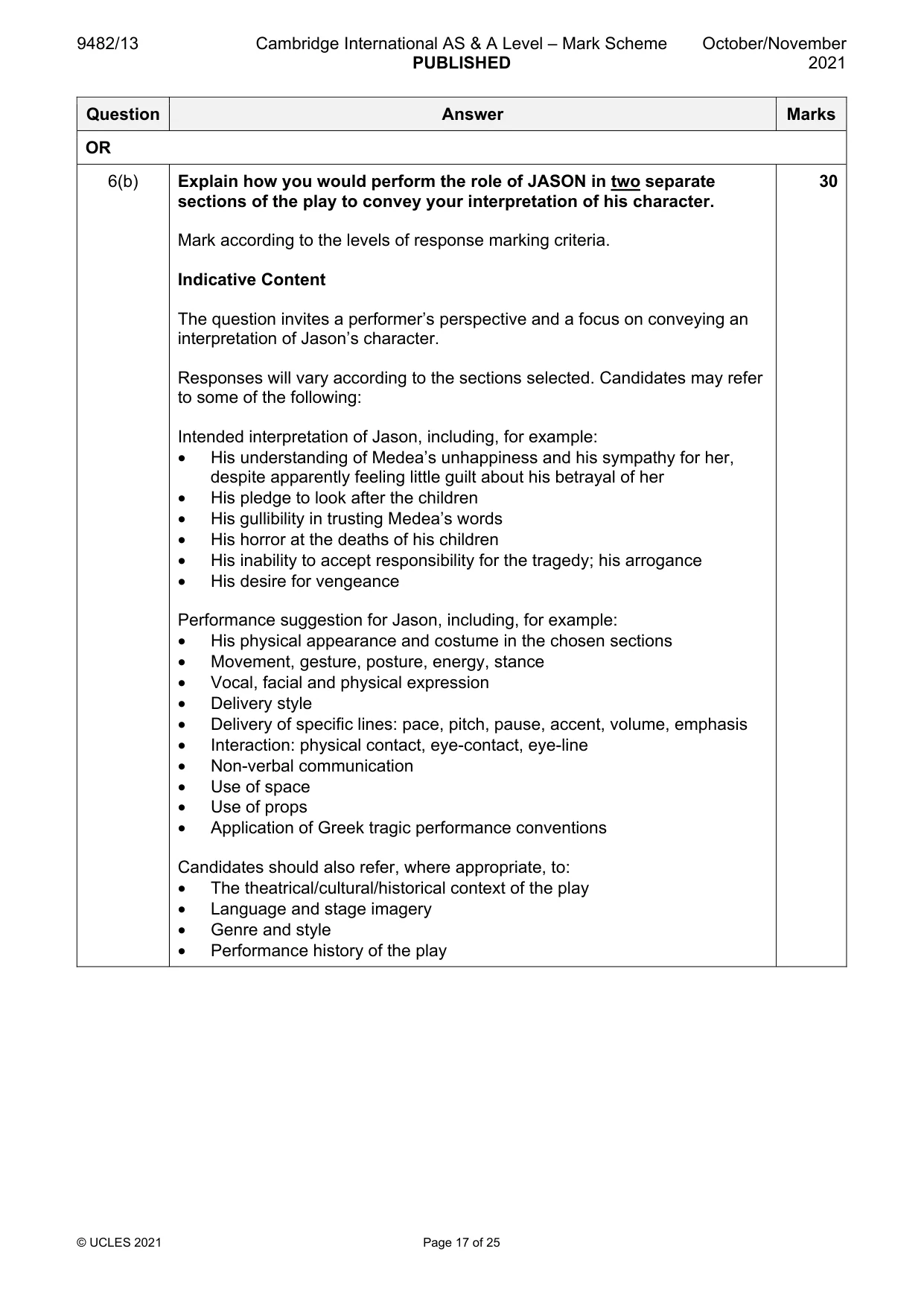
9482/13 Cambridge International AS & A Level – Mark Scheme PUBLISHED October/November 2021 © UCLES 2021 Page 17 of 25 Question Answer Marks OR 6(b) Explain how you would perform the role of JASON in two separate sections of the play to convey your interpretation of his character. Mark according to the levels of response marking criteria. Indicative Content The question invites a performer’s perspective and a focus on conveying an interpretation of Jason’s character. Responses will vary according to the sections selected. Candidates may refer to some of the following: Intended interpretation of Jason, including, for example: • His understanding of Medea’s unhappiness and his sympathy for her, despite apparently feeling little guilt about his betrayal of her • His pledge to look after the children • His gullibility in trusting Medea’s words • His horror at the deaths of his children • His inability to accept responsibility for the tragedy; his arrogance • His desire for vengeance Performance suggestion for Jason, including, for example: • His physical appearance and costume in the chosen sections • Movement, gesture, posture, energy, stance • Vocal, facial and physical expression • Delivery style • Delivery of specific lines: pace, pitch, pause, accent, volume, emphasis • Interaction: physical contact, eye-contact, eye-line • Non-verbal communication • Use of space • Use of props • Application of Greek tragic performance conventions Candidates should also refer, where appropriate, to: • The theatrical/cultural/historical context of the play • Language and stage imagery • Genre and style • Performance history of the play 30
Mark scheme, page 18
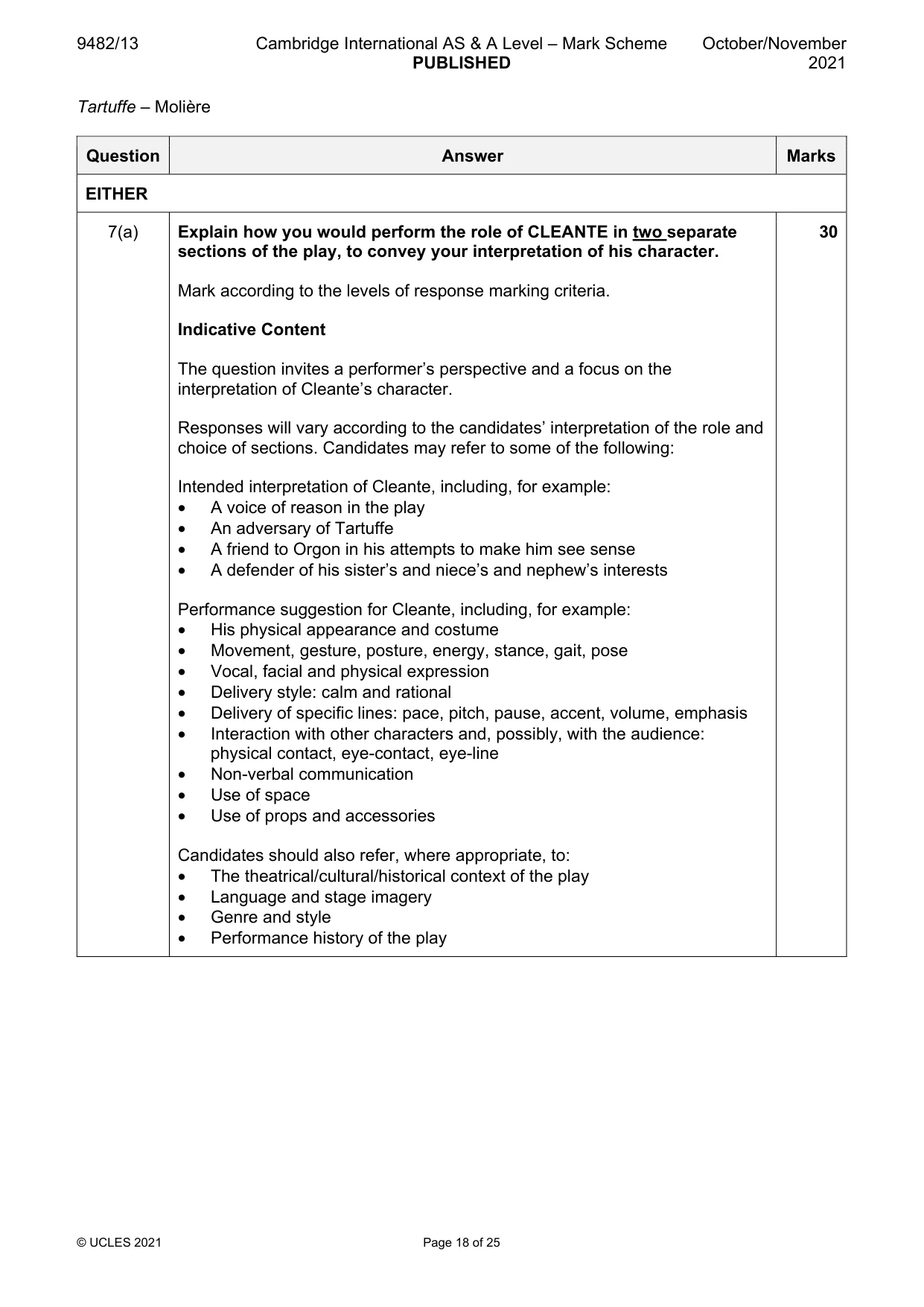
9482/13 Cambridge International AS & A Level – Mark Scheme PUBLISHED October/November 2021 © UCLES 2021 Page 18 of 25 Tartuffe – Molière Question Answer Marks EITHER 7(a) Explain how you would perform the role of CLEANTE in two separate sections of the play, to convey your interpretation of his character. Mark according to the levels of response marking criteria. Indicative Content The question invites a performer’s perspective and a focus on the interpretation of Cleante’s character. Responses will vary according to the candidates’ interpretation of the role and choice of sections. Candidates may refer to some of the following: Intended interpretation of Cleante, including, for example: • A voice of reason in the play • An adversary of Tartuffe • A friend to Orgon in his attempts to make him see sense • A defender of his sister’s and niece’s and nephew’s interests Performance suggestion for Cleante, including, for example: • His physical appearance and costume • Movement, gesture, posture, energy, stance, gait, pose • Vocal, facial and physical expression • Delivery style: calm and rational • Delivery of specific lines: pace, pitch, pause, accent, volume, emphasis • Interaction with other characters and, possibly, with the audience: physical contact, eye-contact, eye-line • Non-verbal communication • Use of space • Use of props and accessories Candidates should also refer, where appropriate, to: • The theatrical/cultural/historical context of the play • Language and stage imagery • Genre and style • Performance history of the play 30
Mark scheme, page 19
9482/13 Cambridge International AS & A Level – Mark Scheme PUBLISHED October/November 2021 © UCLES 2021 Page 19 of 25 Question Answer Marks OR 7(b) How would you direct the performer playing DORINE in two sections of the play to show her true concern for Mariane’s happiness? Mark according to the levels of response marking criteria. Indicative Content The question invites a director’s perspective focused on showing Dorine’s true concern for Mariane’s happiness. Responses will vary according to the candidates’ interpretation of Dorine and choice of sections. Candidates may refer to some of the following: • Dorine’s comical and impertinent interference with Orgon’s plans to marry Tartuffe to Mariane • Her attempt to persuade Mariane to stand up to her father, using wit and sarcasm • Her success in reconciling Mariane with Valere, through comical cajolery • Her pleasure as all ends well Directorial suggestions, for example: • Staging decisions and use of space by the performing • Her physical appearance and costume • Movement, gesture, posture, energy, stance, gait, pose • Vocal, facial and physical expression • Delivery style • Delivery of specific lines: pace, pitch, pause, accent, volume, emphasis • Interaction with other characters and, possibly, with the audience: physical contact, eye-contact, eye-line • Non-verbal communication • Use of space • Use of props and accessories • Reference to commedia performance conventions, if appropriate Candidates should also refer, where appropriate, to: • The theatrical/cultural/historical context of the play • Language and stage imagery • Genre and style • Performance history of the play 30
Mark scheme, page 20
9482/13 Cambridge International AS & A Level – Mark Scheme PUBLISHED October/November 2021 © UCLES 2021 Page 20 of 25 The Seagull – Anton Chekhov Question Answer Marks EITHER 8(a) Explain how your direction of two or more separate sections of the play would demonstrate the troubled relationship between KONSTANTIN and his mother, ARKADINA. Mark according to the levels of response marking criteria. Indicative Content The question invites a director’s perspective and a focus on demonstrating the troubled relationship between Konstantin and his mother, Arkadina. Responses will vary according to the sections selected. Candidates may refer to some of the following: • Arkadina’s blatant indifference to Konstantin’s play and wider literary aspiration • Konstantin’s embarrassment by his mother’s affair with Trigorin and by her stinginess; his desire for recognition and his mother’s love • Arkadina’s concern for Konstantin after his suicide attempt, flaring into outrage at his criticism of her lifestyle • Their arguments about Trigorin and about money Directorial suggestions, for example: • Staging decisions: choice of stage space and use of space by the actors • Direction of the actors: body language, facial expressions, vocal tone • Physical expression of their mutual frustration with one another • Delivery of specific lines: pace, pitch, pause, accent, volume, emphasis • Movement, gesture, stage position, stance, posture, gait • Interaction: physical contact, eye-contact, eye-line • Application of naturalistic performance conventions Candidates should also refer, where appropriate, to: • The theatrical/cultural/historical context of the play • Language and stage imagery • Genre and style • Performance history of the play 30
Mark scheme, page 21
9482/13 Cambridge International AS & A Level – Mark Scheme PUBLISHED October/November 2021 © UCLES 2021 Page 21 of 25 Question Answer Marks OR 8(b) How would you perform the role of NINA in two or more separate sections of the play, to show the development of her character? Mark according to the levels of response marking criteria. Indicative Content The question invites a performer’s perspective and a focus on revealing the development of Nina’s character. Responses will vary according to the candidates’ choice of sections. Candidates may refer to some of the following: • Nina’s innocent love for Konstantin • Her initial shyness and anxiety about her performance in Konstantin’s play • Her star-struck attitude towards Arkadina and Trigorin • Her infatuation with Trigorin and gradual withdrawal from her relationship with Konstantin • Her recklessness in following Trigorin to Moscow • Her mental deterioration but determination to endure Performance suggestions, for example: • Nina’s physical appearance and costume • Movement, gesture, posture, energy, stance, gait • Vocal, facial and physical expression • Delivery style • Delivery of specific lines: pace, pitch, pause, accent, volume, emphasis • Interaction with other characters: physical contact, eye-contact, eye-line • Non-verbal communication • Use of space • Use of props and accessories • Naturalistic performance conventions Candidates should also refer, where appropriate, to: • The theatrical/cultural/historical context of the play • Language and stage imagery • Genre and style • Performance history of the play 30
Mark scheme, page 22
9482/13 Cambridge International AS & A Level – Mark Scheme PUBLISHED October/November 2021 © UCLES 2021 Page 22 of 25 The Curious Incident of the Dog in the Night-Time – Simon Stephens Question Answer Marks EITHER 9(a) What dramatic effects would you want to achieve through your direction of two separate sections of the play that show CHRISTOPHER interacting with authority figures? Explain how you would achieve your intentions. Mark according to the levels of response marking criteria. Indicative Content The question invites a director’s perspective and a focus on the creation of dramatic effects when Christopher is interacting with authority figures. Responses will vary according to the sections and authority figures selected. Candidates may refer to some of the following: • Preferred effects, for example: comedy, intrigue, anticipation, engagement, excitement Directorial suggestions for achieving intentions; for example: • Interaction with, for example: Policeman, Duty Sergeant, Reverend Peters, Station Policeman, Siobhan, Parental figures • Staging decisions and use of space by the actors • Direction of the actors: body language, facial expressions, physical theatre skills, for example: synchronicity, lifts, physical routines • Vocal qualities: tone, pitch, pace, volume • Delivery style • Delivery of specific lines: use of pause and emphasis, tone, volume, accent, pitch, pace • Movement, gesture, stage position, stance, posture, gait • Interaction: physical contact, eye-contact, eye-line • Application of comic method: timing, non-verbal communication • Application of physical theatre performance conventions Candidates should also refer, where appropriate, to: • The theatrical/cultural/historical context of the play • Language and stage imagery • Genre and style • Performance history of the play 30
Mark scheme, page 23
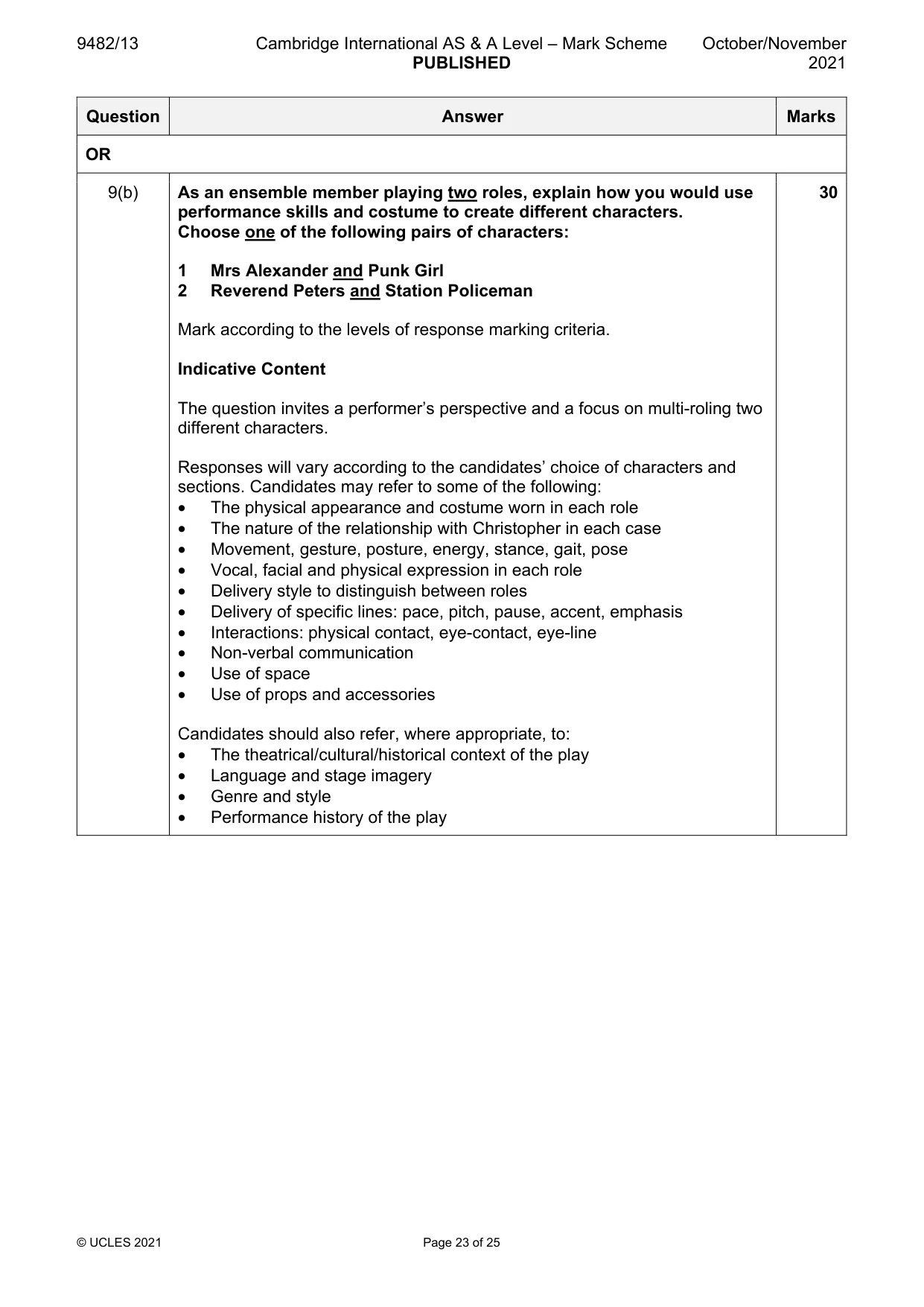
9482/13 Cambridge International AS & A Level – Mark Scheme PUBLISHED October/November 2021 © UCLES 2021 Page 23 of 25 Question Answer Marks OR 9(b) As an ensemble member playing two roles, explain how you would use performance skills and costume to create different characters. Choose one of the following pairs of characters: 1 Mrs Alexander and Punk Girl 2 Reverend Peters and Station Policeman Mark according to the levels of response marking criteria. Indicative Content The question invites a performer’s perspective and a focus on multi-roling two different characters. Responses will vary according to the candidates’ choice of characters and sections. Candidates may refer to some of the following: • The physical appearance and costume worn in each role • The nature of the relationship with Christopher in each case • Movement, gesture, posture, energy, stance, gait, pose • Vocal, facial and physical expression in each role • Delivery style to distinguish between roles • Delivery of specific lines: pace, pitch, pause, accent, emphasis • Interactions: physical contact, eye-contact, eye-line • Non-verbal communication • Use of space • Use of props and accessories Candidates should also refer, where appropriate, to: • The theatrical/cultural/historical context of the play • Language and stage imagery • Genre and style • Performance history of the play 30
Mark scheme, page 24
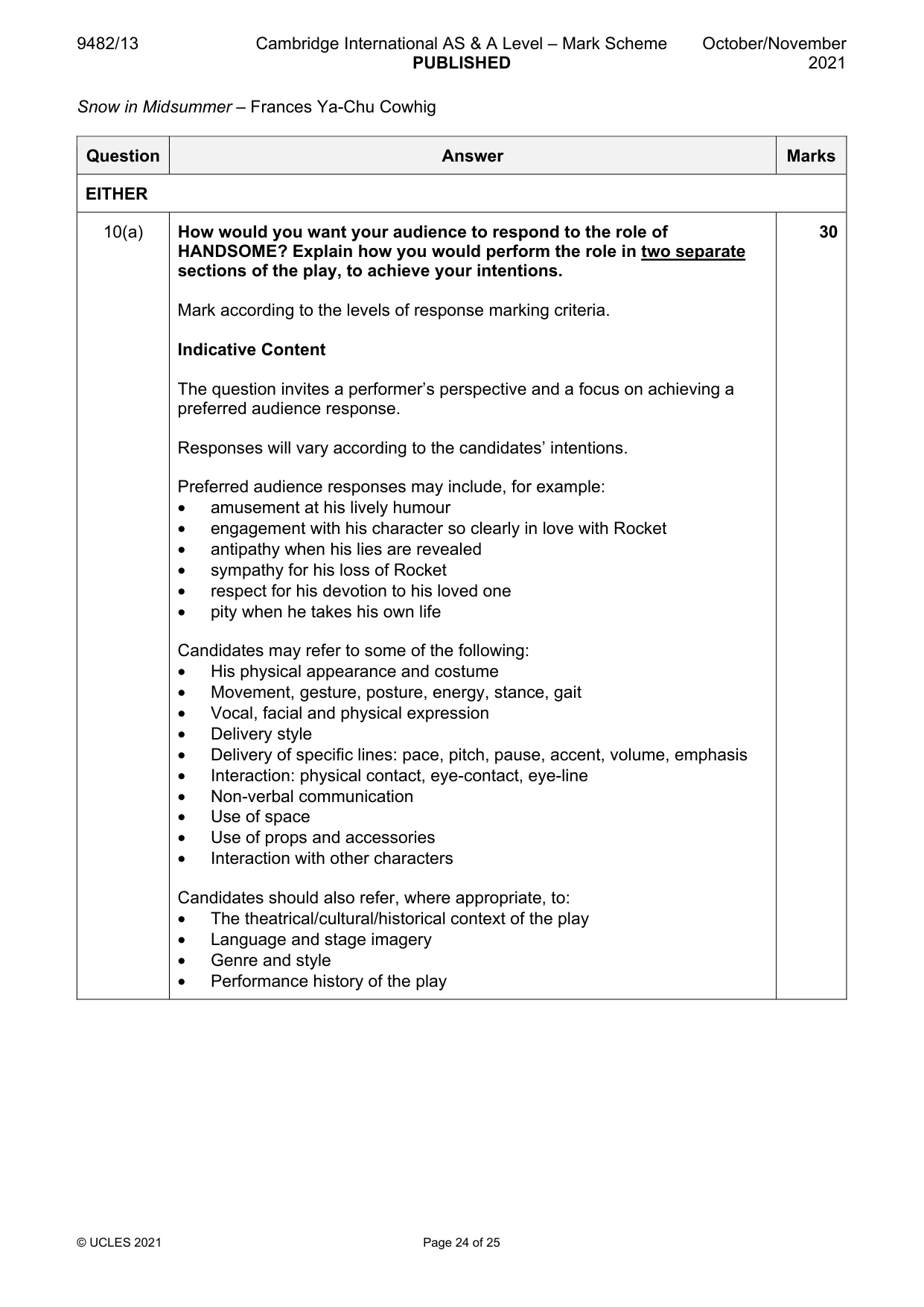
9482/13 Cambridge International AS & A Level – Mark Scheme PUBLISHED October/November 2021 © UCLES 2021 Page 24 of 25 Snow in Midsummer – Frances Ya-Chu Cowhig Question Answer Marks EITHER 10(a) How would you want your audience to respond to the role of HANDSOME? Explain how you would perform the role in two separate sections of the play, to achieve your intentions. Mark according to the levels of response marking criteria. Indicative Content The question invites a performer’s perspective and a focus on achieving a preferred audience response. Responses will vary according to the candidates’ intentions. Preferred audience responses may include, for example: • amusement at his lively humour • engagement with his character so clearly in love with Rocket • antipathy when his lies are revealed • sympathy for his loss of Rocket • respect for his devotion to his loved one • pity when he takes his own life Candidates may refer to some of the following: • His physical appearance and costume • Movement, gesture, posture, energy, stance, gait • Vocal, facial and physical expression • Delivery style • Delivery of specific lines: pace, pitch, pause, accent, volume, emphasis • Interaction: physical contact, eye-contact, eye-line • Non-verbal communication • Use of space • Use of props and accessories • Interaction with other characters Candidates should also refer, where appropriate, to: • The theatrical/cultural/historical context of the play • Language and stage imagery • Genre and style • Performance history of the play 30
Mark scheme, page 25
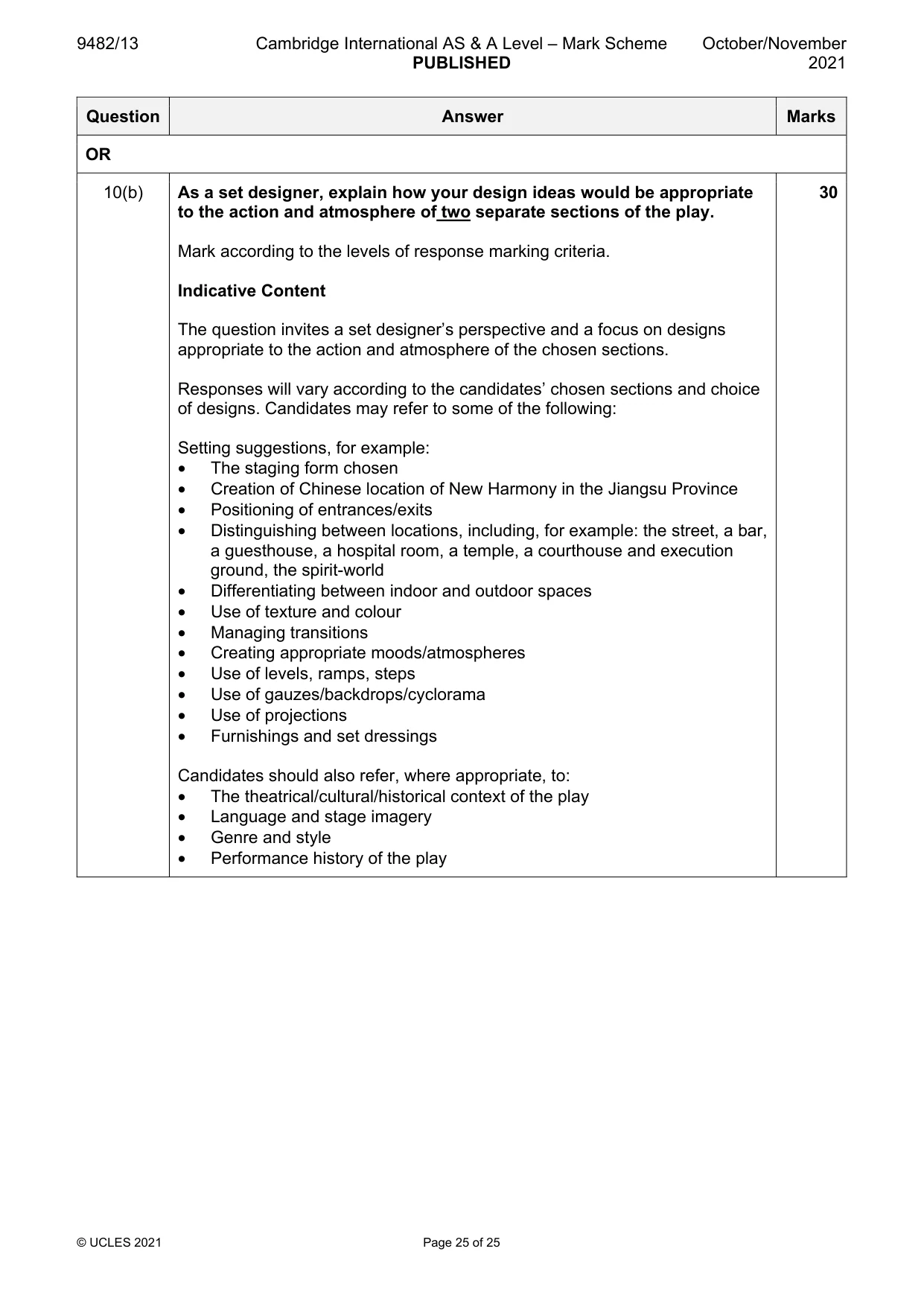
9482/13 Cambridge International AS & A Level – Mark Scheme PUBLISHED October/November 2021 © UCLES 2021 Page 25 of 25 Question Answer Marks OR 10(b) As a set designer, explain how your design ideas would be appropriate to the action and atmosphere of two separate sections of the play. Mark according to the levels of response marking criteria. Indicative Content The question invites a set designer’s perspective and a focus on designs appropriate to the action and atmosphere of the chosen sections. Responses will vary according to the candidates’ chosen sections and choice of designs. Candidates may refer to some of the following: Setting suggestions, for example: • The staging form chosen • Creation of Chinese location of New Harmony in the Jiangsu Province • Positioning of entrances/exits • Distinguishing between locations, including, for example: the street, a bar, a guesthouse, a hospital room, a temple, a courthouse and execution ground, the spirit-world • Differentiating between indoor and outdoor spaces • Use of texture and colour • Managing transitions • Creating appropriate moods/atmospheres • Use of levels, ramps, steps • Use of gauzes/backdrops/cyclorama • Use of projections • Furnishings and set dressings Candidates should also refer, where appropriate, to: • The theatrical/cultural/historical context of the play • Language and stage imagery • Genre and style • Performance history of the play 30
What you needed in this session
Cambridge’s own grade thresholds for 2021 Oct/Nov, Paper 1 · Variant 3. A higher threshold means an easier paper — the bar moves with how the cohort did.