Cambridge A Level Drama 9482 — 2021 Oct/Nov Paper 1 · Variant 2
9482/12/O/N/21 · 60 marks · ≈68 min
The question paper and its mark scheme, free to read here and free to download. This is Cambridge’s own paper, exactly as it was sat.
Question paper8 pages


Mark scheme25 pages
Answers below. Sit the paper first if you are practising.
Paper as text
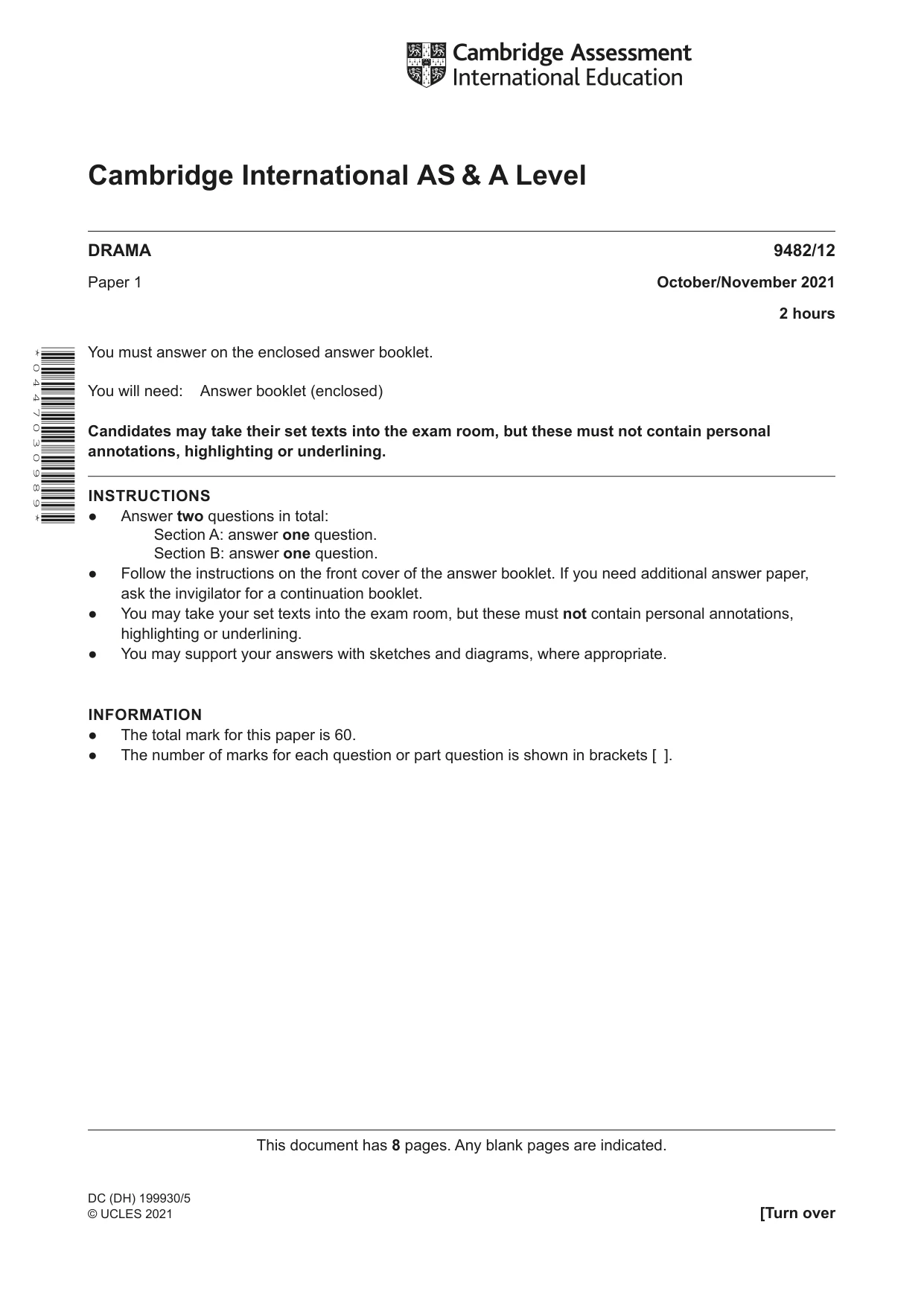
Question paper, page 1
This document has 8 pages. Any blank pages are indicated. Cambridge International AS & A Level * 0 4 4 7 0 3 0 9 8 9 * DC (DH) 199930/5 © UCLES 2021 [Turn over DRAMA 9482/12 Paper 1 October/November 2021 2 hours You must answer on the enclosed answer booklet. You will need: Answer booklet (enclosed) Candidates may take their set texts into the exam room, but these must not contain personal annotations, highlighting or underlining. INSTRUCTIONS ● Answer two questions in total: Section A: answer one question. Section B: answer one question. ● Follow the instructions on the front cover of the answer booklet. If you need additional answer paper, ask the invigilator for a continuation booklet. ● You may take your set texts into the exam room, but these must not contain personal annotations, highlighting or underlining. ● You may support your answers with sketches and diagrams, where appropriate. INFORMATION ● The total mark for this paper is 60. ● The number of marks for each question or part question is shown in brackets [ ].
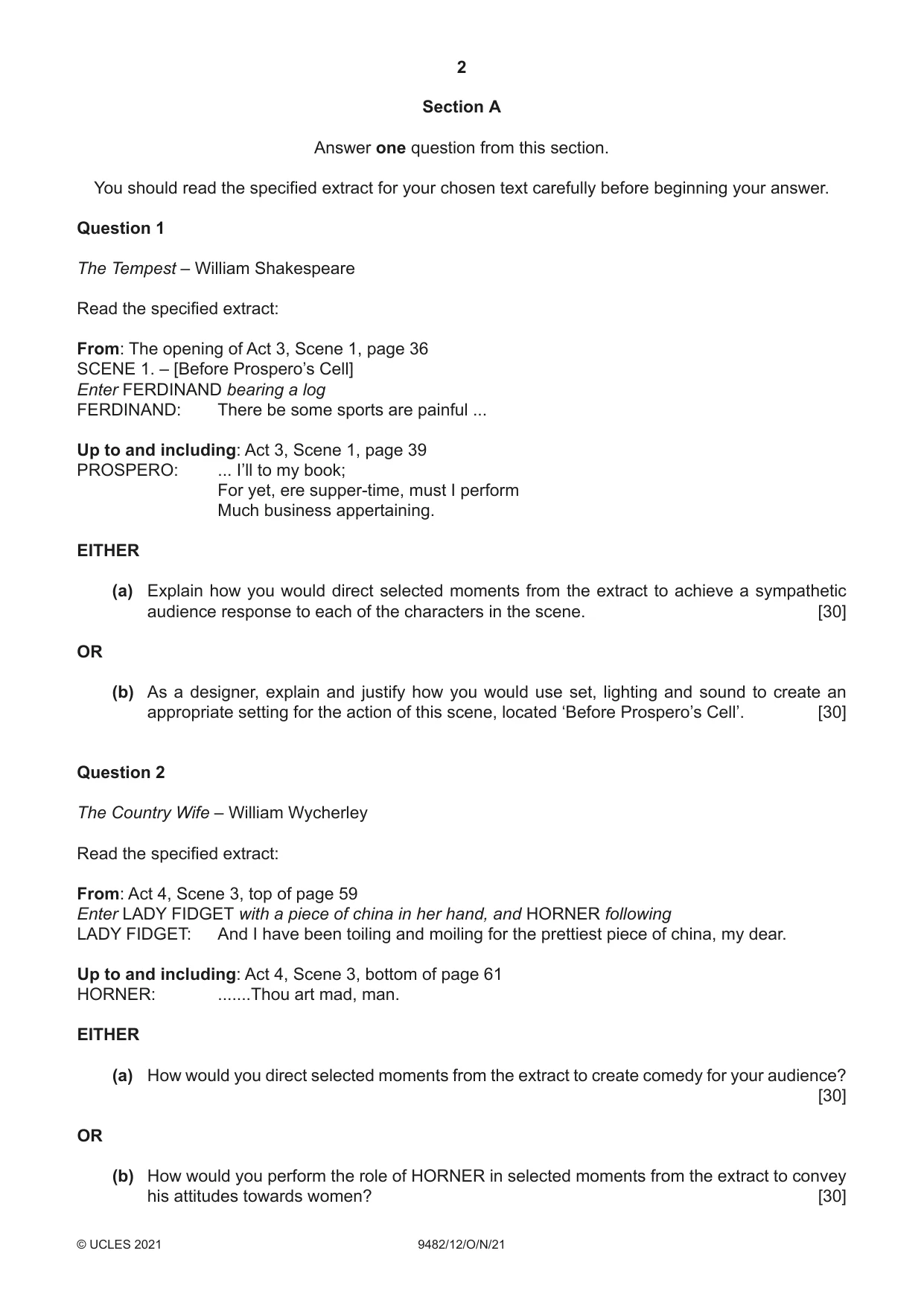
Question paper, page 2
2 9482/12/O/N/21 © UCLES 2021 Section A Answer one question from this section. You should read the specified extract for your chosen text carefully before beginning your answer. Question 1 The Tempest – William Shakespeare Read the specified extract: From: The opening of Act 3, Scene 1, page 36 SCENE 1. – [Before Prospero’s Cell] Enter FERDINAND bearing a log FERDINAND: There be some sports are painful ... Up to and including: Act 3, Scene 1, page 39 PROSPERO: ... I’ll to my book; For yet, ere supper-time, must I perform Much business appertaining. EITHER (a) Explain how you would direct selected moments from the extract to achieve a sympathetic audience response to each of the characters in the scene. [30] OR (b) As a designer, explain and justify how you would use set, lighting and sound to create an appropriate setting for the action of this scene, located ‘Before Prospero’s Cell’. [30] Question 2 The Country Wife – William Wycherley Read the specified extract: From: Act 4, Scene 3, top of page 59 Enter LADY FIDGET with a piece of china in her hand, and HORNER following LADY FIDGET: And I have been toiling and moiling for the prettiest piece of china, my dear. Up to and including: Act 4, Scene 3, bottom of page 61 HORNER: …Thou art mad, man. EITHER (a) How would you direct selected moments from the extract to create comedy for your audience? [30] OR (b) How would you perform the role of HORNER in selected moments from the extract to convey his attitudes towards women? [30]
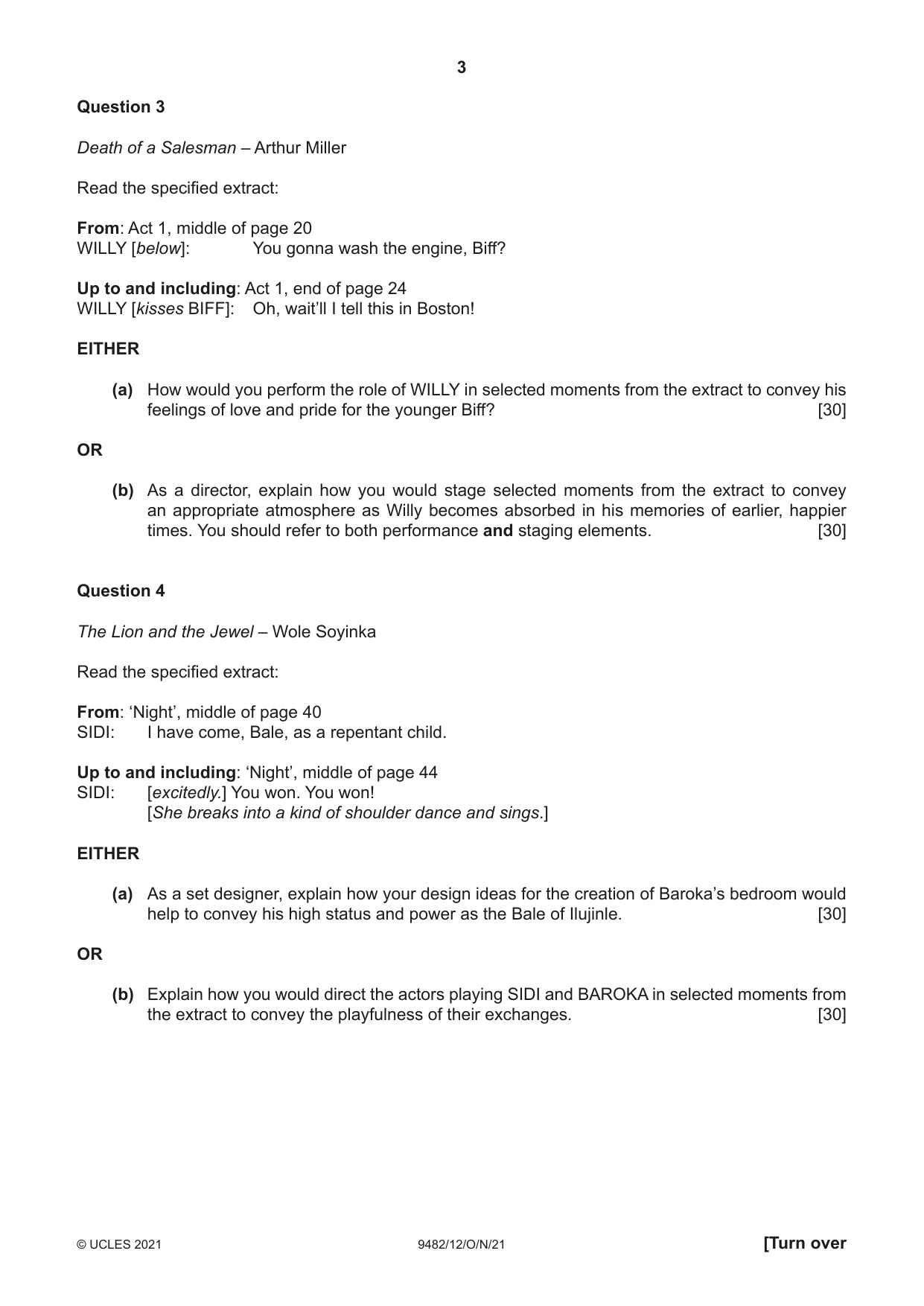
Question paper, page 3
3 9482/12/O/N/21 © UCLES 2021 [Turn over Question 3 Death of a Salesman – Arthur Miller Read the specified extract: From: Act 1, middle of page 20 WILLY [below]: You gonna wash the engine, Biff? Up to and including: Act 1, end of page 24 WILLY [kisses BIFF]: Oh, wait’ll I tell this in Boston! EITHER (a) How would you perform the role of WILLY in selected moments from the extract to convey his feelings of love and pride for the younger Biff? [30] OR (b) As a director, explain how you would stage selected moments from the extract to convey an appropriate atmosphere as Willy becomes absorbed in his memories of earlier, happier times. You should refer to both performance and staging elements. [30] Question 4 The Lion and the Jewel – Wole Soyinka Read the specified extract: From: ‘Night’, middle of page 40 SIDI: I have come, Bale, as a repentant child. Up to and including: ‘Night’, middle of page 44 SIDI: [excitedly.] You won. You won! [She breaks into a kind of shoulder dance and sings.] EITHER (a) As a set designer, explain how your design ideas for the creation of Baroka’s bedroom would help to convey his high status and power as the Bale of Ilujinle. [30] OR (b) Explain how you would direct the actors playing SIDI and BAROKA in selected moments from the extract to convey the playfulness of their exchanges. [30]
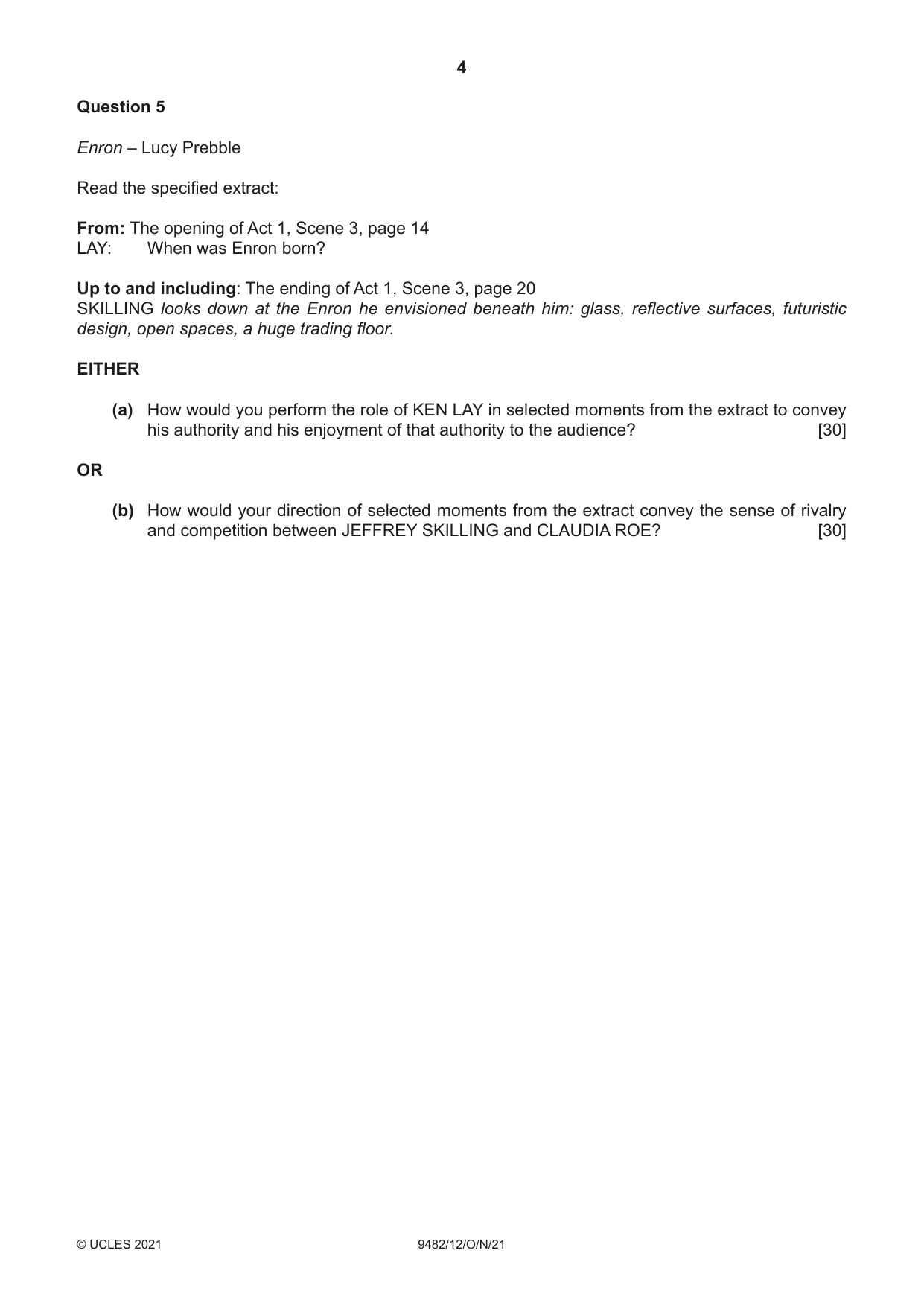
Question paper, page 4
4 9482/12/O/N/21 © UCLES 2021 Question 5 Enron – Lucy Prebble Read the specified extract: From: The opening of Act 1, Scene 3, page 14 LAY: When was Enron born? Up to and including: The ending of Act 1, Scene 3, page 20 SKILLING looks down at the Enron he envisioned beneath him: glass, reflective surfaces, futuristic design, open spaces, a huge trading floor. EITHER (a) How would you perform the role of KEN LAY in selected moments from the extract to convey his authority and his enjoyment of that authority to the audience? [30] OR (b) How would your direction of selected moments from the extract convey the sense of rivalry and competition between JEFFREY SKILLING and CLAUDIA ROE? [30]
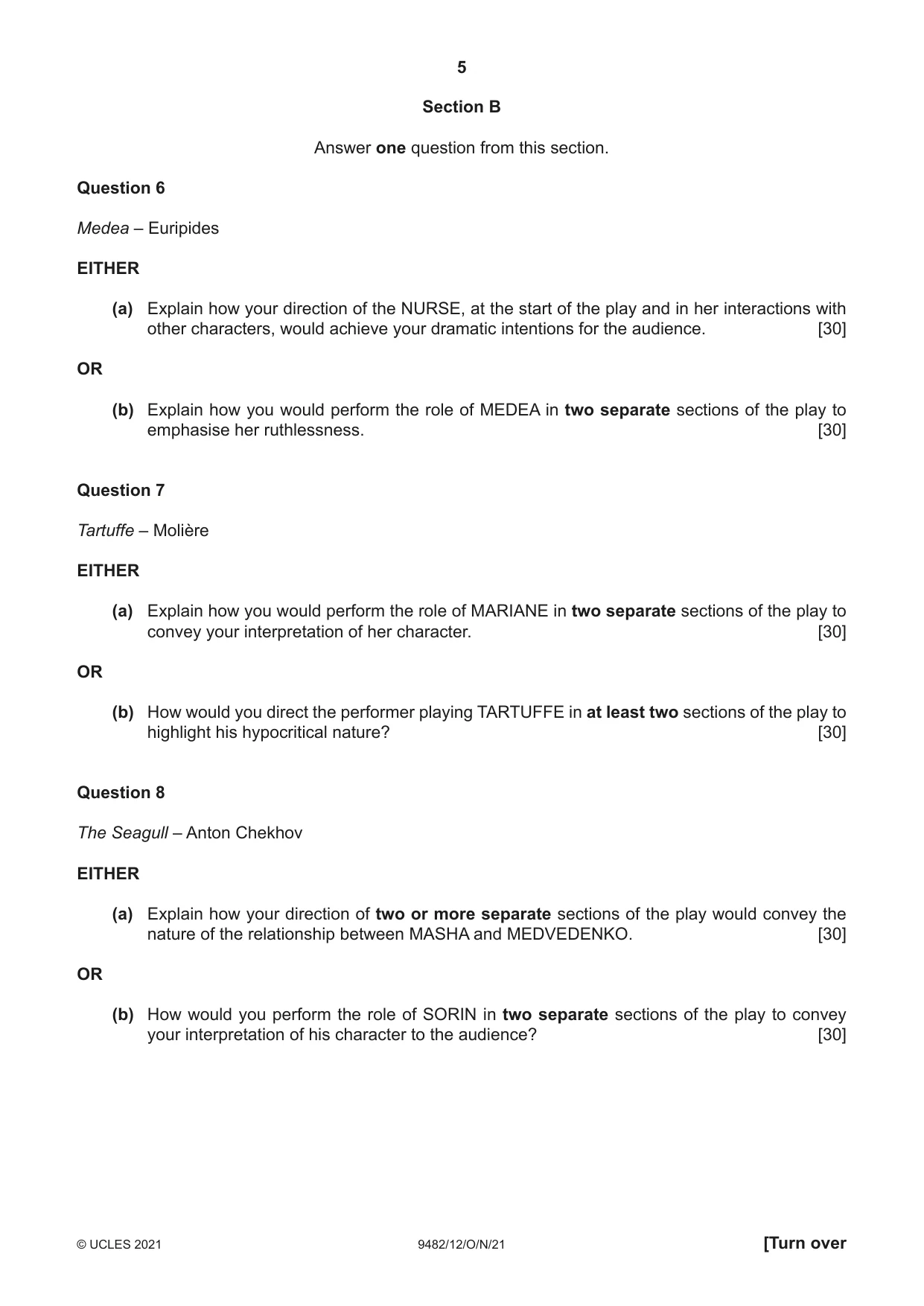
Question paper, page 5
5 9482/12/O/N/21 © UCLES 2021 [Turn over Section B Answer one question from this section. Question 6 Medea – Euripides EITHER (a) Explain how your direction of the NURSE, at the start of the play and in her interactions with other characters, would achieve your dramatic intentions for the audience. [30] OR (b) Explain how you would perform the role of MEDEA in two separate sections of the play to emphasise her ruthlessness. [30] Question 7 Tartuffe – Molière EITHER (a) Explain how you would perform the role of MARIANE in two separate sections of the play to convey your interpretation of her character. [30] OR (b) How would you direct the performer playing TARTUFFE in at least two sections of the play to highlight his hypocritical nature? [30] Question 8 The Seagull – Anton Chekhov EITHER (a) Explain how your direction of two or more separate sections of the play would convey the nature of the relationship between MASHA and MEDVEDENKO. [30] OR (b) How would you perform the role of SORIN in two separate sections of the play to convey your interpretation of his character to the audience? [30]
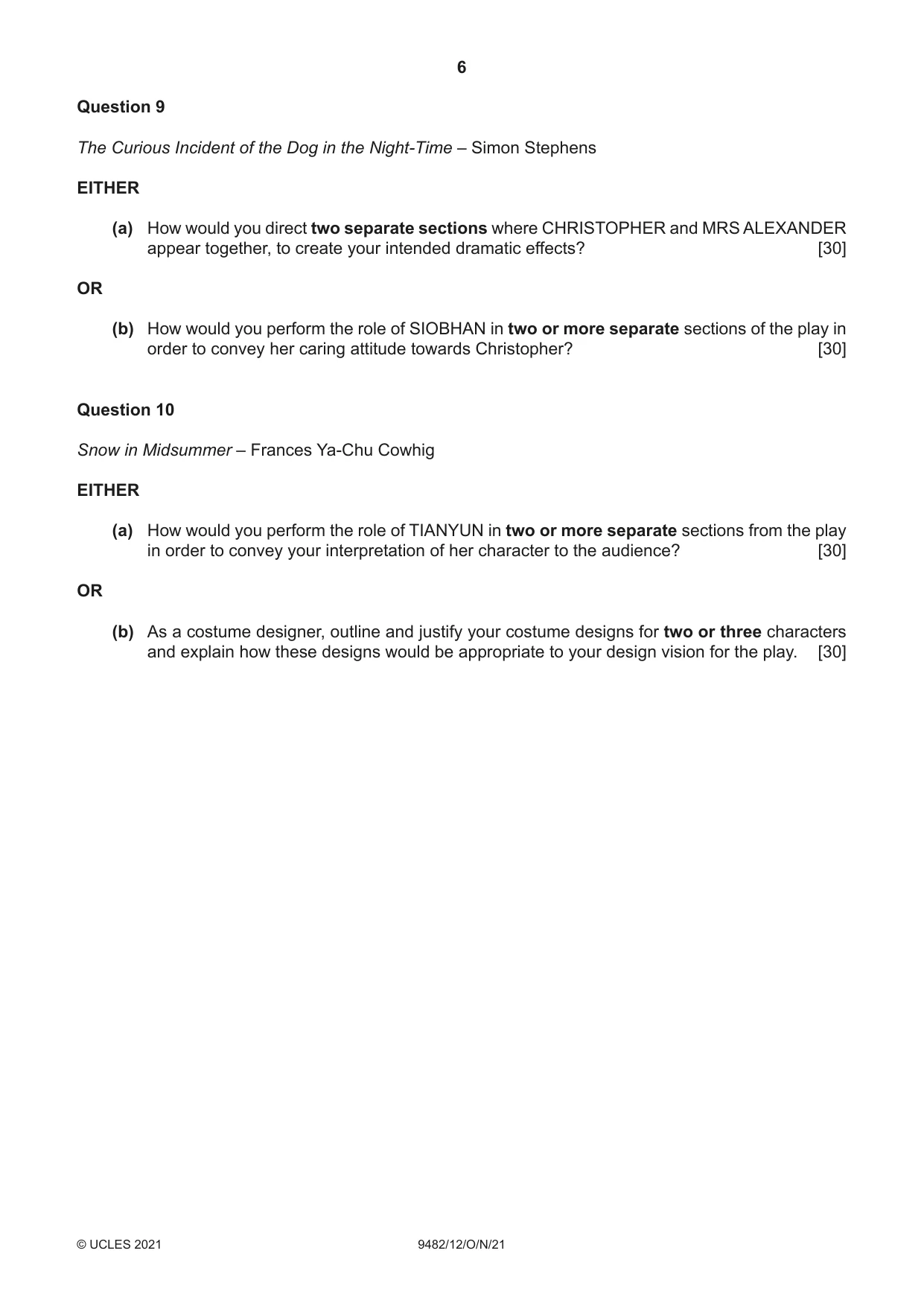
Question paper, page 6
6 9482/12/O/N/21 © UCLES 2021 Question 9 The Curious Incident of the Dog in the Night-Time – Simon Stephens EITHER (a) How would you direct two separate sections where CHRISTOPHER and MRS ALEXANDER appear together, to create your intended dramatic effects? [30] OR (b) How would you perform the role of SIOBHAN in two or more separate sections of the play in order to convey her caring attitude towards Christopher? [30] Question 10 Snow in Midsummer – Frances Ya-Chu Cowhig EITHER (a) How would you perform the role of TIANYUN in two or more separate sections from the play in order to convey your interpretation of her character to the audience? [30] OR (b) As a costume designer, outline and justify your costume designs for two or three characters and explain how these designs would be appropriate to your design vision for the play. [30]
Question paper, page 7
7 9482/12/O/N/21 © UCLES 2021 BLANK PAGE
Question paper, page 8
8 9482/12/O/N/21 © UCLES 2021 Permission to reproduce items where third-party owned material protected by copyright is included has been sought and cleared where possible. Every reasonable effort has been made by the publisher (UCLES) to trace copyright holders, but if any items requiring clearance have unwittingly been included, the publisher will be pleased to make amends at the earliest possible opportunity. To avoid the issue of disclosure of answer-related information to candidates, all copyright acknowledgements are reproduced online in the Cambridge Assessment International Education Copyright Acknowledgements Booklet. This is produced for each series of examinations and is freely available to download at www.cambridgeinternational.org after the live examination series. Cambridge Assessment International Education is part of the Cambridge Assessment Group. Cambridge Assessment is the brand name of the University of Cambridge Local Examinations Syndicate (UCLES), which itself is a department of the University of Cambridge. BLANK PAGE
Mark scheme, page 1
This document consists of 25 printed pages. © UCLES 2021 [Turn over Cambridge International AS & A Level DRAMA 9482/12 Paper 1 Open-Book Written Examination October/November 2021 MARK SCHEME Maximum Mark: 60 Published This mark scheme is published as an aid to teachers and candidates, to indicate the requirements of the examination. It shows the basis on which Examiners were instructed to award marks. It does not indicate the details of the discussions that took place at an Examiners’ meeting before marking began, which would have considered the acceptability of alternative answers. Mark schemes should be read in conjunction with the question paper and the Principal Examiner Report for Teachers. Cambridge International will not enter into discussions about these mark schemes. Cambridge International is publishing the mark schemes for the October/November 2021 series for most Cambridge IGCSE™, Cambridge International A and AS Level components and some Cambridge O Level components.
Mark scheme, page 2
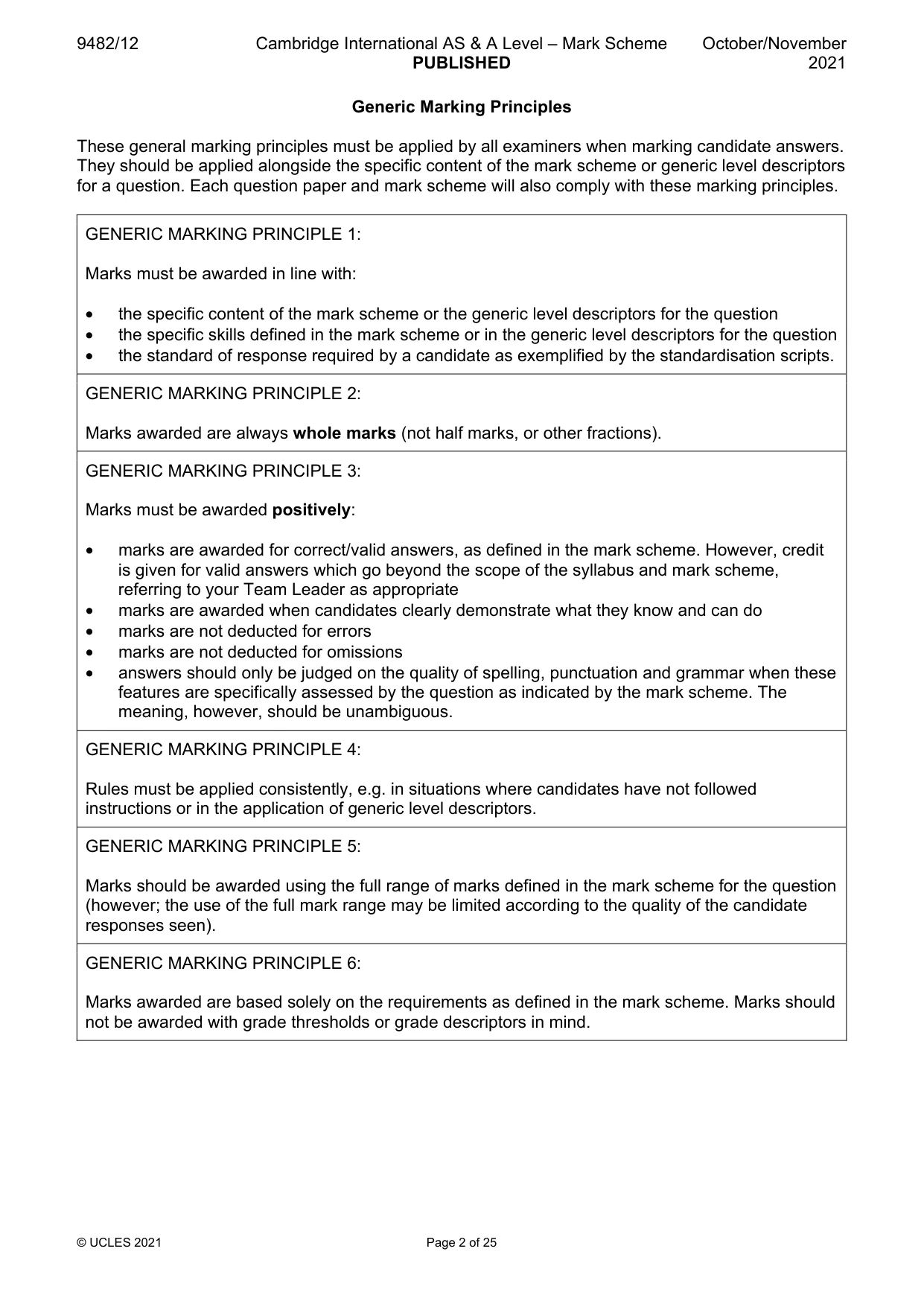
9482/12 Cambridge International AS & A Level – Mark Scheme PUBLISHED October/November 2021 © UCLES 2021 Page 2 of 25 Generic Marking Principles These general marking principles must be applied by all examiners when marking candidate answers. They should be applied alongside the specific content of the mark scheme or generic level descriptors for a question. Each question paper and mark scheme will also comply with these marking principles. GENERIC MARKING PRINCIPLE 1: Marks must be awarded in line with: • the specific content of the mark scheme or the generic level descriptors for the question • the specific skills defined in the mark scheme or in the generic level descriptors for the question • the standard of response required by a candidate as exemplified by the standardisation scripts. GENERIC MARKING PRINCIPLE 2: Marks awarded are always whole marks (not half marks, or other fractions). GENERIC MARKING PRINCIPLE 3: Marks must be awarded positively: • marks are awarded for correct/valid answers, as defined in the mark scheme. However, credit is given for valid answers which go beyond the scope of the syllabus and mark scheme, referring to your Team Leader as appropriate • marks are awarded when candidates clearly demonstrate what they know and can do • marks are not deducted for errors • marks are not deducted for omissions • answers should only be judged on the quality of spelling, punctuation and grammar when these features are specifically assessed by the question as indicated by the mark scheme. The meaning, however, should be unambiguous. GENERIC MARKING PRINCIPLE 4: Rules must be applied consistently, e.g. in situations where candidates have not followed instructions or in the application of generic level descriptors. GENERIC MARKING PRINCIPLE 5: Marks should be awarded using the full range of marks defined in the mark scheme for the question (however; the use of the full mark range may be limited according to the quality of the candidate responses seen). GENERIC MARKING PRINCIPLE 6: Marks awarded are based solely on the requirements as defined in the mark scheme. Marks should not be awarded with grade thresholds or grade descriptors in mind.
Mark scheme, page 3
9482/12 Cambridge International AS & A Level – Mark Scheme PUBLISHED October/November 2021 © UCLES 2021 Page 3 of 25 Drama specific marking instructions Candidates are required to answer two questions in total: one question from Section A and one question from Section B. There are two level-descriptor tables for each section. Please ensure you use the appropriate marking criteria to mark each candidate response. Table A and Table B are for Section A. Table C and Table D are for Section B. Both sections assess AO1: Knowledge and understanding Candidates demonstrate their knowledge and understanding of drama text and its performance context and of theatre-making traditions and theatre practice. Each answer is marked out of 30. Guidance on using level-based mark schemes Marking of work should be positive, rewarding achievement where possible, but clearly differentiating across the whole range of marks, where appropriate. The marker should look at the work and then make a judgement about which level statement is the best fit. In practice, work does not always match one level statement precisely so a judgement may need to be made between two or more level statements. Once a best-fit level statement has been identified, use the following guidance to decide on a specific mark: • If the candidate’s work convincingly meets the level statement, award the highest mark. • If the candidate’s work adequately meets the level statement, award the most appropriate mark in the middle of the range (where middle marks are available). • If the candidate’s work just meets the level statement, award the lowest mark.
Mark scheme, page 4
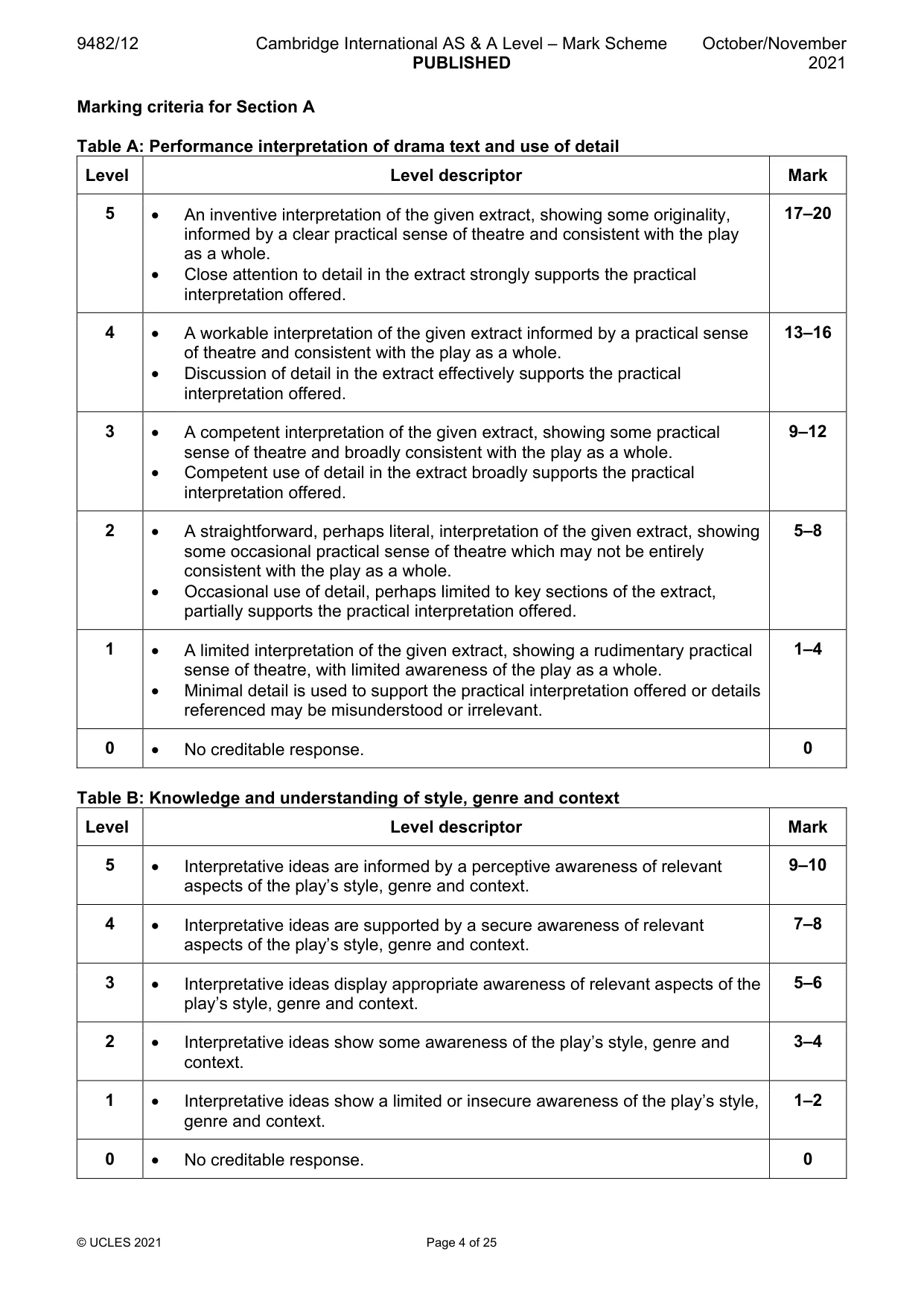
9482/12 Cambridge International AS & A Level – Mark Scheme PUBLISHED October/November 2021 © UCLES 2021 Page 4 of 25 Marking criteria for Section A Table A: Performance interpretation of drama text and use of detail Level Level descriptor Mark 5 • An inventive interpretation of the given extract, showing some originality, informed by a clear practical sense of theatre and consistent with the play as a whole. • Close attention to detail in the extract strongly supports the practical interpretation offered. 17–20 4 • A workable interpretation of the given extract informed by a practical sense of theatre and consistent with the play as a whole. • Discussion of detail in the extract effectively supports the practical interpretation offered. 13–16 3 • A competent interpretation of the given extract, showing some practical sense of theatre and broadly consistent with the play as a whole. • Competent use of detail in the extract broadly supports the practical interpretation offered. 9–12 2 • A straightforward, perhaps literal, interpretation of the given extract, showing some occasional practical sense of theatre which may not be entirely consistent with the play as a whole. • Occasional use of detail, perhaps limited to key sections of the extract, partially supports the practical interpretation offered. 5–8 1 • A limited interpretation of the given extract, showing a rudimentary practical sense of theatre, with limited awareness of the play as a whole. • Minimal detail is used to support the practical interpretation offered or details referenced may be misunderstood or irrelevant. 1–4 0 • No creditable response. 0 Table B: Knowledge and understanding of style, genre and context Level Level descriptor Mark 5 • Interpretative ideas are informed by a perceptive awareness of relevant aspects of the play’s style, genre and context. 9–10 4 • Interpretative ideas are supported by a secure awareness of relevant aspects of the play’s style, genre and context. 7–8 3 • Interpretative ideas display appropriate awareness of relevant aspects of the play’s style, genre and context. 5–6 2 • Interpretative ideas show some awareness of the play’s style, genre and context. 3–4 1 • Interpretative ideas show a limited or insecure awareness of the play’s style, genre and context. 1–2 0 • No creditable response. 0
Mark scheme, page 5
9482/12 Cambridge International AS & A Level – Mark Scheme PUBLISHED October/November 2021 © UCLES 2021 Page 5 of 25 Section A Candidates answer one question from Section A. The Tempest – William Shakespeare Question Answer Marks EITHER 1(a) Explain how you would direct selected moments from the extract to achieve a sympathetic audience response to each of the characters in the scene. Mark according to the levels of response marking criteria. Indicative Content The question invites a director’s perspective and a focus on achieving a sympathetic audience response to each of the characters. Responses will vary according to the moments selected. Candidates may refer to some of the following: • A sympathetic portrayal of Ferdinand who takes pleasure in his labours for Miranda’s sake and declares her ‘peerless’; his declaration of love is very touching • A sympathetic portrayal of Miranda, obviously smitten with Ferdinand and yet trying to respect her father’s orders; she weeps with joy at Ferdinand’s declaration; her innocence engages audience sympathy • A sympathetic portrayal of Prospero who takes pity on his daughter for falling in love with Ferdinand and delights in the happy outcome of his plan Directorial suggestions for achieving intentions, including, for example: • Physical appearance of the characters to invite sympathy • Staging decisions and use of space by the actors: spatial relationships, use of levels • Use of props: the logs, for example • Direction of the actors: body language, facial expressions, vocal tone, pitch, pace, volume • Delivery of specific lines: use of pause and emphasis; use of aside; speaking the verse • Movement, gesture, stage position, stance, posture, gait • Interaction between Miranda and Ferdinand: physical contact, eye- contact, eye-line • Prospero observing unseen; interacting with the audience Candidates should also refer, where appropriate, to: • The theatrical/cultural/historical context of the play • Language and stage imagery • Genre and style • Performance history of the play 30
Mark scheme, page 6
9482/12 Cambridge International AS & A Level – Mark Scheme PUBLISHED October/November 2021 © UCLES 2021 Page 6 of 25 Question Answer Marks OR 1(b) As a designer explain and justify how you would use set, lighting and sound to create an appropriate setting for the action of this scene, located ‘Before Prospero’s Cell’. Mark according to the levels of response marking criteria. Indicative Content The question invites a designer’s perspective and a focus on creating an appropriate setting for the action, before Prospero’s Cell. Responses will vary according to candidates’ interpretation of Prospero’s Cell. Candidates may refer to some of the following: • Ideas for a magician’s lair: books, potions, herbs, the magic staff and other mystical paraphernalia • A sense of some grandeur where Prospero ‘rules’ from, for example, a throne or altar • The staging form chosen • Choice of period setting indicated in furnishings • Creation of the island setting: elements of magic suggested • Use of texture and colour • Positioning of entrances/exits • Use of levels, ramps, steps, as appropriate • Use of gauzes/backdrops/cyclorama • Use of projections • Set dressing: ‘exterior’ of Prospero’s cell, hinting at a more luxurious interior Lighting, for example: • Choice of lantern • Colour/ intensity/positioning/angles • Gobos/ specials/ floor-lamps/birdies • LED lighting Sound, for example: • Live and/or recorded sound • Position and use of speakers; volume/amplification, fading • Realistic sound effects; symbolic sound; music Candidates should also refer, where appropriate, to: • The theatrical/cultural/historical context of the play • Language and stage imagery • Genre and style • Performance history of the play 30
Mark scheme, page 7
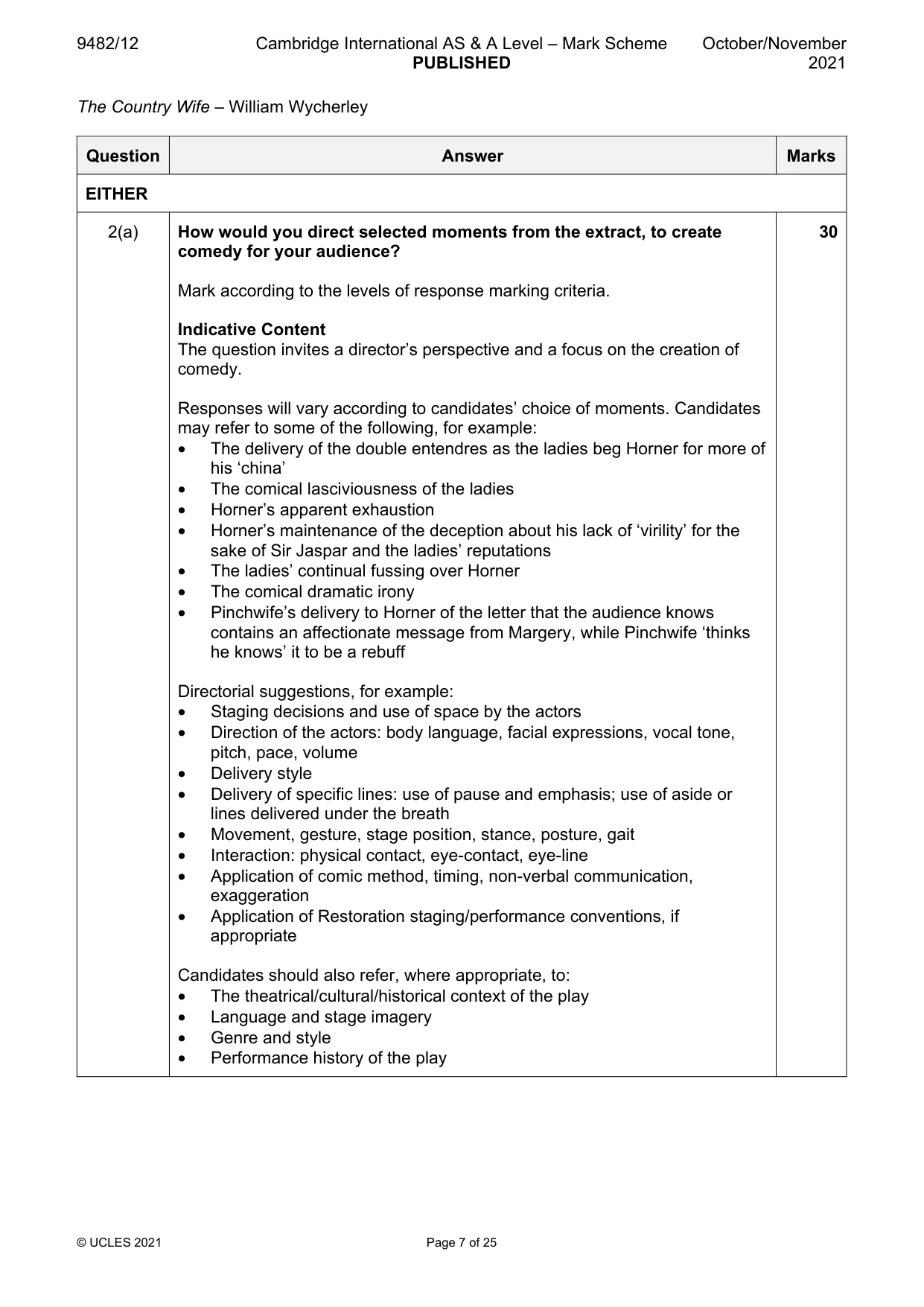
9482/12 Cambridge International AS & A Level – Mark Scheme PUBLISHED October/November 2021 © UCLES 2021 Page 7 of 25 The Country Wife – William Wycherley Question Answer Marks EITHER 2(a) How would you direct selected moments from the extract, to create comedy for your audience? Mark according to the levels of response marking criteria. Indicative Content The question invites a director’s perspective and a focus on the creation of comedy. Responses will vary according to candidates’ choice of moments. Candidates may refer to some of the following, for example: • The delivery of the double entendres as the ladies beg Horner for more of his ‘china’ • The comical lasciviousness of the ladies • Horner’s apparent exhaustion • Horner’s maintenance of the deception about his lack of ‘virility’ for the sake of Sir Jaspar and the ladies’ reputations • The ladies’ continual fussing over Horner • The comical dramatic irony • Pinchwife’s delivery to Horner of the letter that the audience knows contains an affectionate message from Margery, while Pinchwife ‘thinks he knows’ it to be a rebuff Directorial suggestions, for example: • Staging decisions and use of space by the actors • Direction of the actors: body language, facial expressions, vocal tone, pitch, pace, volume • Delivery style • Delivery of specific lines: use of pause and emphasis; use of aside or lines delivered under the breath • Movement, gesture, stage position, stance, posture, gait • Interaction: physical contact, eye-contact, eye-line • Application of comic method, timing, non-verbal communication, exaggeration • Application of Restoration staging/performance conventions, if appropriate Candidates should also refer, where appropriate, to: • The theatrical/cultural/historical context of the play • Language and stage imagery • Genre and style • Performance history of the play 30
Mark scheme, page 8
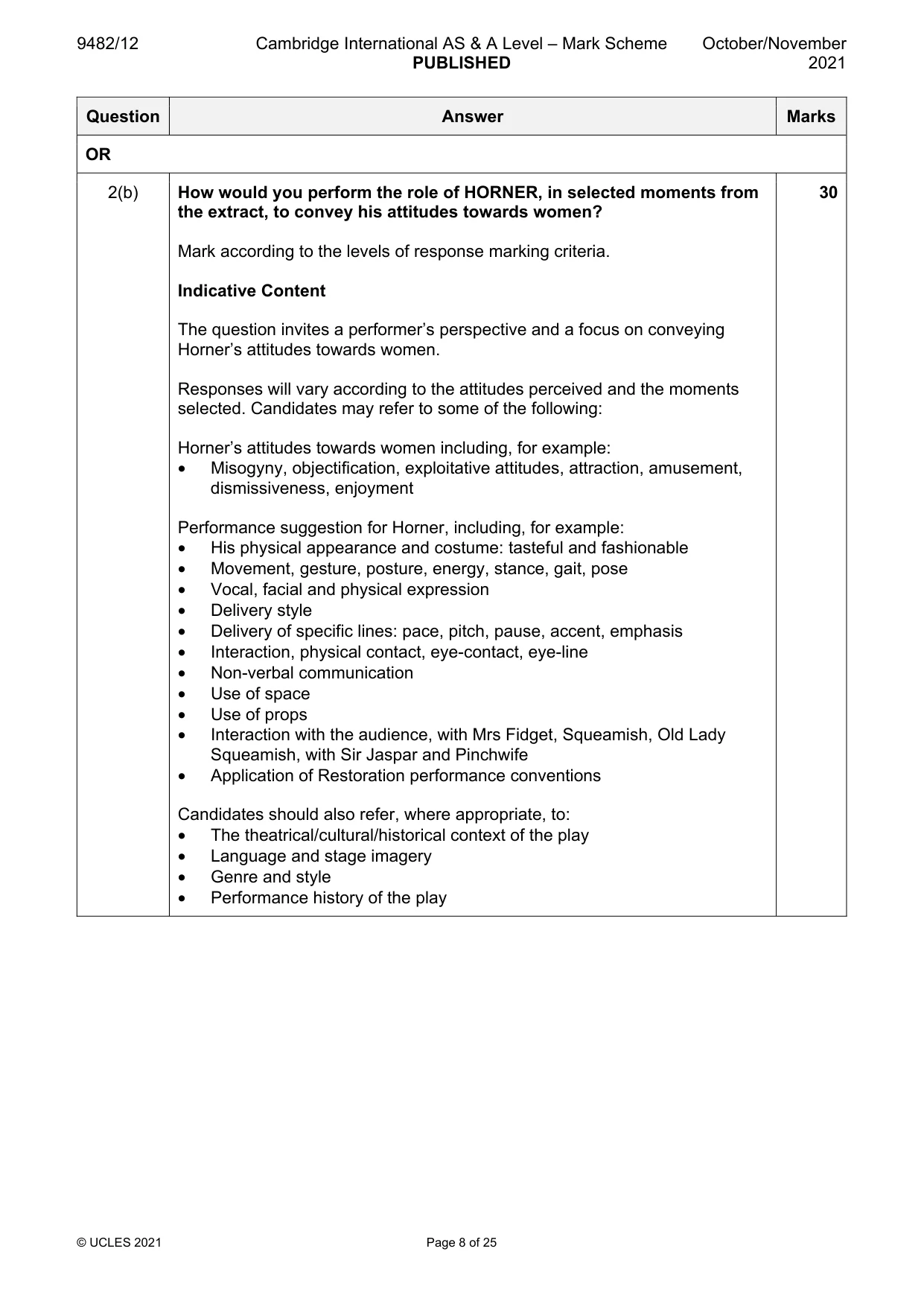
9482/12 Cambridge International AS & A Level – Mark Scheme PUBLISHED October/November 2021 © UCLES 2021 Page 8 of 25 Question Answer Marks OR 2(b) How would you perform the role of HORNER, in selected moments from the extract, to convey his attitudes towards women? Mark according to the levels of response marking criteria. Indicative Content The question invites a performer’s perspective and a focus on conveying Horner’s attitudes towards women. Responses will vary according to the attitudes perceived and the moments selected. Candidates may refer to some of the following: Horner’s attitudes towards women including, for example: • Misogyny, objectification, exploitative attitudes, attraction, amusement, dismissiveness, enjoyment Performance suggestion for Horner, including, for example: • His physical appearance and costume: tasteful and fashionable • Movement, gesture, posture, energy, stance, gait, pose • Vocal, facial and physical expression • Delivery style • Delivery of specific lines: pace, pitch, pause, accent, emphasis • Interaction, physical contact, eye-contact, eye-line • Non-verbal communication • Use of space • Use of props • Interaction with the audience, with Mrs Fidget, Squeamish, Old Lady Squeamish, with Sir Jaspar and Pinchwife • Application of Restoration performance conventions Candidates should also refer, where appropriate, to: • The theatrical/cultural/historical context of the play • Language and stage imagery • Genre and style • Performance history of the play 30
Mark scheme, page 9
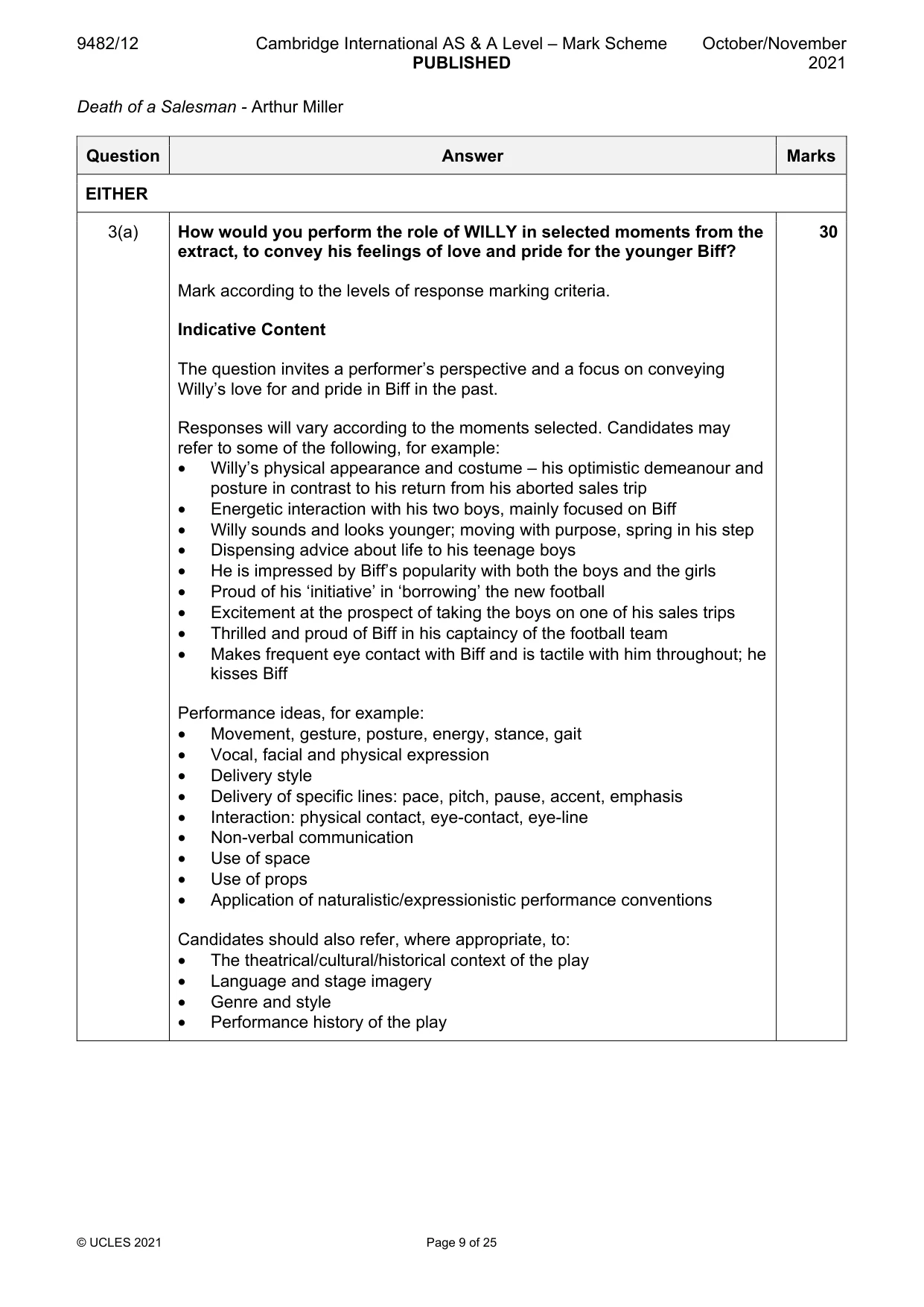
9482/12 Cambridge International AS & A Level – Mark Scheme PUBLISHED October/November 2021 © UCLES 2021 Page 9 of 25 Death of a Salesman - Arthur Miller Question Answer Marks EITHER 3(a) How would you perform the role of WILLY in selected moments from the extract, to convey his feelings of love and pride for the younger Biff? Mark according to the levels of response marking criteria. Indicative Content The question invites a performer’s perspective and a focus on conveying Willy’s love for and pride in Biff in the past. Responses will vary according to the moments selected. Candidates may refer to some of the following, for example: • Willy’s physical appearance and costume – his optimistic demeanour and posture in contrast to his return from his aborted sales trip • Energetic interaction with his two boys, mainly focused on Biff • Willy sounds and looks younger; moving with purpose, spring in his step • Dispensing advice about life to his teenage boys • He is impressed by Biff’s popularity with both the boys and the girls • Proud of his ‘initiative’ in ‘borrowing’ the new football • Excitement at the prospect of taking the boys on one of his sales trips • Thrilled and proud of Biff in his captaincy of the football team • Makes frequent eye contact with Biff and is tactile with him throughout; he kisses Biff Performance ideas, for example: • Movement, gesture, posture, energy, stance, gait • Vocal, facial and physical expression • Delivery style • Delivery of specific lines: pace, pitch, pause, accent, emphasis • Interaction: physical contact, eye-contact, eye-line • Non-verbal communication • Use of space • Use of props • Application of naturalistic/expressionistic performance conventions Candidates should also refer, where appropriate, to: • The theatrical/cultural/historical context of the play • Language and stage imagery • Genre and style • Performance history of the play 30
Mark scheme, page 10
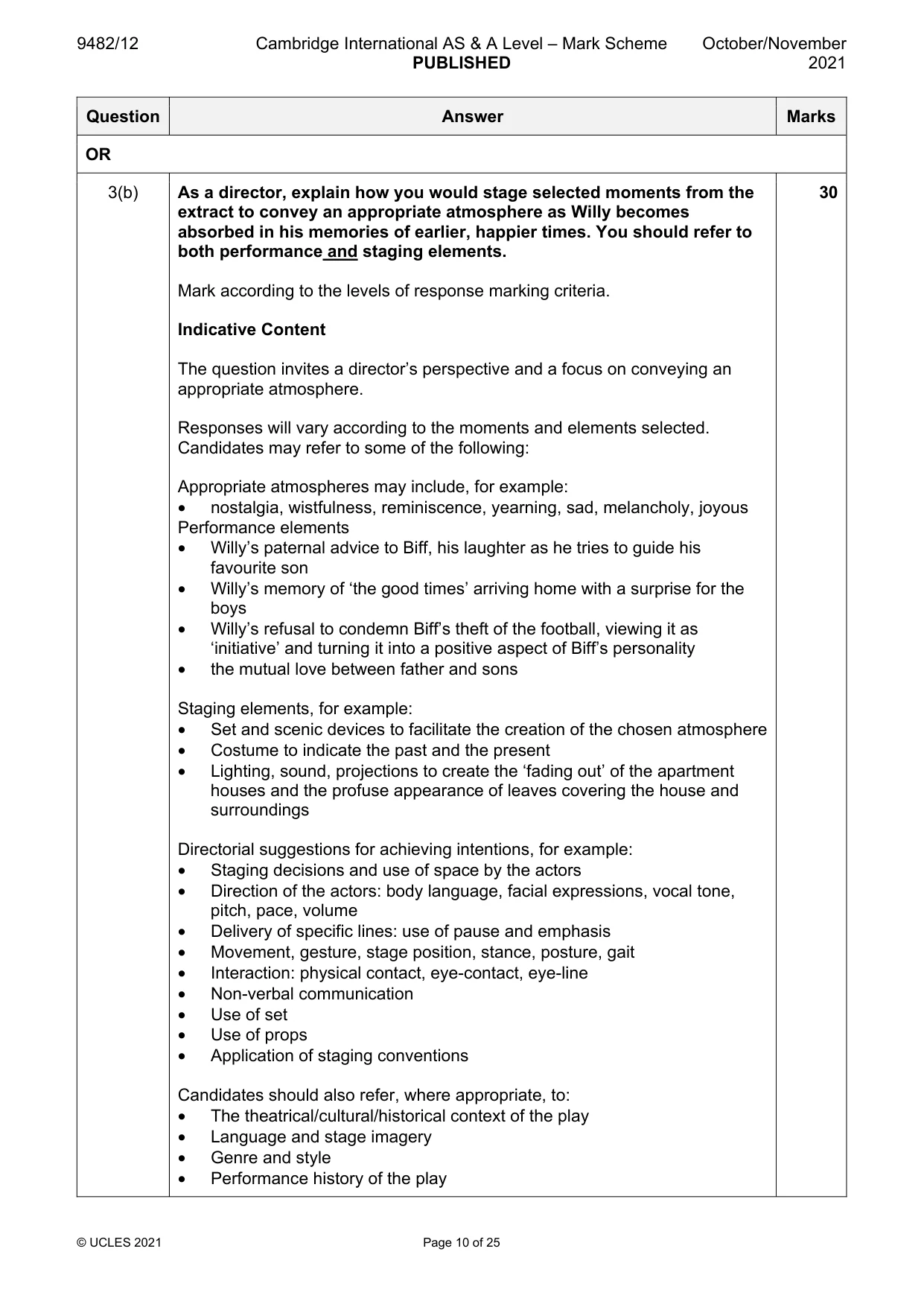
9482/12 Cambridge International AS & A Level – Mark Scheme PUBLISHED October/November 2021 © UCLES 2021 Page 10 of 25 Question Answer Marks OR 3(b) As a director, explain how you would stage selected moments from the extract to convey an appropriate atmosphere as Willy becomes absorbed in his memories of earlier, happier times. You should refer to both performance and staging elements. Mark according to the levels of response marking criteria. Indicative Content The question invites a director’s perspective and a focus on conveying an appropriate atmosphere. Responses will vary according to the moments and elements selected. Candidates may refer to some of the following: Appropriate atmospheres may include, for example: • nostalgia, wistfulness, reminiscence, yearning, sad, melancholy, joyous Performance elements • Willy’s paternal advice to Biff, his laughter as he tries to guide his favourite son • Willy’s memory of ‘the good times’ arriving home with a surprise for the boys • Willy’s refusal to condemn Biff’s theft of the football, viewing it as ‘initiative’ and turning it into a positive aspect of Biff’s personality • the mutual love between father and sons Staging elements, for example: • Set and scenic devices to facilitate the creation of the chosen atmosphere • Costume to indicate the past and the present • Lighting, sound, projections to create the ‘fading out’ of the apartment houses and the profuse appearance of leaves covering the house and surroundings Directorial suggestions for achieving intentions, for example: • Staging decisions and use of space by the actors • Direction of the actors: body language, facial expressions, vocal tone, pitch, pace, volume • Delivery of specific lines: use of pause and emphasis • Movement, gesture, stage position, stance, posture, gait • Interaction: physical contact, eye-contact, eye-line • Non-verbal communication • Use of set • Use of props • Application of staging conventions Candidates should also refer, where appropriate, to: • The theatrical/cultural/historical context of the play • Language and stage imagery • Genre and style • Performance history of the play 30
Mark scheme, page 11
9482/12 Cambridge International AS & A Level – Mark Scheme PUBLISHED October/November 2021 © UCLES 2021 Page 11 of 25 The Lion and the Jewel – Wole Soyinka Question Answer Marks EITHER 4(a) As a set designer, explain how your design ideas for the creation of Baroka’s bedroom would help to convey his high status and power as the Bale of Ilujinle. Mark according to the levels of response marking criteria. Indicative Content The question invites a set designer’s perspective and a focus on conveying Baroka’s high status and power through the design for his bedroom. Responses will vary according to the candidates’ interpretation of the room, but candidates may refer to some of the following: • Baroka’s status as Bale of the village and his wealth in relation to the other villagers • His numerous wives and their likely attentiveness to maintaining the Bale’s home and bedroom Set Design suggestions, for example: • The staging form chosen • Creation of the setting – Baroka’s bedroom within a larger compound – there is mention of an outer room which Sidi has admired • Use of texture and colour • The positioning of the bed: hangings, drapes, cushions, spreads • Animal skins and trophies • Trinkets and decorations • Positioning of entrances/exits • Use of levels, ramps, steps, if appropriate • Use of gauzes/backdrops/cyclorama • Use of projections Candidates should also refer, where appropriate, to: • The theatrical/cultural/historical context of the play • Language and stage imagery • Genre and style • Performance history of the play 30
Mark scheme, page 12
9482/12 Cambridge International AS & A Level – Mark Scheme PUBLISHED October/November 2021 © UCLES 2021 Page 12 of 25 Question Answer Marks OR 4(b) Explain how you would direct the actors playing SIDI and BAROKA in selected moments from the extract to convey the playfulness of their exchanges. Mark according to the levels of response marking criteria. Indicative Content The question invites a director’s perspective and a focus on conveying the playfulness of the exchanges between Sidi and Baroka. Responses will vary according to the moments selected. Candidates may refer to some of the following, for example: • Sidi’s intentions to mock Baroka based on what Sadiku has told her about Baroka’s impotence • Baroka’s plan has worked and he delights in having lured Sidi to his home • The wrestling sequence as a backdrop to and symbol of the ‘skirmish’ between Baroka and Sidi • Sidi’s impudence is met with apparent indifference • Baroka’s refusal to admit to having sought Sidi as his last wife subdues Sidi • Sidi’s innuendoes appear not to strike home with Baroka • Their exchanges in riddles • Sidi is impressed, surprised and pleased when Baroka wins the bout, anticipating her own submission to him Directorial suggestions, for example: • Staging decisions and use of space by the actors • Direction of the actors: body language, facial expressions, vocal tone, pitch, pace, volume • Delivery style • Delivery of specific lines: use of pause and emphasis • Movement, gesture, stage position, stance, posture, gait • Interaction: physical contact, eye-contact, eye-line Candidates should also refer, where appropriate, to: • The theatrical/cultural/historical context of the play • Language and stage imagery • Genre and style • Performance history of the play 30
Mark scheme, page 13
9482/12 Cambridge International AS & A Level – Mark Scheme PUBLISHED October/November 2021 © UCLES 2021 Page 13 of 25 Enron – Lucy Prebble Question Answer Marks EITHER 5(a) How would you perform the role of KEN LAY in selected moments from the extract to convey his authority and his enjoyment of that authority to the audience? Mark according to the levels of response marking criteria. Indicative Content The question invites a performer’s perspective and a focus on conveying Lay’s authority and his enjoyment of his authority to the audience. Responses will vary according to the moments selected. Candidates may refer to some of the following: Performance suggestions, for showing his authority and enjoyment, for example: • He opens with a rhetorical question and prevents both Claudia and Skilling from venturing an opinion • He baits both of them with his statement about needing a replacement president; leaning back to enjoy the competition and letting them ‘scrap’ • He teases Claudia by leading her to believe he is on her side • His address to the audience is authoritative and self-congratulatory • The handshake with Skilling may have something of menace in it Performance ideas may include, for example: • His physical appearance • Movement, gesture, posture, energy, stance, gait, idiosyncrasy • Vocal, facial and physical expression • Delivery style: confident, controlling, at times, casual • Delivery of specific lines: pace, pitch, pause, accent, emphasis • Interaction: physical contact, eye-contact, eye-line • Non-verbal communication • Use of space • Use of props • Interaction with other characters Candidates should also refer, where appropriate, to: • The theatrical/cultural/historical context of the play • Language and stage imagery • Genre and style • Performance history of the play 30
Mark scheme, page 14
9482/12 Cambridge International AS & A Level – Mark Scheme PUBLISHED October/November 2021 © UCLES 2021 Page 14 of 25 Question Answer Marks OR 5(b) How would your direction of selected moments from the extract convey the sense of rivalry and competition between JEFFREY SKILLING and CLAUDIA ROE? Mark according to the levels of response marking criteria. Indicative Content The question invites a director’s perspective and a focus on creating the sense of rivalry and competition between Jeffrey Skilling and Claudia Roe. Responses will vary according to the moments selected. Candidates may refer to some of the following: • The open hostility between Skilling and Roe, despite (or because of) their sexual ‘history’ • Name-calling based on gender stereotyping • Skilling’s open condescension towards Roe and her retaliation with Lay as ‘audience’ • Lay’s quiet but obvious enjoyment of the ‘tournament’; encouraging the competitors Directorial suggestions, for example: • Staging decisions and use of space by the actors • Direction of the actors: body language, facial expressions, actions and reactions • Delivery of specific lines: use of pace, pitch, pause, accent, emphasis • Movement, gesture, stage position, stance, posture, gait • Interaction: physical contact, eye-contact, eye-line Candidates should also refer, where appropriate, to: • The theatrical/cultural/historical context of the play • Language and stage imagery • Genre and style • Performance history of the play 30
Mark scheme, page 15
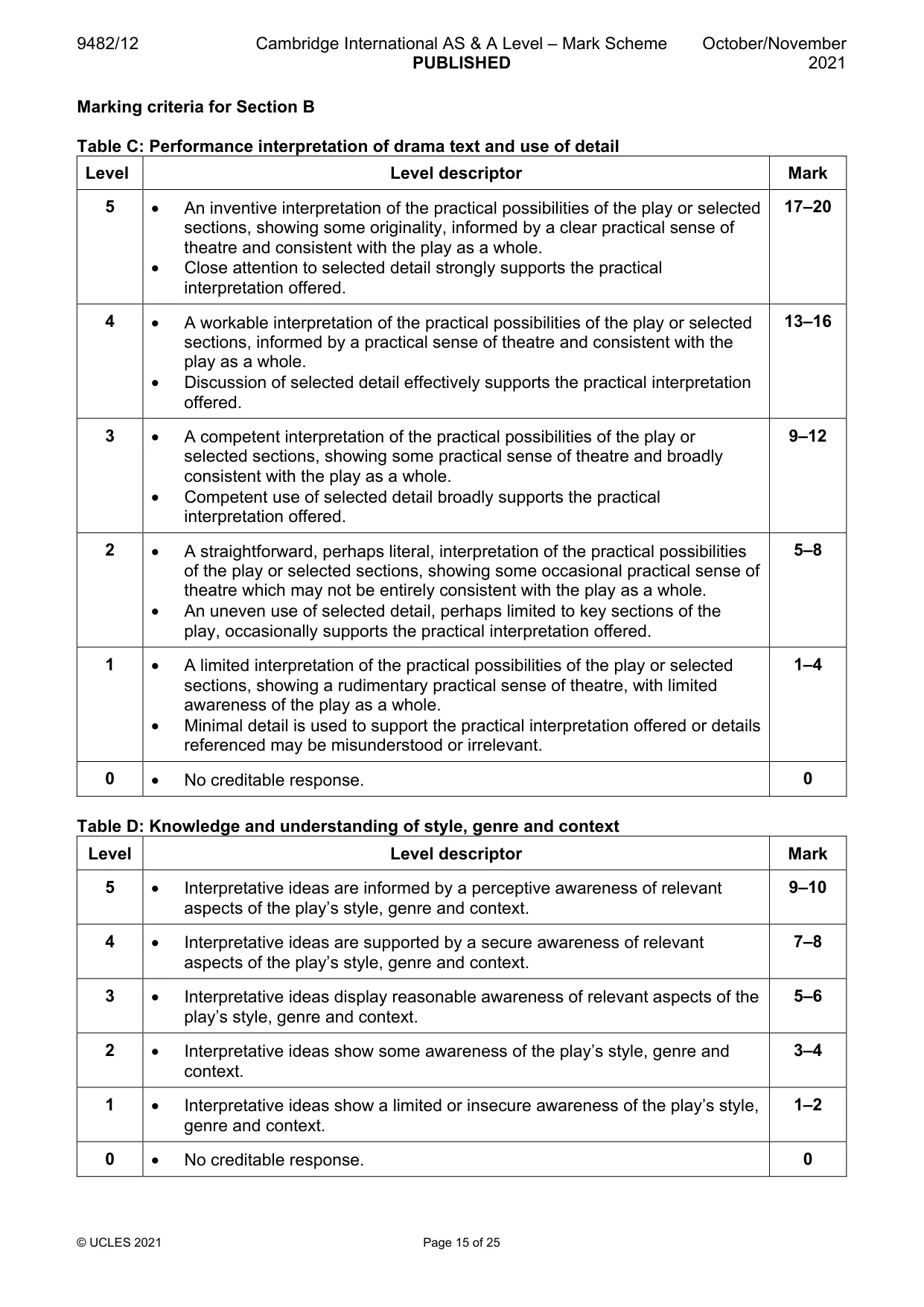
9482/12 Cambridge International AS & A Level – Mark Scheme PUBLISHED October/November 2021 © UCLES 2021 Page 15 of 25 Marking criteria for Section B Table C: Performance interpretation of drama text and use of detail Level Level descriptor Mark 5 • An inventive interpretation of the practical possibilities of the play or selected sections, showing some originality, informed by a clear practical sense of theatre and consistent with the play as a whole. • Close attention to selected detail strongly supports the practical interpretation offered. 17–20 4 • A workable interpretation of the practical possibilities of the play or selected sections, informed by a practical sense of theatre and consistent with the play as a whole. • Discussion of selected detail effectively supports the practical interpretation offered. 13–16 3 • A competent interpretation of the practical possibilities of the play or selected sections, showing some practical sense of theatre and broadly consistent with the play as a whole. • Competent use of selected detail broadly supports the practical interpretation offered. 9–12 2 • A straightforward, perhaps literal, interpretation of the practical possibilities of the play or selected sections, showing some occasional practical sense of theatre which may not be entirely consistent with the play as a whole. • An uneven use of selected detail, perhaps limited to key sections of the play, occasionally supports the practical interpretation offered. 5–8 1 • A limited interpretation of the practical possibilities of the play or selected sections, showing a rudimentary practical sense of theatre, with limited awareness of the play as a whole. • Minimal detail is used to support the practical interpretation offered or details referenced may be misunderstood or irrelevant. 1–4 0 • No creditable response. 0 Table D: Knowledge and understanding of style, genre and context Level Level descriptor Mark 5 • Interpretative ideas are informed by a perceptive awareness of relevant aspects of the play’s style, genre and context. 9–10 4 • Interpretative ideas are supported by a secure awareness of relevant aspects of the play’s style, genre and context. 7–8 3 • Interpretative ideas display reasonable awareness of relevant aspects of the play’s style, genre and context. 5–6 2 • Interpretative ideas show some awareness of the play’s style, genre and context. 3–4 1 • Interpretative ideas show a limited or insecure awareness of the play’s style, genre and context. 1–2 0 • No creditable response. 0
Mark scheme, page 16
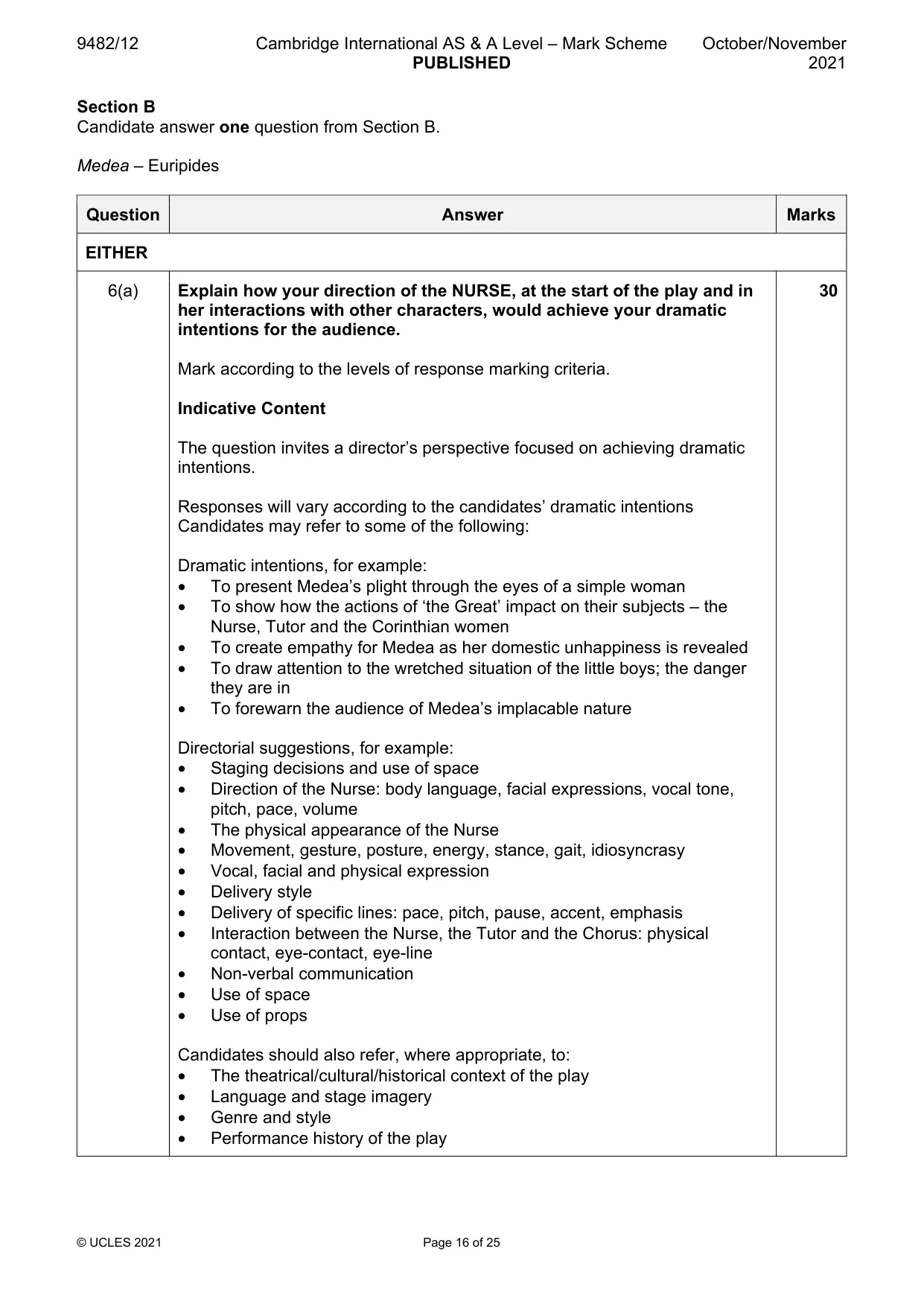
9482/12 Cambridge International AS & A Level – Mark Scheme PUBLISHED October/November 2021 © UCLES 2021 Page 16 of 25 Section B Candidate answer one question from Section B. Medea – Euripides Question Answer Marks EITHER 6(a) Explain how your direction of the NURSE, at the start of the play and in her interactions with other characters, would achieve your dramatic intentions for the audience. Mark according to the levels of response marking criteria. Indicative Content The question invites a director’s perspective focused on achieving dramatic intentions. Responses will vary according to the candidates’ dramatic intentions Candidates may refer to some of the following: Dramatic intentions, for example: • To present Medea’s plight through the eyes of a simple woman • To show how the actions of ‘the Great’ impact on their subjects – the Nurse, Tutor and the Corinthian women • To create empathy for Medea as her domestic unhappiness is revealed • To draw attention to the wretched situation of the little boys; the danger they are in • To forewarn the audience of Medea’s implacable nature Directorial suggestions, for example: • Staging decisions and use of space • Direction of the Nurse: body language, facial expressions, vocal tone, pitch, pace, volume • The physical appearance of the Nurse • Movement, gesture, posture, energy, stance, gait, idiosyncrasy • Vocal, facial and physical expression • Delivery style • Delivery of specific lines: pace, pitch, pause, accent, emphasis • Interaction between the Nurse, the Tutor and the Chorus: physical contact, eye-contact, eye-line • Non-verbal communication • Use of space • Use of props Candidates should also refer, where appropriate, to: • The theatrical/cultural/historical context of the play • Language and stage imagery • Genre and style • Performance history of the play 30
Mark scheme, page 17
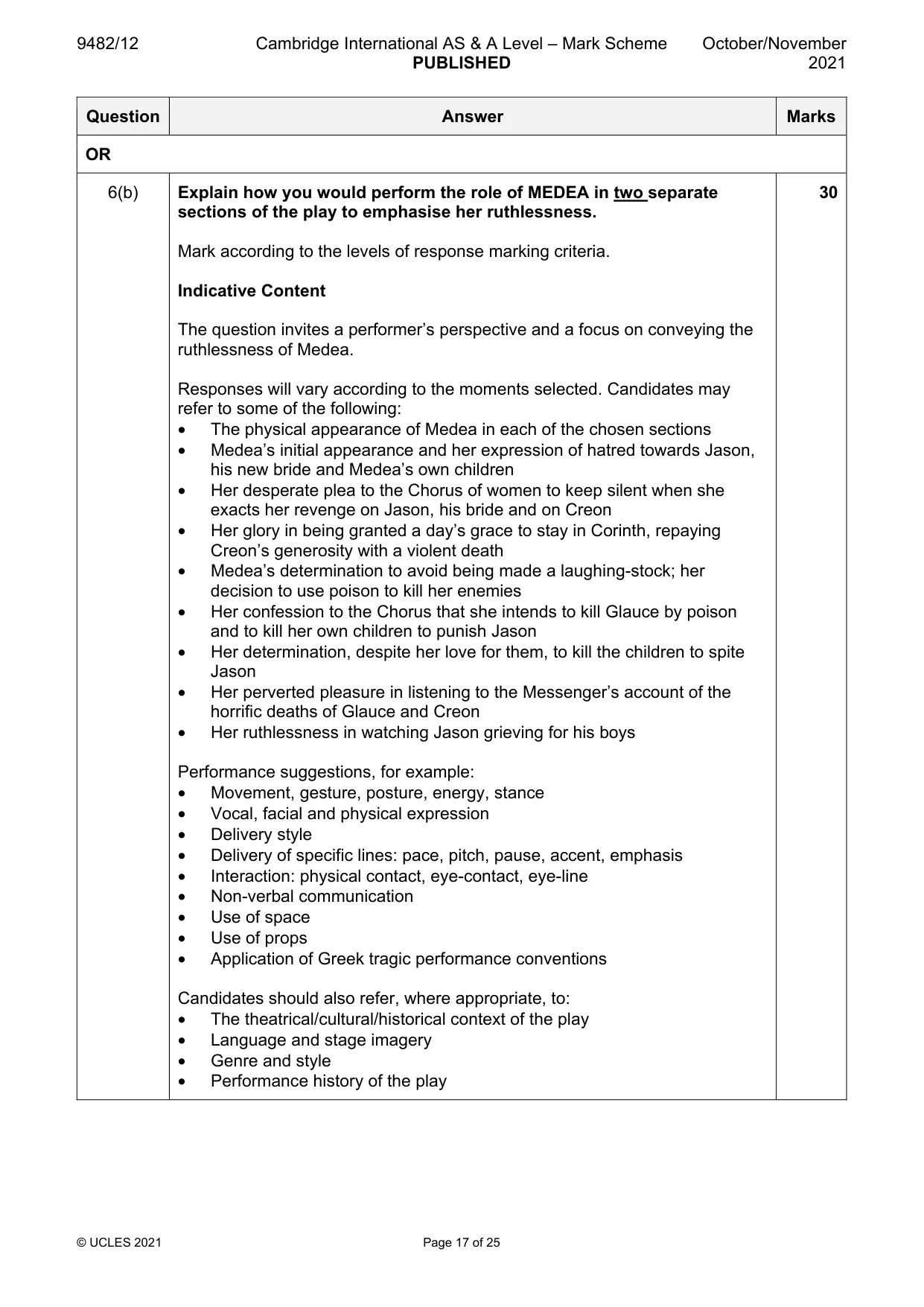
9482/12 Cambridge International AS & A Level – Mark Scheme PUBLISHED October/November 2021 © UCLES 2021 Page 17 of 25 Question Answer Marks OR 6(b) Explain how you would perform the role of MEDEA in two separate sections of the play to emphasise her ruthlessness. Mark according to the levels of response marking criteria. Indicative Content The question invites a performer’s perspective and a focus on conveying the ruthlessness of Medea. Responses will vary according to the moments selected. Candidates may refer to some of the following: • The physical appearance of Medea in each of the chosen sections • Medea’s initial appearance and her expression of hatred towards Jason, his new bride and Medea’s own children • Her desperate plea to the Chorus of women to keep silent when she exacts her revenge on Jason, his bride and on Creon • Her glory in being granted a day’s grace to stay in Corinth, repaying Creon’s generosity with a violent death • Medea’s determination to avoid being made a laughing-stock; her decision to use poison to kill her enemies • Her confession to the Chorus that she intends to kill Glauce by poison and to kill her own children to punish Jason • Her determination, despite her love for them, to kill the children to spite Jason • Her perverted pleasure in listening to the Messenger’s account of the horrific deaths of Glauce and Creon • Her ruthlessness in watching Jason grieving for his boys Performance suggestions, for example: • Movement, gesture, posture, energy, stance • Vocal, facial and physical expression • Delivery style • Delivery of specific lines: pace, pitch, pause, accent, emphasis • Interaction: physical contact, eye-contact, eye-line • Non-verbal communication • Use of space • Use of props • Application of Greek tragic performance conventions Candidates should also refer, where appropriate, to: • The theatrical/cultural/historical context of the play • Language and stage imagery • Genre and style • Performance history of the play 30
Mark scheme, page 18
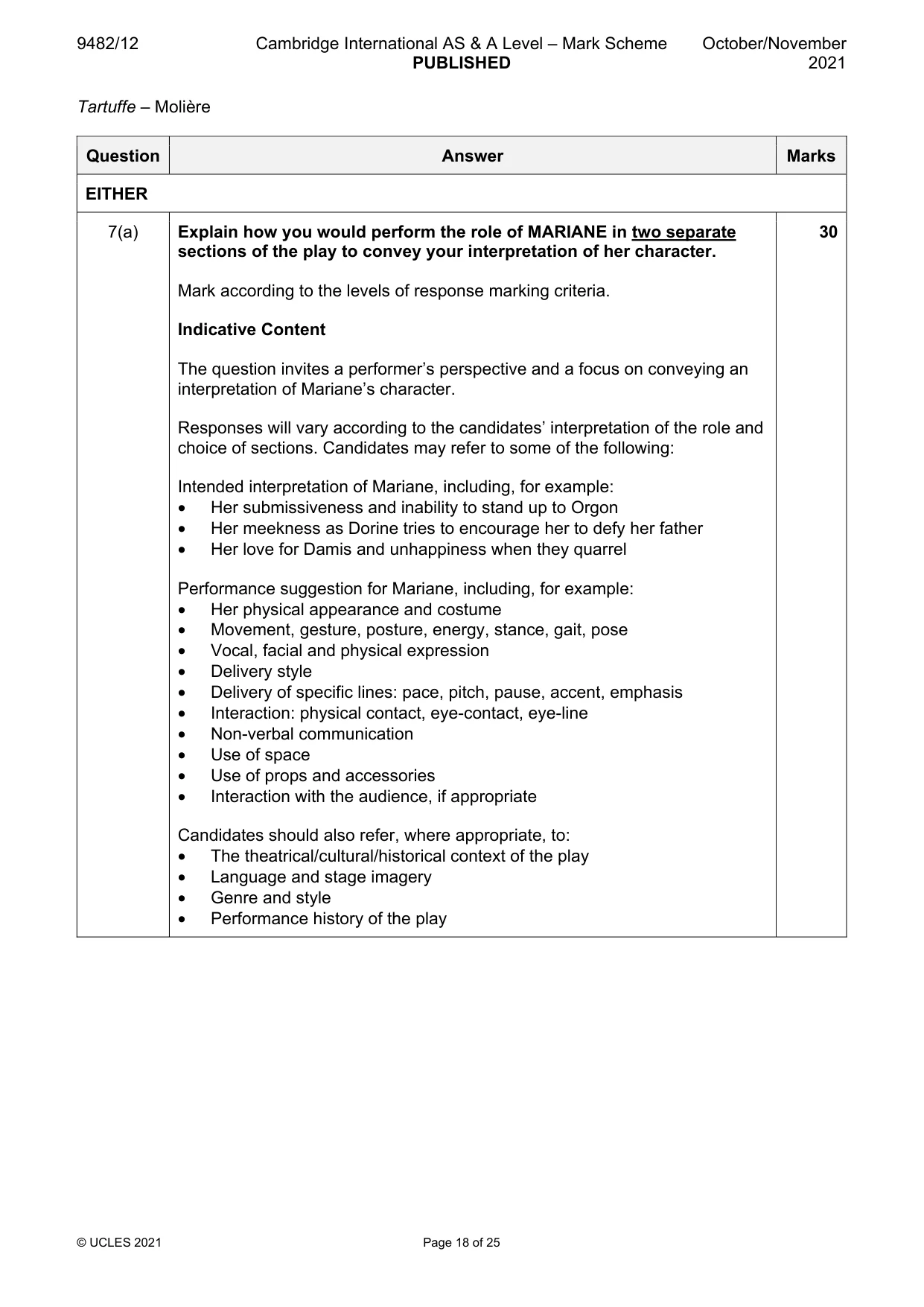
9482/12 Cambridge International AS & A Level – Mark Scheme PUBLISHED October/November 2021 © UCLES 2021 Page 18 of 25 Tartuffe – Molière Question Answer Marks EITHER 7(a) Explain how you would perform the role of MARIANE in two separate sections of the play to convey your interpretation of her character. Mark according to the levels of response marking criteria. Indicative Content The question invites a performer’s perspective and a focus on conveying an interpretation of Mariane’s character. Responses will vary according to the candidates’ interpretation of the role and choice of sections. Candidates may refer to some of the following: Intended interpretation of Mariane, including, for example: • Her submissiveness and inability to stand up to Orgon • Her meekness as Dorine tries to encourage her to defy her father • Her love for Damis and unhappiness when they quarrel Performance suggestion for Mariane, including, for example: • Her physical appearance and costume • Movement, gesture, posture, energy, stance, gait, pose • Vocal, facial and physical expression • Delivery style • Delivery of specific lines: pace, pitch, pause, accent, emphasis • Interaction: physical contact, eye-contact, eye-line • Non-verbal communication • Use of space • Use of props and accessories • Interaction with the audience, if appropriate Candidates should also refer, where appropriate, to: • The theatrical/cultural/historical context of the play • Language and stage imagery • Genre and style • Performance history of the play 30
Mark scheme, page 19
9482/12 Cambridge International AS & A Level – Mark Scheme PUBLISHED October/November 2021 © UCLES 2021 Page 19 of 25 Question Answer Marks OR 7(b) How would you direct the performer playing TARTUFFE in at least two sections of the play to highlight his hypocritical nature? Mark according to the levels of response marking criteria. Indicative Content The question invites a director’s perspective focused on highlighting Tartuffe’s hypocritical nature. Responses will vary according to the candidates’ interpretation of the role and choice of sections. Candidates may refer to some of the following: • His pretence at piety and charity • His exploitation of Orgon’s good nature • His reckless pursuit of Elmire • His more direct interactions with Dorine Directorial suggestions, for example: • Staging decisions and use of space by the actors • Direction of Tartuffe: body language, facial expressions, vocal tone, pitch, pace, volume • His physical appearance and costume • Movement, gesture, posture, energy, stance, gait, idiosyncrasy • Vocal, facial and physical expression • Delivery style which alters depending upon whom he is interacting with • Delivery of specific lines: pace, pitch, pause, accent, emphasis • Interaction with, for example, Dorine, Orgon, Elmire, Damis, Cleante: physical contact, eye-contact, eye-line • Non-verbal communication • Use of space • Use of props Candidates should also refer, where appropriate, to: • The theatrical/cultural/historical context of the play • Language and stage imagery • Genre and style • Performance history of the play 30
Mark scheme, page 20
9482/12 Cambridge International AS & A Level – Mark Scheme PUBLISHED October/November 2021 © UCLES 2021 Page 20 of 25 The Seagull – Anton Chekhov Question Answer Marks EITHER 8(a) Explain how your direction of two or more separate sections of the play would convey the nature of the relationship between MASHA and MEDVEDENKO. Mark according to the levels of response marking criteria. Indicative Content The question invites a director’s perspective and a focus on demonstrating the nature of the relationship between Masha and Medvedenko. Responses will vary according to the sections selected. Candidates may refer to some of the following: • Medvedenko’s declaration of love for Masha in Act One • Masha’s initial indifference to Medvedenko as she harbours feelings for Konstantin, declaring her feelings to Dr Dorn at the end of the Act • Masha’s decision to marry Medvedenko, out of pity, confessed to Trigorin in Act Three • Medvedenko’s unhappiness when married to Masha and her neglect of him and her baby, shown in Act Four • Masha’s continued devotion to Konstantin and the hurt this causes Medvedenko Directorial suggestions, for example: • Physical appearance of the characters and reference to costume, if appropriate • Direction of the actors: body language, facial expressions • Staging decisions: choice of stage space and use of space by the actors • Delivery style • Delivery of specific lines: use of pause and emphasis, vocal tone, pitch, pace, volume • Movement, gesture, stage position, stance, posture, gait • Interaction: physical contact, eye-contact, eye-line • Application of naturalistic performance conventions Candidates should also refer, where appropriate, to: • The theatrical/cultural/historical context of the play • Language and stage imagery • Genre and style • Performance history of the play 30
Mark scheme, page 21
9482/12 Cambridge International AS & A Level – Mark Scheme PUBLISHED October/November 2021 © UCLES 2021 Page 21 of 25 Question Answer Marks OR 8(b) How would you perform the role of SORIN in two separate sections of the play to convey your interpretation of his character to the audience? Mark according to the levels of response marking criteria. Indicative Content The question invites a performer’s perspective and a focus on conveying an interpretation of Sorin’s character. Responses will vary according to the candidates’ interpretation and choice of sections. Candidates may refer to some of the following: Interpretation of Sorin, including, for example: • His good nature and kindness expressed to his family and Nina • His regrets about never having accomplished anything; his regret at not being married • His love for Arkadina despite her faults • His weariness with country life, declining health Performance ideas including, for example: • His dishevelled physical appearance and costume • Movement, gesture, posture, energy, stance, gait • Vocal, facial and physical expression • Interaction with other characters: physical contact, eye-contact, eye-line • Delivery style • Delivery of specific lines: pace, pitch, pause, accent, emphasis • Non-verbal communication • Use of space • Use of props and accessories • Naturalistic performance conventions Candidates should also refer, where appropriate, to: • The theatrical/cultural/historical context of the play • Language and stage imagery • Genre and style • Performance history of the play 30
Mark scheme, page 22
9482/12 Cambridge International AS & A Level – Mark Scheme PUBLISHED October/November 2021 © UCLES 2021 Page 22 of 25 The Curious Incident of the Dog in the Night-Time – Simon Stephens Question Answer Marks EITHER 9(a) How would you direct two sections where CHRISTOPHER and MRS ALEXANDER appear together, to create your intended dramatic effects? Mark according to the levels of response marking criteria. Indicative Content The question invites a director’s perspective and a focus on the creation of intended effects when Christopher is interacting with Mrs Alexander. Responses will vary according to the sections selected. Candidates may refer to some of the following: • Intended effects, for example: comedy, pathos, intrigue Christopher’s interactions with Mrs Alexander, for example: • Christopher’s first encounter with Mrs Alexander when he is making his initial ‘house to house’ enquiries; she offers him cake but he leaves before she returns • The second, longer encounter, when Christopher tells Mrs Alexander that his mother is dead, and Mrs Alexander tells Christopher about Judy’s relationship with Mr Shears • The third encounter when Christopher tells Mrs Alexander that he is going to London Directorial suggestions for achieving intentions, for example: • Staging decisions and use of space by the actors • Direction of the actors: body language, facial expressions, physical theatre skills, synchronicity, lifts, physical routines • Vocal qualities: tone, pitch, pace, volume • Delivery of specific lines: use of pause and emphasis • Movement, gesture, stage position, stance, posture, gait • Interaction: physical contact, eye-contact, eye-line • Application of comic method: timing, non-verbal communication • Application of physical theatre performance conventions Candidates should also refer, where appropriate, to: • The theatrical/cultural/historical context of the play • Language and stage imagery • Genre and style • Performance history of the play 30
Mark scheme, page 23
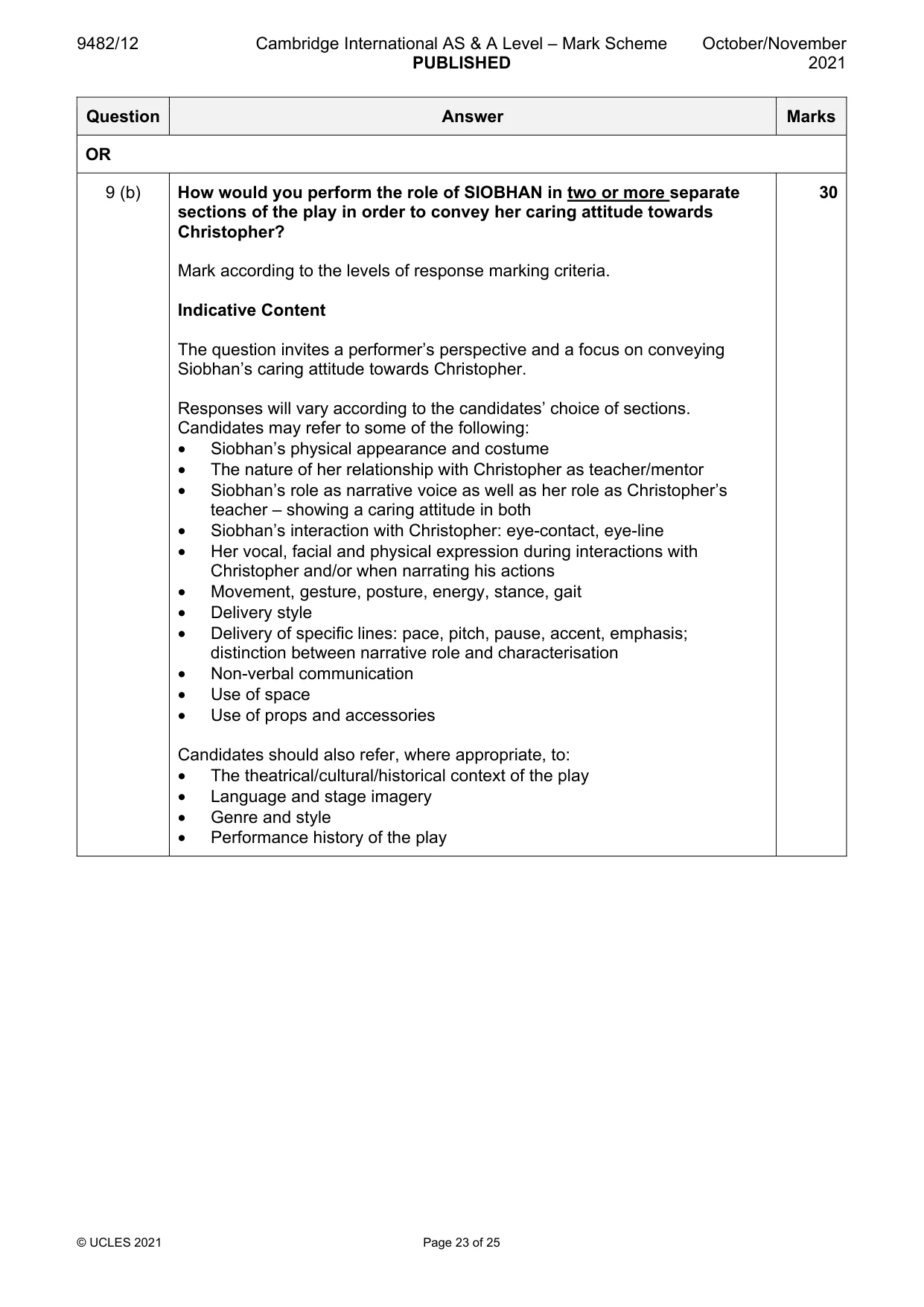
9482/12 Cambridge International AS & A Level – Mark Scheme PUBLISHED October/November 2021 © UCLES 2021 Page 23 of 25 Question Answer Marks OR 9 (b) How would you perform the role of SIOBHAN in two or more separate sections of the play in order to convey her caring attitude towards Christopher? Mark according to the levels of response marking criteria. Indicative Content The question invites a performer’s perspective and a focus on conveying Siobhan’s caring attitude towards Christopher. Responses will vary according to the candidates’ choice of sections. Candidates may refer to some of the following: • Siobhan’s physical appearance and costume • The nature of her relationship with Christopher as teacher/mentor • Siobhan’s role as narrative voice as well as her role as Christopher’s teacher – showing a caring attitude in both • Siobhan’s interaction with Christopher: eye-contact, eye-line • Her vocal, facial and physical expression during interactions with Christopher and/or when narrating his actions • Movement, gesture, posture, energy, stance, gait • Delivery style • Delivery of specific lines: pace, pitch, pause, accent, emphasis; distinction between narrative role and characterisation • Non-verbal communication • Use of space • Use of props and accessories Candidates should also refer, where appropriate, to: • The theatrical/cultural/historical context of the play • Language and stage imagery • Genre and style • Performance history of the play 30
Mark scheme, page 24
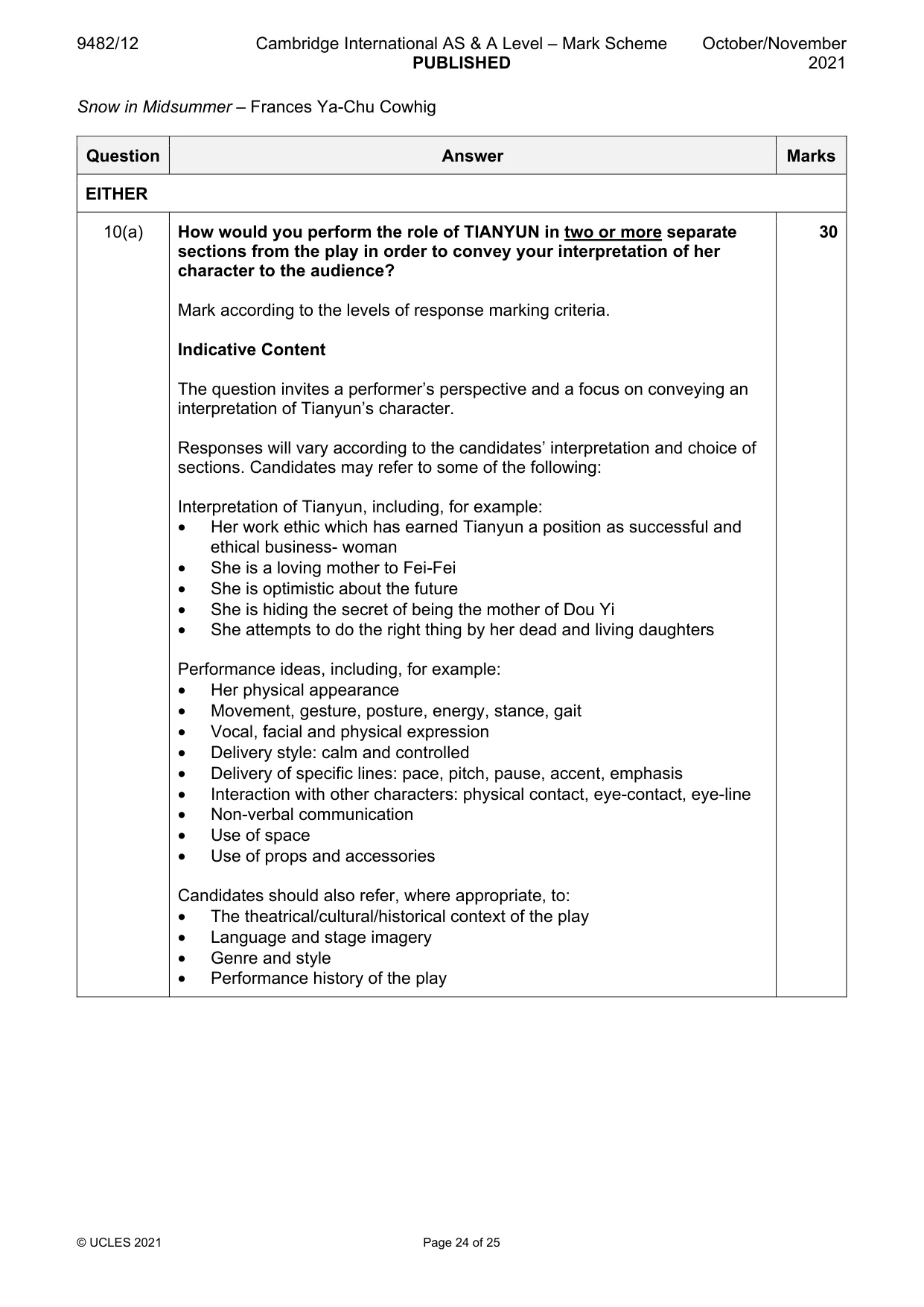
9482/12 Cambridge International AS & A Level – Mark Scheme PUBLISHED October/November 2021 © UCLES 2021 Page 24 of 25 Snow in Midsummer – Frances Ya-Chu Cowhig Question Answer Marks EITHER 10(a) How would you perform the role of TIANYUN in two or more separate sections from the play in order to convey your interpretation of her character to the audience? Mark according to the levels of response marking criteria. Indicative Content The question invites a performer’s perspective and a focus on conveying an interpretation of Tianyun’s character. Responses will vary according to the candidates’ interpretation and choice of sections. Candidates may refer to some of the following: Interpretation of Tianyun, including, for example: • Her work ethic which has earned Tianyun a position as successful and ethical business- woman • She is a loving mother to Fei-Fei • She is optimistic about the future • She is hiding the secret of being the mother of Dou Yi • She attempts to do the right thing by her dead and living daughters Performance ideas, including, for example: • Her physical appearance • Movement, gesture, posture, energy, stance, gait • Vocal, facial and physical expression • Delivery style: calm and controlled • Delivery of specific lines: pace, pitch, pause, accent, emphasis • Interaction with other characters: physical contact, eye-contact, eye-line • Non-verbal communication • Use of space • Use of props and accessories Candidates should also refer, where appropriate, to: • The theatrical/cultural/historical context of the play • Language and stage imagery • Genre and style • Performance history of the play 30
Mark scheme, page 25
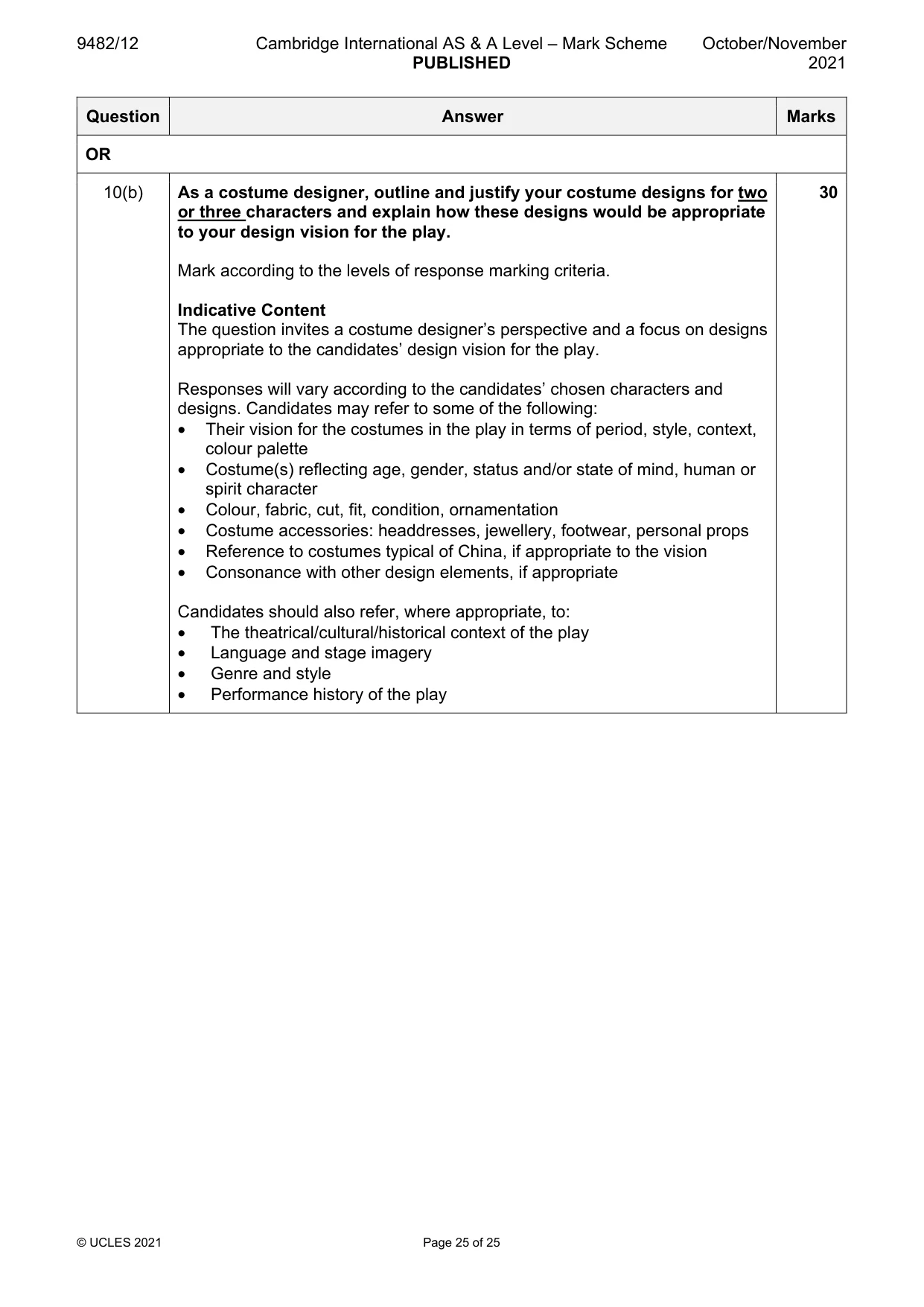
9482/12 Cambridge International AS & A Level – Mark Scheme PUBLISHED October/November 2021 © UCLES 2021 Page 25 of 25 Question Answer Marks OR 10(b) As a costume designer, outline and justify your costume designs for two or three characters and explain how these designs would be appropriate to your design vision for the play. Mark according to the levels of response marking criteria. Indicative Content The question invites a costume designer’s perspective and a focus on designs appropriate to the candidates’ design vision for the play. Responses will vary according to the candidates’ chosen characters and designs. Candidates may refer to some of the following: • Their vision for the costumes in the play in terms of period, style, context, colour palette • Costume(s) reflecting age, gender, status and/or state of mind, human or spirit character • Colour, fabric, cut, fit, condition, ornamentation • Costume accessories: headdresses, jewellery, footwear, personal props • Reference to costumes typical of China, if appropriate to the vision • Consonance with other design elements, if appropriate Candidates should also refer, where appropriate, to: • The theatrical/cultural/historical context of the play • Language and stage imagery • Genre and style • Performance history of the play 30
What you needed in this session
Cambridge’s own grade thresholds for 2021 Oct/Nov, Paper 1 · Variant 2. A higher threshold means an easier paper — the bar moves with how the cohort did.