Cambridge A Level Classical Studies 9274 — 2024 Oct/Nov Paper 2 · Variant 1
9274/21/O/N/24 · 9 questions · 50 marks · ≈56 min
The question paper and its mark scheme, free to read here and free to download. This is Cambridge’s own paper, exactly as it was sat.
Question paper8 pages




Mark scheme21 pages
Answers below. Sit the paper first if you are practising.
Questions as text
Q1 · Read the passage and answer the questions: Having recovered possession of the Spanish…
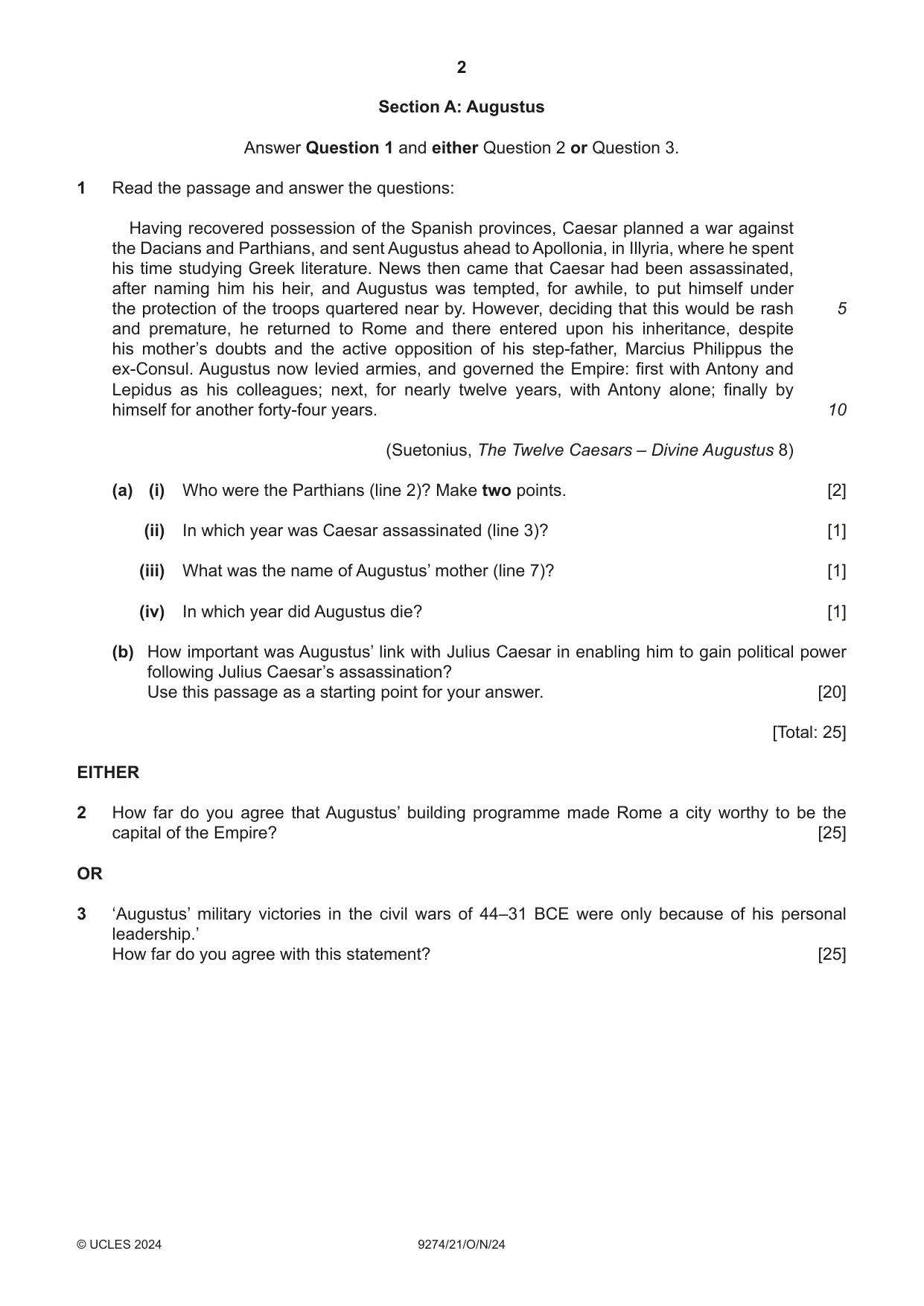
1 Read the passage and answer the questions: Having recovered possession of the Spanish provinces, Caesar planned a war against the Dacians and Parthians, and sent Augustus ahead to Apollonia, in Illyria, where he spent his time studying Greek literature. News then came that Caesar had been assassinated, after naming him his heir, and Augustus was tempted, for awhile, to put himself under the protection of the troops quartered near by. However, deciding that this would be rash 5 and premature, he returned to Rome and there entered upon his inheritance, despite his mother’s doubts and the active opposition of his step-father, Marcius Philippus the ex-Consul. Augustus now levied armies, and governed the Empire: first with Antony and Lepidus as his colleagues; next, for nearly twelve years, with Antony alone; finally by himself for another forty-four years. 10 (Suetonius, The Twelve Caesars – Divine Augustus 8) (a) (i) Who were the Parthians (line 2)? Make two points. [2] (ii) In which year was Caesar assassinated (line 3)? [1] (iii) What was the name of Augustus’ mother (line 7)? [1] (iv) In which year did Augustus die? [1] (b) How important was Augustus’ link with Julius Caesar in enabling him to gain political power following Julius Caesar’s assassination? Use this passage as a starting point for your answer. [20] [Total: 25] EITHER
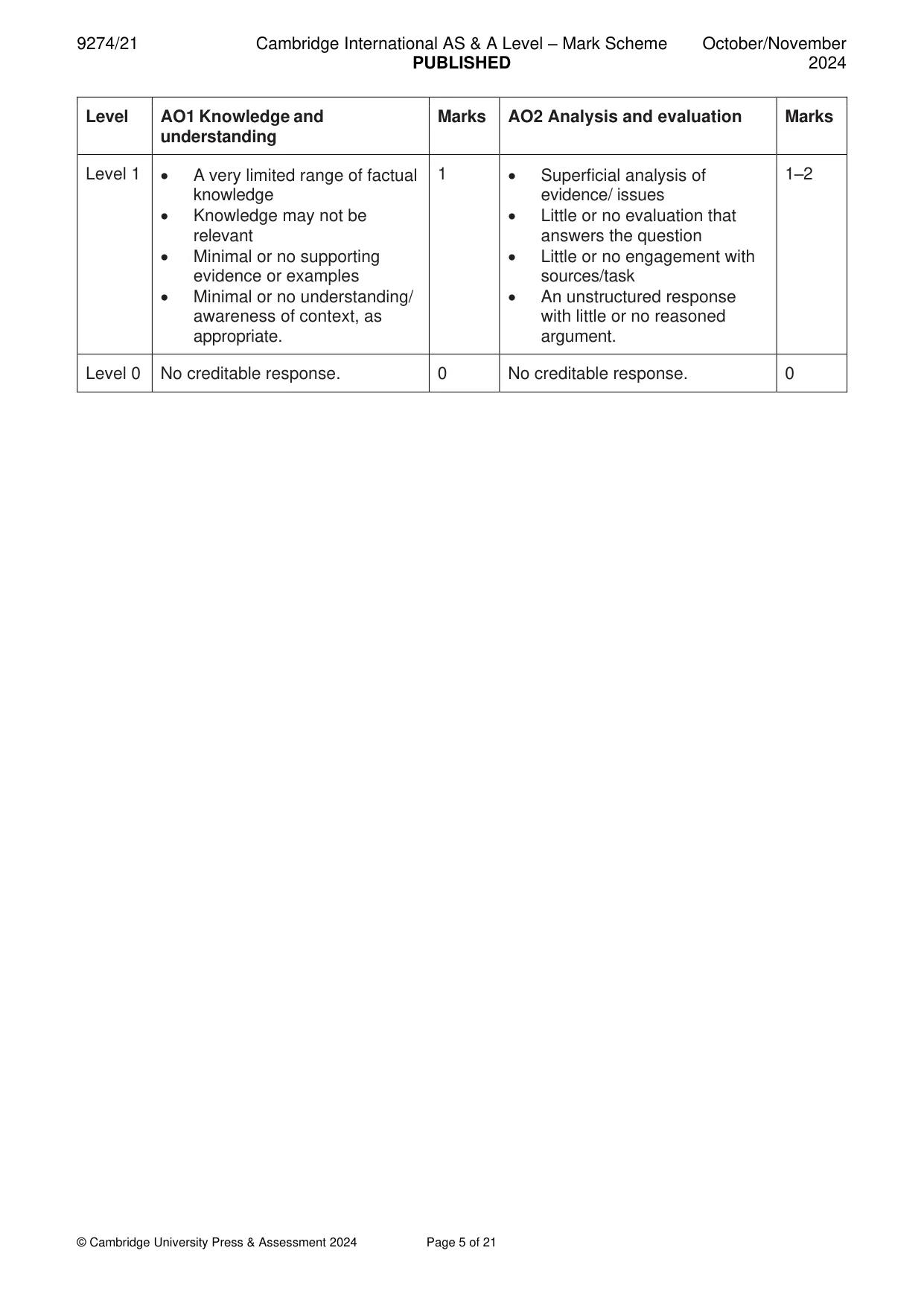
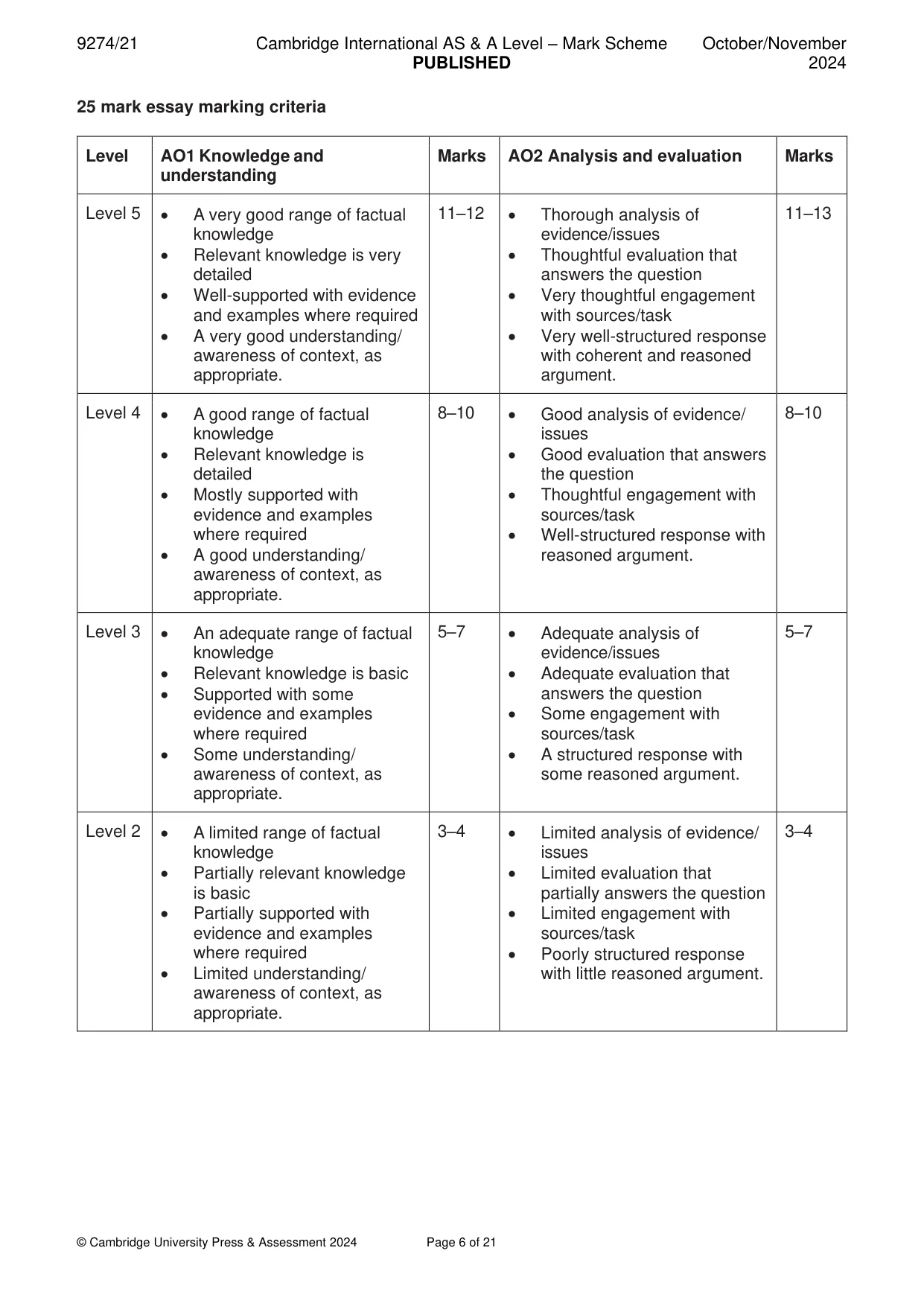
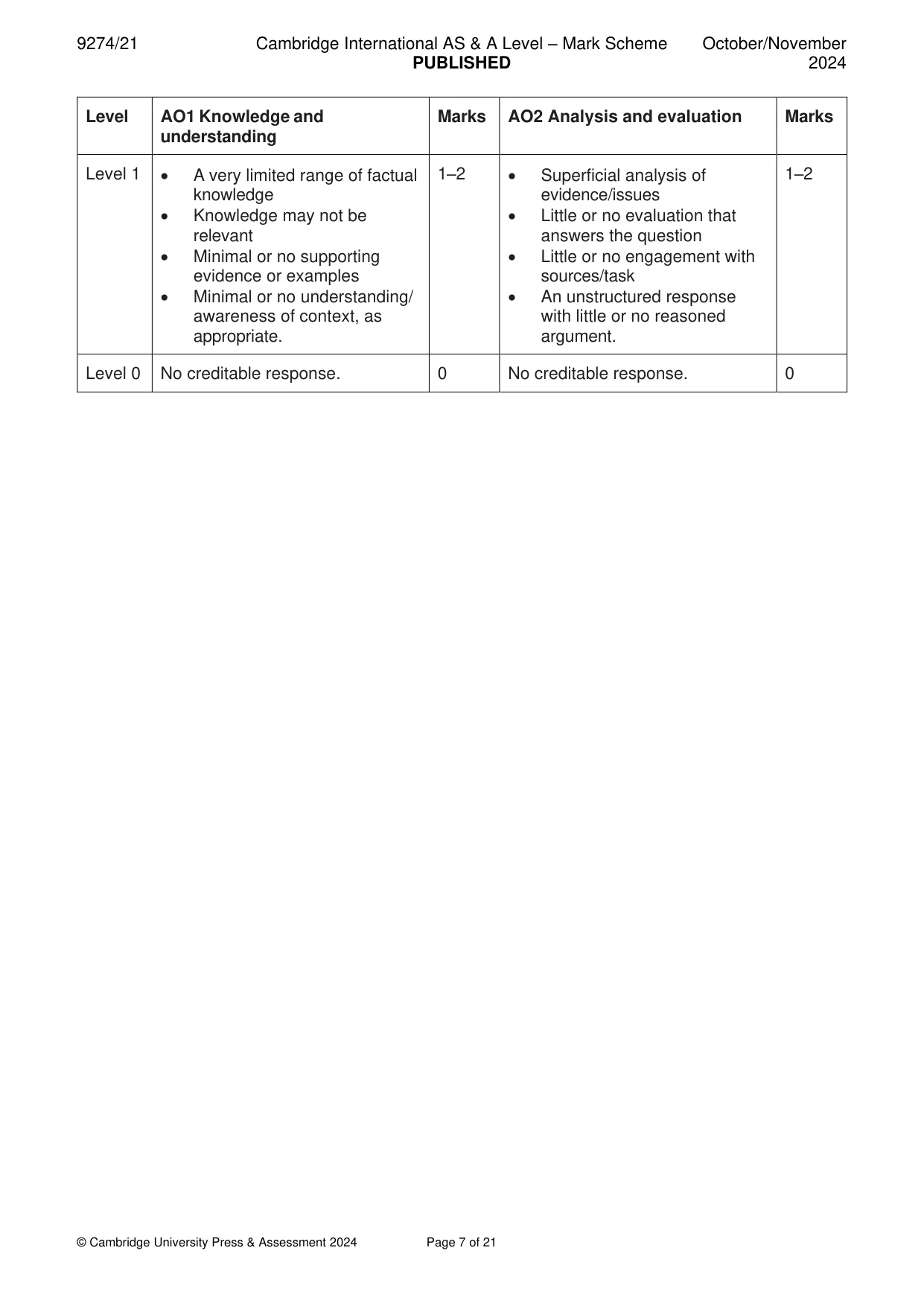
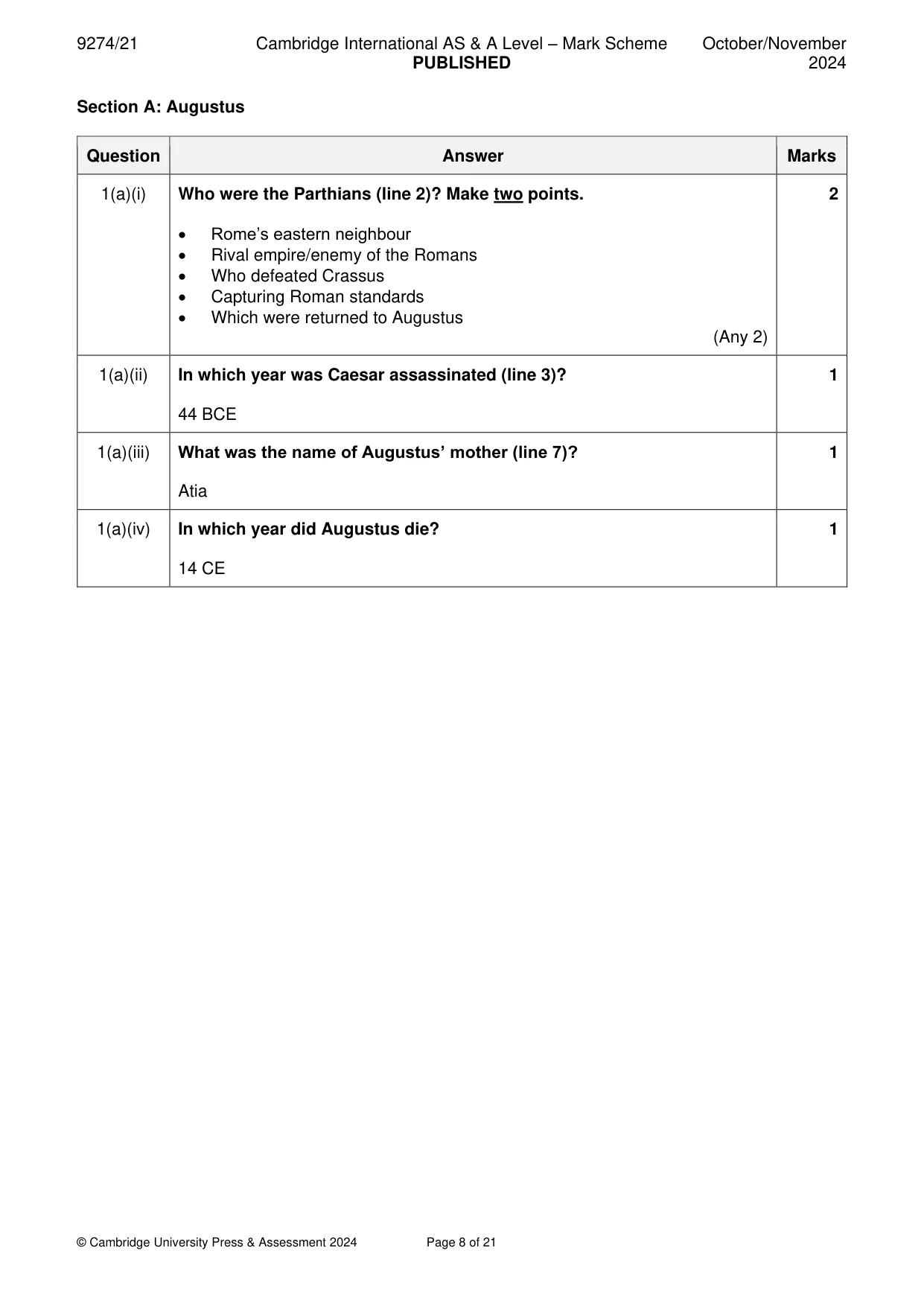
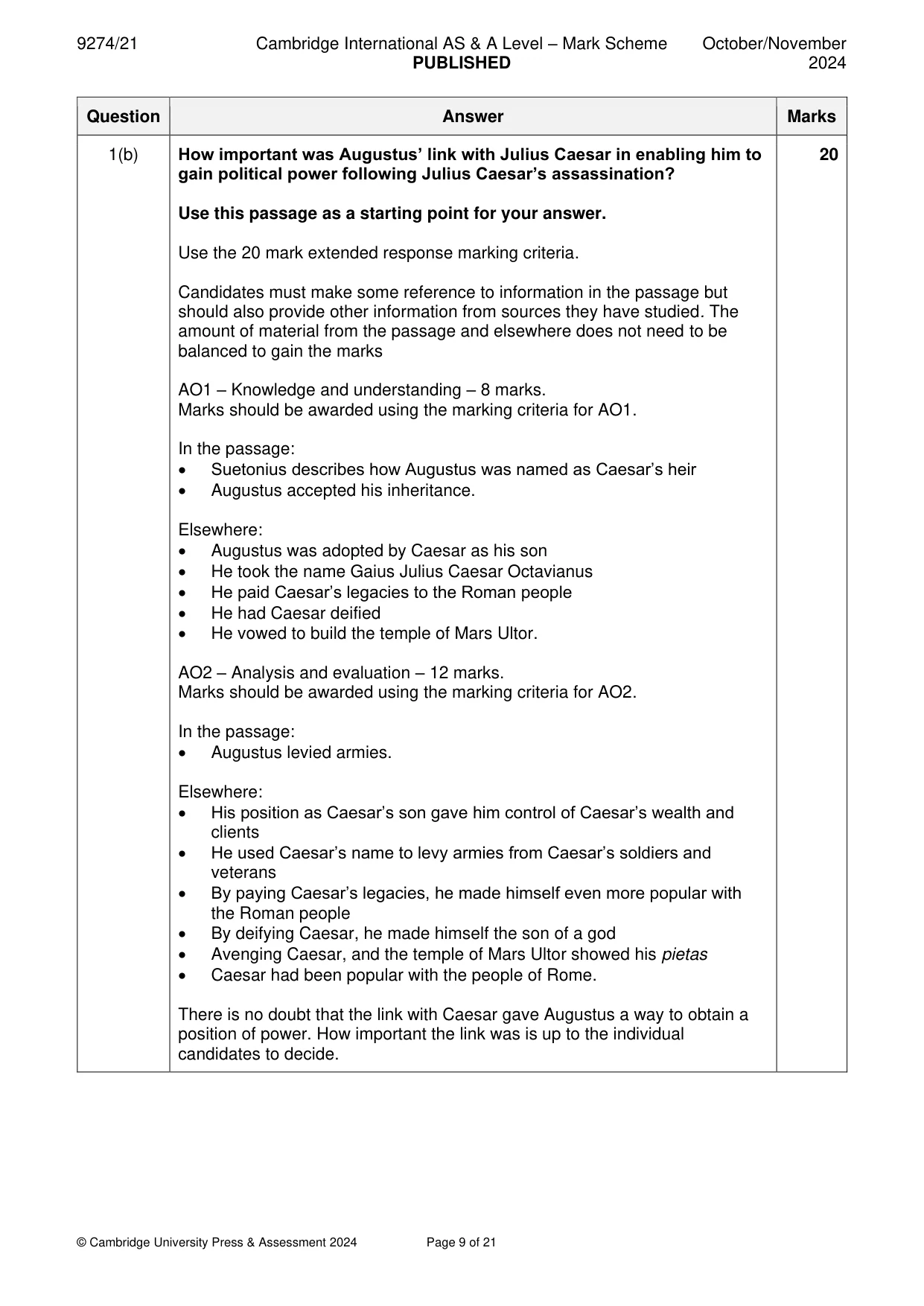
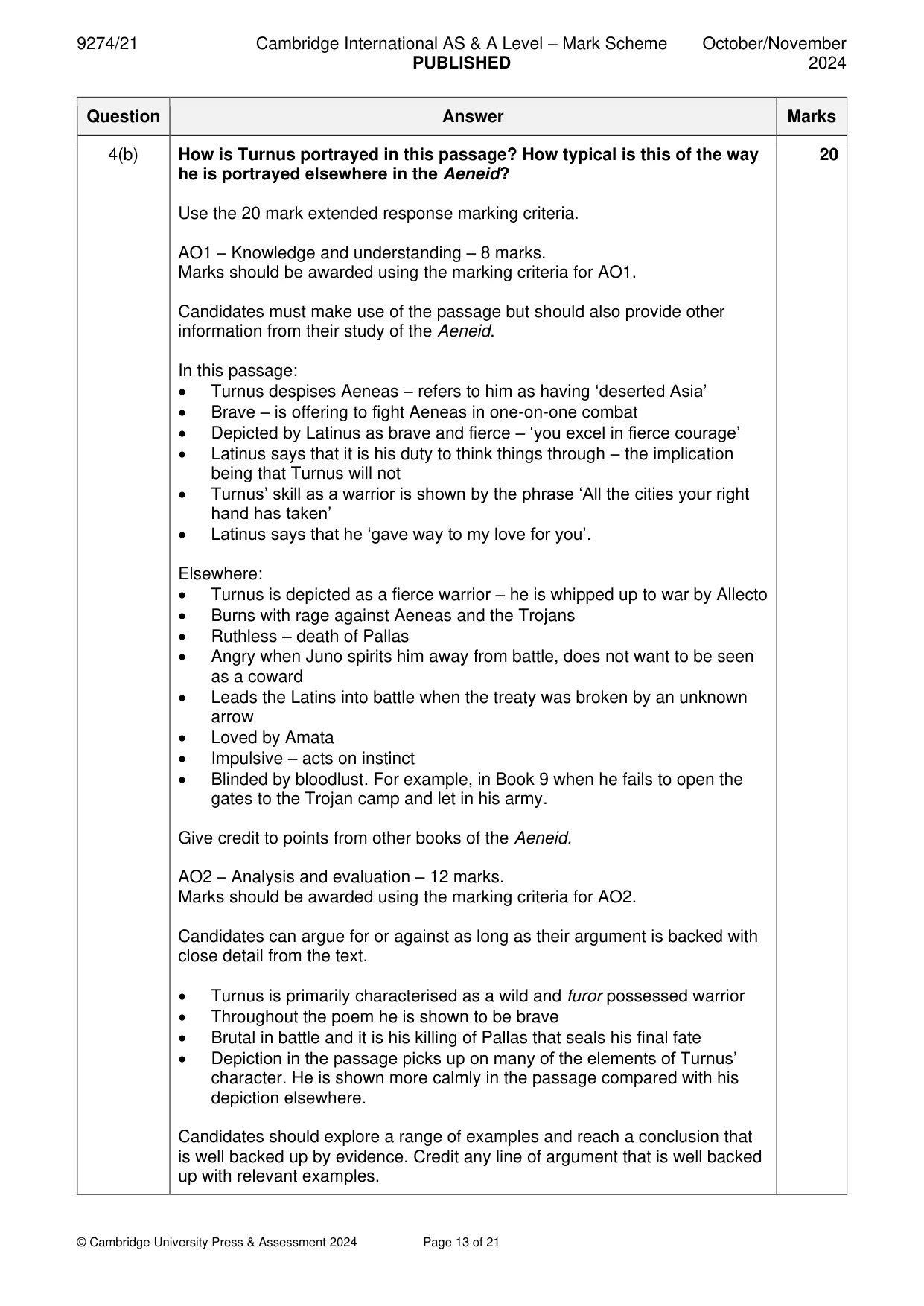
Mark scheme: Question Answer Marks 1(a)(i) Who were the Parthians (line 2)? Make two points. 2 • Rome’s eastern neighbour • Rival empire/enemy of the Romans • Who defeated Crassus • Capturing Roman standards • Which were returned to Augustus (Any 2) 1(a)(ii) In which year was Caesar assassinated (line 3)? 1 44 BCE 1(a)(iii) What was the name of Augustus’ mother (line 7)? 1 Atia 1(a)(iv) In which year did Augustus die? 1 14 CE 1(b) How important was Augustus’ link with Julius Caesar in enabling him to 20 gain political power following Julius Caesar’s assassination? Use this passage as a starting point for your answer. Use the 20 mark extended response marking criteria. Candidates must make some reference to information in the passage but should also provide other information from sources they have studied. The amount of material from the passage and elsewhere does not need to be balanced to gain the marks AO1 – Knowledge and understanding – 8 marks. Marks should be awarded using the marking criteria for AO1. In the passage: • Suetonius describes how Augustus was named as Caesar’s heir • Augustus accepted his inheritance. Elsewhere: • Augustus was adopted by Caesar as his son • He took the name Gaius Julius Caesar Octavianus • He paid Caesar’s legacies to the Roman people • He had Caesar deified • He vowed to build the temple of Mars Ultor. AO2 – Analysis and evaluation – 12 marks. Marks should be awarded using the marking criteria for AO2. In the passage: • Augustus levied armies. Elsewhere: • His position as Caesar’s son gave him control of Caesar’s wealth and clients • He used Caesar’s name to levy armies from Caesar’s soldiers and veterans • By paying Caesar’s legacies, he made himself even more popular with the Roman people • By deifying Caesar, he made himself the son of a god • Avenging Caesar, and the temple of Mars Ultor showed his pietas • Caesar had been popular with the people of Rome. There is no doubt that the link with Caesar gave Augustus a way to obtain a position of power. How important the link was is up to the individual candidates to decide.
Q2 · How far do you agree that Augustus’ building programme made Rome a city worthy to be the…
2 How far do you agree that Augustus’ building programme made Rome a city worthy to be the capital of the Empire? [25] OR
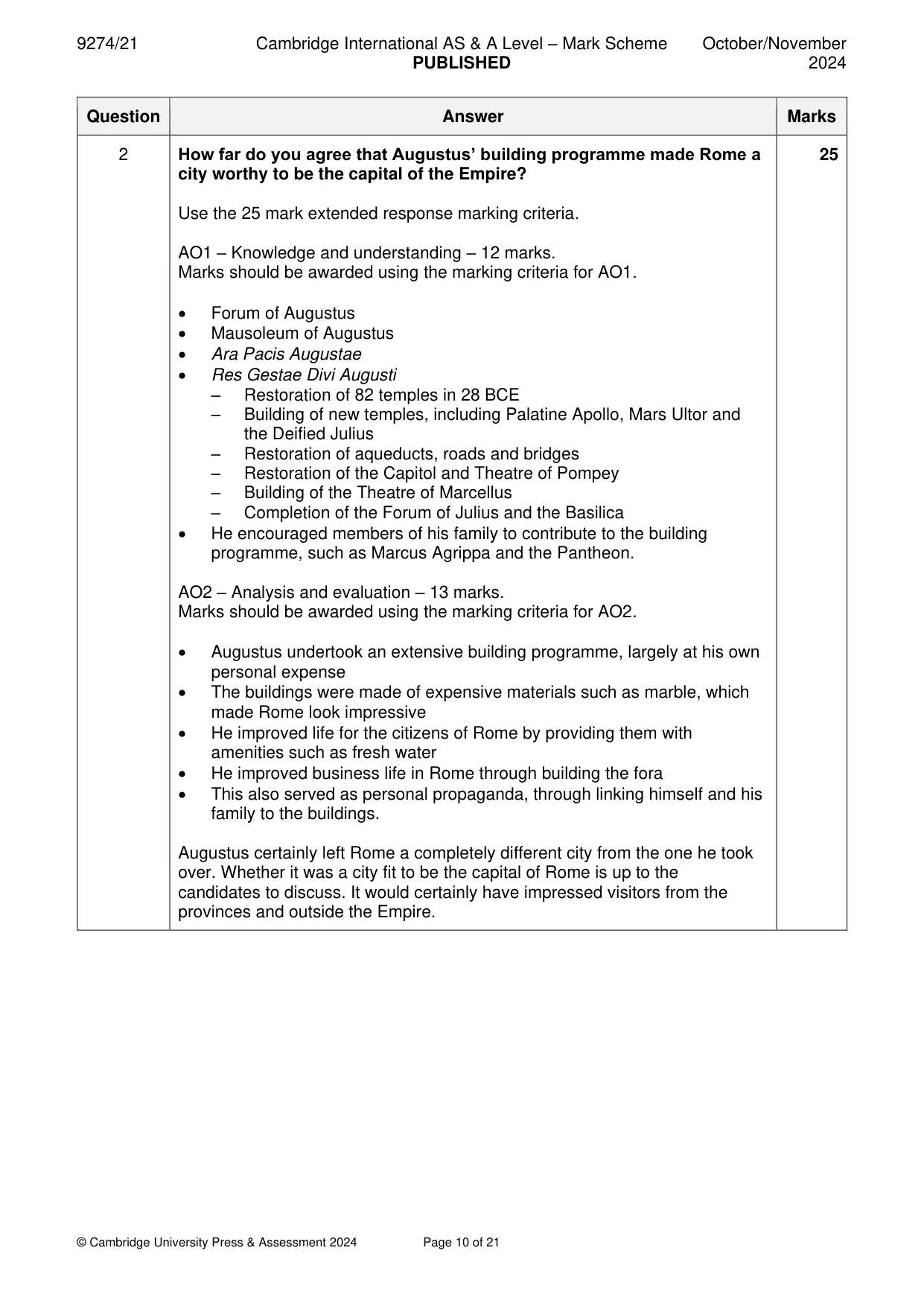
Mark scheme: 2 How far do you agree that Augustus’ building programme made Rome a 25 city worthy to be the capital of the Empire? Use the 25 mark extended response marking criteria. AO1 – Knowledge and understanding – 12 marks. Marks should be awarded using the marking criteria for AO1. • Forum of Augustus • Mausoleum of Augustus • Ara Pacis Augustae • Res Gestae Divi Augusti – Restoration of 82 temples in 28 BCE – Building of new temples, including Palatine Apollo, Mars Ultor and the Deified Julius – Restoration of aqueducts, roads and bridges – Restoration of the Capitol and Theatre of Pompey – Building of the Theatre of Marcellus – Completion of the Forum of Julius and the Basilica • He encouraged members of his family to contribute to the building programme, such as Marcus Agrippa and the Pantheon. AO2 – Analysis and evaluation – 13 marks. Marks should be awarded using the marking criteria for AO2. • Augustus undertook an extensive building programme, largely at his own personal expense • The buildings were made of expensive materials such as marble, which made Rome look impressive • He improved life for the citizens of Rome by providing them with amenities such as fresh water • He improved business life in Rome through building the fora • This also served as personal propaganda, through linking himself and his family to the buildings. Augustus certainly left Rome a completely different city from the one he took over. Whether it was a city fit to be the capital of Rome is up to the candidates to discuss. It would certainly have impressed visitors from the provinces and outside the Empire.
Q3 · ‘Augustus’ military victories in the civil wars of 44–31 BCE were only because of his…
3 ‘Augustus’ military victories in the civil wars of 44–31 BCE were only because of his personal leadership.’ How far do you agree with this statement? [25]
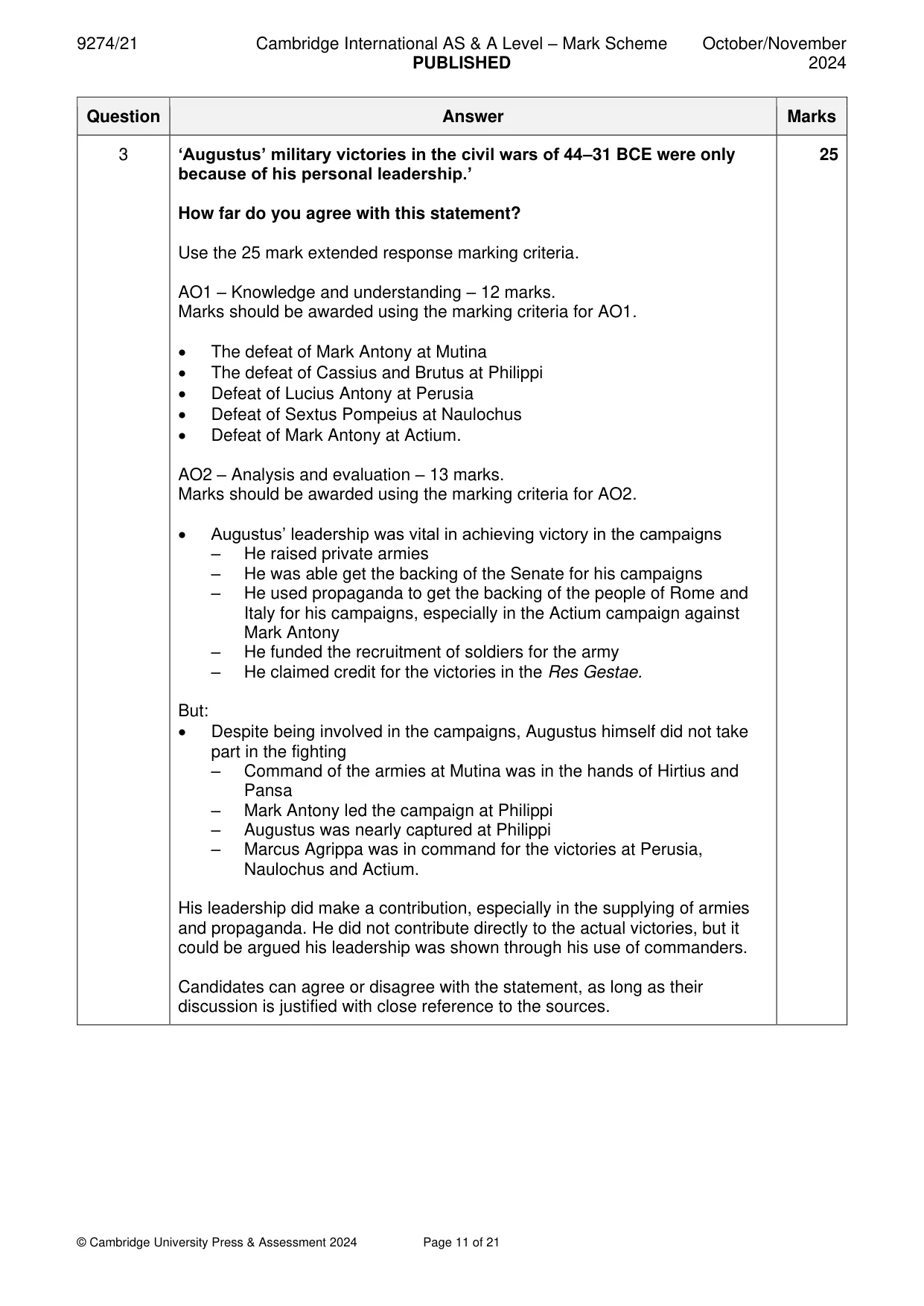
Mark scheme: 3 ‘Augustus’ military victories in the civil wars of 44–31 BCE were only 25 because of his personal leadership.’ How far do you agree with this statement? Use the 25 mark extended response marking criteria. AO1 – Knowledge and understanding – 12 marks. Marks should be awarded using the marking criteria for AO1. • The defeat of Mark Antony at Mutina • The defeat of Cassius and Brutus at Philippi • Defeat of Lucius Antony at Perusia • Defeat of Sextus Pompeius at Naulochus • Defeat of Mark Antony at Actium. AO2 – Analysis and evaluation – 13 marks. Marks should be awarded using the marking criteria for AO2. • Augustus’ leadership was vital in achieving victory in the campaigns – He raised private armies – He was able get the backing of the Senate for his campaigns – He used propaganda to get the backing of the people of Rome and Italy for his campaigns, especially in the Actium campaign against Mark Antony – He funded the recruitment of soldiers for the army – He claimed credit for the victories in the Res Gestae. But: • Despite being involved in the campaigns, Augustus himself did not take part in the fighting – Command of the armies at Mutina was in the hands of Hirtius and Pansa – Mark Antony led the campaign at Philippi – Augustus was nearly captured at Philippi – Marcus Agrippa was in command for the victories at Perusia, Naulochus and Actium. His leadership did make a contribution, especially in the supplying of armies and propaganda. He did not contribute directly to the actual victories, but it could be argued his leadership was shown through his use of commanders. Candidates can agree or disagree with the statement, as long as their discussion is justified with close reference to the sources. Section B: Virgil’s Aeneid
Q4 · Read the passage and answer the questions: ‘Either this right hand of mine will send this…
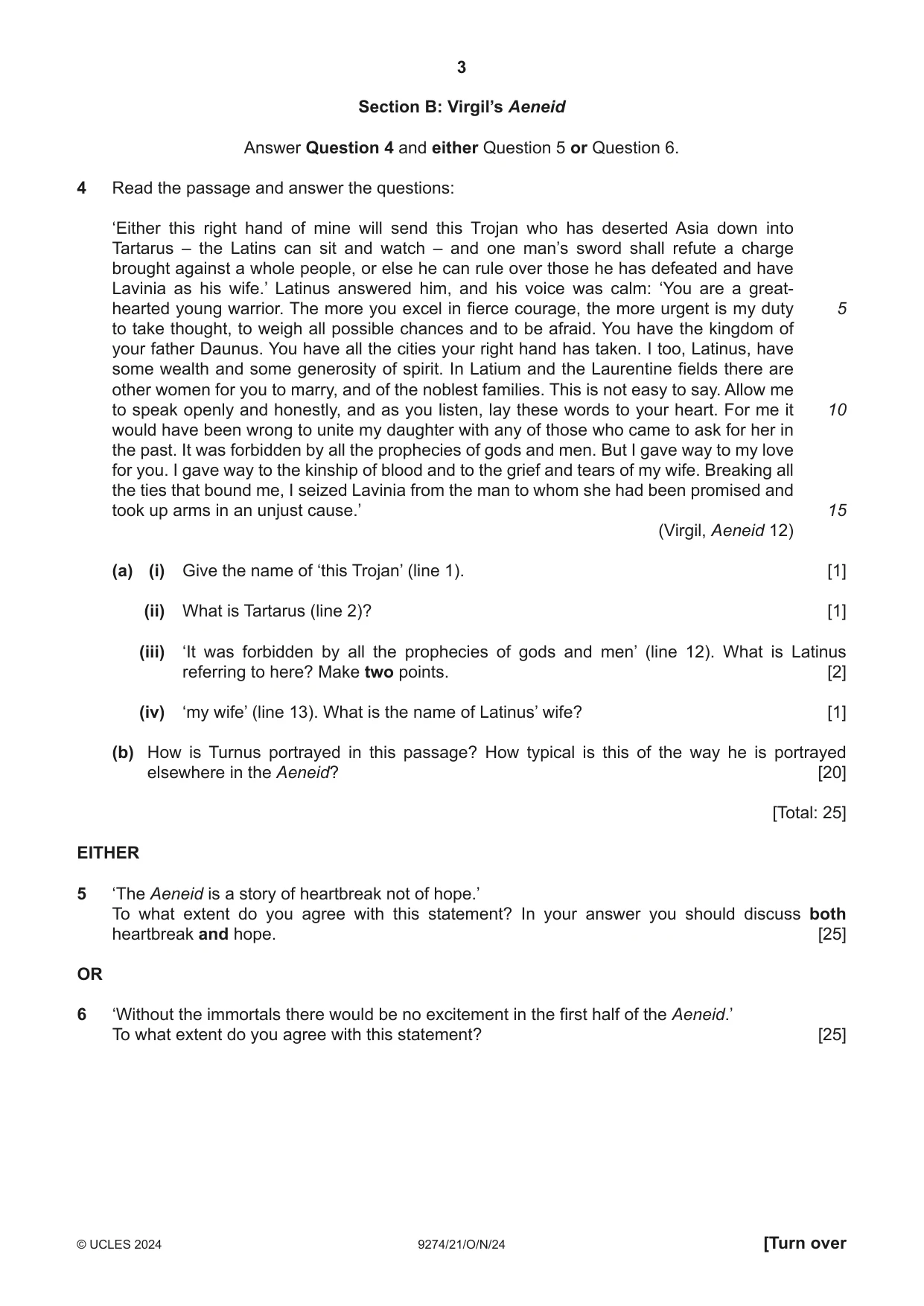
4 Read the passage and answer the questions: ‘Either this right hand of mine will send this Trojan who has deserted Asia down into Tartarus – the Latins can sit and watch – and one man’s sword shall refute a charge brought against a whole people, or else he can rule over those he has defeated and have Lavinia as his wife.’ Latinus answered him, and his voice was calm: ‘You are a great- hearted young warrior. The more you excel in fierce courage, the more urgent is my duty 5 to take thought, to weigh all possible chances and to be afraid. You have the kingdom of your father Daunus. You have all the cities your right hand has taken. I too, Latinus, have some wealth and some generosity of spirit. In Latium and the Laurentine fields there are other women for you to marry, and of the noblest families. This is not easy to say. Allow me to speak openly and honestly, and as you listen, lay these words to your heart. For me it 10 would have been wrong to unite my daughter with any of those who came to ask for her in the past. It was forbidden by all the prophecies of gods and men. But I gave way to my love for you. I gave way to the kinship of blood and to the grief and tears of my wife. Breaking all the ties that bound me, I seized Lavinia from the man to whom she had been promised and took up arms in an unjust cause.’ 15 (Virgil, Aeneid 12) (a) (i) Give the name of ‘this Trojan’ (line 1). [1] (ii) What is Tartarus (line 2)? [1] (iii) ‘It was forbidden by all the prophecies of gods and men’ (line 12). What is Latinus referring to here? Make two points. [2] (iv) ‘my wife’ (line 13). What is the name of Latinus’ wife? [1] (b) How is Turnus portrayed in this passage? How typical is this of the way he is portrayed elsewhere in the Aeneid? [20] [Total: 25] EITHER
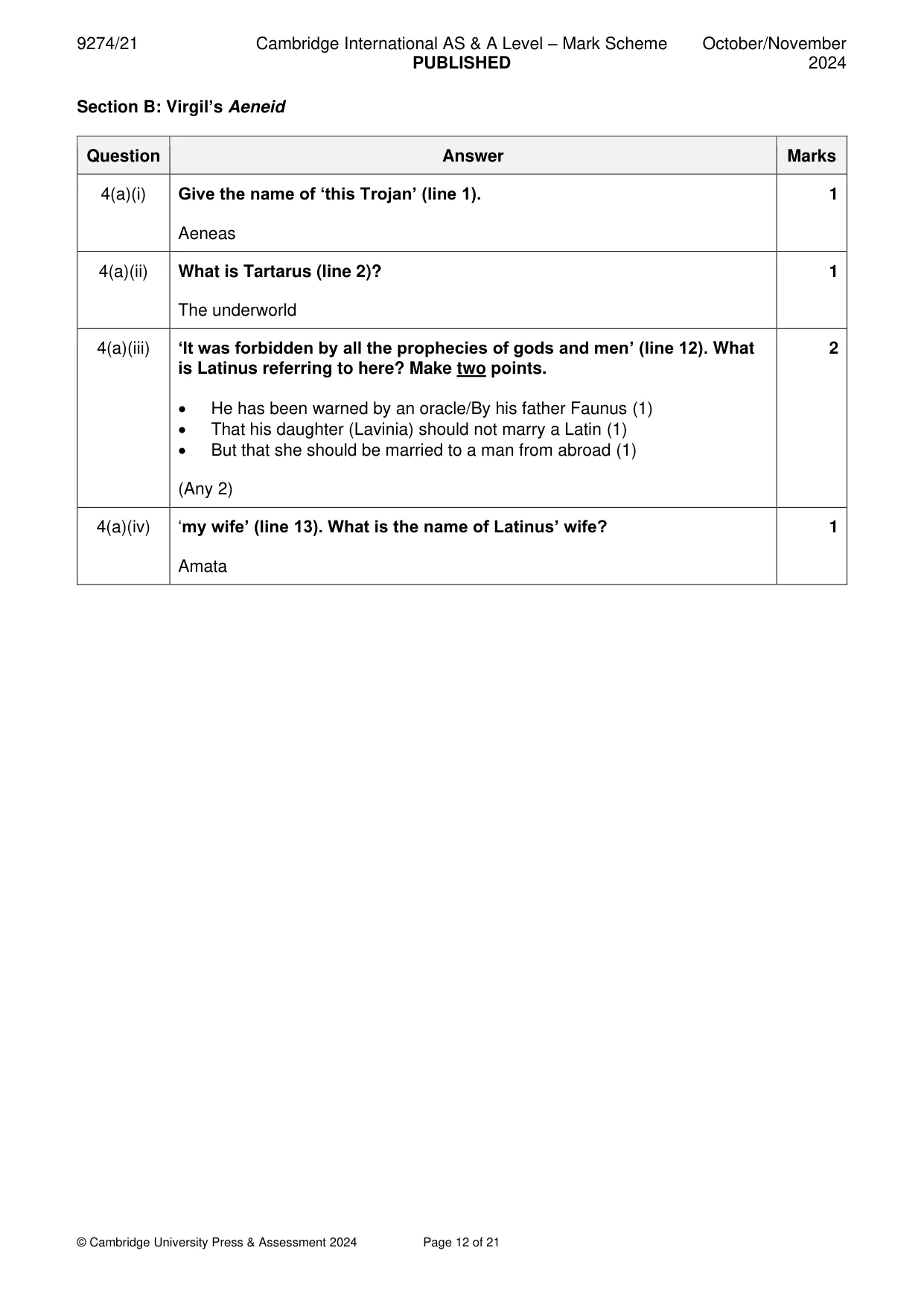
Mark scheme: 4(a)(i) Give the name of ‘this Trojan’ (line 1). 1 Aeneas 4(a)(ii) What is Tartarus (line 2)? 1 The underworld 4(a)(iii) ‘It was forbidden by all the prophecies of gods and men’ (line 12). What 2 is Latinus referring to here? Make two points. • He has been warned by an oracle/By his father Faunus (1) • That his daughter (Lavinia) should not marry a Latin (1) • But that she should be married to a man from abroad (1) (Any 2) 4(a)(iv) ‘my wife’ (line 13). What is the name of Latinus’ wife? 1 Amata 4(b) How is Turnus portrayed in this passage? How typical is this of the way 20 he is portrayed elsewhere in the Aeneid? Use the 20 mark extended response marking criteria. AO1 – Knowledge and understanding – 8 marks. Marks should be awarded using the marking criteria for AO1. Candidates must make use of the passage but should also provide other information from their study of the Aeneid. In this passage: • Turnus despises Aeneas – refers to him as having ‘deserted Asia’ • Brave – is offering to fight Aeneas in one-on-one combat • Depicted by Latinus as brave and fierce – ‘you excel in fierce courage’ • Latinus says that it is his duty to think things through – the implication being that Turnus will not • Turnus’ skill as a warrior is shown by the phrase ‘All the cities your right hand has taken’ • Latinus says that he ‘gave way to my love for you’. Elsewhere: • Turnus is depicted as a fierce warrior – he is whipped up to war by Allecto • Burns with rage against Aeneas and the Trojans • Ruthless – death of Pallas • Angry when Juno spirits him away from battle, does not want to be seen as a coward • Leads the Latins into battle when the treaty was broken by an unknown arrow • Loved by Amata • Impulsive – acts on instinct • Blinded by bloodlust. For example, in Book 9 when he fails to open the gates to the Trojan camp and let in his army. Give credit to points from other books of the Aeneid. AO2 – Analysis and evaluation – 12 marks. Marks should be awarded using the marking criteria for AO2. Candidates can argue for or against as long as their argument is backed with close detail from the text. • Turnus is primarily characterised as a wild and furor possessed warrior • Throughout the poem he is shown to be brave • Brutal in battle and it is his killing of Pallas that seals his final fate • Depiction in the passage picks up on many of the elements of Turnus’ character. He is shown more calmly in the passage compared with his depiction elsewhere. Candidates should explore a range of examples and reach a conclusion that is well backed up by evidence. Credit any line of argument that is well backed up with relevant examples.
Q5 · ‘The Aeneid is a story of heartbreak not of hope.’ To what extent do you agree with this…
5 ‘The Aeneid is a story of heartbreak not of hope.’ To what extent do you agree with this statement? In your answer you should discuss both heartbreak and hope. [25] OR
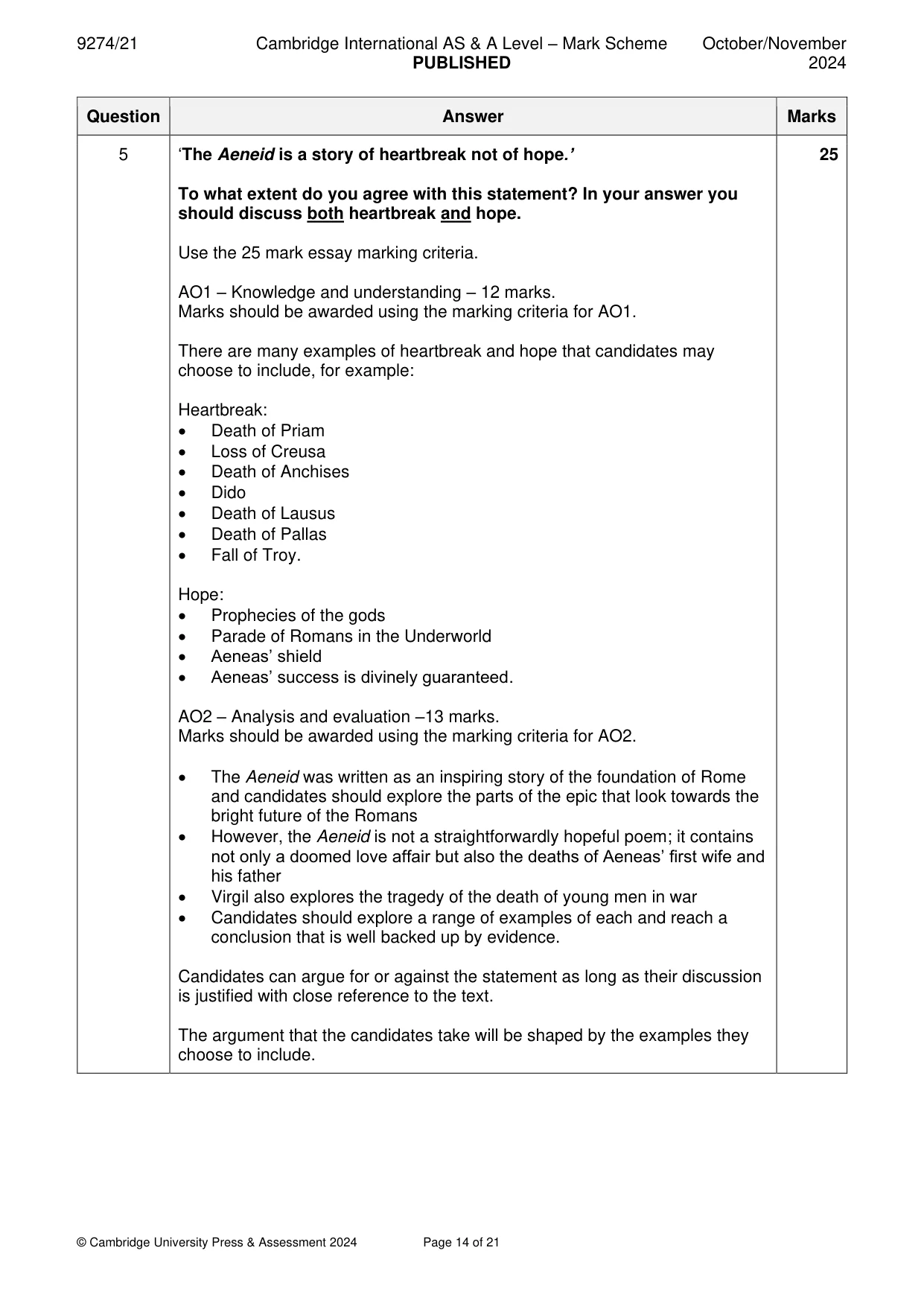
Mark scheme: 5 ‘The Aeneid is a story of heartbreak not of hope.’ 25 To what extent do you agree with this statement? In your answer you should discuss both heartbreak and hope. Use the 25 mark essay marking criteria. AO1 – Knowledge and understanding – 12 marks. Marks should be awarded using the marking criteria for AO1. There are many examples of heartbreak and hope that candidates may choose to include, for example: Heartbreak: • Death of Priam • Loss of Creusa • Death of Anchises • Dido • Death of Lausus • Death of Pallas • Fall of Troy. Hope: • Prophecies of the gods • Parade of Romans in the Underworld • Aeneas’ shield • Aeneas’ success is divinely guaranteed. AO2 – Analysis and evaluation –13 marks. Marks should be awarded using the marking criteria for AO2. • The Aeneid was written as an inspiring story of the foundation of Rome and candidates should explore the parts of the epic that look towards the bright future of the Romans • However, the Aeneid is not a straightforwardly hopeful poem; it contains not only a doomed love affair but also the deaths of Aeneas’ first wife and his father • Virgil also explores the tragedy of the death of young men in war • Candidates should explore a range of examples of each and reach a conclusion that is well backed up by evidence. Candidates can argue for or against the statement as long as their discussion is justified with close reference to the text. The argument that the candidates take will be shaped by the examples they choose to include.
Q6 · Section C: Architecture of the Roman City Answer Question 7 and either Question 8 or…
Section C: Architecture of the Roman City Answer Question 7 and either Question 8 or Question 9.
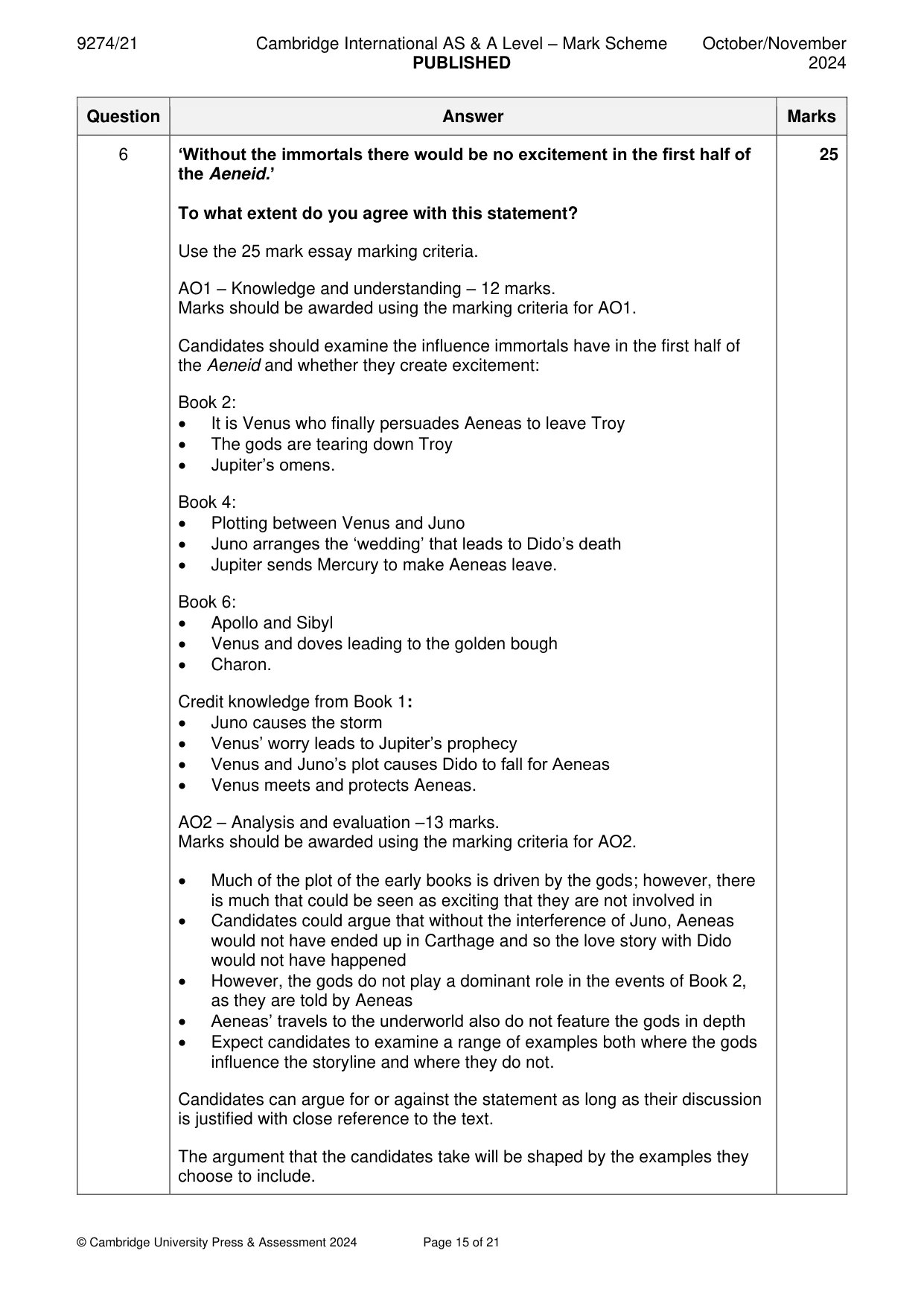
Mark scheme: 6 ‘Without the immortals there would be no excitement in the first half of 25 the Aeneid.’ To what extent do you agree with this statement? Use the 25 mark essay marking criteria. AO1 – Knowledge and understanding – 12 marks. Marks should be awarded using the marking criteria for AO1. Candidates should examine the influence immortals have in the first half of the Aeneid and whether they create excitement: Book 2: • It is Venus who finally persuades Aeneas to leave Troy • The gods are tearing down Troy • Jupiter’s omens. Book 4: • Plotting between Venus and Juno • Juno arranges the ‘wedding’ that leads to Dido’s death • Jupiter sends Mercury to make Aeneas leave. Book 6: • Apollo and Sibyl • Venus and doves leading to the golden bough • Charon. Credit knowledge from Book 1: • Juno causes the storm • Venus’ worry leads to Jupiter’s prophecy • Venus and Juno’s plot causes Dido to fall for Aeneas • Venus meets and protects Aeneas. AO2 – Analysis and evaluation –13 marks. Marks should be awarded using the marking criteria for AO2. • Much of the plot of the early books is driven by the gods; however, there is much that could be seen as exciting that they are not involved in • Candidates could argue that without the interference of Juno, Aeneas would not have ended up in Carthage and so the love story with Dido would not have happened • However, the gods do not play a dominant role in the events of Book 2, as they are told by Aeneas • Aeneas’ travels to the underworld also do not feature the gods in depth • Expect candidates to examine a range of examples both where the gods influence the storyline and where they do not. Candidates can argue for or against the statement as long as their discussion is justified with close reference to the text. The argument that the candidates take will be shaped by the examples they choose to include. Section C: Architecture of the Roman City
Q7 · Study the image and answer the questions: X Y (A plan of a forum) (a) (i) In which…
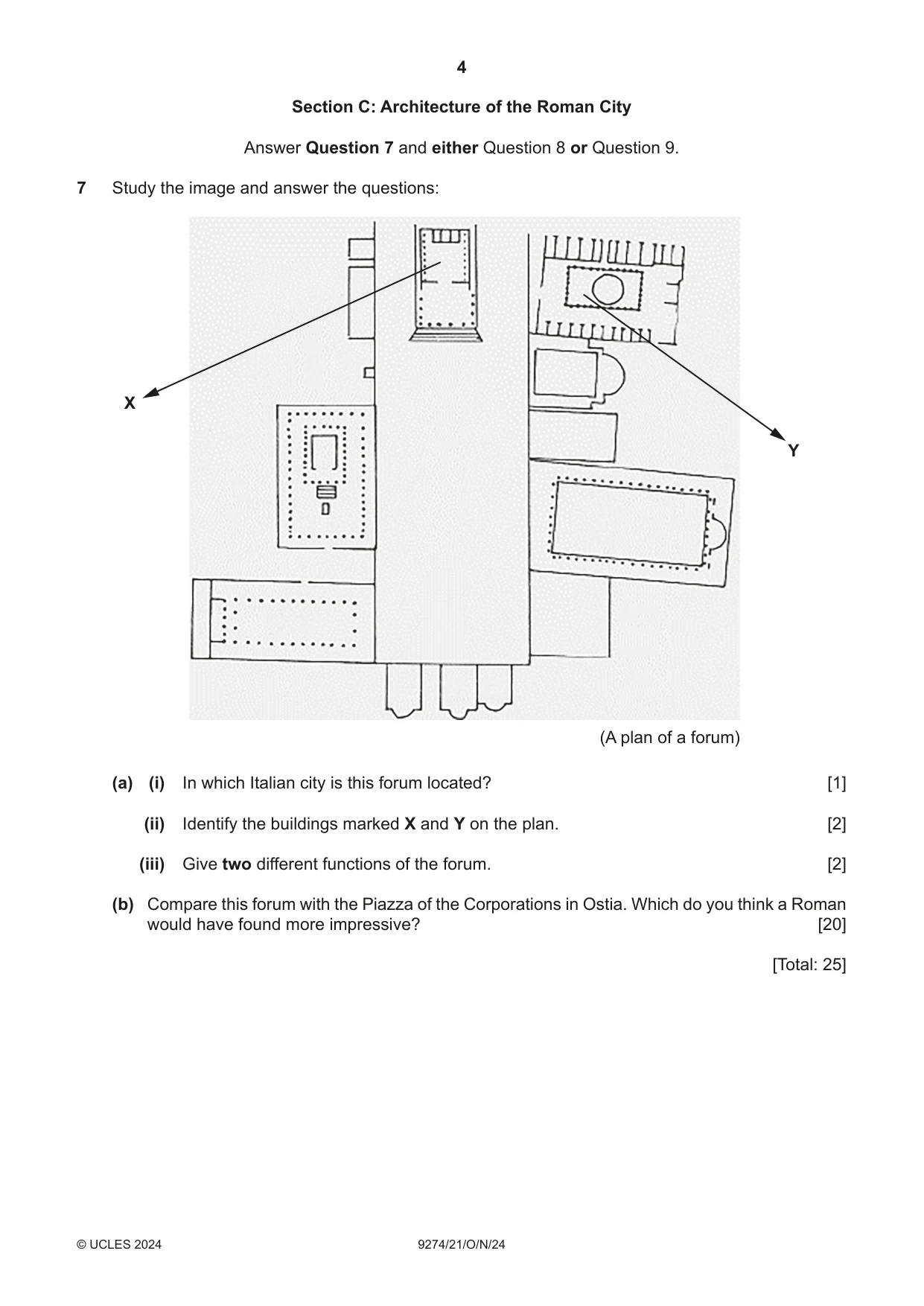
7 Study the image and answer the questions: X Y (A plan of a forum) (a) (i) In which Italian city is this forum located? [1] (ii) Identify the buildings marked X and Y on the plan. [2] (iii) Give two different functions of the forum. [2] (b) Compare this forum with the Piazza of the Corporations in Ostia. Which do you think a Roman would have found more impressive? [20] [Total: 25] EITHER
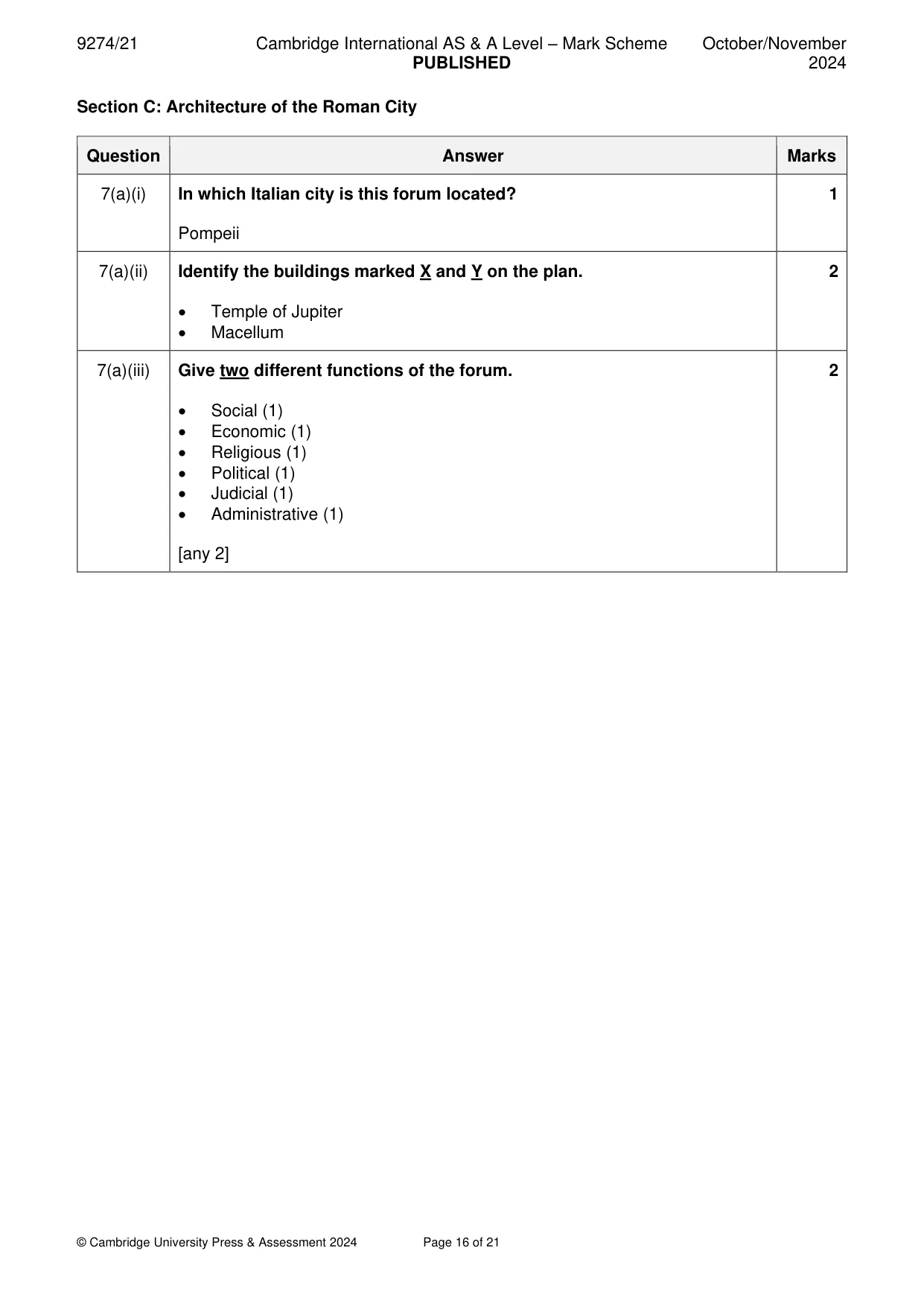
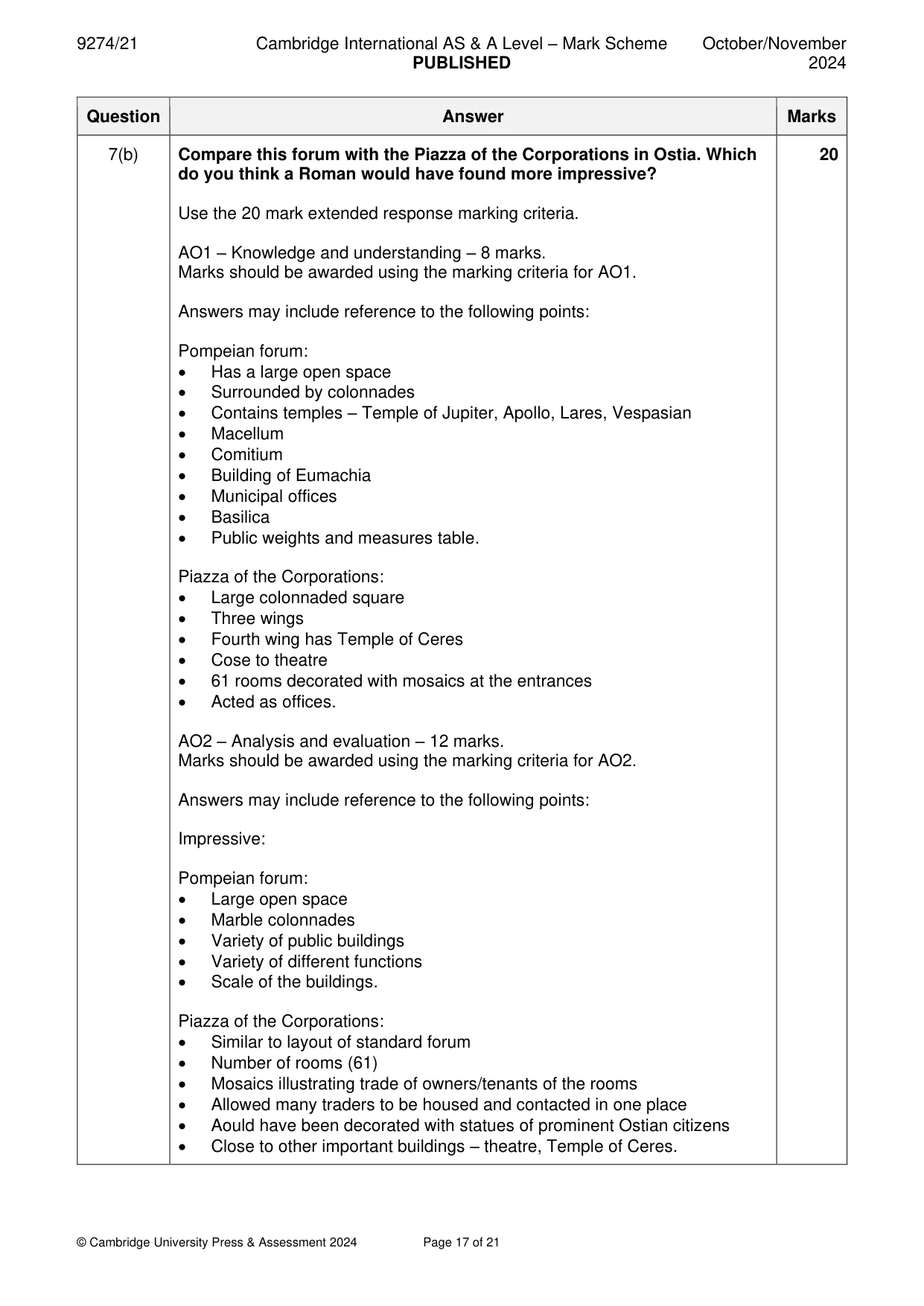
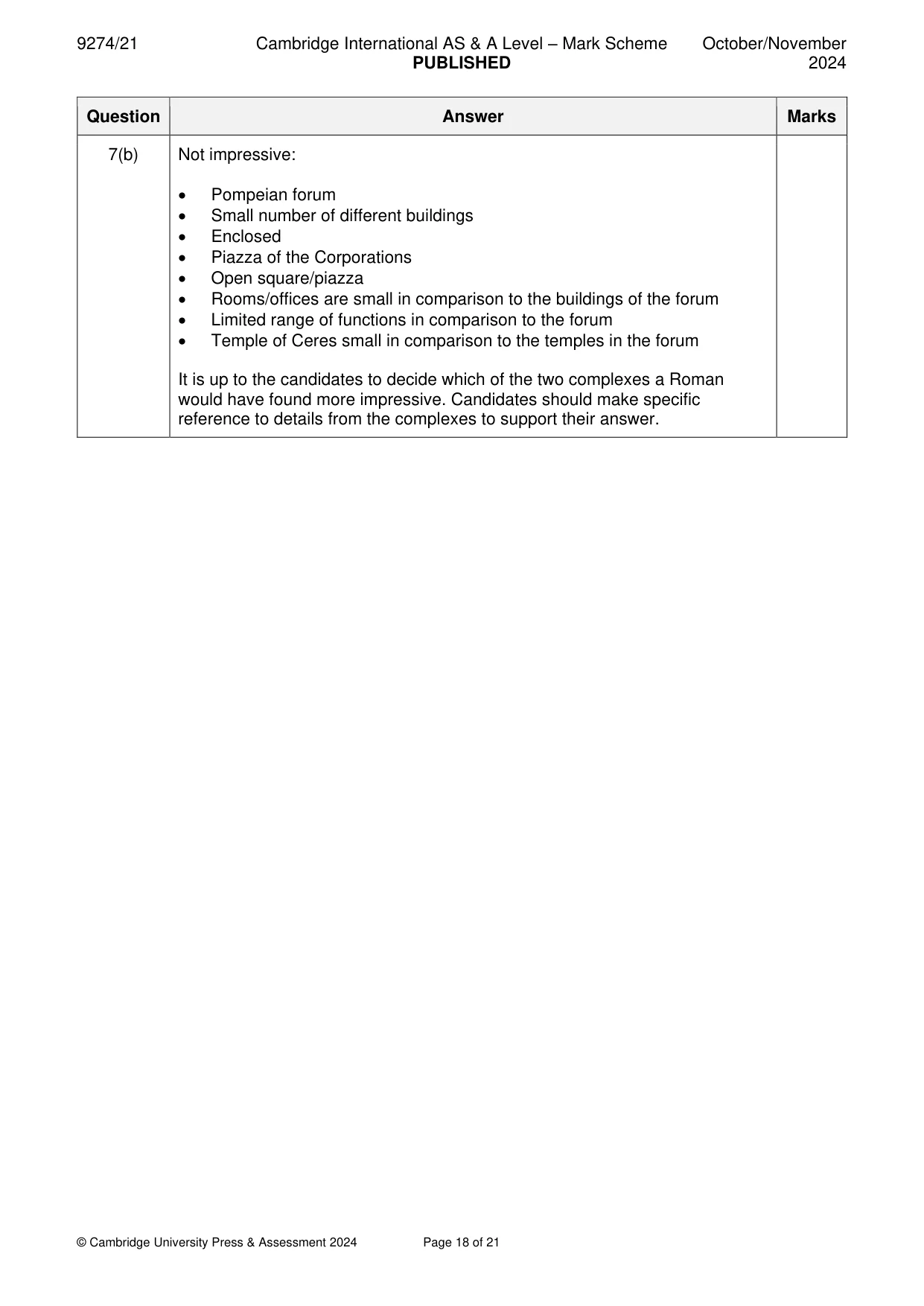
Mark scheme: 7(a)(i) In which Italian city is this forum located? 1 Pompeii 7(a)(ii) Identify the buildings marked X and Y on the plan. 2 • Temple of Jupiter • Macellum 7(a)(iii) Give two different functions of the forum. 2 • Social (1) • Economic (1) • Religious (1) • Political (1) • Judicial (1) • Administrative (1) [any 2] 7(b) Compare this forum with the Piazza of the Corporations in Ostia. Which 20 do you think a Roman would have found more impressive? Use the 20 mark extended response marking criteria. AO1 – Knowledge and understanding – 8 marks. Marks should be awarded using the marking criteria for AO1. Answers may include reference to the following points: Pompeian forum: • Has a large open space • Surrounded by colonnades • Contains temples – Temple of Jupiter, Apollo, Lares, Vespasian • Macellum • Comitium • Building of Eumachia • Municipal offices • Basilica • Public weights and measures table. Piazza of the Corporations: • Large colonnaded square • Three wings • Fourth wing has Temple of Ceres • Cose to theatre • 61 rooms decorated with mosaics at the entrances • Acted as offices. AO2 – Analysis and evaluation – 12 marks. Marks should be awarded using the marking criteria for AO2. Answers may include reference to the following points: Impressive: Pompeian forum: • Large open space • Marble colonnades • Variety of public buildings • Variety of different functions • Scale of the buildings. Piazza of the Corporations: • Similar to layout of standard forum • Number of rooms (61) • Mosaics illustrating trade of owners/tenants of the rooms • Allowed many traders to be housed and contacted in one place • Aould have been decorated with statues of prominent Ostian citizens • Close to other important buildings – theatre, Temple of Ceres. 7(b) Not impressive: • Pompeian forum • Small number of different buildings • Enclosed • Piazza of the Corporations • Open square/piazza • Rooms/offices are small in comparison to the buildings of the forum • Limited range of functions in comparison to the forum • Temple of Ceres small in comparison to the temples in the forum It is up to the candidates to decide which of the two complexes a Roman would have found more impressive. Candidates should make specific reference to details from the complexes to support their answer.
Q8 · ‘The houses in Pompeii were built on a grander scale and were more lavishly decorated…
8 ‘The houses in Pompeii were built on a grander scale and were more lavishly decorated than the houses in Herculaneum.’ How far do you agree with this statement? Explain your answer with reference to specific houses from both Pompeii and Herculaneum. [25] OR
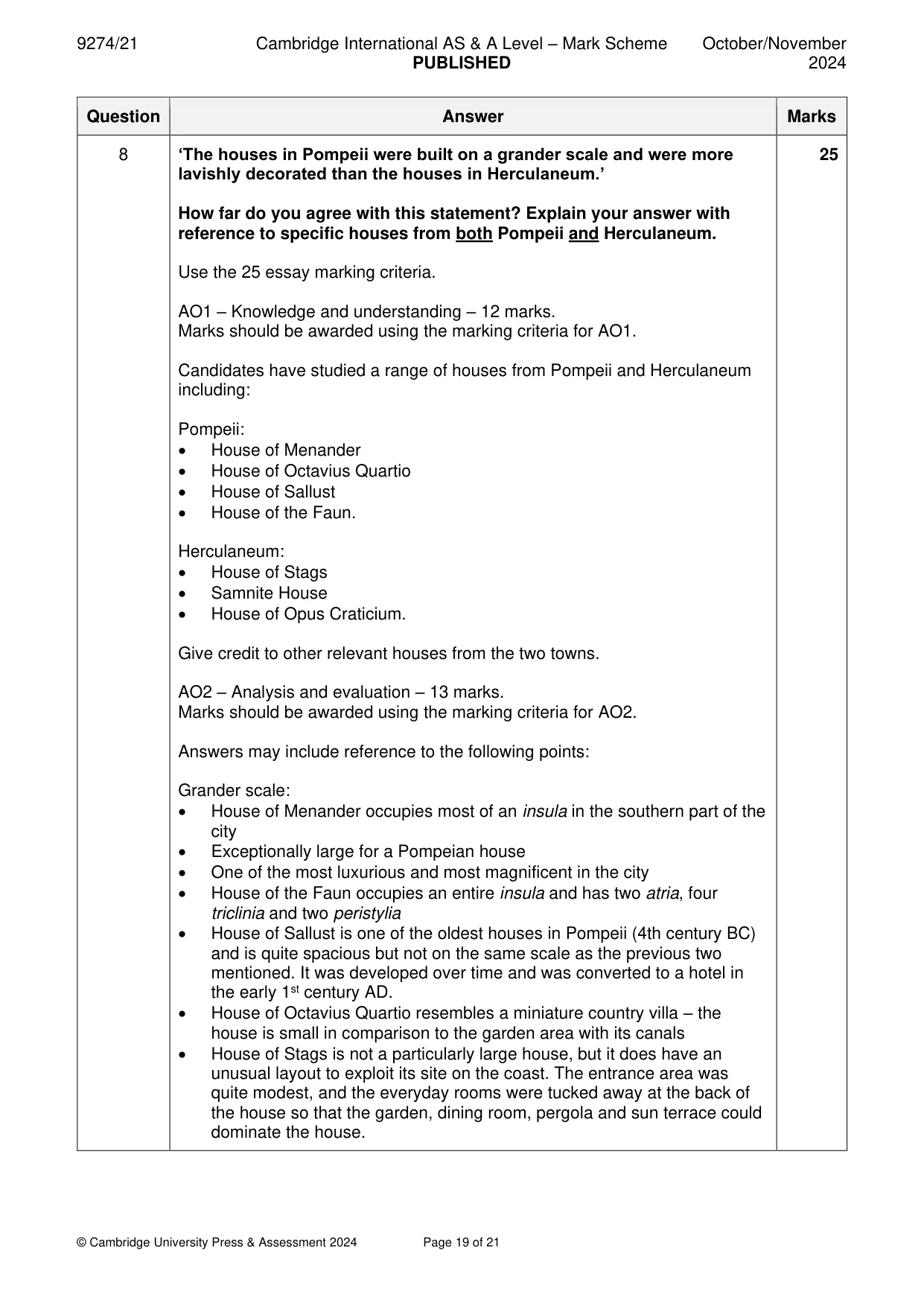
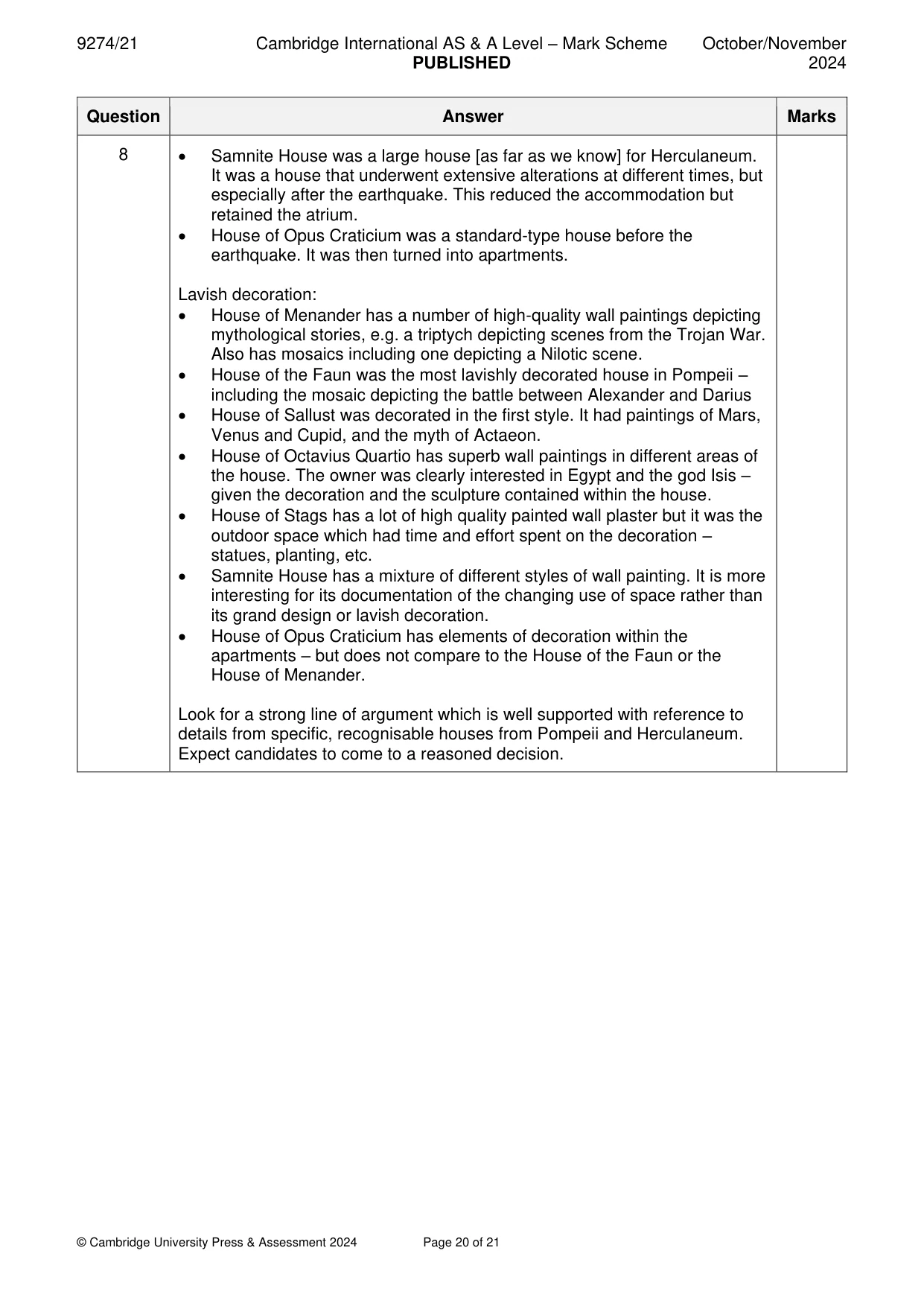
Mark scheme: 8 ‘The houses in Pompeii were built on a grander scale and were more 25 lavishly decorated than the houses in Herculaneum.’ How far do you agree with this statement? Explain your answer with reference to specific houses from both Pompeii and Herculaneum. Use the 25 essay marking criteria. AO1 – Knowledge and understanding – 12 marks. Marks should be awarded using the marking criteria for AO1. Candidates have studied a range of houses from Pompeii and Herculaneum including: Pompeii: • House of Menander • House of Octavius Quartio • House of Sallust • House of the Faun. Herculaneum: • House of Stags • Samnite House • House of Opus Craticium. Give credit to other relevant houses from the two towns. AO2 – Analysis and evaluation – 13 marks. Marks should be awarded using the marking criteria for AO2. Answers may include reference to the following points: Grander scale: • House of Menander occupies most of an insula in the southern part of the city • Exceptionally large for a Pompeian house • One of the most luxurious and most magnificent in the city • House of the Faun occupies an entire insula and has two atria, four triclinia and two peristylia • House of Sallust is one of the oldest houses in Pompeii (4th century BC) and is quite spacious but not on the same scale as the previous two mentioned. It was developed over time and was converted to a hotel in the early 1st century AD. • House of Octavius Quartio resembles a miniature country villa – the house is small in comparison to the garden area with its canals • House of Stags is not a particularly large house, but it does have an unusual layout to exploit its site on the coast. The entrance area was quite modest, and the everyday rooms were tucked away at the back of the house so that the garden, dining room, pergola and sun terrace could dominate the house. 8 • Samnite House was a large house [as far as we know] for Herculaneum. It was a house that underwent extensive alterations at different times, but especially after the earthquake. This reduced the accommodation but retained the atrium. • House of Opus Craticium was a standard-type house before the earthquake. It was then turned into apartments. Lavish decoration: • House of Menander has a number of high-quality wall paintings depicting mythological stories, e.g. a triptych depicting scenes from the Trojan War. Also has mosaics including one depicting a Nilotic scene. • House of the Faun was the most lavishly decorated house in Pompeii – including the mosaic depicting the battle between Alexander and Darius • House of Sallust was decorated in the first style. It had paintings of Mars, Venus and Cupid, and the myth of Actaeon. • House of Octavius Quartio has superb wall paintings in different areas of the house. The owner was clearly interested in Egypt and the god Isis – given the decoration and the sculpture contained within the house. • House of Stags has a lot of high quality painted wall plaster but it was the outdoor space which had time and effort spent on the decoration – statues, planting, etc. • Samnite House has a mixture of different styles of wall painting. It is more interesting for its documentation of the changing use of space rather than its grand design or lavish decoration. • House of Opus Craticium has elements of decoration within the apartments – but does not compare to the House of the Faun or the House of Menander. Look for a strong line of argument which is well supported with reference to details from specific, recognisable houses from Pompeii and Herculaneum. Expect candidates to come to a reasoned decision.
Q9 · ‘The public buildings in Ostia were more practical than the public buildings in Rome.’…
9 ‘The public buildings in Ostia were more practical than the public buildings in Rome.’ How far do the public buildings you have studied support this opinion? Explain your answer with reference to at least two public buildings from Ostia and at least two public buildings from Rome. [25]
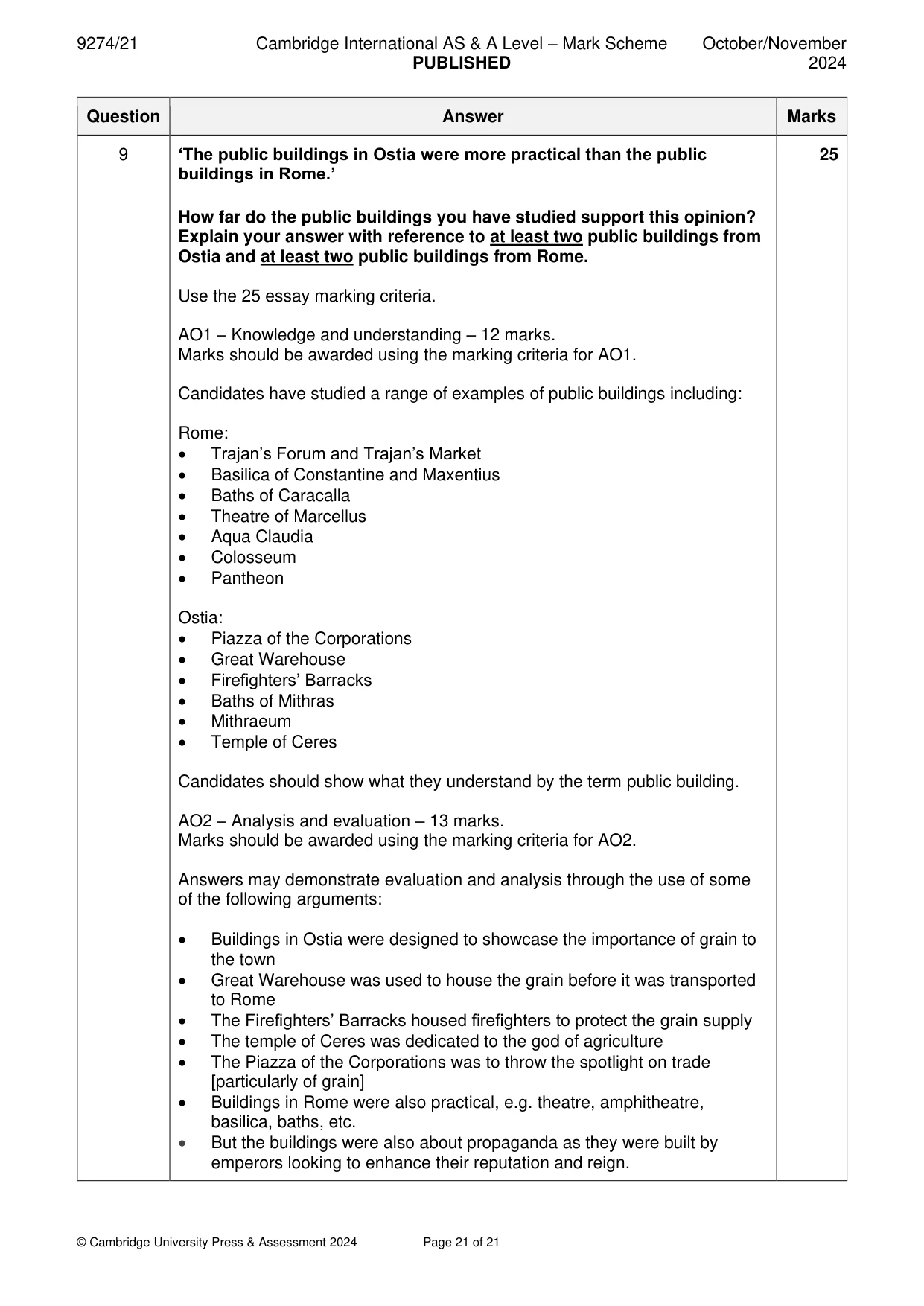
Mark scheme: 9 ‘The public buildings in Ostia were more practical than the public 25 buildings in Rome.’ How far do the public buildings you have studied support this opinion? Explain your answer with reference to at least two public buildings from Ostia and at least two public buildings from Rome. Use the 25 essay marking criteria. AO1 – Knowledge and understanding – 12 marks. Marks should be awarded using the marking criteria for AO1. Candidates have studied a range of examples of public buildings including: Rome: • Trajan’s Forum and Trajan’s Market • Basilica of Constantine and Maxentius • Baths of Caracalla • Theatre of Marcellus • Aqua Claudia • Colosseum • Pantheon Ostia: • Piazza of the Corporations • Great Warehouse • Firefighters’ Barracks • Baths of Mithras • Mithraeum • Temple of Ceres Candidates should show what they understand by the term public building. AO2 – Analysis and evaluation – 13 marks. Marks should be awarded using the marking criteria for AO2. Answers may demonstrate evaluation and analysis through the use of some of the following arguments: • Buildings in Ostia were designed to showcase the importance of grain to the town • Great Warehouse was used to house the grain before it was transported to Rome • The Firefighters’ Barracks housed firefighters to protect the grain supply • The temple of Ceres was dedicated to the god of agriculture • The Piazza of the Corporations was to throw the spotlight on trade [particularly of grain] • Buildings in Rome were also practical, e.g. theatre, amphitheatre, basilica, baths, etc. • But the buildings were also about propaganda as they were built by emperors looking to enhance their reputation and reign.
What was in this paper
The subtopics covered by these 9 questions, and how many questions each got. Open one in a new tab to see every Cambridge question on it.
What you needed in this session
Cambridge’s own grade thresholds for 2024 Oct/Nov, Paper 2 · Variant 1. A higher threshold means an easier paper — the bar moves with how the cohort did.