Cambridge A Level Classical Studies 9274 — 2018 Oct/Nov Paper 2 · Variant 1
9274/21/O/N/18 · 12 questions · 50 marks · ≈56 min
The question paper and its mark scheme, free to read here and free to download. This is Cambridge’s own paper, exactly as it was sat.
Question paper8 pages
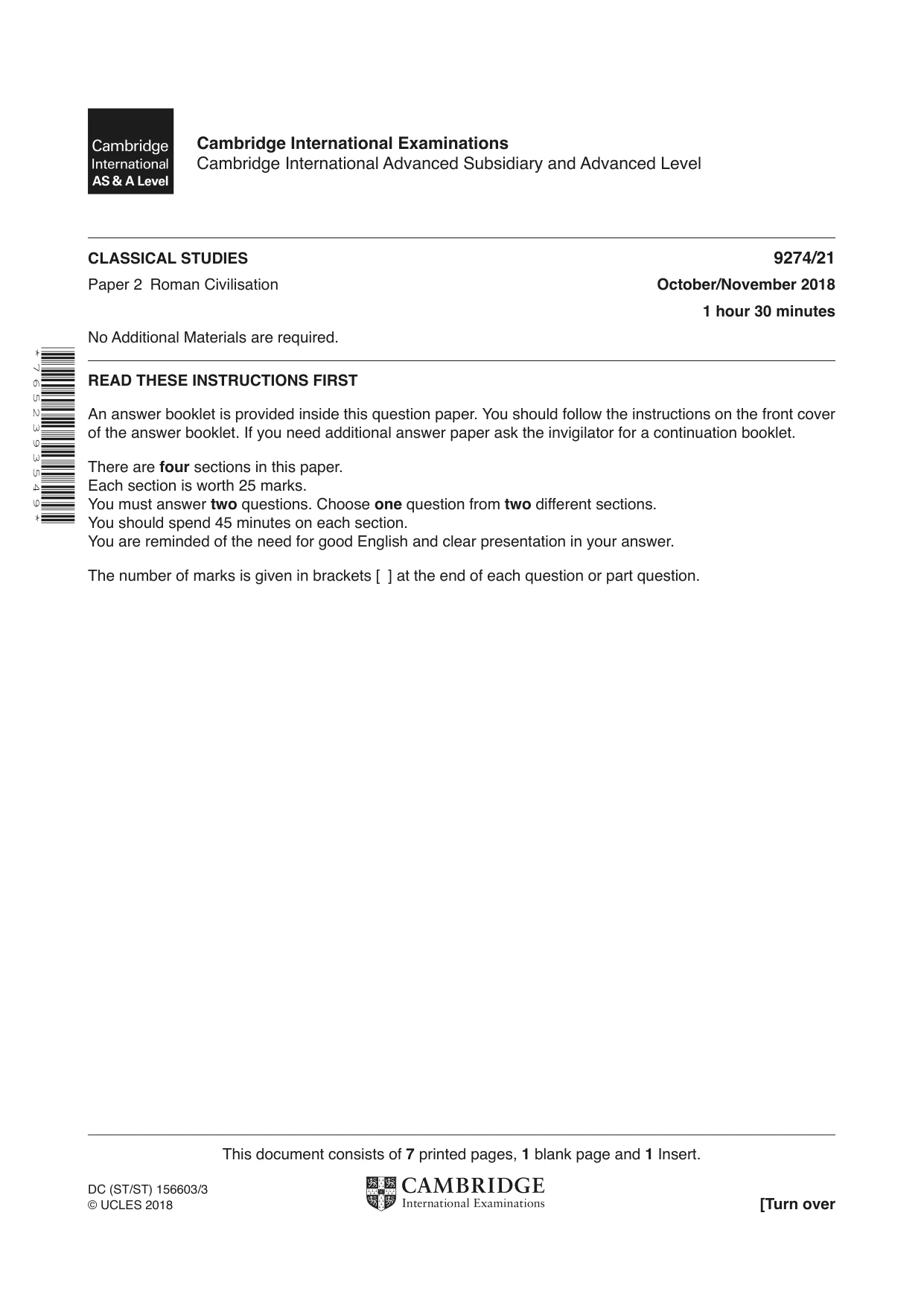
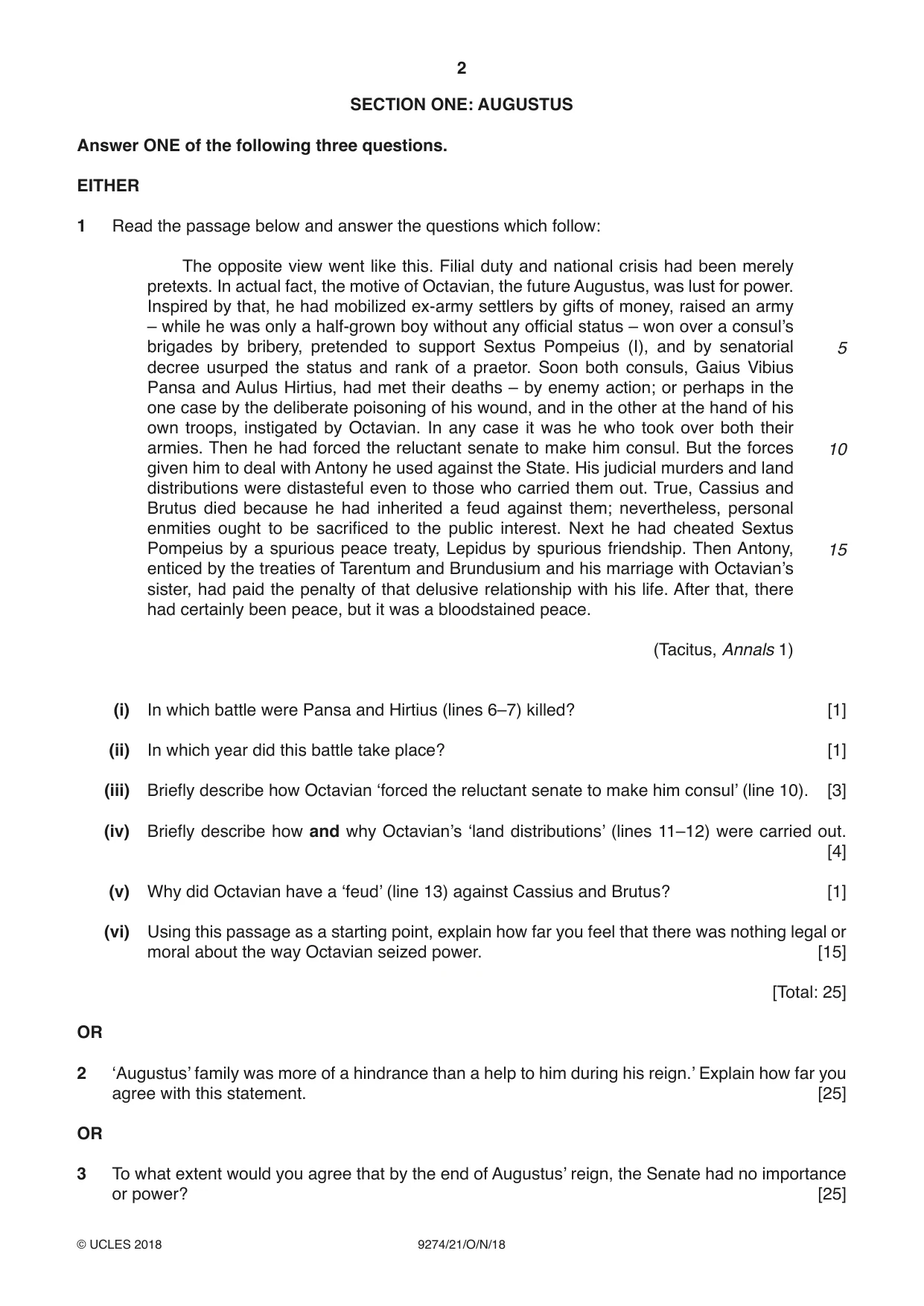
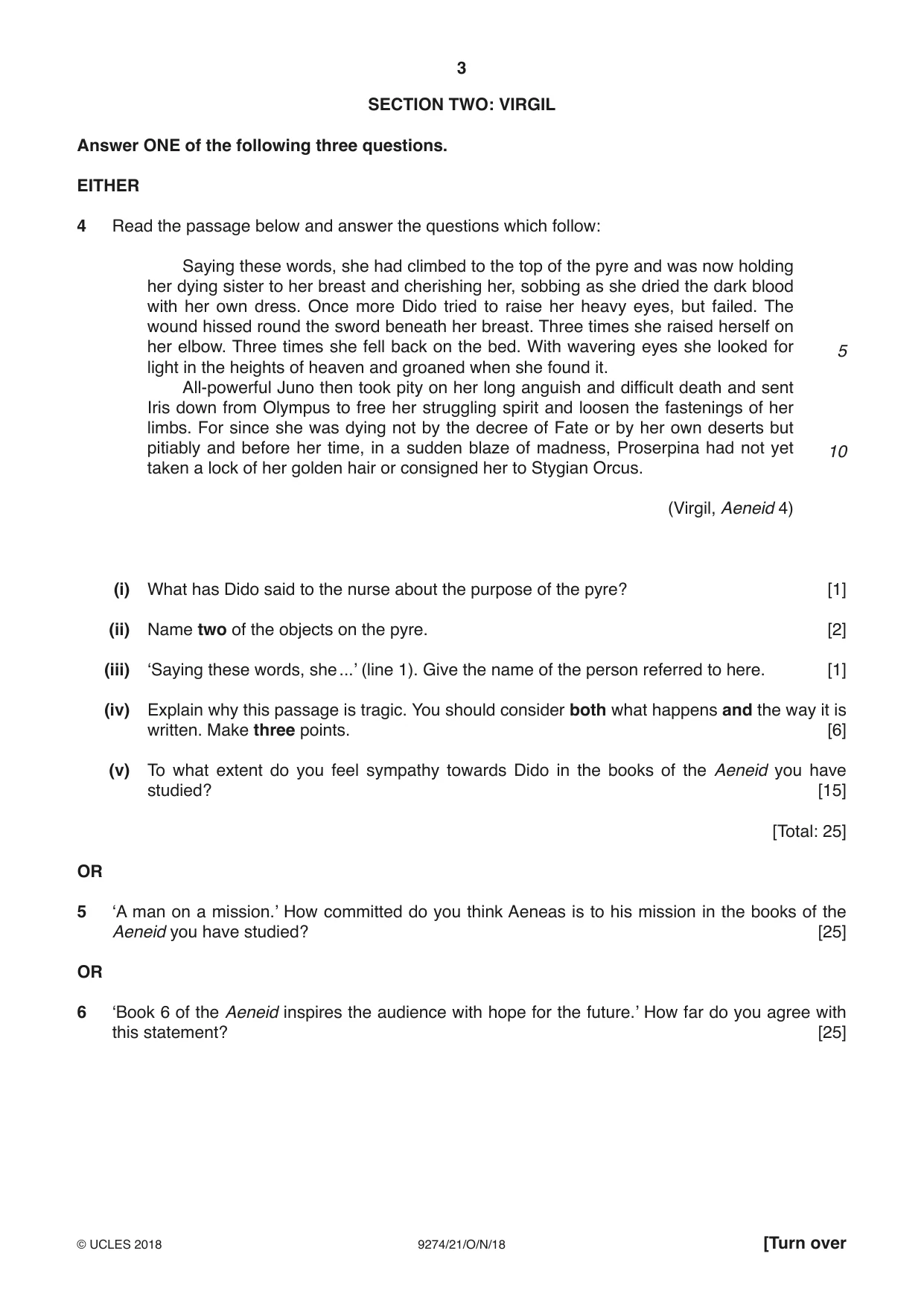
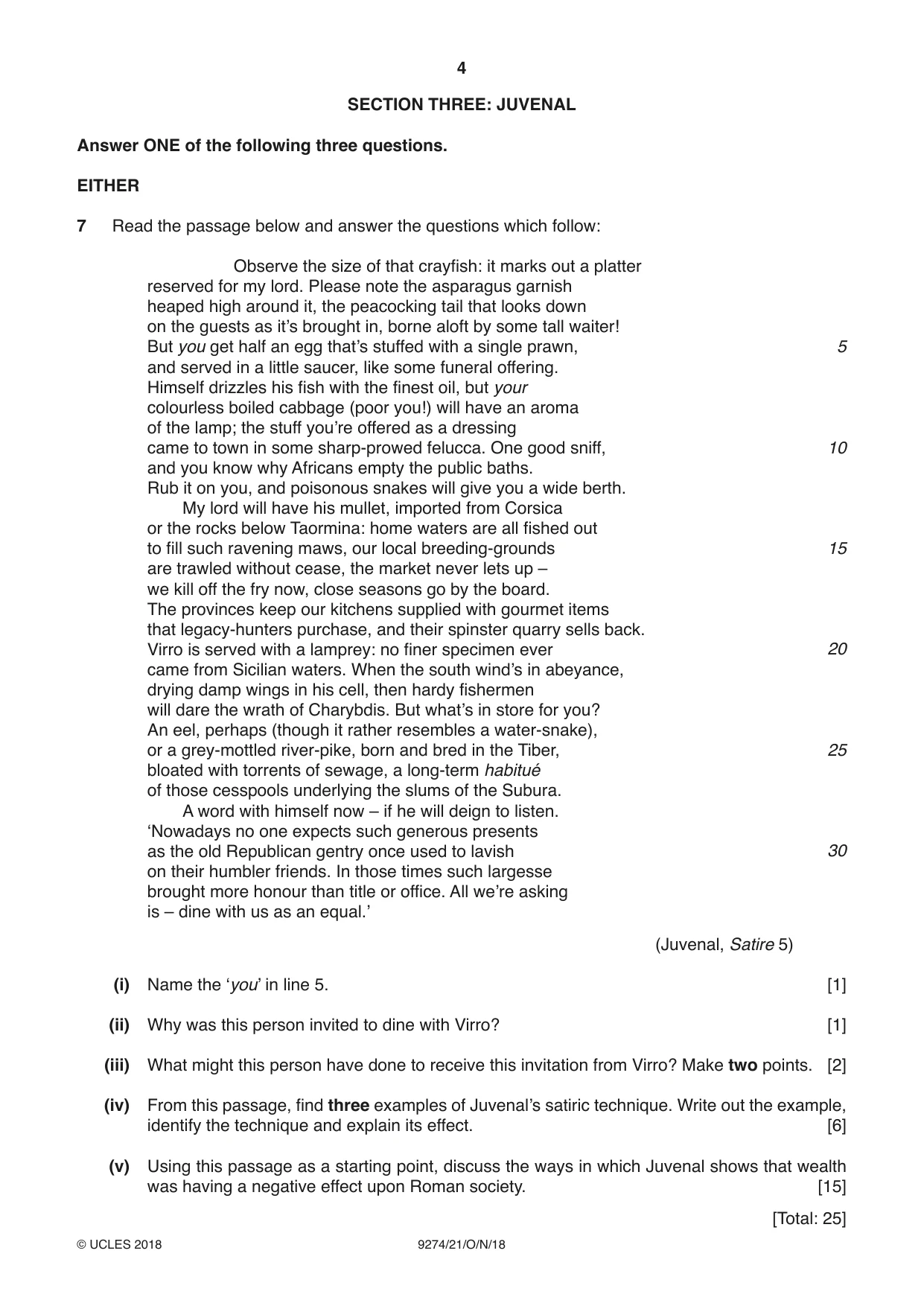



Mark scheme15 pages
Answers below. Sit the paper first if you are practising.
Questions as text
Q1 · Read the passage below and answer the questions which follow: The opposite view went like…
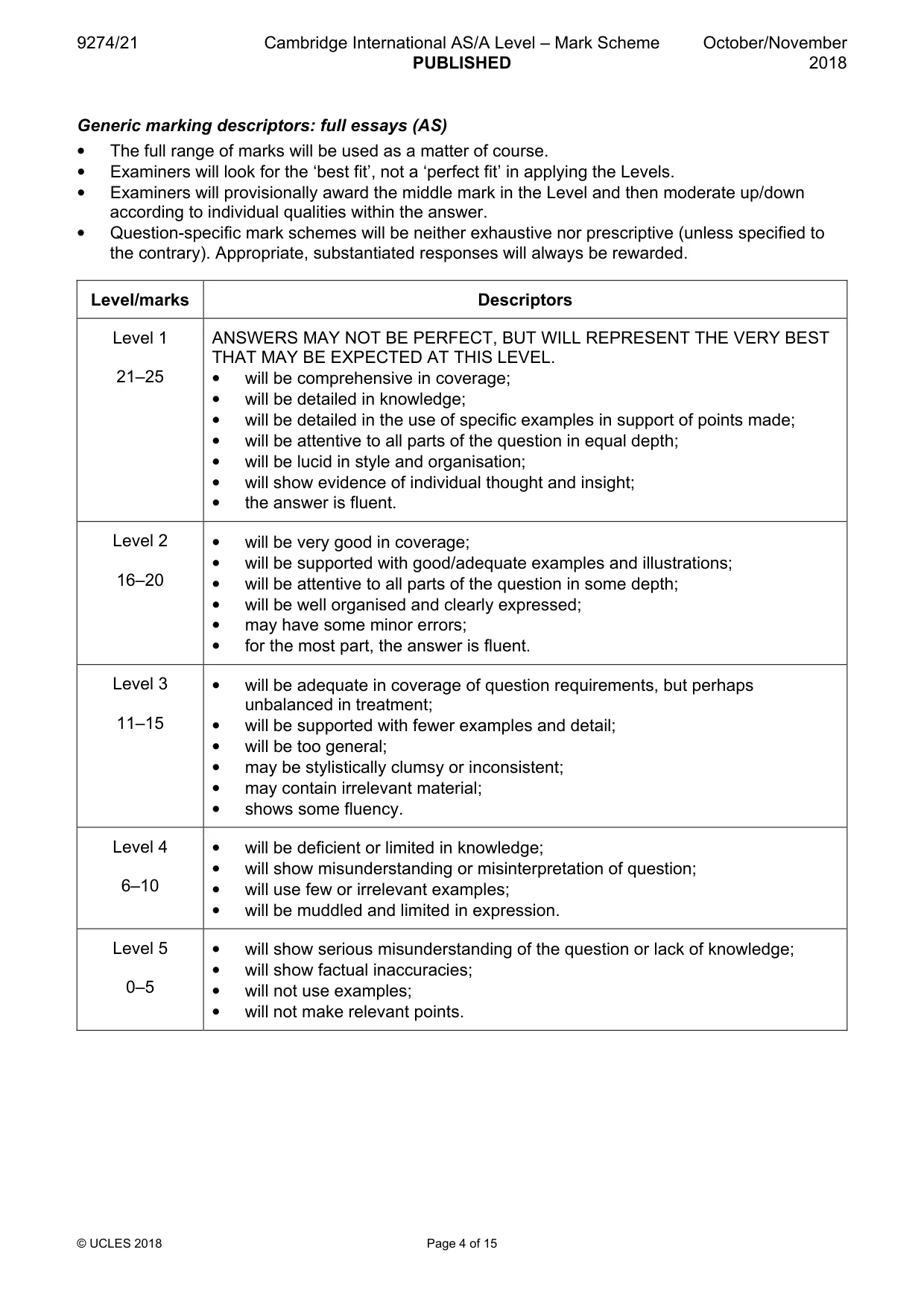
1 Read the passage below and answer the questions which follow: The opposite view went like this. Filial duty and national crisis had been merely pretexts. In actual fact, the motive of Octavian, the future Augustus, was lust for power. Inspired by that, he had mobilized ex-army settlers by gifts of money, raised an army – while he was only a half-grown boy without any official status – won over a consul’s brigades by bribery, pretended to support Sextus Pompeius (I), and by senatorial 5 decree usurped the status and rank of a praetor. Soon both consuls, Gaius Vibius Pansa and Aulus Hirtius, had met their deaths – by enemy action; or perhaps in the one case by the deliberate poisoning of his wound, and in the other at the hand of his own troops, instigated by Octavian. In any case it was he who took over both their armies. Then he had forced the reluctant senate to make him consul. But the forces 10 given him to deal with Antony he used against the State. His judicial murders and land distributions were distasteful even to those who carried them out. True, Cassius and Brutus died because he had inherited a feud against them; nevertheless, personal enmities ought to be sacrificed to the public interest. Next he had cheated Sextus Pompeius by a spurious peace treaty, Lepidus by spurious friendship. Then Antony, 15 enticed by the treaties of Tarentum and Brundusium and his marriage with Octavian’s sister, had paid the penalty of that delusive relationship with his life. After that, there had certainly been peace, but it was a bloodstained peace. (Tacitus, Annals 1) (i) In which battle were Pansa and Hirtius (lines 6–7) killed? [1] (ii) In which year did this battle take place? [1] (iii) Briefly describe how Octavian ‘forced the reluctant senate to make him consul’ (line 10). [3] (iv) Briefly describe how and why Octavian’s ‘land distributions’ (lines 11–12) were carried out. [4] (v) Why did Octavian have a ‘feud’ (line 13) against Cassius and Brutus? [1] (vi) Using this passage as a starting point, explain how far you feel that there was nothing legal or moral about the way Octavian seized power. [15] [Total: 25] OR
Mark scheme: Question Answer Marks 1(i) In which battle were Pansa and Hirtius (lines 6–7) killed? 1 • Mutina 1(ii) In which year did this battle take place? 1 • 43 BC 1(iii) Briefly describe how Octavian ‘forced the reluctant senate to make him 3 consul’ (line 10). After the Battle of Mutina, Octavian took control of their armies (1). He marched his army on Rome (1) and demanded to be made consul (1). When the senate refused, he sent soldiers into the Senate House (1) and threatened the senators (1). (Any 3) 1(iv) Briefly describe how and why Octavian’s ‘land distributions’ (lines 4 11–12) were carried out. After the civil wars ended, there were 62 legions in the army (1). Octavian decided to disband a large number of these (1) to prevent an armed uprising against him (1). Land was confiscated from Octavian’s enemies (1) and other landowners (1) and redistributed amongst the discharged veterans (1). (Any 4) 1(v) Why did Octavian have a ‘feud’ (line 13) against Cassius and Brutus? 1 Because they assassinated Julius Caesar. 1(vi) Using this passage as a starting point, explain how far you feel that 15 there was nothing legal or moral about the way Octavian seized power. Legal • Octavian raised an illegal private army from his father’s veterans. • He forced the senate to make him consul well before the legal age. • He formed the Second Triumvirate. • He organised the proscriptions. • He seized Antony’s will from the Vestal Virgins and published it. Moral • He betrayed his supporters, such as Cicero, in the proscriptions. • He made his sister marry Antony to cement their alliance. • He broke agreements made with Sextus, Pompey and Antony. But All his acts were ratified by the senate and People of Rome, either at the time, or later. He also gained the support of the people of Rome and of Italy during his rise to power, especially in the war against Antony.
Q2 · ‘Augustus’ family was more of a hindrance than a help to him during his reign.’ Explain…
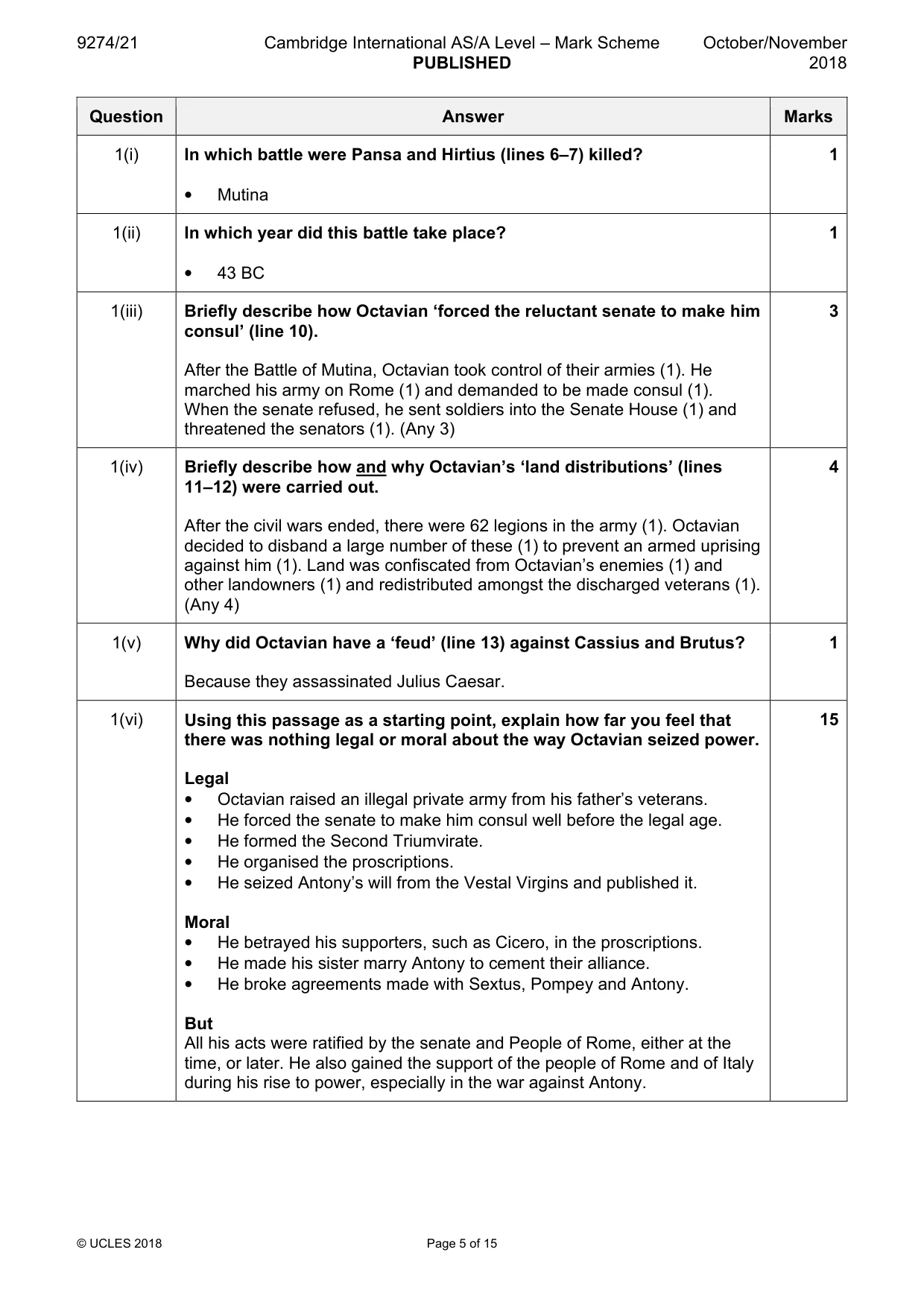
2 ‘Augustus’ family was more of a hindrance than a help to him during his reign.’ Explain how far you agree with this statement. [25] OR
Mark scheme: 2 ‘Augustus’ family was more of a hindrance than a help to him during 25 his reign.’ Explain how far you agree with this statement. Hindrance • Augustus’ reputation suffered from forcing Livia’s husband to divorce her, and marrying her while she was pregnant. • Livia had a bad reputation in certain areas as interfering in affairs of state and as a stepmother to Augustus’ adopted sons. • Augustus quarrelled constantly with Tiberius, who even left Rome for a while as a result. • Both his daughter and his granddaughter were exiled for immoral behaviour. • His adopted sons, Gaius and Lucius Caesar, whom he was educating to be his heirs, died before they could take over from him. Help • Livia was very useful to Augustus in helping him with his decisions. • Livia’s sons, Tiberius and Drusus, were entrusted with command of the Roman armies on the Rhine, as well as administrative duties. • Tiberius was adopted as Augustus’ heir, and carried on his legacy. • Julia proved to be a useful pawn in dynastic marriages. It is clear that Augustus relied heavily on his family members to help him rule the empire, and to carry on his legacy. But there were times when they were an embarrassment to him. Candidates may mention sons-in-law, such as Agrippa and Marcellus.
Q3 · To what extent would you agree that by the end of Augustus’ reign, the Senate had no…
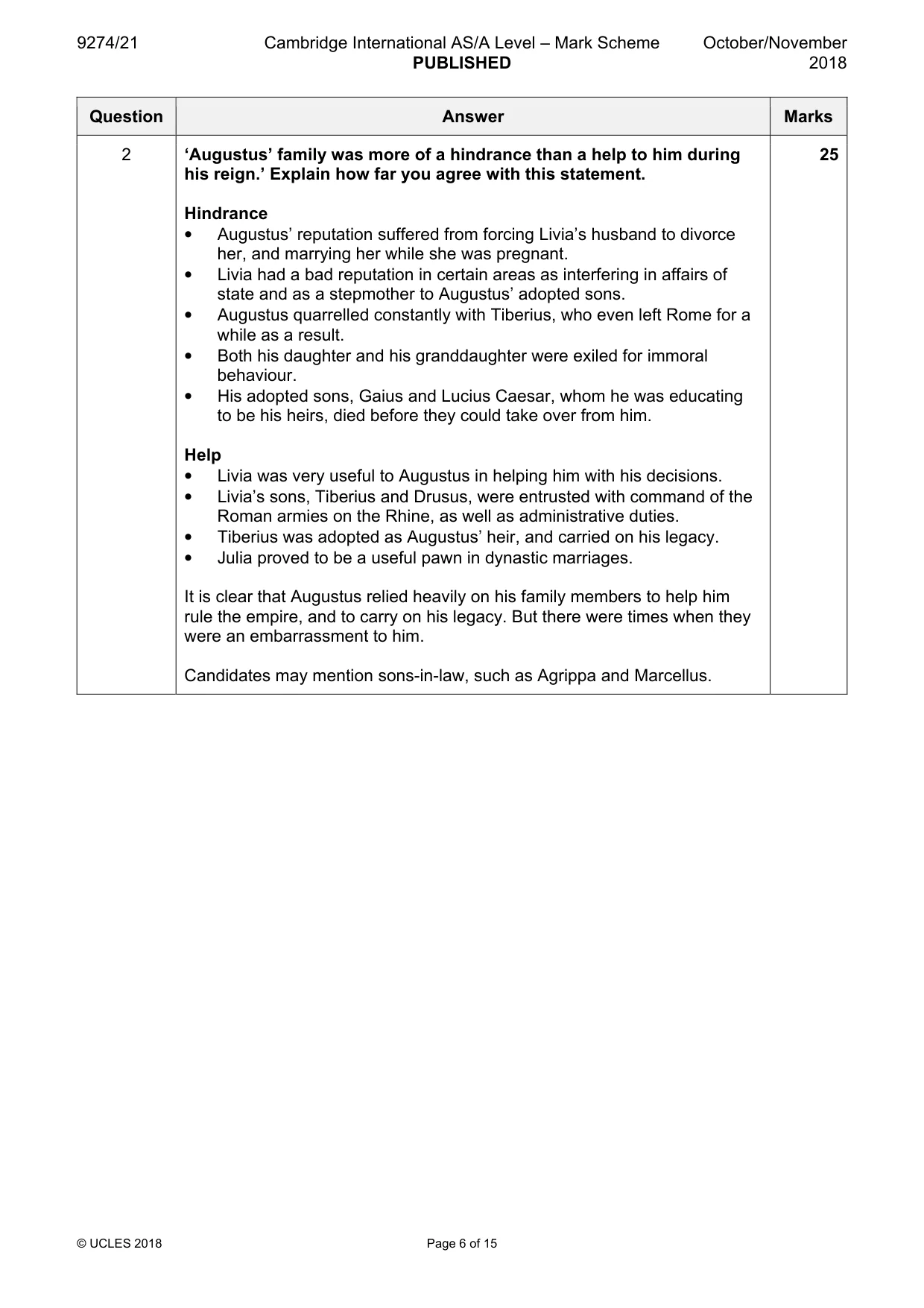
3 To what extent would you agree that by the end of Augustus’ reign, the Senate had no importance or power? [25] SECTION TWO: VIRGIL Answer ONE of the following three questions. EITHER
Mark scheme: 3 To what extent would you agree that by the end of Augustus’ reign, the 25 Senate had no importance or power? Importance • Being a senator carried a lot of prestige under Augustus. • His reforms and reorganisation of the senate as Censor enhanced its reputation. • He made use of senators in positions of authority in large areas of his administration. • Senators still coveted and obtained the position of Consul. • Augustus consulted the senate on questions of policy. Power • The senate still retained its traditional role of passing laws. • Senators still became governors of provinces after holding office. But • His role of Censor meant that he could decide who became a senator. • Although senators held positions of authority, Augustus also appointed Knights to many positions, especially in his executive. • Augustus effectively decided who stood for office and who was elected. • Although Augustus consulted the senate, he was not bound to accept its advice. • Augustus mostly decided what laws the senate should pass. • Senators only governed peaceful provinces with no army. Augustus personally appointed the governors of a large number of provinces. • The senate gave him the power to make treaties with foreign powers in his own name, and he, not the senate, received foreign embassies. • Augustus was careful to maintain the appearance of the senate’s authority, but in practice, he gradually eroded its powers, until by the end of his reign, actual power was in his hands, and that of his Council.
Q4 · Read the passage below and answer the questions which follow: Saying these words, she had…
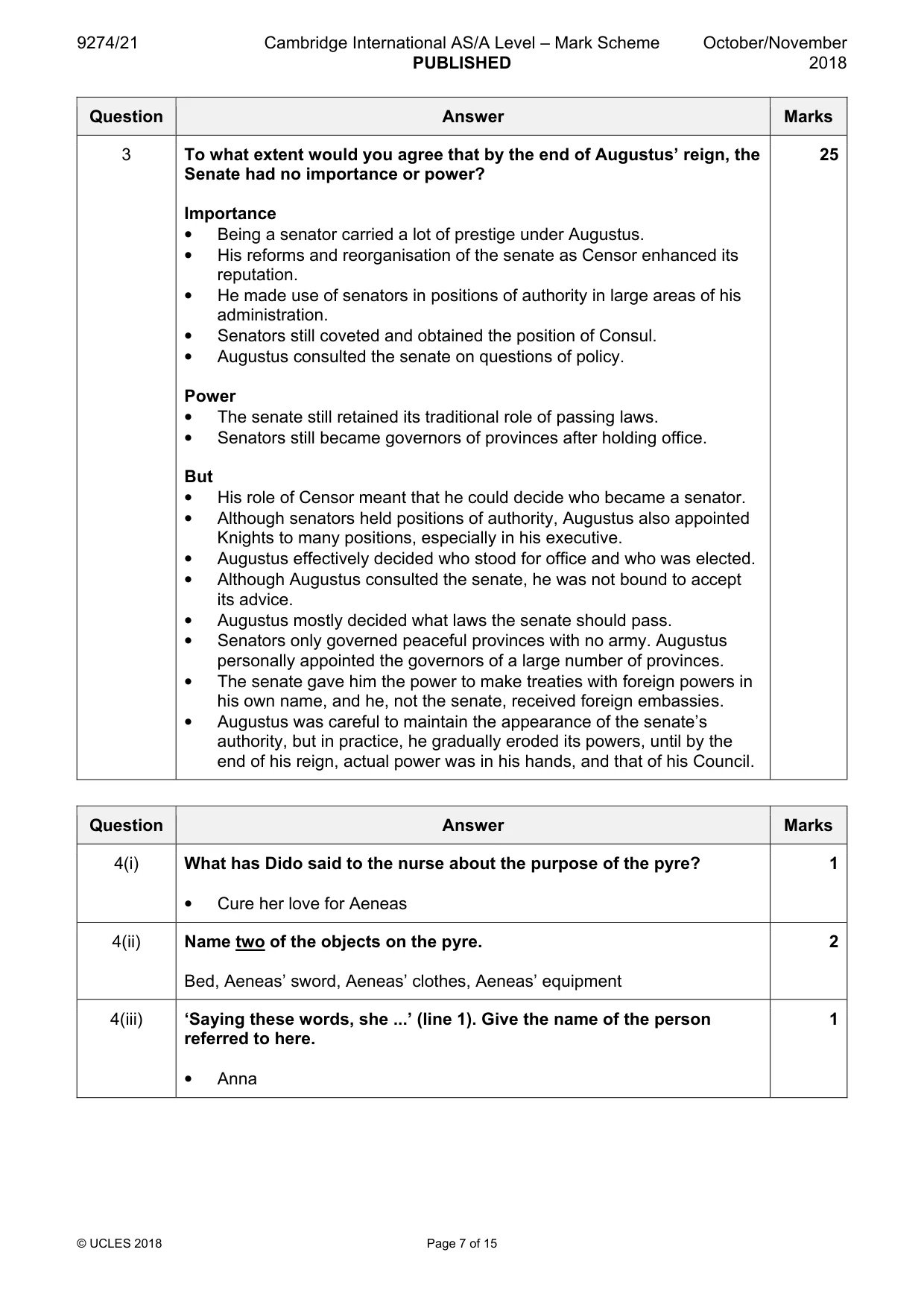
4 Read the passage below and answer the questions which follow: Saying these words, she had climbed to the top of the pyre and was now holding her dying sister to her breast and cherishing her, sobbing as she dried the dark blood with her own dress. Once more Dido tried to raise her heavy eyes, but failed. The wound hissed round the sword beneath her breast. Three times she raised herself on her elbow. Three times she fell back on the bed. With wavering eyes she looked for 5 light in the heights of heaven and groaned when she found it. All-powerful Juno then took pity on her long anguish and difficult death and sent Iris down from Olympus to free her struggling spirit and loosen the fastenings of her limbs. For since she was dying not by the decree of Fate or by her own deserts but pitiably and before her time, in a sudden blaze of madness, Proserpina had not yet 10 taken a lock of her golden hair or consigned her to Stygian Orcus. (Virgil, Aeneid 4) (i) What has Dido said to the nurse about the purpose of the pyre? [1] (ii) Name two of the objects on the pyre. [2] (iii) ‘Saying these words, she ...’ (line 1). Give the name of the person referred to here. [1] (iv) Explain why this passage is tragic. You should consider both what happens and the way it is written. Make three points. [6] (v) To what extent do you feel sympathy towards Dido in the books of the Aeneid you have studied? [15] [Total: 25] OR
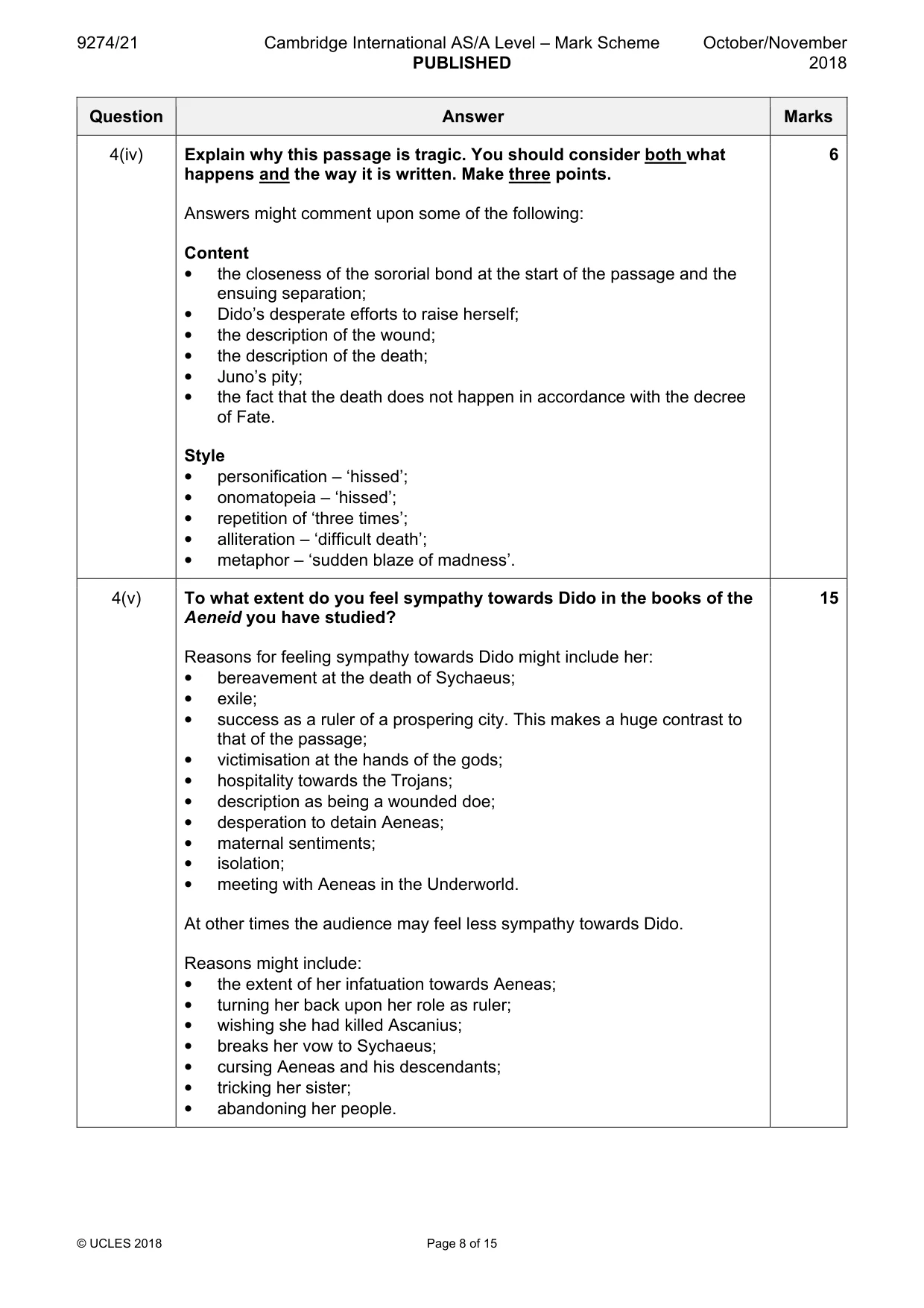
Mark scheme: 4(i) What has Dido said to the nurse about the purpose of the pyre? 1 • Cure her love for Aeneas 4(ii) Name two of the objects on the pyre. 2 Bed, Aeneas’ sword, Aeneas’ clothes, Aeneas’ equipment 4(iii) ‘Saying these words, she ...’ (line 1). Give the name of the person 1 referred to here. • Anna 4(iv) Explain why this passage is tragic. You should consider both what 6 happens and the way it is written. Make three points. Answers might comment upon some of the following: Content • the closeness of the sororial bond at the start of the passage and the ensuing separation; • Dido’s desperate efforts to raise herself; • the description of the wound; • the description of the death; • Juno’s pity; • the fact that the death does not happen in accordance with the decree of Fate. Style • personification – ‘hissed’; • onomatopeia – ‘hissed’; • repetition of ‘three times’; • alliteration – ‘difficult death’; • metaphor – ‘sudden blaze of madness’. 4(v) To what extent do you feel sympathy towards Dido in the books of the 15 Aeneid you have studied? Reasons for feeling sympathy towards Dido might include her: • bereavement at the death of Sychaeus; • exile; • success as a ruler of a prospering city. This makes a huge contrast to that of the passage; • victimisation at the hands of the gods; • hospitality towards the Trojans; • description as being a wounded doe; • desperation to detain Aeneas; • maternal sentiments; • isolation; • meeting with Aeneas in the Underworld. At other times the audience may feel less sympathy towards Dido. Reasons might include: • the extent of her infatuation towards Aeneas; • turning her back upon her role as ruler; • wishing she had killed Ascanius; • breaks her vow to Sychaeus; • cursing Aeneas and his descendants; • tricking her sister; • abandoning her people.
Q5 · ‘A man on a mission.’ How committed do you think Aeneas is to his mission in the books of…
5 ‘A man on a mission.’ How committed do you think Aeneas is to his mission in the books of the Aeneid you have studied? [25] OR
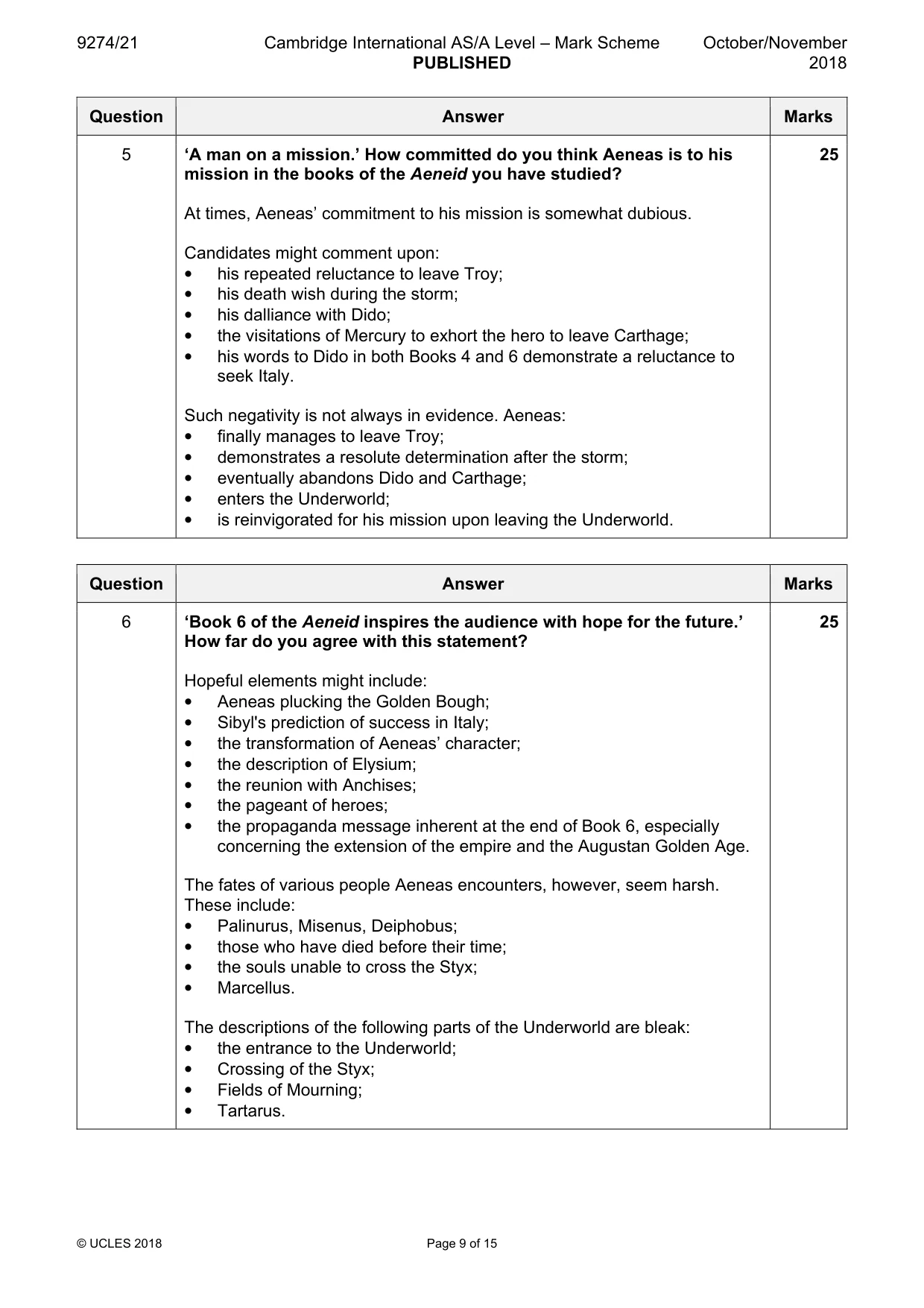
Mark scheme: 5 ‘A man on a mission.’ How committed do you think Aeneas is to his 25 mission in the books of the Aeneid you have studied? At times, Aeneas’ commitment to his mission is somewhat dubious. Candidates might comment upon: • his repeated reluctance to leave Troy; • his death wish during the storm; • his dalliance with Dido; • the visitations of Mercury to exhort the hero to leave Carthage; • his words to Dido in both Books 4 and 6 demonstrate a reluctance to seek Italy. Such negativity is not always in evidence. Aeneas: • finally manages to leave Troy; • demonstrates a resolute determination after the storm; • eventually abandons Dido and Carthage; • enters the Underworld; • is reinvigorated for his mission upon leaving the Underworld.
Q6 · ‘Book 6 of the Aeneid inspires the audience with hope for the future.’ How far do you…
6 ‘Book 6 of the Aeneid inspires the audience with hope for the future.’ How far do you agree with this statement? [25] SECTION THREE: JUVENAL Answer ONE of the following three questions. EITHER
Mark scheme: 6 ‘Book 6 of the Aeneid inspires the audience with hope for the future.’ 25 How far do you agree with this statement? Hopeful elements might include: • Aeneas plucking the Golden Bough; • Sibyl's prediction of success in Italy; • the transformation of Aeneas’ character; • the description of Elysium; • the reunion with Anchises; • the pageant of heroes; • the propaganda message inherent at the end of Book 6, especially concerning the extension of the empire and the Augustan Golden Age. The fates of various people Aeneas encounters, however, seem harsh. These include: • Palinurus, Misenus, Deiphobus; • those who have died before their time; • the souls unable to cross the Styx; • Marcellus. The descriptions of the following parts of the Underworld are bleak: • the entrance to the Underworld; • Crossing of the Styx; • Fields of Mourning; • Tartarus.
Q7 · Read the passage below and answer the questions which follow: Observe the size of that…
7 Read the passage below and answer the questions which follow: Observe the size of that crayfish: it marks out a platter reserved for my lord. Please note the asparagus garnish heaped high around it, the peacocking tail that looks down on the guests as it’s brought in, borne aloft by some tall waiter! But you get half an egg that’s stuffed with a single prawn, 5 and served in a little saucer, like some funeral offering. Himself drizzles his fish with the finest oil, but your colourless boiled cabbage (poor you!) will have an aroma of the lamp; the stuff you’re offered as a dressing came to town in some sharp-prowed felucca. One good sniff, 10 and you know why Africans empty the public baths. Rub it on you, and poisonous snakes will give you a wide berth. My lord will have his mullet, imported from Corsica or the rocks below Taormina: home waters are all fished out to fill such ravening maws, our local breeding-grounds 15 are trawled without cease, the market never lets up – we kill off the fry now, close seasons go by the board. The provinces keep our kitchens supplied with gourmet items that legacy-hunters purchase, and their spinster quarry sells back. Virro is served with a lamprey: no finer specimen ever 20 came from Sicilian waters. When the south wind’s in abeyance, drying damp wings in his cell, then hardy fishermen will dare the wrath of Charybdis. But what’s in store for you? An eel, perhaps (though it rather resembles a water-snake), or a grey-mottled river-pike, born and bred in the Tiber, 25 bloated with torrents of sewage, a long-term habitué of those cesspools underlying the slums of the Subura. A word with himself now – if he will deign to listen. ‘Nowadays no one expects such generous presents as the old Republican gentry once used to lavish 30 on their humbler friends. In those times such largesse brought more honour than title or office. All we’re asking is – dine with us as an equal.’ (Juvenal, Satire 5) (i) Name the ‘you’ in line 5. [1] (ii) Why was this person invited to dine with Virro? [1] (iii) What might this person have done to receive this invitation from Virro? Make two points. [2] (iv) From this passage, find three examples of Juvenal’s satiric technique. Write out the example, identify the technique and explain its effect. [6] (v) Using this passage as a starting point, discuss the ways in which Juvenal shows that wealth was having a negative effect upon Roman society. [15] [Total: 25] OR
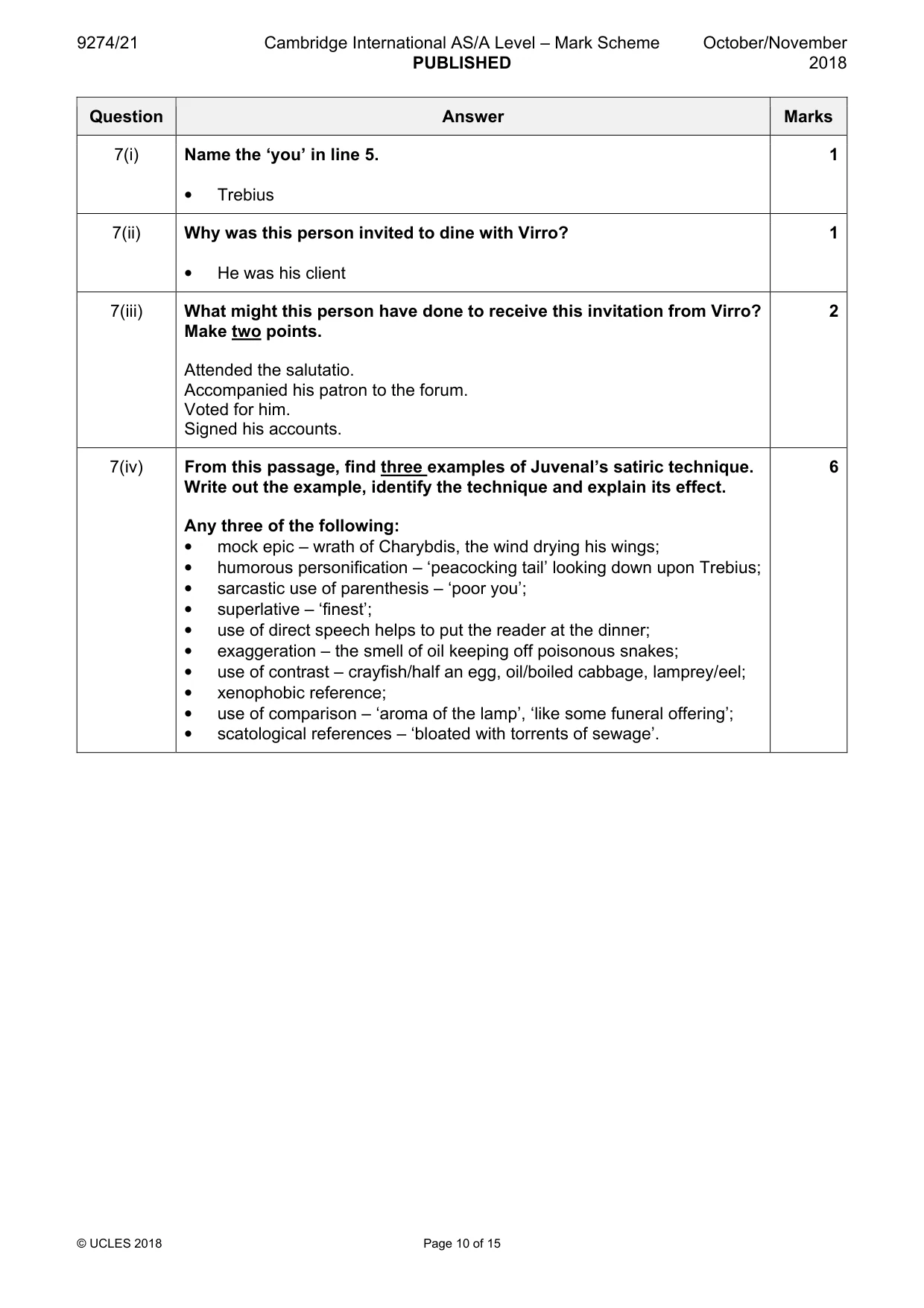
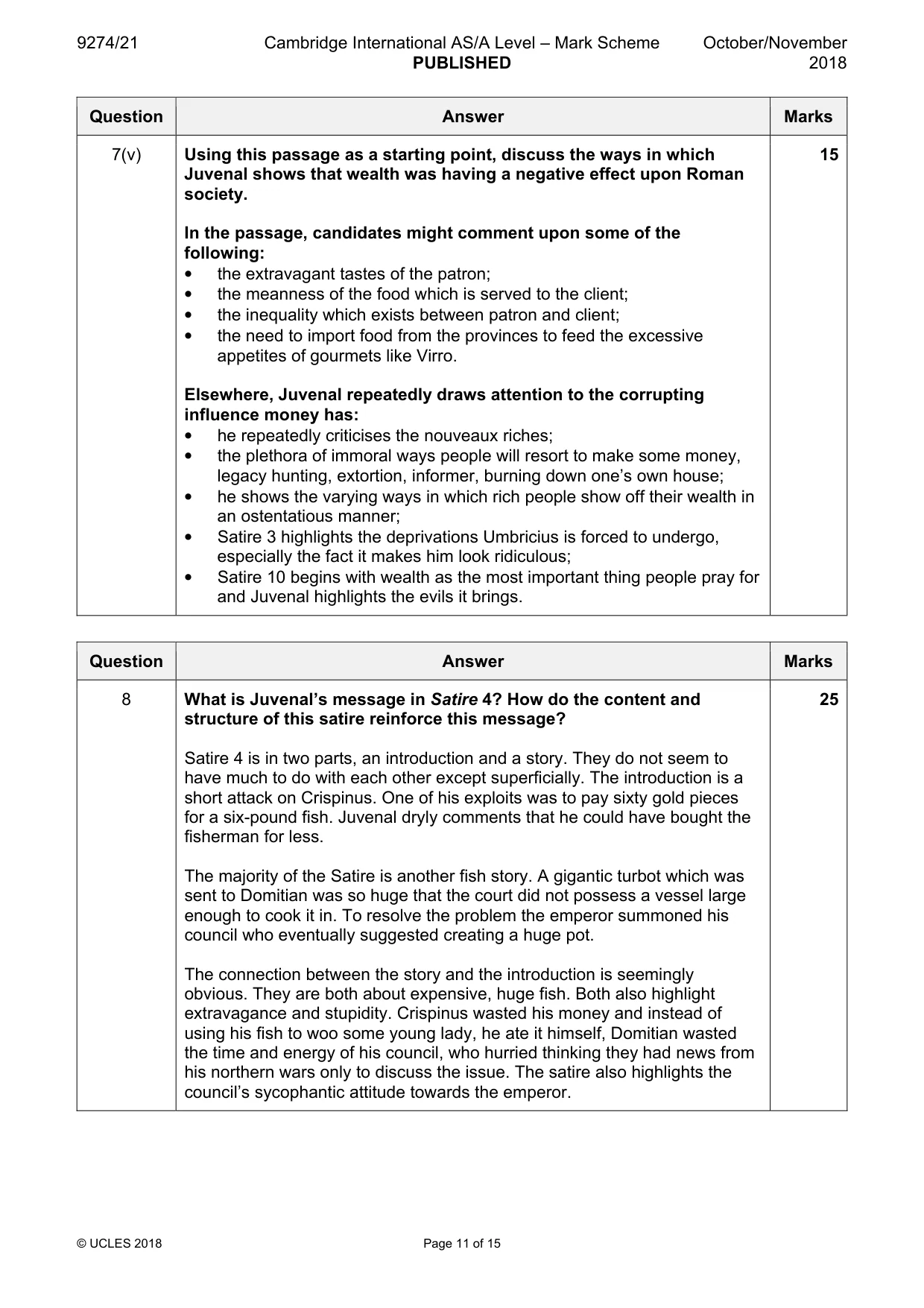
Mark scheme: 7(i) Name the ‘you’ in line 5. 1 • Trebius 7(ii) Why was this person invited to dine with Virro? 1 • He was his client 7(iii) What might this person have done to receive this invitation from Virro? 2 Make two points. Attended the salutatio. Accompanied his patron to the forum. Voted for him. Signed his accounts. 7(iv) From this passage, find three examples of Juvenal’s satiric technique. 6 Write out the example, identify the technique and explain its effect. Any three of the following: • mock epic – wrath of Charybdis, the wind drying his wings; • humorous personification – ‘peacocking tail’ looking down upon Trebius; • sarcastic use of parenthesis – ‘poor you’; • superlative – ‘finest’; • use of direct speech helps to put the reader at the dinner; • exaggeration – the smell of oil keeping off poisonous snakes; • use of contrast – crayfish/half an egg, oil/boiled cabbage, lamprey/eel; • xenophobic reference; • use of comparison – ‘aroma of the lamp’, ‘like some funeral offering’; • scatological references – ‘bloated with torrents of sewage’. 7(v) Using this passage as a starting point, discuss the ways in which 15 Juvenal shows that wealth was having a negative effect upon Roman society. In the passage, candidates might comment upon some of the following: • the extravagant tastes of the patron; • the meanness of the food which is served to the client; • the inequality which exists between patron and client; • the need to import food from the provinces to feed the excessive appetites of gourmets like Virro. Elsewhere, Juvenal repeatedly draws attention to the corrupting influence money has: • he repeatedly criticises the nouveaux riches; • the plethora of immoral ways people will resort to make some money, legacy hunting, extortion, informer, burning down one’s own house; • he shows the varying ways in which rich people show off their wealth in an ostentatious manner; • Satire 3 highlights the deprivations Umbricius is forced to undergo, especially the fact it makes him look ridiculous; • Satire 10 begins with wealth as the most important thing people pray for and Juvenal highlights the evils it brings.
Q8 · What is Juvenal’s message in Satire 4?
8 What is Juvenal’s message in Satire 4? How do the content and structure of this satire reinforce this message? [25] OR
Mark scheme: 8 What is Juvenal’s message in Satire 4? How do the content and 25 structure of this satire reinforce this message? Satire 4 is in two parts, an introduction and a story. They do not seem to have much to do with each other except superficially. The introduction is a short attack on Crispinus. One of his exploits was to pay sixty gold pieces for a six-pound fish. Juvenal dryly comments that he could have bought the fisherman for less. The majority of the Satire is another fish story. A gigantic turbot which was sent to Domitian was so huge that the court did not possess a vessel large enough to cook it in. To resolve the problem the emperor summoned his council who eventually suggested creating a huge pot. The connection between the story and the introduction is seemingly obvious. They are both about expensive, huge fish. Both also highlight extravagance and stupidity. Crispinus wasted his money and instead of using his fish to woo some young lady, he ate it himself, Domitian wasted the time and energy of his council, who hurried thinking they had news from his northern wars only to discuss the issue. The satire also highlights the council’s sycophantic attitude towards the emperor.
Q9 · ‘Irrelevant when they were written and still irrelevant today.’ To what extent do you…
9 ‘Irrelevant when they were written and still irrelevant today.’ To what extent do you agree with this opinion of Juvenal’s Satires? [25] SECTION FOUR: ROMAN ARCHITECTURE Answer ONE of the following three questions. EITHER
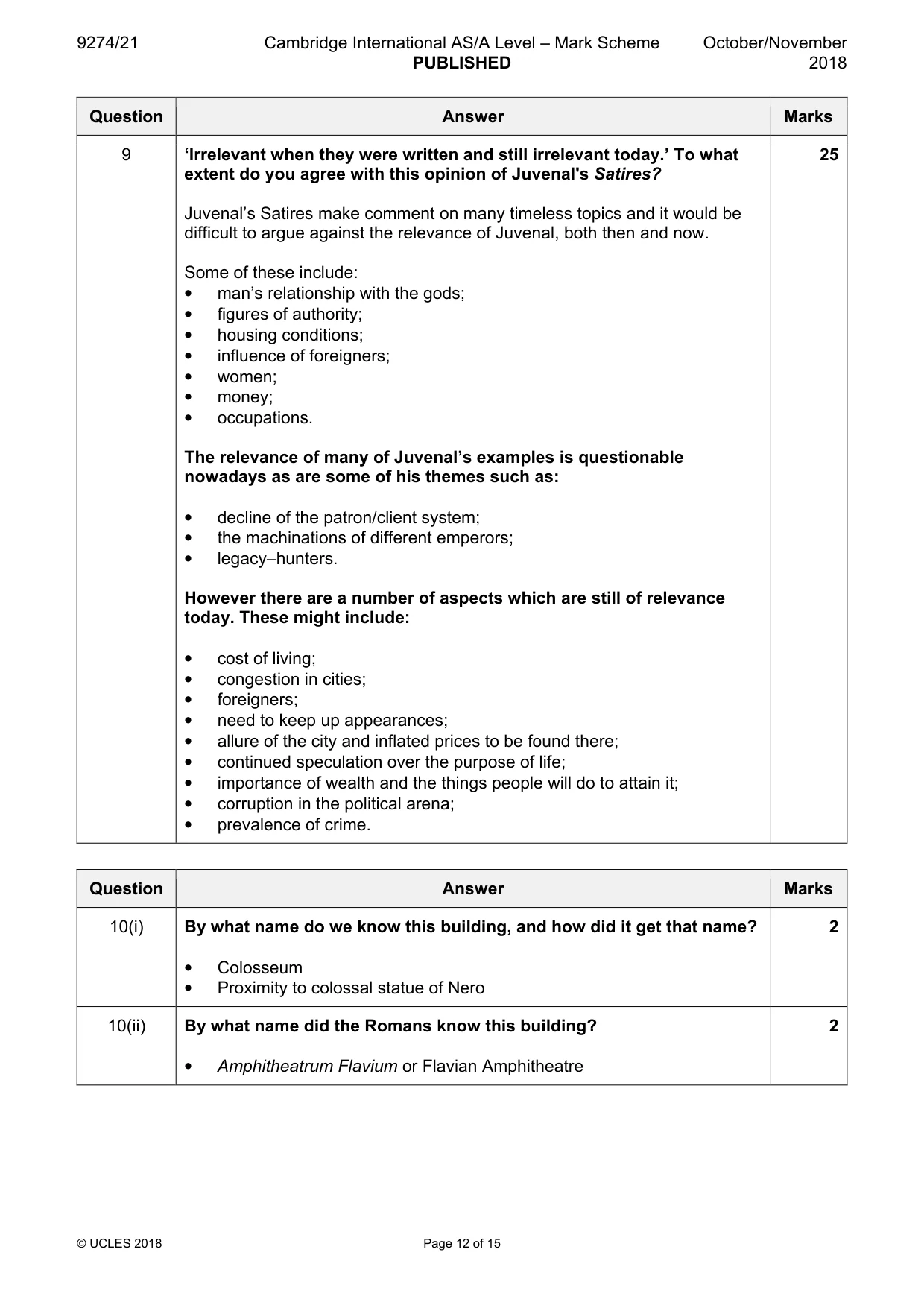
Mark scheme: 9 ‘Irrelevant when they were written and still irrelevant today.’ To what 25 extent do you agree with this opinion of Juvenal's Satires? Juvenal’s Satires make comment on many timeless topics and it would be difficult to argue against the relevance of Juvenal, both then and now. Some of these include: • man’s relationship with the gods; • figures of authority; • housing conditions; • influence of foreigners; • women; • money; • occupations. The relevance of many of Juvenal’s examples is questionable nowadays as are some of his themes such as: • decline of the patron/client system; • the machinations of different emperors; • legacy–hunters. However there are a number of aspects which are still of relevance today. These might include: • cost of living; • congestion in cities; • foreigners; • need to keep up appearances; • allure of the city and inflated prices to be found there; • continued speculation over the purpose of life; • importance of wealth and the things people will do to attain it; • corruption in the political arena; • prevalence of crime.
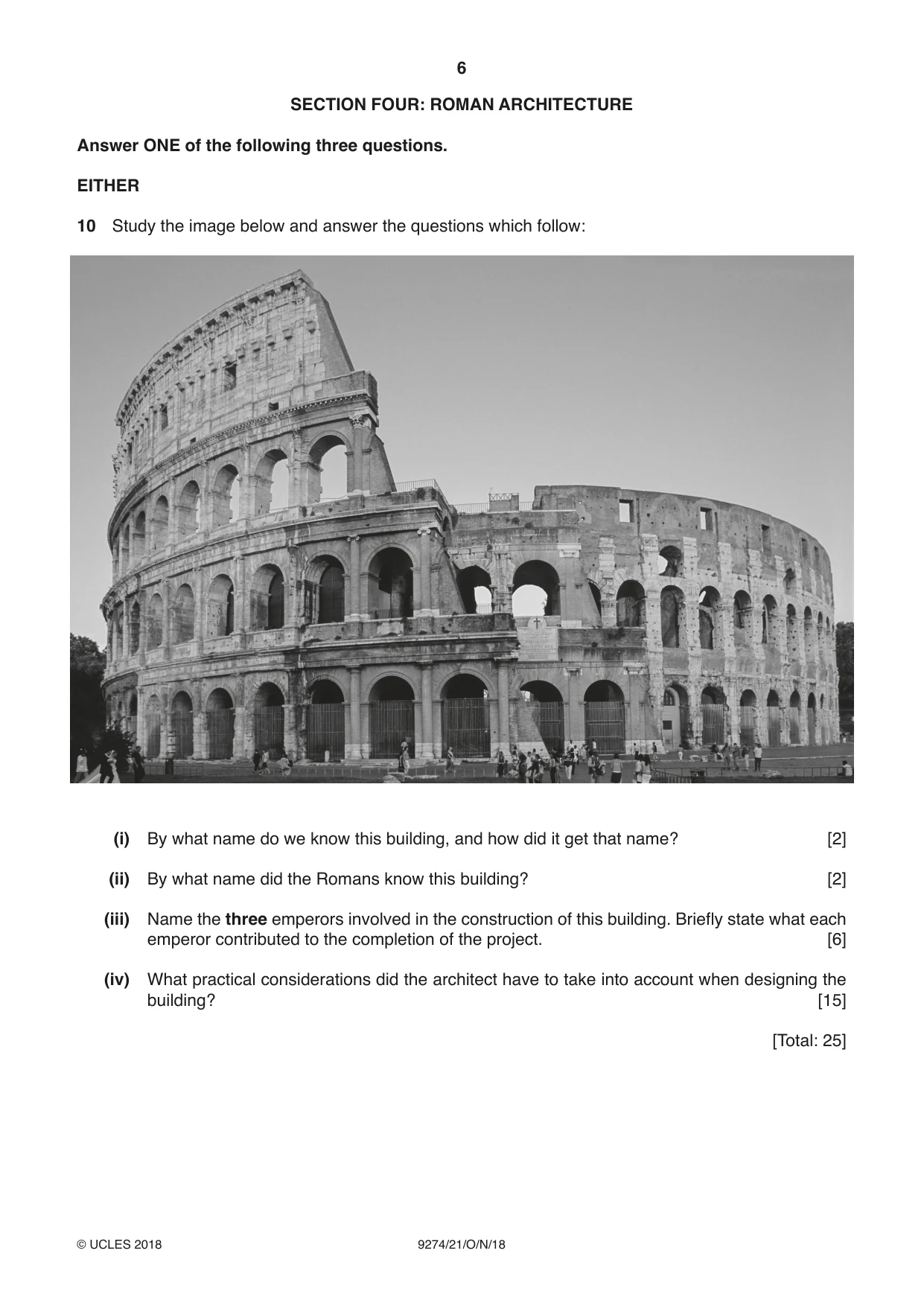
Q10 · Study the image below and answer the questions which follow: (i) By what name do we know…
10 Study the image below and answer the questions which follow: (i) By what name do we know this building, and how did it get that name? [2] (ii) By what name did the Romans know this building? [2] (iii) Name the three emperors involved in the construction of this building. Briefly state what each emperor contributed to the completion of the project. [6] (iv) What practical considerations did the architect have to take into account when designing the building? [15] [Total: 25] OR
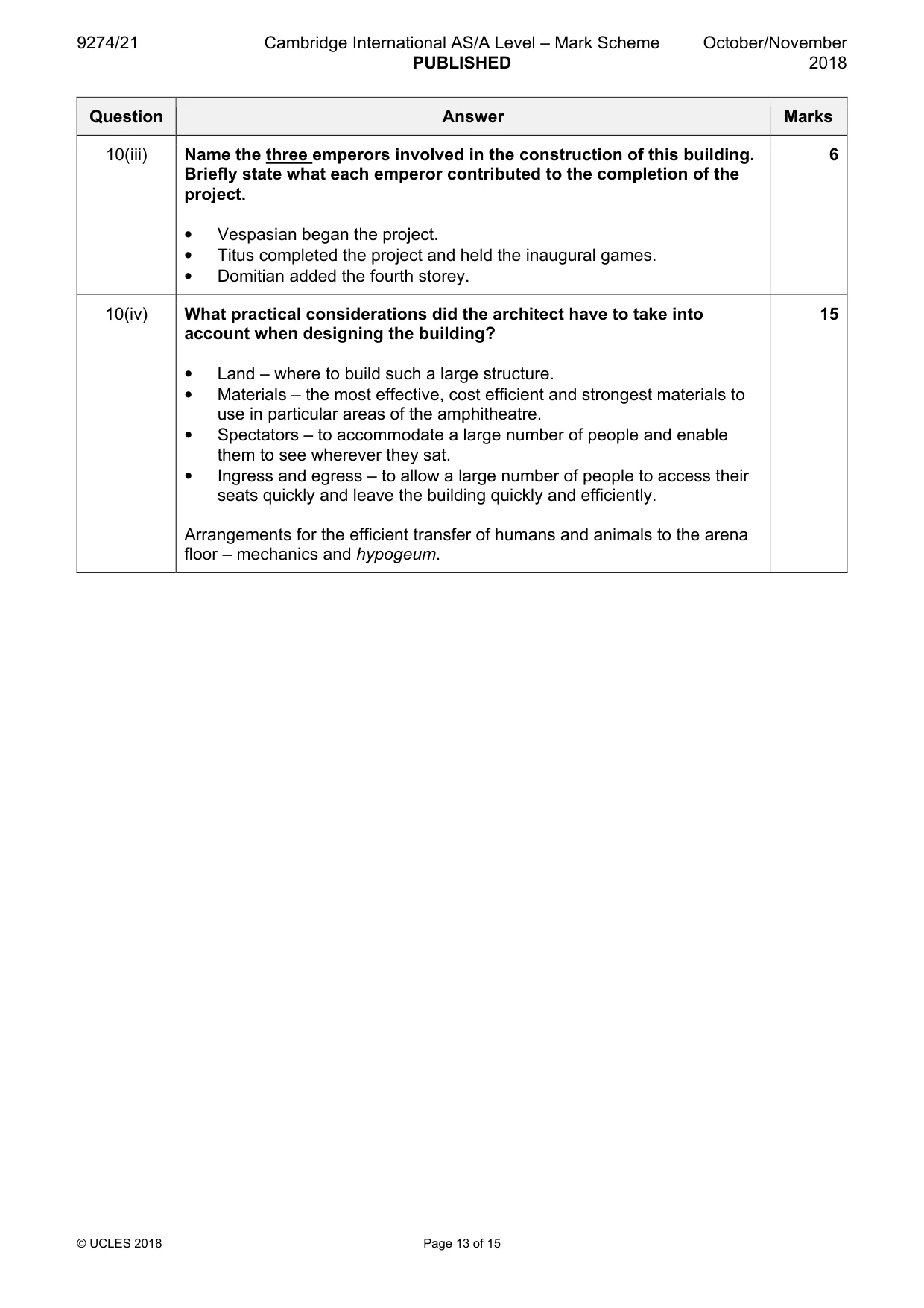
Mark scheme: 10(i) By what name do we know this building, and how did it get that name? 2 • Colosseum • Proximity to colossal statue of Nero 10(ii) By what name did the Romans know this building? 2 • Amphitheatrum Flavium or Flavian Amphitheatre 10(iii) Name the three emperors involved in the construction of this building. 6 Briefly state what each emperor contributed to the completion of the project. • Vespasian began the project. • Titus completed the project and held the inaugural games. • Domitian added the fourth storey. 10(iv) What practical considerations did the architect have to take into 15 account when designing the building? • Land – where to build such a large structure. • Materials – the most effective, cost efficient and strongest materials to use in particular areas of the amphitheatre. • Spectators – to accommodate a large number of people and enable them to see wherever they sat. • Ingress and egress – to allow a large number of people to access their seats quickly and leave the building quickly and efficiently. Arrangements for the efficient transfer of humans and animals to the arena floor – mechanics and hypogeum.
Q11 · ‘The Pantheon illustrates the most important characteristics of Roman architecture.’ How…
11 ‘The Pantheon illustrates the most important characteristics of Roman architecture.’ How far do you agree with this statement? In your answer, you should include discussion of other specific Roman buildings you have studied. [25] OR
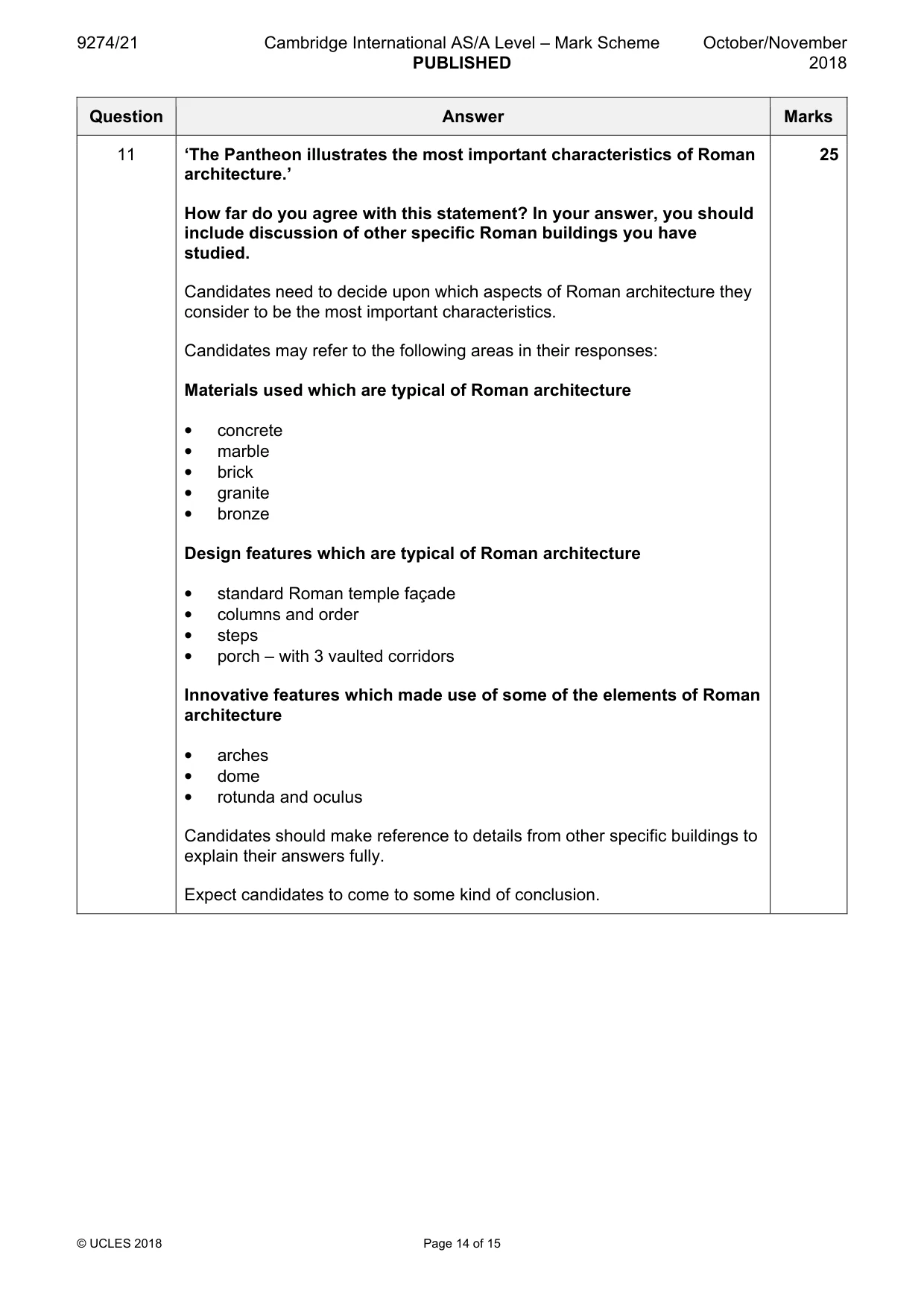
Mark scheme: 11 ‘The Pantheon illustrates the most important characteristics of Roman 25 architecture.’ How far do you agree with this statement? In your answer, you should include discussion of other specific Roman buildings you have studied. Candidates need to decide upon which aspects of Roman architecture they consider to be the most important characteristics. Candidates may refer to the following areas in their responses: Materials used which are typical of Roman architecture • concrete • marble • brick • granite • bronze Design features which are typical of Roman architecture • standard Roman temple façade • columns and order • steps • porch – with 3 vaulted corridors Innovative features which made use of some of the elements of Roman architecture • arches • dome • rotunda and oculus Candidates should make reference to details from other specific buildings to explain their answers fully. Expect candidates to come to some kind of conclusion.
Q12 · ‘The architecture of public bath complexes made them more suitable than theatres as…
12 ‘The architecture of public bath complexes made them more suitable than theatres as places of leisure and entertainment.’ To what extent do you agree with this statement? In your answer, you should include discussion of specific examples of each type of building. [25]
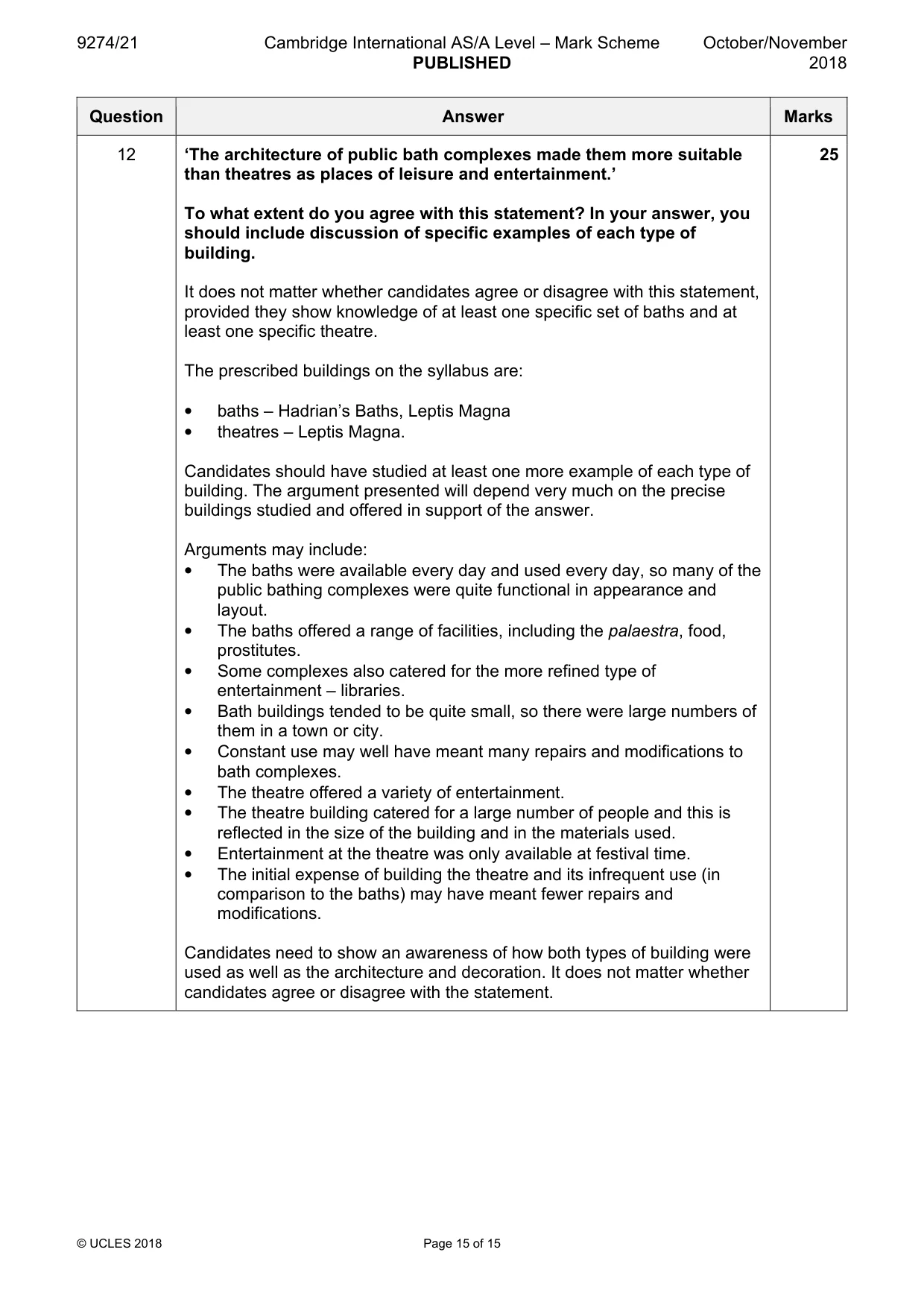
Mark scheme: 12 ‘The architecture of public bath complexes made them more suitable 25 than theatres as places of leisure and entertainment.’ To what extent do you agree with this statement? In your answer, you should include discussion of specific examples of each type of building. It does not matter whether candidates agree or disagree with this statement, provided they show knowledge of at least one specific set of baths and at least one specific theatre. The prescribed buildings on the syllabus are: • baths – Hadrian’s Baths, Leptis Magna • theatres – Leptis Magna. Candidates should have studied at least one more example of each type of building. The argument presented will depend very much on the precise buildings studied and offered in support of the answer. Arguments may include: • The baths were available every day and used every day, so many of the public bathing complexes were quite functional in appearance and layout. • The baths offered a range of facilities, including the palaestra, food, prostitutes. • Some complexes also catered for the more refined type of entertainment – libraries. • Bath buildings tended to be quite small, so there were large numbers of them in a town or city. • Constant use may well have meant many repairs and modifications to bath complexes. • The theatre offered a variety of entertainment. • The theatre building catered for a large number of people and this is reflected in the size of the building and in the materials used. • Entertainment at the theatre was only available at festival time. • The initial expense of building the theatre and its infrequent use (in comparison to the baths) may have meant fewer repairs and modifications. Candidates need to show an awareness of how both types of building were used as well as the architecture and decoration. It does not matter whether candidates agree or disagree with the statement.
What was in this paper
The subtopics covered by these 12 questions, and how many questions each got. Open one in a new tab to see every Cambridge question on it.
What you needed in this session
Cambridge’s own grade thresholds for 2018 Oct/Nov, Paper 2 · Variant 1. A higher threshold means an easier paper — the bar moves with how the cohort did.