Cambridge A Level Classical Studies 9274 — 2023 Oct/Nov Paper 2 · Variant 1
9274/21/O/N/23 · 9 questions · 50 marks · ≈56 min
The question paper and its mark scheme, free to read here and free to download. This is Cambridge’s own paper, exactly as it was sat.
Question paper8 pages



Mark scheme20 pages
Answers below. Sit the paper first if you are practising.
Questions as text
Q1 · Read the passage and answer the questions: Augustus turned the kingdom of Egypt into a…
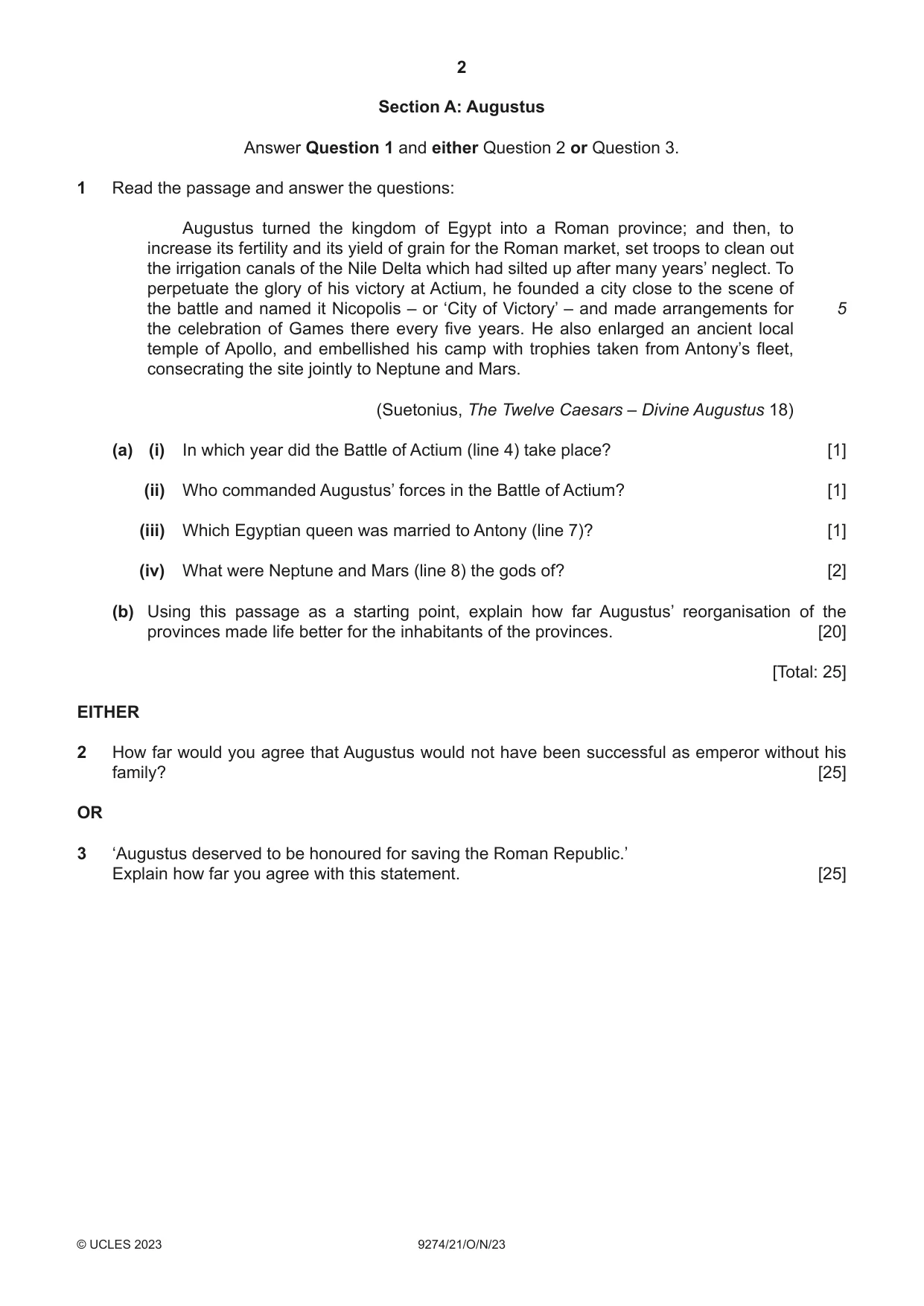
1 Read the passage and answer the questions: Augustus turned the kingdom of Egypt into a Roman province; and then, to increase its fertility and its yield of grain for the Roman market, set troops to clean out the irrigation canals of the Nile Delta which had silted up after many years’ neglect. To perpetuate the glory of his victory at Actium, he founded a city close to the scene of the battle and named it Nicopolis – or ‘City of Victory’ – and made arrangements for 5 the celebration of Games there every five years. He also enlarged an ancient local temple of Apollo, and embellished his camp with trophies taken from Antony’s fleet, consecrating the site jointly to Neptune and Mars. (Suetonius, The Twelve Caesars – Divine Augustus 18) (a) (i) In which year did the Battle of Actium (line 4) take place? [1] (ii) Who commanded Augustus’ forces in the Battle of Actium? [1] (iii) Which Egyptian queen was married to Antony (line 7)? [1] (iv) What were Neptune and Mars (line 8) the gods of? [2] (b) Using this passage as a starting point, explain how far Augustus’ reorganisation of the provinces made life better for the inhabitants of the provinces. [20] [Total: 25] EITHER
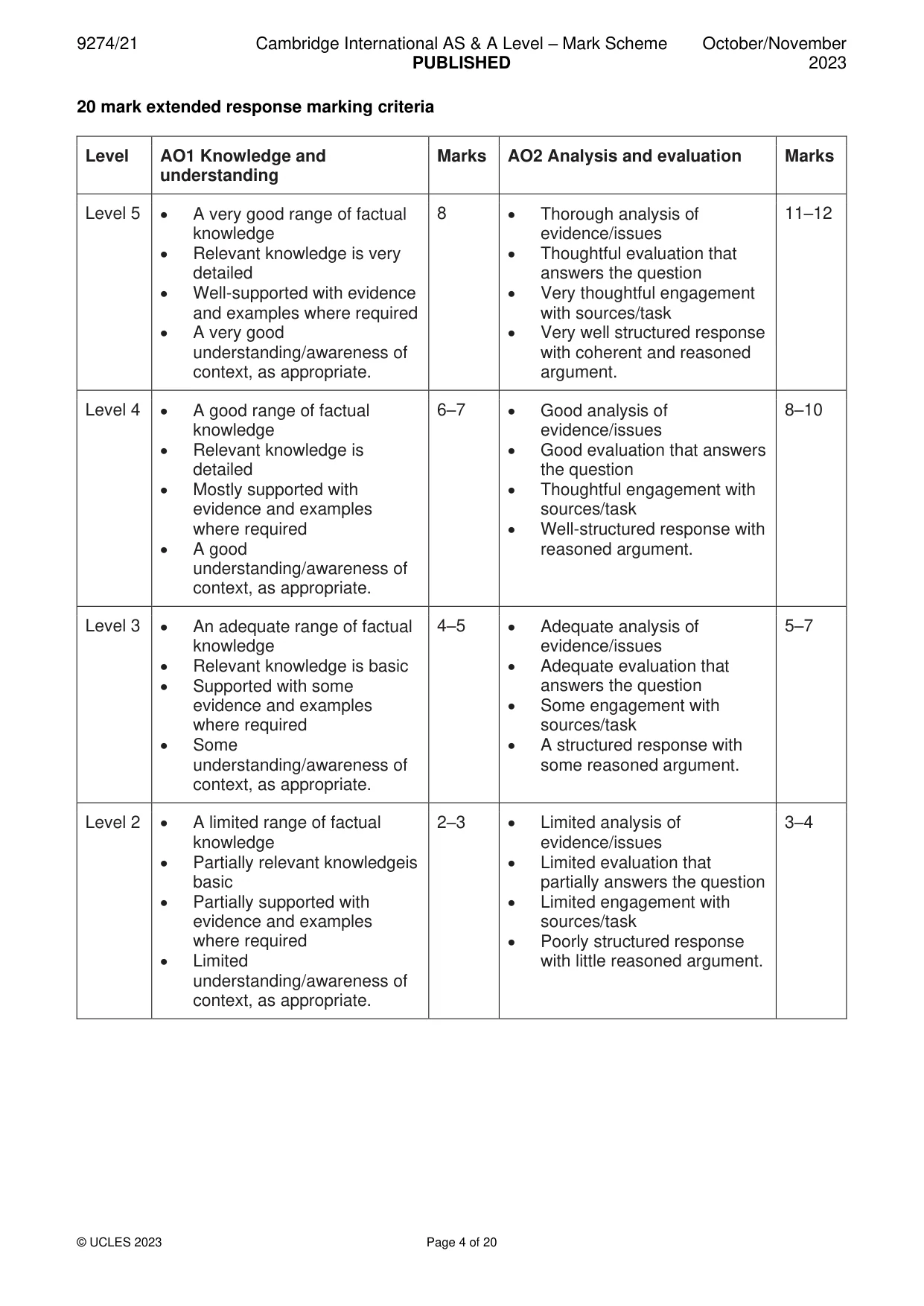
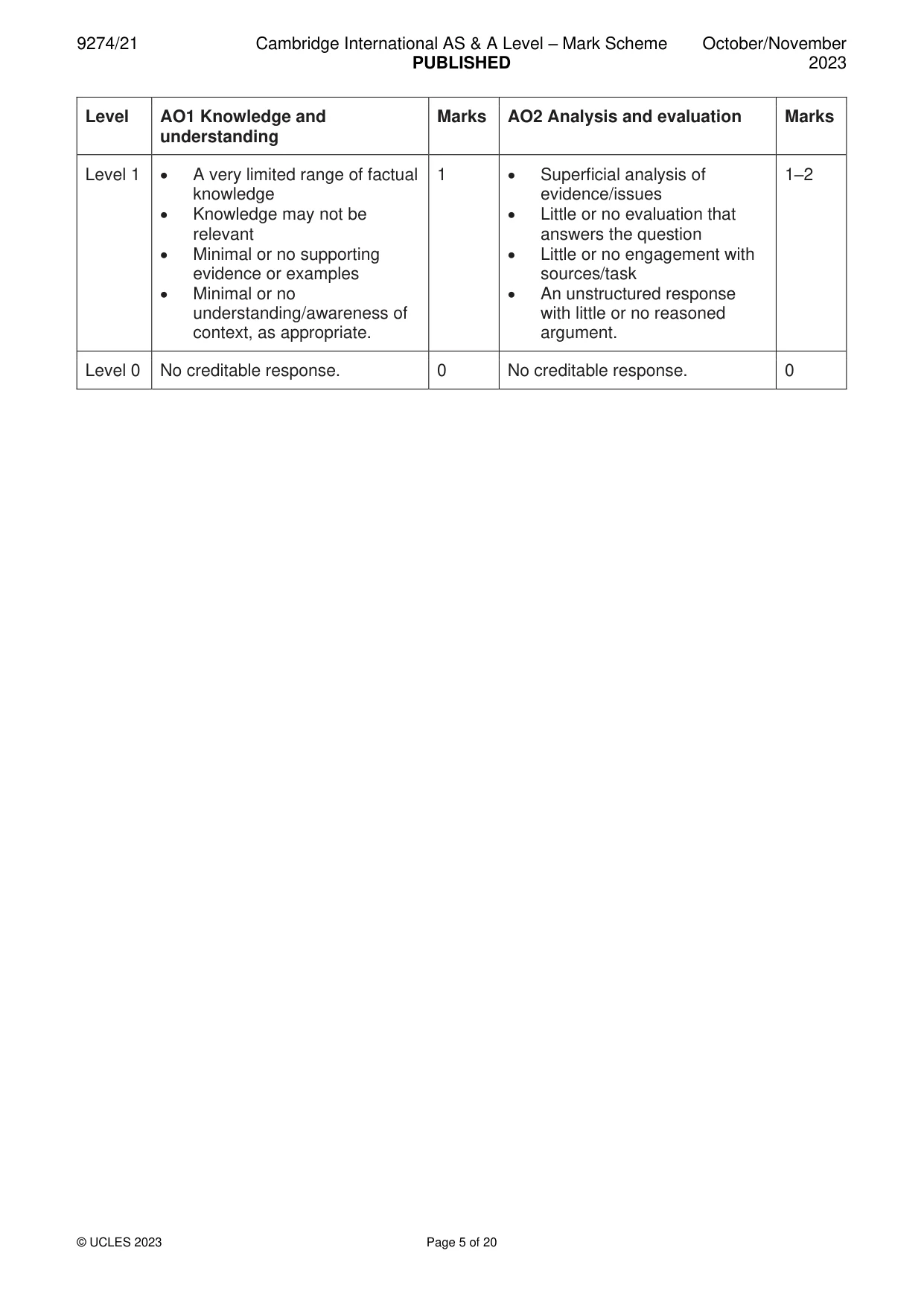
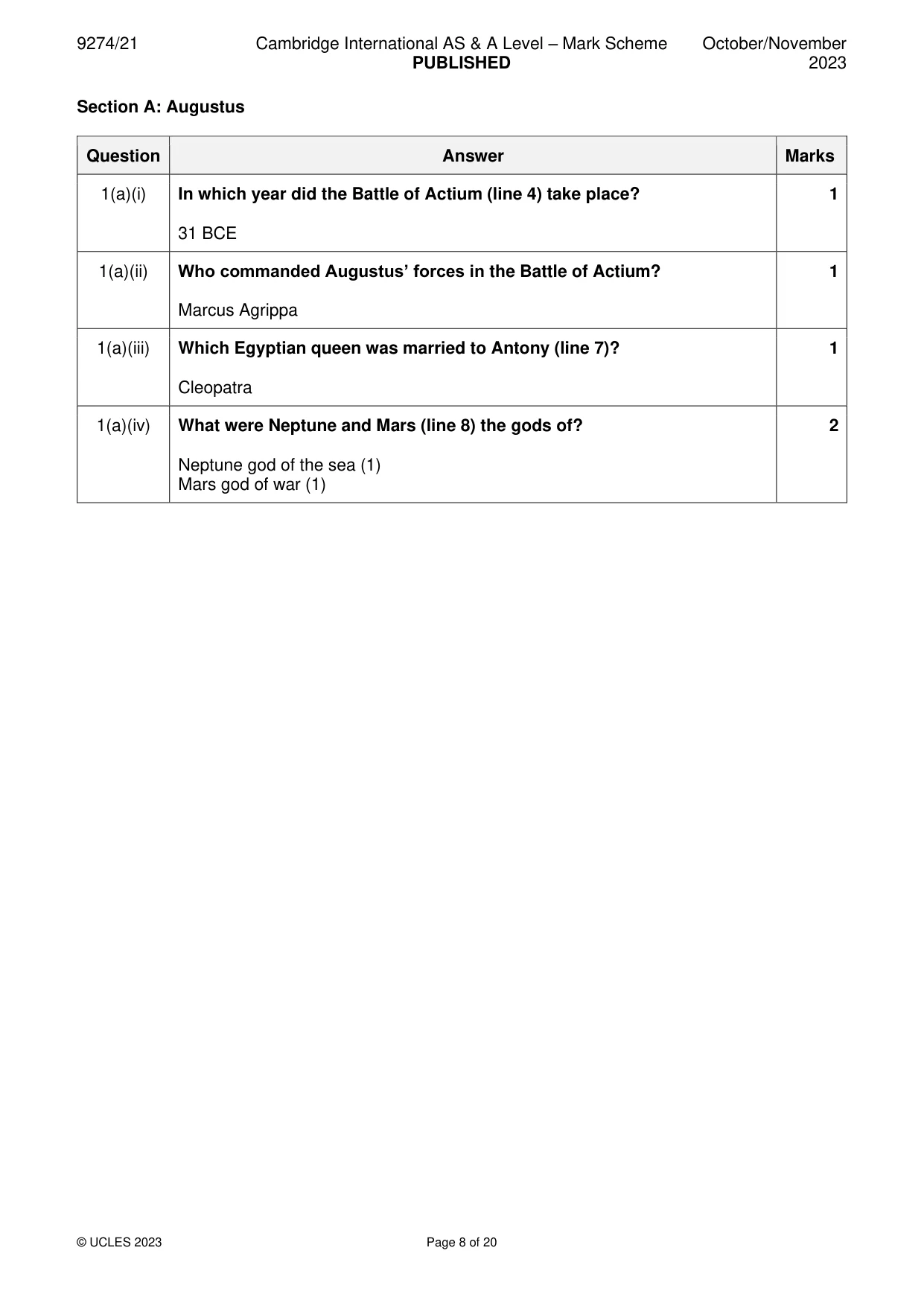
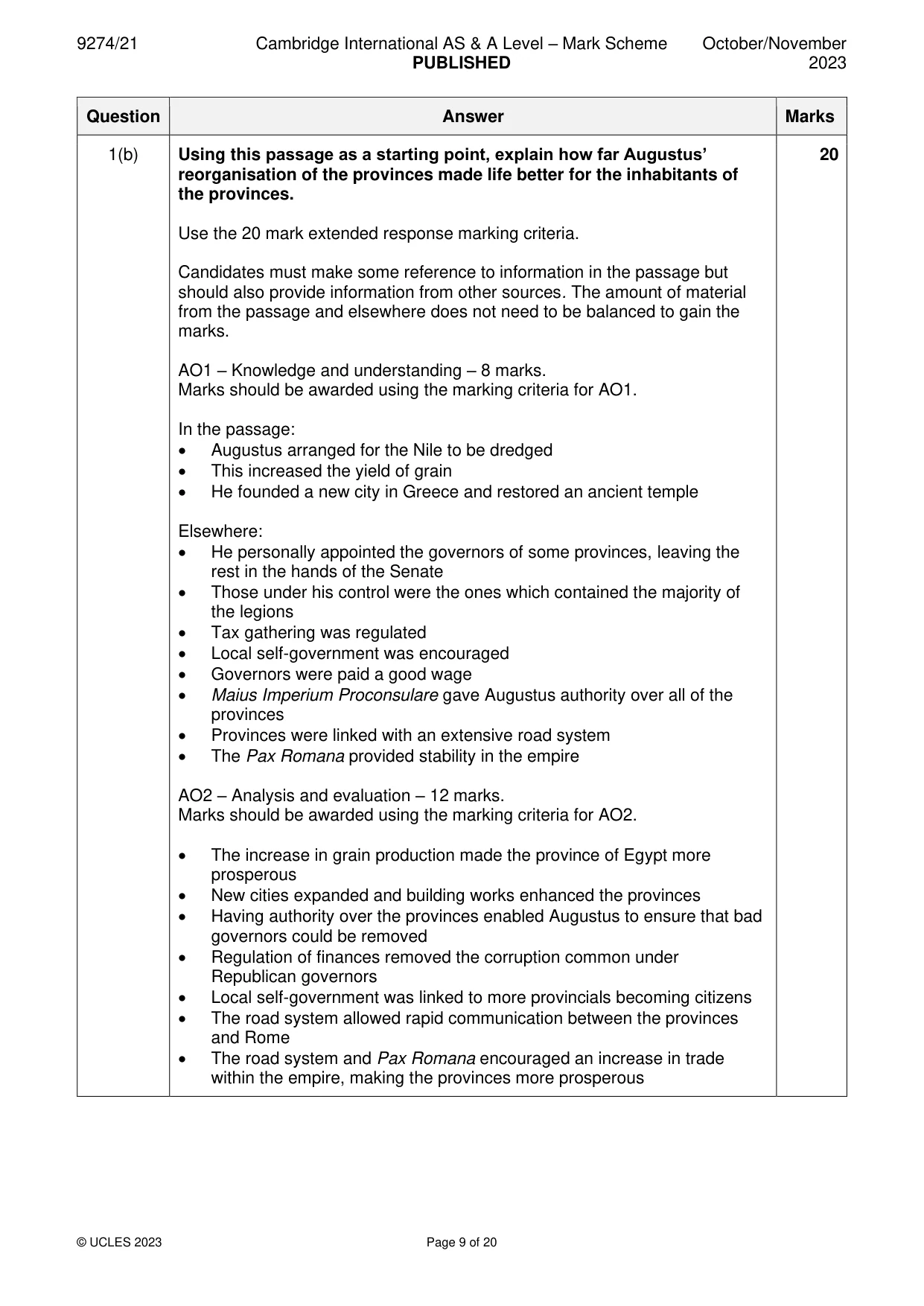
Mark scheme: Question Answer Marks 1(a)(i) In which year did the Battle of Actium (line 4) take place? 1 31 BCE 1(a)(ii) Who commanded Augustus’ forces in the Battle of Actium? 1 Marcus Agrippa 1(a)(iii) Which Egyptian queen was married to Antony (line 7)? 1 Cleopatra 1(a)(iv) What were Neptune and Mars (line 8) the gods of? 2 Neptune god of the sea (1) Mars god of war (1) 1(b) Using this passage as a starting point, explain how far Augustus’ 20 reorganisation of the provinces made life better for the inhabitants of the provinces. Use the 20 mark extended response marking criteria. Candidates must make some reference to information in the passage but should also provide information from other sources. The amount of material from the passage and elsewhere does not need to be balanced to gain the marks. AO1 – Knowledge and understanding – 8 marks. Marks should be awarded using the marking criteria for AO1. In the passage: • Augustus arranged for the Nile to be dredged • This increased the yield of grain • He founded a new city in Greece and restored an ancient temple Elsewhere: • He personally appointed the governors of some provinces, leaving the rest in the hands of the Senate • Those under his control were the ones which contained the majority of the legions • Tax gathering was regulated • Local self-government was encouraged • Governors were paid a good wage • Maius Imperium Proconsulare gave Augustus authority over all of the provinces • Provinces were linked with an extensive road system • The Pax Romana provided stability in the empire AO2 – Analysis and evaluation – 12 marks. Marks should be awarded using the marking criteria for AO2. • The increase in grain production made the province of Egypt more prosperous • New cities expanded and building works enhanced the provinces • Having authority over the provinces enabled Augustus to ensure that bad governors could be removed • Regulation of finances removed the corruption common under Republican governors • Local self-government was linked to more provincials becoming citizens • The road system allowed rapid communication between the provinces and Rome • The road system and Pax Romana encouraged an increase in trade within the empire, making the provinces more prosperous
Q2 · How far would you agree that Augustus would not have been successful as emperor without…
2 How far would you agree that Augustus would not have been successful as emperor without his family? [25] OR
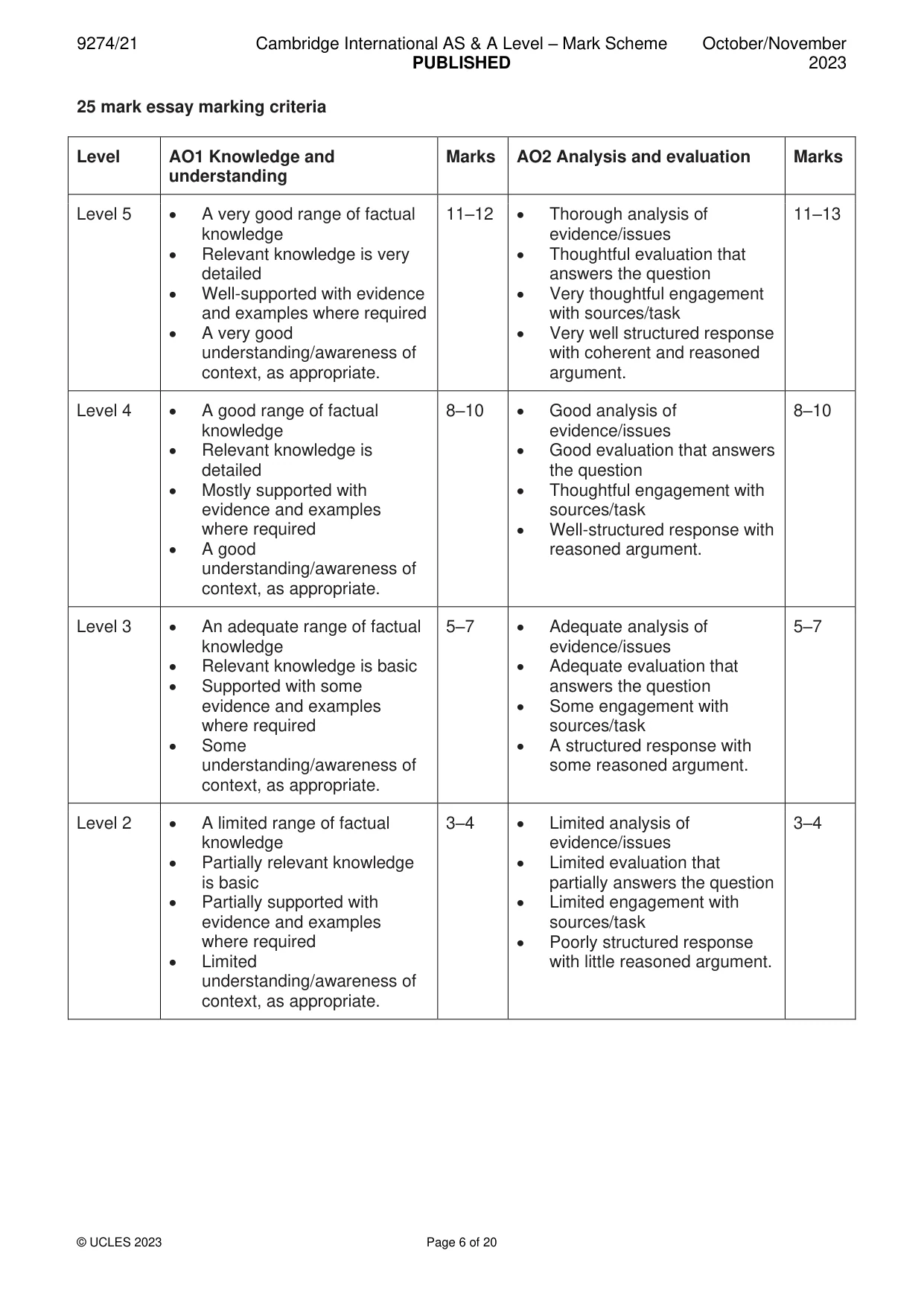
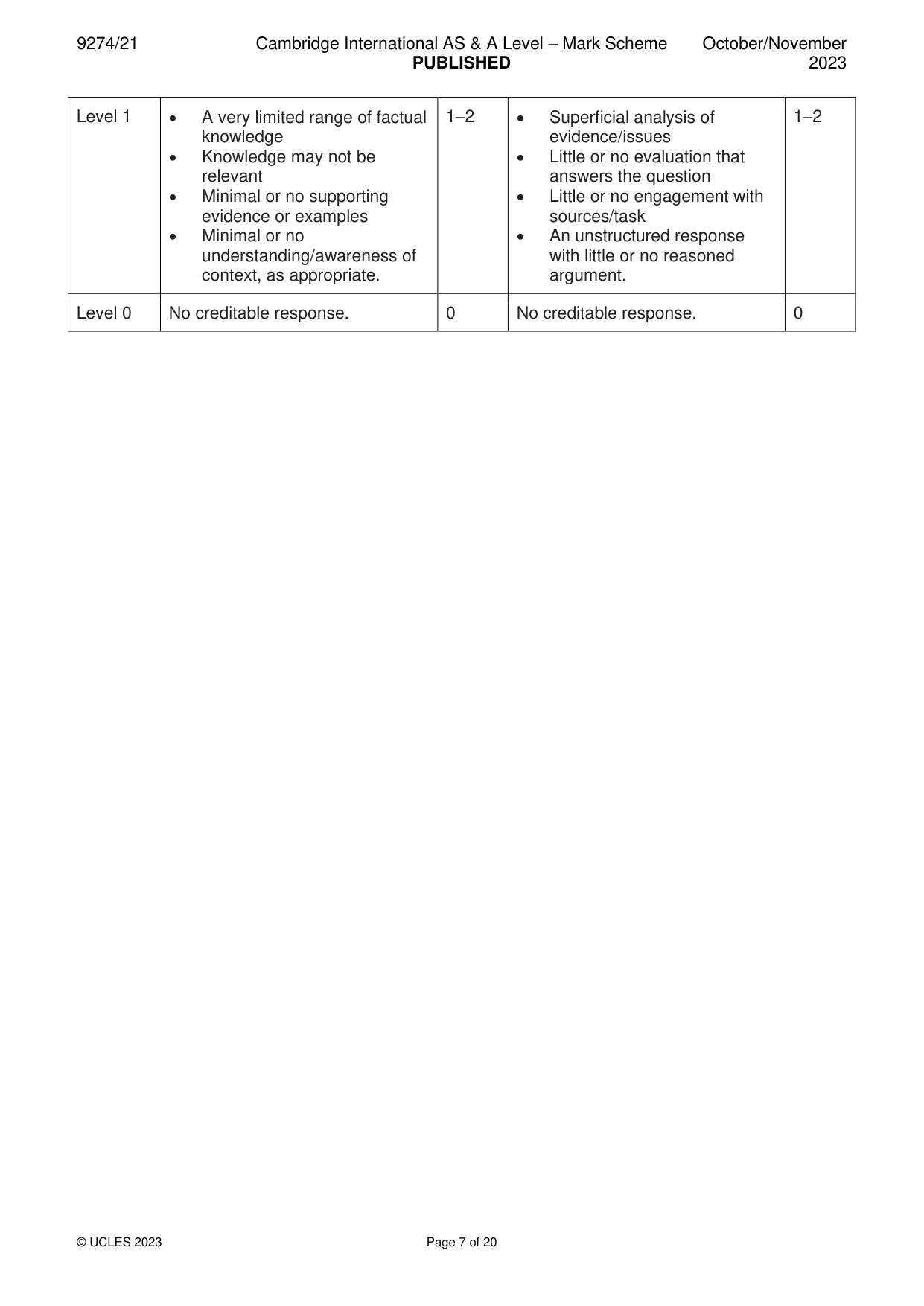
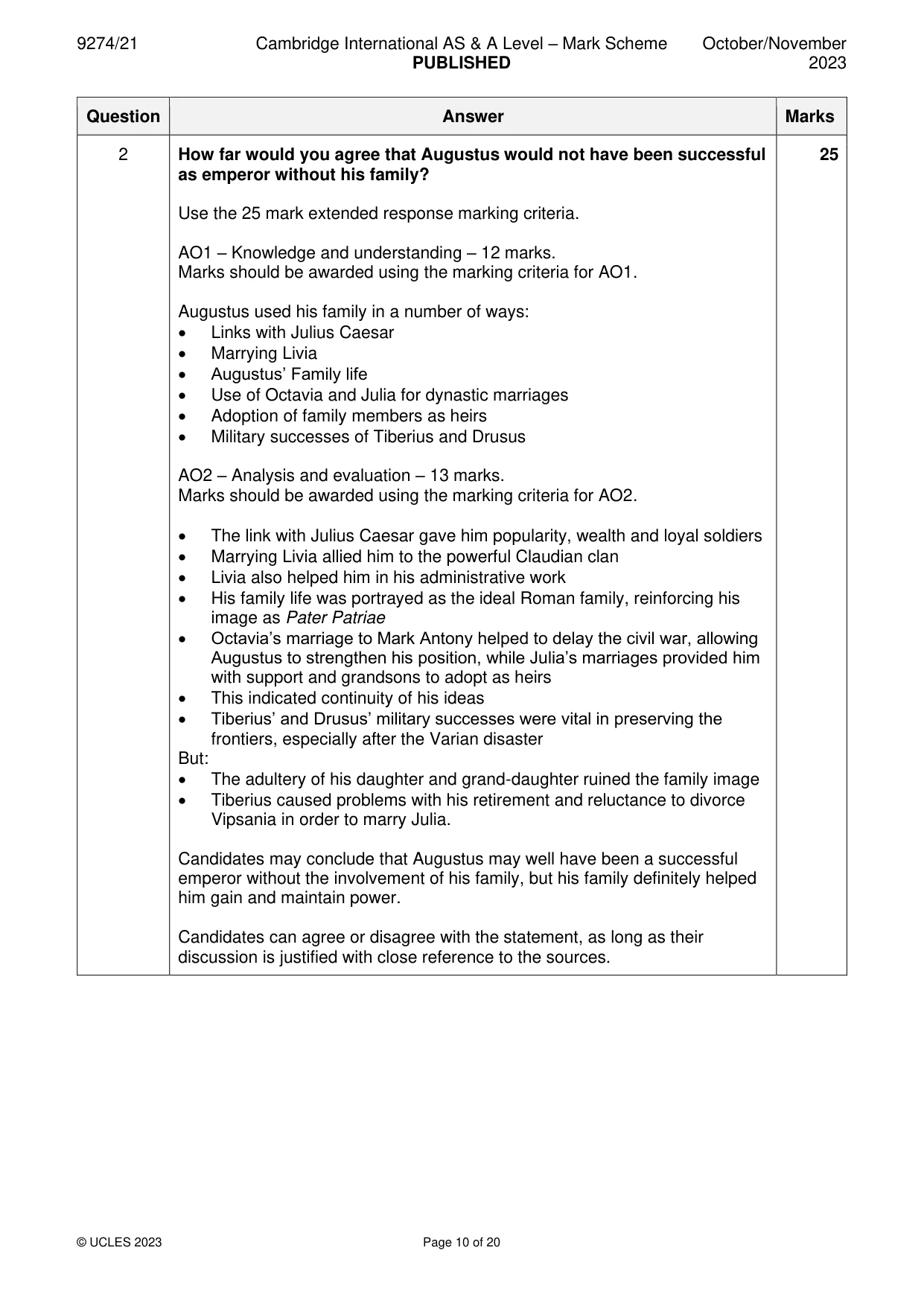
Mark scheme: 2 How far would you agree that Augustus would not have been successful 25 as emperor without his family? Use the 25 mark extended response marking criteria. AO1 – Knowledge and understanding – 12 marks. Marks should be awarded using the marking criteria for AO1. Augustus used his family in a number of ways: • Links with Julius Caesar • Marrying Livia • Augustus’ Family life • Use of Octavia and Julia for dynastic marriages • Adoption of family members as heirs • Military successes of Tiberius and Drusus AO2 – Analysis and evaluation – 13 marks. Marks should be awarded using the marking criteria for AO2. • The link with Julius Caesar gave him popularity, wealth and loyal soldiers • Marrying Livia allied him to the powerful Claudian clan • Livia also helped him in his administrative work • His family life was portrayed as the ideal Roman family, reinforcing his image as Pater Patriae • Octavia’s marriage to Mark Antony helped to delay the civil war, allowing Augustus to strengthen his position, while Julia’s marriages provided him with support and grandsons to adopt as heirs • This indicated continuity of his ideas • Tiberius’ and Drusus’ military successes were vital in preserving the frontiers, especially after the Varian disaster But: • The adultery of his daughter and grand-daughter ruined the family image • Tiberius caused problems with his retirement and reluctance to divorce Vipsania in order to marry Julia. Candidates may conclude that Augustus may well have been a successful emperor without the involvement of his family, but his family definitely helped him gain and maintain power. Candidates can agree or disagree with the statement, as long as their discussion is justified with close reference to the sources.
Q3 · ‘Augustus deserved to be honoured for saving the Roman Republic.’ Explain how far you…
3 ‘Augustus deserved to be honoured for saving the Roman Republic.’ Explain how far you agree with this statement. [25]
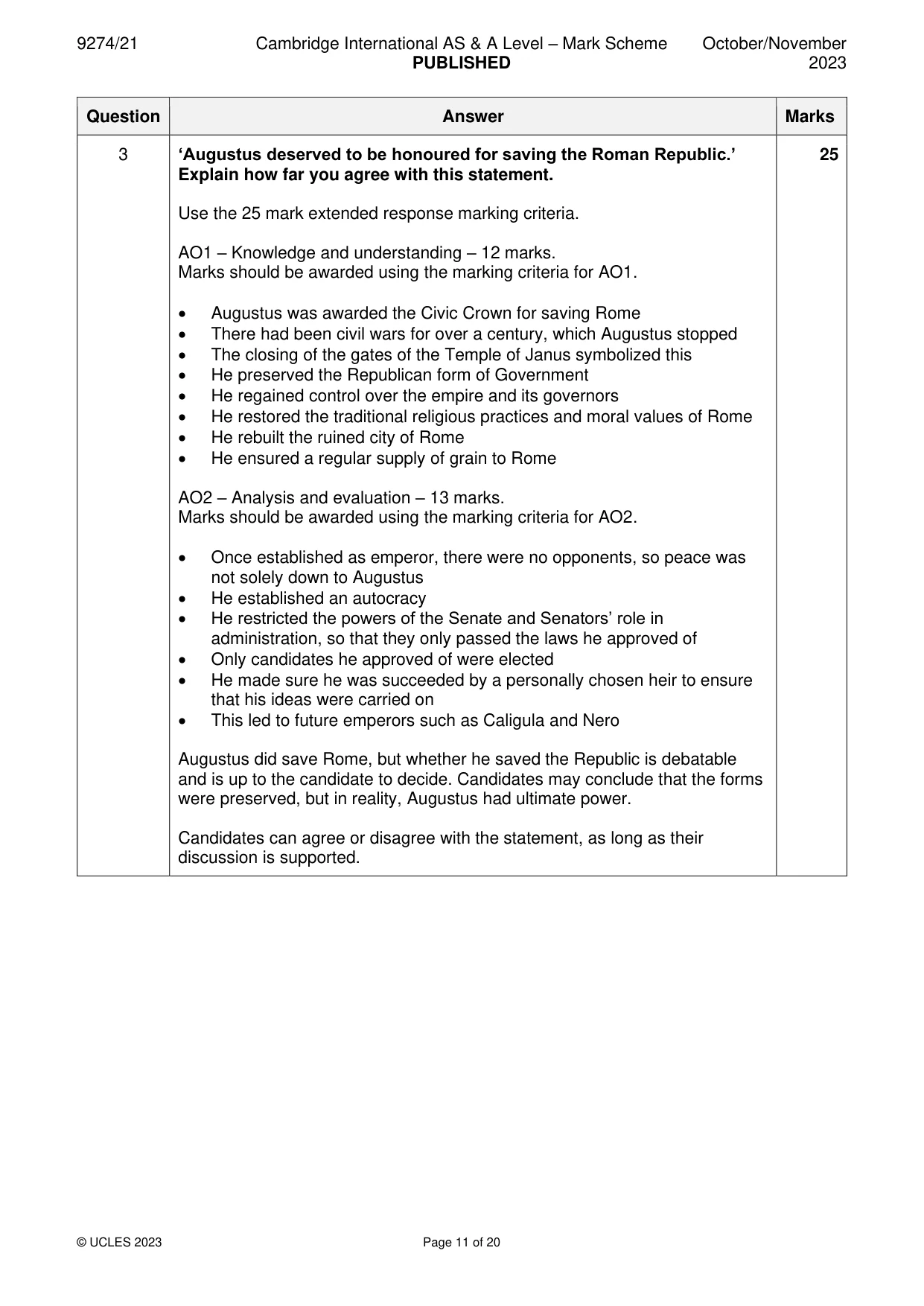
Mark scheme: 3 ‘Augustus deserved to be honoured for saving the Roman Republic.’ 25 Explain how far you agree with this statement. Use the 25 mark extended response marking criteria. AO1 – Knowledge and understanding – 12 marks. Marks should be awarded using the marking criteria for AO1. • Augustus was awarded the Civic Crown for saving Rome • There had been civil wars for over a century, which Augustus stopped • The closing of the gates of the Temple of Janus symbolized this • He preserved the Republican form of Government • He regained control over the empire and its governors • He restored the traditional religious practices and moral values of Rome • He rebuilt the ruined city of Rome • He ensured a regular supply of grain to Rome AO2 – Analysis and evaluation – 13 marks. Marks should be awarded using the marking criteria for AO2. • Once established as emperor, there were no opponents, so peace was not solely down to Augustus • He established an autocracy • He restricted the powers of the Senate and Senators’ role in administration, so that they only passed the laws he approved of • Only candidates he approved of were elected • He made sure he was succeeded by a personally chosen heir to ensure that his ideas were carried on • This led to future emperors such as Caligula and Nero Augustus did save Rome, but whether he saved the Republic is debatable and is up to the candidate to decide. Candidates may conclude that the forms were preserved, but in reality, Augustus had ultimate power. Candidates can agree or disagree with the statement, as long as their discussion is supported. Section B: Virgil’s Aeneid
Q4 · Read the passage and answer the questions: He was veiled in a blue-green cloak of…
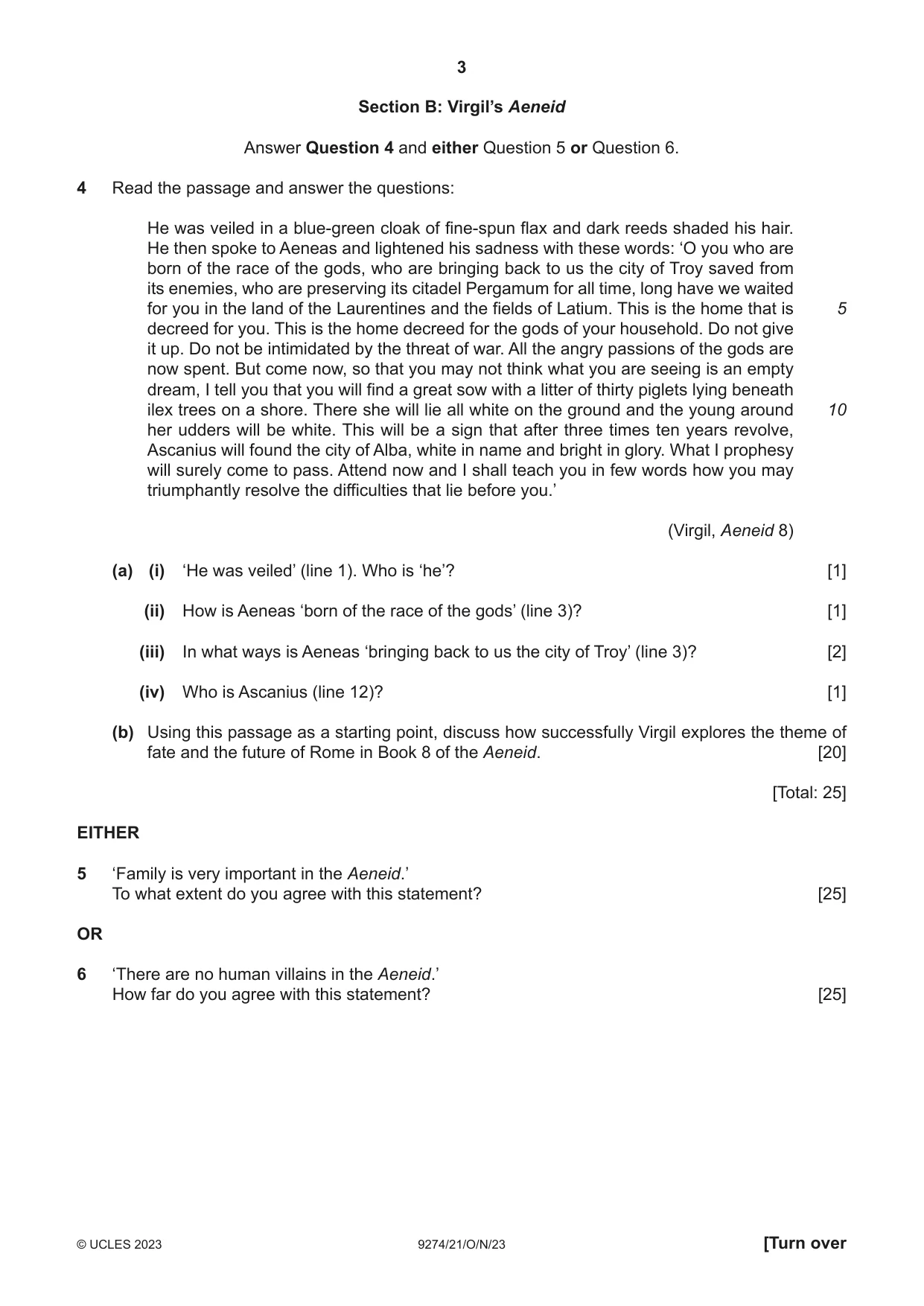
4 Read the passage and answer the questions: He was veiled in a blue-green cloak of fine-spun flax and dark reeds shaded his hair. He then spoke to Aeneas and lightened his sadness with these words: ‘O you who are born of the race of the gods, who are bringing back to us the city of Troy saved from its enemies, who are preserving its citadel Pergamum for all time, long have we waited for you in the land of the Laurentines and the fields of Latium. This is the home that is 5 decreed for you. This is the home decreed for the gods of your household. Do not give it up. Do not be intimidated by the threat of war. All the angry passions of the gods are now spent. But come now, so that you may not think what you are seeing is an empty dream, I tell you that you will find a great sow with a litter of thirty piglets lying beneath ilex trees on a shore. There she will lie all white on the ground and the young around 10 her udders will be white. This will be a sign that after three times ten years revolve, Ascanius will found the city of Alba, white in name and bright in glory. What I prophesy will surely come to pass. Attend now and I shall teach you in few words how you may triumphantly resolve the difficulties that lie before you.’ (Virgil, Aeneid 8) (a) (i) ‘He was veiled’ (line 1). Who is ‘he’? [1] (ii) How is Aeneas ‘born of the race of the gods’ (line 3)? [1] (iii) In what ways is Aeneas ‘bringing back to us the city of Troy’ (line 3)? [2] (iv) Who is Ascanius (line 12)? [1] (b) Using this passage as a starting point, discuss how successfully Virgil explores the theme of fate and the future of Rome in Book 8 of the Aeneid. [20] [Total: 25] EITHER
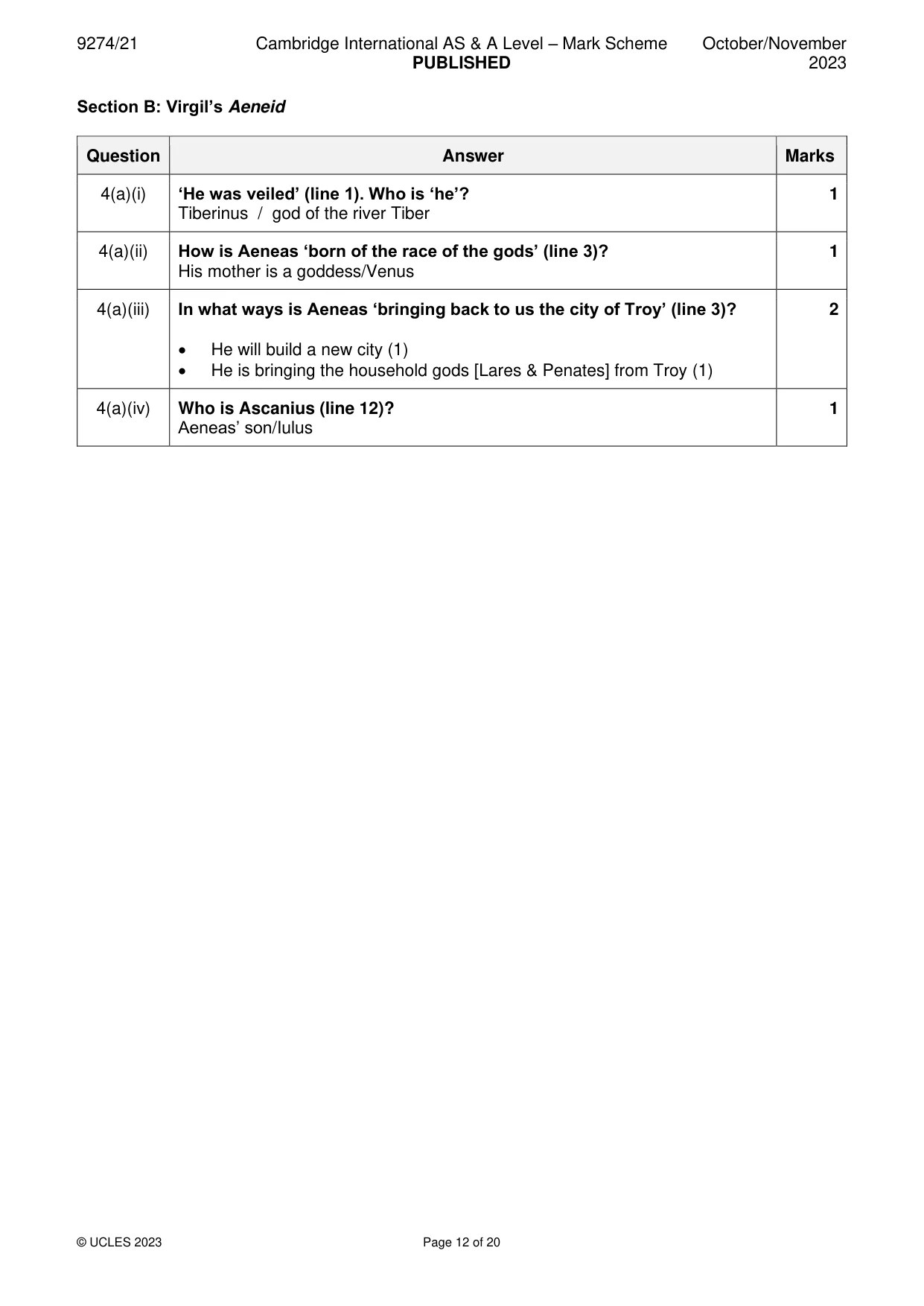
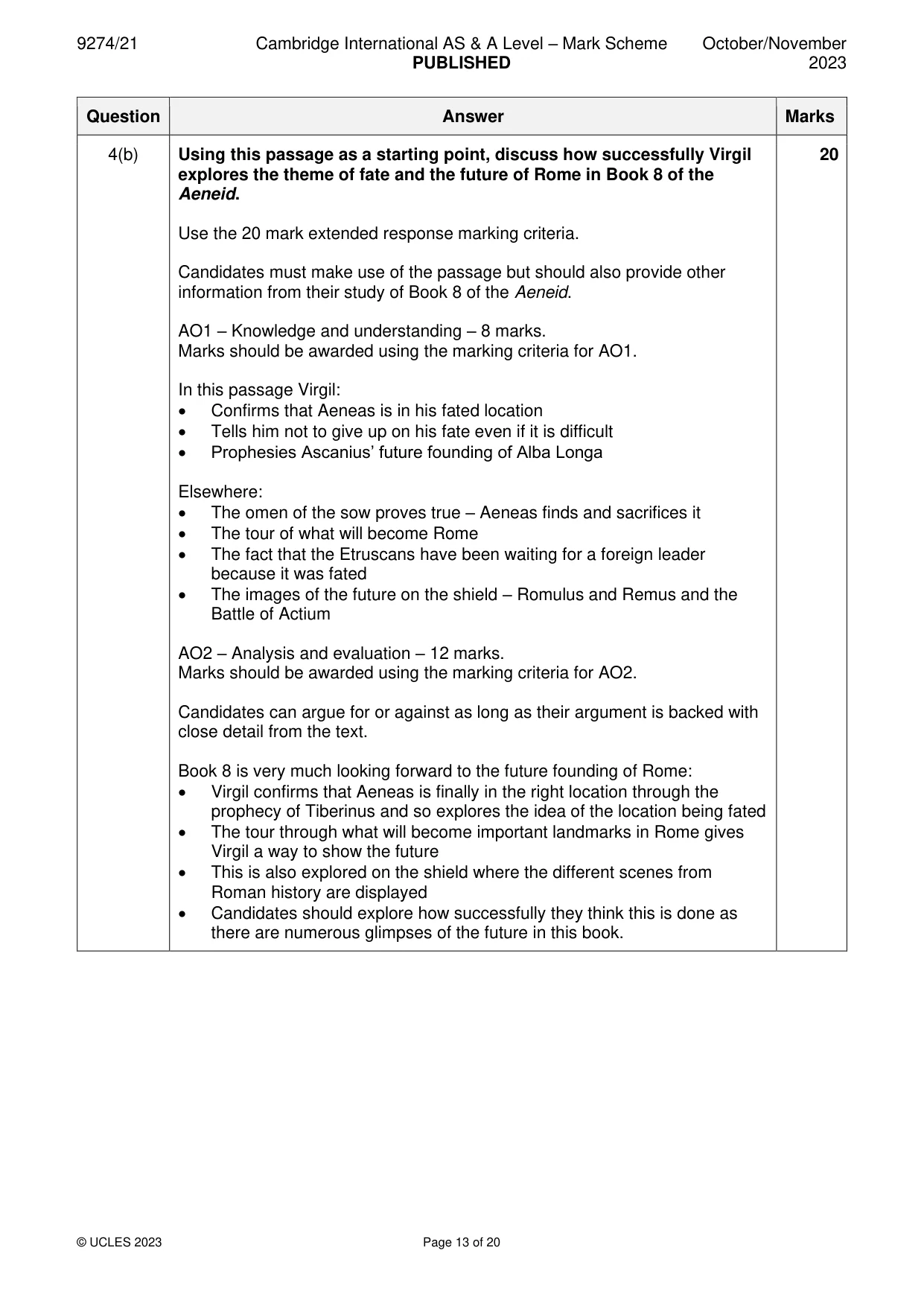
Mark scheme: 4(a)(i) ‘He was veiled’ (line 1). Who is ‘he’? 1 Tiberinus / god of the river Tiber 4(a)(ii) How is Aeneas ‘born of the race of the gods’ (line 3)? 1 His mother is a goddess/Venus 4(a)(iii) In what ways is Aeneas ‘bringing back to us the city of Troy’ (line 3)? 2 • He will build a new city (1) • He is bringing the household gods [Lares & Penates] from Troy (1) 4(a)(iv) Who is Ascanius (line 12)? 1 Aeneas’ son/Iulus 4(b) Using this passage as a starting point, discuss how successfully Virgil 20 explores the theme of fate and the future of Rome in Book 8 of the Aeneid. Use the 20 mark extended response marking criteria. Candidates must make use of the passage but should also provide other information from their study of Book 8 of the Aeneid. AO1 – Knowledge and understanding – 8 marks. Marks should be awarded using the marking criteria for AO1. In this passage Virgil: • Confirms that Aeneas is in his fated location • Tells him not to give up on his fate even if it is difficult • Prophesies Ascanius’ future founding of Alba Longa Elsewhere: • The omen of the sow proves true – Aeneas finds and sacrifices it • The tour of what will become Rome • The fact that the Etruscans have been waiting for a foreign leader because it was fated • The images of the future on the shield – Romulus and Remus and the Battle of Actium AO2 – Analysis and evaluation – 12 marks. Marks should be awarded using the marking criteria for AO2. Candidates can argue for or against as long as their argument is backed with close detail from the text. Book 8 is very much looking forward to the future founding of Rome: • Virgil confirms that Aeneas is finally in the right location through the prophecy of Tiberinus and so explores the idea of the location being fated • The tour through what will become important landmarks in Rome gives Virgil a way to show the future • This is also explored on the shield where the different scenes from Roman history are displayed • Candidates should explore how successfully they think this is done as there are numerous glimpses of the future in this book.
Q5 · ‘Family is very important in the Aeneid.’ To what extent do you agree with this statement?
5 ‘Family is very important in the Aeneid.’ To what extent do you agree with this statement? [25] OR
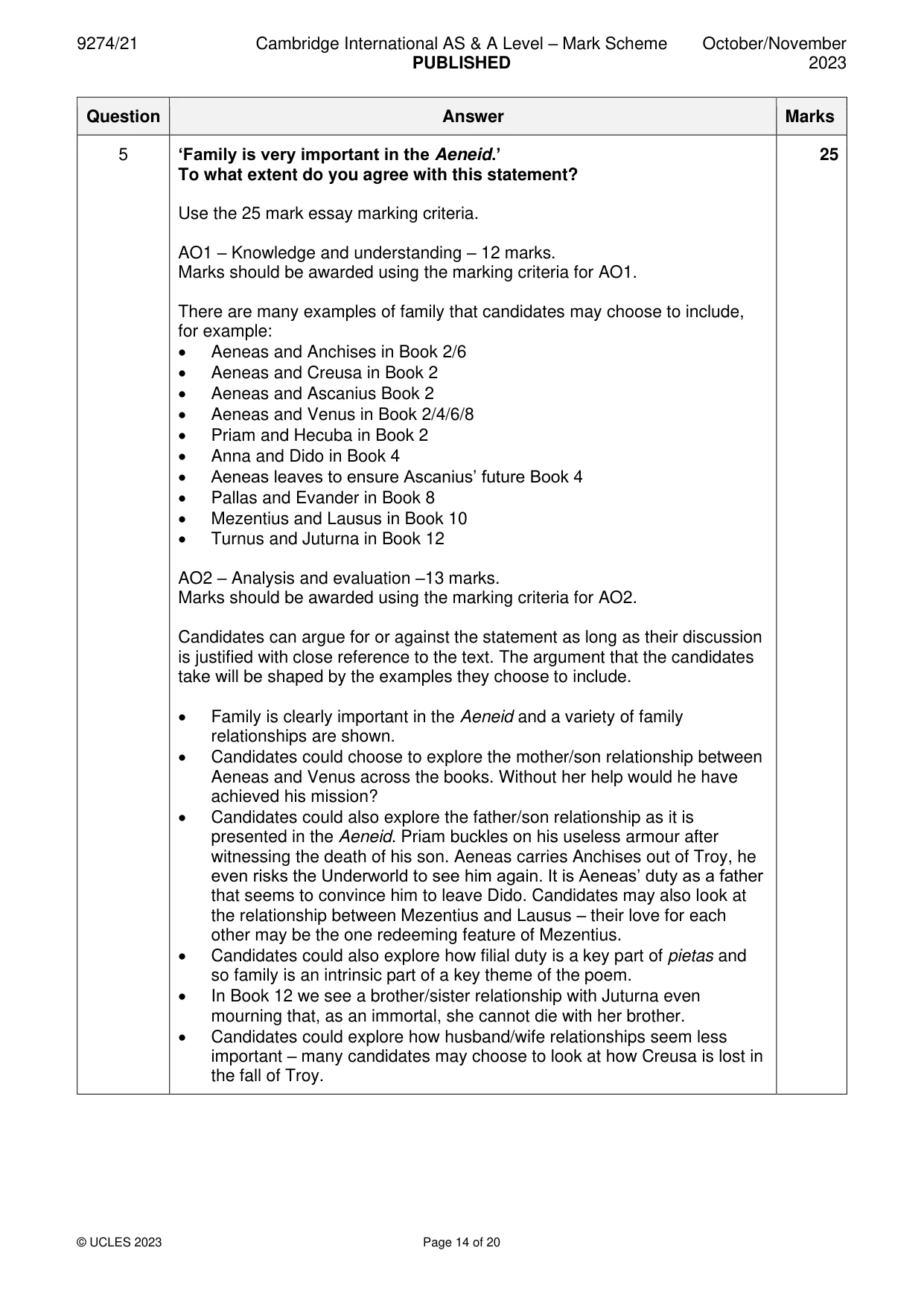
Mark scheme: 5 ‘Family is very important in the Aeneid.’ 25 To what extent do you agree with this statement? Use the 25 mark essay marking criteria. AO1 – Knowledge and understanding – 12 marks. Marks should be awarded using the marking criteria for AO1. There are many examples of family that candidates may choose to include, for example: • Aeneas and Anchises in Book 2/6 • Aeneas and Creusa in Book 2 • Aeneas and Ascanius Book 2 • Aeneas and Venus in Book 2/4/6/8 • Priam and Hecuba in Book 2 • Anna and Dido in Book 4 • Aeneas leaves to ensure Ascanius’ future Book 4 • Pallas and Evander in Book 8 • Mezentius and Lausus in Book 10 • Turnus and Juturna in Book 12 AO2 – Analysis and evaluation –13 marks. Marks should be awarded using the marking criteria for AO2. Candidates can argue for or against the statement as long as their discussion is justified with close reference to the text. The argument that the candidates take will be shaped by the examples they choose to include. • Family is clearly important in the Aeneid and a variety of family relationships are shown. • Candidates could choose to explore the mother/son relationship between Aeneas and Venus across the books. Without her help would he have achieved his mission? • Candidates could also explore the father/son relationship as it is presented in the Aeneid. Priam buckles on his useless armour after witnessing the death of his son. Aeneas carries Anchises out of Troy, he even risks the Underworld to see him again. It is Aeneas’ duty as a father that seems to convince him to leave Dido. Candidates may also look at the relationship between Mezentius and Lausus – their love for each other may be the one redeeming feature of Mezentius. • Candidates could also explore how filial duty is a key part of pietas and so family is an intrinsic part of a key theme of the poem. • In Book 12 we see a brother/sister relationship with Juturna even mourning that, as an immortal, she cannot die with her brother. • Candidates could explore how husband/wife relationships seem less important – many candidates may choose to look at how Creusa is lost in the fall of Troy.
Q6 · ‘There are no human villains in the Aeneid.’ How far do you agree with this statement?
6 ‘There are no human villains in the Aeneid.’ How far do you agree with this statement? [25] Section C: Architecture of the Roman City Answer Question 7 and either Question 8 or Question 9.
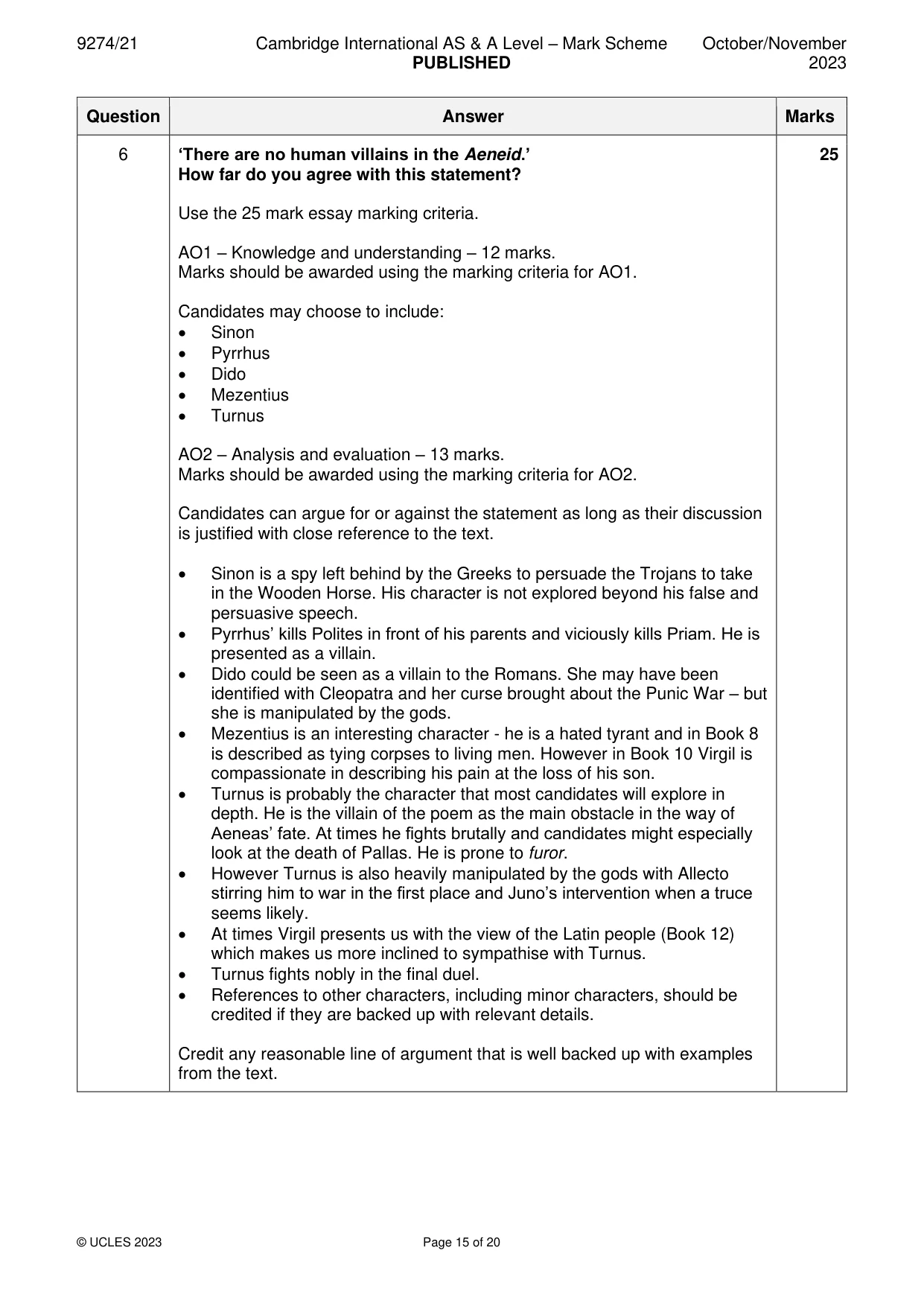
Mark scheme: 6 ‘There are no human villains in the Aeneid.’ 25 How far do you agree with this statement? Use the 25 mark essay marking criteria. AO1 – Knowledge and understanding – 12 marks. Marks should be awarded using the marking criteria for AO1. Candidates may choose to include: • Sinon • Pyrrhus • Dido • Mezentius • Turnus AO2 – Analysis and evaluation – 13 marks. Marks should be awarded using the marking criteria for AO2. Candidates can argue for or against the statement as long as their discussion is justified with close reference to the text. • Sinon is a spy left behind by the Greeks to persuade the Trojans to take in the Wooden Horse. His character is not explored beyond his false and persuasive speech. • Pyrrhus’ kills Polites in front of his parents and viciously kills Priam. He is presented as a villain. • Dido could be seen as a villain to the Romans. She may have been identified with Cleopatra and her curse brought about the Punic War – but she is manipulated by the gods. • Mezentius is an interesting character - he is a hated tyrant and in Book 8 is described as tying corpses to living men. However in Book 10 Virgil is compassionate in describing his pain at the loss of his son. • Turnus is probably the character that most candidates will explore in depth. He is the villain of the poem as the main obstacle in the way of Aeneas’ fate. At times he fights brutally and candidates might especially look at the death of Pallas. He is prone to furor. • However Turnus is also heavily manipulated by the gods with Allecto stirring him to war in the first place and Juno’s intervention when a truce seems likely. • At times Virgil presents us with the view of the Latin people (Book 12) which makes us more inclined to sympathise with Turnus. • Turnus fights nobly in the final duel. • References to other characters, including minor characters, should be credited if they are backed up with relevant details. Credit any reasonable line of argument that is well backed up with examples from the text. Section C: Architecture of the Roman City
Q7 · Study the image and answer the questions: (a) (i) Identify the monument shown in the image
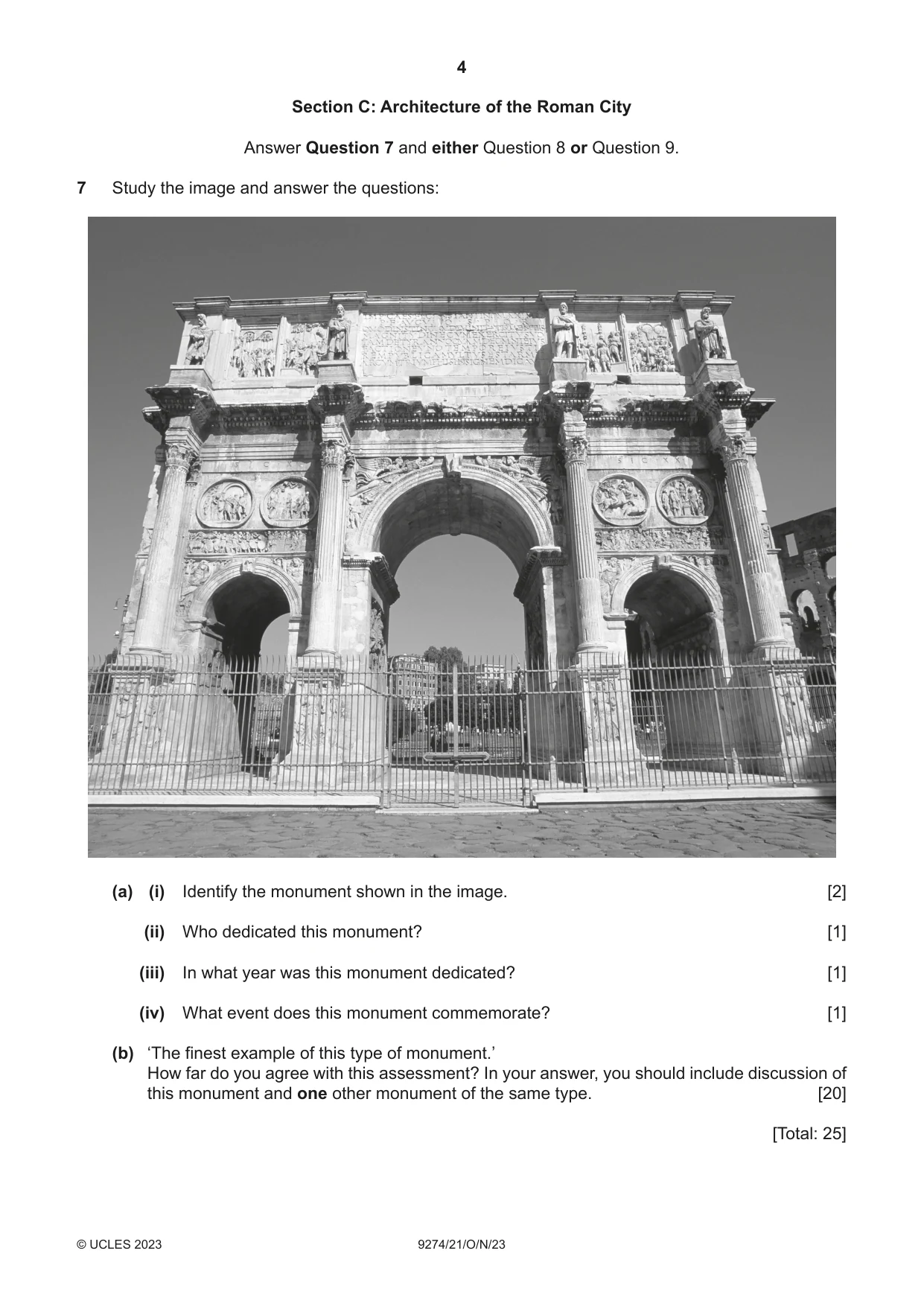
7 Study the image and answer the questions: (a) (i) Identify the monument shown in the image. [2] (ii) Who dedicated this monument? [1] (iii) In what year was this monument dedicated? [1] (iv) What event does this monument commemorate? [1] (b) ‘The finest example of this type of monument.’ How far do you agree with this assessment? In your answer, you should include discussion of this monument and one other monument of the same type. [20] [Total: 25] EITHER
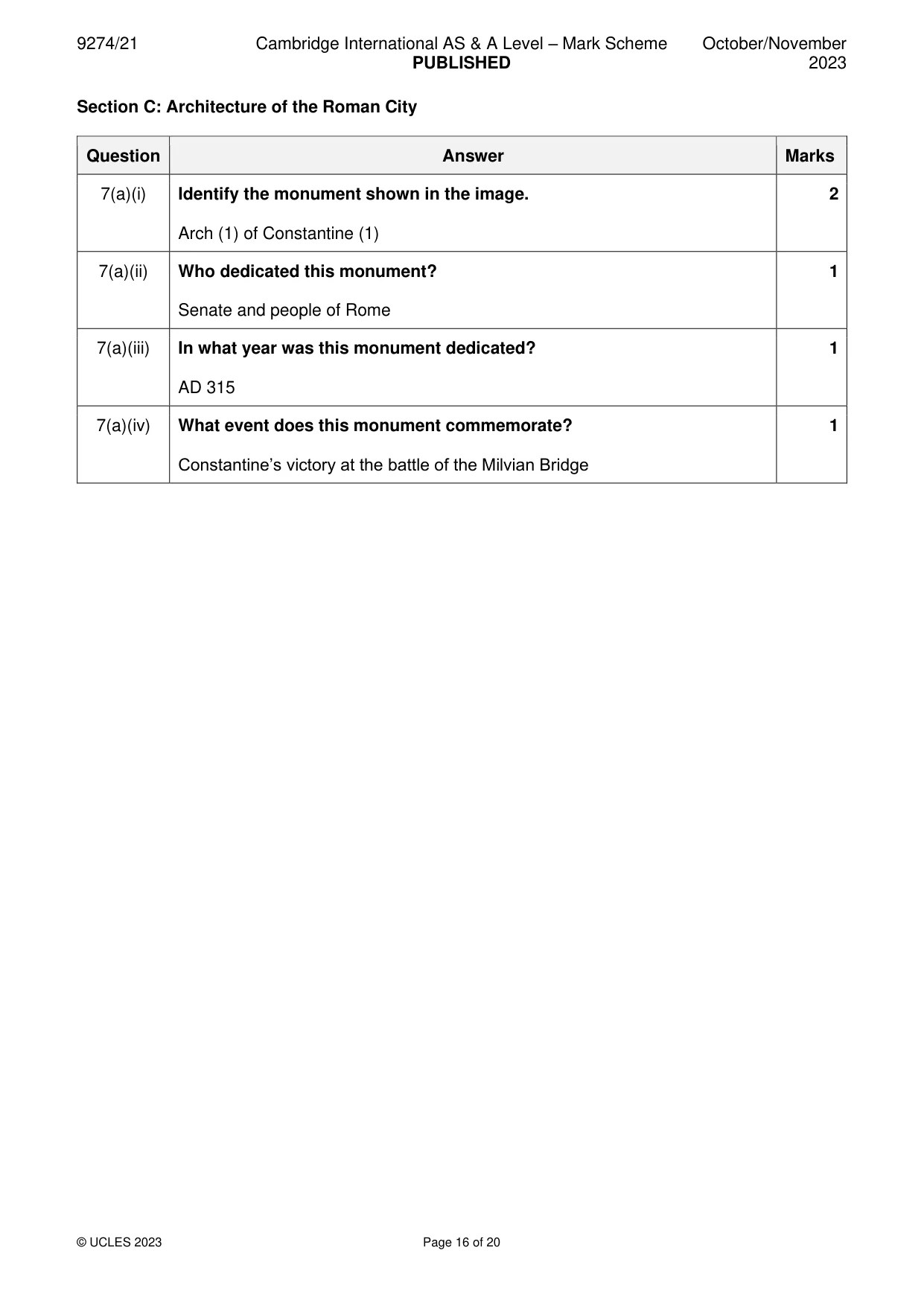
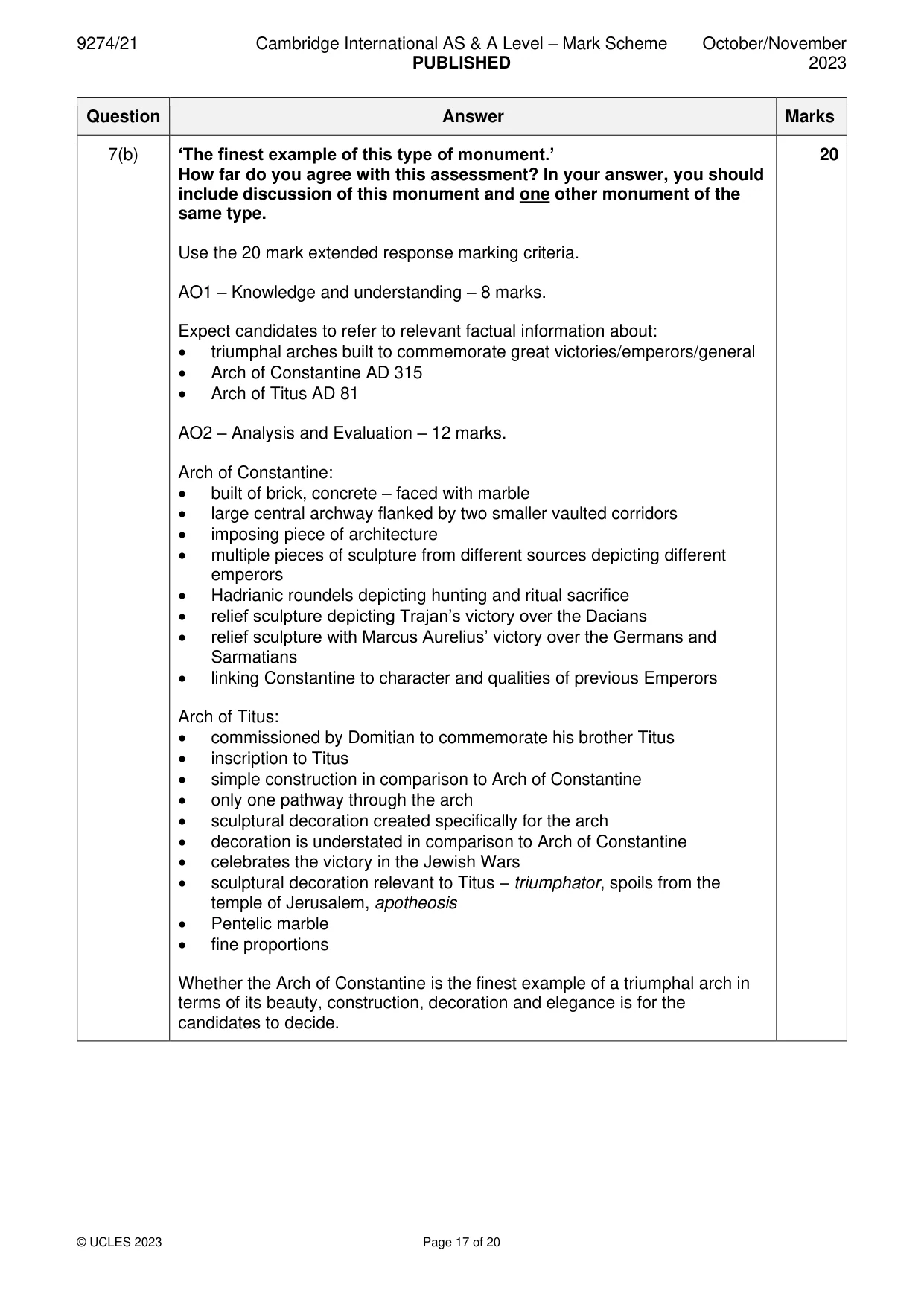
Mark scheme: 7(a)(i) Identify the monument shown in the image. 2 Arch (1) of Constantine (1) 7(a)(ii) Who dedicated this monument? 1 Senate and people of Rome 7(a)(iii) In what year was this monument dedicated? 1 AD 315 7(a)(iv) What event does this monument commemorate? 1 Constantine’s victory at the battle of the Milvian Bridge 7(b) ‘The finest example of this type of monument.’ 20 How far do you agree with this assessment? In your answer, you should include discussion of this monument and one other monument of the same type. Use the 20 mark extended response marking criteria. AO1 – Knowledge and understanding – 8 marks. Expect candidates to refer to relevant factual information about: • triumphal arches built to commemorate great victories/emperors/general • Arch of Constantine AD 315 • Arch of Titus AD 81 AO2 – Analysis and Evaluation – 12 marks. Arch of Constantine: • built of brick, concrete – faced with marble • large central archway flanked by two smaller vaulted corridors • imposing piece of architecture • multiple pieces of sculpture from different sources depicting different emperors • Hadrianic roundels depicting hunting and ritual sacrifice • relief sculpture depicting Trajan’s victory over the Dacians • relief sculpture with Marcus Aurelius’ victory over the Germans and Sarmatians • linking Constantine to character and qualities of previous Emperors Arch of Titus: • commissioned by Domitian to commemorate his brother Titus • inscription to Titus • simple construction in comparison to Arch of Constantine • only one pathway through the arch • sculptural decoration created specifically for the arch • decoration is understated in comparison to Arch of Constantine • celebrates the victory in the Jewish Wars • sculptural decoration relevant to Titus – triumphator, spoils from the temple of Jerusalem, apotheosis • Pentelic marble • fine proportions Whether the Arch of Constantine is the finest example of a triumphal arch in terms of its beauty, construction, decoration and elegance is for the candidates to decide.
Q8 · Which do you think would have impressed an ancient visitor more, the houses from…
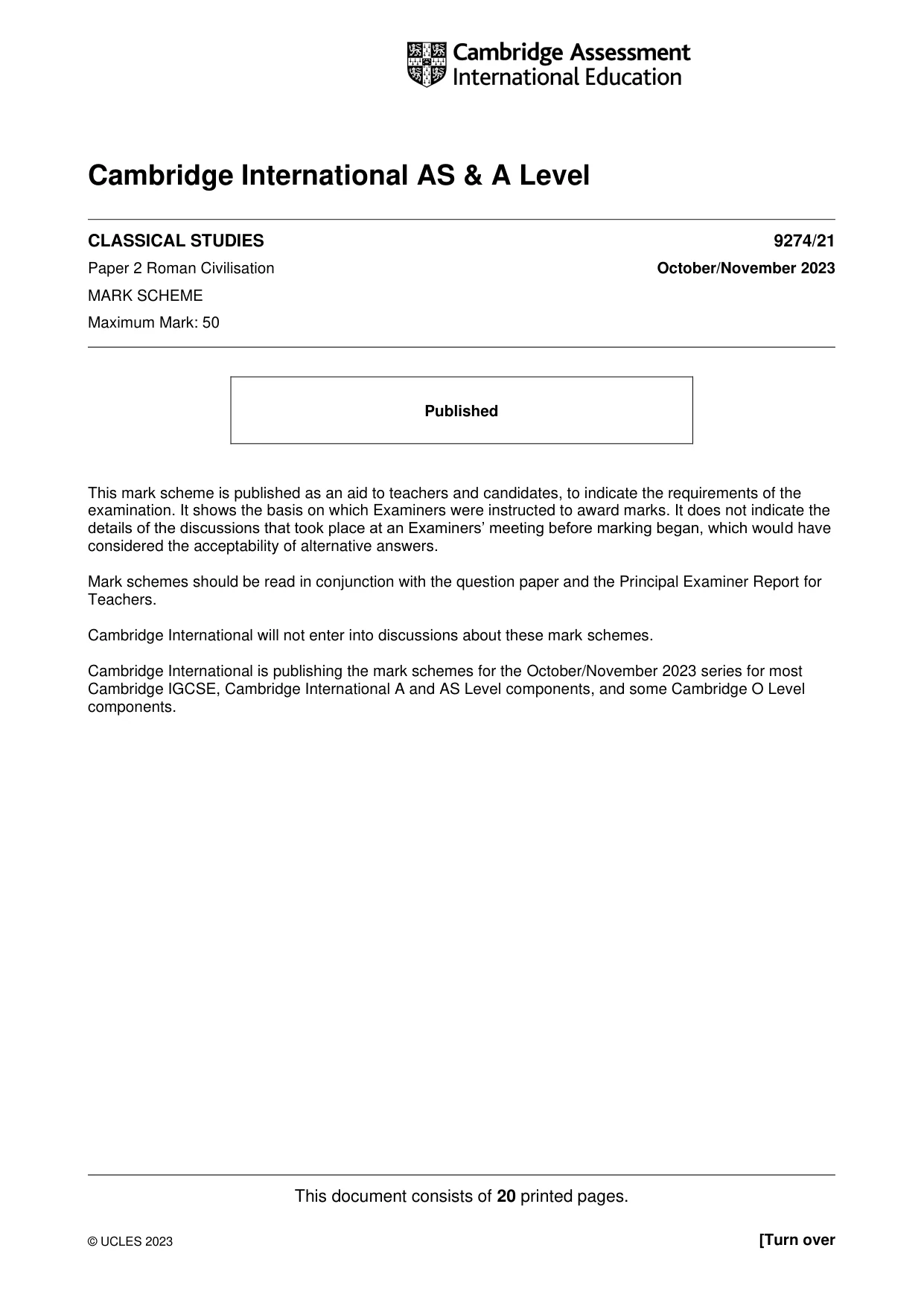
8 Which do you think would have impressed an ancient visitor more, the houses from Herculaneum or the houses from Pompeii? In your answer, you should include discussion of at least two houses from Herculaneum and at least two houses from Pompeii to explain your answer. [25] OR
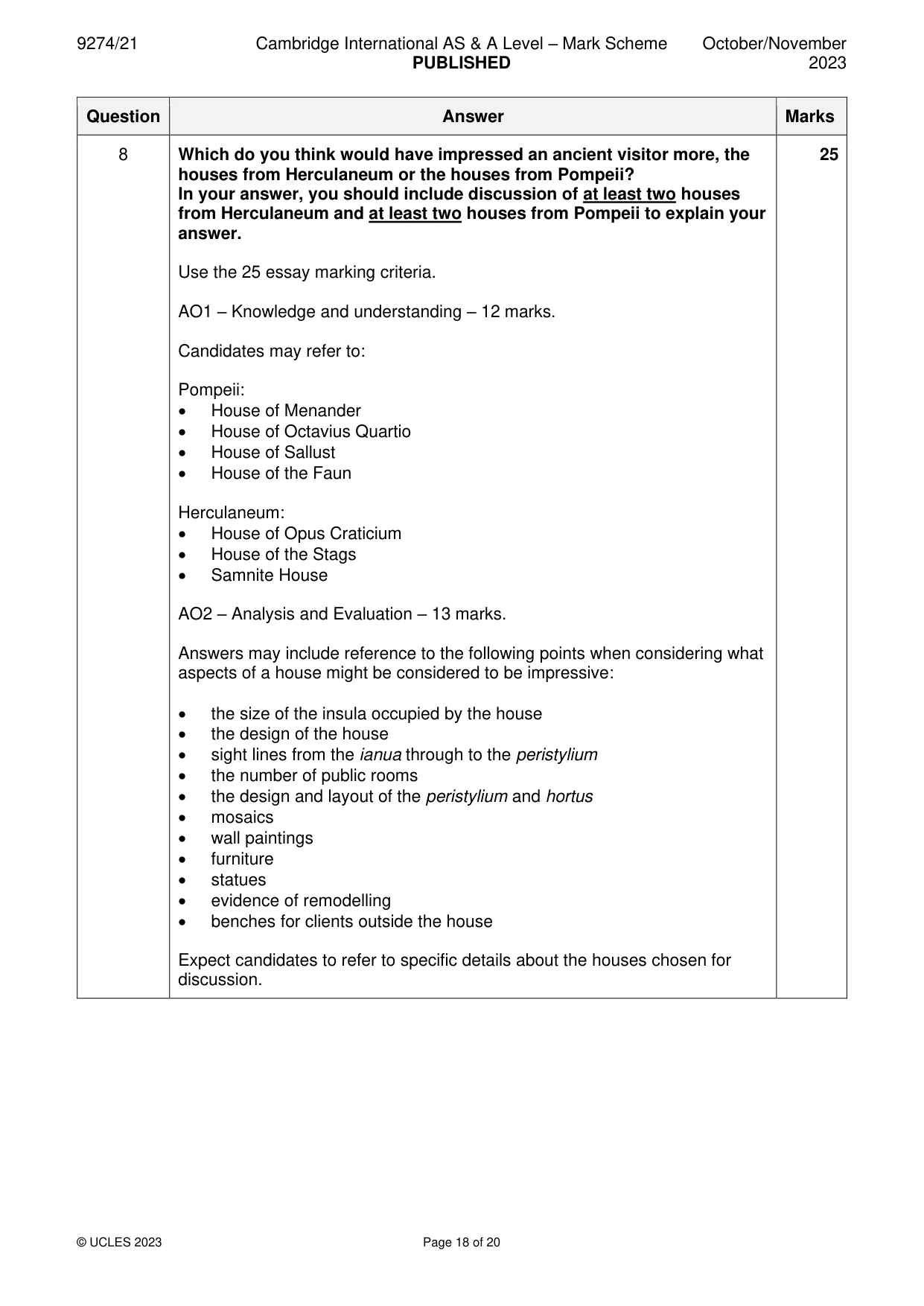
Mark scheme: 8 Which do you think would have impressed an ancient visitor more, the 25 houses from Herculaneum or the houses from Pompeii? In your answer, you should include discussion of at least two houses from Herculaneum and at least two houses from Pompeii to explain your answer. Use the 25 essay marking criteria. AO1 – Knowledge and understanding – 12 marks. Candidates may refer to: Pompeii: • House of Menander • House of Octavius Quartio • House of Sallust • House of the Faun Herculaneum: • House of Opus Craticium • House of the Stags • Samnite House AO2 – Analysis and Evaluation – 13 marks. Answers may include reference to the following points when considering what aspects of a house might be considered to be impressive: • the size of the insula occupied by the house • the design of the house • sight lines from the ianua through to the peristylium • the number of public rooms • the design and layout of the peristylium and hortus • mosaics • wall paintings • furniture • statues • evidence of remodelling • benches for clients outside the house Expect candidates to refer to specific details about the houses chosen for discussion.
Q9 · ‘The Pantheon – the most perfect of all Roman temples.’ How far do you agree with this…
9 ‘The Pantheon – the most perfect of all Roman temples.’ How far do you agree with this statement? In your answer, you should include discussion of the Pantheon and at least two other Roman temples. [25]
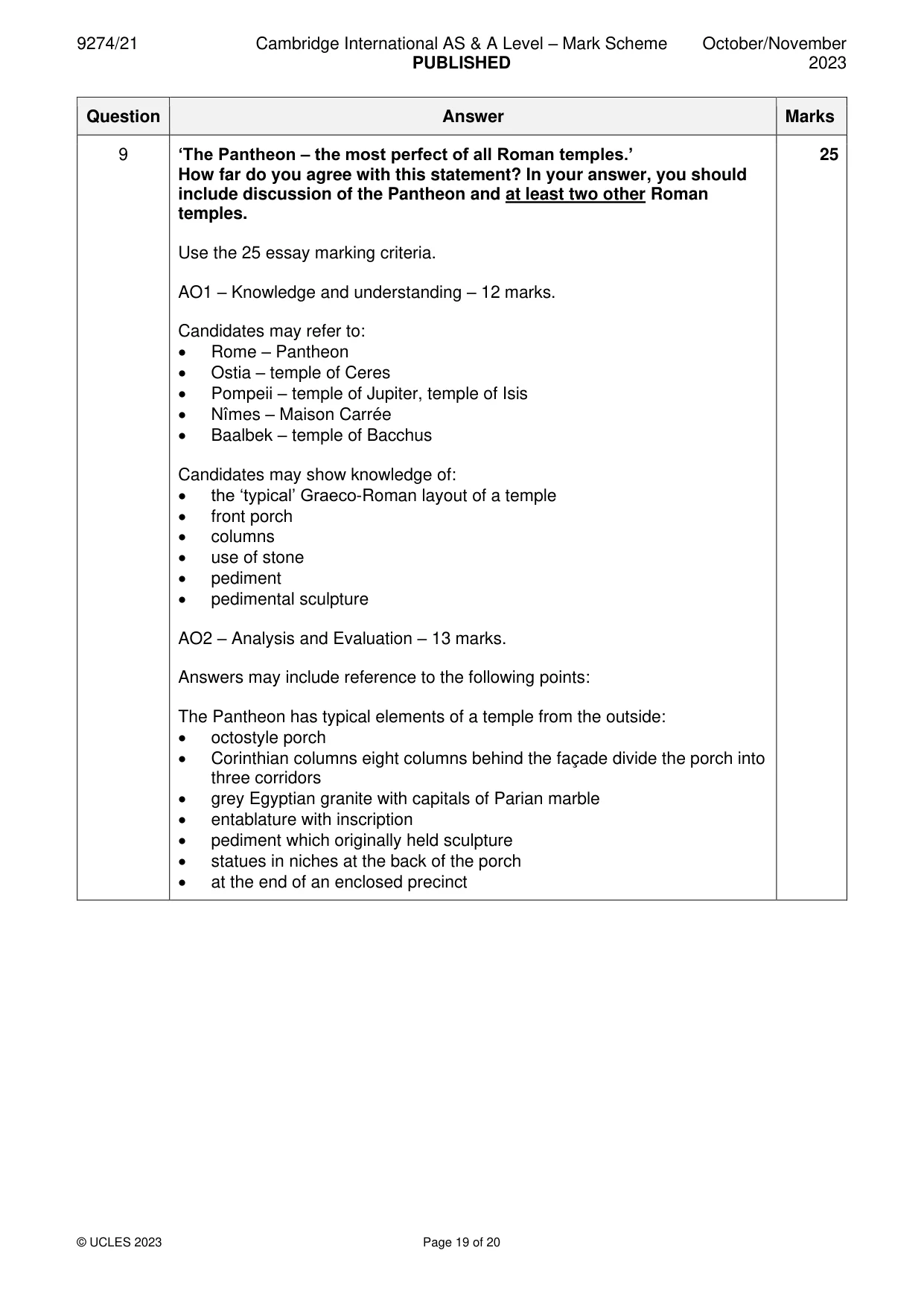
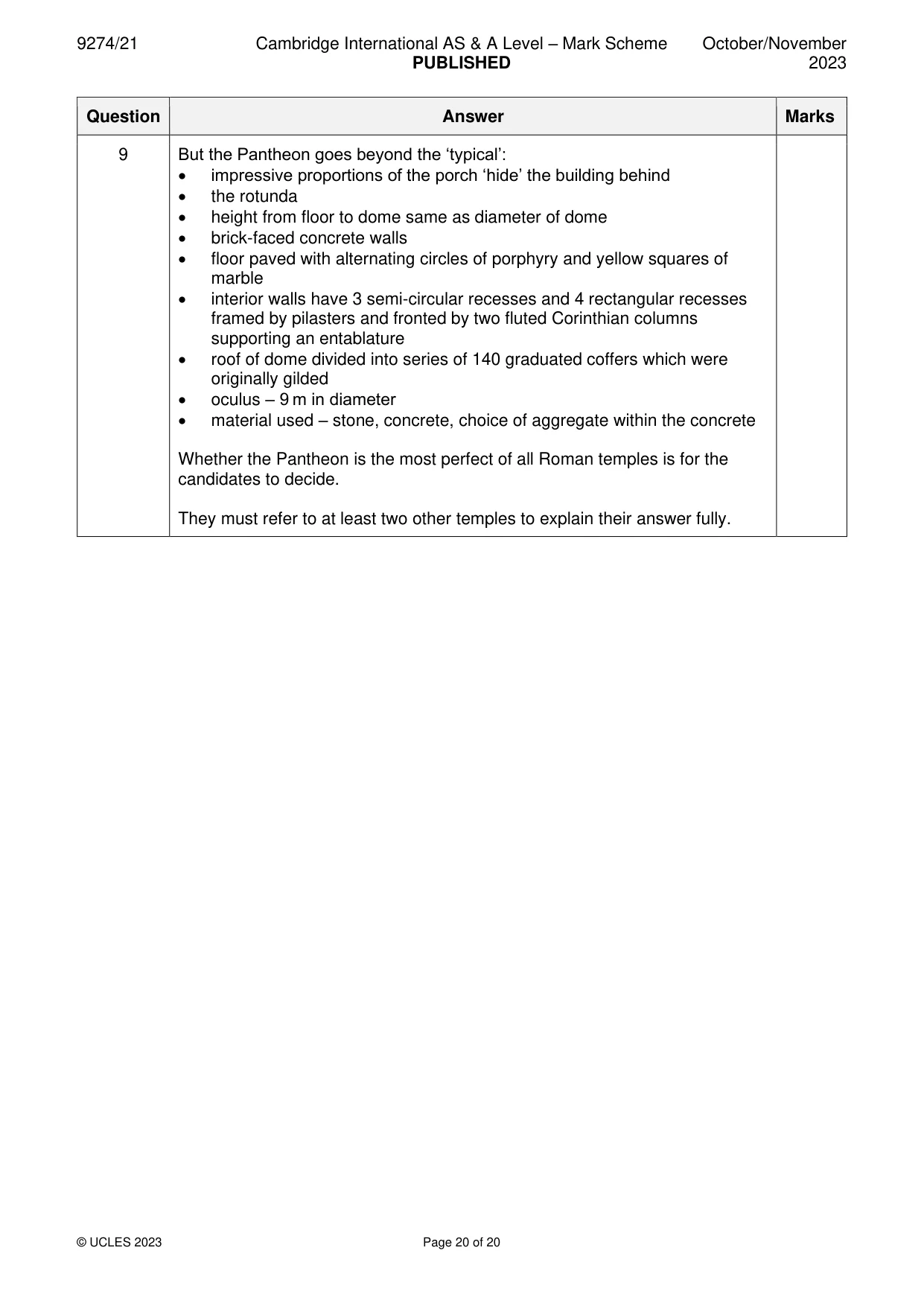
Mark scheme: 9 ‘The Pantheon – the most perfect of all Roman temples.’ 25 How far do you agree with this statement? In your answer, you should include discussion of the Pantheon and at least two other Roman temples. Use the 25 essay marking criteria. AO1 – Knowledge and understanding – 12 marks. Candidates may refer to: • Rome – Pantheon • Ostia – temple of Ceres • Pompeii – temple of Jupiter, temple of Isis • Nîmes – Maison Carrée • Baalbek – temple of Bacchus Candidates may show knowledge of: • the ‘typical’ Graeco-Roman layout of a temple • front porch • columns • use of stone • pediment • pedimental sculpture AO2 – Analysis and Evaluation – 13 marks. Answers may include reference to the following points: The Pantheon has typical elements of a temple from the outside: • octostyle porch • Corinthian columns eight columns behind the façade divide the porch into three corridors • grey Egyptian granite with capitals of Parian marble • entablature with inscription • pediment which originally held sculpture • statues in niches at the back of the porch • at the end of an enclosed precinct 9 But the Pantheon goes beyond the ‘typical’: • impressive proportions of the porch ‘hide’ the building behind • the rotunda • height from floor to dome same as diameter of dome • brick-faced concrete walls • floor paved with alternating circles of porphyry and yellow squares of marble • interior walls have 3 semi-circular recesses and 4 rectangular recesses framed by pilasters and fronted by two fluted Corinthian columns supporting an entablature • roof of dome divided into series of 140 graduated coffers which were originally gilded • oculus – 9 m in diameter • material used – stone, concrete, choice of aggregate within the concrete Whether the Pantheon is the most perfect of all Roman temples is for the candidates to decide. They must refer to at least two other temples to explain their answer fully.
What was in this paper
The subtopics covered by these 9 questions, and how many questions each got. Open one in a new tab to see every Cambridge question on it.
What you needed in this session
Cambridge’s own grade thresholds for 2023 Oct/Nov, Paper 2 · Variant 1. A higher threshold means an easier paper — the bar moves with how the cohort did.