Cambridge A Level Classical Studies 9274 — 2020 Oct/Nov Paper 2 · Variant 1
9274/21/O/N/20 · 12 questions · 50 marks · ≈56 min
The question paper and its mark scheme, free to read here and free to download. This is Cambridge’s own paper, exactly as it was sat.
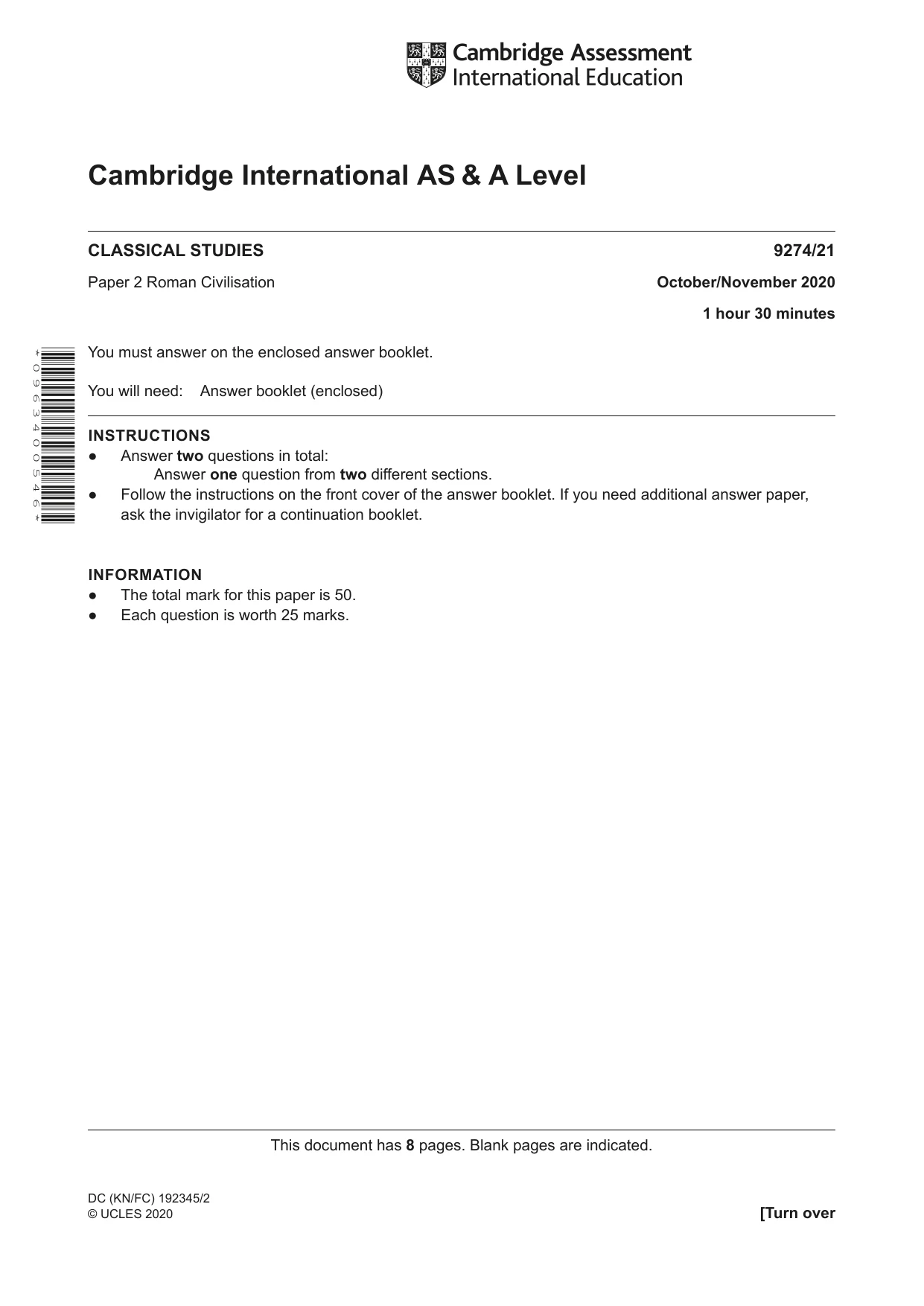
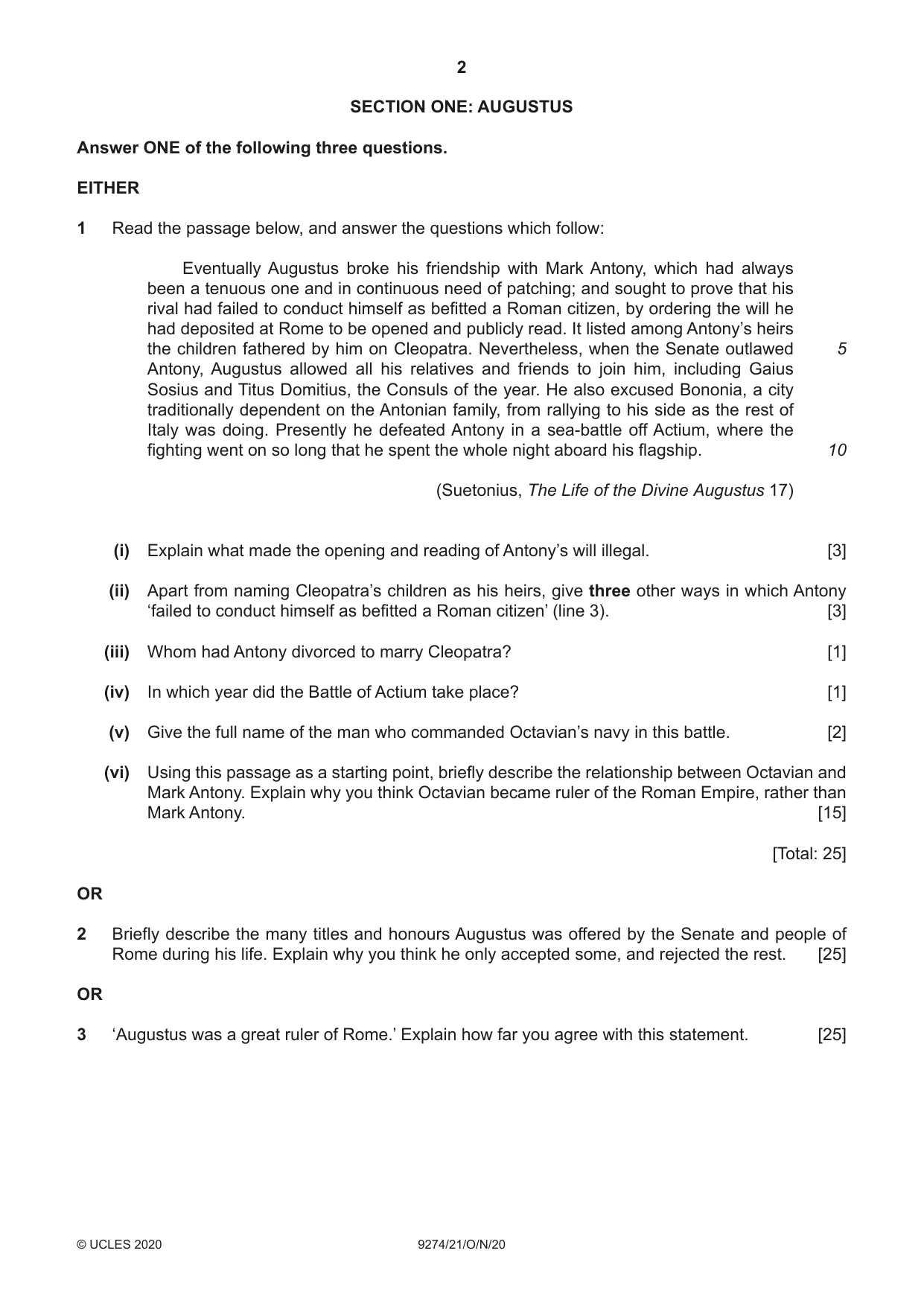
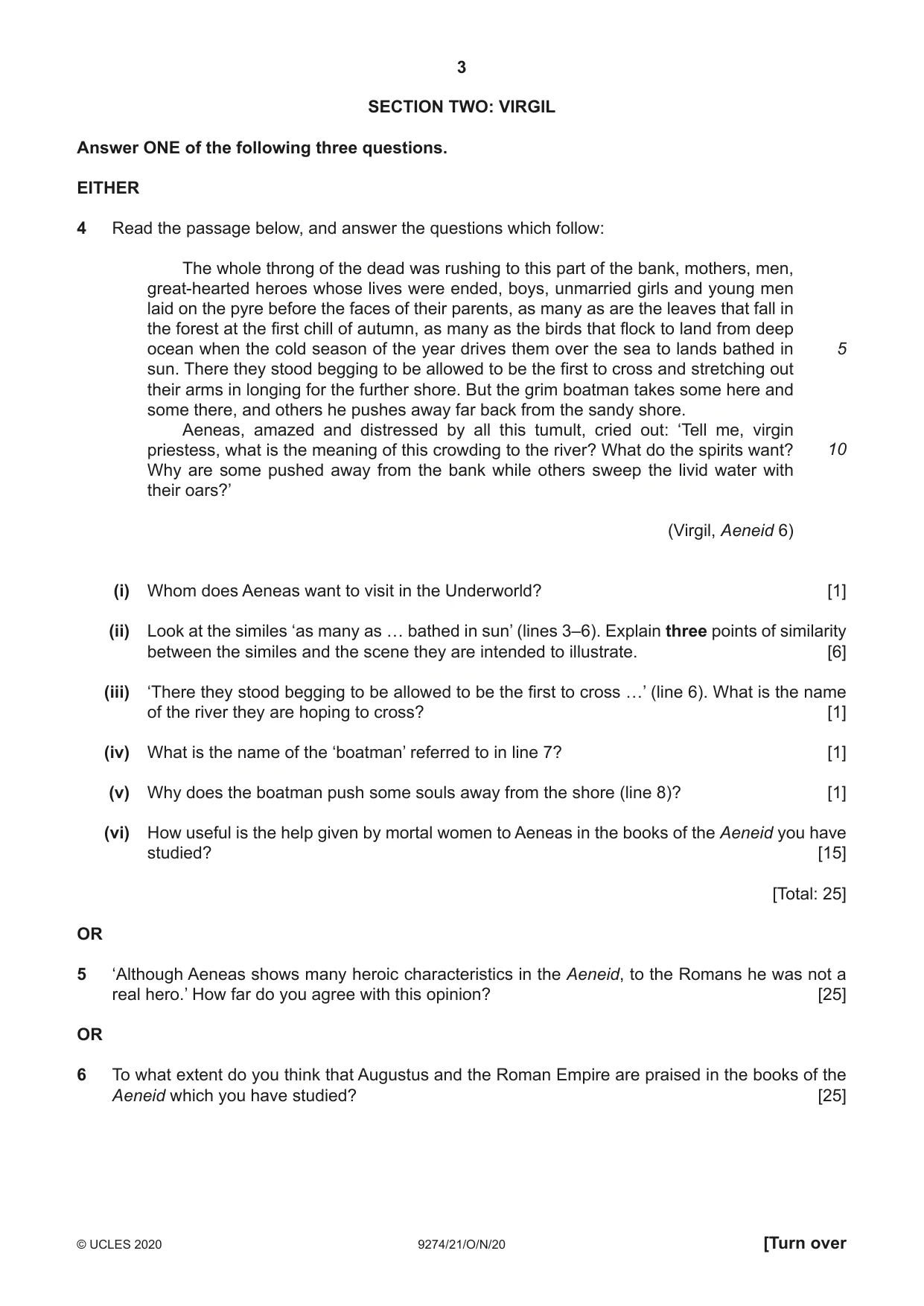
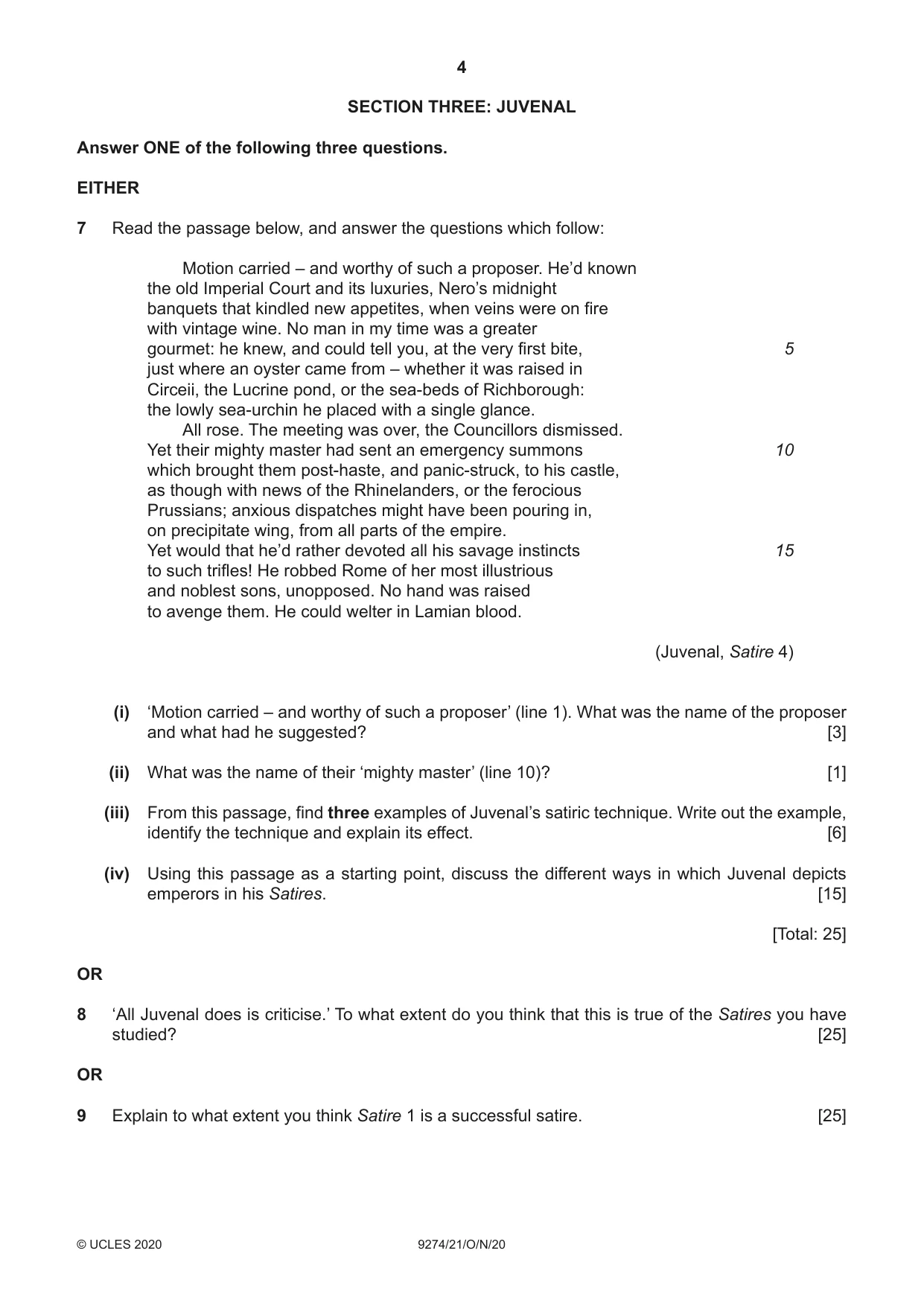
Question paper8 pages



Mark scheme16 pages
Answers below. Sit the paper first if you are practising.
Questions as text
Q1 · Read the passage below, and answer the questions which follow: Eventually Augustus broke…
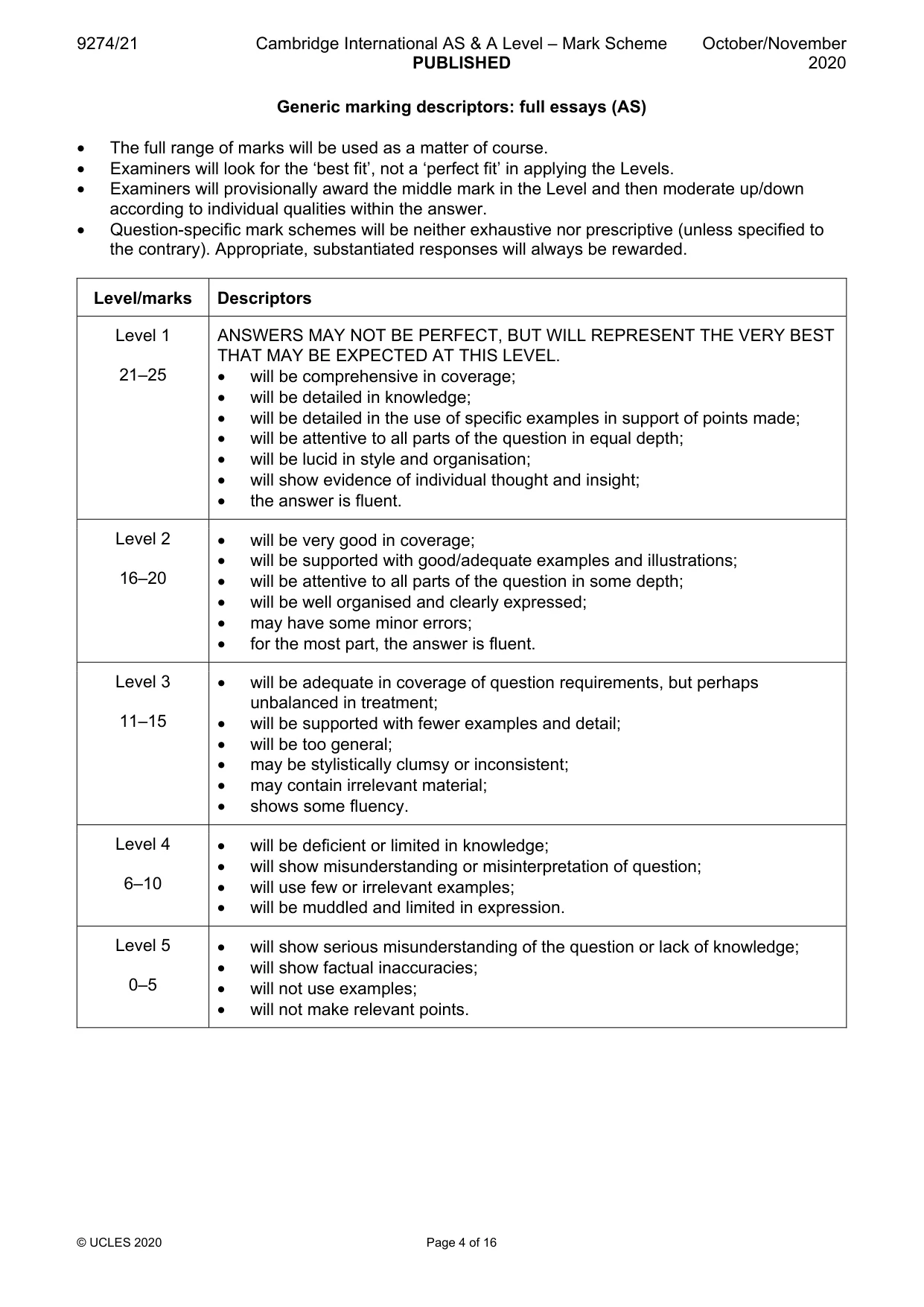
1 Read the passage below, and answer the questions which follow: Eventually Augustus broke his friendship with Mark Antony, which had always been a tenuous one and in continuous need of patching; and sought to prove that his rival had failed to conduct himself as befitted a Roman citizen, by ordering the will he had deposited at Rome to be opened and publicly read. It listed among Antony’s heirs the children fathered by him on Cleopatra. Nevertheless, when the Senate outlawed 5 Antony, Augustus allowed all his relatives and friends to join him, including Gaius Sosius and Titus Domitius, the Consuls of the year. He also excused Bononia, a city traditionally dependent on the Antonian family, from rallying to his side as the rest of Italy was doing. Presently he defeated Antony in a sea-battle off Actium, where the fighting went on so long that he spent the whole night aboard his flagship. 10 (Suetonius, The Life of the Divine Augustus 17) (i) Explain what made the opening and reading of Antony’s will illegal. [3] (ii) Apart from naming Cleopatra’s children as his heirs, give three other ways in which Antony ‘failed to conduct himself as befitted a Roman citizen’ (line 3). [3] (iii) Whom had Antony divorced to marry Cleopatra? [1] (iv) In which year did the Battle of Actium take place? [1] (v) Give the full name of the man who commanded Octavian’s navy in this battle. [2] (vi) Using this passage as a starting point, briefly describe the relationship between Octavian and Mark Antony. Explain why you think Octavian became ruler of the Roman Empire, rather than Mark Antony. [15] [Total: 25] OR
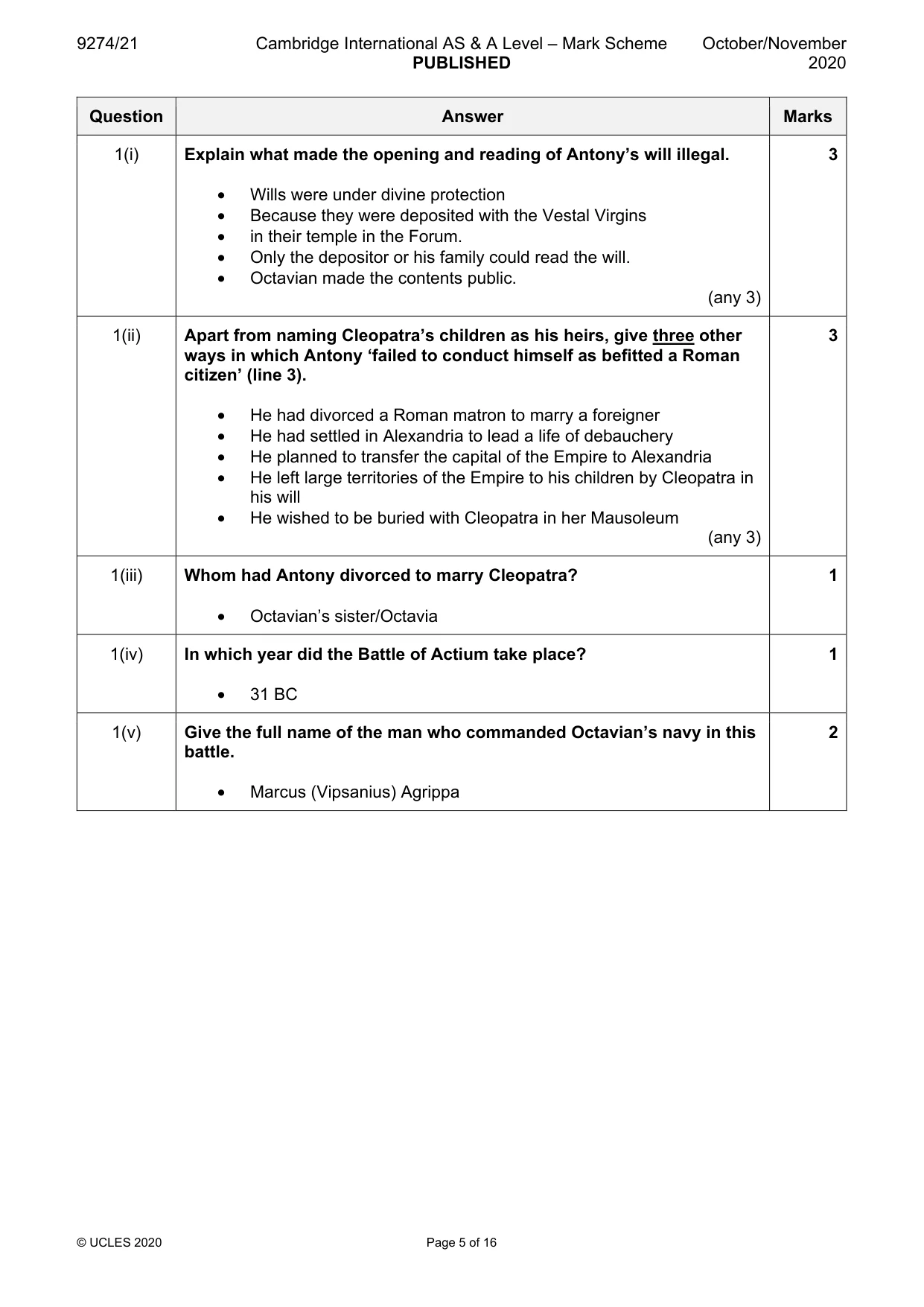
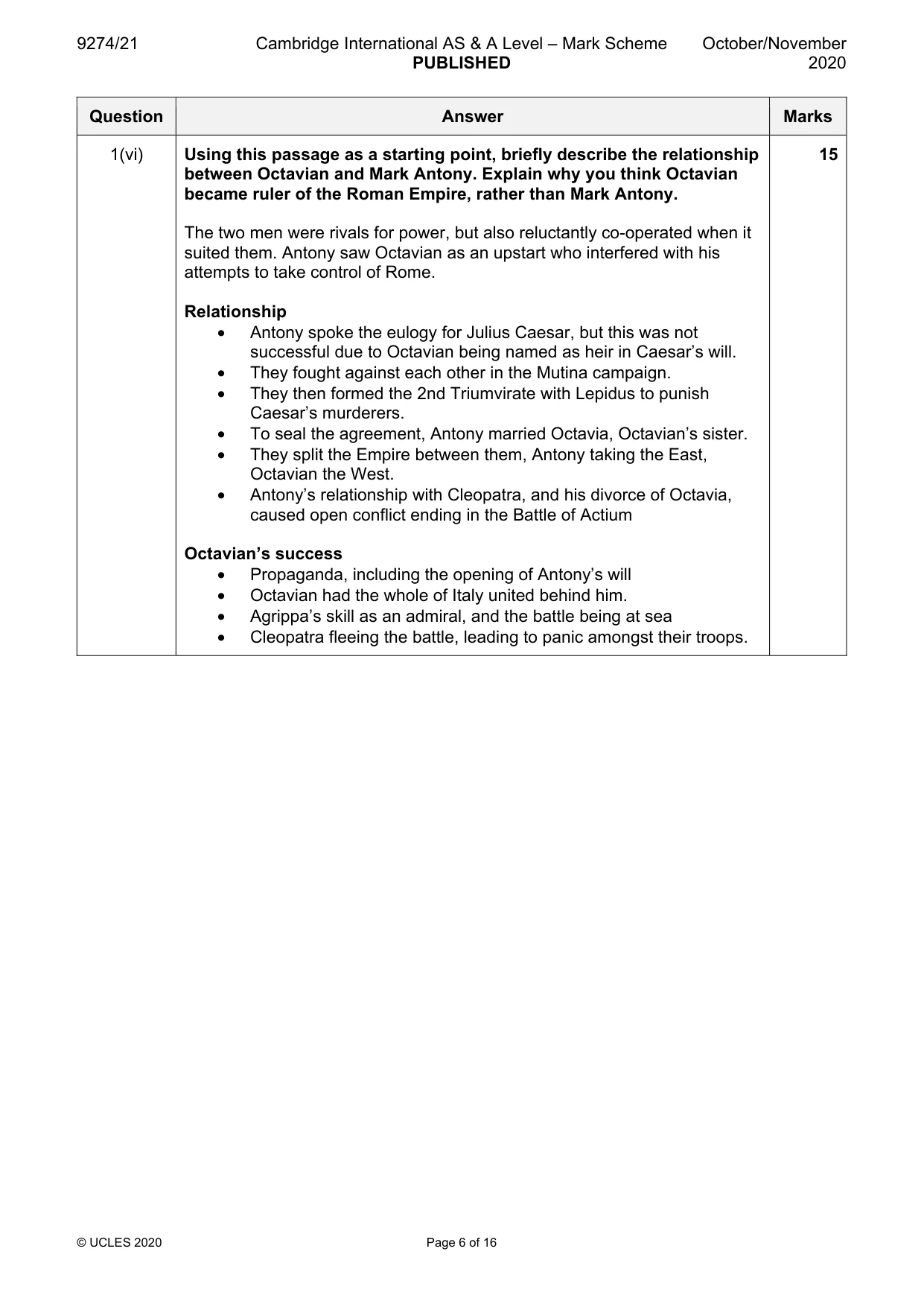
Mark scheme: Question Answer Marks 1(i) Explain what made the opening and reading of Antony’s will illegal. 3 • Wills were under divine protection • Because they were deposited with the Vestal Virgins • in their temple in the Forum. • Only the depositor or his family could read the will. • Octavian made the contents public. (any 3) 1(ii) Apart from naming Cleopatra’s children as his heirs, give three other 3 ways in which Antony ‘failed to conduct himself as befitted a Roman citizen’ (line 3). • He had divorced a Roman matron to marry a foreigner • He had settled in Alexandria to lead a life of debauchery • He planned to transfer the capital of the Empire to Alexandria • He left large territories of the Empire to his children by Cleopatra in his will • He wished to be buried with Cleopatra in her Mausoleum (any 3) 1(iii) Whom had Antony divorced to marry Cleopatra? 1 • Octavian’s sister/Octavia 1(iv) In which year did the Battle of Actium take place? 1 • 31 BC 1(v) Give the full name of the man who commanded Octavian’s navy in this 2 battle. • Marcus (Vipsanius) Agrippa 1(vi) Using this passage as a starting point, briefly describe the relationship 15 between Octavian and Mark Antony. Explain why you think Octavian became ruler of the Roman Empire, rather than Mark Antony. The two men were rivals for power, but also reluctantly co-operated when it suited them. Antony saw Octavian as an upstart who interfered with his attempts to take control of Rome. Relationship • Antony spoke the eulogy for Julius Caesar, but this was not successful due to Octavian being named as heir in Caesar’s will. • They fought against each other in the Mutina campaign. • They then formed the 2nd Triumvirate with Lepidus to punish Caesar’s murderers. • To seal the agreement, Antony married Octavia, Octavian’s sister. • They split the Empire between them, Antony taking the East, Octavian the West. • Antony’s relationship with Cleopatra, and his divorce of Octavia, caused open conflict ending in the Battle of Actium Octavian’s success • Propaganda, including the opening of Antony’s will • Octavian had the whole of Italy united behind him. • Agrippa’s skill as an admiral, and the battle being at sea • Cleopatra fleeing the battle, leading to panic amongst their troops.
Q2 · Briefly describe the many titles and honours Augustus was offered by the Senate and…
2 Briefly describe the many titles and honours Augustus was offered by the Senate and people of Rome during his life. Explain why you think he only accepted some, and rejected the rest. [25] OR
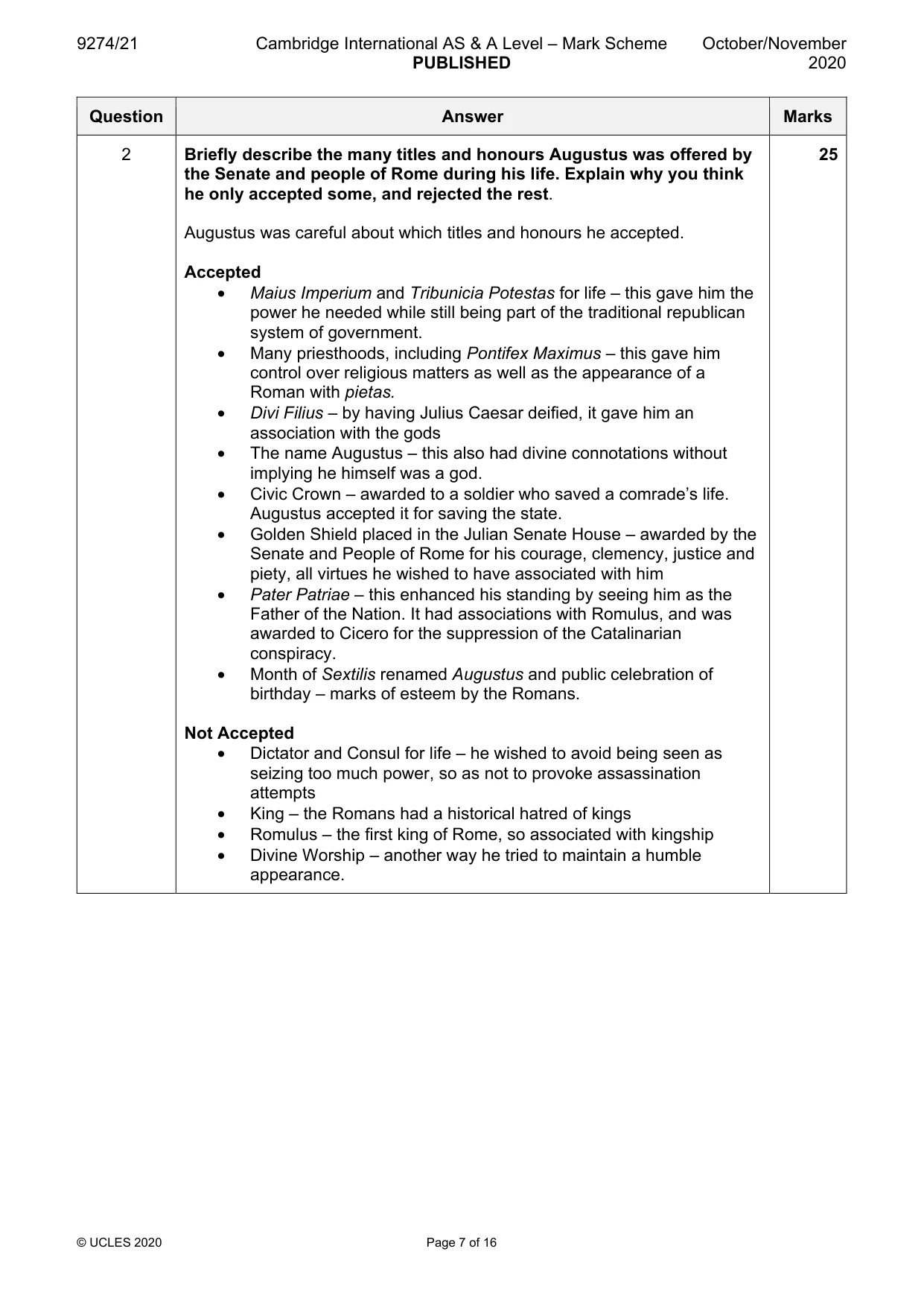
Mark scheme: 2 Briefly describe the many titles and honours Augustus was offered by 25 the Senate and people of Rome during his life. Explain why you think he only accepted some, and rejected the rest. Augustus was careful about which titles and honours he accepted. Accepted • Maius Imperium and Tribunicia Potestas for life – this gave him the power he needed while still being part of the traditional republican system of government. • Many priesthoods, including Pontifex Maximus – this gave him control over religious matters as well as the appearance of a Roman with pietas. • Divi Filius – by having Julius Caesar deified, it gave him an association with the gods • The name Augustus – this also had divine connotations without implying he himself was a god. • Civic Crown – awarded to a soldier who saved a comrade’s life. Augustus accepted it for saving the state. • Golden Shield placed in the Julian Senate House – awarded by the Senate and People of Rome for his courage, clemency, justice and piety, all virtues he wished to have associated with him • Pater Patriae – this enhanced his standing by seeing him as the Father of the Nation. It had associations with Romulus, and was awarded to Cicero for the suppression of the Catalinarian conspiracy. • Month of Sextilis renamed Augustus and public celebration of birthday – marks of esteem by the Romans. Not Accepted • Dictator and Consul for life – he wished to avoid being seen as seizing too much power, so as not to provoke assassination attempts • King – the Romans had a historical hatred of kings • Romulus – the first king of Rome, so associated with kingship • Divine Worship – another way he tried to maintain a humble appearance.
Q3 · SECTION TWO: VIRGIL Answer ONE of the following three questions
SECTION TWO: VIRGIL Answer ONE of the following three questions. EITHER
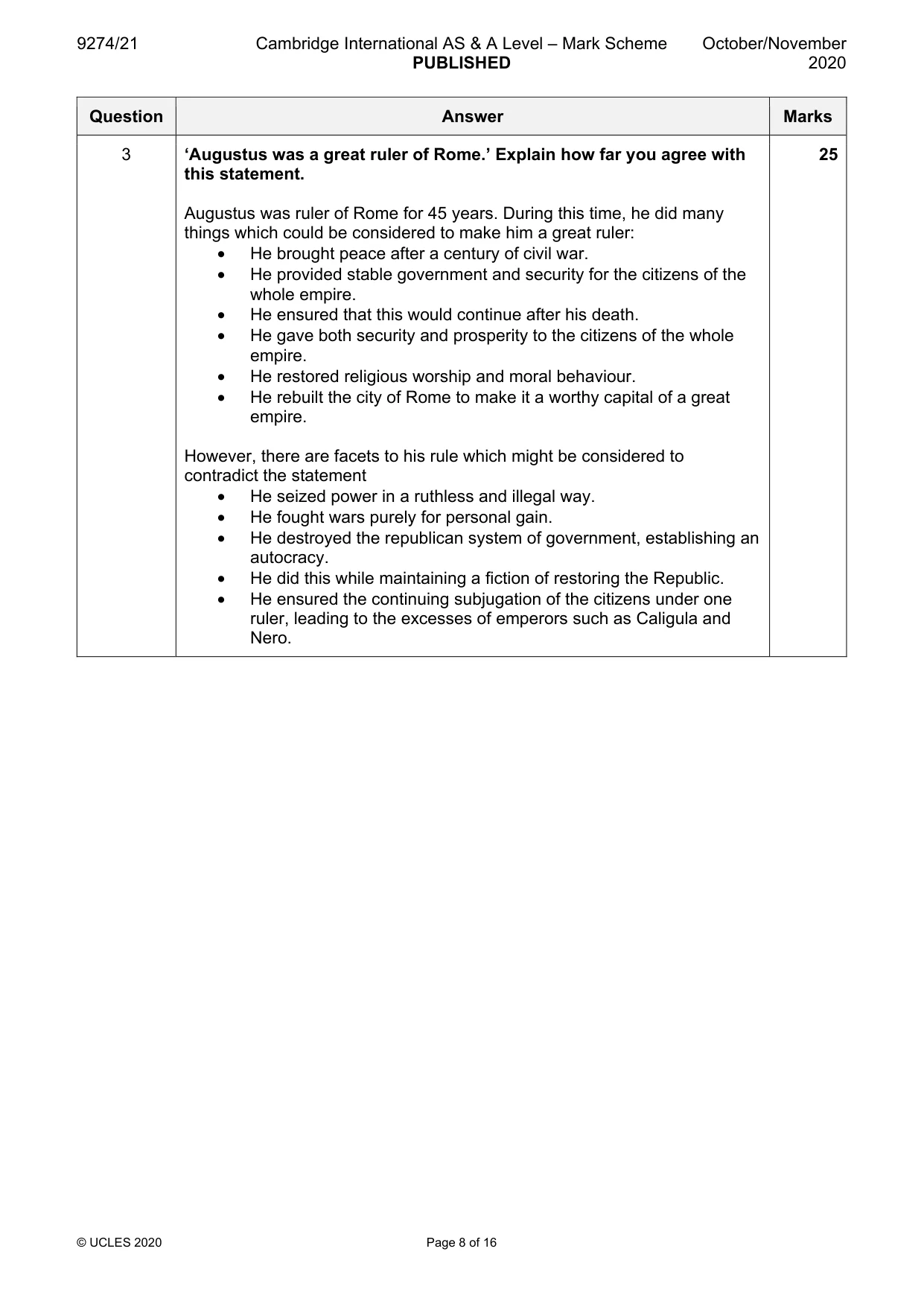
Mark scheme: 3 ‘Augustus was a great ruler of Rome.’ Explain how far you agree with 25 this statement. Augustus was ruler of Rome for 45 years. During this time, he did many things which could be considered to make him a great ruler: • He brought peace after a century of civil war. • He provided stable government and security for the citizens of the whole empire. • He ensured that this would continue after his death. • He gave both security and prosperity to the citizens of the whole empire. • He restored religious worship and moral behaviour. • He rebuilt the city of Rome to make it a worthy capital of a great empire. However, there are facets to his rule which might be considered to contradict the statement • He seized power in a ruthless and illegal way. • He fought wars purely for personal gain. • He destroyed the republican system of government, establishing an autocracy. • He did this while maintaining a fiction of restoring the Republic. • He ensured the continuing subjugation of the citizens under one ruler, leading to the excesses of emperors such as Caligula and Nero.
Q4 · Read the passage below, and answer the questions which follow: The whole throng of the…
4 Read the passage below, and answer the questions which follow: The whole throng of the dead was rushing to this part of the bank, mothers, men, great-hearted heroes whose lives were ended, boys, unmarried girls and young men laid on the pyre before the faces of their parents, as many as are the leaves that fall in the forest at the first chill of autumn, as many as the birds that flock to land from deep ocean when the cold season of the year drives them over the sea to lands bathed in 5 sun. There they stood begging to be allowed to be the first to cross and stretching out their arms in longing for the further shore. But the grim boatman takes some here and some there, and others he pushes away far back from the sandy shore. Aeneas, amazed and distressed by all this tumult, cried out: ‘Tell me, virgin priestess, what is the meaning of this crowding to the river? What do the spirits want? 10 Why are some pushed away from the bank while others sweep the livid water with their oars?’ (Virgil, Aeneid 6) (i) Whom does Aeneas want to visit in the Underworld? [1] (ii) Look at the similes ‘as many as … bathed in sun’ (lines 3–6). Explain three points of similarity between the similes and the scene they are intended to illustrate. [6] (iii) ‘There they stood begging to be allowed to be the first to cross …’ (line 6). What is the name of the river they are hoping to cross? [1] (iv) What is the name of the ‘boatman’ referred to in line 7? [1] (v) Why does the boatman push some souls away from the shore (line 8)? [1] (vi) How useful is the help given by mortal women to Aeneas in the books of the Aeneid you have studied? [15] [Total: 25] OR
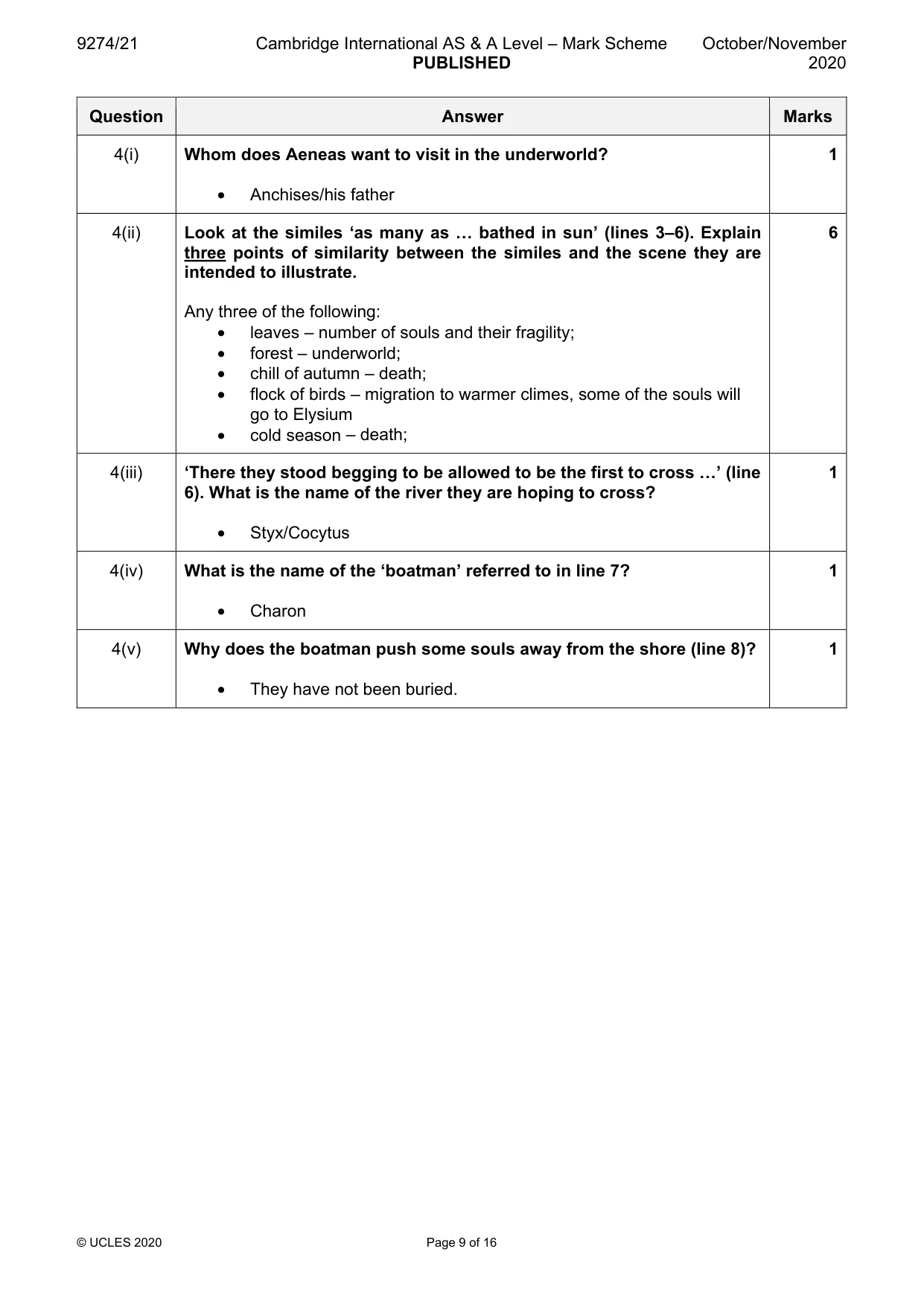
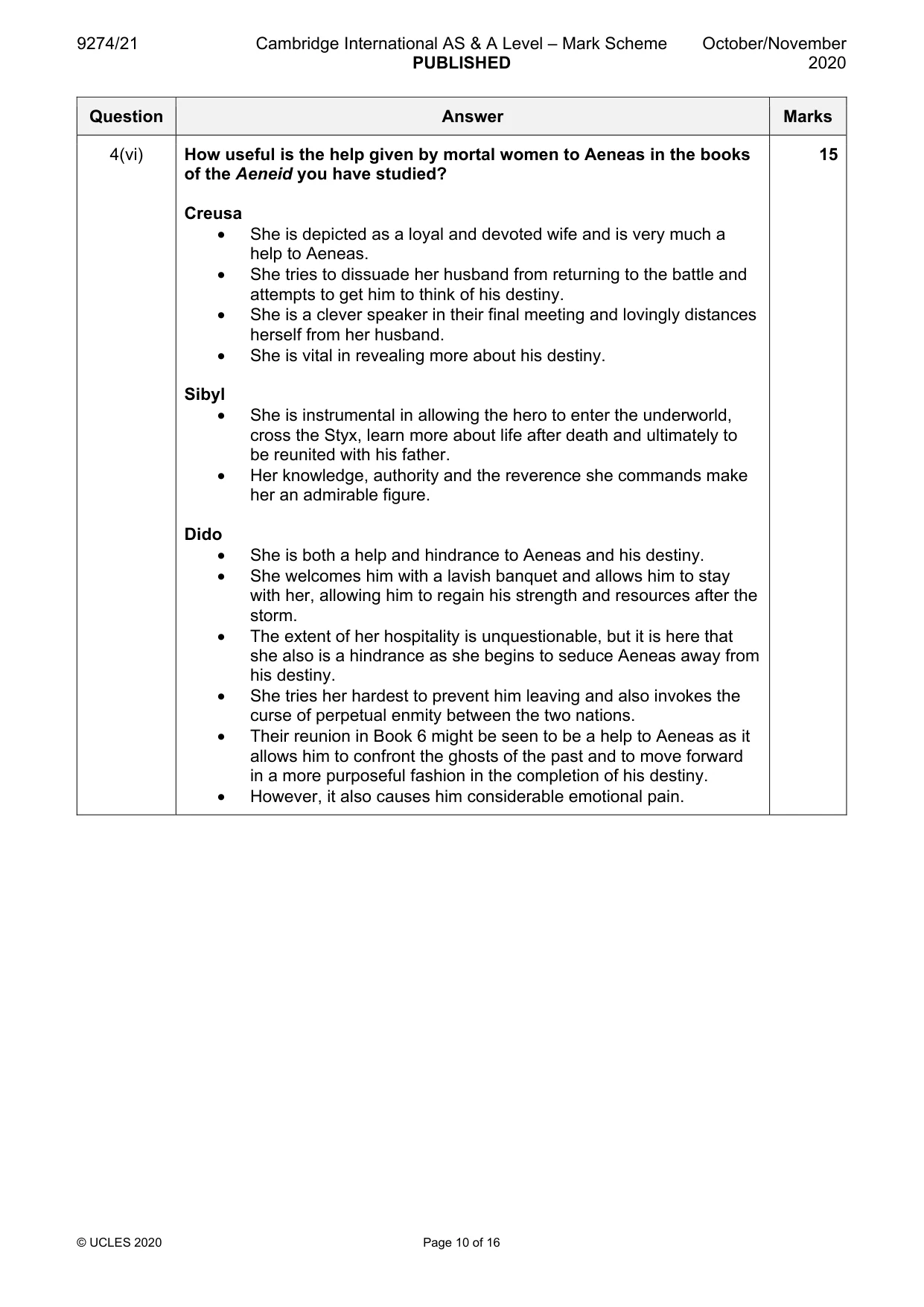
Mark scheme: 4(i) Whom does Aeneas want to visit in the underworld? 1 • Anchises/his father 4(ii) Look at the similes ‘as many as … bathed in sun’ (lines 3–6). Explain 6 three points of similarity between the similes and the scene they are intended to illustrate. Any three of the following: • leaves – number of souls and their fragility; • forest – underworld; • chill of autumn – death; • flock of birds – migration to warmer climes, some of the souls will go to Elysium • cold season – death; 4(iii) ‘There they stood begging to be allowed to be the first to cross …’ (line 1 6). What is the name of the river they are hoping to cross? • Styx/Cocytus 4(iv) What is the name of the ‘boatman’ referred to in line 7? 1 • Charon 4(v) Why does the boatman push some souls away from the shore (line 8)? 1 • They have not been buried. 4(vi) How useful is the help given by mortal women to Aeneas in the books 15 of the Aeneid you have studied? Creusa • She is depicted as a loyal and devoted wife and is very much a help to Aeneas. • She tries to dissuade her husband from returning to the battle and attempts to get him to think of his destiny. • She is a clever speaker in their final meeting and lovingly distances herself from her husband. • She is vital in revealing more about his destiny. Sibyl • She is instrumental in allowing the hero to enter the underworld, cross the Styx, learn more about life after death and ultimately to be reunited with his father. • Her knowledge, authority and the reverence she commands make her an admirable figure. Dido • She is both a help and hindrance to Aeneas and his destiny. • She welcomes him with a lavish banquet and allows him to stay with her, allowing him to regain his strength and resources after the storm. • The extent of her hospitality is unquestionable, but it is here that she also is a hindrance as she begins to seduce Aeneas away from his destiny. • She tries her hardest to prevent him leaving and also invokes the curse of perpetual enmity between the two nations. • Their reunion in Book 6 might be seen to be a help to Aeneas as it allows him to confront the ghosts of the past and to move forward in a more purposeful fashion in the completion of his destiny. • However, it also causes him considerable emotional pain.
Q5 · ‘Although Aeneas shows many heroic characteristics in the Aeneid, to the Romans he was…
5 ‘Although Aeneas shows many heroic characteristics in the Aeneid, to the Romans he was not a real hero.’ How far do you agree with this opinion? [25] OR
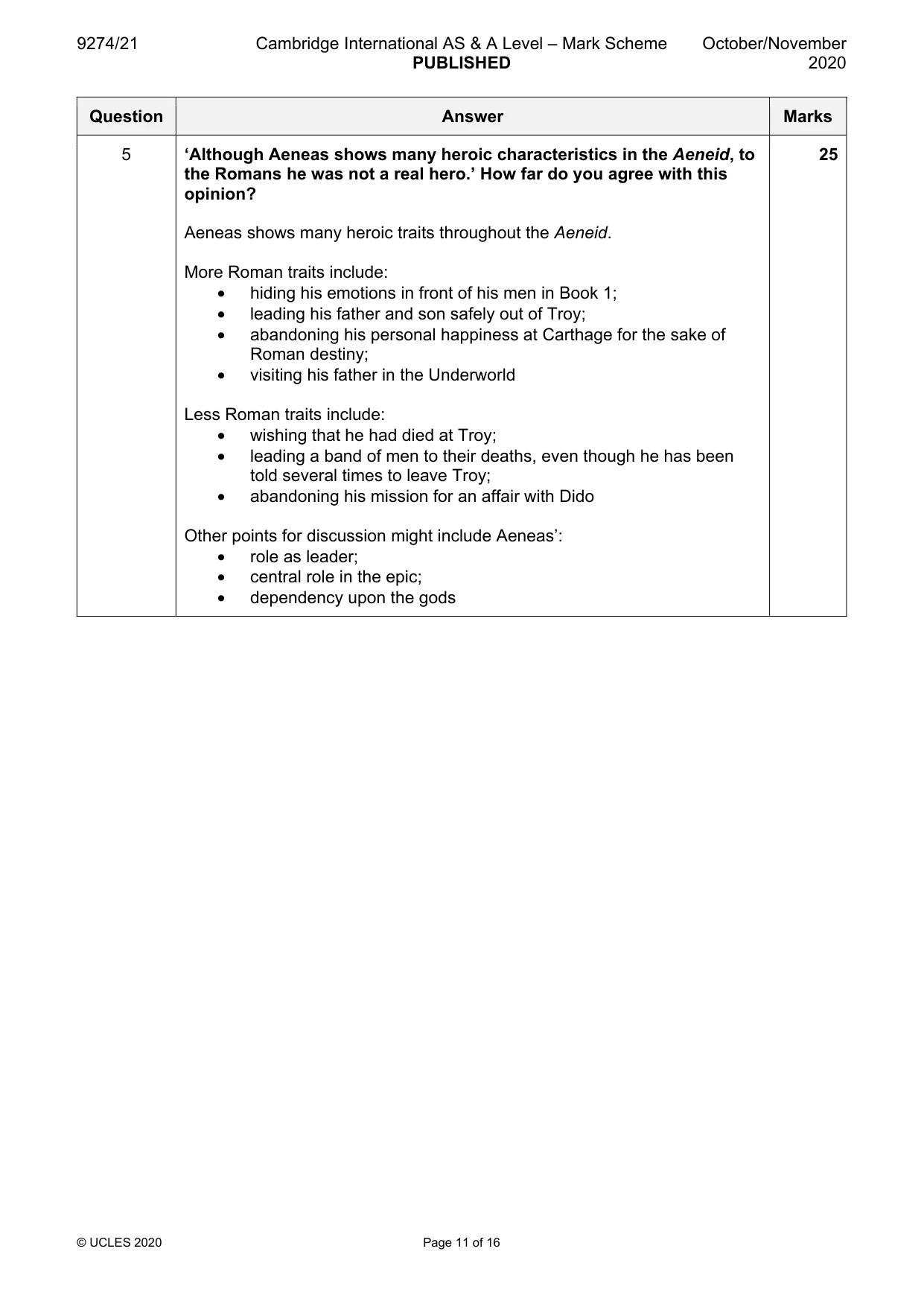
Mark scheme: 5 ‘Although Aeneas shows many heroic characteristics in the Aeneid, to 25 the Romans he was not a real hero.’ How far do you agree with this opinion? Aeneas shows many heroic traits throughout the Aeneid. More Roman traits include: • hiding his emotions in front of his men in Book 1; • leading his father and son safely out of Troy; • abandoning his personal happiness at Carthage for the sake of Roman destiny; • visiting his father in the Underworld Less Roman traits include: • wishing that he had died at Troy; • leading a band of men to their deaths, even though he has been told several times to leave Troy; • abandoning his mission for an affair with Dido Other points for discussion might include Aeneas’: • role as leader; • central role in the epic; • dependency upon the gods
Q6 · To what extent do you think that Augustus and the Roman Empire are praised in the books…
6 To what extent do you think that Augustus and the Roman Empire are praised in the books of the Aeneid which you have studied? [25] SECTION THREE: JUVENAL Answer ONE of the following three questions. EITHER
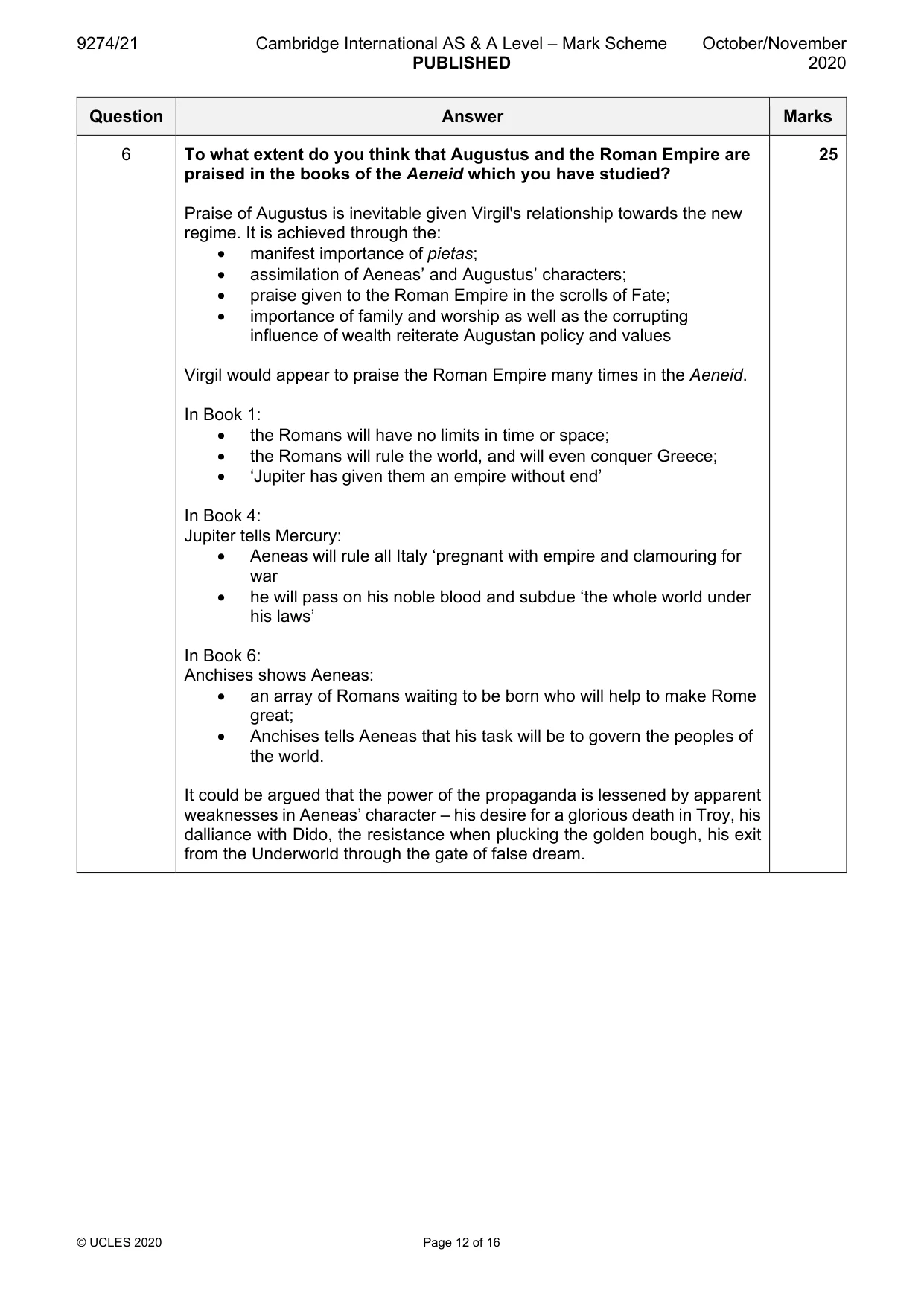
Mark scheme: 6 To what extent do you think that Augustus and the Roman Empire are 25 praised in the books of the Aeneid which you have studied? Praise of Augustus is inevitable given Virgil's relationship towards the new regime. It is achieved through the: • manifest importance of pietas; • assimilation of Aeneas’ and Augustus’ characters; • praise given to the Roman Empire in the scrolls of Fate; • importance of family and worship as well as the corrupting influence of wealth reiterate Augustan policy and values Virgil would appear to praise the Roman Empire many times in the Aeneid. In Book 1: • the Romans will have no limits in time or space; • the Romans will rule the world, and will even conquer Greece; • ‘Jupiter has given them an empire without end’ In Book 4: Jupiter tells Mercury: • Aeneas will rule all Italy ‘pregnant with empire and clamouring for war • he will pass on his noble blood and subdue ‘the whole world under his laws’ In Book 6: Anchises shows Aeneas: • an array of Romans waiting to be born who will help to make Rome great; • Anchises tells Aeneas that his task will be to govern the peoples of the world. It could be argued that the power of the propaganda is lessened by apparent weaknesses in Aeneas’ character – his desire for a glorious death in Troy, his dalliance with Dido, the resistance when plucking the golden bough, his exit from the Underworld through the gate of false dream.
Q7 · Read the passage below, and answer the questions which follow: Motion carried – and…
7 Read the passage below, and answer the questions which follow: Motion carried – and worthy of such a proposer. He’d known the old Imperial Court and its luxuries, Nero’s midnight banquets that kindled new appetites, when veins were on fire with vintage wine. No man in my time was a greater gourmet: he knew, and could tell you, at the very first bite, 5 just where an oyster came from – whether it was raised in Circeii, the Lucrine pond, or the sea-beds of Richborough: the lowly sea-urchin he placed with a single glance. All rose. The meeting was over, the Councillors dismissed. Yet their mighty master had sent an emergency summons 10 which brought them post-haste, and panic-struck, to his castle, as though with news of the Rhinelanders, or the ferocious Prussians; anxious dispatches might have been pouring in, on precipitate wing, from all parts of the empire. Yet would that he’d rather devoted all his savage instincts 15 to such trifles! He robbed Rome of her most illustrious and noblest sons, unopposed. No hand was raised to avenge them. He could welter in Lamian blood. (Juvenal, Satire 4) (i) ‘Motion carried – and worthy of such a proposer’ (line 1). What was the name of the proposer and what had he suggested? [3] (ii) What was the name of their ‘mighty master’ (line 10)? [1] (iii) From this passage, find three examples of Juvenal’s satiric technique. Write out the example, identify the technique and explain its effect. [6] (iv) Using this passage as a starting point, discuss the different ways in which Juvenal depicts emperors in his Satires. [15] [Total: 25] OR
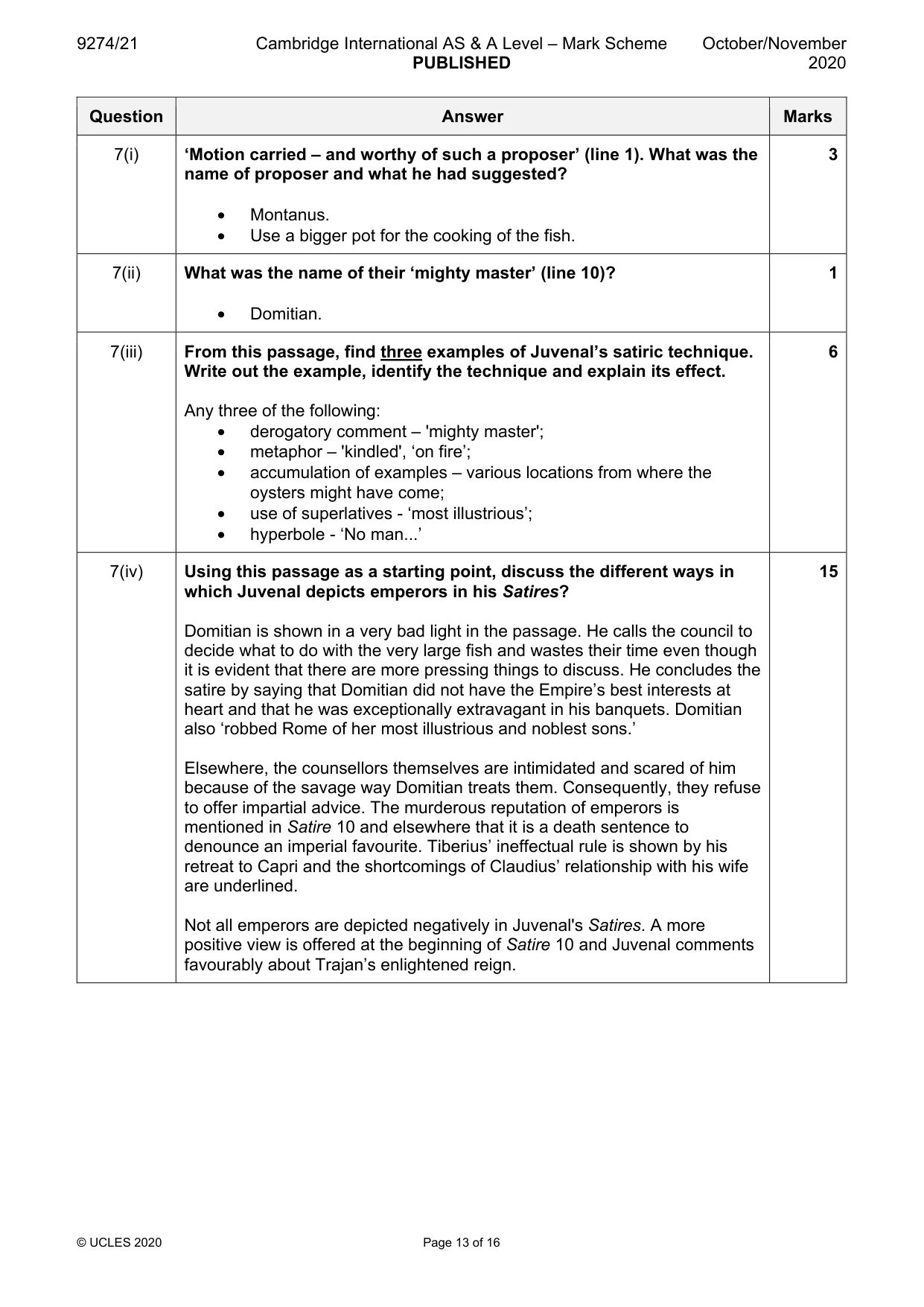
Mark scheme: 7(i) ‘Motion carried – and worthy of such a proposer’ (line 1). What was the 3 name of proposer and what he had suggested? • Montanus. • Use a bigger pot for the cooking of the fish. 7(ii) What was the name of their ‘mighty master’ (line 10)? 1 • Domitian. 7(iii) From this passage, find three examples of Juvenal’s satiric technique. 6 Write out the example, identify the technique and explain its effect. Any three of the following: • derogatory comment – 'mighty master'; • metaphor – 'kindled', ‘on fire’; • accumulation of examples – various locations from where the oysters might have come; • use of superlatives - ‘most illustrious’; • hyperbole - ‘No man...’ 7(iv) Using this passage as a starting point, discuss the different ways in 15 which Juvenal depicts emperors in his Satires? Domitian is shown in a very bad light in the passage. He calls the council to decide what to do with the very large fish and wastes their time even though it is evident that there are more pressing things to discuss. He concludes the satire by saying that Domitian did not have the Empire’s best interests at heart and that he was exceptionally extravagant in his banquets. Domitian also ‘robbed Rome of her most illustrious and noblest sons.’ Elsewhere, the counsellors themselves are intimidated and scared of him because of the savage way Domitian treats them. Consequently, they refuse to offer impartial advice. The murderous reputation of emperors is mentioned in Satire 10 and elsewhere that it is a death sentence to denounce an imperial favourite. Tiberius’ ineffectual rule is shown by his retreat to Capri and the shortcomings of Claudius’ relationship with his wife are underlined. Not all emperors are depicted negatively in Juvenal's Satires. A more positive view is offered at the beginning of Satire 10 and Juvenal comments favourably about Trajan’s enlightened reign.
Q8 · ‘All Juvenal does is criticise.’ To what extent do you think that this is true of the…
8 ‘All Juvenal does is criticise.’ To what extent do you think that this is true of the Satires you have studied? [25] OR
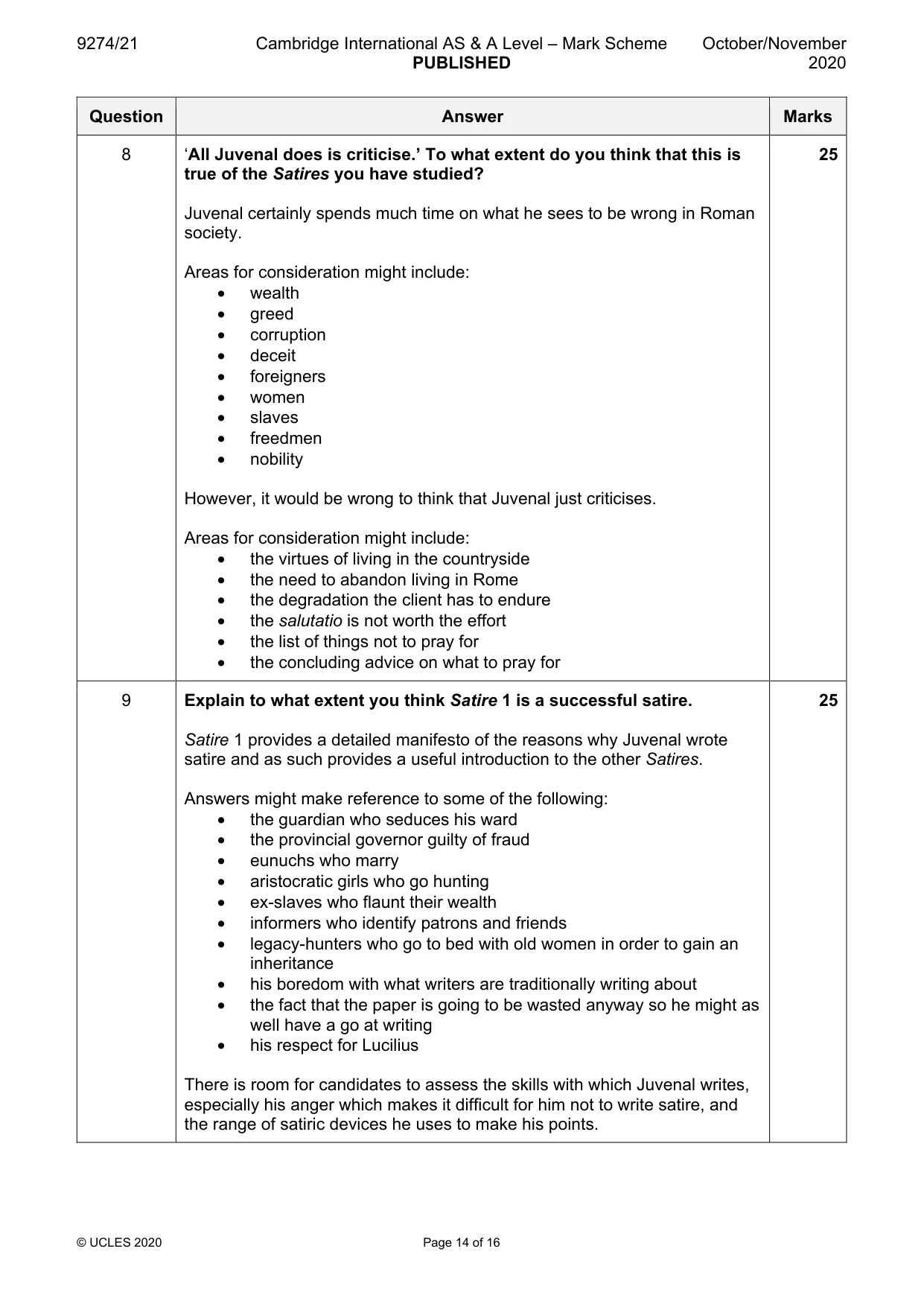
Mark scheme: 8 ‘All Juvenal does is criticise.’ To what extent do you think that this is 25 true of the Satires you have studied? Juvenal certainly spends much time on what he sees to be wrong in Roman society. Areas for consideration might include: • wealth • greed • corruption • deceit • foreigners • women • slaves • freedmen • nobility However, it would be wrong to think that Juvenal just criticises. Areas for consideration might include: • the virtues of living in the countryside • the need to abandon living in Rome • the degradation the client has to endure • the salutatio is not worth the effort • the list of things not to pray for • the concluding advice on what to pray for
Q9 · SECTION FOUR: ROMAN ARCHITECTURE Answer ONE of the following three questions
SECTION FOUR: ROMAN ARCHITECTURE Answer ONE of the following three questions. EITHER
Mark scheme: 9 Explain to what extent you think Satire 1 is a successful satire. 25 Satire 1 provides a detailed manifesto of the reasons why Juvenal wrote satire and as such provides a useful introduction to the other Satires. Answers might make reference to some of the following: • the guardian who seduces his ward • the provincial governor guilty of fraud • eunuchs who marry • aristocratic girls who go hunting • ex-slaves who flaunt their wealth • informers who identify patrons and friends • legacy-hunters who go to bed with old women in order to gain an inheritance • his boredom with what writers are traditionally writing about • the fact that the paper is going to be wasted anyway so he might as well have a go at writing • his respect for Lucilius There is room for candidates to assess the skills with which Juvenal writes, especially his anger which makes it difficult for him not to write satire, and the range of satiric devices he uses to make his points.
Q10 · Study the image below, and answer the questions which follow: (i) What type of building…
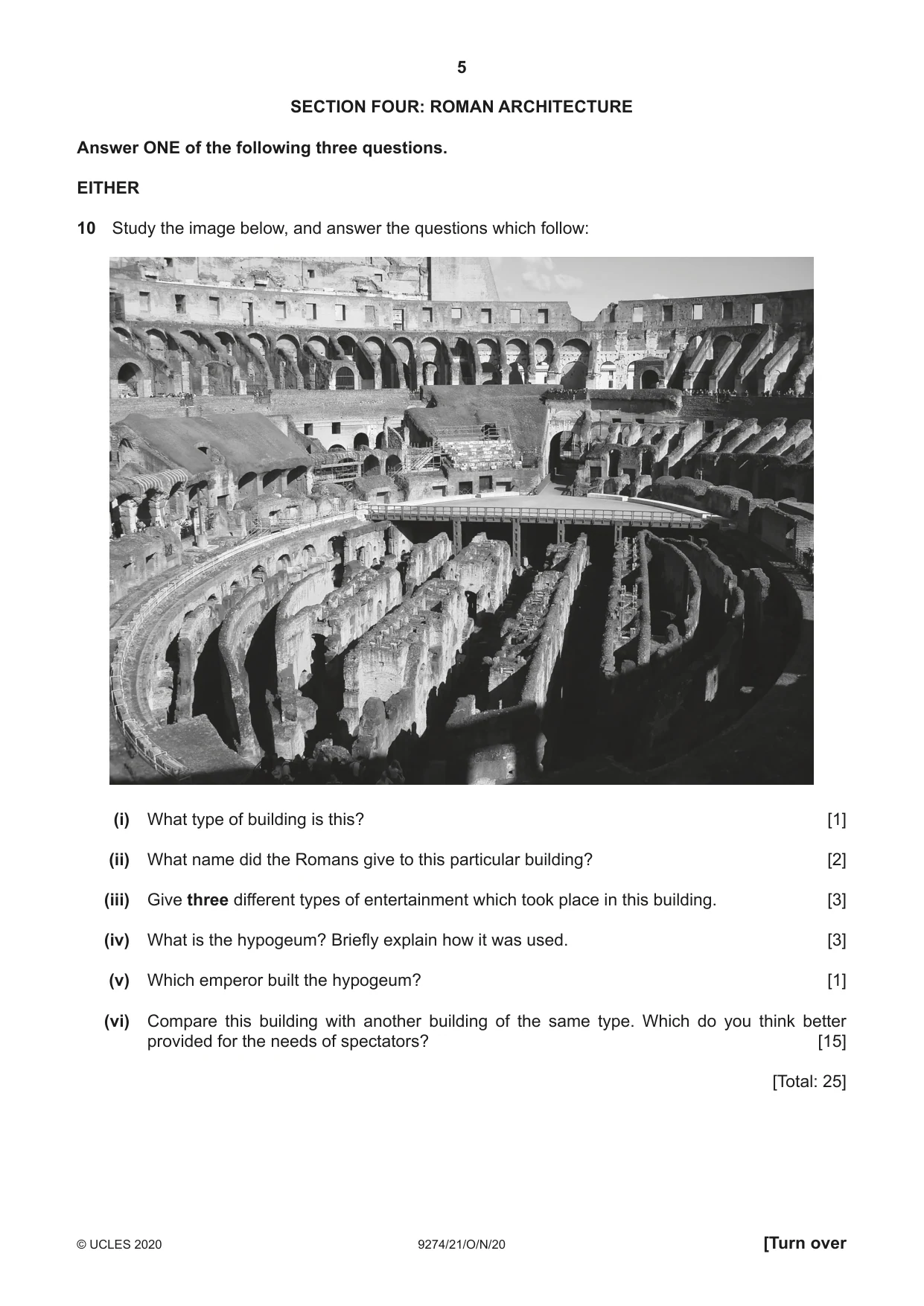
10 Study the image below, and answer the questions which follow: (i) What type of building is this? [1] (ii) What name did the Romans give to this particular building? [2] (iii) Give three different types of entertainment which took place in this building. [3] (iv) What is the hypogeum? Briefly explain how it was used. [3] (v) Which emperor built the hypogeum? [1] (vi) Compare this building with another building of the same type. Which do you think better provided for the needs of spectators? [15] [Total: 25] OR
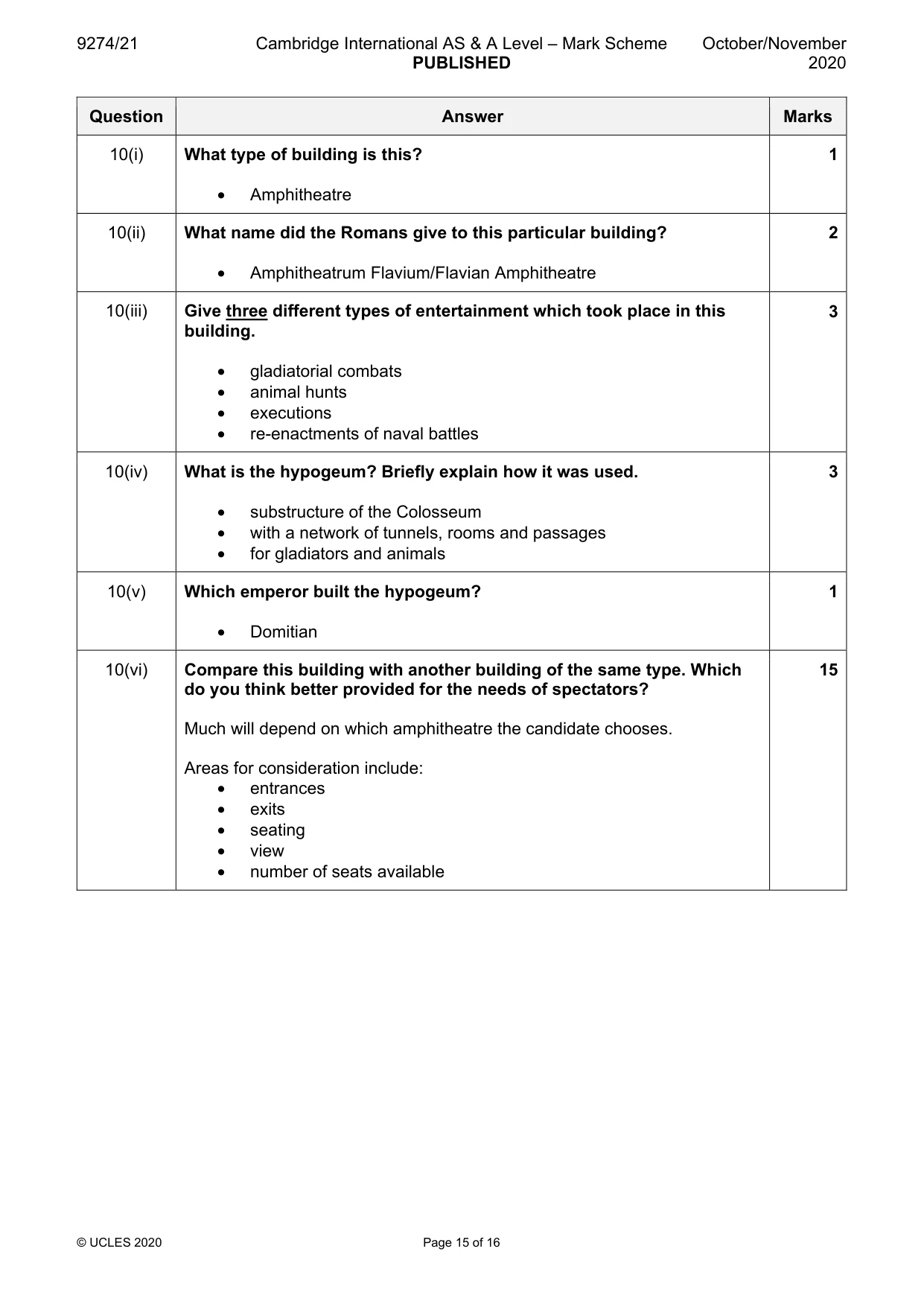
Mark scheme: 10(i) What type of building is this? 1 • Amphitheatre 10(ii) What name did the Romans give to this particular building? 2 • Amphitheatrum Flavium/Flavian Amphitheatre 10(iii) Give three different types of entertainment which took place in this 3 building. • gladiatorial combats • animal hunts • executions • re-enactments of naval battles 10(iv) What is the hypogeum? Briefly explain how it was used. 3 • substructure of the Colosseum • with a network of tunnels, rooms and passages • for gladiators and animals 10(v) Which emperor built the hypogeum? 1 • Domitian 10(vi) Compare this building with another building of the same type. Which 15 do you think better provided for the needs of spectators? Much will depend on which amphitheatre the candidate chooses. Areas for consideration include: • entrances • exits • seating • view • number of seats available
Q11 · ‘A masterpiece of simplicity and beauty.’ To which of the buildings you have studied do…
11 ‘A masterpiece of simplicity and beauty.’ To which of the buildings you have studied do you think that this description applies the most? You should include discussion of at least three specific Roman buildings to explain your answer. [25] OR
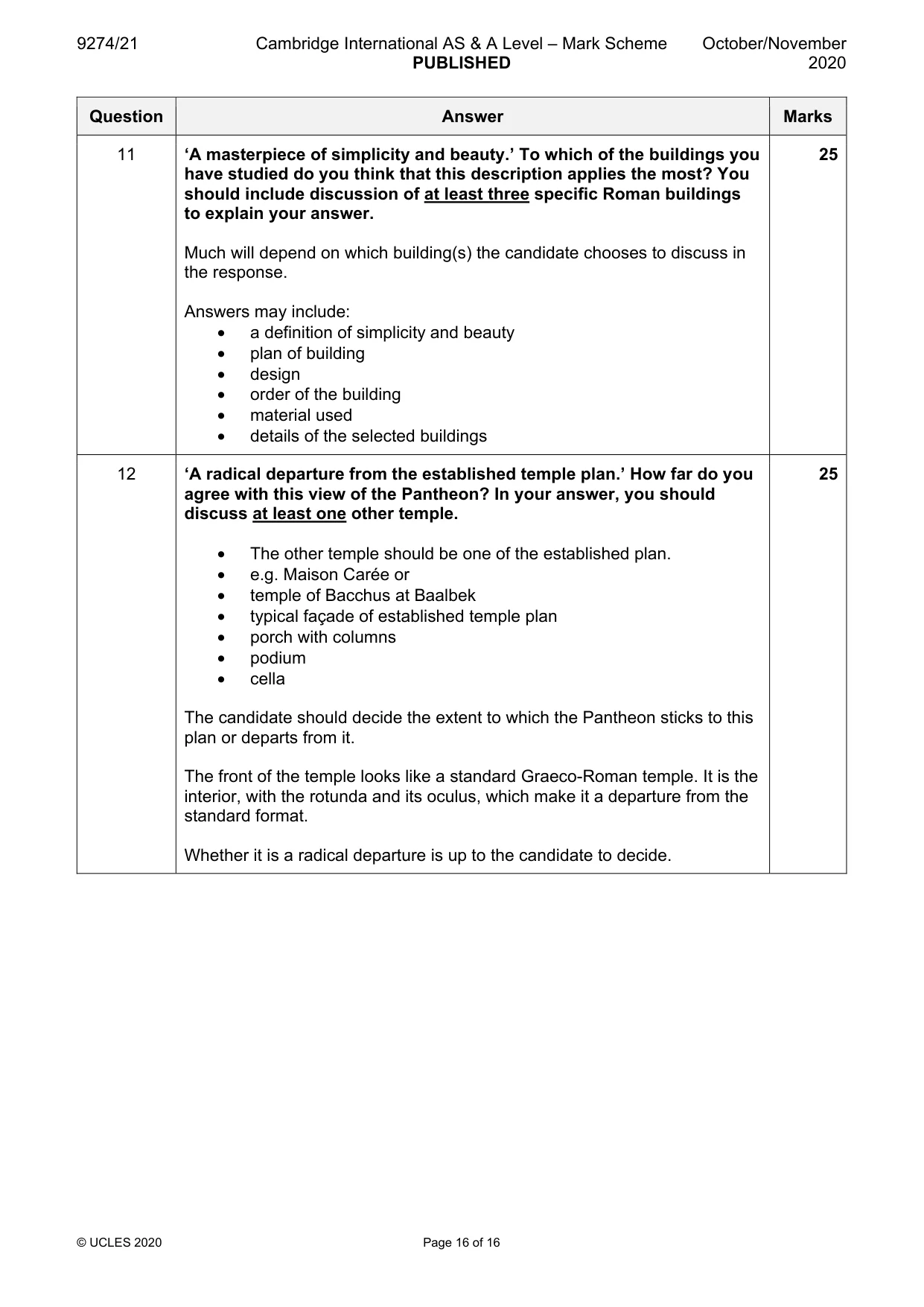
Mark scheme: 11 ‘A masterpiece of simplicity and beauty.’ To which of the buildings you 25 have studied do you think that this description applies the most? You should include discussion of at least three specific Roman buildings to explain your answer. Much will depend on which building(s) the candidate chooses to discuss in the response. Answers may include: • a definition of simplicity and beauty • plan of building • design • order of the building • material used • details of the selected buildings
Q12 · ‘A radical departure from the established temple plan.’ How far do you agree with this…
12 ‘A radical departure from the established temple plan.’ How far do you agree with this view of the Pantheon? In your answer, you should discuss at least one other temple. [25]
Mark scheme: 12 ‘A radical departure from the established temple plan.’ How far do you 25 agree with this view of the Pantheon? In your answer, you should discuss at least one other temple. • The other temple should be one of the established plan. • e.g. Maison Carée or • temple of Bacchus at Baalbek • typical façade of established temple plan • porch with columns • podium • cella The candidate should decide the extent to which the Pantheon sticks to this plan or departs from it. The front of the temple looks like a standard Graeco-Roman temple. It is the interior, with the rotunda and its oculus, which make it a departure from the standard format. Whether it is a radical departure is up to the candidate to decide.
What was in this paper
The subtopics covered by these 12 questions, and how many questions each got. Open one in a new tab to see every Cambridge question on it.
What you needed in this session
Cambridge’s own grade thresholds for 2020 Oct/Nov, Paper 2 · Variant 1. A higher threshold means an easier paper — the bar moves with how the cohort did.