Cambridge A Level Classical Studies 9274 — 2021 Oct/Nov Paper 2 · Variant 1
9274/21/O/N/21 · 12 questions · 50 marks · ≈56 min
The question paper and its mark scheme, free to read here and free to download. This is Cambridge’s own paper, exactly as it was sat.
Question paper8 pages



Mark scheme15 pages
Answers below. Sit the paper first if you are practising.
Questions as text
Q1 · Read the passage below, and answer the questions which follow: Then, O Gods, grant…
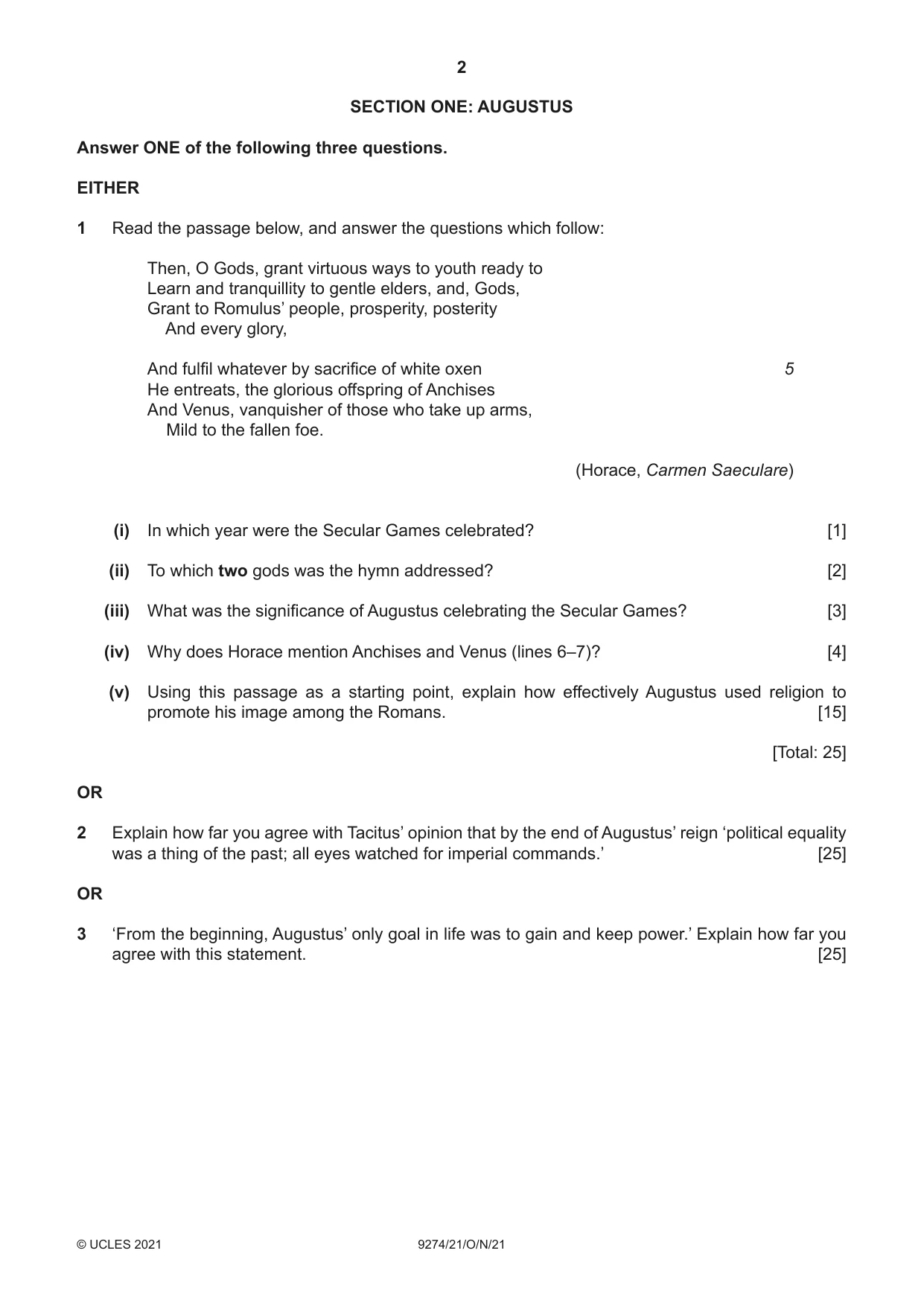
1 Read the passage below, and answer the questions which follow: Then, O Gods, grant virtuous ways to youth ready to Learn and tranquillity to gentle elders, and, Gods, Grant to Romulus’ people, prosperity, posterity And every glory, And fulfil whatever by sacrifice of white oxen 5 He entreats, the glorious offspring of Anchises And Venus, vanquisher of those who take up arms, Mild to the fallen foe. (Horace, Carmen Saeculare) (i) In which year were the Secular Games celebrated? [1] (ii) To which two gods was the hymn addressed? [2] (iii) What was the significance of Augustus celebrating the Secular Games? [3] (iv) Why does Horace mention Anchises and Venus (lines 6–7)? [4] (v) Using this passage as a starting point, explain how effectively Augustus used religion to promote his image among the Romans. [15] [Total: 25] OR
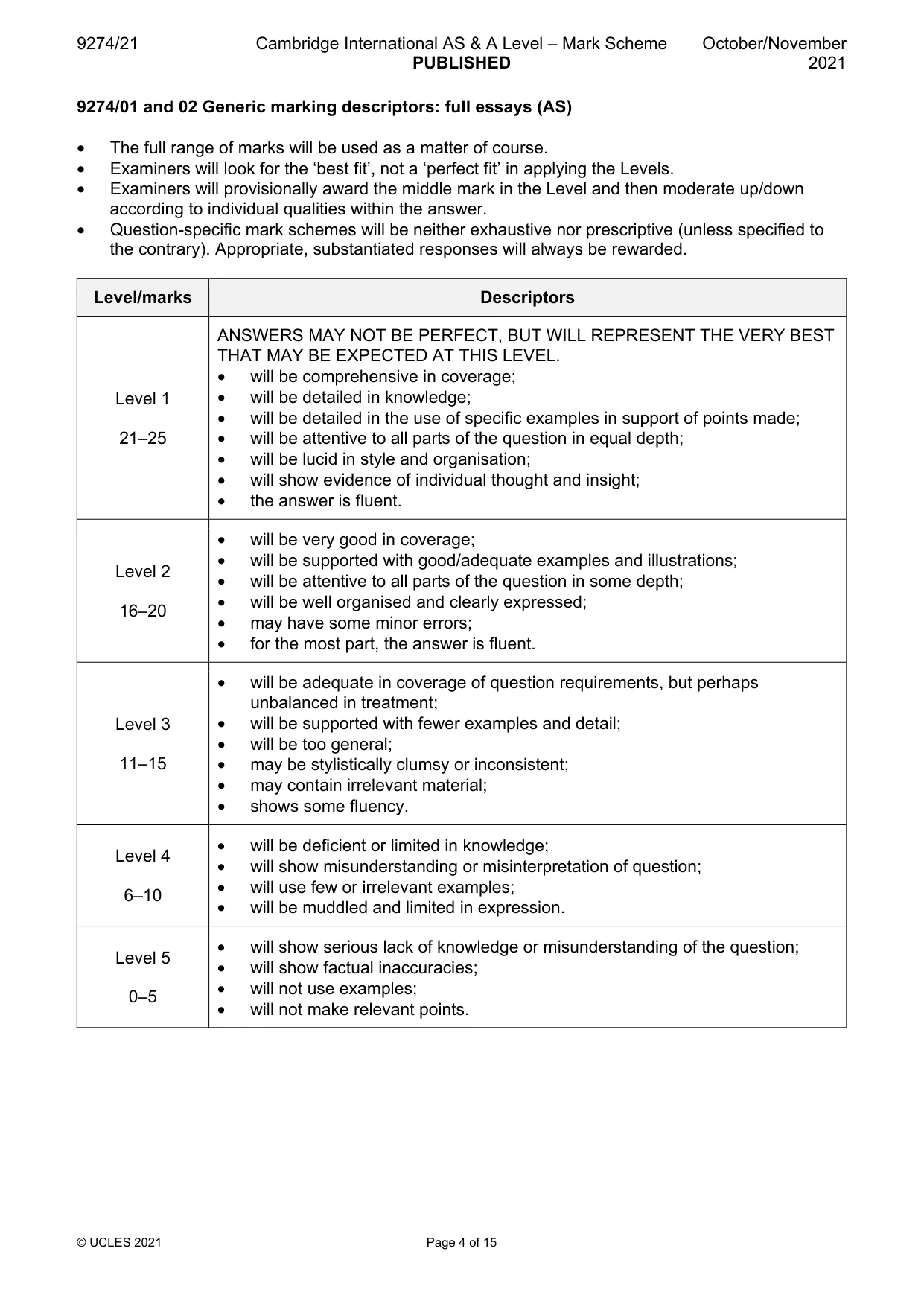
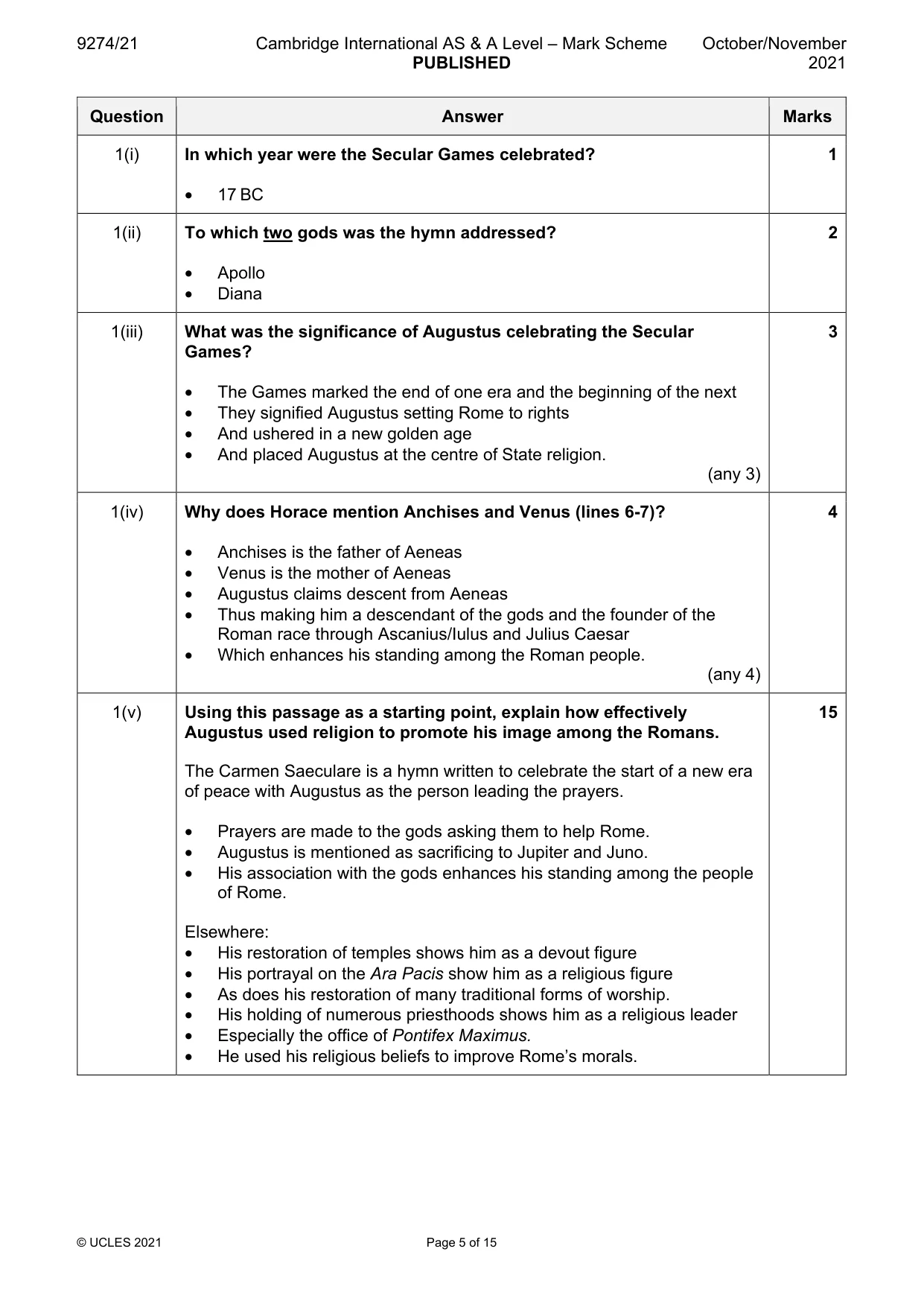
Mark scheme: Question Answer Marks 1(i) In which year were the Secular Games celebrated? 1 • 17 BC 1(ii) To which two gods was the hymn addressed? 2 • Apollo • Diana 1(iii) What was the significance of Augustus celebrating the Secular 3 Games? • The Games marked the end of one era and the beginning of the next • They signified Augustus setting Rome to rights • And ushered in a new golden age • And placed Augustus at the centre of State religion. (any 3) 1(iv) Why does Horace mention Anchises and Venus (lines 6-7)? 4 • Anchises is the father of Aeneas • Venus is the mother of Aeneas • Augustus claims descent from Aeneas • Thus making him a descendant of the gods and the founder of the Roman race through Ascanius/Iulus and Julius Caesar • Which enhances his standing among the Roman people. (any 4) 1(v) Using this passage as a starting point, explain how effectively 15 Augustus used religion to promote his image among the Romans. The Carmen Saeculare is a hymn written to celebrate the start of a new era of peace with Augustus as the person leading the prayers. • Prayers are made to the gods asking them to help Rome. • Augustus is mentioned as sacrificing to Jupiter and Juno. • His association with the gods enhances his standing among the people of Rome. Elsewhere: • His restoration of temples shows him as a devout figure • His portrayal on the Ara Pacis show him as a religious figure • As does his restoration of many traditional forms of worship. • His holding of numerous priesthoods shows him as a religious leader • Especially the office of Pontifex Maximus. • He used his religious beliefs to improve Rome’s morals.
Q2 · Explain how far you agree with Tacitus’ opinion that by the end of Augustus’ reign…
2 Explain how far you agree with Tacitus’ opinion that by the end of Augustus’ reign ‘political equality was a thing of the past; all eyes watched for imperial commands.’ [25] OR
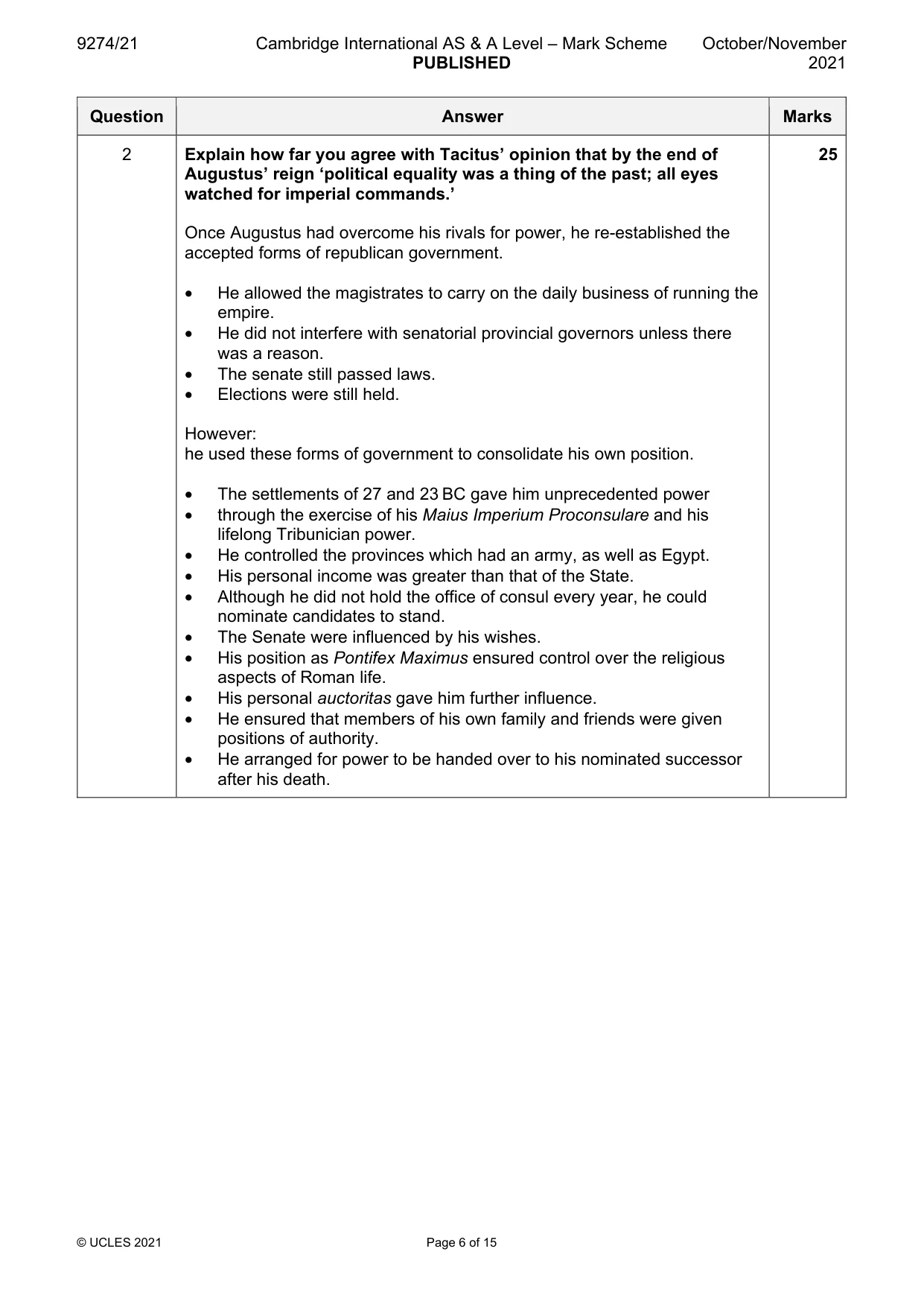
Mark scheme: 2 Explain how far you agree with Tacitus’ opinion that by the end of 25 Augustus’ reign ‘political equality was a thing of the past; all eyes watched for imperial commands.’ Once Augustus had overcome his rivals for power, he re-established the accepted forms of republican government. • He allowed the magistrates to carry on the daily business of running the empire. • He did not interfere with senatorial provincial governors unless there was a reason. • The senate still passed laws. • Elections were still held. However: he used these forms of government to consolidate his own position. • The settlements of 27 and 23 BC gave him unprecedented power • through the exercise of his Maius Imperium Proconsulare and his lifelong Tribunician power. • He controlled the provinces which had an army, as well as Egypt. • His personal income was greater than that of the State. • Although he did not hold the office of consul every year, he could nominate candidates to stand. • The Senate were influenced by his wishes. • His position as Pontifex Maximus ensured control over the religious aspects of Roman life. • His personal auctoritas gave him further influence. • He ensured that members of his own family and friends were given positions of authority. • He arranged for power to be handed over to his nominated successor after his death.
Q3 · ‘From the beginning, Augustus’ only goal in life was to gain and keep power.’ Explain how…
3 ‘From the beginning, Augustus’ only goal in life was to gain and keep power.’ Explain how far you agree with this statement. [25] SECTION TWO: VIRGIL Answer ONE of the following three questions. EITHER
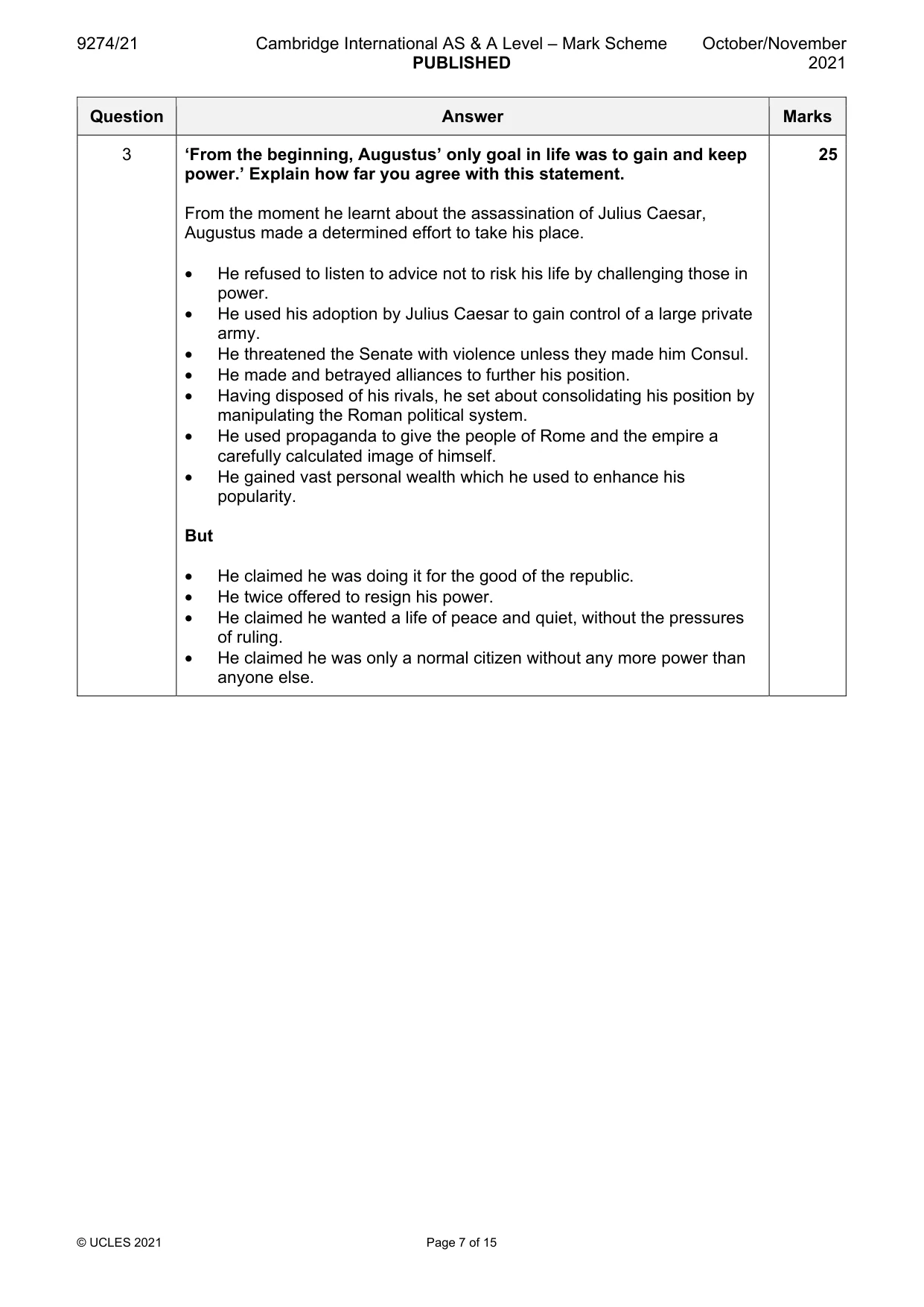
Mark scheme: 3 ‘From the beginning, Augustus’ only goal in life was to gain and keep 25 power.’ Explain how far you agree with this statement. From the moment he learnt about the assassination of Julius Caesar, Augustus made a determined effort to take his place. • He refused to listen to advice not to risk his life by challenging those in power. • He used his adoption by Julius Caesar to gain control of a large private army. • He threatened the Senate with violence unless they made him Consul. • He made and betrayed alliances to further his position. • Having disposed of his rivals, he set about consolidating his position by manipulating the Roman political system. • He used propaganda to give the people of Rome and the empire a carefully calculated image of himself. • He gained vast personal wealth which he used to enhance his popularity. But • He claimed he was doing it for the good of the republic. • He twice offered to resign his power. • He claimed he wanted a life of peace and quiet, without the pressures of ruling. • He claimed he was only a normal citizen without any more power than anyone else.
Q4 · Read the passage below, and answer the questions which follow: When he saw the capture…
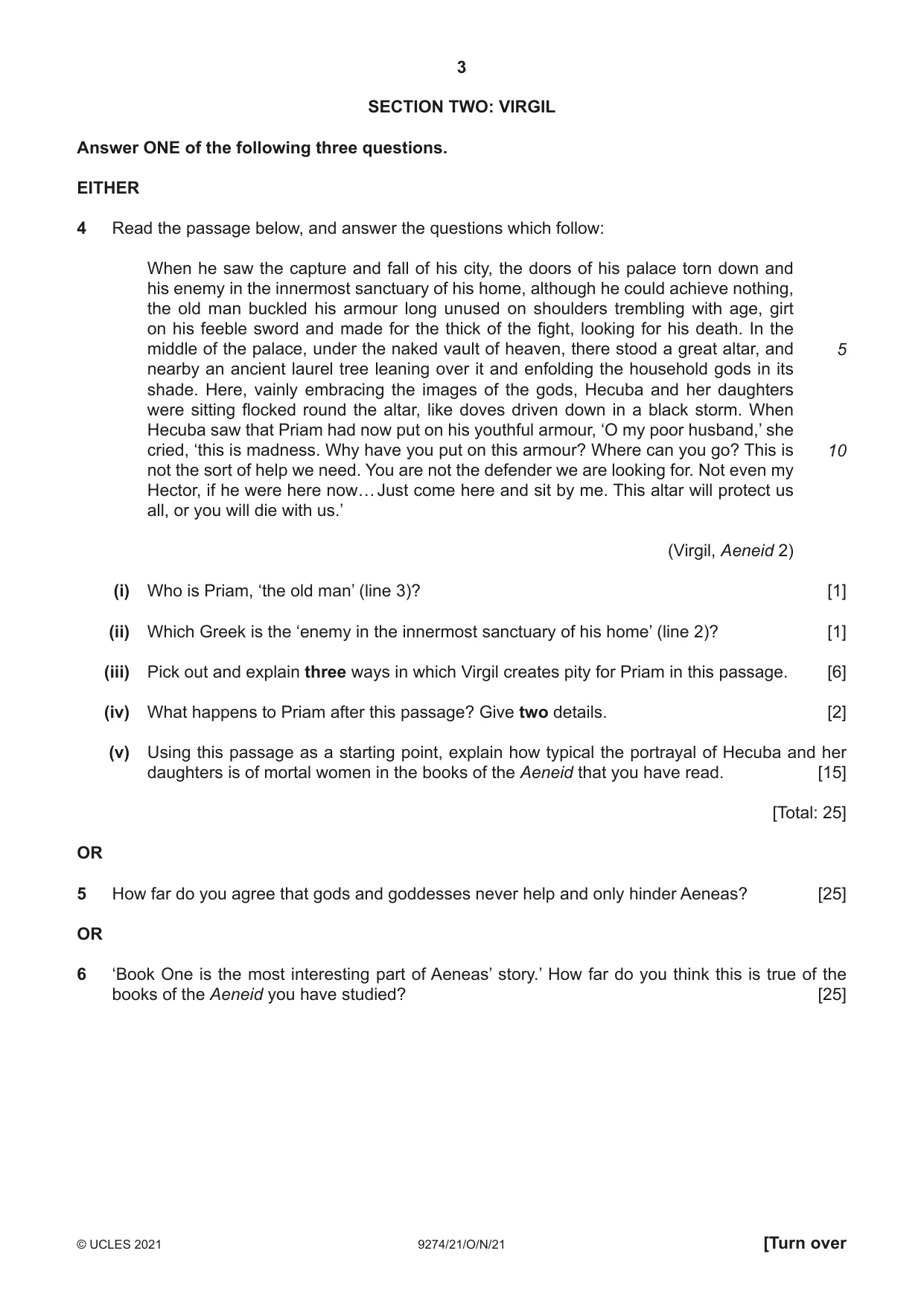
4 Read the passage below, and answer the questions which follow: When he saw the capture and fall of his city, the doors of his palace torn down and his enemy in the innermost sanctuary of his home, although he could achieve nothing, the old man buckled his armour long unused on shoulders trembling with age, girt on his feeble sword and made for the thick of the fight, looking for his death. In the middle of the palace, under the naked vault of heaven, there stood a great altar, and 5 nearby an ancient laurel tree leaning over it and enfolding the household gods in its shade. Here, vainly embracing the images of the gods, Hecuba and her daughters were sitting flocked round the altar, like doves driven down in a black storm. When Hecuba saw that Priam had now put on his youthful armour, ‘O my poor husband,’ she cried, ‘this is madness. Why have you put on this armour? Where can you go? This is 10 not the sort of help we need. You are not the defender we are looking for. Not even my Hector, if he were here now… Just come here and sit by me. This altar will protect us all, or you will die with us.’ (Virgil, Aeneid 2) (i) Who is Priam, ‘the old man’ (line 3)? [1] (ii) Which Greek is the ‘enemy in the innermost sanctuary of his home’ (line 2)? [1] (iii) Pick out and explain three ways in which Virgil creates pity for Priam in this passage. [6] (iv) What happens to Priam after this passage? Give two details. [2] (v) Using this passage as a starting point, explain how typical the portrayal of Hecuba and her daughters is of mortal women in the books of the Aeneid that you have read. [15] [Total: 25] OR
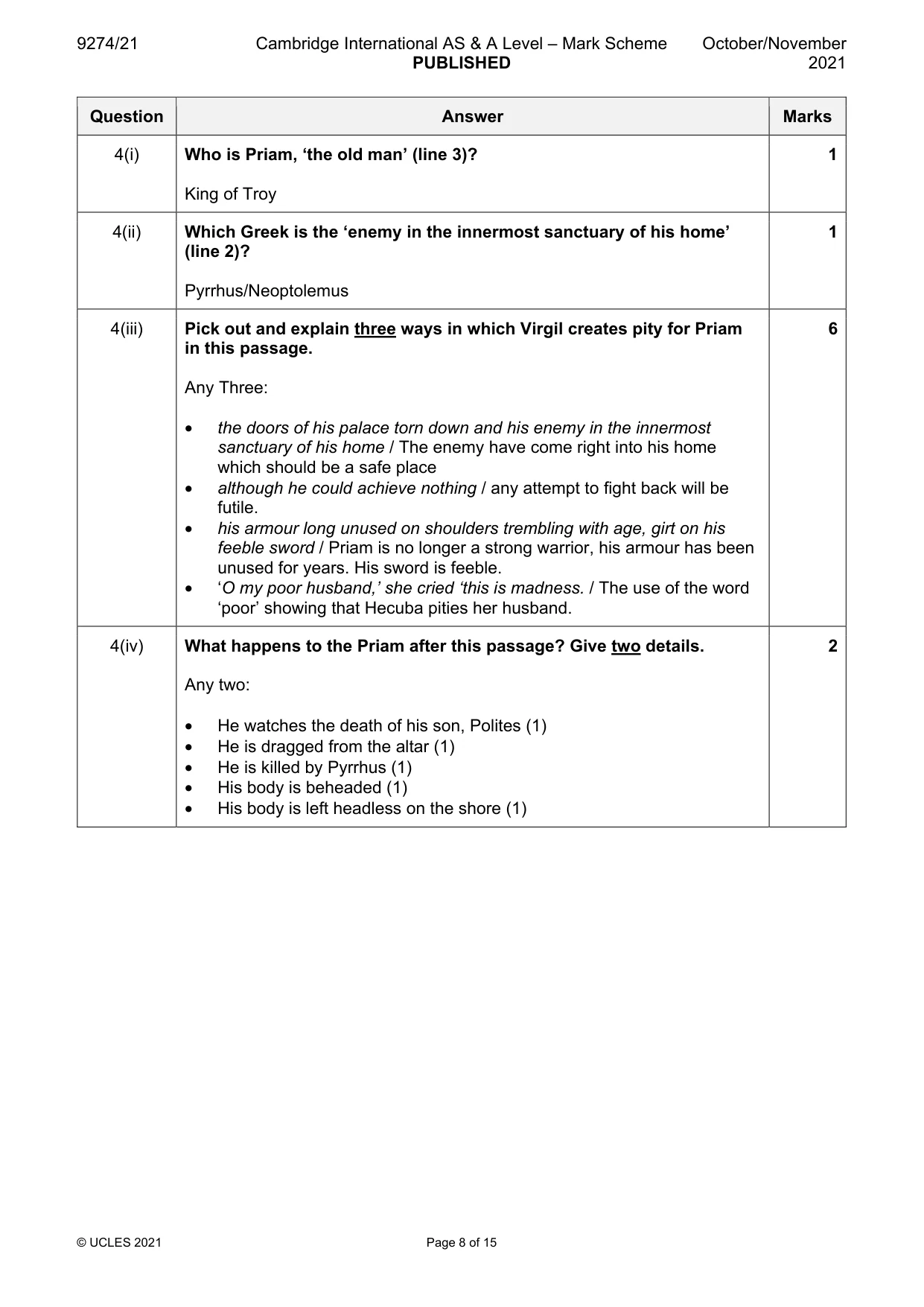
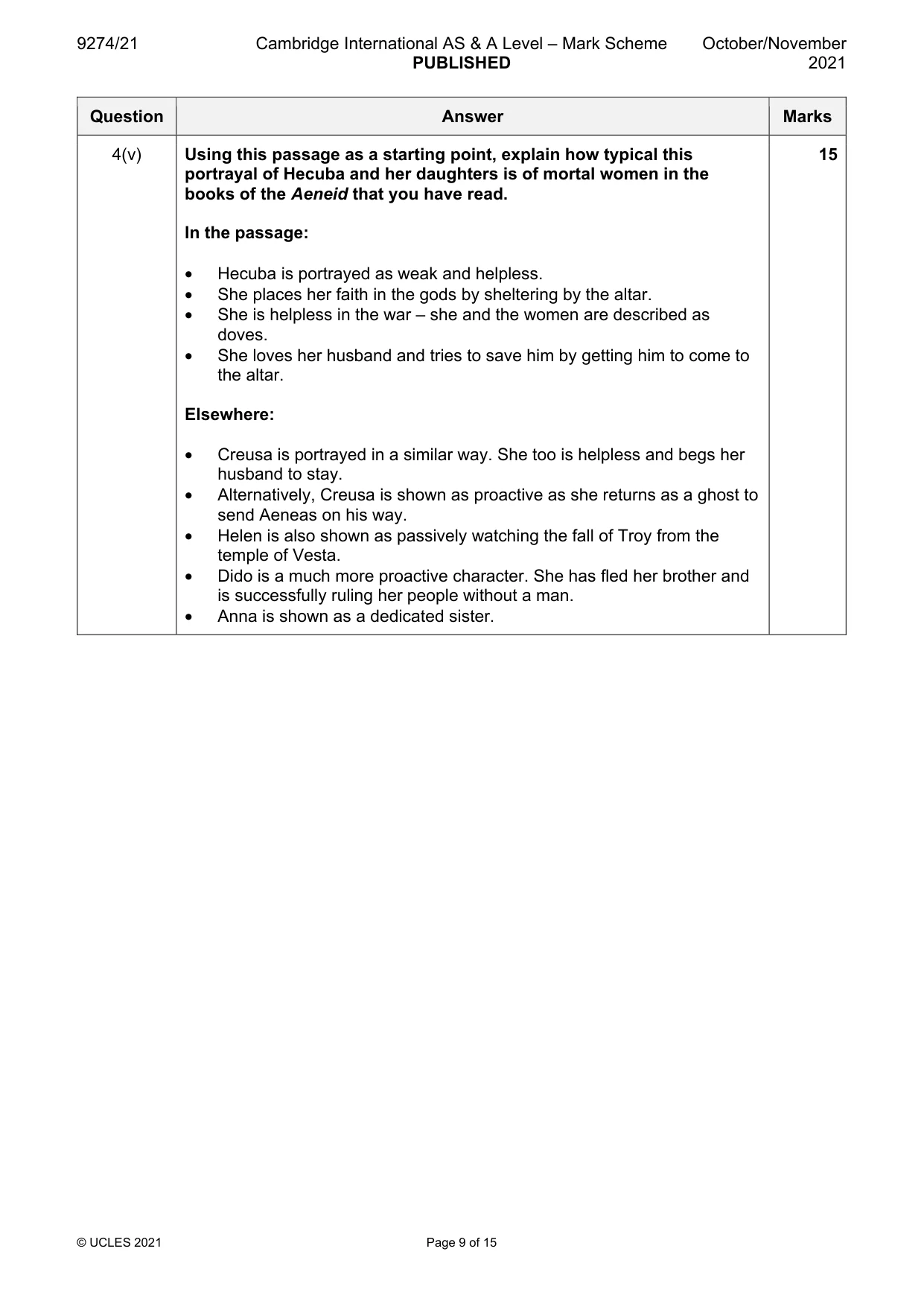
Mark scheme: 4(i) Who is Priam, ‘the old man’ (line 3)? 1 King of Troy 4(ii) Which Greek is the ‘enemy in the innermost sanctuary of his home’ 1 (line 2)? Pyrrhus/Neoptolemus 4(iii) Pick out and explain three ways in which Virgil creates pity for Priam 6 in this passage. Any Three: • the doors of his palace torn down and his enemy in the innermost sanctuary of his home / The enemy have come right into his home which should be a safe place • although he could achieve nothing / any attempt to fight back will be futile. • his armour long unused on shoulders trembling with age, girt on his feeble sword / Priam is no longer a strong warrior, his armour has been unused for years. His sword is feeble. • ‘O my poor husband,’ she cried ‘this is madness. / The use of the word ‘poor’ showing that Hecuba pities her husband. 4(iv) What happens to the Priam after this passage? Give two details. 2 Any two: • He watches the death of his son, Polites (1) • He is dragged from the altar (1) • He is killed by Pyrrhus (1) • His body is beheaded (1) • His body is left headless on the shore (1) 4(v) Using this passage as a starting point, explain how typical this 15 portrayal of Hecuba and her daughters is of mortal women in the books of the Aeneid that you have read. In the passage: • Hecuba is portrayed as weak and helpless. • She places her faith in the gods by sheltering by the altar. • She is helpless in the war – she and the women are described as doves. • She loves her husband and tries to save him by getting him to come to the altar. Elsewhere: • Creusa is portrayed in a similar way. She too is helpless and begs her husband to stay. • Alternatively, Creusa is shown as proactive as she returns as a ghost to send Aeneas on his way. • Helen is also shown as passively watching the fall of Troy from the temple of Vesta. • Dido is a much more proactive character. She has fled her brother and is successfully ruling her people without a man. • Anna is shown as a dedicated sister.
Q5 · How far do you agree that gods and goddesses never help and only hinder Aeneas?
5 How far do you agree that gods and goddesses never help and only hinder Aeneas? [25] OR
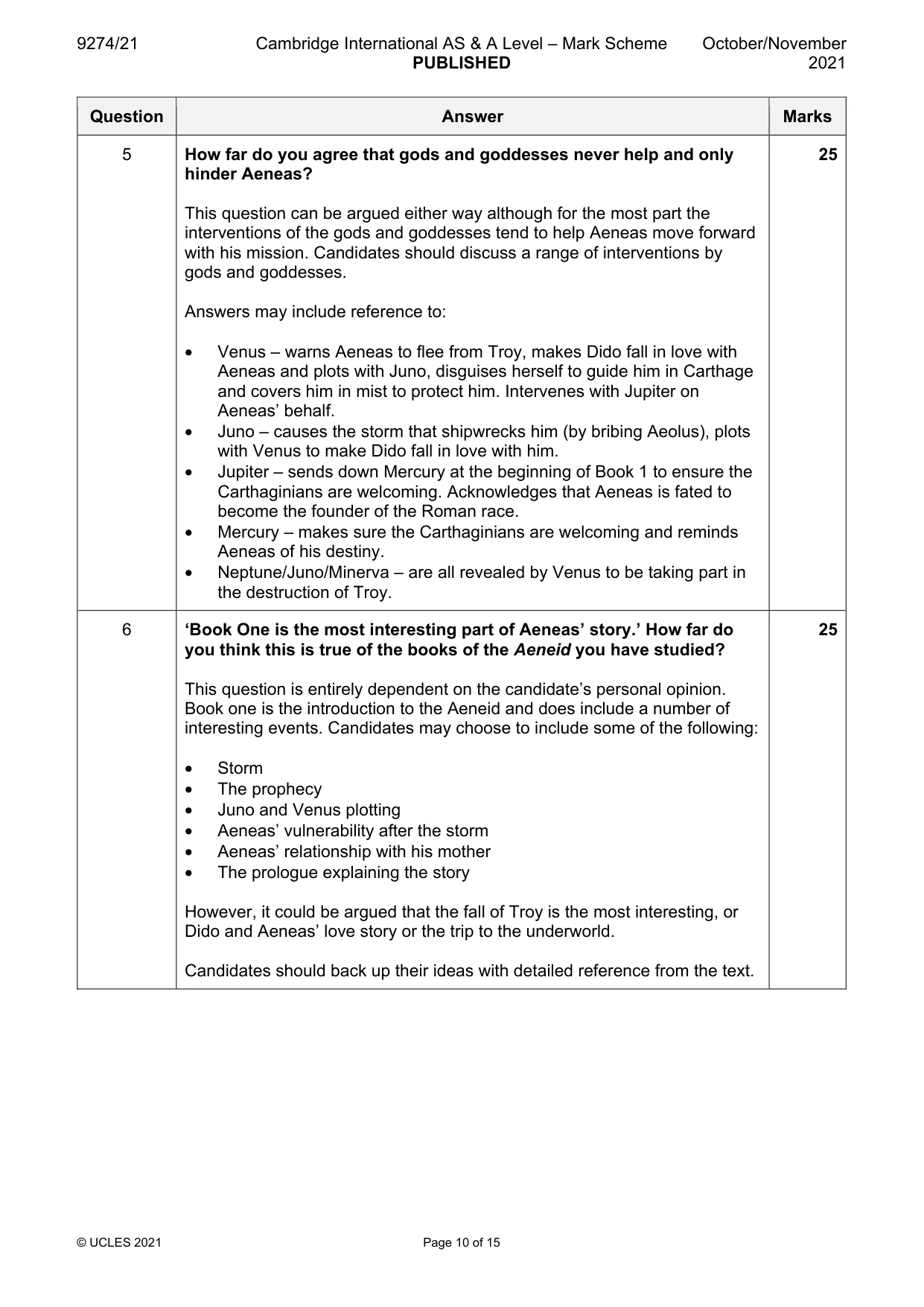
Mark scheme: 5 How far do you agree that gods and goddesses never help and only 25 hinder Aeneas? This question can be argued either way although for the most part the interventions of the gods and goddesses tend to help Aeneas move forward with his mission. Candidates should discuss a range of interventions by gods and goddesses. Answers may include reference to: • Venus – warns Aeneas to flee from Troy, makes Dido fall in love with Aeneas and plots with Juno, disguises herself to guide him in Carthage and covers him in mist to protect him. Intervenes with Jupiter on Aeneas’ behalf. • Juno – causes the storm that shipwrecks him (by bribing Aeolus), plots with Venus to make Dido fall in love with him. • Jupiter – sends down Mercury at the beginning of Book 1 to ensure the Carthaginians are welcoming. Acknowledges that Aeneas is fated to become the founder of the Roman race. • Mercury – makes sure the Carthaginians are welcoming and reminds Aeneas of his destiny. • Neptune/Juno/Minerva – are all revealed by Venus to be taking part in the destruction of Troy.
Q6 · ‘Book One is the most interesting part of Aeneas’ story.’ How far do you think this is…
6 ‘Book One is the most interesting part of Aeneas’ story.’ How far do you think this is true of the books of the Aeneid you have studied? [25] SECTION THREE: JUVENAL Answer ONE of the following three questions. EITHER
Mark scheme: 6 ‘Book One is the most interesting part of Aeneas’ story.’ How far do 25 you think this is true of the books of the Aeneid you have studied? This question is entirely dependent on the candidate’s personal opinion. Book one is the introduction to the Aeneid and does include a number of interesting events. Candidates may choose to include some of the following: • Storm • The prophecy • Juno and Venus plotting • Aeneas’ vulnerability after the storm • Aeneas’ relationship with his mother • The prologue explaining the story However, it could be argued that the fall of Troy is the most interesting, or Dido and Aeneas’ love story or the trip to the underworld. Candidates should back up their ideas with detailed reference from the text.
Q7 · Read the passage below, and answer the questions which follow: The eloquence of…
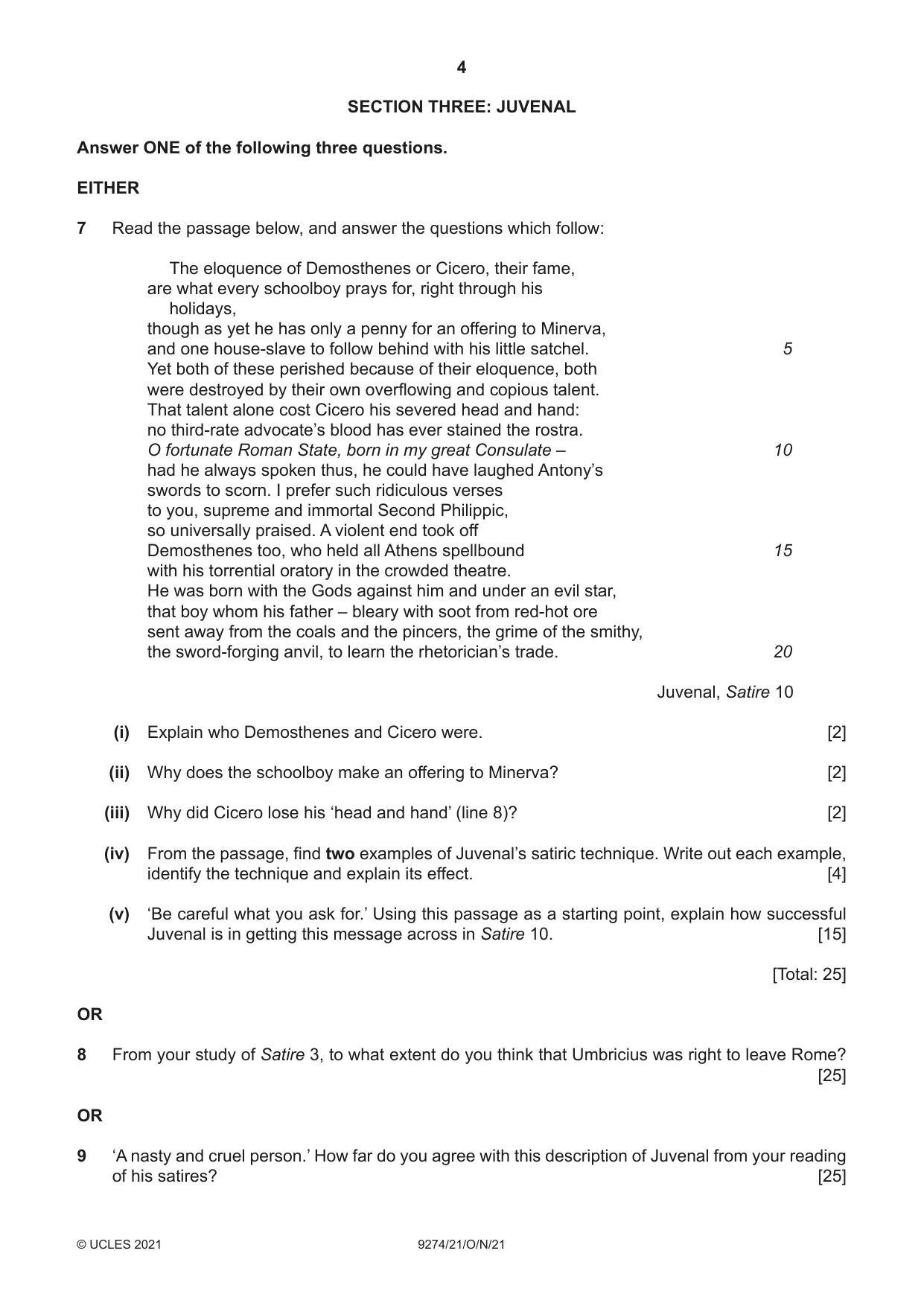
7 Read the passage below, and answer the questions which follow: The eloquence of Demosthenes or Cicero, their fame, are what every schoolboy prays for, right through his holidays, though as yet he has only a penny for an offering to Minerva, and one house-slave to follow behind with his little satchel. 5 Yet both of these perished because of their eloquence, both were destroyed by their own overflowing and copious talent. That talent alone cost Cicero his severed head and hand: no third-rate advocate’s blood has ever stained the rostra. O fortunate Roman State, born in my great Consulate – 10 had he always spoken thus, he could have laughed Antony’s swords to scorn. I prefer such ridiculous verses to you, supreme and immortal Second Philippic, so universally praised. A violent end took off Demosthenes too, who held all Athens spellbound 15 with his torrential oratory in the crowded theatre. He was born with the Gods against him and under an evil star, that boy whom his father – bleary with soot from red-hot ore sent away from the coals and the pincers, the grime of the smithy, the sword-forging anvil, to learn the rhetorician’s trade. 20 Juvenal, Satire 10 (i) Explain who Demosthenes and Cicero were. [2] (ii) Why does the schoolboy make an offering to Minerva? [2] (iii) Why did Cicero lose his ‘head and hand’ (line 8)? [2] (iv) From the passage, find two examples of Juvenal’s satiric technique. Write out each example, identify the technique and explain its effect. [4] (v) ‘Be careful what you ask for.’ Using this passage as a starting point, explain how successful Juvenal is in getting this message across in Satire 10. [15] [Total: 25] OR
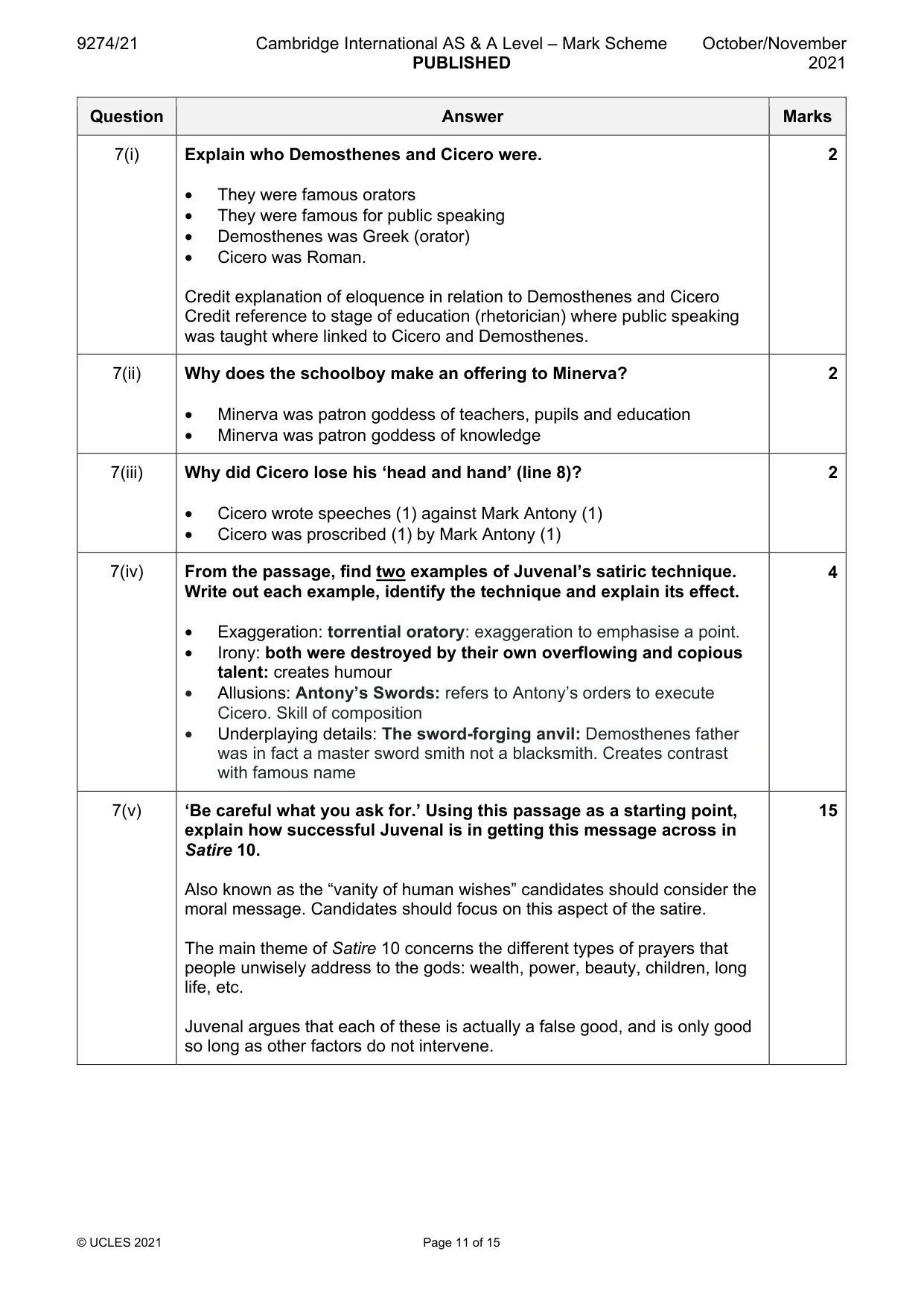
Mark scheme: 7(i) Explain who Demosthenes and Cicero were. 2 • They were famous orators • They were famous for public speaking • Demosthenes was Greek (orator) • Cicero was Roman. Credit explanation of eloquence in relation to Demosthenes and Cicero Credit reference to stage of education (rhetorician) where public speaking was taught where linked to Cicero and Demosthenes. 7(ii) Why does the schoolboy make an offering to Minerva? 2 • Minerva was patron goddess of teachers, pupils and education • Minerva was patron goddess of knowledge 7(iii) Why did Cicero lose his ‘head and hand’ (line 8)? 2 • Cicero wrote speeches (1) against Mark Antony (1) • Cicero was proscribed (1) by Mark Antony (1) 7(iv) From the passage, find two examples of Juvenal’s satiric technique. 4 Write out each example, identify the technique and explain its effect. • Exaggeration: torrential oratory: exaggeration to emphasise a point. • Irony: both were destroyed by their own overflowing and copious talent: creates humour • Allusions: Antony’s Swords: refers to Antony’s orders to execute Cicero. Skill of composition • Underplaying details: The sword-forging anvil: Demosthenes father was in fact a master sword smith not a blacksmith. Creates contrast with famous name 7(v) ‘Be careful what you ask for.’ Using this passage as a starting point, 15 explain how successful Juvenal is in getting this message across in Satire 10. Also known as the “vanity of human wishes” candidates should consider the moral message. Candidates should focus on this aspect of the satire. The main theme of Satire 10 concerns the different types of prayers that people unwisely address to the gods: wealth, power, beauty, children, long life, etc. Juvenal argues that each of these is actually a false good, and is only good so long as other factors do not intervene.
Q8 · From your study of Satire 3, to what extent do you think that Umbricius was right to…
8 From your study of Satire 3, to what extent do you think that Umbricius was right to leave Rome? [25] OR
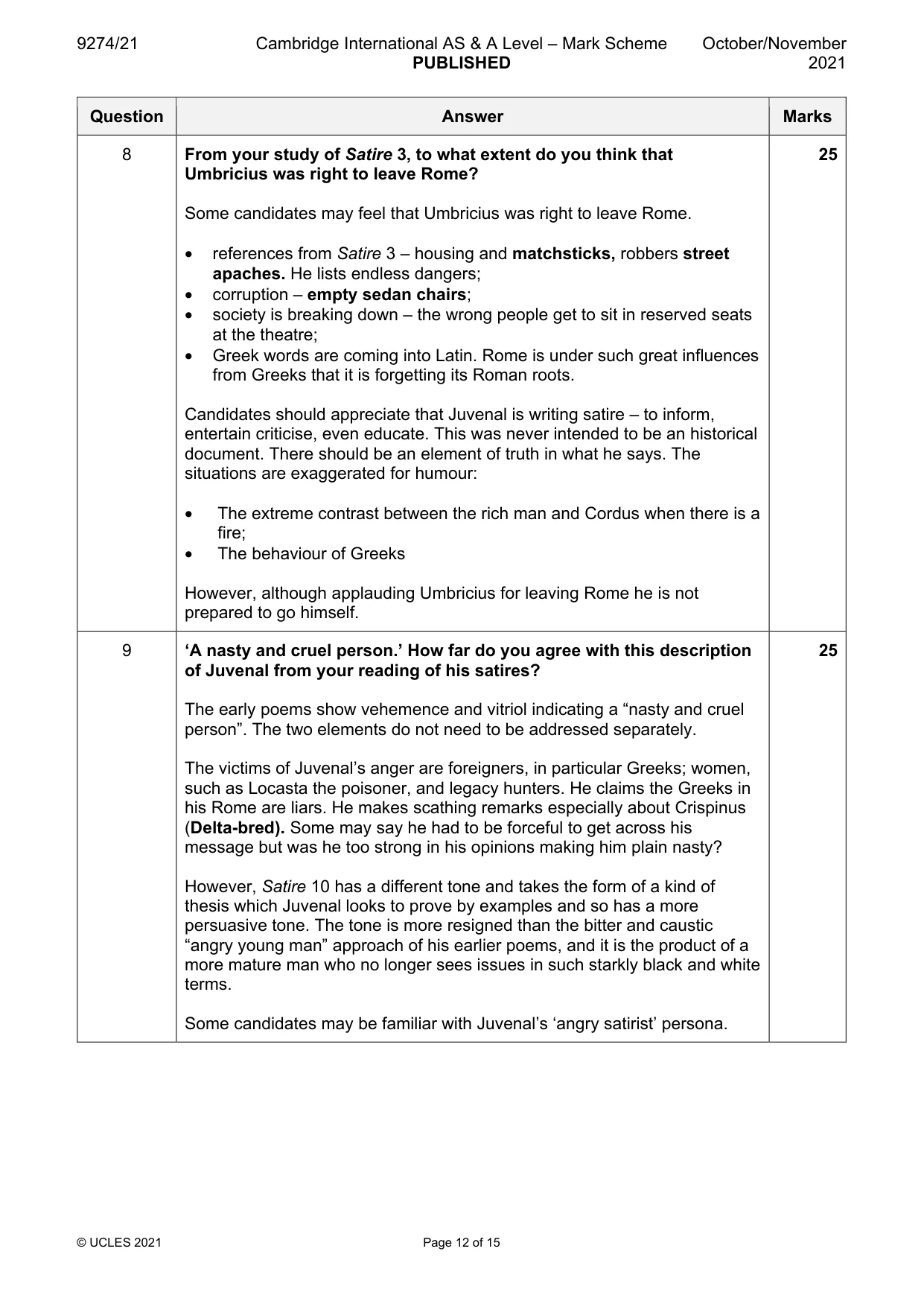
Mark scheme: 8 From your study of Satire 3, to what extent do you think that 25 Umbricius was right to leave Rome? Some candidates may feel that Umbricius was right to leave Rome. • references from Satire 3 – housing and matchsticks, robbers street apaches. He lists endless dangers; • corruption – empty sedan chairs; • society is breaking down – the wrong people get to sit in reserved seats at the theatre; • Greek words are coming into Latin. Rome is under such great influences from Greeks that it is forgetting its Roman roots. Candidates should appreciate that Juvenal is writing satire – to inform, entertain criticise, even educate. This was never intended to be an historical document. There should be an element of truth in what he says. The situations are exaggerated for humour: • The extreme contrast between the rich man and Cordus when there is a fire; • The behaviour of Greeks However, although applauding Umbricius for leaving Rome he is not prepared to go himself.
Q9 · ‘A nasty and cruel person.’ How far do you agree with this description of Juvenal from…
9 ‘A nasty and cruel person.’ How far do you agree with this description of Juvenal from your reading of his satires? [25] SECTION FOUR: ROMAN ARCHITECTURE Answer ONE of the following three questions. EITHER
Mark scheme: 9 ‘A nasty and cruel person.’ How far do you agree with this description 25 of Juvenal from your reading of his satires? The early poems show vehemence and vitriol indicating a “nasty and cruel person”. The two elements do not need to be addressed separately. The victims of Juvenal’s anger are foreigners, in particular Greeks; women, such as Locasta the poisoner, and legacy hunters. He claims the Greeks in his Rome are liars. He makes scathing remarks especially about Crispinus (Delta-bred). Some may say he had to be forceful to get across his message but was he too strong in his opinions making him plain nasty? However, Satire 10 has a different tone and takes the form of a kind of thesis which Juvenal looks to prove by examples and so has a more persuasive tone. The tone is more resigned than the bitter and caustic “angry young man” approach of his earlier poems, and it is the product of a more mature man who no longer sees issues in such starkly black and white terms. Some candidates may be familiar with Juvenal’s ‘angry satirist’ persona.
Q10 · Study the image below, and answer the questions which follow: A C B (i) What type of…
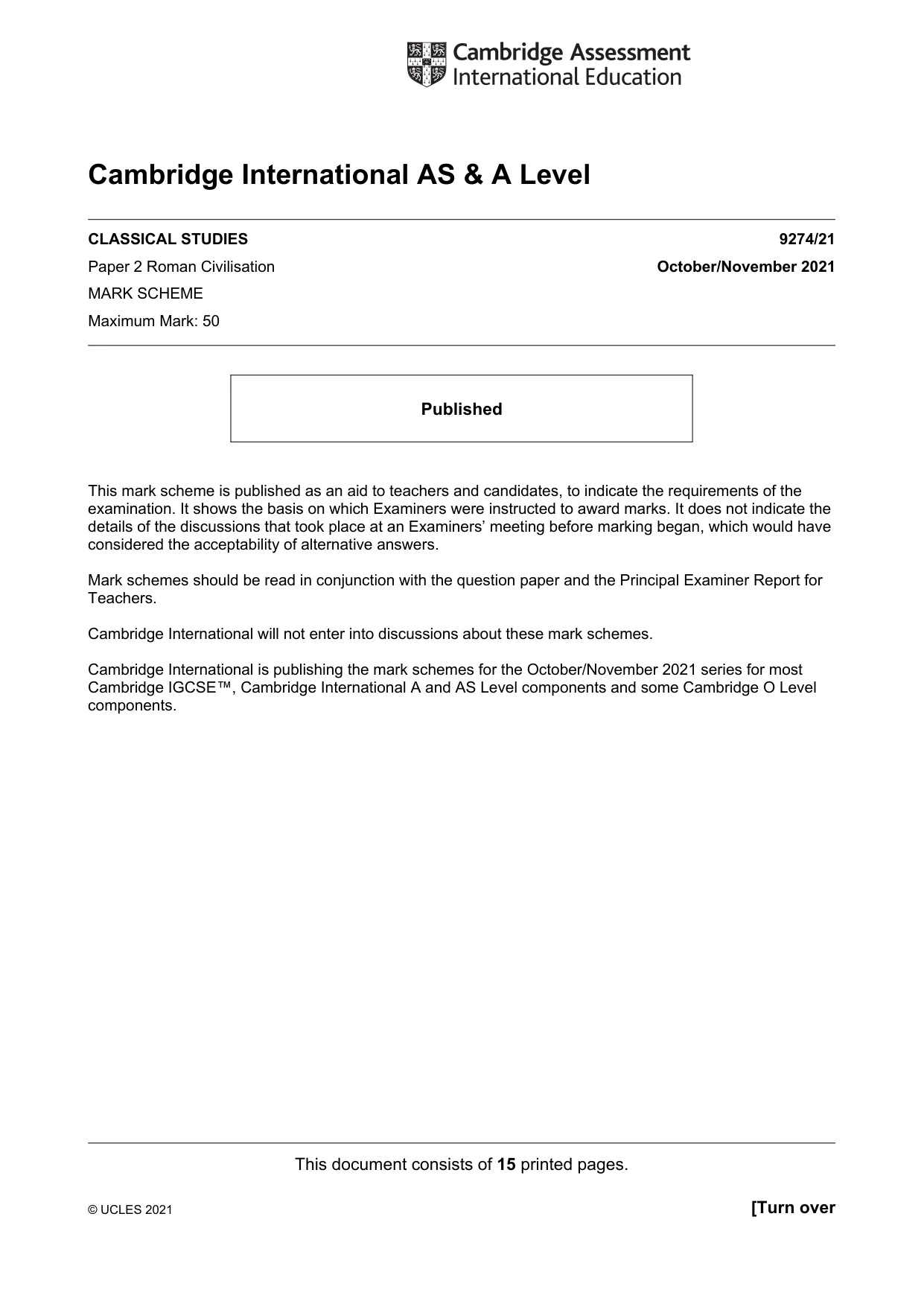
10 Study the image below, and answer the questions which follow: A C B (i) What type of building is this? [1] (ii) In which city is this building? [1] (iii) Give an approximate date for this building. [1] (iv) Name the citizen responsible for financing this building. [1] (v) Name areas A, B and C and explain what happened in each. [6] (vi) Which features of this type of building do you think worked well and which not so well? In your answer, you should discuss this building and one other of the same type. [15] [Total: 25] OR
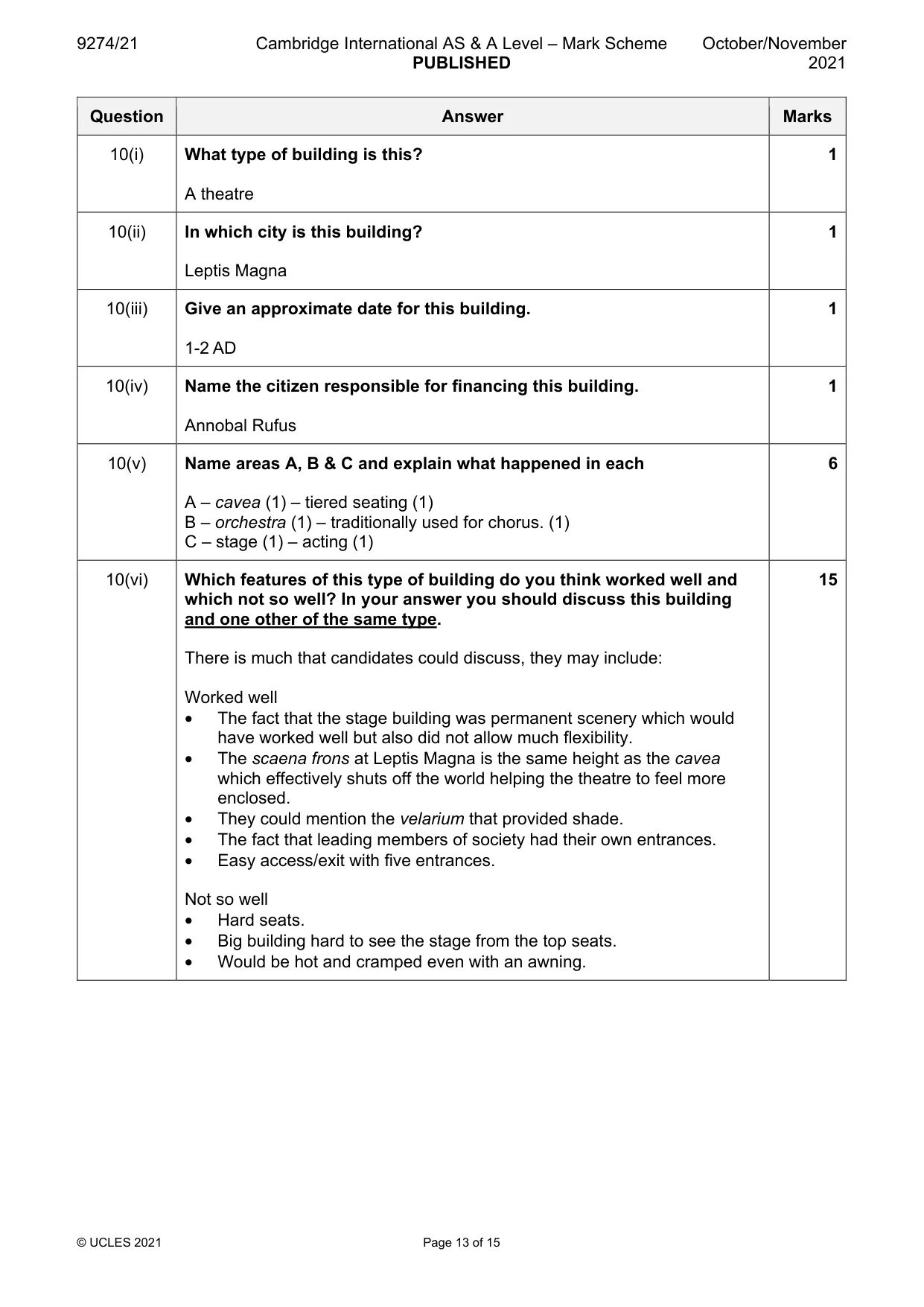
Mark scheme: 10(i) What type of building is this? 1 A theatre 10(ii) In which city is this building? 1 Leptis Magna 10(iii) Give an approximate date for this building. 1 1-2 AD 10(iv) Name the citizen responsible for financing this building. 1 Annobal Rufus 10(v) Name areas A, B & C and explain what happened in each 6 A – cavea (1) – tiered seating (1) B – orchestra (1) – traditionally used for chorus. (1) C – stage (1) – acting (1) 10(vi) Which features of this type of building do you think worked well and 15 which not so well? In your answer you should discuss this building and one other of the same type. There is much that candidates could discuss, they may include: Worked well • The fact that the stage building was permanent scenery which would have worked well but also did not allow much flexibility. • The scaena frons at Leptis Magna is the same height as the cavea which effectively shuts off the world helping the theatre to feel more enclosed. • They could mention the velarium that provided shade. • The fact that leading members of society had their own entrances. • Easy access/exit with five entrances. Not so well • Hard seats. • Big building hard to see the stage from the top seats. • Would be hot and cramped even with an awning.
Q11 · To what extent do you agree that the Baths of Hadrian at Leptis Magna show the most…
11 To what extent do you agree that the Baths of Hadrian at Leptis Magna show the most impressive architectural design of all Roman buildings? In your answer, you should compare these baths to at least two other types of building. [25] OR
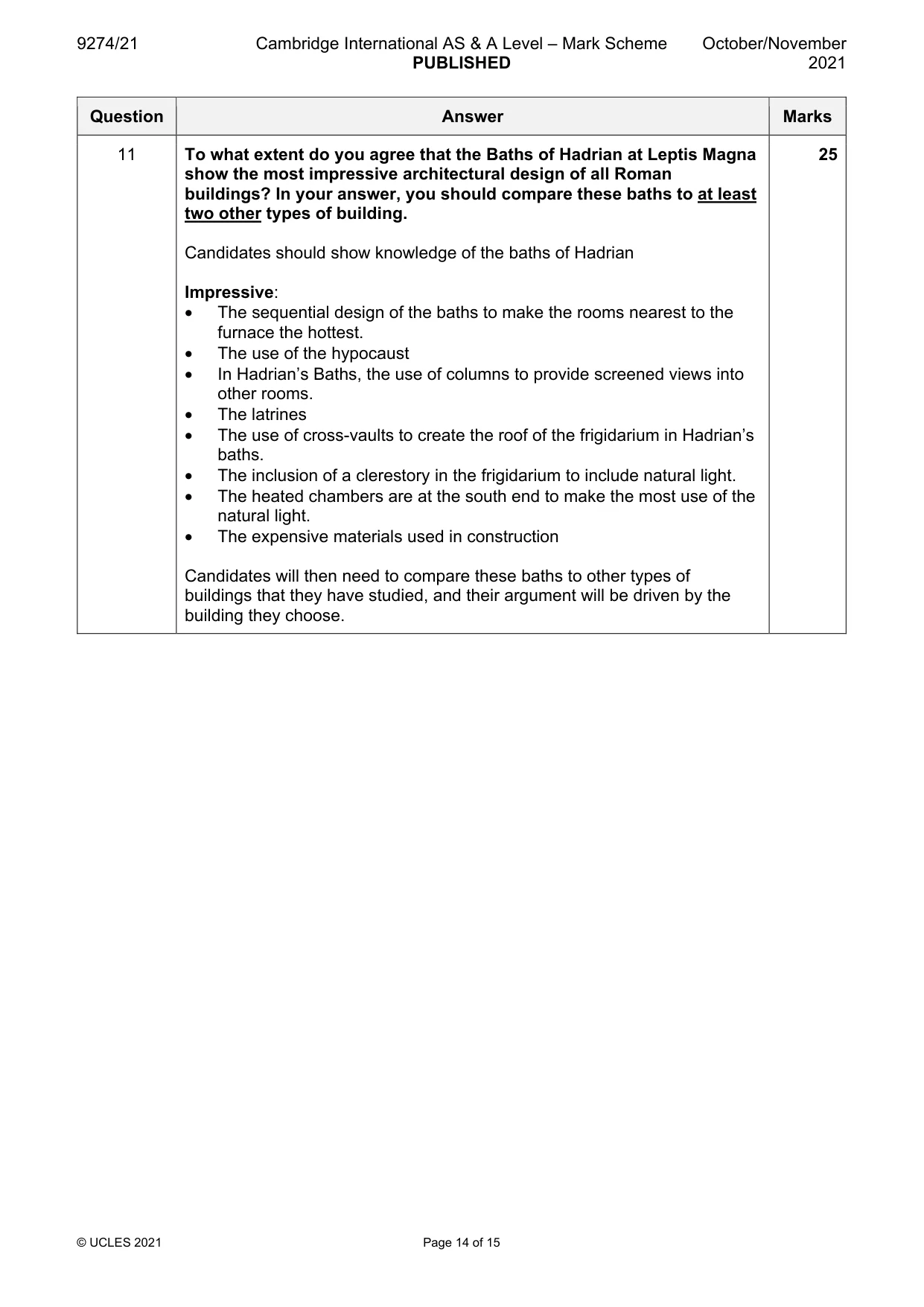
Mark scheme: 11 To what extent do you agree that the Baths of Hadrian at Leptis Magna 25 show the most impressive architectural design of all Roman buildings? In your answer, you should compare these baths to at least two other types of building. Candidates should show knowledge of the baths of Hadrian Impressive: • The sequential design of the baths to make the rooms nearest to the furnace the hottest. • The use of the hypocaust • In Hadrian’s Baths, the use of columns to provide screened views into other rooms. • The latrines • The use of cross-vaults to create the roof of the frigidarium in Hadrian’s baths. • The inclusion of a clerestory in the frigidarium to include natural light. • The heated chambers are at the south end to make the most use of the natural light. • The expensive materials used in construction Candidates will then need to compare these baths to other types of buildings that they have studied, and their argument will be driven by the building they choose.
Q12 · ‘Beautiful rather than practical.’ To what extent do you agree with this statement about…
12 ‘Beautiful rather than practical.’ To what extent do you agree with this statement about the buildings that you have studied? In your answer, you should refer to at least three specific Roman buildings. [25]
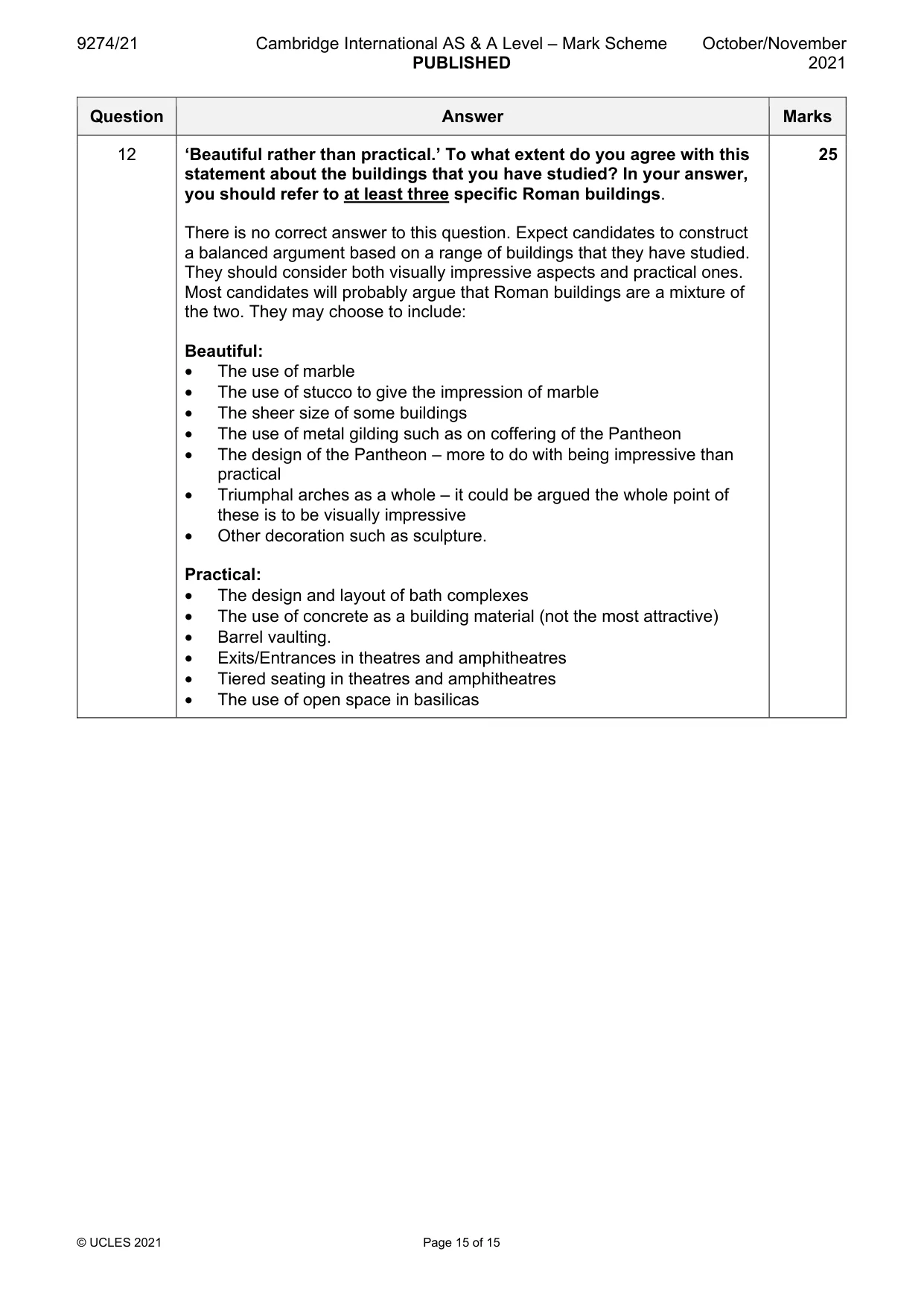
Mark scheme: 12 ‘Beautiful rather than practical.’ To what extent do you agree with this 25 statement about the buildings that you have studied? In your answer, you should refer to at least three specific Roman buildings. There is no correct answer to this question. Expect candidates to construct a balanced argument based on a range of buildings that they have studied. They should consider both visually impressive aspects and practical ones. Most candidates will probably argue that Roman buildings are a mixture of the two. They may choose to include: Beautiful: • The use of marble • The use of stucco to give the impression of marble • The sheer size of some buildings • The use of metal gilding such as on coffering of the Pantheon • The design of the Pantheon – more to do with being impressive than practical • Triumphal arches as a whole – it could be argued the whole point of these is to be visually impressive • Other decoration such as sculpture. Practical: • The design and layout of bath complexes • The use of concrete as a building material (not the most attractive) • Barrel vaulting. • Exits/Entrances in theatres and amphitheatres • Tiered seating in theatres and amphitheatres • The use of open space in basilicas
What was in this paper
The subtopics covered by these 12 questions, and how many questions each got. Open one in a new tab to see every Cambridge question on it.
What you needed in this session
Cambridge’s own grade thresholds for 2021 Oct/Nov, Paper 2 · Variant 1. A higher threshold means an easier paper — the bar moves with how the cohort did.