Cambridge A Level Classical Studies 9274 — 2022 Oct/Nov Paper 2 · Variant 1
9274/21/O/N/22 · 9 questions · 50 marks · ≈56 min
The question paper and its mark scheme, free to read here and free to download. This is Cambridge’s own paper, exactly as it was sat.
Question paper8 pages




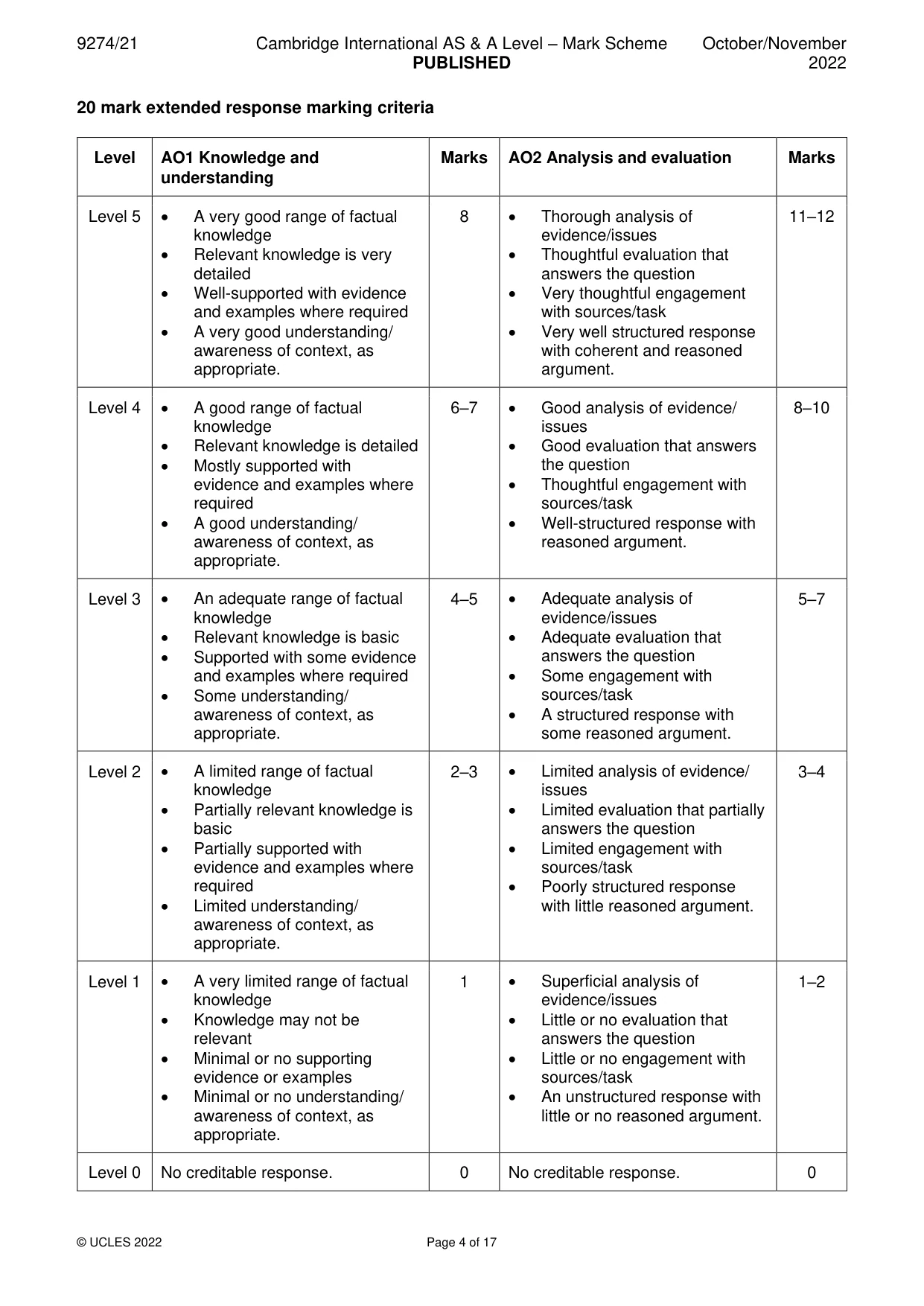
Mark scheme17 pages
Answers below. Sit the paper first if you are practising.
Questions as text
Q1 · Read the passage and answer the questions: Those who butchered my father I drove into…
1 Read the passage and answer the questions: Those who butchered my father I drove into exile, avenging their crime by legal judgements, and afterwards, when they made war upon the republic, I defeated them twice in battle. I many times waged civil and foreign wars by land and sea over the whole world, and as victor I spared all citizens who asked for pardon. Foreign peoples who could be 5 safely forgiven I preferred to preserve rather than exterminate. About 500,000 Roman citizens took the military oath of allegiance to me. Somewhat over 300,000 of these I settled in colonies or sent back to their home towns, once they had served their time, and to all these I assigned lands or gave money as rewards for their military service. (Res Gestae Divi Augusti) (a) (i) In which year were the Res Gestae published? [1] (ii) ‘my father’ (line 1). To whom is Augustus referring here? [1] (iii) ‘Those who butchered my father’ (line 1). Give the names of two of the killers of Augustus’ father. [2] (iv) In which battle did Augustus defeat the killers of his father? [1] (b) ‘Totally accurate and truthful.’ Using this passage as a starting point, explain how far you agree with this description of the Res Gestae Divi Augusti. [20] [Total: 25] EITHER
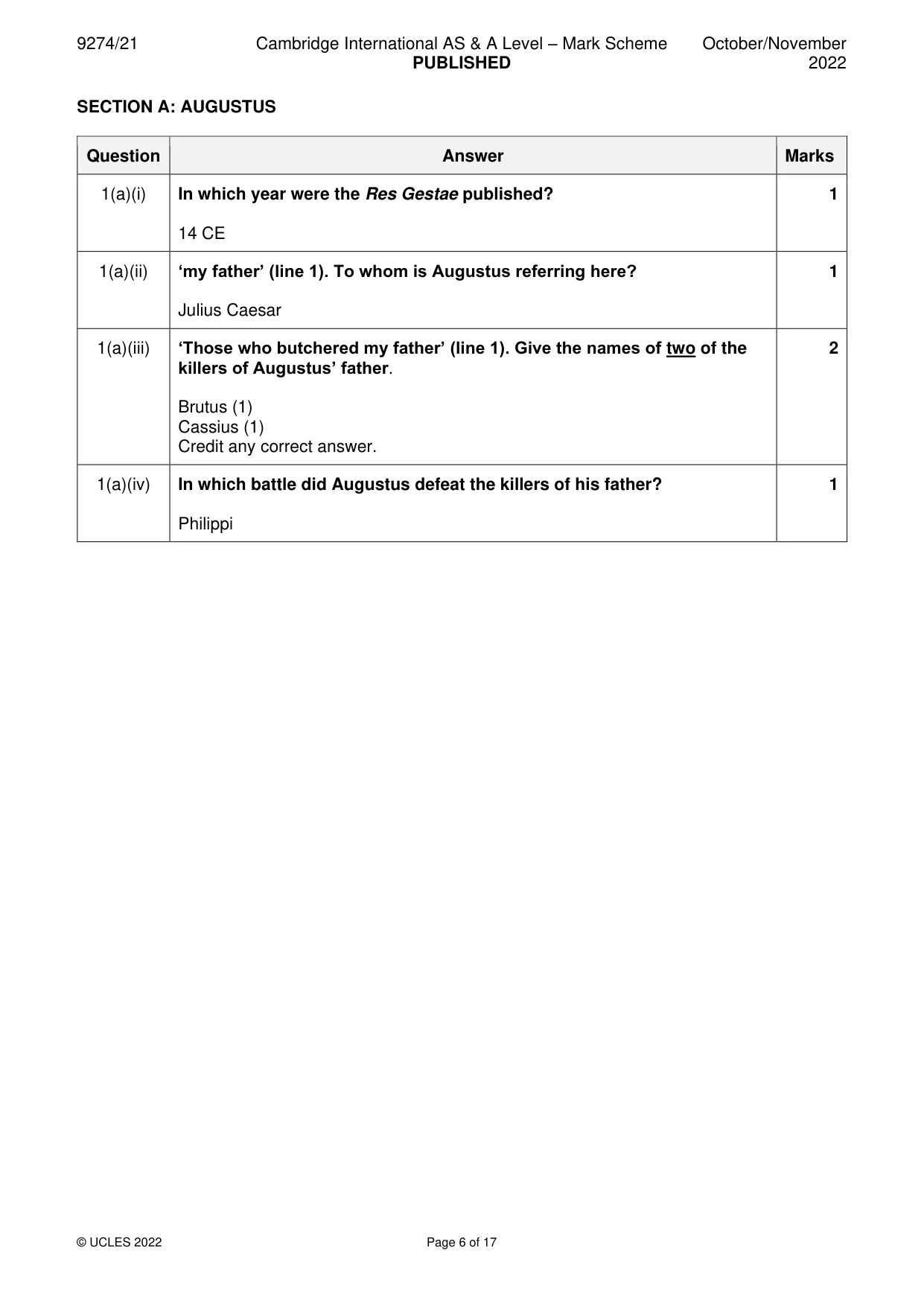
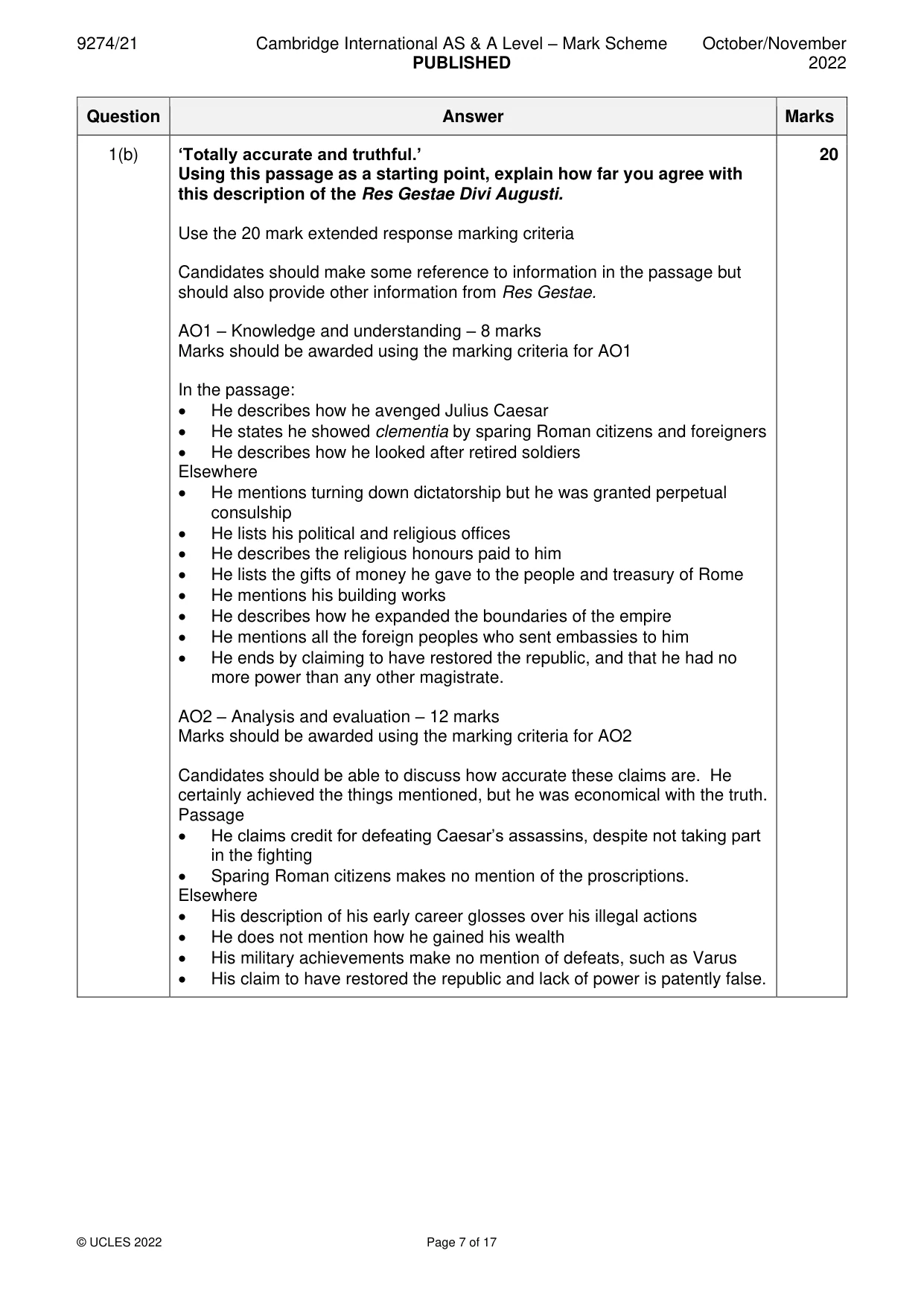
Mark scheme: Question Answer Marks 1(a)(i) In which year were the Res Gestae published? 1 14 CE 1(a)(ii) ‘my father’ (line 1). To whom is Augustus referring here? 1 Julius Caesar 1(a)(iii) ‘Those who butchered my father’ (line 1). Give the names of two of the 2 killers of Augustus’ father. Brutus (1) Cassius (1) Credit any correct answer. 1(a)(iv) In which battle did Augustus defeat the killers of his father? 1 Philippi 1(b) ‘Totally accurate and truthful.’ 20 Using this passage as a starting point, explain how far you agree with this description of the Res Gestae Divi Augusti. Use the 20 mark extended response marking criteria Candidates should make some reference to information in the passage but should also provide other information from Res Gestae. AO1 – Knowledge and understanding – 8 marks Marks should be awarded using the marking criteria for AO1 In the passage: • He describes how he avenged Julius Caesar • He states he showed clementia by sparing Roman citizens and foreigners • He describes how he looked after retired soldiers Elsewhere • He mentions turning down dictatorship but he was granted perpetual consulship • He lists his political and religious offices • He describes the religious honours paid to him • He lists the gifts of money he gave to the people and treasury of Rome • He mentions his building works • He describes how he expanded the boundaries of the empire • He mentions all the foreign peoples who sent embassies to him • He ends by claiming to have restored the republic, and that he had no more power than any other magistrate. AO2 – Analysis and evaluation – 12 marks Marks should be awarded using the marking criteria for AO2 Candidates should be able to discuss how accurate these claims are. He certainly achieved the things mentioned, but he was economical with the truth. Passage • He claims credit for defeating Caesar’s assassins, despite not taking part in the fighting • Sparing Roman citizens makes no mention of the proscriptions. Elsewhere • His description of his early career glosses over his illegal actions • He does not mention how he gained his wealth • His military achievements make no mention of defeats, such as Varus • His claim to have restored the republic and lack of power is patently false.
Q2 · ‘Religion was very important to Augustus.’ Explain how far you agree with this opinion
2 ‘Religion was very important to Augustus.’ Explain how far you agree with this opinion. [25] OR
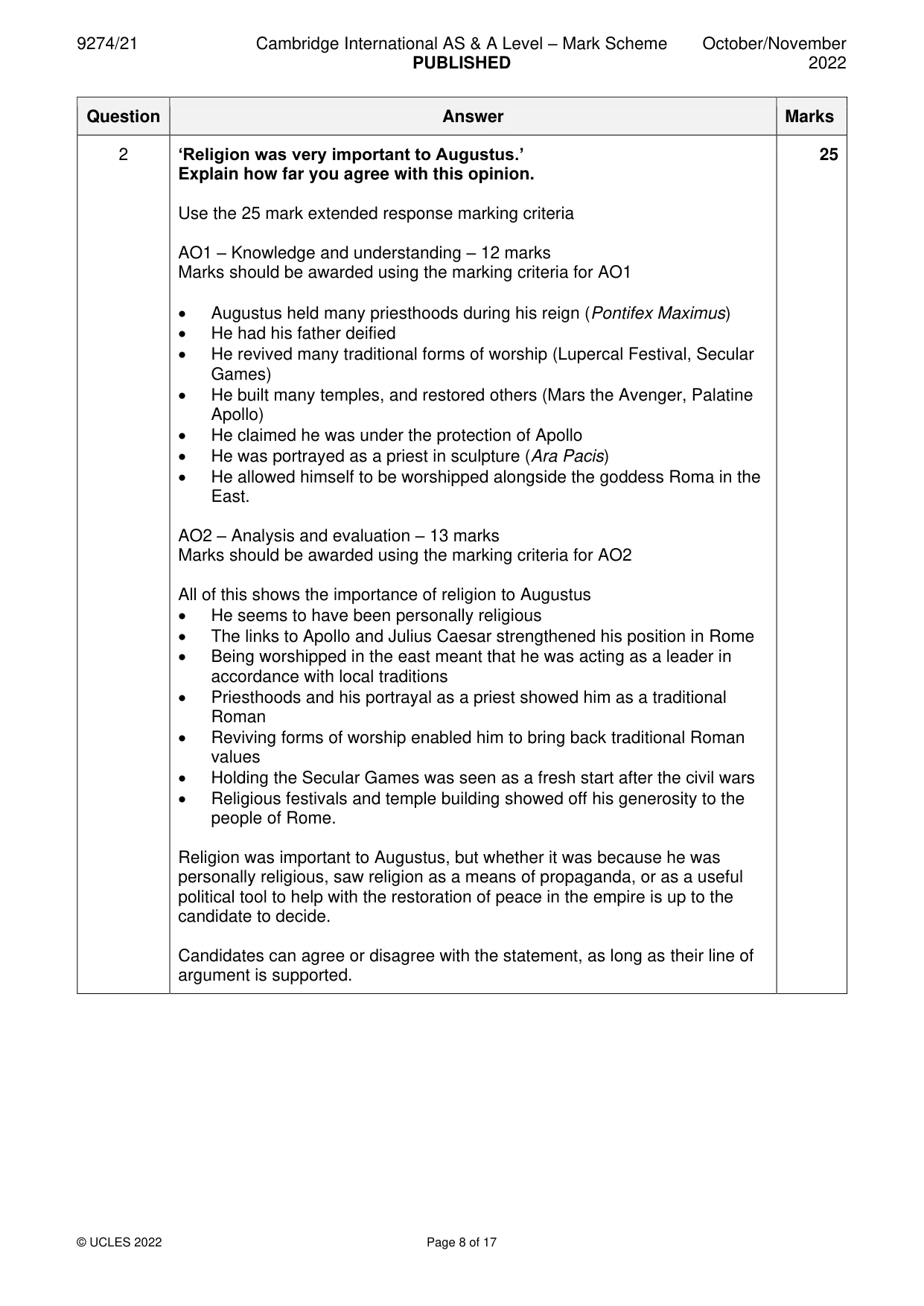
Mark scheme: 2 ‘Religion was very important to Augustus.’ 25 Explain how far you agree with this opinion. Use the 25 mark extended response marking criteria AO1 – Knowledge and understanding – 12 marks Marks should be awarded using the marking criteria for AO1 • Augustus held many priesthoods during his reign (Pontifex Maximus) • He had his father deified • He revived many traditional forms of worship (Lupercal Festival, Secular Games) • He built many temples, and restored others (Mars the Avenger, Palatine Apollo) • He claimed he was under the protection of Apollo • He was portrayed as a priest in sculpture (Ara Pacis) • He allowed himself to be worshipped alongside the goddess Roma in the East. AO2 – Analysis and evaluation – 13 marks Marks should be awarded using the marking criteria for AO2 All of this shows the importance of religion to Augustus • He seems to have been personally religious • The links to Apollo and Julius Caesar strengthened his position in Rome • Being worshipped in the east meant that he was acting as a leader in accordance with local traditions • Priesthoods and his portrayal as a priest showed him as a traditional Roman • Reviving forms of worship enabled him to bring back traditional Roman values • Holding the Secular Games was seen as a fresh start after the civil wars • Religious festivals and temple building showed off his generosity to the people of Rome. Religion was important to Augustus, but whether it was because he was personally religious, saw religion as a means of propaganda, or as a useful political tool to help with the restoration of peace in the empire is up to the candidate to decide. Candidates can agree or disagree with the statement, as long as their line of argument is supported.
Q3 · How far would you agree that, during his reign, Augustus always tried to expand the…
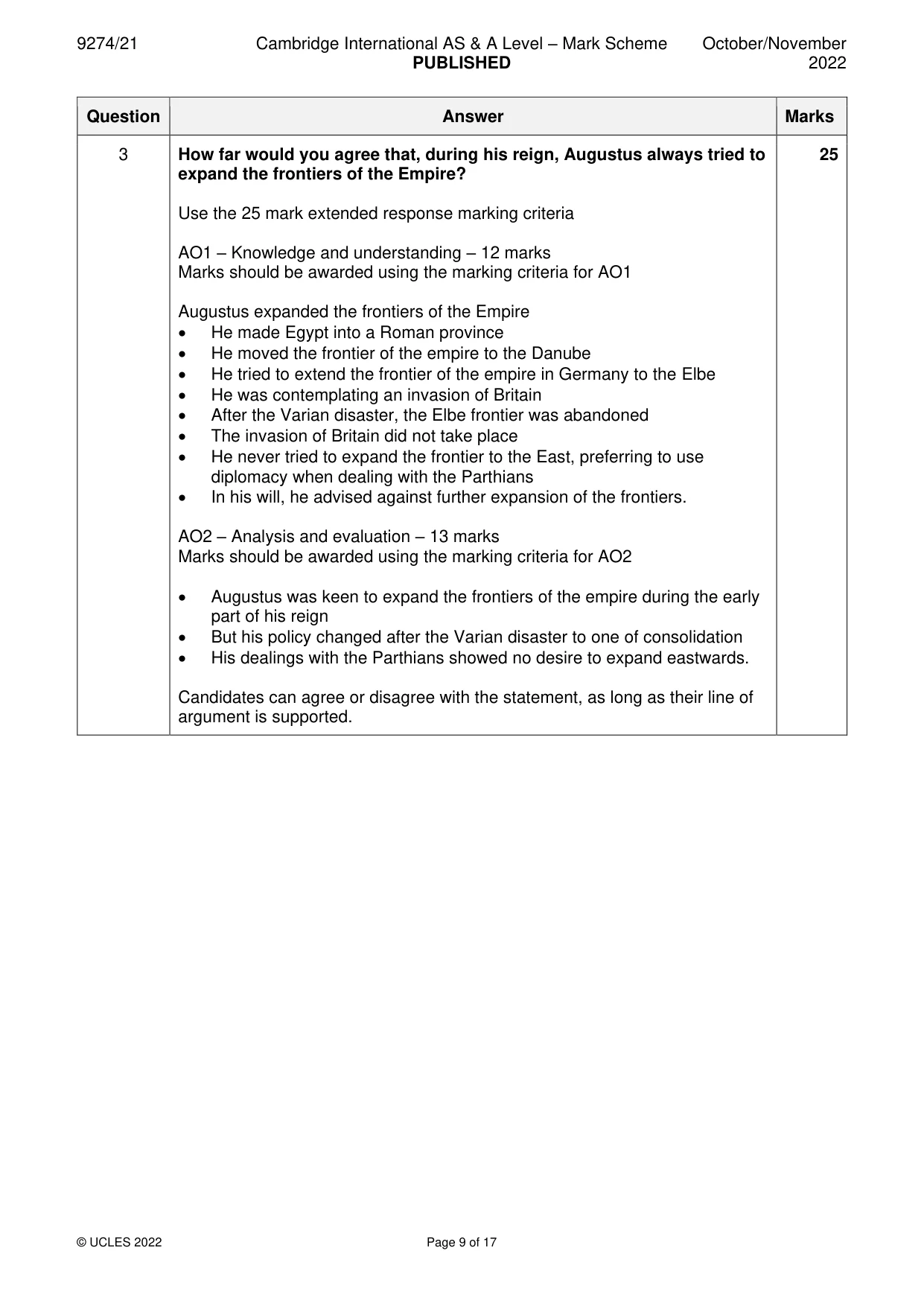
3 How far would you agree that, during his reign, Augustus always tried to expand the frontiers of the Empire? [25]
Mark scheme: 3 How far would you agree that, during his reign, Augustus always tried to 25 expand the frontiers of the Empire? Use the 25 mark extended response marking criteria AO1 – Knowledge and understanding – 12 marks Marks should be awarded using the marking criteria for AO1 Augustus expanded the frontiers of the Empire • He made Egypt into a Roman province • He moved the frontier of the empire to the Danube • He tried to extend the frontier of the empire in Germany to the Elbe • He was contemplating an invasion of Britain • After the Varian disaster, the Elbe frontier was abandoned • The invasion of Britain did not take place • He never tried to expand the frontier to the East, preferring to use diplomacy when dealing with the Parthians • In his will, he advised against further expansion of the frontiers. AO2 – Analysis and evaluation – 13 marks Marks should be awarded using the marking criteria for AO2 • Augustus was keen to expand the frontiers of the empire during the early part of his reign • But his policy changed after the Varian disaster to one of consolidation • His dealings with the Parthians showed no desire to expand eastwards. Candidates can agree or disagree with the statement, as long as their line of argument is supported. SECTION B: VIRGIL’S AENEID
Q4 · Read the passage and answer the questions: ‘This woman was wandering about our land and…
4 Read the passage and answer the questions: ‘This woman was wandering about our land and we allowed her at a price to found her little city. We gave her a piece of shore to plough and laid down the laws of the place for her and she has spurned our offer of marriage and taken Aeneas into her kingdom as lord and master, and now this second Paris, with eunuchs in attendance and hair dripping with perfume and Maeonian bonnet tied under his chin, is enjoying what he 5 has stolen while we bring gifts to temples we think are yours and keep warm with our worship the reputation of a useless god.’ As Iarbas prayed these prayers with his hand on the altar, the All-powerful god heard him and turned his eyes towards the royal city and the lovers who had lost all recollection of their good name. Then he spoke to Mercury and gave him these 10 instructions: ‘Up with you, my son. Call for the Zephyrs, glide down on your wings and speak to the Trojan leader who now lingers in Tyrian Carthage without a thought for the cities granted him by the Fates’ (Virgil, Aeneid 4) (a) (i) What news has Iarbas heard just before this passage begins? [1] (ii) Name the ‘little city’ (line 2). [1] (iii) ‘this second Paris’ (line 4). Who was Paris? Make two points. [2] (iv) Identify ‘the All-powerful god’ in line 8. [1] (b) ‘In Book 4 of the Aeneid, the relationship between gods and humans is always depicted negatively.’ How far do you agree with this statement? You should use this passage as a starting point in your answer. [20] [Total: 25] EITHER
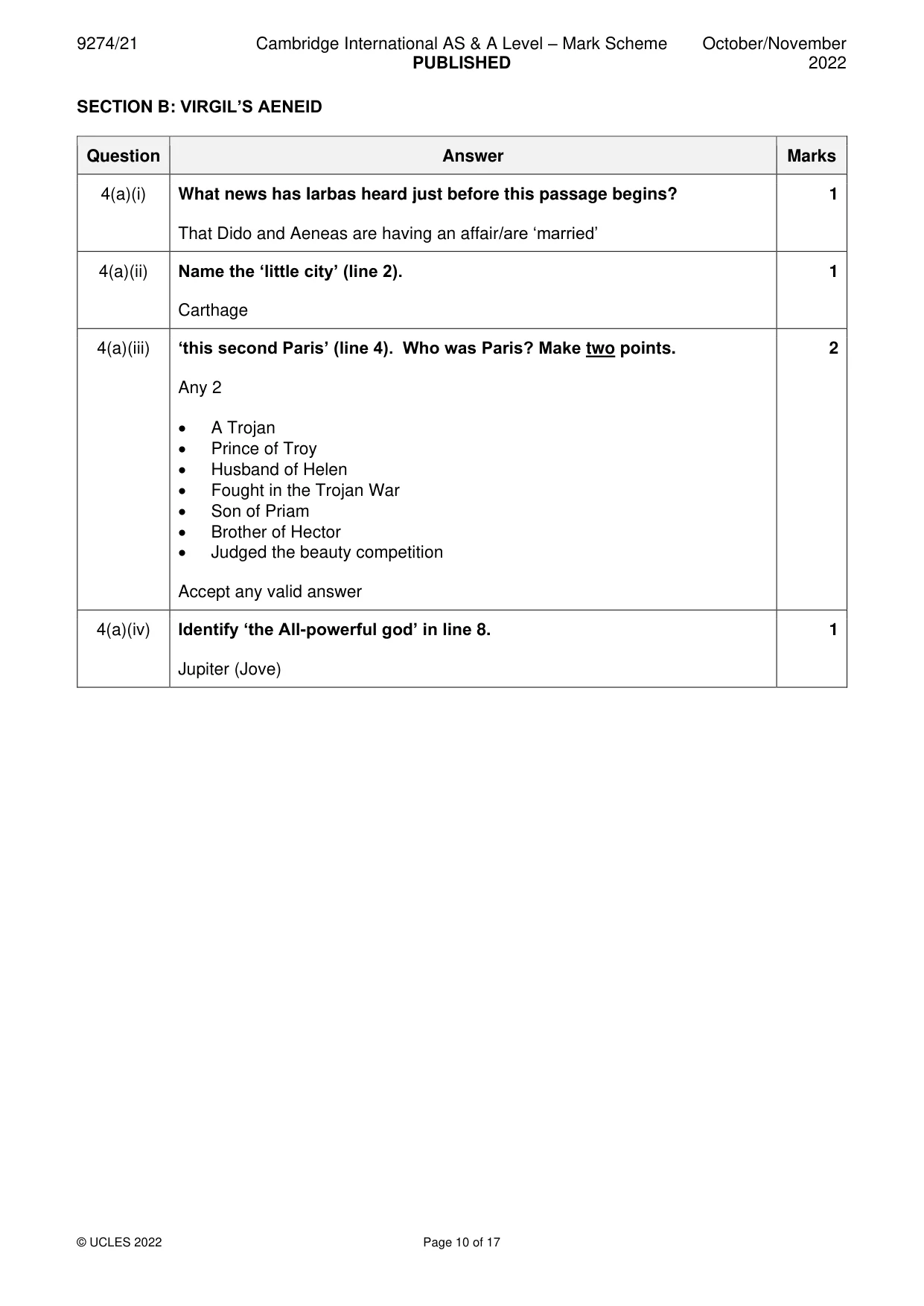
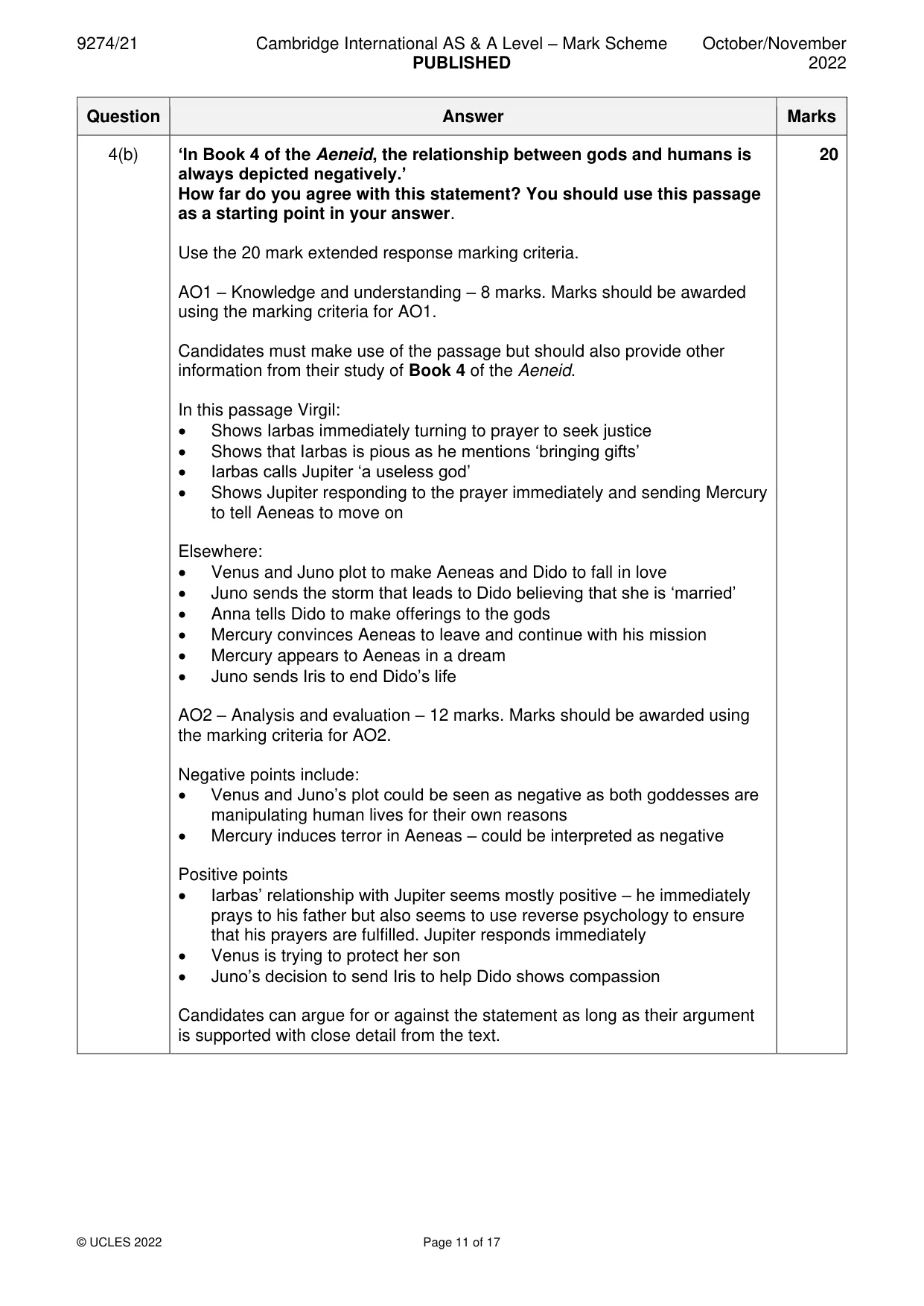
Mark scheme: 4(a)(i) What news has Iarbas heard just before this passage begins? 1 That Dido and Aeneas are having an affair/are ‘married’ 4(a)(ii) Name the ‘little city’ (line 2). 1 Carthage 4(a)(iii) ‘this second Paris’ (line 4). Who was Paris? Make two points. 2 Any 2 • A Trojan • Prince of Troy • Husband of Helen • Fought in the Trojan War • Son of Priam • Brother of Hector • Judged the beauty competition Accept any valid answer 4(a)(iv) Identify ‘the All-powerful god’ in line 8. 1 Jupiter (Jove) 4(b) ‘In Book 4 of the Aeneid, the relationship between gods and humans is 20 always depicted negatively.’ How far do you agree with this statement? You should use this passage as a starting point in your answer. Use the 20 mark extended response marking criteria. AO1 – Knowledge and understanding – 8 marks. Marks should be awarded using the marking criteria for AO1. Candidates must make use of the passage but should also provide other information from their study of Book 4 of the Aeneid. In this passage Virgil: • Shows Iarbas immediately turning to prayer to seek justice • Shows that Iarbas is pious as he mentions ‘bringing gifts’ • Iarbas calls Jupiter ‘a useless god’ • Shows Jupiter responding to the prayer immediately and sending Mercury to tell Aeneas to move on Elsewhere: • Venus and Juno plot to make Aeneas and Dido to fall in love • Juno sends the storm that leads to Dido believing that she is ‘married’ • Anna tells Dido to make offerings to the gods • Mercury convinces Aeneas to leave and continue with his mission • Mercury appears to Aeneas in a dream • Juno sends Iris to end Dido’s life AO2 – Analysis and evaluation – 12 marks. Marks should be awarded using the marking criteria for AO2. Negative points include: • Venus and Juno’s plot could be seen as negative as both goddesses are manipulating human lives for their own reasons • Mercury induces terror in Aeneas – could be interpreted as negative Positive points • Iarbas’ relationship with Jupiter seems mostly positive – he immediately prays to his father but also seems to use reverse psychology to ensure that his prayers are fulfilled. Jupiter responds immediately • Venus is trying to protect her son • Juno’s decision to send Iris to help Dido shows compassion Candidates can argue for or against the statement as long as their argument is supported with close detail from the text.
Q5 · ‘Aeneas always shows the characteristics of a hero.’ How far do you agree with this…
5 ‘Aeneas always shows the characteristics of a hero.’ How far do you agree with this statement? In your answer, you should refer to the books of the Aeneid you have studied. [25] OR
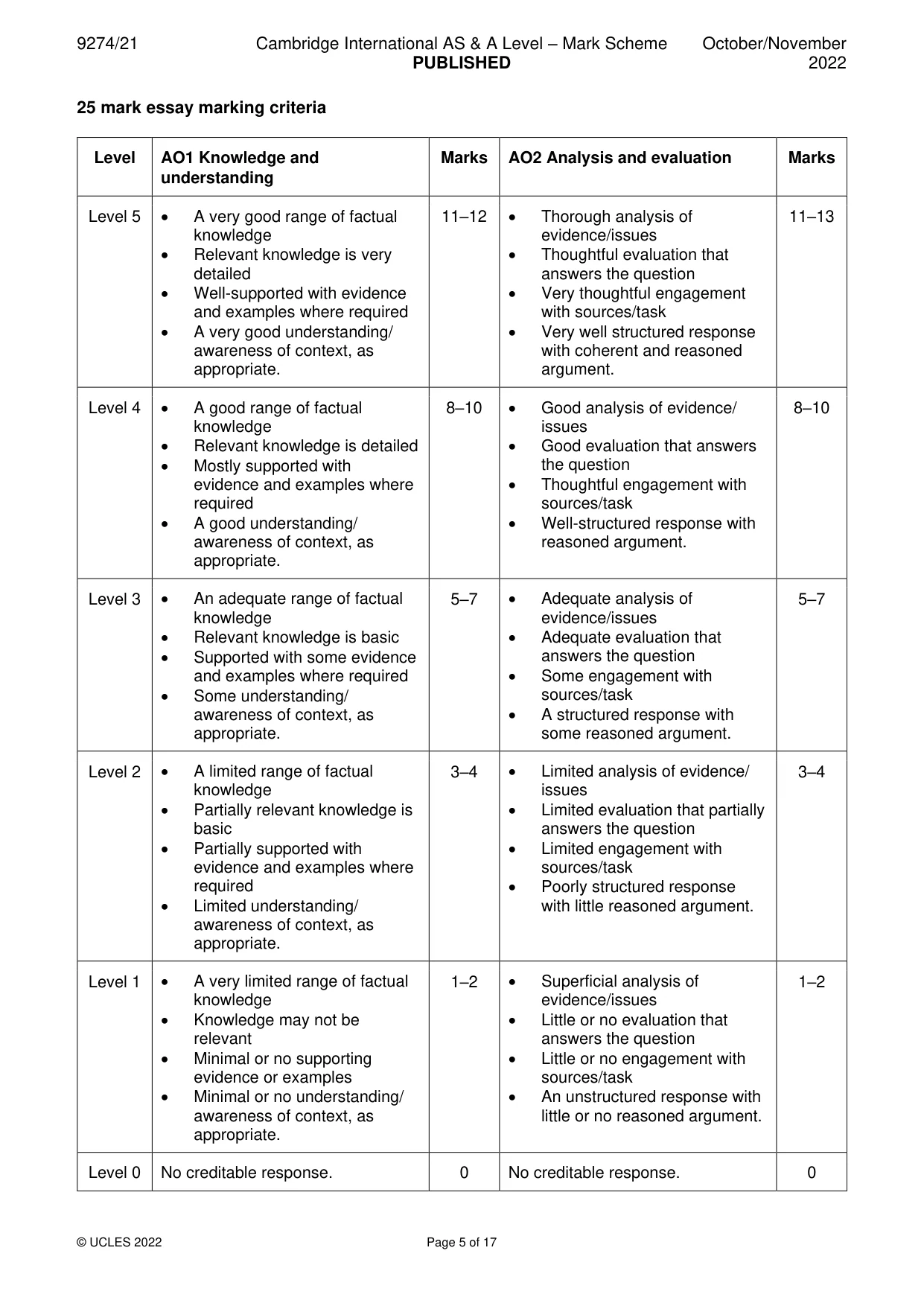
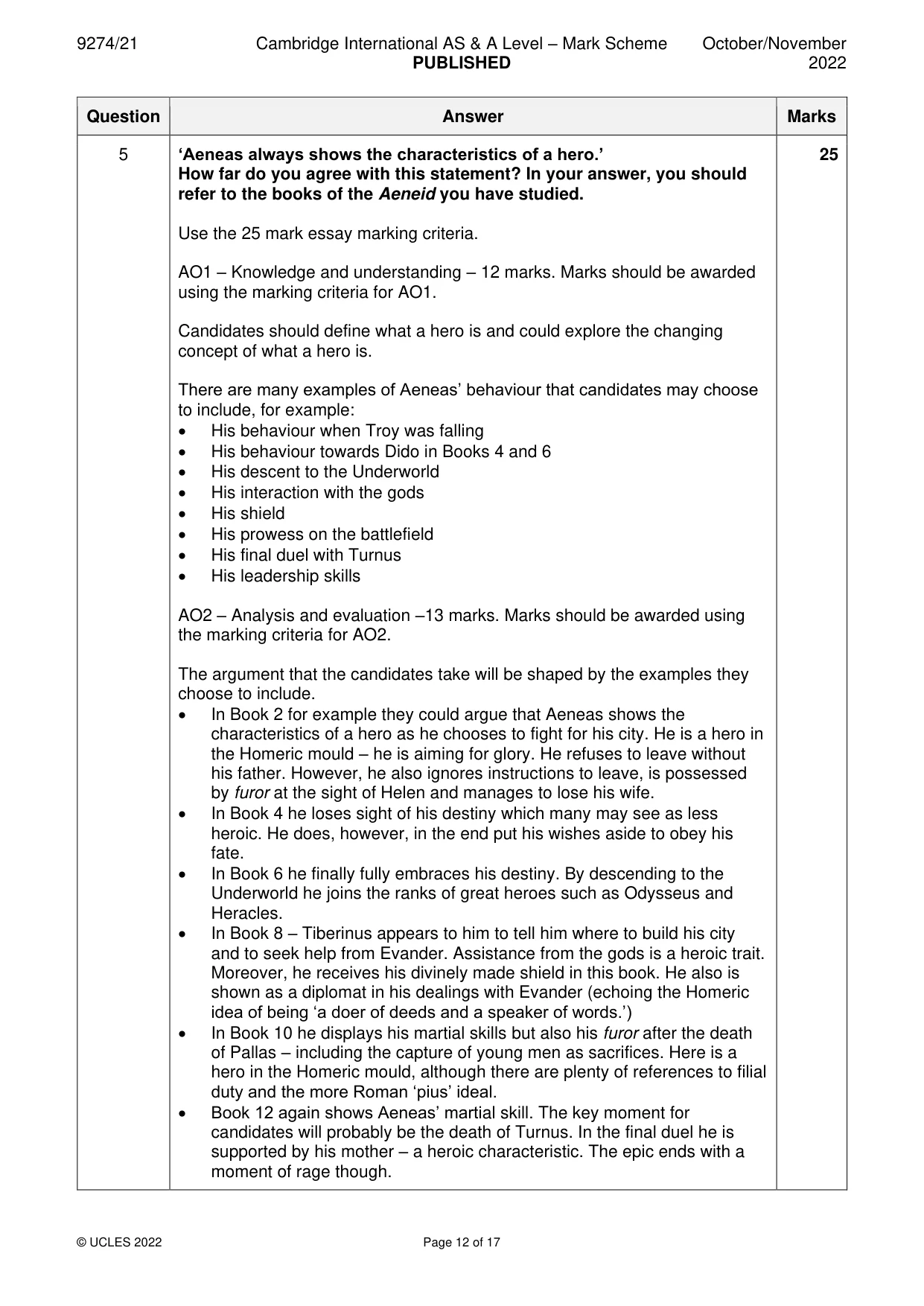
Mark scheme: 5 ‘Aeneas always shows the characteristics of a hero.’ 25 How far do you agree with this statement? In your answer, you should refer to the books of the Aeneid you have studied. Use the 25 mark essay marking criteria. AO1 – Knowledge and understanding – 12 marks. Marks should be awarded using the marking criteria for AO1. Candidates should define what a hero is and could explore the changing concept of what a hero is. There are many examples of Aeneas’ behaviour that candidates may choose to include, for example: • His behaviour when Troy was falling • His behaviour towards Dido in Books 4 and 6 • His descent to the Underworld • His interaction with the gods • His shield • His prowess on the battlefield • His final duel with Turnus • His leadership skills AO2 – Analysis and evaluation –13 marks. Marks should be awarded using the marking criteria for AO2. The argument that the candidates take will be shaped by the examples they choose to include. • In Book 2 for example they could argue that Aeneas shows the characteristics of a hero as he chooses to fight for his city. He is a hero in the Homeric mould – he is aiming for glory. He refuses to leave without his father. However, he also ignores instructions to leave, is possessed by furor at the sight of Helen and manages to lose his wife. • In Book 4 he loses sight of his destiny which many may see as less heroic. He does, however, in the end put his wishes aside to obey his fate. • In Book 6 he finally fully embraces his destiny. By descending to the Underworld he joins the ranks of great heroes such as Odysseus and Heracles. • In Book 8 – Tiberinus appears to him to tell him where to build his city and to seek help from Evander. Assistance from the gods is a heroic trait. Moreover, he receives his divinely made shield in this book. He also is shown as a diplomat in his dealings with Evander (echoing the Homeric idea of being ‘a doer of deeds and a speaker of words.’) • In Book 10 he displays his martial skills but also his furor after the death of Pallas – including the capture of young men as sacrifices. Here is a hero in the Homeric mould, although there are plenty of references to filial duty and the more Roman ‘pius’ ideal. • Book 12 again shows Aeneas’ martial skill. The key moment for candidates will probably be the death of Turnus. In the final duel he is supported by his mother – a heroic characteristic. The epic ends with a moment of rage though. 5 Candidates can argue for or against the statement as long as their argument is supported with close detail from the text.
Q6 · ‘There are no interesting female characters in the Aeneid.’ How far is this statement…
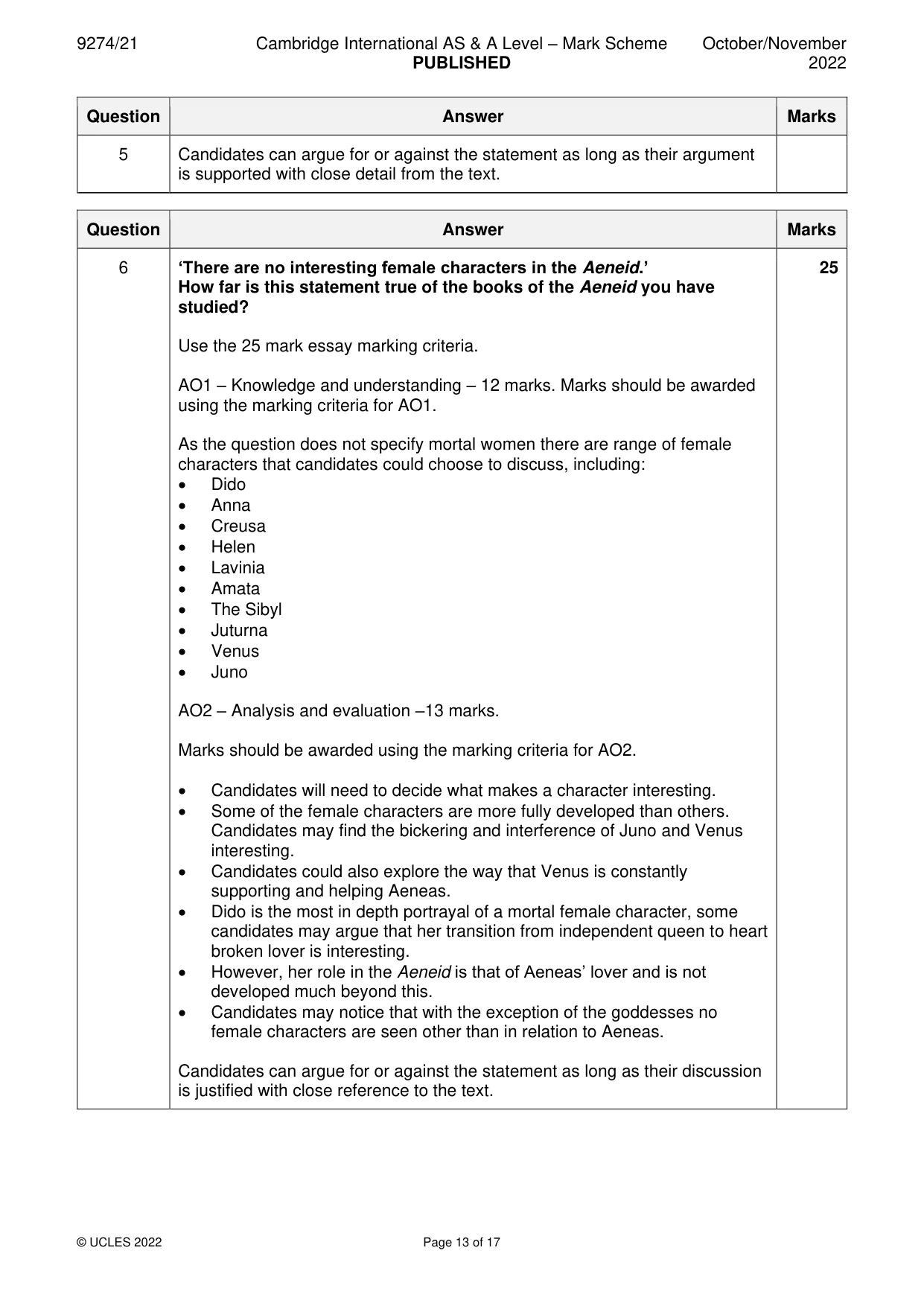
6 ‘There are no interesting female characters in the Aeneid.’ How far is this statement true of the books of the Aeneid you have studied? [25] SECTION C: ARCHITECTURE OF THE ROMAN CITY Answer Question 7 and either Question 8 or Question 9.
Mark scheme: 6 ‘There are no interesting female characters in the Aeneid.’ 25 How far is this statement true of the books of the Aeneid you have studied? Use the 25 mark essay marking criteria. AO1 – Knowledge and understanding – 12 marks. Marks should be awarded using the marking criteria for AO1. As the question does not specify mortal women there are range of female characters that candidates could choose to discuss, including: • Dido • Anna • Creusa • Helen • Lavinia • Amata • The Sibyl • Juturna • Venus • Juno AO2 – Analysis and evaluation –13 marks. Marks should be awarded using the marking criteria for AO2. • Candidates will need to decide what makes a character interesting. • Some of the female characters are more fully developed than others. Candidates may find the bickering and interference of Juno and Venus interesting. • Candidates could also explore the way that Venus is constantly supporting and helping Aeneas. • Dido is the most in depth portrayal of a mortal female character, some candidates may argue that her transition from independent queen to heart broken lover is interesting. • However, her role in the Aeneid is that of Aeneas’ lover and is not developed much beyond this. • Candidates may notice that with the exception of the goddesses no female characters are seen other than in relation to Aeneas. Candidates can argue for or against the statement as long as their discussion is justified with close reference to the text. SECTION C: ARCHITECTURE OF THE ROMAN CITY
Q7 · Study the image below and answer the questions which follow: A B (a) (i) Identify the…
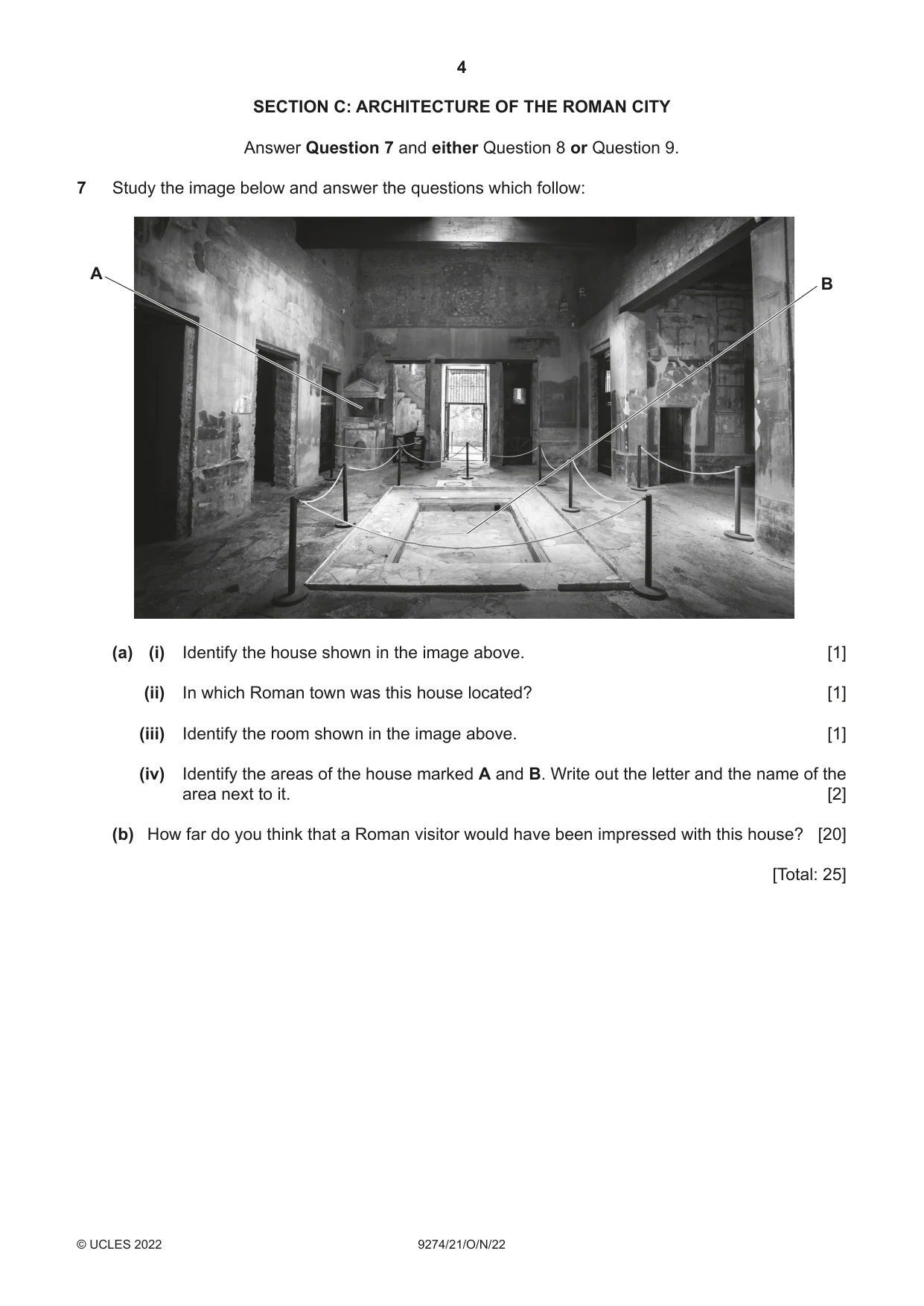
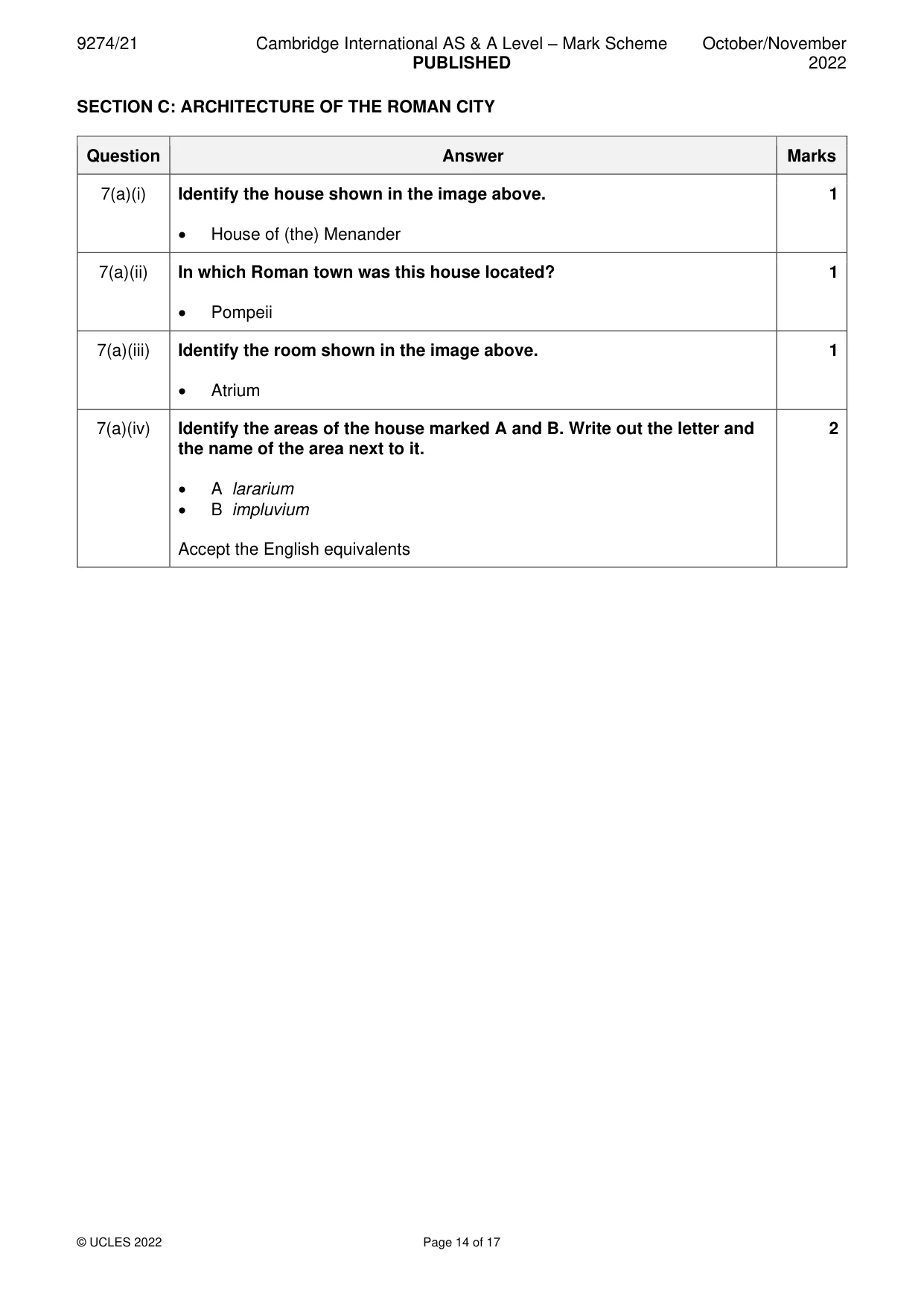
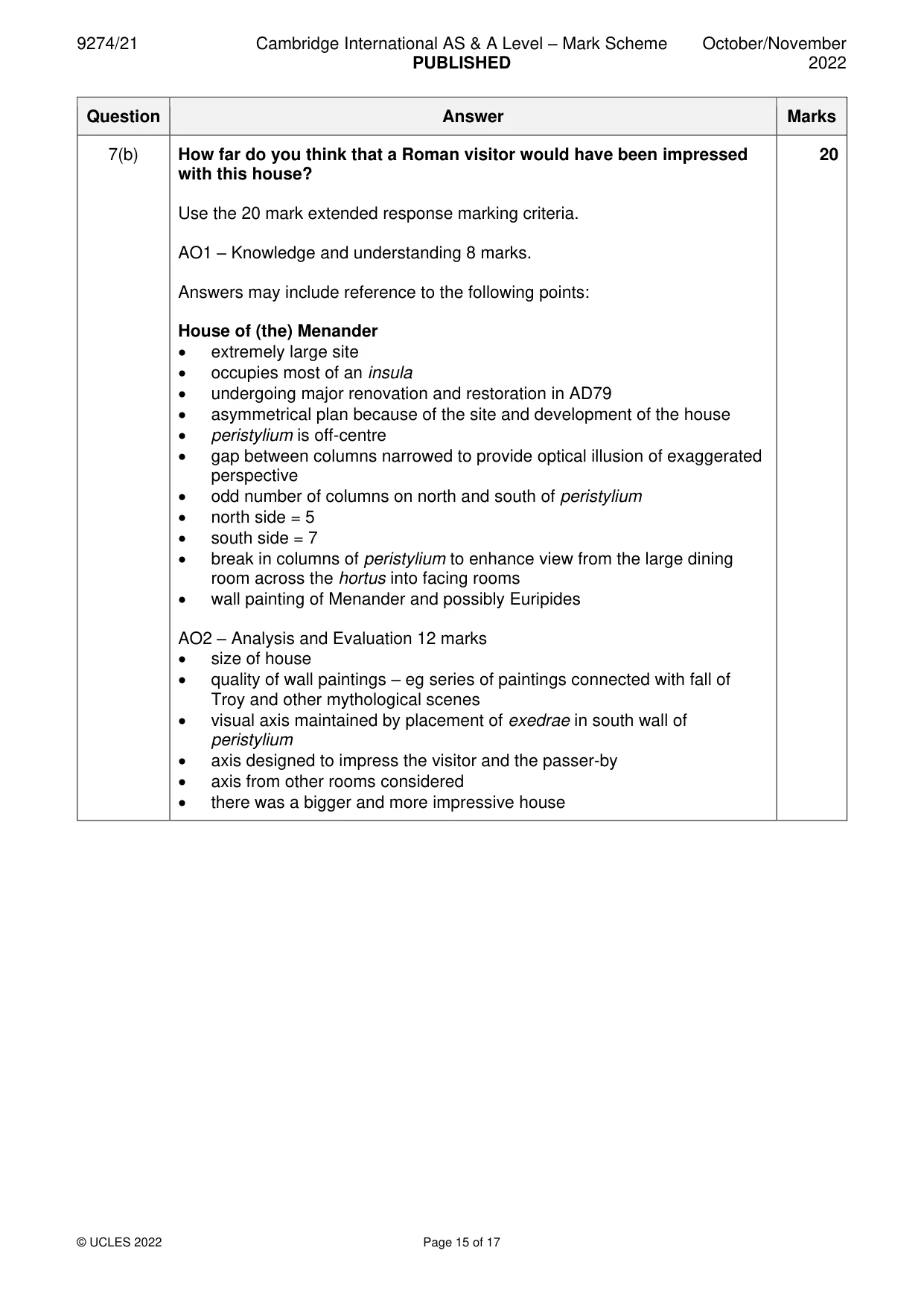
7 Study the image below and answer the questions which follow: A B (a) (i) Identify the house shown in the image above. [1] (ii) In which Roman town was this house located? [1] (iii) Identify the room shown in the image above. [1] (iv) Identify the areas of the house marked A and B. Write out the letter and the name of the area next to it. [2] (b) How far do you think that a Roman visitor would have been impressed with this house? [20] [Total: 25] EITHER
Mark scheme: 7(a)(i) Identify the house shown in the image above. 1 • House of (the) Menander 7(a)(ii) In which Roman town was this house located? 1 • Pompeii 7(a)(iii) Identify the room shown in the image above. 1 • Atrium 7(a)(iv) Identify the areas of the house marked A and B. Write out the letter and 2 the name of the area next to it. • A lararium • B impluvium Accept the English equivalents 7(b) How far do you think that a Roman visitor would have been impressed 20 with this house? Use the 20 mark extended response marking criteria. AO1 – Knowledge and understanding 8 marks. Answers may include reference to the following points: House of (the) Menander • extremely large site • occupies most of an insula • undergoing major renovation and restoration in AD79 • asymmetrical plan because of the site and development of the house • peristylium is off-centre • gap between columns narrowed to provide optical illusion of exaggerated perspective • odd number of columns on north and south of peristylium • north side = 5 • south side = 7 • break in columns of peristylium to enhance view from the large dining room across the hortus into facing rooms • wall painting of Menander and possibly Euripides AO2 – Analysis and Evaluation 12 marks • size of house • quality of wall paintings – eg series of paintings connected with fall of Troy and other mythological scenes • visual axis maintained by placement of exedrae in south wall of peristylium • axis designed to impress the visitor and the passer-by • axis from other rooms considered • there was a bigger and more impressive house
Q8 · How well did the design of Roman amphitheatres meet the needs of the audience?
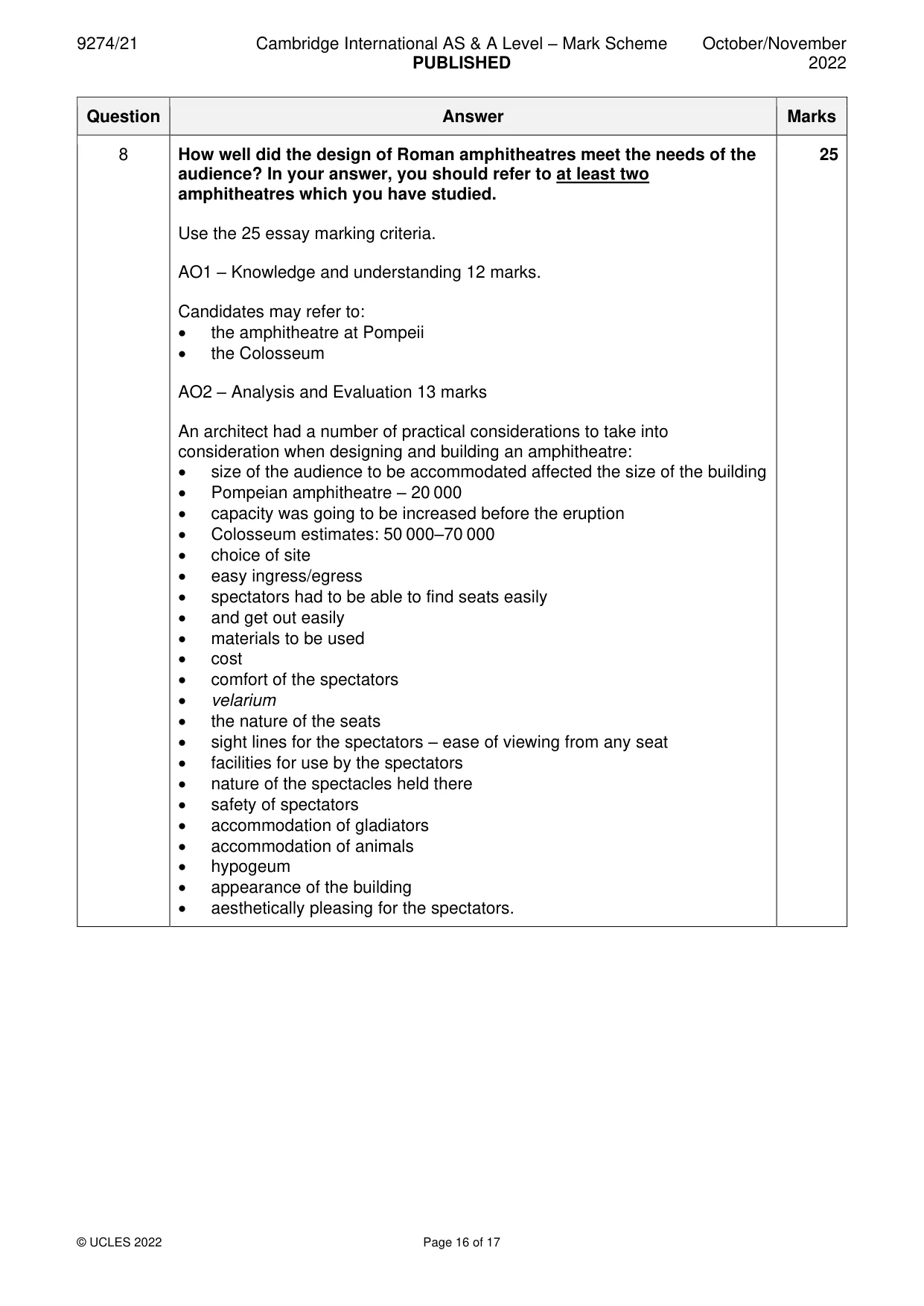
8 How well did the design of Roman amphitheatres meet the needs of the audience? In your answer, you should refer to at least two amphitheatres which you have studied. [25] OR
Mark scheme: 8 How well did the design of Roman amphitheatres meet the needs of the 25 audience? In your answer, you should refer to at least two amphitheatres which you have studied. Use the 25 essay marking criteria. AO1 – Knowledge and understanding 12 marks. Candidates may refer to: • the amphitheatre at Pompeii • the Colosseum AO2 – Analysis and Evaluation 13 marks An architect had a number of practical considerations to take into consideration when designing and building an amphitheatre: • size of the audience to be accommodated affected the size of the building • Pompeian amphitheatre – 20 000 • capacity was going to be increased before the eruption • Colosseum estimates: 50 000–70 000 • choice of site • easy ingress/egress • spectators had to be able to find seats easily • and get out easily • materials to be used • cost • comfort of the spectators • velarium • the nature of the seats • sight lines for the spectators – ease of viewing from any seat • facilities for use by the spectators • nature of the spectacles held there • safety of spectators • accommodation of gladiators • accommodation of animals • hypogeum • appearance of the building • aesthetically pleasing for the spectators.
Q9 · ‘Architects should design public buildings with strength, function and beauty in mind.’…
9 ‘Architects should design public buildings with strength, function and beauty in mind.’ How far do you agree with this statement? In your answer, you should include discussion of at least three different types of Roman public buildings you have studied. [25]
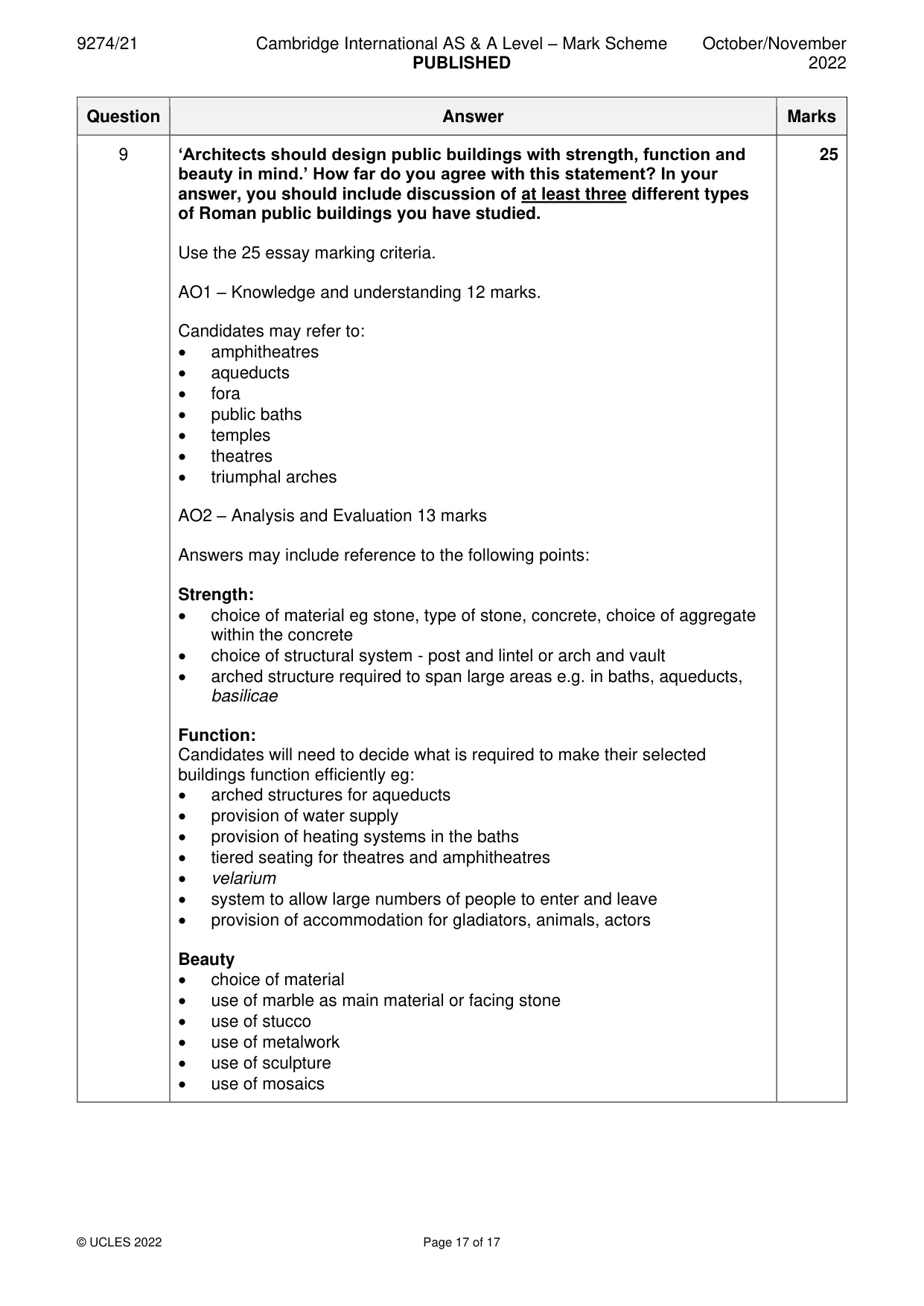
Mark scheme: 9 ‘Architects should design public buildings with strength, function and 25 beauty in mind.’ How far do you agree with this statement? In your answer, you should include discussion of at least three different types of Roman public buildings you have studied. Use the 25 essay marking criteria. AO1 – Knowledge and understanding 12 marks. Candidates may refer to: • amphitheatres • aqueducts • fora • public baths • temples • theatres • triumphal arches AO2 – Analysis and Evaluation 13 marks Answers may include reference to the following points: Strength: • choice of material eg stone, type of stone, concrete, choice of aggregate within the concrete • choice of structural system - post and lintel or arch and vault • arched structure required to span large areas e.g. in baths, aqueducts, basilicae Function: Candidates will need to decide what is required to make their selected buildings function efficiently eg: • arched structures for aqueducts • provision of water supply • provision of heating systems in the baths • tiered seating for theatres and amphitheatres • velarium • system to allow large numbers of people to enter and leave • provision of accommodation for gladiators, animals, actors Beauty • choice of material • use of marble as main material or facing stone • use of stucco • use of metalwork • use of sculpture • use of mosaics
What was in this paper
The subtopics covered by these 9 questions, and how many questions each got. Open one in a new tab to see every Cambridge question on it.
What you needed in this session
Cambridge’s own grade thresholds for 2022 Oct/Nov, Paper 2 · Variant 1. A higher threshold means an easier paper — the bar moves with how the cohort did.