Cambridge A Level Classical Studies 9274 — 2024 Oct/Nov Paper 2 · Variant 3
9274/23/O/N/24 · 9 questions · 50 marks · ≈56 min
The question paper and its mark scheme, free to read here and free to download. This is Cambridge’s own paper, exactly as it was sat.
Question paper8 pages

Mark scheme22 pages
Answers below. Sit the paper first if you are practising.

Questions as text
Q1 · Study the image and answer the questions: (Temple of Mars Ultor) (a) (i) Where exactly…
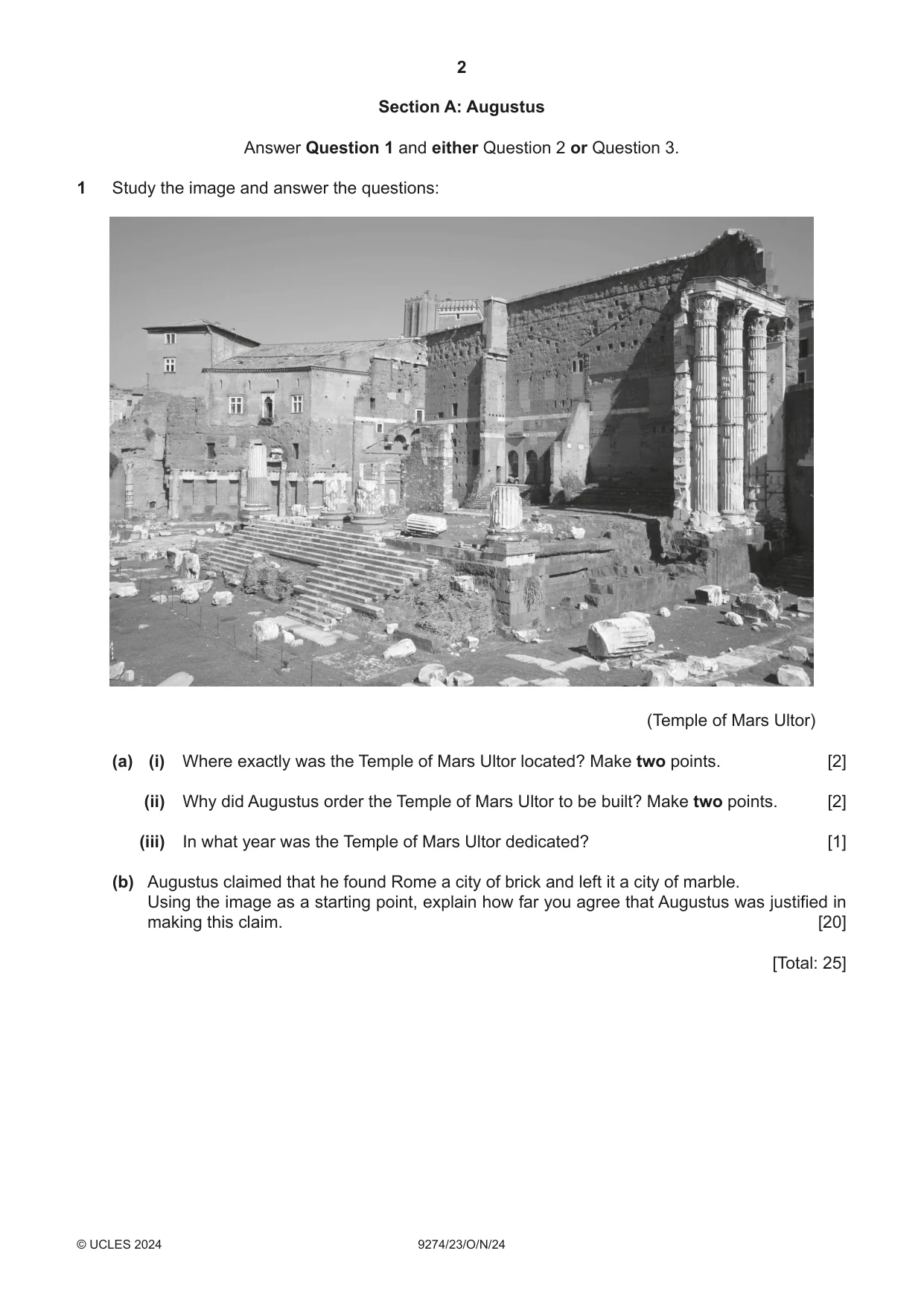
1 Study the image and answer the questions: (Temple of Mars Ultor) (a) (i) Where exactly was the Temple of Mars Ultor located? Make two points. [2] (ii) Why did Augustus order the Temple of Mars Ultor to be built? Make two points. [2] (iii) In what year was the Temple of Mars Ultor dedicated? [1] (b) Augustus claimed that he found Rome a city of brick and left it a city of marble. Using the image as a starting point, explain how far you agree that Augustus was justified in making this claim. [20] [Total: 25] EITHER
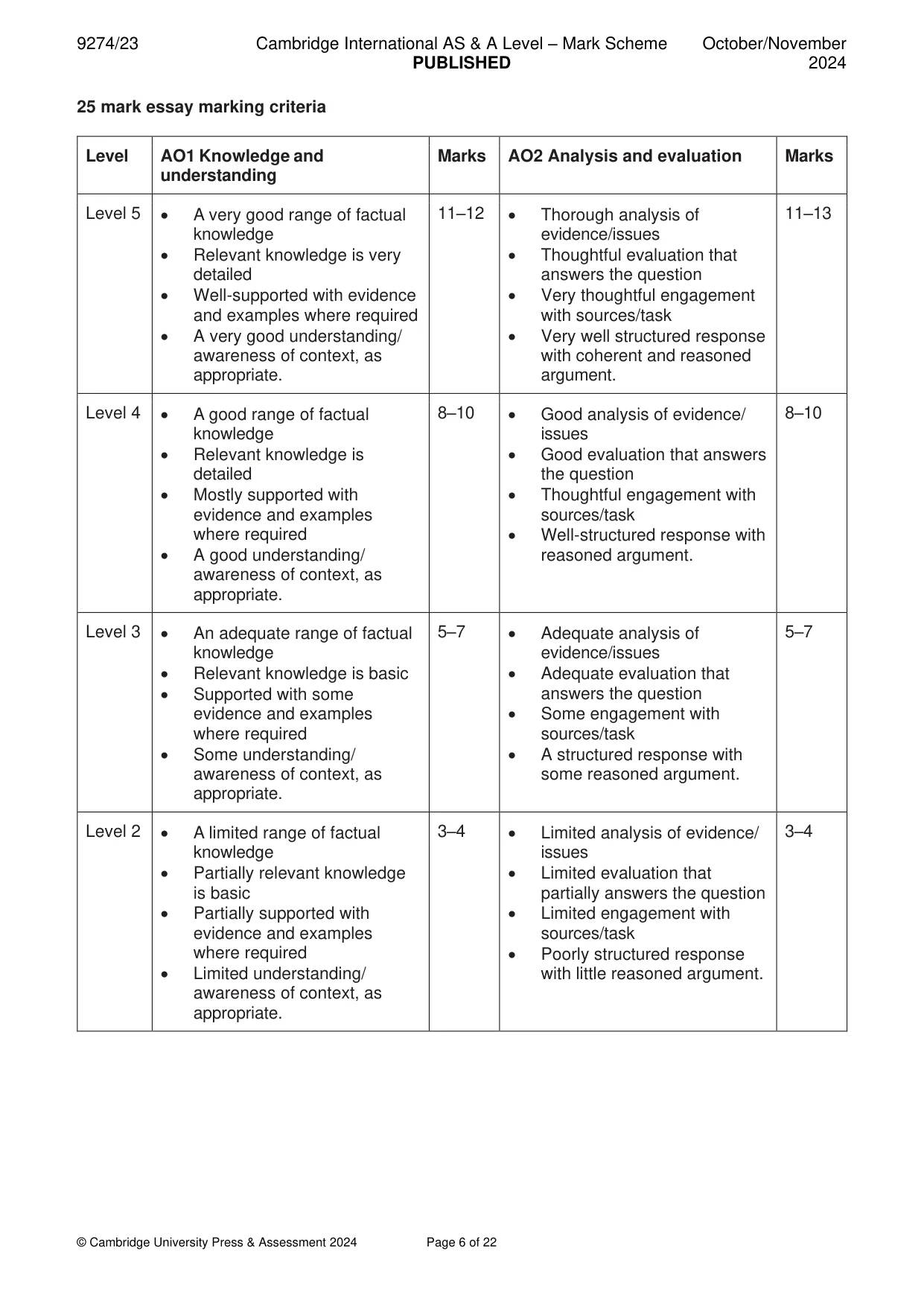
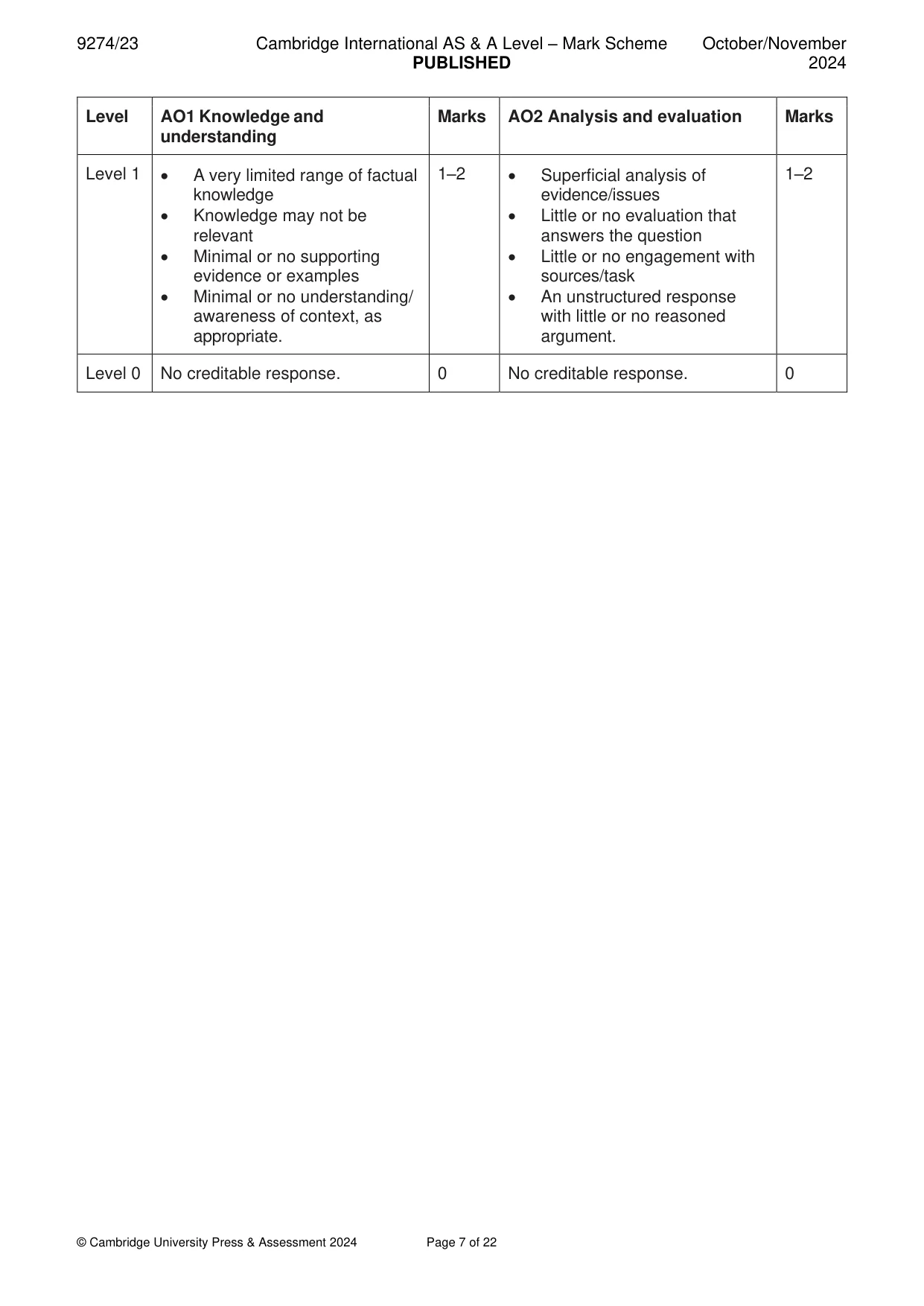
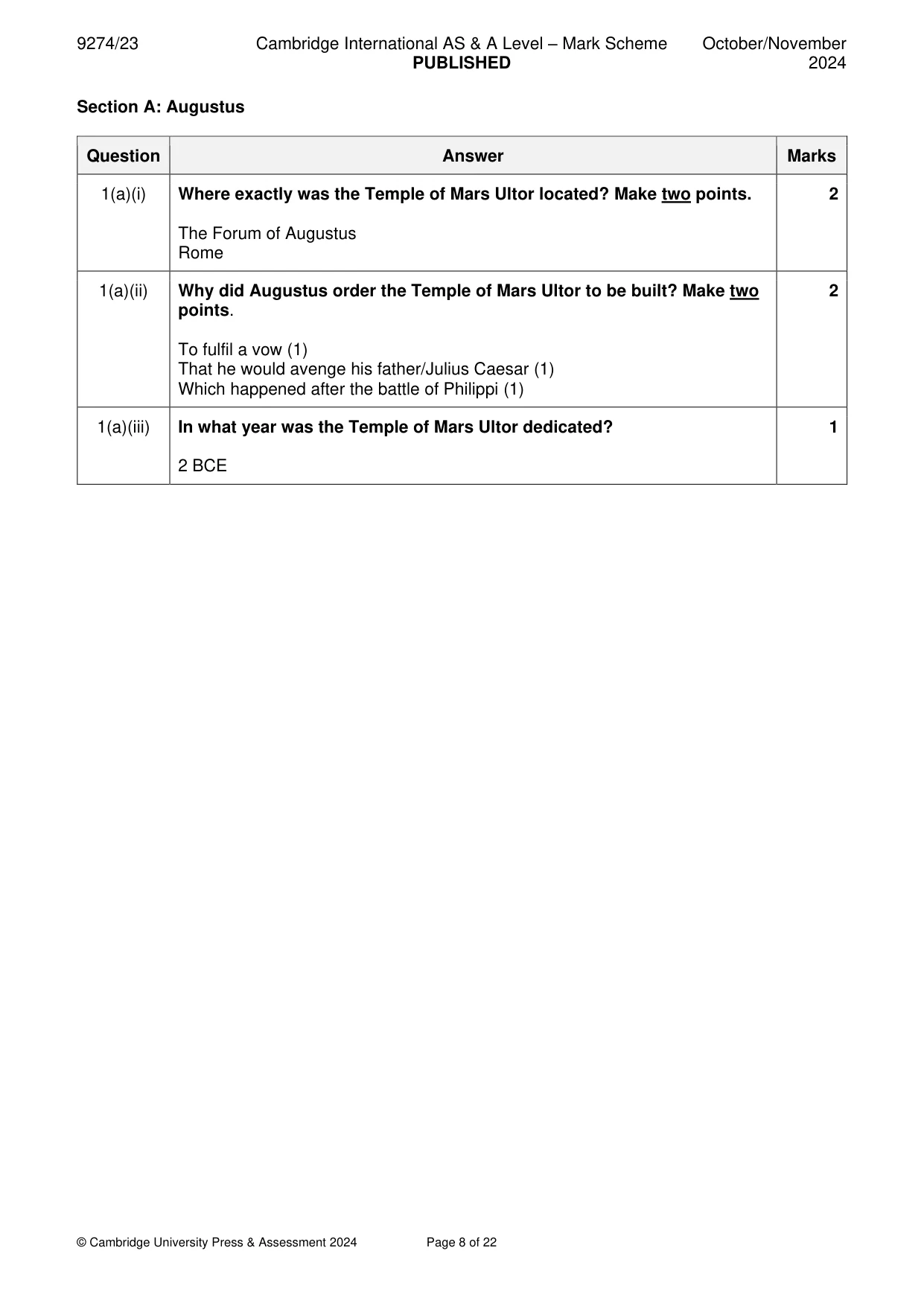
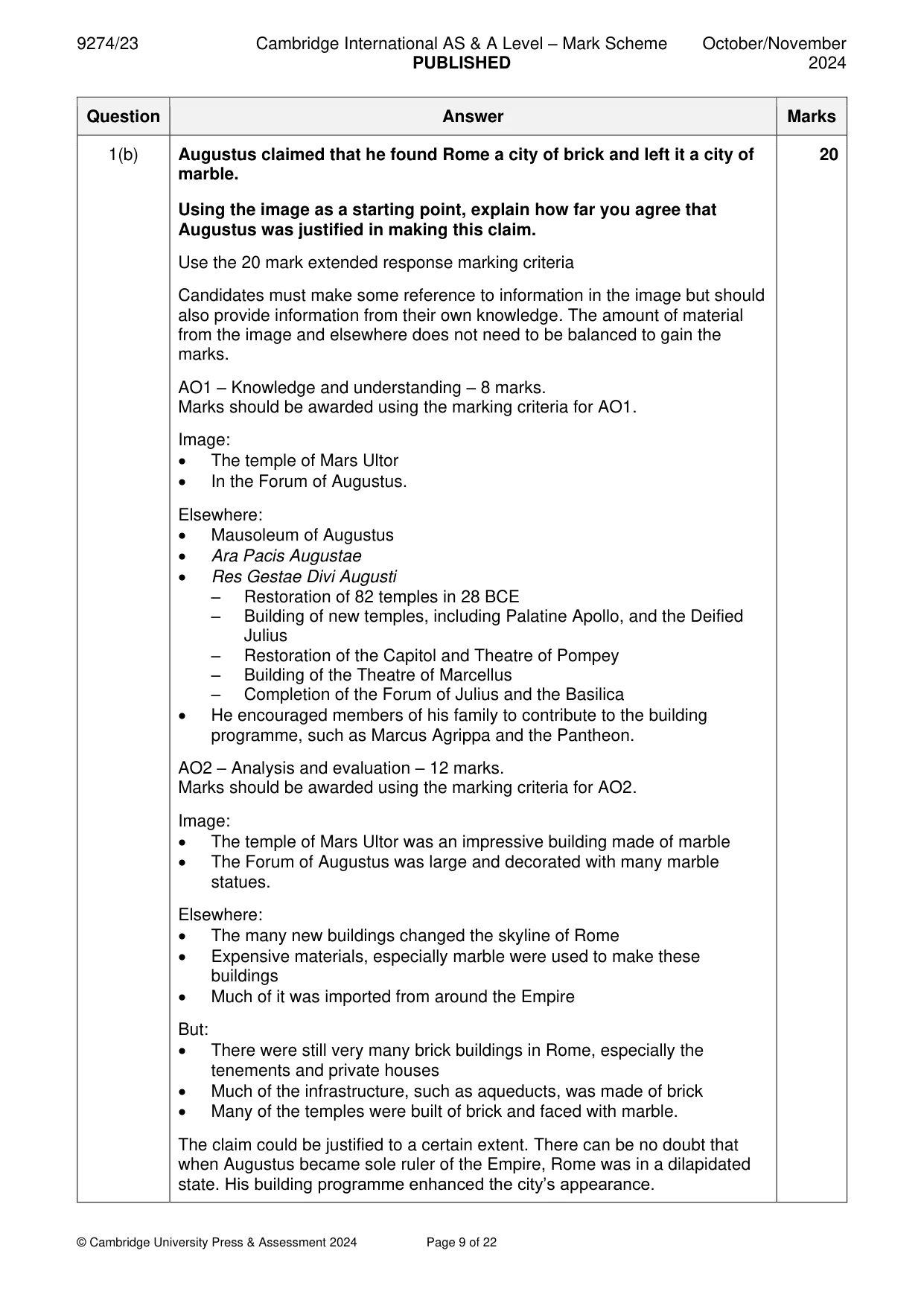
Mark scheme: Question Answer Marks 1(a)(i) Where exactly was the Temple of Mars Ultor located? Make two points. 2 The Forum of Augustus Rome 1(a)(ii) Why did Augustus order the Temple of Mars Ultor to be built? Make two 2 points. To fulfil a vow (1) That he would avenge his father/Julius Caesar (1) Which happened after the battle of Philippi (1) 1(a)(iii) In what year was the Temple of Mars Ultor dedicated? 1 2 BCE 1(b) Augustus claimed that he found Rome a city of brick and left it a city of 20 marble. Using the image as a starting point, explain how far you agree that Augustus was justified in making this claim. Use the 20 mark extended response marking criteria Candidates must make some reference to information in the image but should also provide information from their own knowledge. The amount of material from the image and elsewhere does not need to be balanced to gain the marks. AO1 – Knowledge and understanding – 8 marks. Marks should be awarded using the marking criteria for AO1. Image: • The temple of Mars Ultor • In the Forum of Augustus. Elsewhere: • Mausoleum of Augustus • Ara Pacis Augustae • Res Gestae Divi Augusti – Restoration of 82 temples in 28 BCE – Building of new temples, including Palatine Apollo, and the Deified Julius – Restoration of the Capitol and Theatre of Pompey – Building of the Theatre of Marcellus – Completion of the Forum of Julius and the Basilica • He encouraged members of his family to contribute to the building programme, such as Marcus Agrippa and the Pantheon. AO2 – Analysis and evaluation – 12 marks. Marks should be awarded using the marking criteria for AO2. Image: • The temple of Mars Ultor was an impressive building made of marble • The Forum of Augustus was large and decorated with many marble statues. Elsewhere: • The many new buildings changed the skyline of Rome • Expensive materials, especially marble were used to make these buildings • Much of it was imported from around the Empire But: • There were still very many brick buildings in Rome, especially the tenements and private houses • Much of the infrastructure, such as aqueducts, was made of brick • Many of the temples were built of brick and faced with marble. The claim could be justified to a certain extent. There can be no doubt that when Augustus became sole ruler of the Empire, Rome was in a dilapidated state. His building programme enhanced the city’s appearance.
Q2 · ‘Augustus had nothing to do with the victories in the military campaigns of 44–31 BCE; it…
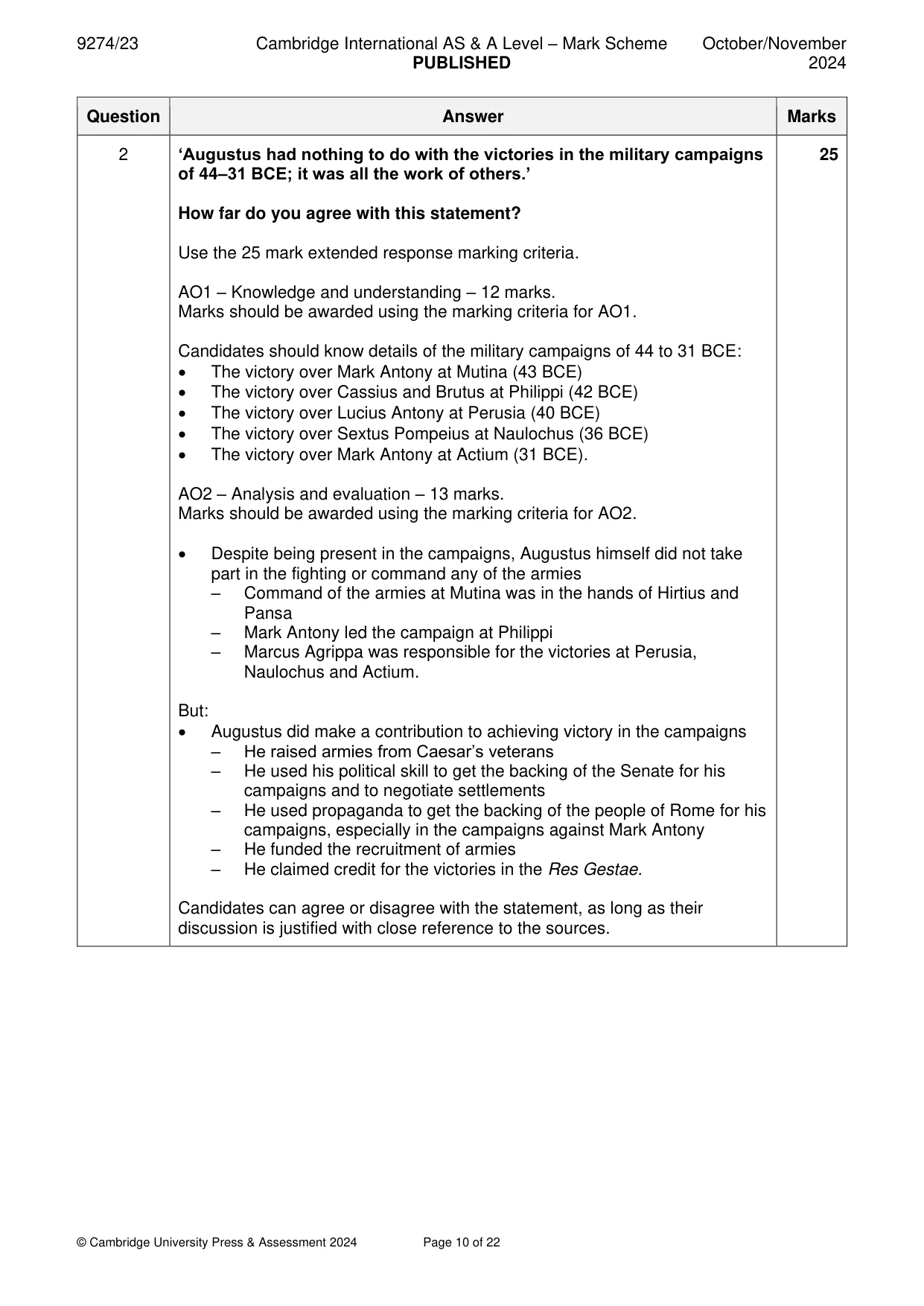
2 ‘Augustus had nothing to do with the victories in the military campaigns of 44–31 BCE; it was all the work of others.’ How far do you agree with this statement? [25] OR
Mark scheme: 2 ‘Augustus had nothing to do with the victories in the military campaigns 25 of 44–31 BCE; it was all the work of others.’ How far do you agree with this statement? Use the 25 mark extended response marking criteria. AO1 – Knowledge and understanding – 12 marks. Marks should be awarded using the marking criteria for AO1. Candidates should know details of the military campaigns of 44 to 31 BCE: • The victory over Mark Antony at Mutina (43 BCE) • The victory over Cassius and Brutus at Philippi (42 BCE) • The victory over Lucius Antony at Perusia (40 BCE) • The victory over Sextus Pompeius at Naulochus (36 BCE) • The victory over Mark Antony at Actium (31 BCE). AO2 – Analysis and evaluation – 13 marks. Marks should be awarded using the marking criteria for AO2. • Despite being present in the campaigns, Augustus himself did not take part in the fighting or command any of the armies – Command of the armies at Mutina was in the hands of Hirtius and Pansa – Mark Antony led the campaign at Philippi – Marcus Agrippa was responsible for the victories at Perusia, Naulochus and Actium. But: • Augustus did make a contribution to achieving victory in the campaigns – He raised armies from Caesar’s veterans – He used his political skill to get the backing of the Senate for his campaigns and to negotiate settlements – He used propaganda to get the backing of the people of Rome for his campaigns, especially in the campaigns against Mark Antony – He funded the recruitment of armies – He claimed credit for the victories in the Res Gestae. Candidates can agree or disagree with the statement, as long as their discussion is justified with close reference to the sources.
Q3 · How far do you agree that Augustus only became emperor because of his family connections?
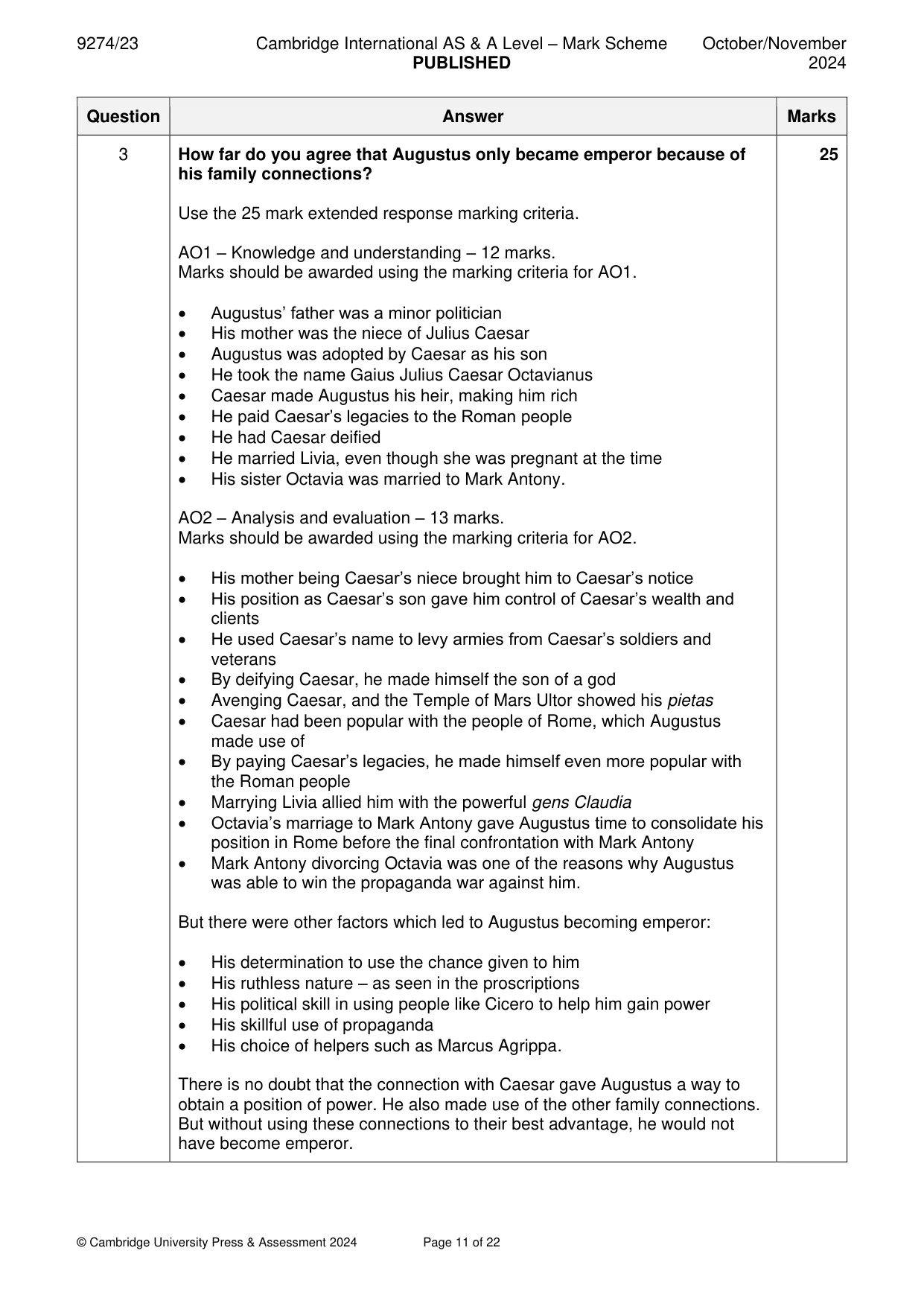
3 How far do you agree that Augustus only became emperor because of his family connections? [25]
Mark scheme: 3 How far do you agree that Augustus only became emperor because of 25 his family connections? Use the 25 mark extended response marking criteria. AO1 – Knowledge and understanding – 12 marks. Marks should be awarded using the marking criteria for AO1. • Augustus’ father was a minor politician • His mother was the niece of Julius Caesar • Augustus was adopted by Caesar as his son • He took the name Gaius Julius Caesar Octavianus • Caesar made Augustus his heir, making him rich • He paid Caesar’s legacies to the Roman people • He had Caesar deified • He married Livia, even though she was pregnant at the time • His sister Octavia was married to Mark Antony. AO2 – Analysis and evaluation – 13 marks. Marks should be awarded using the marking criteria for AO2. • His mother being Caesar’s niece brought him to Caesar’s notice • His position as Caesar’s son gave him control of Caesar’s wealth and clients • He used Caesar’s name to levy armies from Caesar’s soldiers and veterans • By deifying Caesar, he made himself the son of a god • Avenging Caesar, and the Temple of Mars Ultor showed his pietas • Caesar had been popular with the people of Rome, which Augustus made use of • By paying Caesar’s legacies, he made himself even more popular with the Roman people • Marrying Livia allied him with the powerful gens Claudia • Octavia’s marriage to Mark Antony gave Augustus time to consolidate his position in Rome before the final confrontation with Mark Antony • Mark Antony divorcing Octavia was one of the reasons why Augustus was able to win the propaganda war against him. But there were other factors which led to Augustus becoming emperor: • His determination to use the chance given to him • His ruthless nature – as seen in the proscriptions • His political skill in using people like Cicero to help him gain power • His skillful use of propaganda • His choice of helpers such as Marcus Agrippa. There is no doubt that the connection with Caesar gave Augustus a way to obtain a position of power. He also made use of the other family connections. But without using these connections to their best advantage, he would not have become emperor. Section B: VIRGIL’S Aeneid
Q4 · Read the passage and answer the questions: Aeneas was long delayed struggling with the…
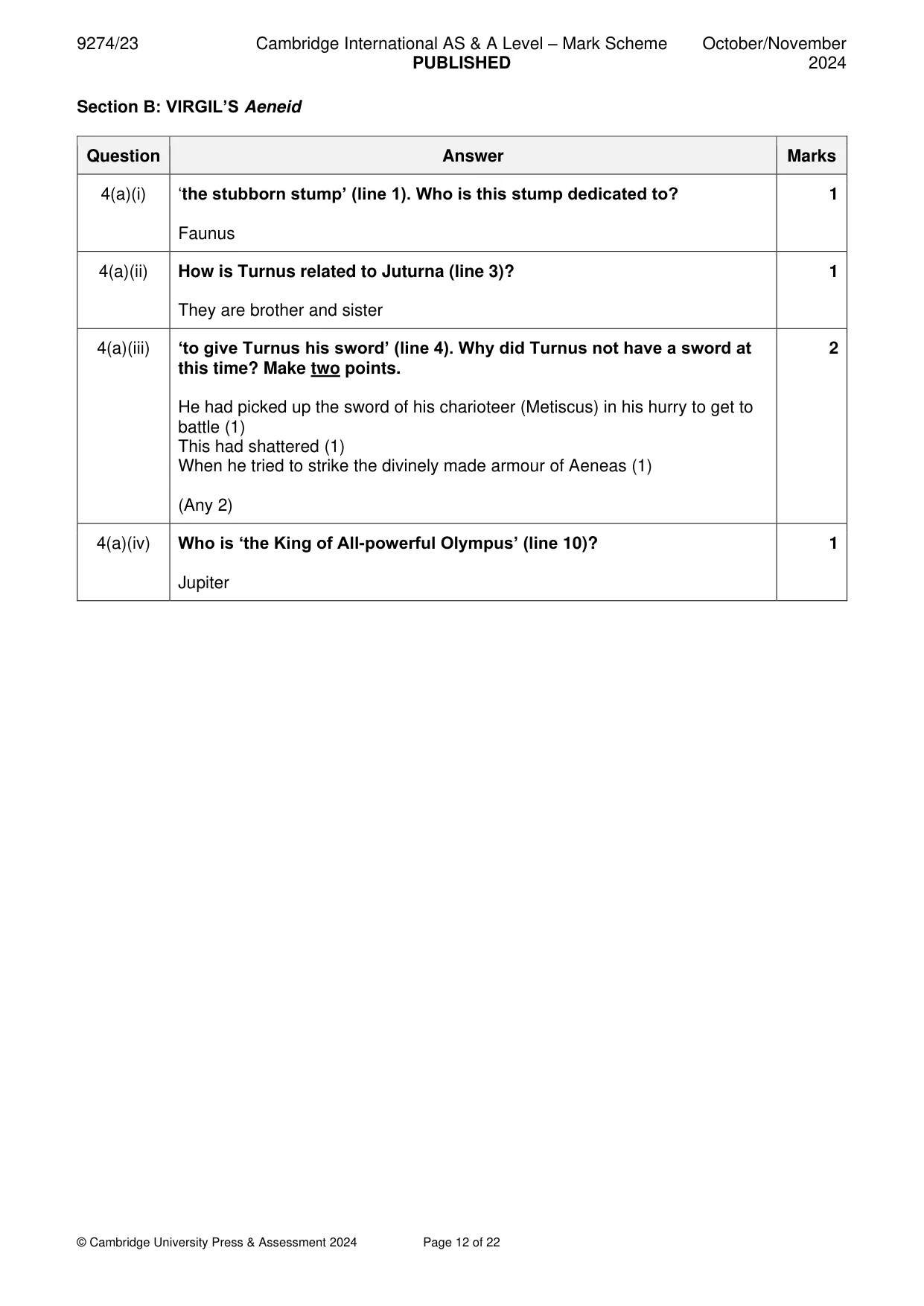
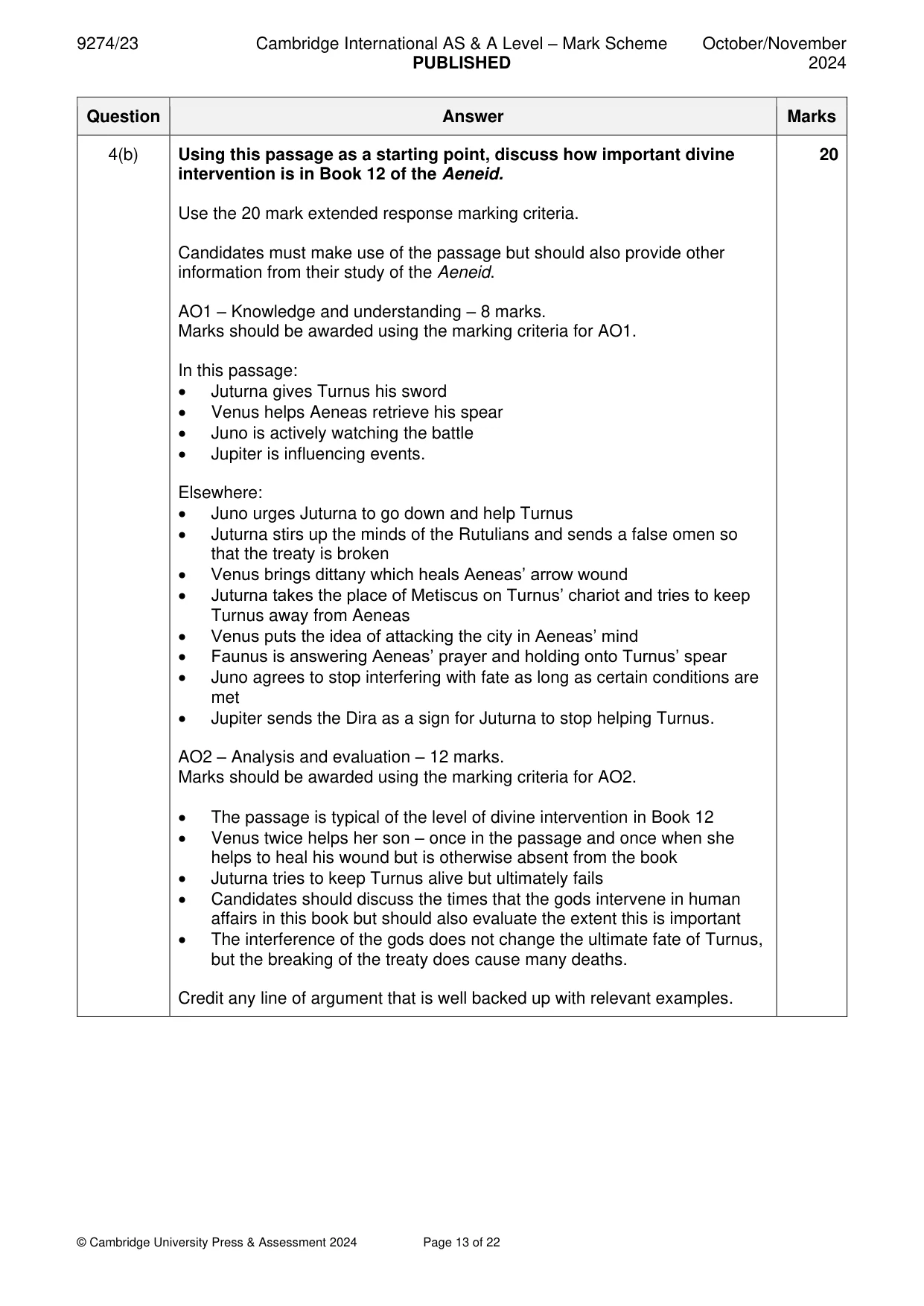
4 Read the passage and answer the questions: Aeneas was long delayed struggling with the stubborn stump and no strength of his could prise open the bite of the wood. While he was heaving and straining with all his might, the goddess Juturna, daughter of Daunus, changed once more into the shape of the charioteer Metiscus and ran forward to give Turnus his sword. Venus was indignant that the nymph was allowed to be so bold, so she came and wrenched 5 out Aeneas’ spear from deep in the root. Then these glorious warriors, their weapons and their spirits restored to them, one relying on his sword, the other towering and formidable behind his spear, stood there breathing hard, ready to engage in the contest of war. Meanwhile the King of All-powerful Olympus saw Juno watching the battle from a 10 golden cloud and spoke these words to her: ‘O my dear wife, what will be the end of this? What is there left for you to do? You yourself know, and admit that you know, that Aeneas is a god of this land, that he has a right to heaven and is fated to be raised to the stars.’ (Virgil, Aeneid 12) (a) (i) ‘the stubborn stump’ (line 1). Who is this stump dedicated to? [1] (ii) How is Turnus related to Juturna (line 3)? [1] (iii) ‘to give Turnus his sword’ (line 4). Why did Turnus not have a sword at this time? Make two points. [2] (iv) Who is ‘the King of All-powerful Olympus’ (line 10)? [1] (b) Using this passage as a starting point, discuss how important divine intervention is in Book 12 of the Aeneid. [20] [Total: 25] EITHER
Mark scheme: 4(a)(i) ‘the stubborn stump’ (line 1). Who is this stump dedicated to? 1 Faunus 4(a)(ii) How is Turnus related to Juturna (line 3)? 1 They are brother and sister 4(a)(iii) ‘to give Turnus his sword’ (line 4). Why did Turnus not have a sword at 2 this time? Make two points. He had picked up the sword of his charioteer (Metiscus) in his hurry to get to battle (1) This had shattered (1) When he tried to strike the divinely made armour of Aeneas (1) (Any 2) 4(a)(iv) Who is ‘the King of All-powerful Olympus’ (line 10)? 1 Jupiter 4(b) Using this passage as a starting point, discuss how important divine 20 intervention is in Book 12 of the Aeneid. Use the 20 mark extended response marking criteria. Candidates must make use of the passage but should also provide other information from their study of the Aeneid. AO1 – Knowledge and understanding – 8 marks. Marks should be awarded using the marking criteria for AO1. In this passage: • Juturna gives Turnus his sword • Venus helps Aeneas retrieve his spear • Juno is actively watching the battle • Jupiter is influencing events. Elsewhere: • Juno urges Juturna to go down and help Turnus • Juturna stirs up the minds of the Rutulians and sends a false omen so that the treaty is broken • Venus brings dittany which heals Aeneas’ arrow wound • Juturna takes the place of Metiscus on Turnus’ chariot and tries to keep Turnus away from Aeneas • Venus puts the idea of attacking the city in Aeneas’ mind • Faunus is answering Aeneas’ prayer and holding onto Turnus’ spear • Juno agrees to stop interfering with fate as long as certain conditions are met • Jupiter sends the Dira as a sign for Juturna to stop helping Turnus. AO2 – Analysis and evaluation – 12 marks. Marks should be awarded using the marking criteria for AO2. • The passage is typical of the level of divine intervention in Book 12 • Venus twice helps her son – once in the passage and once when she helps to heal his wound but is otherwise absent from the book • Juturna tries to keep Turnus alive but ultimately fails • Candidates should discuss the times that the gods intervene in human affairs in this book but should also evaluate the extent this is important • The interference of the gods does not change the ultimate fate of Turnus, but the breaking of the treaty does cause many deaths. Credit any line of argument that is well backed up with relevant examples.
Q5 · ‘Virgil creates a range of interesting mortal characters in the Aeneid.’ How far do you…
5 ‘Virgil creates a range of interesting mortal characters in the Aeneid.’ How far do you agree with this statement? In your answer you should not discuss Aeneas, Dido or Turnus. [25] OR
Mark scheme: 5 ‘Virgil creates a range of interesting mortal characters in the Aeneid.’ 25 How far do you agree with this statement? In your answer you should not discuss Aeneas, Dido or Turnus. Use the 25 mark essay marking criteria. AO1 – Knowledge and understanding – 12 marks. Marks should be awarded using the marking criteria for AO1. Candidates could choose to discuss: • Priam and Hecuba • Anchises • Creusa • Anna • The Sibyl • Latinus • Amata • Evander • Pallas • Camilla • Amata This list is not prescriptive, and all relevant examples should be credited. AO2 – Analysis and evaluation –13 marks. Marks should be awarded using the marking criteria for AO2. • Candidates could look at one or two characters in depth or explore a wider range of them • Creusa is perhaps most interesting as a ghost as it is then that she finally persuades Aeneas to leave Troy • Anna is an interesting character, who is loyal and supportive to her sister. Even to the extent of talking to Aeneas on Dido’s behalf • The Sibyl leads Aeneas to the Underworld and is in her hands during Book 6 • Latinus’ conflict between wanting to obey the prophecy and love and loyalty to Amata and Turnus is interesting • Amata’s loyalty to Turnus is a motivating factor for Latinus • Camilla is an interesting depiction of a female warrior • Minor characters are easy to overlook but they are often crucial to a particular point in the plot and well portrayed. Candidates can argue for or against the statement as long as their discussion is justified with close reference to the text.
Q6 · ‘Love is a more important theme than war in the Aeneid.’ To what extent do you agree with…
6 ‘Love is a more important theme than war in the Aeneid.’ To what extent do you agree with this statement? [25] Section C: Architecture of the Roman City Answer Question 7 and either Question 8 or Question 9.
Mark scheme: 6 ‘Love is a more important theme than war in the Aeneid.’ 25 To what extent do you agree with this statement? Use the 25 mark essay marking criteria. AO1 – Knowledge and understanding – 12 marks. Marks should be awarded using the marking criteria for AO1. Candidates could choose to discuss: Love: • Dido and Aeneas • Dido and Anna • Aeneas and Anchises • Aeneas and Ascanius • Aeneas and Creusa • Evander and Pallas • Lausus and Mezentius • Juturna and Turnus War: • Fall of Troy • War in Italy This list is not prescriptive, and credit should be given for any valid examples. AO2 – Analysis and evaluation –13 marks. Marks should be awarded using the marking criteria for AO2. • There are many examples of love in the Aeneid, including romantic love and familial love so it plays a major part in the poem • War is the major theme of the second half of the poem so is an important theme • Candidates could argue that the themes are equally important Candidates can argue for or against the statement as long as their discussion is justified with close reference to the text. Section C: Architecture of the Roman City
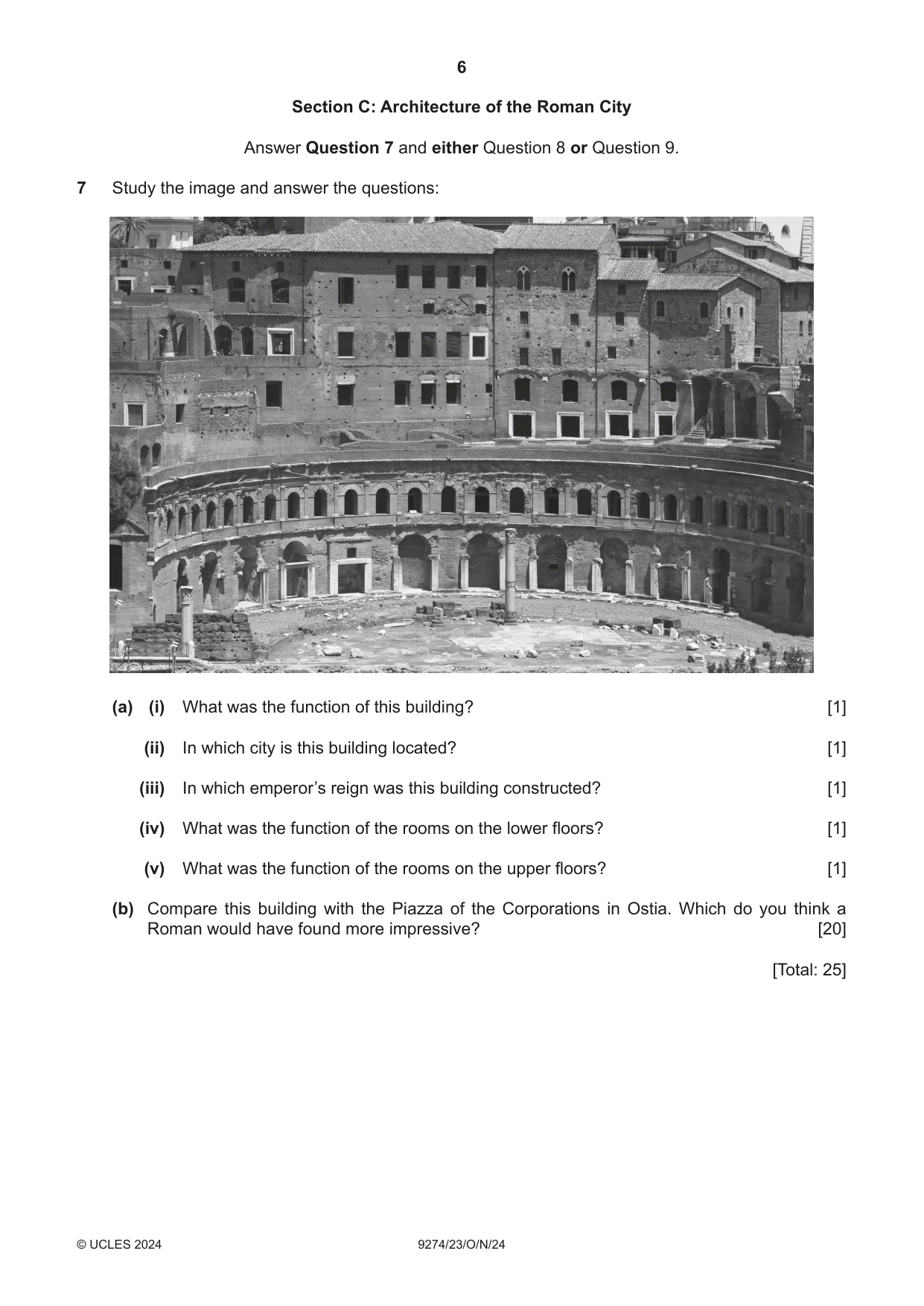
Q7 · Study the image and answer the questions: (a) (i) What was the function of this building?
7 Study the image and answer the questions: (a) (i) What was the function of this building? [1] (ii) In which city is this building located? [1] (iii) In which emperor’s reign was this building constructed? [1] (iv) What was the function of the rooms on the lower floors? [1] (v) What was the function of the rooms on the upper floors? [1] (b) Compare this building with the Piazza of the Corporations in Ostia. Which do you think a Roman would have found more impressive? [20] [Total: 25] EITHER
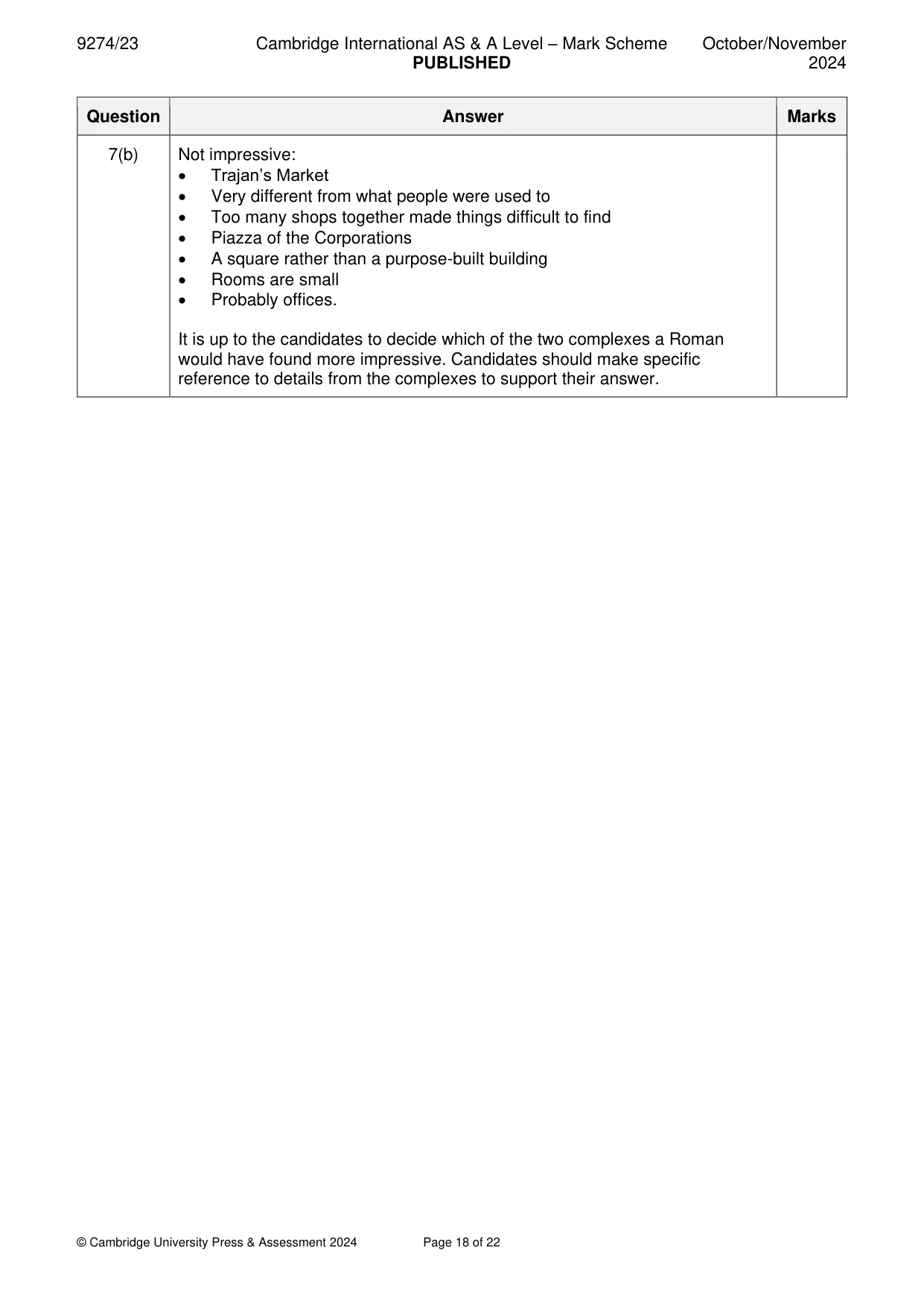
Mark scheme: 7(a)(i) What was the function of this building? 1 Market hall Shopping mall 7(a)(ii) In which city is this building located? 1 Rome 7(a)(iii) In which emperor’s reign was this building constructed? 1 Trajan 7(a)(iv) What was the function of the rooms on the lower floors? 1 Shops 7(a)(v) What was the function of the rooms on the upper floors? 1 Offices 7(b) Compare this building with the Piazza of the Corporations in Ostia. 20 Which do you think a Roman would have found more impressive? Use the 20-mark extended response marking criteria. AO1 – Knowledge and understanding – 8 marks. Marks should be awarded using the marking criteria for AO1. Trajan’s Market: Answers may include reference to the following points from this complex: • Planned by Apollodorus of Damascus • The size of the complex • Set into the side of the Quirinal Hill • Proximity to Trajan’s forum and Trajan’s column • More than 150 tabernae in the complex • Upper level had offices used by officials in charge of the market • Semi-circular façade with a row of columns • Semi-circular exedrae covered by half domes • Roof was arched concrete vault that sat on piers – protected shoppers from weather and allowed sunlight into shops • Great Hall used for concerts, speeches, etc. Piazza of the Corporations: Answers may include reference to the following points from this complex: • Large colonnaded square • Three wings • Fourth wing has temple of Ceres • Close to theatre • 61 rooms decorated with mosaics at the entrances • Acted as offices. AO2 – Analysis and Evaluation 12 marks. Marks should be awarded using the marking criteria for AO2. Answers may include reference to the following points: Impressive: • Trajan’s market • Size • Number of shops • Design • Close to other amenities • Scale of the decoration • Piazza of the Corporations • Similar to layout of standard forum • Close to other important buildings – theatre, Temple of Ceres • 61 rooms • Mosaics illustrating trade of owners/tenants of the rooms • Allowed many traders to be housed and contacted in one place • Would have been decorated with statues of prominent Ostian citizens. 7(b) Not impressive: • Trajan’s Market • Very different from what people were used to • Too many shops together made things difficult to find • Piazza of the Corporations • A square rather than a purpose-built building • Rooms are small • Probably offices. It is up to the candidates to decide which of the two complexes a Roman would have found more impressive. Candidates should make specific reference to details from the complexes to support their answer.
Q8 · ‘The houses in Ostia were better constructed and much more practical than the houses in…
8 ‘The houses in Ostia were better constructed and much more practical than the houses in Herculaneum.’ How far do you agree with this statement? Explain your answer with reference to specific houses from both Ostia and Herculaneum. [25] OR
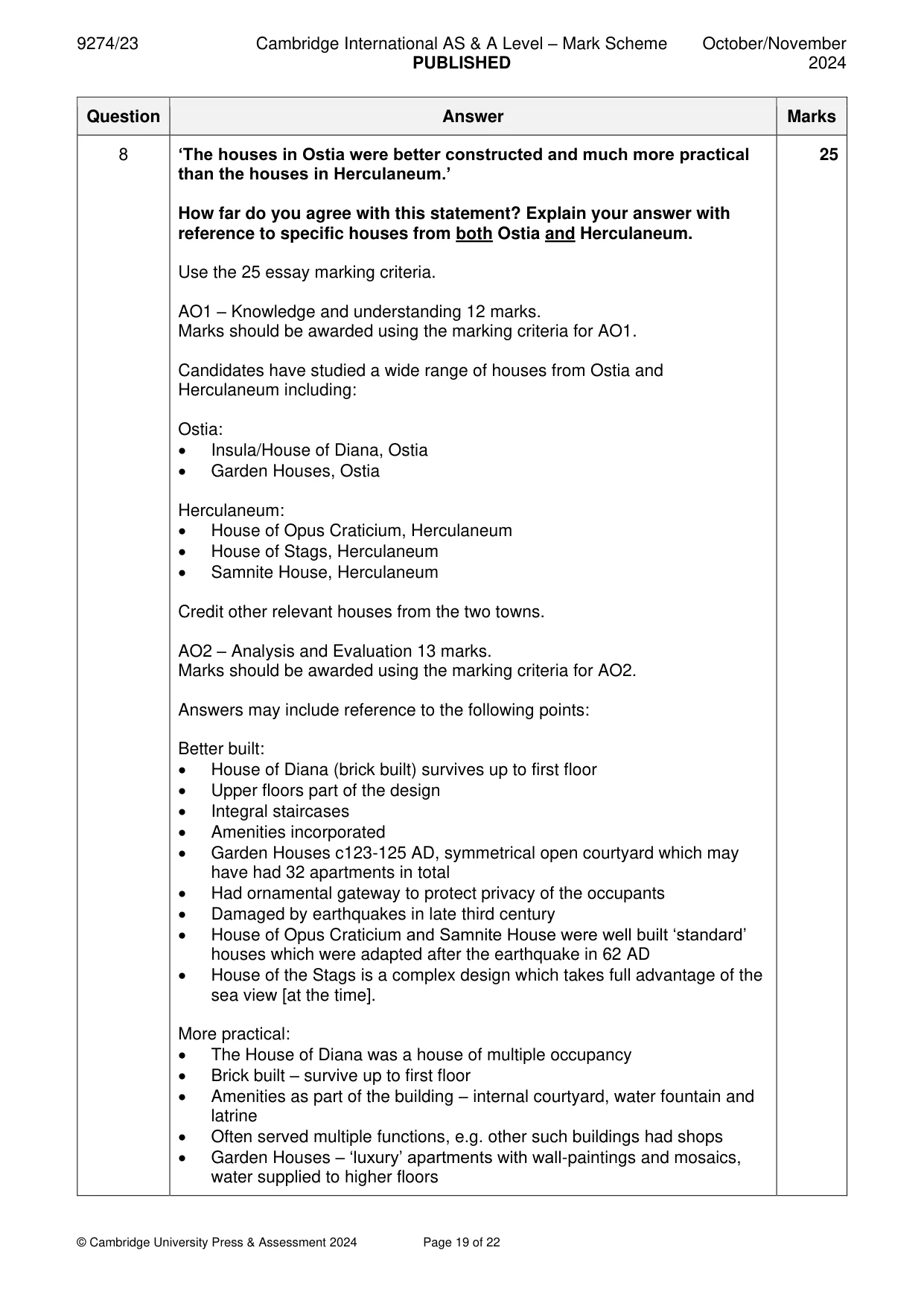
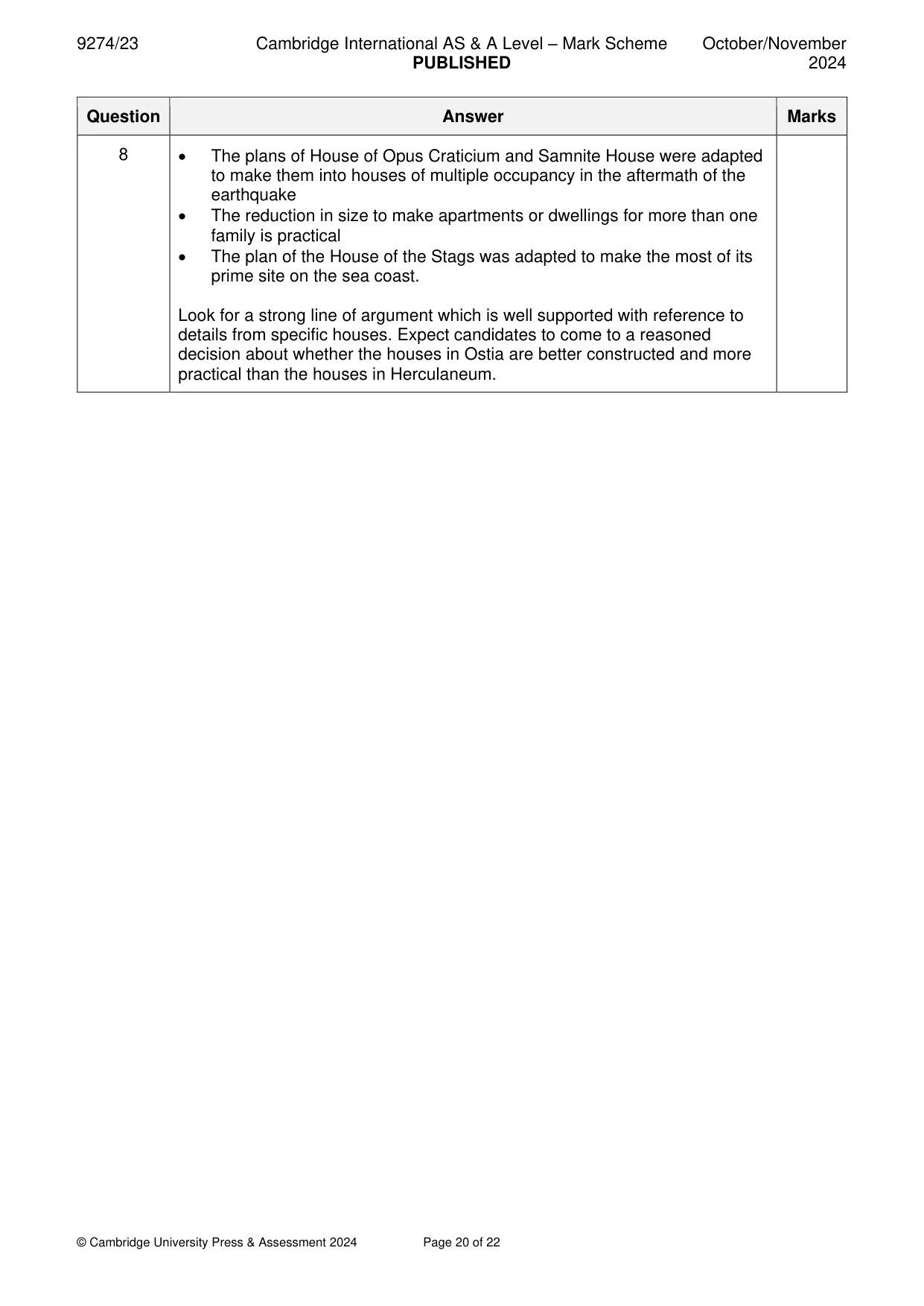
Mark scheme: 8 ‘The houses in Ostia were better constructed and much more practical 25 than the houses in Herculaneum.’ How far do you agree with this statement? Explain your answer with reference to specific houses from both Ostia and Herculaneum. Use the 25 essay marking criteria. AO1 – Knowledge and understanding 12 marks. Marks should be awarded using the marking criteria for AO1. Candidates have studied a wide range of houses from Ostia and Herculaneum including: Ostia: • Insula/House of Diana, Ostia • Garden Houses, Ostia Herculaneum: • House of Opus Craticium, Herculaneum • House of Stags, Herculaneum • Samnite House, Herculaneum Credit other relevant houses from the two towns. AO2 – Analysis and Evaluation 13 marks. Marks should be awarded using the marking criteria for AO2. Answers may include reference to the following points: Better built: • House of Diana (brick built) survives up to first floor • Upper floors part of the design • Integral staircases • Amenities incorporated • Garden Houses c123-125 AD, symmetrical open courtyard which may have had 32 apartments in total • Had ornamental gateway to protect privacy of the occupants • Damaged by earthquakes in late third century • House of Opus Craticium and Samnite House were well built ‘standard’ houses which were adapted after the earthquake in 62 AD • House of the Stags is a complex design which takes full advantage of the sea view [at the time]. More practical: • The House of Diana was a house of multiple occupancy • Brick built – survive up to first floor • Amenities as part of the building – internal courtyard, water fountain and latrine • Often served multiple functions, e.g. other such buildings had shops • Garden Houses – ‘luxury’ apartments with wall-paintings and mosaics, water supplied to higher floors 8 • The plans of House of Opus Craticium and Samnite House were adapted to make them into houses of multiple occupancy in the aftermath of the earthquake • The reduction in size to make apartments or dwellings for more than one family is practical • The plan of the House of the Stags was adapted to make the most of its prime site on the sea coast. Look for a strong line of argument which is well supported with reference to details from specific houses. Expect candidates to come to a reasoned decision about whether the houses in Ostia are better constructed and more practical than the houses in Herculaneum.
Q9 · ‘The temples in Italy were built on a much grander scale and were more lavishly decorated…
9 ‘The temples in Italy were built on a much grander scale and were more lavishly decorated than the temples in other parts of the Roman world.’ How far do the temples you have studied support this opinion? Explain your answer with reference to at least two temples from Italy and at least two temples in other parts of the Roman world. [25]
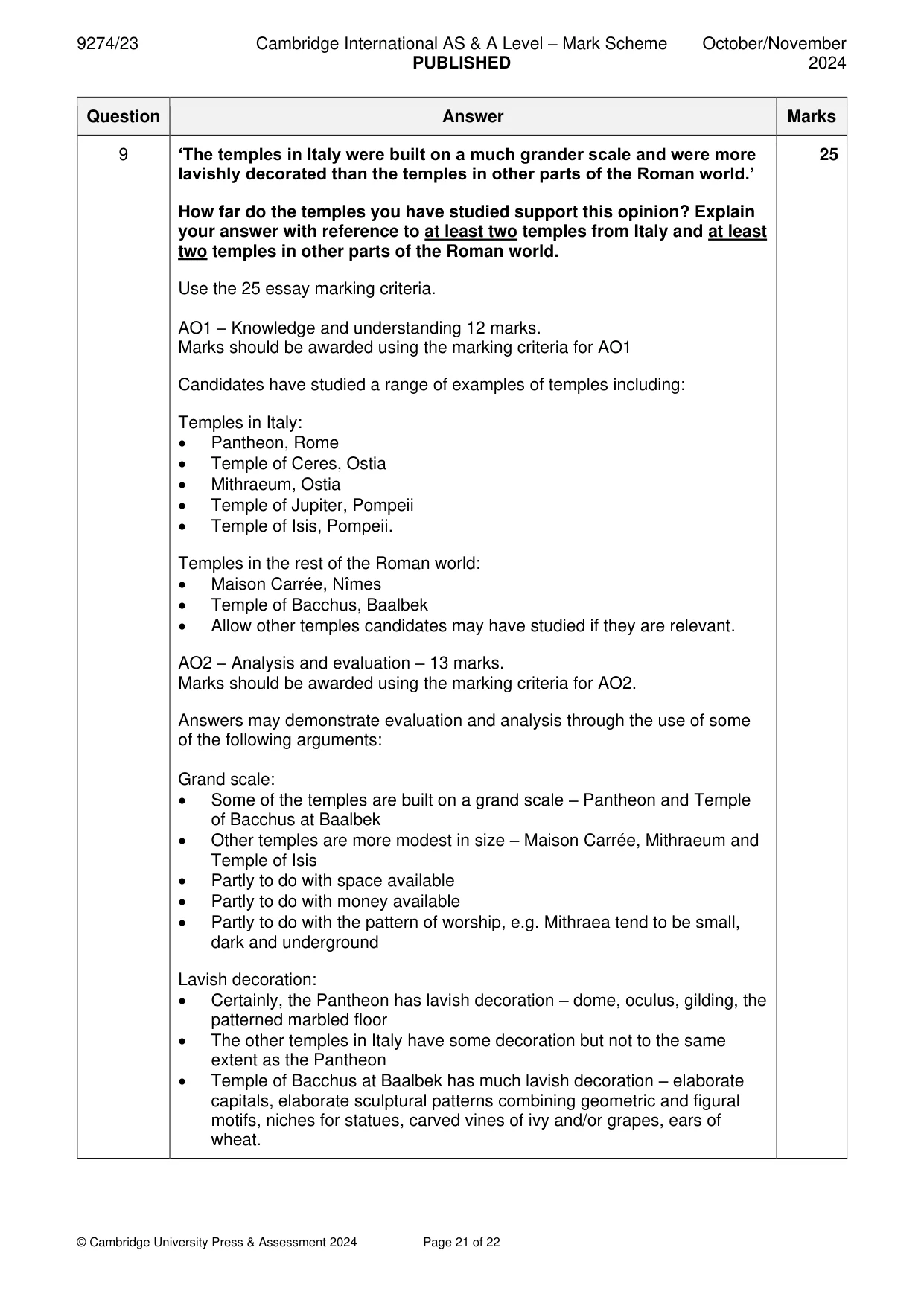
Mark scheme: 9 ‘The temples in Italy were built on a much grander scale and were more 25 lavishly decorated than the temples in other parts of the Roman world.’ How far do the temples you have studied support this opinion? Explain your answer with reference to at least two temples from Italy and at least two temples in other parts of the Roman world. Use the 25 essay marking criteria. AO1 – Knowledge and understanding 12 marks. Marks should be awarded using the marking criteria for AO1 Candidates have studied a range of examples of temples including: Temples in Italy: • Pantheon, Rome • Temple of Ceres, Ostia • Mithraeum, Ostia • Temple of Jupiter, Pompeii • Temple of Isis, Pompeii. Temples in the rest of the Roman world: • Maison Carrée, Nîmes • Temple of Bacchus, Baalbek • Allow other temples candidates may have studied if they are relevant. AO2 – Analysis and evaluation – 13 marks. Marks should be awarded using the marking criteria for AO2. Answers may demonstrate evaluation and analysis through the use of some of the following arguments: Grand scale: • Some of the temples are built on a grand scale – Pantheon and Temple of Bacchus at Baalbek • Other temples are more modest in size – Maison Carrée, Mithraeum and Temple of Isis • Partly to do with space available • Partly to do with money available • Partly to do with the pattern of worship, e.g. Mithraea tend to be small, dark and underground Lavish decoration: • Certainly, the Pantheon has lavish decoration – dome, oculus, gilding, the patterned marbled floor • The other temples in Italy have some decoration but not to the same extent as the Pantheon • Temple of Bacchus at Baalbek has much lavish decoration – elaborate capitals, elaborate sculptural patterns combining geometric and figural motifs, niches for statues, carved vines of ivy and/or grapes, ears of wheat. 9 This is intended to be an open question so that candidates are free to choose their own temples to address the question. The points made should be backed up with close reference to specific temples.
What was in this paper
The subtopics covered by these 9 questions, and how many questions each got. Open one in a new tab to see every Cambridge question on it.
What you needed in this session
Cambridge’s own grade thresholds for 2024 Oct/Nov, Paper 2 · Variant 3. A higher threshold means an easier paper — the bar moves with how the cohort did.