Cambridge A Level Classical Studies 9274 — 2023 Oct/Nov Paper 2 · Variant 3
9274/23/O/N/23 · 8 questions · 50 marks · ≈56 min
The question paper and its mark scheme, free to read here and free to download. This is Cambridge’s own paper, exactly as it was sat.
Question paper8 pages
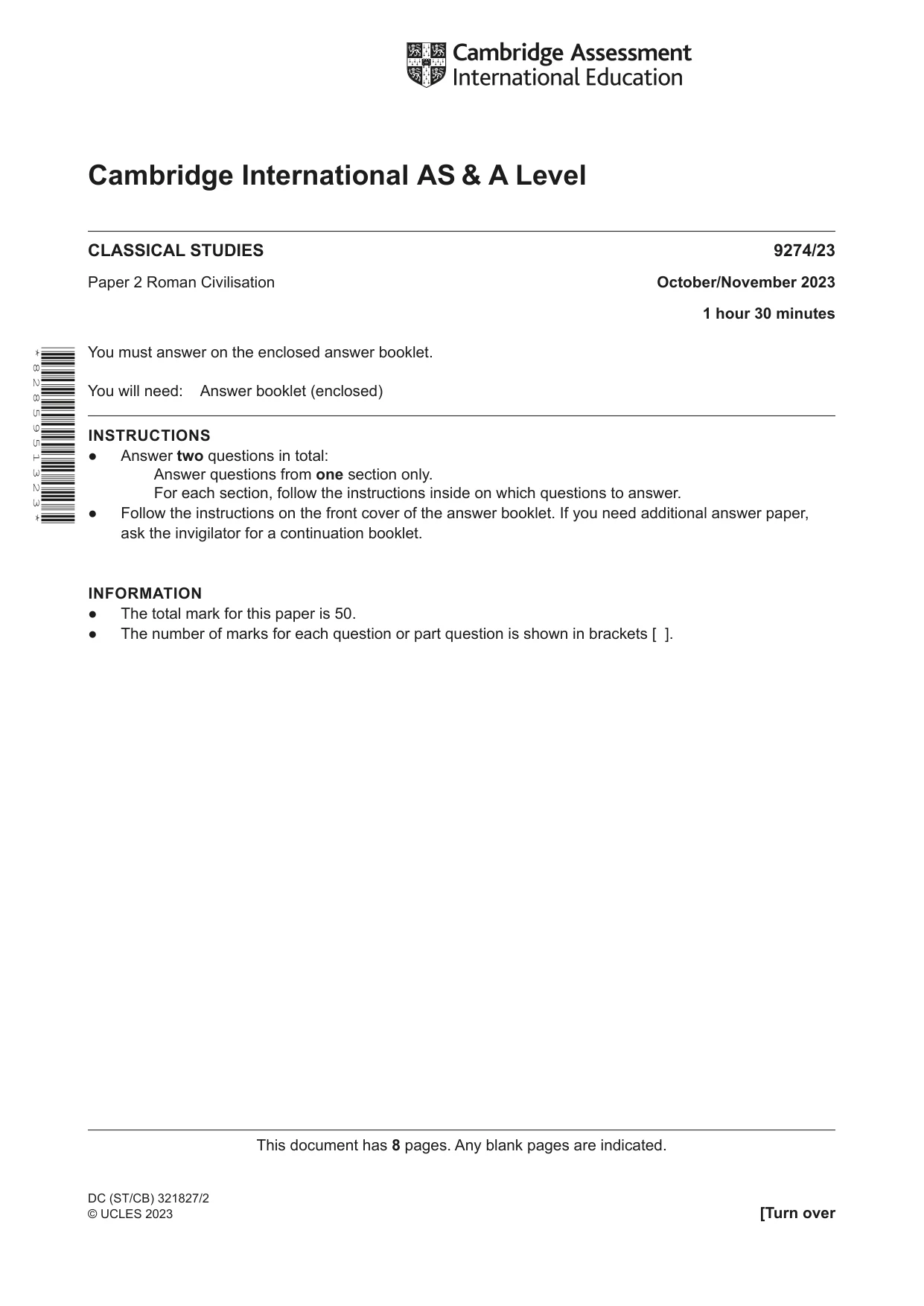




Mark scheme19 pages
Answers below. Sit the paper first if you are practising.
Questions as text
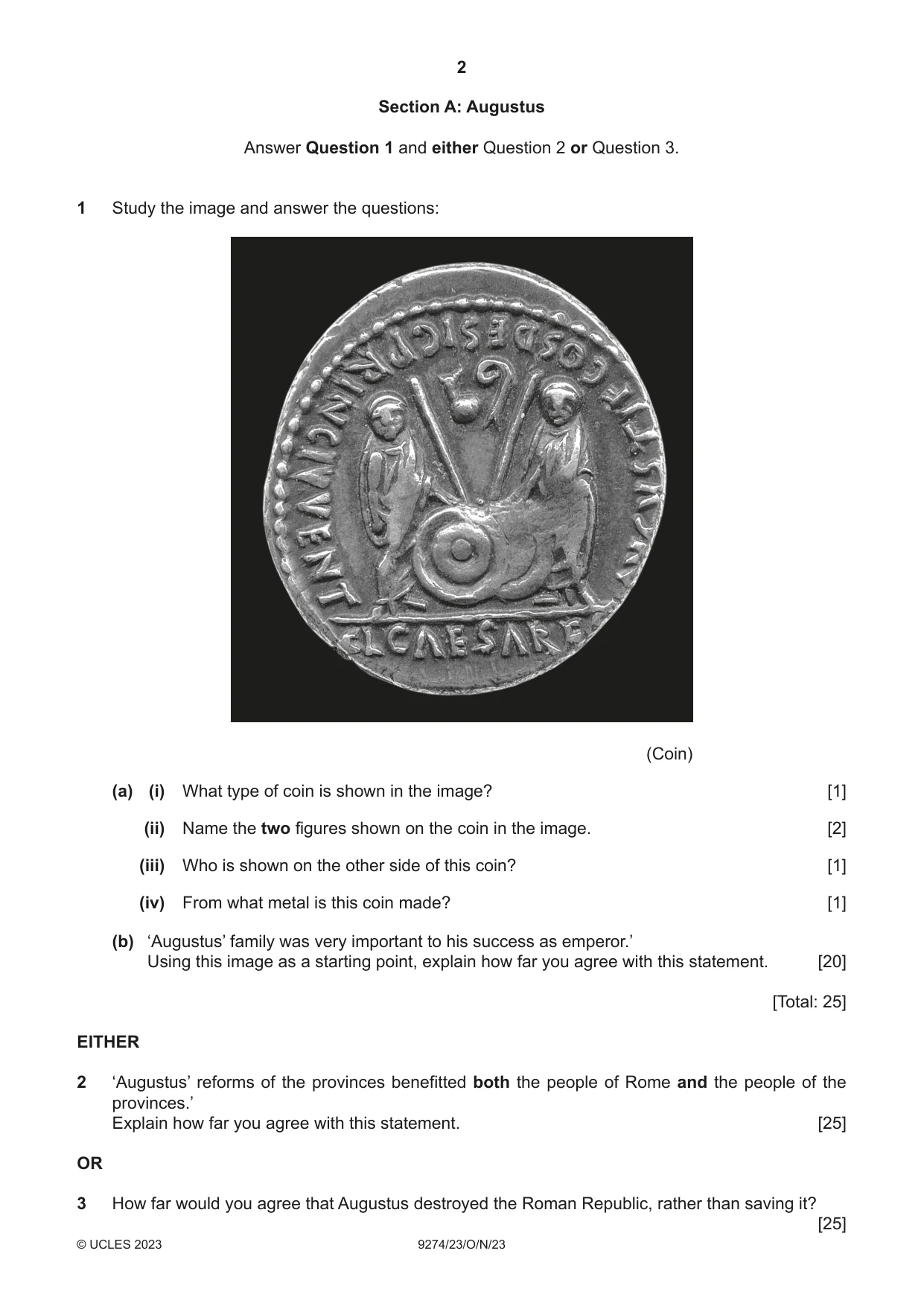
Q1 · Study the image and answer the questions: (Coin) (a) (i) What type of coin is shown in…
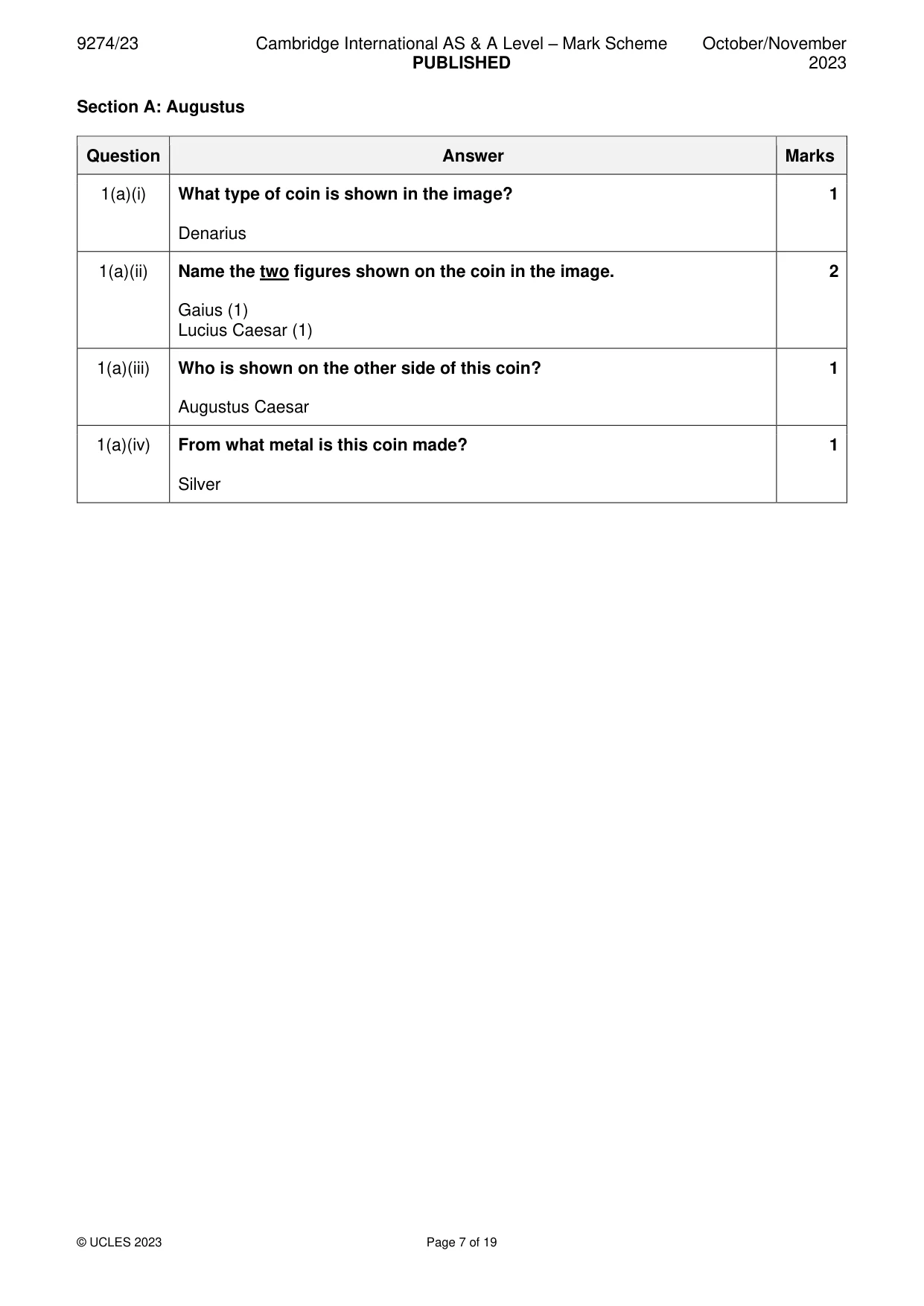
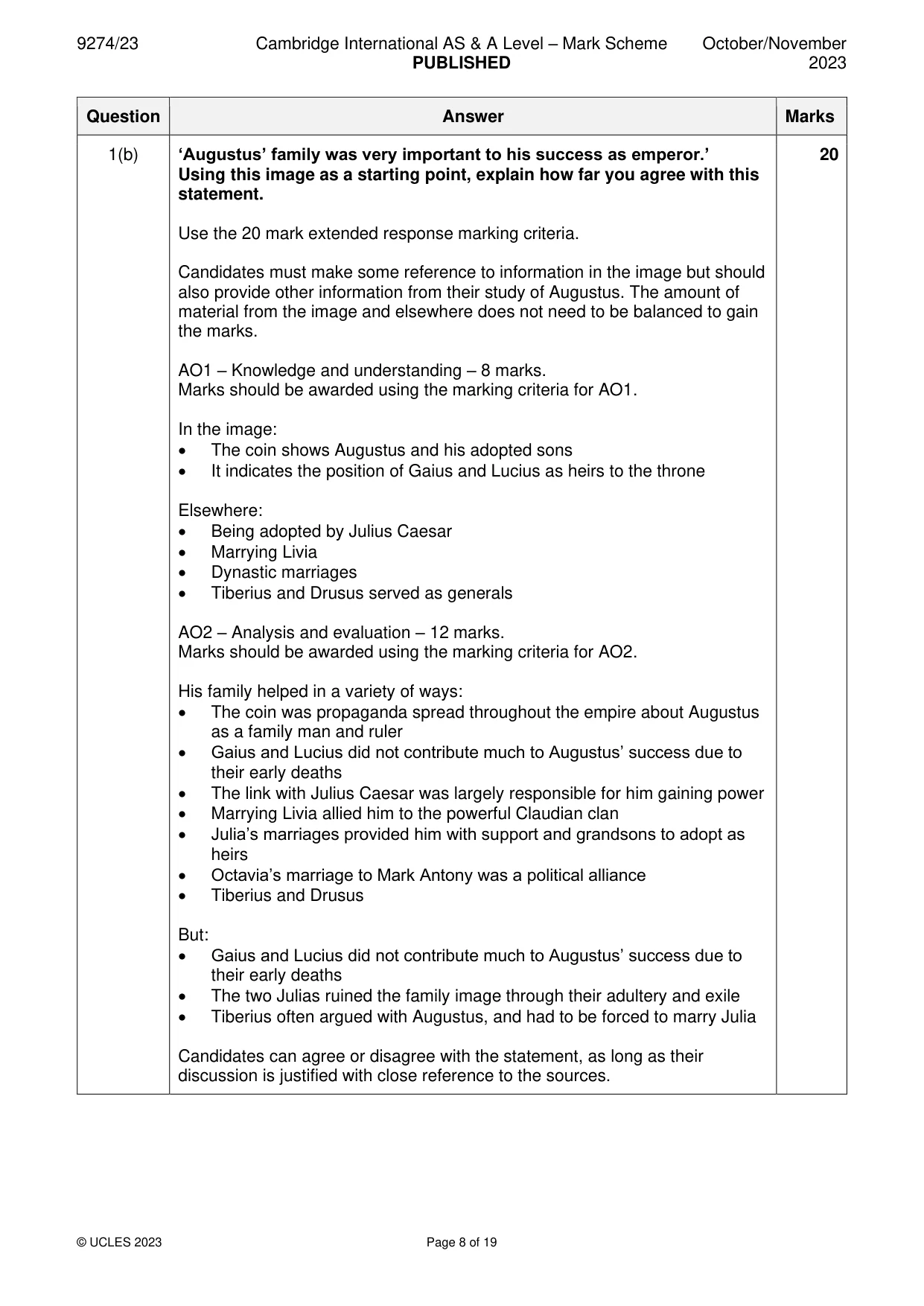
1 Study the image and answer the questions: (Coin) (a) (i) What type of coin is shown in the image? [1] (ii) Name the two figures shown on the coin in the image. [2] (iii) Who is shown on the other side of this coin? [1] (iv) From what metal is this coin made? [1] (b) ‘Augustus’ family was very important to his success as emperor.’ Using this image as a starting point, explain how far you agree with this statement. [20] [Total: 25] EITHER
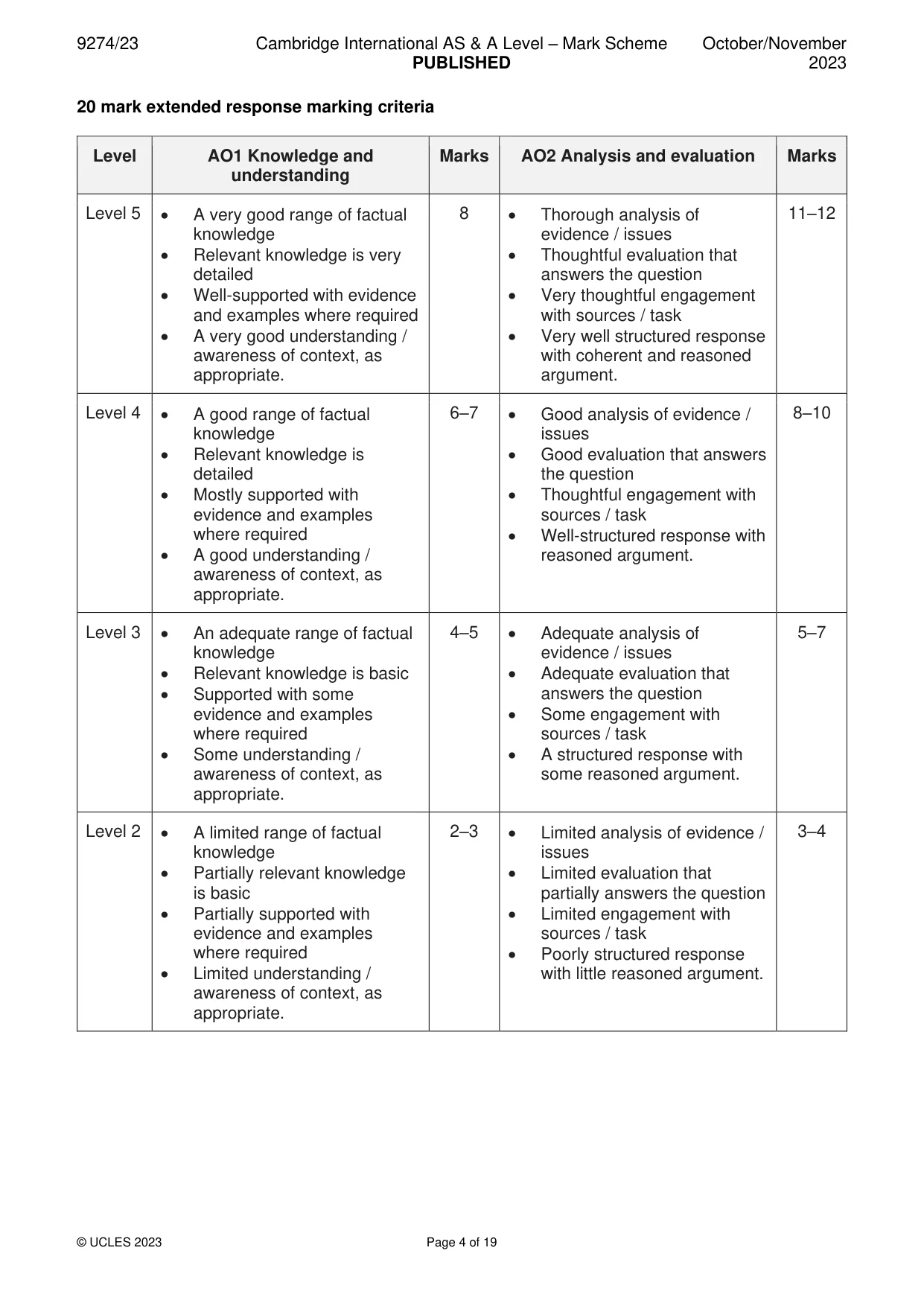
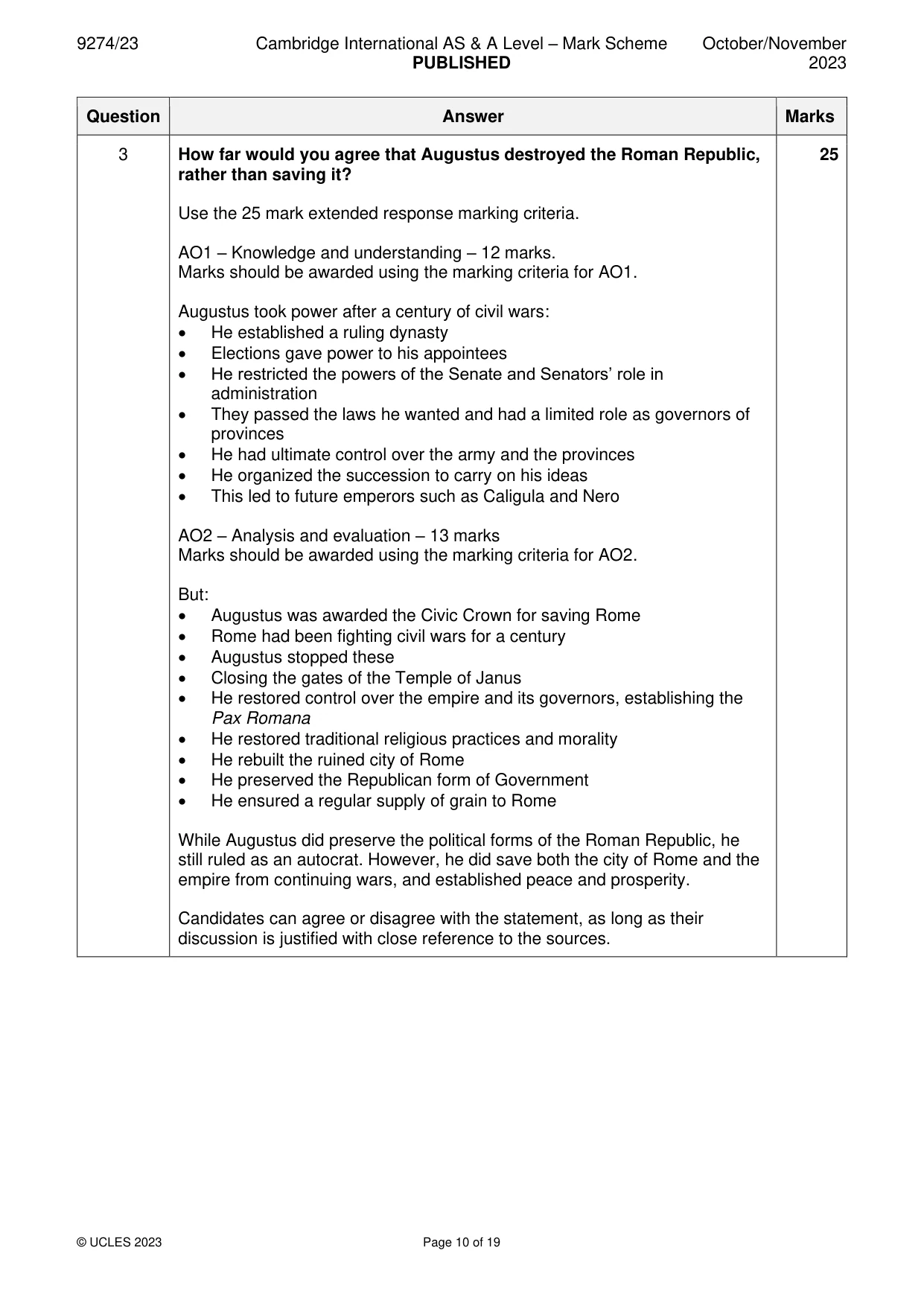
Mark scheme: Question Answer Marks 1(a)(i) What type of coin is shown in the image? 1 Denarius 1(a)(ii) Name the two figures shown on the coin in the image. 2 Gaius (1) Lucius Caesar (1) 1(a)(iii) Who is shown on the other side of this coin? 1 Augustus Caesar 1(a)(iv) From what metal is this coin made? 1 Silver 1(b) ‘Augustus’ family was very important to his success as emperor.’ 20 Using this image as a starting point, explain how far you agree with this statement. Use the 20 mark extended response marking criteria. Candidates must make some reference to information in the image but should also provide other information from their study of Augustus. The amount of material from the image and elsewhere does not need to be balanced to gain the marks. AO1 – Knowledge and understanding – 8 marks. Marks should be awarded using the marking criteria for AO1. In the image: • The coin shows Augustus and his adopted sons • It indicates the position of Gaius and Lucius as heirs to the throne Elsewhere: • Being adopted by Julius Caesar • Marrying Livia • Dynastic marriages • Tiberius and Drusus served as generals AO2 – Analysis and evaluation – 12 marks. Marks should be awarded using the marking criteria for AO2. His family helped in a variety of ways: • The coin was propaganda spread throughout the empire about Augustus as a family man and ruler • Gaius and Lucius did not contribute much to Augustus’ success due to their early deaths • The link with Julius Caesar was largely responsible for him gaining power • Marrying Livia allied him to the powerful Claudian clan • Julia’s marriages provided him with support and grandsons to adopt as heirs • Octavia’s marriage to Mark Antony was a political alliance • Tiberius and Drusus But: • Gaius and Lucius did not contribute much to Augustus’ success due to their early deaths • The two Julias ruined the family image through their adultery and exile • Tiberius often argued with Augustus, and had to be forced to marry Julia Candidates can agree or disagree with the statement, as long as their discussion is justified with close reference to the sources.
Q2 · ‘Augustus’ reforms of the provinces benefitted both the people of Rome and the people of…
2 ‘Augustus’ reforms of the provinces benefitted both the people of Rome and the people of the provinces.’ Explain how far you agree with this statement. [25] OR
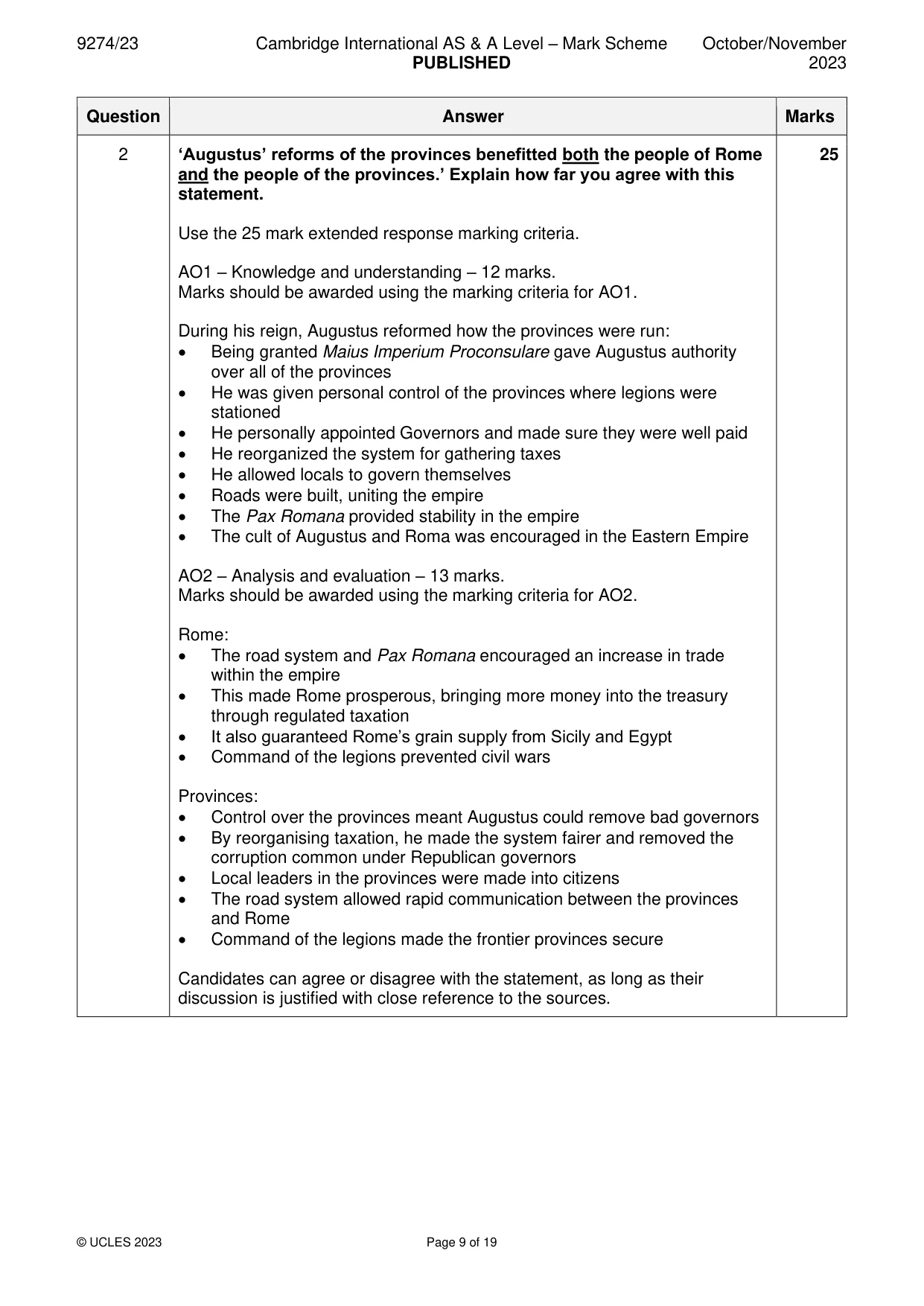
Mark scheme: 2 ‘Augustus’ reforms of the provinces benefitted both the people of Rome 25 and the people of the provinces.’ Explain how far you agree with this statement. Use the 25 mark extended response marking criteria. AO1 – Knowledge and understanding – 12 marks. Marks should be awarded using the marking criteria for AO1. During his reign, Augustus reformed how the provinces were run: • Being granted Maius Imperium Proconsulare gave Augustus authority over all of the provinces • He was given personal control of the provinces where legions were stationed • He personally appointed Governors and made sure they were well paid • He reorganized the system for gathering taxes • He allowed locals to govern themselves • Roads were built, uniting the empire • The Pax Romana provided stability in the empire • The cult of Augustus and Roma was encouraged in the Eastern Empire AO2 – Analysis and evaluation – 13 marks. Marks should be awarded using the marking criteria for AO2. Rome: • The road system and Pax Romana encouraged an increase in trade within the empire • This made Rome prosperous, bringing more money into the treasury through regulated taxation • It also guaranteed Rome’s grain supply from Sicily and Egypt • Command of the legions prevented civil wars Provinces: • Control over the provinces meant Augustus could remove bad governors • By reorganising taxation, he made the system fairer and removed the corruption common under Republican governors • Local leaders in the provinces were made into citizens • The road system allowed rapid communication between the provinces and Rome • Command of the legions made the frontier provinces secure Candidates can agree or disagree with the statement, as long as their discussion is justified with close reference to the sources.
Q4 · Read the passage and answer the questions: ‘Alas!
4 Read the passage and answer the questions: ‘Alas! Alas! Was I the cause of your dying? I swear by the stars, by the gods above, by whatever there is to swear by in the depths of the earth, it was against my will, O queen, that I left your shore. It was the stern authority of the commands of the gods that drove me on, as it drives me now through the shades of this dark night in this foul and mouldering place. I could not have believed that my leaving would cause 5 you such sorrow. Do not move away. Do not leave my sight. Who are you running from? Fate has decreed that I shall not speak to you again.’ With these words Aeneas, shedding tears, tried to comfort that burning spirit, but grim-faced she kept her eyes upon the ground and did not look at him. Her features moved no more when he began to speak than if she had been a block of flint or Parian marble quarried on Mount 10 Marpessus. Then at last she rushed away, hating him, into the shadows of the wood where Sychaeus, who had been her husband, answered her grief with grief and her love with love. Aeneas was no less stricken by the injustice of her fate and long did he gaze after her with tears, pitying her as she went. (Virgil, Aeneid 6) (a) (i) ‘Alas! Alas! Was I the cause of your dying?’ (line 1). Who is Aeneas talking to? [1] (ii) Where precisely is Aeneas? [1] (iii) ‘I left your shore’ (line 3). Where was this shore? [1] (iv) ‘stern authority of the commands of the gods’ (line 3). Which two gods had commanded Aeneas to leave this shore? [2] (b) How is Aeneas portrayed in this passage? How typical is this of his portrayal in Books 4 and 6? [20] [Total: 25] EITHER
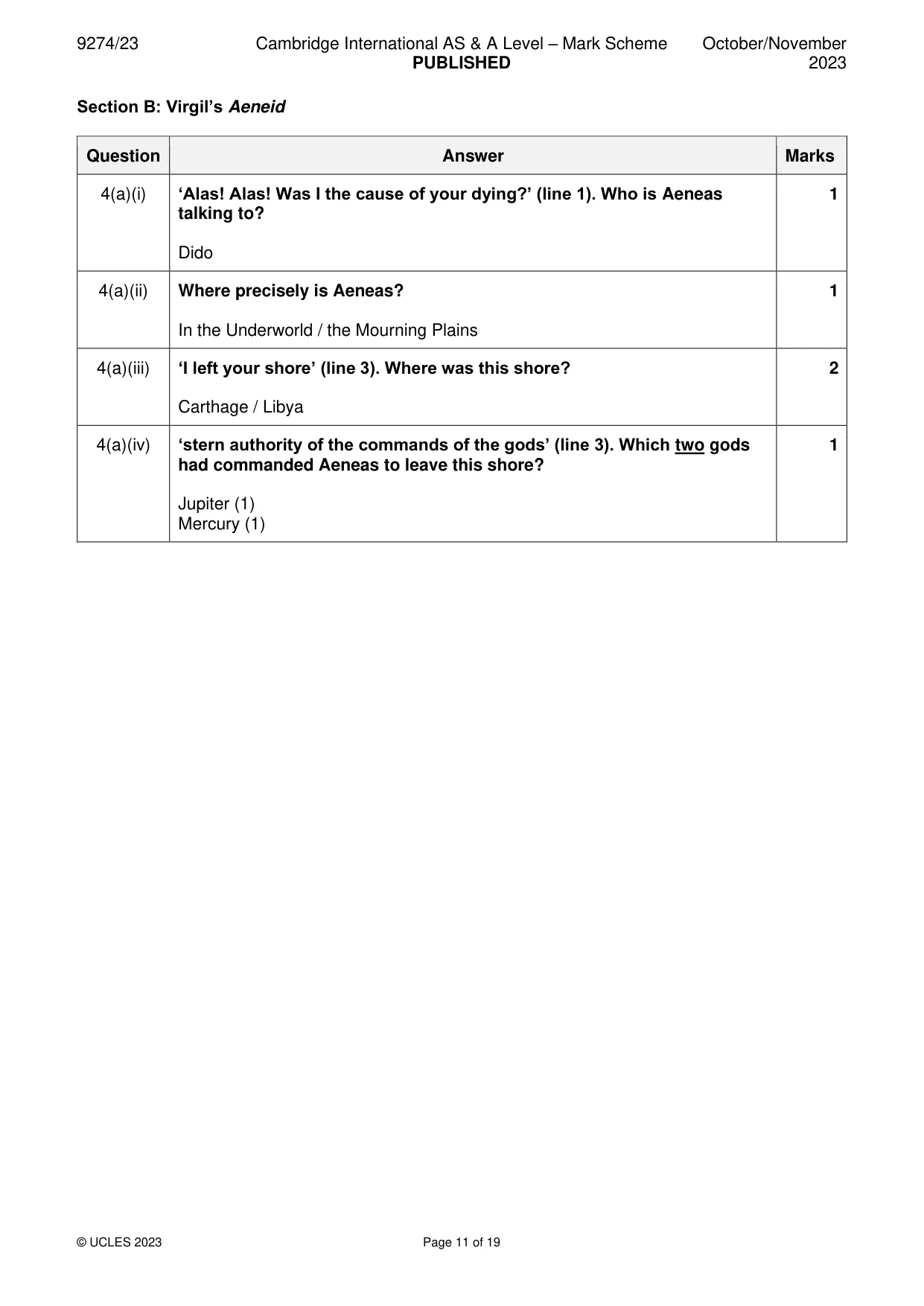
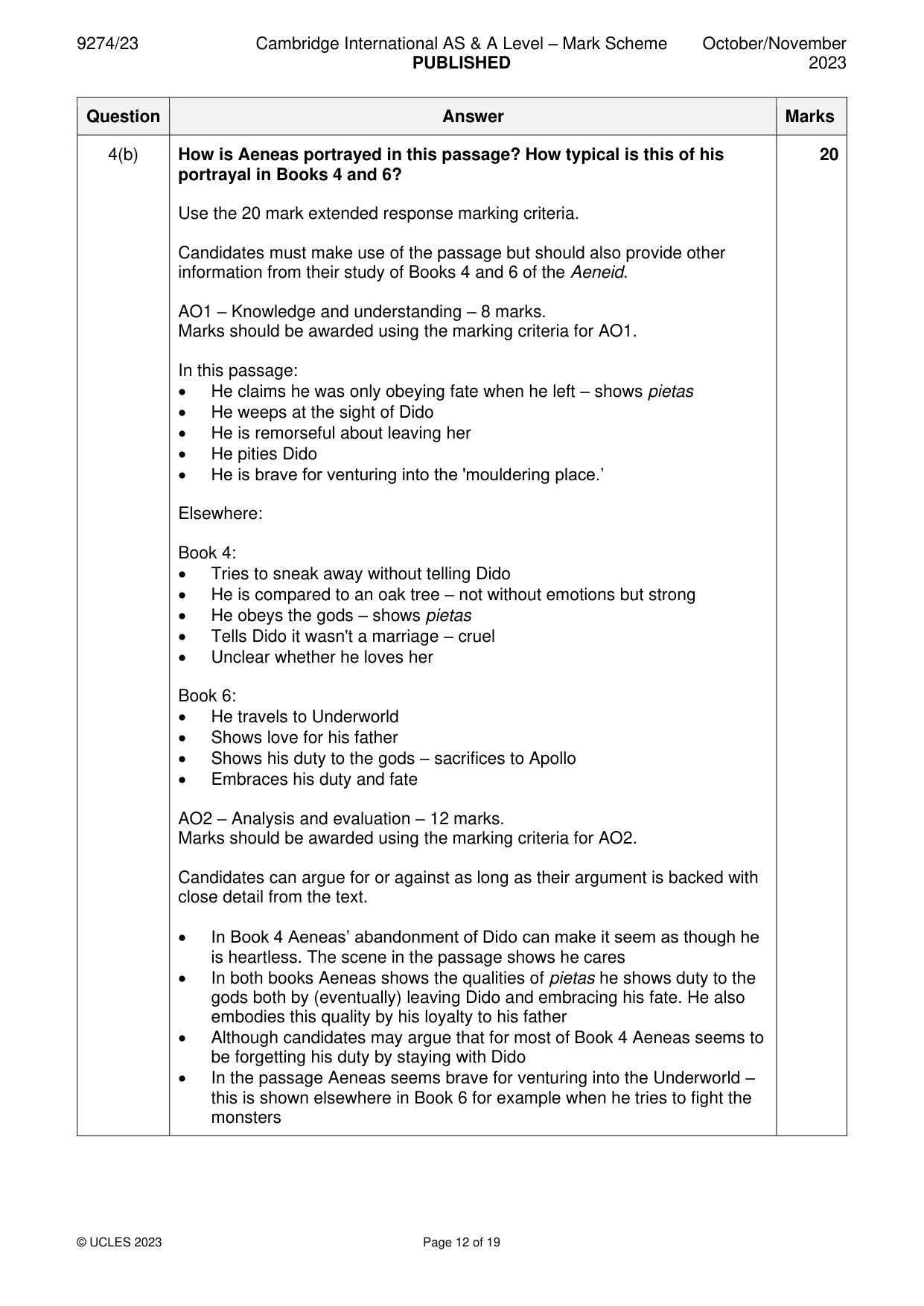
Mark scheme: 4(a)(i) ‘Alas! Alas! Was I the cause of your dying?’ (line 1). Who is Aeneas 1 talking to? Dido 4(a)(ii) Where precisely is Aeneas? 1 In the Underworld / the Mourning Plains 4(a)(iii) ‘I left your shore’ (line 3). Where was this shore? 2 Carthage / Libya 4(a)(iv) ‘stern authority of the commands of the gods’ (line 3). Which two gods 1 had commanded Aeneas to leave this shore? Jupiter (1) Mercury (1) 4(b) How is Aeneas portrayed in this passage? How typical is this of his 20 portrayal in Books 4 and 6? Use the 20 mark extended response marking criteria. Candidates must make use of the passage but should also provide other information from their study of Books 4 and 6 of the Aeneid. AO1 – Knowledge and understanding – 8 marks. Marks should be awarded using the marking criteria for AO1. In this passage: • He claims he was only obeying fate when he left – shows pietas • He weeps at the sight of Dido • He is remorseful about leaving her • He pities Dido • He is brave for venturing into the 'mouldering place.’ Elsewhere: Book 4: • Tries to sneak away without telling Dido • He is compared to an oak tree – not without emotions but strong • He obeys the gods – shows pietas • Tells Dido it wasn't a marriage – cruel • Unclear whether he loves her Book 6: • He travels to Underworld • Shows love for his father • Shows his duty to the gods – sacrifices to Apollo • Embraces his duty and fate AO2 – Analysis and evaluation – 12 marks. Marks should be awarded using the marking criteria for AO2. Candidates can argue for or against as long as their argument is backed with close detail from the text. • In Book 4 Aeneas’ abandonment of Dido can make it seem as though he is heartless. The scene in the passage shows he cares • In both books Aeneas shows the qualities of pietas he shows duty to the gods both by (eventually) leaving Dido and embracing his fate. He also embodies this quality by his loyalty to his father • Although candidates may argue that for most of Book 4 Aeneas seems to be forgetting his duty by staying with Dido • In the passage Aeneas seems brave for venturing into the Underworld – this is shown elsewhere in Book 6 for example when he tries to fight the monsters
Q5 · ‘The books of the first half of the Aeneid are far more interesting and exciting than…
5 ‘The books of the first half of the Aeneid are far more interesting and exciting than those of the second half.’ To what extent do you agree with this statement? [25] OR
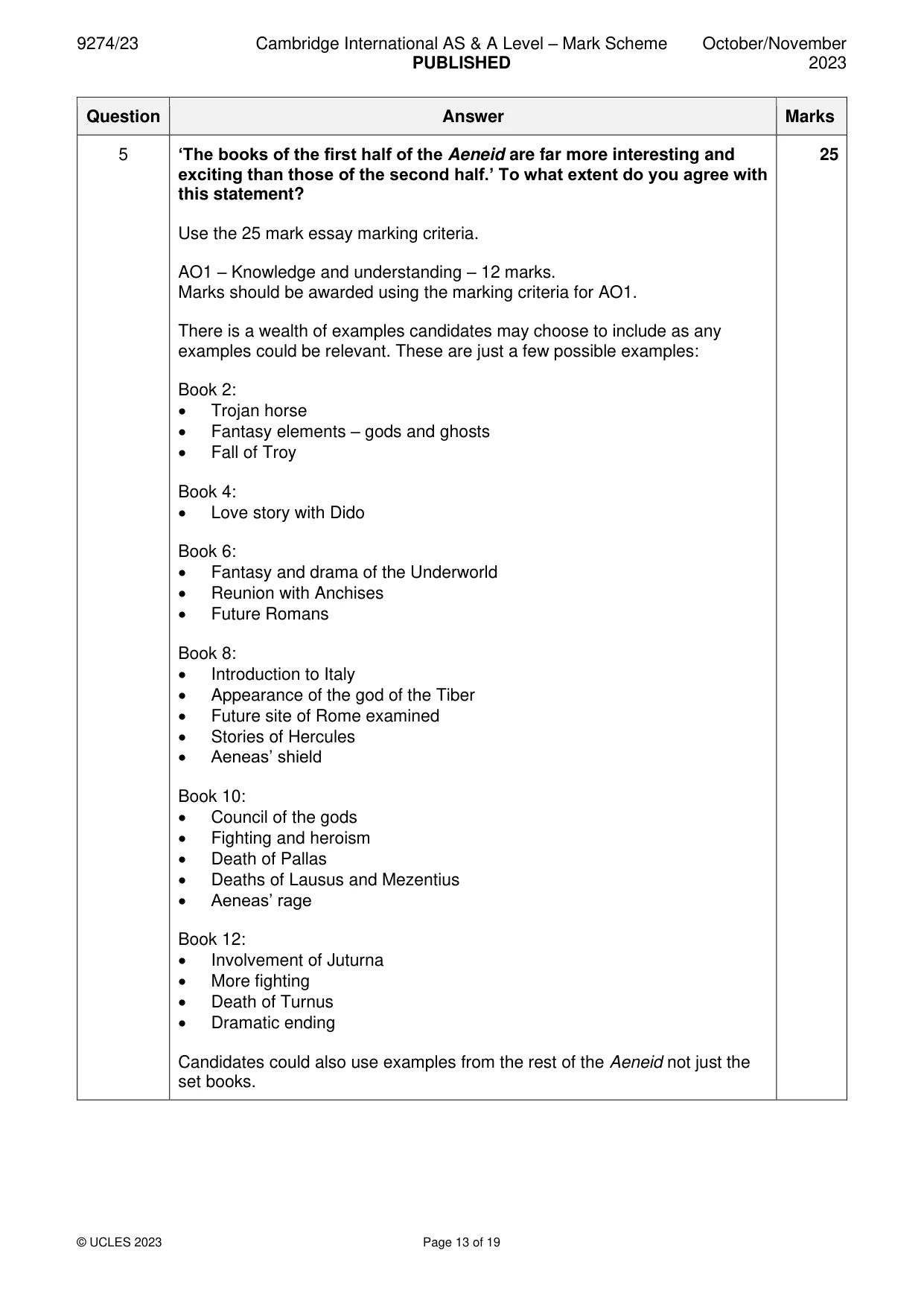
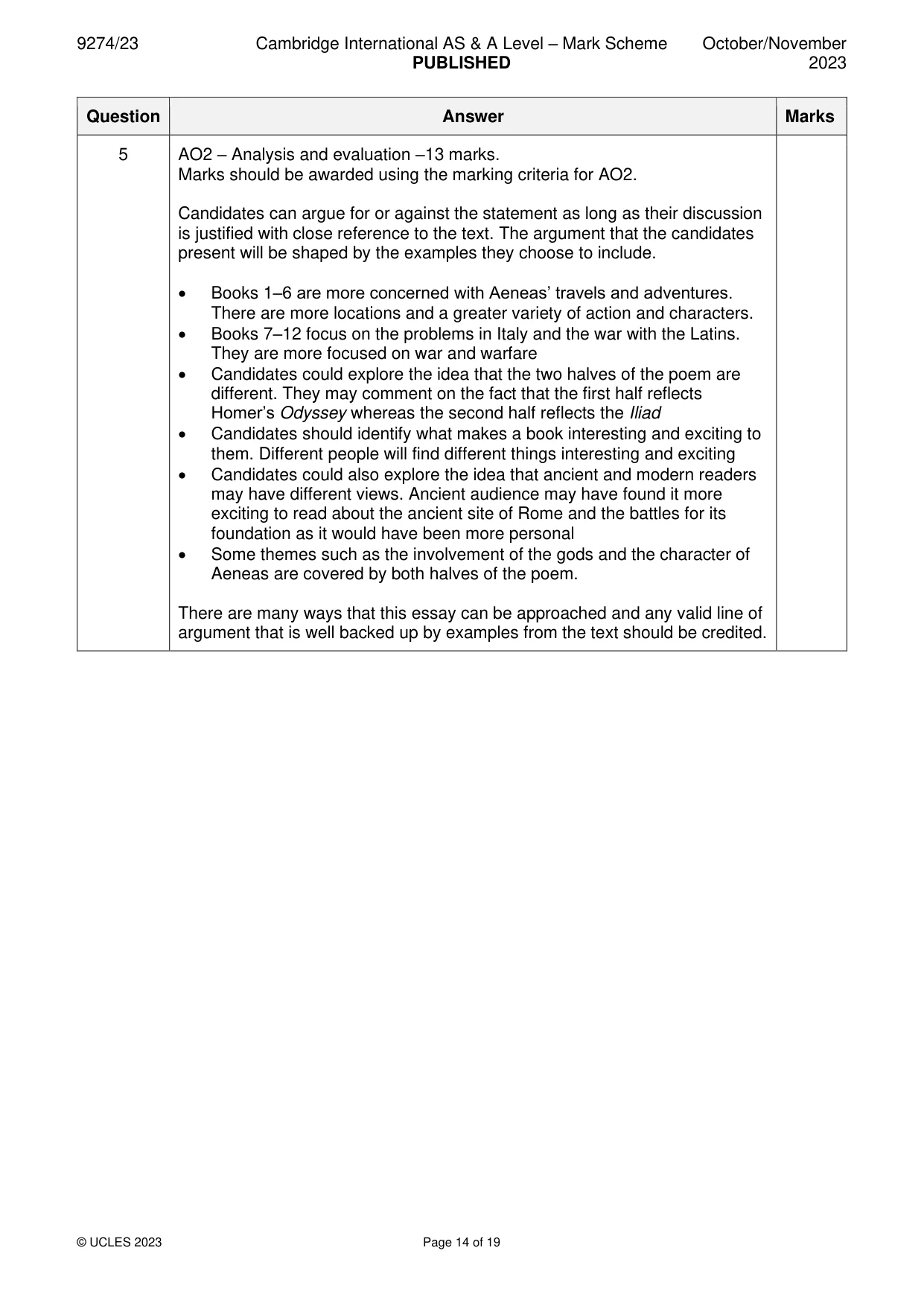
Mark scheme: 5 ‘The books of the first half of the Aeneid are far more interesting and 25 exciting than those of the second half.’ To what extent do you agree with this statement? Use the 25 mark essay marking criteria. AO1 – Knowledge and understanding – 12 marks. Marks should be awarded using the marking criteria for AO1. There is a wealth of examples candidates may choose to include as any examples could be relevant. These are just a few possible examples: Book 2: • Trojan horse • Fantasy elements – gods and ghosts • Fall of Troy Book 4: • Love story with Dido Book 6: • Fantasy and drama of the Underworld • Reunion with Anchises • Future Romans Book 8: • Introduction to Italy • Appearance of the god of the Tiber • Future site of Rome examined • Stories of Hercules • Aeneas’ shield Book 10: • Council of the gods • Fighting and heroism • Death of Pallas • Deaths of Lausus and Mezentius • Aeneas’ rage Book 12: • Involvement of Juturna • More fighting • Death of Turnus • Dramatic ending Candidates could also use examples from the rest of the Aeneid not just the set books. 5 AO2 – Analysis and evaluation –13 marks. Marks should be awarded using the marking criteria for AO2. Candidates can argue for or against the statement as long as their discussion is justified with close reference to the text. The argument that the candidates present will be shaped by the examples they choose to include. • Books 1–6 are more concerned with Aeneas’ travels and adventures. There are more locations and a greater variety of action and characters. • Books 7–12 focus on the problems in Italy and the war with the Latins. They are more focused on war and warfare • Candidates could explore the idea that the two halves of the poem are different. They may comment on the fact that the first half reflects Homer’s Odyssey whereas the second half reflects the Iliad • Candidates should identify what makes a book interesting and exciting to them. Different people will find different things interesting and exciting • Candidates could also explore the idea that ancient and modern readers may have different views. Ancient audience may have found it more exciting to read about the ancient site of Rome and the battles for its foundation as it would have been more personal • Some themes such as the involvement of the gods and the character of Aeneas are covered by both halves of the poem. There are many ways that this essay can be approached and any valid line of argument that is well backed up by examples from the text should be credited.
Q6 · ‘An effective piece of propaganda for Augustus and his regime.’ How far do you agree with…
6 ‘An effective piece of propaganda for Augustus and his regime.’ How far do you agree with this description of the Aeneid? [25] Section C: Architecture of the Roman City Answer Question 7 and either Question 8 or Question 9.
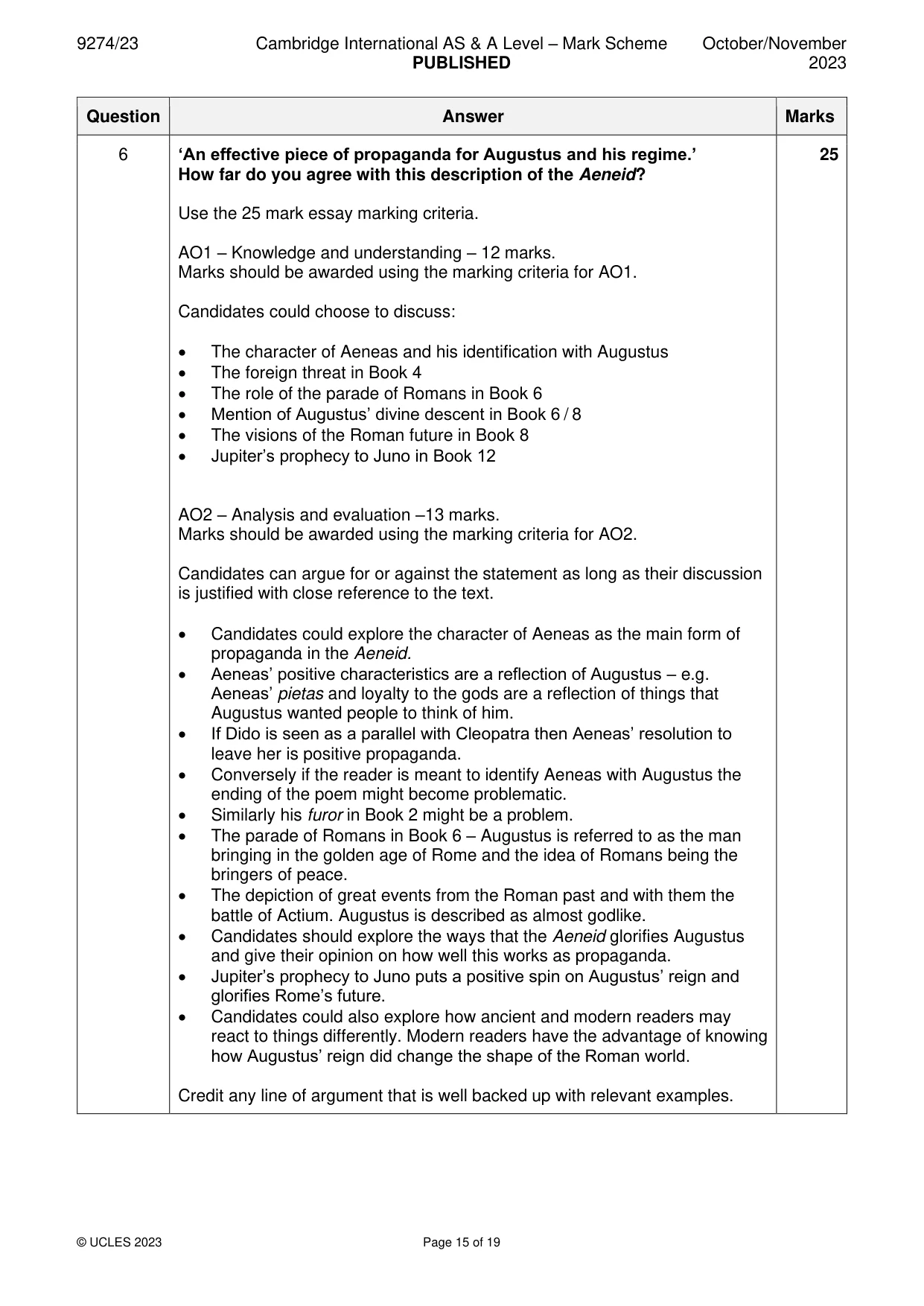
Mark scheme: 6 ‘An effective piece of propaganda for Augustus and his regime.’ 25 How far do you agree with this description of the Aeneid? Use the 25 mark essay marking criteria. AO1 – Knowledge and understanding – 12 marks. Marks should be awarded using the marking criteria for AO1. Candidates could choose to discuss: • The character of Aeneas and his identification with Augustus • The foreign threat in Book 4 • The role of the parade of Romans in Book 6 • Mention of Augustus’ divine descent in Book 6 / 8 • The visions of the Roman future in Book 8 • Jupiter’s prophecy to Juno in Book 12 AO2 – Analysis and evaluation –13 marks. Marks should be awarded using the marking criteria for AO2. Candidates can argue for or against the statement as long as their discussion is justified with close reference to the text. • Candidates could explore the character of Aeneas as the main form of propaganda in the Aeneid. • Aeneas’ positive characteristics are a reflection of Augustus – e.g. Aeneas’ pietas and loyalty to the gods are a reflection of things that Augustus wanted people to think of him. • If Dido is seen as a parallel with Cleopatra then Aeneas’ resolution to leave her is positive propaganda. • Conversely if the reader is meant to identify Aeneas with Augustus the ending of the poem might become problematic. • Similarly his furor in Book 2 might be a problem. • The parade of Romans in Book 6 – Augustus is referred to as the man bringing in the golden age of Rome and the idea of Romans being the bringers of peace. • The depiction of great events from the Roman past and with them the battle of Actium. Augustus is described as almost godlike. • Candidates should explore the ways that the Aeneid glorifies Augustus and give their opinion on how well this works as propaganda. • Jupiter’s prophecy to Juno puts a positive spin on Augustus’ reign and glorifies Rome’s future. • Candidates could also explore how ancient and modern readers may react to things differently. Modern readers have the advantage of knowing how Augustus’ reign did change the shape of the Roman world. Credit any line of argument that is well backed up with relevant examples. Section C: Architecture of the Roman City
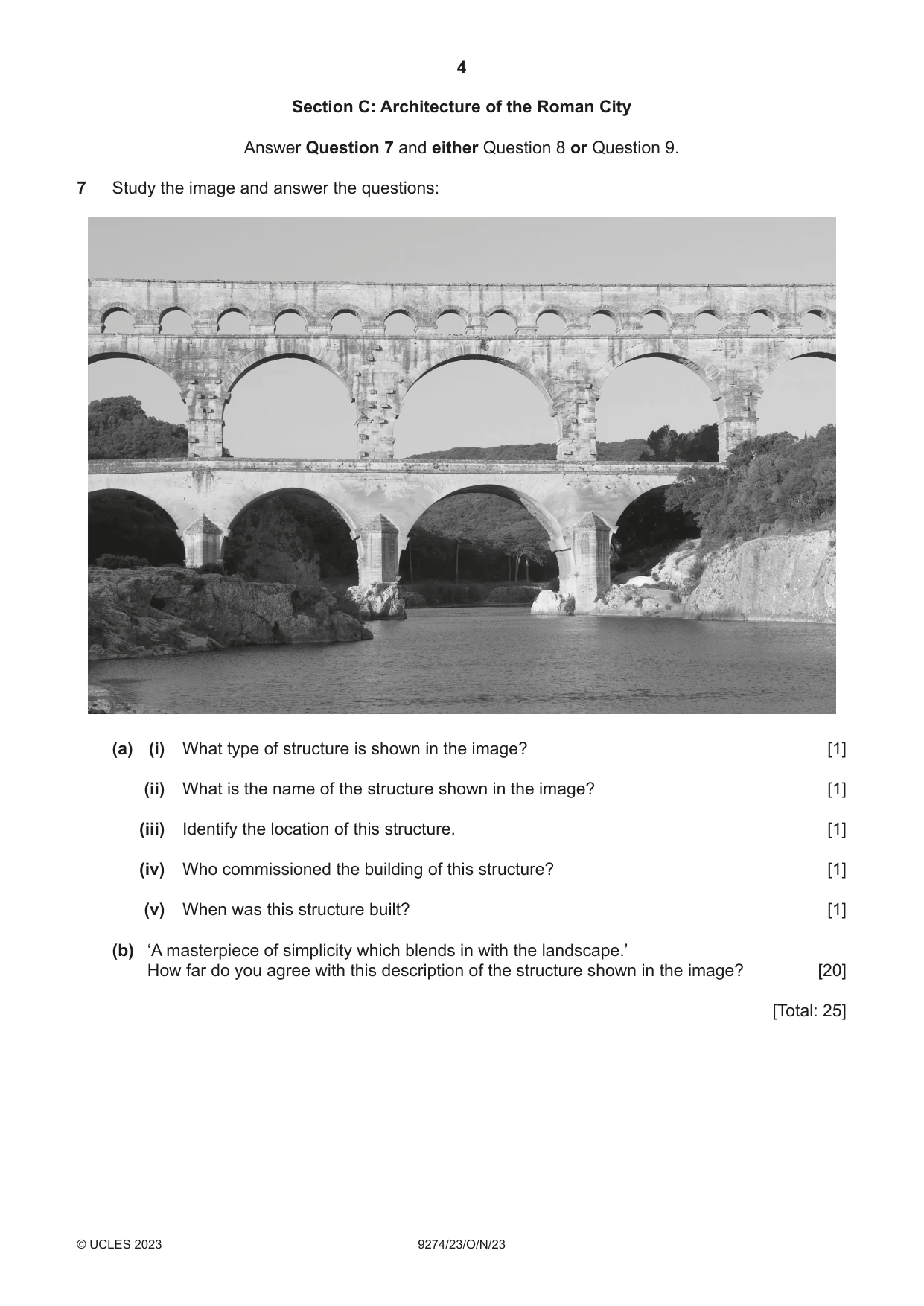
Q7 · Study the image and answer the questions: (a) (i) What type of structure is shown in the…
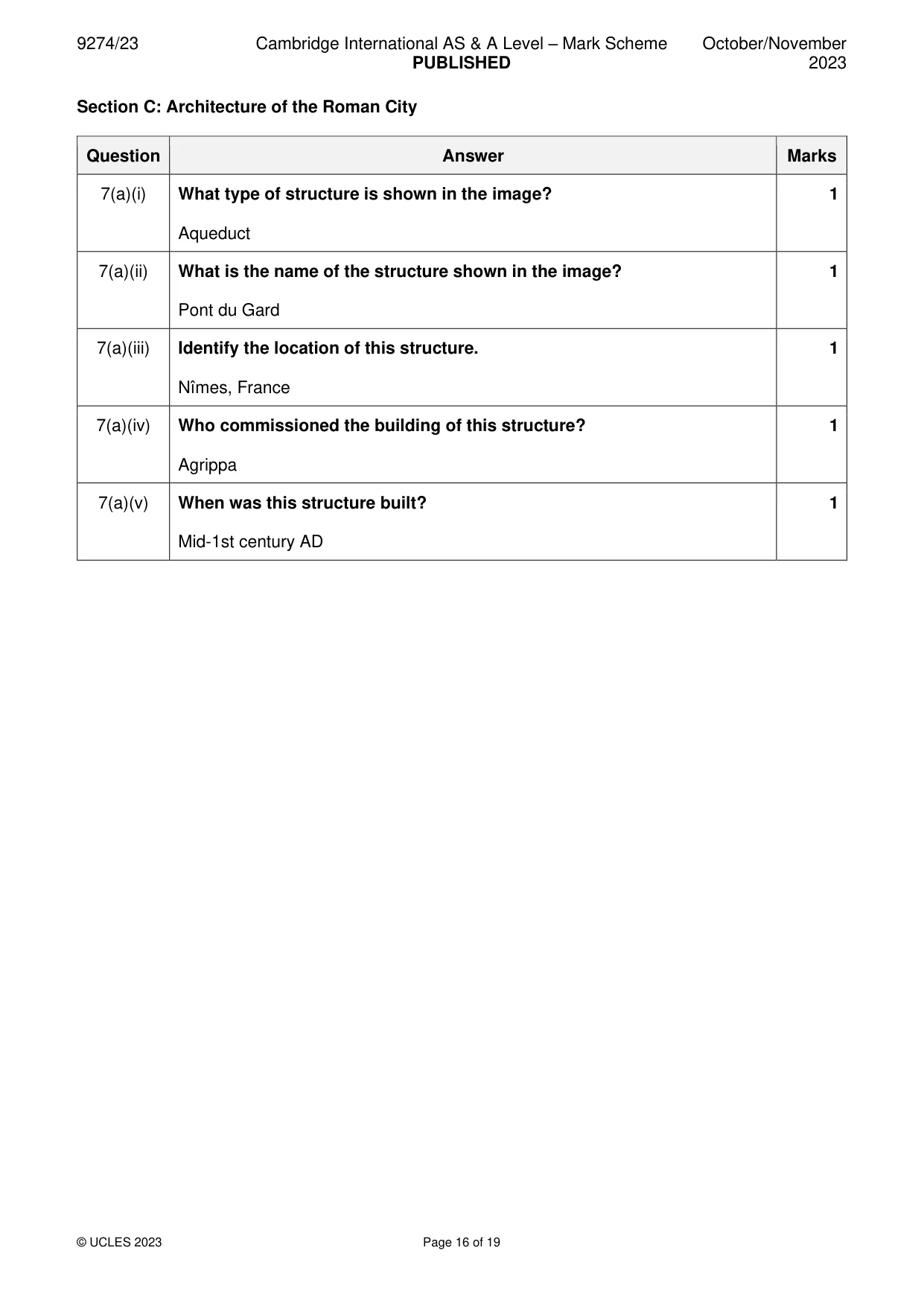
7 Study the image and answer the questions: (a) (i) What type of structure is shown in the image? [1] (ii) What is the name of the structure shown in the image? [1] (iii) Identify the location of this structure. [1] (iv) Who commissioned the building of this structure? [1] (v) When was this structure built? [1] (b) ‘A masterpiece of simplicity which blends in with the landscape.’ How far do you agree with this description of the structure shown in the image? [20] [Total: 25] EITHER
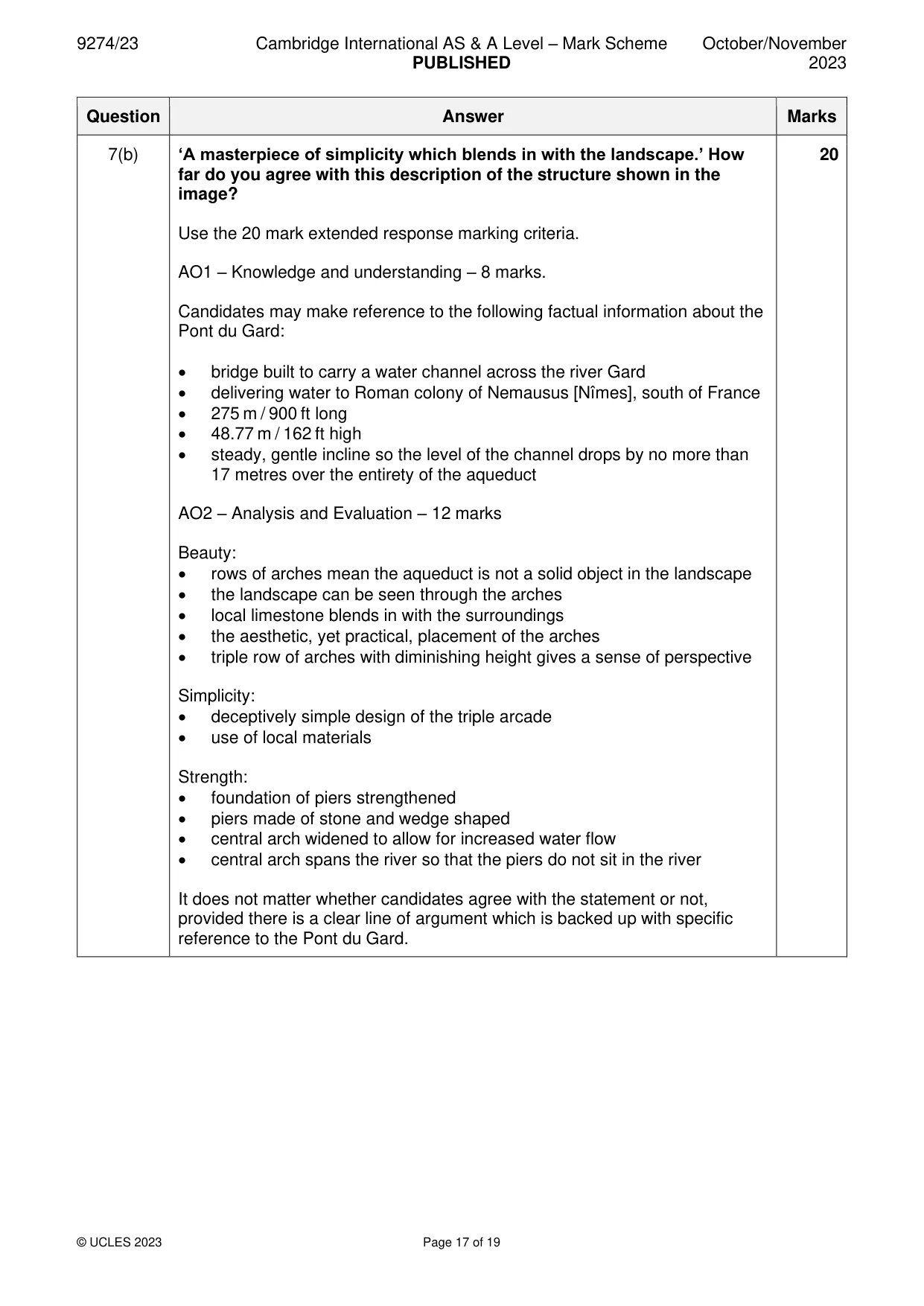
Mark scheme: 7(a)(i) What type of structure is shown in the image? 1 Aqueduct 7(a)(ii) What is the name of the structure shown in the image? 1 Pont du Gard 7(a)(iii) Identify the location of this structure. 1 Nîmes, France 7(a)(iv) Who commissioned the building of this structure? 1 Agrippa 7(a)(v) When was this structure built? 1 Mid-1st century AD 7(b) ‘A masterpiece of simplicity which blends in with the landscape.’ How 20 far do you agree with this description of the structure shown in the image? Use the 20 mark extended response marking criteria. AO1 – Knowledge and understanding – 8 marks. Candidates may make reference to the following factual information about the Pont du Gard: • bridge built to carry a water channel across the river Gard • delivering water to Roman colony of Nemausus [Nîmes], south of France • 275 m / 900 ft long • 48.77 m / 162 ft high • steady, gentle incline so the level of the channel drops by no more than 17 metres over the entirety of the aqueduct AO2 – Analysis and Evaluation – 12 marks Beauty: • rows of arches mean the aqueduct is not a solid object in the landscape • the landscape can be seen through the arches • local limestone blends in with the surroundings • the aesthetic, yet practical, placement of the arches • triple row of arches with diminishing height gives a sense of perspective Simplicity: • deceptively simple design of the triple arcade • use of local materials Strength: • foundation of piers strengthened • piers made of stone and wedge shaped • central arch widened to allow for increased water flow • central arch spans the river so that the piers do not sit in the river It does not matter whether candidates agree with the statement or not, provided there is a clear line of argument which is backed up with specific reference to the Pont du Gard.
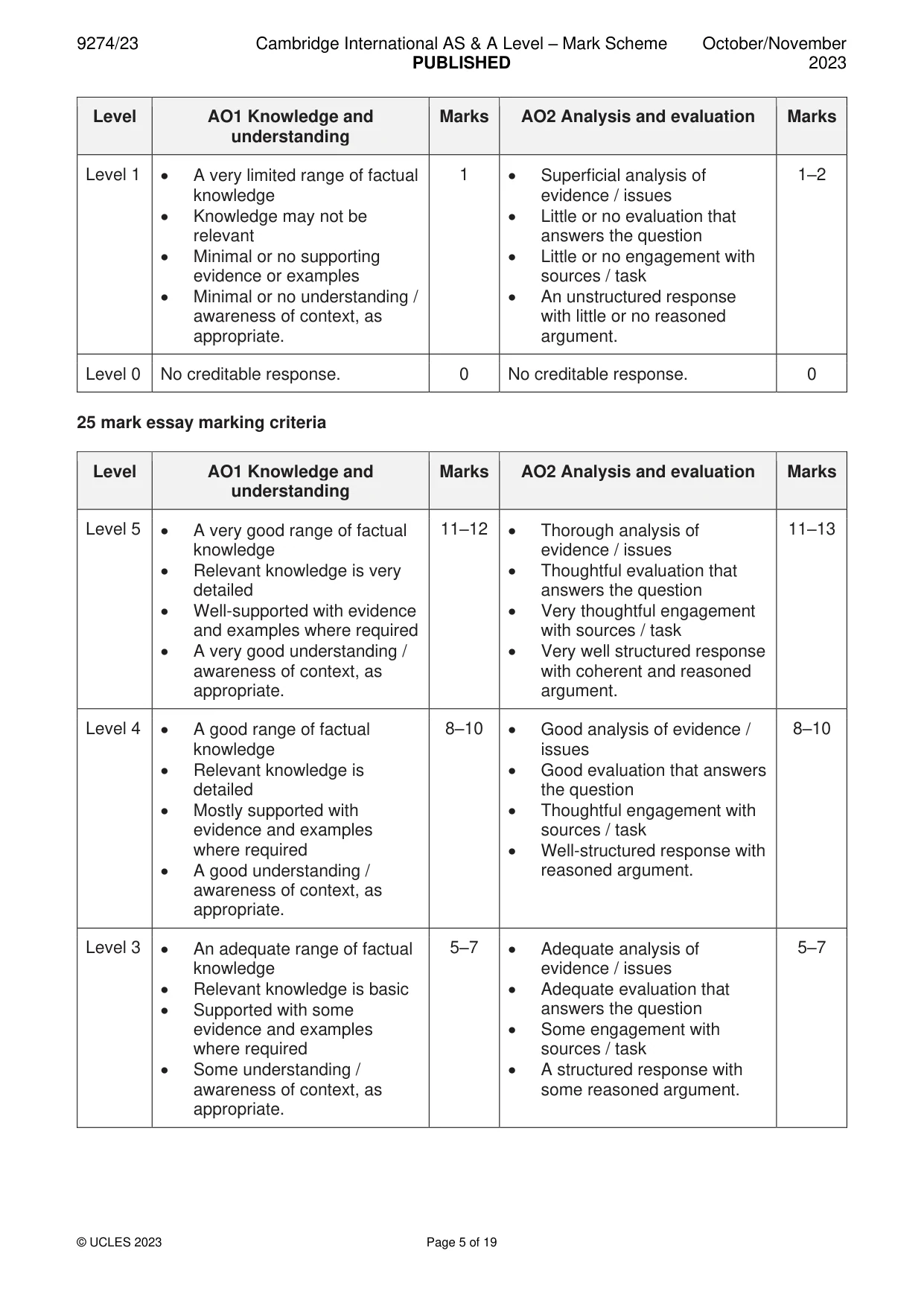
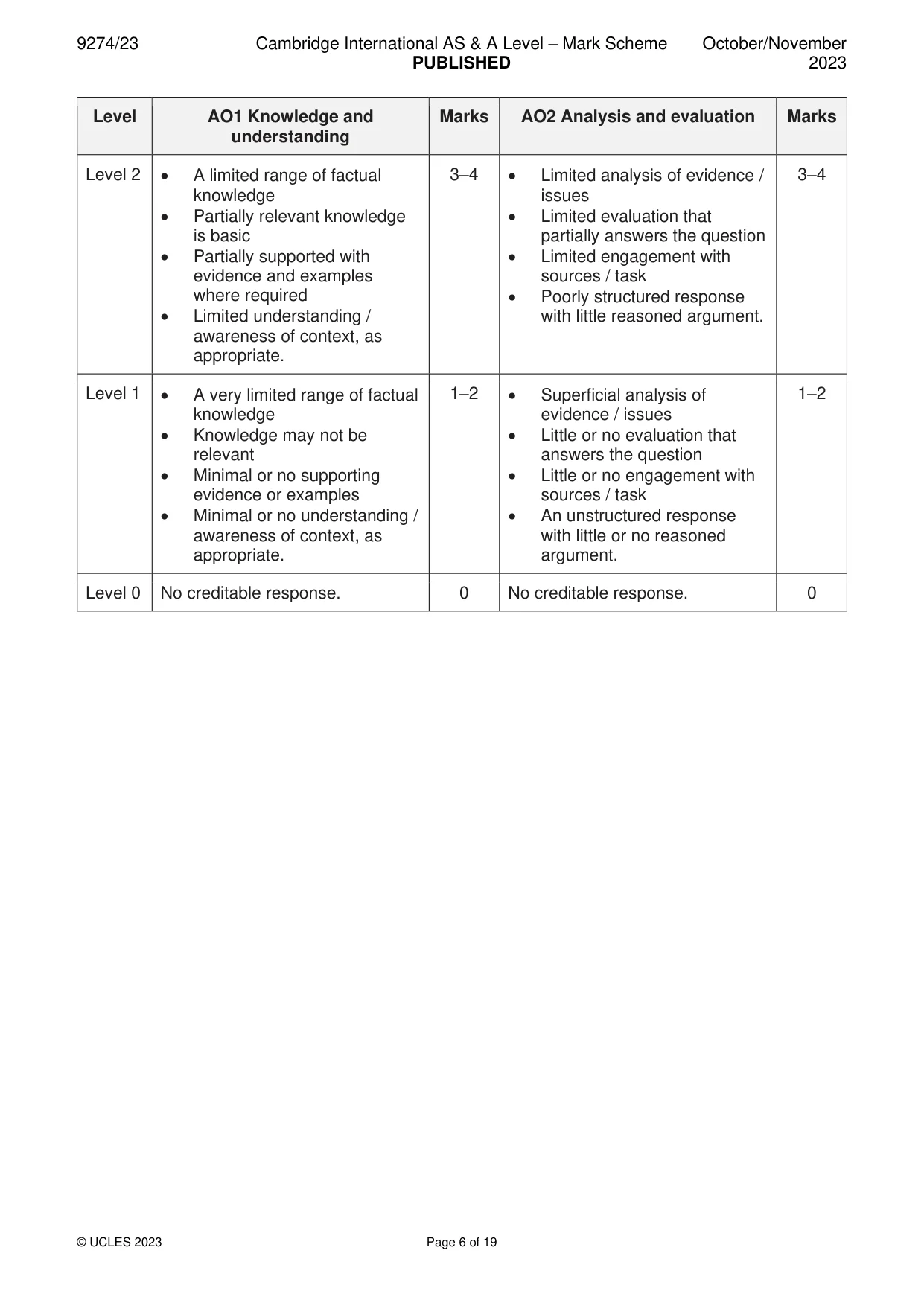
Q8 · ‘All the same, but different.’ To what extent do you think that this is true of houses…
8 ‘All the same, but different.’ To what extent do you think that this is true of houses from Herculaneum and Pompeii? In your answer, you should include discussion of at least four houses and make reference to specific features of the houses to explain your answer. [25] OR
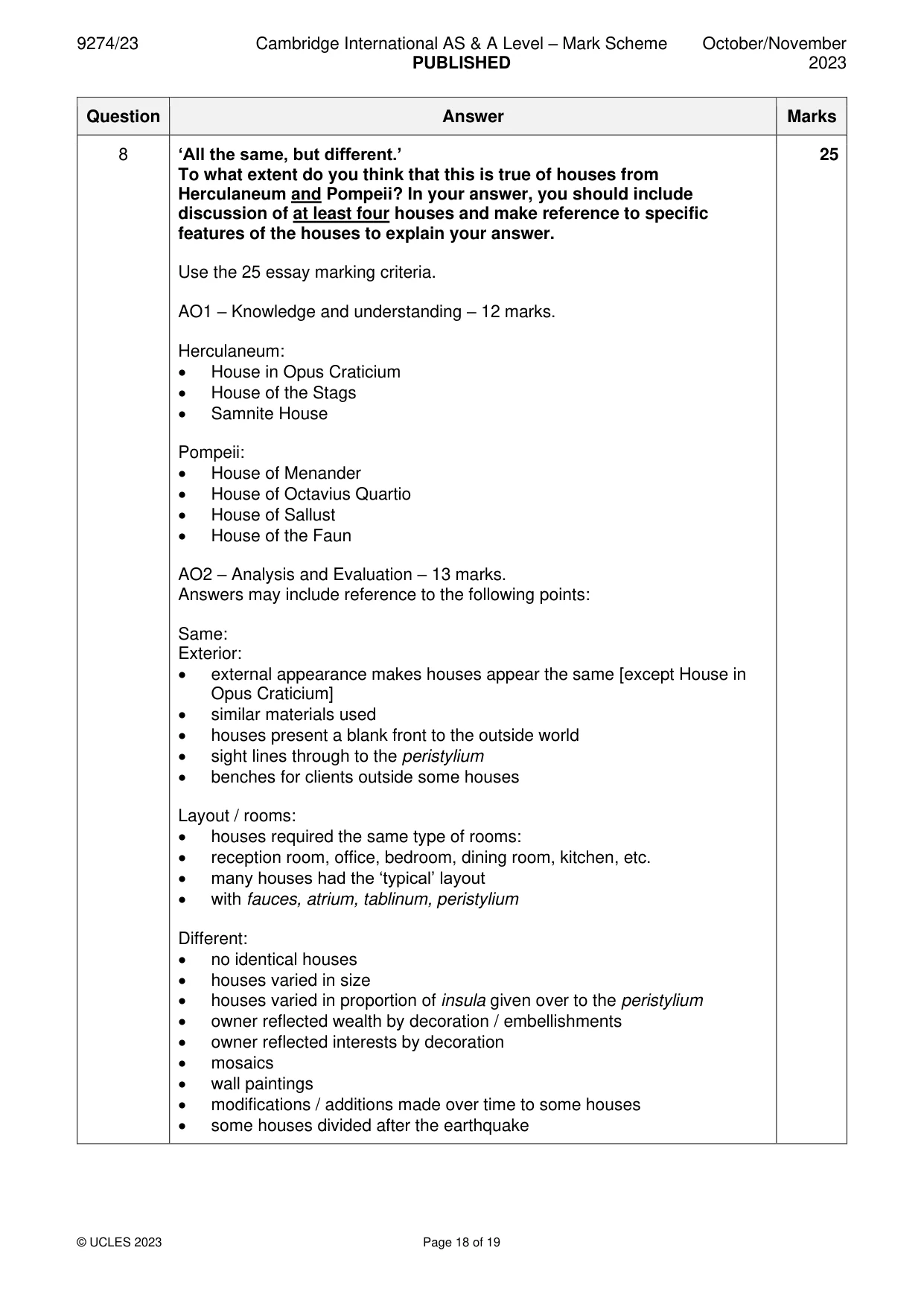
Mark scheme: 8 ‘All the same, but different.’ 25 To what extent do you think that this is true of houses from Herculaneum and Pompeii? In your answer, you should include discussion of at least four houses and make reference to specific features of the houses to explain your answer. Use the 25 essay marking criteria. AO1 – Knowledge and understanding – 12 marks. Herculaneum: • House in Opus Craticium • House of the Stags • Samnite House Pompeii: • House of Menander • House of Octavius Quartio • House of Sallust • House of the Faun AO2 – Analysis and Evaluation – 13 marks. Answers may include reference to the following points: Same: Exterior: • external appearance makes houses appear the same [except House in Opus Craticium] • similar materials used • houses present a blank front to the outside world • sight lines through to the peristylium • benches for clients outside some houses Layout / rooms: • houses required the same type of rooms: • reception room, office, bedroom, dining room, kitchen, etc. • many houses had the ‘typical’ layout • with fauces, atrium, tablinum, peristylium Different: • no identical houses • houses varied in size • houses varied in proportion of insula given over to the peristylium • owner reflected wealth by decoration / embellishments • owner reflected interests by decoration • mosaics • wall paintings • modifications / additions made over time to some houses • some houses divided after the earthquake
Q9 · ‘No imagination, no innovation.’ How far do you think that this is true of the temples…
9 ‘No imagination, no innovation.’ How far do you think that this is true of the temples you have studied? In your answer, you should consider the design, construction and decoration of at least three Roman temples. [25]
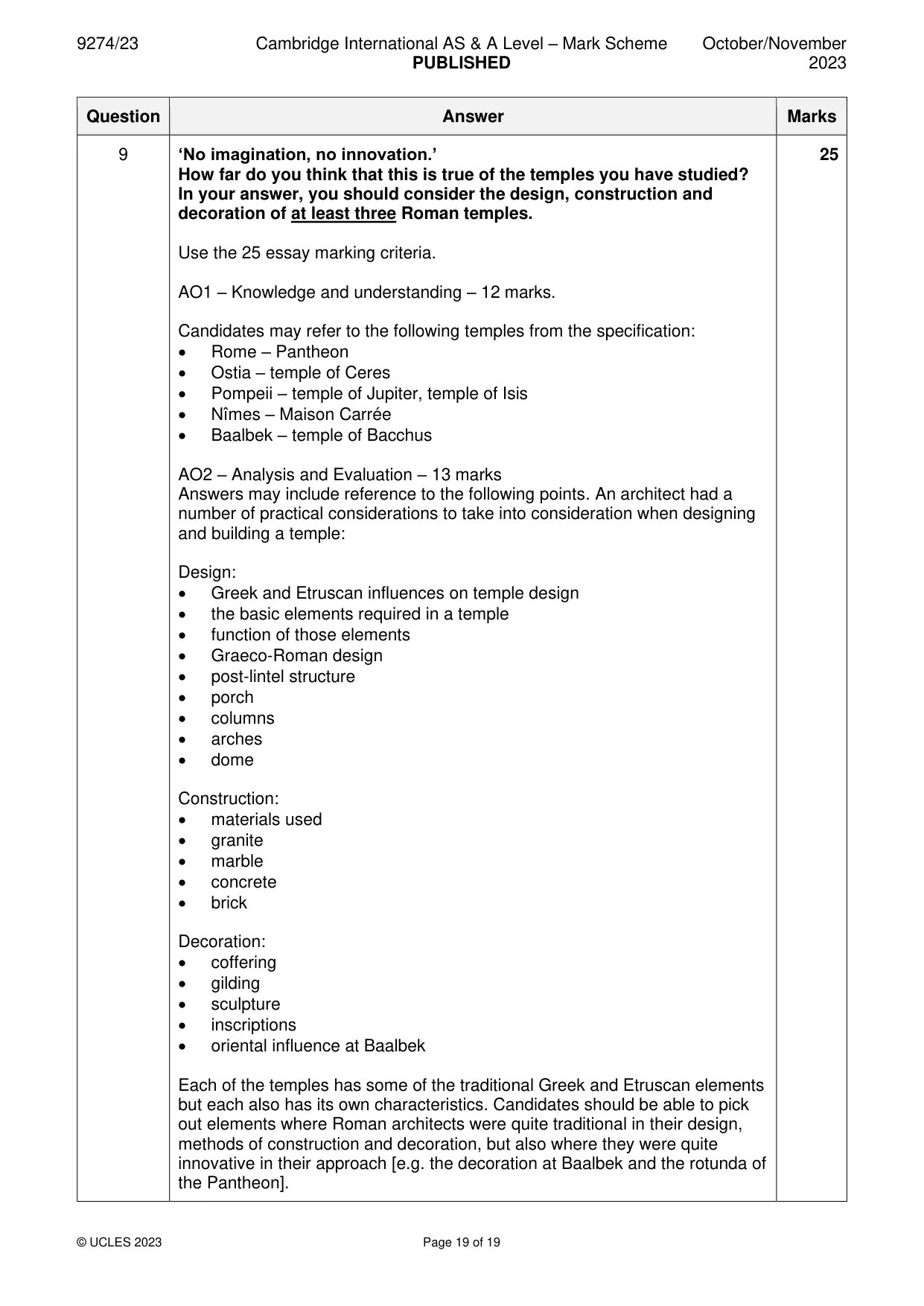
Mark scheme: 9 ‘No imagination, no innovation.’ 25 How far do you think that this is true of the temples you have studied? In your answer, you should consider the design, construction and decoration of at least three Roman temples. Use the 25 essay marking criteria. AO1 – Knowledge and understanding – 12 marks. Candidates may refer to the following temples from the specification: • Rome – Pantheon • Ostia – temple of Ceres • Pompeii – temple of Jupiter, temple of Isis • Nîmes – Maison Carrée • Baalbek – temple of Bacchus AO2 – Analysis and Evaluation – 13 marks Answers may include reference to the following points. An architect had a number of practical considerations to take into consideration when designing and building a temple: Design: • Greek and Etruscan influences on temple design • the basic elements required in a temple • function of those elements • Graeco-Roman design • post-lintel structure • porch • columns • arches • dome Construction: • materials used • granite • marble • concrete • brick Decoration: • coffering • gilding • sculpture • inscriptions • oriental influence at Baalbek Each of the temples has some of the traditional Greek and Etruscan elements but each also has its own characteristics. Candidates should be able to pick out elements where Roman architects were quite traditional in their design, methods of construction and decoration, but also where they were quite innovative in their approach [e.g. the decoration at Baalbek and the rotunda of the Pantheon].
What was in this paper
The subtopics covered by these 8 questions, and how many questions each got. Open one in a new tab to see every Cambridge question on it.
What you needed in this session
Cambridge’s own grade thresholds for 2023 Oct/Nov, Paper 2 · Variant 3. A higher threshold means an easier paper — the bar moves with how the cohort did.