Cambridge A Level Classical Studies 9274 — 2022 Oct/Nov Paper 2 · Variant 2
9274/22/O/N/22 · 9 questions · 50 marks · ≈56 min
The question paper and its mark scheme, free to read here and free to download. This is Cambridge’s own paper, exactly as it was sat.
Question paper8 pages



Mark scheme16 pages
Answers below. Sit the paper first if you are practising.
Questions as text
Q1 · Read the passage and answer the questions: He suffered only two heavy and disgraceful…
1 Read the passage and answer the questions: He suffered only two heavy and disgraceful defeats, both in Germany, the generals concerned being Lollius and Varus. Lollius’ defeat was ignominious rather than of strategic importance; but Varus’ nearly wrecked the Empire, since three legions with their general and all their officers and auxiliary forces, and the general staff, were massacred to a man. When the news reached Rome, Augustus ordered patrols of the 5 city at night to prevent any rising; then prolonged the terms of the provincial governors, so that the allies should have men of experience, whom they trusted, to confirm their allegiance. (Suetonius, The Twelve Caesars – Divine Augustus 23) (a) (i) In which year did the massacre of Varus’ troops take place? [1] (ii) Where specifically in Germany did the massacre take place? [2] (iii) What does Suetonius tell us about how Augustus reacted to this news after this passage? Make two points. [2] (b) ‘The Varian massacre caused a complete change in Augustus’ frontier policy.’ Using this passage as a starting point, explain how far you agree with this statement. [20] [Total: 25] EITHER
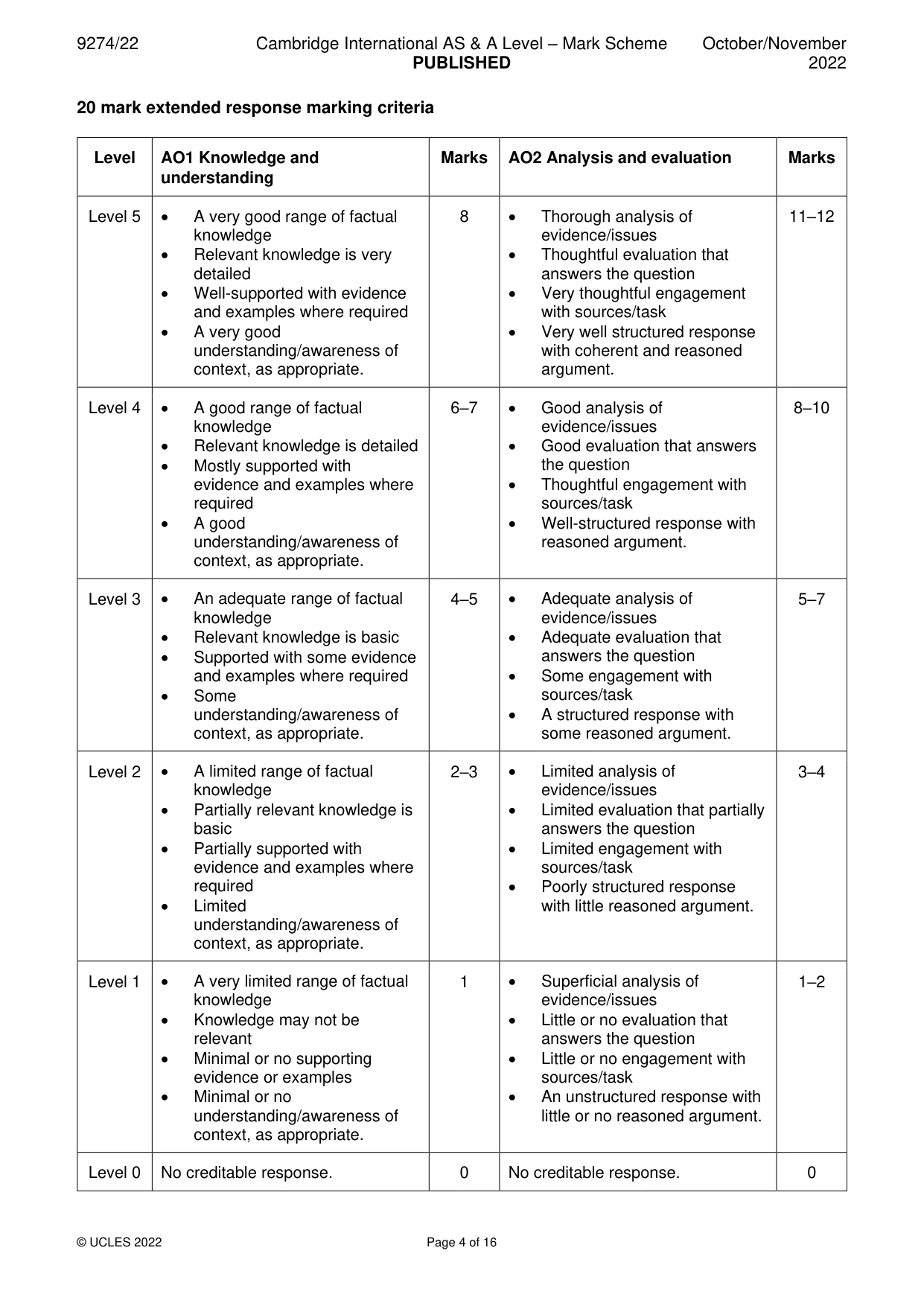
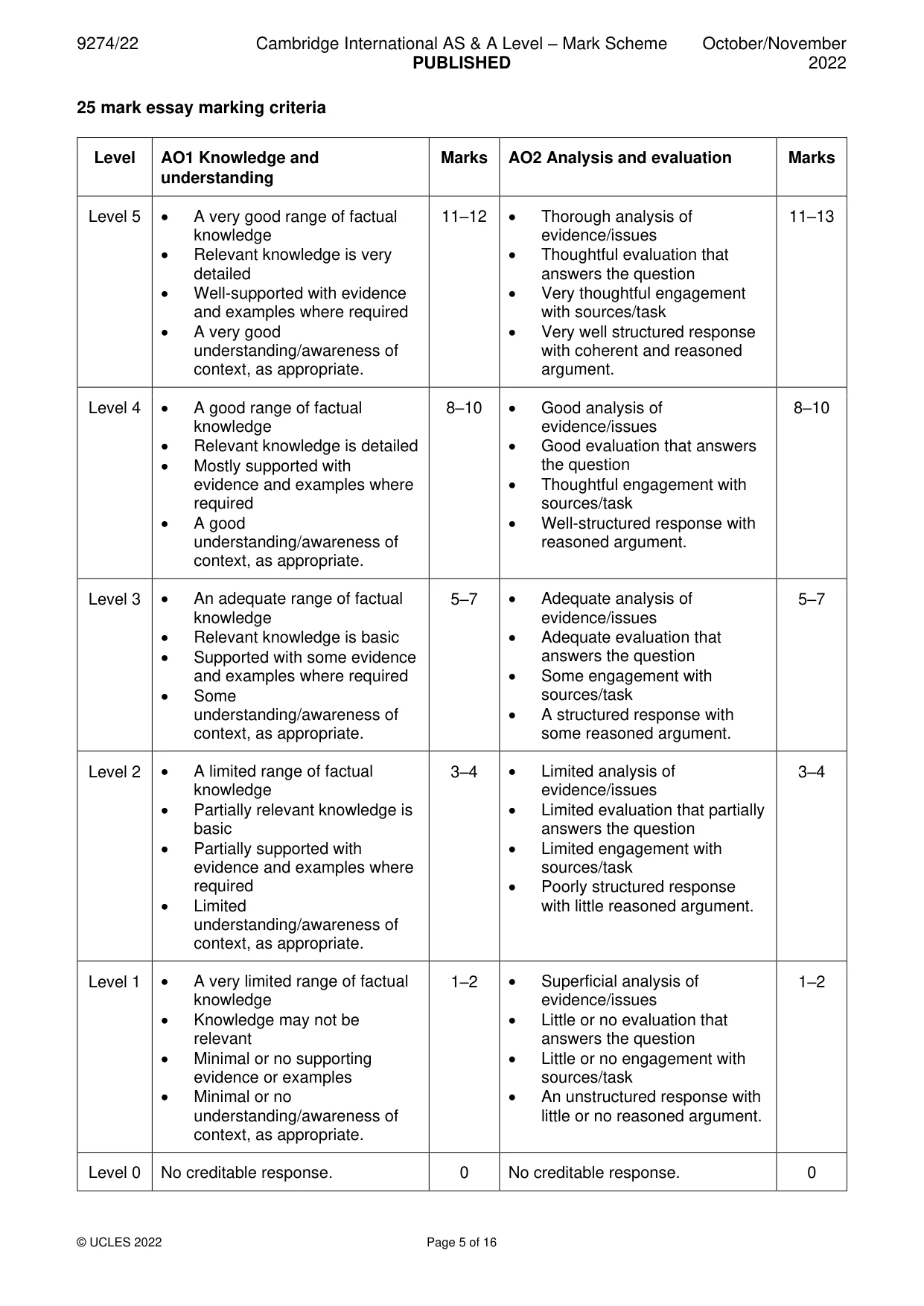
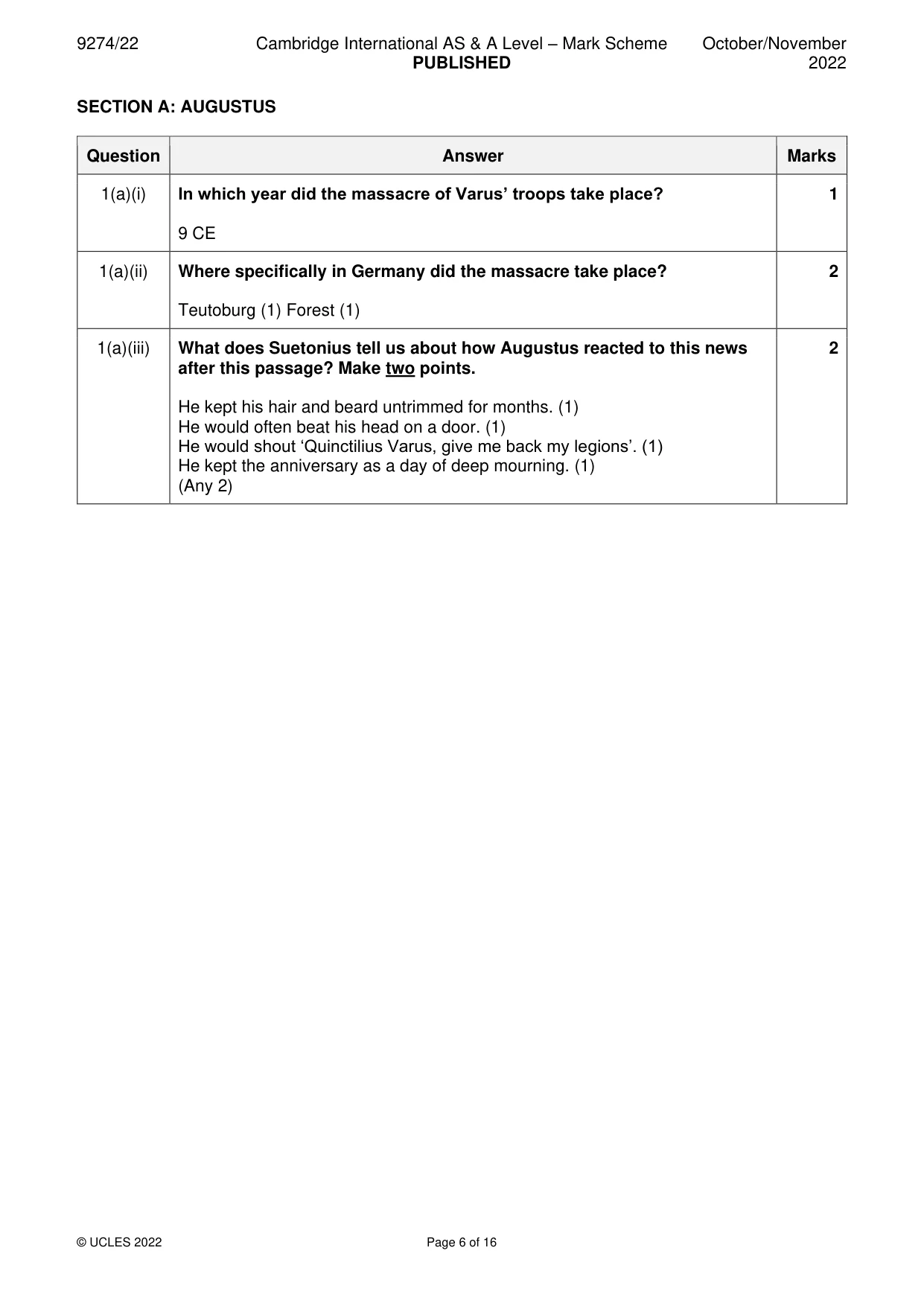
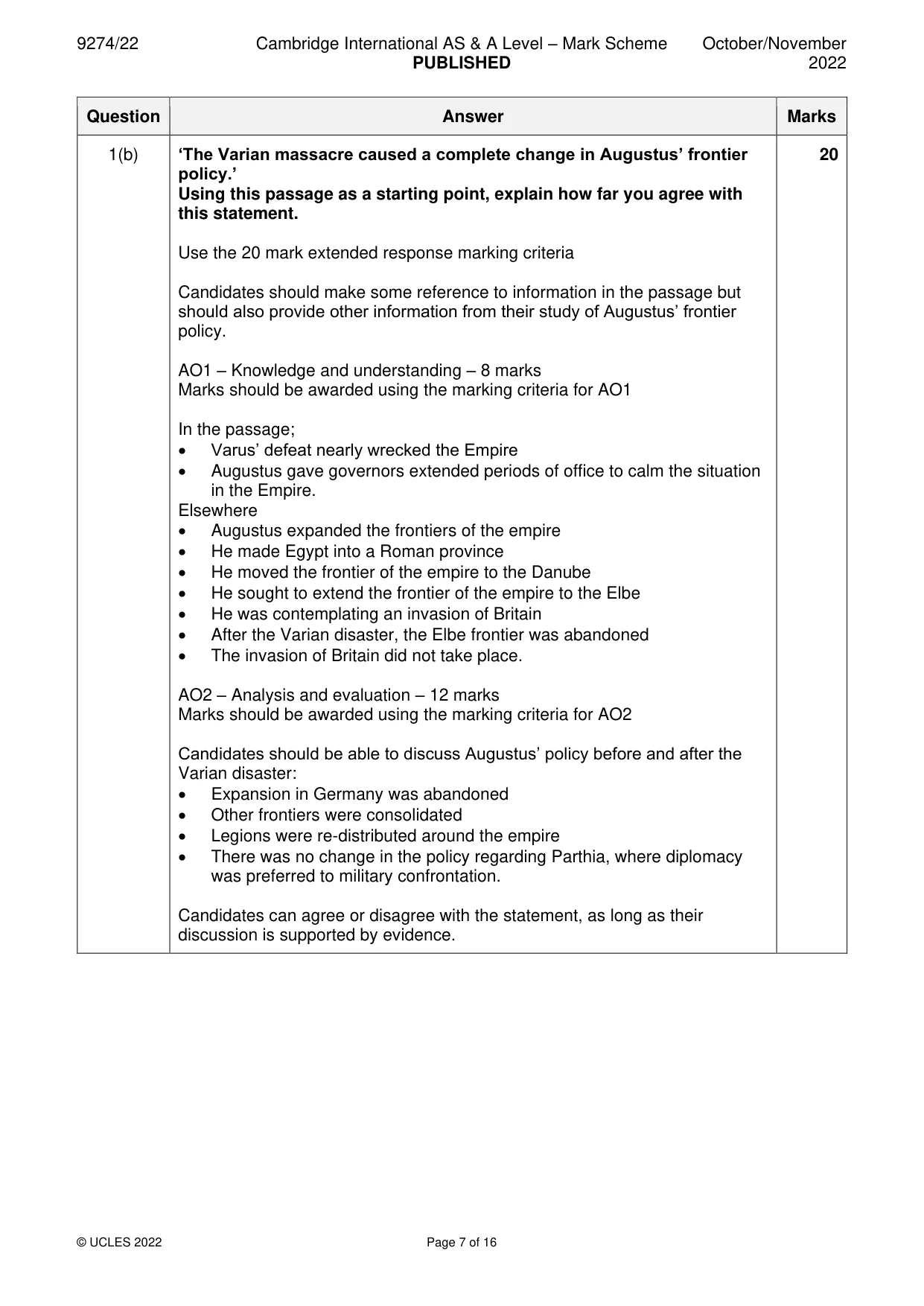
Mark scheme: Question Answer Marks 1(a)(i) In which year did the massacre of Varus’ troops take place? 1 9 CE 1(a)(ii) Where specifically in Germany did the massacre take place? 2 Teutoburg (1) Forest (1) 1(a)(iii) What does Suetonius tell us about how Augustus reacted to this news 2 after this passage? Make two points. He kept his hair and beard untrimmed for months. (1) He would often beat his head on a door. (1) He would shout ‘Quinctilius Varus, give me back my legions’. (1) He kept the anniversary as a day of deep mourning. (1) (Any 2) 1(b) ‘The Varian massacre caused a complete change in Augustus’ frontier 20 policy.’ Using this passage as a starting point, explain how far you agree with this statement. Use the 20 mark extended response marking criteria Candidates should make some reference to information in the passage but should also provide other information from their study of Augustus’ frontier policy. AO1 – Knowledge and understanding – 8 marks Marks should be awarded using the marking criteria for AO1 In the passage; • Varus’ defeat nearly wrecked the Empire • Augustus gave governors extended periods of office to calm the situation in the Empire. Elsewhere • Augustus expanded the frontiers of the empire • He made Egypt into a Roman province • He moved the frontier of the empire to the Danube • He sought to extend the frontier of the empire to the Elbe • He was contemplating an invasion of Britain • After the Varian disaster, the Elbe frontier was abandoned • The invasion of Britain did not take place. AO2 – Analysis and evaluation – 12 marks Marks should be awarded using the marking criteria for AO2 Candidates should be able to discuss Augustus’ policy before and after the Varian disaster: • Expansion in Germany was abandoned • Other frontiers were consolidated • Legions were re-distributed around the empire • There was no change in the policy regarding Parthia, where diplomacy was preferred to military confrontation. Candidates can agree or disagree with the statement, as long as their discussion is supported by evidence.
Q2 · How far would you agree that, in seizing power, Octavian acted in a totally…
2 How far would you agree that, in seizing power, Octavian acted in a totally unconstitutional and illegal manner? [25] OR
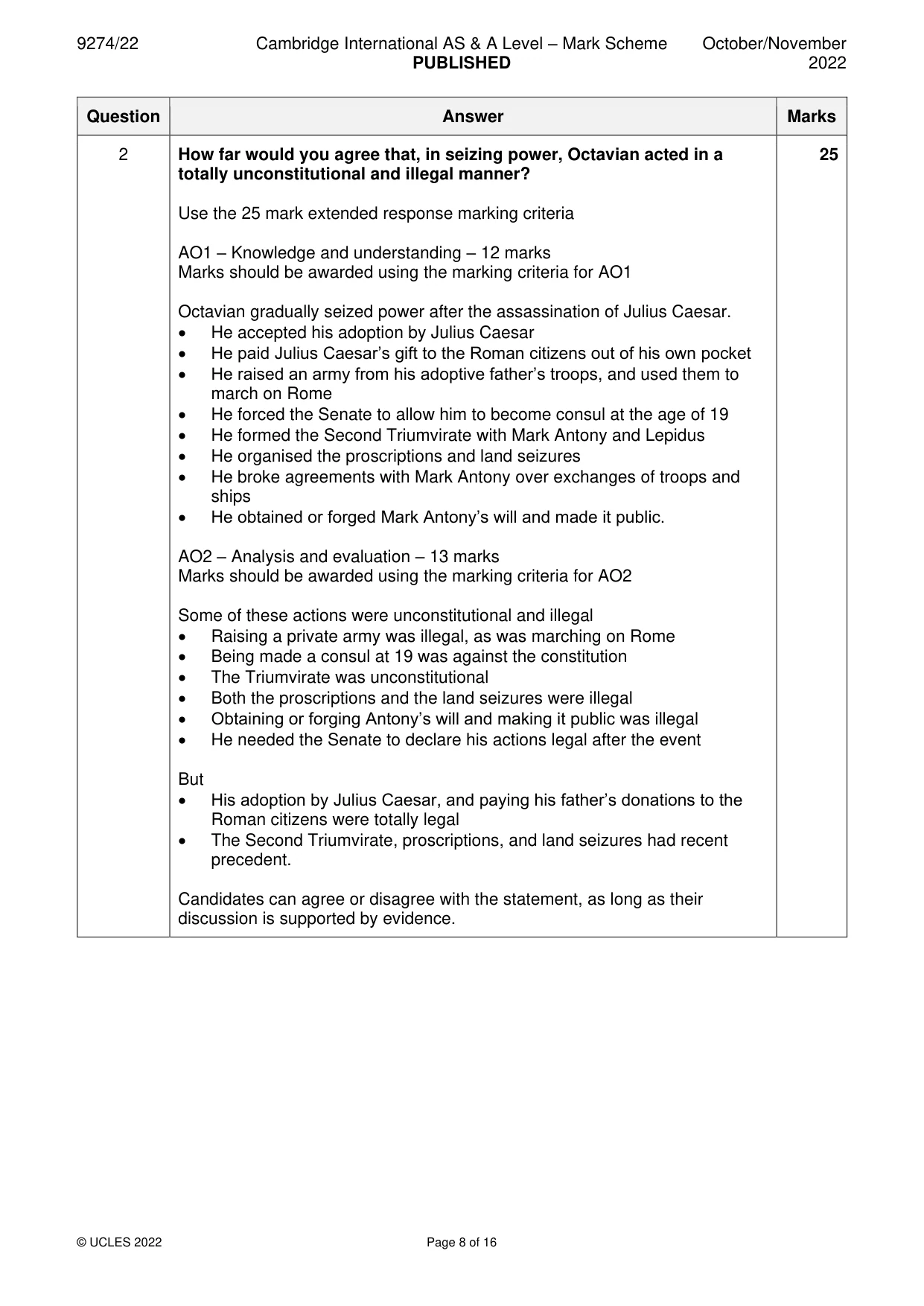
Mark scheme: 2 How far would you agree that, in seizing power, Octavian acted in a 25 totally unconstitutional and illegal manner? Use the 25 mark extended response marking criteria AO1 – Knowledge and understanding – 12 marks Marks should be awarded using the marking criteria for AO1 Octavian gradually seized power after the assassination of Julius Caesar. • He accepted his adoption by Julius Caesar • He paid Julius Caesar’s gift to the Roman citizens out of his own pocket • He raised an army from his adoptive father’s troops, and used them to march on Rome • He forced the Senate to allow him to become consul at the age of 19 • He formed the Second Triumvirate with Mark Antony and Lepidus • He organised the proscriptions and land seizures • He broke agreements with Mark Antony over exchanges of troops and ships • He obtained or forged Mark Antony’s will and made it public. AO2 – Analysis and evaluation – 13 marks Marks should be awarded using the marking criteria for AO2 Some of these actions were unconstitutional and illegal • Raising a private army was illegal, as was marching on Rome • Being made a consul at 19 was against the constitution • The Triumvirate was unconstitutional • Both the proscriptions and the land seizures were illegal • Obtaining or forging Antony’s will and making it public was illegal • He needed the Senate to declare his actions legal after the event But • His adoption by Julius Caesar, and paying his father’s donations to the Roman citizens were totally legal • The Second Triumvirate, proscriptions, and land seizures had recent precedent. Candidates can agree or disagree with the statement, as long as their discussion is supported by evidence.
Q3 · ‘The Res Gestae Divi Augusti were the most important way in which Augustus preserved his…
3 ‘The Res Gestae Divi Augusti were the most important way in which Augustus preserved his reputation for future generations.’ Explain how far you agree with this statement. [25]
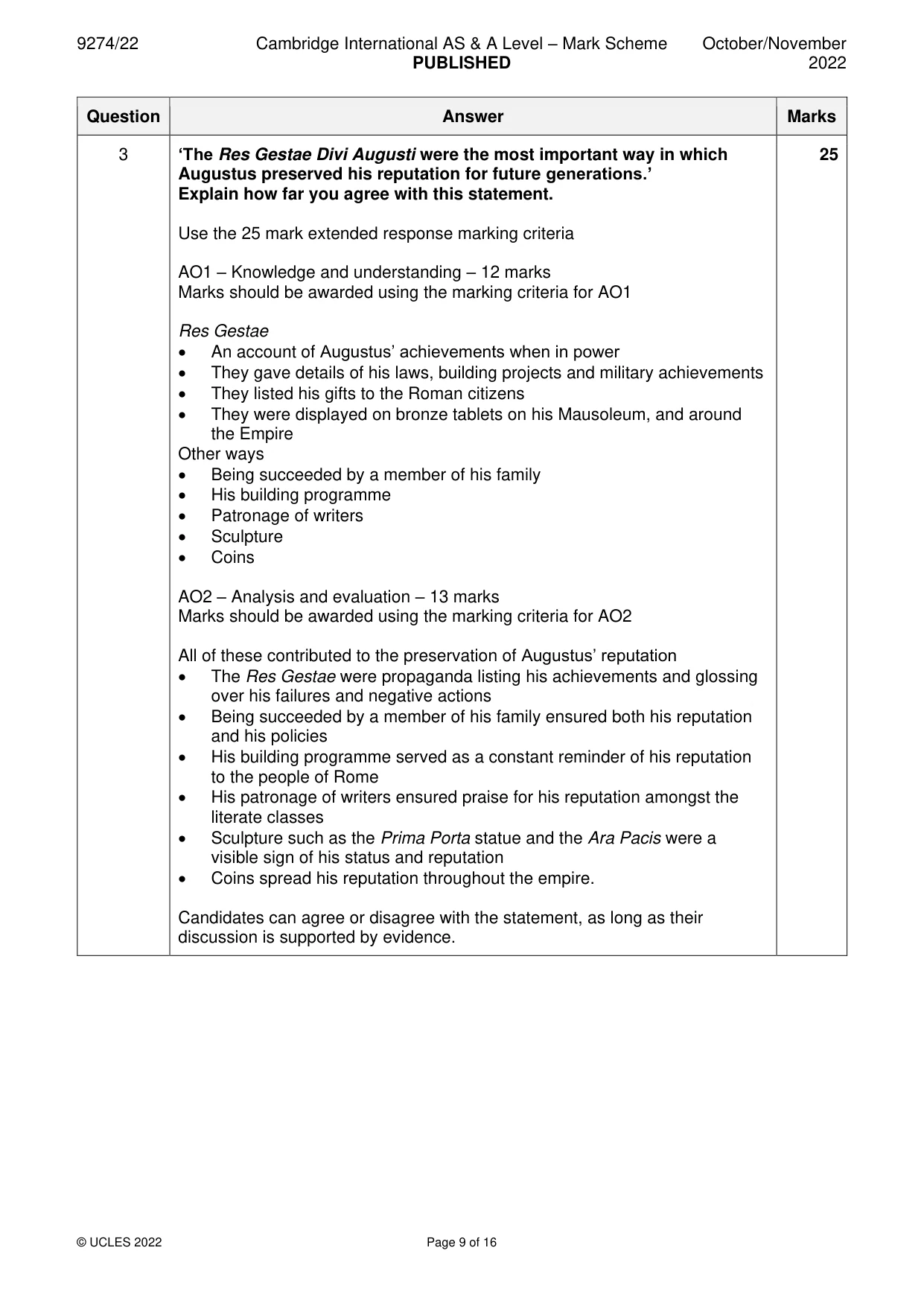
Mark scheme: 3 ‘The Res Gestae Divi Augusti were the most important way in which 25 Augustus preserved his reputation for future generations.’ Explain how far you agree with this statement. Use the 25 mark extended response marking criteria AO1 – Knowledge and understanding – 12 marks Marks should be awarded using the marking criteria for AO1 Res Gestae • An account of Augustus’ achievements when in power • They gave details of his laws, building projects and military achievements • They listed his gifts to the Roman citizens • They were displayed on bronze tablets on his Mausoleum, and around the Empire Other ways • Being succeeded by a member of his family • His building programme • Patronage of writers • Sculpture • Coins AO2 – Analysis and evaluation – 13 marks Marks should be awarded using the marking criteria for AO2 All of these contributed to the preservation of Augustus’ reputation • The Res Gestae were propaganda listing his achievements and glossing over his failures and negative actions • Being succeeded by a member of his family ensured both his reputation and his policies • His building programme served as a constant reminder of his reputation to the people of Rome • His patronage of writers ensured praise for his reputation amongst the literate classes • Sculpture such as the Prima Porta statue and the Ara Pacis were a visible sign of his status and reputation • Coins spread his reputation throughout the empire. Candidates can agree or disagree with the statement, as long as their discussion is supported by evidence. SECTION B: VIRGIL’S AENEID
Q4 · Read the passage and answer the questions: ‘If the Trojans have come to Italy without…
4 Read the passage and answer the questions: ‘If the Trojans have come to Italy without your approval, in defiance of your heavenly will, they must be punished for their sins and you must not raise a finger to help them. But if they have obeyed all the commands they have received from the gods above and the shades below, how can anyone overturn what you have ordered or fashion a new destiny? You have seen their ships burned on the shores of my own son Eryx. 5 You have seen the king of the storms and his raging winds roused out of their Aeolian island. You have seen Iris driven down from the clouds. And now she even turns to the one remaining part of the world and stirs up the powers below – Allecto has suddenly been let loose upon the earth and has run wild through all the cities in the middle of Italy! I no longer give a thought to empire. That was our hope, as you well know, while 10 our fortunes remained. But those who must prevail are those you wish to prevail.’ (Virgil, Aeneid 10) (a) (i) Where is Venus when she is making this speech? [1] (ii) ‘commands they have received from the gods above and the shades below’ (lines 3–4). Identify two beings who have commanded Aeneas to found a new city. [2] (iii) ‘And now she even turns’ (line 7). Who is ‘she’? [1] (iv) What is ‘Allecto’ (line 8)? [1] (b) ‘Fate is the most important theme in Book 10 of the Aeneid.’ How far do you agree with this statement? You should use this passage as a starting point in your answer. [20] [Total: 25] EITHER
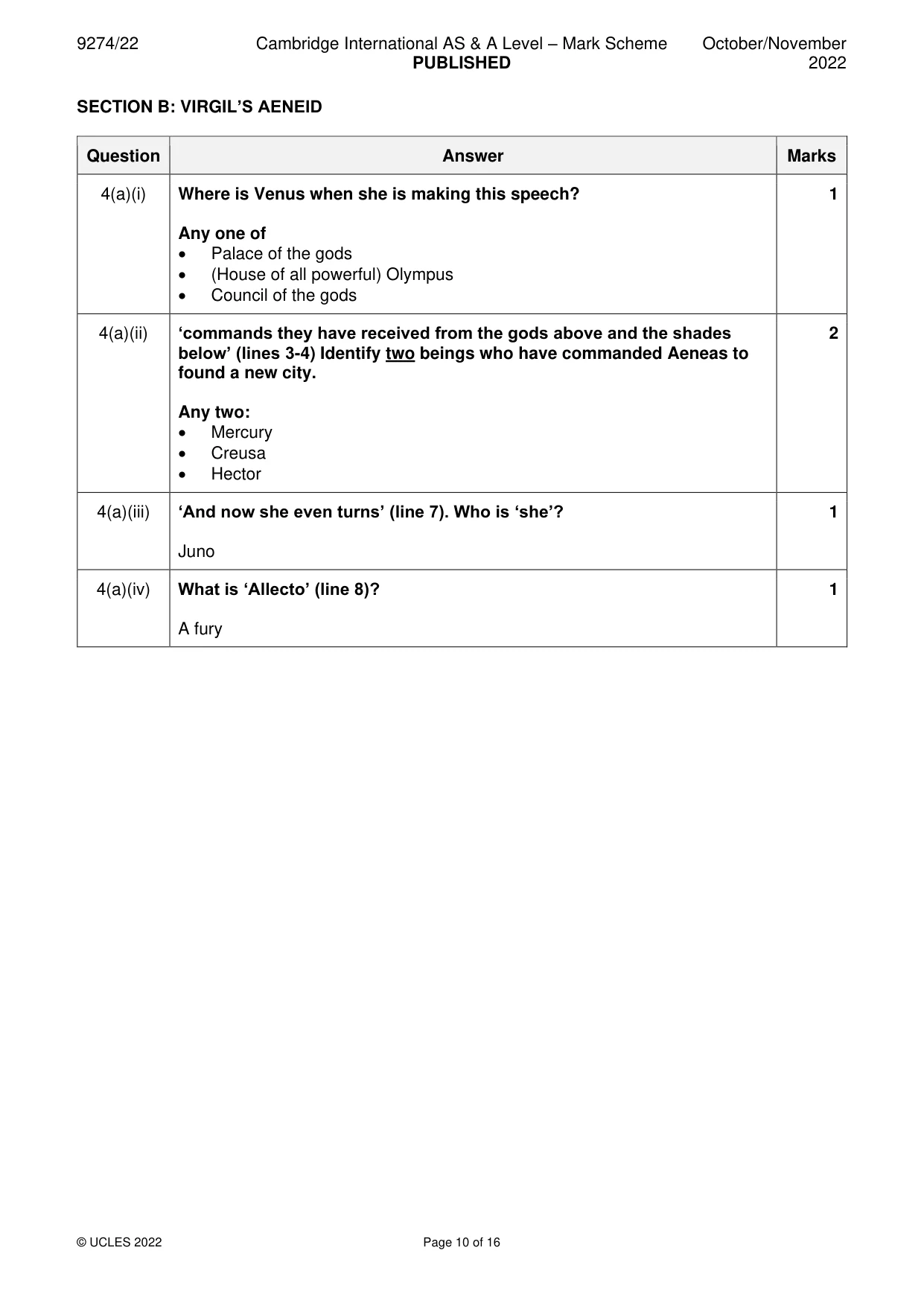
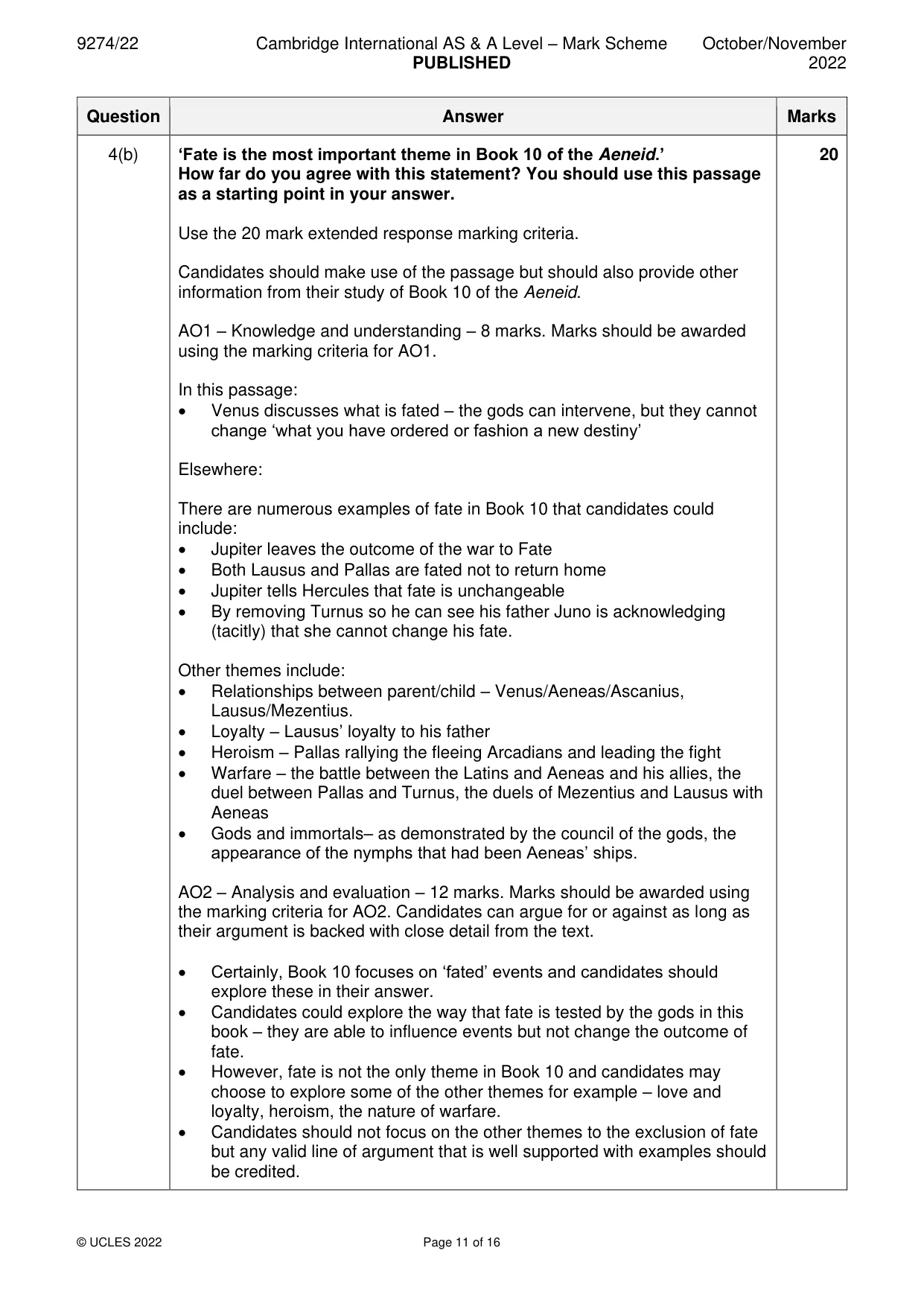
Mark scheme: 4(a)(i) Where is Venus when she is making this speech? 1 Any one of • Palace of the gods • (House of all powerful) Olympus • Council of the gods 4(a)(ii) ‘commands they have received from the gods above and the shades 2 below’ (lines 3-4) Identify two beings who have commanded Aeneas to found a new city. Any two: • Mercury • Creusa • Hector 4(a)(iii) ‘And now she even turns’ (line 7). Who is ‘she’? 1 Juno 4(a)(iv) What is ‘Allecto’ (line 8)? 1 A fury 4(b) ‘Fate is the most important theme in Book 10 of the Aeneid.’ 20 How far do you agree with this statement? You should use this passage as a starting point in your answer. Use the 20 mark extended response marking criteria. Candidates should make use of the passage but should also provide other information from their study of Book 10 of the Aeneid. AO1 – Knowledge and understanding – 8 marks. Marks should be awarded using the marking criteria for AO1. In this passage: • Venus discusses what is fated – the gods can intervene, but they cannot change ‘what you have ordered or fashion a new destiny’ Elsewhere: There are numerous examples of fate in Book 10 that candidates could include: • Jupiter leaves the outcome of the war to Fate • Both Lausus and Pallas are fated not to return home • Jupiter tells Hercules that fate is unchangeable • By removing Turnus so he can see his father Juno is acknowledging (tacitly) that she cannot change his fate. Other themes include: • Relationships between parent/child – Venus/Aeneas/Ascanius, Lausus/Mezentius. • Loyalty – Lausus’ loyalty to his father • Heroism – Pallas rallying the fleeing Arcadians and leading the fight • Warfare – the battle between the Latins and Aeneas and his allies, the duel between Pallas and Turnus, the duels of Mezentius and Lausus with Aeneas • Gods and immortals– as demonstrated by the council of the gods, the appearance of the nymphs that had been Aeneas’ ships. AO2 – Analysis and evaluation – 12 marks. Marks should be awarded using the marking criteria for AO2. Candidates can argue for or against as long as their argument is backed with close detail from the text. • Certainly, Book 10 focuses on ‘fated’ events and candidates should explore these in their answer. • Candidates could explore the way that fate is tested by the gods in this book – they are able to influence events but not change the outcome of fate. • However, fate is not the only theme in Book 10 and candidates may choose to explore some of the other themes for example – love and loyalty, heroism, the nature of warfare. • Candidates should not focus on the other themes to the exclusion of fate but any valid line of argument that is well supported with examples should be credited.
Q5 · ‘Virgil always depicts war and warfare negatively.’ How far is this statement true of the…
5 ‘Virgil always depicts war and warfare negatively.’ How far is this statement true of the books of the Aeneid you have studied? [25] OR
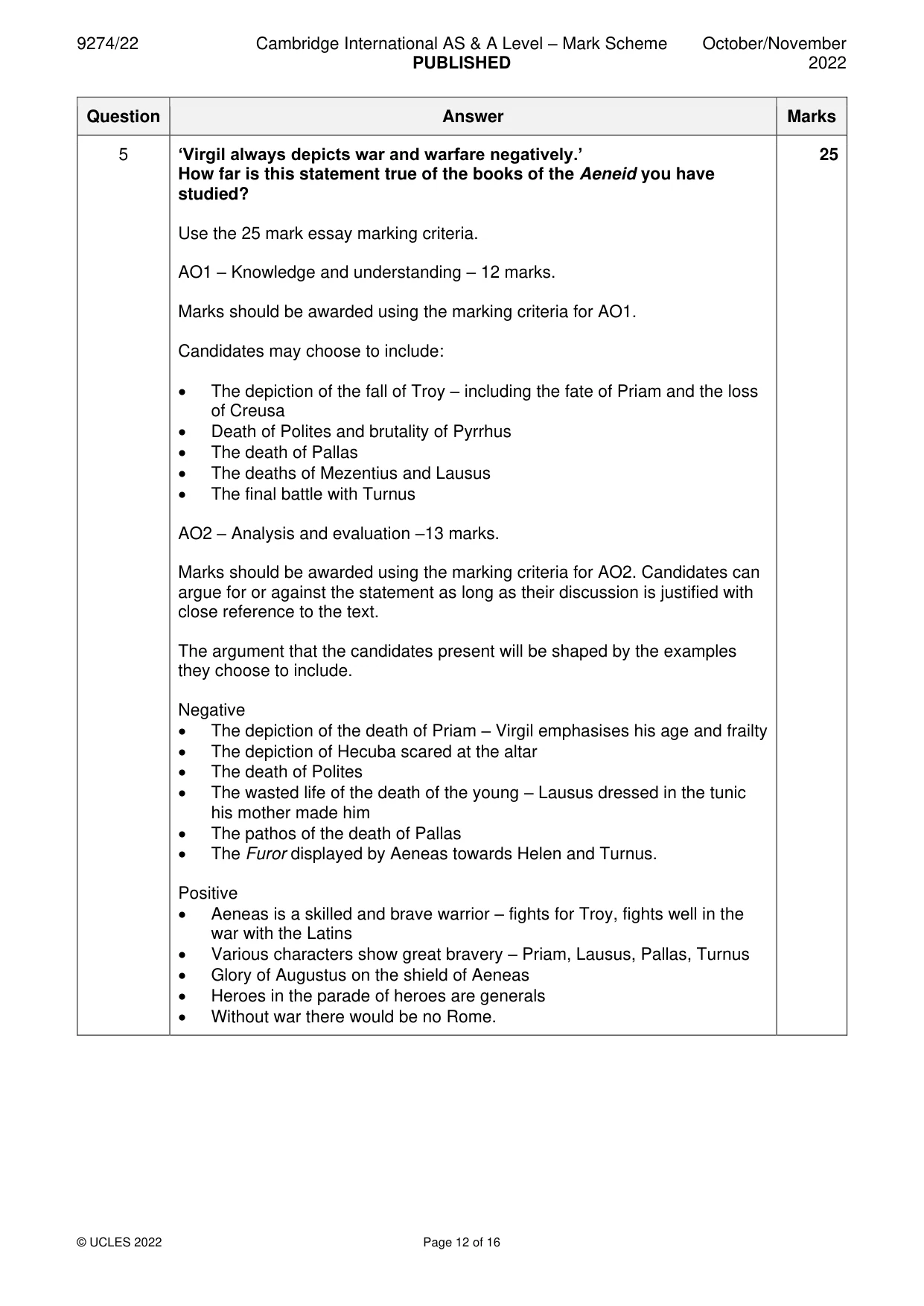
Mark scheme: 5 ‘Virgil always depicts war and warfare negatively.’ 25 How far is this statement true of the books of the Aeneid you have studied? Use the 25 mark essay marking criteria. AO1 – Knowledge and understanding – 12 marks. Marks should be awarded using the marking criteria for AO1. Candidates may choose to include: • The depiction of the fall of Troy – including the fate of Priam and the loss of Creusa • Death of Polites and brutality of Pyrrhus • The death of Pallas • The deaths of Mezentius and Lausus • The final battle with Turnus AO2 – Analysis and evaluation –13 marks. Marks should be awarded using the marking criteria for AO2. Candidates can argue for or against the statement as long as their discussion is justified with close reference to the text. The argument that the candidates present will be shaped by the examples they choose to include. Negative • The depiction of the death of Priam – Virgil emphasises his age and frailty • The depiction of Hecuba scared at the altar • The death of Polites • The wasted life of the death of the young – Lausus dressed in the tunic his mother made him • The pathos of the death of Pallas • The Furor displayed by Aeneas towards Helen and Turnus. Positive • Aeneas is a skilled and brave warrior – fights for Troy, fights well in the war with the Latins • Various characters show great bravery – Priam, Lausus, Pallas, Turnus • Glory of Augustus on the shield of Aeneas • Heroes in the parade of heroes are generals • Without war there would be no Rome.
Q6 · ‘Aeneas is never free to make his own decisions.’ How far do you agree with this…
6 ‘Aeneas is never free to make his own decisions.’ How far do you agree with this statement in the books of the Aeneid you have studied? [25] SECTION C: ARCHITECTURE OF THE ROMAN CITY Answer Question 7 and either Question 8 or Question 9.
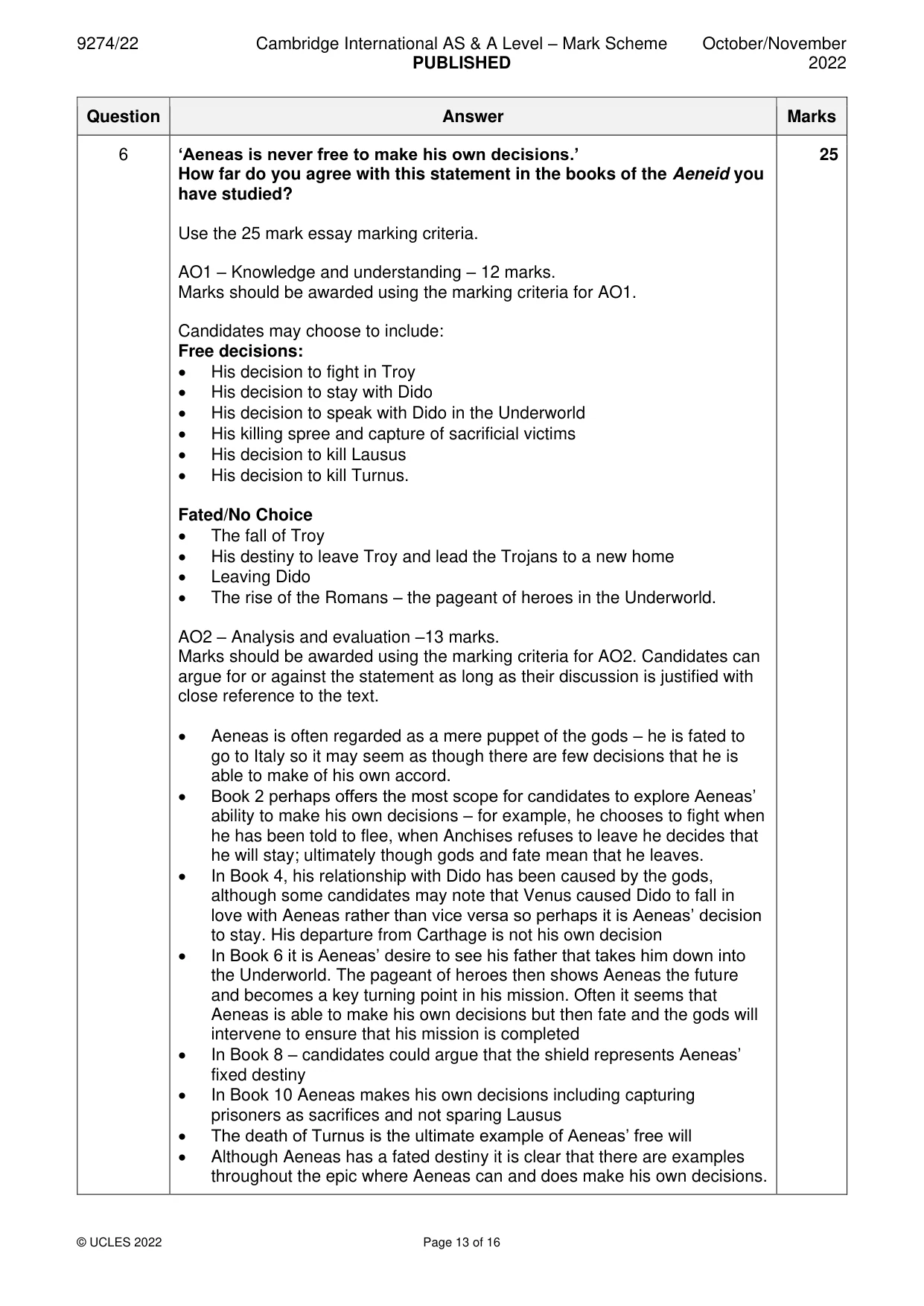
Mark scheme: 6 ‘Aeneas is never free to make his own decisions.’ 25 How far do you agree with this statement in the books of the Aeneid you have studied? Use the 25 mark essay marking criteria. AO1 – Knowledge and understanding – 12 marks. Marks should be awarded using the marking criteria for AO1. Candidates may choose to include: Free decisions: • His decision to fight in Troy • His decision to stay with Dido • His decision to speak with Dido in the Underworld • His killing spree and capture of sacrificial victims • His decision to kill Lausus • His decision to kill Turnus. Fated/No Choice • The fall of Troy • His destiny to leave Troy and lead the Trojans to a new home • Leaving Dido • The rise of the Romans – the pageant of heroes in the Underworld. AO2 – Analysis and evaluation –13 marks. Marks should be awarded using the marking criteria for AO2. Candidates can argue for or against the statement as long as their discussion is justified with close reference to the text. • Aeneas is often regarded as a mere puppet of the gods – he is fated to go to Italy so it may seem as though there are few decisions that he is able to make of his own accord. • Book 2 perhaps offers the most scope for candidates to explore Aeneas’ ability to make his own decisions – for example, he chooses to fight when he has been told to flee, when Anchises refuses to leave he decides that he will stay; ultimately though gods and fate mean that he leaves. • In Book 4, his relationship with Dido has been caused by the gods, although some candidates may note that Venus caused Dido to fall in love with Aeneas rather than vice versa so perhaps it is Aeneas’ decision to stay. His departure from Carthage is not his own decision • In Book 6 it is Aeneas’ desire to see his father that takes him down into the Underworld. The pageant of heroes then shows Aeneas the future and becomes a key turning point in his mission. Often it seems that Aeneas is able to make his own decisions but then fate and the gods will intervene to ensure that his mission is completed • In Book 8 – candidates could argue that the shield represents Aeneas’ fixed destiny • In Book 10 Aeneas makes his own decisions including capturing prisoners as sacrifices and not sparing Lausus • The death of Turnus is the ultimate example of Aeneas’ free will • Although Aeneas has a fated destiny it is clear that there are examples throughout the epic where Aeneas can and does make his own decisions. Section C: ARCHITECTURE OF THE ROMAN CITY
Q7 · Study the image below and answer the questions: A (a) (i) Identify the house shown in the…
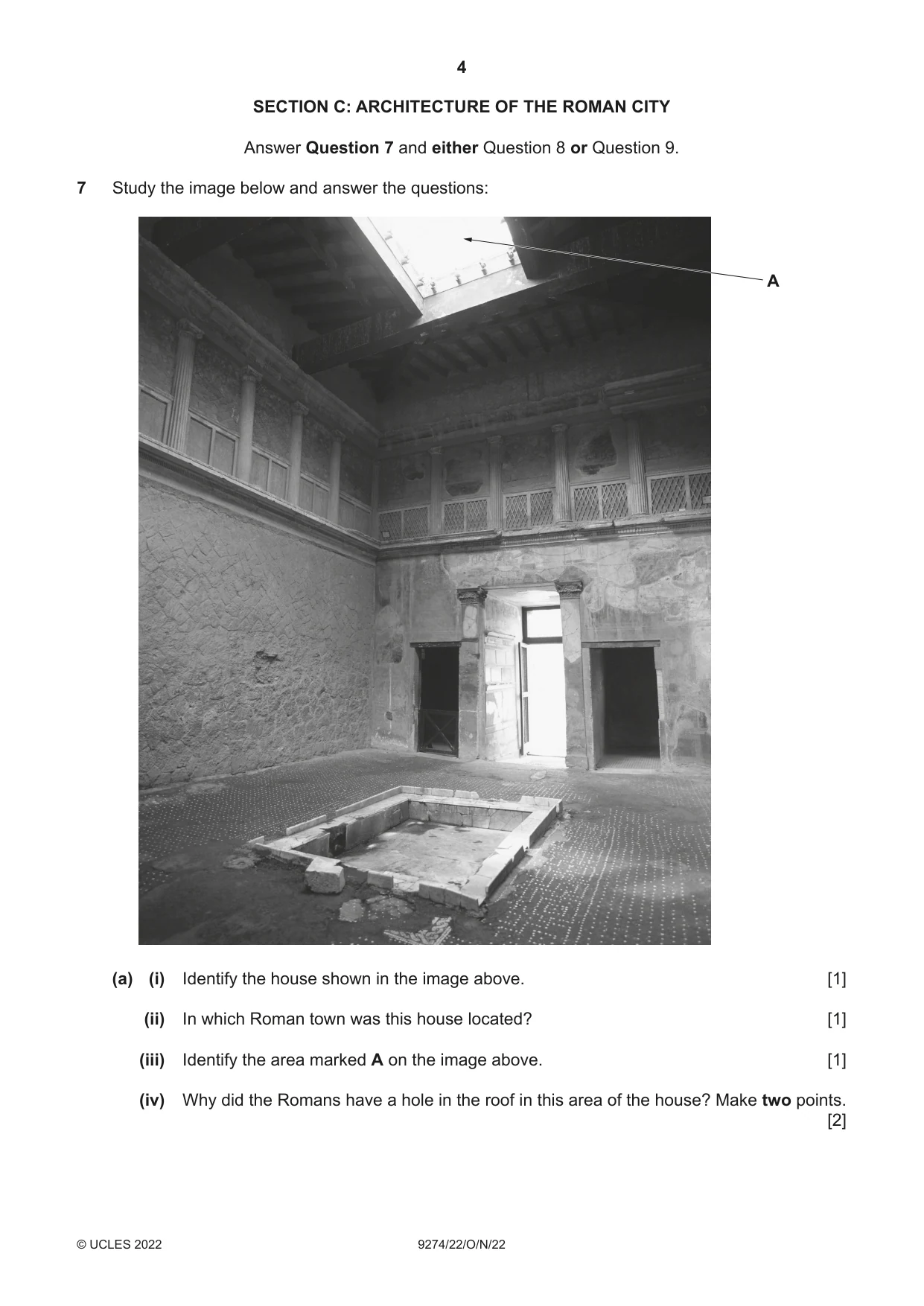
7 Study the image below and answer the questions: A (a) (i) Identify the house shown in the image above. [1] (ii) In which Roman town was this house located? [1] (iii) Identify the area marked A on the image above. [1] (iv) Why did the Romans have a hole in the roof in this area of the house? Make two points. [2] (b) ‘The most run-down and unattractive house in town.’ How far do you agree with this description of the house in the image? [20] [Total: 25] EITHER
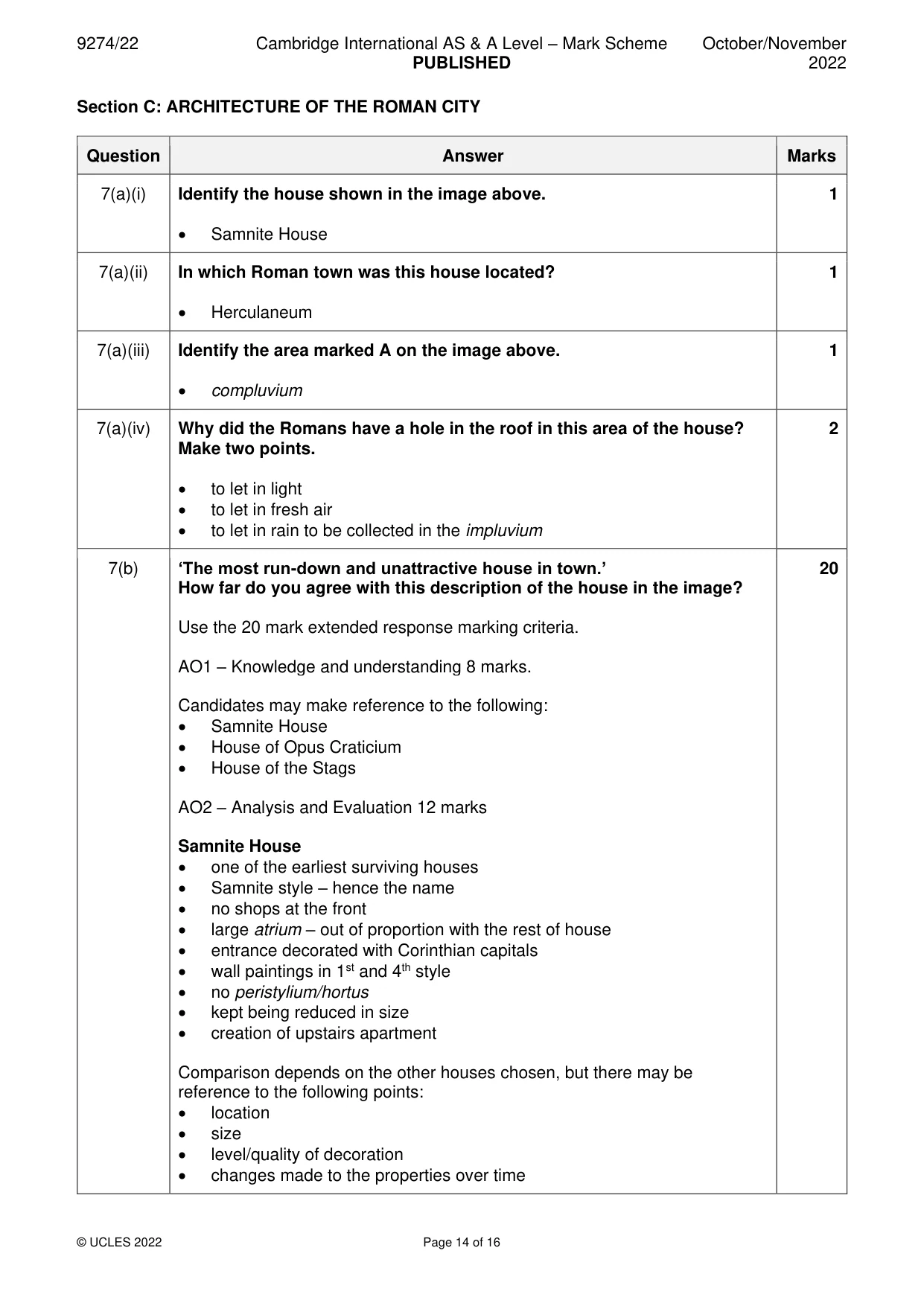
Mark scheme: 7(a)(i) Identify the house shown in the image above. 1 • Samnite House 7(a)(ii) In which Roman town was this house located? 1 • Herculaneum 7(a)(iii) Identify the area marked A on the image above. 1 • compluvium 7(a)(iv) Why did the Romans have a hole in the roof in this area of the house? 2 Make two points. • to let in light • to let in fresh air • to let in rain to be collected in the impluvium 7(b) ‘The most run-down and unattractive house in town.’ 20 How far do you agree with this description of the house in the image? Use the 20 mark extended response marking criteria. AO1 – Knowledge and understanding 8 marks. Candidates may make reference to the following: • Samnite House • House of Opus Craticium • House of the Stags AO2 – Analysis and Evaluation 12 marks Samnite House • one of the earliest surviving houses • Samnite style – hence the name • no shops at the front • large atrium – out of proportion with the rest of house • entrance decorated with Corinthian capitals • wall paintings in 1st and 4th style • no peristylium/hortus • kept being reduced in size • creation of upstairs apartment Comparison depends on the other houses chosen, but there may be reference to the following points: • location • size • level/quality of decoration • changes made to the properties over time
Q8 · ‘Roman architects were driven only by practical issues; they were not interested in…
8 ‘Roman architects were driven only by practical issues; they were not interested in aesthetic aspects.’ How far does your study of Roman public buildings support this view? In your answer, you should include discussion of at least three different types of buildings you have studied. [25] OR
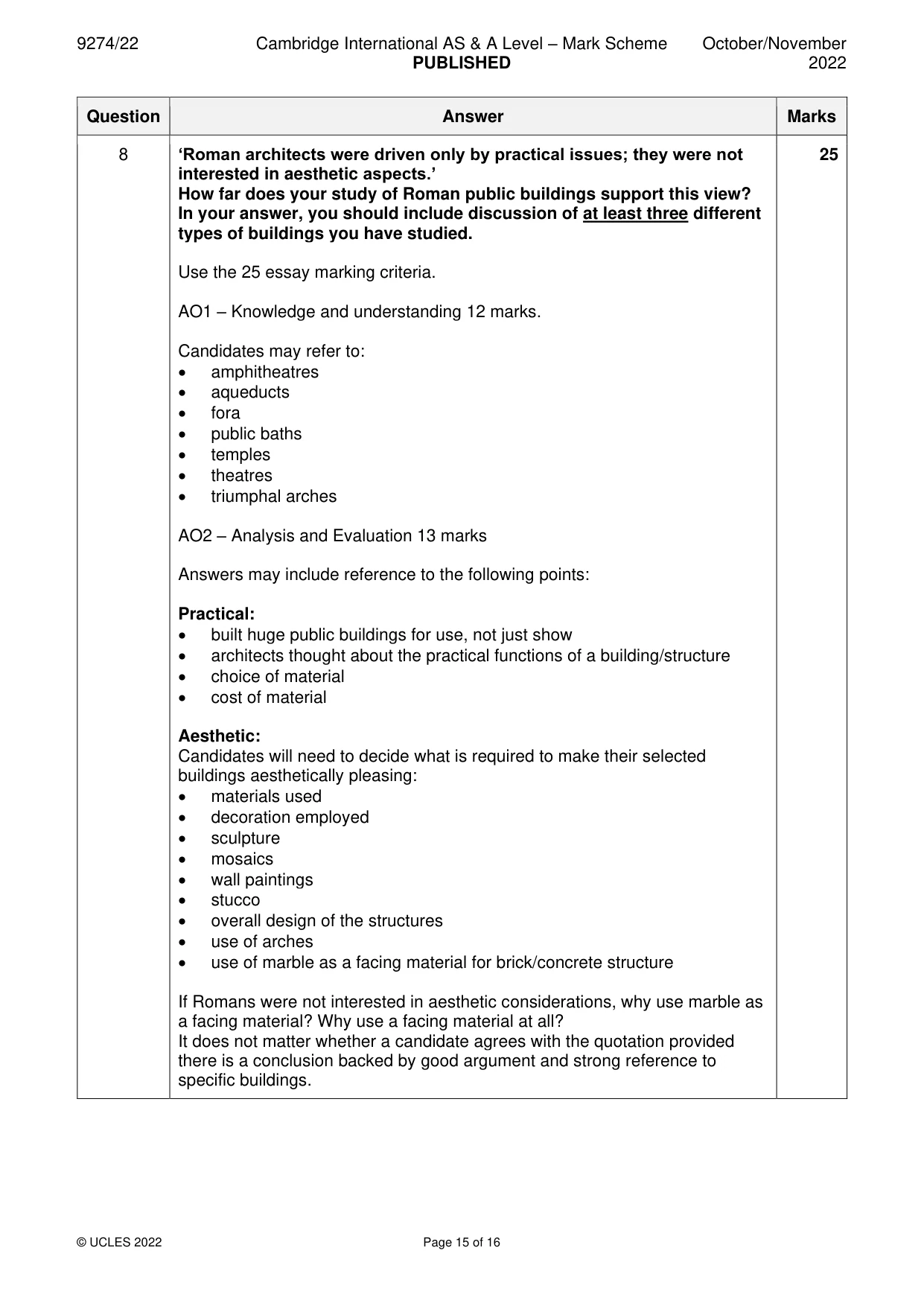
Mark scheme: 8 ‘Roman architects were driven only by practical issues; they were not 25 interested in aesthetic aspects.’ How far does your study of Roman public buildings support this view? In your answer, you should include discussion of at least three different types of buildings you have studied. Use the 25 essay marking criteria. AO1 – Knowledge and understanding 12 marks. Candidates may refer to: • amphitheatres • aqueducts • fora • public baths • temples • theatres • triumphal arches AO2 – Analysis and Evaluation 13 marks Answers may include reference to the following points: Practical: • built huge public buildings for use, not just show • architects thought about the practical functions of a building/structure • choice of material • cost of material Aesthetic: Candidates will need to decide what is required to make their selected buildings aesthetically pleasing: • materials used • decoration employed • sculpture • mosaics • wall paintings • stucco • overall design of the structures • use of arches • use of marble as a facing material for brick/concrete structure If Romans were not interested in aesthetic considerations, why use marble as a facing material? Why use a facing material at all? It does not matter whether a candidate agrees with the quotation provided there is a conclusion backed by good argument and strong reference to specific buildings.
Q9 · How well did the design of Roman theatres meet the needs of the audience?
9 How well did the design of Roman theatres meet the needs of the audience? In your answer, you should refer to at least two theatres which you have studied. [25]
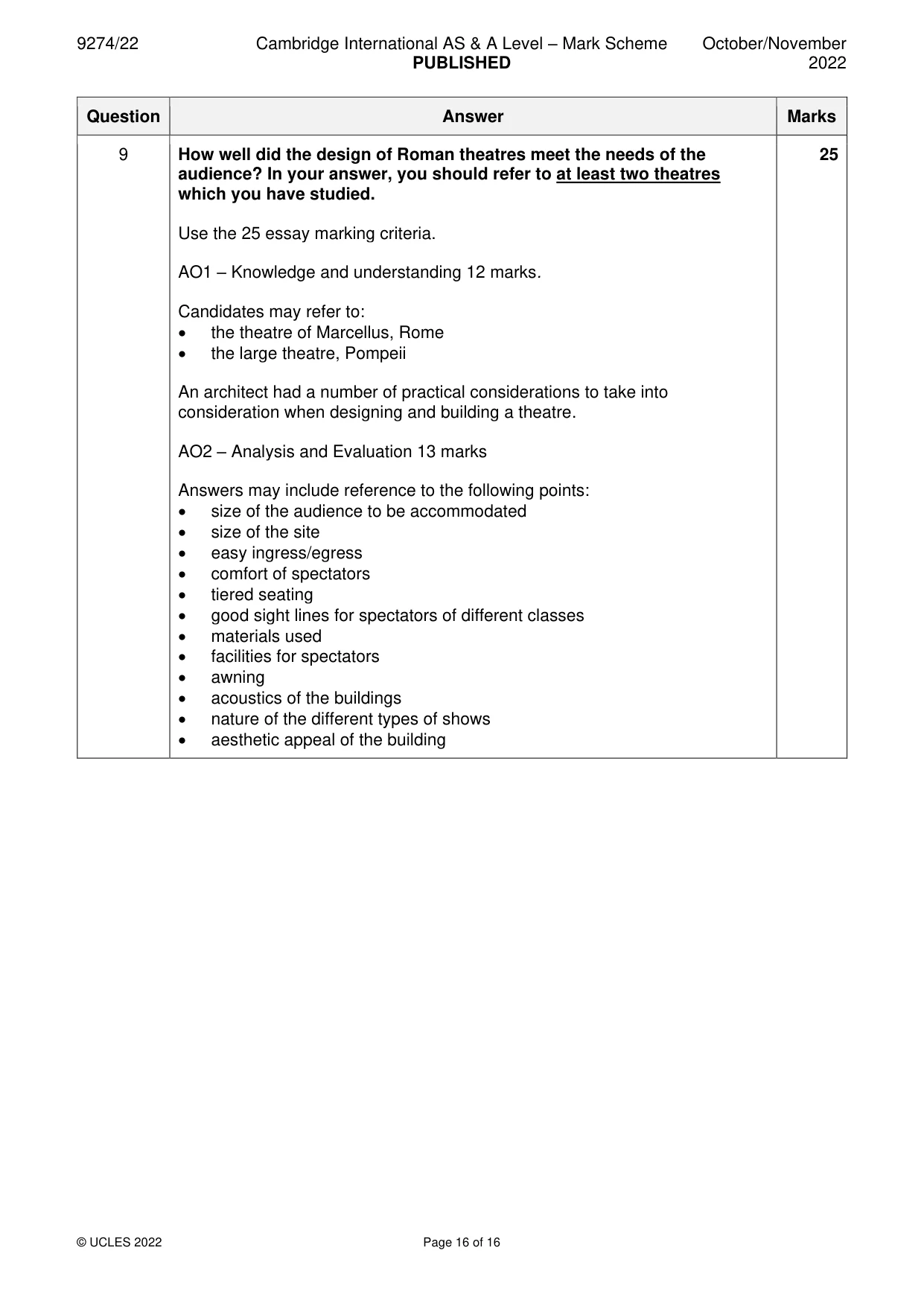
Mark scheme: 9 How well did the design of Roman theatres meet the needs of the 25 audience? In your answer, you should refer to at least two theatres which you have studied. Use the 25 essay marking criteria. AO1 – Knowledge and understanding 12 marks. Candidates may refer to: • the theatre of Marcellus, Rome • the large theatre, Pompeii An architect had a number of practical considerations to take into consideration when designing and building a theatre. AO2 – Analysis and Evaluation 13 marks Answers may include reference to the following points: • size of the audience to be accommodated • size of the site • easy ingress/egress • comfort of spectators • tiered seating • good sight lines for spectators of different classes • materials used • facilities for spectators • awning • acoustics of the buildings • nature of the different types of shows • aesthetic appeal of the building
What was in this paper
The subtopics covered by these 9 questions, and how many questions each got. Open one in a new tab to see every Cambridge question on it.
What you needed in this session
Cambridge’s own grade thresholds for 2022 Oct/Nov, Paper 2 · Variant 2. A higher threshold means an easier paper — the bar moves with how the cohort did.