Cambridge A Level Classical Studies 9274 — 2021 Oct/Nov Paper 2 · Variant 2
9274/22/O/N/21 · 50 marks · ≈56 min
The question paper and its mark scheme, free to read here and free to download. This is Cambridge’s own paper, exactly as it was sat.
Question paper8 pages


Mark scheme17 pages
Answers below. Sit the paper first if you are practising.
Paper as text
Question paper, page 1
This document has 8 pages. Any blank pages are indicated. Cambridge International AS & A Level CLASSICAL STUDIES 9274/22 Paper 2 Roman Civilisation October/November 2021 1 hour 30 minutes You must answer on the enclosed answer booklet. You will need: Answer booklet (enclosed) INSTRUCTIONS ● Answer two questions in total: Answer one question from two different sections. ● Follow the instructions on the front cover of the answer booklet. If you need additional answer paper, ask the invigilator for a continuation booklet. INFORMATION ● The total mark for this paper is 50. ● Each question is worth 25 marks. * 1 1 9 9 4 8 7 6 7 6 * DC (PQ) 222719 © UCLES 2021 [Turn over
Question paper, page 2
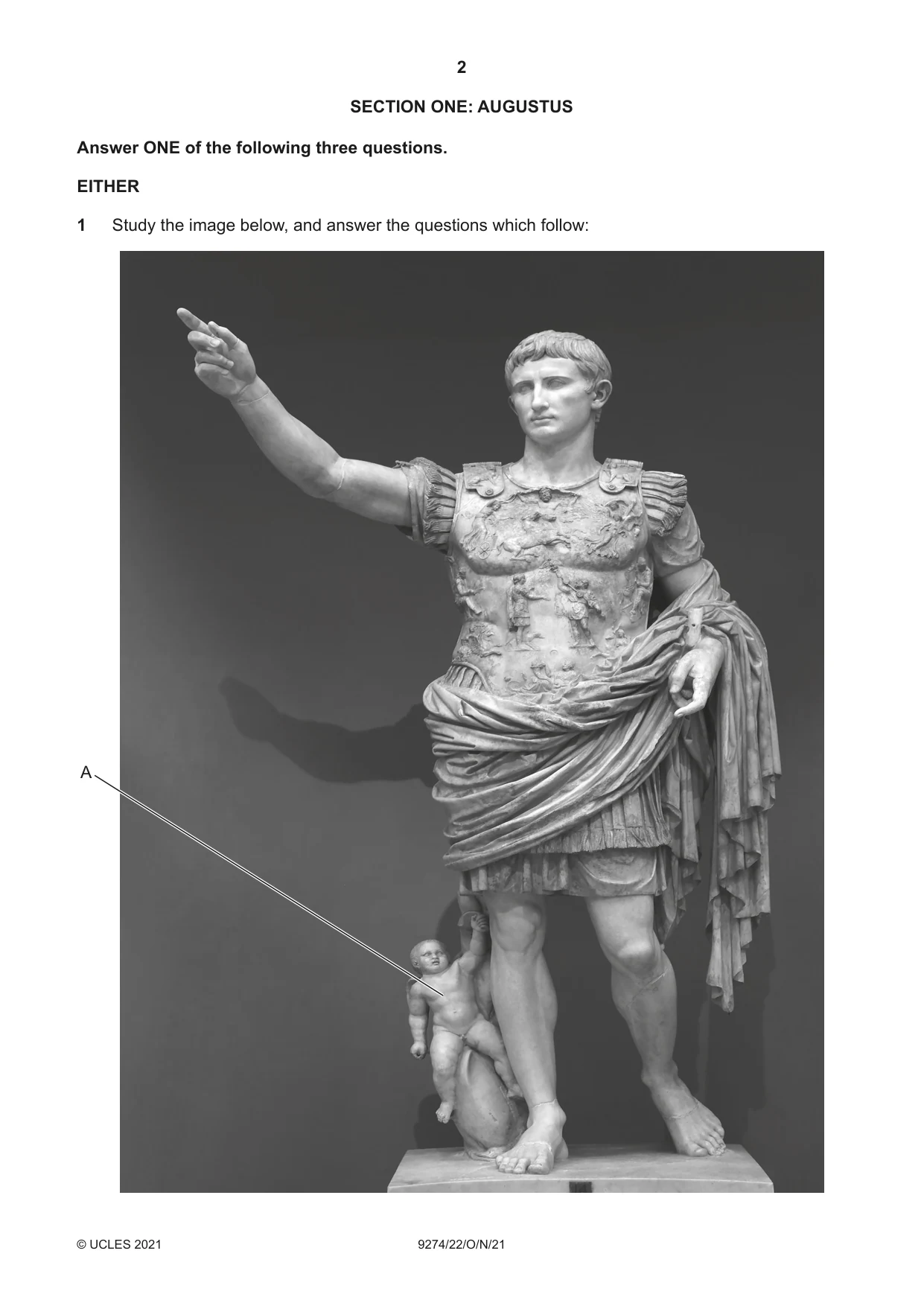
2 9274/22/O/N/21 © UCLES 2021 SECTION ONE: AUGUSTUS Answer ONE of the following three questions. EITHER 1 Study the image below, and answer the questions which follow: A
Question paper, page 3
3 9274/22/O/N/21 © UCLES 2021 [Turn over (i) What is the name given to this statue of Augustus? [2] (ii) Identify Figure A. [1] (iii) What is the significance of Figure A? [3] (iv) What event is shown on the breastplate of the statue? [2] (v) What is the significance of Augustus being portrayed with bare feet? [2] (vi) ‘Sculpture was a more effective form of propaganda for Augustus than literature.’ Using this image as a starting point, explain how far you agree with this statement. [15] [Total: 25] OR 2 Explain how far you agree with Augustus’ statement in the Res Gestae that he ‘successfully championed the liberty of the republic’. [25] OR 3 ‘The most important aim of Augustus during his reign was to ensure that he was succeeded by a member of his family.’ Explain how far you agree with this statement. [25]
Question paper, page 4
4 9274/22/O/N/21 © UCLES 2021 SECTION TWO: VIRGIL Answer ONE of the following three questions. EITHER 4 Read the passage below, and answer the questions which follow: ‘We come from the ancient city of Troy, if the name of Troy has ever reached your ears. We have sailed many seas and by the chance of the winds we have been driven ashore here in Libya. I am Aeneas, known for my devotion. I carry with me on my ships the gods of my home, the Penates, wrested from my enemies, and my fame has reached beyond the skies. I am searching for my fatherland in Italy. My descent is from highest Jupiter. With my goddess mother to show the way, I embarked upon the Phrygian sea with twenty ships, following the destiny which had been given to me, and now a bare seven of them remain, and these torn to pieces by wind and wave. I am a helpless stranger, driven out of Europe and out of Asia, tramping the desert wastes of Libya.’ (Virgil, Aeneid 1) (i) ‘We come from the ancient city of Troy’ (line 1). Name one person who told Aeneas to leave Troy. [1] (ii) Which two immortals caused the storm that shipwrecked Aeneas? [2] (iii) Give the name of Aeneas’ ‘goddess mother’ (line 6). [1] (iv) Pick out and explain three ways in which Virgil creates sympathy for Aeneas in this passage. [6] (v) ‘following the destiny which had been given to me’ (line 7). Using this passage as a starting point, consider to what extent Aeneas is in control of his own destiny. [15] [Total: 25] OR 5 ‘Aeneas is a completely unlikeable hero.’ How far do you agree with this statement? [25] OR 6 ‘A hero motivated mostly by love.’ To what extent do you agree with this description of Aeneas? [25] 5 10
Question paper, page 5
5 9274/22/O/N/21 © UCLES 2021 [Turn over 5 10 15 20 SECTION THREE: JUVENAL Answer ONE of the following three questions. EITHER 7 Read the passage below, and answer the questions which follow: For the lower-income guests some dubious toadstools: for my lord, a rare mushroom, the kind that Claudius guzzled (until his wife fed him one that wrote finis to his eating). For himself, and his fellow-tycoons, friend Virro will order the choicest fruits to be served, their scent is a feast in itself, fruit such as grew in Phaeacia’s eternal autumn, or might, you feel, have been rifled from the Hesperides. For yourself, a rotten apple, the sort munched on the Embankment by monkeys with shield and helmet, cringing beneath the whip as they learn to throw spears from the back of some shaggy she-goat. Perhaps you think Virro’s close-fisted? No way. He does it to make you suffer. What farce, what pantomime could elicit bigger laughs than your pleading gullet? His whole idea – in case you didn’t get it – is simply to reduce you to furious tears, an endless grinding of molars. You see yourself as a free man, your lord’s invited guest; but he assumes you’ve been hooked by the smell from his kitchen – and he’s not far wrong. For what self-respecting person, however down-and-out, whether born to the purple or a simple peasant, would put up with Virro twice? (Juvenal, Satire 5) (i) Who was Claudius (line 2)? [1] (ii) Explain the reference to the Hesperides (line 7). [3] (iii) From this passage, find three examples of Juvenal’s satiric technique. Write out each example, identify the technique and explain its effect. [6] (iv) Using this passage as a starting point, explain how successfully Juvenal shows, in Satire 5, that the life of a client is miserable. [15] [Total: 25] OR 8 ‘Rome was a dangerous place.’ Is this the only conclusion we can arrive at from reading Satire 3? [25] OR 9 To what extent do you agree that Juvenal’s satires cannot be appreciated by a modern audience? [25]
Question paper, page 6
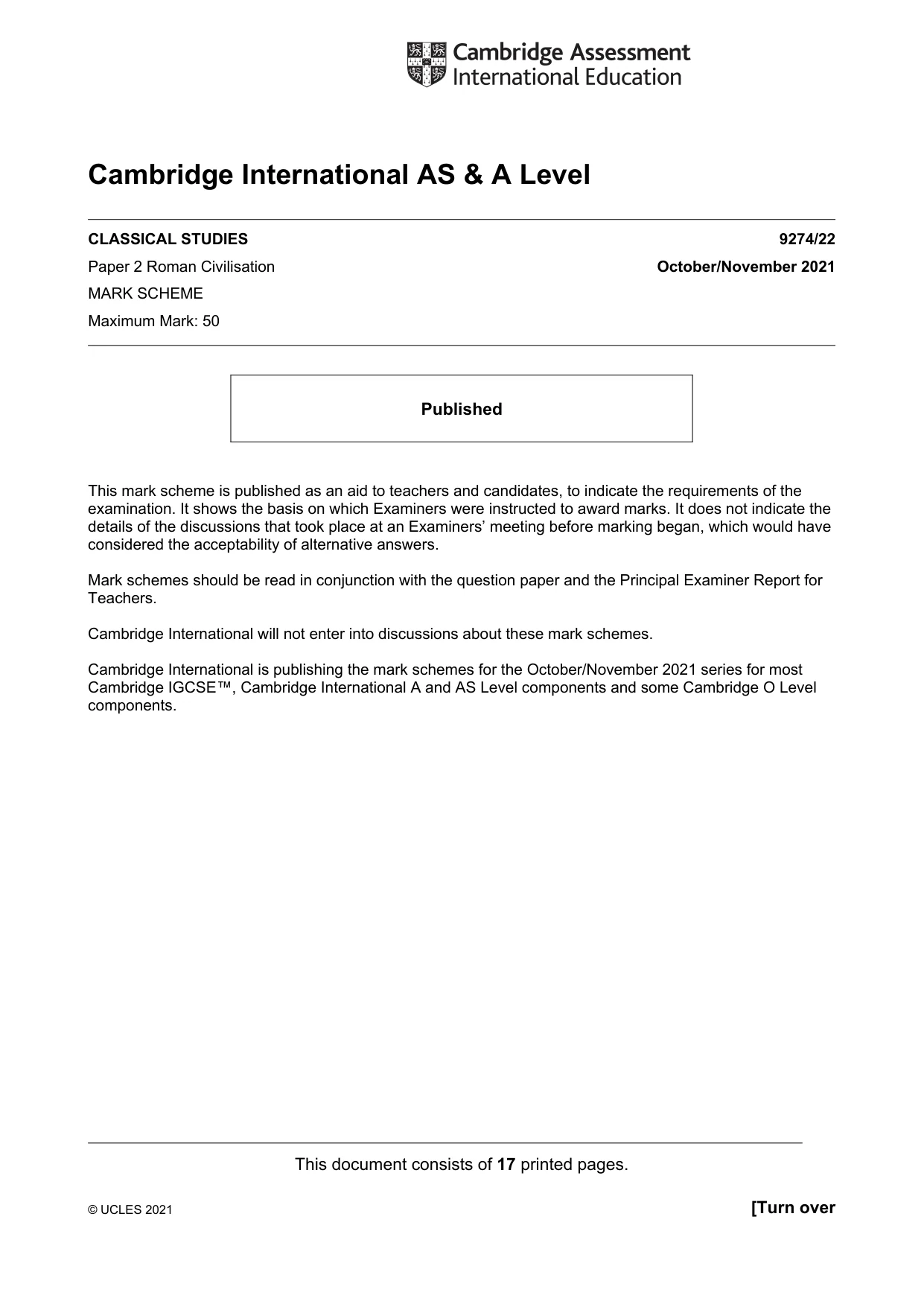
6 9274/22/O/N/21 © UCLES 2021 SECTION FOUR: ROMAN ARCHITECTURE Answer ONE of the following three questions. EITHER 10 Study the photograph below of a bathing complex and answer the questions which follow: (i) In which country and city is this building? [2] (ii) Which emperor commissioned these baths? [1] (iii) What date was it built? [1] (iv) Name three rooms that were found in this complex and explain what each was used for. [6] (v) Compare this bathing complex with one other complex of the same type. Which do you think was the more impressive set of baths and why? [15] [Total: 25] OR 11 ‘The theatre at Leptis Magna shows the most practical architectural design of all Roman buildings.’ To what extent do you agree with this view? In your answer, you should compare this theatre to at least two other buildings. [25] OR 12 ‘Decorating buildings served no purpose.’ How far do you agree with this statement? In your answer, you should consider at least three buildings that you have studied. [25]
Question paper, page 7
7 9274/22/O/N/21 © UCLES 2021 BLANK PAGE
Question paper, page 8
8 9274/22/O/N/21 © UCLES 2021 Permission to reproduce items where third-party owned material protected by copyright is included has been sought and cleared where possible. Every reasonable effort has been made by the publisher (UCLES) to trace copyright holders, but if any items requiring clearance have unwittingly been included, the publisher will be pleased to make amends at the earliest possible opportunity. To avoid the issue of disclosure of answer-related information to candidates, all copyright acknowledgements are reproduced online in the Cambridge Assessment International Education Copyright Acknowledgements Booklet. This is produced for each series of examinations and is freely available to download at www.cambridgeinternational.org after the live examination series. Cambridge Assessment International Education is part of the Cambridge Assessment Group. Cambridge Assessment is the brand name of the University of Cambridge Local Examinations Syndicate (UCLES), which itself is a department of the University of Cambridge. BLANK PAGE
Mark scheme, page 1
This document consists of 17 printed pages. © UCLES 2021 [Turn over Cambridge International AS & A Level CLASSICAL STUDIES 9274/22 Paper 2 Roman Civilisation October/November 2021 MARK SCHEME Maximum Mark: 50 Published This mark scheme is published as an aid to teachers and candidates, to indicate the requirements of the examination. It shows the basis on which Examiners were instructed to award marks. It does not indicate the details of the discussions that took place at an Examiners’ meeting before marking began, which would have considered the acceptability of alternative answers. Mark schemes should be read in conjunction with the question paper and the Principal Examiner Report for Teachers. Cambridge International will not enter into discussions about these mark schemes. Cambridge International is publishing the mark schemes for the October/November 2021 series for most Cambridge IGCSE™, Cambridge International A and AS Level components and some Cambridge O Level components.
Mark scheme, page 2
9274/22 Cambridge International AS & A Level – Mark Scheme PUBLISHED October/November 2021 © UCLES 2021 Page 2 of 17 Generic Marking Principles These general marking principles must be applied by all examiners when marking candidate answers. They should be applied alongside the specific content of the mark scheme or generic level descriptors for a question. Each question paper and mark scheme will also comply with these marking principles. GENERIC MARKING PRINCIPLE 1: Marks must be awarded in line with: • the specific content of the mark scheme or the generic level descriptors for the question • the specific skills defined in the mark scheme or in the generic level descriptors for the question • the standard of response required by a candidate as exemplified by the standardisation scripts. GENERIC MARKING PRINCIPLE 2: Marks awarded are always whole marks (not half marks, or other fractions). GENERIC MARKING PRINCIPLE 3: Marks must be awarded positively: • marks are awarded for correct/valid answers, as defined in the mark scheme. However, credit is given for valid answers which go beyond the scope of the syllabus and mark scheme, referring to your Team Leader as appropriate • marks are awarded when candidates clearly demonstrate what they know and can do • marks are not deducted for errors • marks are not deducted for omissions • answers should only be judged on the quality of spelling, punctuation and grammar when these features are specifically assessed by the question as indicated by the mark scheme. The meaning, however, should be unambiguous. GENERIC MARKING PRINCIPLE 4: Rules must be applied consistently, e.g. in situations where candidates have not followed instructions or in the application of generic level descriptors. GENERIC MARKING PRINCIPLE 5: Marks should be awarded using the full range of marks defined in the mark scheme for the question (however; the use of the full mark range may be limited according to the quality of the candidate responses seen). GENERIC MARKING PRINCIPLE 6: Marks awarded are based solely on the requirements as defined in the mark scheme. Marks should not be awarded with grade thresholds or grade descriptors in mind.
Mark scheme, page 3
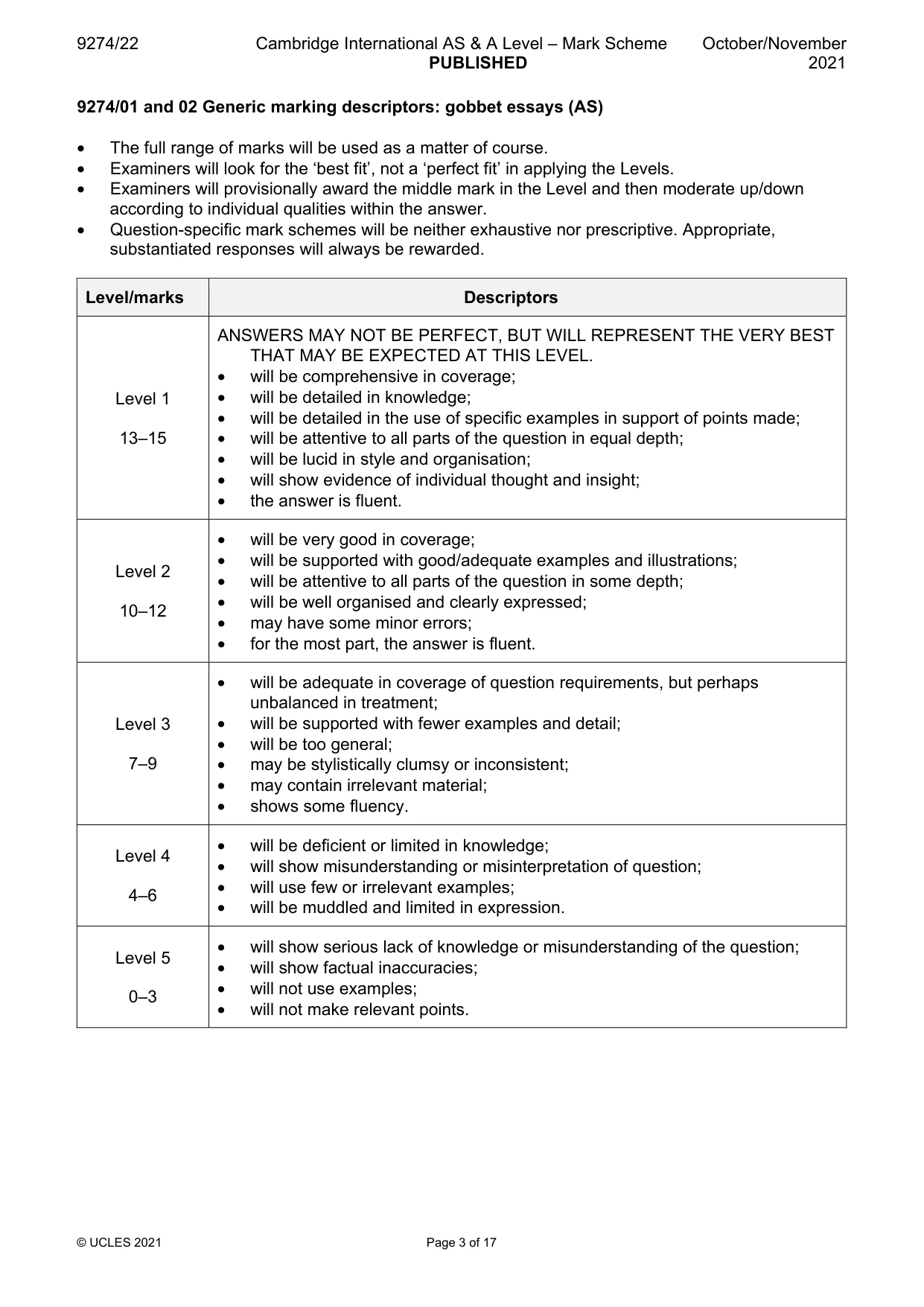
9274/22 Cambridge International AS & A Level – Mark Scheme PUBLISHED October/November 2021 © UCLES 2021 Page 3 of 17 9274/01 and 02 Generic marking descriptors: gobbet essays (AS) • The full range of marks will be used as a matter of course. • Examiners will look for the ‘best fit’, not a ‘perfect fit’ in applying the Levels. • Examiners will provisionally award the middle mark in the Level and then moderate up/down according to individual qualities within the answer. • Question-specific mark schemes will be neither exhaustive nor prescriptive. Appropriate, substantiated responses will always be rewarded. Level/marks Descriptors Level 1 13–15 ANSWERS MAY NOT BE PERFECT, BUT WILL REPRESENT THE VERY BEST THAT MAY BE EXPECTED AT THIS LEVEL. • will be comprehensive in coverage; • will be detailed in knowledge; • will be detailed in the use of specific examples in support of points made; • will be attentive to all parts of the question in equal depth; • will be lucid in style and organisation; • will show evidence of individual thought and insight; • the answer is fluent. Level 2 10–12 • will be very good in coverage; • will be supported with good/adequate examples and illustrations; • will be attentive to all parts of the question in some depth; • will be well organised and clearly expressed; • may have some minor errors; • for the most part, the answer is fluent. Level 3 7–9 • will be adequate in coverage of question requirements, but perhaps unbalanced in treatment; • will be supported with fewer examples and detail; • will be too general; • may be stylistically clumsy or inconsistent; • may contain irrelevant material; • shows some fluency. Level 4 4–6 • will be deficient or limited in knowledge; • will show misunderstanding or misinterpretation of question; • will use few or irrelevant examples; • will be muddled and limited in expression. Level 5 0–3 • will show serious lack of knowledge or misunderstanding of the question; • will show factual inaccuracies; • will not use examples; • will not make relevant points.
Mark scheme, page 4
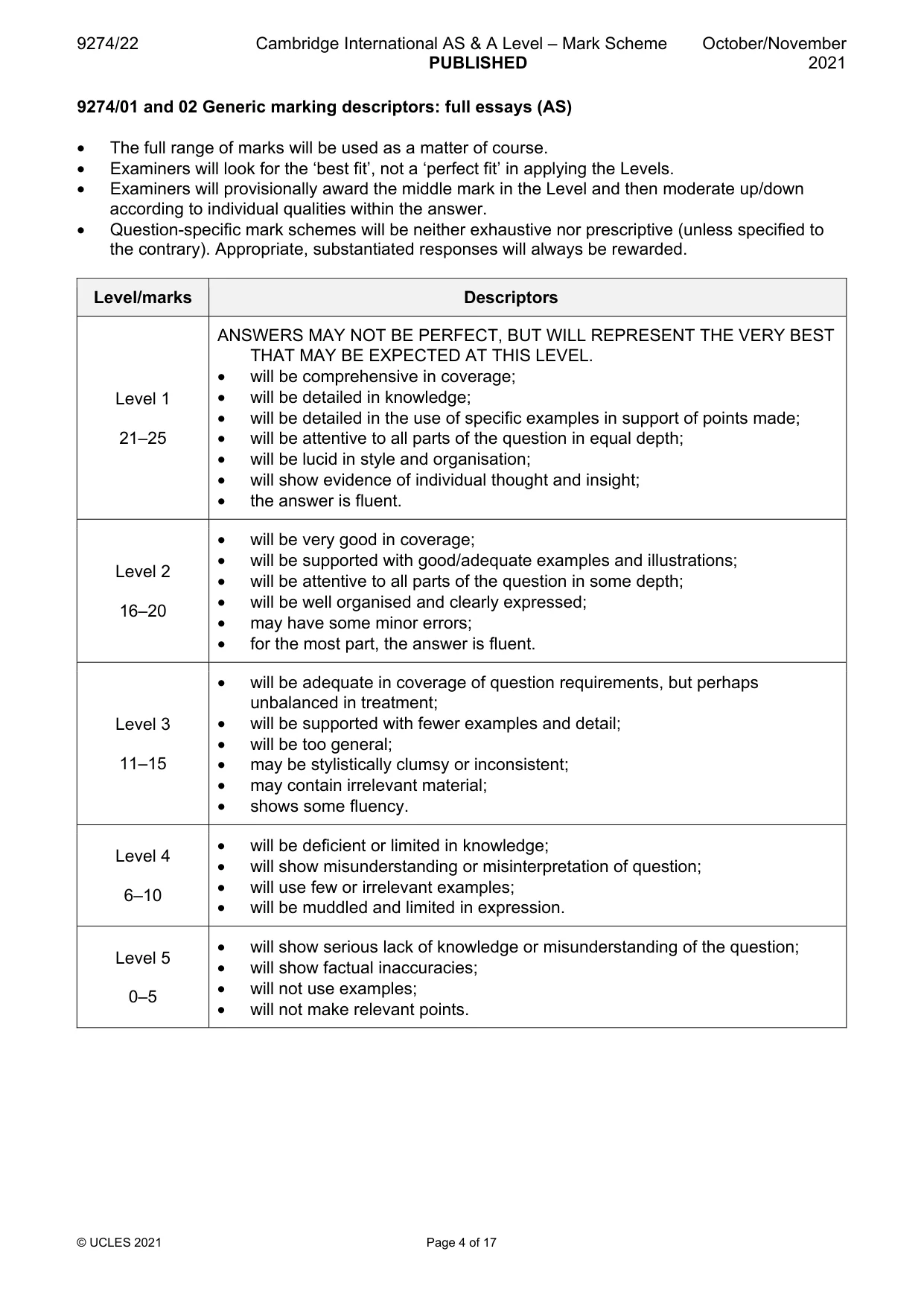
9274/22 Cambridge International AS & A Level – Mark Scheme PUBLISHED October/November 2021 © UCLES 2021 Page 4 of 17 9274/01 and 02 Generic marking descriptors: full essays (AS) • The full range of marks will be used as a matter of course. • Examiners will look for the ‘best fit’, not a ‘perfect fit’ in applying the Levels. • Examiners will provisionally award the middle mark in the Level and then moderate up/down according to individual qualities within the answer. • Question-specific mark schemes will be neither exhaustive nor prescriptive (unless specified to the contrary). Appropriate, substantiated responses will always be rewarded. Level/marks Descriptors Level 1 21–25 ANSWERS MAY NOT BE PERFECT, BUT WILL REPRESENT THE VERY BEST THAT MAY BE EXPECTED AT THIS LEVEL. • will be comprehensive in coverage; • will be detailed in knowledge; • will be detailed in the use of specific examples in support of points made; • will be attentive to all parts of the question in equal depth; • will be lucid in style and organisation; • will show evidence of individual thought and insight; • the answer is fluent. Level 2 16–20 • will be very good in coverage; • will be supported with good/adequate examples and illustrations; • will be attentive to all parts of the question in some depth; • will be well organised and clearly expressed; • may have some minor errors; • for the most part, the answer is fluent. Level 3 11–15 • will be adequate in coverage of question requirements, but perhaps unbalanced in treatment; • will be supported with fewer examples and detail; • will be too general; • may be stylistically clumsy or inconsistent; • may contain irrelevant material; • shows some fluency. Level 4 6–10 • will be deficient or limited in knowledge; • will show misunderstanding or misinterpretation of question; • will use few or irrelevant examples; • will be muddled and limited in expression. Level 5 0–5 • will show serious lack of knowledge or misunderstanding of the question; • will show factual inaccuracies; • will not use examples; • will not make relevant points.
Mark scheme, page 5
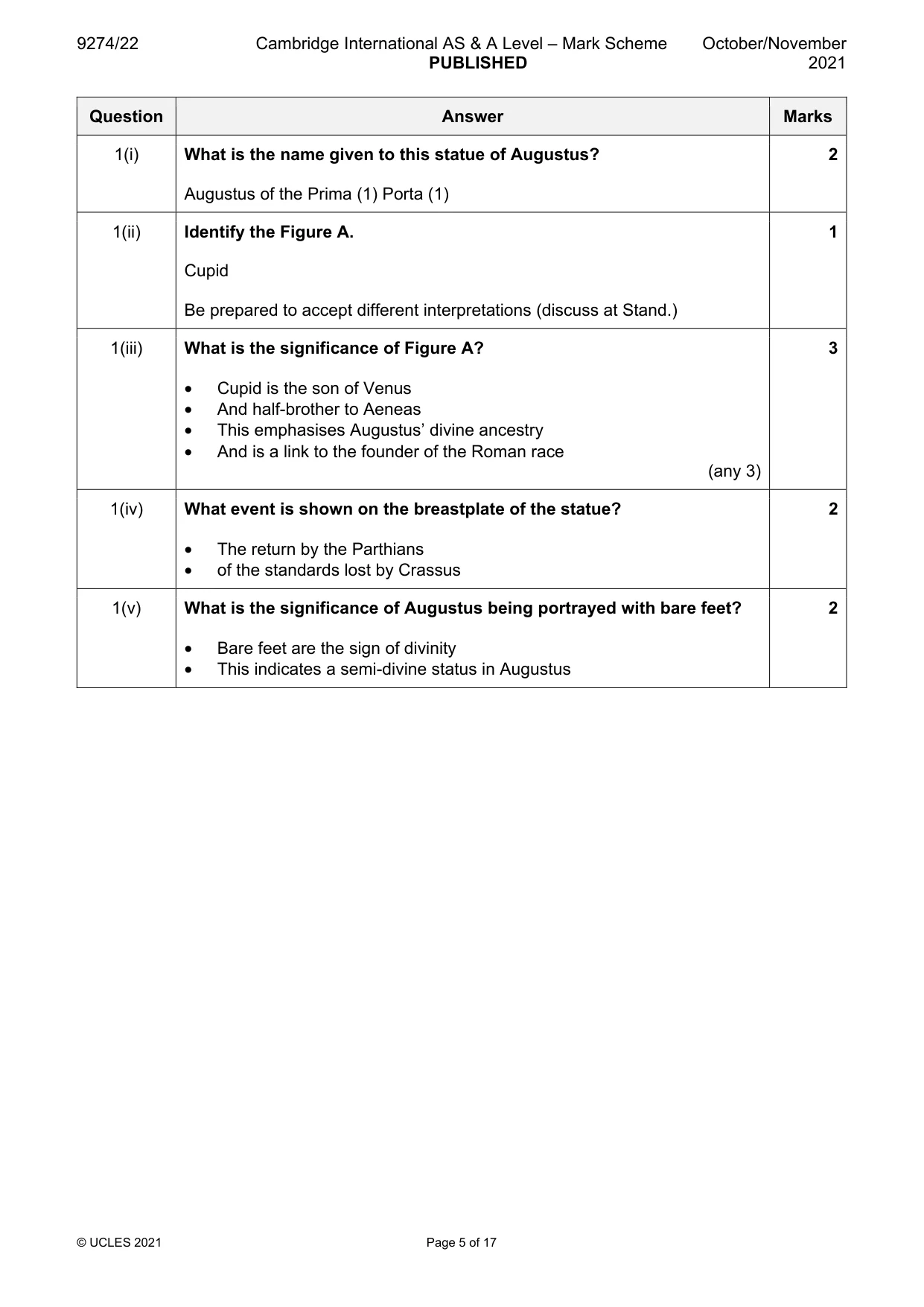
9274/22 Cambridge International AS & A Level – Mark Scheme PUBLISHED October/November 2021 © UCLES 2021 Page 5 of 17 Question Answer Marks 1(i) What is the name given to this statue of Augustus? Augustus of the Prima (1) Porta (1) 2 1(ii) Identify the Figure A. Cupid Be prepared to accept different interpretations (discuss at Stand.) 1 1(iii) What is the significance of Figure A? • Cupid is the son of Venus • And half-brother to Aeneas • This emphasises Augustus’ divine ancestry • And is a link to the founder of the Roman race (any 3) 3 1(iv) What event is shown on the breastplate of the statue? • The return by the Parthians • of the standards lost by Crassus 2 1(v) What is the significance of Augustus being portrayed with bare feet? • Bare feet are the sign of divinity • This indicates a semi-divine status in Augustus 2
Mark scheme, page 6
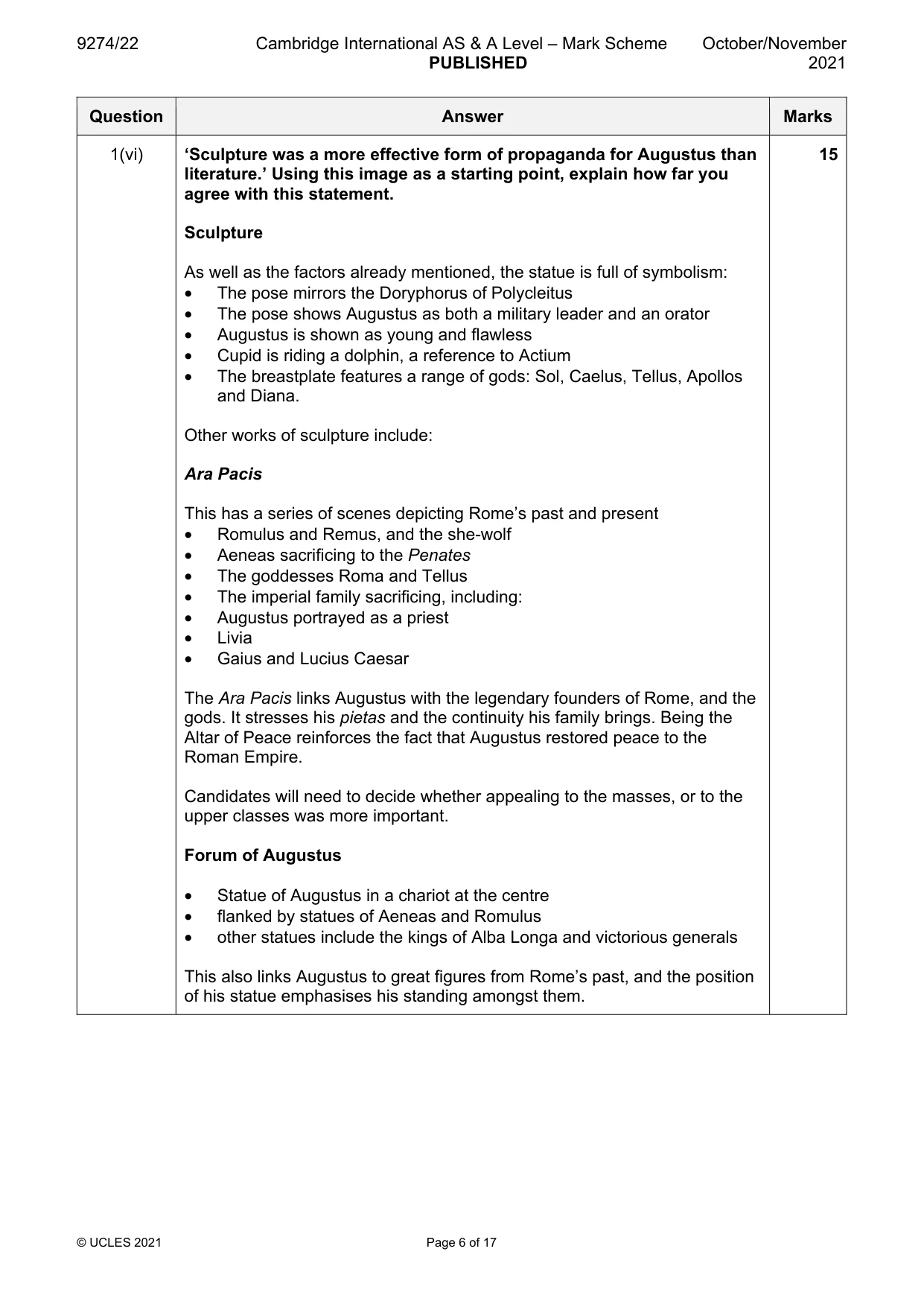
9274/22 Cambridge International AS & A Level – Mark Scheme PUBLISHED October/November 2021 © UCLES 2021 Page 6 of 17 Question Answer Marks 1(vi) ‘Sculpture was a more effective form of propaganda for Augustus than literature.’ Using this image as a starting point, explain how far you agree with this statement. Sculpture As well as the factors already mentioned, the statue is full of symbolism: • The pose mirrors the Doryphorus of Polycleitus • The pose shows Augustus as both a military leader and an orator • Augustus is shown as young and flawless • Cupid is riding a dolphin, a reference to Actium • The breastplate features a range of gods: Sol, Caelus, Tellus, Apollos and Diana. Other works of sculpture include: Ara Pacis This has a series of scenes depicting Rome’s past and present • Romulus and Remus, and the she-wolf • Aeneas sacrificing to the Penates • The goddesses Roma and Tellus • The imperial family sacrificing, including: • Augustus portrayed as a priest • Livia • Gaius and Lucius Caesar The Ara Pacis links Augustus with the legendary founders of Rome, and the gods. It stresses his pietas and the continuity his family brings. Being the Altar of Peace reinforces the fact that Augustus restored peace to the Roman Empire. Candidates will need to decide whether appealing to the masses, or to the upper classes was more important. Forum of Augustus • Statue of Augustus in a chariot at the centre • flanked by statues of Aeneas and Romulus • other statues include the kings of Alba Longa and victorious generals This also links Augustus to great figures from Rome’s past, and the position of his statue emphasises his standing amongst them. 15
Mark scheme, page 7
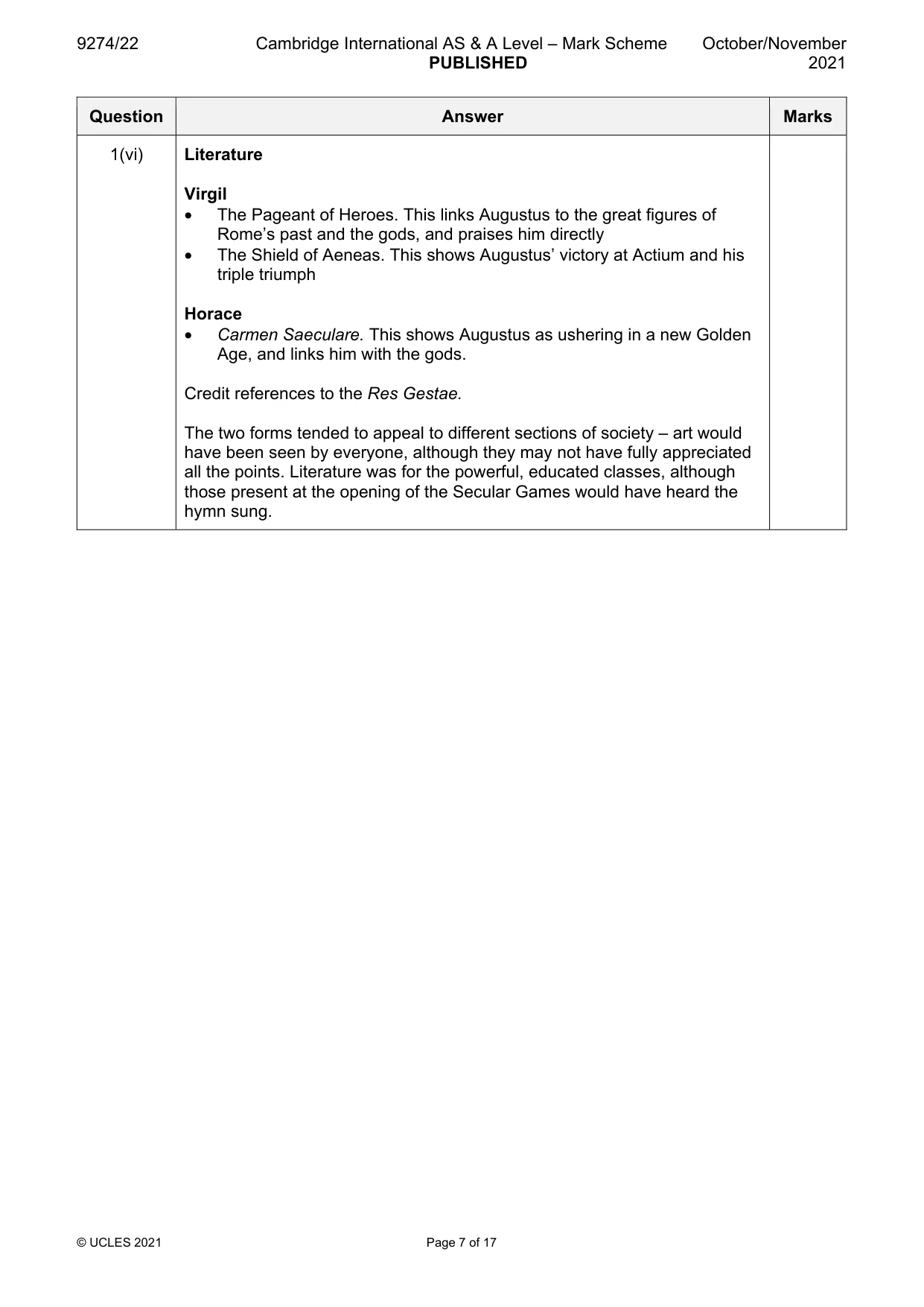
9274/22 Cambridge International AS & A Level – Mark Scheme PUBLISHED October/November 2021 © UCLES 2021 Page 7 of 17 Question Answer Marks 1(vi) Literature Virgil • The Pageant of Heroes. This links Augustus to the great figures of Rome’s past and the gods, and praises him directly • The Shield of Aeneas. This shows Augustus’ victory at Actium and his triple triumph Horace • Carmen Saeculare. This shows Augustus as ushering in a new Golden Age, and links him with the gods. Credit references to the Res Gestae. The two forms tended to appeal to different sections of society – art would have been seen by everyone, although they may not have fully appreciated all the points. Literature was for the powerful, educated classes, although those present at the opening of the Secular Games would have heard the hymn sung.
Mark scheme, page 8
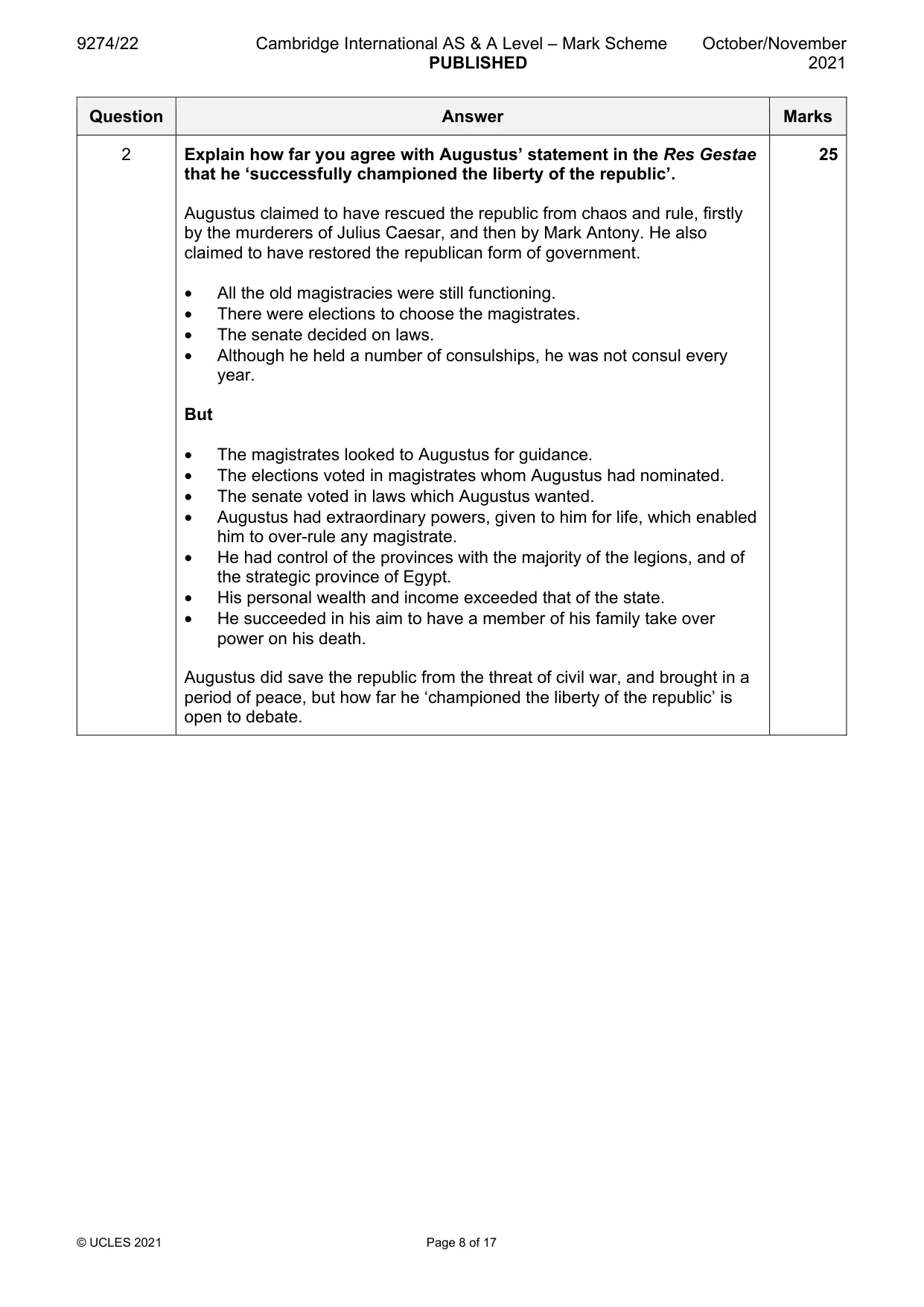
9274/22 Cambridge International AS & A Level – Mark Scheme PUBLISHED October/November 2021 © UCLES 2021 Page 8 of 17 Question Answer Marks 2 Explain how far you agree with Augustus’ statement in the Res Gestae that he ‘successfully championed the liberty of the republic’. Augustus claimed to have rescued the republic from chaos and rule, firstly by the murderers of Julius Caesar, and then by Mark Antony. He also claimed to have restored the republican form of government. • All the old magistracies were still functioning. • There were elections to choose the magistrates. • The senate decided on laws. • Although he held a number of consulships, he was not consul every year. But • The magistrates looked to Augustus for guidance. • The elections voted in magistrates whom Augustus had nominated. • The senate voted in laws which Augustus wanted. • Augustus had extraordinary powers, given to him for life, which enabled him to over-rule any magistrate. • He had control of the provinces with the majority of the legions, and of the strategic province of Egypt. • His personal wealth and income exceeded that of the state. • He succeeded in his aim to have a member of his family take over power on his death. Augustus did save the republic from the threat of civil war, and brought in a period of peace, but how far he ‘championed the liberty of the republic’ is open to debate. 25
Mark scheme, page 9
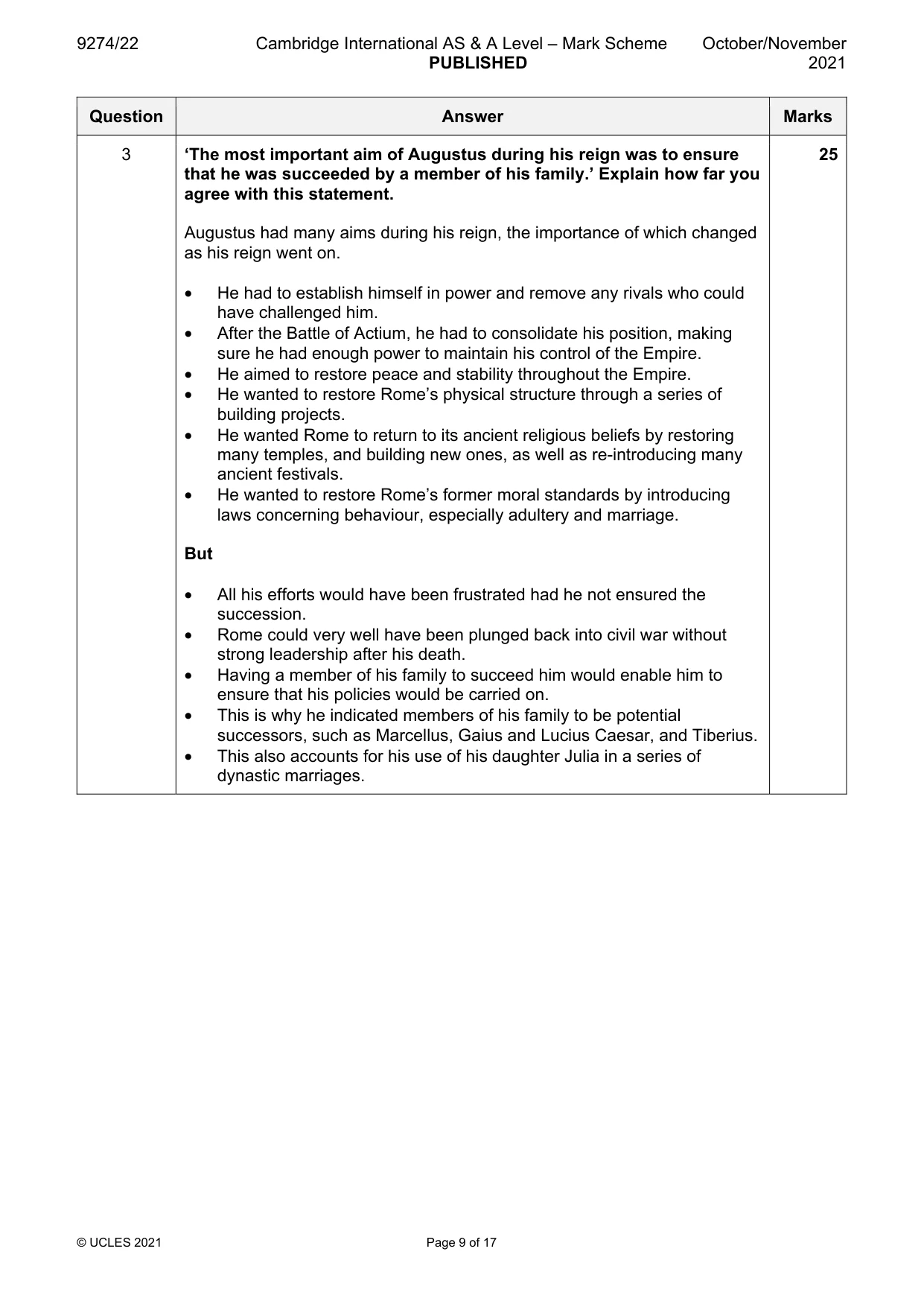
9274/22 Cambridge International AS & A Level – Mark Scheme PUBLISHED October/November 2021 © UCLES 2021 Page 9 of 17 Question Answer Marks 3 ‘The most important aim of Augustus during his reign was to ensure that he was succeeded by a member of his family.’ Explain how far you agree with this statement. Augustus had many aims during his reign, the importance of which changed as his reign went on. • He had to establish himself in power and remove any rivals who could have challenged him. • After the Battle of Actium, he had to consolidate his position, making sure he had enough power to maintain his control of the Empire. • He aimed to restore peace and stability throughout the Empire. • He wanted to restore Rome’s physical structure through a series of building projects. • He wanted Rome to return to its ancient religious beliefs by restoring many temples, and building new ones, as well as re-introducing many ancient festivals. • He wanted to restore Rome’s former moral standards by introducing laws concerning behaviour, especially adultery and marriage. But • All his efforts would have been frustrated had he not ensured the succession. • Rome could very well have been plunged back into civil war without strong leadership after his death. • Having a member of his family to succeed him would enable him to ensure that his policies would be carried on. • This is why he indicated members of his family to be potential successors, such as Marcellus, Gaius and Lucius Caesar, and Tiberius. • This also accounts for his use of his daughter Julia in a series of dynastic marriages. 25
Mark scheme, page 10
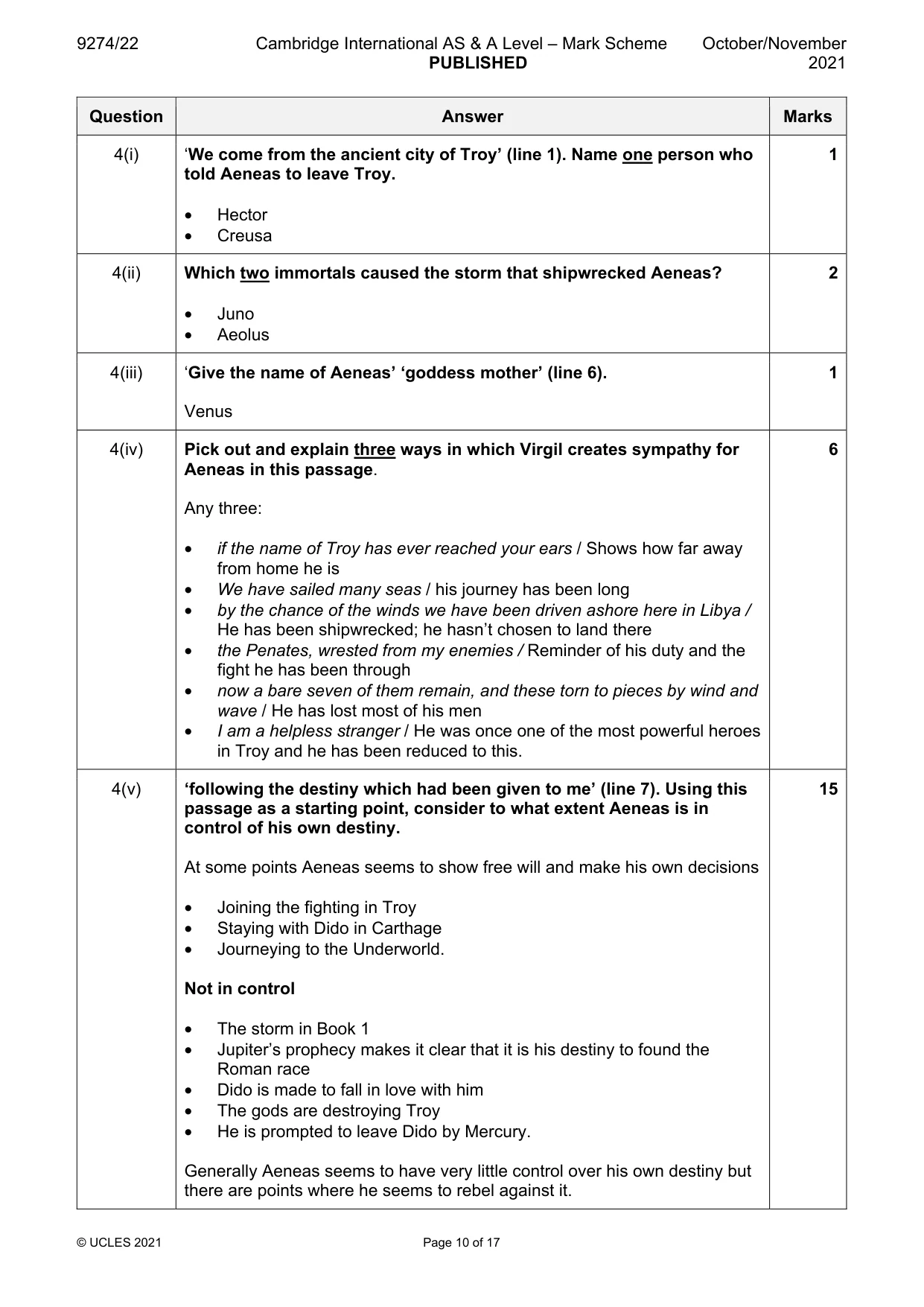
9274/22 Cambridge International AS & A Level – Mark Scheme PUBLISHED October/November 2021 © UCLES 2021 Page 10 of 17 Question Answer Marks 4(i) ‘We come from the ancient city of Troy’ (line 1). Name one person who told Aeneas to leave Troy. • Hector • Creusa 1 4(ii) Which two immortals caused the storm that shipwrecked Aeneas? • Juno • Aeolus 2 4(iii) ‘Give the name of Aeneas’ ‘goddess mother’ (line 6). Venus 1 4(iv) Pick out and explain three ways in which Virgil creates sympathy for Aeneas in this passage. Any three: • if the name of Troy has ever reached your ears / Shows how far away from home he is • We have sailed many seas / his journey has been long • by the chance of the winds we have been driven ashore here in Libya / He has been shipwrecked; he hasn’t chosen to land there • the Penates, wrested from my enemies / Reminder of his duty and the fight he has been through • now a bare seven of them remain, and these torn to pieces by wind and wave / He has lost most of his men • I am a helpless stranger / He was once one of the most powerful heroes in Troy and he has been reduced to this. 6 4(v) ‘following the destiny which had been given to me’ (line 7). Using this passage as a starting point, consider to what extent Aeneas is in control of his own destiny. At some points Aeneas seems to show free will and make his own decisions • Joining the fighting in Troy • Staying with Dido in Carthage • Journeying to the Underworld. Not in control • The storm in Book 1 • Jupiter’s prophecy makes it clear that it is his destiny to found the Roman race • Dido is made to fall in love with him • The gods are destroying Troy • He is prompted to leave Dido by Mercury. Generally Aeneas seems to have very little control over his own destiny but there are points where he seems to rebel against it. 15
Mark scheme, page 11
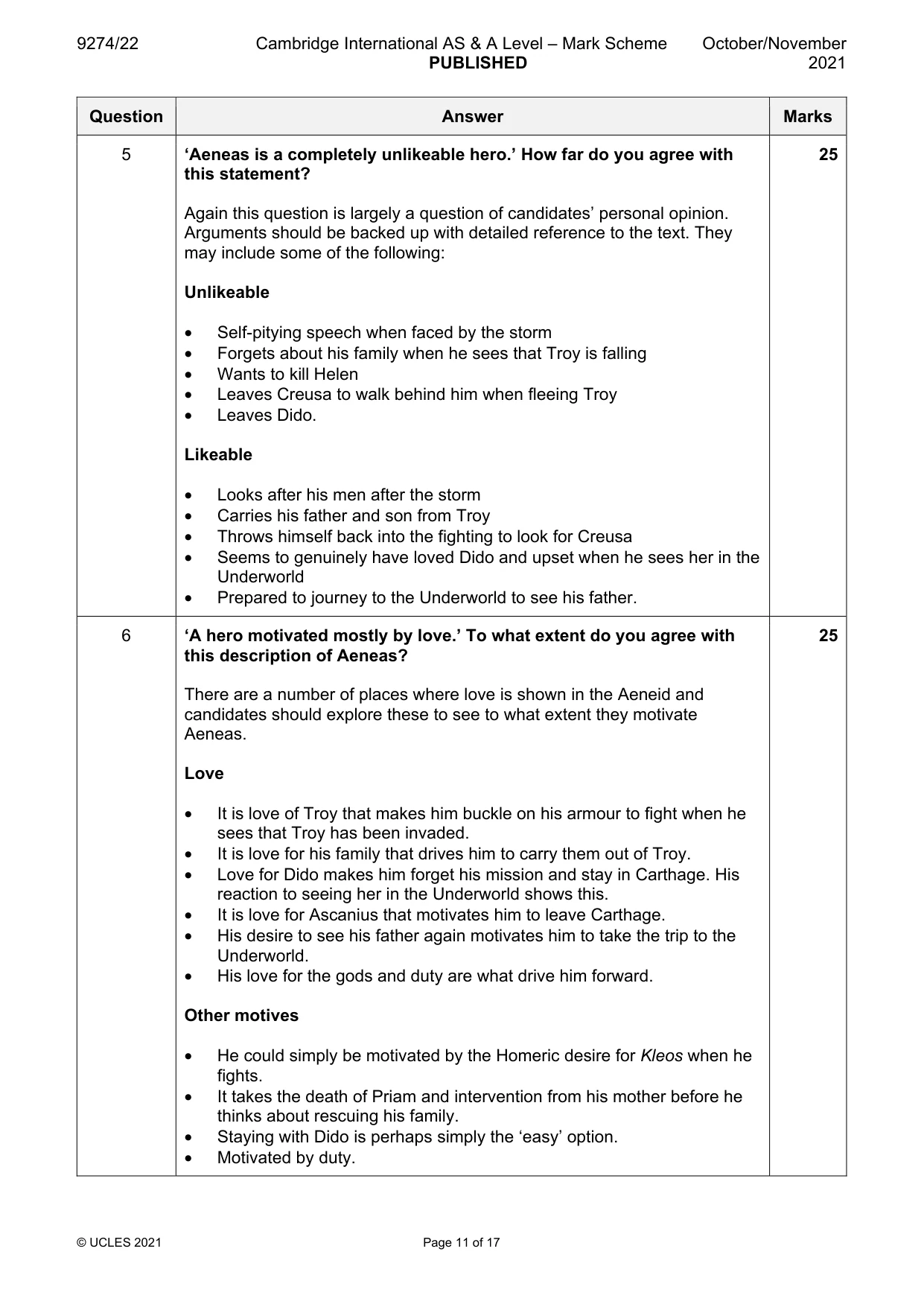
9274/22 Cambridge International AS & A Level – Mark Scheme PUBLISHED October/November 2021 © UCLES 2021 Page 11 of 17 Question Answer Marks 5 ‘Aeneas is a completely unlikeable hero.’ How far do you agree with this statement? Again this question is largely a question of candidates’ personal opinion. Arguments should be backed up with detailed reference to the text. They may include some of the following: Unlikeable • Self-pitying speech when faced by the storm • Forgets about his family when he sees that Troy is falling • Wants to kill Helen • Leaves Creusa to walk behind him when fleeing Troy • Leaves Dido. Likeable • Looks after his men after the storm • Carries his father and son from Troy • Throws himself back into the fighting to look for Creusa • Seems to genuinely have loved Dido and upset when he sees her in the Underworld • Prepared to journey to the Underworld to see his father. 25 6 ‘A hero motivated mostly by love.’ To what extent do you agree with this description of Aeneas? There are a number of places where love is shown in the Aeneid and candidates should explore these to see to what extent they motivate Aeneas. Love • It is love of Troy that makes him buckle on his armour to fight when he sees that Troy has been invaded. • It is love for his family that drives him to carry them out of Troy. • Love for Dido makes him forget his mission and stay in Carthage. His reaction to seeing her in the Underworld shows this. • It is love for Ascanius that motivates him to leave Carthage. • His desire to see his father again motivates him to take the trip to the Underworld. • His love for the gods and duty are what drive him forward. Other motives • He could simply be motivated by the Homeric desire for Kleos when he fights. • It takes the death of Priam and intervention from his mother before he thinks about rescuing his family. • Staying with Dido is perhaps simply the ‘easy’ option. • Motivated by duty. 25
Mark scheme, page 12
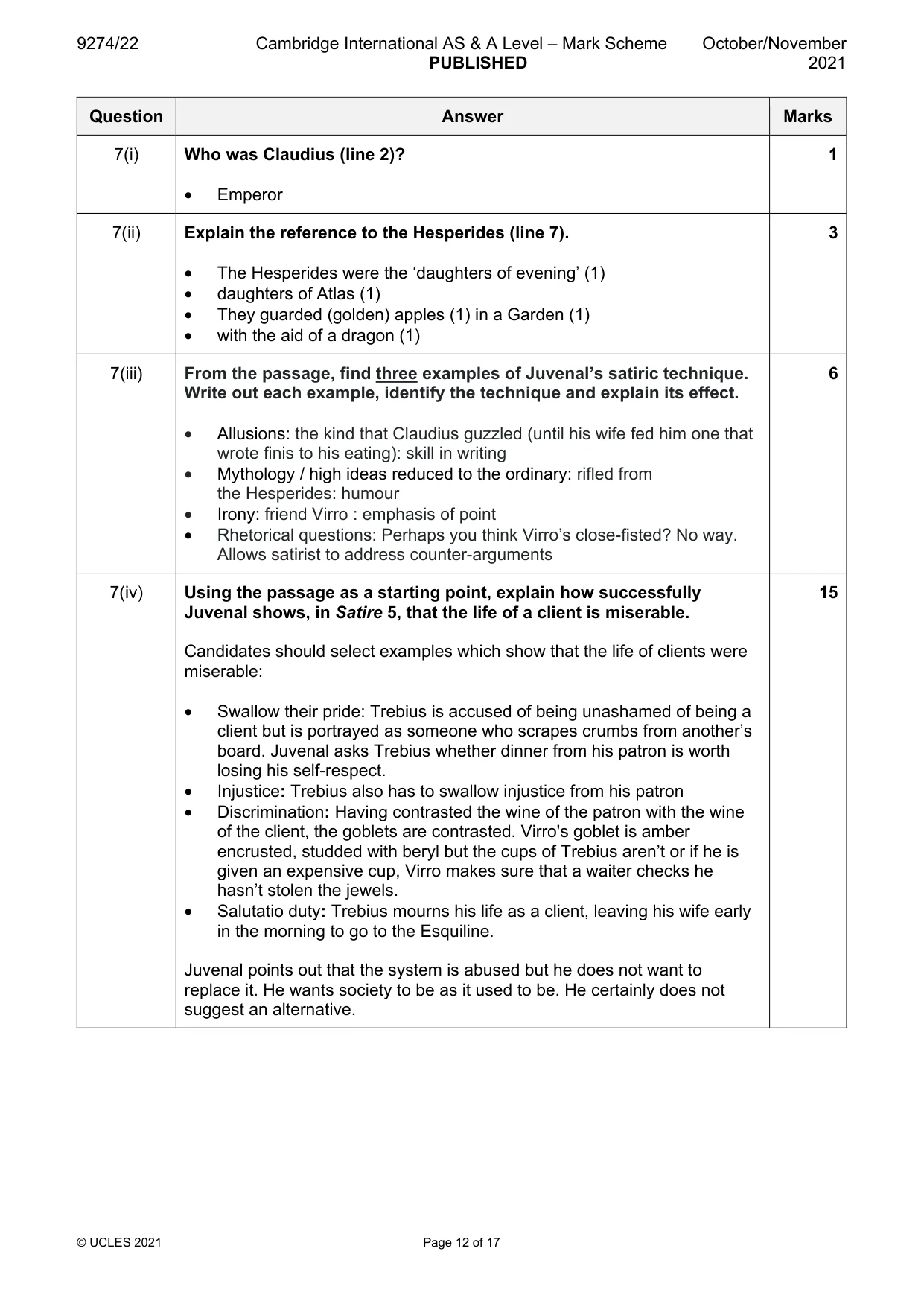
9274/22 Cambridge International AS & A Level – Mark Scheme PUBLISHED October/November 2021 © UCLES 2021 Page 12 of 17 Question Answer Marks 7(i) Who was Claudius (line 2)? • Emperor 1 7(ii) Explain the reference to the Hesperides (line 7). • The Hesperides were the ‘daughters of evening’ (1) • daughters of Atlas (1) • They guarded (golden) apples (1) in a Garden (1) • with the aid of a dragon (1) 3 7(iii) From the passage, find three examples of Juvenal’s satiric technique. Write out each example, identify the technique and explain its effect. • Allusions: the kind that Claudius guzzled (until his wife fed him one that wrote finis to his eating): skill in writing • Mythology / high ideas reduced to the ordinary: rifled from the Hesperides: humour • Irony: friend Virro : emphasis of point • Rhetorical questions: Perhaps you think Virro’s close-fisted? No way. Allows satirist to address counter-arguments 6 7(iv) Using the passage as a starting point, explain how successfully Juvenal shows, in Satire 5, that the life of a client is miserable. Candidates should select examples which show that the life of clients were miserable: • Swallow their pride: Trebius is accused of being unashamed of being a client but is portrayed as someone who scrapes crumbs from another’s board. Juvenal asks Trebius whether dinner from his patron is worth losing his self-respect. • Injustice: Trebius also has to swallow injustice from his patron • Discrimination: Having contrasted the wine of the patron with the wine of the client, the goblets are contrasted. Virro's goblet is amber encrusted, studded with beryl but the cups of Trebius aren’t or if he is given an expensive cup, Virro makes sure that a waiter checks he hasn’t stolen the jewels. • Salutatio duty: Trebius mourns his life as a client, leaving his wife early in the morning to go to the Esquiline. Juvenal points out that the system is abused but he does not want to replace it. He wants society to be as it used to be. He certainly does not suggest an alternative. 15
Mark scheme, page 13
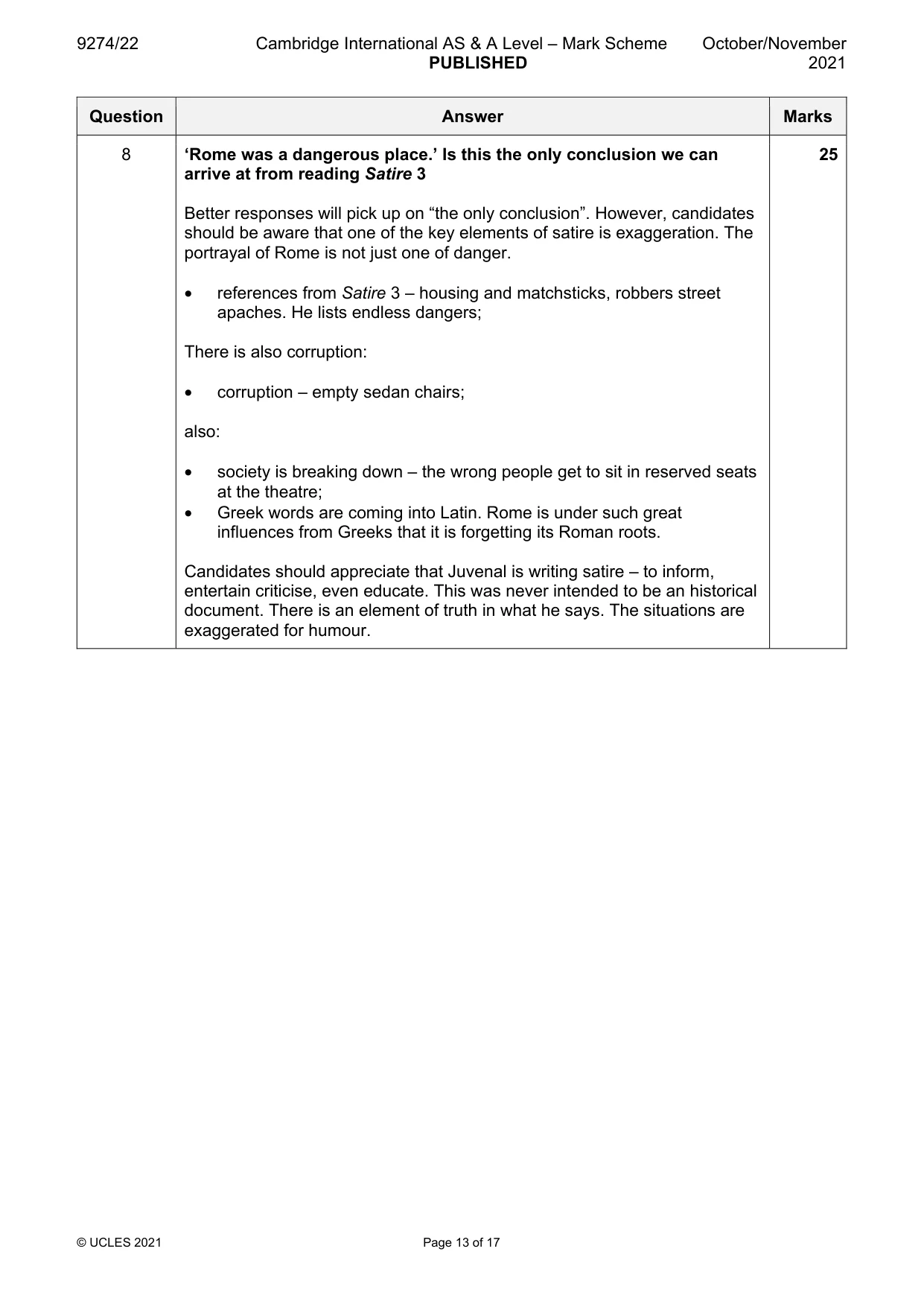
9274/22 Cambridge International AS & A Level – Mark Scheme PUBLISHED October/November 2021 © UCLES 2021 Page 13 of 17 Question Answer Marks 8 ‘Rome was a dangerous place.’ Is this the only conclusion we can arrive at from reading Satire 3 Better responses will pick up on “the only conclusion”. However, candidates should be aware that one of the key elements of satire is exaggeration. The portrayal of Rome is not just one of danger. • references from Satire 3 – housing and matchsticks, robbers street apaches. He lists endless dangers; There is also corruption: • corruption – empty sedan chairs; also: • society is breaking down – the wrong people get to sit in reserved seats at the theatre; • Greek words are coming into Latin. Rome is under such great influences from Greeks that it is forgetting its Roman roots. Candidates should appreciate that Juvenal is writing satire – to inform, entertain criticise, even educate. This was never intended to be an historical document. There is an element of truth in what he says. The situations are exaggerated for humour. 25
Mark scheme, page 14
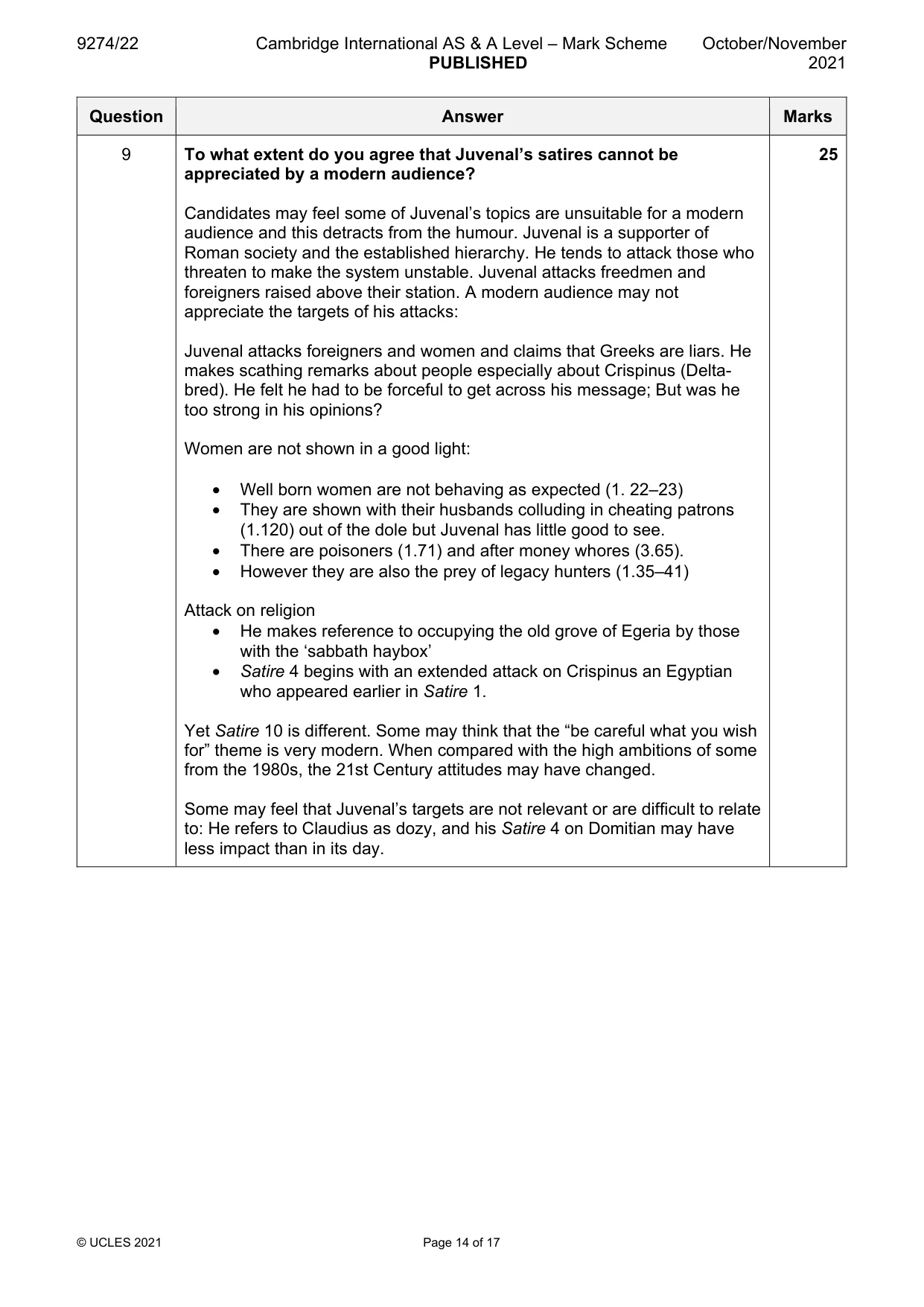
9274/22 Cambridge International AS & A Level – Mark Scheme PUBLISHED October/November 2021 © UCLES 2021 Page 14 of 17 Question Answer Marks 9 To what extent do you agree that Juvenal’s satires cannot be appreciated by a modern audience? Candidates may feel some of Juvenal’s topics are unsuitable for a modern audience and this detracts from the humour. Juvenal is a supporter of Roman society and the established hierarchy. He tends to attack those who threaten to make the system unstable. Juvenal attacks freedmen and foreigners raised above their station. A modern audience may not appreciate the targets of his attacks: Juvenal attacks foreigners and women and claims that Greeks are liars. He makes scathing remarks about people especially about Crispinus (Delta- bred). He felt he had to be forceful to get across his message; But was he too strong in his opinions? Women are not shown in a good light: • Well born women are not behaving as expected (1. 22–23) • They are shown with their husbands colluding in cheating patrons (1.120) out of the dole but Juvenal has little good to see. • There are poisoners (1.71) and after money whores (3.65). • However they are also the prey of legacy hunters (1.35–41) Attack on religion • He makes reference to occupying the old grove of Egeria by those with the ‘sabbath haybox’ • Satire 4 begins with an extended attack on Crispinus an Egyptian who appeared earlier in Satire 1. Yet Satire 10 is different. Some may think that the “be careful what you wish for” theme is very modern. When compared with the high ambitions of some from the 1980s, the 21st Century attitudes may have changed. Some may feel that Juvenal’s targets are not relevant or are difficult to relate to: He refers to Claudius as dozy, and his Satire 4 on Domitian may have less impact than in its day. 25
Mark scheme, page 15
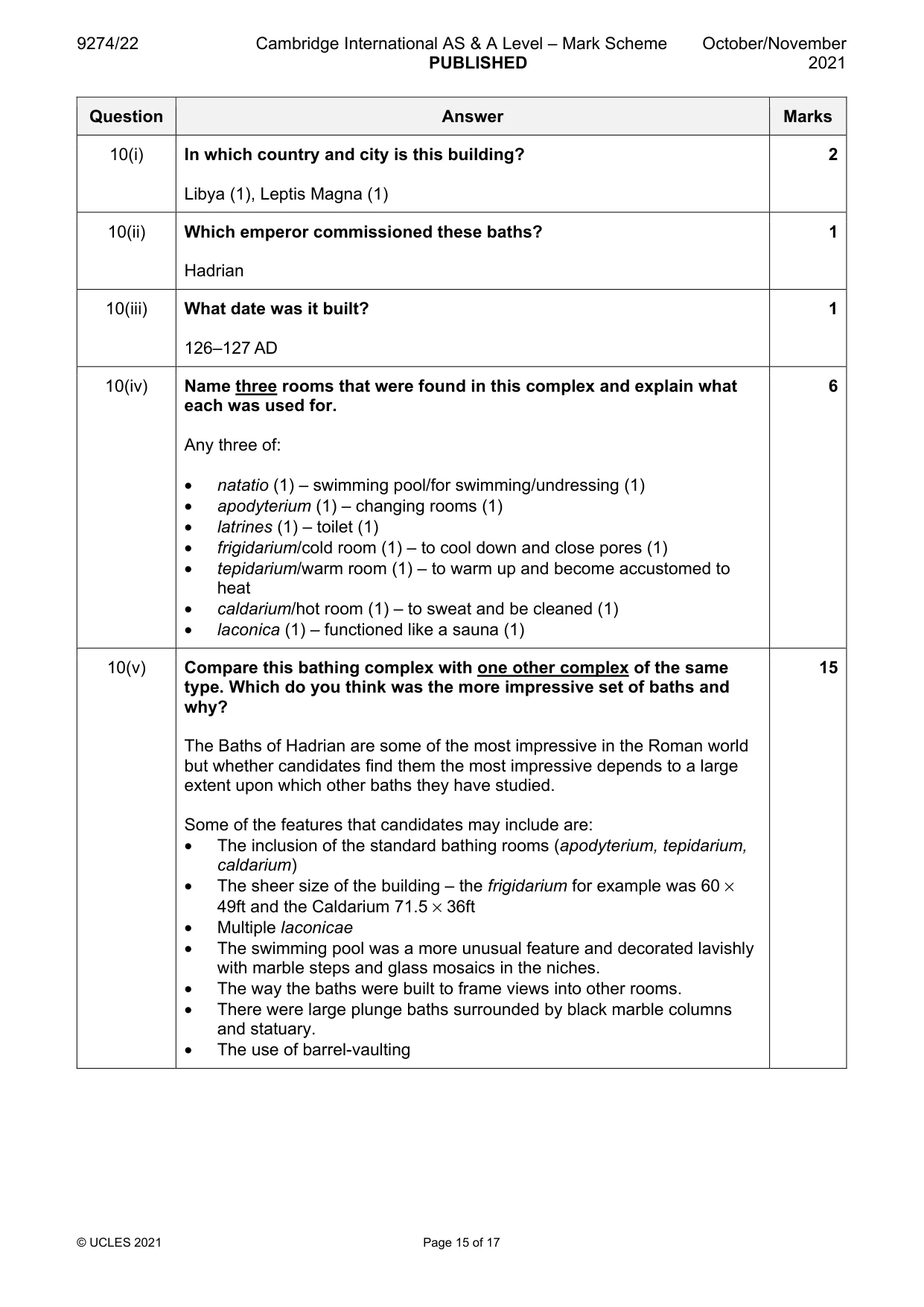
9274/22 Cambridge International AS & A Level – Mark Scheme PUBLISHED October/November 2021 © UCLES 2021 Page 15 of 17 Question Answer Marks 10(i) In which country and city is this building? Libya (1), Leptis Magna (1) 2 10(ii) Which emperor commissioned these baths? Hadrian 1 10(iii) What date was it built? 126–127 AD 1 10(iv) Name three rooms that were found in this complex and explain what each was used for. Any three of: • natatio (1) – swimming pool/for swimming/undressing (1) • apodyterium (1) – changing rooms (1) • latrines (1) – toilet (1) • frigidarium/cold room (1) – to cool down and close pores (1) • tepidarium/warm room (1) – to warm up and become accustomed to heat • caldarium/hot room (1) – to sweat and be cleaned (1) • laconica (1) – functioned like a sauna (1) 6 10(v) Compare this bathing complex with one other complex of the same type. Which do you think was the more impressive set of baths and why? The Baths of Hadrian are some of the most impressive in the Roman world but whether candidates find them the most impressive depends to a large extent upon which other baths they have studied. Some of the features that candidates may include are: • The inclusion of the standard bathing rooms (apodyterium, tepidarium, caldarium) • The sheer size of the building – the frigidarium for example was 60 × 49ft and the Caldarium 71.5 × 36ft • Multiple laconicae • The swimming pool was a more unusual feature and decorated lavishly with marble steps and glass mosaics in the niches. • The way the baths were built to frame views into other rooms. • There were large plunge baths surrounded by black marble columns and statuary. • The use of barrel-vaulting 15
Mark scheme, page 16
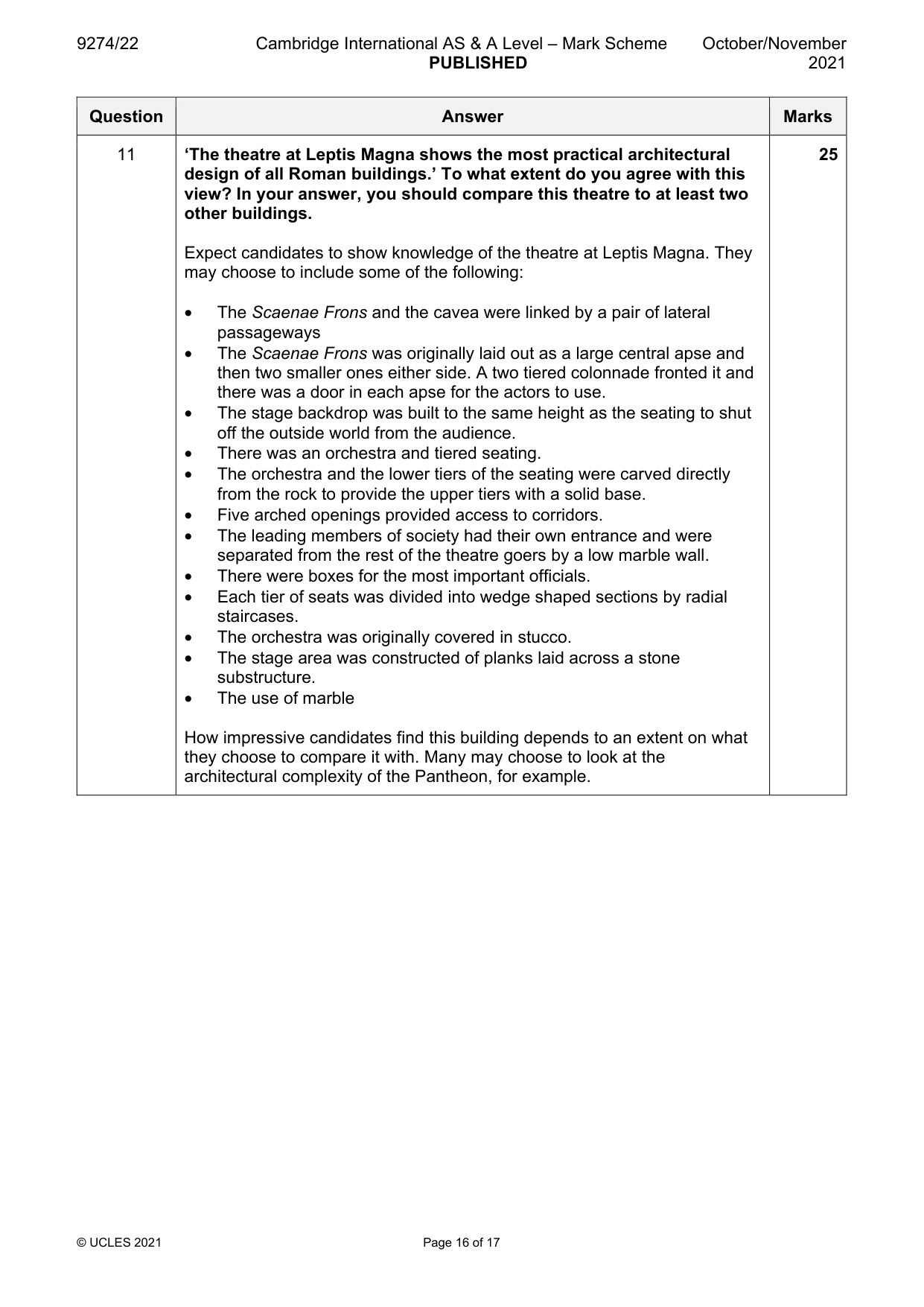
9274/22 Cambridge International AS & A Level – Mark Scheme PUBLISHED October/November 2021 © UCLES 2021 Page 16 of 17 Question Answer Marks 11 ‘The theatre at Leptis Magna shows the most practical architectural design of all Roman buildings.’ To what extent do you agree with this view? In your answer, you should compare this theatre to at least two other buildings. Expect candidates to show knowledge of the theatre at Leptis Magna. They may choose to include some of the following: • The Scaenae Frons and the cavea were linked by a pair of lateral passageways • The Scaenae Frons was originally laid out as a large central apse and then two smaller ones either side. A two tiered colonnade fronted it and there was a door in each apse for the actors to use. • The stage backdrop was built to the same height as the seating to shut off the outside world from the audience. • There was an orchestra and tiered seating. • The orchestra and the lower tiers of the seating were carved directly from the rock to provide the upper tiers with a solid base. • Five arched openings provided access to corridors. • The leading members of society had their own entrance and were separated from the rest of the theatre goers by a low marble wall. • There were boxes for the most important officials. • Each tier of seats was divided into wedge shaped sections by radial staircases. • The orchestra was originally covered in stucco. • The stage area was constructed of planks laid across a stone substructure. • The use of marble How impressive candidates find this building depends to an extent on what they choose to compare it with. Many may choose to look at the architectural complexity of the Pantheon, for example. 25
Mark scheme, page 17
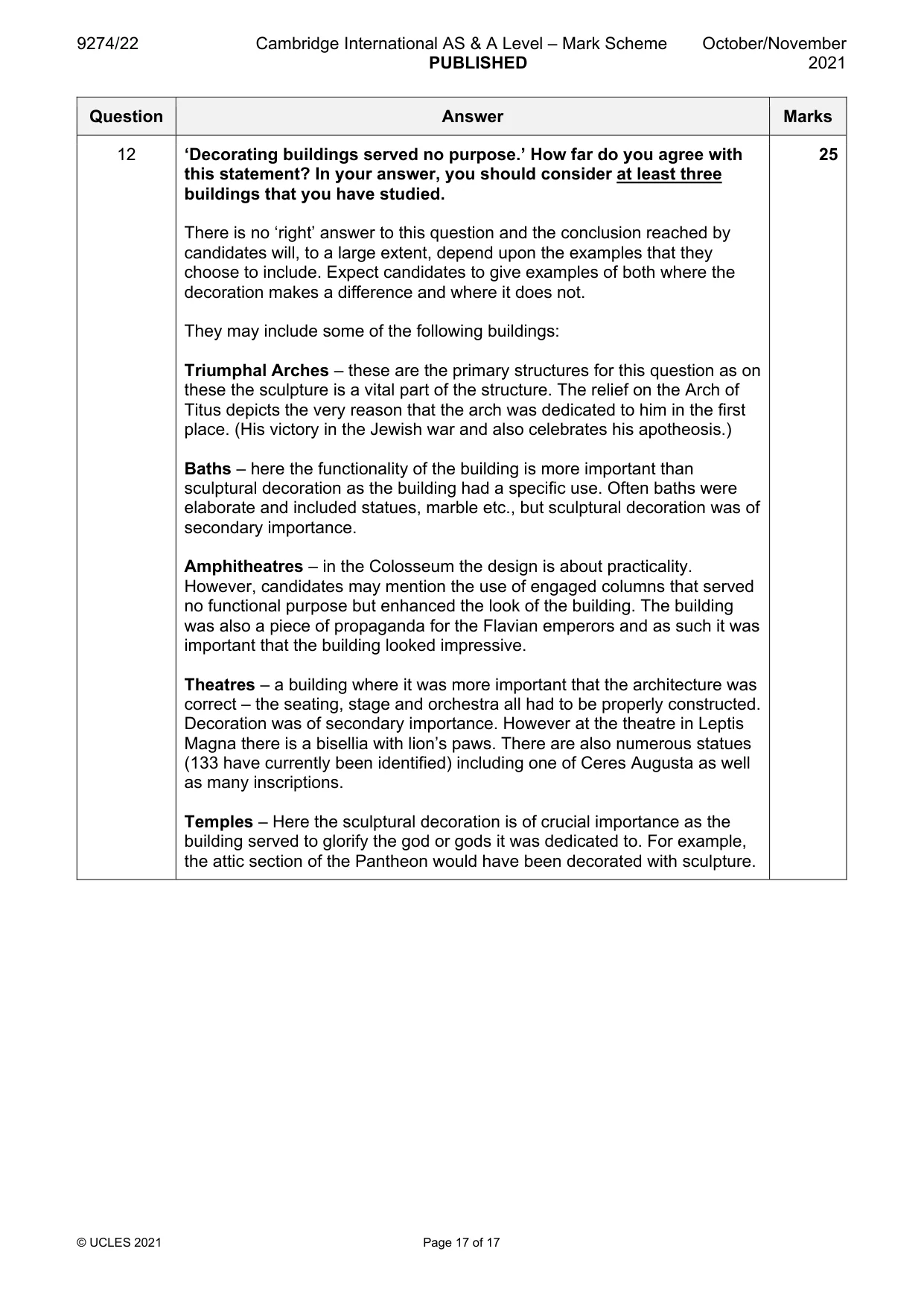
9274/22 Cambridge International AS & A Level – Mark Scheme PUBLISHED October/November 2021 © UCLES 2021 Page 17 of 17 Question Answer Marks 12 ‘Decorating buildings served no purpose.’ How far do you agree with this statement? In your answer, you should consider at least three buildings that you have studied. There is no ‘right’ answer to this question and the conclusion reached by candidates will, to a large extent, depend upon the examples that they choose to include. Expect candidates to give examples of both where the decoration makes a difference and where it does not. They may include some of the following buildings: Triumphal Arches – these are the primary structures for this question as on these the sculpture is a vital part of the structure. The relief on the Arch of Titus depicts the very reason that the arch was dedicated to him in the first place. (His victory in the Jewish war and also celebrates his apotheosis.) Baths – here the functionality of the building is more important than sculptural decoration as the building had a specific use. Often baths were elaborate and included statues, marble etc., but sculptural decoration was of secondary importance. Amphitheatres – in the Colosseum the design is about practicality. However, candidates may mention the use of engaged columns that served no functional purpose but enhanced the look of the building. The building was also a piece of propaganda for the Flavian emperors and as such it was important that the building looked impressive. Theatres – a building where it was more important that the architecture was correct – the seating, stage and orchestra all had to be properly constructed. Decoration was of secondary importance. However at the theatre in Leptis Magna there is a bisellia with lion’s paws. There are also numerous statues (133 have currently been identified) including one of Ceres Augusta as well as many inscriptions. Temples – Here the sculptural decoration is of crucial importance as the building served to glorify the god or gods it was dedicated to. For example, the attic section of the Pantheon would have been decorated with sculpture. 25
What you needed in this session
Cambridge’s own grade thresholds for 2021 Oct/Nov, Paper 2 · Variant 2. A higher threshold means an easier paper — the bar moves with how the cohort did.