Cambridge A Level Classical Studies 9274 — 2020 Oct/Nov Paper 2 · Variant 3
9274/23/O/N/20 · 12 questions · 50 marks · ≈56 min
The question paper and its mark scheme, free to read here and free to download. This is Cambridge’s own paper, exactly as it was sat.
Question paper8 pages



Mark scheme17 pages
Answers below. Sit the paper first if you are practising.
Questions as text
Q1 · Read the passage below, and answer the questions which follow: My sons Gaius and Lucius…
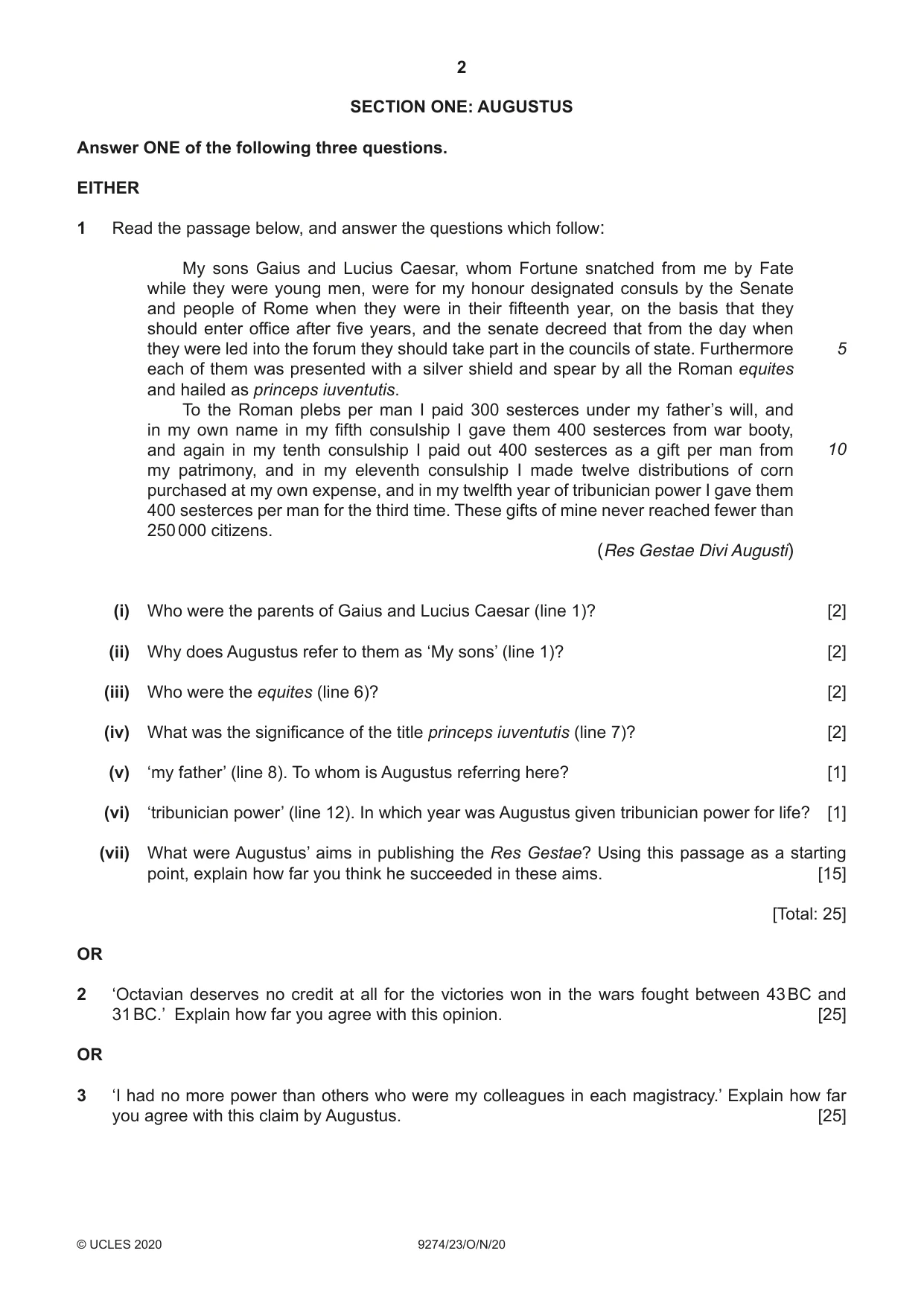
1 Read the passage below, and answer the questions which follow: My sons Gaius and Lucius Caesar, whom Fortune snatched from me by Fate while they were young men, were for my honour designated consuls by the Senate and people of Rome when they were in their fifteenth year, on the basis that they should enter office after five years, and the senate decreed that from the day when they were led into the forum they should take part in the councils of state. Furthermore 5 each of them was presented with a silver shield and spear by all the Roman equites and hailed as princeps iuventutis. To the Roman plebs per man I paid 300 sesterces under my father’s will, and in my own name in my fifth consulship I gave them 400 sesterces from war booty, and again in my tenth consulship I paid out 400 sesterces as a gift per man from 10 my patrimony, and in my eleventh consulship I made twelve distributions of corn purchased at my own expense, and in my twelfth year of tribunician power I gave them 400 sesterces per man for the third time. These gifts of mine never reached fewer than 250 000 citizens. (Res Gestae Divi Augusti) (i) Who were the parents of Gaius and Lucius Caesar (line 1)? [2] (ii) Why does Augustus refer to them as ‘My sons’ (line 1)? [2] (iii) Who were the equites (line 6)? [2] (iv) What was the significance of the title princeps iuventutis (line 7)? [2] (v) ‘my father’ (line 8). To whom is Augustus referring here? [1] (vi) ‘tribunician power’ (line 12). In which year was Augustus given tribunician power for life? [1] (vii) What were Augustus’ aims in publishing the Res Gestae? Using this passage as a starting point, explain how far you think he succeeded in these aims. [15] [Total: 25] OR
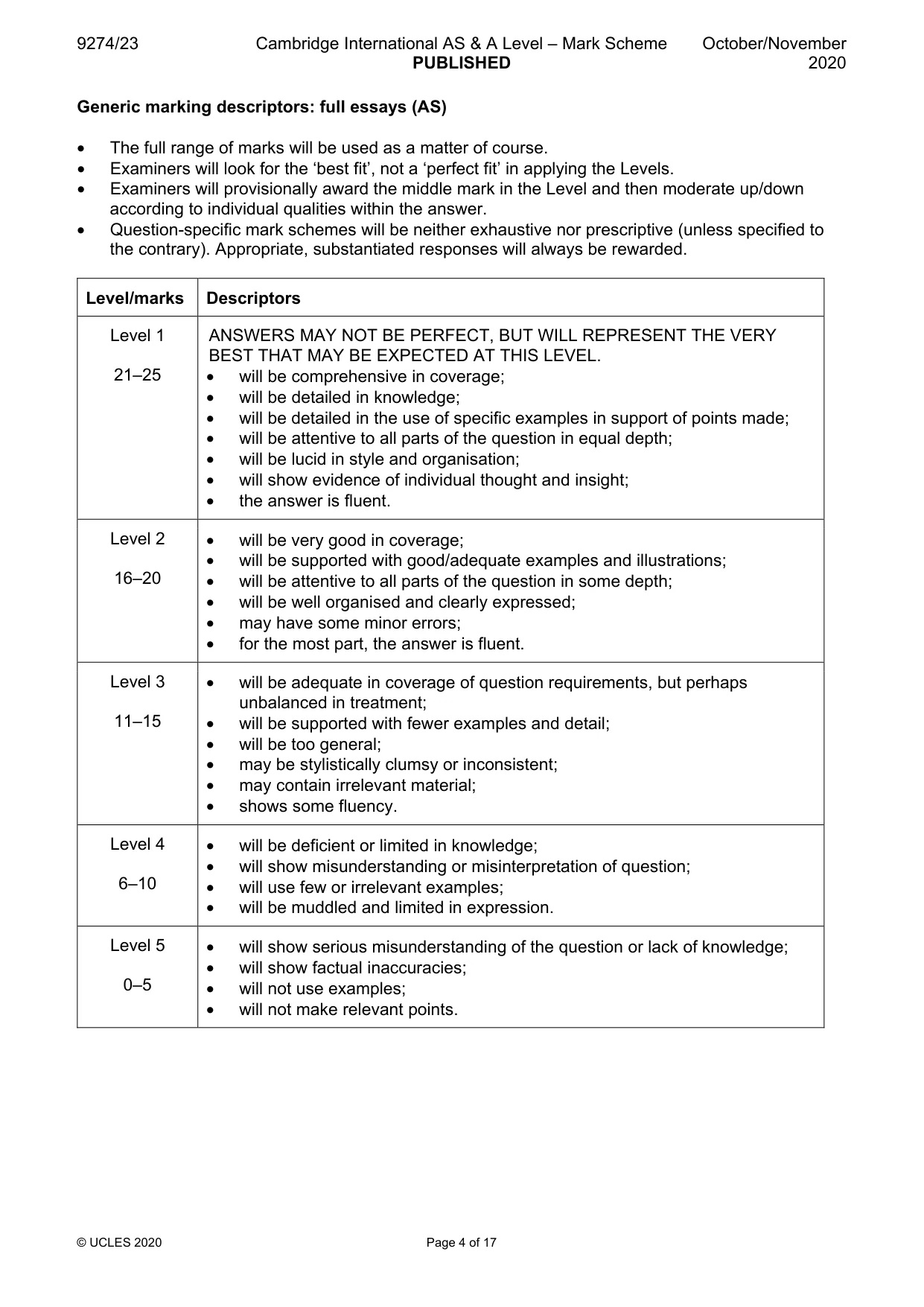
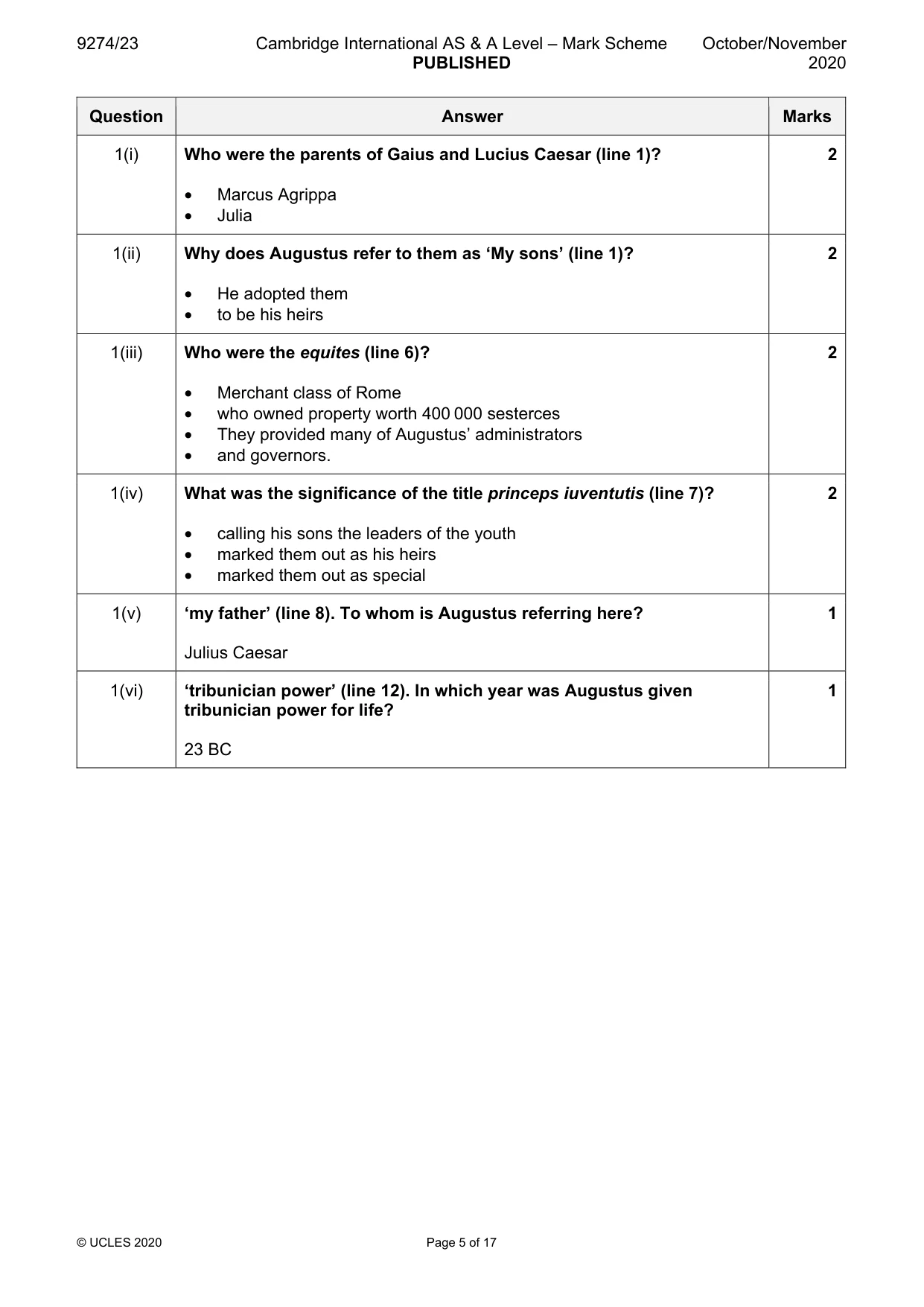
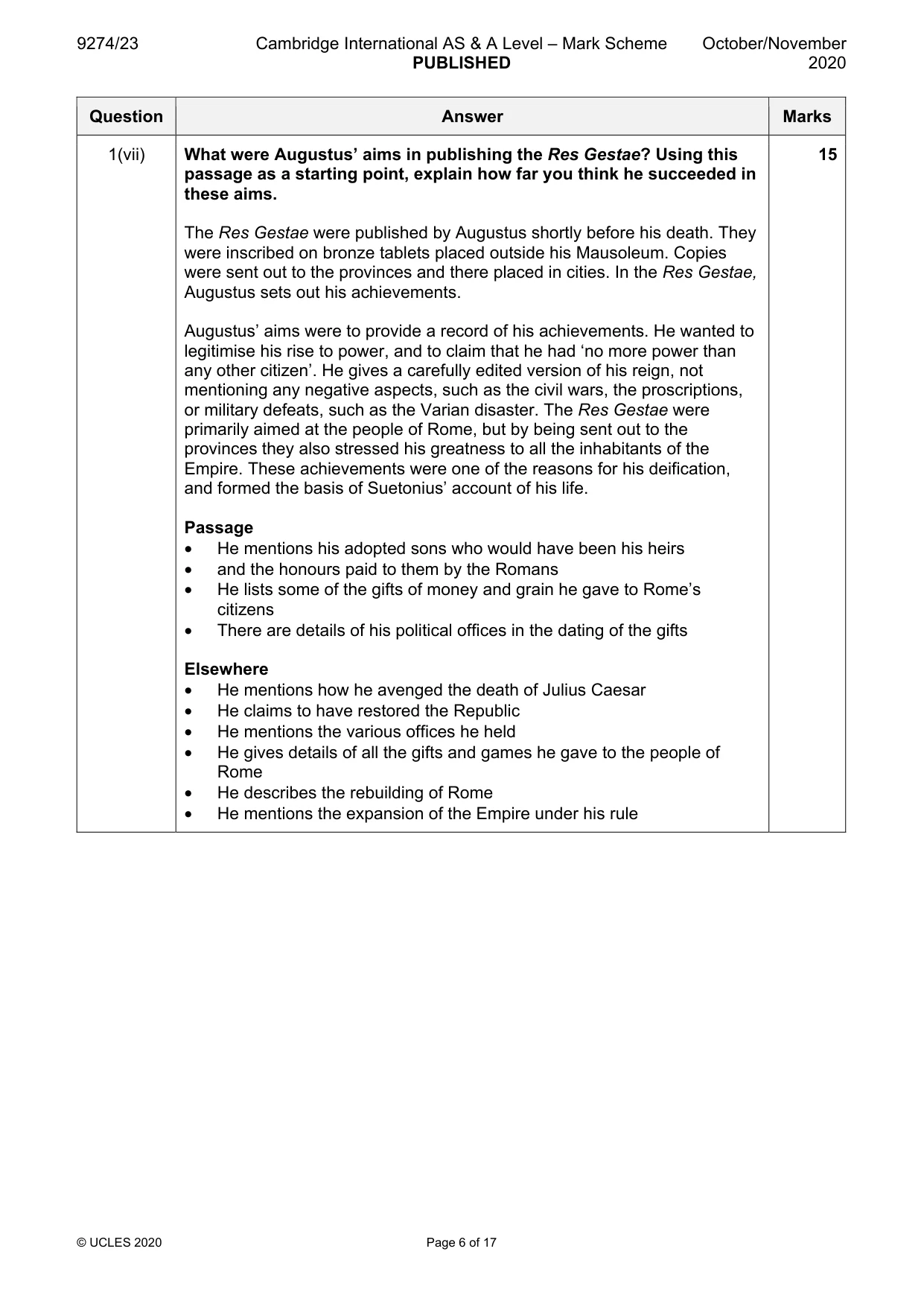
Mark scheme: Question Answer Marks 1(i) Who were the parents of Gaius and Lucius Caesar (line 1)? 2 • Marcus Agrippa • Julia 1(ii) Why does Augustus refer to them as ‘My sons’ (line 1)? 2 • He adopted them • to be his heirs 1(iii) Who were the equites (line 6)? 2 • Merchant class of Rome • who owned property worth 400 000 sesterces • They provided many of Augustus’ administrators • and governors. 1(iv) What was the significance of the title princeps iuventutis (line 7)? 2 • calling his sons the leaders of the youth • marked them out as his heirs • marked them out as special 1(v) ‘my father’ (line 8). To whom is Augustus referring here? 1 Julius Caesar 1(vi) ‘tribunician power’ (line 12). In which year was Augustus given 1 tribunician power for life? 23 BC 1(vii) What were Augustus’ aims in publishing the Res Gestae? Using this 15 passage as a starting point, explain how far you think he succeeded in these aims. The Res Gestae were published by Augustus shortly before his death. They were inscribed on bronze tablets placed outside his Mausoleum. Copies were sent out to the provinces and there placed in cities. In the Res Gestae, Augustus sets out his achievements. Augustus’ aims were to provide a record of his achievements. He wanted to legitimise his rise to power, and to claim that he had ‘no more power than any other citizen’. He gives a carefully edited version of his reign, not mentioning any negative aspects, such as the civil wars, the proscriptions, or military defeats, such as the Varian disaster. The Res Gestae were primarily aimed at the people of Rome, but by being sent out to the provinces they also stressed his greatness to all the inhabitants of the Empire. These achievements were one of the reasons for his deification, and formed the basis of Suetonius’ account of his life. Passage • He mentions his adopted sons who would have been his heirs • and the honours paid to them by the Romans • He lists some of the gifts of money and grain he gave to Rome’s citizens • There are details of his political offices in the dating of the gifts Elsewhere • He mentions how he avenged the death of Julius Caesar • He claims to have restored the Republic • He mentions the various offices he held • He gives details of all the gifts and games he gave to the people of Rome • He describes the rebuilding of Rome • He mentions the expansion of the Empire under his rule
Q2 · ‘Octavian deserves no credit at all for the victories won in the wars fought between 43…
2 ‘Octavian deserves no credit at all for the victories won in the wars fought between 43 BC and 31 BC.’ Explain how far you agree with this opinion. [25] OR
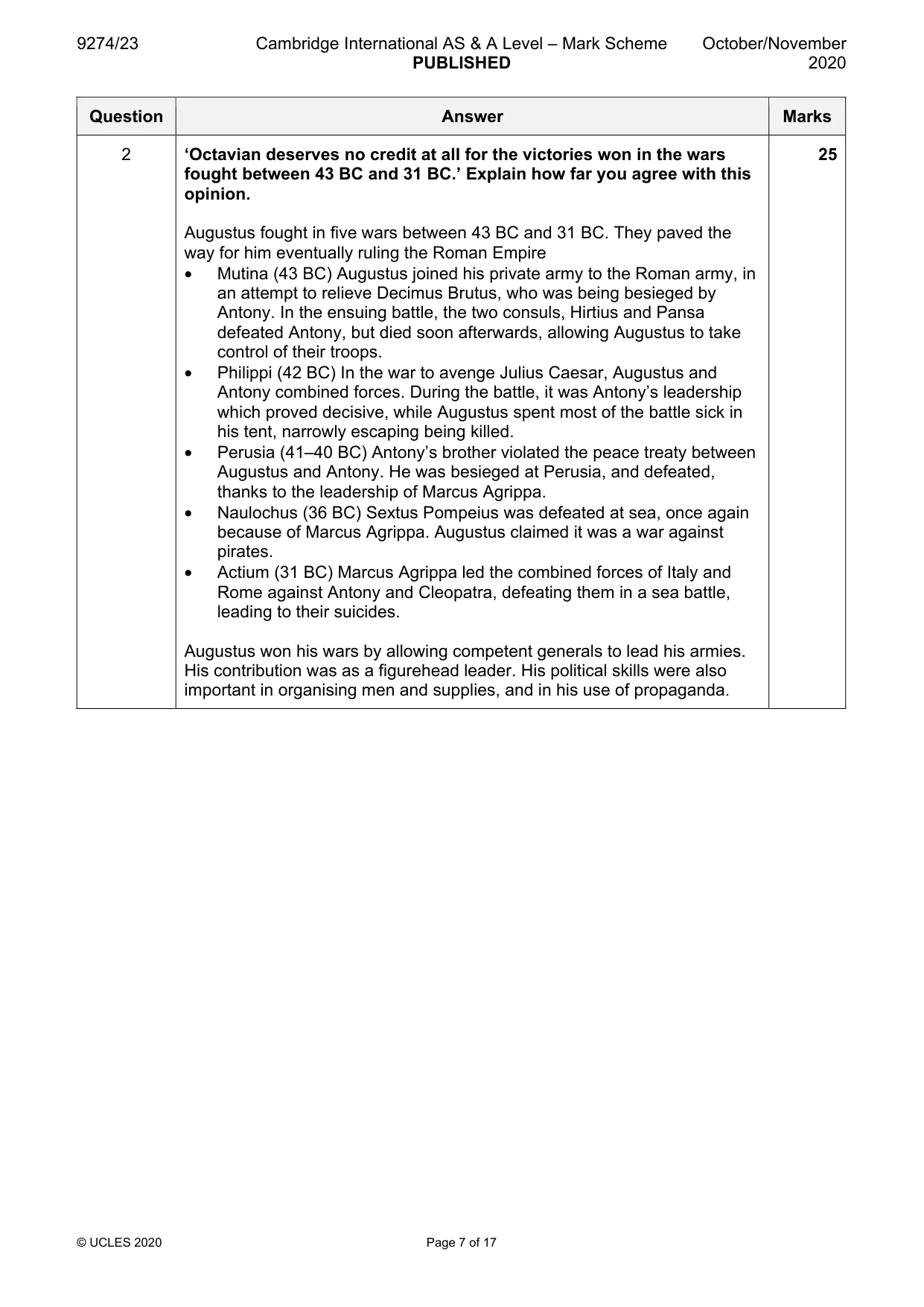
Mark scheme: 2 ‘Octavian deserves no credit at all for the victories won in the wars 25 fought between 43 BC and 31 BC.’ Explain how far you agree with this opinion. Augustus fought in five wars between 43 BC and 31 BC. They paved the way for him eventually ruling the Roman Empire • Mutina (43 BC) Augustus joined his private army to the Roman army, in an attempt to relieve Decimus Brutus, who was being besieged by Antony. In the ensuing battle, the two consuls, Hirtius and Pansa defeated Antony, but died soon afterwards, allowing Augustus to take control of their troops. • Philippi (42 BC) In the war to avenge Julius Caesar, Augustus and Antony combined forces. During the battle, it was Antony’s leadership which proved decisive, while Augustus spent most of the battle sick in his tent, narrowly escaping being killed. • Perusia (41–40 BC) Antony’s brother violated the peace treaty between Augustus and Antony. He was besieged at Perusia, and defeated, thanks to the leadership of Marcus Agrippa. • Naulochus (36 BC) Sextus Pompeius was defeated at sea, once again because of Marcus Agrippa. Augustus claimed it was a war against pirates. • Actium (31 BC) Marcus Agrippa led the combined forces of Italy and Rome against Antony and Cleopatra, defeating them in a sea battle, leading to their suicides. Augustus won his wars by allowing competent generals to lead his armies. His contribution was as a figurehead leader. His political skills were also important in organising men and supplies, and in his use of propaganda.
Q3 · ‘I had no more power than others who were my colleagues in each magistracy.’ Explain how…
3 ‘I had no more power than others who were my colleagues in each magistracy.’ Explain how far you agree with this claim by Augustus. [25] SECTION TWO: VIRGIL Answer ONE of the following three questions. EITHER
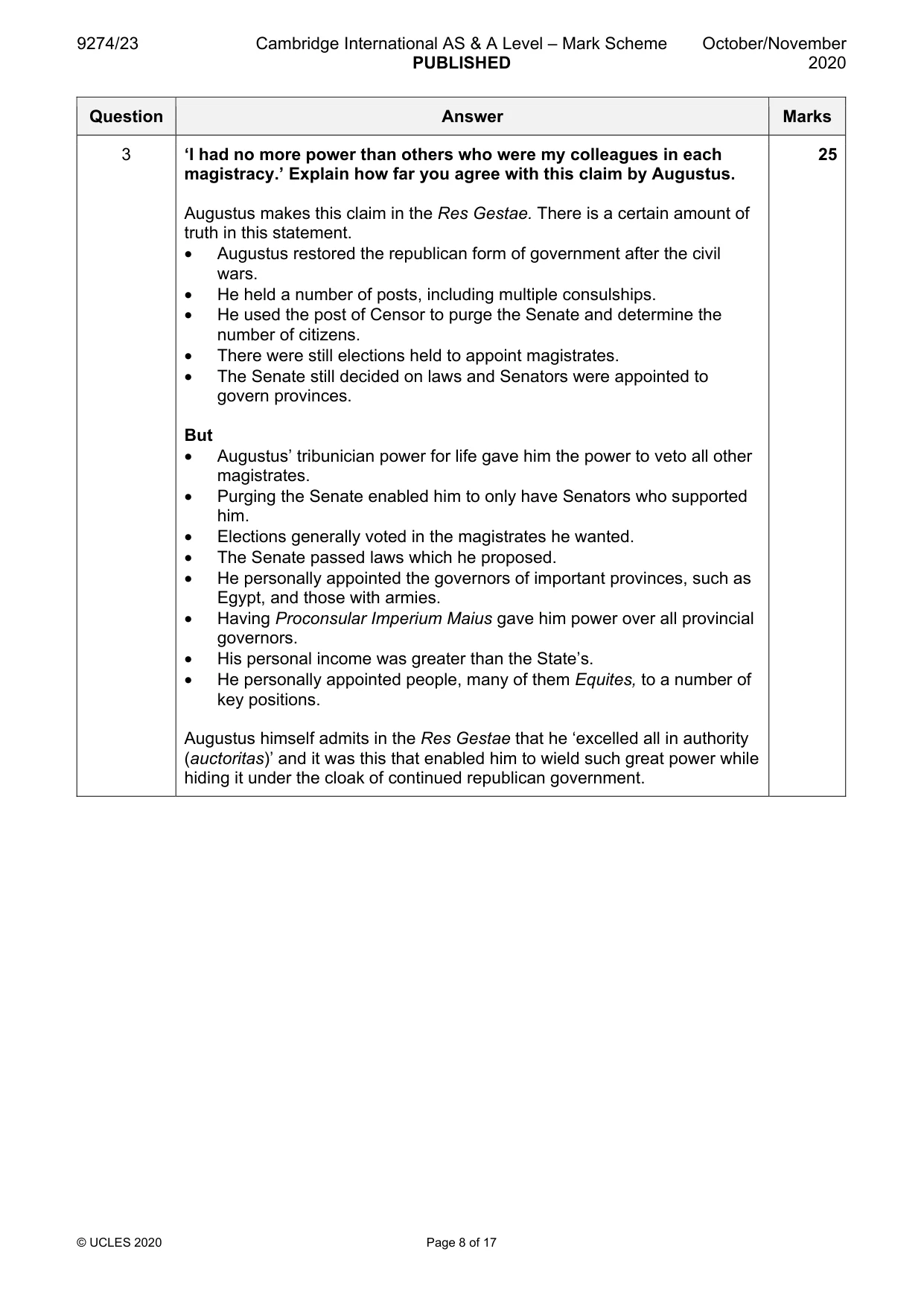
Mark scheme: 3 ‘I had no more power than others who were my colleagues in each 25 magistracy.’ Explain how far you agree with this claim by Augustus. Augustus makes this claim in the Res Gestae. There is a certain amount of truth in this statement. • Augustus restored the republican form of government after the civil wars. • He held a number of posts, including multiple consulships. • He used the post of Censor to purge the Senate and determine the number of citizens. • There were still elections held to appoint magistrates. • The Senate still decided on laws and Senators were appointed to govern provinces. But • Augustus’ tribunician power for life gave him the power to veto all other magistrates. • Purging the Senate enabled him to only have Senators who supported him. • Elections generally voted in the magistrates he wanted. • The Senate passed laws which he proposed. • He personally appointed the governors of important provinces, such as Egypt, and those with armies. • Having Proconsular Imperium Maius gave him power over all provincial governors. • His personal income was greater than the State’s. • He personally appointed people, many of them Equites, to a number of key positions. Augustus himself admits in the Res Gestae that he ‘excelled all in authority (auctoritas)’ and it was this that enabled him to wield such great power while hiding it under the cloak of continued republican government.
Q4 · Read the passage below, and answer the questions which follow: At these words she broke…
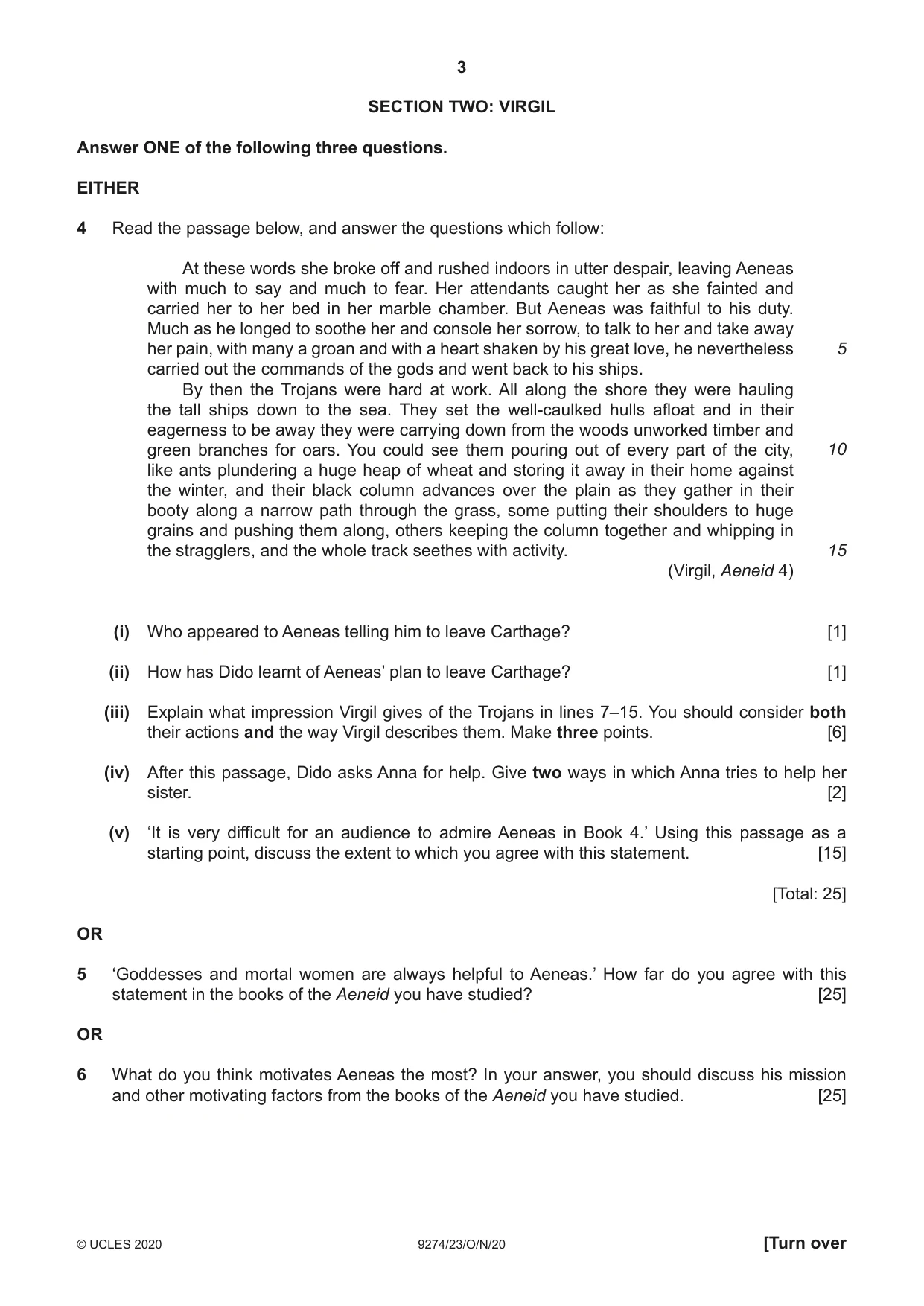
4 Read the passage below, and answer the questions which follow: At these words she broke off and rushed indoors in utter despair, leaving Aeneas with much to say and much to fear. Her attendants caught her as she fainted and carried her to her bed in her marble chamber. But Aeneas was faithful to his duty. Much as he longed to soothe her and console her sorrow, to talk to her and take away her pain, with many a groan and with a heart shaken by his great love, he nevertheless 5 carried out the commands of the gods and went back to his ships. By then the Trojans were hard at work. All along the shore they were hauling the tall ships down to the sea. They set the well-caulked hulls afloat and in their eagerness to be away they were carrying down from the woods unworked timber and green branches for oars. You could see them pouring out of every part of the city, 10 like ants plundering a huge heap of wheat and storing it away in their home against the winter, and their black column advances over the plain as they gather in their booty along a narrow path through the grass, some putting their shoulders to huge grains and pushing them along, others keeping the column together and whipping in the stragglers, and the whole track seethes with activity. 15 (Virgil, Aeneid 4) (i) Who appeared to Aeneas telling him to leave Carthage? [1] (ii) How has Dido learnt of Aeneas’ plan to leave Carthage? [1] (iii) Explain what impression Virgil gives of the Trojans in lines 7–15. You should consider both their actions and the way Virgil describes them. Make three points. [6] (iv) After this passage, Dido asks Anna for help. Give two ways in which Anna tries to help her sister. [2] (v) ‘It is very difficult for an audience to admire Aeneas in Book 4.’ Using this passage as a starting point, discuss the extent to which you agree with this statement. [15] [Total: 25] OR
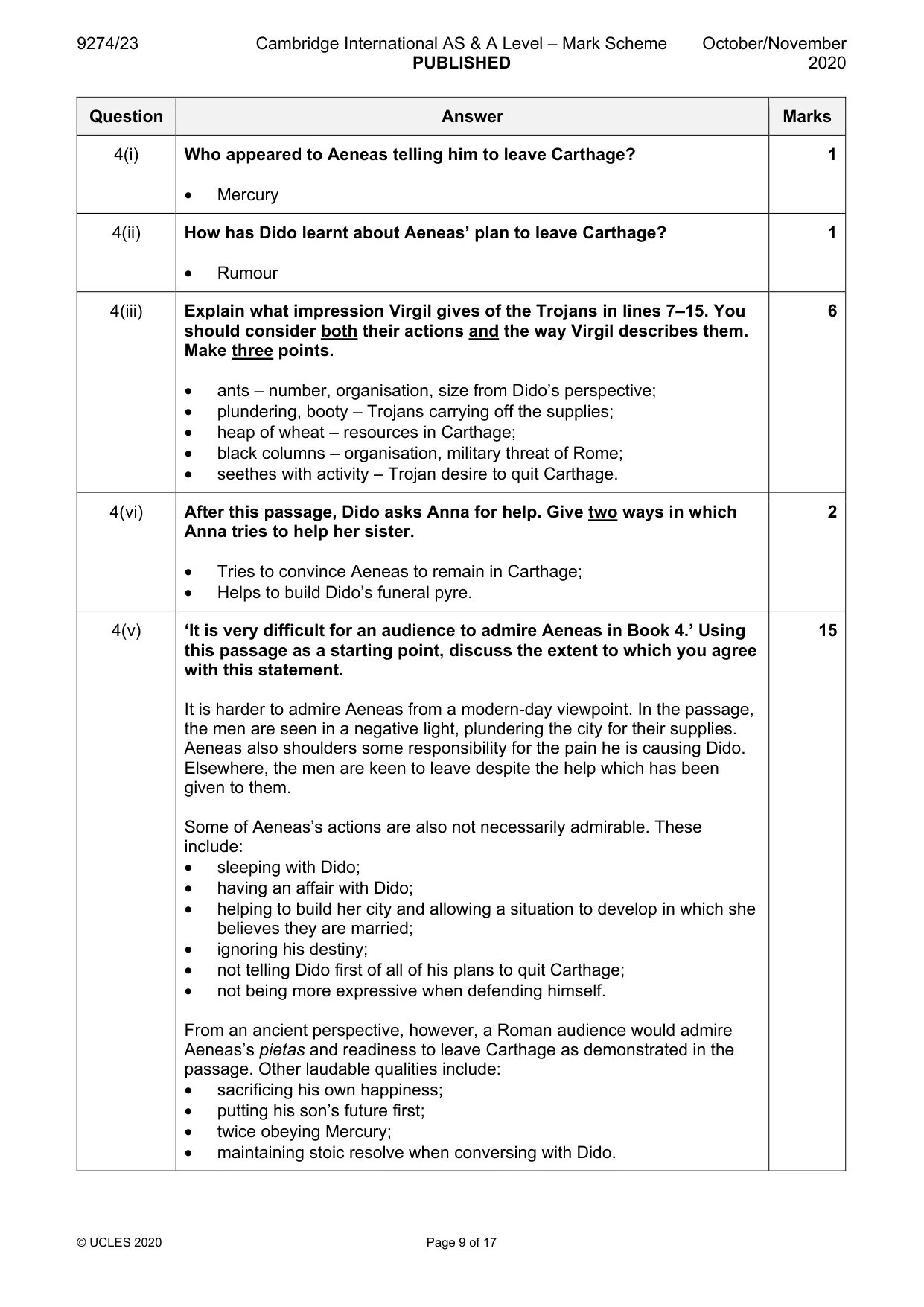
Mark scheme: 4(i) Who appeared to Aeneas telling him to leave Carthage? 1 • Mercury 4(ii) How has Dido learnt about Aeneas’ plan to leave Carthage? 1 • Rumour 4(iii) Explain what impression Virgil gives of the Trojans in lines 7–15. You 6 should consider both their actions and the way Virgil describes them. Make three points. • ants – number, organisation, size from Dido’s perspective; • plundering, booty – Trojans carrying off the supplies; • heap of wheat – resources in Carthage; • black columns – organisation, military threat of Rome; • seethes with activity – Trojan desire to quit Carthage. 4(vi) After this passage, Dido asks Anna for help. Give two ways in which 2 Anna tries to help her sister. • Tries to convince Aeneas to remain in Carthage; • Helps to build Dido’s funeral pyre. 4(v) ‘It is very difficult for an audience to admire Aeneas in Book 4.’ Using 15 this passage as a starting point, discuss the extent to which you agree with this statement. It is harder to admire Aeneas from a modern-day viewpoint. In the passage, the men are seen in a negative light, plundering the city for their supplies. Aeneas also shoulders some responsibility for the pain he is causing Dido. Elsewhere, the men are keen to leave despite the help which has been given to them. Some of Aeneas’s actions are also not necessarily admirable. These include: • sleeping with Dido; • having an affair with Dido; • helping to build her city and allowing a situation to develop in which she believes they are married; • ignoring his destiny; • not telling Dido first of all of his plans to quit Carthage; • not being more expressive when defending himself. From an ancient perspective, however, a Roman audience would admire Aeneas’s pietas and readiness to leave Carthage as demonstrated in the passage. Other laudable qualities include: • sacrificing his own happiness; • putting his son’s future first; • twice obeying Mercury; • maintaining stoic resolve when conversing with Dido.
Q5 · ‘Goddesses and mortal women are always helpful to Aeneas.’ How far do you agree with this…
5 ‘Goddesses and mortal women are always helpful to Aeneas.’ How far do you agree with this statement in the books of the Aeneid you have studied? [25] OR
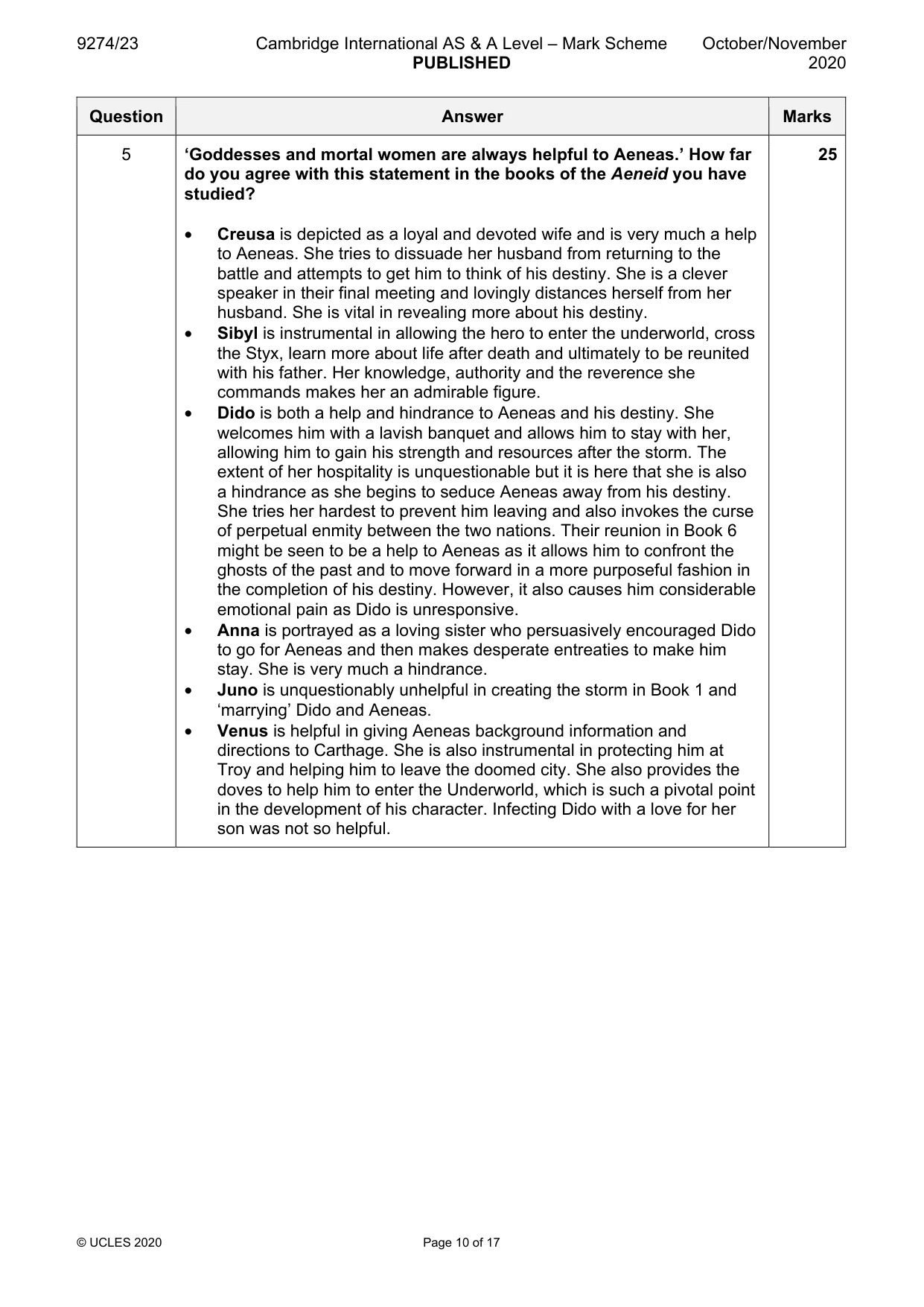
Mark scheme: 5 ‘Goddesses and mortal women are always helpful to Aeneas.’ How far 25 do you agree with this statement in the books of the Aeneid you have studied? • Creusa is depicted as a loyal and devoted wife and is very much a help to Aeneas. She tries to dissuade her husband from returning to the battle and attempts to get him to think of his destiny. She is a clever speaker in their final meeting and lovingly distances herself from her husband. She is vital in revealing more about his destiny. • Sibyl is instrumental in allowing the hero to enter the underworld, cross the Styx, learn more about life after death and ultimately to be reunited with his father. Her knowledge, authority and the reverence she commands makes her an admirable figure. • Dido is both a help and hindrance to Aeneas and his destiny. She welcomes him with a lavish banquet and allows him to stay with her, allowing him to gain his strength and resources after the storm. The extent of her hospitality is unquestionable but it is here that she is also a hindrance as she begins to seduce Aeneas away from his destiny. She tries her hardest to prevent him leaving and also invokes the curse of perpetual enmity between the two nations. Their reunion in Book 6 might be seen to be a help to Aeneas as it allows him to confront the ghosts of the past and to move forward in a more purposeful fashion in the completion of his destiny. However, it also causes him considerable emotional pain as Dido is unresponsive. • Anna is portrayed as a loving sister who persuasively encouraged Dido to go for Aeneas and then makes desperate entreaties to make him stay. She is very much a hindrance. • Juno is unquestionably unhelpful in creating the storm in Book 1 and ‘marrying’ Dido and Aeneas. • Venus is helpful in giving Aeneas background information and directions to Carthage. She is also instrumental in protecting him at Troy and helping him to leave the doomed city. She also provides the doves to help him to enter the Underworld, which is such a pivotal point in the development of his character. Infecting Dido with a love for her son was not so helpful.
Q6 · What do you think motivates Aeneas the most?
6 What do you think motivates Aeneas the most? In your answer, you should discuss his mission and other motivating factors from the books of the Aeneid you have studied. [25] SECTION THREE: JUVENAL Answer ONE of the following three questions. EITHER
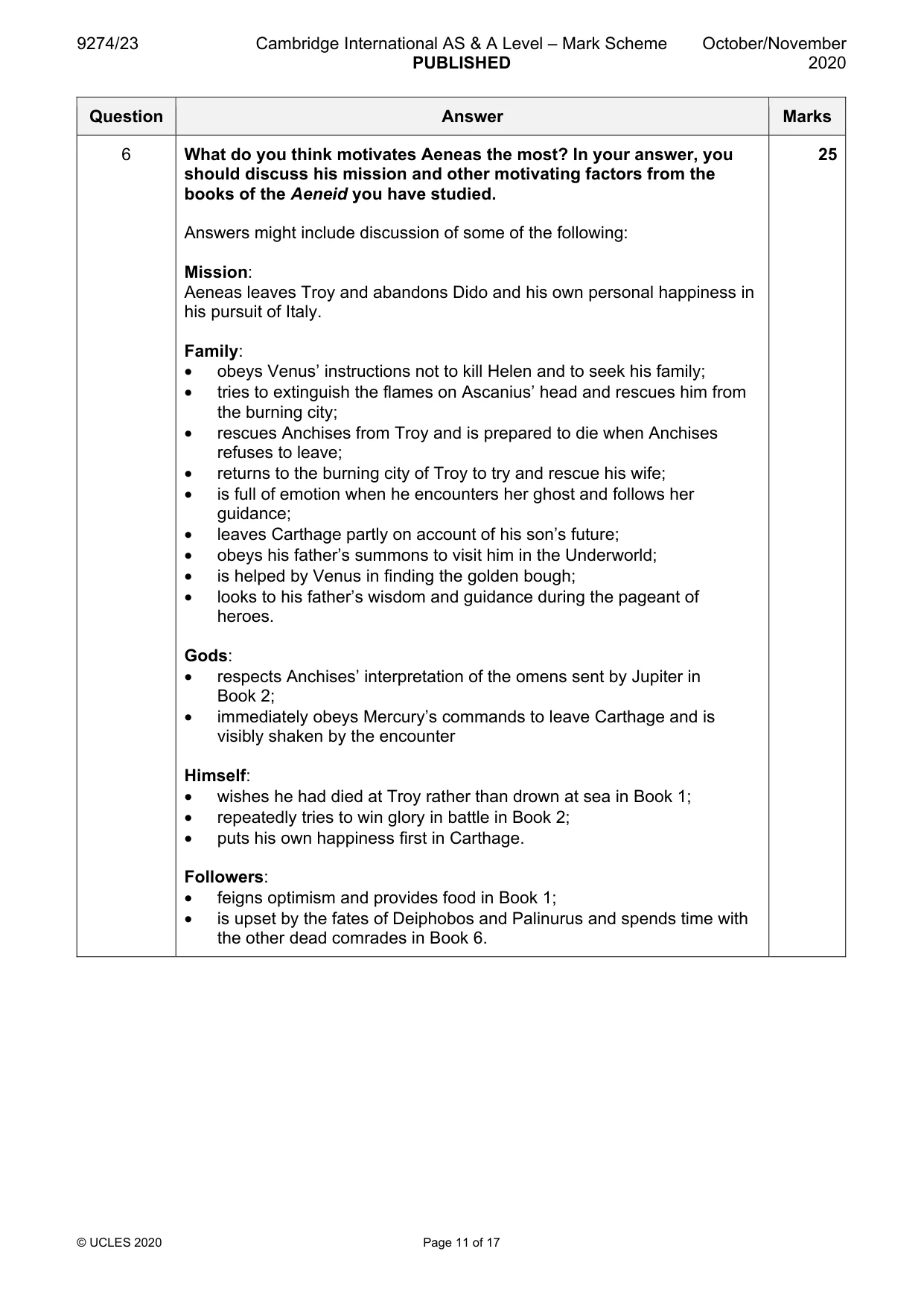
Mark scheme: 6 What do you think motivates Aeneas the most? In your answer, you 25 should discuss his mission and other motivating factors from the books of the Aeneid you have studied. Answers might include discussion of some of the following: Mission: Aeneas leaves Troy and abandons Dido and his own personal happiness in his pursuit of Italy. Family: • obeys Venus’ instructions not to kill Helen and to seek his family; • tries to extinguish the flames on Ascanius’ head and rescues him from the burning city; • rescues Anchises from Troy and is prepared to die when Anchises refuses to leave; • returns to the burning city of Troy to try and rescue his wife; • is full of emotion when he encounters her ghost and follows her guidance; • leaves Carthage partly on account of his son’s future; • obeys his father’s summons to visit him in the Underworld; • is helped by Venus in finding the golden bough; • looks to his father’s wisdom and guidance during the pageant of heroes. Gods: • respects Anchises’ interpretation of the omens sent by Jupiter in Book 2; • immediately obeys Mercury’s commands to leave Carthage and is visibly shaken by the encounter Himself: • wishes he had died at Troy rather than drown at sea in Book 1; • repeatedly tries to win glory in battle in Book 2; • puts his own happiness first in Carthage. Followers: • feigns optimism and provides food in Book 1; • is upset by the fates of Deiphobos and Palinurus and spends time with the other dead comrades in Book 6.
Q7 · Read the passage below, and answer the questions which follow: In an age when each…
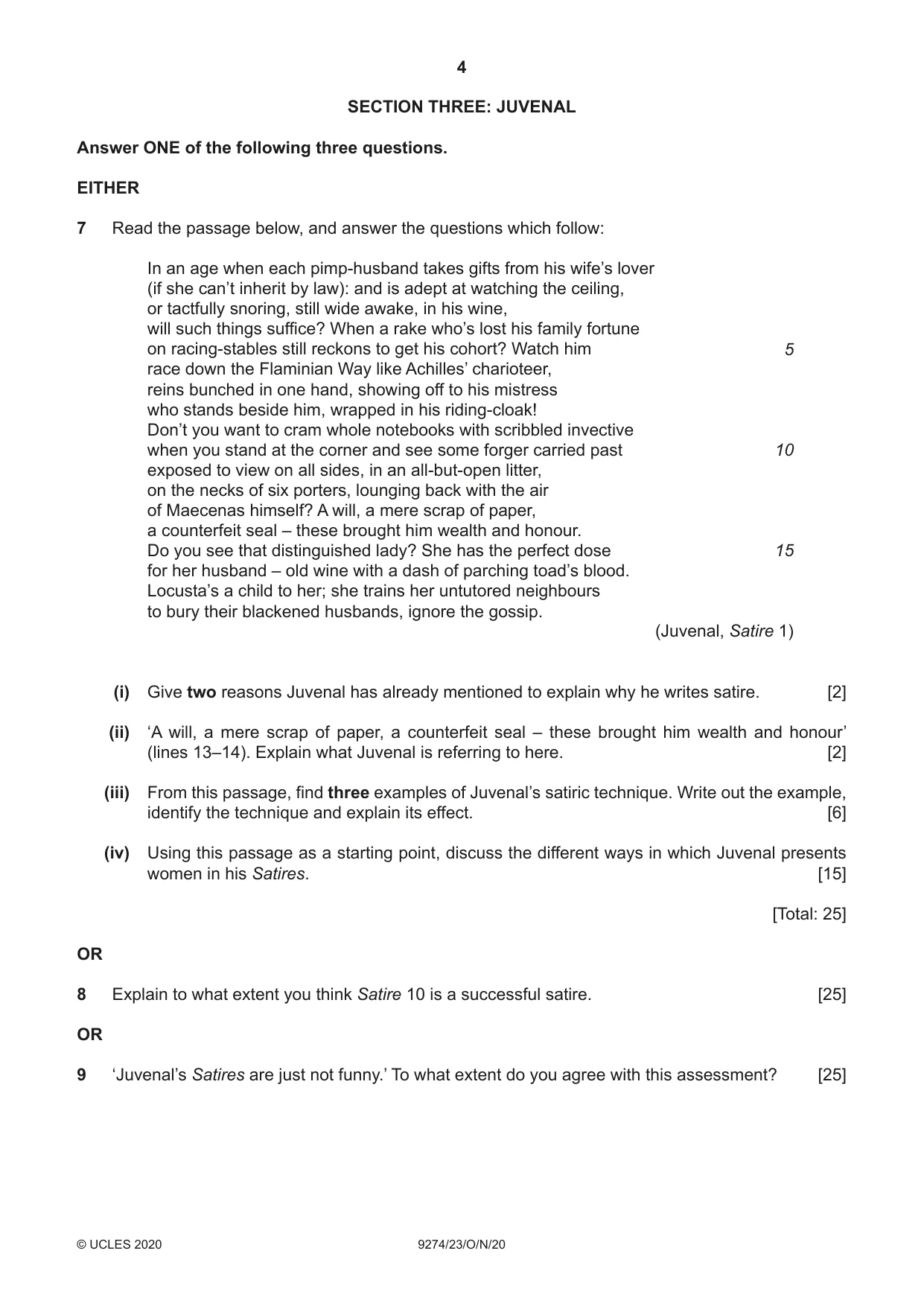
7 Read the passage below, and answer the questions which follow: In an age when each pimp-husband takes gifts from his wife’s lover (if she can’t inherit by law): and is adept at watching the ceiling, or tactfully snoring, still wide awake, in his wine, will such things suffice? When a rake who’s lost his family fortune on racing-stables still reckons to get his cohort? Watch him 5 race down the Flaminian Way like Achilles’ charioteer, reins bunched in one hand, showing off to his mistress who stands beside him, wrapped in his riding-cloak! Don’t you want to cram whole notebooks with scribbled invective when you stand at the corner and see some forger carried past 10 exposed to view on all sides, in an all-but-open litter, on the necks of six porters, lounging back with the air of Maecenas himself? A will, a mere scrap of paper, a counterfeit seal – these brought him wealth and honour. Do you see that distinguished lady? She has the perfect dose 15 for her husband – old wine with a dash of parching toad’s blood. Locusta’s a child to her; she trains her untutored neighbours to bury their blackened husbands, ignore the gossip. (Juvenal, Satire 1) (i) Give two reasons Juvenal has already mentioned to explain why he writes satire. [2] (ii) ‘A will, a mere scrap of paper, a counterfeit seal – these brought him wealth and honour’ (lines 13–14). Explain what Juvenal is referring to here. [2] (iii) From this passage, find three examples of Juvenal’s satiric technique. Write out the example, identify the technique and explain its effect. [6] (iv) Using this passage as a starting point, discuss the different ways in which Juvenal presents women in his Satires. [15] [Total: 25] OR
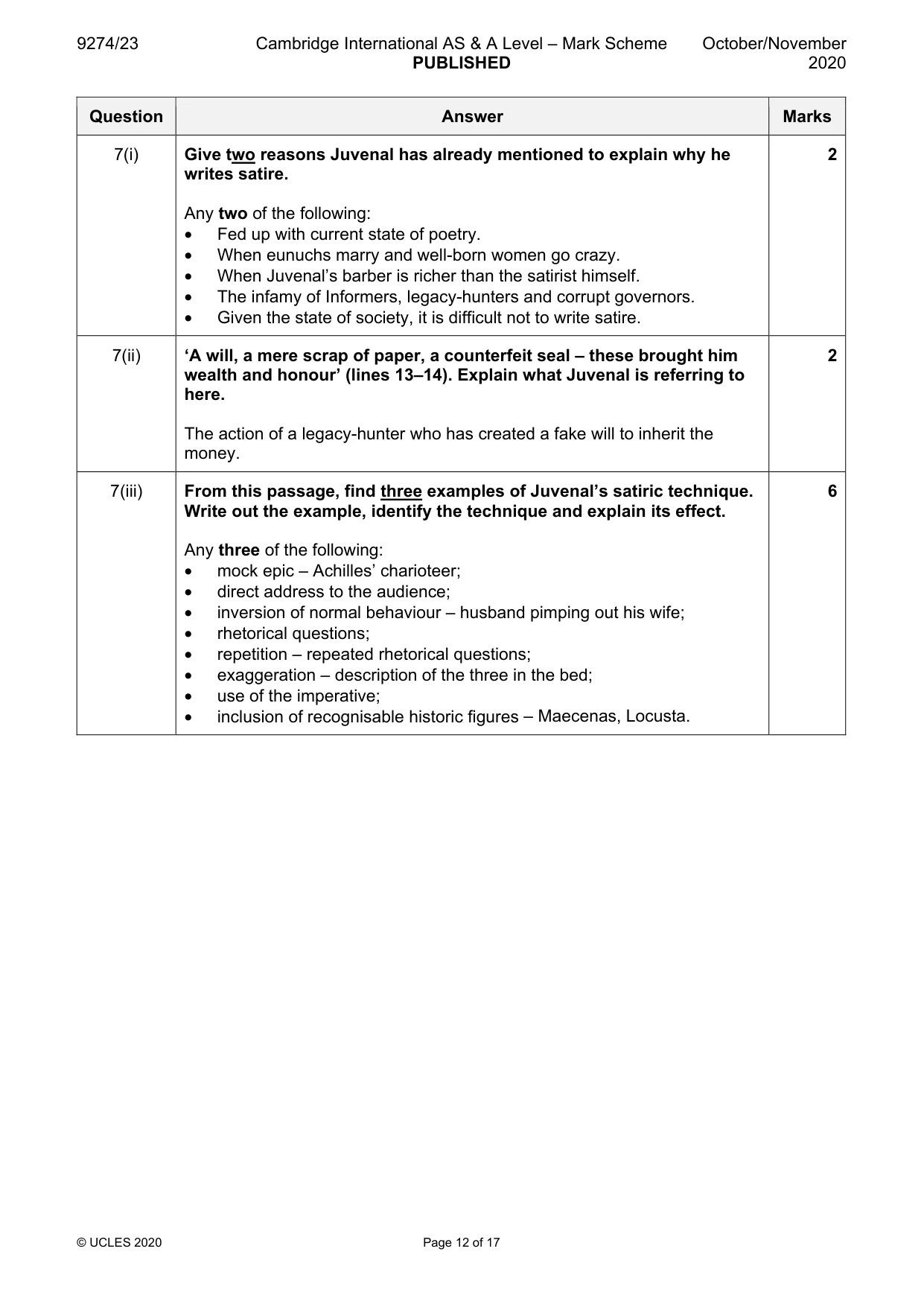
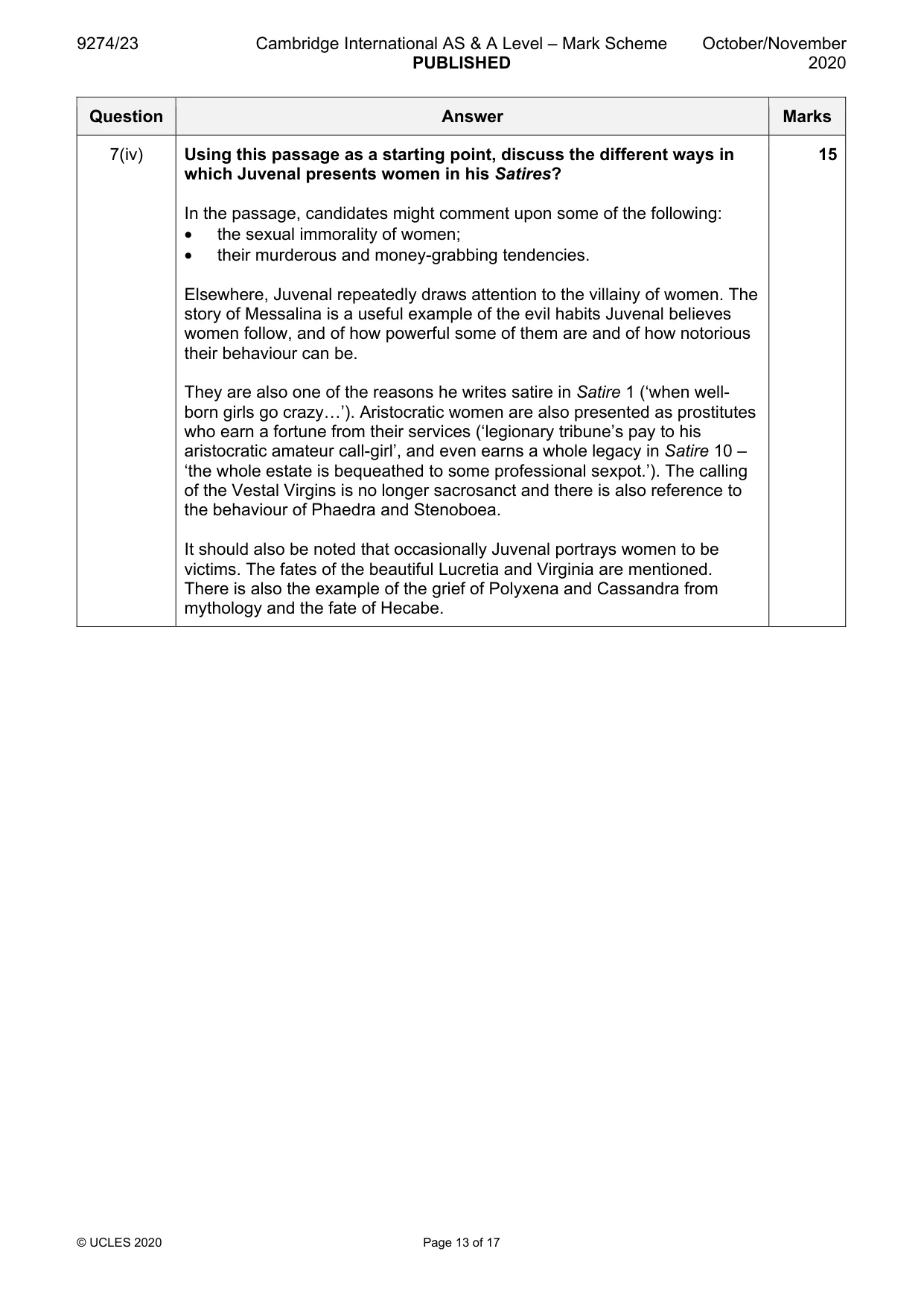
Mark scheme: 7(i) Give two reasons Juvenal has already mentioned to explain why he 2 writes satire. Any two of the following: • Fed up with current state of poetry. • When eunuchs marry and well-born women go crazy. • When Juvenal’s barber is richer than the satirist himself. • The infamy of Informers, legacy-hunters and corrupt governors. • Given the state of society, it is difficult not to write satire. 7(ii) ‘A will, a mere scrap of paper, a counterfeit seal – these brought him 2 wealth and honour’ (lines 13–14). Explain what Juvenal is referring to here. The action of a legacy-hunter who has created a fake will to inherit the money. 7(iii) From this passage, find three examples of Juvenal’s satiric technique. 6 Write out the example, identify the technique and explain its effect. Any three of the following: • mock epic – Achilles’ charioteer; • direct address to the audience; • inversion of normal behaviour – husband pimping out his wife; • rhetorical questions; • repetition – repeated rhetorical questions; • exaggeration – description of the three in the bed; • use of the imperative; • inclusion of recognisable historic figures – Maecenas, Locusta. 7(iv) Using this passage as a starting point, discuss the different ways in 15 which Juvenal presents women in his Satires? In the passage, candidates might comment upon some of the following: • the sexual immorality of women; • their murderous and money-grabbing tendencies. Elsewhere, Juvenal repeatedly draws attention to the villainy of women. The story of Messalina is a useful example of the evil habits Juvenal believes women follow, and of how powerful some of them are and of how notorious their behaviour can be. They are also one of the reasons he writes satire in Satire 1 (‘when well- born girls go crazy…’). Aristocratic women are also presented as prostitutes who earn a fortune from their services (‘legionary tribune’s pay to his aristocratic amateur call-girl’, and even earns a whole legacy in Satire 10 – ‘the whole estate is bequeathed to some professional sexpot.’). The calling of the Vestal Virgins is no longer sacrosanct and there is also reference to the behaviour of Phaedra and Stenoboea. It should also be noted that occasionally Juvenal portrays women to be victims. The fates of the beautiful Lucretia and Virginia are mentioned. There is also the example of the grief of Polyxena and Cassandra from mythology and the fate of Hecabe.
Q8 · Explain to what extent you think Satire 10 is a successful satire
8 Explain to what extent you think Satire 10 is a successful satire. [25] OR
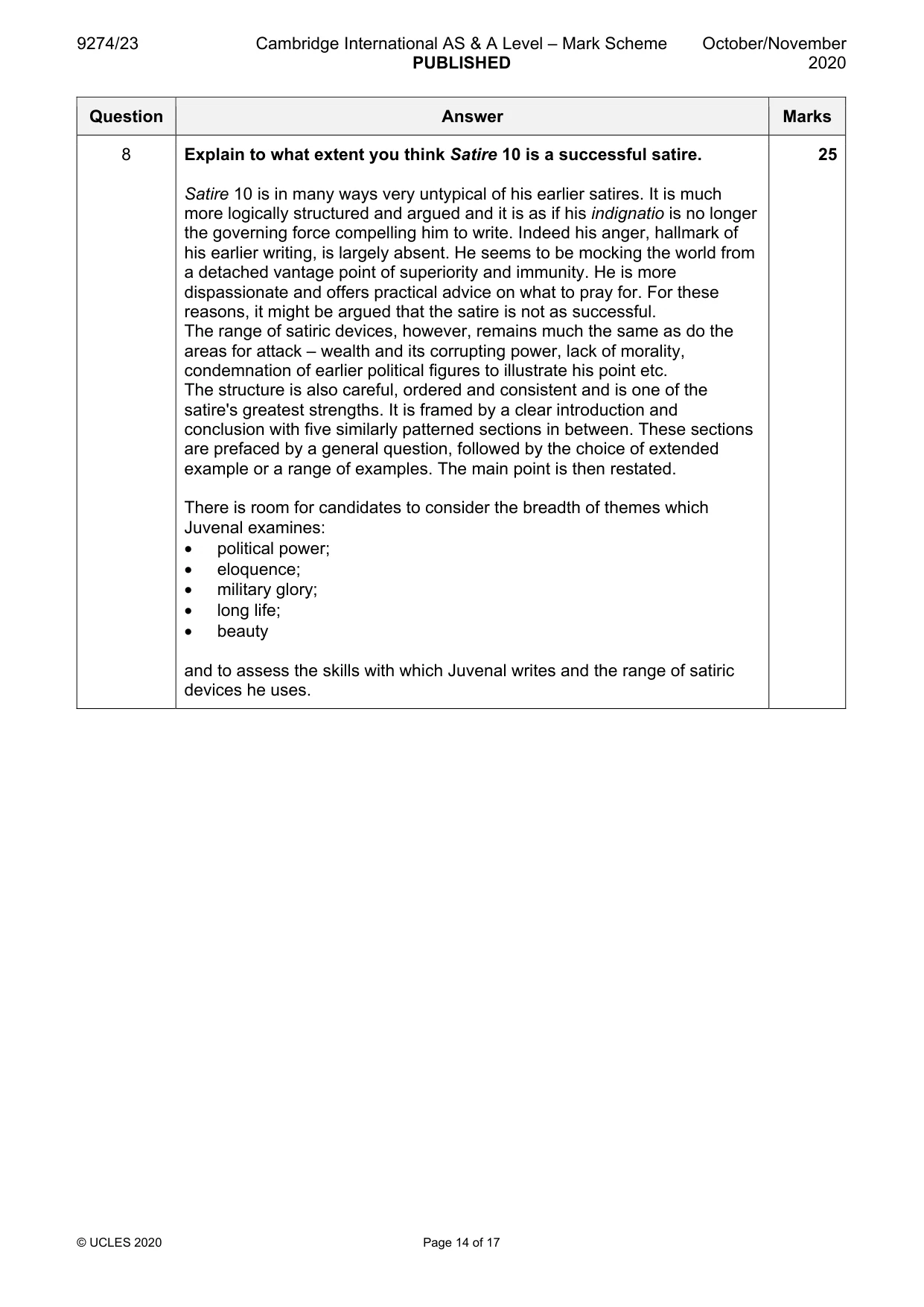
Mark scheme: 8 Explain to what extent you think Satire 10 is a successful satire. 25 Satire 10 is in many ways very untypical of his earlier satires. It is much more logically structured and argued and it is as if his indignatio is no longer the governing force compelling him to write. Indeed his anger, hallmark of his earlier writing, is largely absent. He seems to be mocking the world from a detached vantage point of superiority and immunity. He is more dispassionate and offers practical advice on what to pray for. For these reasons, it might be argued that the satire is not as successful. The range of satiric devices, however, remains much the same as do the areas for attack – wealth and its corrupting power, lack of morality, condemnation of earlier political figures to illustrate his point etc. The structure is also careful, ordered and consistent and is one of the satire's greatest strengths. It is framed by a clear introduction and conclusion with five similarly patterned sections in between. These sections are prefaced by a general question, followed by the choice of extended example or a range of examples. The main point is then restated. There is room for candidates to consider the breadth of themes which Juvenal examines: • political power; • eloquence; • military glory; • long life; • beauty and to assess the skills with which Juvenal writes and the range of satiric devices he uses.
Q9 · SECTION FOUR: ROMAN ARCHITECTURE Answer ONE of the following three questions
SECTION FOUR: ROMAN ARCHITECTURE Answer ONE of the following three questions. EITHER
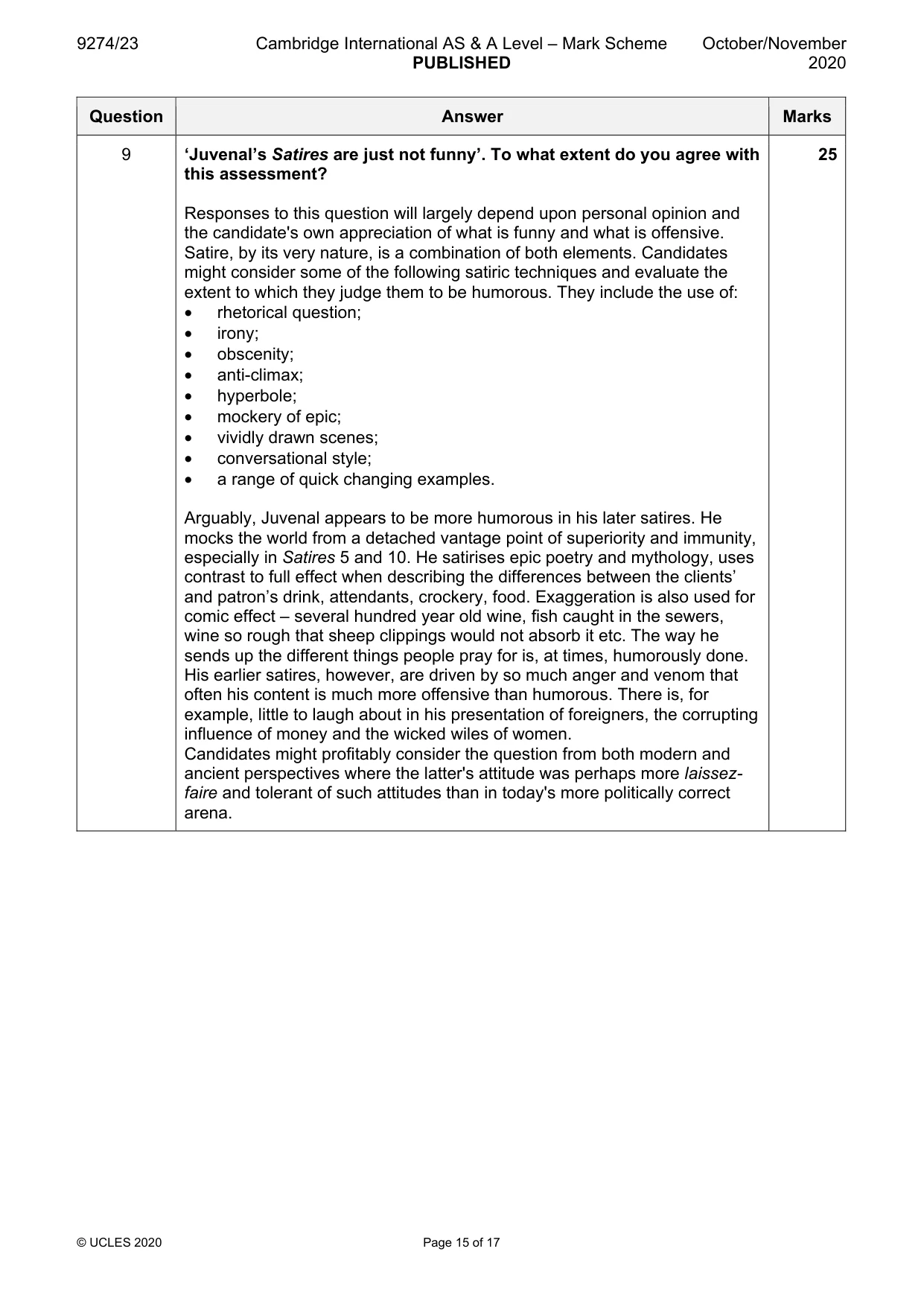
Mark scheme: 9 ‘Juvenal’s Satires are just not funny’. To what extent do you agree with 25 this assessment? Responses to this question will largely depend upon personal opinion and the candidate's own appreciation of what is funny and what is offensive. Satire, by its very nature, is a combination of both elements. Candidates might consider some of the following satiric techniques and evaluate the extent to which they judge them to be humorous. They include the use of: • rhetorical question; • irony; • obscenity; • anti-climax; • hyperbole; • mockery of epic; • vividly drawn scenes; • conversational style; • a range of quick changing examples. Arguably, Juvenal appears to be more humorous in his later satires. He mocks the world from a detached vantage point of superiority and immunity, especially in Satires 5 and 10. He satirises epic poetry and mythology, uses contrast to full effect when describing the differences between the clients’ and patron’s drink, attendants, crockery, food. Exaggeration is also used for comic effect – several hundred year old wine, fish caught in the sewers, wine so rough that sheep clippings would not absorb it etc. The way he sends up the different things people pray for is, at times, humorously done. His earlier satires, however, are driven by so much anger and venom that often his content is much more offensive than humorous. There is, for example, little to laugh about in his presentation of foreigners, the corrupting influence of money and the wicked wiles of women. Candidates might profitably consider the question from both modern and ancient perspectives where the latter's attitude was perhaps more laissez- faire and tolerant of such attitudes than in today's more politically correct arena.
Q10 · Study the image below, and answer the questions which follow: (i) What type of building…
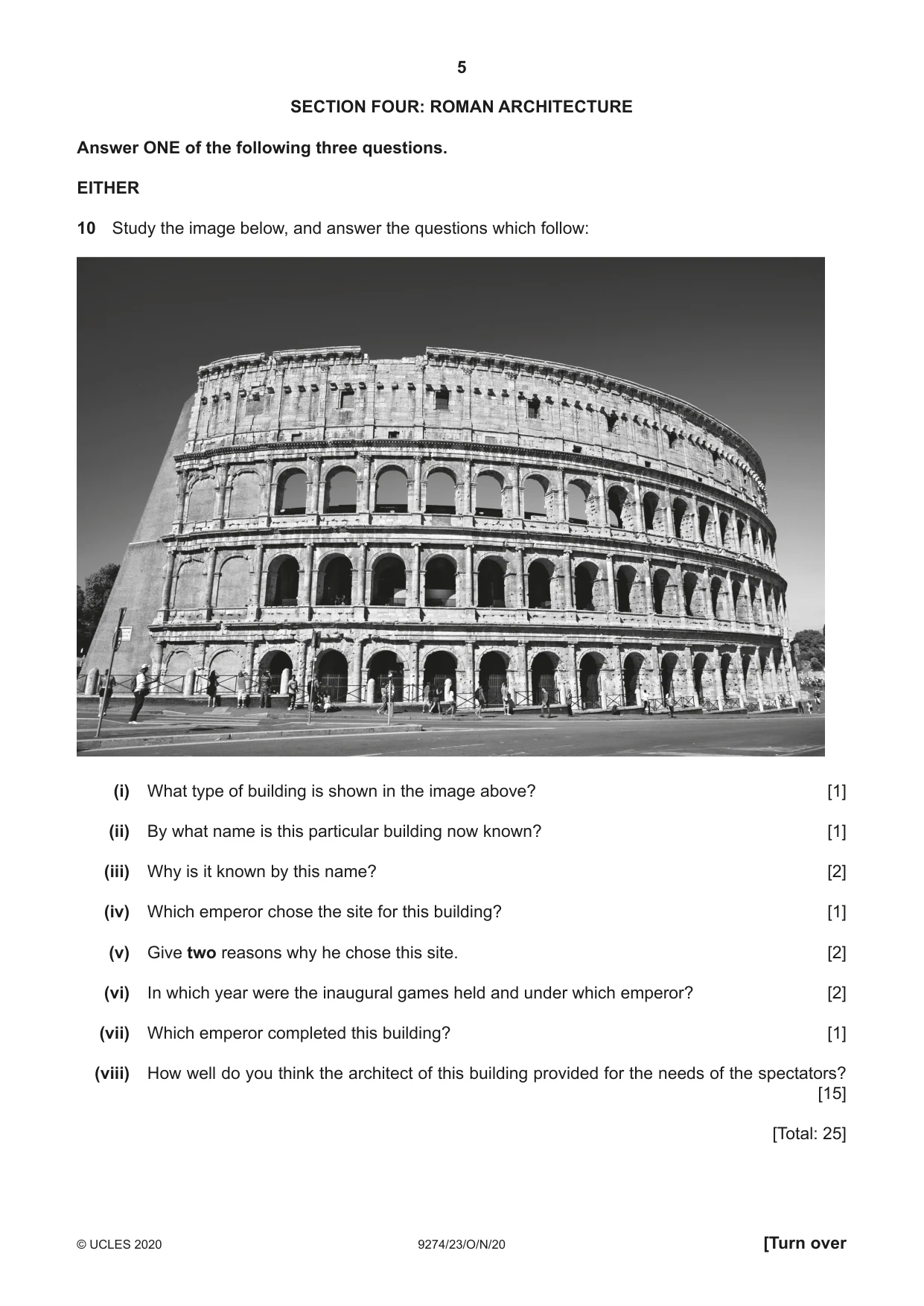
10 Study the image below, and answer the questions which follow: (i) What type of building is shown in the image above? [1] (ii) By what name is this particular building now known? [1] (iii) Why is it known by this name? [2] (iv) Which emperor chose the site for this building? [1] (v) Give two reasons why he chose this site. [2] (vi) In which year were the inaugural games held and under which emperor? [2] (vii) Which emperor completed this building? [1] (viii) How well do you think the architect of this building provided for the needs of the spectators? [15] [Total: 25] OR
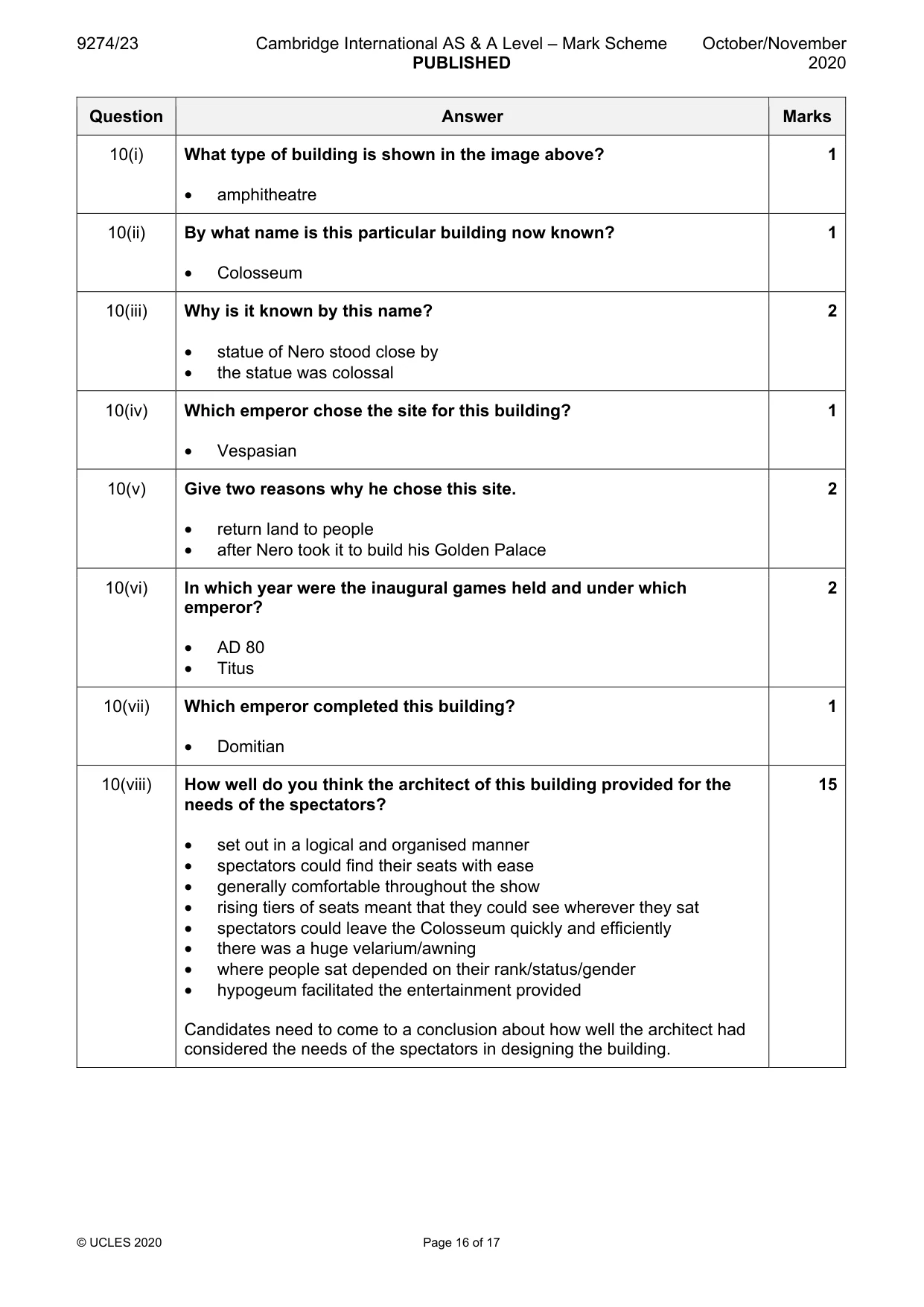
Mark scheme: 10(i) What type of building is shown in the image above? 1 • amphitheatre 10(ii) By what name is this particular building now known? 1 • Colosseum 10(iii) Why is it known by this name? 2 • statue of Nero stood close by • the statue was colossal 10(iv) Which emperor chose the site for this building? 1 • Vespasian 10(v) Give two reasons why he chose this site. 2 • return land to people • after Nero took it to build his Golden Palace 10(vi) In which year were the inaugural games held and under which 2 emperor? • AD 80 • Titus 10(vii) Which emperor completed this building? 1 • Domitian 10(viii) How well do you think the architect of this building provided for the 15 needs of the spectators? • set out in a logical and organised manner • spectators could find their seats with ease • generally comfortable throughout the show • rising tiers of seats meant that they could see wherever they sat • spectators could leave the Colosseum quickly and efficiently • there was a huge velarium/awning • where people sat depended on their rank/status/gender • hypogeum facilitated the entertainment provided Candidates need to come to a conclusion about how well the architect had considered the needs of the spectators in designing the building.
Q11 · ‘A masterpiece of propaganda.’ To which of the buildings you have studied do you think…
11 ‘A masterpiece of propaganda.’ To which of the buildings you have studied do you think that this description applies the most? You should include discussion of at least three specific Roman buildings to explain your answer. [25] OR
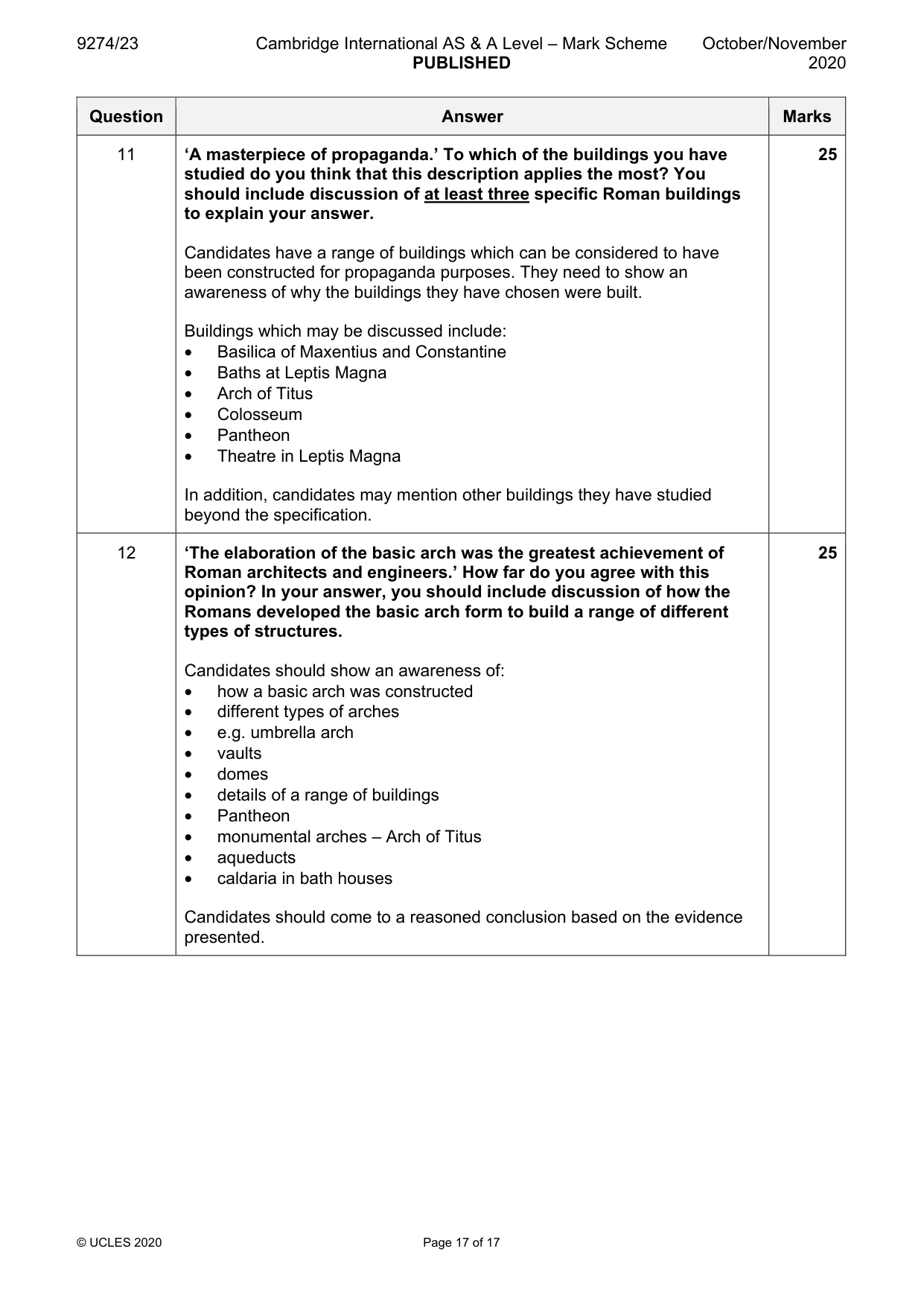
Mark scheme: 11 ‘A masterpiece of propaganda.’ To which of the buildings you have 25 studied do you think that this description applies the most? You should include discussion of at least three specific Roman buildings to explain your answer. Candidates have a range of buildings which can be considered to have been constructed for propaganda purposes. They need to show an awareness of why the buildings they have chosen were built. Buildings which may be discussed include: • Basilica of Maxentius and Constantine • Baths at Leptis Magna • Arch of Titus • Colosseum • Pantheon • Theatre in Leptis Magna In addition, candidates may mention other buildings they have studied beyond the specification.
Q12 · ‘The elaboration of the basic arch was the greatest achievement of Roman architects and…
12 ‘The elaboration of the basic arch was the greatest achievement of Roman architects and engineers.’ How far do you agree with this opinion? In your answer, you should include discussion of how the Romans developed the basic arch form to build a range of different types of structures. [25]
Mark scheme: 12 ‘The elaboration of the basic arch was the greatest achievement of 25 Roman architects and engineers.’ How far do you agree with this opinion? In your answer, you should include discussion of how the Romans developed the basic arch form to build a range of different types of structures. Candidates should show an awareness of: • how a basic arch was constructed • different types of arches • e.g. umbrella arch • vaults • domes • details of a range of buildings • Pantheon • monumental arches – Arch of Titus • aqueducts • caldaria in bath houses Candidates should come to a reasoned conclusion based on the evidence presented.
What was in this paper
The subtopics covered by these 12 questions, and how many questions each got. Open one in a new tab to see every Cambridge question on it.
What you needed in this session
Cambridge’s own grade thresholds for 2020 Oct/Nov, Paper 2 · Variant 3. A higher threshold means an easier paper — the bar moves with how the cohort did.