Cambridge A Level Chemistry 9701 — 2025 May/June Paper 5 · Variant 2
9701/52/M/J/25 · 2 questions · 30 marks · 75 min
The question paper and its mark scheme, free to read here and free to download. This is Cambridge’s own paper, exactly as it was sat.
Question paper12 pages

Mark scheme10 pages
Answers below. Sit the paper first if you are practising.
Questions as text
Q1 · Activated carbon is a form of carbon with the ability to adsorb solutes from solutions
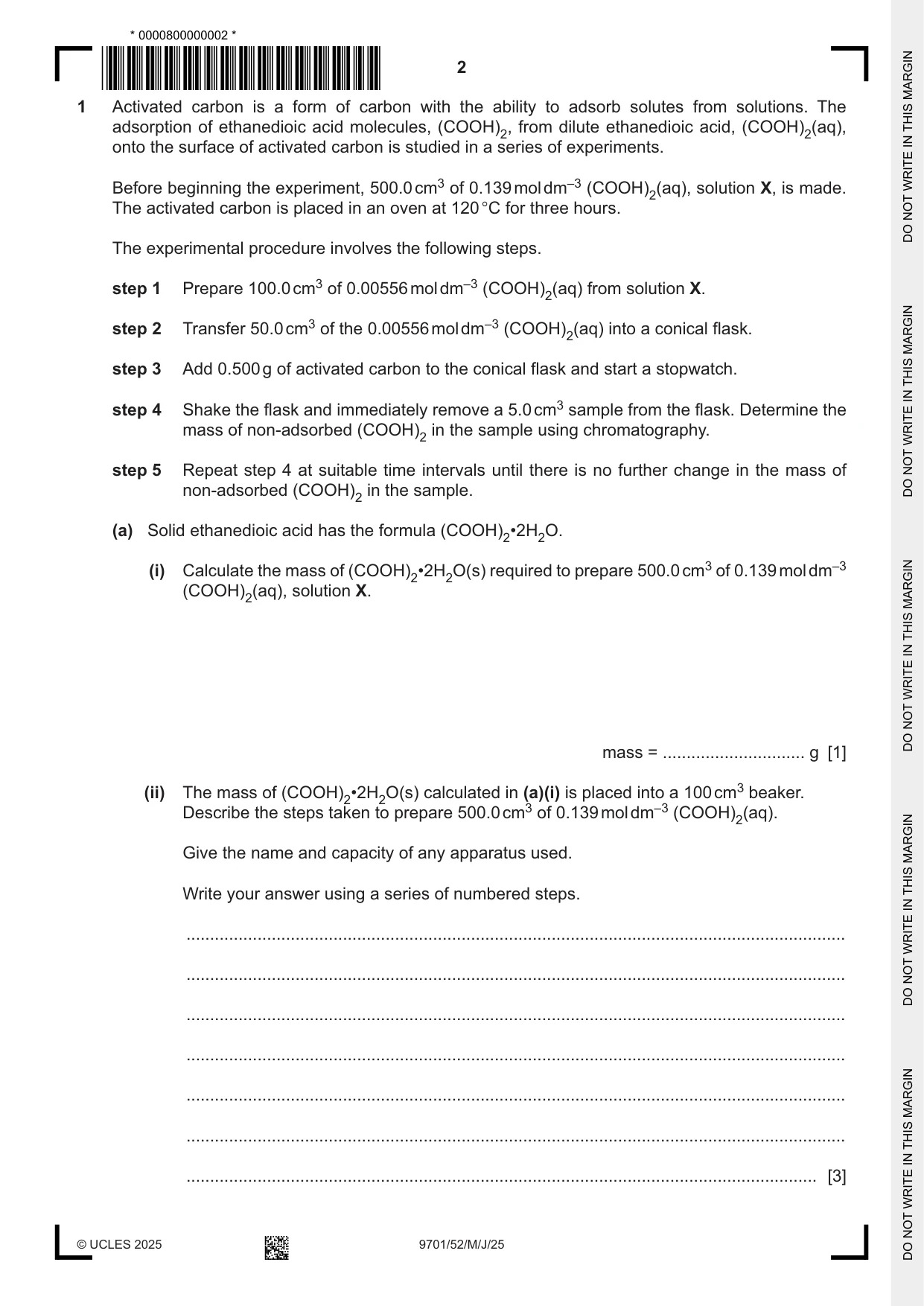
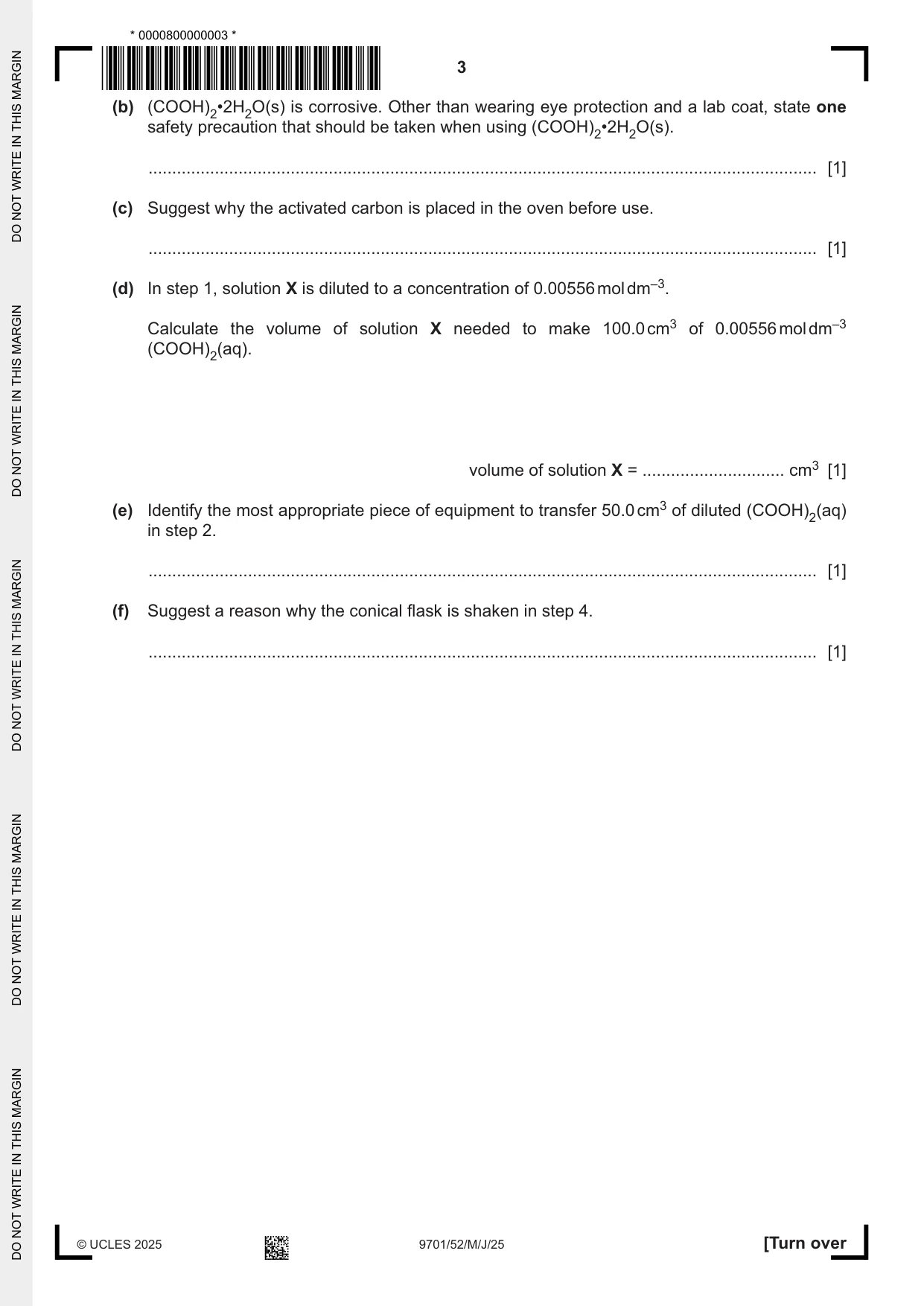
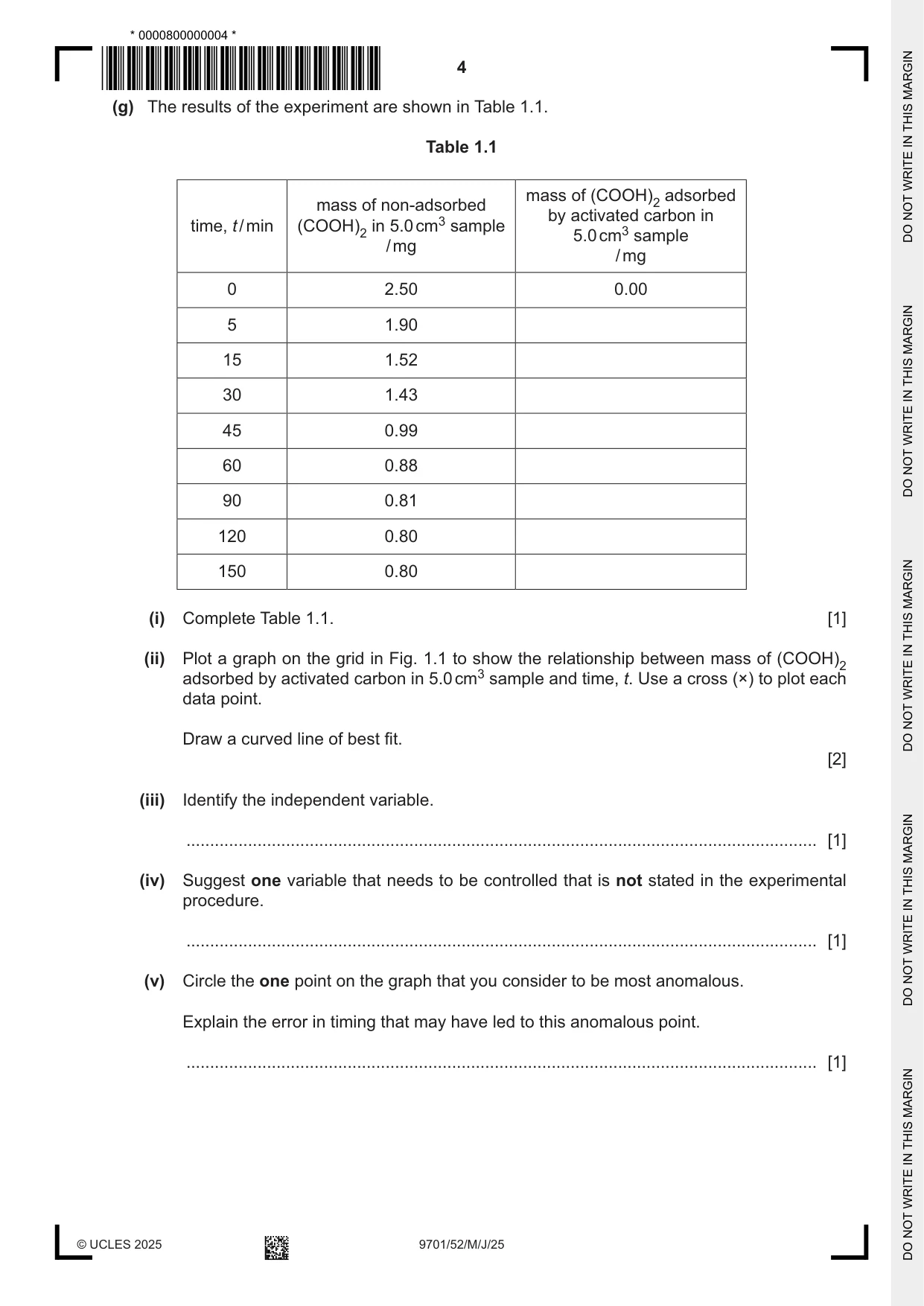
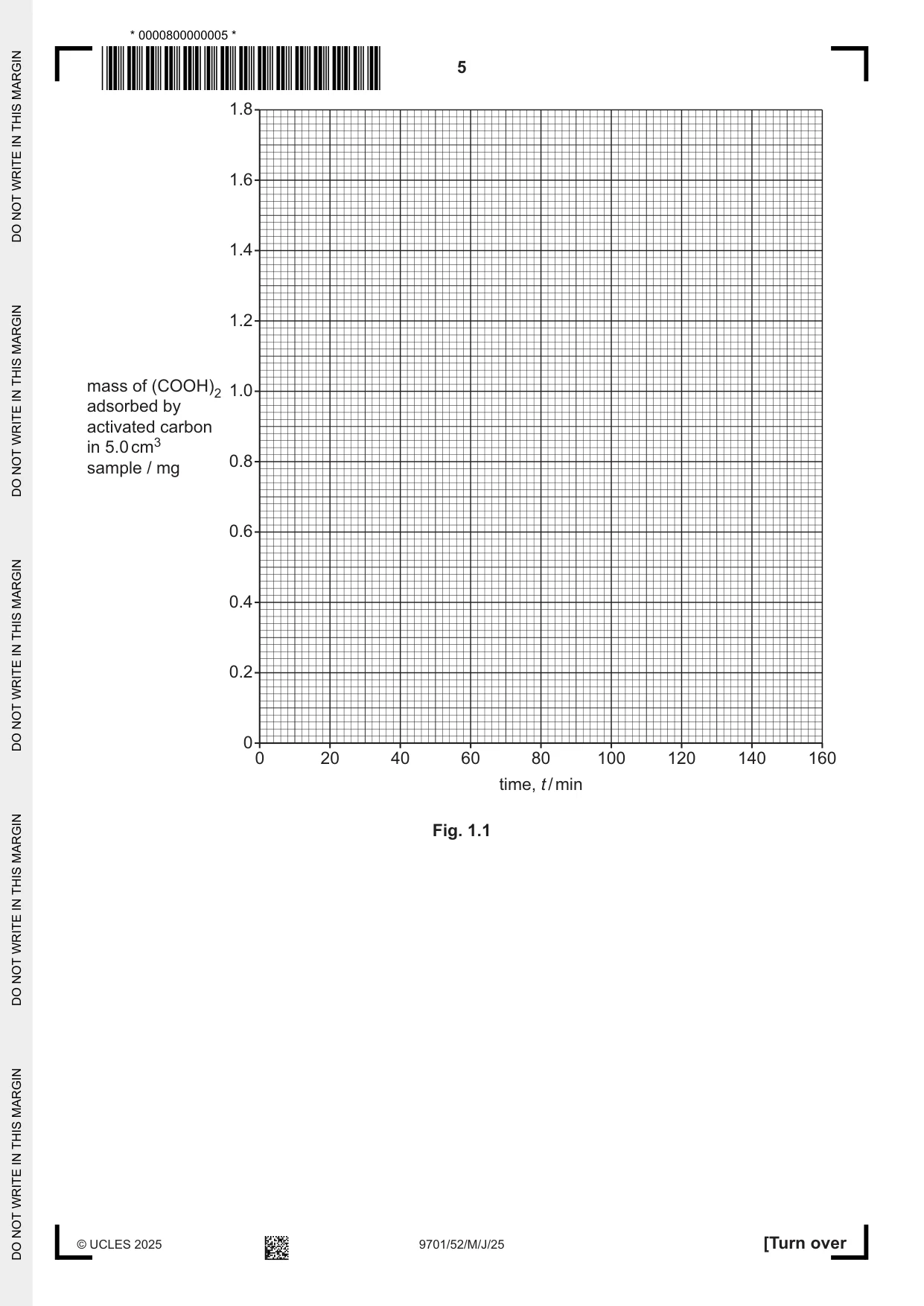
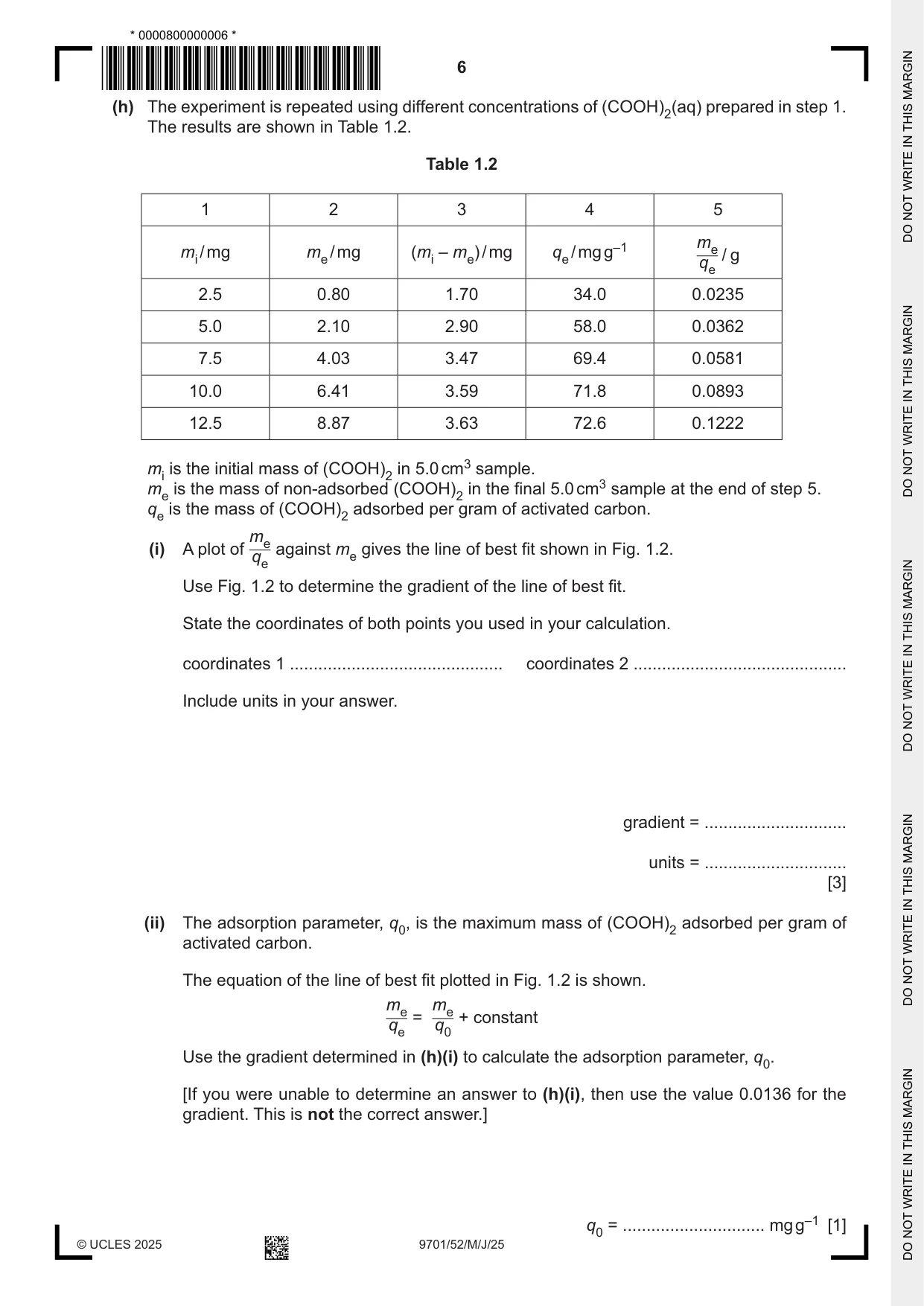
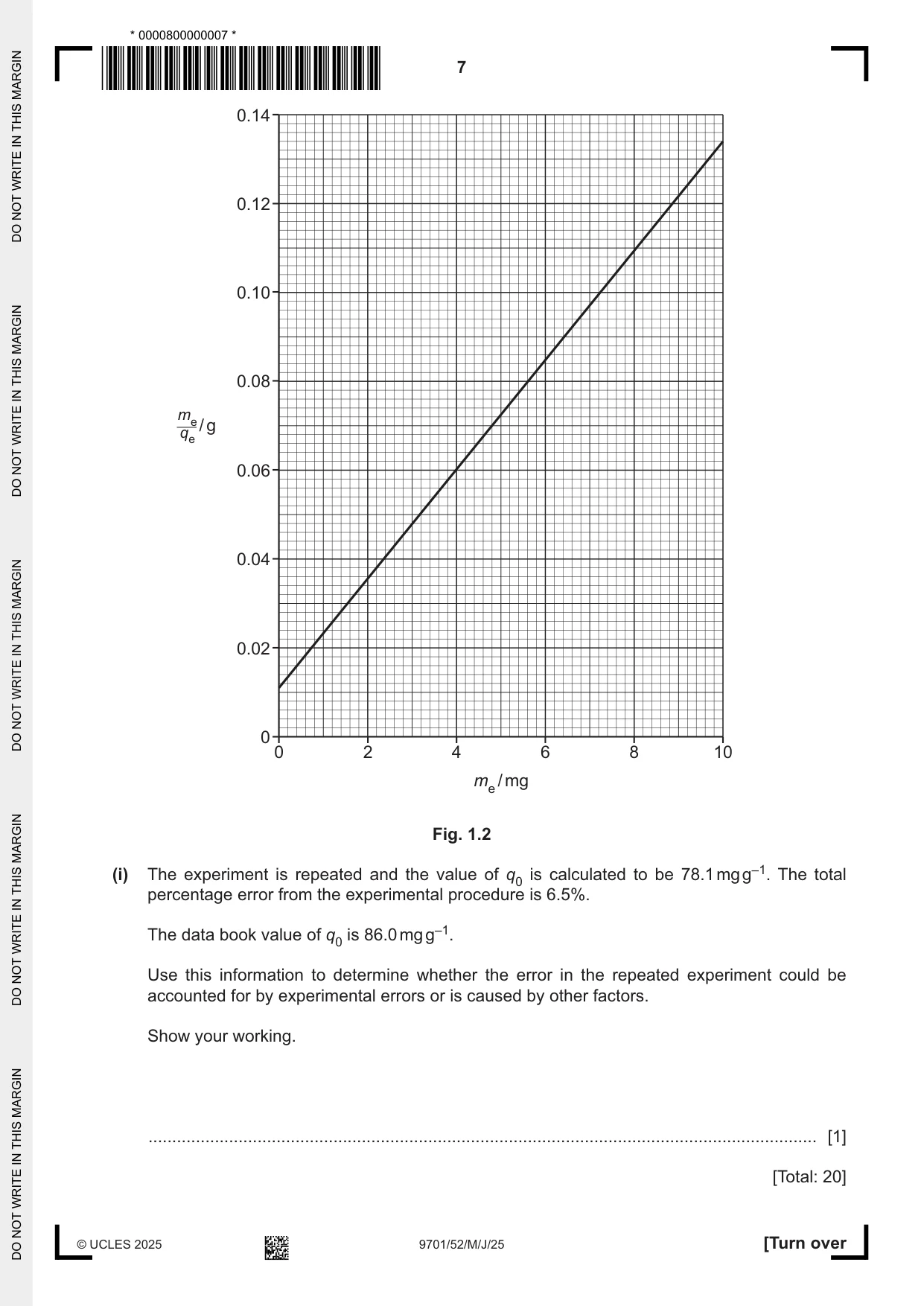
1 Activated carbon is a form of carbon with the ability to adsorb solutes from solutions. The adsorption of ethanedioic acid molecules, (COOH)2, from dilute ethanedioic acid, (COOH)2(aq), onto the surface of activated carbon is studied in a series of experiments. Before beginning the experiment, 500.0 cm3 of 0.139 mol dm–3 (COOH)2(aq), solution X, is made. The activated carbon is placed in an oven at 120 °C for three hours. The experimental procedure involves the following steps. step 1 Prepare 100.0 cm3 of 0.00556 mol dm–3 (COOH)2(aq) from solution X. step 2 Transfer 50.0 cm3 of the 0.00556 mol dm–3 (COOH)2(aq) into a conical flask. step 3 Add 0.500 g of activated carbon to the conical flask and start a stopwatch. step 4 Shake the flask and immediately remove a 5.0 cm3 sample from the flask. Determine the mass of non-adsorbed (COOH)2 in the sample using chromatography. step 5 Repeat step 4 at suitable time intervals until there is no further change in the mass of non-adsorbed (COOH)2 in the sample. (a) Solid ethanedioic acid has the formula (COOH)2•2H2O. (i) Calculate the mass of (COOH)2•2H2O(s) required to prepare 500.0 cm3 of 0.139 mol dm–3 (COOH)2(aq), solution X. mass = .............................. g [1] (ii) The mass of (COOH)2•2H2O(s) calculated in (a)(i) is placed into a 100 cm3 beaker. Describe the steps taken to prepare 500.0 cm3 of 0.139 mol dm–3 (COOH)2(aq). Give the name and capacity of any apparatus used. Write your answer using a series of numbered steps. ........................................................................................................................................... ........................................................................................................................................... ........................................................................................................................................... ........................................................................................................................................... ........................................................................................................................................... ........................................................................................................................................... ..................................................................................................................................... [3] (b) (COOH)2•2H2O(s) is corrosive. Other than wearing eye protection and a lab coat, state one safety precaution that should be taken when using (COOH)2•2H2O(s). ............................................................................................................................................. [1] (c) Suggest why the activated carbon is placed in the oven before use. ............................................................................................................................................. [1] (d) In step 1, solution X is diluted to a concentration of 0.00556 mol dm–3. Calculate the volume of solution X needed to make 100.0 cm3 of 0.00556 mol dm–3 (COOH)2(aq). volume of solution X = .............................. cm3 [1] (e) Identify the most appropriate piece of equipment to transfer 50.0 cm3 of diluted (COOH)2(aq) in step 2. ............................................................................................................................................. [1] (f) Suggest a reason why the conical flask is shaken in step 4. ............................................................................................................................................. [1] (g) The results of the experiment are shown in Table 1.1. Table 1.1 mass of (COOH)2 adsorbed mass of non-adsorbed by activated carbon in time, t / min (COOH)2 in 5.0 cm3 sample 5.0 cm3 sample / mg / mg 0 2.50 0.00 5 1.90 15 1.52 30 1.43 45 0.99 60 0.88 90 0.81 120 0.80 150 0.80 (i) Complete Table 1.1. [1] (ii) Plot a graph on the grid in Fig. 1.1 to show the relationship between mass of (COOH)2 adsorbed by activated carbon in 5.0 cm3 sample and time, t. Use a cross (×) to plot each data point. Draw a curved line of best fit. [2] (iii) Identify the independent variable. ..................................................................................................................................... [1] (iv) Suggest one variable that needs to be controlled that is not stated in the experimental procedure. ..................................................................................................................................... [1] (v) Circle the one point on the graph that you consider to be most anomalous. Explain the error in timing that may have led to this anomalous point. ..................................................................................................................................... [1] 1.8 1.6 1.4 1.2 mass of (COOH)2 1.0 adsorbed by activated carbon in 5.0 cm3 0.8sample / mg 0.6 0.4 0.2 0 0 20 40 60 80 100 120 140 160 time, t / min Fig. 1.1 (h) The experiment is repeated using different concentrations of (COOH)2(aq) prepared in step 1. The results are shown in Table 1.2. Table 1.2 1 2 3 4 5 me / g mi / mg me / mg (mi – me) / mg qe / mg g–1 qe 2.5 0.80 1.70 34.0 0.0235 5.0 2.10 2.90 58.0 0.0362 7.5 4.03 3.47 69.4 0.0581 10.0 6.41 3.59 71.8 0.0893 12.5 8.87 3.63 72.6 0.1222 mi is the initial mass of (COOH)2 in 5.0 cm3 sample. me is the mass of non-adsorbed (COOH)2 in the final 5.0 cm3 sample at the end of step 5. qe is the mass of (COOH)2 adsorbed per gram of activated carbon. me (i) A plot of against me gives the line of best fit shown in Fig. 1.2. qe Use Fig. 1.2 to determine the gradient of the line of best fit. State the coordinates of both points you used in your calculation. coordinates 1 ............................................. coordinates 2 ............................................. Include units in your answer. gradient = .............................. units = .............................. [3] (ii) The adsorption parameter, q0, is the maximum mass of (COOH)2 adsorbed per gram of activated carbon. The equation of the line of best fit plotted in Fig. 1.2 is shown. me me = + constant qe q0 Use the gradient determined in (h)(i) to calculate the adsorption parameter, q0. [If you were unable to determine an answer to (h)(i), then use the value 0.0136 for the gradient. This is not the correct answer.] q0 = .............................. mg g–1 [1] 0.14 0.12 0.10 0.08 me / g qe 0.06 0.04 0.02 0 0 2 4 6 8 10 me / mg Fig. 1.2 (i) The experiment is repeated and the value of q0 is calculated to be 78.1 mg g–1. The total percentage error from the experimental procedure is 6.5%. The data book value of q0 is 86.0 mg g–1. Use this information to determine whether the error in the repeated experiment could be accounted for by experimental errors or is caused by other factors. Show your working. ............................................................................................................................................. [1] [Total: 20]
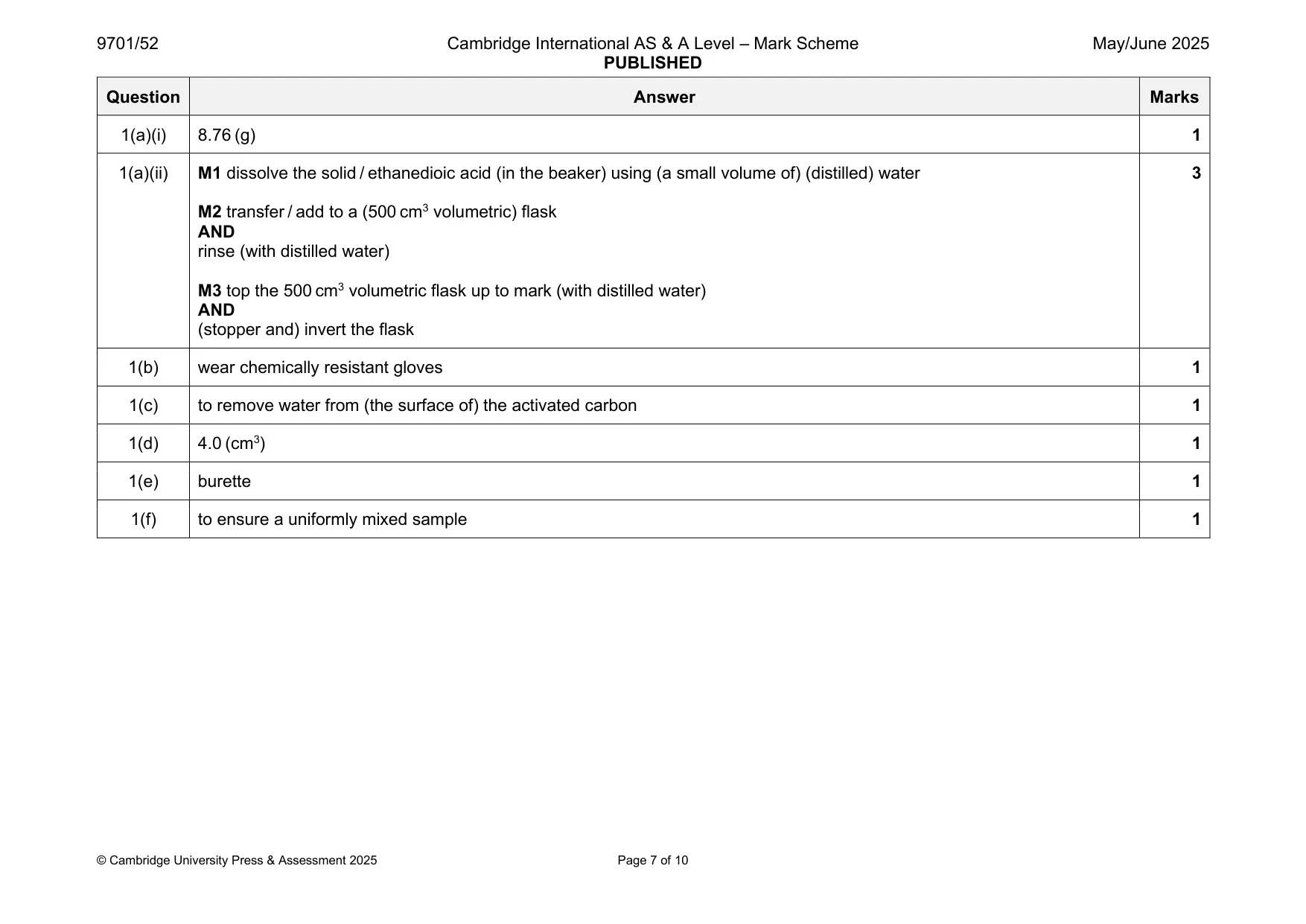
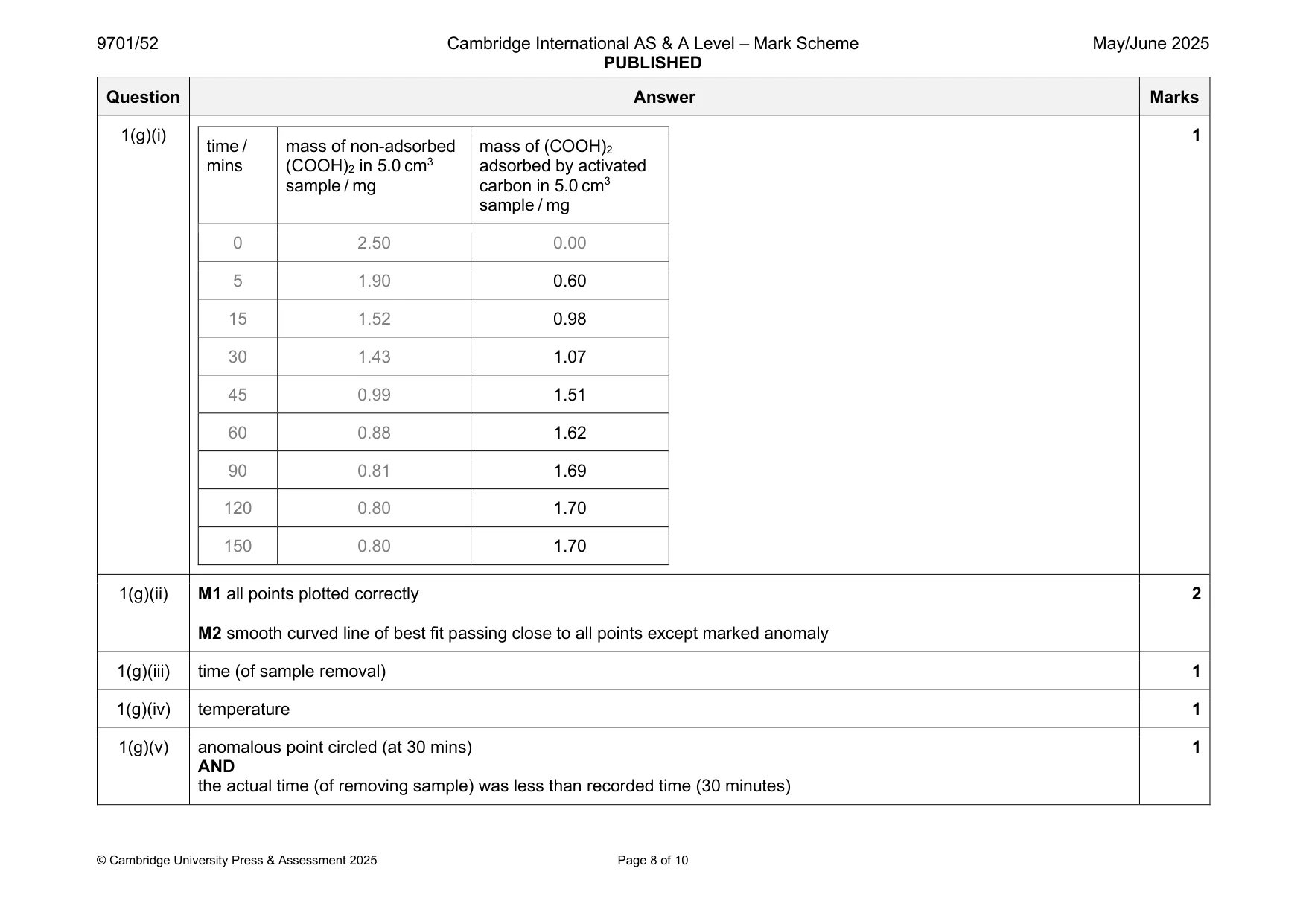
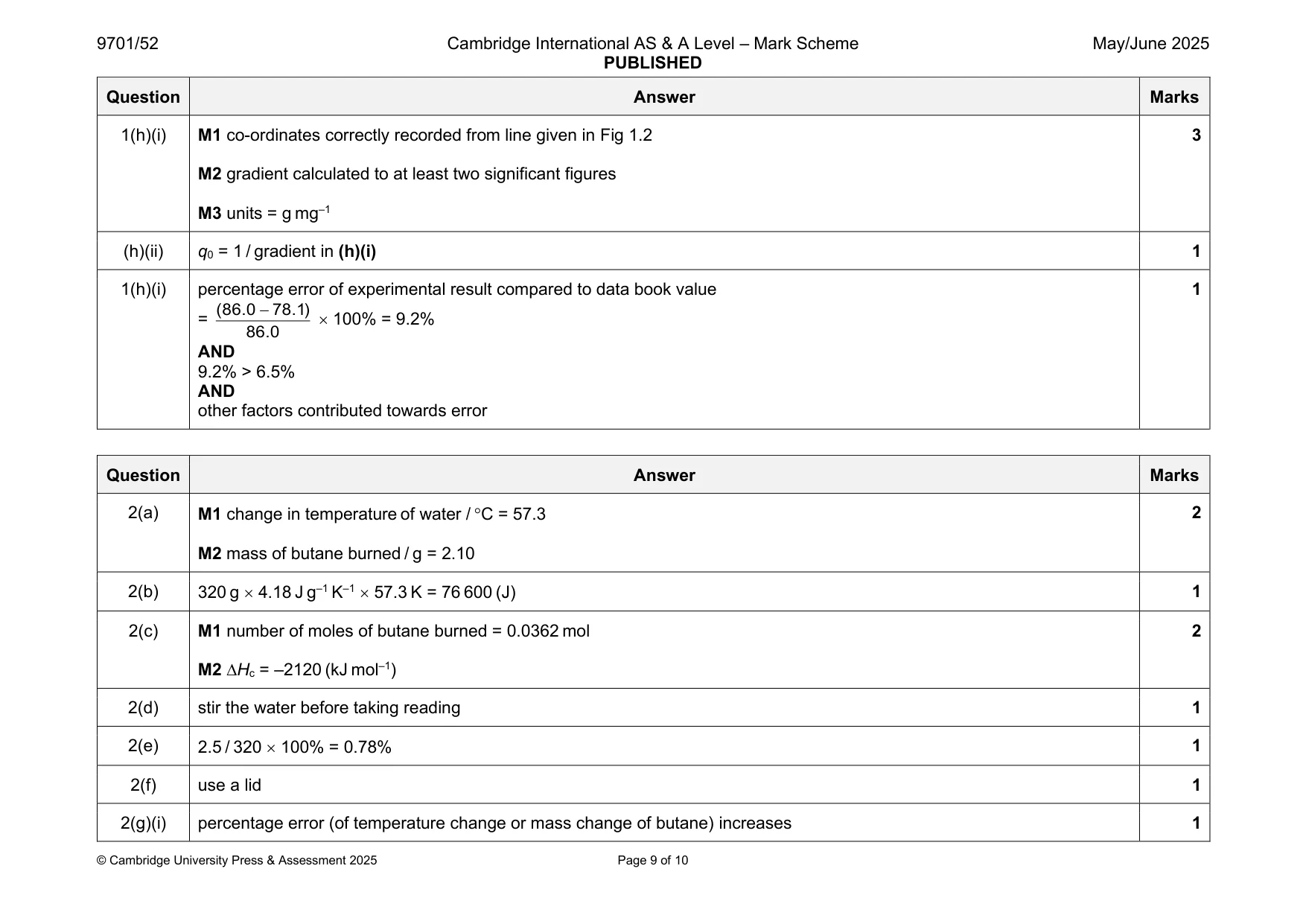
Mark scheme: Question Answer Marks 1(a)(i) 8.76 (g) 1 1(a)(ii) M1 dissolve the solid / ethanedioic acid (in the beaker) using (a small volume of) (distilled) water 3 M2 transfer / add to a (500 cm3 volumetric) flask AND rinse (with distilled water) M3 top the 500 cm3 volumetric flask up to mark (with distilled water) AND (stopper and) invert the flask 1(b) wear chemically resistant gloves 1 1(c) to remove water from (the surface of) the activated carbon 1 1(d) 4.0 (cm3) 1 1(e) burette 1 1(f) to ensure a uniformly mixed sample 1 1(g)(i) 1 time / mass of non-adsorbed mass of (COOH)2 mins (COOH)2 in 5.0 cm3 adsorbed by activated sample / mg carbon in 5.0 cm3 sample / mg 0 2.50 0.00 5 1.90 0.60 15 1.52 0.98 30 1.43 1.07 45 0.99 1.51 60 0.88 1.62 90 0.81 1.69 120 0.80 1.70 150 0.80 1.70 1(g)(ii) M1 all points plotted correctly 2 M2 smooth curved line of best fit passing close to all points except marked anomaly 1(g)(iii) time (of sample removal) 1 1(g)(iv) temperature 1 1(g)(v) anomalous point circled (at 30 mins) 1 AND the actual time (of removing sample) was less than recorded time (30 minutes) 1(h)(i) M1 co-ordinates correctly recorded from line given in Fig 1.2 3 M2 gradient calculated to at least two significant figures M3 units = g mg–1 (h)(ii) q0 = 1 / gradient in (h)(i) 1 1(h)(i) percentage error of experimental result compared to data book value 1 (86.0 − 78.1) = 100% = 9.2% 86.0 AND 9.2% > 6.5% AND other factors contributed towards error
More questions on Reacting masses and volumes (of solutions and gases)
Q2 · The enthalpy change of combustion, ∆Hc, of butane, C4H10, can be determined using the…
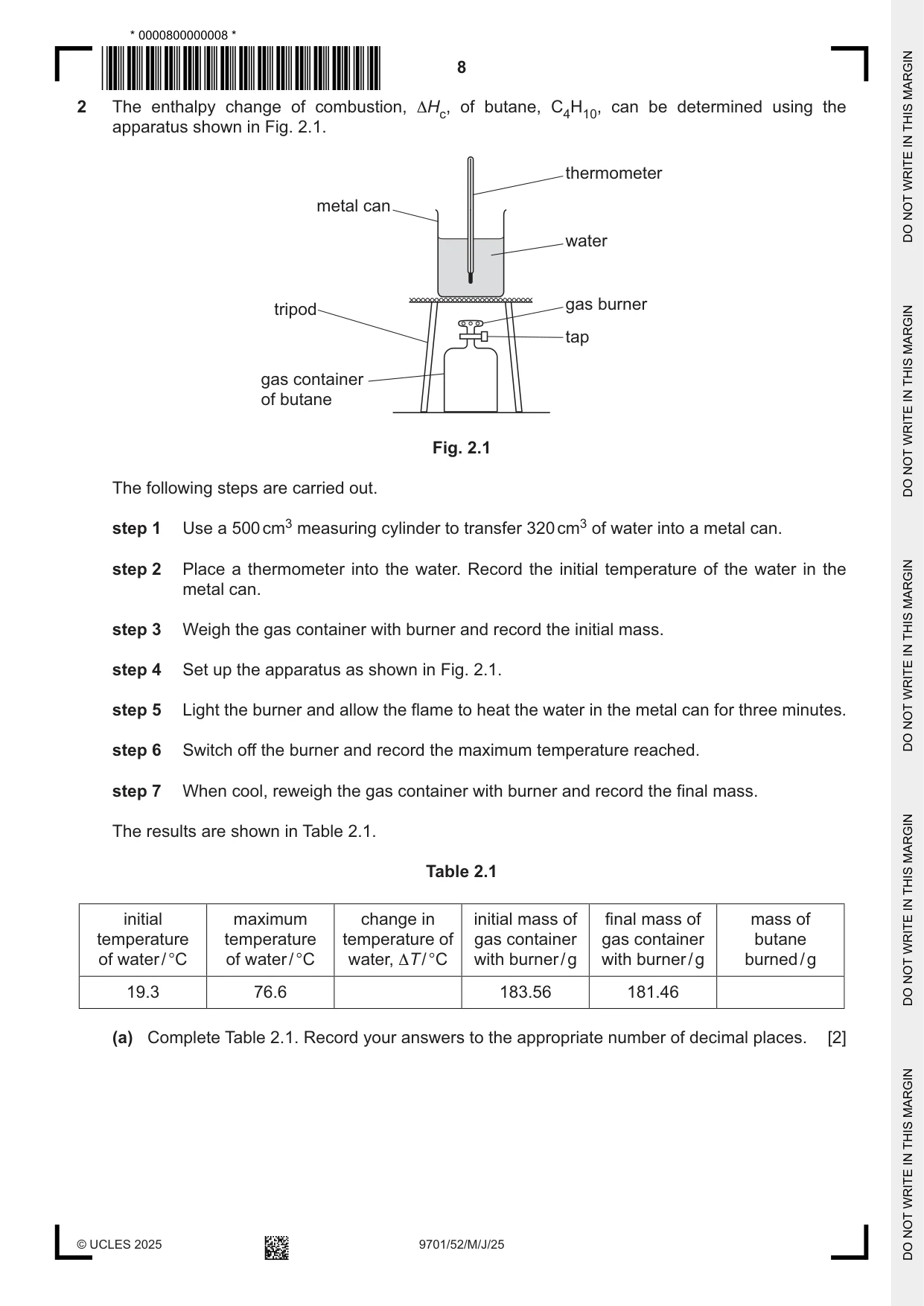
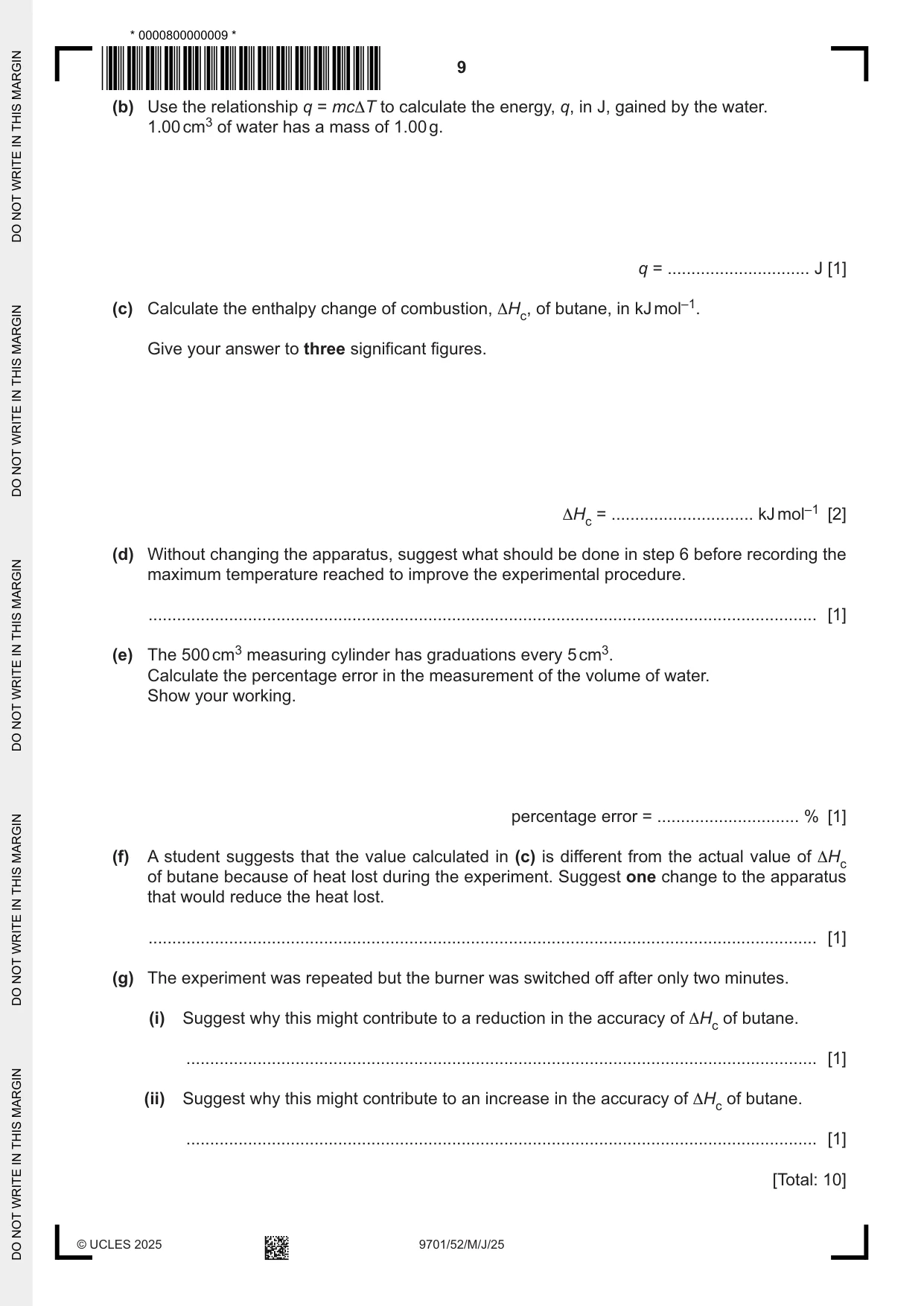
2 The enthalpy change of combustion, ∆Hc, of butane, C4H10, can be determined using the apparatus shown in Fig. 2.1. thermometer metal can water gas burner tripod tap gas container of butane Fig. 2.1 The following steps are carried out. step 1 Use a 500 cm3 measuring cylinder to transfer 320 cm3 of water into a metal can. step 2 Place a thermometer into the water. Record the initial temperature of the water in the metal can. step 3 Weigh the gas container with burner and record the initial mass. step 4 Set up the apparatus as shown in Fig. 2.1. step 5 Light the burner and allow the flame to heat the water in the metal can for three minutes. step 6 Switch off the burner and record the maximum temperature reached. step 7 When cool, reweigh the gas container with burner and record the final mass. The results are shown in Table 2.1. Table 2.1 initial maximum change in initial mass of final mass of mass of temperature temperature temperature of gas container gas container butane of water / °C of water / °C water, ∆T / °C with burner / g with burner / g burned / g 19.3 76.6 183.56 181.46 (a) Complete Table 2.1. Record your answers to the appropriate number of decimal places. [2] (b) Use the relationship q = mc∆T to calculate the energy, q, in J, gained by the water. 1.00 cm3 of water has a mass of 1.00 g. q = .............................. J [1] (c) Calculate the enthalpy change of combustion, ∆Hc, of butane, in kJ mol–1. Give your answer to three significant figures. ∆Hc = .............................. kJ mol–1 [2] (d) Without changing the apparatus, suggest what should be done in step 6 before recording the maximum temperature reached to improve the experimental procedure. ............................................................................................................................................. [1] (e) The 500 cm3 measuring cylinder has graduations every 5 cm3. Calculate the percentage error in the measurement of the volume of water. Show your working. percentage error = .............................. % [1] (f) A student suggests that the value calculated in (c) is different from the actual value of ∆Hc of butane because of heat lost during the experiment. Suggest one change to the apparatus that would reduce the heat lost. ............................................................................................................................................. [1] (g) The experiment was repeated but the burner was switched off after only two minutes. (i) Suggest why this might contribute to a reduction in the accuracy of ∆Hc of butane. ..................................................................................................................................... [1] (ii) Suggest why this might contribute to an increase in the accuracy of ∆Hc of butane. ..................................................................................................................................... [1] [Total: 10]
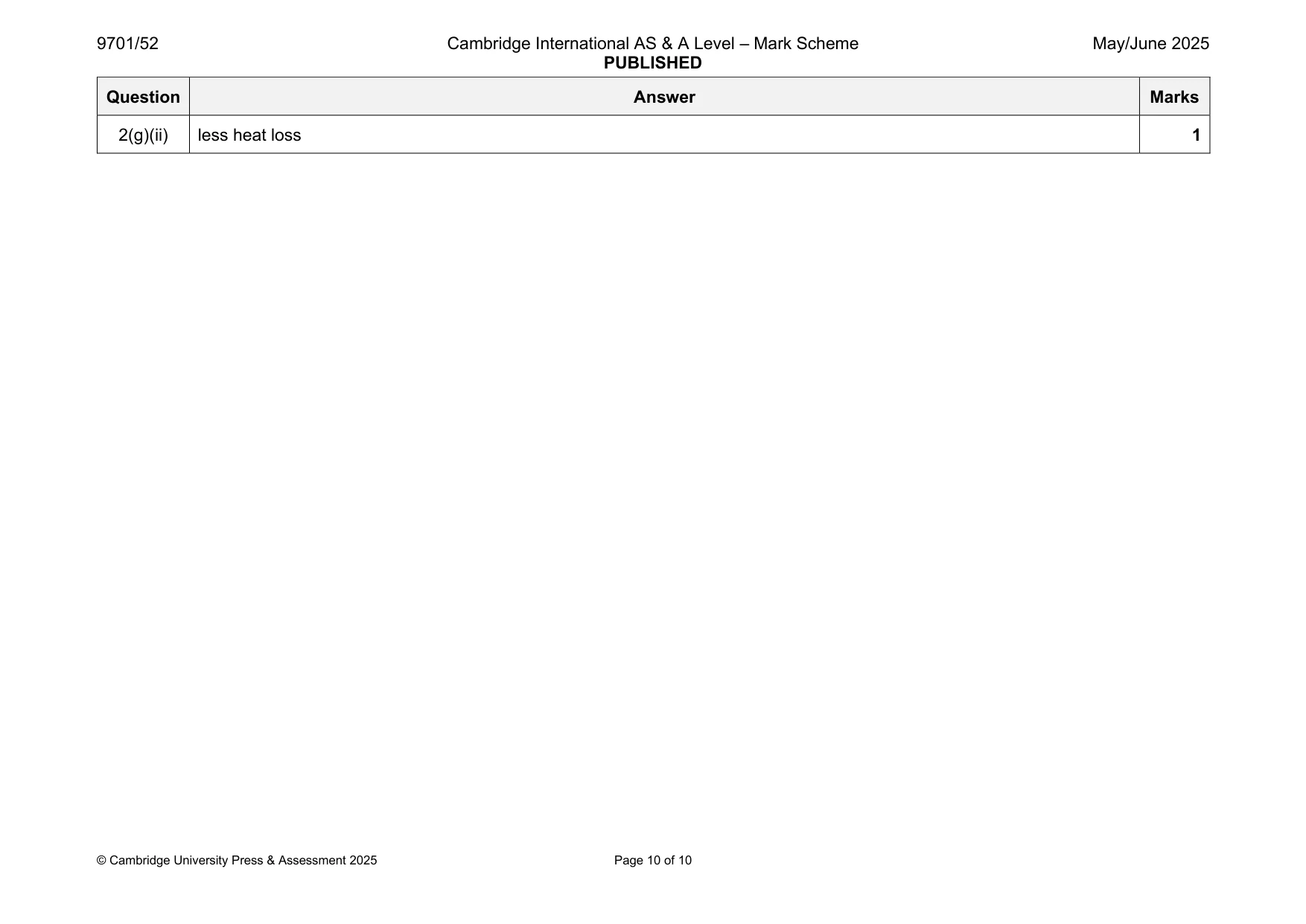
Mark scheme: 2(a) M1 change in temperature of water / C = 57.3 2 M2 mass of butane burned / g = 2.10 2(b) 320 g 4.18 J g–1 K–1 57.3 K = 76 600 (J) 1 2(c) M1 number of moles of butane burned = 0.0362 mol 2 M2 ∆Hc = –2120 (kJ mol–1) 2(d) stir the water before taking reading 1 2(e) 2.5 / 320 100% = 0.78% 1 2(f) use a lid 1 2(g)(i) percentage error (of temperature change or mass change of butane) increases 1 2(g)(ii) less heat loss 1
What was in this paper
The subtopics covered by these 2 questions, and how many questions each got. Open one in a new tab to see every Cambridge question on it.
What you needed in this session
Cambridge’s own grade thresholds for 2025 May/June, Paper 5 · Variant 2. A higher threshold means an easier paper — the bar moves with how the cohort did.