Cambridge A Level Chemistry 9701 — 2023 Oct/Nov Paper 5 · Variant 2
9701/52/O/N/23 · 2 questions · 30 marks · ≈34 min
The question paper and its mark scheme, free to read here and free to download. This is Cambridge’s own paper, exactly as it was sat.
Question paper12 pages

Mark scheme7 pages
Answers below. Sit the paper first if you are practising.
Questions as text
Q1 · Thermometric titrations can be used to determine the standard enthalpy change of…
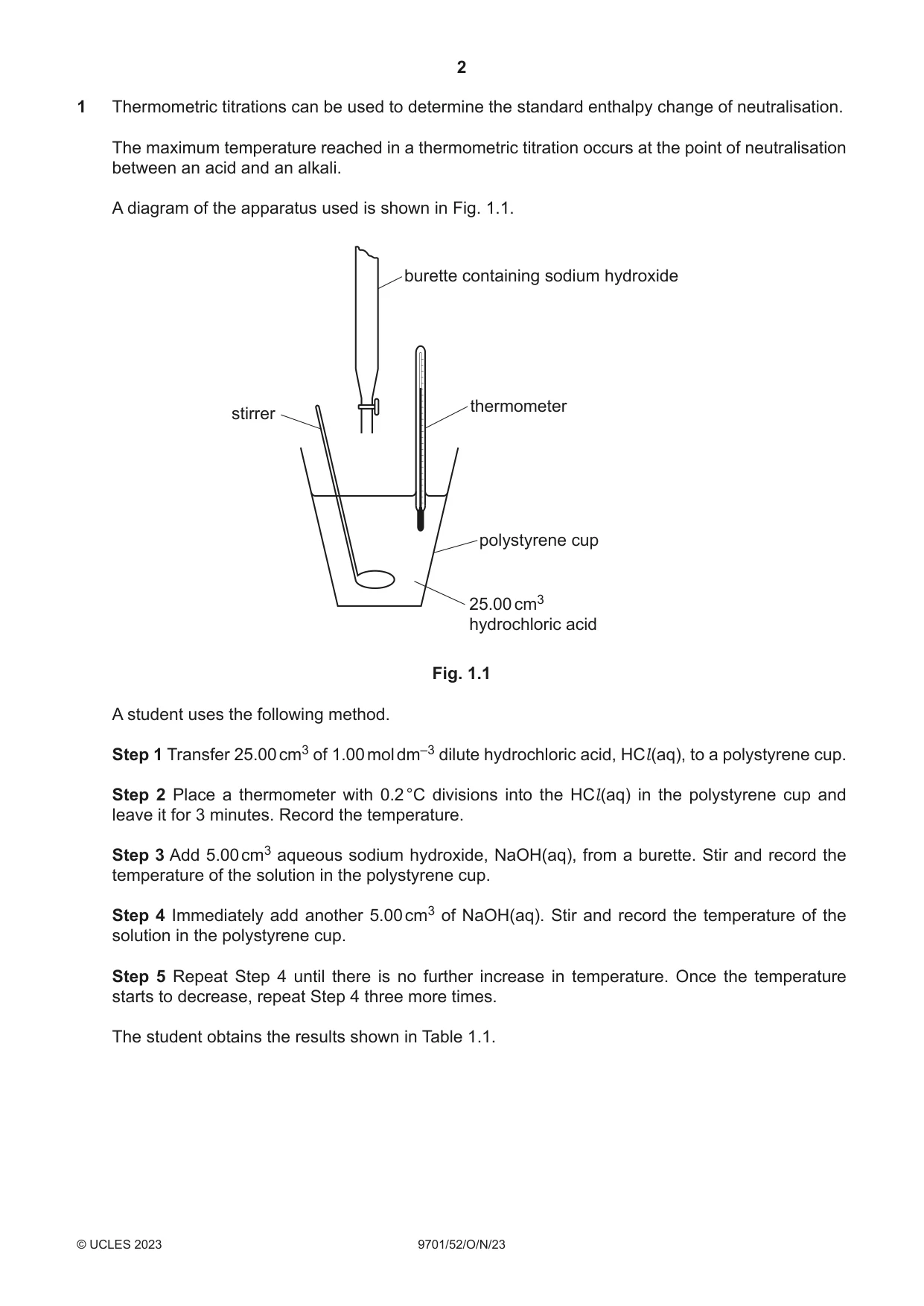
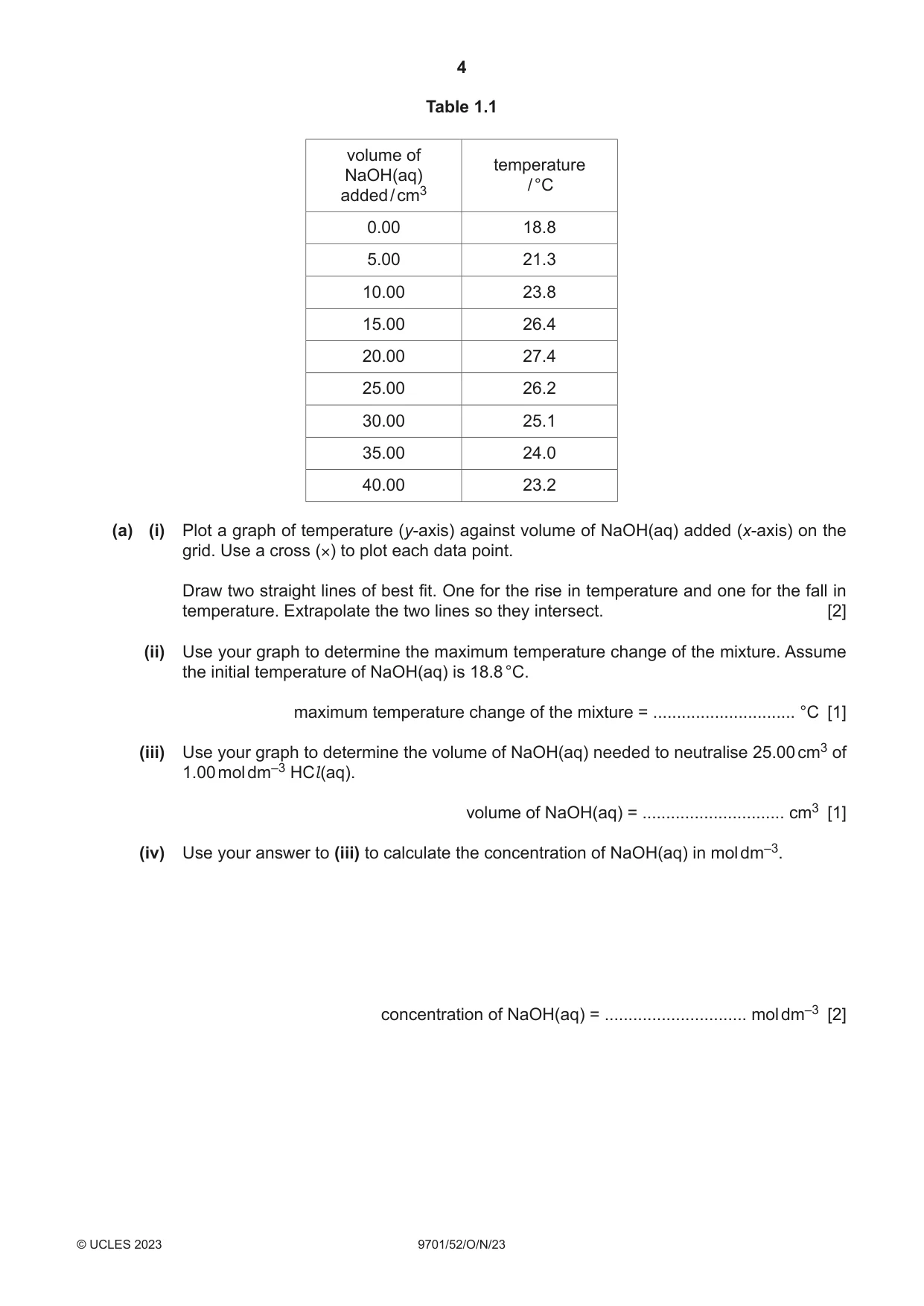
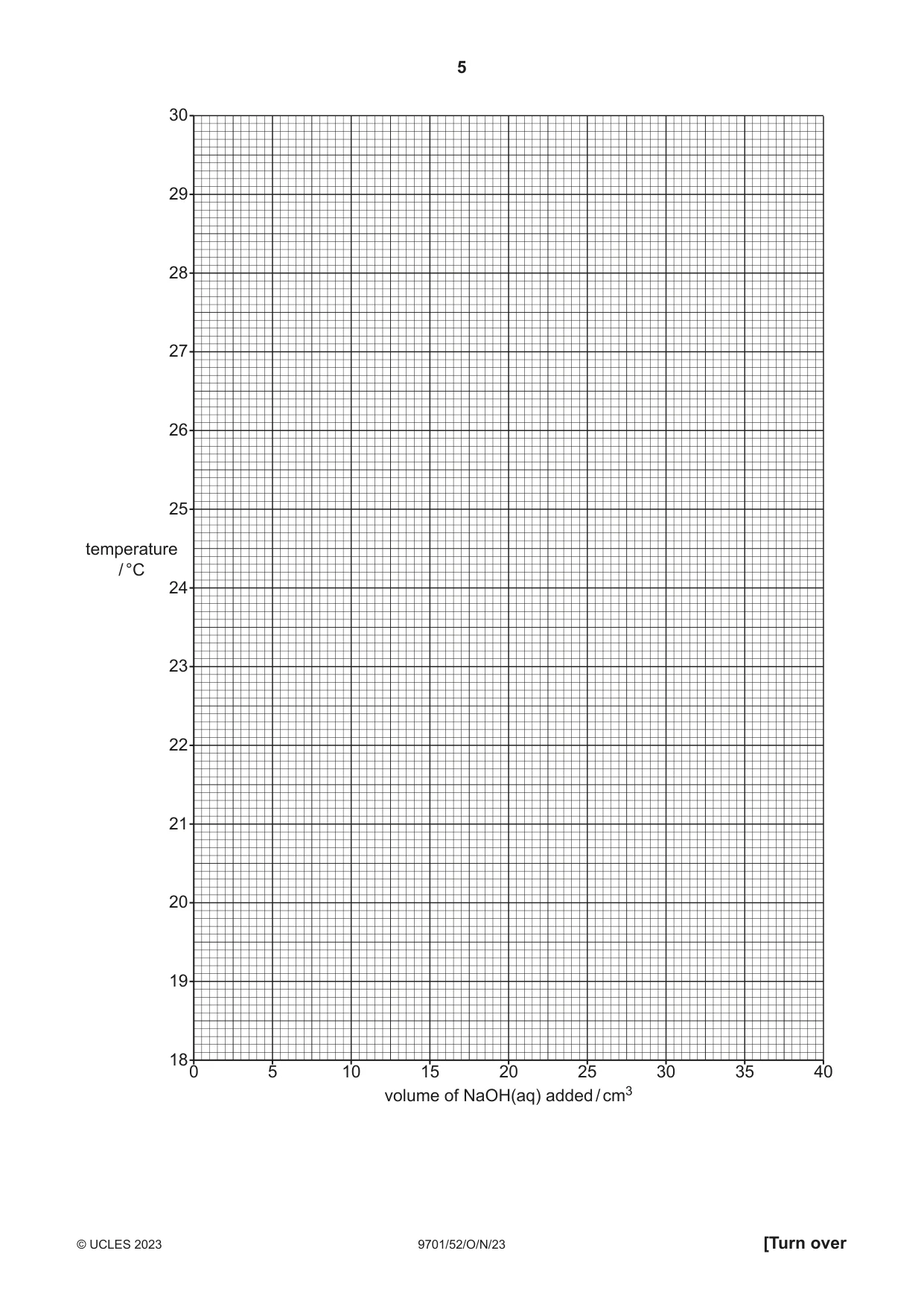
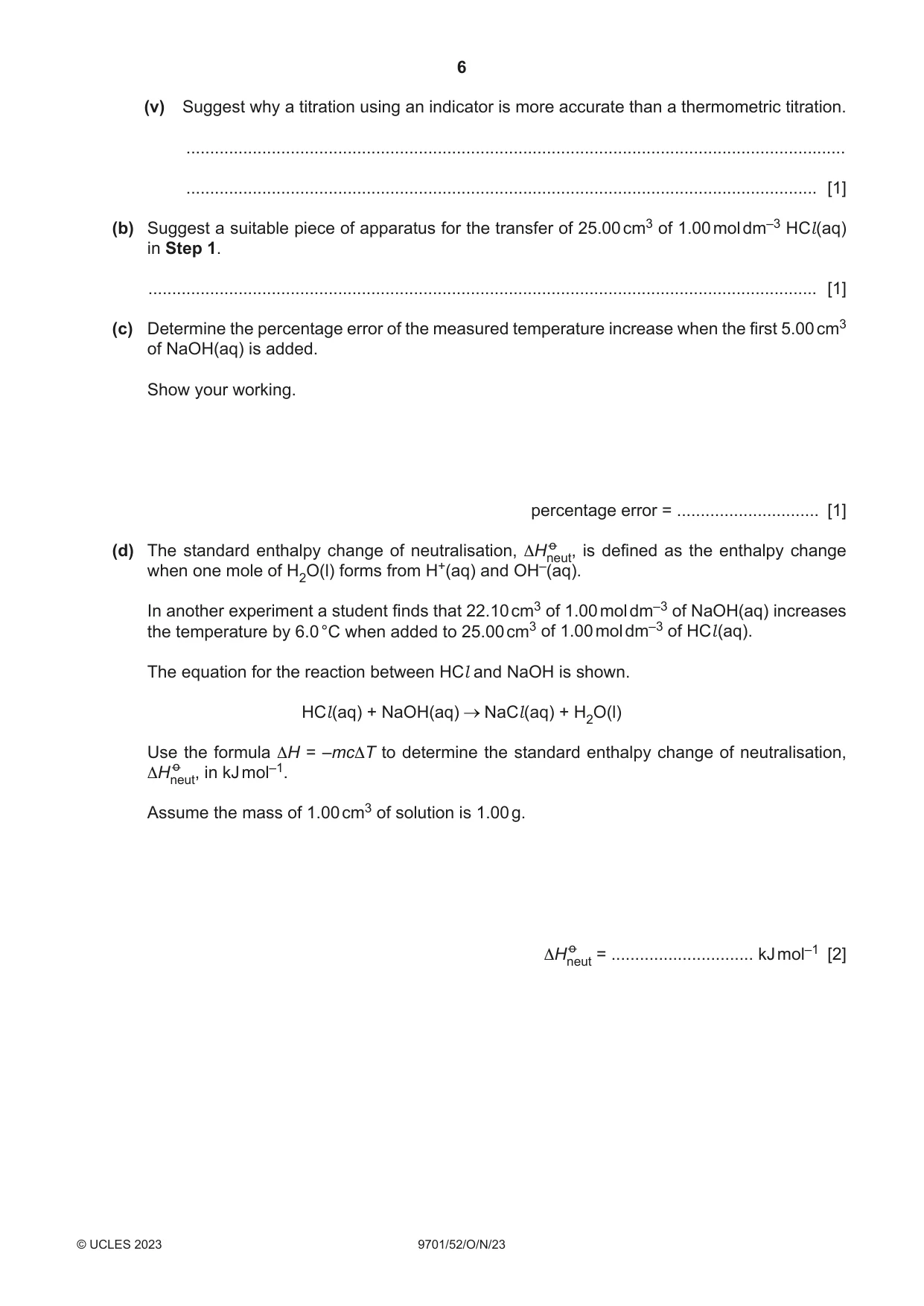
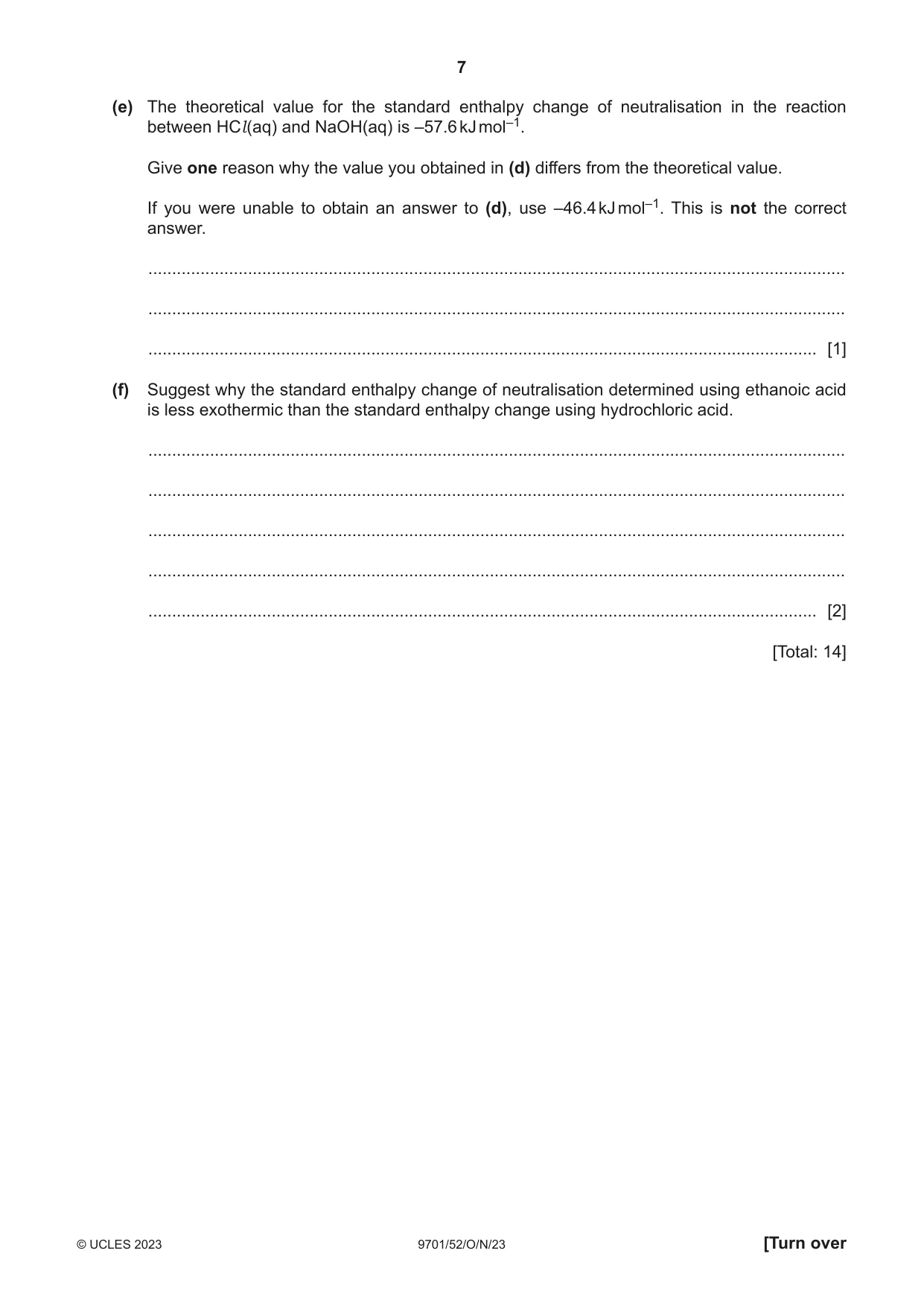
1 Thermometric titrations can be used to determine the standard enthalpy change of neutralisation. The maximum temperature reached in a thermometric titration occurs at the point of neutralisation between an acid and an alkali. A diagram of the apparatus used is shown in Fig. 1.1. burette containing sodium hydroxide thermometer stirrer polystyrene cup 25.00 cm3 hydrochloric acid Fig. 1.1 A student uses the following method. Step 1 Transfer 25.00 cm3 of 1.00 mol dm–3 dilute hydrochloric acid, HCl (aq), to a polystyrene cup. Step 2 Place a thermometer with 0.2 °C divisions into the HCl (aq) in the polystyrene cup and leave it for 3 minutes. Record the temperature. Step 3 Add 5.00 cm3 aqueous sodium hydroxide, NaOH(aq), from a burette. Stir and record the temperature of the solution in the polystyrene cup. Step 4 Immediately add another 5.00 cm3 of NaOH(aq). Stir and record the temperature of the solution in the polystyrene cup. Step 5 Repeat Step 4 until there is no further increase in temperature. Once the temperature starts to decrease, repeat Step 4 three more times. The student obtains the results shown in Table 1.1. Question 1 continues on the next page. Table 1.1 volume of temperature NaOH(aq) / °C added / cm3 0.00 18.8 5.00 21.3 10.00 23.8 15.00 26.4 20.00 27.4 25.00 26.2 30.00 25.1 35.00 24.0 40.00 23.2 (a) (i) Plot a graph of temperature (y-axis) against volume of NaOH(aq) added (x-axis) on the grid. Use a cross (×) to plot each data point. Draw two straight lines of best fit. One for the rise in temperature and one for the fall in temperature. Extrapolate the two lines so they intersect. [2] (ii) Use your graph to determine the maximum temperature change of the mixture. Assume the initial temperature of NaOH(aq) is 18.8 °C. maximum temperature change of the mixture = .............................. °C [1] (iii) Use your graph to determine the volume of NaOH(aq) needed to neutralise 25.00 cm3 of 1.00 mol dm–3 HCl (aq). volume of NaOH(aq) = .............................. cm3 [1] (iv) Use your answer to (iii) to calculate the concentration of NaOH(aq) in mol dm–3. concentration of NaOH(aq) = .............................. mol dm–3 [2] (v) Suggest why a titration using an indicator is more accurate than a thermometric titration. ........................................................................................................................................... ..................................................................................................................................... [1] (b) Suggest a suitable piece of apparatus for the transfer of 25.00 cm3 of 1.00 mol dm–3 HCl (aq) in Step 1. ............................................................................................................................................. [1] (c) Determine the percentage error of the measured temperature increase when the first 5.00 cm3 of NaOH(aq) is added. Show your working. percentage error = .............................. [1] (d) The standard enthalpy change of neutralisation, ΔHneut,o is defined as the enthalpy change when one mole of H2O(l) forms from H+(aq) and OH–(aq). In another experiment a student finds that 22.10 cm3 of 1.00 mol dm–3 of NaOH(aq) increases the temperature by 6.0 °C when added to 25.00 cm3 of 1.00 mol dm–3 of HCl (aq). The equation for the reaction between HCl and NaOH is shown. HCl (aq) + NaOH(aq) NaCl (aq) + H2O(l) Use the formula ΔH = –mcΔT to determine the standard enthalpy change of neutralisation, ΔHneut,o in kJ mol–1. Assume the mass of 1.00 cm3 of solution is 1.00 g. ΔHneuto = .............................. kJ mol–1 [2] (e) The theoretical value for the standard enthalpy change of neutralisation in the reaction between HCl (aq) and NaOH(aq) is –57.6 kJ mol–1. Give one reason why the value you obtained in (d) differs from the theoretical value. If you were unable to obtain an answer to (d), use –46.4 kJ mol–1. This is not the correct answer. ................................................................................................................................................... ................................................................................................................................................... ............................................................................................................................................. [1] (f) Suggest why the standard enthalpy change of neutralisation determined using ethanoic acid is less exothermic than the standard enthalpy change using hydrochloric acid. ................................................................................................................................................... ................................................................................................................................................... ................................................................................................................................................... ................................................................................................................................................... ............................................................................................................................................. [2] [Total: 14]
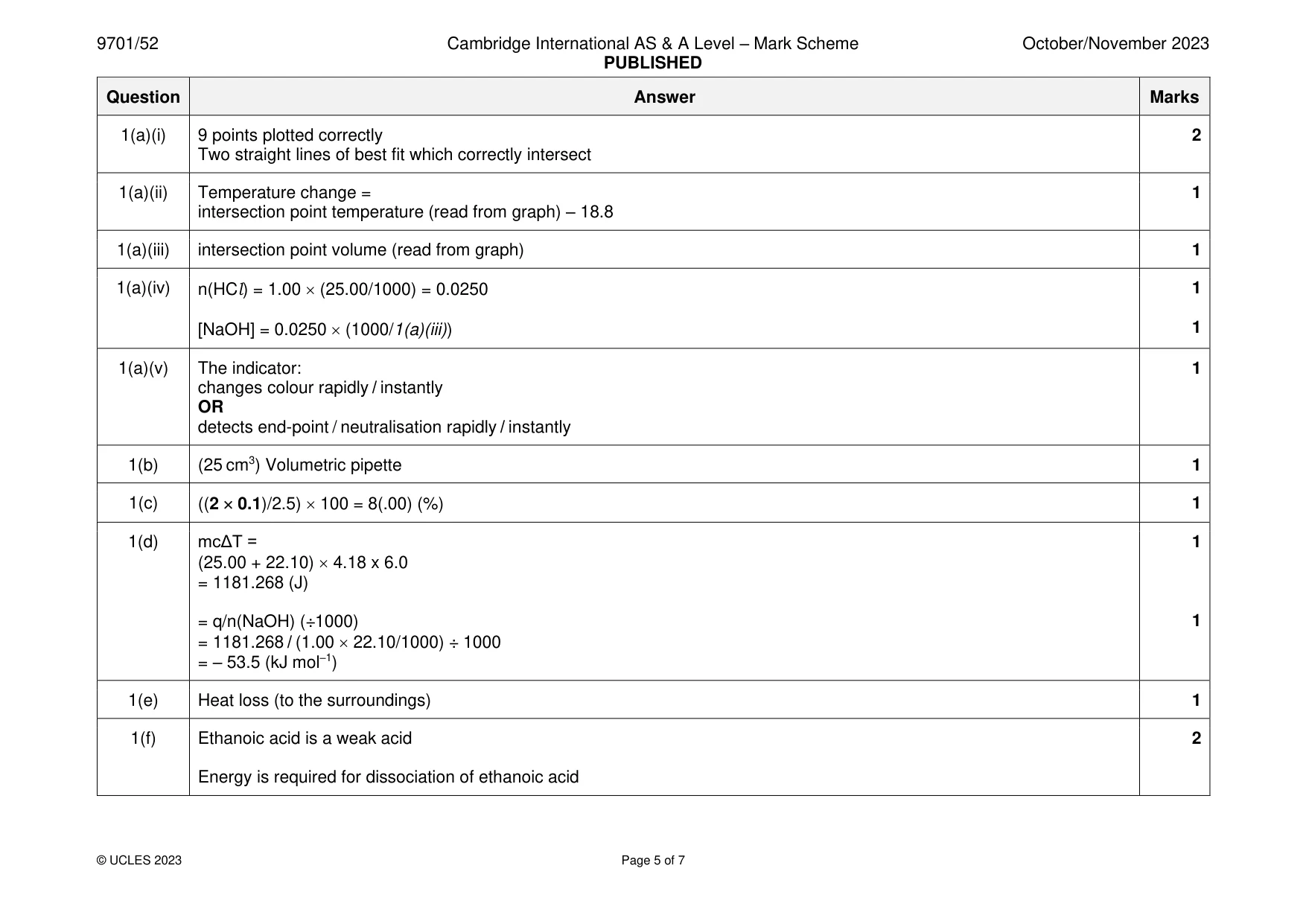
Mark scheme: Question Answer Marks 1(a)(i) 9 points plotted correctly 2 Two straight lines of best fit which correctly intersect 1(a)(ii) Temperature change = 1 intersection point temperature (read from graph) – 18.8 1(a)(iii) intersection point volume (read from graph) 1 1(a)(iv) n(HCl) = 1.00 (25.00/1000) = 0.0250 1 [NaOH] = 0.0250 (1000/1(a)(iii)) 1 1(a)(v) The indicator: 1 changes colour rapidly / instantly OR detects end-point / neutralisation rapidly / instantly 1(b) (25 cm3) Volumetric pipette 1 1(c) ((2 0.1)/2.5) 100 = 8(.00) (%) 1 1(d) mcΔT = 1 (25.00 + 22.10) 4.18 x 6.0 = 1181.268 (J) = q/n(NaOH) (÷1000) 1 = 1181.268 / (1.00 22.10/1000) ÷ 1000 = – 53.5 (kJ mol–1) 1(e) Heat loss (to the surroundings) 1 1(f) Ethanoic acid is a weak acid 2 Energy is required for dissociation of ethanoic acid
Q2 · A student investigates the rate of reaction when zinc reacts with dilute hydrochloric…
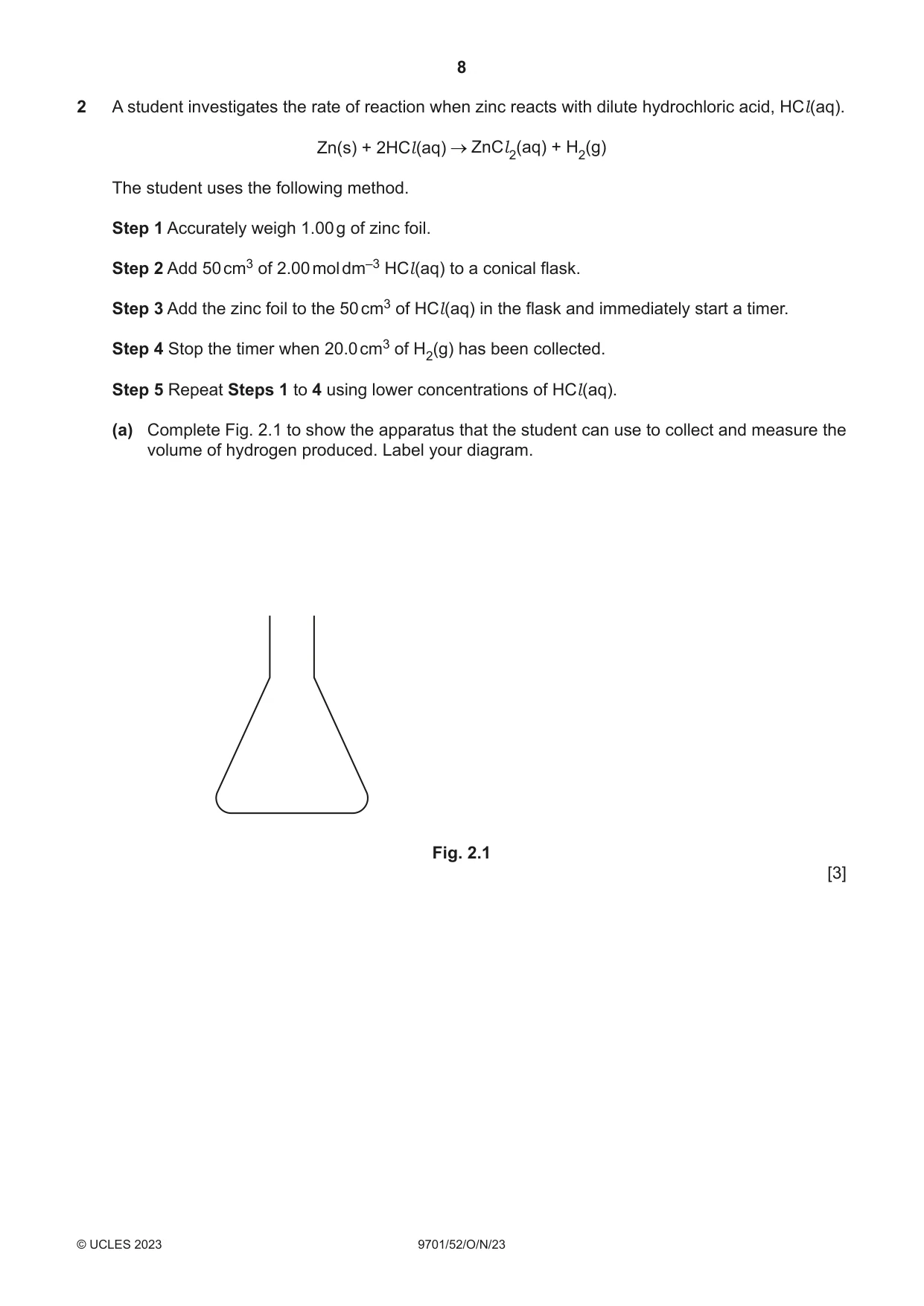
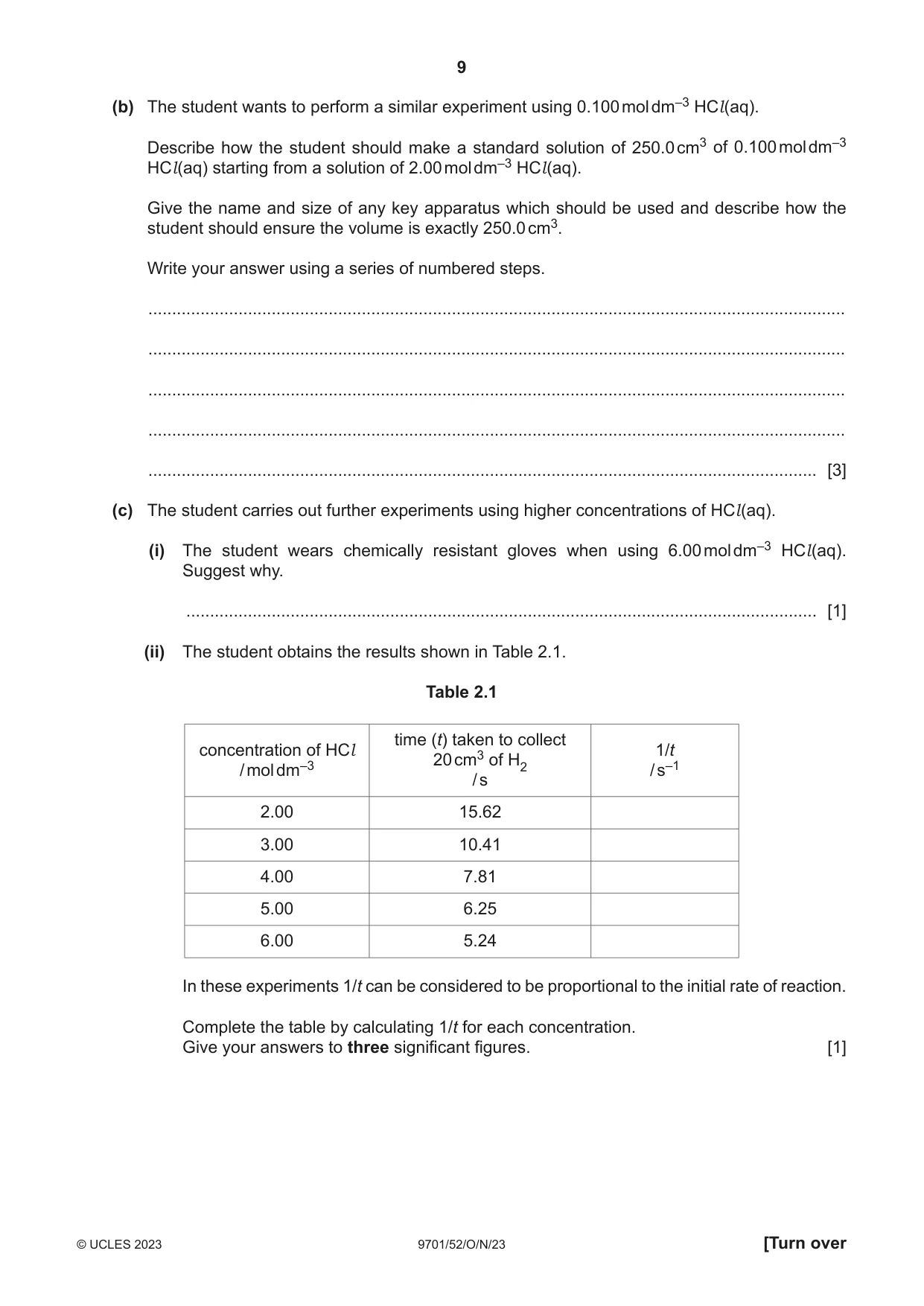
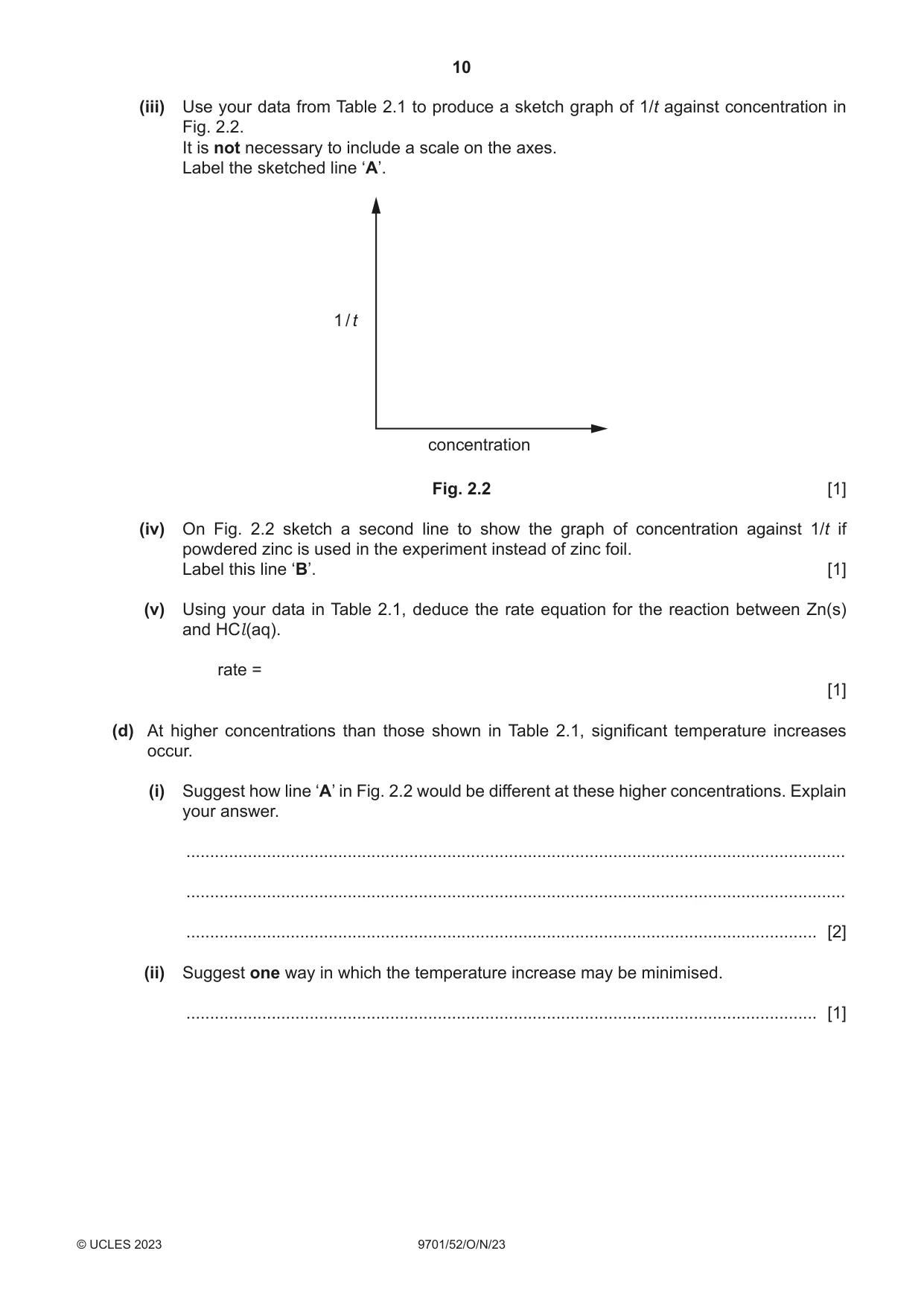
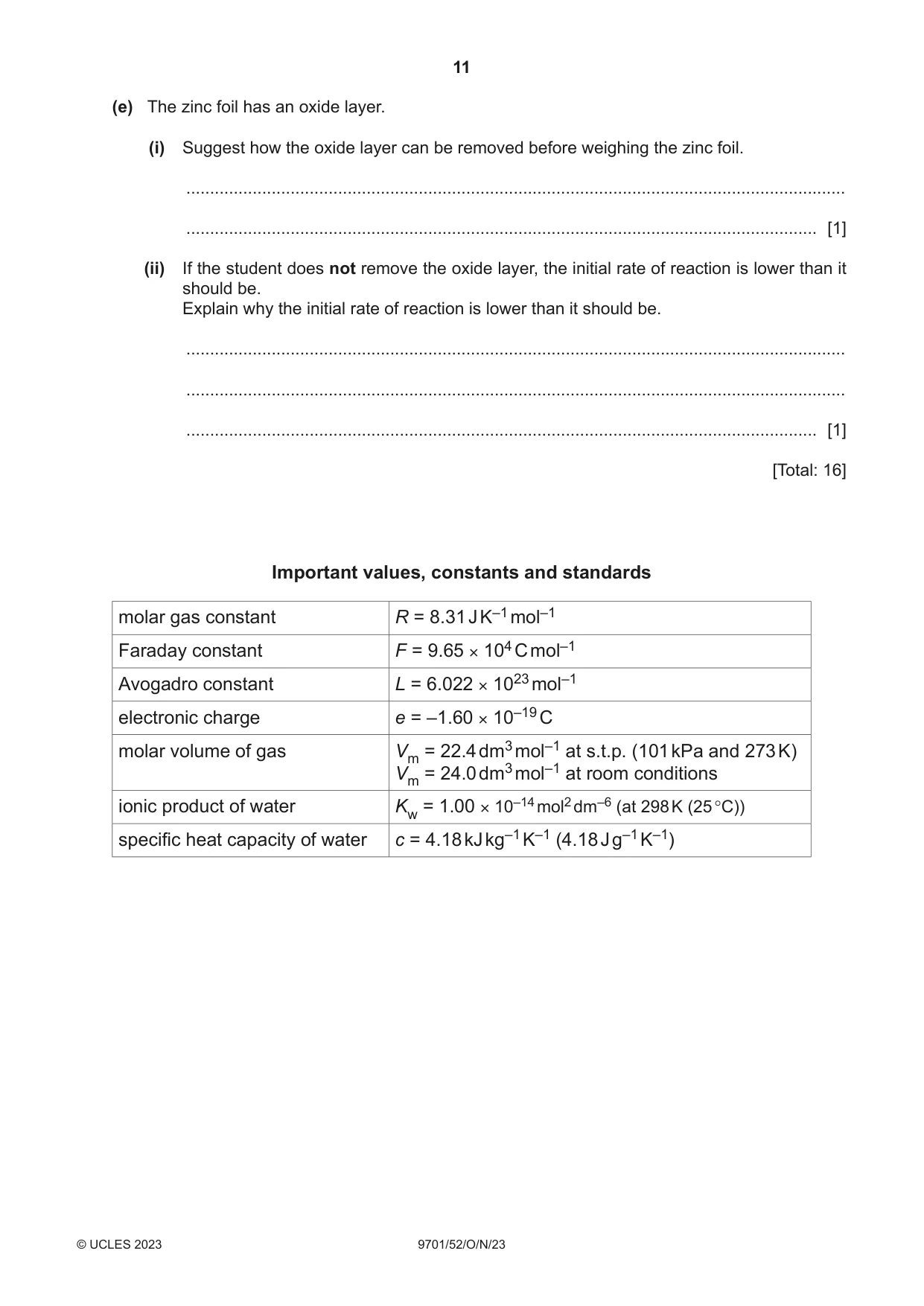
2 A student investigates the rate of reaction when zinc reacts with dilute hydrochloric acid, HCl (aq). Zn(s) + 2HCl (aq) ZnCl 2(aq) + H2(g) The student uses the following method. Step 1 Accurately weigh 1.00 g of zinc foil. Step 2 Add 50 cm3 of 2.00 mol dm–3 HCl (aq) to a conical flask. Step 3 Add the zinc foil to the 50 cm3 of HCl (aq) in the flask and immediately start a timer. Step 4 Stop the timer when 20.0 cm3 of H2(g) has been collected. Step 5 Repeat Steps 1 to 4 using lower concentrations of HCl (aq). (a) Complete Fig. 2.1 to show the apparatus that the student can use to collect and measure the volume of hydrogen produced. Label your diagram. Fig. 2.1 [3] (b) The student wants to perform a similar experiment using 0.100 mol dm–3 HCl (aq). Describe how the student should make a standard solution of 250.0 cm3 of 0.100 mol dm–3 HCl (aq) starting from a solution of 2.00 mol dm–3 HCl (aq). Give the name and size of any key apparatus which should be used and describe how the student should ensure the volume is exactly 250.0 cm3. Write your answer using a series of numbered steps. ................................................................................................................................................... ................................................................................................................................................... ................................................................................................................................................... ................................................................................................................................................... ............................................................................................................................................. [3] (c) The student carries out further experiments using higher concentrations of HCl (aq). (i) The student wears chemically resistant gloves when using 6.00 mol dm–3 HCl (aq). Suggest why. ..................................................................................................................................... [1] (ii) The student obtains the results shown in Table 2.1. Table 2.1 time (t) taken to collect concentration of HCl 1/t 20 cm3 of H2 / mol dm–3 / s–1 / s 2.00 15.62 3.00 10.41 4.00 7.81 5.00 6.25 6.00 5.24 In these experiments 1/t can be considered to be proportional to the initial rate of reaction. Complete the table by calculating 1/t for each concentration. Give your answers to three significant figures. [1] (iii) Use your data from Table 2.1 to produce a sketch graph of 1/t against concentration in Fig. 2.2. It is not necessary to include a scale on the axes. Label the sketched line ‘A’. 1 / t concentration Fig. 2.2 [1] (iv) On Fig. 2.2 sketch a second line to show the graph of concentration against 1/t if powdered zinc is used in the experiment instead of zinc foil. Label this line ‘B’. [1] (v) Using your data in Table 2.1, deduce the rate equation for the reaction between Zn(s) and HCl (aq). rate = [1] (d) At higher concentrations than those shown in Table 2.1, significant temperature increases occur. (i) Suggest how line ‘A’ in Fig. 2.2 would be different at these higher concentrations. Explain your answer. ........................................................................................................................................... ........................................................................................................................................... ..................................................................................................................................... [2] (ii) Suggest one way in which the temperature increase may be minimised. ..................................................................................................................................... [1]
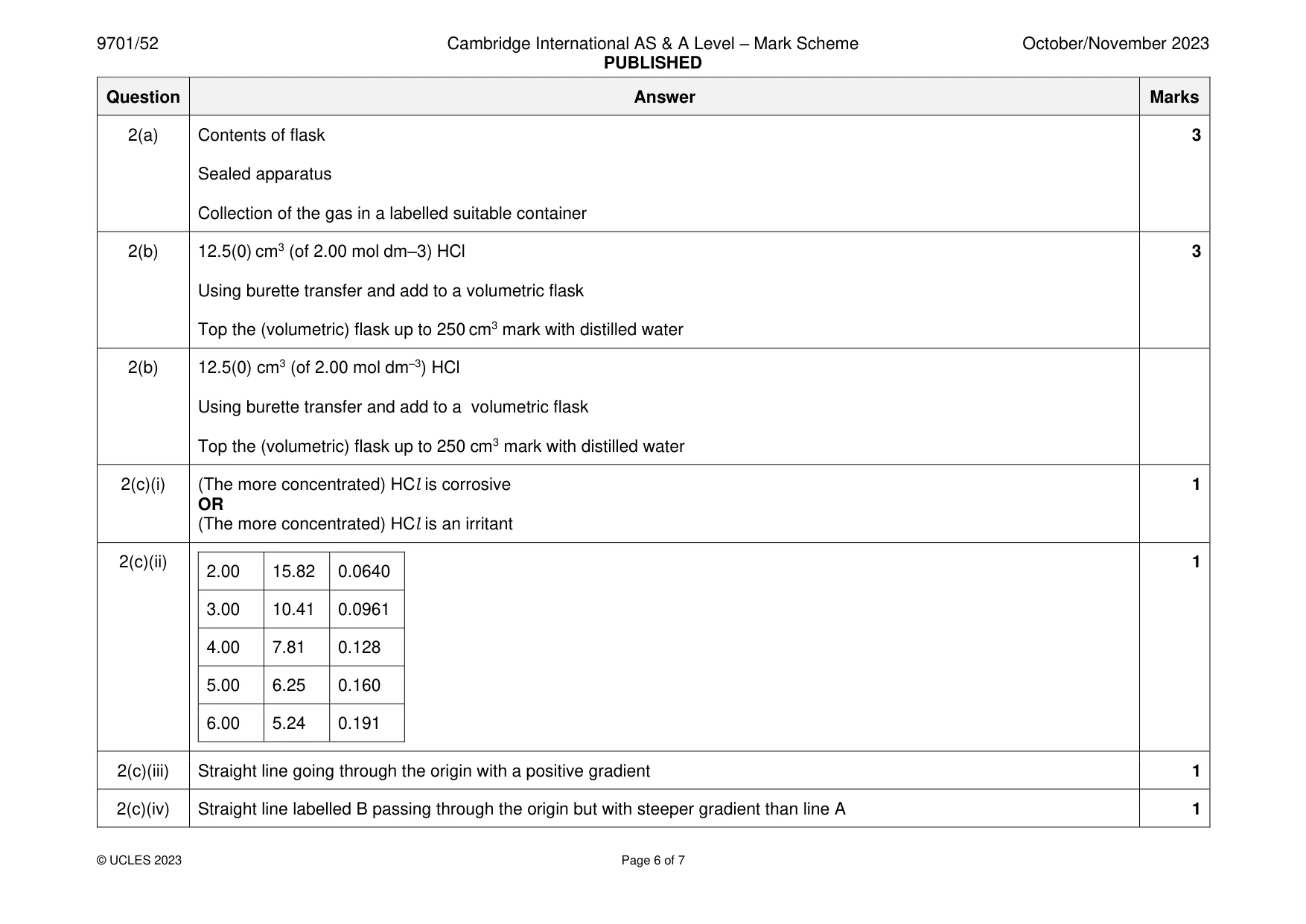
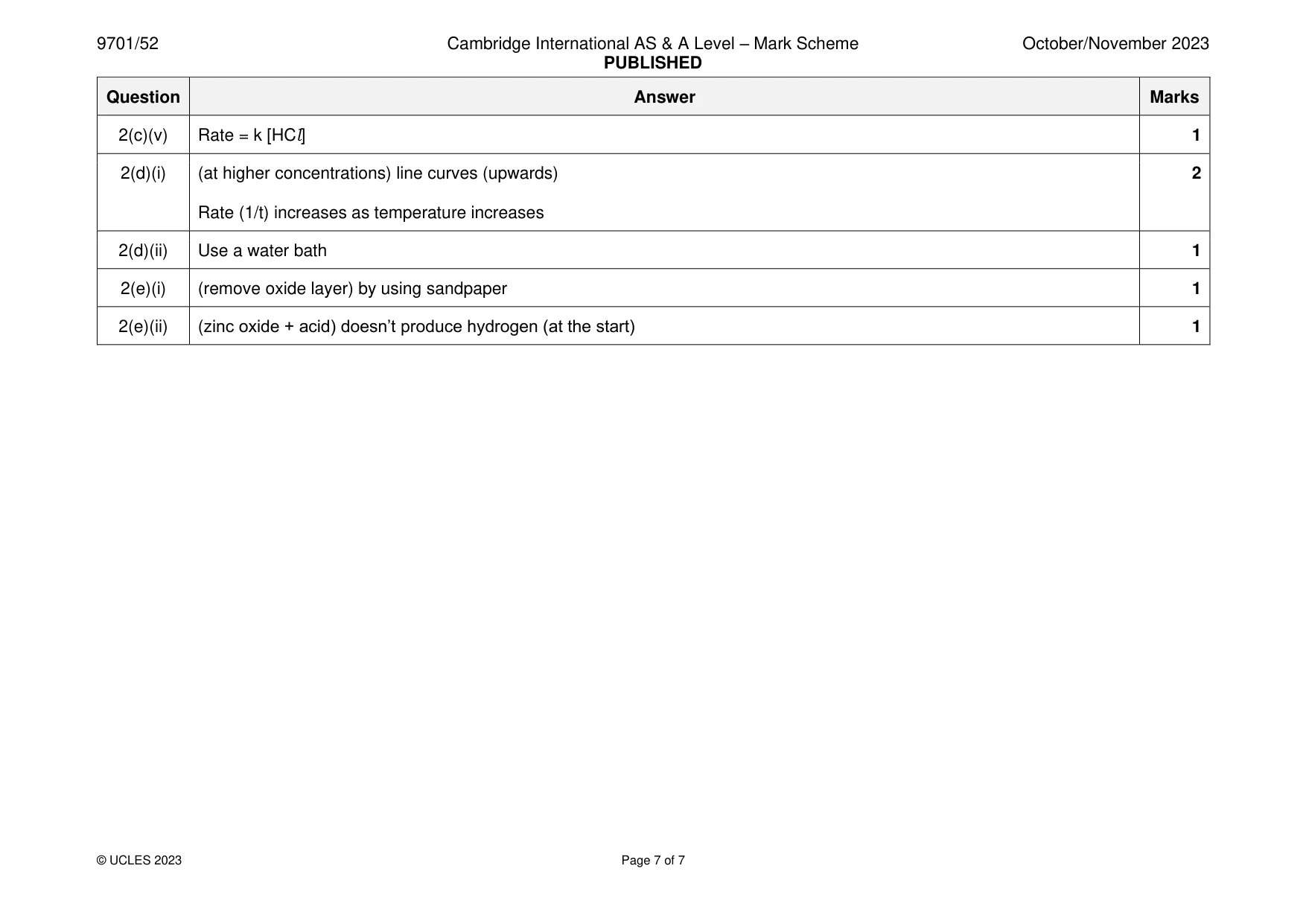
Mark scheme: 2(a) Contents of flask 3 Sealed apparatus Collection of the gas in a labelled suitable container 2(b) 12.5(0) cm3 (of 2.00 mol dm–3) HCl 3 Using burette transfer and add to a volumetric flask Top the (volumetric) flask up to 250 cm3 mark with distilled water 2(b) 12.5(0) cm3 (of 2.00 mol dm–3) HCl Using burette transfer and add to a volumetric flask Top the (volumetric) flask up to 250 cm3 mark with distilled water 2(c)(i) (The more concentrated) HCl is corrosive 1 OR (The more concentrated) HCl is an irritant 2(c)(ii) 1 2.00 15.82 0.0640 3.00 10.41 0.0961 4.00 7.81 0.128 5.00 6.25 0.160 6.00 5.24 0.191 2(c)(iii) Straight line going through the origin with a positive gradient 1 2(c)(iv) Straight line labelled B passing through the origin but with steeper gradient than line A 1 2(c)(v) Rate = k [HCl] 1 2(d)(i) (at higher concentrations) line curves (upwards) 2 Rate (1/t) increases as temperature increases 2(d)(ii) Use a water bath 1 2(e)(i) (remove oxide layer) by using sandpaper 1 2(e)(ii) (zinc oxide + acid) doesn’t produce hydrogen (at the start) 1
More questions on Reacting masses and volumes (of solutions and gases)
What was in this paper
The subtopics covered by these 2 questions, and how many questions each got. Open one in a new tab to see every Cambridge question on it.
What you needed in this session
Cambridge’s own grade thresholds for 2023 Oct/Nov, Paper 5 · Variant 2. A higher threshold means an easier paper — the bar moves with how the cohort did.