Cambridge A Level Chemistry 9701 — 2025 Feb/March Paper 5 · Variant 2
9701/52/F/M/25 · 2 questions · 30 marks · 75 min
The question paper and its mark scheme, free to read here and free to download. This is Cambridge’s own paper, exactly as it was sat.
Question paper16 pages




Mark scheme7 pages
Answers below. Sit the paper first if you are practising.
Questions as text
Q1 · Brass is an alloy of copper and zinc
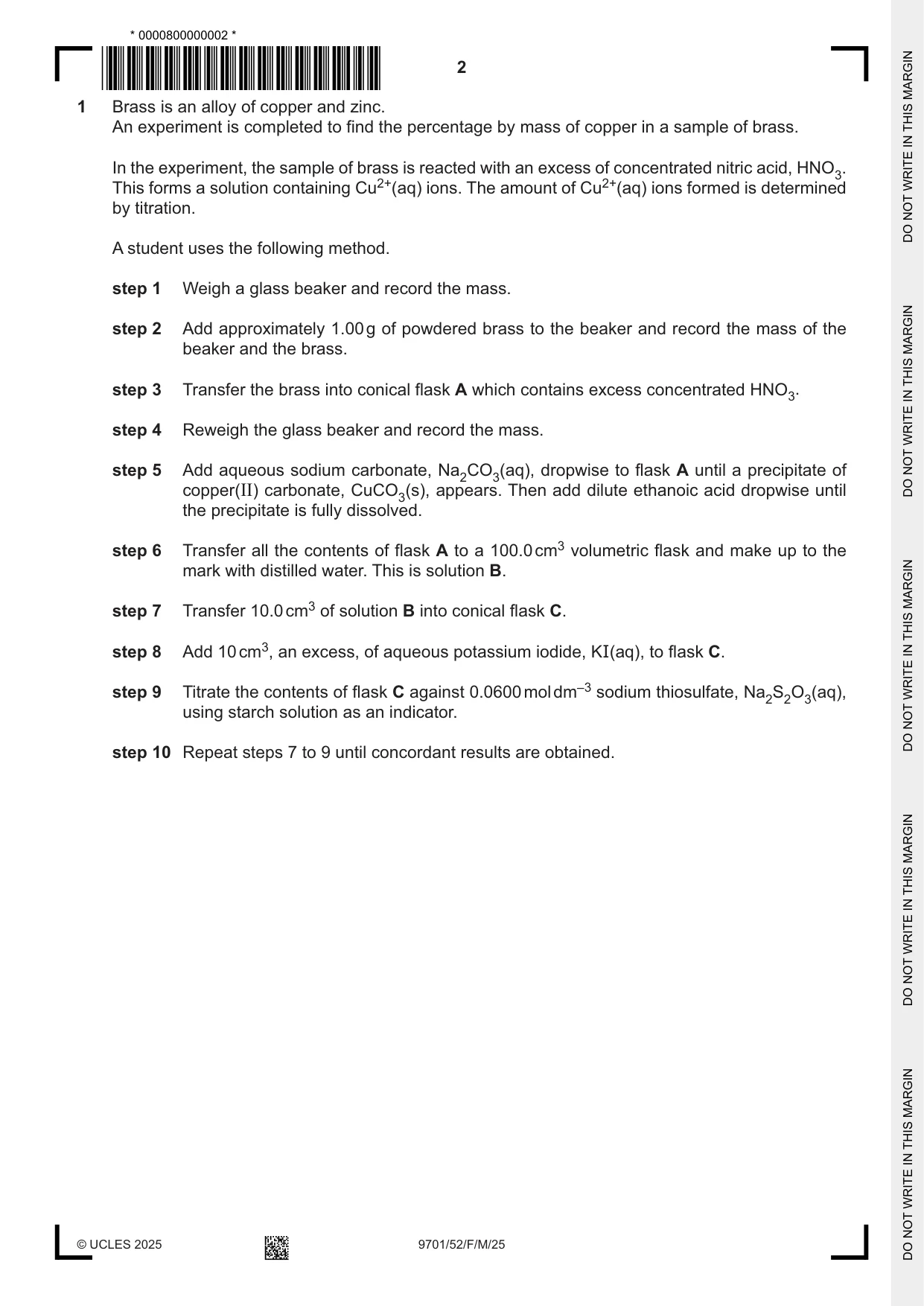
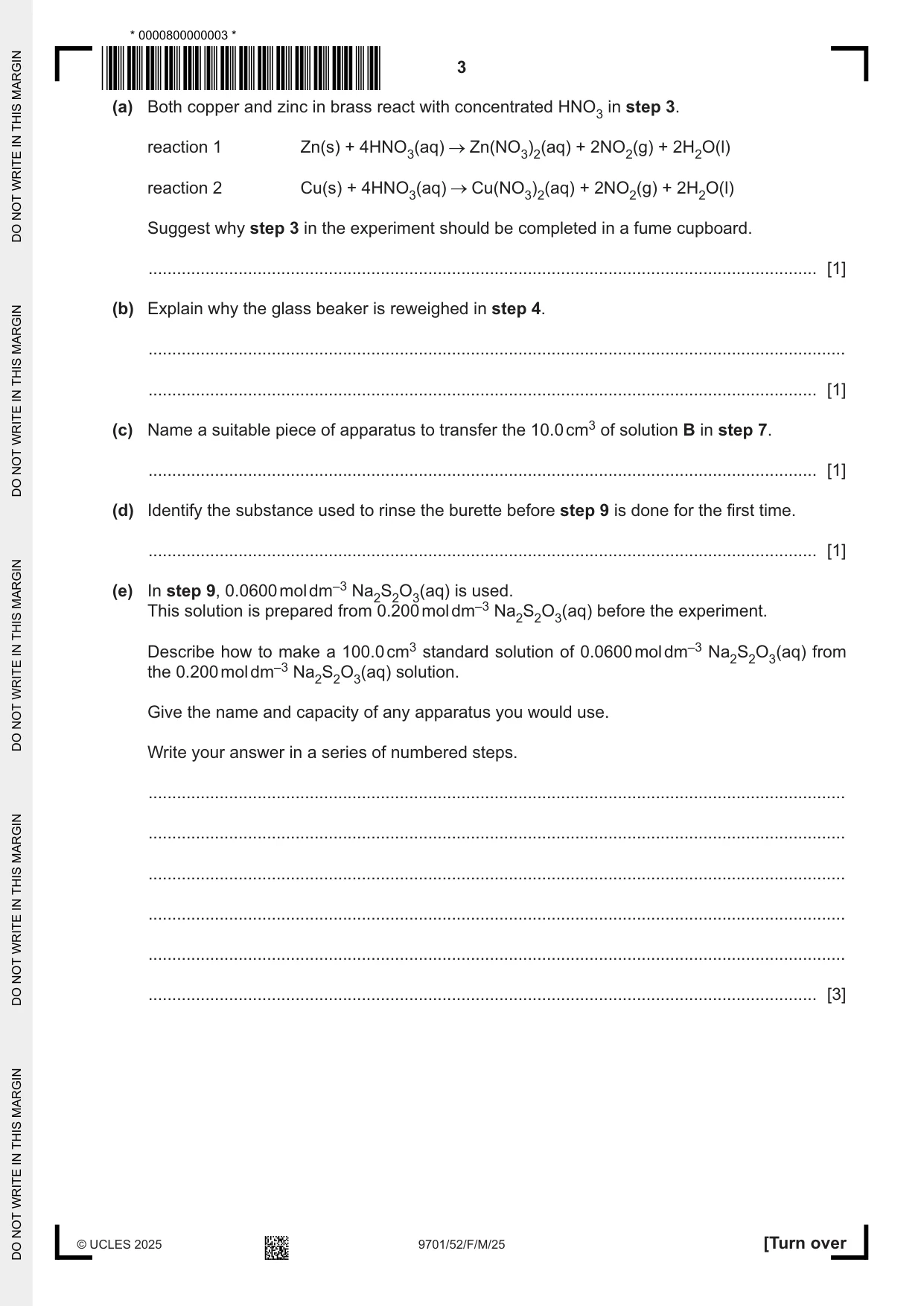
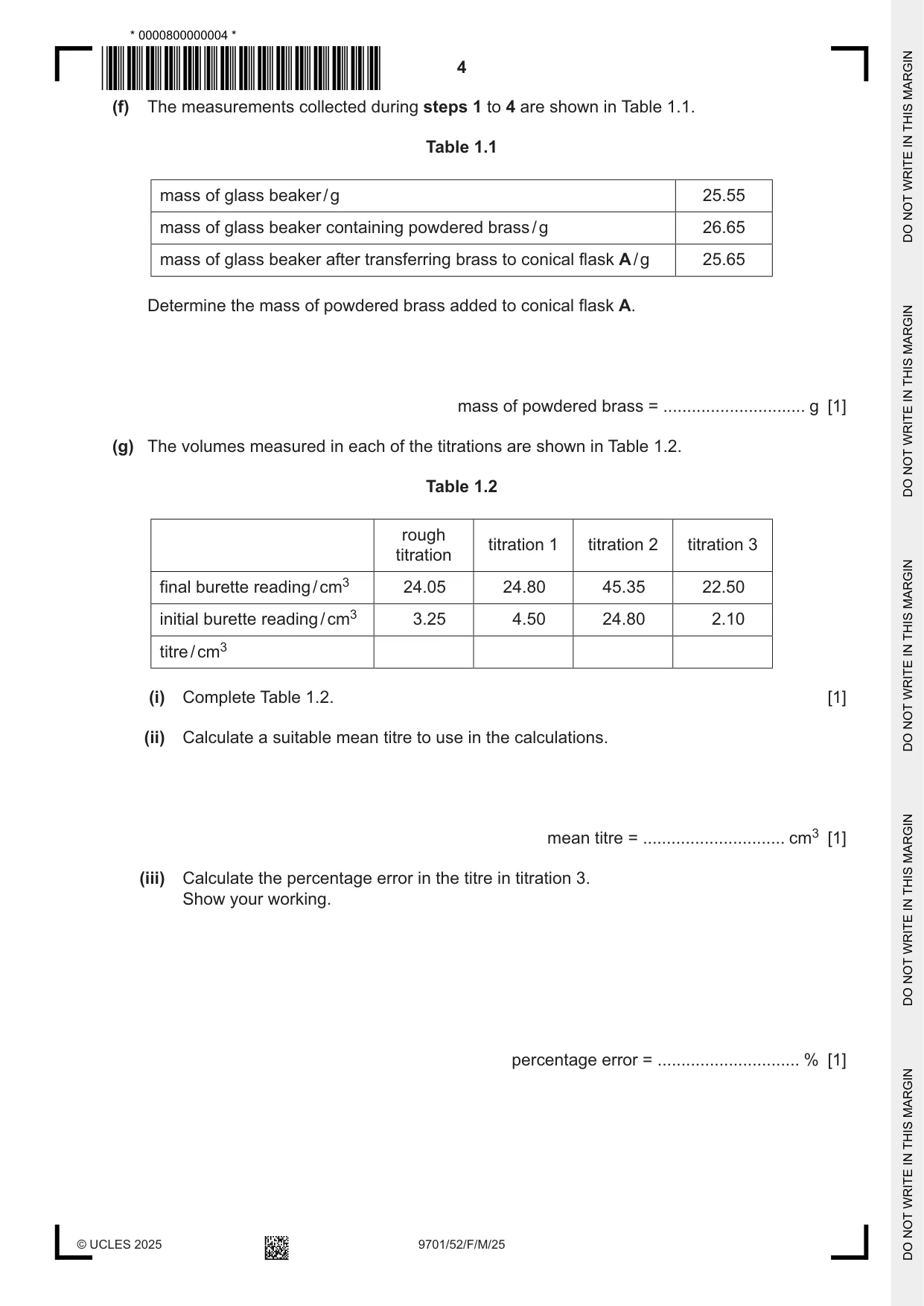
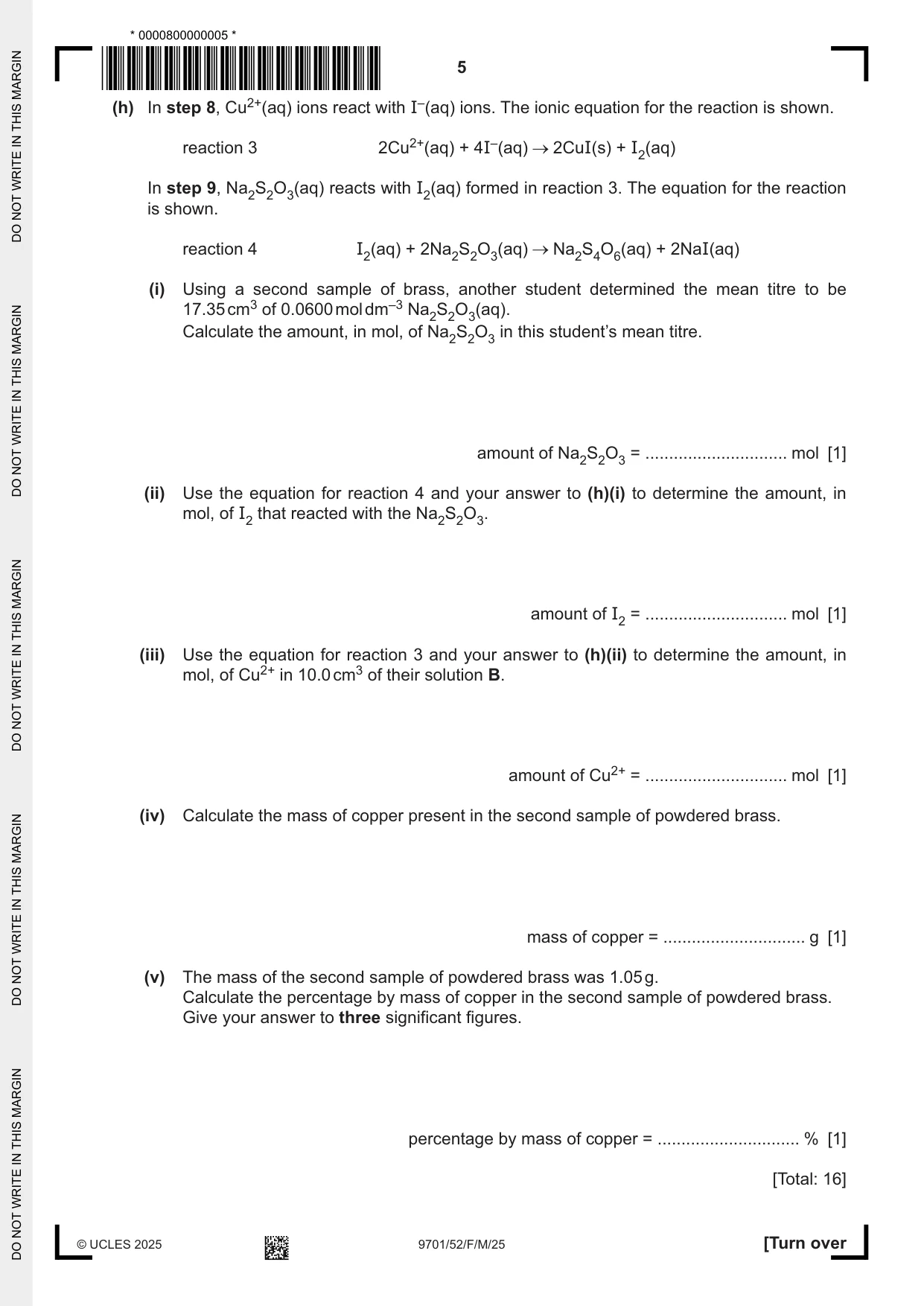
1 Brass is an alloy of copper and zinc. An experiment is completed to find the percentage by mass of copper in a sample of brass. In the experiment, the sample of brass is reacted with an excess of concentrated nitric acid, HNO3. This forms a solution containing Cu2+(aq) ions. The amount of Cu2+(aq) ions formed is determined by titration. A student uses the following method. step 1 Weigh a glass beaker and record the mass. step 2 Add approximately 1.00 g of powdered brass to the beaker and record the mass of the beaker and the brass. step 3 Transfer the brass into conical flask A which contains excess concentrated HNO3. step 4 Reweigh the glass beaker and record the mass. step 5 Add aqueous sodium carbonate, Na2CO3(aq), dropwise to flask A until a precipitate of copper(II) carbonate, CuCO3(s), appears. Then add dilute ethanoic acid dropwise until the precipitate is fully dissolved. step 6 Transfer all the contents of flask A to a 100.0 cm3 volumetric flask and make up to the mark with distilled water. This is solution B. step 7 Transfer 10.0 cm3 of solution B into conical flask C. step 8 Add 10 cm3, an excess, of aqueous potassium iodide, KI(aq), to flask C. step 9 Titrate the contents of flask C against 0.0600 mol dm–3 sodium thiosulfate, Na2S2O3(aq), using starch solution as an indicator. step 10 Repeat steps 7 to 9 until concordant results are obtained. (a) Both copper and zinc in brass react with concentrated HNO3 in step 3. reaction 1 Zn(s) + 4HNO3(aq) Zn(NO3)2(aq) + 2NO2(g) + 2H2O(l) reaction 2 Cu(s) + 4HNO3(aq) Cu(NO3)2(aq) + 2NO2(g) + 2H2O(l) Suggest why step 3 in the experiment should be completed in a fume cupboard. ............................................................................................................................................. [1] (b) Explain why the glass beaker is reweighed in step 4. ................................................................................................................................................... ............................................................................................................................................. [1] (c) Name a suitable piece of apparatus to transfer the 10.0 cm3 of solution B in step 7. ............................................................................................................................................. [1] (d) Identify the substance used to rinse the burette before step 9 is done for the first time. ............................................................................................................................................. [1] (e) In step 9, 0.0600 mol dm–3 Na2S2O3(aq) is used. This solution is prepared from 0.200 mol dm–3 Na2S2O3(aq) before the experiment. Describe how to make a 100.0 cm3 standard solution of 0.0600 mol dm–3 Na2S2O3(aq) from the 0.200 mol dm–3 Na2S2O3(aq) solution. Give the name and capacity of any apparatus you would use. Write your answer in a series of numbered steps. ................................................................................................................................................... ................................................................................................................................................... ................................................................................................................................................... ................................................................................................................................................... ................................................................................................................................................... ............................................................................................................................................. [3] (f) The measurements collected during steps 1 to 4 are shown in Table 1.1. Table 1.1 mass of glass beaker / g 25.55 mass of glass beaker containing powdered brass / g 26.65 mass of glass beaker after transferring brass to conical flask A / g 25.65 Determine the mass of powdered brass added to conical flask A. mass of powdered brass = .............................. g [1] (g) The volumes measured in each of the titrations are shown in Table 1.2. Table 1.2 rough titration 1 titration 2 titration 3 titration final burette reading / cm3 24.05 24.80 45.35 22.50 initial burette reading / cm3 3.25 4.50 24.80 2.10 titre / cm3 (i) Complete Table 1.2. [1] (ii) Calculate a suitable mean titre to use in the calculations. mean titre = .............................. cm3 [1] (iii) Calculate the percentage error in the titre in titration 3. Show your working. percentage error = .............................. % [1] (h) In step 8, Cu2+(aq) ions react with I–(aq) ions. The ionic equation for the reaction is shown. reaction 3 2Cu2+(aq) + 4I–(aq) 2CuI(s) + I2(aq) In step 9, Na2S2O3(aq) reacts with I2(aq) formed in reaction 3. The equation for the reaction is shown. reaction 4 I2(aq) + 2Na2S2O3(aq) Na2S4O6(aq) + 2NaI(aq) (i) Using a second sample of brass, another student determined the mean titre to be 17.35 cm3 of 0.0600 mol dm–3 Na2S2O3(aq). Calculate the amount, in mol, of Na2S2O3 in this student’s mean titre. amount of Na2S2O3 = .............................. mol [1] (ii) Use the equation for reaction 4 and your answer to (h)(i) to determine the amount, in mol, of I2 that reacted with the Na2S2O3. amount of I2 = .............................. mol [1] (iii) Use the equation for reaction 3 and your answer to (h)(ii) to determine the amount, in mol, of Cu2+ in 10.0 cm3 of their solution B. amount of Cu2+ = .............................. mol [1] (iv) Calculate the mass of copper present in the second sample of powdered brass. mass of copper = .............................. g [1] (v) The mass of the second sample of powdered brass was 1.05 g. Calculate the percentage by mass of copper in the second sample of powdered brass. Give your answer to three significant figures. percentage by mass of copper = .............................. % [1] [Total: 16]
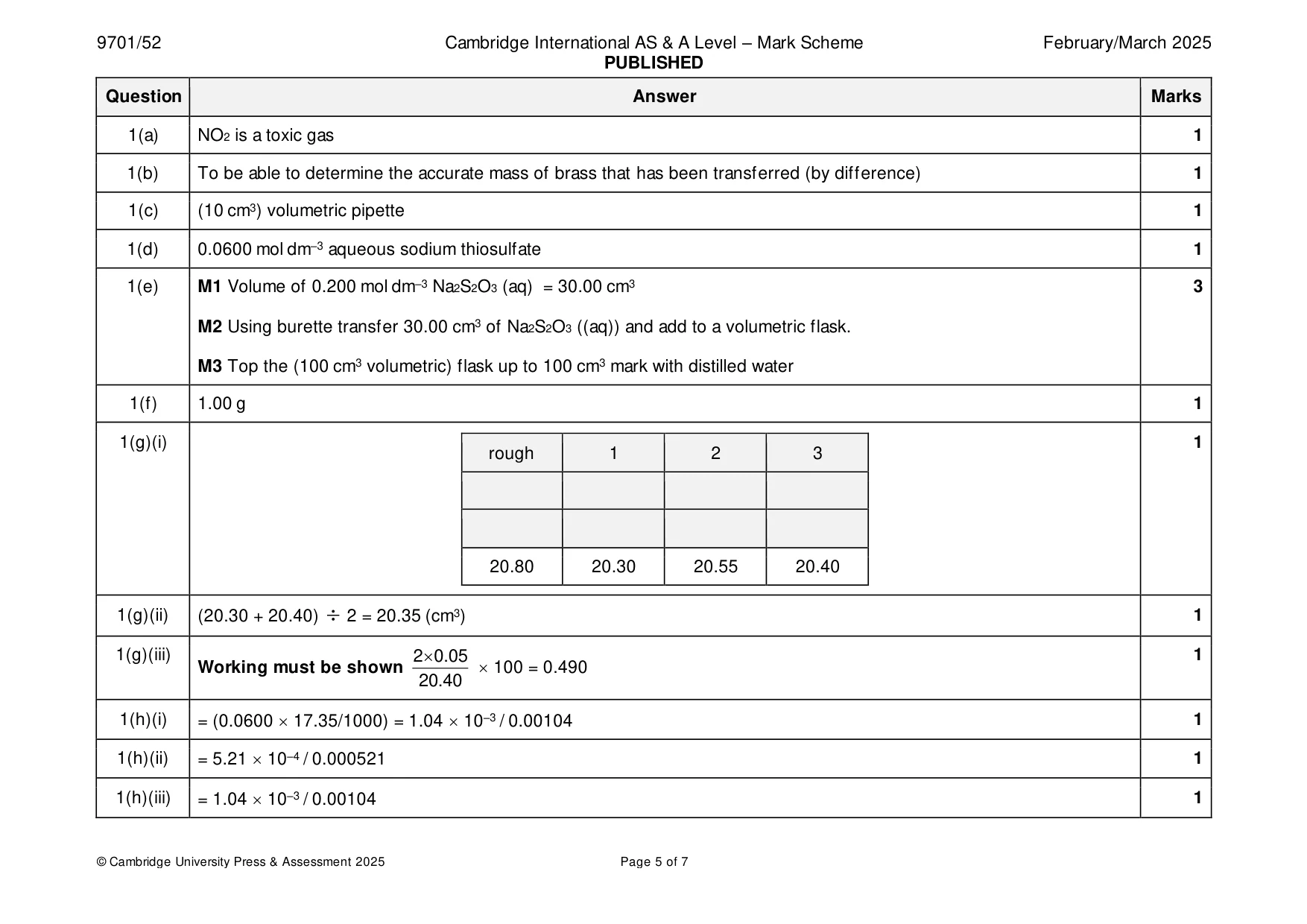
Mark scheme: Question Answer Marks 1(a) NO2 is a toxic gas 1 1(b) To be able to determine the accurate mass of brass that has been transferred (by difference) 1 1(c) (10 cm3) volumetric pipette 1 1(d) 0.0600 mol dm–3 aqueous sodium thiosulfate 1 1(e) M1 Volume of 0.200 mol dm–3 Na2S2O3 (aq) = 30.00 cm3 3 M2 Using burette transfer 30.00 cm3 of Na2S2O3 ((aq)) and add to a volumetric flask. M3 Top the (100 cm3 volumetric) flask up to 100 cm3 mark with distilled water 1(f) 1.00 g 1 1(g)(i) 1 rough 1 2 3 20.80 20.30 20.55 20.40 1(g)(ii) (20.30 + 20.40) ÷ 2 = 20.35 (cm3) 1 1(g)(iii) 2 0.05 1 Working must be shown 100 = 0.490 20.40 1(h)(i) = (0.0600 17.35/1000) = 1.04 10–3 / 0.00104 1 1(h)(ii) = 5.21 10–4 / 0.000521 1 1(h)(iii) = 1.04 10–3 / 0.00104 1 1(h)(iv) 1.041 10–3 10 63.5 = 0.661 1 1(h)(v) 0.661/1.05 100 = 63.0 1
More questions on Reacting masses and volumes (of solutions and gases)
Q2 · Ester X has the formula CH3COOR
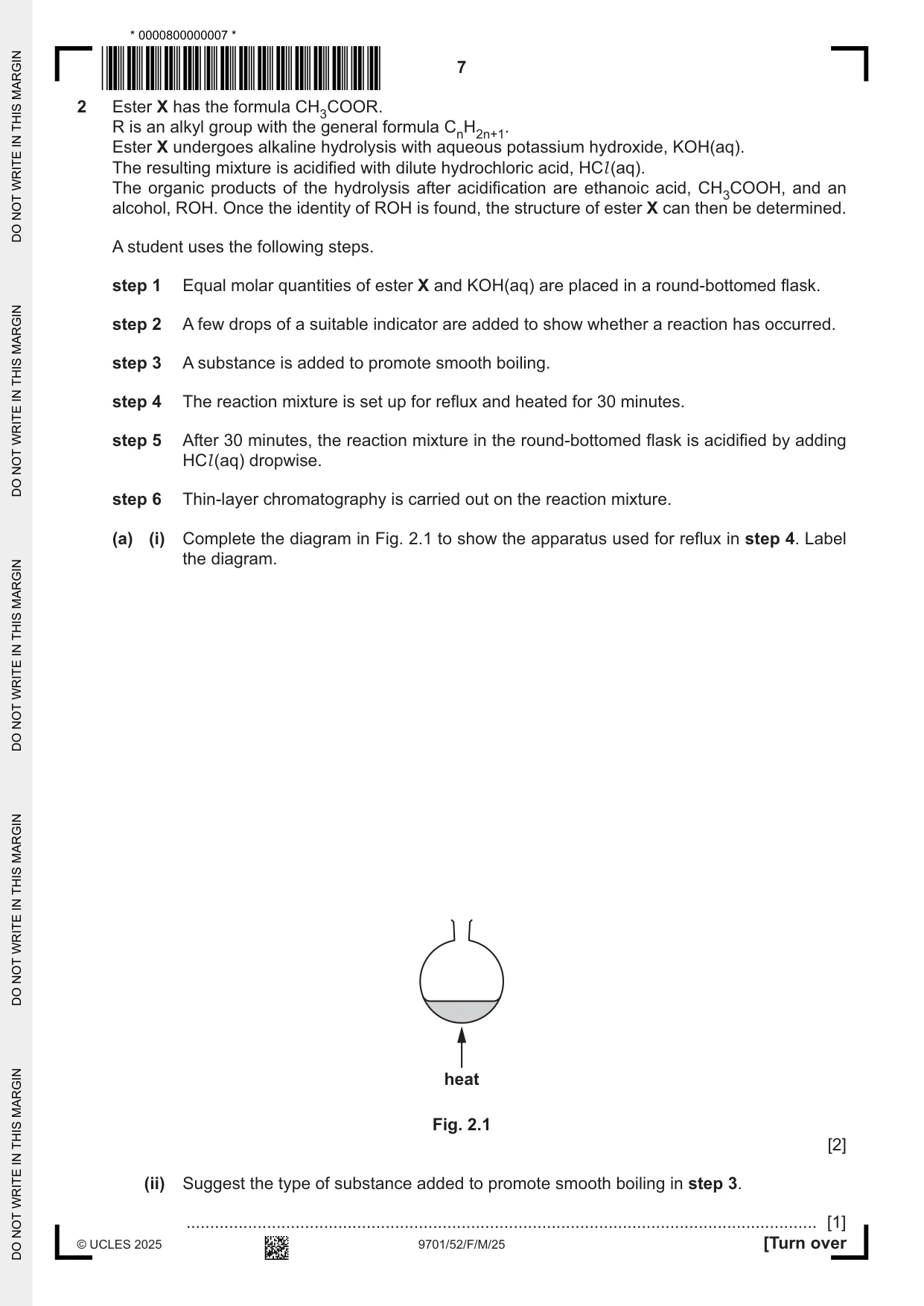
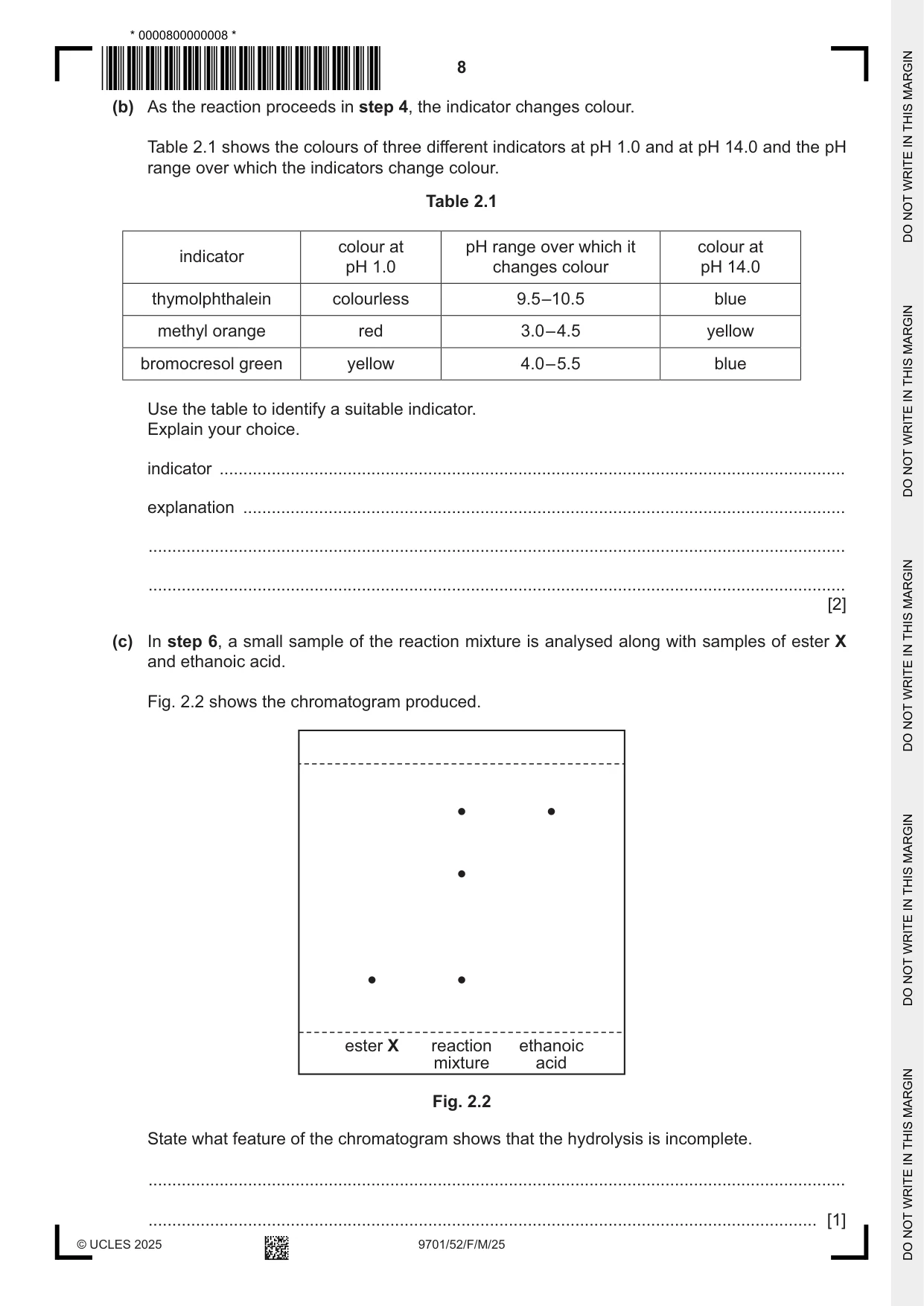
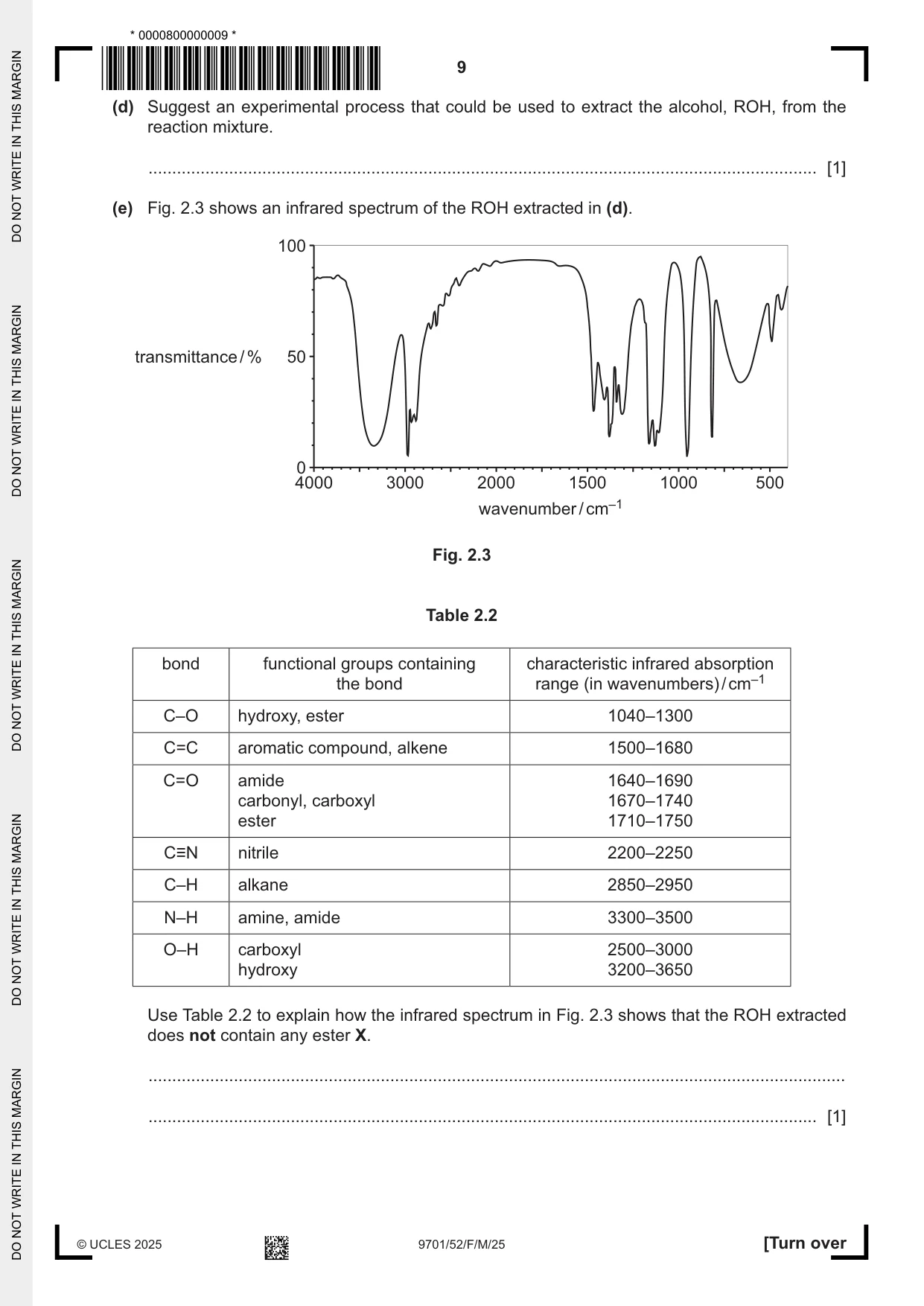
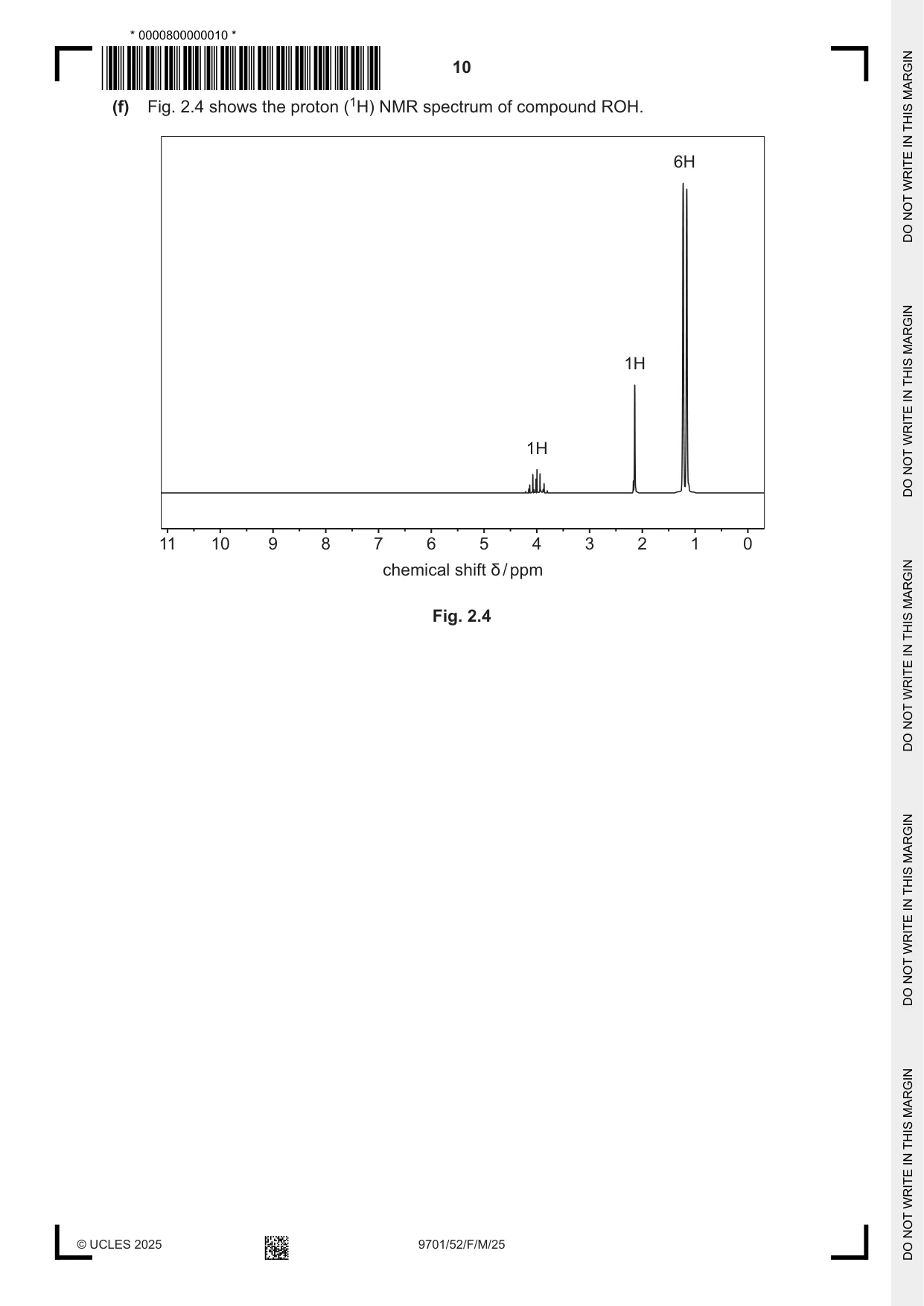
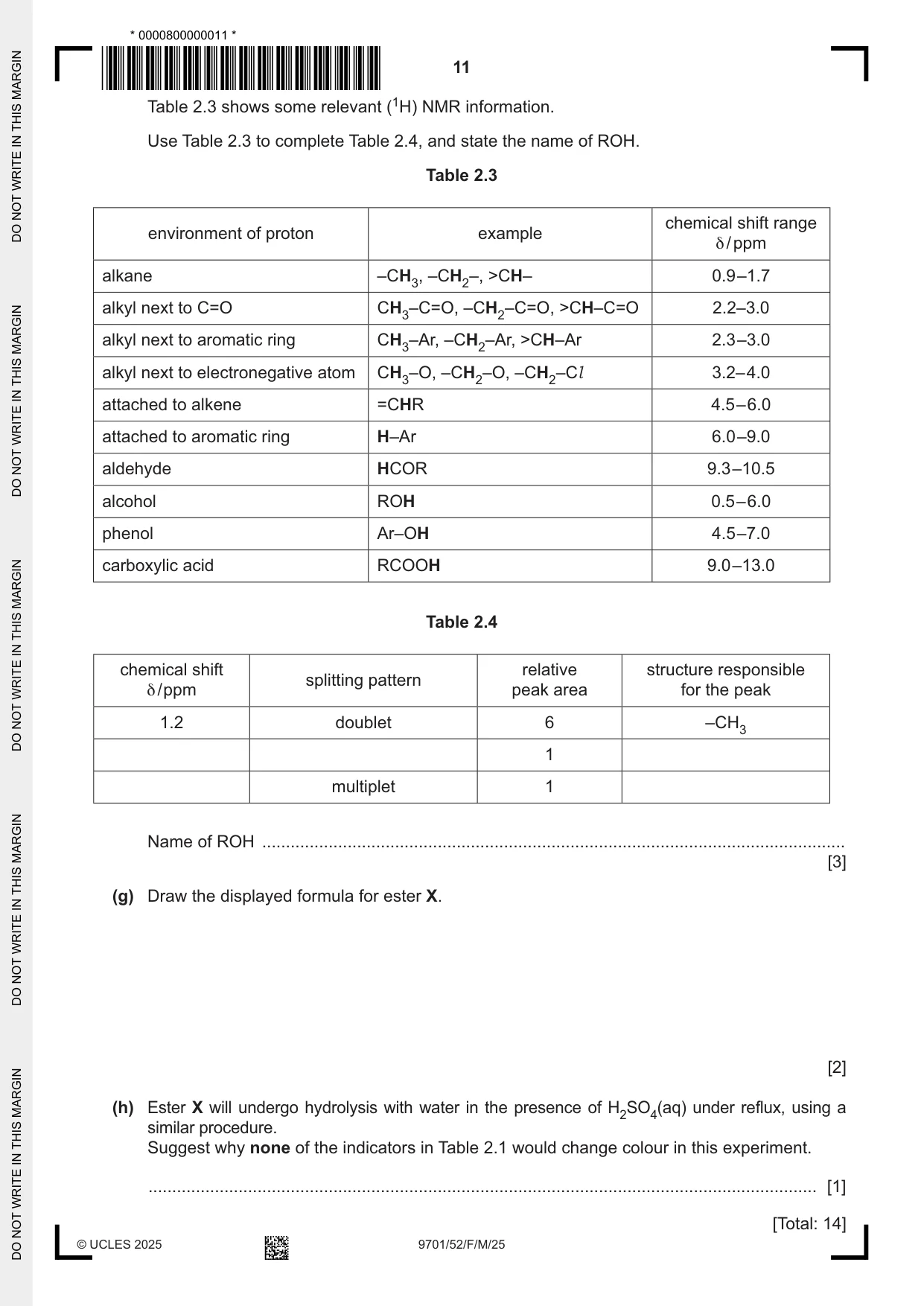
2 Ester X has the formula CH3COOR. R is an alkyl group with the general formula CnH2n+1. Ester X undergoes alkaline hydrolysis with aqueous potassium hydroxide, KOH(aq). The resulting mixture is acidified with dilute hydrochloric acid, HCl (aq). The organic products of the hydrolysis after acidification are ethanoic acid, CH3COOH, and an alcohol, ROH. Once the identity of ROH is found, the structure of ester X can then be determined. A student uses the following steps. step 1 Equal molar quantities of ester X and KOH(aq) are placed in a round‑bottomed flask. step 2 A few drops of a suitable indicator are added to show whether a reaction has occurred. step 3 A substance is added to promote smooth boiling. step 4 The reaction mixture is set up for reflux and heated for 30 minutes. step 5 After 30 minutes, the reaction mixture in the round‑bottomed flask is acidified by adding HCl (aq) dropwise. step 6 Thin‑layer chromatography is carried out on the reaction mixture. (a) (i) Complete the diagram in Fig. 2.1 to show the apparatus used for reflux in step 4. Label the diagram. heat Fig. 2.1 [2] (ii) Suggest the type of substance added to promote smooth boiling in step 3. ..................................................................................................................................... [1] (b) As the reaction proceeds in step 4, the indicator changes colour. Table 2.1 shows the colours of three different indicators at pH 1.0 and at pH 14.0 and the pH range over which the indicators change colour. Table 2.1 colour at pH range over which it colour at indicator pH 1.0 changes colour pH 14.0 thymolphthalein colourless 9.5 –10.5 blue methyl orange red 3.0 – 4.5 yellow bromocresol green yellow 4.0 – 5.5 blue Use the table to identify a suitable indicator. Explain your choice. indicator .................................................................................................................................... explanation ............................................................................................................................... ................................................................................................................................................... ................................................................................................................................................... [2] (c) In step 6, a small sample of the reaction mixture is analysed along with samples of ester X and ethanoic acid. Fig. 2.2 shows the chromatogram produced. ester X reaction ethanoic mixture acid Fig. 2.2 State what feature of the chromatogram shows that the hydrolysis is incomplete. ................................................................................................................................................... ............................................................................................................................................. [1] (d) Suggest an experimental process that could be used to extract the alcohol, ROH, from the reaction mixture. ............................................................................................................................................. [1] (e) Fig. 2.3 shows an infrared spectrum of the ROH extracted in (d). 100 transmittance / % 50 0 4000 3000 2000 1500 1000 500 wavenumber / cm–1 Fig. 2.3 Table 2.2 bond functional groups containing characteristic infrared absorption the bond range (in wavenumbers) / cm–1 C–O hydroxy, ester 1040–1300 C=C aromatic compound, alkene 1500–1680 C=O amide 1640–1690 carbonyl, carboxyl 1670–1740 ester 1710–1750 C≡N nitrile 2200–2250 C–H alkane 2850–2950 N–H amine, amide 3300–3500 O–H carboxyl 2500–3000 hydroxy 3200–3650 Use Table 2.2 to explain how the infrared spectrum in Fig. 2.3 shows that the ROH extracted does not contain any ester X. ................................................................................................................................................... ............................................................................................................................................. [1]
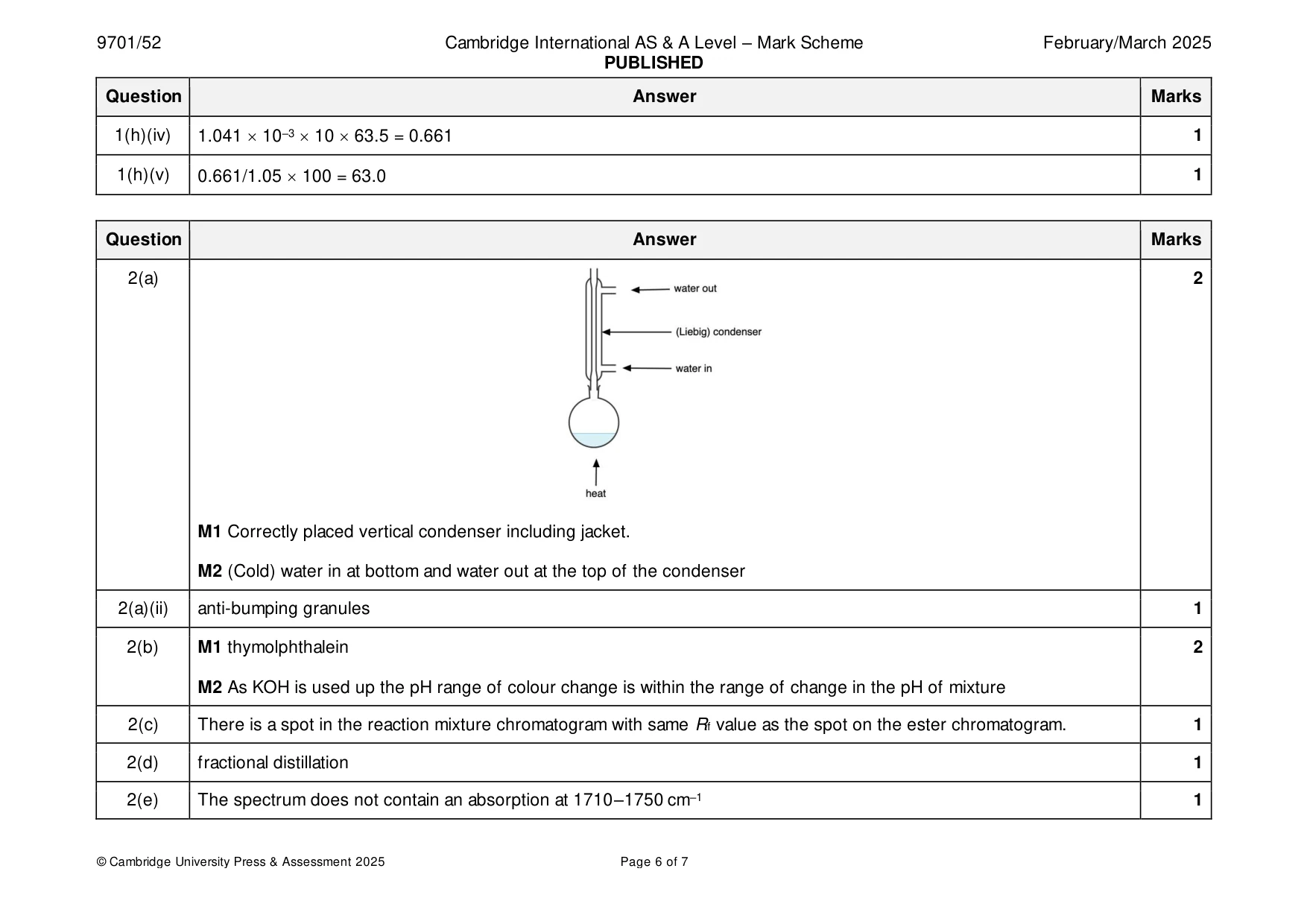
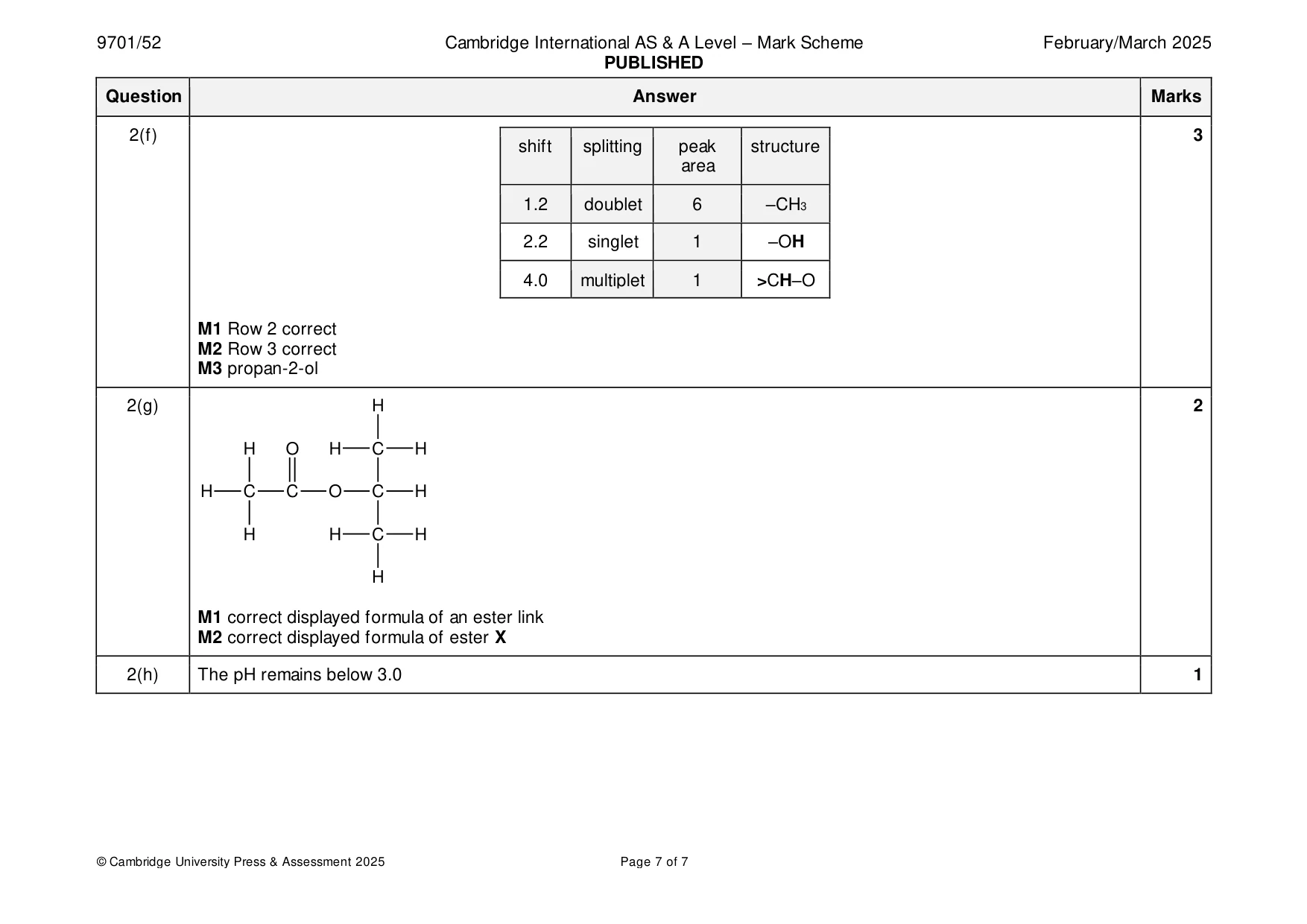
Mark scheme: 2(a) 2 M1 Correctly placed vertical condenser including jacket. M2 (Cold) water in at bottom and water out at the top of the condenser 2(a)(ii) anti-bumping granules 1 2(b) M1 thymolphthalein 2 M2 As KOH is used up the pH range of colour change is within the range of change in the pH of mixture 2(c) There is a spot in the reaction mixture chromatogram with same Rf value as the spot on the ester chromatogram. 1 2(d) fractional distillation 1 2(e) The spectrum does not contain an absorption at 1710–1750 cm–1 1 2(f) 3 shift splitting peak structure area 1.2 doublet 6 –CH3 2.2 singlet 1 –OH 4.0 multiplet 1 >CH–O M1 Row 2 correct M2 Row 3 correct M3 propan-2-ol 2(g) H 2 H O H C H H C C O C H H H C H H M1 correct displayed formula of an ester link M2 correct displayed formula of ester X 2(h) The pH remains below 3.0 1
What was in this paper
The subtopics covered by these 2 questions, and how many questions each got. Open one in a new tab to see every Cambridge question on it.
What you needed in this session
Cambridge’s own grade thresholds for 2025 Feb/March, Paper 5 · Variant 2. A higher threshold means an easier paper — the bar moves with how the cohort did.