Cambridge A Level Chemistry 9701 — 2023 May/June Paper 5 · Variant 2
9701/52/M/J/23 · 2 questions · 30 marks · ≈34 min
The question paper and its mark scheme, free to read here and free to download. This is Cambridge’s own paper, exactly as it was sat.
Question paper12 pages
Mark scheme7 pages
Answers below. Sit the paper first if you are practising.
Questions as text
Q1 · Three students are asked to prepare samples of benzoic acid, C6H5COOH, from the alkaline…
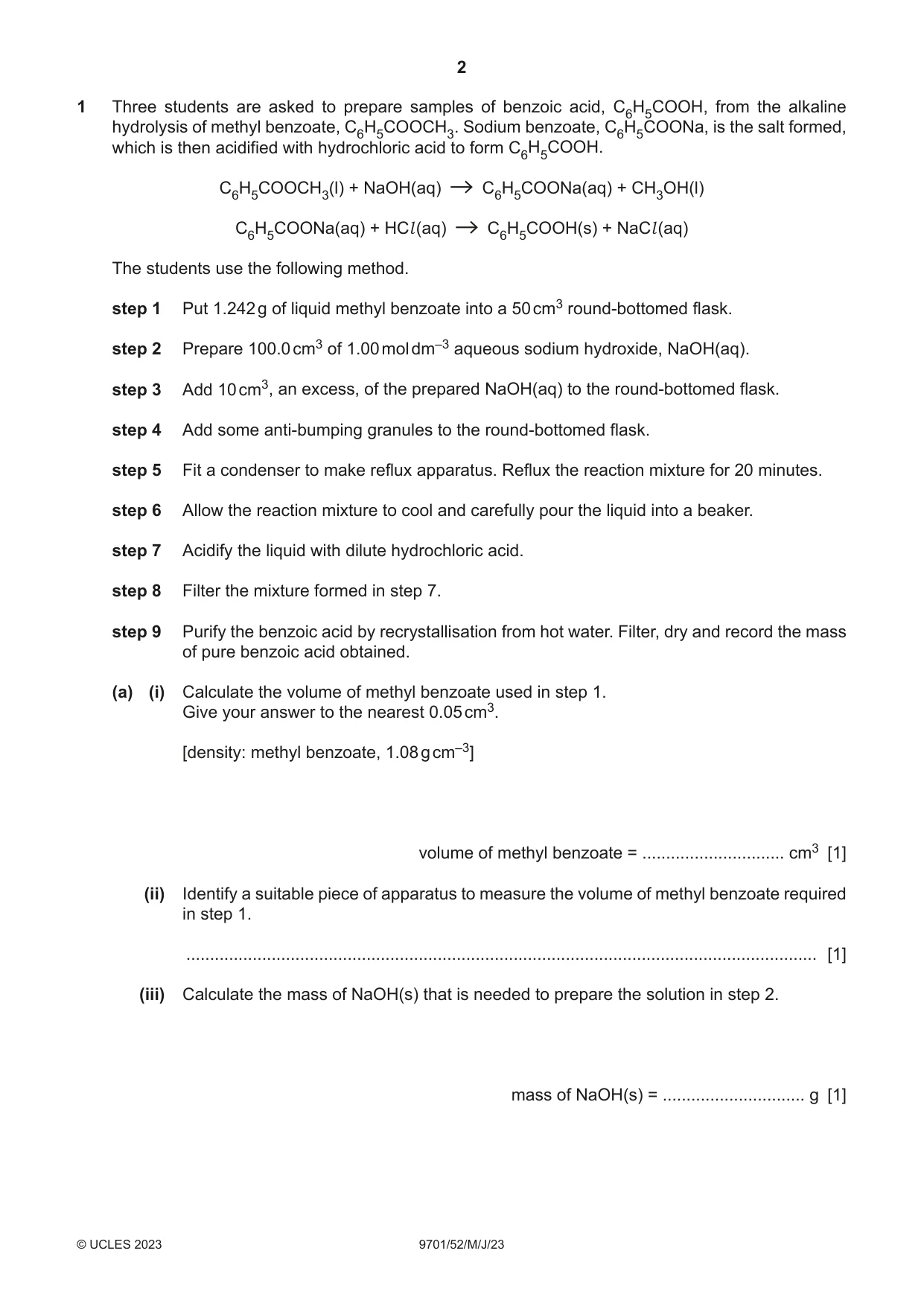
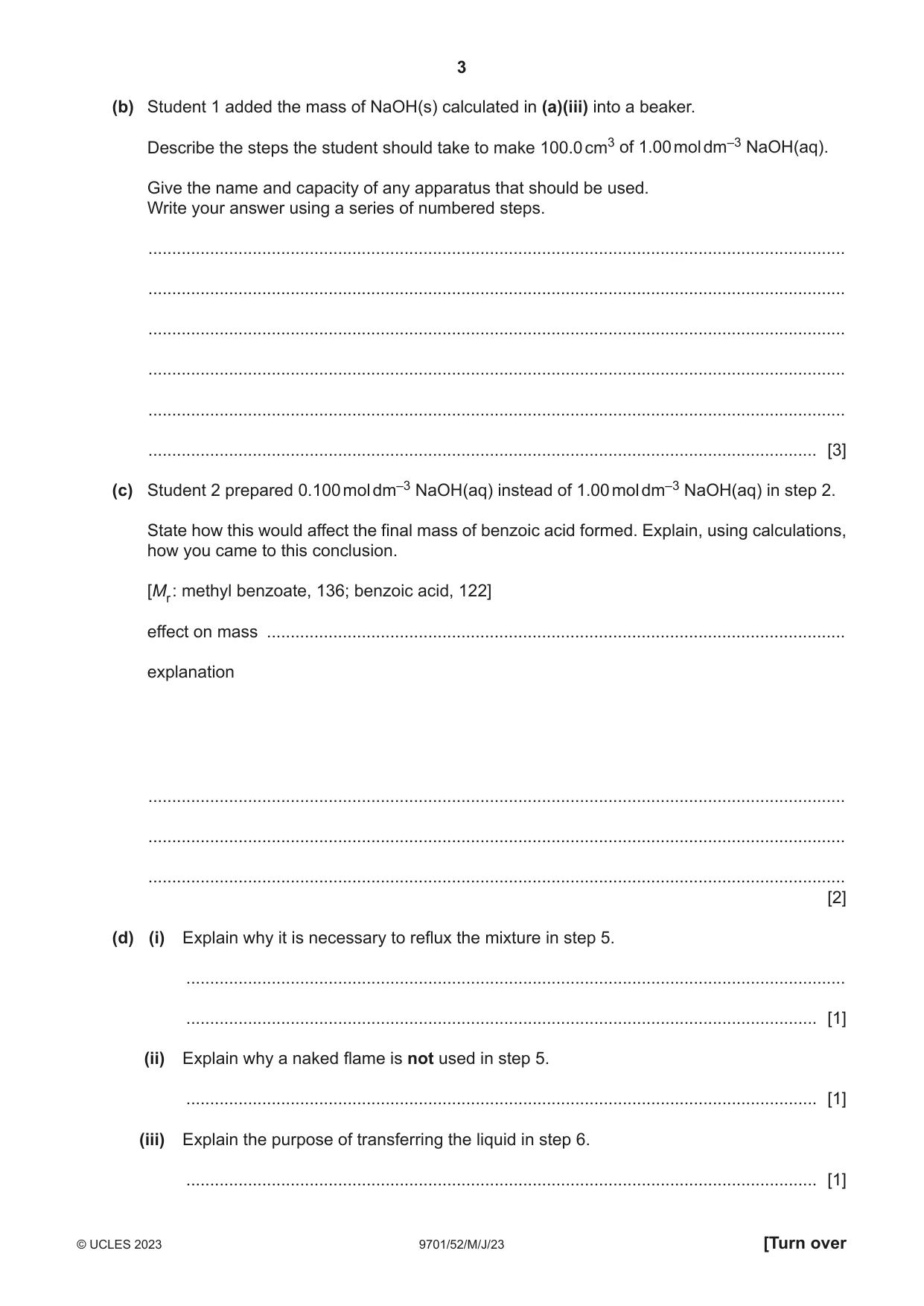
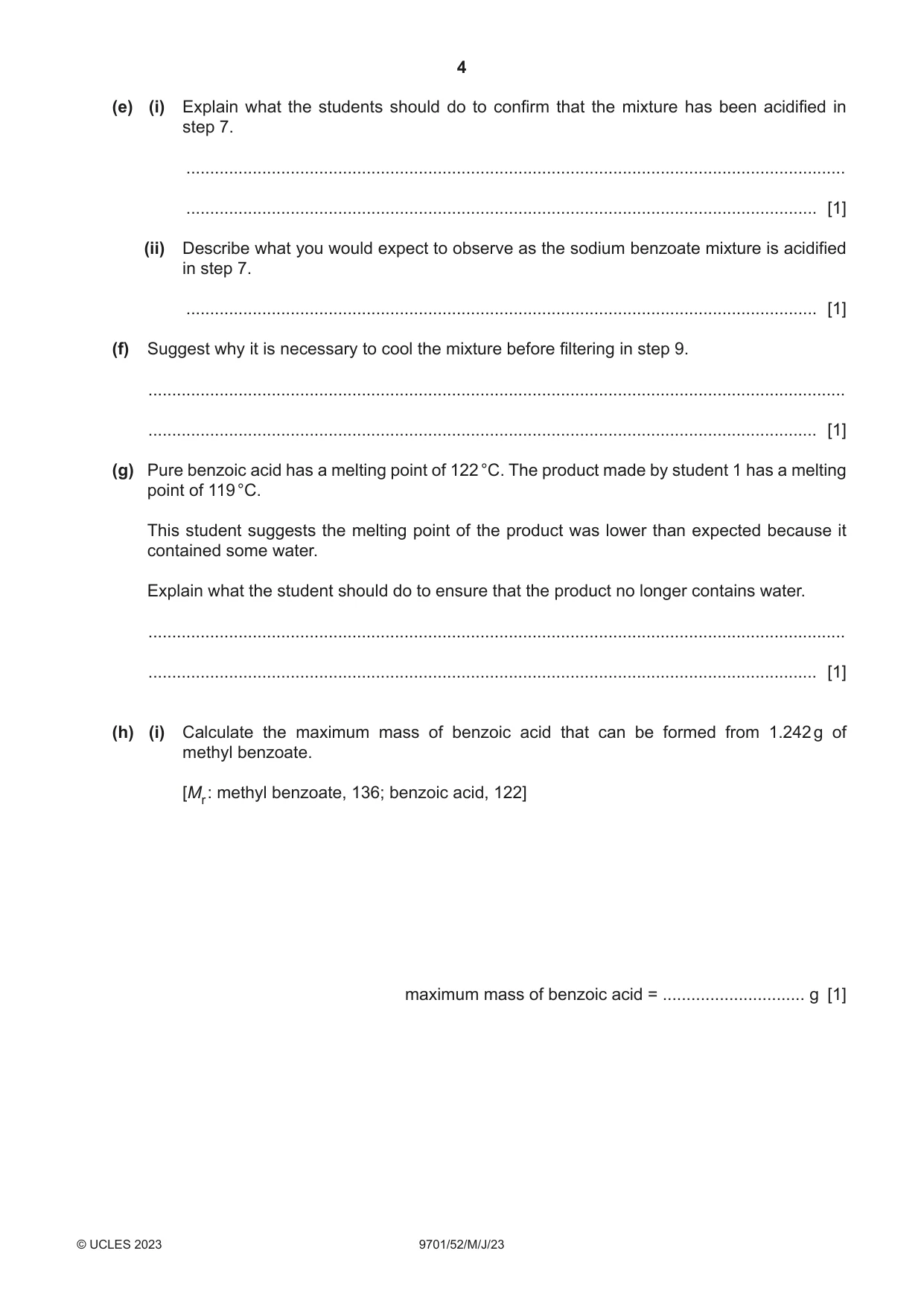
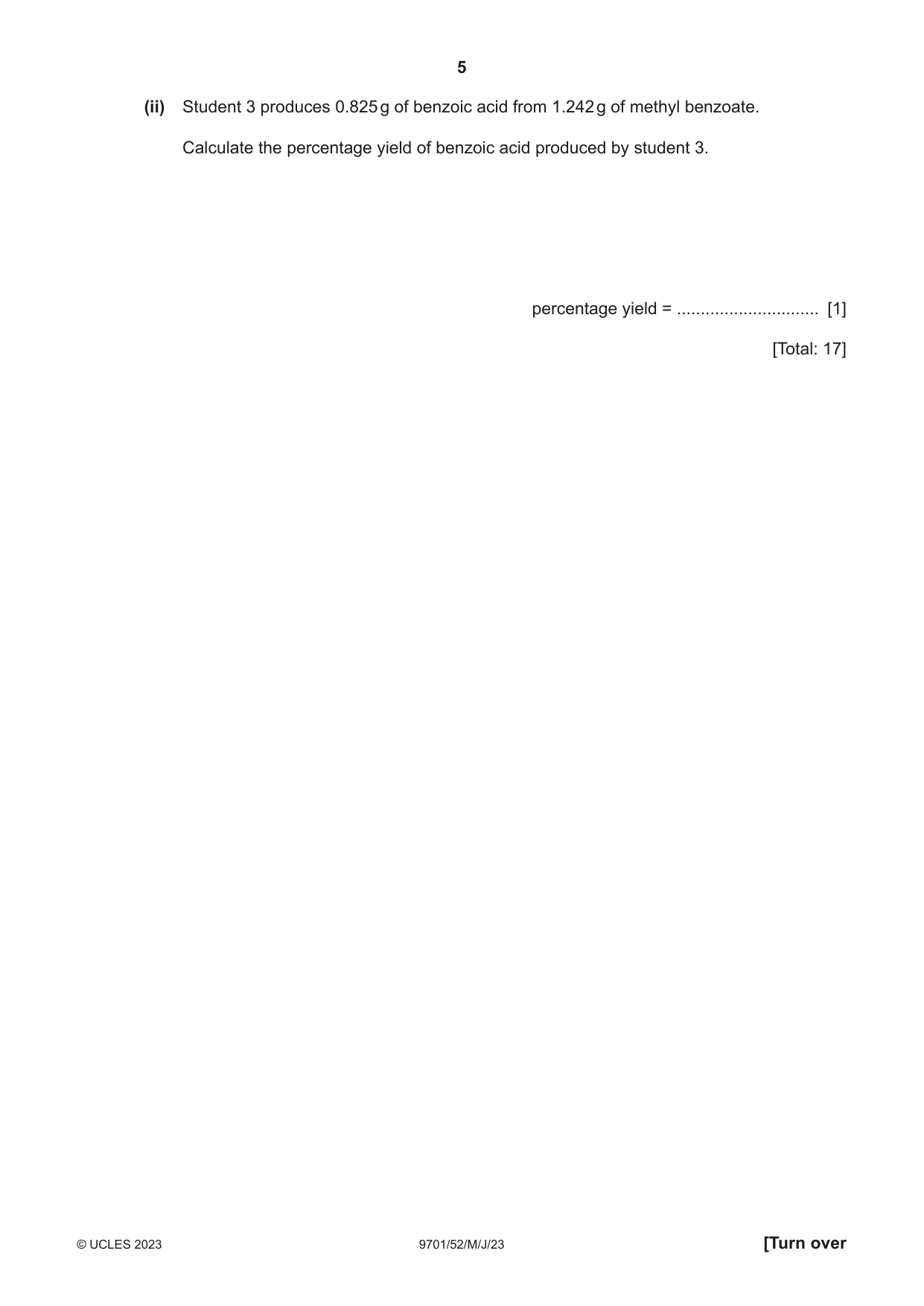
1 Three students are asked to prepare samples of benzoic acid, C6H5COOH, from the alkaline hydrolysis of methyl benzoate, C6H5COOCH3. Sodium benzoate, C6H5COONa, is the salt formed, which is then acidified with hydrochloric acid to form C6H5COOH. C6H5COOCH3(l) + NaOH(aq) C6H5COONa(aq) + CH3OH(l) C6H5COONa(aq) + HCl (aq) C6H5COOH(s) + NaCl (aq) The students use the following method. step 1 Put 1.242 g of liquid methyl benzoate into a 50 cm3 round-bottomed flask. step 2 Prepare 100.0 cm3 of 1.00 mol dm–3 aqueous sodium hydroxide, NaOH(aq). step 3 Add 10 cm3, an excess, of the prepared NaOH(aq) to the round-bottomed flask. step 4 Add some anti-bumping granules to the round-bottomed flask. step 5 Fit a condenser to make reflux apparatus. Reflux the reaction mixture for 20 minutes. step 6 Allow the reaction mixture to cool and carefully pour the liquid into a beaker. step 7 Acidify the liquid with dilute hydrochloric acid. step 8 Filter the mixture formed in step 7. step 9 Purify the benzoic acid by recrystallisation from hot water. Filter, dry and record the mass of pure benzoic acid obtained. (a) (i) Calculate the volume of methyl benzoate used in step 1. Give your answer to the nearest 0.05 cm3. [density: methyl benzoate, 1.08 g cm–3] volume of methyl benzoate = .............................. cm3 [1] (ii) Identify a suitable piece of apparatus to measure the volume of methyl benzoate required in step 1. ..................................................................................................................................... [1] (iii) Calculate the mass of NaOH(s) that is needed to prepare the solution in step 2. mass of NaOH(s) = .............................. g [1] (b) Student 1 added the mass of NaOH(s) calculated in (a)(iii) into a beaker. Describe the steps the student should take to make 100.0 cm3 of 1.00 mol dm–3 NaOH(aq). Give the name and capacity of any apparatus that should be used. Write your answer using a series of numbered steps. ................................................................................................................................................... ................................................................................................................................................... ................................................................................................................................................... ................................................................................................................................................... ................................................................................................................................................... ............................................................................................................................................. [3] (c) Student 2 prepared 0.100 mol dm–3 NaOH(aq) instead of 1.00 mol dm–3 NaOH(aq) in step 2. State how this would affect the final mass of benzoic acid formed. Explain, using calculations, how you came to this conclusion. [Mr : methyl benzoate, 136; benzoic acid, 122] effect on mass .......................................................................................................................... explanation ................................................................................................................................................... ................................................................................................................................................... ................................................................................................................................................... [2] (d) (i) Explain why it is necessary to reflux the mixture in step 5. ........................................................................................................................................... ..................................................................................................................................... [1] (ii) Explain why a naked flame is not used in step 5. ..................................................................................................................................... [1] (iii) Explain the purpose of transferring the liquid in step 6. ..................................................................................................................................... [1] (e) (i) Explain what the students should do to confirm that the mixture has been acidified in step 7. ........................................................................................................................................... ..................................................................................................................................... [1] (ii) Describe what you would expect to observe as the sodium benzoate mixture is acidified in step 7. ..................................................................................................................................... [1] (f) Suggest why it is necessary to cool the mixture before filtering in step 9. ................................................................................................................................................... ............................................................................................................................................. [1] (g) Pure benzoic acid has a melting point of 122 °C. The product made by student 1 has a melting point of 119 °C. This student suggests the melting point of the product was lower than expected because it contained some water. Explain what the student should do to ensure that the product no longer contains water. ................................................................................................................................................... ............................................................................................................................................. [1] (h) (i) Calculate the maximum mass of benzoic acid that can be formed from 1.242 g of methyl benzoate. [Mr : methyl benzoate, 136; benzoic acid, 122] maximum mass of benzoic acid = .............................. g [1] (ii) Student 3 produces 0.825 g of benzoic acid from 1.242 g of methyl benzoate. Calculate the percentage yield of benzoic acid produced by student 3. percentage yield = .............................. [1] [Total: 17]
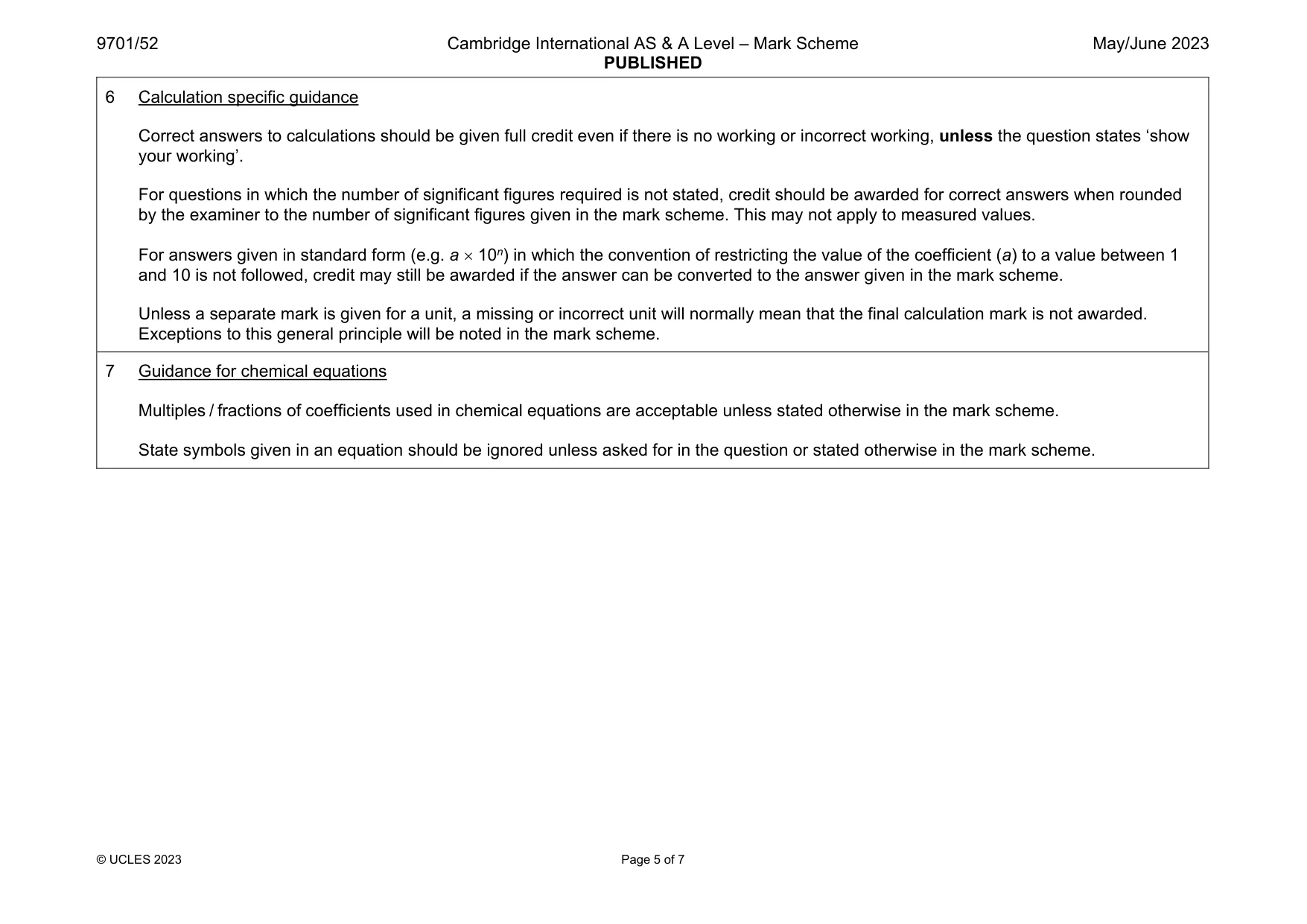
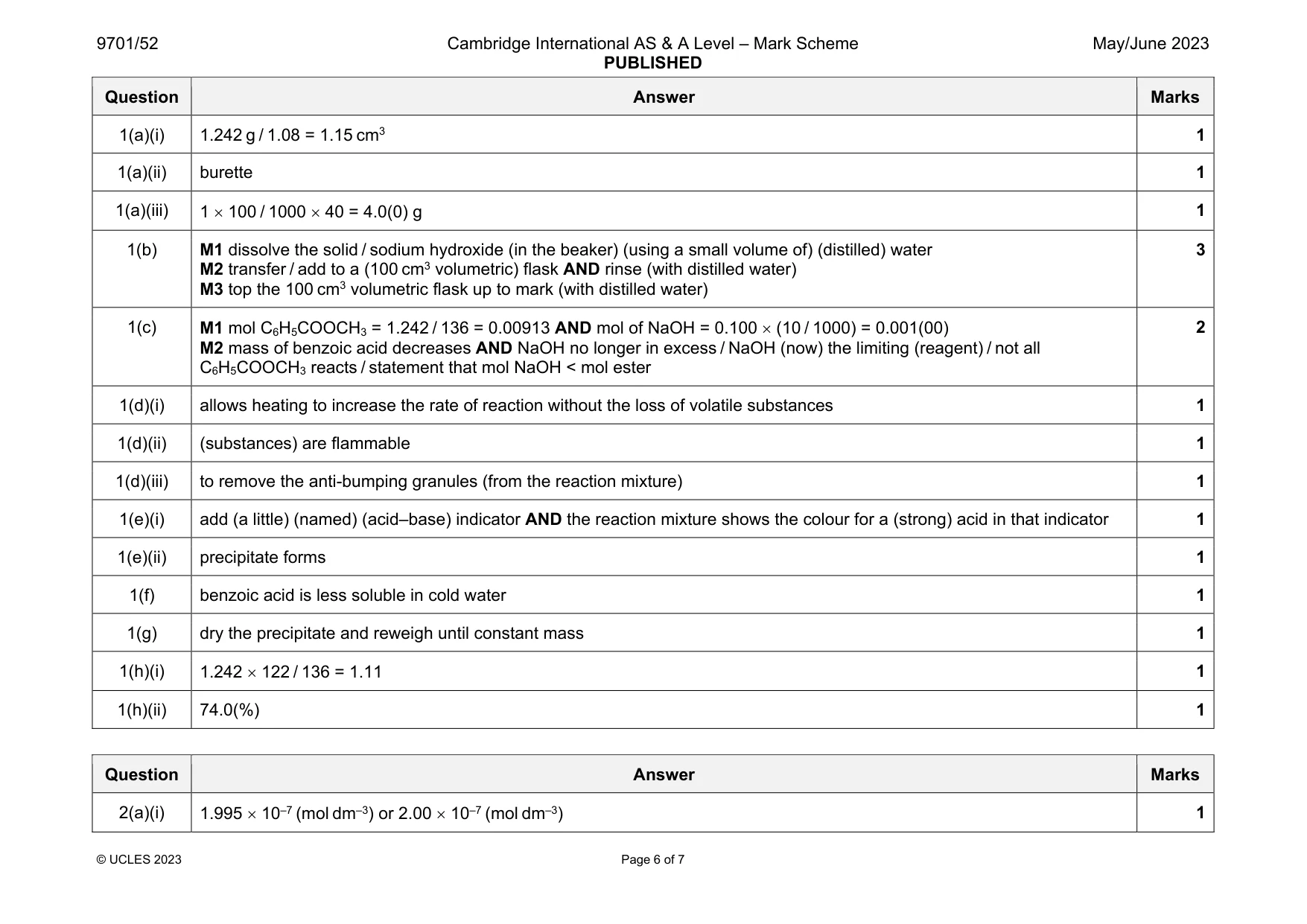
Mark scheme: 1(a)(i) 1.242 g / 1.08 = 1.15 cm3 1 1(a)(ii) burette 1 1(a)(iii) 1 100 / 1000 40 = 4.0(0) g 1 1(b) M1 dissolve the solid / sodium hydroxide (in the beaker) (using a small volume of) (distilled) water M2 transfer / add to a (100 cm3 volumetric) flask AND rinse (with distilled water) M3 top the 100 cm3 volumetric flask up to mark (with distilled water) 3 1(c) M1 mol C6H5COOCH3 = 1.242 / 136 = 0.00913 AND mol of NaOH = 0.100 (10 / 1000) = 0.001(00) M2 mass of benzoic acid decreases AND NaOH no longer in excess / NaOH (now) the limiting (reagent) / not all C6H5COOCH3 reacts / statement that mol NaOH < mol ester 2 1(d)(i) allows heating to increase the rate of reaction without the loss of volatile substances 1 1(d)(ii) (substances) are flammable 1 1(d)(iii) to remove the anti-bumping granules (from the reaction mixture) 1 1(e)(i) add (a little) (named) (acid–base) indicator AND the reaction mixture shows the colour for a (strong) acid in that indicator 1 1(e)(ii) precipitate forms 1 1(f) benzoic acid is less soluble in cold water 1 1(g) dry the precipitate and reweigh until constant mass 1 1(h)(i) 1.242 122 / 136 = 1.11 1 1(h)(ii) 74.0(%) 1
Q2 · Pure water dissociates according to the equation shown
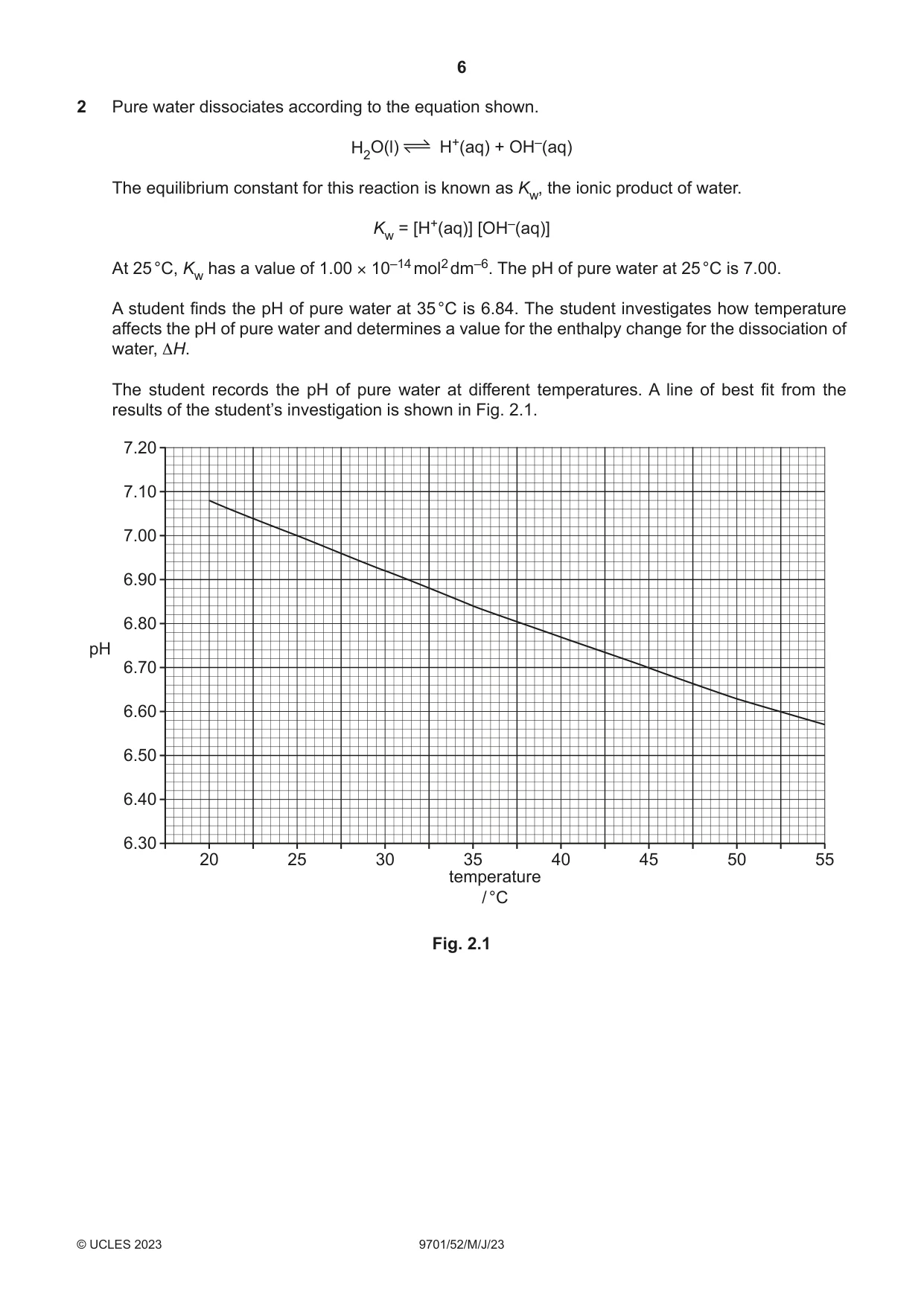
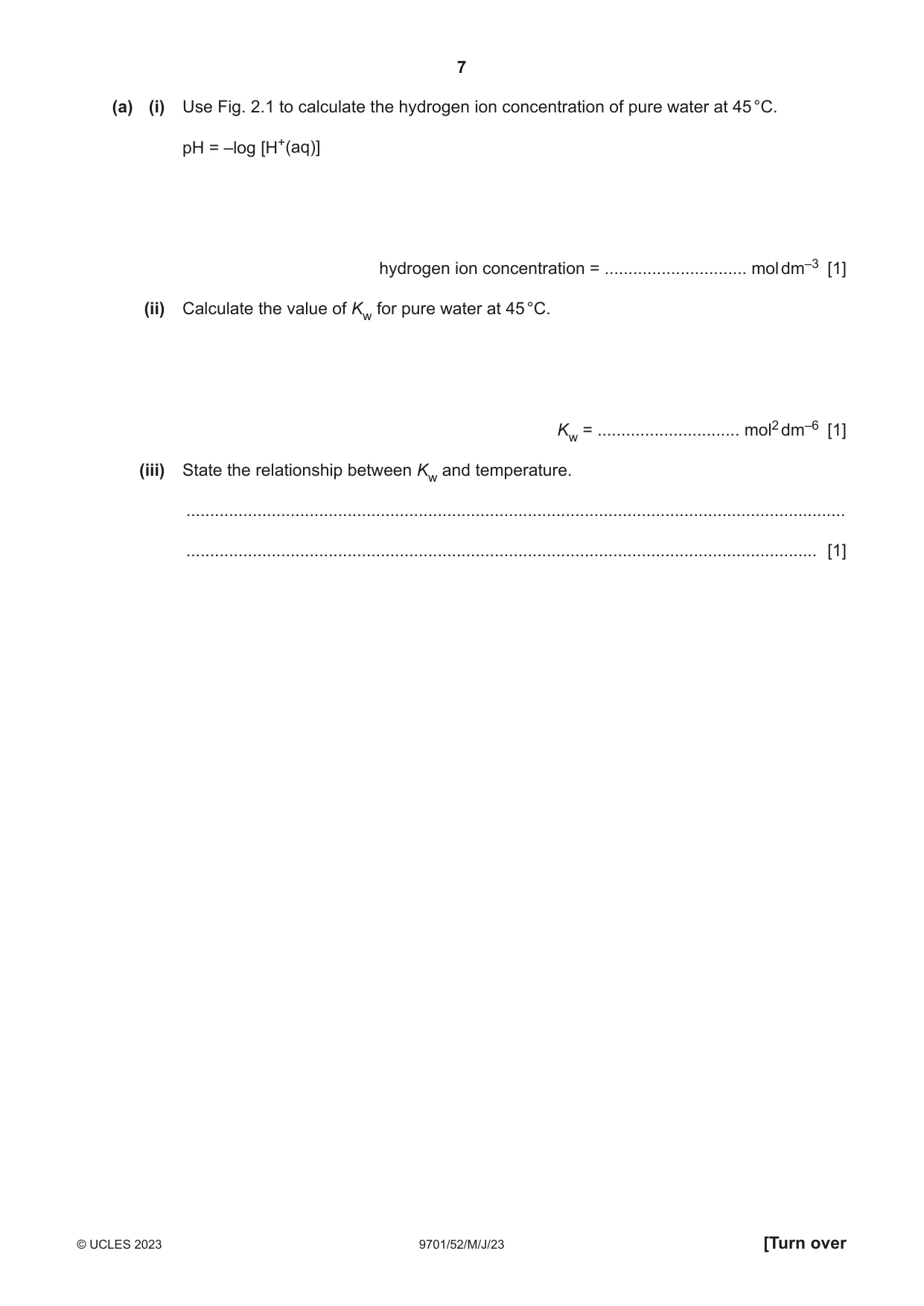
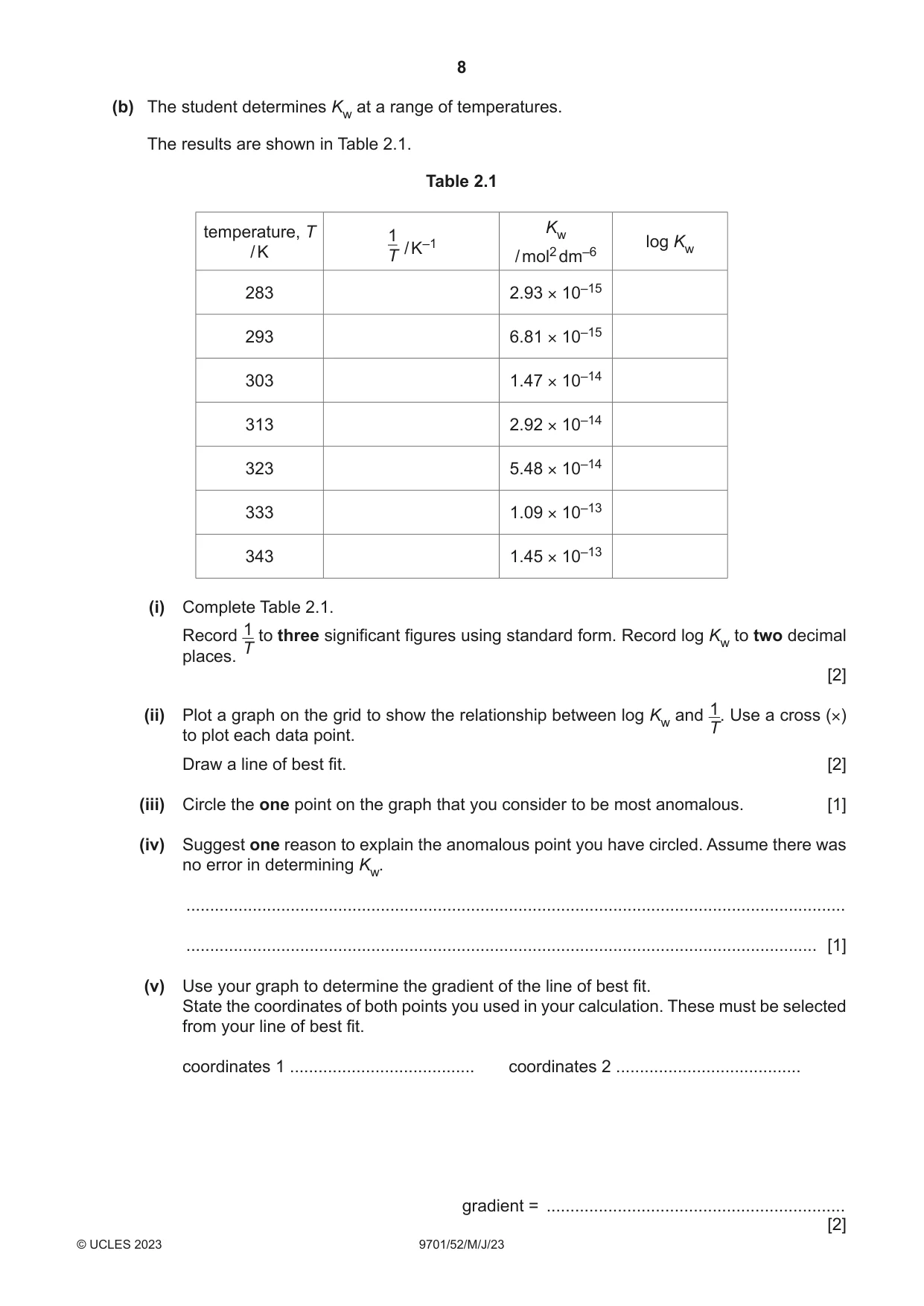
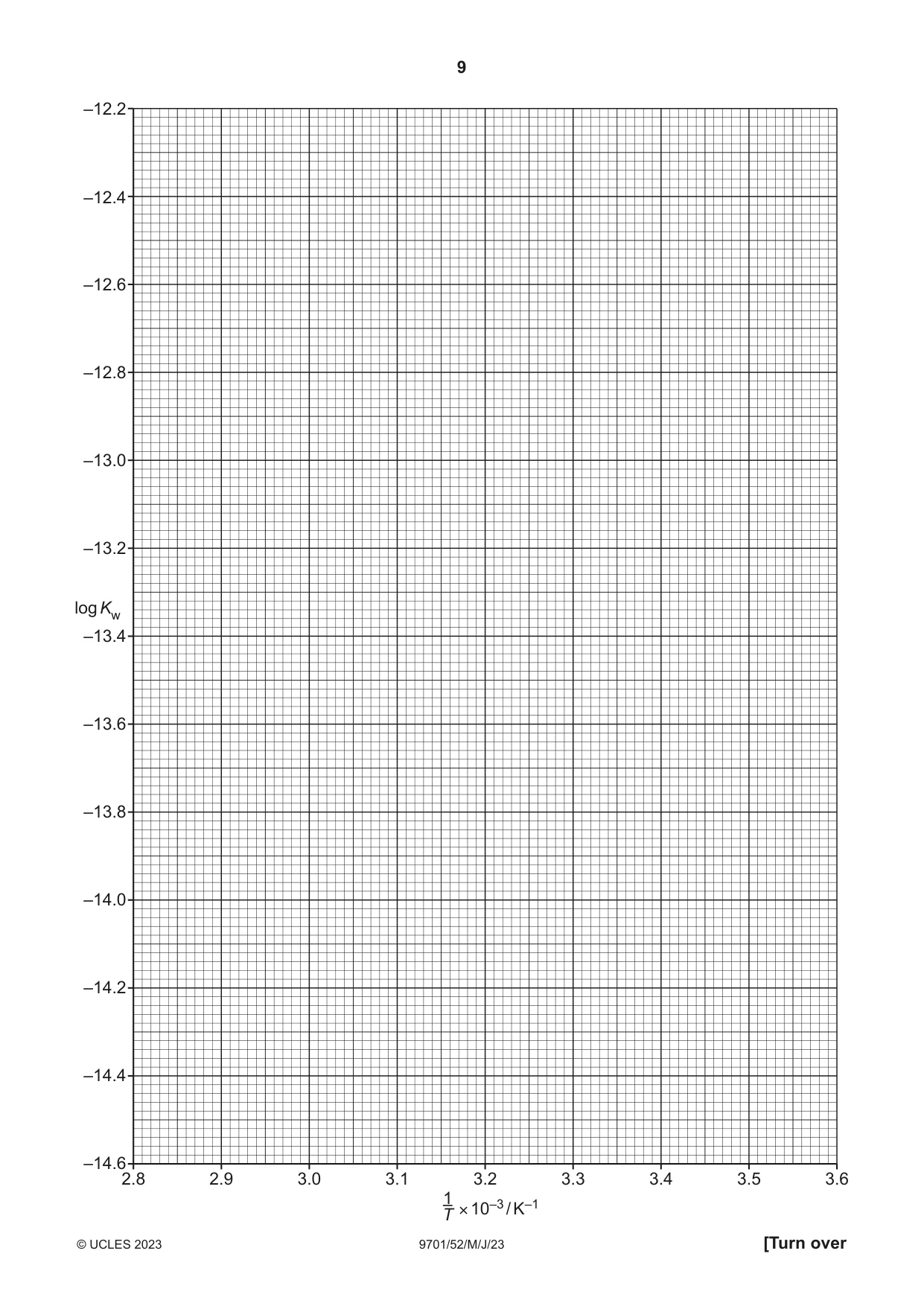
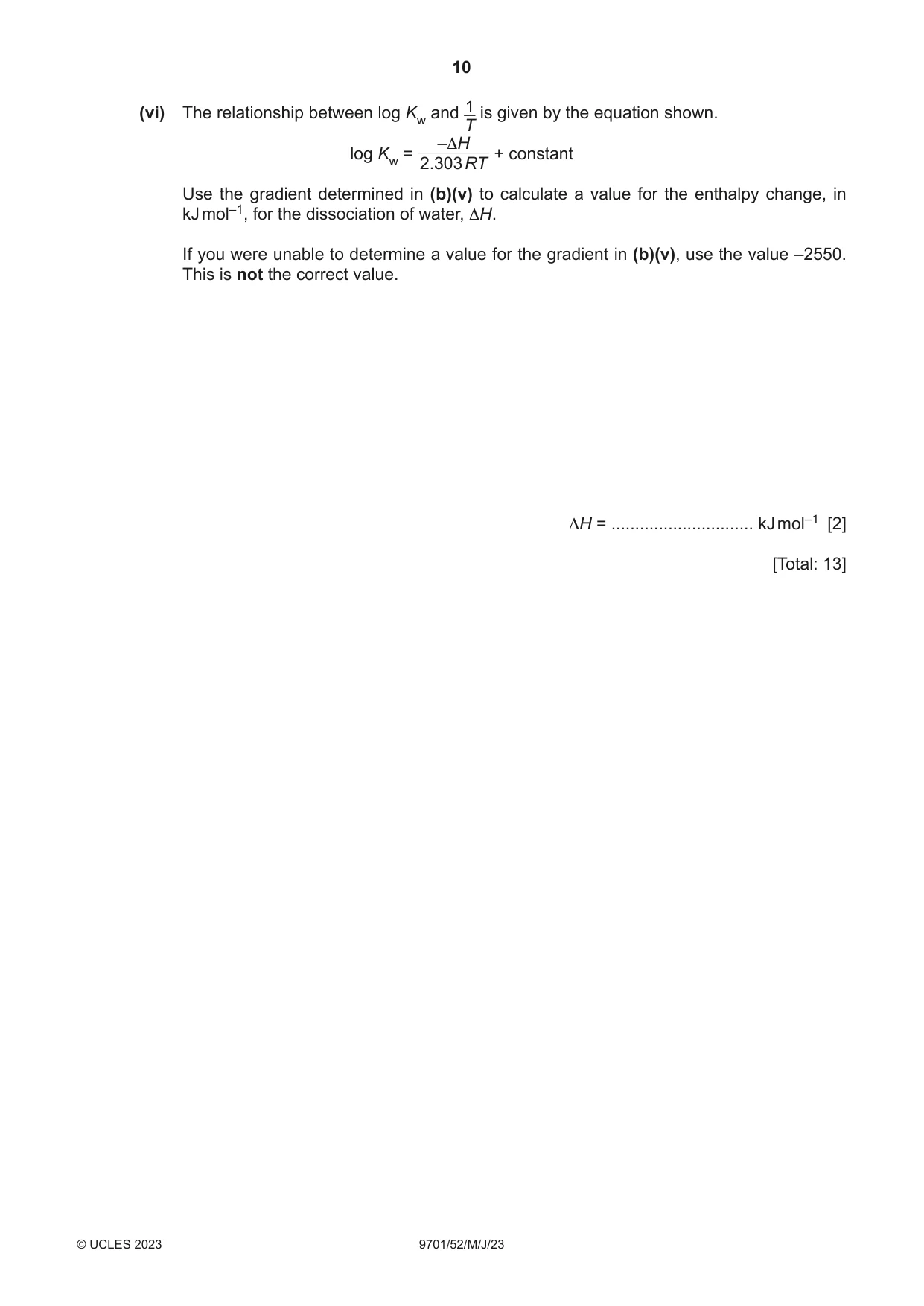
2 Pure water dissociates according to the equation shown. H2O(l) H+(aq) + OH–(aq) The equilibrium constant for this reaction is known as Kw, the ionic product of water. Kw = [H+(aq)] [OH–(aq)] At 25 °C, Kw has a value of 1.00 × 10⁻¹⁴ mol2 dm–6. The pH of pure water at 25 °C is 7.00. A student finds the pH of pure water at 35 °C is 6.84. The student investigates how temperature affects the pH of pure water and determines a value for the enthalpy change for the dissociation of water, ΔH. The student records the pH of pure water at different temperatures. A line of best fit from the results of the student’s investigation is shown in Fig. 2.1. 7.20 7.10 7.00 6.90 6.80 pH 6.70 6.60 6.50 6.40 6.30 20 25 30 35 40 45 50 55 temperature / °C Fig. 2.1 (a) (i) Use Fig. 2.1 to calculate the hydrogen ion concentration of pure water at 45 °C. pH = –log [H+(aq)] hydrogen ion concentration = .............................. mol dm–3 [1] (ii) Calculate the value of Kw for pure water at 45 °C. Kw = .............................. mol2 dm–6 [1] (iii) State the relationship between Kw and temperature. ........................................................................................................................................... ..................................................................................................................................... [1] (b) The student determines Kw at a range of temperatures. The results are shown in Table 2.1. Table 2.1 temperature, T 1 Kw log Kw / K T / K–1 / mol2 dm–6 283 2.93 × 10⁻¹⁵ 293 6.81 × 10⁻¹⁵ 303 1.47 × 10⁻¹⁴ 313 2.92 × 10⁻¹⁴ 323 5.48 × 10⁻¹⁴ 333 1.09 × 10⁻¹³ 343 1.45 × 10⁻¹³ (i) Complete Table 2.1. 1 Record to three significant figures using standard form. Record log Kw to two decimal T places. [2] 1 (ii) Plot a graph on the grid to show the relationship between log Kw and T. Use a cross (×) to plot each data point. Draw a line of best fit. [2] (iii) Circle the one point on the graph that you consider to be most anomalous. [1] (iv) Suggest one reason to explain the anomalous point you have circled. Assume there was no error in determining Kw. ........................................................................................................................................... ..................................................................................................................................... [1] (v) Use your graph to determine the gradient of the line of best fit. State the coordinates of both points you used in your calculation. These must be selected from your line of best fit. coordinates 1 ....................................... coordinates 2 ....................................... gradient = ...............................................................
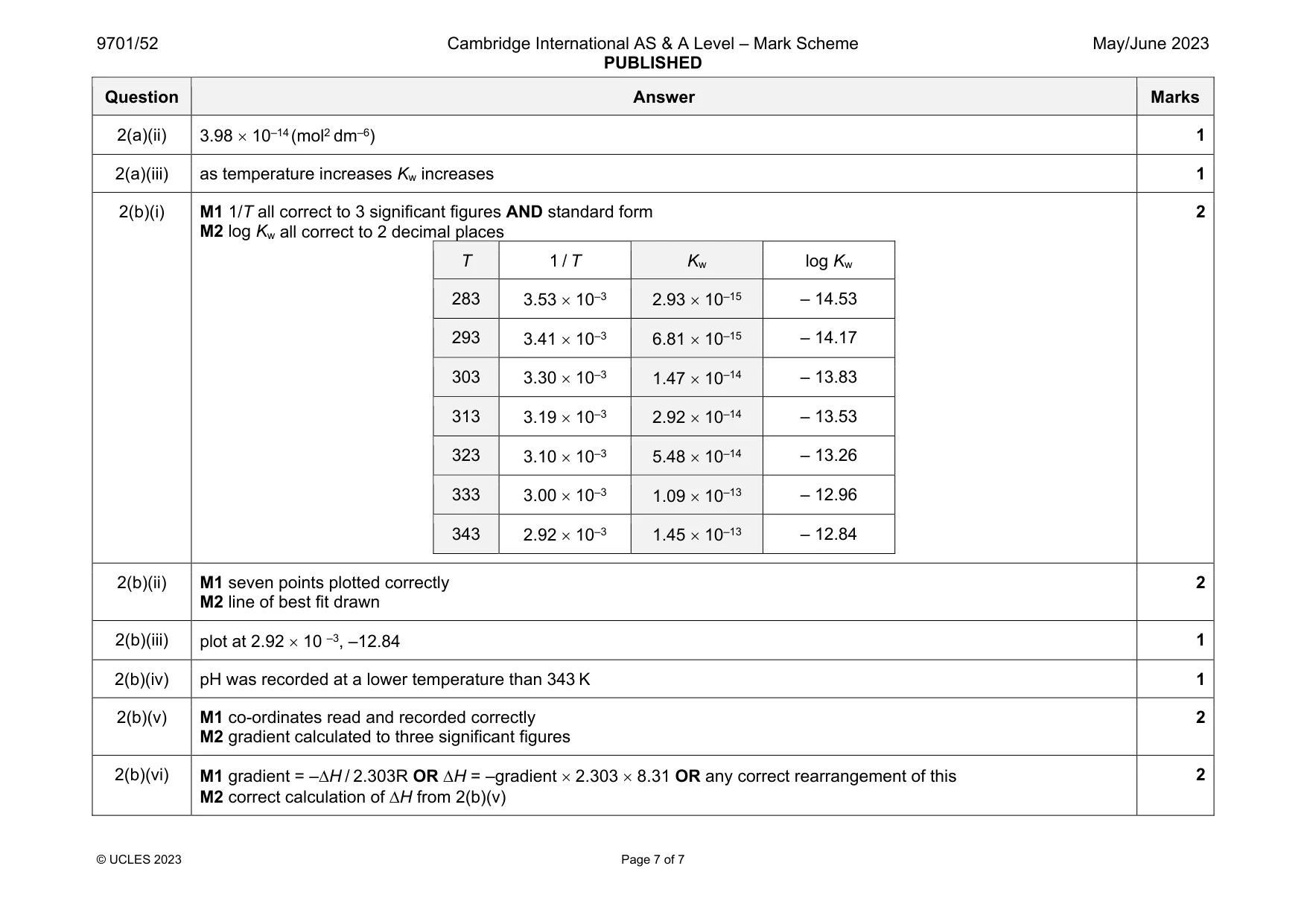
Mark scheme: 2(a)(i) Question Answer Marks 2(a)(ii) 3.98 10–14 (mol2 dm–6) 1 2(a)(iii) as temperature increases Kw increases 1 2(b)(i) M1 1/T all correct to 3 significant figures AND standard form M2 log Kw all correct to 2 decimal places T 1 / T Kw log Kw 283 3.53 10–3 2.93 10–15 – 14.53 293 3.41 10–3 6.81 10–15 – 14.17 303 3.30 10–3 1.47 10–14 – 13.83 313 3.19 10–3 2.92 10–14 – 13.53 323 3.10 10–3 5.48 10–14 – 13.26 333 3.00 10–3 1.09 10–13 – 12.96 343 2.92 10–3 1.45 10–13 – 12.84 2 2(b)(ii) M1 seven points plotted correctly M2 line of best fit drawn 2 2(b)(iii) plot at 2.92 10 –3, –12.84 1 2(b)(iv) pH was recorded at a lower temperature than 343 K 1 2(b)(v) M1 co-ordinates read and recorded correctly M2 gradient calculated to three significant figures 2 2(b)(vi) M1 gradient = –H / 2.303R OR H = –gradient 2.303 8.31 OR any correct rearrangement of this M2 correct calculation of H from 2(b)(v) 2
What was in this paper
The subtopics covered by these 2 questions, and how many questions each got. Open one in a new tab to see every Cambridge question on it.
What you needed in this session
Cambridge’s own grade thresholds for 2023 May/June, Paper 5 · Variant 2. A higher threshold means an easier paper — the bar moves with how the cohort did.