Cambridge A Level Chemistry 9701 — 2023 Feb/March Paper 5 · Variant 2
9701/52/F/M/23 · 2 questions · 30 marks · ≈34 min
The question paper and its mark scheme, free to read here and free to download. This is Cambridge’s own paper, exactly as it was sat.
Question paper12 pages

Mark scheme8 pages
Answers below. Sit the paper first if you are practising.
Questions as text
Q1 · Aqueous iron(II) ions, Fe2+(aq), are usually kept in acidic conditions to prevent them…
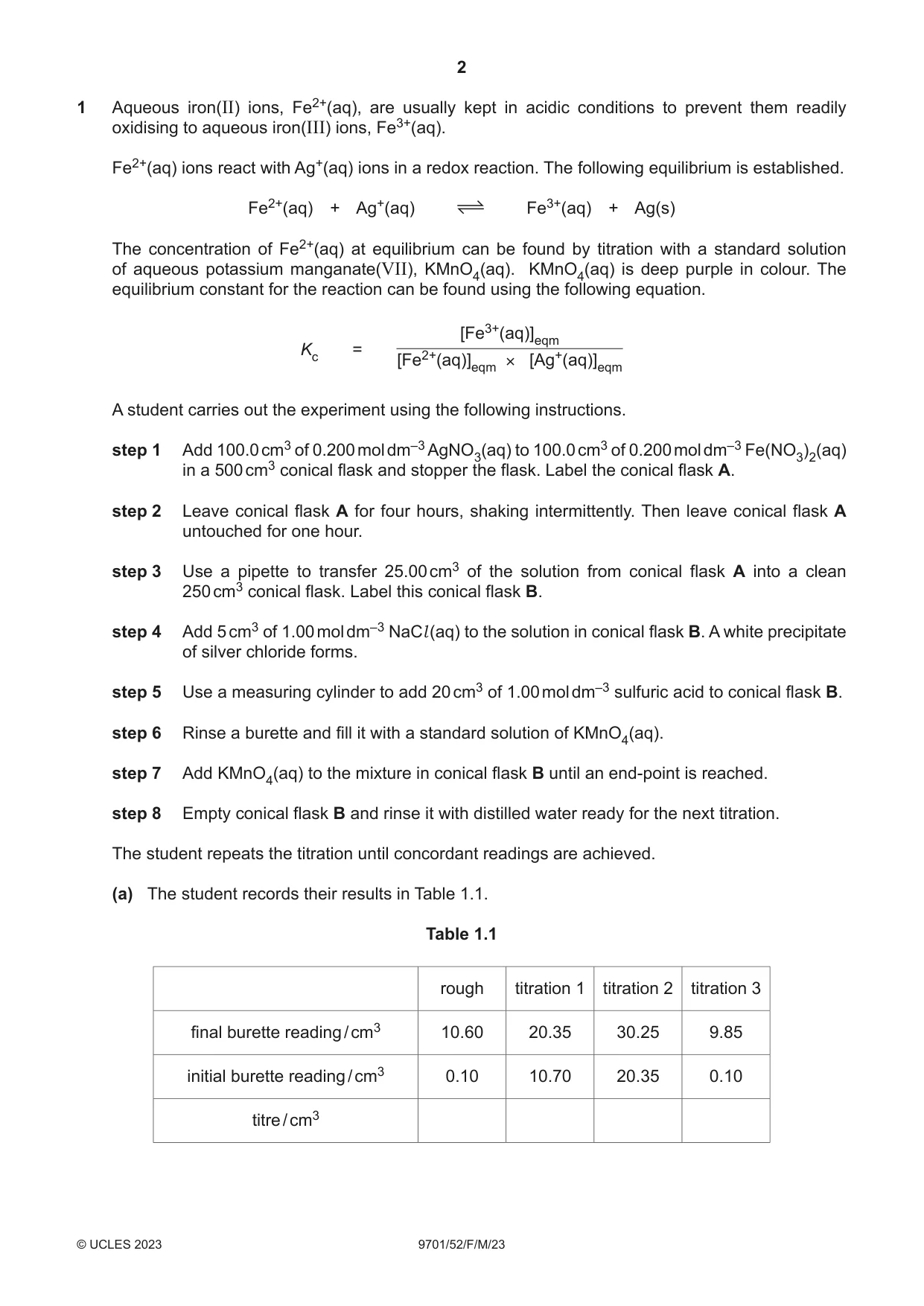
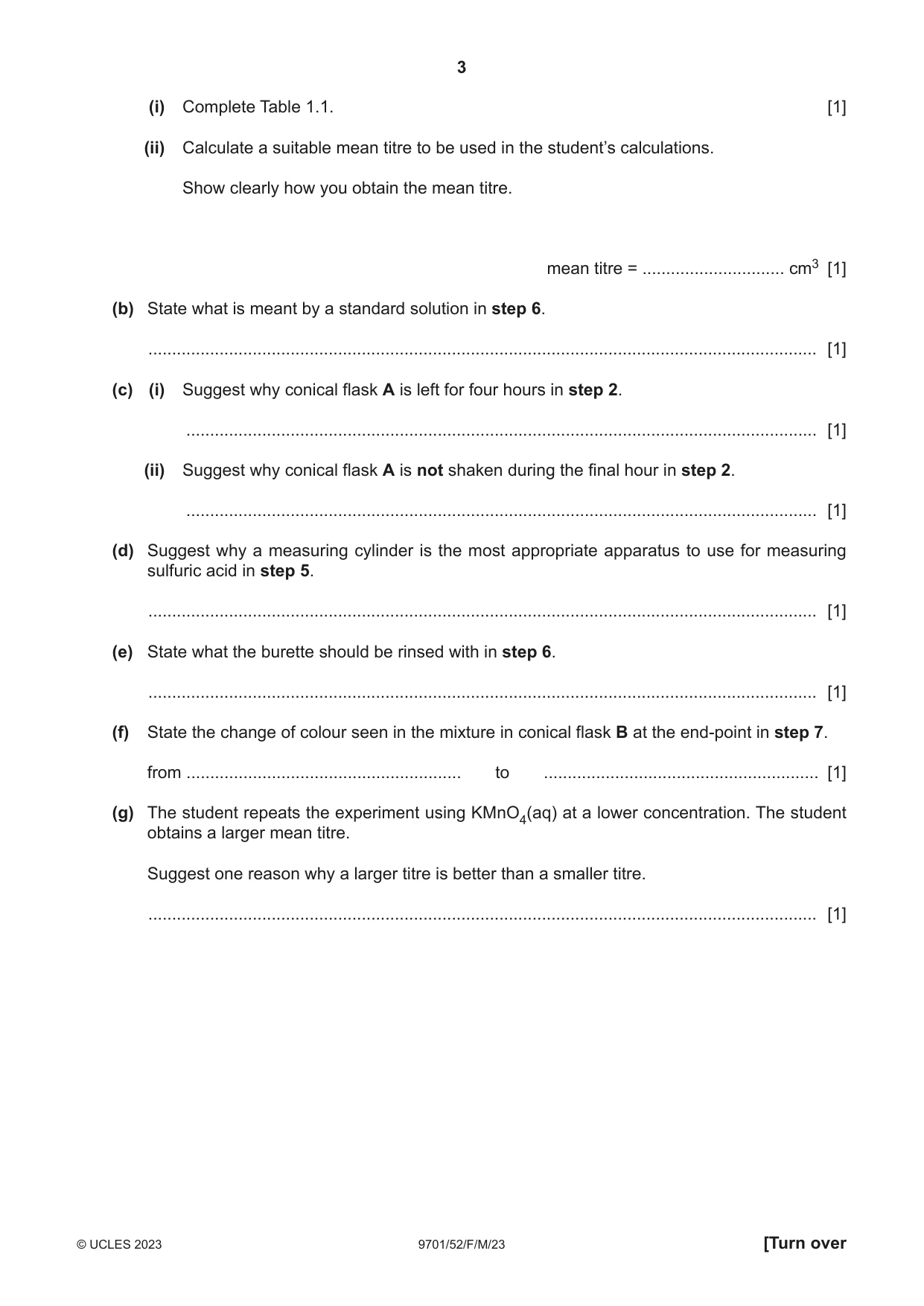
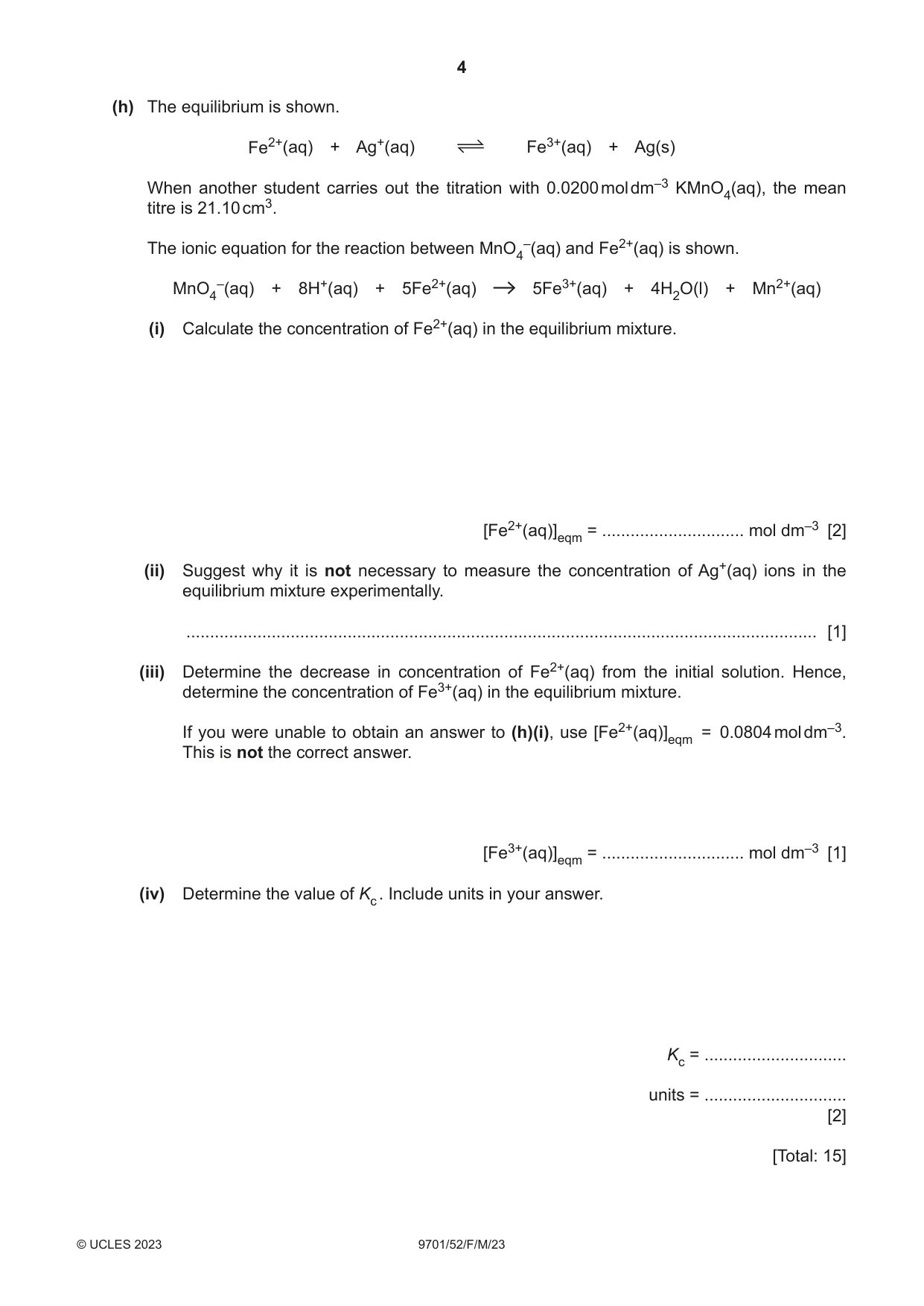
1 Aqueous iron(II) ions, Fe2+(aq), are usually kept in acidic conditions to prevent them readily oxidising to aqueous iron(III) ions, Fe3+(aq). Fe2+(aq) ions react with Ag+(aq) ions in a redox reaction. The following equilibrium is established. Fe2+(aq) + Ag+(aq) Fe3+(aq) + Ag(s) The concentration of Fe2+(aq) at equilibrium can be found by titration with a standard solution of aqueous potassium manganate(VII), KMnO4(aq). KMnO4(aq) is deep purple in colour. The equilibrium constant for the reaction can be found using the following equation. [Fe3+(aq)]eqm Kc = × [Fe2+(aq)]eqm [Ag+(aq)]eqm A student carries out the experiment using the following instructions. step 1 Add 100.0 cm3 of 0.200 mol dm–3 AgNO3(aq) to 100.0 cm3 of 0.200 mol dm–3 Fe(NO3)2(aq) in a 500 cm3 conical flask and stopper the flask. Label the conical flask A. step 2 Leave conical flask A for four hours, shaking intermittently. Then leave conical flask A untouched for one hour. step 3 Use a pipette to transfer 25.00 cm3 of the solution from conical flask A into a clean 250 cm3 conical flask. Label this conical flask B. step 4 Add 5 cm3 of 1.00 mol dm–3 NaCl (aq) to the solution in conical flask B. A white precipitate of silver chloride forms. step 5 Use a measuring cylinder to add 20 cm3 of 1.00 mol dm–3 sulfuric acid to conical flask B. step 6 Rinse a burette and fill it with a standard solution of KMnO4(aq). step 7 Add KMnO4(aq) to the mixture in conical flask B until an end-point is reached. step 8 Empty conical flask B and rinse it with distilled water ready for the next titration. The student repeats the titration until concordant readings are achieved. (a) The student records their results in Table 1.1. Table 1.1 rough titration 1 titration 2 titration 3 final burette reading / cm3 10.60 20.35 30.25 9.85 initial burette reading / cm3 0.10 10.70 20.35 0.10 titre / cm3 (i) Complete Table 1.1. [1] (ii) Calculate a suitable mean titre to be used in the student’s calculations. Show clearly how you obtain the mean titre. mean titre = .............................. cm3 [1] (b) State what is meant by a standard solution in step 6. ............................................................................................................................................. [1] (c) (i) Suggest why conical flask A is left for four hours in step 2. ..................................................................................................................................... [1] (ii) Suggest why conical flask A is not shaken during the final hour in step 2. ..................................................................................................................................... [1] (d) Suggest why a measuring cylinder is the most appropriate apparatus to use for measuring sulfuric acid in step 5. ............................................................................................................................................. [1] (e) State what the burette should be rinsed with in step 6. ............................................................................................................................................. [1] (f) State the change of colour seen in the mixture in conical flask B at the end-point in step 7. from .......................................................... to .......................................................... [1] (g) The student repeats the experiment using KMnO4(aq) at a lower concentration. The student obtains a larger mean titre. Suggest one reason why a larger titre is better than a smaller titre. ............................................................................................................................................. [1] (h) The equilibrium is shown. Fe2+(aq) + Ag+(aq) Fe3+(aq) + Ag(s) When another student carries out the titration with 0.0200 mol dm–3 KMnO4(aq), the mean titre is 21.10 cm3. The ionic equation for the reaction between MnO4–(aq) and Fe2+(aq) is shown. MnO4–(aq) + 8H+(aq) + 5Fe2+(aq) 5Fe3+(aq) + 4H2O(l) + Mn2+(aq) (i) Calculate the concentration of Fe2+(aq) in the equilibrium mixture. [Fe2+(aq)]eqm = .............................. mol dm–3 [2] (ii) Suggest why it is not necessary to measure the concentration of Ag+(aq) ions in the equilibrium mixture experimentally. ..................................................................................................................................... [1] (iii) Determine the decrease in concentration of Fe2+(aq) from the initial solution. Hence, determine the concentration of Fe3+(aq) in the equilibrium mixture. If you were unable to obtain an answer to (h)(i), use [Fe2+(aq)]eqm = 0.0804 mol dm–3. This is not the correct answer. [Fe3+(aq)]eqm = .............................. mol dm–3 [1] (iv) Determine the value of Kc . Include units in your answer. Kc = .............................. units = .............................. [2] [Total: 15]
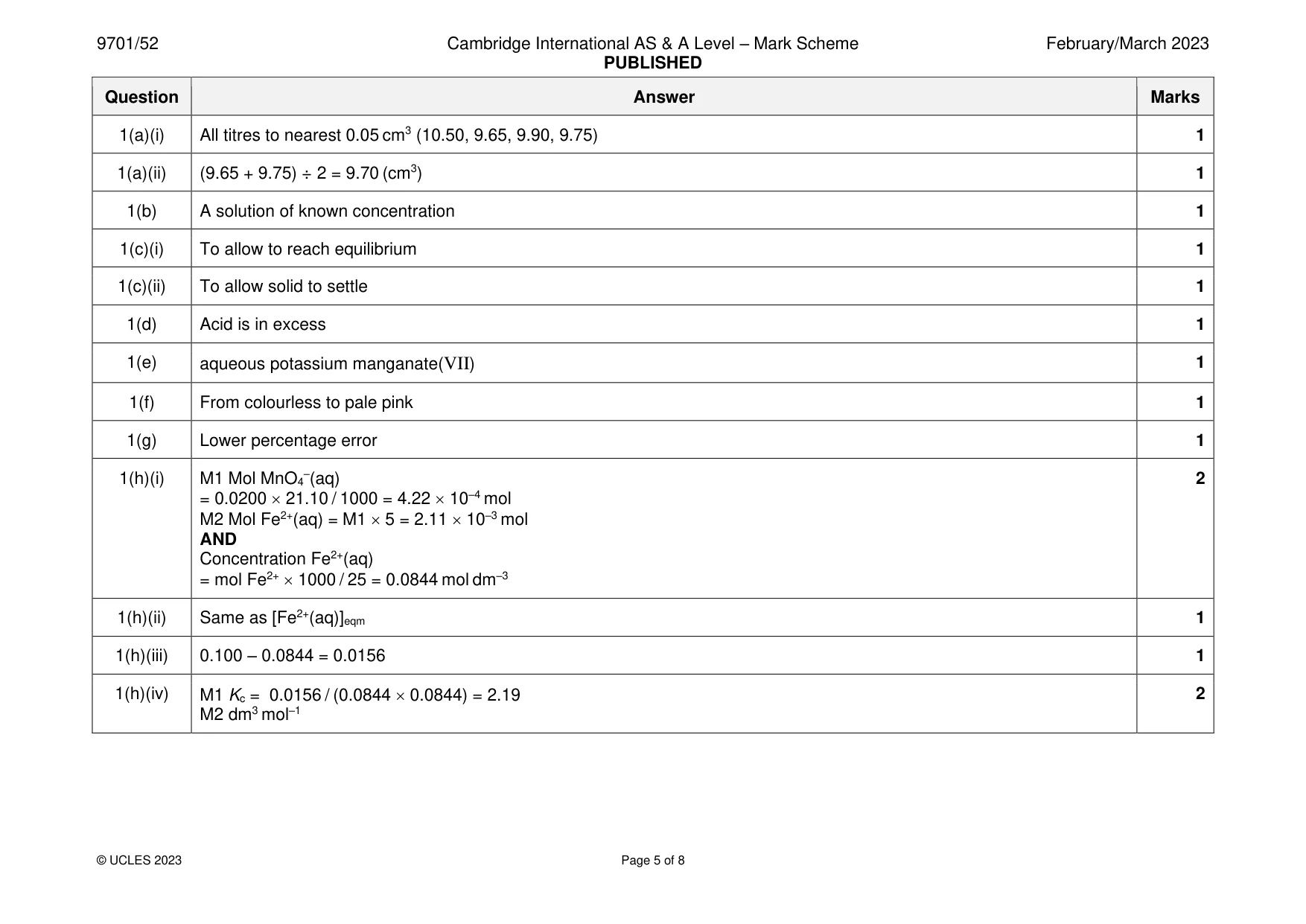
Mark scheme: Question Answer Marks 1(a)(i) All titres to nearest 0.05 cm3 (10.50, 9.65, 9.90, 9.75) 1 1(a)(ii) (9.65 + 9.75) ÷ 2 = 9.70 (cm3) 1 1(b) A solution of known concentration 1 1(c)(i) To allow to reach equilibrium 1 1(c)(ii) To allow solid to settle 1 1(d) Acid is in excess 1 1(e) aqueous potassium manganate(VII) 1 1(f) From colourless to pale pink 1 1(g) Lower percentage error 1 1(h)(i) M1 Mol MnO4–(aq) 2 = 0.0200 21.10 / 1000 = 4.22 10–4 mol M2 Mol Fe2+(aq) = M1 5 = 2.11 10–3 mol AND Concentration Fe2+(aq) = mol Fe2+ 1000 / 25 = 0.0844 mol dm–3 1(h)(ii) Same as [Fe2+(aq)]eqm 1 1(h)(iii) 0.100 – 0.0844 = 0.0156 1 1(h)(iv) M1 Kc = 0.0156 / (0.0844 0.0844) = 2.19 2 M2 dm3 mol–1
More questions on Reacting masses and volumes (of solutions and gases)
Q2 · The reaction between iodide ions, I–(aq), and aqueous hydrogen peroxide, H2O2(aq), takes…
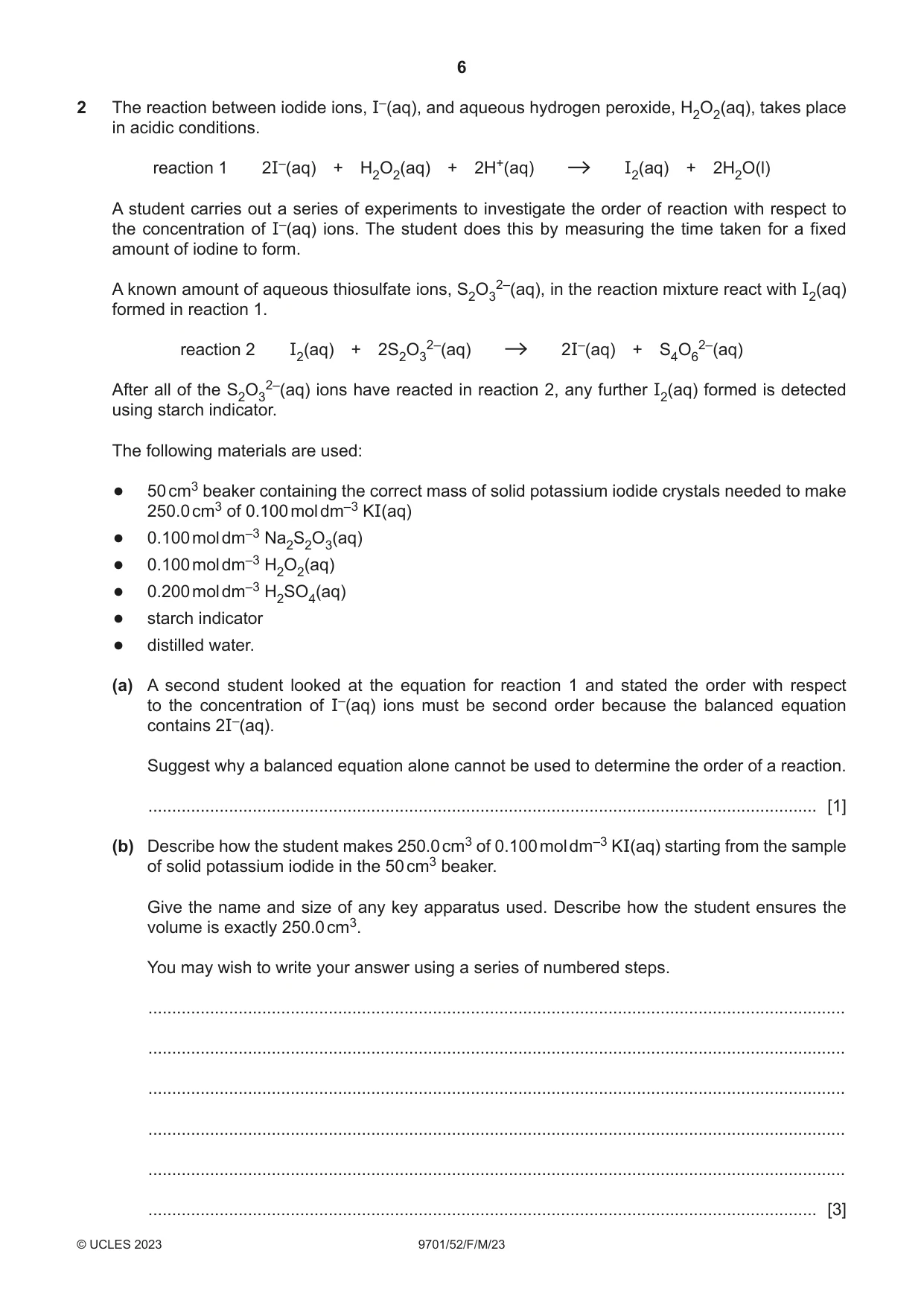
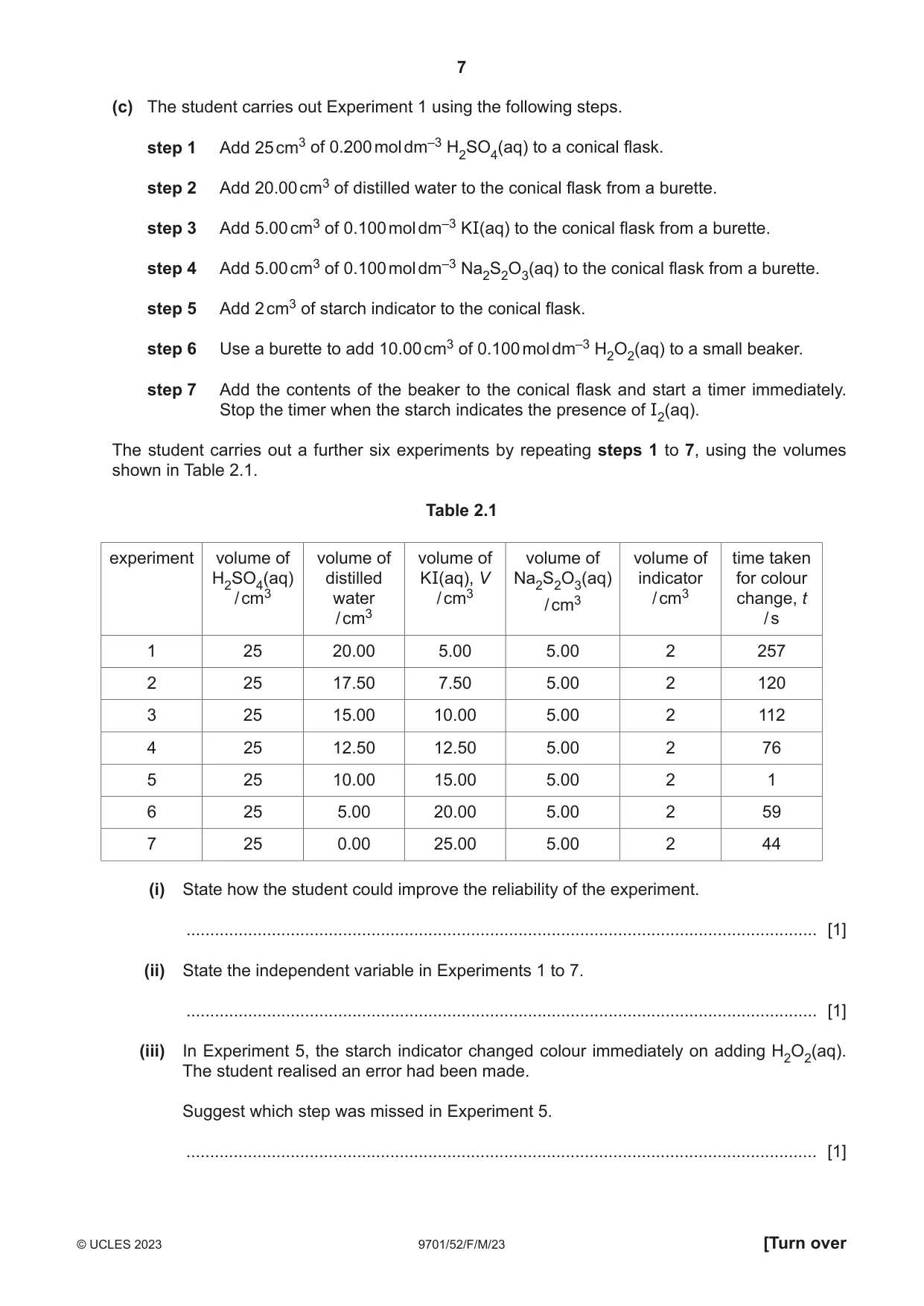
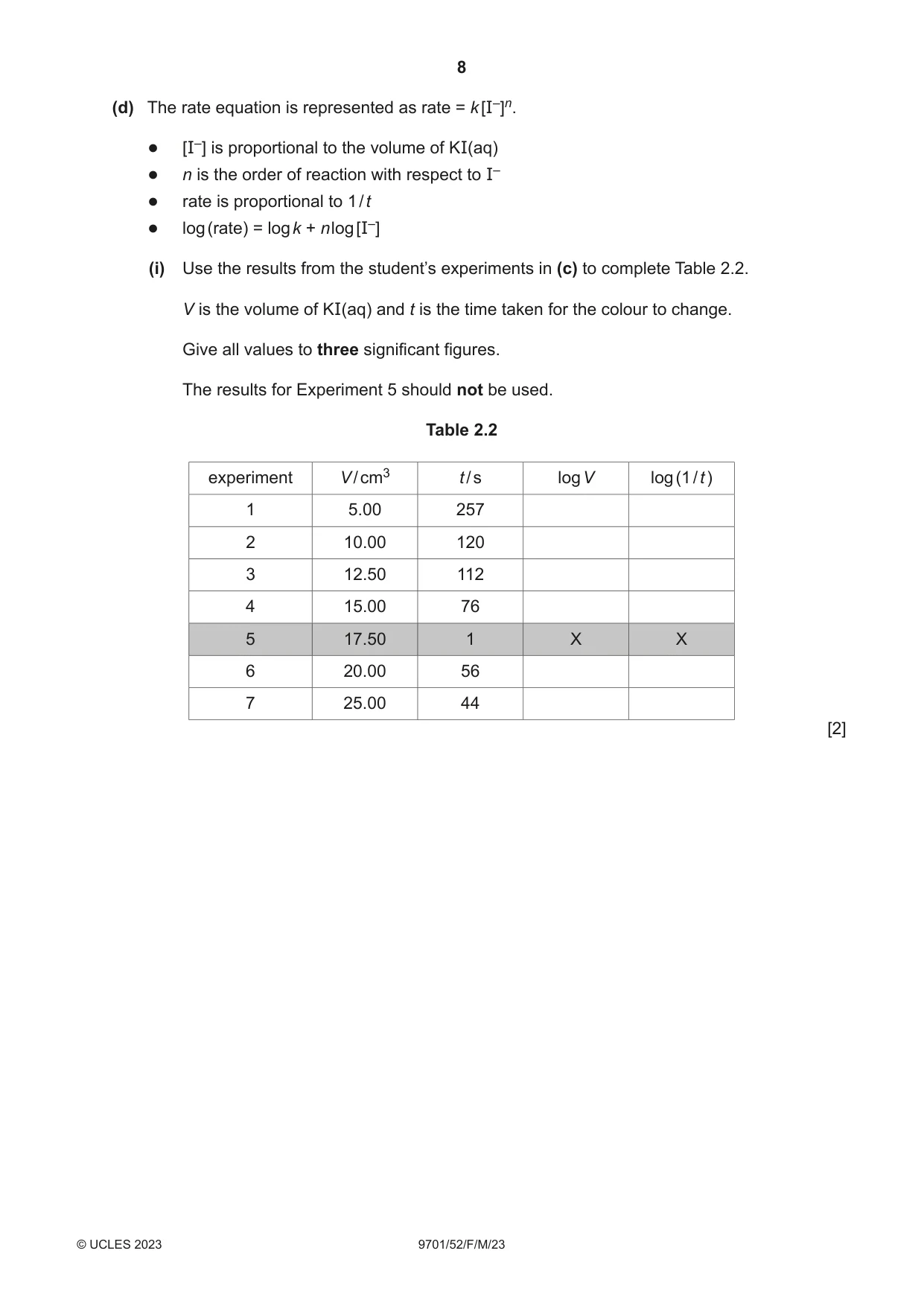
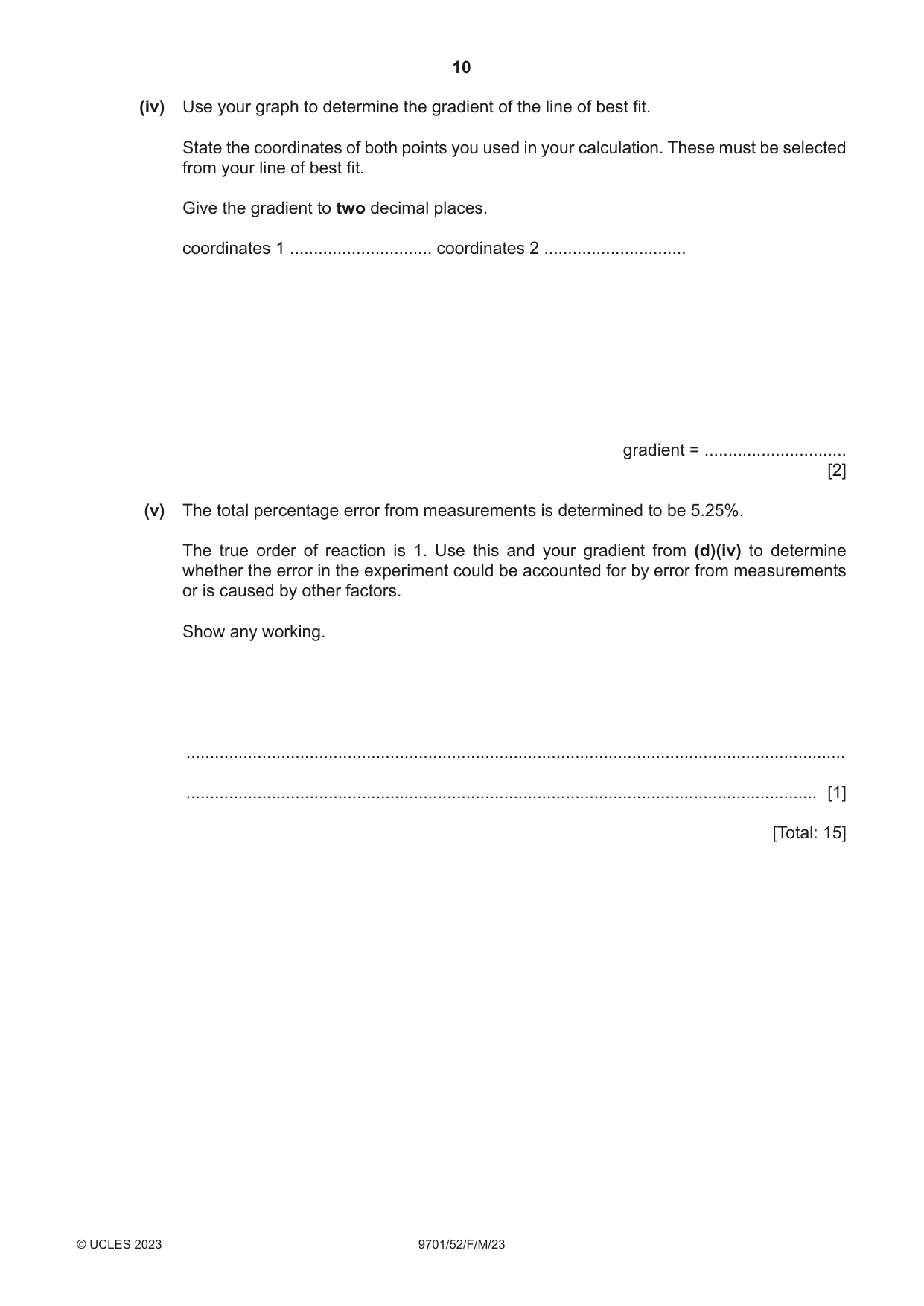
2 The reaction between iodide ions, I–(aq), and aqueous hydrogen peroxide, H2O2(aq), takes place in acidic conditions. reaction 1 2I–(aq) + H2O2(aq) + 2H+(aq) I2(aq) + 2H2O(l) A student carries out a series of experiments to investigate the order of reaction with respect to the concentration of I–(aq) ions. The student does this by measuring the time taken for a fixed amount of iodine to form. A known amount of aqueous thiosulfate ions, S2O32–(aq), in the reaction mixture react with I2(aq) formed in reaction 1. reaction 2 I2(aq) + 2S2O32–(aq) 2I–(aq) + S4O62–(aq) After all of the S2O32–(aq) ions have reacted in reaction 2, any further I2(aq) formed is detected using starch indicator. The following materials are used: ● 50 cm3 beaker containing the correct mass of solid potassium iodide crystals needed to make 250.0 cm3 of 0.100 mol dm–3 KI(aq) ● 0.100 mol dm–3 Na2S2O3(aq) ● 0.100 mol dm–3 H2O2(aq) ● 0.200 mol dm–3 H2SO4(aq) ● starch indicator ● distilled water. (a) A second student looked at the equation for reaction 1 and stated the order with respect to the concentration of I–(aq) ions must be second order because the balanced equation contains 2I–(aq). Suggest why a balanced equation alone cannot be used to determine the order of a reaction. ............................................................................................................................................. [1] (b) Describe how the student makes 250.0 cm3 of 0.100 mol dm–3 KI(aq) starting from the sample of solid potassium iodide in the 50 cm3 beaker. Give the name and size of any key apparatus used. Describe how the student ensures the volume is exactly 250.0 cm3. You may wish to write your answer using a series of numbered steps. ................................................................................................................................................... ................................................................................................................................................... ................................................................................................................................................... ................................................................................................................................................... ................................................................................................................................................... ............................................................................................................................................. [3] (c) The student carries out Experiment 1 using the following steps. step 1 Add 25 cm3 of 0.200 mol dm–3 H2SO4(aq) to a conical flask. step 2 Add 20.00 cm3 of distilled water to the conical flask from a burette. step 3 Add 5.00 cm3 of 0.100 mol dm–3 KI(aq) to the conical flask from a burette. step 4 Add 5.00 cm3 of 0.100 mol dm–3 Na2S2O3(aq) to the conical flask from a burette. step 5 Add 2 cm3 of starch indicator to the conical flask. step 6 Use a burette to add 10.00 cm3 of 0.100 mol dm–3 H2O2(aq) to a small beaker. step 7 Add the contents of the beaker to the conical flask and start a timer immediately. Stop the timer when the starch indicates the presence of I2(aq). The student carries out a further six experiments by repeating steps 1 to 7, using the volumes shown in Table 2.1. Table 2.1 experiment volume of volume of volume of volume of volume of time taken H2SO4(aq) distilled KI(aq), V Na2S2O3(aq) indicator for colour / cm3 water / cm3 / cm3 change, t / cm3 / cm3 / s 1 25 20.00 5.00 5.00 2 257 2 25 17.50 7.50 5.00 2 120 3 25 15.00 10.00 5.00 2 112 4 25 12.50 12.50 5.00 2 76 5 25 10.00 15.00 5.00 2 1 6 25 5.00 20.00 5.00 2 59 7 25 0.00 25.00 5.00 2 44 (i) State how the student could improve the reliability of the experiment. ..................................................................................................................................... [1] (ii) State the independent variable in Experiments 1 to 7. ..................................................................................................................................... [1] (iii) In Experiment 5, the starch indicator changed colour immediately on adding H2O2(aq). The student realised an error had been made. Suggest which step was missed in Experiment 5. ..................................................................................................................................... [1] (d) The rate equation is represented as rate = k [I–]n. ● [I–] is proportional to the volume of KI(aq) ● n is the order of reaction with respect to I– ● rate is proportional to 1 / t ● log (rate) = log k + nlog [I–] (i) Use the results from the student’s experiments in (c) to complete Table 2.2. V is the volume of KI(aq) and t is the time taken for the colour to change. Give all values to three significant figures. The results for Experiment 5 should not be used. Table 2.2 experiment V / cm3 t / s log V log (1 / t ) 1 5.00 257 2 10.00 120 3 12.50 112 4 15.00 76 5 17.50 1 X X 6 20.00 56 7 25.00 44 [2]
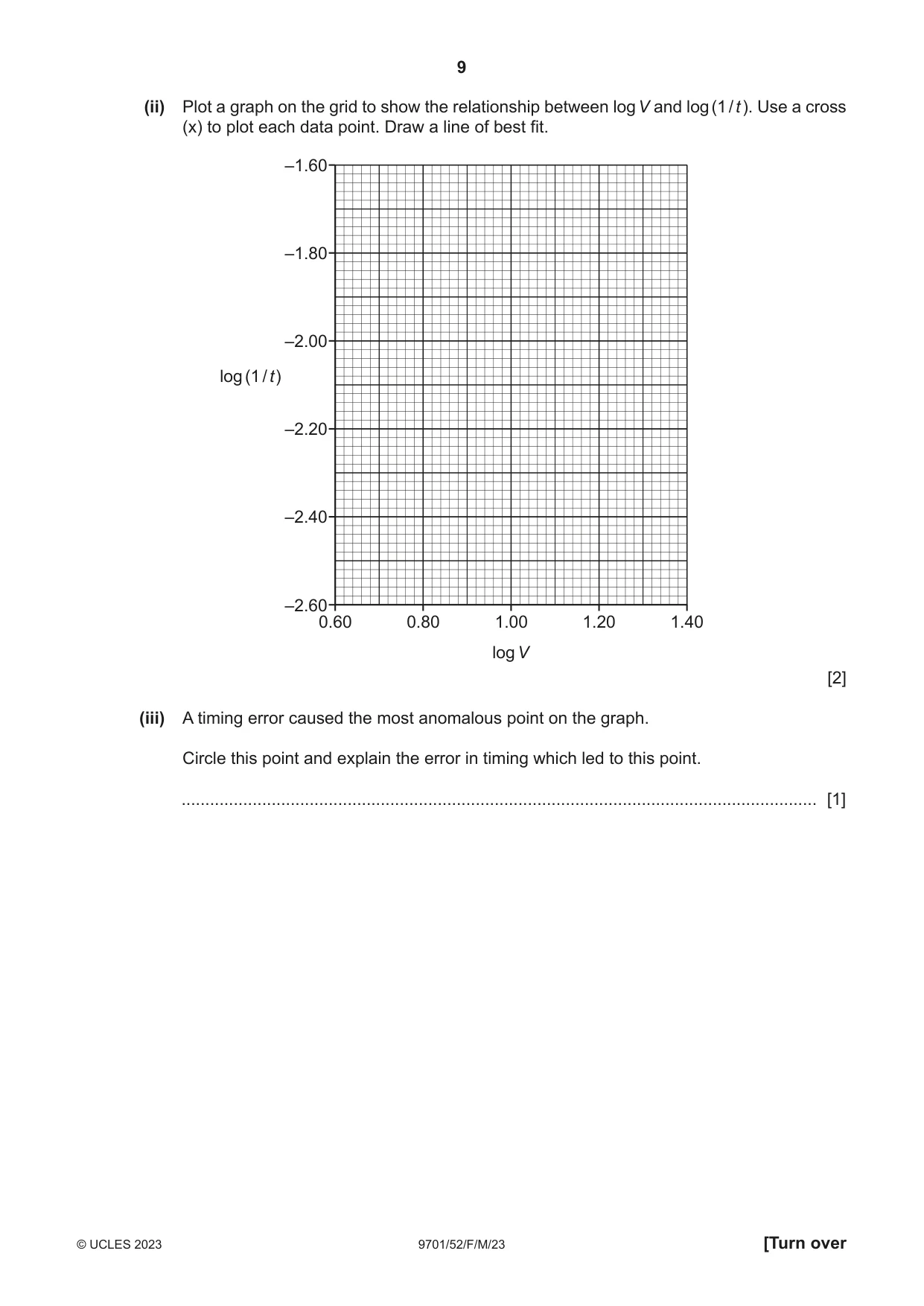
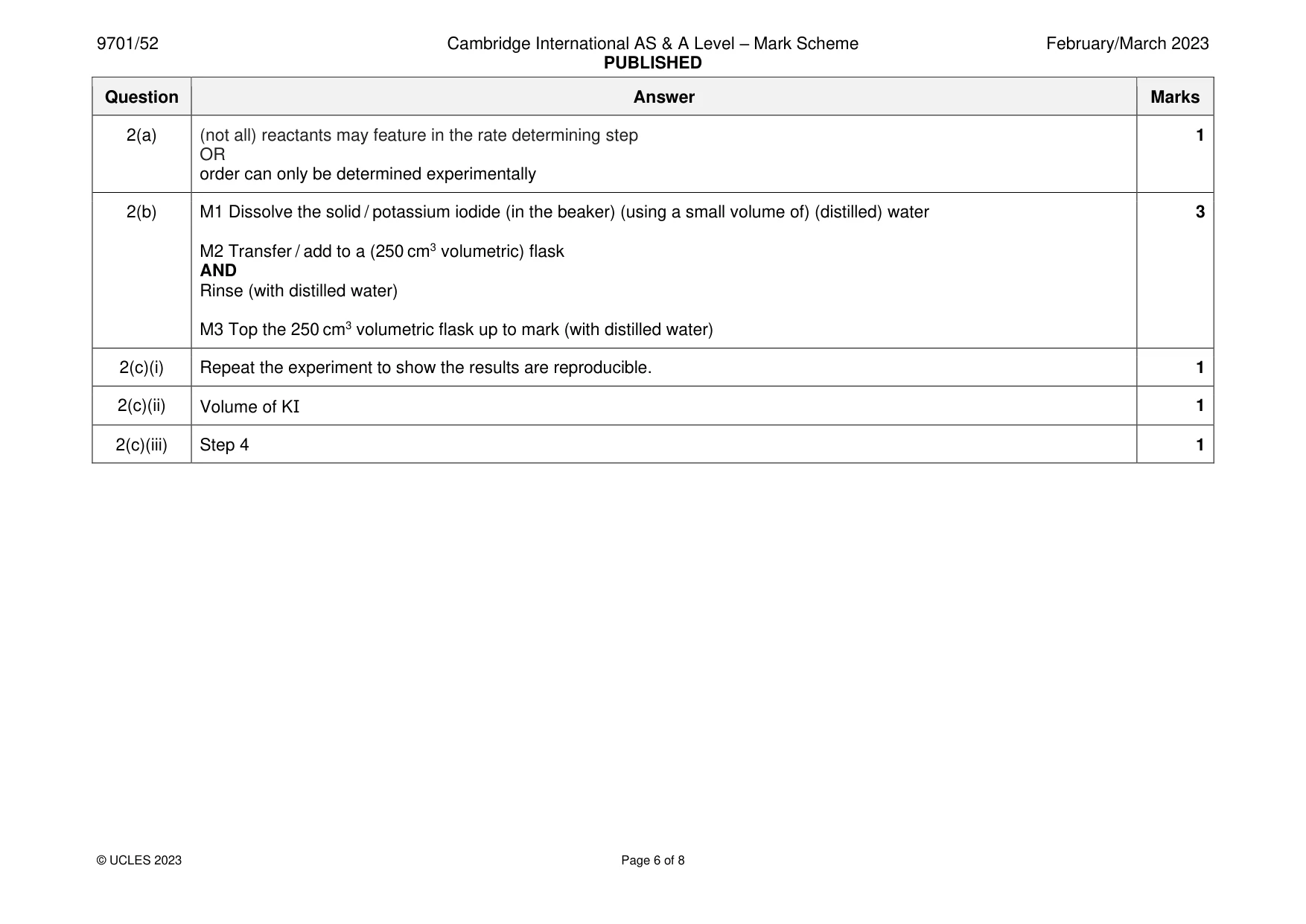
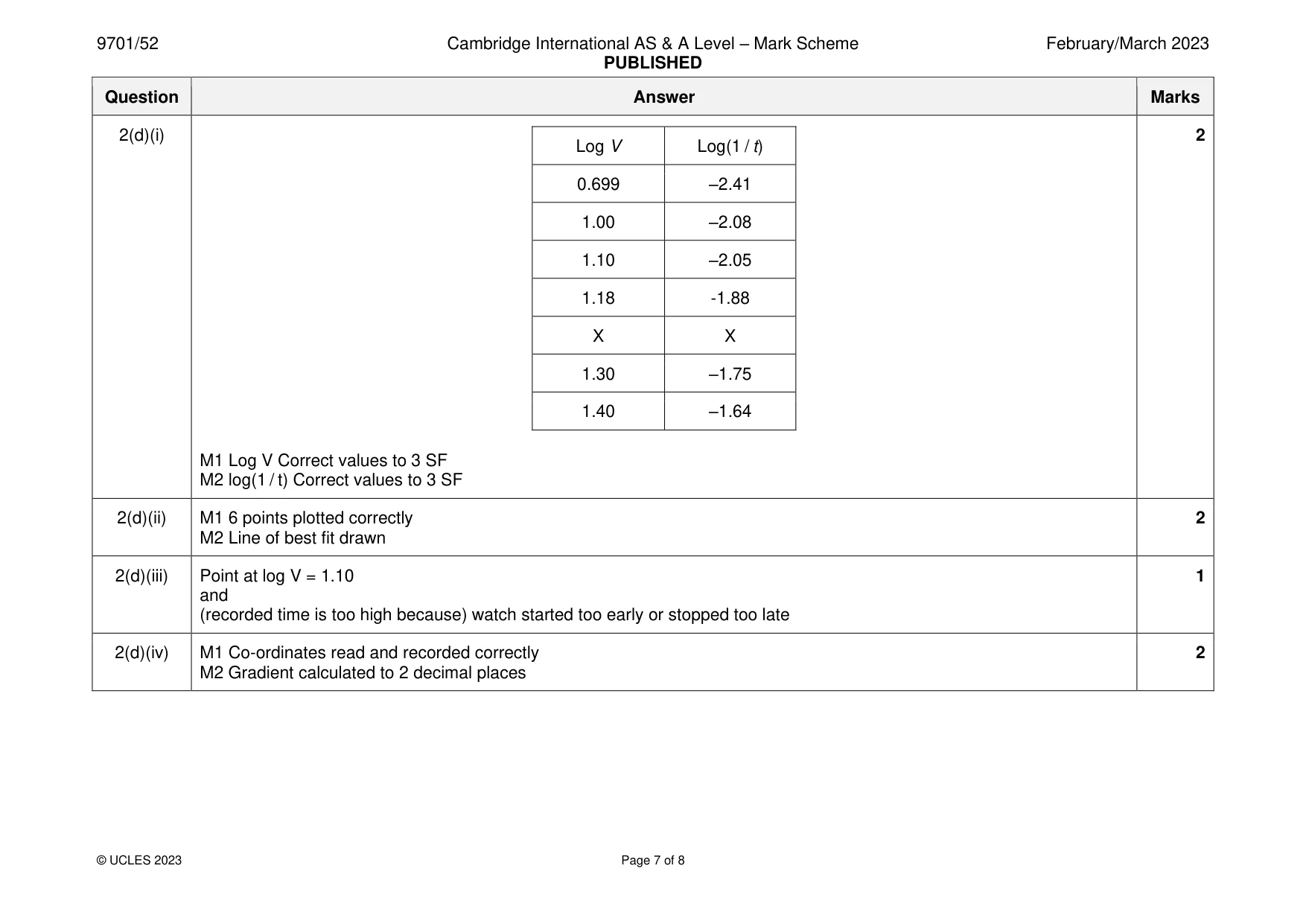
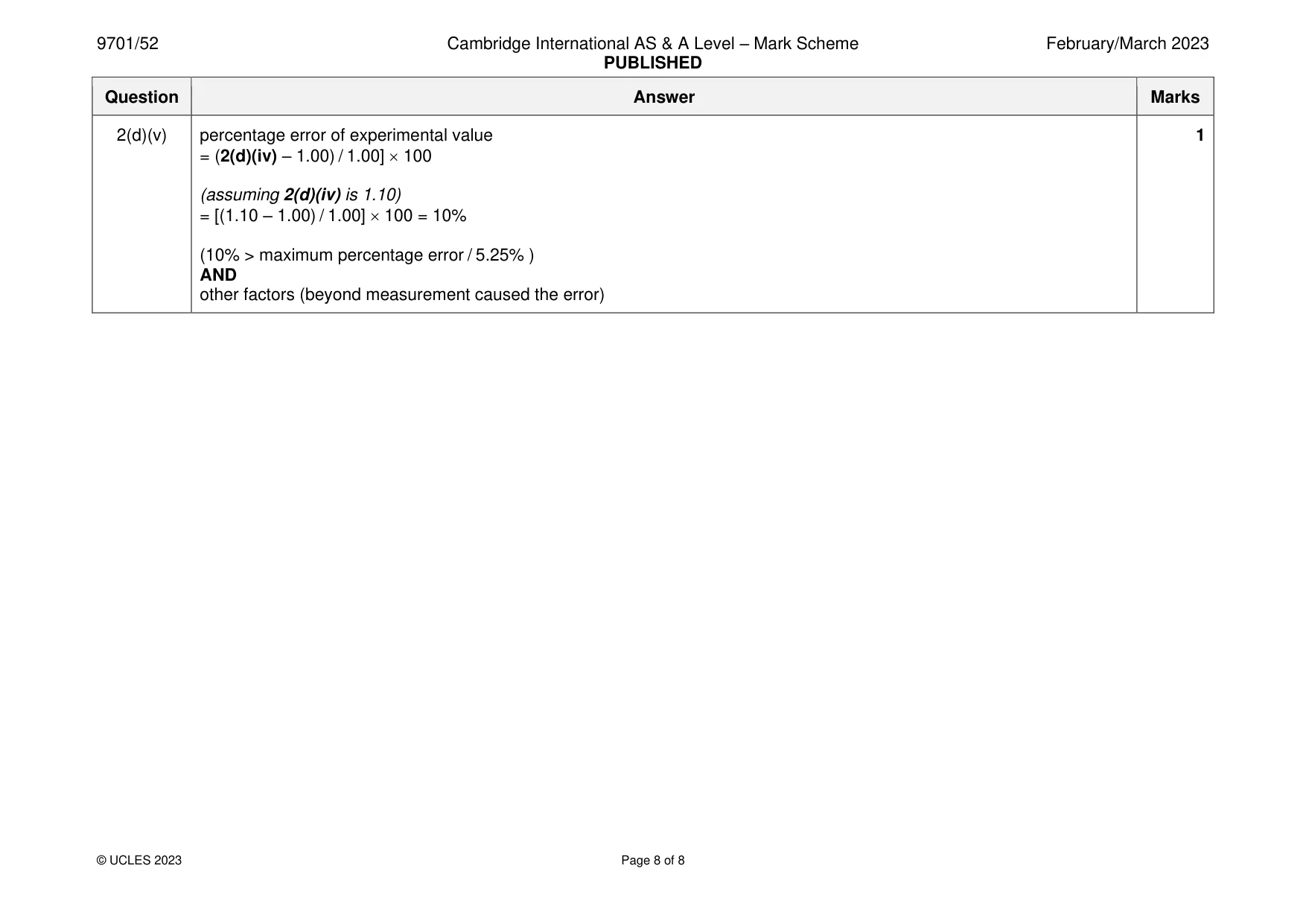
Mark scheme: 2(a) (not all) reactants may feature in the rate determining step 1 OR order can only be determined experimentally 2(b) M1 Dissolve the solid / potassium iodide (in the beaker) (using a small volume of) (distilled) water 3 M2 Transfer / add to a (250 cm3 volumetric) flask AND Rinse (with distilled water) M3 Top the 250 cm3 volumetric flask up to mark (with distilled water) 2(c)(i) Repeat the experiment to show the results are reproducible. 1 2(c)(ii) Volume of KI 1 2(c)(iii) Step 4 1 2(d)(i) 2 Log V Log(1 / t) 0.699 –2.41 1.00 –2.08 1.10 –2.05 1.18 -1.88 X X 1.30 –1.75 1.40 –1.64 M1 Log V Correct values to 3 SF M2 log(1 / t) Correct values to 3 SF 2(d)(ii) M1 6 points plotted correctly 2 M2 Line of best fit drawn 2(d)(iii) Point at log V = 1.10 1 and (recorded time is too high because) watch started too early or stopped too late 2(d)(iv) M1 Co-ordinates read and recorded correctly 2 M2 Gradient calculated to 2 decimal places 2(d)(v) percentage error of experimental value 1 = (2(d)(iv) – 1.00) / 1.00] 100 (assuming 2(d)(iv) is 1.10) = [(1.10 – 1.00) / 1.00] 100 = 10% (10% > maximum percentage error / 5.25% ) AND other factors (beyond measurement caused the error)
More questions on Simple rate equations, orders of reaction and rate constants
What was in this paper
The subtopics covered by these 2 questions, and how many questions each got. Open one in a new tab to see every Cambridge question on it.
What you needed in this session
Cambridge’s own grade thresholds for 2023 Feb/March, Paper 5 · Variant 2. A higher threshold means an easier paper — the bar moves with how the cohort did.