Cambridge A Level Chemistry 9701 — 2024 Oct/Nov Paper 5 · Variant 2
9701/52/O/N/24 · 2 questions · 30 marks · ≈34 min
The question paper and its mark scheme, free to read here and free to download. This is Cambridge’s own paper, exactly as it was sat.
Question paper12 pages

Mark scheme7 pages
Answers below. Sit the paper first if you are practising.
Questions as text
Q1 · Solution X is dilute hydrochloric acid of unknown concentration
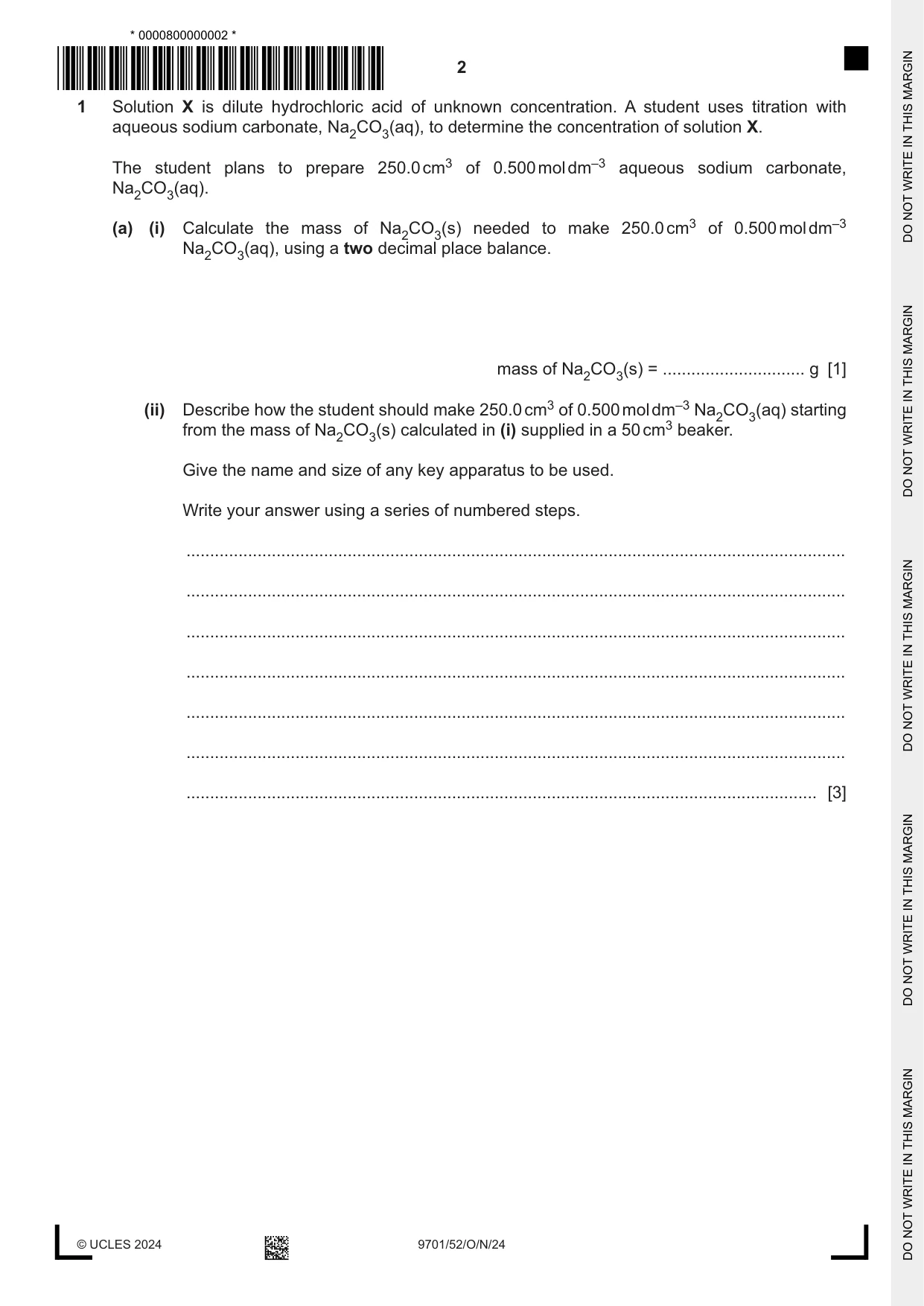
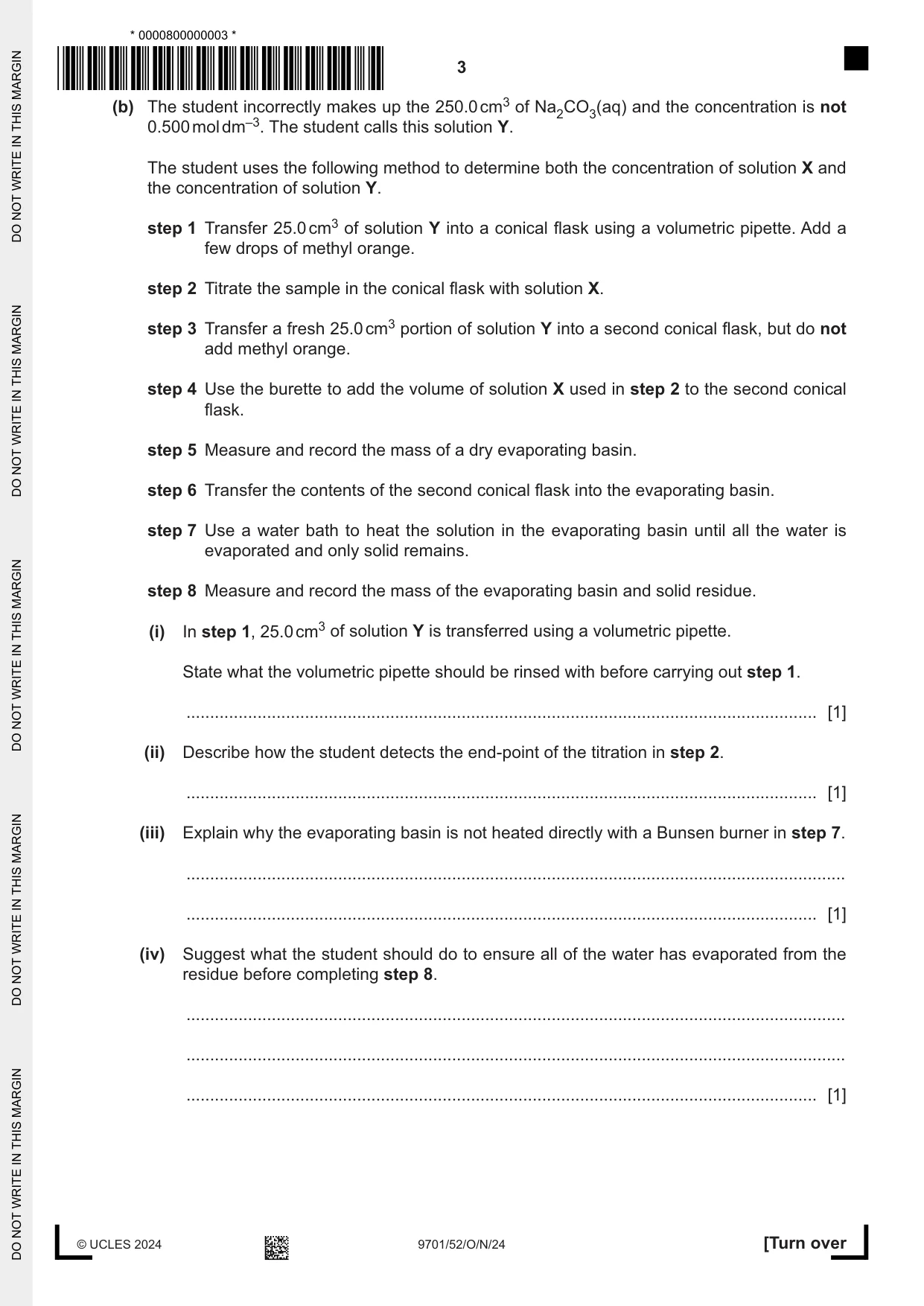
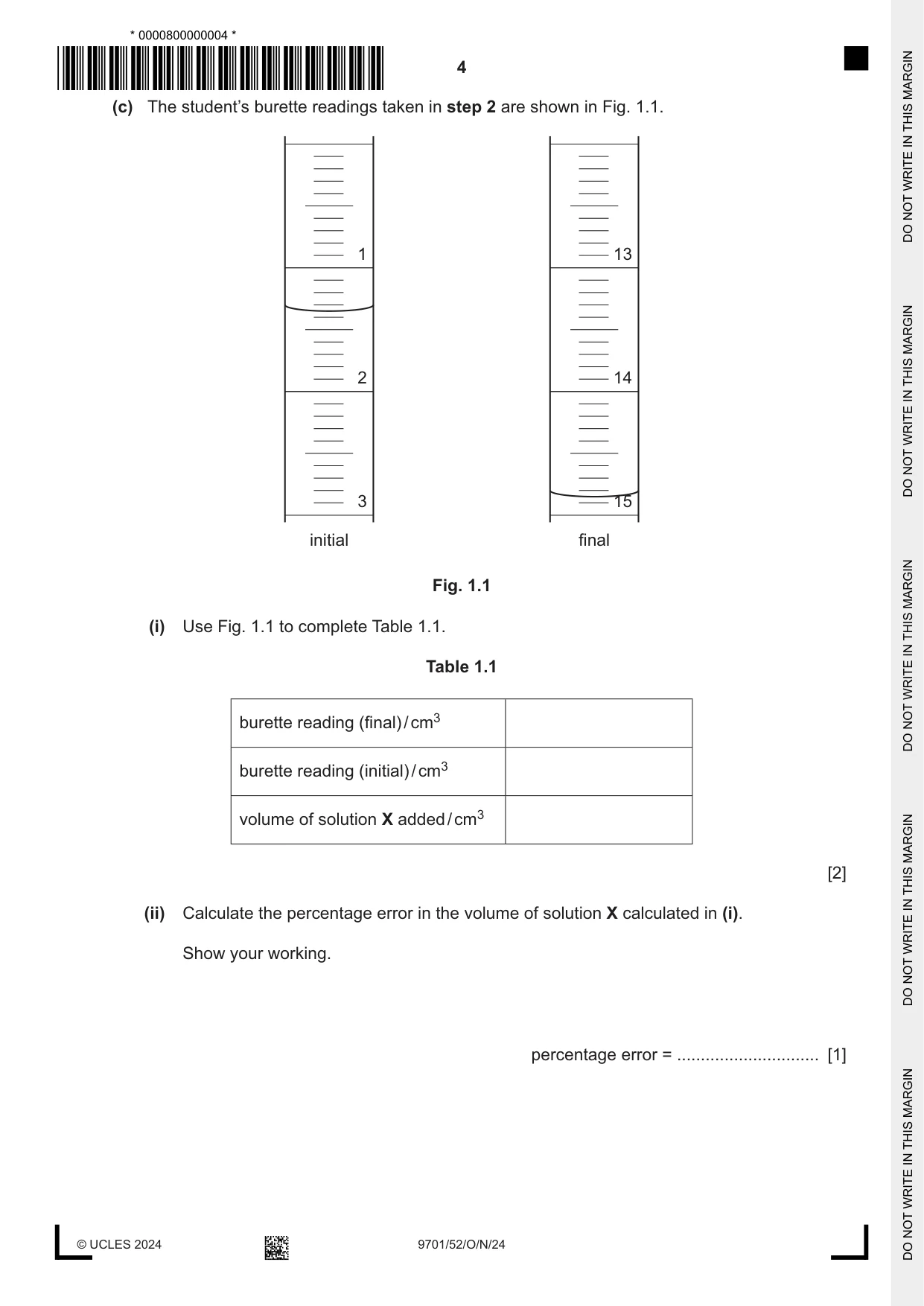
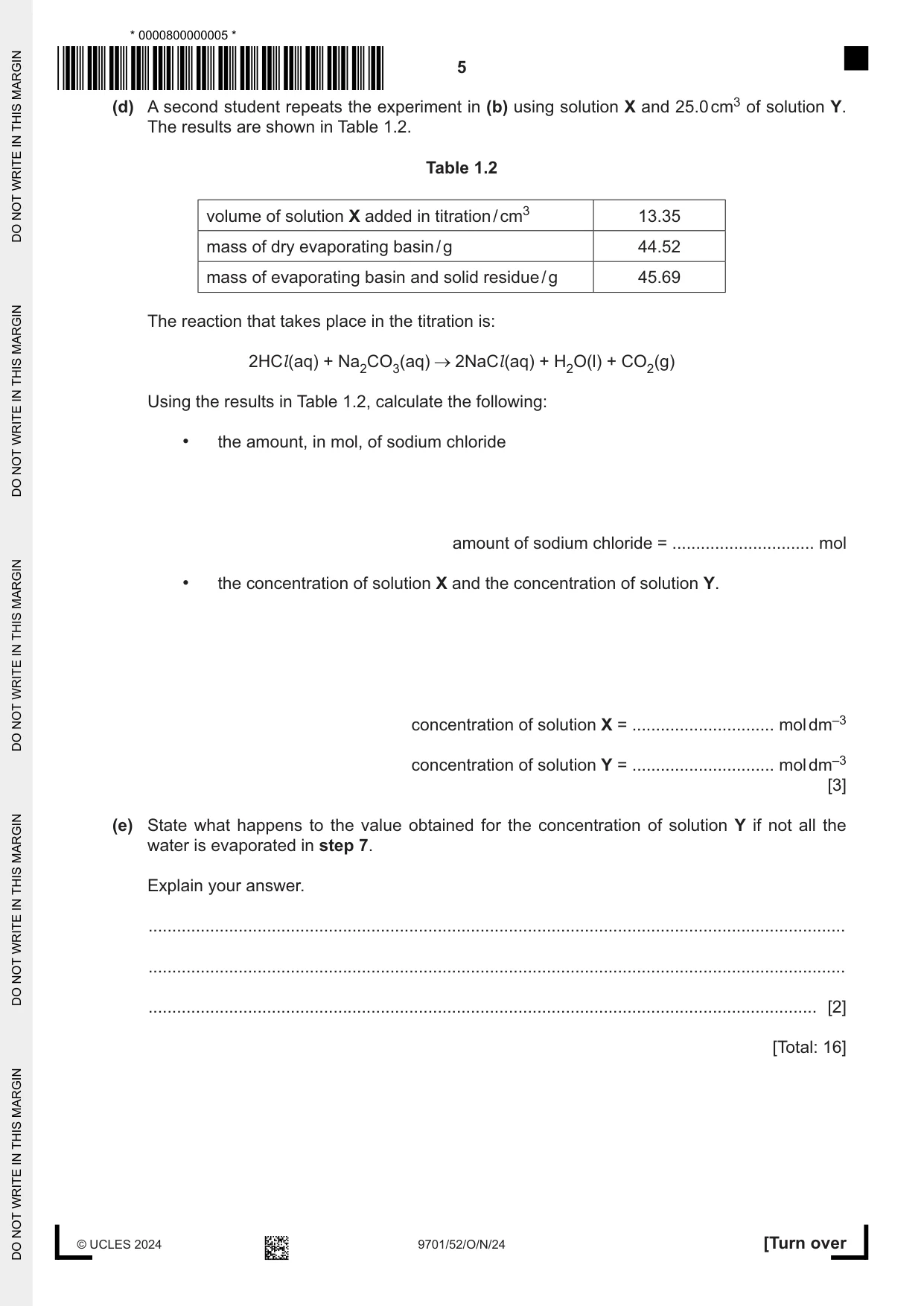
1 Solution X is dilute hydrochloric acid of unknown concentration. A student uses titration with aqueous sodium carbonate, Na2CO3(aq), to determine the concentration of solution X. The student plans to prepare 250.0 cm3 of 0.500 mol dm–3 aqueous sodium carbonate, Na2CO3(aq). (a) (i) Calculate the mass of Na2CO3(s) needed to make 250.0 cm3 of 0.500 mol dm–3 Na2CO3(aq), using a two decimal place balance. mass of Na2CO3(s) = .............................. g [1] (ii) Describe how the student should make 250.0 cm3 of 0.500 mol dm–3 Na2CO3(aq) starting from the mass of Na2CO3(s) calculated in (i) supplied in a 50 cm3 beaker. Give the name and size of any key apparatus to be used. Write your answer using a series of numbered steps. ........................................................................................................................................... ........................................................................................................................................... ........................................................................................................................................... ........................................................................................................................................... ........................................................................................................................................... ........................................................................................................................................... ..................................................................................................................................... [3] (b) The student incorrectly makes up the 250.0 cm3 of Na2CO3(aq) and the concentration is not 0.500 mol dm–3. The student calls this solution Y. The student uses the following method to determine both the concentration of solution X and the concentration of solution Y. step 1 Transfer 25.0 cm3 of solution Y into a conical flask using a volumetric pipette. Add a few drops of methyl orange. step 2 Titrate the sample in the conical flask with solution X. step 3 Transfer a fresh 25.0 cm3 portion of solution Y into a second conical flask, but do not add methyl orange. step 4 Use the burette to add the volume of solution X used in step 2 to the second conical flask. step 5 Measure and record the mass of a dry evaporating basin. step 6 Transfer the contents of the second conical flask into the evaporating basin. step 7 Use a water bath to heat the solution in the evaporating basin until all the water is evaporated and only solid remains. step 8 Measure and record the mass of the evaporating basin and solid residue. (i) In step 1, 25.0 cm3 of solution Y is transferred using a volumetric pipette. State what the volumetric pipette should be rinsed with before carrying out step 1. ..................................................................................................................................... [1] (ii) Describe how the student detects the end-point of the titration in step 2. ..................................................................................................................................... [1] (iii) Explain why the evaporating basin is not heated directly with a Bunsen burner in step 7. ........................................................................................................................................... ..................................................................................................................................... [1] (iv) Suggest what the student should do to ensure all of the water has evaporated from the residue before completing step 8. ........................................................................................................................................... ........................................................................................................................................... ..................................................................................................................................... [1] (c) The student’s burette readings taken in step 2 are shown in Fig. 1.1. 1 13 2 14 3 15 initial final Fig. 1.1 (i) Use Fig. 1.1 to complete Table 1.1. Table 1.1 burette reading (final) / cm3 burette reading (initial) / cm3 volume of solution X added / cm3 [2] (ii) Calculate the percentage error in the volume of solution X calculated in (i). Show your working. percentage error = .............................. [1] (d) A second student repeats the experiment in (b) using solution X and 25.0 cm3 of solution Y. The results are shown in Table 1.2. Table 1.2 volume of solution X added in titration / cm3 13.35 mass of dry evaporating basin / g 44.52 mass of evaporating basin and solid residue / g 45.69 The reaction that takes place in the titration is: 2HCl (aq) + Na2CO3(aq) 2NaCl (aq) + H2O(l) + CO2(g) Using the results in Table 1.2, calculate the following: • the amount, in mol, of sodium chloride amount of sodium chloride = .............................. mol • the concentration of solution X and the concentration of solution Y. concentration of solution X = .............................. mol dm–3 concentration of solution Y = .............................. mol dm–3 [3] (e) State what happens to the value obtained for the concentration of solution Y if not all the water is evaporated in step 7. Explain your answer. ................................................................................................................................................... ................................................................................................................................................... ............................................................................................................................................. [2] [Total: 16]
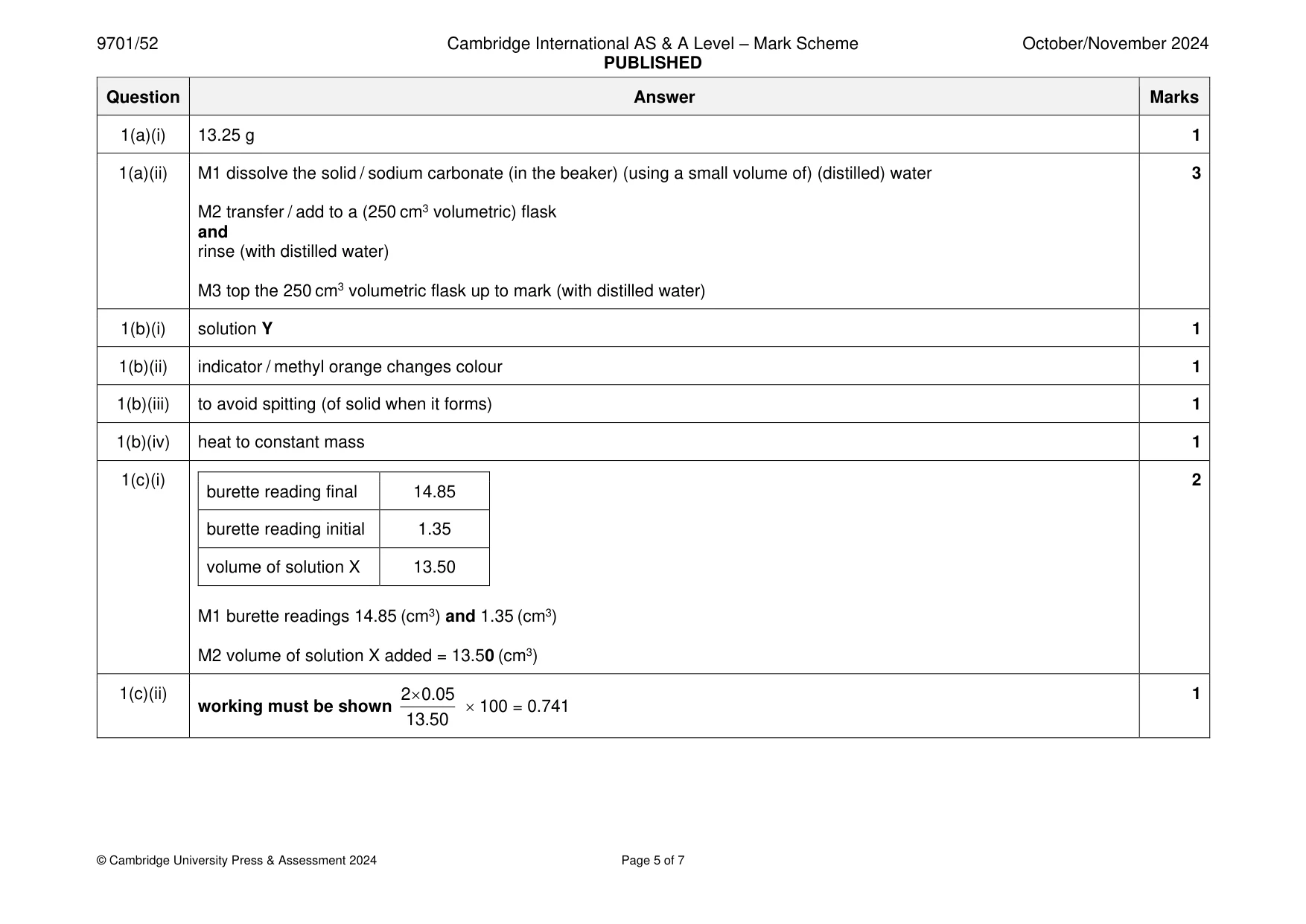
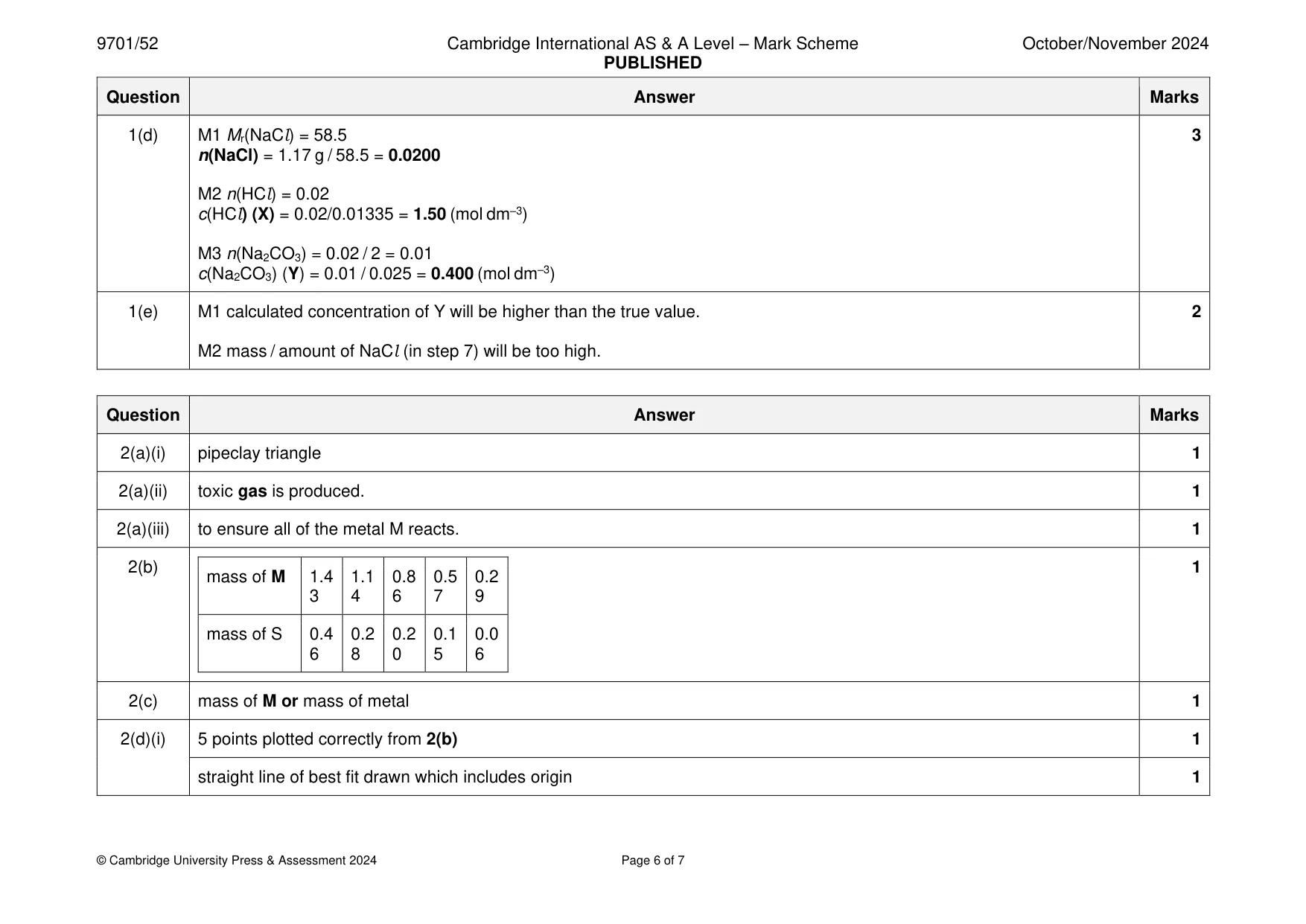
Mark scheme: Question Answer Marks 1(a)(i) 13.25 g 1 1(a)(ii) M1 dissolve the solid / sodium carbonate (in the beaker) (using a small volume of) (distilled) water 3 M2 transfer / add to a (250 cm3 volumetric) flask and rinse (with distilled water) M3 top the 250 cm3 volumetric flask up to mark (with distilled water) 1(b)(i) solution Y 1 1(b)(ii) indicator / methyl orange changes colour 1 1(b)(iii) to avoid spitting (of solid when it forms) 1 1(b)(iv) heat to constant mass 1 1(c)(i) 2 burette reading final 14.85 burette reading initial 1.35 volume of solution X 13.50 M1 burette readings 14.85 (cm3) and 1.35 (cm3) M2 volume of solution X added = 13.50 (cm3) 1(c)(ii) 2 0.05 1 working must be shown 100 = 0.741 13.50 1(d) M1 Mr(NaCl) = 58.5 3 n(NaCl) = 1.17 g / 58.5 = 0.0200 M2 n(HCl) = 0.02 c(HCl) (X) = 0.02/0.01335 = 1.50 (mol dm–3) M3 n(Na2CO3) = 0.02 / 2 = 0.01 c(Na2CO3) (Y) = 0.01 / 0.025 = 0.400 (mol dm–3) 1(e) M1 calculated concentration of Y will be higher than the true value. 2 M2 mass / amount of NaCl (in step 7) will be too high.
More questions on Reacting masses and volumes (of solutions and gases)
Q2 · A group of students uses the following method to investigate the change in mass that…
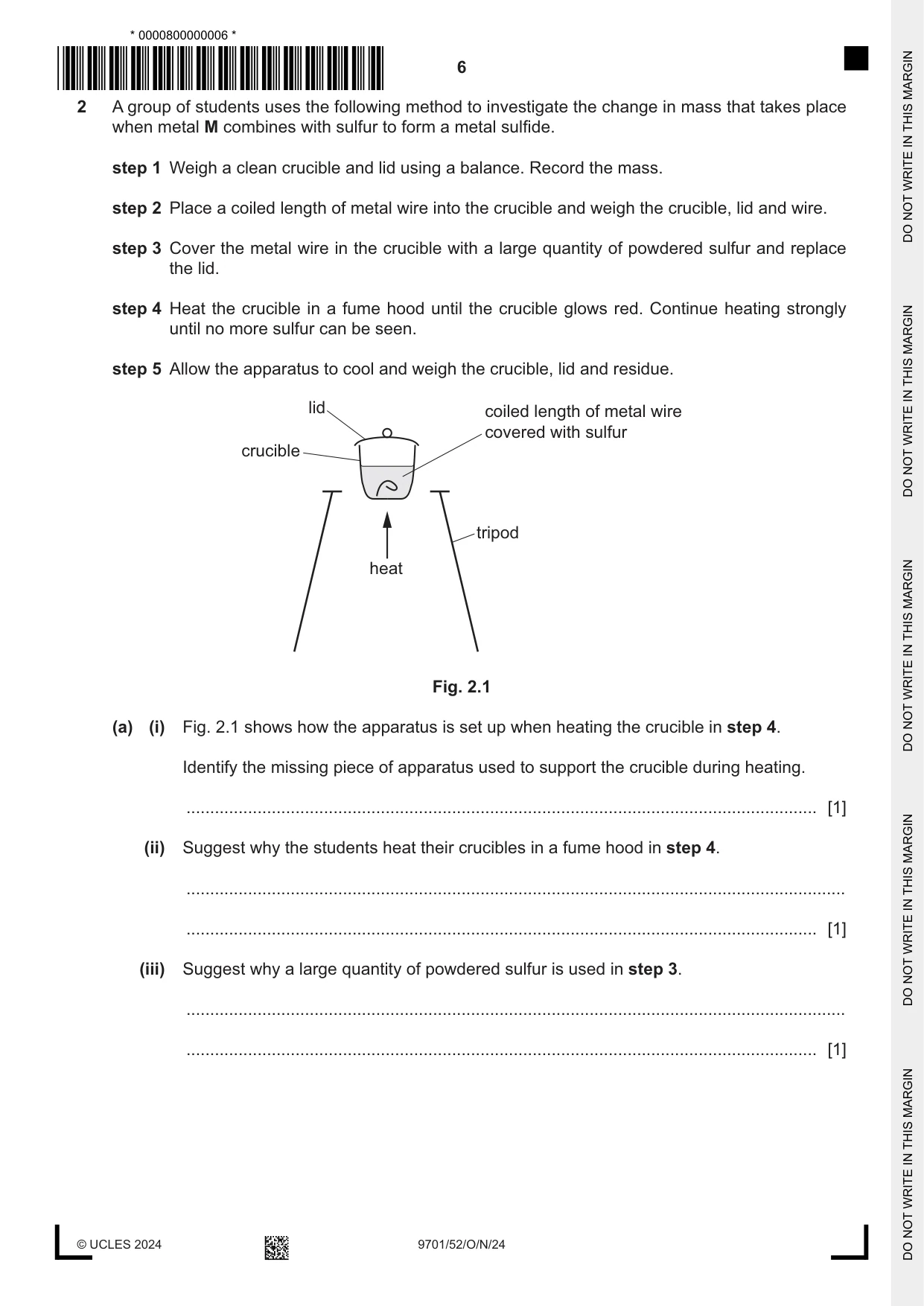
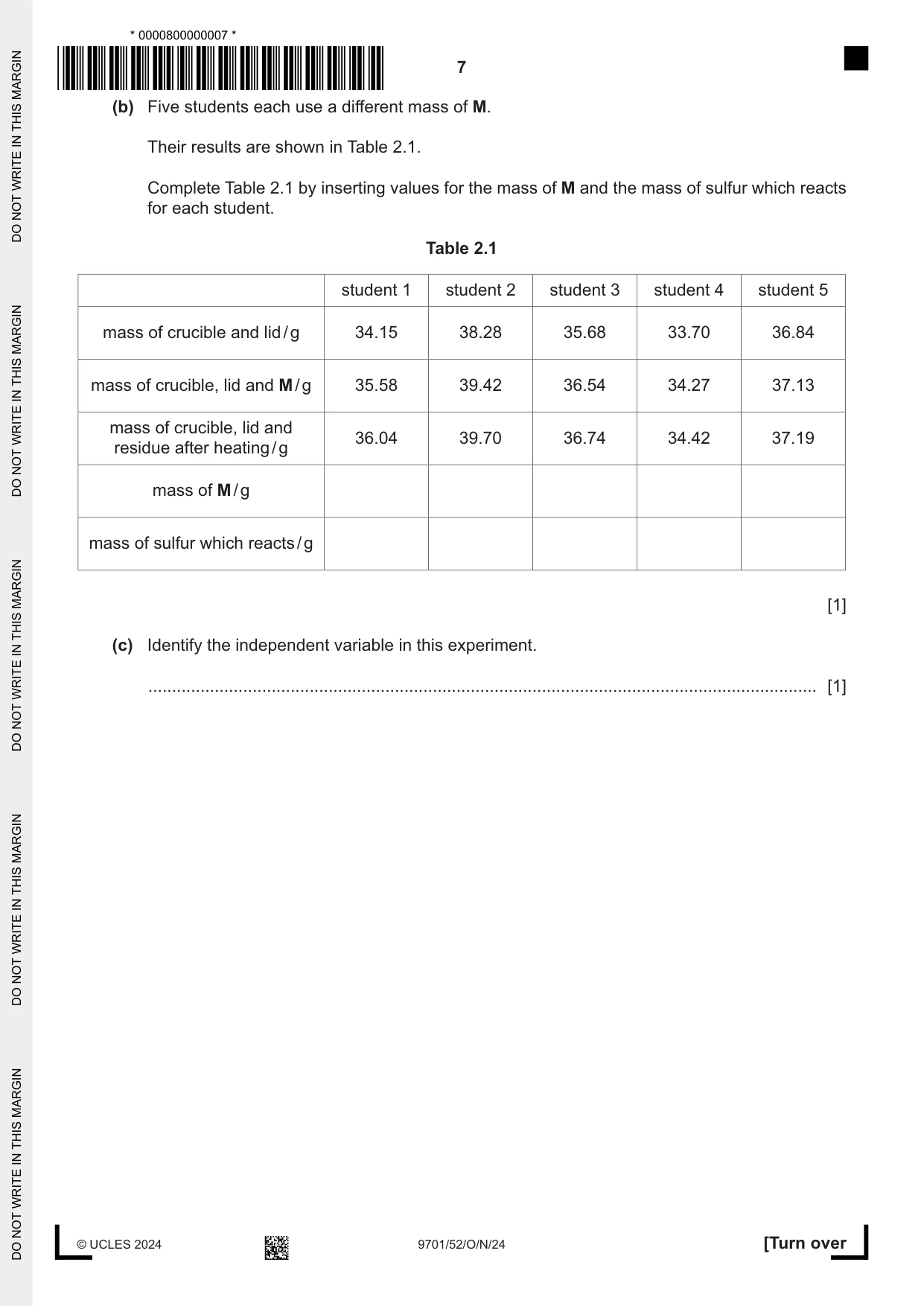
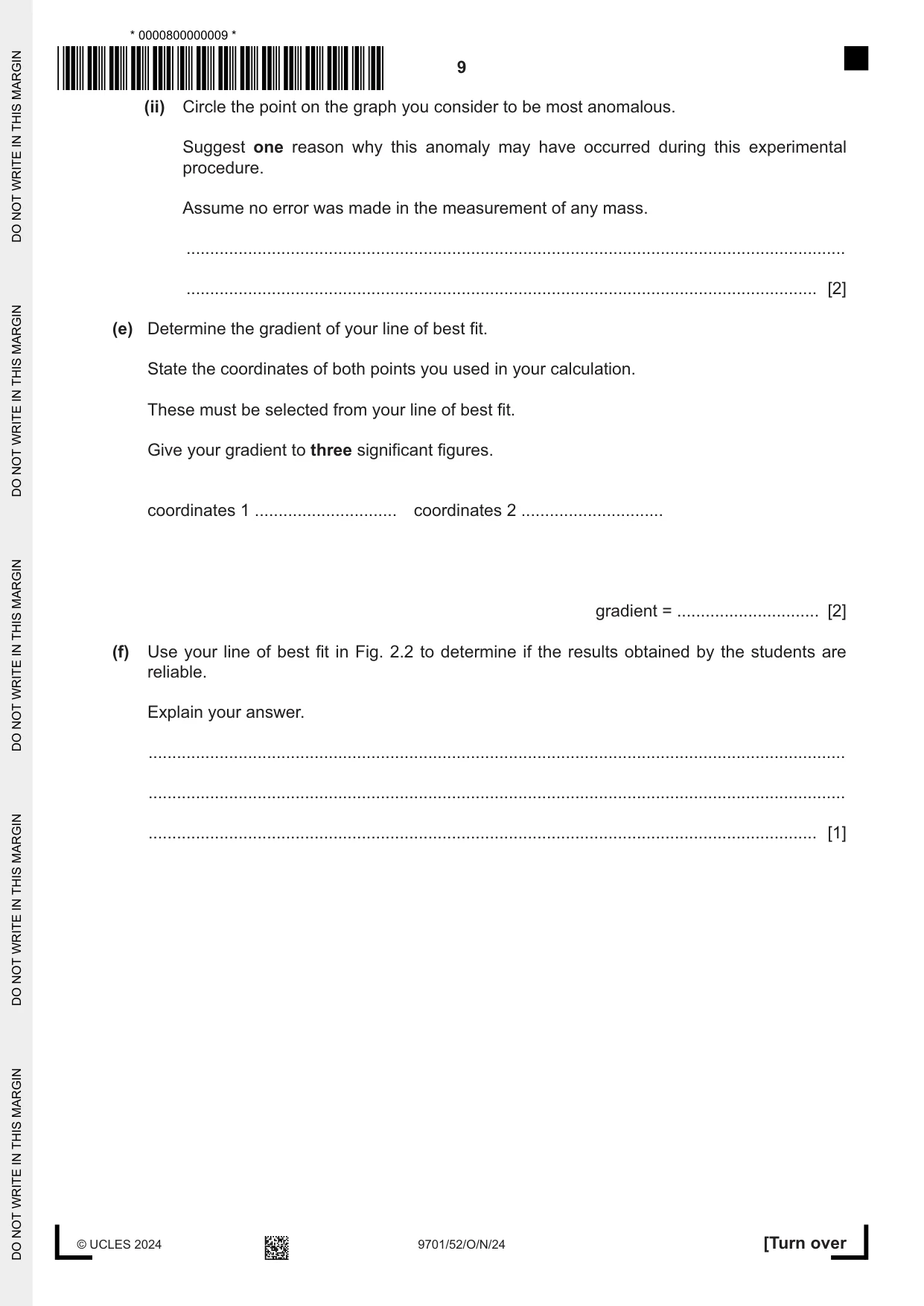
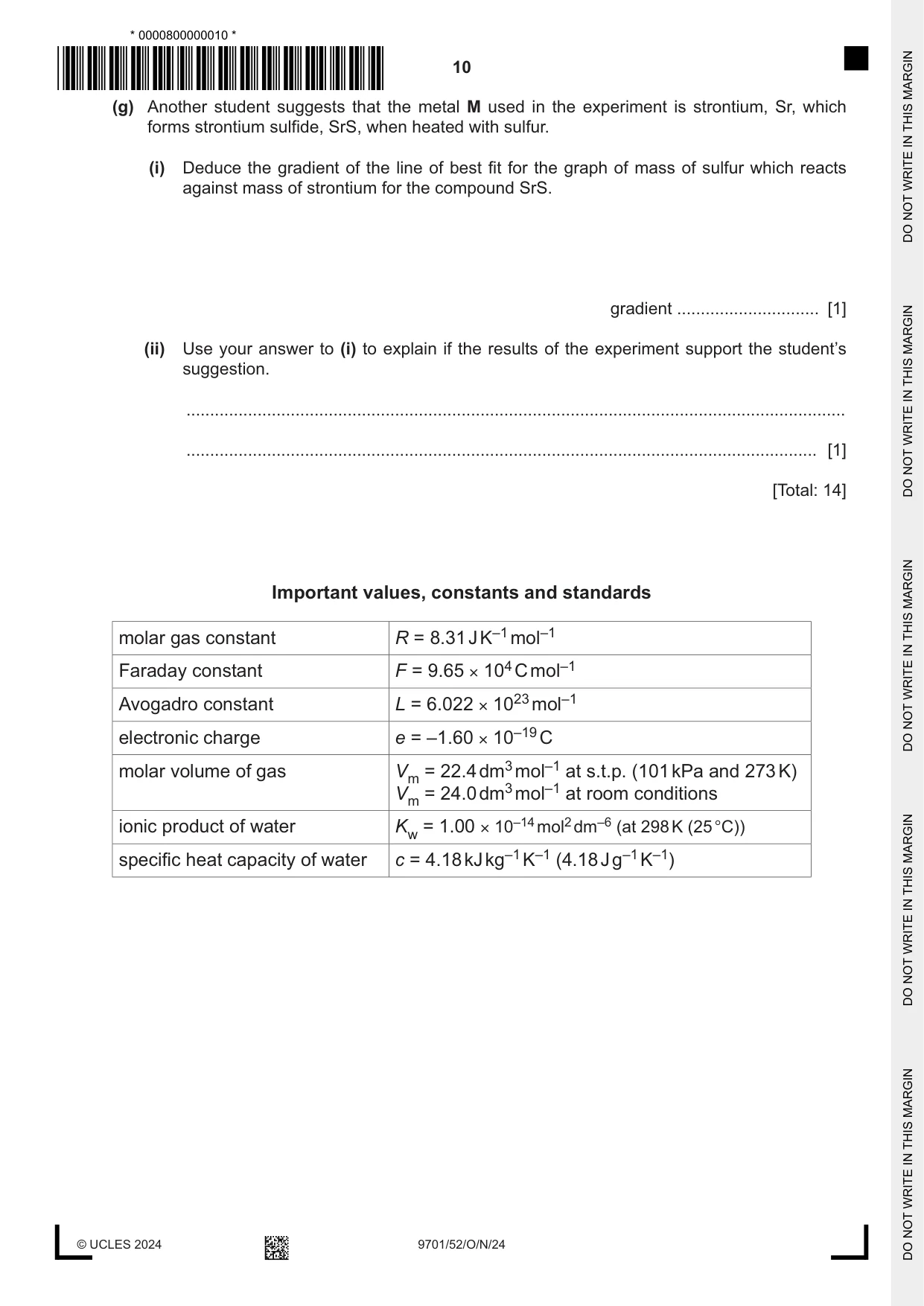
2 A group of students uses the following method to investigate the change in mass that takes place when metal M combines with sulfur to form a metal sulfide. step 1 Weigh a clean crucible and lid using a balance. Record the mass. step 2 Place a coiled length of metal wire into the crucible and weigh the crucible, lid and wire. step 3 Cover the metal wire in the crucible with a large quantity of powdered sulfur and replace the lid. step 4 Heat the crucible in a fume hood until the crucible glows red. Continue heating strongly until no more sulfur can be seen. step 5 Allow the apparatus to cool and weigh the crucible, lid and residue. lid coiled length of metal wire covered with sulfur crucible tripod heat Fig. 2.1 (a) (i) Fig. 2.1 shows how the apparatus is set up when heating the crucible in step 4. Identify the missing piece of apparatus used to support the crucible during heating. ..................................................................................................................................... [1] (ii) Suggest why the students heat their crucibles in a fume hood in step 4. ........................................................................................................................................... ..................................................................................................................................... [1] (iii) Suggest why a large quantity of powdered sulfur is used in step 3. ........................................................................................................................................... ..................................................................................................................................... [1] (b) Five students each use a different mass of M. Their results are shown in Table 2.1. Complete Table 2.1 by inserting values for the mass of M and the mass of sulfur which reacts for each student. Table 2.1 student 1 student 2 student 3 student 4 student 5 mass of crucible and lid / g 34.15 38.28 35.68 33.70 36.84 mass of crucible, lid and M / g 35.58 39.42 36.54 34.27 37.13 mass of crucible, lid and 36.04 39.70 36.74 34.42 37.19 residue after heating / g mass of M / g mass of sulfur which reacts / g [1] (c) Identify the independent variable in this experiment. ............................................................................................................................................. [1]
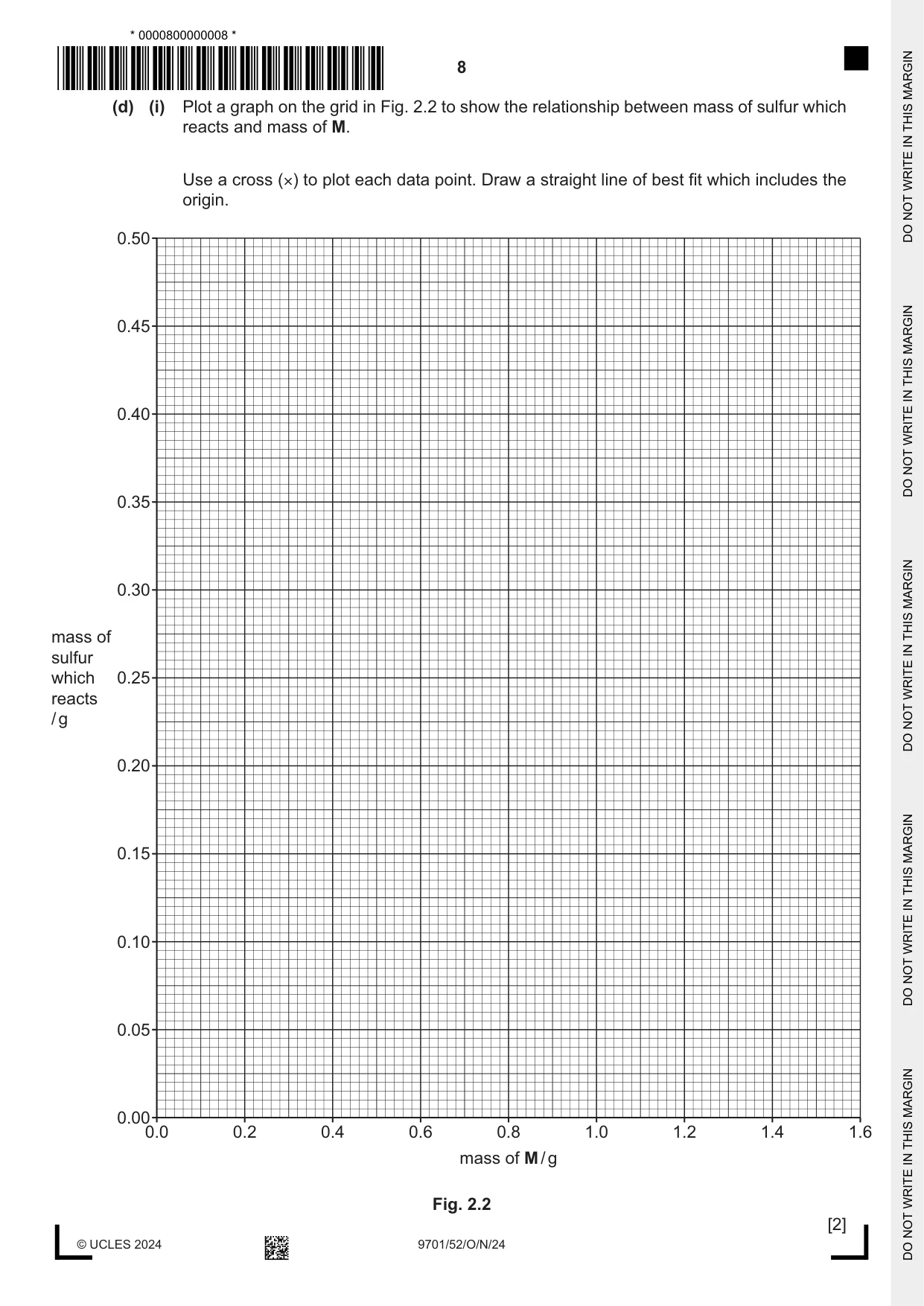
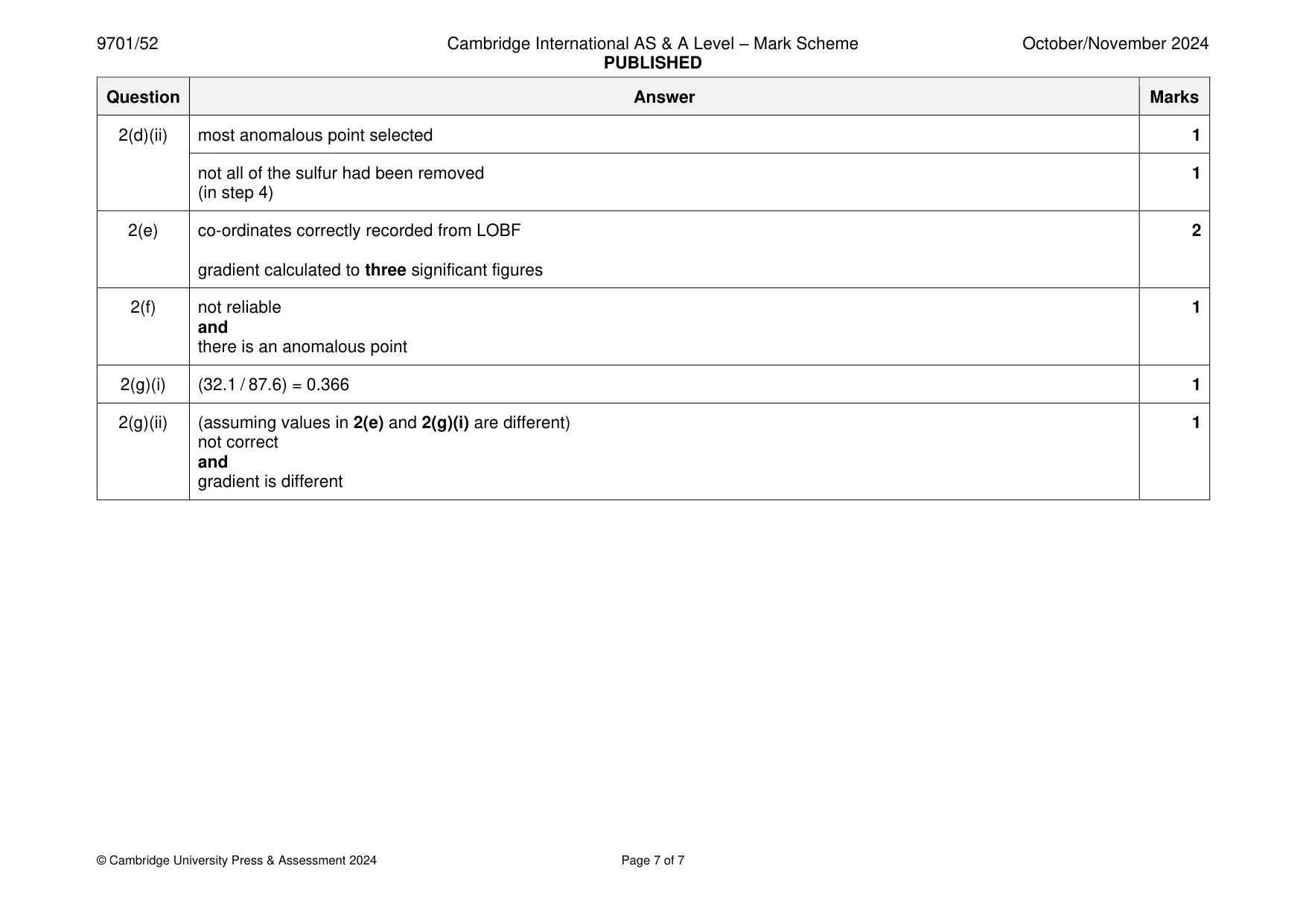
Mark scheme: 2(a)(i) pipeclay triangle 1 2(a)(ii) toxic gas is produced. 1 2(a)(iii) to ensure all of the metal M reacts. 1 2(b) 1 mass of M 1.4 1.1 0.8 0.5 0.2 3 4 6 7 9 mass of S 0.4 0.2 0.2 0.1 0.0 6 8 0 5 6 2(c) mass of M or mass of metal 1 2(d)(i) 5 points plotted correctly from 2(b) 1 straight line of best fit drawn which includes origin 1 2(d)(ii) most anomalous point selected 1 not all of the sulfur had been removed 1 (in step 4) 2(e) co-ordinates correctly recorded from LOBF 2 gradient calculated to three significant figures 2(f) not reliable 1 and there is an anomalous point 2(g)(i) (32.1 / 87.6) = 0.366 1 2(g)(ii) (assuming values in 2(e) and 2(g)(i) are different) 1 not correct and gradient is different
More questions on Reacting masses and volumes (of solutions and gases)
What was in this paper
The subtopics covered by these 2 questions, and how many questions each got. Open one in a new tab to see every Cambridge question on it.
What you needed in this session
Cambridge’s own grade thresholds for 2024 Oct/Nov, Paper 5 · Variant 2. A higher threshold means an easier paper — the bar moves with how the cohort did.