Cambridge A Level Chemistry 9701 — 2025 May/June Paper 5 · Variant 3
9701/53/M/J/25 · 2 questions · 30 marks · 75 min
The question paper and its mark scheme, free to read here and free to download. This is Cambridge’s own paper, exactly as it was sat.
Question paper12 pages
Mark scheme10 pages
Answers below. Sit the paper first if you are practising.
Questions as text
Q1 · Grignard reagents have the general formula RMgX, where R is a hydrocarbon group and X is…
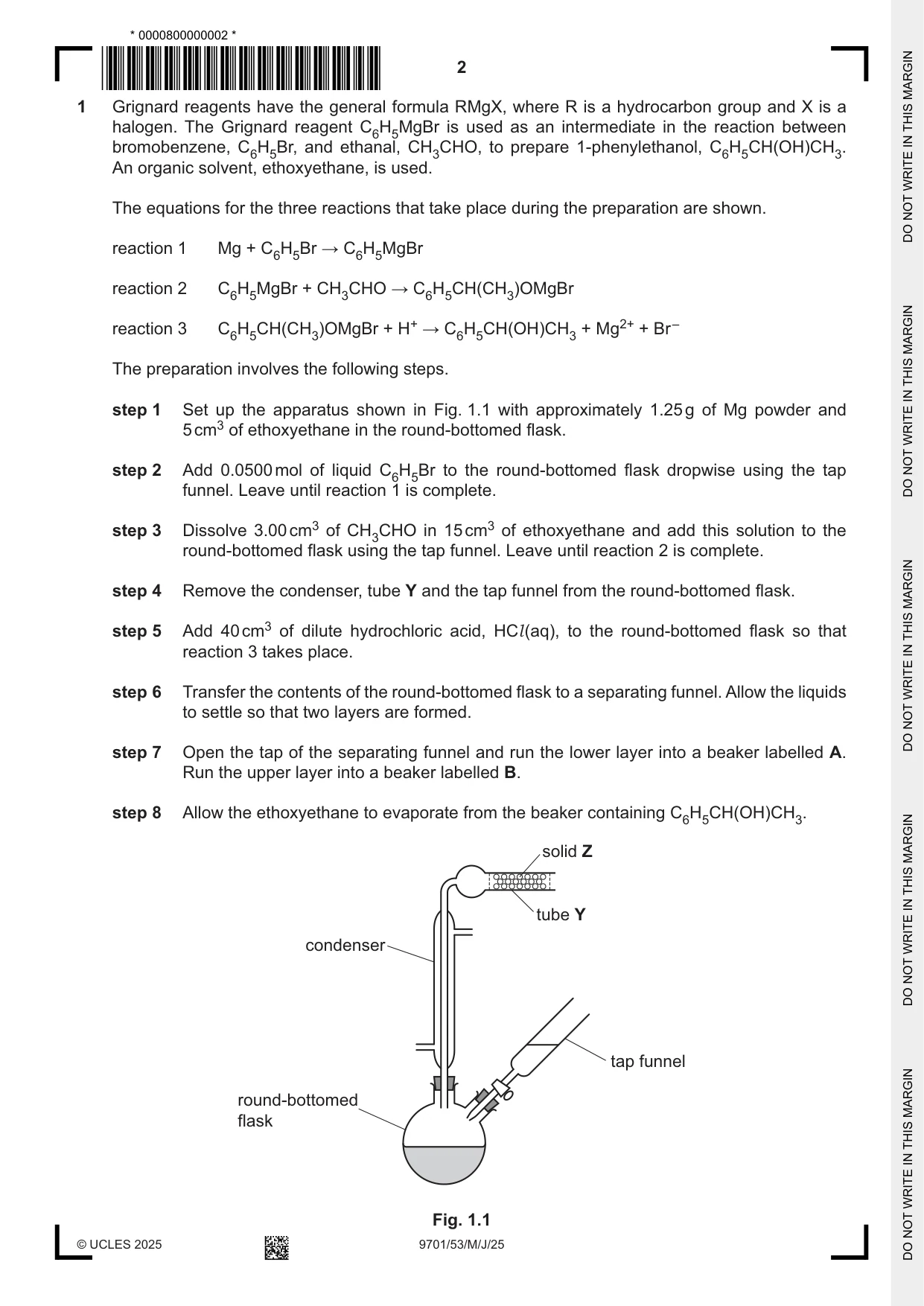
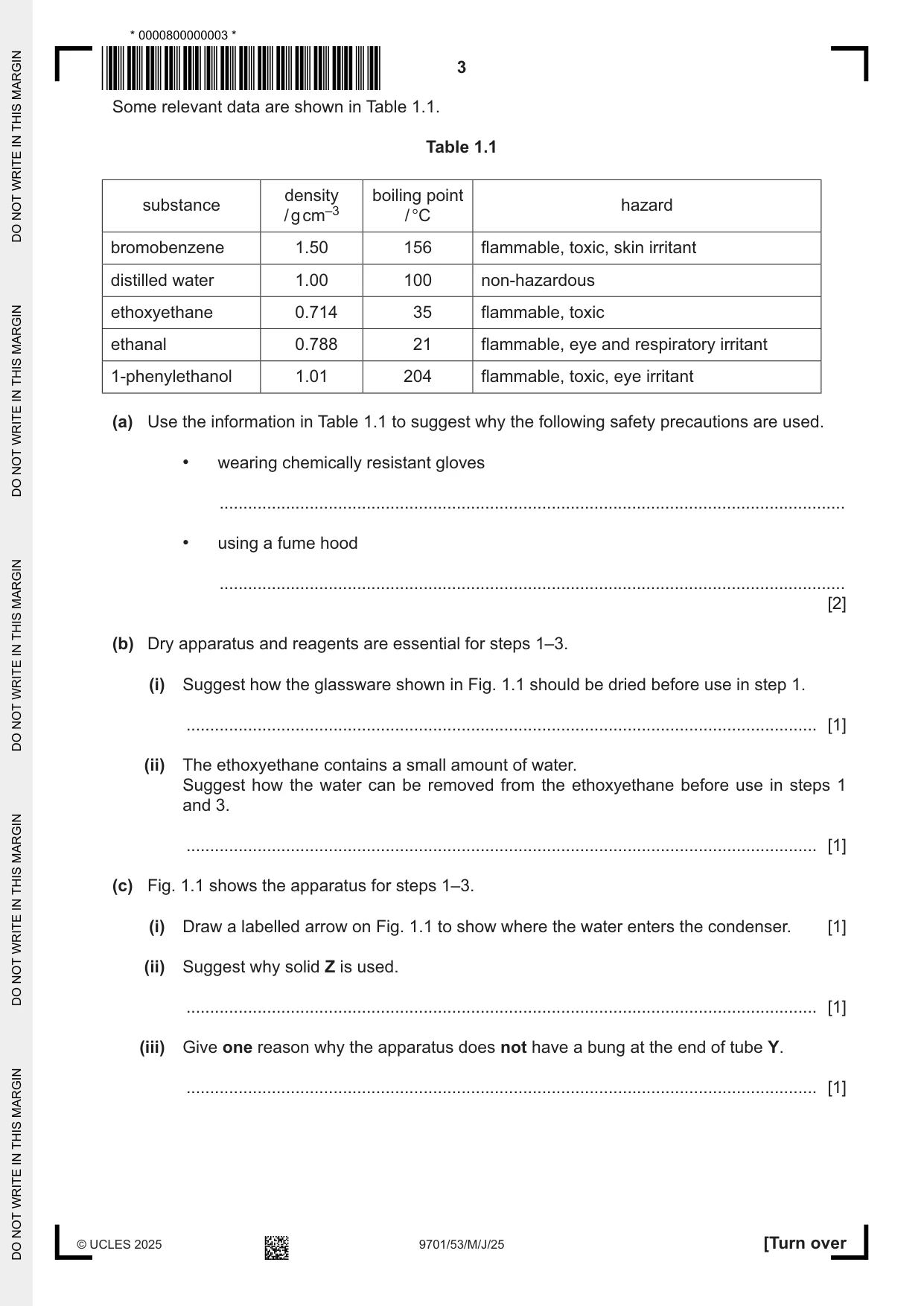
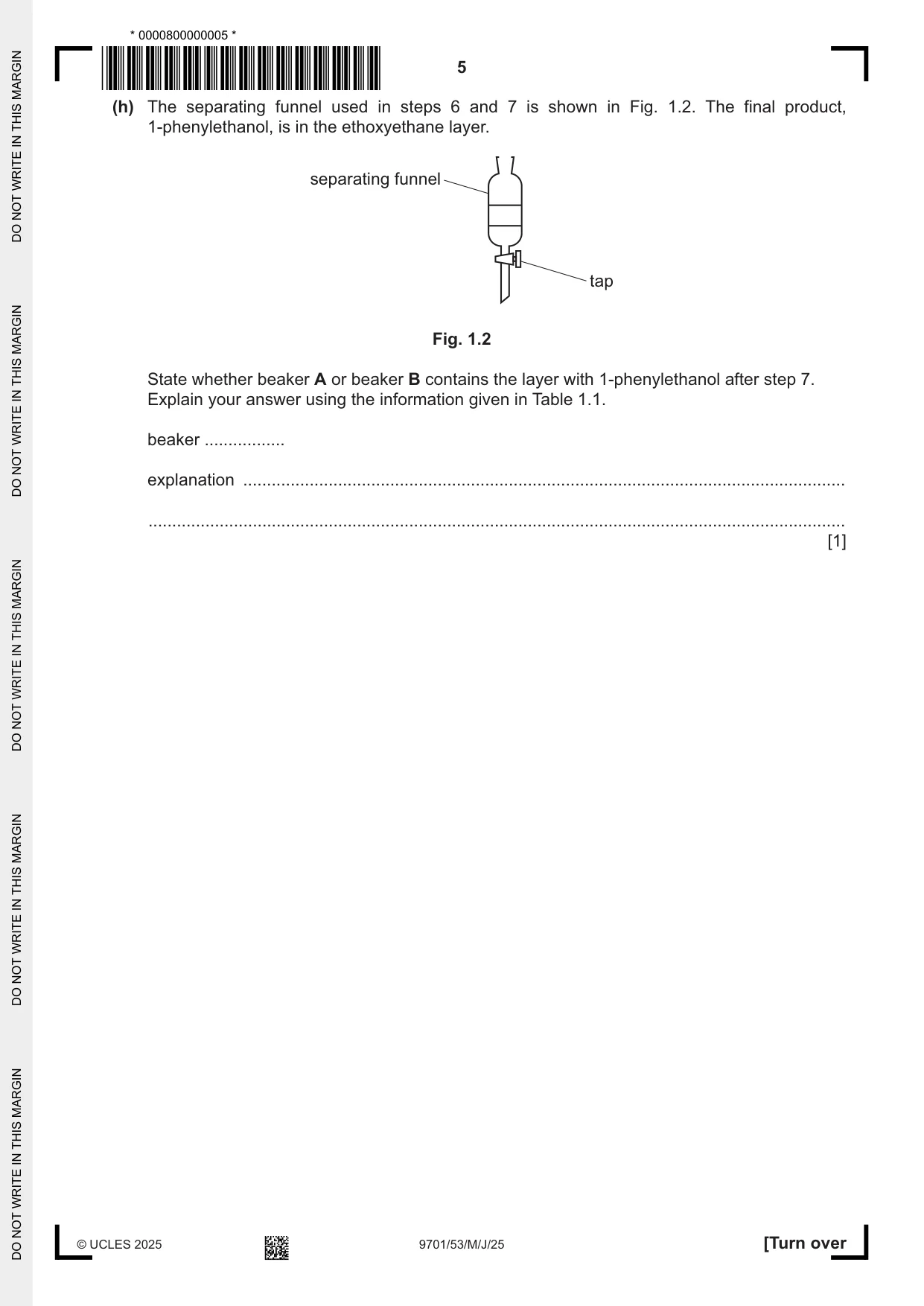
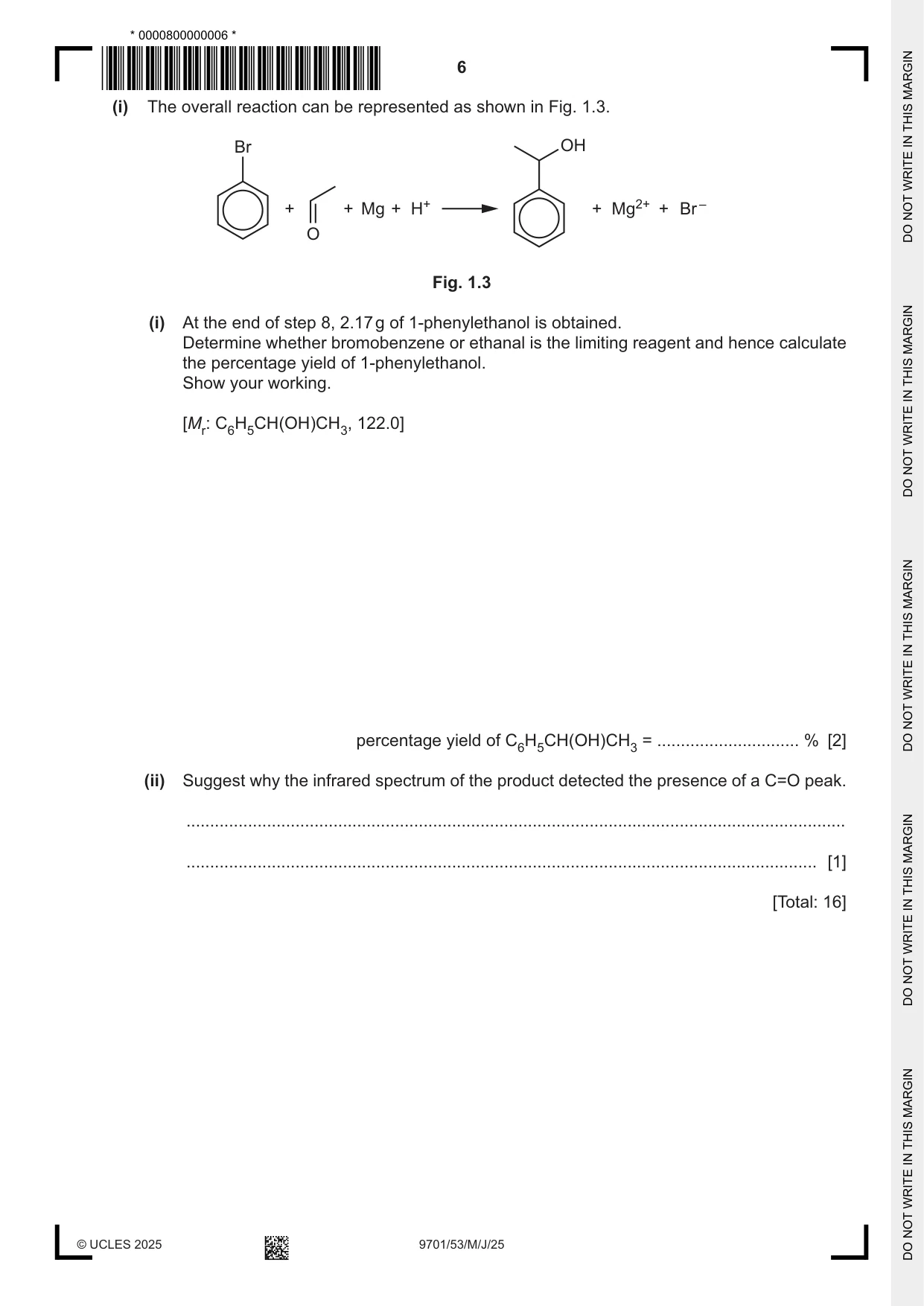
1 Grignard reagents have the general formula RMgX, where R is a hydrocarbon group and X is a halogen. The Grignard reagent C6H5MgBr is used as an intermediate in the reaction between bromobenzene, C6H5Br, and ethanal, CH3CHO, to prepare 1-phenylethanol, C6H5CH(OH)CH3. An organic solvent, ethoxyethane, is used. The equations for the three reactions that take place during the preparation are shown. reaction 1 Mg + C6H5Br → C6H5MgBr reaction 2 C6H5MgBr + CH3CHO → C6H5CH(CH3)OMgBr reaction 3 C6H5CH(CH3)OMgBr + H+ → C6H5CH(OH)CH3 + Mg2+ + Br – The preparation involves the following steps. step 1 Set up the apparatus shown in Fig. 1.1 with approximately 1.25 g of Mg powder and 5 cm3 of ethoxyethane in the round-bottomed flask. step 2 Add 0.0500 mol of liquid C6H5Br to the round-bottomed flask dropwise using the tap funnel. Leave until reaction 1 is complete. step 3 Dissolve 3.00 cm3 of CH3CHO in 15 cm3 of ethoxyethane and add this solution to the round-bottomed flask using the tap funnel. Leave until reaction 2 is complete. step 4 Remove the condenser, tube Y and the tap funnel from the round-bottomed flask. step 5 Add 40 cm3 of dilute hydrochloric acid, HCl (aq), to the round-bottomed flask so that reaction 3 takes place. step 6 Transfer the contents of the round-bottomed flask to a separating funnel. Allow the liquids to settle so that two layers are formed. step 7 Open the tap of the separating funnel and run the lower layer into a beaker labelled A. Run the upper layer into a beaker labelled B. step 8 Allow the ethoxyethane to evaporate from the beaker containing C6H5CH(OH)CH3. solid Z tube Y condenser tap funnel round-bottomed flask Fig. 1.1 Some relevant data are shown in Table 1.1. Table 1.1 density boiling point substance hazard / g cm–3 / °C bromobenzene 1.50 156 flammable, toxic, skin irritant distilled water 1.00 100 non-hazardous ethoxyethane 0.714 35 flammable, toxic ethanal 0.788 21 flammable, eye and respiratory irritant 1-phenylethanol 1.01 204 flammable, toxic, eye irritant (a) Use the information in Table 1.1 to suggest why the following safety precautions are used. • wearing chemically resistant gloves .................................................................................................................................... • using a fume hood .................................................................................................................................... [2] (b) Dry apparatus and reagents are essential for steps 1–3. (i) Suggest how the glassware shown in Fig. 1.1 should be dried before use in step 1. ..................................................................................................................................... [1] (ii) The ethoxyethane contains a small amount of water. Suggest how the water can be removed from the ethoxyethane before use in steps 1 and 3. ..................................................................................................................................... [1] (c) Fig. 1.1 shows the apparatus for steps 1–3. (i) Draw a labelled arrow on Fig. 1.1 to show where the water enters the condenser. [1] (ii) Suggest why solid Z is used. ..................................................................................................................................... [1] (iii) Give one reason why the apparatus does not have a bung at the end of tube Y. ..................................................................................................................................... [1] (d) In step 1, approximately 1.25 g of Mg powder is needed. Outline how the student should accurately weigh by difference using a weighing boat so that the exact mass of Mg transferred into the flask is known. Include a results table, with appropriate headings, ready for the student to fill in. ................................................................................................................................................... ................................................................................................................................................... ................................................................................................................................................... [2] (e) Use the information in Table 1.1 to determine the volume, in cm3, of bromobenzene used in step 2. [Mr: C6H5Br, 156.9] volume of C6H5Br = .............................. cm3 [1] (f) The bromobenzene is added dropwise in step 2. Suggest one reason why the bromobenzene is not added all at once. ............................................................................................................................................. [1] (g) Suggest why a measuring cylinder is a suitable piece of apparatus to measure 40 cm3 of hydrochloric acid in step 5. ................................................................................................................................................... ............................................................................................................................................. [1] (h) The separating funnel used in steps 6 and 7 is shown in Fig. 1.2. The final product, 1-phenylethanol, is in the ethoxyethane layer. separating funnel tap Fig. 1.2 State whether beaker A or beaker B contains the layer with 1-phenylethanol after step 7. Explain your answer using the information given in Table 1.1. beaker ................. explanation ............................................................................................................................... ................................................................................................................................................... [1] (i) The overall reaction can be represented as shown in Fig. 1.3. Br OH + + Mg + H+ + Mg2+ + Br – O Fig. 1.3 (i) At the end of step 8, 2.17 g of 1-phenylethanol is obtained. Determine whether bromobenzene or ethanal is the limiting reagent and hence calculate the percentage yield of 1-phenylethanol. Show your working. [Mr: C6H5CH(OH)CH3, 122.0] percentage yield of C6H5CH(OH)CH3 = .............................. % [2] (ii) Suggest why the infrared spectrum of the product detected the presence of a C=O peak. ........................................................................................................................................... ..................................................................................................................................... [1] [Total: 16]
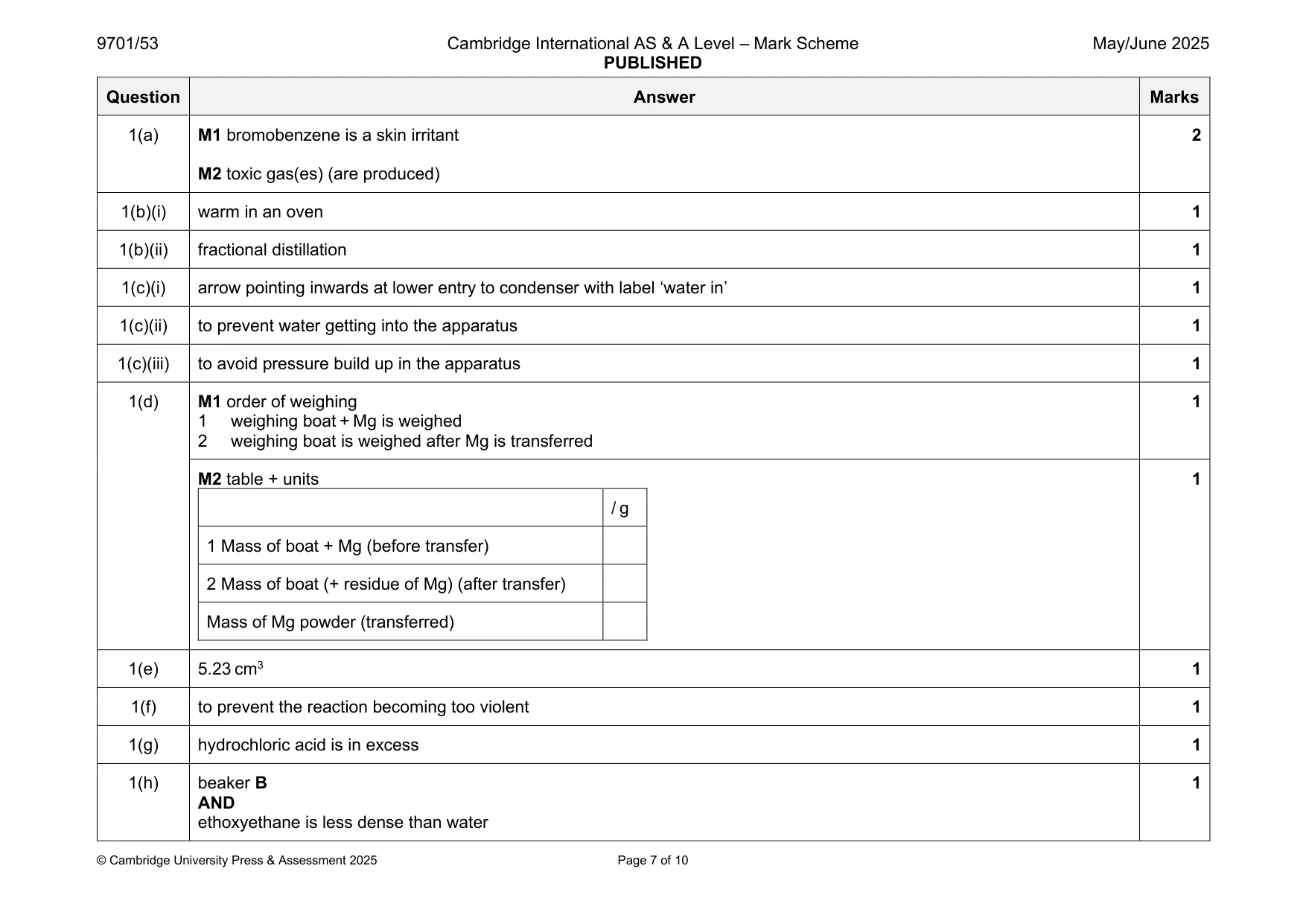
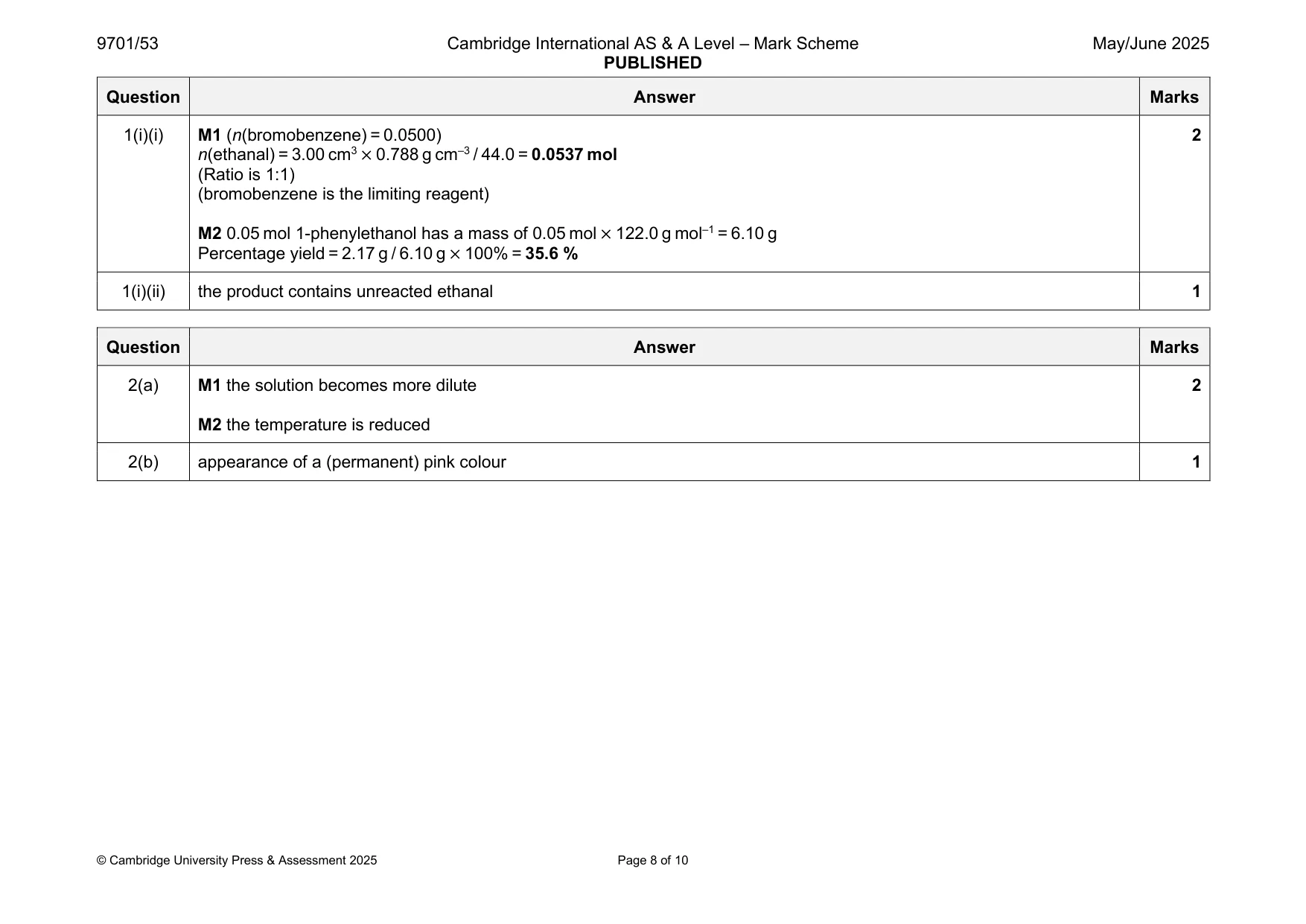
Mark scheme: Question Answer Marks 1(a) M1 bromobenzene is a skin irritant 2 M2 toxic gas(es) (are produced) 1(b)(i) warm in an oven 1 1(b)(ii) fractional distillation 1 1(c)(i) arrow pointing inwards at lower entry to condenser with label ‘water in’ 1 1(c)(ii) to prevent water getting into the apparatus 1 1(c)(iii) to avoid pressure build up in the apparatus 1 1(d) M1 order of weighing 1 1 weighing boat + Mg is weighed 2 weighing boat is weighed after Mg is transferred M2 table + units 1 / g 1 Mass of boat + Mg (before transfer) 2 Mass of boat (+ residue of Mg) (after transfer) Mass of Mg powder (transferred) 1(e) 5.23 cm3 1 1(f) to prevent the reaction becoming too violent 1 1(g) hydrochloric acid is in excess 1 1(h) beaker B 1 AND ethoxyethane is less dense than water 1(i)(i) M1 (n(bromobenzene) = 0.0500) 2 n(ethanal) = 3.00 cm3 × 0.788 g cm–3 / 44.0 = 0.0537 mol (Ratio is 1:1) (bromobenzene is the limiting reagent) M2 0.05 mol 1-phenylethanol has a mass of 0.05 mol × 122.0 g mol–1 = 6.10 g Percentage yield = 2.17 g / 6.10 g × 100% = 35.6 % 1(i)(ii) the product contains unreacted ethanal 1
Q2 · An experiment is carried out to determine the rate constant, k, for the hydrolysis of…
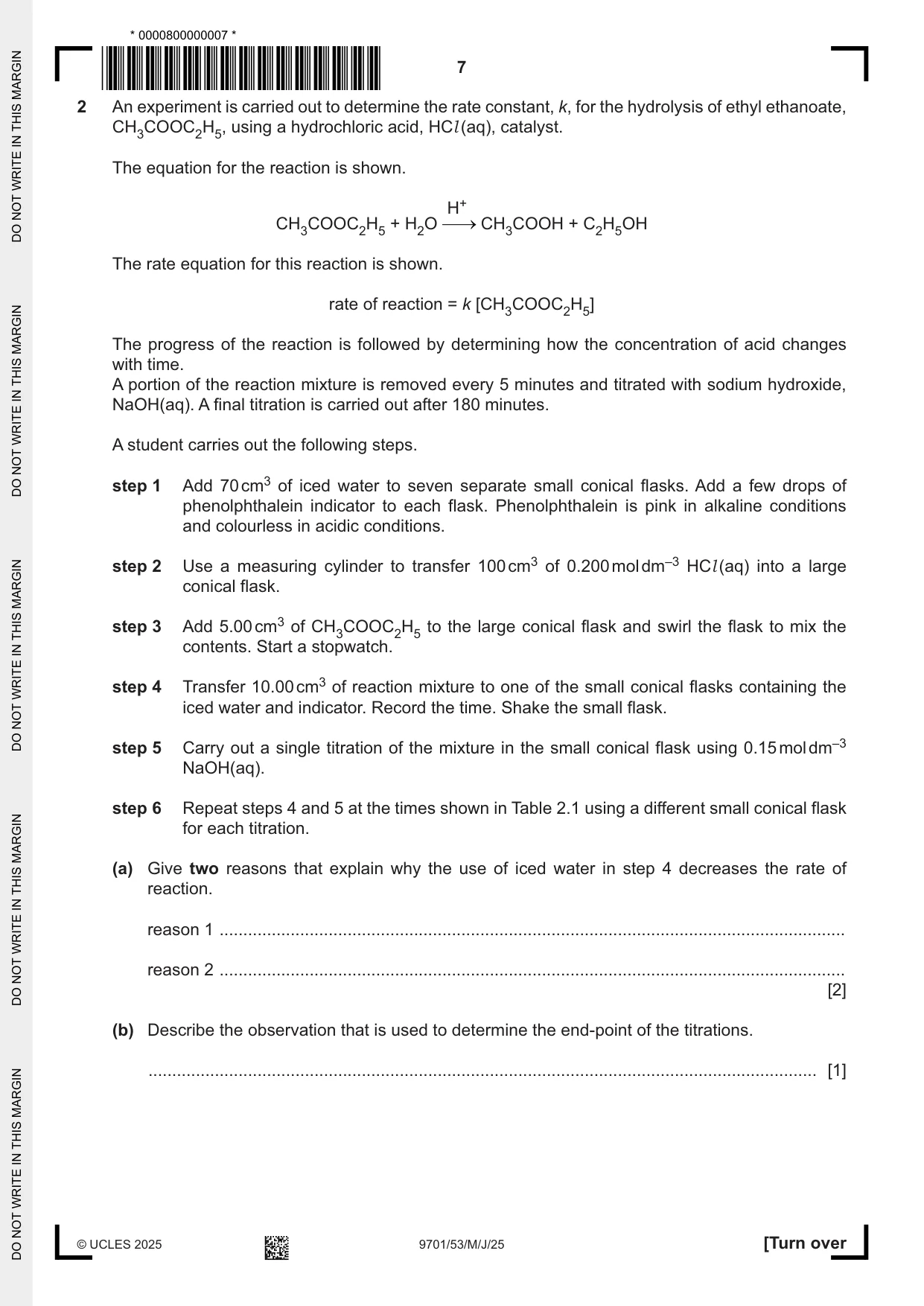
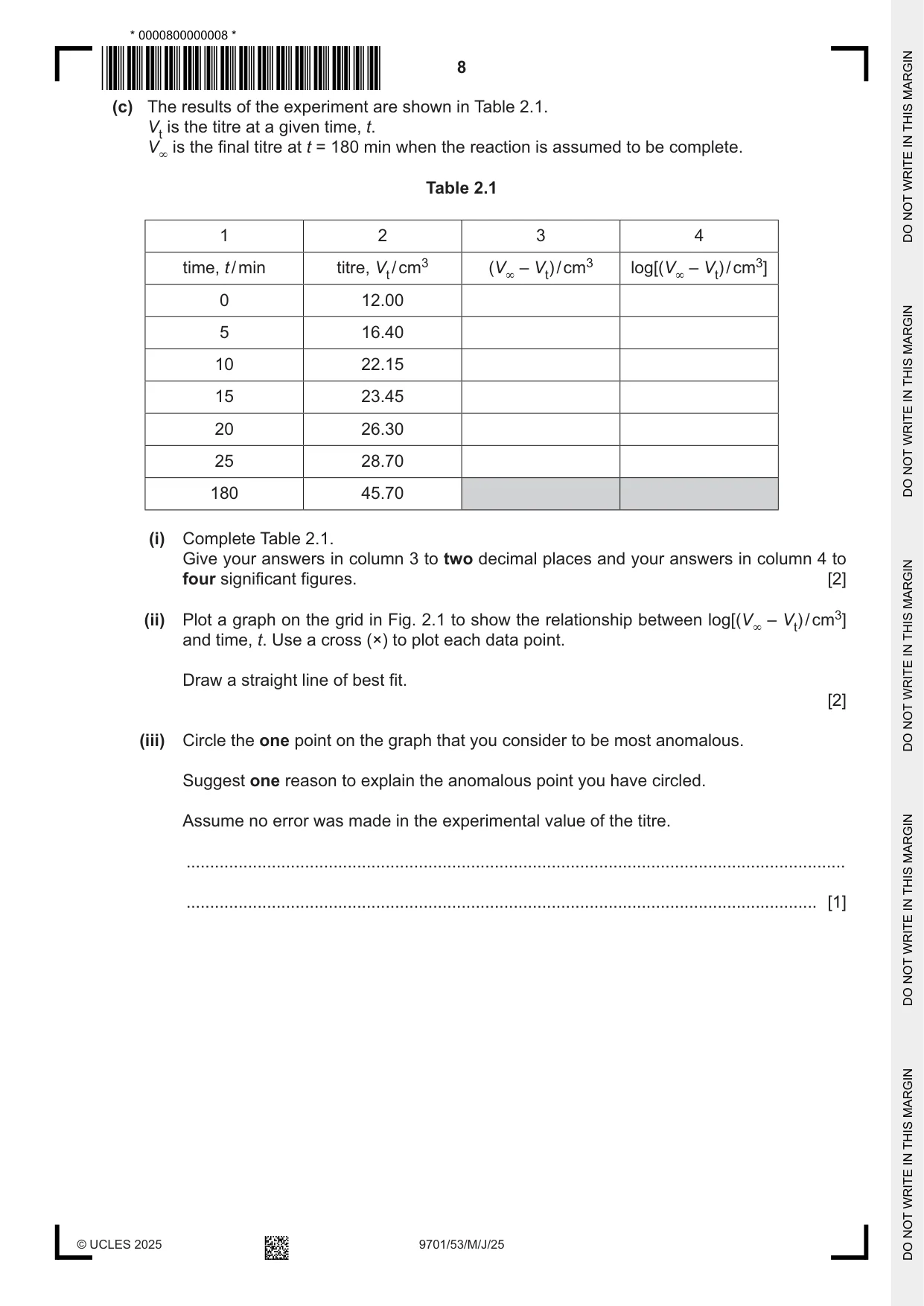
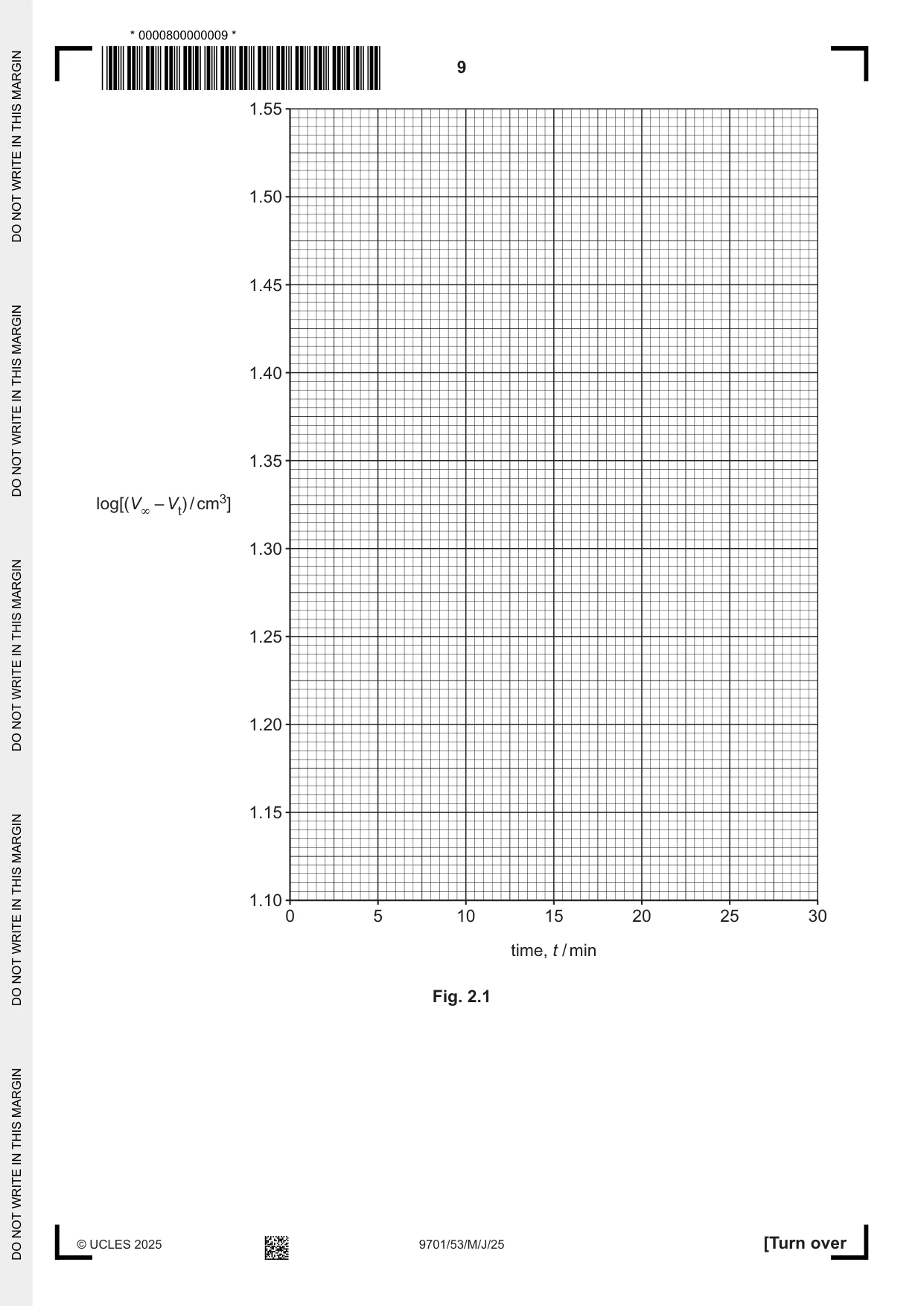
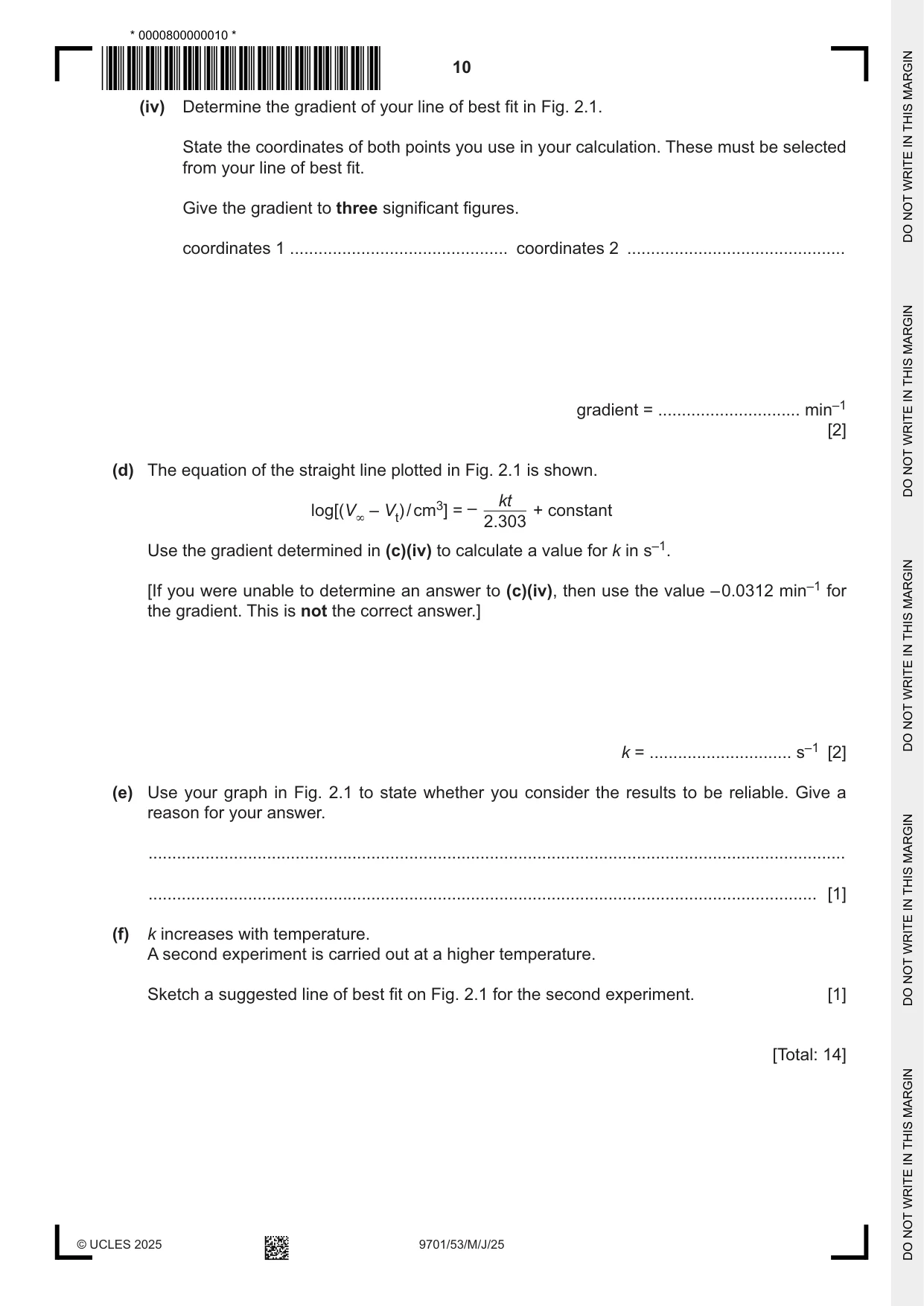
2 An experiment is carried out to determine the rate constant, k, for the hydrolysis of ethyl ethanoate, CH3COOC2H5, using a hydrochloric acid, HCl (aq), catalyst. The equation for the reaction is shown. H+ CH3COOC2H5 + H2O CH3COOH + C2H5OH The rate equation for this reaction is shown. rate of reaction = k [CH3COOC2H5] The progress of the reaction is followed by determining how the concentration of acid changes with time. A portion of the reaction mixture is removed every 5 minutes and titrated with sodium hydroxide, NaOH(aq). A final titration is carried out after 180 minutes. A student carries out the following steps. step 1 Add 70 cm3 of iced water to seven separate small conical flasks. Add a few drops of phenolphthalein indicator to each flask. Phenolphthalein is pink in alkaline conditions and colourless in acidic conditions. step 2 Use a measuring cylinder to transfer 100 cm3 of 0.200 mol dm–3 HCl (aq) into a large conical flask. step 3 Add 5.00 cm3 of CH3COOC2H5 to the large conical flask and swirl the flask to mix the contents. Start a stopwatch. step 4 Transfer 10.00 cm3 of reaction mixture to one of the small conical flasks containing the iced water and indicator. Record the time. Shake the small flask. step 5 Carry out a single titration of the mixture in the small conical flask using 0.15 mol dm–3 NaOH(aq). step 6 Repeat steps 4 and 5 at the times shown in Table 2.1 using a different small conical flask for each titration. (a) Give two reasons that explain why the use of iced water in step 4 decreases the rate of reaction. reason 1 .................................................................................................................................... reason 2 .................................................................................................................................... [2] (b) Describe the observation that is used to determine the end-point of the titrations. ............................................................................................................................................. [1] (c) The results of the experiment are shown in Table 2.1. Vt is the titre at a given time, t. V∞ is the final titre at t = 180 min when the reaction is assumed to be complete. Table 2.1 1 2 3 4 time, t / min titre, Vt / cm3 (V∞ – Vt) / cm3 log[(V∞ – Vt) / cm3] 0 12.00 5 16.40 10 22.15 15 23.45 20 26.30 25 28.70 180 45.70 (i) Complete Table 2.1. Give your answers in column 3 to two decimal places and your answers in column 4 to four significant figures. [2] (ii) Plot a graph on the grid in Fig. 2.1 to show the relationship between log[(V∞ – Vt) / cm3] and time, t. Use a cross (×) to plot each data point. Draw a straight line of best fit. [2] (iii) Circle the one point on the graph that you consider to be most anomalous. Suggest one reason to explain the anomalous point you have circled. Assume no error was made in the experimental value of the titre. ........................................................................................................................................... ..................................................................................................................................... [1]
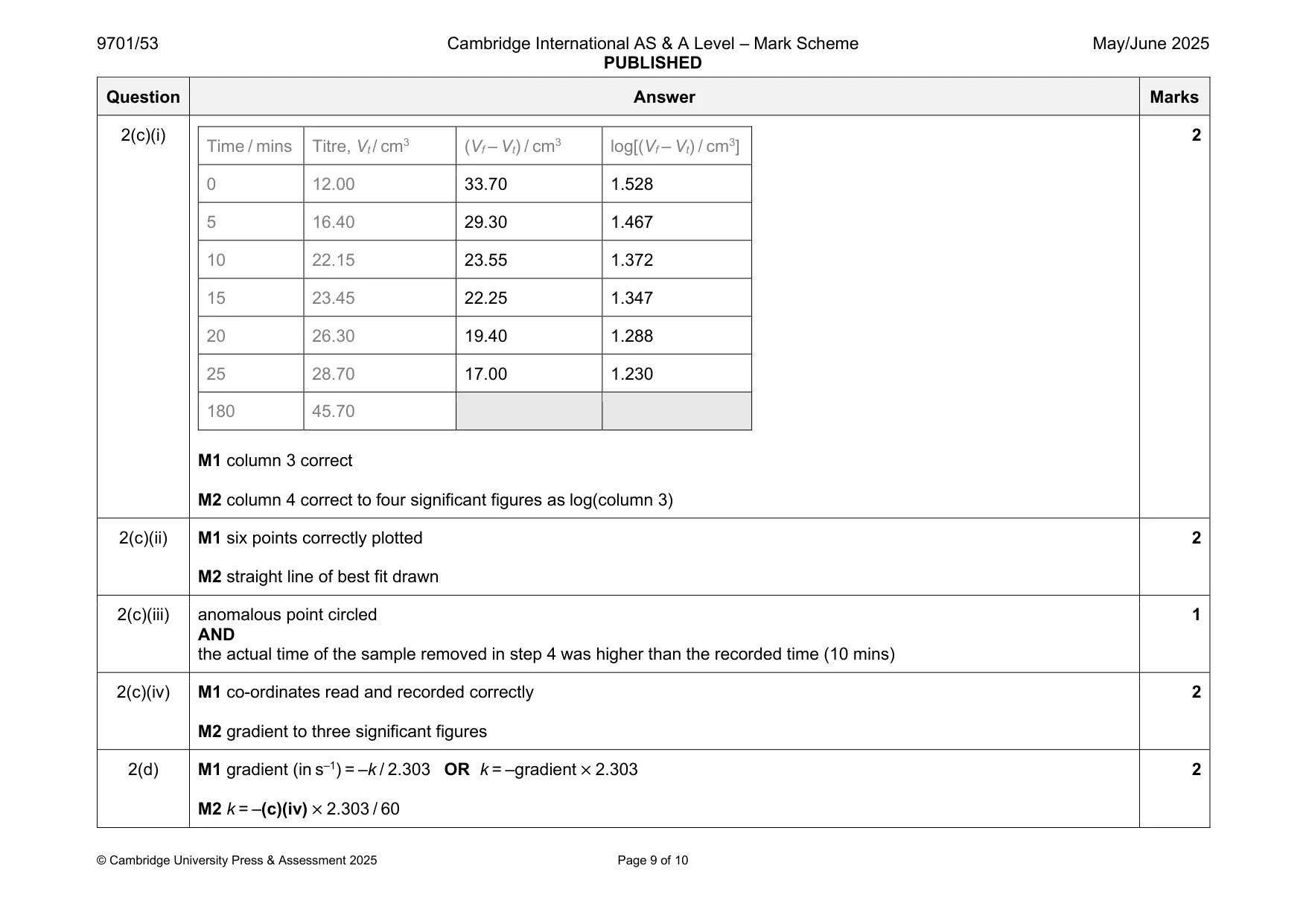
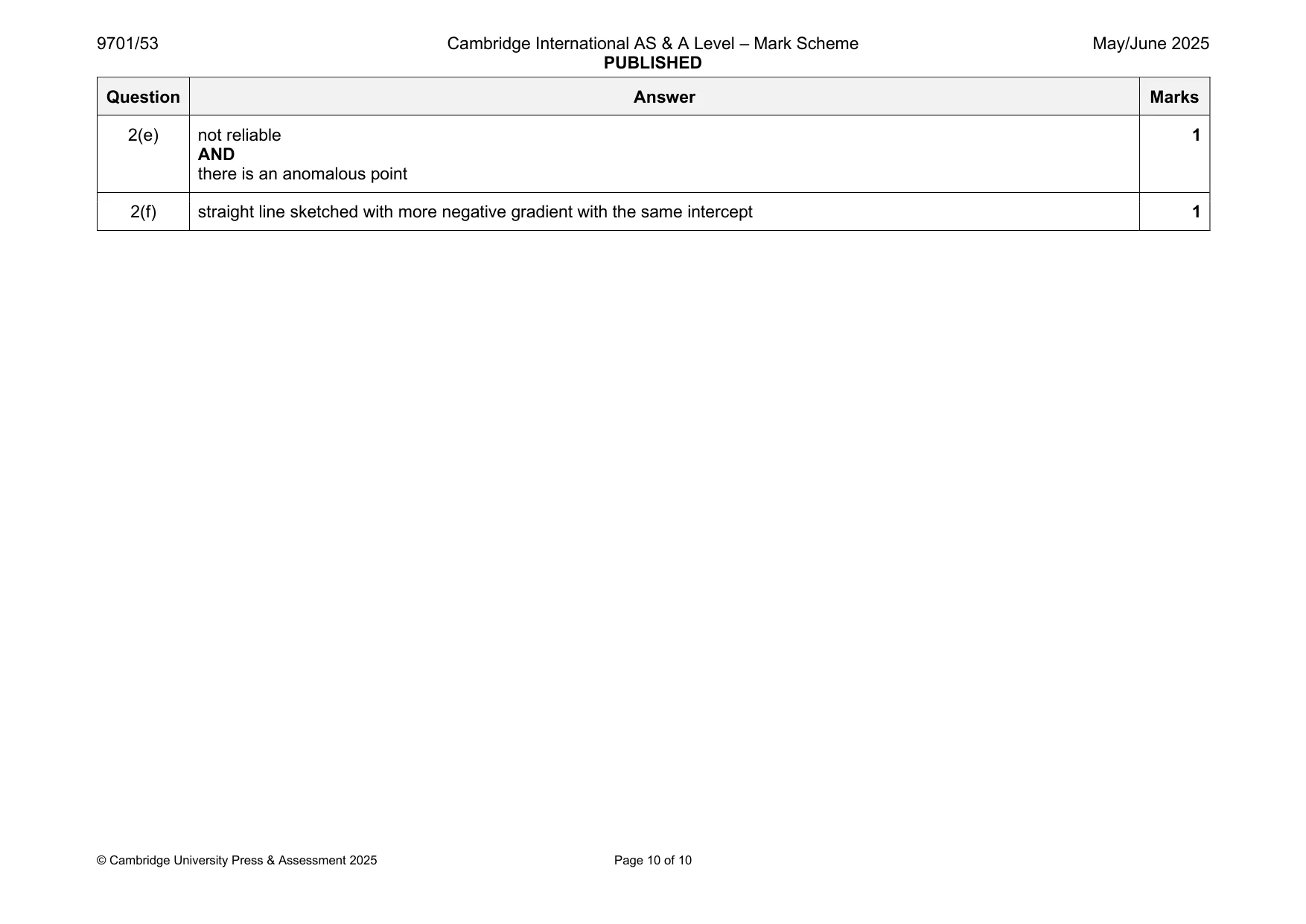
Mark scheme: 2(a) M1 the solution becomes more dilute 2 M2 the temperature is reduced 2(b) appearance of a (permanent) pink colour 1 2(c)(i) 2 Time / mins Titre, Vt / cm3 (Vf – Vt) / cm3 log[(Vf – Vt) / cm3] 0 12.00 33.70 1.528 5 16.40 29.30 1.467 10 22.15 23.55 1.372 15 23.45 22.25 1.347 20 26.30 19.40 1.288 25 28.70 17.00 1.230 180 45.70 M1 column 3 correct M2 column 4 correct to four significant figures as log(column 3) 2(c)(ii) M1 six points correctly plotted 2 M2 straight line of best fit drawn 2(c)(iii) anomalous point circled 1 AND the actual time of the sample removed in step 4 was higher than the recorded time (10 mins) 2(c)(iv) M1 co-ordinates read and recorded correctly 2 M2 gradient to three significant figures 2(d) M1 gradient (in s–1) = –k / 2.303 OR k = –gradient × 2.303 2 M2 k = –(c)(iv) × 2.303 / 60 2(e) not reliable 1 AND there is an anomalous point 2(f) straight line sketched with more negative gradient with the same intercept 1
More questions on Simple rate equations, orders of reaction and rate constants
What was in this paper
The subtopics covered by these 2 questions, and how many questions each got. Open one in a new tab to see every Cambridge question on it.
What you needed in this session
Cambridge’s own grade thresholds for 2025 May/June, Paper 5 · Variant 3. A higher threshold means an easier paper — the bar moves with how the cohort did.