Cambridge A Level Chemistry 9701 — 2024 Oct/Nov Paper 5 · Variant 3
9701/53/O/N/24 · 2 questions · 30 marks · ≈34 min
The question paper and its mark scheme, free to read here and free to download. This is Cambridge’s own paper, exactly as it was sat.
Question paper16 pages
Mark scheme7 pages
Answers below. Sit the paper first if you are practising.
Questions as text
Q1 · A student uses the following method to determine the percentage by mass of the painkiller…
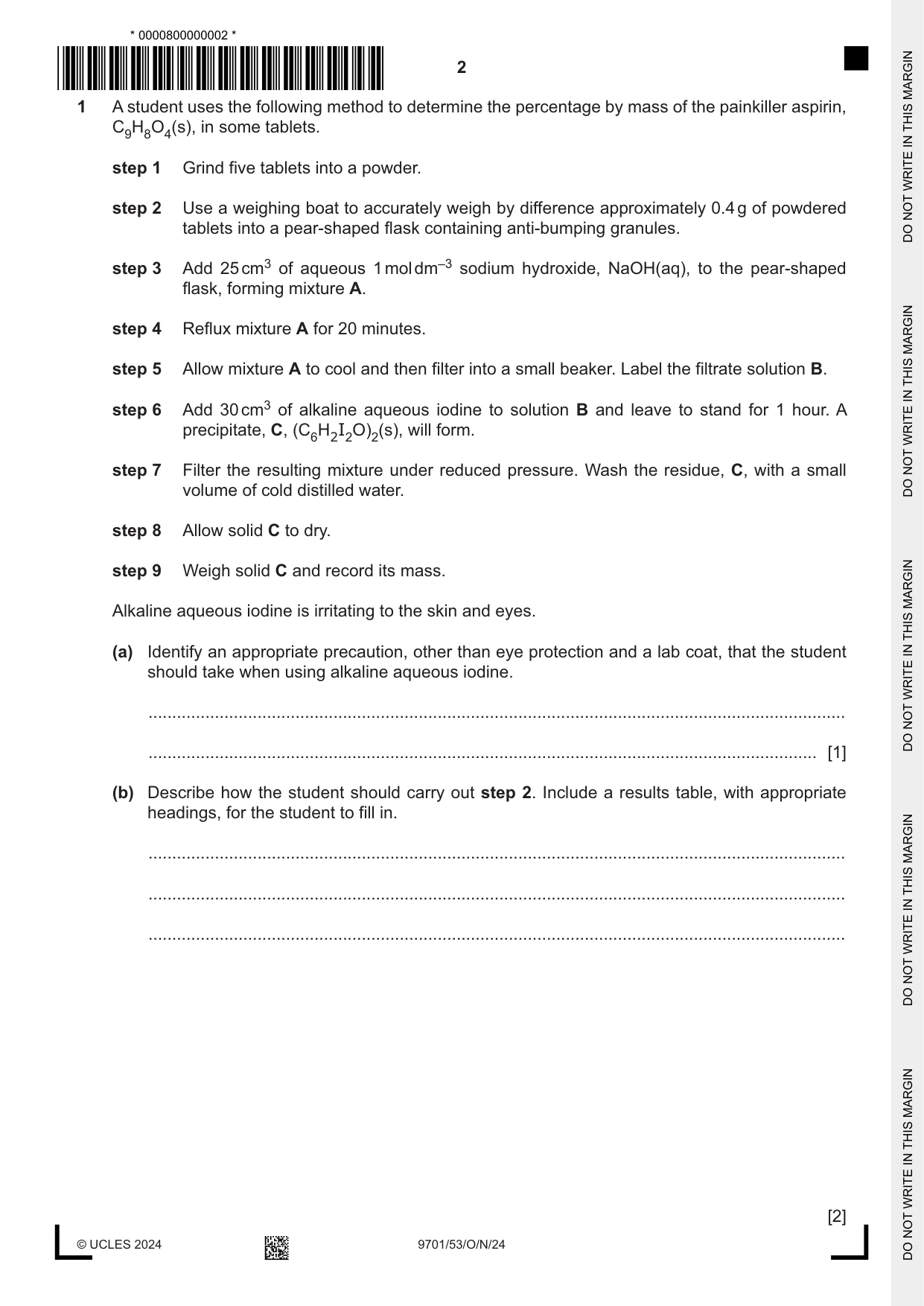
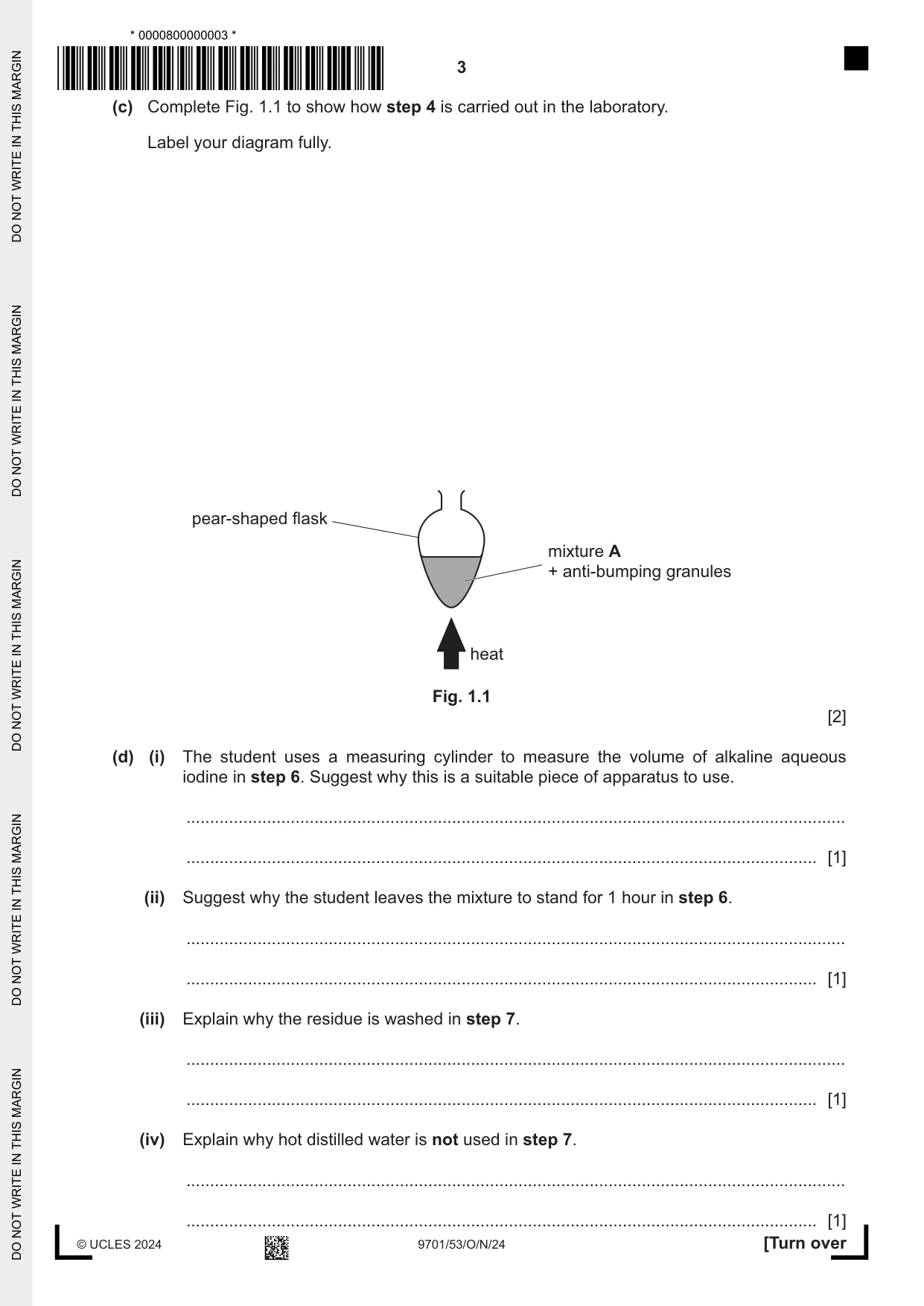
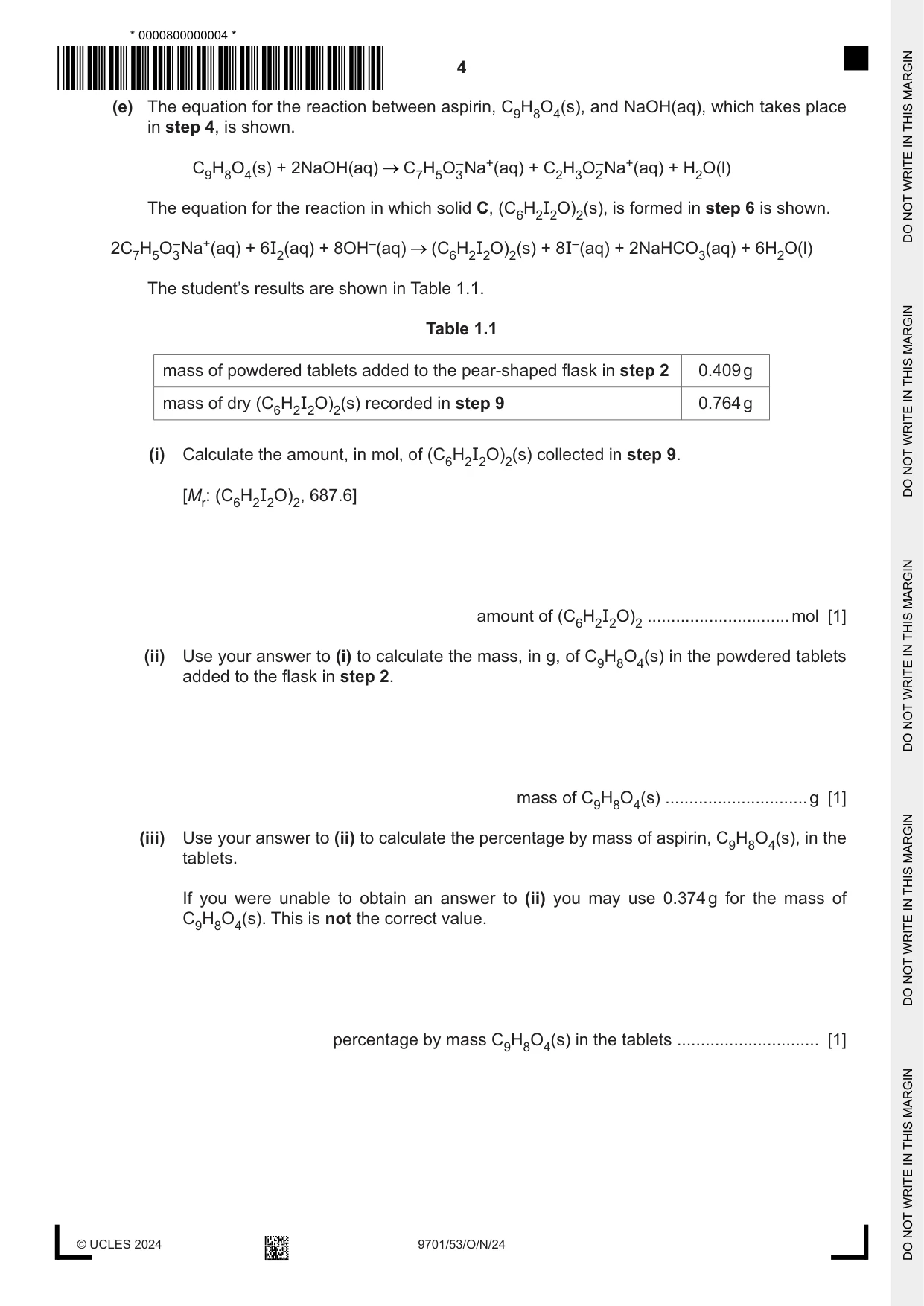
1 A student uses the following method to determine the percentage by mass of the painkiller aspirin, C9H8O4(s), in some tablets. step 1 Grind five tablets into a powder. step 2 Use a weighing boat to accurately weigh by difference approximately 0.4 g of powdered tablets into a pear‑shaped flask containing anti‑bumping granules. step 3 Add 25 cm3 of aqueous 1 mol dm–3 sodium hydroxide, NaOH(aq), to the pear‑shaped flask, forming mixture A. step 4 Reflux mixture A for 20 minutes. step 5 Allow mixture A to cool and then filter into a small beaker. Label the filtrate solution B. step 6 Add 30 cm3 of alkaline aqueous iodine to solution B and leave to stand for 1 hour. A precipitate, C, (C6H2I2O)2(s), will form. step 7 Filter the resulting mixture under reduced pressure. Wash the residue, C, with a small volume of cold distilled water. step 8 Allow solid C to dry. step 9 Weigh solid C and record its mass. Alkaline aqueous iodine is irritating to the skin and eyes. (a) Identify an appropriate precaution, other than eye protection and a lab coat, that the student should take when using alkaline aqueous iodine. ................................................................................................................................................... ............................................................................................................................................. [1] (b) Describe how the student should carry out step 2. Include a results table, with appropriate headings, for the student to fill in. ................................................................................................................................................... ................................................................................................................................................... ................................................................................................................................................... [2] (c) Complete Fig. 1.1 to show how step 4 is carried out in the laboratory. Label your diagram fully. pear-shaped flask mixture A + anti-bumping granules heat Fig. 1.1 [2] (d) (i) The student uses a measuring cylinder to measure the volume of alkaline aqueous iodine in step 6. Suggest why this is a suitable piece of apparatus to use. ........................................................................................................................................... ..................................................................................................................................... [1] (ii) Suggest why the student leaves the mixture to stand for 1 hour in step 6. ........................................................................................................................................... ..................................................................................................................................... [1] (iii) Explain why the residue is washed in step 7. ........................................................................................................................................... ..................................................................................................................................... [1] (iv) Explain why hot distilled water is not used in step 7. ........................................................................................................................................... ..................................................................................................................................... [1] (e) The equation for the reaction between aspirin, C9H8O4(s), and NaOH(aq), which takes place in step 4, is shown. C9H8O4(s) + 2NaOH(aq) C7H5O3–Na+(aq) + C2H3O2–Na+(aq) + H2O(l) The equation for the reaction in which solid C, (C6H2I2O)2(s), is formed in step 6 is shown. 2C7H5O3–Na+(aq) + 6I2(aq) + 8OH–(aq) (C6H2I2O)2(s) + 8I–(aq) + 2NaHCO3(aq) + 6H2O(l) The student’s results are shown in Table 1.1. Table 1.1 mass of powdered tablets added to the pear‑shaped flask in step 2 0.409 g mass of dry (C6H2I2O)2(s) recorded in step 9 0.764 g (i) Calculate the amount, in mol, of (C6H2I2O)2(s) collected in step 9. [Mr: (C6H2I2O)2, 687.6] amount of (C6H2I2O)2 .............................. mol [1] (ii) Use your answer to (i) to calculate the mass, in g, of C9H8O4(s) in the powdered tablets added to the flask in step 2. mass of C9H8O4(s) .............................. g [1] (iii) Use your answer to (ii) to calculate the percentage by mass of aspirin, C9H8O4(s), in the tablets. If you were unable to obtain an answer to (ii) you may use 0.374 g for the mass of C9H8O4(s). This is not the correct value. percentage by mass C9H8O4(s) in the tablets .............................. [1] (f) Another student follows the same method but does not allow solid C to dry completely in step 8. State and explain the effect that this has on the calculated percentage by mass of aspirin, C9H8O4(s), in the tablets. ................................................................................................................................................... ................................................................................................................................................... ............................................................................................................................................. [1] [Total: 13]
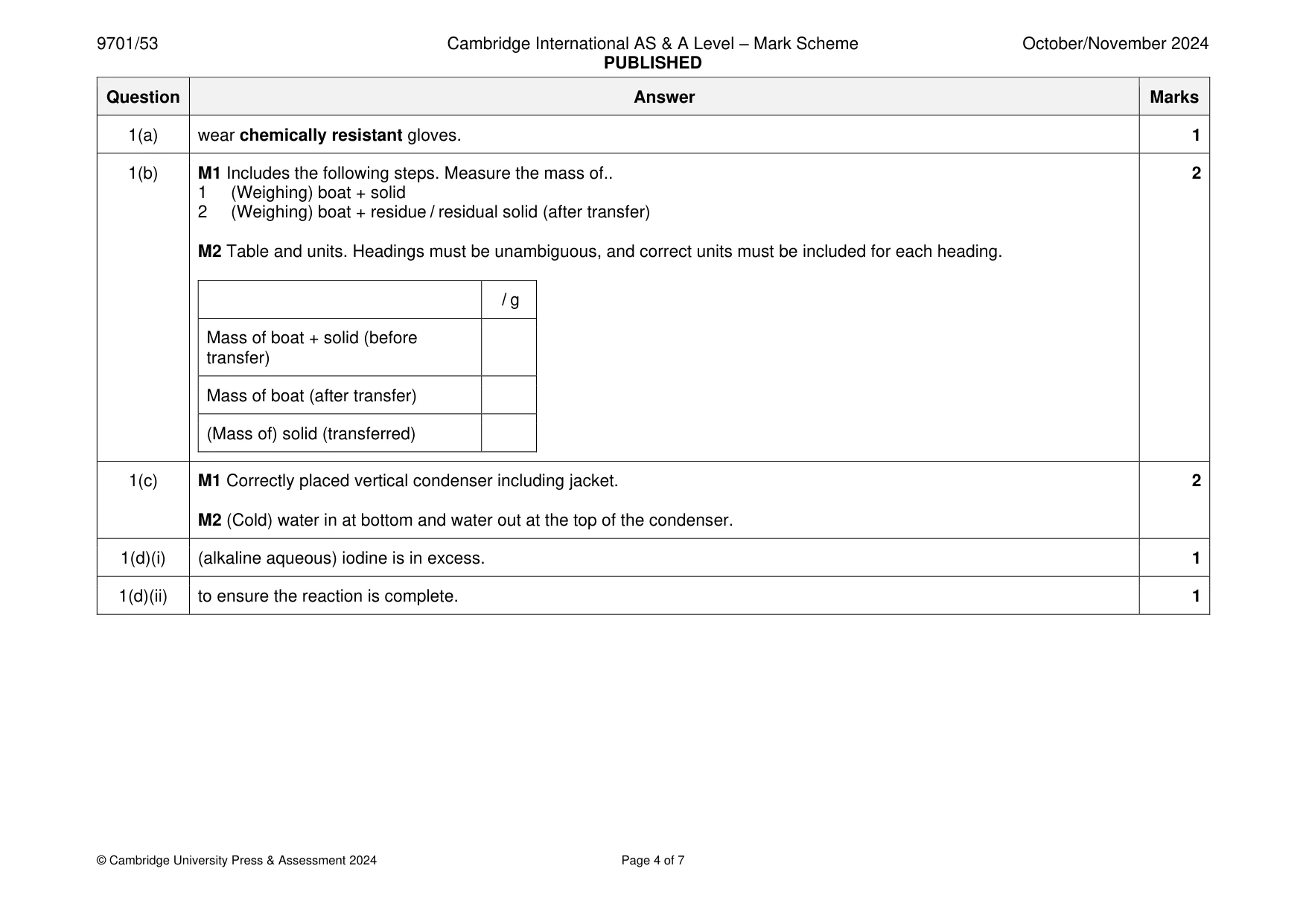
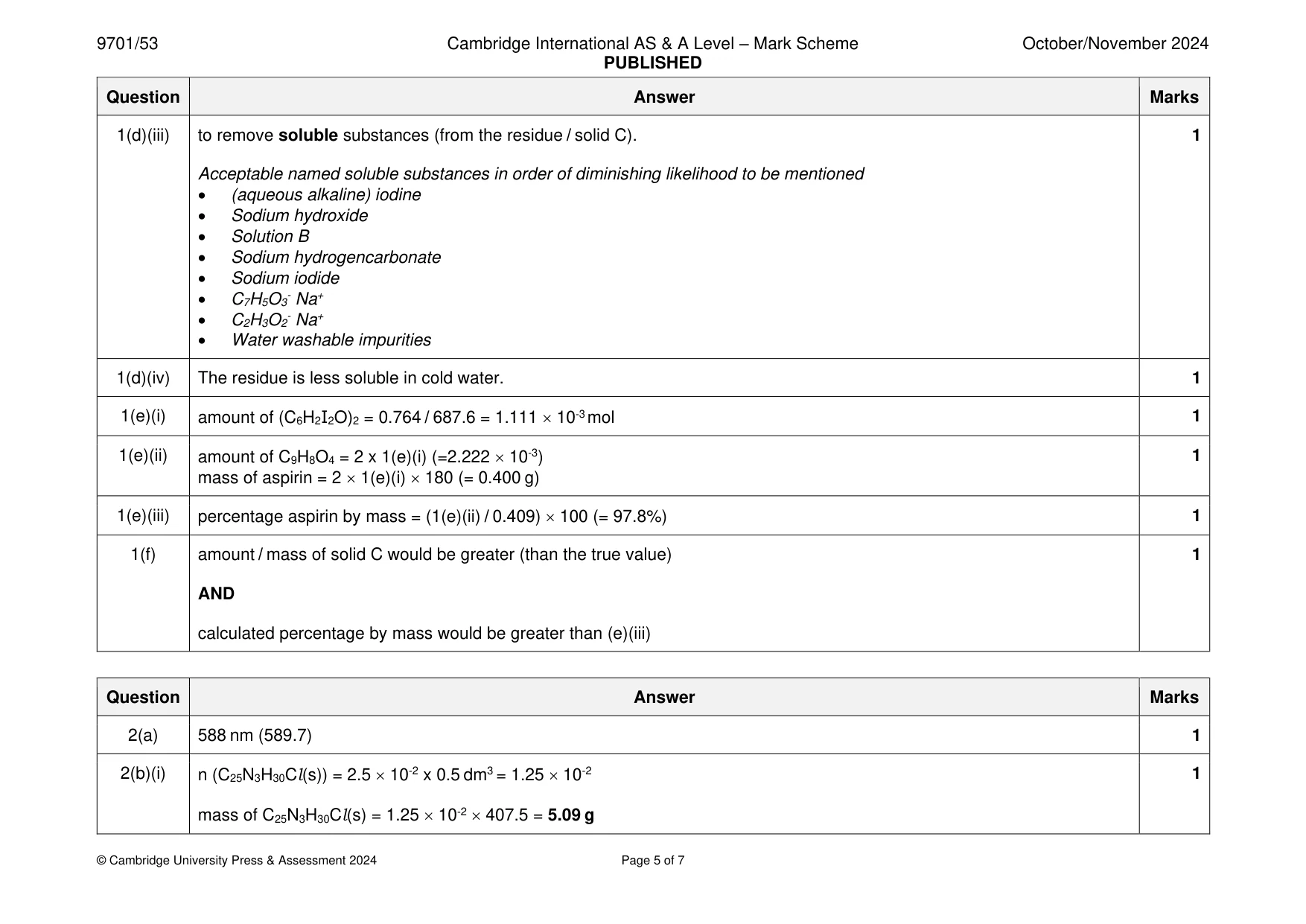
Mark scheme: Question Answer Marks 1(a) wear chemically resistant gloves. 1 1(b) M1 Includes the following steps. Measure the mass of.. 2 1 (Weighing) boat + solid 2 (Weighing) boat + residue / residual solid (after transfer) M2 Table and units. Headings must be unambiguous, and correct units must be included for each heading. / g Mass of boat + solid (before transfer) Mass of boat (after transfer) (Mass of) solid (transferred) 1(c) M1 Correctly placed vertical condenser including jacket. 2 M2 (Cold) water in at bottom and water out at the top of the condenser. 1(d)(i) (alkaline aqueous) iodine is in excess. 1 1(d)(ii) to ensure the reaction is complete. 1 1(d)(iii) to remove soluble substances (from the residue / solid C). 1 Acceptable named soluble substances in order of diminishing likelihood to be mentioned • (aqueous alkaline) iodine • Sodium hydroxide • Solution B • Sodium hydrogencarbonate • Sodium iodide • C7H5O3- Na+ • C2H3O2- Na+ • Water washable impurities 1(d)(iv) The residue is less soluble in cold water. 1 1(e)(i) amount of (C6H2I2O)2 = 0.764 / 687.6 = 1.111 10-3 mol 1 1(e)(ii) amount of C9H8O4 = 2 x 1(e)(i) (=2.222 10-3) 1 mass of aspirin = 2 1(e)(i) 180 (= 0.400 g) 1(e)(iii) percentage aspirin by mass = (1(e)(ii) / 0.409) 100 (= 97.8%) 1 1(f) amount / mass of solid C would be greater (than the true value) 1 AND calculated percentage by mass would be greater than (e)(iii)
More questions on Reacting masses and volumes (of solutions and gases)
Q2 · Crystal violet, C25H30N3Cl (s), is a purple dye
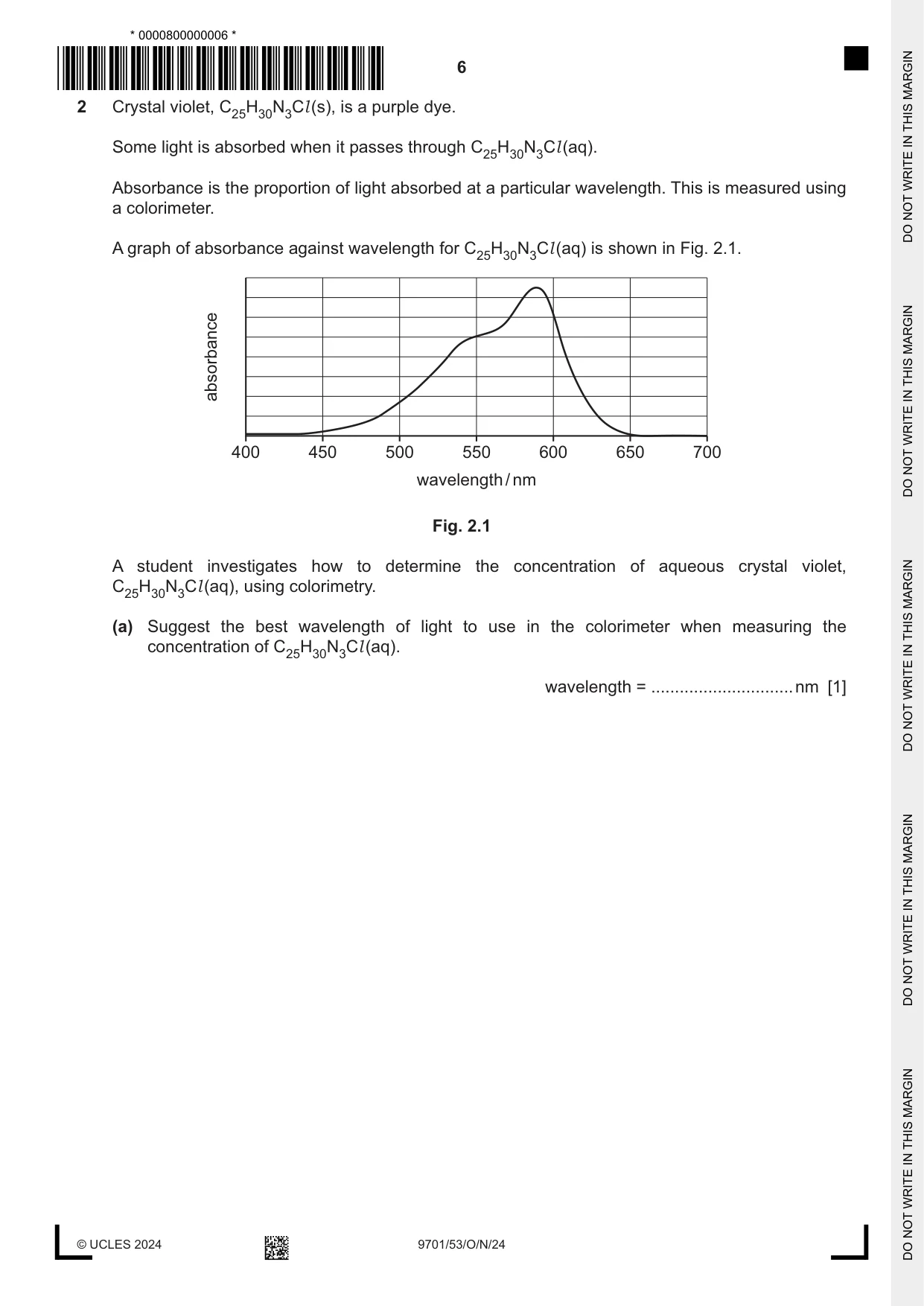
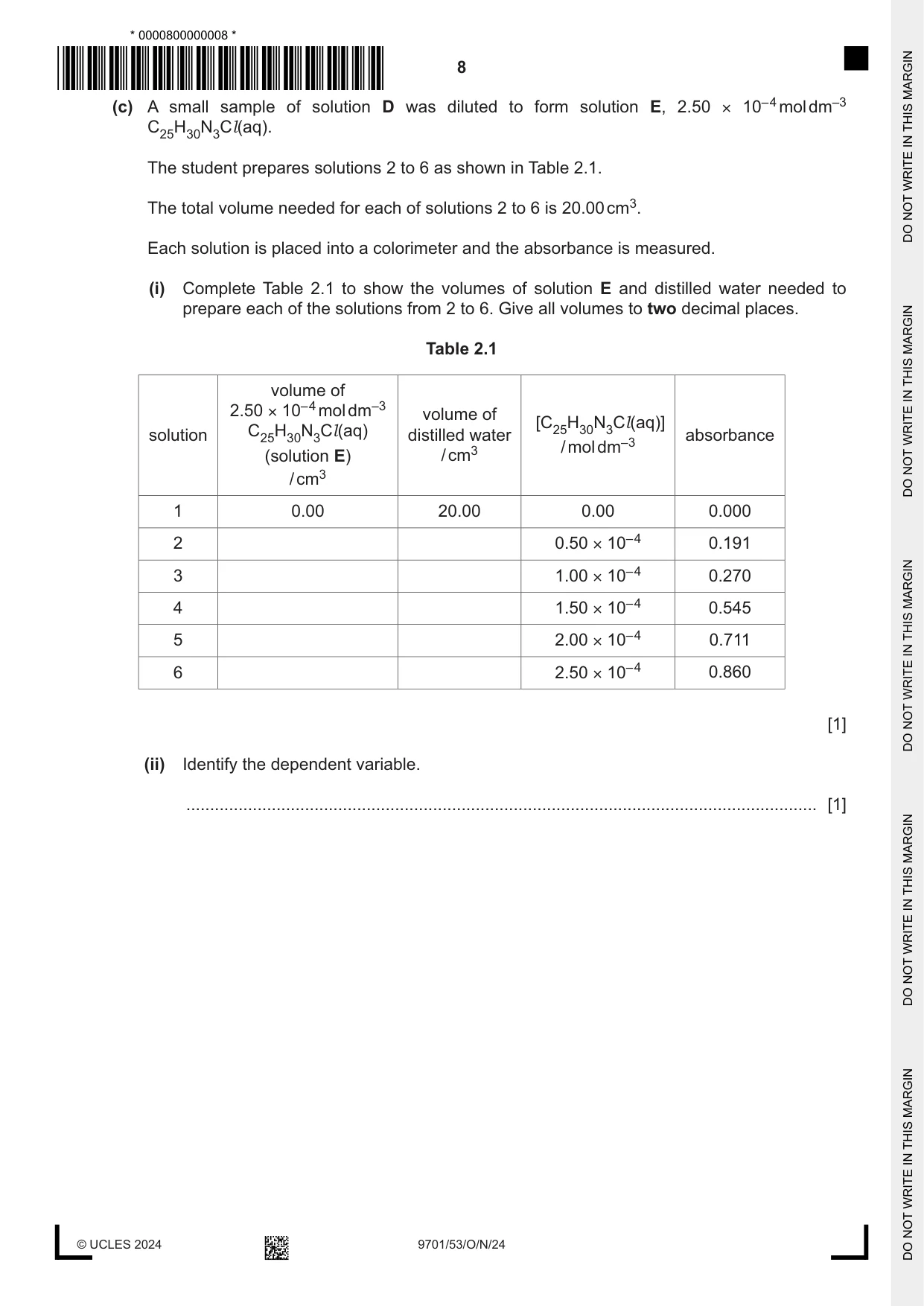
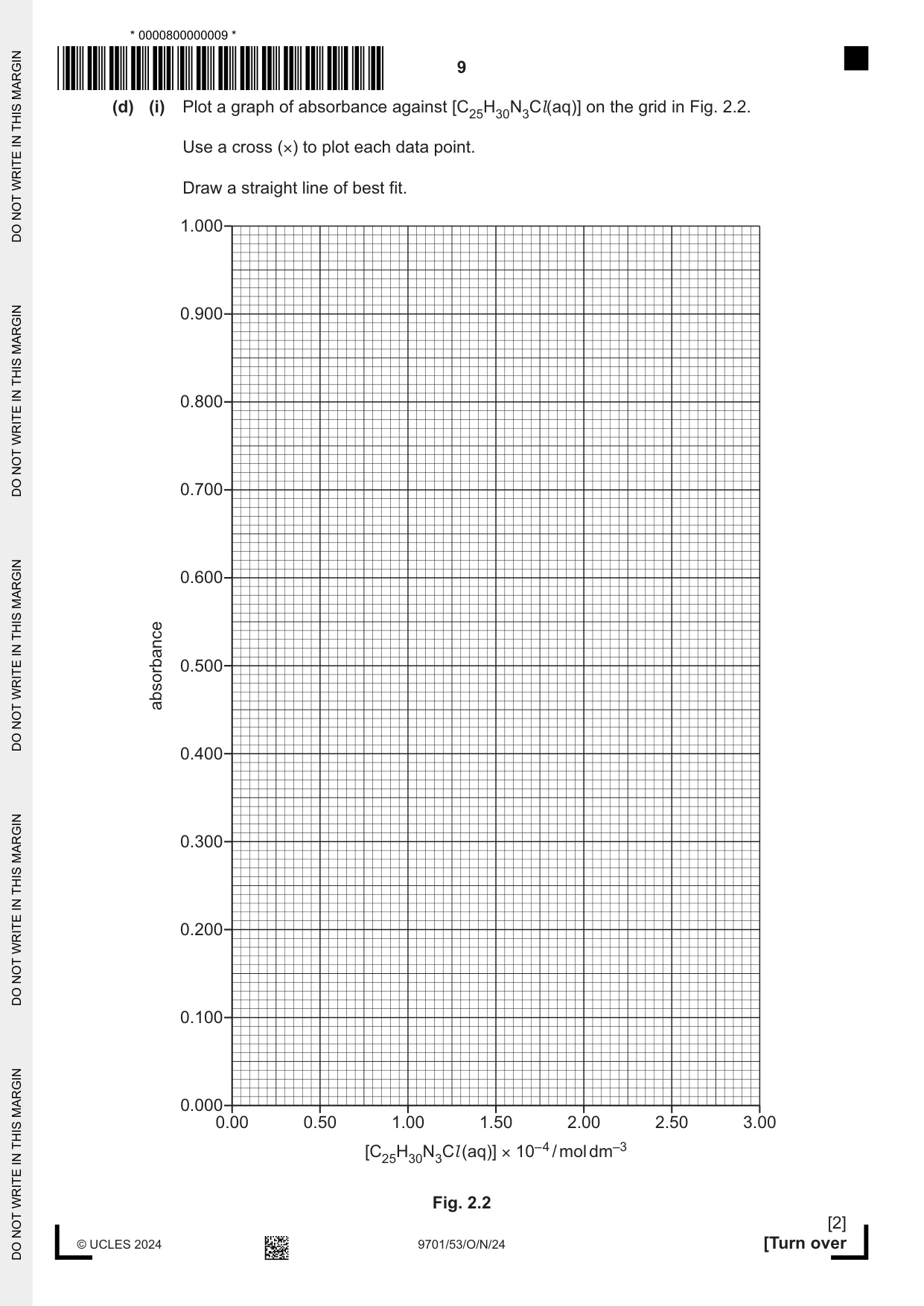
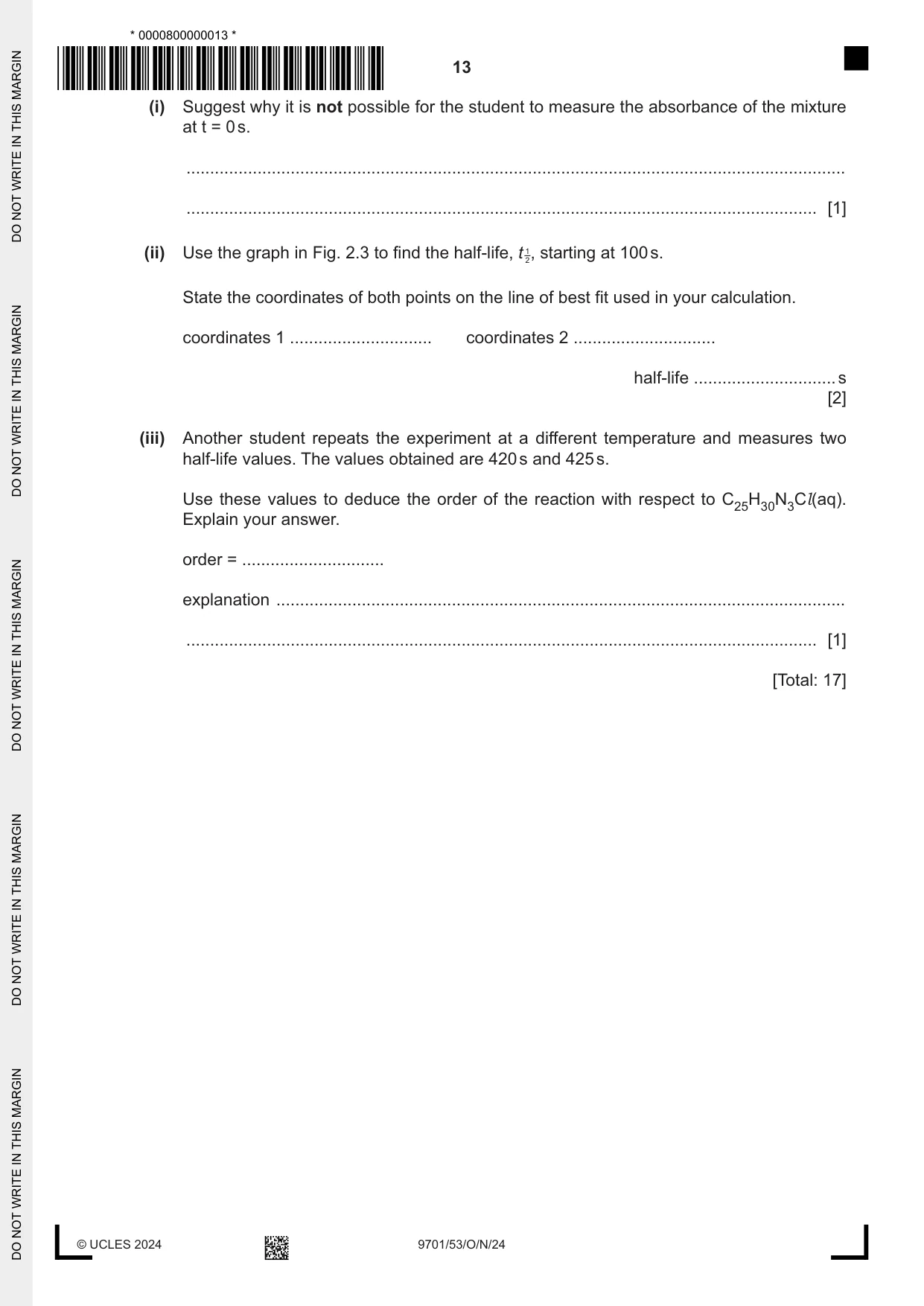
2 Crystal violet, C25H30N3Cl (s), is a purple dye. Some light is absorbed when it passes through C25H30N3Cl (aq). Absorbance is the proportion of light absorbed at a particular wavelength. This is measured using a colorimeter. A graph of absorbance against wavelength for C25H30N3Cl (aq) is shown in Fig. 2.1. absorbance 400 450 500 550 600 650 700 wavelength / nm Fig. 2.1 A student investigates how to determine the concentration of aqueous crystal violet, C25H30N3Cl (aq), using colorimetry. (a) Suggest the best wavelength of light to use in the colorimeter when measuring the concentration of C25H30N3Cl (aq). wavelength = .............................. nm [1] (b) Solution D is 500.0 cm3 of 2.50 × 10⁻² mol dm–3 C25H30N3Cl (aq). (i) Calculate the mass of C25H30N3Cl (s) needed to prepare solution D. Give your answer to three significant figures. [Mr: C25H30N3Cl (s), 407.5] mass of C25H30N3Cl (s) = .............................. g [1] (ii) The student is given a small beaker containing the mass of C25H30N3Cl (s) calculated in (i). Describe how the student should prepare 500.0 cm3 of solution D. Include the name and capacity of the key apparatus which should be used and describe how the student should ensure the volume is exactly 500.0 cm3. ........................................................................................................................................... ........................................................................................................................................... ........................................................................................................................................... ........................................................................................................................................... ........................................................................................................................................... ........................................................................................................................................... ..................................................................................................................................... [3] (c) A small sample of solution D was diluted to form solution E, 2.50 × 10– 4 mol dm–3 C25H30N3Cl(aq). The student prepares solutions 2 to 6 as shown in Table 2.1. The total volume needed for each of solutions 2 to 6 is 20.00 cm3. Each solution is placed into a colorimeter and the absorbance is measured. (i) Complete Table 2.1 to show the volumes of solution E and distilled water needed to prepare each of the solutions from 2 to 6. Give all volumes to two decimal places. Table 2.1 volume of 2.50 × 10– 4 mol dm–3 volume of [C25H30N3Cl(aq)] solution C25H30N3Cl(aq) distilled water absorbance / mol dm–3 (solution E) / cm3 / cm3 1 0.00 20.00 0.00 0.000 2 0.50 × 10– 4 0.191 3 1.00 × 10– 4 0.270 4 1.50 × 10– 4 0.545 5 2.00 × 10– 4 0.711 6 2.50 × 10– 4 0.860 [1] (ii) Identify the dependent variable. ..................................................................................................................................... [1]
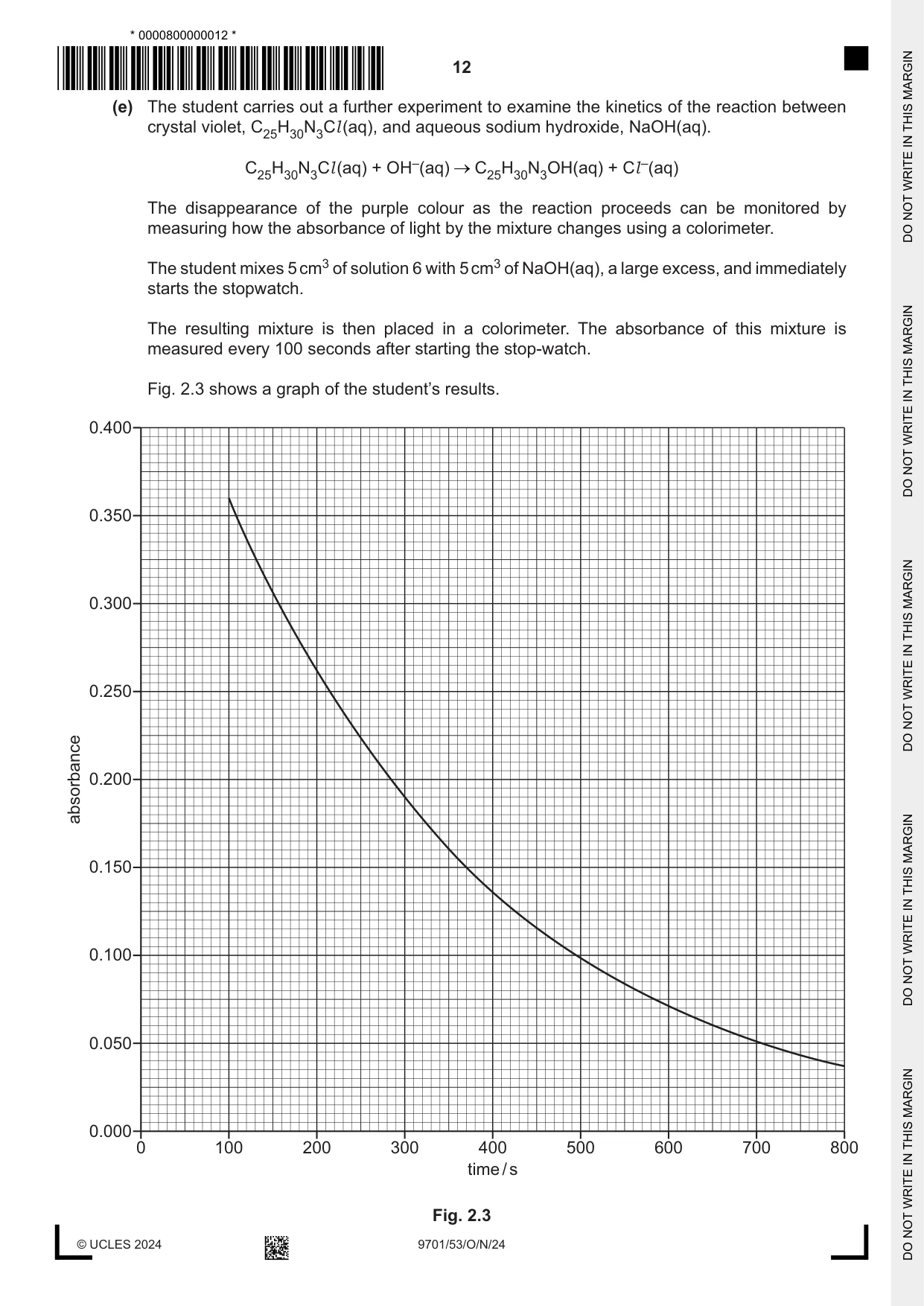
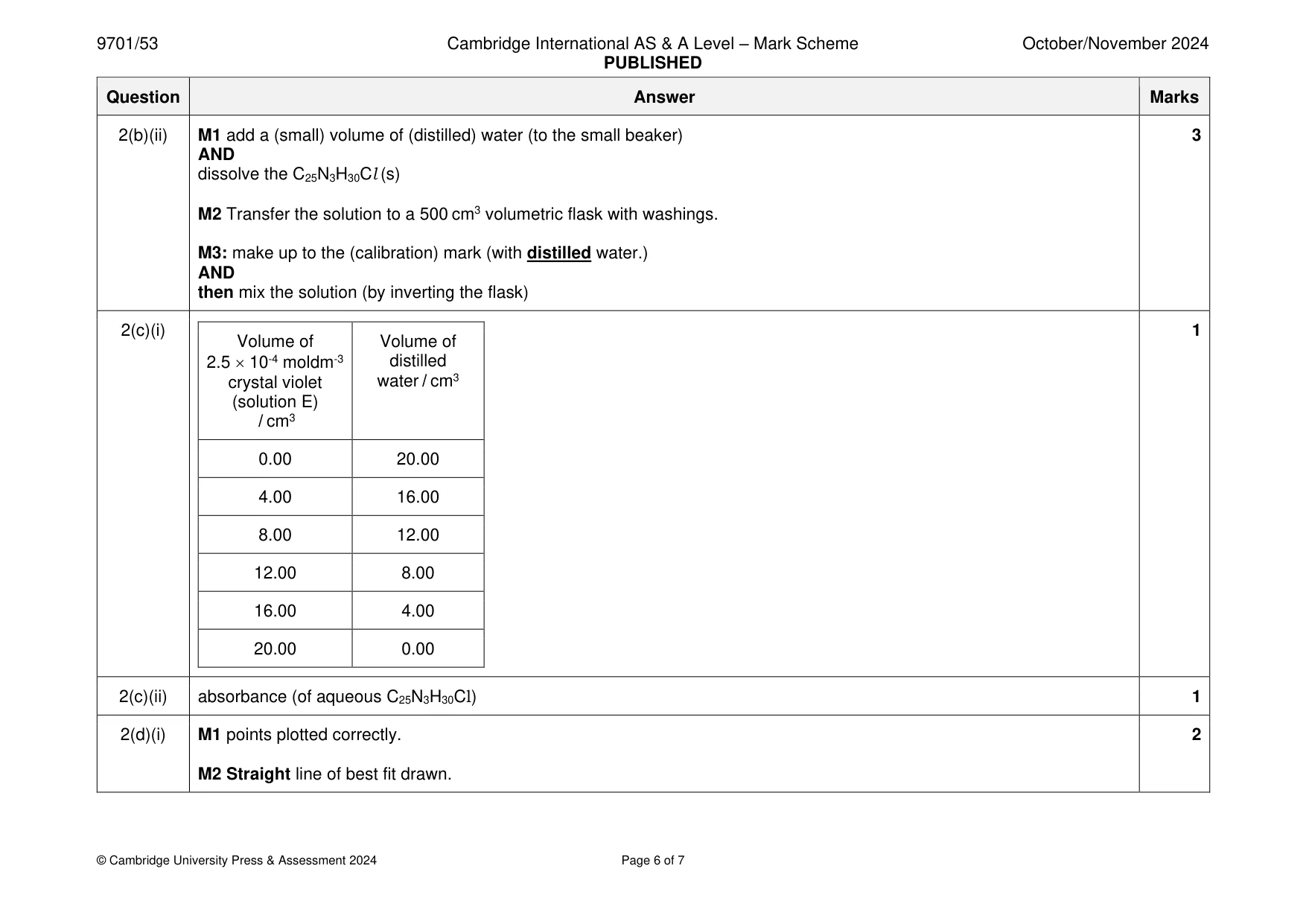
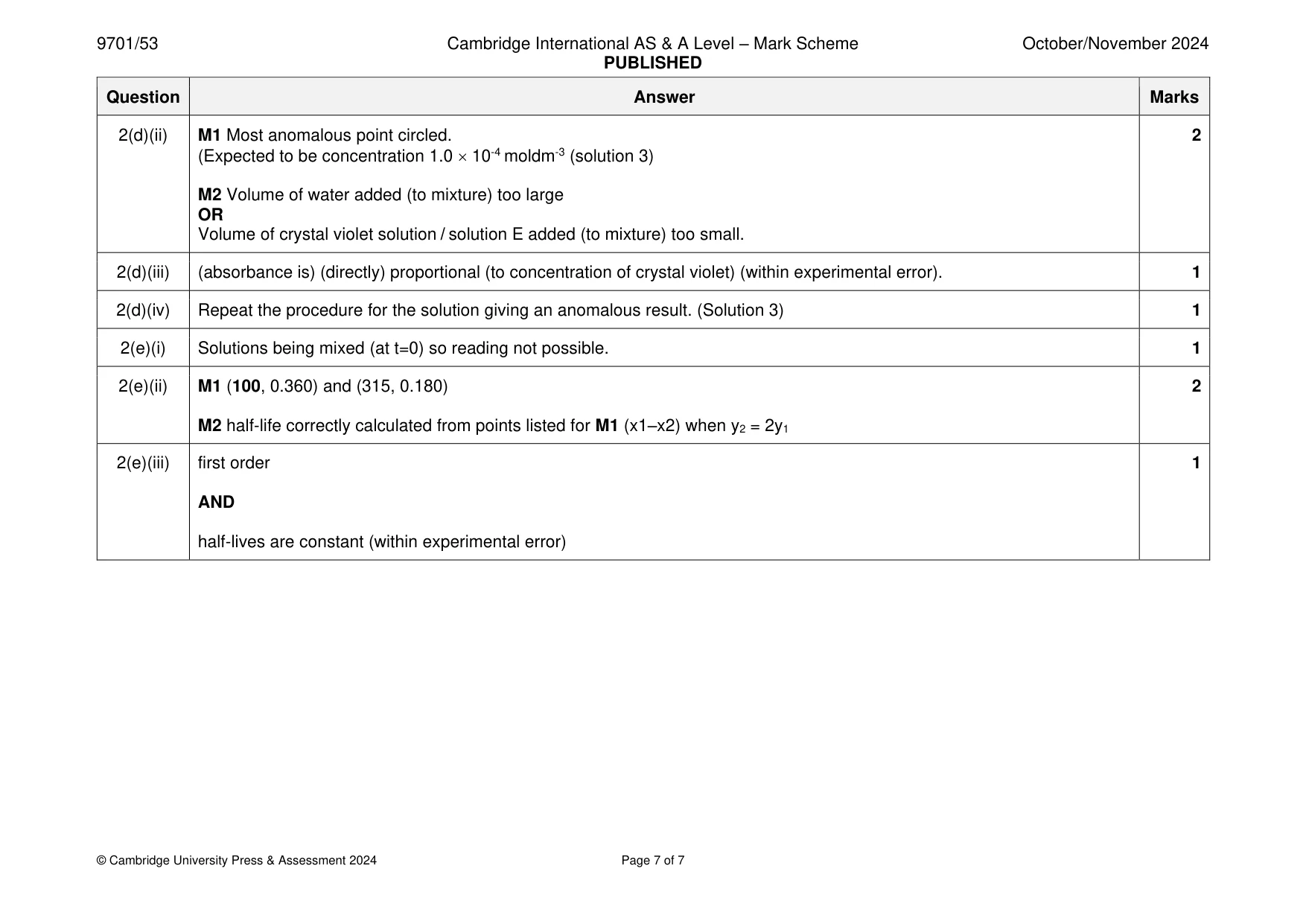
Mark scheme: 2(a) 588 nm (589.7) 1 2(b)(i) n (C25N3H30Cl(s)) = 2.5 10-2 x 0.5 dm3 = 1.25 10-2 1 mass of C25N3H30Cl(s) = 1.25 10-2 407.5 = 5.09 g 2(b)(ii) M1 add a (small) volume of (distilled) water (to the small beaker) 3 AND dissolve the C25N3H30Cl (s) M2 Transfer the solution to a 500 cm3 volumetric flask with washings. M3: make up to the (calibration) mark (with distilled water.) AND then mix the solution (by inverting the flask) 2(c)(i) 1 Volume of Volume of 2.5 10-4 moldm-3 distilled crystal violet water / cm3 (solution E) / cm3 0.00 20.00 4.00 16.00 8.00 12.00 12.00 8.00 16.00 4.00 20.00 0.00 2(c)(ii) absorbance (of aqueous C25N3H30Cl) 1 2(d)(i) M1 points plotted correctly. 2 M2 Straight line of best fit drawn. 2(d)(ii) M1 Most anomalous point circled. 2 (Expected to be concentration 1.0 10-4 moldm-3 (solution 3) M2 Volume of water added (to mixture) too large OR Volume of crystal violet solution / solution E added (to mixture) too small. 2(d)(iii) (absorbance is) (directly) proportional (to concentration of crystal violet) (within experimental error). 1 2(d)(iv) Repeat the procedure for the solution giving an anomalous result. (Solution 3) 1 2(e)(i) Solutions being mixed (at t=0) so reading not possible. 1 2(e)(ii) M1 (100, 0.360) and (315, 0.180) 2 M2 half-life correctly calculated from points listed for M1 (x1–x2) when y2 = 2y1 2(e)(iii) first order 1 AND half-lives are constant (within experimental error)
More questions on Reacting masses and volumes (of solutions and gases)
What was in this paper
The subtopics covered by these 2 questions, and how many questions each got. Open one in a new tab to see every Cambridge question on it.
What you needed in this session
Cambridge’s own grade thresholds for 2024 Oct/Nov, Paper 5 · Variant 3. A higher threshold means an easier paper — the bar moves with how the cohort did.