Cambridge A Level Chemistry 9701 — 2024 Oct/Nov Paper 2 · Variant 1
9701/21/O/N/24 · 4 questions · 60 marks · ≈68 min
The question paper and its mark scheme, free to read here and free to download. This is Cambridge’s own paper, exactly as it was sat.
Question paper20 pages
Mark scheme11 pages
Answers below. Sit the paper first if you are practising.
Questions as text
Q1 · Cobalt, rhodium and iridium are metals in the same group of the Periodic Table
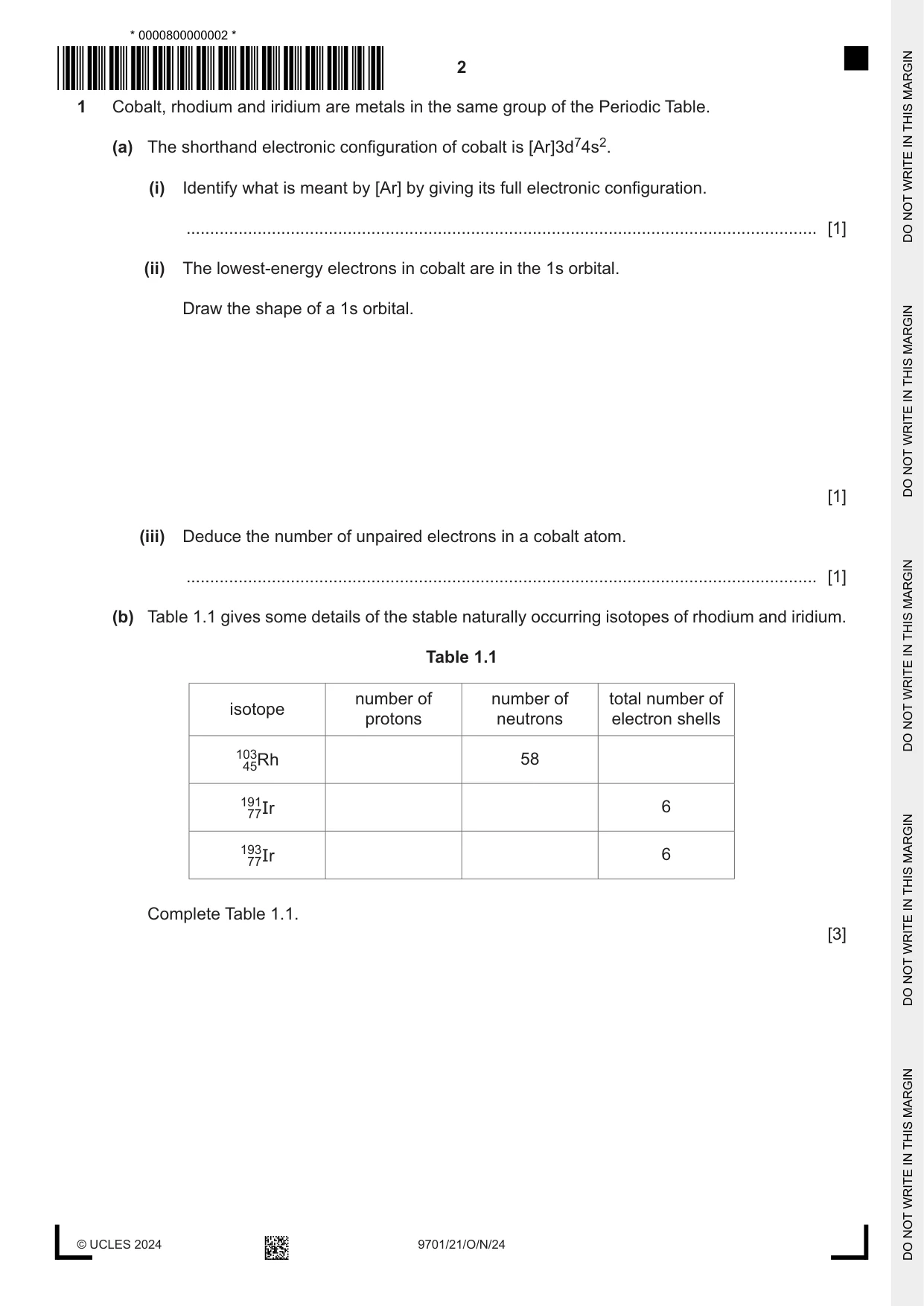
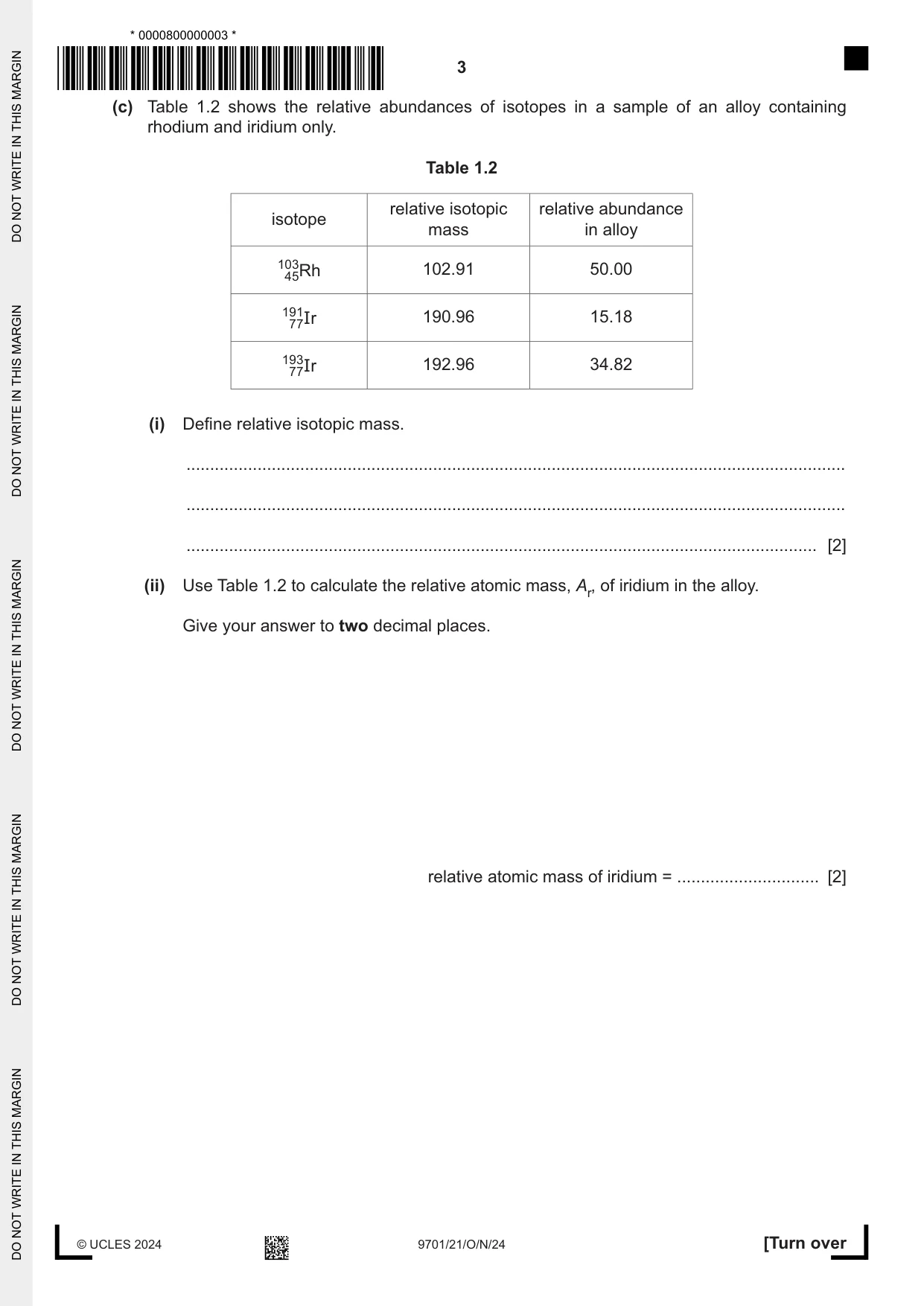
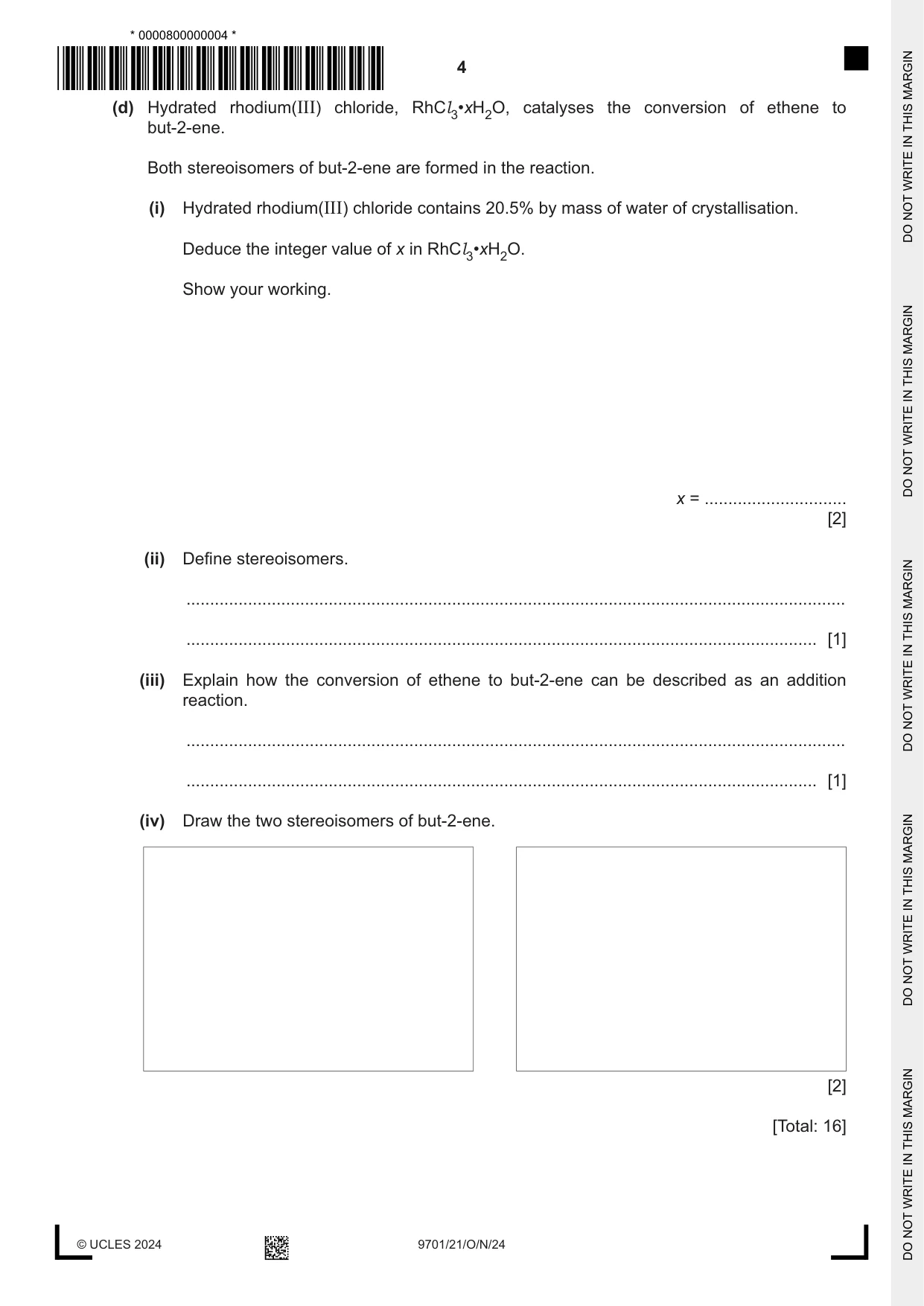
1 Cobalt, rhodium and iridium are metals in the same group of the Periodic Table. (a) The shorthand electronic configuration of cobalt is [Ar]3d74s2. (i) Identify what is meant by [Ar] by giving its full electronic configuration. ..................................................................................................................................... [1] (ii) The lowest-energy electrons in cobalt are in the 1s orbital. Draw the shape of a 1s orbital. [1] (iii) Deduce the number of unpaired electrons in a cobalt atom. ..................................................................................................................................... [1] (b) Table 1.1 gives some details of the stable naturally occurring isotopes of rhodium and iridium. Table 1.1 number of number of total number of isotope protons neutrons electron shells 10345Rh 58 19177Ir 6 19377Ir 6 Complete Table 1.1. [3] (c) Table 1.2 shows the relative abundances of isotopes in a sample of an alloy containing rhodium and iridium only. Table 1.2 relative isotopic relative abundance isotope mass in alloy 10345Rh 102.91 50.00 19177Ir 190.96 15.18 19377Ir 192.96 34.82 (i) Define relative isotopic mass. ........................................................................................................................................... ........................................................................................................................................... ..................................................................................................................................... [2] (ii) Use Table 1.2 to calculate the relative atomic mass, Ar, of iridium in the alloy. Give your answer to two decimal places. relative atomic mass of iridium = .............................. [2] (d) Hydrated rhodium(III) chloride, RhCl3•xH2O, catalyses the conversion of ethene to but-2-ene. Both stereoisomers of but-2-ene are formed in the reaction. (i) Hydrated rhodium(III) chloride contains 20.5% by mass of water of crystallisation. Deduce the integer value of x in RhCl3•xH2O. Show your working. x = .............................. [2] (ii) Define stereoisomers. ........................................................................................................................................... ..................................................................................................................................... [1] (iii) Explain how the conversion of ethene to but-2-ene can be described as an addition reaction. ........................................................................................................................................... ..................................................................................................................................... [1] (iv) Draw the two stereoisomers of but-2-ene. [2] [Total: 16]
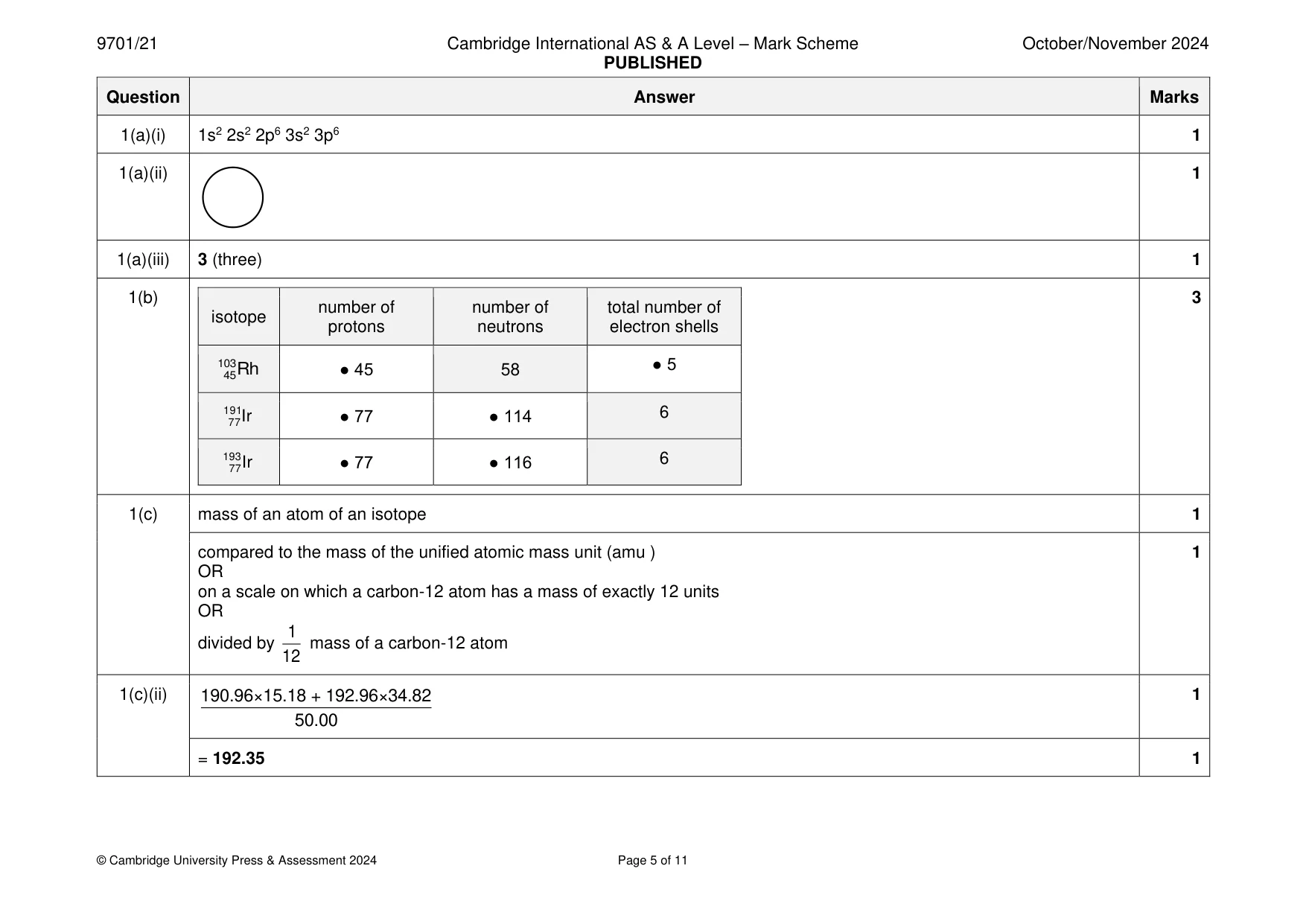
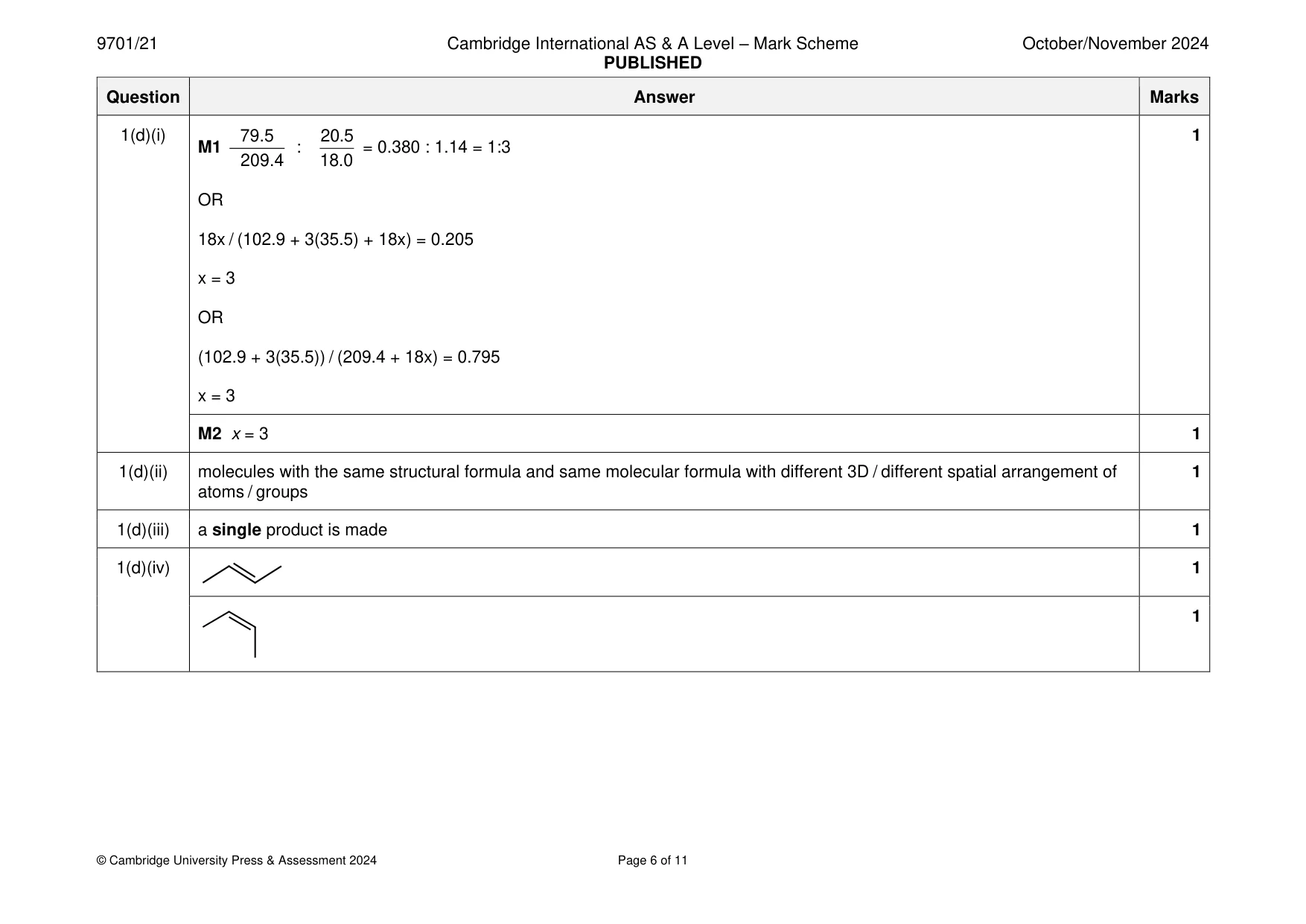
Mark scheme: Question Answer Marks 1(a)(i) 1s2 2s2 2p6 3s2 3p6 1 1(a)(ii) 1 1(a)(iii) 3 (three) 1 1(b) 3 number of number of total number of isotope protons neutrons electron shells 10345Rh ● 45 58 ● 5 19177Ir ● 77 ● 114 6 19377Ir ● 77 ● 116 6 1(c) mass of an atom of an isotope 1 compared to the mass of the unified atomic mass unit (amu ) 1 OR on a scale on which a carbon-12 atom has a mass of exactly 12 units OR 1 divided by mass of a carbon-12 atom 12 1(c)(ii) 190.96×15.18 + 192.96×34.82 1 50.00 = 192.35 1 1(d)(i) 79.5 20.5 1 M1 : = 0.380 : 1.14 = 1:3 209.4 18.0 OR 18x / (102.9 + 3(35.5) + 18x) = 0.205 x = 3 OR (102.9 + 3(35.5)) / (209.4 + 18x) = 0.795 x = 3 M2 x = 3 1 1(d)(ii) molecules with the same structural formula and same molecular formula with different 3D / different spatial arrangement of 1 atoms / groups 1(d)(iii) a single product is made 1 1(d)(iv) 1 1
More questions on Electrons, energy levels and atomic orbitals
Q2 · Chlorine is one of the elements in Group 17 of the Periodic Table
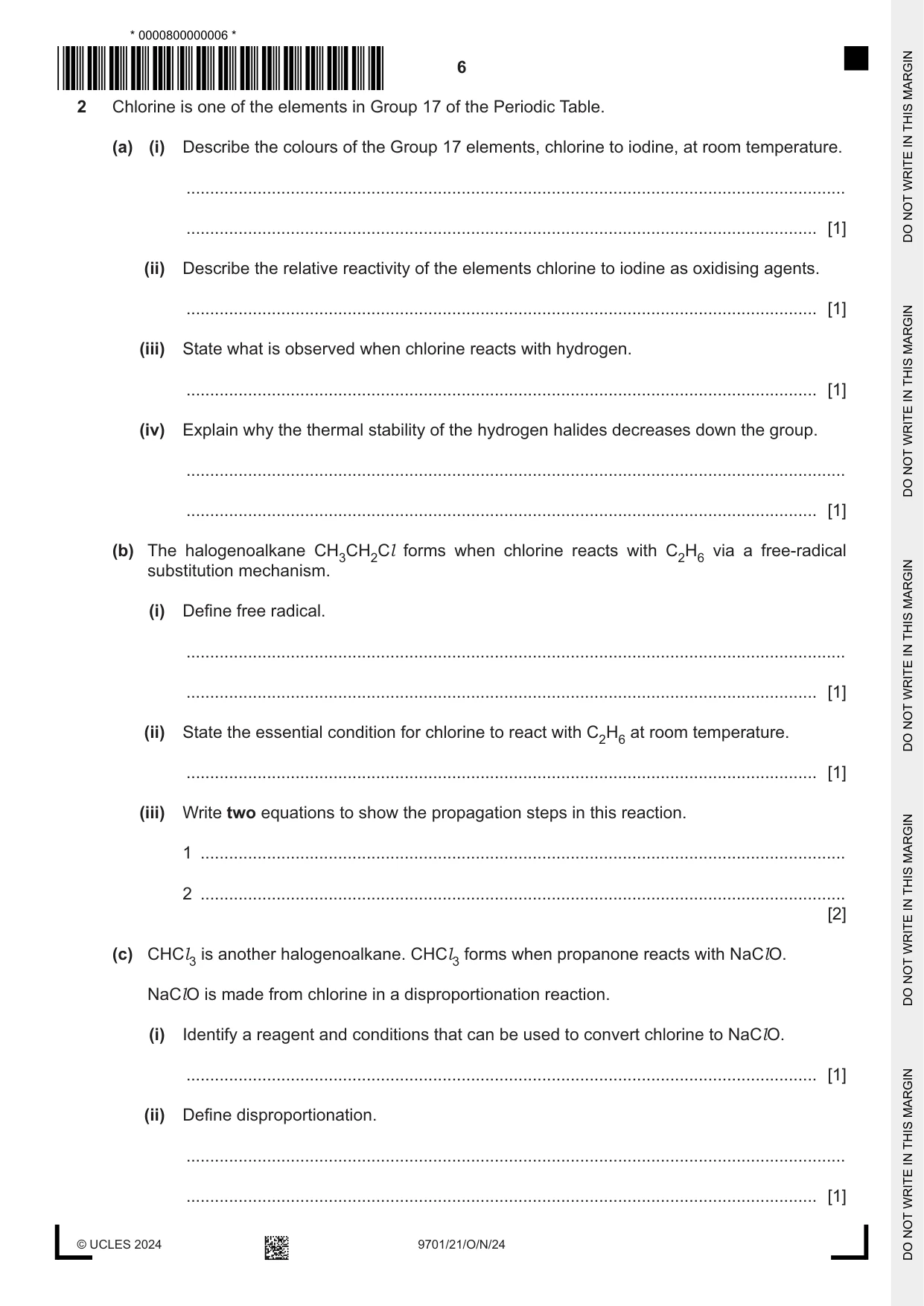
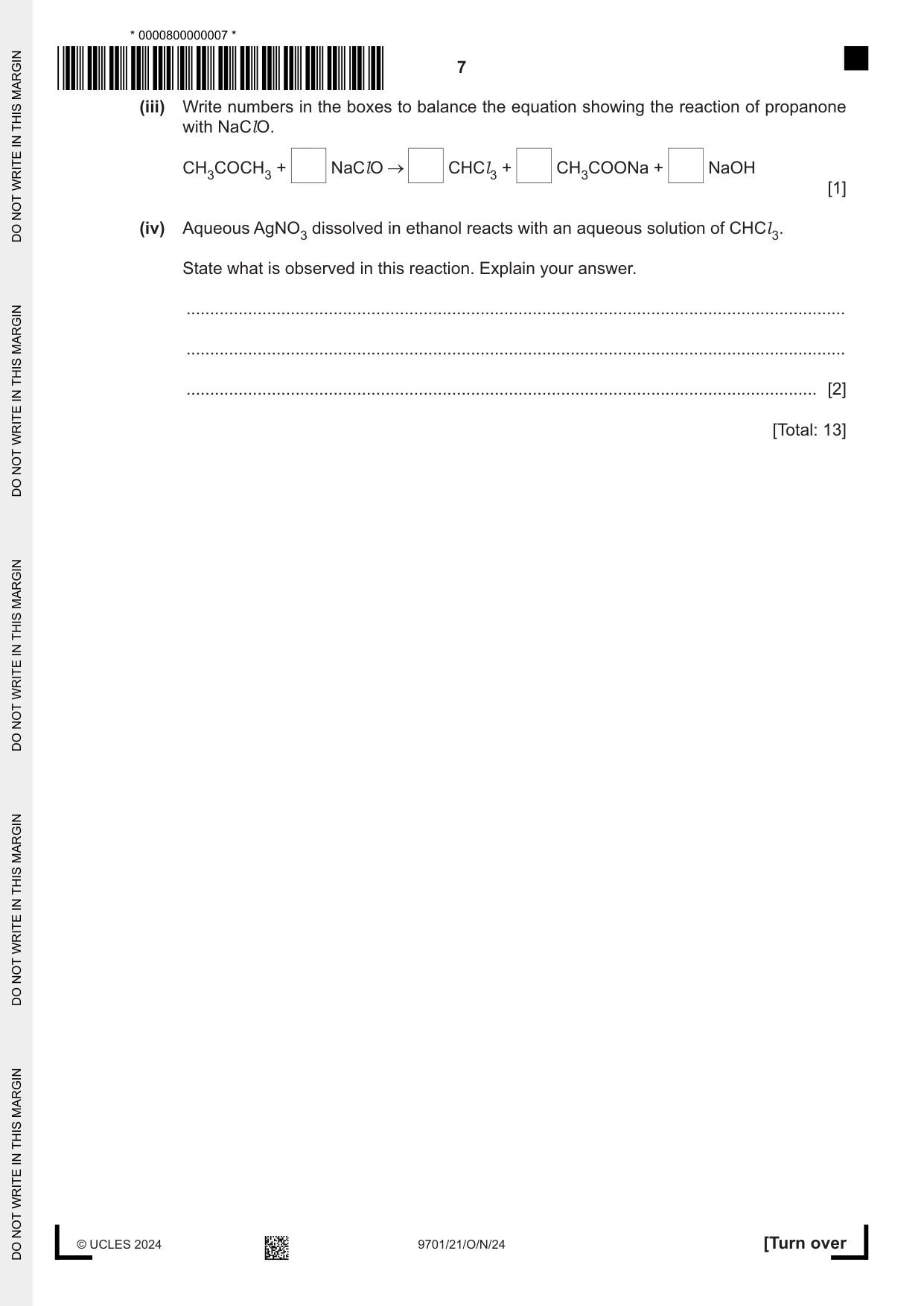
2 Chlorine is one of the elements in Group 17 of the Periodic Table. (a) (i) Describe the colours of the Group 17 elements, chlorine to iodine, at room temperature. ........................................................................................................................................... ..................................................................................................................................... [1] (ii) Describe the relative reactivity of the elements chlorine to iodine as oxidising agents. ..................................................................................................................................... [1] (iii) State what is observed when chlorine reacts with hydrogen. ..................................................................................................................................... [1] (iv) Explain why the thermal stability of the hydrogen halides decreases down the group. ........................................................................................................................................... ..................................................................................................................................... [1] (b) The halogenoalkane CH3CH2Cl forms when chlorine reacts with C2H6 via a free-radical substitution mechanism. (i) Define free radical. ........................................................................................................................................... ..................................................................................................................................... [1] (ii) State the essential condition for chlorine to react with C2H6 at room temperature. ..................................................................................................................................... [1] (iii) Write two equations to show the propagation steps in this reaction. 1 ........................................................................................................................................ 2 ........................................................................................................................................ [2] (c) CHCl3 is another halogenoalkane. CHCl3 forms when propanone reacts with NaClO. NaClO is made from chlorine in a disproportionation reaction. (i) Identify a reagent and conditions that can be used to convert chlorine to NaClO. ..................................................................................................................................... [1] (ii) Define disproportionation. ........................................................................................................................................... ..................................................................................................................................... [1] (iii) Write numbers in the boxes to balance the equation showing the reaction of propanone with NaClO. CH3COCH3 + NaClO CHCl3 + CH3COONa + NaOH [1] (iv) Aqueous AgNO3 dissolved in ethanol reacts with an aqueous solution of CHCl 3. State what is observed in this reaction. Explain your answer. ........................................................................................................................................... ........................................................................................................................................... ..................................................................................................................................... [2] [Total: 13]
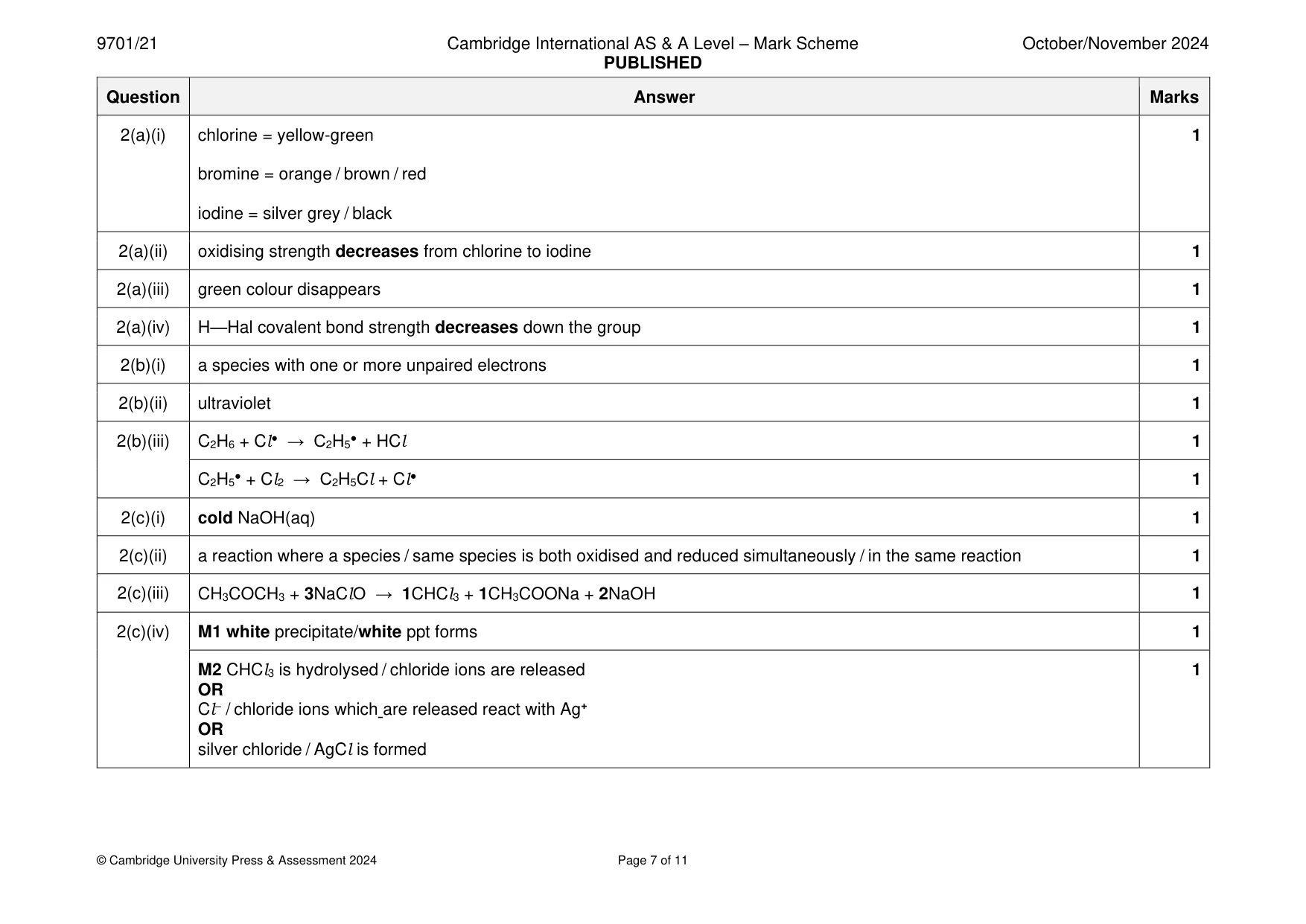
Mark scheme: 2(a)(i) chlorine = yellow-green 1 bromine = orange / brown / red iodine = silver grey / black 2(a)(ii) oxidising strength decreases from chlorine to iodine 1 2(a)(iii) green colour disappears 1 2(a)(iv) H—Hal covalent bond strength decreases down the group 1 2(b)(i) a species with one or more unpaired electrons 1 2(b)(ii) ultraviolet 1 2(b)(iii) C2H6 + Cl● → C2H5● + HCl 1 C2H5● + Cl2 → C2H5Cl + Cl● 1 2(c)(i) cold NaOH(aq) 1 2(c)(ii) a reaction where a species / same species is both oxidised and reduced simultaneously / in the same reaction 1 2(c)(iii) CH3COCH3 + 3NaClO → 1CHCl3 + 1CH3COONa + 2NaOH 1 2(c)(iv) M1 white precipitate/white ppt forms 1 M2 CHCl3 is hydrolysed / chloride ions are released 1 OR Cl– / chloride ions which are released react with Ag+ OR silver chloride / AgCl is formed
Q3 · The Group 14 elements show a change from non-metallic to metallic character down the group
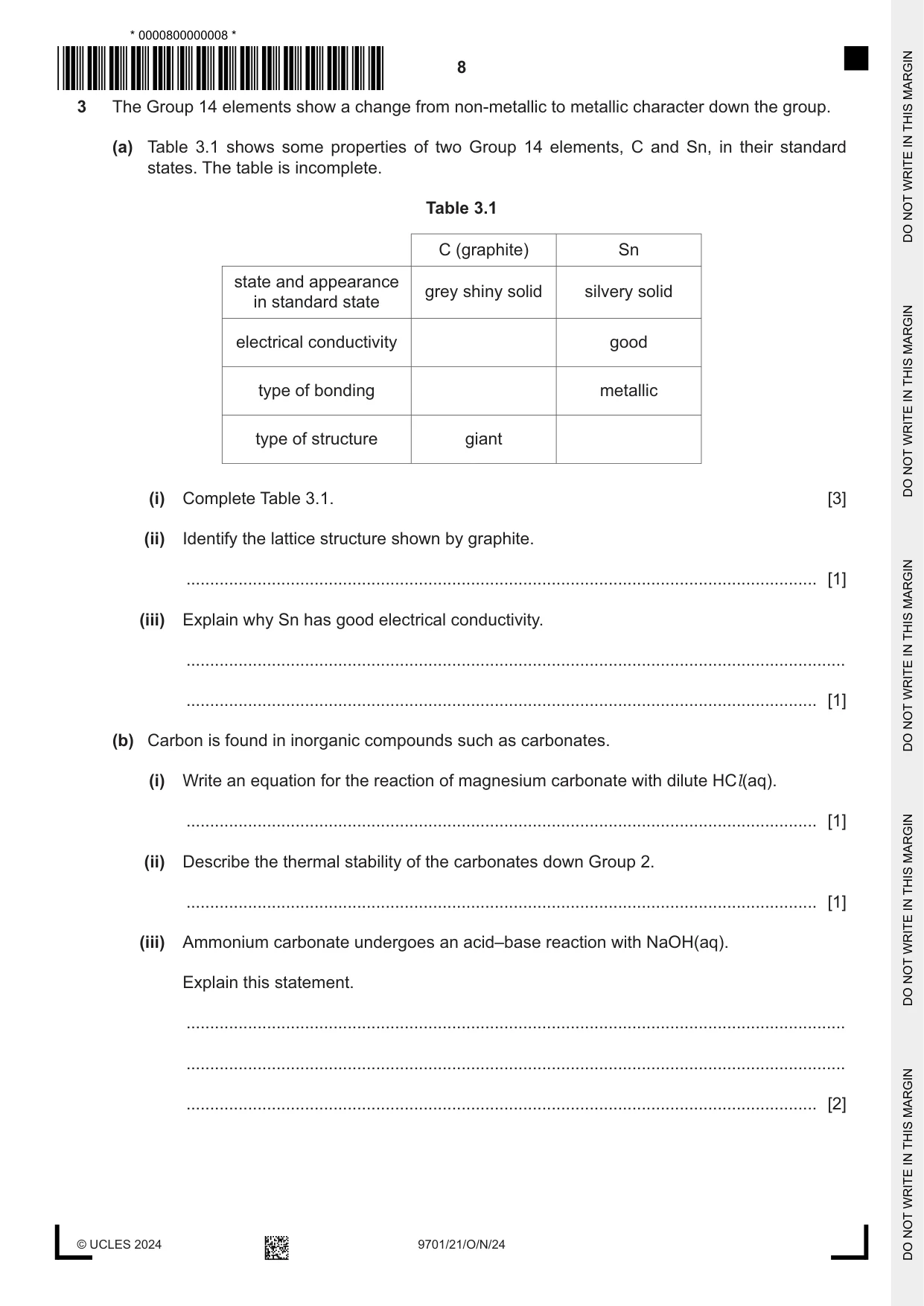
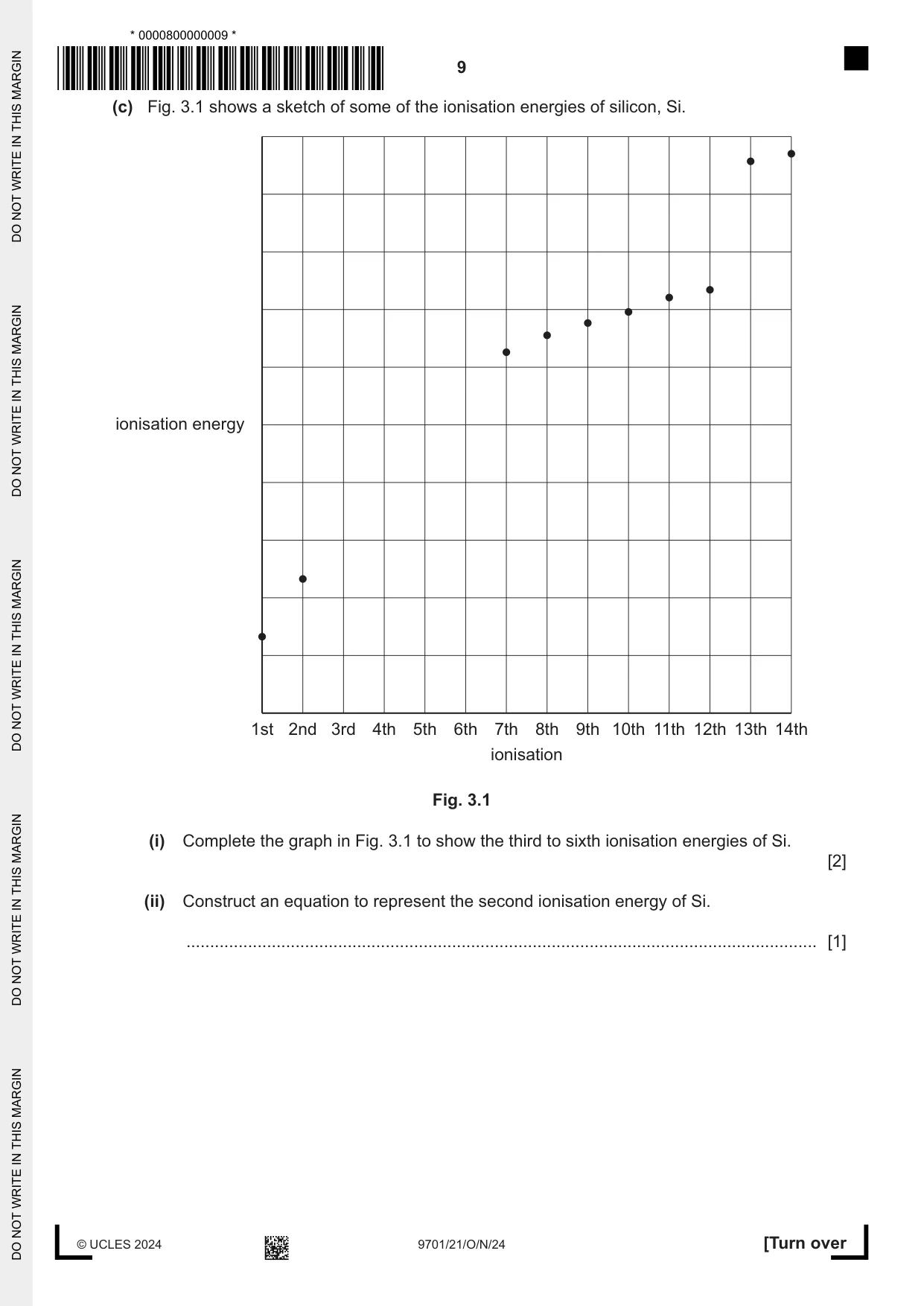
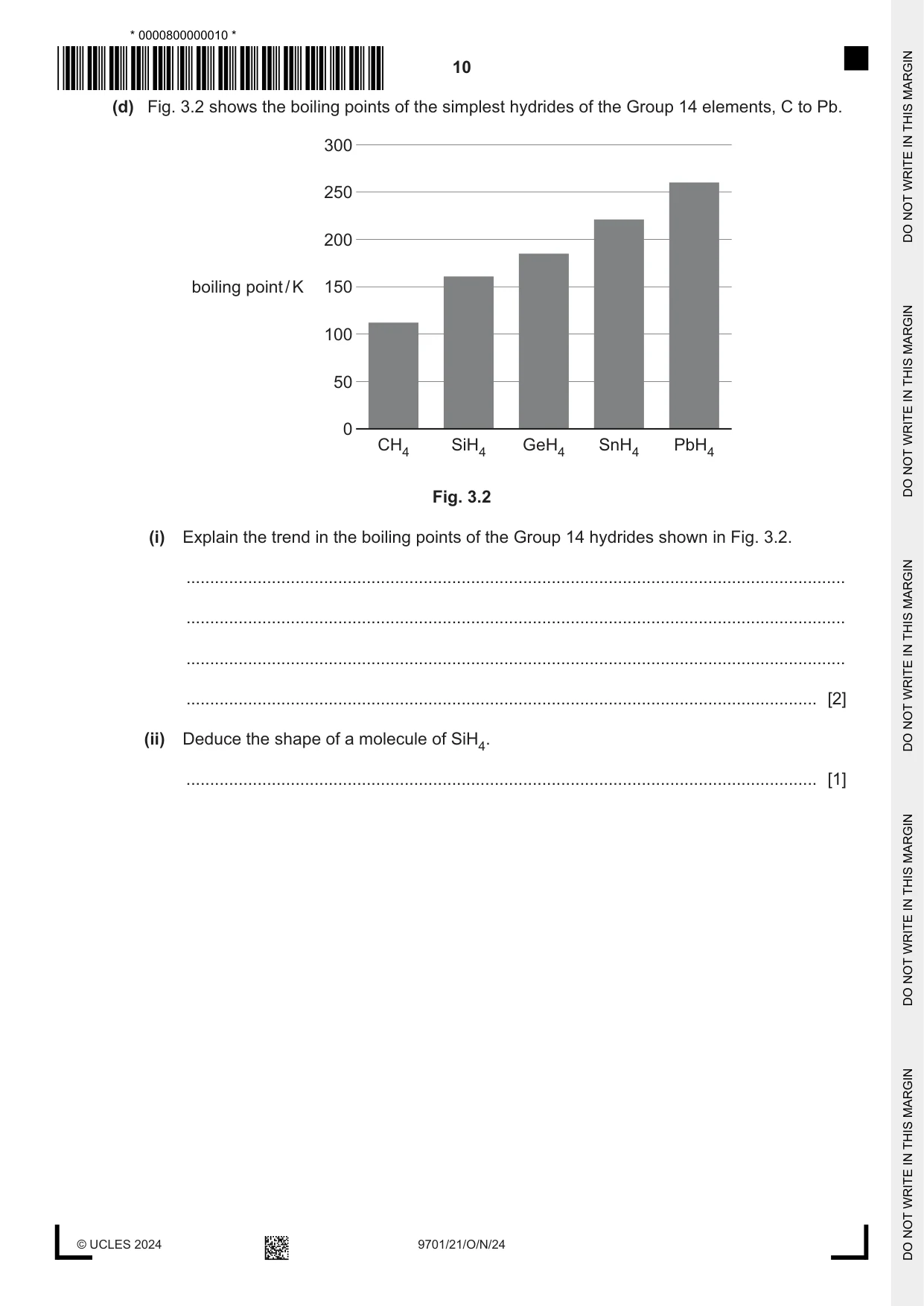
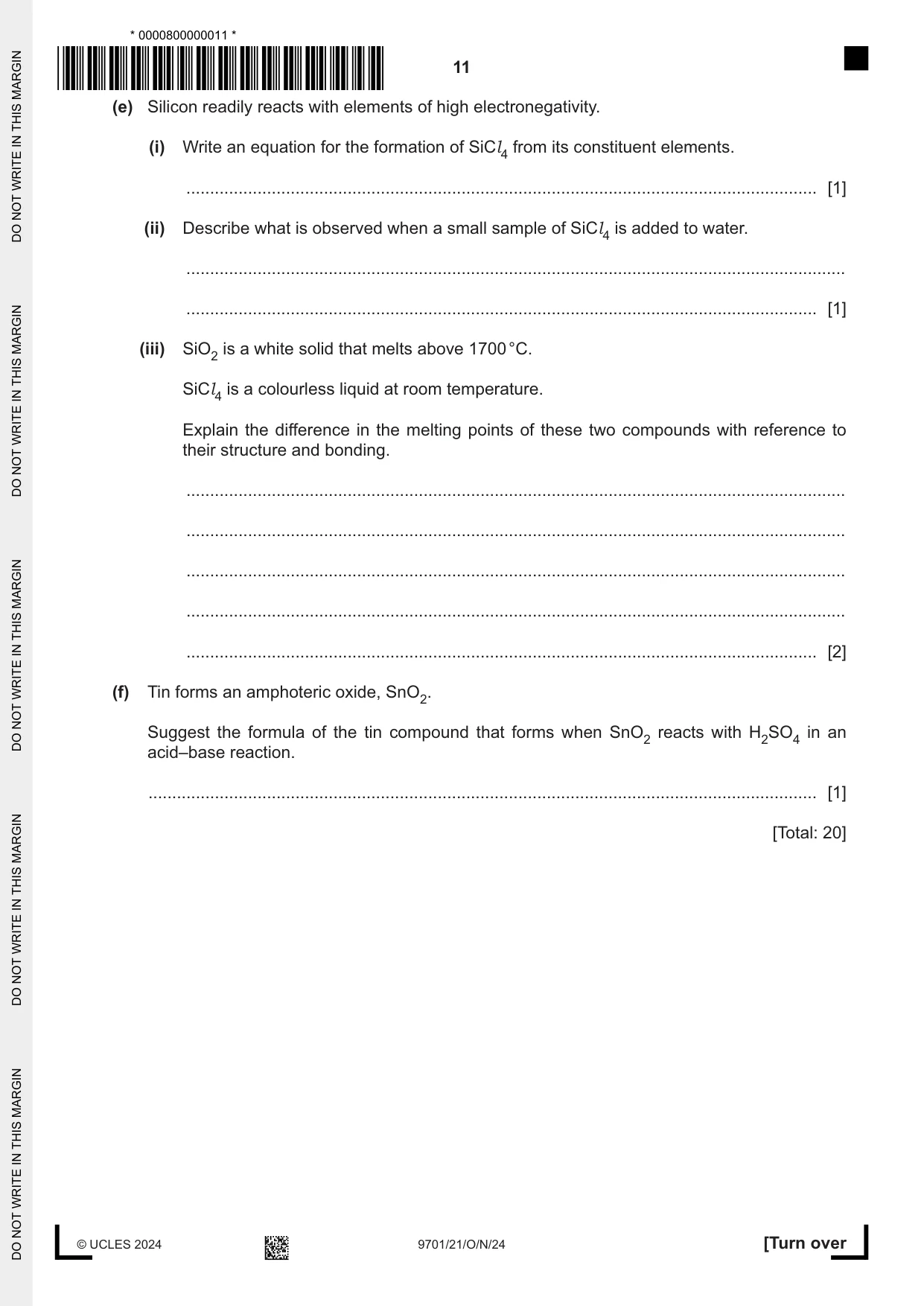
3 The Group 14 elements show a change from non-metallic to metallic character down the group. (a) Table 3.1 shows some properties of two Group 14 elements, C and Sn, in their standard states. The table is incomplete. Table 3.1 C (graphite) Sn state and appearance grey shiny solid silvery solid in standard state electrical conductivity good type of bonding metallic type of structure giant (i) Complete Table 3.1. [3] (ii) Identify the lattice structure shown by graphite. ..................................................................................................................................... [1] (iii) Explain why Sn has good electrical conductivity. ........................................................................................................................................... ..................................................................................................................................... [1] (b) Carbon is found in inorganic compounds such as carbonates. (i) Write an equation for the reaction of magnesium carbonate with dilute HCl(aq). ..................................................................................................................................... [1] (ii) Describe the thermal stability of the carbonates down Group 2. ..................................................................................................................................... [1] (iii) Ammonium carbonate undergoes an acid–base reaction with NaOH(aq). Explain this statement. ........................................................................................................................................... ........................................................................................................................................... ..................................................................................................................................... [2] (c) Fig. 3.1 shows a sketch of some of the ionisation energies of silicon, Si. ionisation energy 1st 2nd 3rd 4th 5th 6th 7th 8th 9th 10th 11th 12th 13th 14th ionisation Fig. 3.1 (i) Complete the graph in Fig. 3.1 to show the third to sixth ionisation energies of Si. [2] (ii) Construct an equation to represent the second ionisation energy of Si. ..................................................................................................................................... [1] (d) Fig. 3.2 shows the boiling points of the simplest hydrides of the Group 14 elements, C to Pb. 300 250 200 boiling point / K 150 100 50 0 CH4 SiH4 GeH4 SnH4 PbH4 Fig. 3.2 (i) Explain the trend in the boiling points of the Group 14 hydrides shown in Fig. 3.2. ........................................................................................................................................... ........................................................................................................................................... ........................................................................................................................................... ..................................................................................................................................... [2] (ii) Deduce the shape of a molecule of SiH4. ..................................................................................................................................... [1] (e) Silicon readily reacts with elements of high electronegativity. (i) Write an equation for the formation of SiCl4 from its constituent elements. ..................................................................................................................................... [1] (ii) Describe what is observed when a small sample of SiCl4 is added to water. ........................................................................................................................................... ..................................................................................................................................... [1] (iii) SiO2 is a white solid that melts above 1700 °C. SiCl4 is a colourless liquid at room temperature. Explain the difference in the melting points of these two compounds with reference to their structure and bonding. ........................................................................................................................................... ........................................................................................................................................... ........................................................................................................................................... ........................................................................................................................................... ..................................................................................................................................... [2] (f) Tin forms an amphoteric oxide, SnO2. Suggest the formula of the tin compound that forms when SnO2 reacts with H2SO4 in an acid–base reaction. ............................................................................................................................................. [1] [Total: 20]
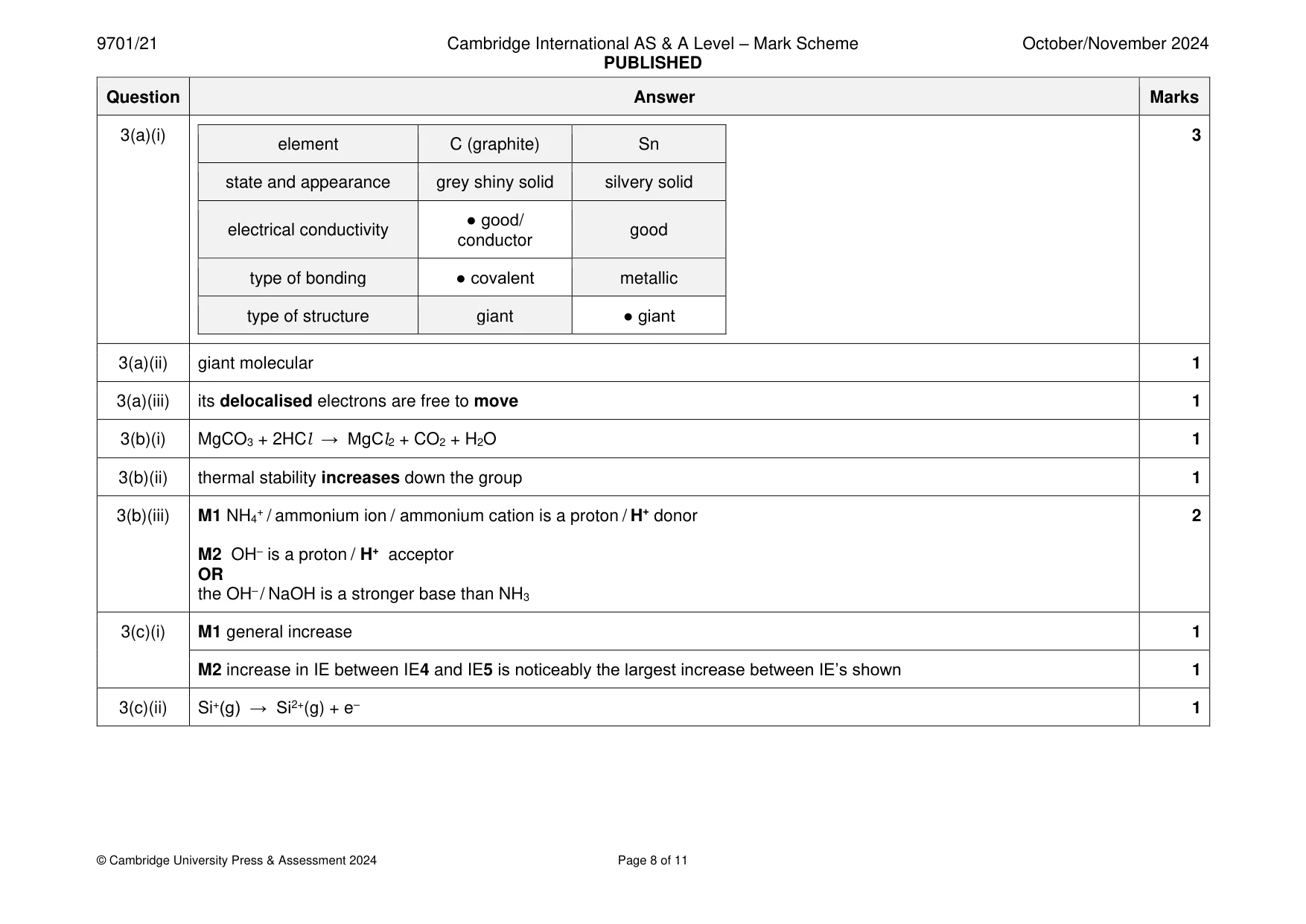
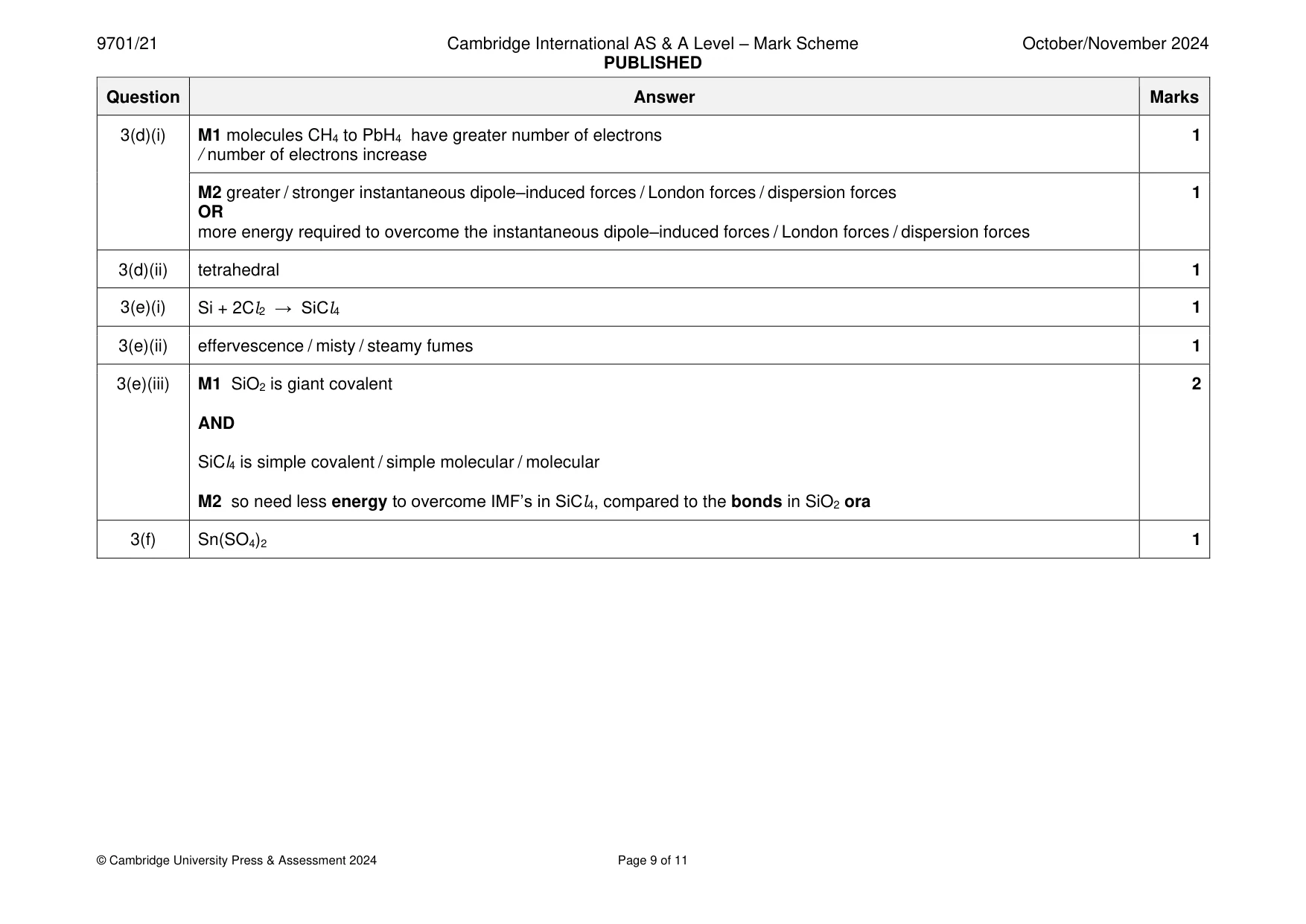
Mark scheme: 3(a)(i) 3 element C (graphite) Sn state and appearance grey shiny solid silvery solid ● good/ electrical conductivity good conductor type of bonding ● covalent metallic type of structure giant ● giant 3(a)(ii) giant molecular 1 3(a)(iii) its delocalised electrons are free to move 1 3(b)(i) MgCO3 + 2HCl → MgCl2 + CO2 + H2O 1 3(b)(ii) thermal stability increases down the group 1 3(b)(iii) M1 NH4+ / ammonium ion / ammonium cation is a proton / H+ donor 2 M2 OH– is a proton / H+ acceptor OR the OH– / NaOH is a stronger base than NH3 3(c)(i) M1 general increase 1 M2 increase in IE between IE4 and IE5 is noticeably the largest increase between IE’s shown 1 3(c)(ii) Si+(g) → Si2+(g) + e– 1 3(d)(i) M1 molecules CH4 to PbH4 have greater number of electrons 1 / number of electrons increase M2 greater / stronger instantaneous dipole–induced forces / London forces / dispersion forces 1 OR more energy required to overcome the instantaneous dipole–induced forces / London forces / dispersion forces 3(d)(ii) tetrahedral 1 3(e)(i) Si + 2Cl2 → SiCl4 1 3(e)(ii) effervescence / misty / steamy fumes 1 3(e)(iii) M1 SiO2 is giant covalent 2 AND SiCl4 is simple covalent / simple molecular / molecular M2 so need less energy to overcome IMF’s in SiCl4, compared to the bonds in SiO2 ora 3(f) Sn(SO4)2 1
More questions on Periodicity of physical properties of the elements in Period 3
Q4 · Propanone, CH3COCH3, is an important organic reagent
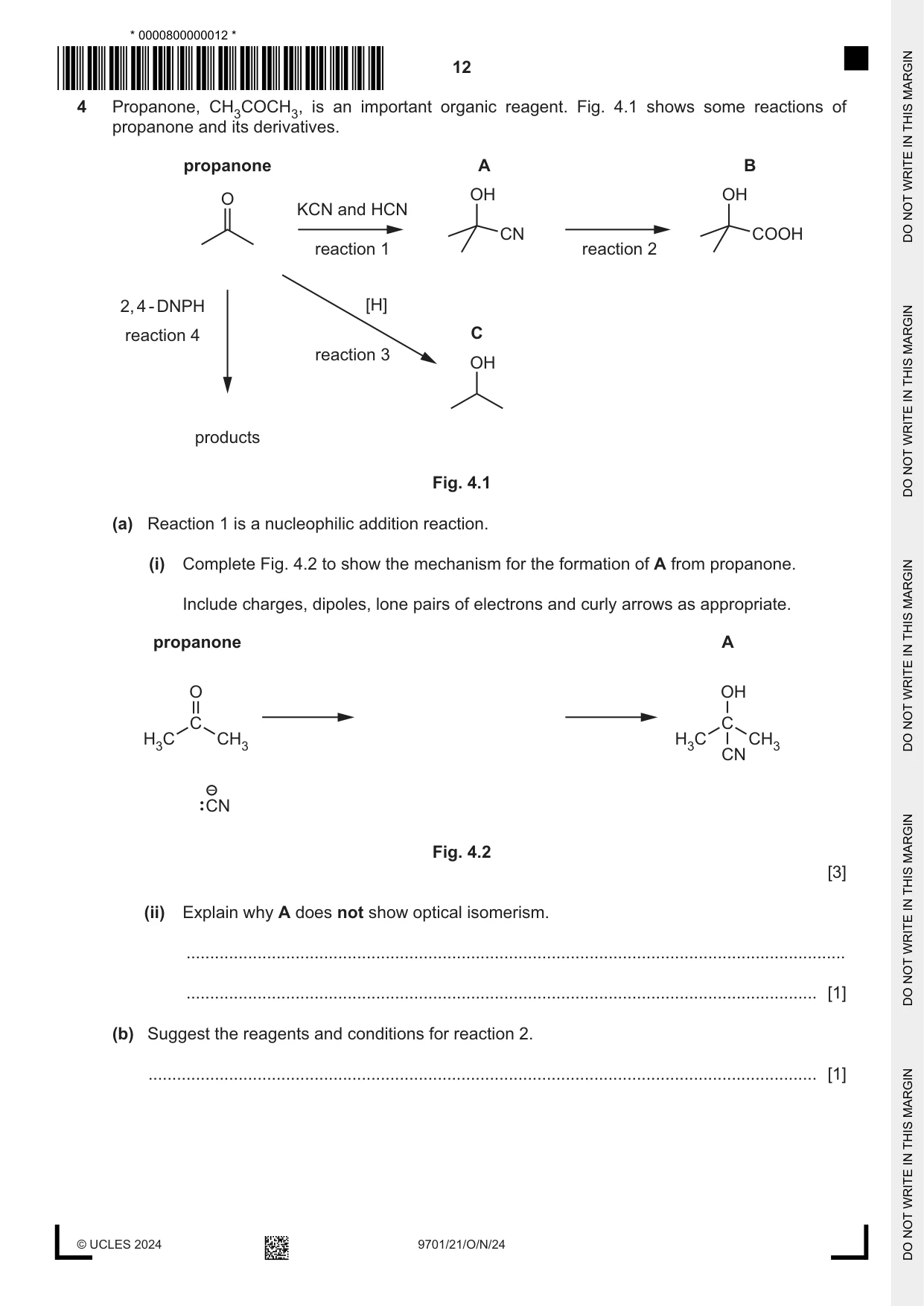
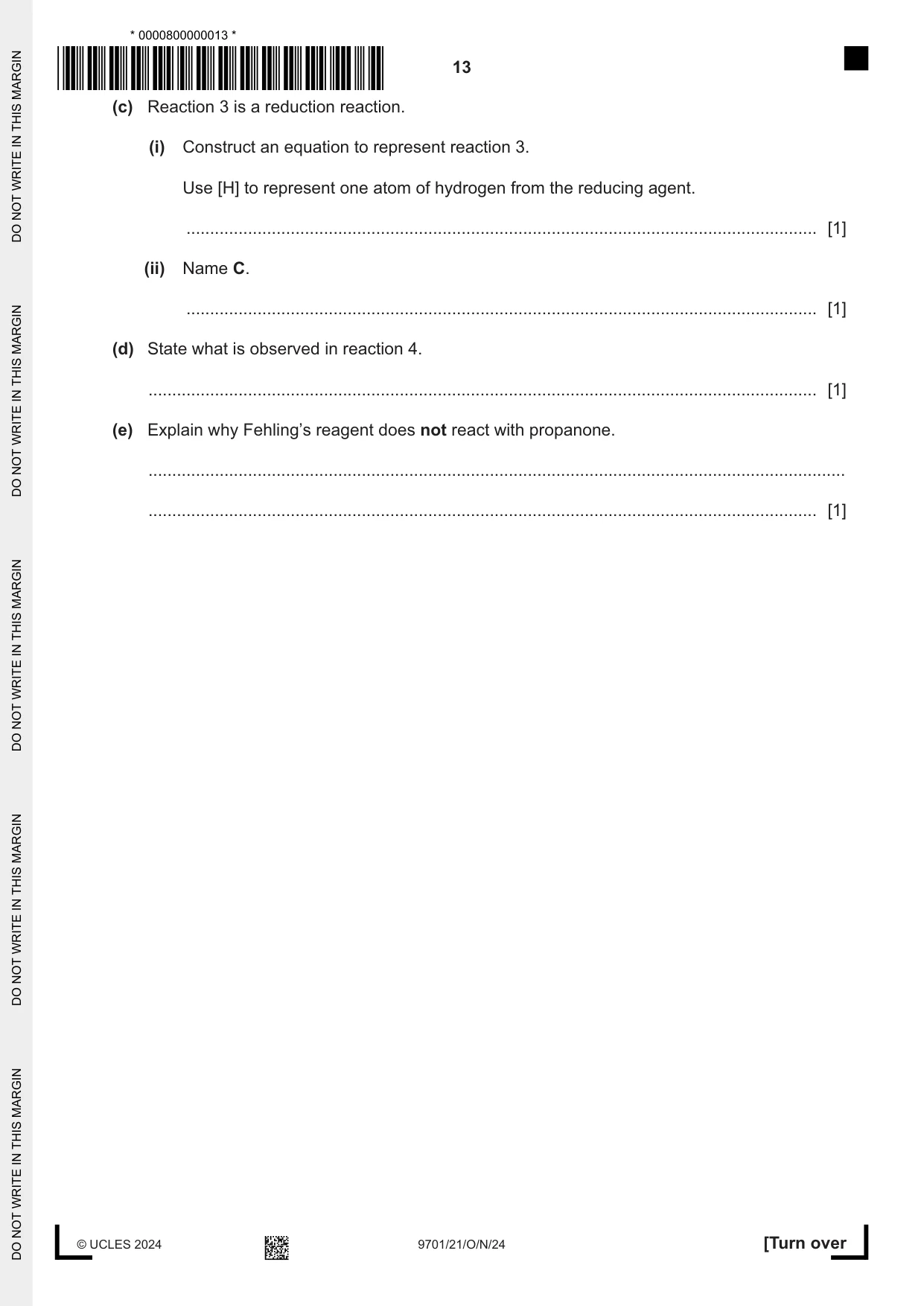
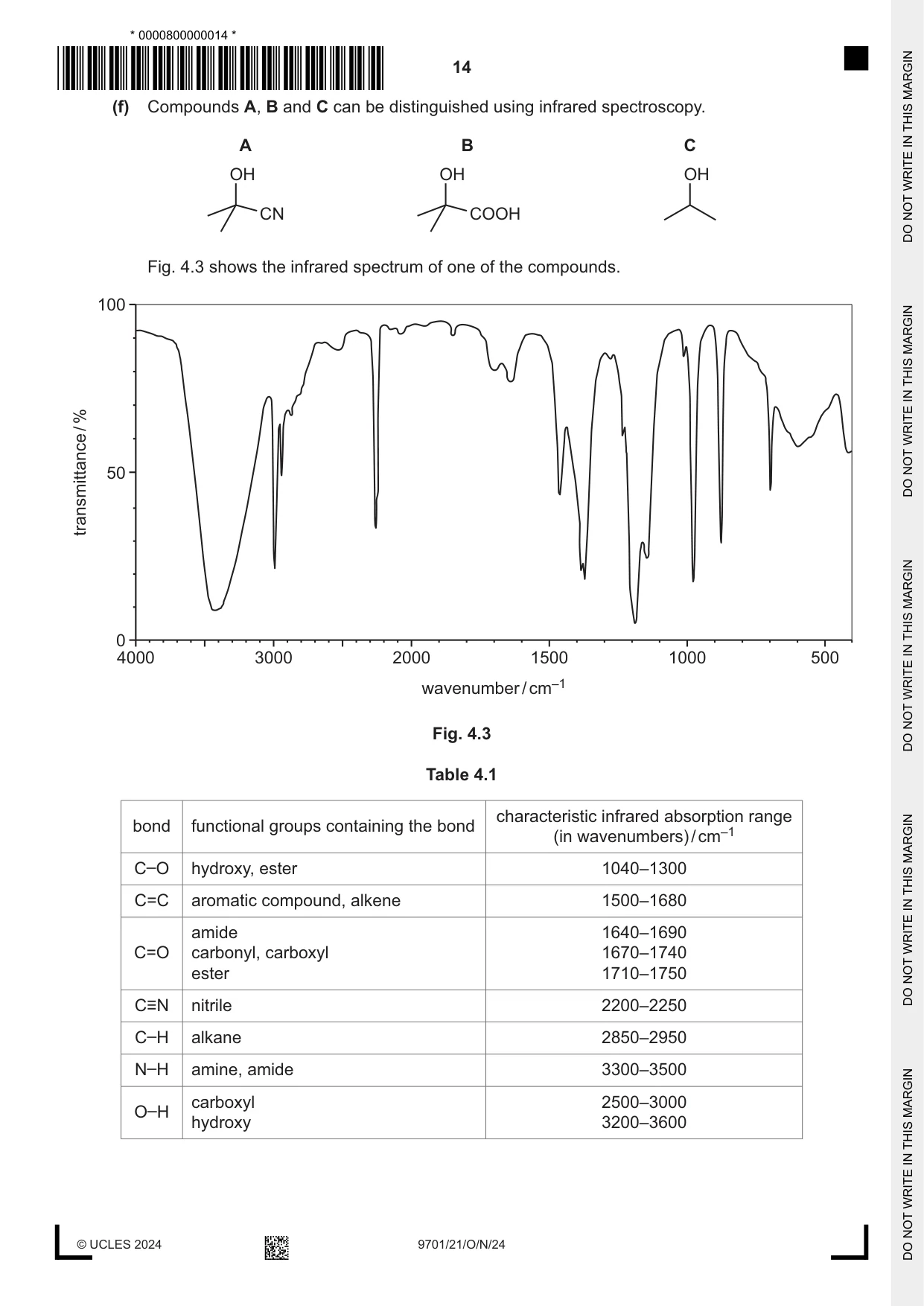
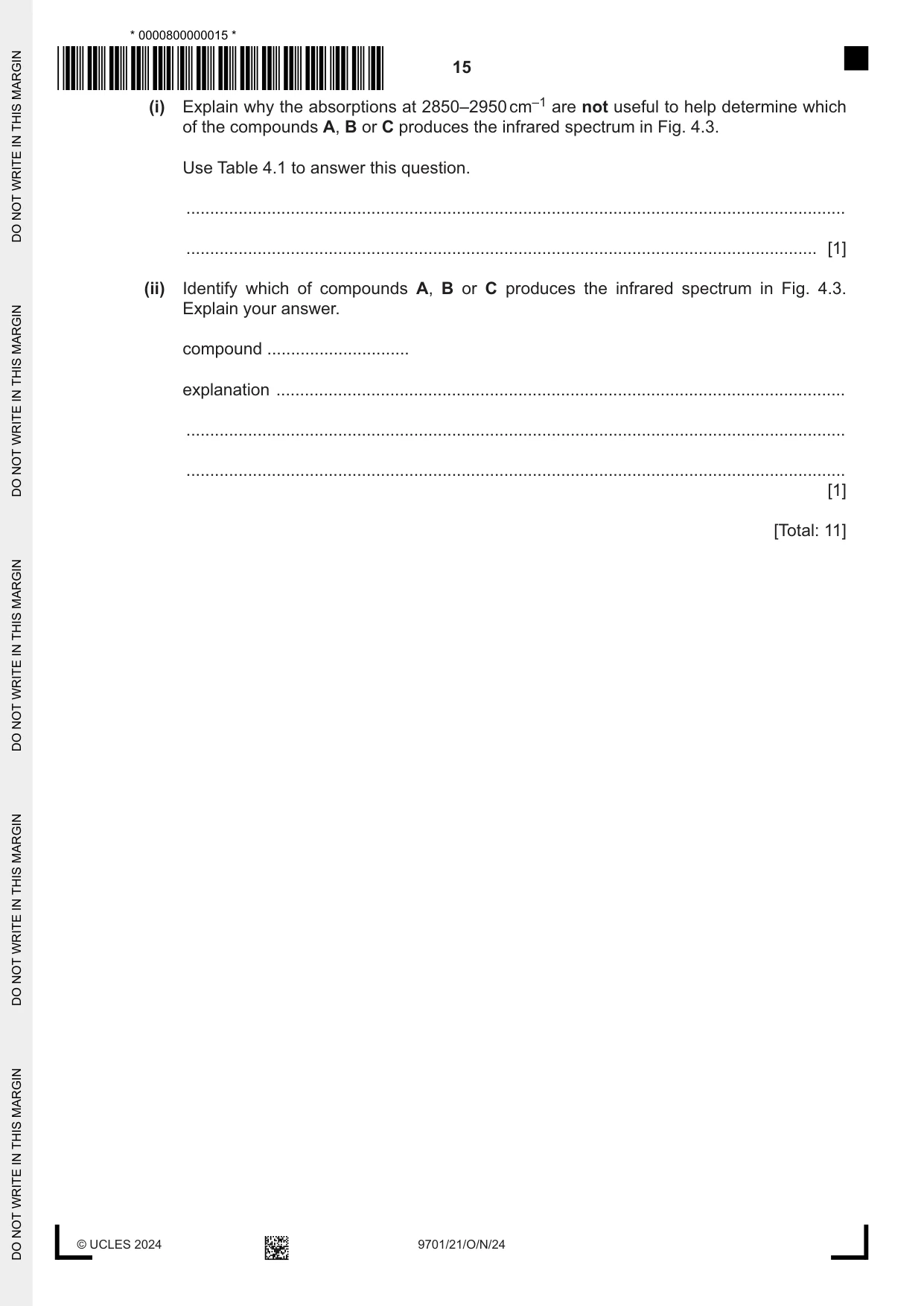
4 Propanone, CH3COCH3, is an important organic reagent. Fig. 4.1 shows some reactions of propanone and its derivatives. propanone A B O OH OH KCN and HCN CN COOH reaction 1 reaction 2 2, 4 - DNPH [H] reaction 4 C reaction 3 OH products Fig. 4.1 (a) Reaction 1 is a nucleophilic addition reaction. (i) Complete Fig. 4.2 to show the mechanism for the formation of A from propanone. Include charges, dipoles, lone pairs of electrons and curly arrows as appropriate. propanone A O OH C C H3C CH3 H3C CH3 CN CN Fig. 4.2 [3] (ii) Explain why A does not show optical isomerism. ........................................................................................................................................... ..................................................................................................................................... [1] (b) Suggest the reagents and conditions for reaction 2. ............................................................................................................................................. [1] (c) Reaction 3 is a reduction reaction. (i) Construct an equation to represent reaction 3. Use [H] to represent one atom of hydrogen from the reducing agent. ..................................................................................................................................... [1] (ii) Name C. ..................................................................................................................................... [1] (d) State what is observed in reaction 4. ............................................................................................................................................. [1] (e) Explain why Fehling’s reagent does not react with propanone. ................................................................................................................................................... ............................................................................................................................................. [1] (f) Compounds A, B and C can be distinguished using infrared spectroscopy. A B C OH OH OH CN COOH Fig. 4.3 shows the infrared spectrum of one of the compounds. 100 % / 50 transmittance 0 4000 3000 2000 1500 1000 500 wavenumber / cm–1 Fig. 4.3 Table 4.1 characteristic infrared absorption range bond functional groups containing the bond (in wavenumbers) / cm–1 C–O hydroxy, ester 1040–1300 C=C aromatic compound, alkene 1500–1680 amide 1640–1690 C=O carbonyl, carboxyl 1670–1740 ester 1710–1750 C N nitrile 2200–2250 C–H alkane 2850–2950 N–H amine, amide 3300–3500 carboxyl 2500–3000 O–H hydroxy 3200–3600
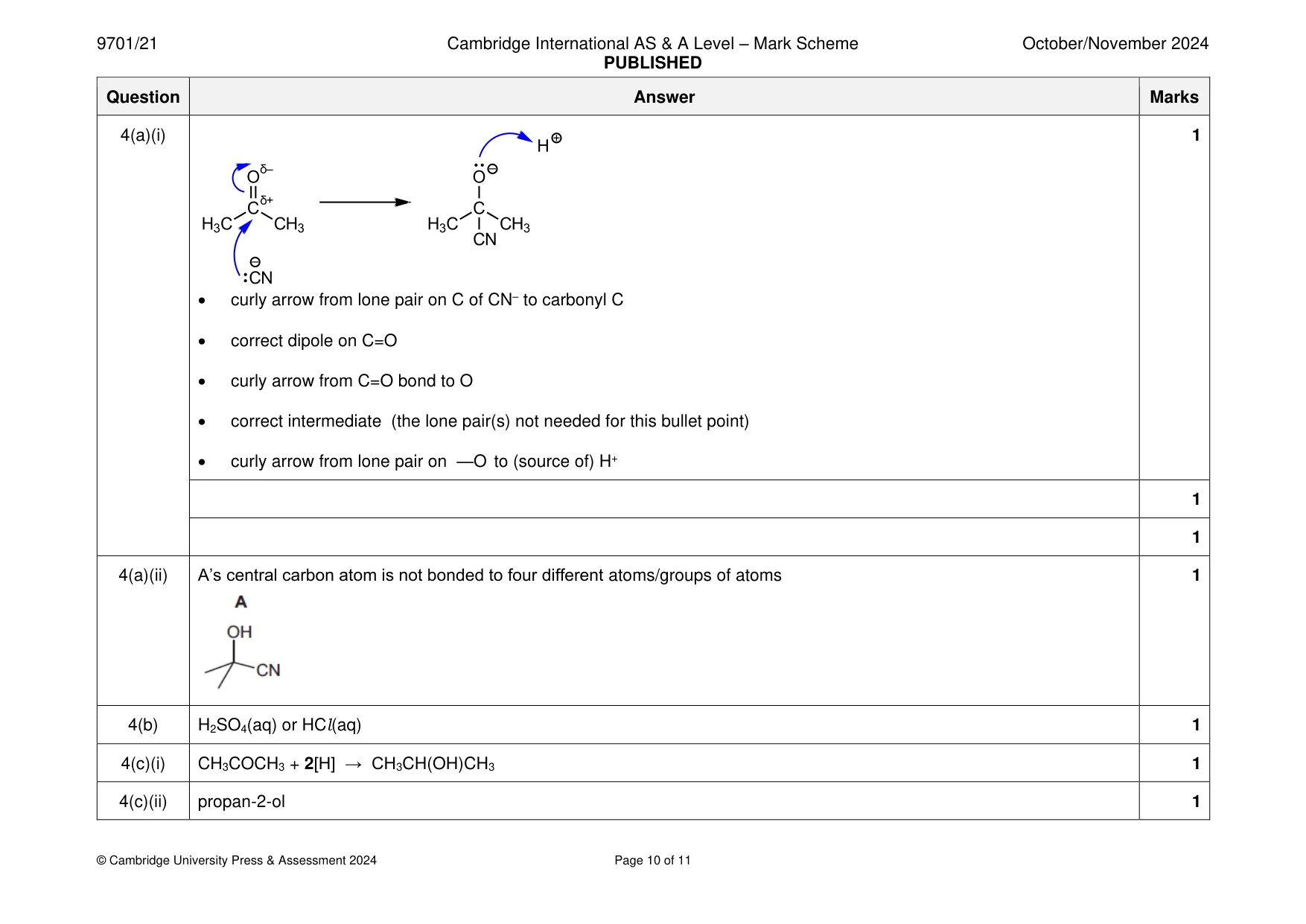
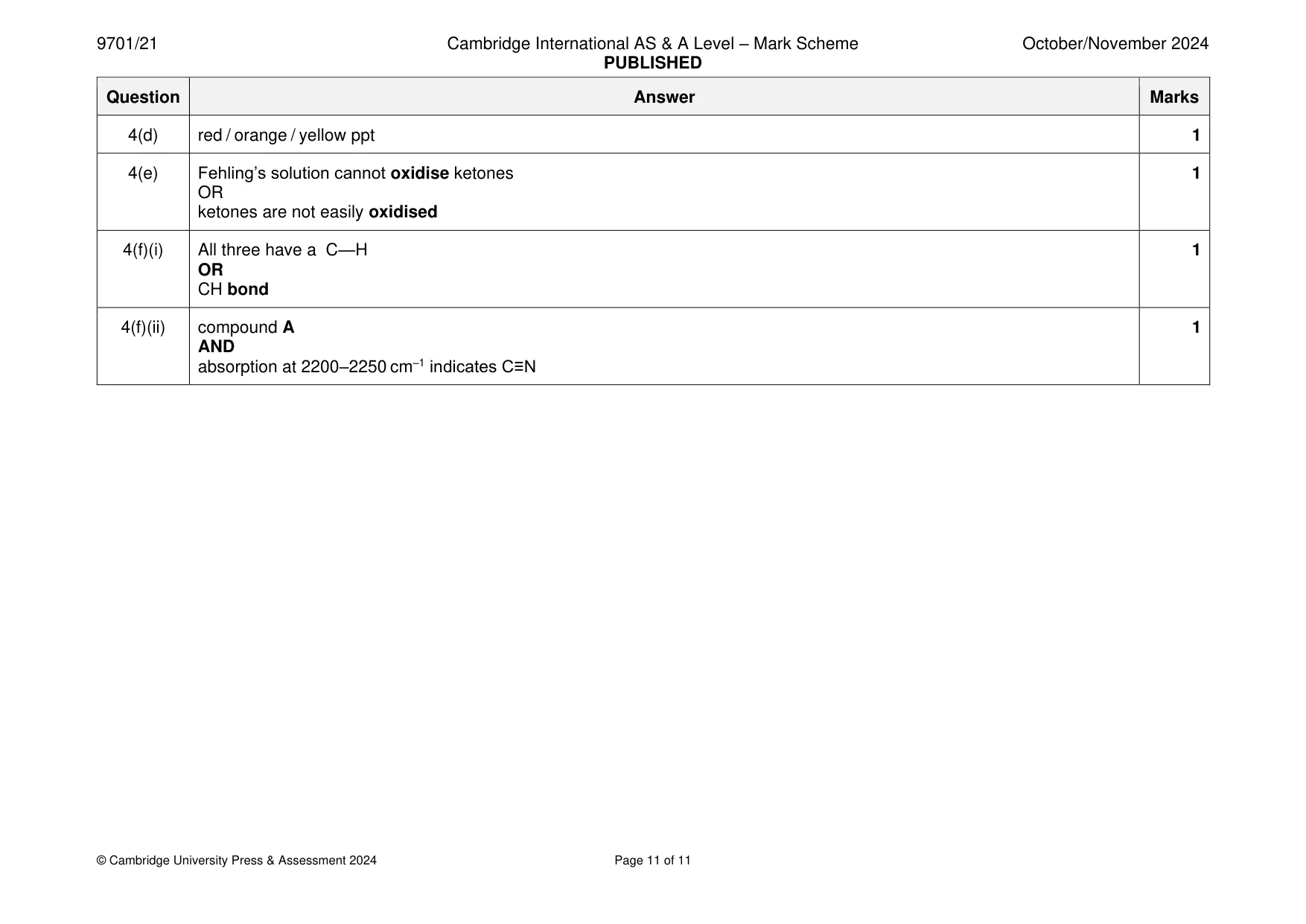
Mark scheme: 4(a)(i) 1 • curly arrow from lone pair on C of CN– to carbonyl C • correct dipole on C=O • curly arrow from C=O bond to O • correct intermediate (the lone pair(s) not needed for this bullet point) • curly arrow from lone pair on —O to (source of) H+ 1 1 4(a)(ii) A’s central carbon atom is not bonded to four different atoms/groups of atoms 1 4(b) H2SO4(aq) or HCl(aq) 1 4(c)(i) CH3COCH3 + 2[H] → CH3CH(OH)CH3 1 4(c)(ii) propan-2-ol 1 4(d) red / orange / yellow ppt 1 4(e) Fehling’s solution cannot oxidise ketones 1 OR ketones are not easily oxidised 4(f)(i) All three have a C—H 1 OR CH bond 4(f)(ii) compound A 1 AND absorption at 2200–2250 cm–1 indicates C≡N
What was in this paper
The subtopics covered by these 4 questions, and how many questions each got. Open one in a new tab to see every Cambridge question on it.
What you needed in this session
Cambridge’s own grade thresholds for 2024 Oct/Nov, Paper 2 · Variant 1. A higher threshold means an easier paper — the bar moves with how the cohort did.