Cambridge A Level Chemistry 9701 — 2024 May/June Paper 2 · Variant 3
9701/23/M/J/24 · 60 marks · ≈68 min
The question paper and its mark scheme, free to read here and free to download. This is Cambridge’s own paper, exactly as it was sat.
Question paper16 pages
Mark scheme11 pages
Answers below. Sit the paper first if you are practising.
Paper as text
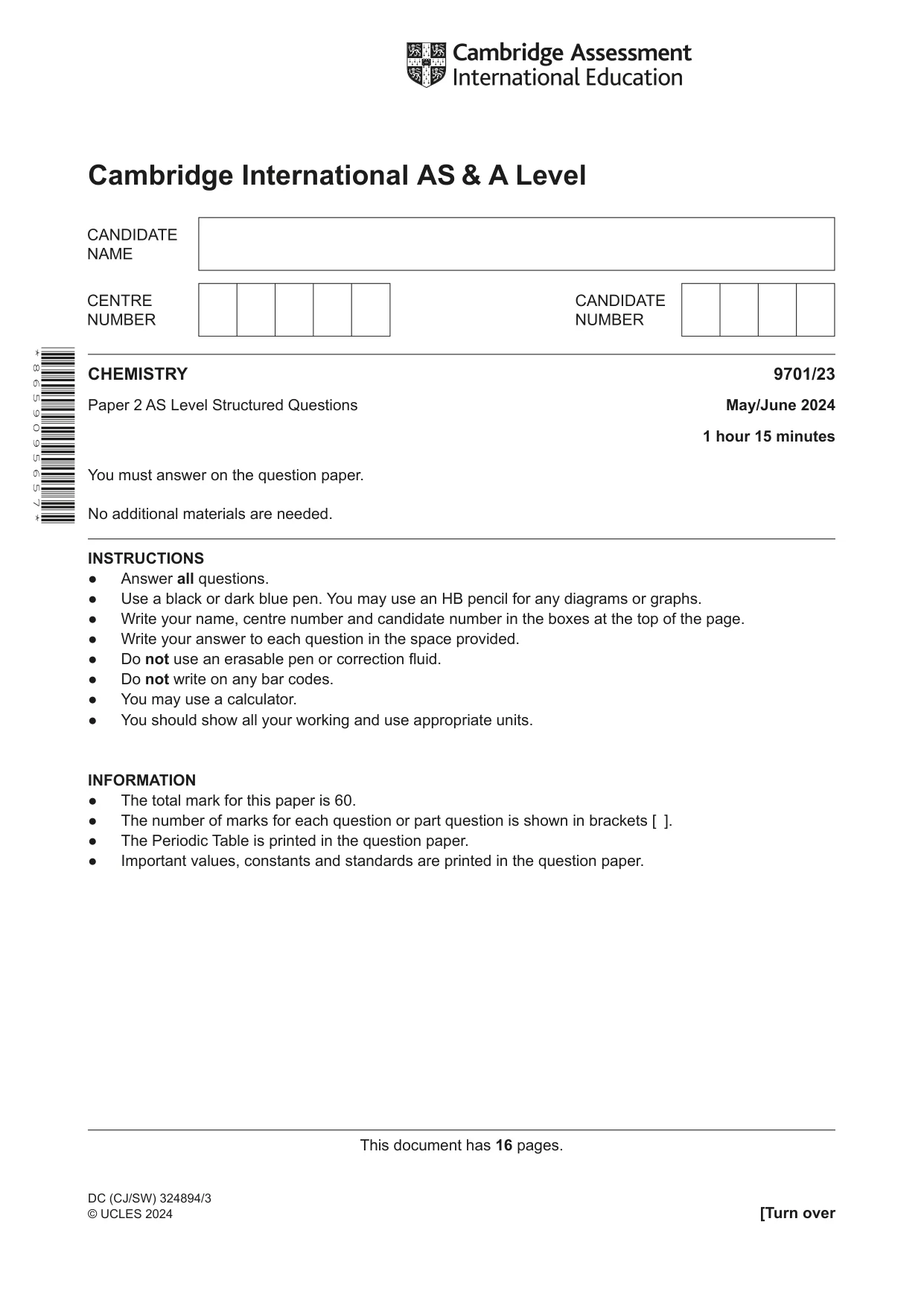
Question paper, page 1
This document has 16 pages. [Turn over Cambridge International AS & A Level * 8 6 5 9 0 9 5 6 5 7 * DC (CJ/SW) 324894/3 © UCLES 2024 CHEMISTRY 9701/23 Paper 2 AS Level Structured Questions May/June 2024 1 hour 15 minutes You must answer on the question paper. No additional materials are needed. INSTRUCTIONS ● Answer all questions. ● Use a black or dark blue pen. You may use an HB pencil for any diagrams or graphs. ● Write your name, centre number and candidate number in the boxes at the top of the page. ● Write your answer to each question in the space provided. ● Do not use an erasable pen or correction fluid. ● Do not write on any bar codes. ● You may use a calculator. ● You should show all your working and use appropriate units. INFORMATION ● The total mark for this paper is 60. ● The number of marks for each question or part question is shown in brackets [ ]. ● The Periodic Table is printed in the question paper. ● Important values, constants and standards are printed in the question paper.
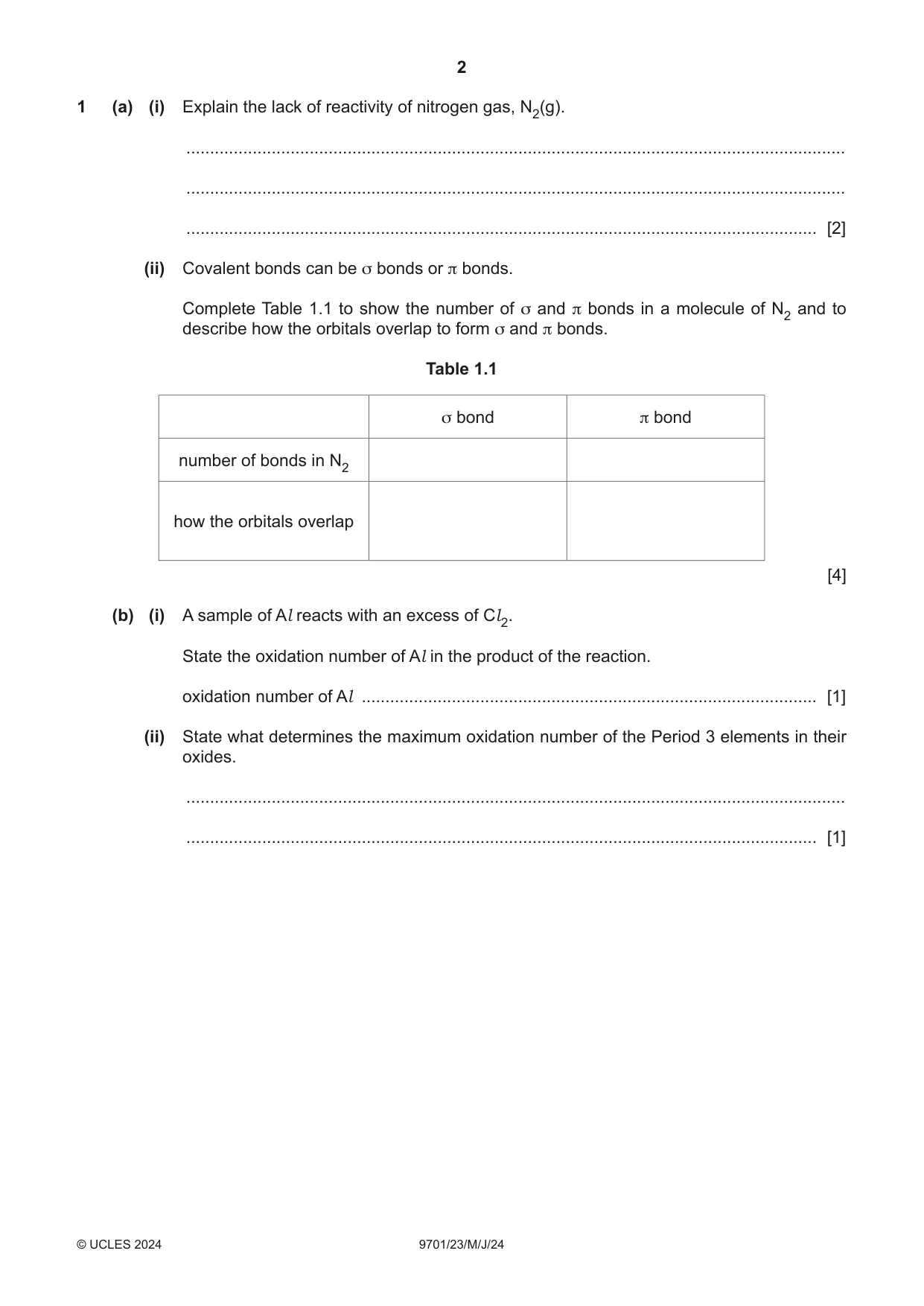
Question paper, page 2
2 9701/23/M/J/24 © UCLES 2024 1 (a) (i) Explain the lack of reactivity of nitrogen gas, N2(g). … … … [2] (ii) Covalent bonds can be σ bonds or π bonds. Complete Table 1.1 to show the number of σ and π bonds in a molecule of N2 and to describe how the orbitals overlap to form σ and π bonds. Table 1.1 σ bond π bond number of bonds in N2 how the orbitals overlap [4] (b) (i) A sample of Al reacts with an excess of Cl 2. State the oxidation number of Al in the product of the reaction. oxidation number of Al … [1] (ii) State what determines the maximum oxidation number of the Period 3 elements in their oxides. … … [1]
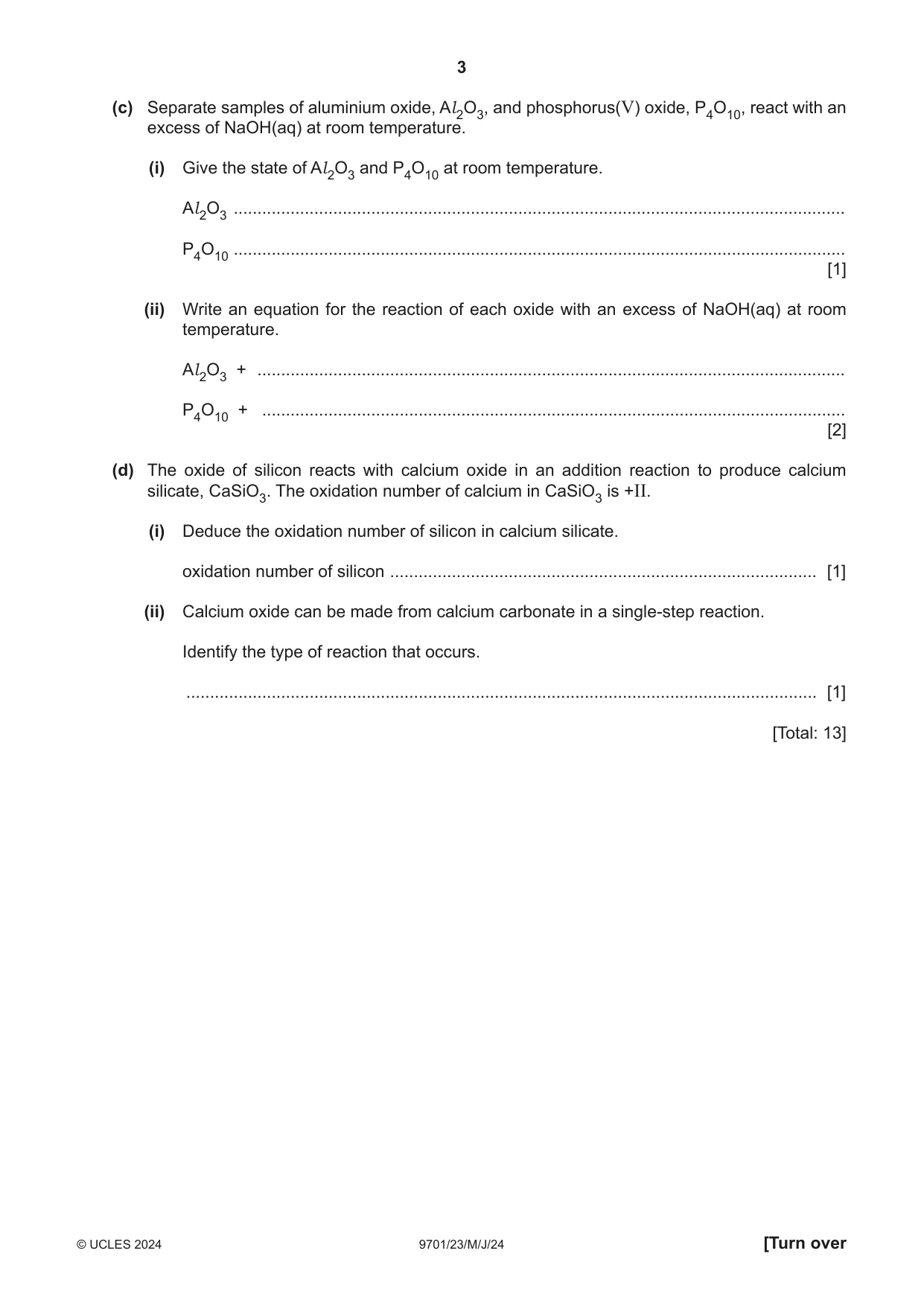
Question paper, page 3
3 9701/23/M/J/24 © UCLES 2024 [Turn over (c) Separate samples of aluminium oxide, Al 2O3, and phosphorus(V) oxide, P4O10, react with an excess of NaOH(aq) at room temperature. (i) Give the state of Al 2O3 and P4O10 at room temperature. Al 2O3 … P4O10 … [1] (ii) Write an equation for the reaction of each oxide with an excess of NaOH(aq) at room temperature. Al 2O3 + … P4O10 + … [2] (d) The oxide of silicon reacts with calcium oxide in an addition reaction to produce calcium silicate, CaSiO3. The oxidation number of calcium in CaSiO3 is +II. (i) Deduce the oxidation number of silicon in calcium silicate. oxidation number of silicon … [1] (ii) Calcium oxide can be made from calcium carbonate in a single-step reaction. Identify the type of reaction that occurs. … [1] [Total: 13]
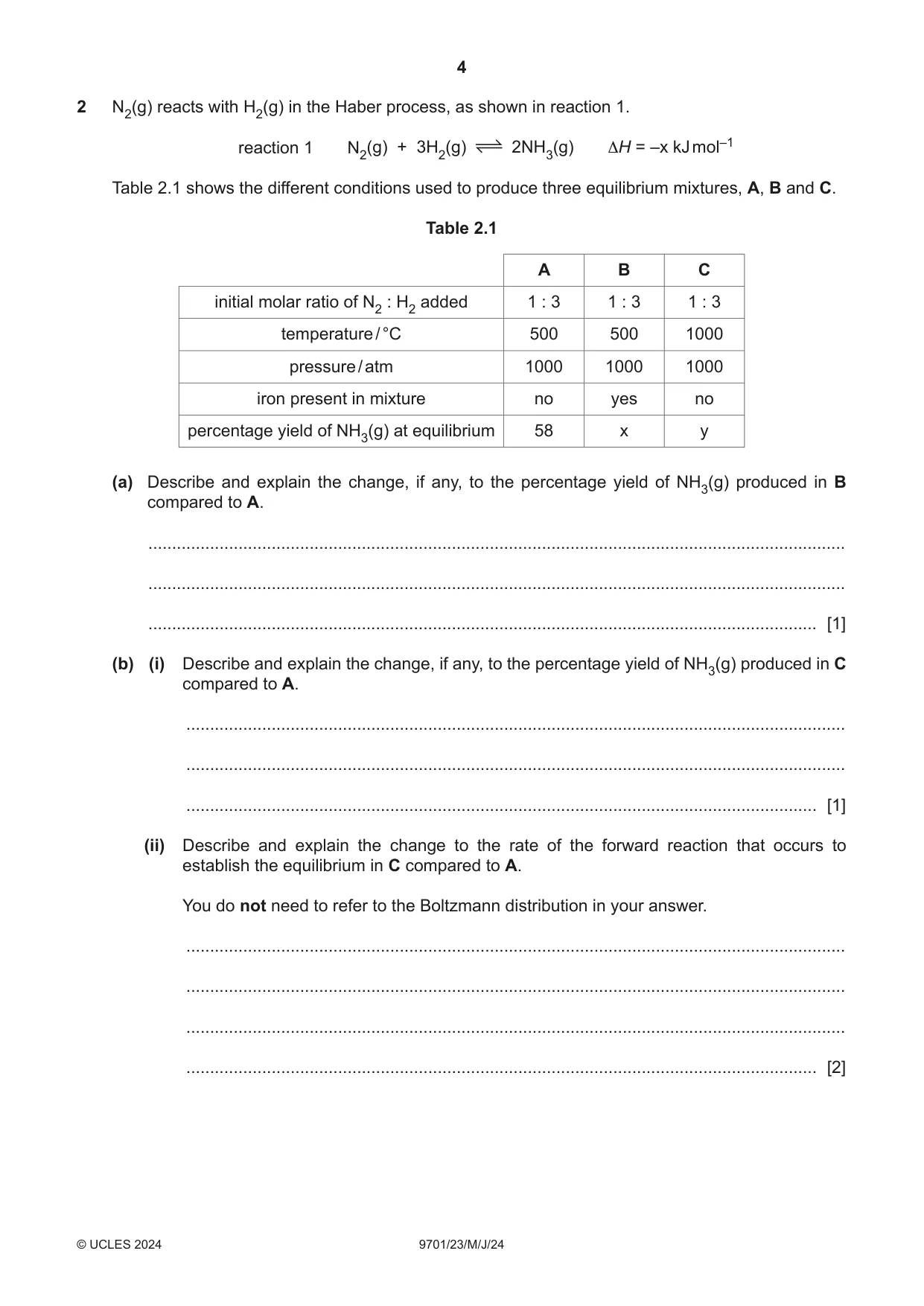
Question paper, page 4
4 9701/23/M/J/24 © UCLES 2024 2 N2(g) reacts with H2(g) in the Haber process, as shown in reaction 1. reaction 1 N2(g) + 3H2(g) 2NH3(g) ΔH = –x kJ mol–1 Table 2.1 shows the different conditions used to produce three equilibrium mixtures, A, B and C. Table 2.1 A B C initial molar ratio of N2 : H2 added 1 : 3 1 : 3 1 : 3 temperature / °C 500 500 1000 pressure / atm 1000 1000 1000 iron present in mixture no yes no percentage yield of NH3(g) at equilibrium 58 x y (a) Describe and explain the change, if any, to the percentage yield of NH3(g) produced in B compared to A. … … … [1] (b) (i) Describe and explain the change, if any, to the percentage yield of NH3(g) produced in C compared to A. … … … [1] (ii) Describe and explain the change to the rate of the forward reaction that occurs to establish the equilibrium in C compared to A. You do not need to refer to the Boltzmann distribution in your answer. … … … … [2]
Question paper, page 5
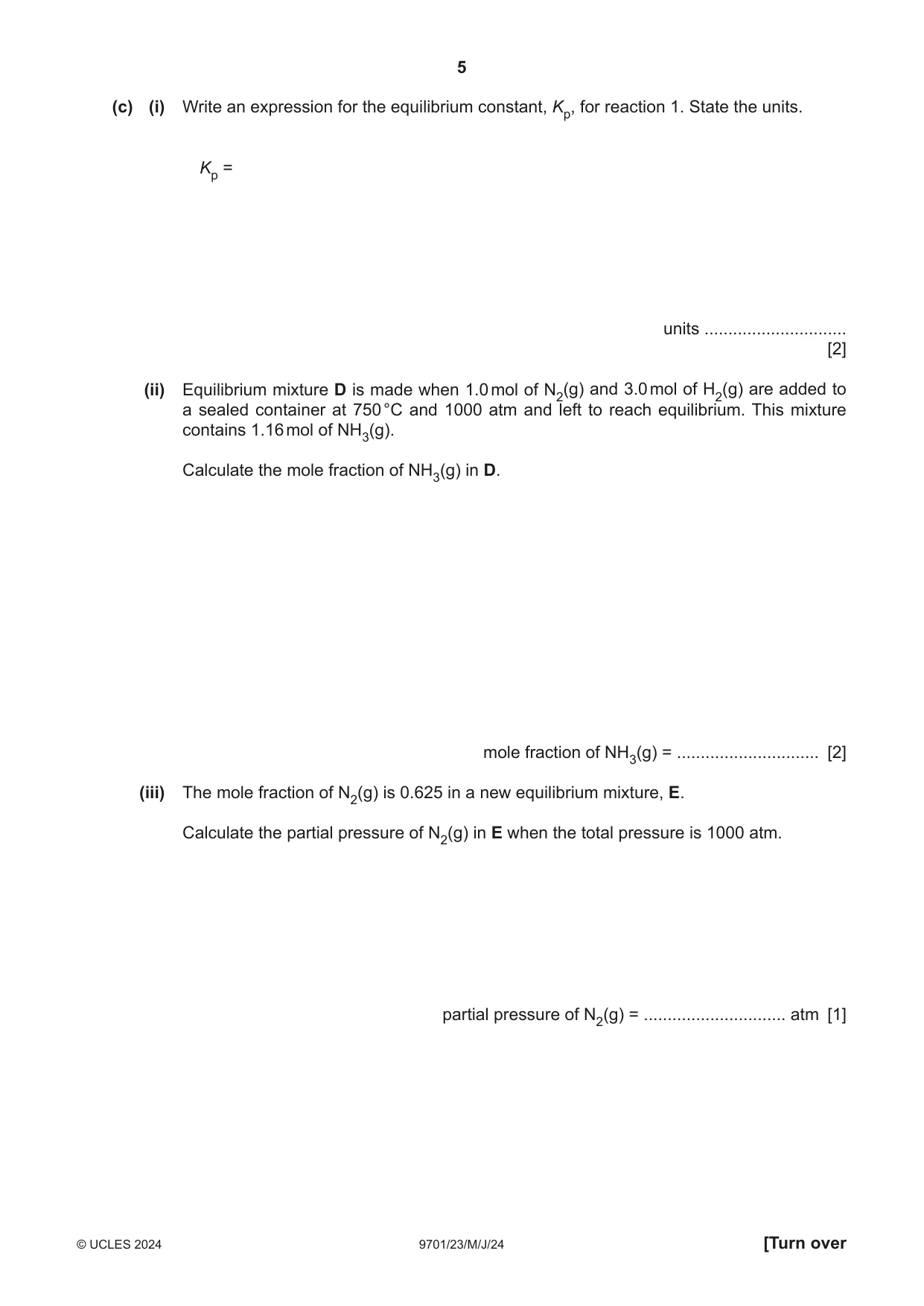
5 9701/23/M/J/24 © UCLES 2024 [Turn over (c) (i) Write an expression for the equilibrium constant, Kp, for reaction 1. State the units. Kp = units … [2] (ii) Equilibrium mixture D is made when 1.0 mol of N2(g) and 3.0 mol of H2(g) are added to a sealed container at 750 °C and 1000 atm and left to reach equilibrium. This mixture contains 1.16 mol of NH3(g). Calculate the mole fraction of NH3(g) in D. mole fraction of NH3(g) = … [2] (iii) The mole fraction of N2(g) is 0.625 in a new equilibrium mixture, E. Calculate the partial pressure of N2(g) in E when the total pressure is 1000 atm. partial pressure of N2(g) = … atm [1]
Question paper, page 6
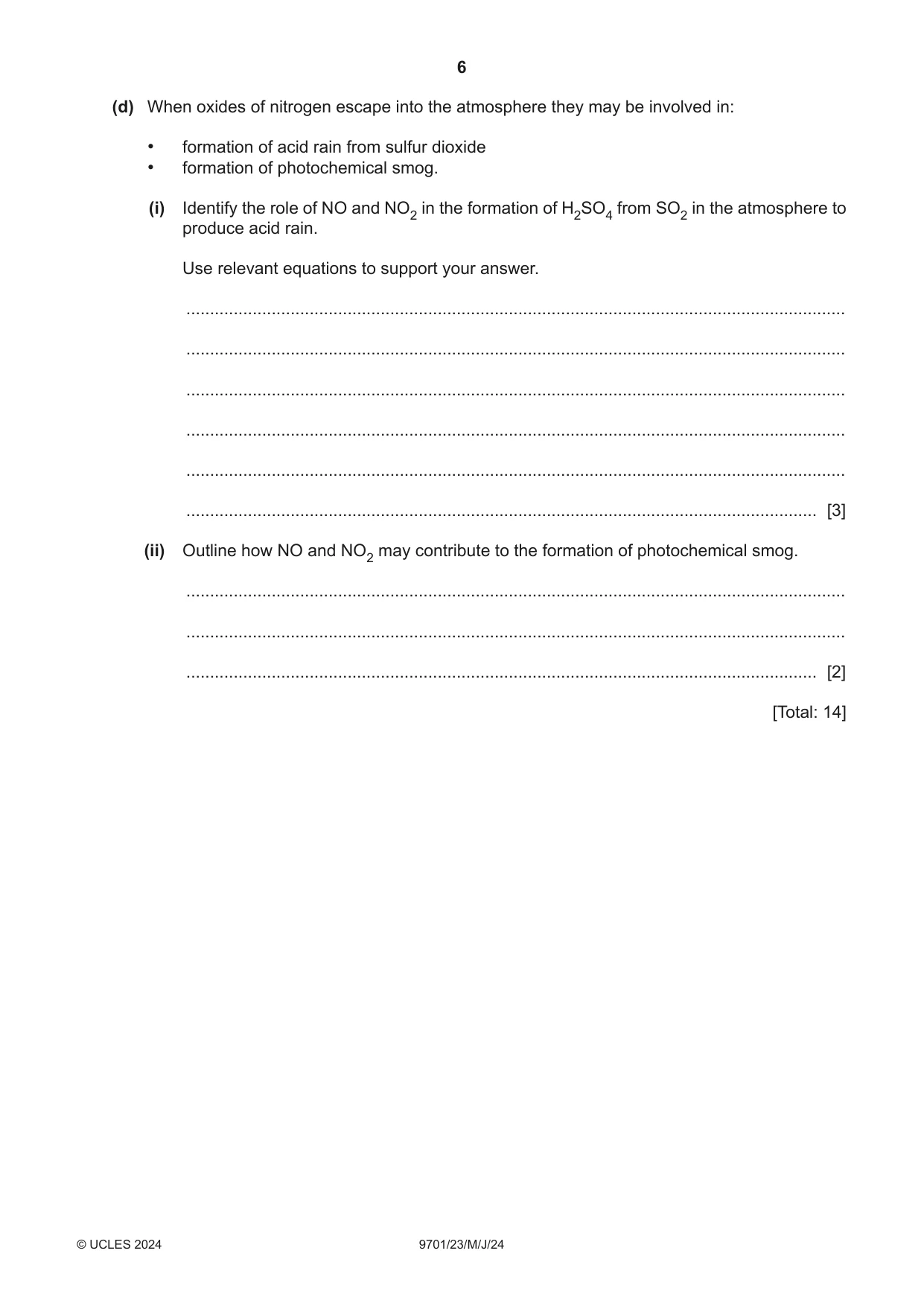
6 9701/23/M/J/24 © UCLES 2024 (d) When oxides of nitrogen escape into the atmosphere they may be involved in: • formation of acid rain from sulfur dioxide • formation of photochemical smog. (i) Identify the role of NO and NO2 in the formation of H2SO4 from SO2 in the atmosphere to produce acid rain. Use relevant equations to support your answer. … … … … … … [3] (ii) Outline how NO and NO2 may contribute to the formation of photochemical smog. … … … [2] [Total: 14]
Question paper, page 7
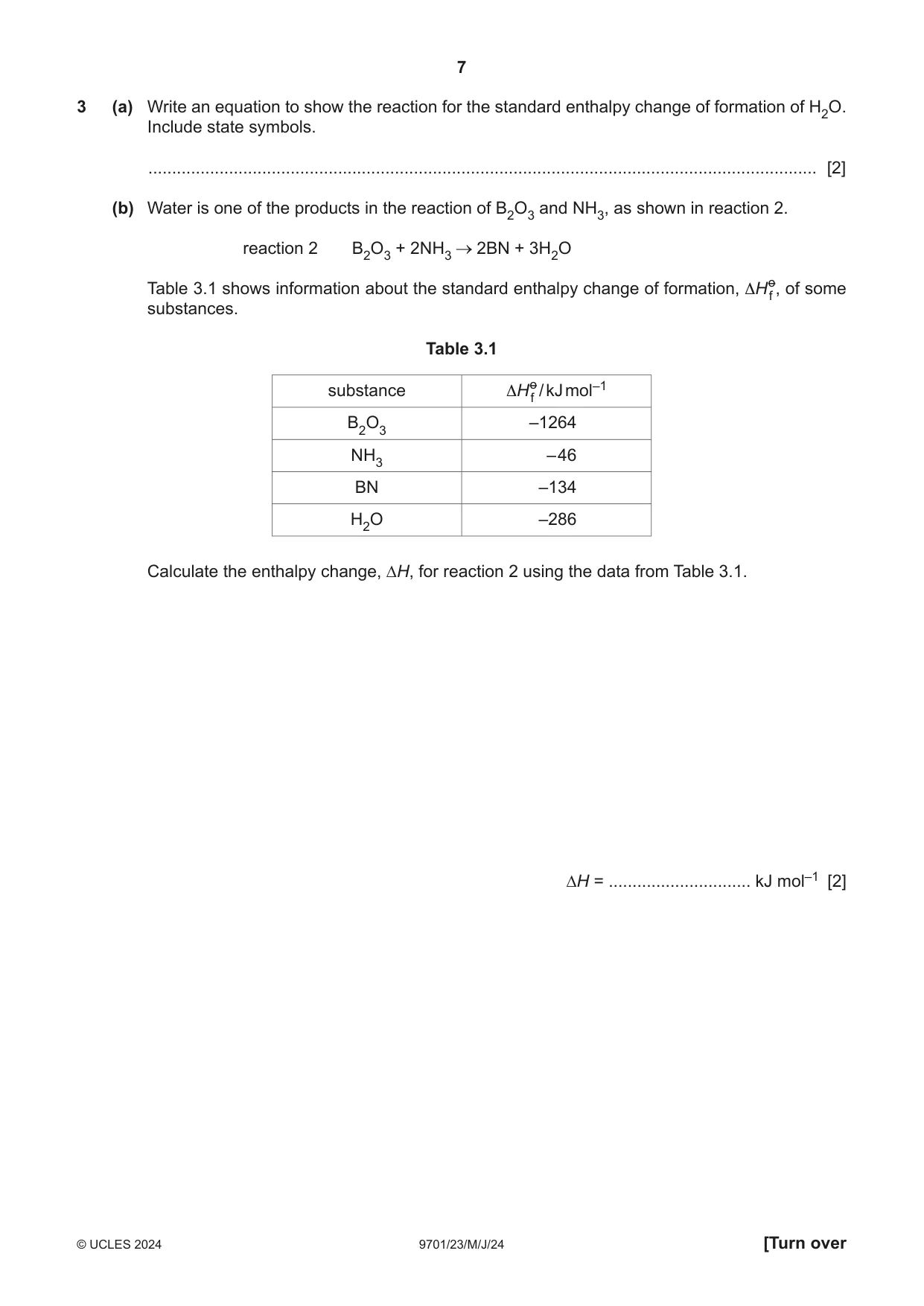
7 9701/23/M/J/24 © UCLES 2024 [Turn over 3 (a) Write an equation to show the reaction for the standard enthalpy change of formation of H2O. Include state symbols. … [2] (b) Water is one of the products in the reaction of B2O3 and NH3, as shown in reaction 2. reaction 2 B2O3 + 2NH3 2BN + 3H2O Table 3.1 shows information about the standard enthalpy change of formation, ΔH f o, of some substances. Table 3.1 substance ΔH f o / kJ mol–1 B2O3 –1264 NH3 – 46 BN –134 H2O –286 Calculate the enthalpy change, ∆H, for reaction 2 using the data from Table 3.1. ∆H = … kJ mol–1 [2]
Question paper, page 8
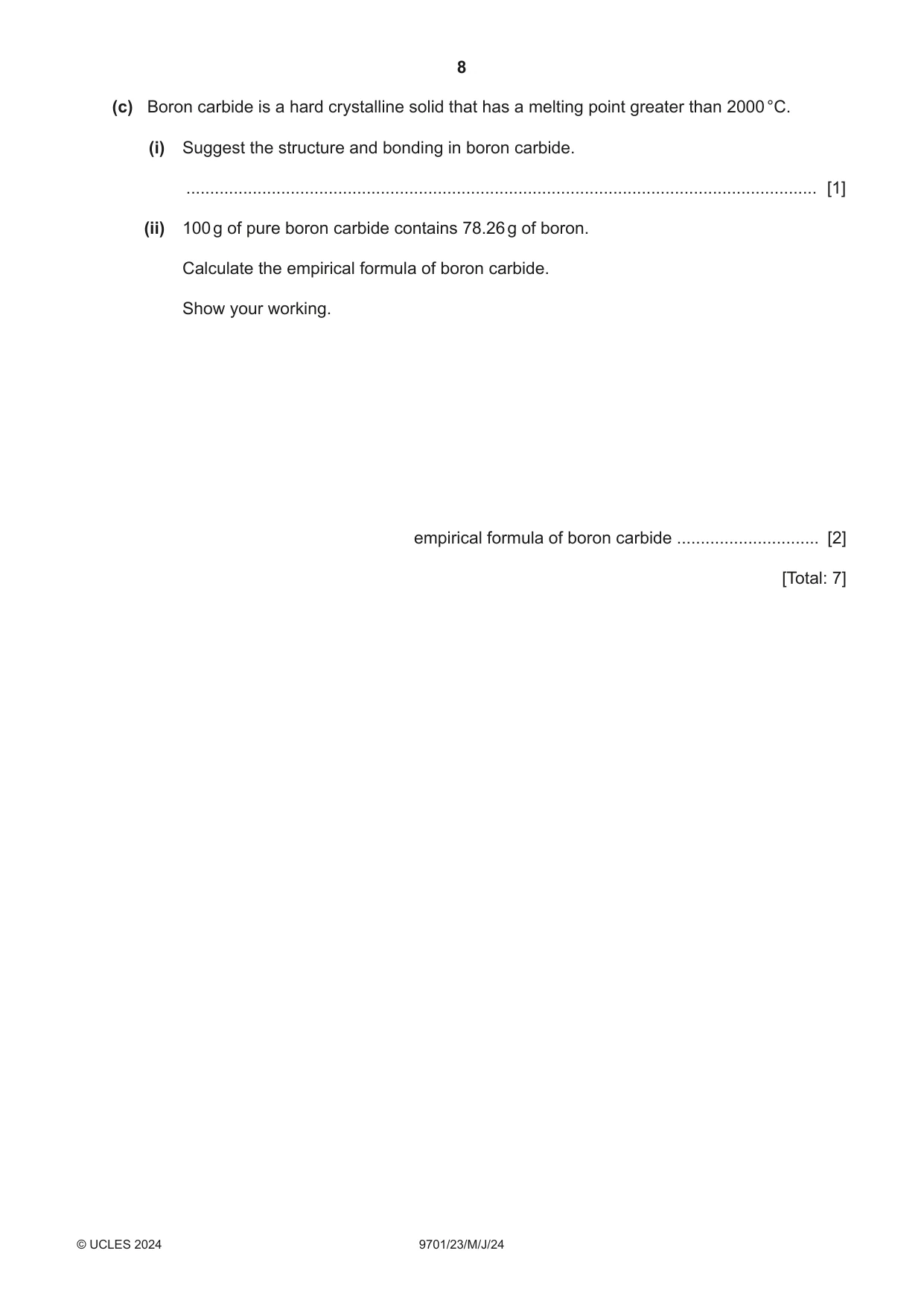
8 9701/23/M/J/24 © UCLES 2024 (c) Boron carbide is a hard crystalline solid that has a melting point greater than 2000 °C. (i) Suggest the structure and bonding in boron carbide. … [1] (ii) 100 g of pure boron carbide contains 78.26 g of boron. Calculate the empirical formula of boron carbide. Show your working. empirical formula of boron carbide … [2] [Total: 7]
Question paper, page 9
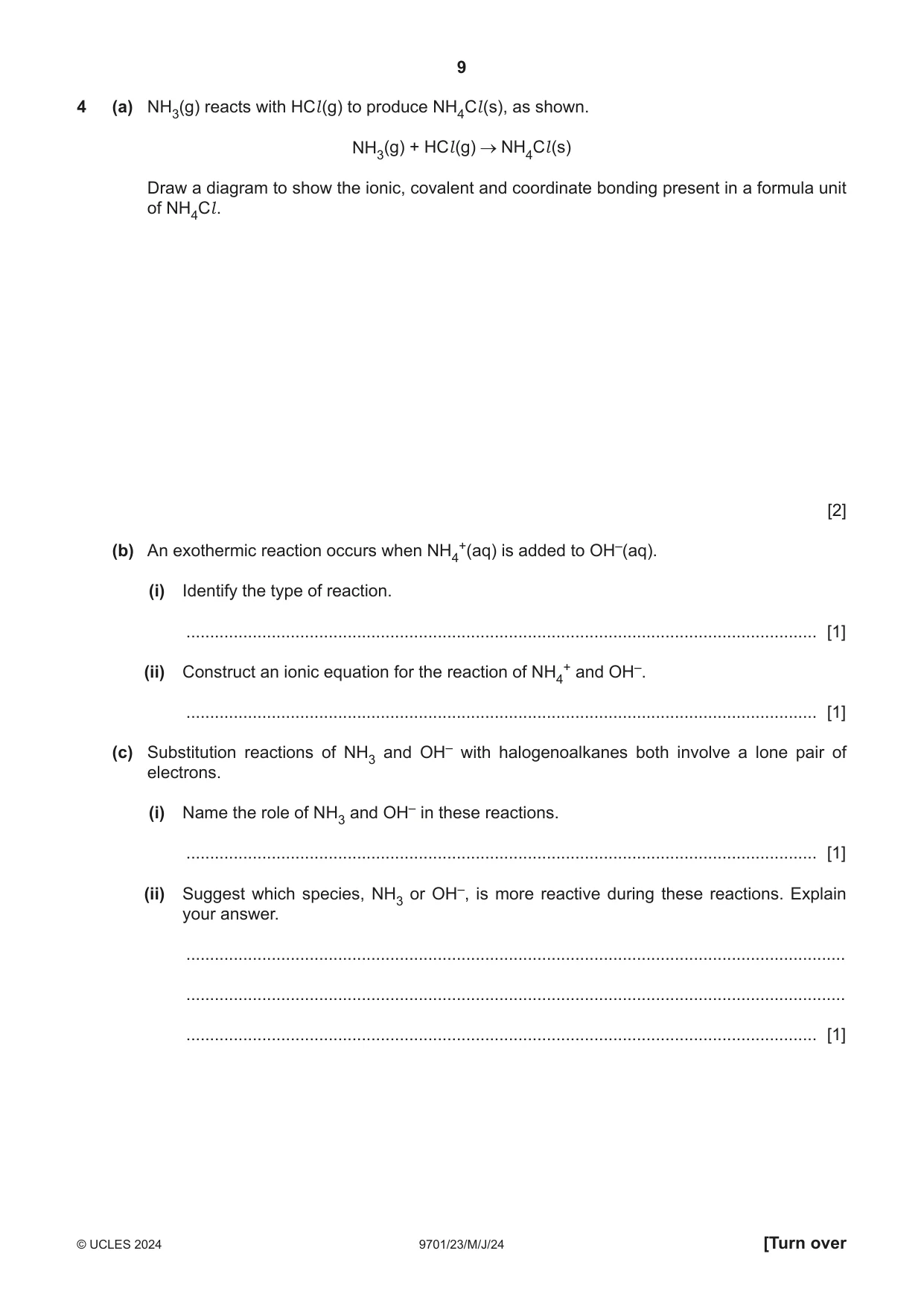
9 9701/23/M/J/24 © UCLES 2024 [Turn over 4 (a) NH3(g) reacts with HCl (g) to produce NH4Cl (s), as shown. NH3(g) + HCl (g) NH4Cl (s) Draw a diagram to show the ionic, covalent and coordinate bonding present in a formula unit of NH4Cl . [2] (b) An exothermic reaction occurs when NH4 +(aq) is added to OH–(aq). (i) Identify the type of reaction. … [1] (ii) Construct an ionic equation for the reaction of NH4 + and OH–. … [1] (c) Substitution reactions of NH3 and OH– with halogenoalkanes both involve a lone pair of electrons. (i) Name the role of NH3 and OH– in these reactions. … [1] (ii) Suggest which species, NH3 or OH–, is more reactive during these reactions. Explain your answer. … … … [1]
Question paper, page 10
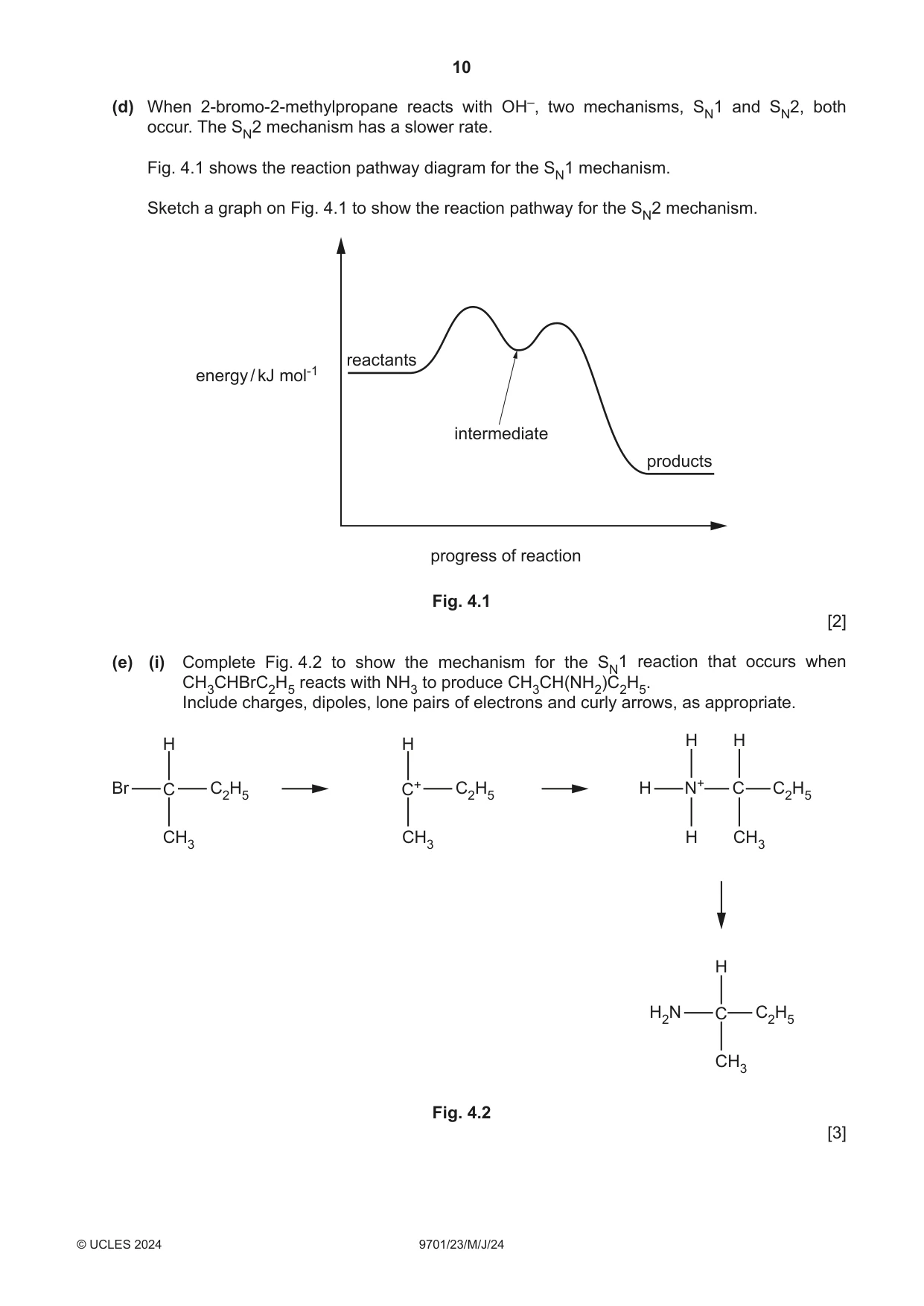
10 9701/23/M/J/24 © UCLES 2024 (d) When 2-bromo-2-methylpropane reacts with OH–, two mechanisms, SN1 and SN2, both occur. The SN2 mechanism has a slower rate. Fig. 4.1 shows the reaction pathway diagram for the SN1 mechanism. Sketch a graph on Fig. 4.1 to show the reaction pathway for the SN2 mechanism. intermediate reactants progress of reaction products energy / kJ mol-1 Fig. 4.1 [2] (e) (i) Complete Fig. 4.2 to show the mechanism for the SN1 reaction that occurs when CH3CHBrC2H5 reacts with NH3 to produce CH3CH(NH2)C2H5. Include charges, dipoles, lone pairs of electrons and curly arrows, as appropriate. Br C2H5 C2H5 C H CH3 C2H5 C+ H CH3 H C N+ H H CH3 H H2N C2H5 C H CH3 Fig. 4.2 [3]
Question paper, page 11
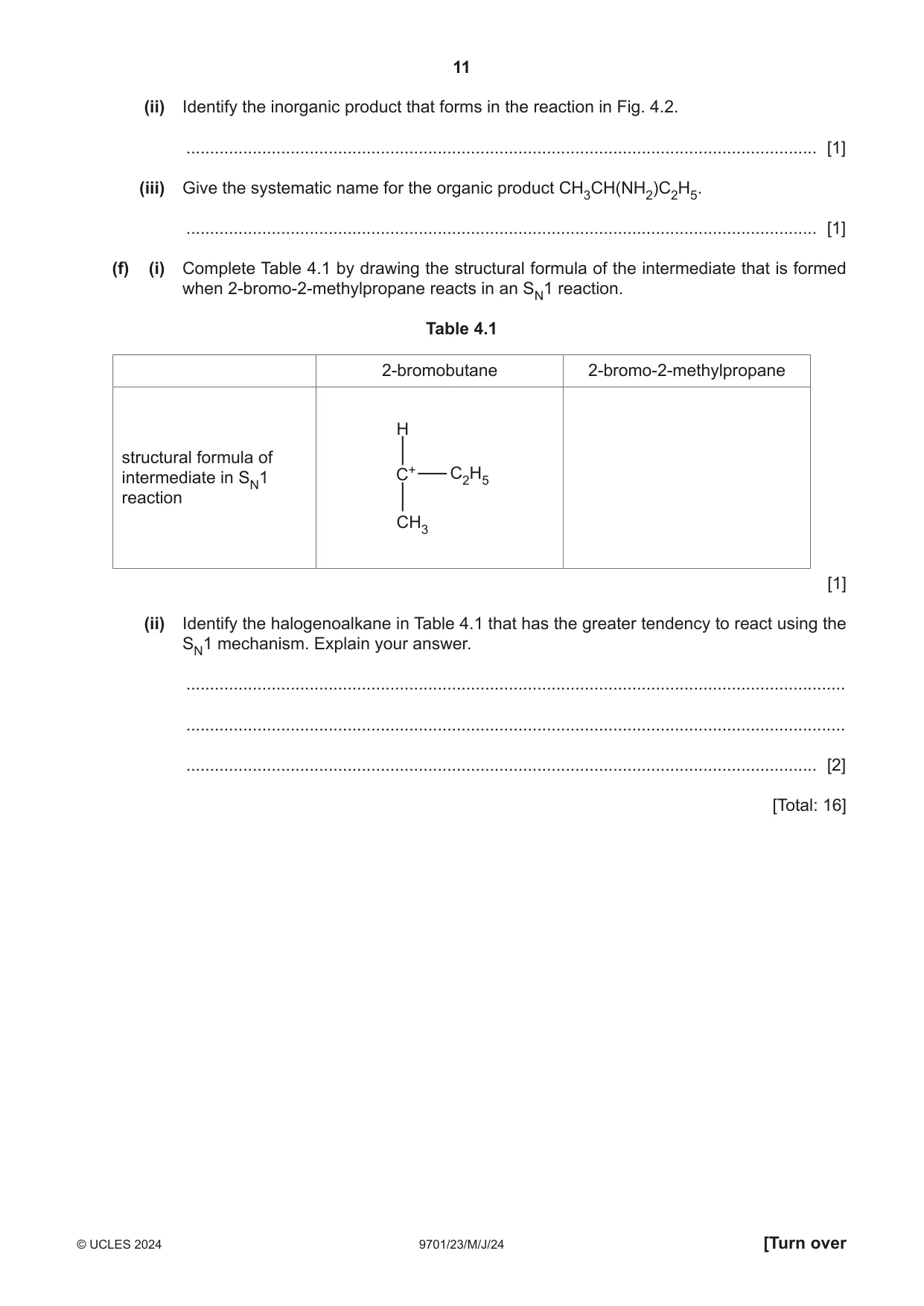
11 9701/23/M/J/24 © UCLES 2024 [Turn over (ii) Identify the inorganic product that forms in the reaction in Fig. 4.2. … [1] (iii) Give the systematic name for the organic product CH3CH(NH2)C2H5. … [1] (f) (i) Complete Table 4.1 by drawing the structural formula of the intermediate that is formed when 2-bromo-2-methylpropane reacts in an SN1 reaction. Table 4.1 2-bromobutane 2-bromo-2-methylpropane structural formula of intermediate in SN1 reaction C2H5 C+ H CH3 [1] (ii) Identify the halogenoalkane in Table 4.1 that has the greater tendency to react using the SN1 mechanism. Explain your answer. … … … [2] [Total: 16]
Question paper, page 12
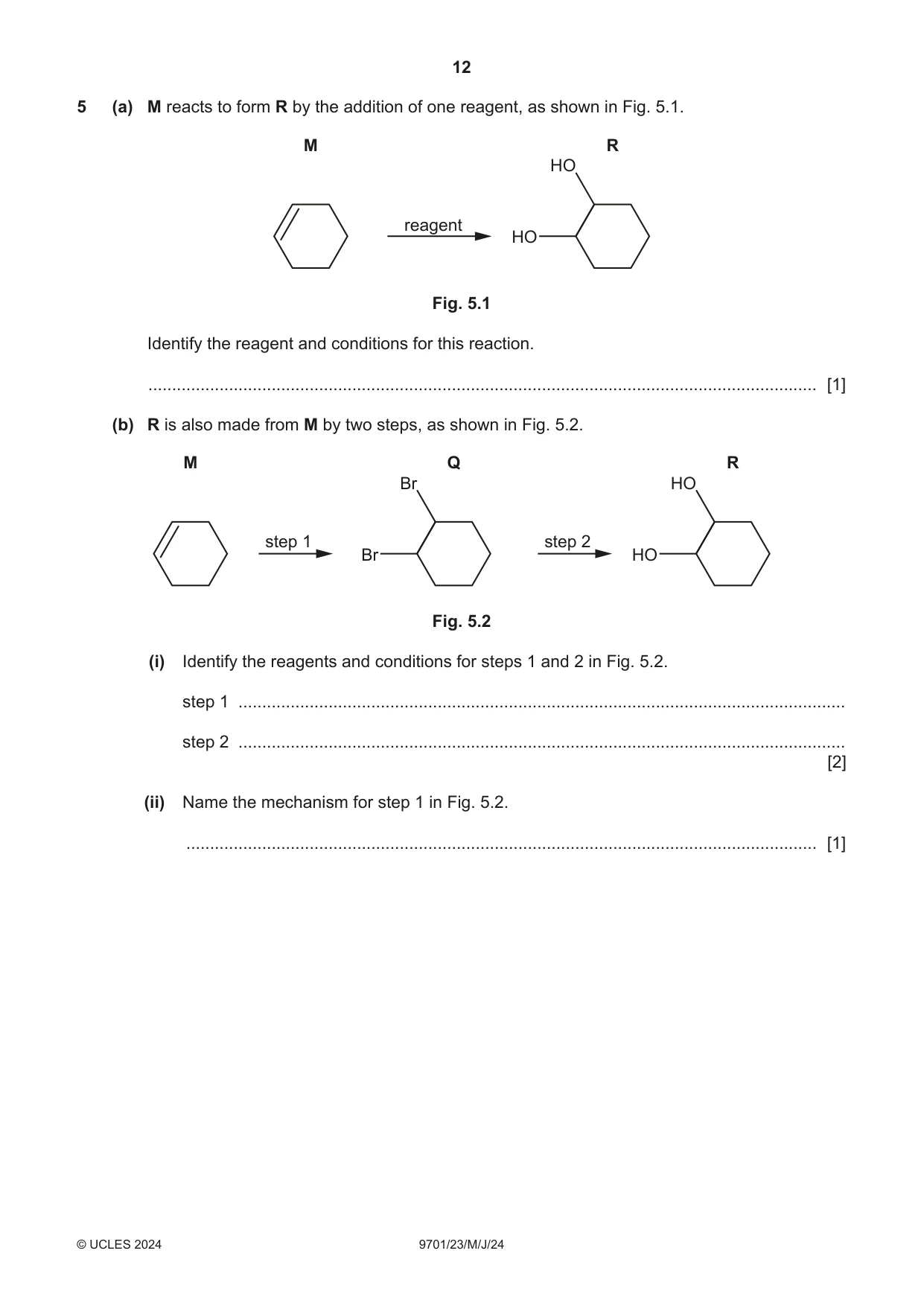
12 9701/23/M/J/24 © UCLES 2024 5 (a) M reacts to form R by the addition of one reagent, as shown in Fig. 5.1. HO reagent M R HO Fig. 5.1 Identify the reagent and conditions for this reaction. … [1] (b) R is also made from M by two steps, as shown in Fig. 5.2. HO step 2 M R HO Br step 1 Q Br Fig. 5.2 (i) Identify the reagents and conditions for steps 1 and 2 in Fig. 5.2. step 1 … step 2 … [2] (ii) Name the mechanism for step 1 in Fig. 5.2. … [1]
Question paper, page 13
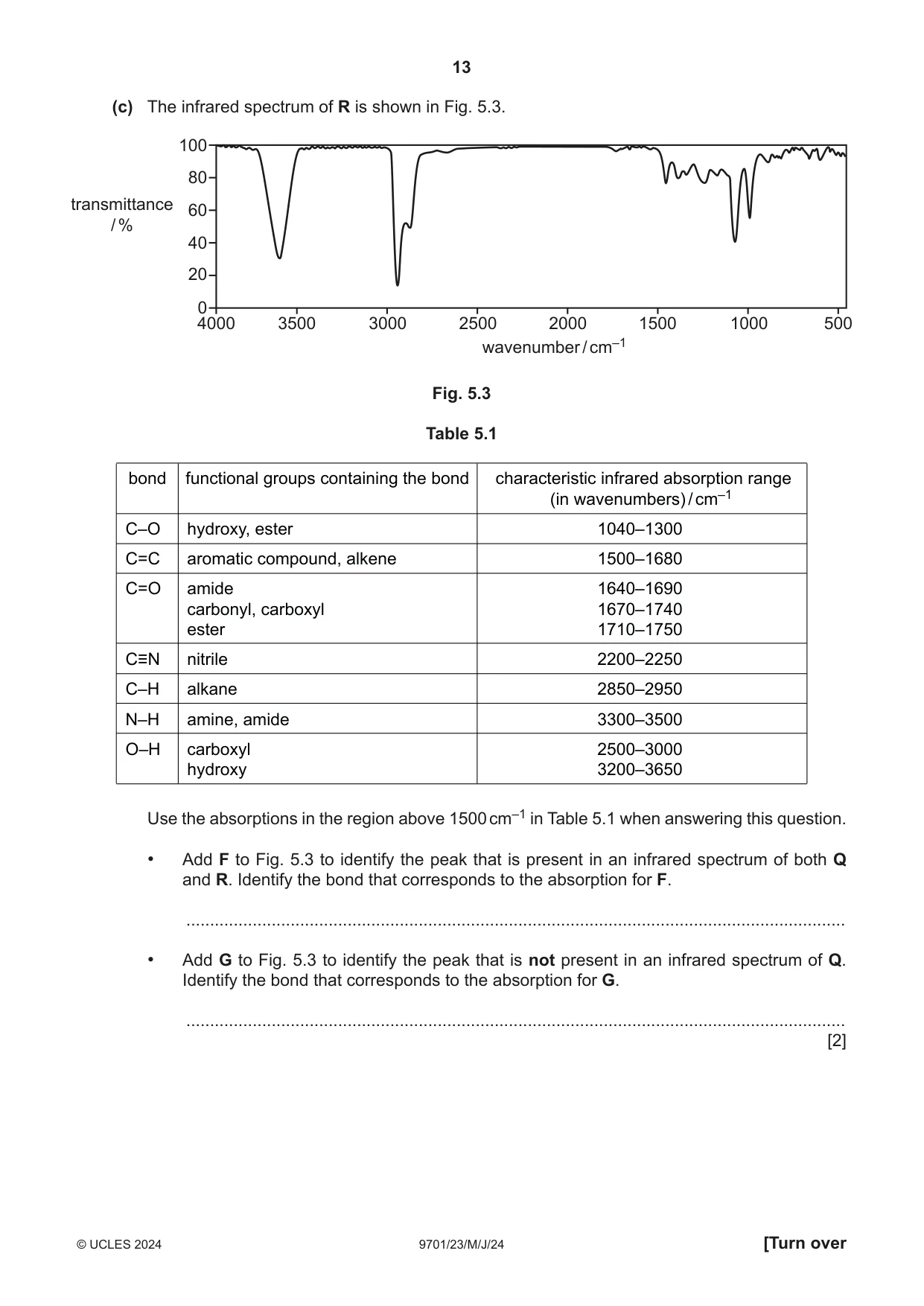
13 9701/23/M/J/24 © UCLES 2024 [Turn over (c) The infrared spectrum of R is shown in Fig. 5.3. 0 20 40 60 80 100 3500 4000 3000 2500 2000 wavenumber / cm–1 transmittance / % 1500 1000 500 Fig. 5.3 Table 5.1 bond functional groups containing the bond characteristic infrared absorption range (in wavenumbers) / cm–1 C–O hydroxy, ester 1040–1300 C=C aromatic compound, alkene 1500–1680 C=O amide carbonyl, carboxyl ester 1640–1690 1670–1740 1710–1750 C≡N nitrile 2200–2250 C–H alkane 2850–2950 N–H amine, amide 3300–3500 O–H carboxyl hydroxy 2500–3000 3200–3650 Use the absorptions in the region above 1500 cm–1 in Table 5.1 when answering this question. • Add F to Fig. 5.3 to identify the peak that is present in an infrared spectrum of both Q and R. Identify the bond that corresponds to the absorption for F. … • Add G to Fig. 5.3 to identify the peak that is not present in an infrared spectrum of Q. Identify the bond that corresponds to the absorption for G. … [2]
Question paper, page 14
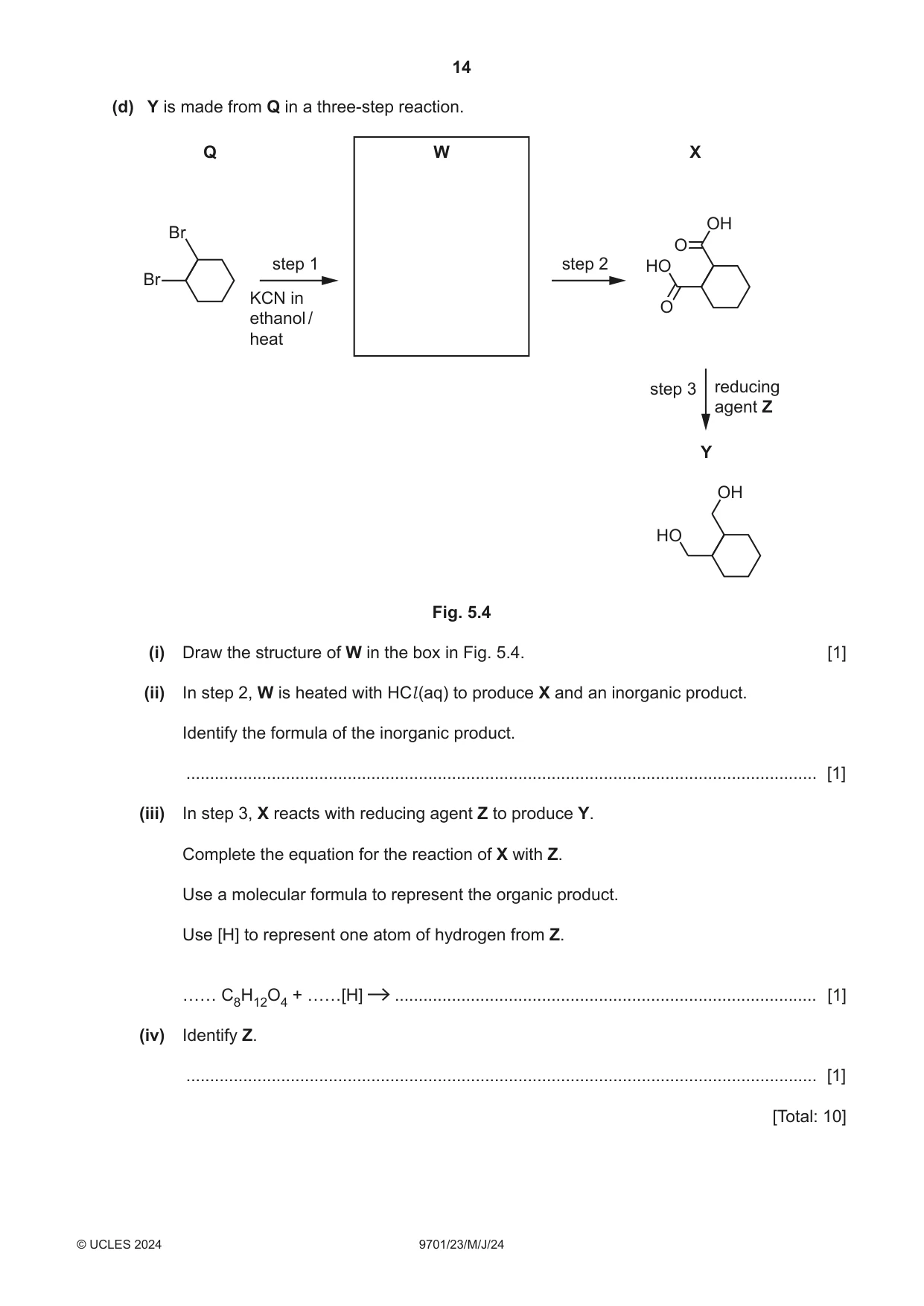
14 9701/23/M/J/24 © UCLES 2024 (d) Y is made from Q in a three-step reaction. Br Q W X Y Br KCN in ethanol / heat reducing agent Z step 2 step 3 step 1 O HO O OH HO OH Fig. 5.4 (i) Draw the structure of W in the box in Fig. 5.4. [1] (ii) In step 2, W is heated with HCl (aq) to produce X and an inorganic product. Identify the formula of the inorganic product. … [1] (iii) In step 3, X reacts with reducing agent Z to produce Y. Complete the equation for the reaction of X with Z. Use a molecular formula to represent the organic product. Use [H] to represent one atom of hydrogen from Z. …… C8H12O4 + ……[H] … [1] (iv) Identify Z. … [1] [Total: 10]
Question paper, page 15
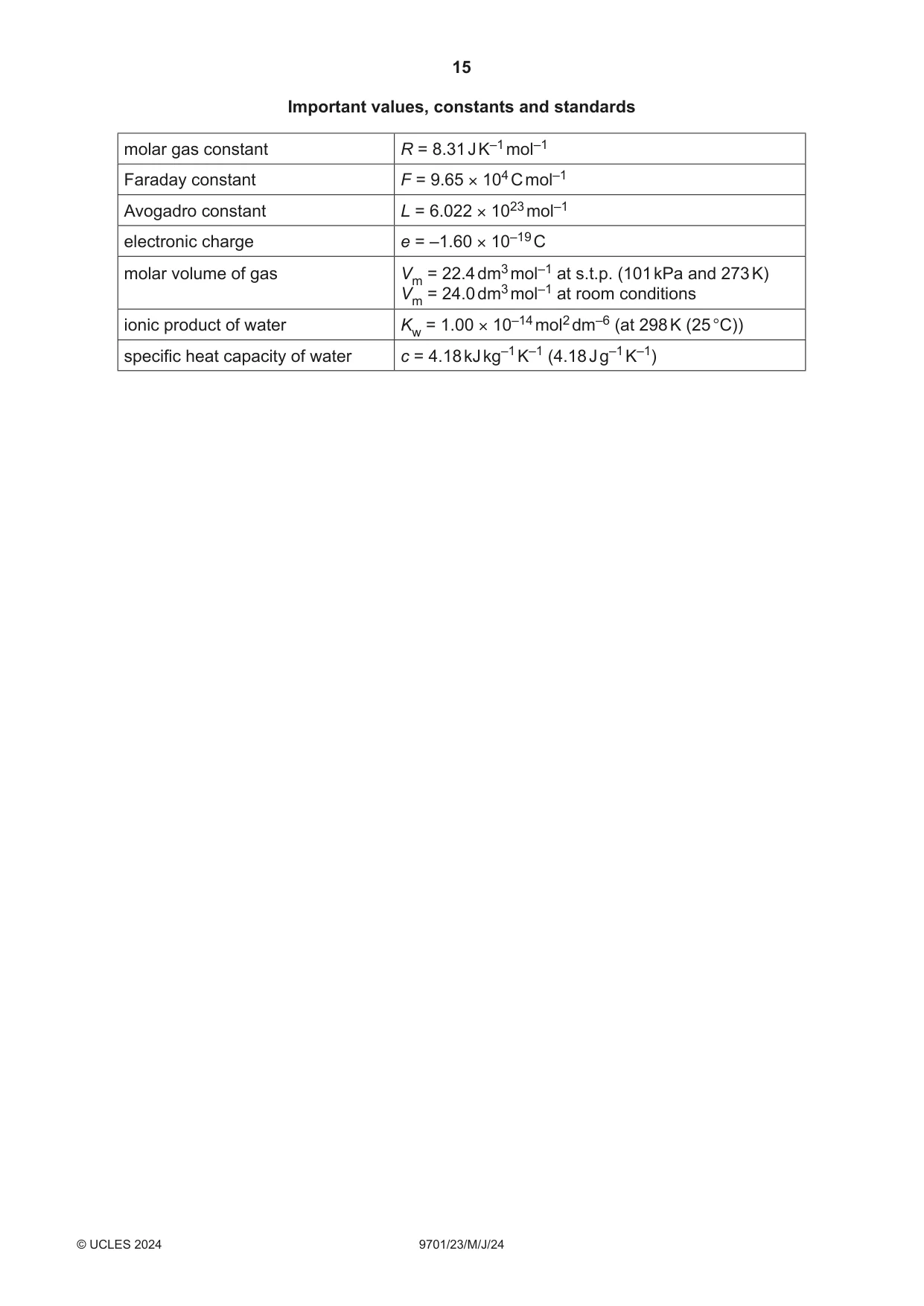
15 9701/23/M/J/24 © UCLES 2024 Important values, constants and standards molar gas constant R = 8.31 J K–1 mol–1 Faraday constant F = 9.65 × 10⁴ C mol–1 Avogadro constant L = 6.022 × 10²³ mol–1 electronic charge e = –1.60 × 10⁻¹⁹ C molar volume of gas Vm = 22.4 dm3 mol–1 at s.t.p. (101 kPa and 273 K) Vm = 24.0 dm3 mol–1 at room conditions ionic product of water Kw = 1.00 × 10⁻¹⁴ mol2 dm–6 (at 298 K (25 °C)) specific heat capacity of water c = 4.18 kJ kg–1 K–1 (4.18 J g–1 K–1)
Question paper, page 16
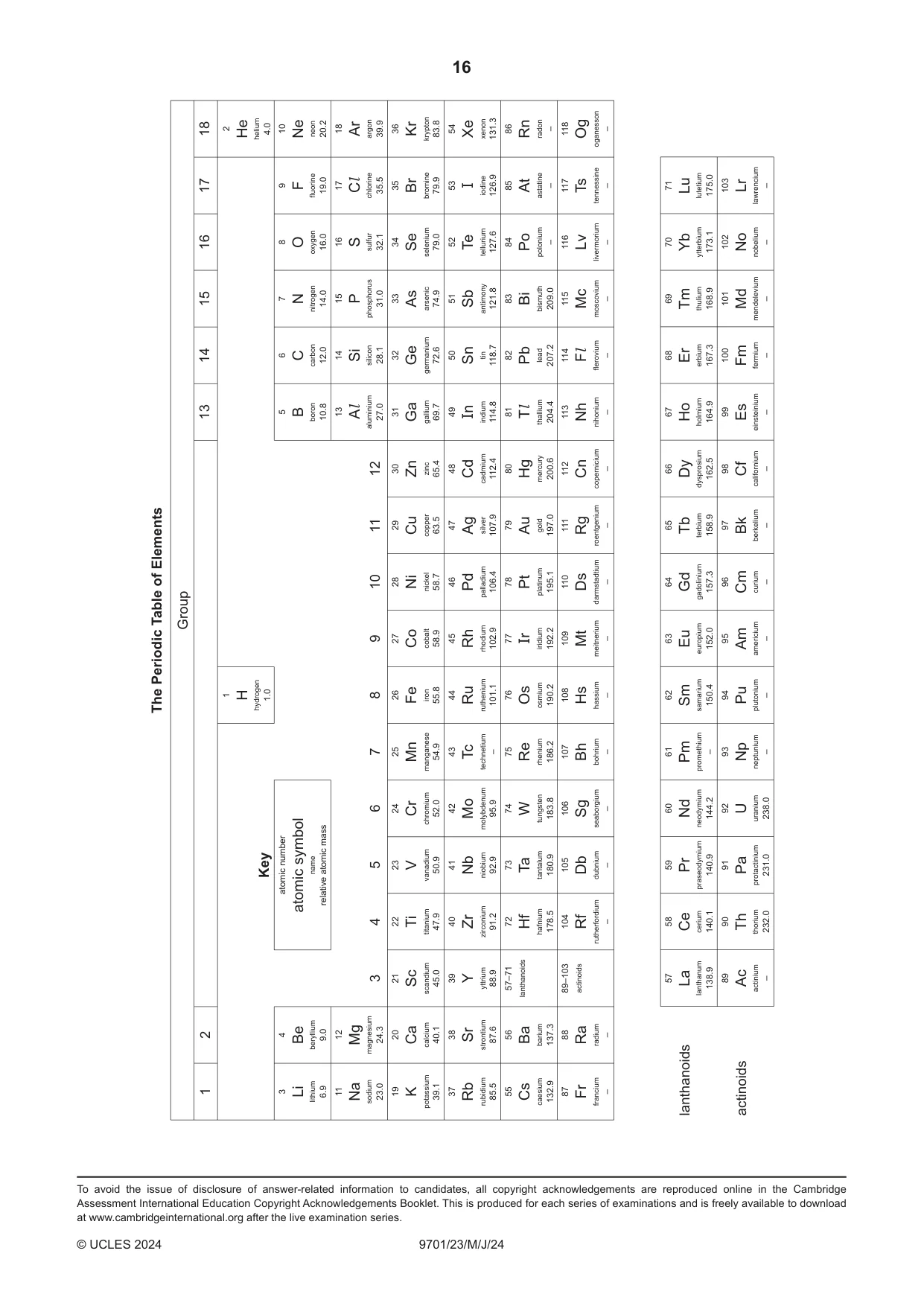
16 9701/23/M/J/24 © UCLES 2024 To avoid the issue of disclosure of answer-related information to candidates, all copyright acknowledgements are reproduced online in the Cambridge Assessment International Education Copyright Acknowledgements Booklet. This is produced for each series of examinations and is freely available to download at www.cambridgeinternational.org after the live examination series. Group The Periodic Table of Elements 1 H hydrogen 1.0 2 He helium 4.0 1 2 13 14 15 16 17 18 3 4 5 6 7 8 9 10 11 12 3 Li lithium 6.9 4 Be beryllium 9.0 atomic number atomic symbol Key name relative atomic mass 11 Na sodium 23.0 12 Mg magnesium 24.3 19 K potassium 39.1 20 Ca calcium 40.1 37 Rb rubidium 85.5 38 Sr strontium 87.6 55 Cs caesium 132.9 56 Ba barium 137.3 87 Fr francium – 88 Ra radium – 5 B boron 10.8 13 Al aluminium 27.0 31 Ga gallium 69.7 49 In indium 114.8 81 Tl thallium 204.4 6 C carbon 12.0 14 Si silicon 28.1 32 Ge germanium 72.6 50 Sn tin 118.7 82 Pb lead 207.2 22 Ti titanium 47.9 40 Zr zirconium 91.2 72 Hf hafnium 178.5 104 Rf rutherfordium – 23 V vanadium 50.9 41 Nb niobium 92.9 73 Ta tantalum 180.9 105 Db dubnium – 24 Cr chromium 52.0 42 Mo molybdenum 95.9 74 W tungsten 183.8 106 Sg seaborgium – 25 Mn manganese 54.9 43 Tc technetium – 75 Re rhenium 186.2 107 Bh bohrium – 26 Fe iron 55.8 44 Ru ruthenium 101.1 76 Os osmium 190.2 108 Hs hassium – 27 Co cobalt 58.9 45 Rh rhodium 102.9 77 Ir iridium 192.2 109 Mt meitnerium – 28 Ni nickel 58.7 46 Pd palladium 106.4 78 Pt platinum 195.1 110 Ds darmstadtium – 29 Cu copper 63.5 47 Ag silver 107.9 79 Au gold 197.0 111 Rg roentgenium – 30 Zn zinc 65.4 48 Cd cadmium 112.4 80 Hg mercury 200.6 112 Cn copernicium – 114 Fl flerovium – 116 Lv livermorium – 7 N nitrogen 14.0 15 P phosphorus 31.0 33 As arsenic 74.9 51 Sb antimony 121.8 83 Bi bismuth 209.0 8 O oxygen 16.0 16 S sulfur 32.1 34 Se selenium 79.0 52 Te tellurium 127.6 84 Po polonium – 9 F fluorine 19.0 17 Cl chlorine 35.5 35 Br bromine 79.9 53 I iodine 126.9 85 At astatine – 10 Ne neon 20.2 18 Ar argon 39.9 36 Kr krypton 83.8 54 Xe xenon 131.3 86 Rn radon – 113 Nh nihonium – 115 Mc moscovium – 117 Ts tennessine – 118 Og oganesson – 21 Sc scandium 45.0 39 Y yttrium 88.9 57–71 lanthanoids 89–103 actinoids 57 La lanthanum 138.9 89 Ac lanthanoids actinoids actinium – 58 Ce cerium 140.1 90 Th thorium 232.0 59 Pr praseodymium 140.9 91 Pa protactinium 231.0 60 Nd neodymium 144.2 92 U uranium 238.0 61 Pm promethium – 93 Np neptunium – 62 Sm samarium 150.4 94 Pu plutonium – 63 Eu europium 152.0 95 Am americium – 64 Gd gadolinium 157.3 96 Cm curium – 65 Tb terbium 158.9 97 Bk berkelium – 66 Dy dysprosium 162.5 98 Cf californium – 67 Ho holmium 164.9 99 Es einsteinium – 68 Er erbium 167.3 100 Fm fermium – 69 Tm thulium 168.9 101 Md mendelevium – 70 Yb ytterbium 173.1 102 No nobelium – 71 Lu lutetium 175.0 103 Lr lawrencium –
Mark scheme, page 1
This document consists of 11 printed pages. © Cambridge University Press & Assessment 2024 [Turn over Cambridge International AS & A Level CHEMISTRY 9701/23 Paper 2 AS Level Structured Questions May/June 2024 MARK SCHEME Maximum Mark: 60 Published This mark scheme is published as an aid to teachers and candidates, to indicate the requirements of the examination. It shows the basis on which Examiners were instructed to award marks. It does not indicate the details of the discussions that took place at an Examiners’ meeting before marking began, which would have considered the acceptability of alternative answers. Mark schemes should be read in conjunction with the question paper and the Principal Examiner Report for Teachers. Cambridge International will not enter into discussions about these mark schemes. Cambridge International is publishing the mark schemes for the May/June 2024 series for most Cambridge IGCSE, Cambridge International A and AS Level and Cambridge Pre-U components, and some Cambridge O Level components.
Mark scheme, page 2
9701/23 Cambridge International AS & A Level – Mark Scheme PUBLISHED May/June 2024 © Cambridge University Press & Assessment 2024 Page 2 of 11 Generic Marking Principles These general marking principles must be applied by all examiners when marking candidate answers. They should be applied alongside the specific content of the mark scheme or generic level descriptions for a question. Each question paper and mark scheme will also comply with these marking principles. GENERIC MARKING PRINCIPLE 1: Marks must be awarded in line with: the specific content of the mark scheme or the generic level descriptors for the question the specific skills defined in the mark scheme or in the generic level descriptors for the question the standard of response required by a candidate as exemplified by the standardisation scripts. GENERIC MARKING PRINCIPLE 2: Marks awarded are always whole marks (not half marks, or other fractions). GENERIC MARKING PRINCIPLE 3: Marks must be awarded positively: marks are awarded for correct/valid answers, as defined in the mark scheme. However, credit is given for valid answers which go beyond the scope of the syllabus and mark scheme, referring to your Team Leader as appropriate marks are awarded when candidates clearly demonstrate what they know and can do marks are not deducted for errors marks are not deducted for omissions answers should only be judged on the quality of spelling, punctuation and grammar when these features are specifically assessed by the question as indicated by the mark scheme. The meaning, however, should be unambiguous. GENERIC MARKING PRINCIPLE 4: Rules must be applied consistently, e.g. in situations where candidates have not followed instructions or in the application of generic level descriptors.
Mark scheme, page 3
9701/23 Cambridge International AS & A Level – Mark Scheme PUBLISHED May/June 2024 © Cambridge University Press & Assessment 2024 Page 3 of 11 GENERIC MARKING PRINCIPLE 5: Marks should be awarded using the full range of marks defined in the mark scheme for the question (however; the use of the full mark range may be limited according to the quality of the candidate responses seen). GENERIC MARKING PRINCIPLE 6: Marks awarded are based solely on the requirements as defined in the mark scheme. Marks should not be awarded with grade thresholds or grade descriptors in mind.
Mark scheme, page 4
9701/23 Cambridge International AS & A Level – Mark Scheme PUBLISHED May/June 2024 © Cambridge University Press & Assessment 2024 Page 4 of 11 Science-Specific Marking Principles 1 Examiners should consider the context and scientific use of any keywords when awarding marks. Although keywords may be present, marks should not be awarded if the keywords are used incorrectly. 2 The examiner should not choose between contradictory statements given in the same question part, and credit should not be awarded for any correct statement that is contradicted within the same question part. Wrong science that is irrelevant to the question should be ignored. 3 Although spellings do not have to be correct, spellings of syllabus terms must allow for clear and unambiguous separation from other syllabus terms with which they may be confused (e.g. ethane / ethene, glucagon / glycogen, refraction / reflection). 4 The error carried forward (ecf) principle should be applied, where appropriate. If an incorrect answer is subsequently used in a scientifically correct way, the candidate should be awarded these subsequent marking points. Further guidance will be included in the mark scheme where necessary and any exceptions to this general principle will be noted. 5 ‘List rule’ guidance For questions that require n responses (e.g. State two reasons …): The response should be read as continuous prose, even when numbered answer spaces are provided. Any response marked ignore in the mark scheme should not count towards n. Incorrect responses should not be awarded credit but will still count towards n. Read the entire response to check for any responses that contradict those that would otherwise be credited. Credit should not be awarded for any responses that are contradicted within the rest of the response. Where two responses contradict one another, this should be treated as a single incorrect response. Non-contradictory responses after the first n responses may be ignored even if they include incorrect science.
Mark scheme, page 5
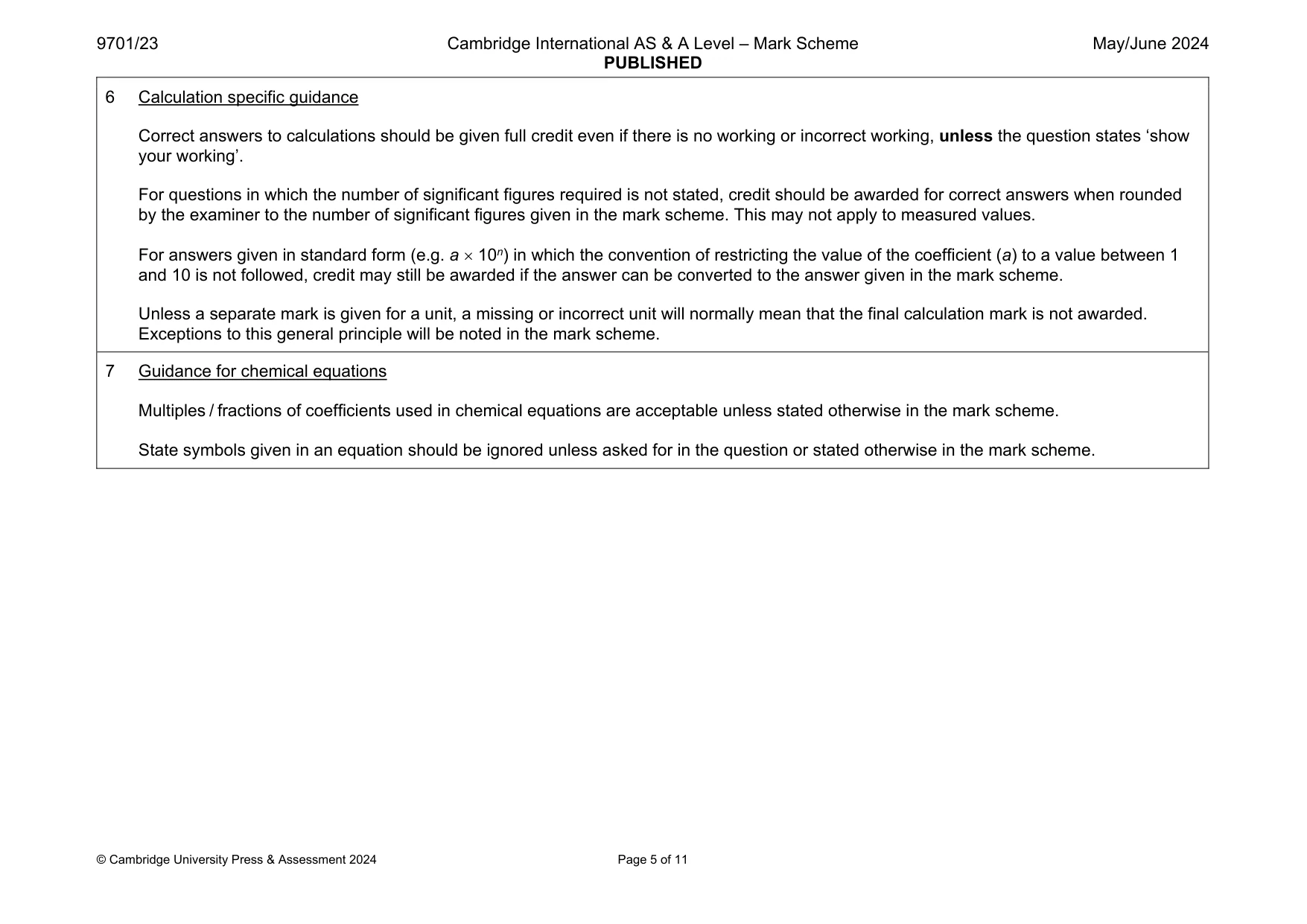
9701/23 Cambridge International AS & A Level – Mark Scheme PUBLISHED May/June 2024 © Cambridge University Press & Assessment 2024 Page 5 of 11 6 Calculation specific guidance Correct answers to calculations should be given full credit even if there is no working or incorrect working, unless the question states ‘show your working’. For questions in which the number of significant figures required is not stated, credit should be awarded for correct answers when rounded by the examiner to the number of significant figures given in the mark scheme. This may not apply to measured values. For answers given in standard form (e.g. a 10n) in which the convention of restricting the value of the coefficient (a) to a value between 1 and 10 is not followed, credit may still be awarded if the answer can be converted to the answer given in the mark scheme. Unless a separate mark is given for a unit, a missing or incorrect unit will normally mean that the final calculation mark is not awarded. Exceptions to this general principle will be noted in the mark scheme. 7 Guidance for chemical equations Multiples / fractions of coefficients used in chemical equations are acceptable unless stated otherwise in the mark scheme. State symbols given in an equation should be ignored unless asked for in the question or stated otherwise in the mark scheme.
Mark scheme, page 6
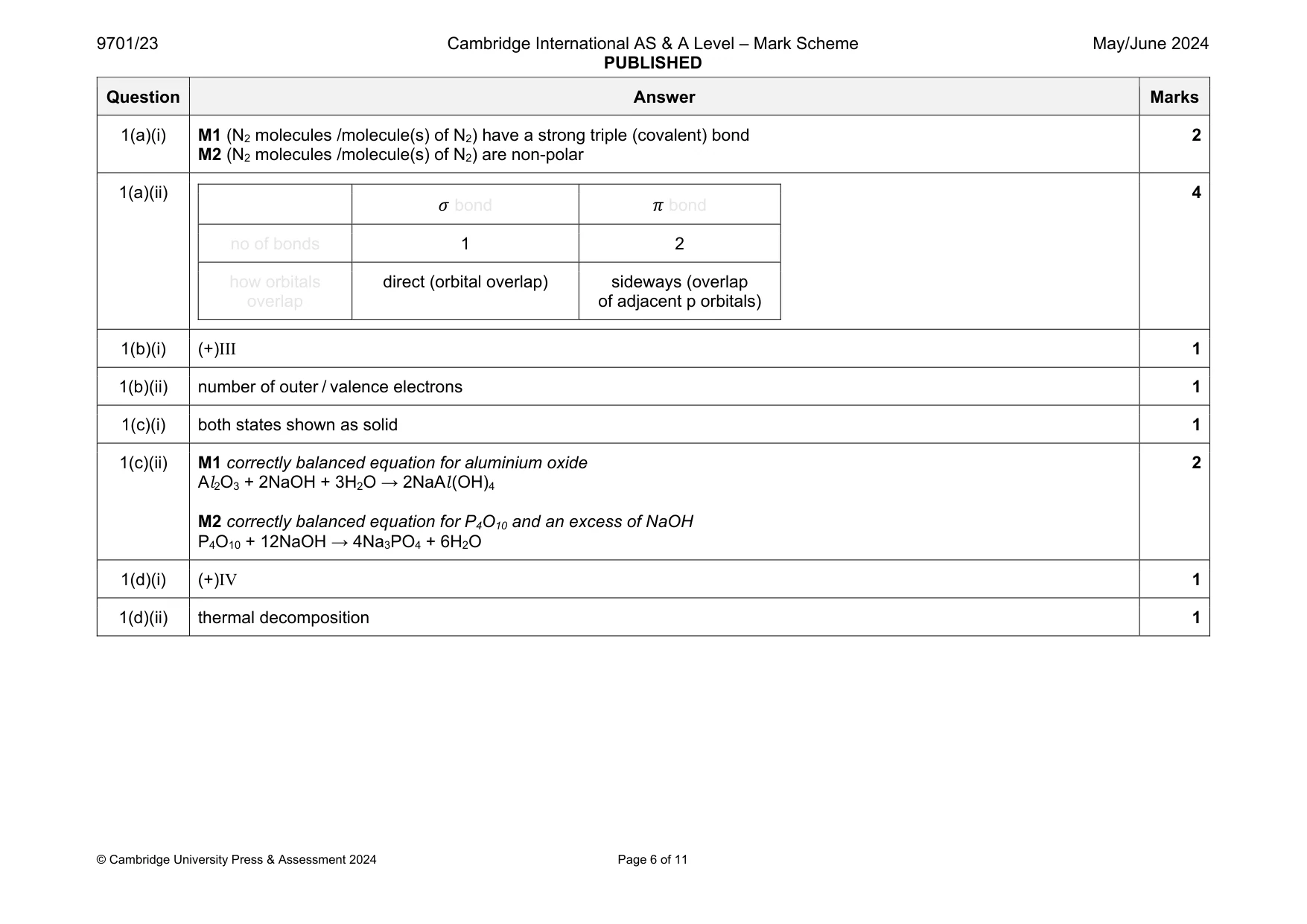
9701/23 Cambridge International AS & A Level – Mark Scheme PUBLISHED May/June 2024 © Cambridge University Press & Assessment 2024 Page 6 of 11 Question Answer Marks 1(a)(i) M1 (N2 molecules /molecule(s) of N2) have a strong triple (covalent) bond M2 (N2 molecules /molecule(s) of N2) are non-polar 2 1(a)(ii) 𝜎 bond 𝜋 bond no of bonds 1 2 how orbitals overlap direct (orbital overlap) sideways (overlap of adjacent p orbitals) 4 1(b)(i) (+)III 1 1(b)(ii) number of outer / valence electrons 1 1(c)(i) both states shown as solid 1 1(c)(ii) M1 correctly balanced equation for aluminium oxide Al2O3 + 2NaOH + 3H2O → 2NaAl (OH)4 M2 correctly balanced equation for P4O10 and an excess of NaOH P4O10 + 12NaOH → 4Na3PO4 + 6H2O 2 1(d)(i) (+)IV 1 1(d)(ii) thermal decomposition 1
Mark scheme, page 7
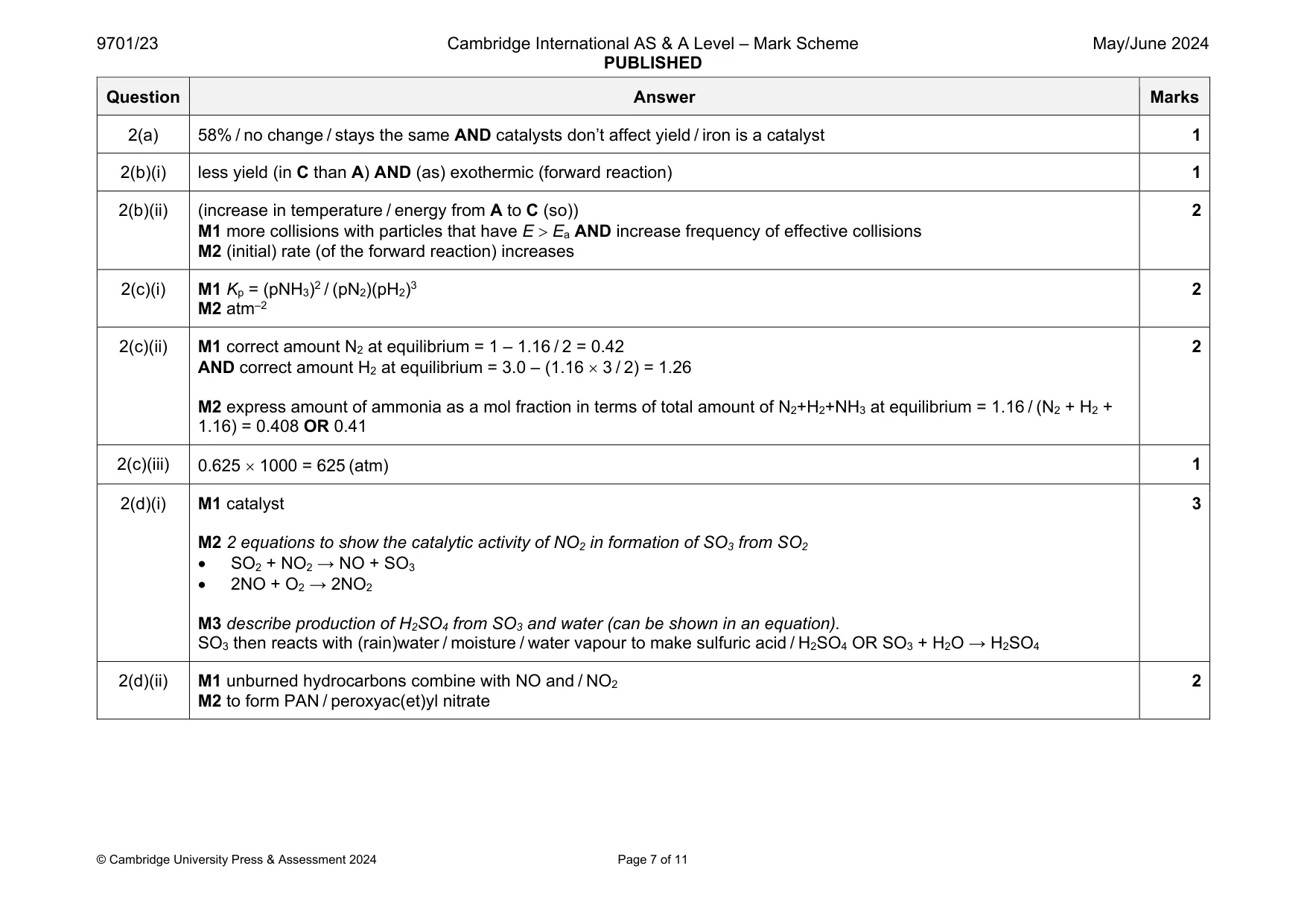
9701/23 Cambridge International AS & A Level – Mark Scheme PUBLISHED May/June 2024 © Cambridge University Press & Assessment 2024 Page 7 of 11 Question Answer Marks 2(a) 58% / no change / stays the same AND catalysts don’t affect yield / iron is a catalyst 1 2(b)(i) less yield (in C than A) AND (as) exothermic (forward reaction) 1 2(b)(ii) (increase in temperature / energy from A to C (so)) M1 more collisions with particles that have E Ea AND increase frequency of effective collisions M2 (initial) rate (of the forward reaction) increases 2 2(c)(i) M1 Kp = (pNH3)2 / (pN2)(pH2)3 M2 atm–2 2 2(c)(ii) M1 correct amount N2 at equilibrium = 1 – 1.16 / 2 = 0.42 AND correct amount H2 at equilibrium = 3.0 – (1.16 3 / 2) = 1.26 M2 express amount of ammonia as a mol fraction in terms of total amount of N2+H2+NH3 at equilibrium = 1.16 / (N2 + H2 + 1.16) = 0.408 OR 0.41 2 2(c)(iii) 0.625 1000 = 625 (atm) 1 2(d)(i) M1 catalyst M2 2 equations to show the catalytic activity of NO2 in formation of SO3 from SO2 SO2 + NO2 → NO + SO3 2NO + O2 → 2NO2 M3 describe production of H2SO4 from SO3 and water (can be shown in an equation). SO3 then reacts with (rain)water / moisture / water vapour to make sulfuric acid / H2SO4 OR SO3 + H2O → H2SO4 3 2(d)(ii) M1 unburned hydrocarbons combine with NO and / NO2 M2 to form PAN / peroxyac(et)yl nitrate 2
Mark scheme, page 8
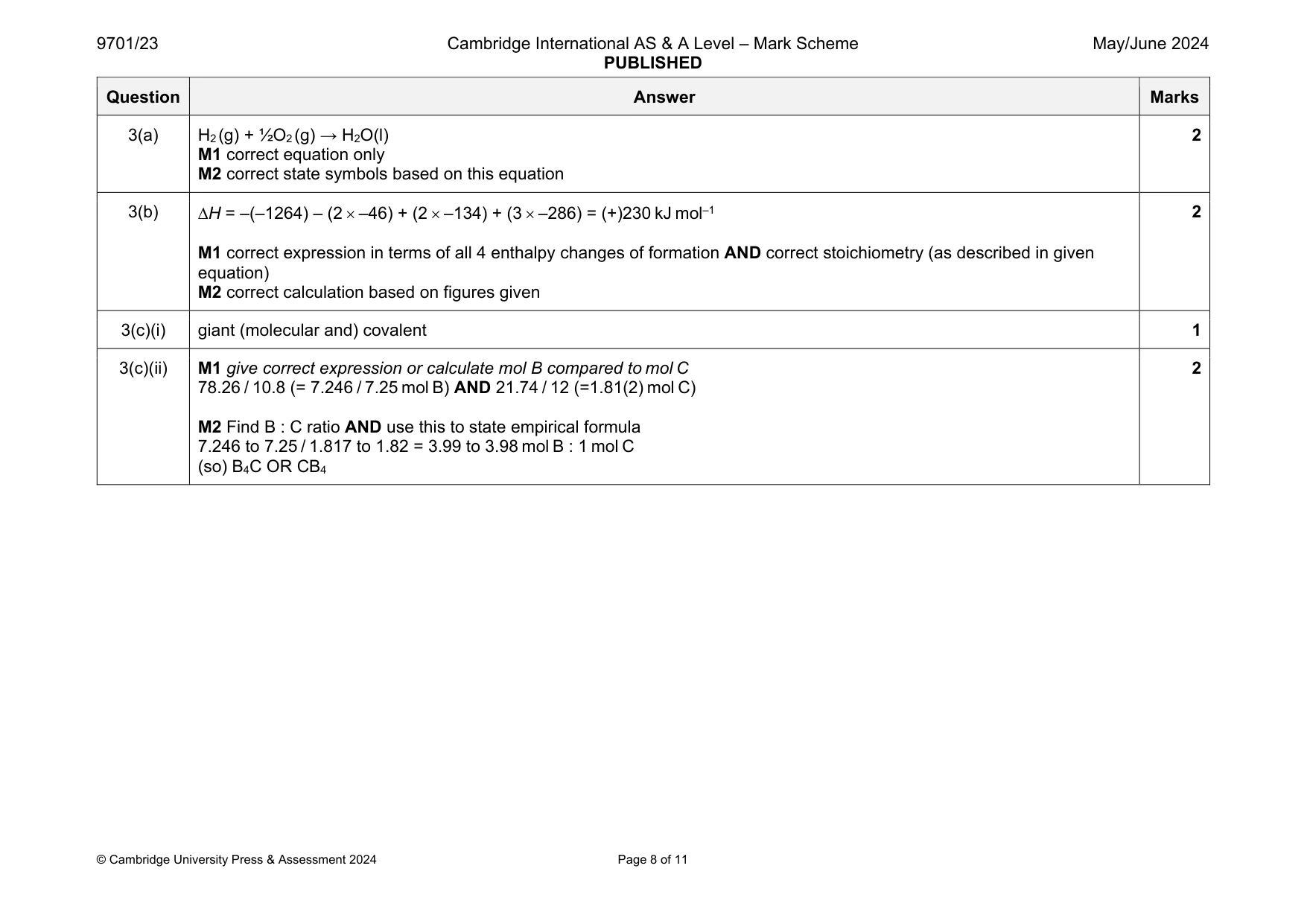
9701/23 Cambridge International AS & A Level – Mark Scheme PUBLISHED May/June 2024 © Cambridge University Press & Assessment 2024 Page 8 of 11 Question Answer Marks 3(a) H2 (g) + ½O2 (g) → H2O(l) M1 correct equation only M2 correct state symbols based on this equation 2 3(b) ∆H = –(–1264) – (2 –46) + (2 –134) + (3 –286) = (+)230 kJ mol–1 M1 correct expression in terms of all 4 enthalpy changes of formation AND correct stoichiometry (as described in given equation) M2 correct calculation based on figures given 2 3(c)(i) giant (molecular and) covalent 1 3(c)(ii) M1 give correct expression or calculate mol B compared to mol C 78.26 / 10.8 (= 7.246 / 7.25 mol B) AND 21.74 / 12 (=1.81(2) mol C) M2 Find B : C ratio AND use this to state empirical formula 7.246 to 7.25 / 1.817 to 1.82 = 3.99 to 3.98 mol B : 1 mol C (so) B4C OR CB4 2
Mark scheme, page 9
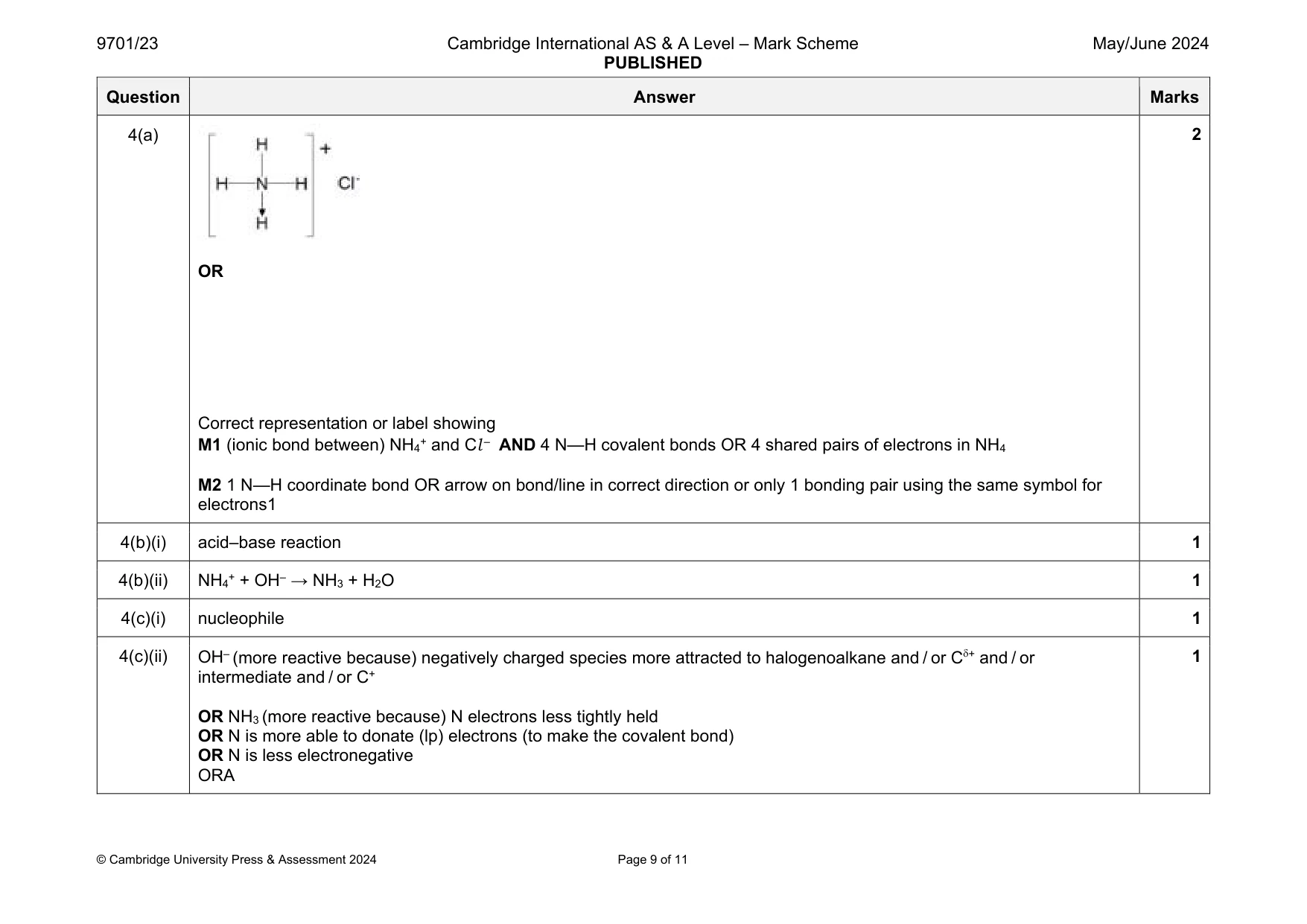
9701/23 Cambridge International AS & A Level – Mark Scheme PUBLISHED May/June 2024 © Cambridge University Press & Assessment 2024 Page 9 of 11 Question Answer Marks 4(a) OR Correct representation or label showing M1 (ionic bond between) NH4+ and Cl – AND 4 N—H covalent bonds OR 4 shared pairs of electrons in NH4 M2 1 N—H coordinate bond OR arrow on bond/line in correct direction or only 1 bonding pair using the same symbol for electrons1 2 4(b)(i) acid–base reaction 1 4(b)(ii) NH4+ + OH– → NH3 + H2O 1 4(c)(i) nucleophile 1 4(c)(ii) OH– (more reactive because) negatively charged species more attracted to halogenoalkane and / or C+ and / or intermediate and / or C+ OR NH3 (more reactive because) N electrons less tightly held OR N is more able to donate (lp) electrons (to make the covalent bond) OR N is less electronegative ORA 1
Mark scheme, page 10
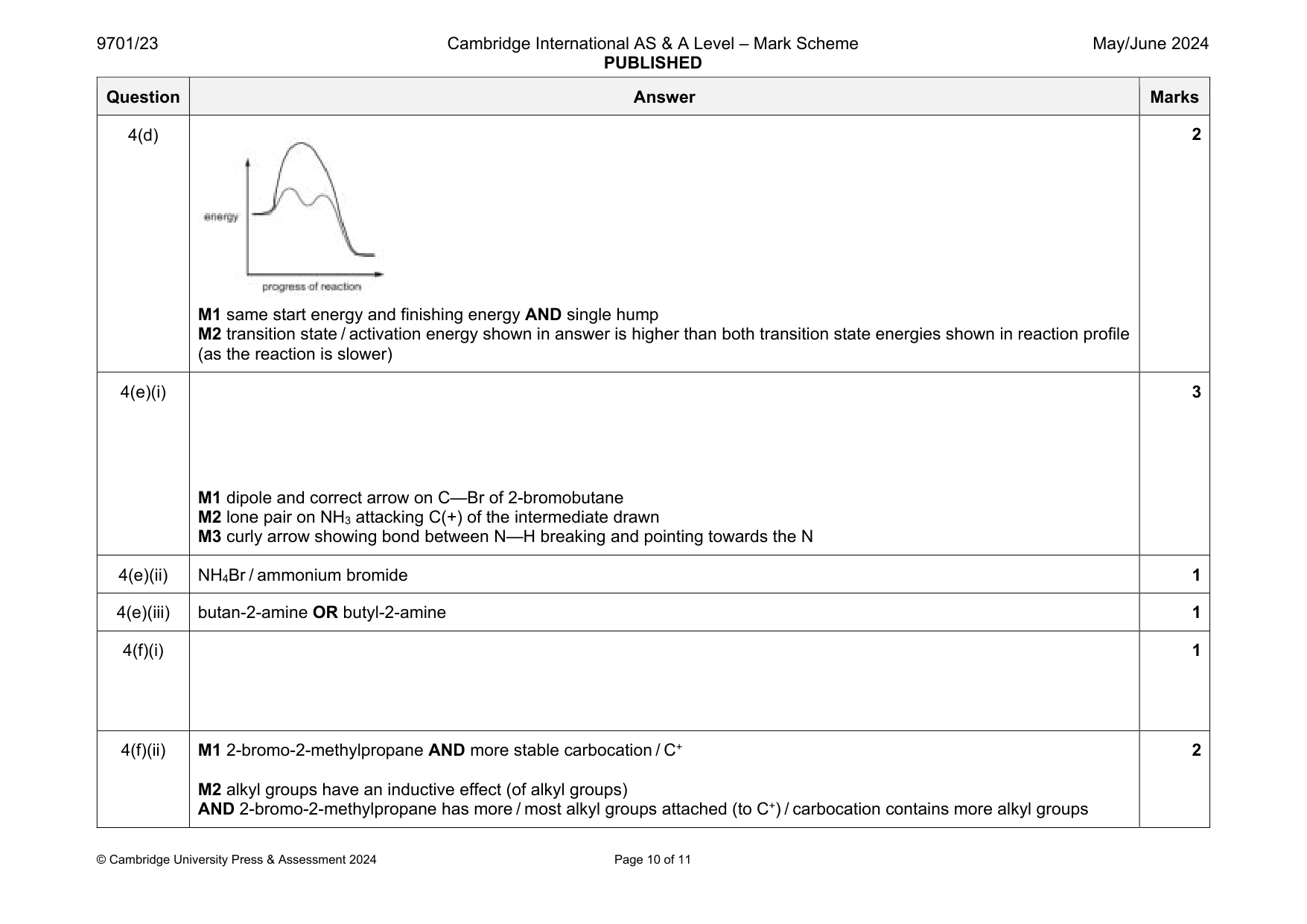
9701/23 Cambridge International AS & A Level – Mark Scheme PUBLISHED May/June 2024 © Cambridge University Press & Assessment 2024 Page 10 of 11 Question Answer Marks 4(d) M1 same start energy and finishing energy AND single hump M2 transition state / activation energy shown in answer is higher than both transition state energies shown in reaction profile (as the reaction is slower) 2 4(e)(i) M1 dipole and correct arrow on C—Br of 2-bromobutane M2 lone pair on NH3 attacking C(+) of the intermediate drawn M3 curly arrow showing bond between N—H breaking and pointing towards the N 3 4(e)(ii) NH4Br / ammonium bromide 1 4(e)(iii) butan-2-amine OR butyl-2-amine 1 4(f)(i) 1 4(f)(ii) M1 2-bromo-2-methylpropane AND more stable carbocation / C+ M2 alkyl groups have an inductive effect (of alkyl groups) AND 2-bromo-2-methylpropane has more / most alkyl groups attached (to C+) / carbocation contains more alkyl groups 2
Mark scheme, page 11
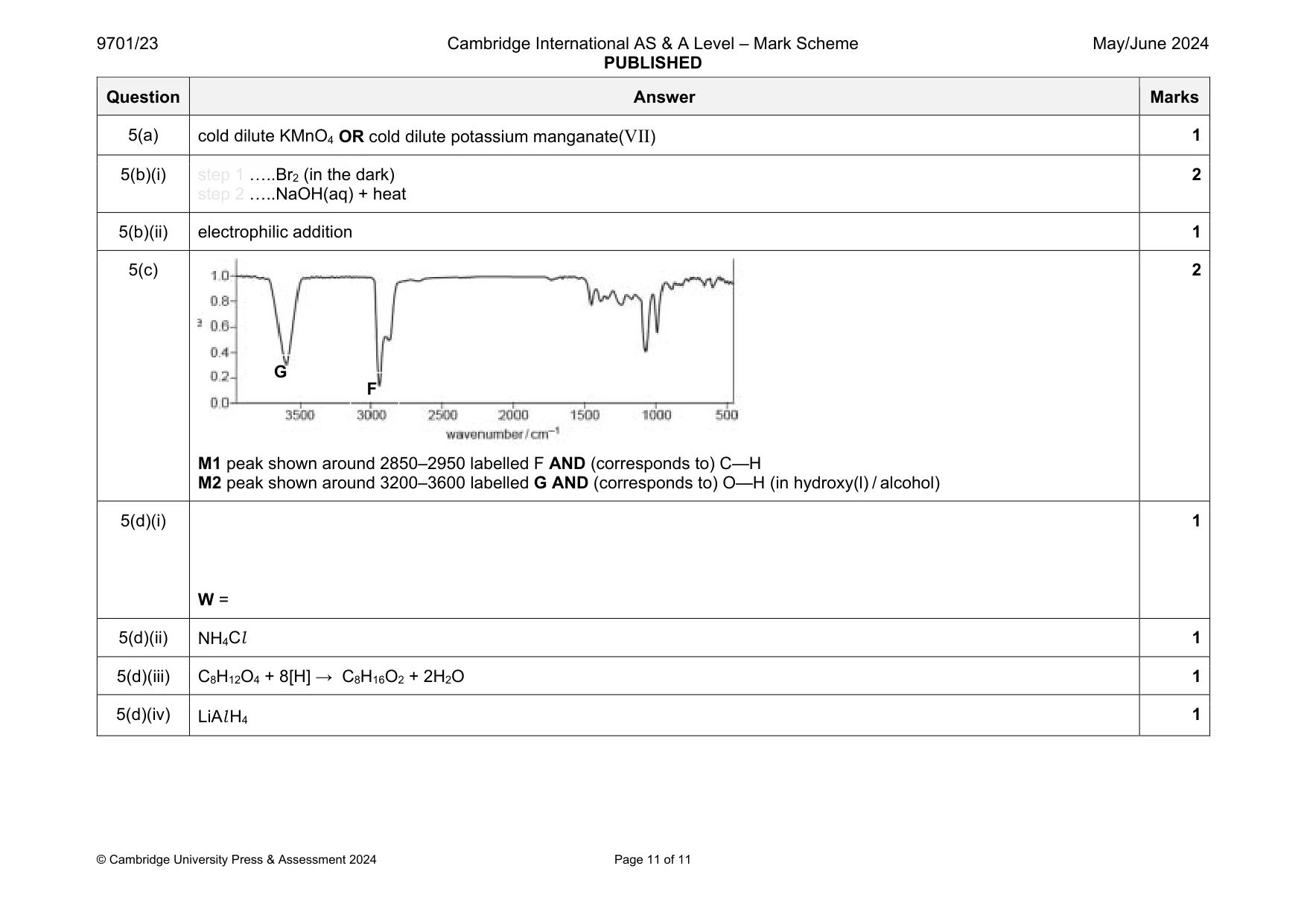
9701/23 Cambridge International AS & A Level – Mark Scheme PUBLISHED May/June 2024 © Cambridge University Press & Assessment 2024 Page 11 of 11 Question Answer Marks 5(a) cold dilute KMnO4 OR cold dilute potassium manganate(VII) 1 5(b)(i) step 1 …..Br2 (in the dark) step 2 …..NaOH(aq) + heat 2 5(b)(ii) electrophilic addition 1 5(c) M1 peak shown around 2850–2950 labelled F AND (corresponds to) C—H M2 peak shown around 3200–3600 labelled G AND (corresponds to) O—H (in hydroxy(l) / alcohol) 2 5(d)(i) W = 1 5(d)(ii) NH4Cl 1 5(d)(iii) C8H12O4 + 8[H] → C8H16O2 + 2H2O 1 5(d)(iv) LiAl H4 1 G F
What you needed in this session
Cambridge’s own grade thresholds for 2024 May/June, Paper 2 · Variant 3. A higher threshold means an easier paper — the bar moves with how the cohort did.