Cambridge A Level Chemistry 9701 — 2023 Oct/Nov Paper 2 · Variant 2
9701/22/O/N/23 · 4 questions · 60 marks · ≈68 min
The question paper and its mark scheme, free to read here and free to download. This is Cambridge’s own paper, exactly as it was sat.
Question paper20 pages




Mark scheme9 pages
Answers below. Sit the paper first if you are practising.
Questions as text
Q1 · The elements silicon, phosphorus and sulfur are in Period 3 of the Periodic Table
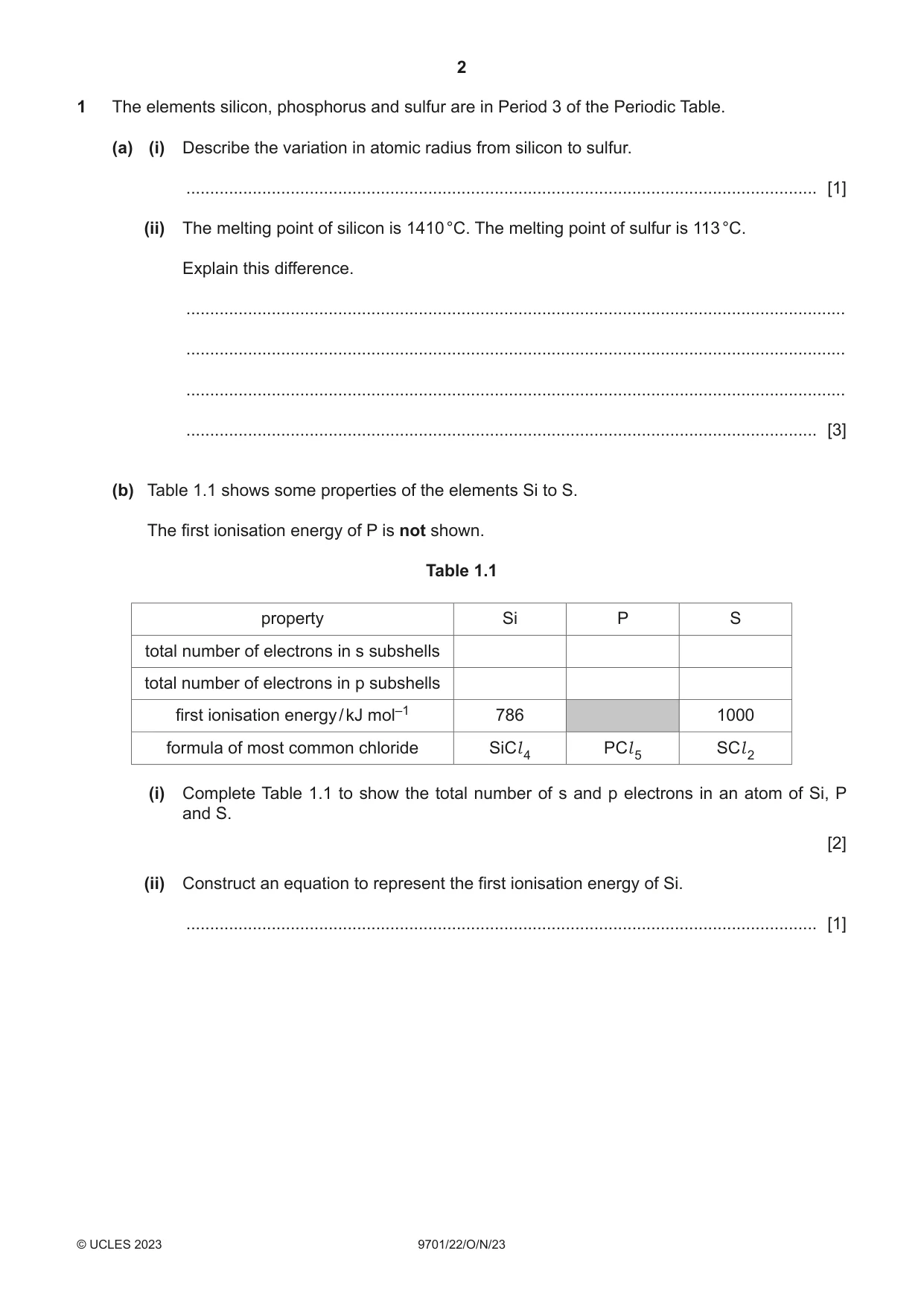
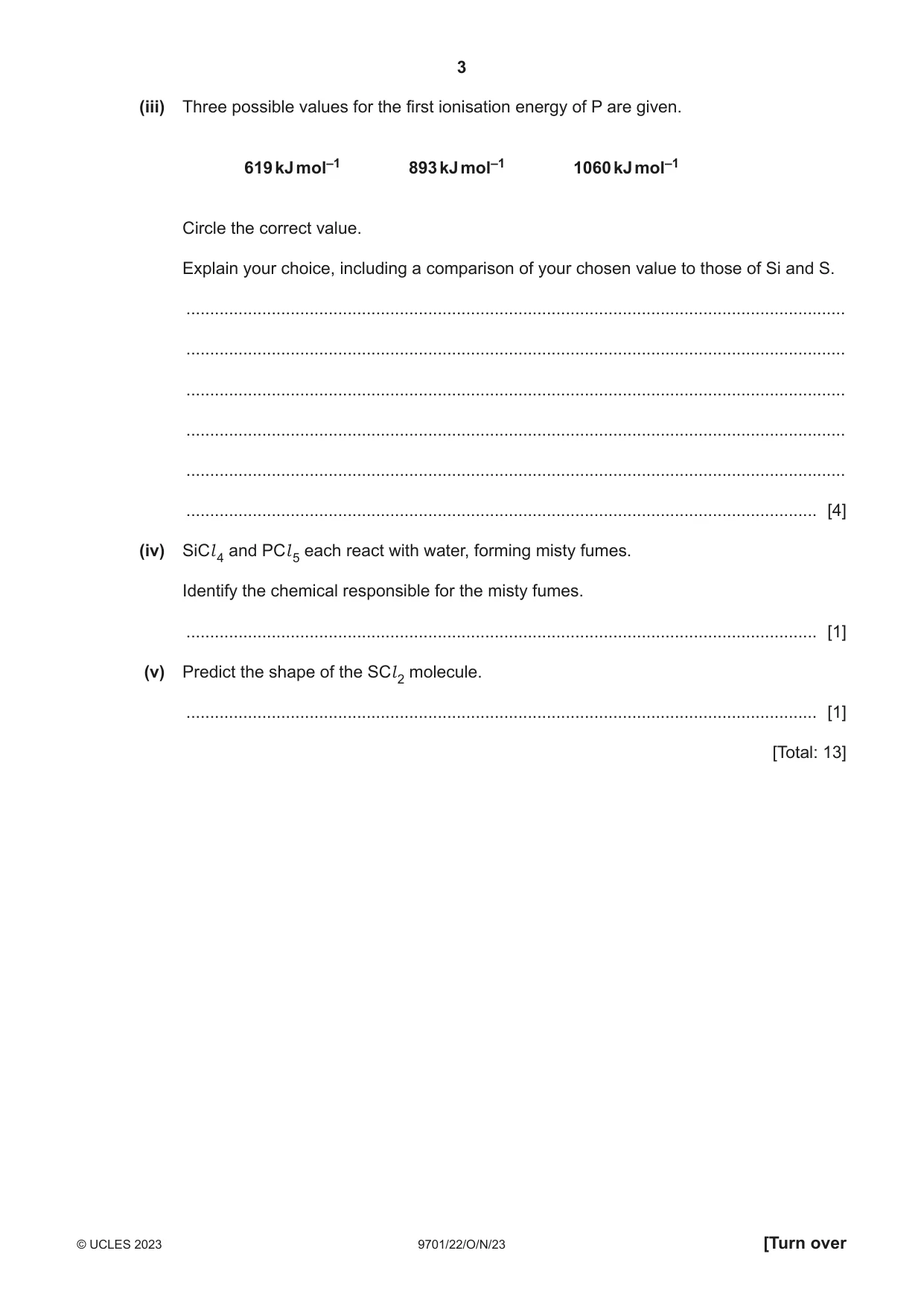
1 The elements silicon, phosphorus and sulfur are in Period 3 of the Periodic Table. (a) (i) Describe the variation in atomic radius from silicon to sulfur. ..................................................................................................................................... [1] (ii) The melting point of silicon is 1410 °C. The melting point of sulfur is 113 °C. Explain this difference. ........................................................................................................................................... ........................................................................................................................................... ........................................................................................................................................... ..................................................................................................................................... [3] (b) Table 1.1 shows some properties of the elements Si to S. The first ionisation energy of P is not shown. Table 1.1 property Si P S total number of electrons in s subshells total number of electrons in p subshells first ionisation energy / kJ mol–1 786 1000 formula of most common chloride SiCl 4 PCl 5 SCl 2 (i) Complete Table 1.1 to show the total number of s and p electrons in an atom of Si, P and S. [2] (ii) Construct an equation to represent the first ionisation energy of Si. ..................................................................................................................................... [1] (iii) Three possible values for the first ionisation energy of P are given. 619 kJ mol–1 893 kJ mol–1 1060 kJ mol–1 Circle the correct value. Explain your choice, including a comparison of your chosen value to those of Si and S. ........................................................................................................................................... ........................................................................................................................................... ........................................................................................................................................... ........................................................................................................................................... ........................................................................................................................................... ..................................................................................................................................... [4] (iv) SiCl 4 and PCl 5 each react with water, forming misty fumes. Identify the chemical responsible for the misty fumes. ..................................................................................................................................... [1] (v) Predict the shape of the SCl 2 molecule. ..................................................................................................................................... [1] [Total: 13]
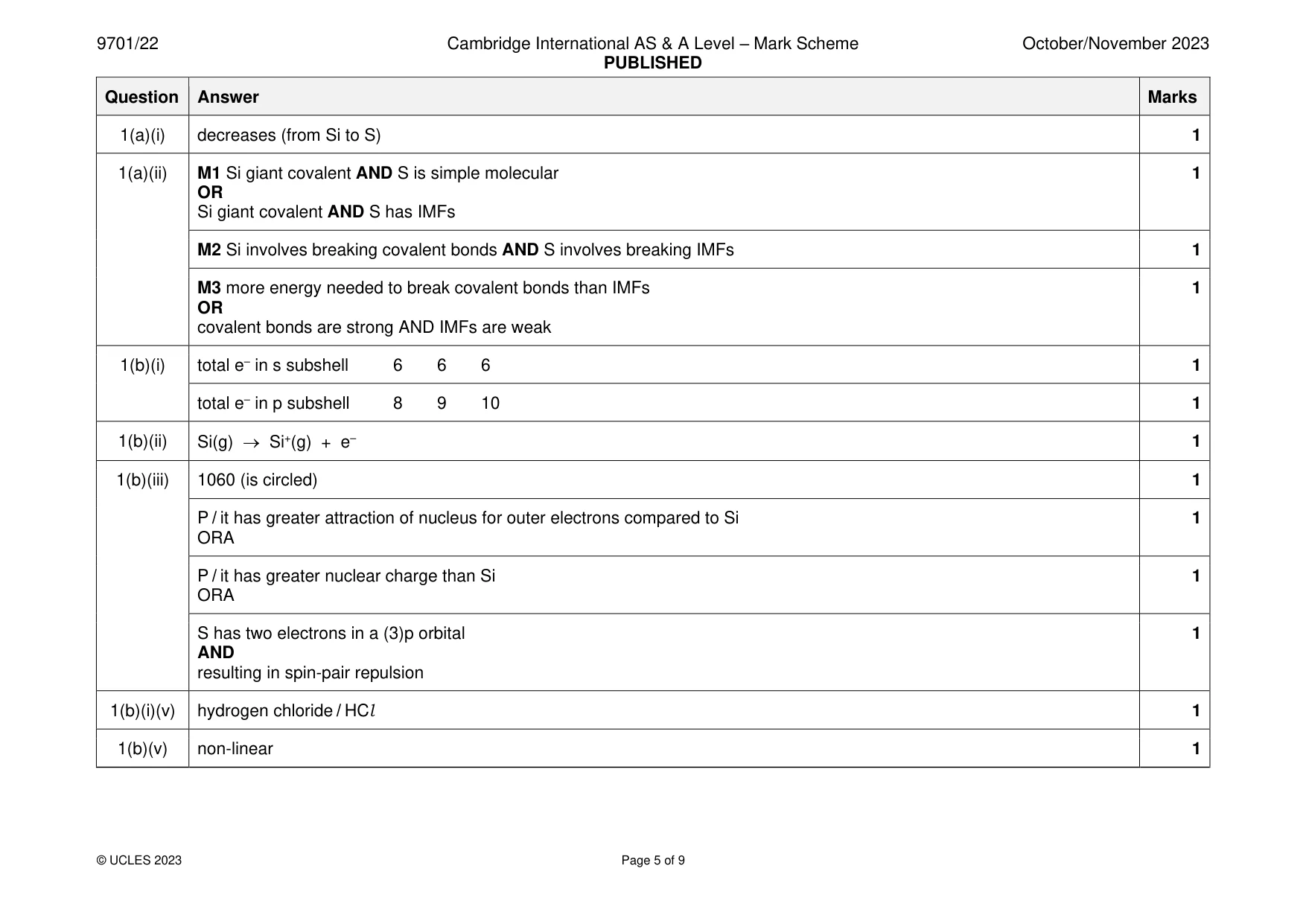
Mark scheme: Question Answer Marks 1(a)(i) decreases (from Si to S) 1 1(a)(ii) M1 Si giant covalent AND S is simple molecular 1 OR Si giant covalent AND S has IMFs M2 Si involves breaking covalent bonds AND S involves breaking IMFs 1 M3 more energy needed to break covalent bonds than IMFs 1 OR covalent bonds are strong AND IMFs are weak 1(b)(i) total e– in s subshell 6 6 6 1 total e– in p subshell 8 9 10 1 1(b)(ii) Si(g) → Si+(g) + e– 1 1(b)(iii) 1060 (is circled) 1 P / it has greater attraction of nucleus for outer electrons compared to Si 1 ORA P / it has greater nuclear charge than Si 1 ORA S has two electrons in a (3)p orbital 1 AND resulting in spin-pair repulsion 1(b)(i)(v) hydrogen chloride / HCl 1 1(b)(v) non-linear 1
More questions on Periodicity of physical properties of the elements in Period 3
Q2 · NO and NO2 react at 25 °C to give N2O3 as shown in the equation
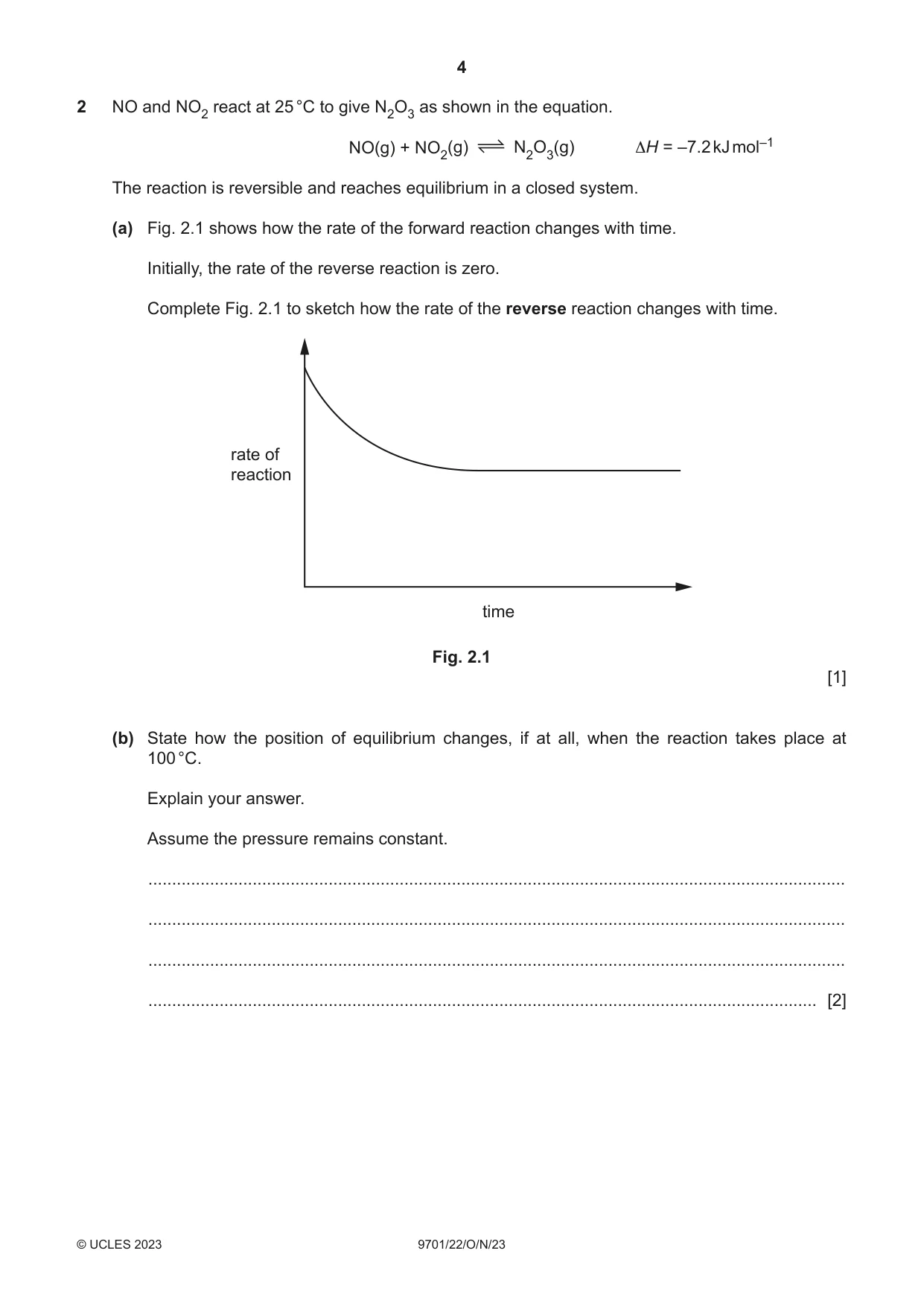
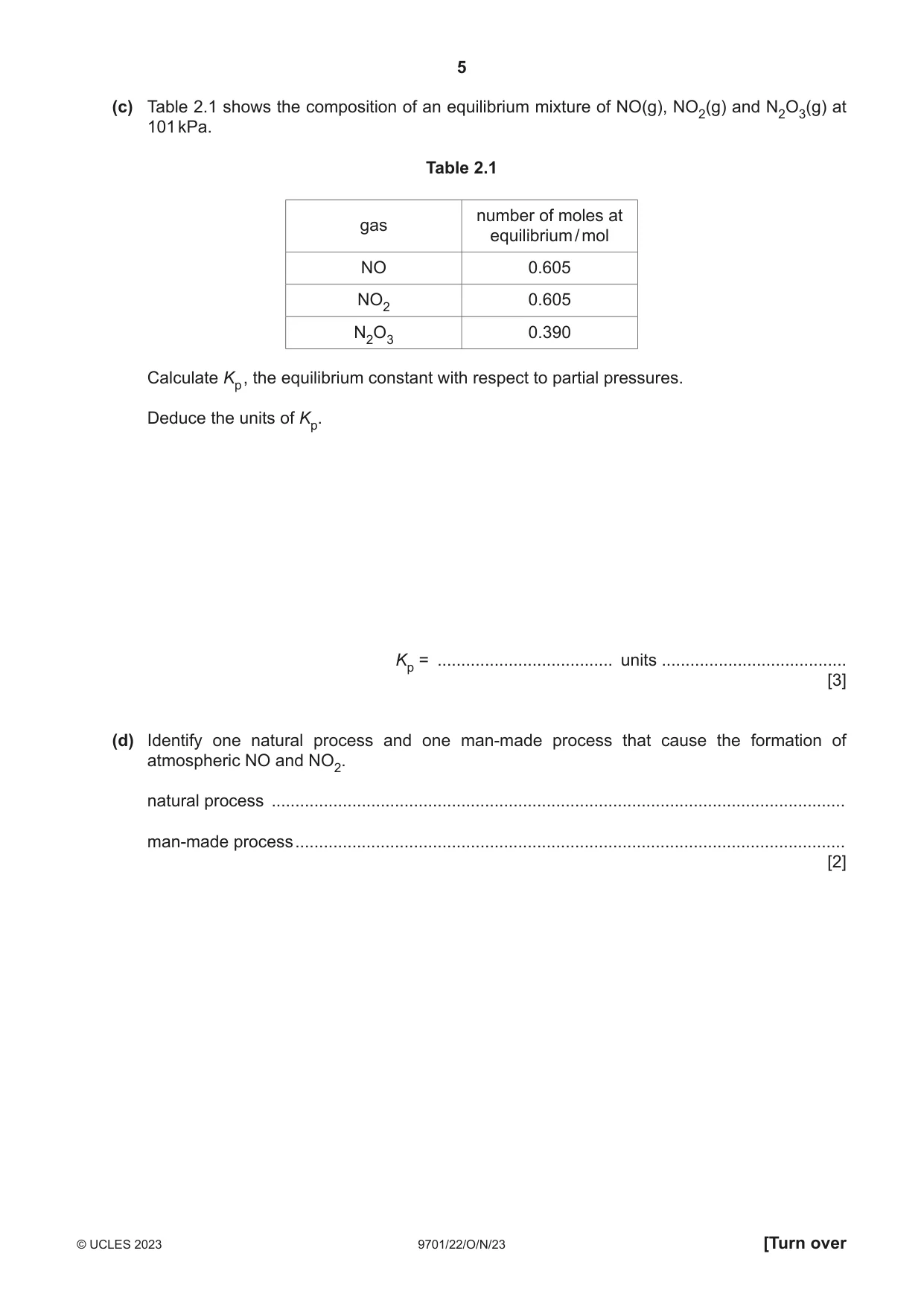
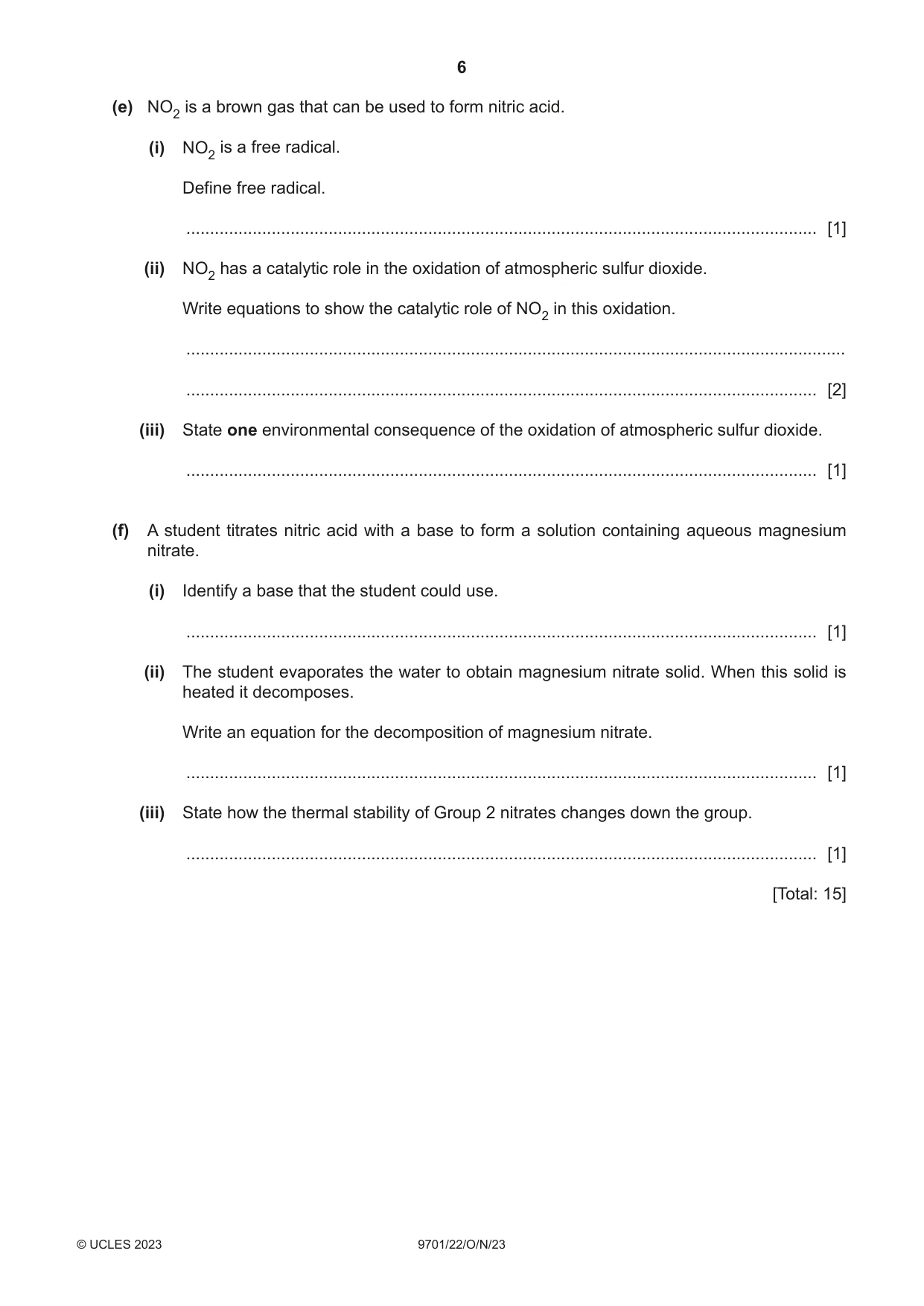
2 NO and NO2 react at 25 °C to give N2O3 as shown in the equation. NO(g) + NO2(g) N2O3(g) ΔH = –7.2 kJ mol–1 The reaction is reversible and reaches equilibrium in a closed system. (a) Fig. 2.1 shows how the rate of the forward reaction changes with time. Initially, the rate of the reverse reaction is zero. Complete Fig. 2.1 to sketch how the rate of the reverse reaction changes with time. rate of reaction time Fig. 2.1 [1] (b) State how the position of equilibrium changes, if at all, when the reaction takes place at 100 °C. Explain your answer. Assume the pressure remains constant. ................................................................................................................................................... ................................................................................................................................................... ................................................................................................................................................... ............................................................................................................................................. [2] (c) Table 2.1 shows the composition of an equilibrium mixture of NO(g), NO2(g) and N2O3(g) at 101 kPa. Table 2.1 number of moles at gas equilibrium / mol NO 0.605 NO2 0.605 N2O3 0.390 Calculate Kp , the equilibrium constant with respect to partial pressures. Deduce the units of Kp. Kp = ..................................... units ....................................... [3] (d) Identify one natural process and one man-made process that cause the formation of atmospheric NO and NO2. natural process ......................................................................................................................... man-made process .................................................................................................................... [2] (e) NO2 is a brown gas that can be used to form nitric acid. (i) NO2 is a free radical. Define free radical. ..................................................................................................................................... [1] (ii) NO2 has a catalytic role in the oxidation of atmospheric sulfur dioxide. Write equations to show the catalytic role of NO2 in this oxidation. ........................................................................................................................................... ..................................................................................................................................... [2] (iii) State one environmental consequence of the oxidation of atmospheric sulfur dioxide. ..................................................................................................................................... [1] (f) A student titrates nitric acid with a base to form a solution containing aqueous magnesium nitrate. (i) Identify a base that the student could use. ..................................................................................................................................... [1] (ii) The student evaporates the water to obtain magnesium nitrate solid. When this solid is heated it decomposes. Write an equation for the decomposition of magnesium nitrate. ..................................................................................................................................... [1] (iii) State how the thermal stability of Group 2 nitrates changes down the group. ..................................................................................................................................... [1] [Total: 15]
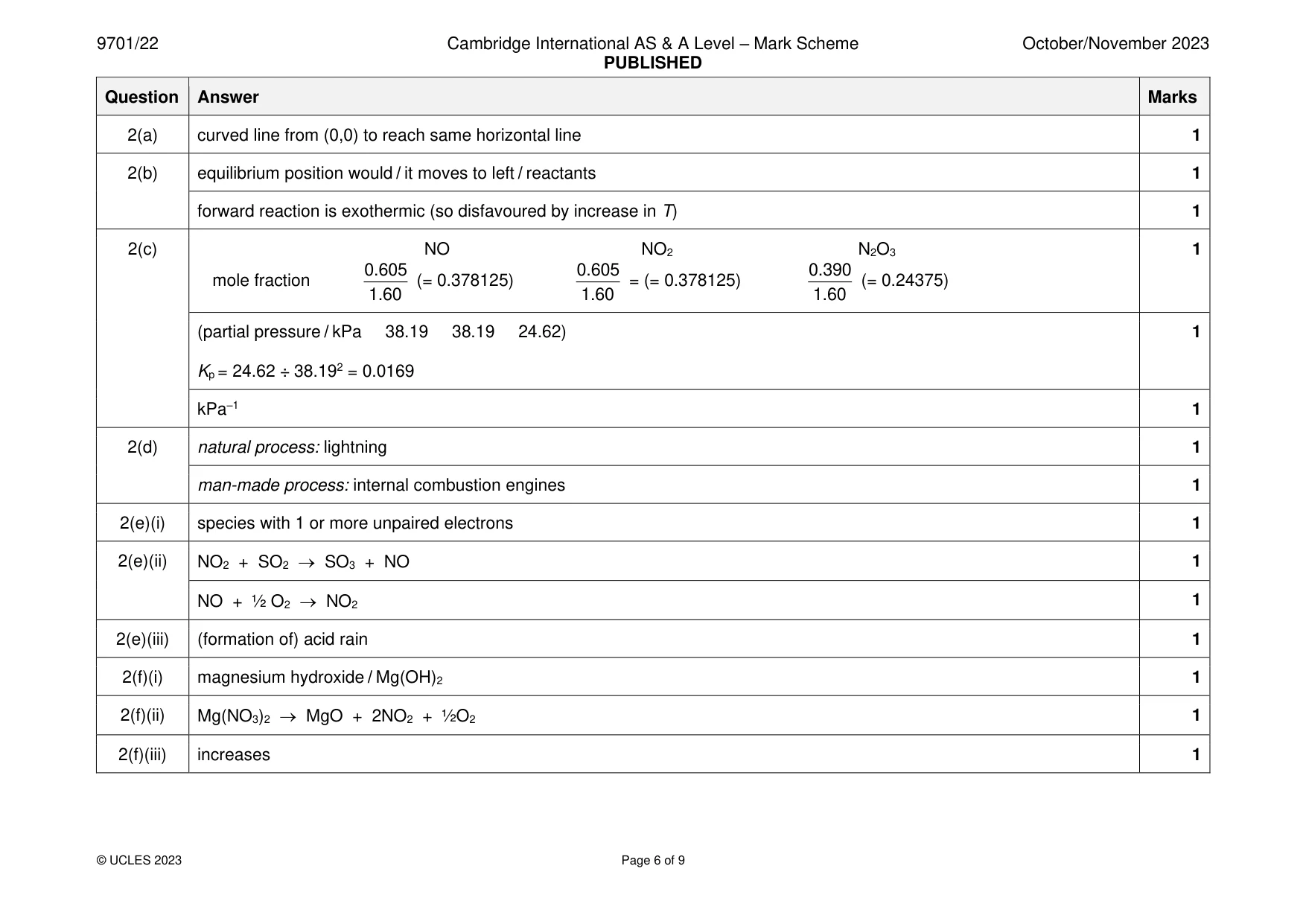
Mark scheme: 2(a) curved line from (0,0) to reach same horizontal line 1 2(b) equilibrium position would / it moves to left / reactants 1 forward reaction is exothermic (so disfavoured by increase in T) 1 2(c) NO NO2 N2O3 1 0.605 0.605 0.390 mole fraction (= 0.378125) = (= 0.378125) (= 0.24375) 1.60 1.60 1.60 (partial pressure / kPa 38.19 38.19 24.62) 1 Kp = 24.62 ÷ 38.192 = 0.0169 kPa–1 1 2(d) natural process: lightning 1 man-made process: internal combustion engines 1 2(e)(i) species with 1 or more unpaired electrons 1 2(e)(ii) NO2 + SO2 → SO3 + NO 1 NO + ½ O2 → NO2 1 2(e)(iii) (formation of) acid rain 1 2(f)(i) magnesium hydroxide / Mg(OH)2 1 2(f)(ii) Mg(NO3)2 → MgO + 2NO2 + ½O2 1 2(f)(iii) increases 1
More questions on Chemical equilibria: reversible reactions, dynamic equilibrium
Q3 · Phosphoric(V) acid, H3PO4, is used in both inorganic and organic reactions
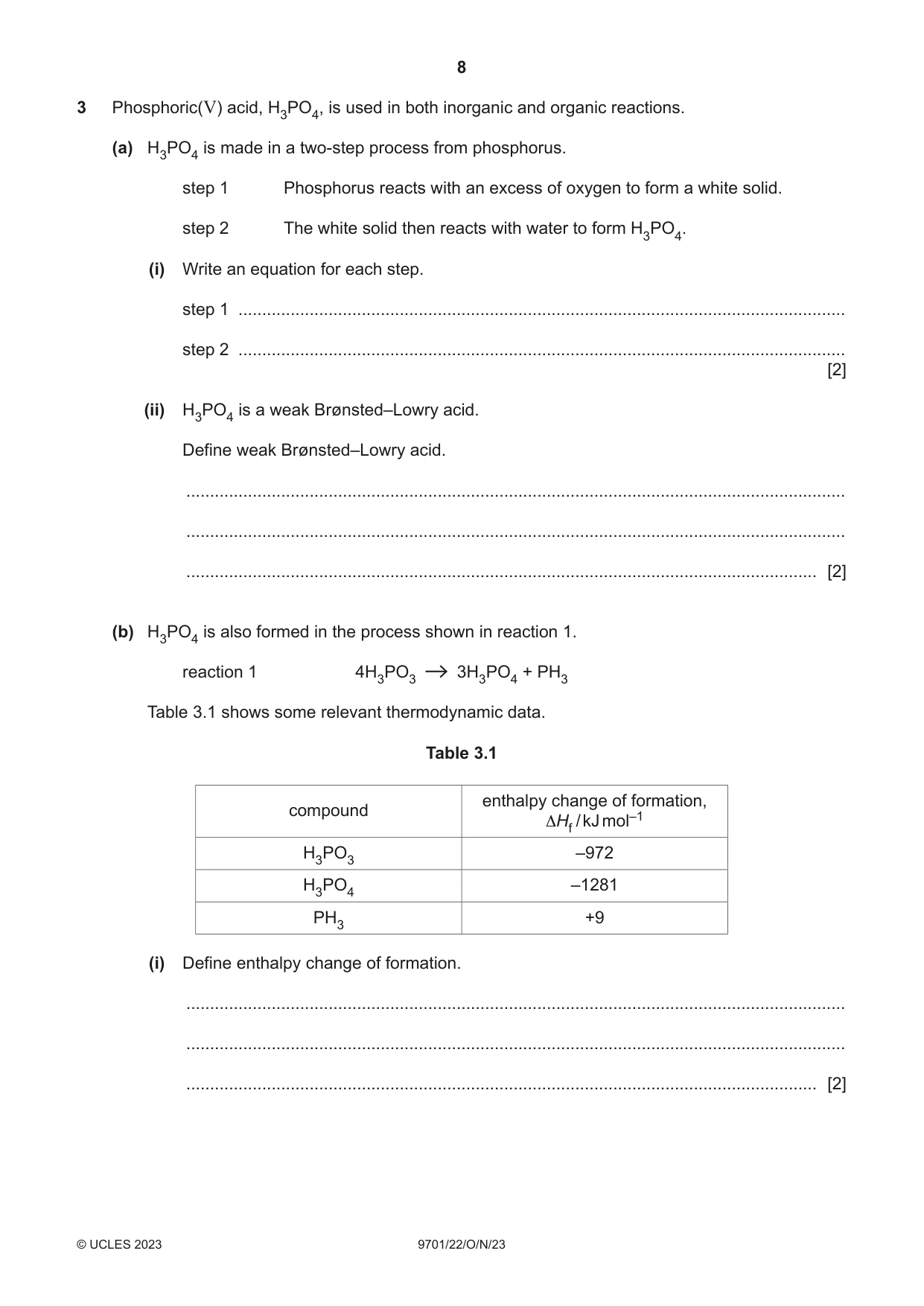
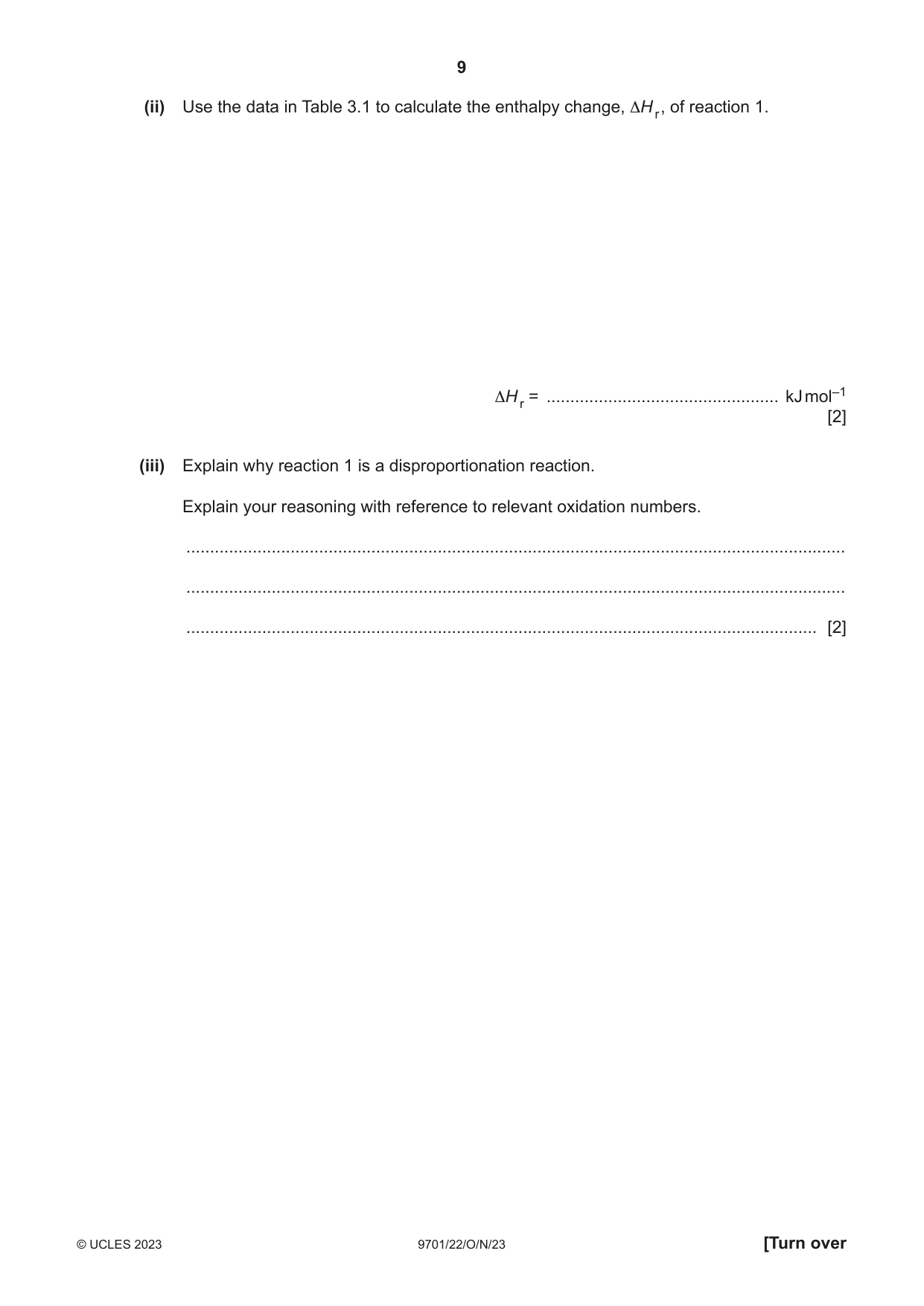
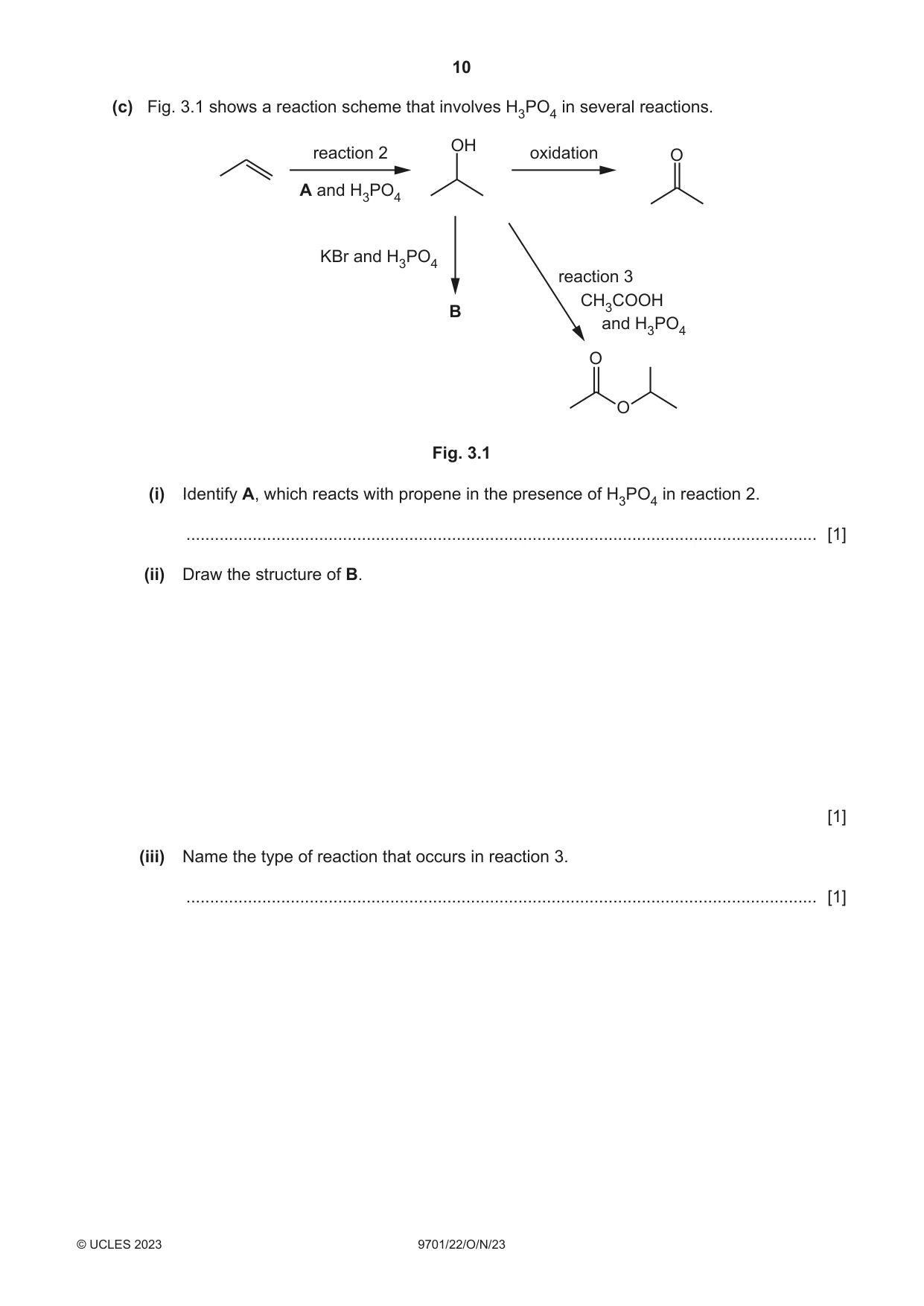
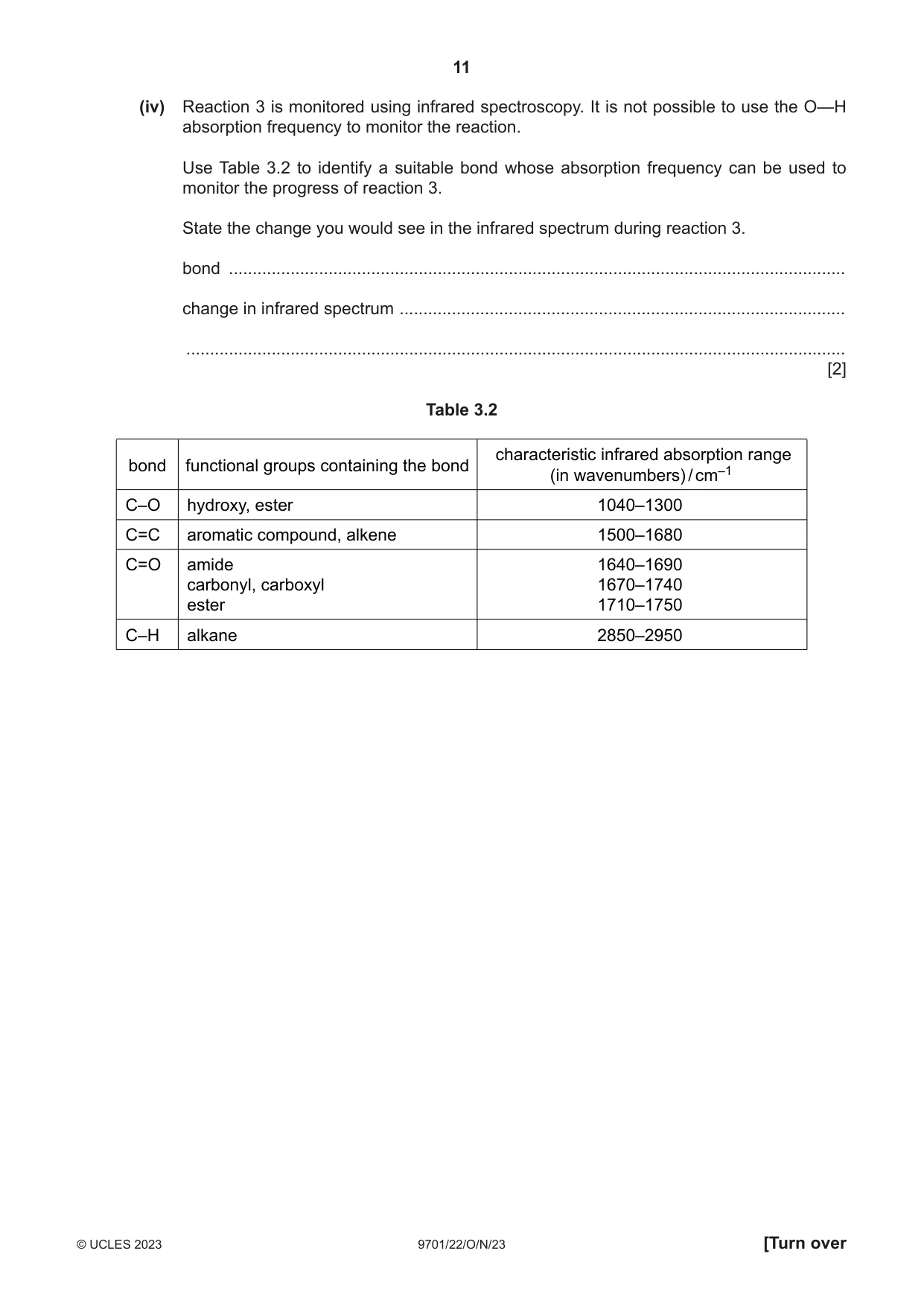
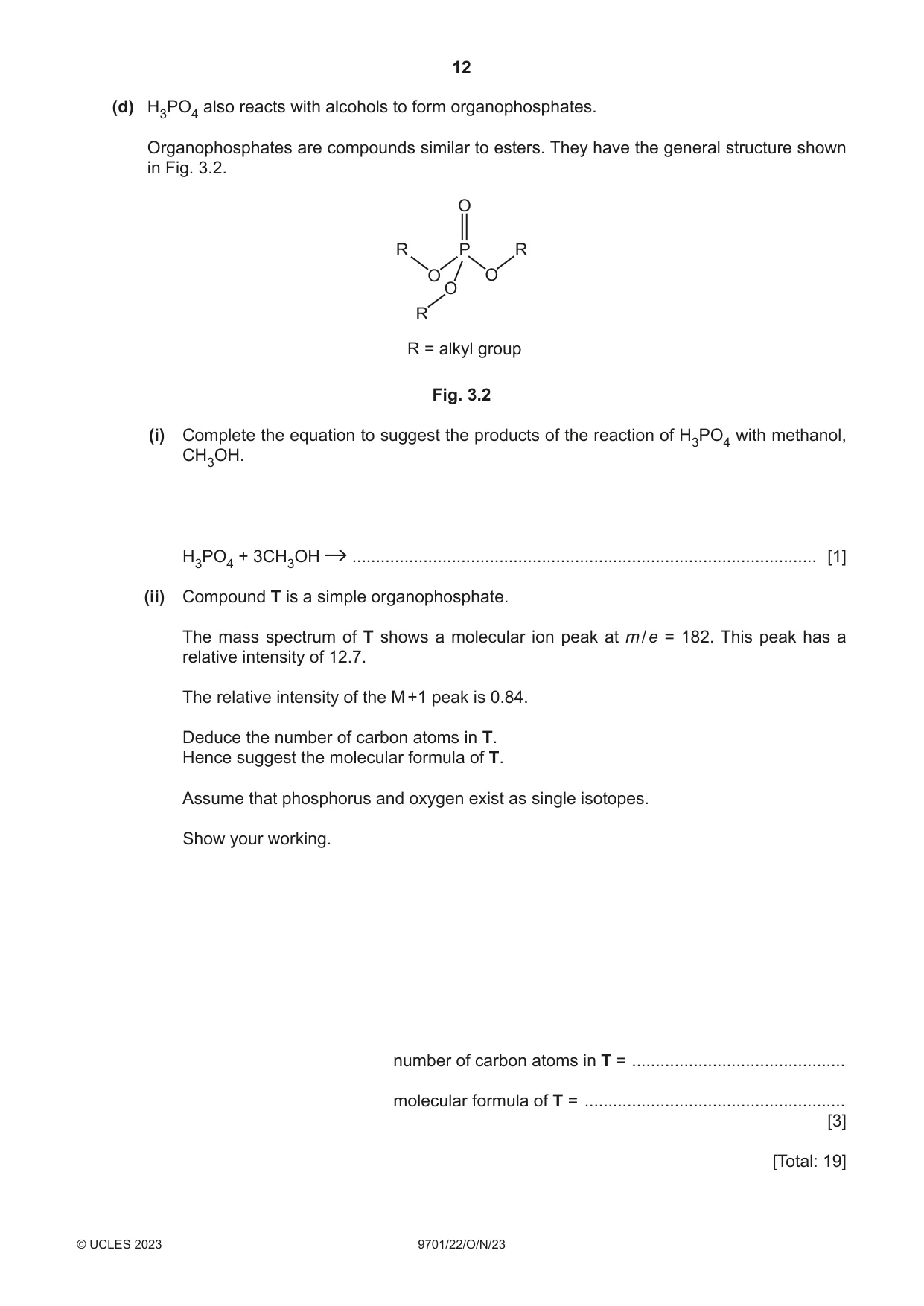
3 Phosphoric(V) acid, H3PO4, is used in both inorganic and organic reactions. (a) H3PO4 is made in a two-step process from phosphorus. step 1 Phosphorus reacts with an excess of oxygen to form a white solid. step 2 The white solid then reacts with water to form H3PO4. (i) Write an equation for each step. step 1 ................................................................................................................................ step 2 ................................................................................................................................ [2] (ii) H3PO4 is a weak Brønsted–Lowry acid. Define weak Brønsted–Lowry acid. ........................................................................................................................................... ........................................................................................................................................... ..................................................................................................................................... [2] (b) H3PO4 is also formed in the process shown in reaction 1. reaction 1 4H3PO3 3H3PO4 + PH3 Table 3.1 shows some relevant thermodynamic data. Table 3.1 enthalpy change of formation, compound ΔHf / kJ mol–1 H3PO3 –972 H3PO4 –1281 PH3 +9 (i) Define enthalpy change of formation. ........................................................................................................................................... ........................................................................................................................................... ..................................................................................................................................... [2] (ii) Use the data in Table 3.1 to calculate the enthalpy change, ΔH r , of reaction 1. ΔH r = ................................................. kJ mol–1 [2] (iii) Explain why reaction 1 is a disproportionation reaction. Explain your reasoning with reference to relevant oxidation numbers. ........................................................................................................................................... ........................................................................................................................................... ..................................................................................................................................... [2] (c) Fig. 3.1 shows a reaction scheme that involves H3PO4 in several reactions. OH reaction 2 oxidation O A and H3PO4 KBr and H3PO4 reaction 3 CH3COOH B and H3PO4 O O Fig. 3.1 (i) Identify A, which reacts with propene in the presence of H3PO4 in reaction 2. ..................................................................................................................................... [1] (ii) Draw the structure of B. [1] (iii) Name the type of reaction that occurs in reaction 3. ..................................................................................................................................... [1] (iv) Reaction 3 is monitored using infrared spectroscopy. It is not possible to use the O—H absorption frequency to monitor the reaction. Use Table 3.2 to identify a suitable bond whose absorption frequency can be used to monitor the progress of reaction 3. State the change you would see in the infrared spectrum during reaction 3. bond .................................................................................................................................. change in infrared spectrum .............................................................................................. ........................................................................................................................................... [2] Table 3.2 characteristic infrared absorption rangebond functional groups containing the bond (in wavenumbers) / cm–1 C–O hydroxy, ester 1040–1300 C=C aromatic compound, alkene 1500–1680 C=O amide 1640–1690 carbonyl, carboxyl 1670–1740 ester 1710–1750 C–H alkane 2850–2950 (d) H3PO4 also reacts with alcohols to form organophosphates. Organophosphates are compounds similar to esters. They have the general structure shown in Fig. 3.2. O R P R O O O R R = alkyl group Fig. 3.2 (i) Complete the equation to suggest the products of the reaction of H3PO4 with methanol, CH3OH. H3PO4 + 3CH3OH .................................................................................................. [1] (ii) Compound T is a simple organophosphate. The mass spectrum of T shows a molecular ion peak at m / e = 182. This peak has a relative intensity of 12.7. The relative intensity of the M +1 peak is 0.84. Deduce the number of carbon atoms in T. Hence suggest the molecular formula of T. Assume that phosphorus and oxygen exist as single isotopes. Show your working. number of carbon atoms in T = ............................................. molecular formula of T = ....................................................... [3] [Total: 19]
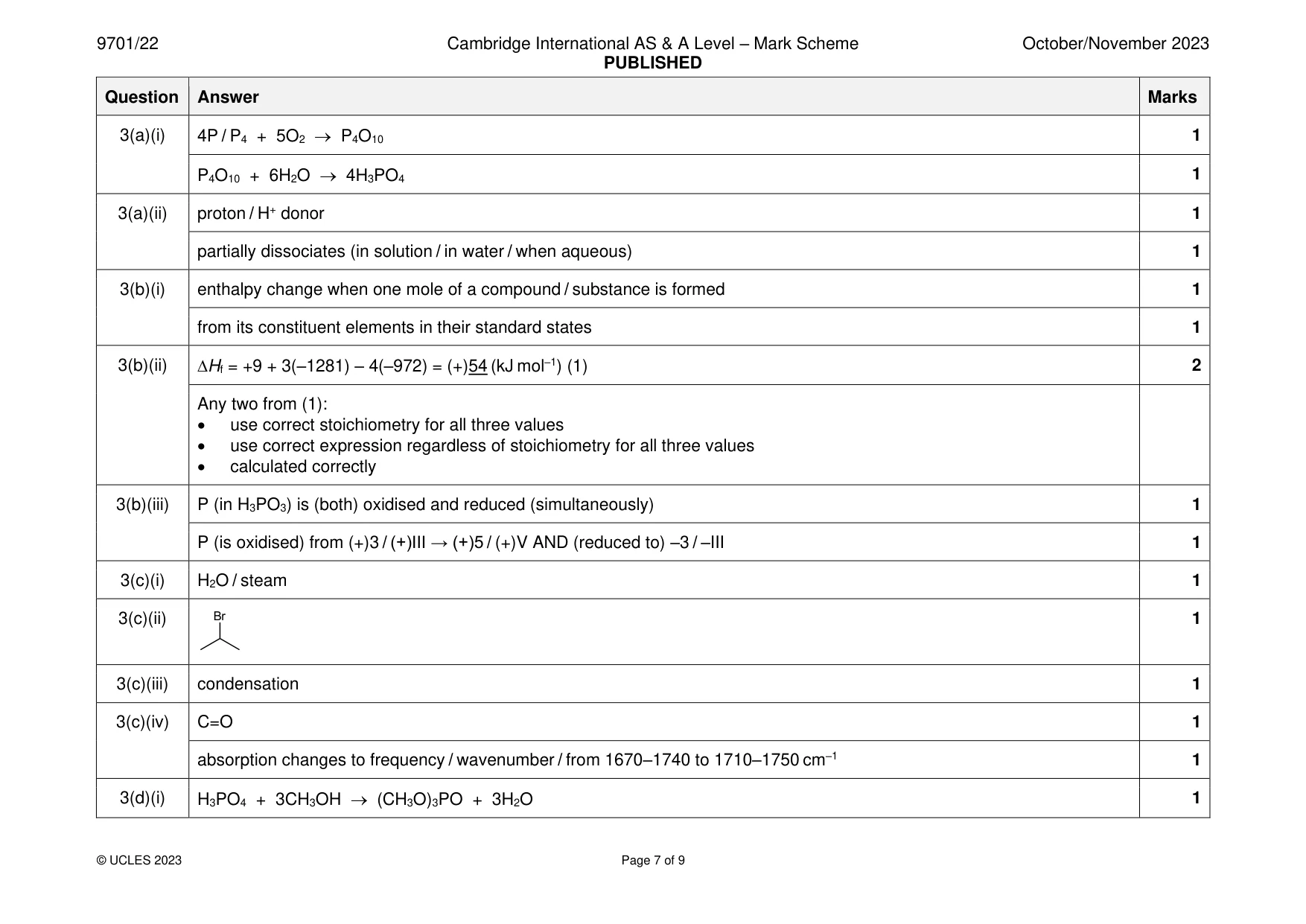
Mark scheme: 3(a)(i) 4P / P4 + 5O2 → P4O10 1 P4O10 + 6H2O → 4H3PO4 1 3(a)(ii) proton / H+ donor 1 partially dissociates (in solution / in water / when aqueous) 1 3(b)(i) enthalpy change when one mole of a compound / substance is formed 1 from its constituent elements in their standard states 1 3(b)(ii) Hf = +9 + 3(–1281) – 4(–972) = (+)54 (kJ mol–1) (1) 2 Any two from (1): • use correct stoichiometry for all three values • use correct expression regardless of stoichiometry for all three values • calculated correctly 3(b)(iii) P (in H3PO3) is (both) oxidised and reduced (simultaneously) 1 P (is oxidised) from (+)3 / (+)III → (+)5 / (+)V AND (reduced to) –3 / –III 1 3(c)(i) H2O / steam 1 3(c)(ii) 1 3(c)(iii) condensation 1 3(c)(iv) C=O 1 absorption changes to frequency / wavenumber / from 1670–1740 to 1710–1750 cm–1 1 3(d)(i) H3PO4 + 3CH3OH → (CH3O)3PO + 3H2O 1 3(d)(ii) 0.84 100 1 ( = 6.013 ) 12.7 1.1 no. of carbon atoms = 6 1 molecular formula = C6H15O4P 1
Q4 · Lactic acid, CH3CH(OH)COOH, and pyruvic acid, CH3COCOOH, both contain two functional…
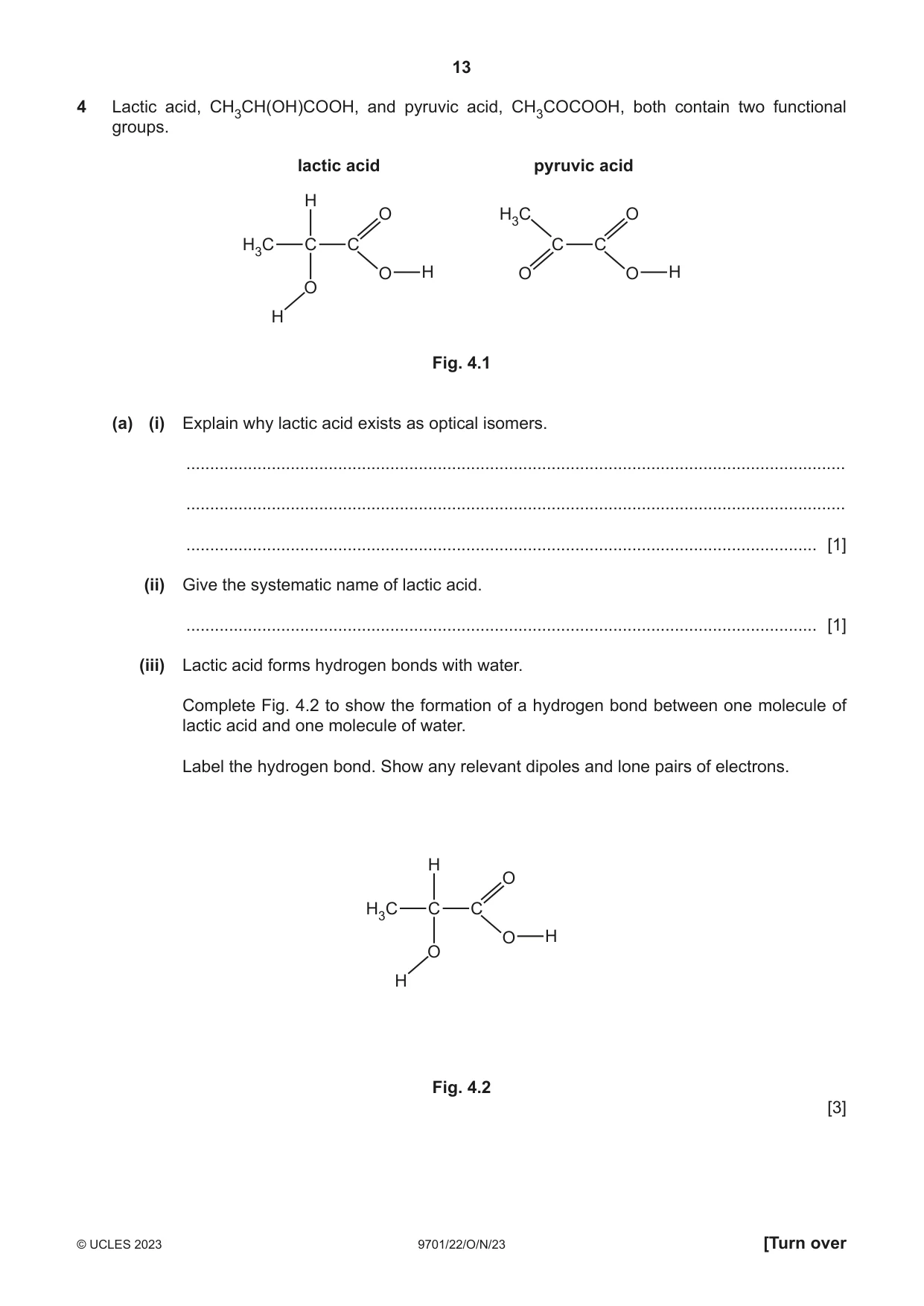
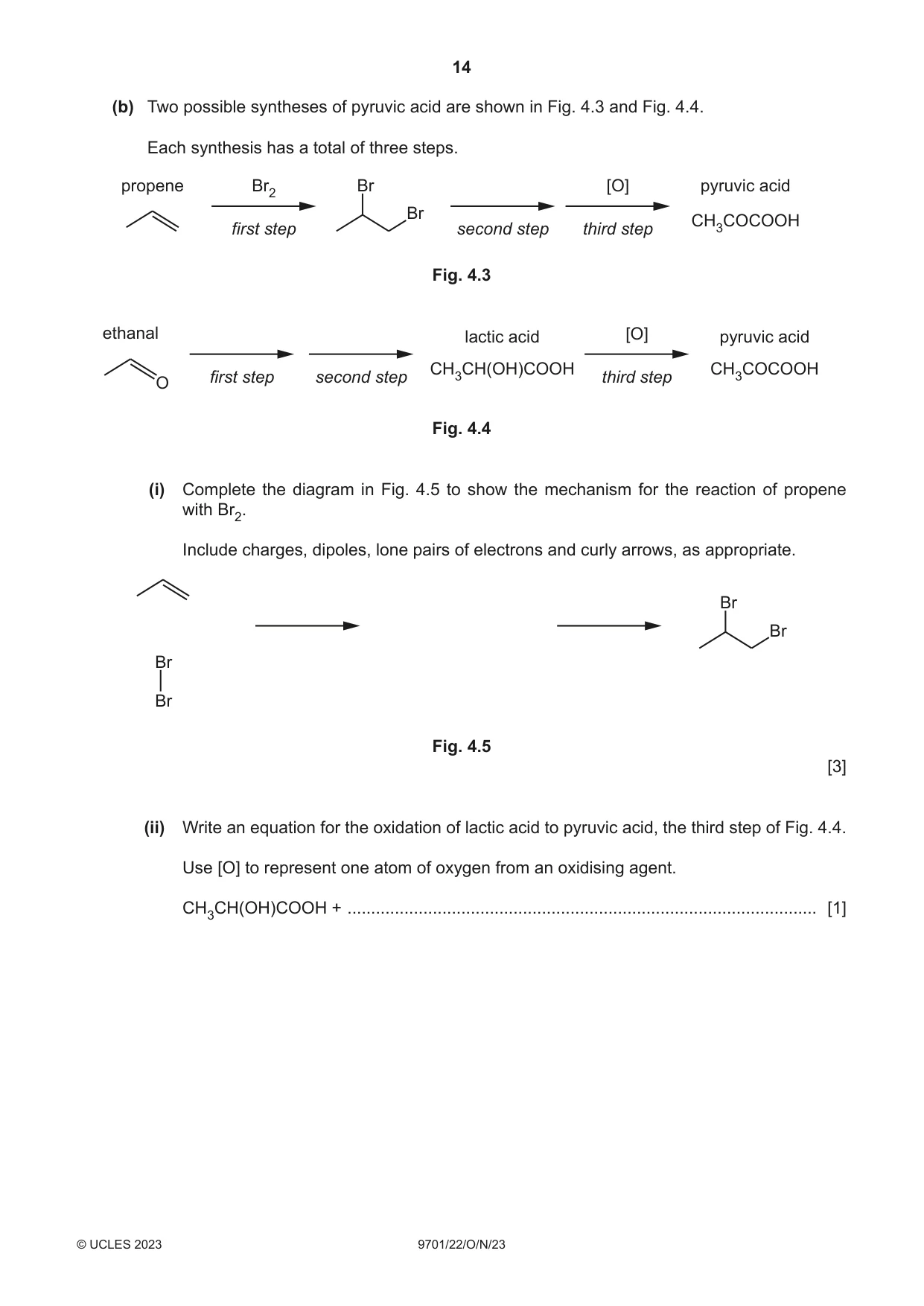
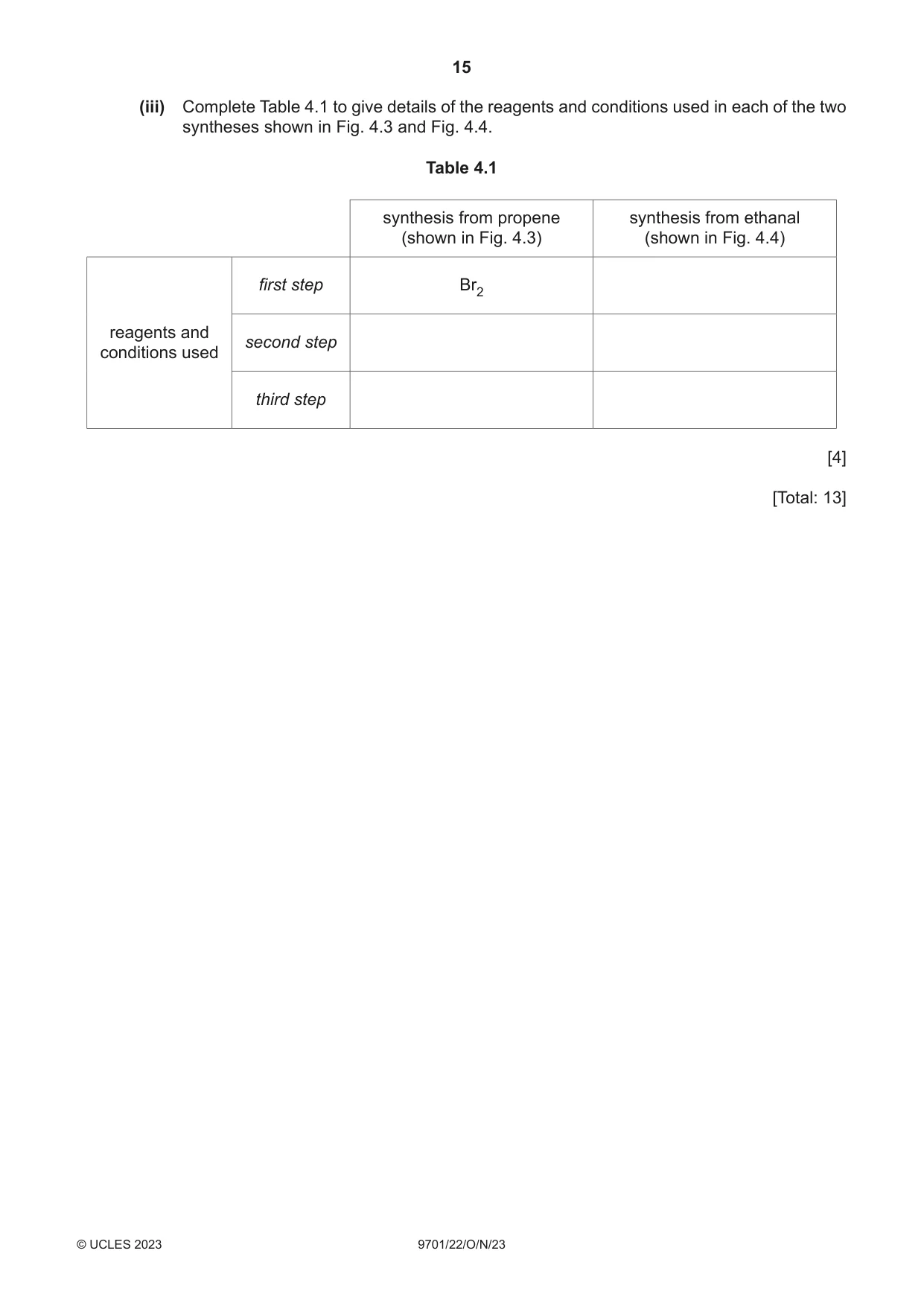
4 Lactic acid, CH3CH(OH)COOH, and pyruvic acid, CH3COCOOH, both contain two functional groups. lactic acid pyruvic acid H O H3C O H3C C C C C O H O O H O H Fig. 4.1 (a) (i) Explain why lactic acid exists as optical isomers. ........................................................................................................................................... ........................................................................................................................................... ..................................................................................................................................... [1] (ii) Give the systematic name of lactic acid. ..................................................................................................................................... [1] (iii) Lactic acid forms hydrogen bonds with water. Complete Fig. 4.2 to show the formation of a hydrogen bond between one molecule of lactic acid and one molecule of water. Label the hydrogen bond. Show any relevant dipoles and lone pairs of electrons. H O H3C C C O H O H Fig. 4.2 [3] (b) Two possible syntheses of pyruvic acid are shown in Fig. 4.3 and Fig. 4.4. Each synthesis has a total of three steps. propene Br2 Br [O] pyruvic acid Br first step second step third step CH3COCOOH Fig. 4.3 ethanal lactic acid [O] pyruvic acid first step second step CH3CH(OH)COOH third step CH3COCOOH O Fig. 4.4 (i) Complete the diagram in Fig. 4.5 to show the mechanism for the reaction of propene with Br2. Include charges, dipoles, lone pairs of electrons and curly arrows, as appropriate. Br Br Br Br Fig. 4.5 [3] (ii) Write an equation for the oxidation of lactic acid to pyruvic acid, the third step of Fig. 4.4. Use [O] to represent one atom of oxygen from an oxidising agent. CH3CH(OH)COOH + ................................................................................................... [1] (iii) Complete Table 4.1 to give details of the reagents and conditions used in each of the two syntheses shown in Fig. 4.3 and Fig. 4.4. Table 4.1 synthesis from propene synthesis from ethanal (shown in Fig. 4.3) (shown in Fig. 4.4) first step Br2 reagents and second stepconditions used third step [4] [Total: 13]
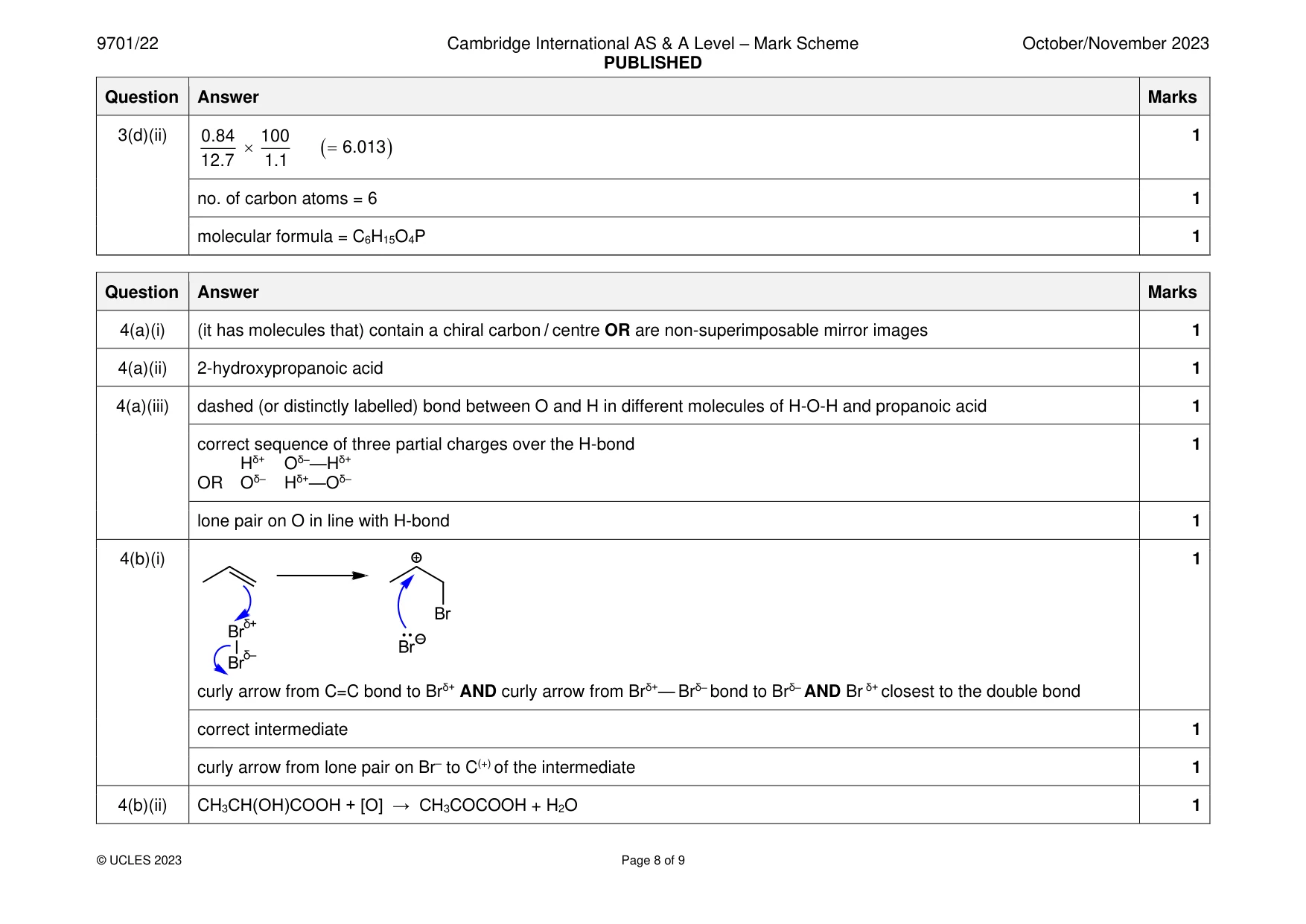
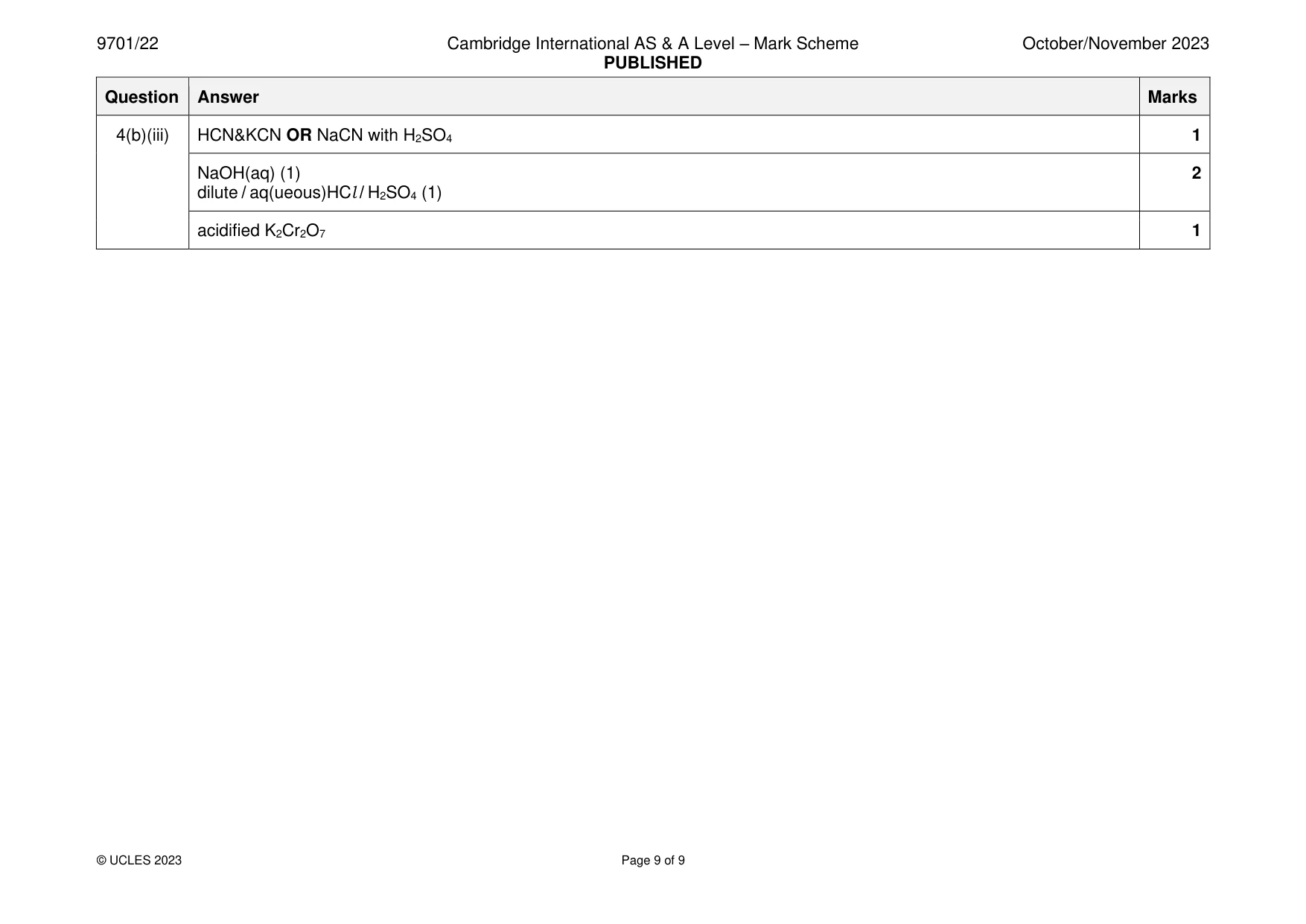
Mark scheme: 4(a)(i) (it has molecules that) contain a chiral carbon / centre OR are non-superimposable mirror images 1 4(a)(ii) 2-hydroxypropanoic acid 1 4(a)(iii) dashed (or distinctly labelled) bond between O and H in different molecules of H-O-H and propanoic acid 1 correct sequence of three partial charges over the H-bond 1 Hδ+ Oδ–—Hδ+ OR Oδ– Hδ+—Oδ– lone pair on O in line with H-bond 1 4(b)(i) 1 curly arrow from C=C bond to Brδ+ AND curly arrow from Brδ+— Brδ– bond to Brδ– AND Br δ+ closest to the double bond correct intermediate 1 curly arrow from lone pair on Br– to C(+) of the intermediate 1 4(b)(ii) CH3CH(OH)COOH + [O] → CH3COCOOH + H2O 1 4(b)(iii) HCN&KCN OR NaCN with H2SO4 1 NaOH(aq) (1) 2 dilute / aq(ueous)HCl / H2SO4 (1) acidified K2Cr2O7 1
More questions on Formulas, functional groups and the naming of organic compounds
What was in this paper
The subtopics covered by these 4 questions, and how many questions each got. Open one in a new tab to see every Cambridge question on it.
What you needed in this session
Cambridge’s own grade thresholds for 2023 Oct/Nov, Paper 2 · Variant 2. A higher threshold means an easier paper — the bar moves with how the cohort did.