Cambridge A Level Chemistry 9701 — 2023 Oct/Nov Paper 2 · Variant 1
9701/21/O/N/23 · 4 questions · 60 marks · ≈68 min
The question paper and its mark scheme, free to read here and free to download. This is Cambridge’s own paper, exactly as it was sat.
Question paper20 pages




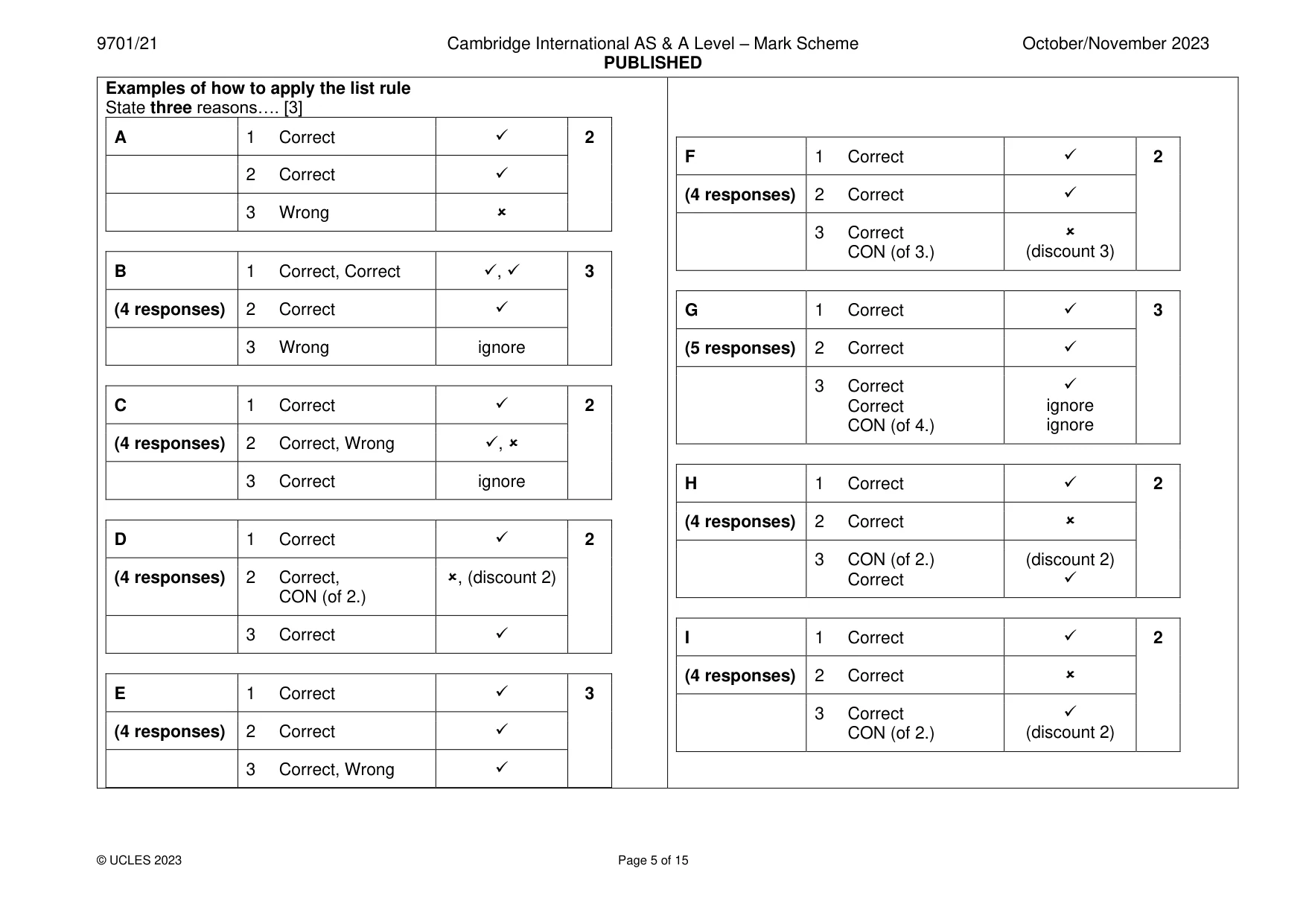
Mark scheme15 pages
Answers below. Sit the paper first if you are practising.
Questions as text
Q1 · The elements phosphorus, sulfur and chlorine are in Period 3 of the Periodic Table
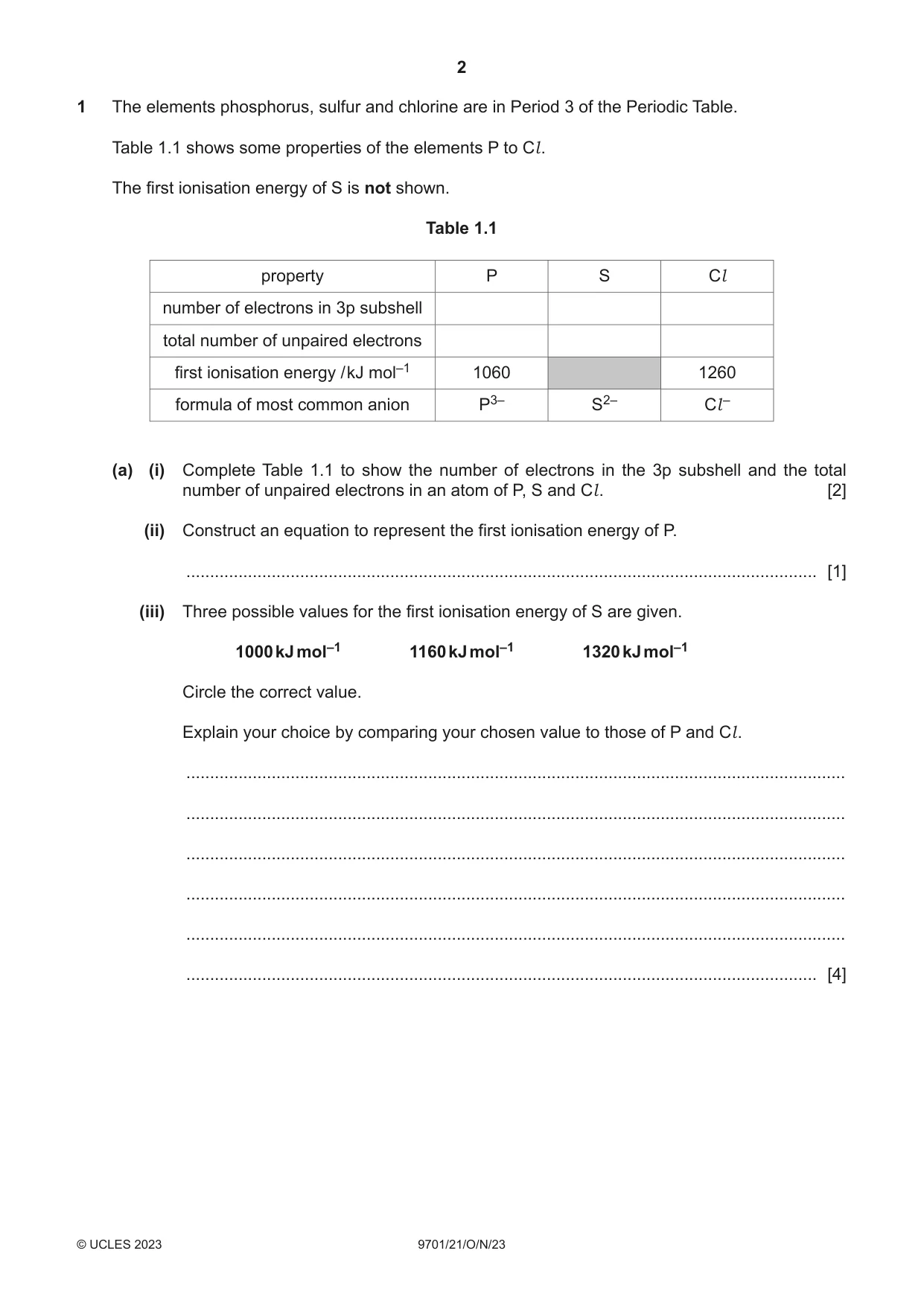
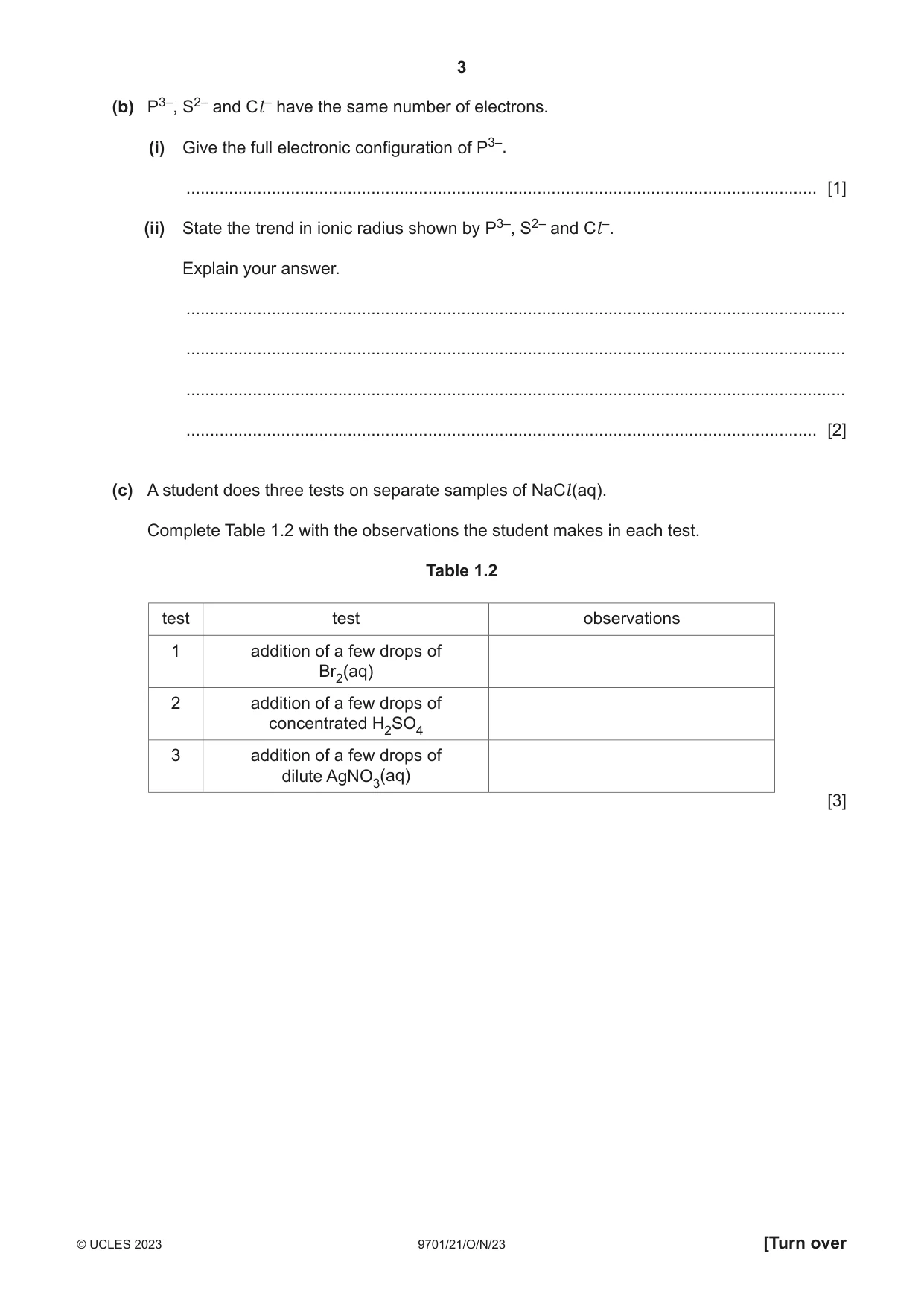
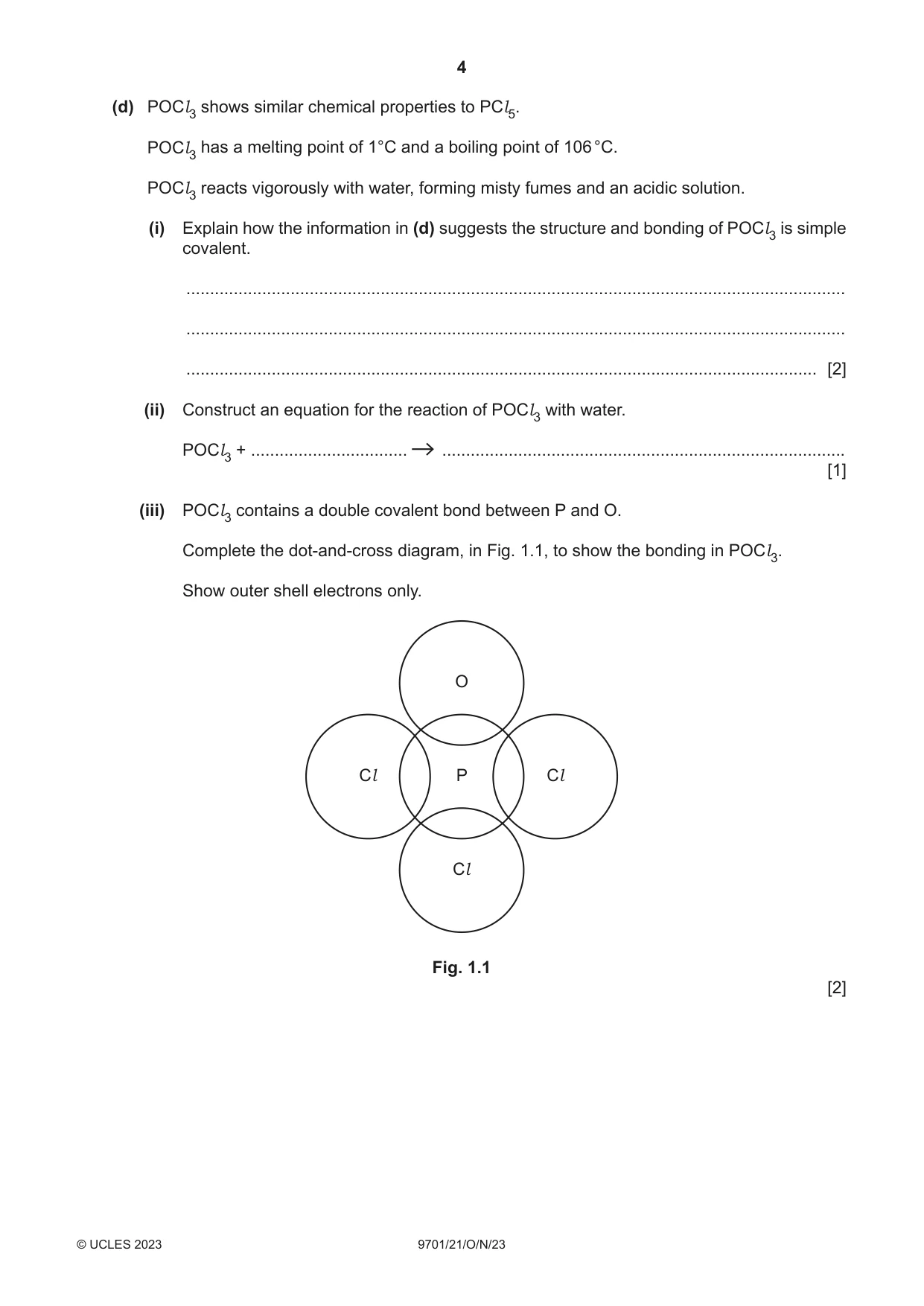
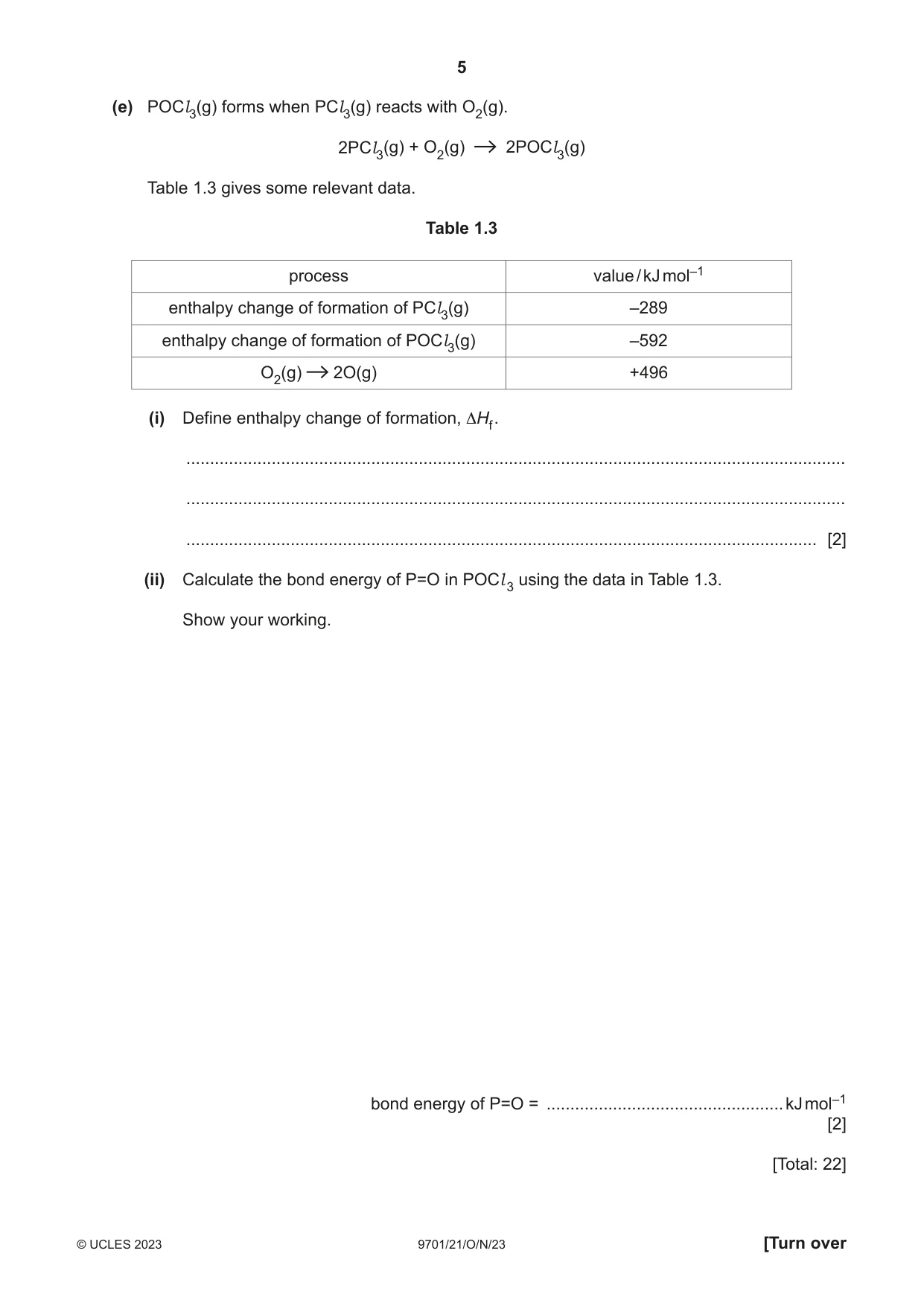
1 The elements phosphorus, sulfur and chlorine are in Period 3 of the Periodic Table. Table 1.1 shows some properties of the elements P to Cl . The first ionisation energy of S is not shown. Table 1.1 property P S Cl number of electrons in 3p subshell total number of unpaired electrons first ionisation energy / kJ mol–1 1060 1260 formula of most common anion P3– S2– Cl – (a) (i) Complete Table 1.1 to show the number of electrons in the 3p subshell and the total number of unpaired electrons in an atom of P, S and Cl . [2] (ii) Construct an equation to represent the first ionisation energy of P. ..................................................................................................................................... [1] (iii) Three possible values for the first ionisation energy of S are given. 1000 kJ mol–1 1160 kJ mol–1 1320 kJ mol–1 Circle the correct value. Explain your choice by comparing your chosen value to those of P and Cl . ........................................................................................................................................... ........................................................................................................................................... ........................................................................................................................................... ........................................................................................................................................... ........................................................................................................................................... ..................................................................................................................................... [4] (b) P3–, S2– and Cl – have the same number of electrons. (i) Give the full electronic configuration of P3–. ..................................................................................................................................... [1] (ii) State the trend in ionic radius shown by P3–, S2– and Cl –. Explain your answer. ........................................................................................................................................... ........................................................................................................................................... ........................................................................................................................................... ..................................................................................................................................... [2] (c) A student does three tests on separate samples of NaCl (aq). Complete Table 1.2 with the observations the student makes in each test. Table 1.2 test test observations 1 addition of a few drops of Br2(aq) 2 addition of a few drops of concentrated H2SO4 3 addition of a few drops of dilute AgNO3(aq) [3] (d) POCl3 shows similar chemical properties to PCl5. POCl3 has a melting point of 1°C and a boiling point of 106 °C. POCl3 reacts vigorously with water, forming misty fumes and an acidic solution. (i) Explain how the information in (d) suggests the structure and bonding of POCl3 is simple covalent. ........................................................................................................................................... ........................................................................................................................................... ..................................................................................................................................... [2] (ii) Construct an equation for the reaction of POCl3 with water. POCl3 + ................................. ..................................................................................... [1] (iii) POCl3 contains a double covalent bond between P and O. Complete the dot-and-cross diagram, in Fig. 1.1, to show the bonding in POCl3. Show outer shell electrons only. O Cl P Cl Cl Fig. 1.1 [2] (e) POCl3(g) forms when PCl3(g) reacts with O2(g). 2PCl3(g) + O2(g) 2POCl3(g) Table 1.3 gives some relevant data. Table 1.3 process value / kJ mol–1 enthalpy change of formation of PCl3(g) –289 enthalpy change of formation of POCl3(g) –592 O2(g) 2O(g) +496 (i) Define enthalpy change of formation, ΔHf . ........................................................................................................................................... ........................................................................................................................................... ..................................................................................................................................... [2] (ii) Calculate the bond energy of P=O in POCl 3 using the data in Table 1.3. Show your working. bond energy of P=O = ..................................................kJ mol–1 [2] [Total: 22]
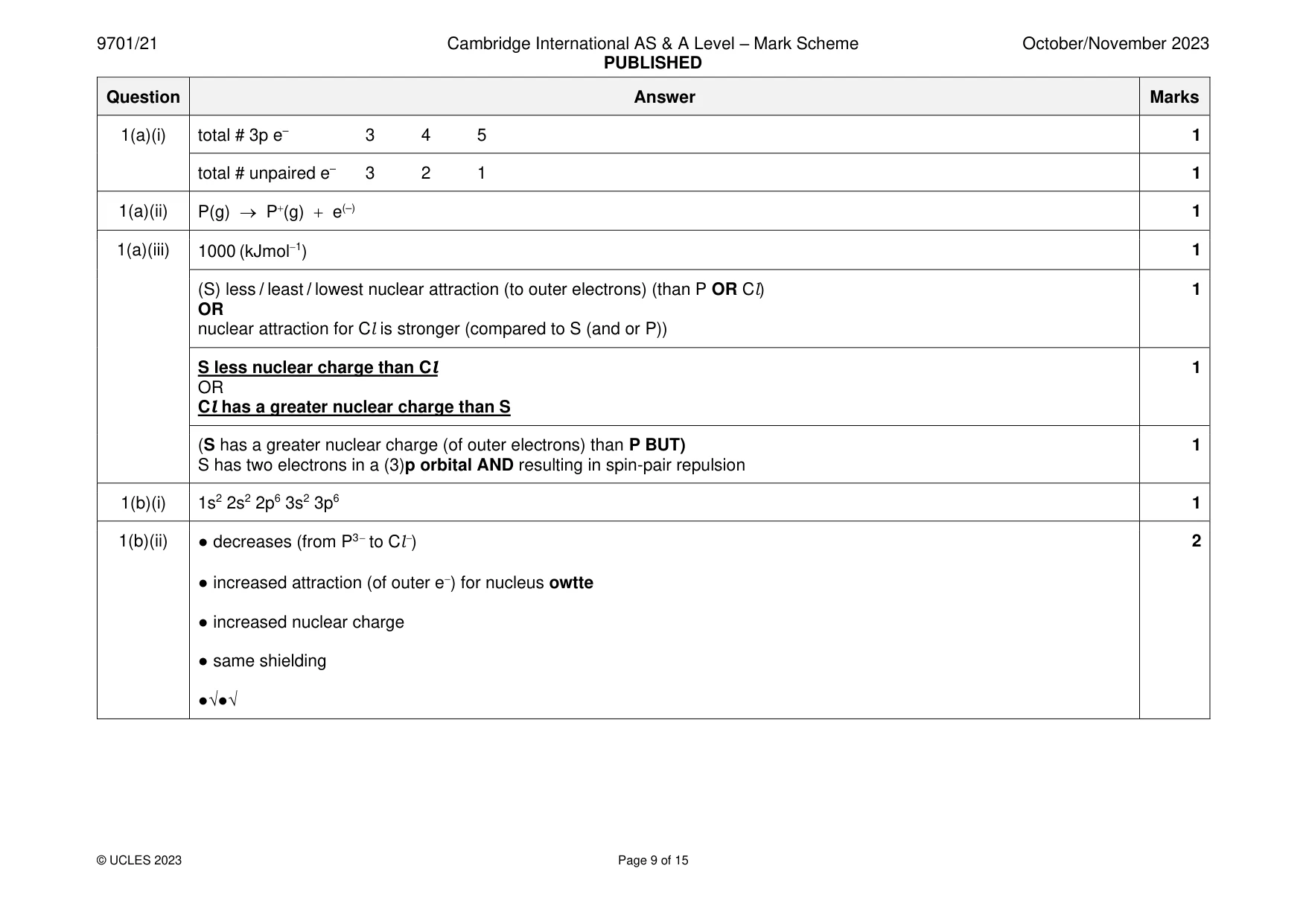
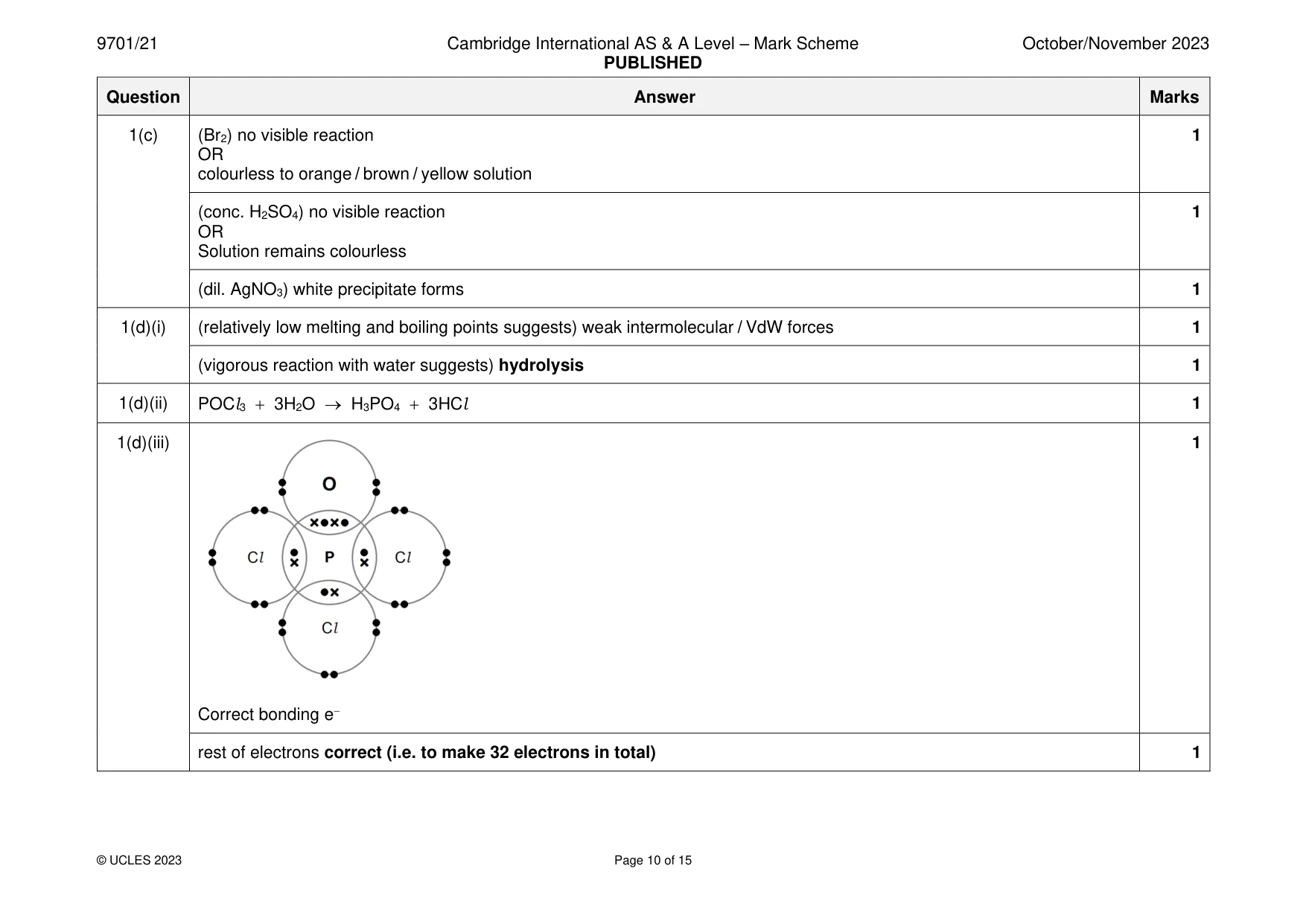
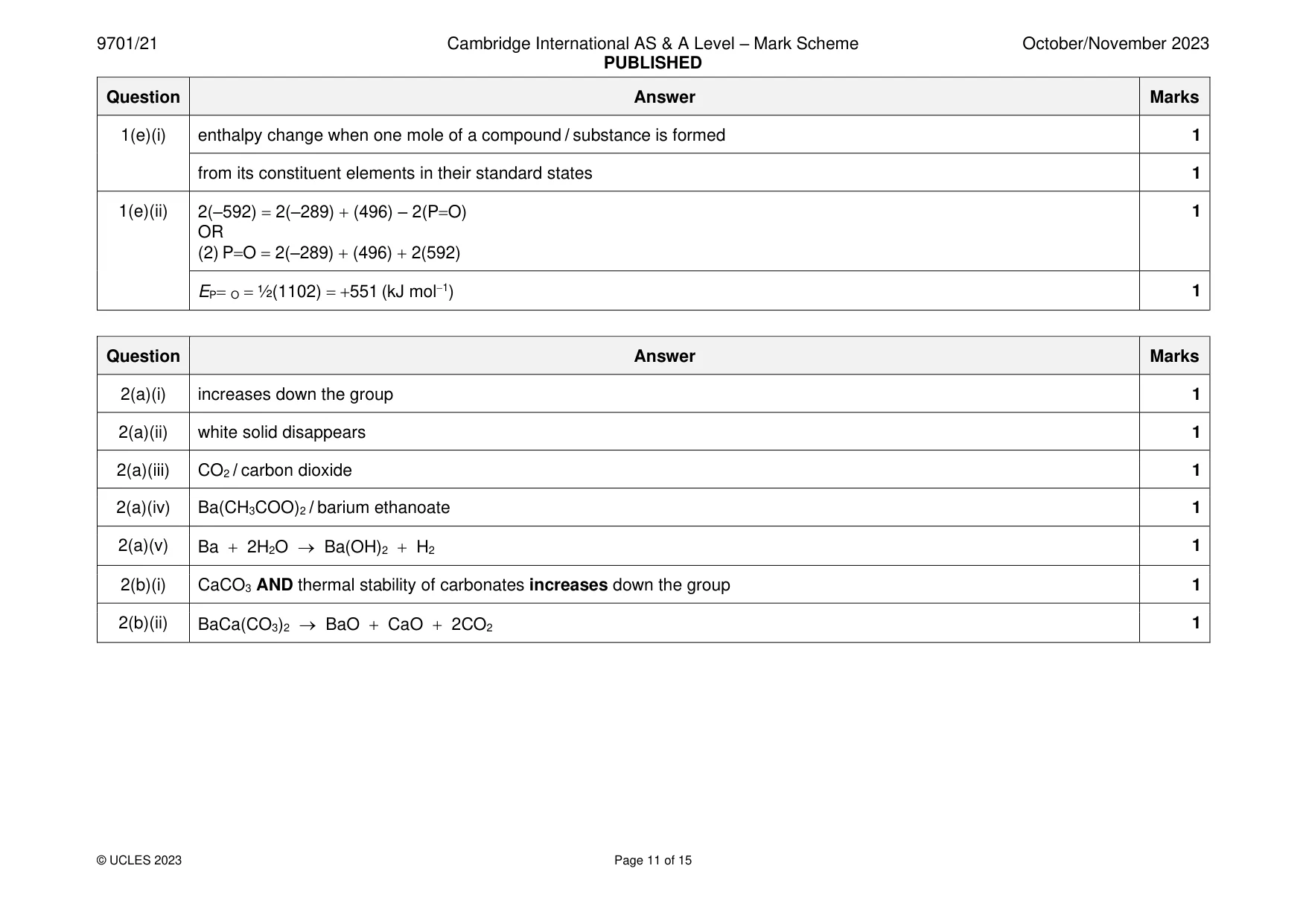
Mark scheme: Question Answer Marks 1(a)(i) total # 3p e– 3 4 5 1 total # unpaired e– 3 2 1 1 1(a)(ii) P(g) → P+(g) + e(–) 1 1(a)(iii) 1000 (kJmol−1) 1 (S) less / least / lowest nuclear attraction (to outer electrons) (than P OR Cl) 1 OR nuclear attraction for Cl is stronger (compared to S (and or P)) S less nuclear charge than Cl 1 OR Cl has a greater nuclear charge than S (S has a greater nuclear charge (of outer electrons) than P BUT) 1 S has two electrons in a (3)p orbital AND resulting in spin-pair repulsion 1(b)(i) 1s2 2s2 2p6 3s2 3p6 1 1(b)(ii) ● decreases (from P3− to Cl−) 2 ● increased attraction (of outer e−) for nucleus owtte ● increased nuclear charge ● same shielding ●√●√ 1(c) (Br2) no visible reaction 1 OR colourless to orange / brown / yellow solution (conc. H2SO4) no visible reaction 1 OR Solution remains colourless (dil. AgNO3) white precipitate forms 1 1(d)(i) (relatively low melting and boiling points suggests) weak intermolecular / VdW forces 1 (vigorous reaction with water suggests) hydrolysis 1 1(d)(ii) POCl3 + 3H2O → H3PO4 + 3HCl 1 1(d)(iii) 1 Correct bonding e− rest of electrons correct (i.e. to make 32 electrons in total) 1 1(e)(i) enthalpy change when one mole of a compound / substance is formed 1 from its constituent elements in their standard states 1 1(e)(ii) 2(–592) = 2(–289) + (496) – 2(P=O) 1 OR (2) P=O = 2(–289) + (496) + 2(592) EP= O = ½(1102) = +551 (kJ mol−1) 1
More questions on Electrons, energy levels and atomic orbitals
Q2 · Barium hydroxide, Ba(OH)2 , is a strong base used in inorganic and organic reactions
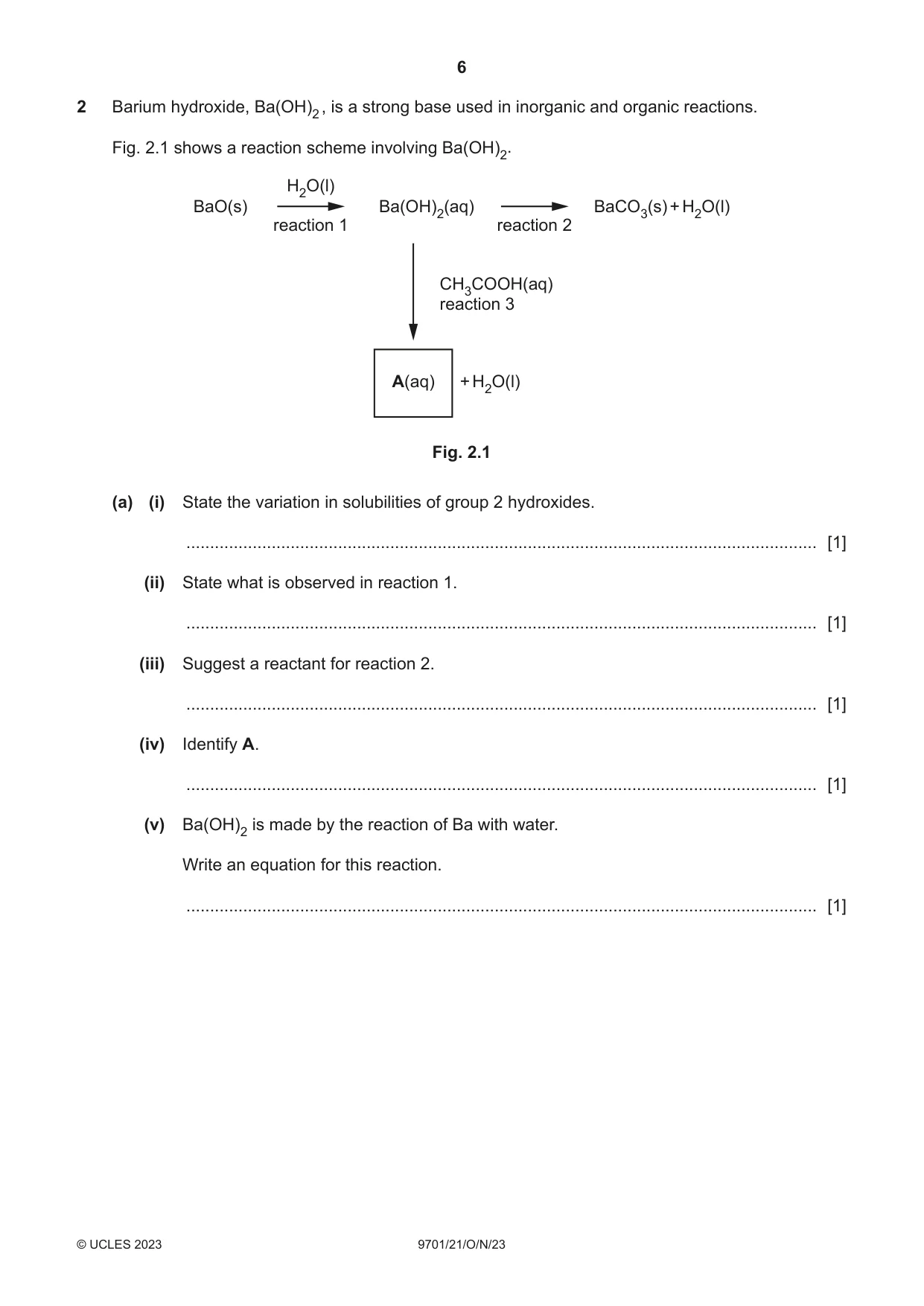
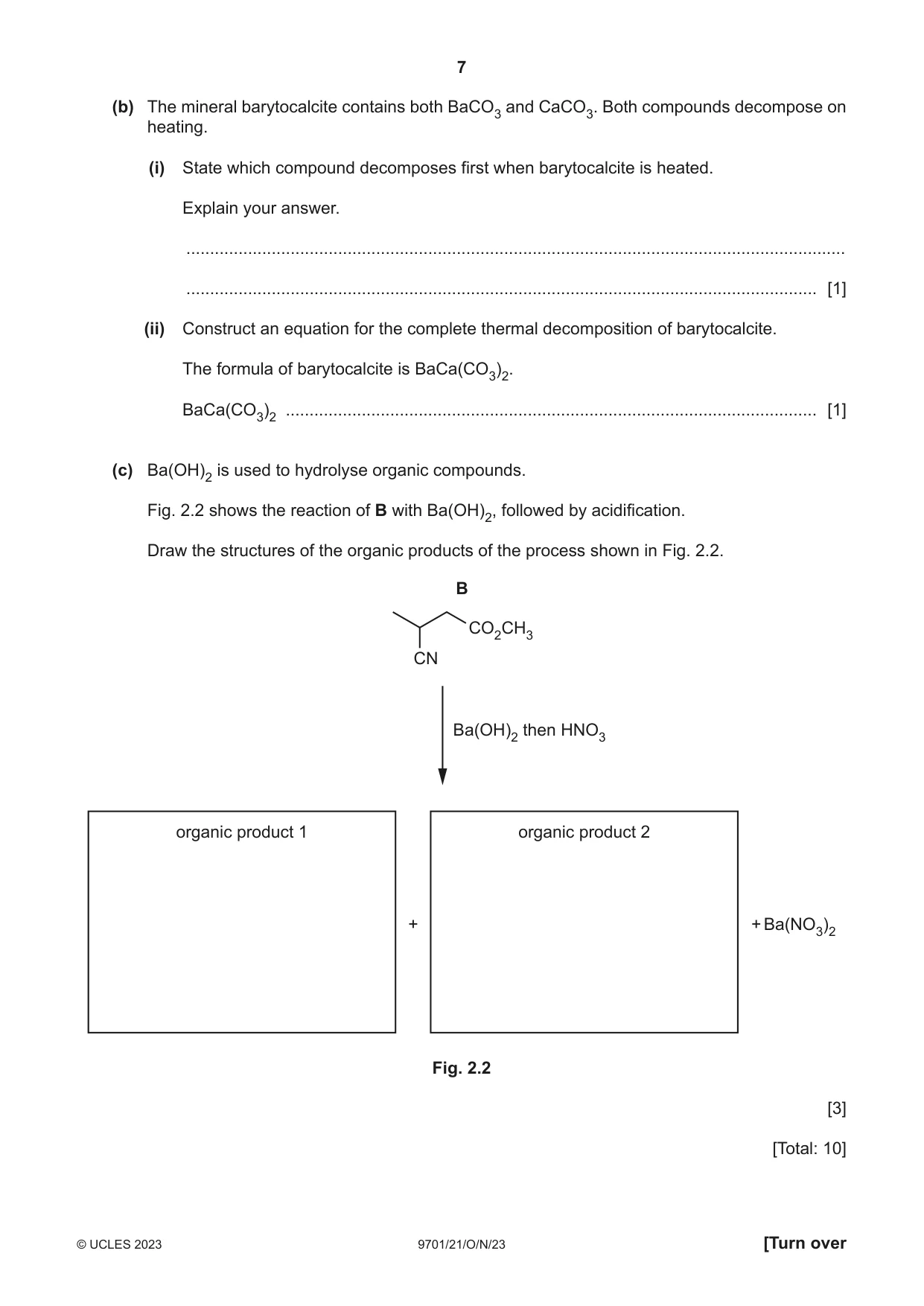
2 Barium hydroxide, Ba(OH)2 , is a strong base used in inorganic and organic reactions. Fig. 2.1 shows a reaction scheme involving Ba(OH)2. H2O(l) BaO(s) Ba(OH)2(aq) BaCO3(s) + H2O(l) reaction 1 reaction 2 CH3COOH(aq) reaction 3 A(aq) + H2O(l) Fig. 2.1 (a) (i) State the variation in solubilities of group 2 hydroxides. ..................................................................................................................................... [1] (ii) State what is observed in reaction 1. ..................................................................................................................................... [1] (iii) Suggest a reactant for reaction 2. ..................................................................................................................................... [1] (iv) Identify A. ..................................................................................................................................... [1] (v) Ba(OH)2 is made by the reaction of Ba with water. Write an equation for this reaction. ..................................................................................................................................... [1] (b) The mineral barytocalcite contains both BaCO3 and CaCO3. Both compounds decompose on heating. (i) State which compound decomposes first when barytocalcite is heated. Explain your answer. ........................................................................................................................................... ..................................................................................................................................... [1] (ii) Construct an equation for the complete thermal decomposition of barytocalcite. The formula of barytocalcite is BaCa(CO3)2. BaCa(CO3)2 ................................................................................................................ [1] (c) Ba(OH)2 is used to hydrolyse organic compounds. Fig. 2.2 shows the reaction of B with Ba(OH)2, followed by acidification. Draw the structures of the organic products of the process shown in Fig. 2.2. B CO2CH3 CN Ba(OH)2 then HNO3 organic product 1 organic product 2 + + Ba(NO3)2 Fig. 2.2 [3] [Total: 10]
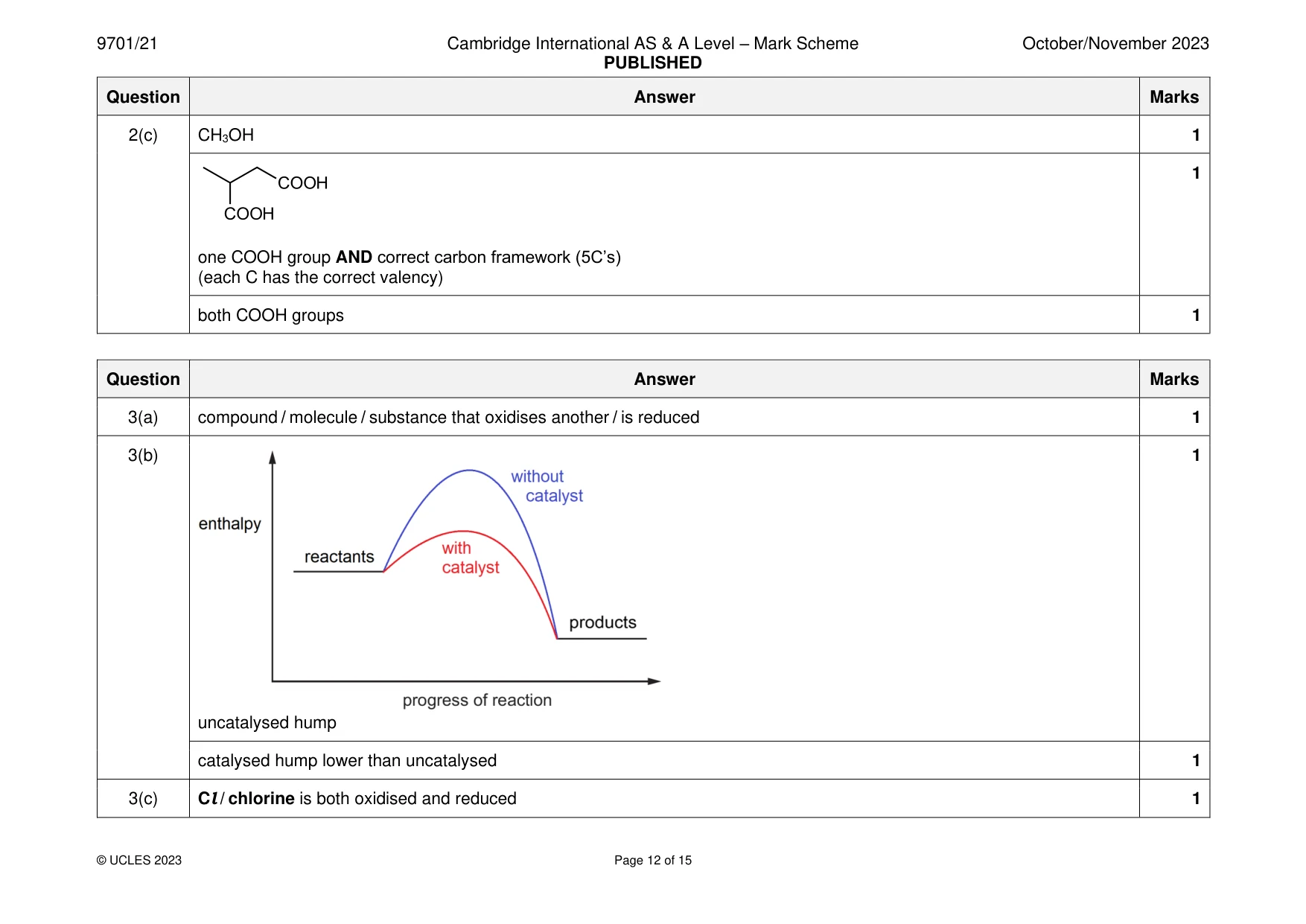
Mark scheme: 2(a)(i) increases down the group 1 2(a)(ii) white solid disappears 1 2(a)(iii) CO2 / carbon dioxide 1 2(a)(iv) Ba(CH3COO)2 / barium ethanoate 1 2(a)(v) Ba + 2H2O → Ba(OH)2 + H2 1 2(b)(i) CaCO3 AND thermal stability of carbonates increases down the group 1 2(b)(ii) BaCa(CO3)2 → BaO + CaO + 2CO2 1 2(c) CH3OH 1 1 one COOH group AND correct carbon framework (5C’s) (each C has the correct valency) both COOH groups 1
Q3 · Potassium chlorate, KCl O3, is widely used as an oxidising agent and to make O2(g)
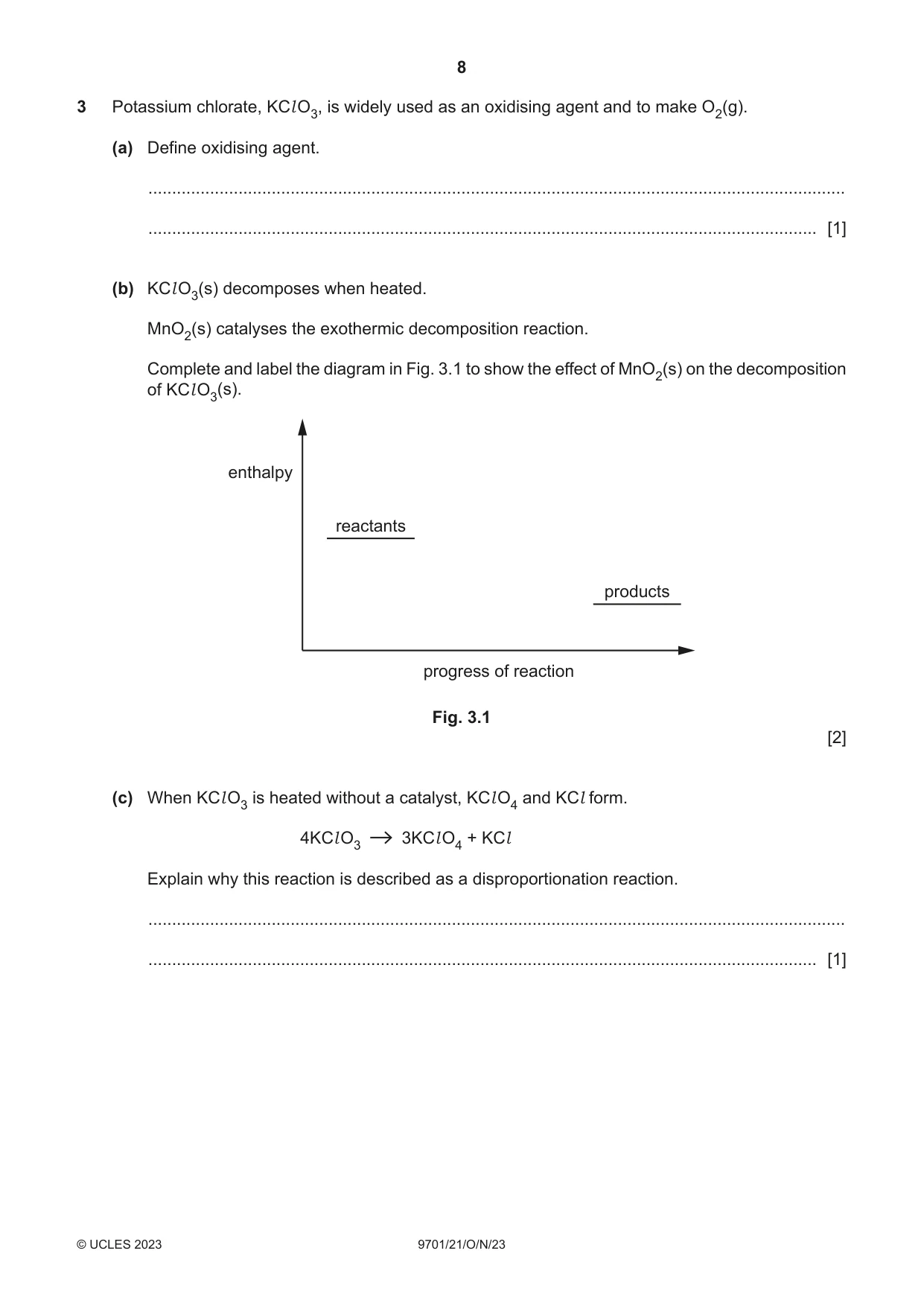
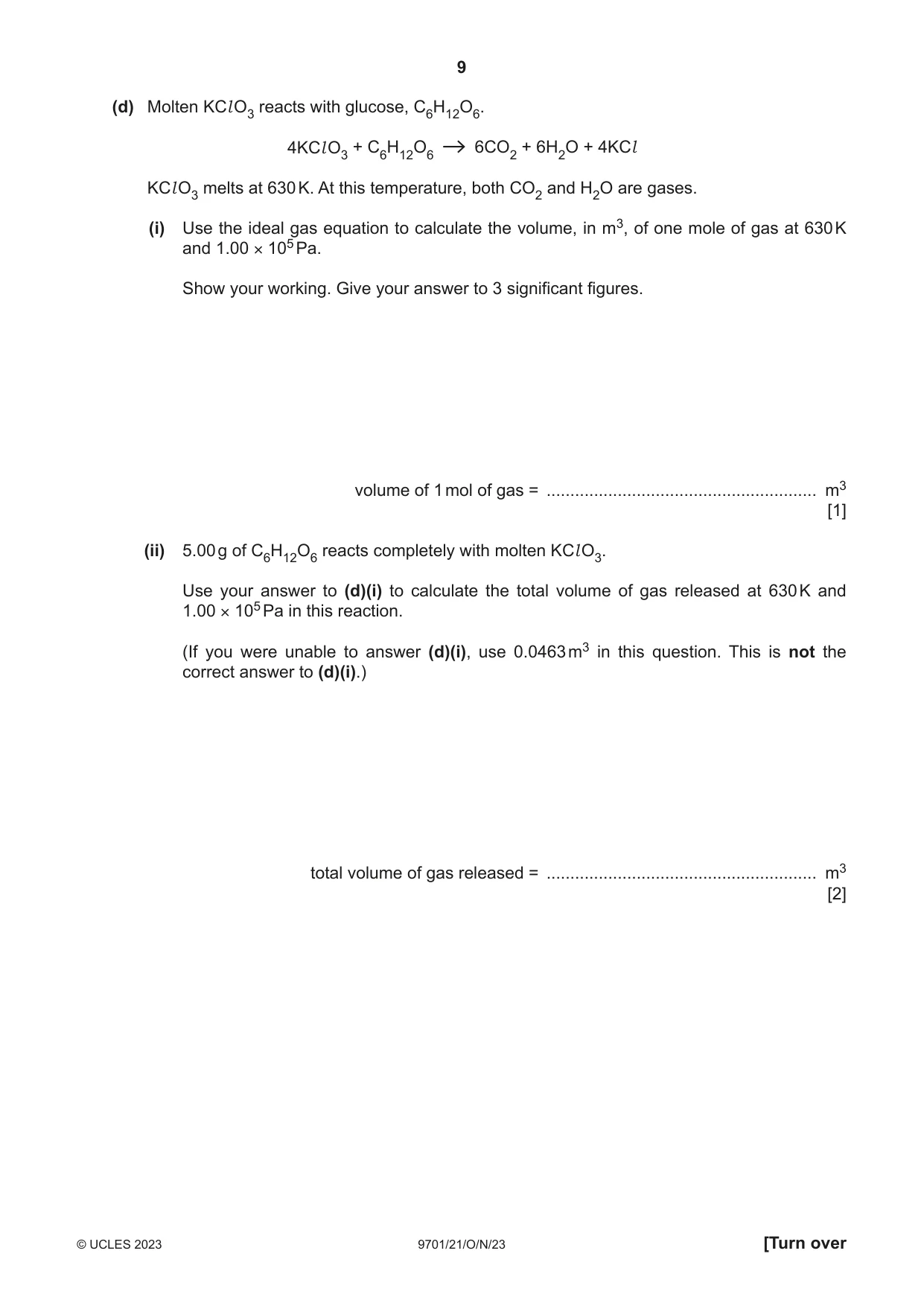
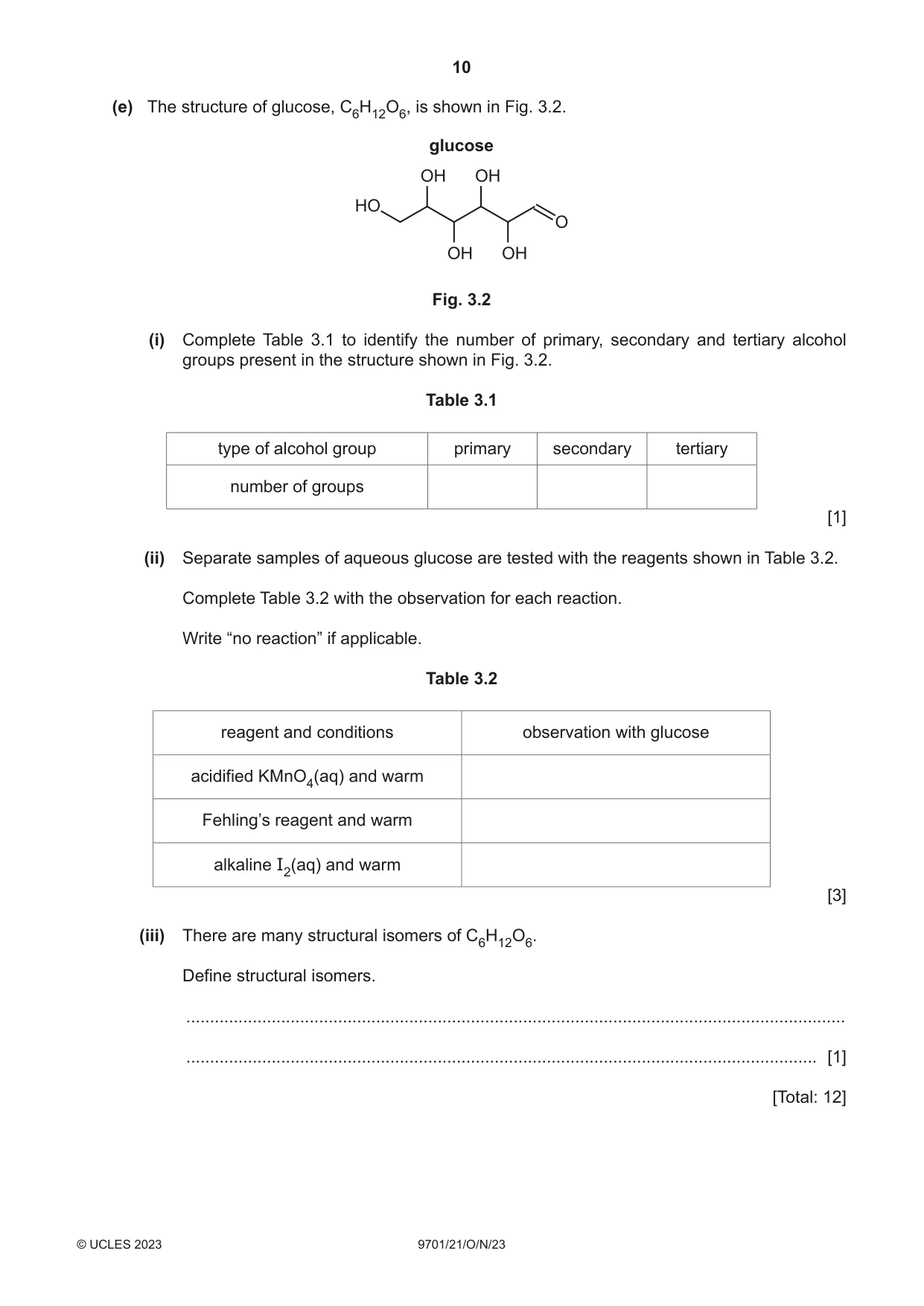
3 Potassium chlorate, KCl O3, is widely used as an oxidising agent and to make O2(g). (a) Define oxidising agent. ................................................................................................................................................... ............................................................................................................................................. [1] (b) KCl O3(s) decomposes when heated. MnO2(s) catalyses the exothermic decomposition reaction. Complete and label the diagram in Fig. 3.1 to show the effect of MnO2(s) on the decomposition of KCl O3(s). enthalpy reactants products progress of reaction Fig. 3.1 [2] (c) When KCl O3 is heated without a catalyst, KCl O4 and KCl form. 4KCl O3 3KCl O4 + KCl Explain why this reaction is described as a disproportionation reaction. ................................................................................................................................................... ............................................................................................................................................. [1] (d) Molten KCl O3 reacts with glucose, C6H12O6. 4KCl O3 + C6H12O6 6CO2 + 6H2O + 4KCl KCl O3 melts at 630 K. At this temperature, both CO2 and H2O are gases. (i) Use the ideal gas equation to calculate the volume, in m3, of one mole of gas at 630 K and 1.00 × 10⁵ Pa. Show your working. Give your answer to 3 significant figures. volume of 1 mol of gas = ......................................................... m3 [1] (ii) 5.00 g of C6H12O6 reacts completely with molten KCl O3. Use your answer to (d)(i) to calculate the total volume of gas released at 630 K and 1.00 × 10⁵ Pa in this reaction. (If you were unable to answer (d)(i), use 0.0463 m3 in this question. This is not the correct answer to (d)(i).) total volume of gas released = ......................................................... m3 [2] (e) The structure of glucose, C6H12O6, is shown in Fig. 3.2. glucose OH OH HO O OH OH Fig. 3.2 (i) Complete Table 3.1 to identify the number of primary, secondary and tertiary alcohol groups present in the structure shown in Fig. 3.2. Table 3.1 type of alcohol group primary secondary tertiary number of groups [1] (ii) Separate samples of aqueous glucose are tested with the reagents shown in Table 3.2. Complete Table 3.2 with the observation for each reaction. Write “no reaction” if applicable. Table 3.2 reagent and conditions observation with glucose acidified KMnO4(aq) and warm Fehling’s reagent and warm alkaline I2(aq) and warm [3] (iii) There are many structural isomers of C6H12O6. Define structural isomers. ........................................................................................................................................... ..................................................................................................................................... [1] [Total: 12]
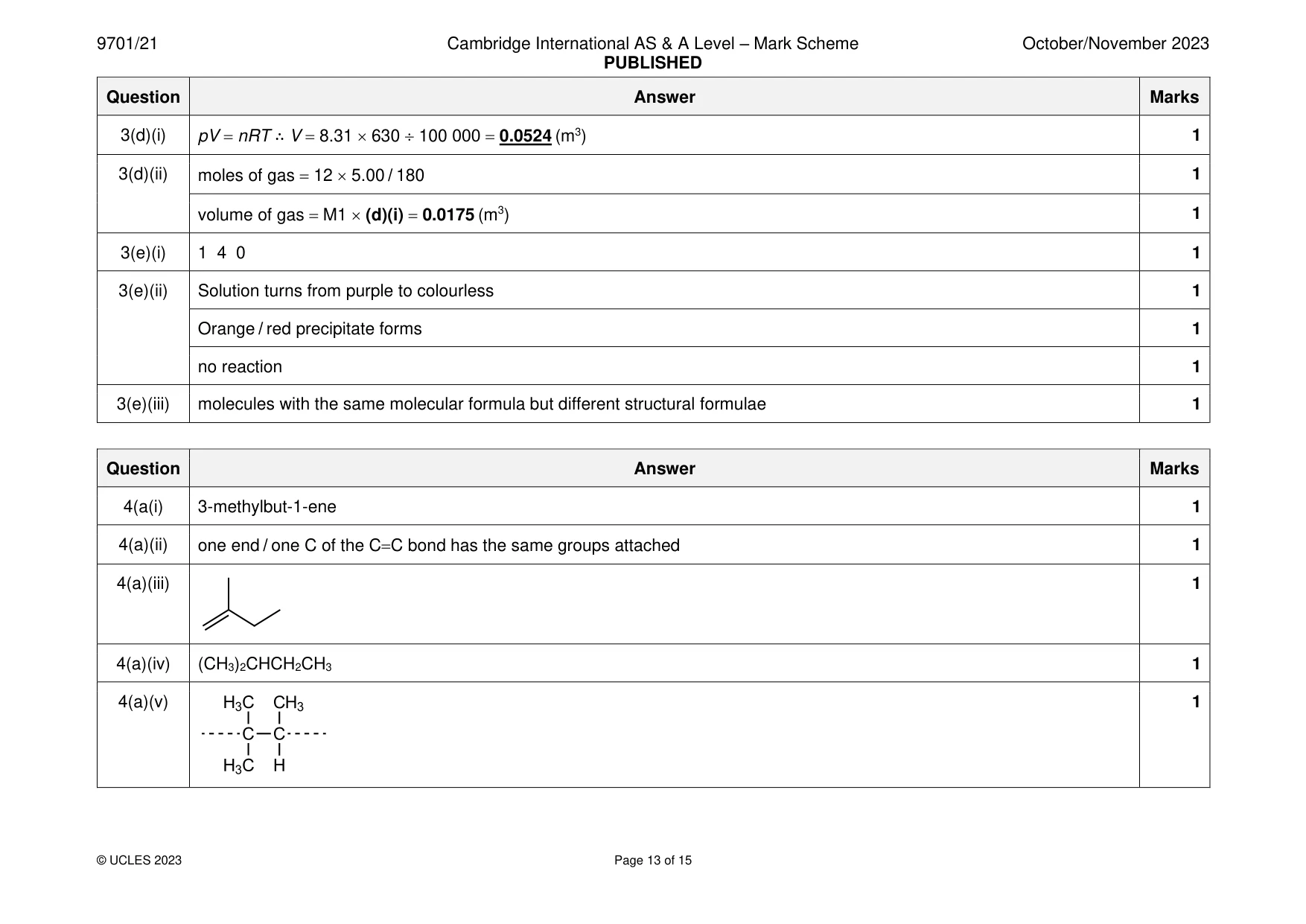
Mark scheme: 3(a) compound / molecule / substance that oxidises another / is reduced 1 3(b) 1 uncatalysed hump catalysed hump lower than uncatalysed 1 3(c) Cl / chlorine is both oxidised and reduced 1 3(d)(i) pV = nRT ∴ V = 8.31 630 100 000 = 0.0524 (m3) 1 3(d)(ii) moles of gas = 12 5.00 / 180 1 volume of gas = M1 (d)(i) = 0.0175 (m3) 1 3(e)(i) 1 4 0 1 3(e)(ii) Solution turns from purple to colourless 1 Orange / red precipitate forms 1 no reaction 1 3(e)(iii) molecules with the same molecular formula but different structural formulae 1
Q4 · Compounds C and D are alkenes with the same molecular formula, C5H10
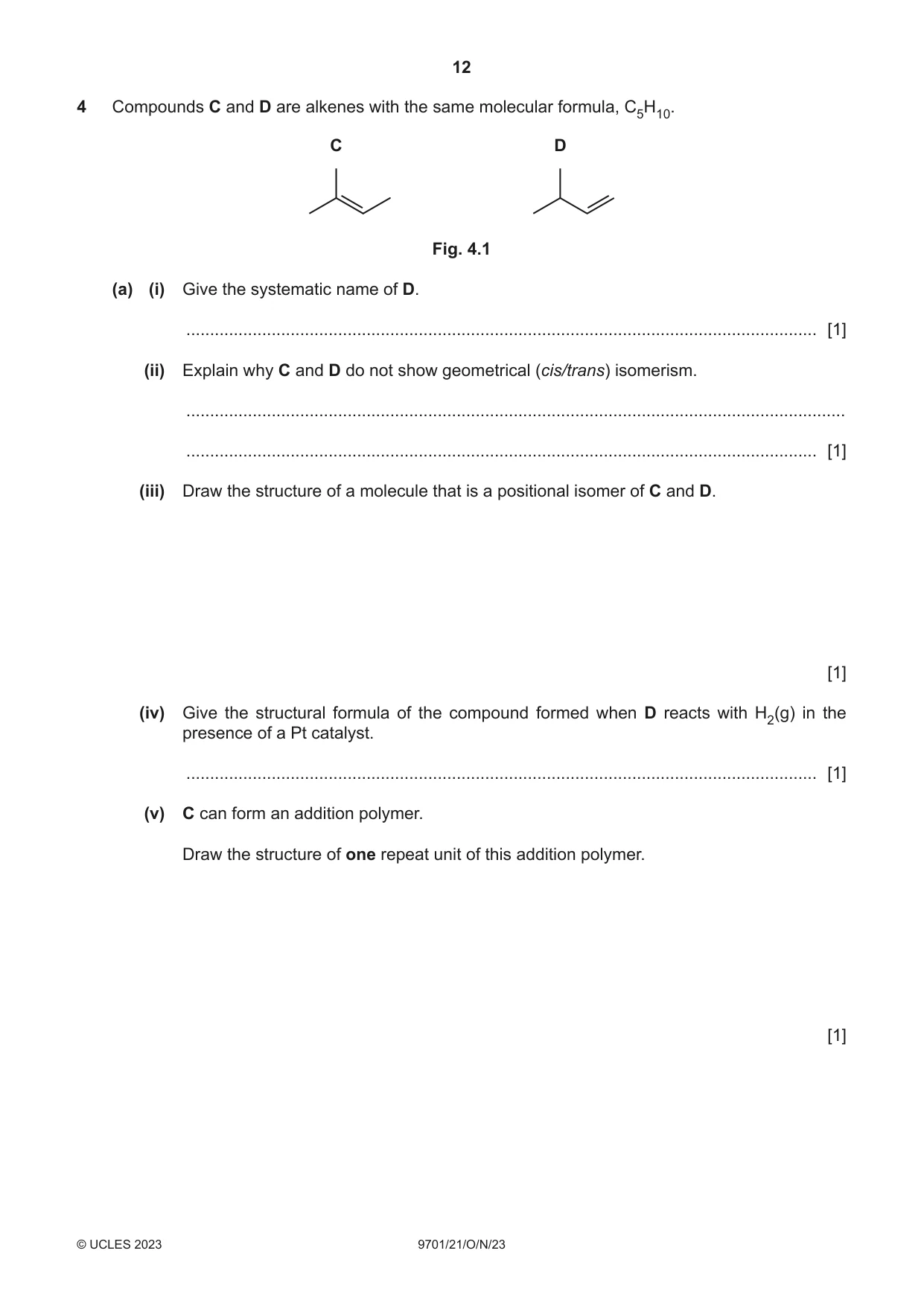
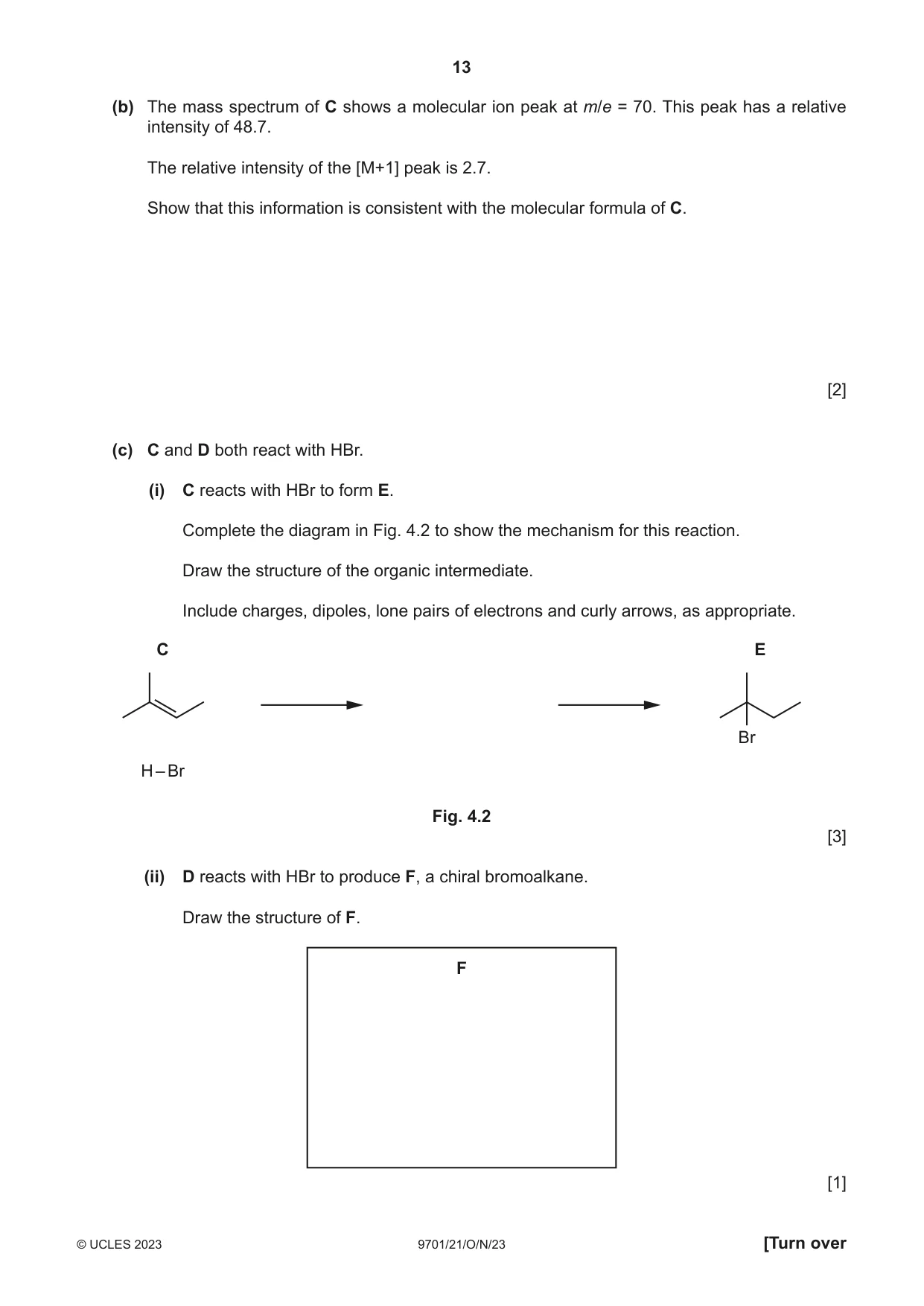
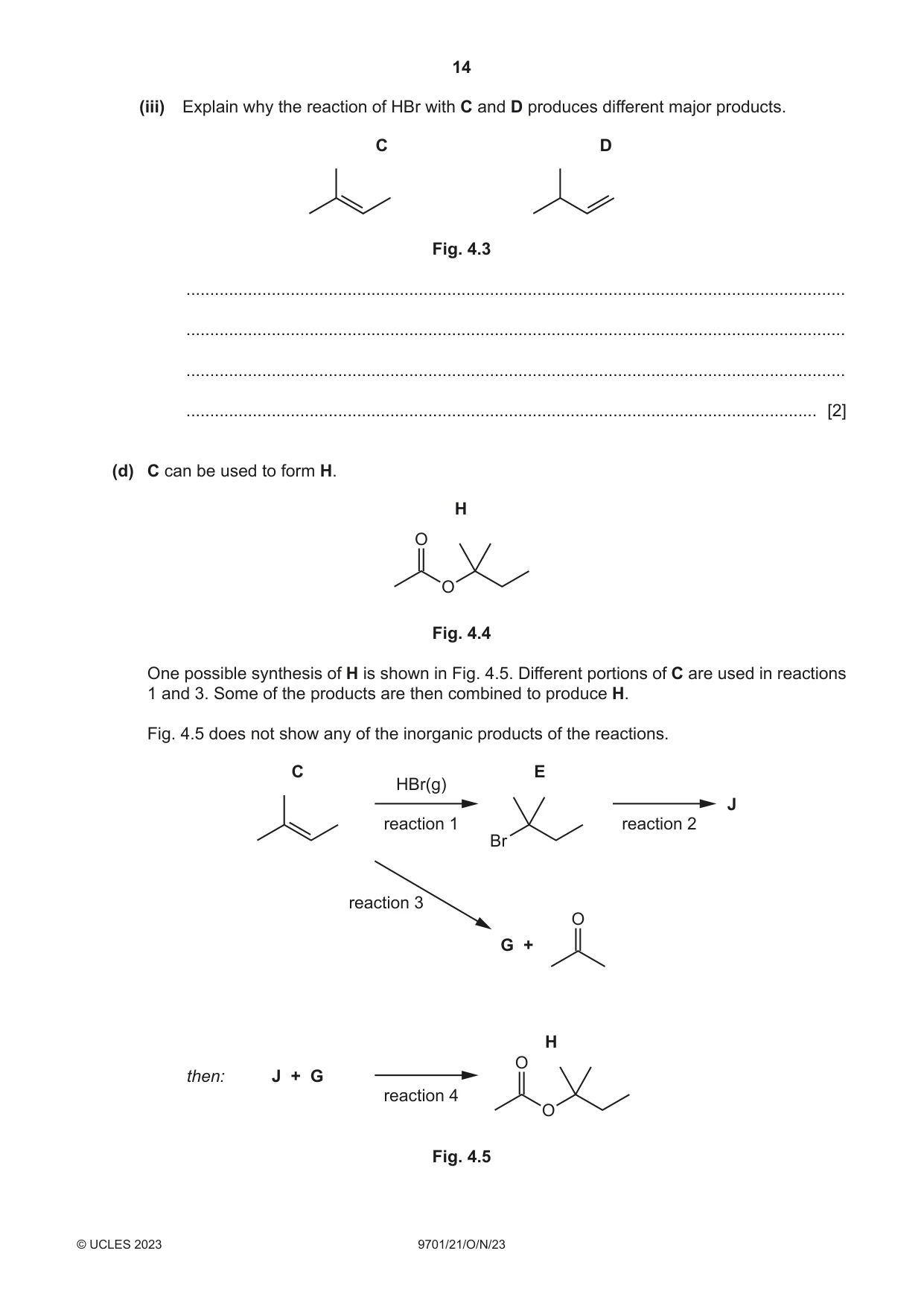
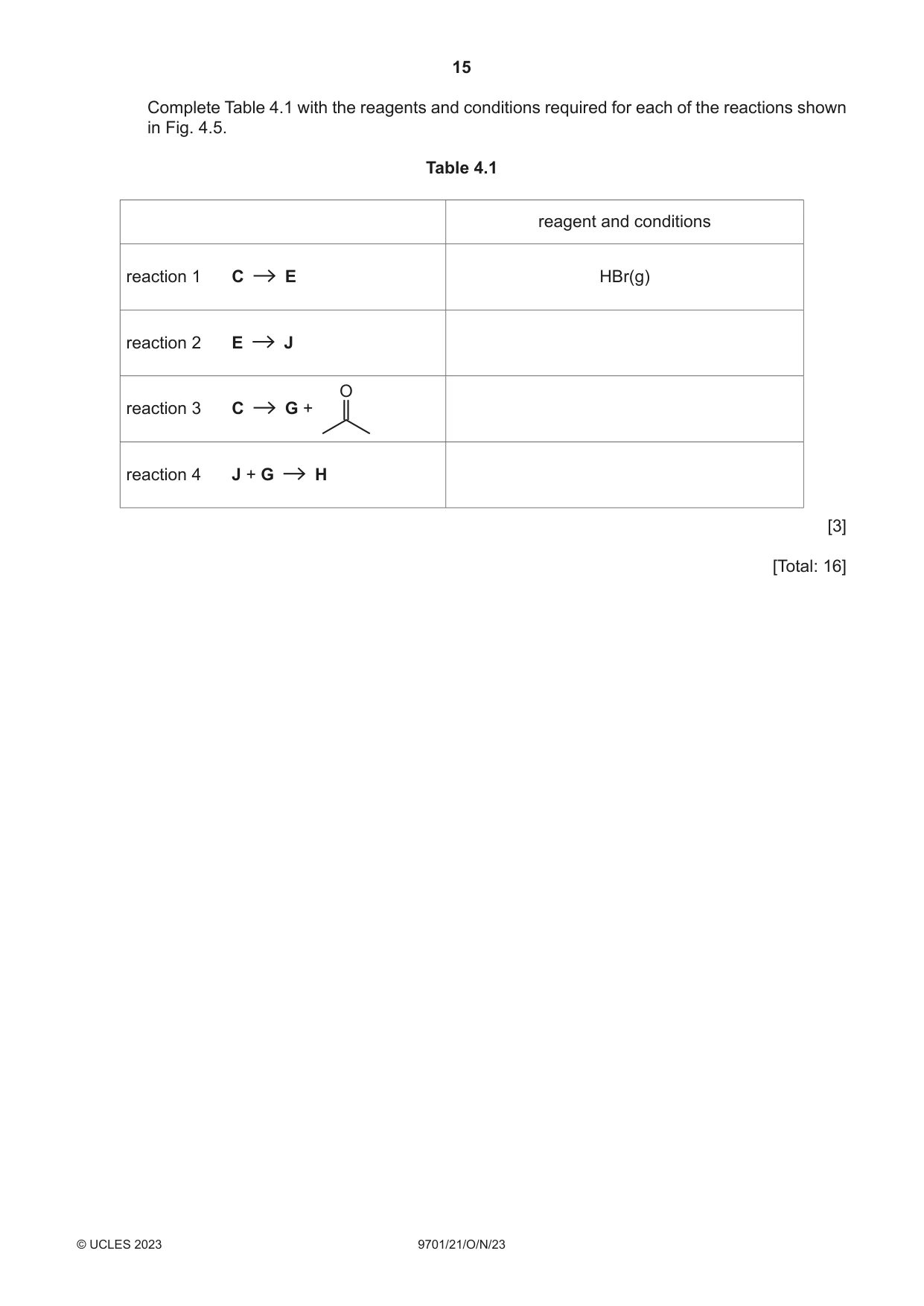
4 Compounds C and D are alkenes with the same molecular formula, C5H10. C D Fig. 4.1 (a) (i) Give the systematic name of D. ..................................................................................................................................... [1] (ii) Explain why C and D do not show geometrical (cis/trans) isomerism. ........................................................................................................................................... ..................................................................................................................................... [1] (iii) Draw the structure of a molecule that is a positional isomer of C and D. [1] (iv) Give the structural formula of the compound formed when D reacts with H2(g) in the presence of a Pt catalyst. ..................................................................................................................................... [1] (v) C can form an addition polymer. Draw the structure of one repeat unit of this addition polymer. [1] (b) The mass spectrum of C shows a molecular ion peak at m/e = 70. This peak has a relative intensity of 48.7. The relative intensity of the [M+1] peak is 2.7. Show that this information is consistent with the molecular formula of C. [2] (c) C and D both react with HBr. (i) C reacts with HBr to form E. Complete the diagram in Fig. 4.2 to show the mechanism for this reaction. Draw the structure of the organic intermediate. Include charges, dipoles, lone pairs of electrons and curly arrows, as appropriate. C E Br H – Br Fig. 4.2 [3] (ii) D reacts with HBr to produce F, a chiral bromoalkane. Draw the structure of F. F [1] (iii) Explain why the reaction of HBr with C and D produces different major products. C D Fig. 4.3 ........................................................................................................................................... ........................................................................................................................................... ........................................................................................................................................... ..................................................................................................................................... [2] (d) C can be used to form H. H O O Fig. 4.4 One possible synthesis of H is shown in Fig. 4.5. Different portions of C are used in reactions 1 and 3. Some of the products are then combined to produce H. Fig. 4.5 does not show any of the inorganic products of the reactions. C E HBr(g) J reaction 1 reaction 2 Br reaction 3 O G + H O then: J + G reaction 4 O Fig. 4.5
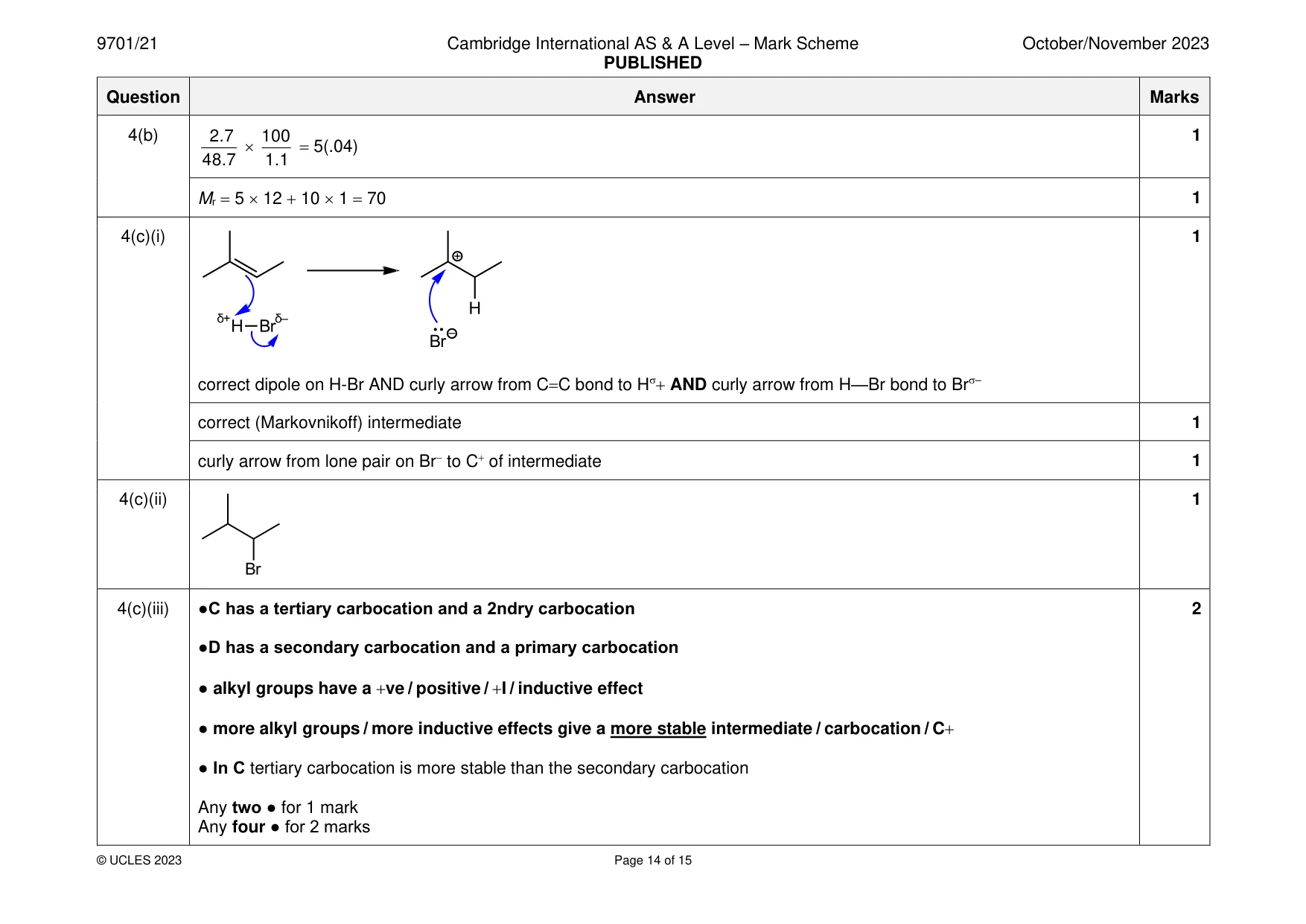
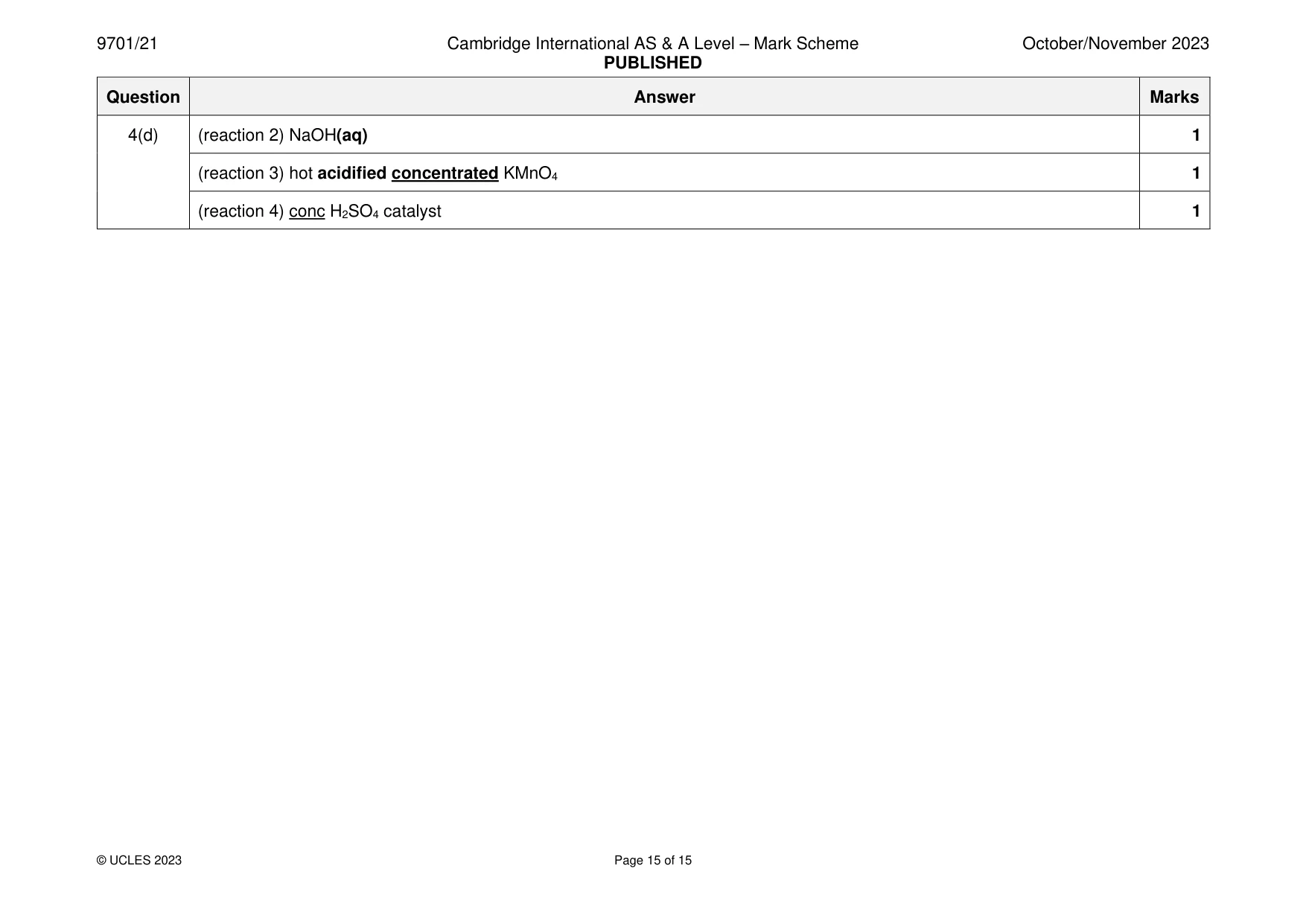
Mark scheme: 4(a(i) 3-methylbut-1-ene 1 4(a)(ii) one end / one C of the C=C bond has the same groups attached 1 4(a)(iii) 1 4(a)(iv) (CH3)2CHCH2CH3 1 4(a)(v) 1 4(b) 2.7 100 1 = 5(.04) 48.7 1.1 Mr = 5 12 + 10 1 = 70 1 4(c)(i) 1 correct dipole on H-Br AND curly arrow from C=C bond to H+ AND curly arrow from H—Br bond to Br– correct (Markovnikoff) intermediate 1 curly arrow from lone pair on Br− to C+ of intermediate 1 4(c)(ii) 1 4(c)(iii) ●C has a tertiary carbocation and a 2ndry carbocation 2 ●D has a secondary carbocation and a primary carbocation ● alkyl groups have a +ve / positive / +I / inductive effect ● more alkyl groups / more inductive effects give a more stable intermediate / carbocation / C+ ● In C tertiary carbocation is more stable than the secondary carbocation Any two ● for 1 mark Any four ● for 2 marks 4(d) (reaction 2) NaOH(aq) 1 (reaction 3) hot acidified concentrated KMnO4 1 (reaction 4) conc H2SO4 catalyst 1
What was in this paper
The subtopics covered by these 4 questions, and how many questions each got. Open one in a new tab to see every Cambridge question on it.
What you needed in this session
Cambridge’s own grade thresholds for 2023 Oct/Nov, Paper 2 · Variant 1. A higher threshold means an easier paper — the bar moves with how the cohort did.