Cambridge A Level Chemistry 9701 — 2023 May/June Paper 2 · Variant 2
9701/22/M/J/23 · 5 questions · 60 marks · ≈68 min
The question paper and its mark scheme, free to read here and free to download. This is Cambridge’s own paper, exactly as it was sat.
Question paper16 pages
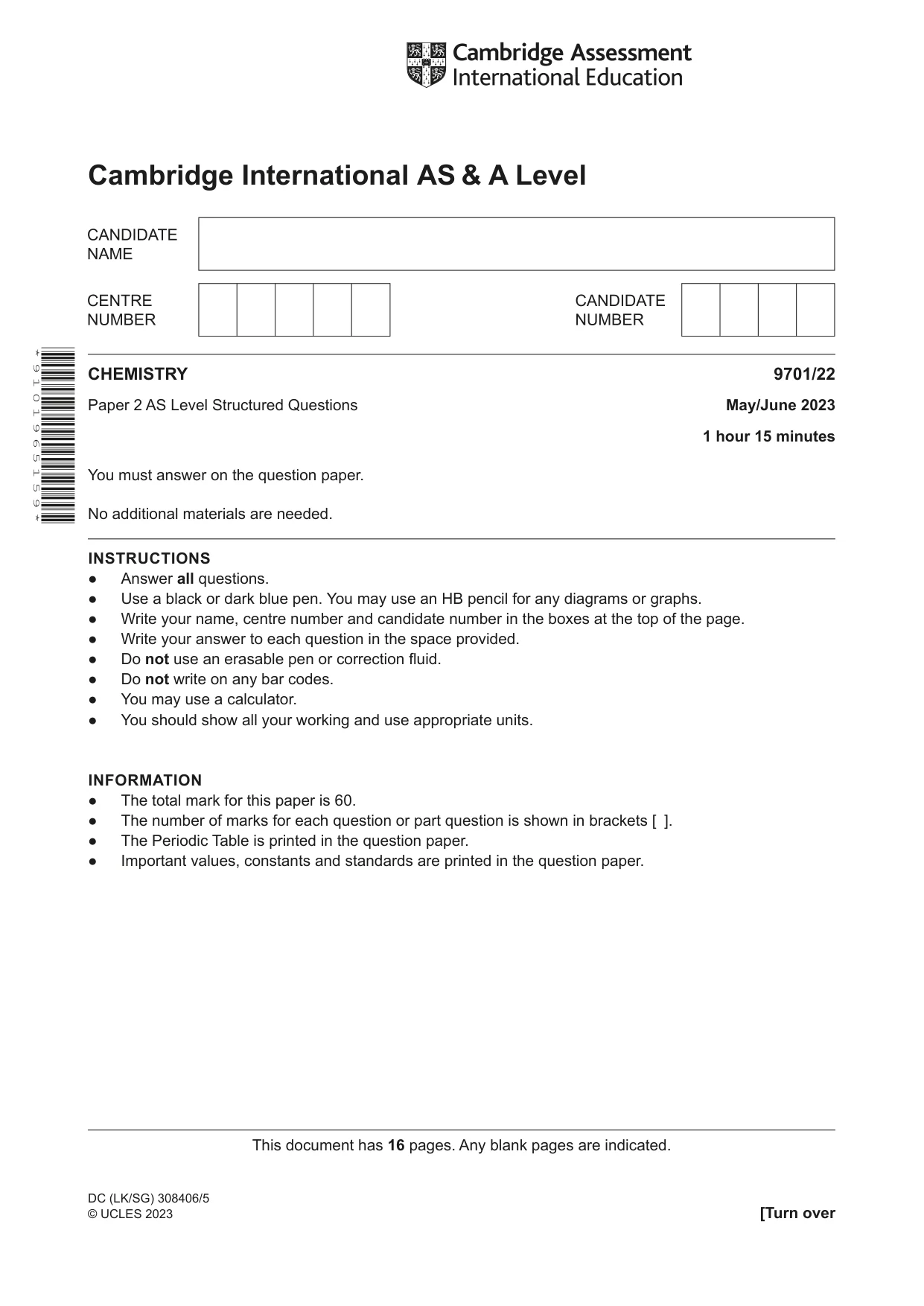

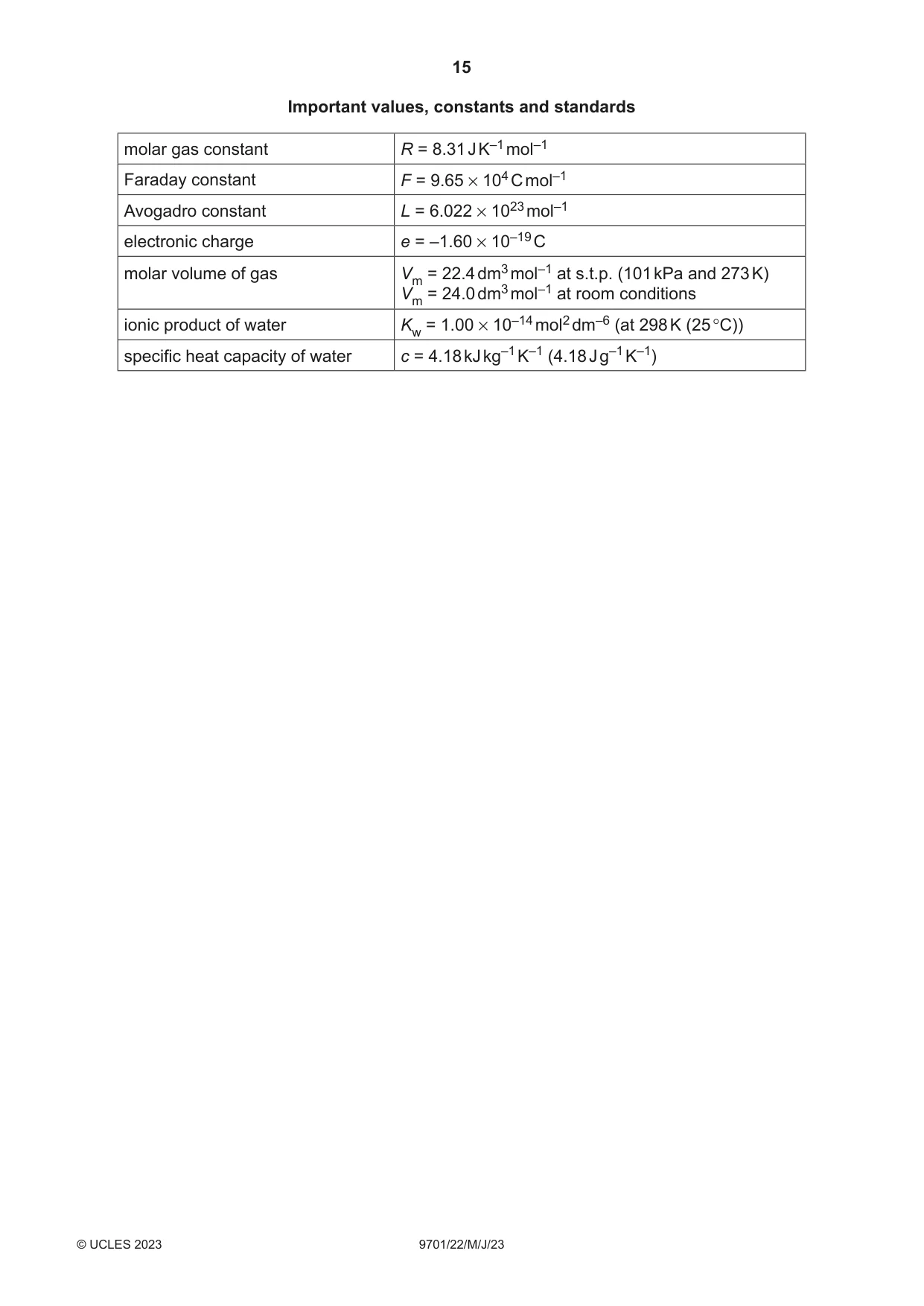
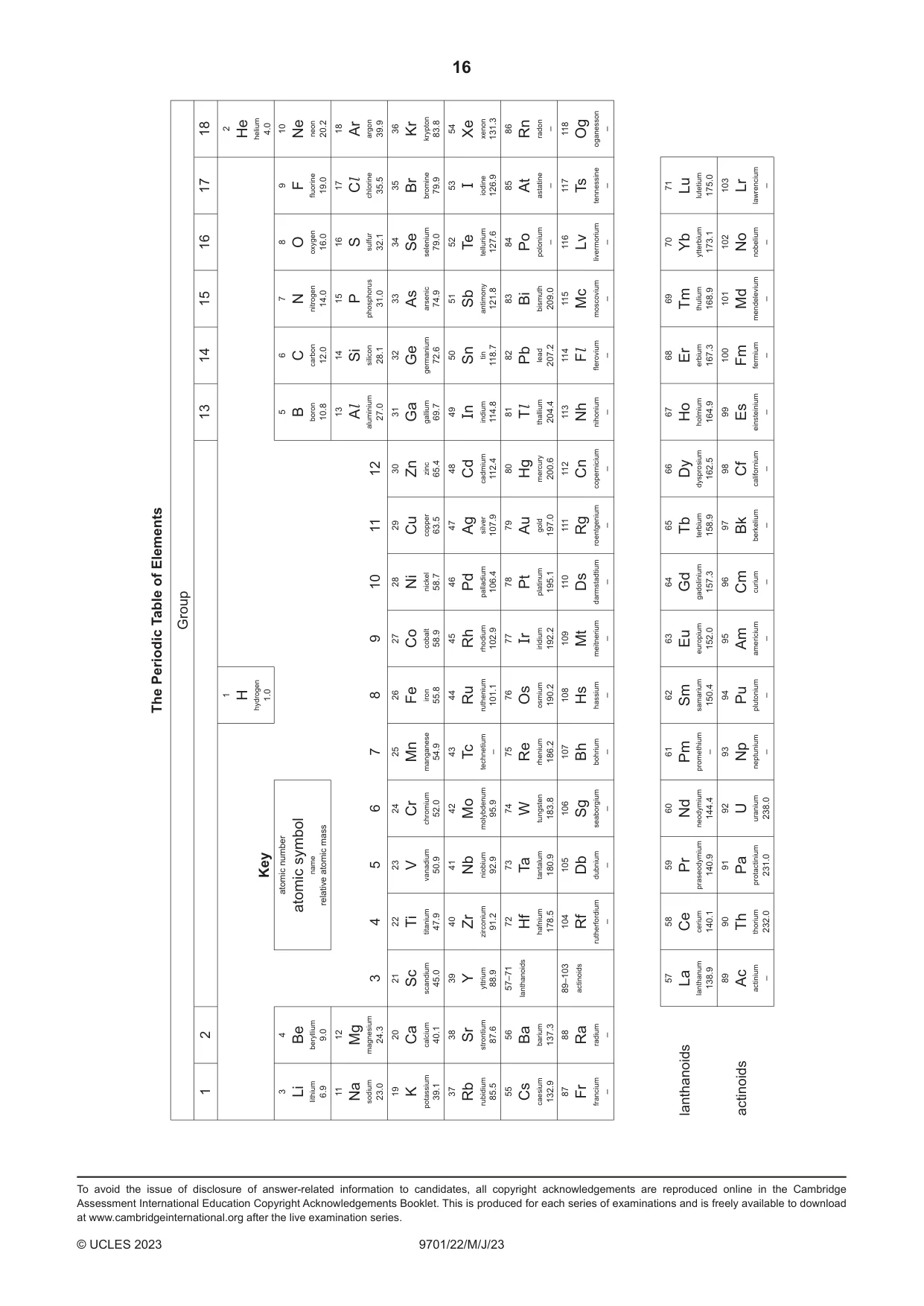
Mark scheme12 pages
Answers below. Sit the paper first if you are practising.
Questions as text
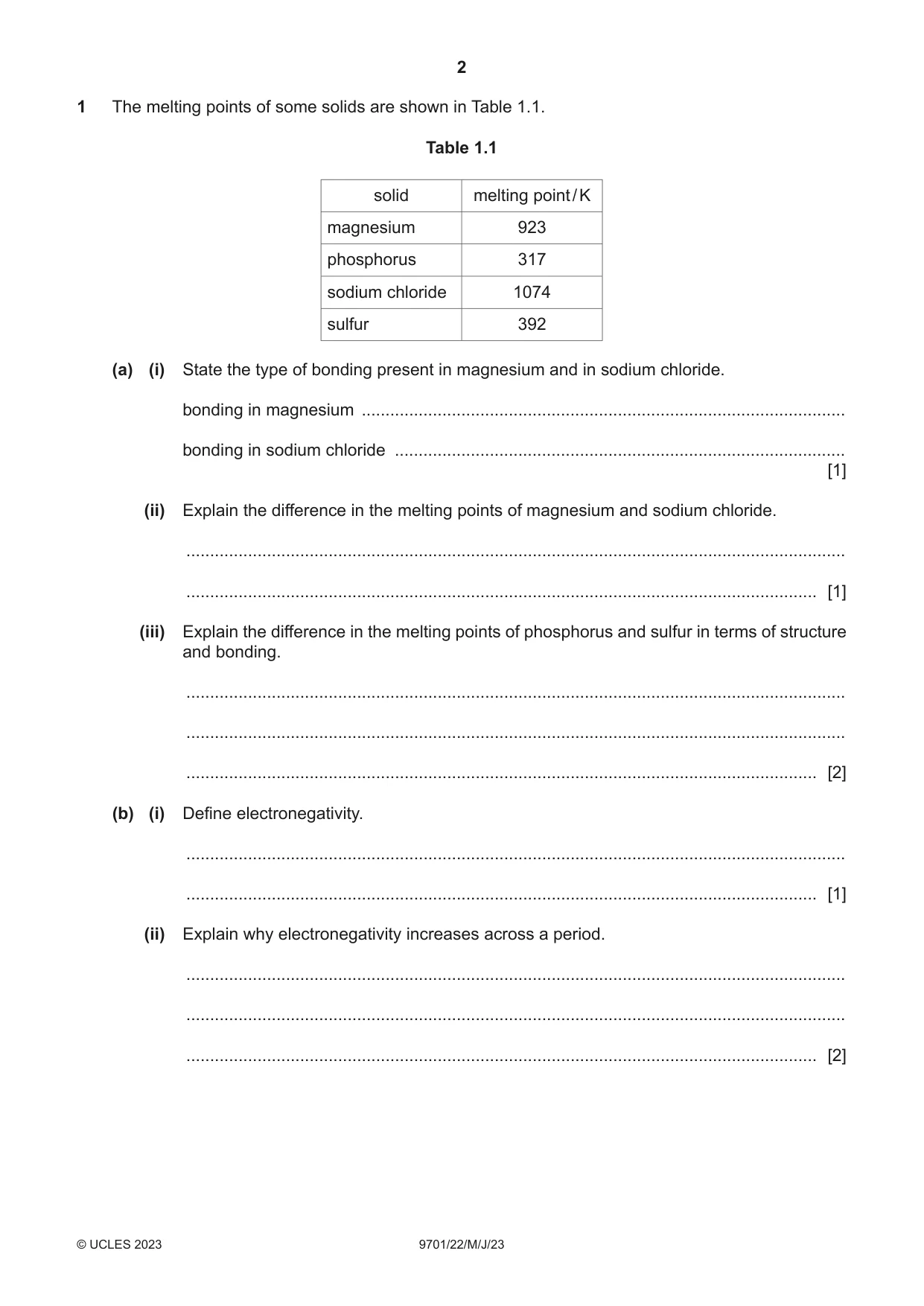
Q1 · The melting points of some solids are shown in Table 1.1
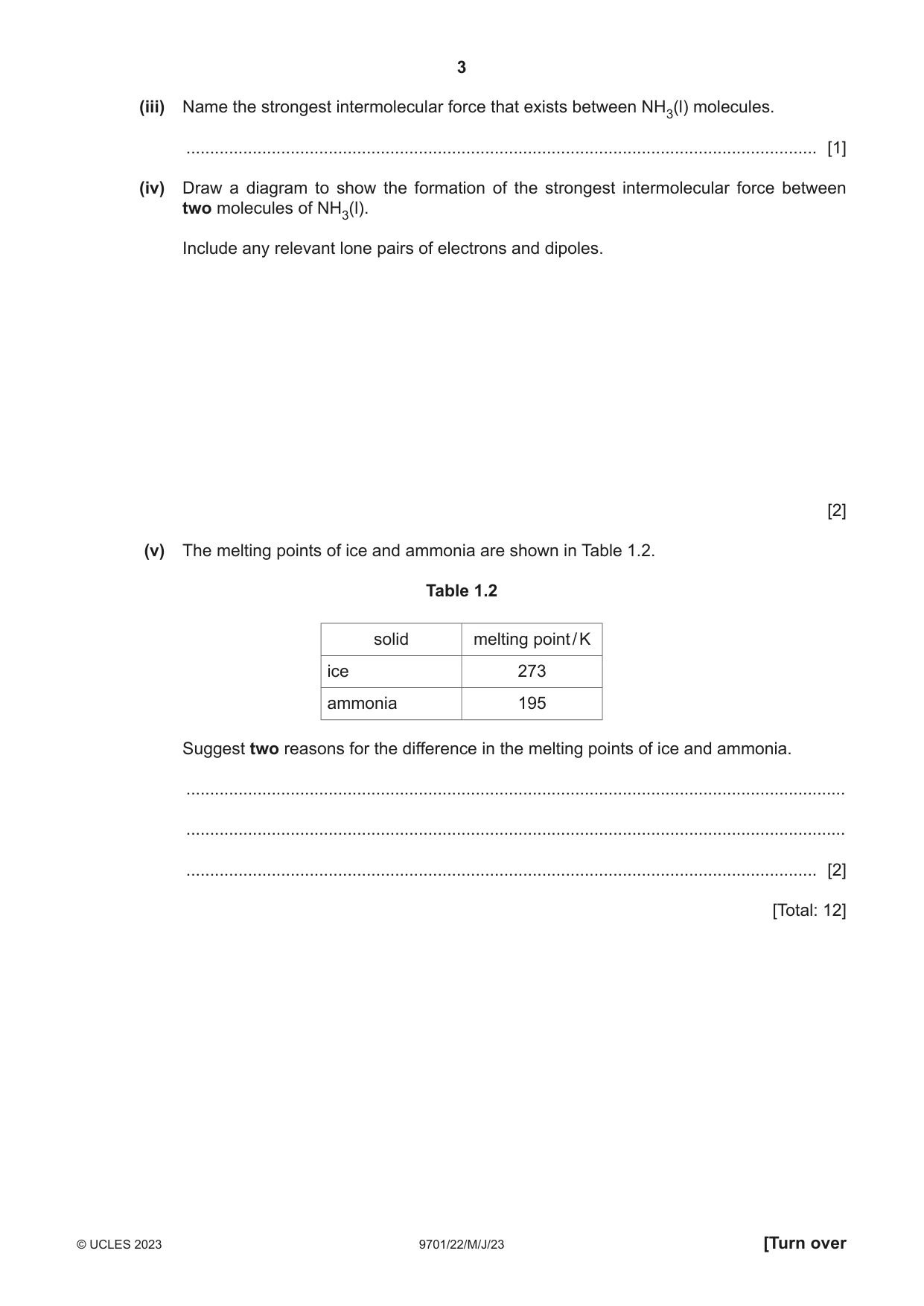
1 The melting points of some solids are shown in Table 1.1. Table 1.1 solid melting point / K magnesium 923 phosphorus 317 sodium chloride 1074 sulfur 392 (a) (i) State the type of bonding present in magnesium and in sodium chloride. bonding in magnesium ...................................................................................................... bonding in sodium chloride ............................................................................................... [1] (ii) Explain the difference in the melting points of magnesium and sodium chloride. ........................................................................................................................................... ..................................................................................................................................... [1] (iii) Explain the difference in the melting points of phosphorus and sulfur in terms of structure and bonding. ........................................................................................................................................... ........................................................................................................................................... ..................................................................................................................................... [2] (b) (i) Define electronegativity. ........................................................................................................................................... ..................................................................................................................................... [1] (ii) Explain why electronegativity increases across a period. ........................................................................................................................................... ........................................................................................................................................... ..................................................................................................................................... [2] (iii) Name the strongest intermolecular force that exists between NH3(l) molecules. ..................................................................................................................................... [1] (iv) Draw a diagram to show the formation of the strongest intermolecular force between two molecules of NH3(l). Include any relevant lone pairs of electrons and dipoles. [2] (v) The melting points of ice and ammonia are shown in Table 1.2. Table 1.2 solid melting point / K ice 273 ammonia 195 Suggest two reasons for the difference in the melting points of ice and ammonia. ........................................................................................................................................... ........................................................................................................................................... ..................................................................................................................................... [2] [Total: 12]
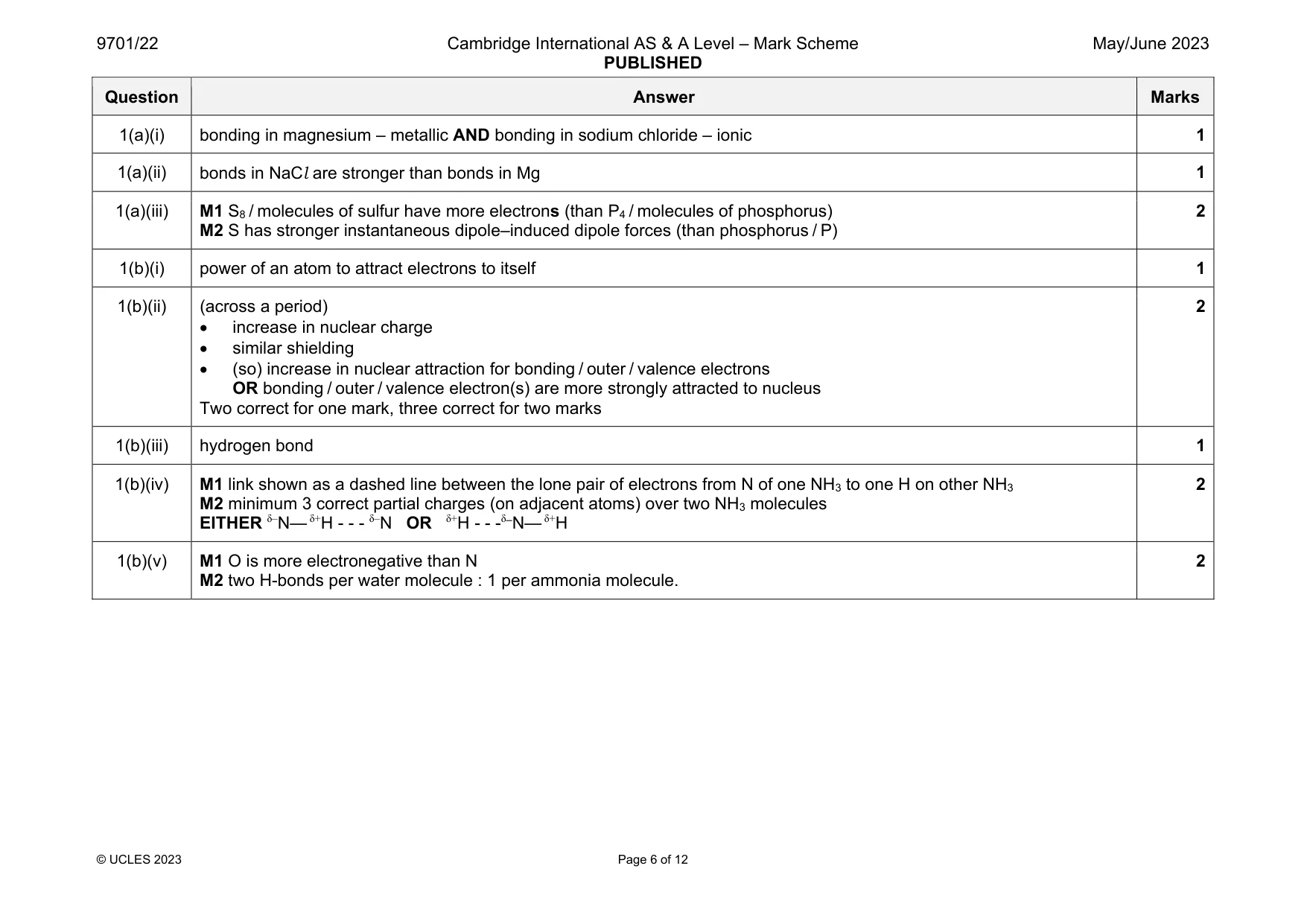
Mark scheme: 1(a)(i) bonding in magnesium – metallic AND bonding in sodium chloride – ionic 1 1(a)(ii) bonds in NaCl are stronger than bonds in Mg 1 1(a)(iii) M1 S8 / molecules of sulfur have more electrons (than P4 / molecules of phosphorus) M2 S has stronger instantaneous dipole–induced dipole forces (than phosphorus / P) 2 1(b)(i) power of an atom to attract electrons to itself 1 1(b)(ii) (across a period) increase in nuclear charge similar shielding (so) increase in nuclear attraction for bonding / outer / valence electrons OR bonding / outer / valence electron(s) are more strongly attracted to nucleus Two correct for one mark, three correct for two marks 2 1(b)(iii) hydrogen bond 1 1(b)(iv) M1 link shown as a dashed line between the lone pair of electrons from N of one NH3 to one H on other NH3 M2 minimum 3 correct partial charges (on adjacent atoms) over two NH3 molecules EITHER δ–N— δ+H - - - δ–N OR δ+H - - -δ–N— δ+H 2 1(b)(v) M1 O is more electronegative than N M2 two H-bonds per water molecule : 1 per ammonia molecule. 2
Q2 · Chlorine is a reactive element
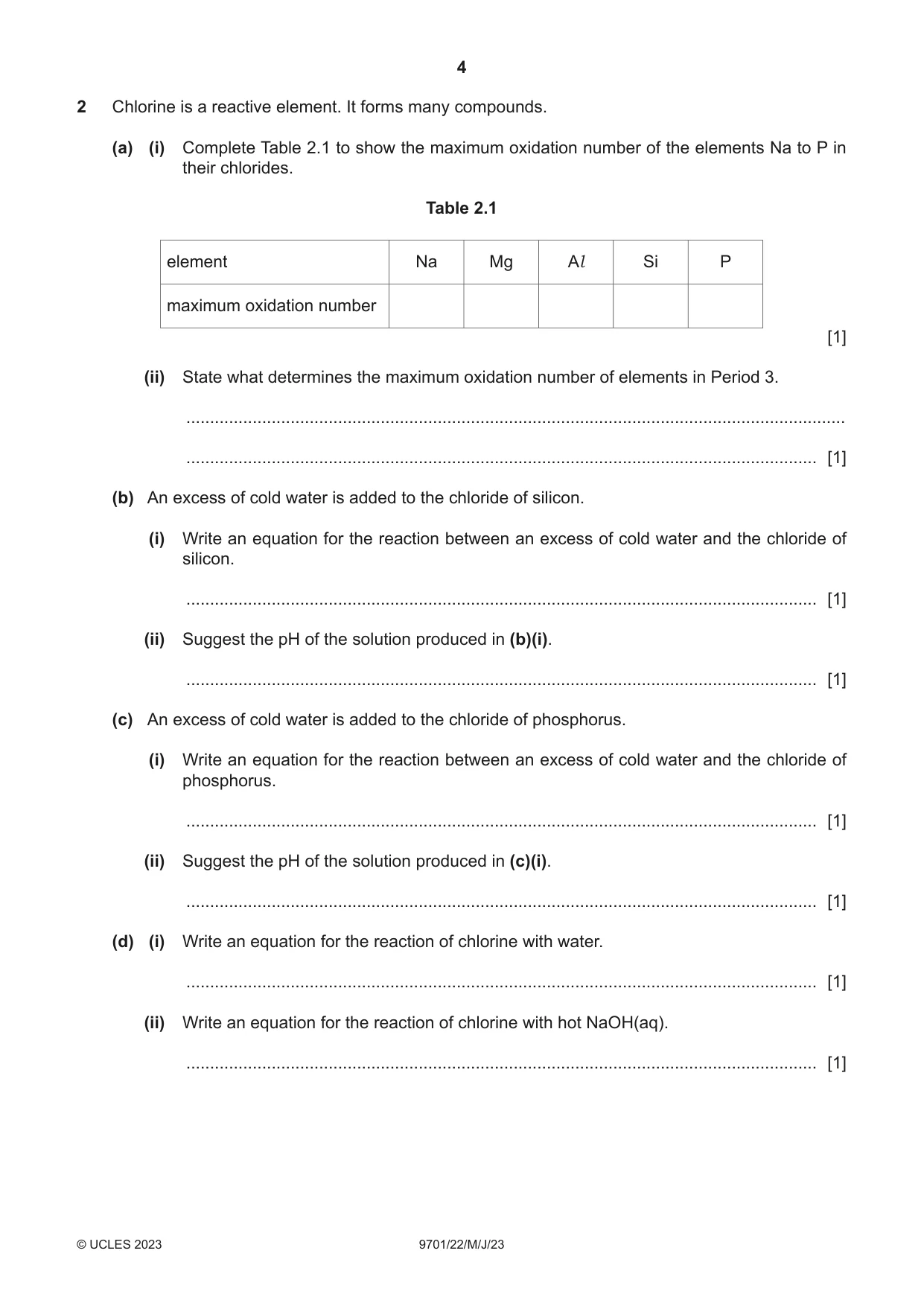
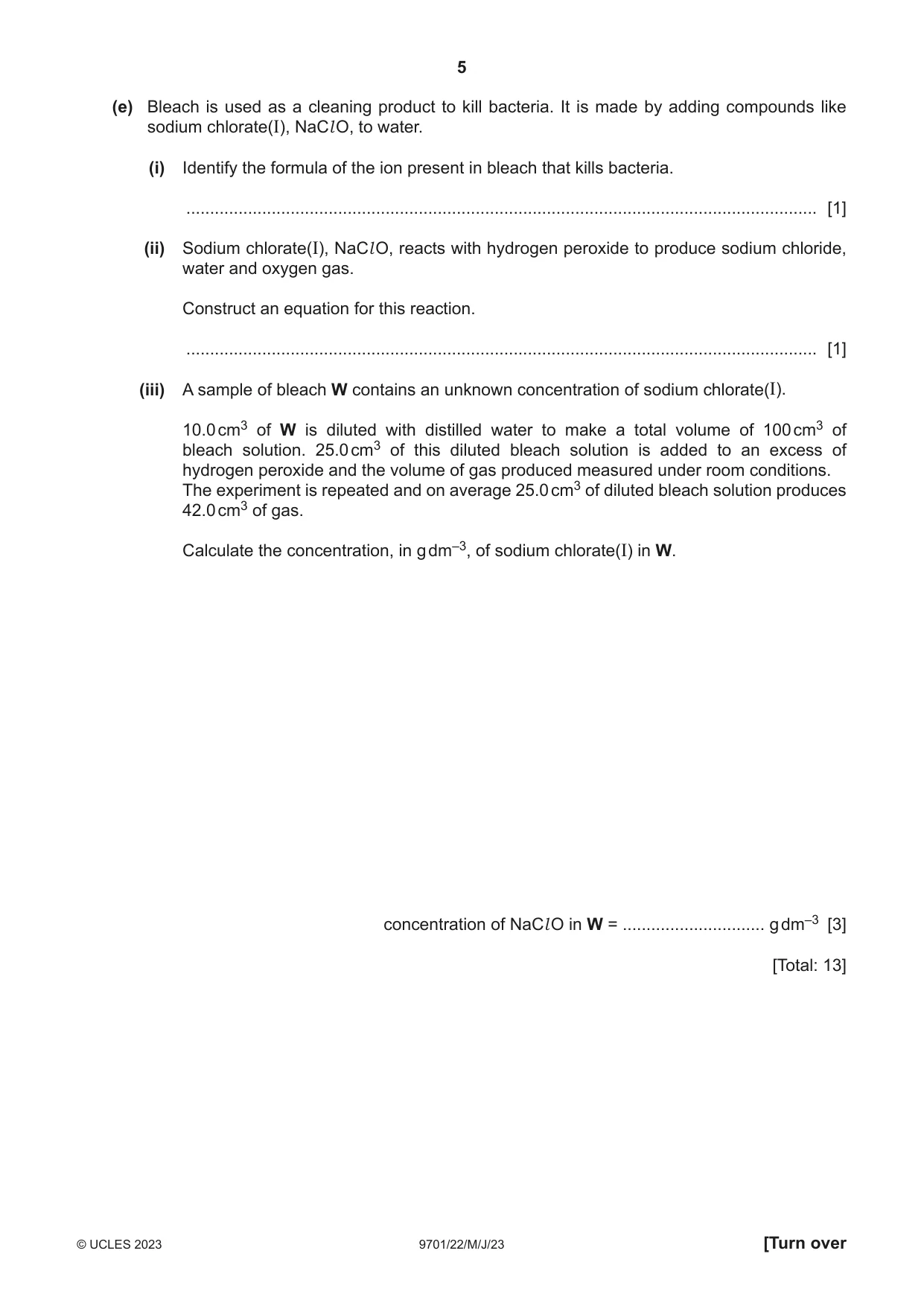
2 Chlorine is a reactive element. It forms many compounds. (a) (i) Complete Table 2.1 to show the maximum oxidation number of the elements Na to P in their chlorides. Table 2.1 element Na Mg Al Si P maximum oxidation number [1] (ii) State what determines the maximum oxidation number of elements in Period 3. ........................................................................................................................................... ..................................................................................................................................... [1] (b) An excess of cold water is added to the chloride of silicon. (i) Write an equation for the reaction between an excess of cold water and the chloride of silicon. ..................................................................................................................................... [1] (ii) Suggest the pH of the solution produced in (b)(i). ..................................................................................................................................... [1] (c) An excess of cold water is added to the chloride of phosphorus. (i) Write an equation for the reaction between an excess of cold water and the chloride of phosphorus. ..................................................................................................................................... [1] (ii) Suggest the pH of the solution produced in (c)(i). ..................................................................................................................................... [1] (d) (i) Write an equation for the reaction of chlorine with water. ..................................................................................................................................... [1] (ii) Write an equation for the reaction of chlorine with hot NaOH(aq). ..................................................................................................................................... [1] (e) Bleach is used as a cleaning product to kill bacteria. It is made by adding compounds like sodium chlorate(I), NaCl O, to water. (i) Identify the formula of the ion present in bleach that kills bacteria. ..................................................................................................................................... [1] (ii) Sodium chlorate(I), NaCl O, reacts with hydrogen peroxide to produce sodium chloride, water and oxygen gas. Construct an equation for this reaction. ..................................................................................................................................... [1] (iii) A sample of bleach W contains an unknown concentration of sodium chlorate(I). 10.0 cm3 of W is diluted with distilled water to make a total volume of 100 cm3 of bleach solution. 25.0 cm3 of this diluted bleach solution is added to an excess of hydrogen peroxide and the volume of gas produced measured under room conditions. The experiment is repeated and on average 25.0 cm3 of diluted bleach solution produces 42.0 cm3 of gas. Calculate the concentration, in g dm–3, of sodium chlorate(I) in W. concentration of NaCl O in W = .............................. g dm–3 [3] [Total: 13]
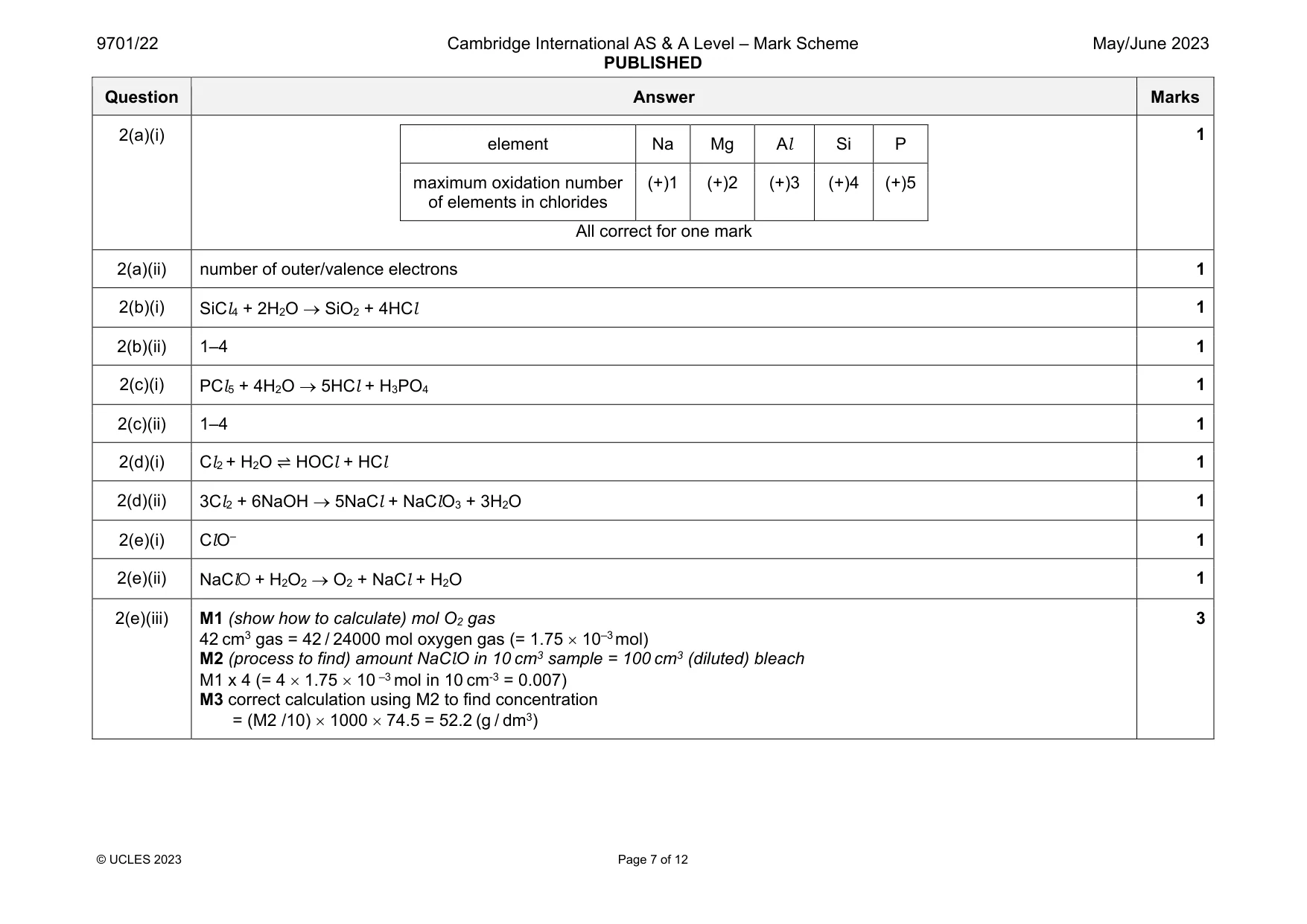
Mark scheme: 2(a)(i) element Na Mg Al Si P maximum oxidation number of elements in chlorides (+)1 (+)2 (+)3 (+)4 (+)5 All correct for one mark 2(a)(ii) number of outer/valence electrons 1 2(b)(i) SiCl4 + 2H2O SiO2 + 4HCl 1 2(b)(ii) 1–4 1 2(c)(i) PCl5 + 4H2O 5HCl + H3PO4 1 2(c)(ii) 1–4 1 2(d)(i) Cl2 + H2O ⇌ HOCl + HCl 1 2(d)(ii) 3Cl2 + 6NaOH 5NaCl + NaClO3 + 3H2O 1 2(e)(i) ClO– 1 2(e)(ii) NaClO + H2O2 O2 + NaCl + H2O 1 2(e)(iii) M1 (show how to calculate) mol O2 gas 42 cm3 gas = 42 / 24000 mol oxygen gas (= 1.75 10–3 mol) M2 (process to find) amount NaClO in 10 cm3 sample = 100 cm3 (diluted) bleach M1 x 4 (= 4 1.75 10 –3 mol in 10 cm-3 = 0.007) M3 correct calculation using M2 to find concentration = (M2 /10) 1000 74.5 = 52.2 (g / dm3) 3
Question 3
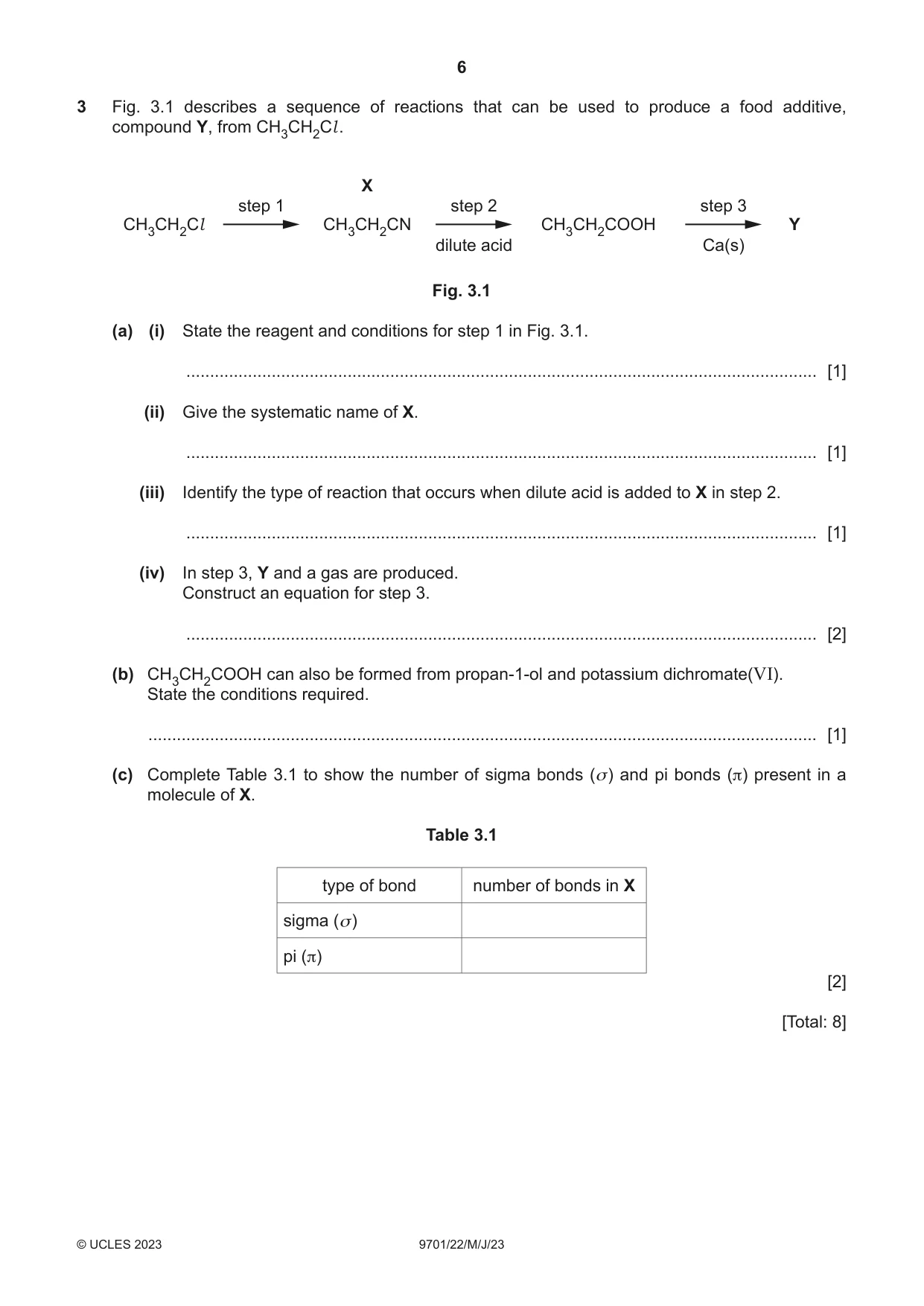
3 Fig. 3.1 describes a sequence of reactions that can be used to produce a food additive, compound Y, from CH3CH2Cl . X step 1 step 2 step 3 CH3CH2Cl CH3CH2CN CH3CH2COOH Y dilute acid Ca(s) Fig. 3.1 (a) (i) State the reagent and conditions for step 1 in Fig. 3.1. ..................................................................................................................................... [1] (ii) Give the systematic name of X. ..................................................................................................................................... [1] (iii) Identify the type of reaction that occurs when dilute acid is added to X in step 2. ..................................................................................................................................... [1] (iv) In step 3, Y and a gas are produced. Construct an equation for step 3. ..................................................................................................................................... [2] (b) CH3CH2COOH can also be formed from propan-1-ol and potassium dichromate(VI). State the conditions required. ............................................................................................................................................. [1] (c) Complete Table 3.1 to show the number of sigma bonds (σ ) and pi bonds (π) present in a molecule of X. Table 3.1 type of bond number of bonds in X sigma (σ ) pi (π) [2] [Total: 8]
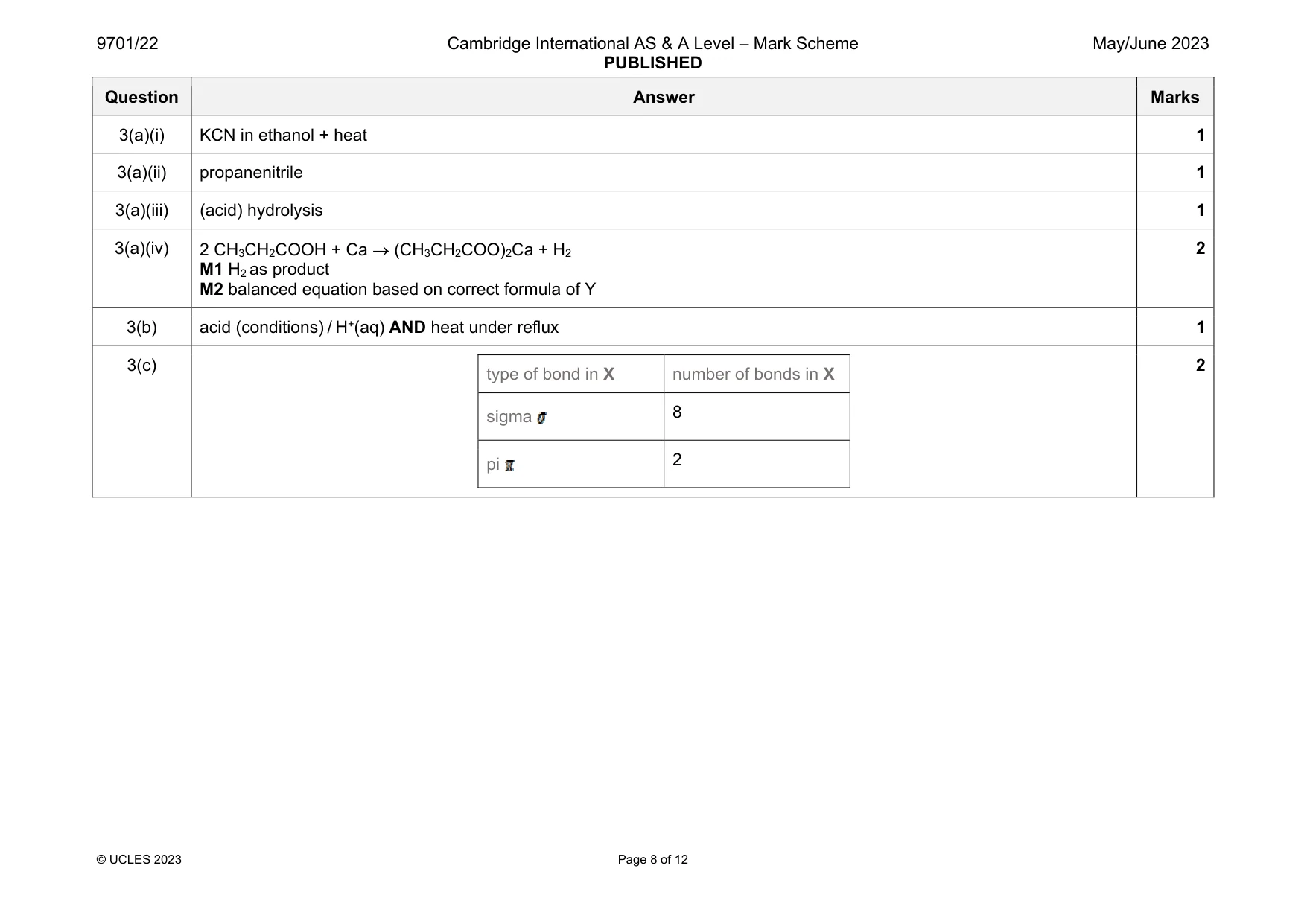
Mark scheme: 3(a)(i) KCN in ethanol + heat 1 3(a)(ii) propanenitrile 1 3(a)(iii) (acid) hydrolysis 1 3(a)(iv) 2 CH3CH2COOH + Ca (CH3CH2COO)2Ca + H2 M1 H2 as product M2 balanced equation based on correct formula of Y 2 3(b) acid (conditions) / H+(aq) AND heat under reflux 1 3(c) type of bond in X number of bonds in X sigma 8 pi 2 2
Q4 · In industry, ethanol is made by reacting ethene with steam in the presence of H3PO4
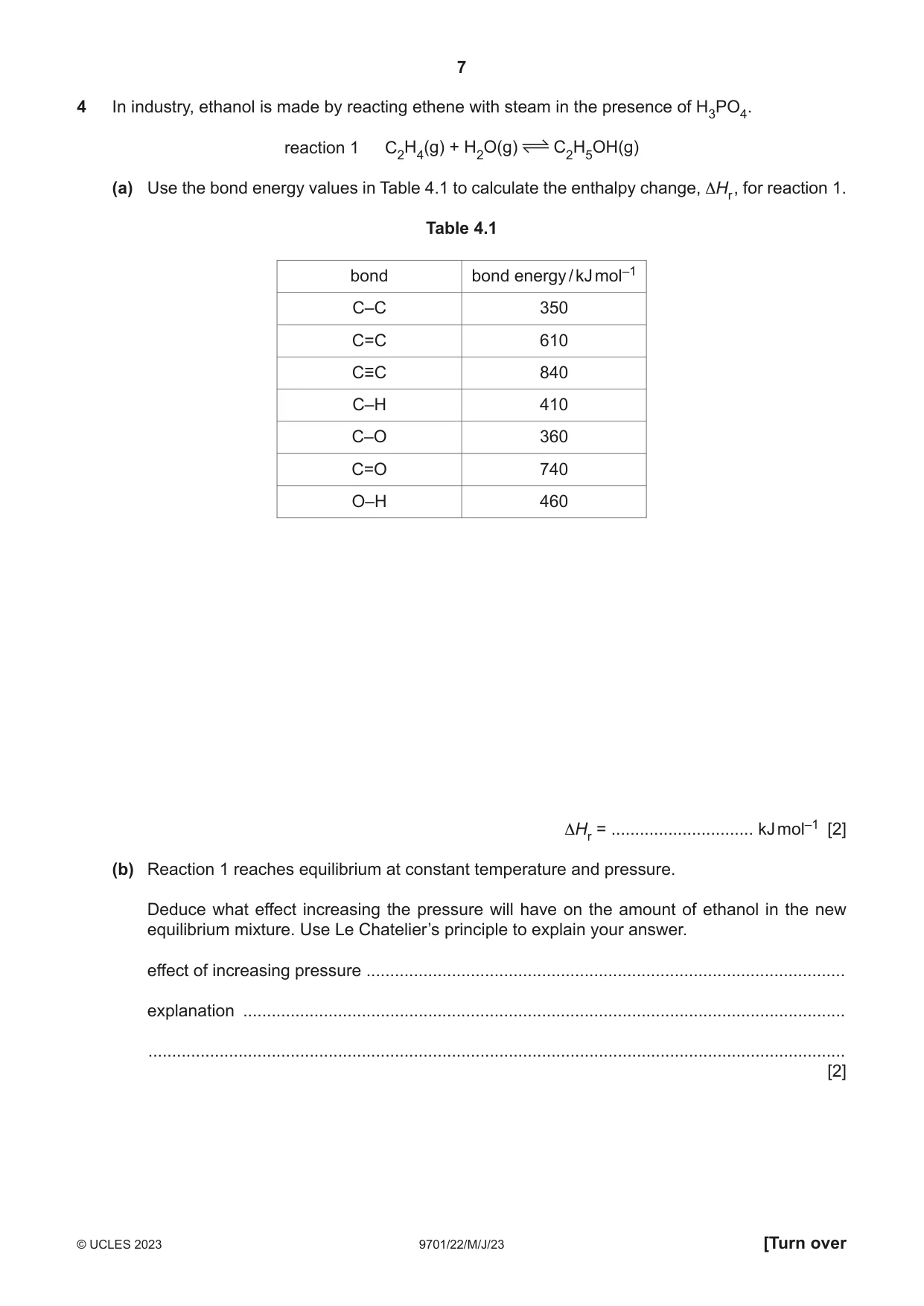
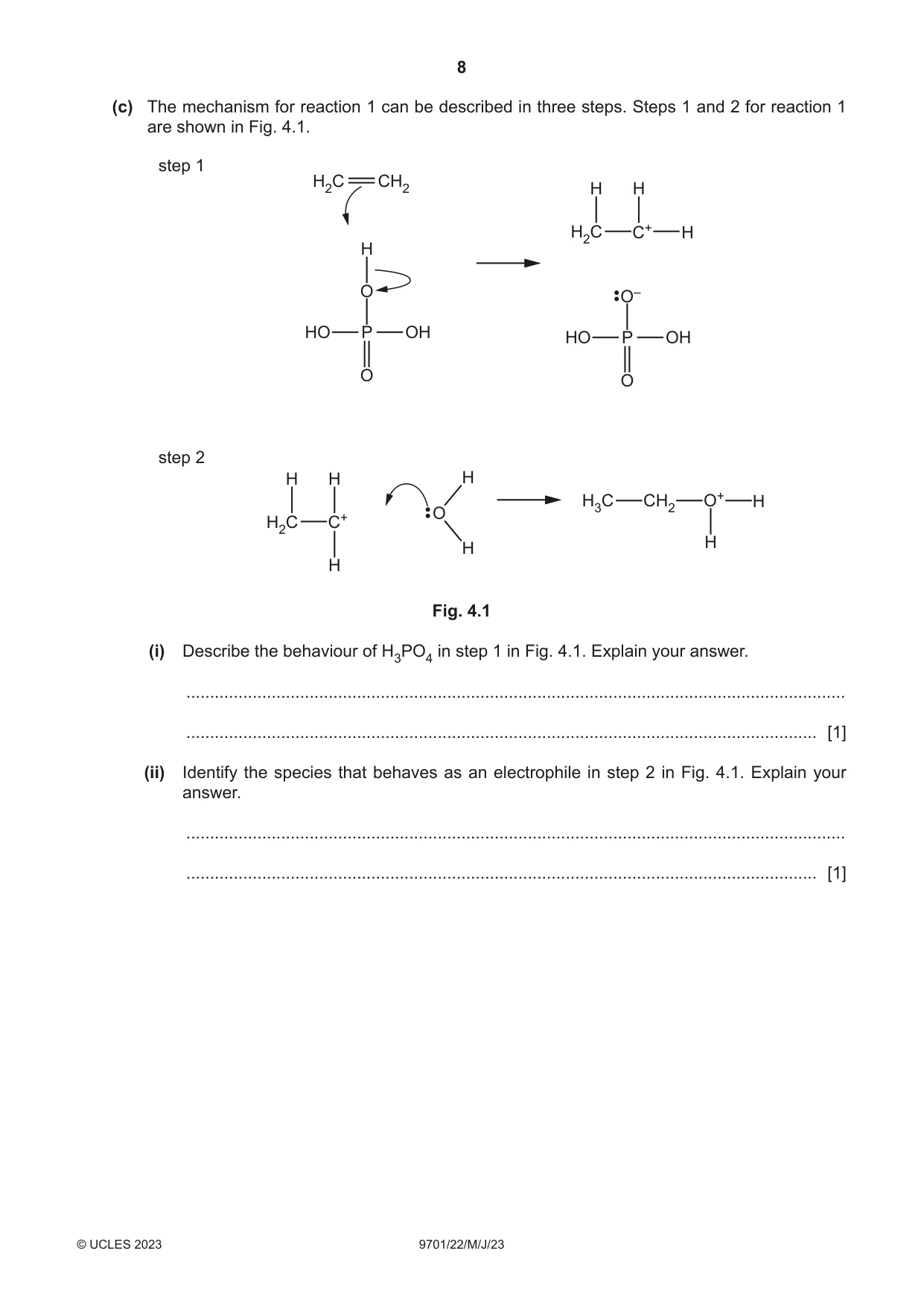
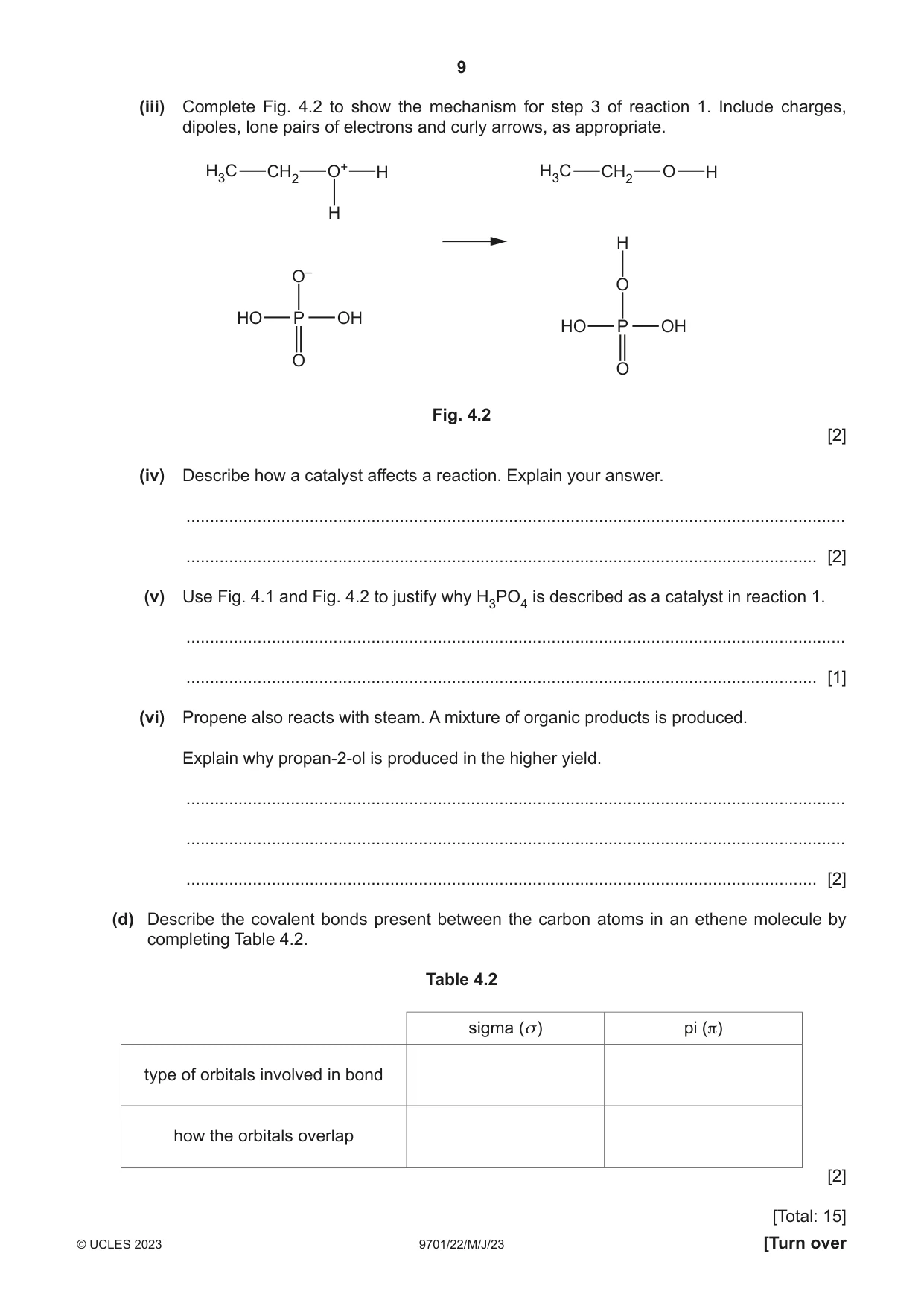
4 In industry, ethanol is made by reacting ethene with steam in the presence of H3PO4. reaction 1 C2H4(g) + H2O(g) C2H5OH(g) (a) Use the bond energy values in Table 4.1 to calculate the enthalpy change, ΔHr , for reaction 1. Table 4.1 bond bond energy / kJ mol–1 C–C 350 C=C 610 C≡C 840 C–H 410 C–O 360 C=O 740 O–H 460 ΔHr = .............................. kJ mol–1 [2] (b) Reaction 1 reaches equilibrium at constant temperature and pressure. Deduce what effect increasing the pressure will have on the amount of ethanol in the new equilibrium mixture. Use Le Chatelier’s principle to explain your answer. effect of increasing pressure ..................................................................................................... explanation ............................................................................................................................... ................................................................................................................................................... [2] (c) The mechanism for reaction 1 can be described in three steps. Steps 1 and 2 for reaction 1 are shown in Fig. 4.1. step 1 H2C CH2 H H H2C C+ H H O O– HO P OH HO P OH O O step 2 H H H H3C CH2 O+ H O H2C C+ H H H Fig. 4.1 (i) Describe the behaviour of H3PO4 in step 1 in Fig. 4.1. Explain your answer. ........................................................................................................................................... ..................................................................................................................................... [1] (ii) Identify the species that behaves as an electrophile in step 2 in Fig. 4.1. Explain your answer. ........................................................................................................................................... ..................................................................................................................................... [1] (iii) Complete Fig. 4.2 to show the mechanism for step 3 of reaction 1. Include charges, dipoles, lone pairs of electrons and curly arrows, as appropriate. H3C CH2 O+ H H3C CH2 O H H H O– O HO P OH HO P OH O O Fig. 4.2 [2] (iv) Describe how a catalyst affects a reaction. Explain your answer. ........................................................................................................................................... ..................................................................................................................................... [2] (v) Use Fig. 4.1 and Fig. 4.2 to justify why H3PO4 is described as a catalyst in reaction 1. ........................................................................................................................................... ..................................................................................................................................... [1] (vi) Propene also reacts with steam. A mixture of organic products is produced. Explain why propan-2-ol is produced in the higher yield. ........................................................................................................................................... ........................................................................................................................................... ..................................................................................................................................... [2] (d) Describe the covalent bonds present between the carbon atoms in an ethene molecule by completing Table 4.2. Table 4.2 sigma (σ ) pi (π) type of orbitals involved in bond how the orbitals overlap [2] [Total: 15]
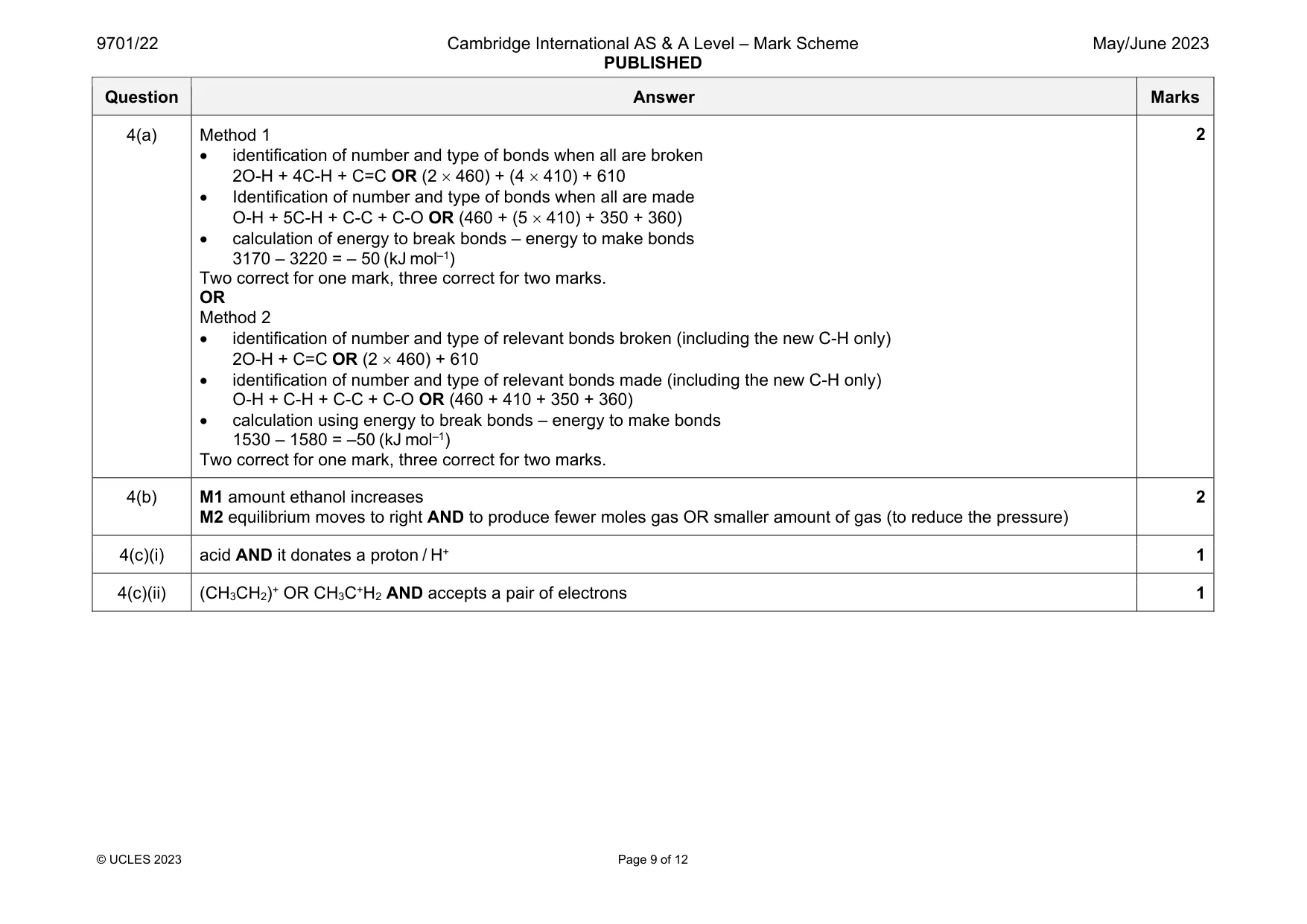
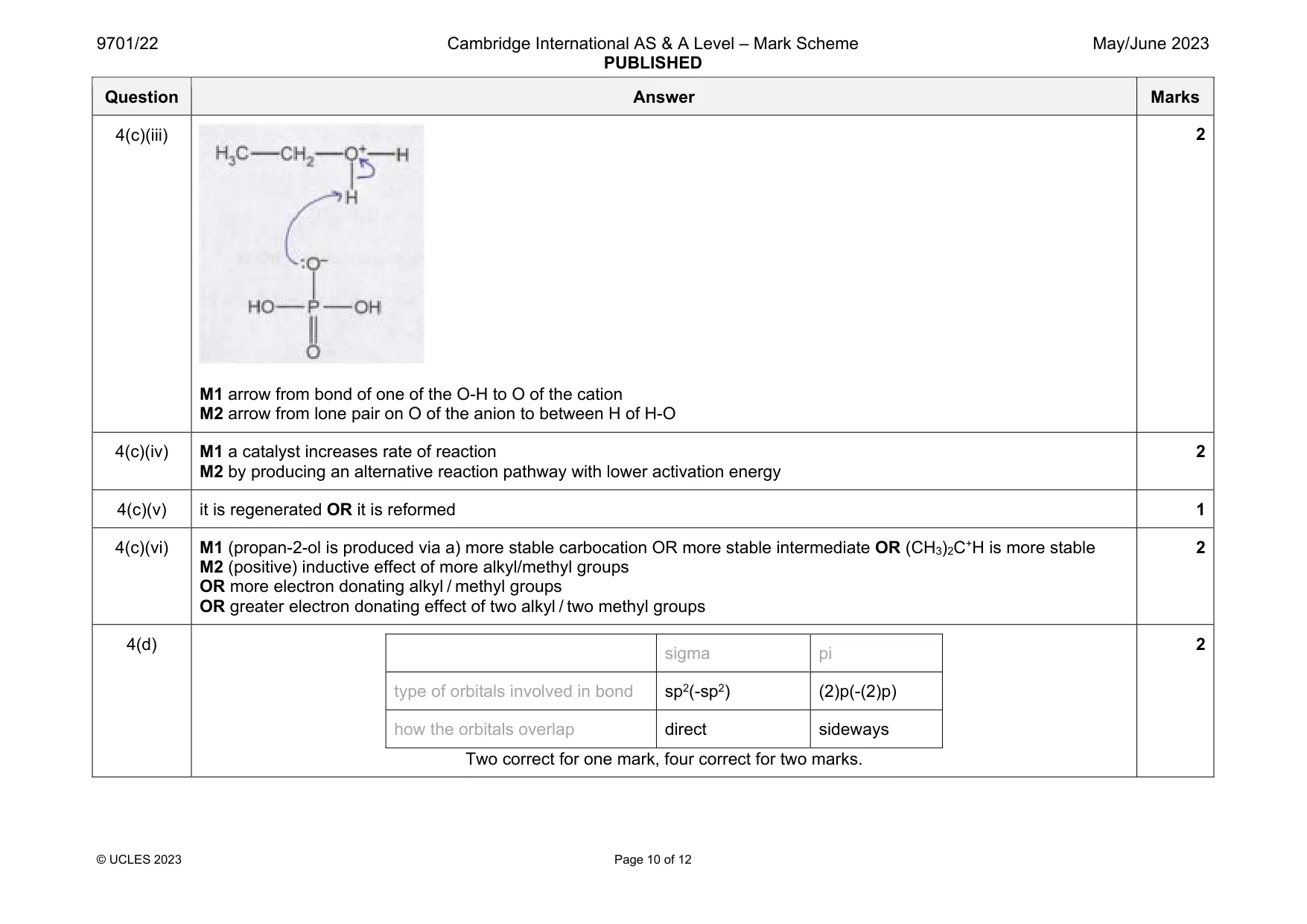
Mark scheme: 4(a) Method 1 identification of number and type of bonds when all are broken 2O-H + 4C-H + C=C OR (2 460) + (4 410) + 610 Identification of number and type of bonds when all are made O-H + 5C-H + C-C + C-O OR (460 + (5 410) + 350 + 360) calculation of energy to break bonds – energy to make bonds 3170 – 3220 = – 50 (kJ mol–1) Two correct for one mark, three correct for two marks. OR Method 2 identification of number and type of relevant bonds broken (including the new C-H only) 2O-H + C=C OR (2 460) + 610 identification of number and type of relevant bonds made (including the new C-H only) O-H + C-H + C-C + C-O OR (460 + 410 + 350 + 360) calculation using energy to break bonds – energy to make bonds 1530 – 1580 = –50 (kJ mol–1) Two correct for one mark, three correct for two marks. 4(b) M1 amount ethanol increases M2 equilibrium moves to right AND to produce fewer moles gas OR smaller amount of gas (to reduce the pressure) 2 4(c)(i) acid AND it donates a proton / H+ 1 4(c)(ii) (CH3CH2)+ OR CH3C+H2 AND accepts a pair of electrons 1 Question Answer Marks 4(c)(iii) M1 arrow from bond of one of the O-H to O of the cation M2 arrow from lone pair on O of the anion to between H of H-O 2 4(c)(iv) M1 a catalyst increases rate of reaction M2 by producing an alternative reaction pathway with lower activation energy 2 4(c)(v) it is regenerated OR it is reformed 1 4(c)(vi) M1 (propan-2-ol is produced via a) more stable carbocation OR more stable intermediate OR (CH3)2C+H is more stable M2 (positive) inductive effect of more alkyl/methyl groups OR more electron donating alkyl / methyl groups OR greater electron donating effect of two alkyl / two methyl groups 2 4(d) sigma pi type of orbitals involved in bond sp2(-sp2) (2)p(-(2)p) how the orbitals overlap direct sideways Two correct for one mark, four correct for two marks. 2
Question 5
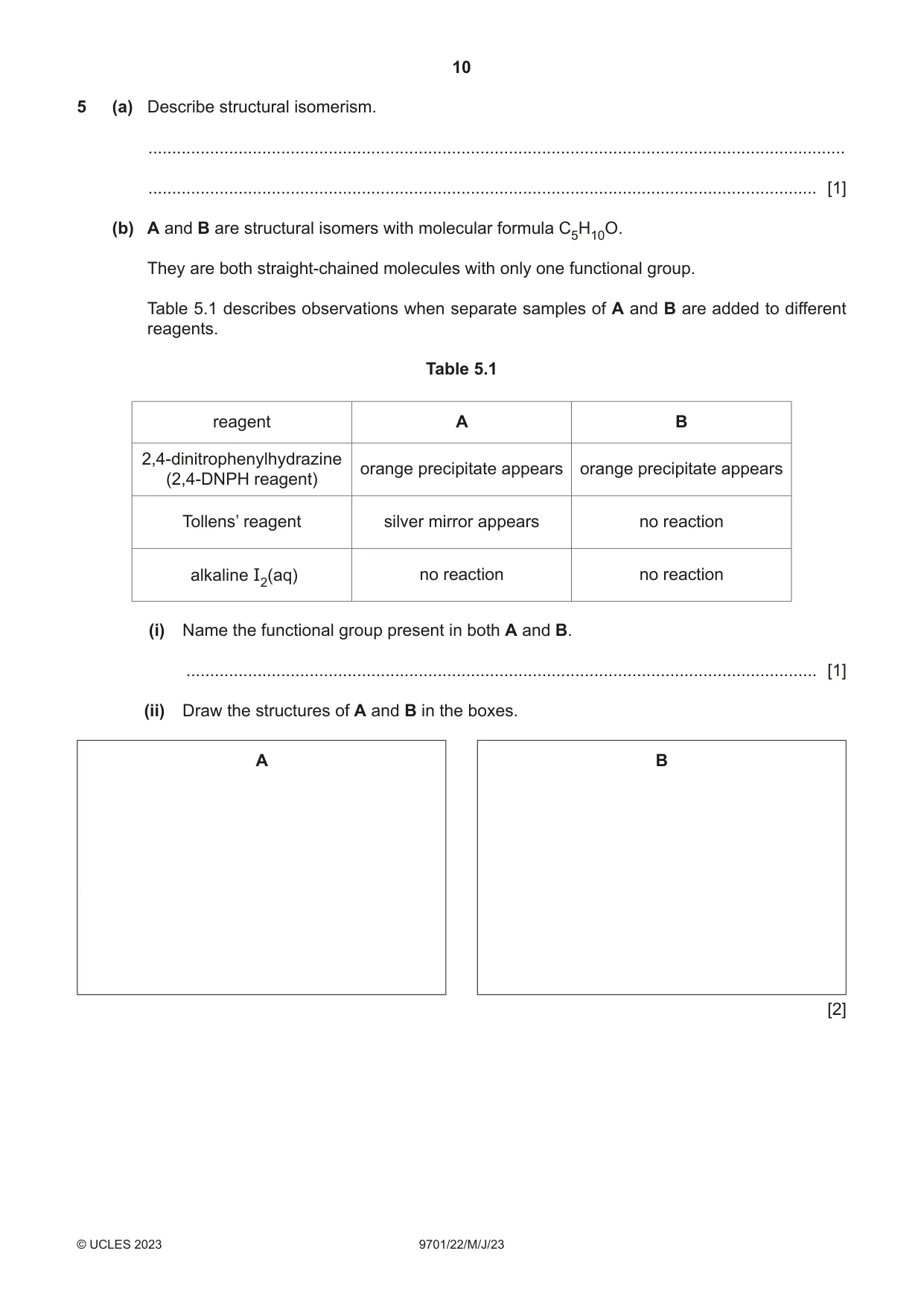
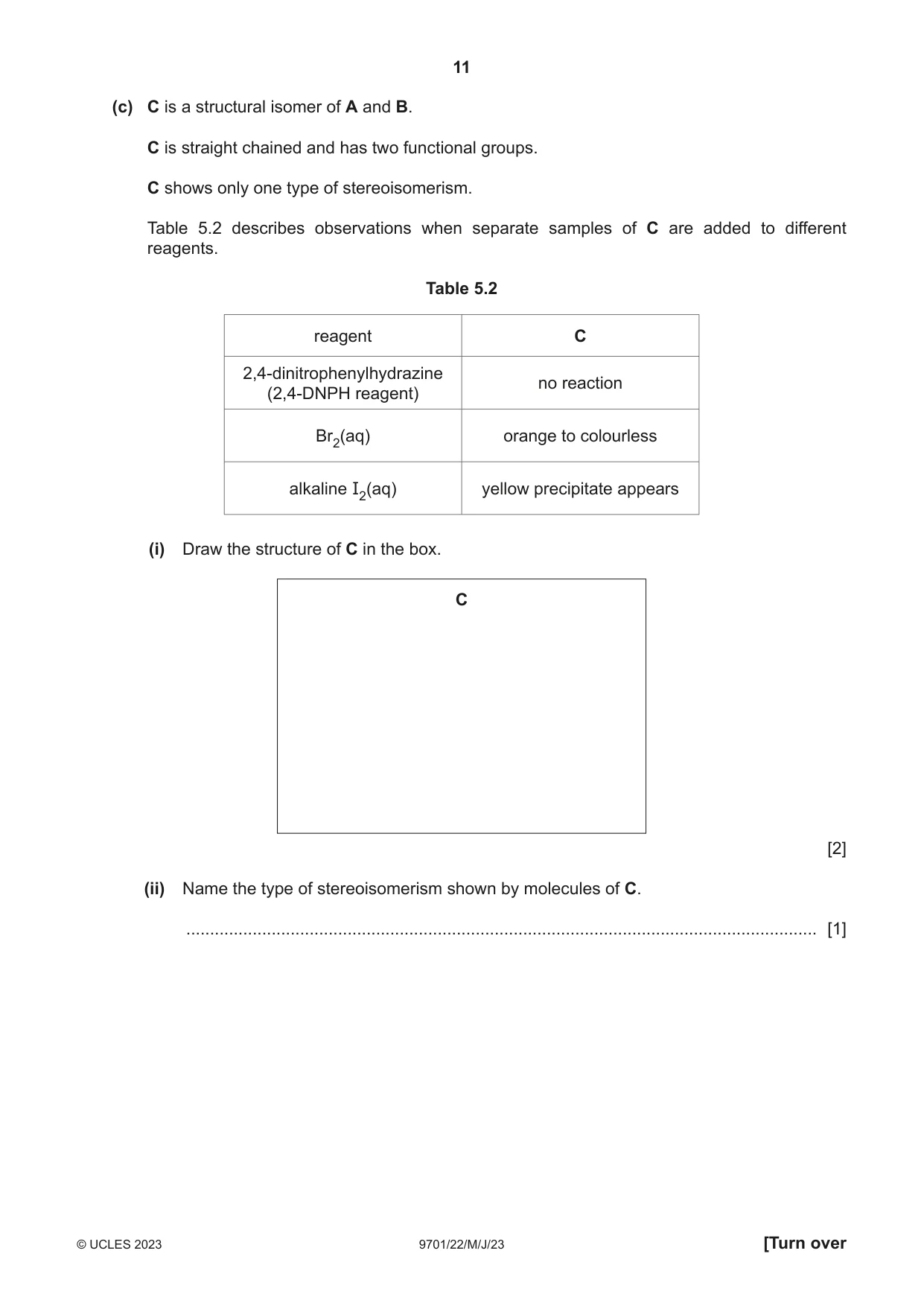
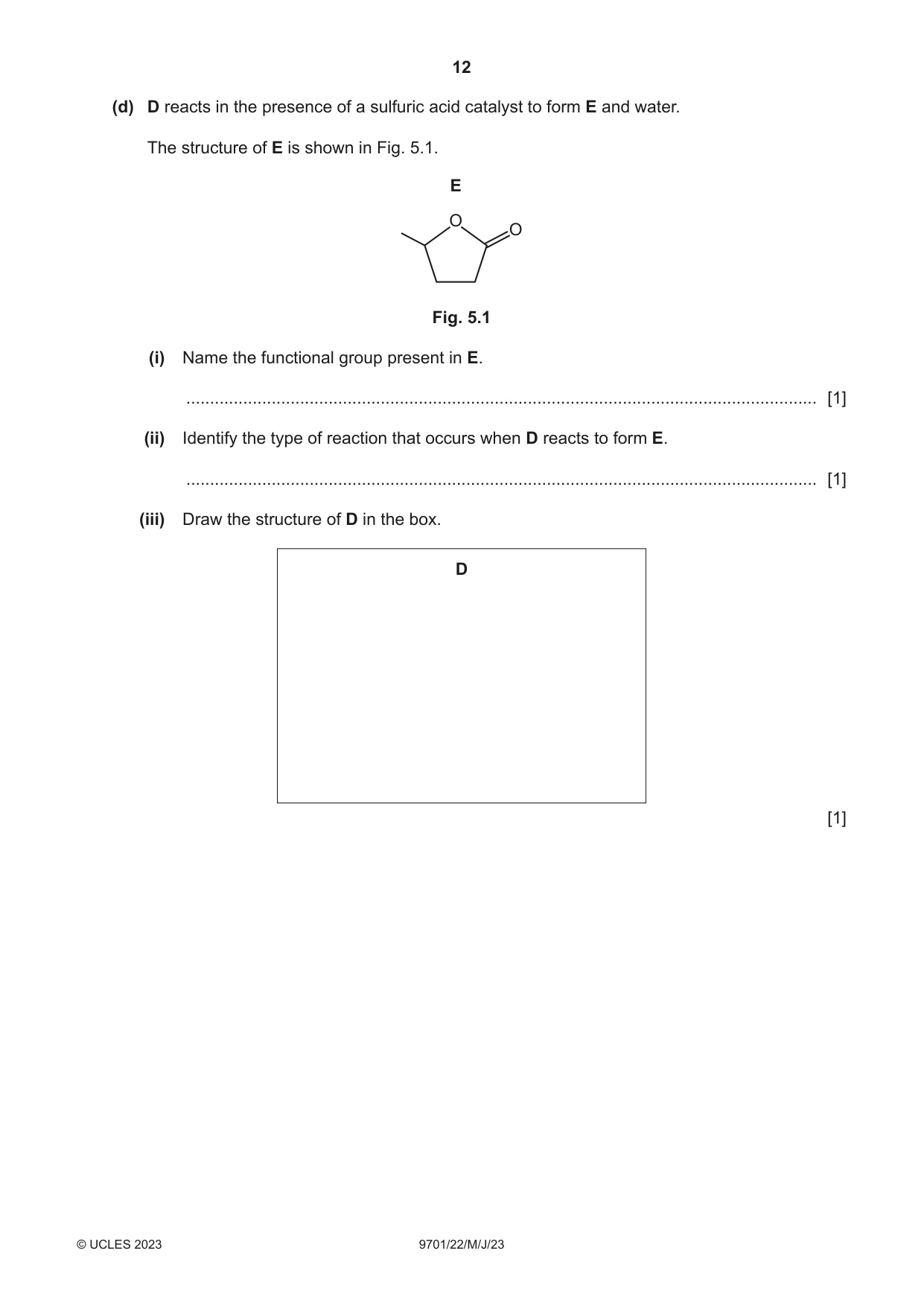
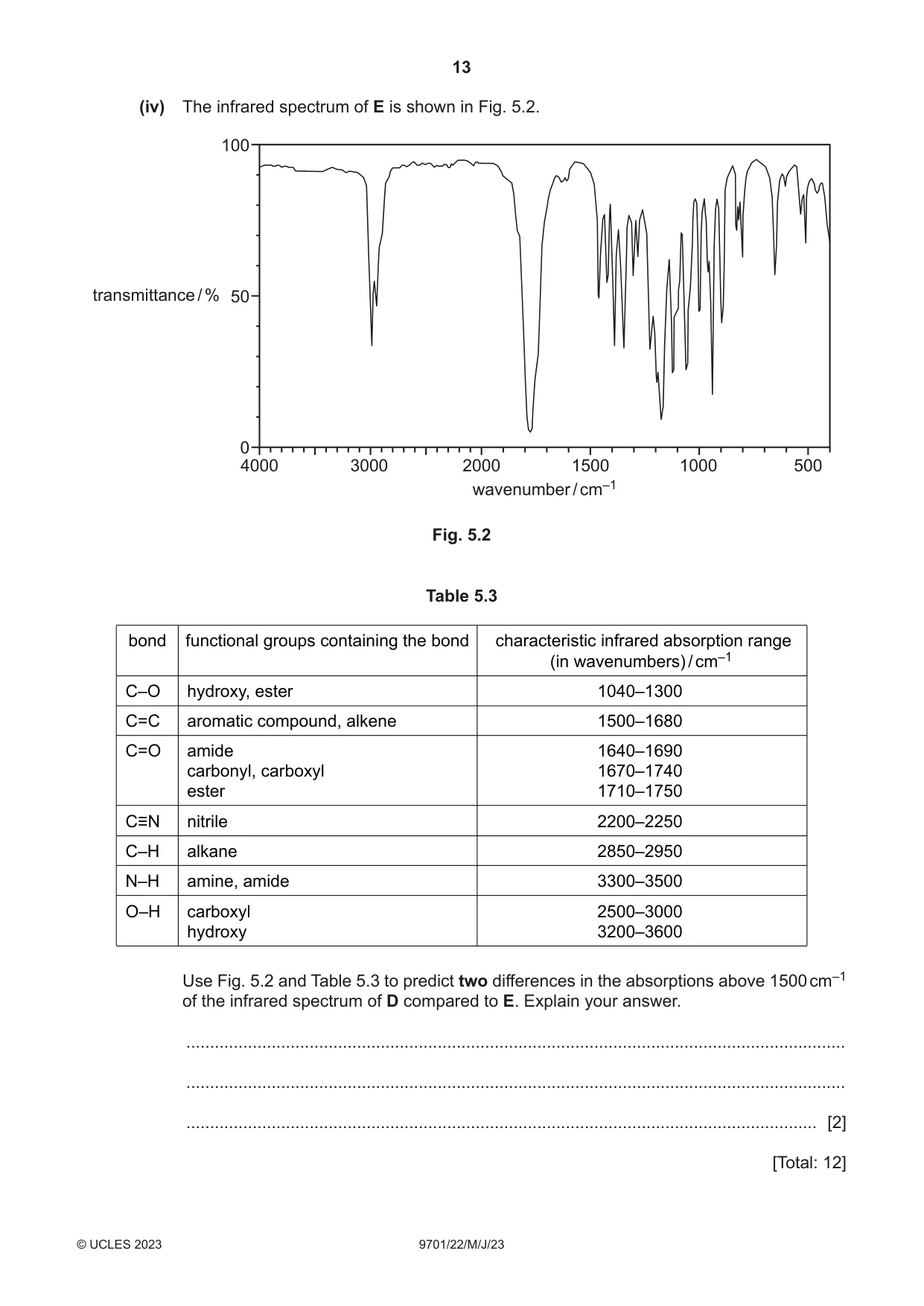
5 (a) Describe structural isomerism. ................................................................................................................................................... ............................................................................................................................................. [1] (b) A and B are structural isomers with molecular formula C5H10O. They are both straight-chained molecules with only one functional group. Table 5.1 describes observations when separate samples of A and B are added to different reagents. Table 5.1 reagent A B 2,4-dinitrophenylhydrazine orange precipitate appears orange precipitate appears (2,4-DNPH reagent) Tollens’ reagent silver mirror appears no reaction alkaline I2(aq) no reaction no reaction (i) Name the functional group present in both A and B. ..................................................................................................................................... [1] (ii) Draw the structures of A and B in the boxes. A B [2] (c) C is a structural isomer of A and B. C is straight chained and has two functional groups. C shows only one type of stereoisomerism. Table 5.2 describes observations when separate samples of C are added to different reagents. Table 5.2 reagent C 2,4-dinitrophenylhydrazine no reaction (2,4-DNPH reagent) Br2(aq) orange to colourless alkaline I2(aq) yellow precipitate appears (i) Draw the structure of C in the box. C [2] (ii) Name the type of stereoisomerism shown by molecules of C. ..................................................................................................................................... [1] (d) D reacts in the presence of a sulfuric acid catalyst to form E and water. The structure of E is shown in Fig. 5.1. E O O Fig. 5.1 (i) Name the functional group present in E. ..................................................................................................................................... [1] (ii) Identify the type of reaction that occurs when D reacts to form E. ..................................................................................................................................... [1] (iii) Draw the structure of D in the box. D [1]
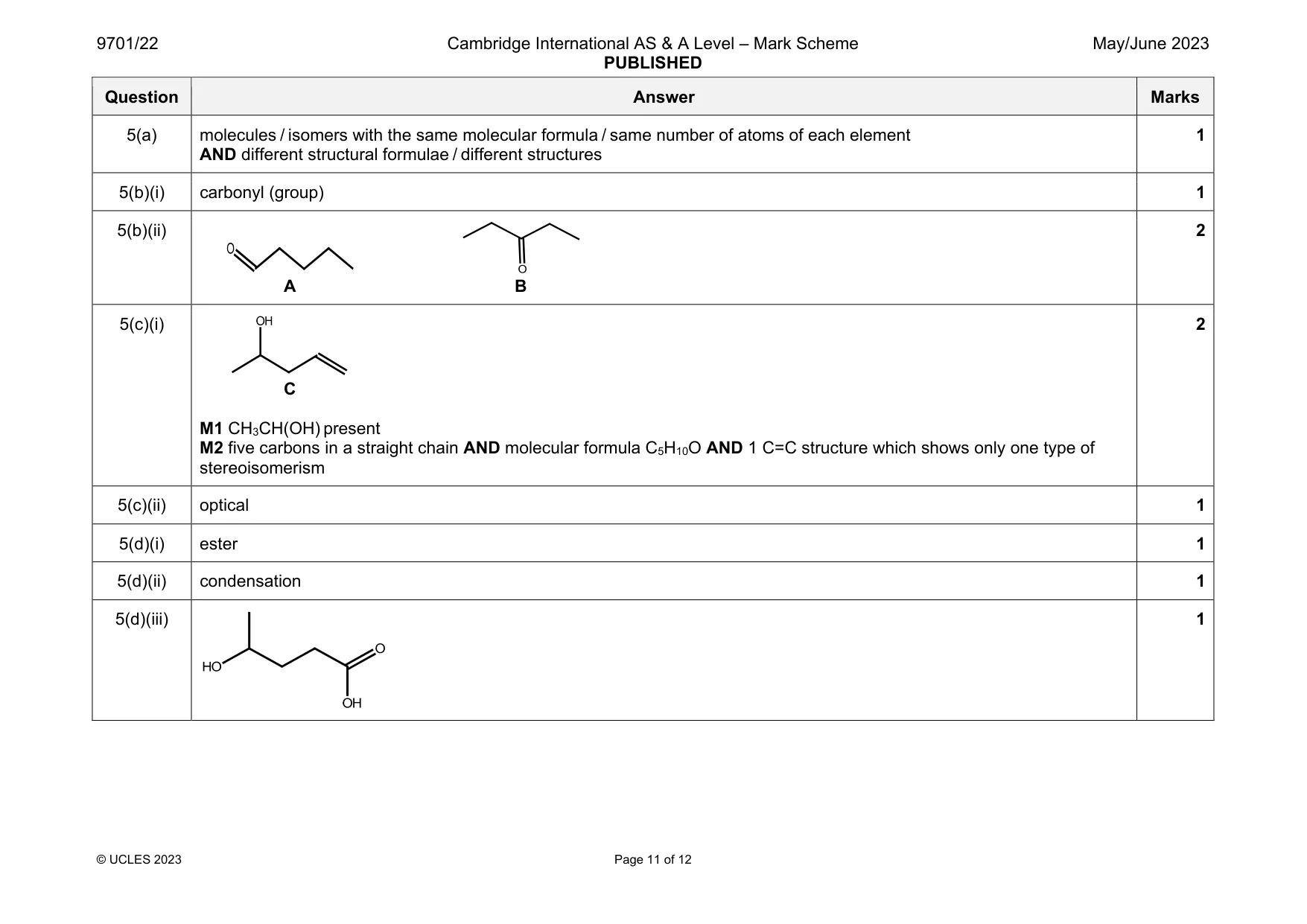
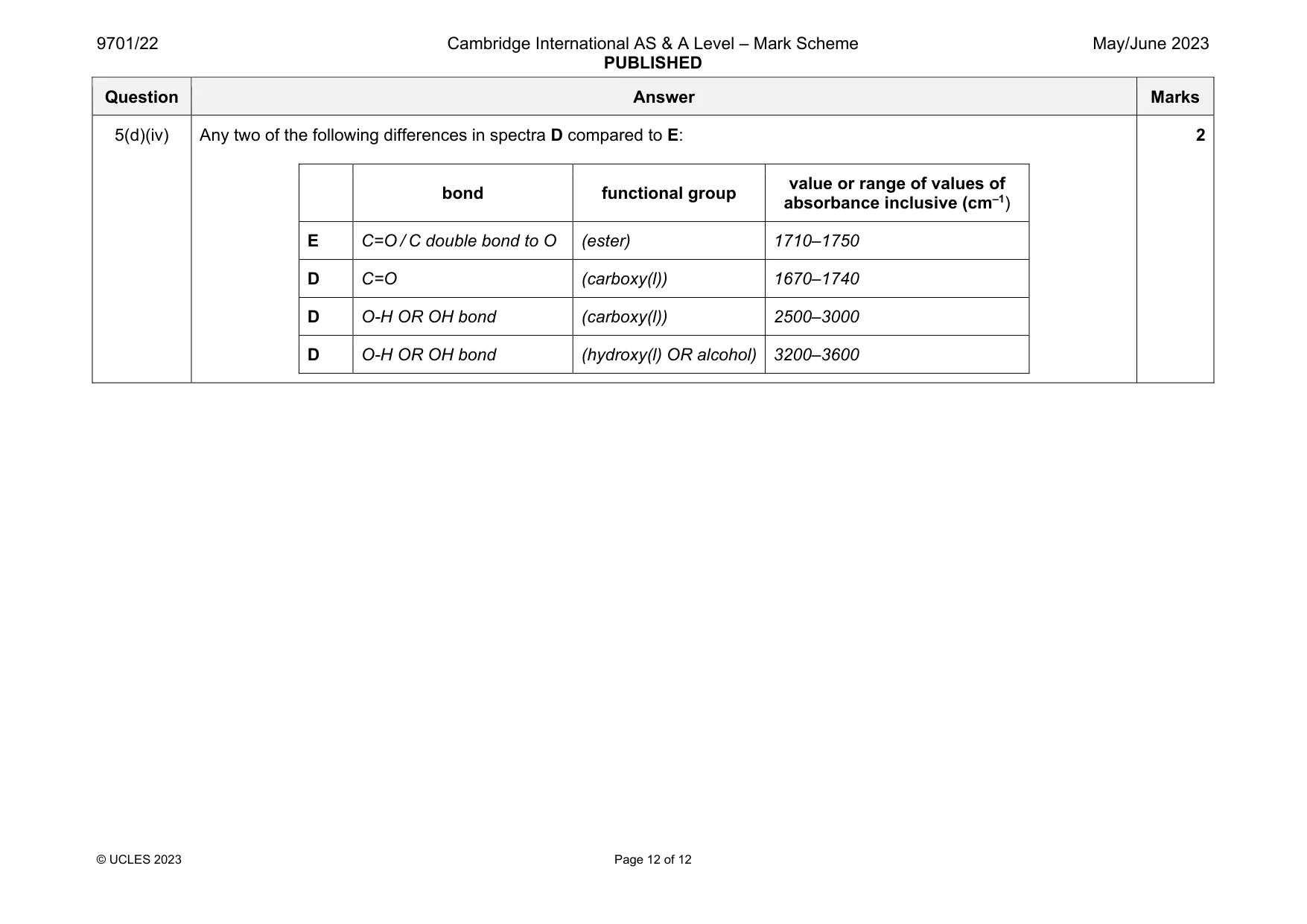
Mark scheme: 5(a) molecules / isomers with the same molecular formula / same number of atoms of each element AND different structural formulae / different structures 1 5(b)(i) carbonyl (group) 1 5(b)(ii) A B 2 5(c)(i) C M1 CH3CH(OH) present M2 five carbons in a straight chain AND molecular formula C5H10O AND 1 C=C structure which shows only one type of stereoisomerism 2 5(c)(ii) optical 1 5(d)(i) ester 1 5(d)(ii) condensation 1 5(d)(iii) 1 Question Answer Marks 5(d)(iv) Any two of the following differences in spectra D compared to E: bond functional group value or range of values of absorbance inclusive (cm–1) E C=O / C double bond to O (ester) 1710–1750 D C=O (carboxy(l)) 1670–1740 D O-H OR OH bond (carboxy(l)) 2500–3000 D O-H OR OH bond (hydroxy(l) OR alcohol) 3200–3600 2
What was in this paper
The subtopics covered by these 5 questions, and how many questions each got. Open one in a new tab to see every Cambridge question on it.
What you needed in this session
Cambridge’s own grade thresholds for 2023 May/June, Paper 2 · Variant 2. A higher threshold means an easier paper — the bar moves with how the cohort did.