Cambridge A Level Chemistry 9701 — 2023 May/June Paper 2 · Variant 3
9701/23/M/J/23 · 6 questions · 60 marks · ≈68 min
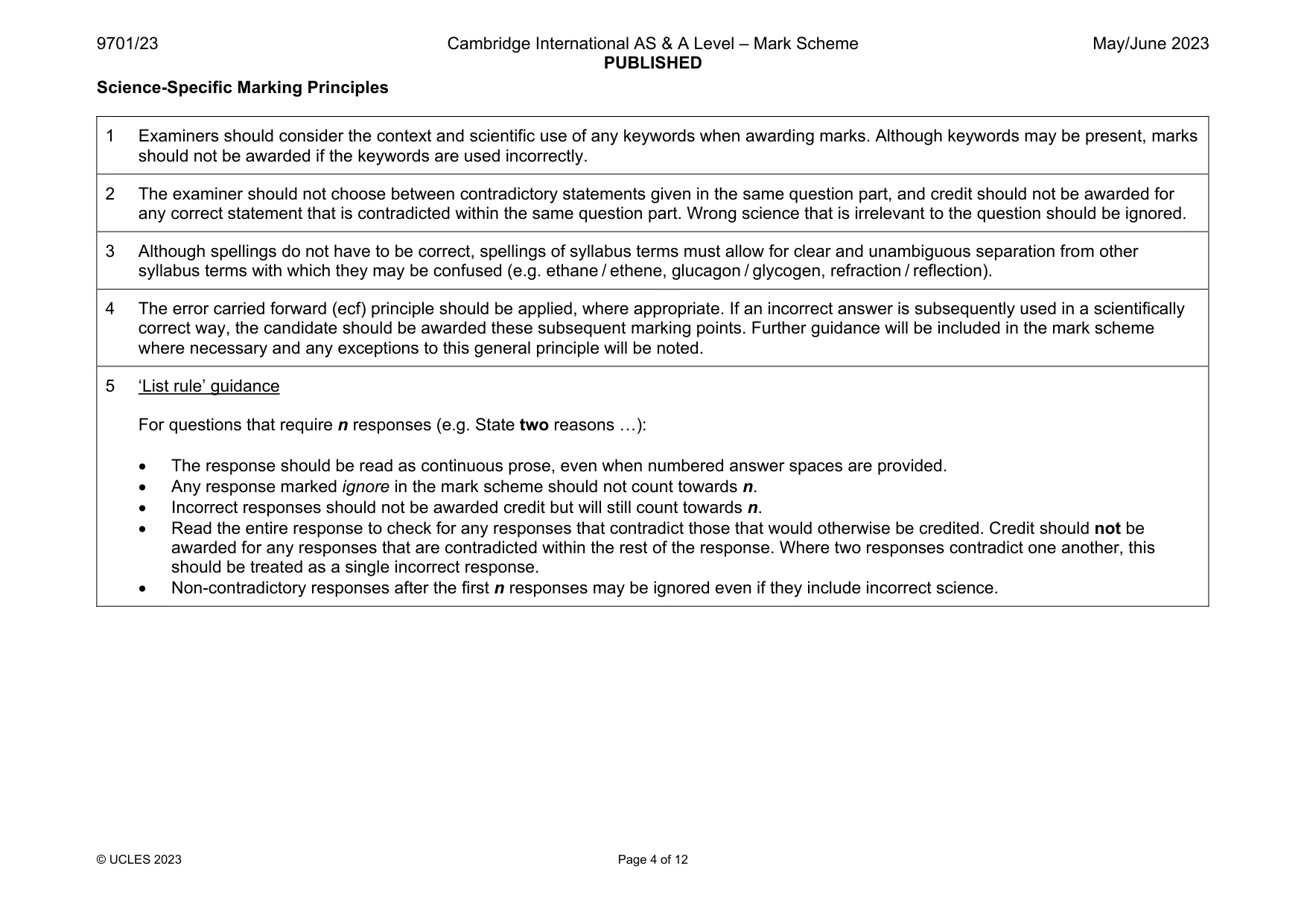
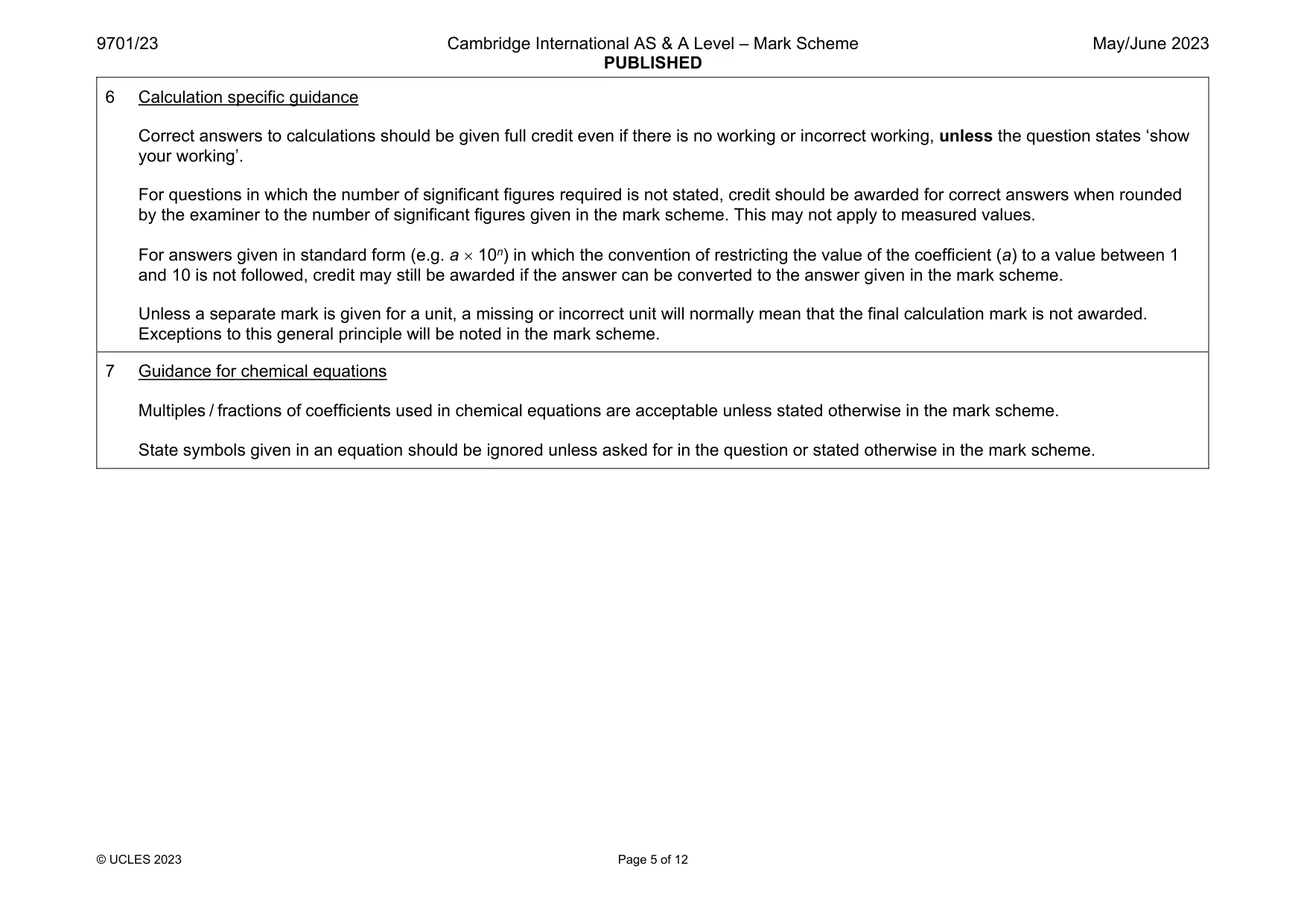
The question paper and its mark scheme, free to read here and free to download. This is Cambridge’s own paper, exactly as it was sat.
Question paper20 pages



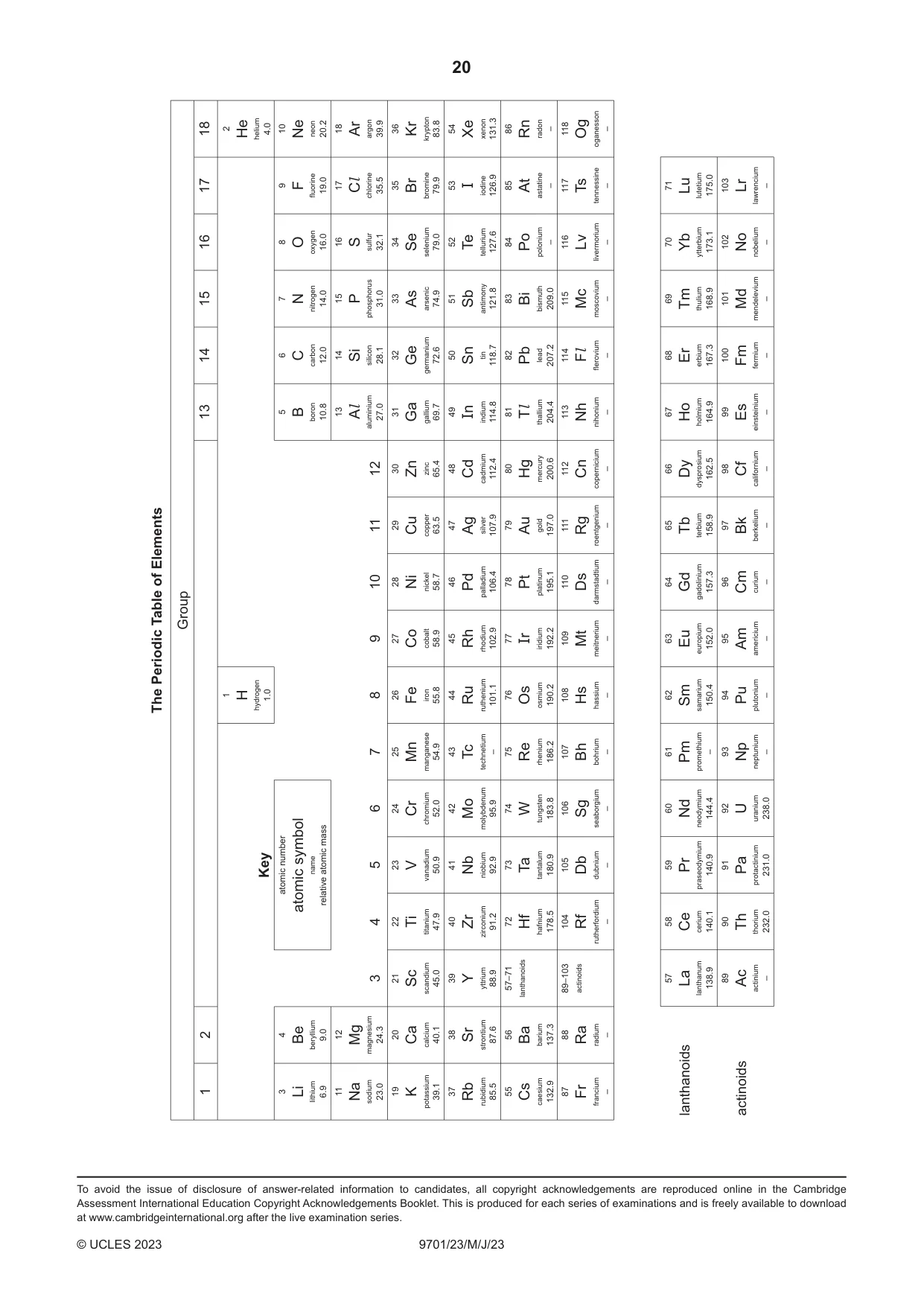
Mark scheme12 pages
Answers below. Sit the paper first if you are practising.
Questions as text
Q1 · Copper is used in electrical equipment
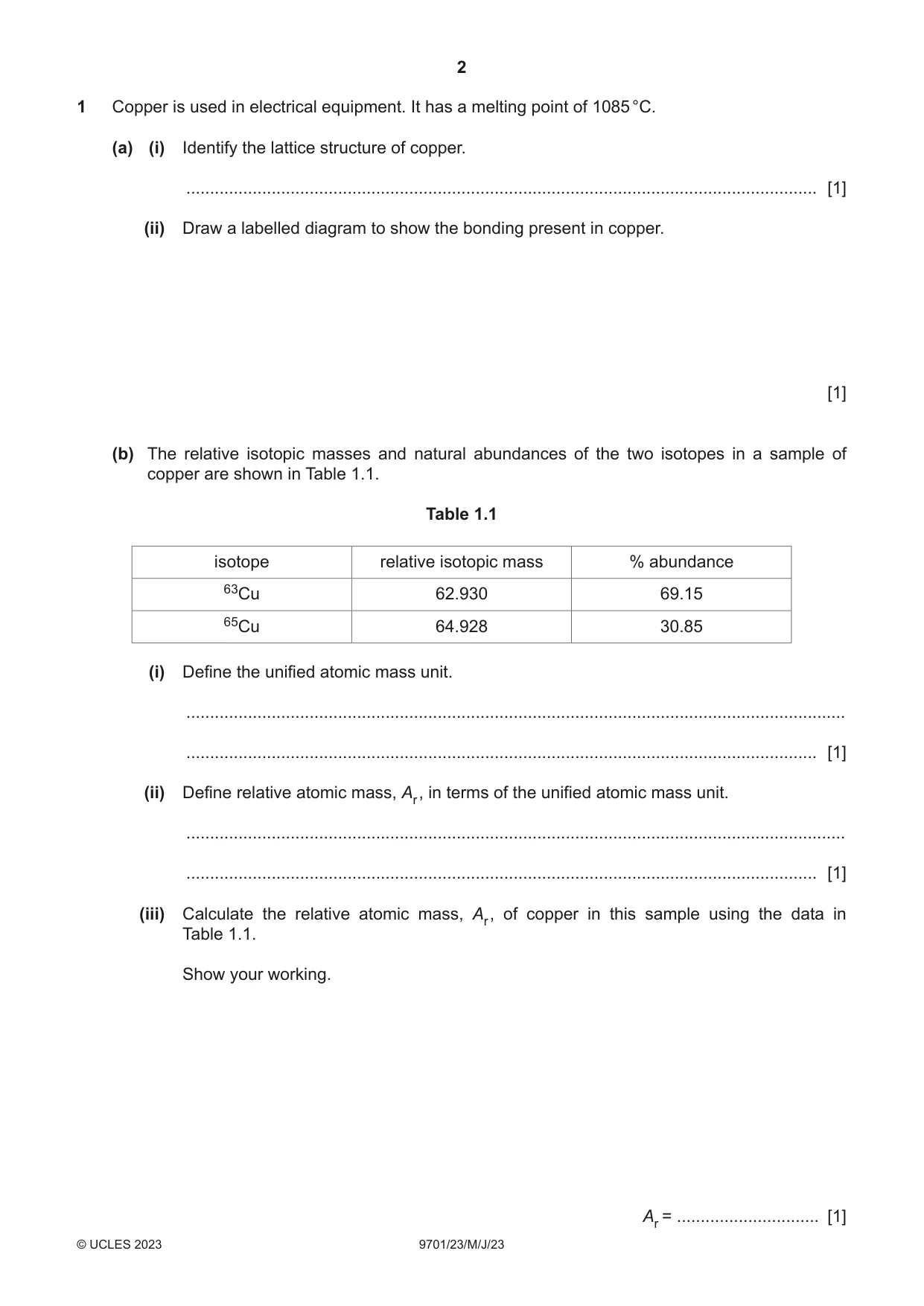
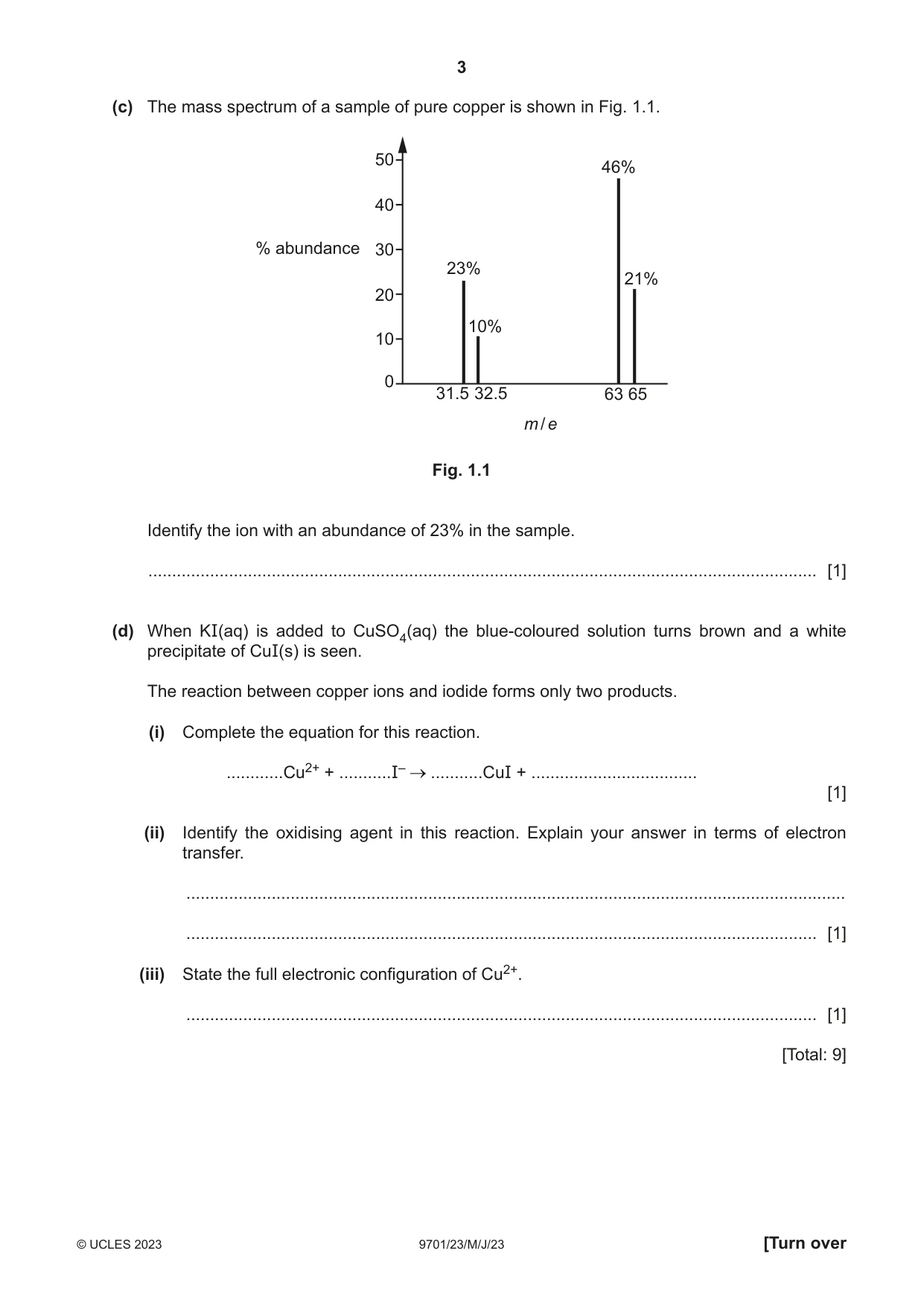
1 Copper is used in electrical equipment. It has a melting point of 1085 °C. (a) (i) Identify the lattice structure of copper. ..................................................................................................................................... [1] (ii) Draw a labelled diagram to show the bonding present in copper. [1] (b) The relative isotopic masses and natural abundances of the two isotopes in a sample of copper are shown in Table 1.1. Table 1.1 isotope relative isotopic mass % abundance 63Cu 62.930 69.15 65Cu 64.928 30.85 (i) Define the unified atomic mass unit. ........................................................................................................................................... ..................................................................................................................................... [1] (ii) Define relative atomic mass, Ar , in terms of the unified atomic mass unit. ........................................................................................................................................... ..................................................................................................................................... [1] (iii) Calculate the relative atomic mass, Ar , of copper in this sample using the data in Table 1.1. Show your working. Ar = .............................. [1] (c) The mass spectrum of a sample of pure copper is shown in Fig. 1.1. 50 46% 40 % abundance 30 23% 21% 20 10% 10 0 31.5 32.5 63 65 m / e Fig. 1.1 Identify the ion with an abundance of 23% in the sample. ............................................................................................................................................. [1] (d) When KI(aq) is added to CuSO4(aq) the blue-coloured solution turns brown and a white precipitate of CuI(s) is seen. The reaction between copper ions and iodide forms only two products. (i) Complete the equation for this reaction. ............Cu2+ + ...........I– ...........CuI + ................................... [1] (ii) Identify the oxidising agent in this reaction. Explain your answer in terms of electron transfer. ........................................................................................................................................... ..................................................................................................................................... [1] (iii) State the full electronic configuration of Cu2+. ..................................................................................................................................... [1] [Total: 9]
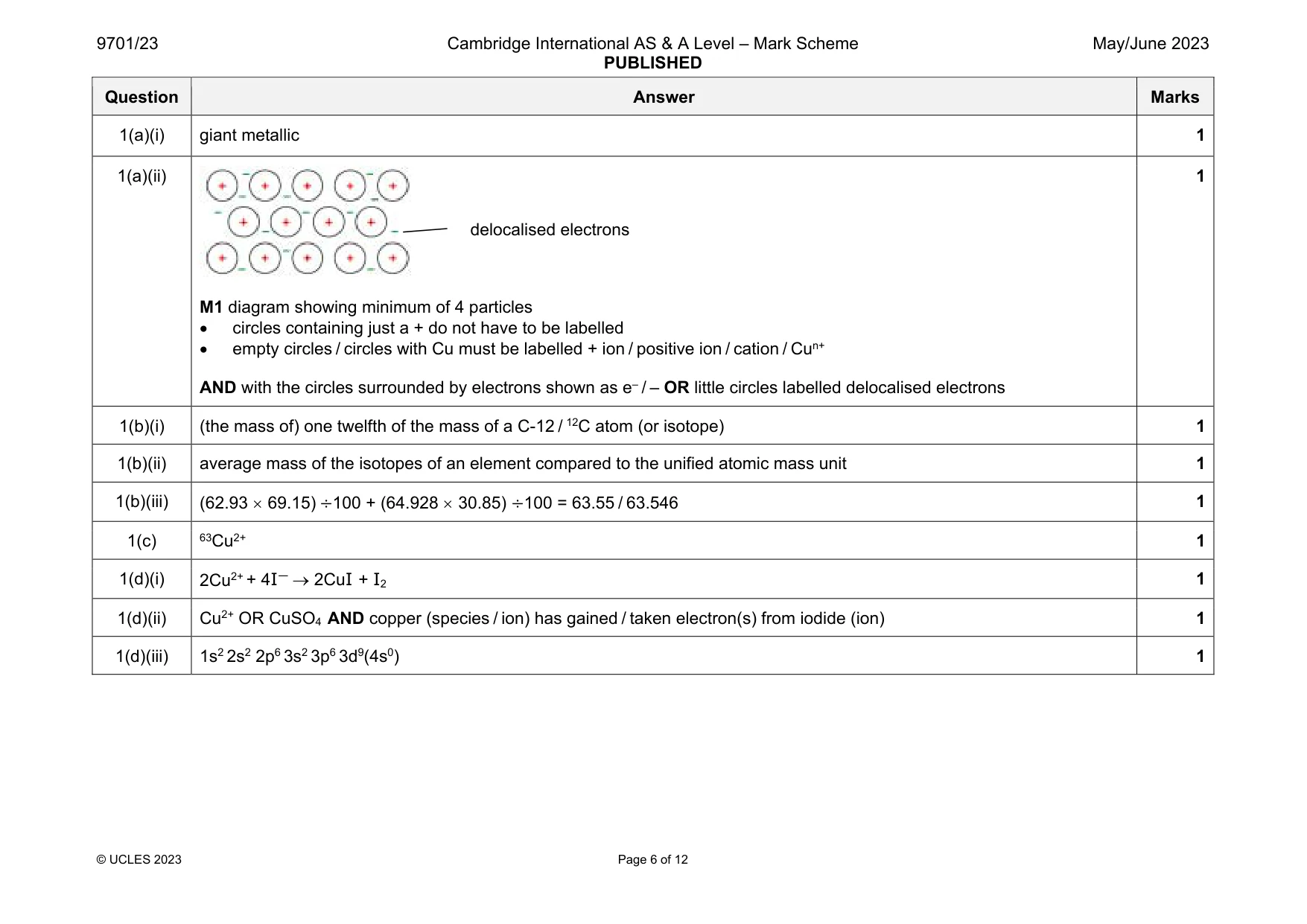
Mark scheme: 1(a)(i) giant metallic 1 1(a)(ii) M1 diagram showing minimum of 4 particles circles containing just a + do not have to be labelled empty circles / circles with Cu must be labelled + ion / positive ion / cation / Cun+ AND with the circles surrounded by electrons shown as e– / – OR little circles labelled delocalised electrons 1 1(b)(i) (the mass of) one twelfth of the mass of a C-12 / 12C atom (or isotope) 1 1(b)(ii) average mass of the isotopes of an element compared to the unified atomic mass unit 1 1(b)(iii) (62.93 69.15) ൊ100 + (64.928 30.85) ൊ100 = 63.55 / 63.546 1 1(c) 63Cu2+ 1 1(d)(i) 2Cu2+ + 4I— 2CuI + I2 1 1(d)(ii) Cu2+ OR CuSO4 AND copper (species / ion) has gained / taken electron(s) from iodide (ion) 1 1(d)(iii) 1s2 2s2 2p6 3s2 3p6 3d9(4s0) 1 delocalised electrons
Q2 · The reaction of pure aluminium is only observed if the aluminium oxide layer is removed…
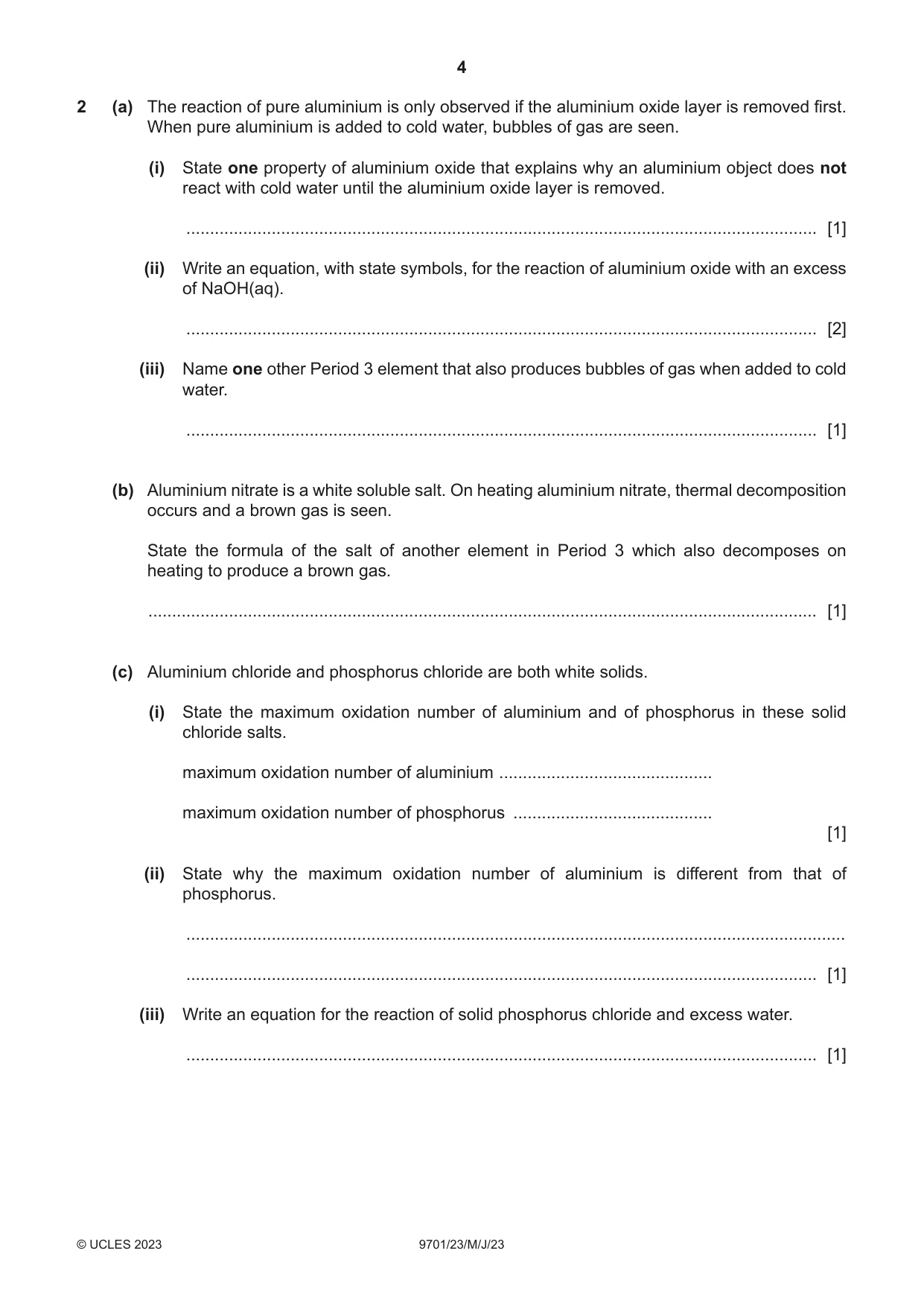
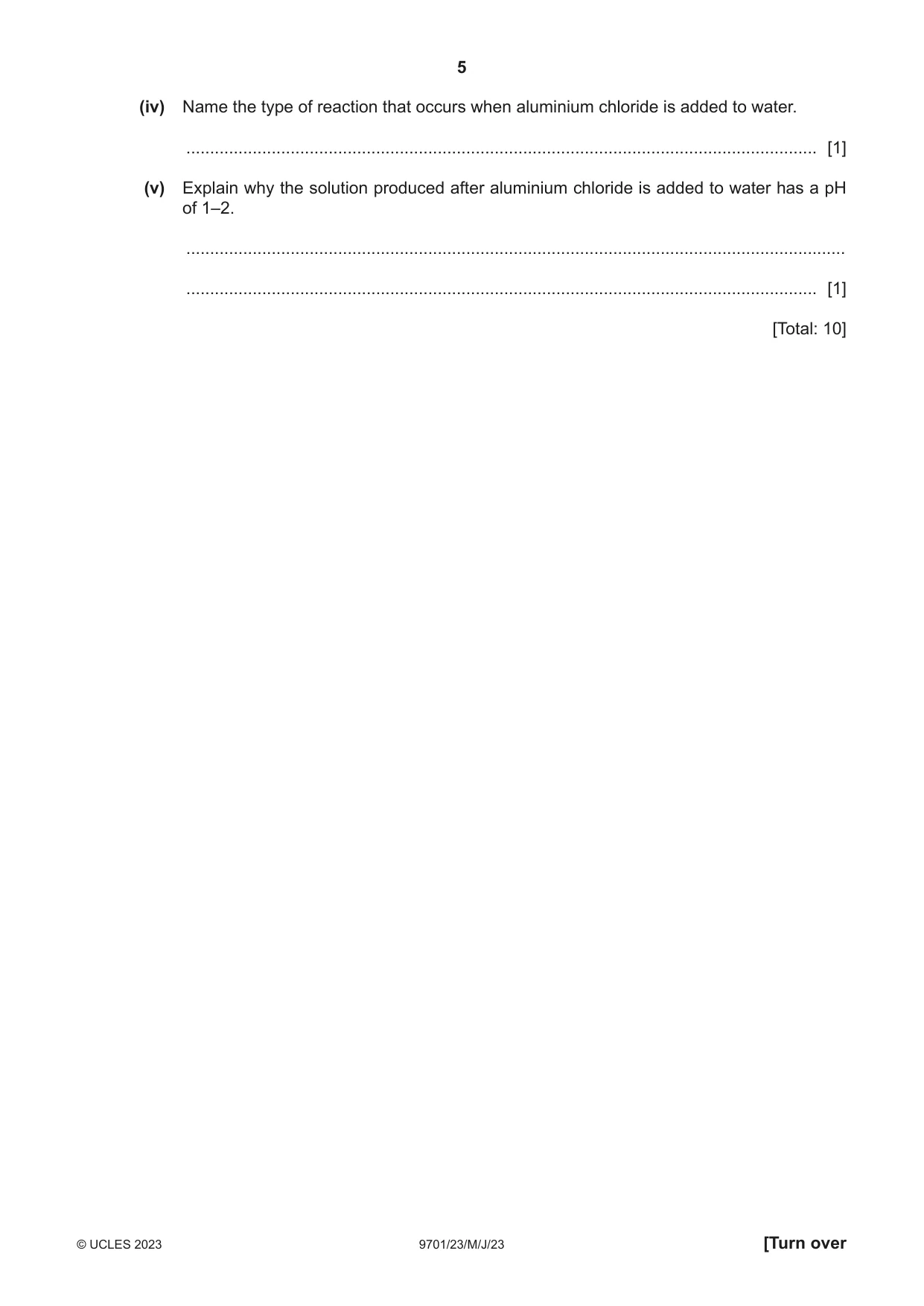
2 (a) The reaction of pure aluminium is only observed if the aluminium oxide layer is removed first. When pure aluminium is added to cold water, bubbles of gas are seen. (i) State one property of aluminium oxide that explains why an aluminium object does not react with cold water until the aluminium oxide layer is removed. ..................................................................................................................................... [1] (ii) Write an equation, with state symbols, for the reaction of aluminium oxide with an excess of NaOH(aq). ..................................................................................................................................... [2] (iii) Name one other Period 3 element that also produces bubbles of gas when added to cold water. ..................................................................................................................................... [1] (b) Aluminium nitrate is a white soluble salt. On heating aluminium nitrate, thermal decomposition occurs and a brown gas is seen. State the formula of the salt of another element in Period 3 which also decomposes on heating to produce a brown gas. ............................................................................................................................................. [1] (c) Aluminium chloride and phosphorus chloride are both white solids. (i) State the maximum oxidation number of aluminium and of phosphorus in these solid chloride salts. maximum oxidation number of aluminium ............................................. maximum oxidation number of phosphorus .......................................... [1] (ii) State why the maximum oxidation number of aluminium is different from that of phosphorus. ........................................................................................................................................... ..................................................................................................................................... [1] (iii) Write an equation for the reaction of solid phosphorus chloride and excess water. ..................................................................................................................................... [1] (iv) Name the type of reaction that occurs when aluminium chloride is added to water. ..................................................................................................................................... [1] (v) Explain why the solution produced after aluminium chloride is added to water has a pH of 1–2. ........................................................................................................................................... ..................................................................................................................................... [1] [Total: 10]
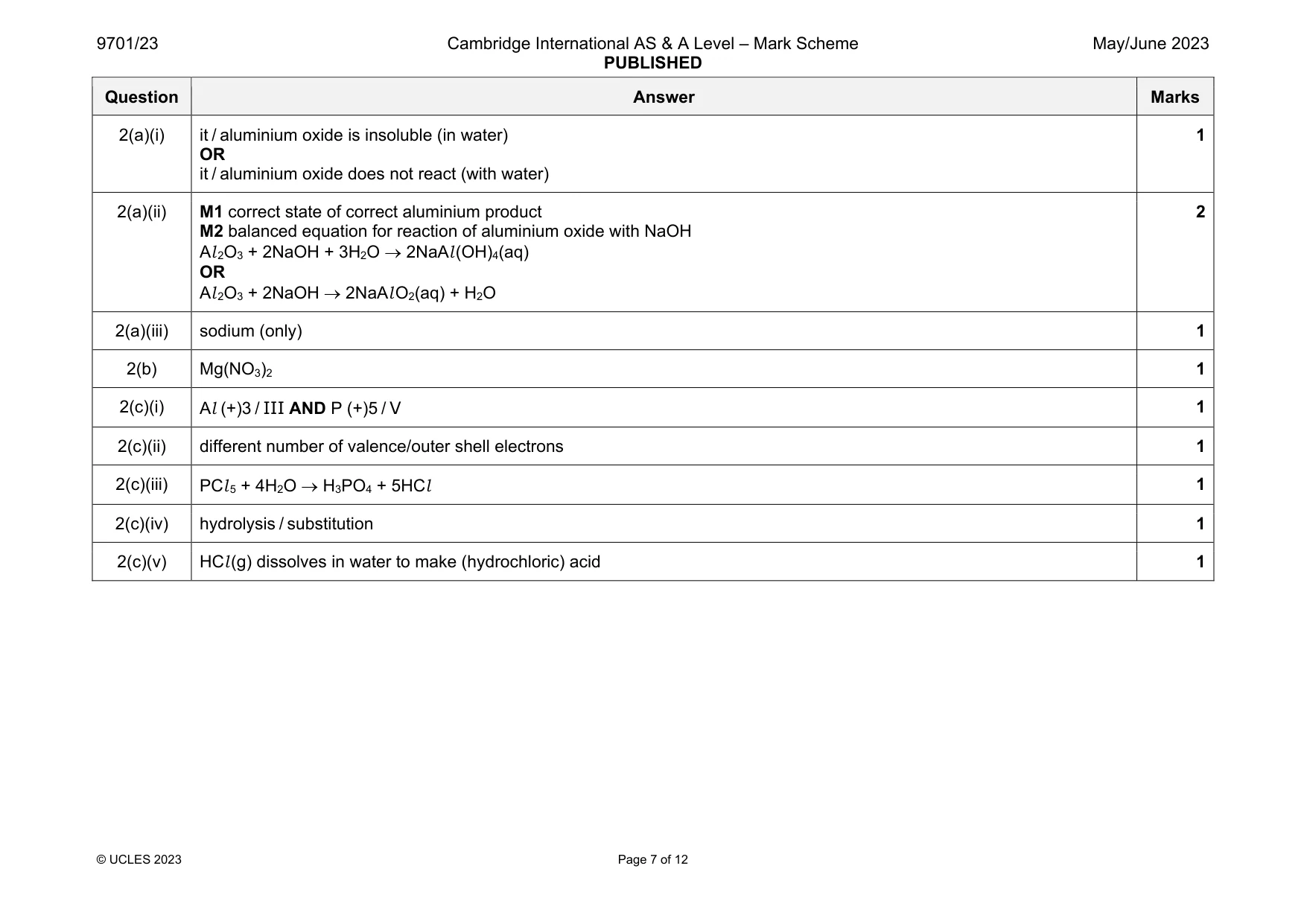
Mark scheme: 2(a)(i) it / aluminium oxide is insoluble (in water) OR it / aluminium oxide does not react (with water) 1 2(a)(ii) M1 correct state of correct aluminium product M2 balanced equation for reaction of aluminium oxide with NaOH Al 2O3 + 2NaOH + 3H2O 2NaAl (OH)4(aq) OR Al 2O3 + 2NaOH 2NaAl O2(aq) + H2O 2 2(a)(iii) sodium (only) 1 2(b) Mg(NO3)2 1 2(c)(i) Al (+)3 / III AND P (+)5 / V 1 2(c)(ii) different number of valence/outer shell electrons 1 2(c)(iii) PCl 5 + 4H2O H3PO4 + 5HCl 1 2(c)(iv) hydrolysis / substitution 1 2(c)(v) HCl (g) dissolves in water to make (hydrochloric) acid 1
More questions on Periodicity of chemical properties of the elements in Period 3
Q3 · A neutralisation reaction occurs when NaOH(aq) is added to H2SO4(aq)
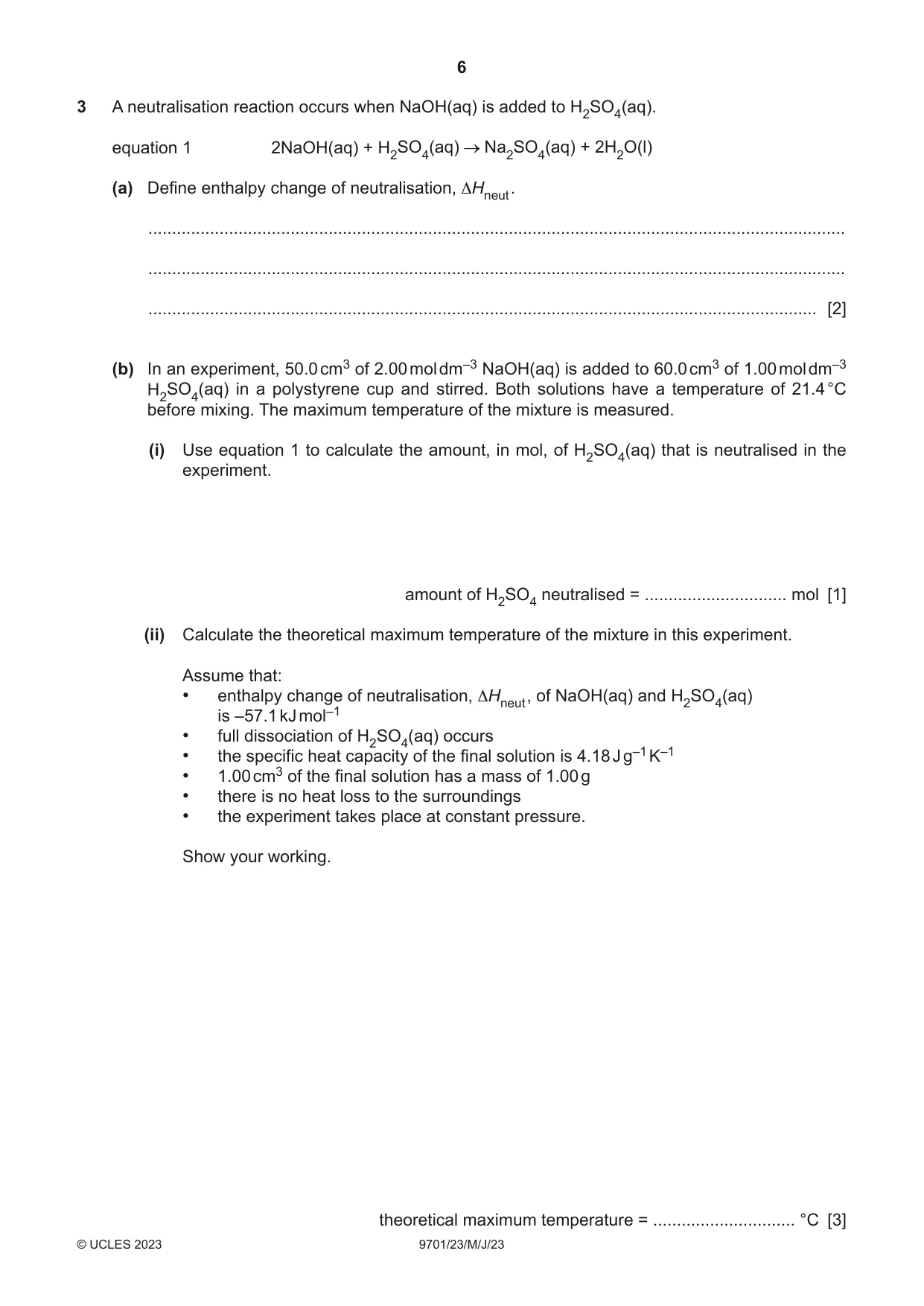
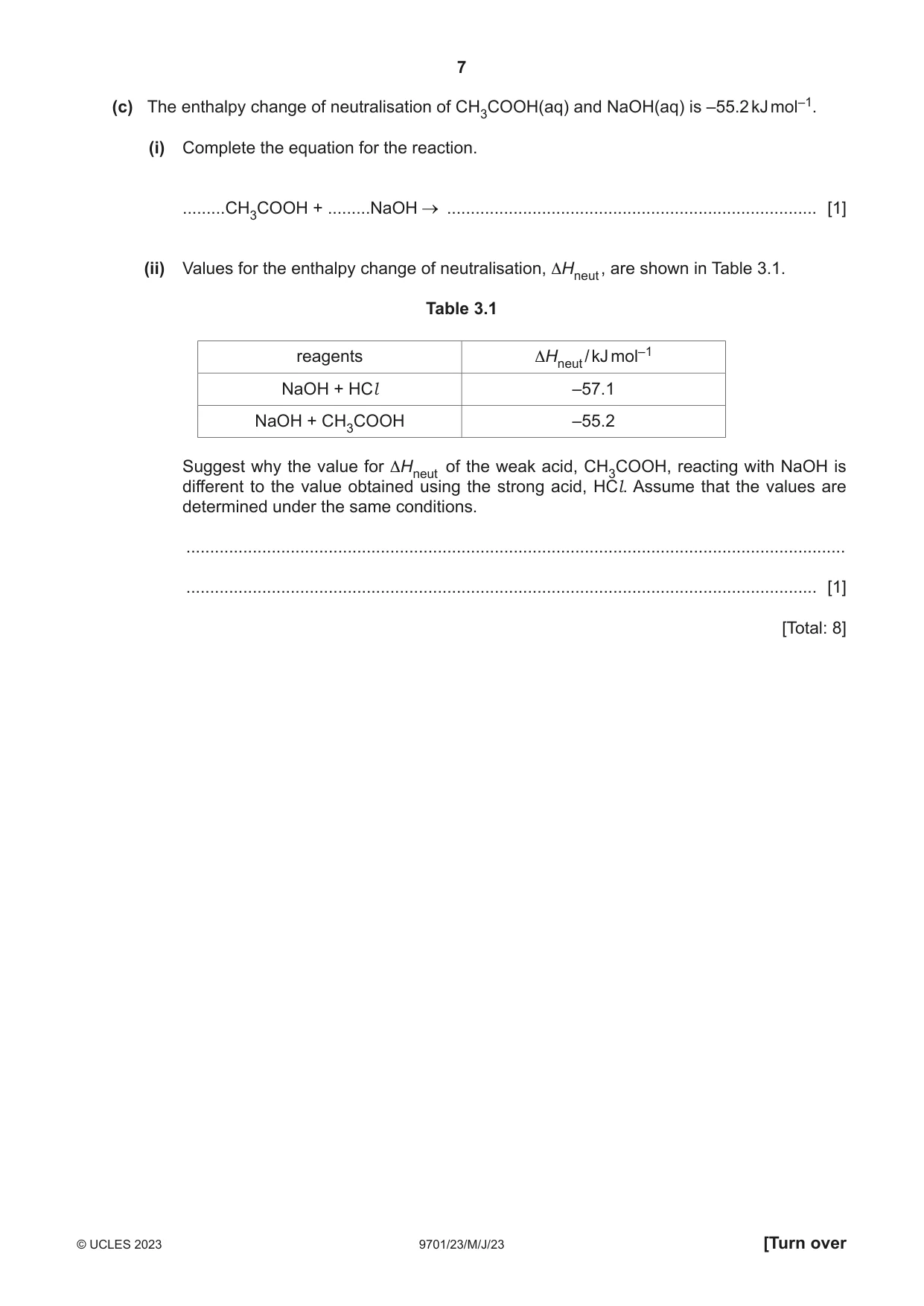
3 A neutralisation reaction occurs when NaOH(aq) is added to H2SO4(aq). equation 1 2NaOH(aq) + H2SO4(aq) Na2SO4(aq) + 2H2O(l) (a) Define enthalpy change of neutralisation, ∆Hneut . ................................................................................................................................................... ................................................................................................................................................... ............................................................................................................................................. [2] (b) In an experiment, 50.0 cm3 of 2.00 mol dm–3 NaOH(aq) is added to 60.0 cm3 of 1.00 mol dm–3 H2SO4(aq) in a polystyrene cup and stirred. Both solutions have a temperature of 21.4 °C before mixing. The maximum temperature of the mixture is measured. (i) Use equation 1 to calculate the amount, in mol, of H2SO4(aq) that is neutralised in the experiment. amount of H2SO4 neutralised = .............................. mol [1] (ii) Calculate the theoretical maximum temperature of the mixture in this experiment. Assume that: • enthalpy change of neutralisation, ∆Hneut , of NaOH(aq) and H2SO4(aq) is –57.1 kJ mol–1 • full dissociation of H2SO4(aq) occurs • the specific heat capacity of the final solution is 4.18 J g–1 K–1 • 1.00 cm3 of the final solution has a mass of 1.00 g • there is no heat loss to the surroundings • the experiment takes place at constant pressure. Show your working. theoretical maximum temperature = .............................. °C [3] (c) The enthalpy change of neutralisation of CH3COOH(aq) and NaOH(aq) is –55.2 kJ mol–1. (i) Complete the equation for the reaction. .........CH3COOH + .........NaOH .............................................................................. [1] (ii) Values for the enthalpy change of neutralisation, ∆Hneut , are shown in Table 3.1. Table 3.1 reagents ∆Hneut / kJ mol–1 NaOH + HCl –57.1 NaOH + CH3COOH –55.2 Suggest why the value for ∆Hneut of the weak acid, CH3COOH, reacting with NaOH is different to the value obtained using the strong acid, HCl. Assume that the values are determined under the same conditions. ........................................................................................................................................... ..................................................................................................................................... [1] [Total: 8]
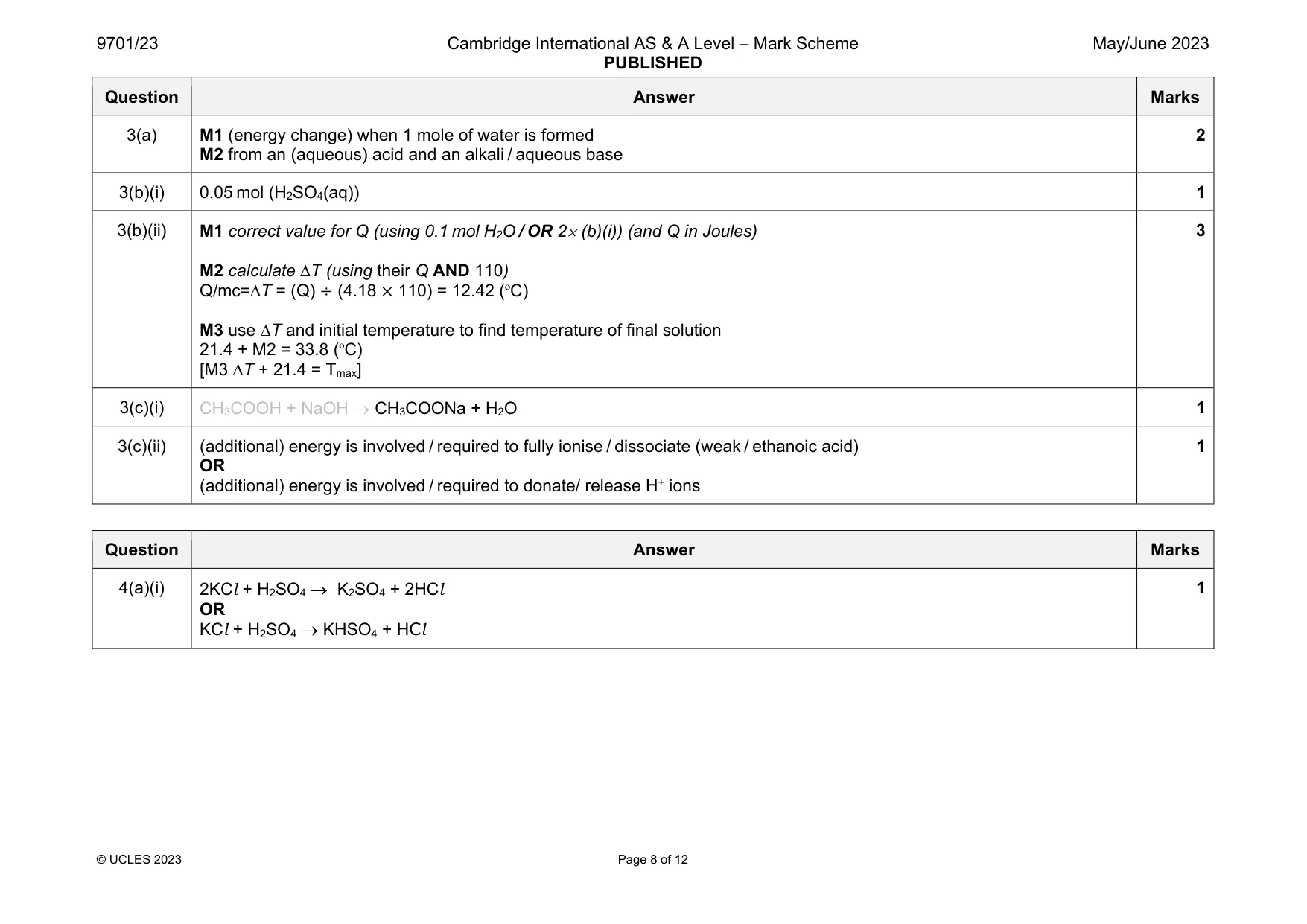
Mark scheme: 3(a) M1 (energy change) when 1 mole of water is formed M2 from an (aqueous) acid and an alkali / aqueous base 2 3(b)(i) 0.05 mol (H2SO4(aq)) 1 3(b)(ii) M1 correct value for Q (using 0.1 mol H2O / OR 2 (b)(i)) (and Q in Joules) M2 calculate ∆T (using their Q AND 110) Q/mc=∆T = (Q) ÷ (4.18 × 110) = 12.42 (ºC) M3 use ∆T and initial temperature to find temperature of final solution 21.4 + M2 = 33.8 (ºC) [M3 ∆T + 21.4 = Tmax] 3 3(c)(i) CH3COOH + NaOH CH3COONa + H2O 1 3(c)(ii) (additional) energy is involved / required to fully ionise / dissociate (weak / ethanoic acid) OR (additional) energy is involved / required to donate/ release H+ ions 1
Q4 · Hydrogen chloride gas is made in the laboratory by adding concentrated sulfuric acid to…
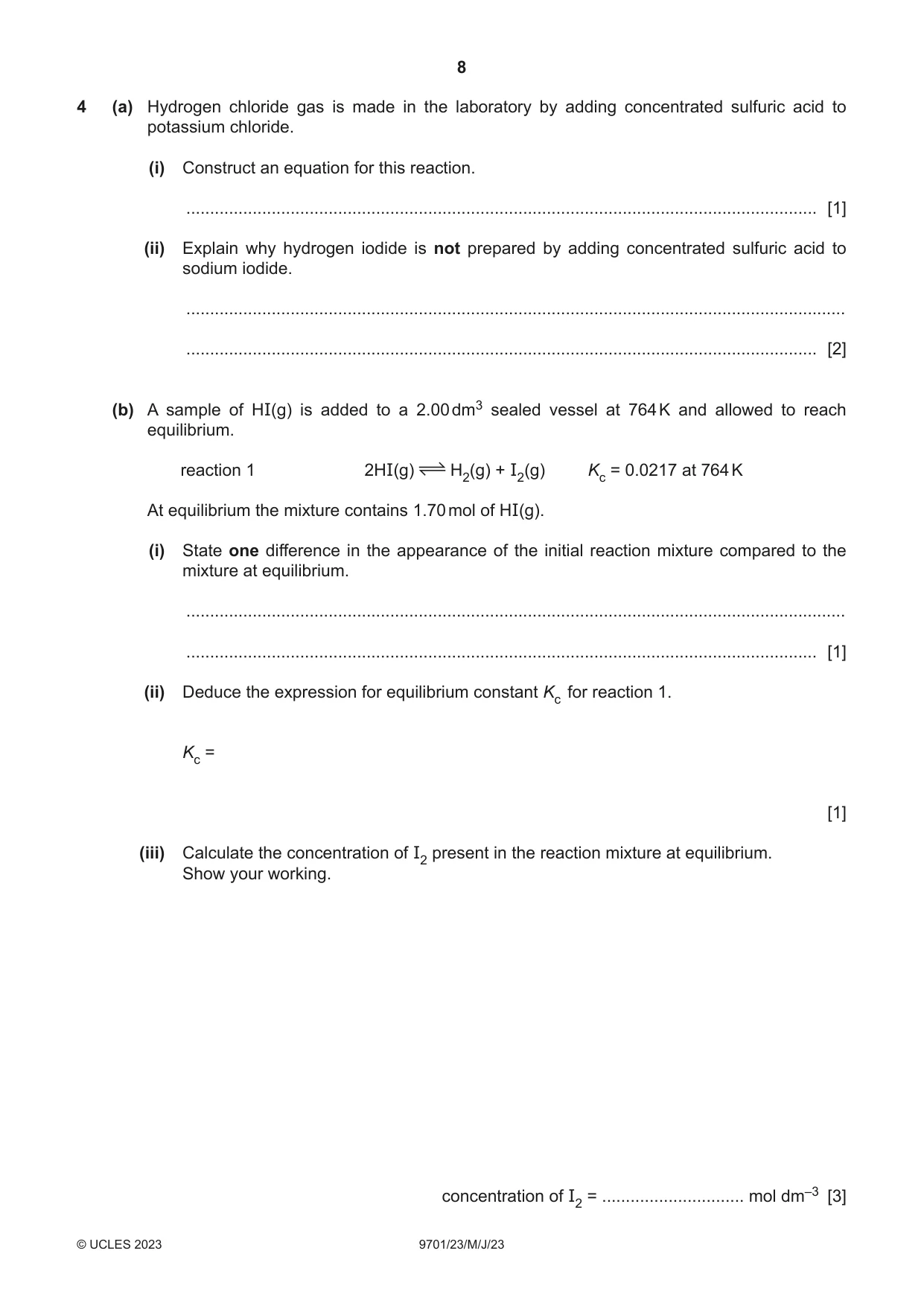
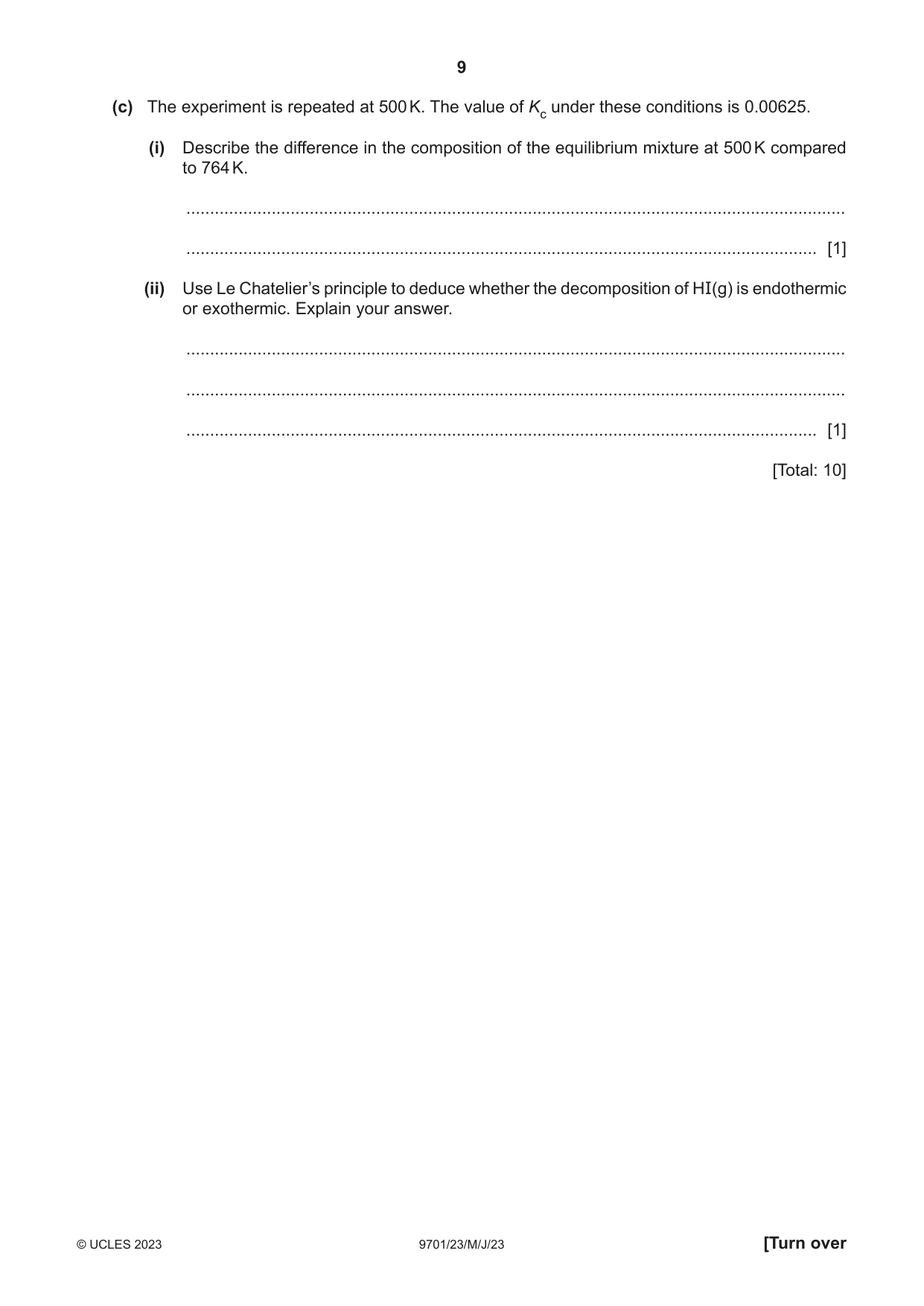
4 (a) Hydrogen chloride gas is made in the laboratory by adding concentrated sulfuric acid to potassium chloride. (i) Construct an equation for this reaction. ..................................................................................................................................... [1] (ii) Explain why hydrogen iodide is not prepared by adding concentrated sulfuric acid to sodium iodide. ........................................................................................................................................... ..................................................................................................................................... [2] (b) A sample of HI(g) is added to a 2.00 dm3 sealed vessel at 764 K and allowed to reach equilibrium. reaction 1 2HI(g) H2(g) + I2(g) Kc = 0.0217 at 764 K At equilibrium the mixture contains 1.70 mol of HI(g). (i) State one difference in the appearance of the initial reaction mixture compared to the mixture at equilibrium. ........................................................................................................................................... ..................................................................................................................................... [1] (ii) Deduce the expression for equilibrium constant Kc for reaction 1. Kc = [1] (iii) Calculate the concentration of I2 present in the reaction mixture at equilibrium. Show your working. concentration of I2 = .............................. mol dm–3 [3] (c) The experiment is repeated at 500 K. The value of Kc under these conditions is 0.00625. (i) Describe the difference in the composition of the equilibrium mixture at 500 K compared to 764 K. ........................................................................................................................................... ..................................................................................................................................... [1] (ii) Use Le Chatelier’s principle to deduce whether the decomposition of HI(g) is endothermic or exothermic. Explain your answer. ........................................................................................................................................... ........................................................................................................................................... ..................................................................................................................................... [1] [Total: 10]
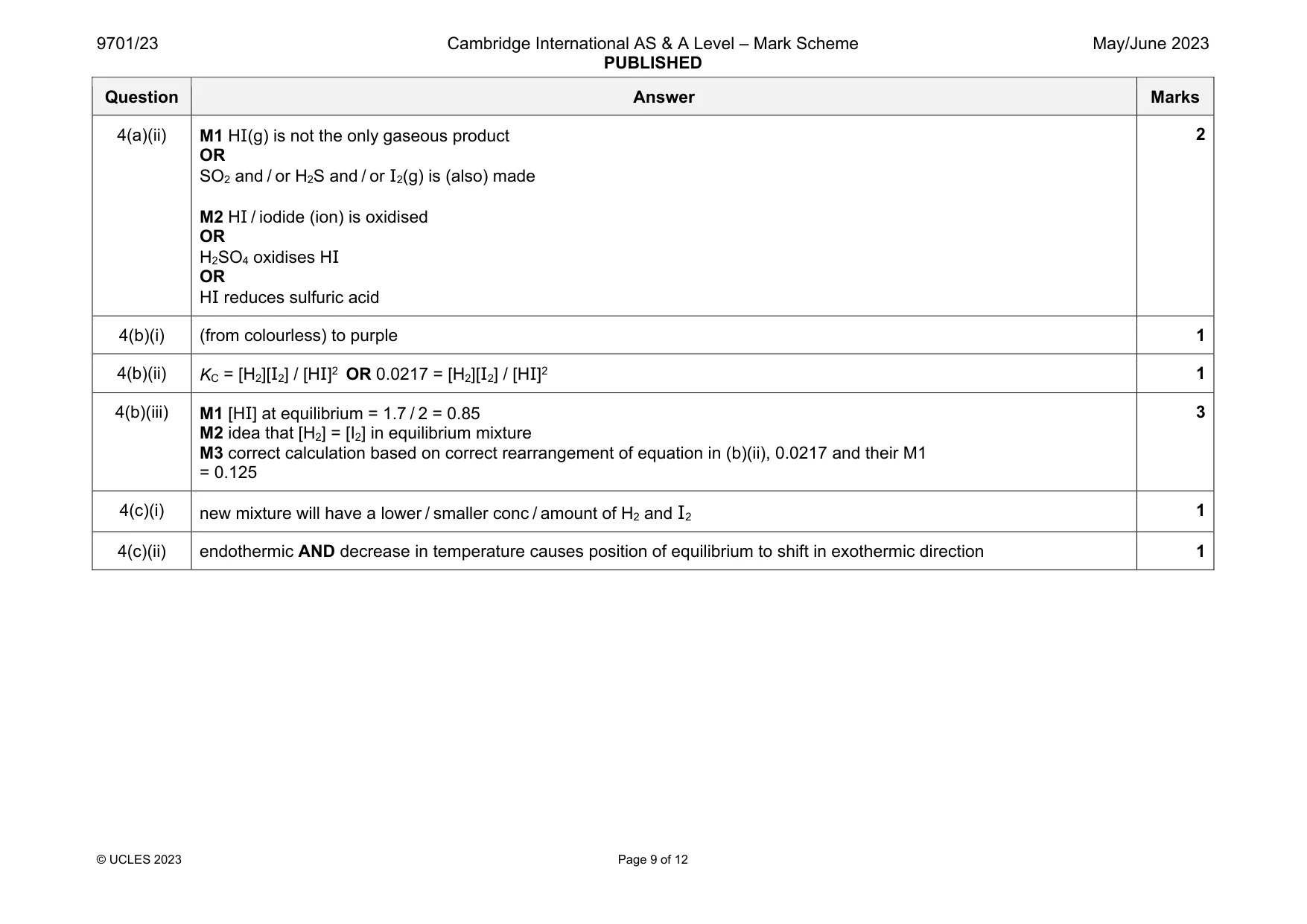
Mark scheme: 4(a)(i) OR KCl + H2SO4 KHSO4 + HCl 1 Question Answer Marks 4(a)(ii) M1 HI(g) is not the only gaseous product OR SO2 and / or H2S and / or I2(g) is (also) made M2 HI / iodide (ion) is oxidised OR H2SO4 oxidises HI OR HI reduces sulfuric acid 2 4(b)(i) (from colourless) to purple 1 4(b)(ii) KC = [H2][I2] / [HI]2 OR 0.0217 = [H2][I2] / [HI]2 1 4(b)(iii) M1 [HI] at equilibrium = 1.7 / 2 = 0.85 M2 idea that [H2] = [I2] in equilibrium mixture M3 correct calculation based on correct rearrangement of equation in (b)(ii), 0.0217 and their M1 = 0.125 3 4(c)(i) new mixture will have a lower / smaller conc / amount of H2 and I2 1 4(c)(ii) endothermic AND decrease in temperature causes position of equilibrium to shift in exothermic direction 1
More questions on The chemical properties of the halogen elements and the hydrogen halides
Q5 · Y is formed from X in a single-step reaction, as shown in Fig
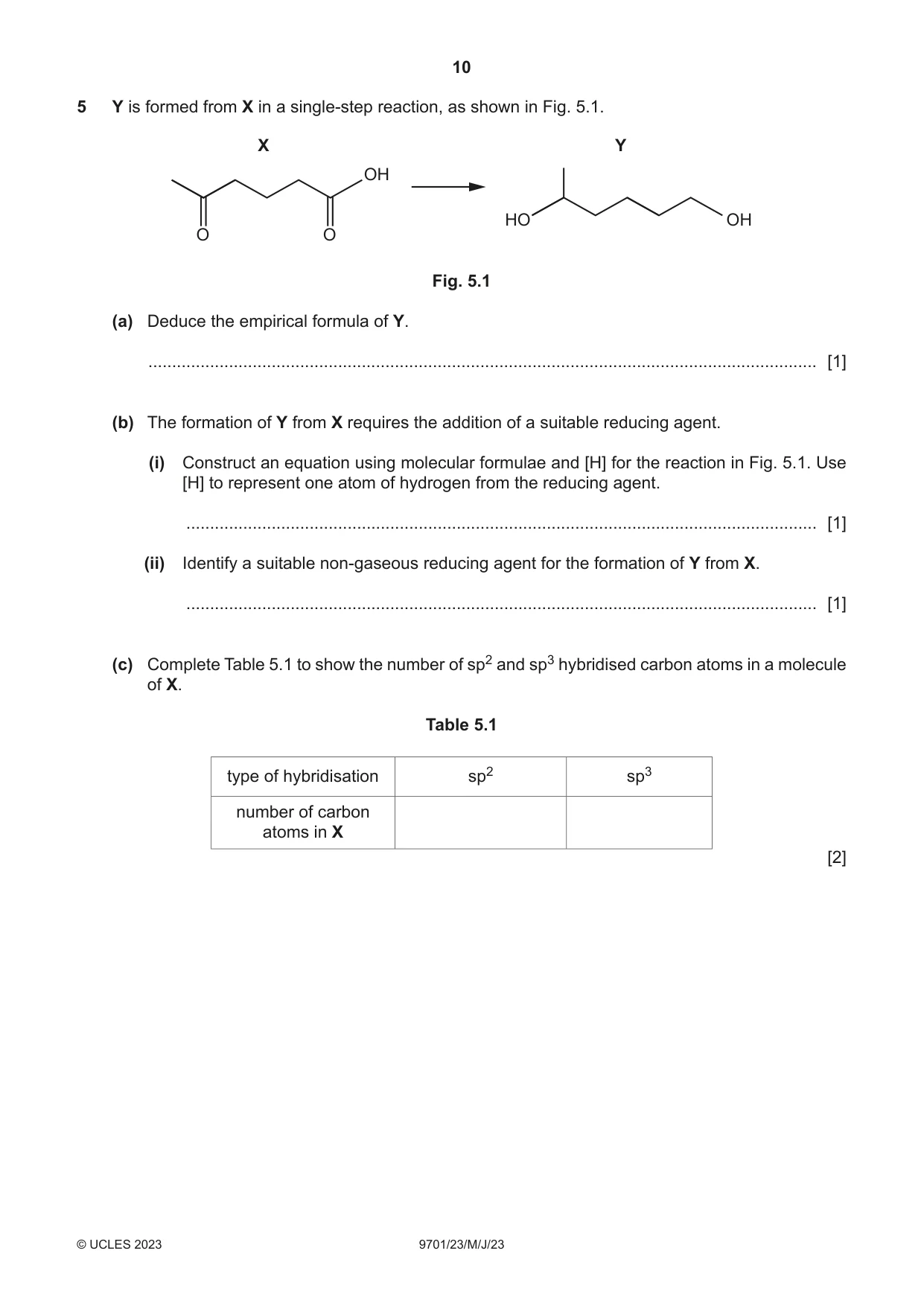
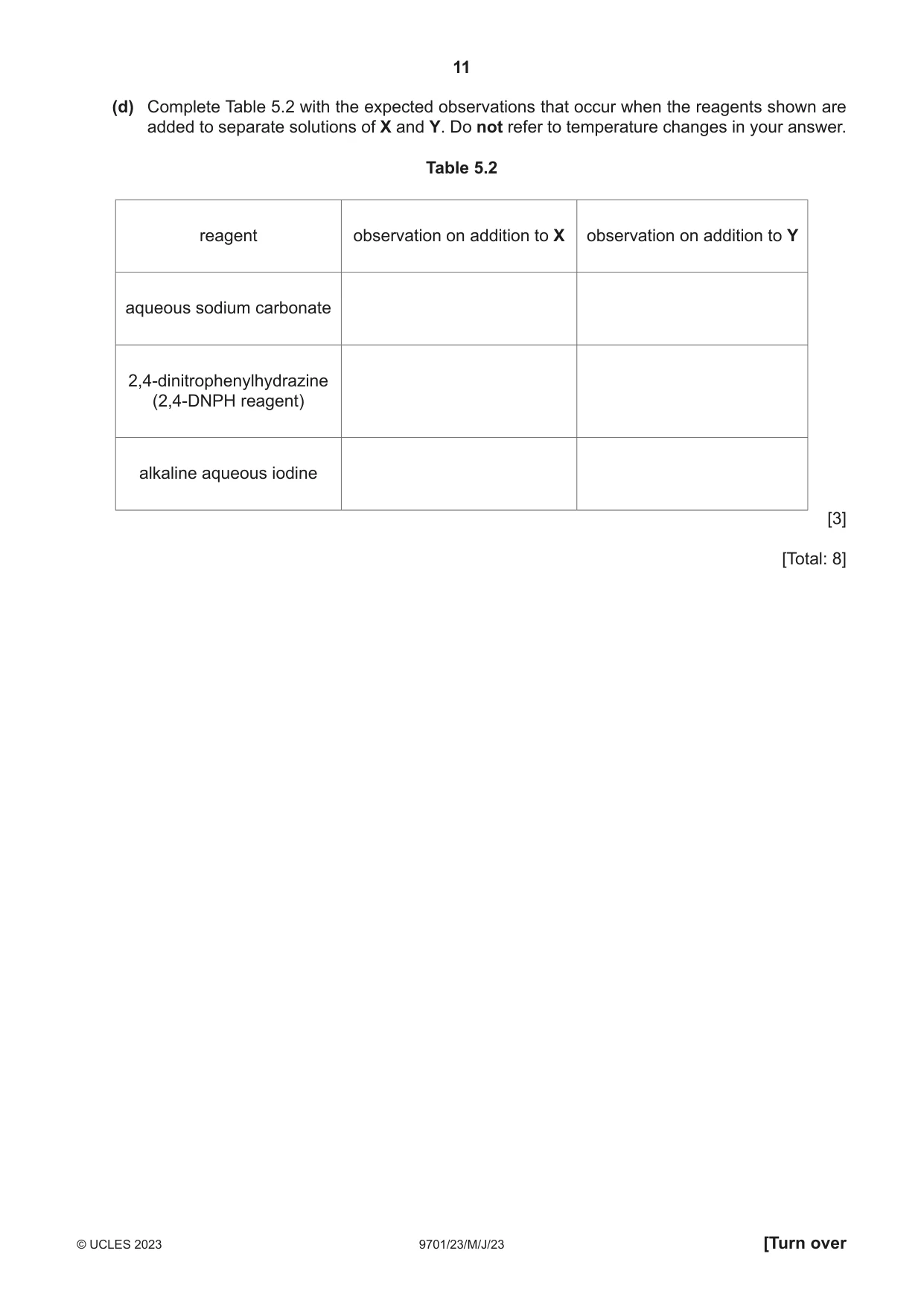
5 Y is formed from X in a single-step reaction, as shown in Fig. 5.1. X Y OH HO OH O O Fig. 5.1 (a) Deduce the empirical formula of Y. ............................................................................................................................................. [1] (b) The formation of Y from X requires the addition of a suitable reducing agent. (i) Construct an equation using molecular formulae and [H] for the reaction in Fig. 5.1. Use [H] to represent one atom of hydrogen from the reducing agent. ..................................................................................................................................... [1] (ii) Identify a suitable non-gaseous reducing agent for the formation of Y from X. ..................................................................................................................................... [1] (c) Complete Table 5.1 to show the number of sp2 and sp3 hybridised carbon atoms in a molecule of X. Table 5.1 type of hybridisation sp2 sp3 number of carbon atoms in X [2] (d) Complete Table 5.2 with the expected observations that occur when the reagents shown are added to separate solutions of X and Y. Do not refer to temperature changes in your answer. Table 5.2 reagent observation on addition to X observation on addition to Y aqueous sodium carbonate 2,4-dinitrophenylhydrazine (2,4-DNPH reagent) alkaline aqueous iodine [3] [Total: 8]
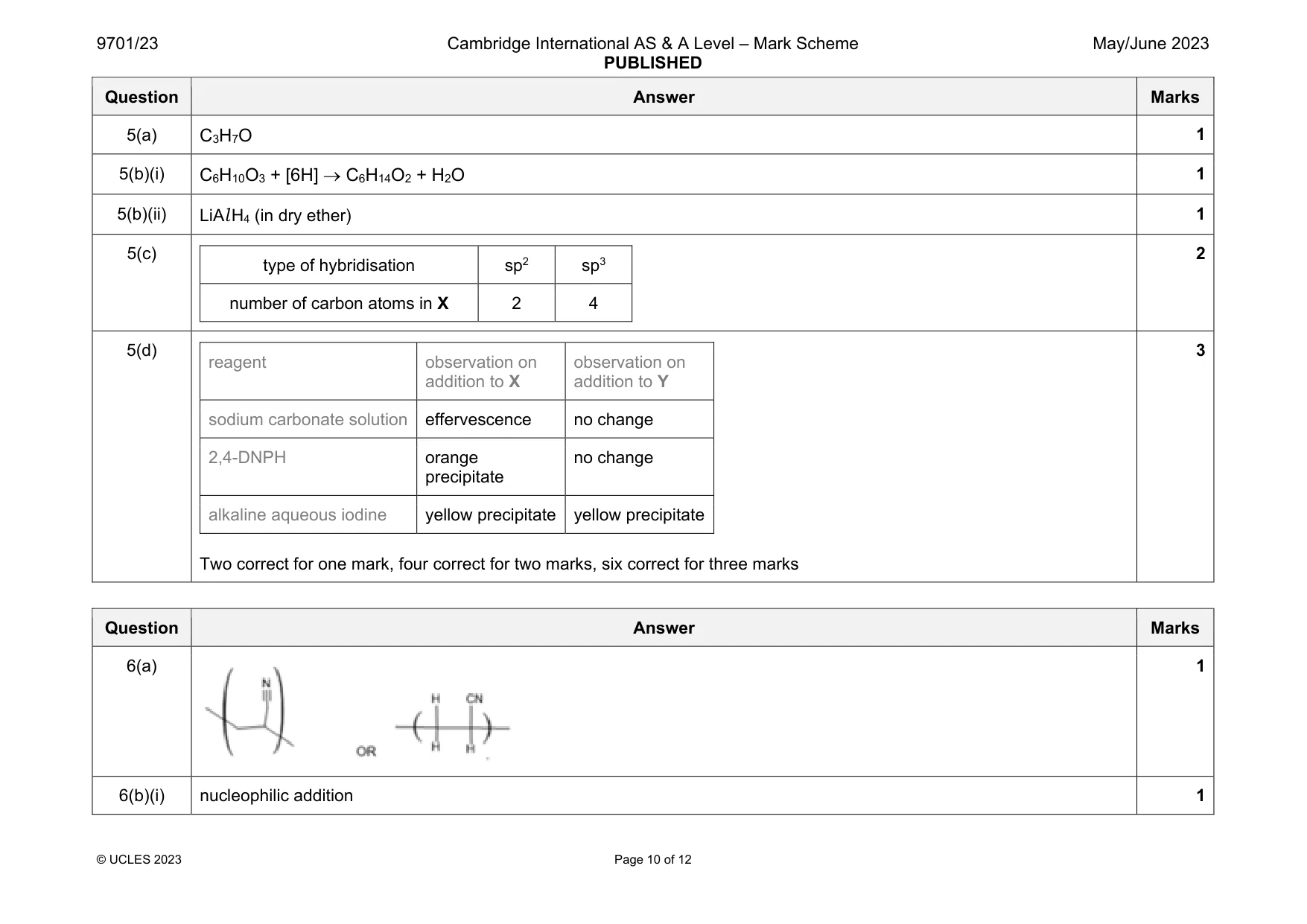
Mark scheme: 5(a) C3H7O 5(b)(i) C6H10O3 + [6H] C6H14O2 + H2O 1 5(b)(ii) LiAl H4 (in dry ether) 1 5(c) type of hybridisation sp2 sp3 number of carbon atoms in X 2 4 2 5(d) reagent observation on addition to X observation on addition to Y sodium carbonate solution effervescence no change 2,4-DNPH orange precipitate no change alkaline aqueous iodine yellow precipitate yellow precipitate Two correct for one mark, four correct for two marks, six correct for three marks 3
Q6 · Compound W, CH2=CHCN, is used to make an addition polymer which is present in carbon…
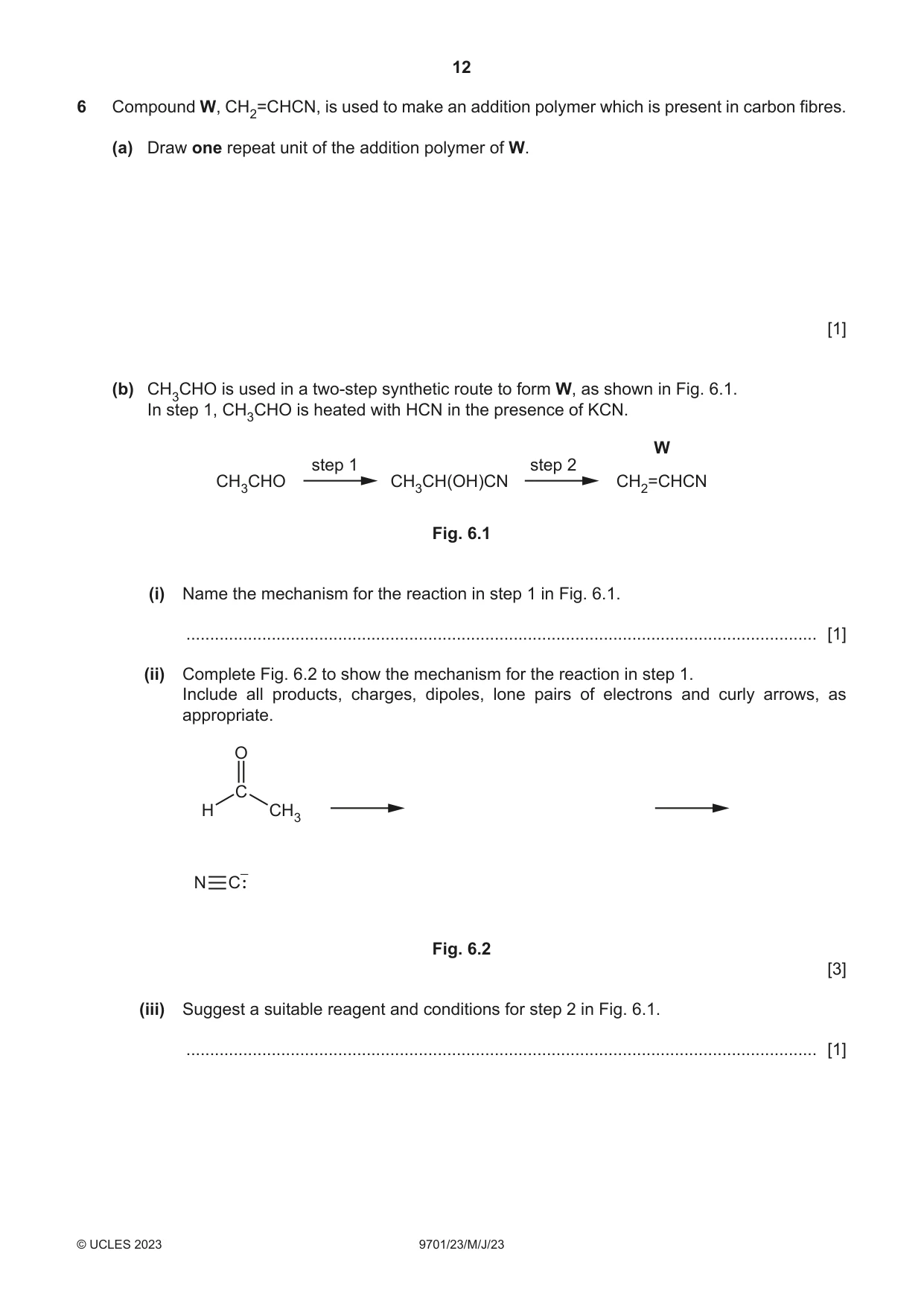
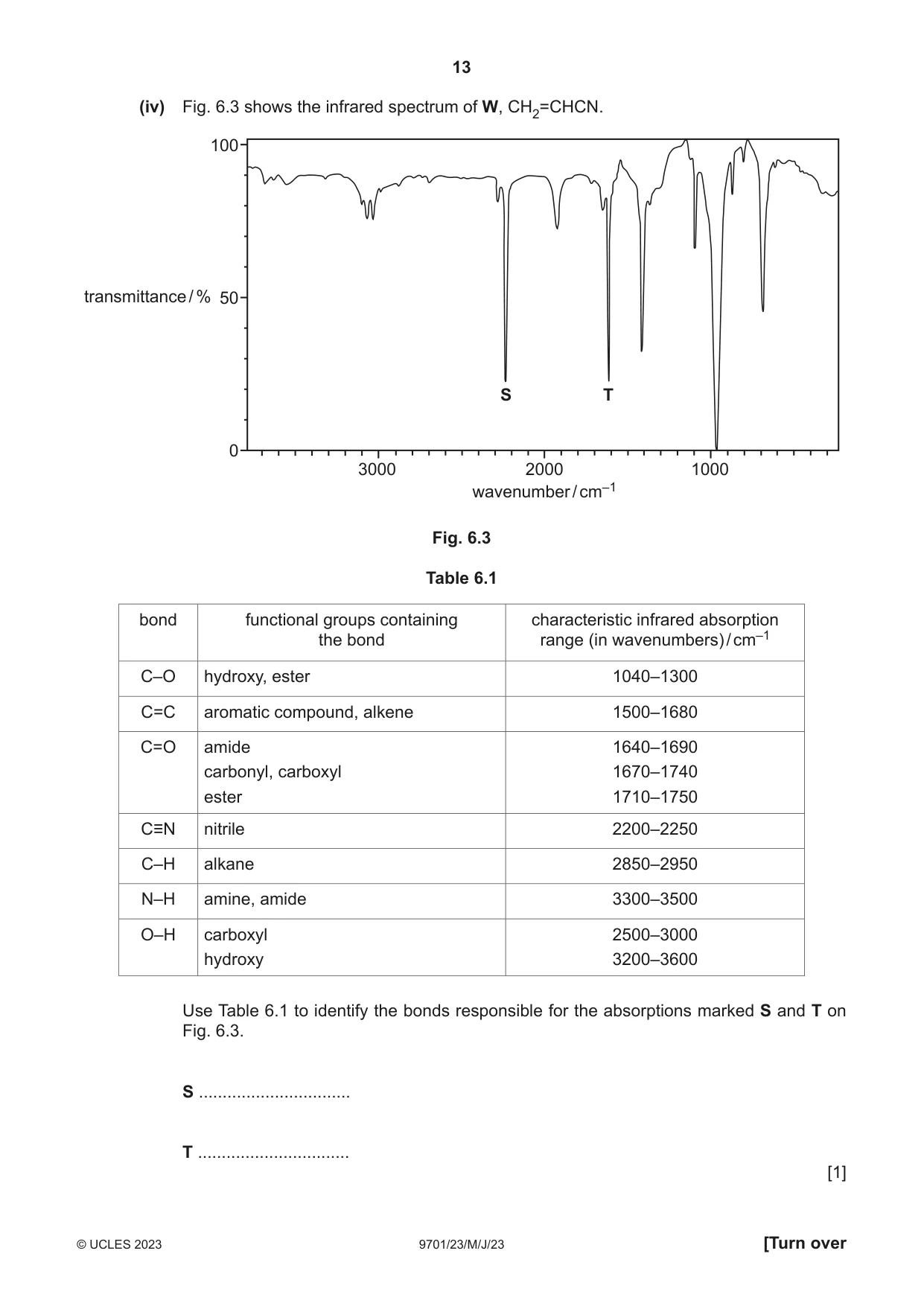
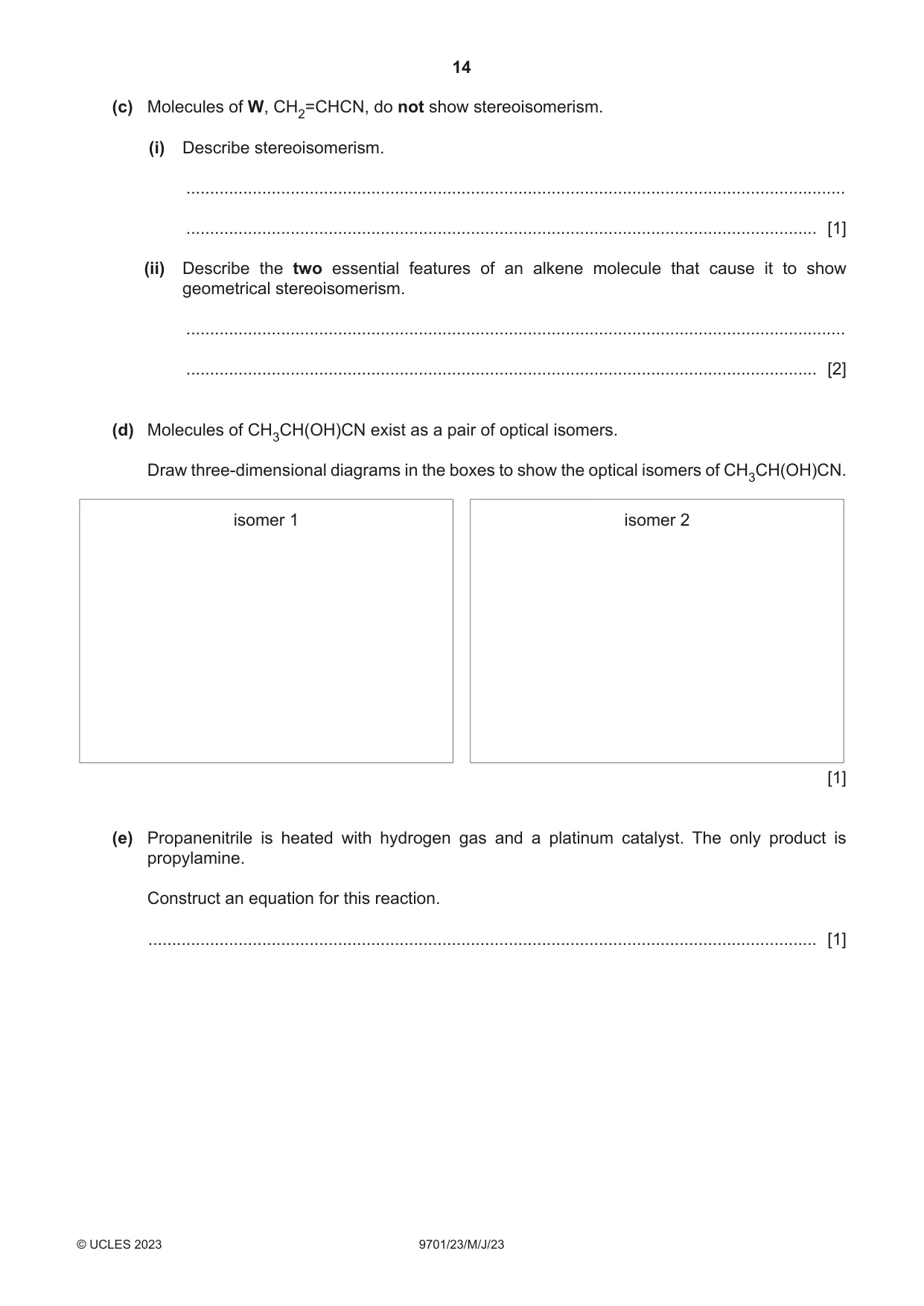
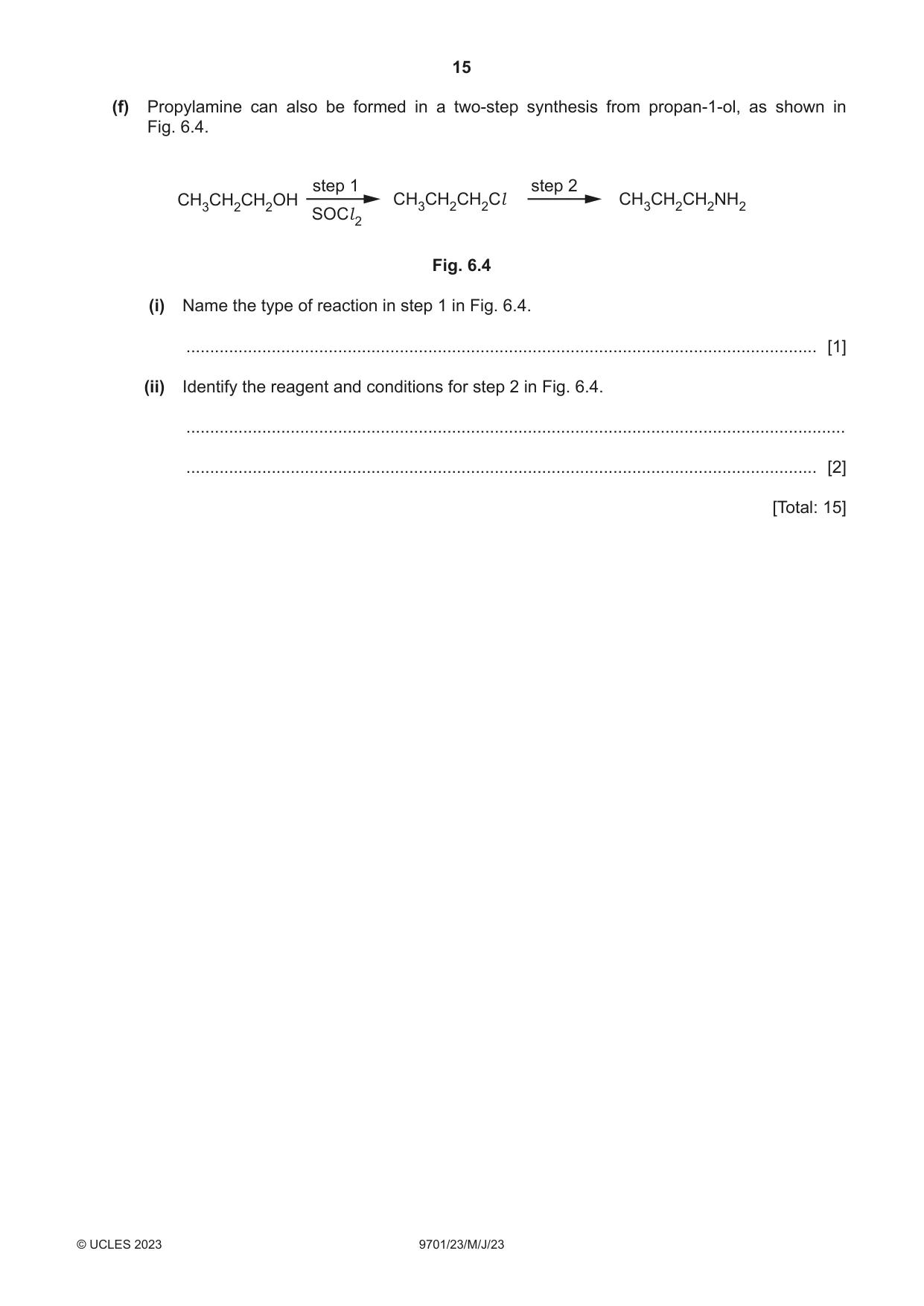
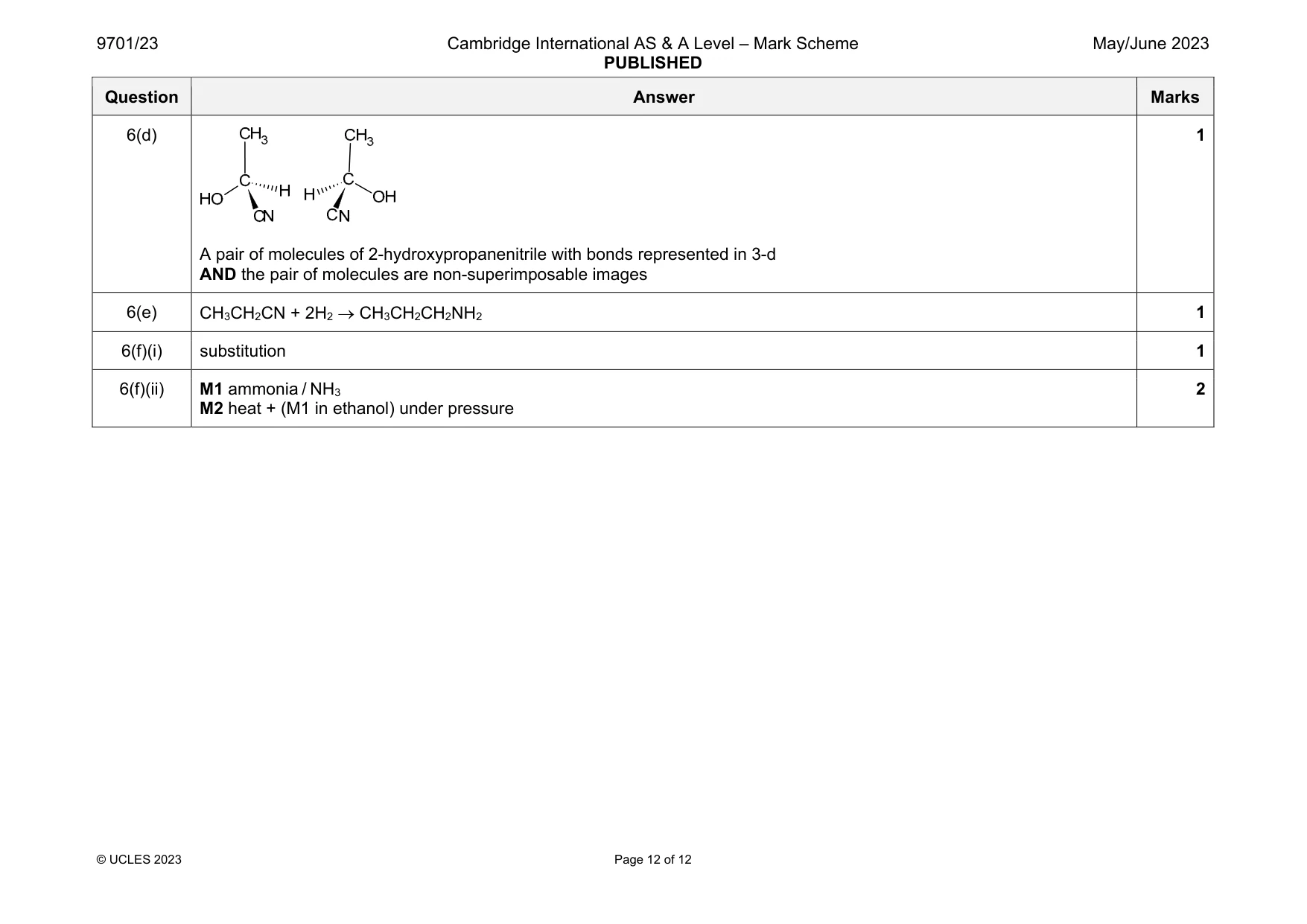
6 Compound W, CH2=CHCN, is used to make an addition polymer which is present in carbon fibres. (a) Draw one repeat unit of the addition polymer of W. [1] (b) CH3CHO is used in a two-step synthetic route to form W, as shown in Fig. 6.1. In step 1, CH3CHO is heated with HCN in the presence of KCN. W step 1 step 2 CH3CHO CH3CH(OH)CN CH2=CHCN Fig. 6.1 (i) Name the mechanism for the reaction in step 1 in Fig. 6.1. ..................................................................................................................................... [1] (ii) Complete Fig. 6.2 to show the mechanism for the reaction in step 1. Include all products, charges, dipoles, lone pairs of electrons and curly arrows, as appropriate. O C H CH3 N C Fig. 6.2 [3] (iii) Suggest a suitable reagent and conditions for step 2 in Fig. 6.1. ..................................................................................................................................... [1] (iv) Fig. 6.3 shows the infrared spectrum of W, CH2=CHCN. 100 transmittance / % 50 S T 0 3000 2000 1000 wavenumber / cm–1 Fig. 6.3 Table 6.1 bond functional groups containing characteristic infrared absorption the bond range (in wavenumbers) / cm–1 C–O hydroxy, ester 1040–1300 C=C aromatic compound, alkene 1500–1680 C=O amide 1640–1690 carbonyl, carboxyl 1670–1740 ester 1710–1750 C≡N nitrile 2200–2250 C–H alkane 2850–2950 N–H amine, amide 3300–3500 O–H carboxyl 2500–3000 hydroxy 3200–3600 Use Table 6.1 to identify the bonds responsible for the absorptions marked S and T on Fig. 6.3. S ................................ T ................................ [1] (c) Molecules of W, CH2=CHCN, do not show stereoisomerism. (i) Describe stereoisomerism. ........................................................................................................................................... ..................................................................................................................................... [1] (ii) Describe the two essential features of an alkene molecule that cause it to show geometrical stereoisomerism. ........................................................................................................................................... ..................................................................................................................................... [2] (d) Molecules of CH3CH(OH)CN exist as a pair of optical isomers. Draw three-dimensional diagrams in the boxes to show the optical isomers of CH3CH(OH)CN. isomer 1 isomer 2 [1] (e) Propanenitrile is heated with hydrogen gas and a platinum catalyst. The only product is propylamine. Construct an equation for this reaction. ............................................................................................................................................. [1]
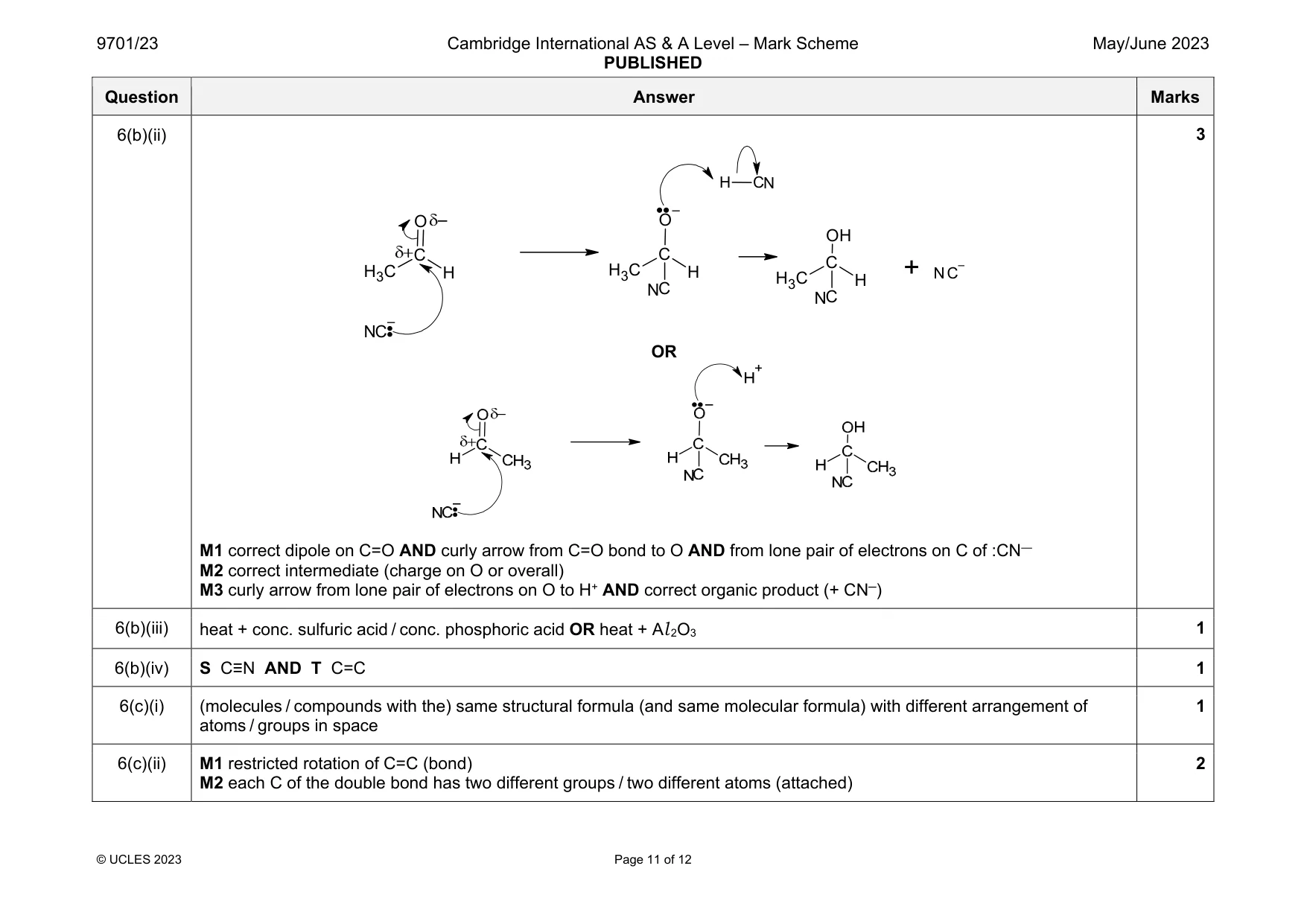
Mark scheme: 6(a) 1 6(b)(i) nucleophilic addition 1 Question Answer Marks 6(b)(ii) OR M1 correct dipole on C=O AND curly arrow from C=O bond to O AND from lone pair of electrons on C of :CN— M2 correct intermediate (charge on O or overall) M3 curly arrow from lone pair of electrons on O to H+ AND correct organic product (+ CN─) 3 6(b)(iii) heat + conc. sulfuric acid / conc. phosphoric acid OR heat + Al 2O3 1 6(b)(iv) S C≡N AND T C=C 1 6(c)(i) (molecules / compounds with the) same structural formula (and same molecular formula) with different arrangement of atoms / groups in space 1 6(c)(ii) M1 restricted rotation of C=C (bond) M2 each C of the double bond has two different groups / two different atoms (attached) 2 H C C H3 O C – N H C C H3 O – C N NC – H C C H3 C N OH N C H Question Answer Marks 6(d) A pair of molecules of 2-hydroxypropanenitrile with bonds represented in 3-d AND the pair of molecules are non-superimposable images 1 6(e) CH3CH2CN + 2H2 CH3CH2CH2NH2 1 6(f)(i) substitution 1 6(f)(ii) M1 ammonia / NH3 M2 heat + (M1 in ethanol) under pressure 2
What was in this paper
The subtopics covered by these 6 questions, and how many questions each got. Open one in a new tab to see every Cambridge question on it.
What you needed in this session
Cambridge’s own grade thresholds for 2023 May/June, Paper 2 · Variant 3. A higher threshold means an easier paper — the bar moves with how the cohort did.