Cambridge A Level Chemistry 9701 — 2022 Oct/Nov Paper 5 · Variant 2
9701/52/O/N/22 · 2 questions · 30 marks · ≈34 min
The question paper and its mark scheme, free to read here and free to download. This is Cambridge’s own paper, exactly as it was sat.
Question paper12 pages


Mark scheme7 pages
Answers below. Sit the paper first if you are practising.
Questions as text
Q1 · Eggshells contain a high percentage by mass of calcium carbonate, CaCO3
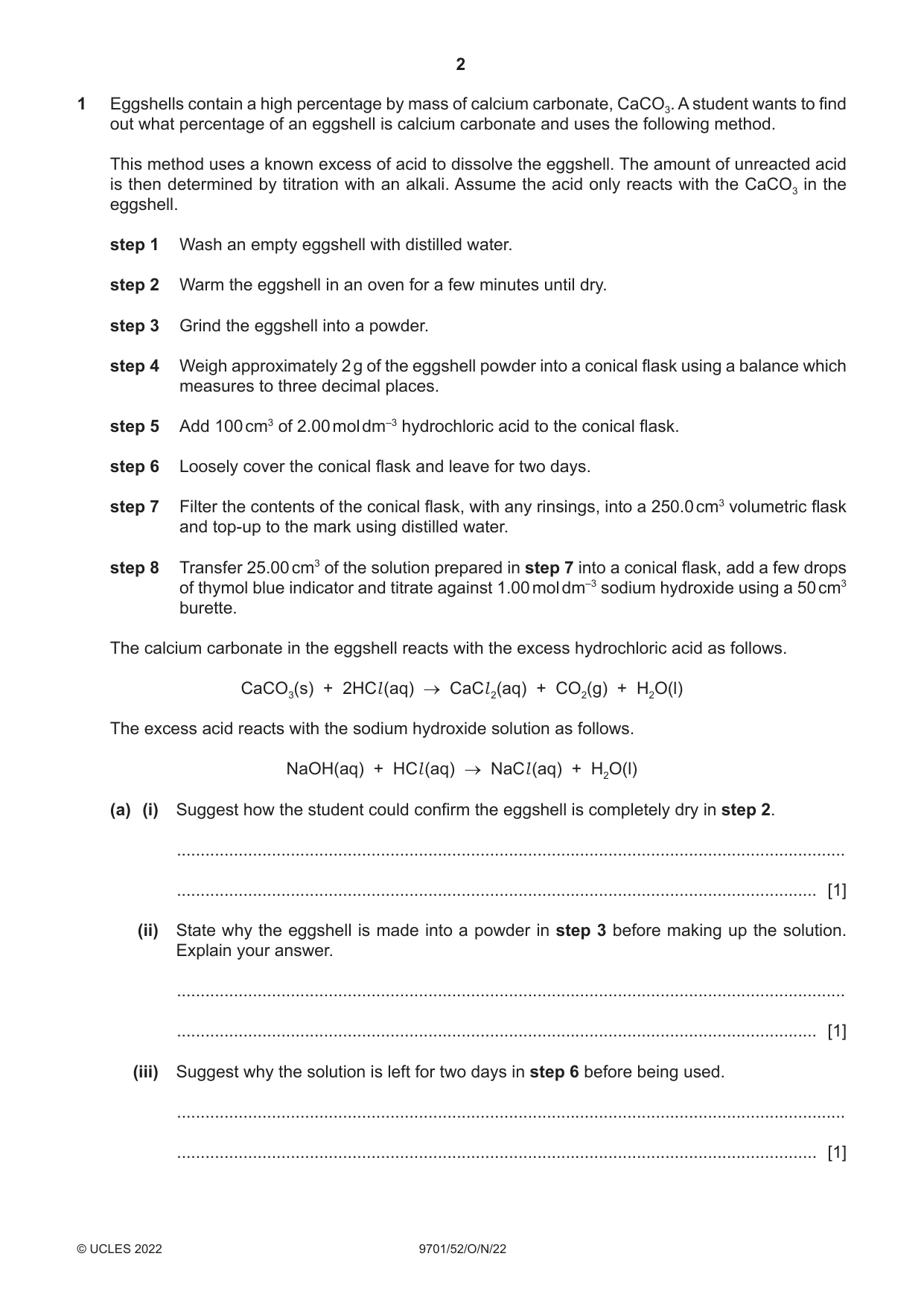
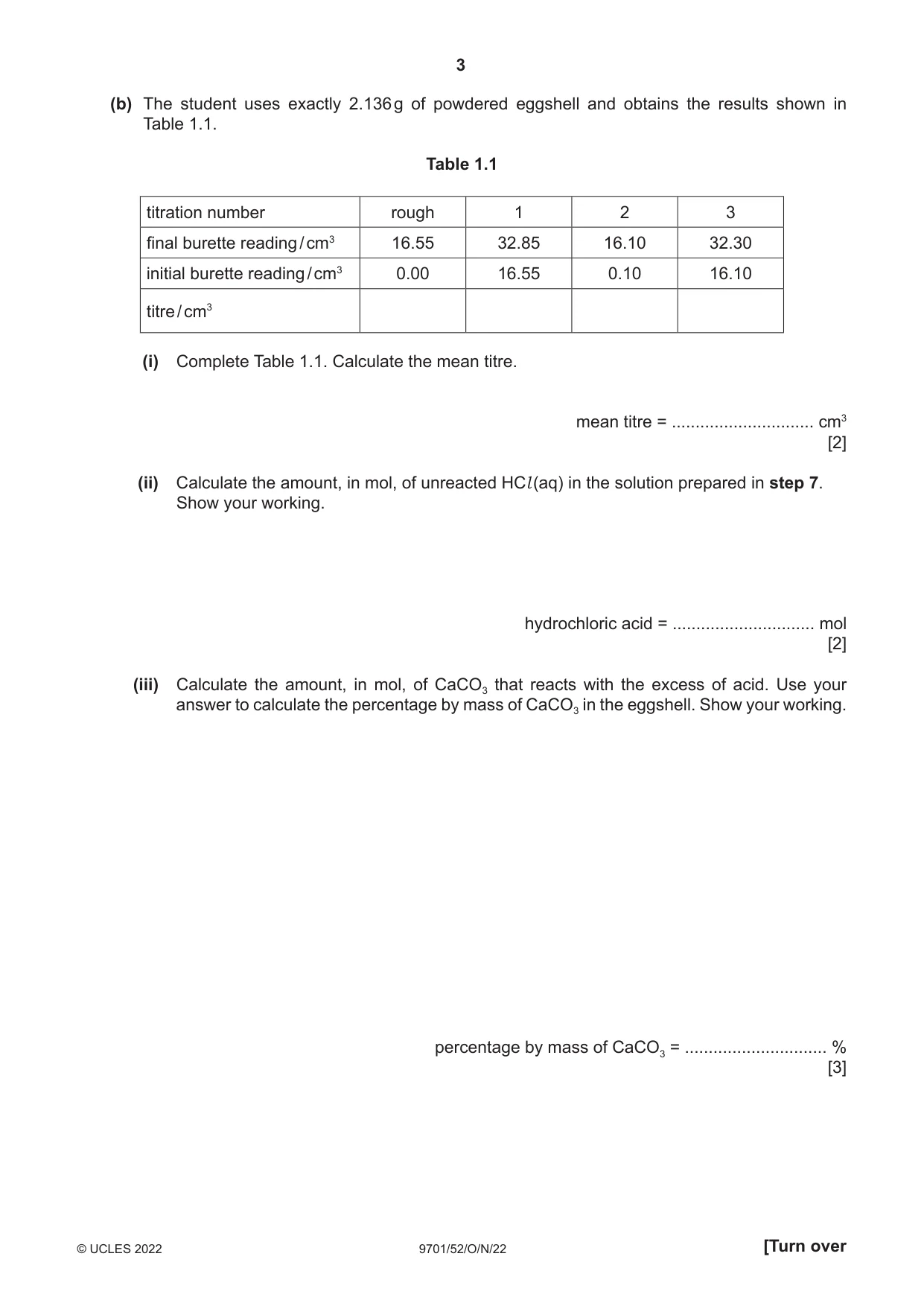
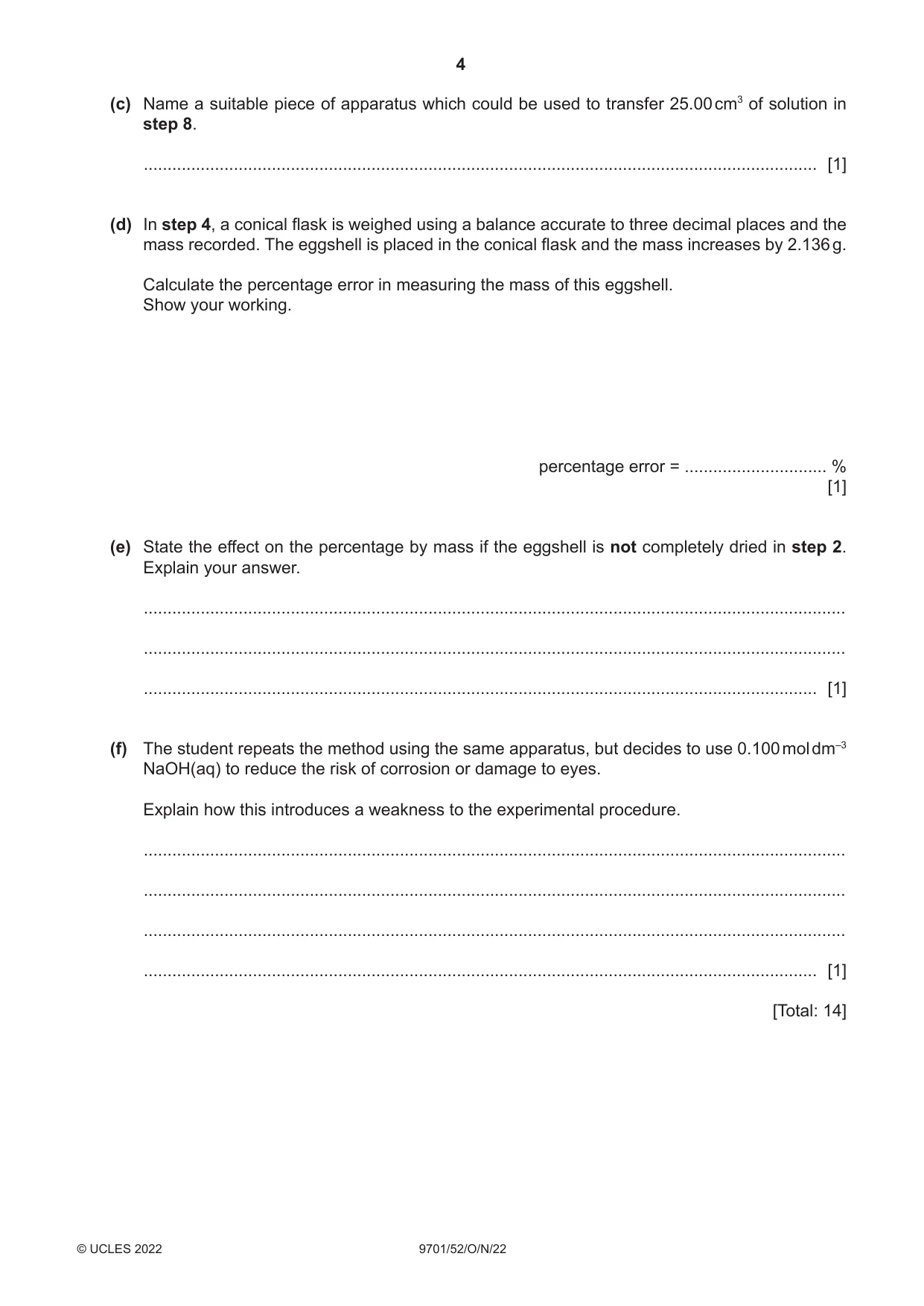
1 Eggshells contain a high percentage by mass of calcium carbonate, CaCO3. A student wants to find out what percentage of an eggshell is calcium carbonate and uses the following method. This method uses a known excess of acid to dissolve the eggshell. The amount of unreacted acid is then determined by titration with an alkali. Assume the acid only reacts with the CaCO3 in the eggshell. step 1 Wash an empty eggshell with distilled water. step 2 Warm the eggshell in an oven for a few minutes until dry. step 3 Grind the eggshell into a powder. step 4 Weigh approximately 2 g of the eggshell powder into a conical flask using a balance which measures to three decimal places. step 5 Add 100 cm3 of 2.00 mol dm–3 hydrochloric acid to the conical flask. step 6 Loosely cover the conical flask and leave for two days. step 7 Filter the contents of the conical flask, with any rinsings, into a 250.0 cm3 volumetric flask and top‑up to the mark using distilled water. step 8 Transfer 25.00 cm3 of the solution prepared in step 7 into a conical flask, add a few drops of thymol blue indicator and titrate against 1.00 mol dm–3 sodium hydroxide using a 50 cm3 burette. The calcium carbonate in the eggshell reacts with the excess hydrochloric acid as follows. CaCO3(s) + 2HCl (aq) → CaCl 2(aq) + CO2(g) + H2O(l) The excess acid reacts with the sodium hydroxide solution as follows. NaOH(aq) + HCl (aq) → NaCl (aq) + H2O(l) (a) (i) Suggest how the student could confirm the eggshell is completely dry in step 2. ............................................................................................................................................. ....................................................................................................................................... [1] (ii) State why the eggshell is made into a powder in step 3 before making up the solution. Explain your answer. ............................................................................................................................................. ....................................................................................................................................... [1] (iii) Suggest why the solution is left for two days in step 6 before being used. ............................................................................................................................................. ....................................................................................................................................... [1] (b) The student uses exactly 2.136 g of powdered eggshell and obtains the results shown in Table 1.1. Table 1.1 titration number rough 1 2 3 final burette reading / cm3 16.55 32.85 16.10 32.30 initial burette reading / cm3 0.00 16.55 0.10 16.10 titre / cm3 (i) Complete Table 1.1. Calculate the mean titre. mean titre = .............................. cm3 [2] (ii) Calculate the amount, in mol, of unreacted HCl (aq) in the solution prepared in step 7. Show your working. hydrochloric acid = .............................. mol [2] (iii) Calculate the amount, in mol, of CaCO3 that reacts with the excess of acid. Use your answer to calculate the percentage by mass of CaCO3 in the eggshell. Show your working. percentage by mass of CaCO3 = .............................. % [3] (c) Name a suitable piece of apparatus which could be used to transfer 25.00 cm3 of solution in step 8. .............................................................................................................................................. [1] (d) In step 4, a conical flask is weighed using a balance accurate to three decimal places and the mass recorded. The eggshell is placed in the conical flask and the mass increases by 2.136 g. Calculate the percentage error in measuring the mass of this eggshell. Show your working. percentage error = .............................. % [1] (e) State the effect on the percentage by mass if the eggshell is not completely dried in step 2. Explain your answer. .................................................................................................................................................... .................................................................................................................................................... .............................................................................................................................................. [1] (f) The student repeats the method using the same apparatus, but decides to use 0.100 mol dm–3 NaOH(aq) to reduce the risk of corrosion or damage to eyes. Explain how this introduces a weakness to the experimental procedure. .................................................................................................................................................... .................................................................................................................................................... .................................................................................................................................................... .............................................................................................................................................. [1] [Total: 14] Question 2 starts on the next page.
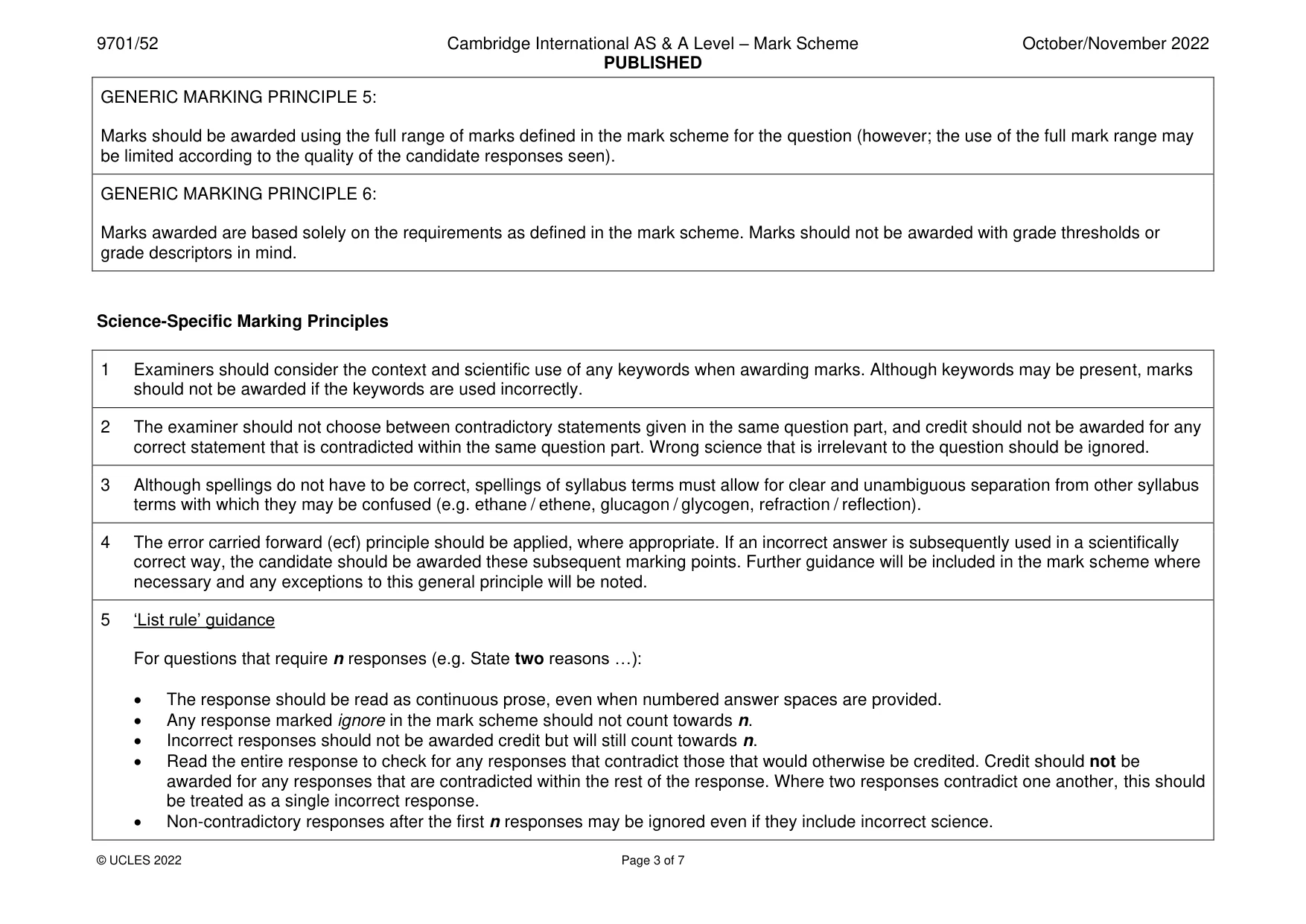
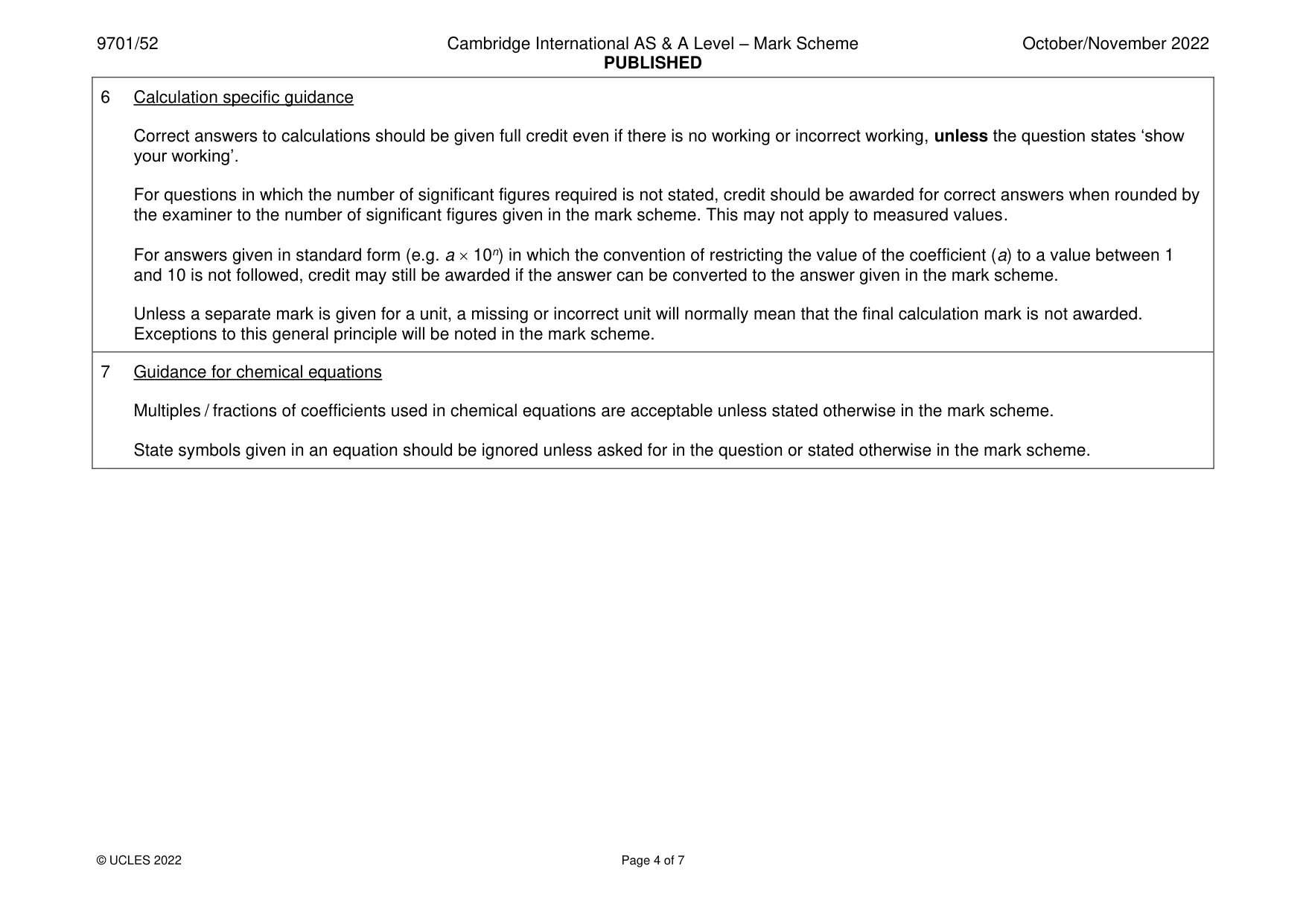
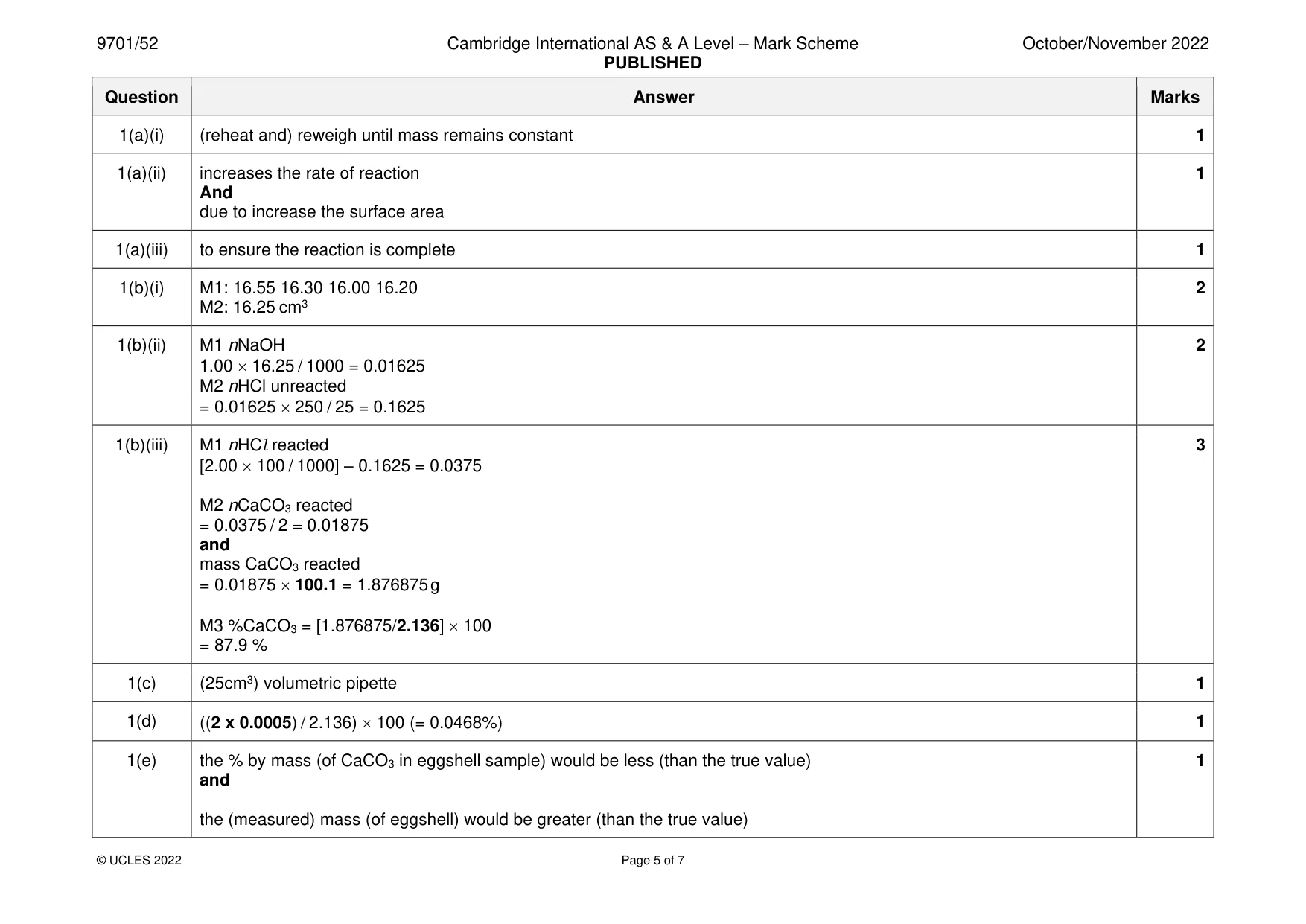
Mark scheme: Question Answer Marks 1(a)(i) (reheat and) reweigh until mass remains constant 1 1(a)(ii) increases the rate of reaction 1 And due to increase the surface area 1(a)(iii) to ensure the reaction is complete 1 1(b)(i) M1: 16.55 16.30 16.00 16.20 2 M2: 16.25 cm3 1(b)(ii) M1 nNaOH 2 1.00 16.25 / 1000 = 0.01625 M2 nHCl unreacted = 0.01625 250 / 25 = 0.1625 1(b)(iii) M1 nHCl reacted 3 [2.00 100 / 1000] – 0.1625 = 0.0375 M2 nCaCO3 reacted = 0.0375 / 2 = 0.01875 and mass CaCO3 reacted = 0.01875 100.1 = 1.876875 g M3 %CaCO3 = [1.876875/2.136] 100 = 87.9 % 1(c) (25cm3) volumetric pipette 1 1(d) ((2 x 0.0005) / 2.136) 100 (= 0.0468%) 1 1(e) the % by mass (of CaCO3 in eggshell sample) would be less (than the true value) 1 and the (measured) mass (of eggshell) would be greater (than the true value) 1(f) volume of NaOH would be 162.5 cm3 1 (which is too large for a 50 cm3 burette)
More questions on Reacting masses and volumes (of solutions and gases)
Q2 · It is possible to measure the rate at which potassium manganate(VII), KMnO4(aq), Mr =…
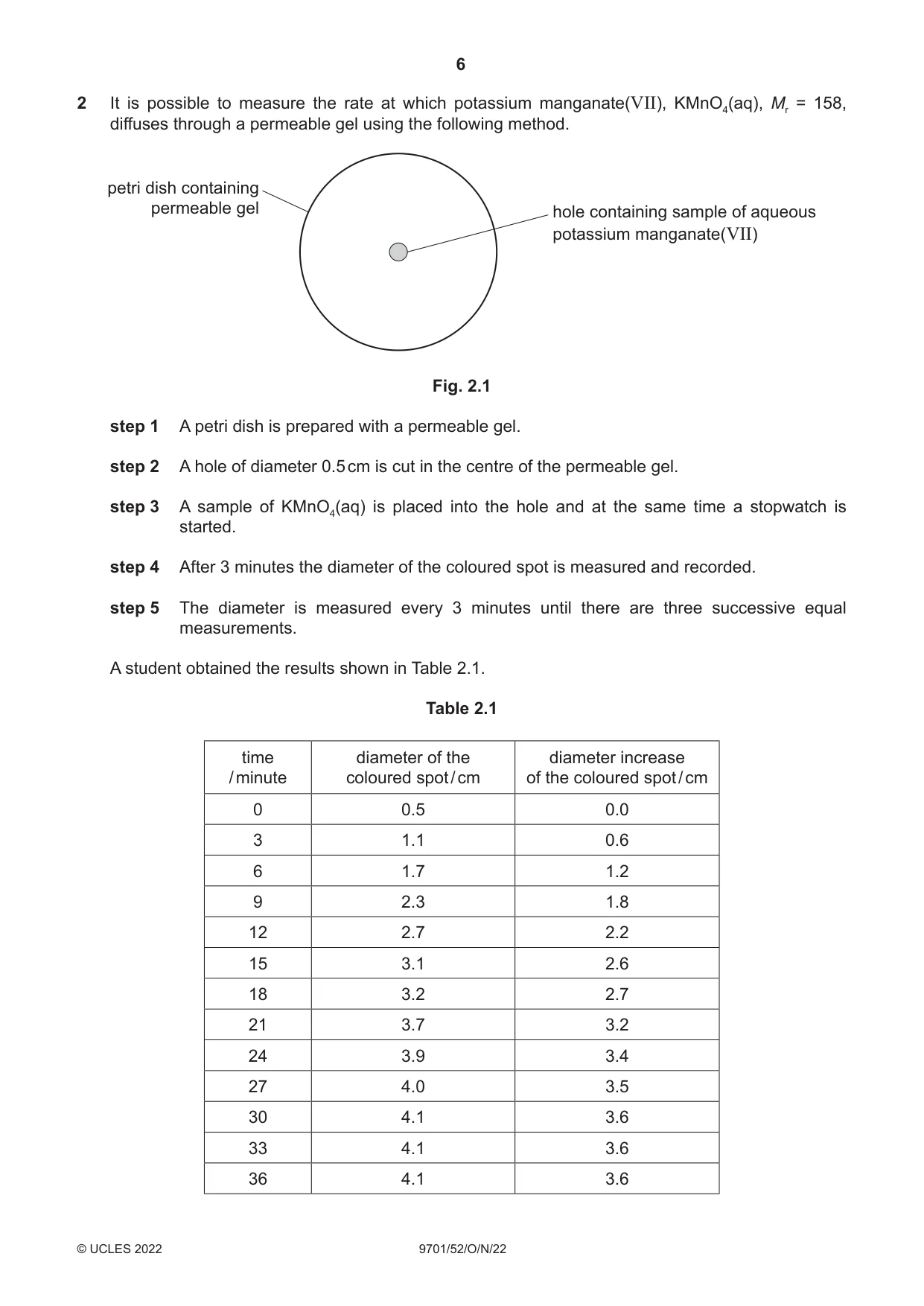
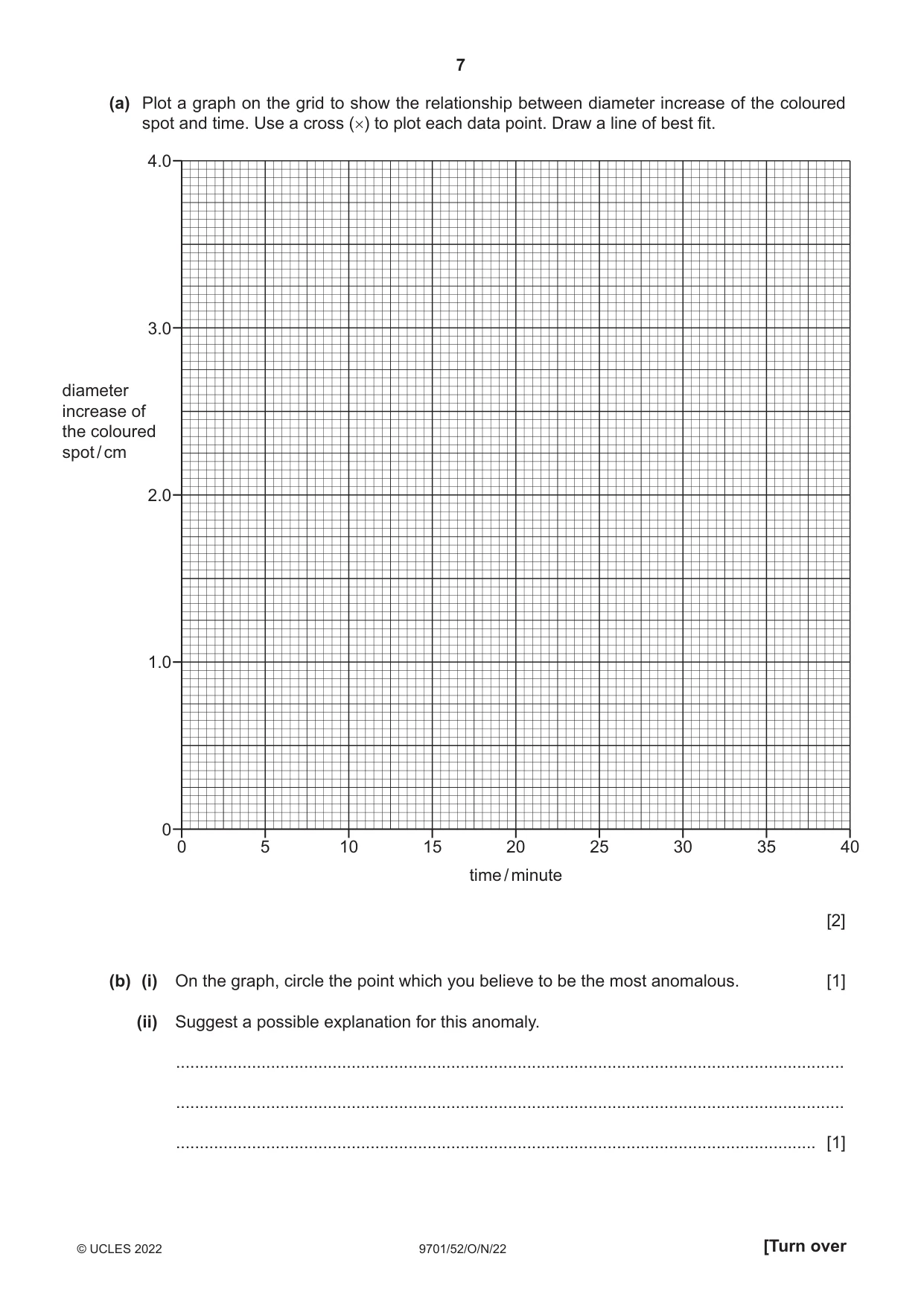
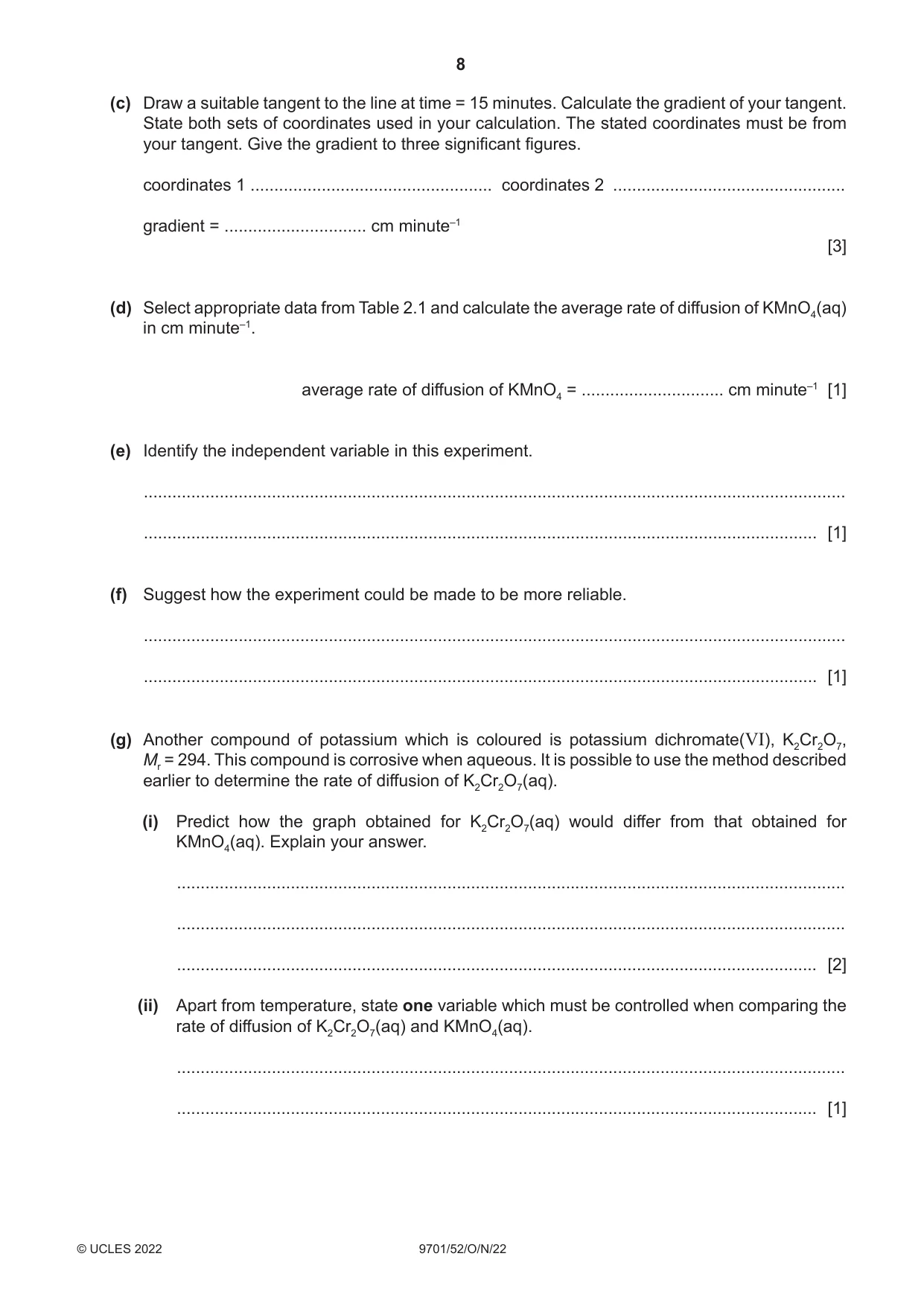
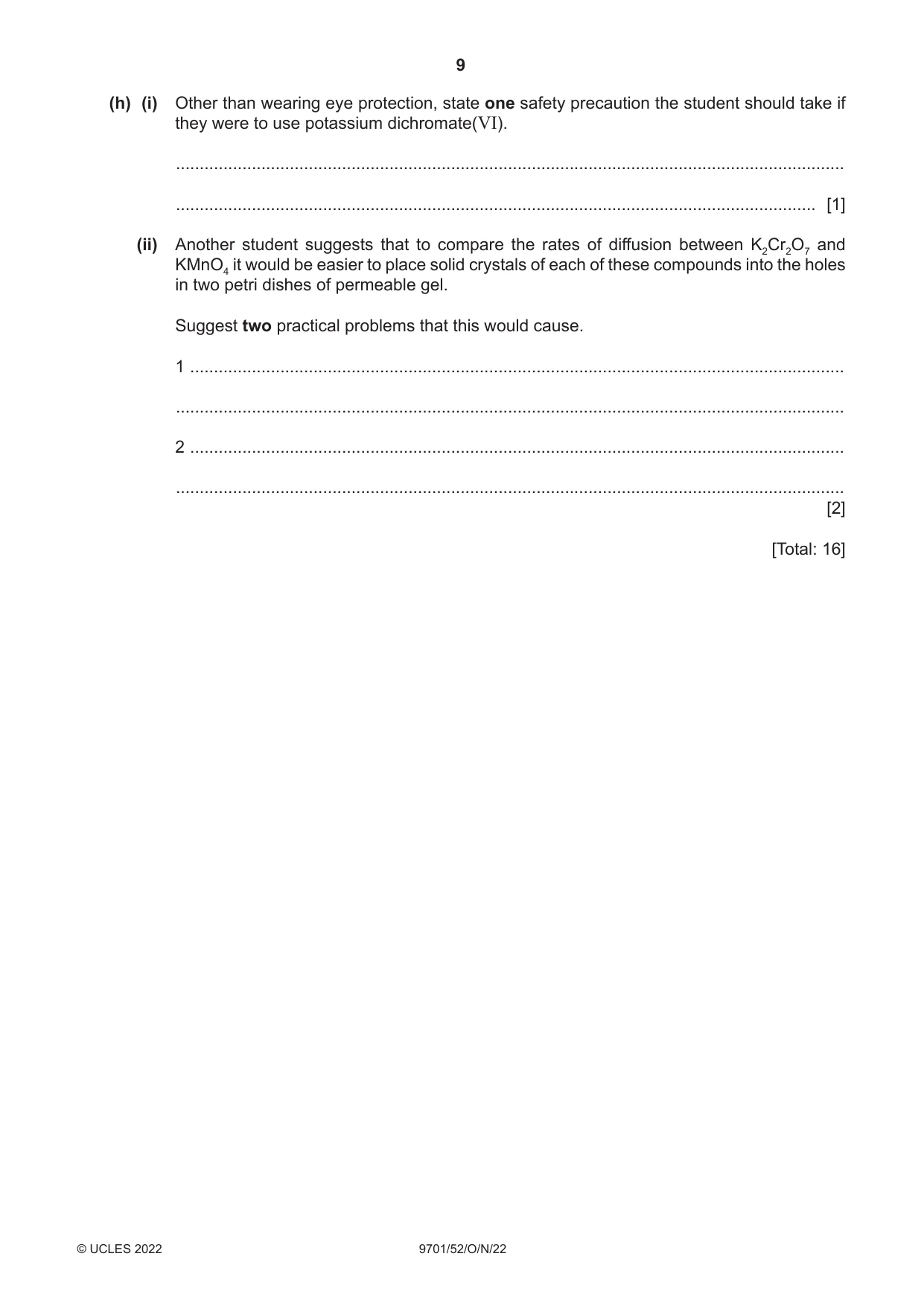
2 It is possible to measure the rate at which potassium manganate(VII), KMnO4(aq), Mr = 158, diffuses through a permeable gel using the following method. petri dish containing permeable gel hole containing sample of aqueous potassium manganate(VII) Fig. 2.1 step 1 A petri dish is prepared with a permeable gel. step 2 A hole of diameter 0.5 cm is cut in the centre of the permeable gel. step 3 A sample of KMnO4(aq) is placed into the hole and at the same time a stopwatch is started. step 4 After 3 minutes the diameter of the coloured spot is measured and recorded. step 5 The diameter is measured every 3 minutes until there are three successive equal measurements. A student obtained the results shown in Table 2.1. Table 2.1 time diameter of the diameter increase / minute coloured spot / cm of the coloured spot / cm 0 0.5 0.0 3 1.1 0.6 6 1.7 1.2 9 2.3 1.8 12 2.7 2.2 15 3.1 2.6 18 3.2 2.7 21 3.7 3.2 24 3.9 3.4 27 4.0 3.5 30 4.1 3.6 33 4.1 3.6 36 4.1 3.6 (a) Plot a graph on the grid to show the relationship between diameter increase of the coloured spot and time. Use a cross (×) to plot each data point. Draw a line of best fit. 4.0 3.0 diameter increase of the coloured spot / cm 2.0 1.0 0 0 5 10 15 20 25 30 35 40 time / minute [2] (b) (i) On the graph, circle the point which you believe to be the most anomalous. [1] (ii) Suggest a possible explanation for this anomaly. ............................................................................................................................................. ............................................................................................................................................. ....................................................................................................................................... [1] (c) Draw a suitable tangent to the line at time = 15 minutes. Calculate the gradient of your tangent. State both sets of coordinates used in your calculation. The stated coordinates must be from your tangent. Give the gradient to three significant figures. coordinates 1 ................................................... coordinates 2 .................................................. gradient = .............................. cm minute–1 [3] (d) Select appropriate data from Table 2.1 and calculate the average rate of diffusion of KMnO4(aq) in cm minute–1. average rate of diffusion of KMnO4 = .............................. cm minute–1 [1] (e) Identify the independent variable in this experiment. .................................................................................................................................................... .............................................................................................................................................. [1] (f) Suggest how the experiment could be made to be more reliable. .................................................................................................................................................... .............................................................................................................................................. [1] (g) Another compound of potassium which is coloured is potassium dichromate(VI), K2Cr2O7, Mr = 294. This compound is corrosive when aqueous. It is possible to use the method described earlier to determine the rate of diffusion of K2Cr2O7(aq). (i) Predict how the graph obtained for K2Cr2O7(aq) would differ from that obtained for KMnO4(aq). Explain your answer. ............................................................................................................................................. ............................................................................................................................................. ....................................................................................................................................... [2] (ii) Apart from temperature, state one variable which must be controlled when comparing the rate of diffusion of K2Cr2O7(aq) and KMnO4(aq). ............................................................................................................................................. ....................................................................................................................................... [1]
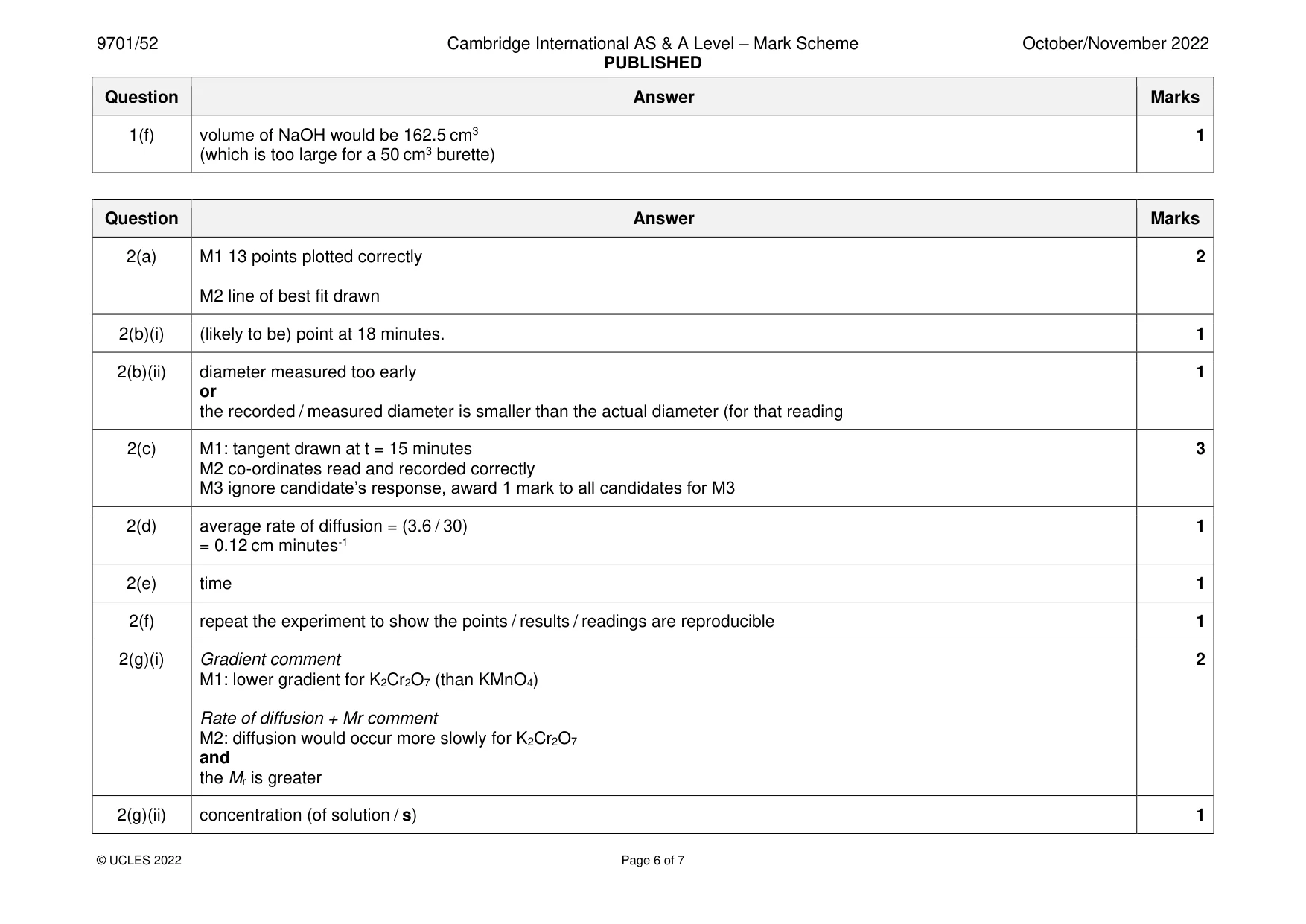
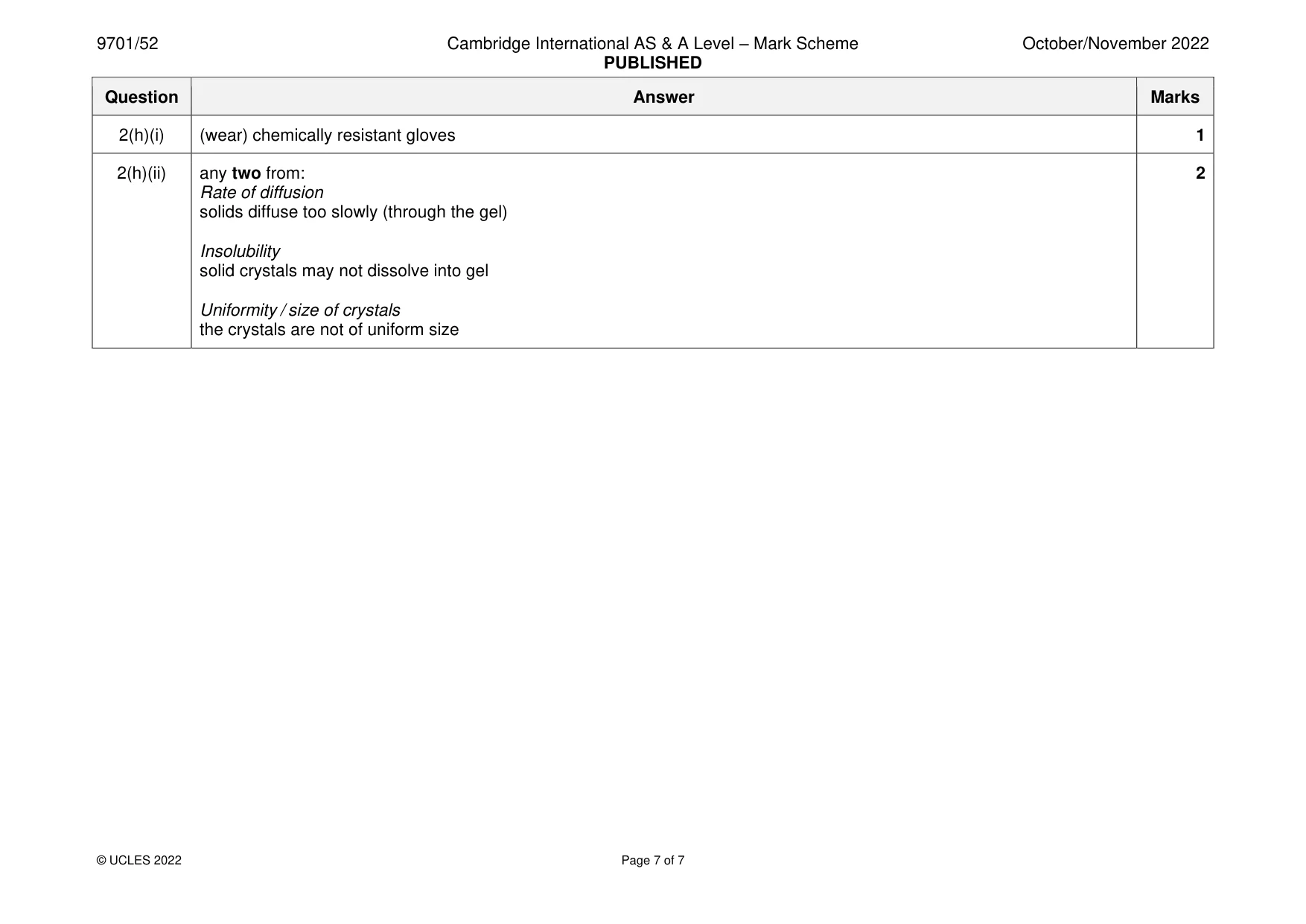
Mark scheme: 2(a) M1 13 points plotted correctly 2 M2 line of best fit drawn 2(b)(i) (likely to be) point at 18 minutes. 1 2(b)(ii) diameter measured too early 1 or the recorded / measured diameter is smaller than the actual diameter (for that reading 2(c) M1: tangent drawn at t = 15 minutes 3 M2 co-ordinates read and recorded correctly M3 ignore candidate’s response, award 1 mark to all candidates for M3 2(d) average rate of diffusion = (3.6 / 30) 1 = 0.12 cm minutes-1 2(e) time 1 2(f) repeat the experiment to show the points / results / readings are reproducible 1 2(g)(i) Gradient comment 2 M1: lower gradient for K2Cr2O7 (than KMnO4) Rate of diffusion + Mr comment M2: diffusion would occur more slowly for K2Cr2O7 and the Mr is greater 2(g)(ii) concentration (of solution / s) 1 2(h)(i) (wear) chemically resistant gloves 1 2(h)(ii) any two from: 2 Rate of diffusion solids diffuse too slowly (through the gel) Insolubility solid crystals may not dissolve into gel Uniformity / size of crystals the crystals are not of uniform size
What was in this paper
The subtopics covered by these 2 questions, and how many questions each got. Open one in a new tab to see every Cambridge question on it.
What you needed in this session
Cambridge’s own grade thresholds for 2022 Oct/Nov, Paper 5 · Variant 2. A higher threshold means an easier paper — the bar moves with how the cohort did.