Cambridge A Level Chemistry 9701 — 2019 Oct/Nov Paper 2 · Variant 2
9701/22/O/N/19 · 4 questions · 60 marks · ≈68 min
The question paper and its mark scheme, free to read here and free to download. This is Cambridge’s own paper, exactly as it was sat.
Question paper16 pages
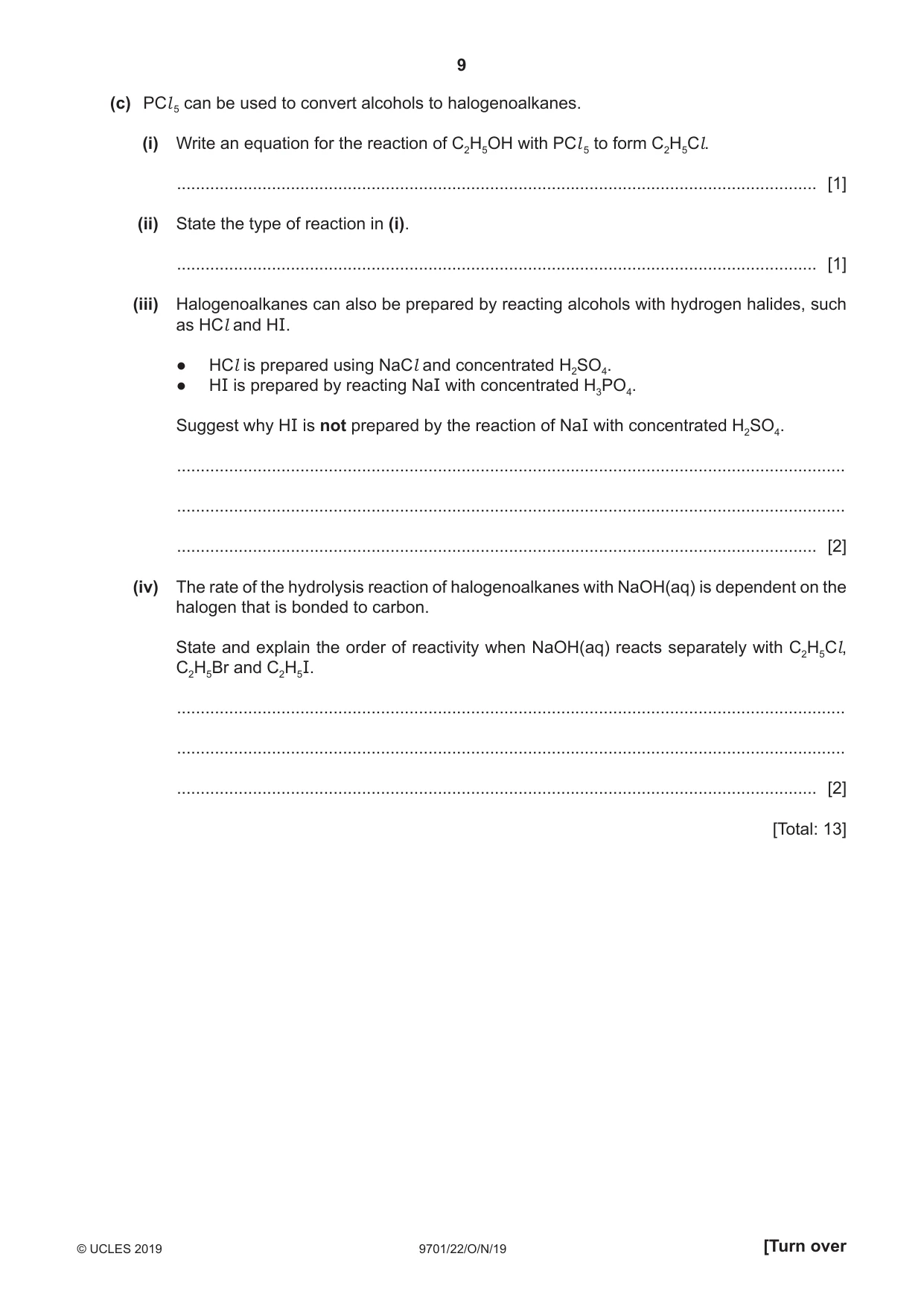
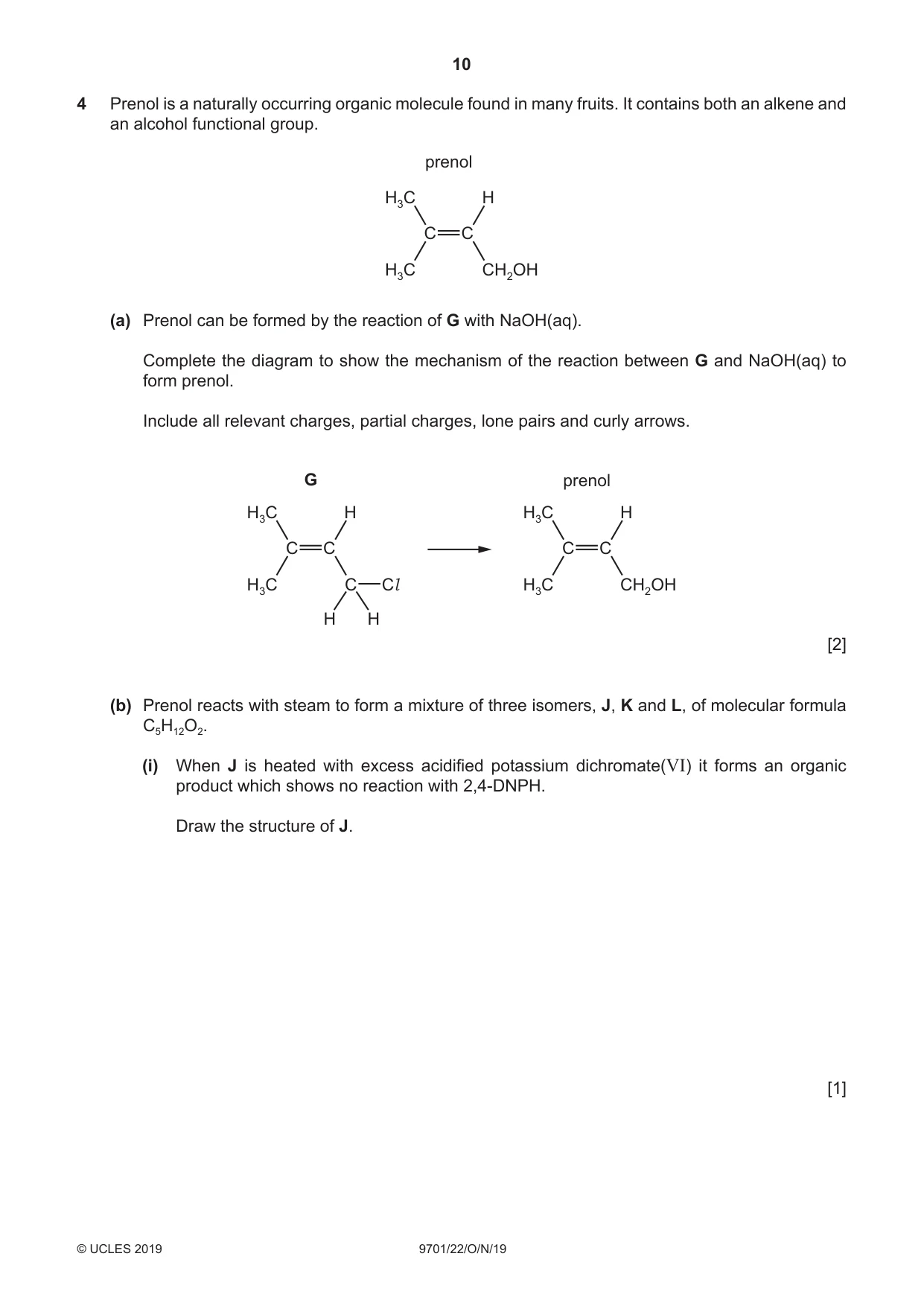
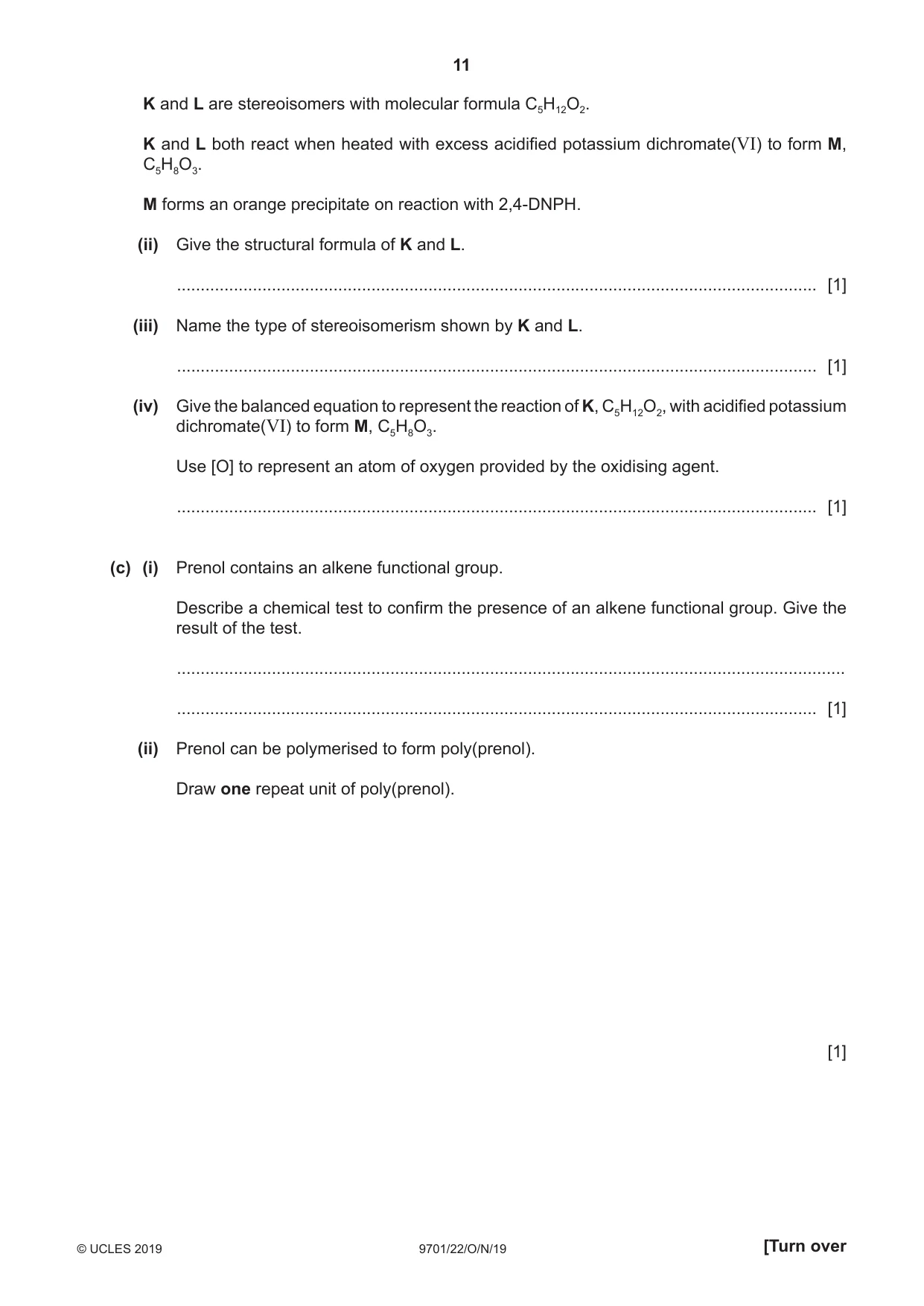
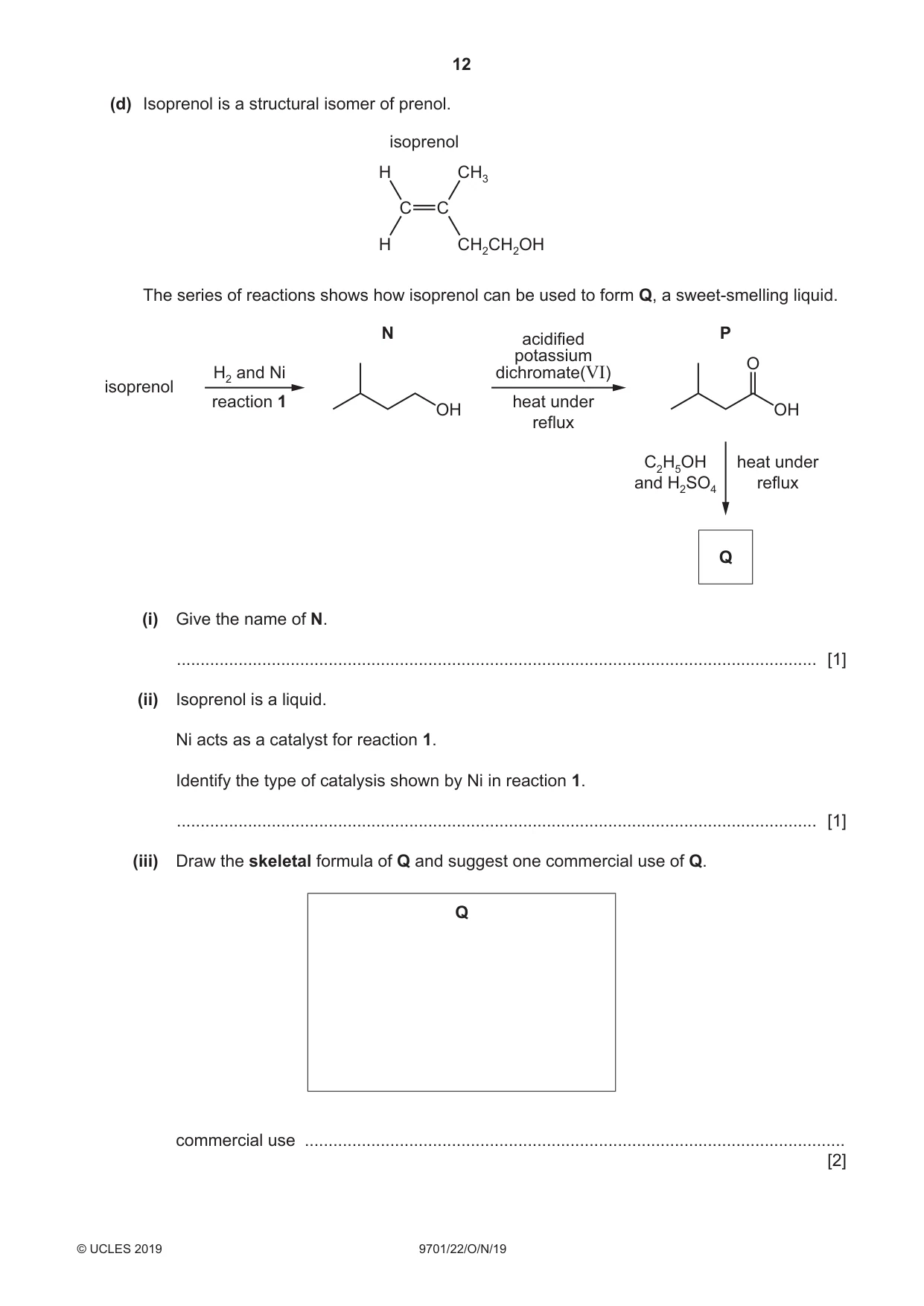


Mark scheme10 pages
Answers below. Sit the paper first if you are practising.
Questions as text
Q1 · In the Periodic Table, the p block contains elements whose outer electrons are found in…
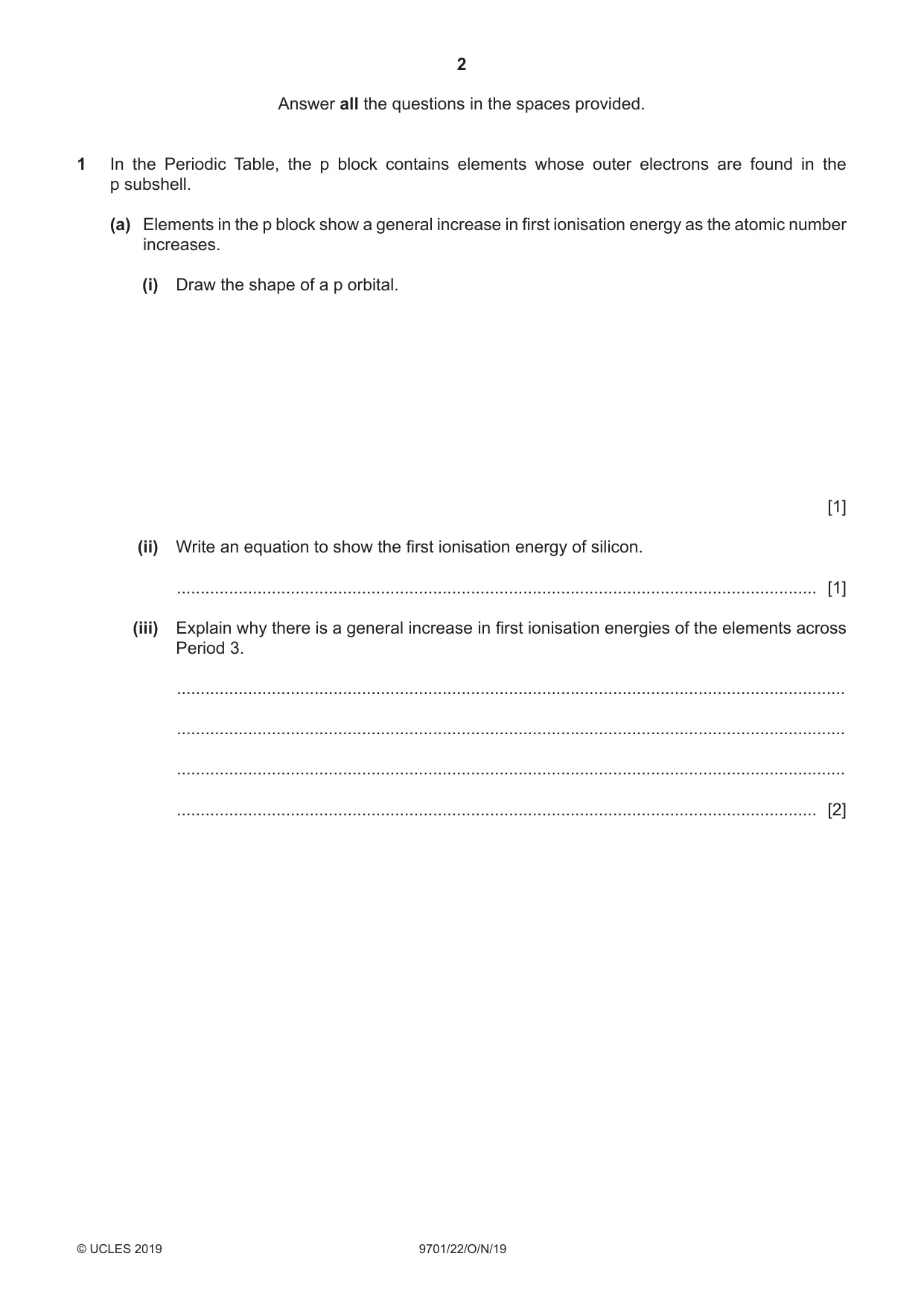
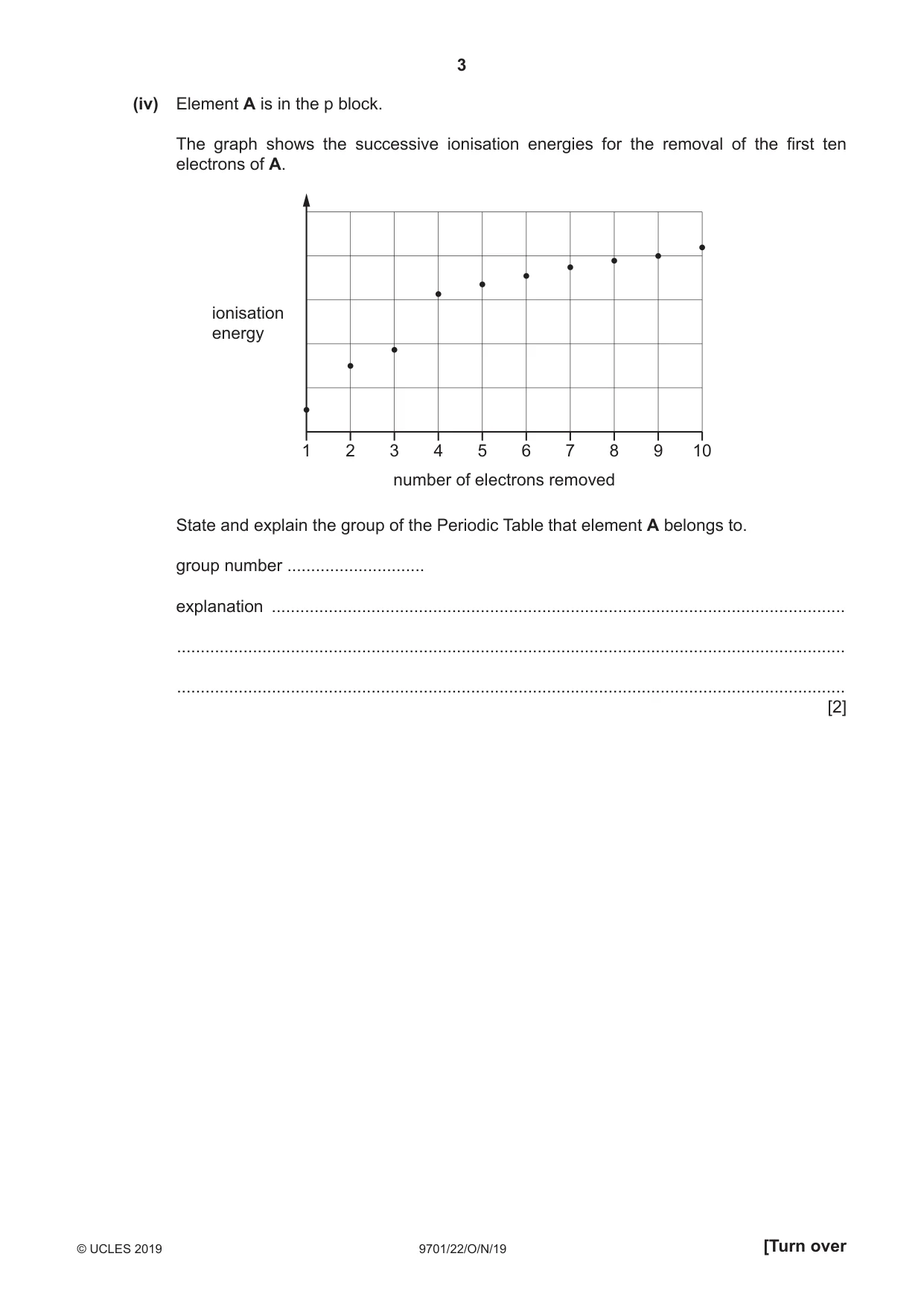
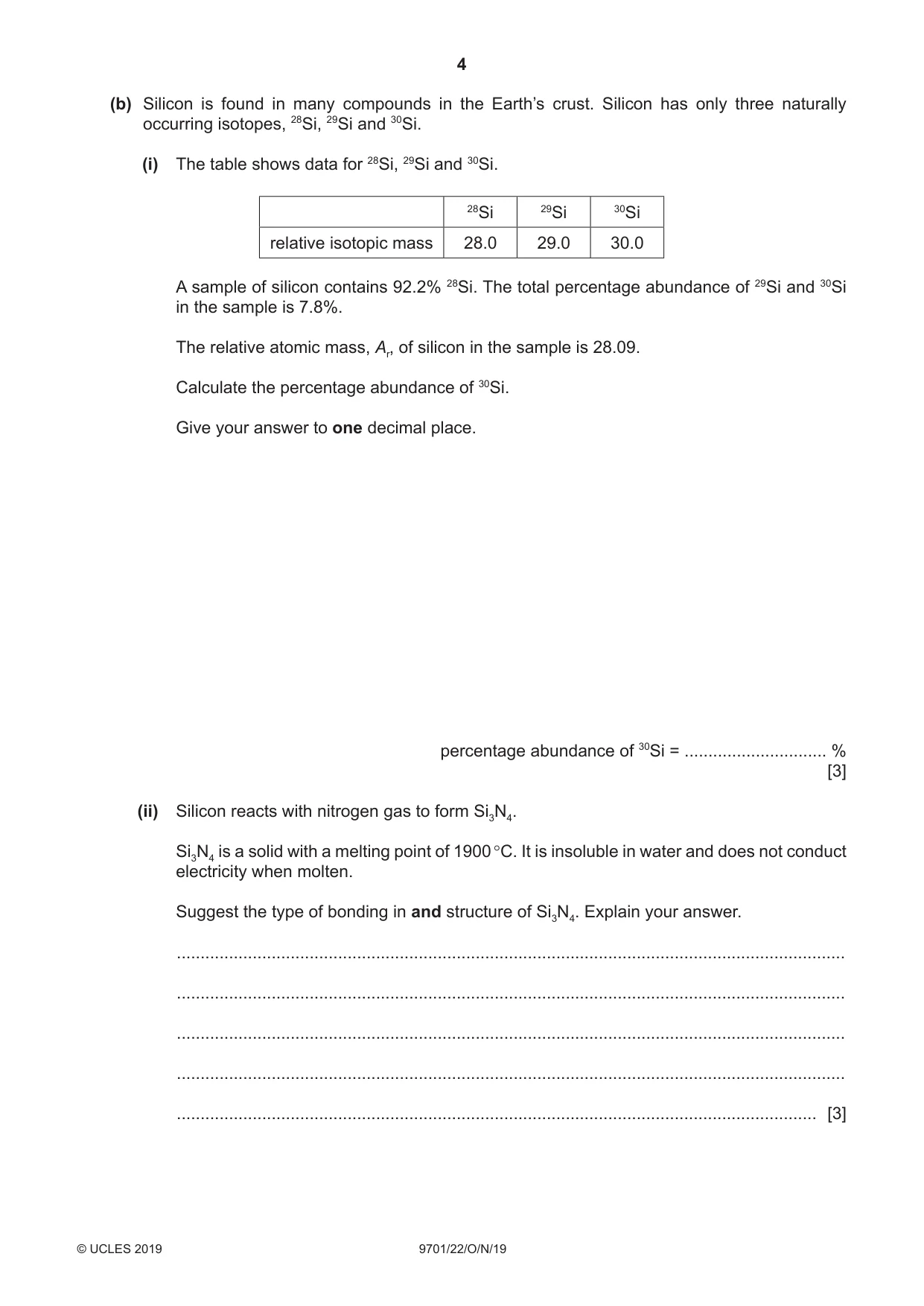
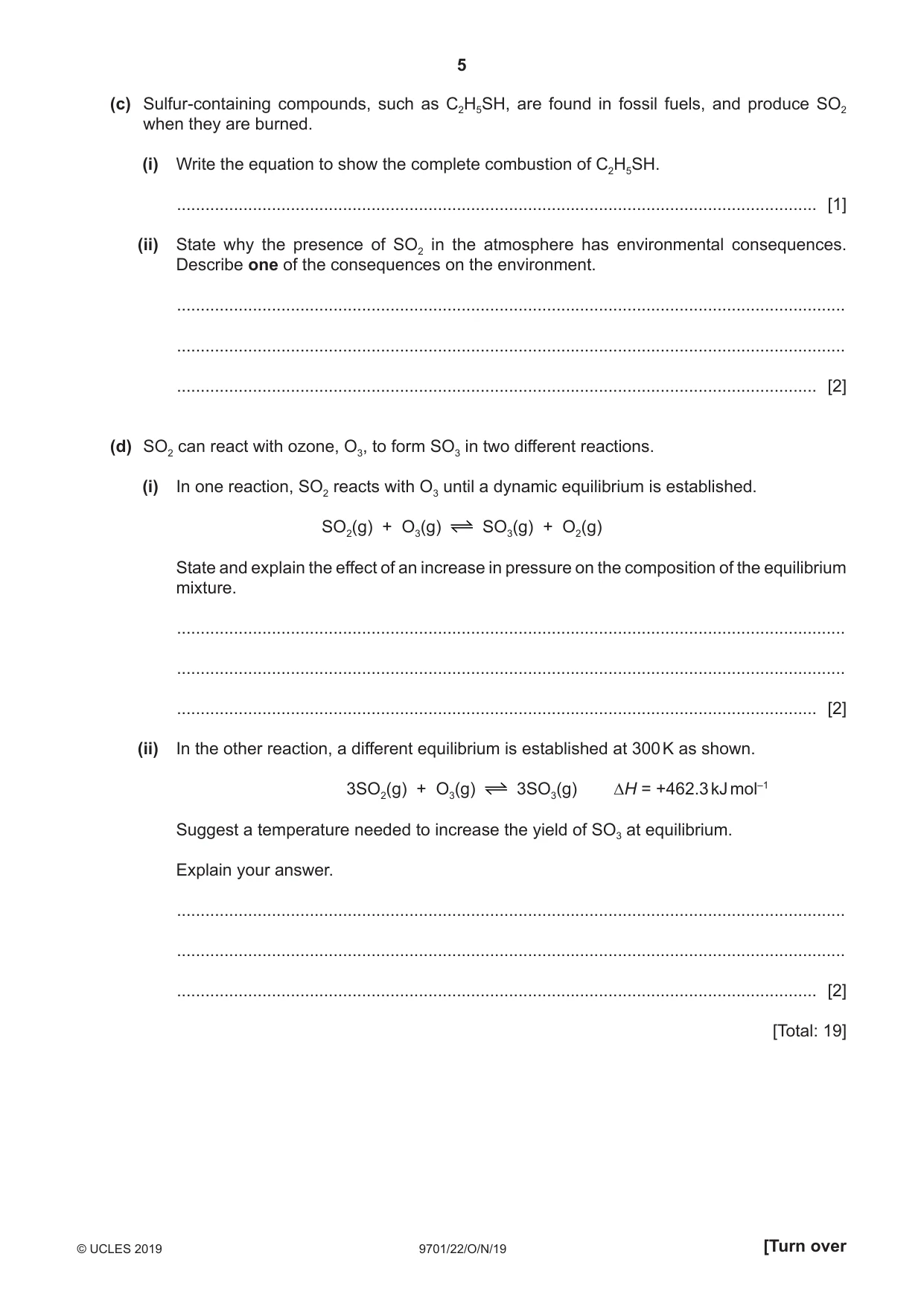
1 In the Periodic Table, the p block contains elements whose outer electrons are found in the p subshell. (a) Elements in the p block show a general increase in first ionisation energy as the atomic number increases. (i) Draw the shape of a p orbital. [1] (ii) Write an equation to show the first ionisation energy of silicon. ....................................................................................................................................... [1] (iii) Explain why there is a general increase in first ionisation energies of the elements across Period 3. ............................................................................................................................................. ............................................................................................................................................. ............................................................................................................................................. ....................................................................................................................................... [2] (iv) Element A is in the p block. The graph shows the successive ionisation energies for the removal of the first ten electrons of A. ionisation energy 1 2 3 4 5 6 7 8 9 10 number of electrons removed State and explain the group of the Periodic Table that element A belongs to. group number ............................. explanation .......................................................................................................................... ............................................................................................................................................. ............................................................................................................................................. [2] (b) Silicon is found in many compounds in the Earth’s crust. Silicon has only three naturally occurring isotopes, 28Si, 29Si and 30Si. (i) The table shows data for 28Si, 29Si and 30Si. 28Si 29Si 30Si relative isotopic mass 28.0 29.0 30.0 A sample of silicon contains 92.2% 28Si. The total percentage abundance of 29Si and 30Si in the sample is 7.8%. The relative atomic mass, Ar, of silicon in the sample is 28.09. Calculate the percentage abundance of 30Si. Give your answer to one decimal place. percentage abundance of 30Si = .............................. % [3] (ii) Silicon reacts with nitrogen gas to form Si3N4. Si3N4 is a solid with a melting point of 1900 °C. It is insoluble in water and does not conduct electricity when molten. Suggest the type of bonding in and structure of Si3N4. Explain your answer. ............................................................................................................................................. ............................................................................................................................................. ............................................................................................................................................. ............................................................................................................................................. ....................................................................................................................................... [3] (c) Sulfur-containing compounds, such as C2H5SH, are found in fossil fuels, and produce SO2 when they are burned. (i) Write the equation to show the complete combustion of C2H5SH. ....................................................................................................................................... [1] (ii) State why the presence of SO2 in the atmosphere has environmental consequences. Describe one of the consequences on the environment. ............................................................................................................................................. ............................................................................................................................................. ....................................................................................................................................... [2] (d) SO2 can react with ozone, O3, to form SO3 in two different reactions. (i) In one reaction, SO2 reacts with O3 until a dynamic equilibrium is established. SO2(g) + O3(g) SO3(g) + O2(g) State and explain the effect of an increase in pressure on the composition of the equilibrium mixture. ............................................................................................................................................. ............................................................................................................................................. ....................................................................................................................................... [2] (ii) In the other reaction, a different equilibrium is established at 300 K as shown. 3SO2(g) + O3(g) 3SO3(g) ΔH = +462.3 kJ mol–1 Suggest a temperature needed to increase the yield of SO3 at equilibrium. Explain your answer. ............................................................................................................................................. ............................................................................................................................................. ....................................................................................................................................... [2] [Total: 19]
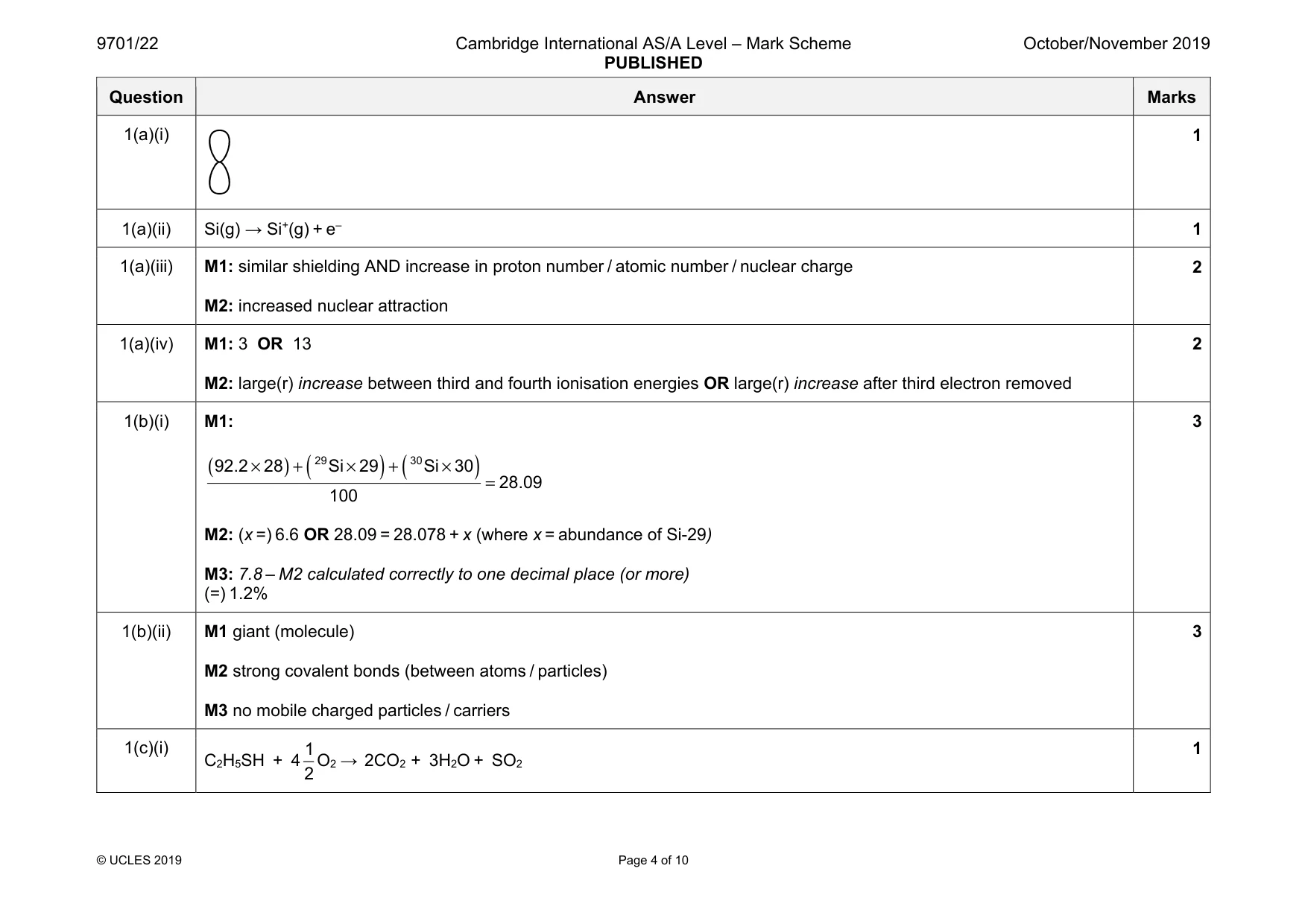
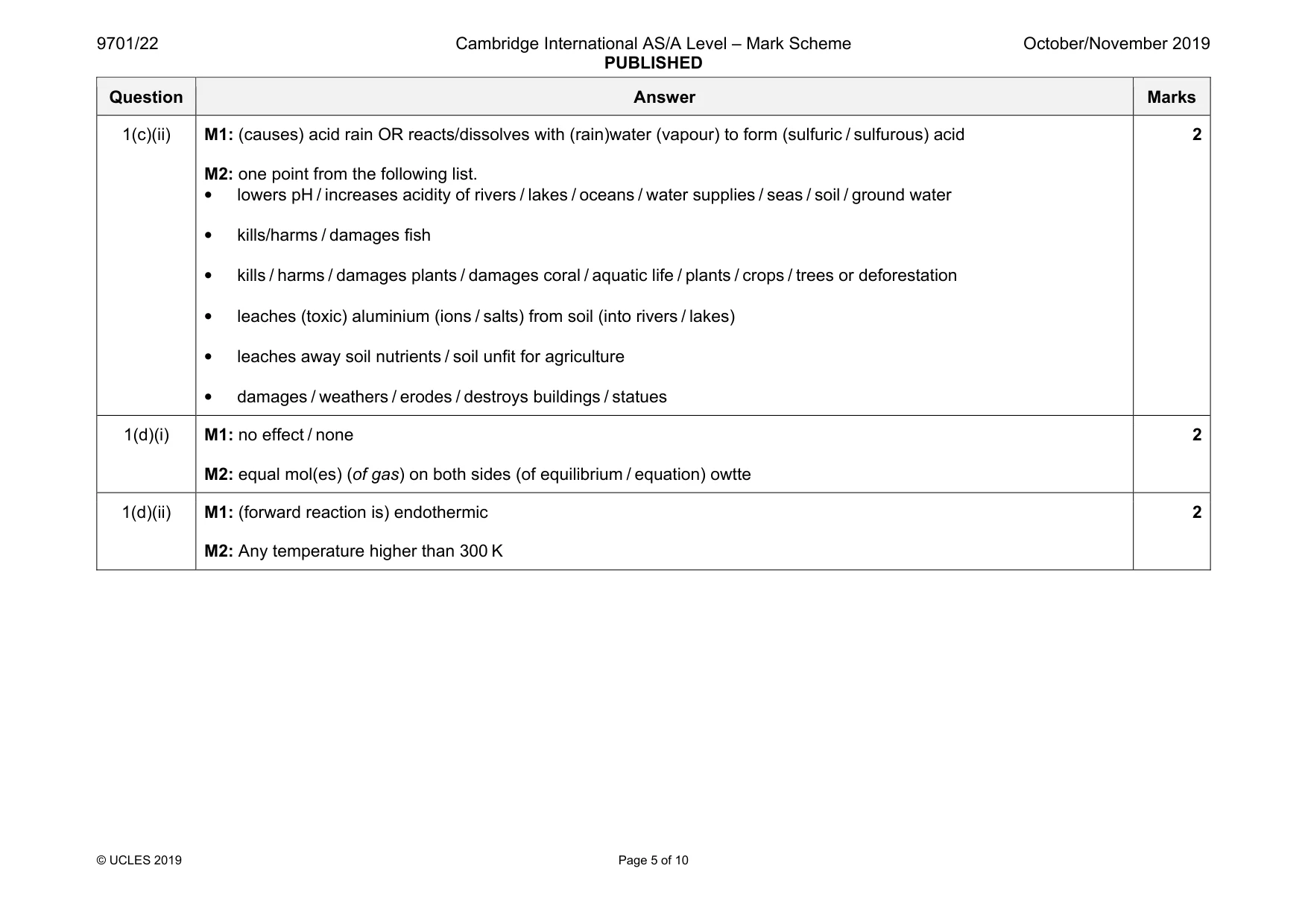
Mark scheme: 1(a)(i) 1 1(a)(ii) Si(g) → Si+(g) + e– 1 1(a)(iii) M1: similar shielding AND increase in proton number / atomic number / nuclear charge M2: increased nuclear attraction 2 1(a)(iv) M1: 3 OR 13 M2: large(r) increase between third and fourth ionisation energies OR large(r) increase after third electron removed 2 1(b)(i) M1: ( ) ( ) ( ) 29 30 92.2 28 Si 29 Si 30 28.09 100 × + × + × = M2: (x =) 6.6 OR 28.09 = 28.078 + x (where x = abundance of Si-29) M3: 7.8 – M2 calculated correctly to one decimal place (or more) (=) 1.2% 3 1(b)(ii) M1 giant (molecule) M2 strong covalent bonds (between atoms / particles) M3 no mobile charged particles / carriers 3 1(c)(i) C2H5SH + 4 1 2 O2 → 2CO2 + 3H2O + SO2 1 Question Answer Marks 1(c)(ii) M1: (causes) acid rain OR reacts/dissolves with (rain)water (vapour) to form (sulfuric / sulfurous) acid M2: one point from the following list. • lowers pH / increases acidity of rivers / lakes / oceans / water supplies / seas / soil / ground water • kills/harms / damages fish • kills / harms / damages plants / damages coral / aquatic life / plants / crops / trees or deforestation • leaches (toxic) aluminium (ions / salts) from soil (into rivers / lakes) • leaches away soil nutrients / soil unfit for agriculture • damages / weathers / erodes / destroys buildings / statues 2 1(d)(i) M1: no effect / none M2: equal mol(es) (of gas) on both sides (of equilibrium / equation) owtte 2 1(d)(ii) M1: (forward reaction is) endothermic M2: Any temperature higher than 300 K 2
Q2 · Oxygen is the most abundant element in the Earth’s crust
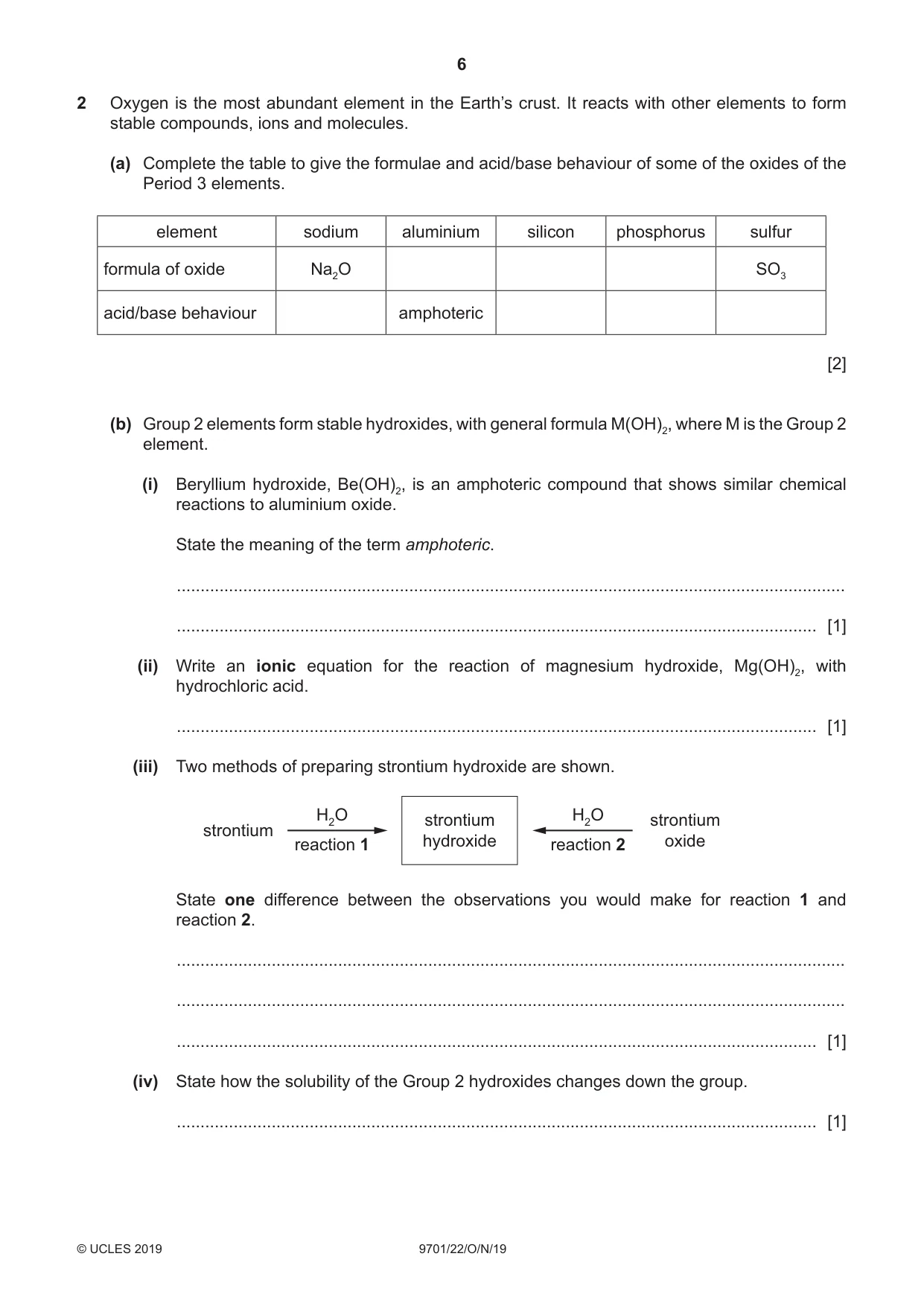
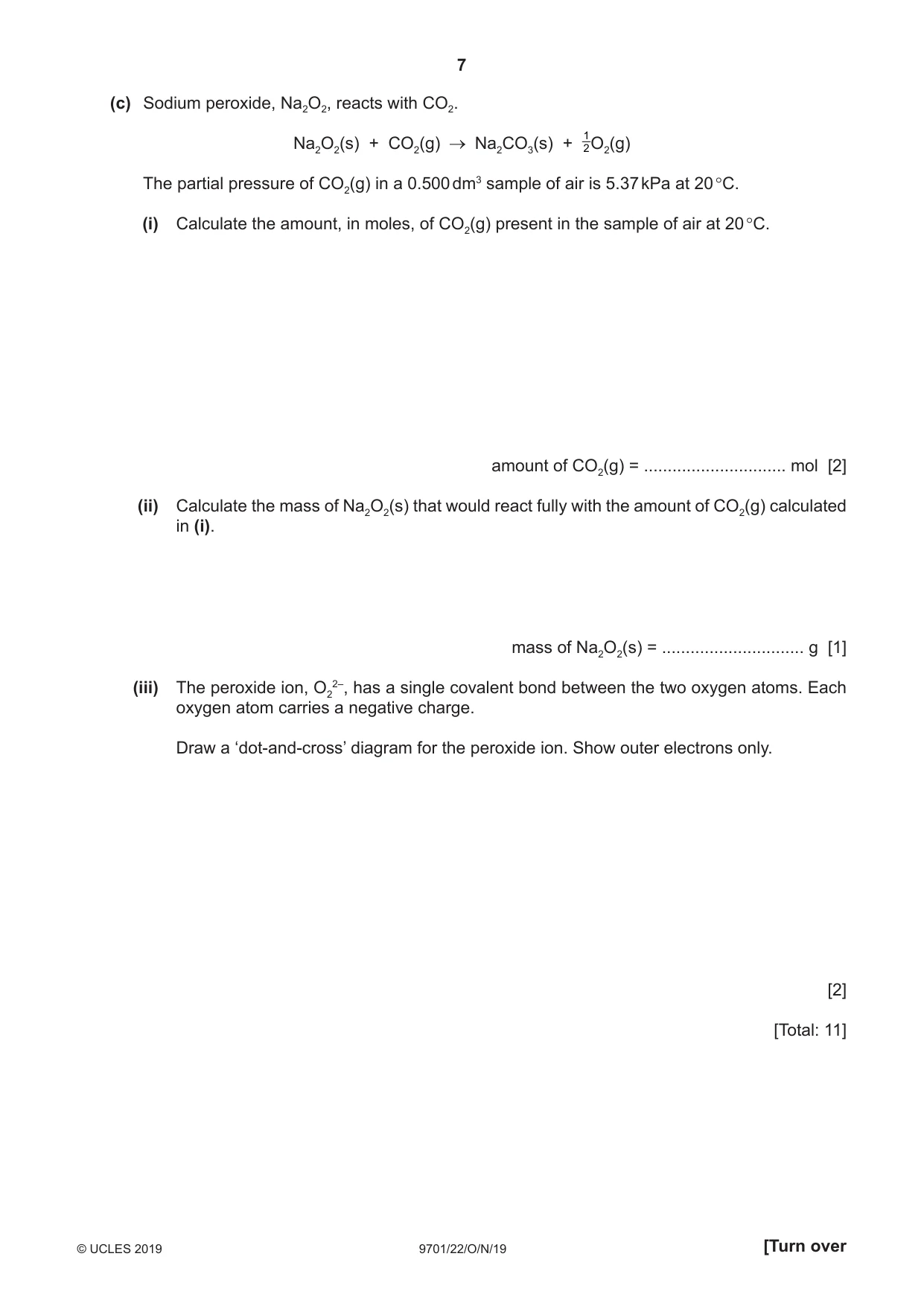
2 Oxygen is the most abundant element in the Earth’s crust. It reacts with other elements to form stable compounds, ions and molecules. (a) Complete the table to give the formulae and acid/base behaviour of some of the oxides of the Period 3 elements. element sodium aluminium silicon phosphorus sulfur formula of oxide Na2O SO3 acid/base behaviour amphoteric [2] (b) Group 2 elements form stable hydroxides, with general formula M(OH)2, where M is the Group 2 element. (i) Beryllium hydroxide, Be(OH)2, is an amphoteric compound that shows similar chemical reactions to aluminium oxide. State the meaning of the term amphoteric. ............................................................................................................................................. ....................................................................................................................................... [1] (ii) Write an ionic equation for the reaction of magnesium hydroxide, Mg(OH)2, with hydrochloric acid. ....................................................................................................................................... [1] (iii) Two methods of preparing strontium hydroxide are shown. H2O strontium H2O strontium strontium reaction 1 hydroxide reaction 2 oxide State one difference between the observations you would make for reaction 1 and reaction 2. ............................................................................................................................................. ............................................................................................................................................. ....................................................................................................................................... [1] (iv) State how the solubility of the Group 2 hydroxides changes down the group. ....................................................................................................................................... [1] (c) Sodium peroxide, Na2O2, reacts with CO2. Na2O2(s) + CO2(g) Na2CO3(s) + 12O2(g) The partial pressure of CO2(g) in a 0.500 dm3 sample of air is 5.37 kPa at 20 °C. (i) Calculate the amount, in moles, of CO2(g) present in the sample of air at 20 °C. amount of CO2(g) = .............................. mol [2] (ii) Calculate the mass of Na2O2(s) that would react fully with the amount of CO2(g) calculated in (i). mass of Na2O2(s) = .............................. g [1] (iii) The peroxide ion, O22–, has a single covalent bond between the two oxygen atoms. Each oxygen atom carries a negative charge. Draw a ‘dot-and-cross’ diagram for the peroxide ion. Show outer electrons only. [2] [Total: 11]
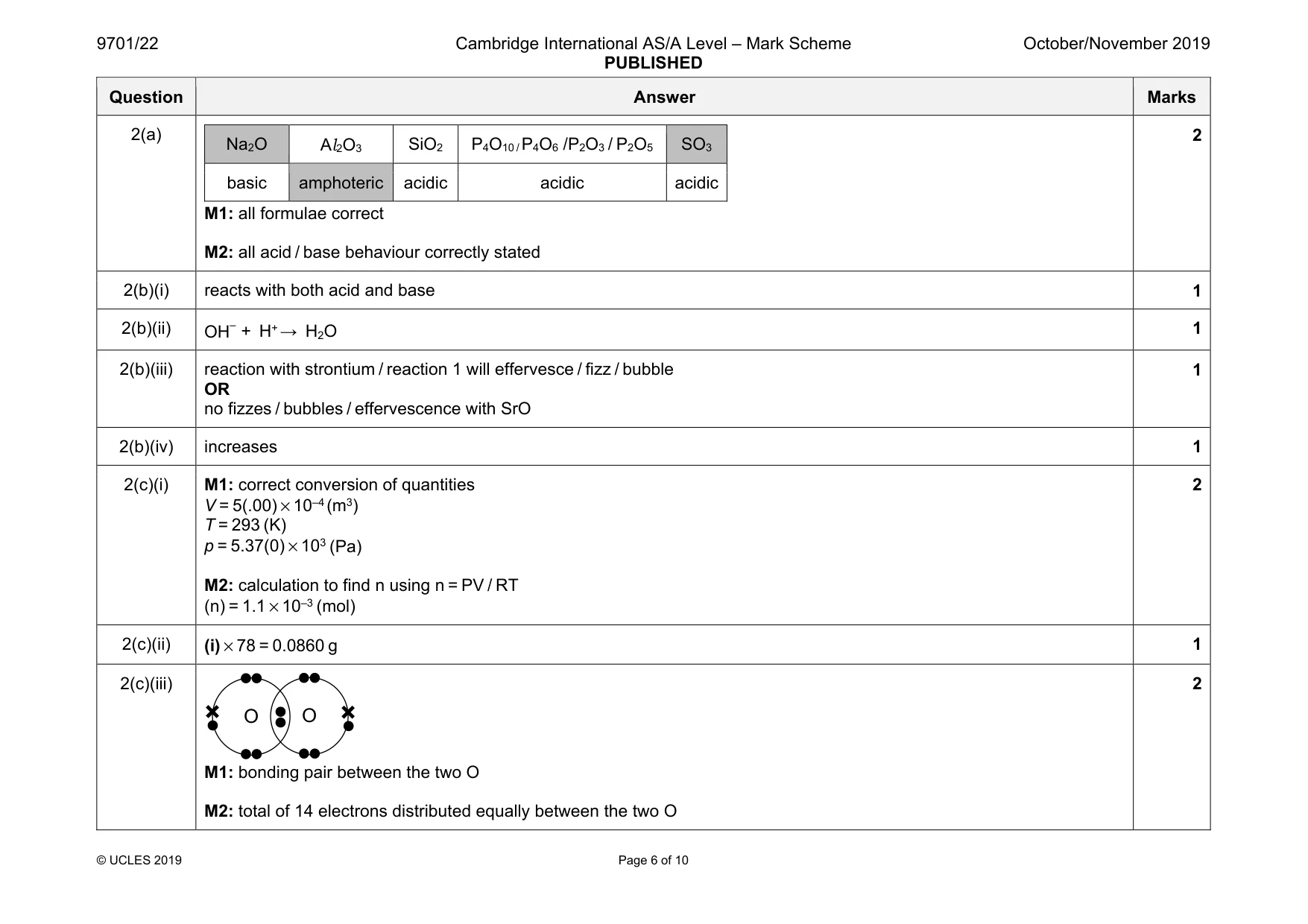
Mark scheme: 2(a) M1: all formulae correct M2: all acid / base behaviour correctly stated Na2O Al2O3 SiO2 P4O10 / P4O6 /P2O3 / P2O5 SO3 basic amphoteric acidic acidic acidic 2 2(b)(i) reacts with both acid and base 1 2(b)(ii) OH– + H+ → H2O 1 2(b)(iii) reaction with strontium / reaction 1 will effervesce / fizz / bubble OR no fizzes / bubbles / effervescence with SrO 1 2(b)(iv) increases 1 2(c)(i) M1: correct conversion of quantities V = 5(.00) × 10–4 (m3) T = 293 (K) p = 5.37(0) × 103 (Pa) M2: calculation to find n using n = PV / RT (n) = 1.1 × 10⁻³ (mol) 2 2(c)(ii) (i) × 78 = 0.0860 g 1 2(c)(iii) M1: bonding pair between the two O M2: total of 14 electrons distributed equally between the two O 2 O O
More questions on The gaseous state: ideal and real gases and pV = nRT
Q3 · A series of reactions for phosphorus and its compounds is shown
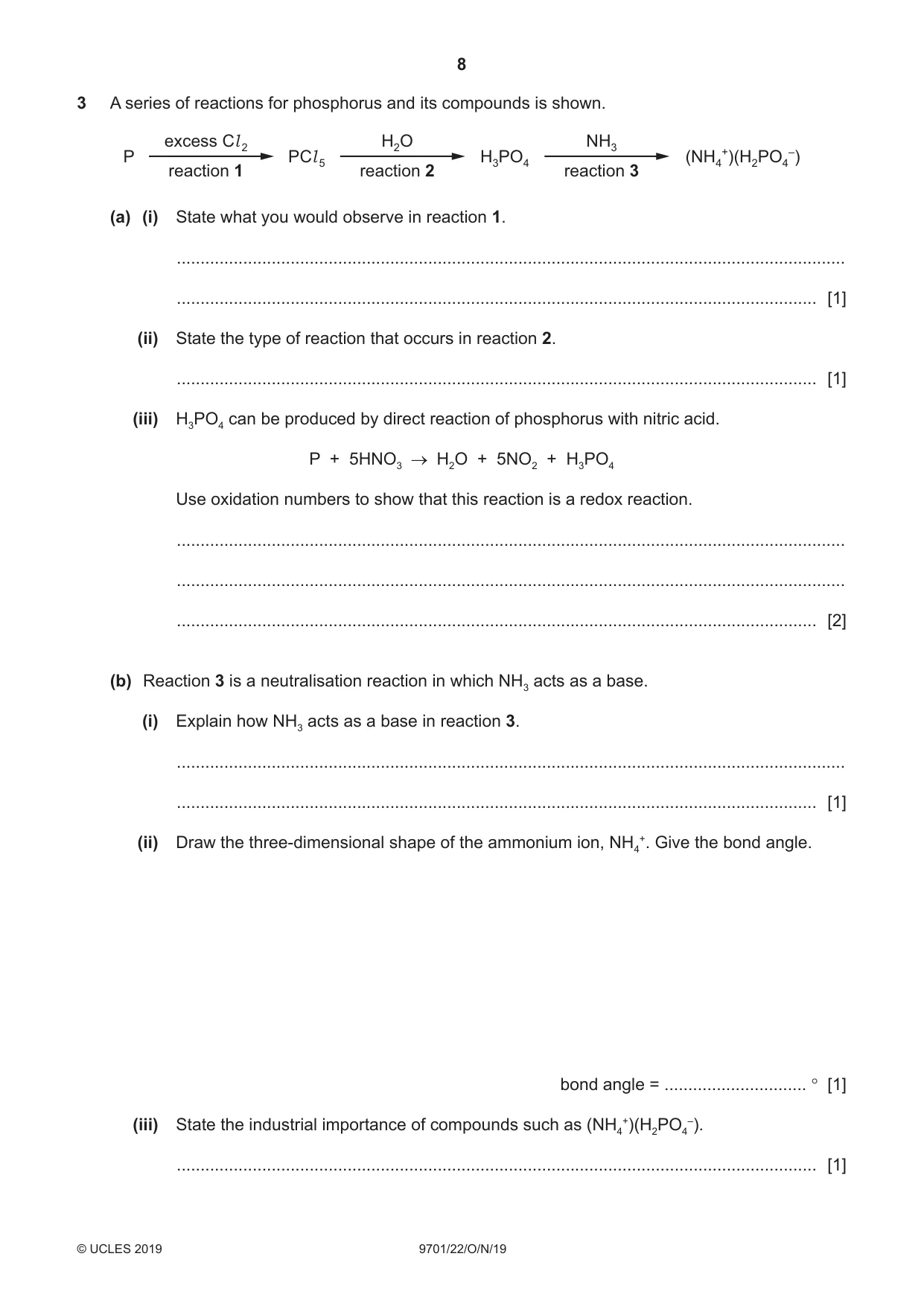
3 A series of reactions for phosphorus and its compounds is shown. excess Cl 2 H2O NH3 P PCl 5 H3PO4 (NH4+)(H2PO4–) reaction 1 reaction 2 reaction 3 (a) (i) State what you would observe in reaction 1. ............................................................................................................................................. ....................................................................................................................................... [1] (ii) State the type of reaction that occurs in reaction 2. ....................................................................................................................................... [1] (iii) H3PO4 can be produced by direct reaction of phosphorus with nitric acid. P + 5HNO3 H2O + 5NO2 + H3PO4 Use oxidation numbers to show that this reaction is a redox reaction. ............................................................................................................................................. ............................................................................................................................................. ....................................................................................................................................... [2] (b) Reaction 3 is a neutralisation reaction in which NH3 acts as a base. (i) Explain how NH3 acts as a base in reaction 3. ............................................................................................................................................. ....................................................................................................................................... [1] (ii) Draw the three-dimensional shape of the ammonium ion, NH4+. Give the bond angle. bond angle = .............................. ° [1] (iii) State the industrial importance of compounds such as (NH4+)(H2PO4–). ....................................................................................................................................... [1] (c) PCl 5 can be used to convert alcohols to halogenoalkanes. (i) Write an equation for the reaction of C2H5OH with PCl 5 to form C2H5Cl. ....................................................................................................................................... [1] (ii) State the type of reaction in (i). ....................................................................................................................................... [1] (iii) Halogenoalkanes can also be prepared by reacting alcohols with hydrogen halides, such as HCl and HI. ● HCl is prepared using NaCl and concentrated H2SO4. ● HI is prepared by reacting NaI with concentrated H3PO4. Suggest why HI is not prepared by the reaction of NaI with concentrated H2SO4. ............................................................................................................................................. ............................................................................................................................................. ....................................................................................................................................... [2] (iv) The rate of the hydrolysis reaction of halogenoalkanes with NaOH(aq) is dependent on the halogen that is bonded to carbon. State and explain the order of reactivity when NaOH(aq) reacts separately with C2H5Cl, C2H5Br and C2H5I. ............................................................................................................................................. ............................................................................................................................................. ....................................................................................................................................... [2] [Total: 13]
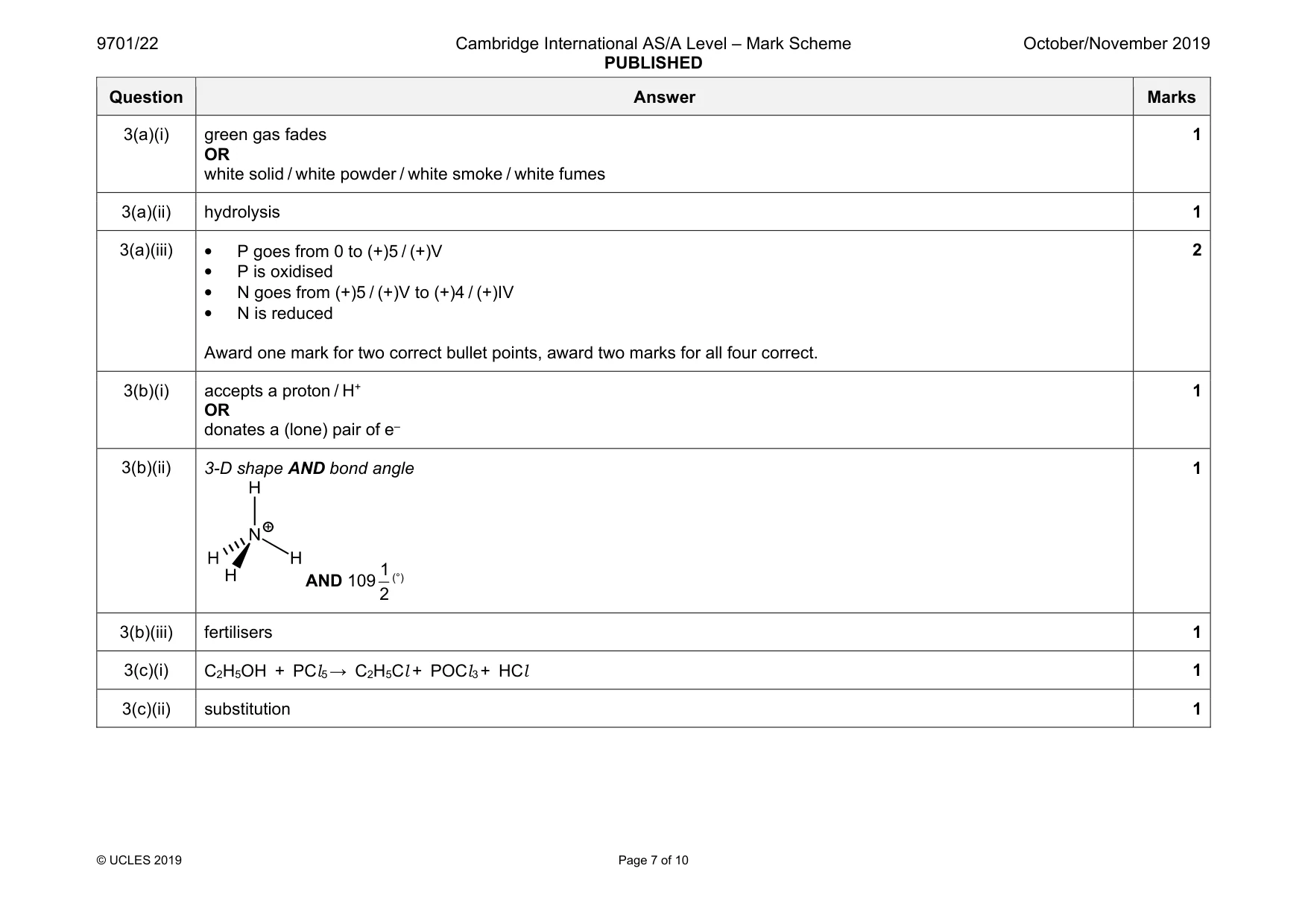
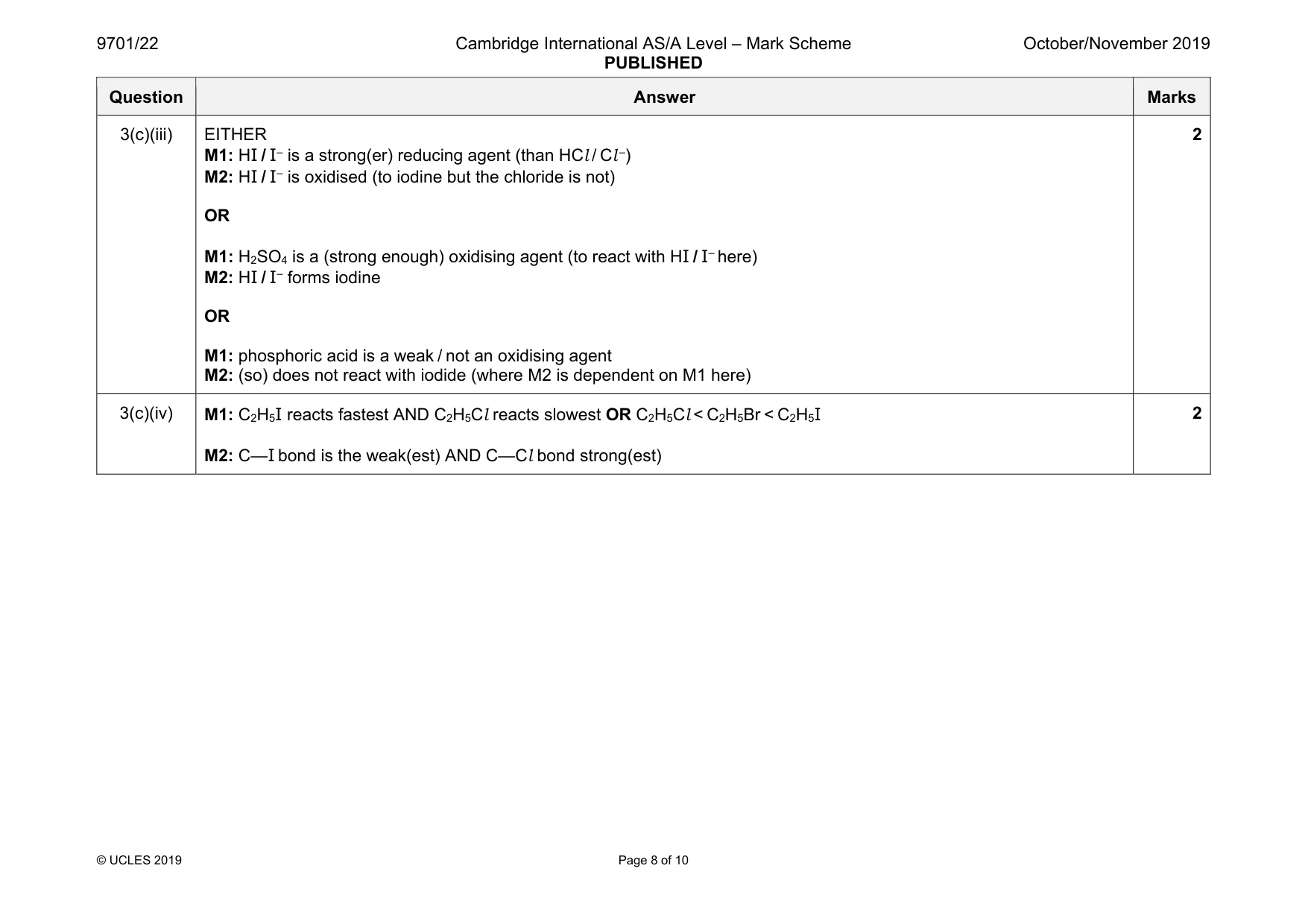
Mark scheme: 3(a)(i) green gas fades OR white solid / white powder / white smoke / white fumes 1 3(a)(ii) hydrolysis 1 3(a)(iii) • P goes from 0 to (+)5 / (+)V • P is oxidised • N goes from (+)5 / (+)V to (+)4 / (+)IV • N is reduced Award one mark for two correct bullet points, award two marks for all four correct. 2 3(b)(i) accepts a proton / H+ OR donates a (lone) pair of e– 1 3(b)(ii) 3-D shape AND bond angle AND 109 1 2 (°) 1 3(b)(iii) fertilisers 1 3(c)(i) C2H5OH + PCl5 → C2H5Cl + POCl3+ HCl 1 3(c)(ii) substitution 1 Question Answer Marks 3(c)(iii) EITHER M1: HI / I– is a strong(er) reducing agent (than HCl / Cl –) M2: HI / I– is oxidised (to iodine but the chloride is not) OR M1: H2SO4 is a (strong enough) oxidising agent (to react with HI / I– here) M2: HI / I– forms iodine OR M1: phosphoric acid is a weak / not an oxidising agent M2: (so) does not react with iodide (where M2 is dependent on M1 here) 2 3(c)(iv) M1: C2H5I reacts fastest AND C2H5Cl reacts slowest OR C2H5Cl < C2H5Br < C2H5I M2: C—I bond is the weak(est) AND C—Cl bond strong(est) 2
Q4 · Prenol is a naturally occurring organic molecule found in many fruits
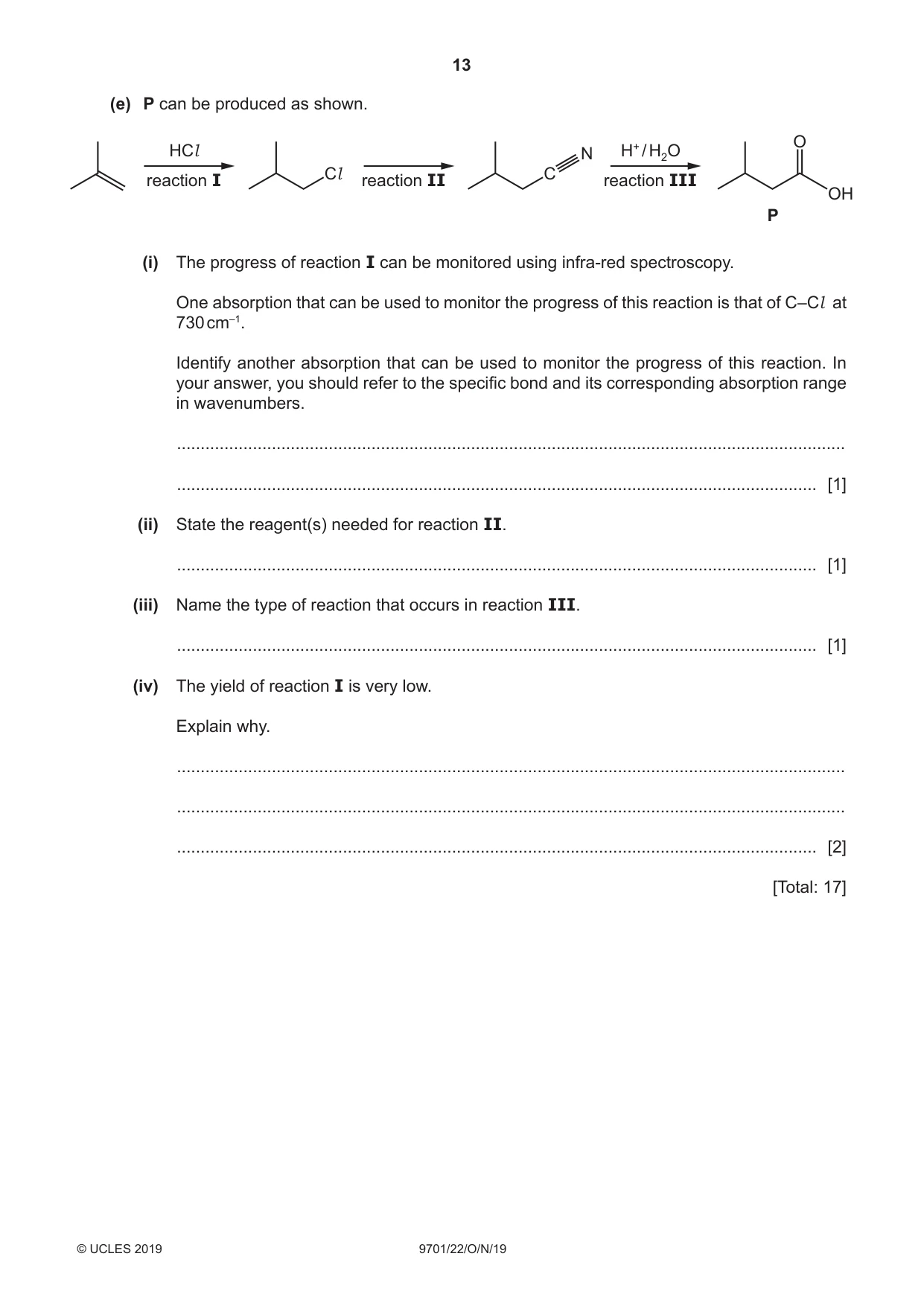
4 Prenol is a naturally occurring organic molecule found in many fruits. It contains both an alkene and an alcohol functional group. prenol H3C H C C H3C CH2OH (a) Prenol can be formed by the reaction of G with NaOH(aq). Complete the diagram to show the mechanism of the reaction between G and NaOH(aq) to form prenol. Include all relevant charges, partial charges, lone pairs and curly arrows. G prenol H3C H H3C H C C C C H3C C Cl H3C CH2OH H H [2] (b) Prenol reacts with steam to form a mixture of three isomers, J, K and L, of molecular formula C5H12O2. (i) When J is heated with excess acidified potassium dichromate(VI) it forms an organic product which shows no reaction with 2,4‑DNPH. Draw the structure of J. [1] K and L are stereoisomers with molecular formula C5H12O2. K and L both react when heated with excess acidified potassium dichromate(VI) to form M, C5H8O3. M forms an orange precipitate on reaction with 2,4‑DNPH. (ii) Give the structural formula of K and L. ....................................................................................................................................... [1] (iii) Name the type of stereoisomerism shown by K and L. ....................................................................................................................................... [1] (iv) Give the balanced equation to represent the reaction of K, C5H12O2, with acidified potassium dichromate(VI) to form M, C5H8O3. Use [O] to represent an atom of oxygen provided by the oxidising agent. ....................................................................................................................................... [1] (c) (i) Prenol contains an alkene functional group. Describe a chemical test to confirm the presence of an alkene functional group. Give the result of the test. ............................................................................................................................................. ....................................................................................................................................... [1] (ii) Prenol can be polymerised to form poly(prenol). Draw one repeat unit of poly(prenol). [1] (d) Isoprenol is a structural isomer of prenol. isoprenol H CH3 C C H CH2CH2OH The series of reactions shows how isoprenol can be used to form Q, a sweet-smelling liquid. N acidified P potassium O H2 and Ni dichromate(VI) isoprenol reaction 1 heat under OH OH reflux C2H5OH heat under and H2SO4 reflux Q (i) Give the name of N. ....................................................................................................................................... [1] (ii) Isoprenol is a liquid. Ni acts as a catalyst for reaction 1. Identify the type of catalysis shown by Ni in reaction 1. ....................................................................................................................................... [1] (iii) Draw the skeletal formula of Q and suggest one commercial use of Q. Q commercial use ................................................................................................................... [2]
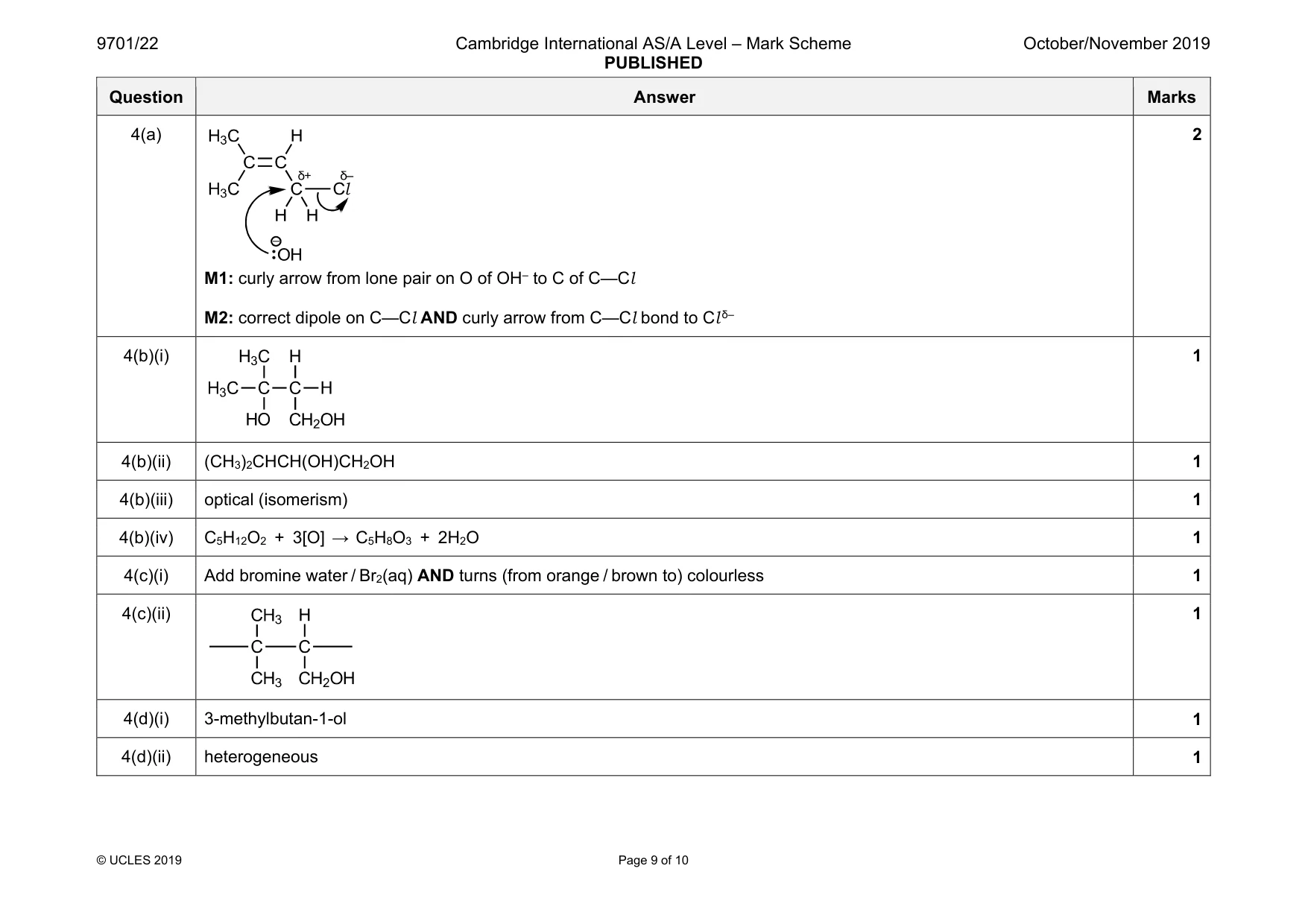
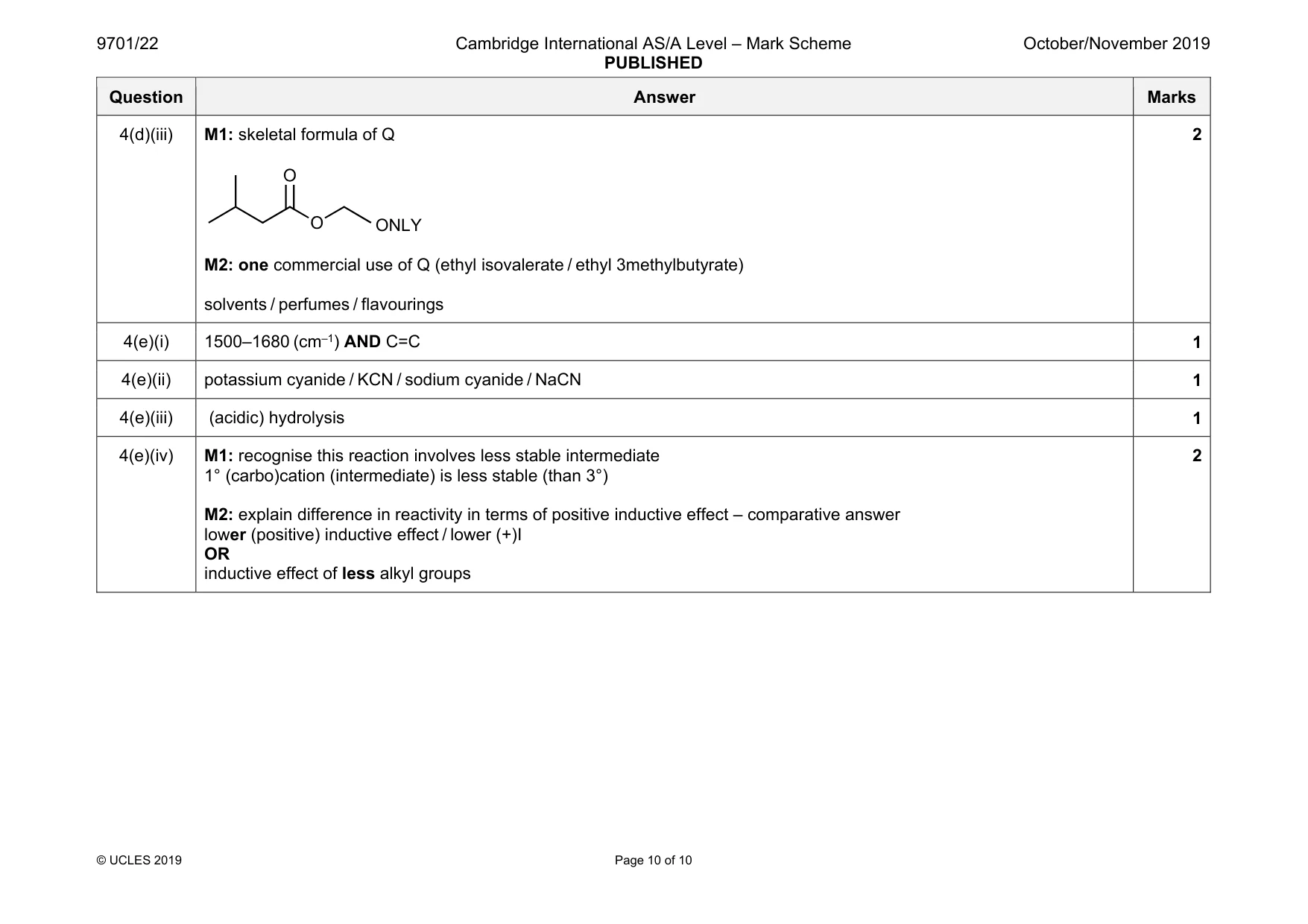
Mark scheme: 4(a) M1: curly arrow from lone pair on O of OH– to C of C—Cl M2: correct dipole on C—Cl AND curly arrow from C—Cl bond to Cl δ– 2 4(b)(i) 1 4(b)(ii) (CH3)2CHCH(OH)CH2OH 1 4(b)(iii) optical (isomerism) 1 4(b)(iv) C5H12O2 + 3[O] → C5H8O3 + 2H2O 1 4(c)(i) Add bromine water / Br2(aq) AND turns (from orange / brown to) colourless 1 4(c)(ii) 1 4(d)(i) 3-methylbutan-1-ol 1 4(d)(ii) heterogeneous 1 Question Answer Marks 4(d)(iii) M1: skeletal formula of Q ONLY M2: one commercial use of Q (ethyl isovalerate / ethyl 3methylbutyrate) solvents / perfumes / flavourings 2 4(e)(i) 1500–1680 (cm–1) AND C=C 1 4(e)(ii) potassium cyanide / KCN / sodium cyanide / NaCN 1 4(e)(iii) (acidic) hydrolysis 1 4(e)(iv) M1: recognise this reaction involves less stable intermediate 1° (carbo)cation (intermediate) is less stable (than 3°) M2: explain difference in reactivity in terms of positive inductive effect – comparative answer lower (positive) inductive effect / lower (+)I OR inductive effect of less alkyl groups 2
What was in this paper
The subtopics covered by these 4 questions, and how many questions each got. Open one in a new tab to see every Cambridge question on it.
What you needed in this session
Cambridge’s own grade thresholds for 2019 Oct/Nov, Paper 2 · Variant 2. A higher threshold means an easier paper — the bar moves with how the cohort did.