Cambridge A Level Chemistry 9701 — 2019 Oct/Nov Paper 2 · Variant 1
9701/21/O/N/19 · 4 questions · 60 marks · ≈68 min
The question paper and its mark scheme, free to read here and free to download. This is Cambridge’s own paper, exactly as it was sat.
Question paper12 pages
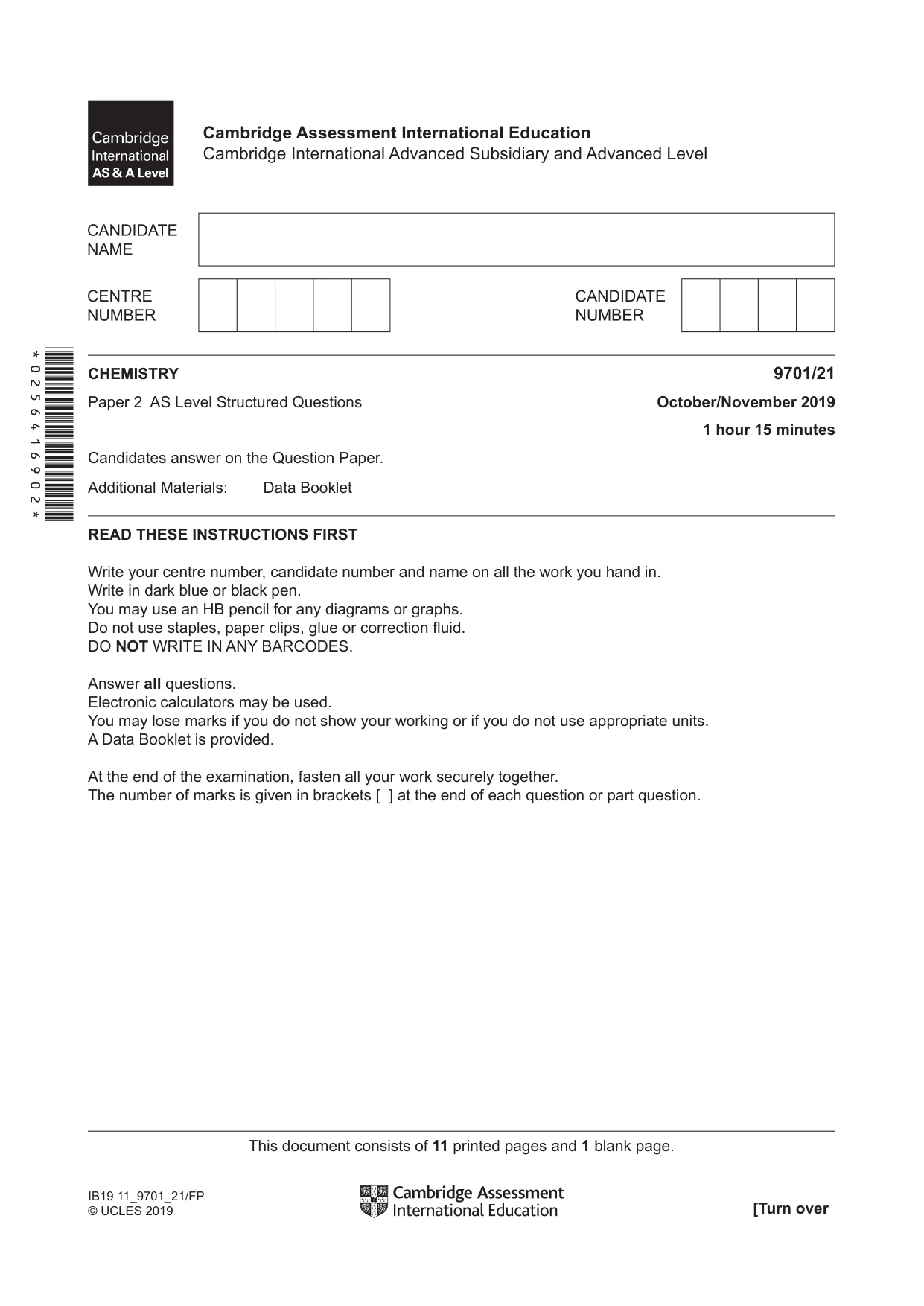
Mark scheme9 pages
Answers below. Sit the paper first if you are practising.
Questions as text
Q1 · Chlorine can be prepared using the following reaction
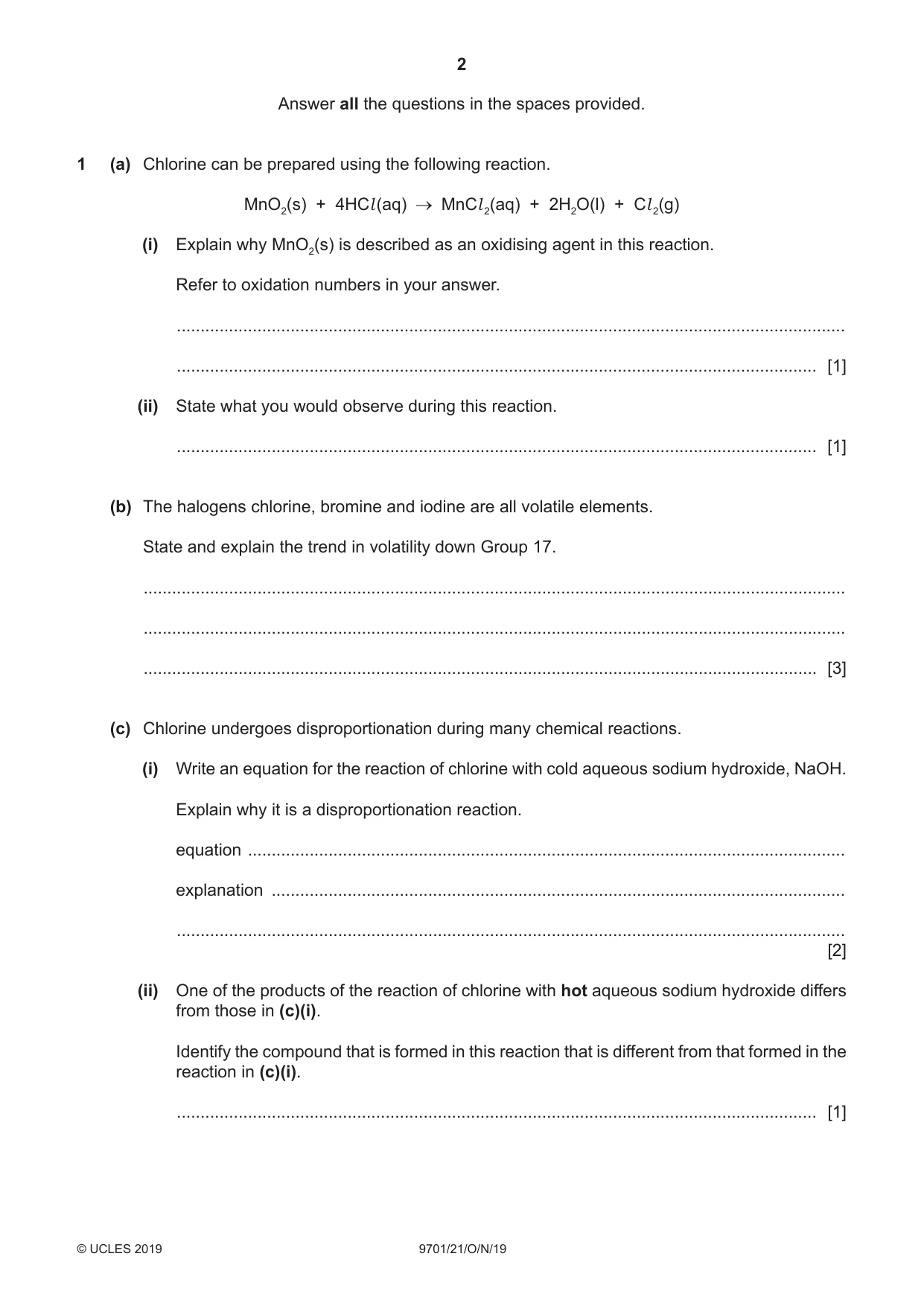
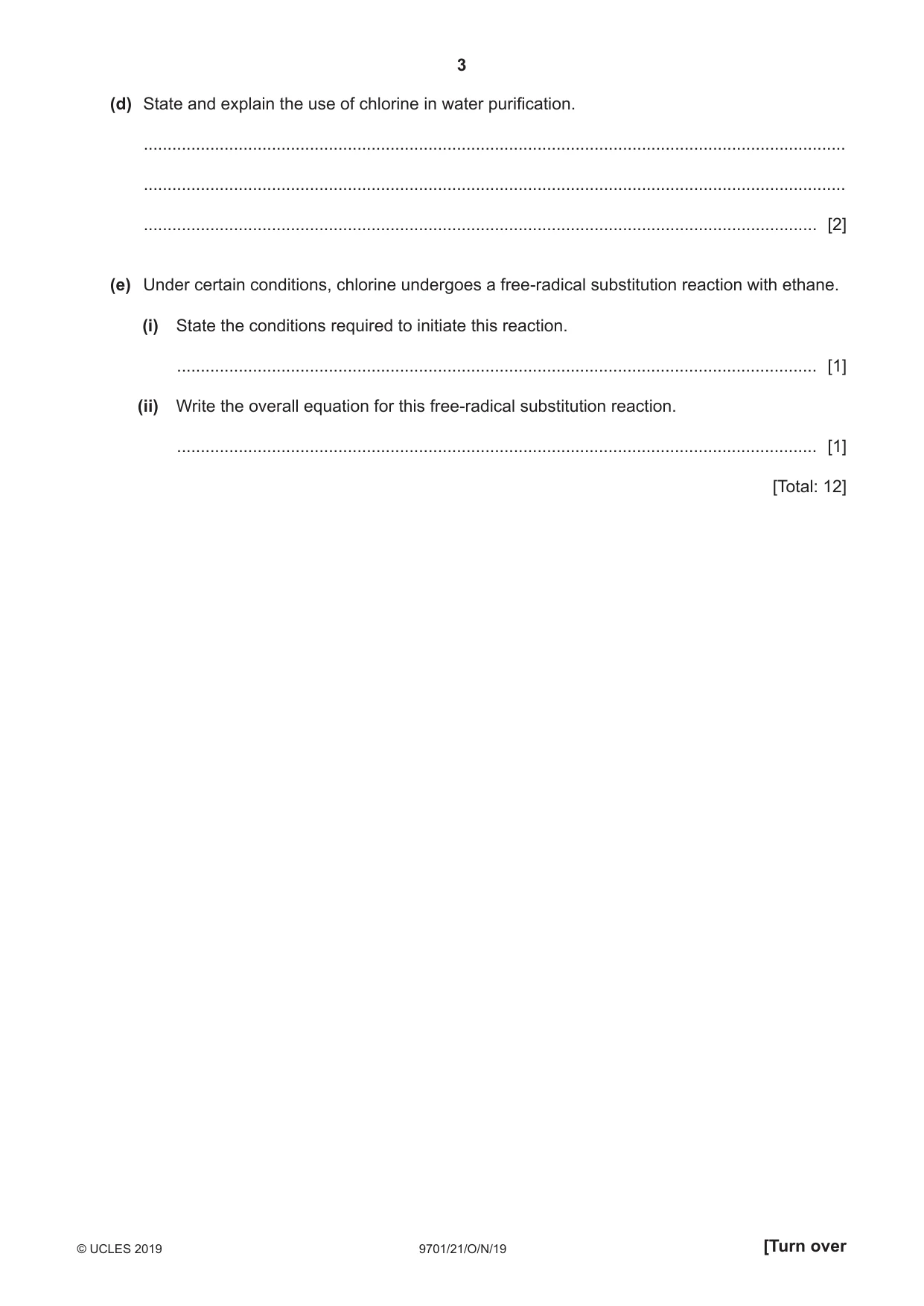
1 (a) Chlorine can be prepared using the following reaction. MnO2(s) + 4HCl (aq) MnCl 2(aq) + 2H2O(l) + Cl 2(g) (i) Explain why MnO2(s) is described as an oxidising agent in this reaction. Refer to oxidation numbers in your answer. ............................................................................................................................................. ....................................................................................................................................... [1] (ii) State what you would observe during this reaction. ....................................................................................................................................... [1] (b) The halogens chlorine, bromine and iodine are all volatile elements. State and explain the trend in volatility down Group 17. .................................................................................................................................................... .................................................................................................................................................... .............................................................................................................................................. [3] (c) Chlorine undergoes disproportionation during many chemical reactions. (i) Write an equation for the reaction of chlorine with cold aqueous sodium hydroxide, NaOH. Explain why it is a disproportionation reaction. equation .............................................................................................................................. explanation .......................................................................................................................... ............................................................................................................................................. [2] (ii) One of the products of the reaction of chlorine with hot aqueous sodium hydroxide differs from those in (c)(i). Identify the compound that is formed in this reaction that is different from that formed in the reaction in (c)(i). ....................................................................................................................................... [1] (d) State and explain the use of chlorine in water purification. .................................................................................................................................................... .................................................................................................................................................... .............................................................................................................................................. [2] (e) Under certain conditions, chlorine undergoes a free-radical substitution reaction with ethane. (i) State the conditions required to initiate this reaction. ....................................................................................................................................... [1] (ii) Write the overall equation for this free-radical substitution reaction. ....................................................................................................................................... [1] [Total: 12]
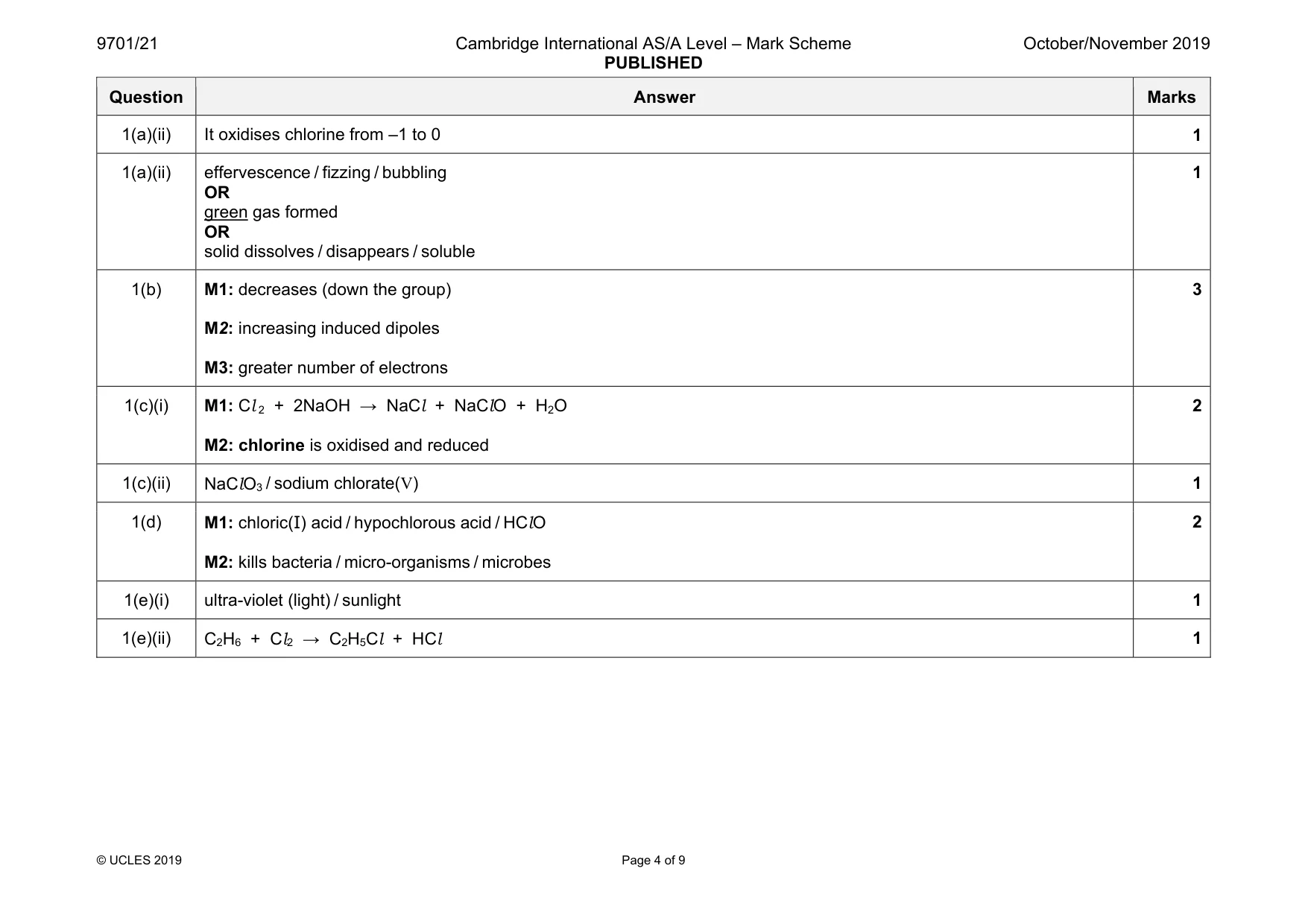
Mark scheme: 1(a)(ii) It oxidises chlorine from –1 to 0 1 1(a)(ii) effervescence / fizzing / bubbling OR green gas formed OR solid dissolves / disappears / soluble 1 1(b) M1: decreases (down the group) M2: increasing induced dipoles M3: greater number of electrons 3 1(c)(i) M1: Cl 2 + 2NaOH → NaCl + NaClO + H2O M2: chlorine is oxidised and reduced 2 1(c)(ii) NaClO3 / sodium chlorate(V) 1 1(d) M1: chloric(I) acid / hypochlorous acid / HClO M2: kills bacteria / micro-organisms / microbes 2 1(e)(i) ultra-violet (light) / sunlight 1 1(e)(ii) C2H6 + Cl2 → C2H5Cl + HCl 1
Q2 · Complete the table to give details of the type of bonding and structure shown by some of…
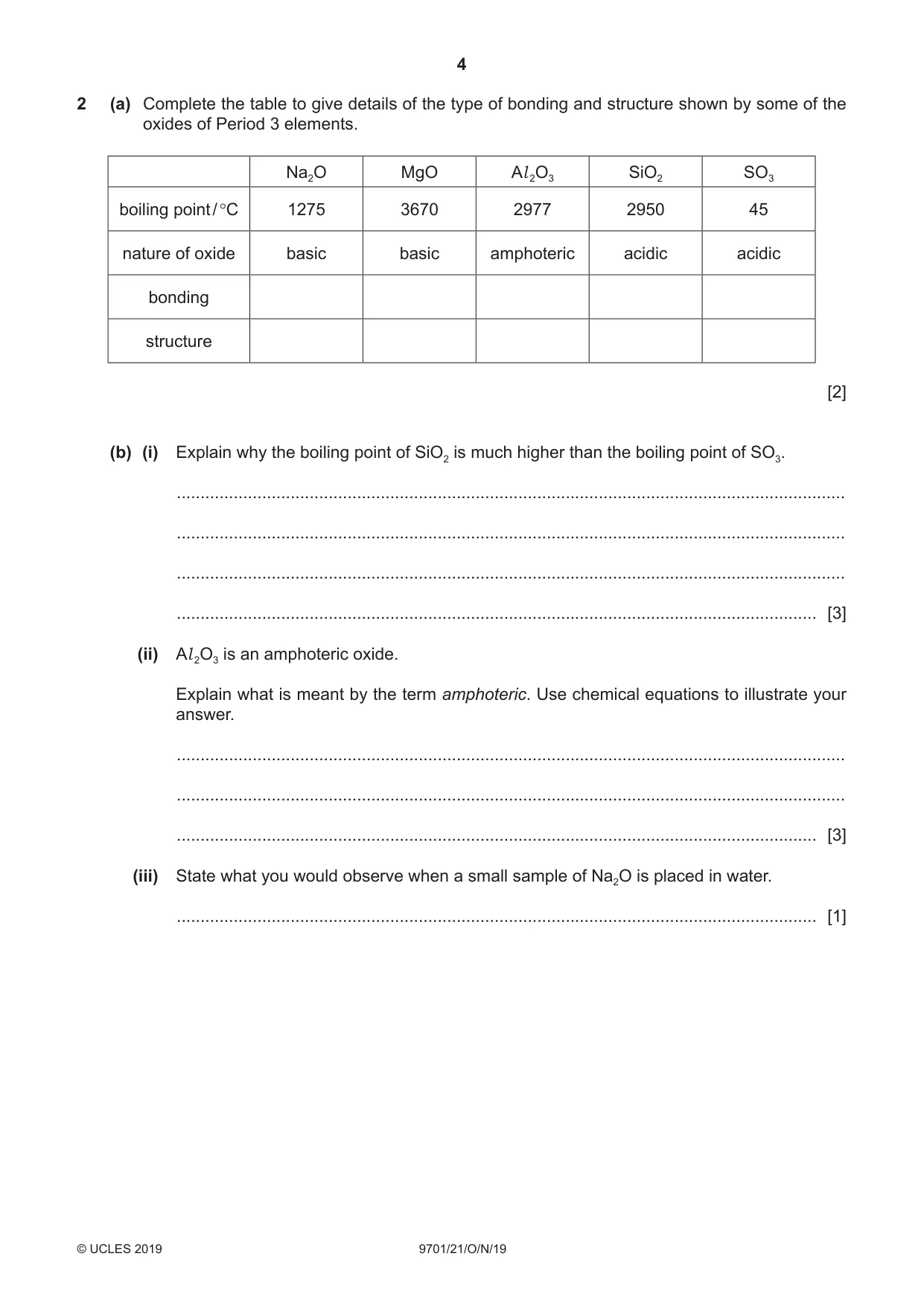
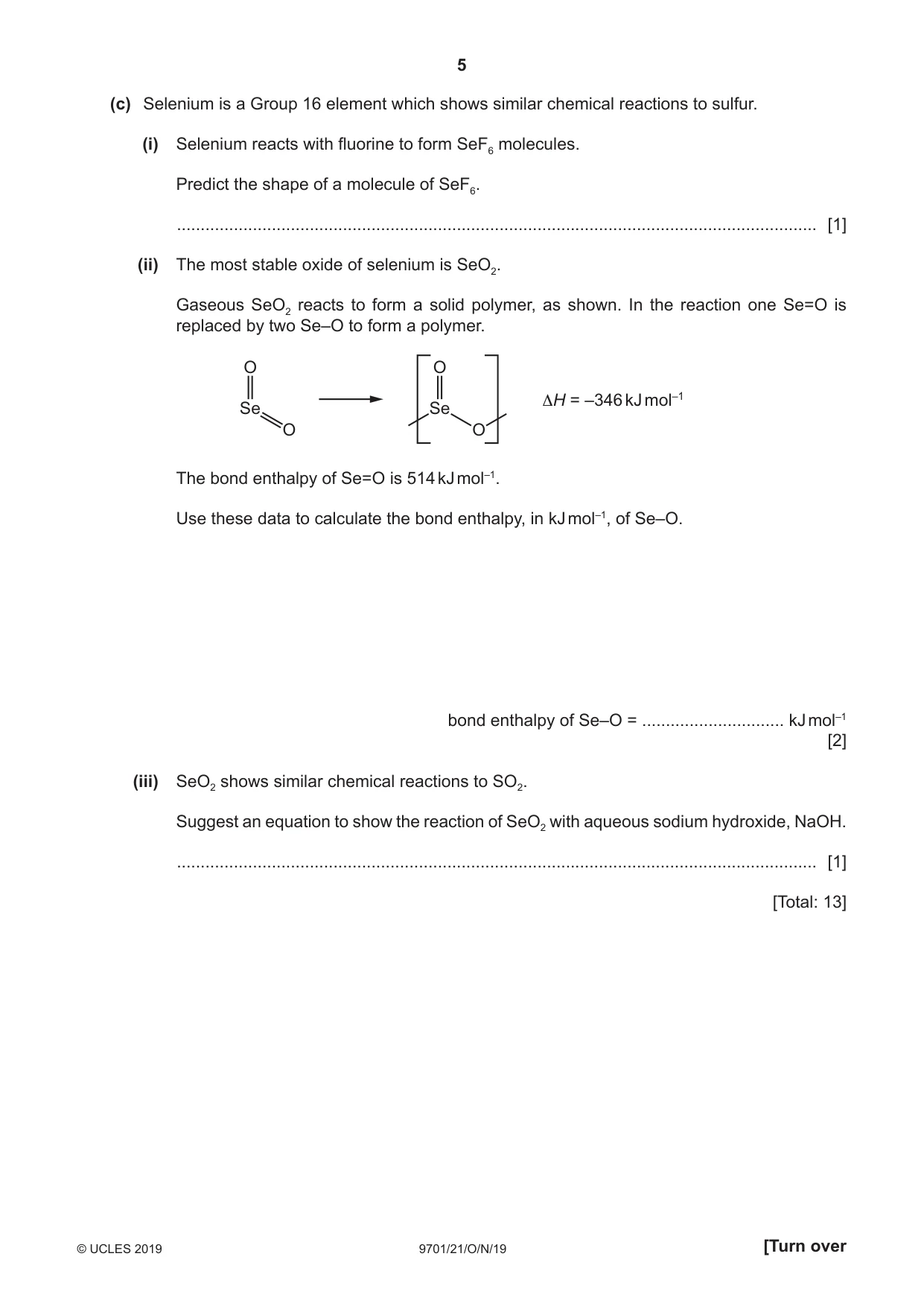
2 (a) Complete the table to give details of the type of bonding and structure shown by some of the oxides of Period 3 elements. Na2O MgO Al 2O3 SiO2 SO3 boiling point / °C 1275 3670 2977 2950 45 nature of oxide basic basic amphoteric acidic acidic bonding structure [2] (b) (i) Explain why the boiling point of SiO2 is much higher than the boiling point of SO3. ............................................................................................................................................. ............................................................................................................................................. ............................................................................................................................................. ....................................................................................................................................... [3] (ii) Al 2O3 is an amphoteric oxide. Explain what is meant by the term amphoteric. Use chemical equations to illustrate your answer. ............................................................................................................................................. ............................................................................................................................................. ....................................................................................................................................... [3] (iii) State what you would observe when a small sample of Na2O is placed in water. ....................................................................................................................................... [1] (c) Selenium is a Group 16 element which shows similar chemical reactions to sulfur. (i) Selenium reacts with fluorine to form SeF6 molecules. Predict the shape of a molecule of SeF6. ....................................................................................................................................... [1] (ii) The most stable oxide of selenium is SeO2. Gaseous SeO2 reacts to form a solid polymer, as shown. In the reaction one Se=O is replaced by two Se–O to form a polymer. O O ΔH = –346 kJ mol–1 Se Se O O The bond enthalpy of Se=O is 514 kJ mol–1. Use these data to calculate the bond enthalpy, in kJ mol–1, of Se–O. bond enthalpy of Se–O = .............................. kJ mol–1 [2] (iii) SeO2 shows similar chemical reactions to SO2. Suggest an equation to show the reaction of SeO2 with aqueous sodium hydroxide, NaOH. ....................................................................................................................................... [1] [Total: 13]
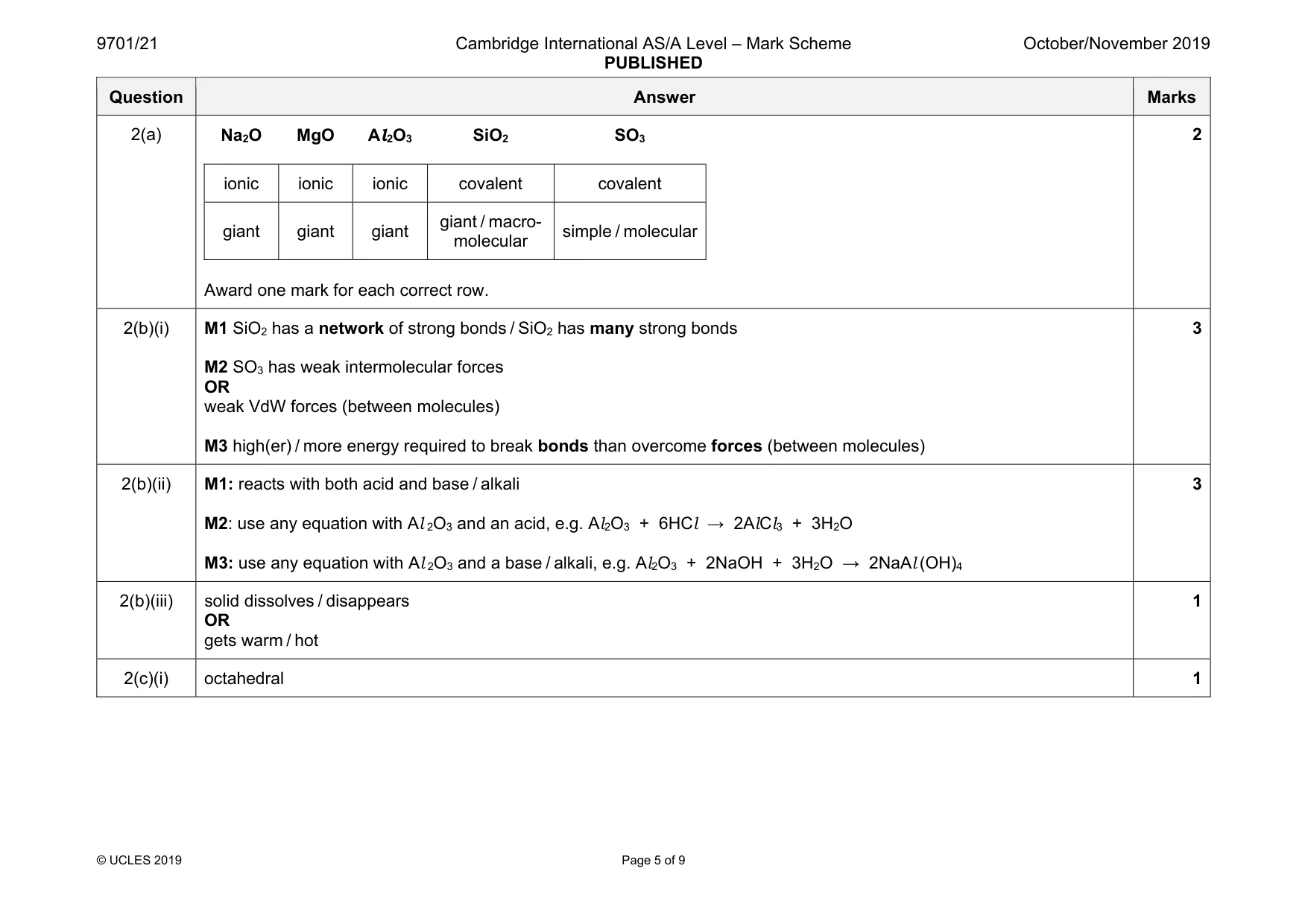
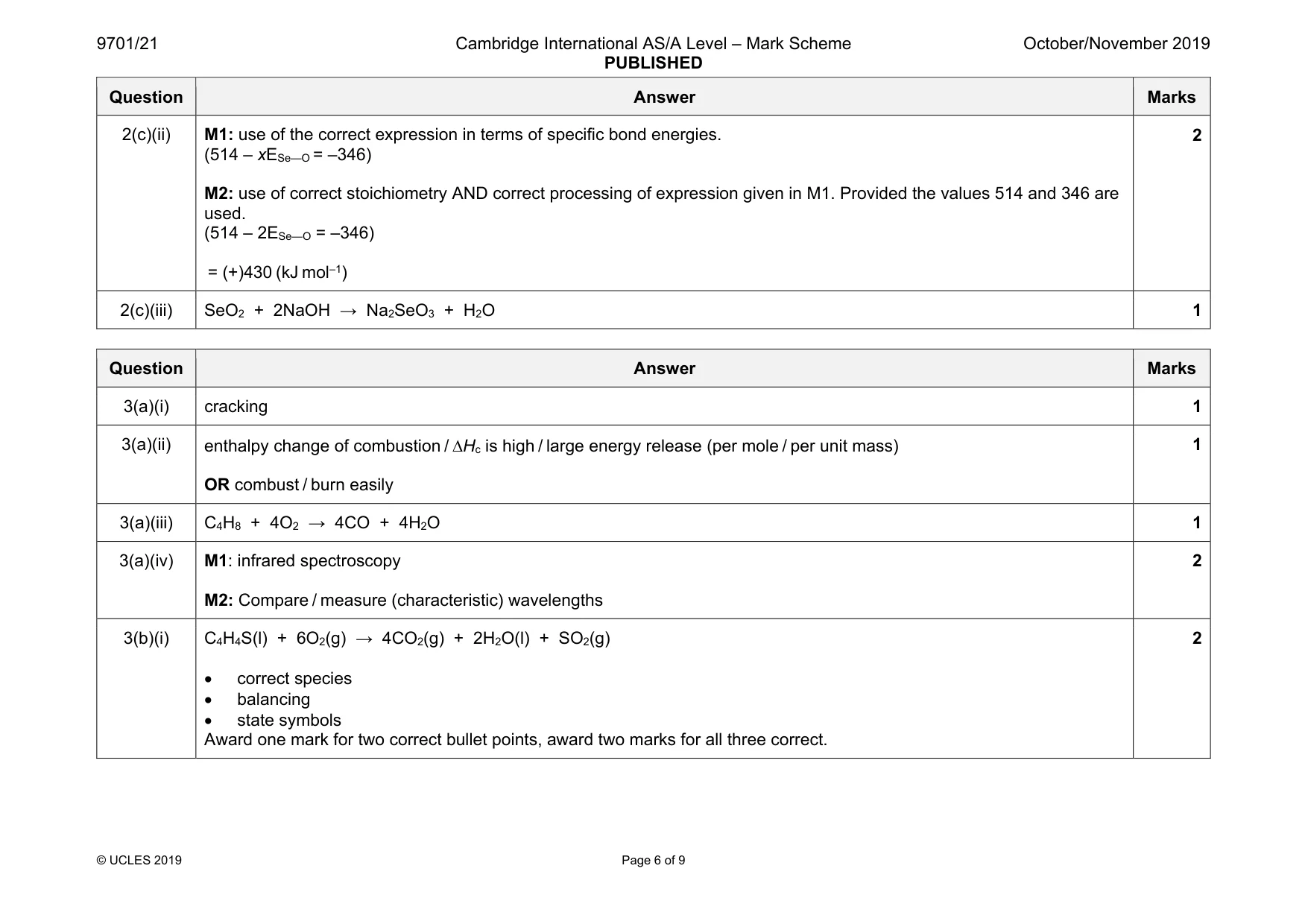
Mark scheme: 2(a) Na2O MgO SiO2 SO3 ionic ionic ionic covalent covalent giant giant giant giant / macro- molecular simple / molecular Award one mark for each correct row. 2 2(b)(i) M1 SiO2 has a network of strong bonds / SiO2 has many strong bonds M2 SO3 has weak intermolecular forces OR weak VdW forces (between molecules) M3 high(er) / more energy required to break bonds than overcome forces (between molecules) 3 2(b)(ii) M1: reacts with both acid and base / alkali M2: use any equation with Al 2O3 and an acid, e.g. Al2O3 + 6HCl → 2AlCl3 + 3H2O M3: use any equation with Al 2O3 and a base / alkali, e.g. Al2O3 + 2NaOH + 3H2O → 2NaAl (OH)4 3 2(b)(iii) solid dissolves / disappears OR gets warm / hot 1 2(c)(i) octahedral 1 Question Answer Marks 2(c)(ii) M1: use of the correct expression in terms of specific bond energies. (514 – xESe—O = –346) M2: use of correct stoichiometry AND correct processing of expression given in M1. Provided the values 514 and 346 are used. (514 – 2ESe—O = –346) = (+)430 (kJ mol–1) 2 2(c)(iii) SeO2 + 2NaOH → Na2SeO3 + H2O 1
More questions on Periodicity of chemical properties of the elements in Period 3
Q3 · Crude oil is a natural source of hydrocarbons that are used as fuels
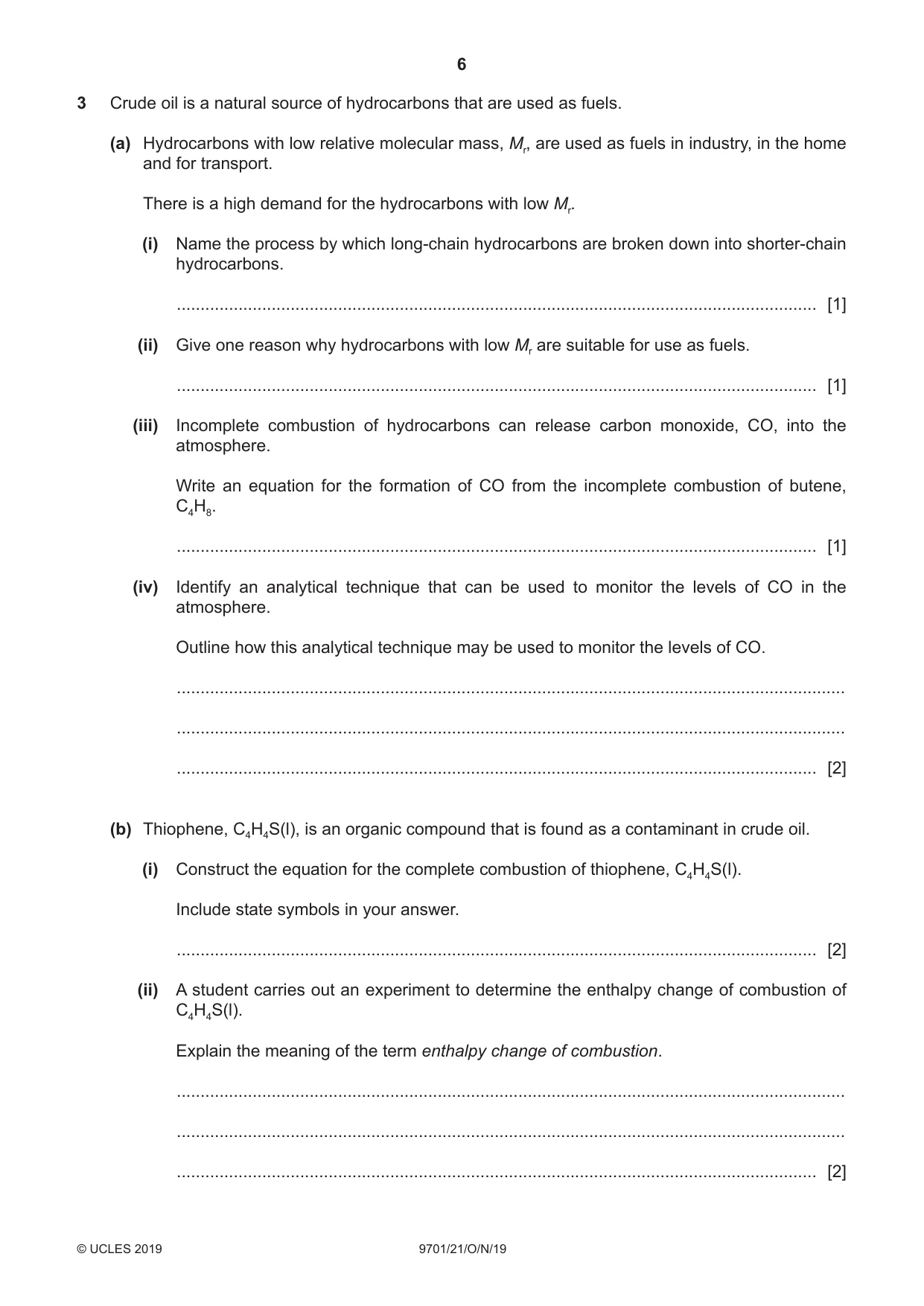
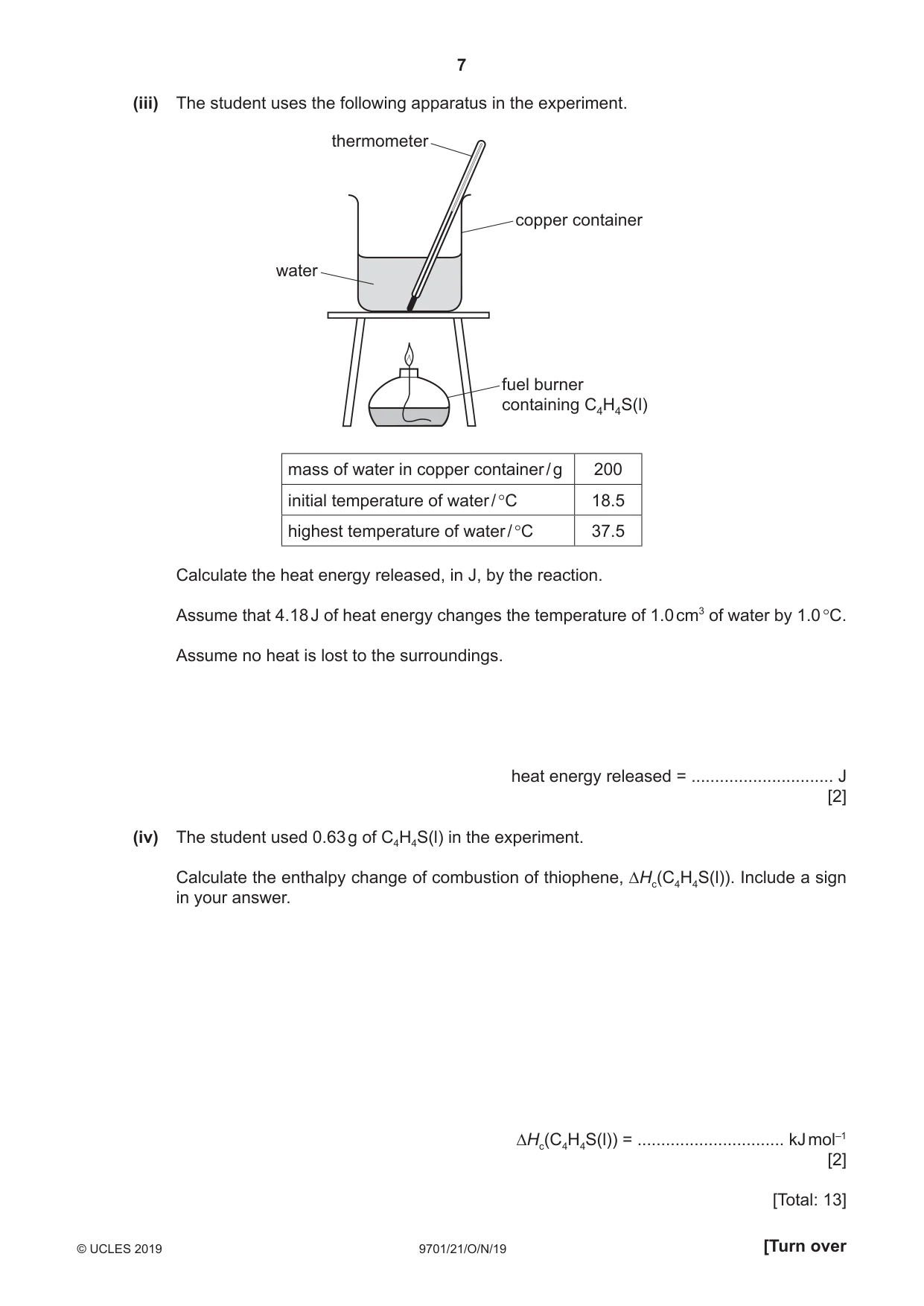
3 Crude oil is a natural source of hydrocarbons that are used as fuels. (a) Hydrocarbons with low relative molecular mass, Mr, are used as fuels in industry, in the home and for transport. There is a high demand for the hydrocarbons with low Mr. (i) Name the process by which long-chain hydrocarbons are broken down into shorter-chain hydrocarbons. ....................................................................................................................................... [1] (ii) Give one reason why hydrocarbons with low Mr are suitable for use as fuels. ....................................................................................................................................... [1] (iii) Incomplete combustion of hydrocarbons can release carbon monoxide, CO, into the atmosphere. Write an equation for the formation of CO from the incomplete combustion of butene, C4H8. ....................................................................................................................................... [1] (iv) Identify an analytical technique that can be used to monitor the levels of CO in the atmosphere. Outline how this analytical technique may be used to monitor the levels of CO. ............................................................................................................................................. ............................................................................................................................................. ....................................................................................................................................... [2] (b) Thiophene, C4H4S(l), is an organic compound that is found as a contaminant in crude oil. (i) Construct the equation for the complete combustion of thiophene, C4H4S(l). Include state symbols in your answer. ....................................................................................................................................... [2] (ii) A student carries out an experiment to determine the enthalpy change of combustion of C4H4S(l). Explain the meaning of the term enthalpy change of combustion. ............................................................................................................................................. ............................................................................................................................................. ....................................................................................................................................... [2] (iii) The student uses the following apparatus in the experiment. thermometer copper container water fuel burner containing C4H4S(l) mass of water in copper container / g 200 initial temperature of water / °C 18.5 highest temperature of water / °C 37.5 Calculate the heat energy released, in J, by the reaction. Assume that 4.18 J of heat energy changes the temperature of 1.0 cm3 of water by 1.0 °C. Assume no heat is lost to the surroundings. heat energy released = .............................. J [2] (iv) The student used 0.63 g of C4H4S(l) in the experiment. Calculate the enthalpy change of combustion of thiophene, ΔHc(C4H4S(l)). Include a sign in your answer. ΔHc(C4H4S(l)) = ............................... kJ mol–1 [2] [Total: 13]
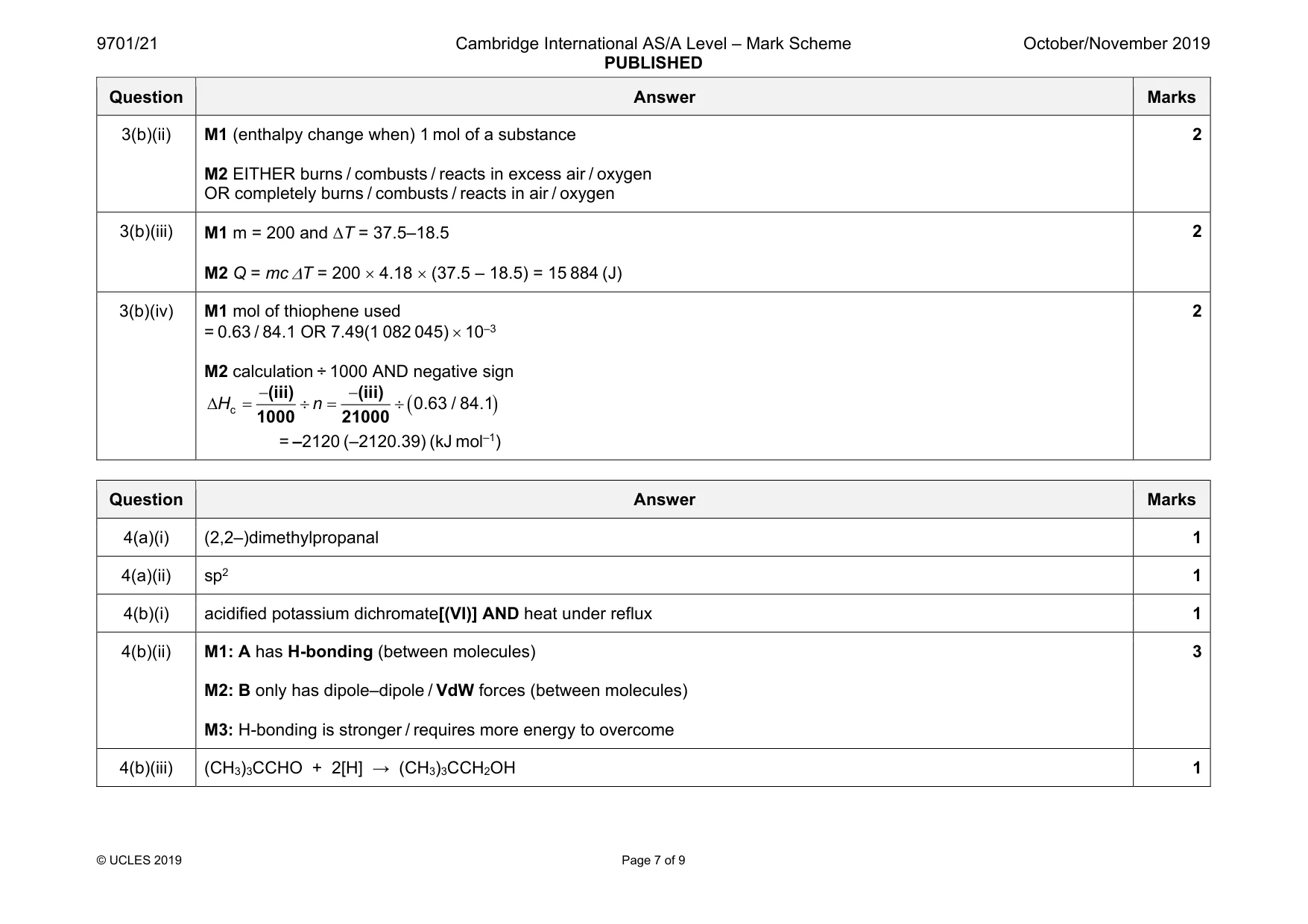
Mark scheme: 3(a)(i) cracking 1 3(a)(ii) enthalpy change of combustion / ∆Hc is high / large energy release (per mole / per unit mass) OR combust / burn easily 1 3(a)(iii) C4H8 + 4O2 → 4CO + 4H2O 1 3(a)(iv) M1: infrared spectroscopy M2: Compare / measure (characteristic) wavelengths 2 3(b)(i) C4H4S(l) + 6O2(g) → 4CO2(g) + 2H2O(l) + SO2(g) • correct species • balancing • state symbols Award one mark for two correct bullet points, award two marks for all three correct. 2 Question Answer Marks 3(b)(ii) M1 (enthalpy change when) 1 mol of a substance M2 EITHER burns / combusts / reacts in excess air / oxygen OR completely burns / combusts / reacts in air / oxygen 2 3(b)(iii) M1 m = 200 and ∆T = 37.5–18.5 M2 Q = mc ∆T = 200 × 4.18 × (37.5 – 18.5) = 15 884 (J) 2 3(b)(iv) M1 mol of thiophene used = 0.63 / 84.1 OR 7.49(1 082 045) × 10–3 M2 calculation ÷ 1000 AND negative sign ( ) − − ∆ = ÷ = ÷ c 0.63 / 84.1 H n (iii) (iii) 1000 21000 = –2120 (–2120.39) (kJ mol–1) 2
Q4 · (CH3)3CCHO is used in the synthesis of some antibiotics
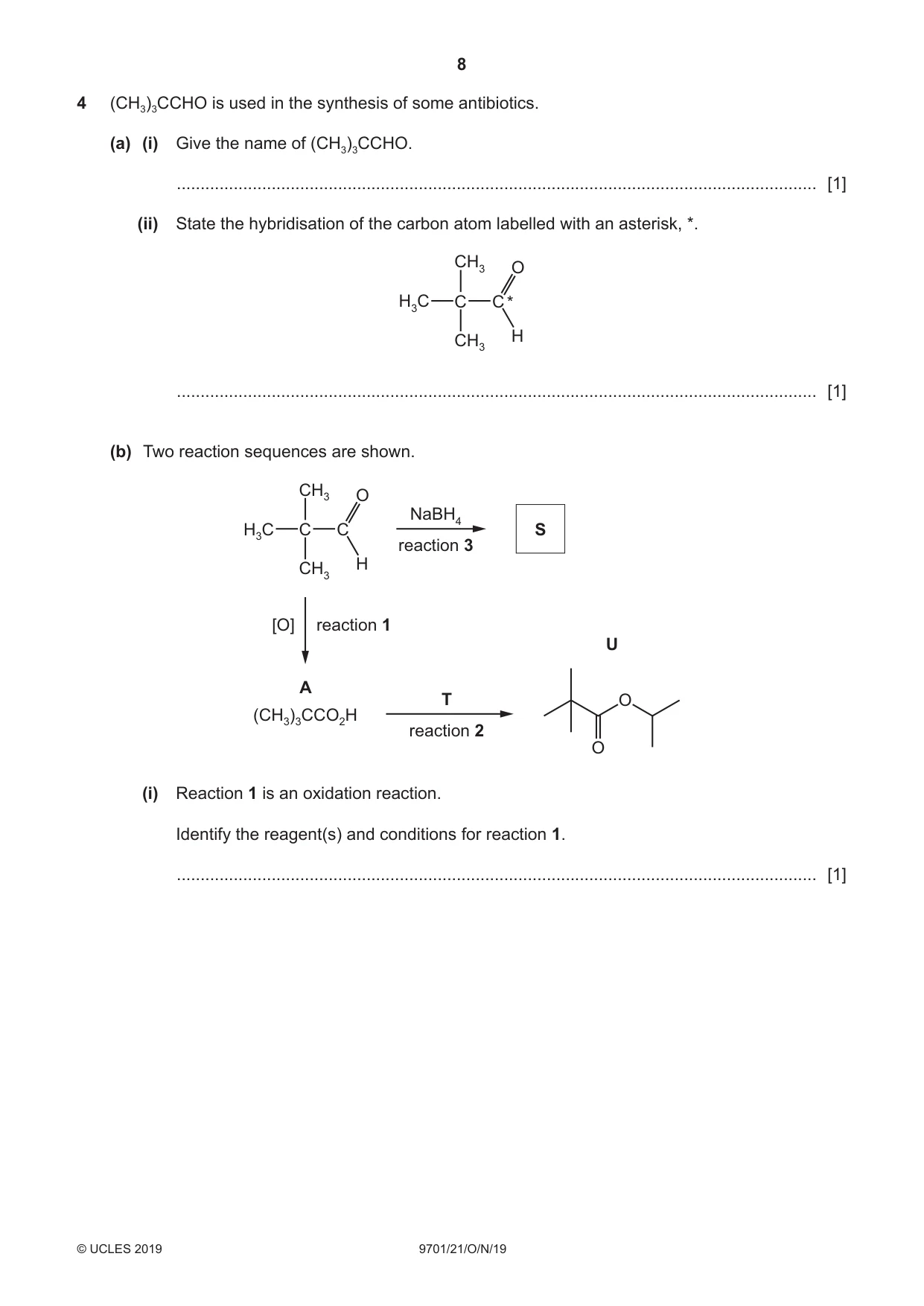
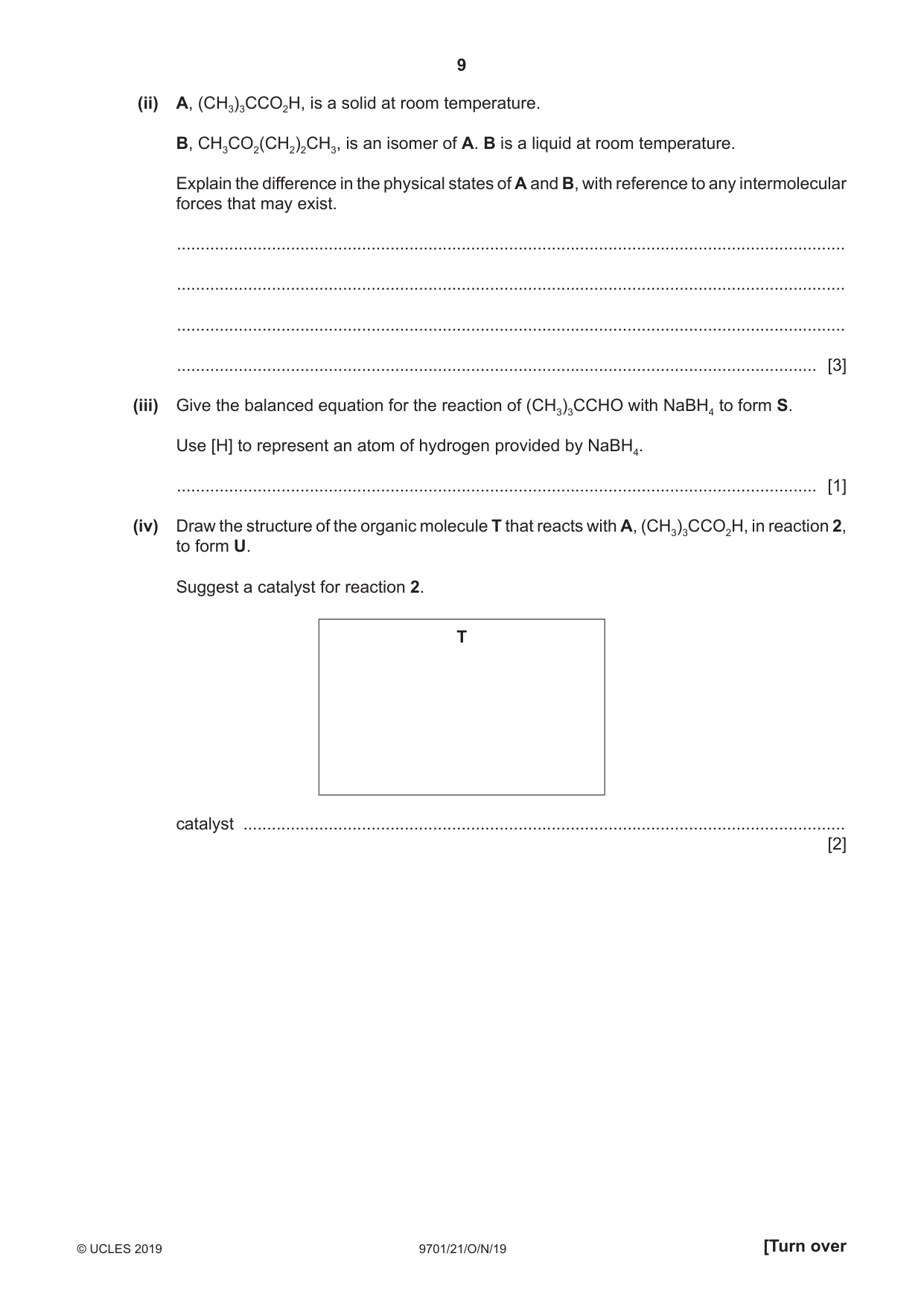
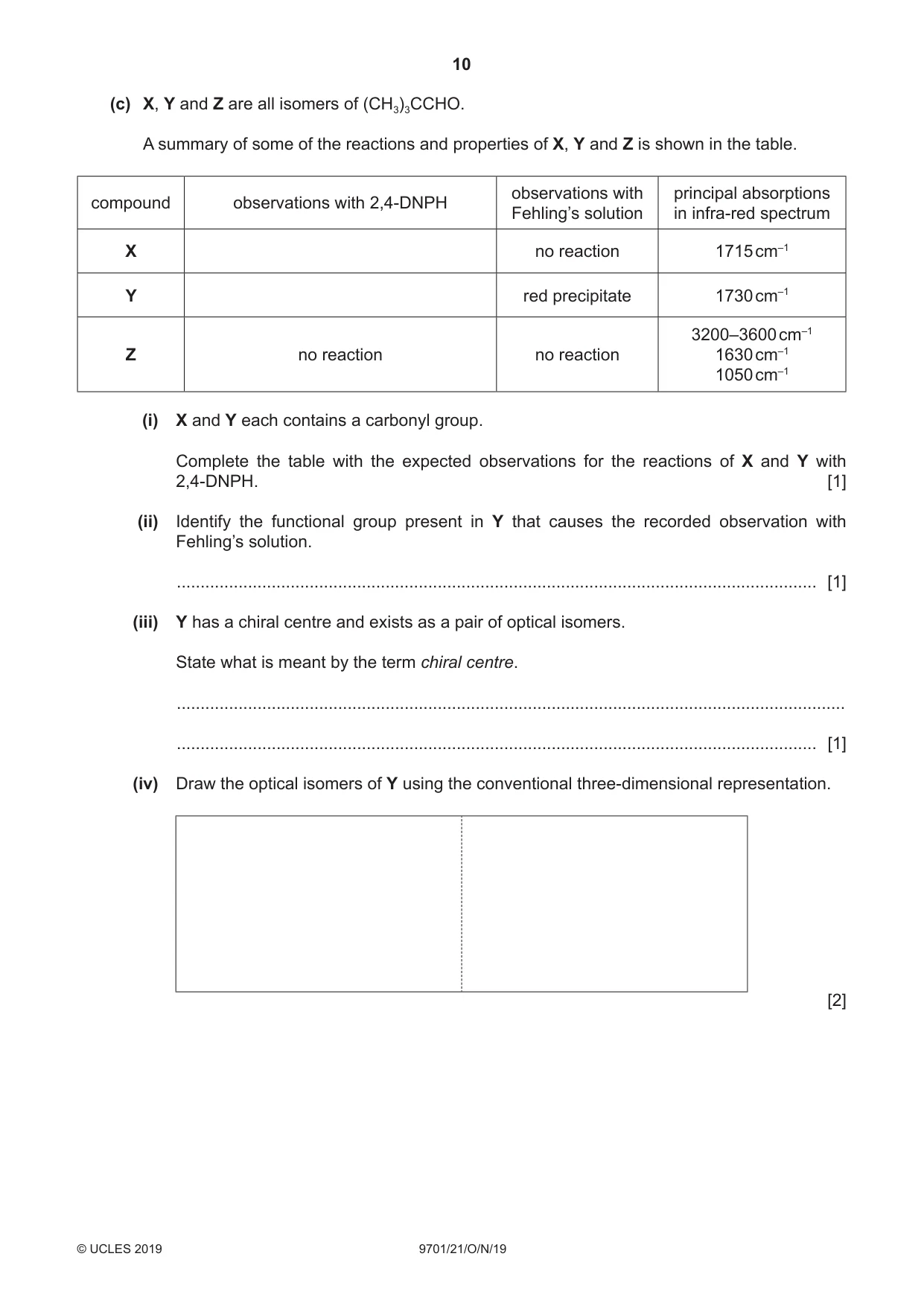
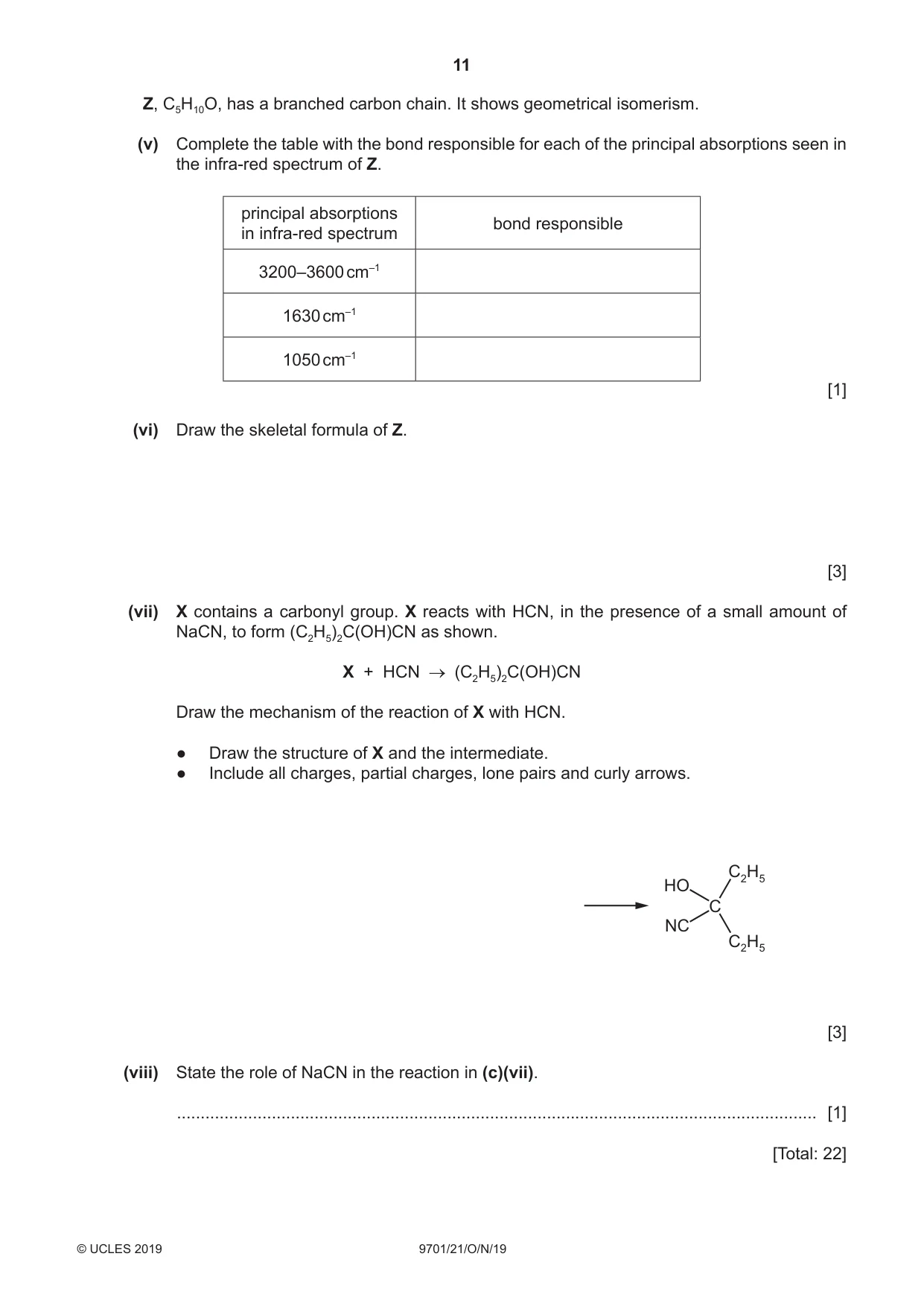
4 (CH3)3CCHO is used in the synthesis of some antibiotics. (a) (i) Give the name of (CH3)3CCHO. ....................................................................................................................................... [1] (ii) State the hybridisation of the carbon atom labelled with an asterisk, *. CH3 O H3C C C * H CH3 ....................................................................................................................................... [1] (b) Two reaction sequences are shown. CH3 O NaBH4 H3C C C S reaction 3 H CH3 [O] reaction 1 U A T O (CH3)3CCO2H reaction 2 O (i) Reaction 1 is an oxidation reaction. Identify the reagent(s) and conditions for reaction 1. ....................................................................................................................................... [1] (ii) A, (CH3)3CCO2H, is a solid at room temperature. B, CH3CO2(CH2)2CH3, is an isomer of A. B is a liquid at room temperature. Explain the difference in the physical states of A and B, with reference to any intermolecular forces that may exist. ............................................................................................................................................. ............................................................................................................................................. ............................................................................................................................................. ....................................................................................................................................... [3] (iii) Give the balanced equation for the reaction of (CH3)3CCHO with NaBH4 to form S. Use [H] to represent an atom of hydrogen provided by NaBH4. ....................................................................................................................................... [1] (iv) Draw the structure of the organic molecule T that reacts with A, (CH3)3CCO2H, in reaction 2, to form U. Suggest a catalyst for reaction 2. T catalyst ................................................................................................................................ [2] (c) X, Y and Z are all isomers of (CH3)3CCHO. A summary of some of the reactions and properties of X, Y and Z is shown in the table. observations with principal absorptionscompound observations with 2,4-DNPH Fehling’s solution in infra-red spectrum X no reaction 1715 cm–1 Y red precipitate 1730 cm–1 3200–3600 cm–1 Z no reaction no reaction 1630 cm–1 1050 cm–1 (i) X and Y each contains a carbonyl group. Complete the table with the expected observations for the reactions of X and Y with 2,4‑DNPH. [1] (ii) Identify the functional group present in Y that causes the recorded observation with Fehling’s solution. ....................................................................................................................................... [1] (iii) Y has a chiral centre and exists as a pair of optical isomers. State what is meant by the term chiral centre. ............................................................................................................................................. ....................................................................................................................................... [1] (iv) Draw the optical isomers of Y using the conventional three-dimensional representation. [2]
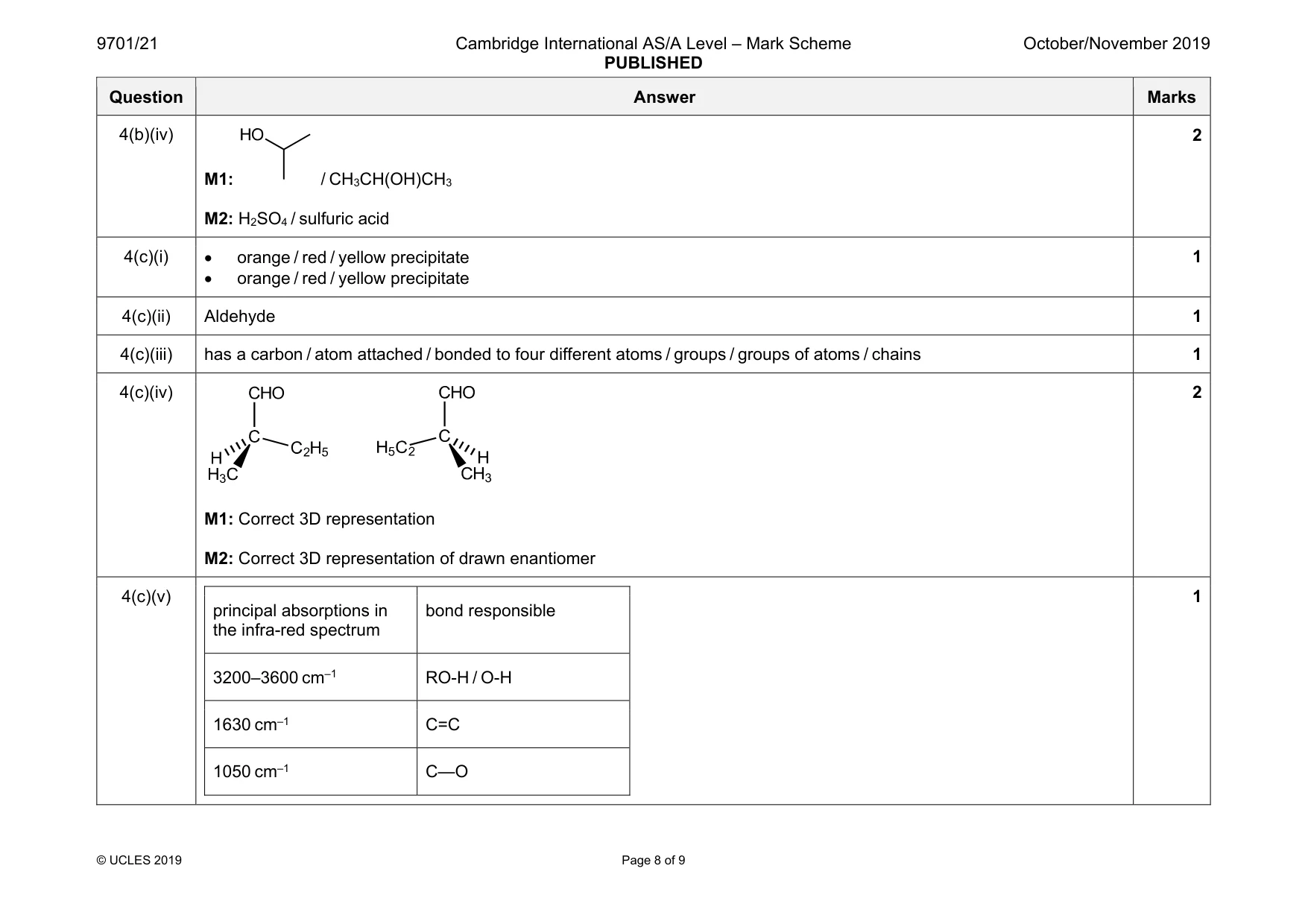
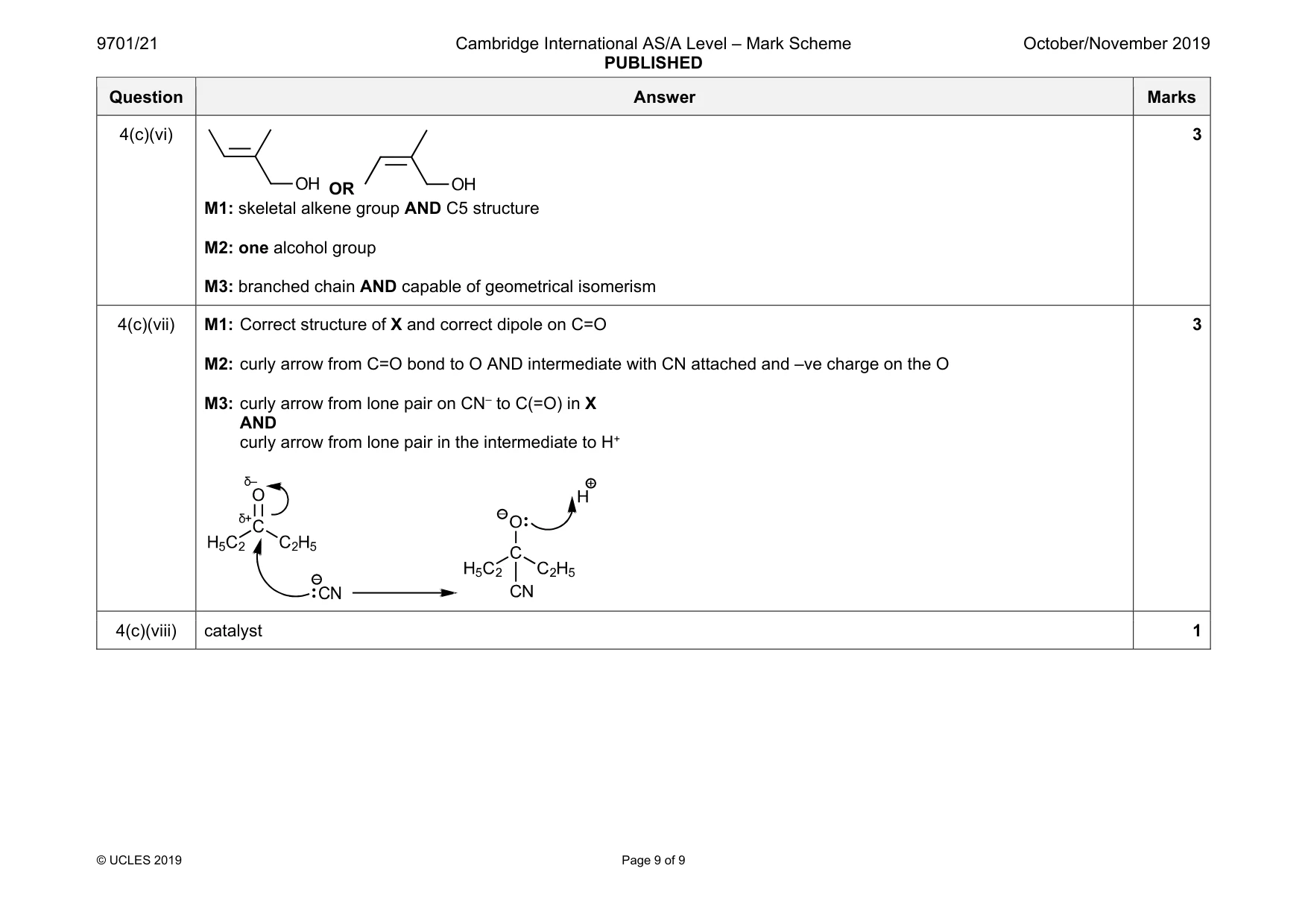
Mark scheme: 4(a)(i) (2,2–)dimethylpropanal 1 4(a)(ii) sp2 1 4(b)(i) acidified potassium dichromate[(VI)] AND heat under reflux 1 4(b)(ii) M1: A has H-bonding (between molecules) M2: B only has dipole–dipole / VdW forces (between molecules) M3: H-bonding is stronger / requires more energy to overcome 3 4(b)(iii) (CH3)3CCHO + 2[H] → (CH3)3CCH2OH 1 Question Answer Marks 4(b)(iv) M1: / CH3CH(OH)CH3 M2: H2SO4 / sulfuric acid 2 4(c)(i) • orange / red / yellow precipitate • orange / red / yellow precipitate 1 4(c)(ii) Aldehyde 1 4(c)(iii) has a carbon / atom attached / bonded to four different atoms / groups / groups of atoms / chains 1 4(c)(iv) M1: Correct 3D representation M2: Correct 3D representation of drawn enantiomer 2 4(c)(v) principal absorptions in the infra-red spectrum bond responsible 3200–3600 cm–1 RO-H / O-H 1630 cm–1 C=C 1050 cm–1 C—O 1 Question Answer Marks 4(c)(vi) OR M1: skeletal alkene group AND C5 structure M2: one alcohol group M3: branched chain AND capable of geometrical isomerism 3 4(c)(vii) M1: Correct structure of X and correct dipole on C=O M2: curly arrow from C=O bond to O AND intermediate with CN attached and –ve charge on the O M3: curly arrow from lone pair on CN– to C(=O) in X AND curly arrow from lone pair in the intermediate to H+ 3 4(c)(viii) catalyst 1
What was in this paper
The subtopics covered by these 4 questions, and how many questions each got. Open one in a new tab to see every Cambridge question on it.
What you needed in this session
Cambridge’s own grade thresholds for 2019 Oct/Nov, Paper 2 · Variant 1. A higher threshold means an easier paper — the bar moves with how the cohort did.