Cambridge A Level Chemistry 9701 — 2019 May/June Paper 5 · Variant 2
9701/52/M/J/19 · 2 questions · 30 marks · ≈34 min
The question paper and its mark scheme, free to read here and free to download. This is Cambridge’s own paper, exactly as it was sat.
Question paper12 pages

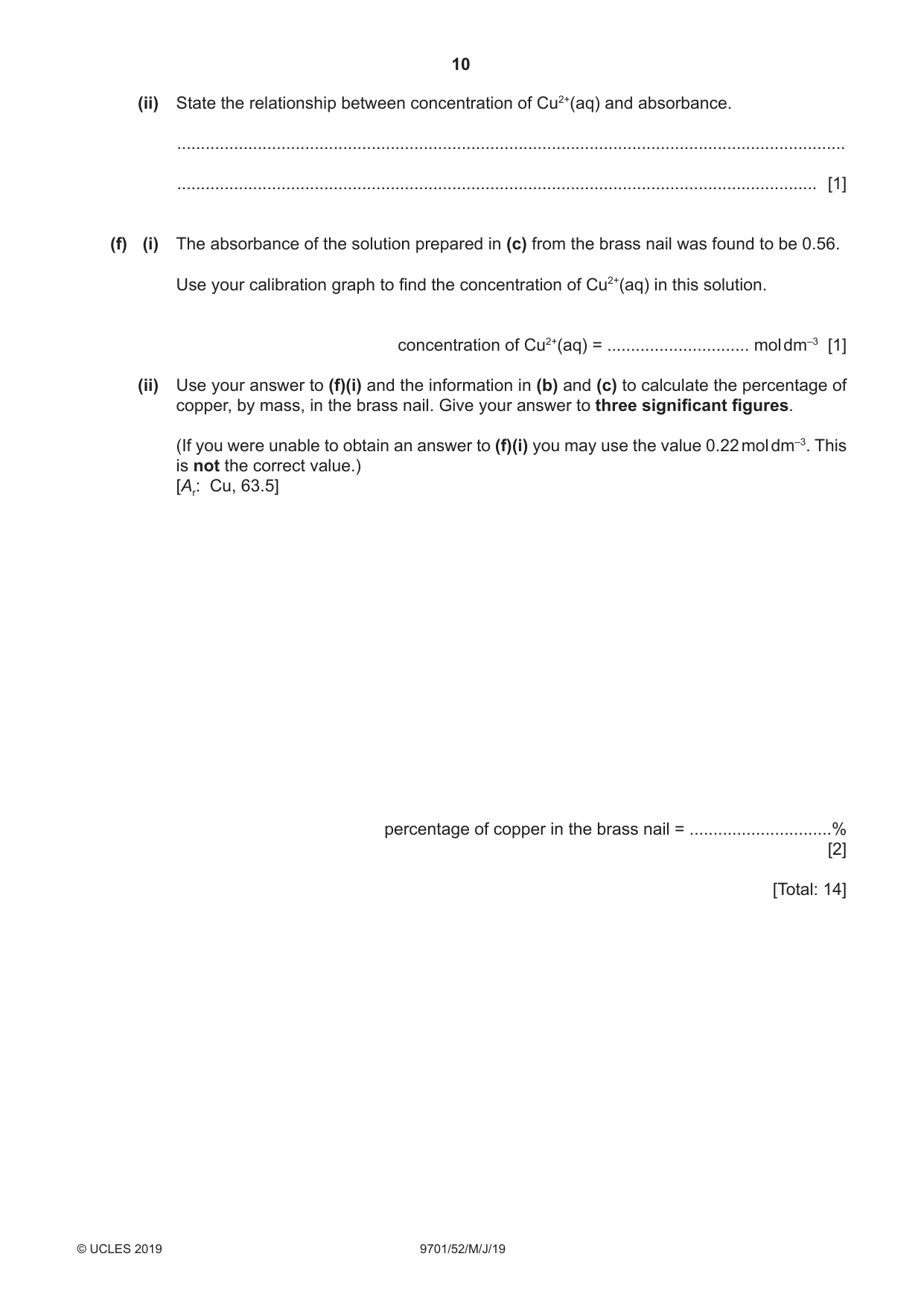

Mark scheme7 pages
Answers below. Sit the paper first if you are practising.
Questions as text
Q1 · A student is provided with samples of six metal carbonate ores, known to be ores of the…
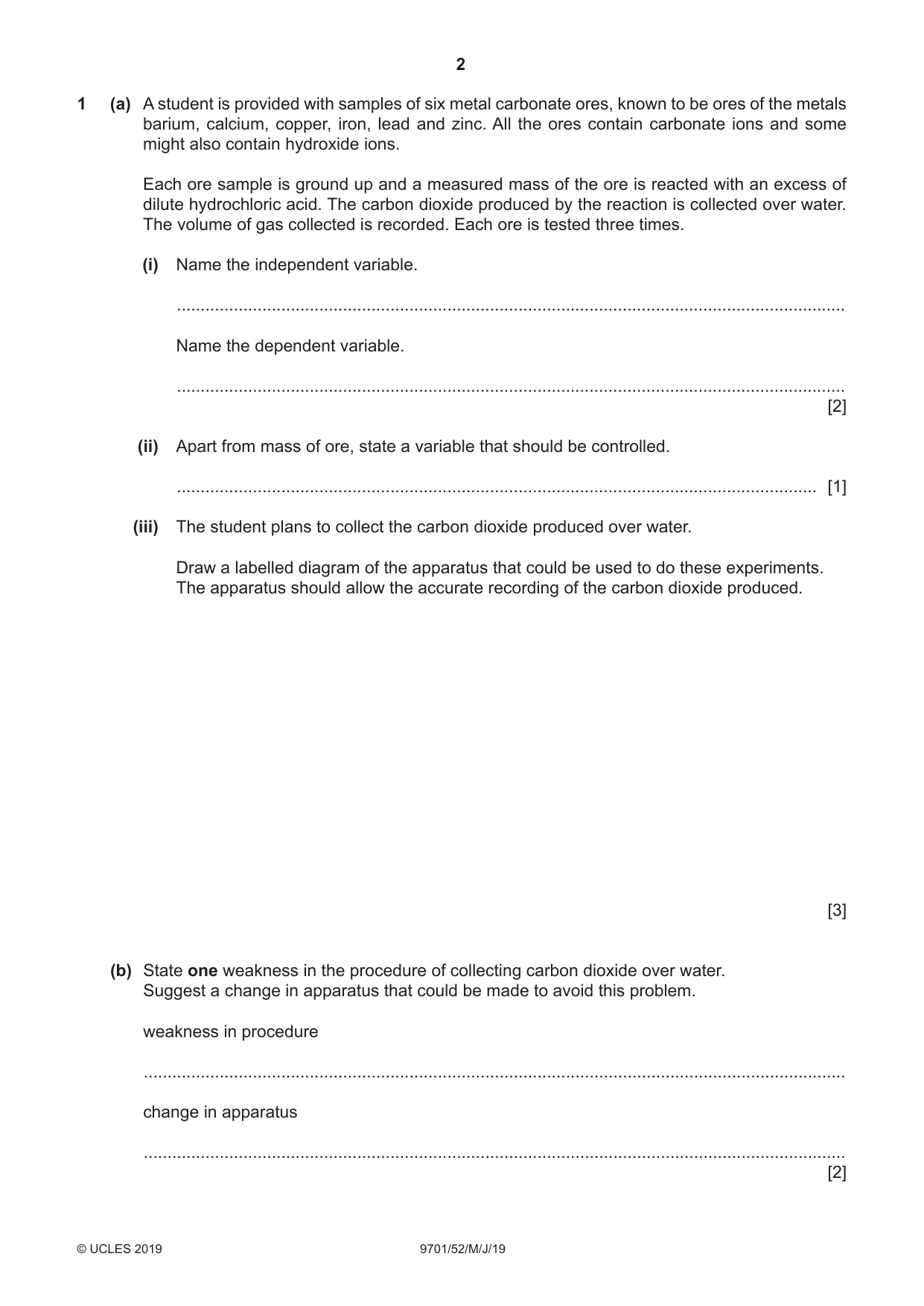
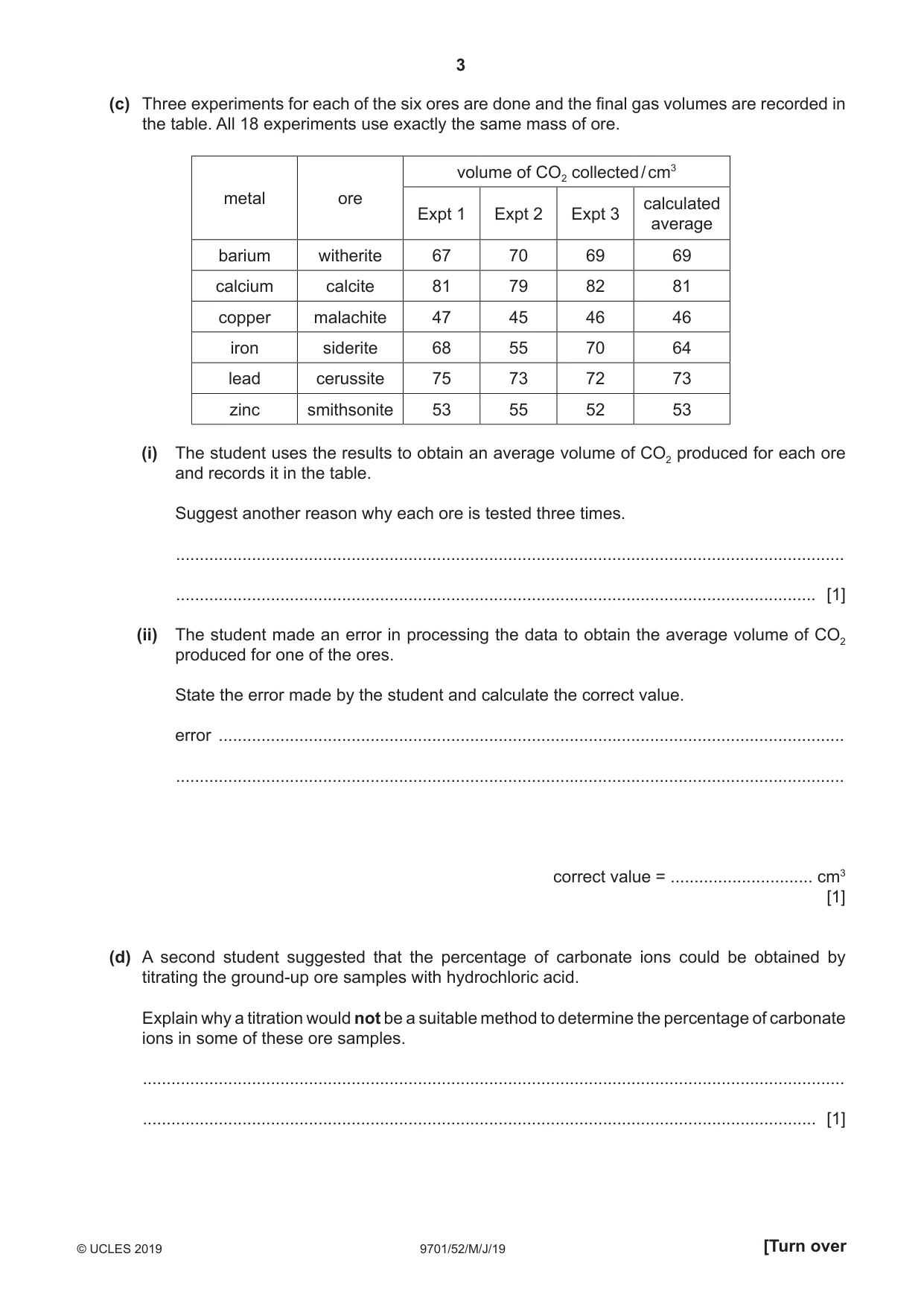
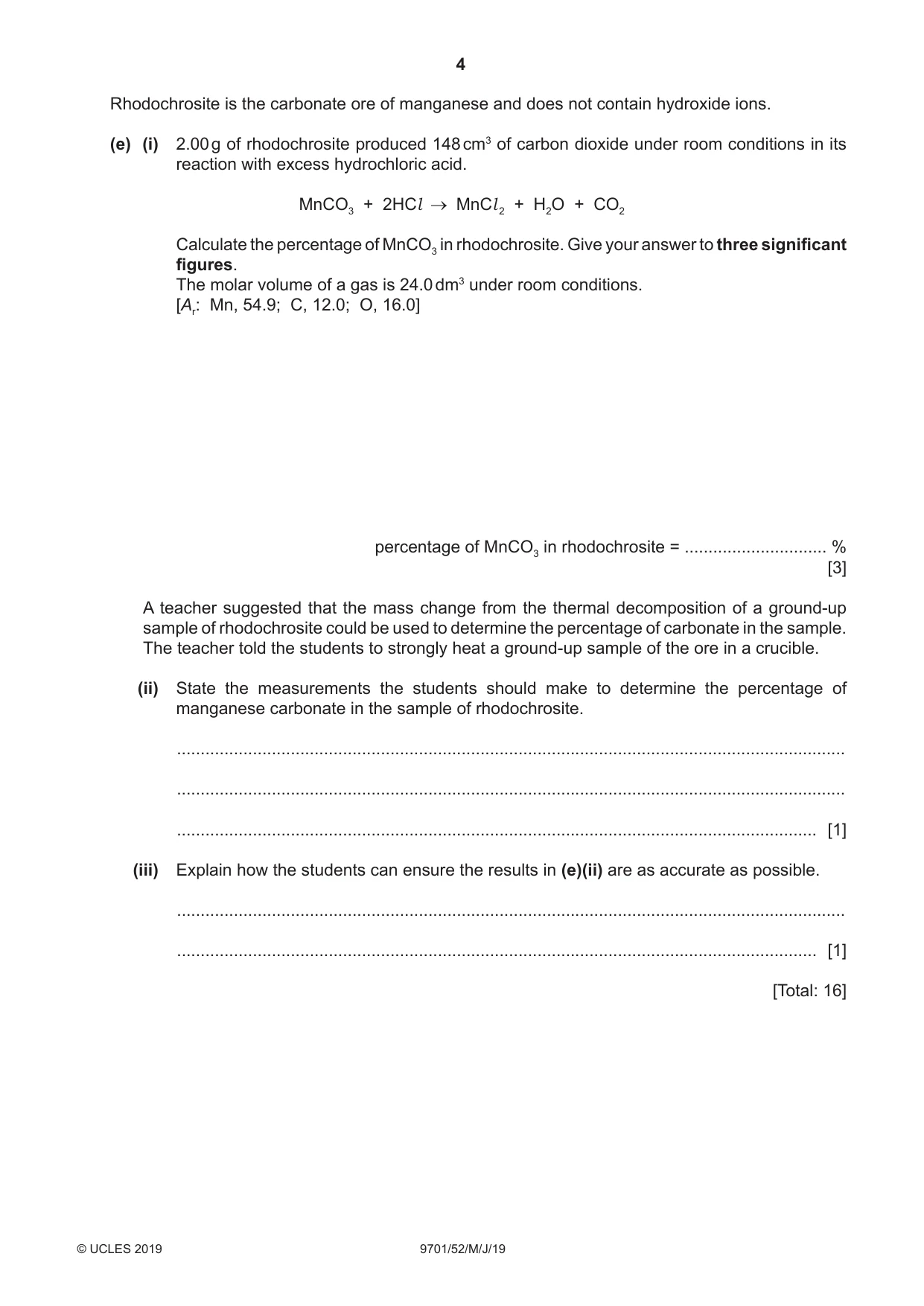
1 (a) A student is provided with samples of six metal carbonate ores, known to be ores of the metals barium, calcium, copper, iron, lead and zinc. All the ores contain carbonate ions and some might also contain hydroxide ions. Each ore sample is ground up and a measured mass of the ore is reacted with an excess of dilute hydrochloric acid. The carbon dioxide produced by the reaction is collected over water. The volume of gas collected is recorded. Each ore is tested three times. (i) Name the independent variable. ............................................................................................................................................. Name the dependent variable. ............................................................................................................................................. [2] (ii) Apart from mass of ore, state a variable that should be controlled. ....................................................................................................................................... [1] (iii) The student plans to collect the carbon dioxide produced over water. Draw a labelled diagram of the apparatus that could be used to do these experiments. The apparatus should allow the accurate recording of the carbon dioxide produced. [3] (b) State one weakness in the procedure of collecting carbon dioxide over water. Suggest a change in apparatus that could be made to avoid this problem. weakness in procedure .................................................................................................................................................... change in apparatus .................................................................................................................................................... [2] (c) Three experiments for each of the six ores are done and the final gas volumes are recorded in the table. All 18 experiments use exactly the same mass of ore. volume of CO2 collected / cm3 metal ore calculated Expt 1 Expt 2 Expt 3 average barium witherite 67 70 69 69 calcium calcite 81 79 82 81 copper malachite 47 45 46 46 iron siderite 68 55 70 64 lead cerussite 75 73 72 73 zinc smithsonite 53 55 52 53 (i) The student uses the results to obtain an average volume of CO2 produced for each ore and records it in the table. Suggest another reason why each ore is tested three times. ............................................................................................................................................. ....................................................................................................................................... [1] (ii) The student made an error in processing the data to obtain the average volume of CO2 produced for one of the ores. State the error made by the student and calculate the correct value. error ..................................................................................................................................... ............................................................................................................................................. correct value = .............................. cm3 [1] (d) A second student suggested that the percentage of carbonate ions could be obtained by titrating the ground-up ore samples with hydrochloric acid. Explain why a titration would not be a suitable method to determine the percentage of carbonate ions in some of these ore samples. .................................................................................................................................................... .............................................................................................................................................. [1] Rhodochrosite is the carbonate ore of manganese and does not contain hydroxide ions. (e) (i) 2.00 g of rhodochrosite produced 148 cm3 of carbon dioxide under room conditions in its reaction with excess hydrochloric acid. MnCO3 + 2HCl MnCl 2 + H2O + CO2 Calculate the percentage of MnCO3 in rhodochrosite. Give your answer to three significant figures. The molar volume of a gas is 24.0 dm3 under room conditions. [Ar: Mn, 54.9; C, 12.0; O, 16.0] percentage of MnCO3 in rhodochrosite = .............................. % [3] A teacher suggested that the mass change from the thermal decomposition of a ground‑up sample of rhodochrosite could be used to determine the percentage of carbonate in the sample. The teacher told the students to strongly heat a ground‑up sample of the ore in a crucible. (ii) State the measurements the students should make to determine the percentage of manganese carbonate in the sample of rhodochrosite. ............................................................................................................................................. ............................................................................................................................................. ....................................................................................................................................... [1] (iii) Explain how the students can ensure the results in (e)(ii) are as accurate as possible. ............................................................................................................................................. ....................................................................................................................................... [1] [Total: 16]
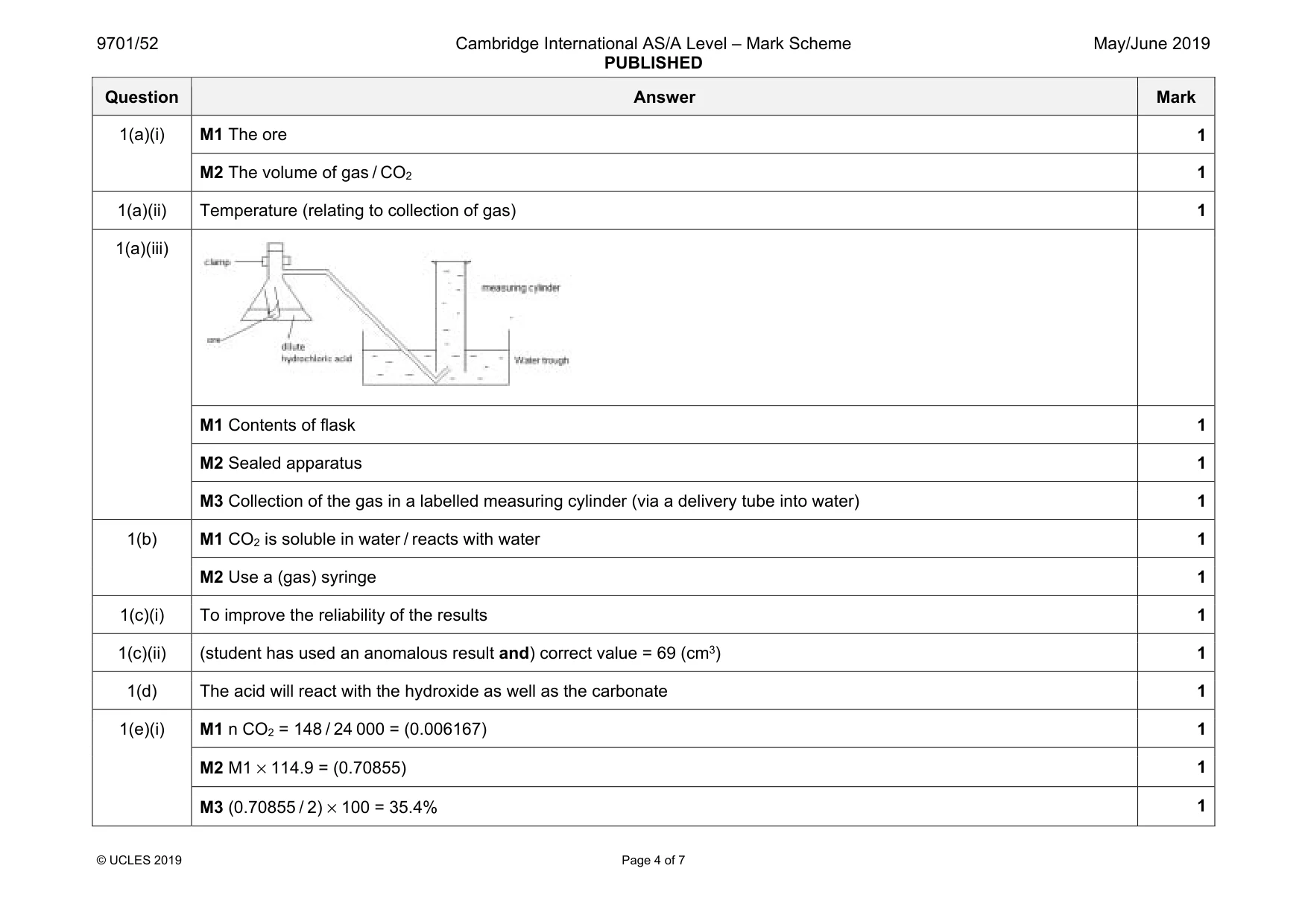
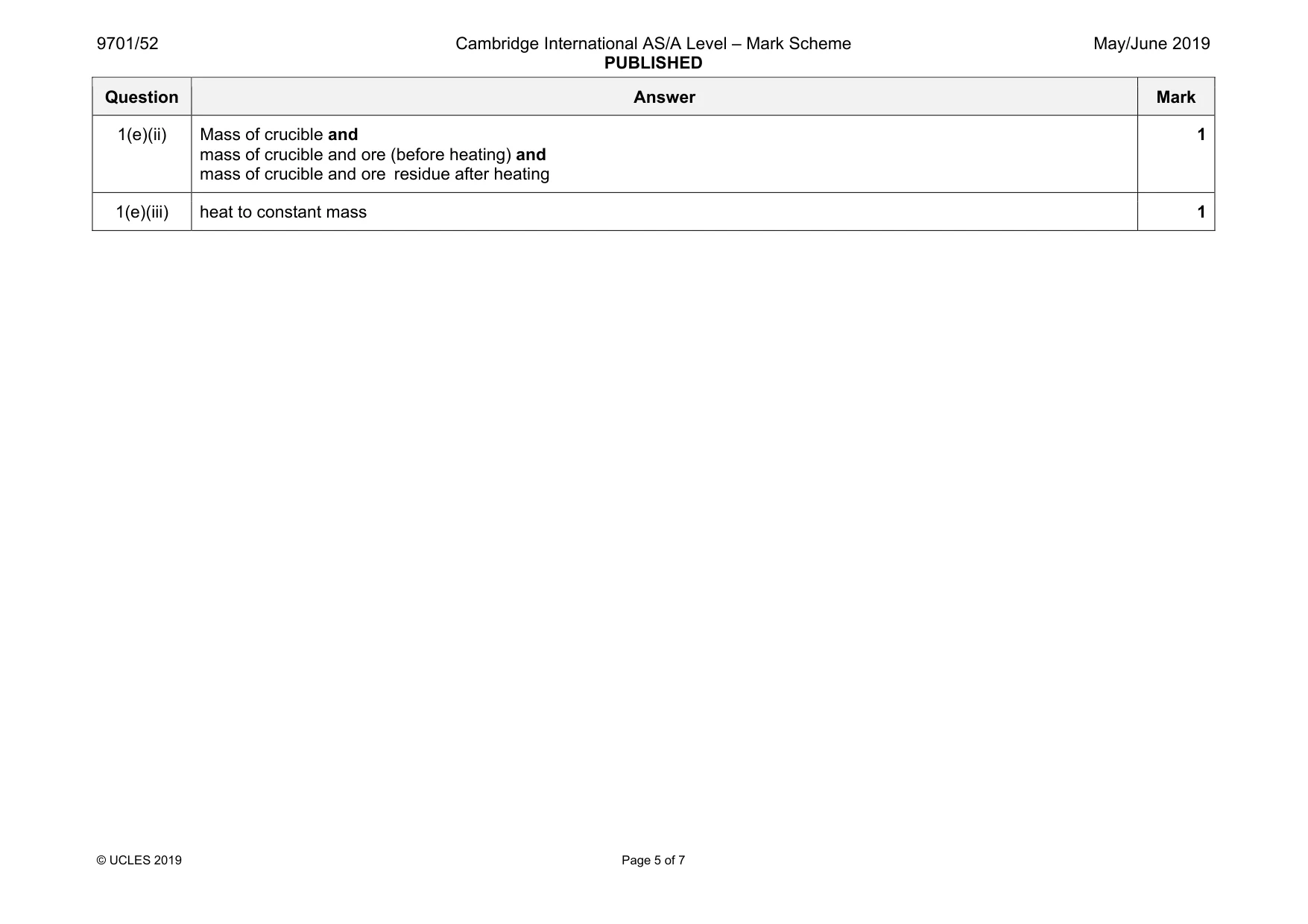
Mark scheme: 1(a)(i) M1 The ore 1 M2 The volume of gas / CO2 1 1(a)(ii) Temperature (relating to collection of gas) 1 1(a)(iii) M1 Contents of flask 1 M2 Sealed apparatus 1 M3 Collection of the gas in a labelled measuring cylinder (via a delivery tube into water) 1 1(b) M1 CO2 is soluble in water / reacts with water 1 M2 Use a (gas) syringe 1 1(c)(i) To improve the reliability of the results 1 1(c)(ii) (student has used an anomalous result and) correct value = 69 (cm3) 1 1(d) The acid will react with the hydroxide as well as the carbonate 1 1(e)(i) M1 n CO2 = 148 / 24 000 = (0.006167) 1 M2 M1 × 114.9 = (0.70855) 1 M3 (0.70855 / 2) × 100 = 35.4% 1 Question Answer Mark 1(e)(ii) Mass of crucible and mass of crucible and ore (before heating) and mass of crucible and ore residue after heating 1 1(e)(iii) heat to constant mass 1
More questions on Reacting masses and volumes (of solutions and gases)
Q2 · An investigation is done to find the percentage of copper in a brass nail
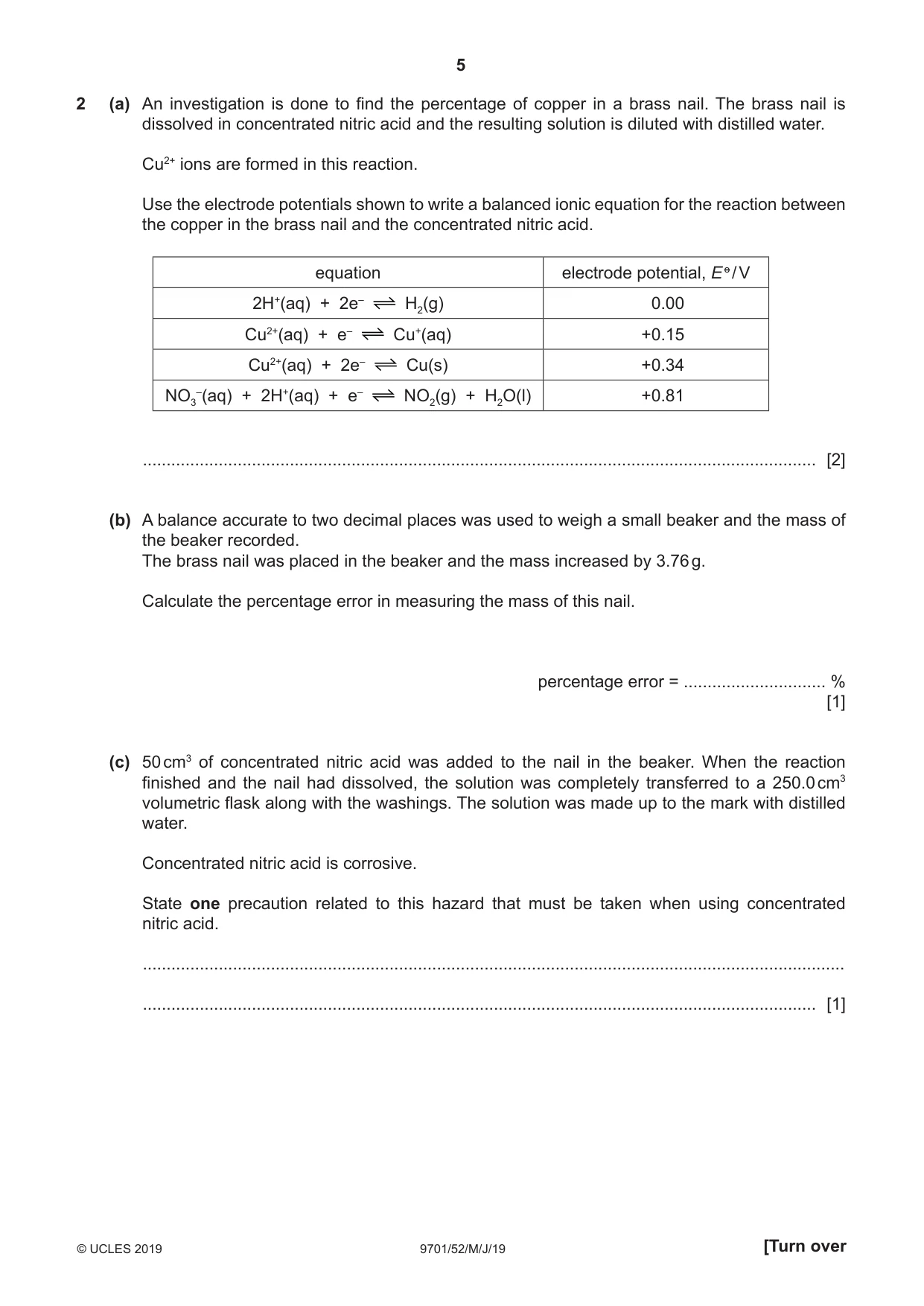
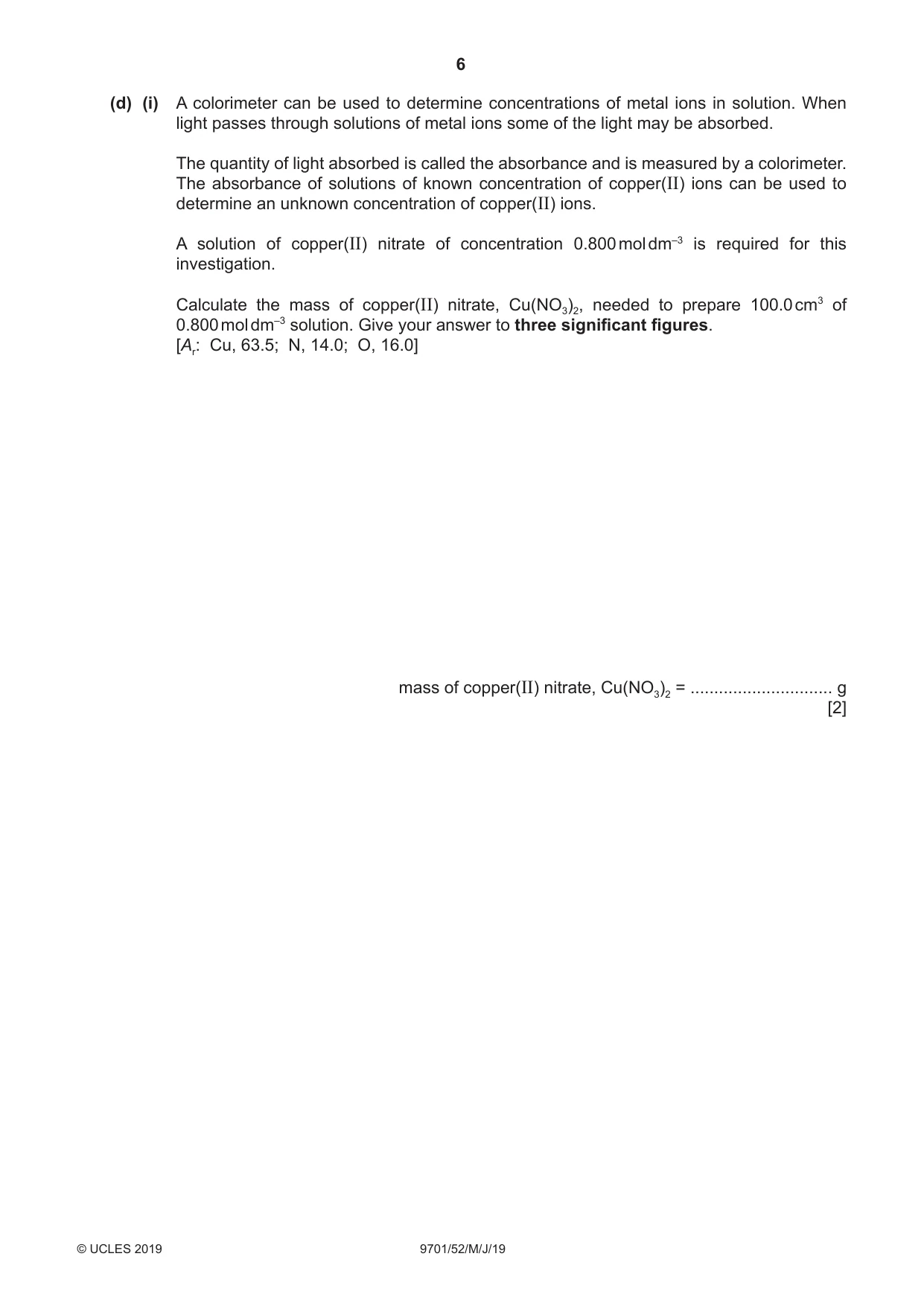
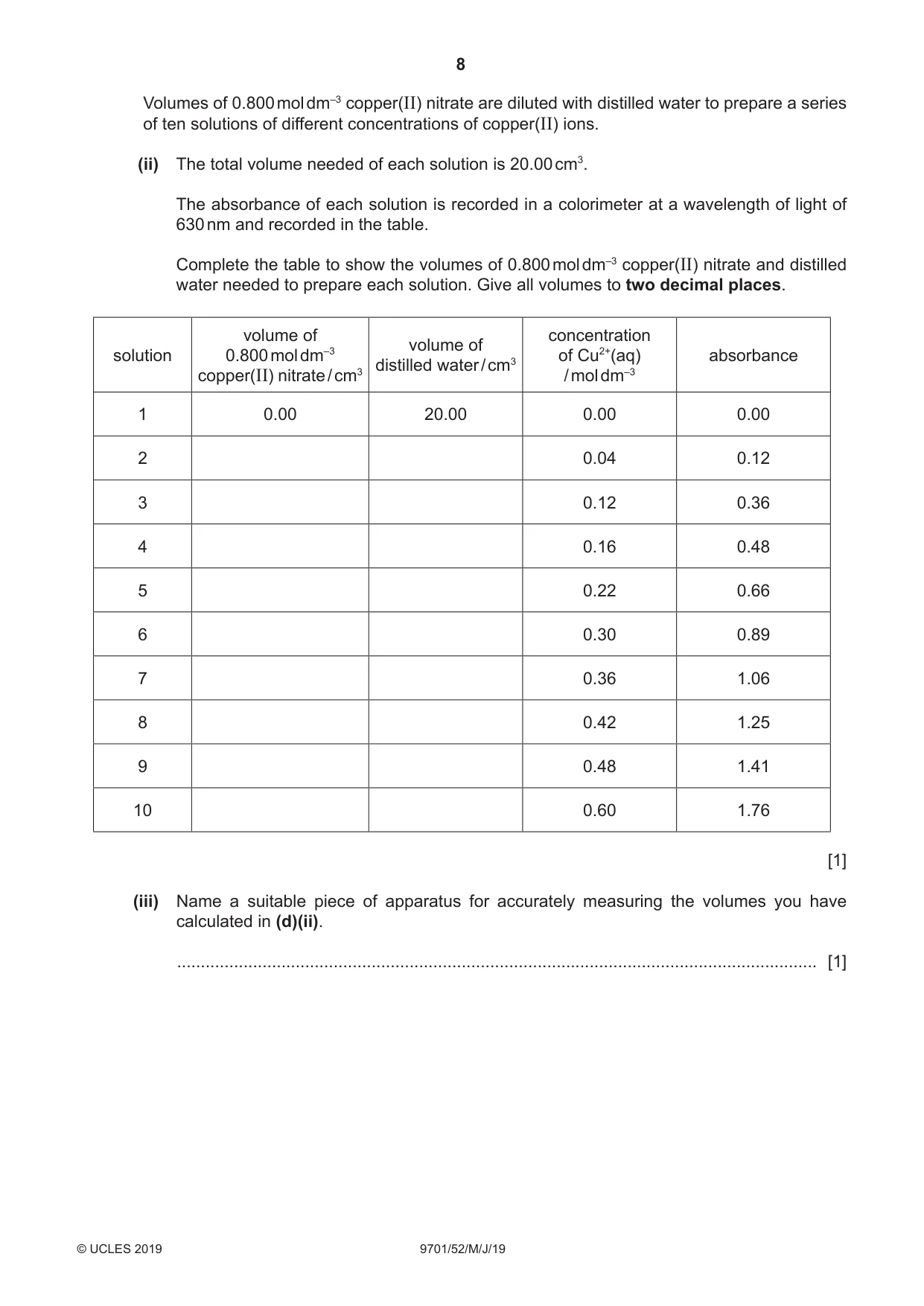
2 (a) An investigation is done to find the percentage of copper in a brass nail. The brass nail is dissolved in concentrated nitric acid and the resulting solution is diluted with distilled water. Cu2+ ions are formed in this reaction. Use the electrode potentials shown to write a balanced ionic equation for the reaction between the copper in the brass nail and the concentrated nitric acid. equation electrode potential, E o / V 2H+(aq) + 2e– H2(g) 0.00 Cu2+(aq) + e– Cu+(aq) +0.15 Cu2+(aq) + 2e– Cu(s) +0.34 NO3–(aq) + 2H+(aq) + e– NO2(g) + H2O(l) +0.81 .............................................................................................................................................. [2] (b) A balance accurate to two decimal places was used to weigh a small beaker and the mass of the beaker recorded. The brass nail was placed in the beaker and the mass increased by 3.76 g. Calculate the percentage error in measuring the mass of this nail. percentage error = .............................. % [1] (c) 50 cm3 of concentrated nitric acid was added to the nail in the beaker. When the reaction finished and the nail had dissolved, the solution was completely transferred to a 250.0 cm3 volumetric flask along with the washings. The solution was made up to the mark with distilled water. Concentrated nitric acid is corrosive. State one precaution related to this hazard that must be taken when using concentrated nitric acid. .................................................................................................................................................... .............................................................................................................................................. [1] (d) (i) A colorimeter can be used to determine concentrations of metal ions in solution. When light passes through solutions of metal ions some of the light may be absorbed. The quantity of light absorbed is called the absorbance and is measured by a colorimeter. The absorbance of solutions of known concentration of copper(II) ions can be used to determine an unknown concentration of copper(II) ions. A solution of copper(II) nitrate of concentration 0.800 mol dm–3 is required for this investigation. Calculate the mass of copper(II) nitrate, Cu(NO3)2, needed to prepare 100.0 cm3 of 0.800 mol dm–3 solution. Give your answer to three significant figures. [Ar: Cu, 63.5; N, 14.0; O, 16.0] mass of copper(II) nitrate, Cu(NO3)2 = .............................. g [2] Question 2 continues on the next page.
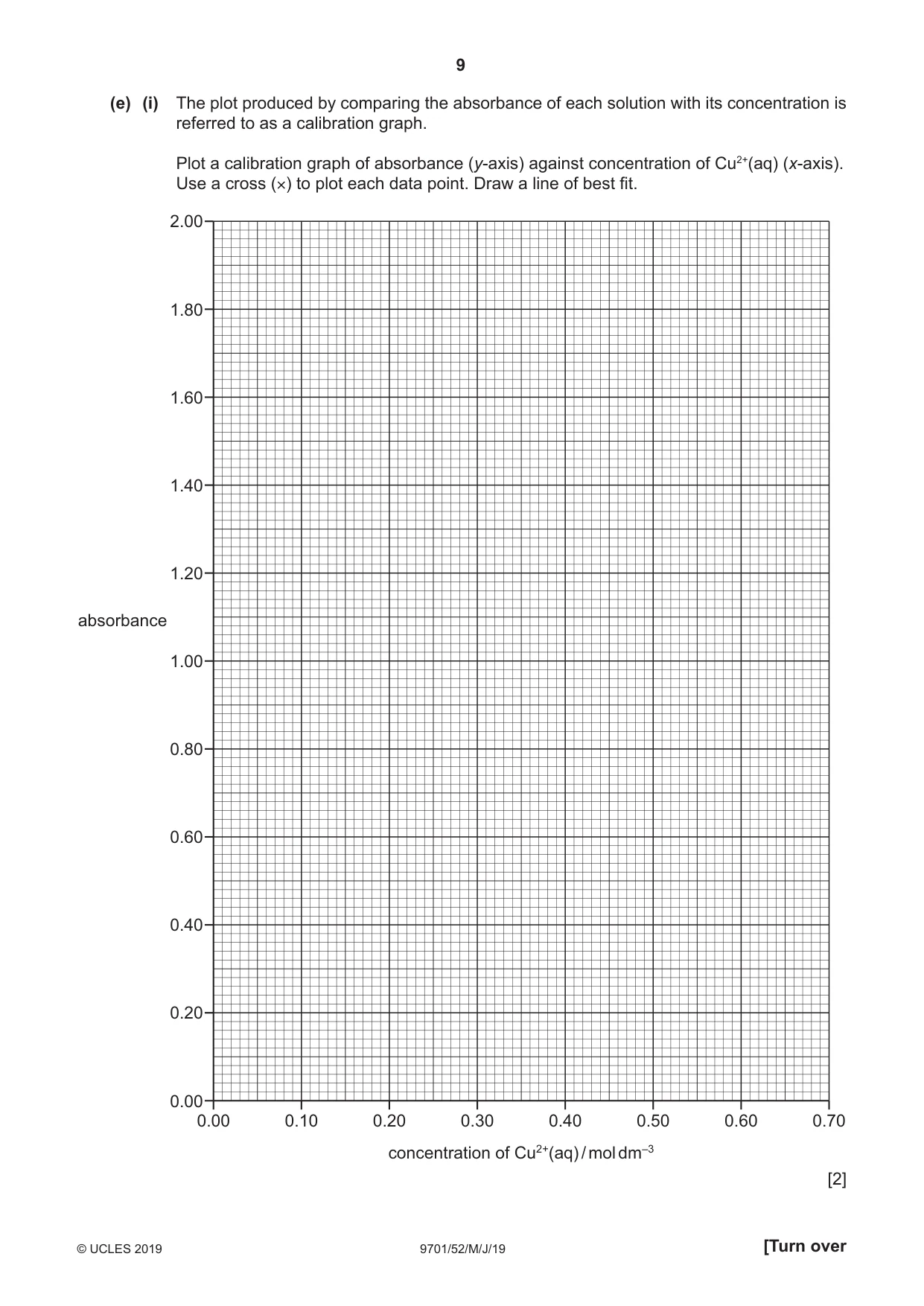
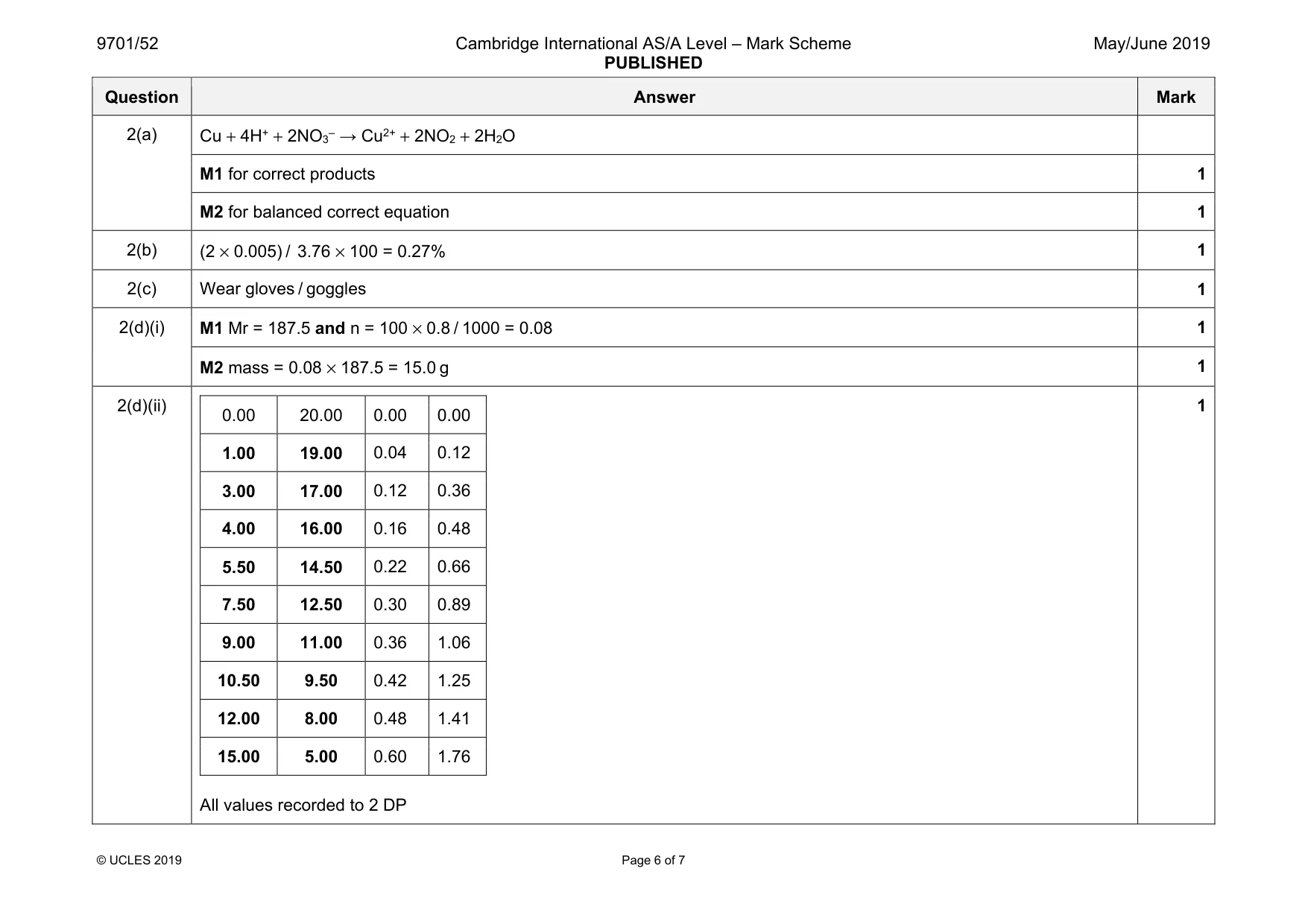
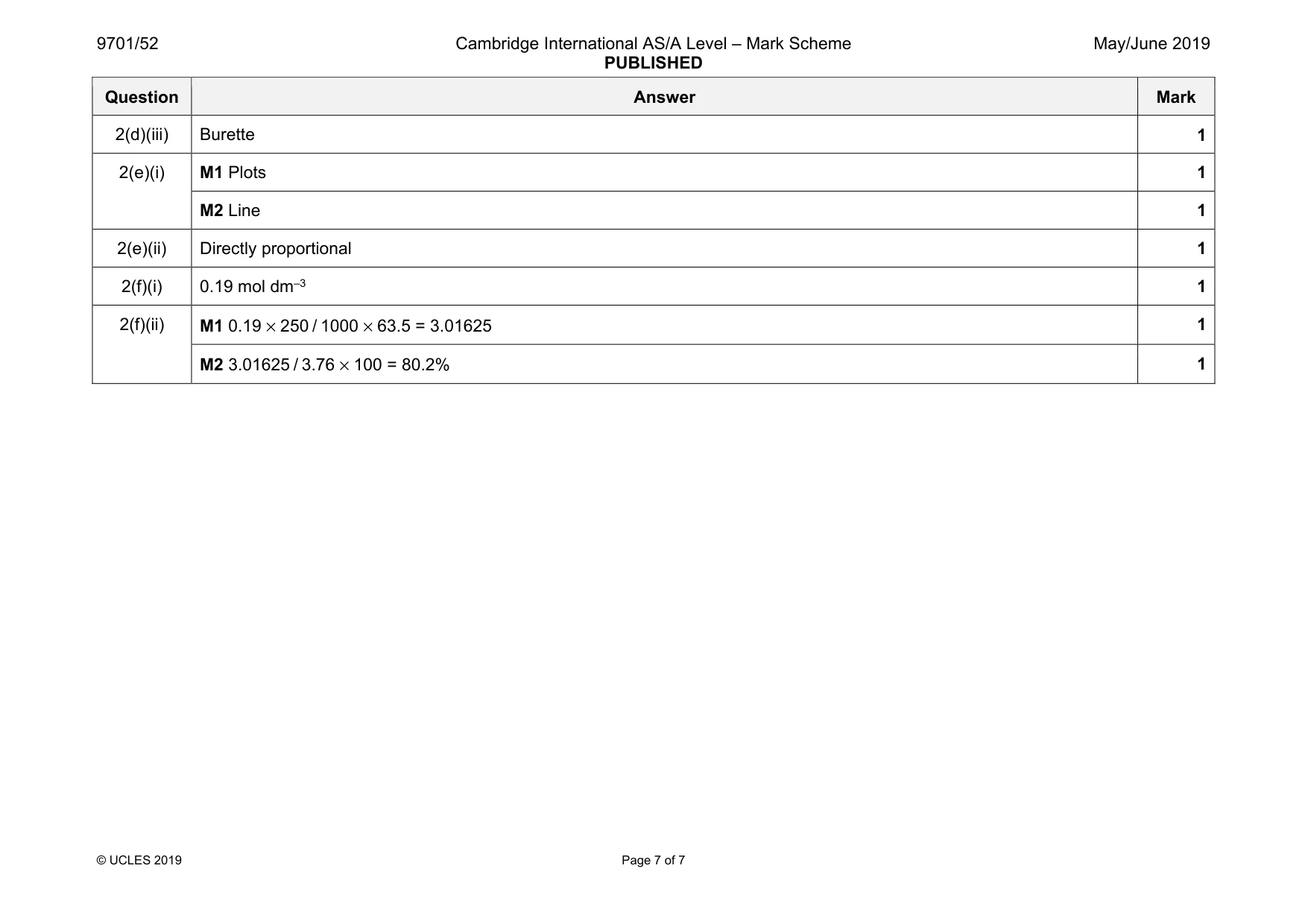
Mark scheme: 2(a) M1 for correct products 1 M2 for balanced correct equation 1 2(b) (2 × 0.005) / 3.76 × 100 = 0.27% 1 2(c) Wear gloves / goggles 1 2(d)(i) M1 Mr = 187.5 and n = 100 × 0.8 / 1000 = 0.08 1 M2 mass = 0.08 × 187.5 = 15.0 g 1 2(d)(ii) 0.00 20.00 0.00 0.00 1.00 19.00 0.04 0.12 3.00 17.00 0.12 0.36 4.00 16.00 0.16 0.48 5.50 14.50 0.22 0.66 7.50 12.50 0.30 0.89 9.00 11.00 0.36 1.06 10.50 9.50 0.42 1.25 12.00 8.00 0.48 1.41 15.00 5.00 0.60 1.76 All values recorded to 2 DP 1 Question Answer Mark 2(d)(iii) Burette 1 2(e)(i) M1 Plots 1 M2 Line 1 2(e)(ii) Directly proportional 1 2(f)(i) 0.19 mol dm–3 1 2(f)(ii) M1 0.19 × 250 / 1000 × 63.5 = 3.01625 1 M2 3.01625 / 3.76 × 100 = 80.2% 1
More questions on Reacting masses and volumes (of solutions and gases)
What was in this paper
The subtopics covered by these 2 questions, and how many questions each got. Open one in a new tab to see every Cambridge question on it.
What you needed in this session
Cambridge’s own grade thresholds for 2019 May/June, Paper 5 · Variant 2. A higher threshold means an easier paper — the bar moves with how the cohort did.