Cambridge A Level Chemistry 9701 — 2019 May/June Paper 5 · Variant 1
9701/51/M/J/19 · 2 questions · 30 marks · ≈34 min
The question paper and its mark scheme, free to read here and free to download. This is Cambridge’s own paper, exactly as it was sat.
Question paper12 pages

Mark scheme9 pages
Answers below. Sit the paper first if you are practising.
Questions as text
Q1 · A student investigates the charge (z+) carried by aqueous manganese ions, Mnz+(aq)
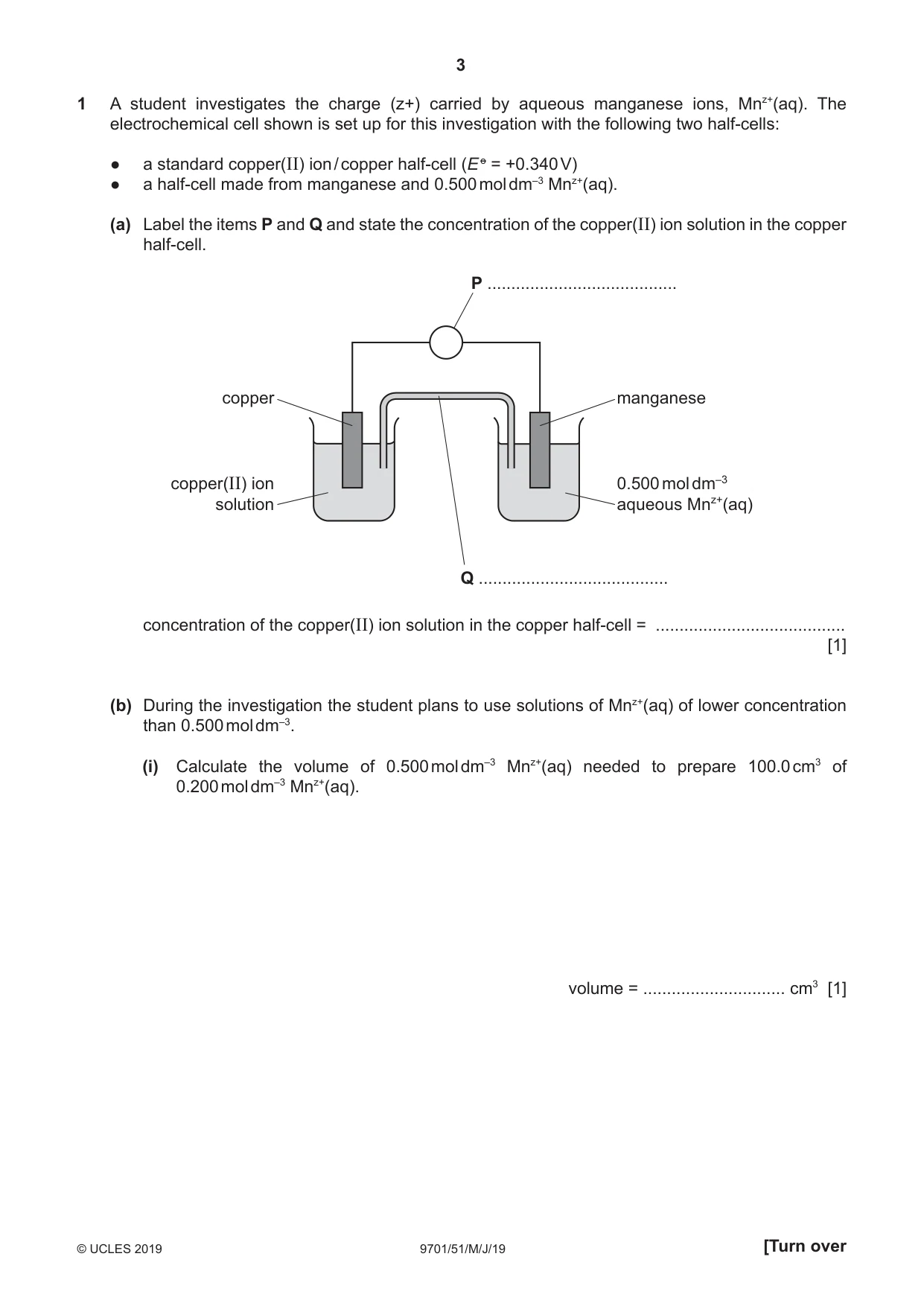
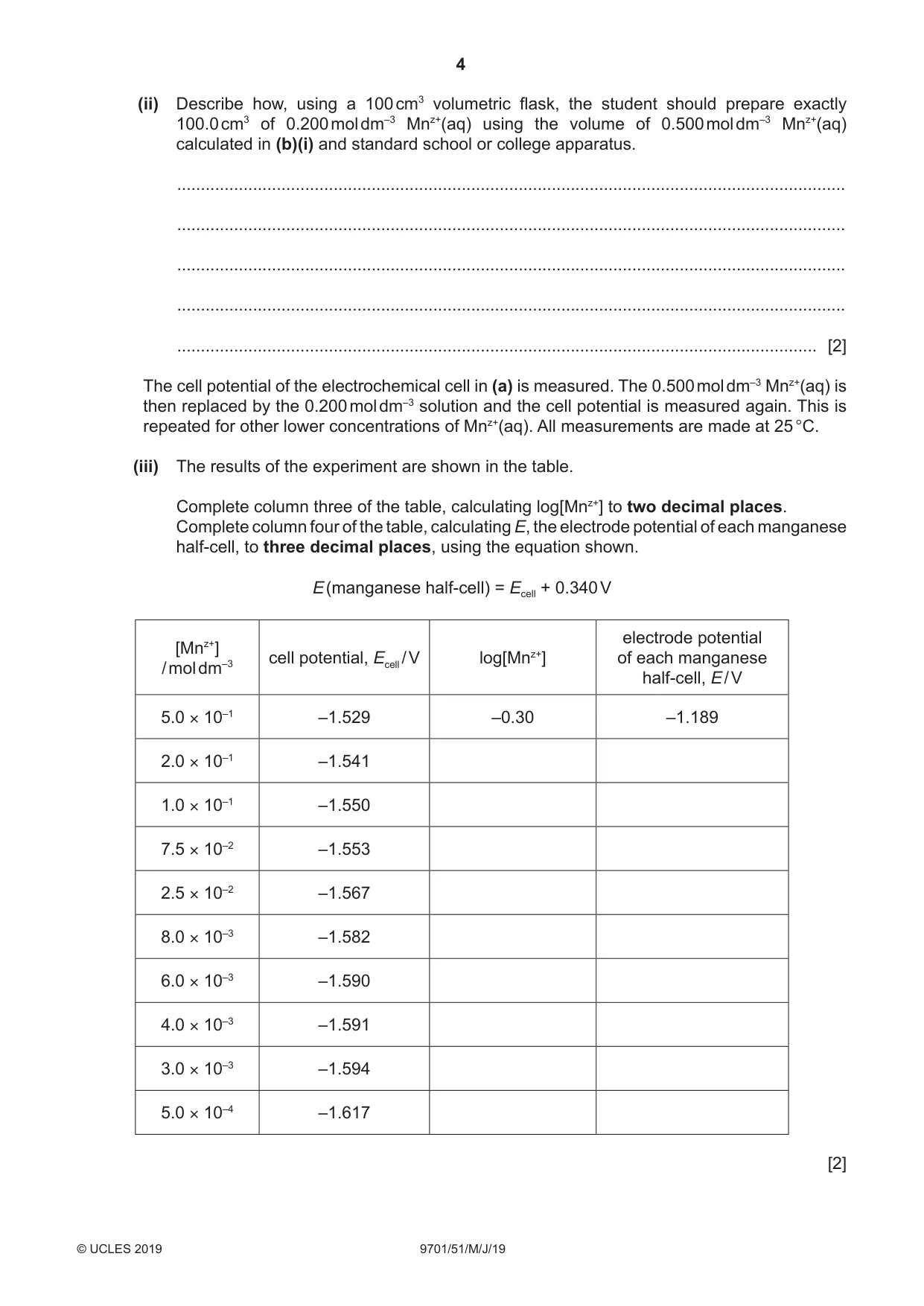
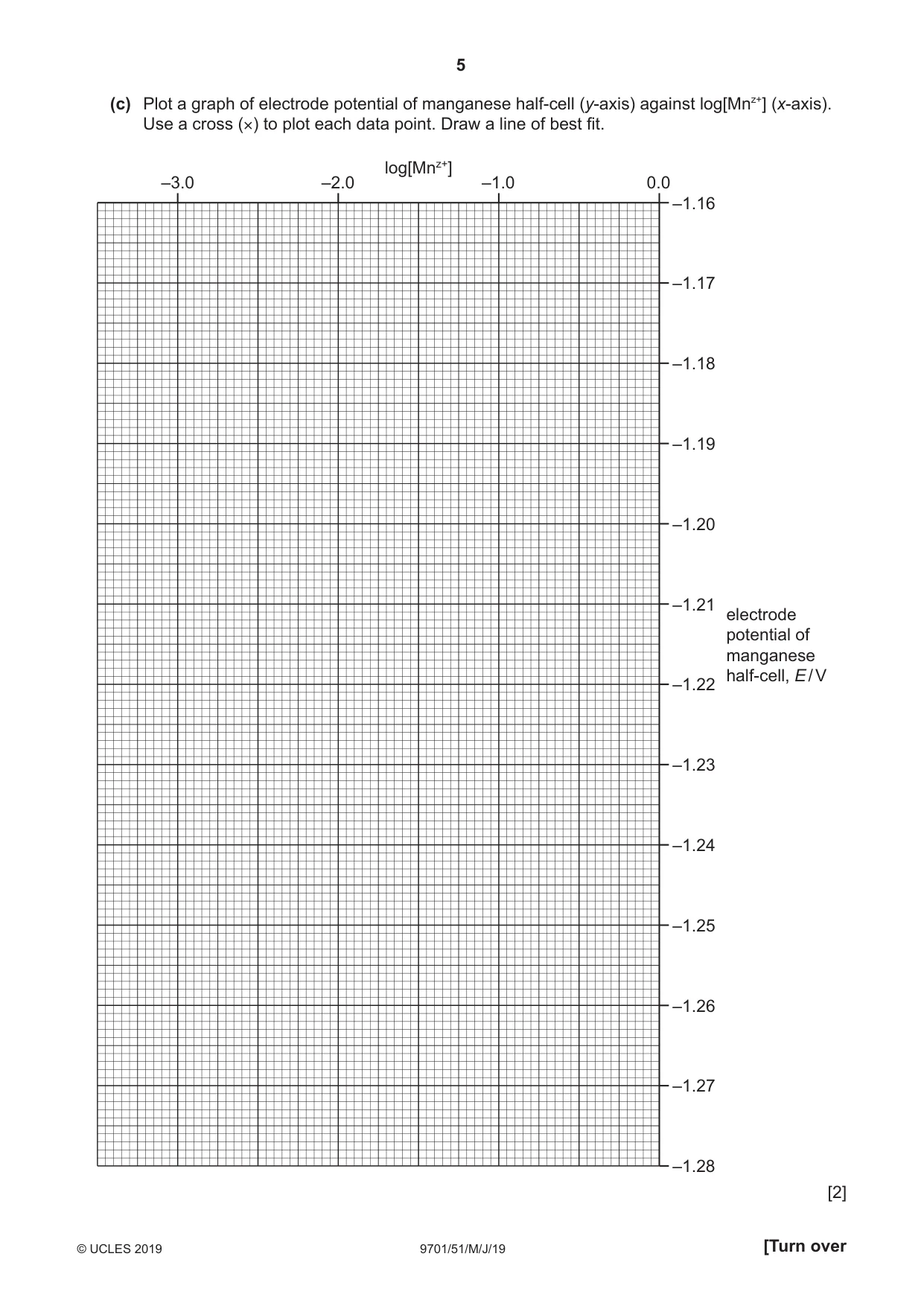
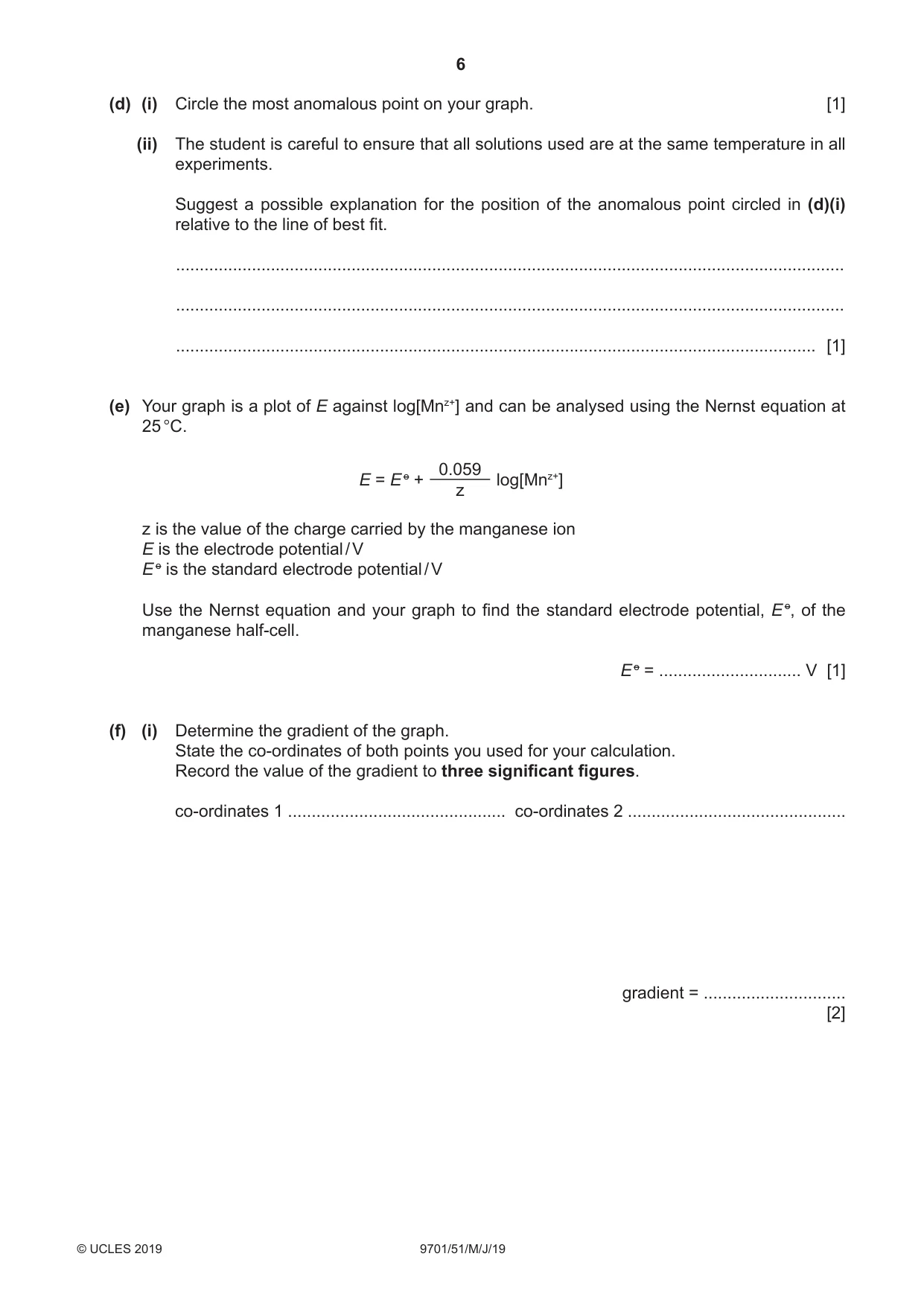
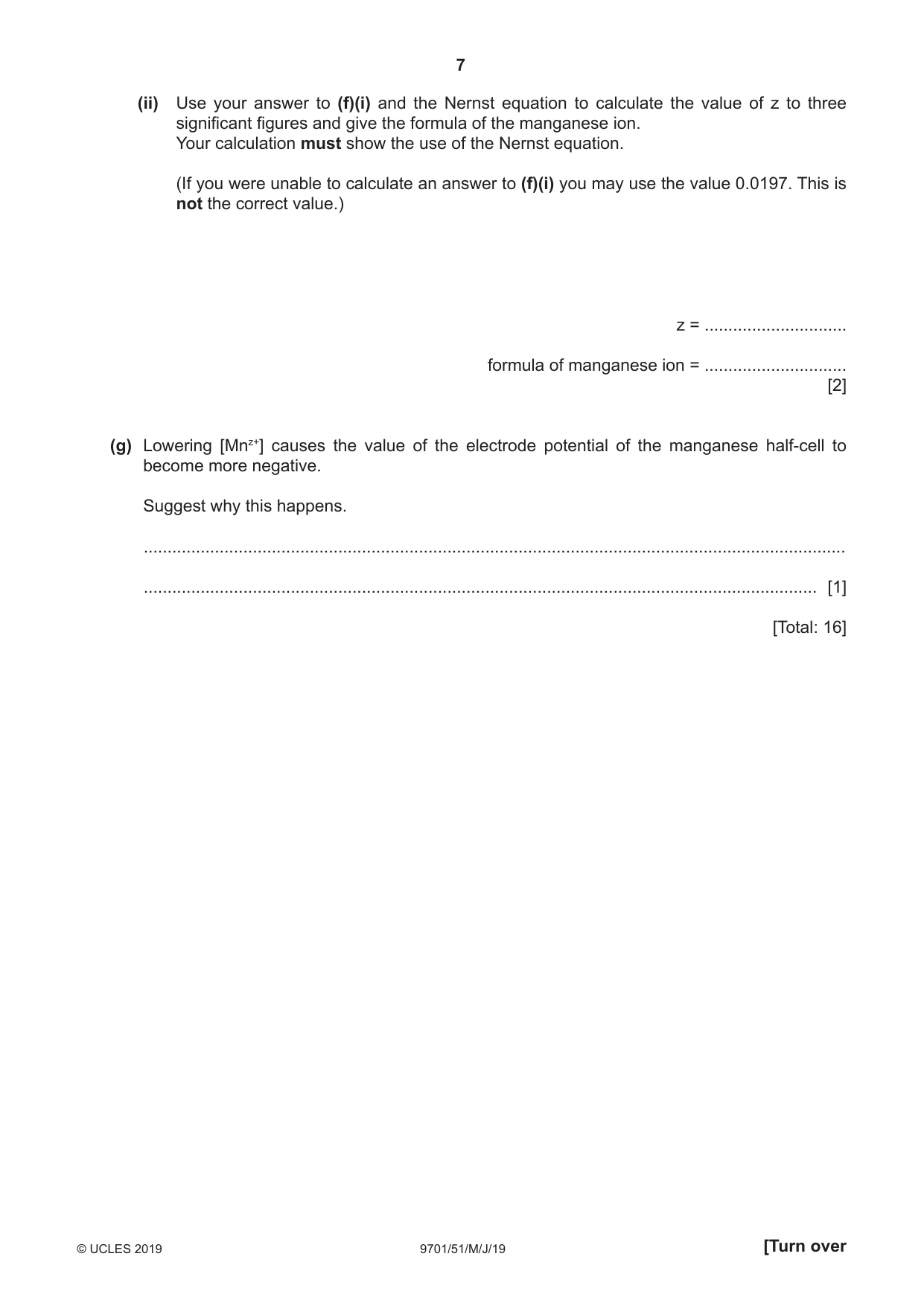
1 A student investigates the charge (z+) carried by aqueous manganese ions, Mnz+(aq). The electrochemical cell shown is set up for this investigation with the following two half-cells: ●● a standard copper(II) ion / copper half-cell (E o = +0.340 V) ●● a half-cell made from manganese and 0.500 mol dm–3 Mnz+(aq). (a) Label the items P and Q and state the concentration of the copper(II) ion solution in the copper half-cell. P ........................................ copper manganese copper(II) ion 0.500 mol dm–3 solution aqueous Mnz+(aq) Q ........................................ concentration of the copper(II) ion solution in the copper half-cell = ���������������������������������������� [1] (b) During the investigation the student plans to use solutions of Mnz+(aq) of lower concentration than 0.500 mol dm–3. (i) Calculate the volume of 0.500 mol dm–3 Mnz+(aq) needed to prepare 100.0 cm3 of 0.200 mol dm–3 Mnz+(aq). volume = .............................. cm3 [1] (ii) Describe how, using a 100 cm3 volumetric flask, the student should prepare exactly 100.0 cm3 of 0.200 mol dm–3 Mnz+(aq) using the volume of 0.500 mol dm–3 Mnz+(aq) calculated in (b)(i) and standard school or college apparatus. ............................................................................................................................................. ............................................................................................................................................. ............................................................................................................................................. ............................................................................................................................................. ....................................................................................................................................... [2] The cell potential of the electrochemical cell in (a) is measured. The 0.500 mol dm–3 Mnz+(aq) is then replaced by the 0.200 mol dm–3 solution and the cell potential is measured again. This is repeated for other lower concentrations of Mnz+(aq). All measurements are made at 25 °C. (iii) The results of the experiment are shown in the table. Complete column three of the table, calculating log[Mnz+] to two decimal places. Complete column four of the table, calculating E, the electrode potential of each manganese half‑cell, to three decimal places, using the equation shown. E (manganese half‑cell) = Ecell + 0.340 V electrode potential [Mnz+] cell potential, Ecell / V log[Mnz+] of each manganese / mol dm–3 half-cell, E / V 5.0 × 10⁻¹ –1.529 –0.30 –1.189 2.0 × 10⁻¹ –1.541 1.0 × 10⁻¹ –1.550 7.5 × 10⁻² –1.553 2.5 × 10⁻² –1.567 8.0 × 10⁻³ –1.582 6.0 × 10⁻³ –1.590 4.0 × 10⁻³ –1.591 3.0 × 10⁻³ –1.594 5.0 × 10⁻⁴ –1.617 [2] (d) (i) Circle the most anomalous point on your graph. [1] (ii) The student is careful to ensure that all solutions used are at the same temperature in all experiments. Suggest a possible explanation for the position of the anomalous point circled in (d)(i) relative to the line of best fit. ............................................................................................................................................. ............................................................................................................................................. ....................................................................................................................................... [1] (e) Your graph is a plot of E against log[Mnz+] and can be analysed using the Nernst equation at 25 °C. 0.059 E = E o + log[Mnz+] z z is the value of the charge carried by the manganese ion E is the electrode potential / V E o is the standard electrode potential / V Use the Nernst equation and your graph to find the standard electrode potential, E o, of the manganese half-cell. E o = .............................. V [1] (f) (i) Determine the gradient of the graph. State the co‑ordinates of both points you used for your calculation. Record the value of the gradient to three significant figures. co‑ordinates 1 .............................................. co-ordinates 2 .............................................. gradient = .............................. [2] (ii) Use your answer to (f)(i) and the Nernst equation to calculate the value of z to three significant figures and give the formula of the manganese ion. Your calculation must show the use of the Nernst equation. (If you were unable to calculate an answer to (f)(i) you may use the value 0.0197. This is not the correct value.) z = .............................. formula of manganese ion = .............................. [2] (g) Lowering [Mnz+] causes the value of the electrode potential of the manganese half‑cell to become more negative. Suggest why this happens. .................................................................................................................................................... .............................................................................................................................................. [1] [Total: 16]
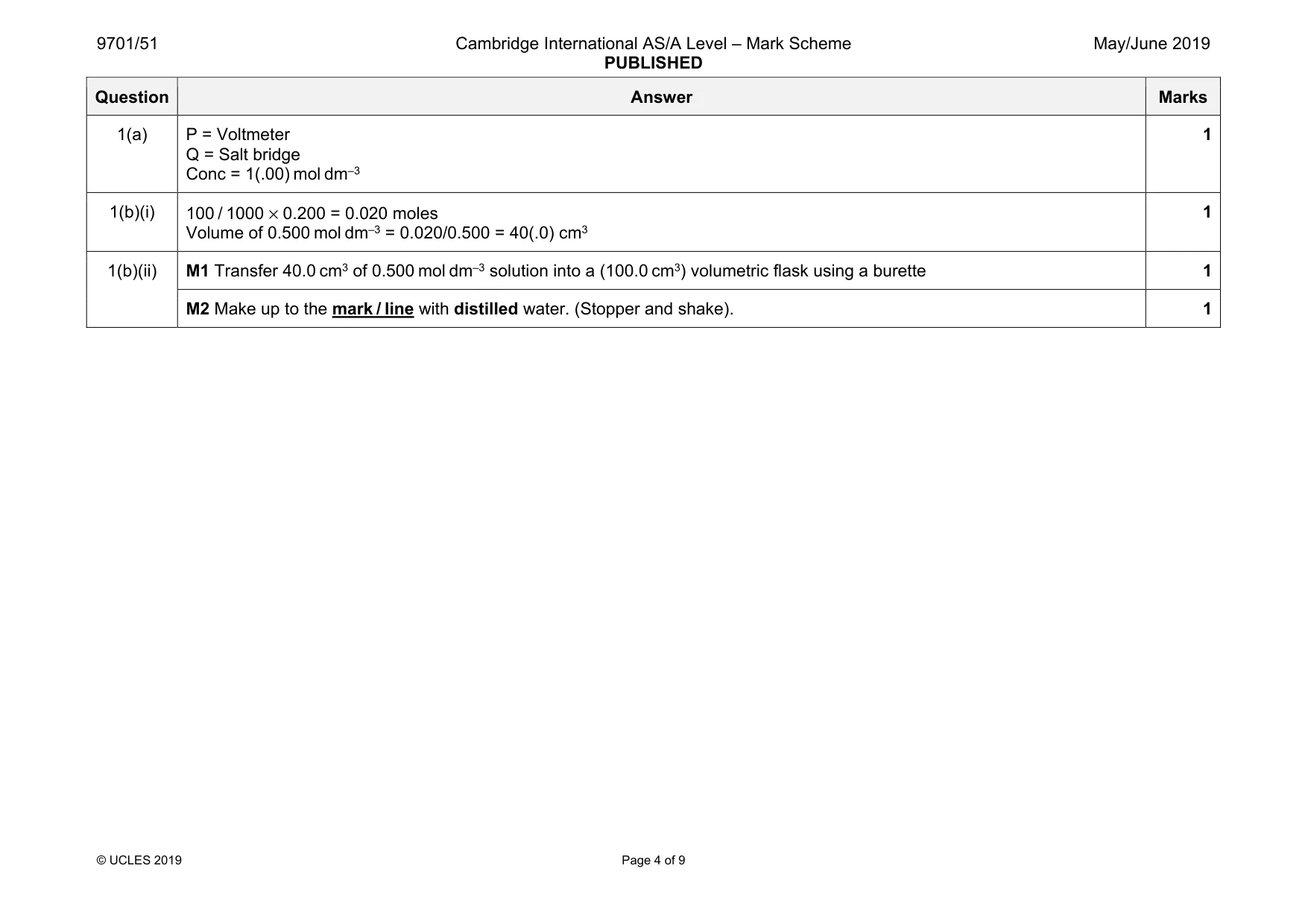
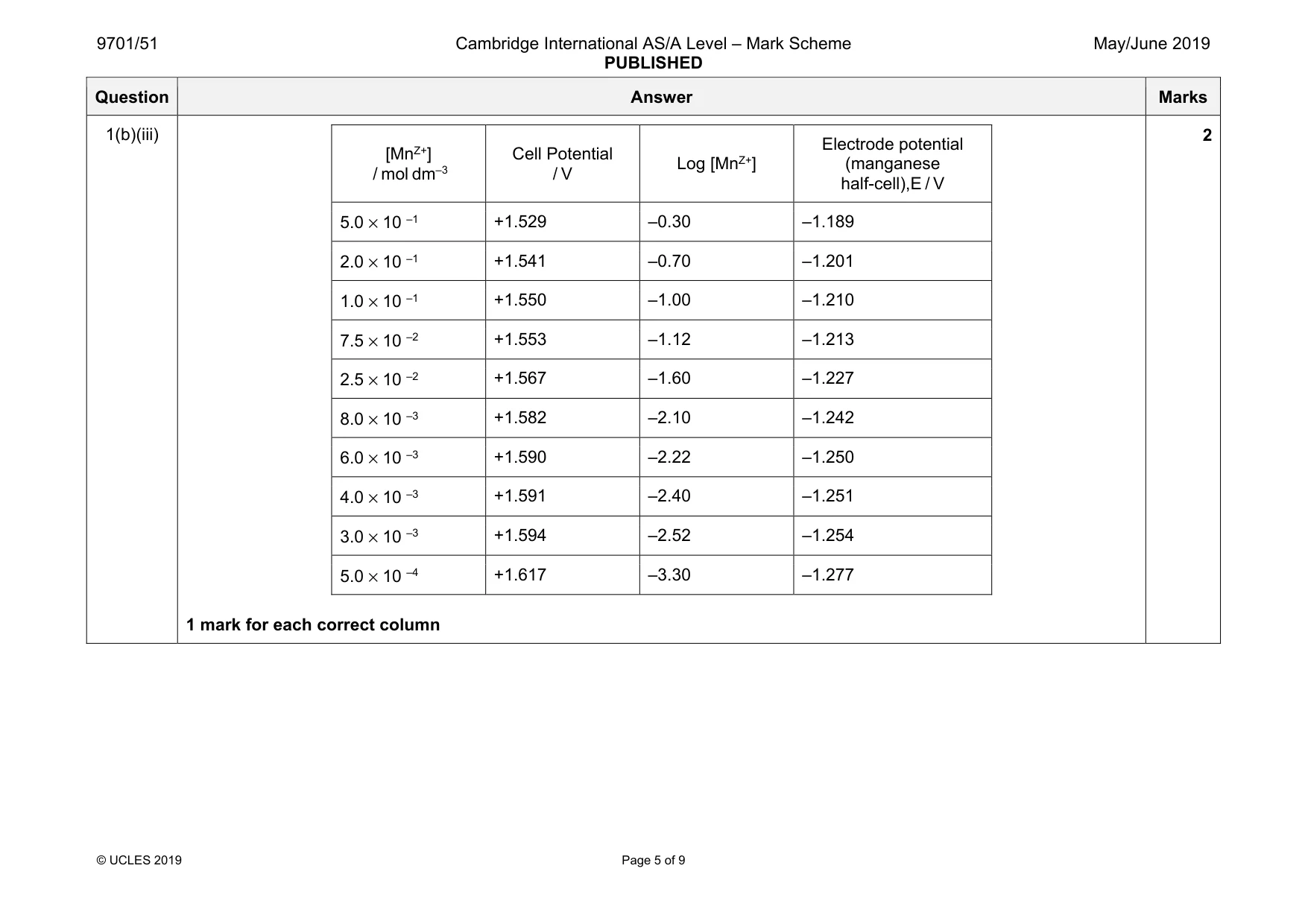
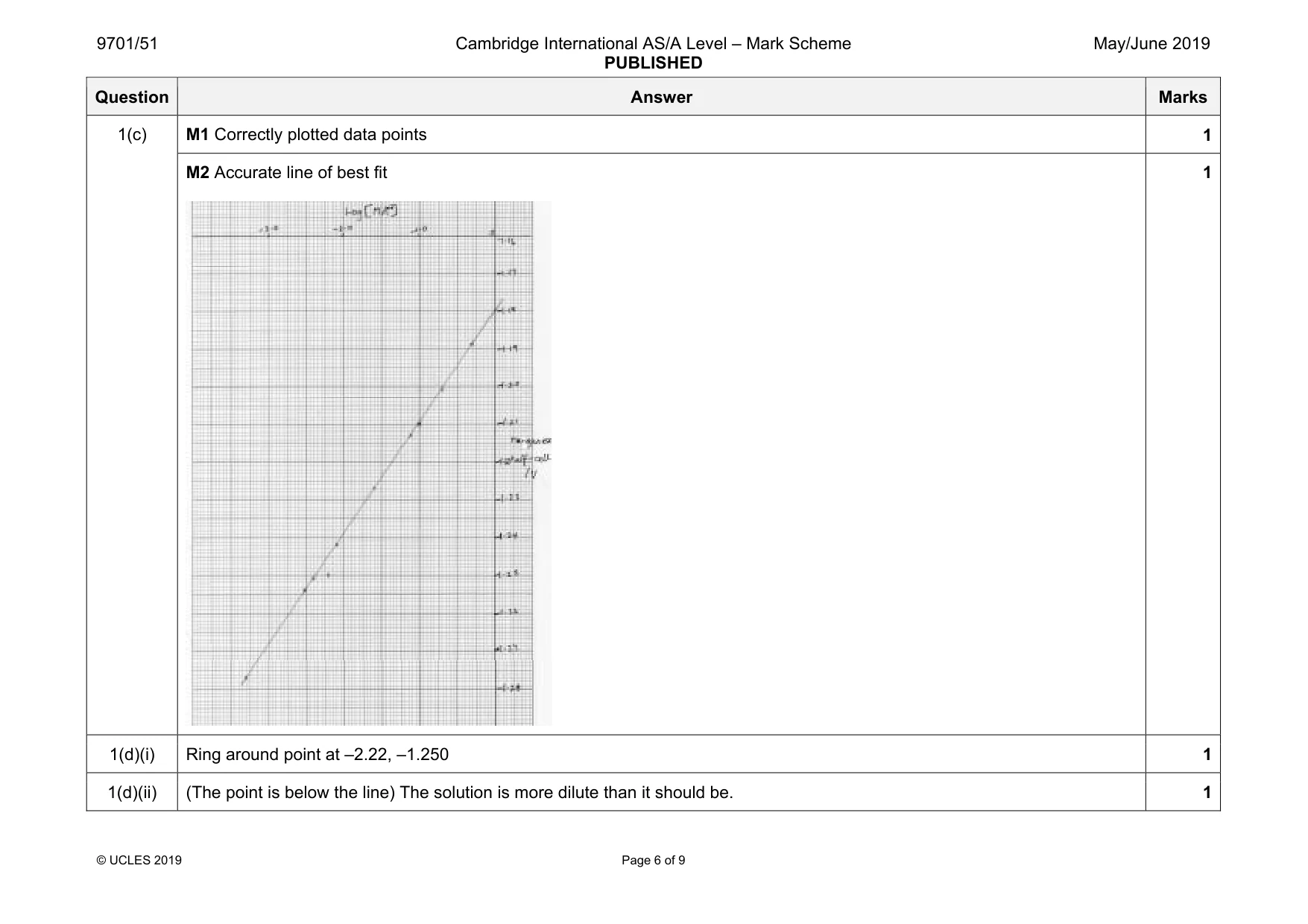
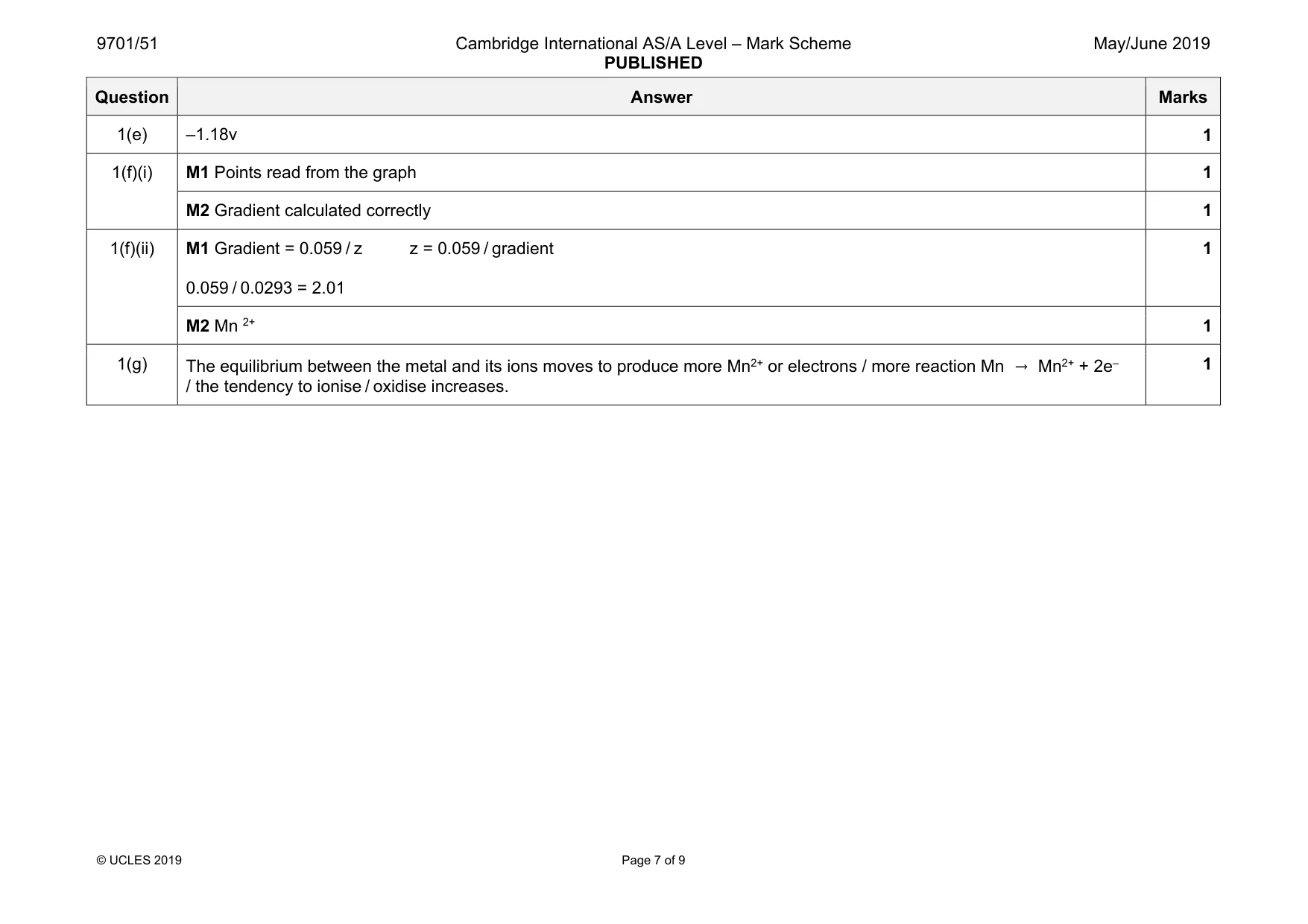
Mark scheme: 1(a) P = Voltmeter Q = Salt bridge Conc = 1(.00) mol dm–3 1 1(b)(i) 100 / 1000 × 0.200 = 0.020 moles Volume of 0.500 mol dm–3 = 0.020/0.500 = 40(.0) cm3 1 1(b)(ii) M1 Transfer 40.0 cm3 of 0.500 mol dm–3 solution into a (100.0 cm3) volumetric flask using a burette 1 M2 Make up to the mark / line with distilled water. (Stopper and shake). 1 Question Answer Marks 1(b)(iii) [MnZ+] / mol dm–3 Cell Potential / V Log [MnZ+] Electrode potential (manganese half-cell),E / V 5.0 × 10 –1 +1.529 –0.30 –1.189 2.0 × 10 –1 +1.541 –0.70 –1.201 1.0 × 10 –1 +1.550 –1.00 –1.210 7.5 × 10 –2 +1.553 –1.12 –1.213 2.5 × 10 –2 +1.567 –1.60 –1.227 8.0 × 10 –3 +1.582 –2.10 –1.242 6.0 × 10 –3 +1.590 –2.22 –1.250 4.0 × 10 –3 +1.591 –2.40 –1.251 3.0 × 10 –3 +1.594 –2.52 –1.254 5.0 × 10 –4 +1.617 –3.30 –1.277 1 mark for each correct column 2 Question Answer Marks 1(c) M1 Correctly plotted data points 1 M2 Accurate line of best fit 1 1(d)(i) Ring around point at –2.22, –1.250 1 1(d)(ii) (The point is below the line) The solution is more dilute than it should be. 1 Question Answer Marks 1(e) –1.18v 1 1(f)(i) M1 Points read from the graph 1 M2 Gradient calculated correctly 1 1(f)(ii) M1 Gradient = 0.059 / z z = 0.059 / gradient 0.059 / 0.0293 = 2.01 1 M2 Mn 2+ 1 1(g) The equilibrium between the metal and its ions moves to produce more Mn2+ or electrons / more reaction Mn → Mn2+ + 2e– / the tendency to ionise / oxidise increases. 1
Q2 · A student plans to prepare propanone from propan‑2‑ol and test the product
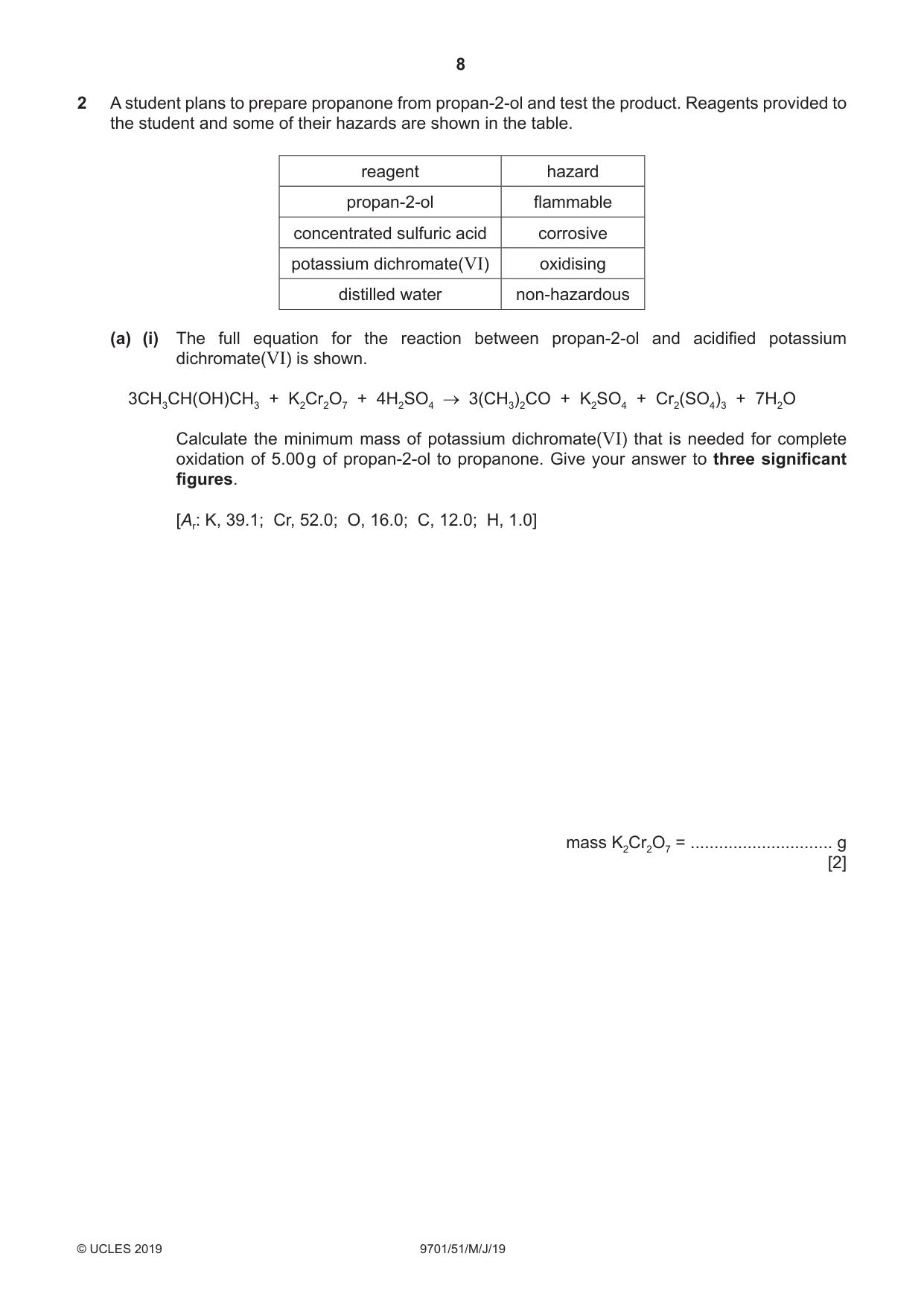
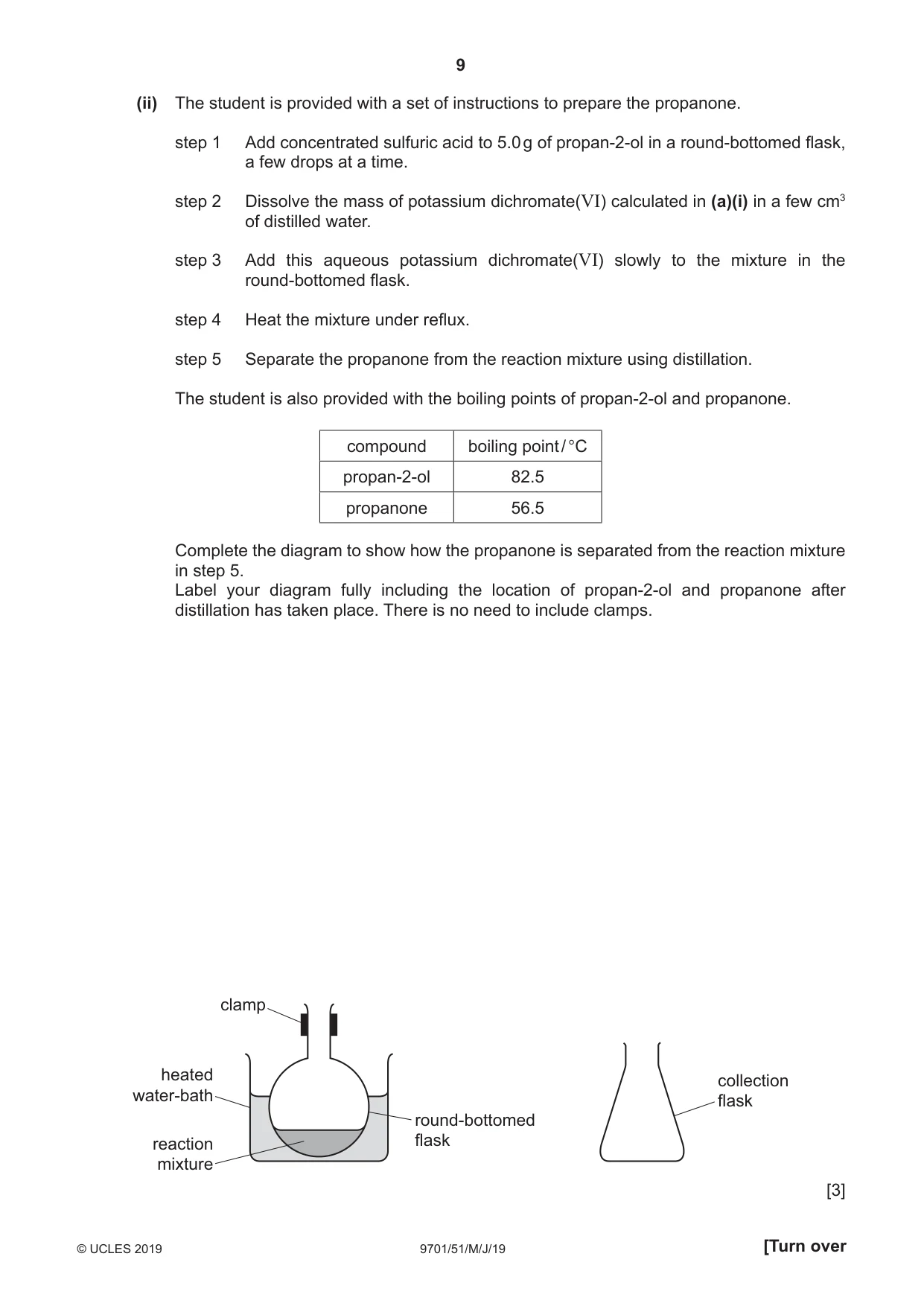
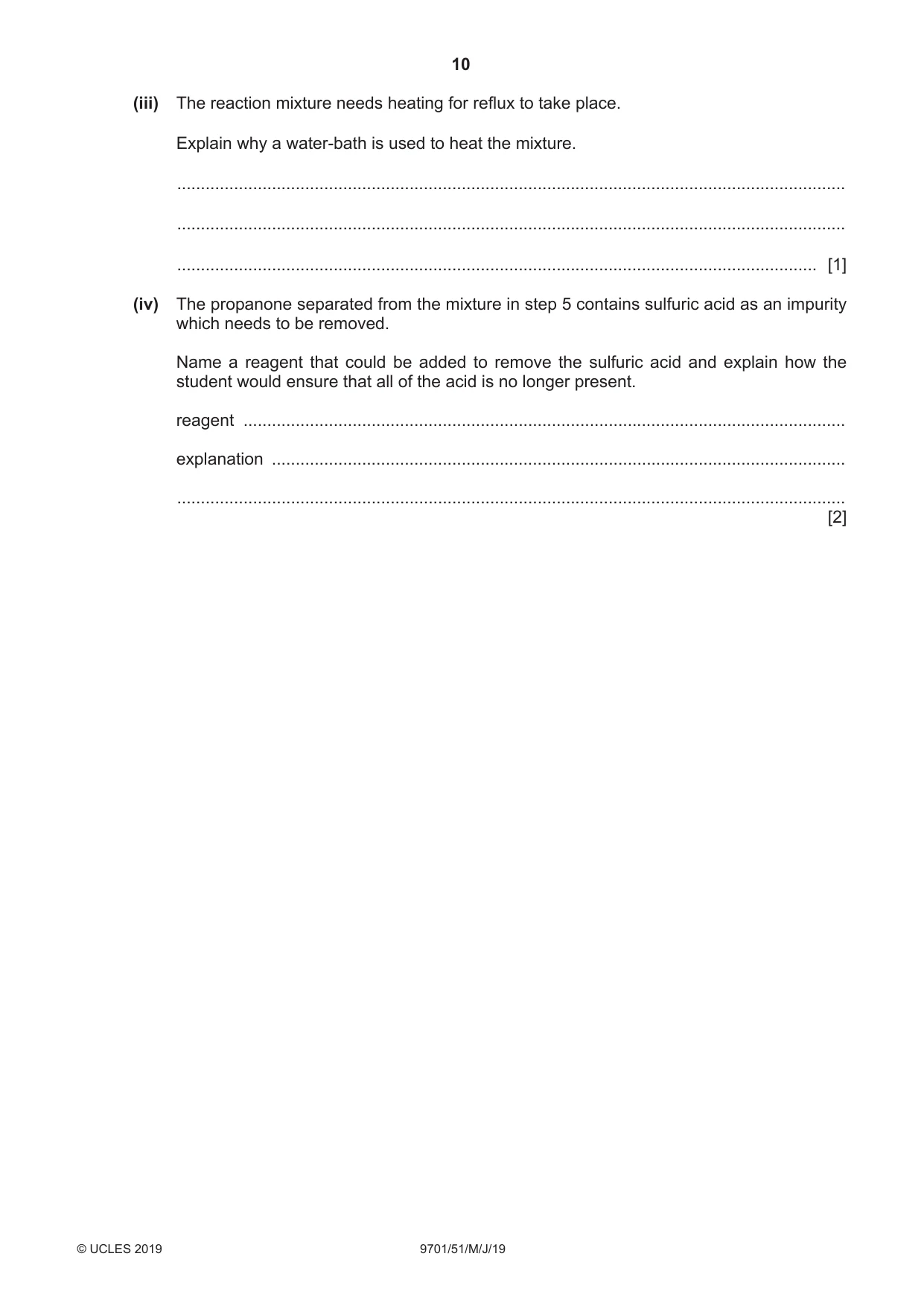
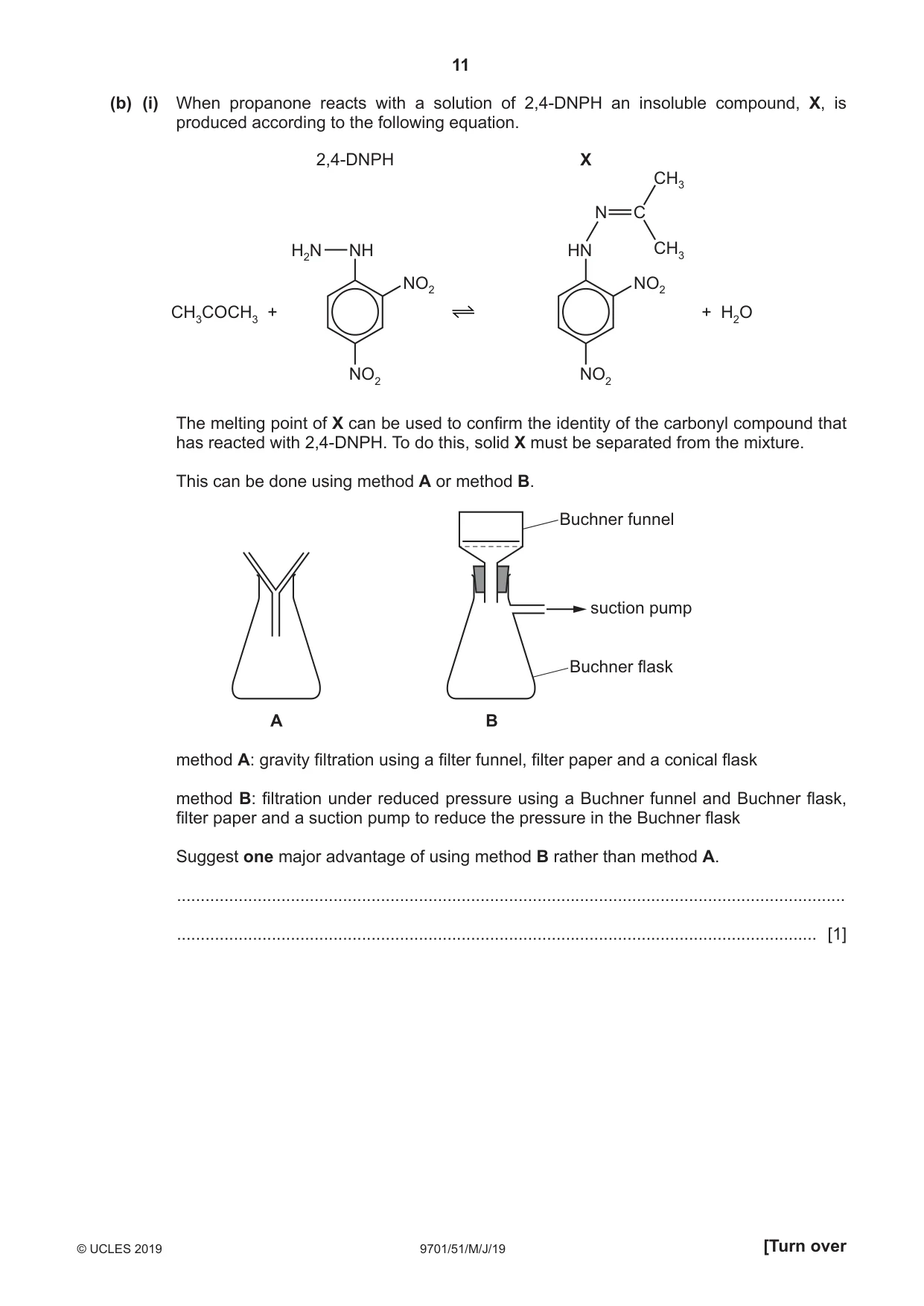
2 A student plans to prepare propanone from propan‑2‑ol and test the product. Reagents provided to the student and some of their hazards are shown in the table. reagent hazard propan-2-ol flammable concentrated sulfuric acid corrosive potassium dichromate(VI) oxidising distilled water non-hazardous (a) (i) The full equation for the reaction between propan‑2‑ol and acidified potassium dichromate(VI) is shown. 3CH3CH(OH)CH3 + K2Cr2O7 + 4H2SO4 3(CH3)2CO + K2SO4 + Cr2(SO4)3 + 7H2O Calculate the minimum mass of potassium dichromate(VI) that is needed for complete oxidation of 5.00 g of propan‑2‑ol to propanone. Give your answer to three significant figures. [Ar: K, 39.1; Cr, 52.0; O, 16.0; C, 12.0; H, 1.0] mass K2Cr2O7 = .............................. g [2] (ii) The student is provided with a set of instructions to prepare the propanone. step 1 Add concentrated sulfuric acid to 5.0 g of propan‑2‑ol in a round‑bottomed flask, a few drops at a time. step 2 Dissolve the mass of potassium dichromate(VI) calculated in (a)(i) in a few cm3 of distilled water. step 3 Add this aqueous potassium dichromate(VI) slowly to the mixture in the round-bottomed flask. step 4 Heat the mixture under reflux. step 5 Separate the propanone from the reaction mixture using distillation. The student is also provided with the boiling points of propan‑2‑ol and propanone. compound boiling point / °C propan-2-ol 82.5 propanone 56.5 Complete the diagram to show how the propanone is separated from the reaction mixture in step 5. Label your diagram fully including the location of propan-2-ol and propanone after distillation has taken place. There is no need to include clamps. clamp heated collection water-bath flask round-bottomed reaction flask mixture [3] (iii) The reaction mixture needs heating for reflux to take place. Explain why a water-bath is used to heat the mixture. ............................................................................................................................................. ............................................................................................................................................. ....................................................................................................................................... [1] (iv) The propanone separated from the mixture in step 5 contains sulfuric acid as an impurity which needs to be removed. Name a reagent that could be added to remove the sulfuric acid and explain how the student would ensure that all of the acid is no longer present. reagent ................................................................................................................................ explanation .......................................................................................................................... ............................................................................................................................................. [2]
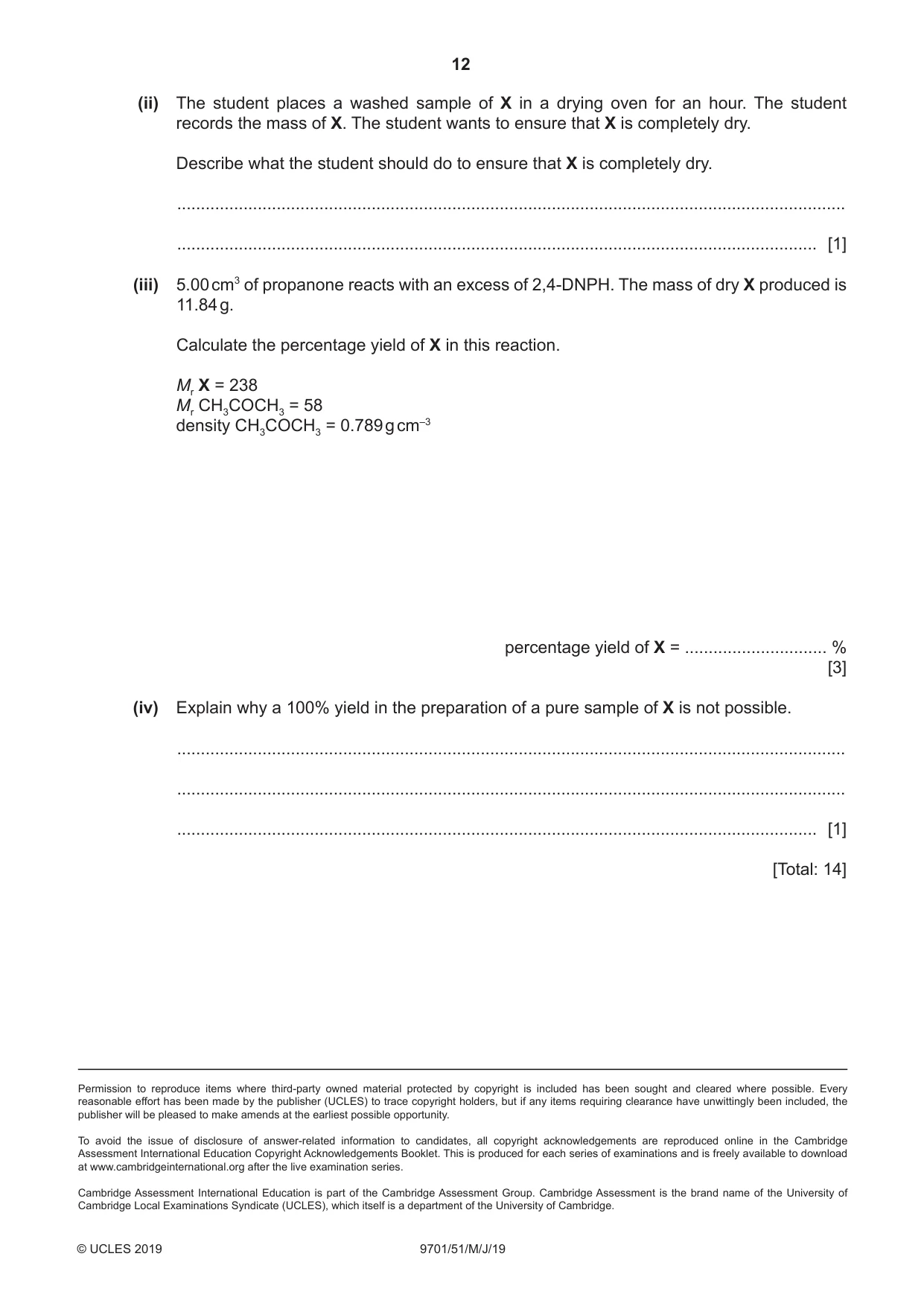
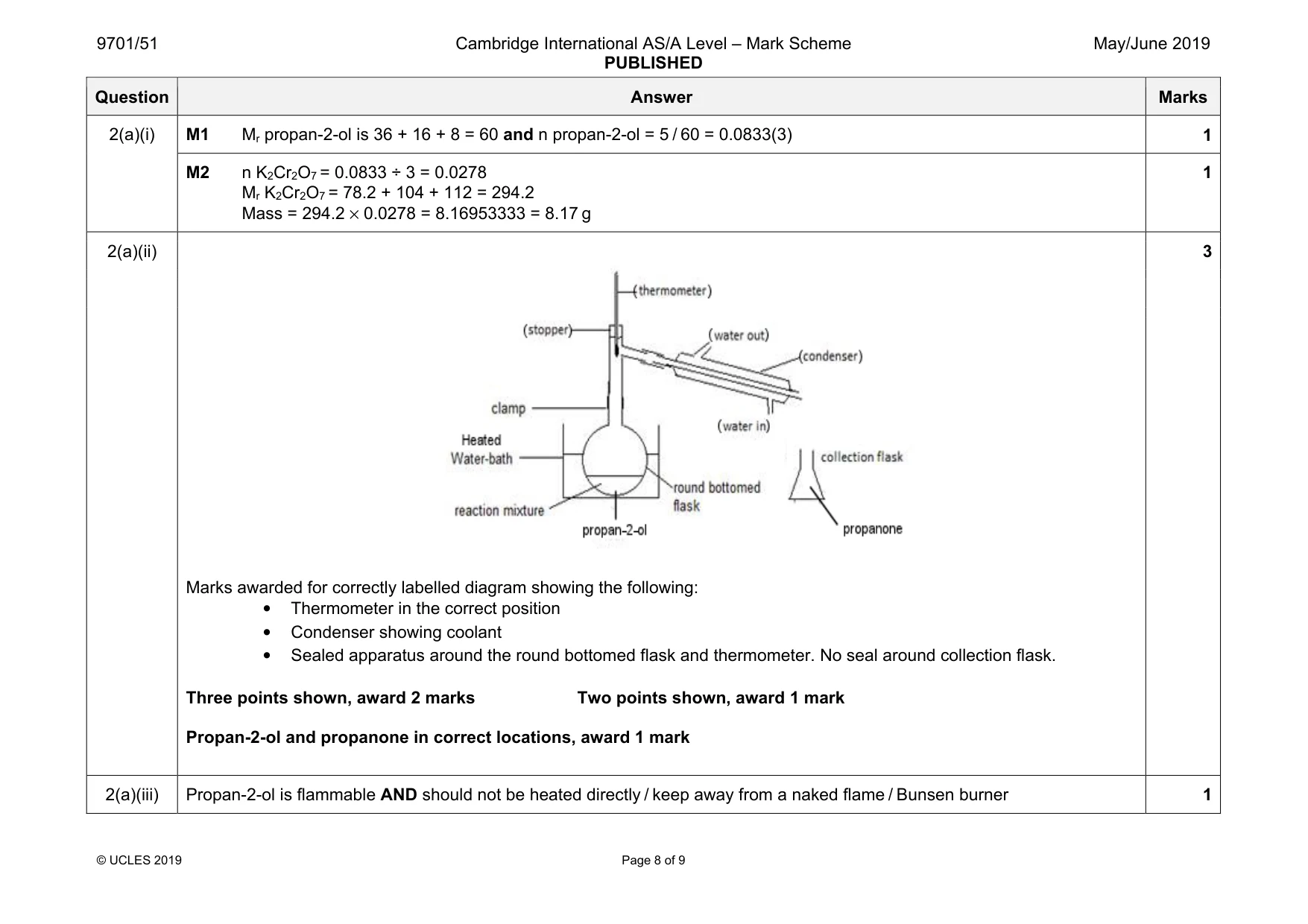
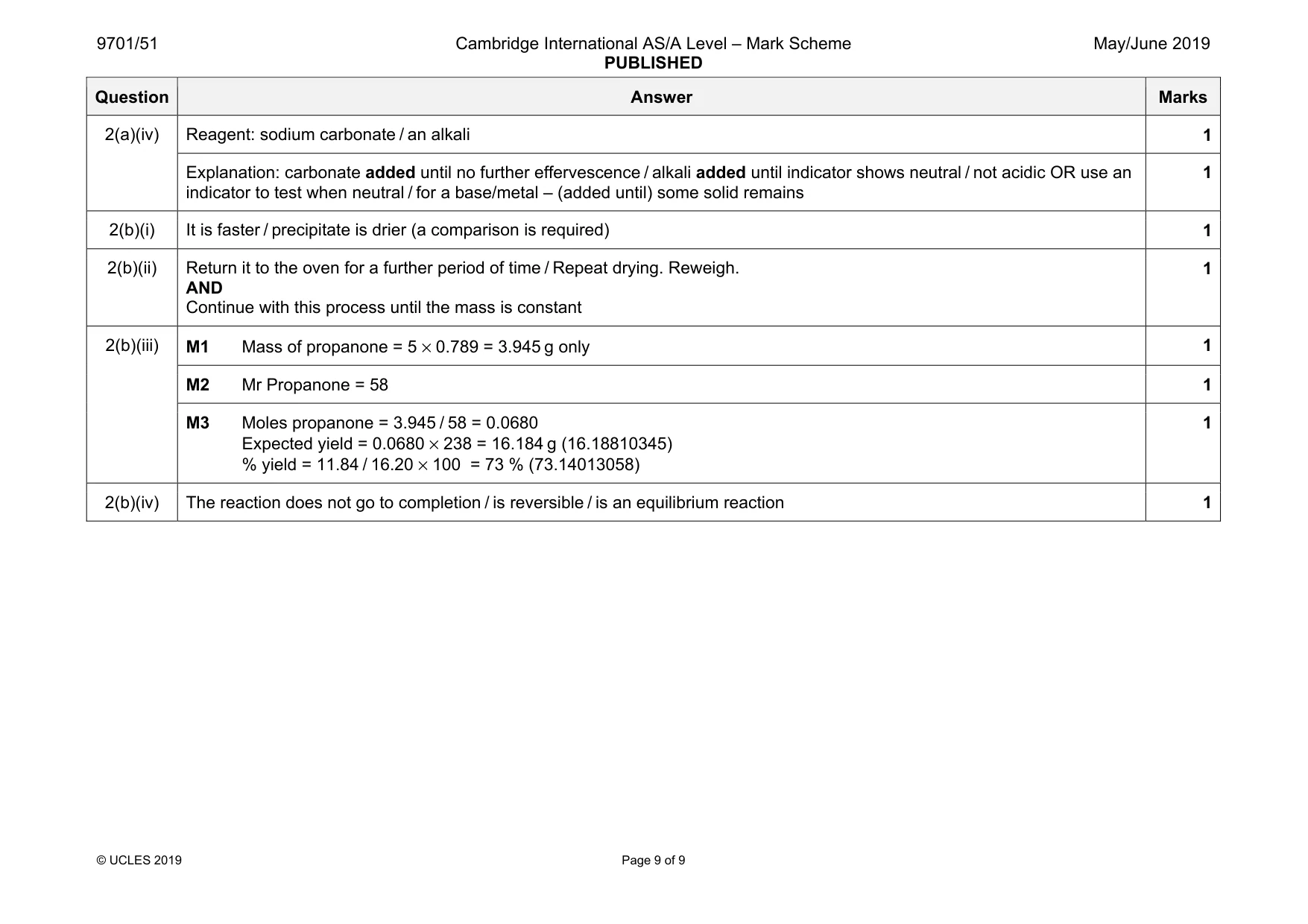
Mark scheme: 2(a)(i) M1 Mr propan-2-ol is 36 + 16 + 8 = 60 and n propan-2-ol = 5 / 60 = 0.0833(3) 1 M2 n K2Cr2O7 = 0.0833 ÷ 3 = 0.0278 Mr K2Cr2O7 = 78.2 + 104 + 112 = 294.2 Mass = 294.2 × 0.0278 = 8.16953333 = 8.17 g 1 2(a)(ii) Marks awarded for correctly labelled diagram showing the following: • Thermometer in the correct position • Condenser showing coolant • Sealed apparatus around the round bottomed flask and thermometer. No seal around collection flask. Three points shown, award 2 marks Two points shown, award 1 mark Propan-2-ol and propanone in correct locations, award 1 mark 3 2(a)(iii) Propan-2-ol is flammable AND should not be heated directly / keep away from a naked flame / Bunsen burner 1 Question Answer Marks 2(a)(iv) Reagent: sodium carbonate / an alkali 1 Explanation: carbonate added until no further effervescence / alkali added until indicator shows neutral / not acidic OR use an indicator to test when neutral / for a base/metal – (added until) some solid remains 1 2(b)(i) It is faster / precipitate is drier (a comparison is required) 1 2(b)(ii) Return it to the oven for a further period of time / Repeat drying. Reweigh. AND Continue with this process until the mass is constant 1 2(b)(iii) M1 Mass of propanone = 5 × 0.789 = 3.945 g only 1 M2 Mr Propanone = 58 1 M3 Moles propanone = 3.945 / 58 = 0.0680 Expected yield = 0.0680 × 238 = 16.184 g (16.18810345) % yield = 11.84 / 16.20 × 100 = 73 % (73.14013058) 1 2(b)(iv) The reaction does not go to completion / is reversible / is an equilibrium reaction 1
More questions on Reacting masses and volumes (of solutions and gases)
What was in this paper
The subtopics covered by these 2 questions, and how many questions each got. Open one in a new tab to see every Cambridge question on it.
What you needed in this session
Cambridge’s own grade thresholds for 2019 May/June, Paper 5 · Variant 1. A higher threshold means an easier paper — the bar moves with how the cohort did.