Cambridge A Level Chemistry 9701 — 2018 Oct/Nov Paper 5 · Variant 2
9701/52/O/N/18 · 2 questions · 30 marks · ≈34 min
The question paper and its mark scheme, free to read here and free to download. This is Cambridge’s own paper, exactly as it was sat.
Question paper12 pages

Mark scheme6 pages
Answers below. Sit the paper first if you are practising.
Questions as text
Q1 · A sample of waste water contains calcium ions, copper(II) ions and lead(II) ions
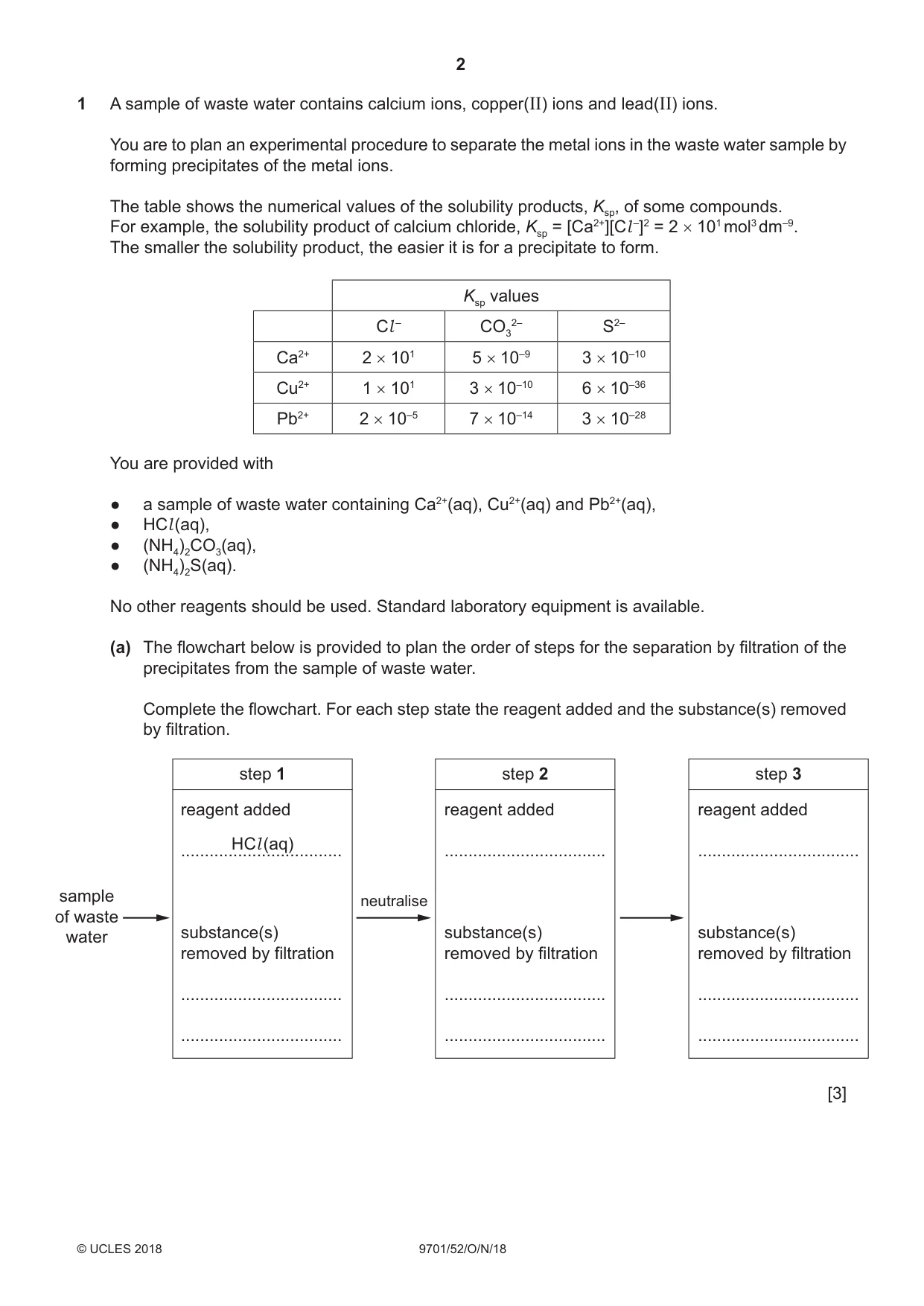
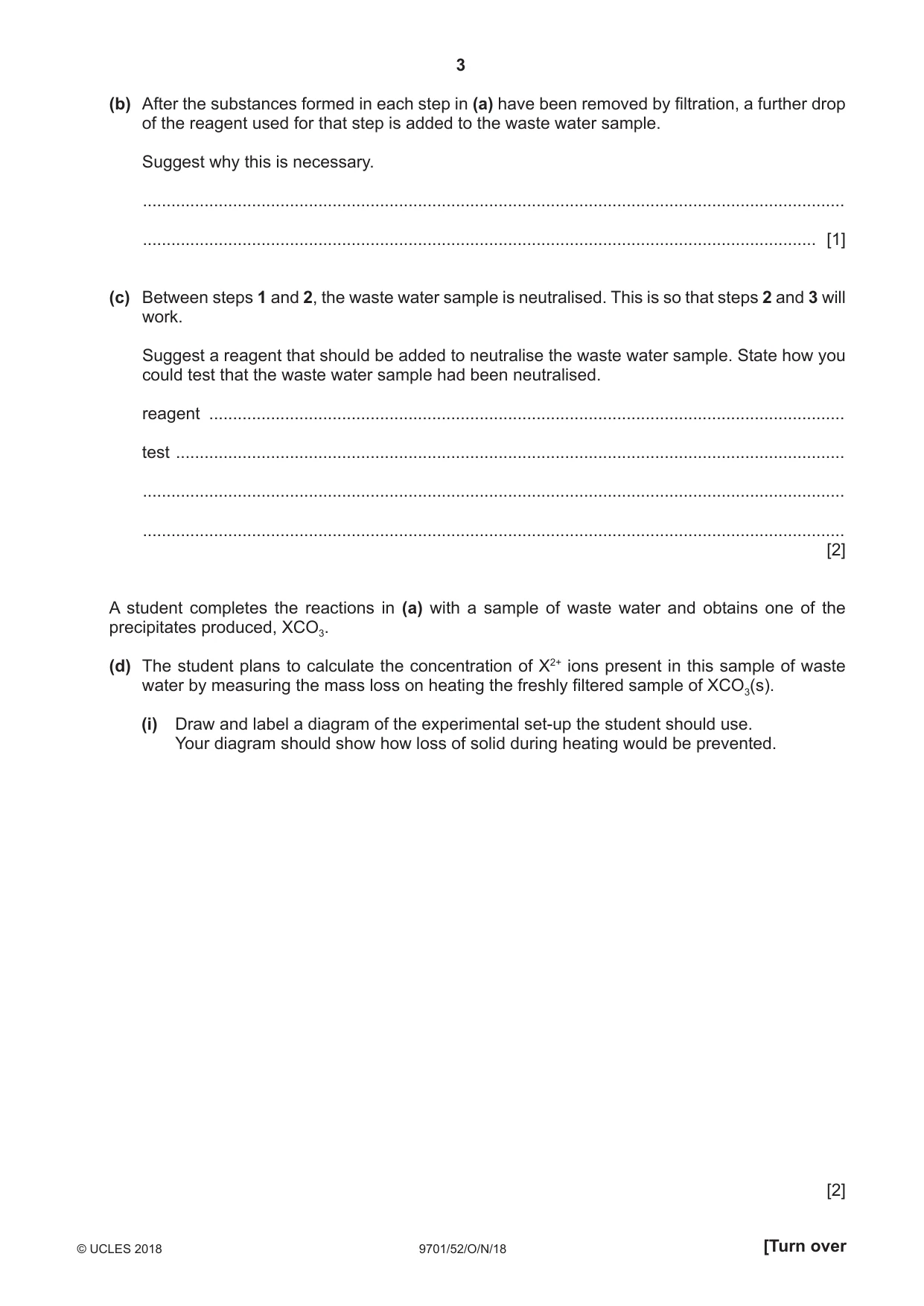
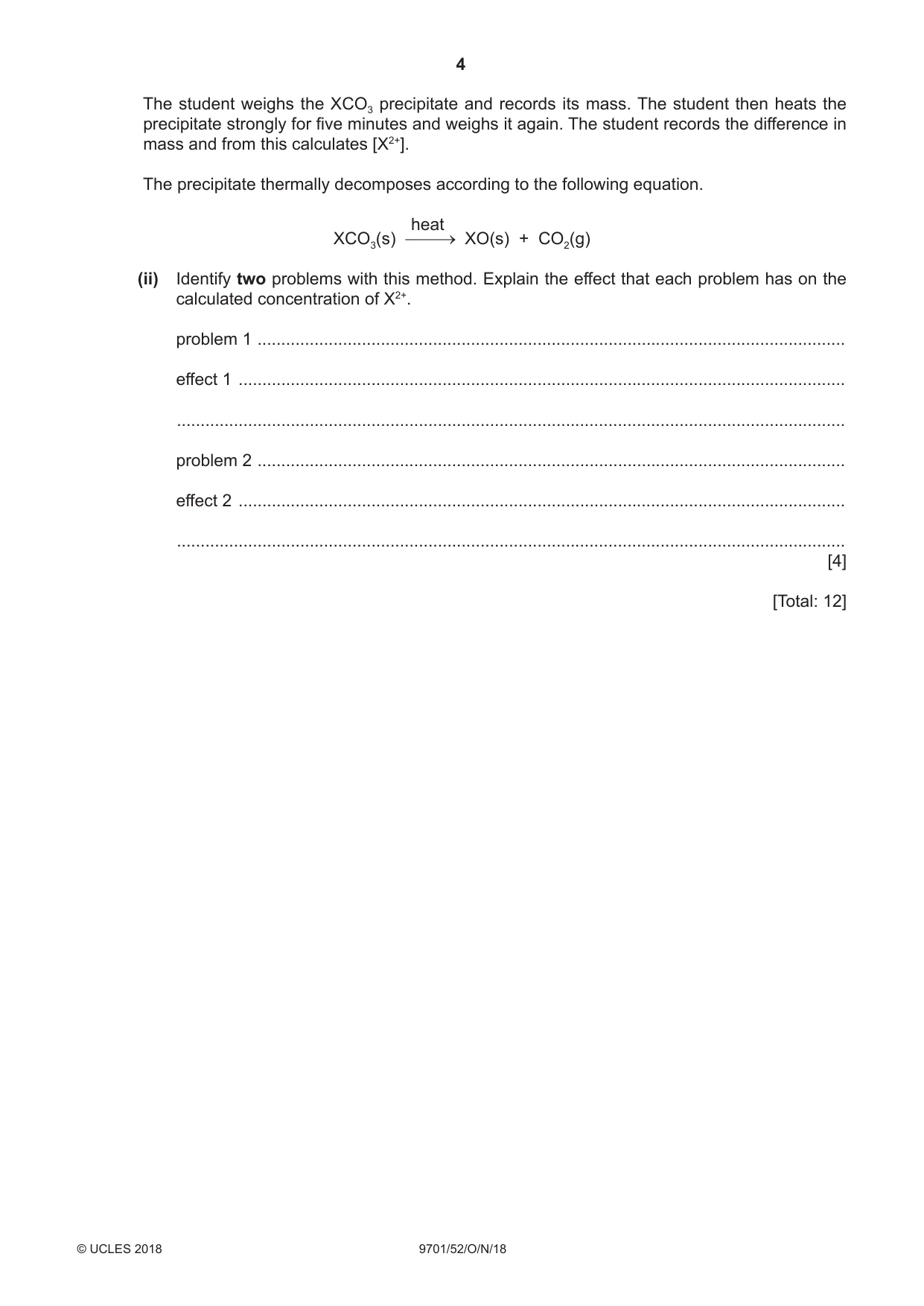
1 A sample of waste water contains calcium ions, copper(II) ions and lead(II) ions. You are to plan an experimental procedure to separate the metal ions in the waste water sample by forming precipitates of the metal ions. The table shows the numerical values of the solubility products, Ksp, of some compounds. For example, the solubility product of calcium chloride, Ksp = [Ca2+][Cl –]2 = 2 × 101 mol3 dm–9. The smaller the solubility product, the easier it is for a precipitate to form. Ksp values Cl – CO32– S2– Ca2+ 2 × 101 5 × 10⁻⁹ 3 × 10⁻¹⁰ Cu2+ 1 × 101 3 × 10⁻¹⁰ 6 × 10–36 Pb2+ 2 × 10⁻⁵ 7 × 10–14 3 × 10–28 You are provided with ● a sample of waste water containing Ca2+(aq), Cu2+(aq) and Pb2+(aq), ● HCl (aq), ● (NH4)2CO3(aq), ● (NH4)2S(aq). No other reagents should be used. Standard laboratory equipment is available. (a) The flowchart below is provided to plan the order of steps for the separation by filtration of the precipitates from the sample of waste water. Complete the flowchart. For each step state the reagent added and the substance(s) removed by filtration. step 1 step 2 step 3 reagent added reagent added reagent added HCl (aq) .................................. .................................. .................................. sample neutralise of waste water substance(s) substance(s) substance(s) removed by filtration removed by filtration removed by filtration .................................. .................................. .................................. .................................. .................................. .................................. [3] (b) After the substances formed in each step in (a) have been removed by filtration, a further drop of the reagent used for that step is added to the waste water sample. Suggest why this is necessary. .................................................................................................................................................... .............................................................................................................................................. [1] (c) Between steps 1 and 2, the waste water sample is neutralised. This is so that steps 2 and 3 will work. Suggest a reagent that should be added to neutralise the waste water sample. State how you could test that the waste water sample had been neutralised. reagent ....................................................................................................................................... test ............................................................................................................................................. .................................................................................................................................................... .................................................................................................................................................... [2] A student completes the reactions in (a) with a sample of waste water and obtains one of the precipitates produced, XCO3. (d) The student plans to calculate the concentration of X2+ ions present in this sample of waste water by measuring the mass loss on heating the freshly filtered sample of XCO3(s). (i) Draw and label a diagram of the experimental set-up the student should use. Your diagram should show how loss of solid during heating would be prevented. [2] The student weighs the XCO3 precipitate and records its mass. The student then heats the precipitate strongly for five minutes and weighs it again. The student records the difference in mass and from this calculates [X2+]. The precipitate thermally decomposes according to the following equation. heat XCO3(s) XO(s) + CO2(g) (ii) Identify two problems with this method. Explain the effect that each problem has on the calculated concentration of X2+. problem 1 ............................................................................................................................ effect 1 ................................................................................................................................. ............................................................................................................................................. problem 2 ............................................................................................................................ effect 2 ................................................................................................................................. ............................................................................................................................................. [4] [Total: 12]
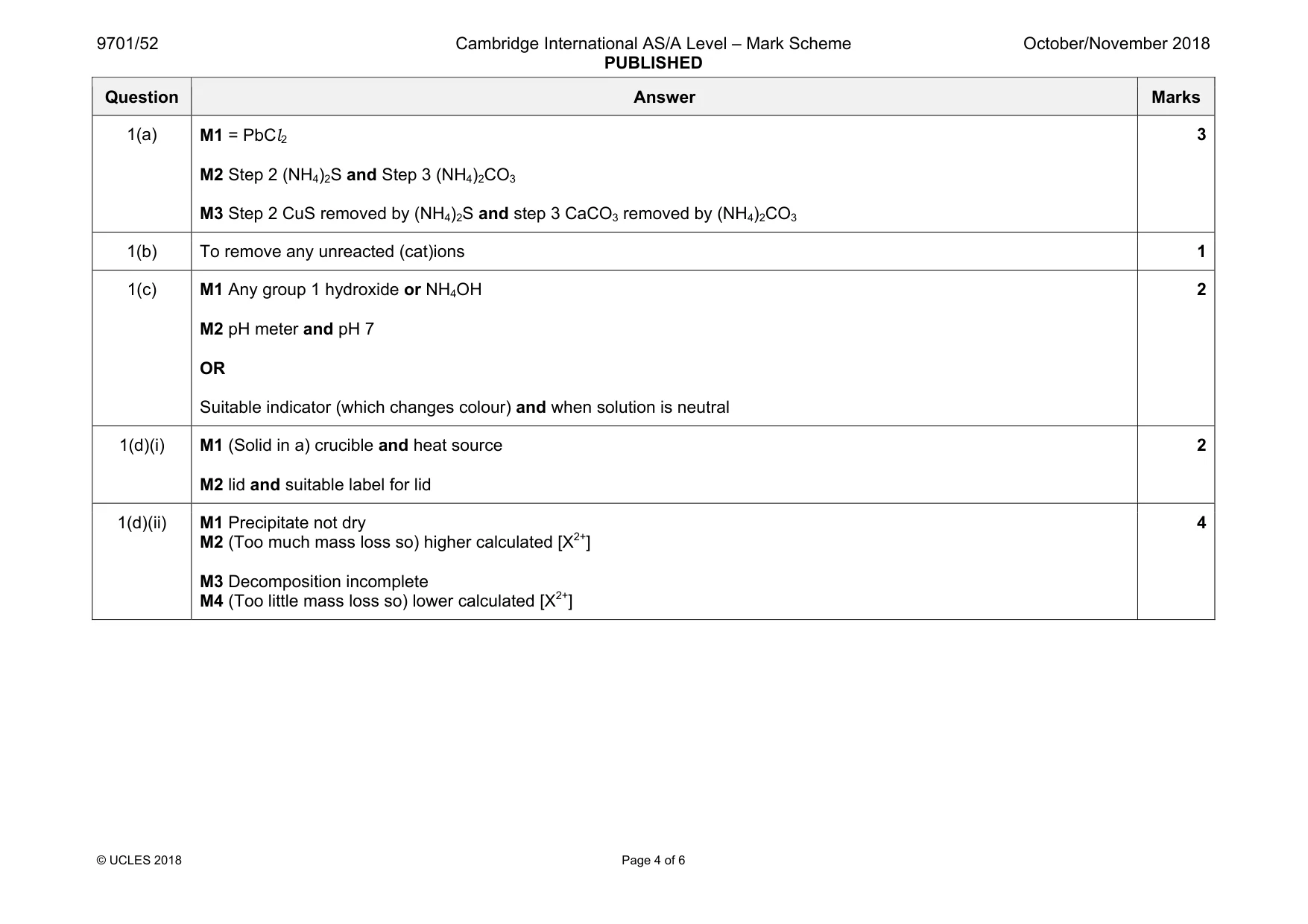
Mark scheme: 1(a) M2 Step 2 (NH4)2S and Step 3 (NH4)2CO3 M3 Step 2 CuS removed by (NH4)2S and step 3 CaCO3 removed by (NH4)2CO3 3 1(b) To remove any unreacted (cat)ions 1 1(c) M1 Any group 1 hydroxide or NH4OH M2 pH meter and pH 7 OR Suitable indicator (which changes colour) and when solution is neutral 2 1(d)(i) M1 (Solid in a) crucible and heat source M2 lid and suitable label for lid 2 1(d)(ii) M1 Precipitate not dry M2 (Too much mass loss so) higher calculated [X2+] M3 Decomposition incomplete M4 (Too little mass loss so) lower calculated [X2+] 4
More questions on Reacting masses and volumes (of solutions and gases)
Q2 · The hydrolysis of urea, (NH2)2CO, Mr = 60, is shown by the equation
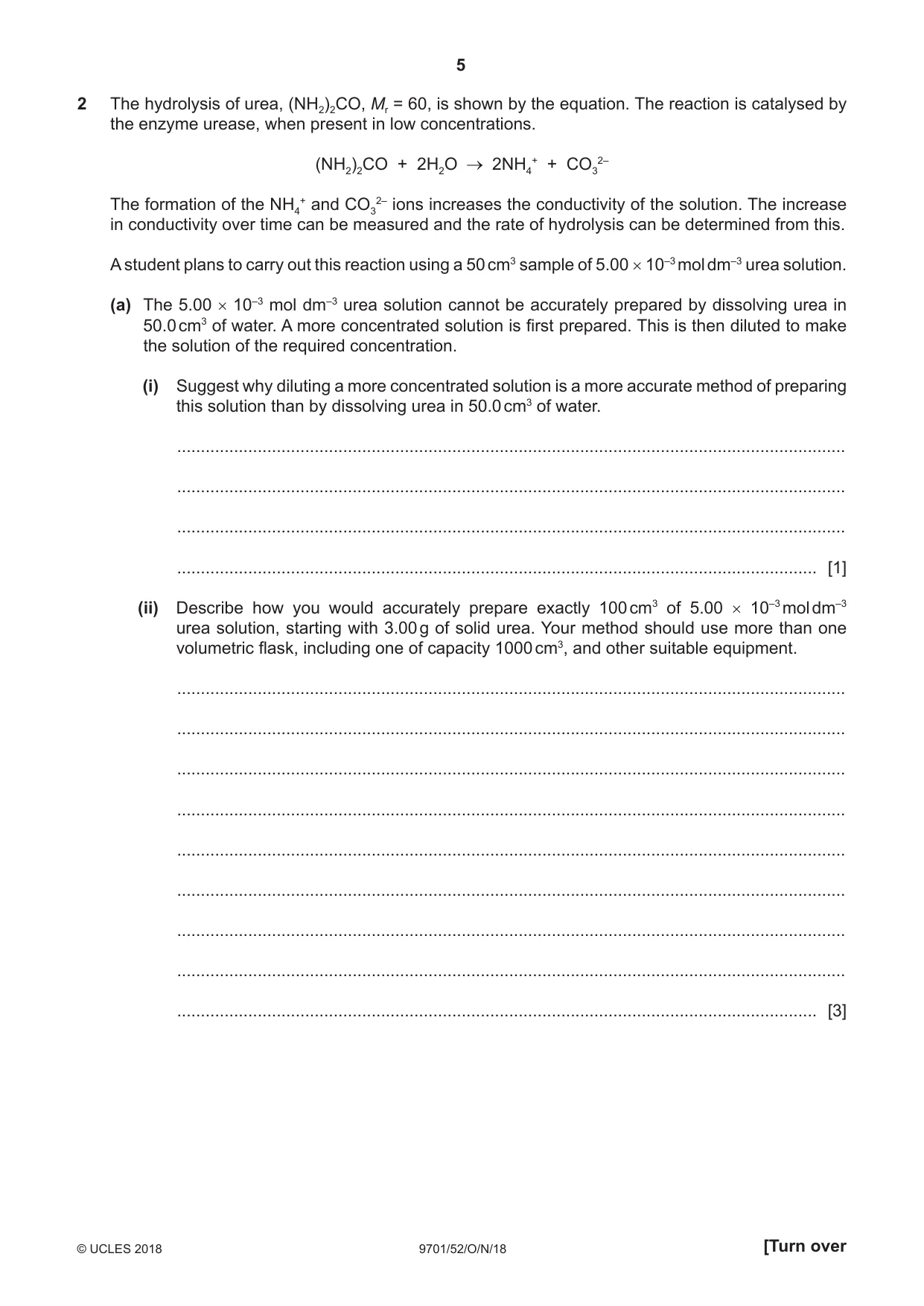
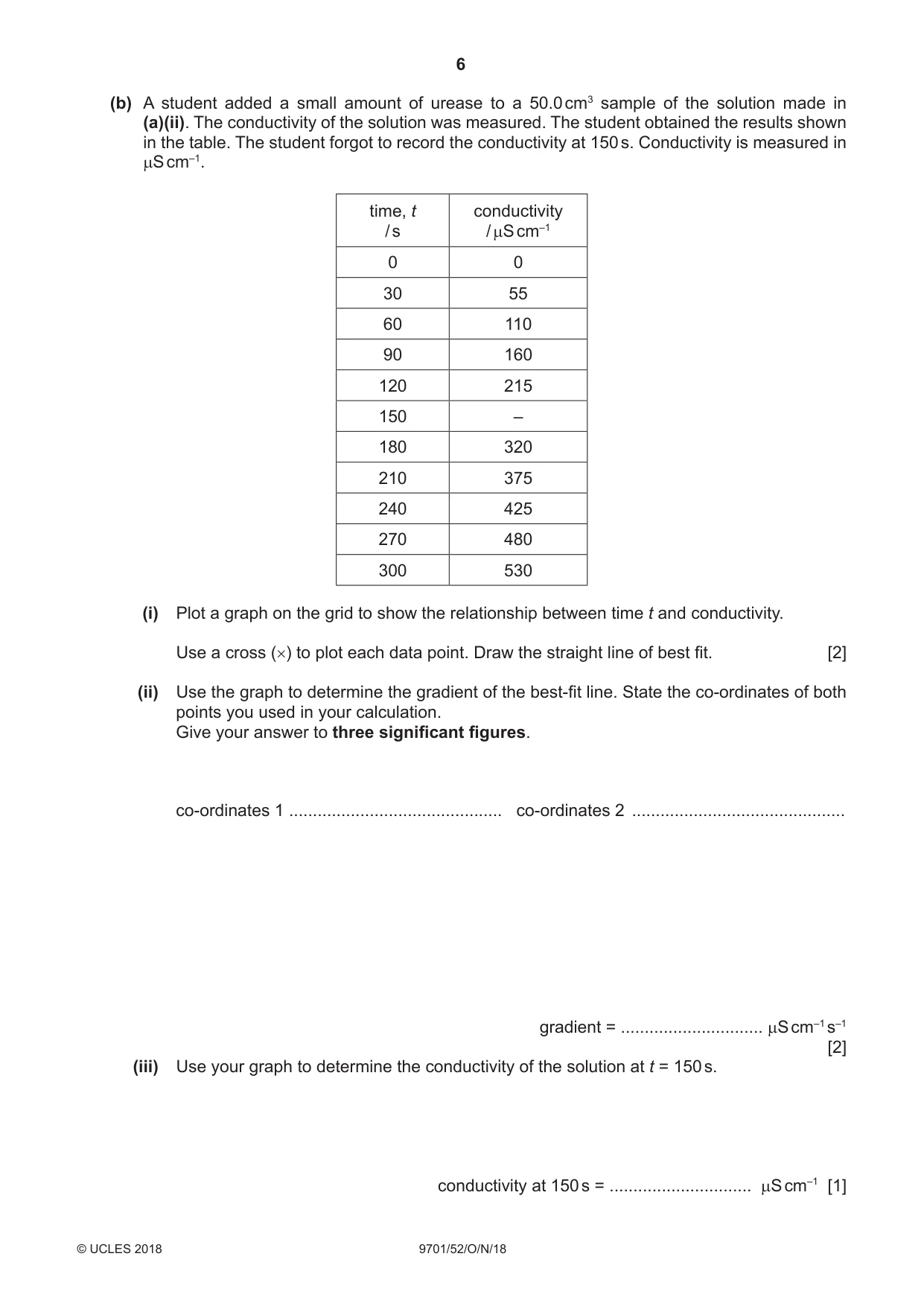
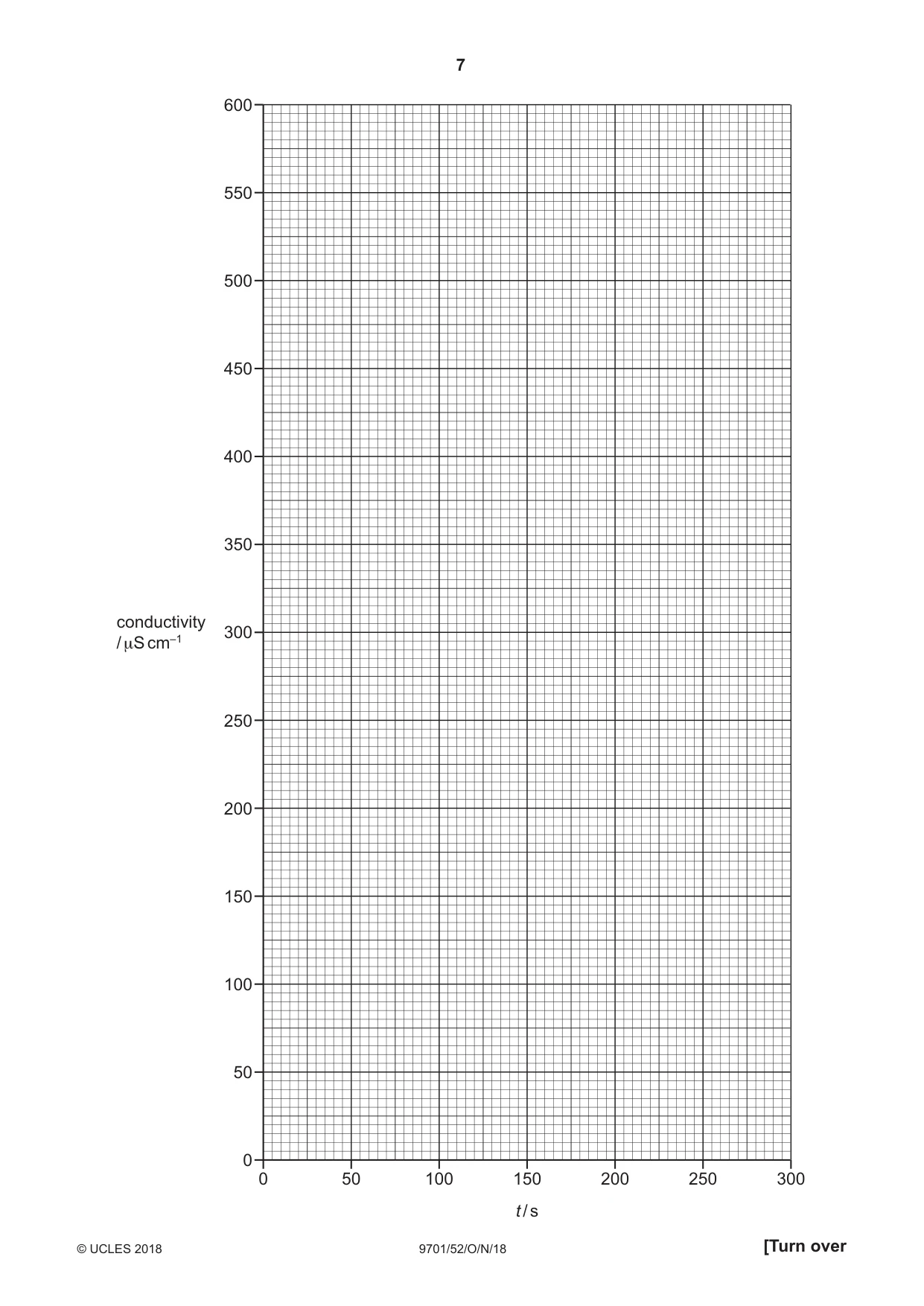
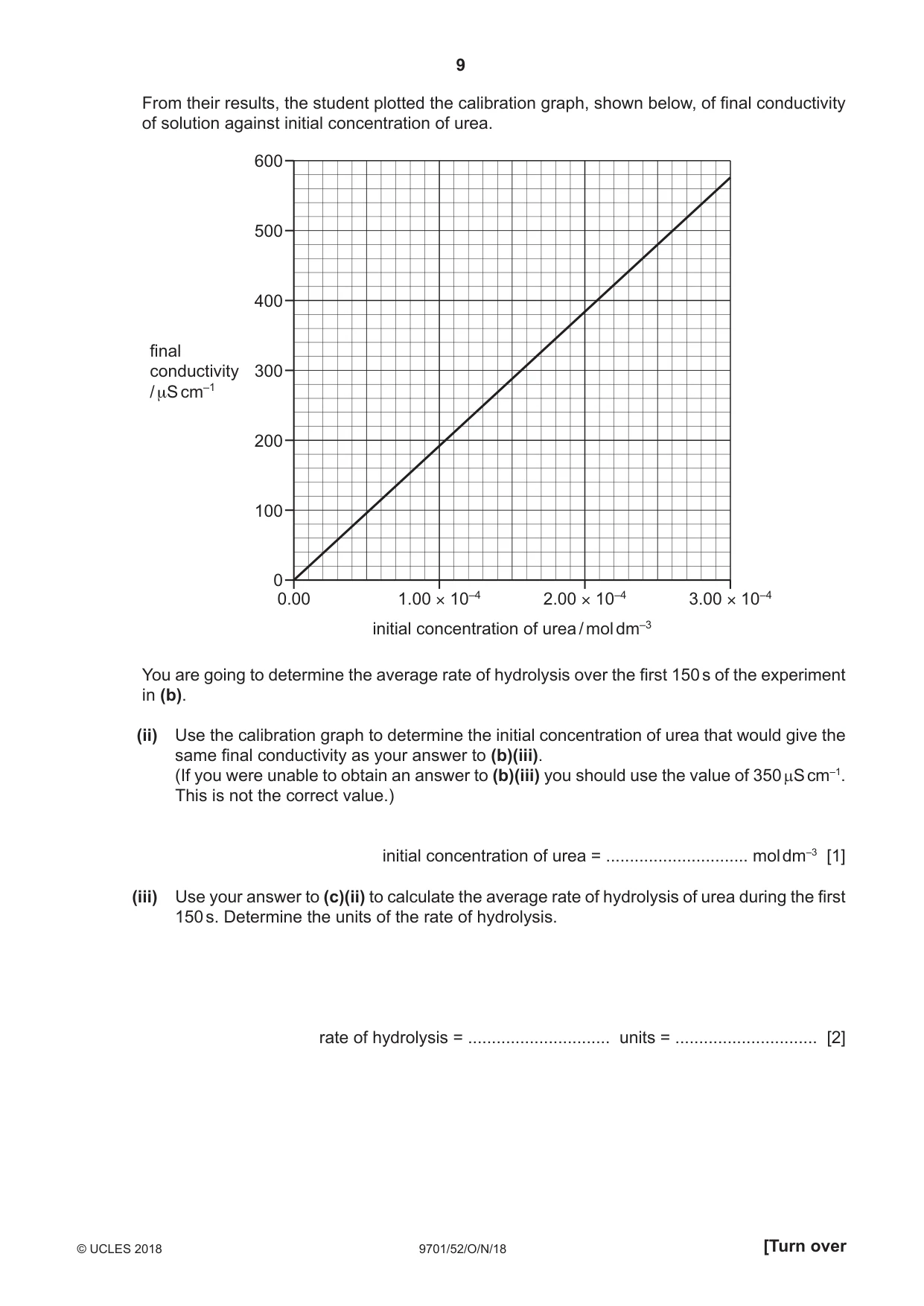
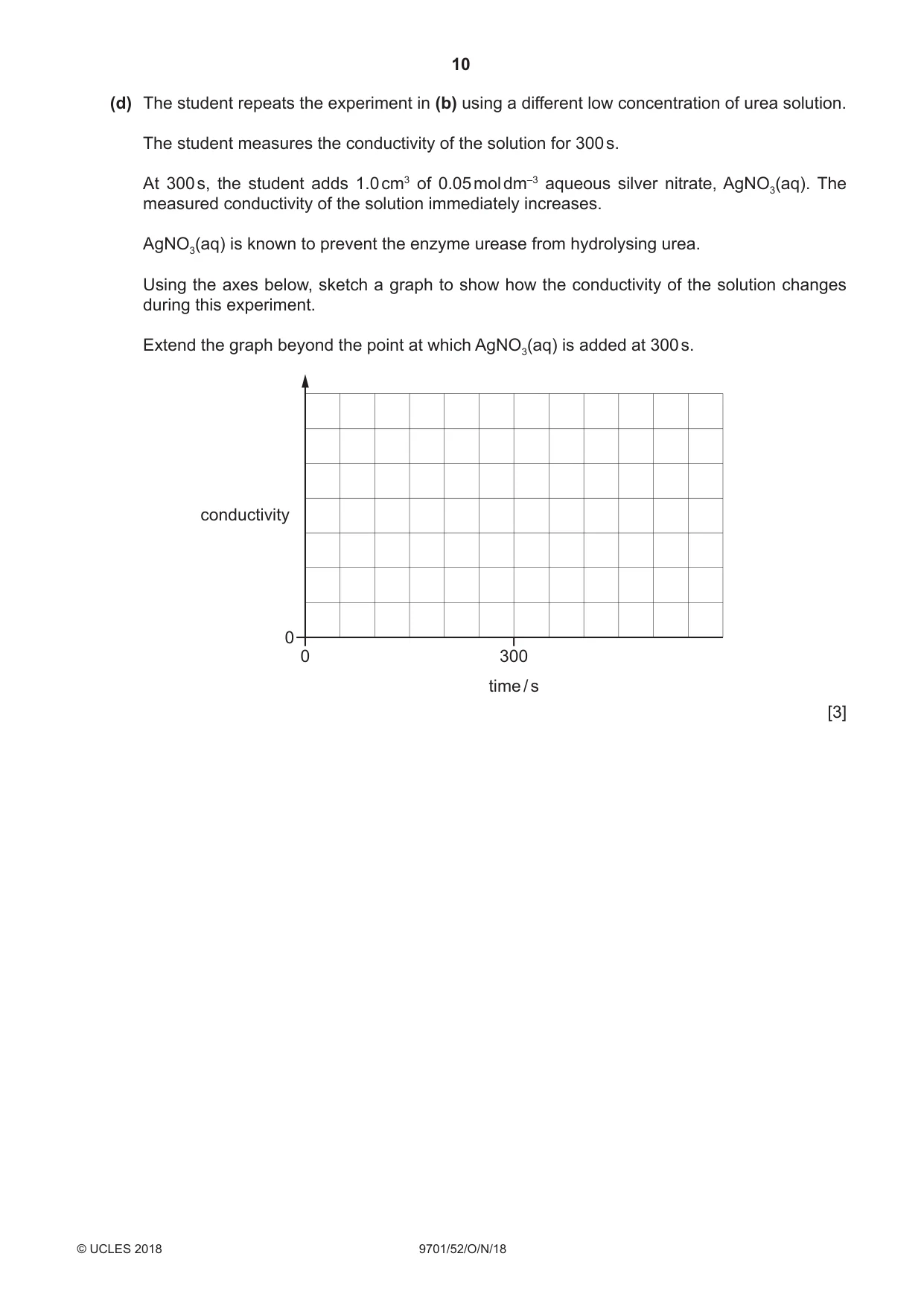
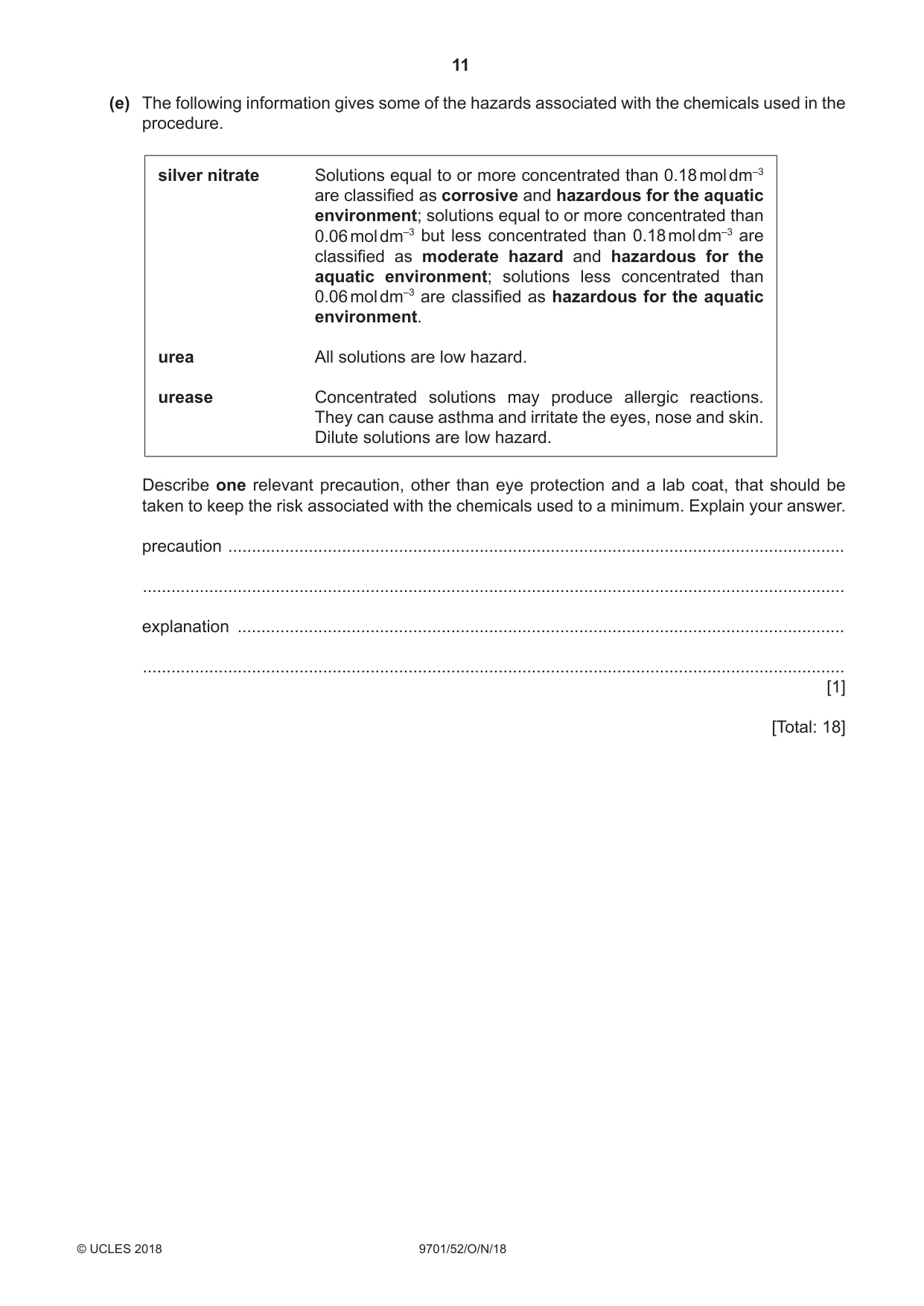
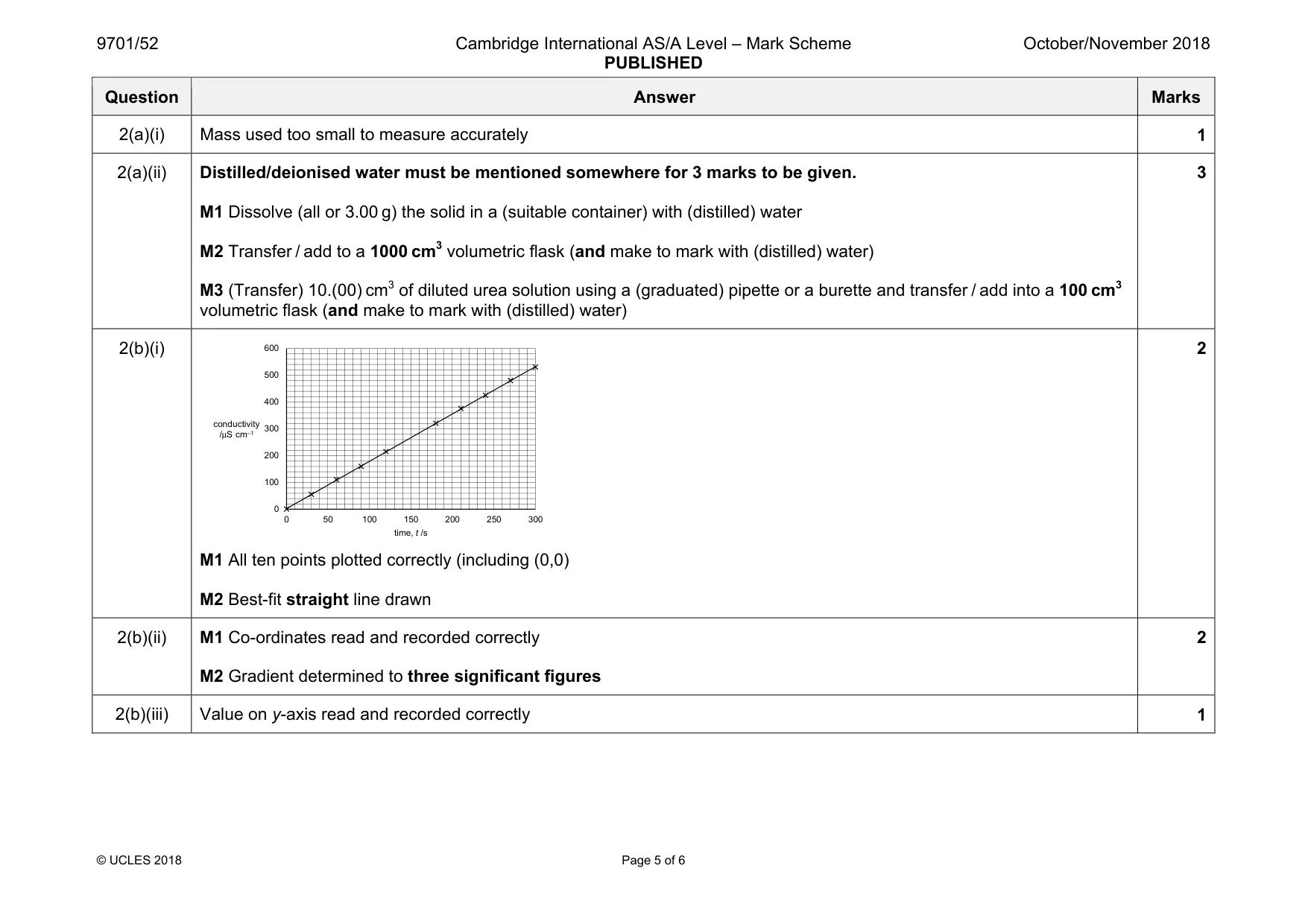
2 The hydrolysis of urea, (NH2)2CO, Mr = 60, is shown by the equation. The reaction is catalysed by the enzyme urease, when present in low concentrations. (NH2)2CO + 2H2O 2NH4+ + CO32– The formation of the NH4+ and CO32– ions increases the conductivity of the solution. The increase in conductivity over time can be measured and the rate of hydrolysis can be determined from this. A student plans to carry out this reaction using a 50 cm3 sample of 5.00 × 10⁻³ mol dm–3 urea solution. (a) The 5.00 × 10⁻³ mol dm–3 urea solution cannot be accurately prepared by dissolving urea in 50.0 cm3 of water. A more concentrated solution is first prepared. This is then diluted to make the solution of the required concentration. (i) Suggest why diluting a more concentrated solution is a more accurate method of preparing this solution than by dissolving urea in 50.0 cm3 of water. ............................................................................................................................................. ............................................................................................................................................. ............................................................................................................................................. ....................................................................................................................................... [1] (ii) Describe how you would accurately prepare exactly 100 cm3 of 5.00 × 10⁻³ mol dm–3 urea solution, starting with 3.00 g of solid urea. Your method should use more than one volumetric flask, including one of capacity 1000 cm3, and other suitable equipment. ............................................................................................................................................. ............................................................................................................................................. ............................................................................................................................................. ............................................................................................................................................. ............................................................................................................................................. ............................................................................................................................................. ............................................................................................................................................. ............................................................................................................................................. ....................................................................................................................................... [3] (b) A student added a small amount of urease to a 50.0 cm3 sample of the solution made in (a)(ii). The conductivity of the solution was measured. The student obtained the results shown in the table. The student forgot to record the conductivity at 150 s. Conductivity is measured in μS cm–1. time, t conductivity / s / μS cm–1 0 0 30 55 60 110 90 160 120 215 150 – 180 320 210 375 240 425 270 480 300 530 (i) Plot a graph on the grid to show the relationship between time t and conductivity. Use a cross (×) to plot each data point. Draw the straight line of best fit. [2] (ii) Use the graph to determine the gradient of the best-fit line. State the co-ordinates of both points you used in your calculation. Give your answer to three significant figures. co-ordinates 1 ............................................. co-ordinates 2 .............................................. gradient = .............................. μS cm–1 s–1 [2] (iii) Use your graph to determine the conductivity of the solution at t = 150 s. conductivity at 150 s = .............................. μS cm–1 [1] 0
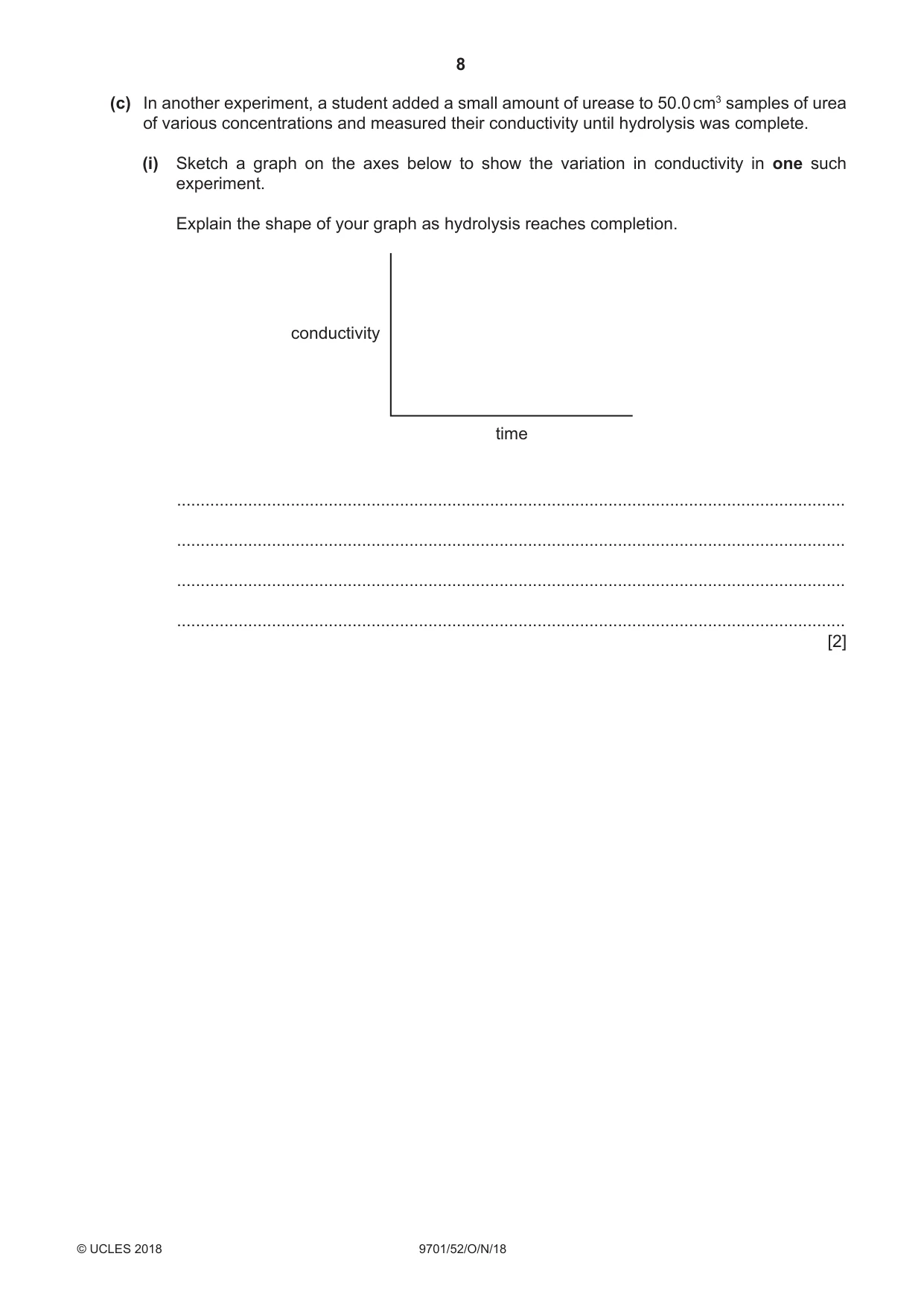
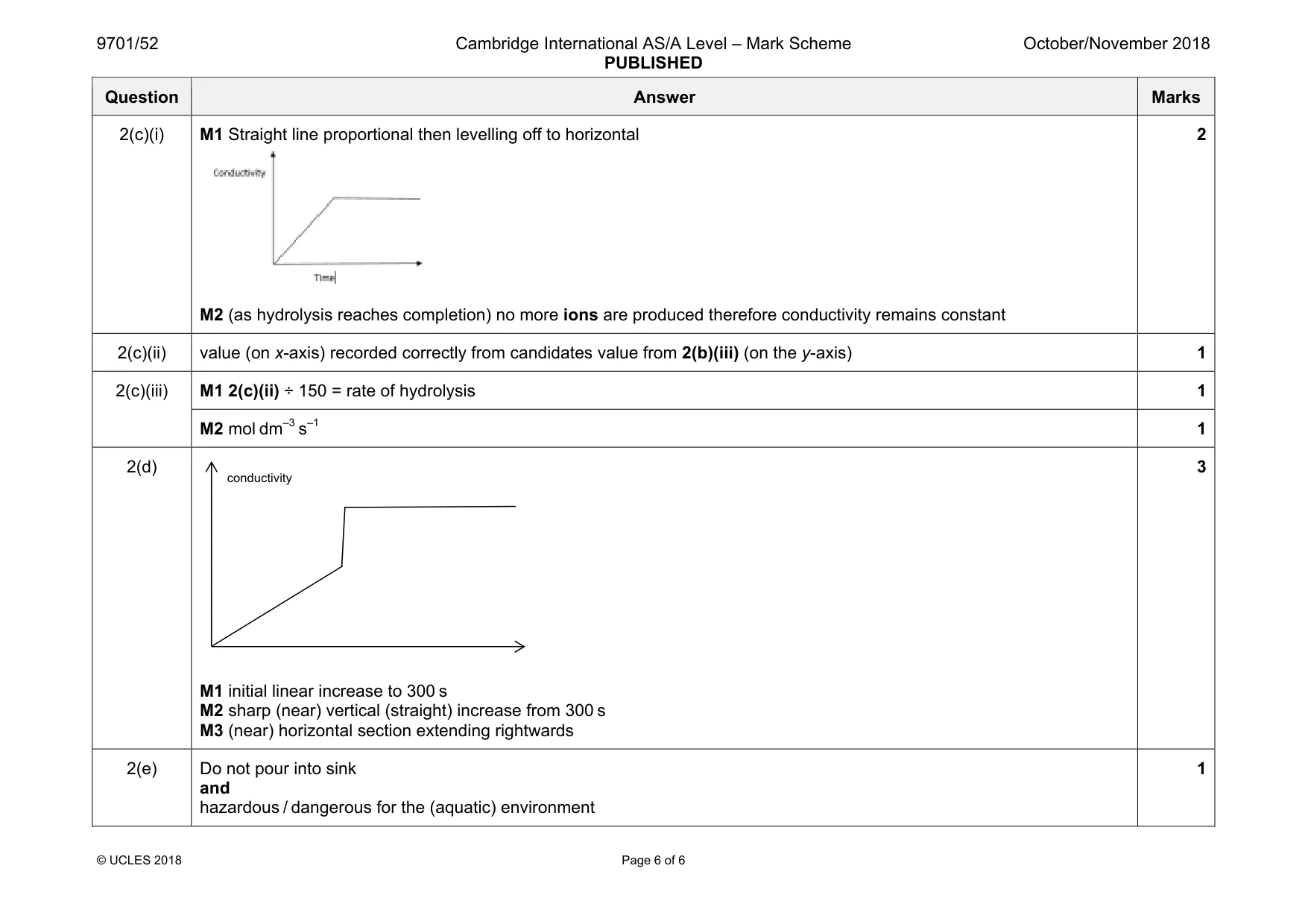
Mark scheme: 2(a)(i) Mass used too small to measure accurately 1 2(a)(ii) Distilled/deionised water must be mentioned somewhere for 3 marks to be given. M1 Dissolve (all or 3.00 g) the solid in a (suitable container) with (distilled) water M2 Transfer / add to a 1000 cm3 volumetric flask (and make to mark with (distilled) water) M3 (Transfer) 10.(00) cm3 of diluted urea solution using a (graduated) pipette or a burette and transfer / add into a 100 cm3 volumetric flask (and make to mark with (distilled) water) 3 2(b)(i) M1 All ten points plotted correctly (including (0,0) M2 Best-fit straight line drawn 2 2(b)(ii) M1 Co-ordinates read and recorded correctly M2 Gradient determined to three significant figures 2 2(b)(iii) Value on y-axis read and recorded correctly 1 0 100 200 300 400 500 600 0 50 100 150 200 250 300 conductivity /µS cm–1 time, t /s Question Answer Marks 2(c)(i) M1 Straight line proportional then levelling off to horizontal M2 (as hydrolysis reaches completion) no more ions are produced therefore conductivity remains constant 2 2(c)(ii) value (on x-axis) recorded correctly from candidates value from 2(b)(iii) (on the y-axis) 1 2(c)(iii) M1 2(c)(ii) ÷ 150 = rate of hydrolysis 1 M2 mol dm–3 s–1 1 2(d) M1 initial linear increase to 300 s M2 sharp (near) vertical (straight) increase from 300 s M3 (near) horizontal section extending rightwards 3 2(e) Do not pour into sink and hazardous / dangerous for the (aquatic) environment 1 conductivity
More questions on Reacting masses and volumes (of solutions and gases)
What was in this paper
The subtopics covered by these 2 questions, and how many questions each got. Open one in a new tab to see every Cambridge question on it.
What you needed in this session
Cambridge’s own grade thresholds for 2018 Oct/Nov, Paper 5 · Variant 2. A higher threshold means an easier paper — the bar moves with how the cohort did.