Cambridge A Level Chemistry 9701 — 2018 May/June Paper 5 · Variant 2
9701/52/M/J/18 · 2 questions · 30 marks · ≈34 min
The question paper and its mark scheme, free to read here and free to download. This is Cambridge’s own paper, exactly as it was sat.
Question paper12 pages

Mark scheme6 pages
Answers below. Sit the paper first if you are practising.
Questions as text
Q1 · When concentrated iron(III) chloride is added to water at just below boiling point, a…
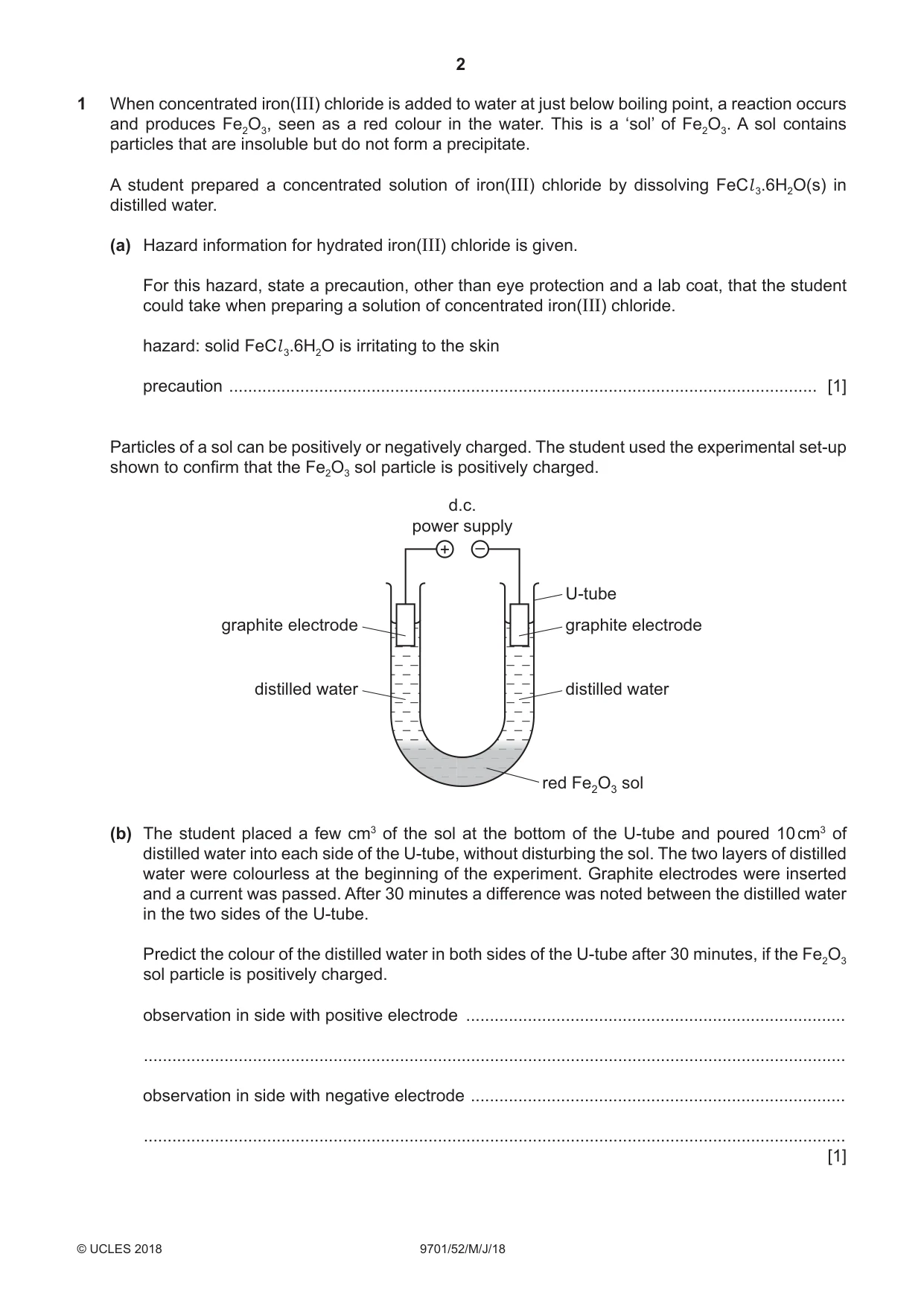
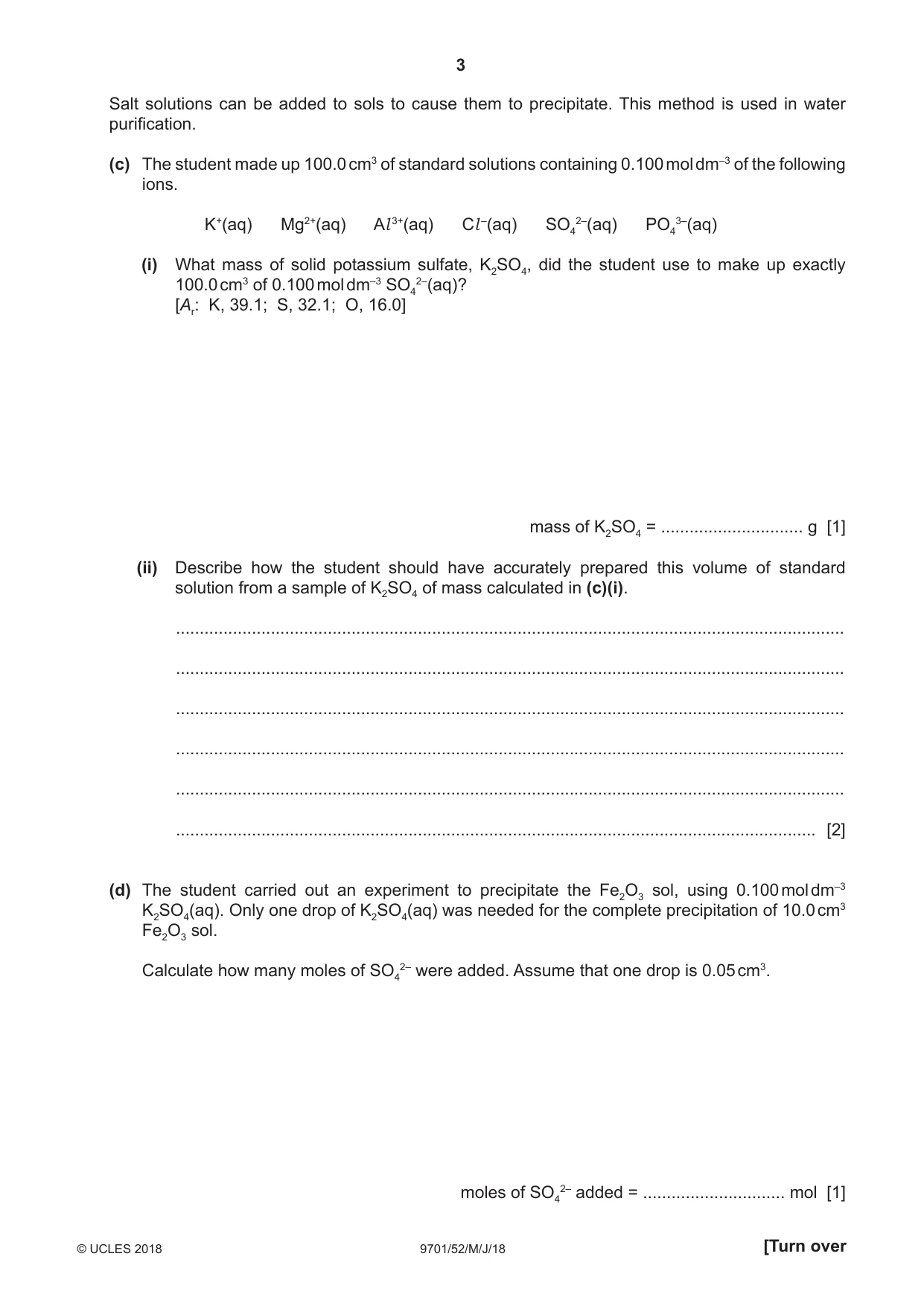
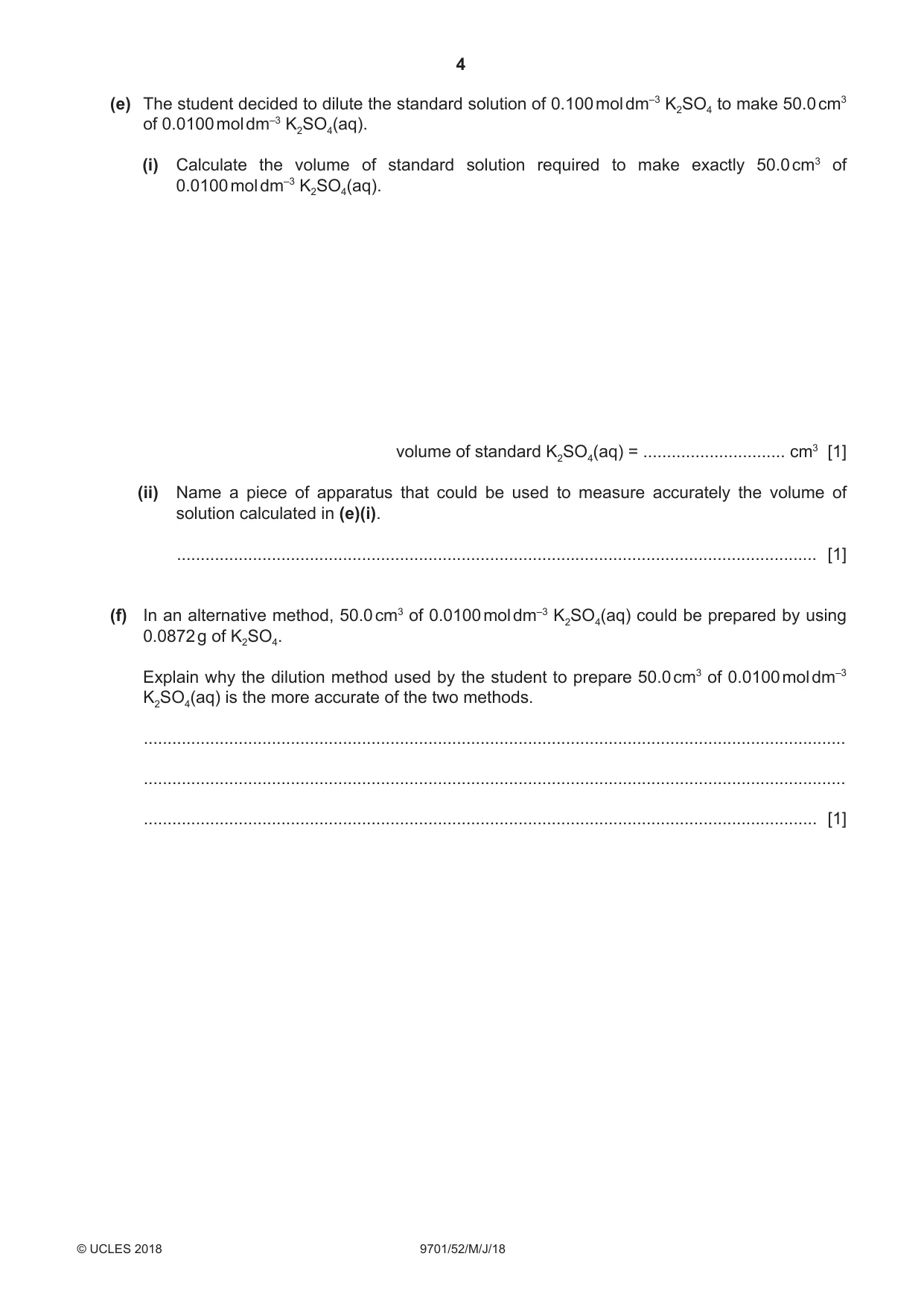
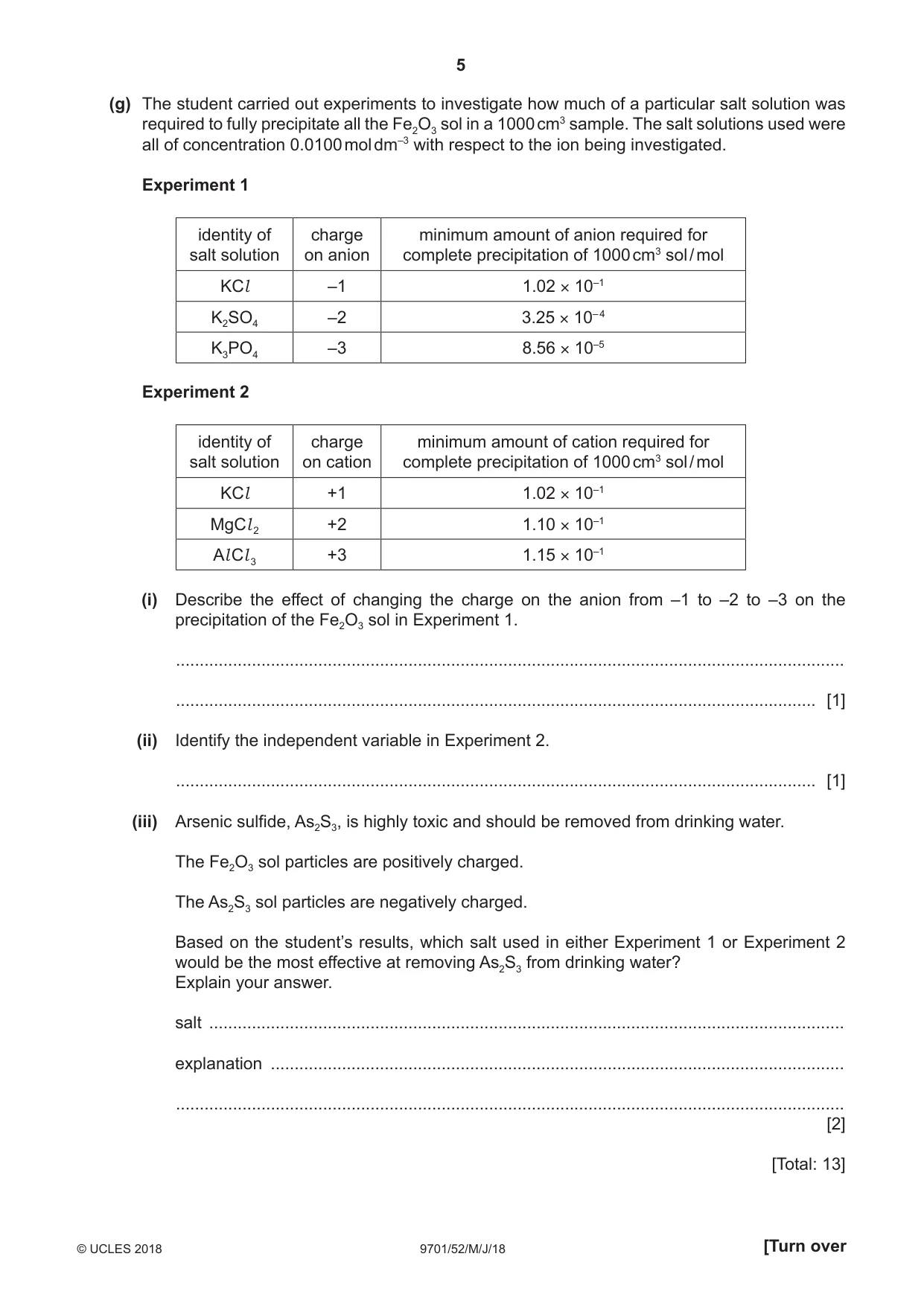
1 When concentrated iron(III) chloride is added to water at just below boiling point, a reaction occurs and produces Fe2O3, seen as a red colour in the water. This is a ‘sol’ of Fe2O3. A sol contains particles that are insoluble but do not form a precipitate. A student prepared a concentrated solution of iron(III) chloride by dissolving FeCl 3.6H2O(s) in distilled water. (a) Hazard information for hydrated iron(III) chloride is given. For this hazard, state a precaution, other than eye protection and a lab coat, that the student could take when preparing a solution of concentrated iron(III) chloride. hazard: solid FeCl 3.6H2O is irritating to the skin precaution ............................................................................................................................ [1] Particles of a sol can be positively or negatively charged. The student used the experimental set-up shown to confirm that the Fe2O3 sol particle is positively charged. d.c. power supply + – U-tube graphite electrode graphite electrode distilled water distilled water red Fe2O3 sol (b) The student placed a few cm3 of the sol at the bottom of the U-tube and poured 10 cm3 of distilled water into each side of the U-tube, without disturbing the sol. The two layers of distilled water were colourless at the beginning of the experiment. Graphite electrodes were inserted and a current was passed. After 30 minutes a difference was noted between the distilled water in the two sides of the U-tube. Predict the colour of the distilled water in both sides of the U-tube after 30 minutes, if the Fe2O3 sol particle is positively charged. observation in side with positive electrode ................................................................................. .................................................................................................................................................... observation in side with negative electrode ............................................................................... .................................................................................................................................................... [1] Salt solutions can be added to sols to cause them to precipitate. This method is used in water purification. (c) The student made up 100.0 cm3 of standard solutions containing 0.100 mol dm–3 of the following ions. K+(aq) Mg2+(aq) Al 3+(aq) Cl –(aq) SO42–(aq) PO43–(aq) (i) What mass of solid potassium sulfate, K2SO4, did the student use to make up exactly 100.0 cm3 of 0.100 mol dm–3 SO42–(aq)? [Ar: K, 39.1; S, 32.1; O, 16.0] mass of K2SO4 = .............................. g [1] (ii) Describe how the student should have accurately prepared this volume of standard solution from a sample of K2SO4 of mass calculated in (c)(i). ............................................................................................................................................. ............................................................................................................................................. ............................................................................................................................................. ............................................................................................................................................. ............................................................................................................................................. ....................................................................................................................................... [2] (d) The student carried out an experiment to precipitate the Fe2O3 sol, using 0.100 mol dm–3 K2SO4(aq). Only one drop of K2SO4(aq) was needed for the complete precipitation of 10.0 cm3 Fe2O3 sol. Calculate how many moles of SO42– were added. Assume that one drop is 0.05 cm3. moles of SO42– added = .............................. mol [1] (e) The student decided to dilute the standard solution of 0.100 mol dm–3 K2SO4 to make 50.0 cm3 of 0.0100 mol dm–3 K2SO4(aq). (i) Calculate the volume of standard solution required to make exactly 50.0 cm3 of 0.0100 mol dm–3 K2SO4(aq). volume of standard K2SO4(aq) = .............................. cm3 [1] (ii) Name a piece of apparatus that could be used to measure accurately the volume of solution calculated in (e)(i). ....................................................................................................................................... [1] (f) In an alternative method, 50.0 cm3 of 0.0100 mol dm–3 K2SO4(aq) could be prepared by using 0.0872 g of K2SO4. Explain why the dilution method used by the student to prepare 50.0 cm3 of 0.0100 mol dm–3 K2SO4(aq) is the more accurate of the two methods. .................................................................................................................................................... .................................................................................................................................................... .............................................................................................................................................. [1] (g) The student carried out experiments to investigate how much of a particular salt solution was required to fully precipitate all the Fe2O3 sol in a 1000 cm3 sample. The salt solutions used were all of concentration 0.0100 mol dm–3 with respect to the ion being investigated. Experiment 1 identity of charge minimum amount of anion required for salt solution on anion complete precipitation of 1000 cm3 sol / mol KCl –1 1.02 × 10⁻¹ K2SO4 –2 3.25 × 10– 4 K3PO4 –3 8.56 × 10⁻⁵ Experiment 2 identity of charge minimum amount of cation required for salt solution on cation complete precipitation of 1000 cm3 sol / mol KCl +1 1.02 × 10⁻¹ MgCl 2 +2 1.10 × 10⁻¹ Al Cl 3 +3 1.15 × 10⁻¹ (i) Describe the effect of changing the charge on the anion from –1 to –2 to –3 on the precipitation of the Fe2O3 sol in Experiment 1. ............................................................................................................................................. ....................................................................................................................................... [1] (ii) Identify the independent variable in Experiment 2. ....................................................................................................................................... [1] (iii) Arsenic sulfide, As2S3, is highly toxic and should be removed from drinking water. The Fe2O3 sol particles are positively charged. The As2S3 sol particles are negatively charged. Based on the student’s results, which salt used in either Experiment 1 or Experiment 2 would be the most effective at removing As2S3 from drinking water? Explain your answer. salt ....................................................................................................................................... explanation .......................................................................................................................... ............................................................................................................................................. [2] [Total: 13]
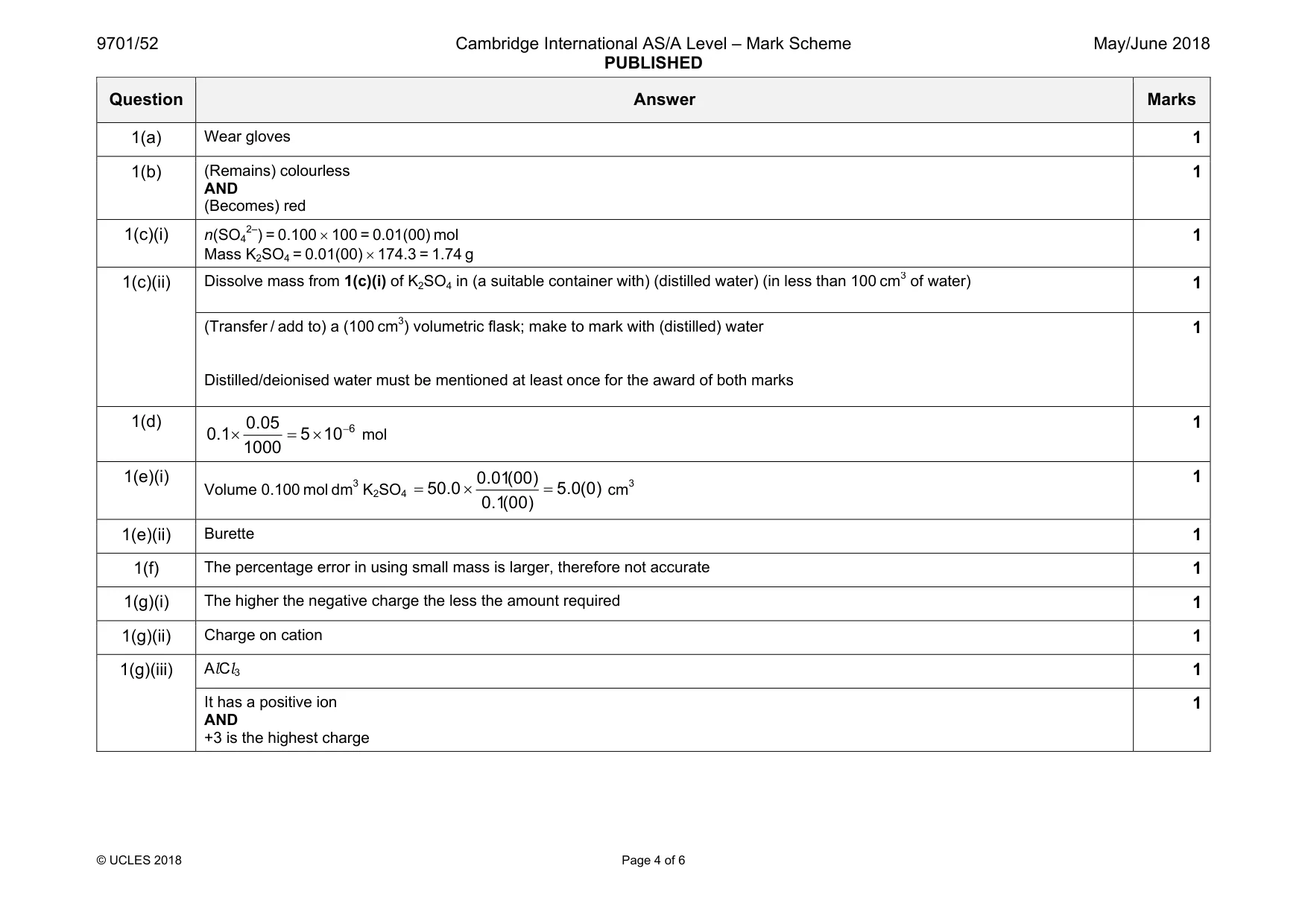
Mark scheme: 1(a) 1 1(b) (Remains) colourless AND (Becomes) red 1 1(c)(i) n(SO4 2–) = 0.100 × 100 = 0.01(00) mol Mass K2SO4 = 0.01(00) × 174.3 = 1.74 g 1 1(c)(ii) Dissolve mass from 1(c)(i) of K2SO4 in (a suitable container with) (distilled water) (in less than 100 cm3 of water) 1 (Transfer / add to) a (100 cm3) volumetric flask; make to mark with (distilled) water Distilled/deionised water must be mentioned at least once for the award of both marks 1 1(d) 6 0.05 0.1 5 10 1000 − × = × mol 1 1(e)(i) Volume 0.100 mol dm3 K2SO4 0.01(00) 50.0 5.0(0) 0.1(00) = × = cm3 1 1(e)(ii) Burette 1 1(f) The percentage error in using small mass is larger, therefore not accurate 1 1(g)(i) The higher the negative charge the less the amount required 1 1(g)(ii) Charge on cation 1 1(g)(iii) AlCl3 1 It has a positive ion AND +3 is the highest charge 1
More questions on Reacting masses and volumes (of solutions and gases)
Q2 · Water boils when the pressure of its vapour above the liquid surface is equal to the…
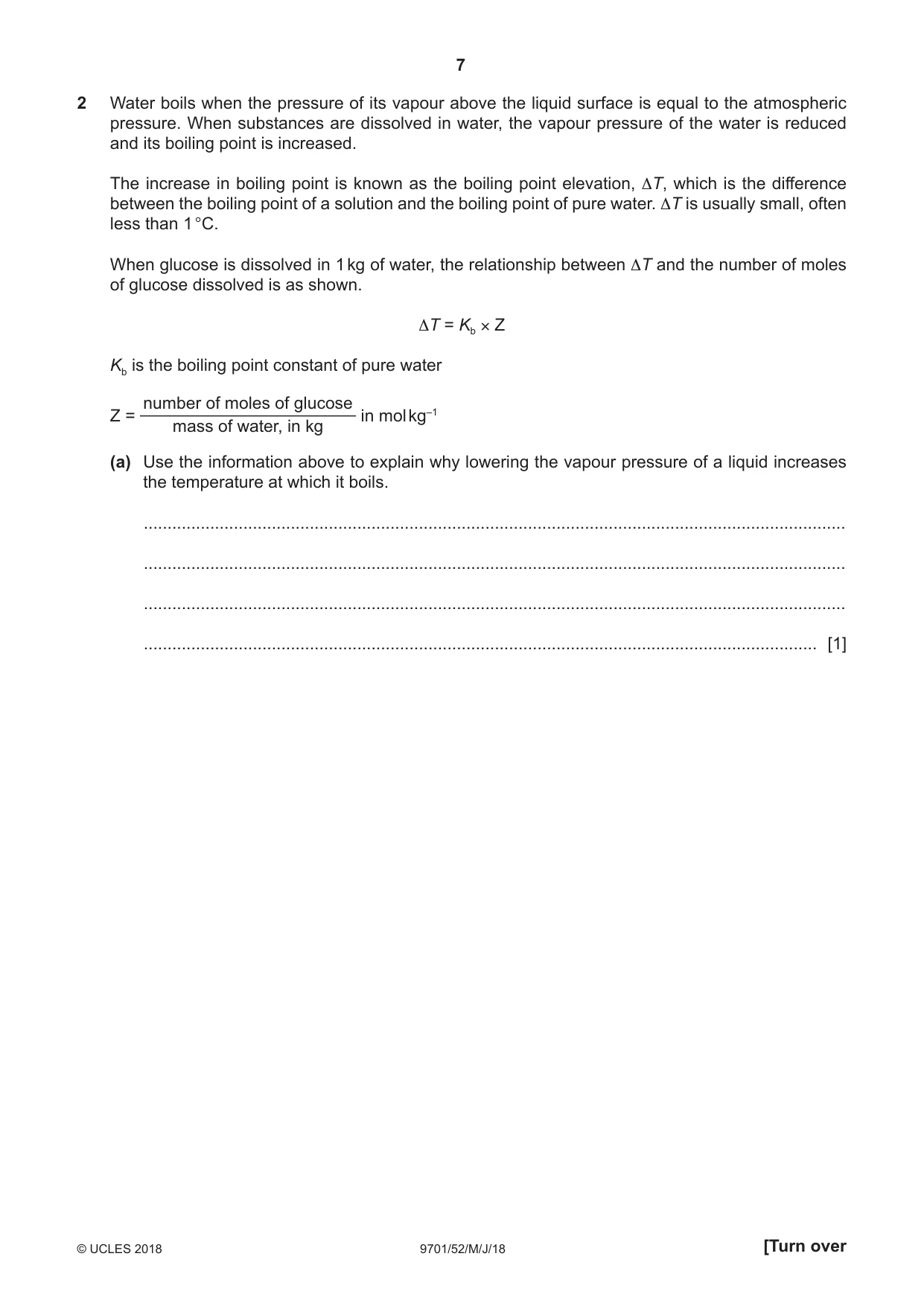
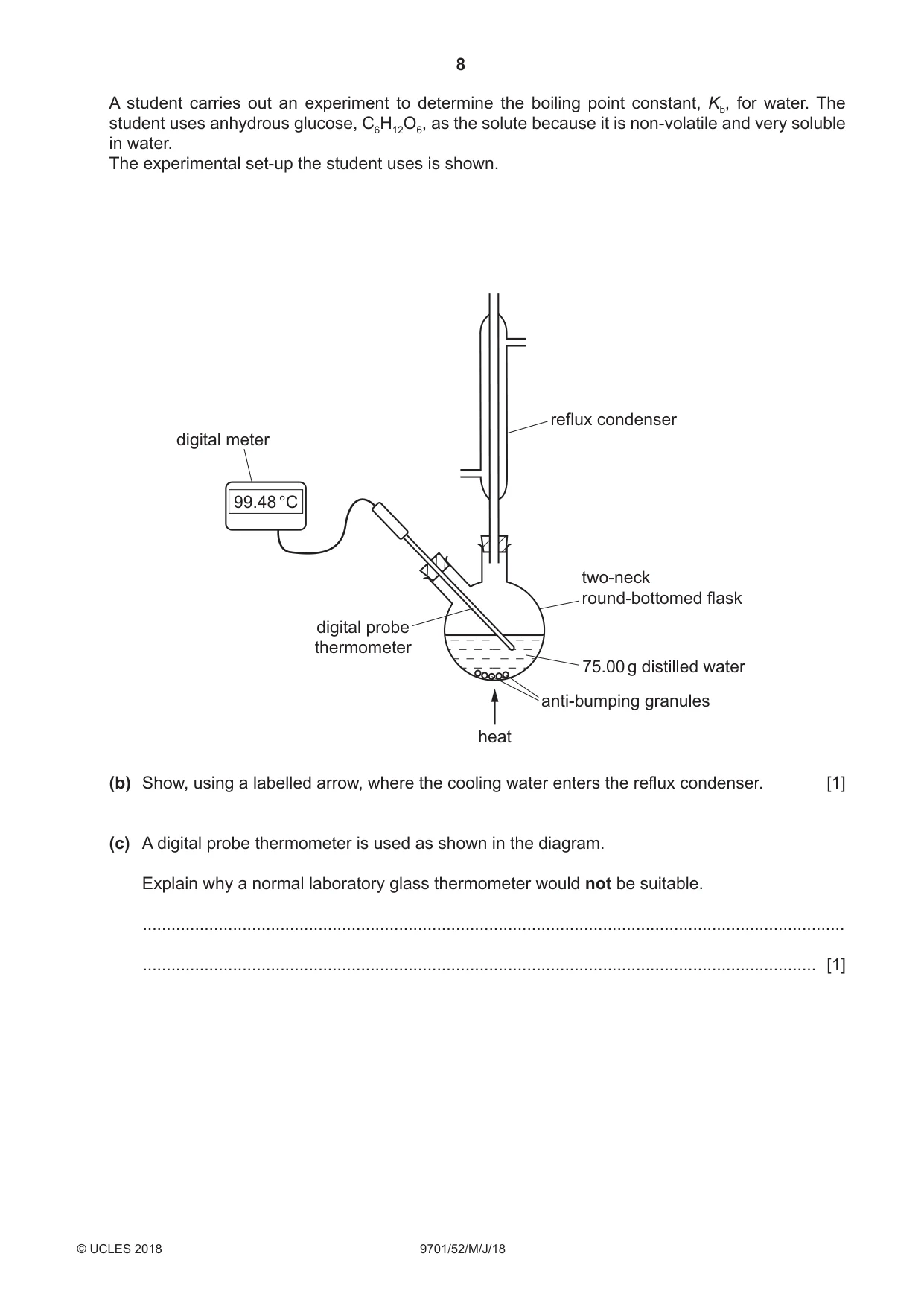
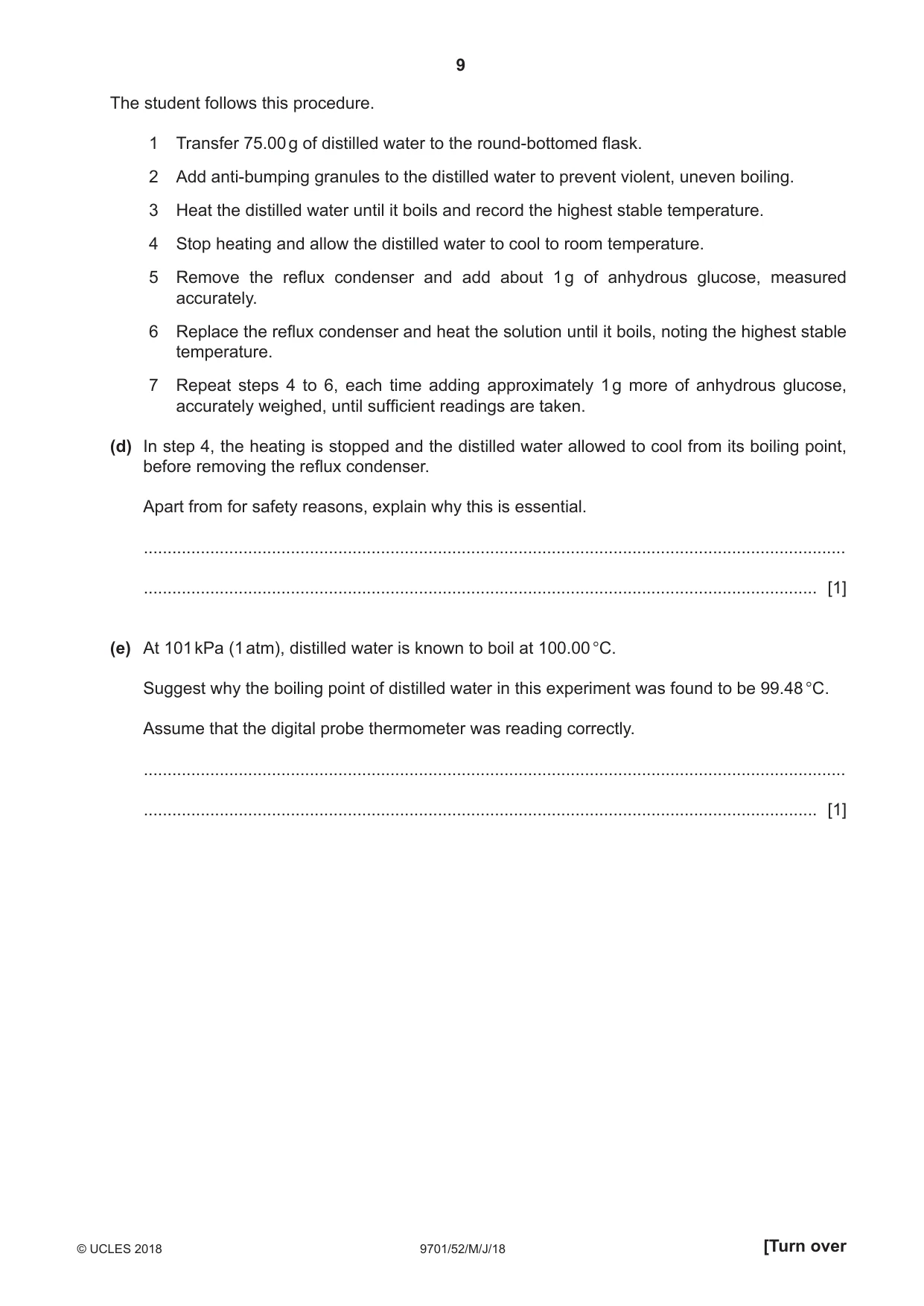
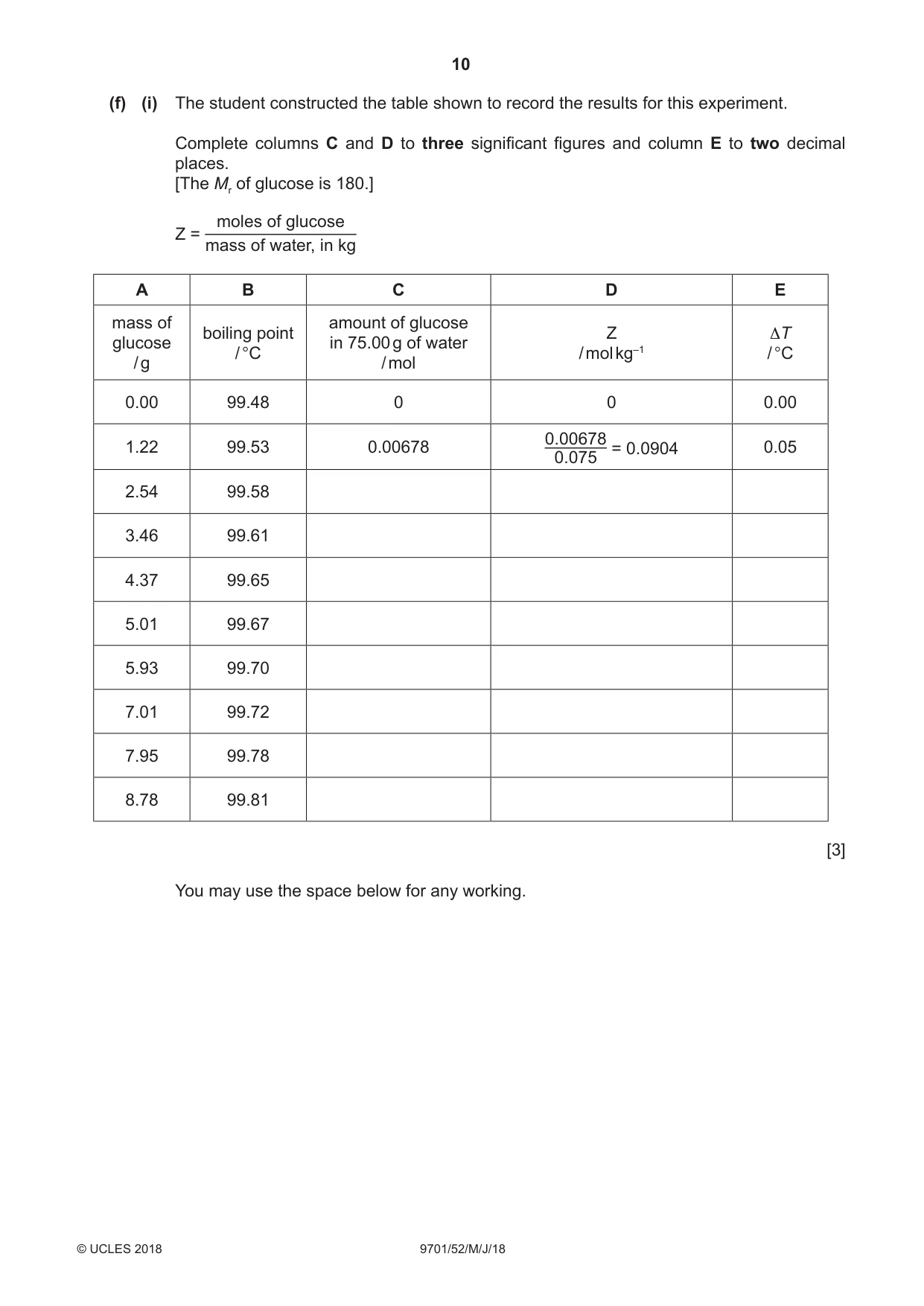
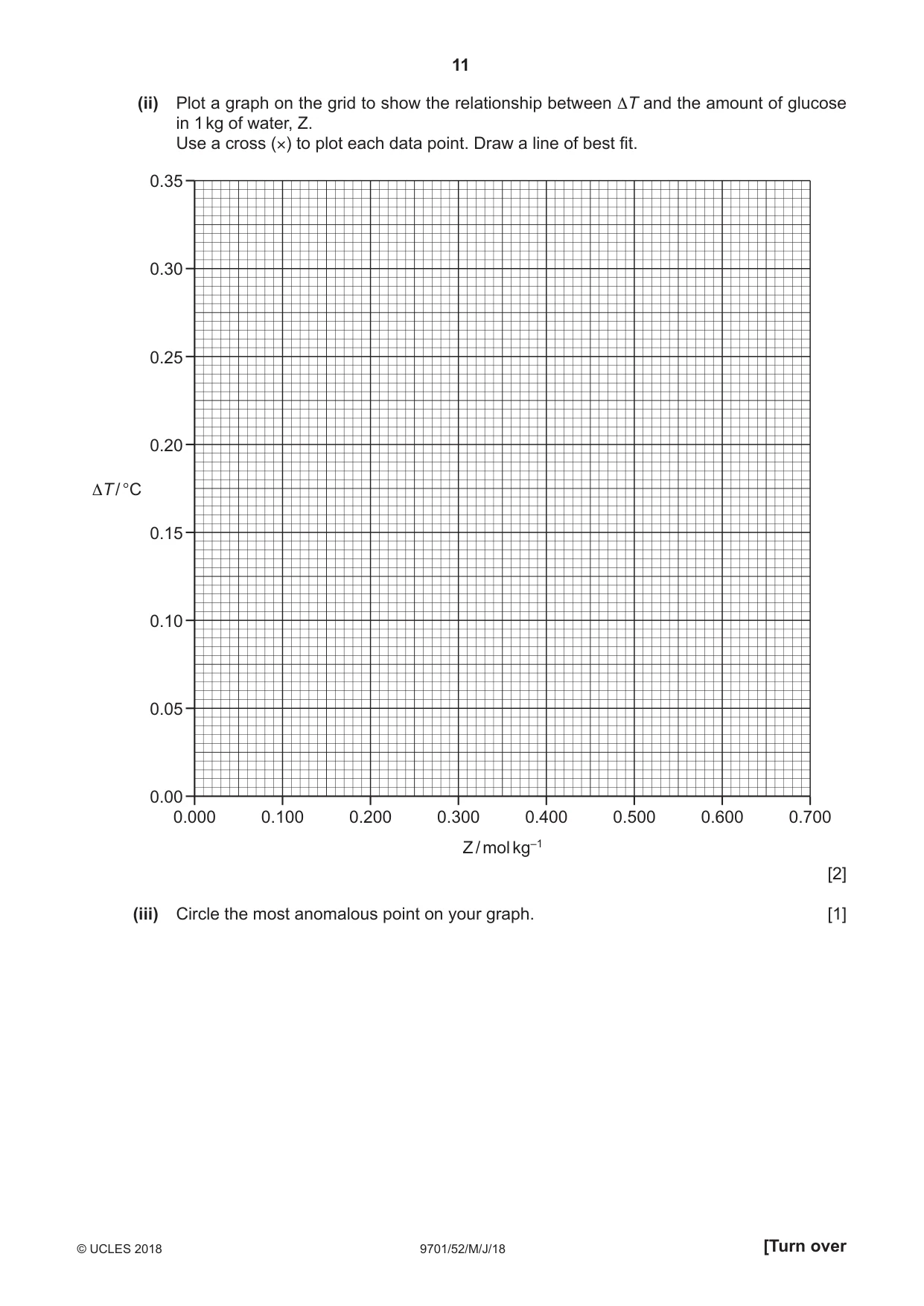
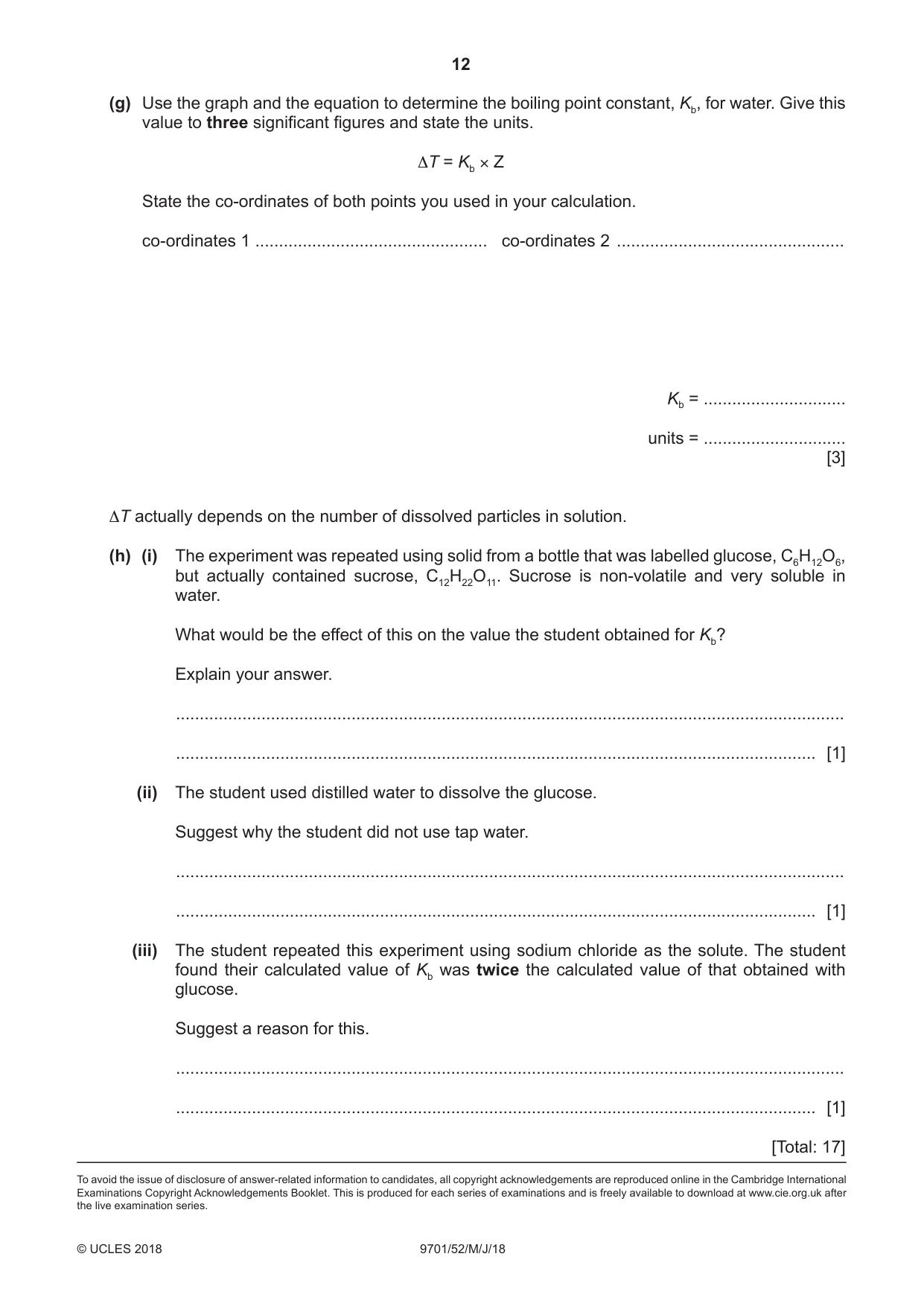
2 Water boils when the pressure of its vapour above the liquid surface is equal to the atmospheric pressure. When substances are dissolved in water, the vapour pressure of the water is reduced and its boiling point is increased. The increase in boiling point is known as the boiling point elevation, ΔT, which is the difference between the boiling point of a solution and the boiling point of pure water. ΔT is usually small, often less than 1 °C. When glucose is dissolved in 1 kg of water, the relationship between ΔT and the number of moles of glucose dissolved is as shown. ΔT = Kb × Z Kb is the boiling point constant of pure water number of moles of glucose Z = in mol kg–1 mass of water, in kg (a) Use the information above to explain why lowering the vapour pressure of a liquid increases the temperature at which it boils. .................................................................................................................................................... .................................................................................................................................................... .................................................................................................................................................... .............................................................................................................................................. [1] A student carries out an experiment to determine the boiling point constant, Kb, for water. The student uses anhydrous glucose, C6H12O6, as the solute because it is non-volatile and very soluble in water. The experimental set-up the student uses is shown. reflux condenser digital meter 99.48 °C two-neck round-bottomed flask digital probe thermometer 75.00 g distilled water anti-bumping granules heat (b) Show, using a labelled arrow, where the cooling water enters the reflux condenser. [1] (c) A digital probe thermometer is used as shown in the diagram. Explain why a normal laboratory glass thermometer would not be suitable. .................................................................................................................................................... .............................................................................................................................................. [1] The student follows this procedure. 1 Transfer 75.00 g of distilled water to the round-bottomed flask. 2 Add anti-bumping granules to the distilled water to prevent violent, uneven boiling. 3 Heat the distilled water until it boils and record the highest stable temperature. 4 Stop heating and allow the distilled water to cool to room temperature. 5 Remove the reflux condenser and add about 1 g of anhydrous glucose, measured accurately. 6 Replace the reflux condenser and heat the solution until it boils, noting the highest stable temperature. 7 Repeat steps 4 to 6, each time adding approximately 1 g more of anhydrous glucose, accurately weighed, until sufficient readings are taken. (d) In step 4, the heating is stopped and the distilled water allowed to cool from its boiling point, before removing the reflux condenser. Apart from for safety reasons, explain why this is essential. .................................................................................................................................................... .............................................................................................................................................. [1] (e) At 101 kPa (1 atm), distilled water is known to boil at 100.00 °C. Suggest why the boiling point of distilled water in this experiment was found to be 99.48 °C. Assume that the digital probe thermometer was reading correctly. .................................................................................................................................................... .............................................................................................................................................. [1]
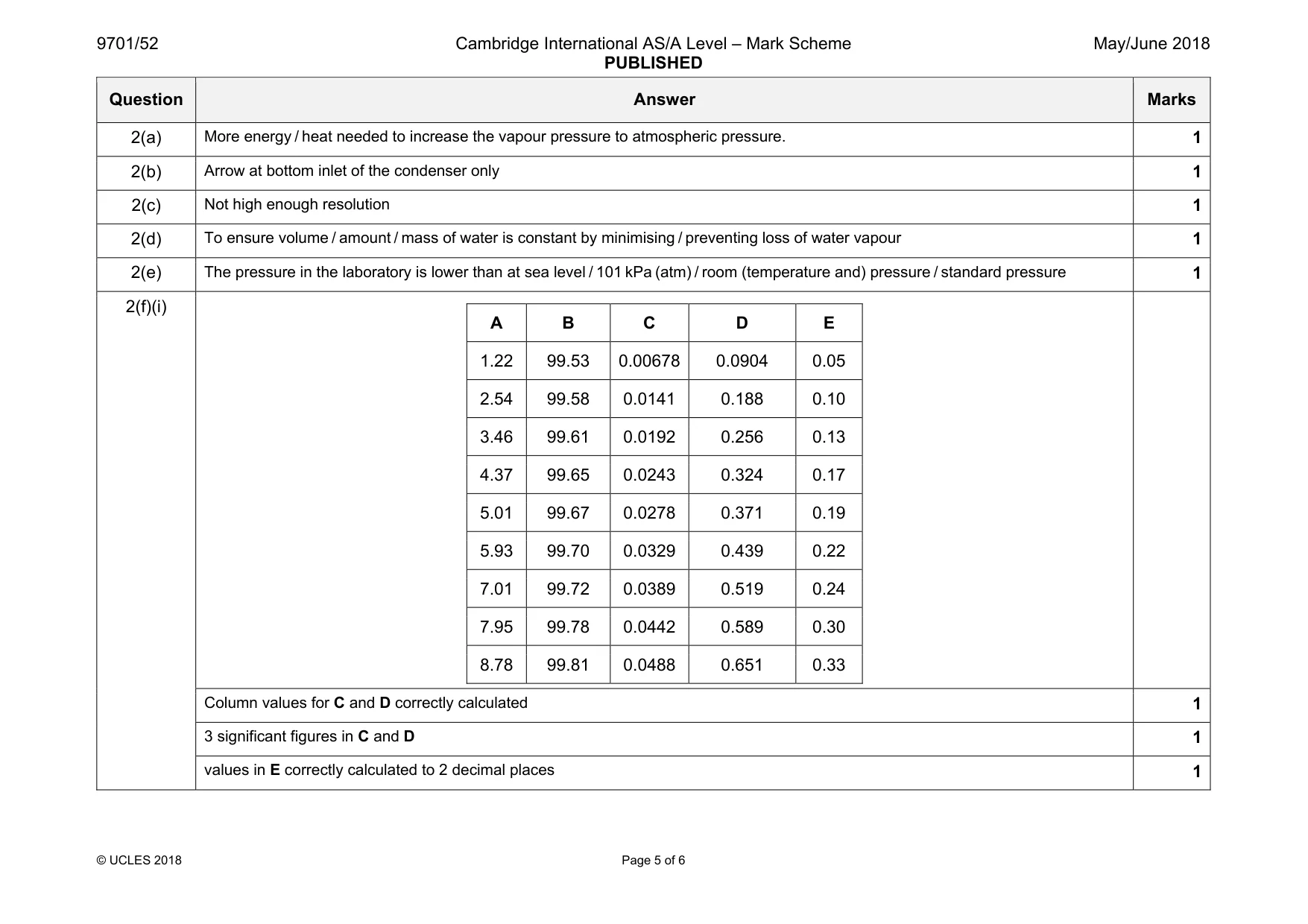
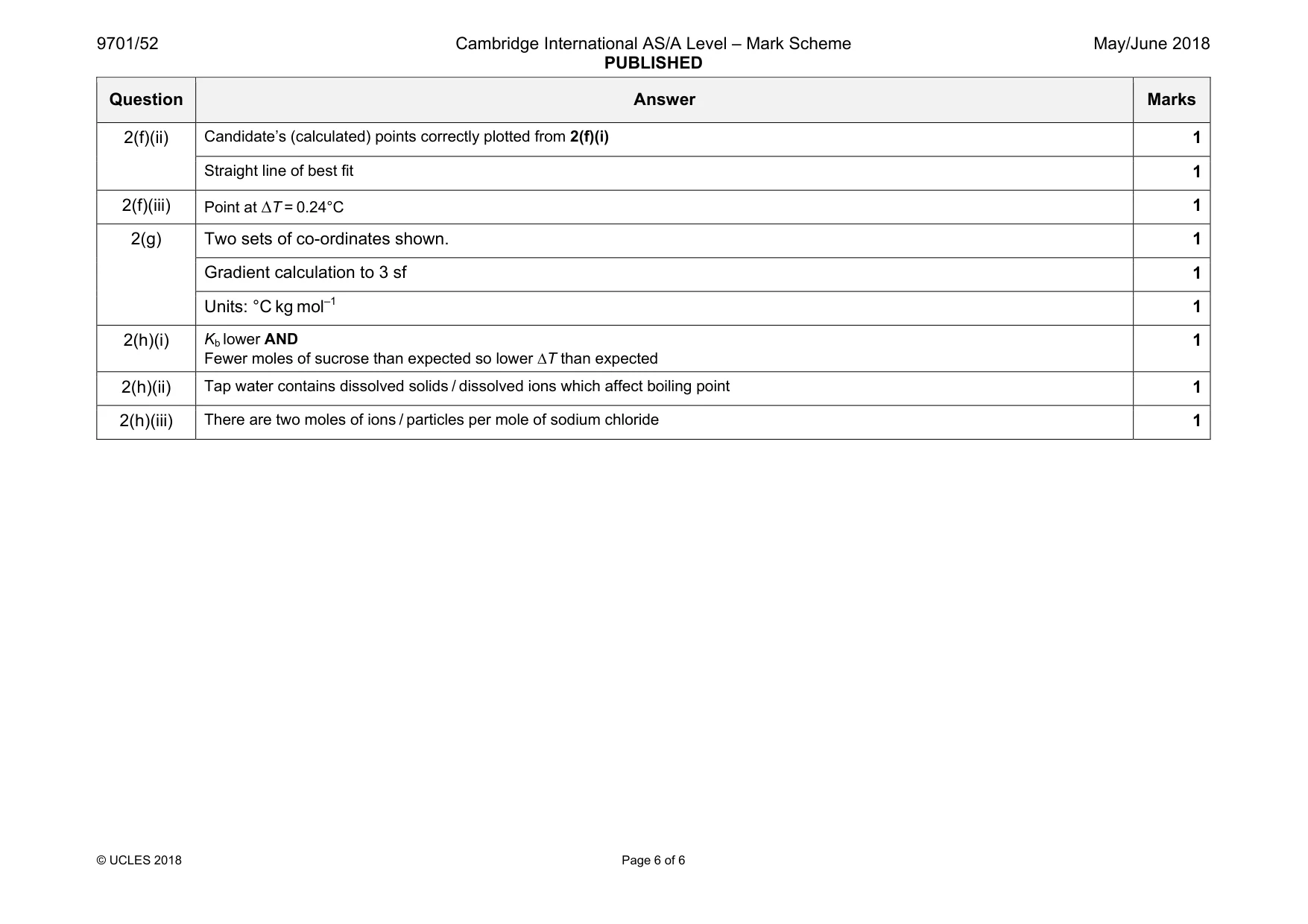
Mark scheme: 2(a) 1 2(b) Arrow at bottom inlet of the condenser only 1 2(c) Not high enough resolution 1 2(d) To ensure volume / amount / mass of water is constant by minimising / preventing loss of water vapour 1 2(e) The pressure in the laboratory is lower than at sea level / 101 kPa (atm) / room (temperature and) pressure / standard pressure 1 2(f)(i) A B C D E 1.22 99.53 0.00678 0.0904 0.05 2.54 99.58 0.0141 0.188 0.10 3.46 99.61 0.0192 0.256 0.13 4.37 99.65 0.0243 0.324 0.17 5.01 99.67 0.0278 0.371 0.19 5.93 99.70 0.0329 0.439 0.22 7.01 99.72 0.0389 0.519 0.24 7.95 99.78 0.0442 0.589 0.30 8.78 99.81 0.0488 0.651 0.33 Column values for C and D correctly calculated 1 3 significant figures in C and D 1 values in E correctly calculated to 2 decimal places 1 Question Answer Marks 2(f)(ii) Candidate’s (calculated) points correctly plotted from 2(f)(i) 1 Straight line of best fit 1 2(f)(iii) Point at ∆T = 0.24°C 1 2(g) Two sets of co-ordinates shown. 1 Gradient calculation to 3 sf 1 Units: °C kg mol–1 1 2(h)(i) Kb lower AND Fewer moles of sucrose than expected so lower ∆T than expected 1 2(h)(ii) Tap water contains dissolved solids / dissolved ions which affect boiling point 1 2(h)(iii) There are two moles of ions / particles per mole of sodium chloride 1
What was in this paper
The subtopics covered by these 2 questions, and how many questions each got. Open one in a new tab to see every Cambridge question on it.
What you needed in this session
Cambridge’s own grade thresholds for 2018 May/June, Paper 5 · Variant 2. A higher threshold means an easier paper — the bar moves with how the cohort did.