Cambridge A Level Chemistry 9701 — 2018 May/June Paper 5 · Variant 1
9701/51/M/J/18 · 2 questions · 30 marks · ≈34 min
The question paper and its mark scheme, free to read here and free to download. This is Cambridge’s own paper, exactly as it was sat.
Question paper12 pages

Mark scheme7 pages
Answers below. Sit the paper first if you are practising.
Questions as text
Q1 · The Faraday constant is the charge in coulombs, C, carried by 1 mole of electrons
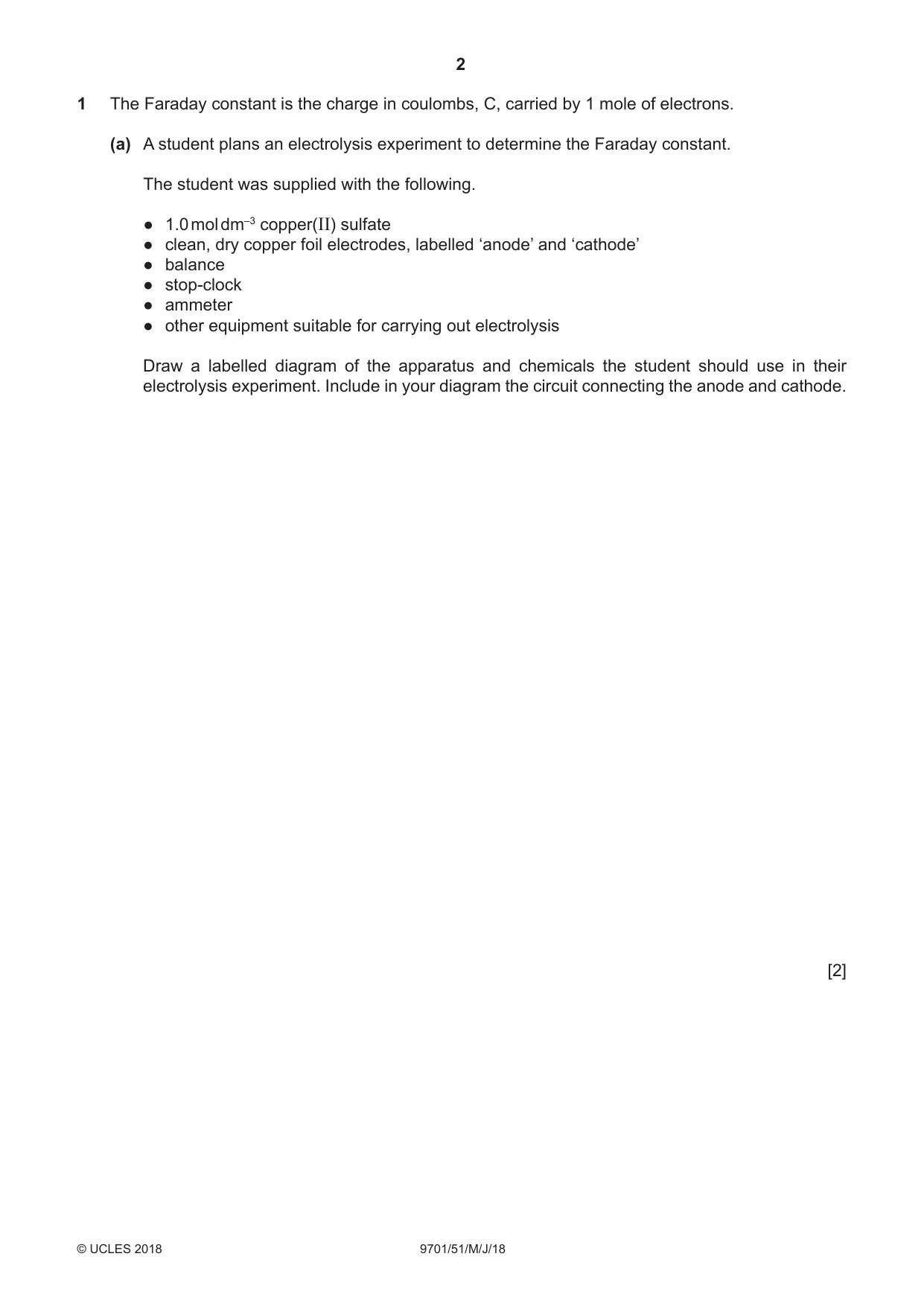
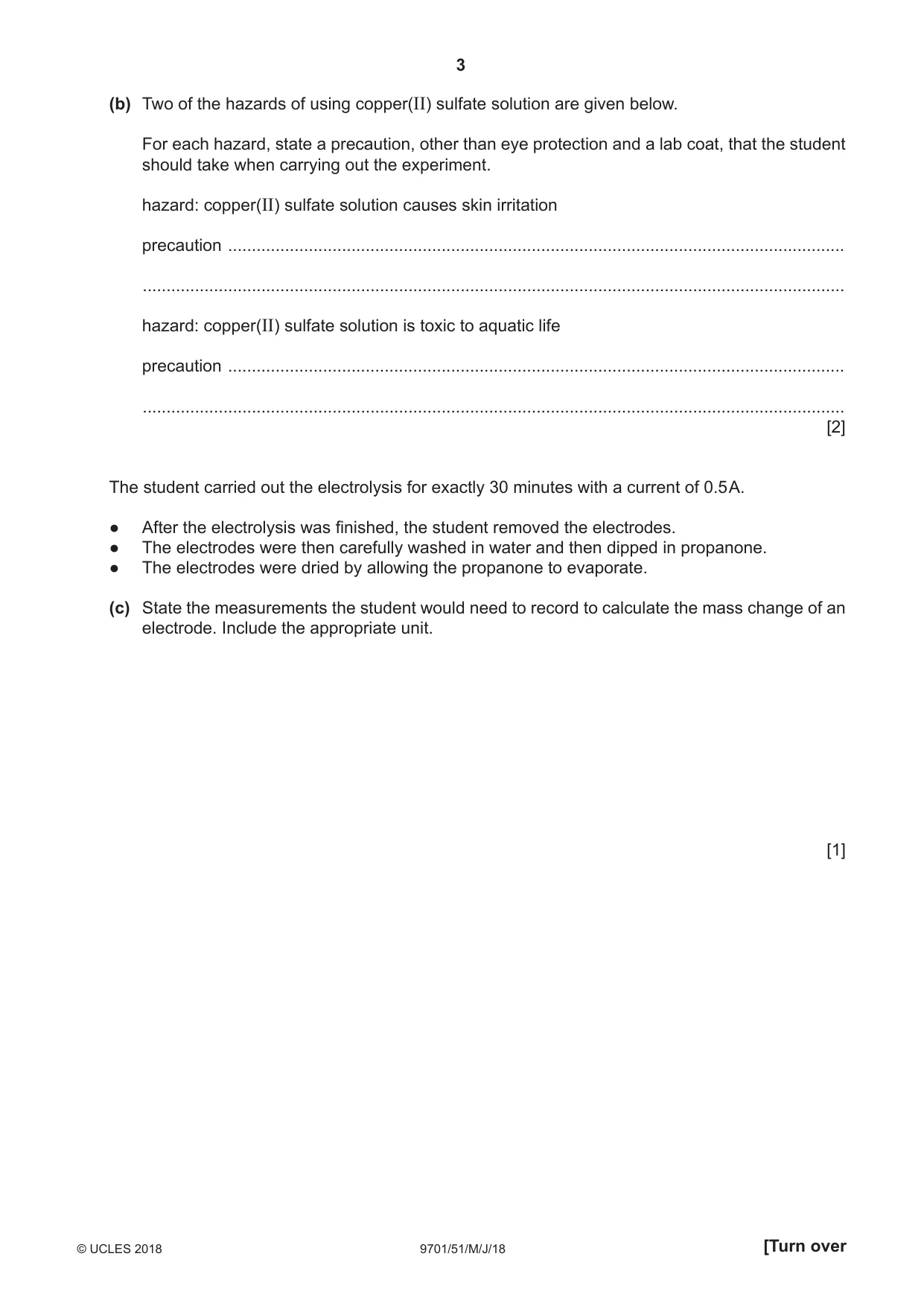
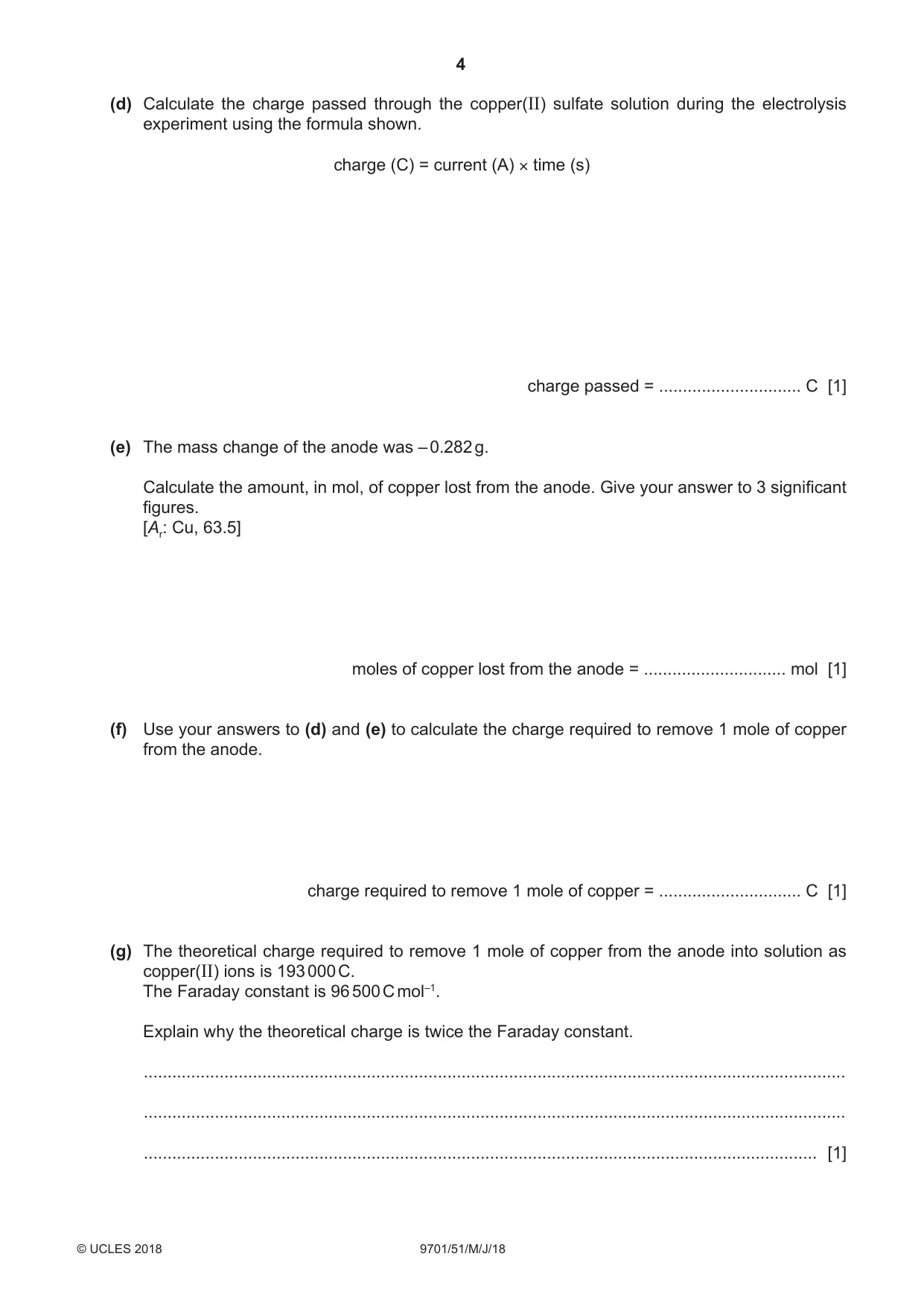
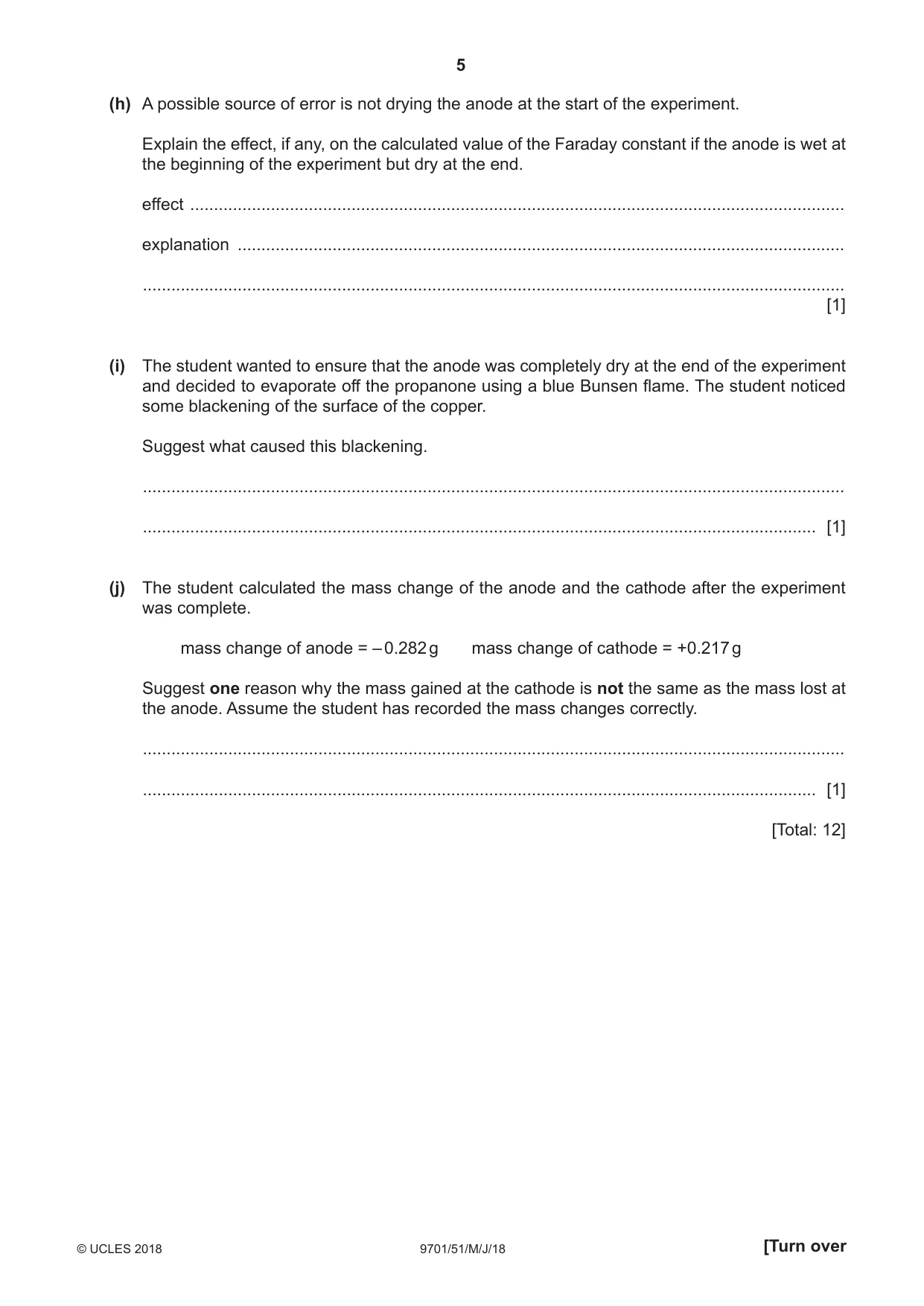
1 The Faraday constant is the charge in coulombs, C, carried by 1 mole of electrons. (a) A student plans an electrolysis experiment to determine the Faraday constant. The student was supplied with the following. ●● 1.0 mol dm–3 copper(II) sulfate ●● clean, dry copper foil electrodes, labelled ‘anode’ and ‘cathode’ ●● balance ●● stop-clock ●● ammeter ●● other equipment suitable for carrying out electrolysis Draw a labelled diagram of the apparatus and chemicals the student should use in their electrolysis experiment. Include in your diagram the circuit connecting the anode and cathode. [2] (b) Two of the hazards of using copper(II) sulfate solution are given below. For each hazard, state a precaution, other than eye protection and a lab coat, that the student should take when carrying out the experiment. hazard: copper(II) sulfate solution causes skin irritation precaution .................................................................................................................................. .................................................................................................................................................... hazard: copper(II) sulfate solution is toxic to aquatic life precaution .................................................................................................................................. .................................................................................................................................................... [2] The student carried out the electrolysis for exactly 30 minutes with a current of 0.5 A. ●● After the electrolysis was finished, the student removed the electrodes. ●● The electrodes were then carefully washed in water and then dipped in propanone. ●● The electrodes were dried by allowing the propanone to evaporate. (c) State the measurements the student would need to record to calculate the mass change of an electrode. Include the appropriate unit. [1] (d) Calculate the charge passed through the copper(II) sulfate solution during the electrolysis experiment using the formula shown. charge (C) = current (A) × time (s) charge passed = .............................. C [1] (e) The mass change of the anode was – 0.282 g. Calculate the amount, in mol, of copper lost from the anode. Give your answer to 3 significant figures. [Ar: Cu, 63.5] moles of copper lost from the anode = .............................. mol [1] (f) Use your answers to (d) and (e) to calculate the charge required to remove 1 mole of copper from the anode. charge required to remove 1 mole of copper = .............................. C [1] (g) The theoretical charge required to remove 1 mole of copper from the anode into solution as copper(II) ions is 193 000 C. The Faraday constant is 96 500 C mol–1. Explain why the theoretical charge is twice the Faraday constant. .................................................................................................................................................... .................................................................................................................................................... .............................................................................................................................................. [1] (h) A possible source of error is not drying the anode at the start of the experiment. Explain the effect, if any, on the calculated value of the Faraday constant if the anode is wet at the beginning of the experiment but dry at the end. effect .......................................................................................................................................... explanation ................................................................................................................................. .................................................................................................................................................... [1] (i) The student wanted to ensure that the anode was completely dry at the end of the experiment and decided to evaporate off the propanone using a blue Bunsen flame. The student noticed some blackening of the surface of the copper. Suggest what caused this blackening. .................................................................................................................................................... .............................................................................................................................................. [1] (j) The student calculated the mass change of the anode and the cathode after the experiment was complete. mass change of anode = – 0.282 g mass change of cathode = +0.217 g Suggest one reason why the mass gained at the cathode is not the same as the mass lost at the anode. Assume the student has recorded the mass changes correctly. .................................................................................................................................................... .............................................................................................................................................. [1] [Total: 12]
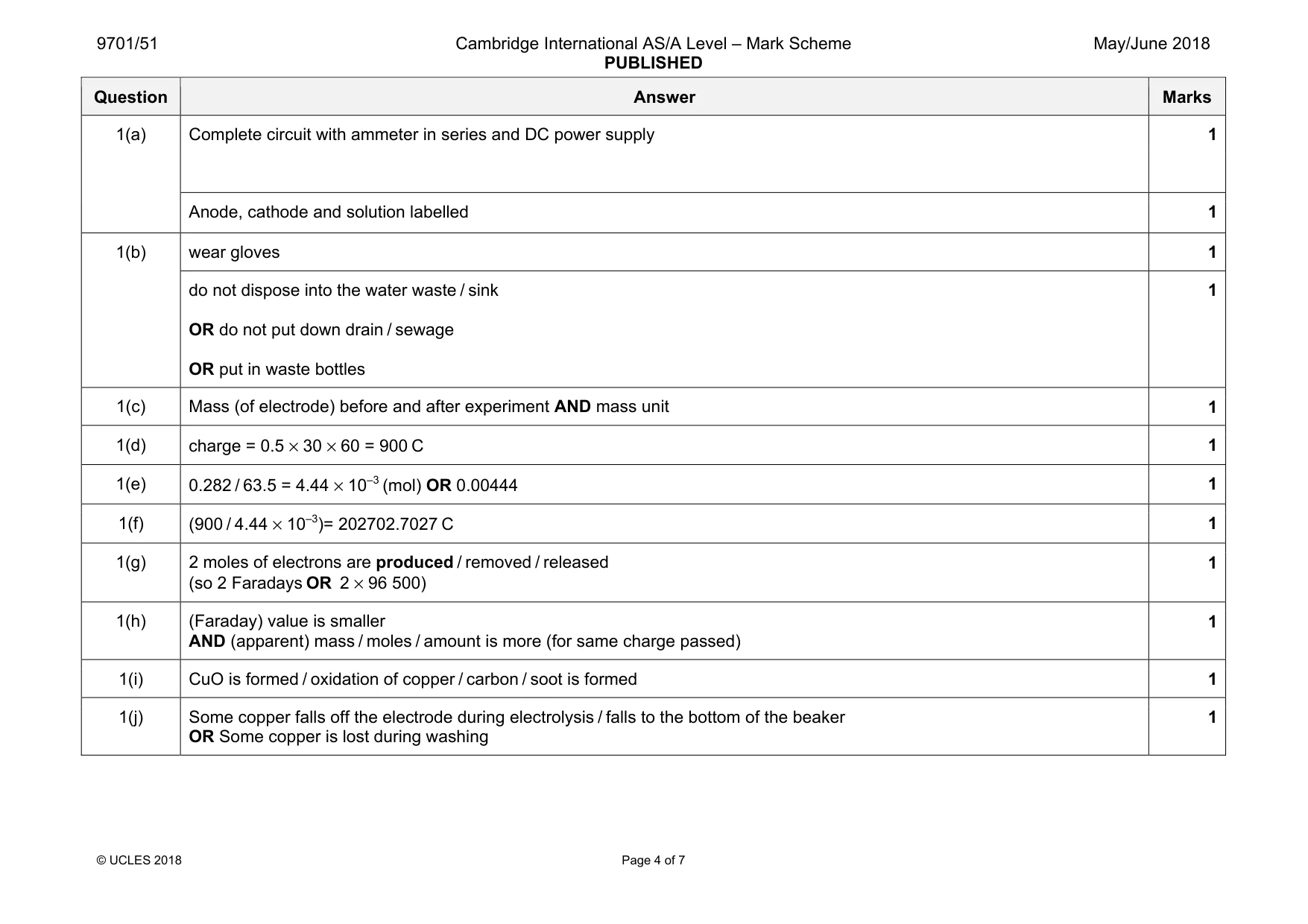
Mark scheme: 1(a) Complete circuit with ammeter in series and DC power supply 1 Anode, cathode and solution labelled 1 1(b) wear gloves 1 do not dispose into the water waste / sink OR do not put down drain / sewage OR put in waste bottles 1 1(c) Mass (of electrode) before and after experiment AND mass unit 1 1(d) charge = 0.5 × 30 × 60 = 900 C 1 1(e) 0.282 / 63.5 = 4.44 × 10⁻³ (mol) OR 0.00444 1 1(f) (900 / 4.44 × 10⁻³)= 202702.7027 C 1 1(g) 2 moles of electrons are produced / removed / released (so 2 Faradays OR 2 × 96 500) 1 1(h) (Faraday) value is smaller AND (apparent) mass / moles / amount is more (for same charge passed) 1 1(i) CuO is formed / oxidation of copper / carbon / soot is formed 1 1(j) Some copper falls off the electrode during electrolysis / falls to the bottom of the beaker OR Some copper is lost during washing 1
Q2 · At temperatures above 5 °C, the benzenediazonium ion, C6H5N2+, reacts with water as shown
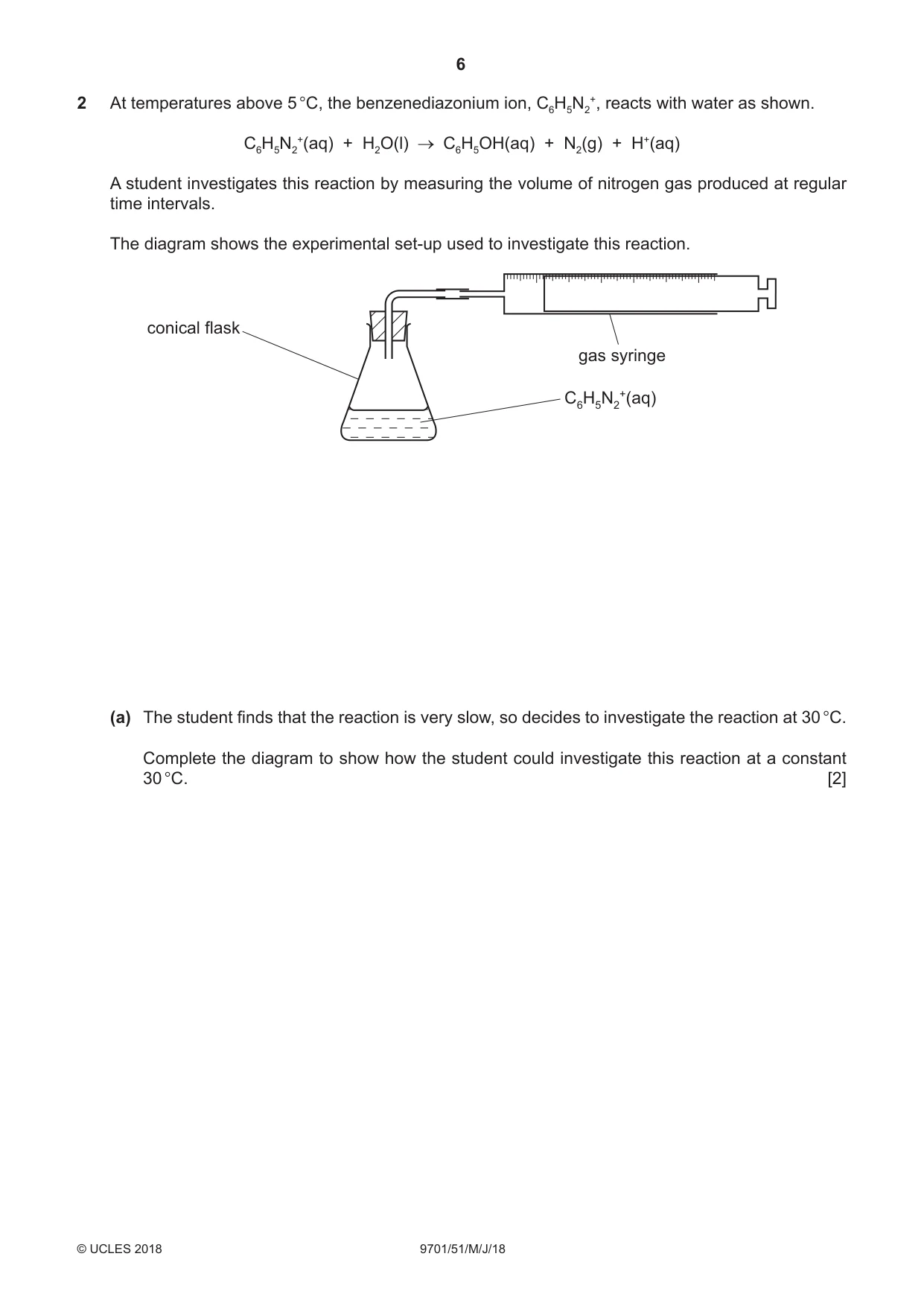
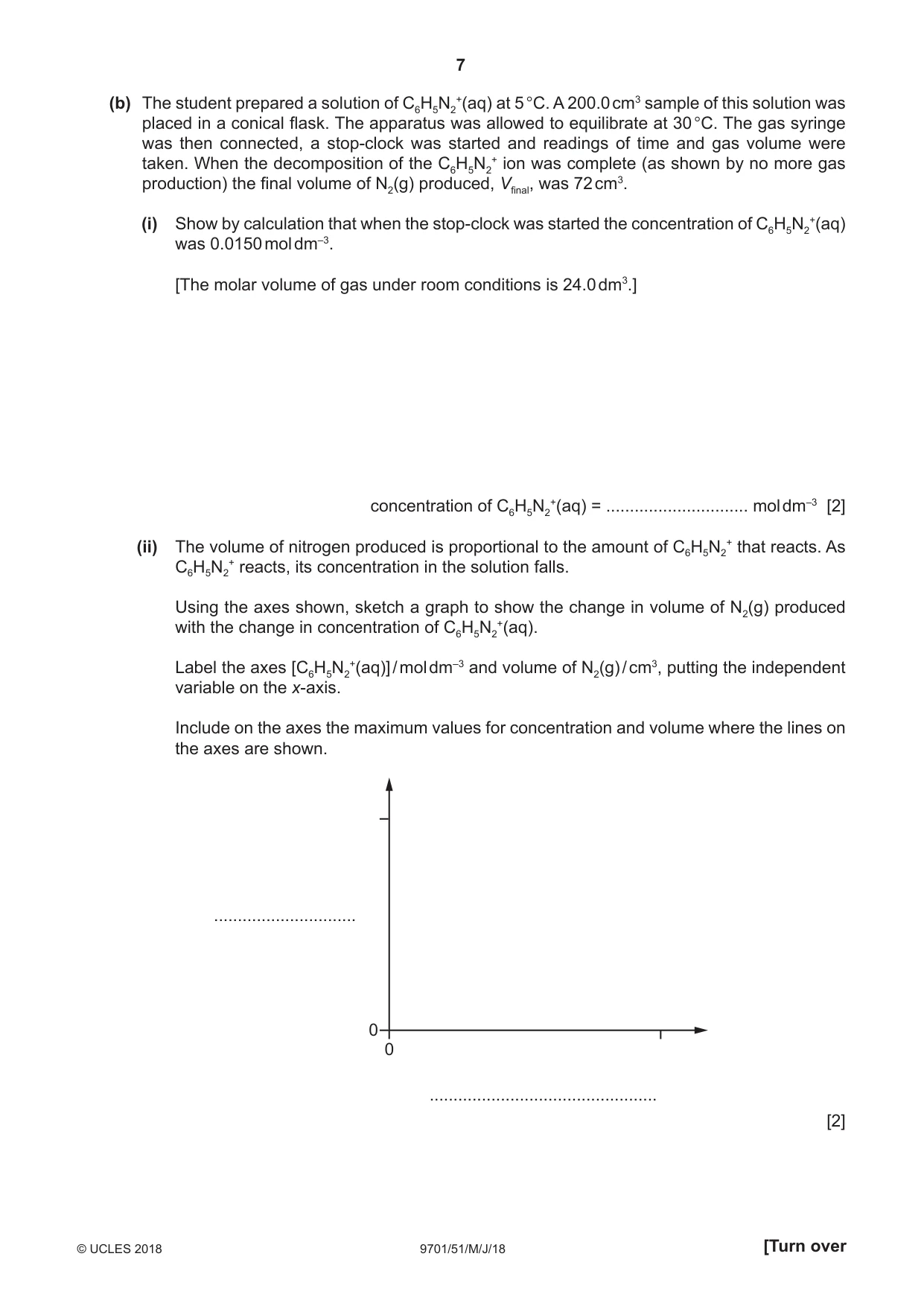
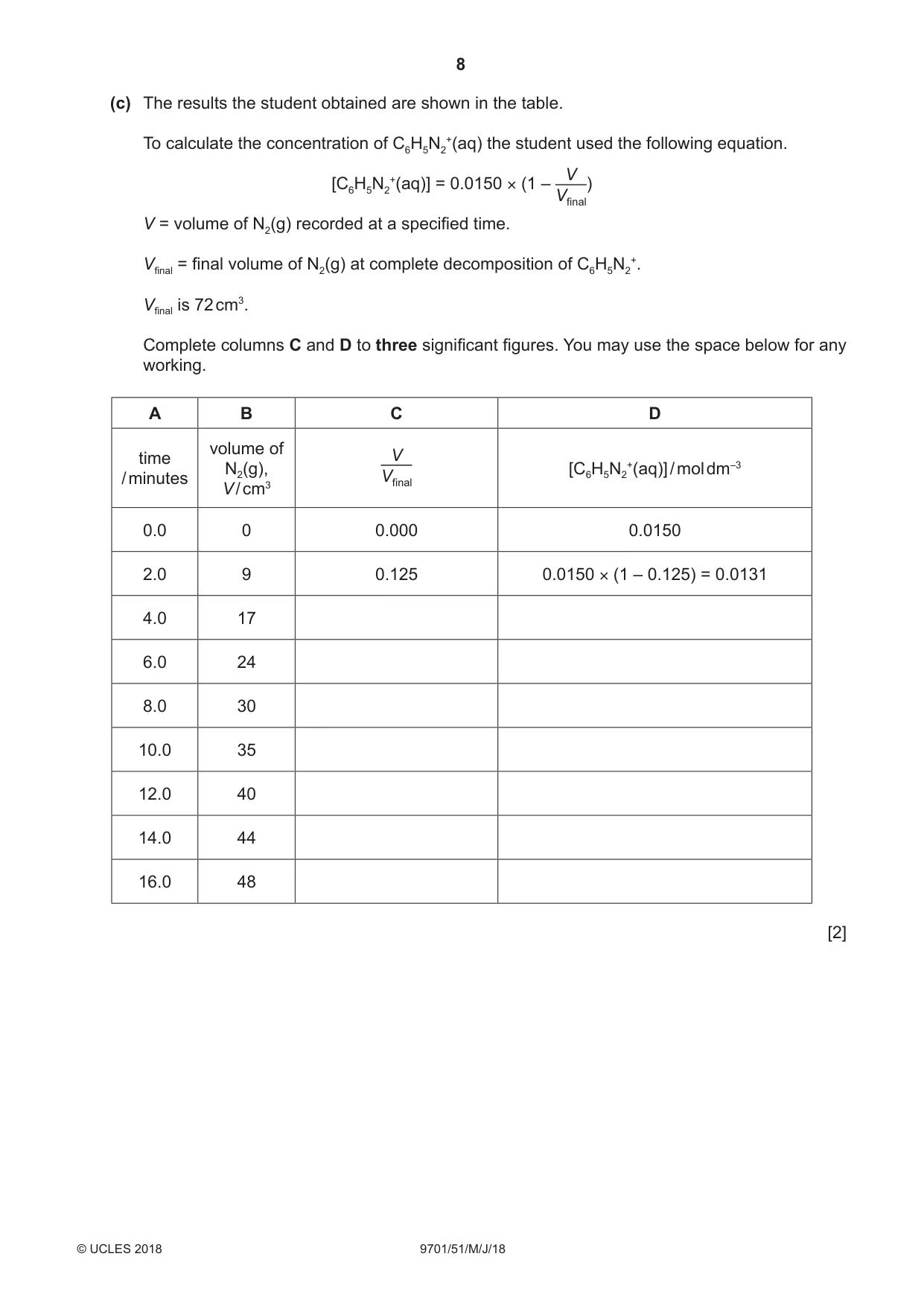
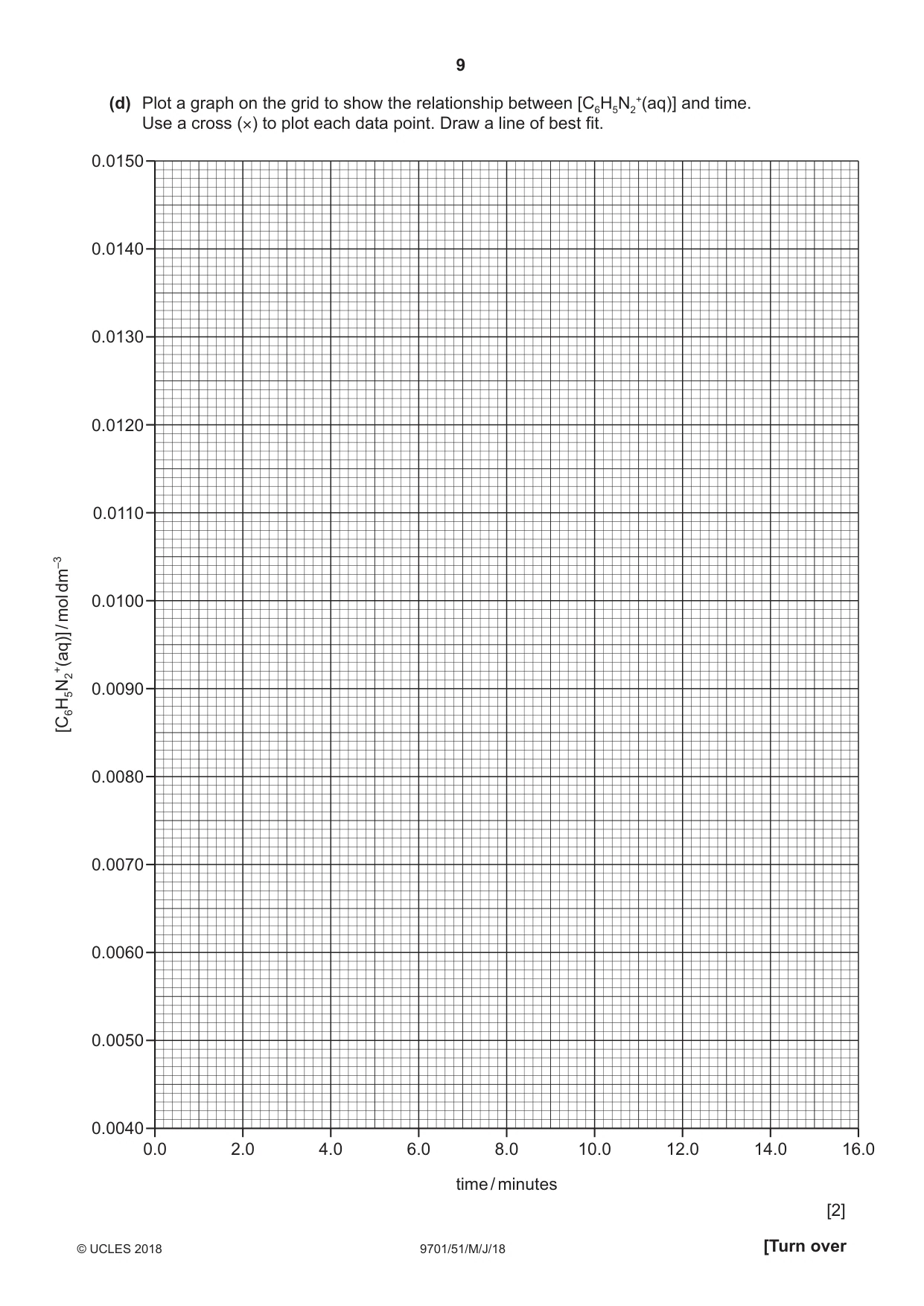
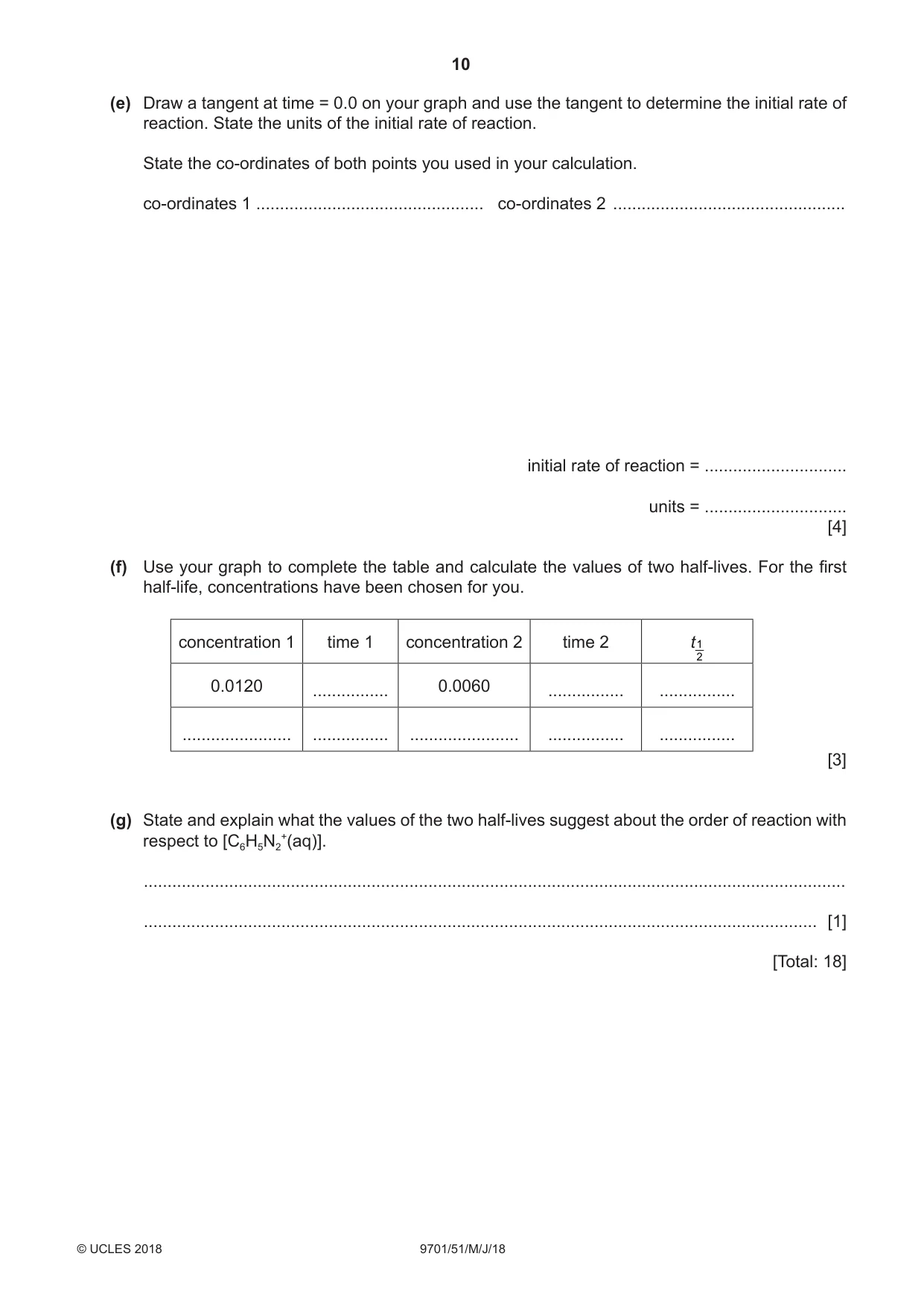
2 At temperatures above 5 °C, the benzenediazonium ion, C6H5N2+, reacts with water as shown. C6H5N2+(aq) + H2O(l) C6H5OH(aq) + N2(g) + H+(aq) A student investigates this reaction by measuring the volume of nitrogen gas produced at regular time intervals. The diagram shows the experimental set‑up used to investigate this reaction. conical flask gas syringe C6H5N2+(aq) (a) The student finds that the reaction is very slow, so decides to investigate the reaction at 30 °C. Complete the diagram to show how the student could investigate this reaction at a constant 30 °C. [2] (b) The student prepared a solution of C6H5N2+(aq) at 5 °C. A 200.0 cm3 sample of this solution was placed in a conical flask. The apparatus was allowed to equilibrate at 30 °C. The gas syringe was then connected, a stop-clock was started and readings of time and gas volume were taken. When the decomposition of the C6H5N2+ ion was complete (as shown by no more gas production) the final volume of N2(g) produced, Vfinal, was 72 cm3. (i) Show by calculation that when the stop-clock was started the concentration of C6H5N2+(aq) was 0.0150 mol dm–3. [The molar volume of gas under room conditions is 24.0 dm3.] concentration of C6H5N2+(aq) = .............................. mol dm–3 [2] (ii) The volume of nitrogen produced is proportional to the amount of C6H5N2+ that reacts. As C6H5N2+ reacts, its concentration in the solution falls. Using the axes shown, sketch a graph to show the change in volume of N2(g) produced with the change in concentration of C6H5N2+(aq). Label the axes [C6H5N2+(aq)] / mol dm–3 and volume of N2(g) / cm3, putting the independent variable on the x-axis. Include on the axes the maximum values for concentration and volume where the lines on the axes are shown. .............................. 0 0 ................................................ [2] (c) The results the student obtained are shown in the table. To calculate the concentration of C6H5N2+(aq) the student used the following equation. V [C6H5N2+(aq)] = 0.0150 × (1 – ) Vfinal V = volume of N2(g) recorded at a specified time. Vfinal = final volume of N2(g) at complete decomposition of C6H5N2+. Vfinal is 72 cm3. Complete columns C and D to three significant figures. You may use the space below for any working. A B C D volume of time V N2(g), [C6H5N2+(aq)] / mol dm–3 / minutes Vfinal V / cm3 0.0 0 0.000 0.0150 2.0 9 0.125 0.0150 × (1 – 0.125) = 0.0131 4.0 17 6.0 24 8.0 30 10.0 35 12.0 40 14.0 44 16.0 48 [2]
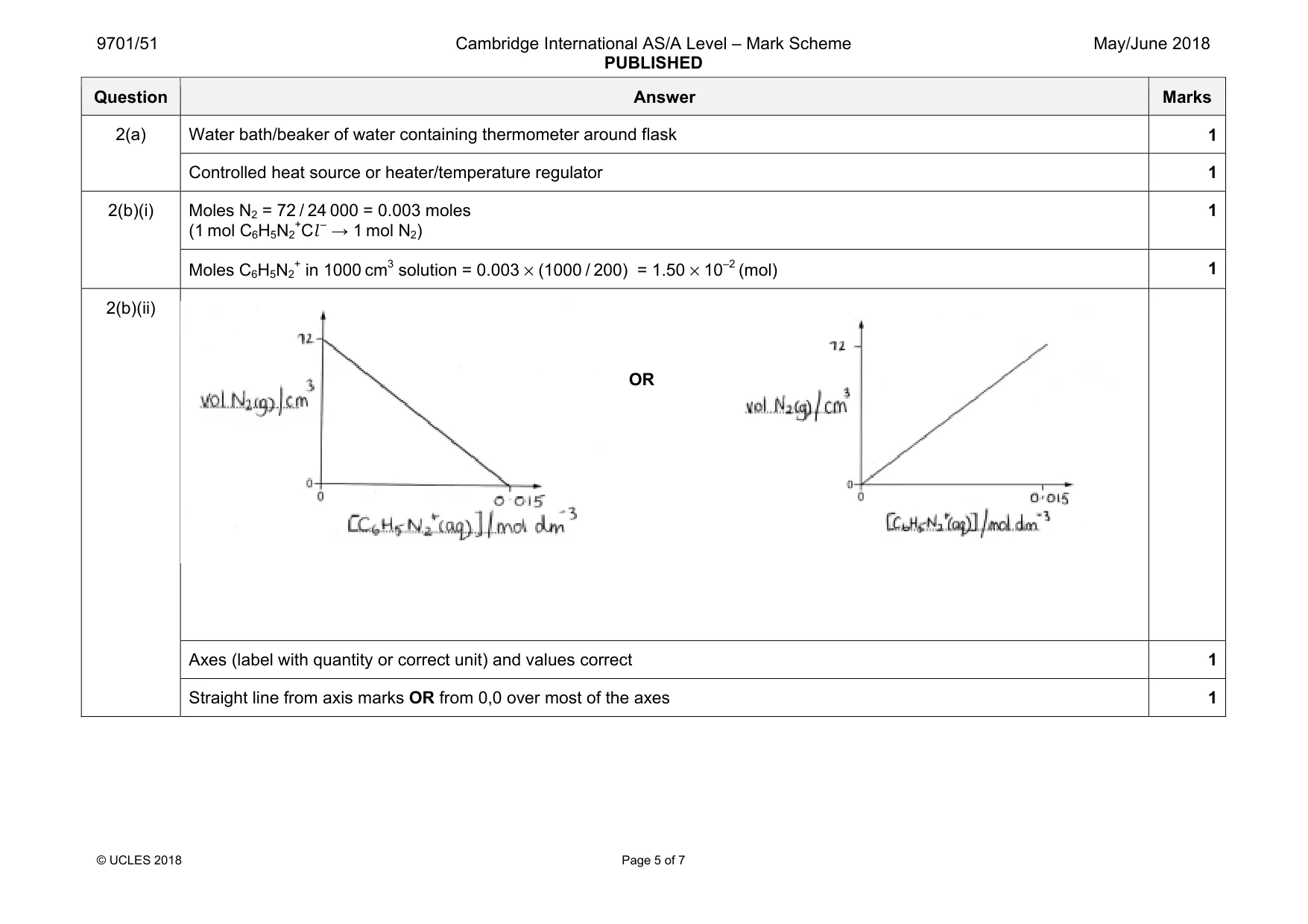
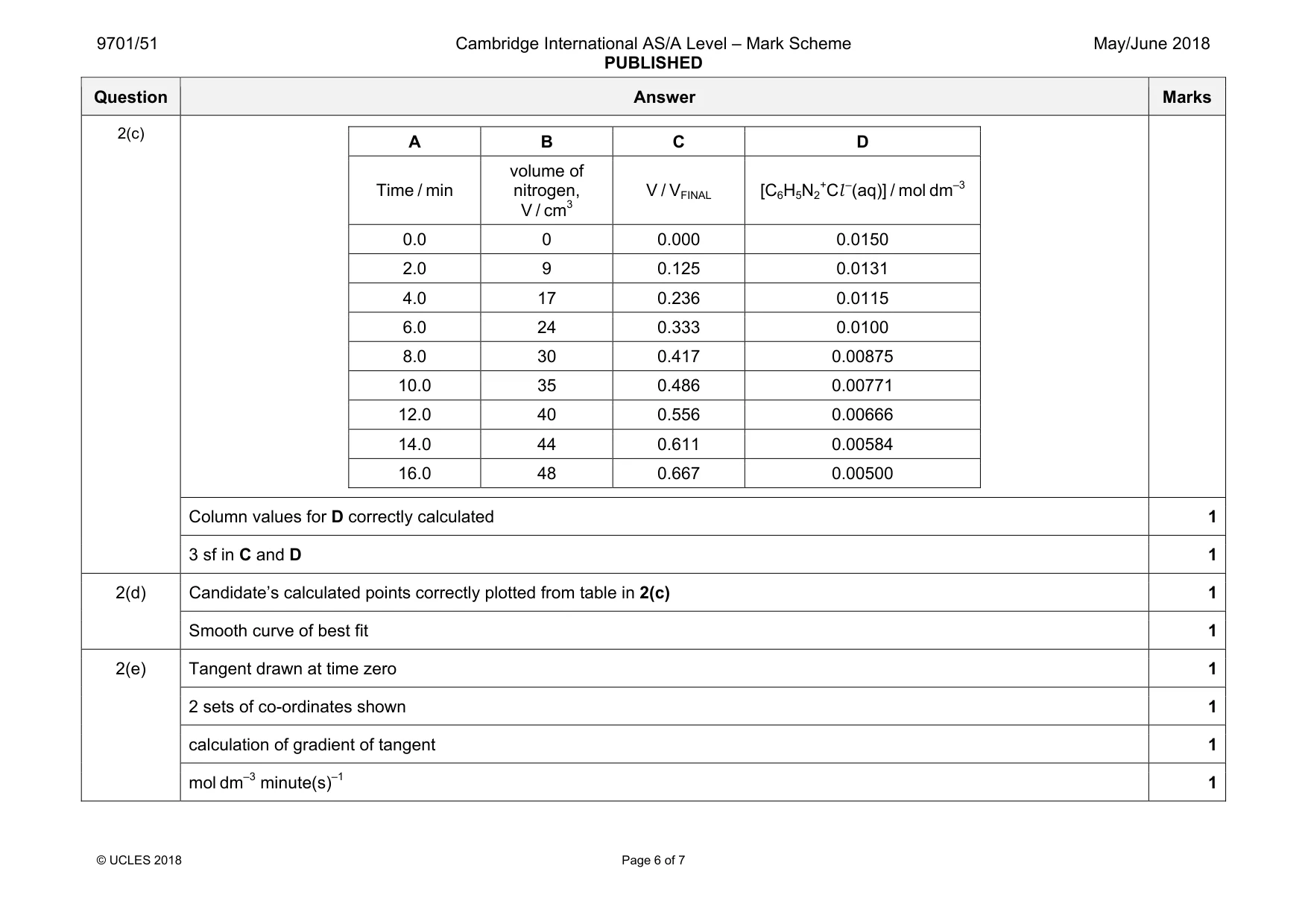
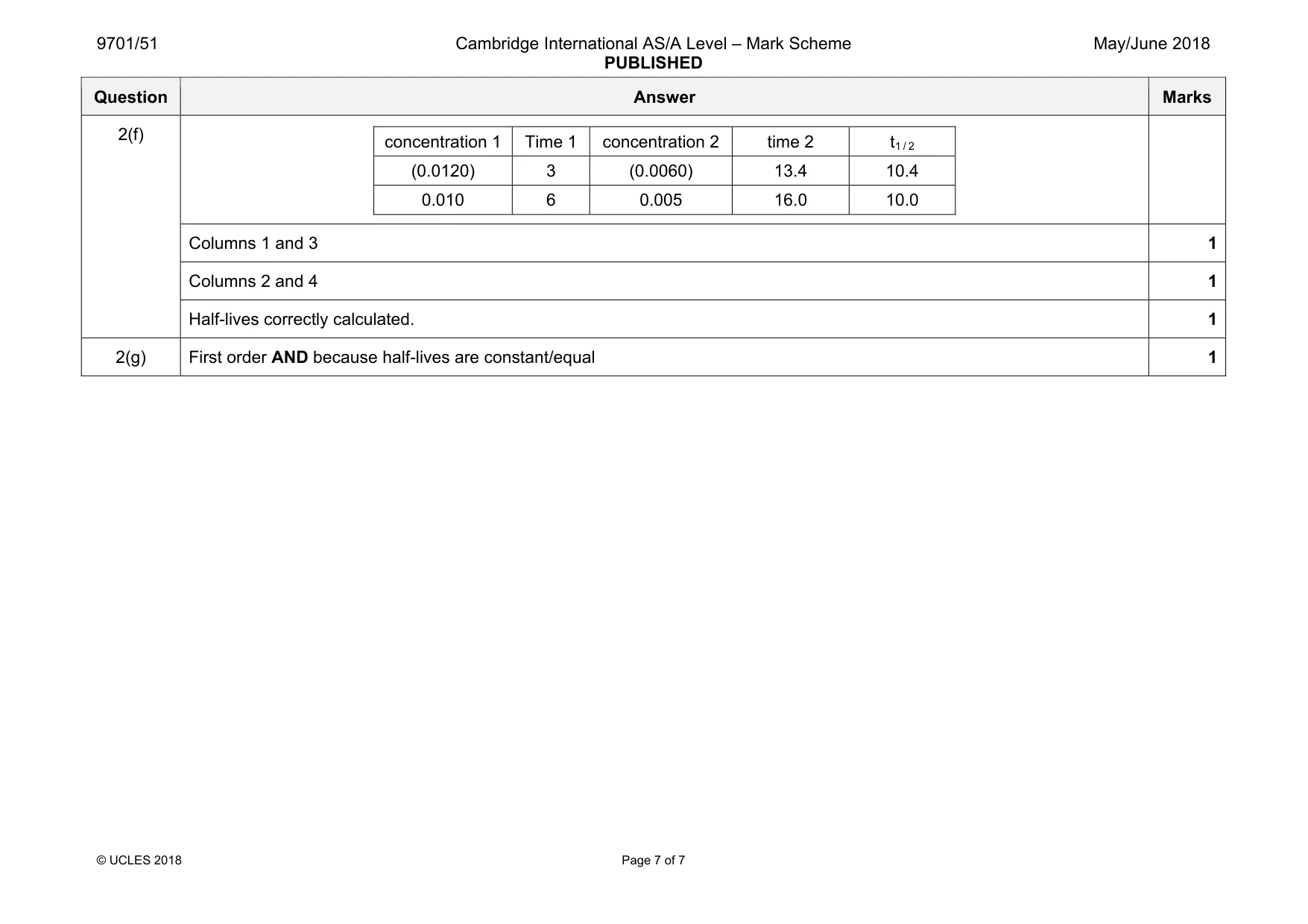
Mark scheme: 2(a) Water bath/beaker of water containing thermometer around flask 1 Controlled heat source or heater/temperature regulator 1 2(b)(i) Moles N2 = 72 / 24 000 = 0.003 moles (1 mol C6H5N2 +Cl – → 1 mol N2) 1 Moles C6H5N2 + in 1000 cm3 solution = 0.003 × (1000 / 200) = 1.50 × 10⁻² (mol) 1 2(b)(ii) Axes (label with quantity or correct unit) and values correct 1 Straight line from axis marks OR from 0,0 over most of the axes 1 OR Question Answer Marks 2(c) A B C D Time / min volume of nitrogen, V / cm3 V / VFINAL [C6H5N2 +Cl –(aq)] / mol dm–3 0.0 0 0.000 0.0150 2.0 9 0.125 0.0131 4.0 17 0.236 0.0115 6.0 24 0.333 0.0100 8.0 30 0.417 0.00875 10.0 35 0.486 0.00771 12.0 40 0.556 0.00666 14.0 44 0.611 0.00584 16.0 48 0.667 0.00500 Column values for D correctly calculated 1 3 sf in C and D 1 2(d) Candidate’s calculated points correctly plotted from table in 2(c) 1 Smooth curve of best fit 1 2(e) Tangent drawn at time zero 1 2 sets of co-ordinates shown 1 calculation of gradient of tangent 1 mol dm–3 minute(s)–1 1 Question Answer Marks 2(f) concentration 1 Time 1 concentration 2 time 2 t1 / 2 (0.0120) 3 (0.0060) 13.4 10.4 0.010 6 0.005 16.0 10.0 Columns 1 and 3 1 Columns 2 and 4 1 Half-lives correctly calculated. 1 2(g) First order AND because half-lives are constant/equal 1
More questions on Reacting masses and volumes (of solutions and gases)
What was in this paper
The subtopics covered by these 2 questions, and how many questions each got. Open one in a new tab to see every Cambridge question on it.
What you needed in this session
Cambridge’s own grade thresholds for 2018 May/June, Paper 5 · Variant 1. A higher threshold means an easier paper — the bar moves with how the cohort did.