Cambridge A Level Chemistry 9701 — 2017 Oct/Nov Paper 5 · Variant 2
9701/52/O/N/17 · 2 questions · 30 marks · ≈34 min
The question paper and its mark scheme, free to read here and free to download. This is Cambridge’s own paper, exactly as it was sat.
Question paper12 pages

Mark scheme7 pages
Answers below. Sit the paper first if you are practising.
Questions as text
Q1 · Verdigris is a green pigment that contains both copper(II) carbonate, CuCO3, and…
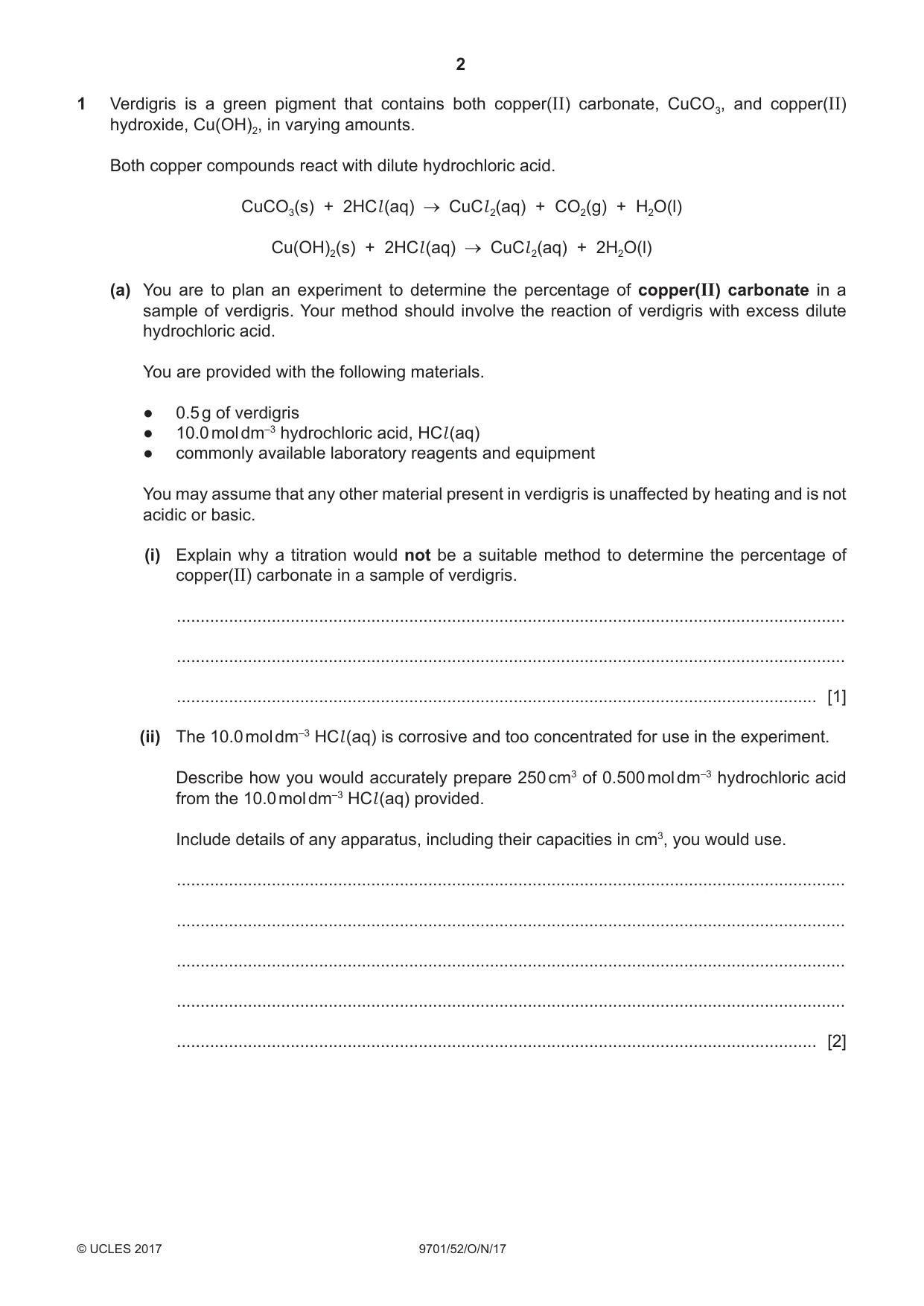
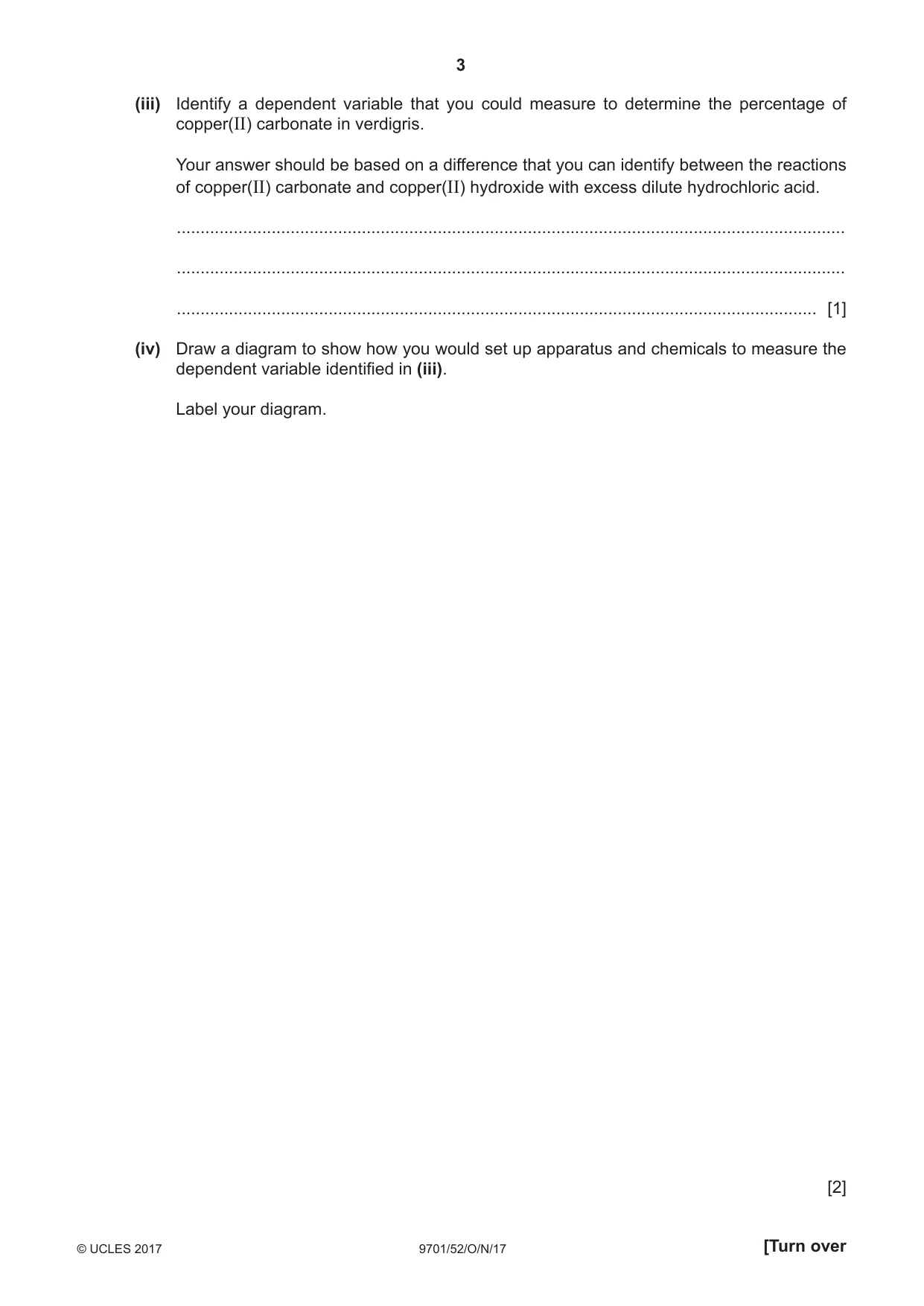
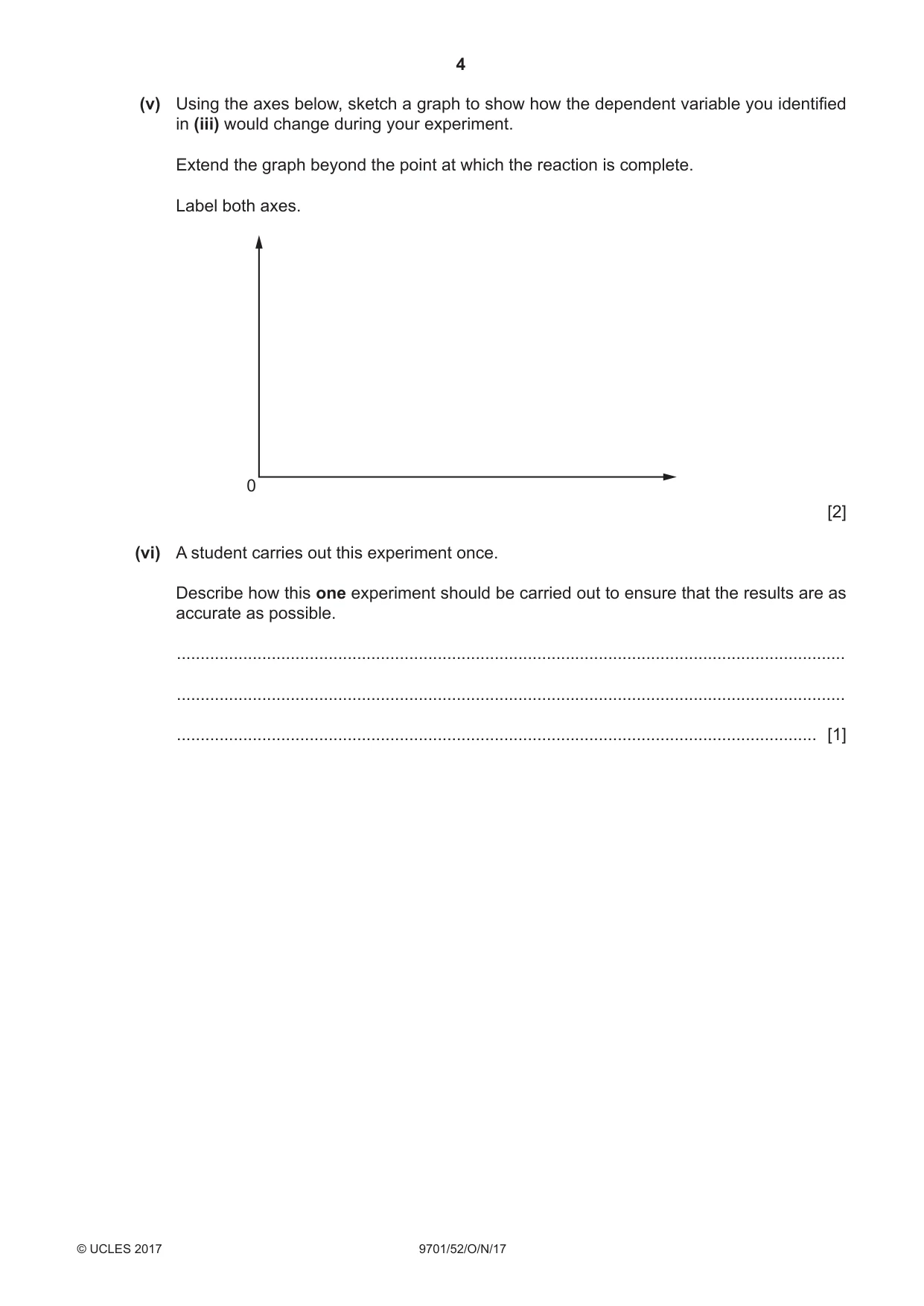
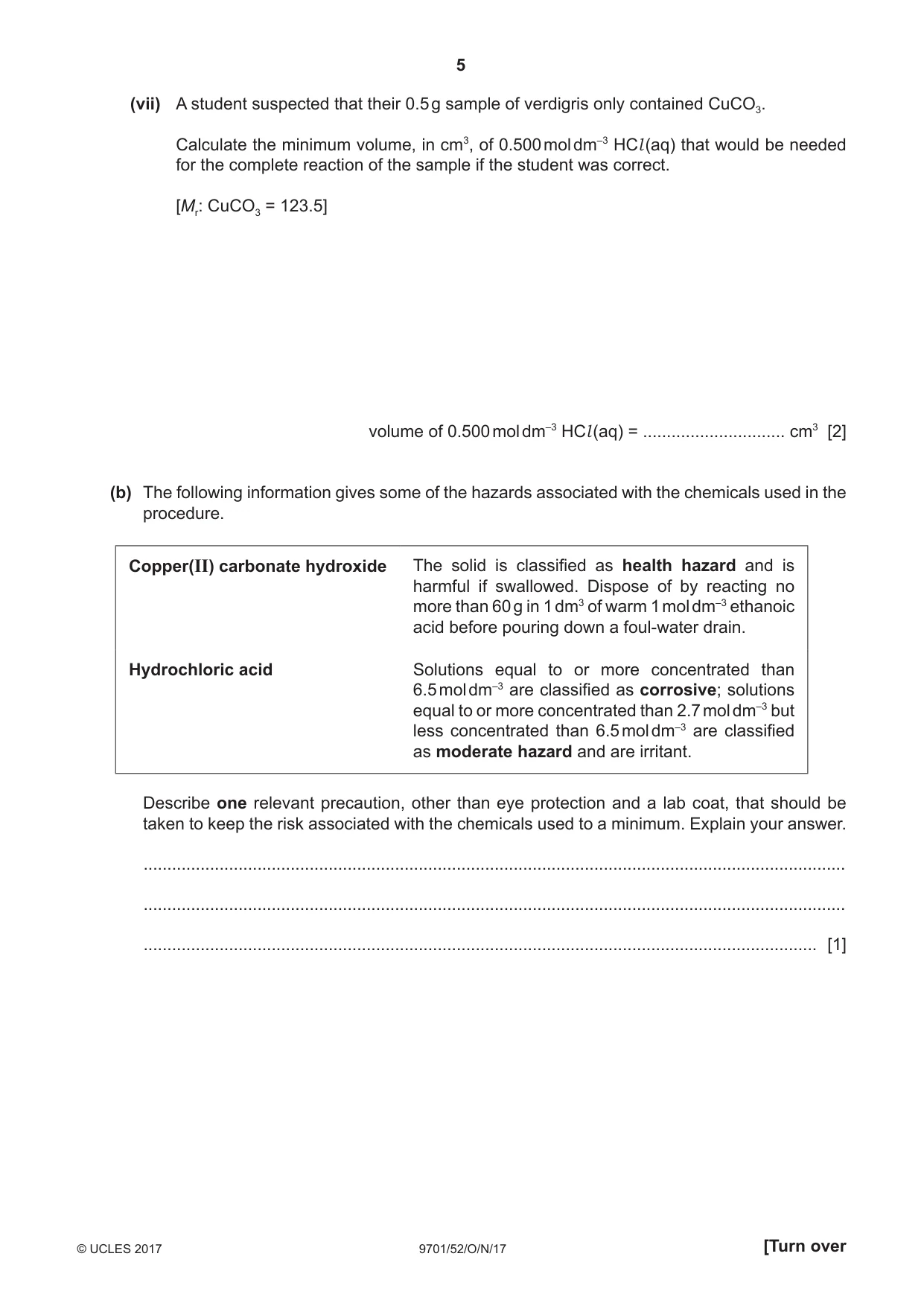
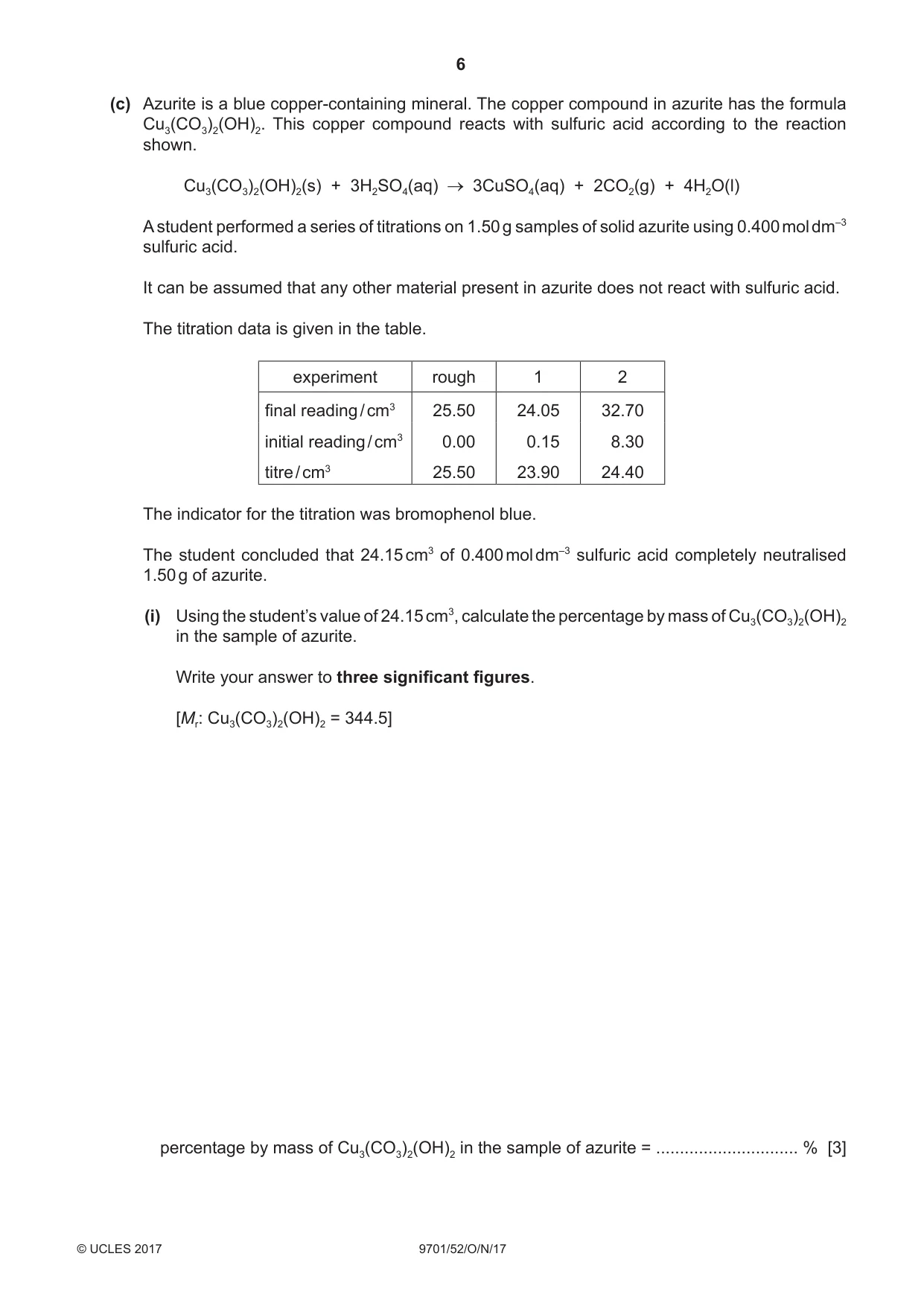
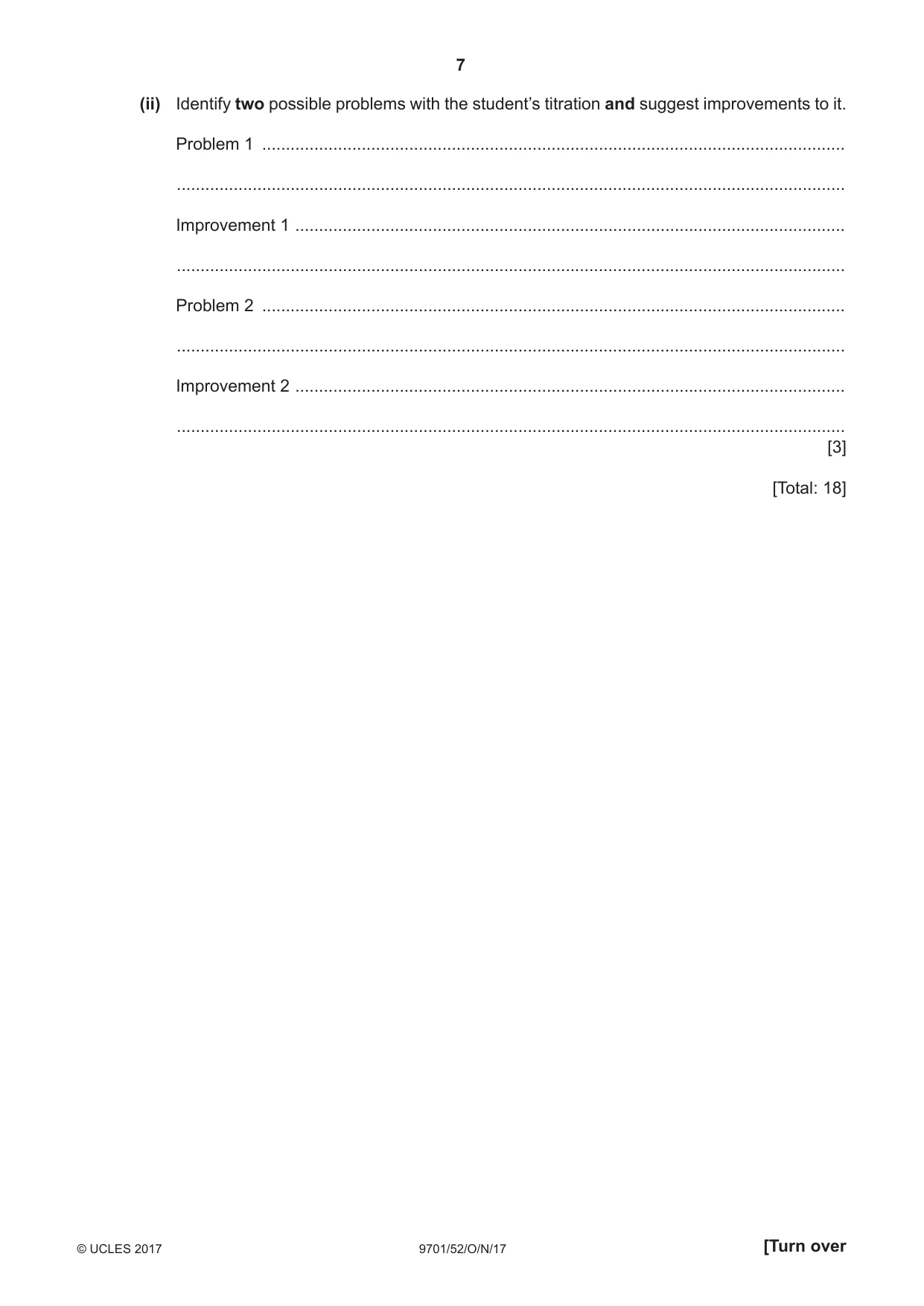
1 Verdigris is a green pigment that contains both copper(II) carbonate, CuCO3, and copper(II) hydroxide, Cu(OH)2, in varying amounts. Both copper compounds react with dilute hydrochloric acid. CuCO3(s) + 2HCl (aq) CuCl 2(aq) + CO2(g) + H2O(l) Cu(OH)2(s) + 2HCl (aq) CuCl 2(aq) + 2H2O(l) (a) You are to plan an experiment to determine the percentage of copper(II) carbonate in a sample of verdigris. Your method should involve the reaction of verdigris with excess dilute hydrochloric acid. You are provided with the following materials. ● 0.5 g of verdigris ● 10.0 mol dm–3 hydrochloric acid, HCl (aq) ● commonly available laboratory reagents and equipment You may assume that any other material present in verdigris is unaffected by heating and is not acidic or basic. (i) Explain why a titration would not be a suitable method to determine the percentage of copper(II) carbonate in a sample of verdigris. ............................................................................................................................................. ............................................................................................................................................. ....................................................................................................................................... [1] (ii) The 10.0 mol dm–3 HCl (aq) is corrosive and too concentrated for use in the experiment. Describe how you would accurately prepare 250 cm3 of 0.500 mol dm–3 hydrochloric acid from the 10.0 mol dm–3 HCl (aq) provided. Include details of any apparatus, including their capacities in cm3, you would use. ............................................................................................................................................. ............................................................................................................................................. ............................................................................................................................................. ............................................................................................................................................. ....................................................................................................................................... [2] (iii) Identify a dependent variable that you could measure to determine the percentage of copper(II) carbonate in verdigris. Your answer should be based on a difference that you can identify between the reactions of copper(II) carbonate and copper(II) hydroxide with excess dilute hydrochloric acid. ............................................................................................................................................. ............................................................................................................................................. ....................................................................................................................................... [1] (iv) Draw a diagram to show how you would set up apparatus and chemicals to measure the dependent variable identified in (iii). Label your diagram. [2] (v) Using the axes below, sketch a graph to show how the dependent variable you identified in (iii) would change during your experiment. Extend the graph beyond the point at which the reaction is complete. Label both axes. 0 [2] (vi) A student carries out this experiment once. Describe how this one experiment should be carried out to ensure that the results are as accurate as possible. ............................................................................................................................................. ............................................................................................................................................. ....................................................................................................................................... [1] (vii) A student suspected that their 0.5 g sample of verdigris only contained CuCO3. Calculate the minimum volume, in cm3, of 0.500 mol dm–3 HCl (aq) that would be needed for the complete reaction of the sample if the student was correct. [Mr: CuCO3 = 123.5] volume of 0.500 mol dm–3 HCl (aq) = .............................. cm3 [2] (b) The following information gives some of the hazards associated with the chemicals used in the procedure. Copper(II) carbonate hydroxide The solid is classified as health hazard and is harmful if swallowed. Dispose of by reacting no more than 60 g in 1 dm3 of warm 1 mol dm–3 ethanoic acid before pouring down a foul-water drain. Hydrochloric acid Solutions equal to or more concentrated than 6.5 mol dm–3 are classified as corrosive; solutions equal to or more concentrated than 2.7 mol dm–3 but less concentrated than 6.5 mol dm–3 are classified as moderate hazard and are irritant. Describe one relevant precaution, other than eye protection and a lab coat, that should be taken to keep the risk associated with the chemicals used to a minimum. Explain your answer. .................................................................................................................................................... .................................................................................................................................................... .............................................................................................................................................. [1] (c) Azurite is a blue copper-containing mineral. The copper compound in azurite has the formula Cu3(CO3)2(OH)2. This copper compound reacts with sulfuric acid according to the reaction shown. Cu3(CO3)2(OH)2(s) + 3H2SO4(aq) 3CuSO4(aq) + 2CO2(g) + 4H2O(l) A student performed a series of titrations on 1.50 g samples of solid azurite using 0.400 mol dm–3 sulfuric acid. It can be assumed that any other material present in azurite does not react with sulfuric acid. The titration data is given in the table. experiment rough 1 2 final reading / cm3 25.50 24.05 32.70 initial reading / cm3 0.00 0.15 8.30 titre / cm3 25.50 23.90 24.40 The indicator for the titration was bromophenol blue. The student concluded that 24.15 cm3 of 0.400 mol dm–3 sulfuric acid completely neutralised 1.50 g of azurite. (i) Using the student’s value of 24.15 cm3, calculate the percentage by mass of Cu3(CO3)2(OH)2 in the sample of azurite. Write your answer to three significant figures. [Mr: Cu3(CO3)2(OH)2 = 344.5] percentage by mass of Cu3(CO3)2(OH)2 in the sample of azurite = .............................. % [3] (ii) Identify two possible problems with the student’s titration and suggest improvements to it. Problem 1 ............................................................................................................................ ............................................................................................................................................. Improvement 1 .................................................................................................................... ............................................................................................................................................. Problem 2 ............................................................................................................................ ............................................................................................................................................. Improvement 2 .................................................................................................................... ............................................................................................................................................. [3] [Total: 18]
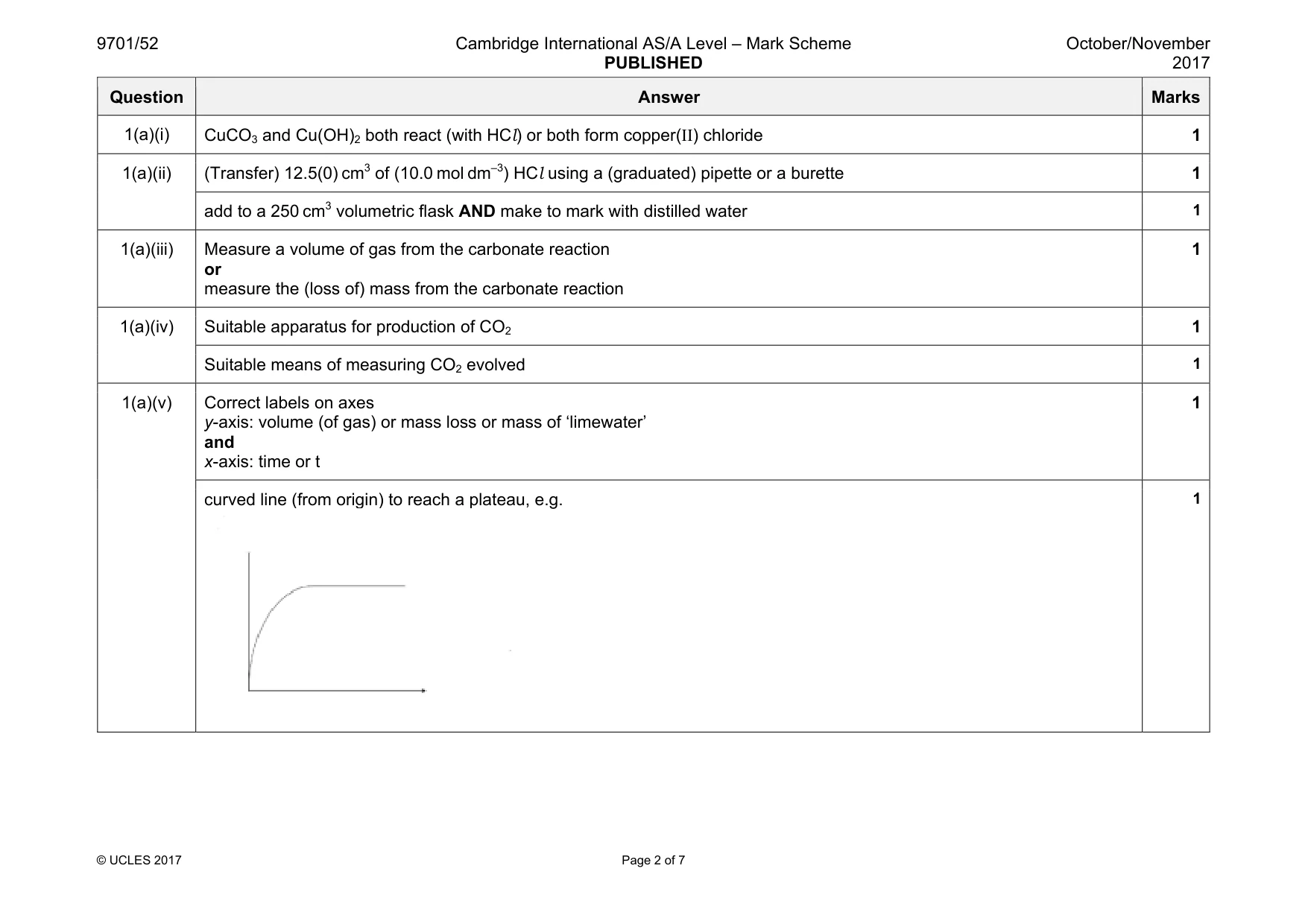
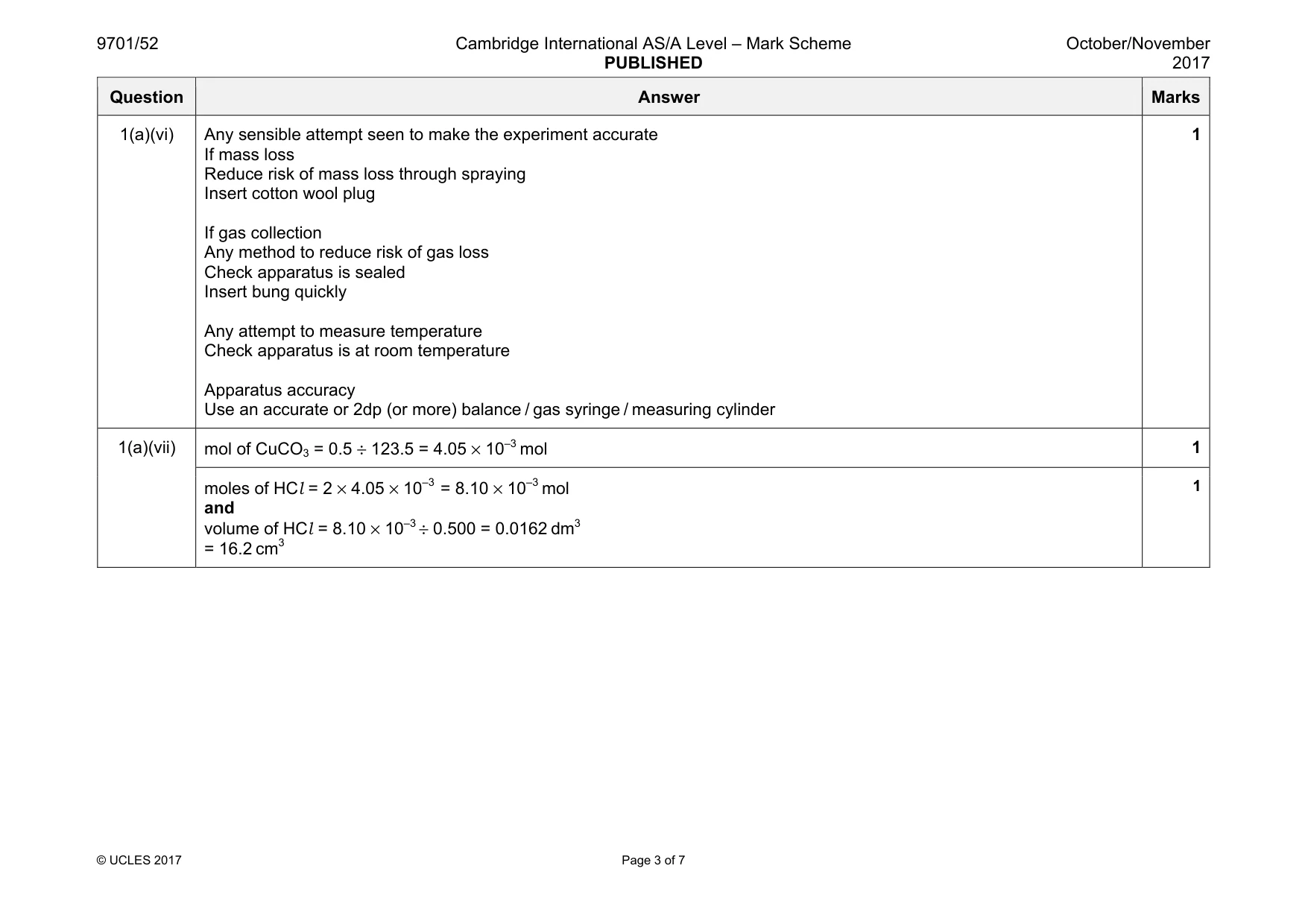
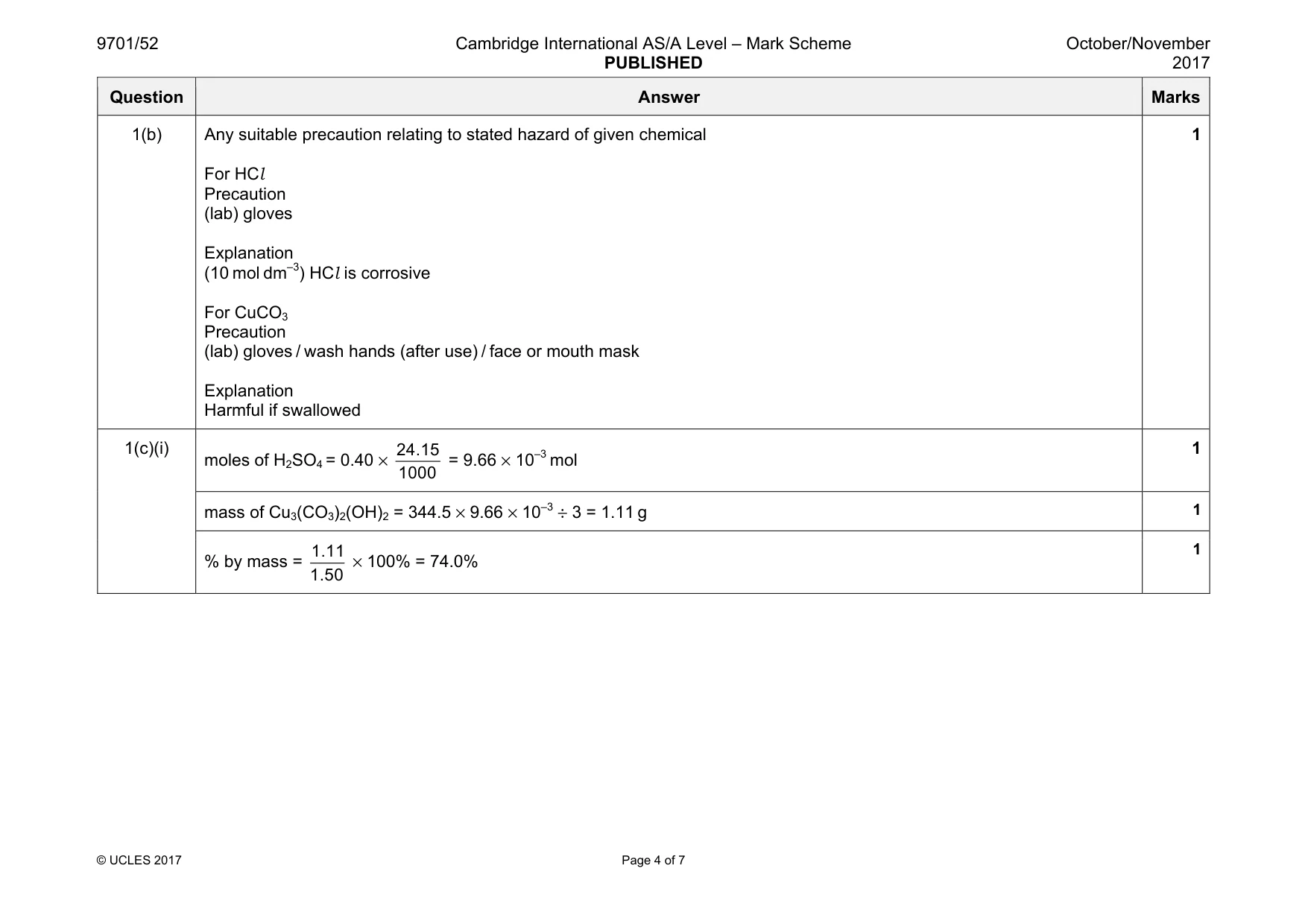
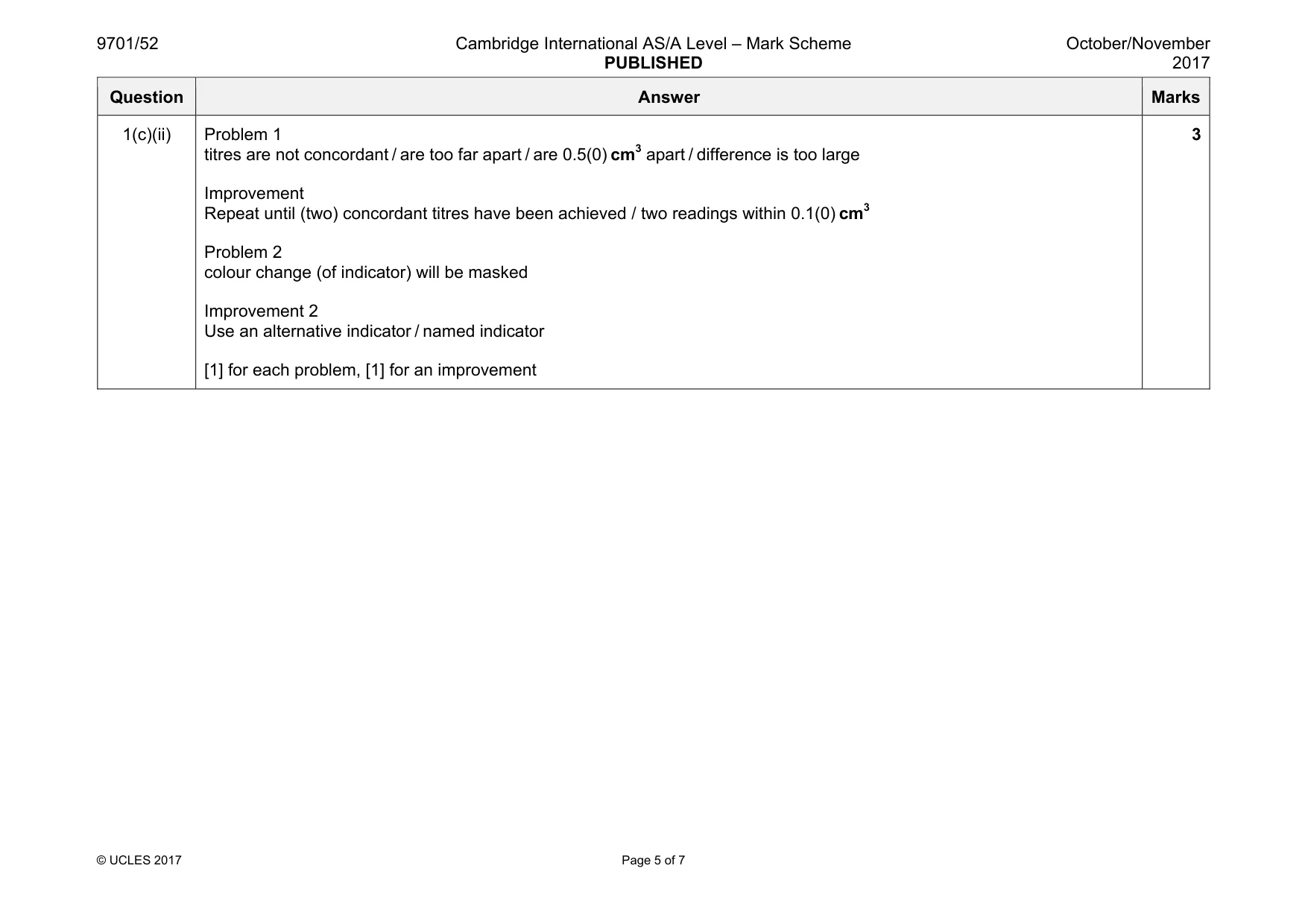
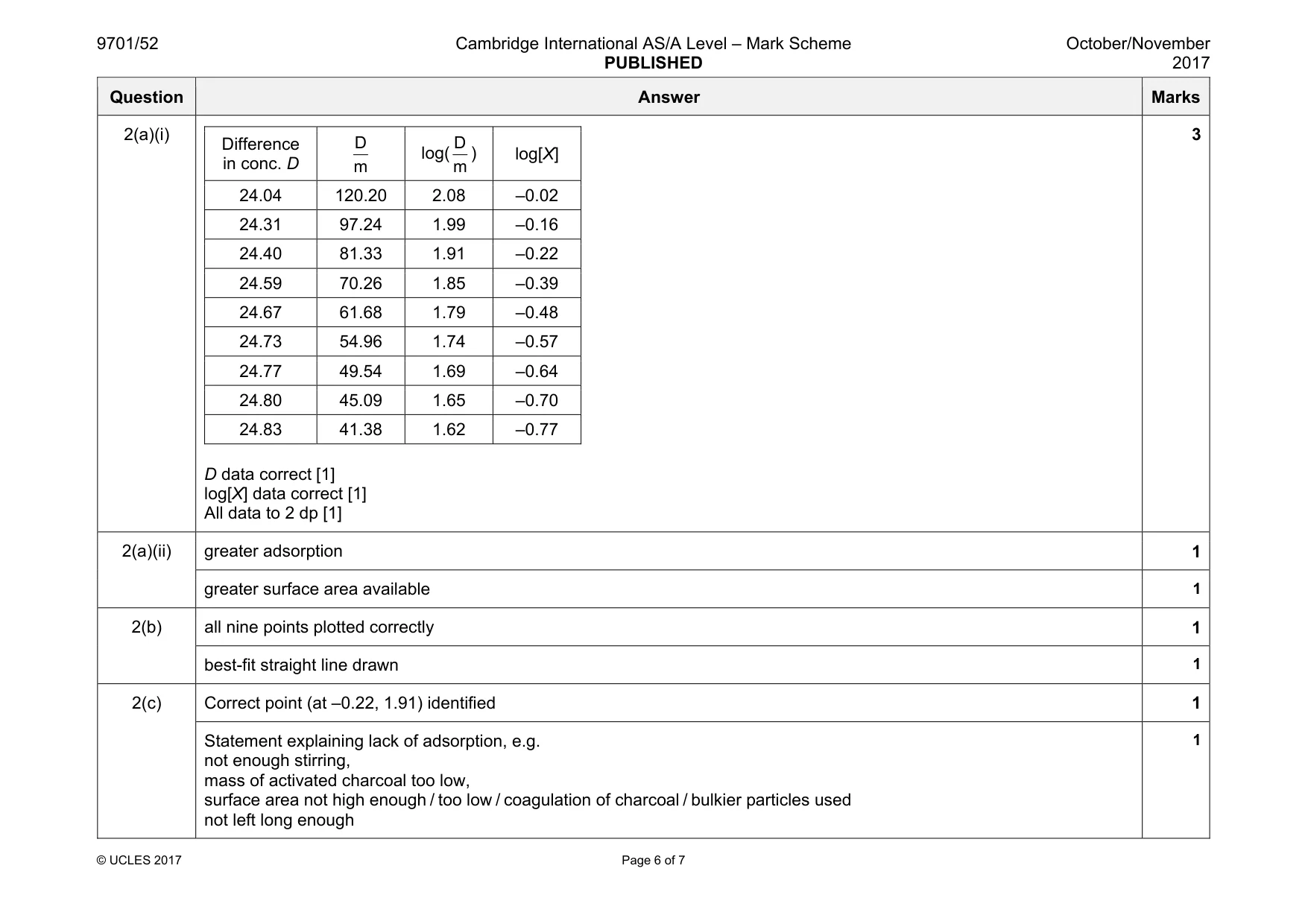
Mark scheme: 1(a)(i) 1 1(a)(ii) (Transfer) 12.5(0) cm3 of (10.0 mol dm–3) HCl using a (graduated) pipette or a burette 1 add to a 250 cm3 volumetric flask AND make to mark with distilled water 1 1(a)(iii) Measure a volume of gas from the carbonate reaction or measure the (loss of) mass from the carbonate reaction 1 1(a)(iv) Suitable apparatus for production of CO2 1 Suitable means of measuring CO2 evolved 1 1(a)(v) Correct labels on axes y-axis: volume (of gas) or mass loss or mass of ‘limewater’ and x-axis: time or t 1 curved line (from origin) to reach a plateau, e.g. 1 Question Answer Marks 1(a)(vi) Any sensible attempt seen to make the experiment accurate If mass loss Reduce risk of mass loss through spraying Insert cotton wool plug If gas collection Any method to reduce risk of gas loss Check apparatus is sealed Insert bung quickly Any attempt to measure temperature Check apparatus is at room temperature Apparatus accuracy Use an accurate or 2dp (or more) balance / gas syringe / measuring cylinder 1 1(a)(vii) mol of CuCO3 = 0.5 ÷ 123.5 = 4.05 × 10⁻³ mol 1 moles of HCl = 2 × 4.05 × 10–3 = 8.10 × 10⁻³ mol and volume of HCl = 8.10 × 10⁻³ ÷ 0.500 = 0.0162 dm3 = 16.2 cm3 1 Question Answer Marks 1(b) Any suitable precaution relating to stated hazard of given chemical For HCl Precaution (lab) gloves Explanation (10 mol dm–3) HCl is corrosive For CuCO3 Precaution (lab) gloves / wash hands (after use) / face or mouth mask Explanation Harmful if swallowed 1 1(c)(i) moles of H2SO4 = 0.40 × 24.15 1000 = 9.66 × 10⁻³ mol 1 mass of Cu3(CO3)2(OH)2 = 344.5 × 9.66 × 10–3 ÷ 3 = 1.11 g 1 % by mass = 1.11 1.50 × 100% = 74.0% 1 Question Answer Marks 1(c)(ii) Problem 1 titres are not concordant / are too far apart / are 0.5(0) cm3 apart / difference is too large Improvement Repeat until (two) concordant titres have been achieved / two readings within 0.1(0) cm3 Problem 2 colour change (of indicator) will be masked Improvement 2 Use an alternative indicator / named indicator [1] for each problem, [1] for an improvement 3
Q2 · Activated charcoal is a form of carbon with a very high surface area
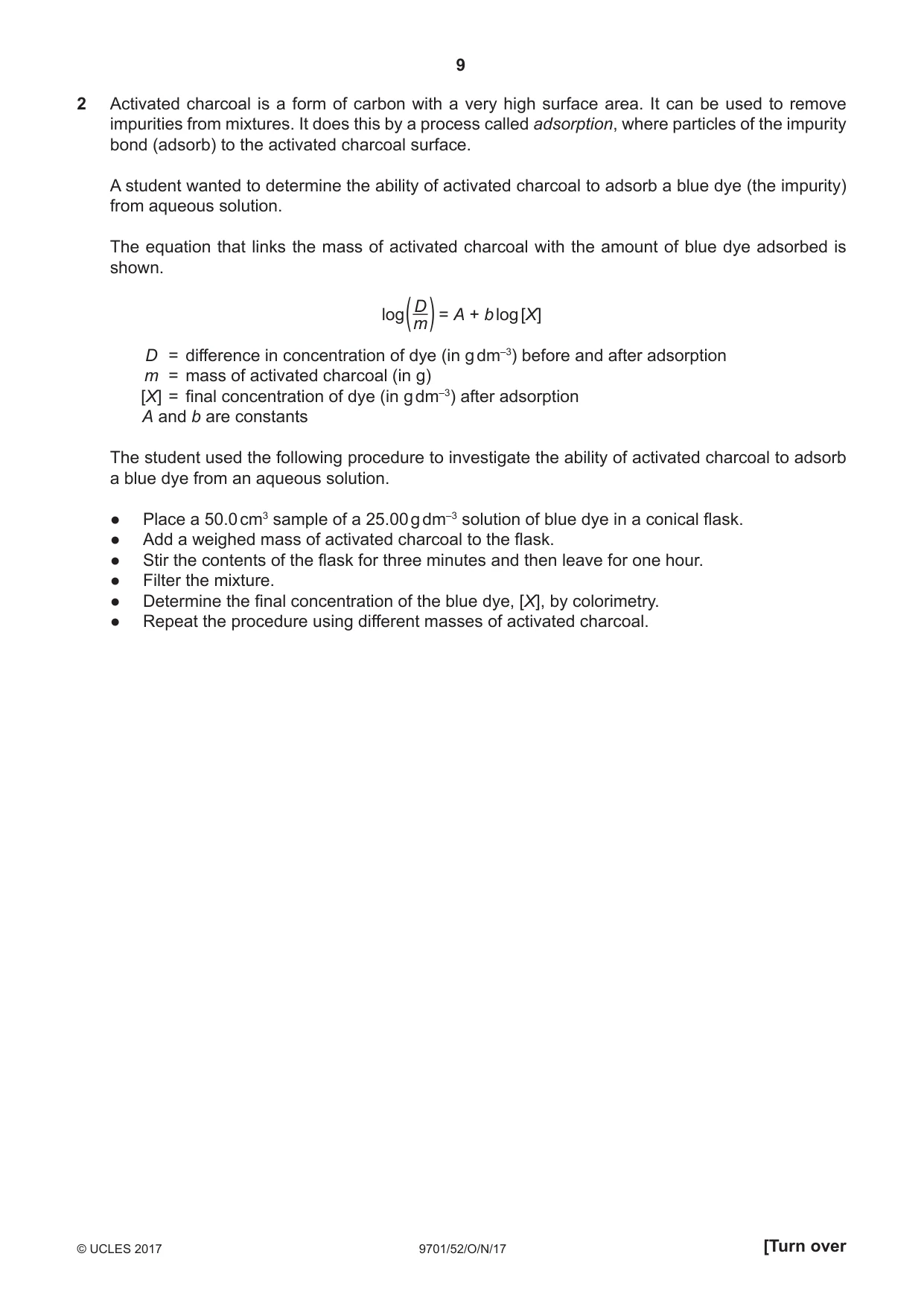
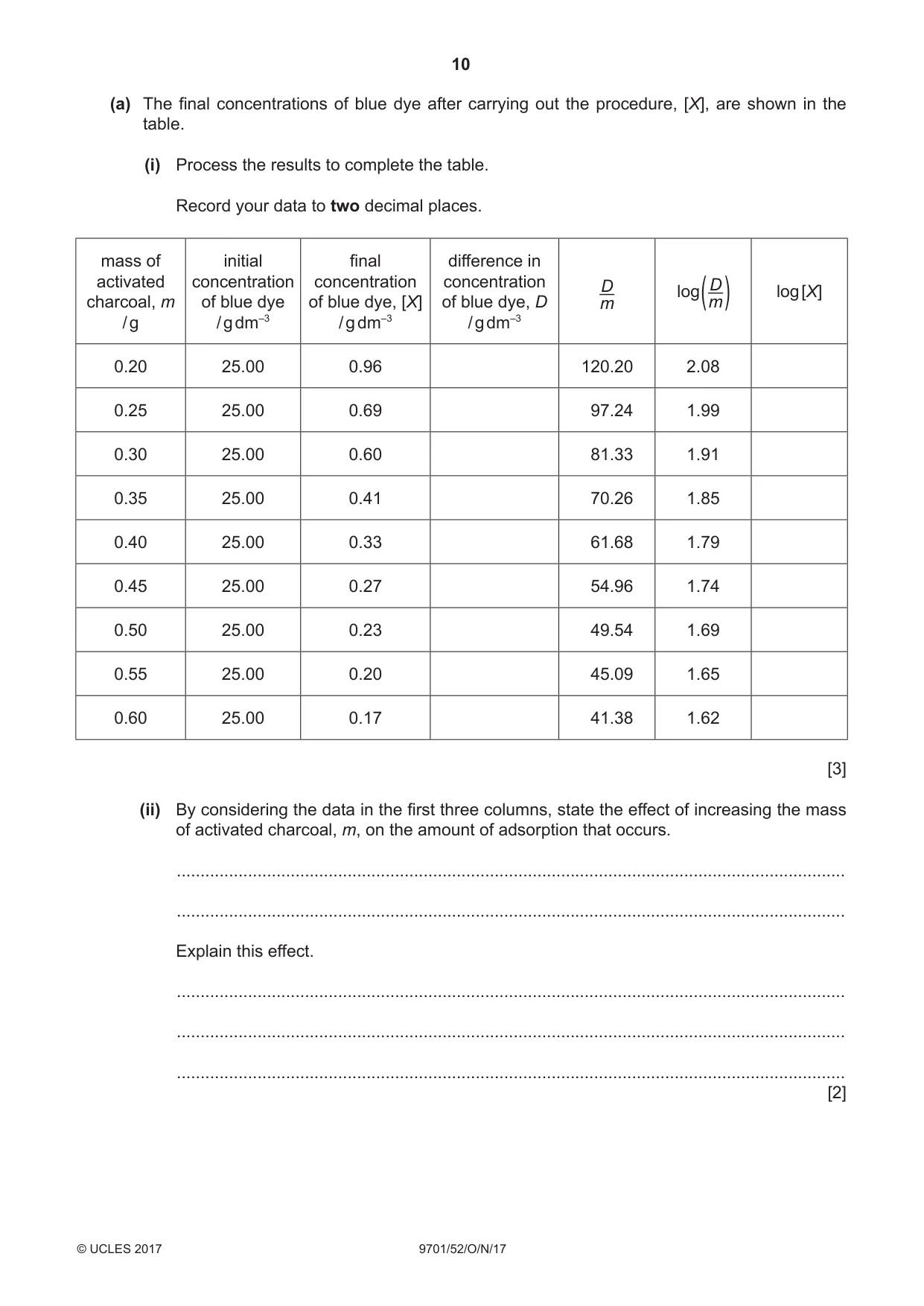
2 Activated charcoal is a form of carbon with a very high surface area. It can be used to remove impurities from mixtures. It does this by a process called adsorption, where particles of the impurity bond (adsorb) to the activated charcoal surface. A student wanted to determine the ability of activated charcoal to adsorb a blue dye (the impurity) from aqueous solution. The equation that links the mass of activated charcoal with the amount of blue dye adsorbed is shown. D log = A + b log [X] m D = difference in concentration of dye (in g dm–3) before and after adsorption m = mass of activated charcoal (in g) [X] = final concentration of dye (in g dm–3) after adsorption A and b are constants The student used the following procedure to investigate the ability of activated charcoal to adsorb a blue dye from an aqueous solution. ● Place a 50.0 cm3 sample of a 25.00 g dm–3 solution of blue dye in a conical flask. ● Add a weighed mass of activated charcoal to the flask. ● Stir the contents of the flask for three minutes and then leave for one hour. ● Filter the mixture. ● Determine the final concentration of the blue dye, [X], by colorimetry. ● Repeat the procedure using different masses of activated charcoal. (a) The final concentrations of blue dye after carrying out the procedure, [X], are shown in the table. (i) Process the results to complete the table. Record your data to two decimal places. mass of initial final difference in activated concentration concentration concentration D D log log [X]charcoal, m of blue dye of blue dye, [X] of blue dye, D m m / g / g dm–3 / g dm–3 / g dm–3 0.20 25.00 0.96 120.20 2.08 0.25 25.00 0.69 97.24 1.99 0.30 25.00 0.60 81.33 1.91 0.35 25.00 0.41 70.26 1.85 0.40 25.00 0.33 61.68 1.79 0.45 25.00 0.27 54.96 1.74 0.50 25.00 0.23 49.54 1.69 0.55 25.00 0.20 45.09 1.65 0.60 25.00 0.17 41.38 1.62 [3] (ii) By considering the data in the first three columns, state the effect of increasing the mass of activated charcoal, m, on the amount of adsorption that occurs. ............................................................................................................................................. ............................................................................................................................................. Explain this effect. ............................................................................................................................................. ............................................................................................................................................. ............................................................................................................................................. [2]
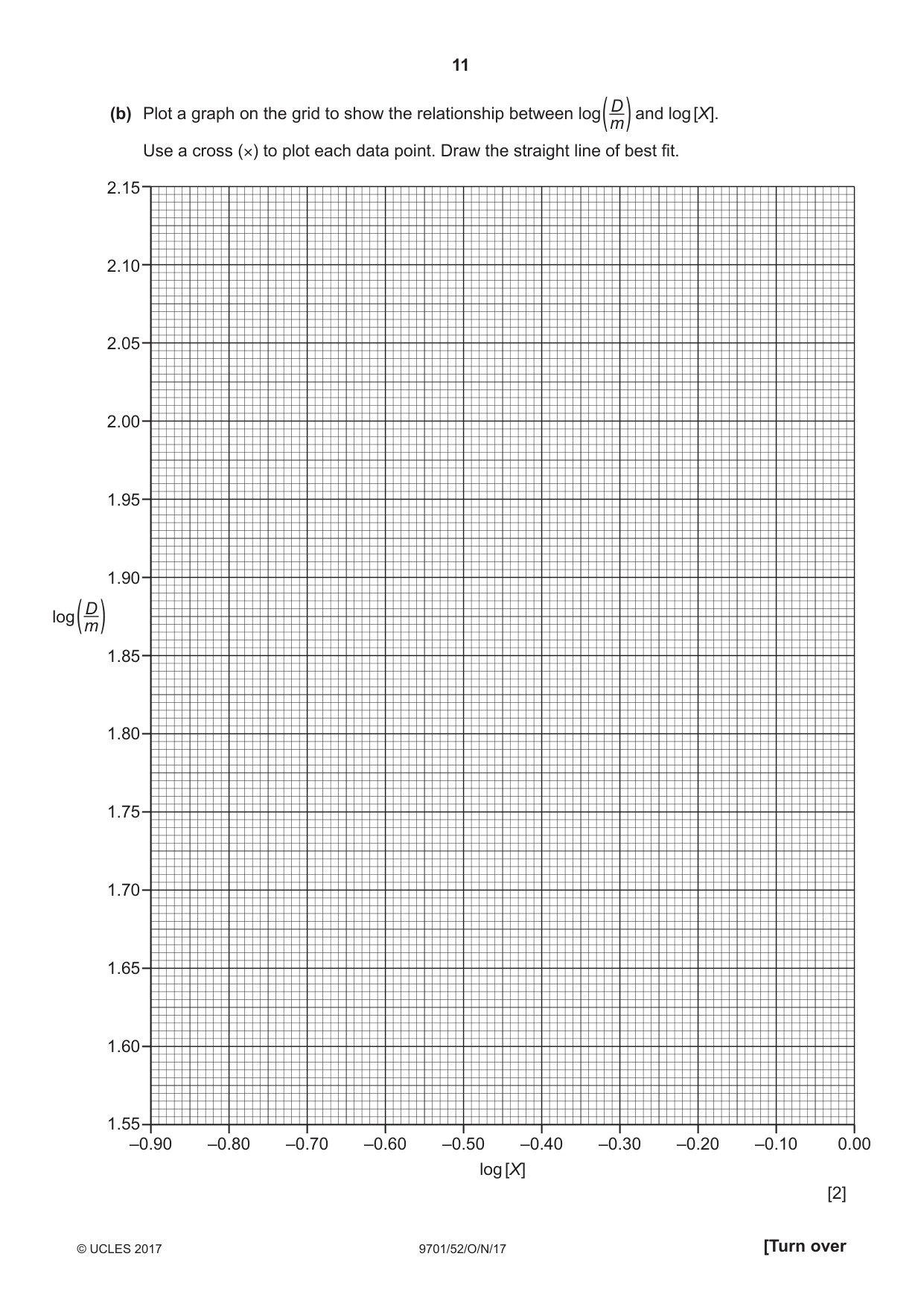
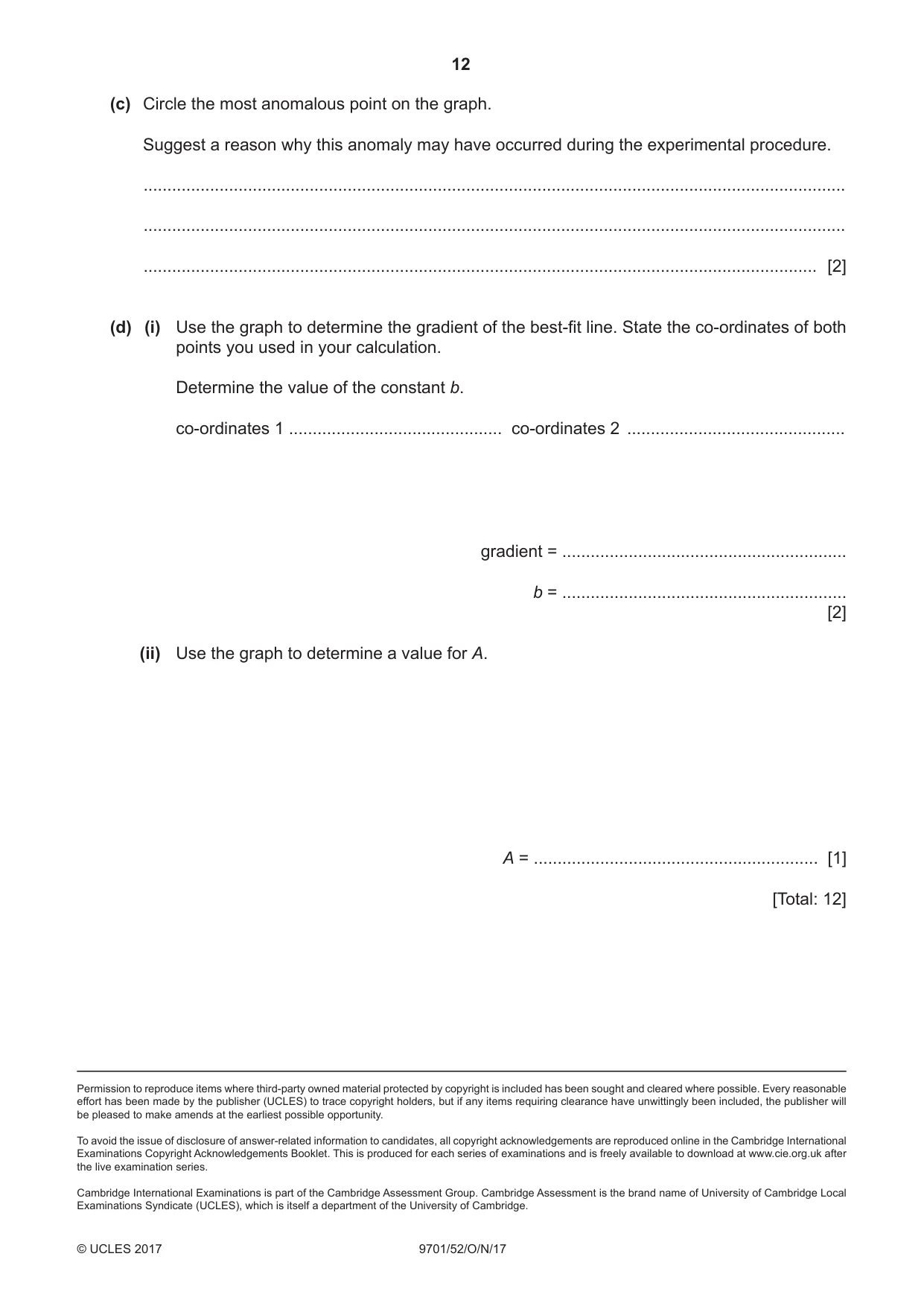
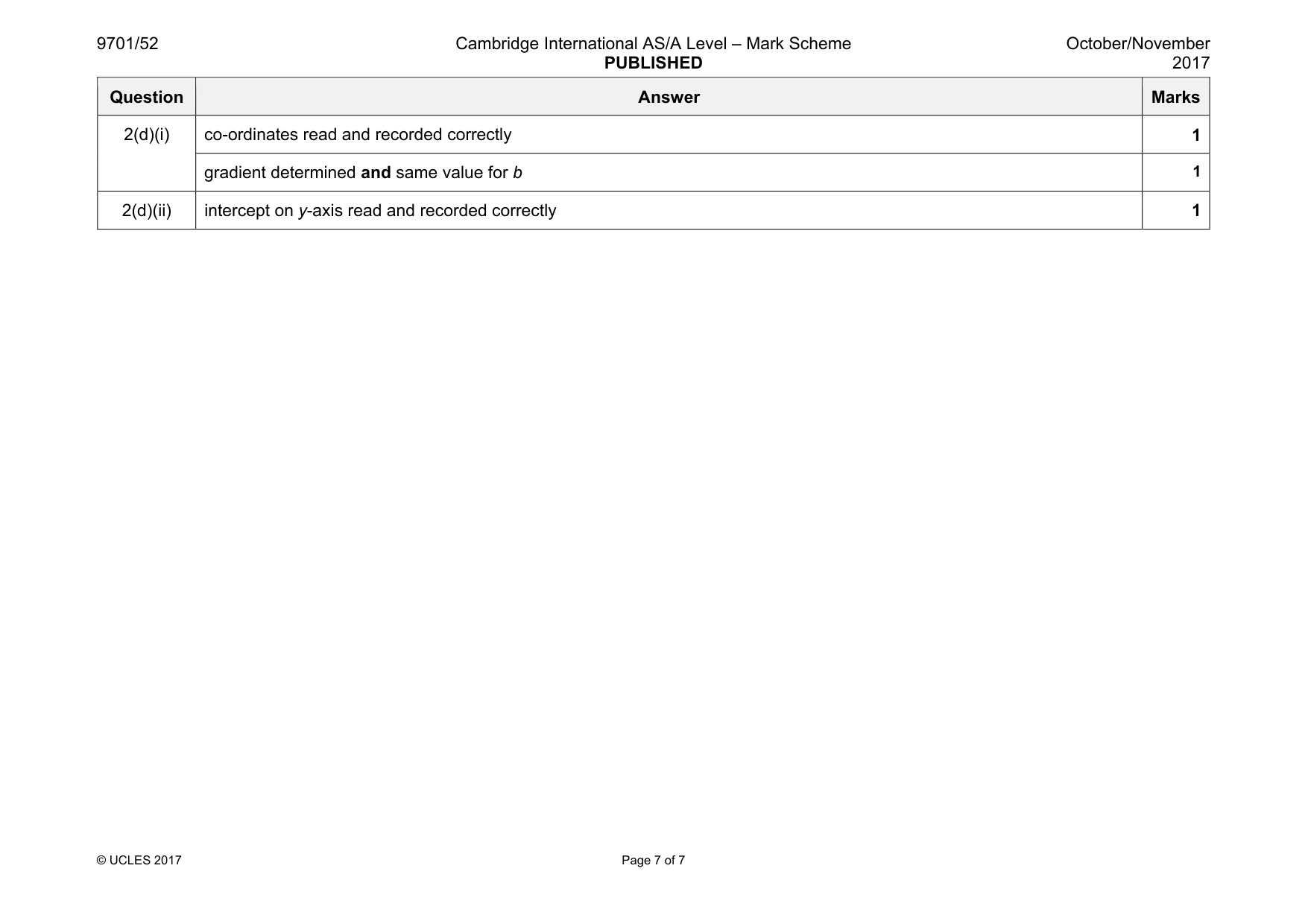
Mark scheme: 2(a)(i) Difference in conc. D D m log( D m ) log[X] 24.04 120.20 2.08 –0.02 24.31 97.24 1.99 –0.16 24.40 81.33 1.91 –0.22 24.59 70.26 1.85 –0.39 24.67 61.68 1.79 –0.48 24.73 54.96 1.74 –0.57 24.77 49.54 1.69 –0.64 24.80 45.09 1.65 –0.70 24.83 41.38 1.62 –0.77 D data correct [1] log[X] data correct [1] All data to 2 dp [1] 3 2(a)(ii) greater adsorption 1 greater surface area available 1 2(b) all nine points plotted correctly 1 best-fit straight line drawn 1 2(c) Correct point (at –0.22, 1.91) identified 1 Statement explaining lack of adsorption, e.g. not enough stirring, mass of activated charcoal too low, surface area not high enough / too low / coagulation of charcoal / bulkier particles used not left long enough 1 Question Answer Marks 2(d)(i) co-ordinates read and recorded correctly 1 gradient determined and same value for b 1 2(d)(ii) intercept on y-axis read and recorded correctly 1
More questions on Reacting masses and volumes (of solutions and gases)
What was in this paper
The subtopics covered by these 2 questions, and how many questions each got. Open one in a new tab to see every Cambridge question on it.
What you needed in this session
Cambridge’s own grade thresholds for 2017 Oct/Nov, Paper 5 · Variant 2. A higher threshold means an easier paper — the bar moves with how the cohort did.