Cambridge A Level Chemistry 9701 — 2017 Oct/Nov Paper 5 · Variant 3
9701/53/O/N/17 · 2 questions · 30 marks · ≈34 min
The question paper and its mark scheme, free to read here and free to download. This is Cambridge’s own paper, exactly as it was sat.
Question paper12 pages
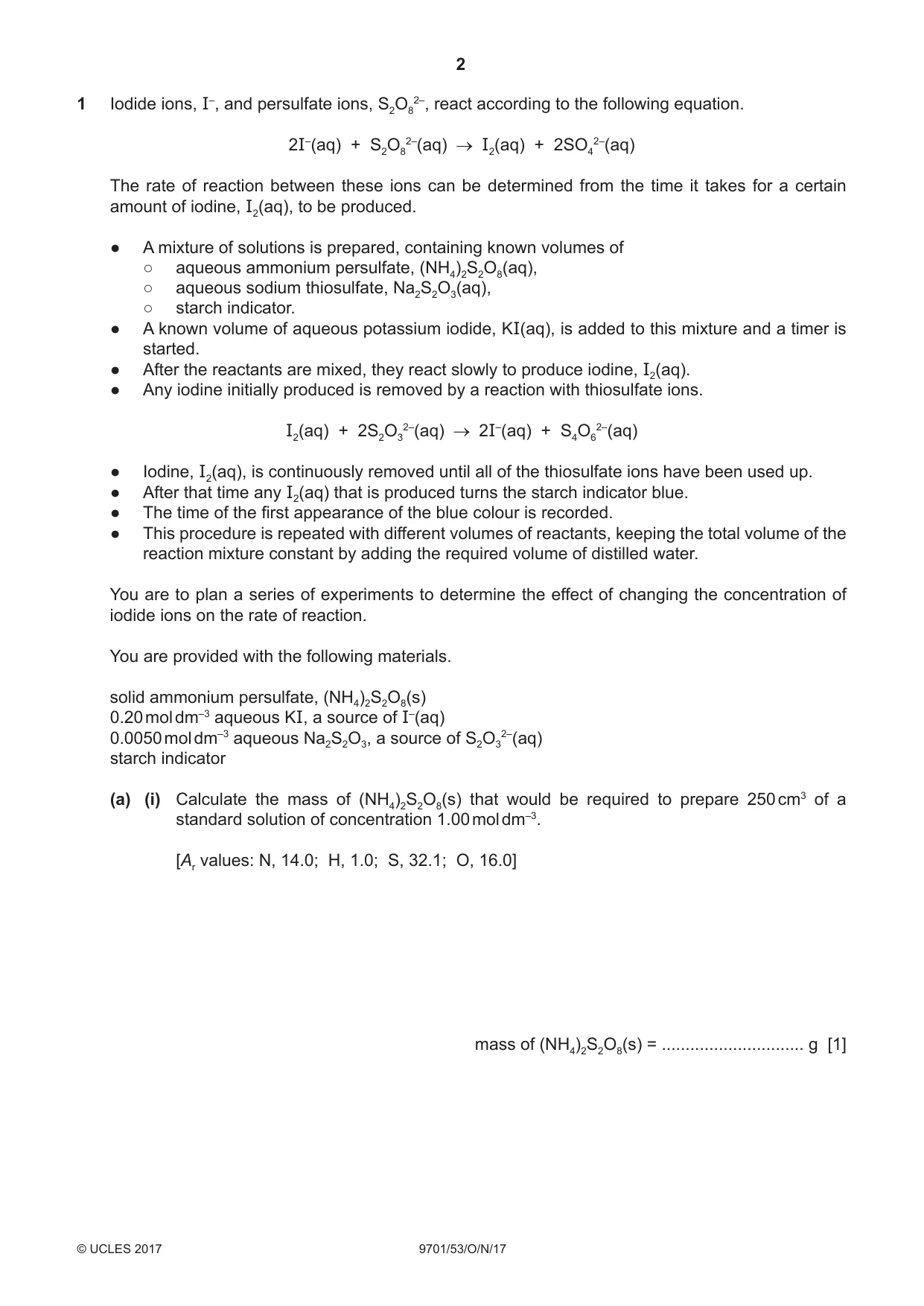
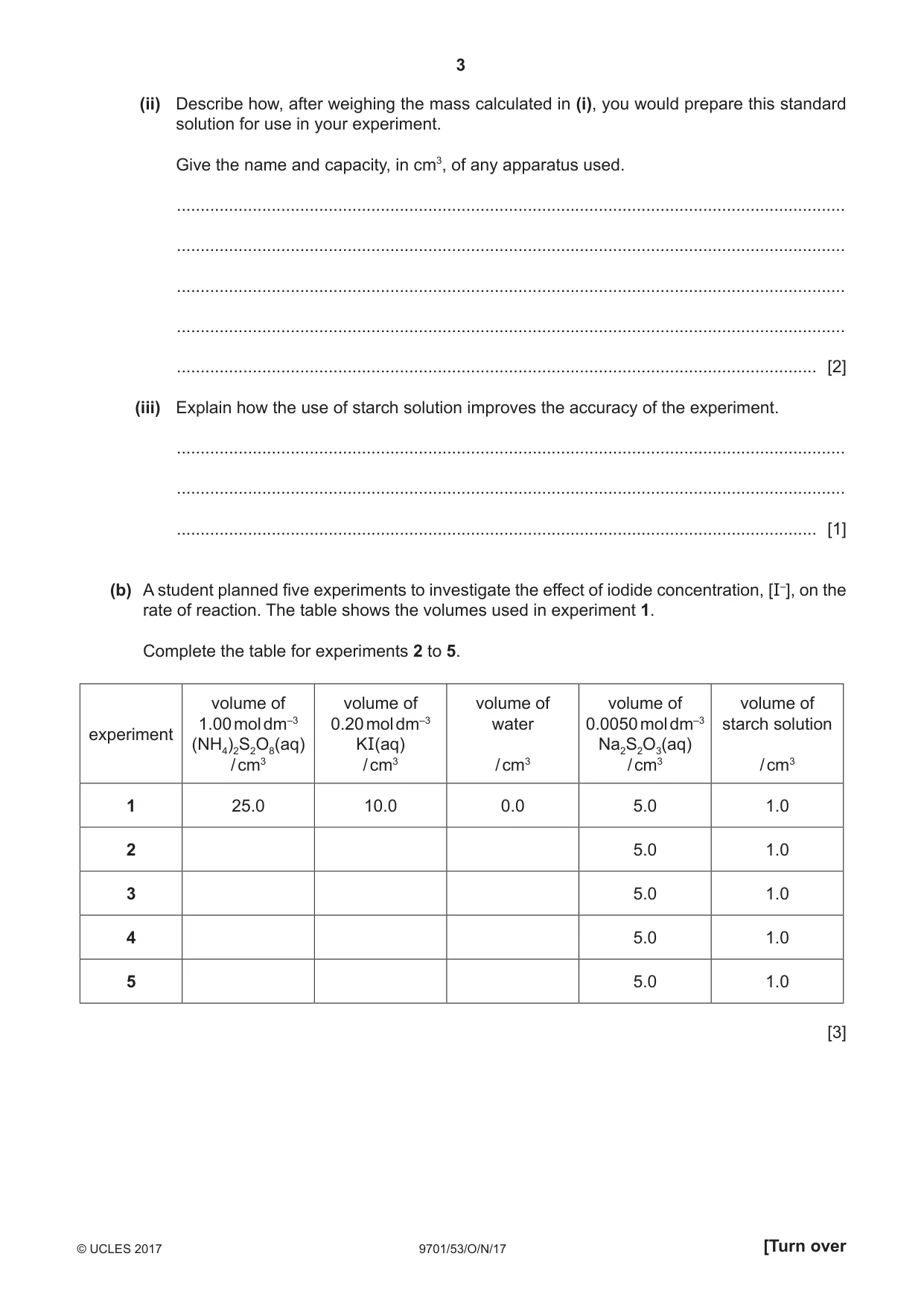
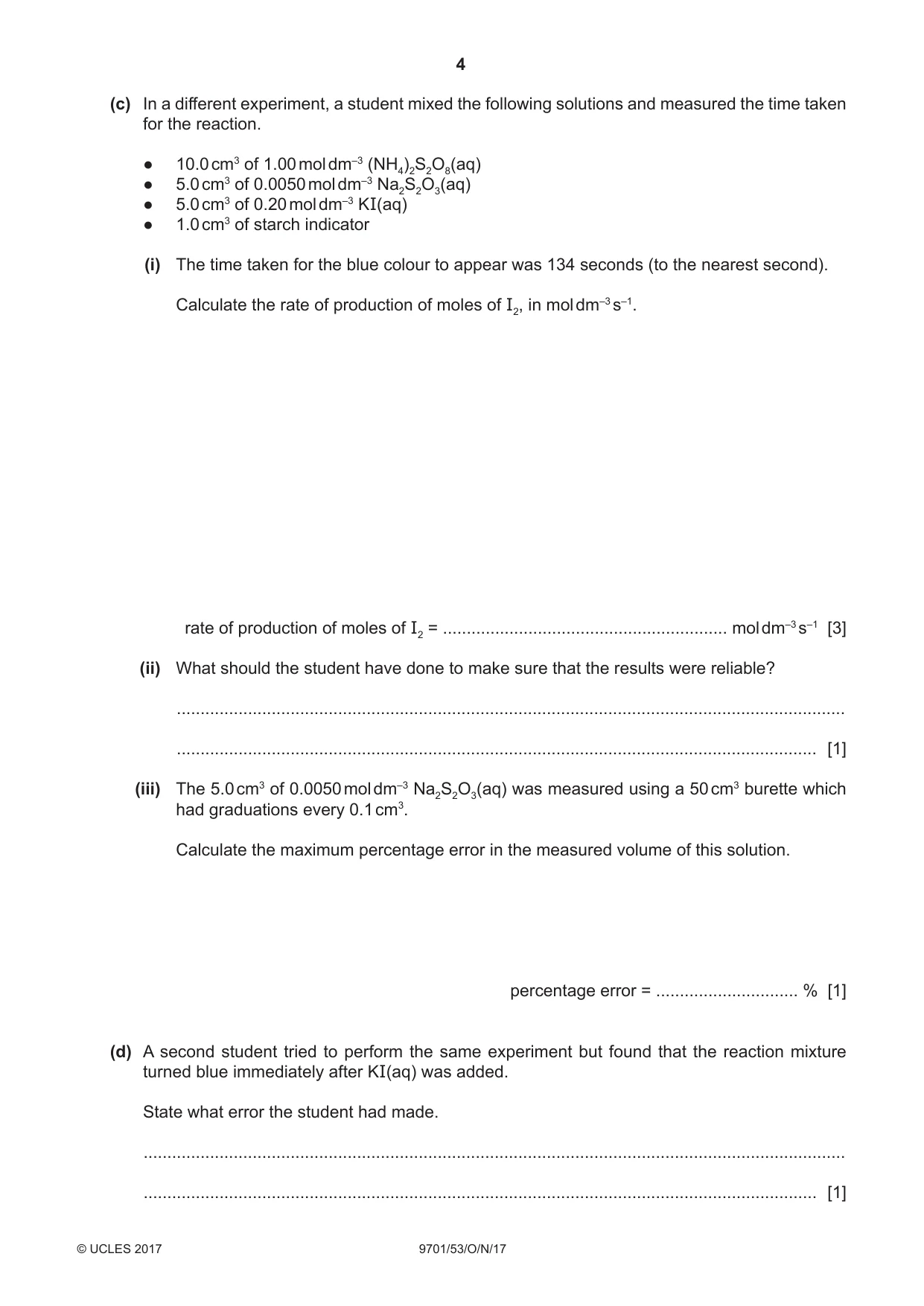

Mark scheme6 pages
Answers below. Sit the paper first if you are practising.
Questions as text
Q1 · Iodide ions, I–, and persulfate ions, S2O82–, react according to the following equation
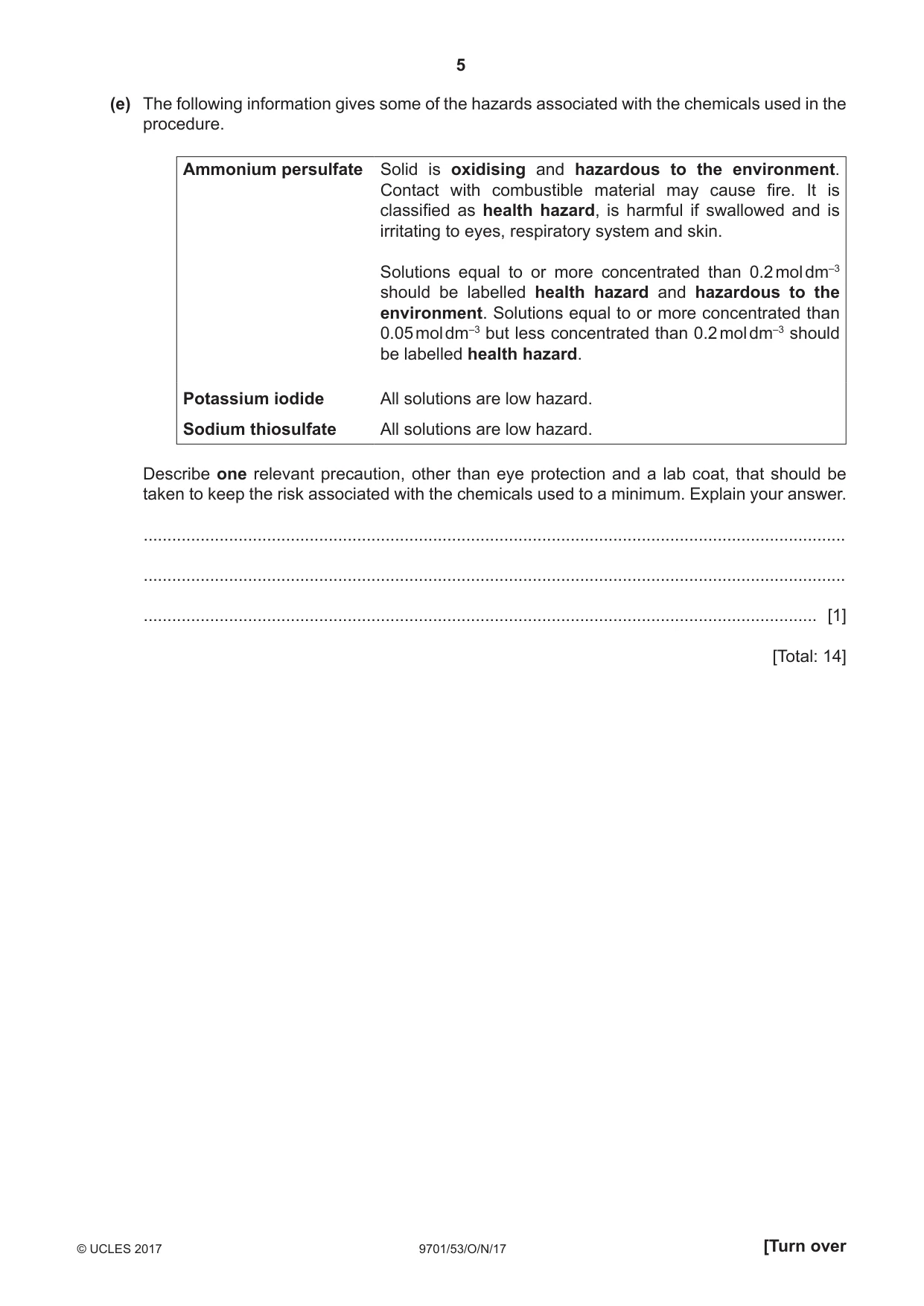
1 Iodide ions, I–, and persulfate ions, S2O82–, react according to the following equation. 2I–(aq) + S2O82–(aq) I2(aq) + 2SO42–(aq) The rate of reaction between these ions can be determined from the time it takes for a certain amount of iodine, I2(aq), to be produced. ● A mixture of solutions is prepared, containing known volumes of ○ aqueous ammonium persulfate, (NH4)2S2O8(aq), ○ aqueous sodium thiosulfate, Na2S2O3(aq), ○ starch indicator. ● A known volume of aqueous potassium iodide, KI(aq), is added to this mixture and a timer is started. ● After the reactants are mixed, they react slowly to produce iodine, I2(aq). ● Any iodine initially produced is removed by a reaction with thiosulfate ions. I2(aq) + 2S2O32–(aq) 2I–(aq) + S4O62–(aq) ● Iodine, I2(aq), is continuously removed until all of the thiosulfate ions have been used up. ● After that time any I2(aq) that is produced turns the starch indicator blue. ● The time of the first appearance of the blue colour is recorded. ● This procedure is repeated with different volumes of reactants, keeping the total volume of the reaction mixture constant by adding the required volume of distilled water. You are to plan a series of experiments to determine the effect of changing the concentration of iodide ions on the rate of reaction. You are provided with the following materials. solid ammonium persulfate, (NH4)2S2O8(s) 0.20 mol dm–3 aqueous KI, a source of I–(aq) 0.0050 mol dm–3 aqueous Na2S2O3, a source of S2O32–(aq) starch indicator (a) (i) Calculate the mass of (NH4)2S2O8(s) that would be required to prepare 250 cm3 of a standard solution of concentration 1.00 mol dm–3. [Ar values: N, 14.0; H, 1.0; S, 32.1; O, 16.0] mass of (NH4)2S2O8(s) = .............................. g [1] (ii) Describe how, after weighing the mass calculated in (i), you would prepare this standard solution for use in your experiment. Give the name and capacity, in cm3, of any apparatus used. ............................................................................................................................................. ............................................................................................................................................. ............................................................................................................................................. ............................................................................................................................................. ....................................................................................................................................... [2] (iii) Explain how the use of starch solution improves the accuracy of the experiment. ............................................................................................................................................. ............................................................................................................................................. ....................................................................................................................................... [1] (b) A student planned five experiments to investigate the effect of iodide concentration, [I–], on the rate of reaction. The table shows the volumes used in experiment 1. Complete the table for experiments 2 to 5. volume of volume of volume of volume of volume of 1.00 mol dm–3 0.20 mol dm–3 water 0.0050 mol dm–3 starch solutionexperiment (NH4)2S2O8(aq) KI(aq) Na2S2O3(aq) / cm3 / cm3 / cm3 / cm3 / cm3 1 25.0 10.0 0.0 5.0 1.0 2 5.0 1.0 3 5.0 1.0 4 5.0 1.0 5 5.0 1.0 [3] (c) In a different experiment, a student mixed the following solutions and measured the time taken for the reaction. ● 10.0 cm3 of 1.00 mol dm–3 (NH4)2S2O8(aq) ● 5.0 cm3 of 0.0050 mol dm–3 Na2S2O3(aq) ● 5.0 cm3 of 0.20 mol dm–3 KI(aq) ● 1.0 cm3 of starch indicator (i) The time taken for the blue colour to appear was 134 seconds (to the nearest second). Calculate the rate of production of moles of I2, in mol dm–3 s–1. rate of production of moles of I2 = ............................................................ mol dm–3 s–1 [3] (ii) What should the student have done to make sure that the results were reliable? ............................................................................................................................................. ....................................................................................................................................... [1] (iii) The 5.0 cm3 of 0.0050 mol dm–3 Na2S2O3(aq) was measured using a 50 cm3 burette which had graduations every 0.1 cm3. Calculate the maximum percentage error in the measured volume of this solution. percentage error = .............................. % [1] (d) A second student tried to perform the same experiment but found that the reaction mixture turned blue immediately after KI(aq) was added. State what error the student had made. .................................................................................................................................................... .............................................................................................................................................. [1] (e) The following information gives some of the hazards associated with the chemicals used in the procedure. Ammonium persulfate Solid is oxidising and hazardous to the environment. Contact with combustible material may cause fire. It is classified as health hazard, is harmful if swallowed and is irritating to eyes, respiratory system and skin. Solutions equal to or more concentrated than 0.2 mol dm–3 should be labelled health hazard and hazardous to the environment. Solutions equal to or more concentrated than 0.05 mol dm–3 but less concentrated than 0.2 mol dm–3 should be labelled health hazard. Potassium iodide All solutions are low hazard. Sodium thiosulfate All solutions are low hazard. Describe one relevant precaution, other than eye protection and a lab coat, that should be taken to keep the risk associated with the chemicals used to a minimum. Explain your answer. .................................................................................................................................................... .................................................................................................................................................... .............................................................................................................................................. [1] [Total: 14]
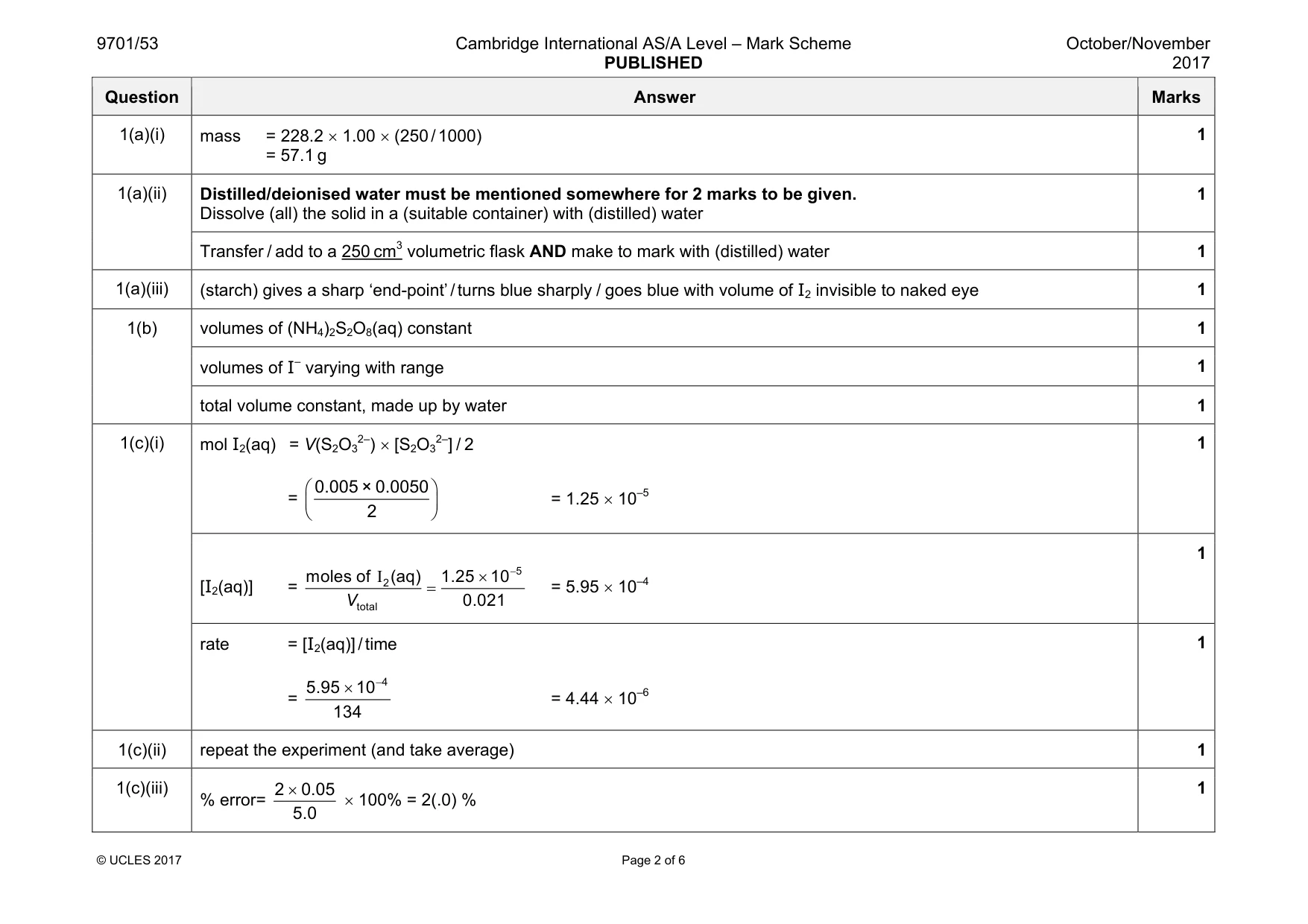
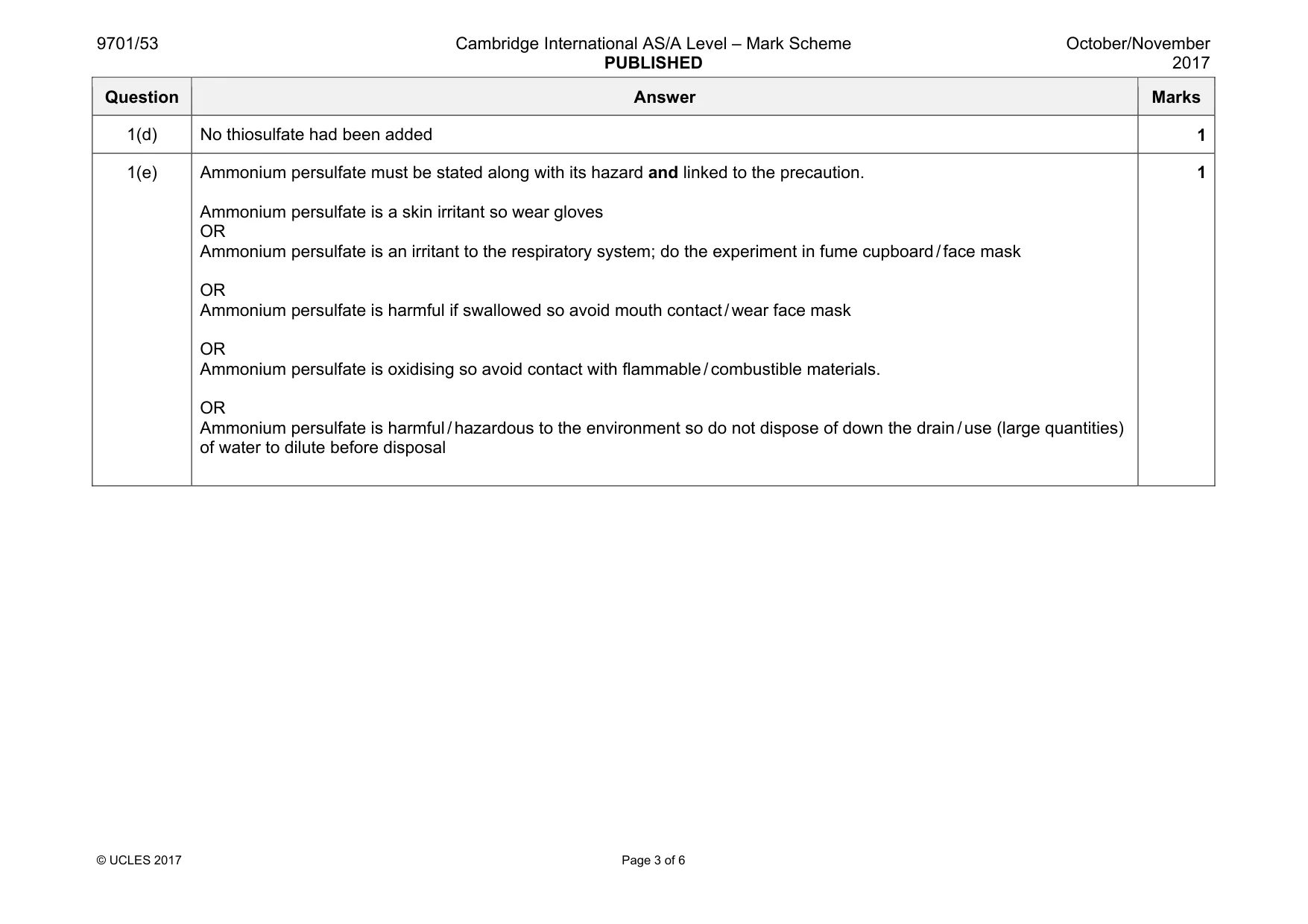
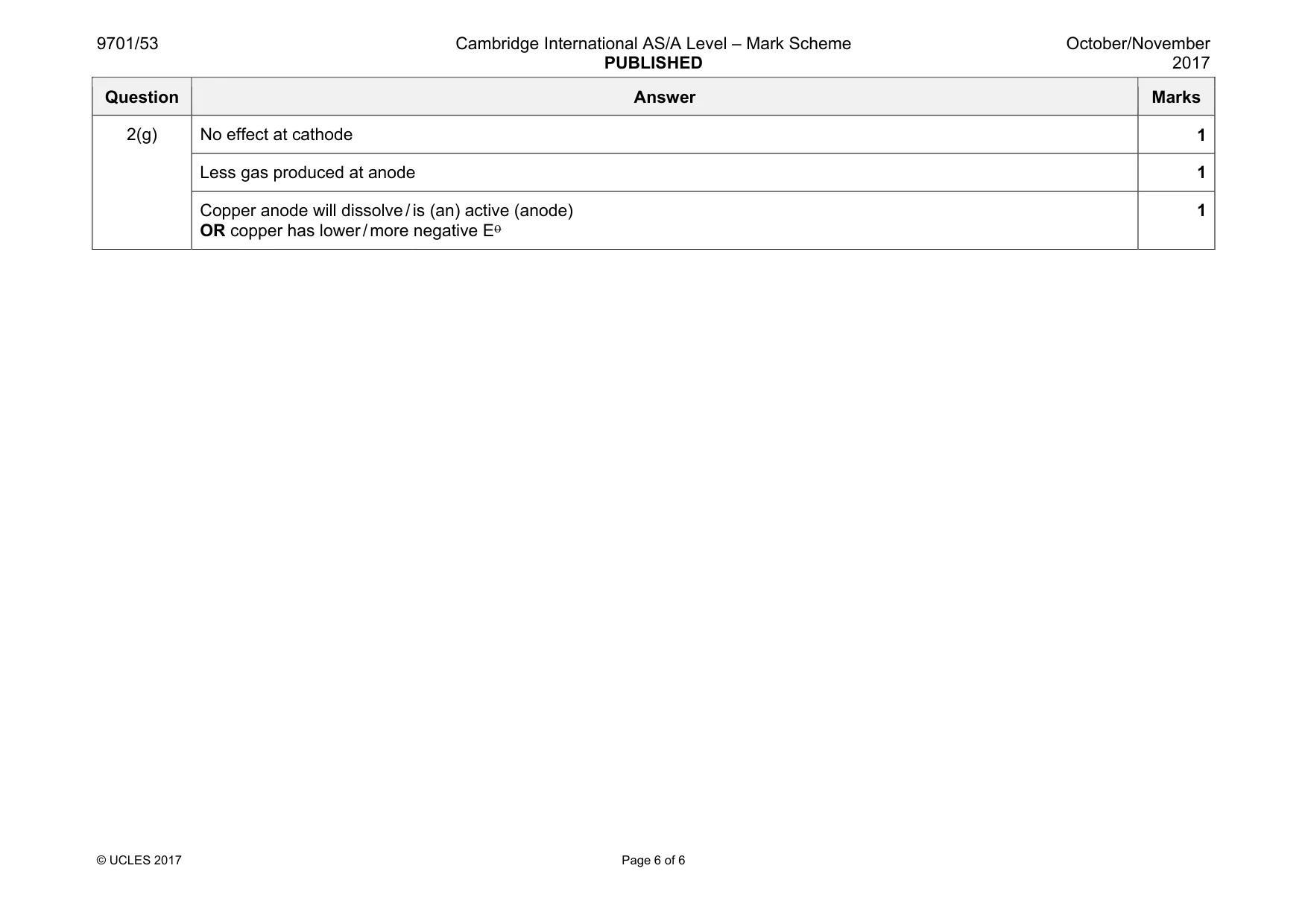
Mark scheme: 1(a)(i) mass = 57.1 g 1 1(a)(ii) Distilled/deionised water must be mentioned somewhere for 2 marks to be given. Dissolve (all) the solid in a (suitable container) with (distilled) water 1 Transfer / add to a 250 cm3 volumetric flask AND make to mark with (distilled) water 1 1(a)(iii) (starch) gives a sharp ‘end-point’ / turns blue sharply / goes blue with volume of I2 invisible to naked eye 1 1(b) volumes of (NH4)2S2O8(aq) constant 1 volumes of I– varying with range 1 total volume constant, made up by water 1 1(c)(i) mol I2(aq) = V(S2O3 2–) × [S2O3 2–] / 2 = 0.005 × 0.0050 2 = 1.25 × 10⁻⁵ 1 [I2(aq)] = I − × = 5 2 total moles of (aq) 1.25 10 0.021 V = 5.95 × 10⁻⁴ 1 rate = [I2(aq)] / time = − × 4 5.95 10 134 = 4.44 × 10⁻⁶ 1 1(c)(ii) repeat the experiment (and take average) 1 1(c)(iii) % error= × 2 0.05 5.0 × 100% = 2(.0) % 1 Question Answer Marks 1(d) No thiosulfate had been added 1 1(e) Ammonium persulfate must be stated along with its hazard and linked to the precaution. Ammonium persulfate is a skin irritant so wear gloves OR Ammonium persulfate is an irritant to the respiratory system; do the experiment in fume cupboard / face mask OR Ammonium persulfate is harmful if swallowed so avoid mouth contact / wear face mask OR Ammonium persulfate is oxidising so avoid contact with flammable / combustible materials. OR Ammonium persulfate is harmful / hazardous to the environment so do not dispose of down the drain / use (large quantities) of water to dilute before disposal 1
More questions on Reacting masses and volumes (of solutions and gases)
Q2 · Dilute sulfuric acid, H2SO4(aq), can be electrolysed using platinum electrodes and a…
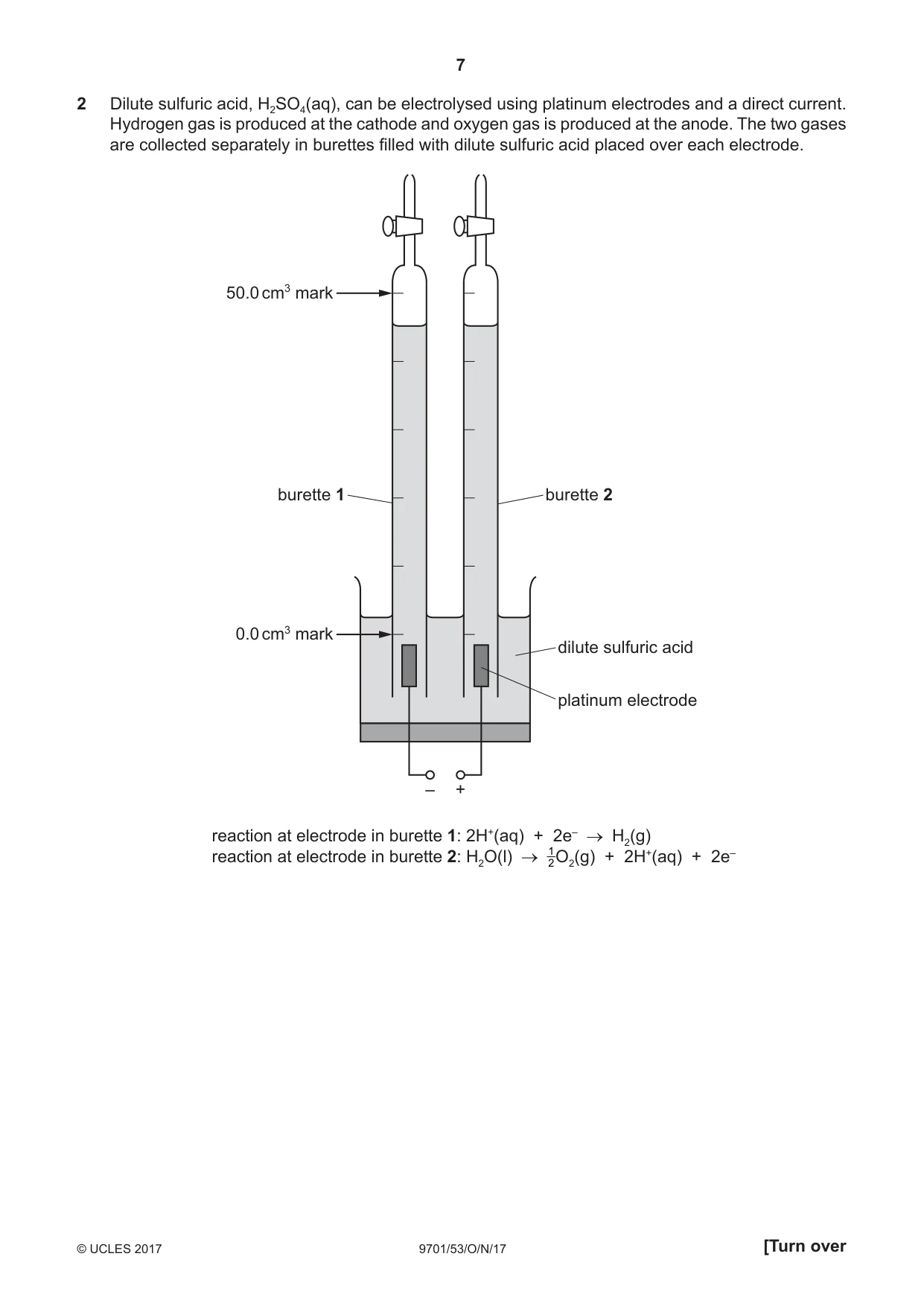
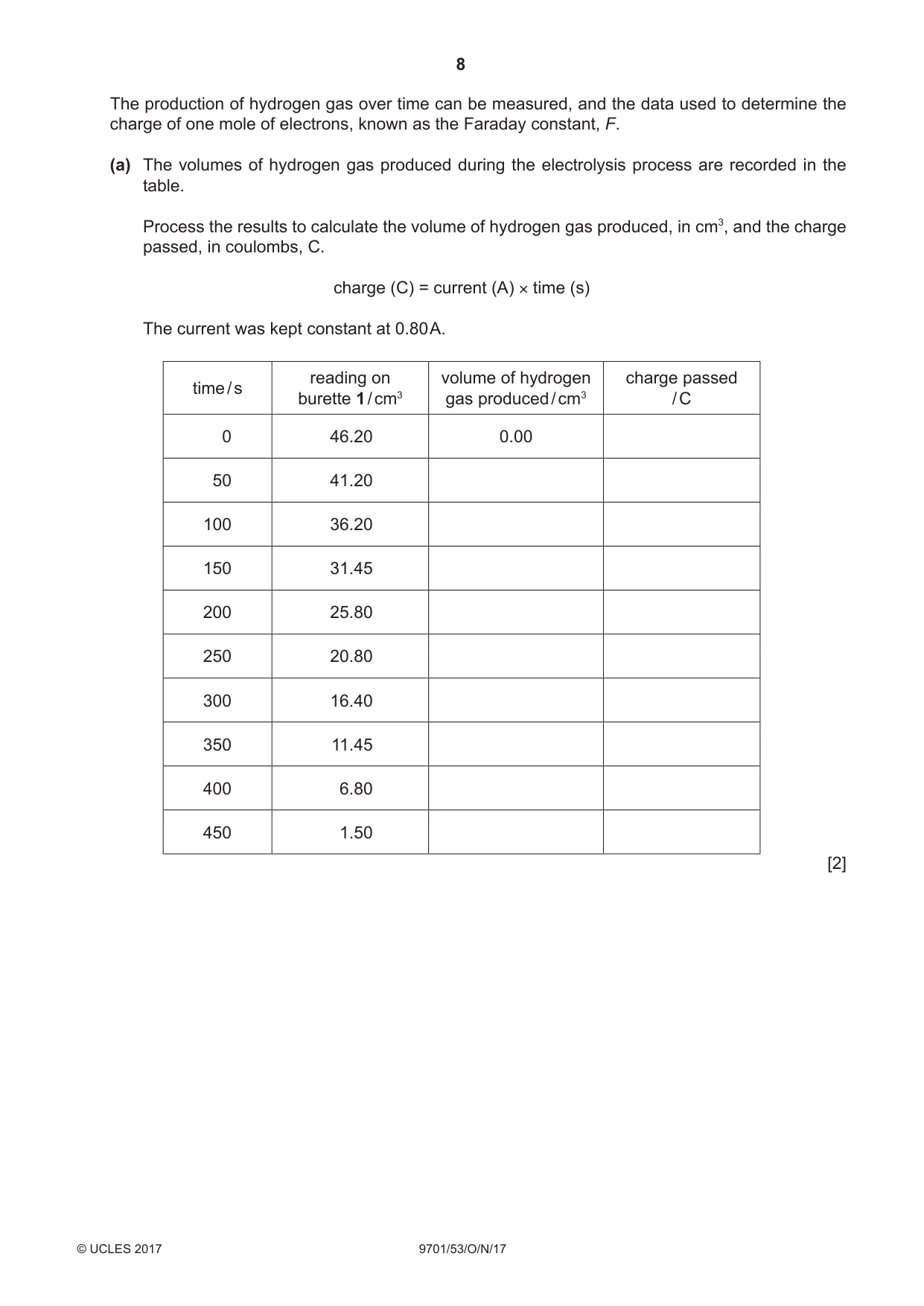
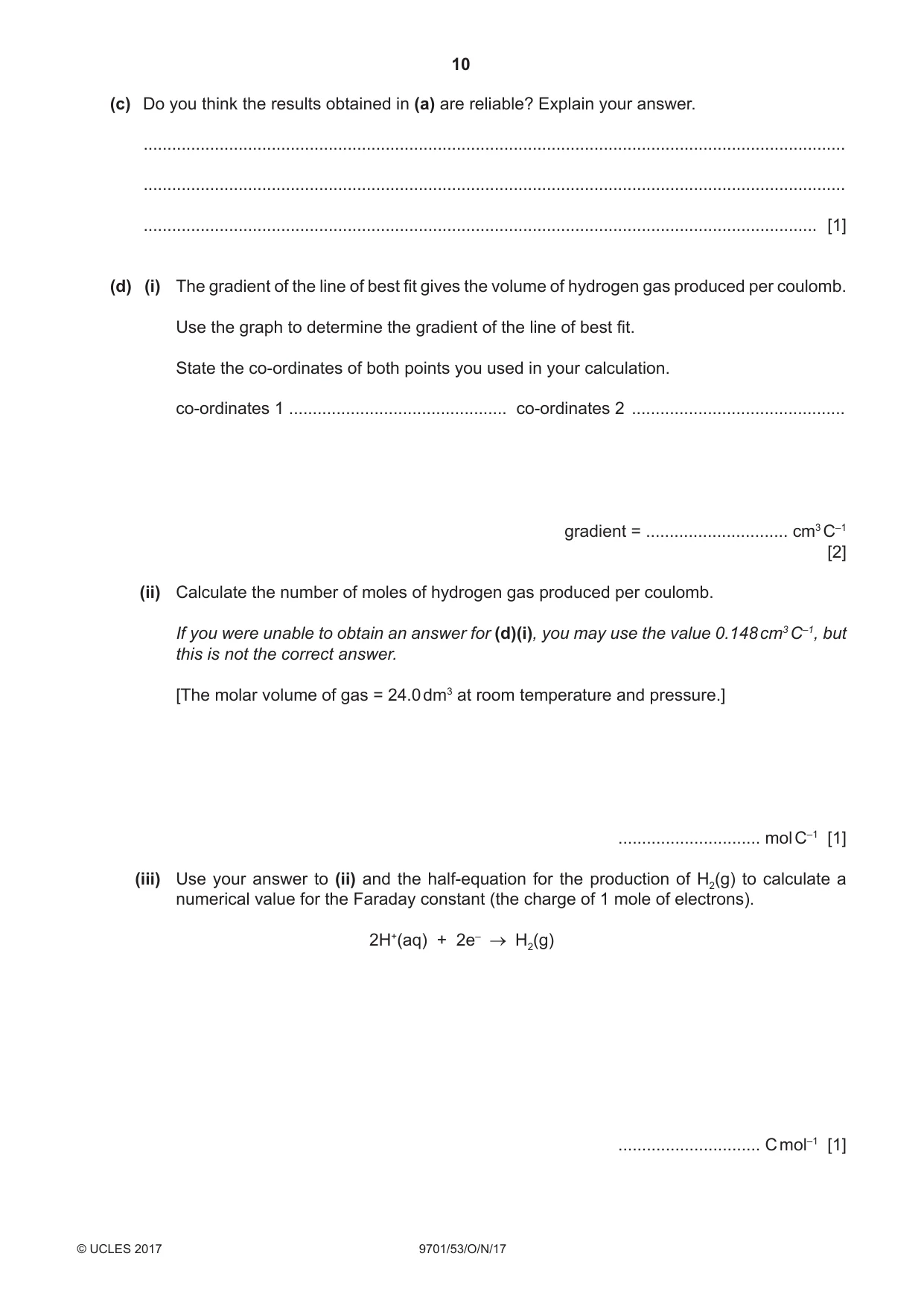
2 Dilute sulfuric acid, H2SO4(aq), can be electrolysed using platinum electrodes and a direct current. Hydrogen gas is produced at the cathode and oxygen gas is produced at the anode. The two gases are collected separately in burettes filled with dilute sulfuric acid placed over each electrode. 50.0 cm3 mark burette 1 burette 2 0.0 cm3 mark dilute sulfuric acid platinum electrode – + reaction at electrode in burette 1: 2H+(aq) + 2e– H2(g) reaction at electrode in burette 2: H2O(l) 12O2(g) + 2H+(aq) + 2e– The production of hydrogen gas over time can be measured, and the data used to determine the charge of one mole of electrons, known as the Faraday constant, F. (a) The volumes of hydrogen gas produced during the electrolysis process are recorded in the table. Process the results to calculate the volume of hydrogen gas produced, in cm3, and the charge passed, in coulombs, C. charge (C) = current (A) × time (s) The current was kept constant at 0.80 A. reading on volume of hydrogen charge passed time / s burette 1 / cm3 gas produced / cm3 / C 0 46.20 0.00 50 41.20 100 36.20 150 31.45 200 25.80 250 20.80 300 16.40 350 11.45 400 6.80 450 1.50 [2]
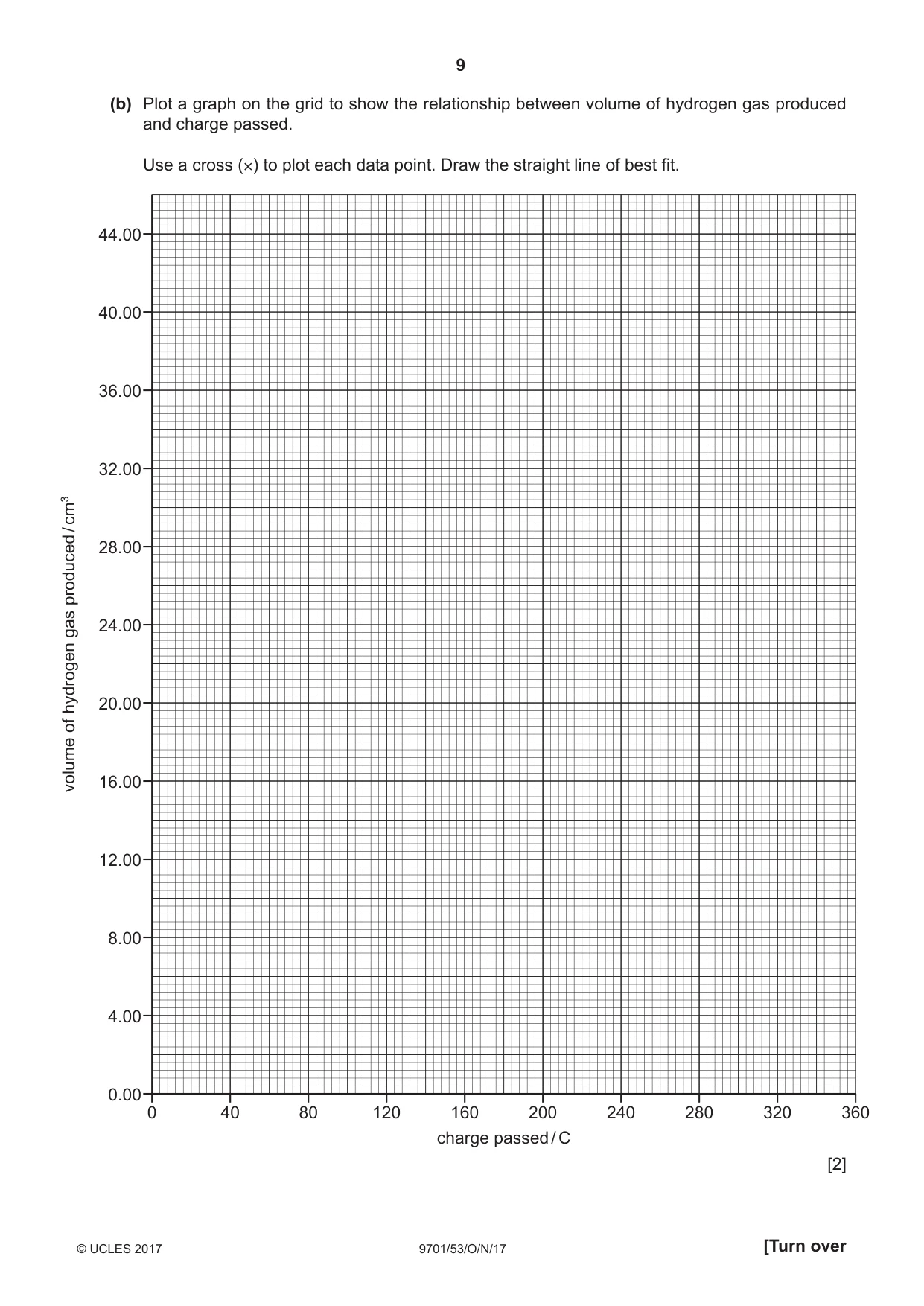
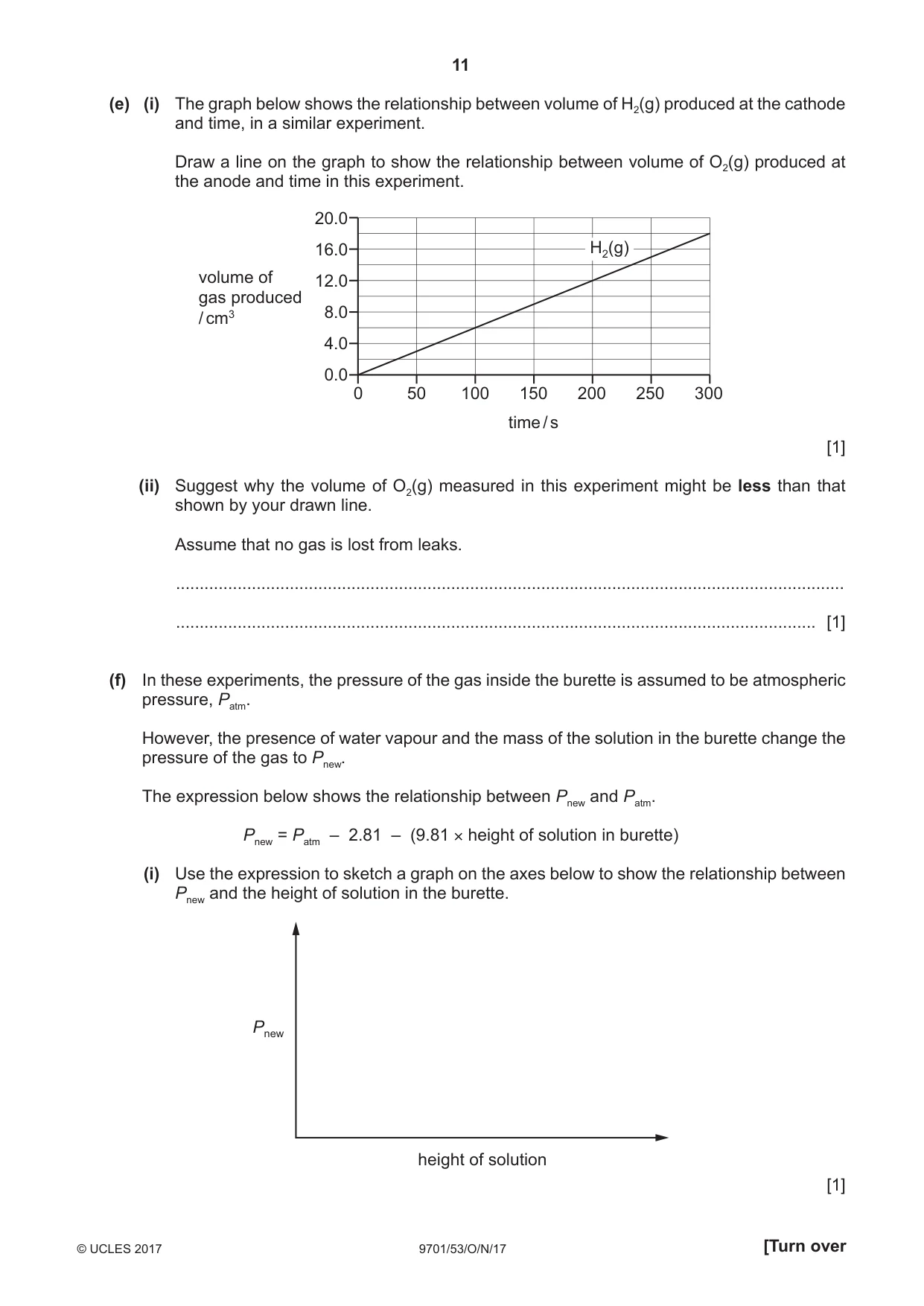
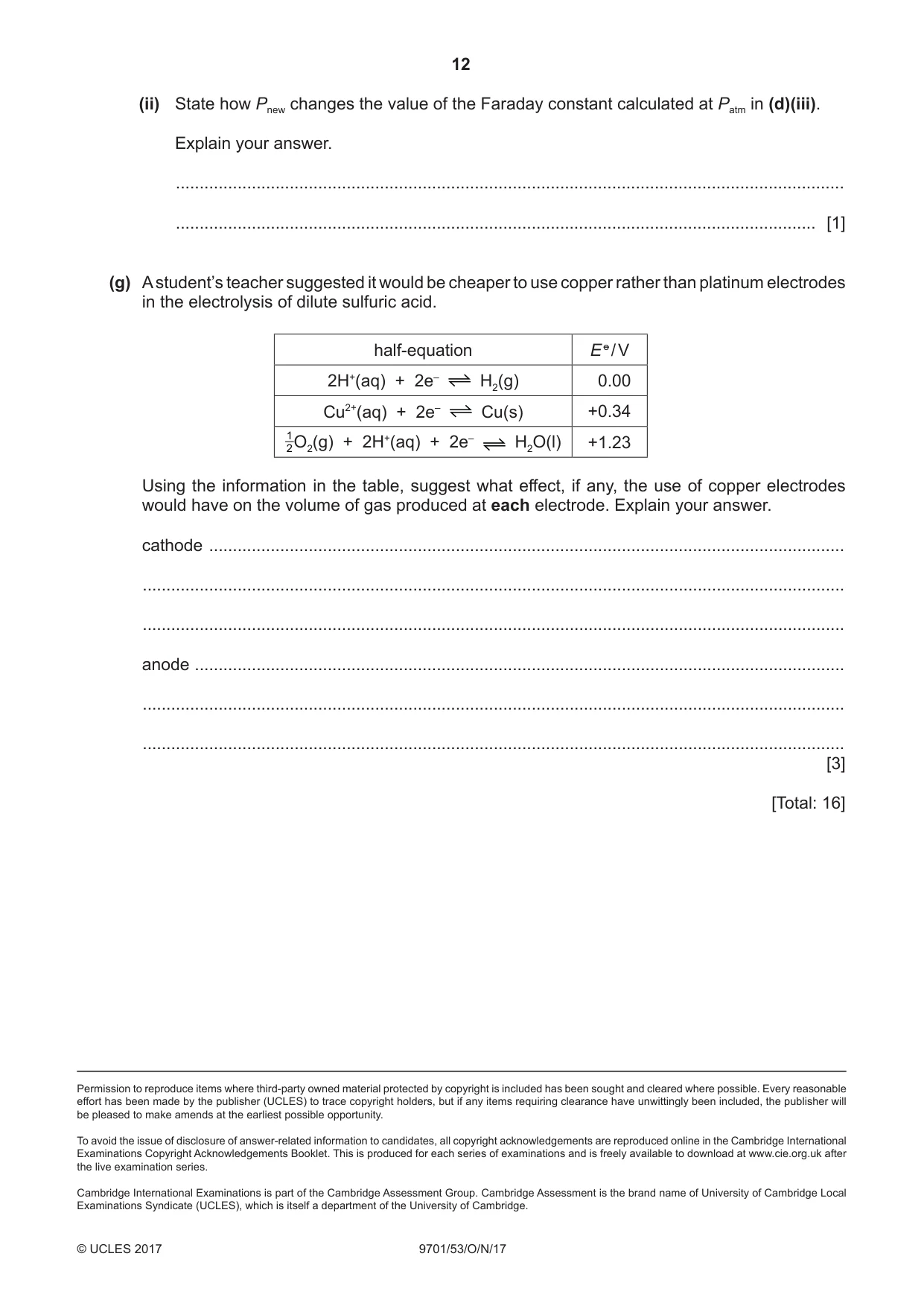
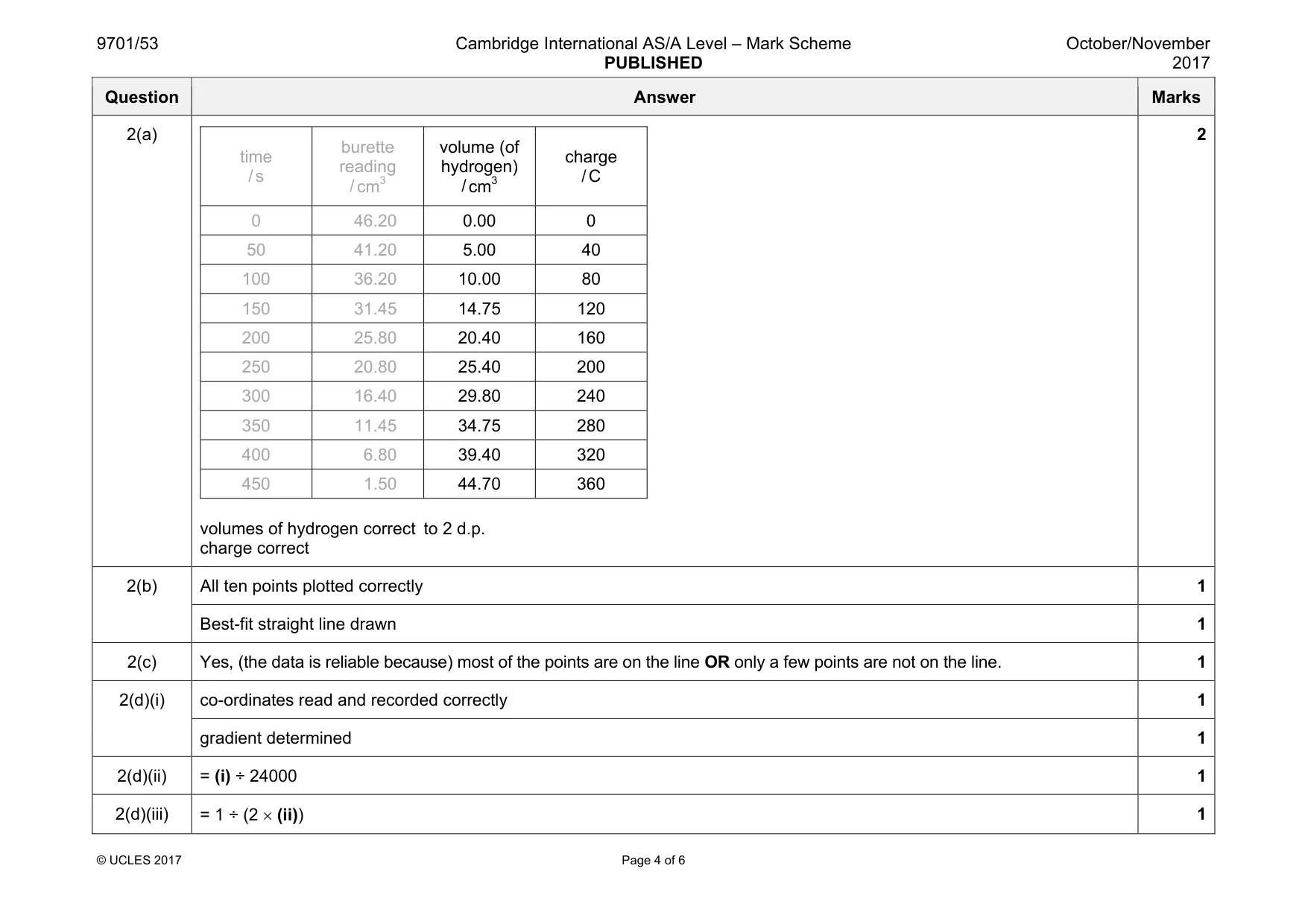
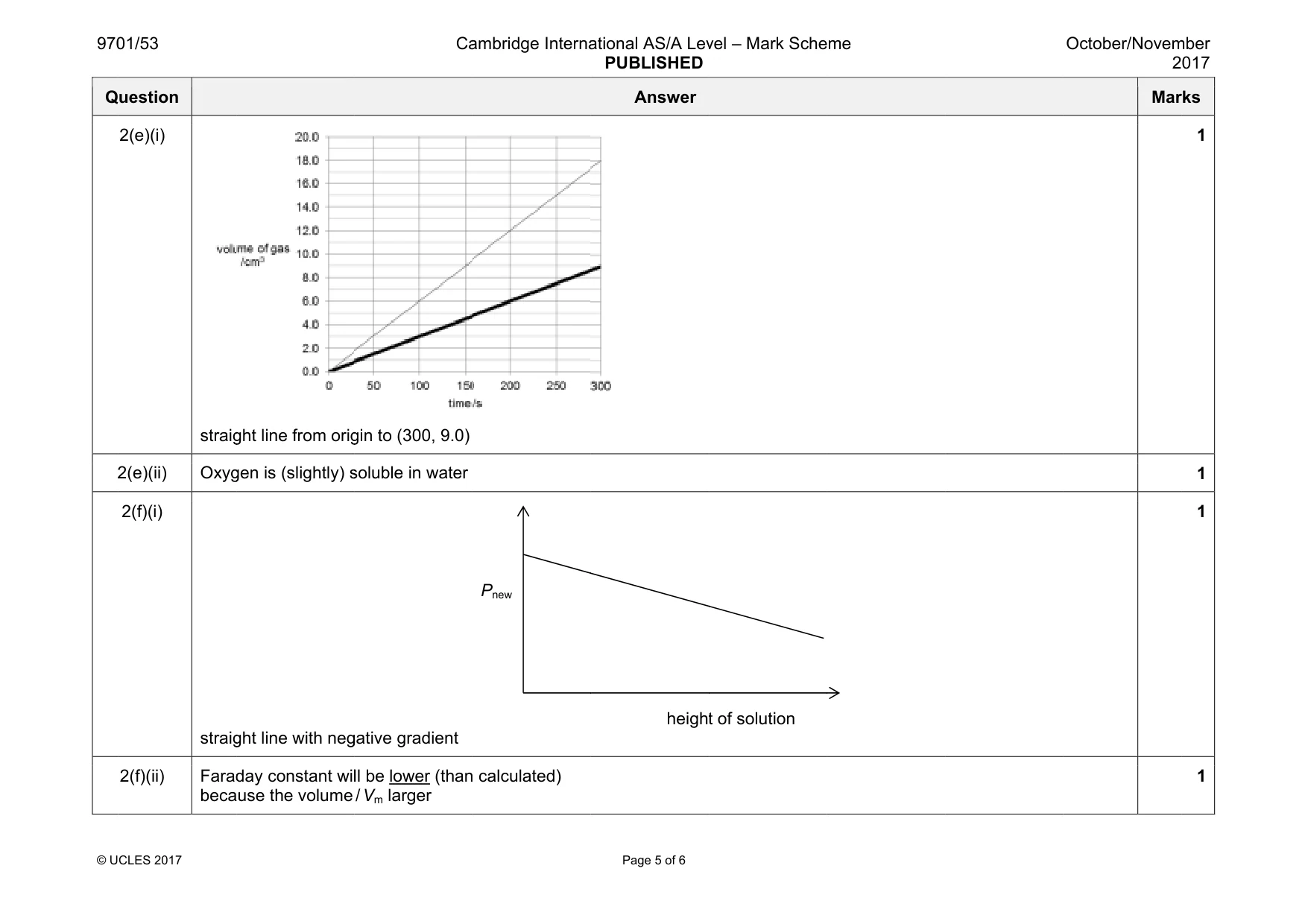
Mark scheme: 2(a) time / s burette reading / cm3 volume (of hydrogen) / cm3 charge / C 0 46.20 0.00 0 50 41.20 5.00 40 100 36.20 10.00 80 150 31.45 14.75 120 200 25.80 20.40 160 250 20.80 25.40 200 300 16.40 29.80 240 350 11.45 34.75 280 400 6.80 39.40 320 450 1.50 44.70 360 volumes of hydrogen correct to 2 d.p. charge correct 2 2(b) All ten points plotted correctly 1 Best-fit straight line drawn 1 2(c) Yes, (the data is reliable because) most of the points are on the line OR only a few points are not on the line. 1 2(d)(i) co-ordinates read and recorded correctly 1 gradient determined 1 2(d)(ii) = (i) ÷ 24000 1 2(d)(iii) = 1 ÷ (2 × (ii)) 1 Q 2 uestion 2(e)(i) straig 2(e)(ii) Oxyg 2(f)(i) straig 2(f)(ii) Farad beca ght line from orig gen is (slightly) s ght line with neg day constant wil ause the volume gin to (300, 9.0) soluble in water gative gradient ll be lower (than / Vm larger Pnew calculated) Answer height t of solution Mar rks 1 1 1 1 Question Answer Marks 2(g) No effect at cathode 1 Less gas produced at anode 1 Copper anode will dissolve / is (an) active (anode) OR copper has lower / more negative EO 1
What was in this paper
The subtopics covered by these 2 questions, and how many questions each got. Open one in a new tab to see every Cambridge question on it.
What you needed in this session
Cambridge’s own grade thresholds for 2017 Oct/Nov, Paper 5 · Variant 3. A higher threshold means an easier paper — the bar moves with how the cohort did.