Cambridge A Level Chemistry 9701 — 2017 Oct/Nov Paper 2 · Variant 2
9701/22/O/N/17 · 4 questions · 60 marks · ≈68 min
The question paper and its mark scheme, free to read here and free to download. This is Cambridge’s own paper, exactly as it was sat.
Question paper12 pages

Mark scheme7 pages
Answers below. Sit the paper first if you are practising.
Questions as text
Q1 · The elements sodium to sulfur react with chlorine
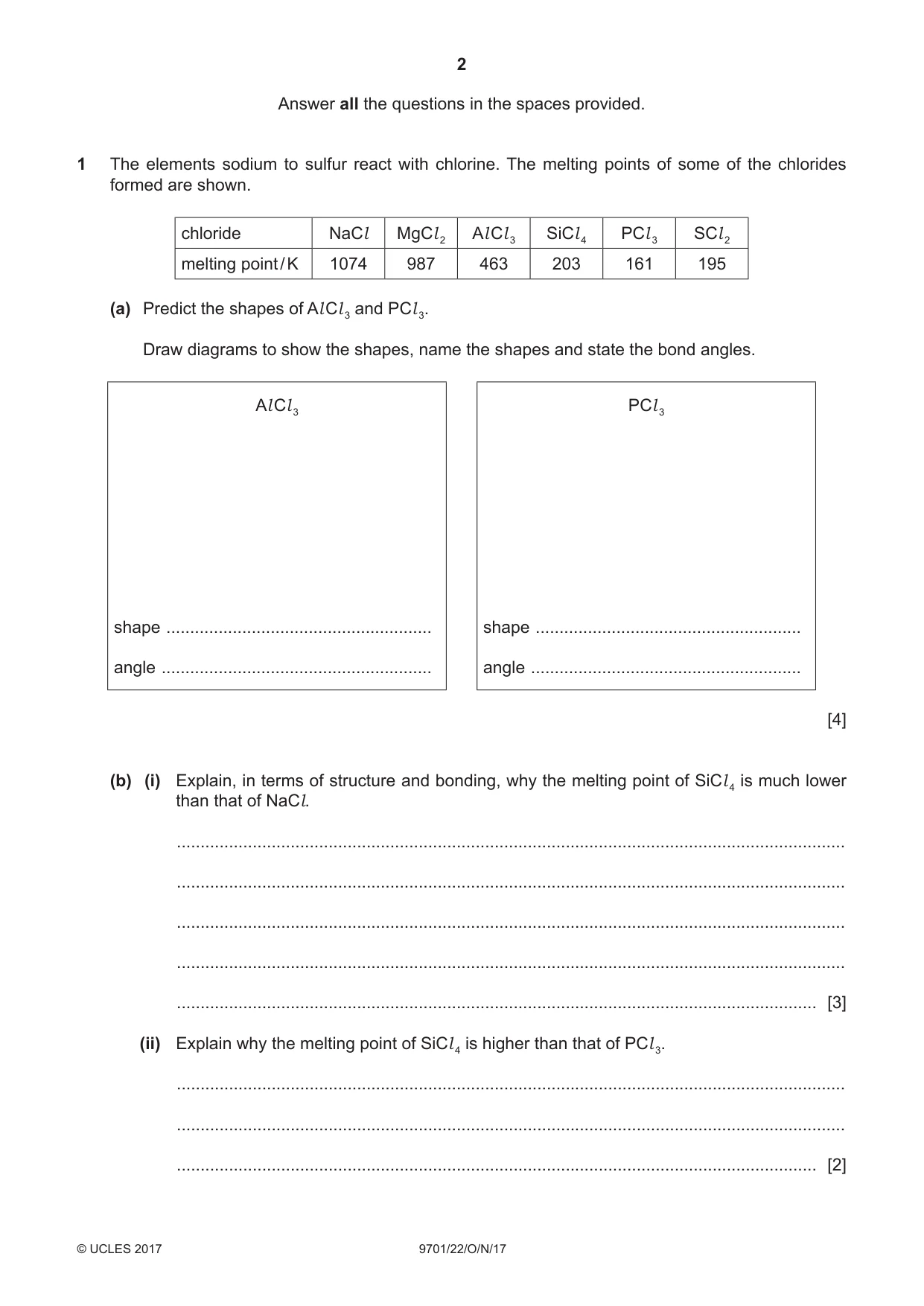
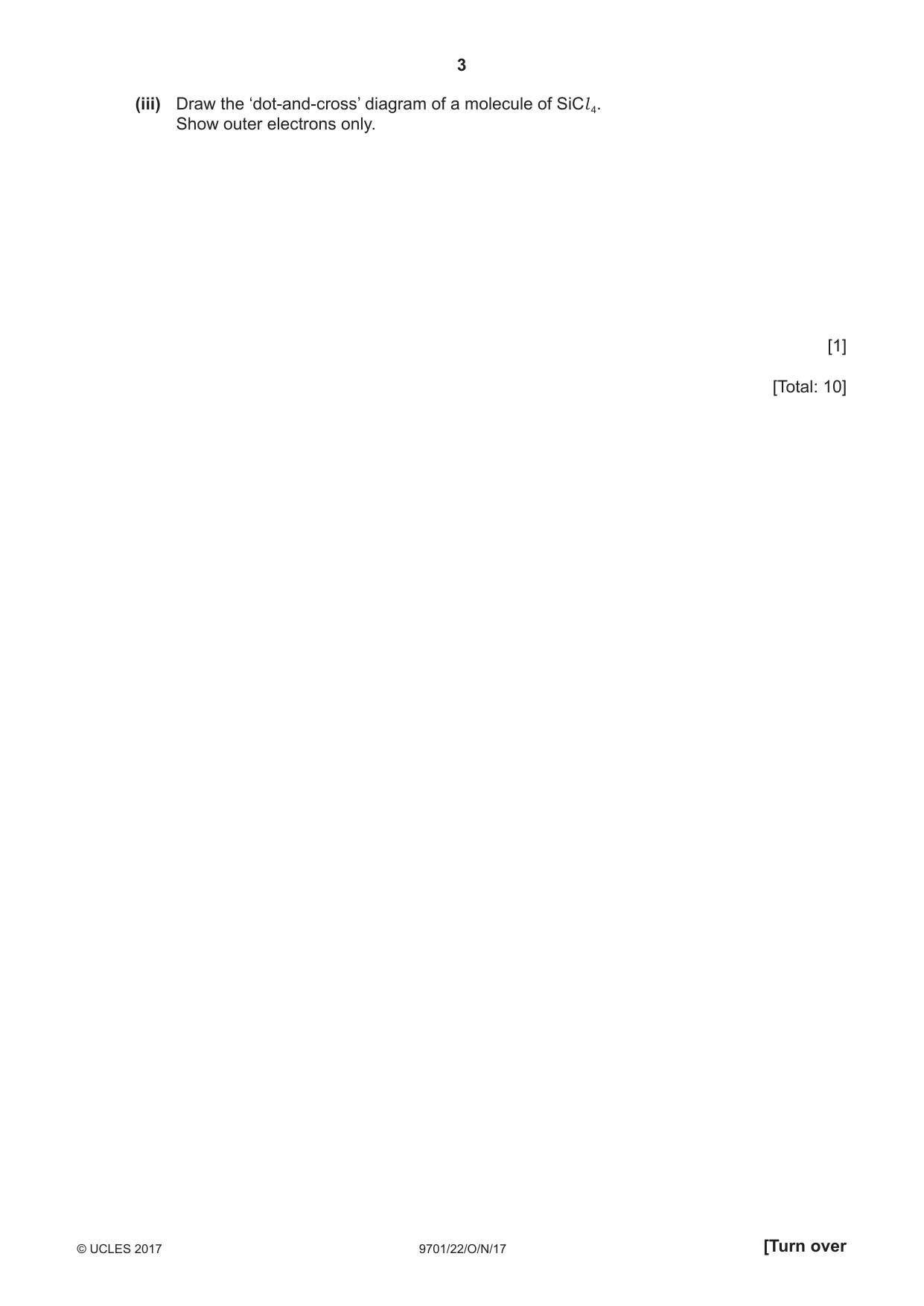
1 The elements sodium to sulfur react with chlorine. The melting points of some of the chlorides formed are shown. chloride NaCl MgCl 2 Al Cl 3 SiCl 4 PCl 3 SCl 2 melting point / K 1074 987 463 203 161 195 (a) Predict the shapes of Al Cl 3 and PCl 3. Draw diagrams to show the shapes, name the shapes and state the bond angles. Al Cl 3 PCl 3 shape ........................................................ shape ........................................................ angle ......................................................... angle ......................................................... [4] (b) (i) Explain, in terms of structure and bonding, why the melting point of SiCl 4 is much lower than that of NaCl. ............................................................................................................................................. ............................................................................................................................................. ............................................................................................................................................. ............................................................................................................................................. ....................................................................................................................................... [3] (ii) Explain why the melting point of SiCl 4 is higher than that of PCl 3. ............................................................................................................................................. ............................................................................................................................................. ....................................................................................................................................... [2] (iii) Draw the ‘dot-and-cross’ diagram of a molecule of SiCl 4. Show outer electrons only. [1] [Total: 10]
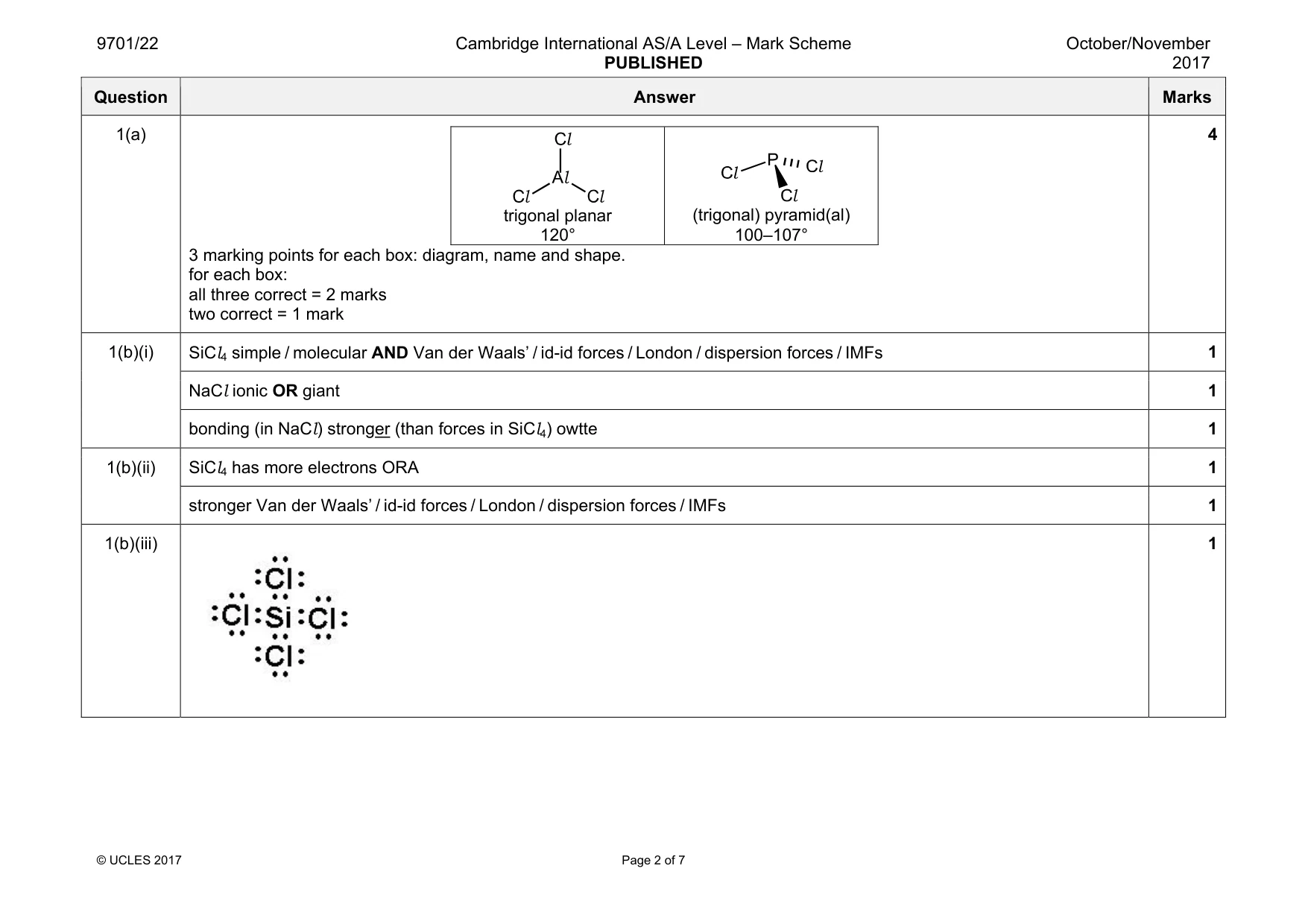
Mark scheme: 1(a) trigonal planar 120° (trigonal) pyramid(al) 100–107° 3 marking points for each box: diagram, name and shape. for each box: all three correct = 2 marks two correct = 1 mark 4 1(b)(i) SiCl4 simple / molecular AND Van der Waals’ / id-id forces / London / dispersion forces / IMFs 1 NaCl ionic OR giant 1 bonding (in NaCl) stronger (than forces in SiCl4) owtte 1 1(b)(ii) SiCl4 has more electrons ORA 1 stronger Van der Waals’ / id-id forces / London / dispersion forces / IMFs 1 1(b)(iii) 1
Q2 · At 450 K phosphorus(V) chloride, PCl 5(g), decomposes to form phosphorus(III) chloride…
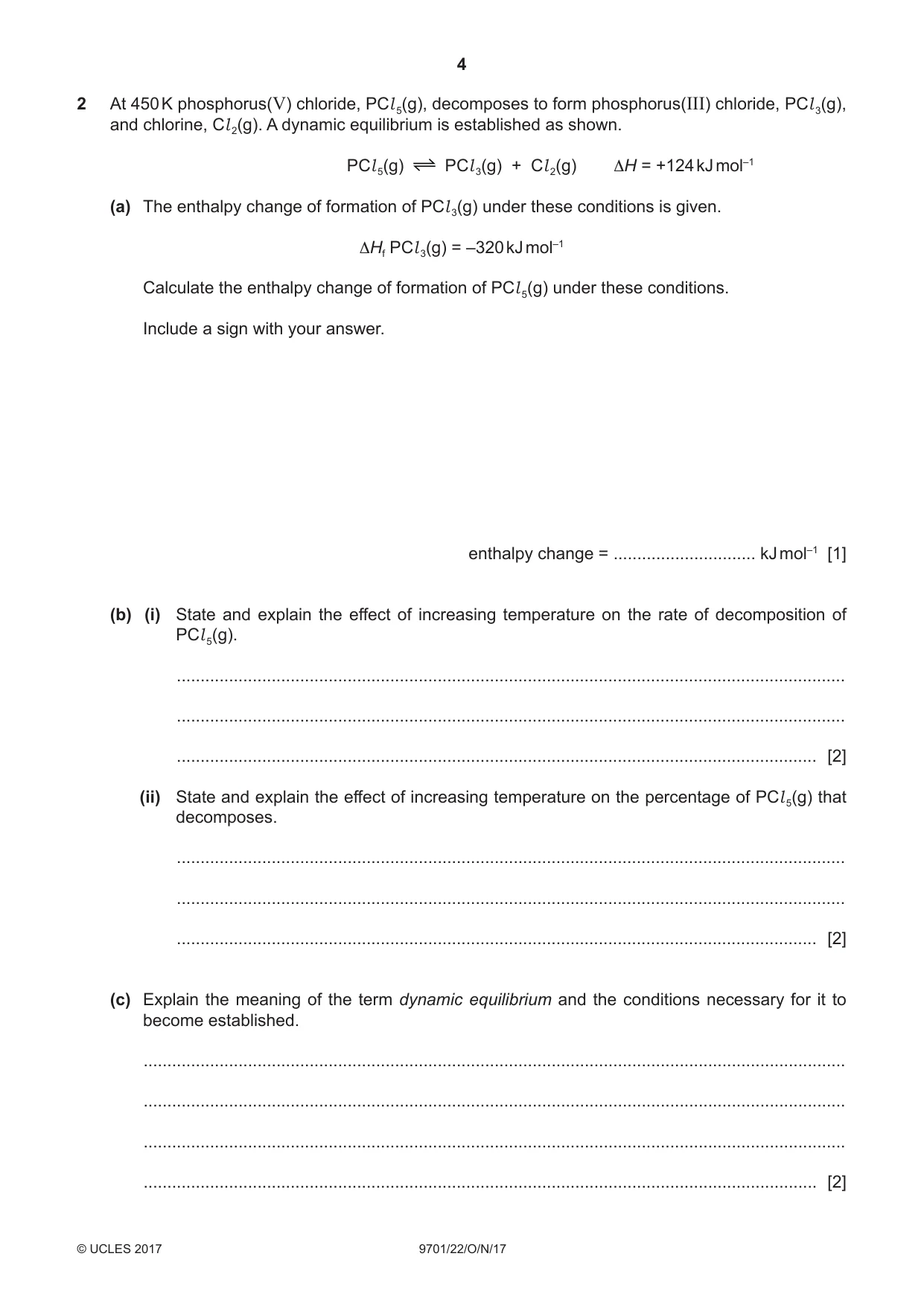
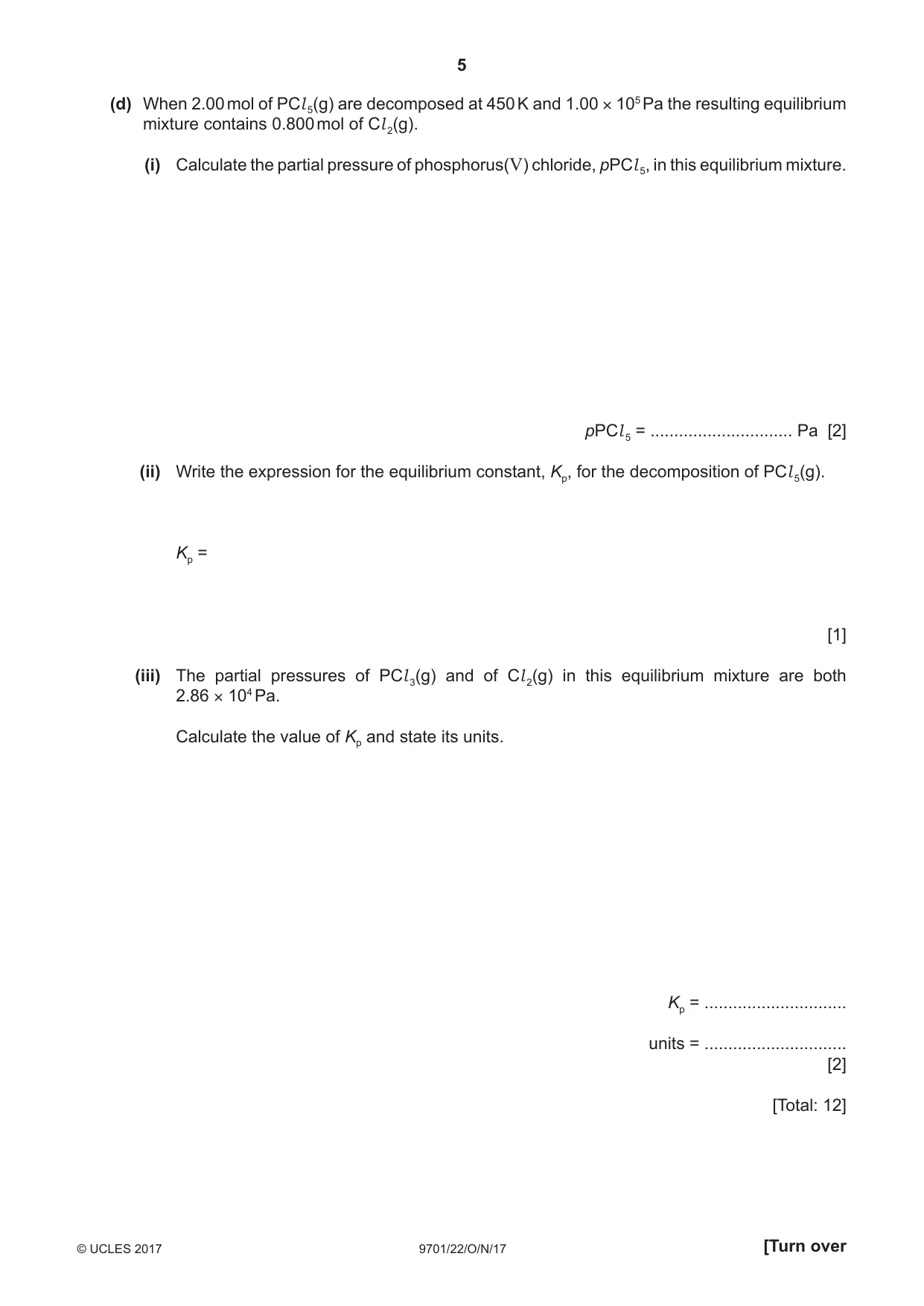
2 At 450 K phosphorus(V) chloride, PCl 5(g), decomposes to form phosphorus(III) chloride, PCl 3(g), and chlorine, Cl 2(g). A dynamic equilibrium is established as shown. PCl 5(g) PCl 3(g) + Cl 2(g) ΔH = +124 kJ mol–1 (a) The enthalpy change of formation of PCl 3(g) under these conditions is given. ΔHf PCl 3(g) = –320 kJ mol–1 Calculate the enthalpy change of formation of PCl 5(g) under these conditions. Include a sign with your answer. enthalpy change = .............................. kJ mol–1 [1] (b) (i) State and explain the effect of increasing temperature on the rate of decomposition of PCl 5(g). ............................................................................................................................................. ............................................................................................................................................. ....................................................................................................................................... [2] (ii) State and explain the effect of increasing temperature on the percentage of PCl 5(g) that decomposes. ............................................................................................................................................. ............................................................................................................................................. ....................................................................................................................................... [2] (c) Explain the meaning of the term dynamic equilibrium and the conditions necessary for it to become established. .................................................................................................................................................... .................................................................................................................................................... .................................................................................................................................................... .............................................................................................................................................. [2] (d) When 2.00 mol of PCl 5(g) are decomposed at 450 K and 1.00 × 10⁵ Pa the resulting equilibrium mixture contains 0.800 mol of Cl 2(g). (i) Calculate the partial pressure of phosphorus(V) chloride, pPCl 5, in this equilibrium mixture. pPCl 5 = .............................. Pa [2] (ii) Write the expression for the equilibrium constant, Kp, for the decomposition of PCl 5(g). Kp = [1] (iii) The partial pressures of PCl 3(g) and of Cl 2(g) in this equilibrium mixture are both 2.86 × 10⁴ Pa. Calculate the value of Kp and state its units. Kp = .............................. units = .............................. [2] [Total: 12]
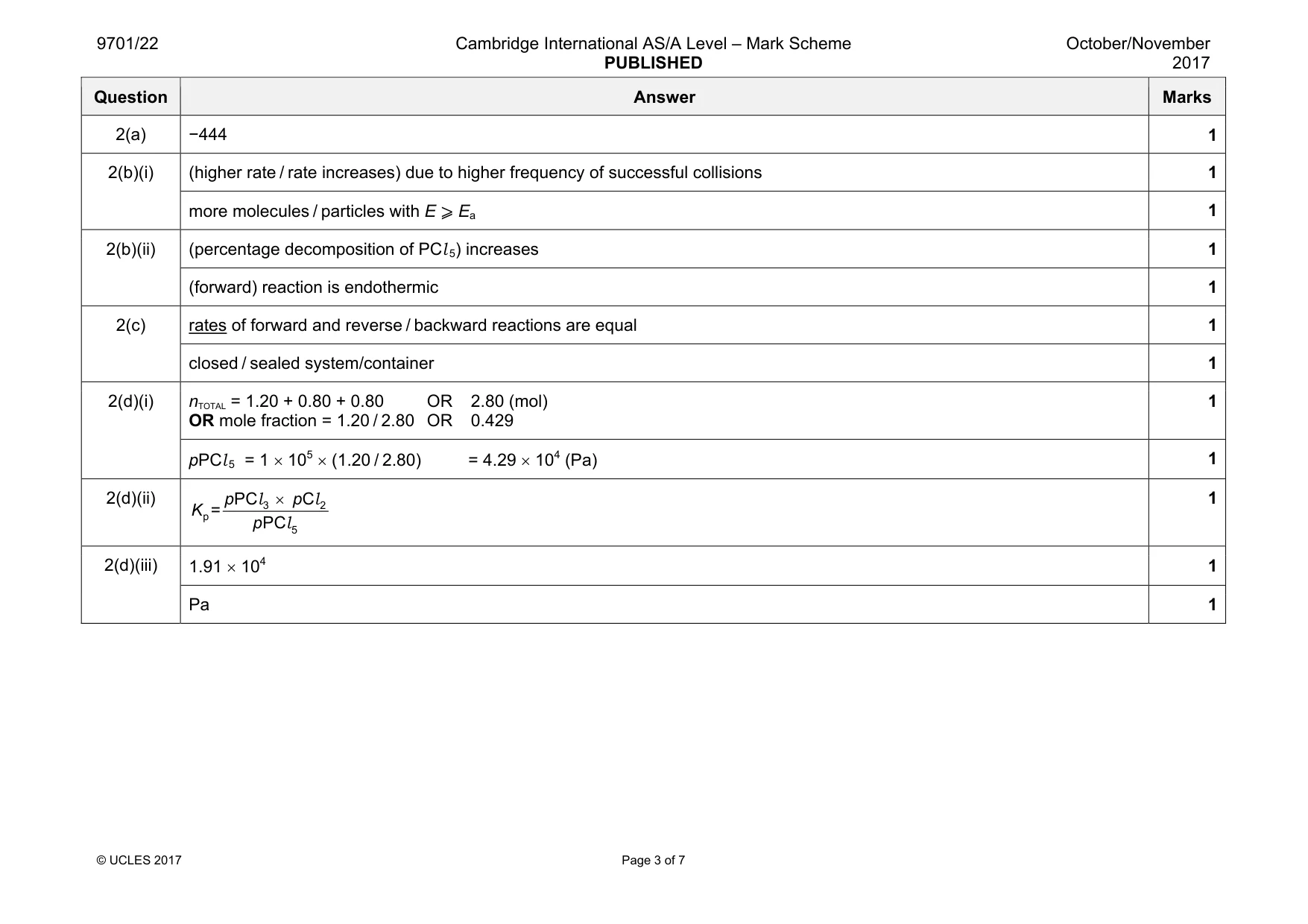
Mark scheme: 2(a) −444 1 2(b)(i) (higher rate / rate increases) due to higher frequency of successful collisions 1 more molecules / particles with E ⩾ Ea 1 2(b)(ii) (percentage decomposition of PCl 5) increases 1 (forward) reaction is endothermic 1 2(c) rates of forward and reverse / backward reactions are equal 1 closed / sealed system/container 1 2(d)(i) nTOTAL = 1.20 + 0.80 + 0.80 OR 2.80 (mol) OR mole fraction = 1.20 / 2.80 OR 0.429 1 pPCl 5 = 1 × 105 × (1.20 / 2.80) = 4.29 × 10⁴ (Pa) 1 2(d)(ii) 3 2 p 5 PC C = PC p p K p × l l l 1 2(d)(iii) 1.91 × 10⁴ 1 Pa 1
More questions on Chemical equilibria: reversible reactions, dynamic equilibrium
Q3 · The elements in Group 2 show trends in their properties that are typical of metals
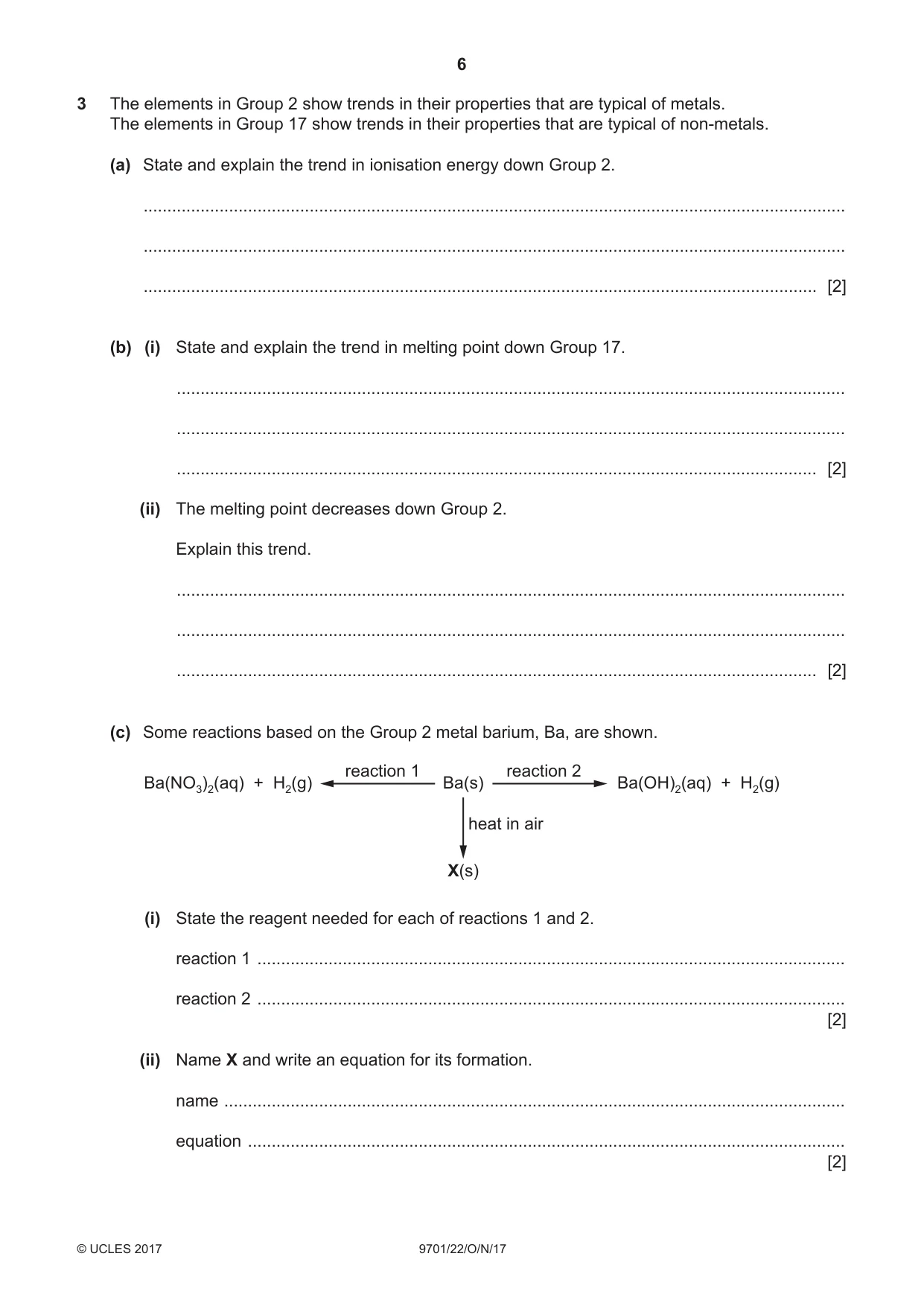
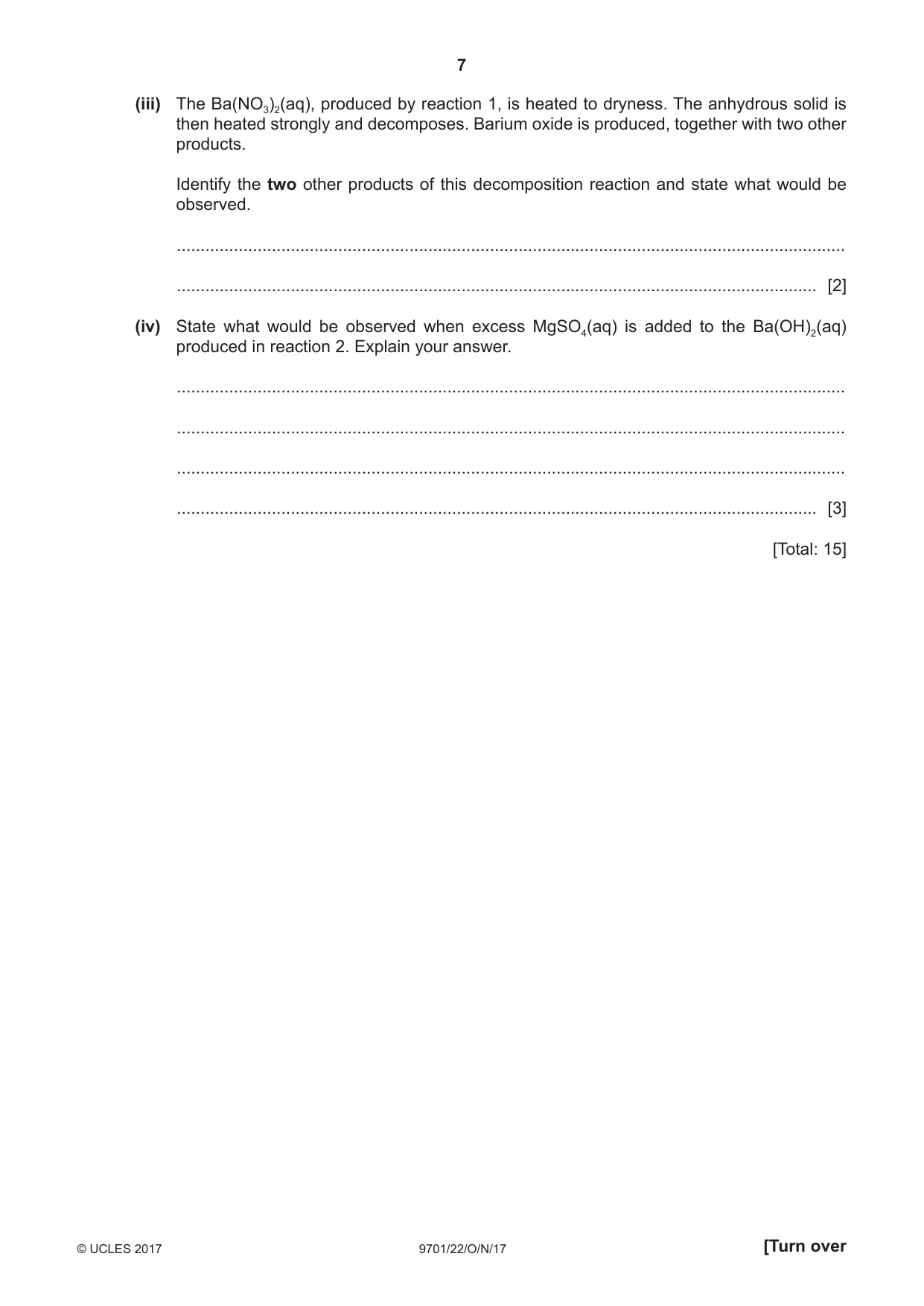
3 The elements in Group 2 show trends in their properties that are typical of metals. The elements in Group 17 show trends in their properties that are typical of non-metals. (a) State and explain the trend in ionisation energy down Group 2. .................................................................................................................................................... .................................................................................................................................................... .............................................................................................................................................. [2] (b) (i) State and explain the trend in melting point down Group 17. ............................................................................................................................................. ............................................................................................................................................. ....................................................................................................................................... [2] (ii) The melting point decreases down Group 2. Explain this trend. ............................................................................................................................................. ............................................................................................................................................. ....................................................................................................................................... [2] (c) Some reactions based on the Group 2 metal barium, Ba, are shown. reaction 1 reaction 2 Ba(NO3)2(aq) + H2(g) Ba(s) Ba(OH)2(aq) + H2(g) heat in air X(s) (i) State the reagent needed for each of reactions 1 and 2. reaction 1 ............................................................................................................................ reaction 2 ............................................................................................................................ [2] (ii) Name X and write an equation for its formation. name ................................................................................................................................... equation .............................................................................................................................. [2] (iii) The Ba(NO3)2(aq), produced by reaction 1, is heated to dryness. The anhydrous solid is then heated strongly and decomposes. Barium oxide is produced, together with two other products. Identify the two other products of this decomposition reaction and state what would be observed. ............................................................................................................................................. ....................................................................................................................................... [2] (iv) State what would be observed when excess MgSO4(aq) is added to the Ba(OH)2(aq) produced in reaction 2. Explain your answer. ............................................................................................................................................. ............................................................................................................................................. ............................................................................................................................................. ....................................................................................................................................... [3] [Total: 15]
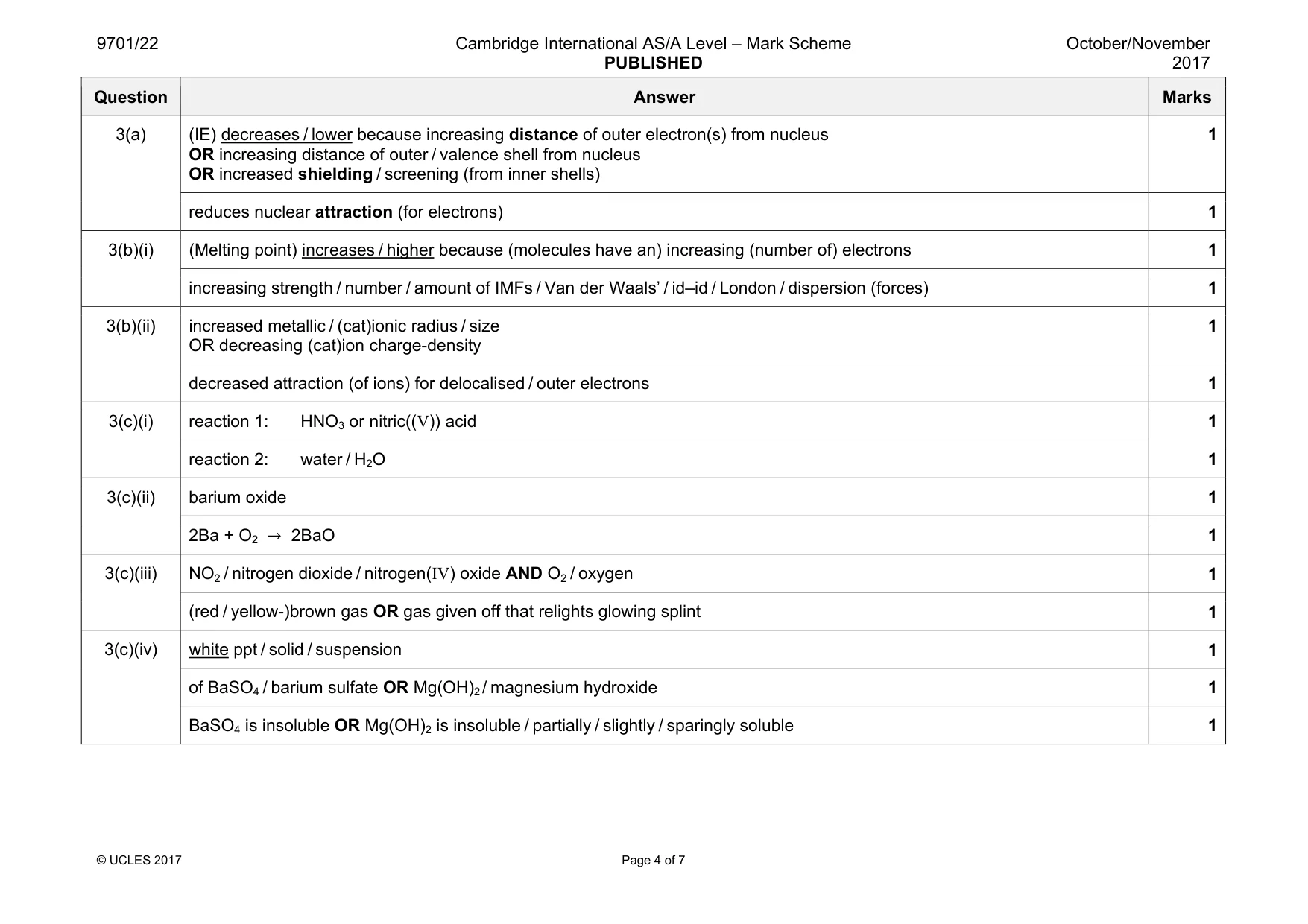
Mark scheme: 3(a) (IE) decreases / lower because increasing distance of outer electron(s) from nucleus OR increasing distance of outer / valence shell from nucleus OR increased shielding / screening (from inner shells) 1 reduces nuclear attraction (for electrons) 1 3(b)(i) (Melting point) increases / higher because (molecules have an) increasing (number of) electrons 1 increasing strength / number / amount of IMFs / Van der Waals’ / id–id / London / dispersion (forces) 1 3(b)(ii) increased metallic / (cat)ionic radius / size OR decreasing (cat)ion charge-density 1 decreased attraction (of ions) for delocalised / outer electrons 1 3(c)(i) reaction 1: HNO3 or nitric((V)) acid 1 reaction 2: water / H2O 1 3(c)(ii) barium oxide 1 2Ba + O2 → 2BaO 1 3(c)(iii) NO2 / nitrogen dioxide / nitrogen(IV) oxide AND O2 / oxygen 1 (red / yellow-)brown gas OR gas given off that relights glowing splint 1 3(c)(iv) white ppt / solid / suspension 1 of BaSO4 / barium sulfate OR Mg(OH)2/ magnesium hydroxide 1 BaSO4 is insoluble OR Mg(OH)2 is insoluble / partially / slightly / sparingly soluble 1
Q4 · Some reactions are shown, based on methylpropan-2-ol, (CH3)3COH
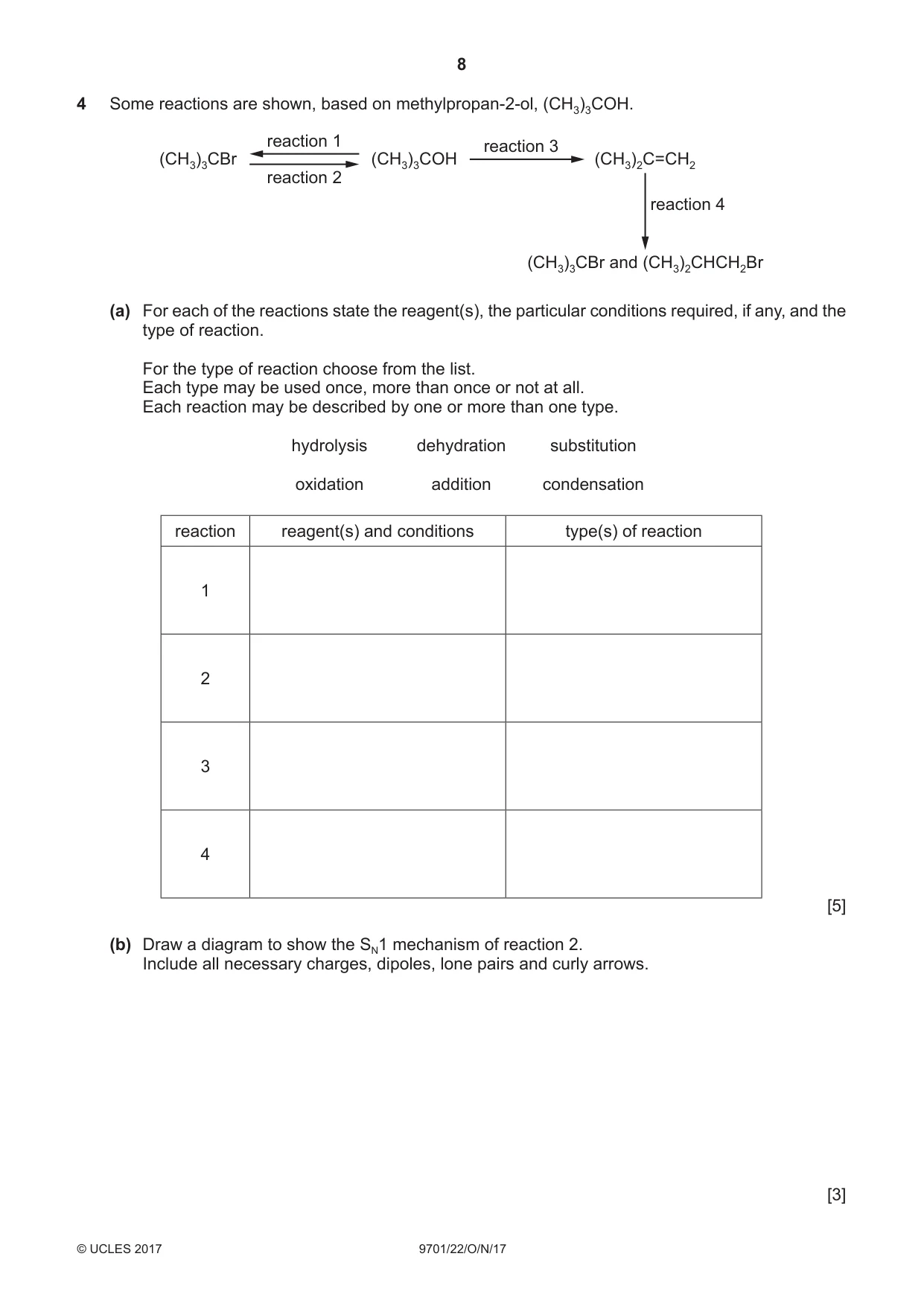
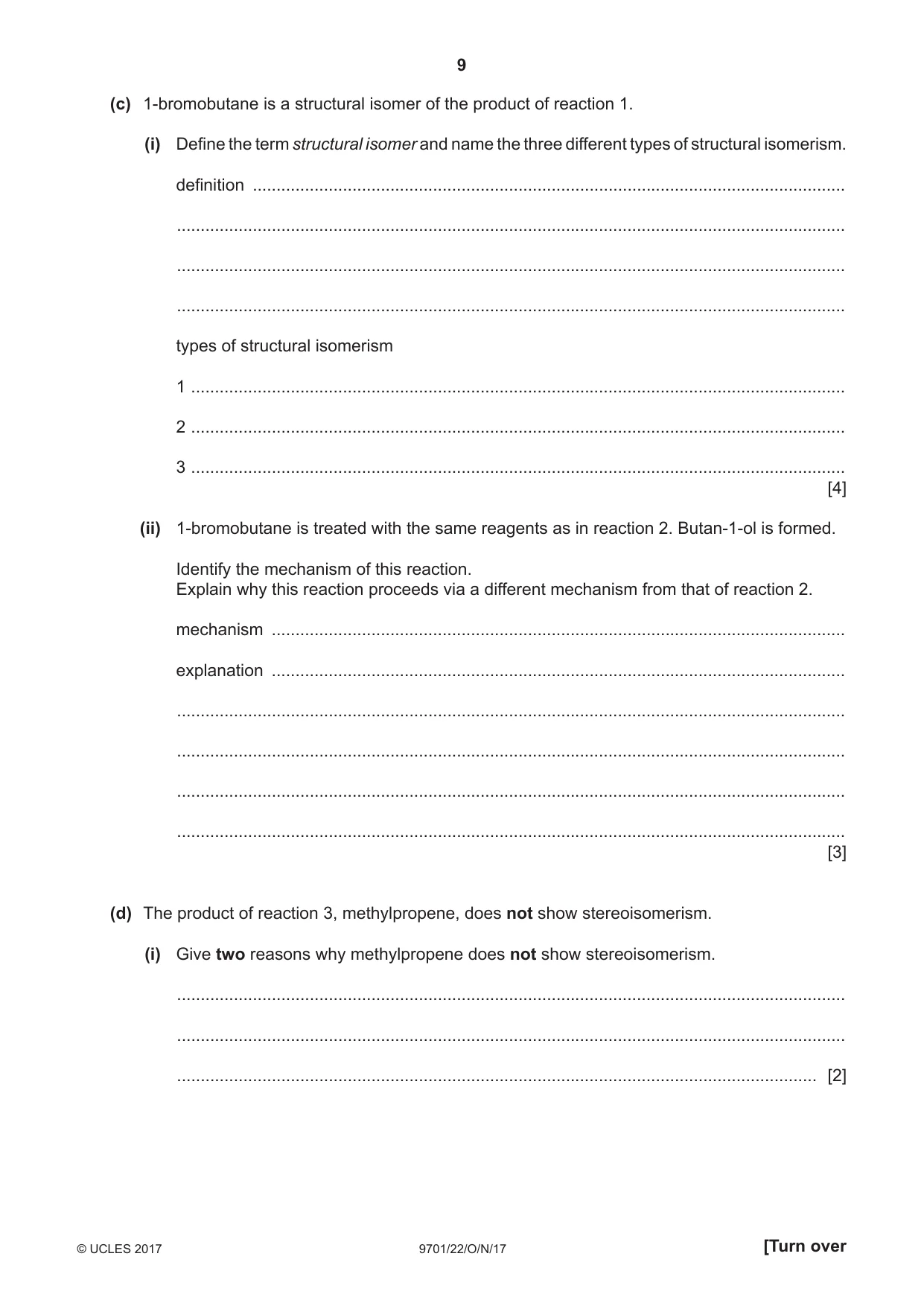
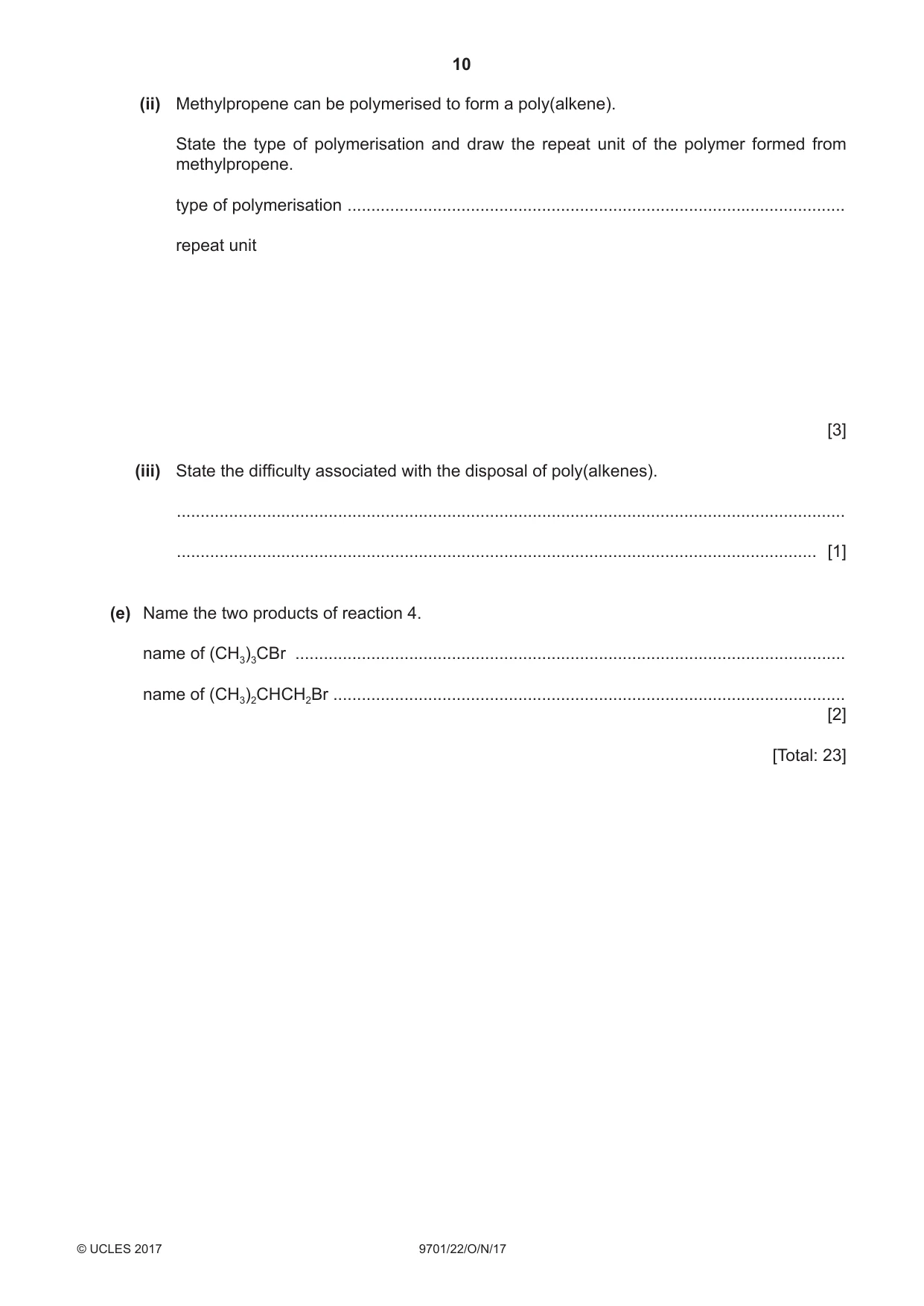
4 Some reactions are shown, based on methylpropan-2-ol, (CH3)3COH. reaction 1 reaction 3 (CH3)3CBr (CH3)3COH (CH3)2C=CH2 reaction 2 reaction 4 (CH3)3CBr and (CH3)2CHCH2Br (a) For each of the reactions state the reagent(s), the particular conditions required, if any, and the type of reaction. For the type of reaction choose from the list. Each type may be used once, more than once or not at all. Each reaction may be described by one or more than one type. hydrolysis dehydration substitution oxidation addition condensation reaction reagent(s) and conditions type(s) of reaction 1 2 3 4 [5] (b) Draw a diagram to show the SN1 mechanism of reaction 2. Include all necessary charges, dipoles, lone pairs and curly arrows. [3] (c) 1-bromobutane is a structural isomer of the product of reaction 1. (i) Define the term structural isomer and name the three different types of structural isomerism. definition .............................................................................................................................. ............................................................................................................................................. ............................................................................................................................................. ............................................................................................................................................. types of structural isomerism 1 .......................................................................................................................................... 2 .......................................................................................................................................... 3 .......................................................................................................................................... [4] (ii) 1-bromobutane is treated with the same reagents as in reaction 2. Butan-1-ol is formed. Identify the mechanism of this reaction. Explain why this reaction proceeds via a different mechanism from that of reaction 2. mechanism .......................................................................................................................... explanation .......................................................................................................................... ............................................................................................................................................. ............................................................................................................................................. ............................................................................................................................................. ............................................................................................................................................. [3] (d) The product of reaction 3, methylpropene, does not show stereoisomerism. (i) Give two reasons why methylpropene does not show stereoisomerism. ............................................................................................................................................. ............................................................................................................................................. ....................................................................................................................................... [2] (ii) Methylpropene can be polymerised to form a poly(alkene). State the type of polymerisation and draw the repeat unit of the polymer formed from methylpropene. type of polymerisation ......................................................................................................... repeat unit [3] (iii) State the difficulty associated with the disposal of poly(alkenes). ............................................................................................................................................. ....................................................................................................................................... [1] (e) Name the two products of reaction 4. name of (CH3)3CBr ..................................................................................................................... name of (CH3)2CHCH2Br ............................................................................................................ [2] [Total: 23]
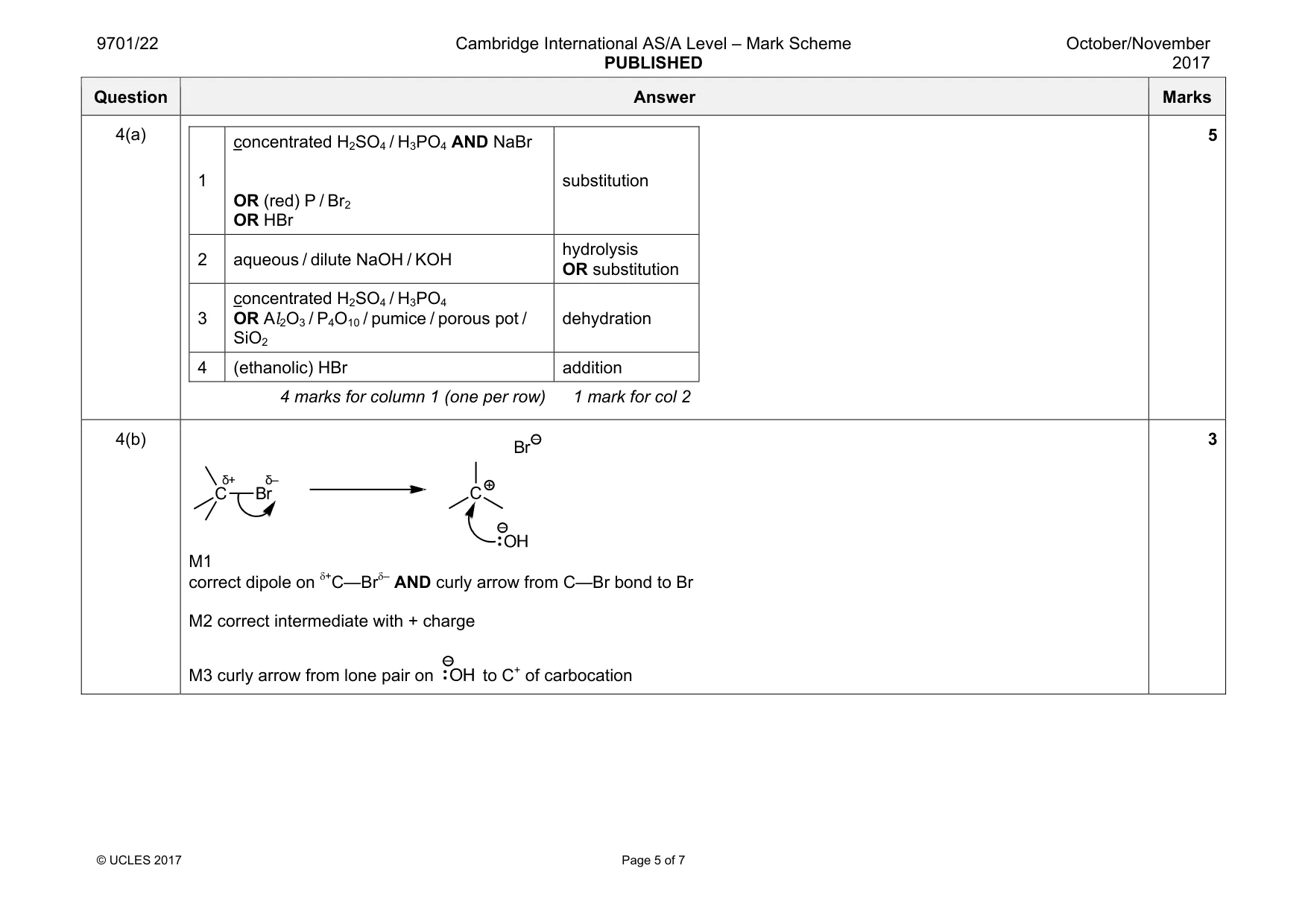
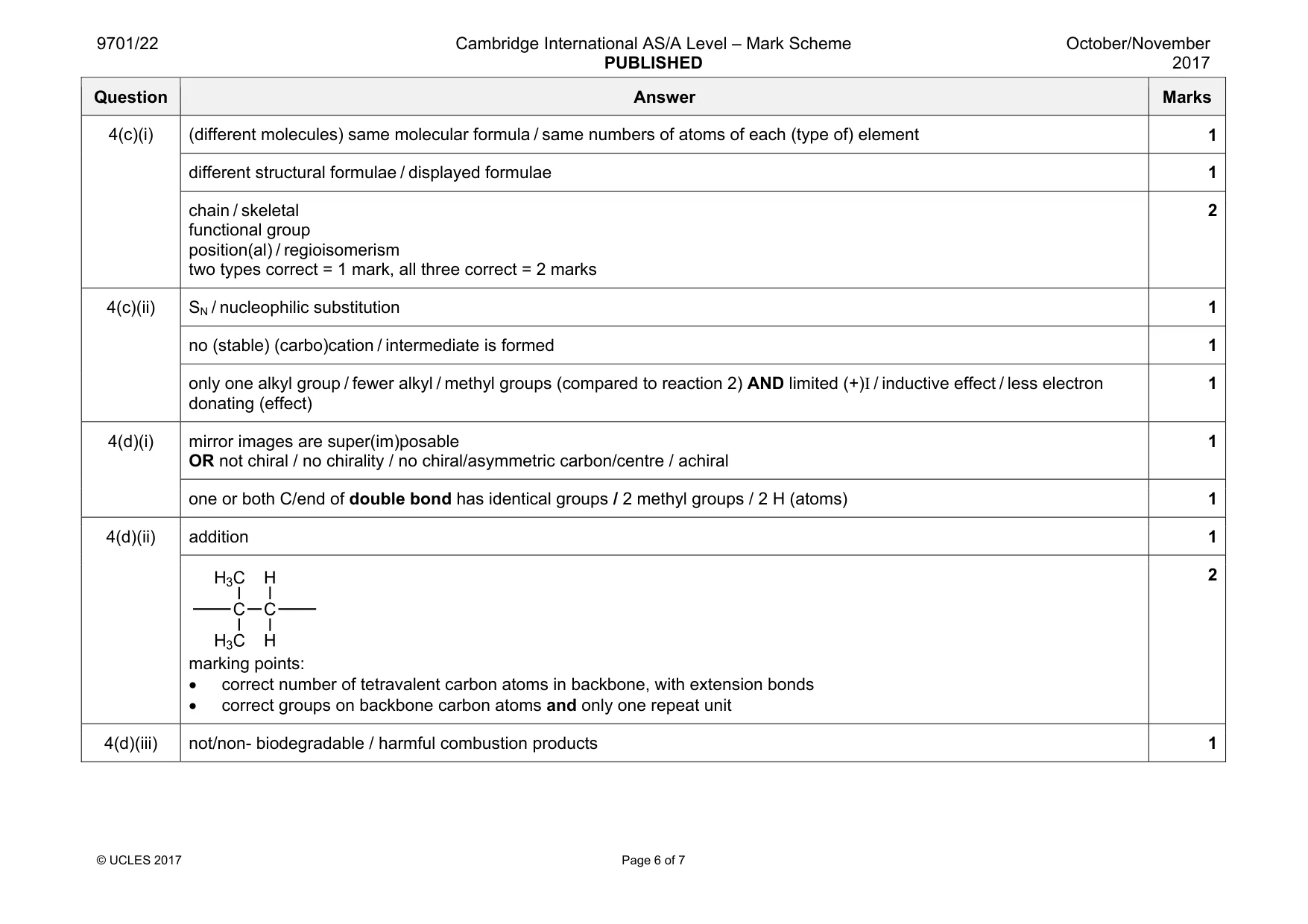
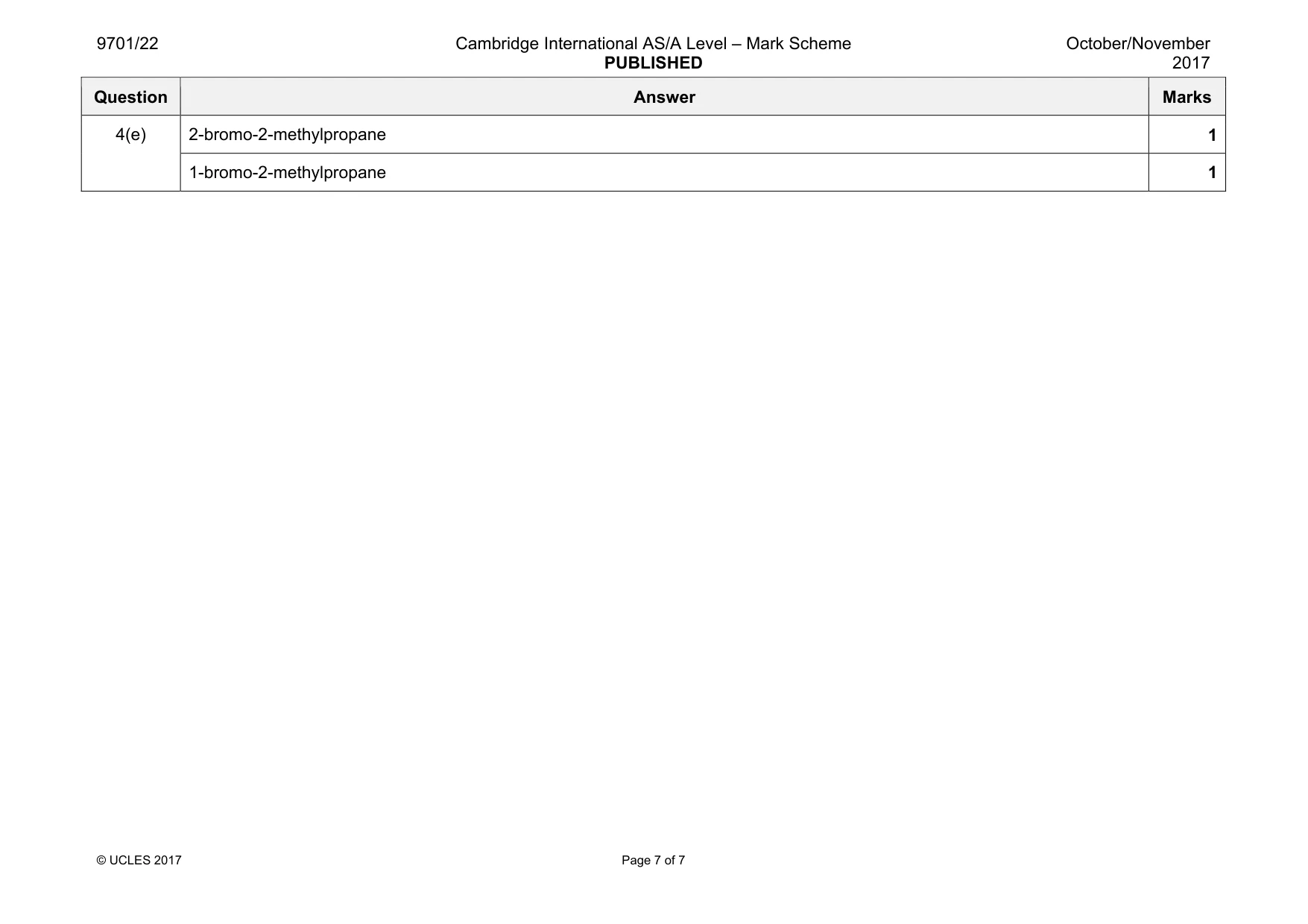
Mark scheme: 4(a) 1 concentrated H2SO4 / H3PO4 AND NaBr OR (red) P / Br2 OR HBr substitution 2 aqueous / dilute NaOH / KOH hydrolysis OR substitution 3 concentrated H2SO4 / H3PO4 OR Al2O3 / P4O10 / pumice / porous pot / SiO2 dehydration 4 (ethanolic) HBr addition 4 marks for column 1 (one per row) 1 mark for col 2 5 4(b) M1 correct dipole on δ+C—Brδ– AND curly arrow from C—Br bond to Br M2 correct intermediate with + charge M3 curly arrow from lone pair on to C+ of carbocation 3 Question Answer Marks 4(c)(i) (different molecules) same molecular formula / same numbers of atoms of each (type of) element 1 different structural formulae / displayed formulae 1 chain / skeletal functional group position(al) / regioisomerism two types correct = 1 mark, all three correct = 2 marks 2 4(c)(ii) SN / nucleophilic substitution 1 no (stable) (carbo)cation / intermediate is formed 1 only one alkyl group / fewer alkyl / methyl groups (compared to reaction 2) AND limited (+)I / inductive effect / less electron donating (effect) 1 4(d)(i) mirror images are super(im)posable OR not chiral / no chirality / no chiral/asymmetric carbon/centre / achiral 1 one or both C/end of double bond has identical groups / 2 methyl groups / 2 H (atoms) 1 4(d)(ii) addition 1 marking points: • correct number of tetravalent carbon atoms in backbone, with extension bonds • correct groups on backbone carbon atoms and only one repeat unit 2 4(d)(iii) not/non- biodegradable / harmful combustion products 1 Question Answer Marks 4(e) 2-bromo-2-methylpropane 1 1-bromo-2-methylpropane 1
What was in this paper
The subtopics covered by these 4 questions, and how many questions each got. Open one in a new tab to see every Cambridge question on it.
What you needed in this session
Cambridge’s own grade thresholds for 2017 Oct/Nov, Paper 2 · Variant 2. A higher threshold means an easier paper — the bar moves with how the cohort did.