Cambridge A Level Chemistry 9701 — 2017 Oct/Nov Paper 2 · Variant 3
9701/23/O/N/17 · 3 questions · 60 marks · ≈68 min
The question paper and its mark scheme, free to read here and free to download. This is Cambridge’s own paper, exactly as it was sat.
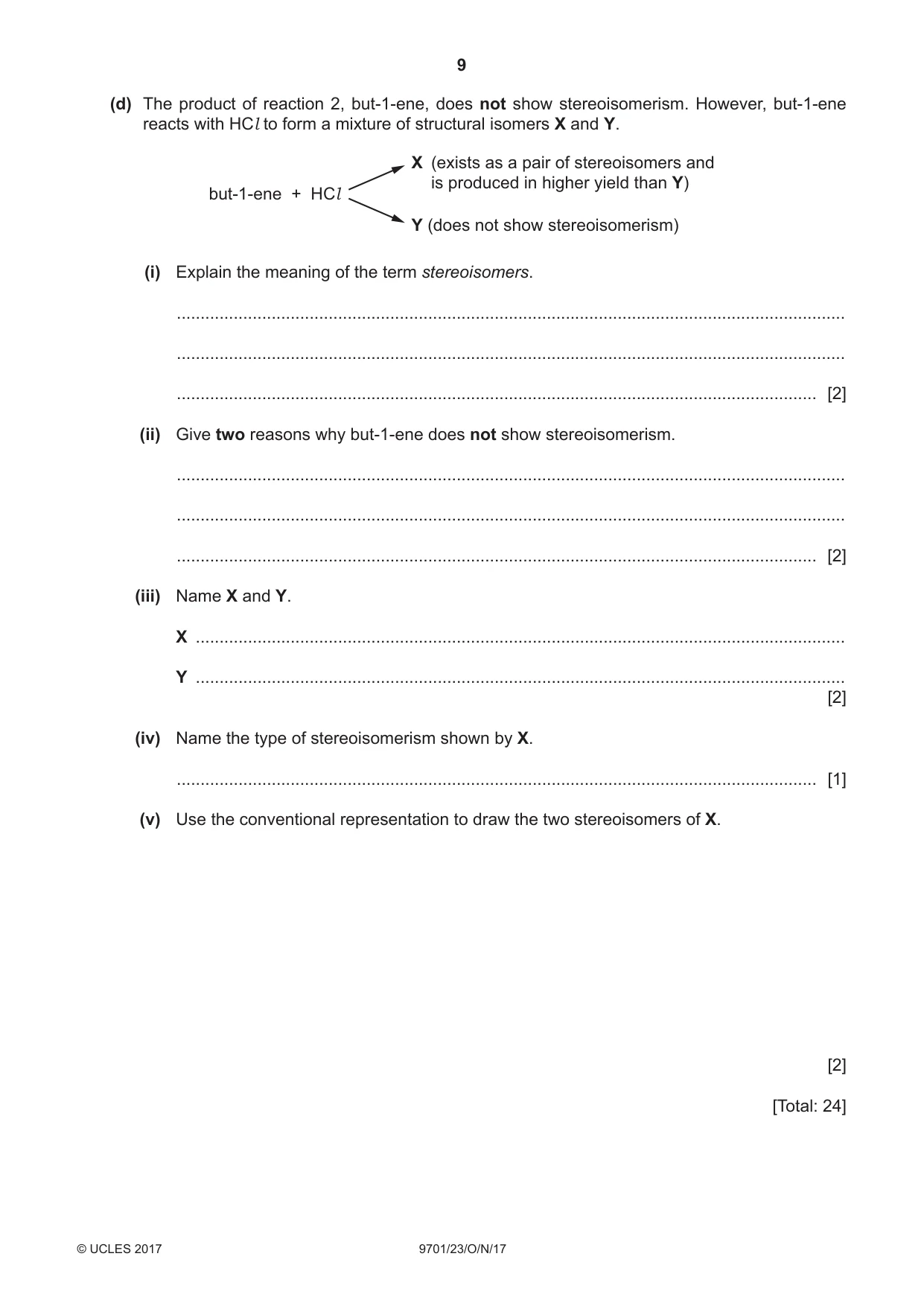
Question paper12 pages
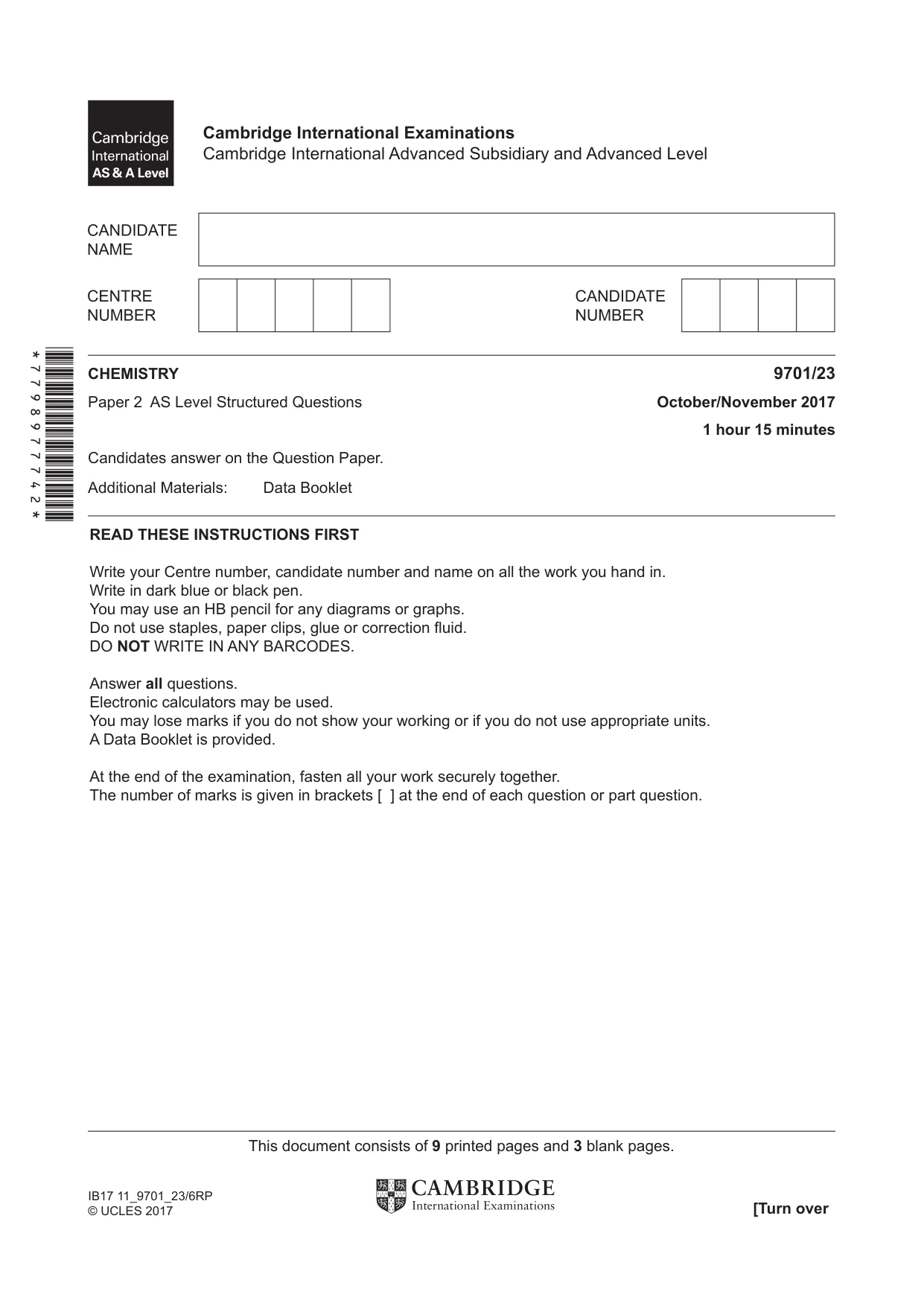
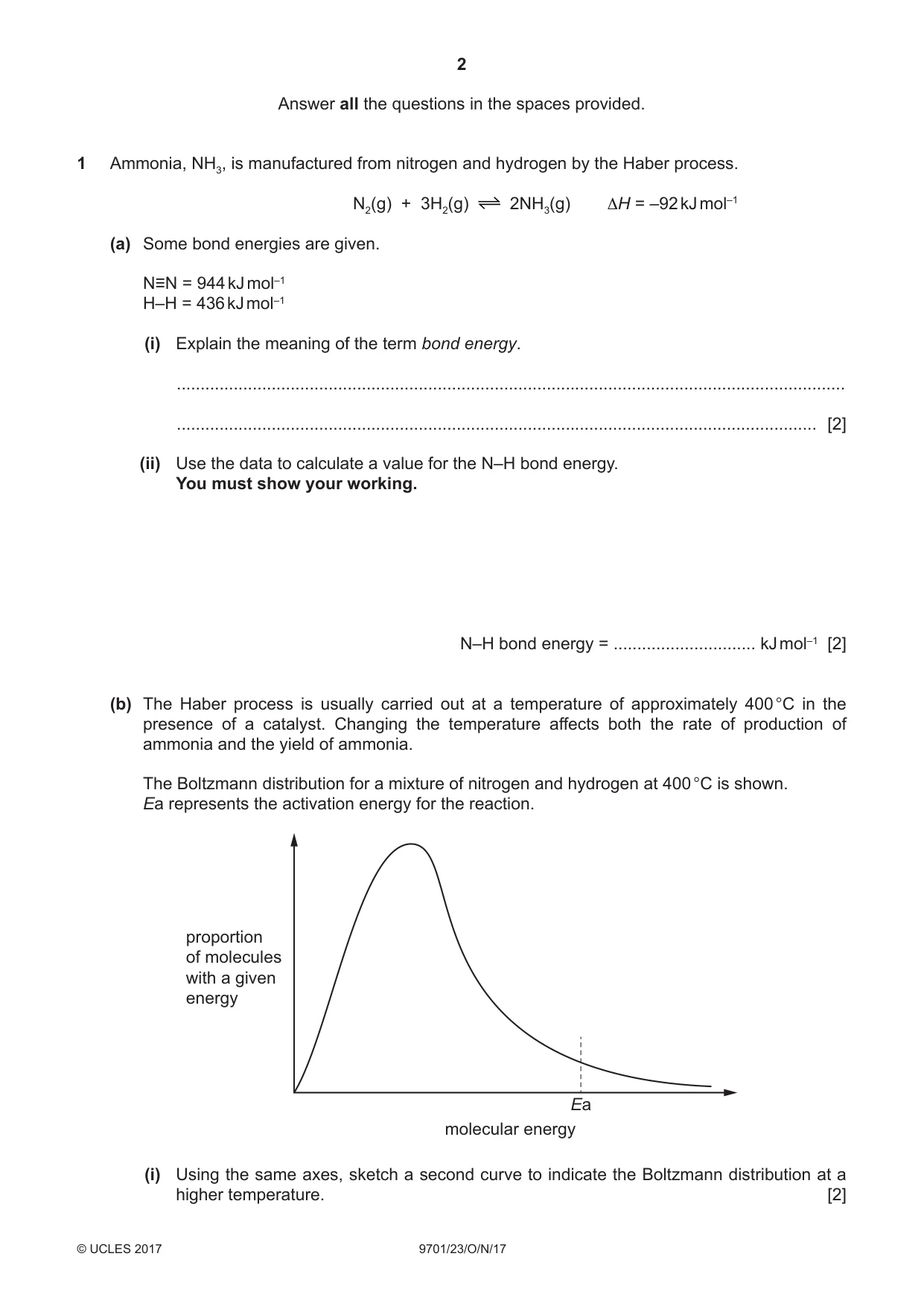
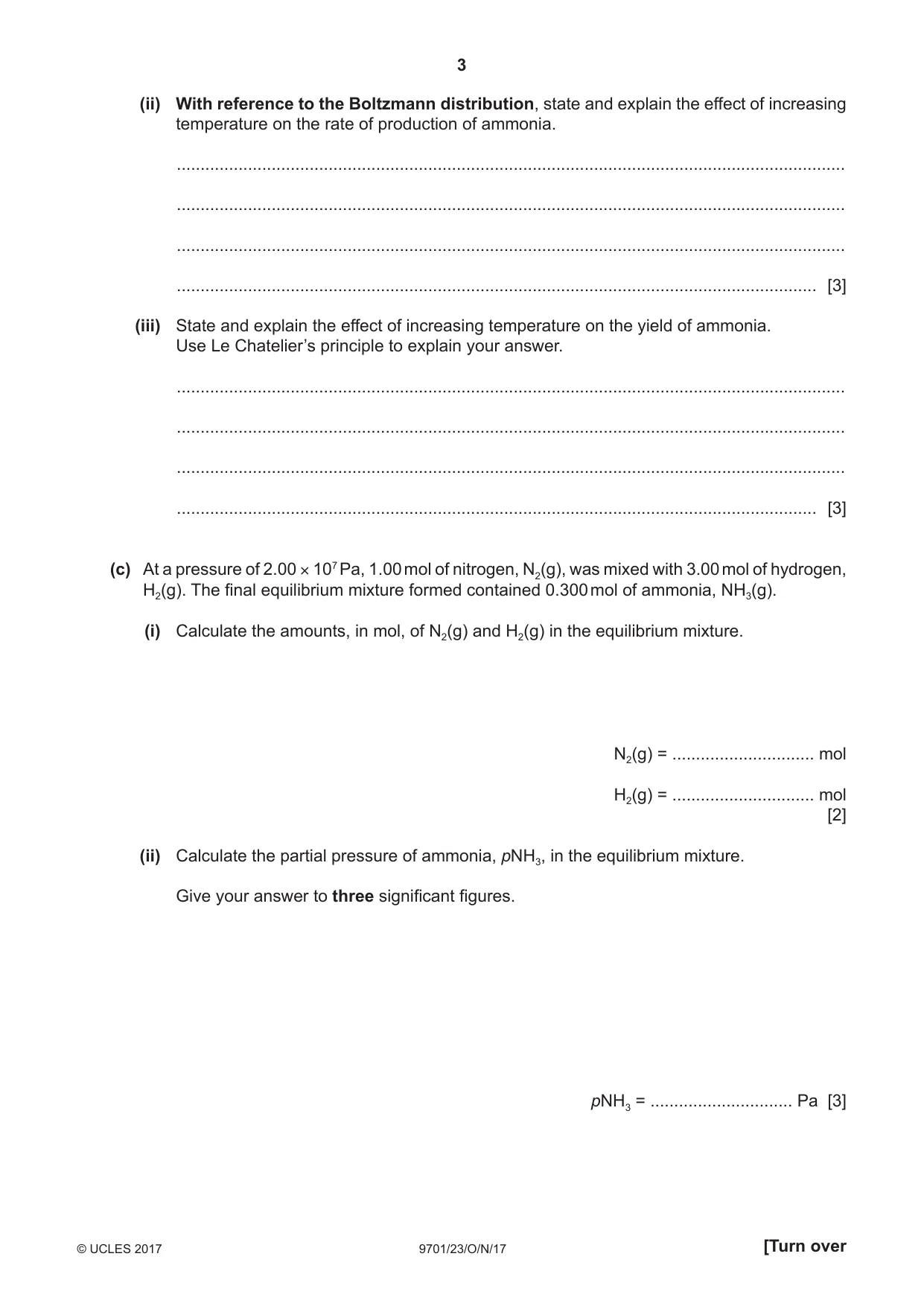
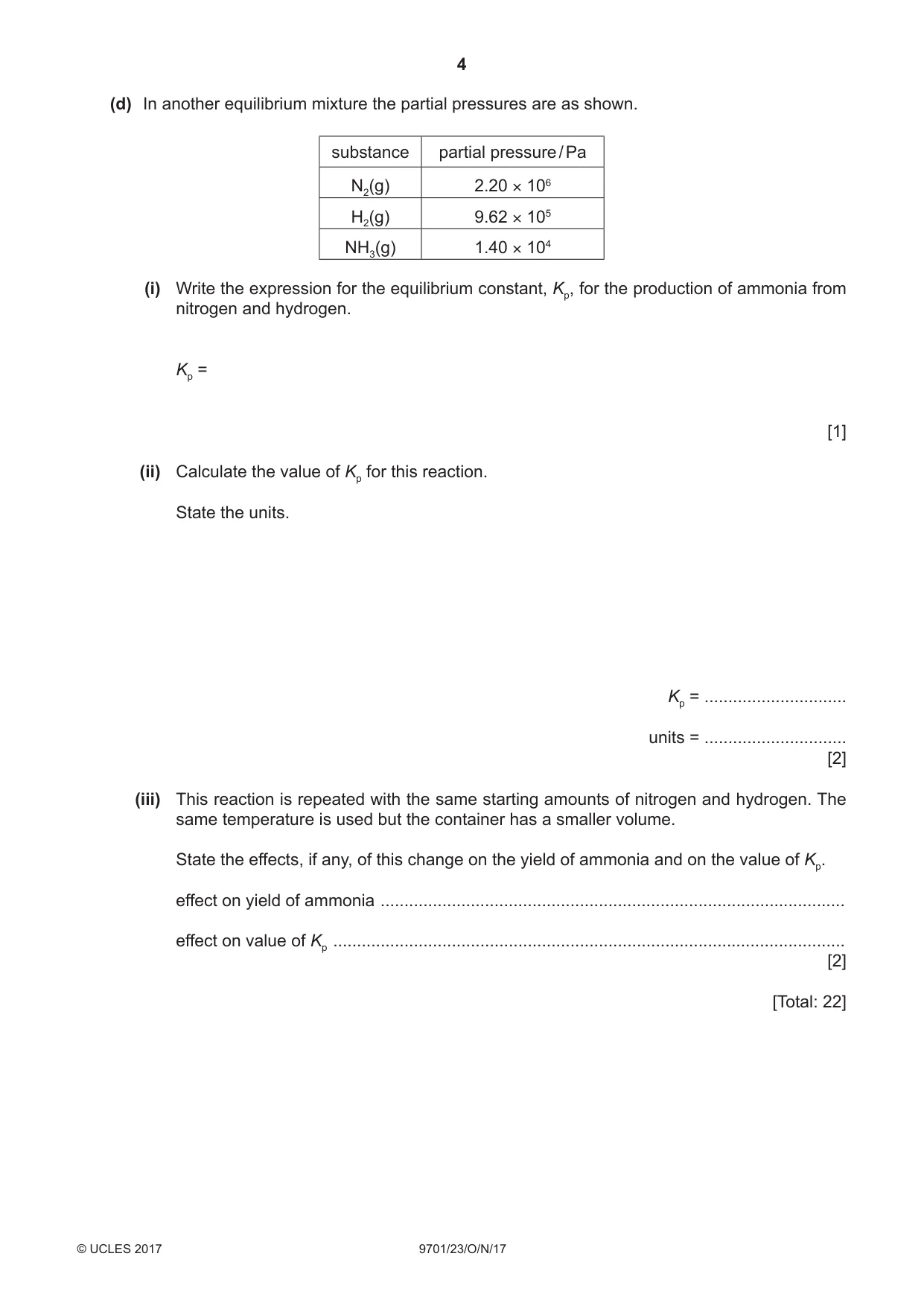


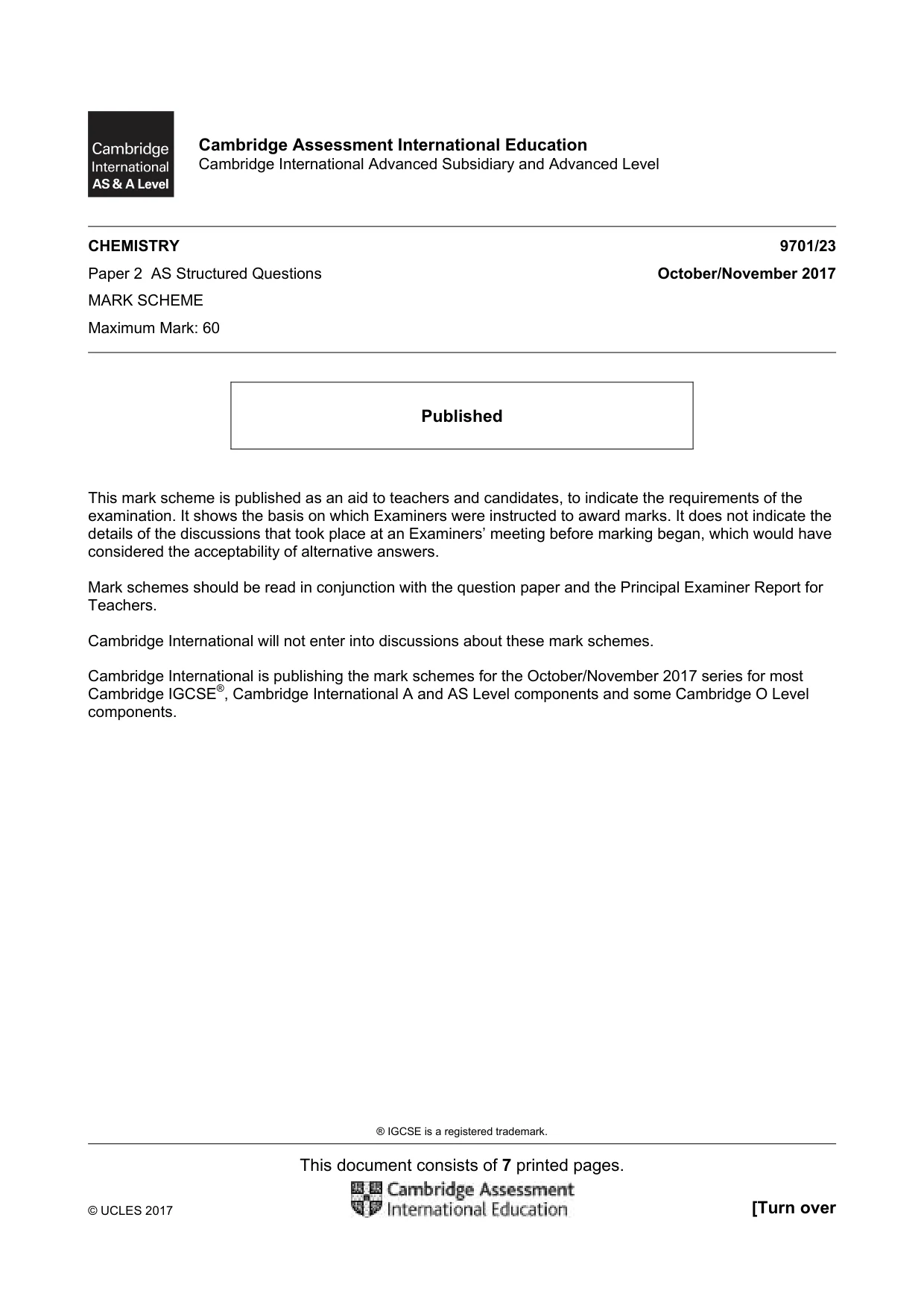
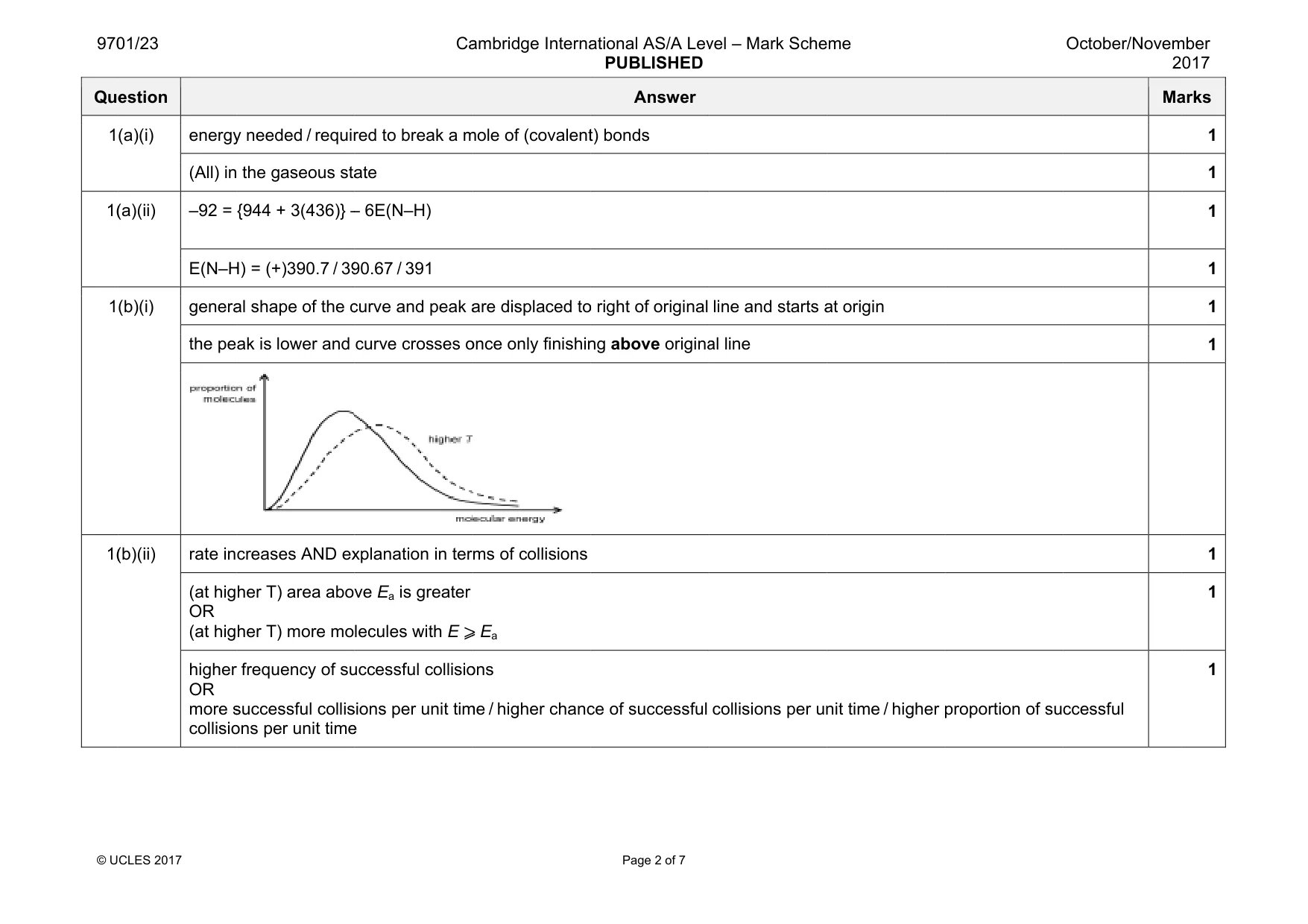
Mark scheme7 pages
Answers below. Sit the paper first if you are practising.
Questions as text
Q1 · Ammonia, NH3, is manufactured from nitrogen and hydrogen by the Haber process
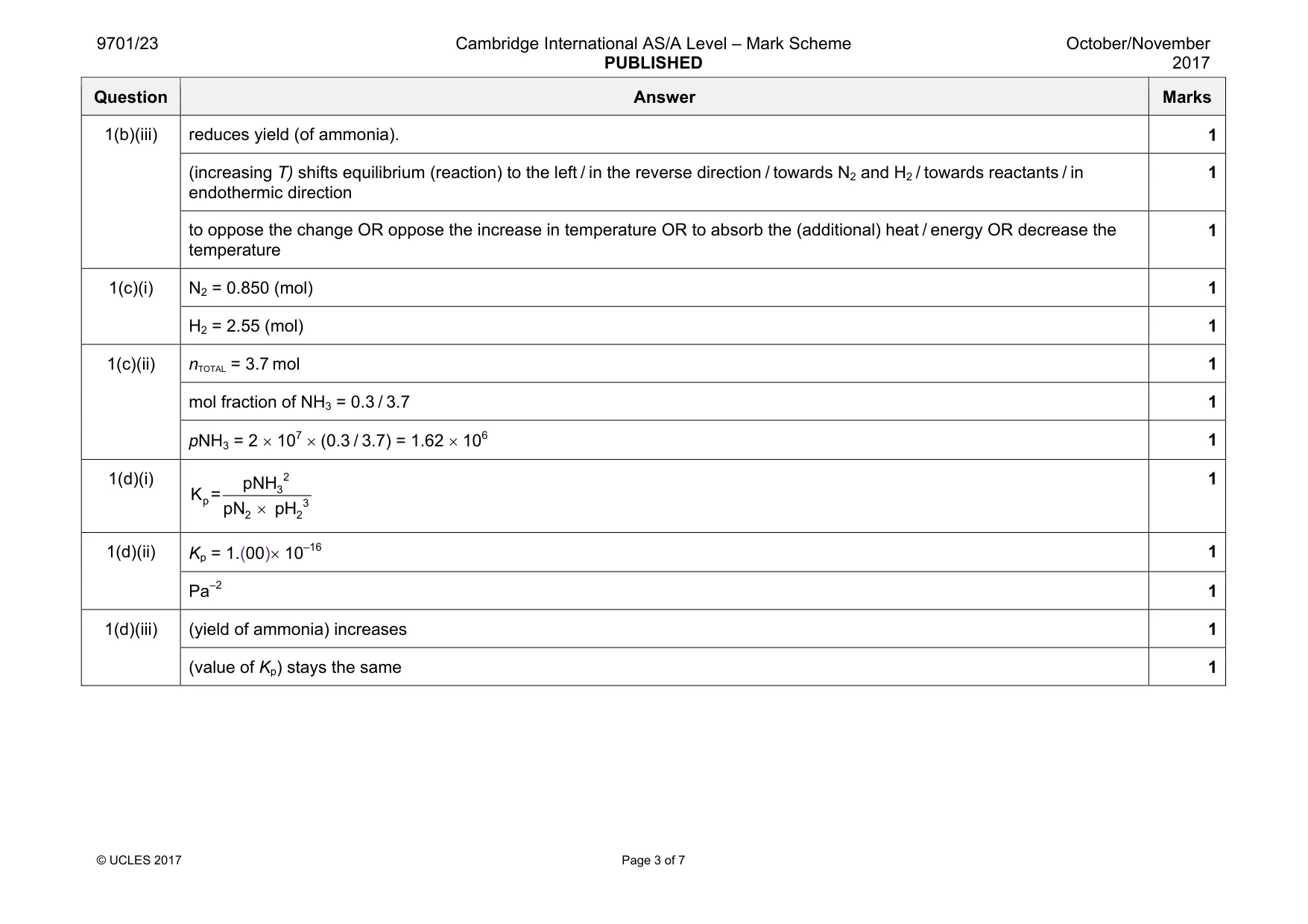
1 Ammonia, NH3, is manufactured from nitrogen and hydrogen by the Haber process. N2(g) + 3H2(g) 2NH3(g) ΔH = –92 kJ mol–1 (a) Some bond energies are given. N≡N = 944 kJ mol–1 H–H = 436 kJ mol–1 (i) Explain the meaning of the term bond energy. ............................................................................................................................................. ....................................................................................................................................... [2] (ii) Use the data to calculate a value for the N–H bond energy. You must show your working. N–H bond energy = .............................. kJ mol–1 [2] (b) The Haber process is usually carried out at a temperature of approximately 400 °C in the presence of a catalyst. Changing the temperature affects both the rate of production of ammonia and the yield of ammonia. The Boltzmann distribution for a mixture of nitrogen and hydrogen at 400 °C is shown. Ea represents the activation energy for the reaction. proportion of molecules with a given energy Ea molecular energy (i) Using the same axes, sketch a second curve to indicate the Boltzmann distribution at a higher temperature. [2] (ii) With reference to the Boltzmann distribution, state and explain the effect of increasing temperature on the rate of production of ammonia. ............................................................................................................................................. ............................................................................................................................................. ............................................................................................................................................. ....................................................................................................................................... [3] (iii) State and explain the effect of increasing temperature on the yield of ammonia. Use Le Chatelier’s principle to explain your answer. ............................................................................................................................................. ............................................................................................................................................. ............................................................................................................................................. ....................................................................................................................................... [3] (c) At a pressure of 2.00 × 10⁷ Pa, 1.00 mol of nitrogen, N2(g), was mixed with 3.00 mol of hydrogen, H2(g). The final equilibrium mixture formed contained 0.300 mol of ammonia, NH3(g). (i) Calculate the amounts, in mol, of N2(g) and H2(g) in the equilibrium mixture. N2(g) = .............................. mol H2(g) = .............................. mol [2] (ii) Calculate the partial pressure of ammonia, pNH3, in the equilibrium mixture. Give your answer to three significant figures. pNH3 = .............................. Pa [3] (d) In another equilibrium mixture the partial pressures are as shown. substance partial pressure / Pa N2(g) 2.20 × 10⁶ H2(g) 9.62 × 10⁵ NH3(g) 1.40 × 10⁴ (i) Write the expression for the equilibrium constant, Kp, for the production of ammonia from nitrogen and hydrogen. Kp = [1] (ii) Calculate the value of Kp for this reaction. State the units. Kp = .............................. units = .............................. [2] (iii) This reaction is repeated with the same starting amounts of nitrogen and hydrogen. The same temperature is used but the container has a smaller volume. State the effects, if any, of this change on the yield of ammonia and on the value of Kp. effect on yield of ammonia .................................................................................................. effect on value of Kp ............................................................................................................ [2] [Total: 22]
Mark scheme: 1 1( 1 1( (a)(i) energy (All) in (a)(ii) –92 = E(N–H (b)(i) genera the pe (b)(ii) rate in (at hig OR (at hig higher OR more s collisio y needed / requir the gaseous sta {944 + 3(436)} – H) = (+)390.7 / 39 al shape of the c ak is lower and creases AND ex her T) area abov her T) more mo r frequency of su successful collis ons per unit time red to break a m ate – 6E(N–H) 90.67 / 391 curve and peak a curve crosses o xplanation in ter ve Ea is greater lecules with E ⩾ uccessful collisio sions per unit tim e mole of (covalent are displaced to once only finishin ms of collisions ⩾ Ea ons me / higher chanc t) bonds o right of original ng above origina ce of successful line and starts a al line collisions per un at origin nit time / higher proportion of su ccessful 1 1 1 1 1 1 1 1 1 Question Answer Marks 1(b)(iii) reduces yield (of ammonia). 1 (increasing T) shifts equilibrium (reaction) to the left / in the reverse direction / towards N2 and H2 / towards reactants / in endothermic direction 1 to oppose the change OR oppose the increase in temperature OR to absorb the (additional) heat / energy OR decrease the temperature 1 1(c)(i) N2 = 0.850 (mol) 1 H2 = 2.55 (mol) 1 1(c)(ii) nTOTAL = 3.7 mol 1 mol fraction of NH3 = 0.3 / 3.7 1 pNH3 = 2 × 107 × (0.3 / 3.7) = 1.62 × 10⁶ 1 1(d)(i) × 2 3 p 3 2 2 pNH K = pN pH 1 1(d)(ii) Kp = 1.(00)× 10–16 1 Pa–2 1 1(d)(iii) (yield of ammonia) increases 1 (value of Kp) stays the same 1
Q2 · The elements in the third period, and their compounds, show trends in their physical and…
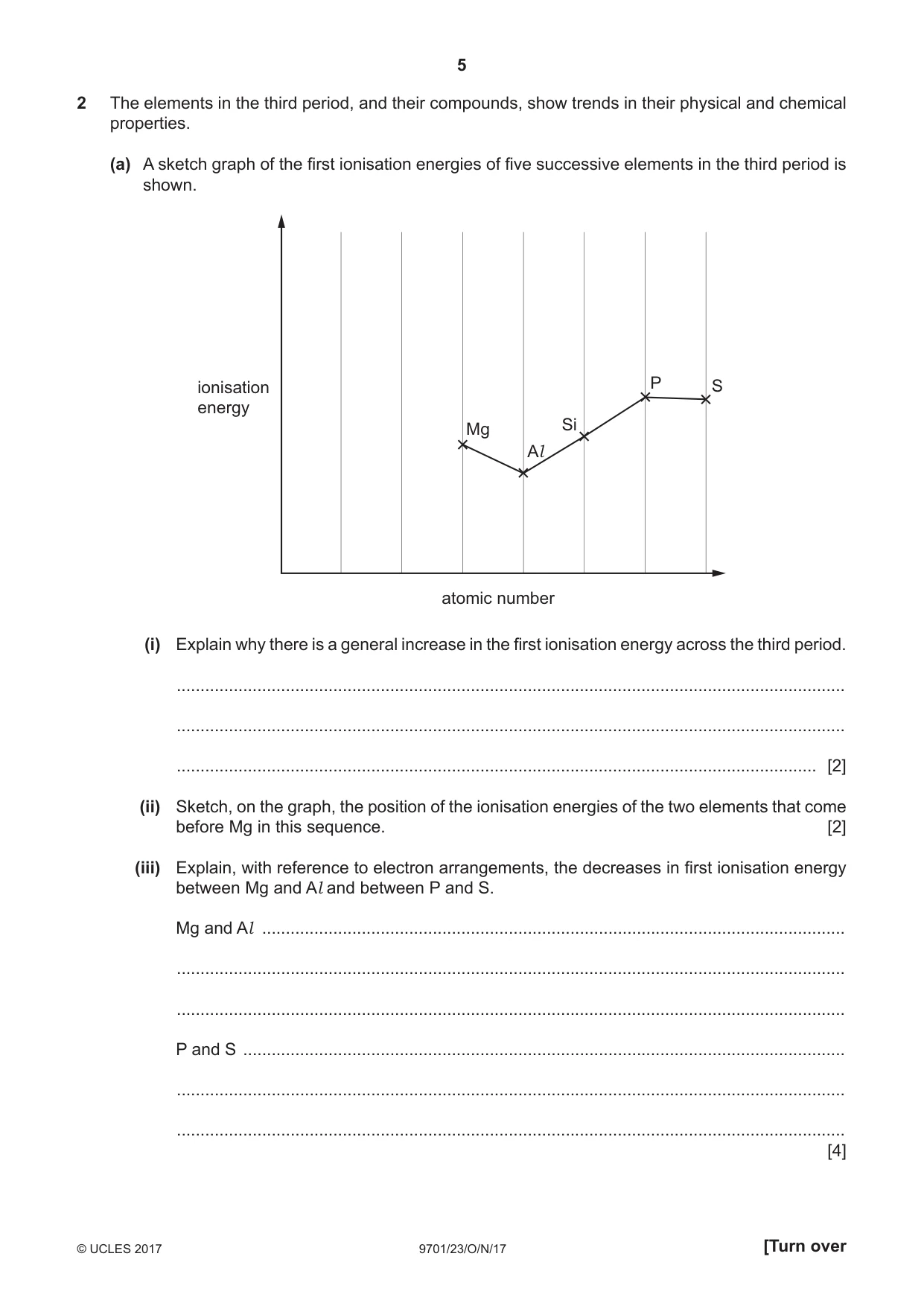
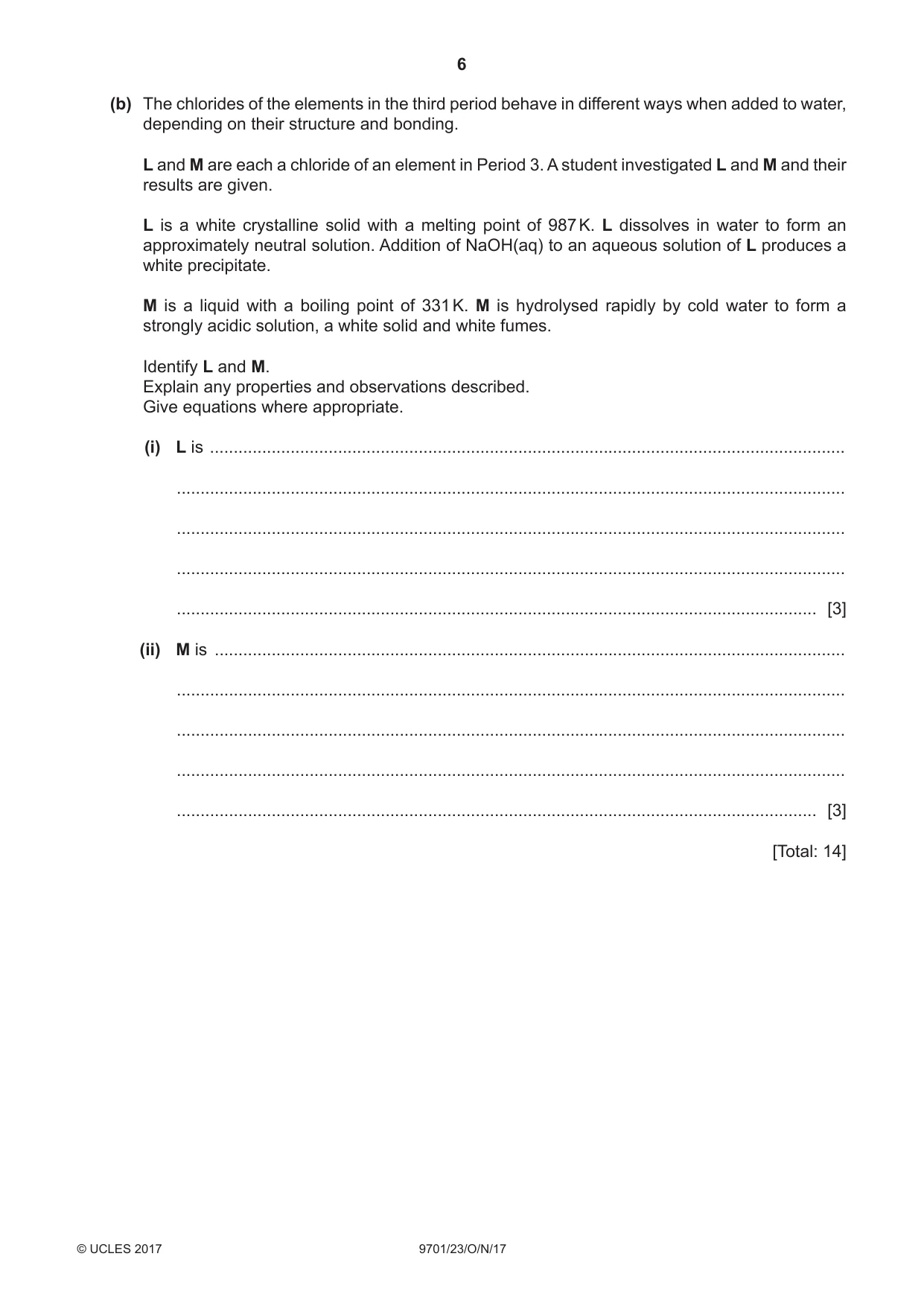
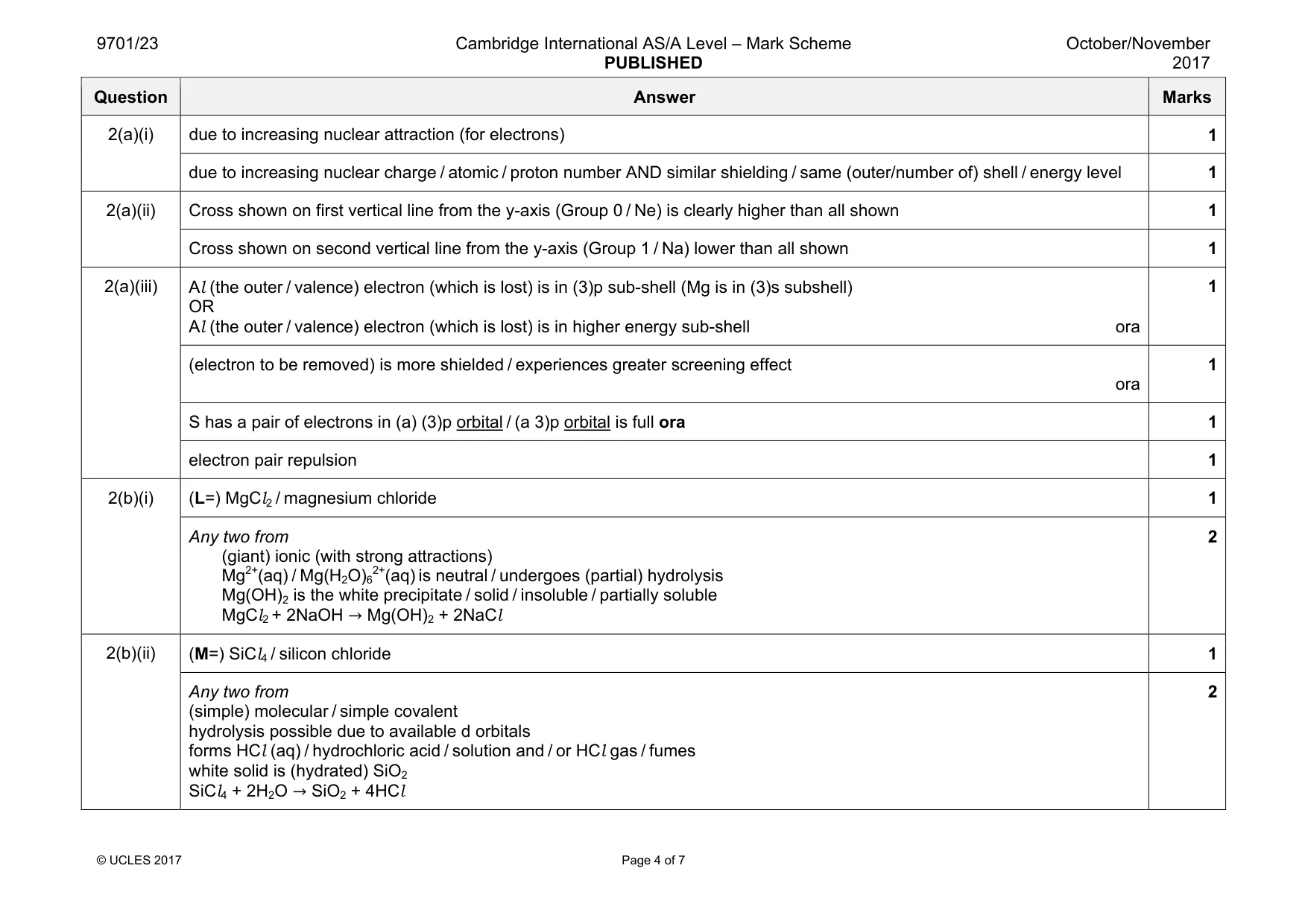
2 The elements in the third period, and their compounds, show trends in their physical and chemical properties. (a) A sketch graph of the first ionisation energies of five successive elements in the third period is shown. ionisation P S energy Mg Si Al atomic number (i) Explain why there is a general increase in the first ionisation energy across the third period. ............................................................................................................................................. ............................................................................................................................................. ....................................................................................................................................... [2] (ii) Sketch, on the graph, the position of the ionisation energies of the two elements that come before Mg in this sequence. [2] (iii) Explain, with reference to electron arrangements, the decreases in first ionisation energy between Mg and Al and between P and S. Mg and Al ............................................................................................................................ ............................................................................................................................................. ............................................................................................................................................. P and S ................................................................................................................................ ............................................................................................................................................. ............................................................................................................................................. [4] (b) The chlorides of the elements in the third period behave in different ways when added to water, depending on their structure and bonding. L and M are each a chloride of an element in Period 3. A student investigated L and M and their results are given. L is a white crystalline solid with a melting point of 987 K. L dissolves in water to form an approximately neutral solution. Addition of NaOH(aq) to an aqueous solution of L produces a white precipitate. M is a liquid with a boiling point of 331 K. M is hydrolysed rapidly by cold water to form a strongly acidic solution, a white solid and white fumes. Identify L and M. Explain any properties and observations described. Give equations where appropriate. (i) L is ...................................................................................................................................... ............................................................................................................................................. ............................................................................................................................................. ............................................................................................................................................. ....................................................................................................................................... [3] (ii) M is ...................................................................................................................................... ............................................................................................................................................. ............................................................................................................................................. ............................................................................................................................................. ....................................................................................................................................... [3] [Total: 14]
Mark scheme: 2(a)(i) due to increasing nuclear attraction (for electrons) 1 due to increasing nuclear charge / atomic / proton number AND similar shielding / same (outer/number of) shell / energy level 1 2(a)(ii) Cross shown on first vertical line from the y-axis (Group 0 / Ne) is clearly higher than all shown 1 Cross shown on second vertical line from the y-axis (Group 1 / Na) lower than all shown 1 2(a)(iii) Al (the outer / valence) electron (which is lost) is in (3)p sub-shell (Mg is in (3)s subshell) OR Al (the outer / valence) electron (which is lost) is in higher energy sub-shell ora 1 (electron to be removed) is more shielded / experiences greater screening effect ora 1 S has a pair of electrons in (a) (3)p orbital / (a 3)p orbital is full ora 1 electron pair repulsion 1 2(b)(i) (L=) MgCl2 / magnesium chloride 1 Any two from (giant) ionic (with strong attractions) Mg2+(aq) / Mg(H2O)6 2+(aq) is neutral / undergoes (partial) hydrolysis Mg(OH)2 is the white precipitate / solid / insoluble / partially soluble MgCl2 + 2NaOH → Mg(OH)2 + 2NaCl 2 2(b)(ii) (M=) SiCl4 / silicon chloride 1 Any two from (simple) molecular / simple covalent hydrolysis possible due to available d orbitals forms HCl (aq) / hydrochloric acid / solution and / or HCl gas / fumes white solid is (hydrated) SiO2 SiCl4 + 2H2O → SiO2 + 4HCl 2
Q3 · Some reactions based on 1-bromobutane, CH3(CH2)3Br, are shown
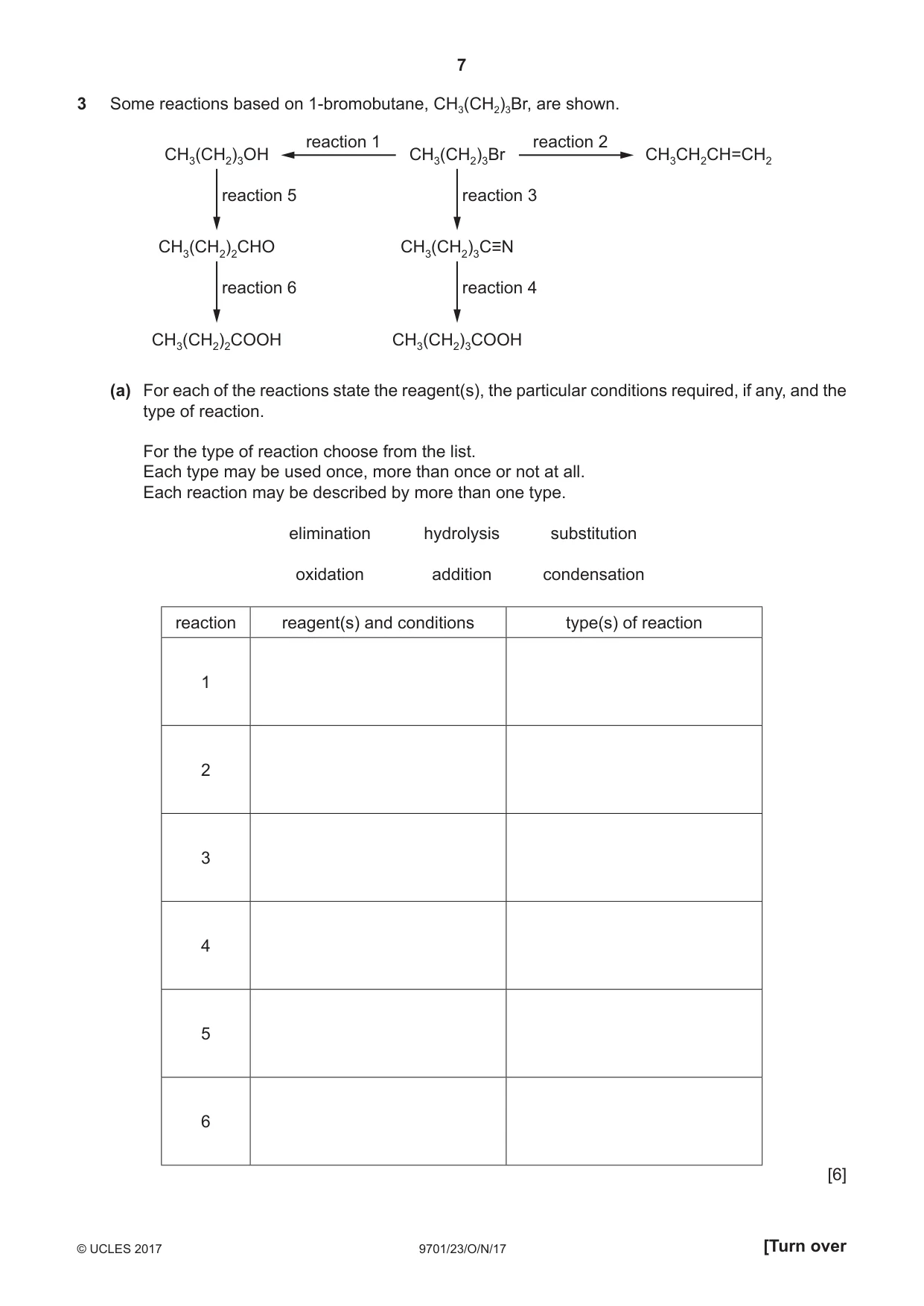
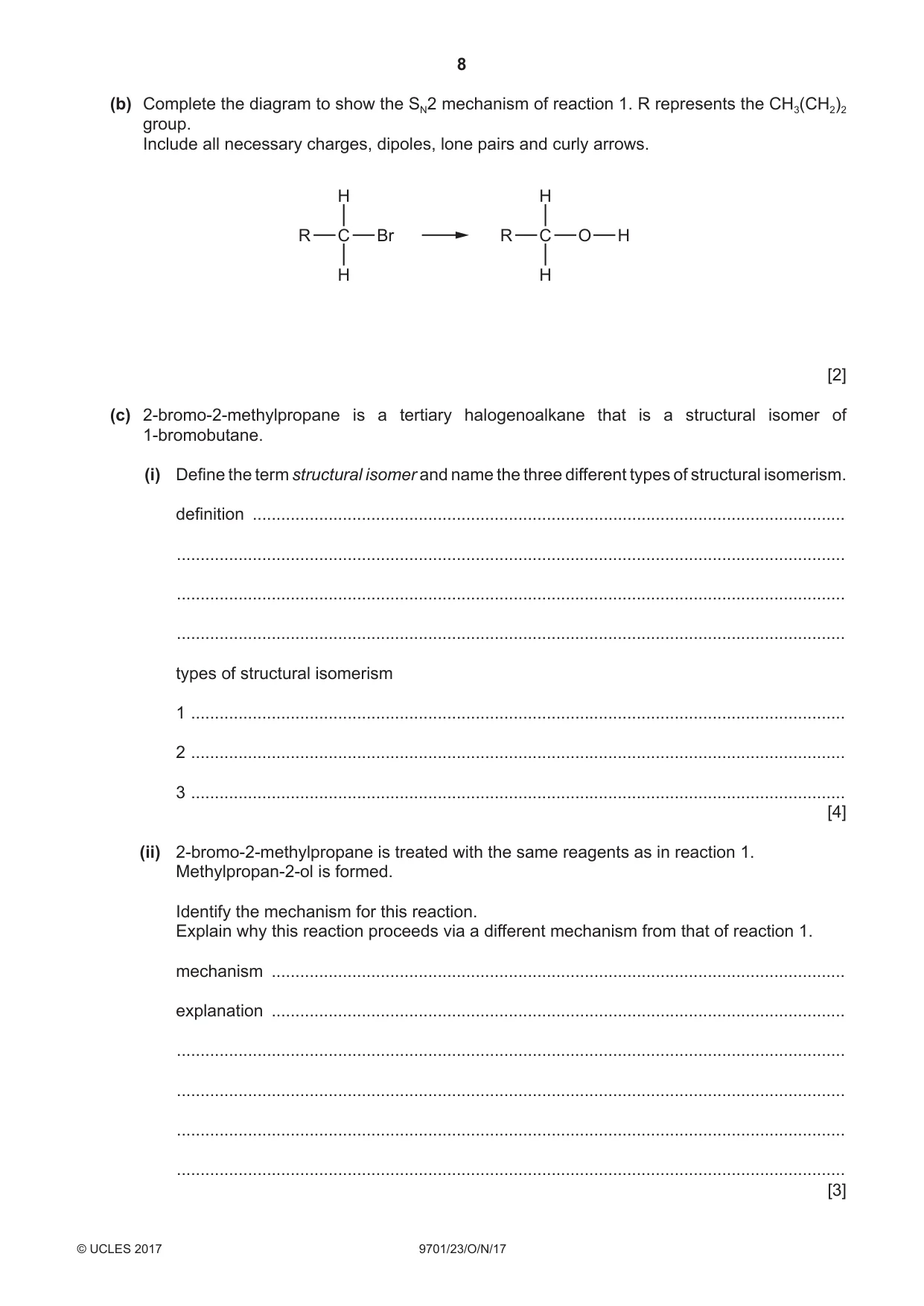
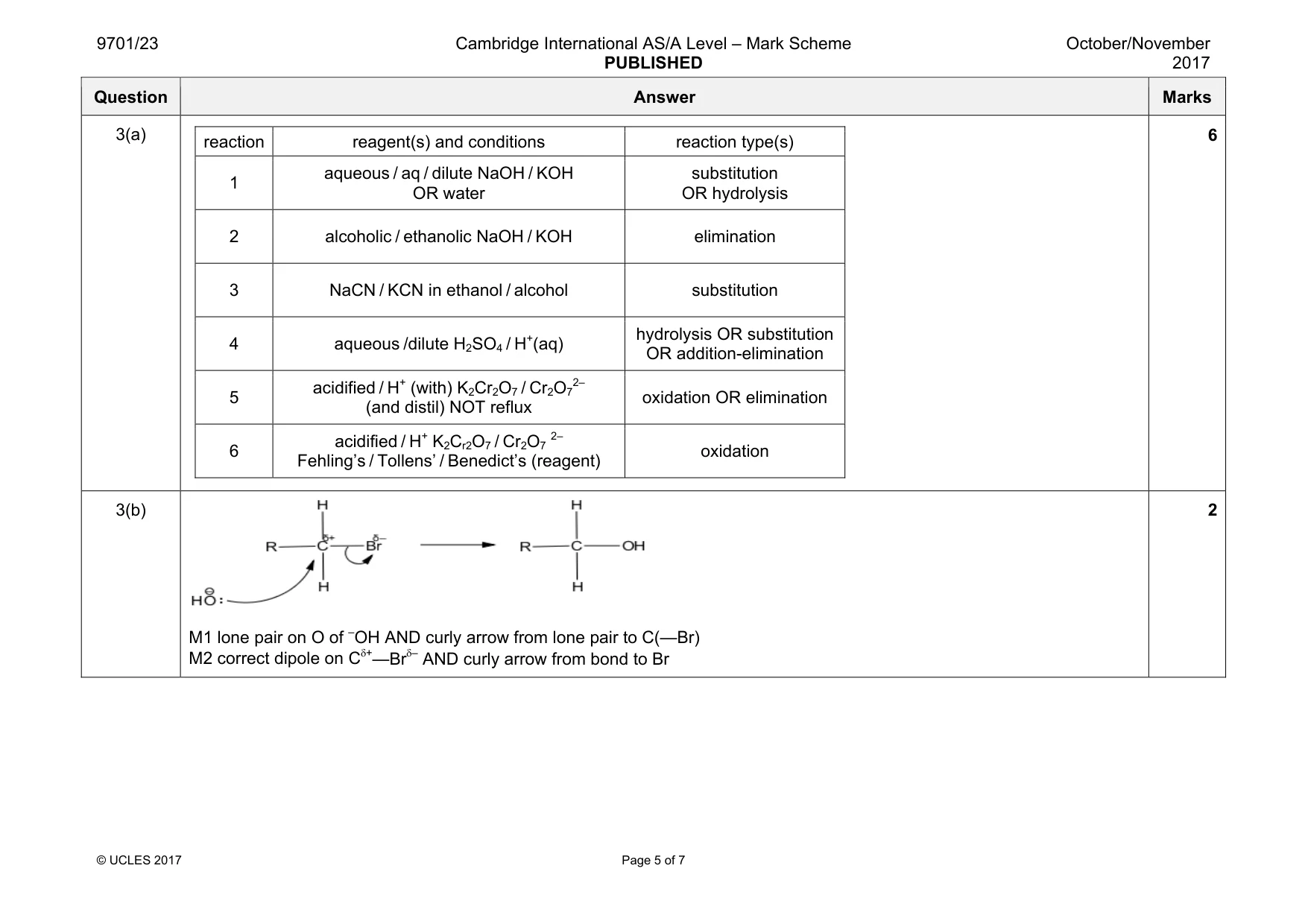
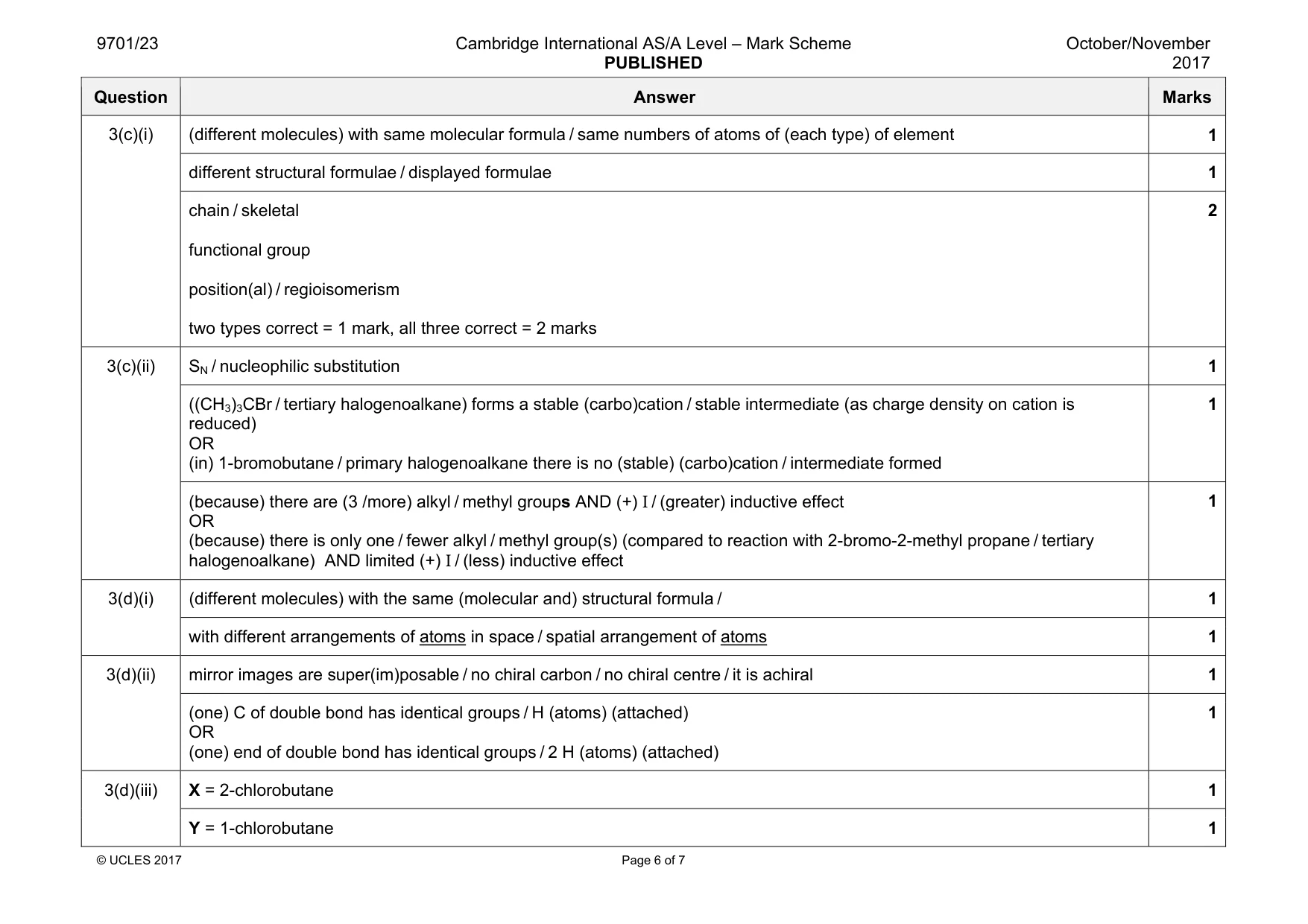
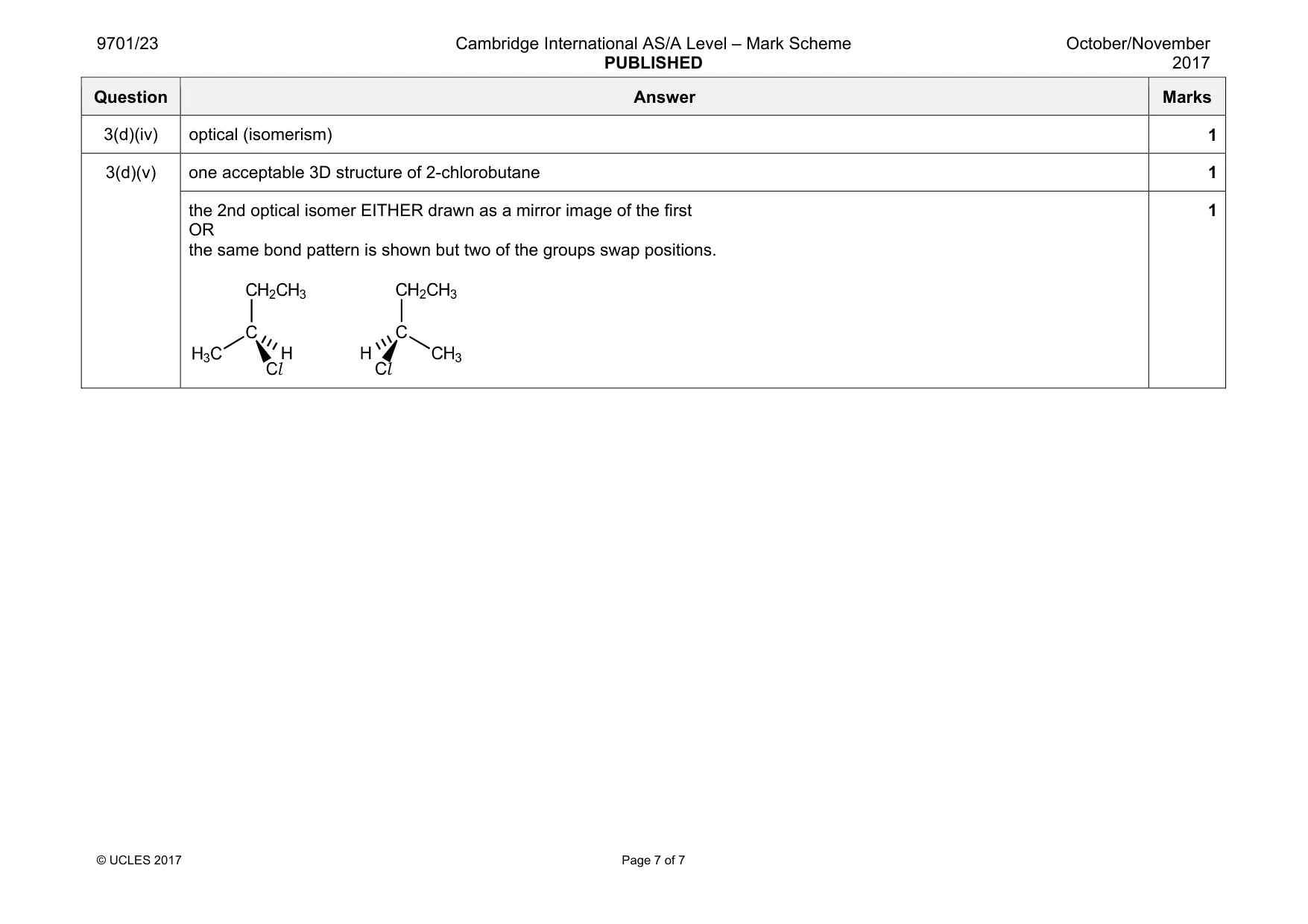
3 Some reactions based on 1-bromobutane, CH3(CH2)3Br, are shown. reaction 1 reaction 2 CH3(CH2)3OH CH3(CH2)3Br CH3CH2CH=CH2 reaction 5 reaction 3 CH3(CH2)2CHO CH3(CH2)3C≡N reaction 6 reaction 4 CH3(CH2)2COOH CH3(CH2)3COOH (a) For each of the reactions state the reagent(s), the particular conditions required, if any, and the type of reaction. For the type of reaction choose from the list. Each type may be used once, more than once or not at all. Each reaction may be described by more than one type. elimination hydrolysis substitution oxidation addition condensation reaction reagent(s) and conditions type(s) of reaction 1 2 3 4 5 6 [6] (b) Complete the diagram to show the SN2 mechanism of reaction 1. R represents the CH3(CH2)2 group. Include all necessary charges, dipoles, lone pairs and curly arrows. H H R C Br R C O H H H [2] (c) 2-bromo-2-methylpropane is a tertiary halogenoalkane that is a structural isomer of 1-bromobutane. (i) Define the term structural isomer and name the three different types of structural isomerism. definition .............................................................................................................................. ............................................................................................................................................. ............................................................................................................................................. ............................................................................................................................................. types of structural isomerism 1 .......................................................................................................................................... 2 .......................................................................................................................................... 3 .......................................................................................................................................... [4] (ii) 2-bromo-2-methylpropane is treated with the same reagents as in reaction 1. Methylpropan-2-ol is formed. Identify the mechanism for this reaction. Explain why this reaction proceeds via a different mechanism from that of reaction 1. mechanism .......................................................................................................................... explanation .......................................................................................................................... ............................................................................................................................................. ............................................................................................................................................. ............................................................................................................................................. ............................................................................................................................................. [3] (d) The product of reaction 2, but-1-ene, does not show stereoisomerism. However, but-1-ene reacts with HCl to form a mixture of structural isomers X and Y. X (exists as a pair of stereoisomers and is produced in higher yield than Y) but-1-ene + HCl Y (does not show stereoisomerism) (i) Explain the meaning of the term stereoisomers. ............................................................................................................................................. ............................................................................................................................................. ....................................................................................................................................... [2] (ii) Give two reasons why but-1-ene does not show stereoisomerism. ............................................................................................................................................. ............................................................................................................................................. ....................................................................................................................................... [2] (iii) Name X and Y. X .......................................................................................................................................... Y .......................................................................................................................................... [2] (iv) Name the type of stereoisomerism shown by X. ....................................................................................................................................... [1] (v) Use the conventional representation to draw the two stereoisomers of X. [2] [Total: 24]
Mark scheme: 3(a) reaction reagent(s) and conditions reaction type(s) 1 aqueous / aq / dilute NaOH / KOH OR water substitution OR hydrolysis 2 alcoholic / ethanolic NaOH / KOH elimination 3 NaCN / KCN in ethanol / alcohol substitution 4 aqueous /dilute H2SO4 / H+(aq) hydrolysis OR substitution OR addition-elimination 5 acidified / H+ (with) K2Cr2O7 / Cr2O7 2– (and distil) NOT reflux oxidation OR elimination 6 acidified / H+ K2Cr2O7 / Cr2O7 2– Fehling’s / Tollens’ / Benedict’s (reagent) oxidation 6 3(b) M1 lone pair on O of –OH AND curly arrow from lone pair to C(—Br) M2 correct dipole on Cδ+—Brδ– AND curly arrow from bond to Br 2 Question Answer Marks 3(c)(i) (different molecules) with same molecular formula / same numbers of atoms of (each type) of element 1 different structural formulae / displayed formulae 1 chain / skeletal functional group position(al) / regioisomerism two types correct = 1 mark, all three correct = 2 marks 2 3(c)(ii) SN / nucleophilic substitution 1 ((CH3)3CBr / tertiary halogenoalkane) forms a stable (carbo)cation / stable intermediate (as charge density on cation is reduced) OR (in) 1-bromobutane / primary halogenoalkane there is no (stable) (carbo)cation / intermediate formed 1 (because) there are (3 /more) alkyl / methyl groups AND (+) I / (greater) inductive effect OR (because) there is only one / fewer alkyl / methyl group(s) (compared to reaction with 2-bromo-2-methyl propane / tertiary halogenoalkane) AND limited (+) I / (less) inductive effect 1 3(d)(i) (different molecules) with the same (molecular and) structural formula / 1 with different arrangements of atoms in space / spatial arrangement of atoms 1 3(d)(ii) mirror images are super(im)posable / no chiral carbon / no chiral centre / it is achiral 1 (one) C of double bond has identical groups / H (atoms) (attached) OR (one) end of double bond has identical groups / 2 H (atoms) (attached) 1 3(d)(iii) X = 2-chlorobutane 1 Y = 1-chlorobutane 1 Question Answer Marks 3(d)(iv) optical (isomerism) 1 3(d)(v) one acceptable 3D structure of 2-chlorobutane 1 the 2nd optical isomer EITHER drawn as a mirror image of the first OR the same bond pattern is shown but two of the groups swap positions. 1
What was in this paper
The subtopics covered by these 3 questions, and how many questions each got. Open one in a new tab to see every Cambridge question on it.
What you needed in this session
Cambridge’s own grade thresholds for 2017 Oct/Nov, Paper 2 · Variant 3. A higher threshold means an easier paper — the bar moves with how the cohort did.