Cambridge A Level Chemistry 9701 — 2017 May/June Paper 5 · Variant 2
9701/52/M/J/17 · 2 questions · 30 marks · ≈34 min
The question paper and its mark scheme, free to read here and free to download. This is Cambridge’s own paper, exactly as it was sat.
Question paper16 pages




Mark scheme5 pages
Answers below. Sit the paper first if you are practising.
Questions as text
Q1 · In 1804 the chemist John Dalton put forward the following idea
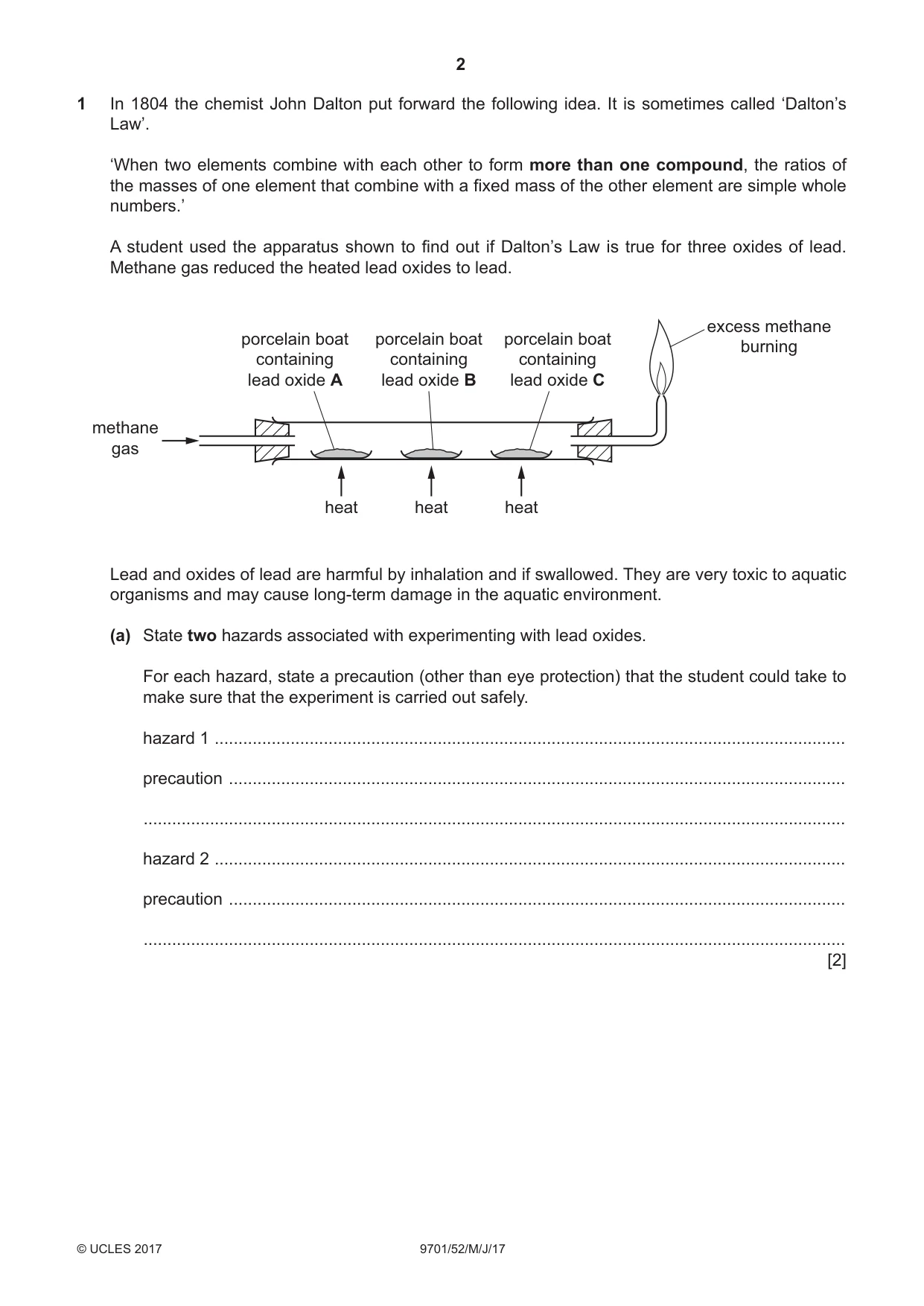
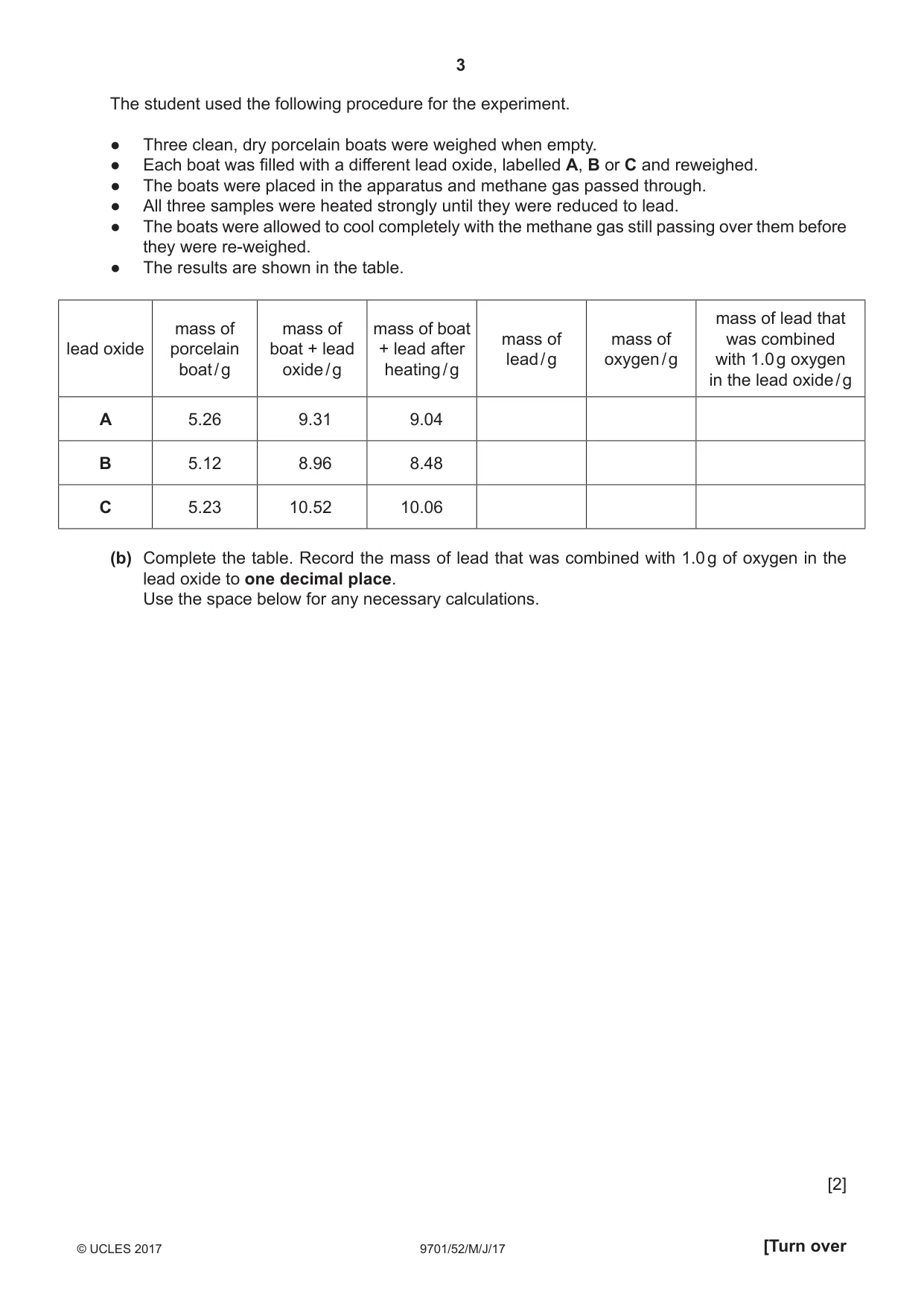
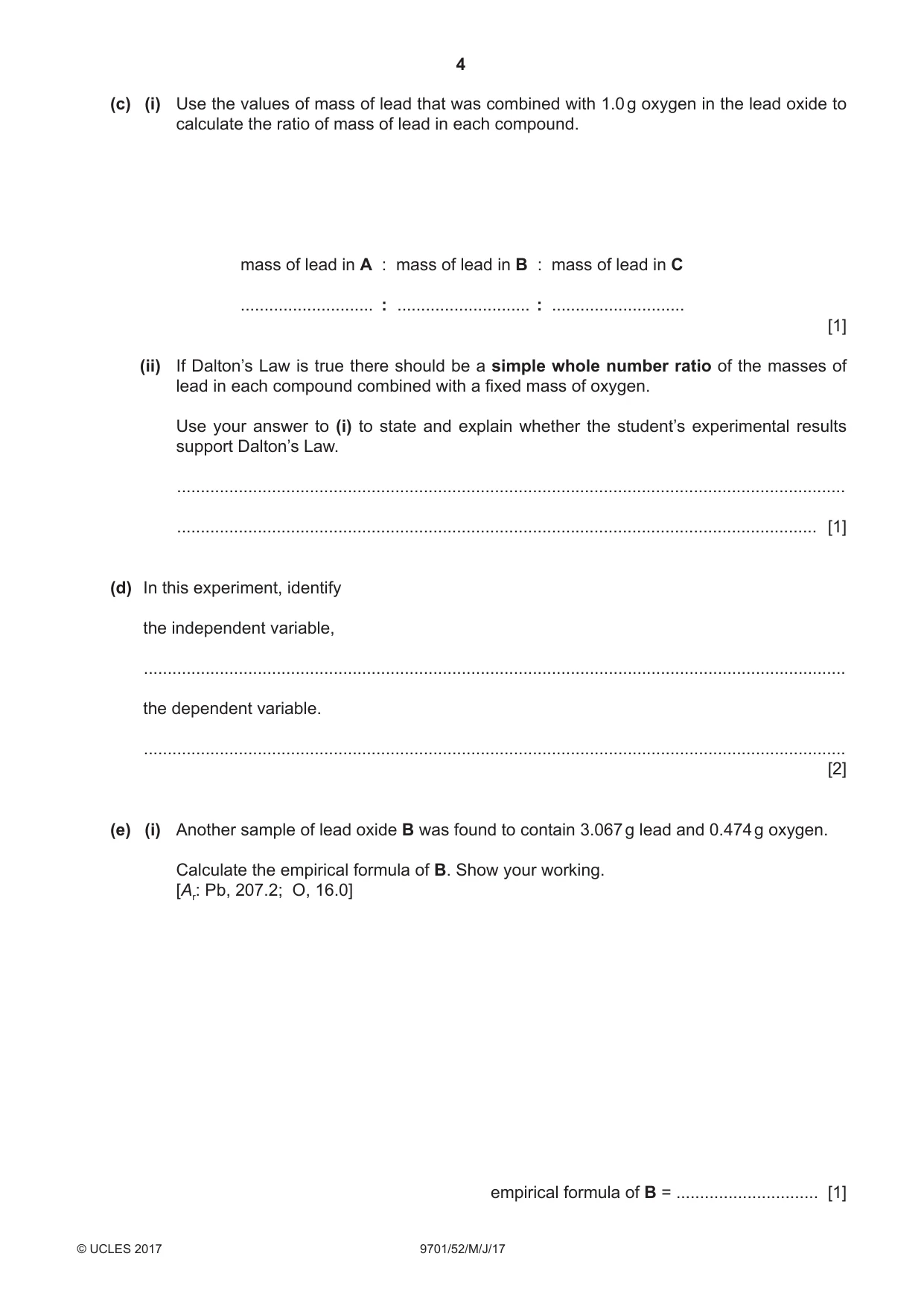
1 In 1804 the chemist John Dalton put forward the following idea. It is sometimes called ‘Dalton’s Law’. ‘When two elements combine with each other to form more than one compound, the ratios of the masses of one element that combine with a fixed mass of the other element are simple whole numbers.’ A student used the apparatus shown to find out if Dalton’s Law is true for three oxides of lead. Methane gas reduced the heated lead oxides to lead. excess methane porcelain boat porcelain boat porcelain boat burning containing containing containing lead oxide A lead oxide B lead oxide C methane gas heat heat heat Lead and oxides of lead are harmful by inhalation and if swallowed. They are very toxic to aquatic organisms and may cause long-term damage in the aquatic environment. (a) State two hazards associated with experimenting with lead oxides. For each hazard, state a precaution (other than eye protection) that the student could take to make sure that the experiment is carried out safely. hazard 1 ..................................................................................................................................... precaution .................................................................................................................................. .................................................................................................................................................... hazard 2 ..................................................................................................................................... precaution .................................................................................................................................. .................................................................................................................................................... [2] The student used the following procedure for the experiment. ● Three clean, dry porcelain boats were weighed when empty. ● Each boat was filled with a different lead oxide, labelled A, B or C and reweighed. ● The boats were placed in the apparatus and methane gas passed through. ● All three samples were heated strongly until they were reduced to lead. ● The boats were allowed to cool completely with the methane gas still passing over them before they were re-weighed. ● The results are shown in the table. mass of lead that mass of mass of mass of boat mass of mass of was combinedlead oxide porcelain boat + lead + lead after lead / g oxygen / g with 1.0 g oxygen boat / g oxide / g heating / g in the lead oxide / g A 5.26 9.31 9.04 B 5.12 8.96 8.48 C 5.23 10.52 10.06 (b) Complete the table. Record the mass of lead that was combined with 1.0 g of oxygen in the lead oxide to one decimal place. Use the space below for any necessary calculations. [2] (c) (i) Use the values of mass of lead that was combined with 1.0 g oxygen in the lead oxide to calculate the ratio of mass of lead in each compound. mass of lead in A : mass of lead in B : mass of lead in C ............................ : ............................ : ............................ [1] (ii) If Dalton’s Law is true there should be a simple whole number ratio of the masses of lead in each compound combined with a fixed mass of oxygen. Use your answer to (i) to state and explain whether the student’s experimental results support Dalton’s Law. ............................................................................................................................................. ....................................................................................................................................... [1] (d) In this experiment, identify the independent variable, .................................................................................................................................................... the dependent variable. .................................................................................................................................................... [2] (e) (i) Another sample of lead oxide B was found to contain 3.067 g lead and 0.474 g oxygen. Calculate the empirical formula of B. Show your working. [Ar: Pb, 207.2; O, 16.0] empirical formula of B = .............................. [1] (ii) What additional piece of information is required to calculate the molecular formula of B? ....................................................................................................................................... [1] (f) Before the porcelain boats containing the lead were weighed, they were allowed to cool completely with the methane gas still passing over them. Apart from the hazards associated with handling hot apparatus, explain why this procedure is essential to ensure that the results are reliable. .................................................................................................................................................... .............................................................................................................................................. [1] (g) The student thought that not all of the lead oxide C had been reduced. What should the student do to make sure all the lead oxide C had been reduced? .................................................................................................................................................... .................................................................................................................................................... .............................................................................................................................................. [1] [Total: 12]
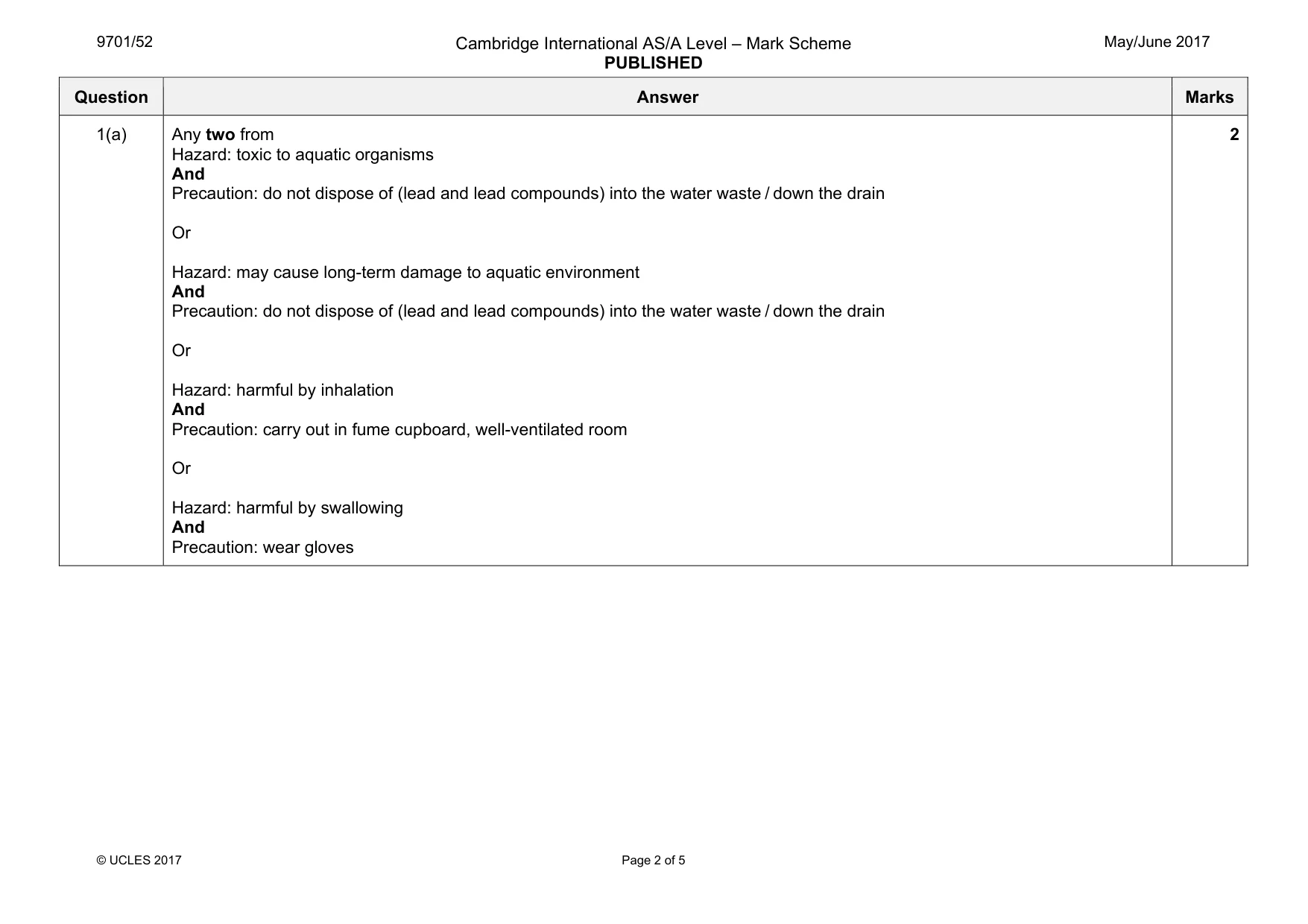
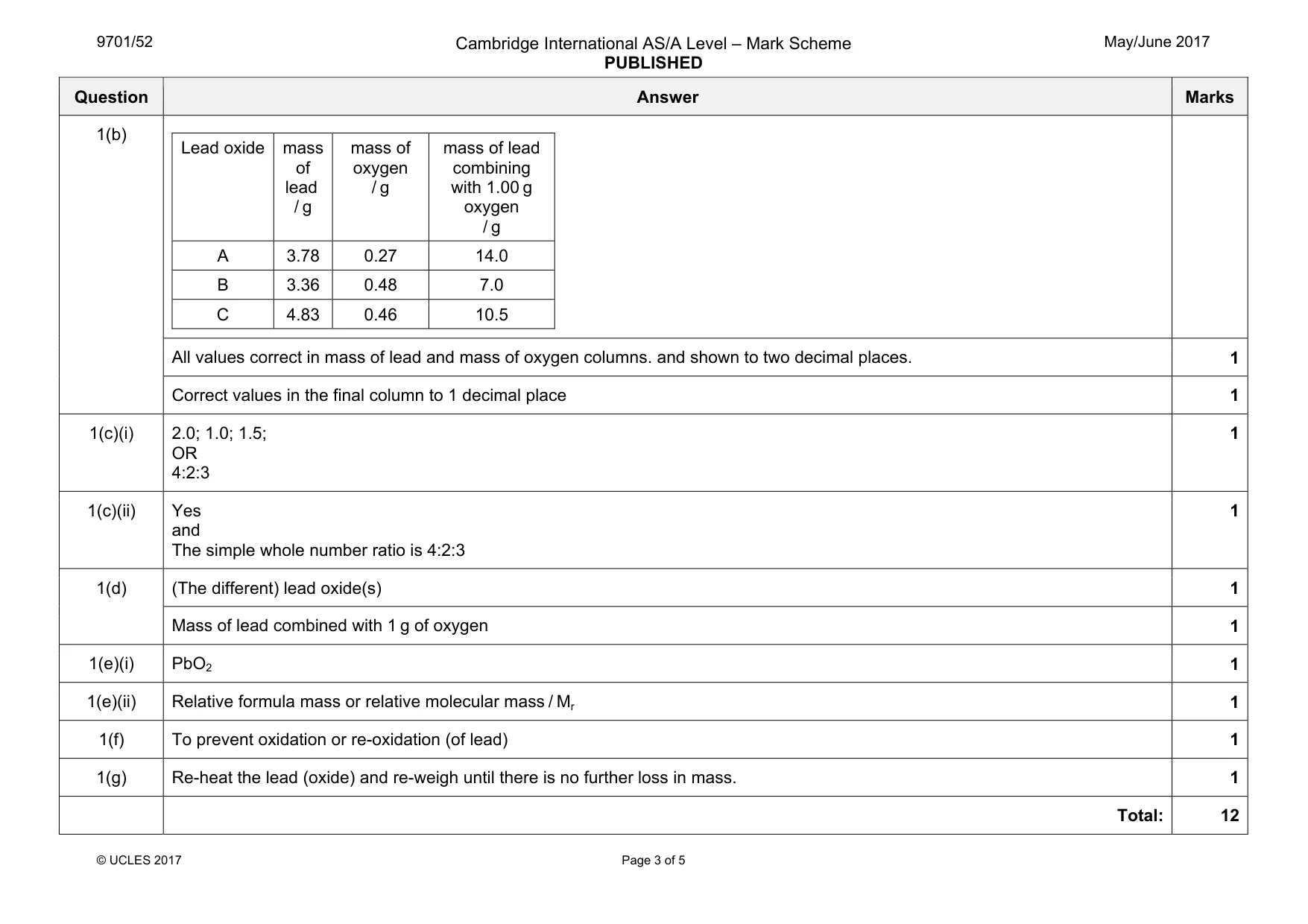
Mark scheme: 1(a) Any two from Hazard: toxic to aquatic organisms And Precaution: do not dispose of (lead and lead compounds) into the water waste / down the drain Or Hazard: may cause long-term damage to aquatic environment And Precaution: do not dispose of (lead and lead compounds) into the water waste / down the drain Or Hazard: harmful by inhalation And Precaution: carry out in fume cupboard, well-ventilated room Or Hazard: harmful by swallowing And Precaution: wear gloves 2 Question Answer Marks 1(b) Lead oxide mass of lead / g mass of oxygen / g mass of lead combining with 1.00 g oxygen / g A 3.78 0.27 14.0 B 3.36 0.48 7.0 C 4.83 0.46 10.5 All values correct in mass of lead and mass of oxygen columns. and shown to two decimal places. 1 Correct values in the final column to 1 decimal place 1 1(c)(i) 2.0; 1.0; 1.5; OR 4:2:3 1 1(c)(ii) Yes and The simple whole number ratio is 4:2:3 1 1(d) (The different) lead oxide(s) 1 Mass of lead combined with 1 g of oxygen 1 1(e)(i) PbO2 1 1(e)(ii) Relative formula mass or relative molecular mass / Mr 1 1(f) To prevent oxidation or re-oxidation (of lead) 1 1(g) Re-heat the lead (oxide) and re-weigh until there is no further loss in mass. 1 Total: 12
More questions on Reacting masses and volumes (of solutions and gases)
Q2 · When light passes through solutions of chemical compounds some of the light may be…
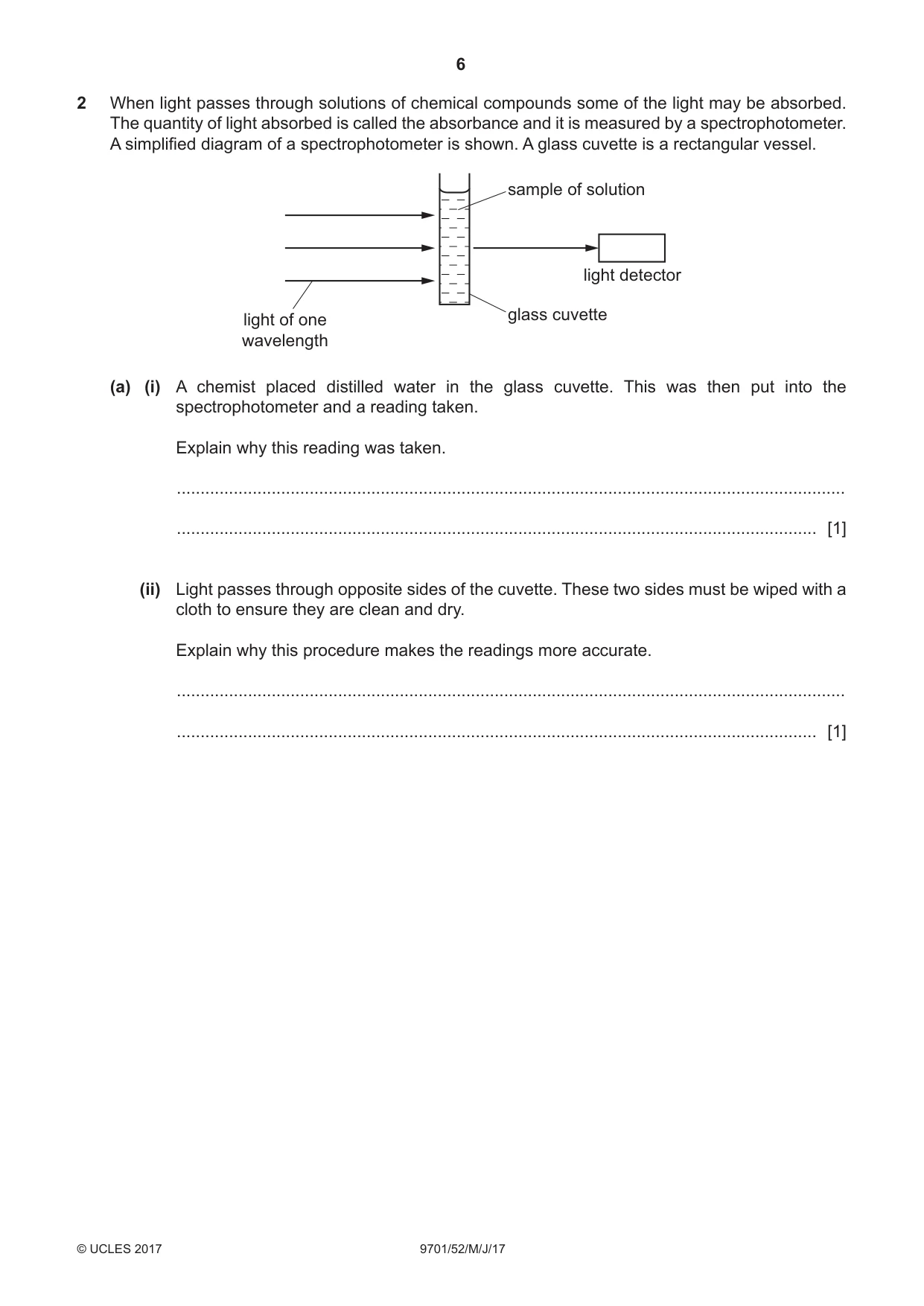
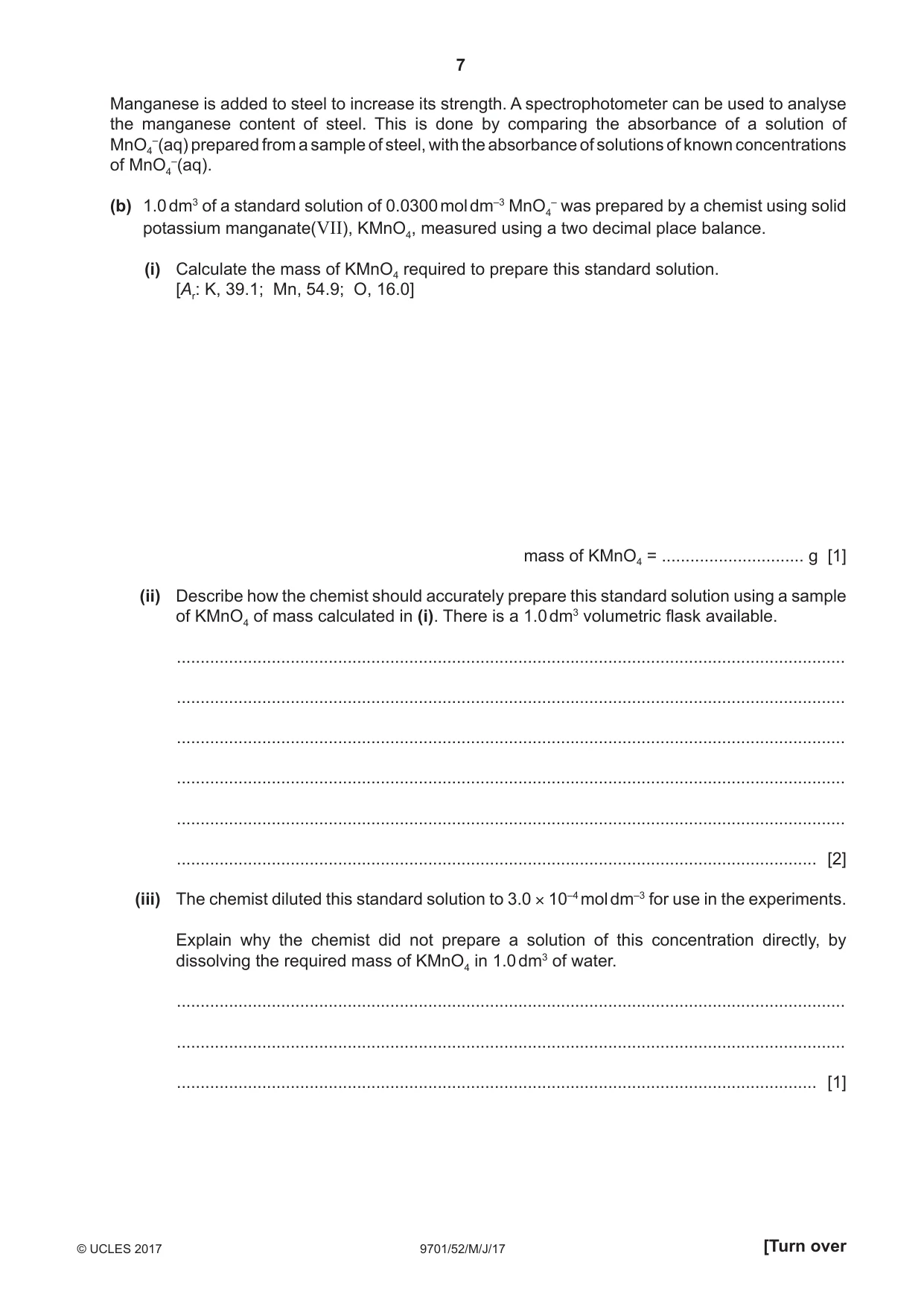
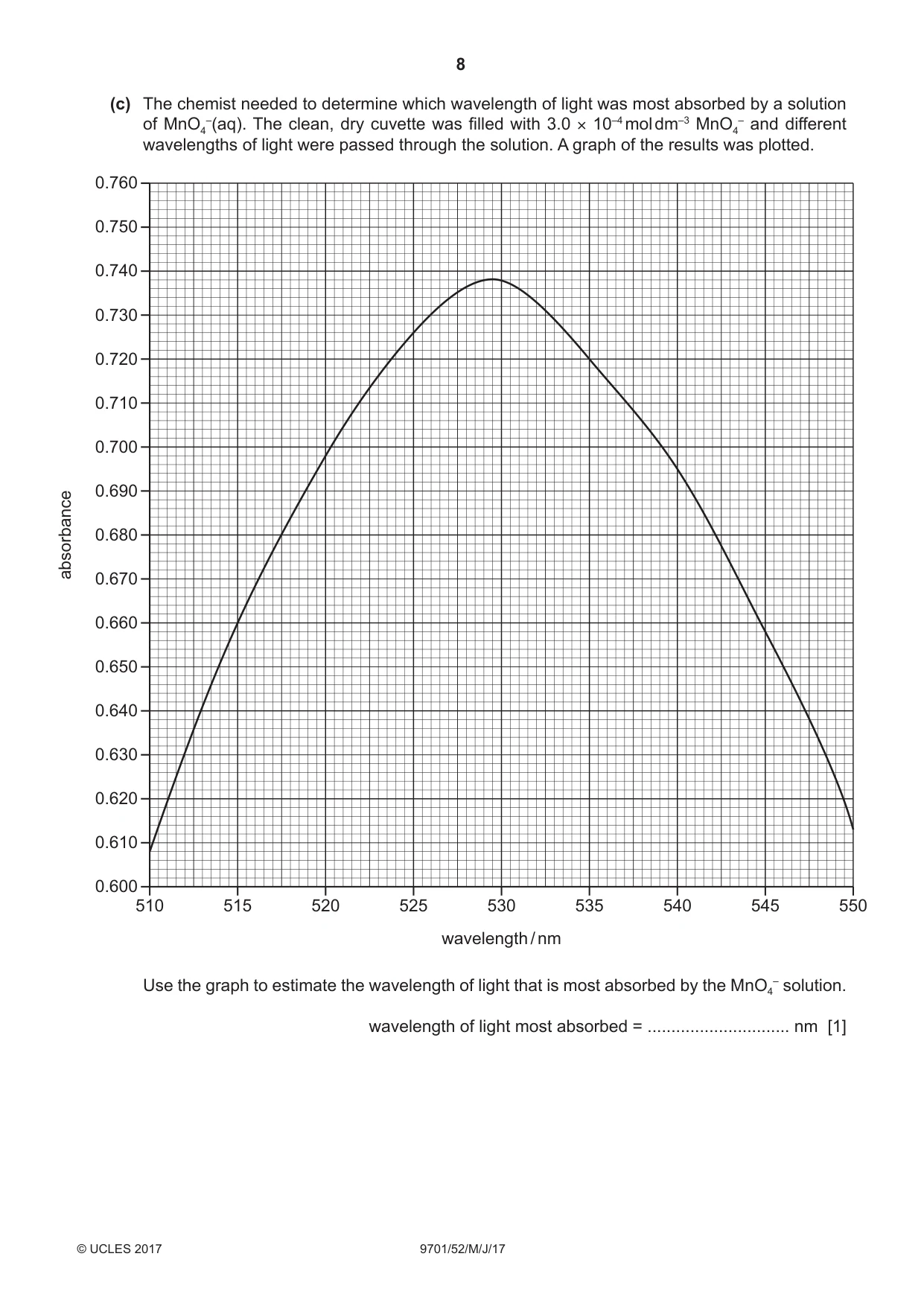
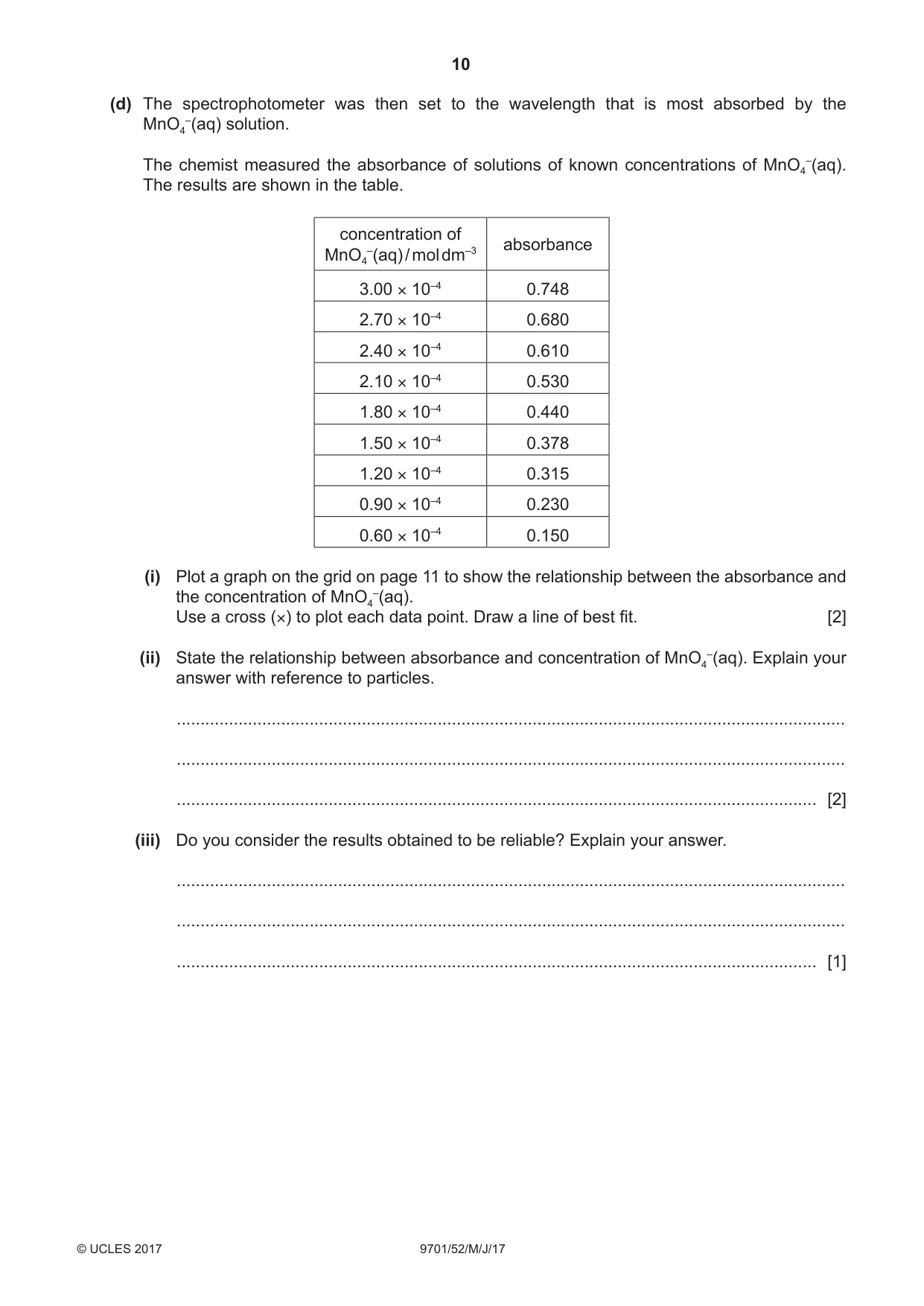
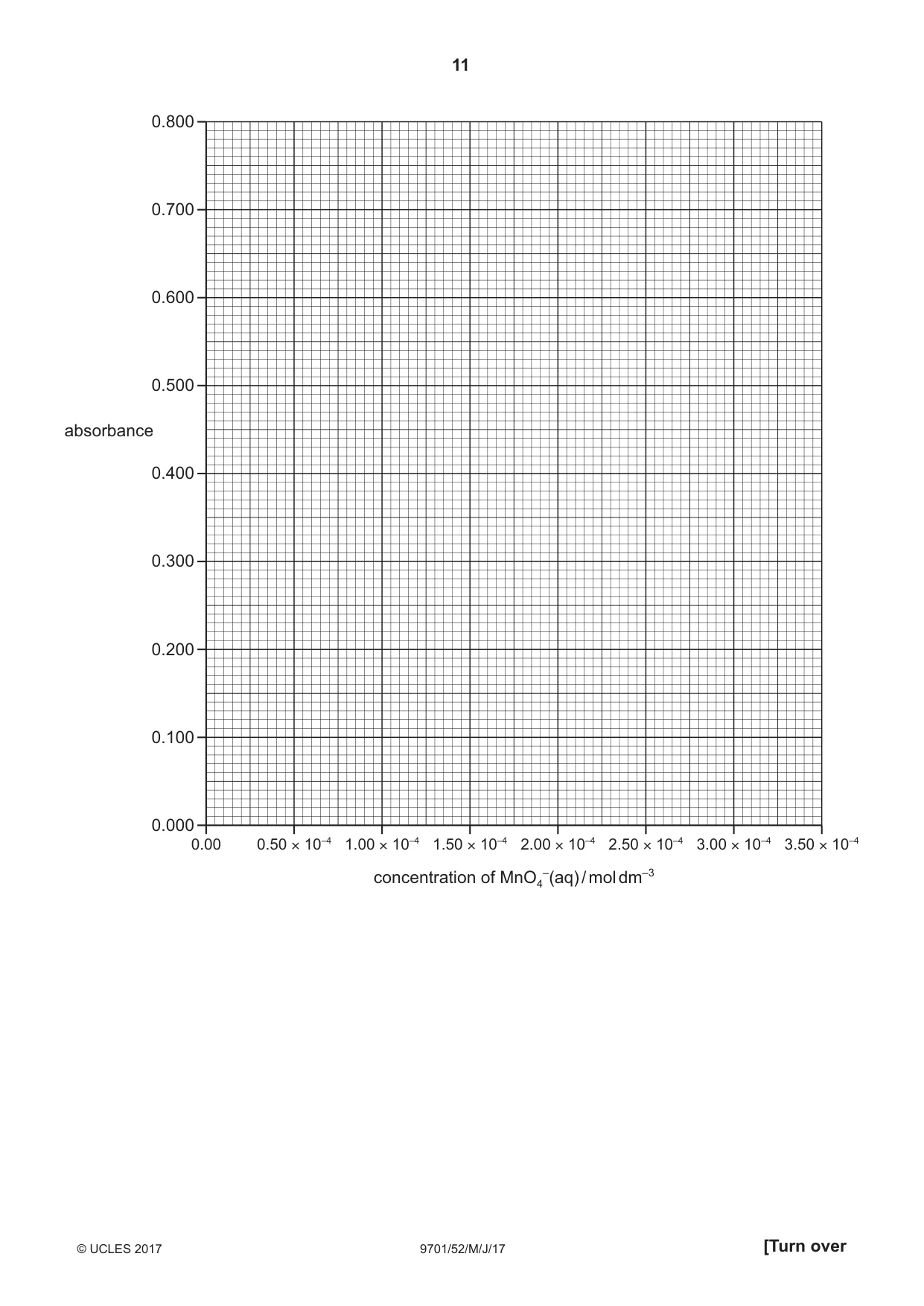
2 When light passes through solutions of chemical compounds some of the light may be absorbed. The quantity of light absorbed is called the absorbance and it is measured by a spectrophotometer. A simplified diagram of a spectrophotometer is shown. A glass cuvette is a rectangular vessel. sample of solution light detector glass cuvette light of one wavelength (a) (i) A chemist placed distilled water in the glass cuvette. This was then put into the spectrophotometer and a reading taken. Explain why this reading was taken. ............................................................................................................................................. ....................................................................................................................................... [1] (ii) Light passes through opposite sides of the cuvette. These two sides must be wiped with a cloth to ensure they are clean and dry. Explain why this procedure makes the readings more accurate. ............................................................................................................................................. ....................................................................................................................................... [1] Manganese is added to steel to increase its strength. A spectrophotometer can be used to analyse the manganese content of steel. This is done by comparing the absorbance of a solution of MnO4–(aq) prepared from a sample of steel, with the absorbance of solutions of known concentrations of MnO4–(aq). (b) 1.0 dm3 of a standard solution of 0.0300 mol dm–3 MnO4– was prepared by a chemist using solid potassium manganate(VII), KMnO4, measured using a two decimal place balance. (i) Calculate the mass of KMnO4 required to prepare this standard solution. [Ar: K, 39.1; Mn, 54.9; O, 16.0] mass of KMnO4 = .............................. g [1] (ii) Describe how the chemist should accurately prepare this standard solution using a sample of KMnO4 of mass calculated in (i). There is a 1.0 dm3 volumetric flask available. ............................................................................................................................................. ............................................................................................................................................. ............................................................................................................................................. ............................................................................................................................................. ............................................................................................................................................. ....................................................................................................................................... [2] (iii) The chemist diluted this standard solution to 3.0 × 10⁻⁴ mol dm–3 for use in the experiments. Explain why the chemist did not prepare a solution of this concentration directly, by dissolving the required mass of KMnO4 in 1.0 dm3 of water. ............................................................................................................................................. ............................................................................................................................................. ....................................................................................................................................... [1] (c) The chemist needed to determine which wavelength of light was most absorbed by a solution of MnO4–(aq). The clean, dry cuvette was filled with 3.0 × 10⁻⁴ mol dm–3 MnO4– and different wavelengths of light were passed through the solution. A graph of the results was plotted. 0.760 0.750 0.740 0.730 0.720 0.710 0.700 0.690 0.680absorbance 0.670 0.660 0.650 0.640 0.630 0.620 0.610 0.600 510 515 520 525 530 535 540 545 550 wavelength / nm Use the graph to estimate the wavelength of light that is most absorbed by the MnO4– solution. wavelength of light most absorbed = .............................. nm [1]
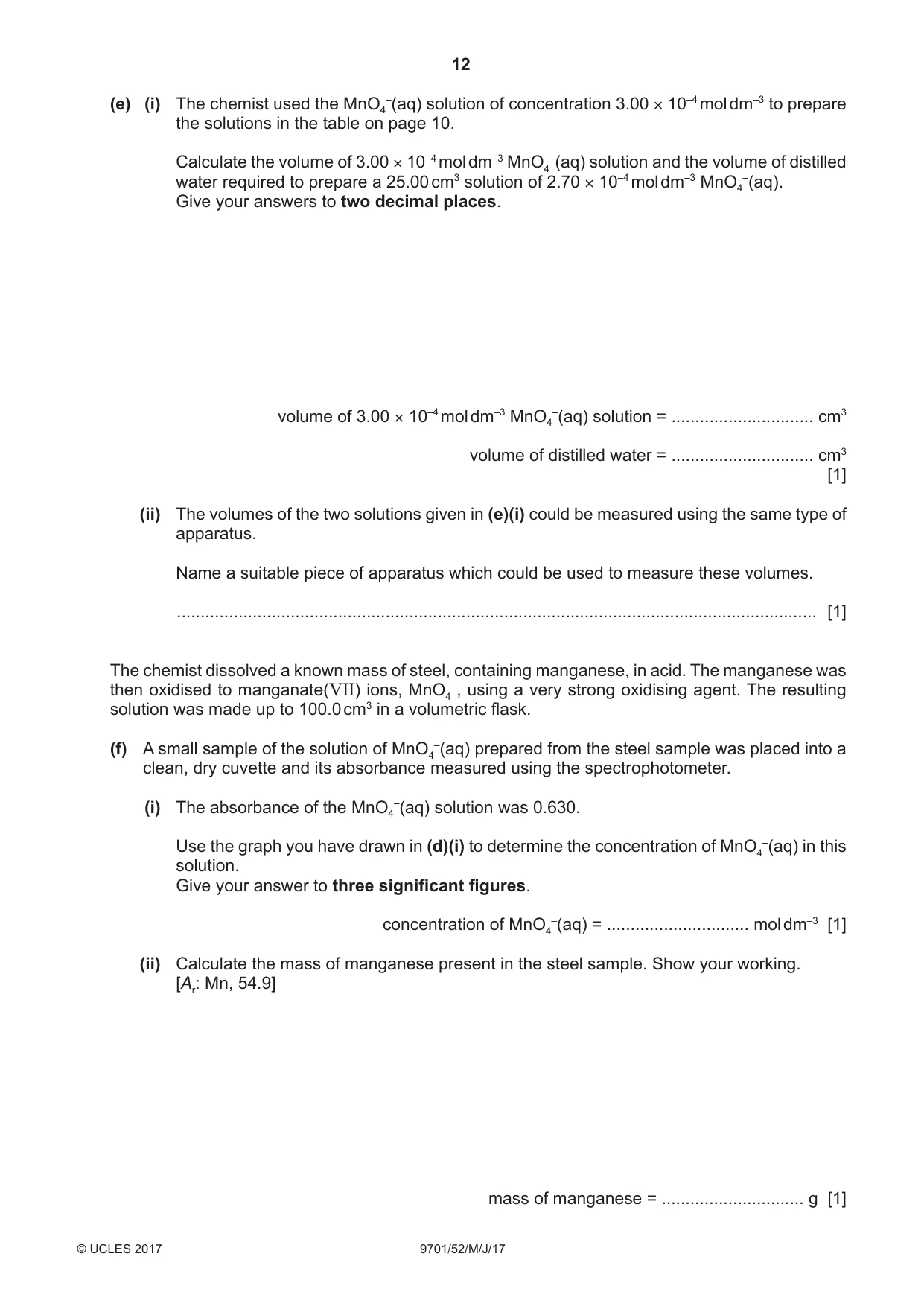
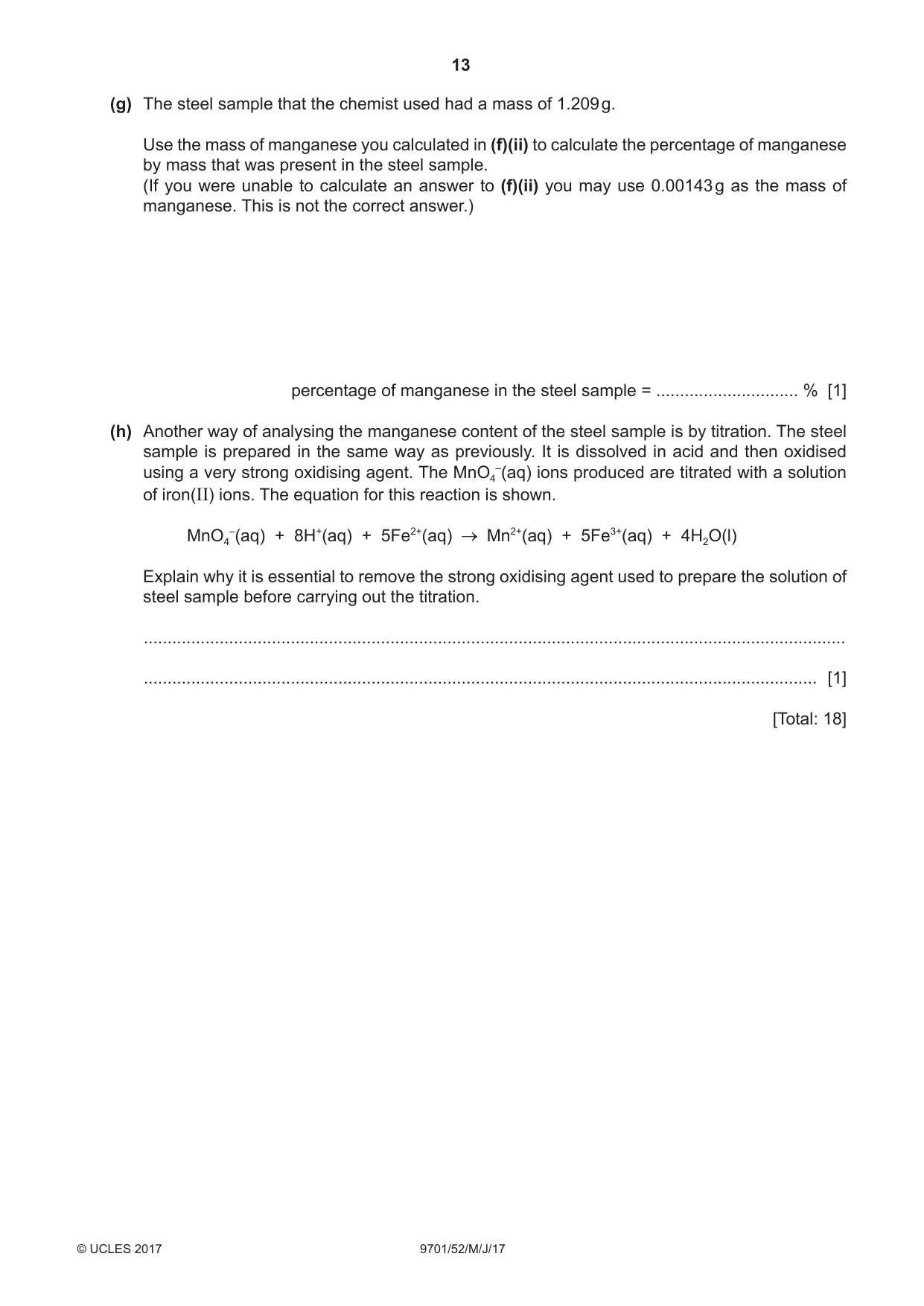
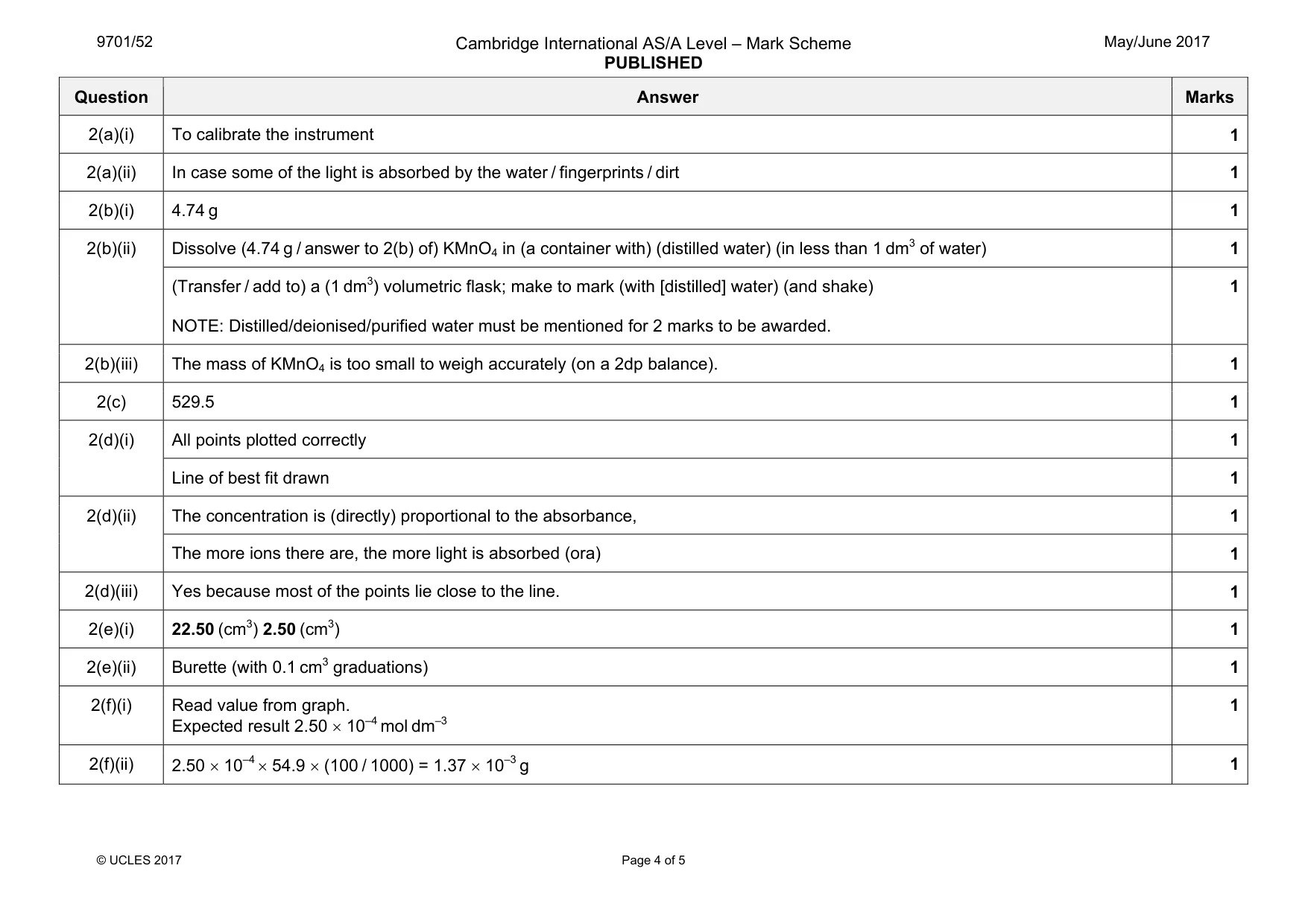
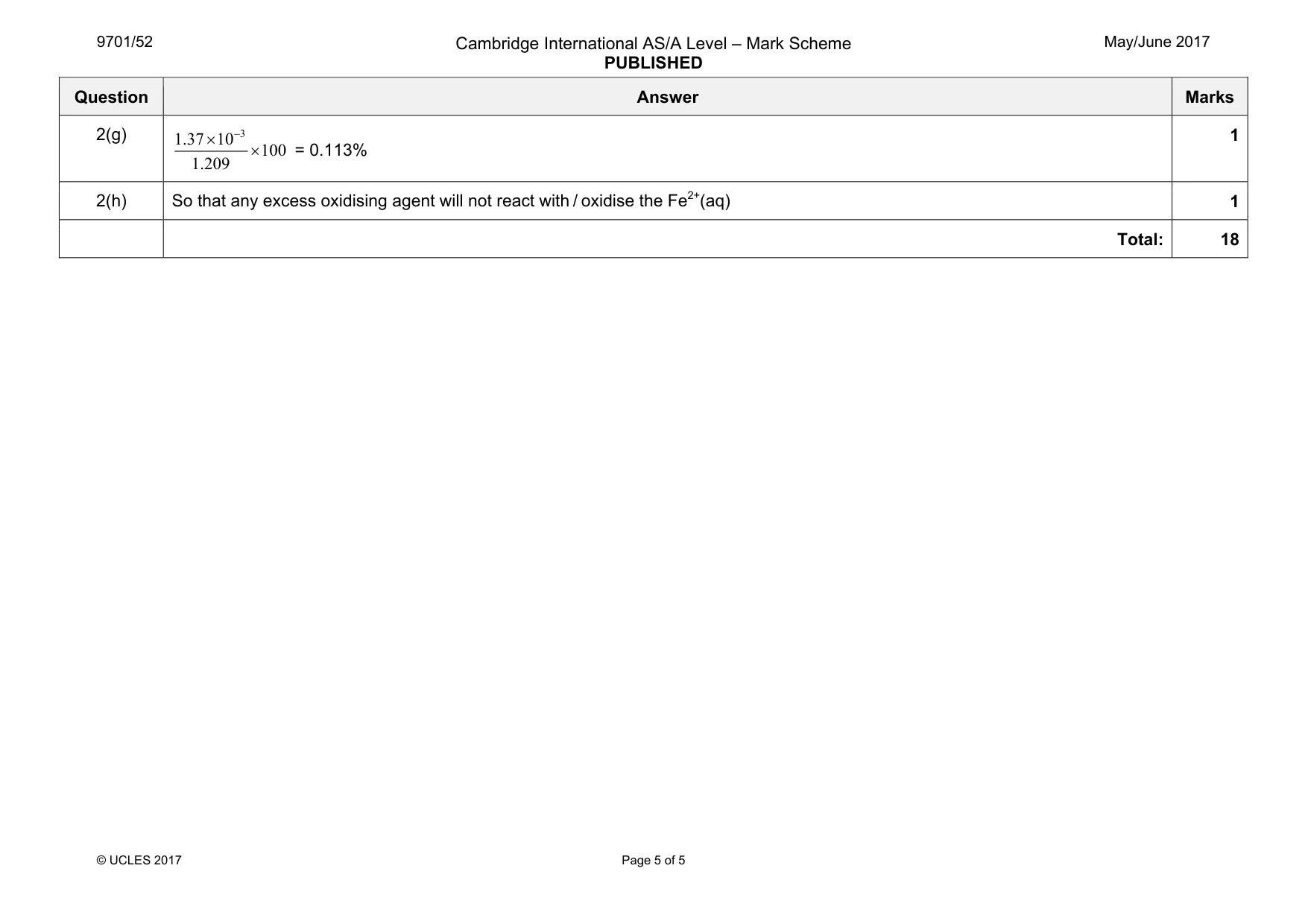
Mark scheme: 2(a)(i) To calibrate the instrument 1 2(a)(ii) In case some of the light is absorbed by the water / fingerprints / dirt 1 2(b)(i) 4.74 g 1 2(b)(ii) Dissolve (4.74 g / answer to 2(b) of) KMnO4 in (a container with) (distilled water) (in less than 1 dm3 of water) 1 (Transfer / add to) a (1 dm3) volumetric flask; make to mark (with [distilled] water) (and shake) NOTE: Distilled/deionised/purified water must be mentioned for 2 marks to be awarded. 1 2(b)(iii) The mass of KMnO4 is too small to weigh accurately (on a 2dp balance). 1 2(c) 529.5 1 2(d)(i) All points plotted correctly 1 Line of best fit drawn 1 2(d)(ii) The concentration is (directly) proportional to the absorbance, 1 The more ions there are, the more light is absorbed (ora) 1 2(d)(iii) Yes because most of the points lie close to the line. 1 2(e)(i) 22.50 (cm3) 2.50 (cm3) 1 2(e)(ii) Burette (with 0.1 cm3 graduations) 1 2(f)(i) Read value from graph. Expected result 2.50 × 10⁻⁴ mol dm–3 1 2(f)(ii) 2.50 × 10–4 × 54.9 × (100 / 1000) = 1.37 × 10⁻³ g 1 Question Answer Marks 2(g) 3 1.37 10 100 1.209 − × × = 0.113% 1 2(h) So that any excess oxidising agent will not react with / oxidise the Fe2+(aq) 1 Total: 18
What was in this paper
The subtopics covered by these 2 questions, and how many questions each got. Open one in a new tab to see every Cambridge question on it.
What you needed in this session
Cambridge’s own grade thresholds for 2017 May/June, Paper 5 · Variant 2. A higher threshold means an easier paper — the bar moves with how the cohort did.