Cambridge A Level Chemistry 9701 — 2017 May/June Paper 5 · Variant 1
9701/51/M/J/17 · 2 questions · 30 marks · ≈34 min
The question paper and its mark scheme, free to read here and free to download. This is Cambridge’s own paper, exactly as it was sat.
Question paper12 pages

Mark scheme4 pages
Answers below. Sit the paper first if you are practising.
Questions as text
Q1 · The pain of muscle strains and swellings can be eased by using heat packs
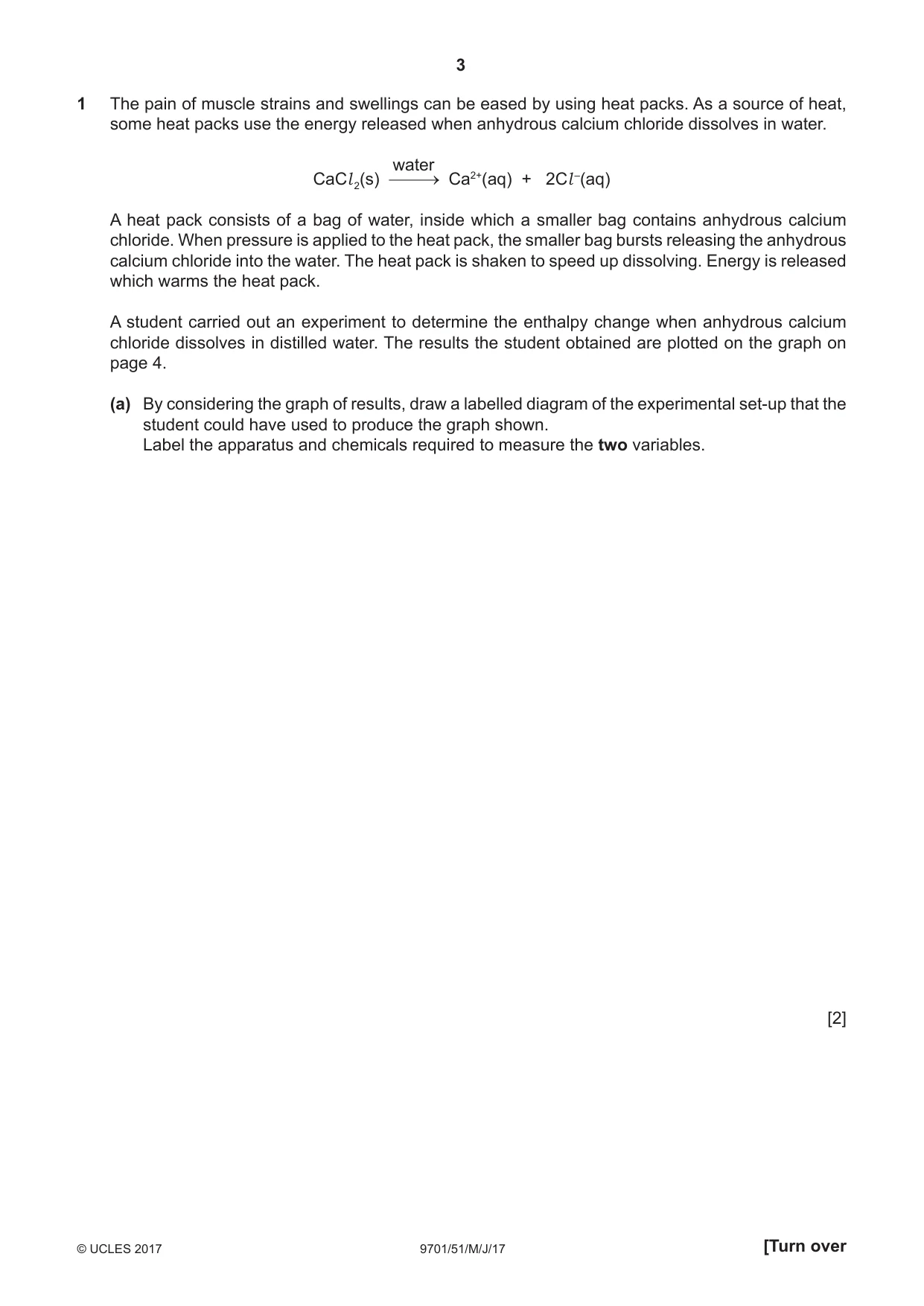
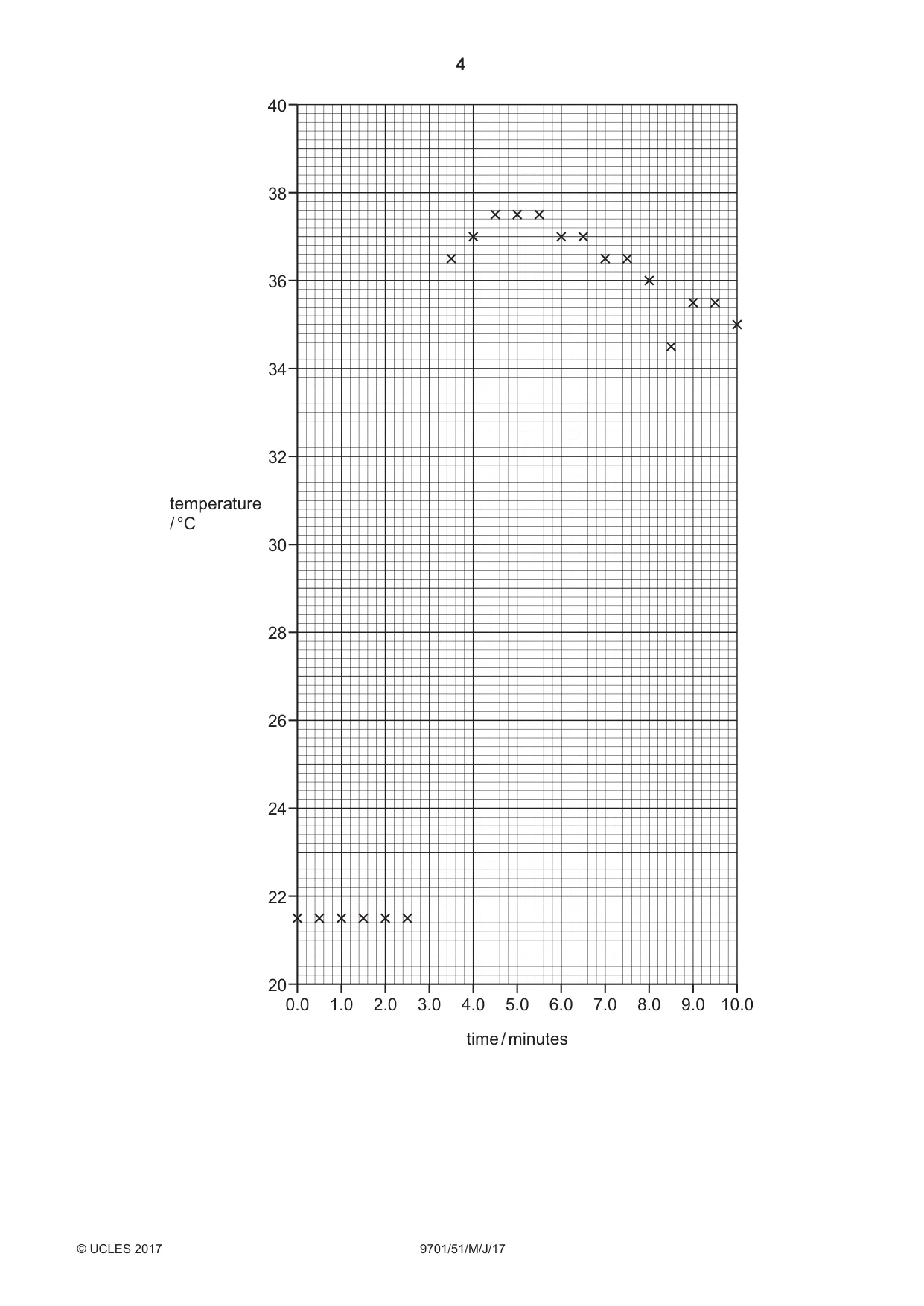
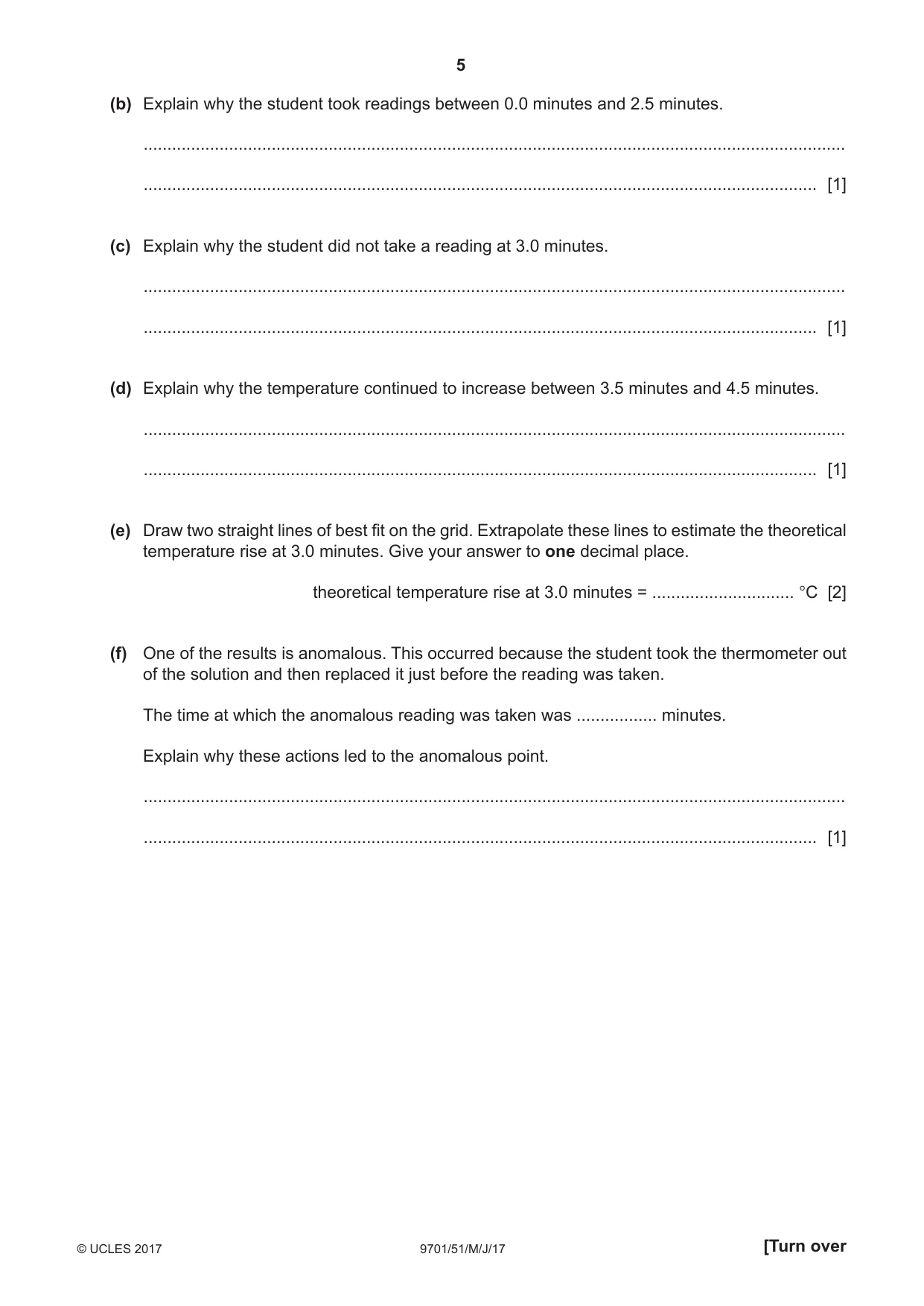
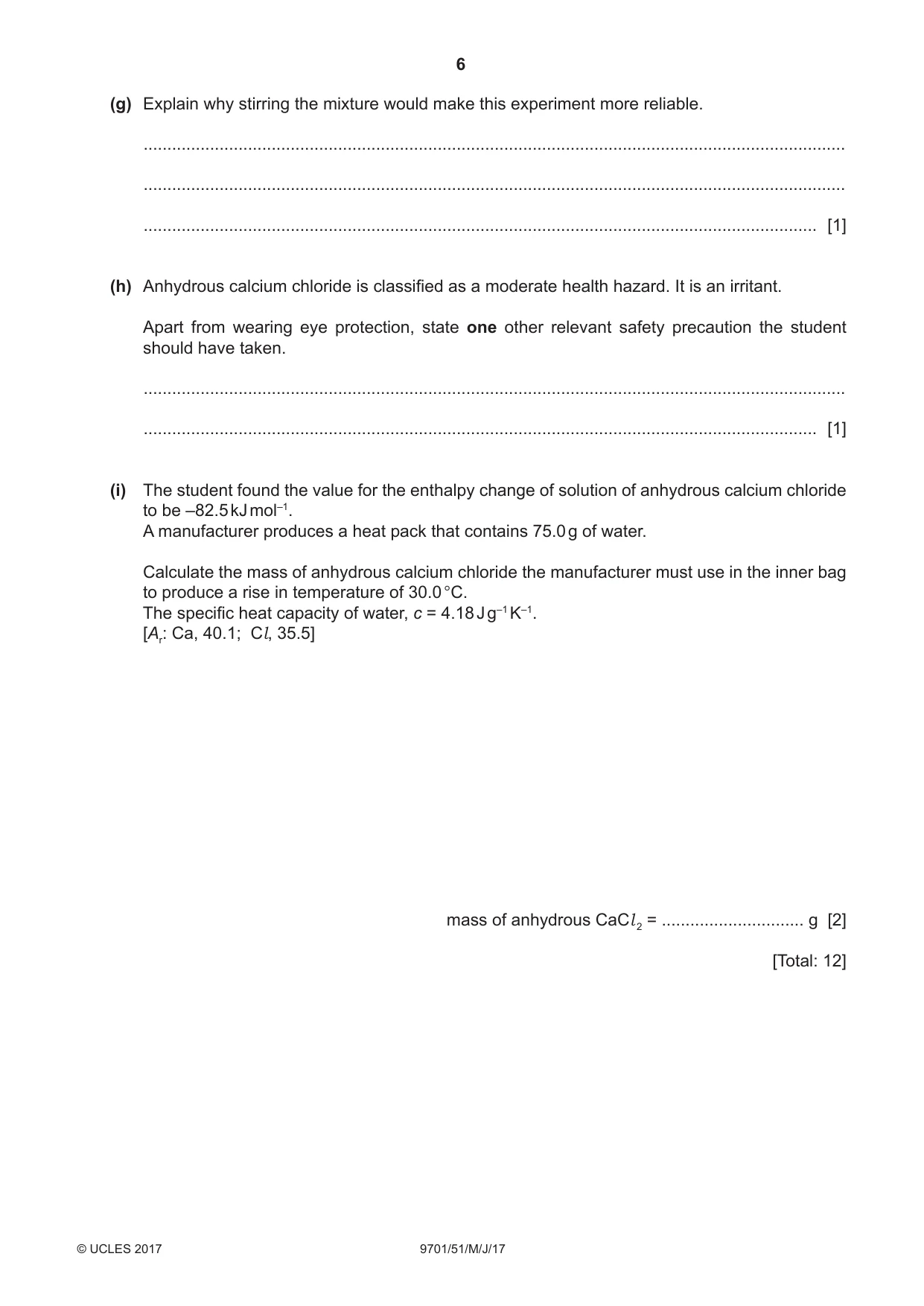
1 The pain of muscle strains and swellings can be eased by using heat packs. As a source of heat, some heat packs use the energy released when anhydrous calcium chloride dissolves in water. water CaCl 2(s) Ca2+(aq) + 2Cl –(aq) A heat pack consists of a bag of water, inside which a smaller bag contains anhydrous calcium chloride. When pressure is applied to the heat pack, the smaller bag bursts releasing the anhydrous calcium chloride into the water. The heat pack is shaken to speed up dissolving. Energy is released which warms the heat pack. A student carried out an experiment to determine the enthalpy change when anhydrous calcium chloride dissolves in distilled water. The results the student obtained are plotted on the graph on page 4. (a) By considering the graph of results, draw a labelled diagram of the experimental set-up that the student could have used to produce the graph shown. Label the apparatus and chemicals required to measure the two variables. [2] 0 4 (b) Explain why the student took readings between 0.0 minutes and 2.5 minutes. .................................................................................................................................................... .............................................................................................................................................. [1] (c) Explain why the student did not take a reading at 3.0 minutes. .................................................................................................................................................... .............................................................................................................................................. [1] (d) Explain why the temperature continued to increase between 3.5 minutes and 4.5 minutes. .................................................................................................................................................... .............................................................................................................................................. [1] (e) Draw two straight lines of best fit on the grid. Extrapolate these lines to estimate the theoretical temperature rise at 3.0 minutes. Give your answer to one decimal place. theoretical temperature rise at 3.0 minutes = .............................. °C [2] (f) One of the results is anomalous. This occurred because the student took the thermometer out of the solution and then replaced it just before the reading was taken. The time at which the anomalous reading was taken was ................. minutes. Explain why these actions led to the anomalous point. .................................................................................................................................................... .............................................................................................................................................. [1] (g) Explain why stirring the mixture would make this experiment more reliable. .................................................................................................................................................... .................................................................................................................................................... .............................................................................................................................................. [1] (h) Anhydrous calcium chloride is classified as a moderate health hazard. It is an irritant. Apart from wearing eye protection, state one other relevant safety precaution the student should have taken. .................................................................................................................................................... .............................................................................................................................................. [1] (i) The student found the value for the enthalpy change of solution of anhydrous calcium chloride to be –82.5 kJ mol–1. A manufacturer produces a heat pack that contains 75.0 g of water. Calculate the mass of anhydrous calcium chloride the manufacturer must use in the inner bag to produce a rise in temperature of 30.0 °C. The specific heat capacity of water, c = 4.18 J g–1 K–1. [Ar: Ca, 40.1; Cl, 35.5] mass of anhydrous CaCl 2 = .............................. g [2] [Total: 12]
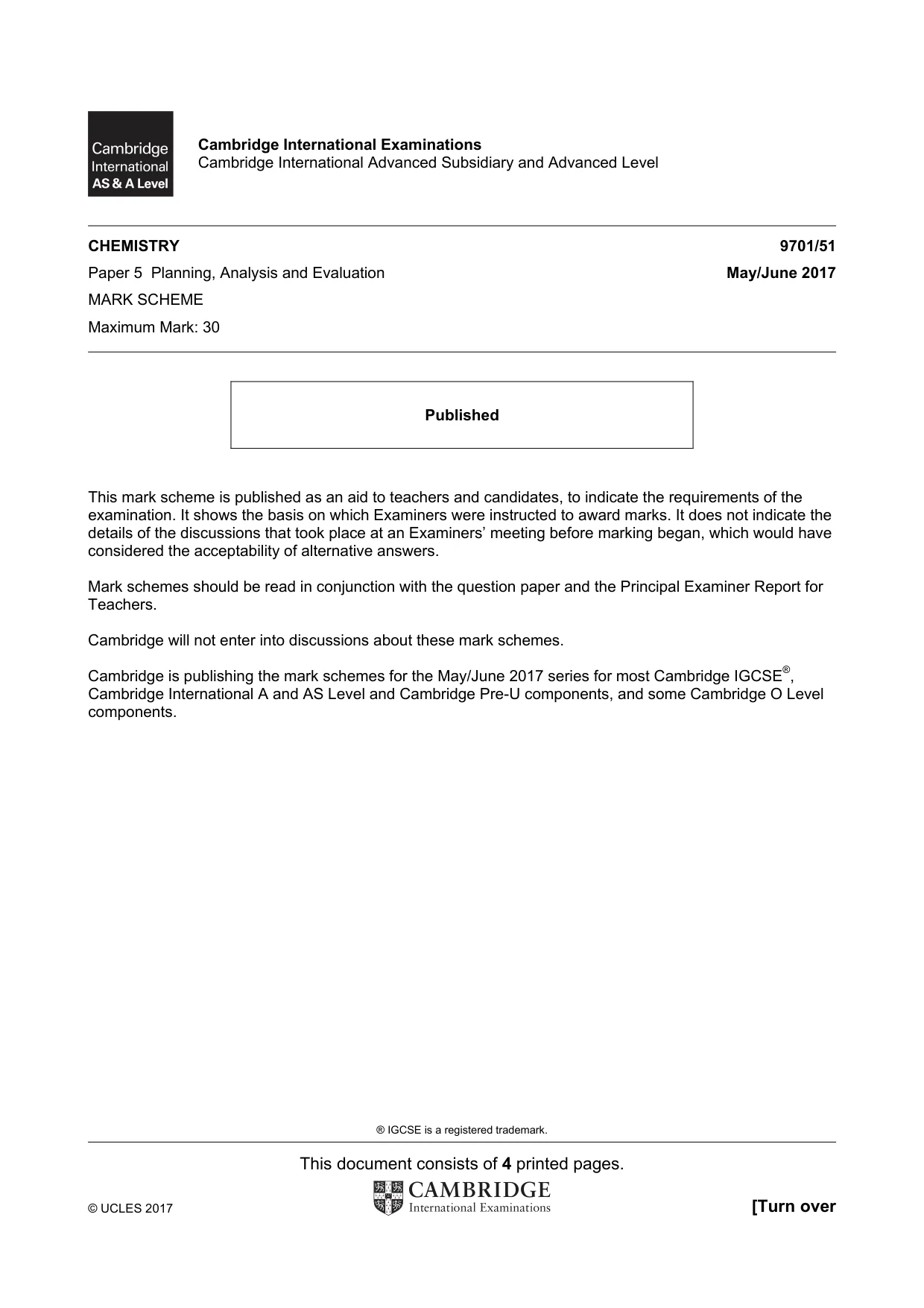
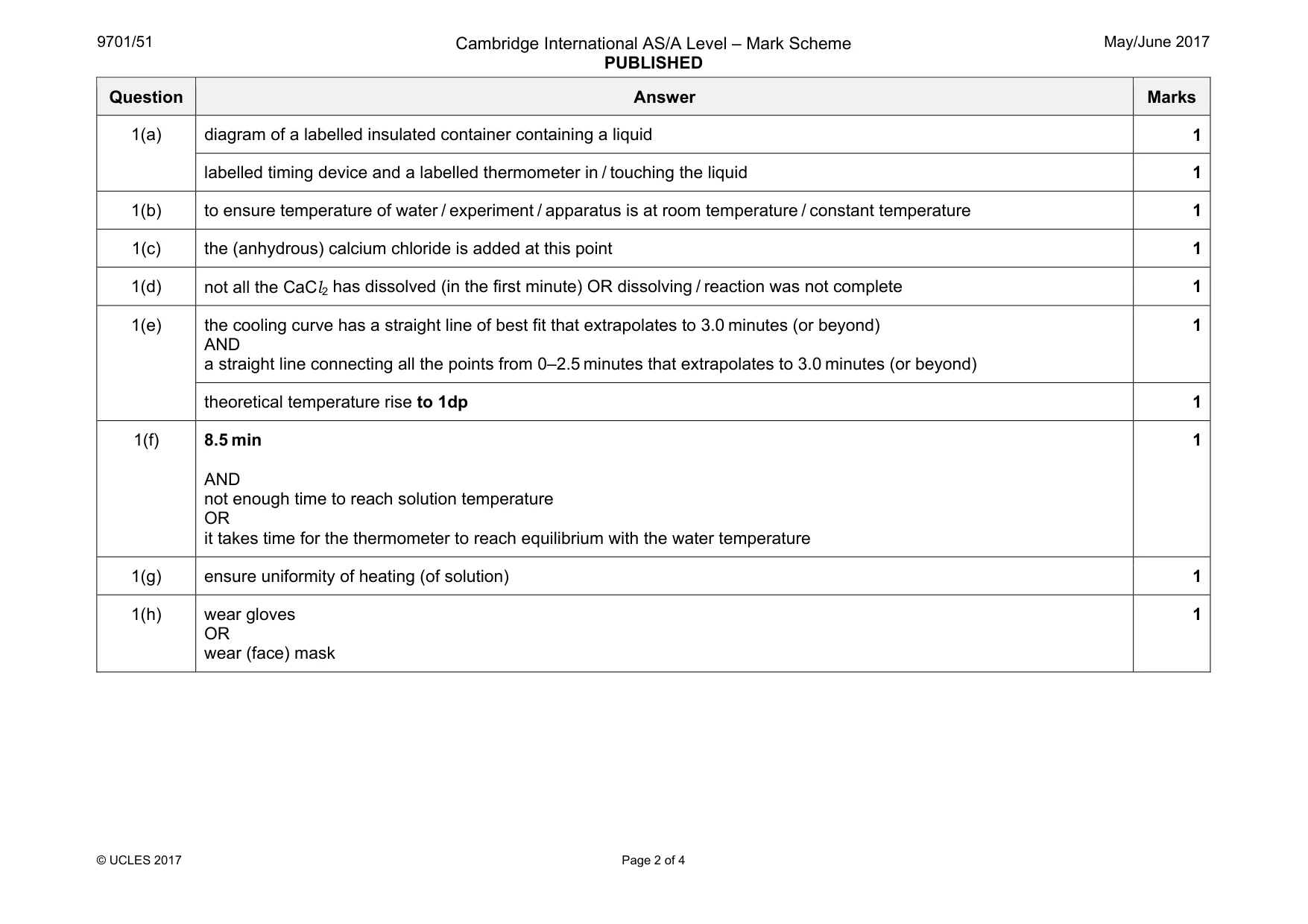
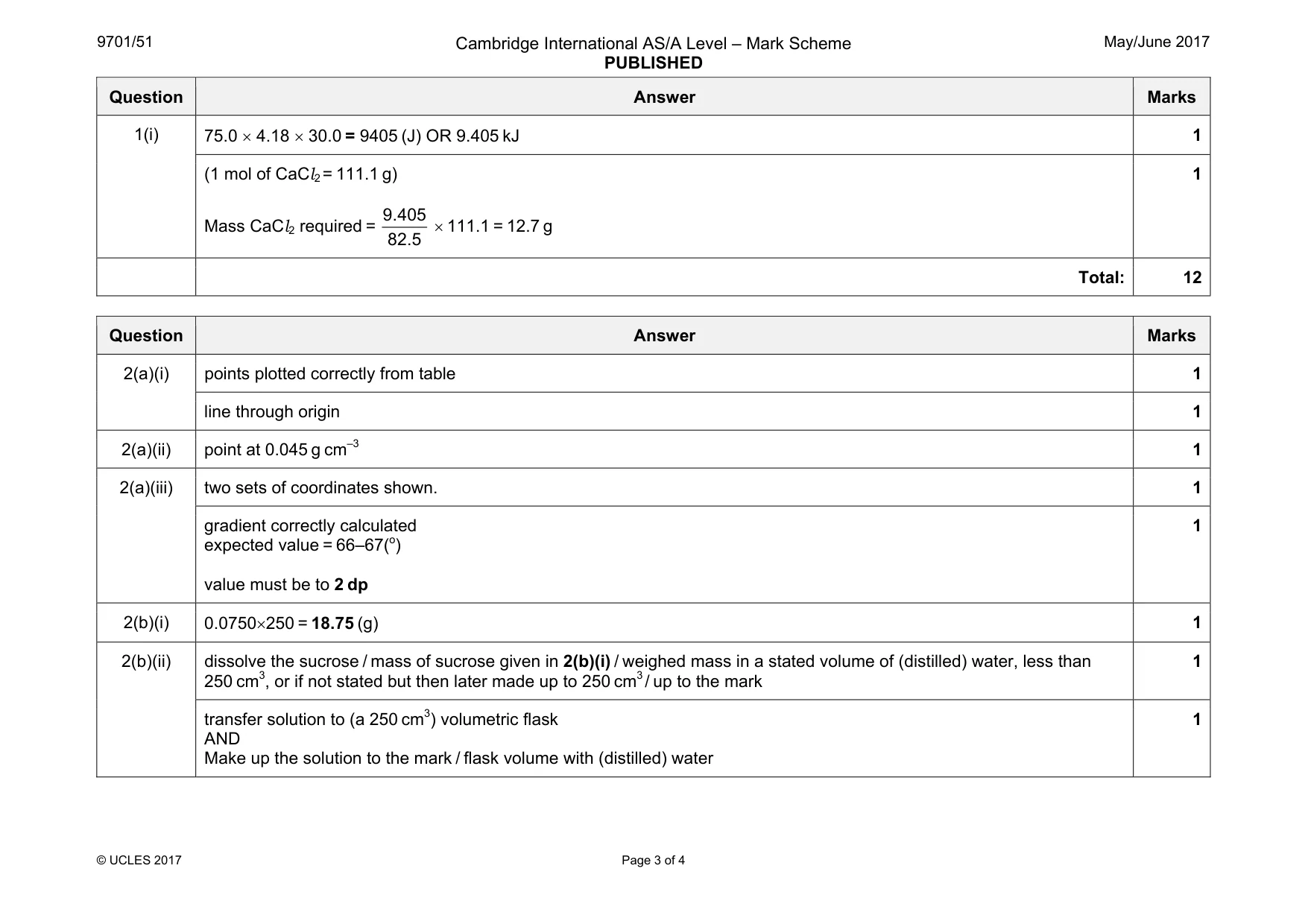
Mark scheme: 1(a) diagram of a labelled insulated container containing a liquid 1 labelled timing device and a labelled thermometer in / touching the liquid 1 1(b) to ensure temperature of water / experiment / apparatus is at room temperature / constant temperature 1 1(c) the (anhydrous) calcium chloride is added at this point 1 1(d) not all the CaCl2 has dissolved (in the first minute) OR dissolving / reaction was not complete 1 1(e) the cooling curve has a straight line of best fit that extrapolates to 3.0 minutes (or beyond) AND a straight line connecting all the points from 0–2.5 minutes that extrapolates to 3.0 minutes (or beyond) 1 theoretical temperature rise to 1dp 1 1(f) 8.5 min AND not enough time to reach solution temperature OR it takes time for the thermometer to reach equilibrium with the water temperature 1 1(g) ensure uniformity of heating (of solution) 1 1(h) wear gloves OR wear (face) mask 1 Question Answer Marks 1(i) 75.0 × 4.18 × 30.0 = 9405 (J) OR 9.405 kJ 1 (1 mol of CaCl2 = 111.1 g) Mass CaCl2 required = 9.405 82.5 × 111.1 = 12.7 g 1 Total: 12
Q2 · Sucrose is a sugar
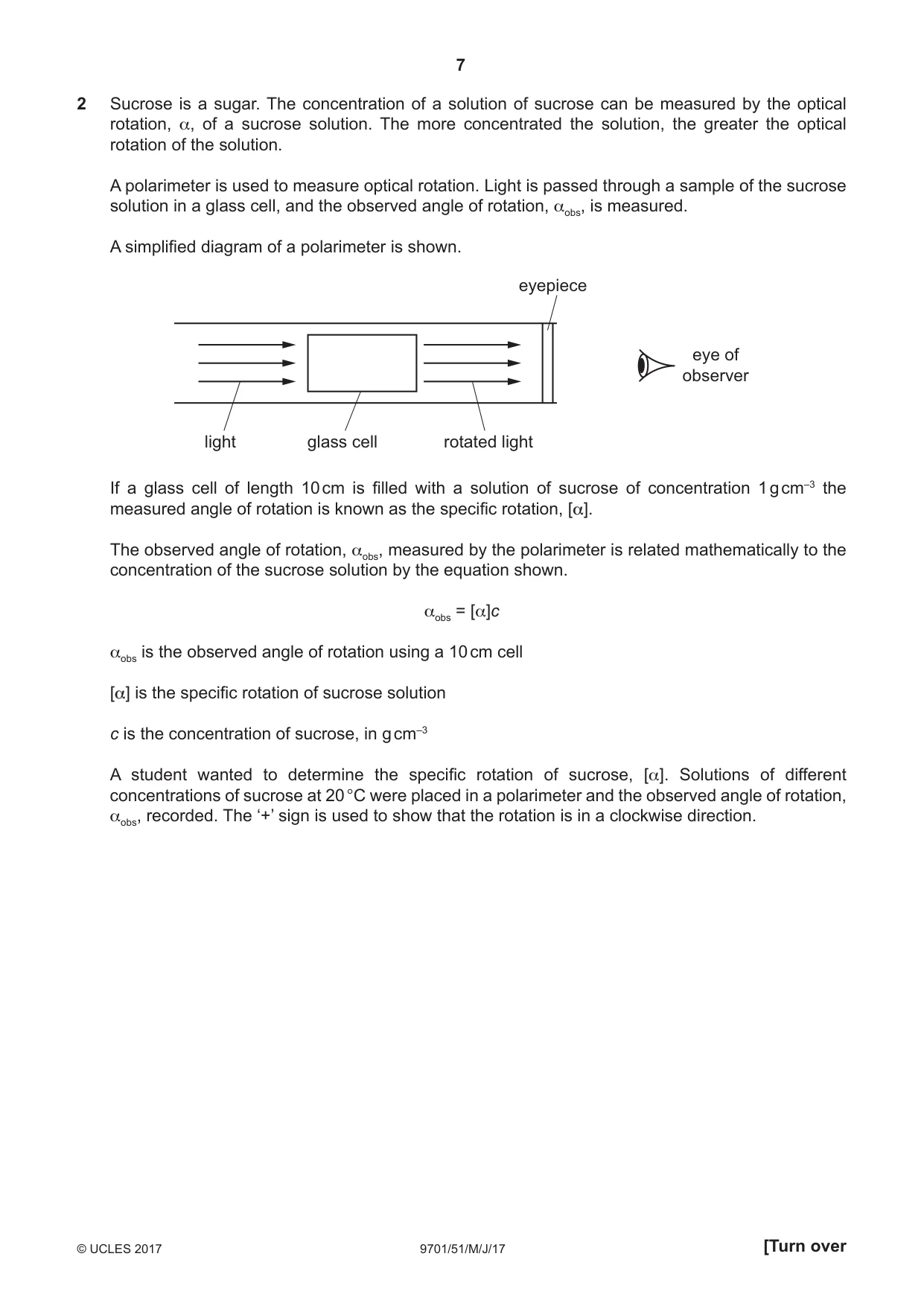
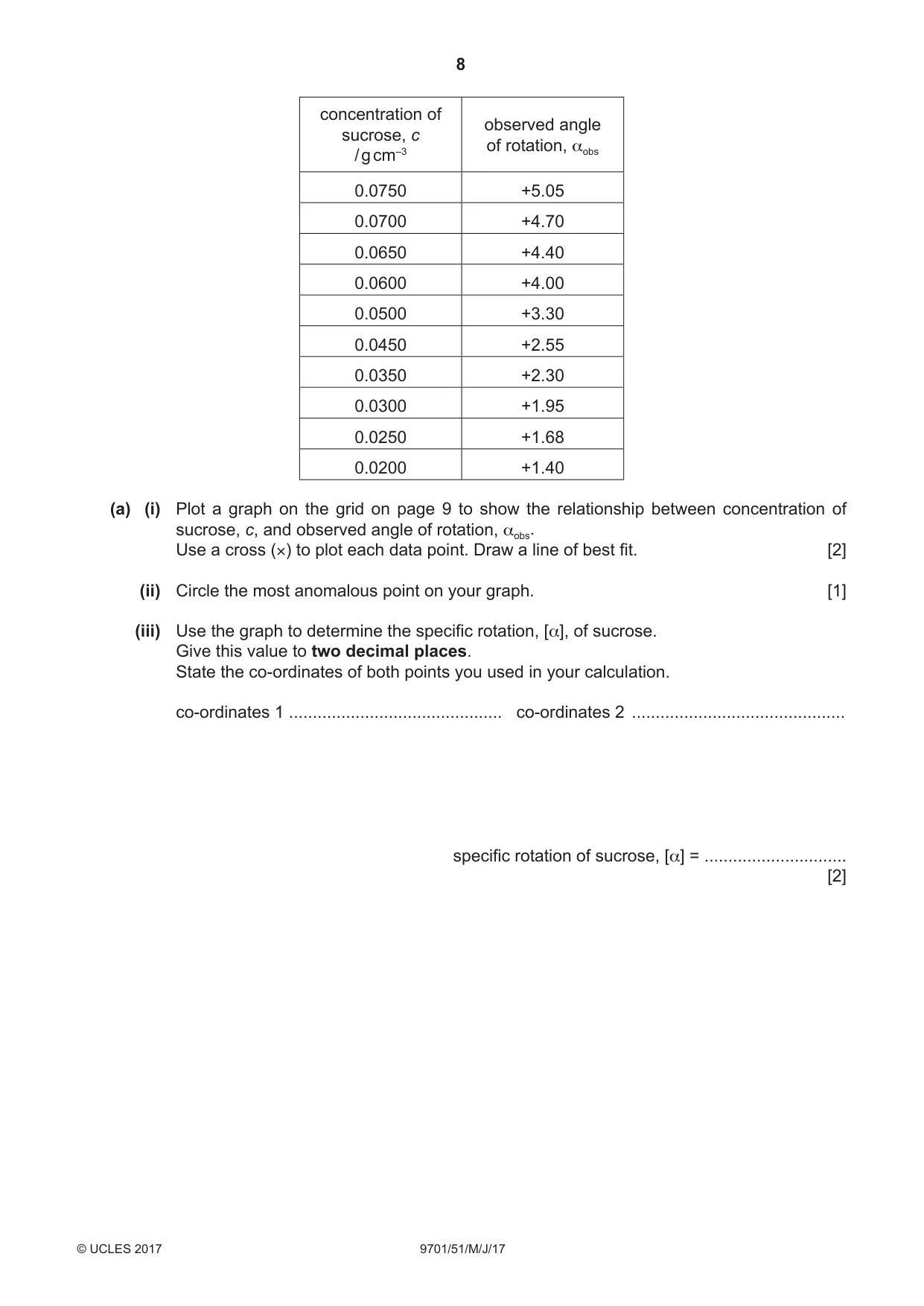
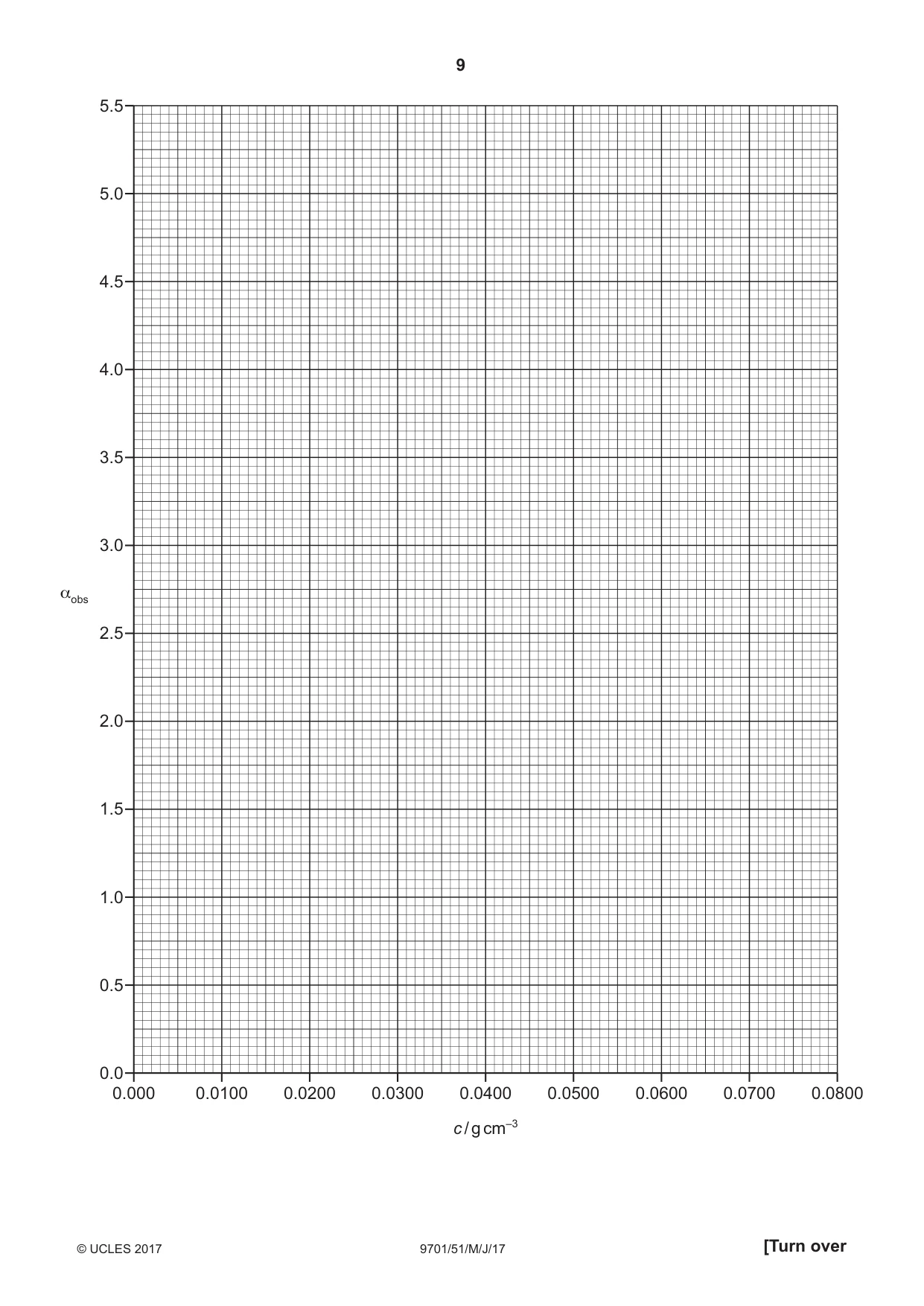
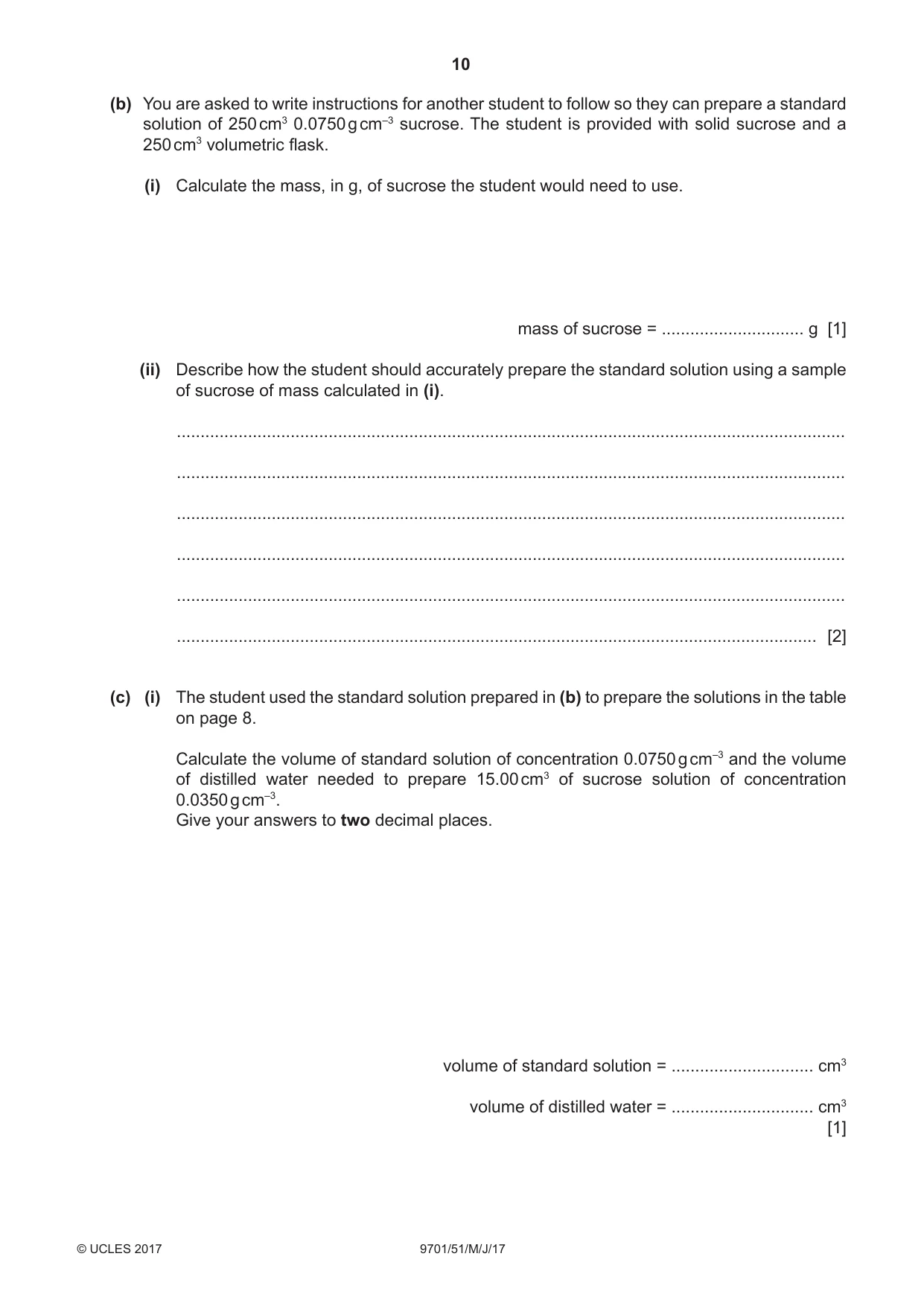
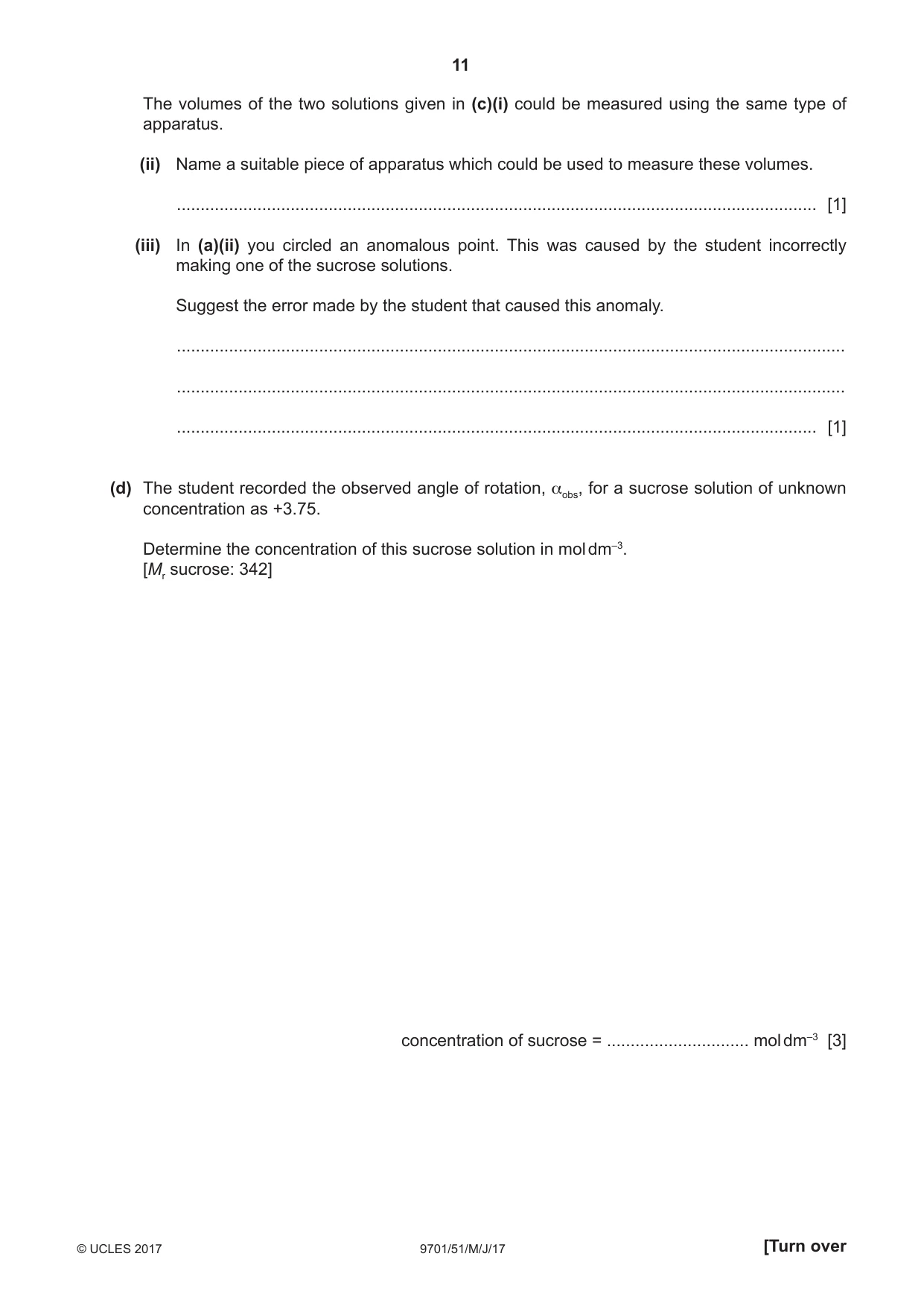
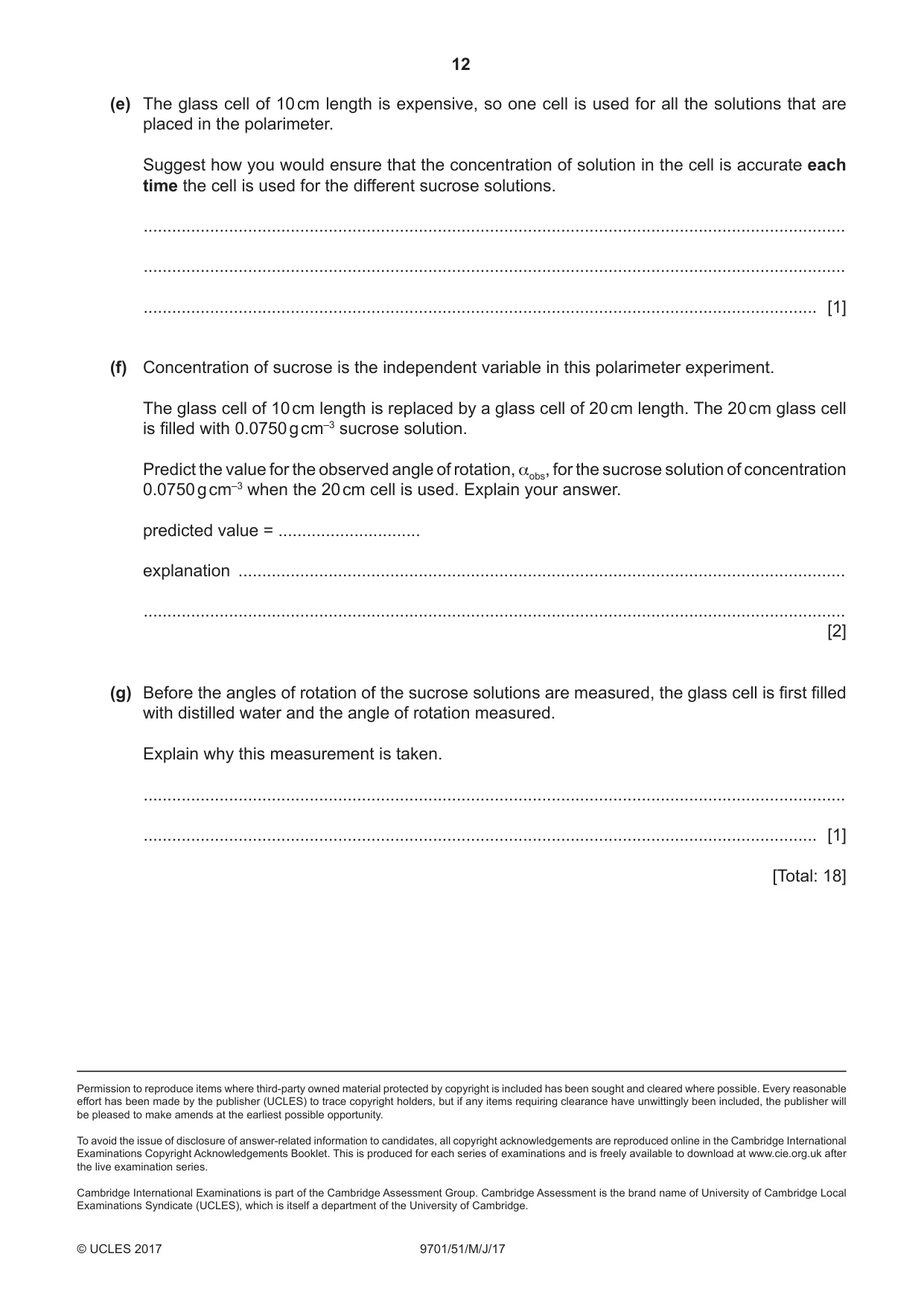
2 Sucrose is a sugar. The concentration of a solution of sucrose can be measured by the optical rotation, α, of a sucrose solution. The more concentrated the solution, the greater the optical rotation of the solution. A polarimeter is used to measure optical rotation. Light is passed through a sample of the sucrose solution in a glass cell, and the observed angle of rotation, αobs, is measured. A simplified diagram of a polarimeter is shown. eyepiece eye of observer light glass cell rotated light If a glass cell of length 10 cm is filled with a solution of sucrose of concentration 1 g cm–3 the measured angle of rotation is known as the specific rotation, [α]. The observed angle of rotation, αobs, measured by the polarimeter is related mathematically to the concentration of the sucrose solution by the equation shown. αobs = [α]c αobs is the observed angle of rotation using a 10 cm cell [α] is the specific rotation of sucrose solution c is the concentration of sucrose, in g cm–3 A student wanted to determine the specific rotation of sucrose, [α]. Solutions of different concentrations of sucrose at 20 °C were placed in a polarimeter and the observed angle of rotation, αobs, recorded. The ‘+’ sign is used to show that the rotation is in a clockwise direction. concentration of observed angle sucrose, c of rotation, αobs / g cm–3 0.0750 +5.05 0.0700 +4.70 0.0650 +4.40 0.0600 +4.00 0.0500 +3.30 0.0450 +2.55 0.0350 +2.30 0.0300 +1.95 0.0250 +1.68 0.0200 +1.40 (a) (i) Plot a graph on the grid on page 9 to show the relationship between concentration of sucrose, c, and observed angle of rotation, αobs. Use a cross (×) to plot each data point. Draw a line of best fit. [2] (ii) Circle the most anomalous point on your graph. [1] (iii) Use the graph to determine the specific rotation, [α], of sucrose. Give this value to two decimal places. State the co-ordinates of both points you used in your calculation. co-ordinates 1 ............................................. co-ordinates 2 .............................................. specific rotation of sucrose, [α] = .............................. [2] 0.0 c / g
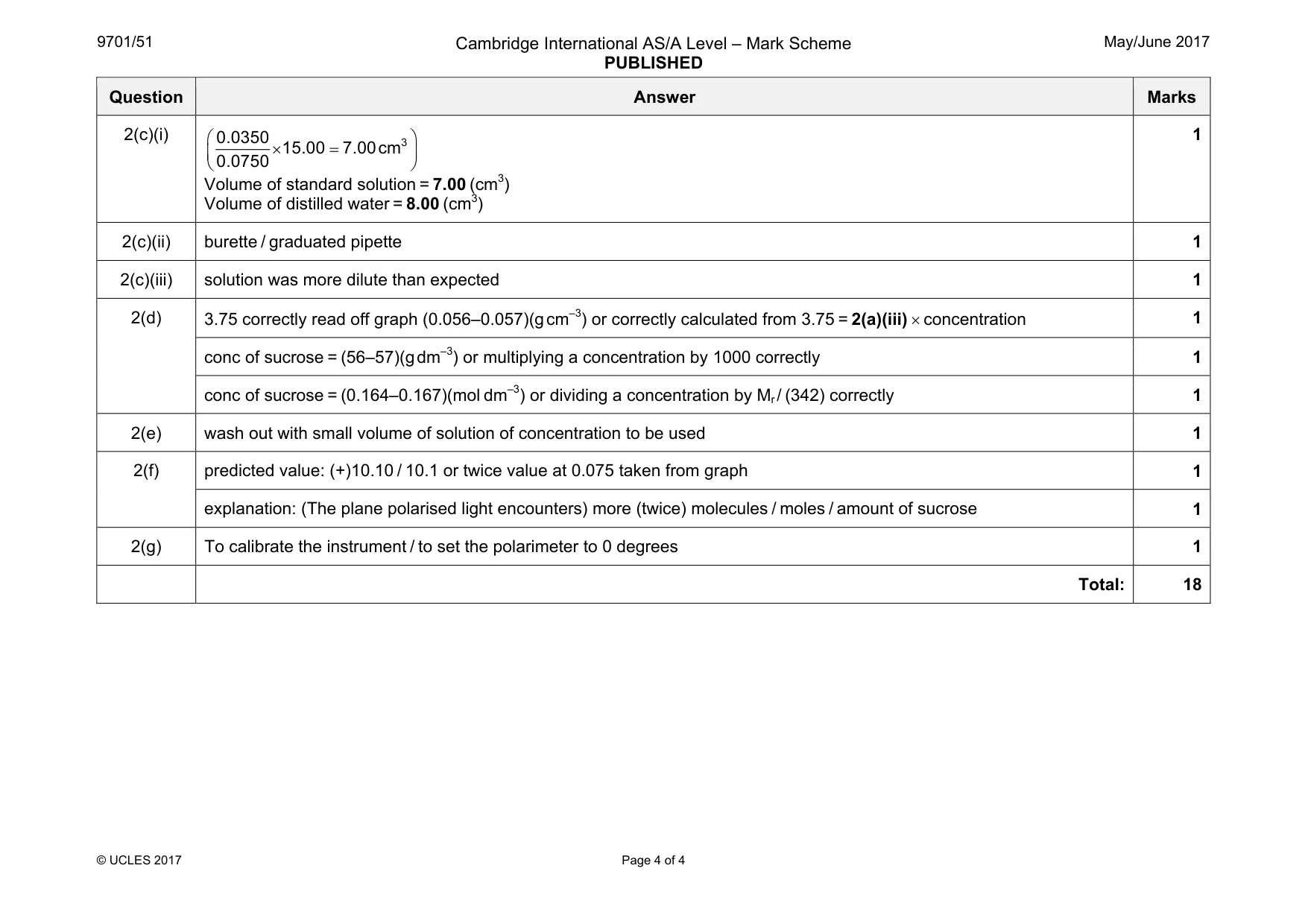
Mark scheme: 2(a)(i) points plotted correctly from table 1 line through origin 1 2(a)(ii) point at 0.045 g cm–3 1 2(a)(iii) two sets of coordinates shown. 1 gradient correctly calculated expected value = 66–67(o) value must be to 2 dp 1 2(b)(i) 0.0750×250 = 18.75 (g) 1 2(b)(ii) dissolve the sucrose / mass of sucrose given in 2(b)(i) / weighed mass in a stated volume of (distilled) water, less than 250 cm3, or if not stated but then later made up to 250 cm3 / up to the mark 1 transfer solution to (a 250 cm3) volumetric flask AND Make up the solution to the mark / flask volume with (distilled) water 1 Question Answer Marks 2(c)(i) 3 0.0350 15.00 7.00cm 0.0750 × = Volume of standard solution = 7.00 (cm3) Volume of distilled water = 8.00 (cm3) 1 2(c)(ii) burette / graduated pipette 1 2(c)(iii) solution was more dilute than expected 1 2(d) 3.75 correctly read off graph (0.056–0.057)(g cm–3) or correctly calculated from 3.75 = 2(a)(iii) × concentration 1 conc of sucrose = (56–57)(g dm–3) or multiplying a concentration by 1000 correctly 1 conc of sucrose = (0.164–0.167)(mol dm–3) or dividing a concentration by Mr/ (342) correctly 1 2(e) wash out with small volume of solution of concentration to be used 1 2(f) predicted value: (+)10.10 / 10.1 or twice value at 0.075 taken from graph 1 explanation: (The plane polarised light encounters) more (twice) molecules / moles / amount of sucrose 1 2(g) To calibrate the instrument / to set the polarimeter to 0 degrees 1 Total: 18
What was in this paper
The subtopics covered by these 2 questions, and how many questions each got. Open one in a new tab to see every Cambridge question on it.
What you needed in this session
Cambridge’s own grade thresholds for 2017 May/June, Paper 5 · Variant 1. A higher threshold means an easier paper — the bar moves with how the cohort did.