Cambridge A Level Chemistry 9701 — 2015 Oct/Nov Paper 2 · Variant 2
9701/22/O/N/15 · 60 marks · ≈68 min
The question paper and its mark scheme, free to read here and free to download. This is Cambridge’s own paper, exactly as it was sat.
Question paper12 pages

Mark scheme7 pages
Answers below. Sit the paper first if you are practising.
Paper as text
Question paper, page 1
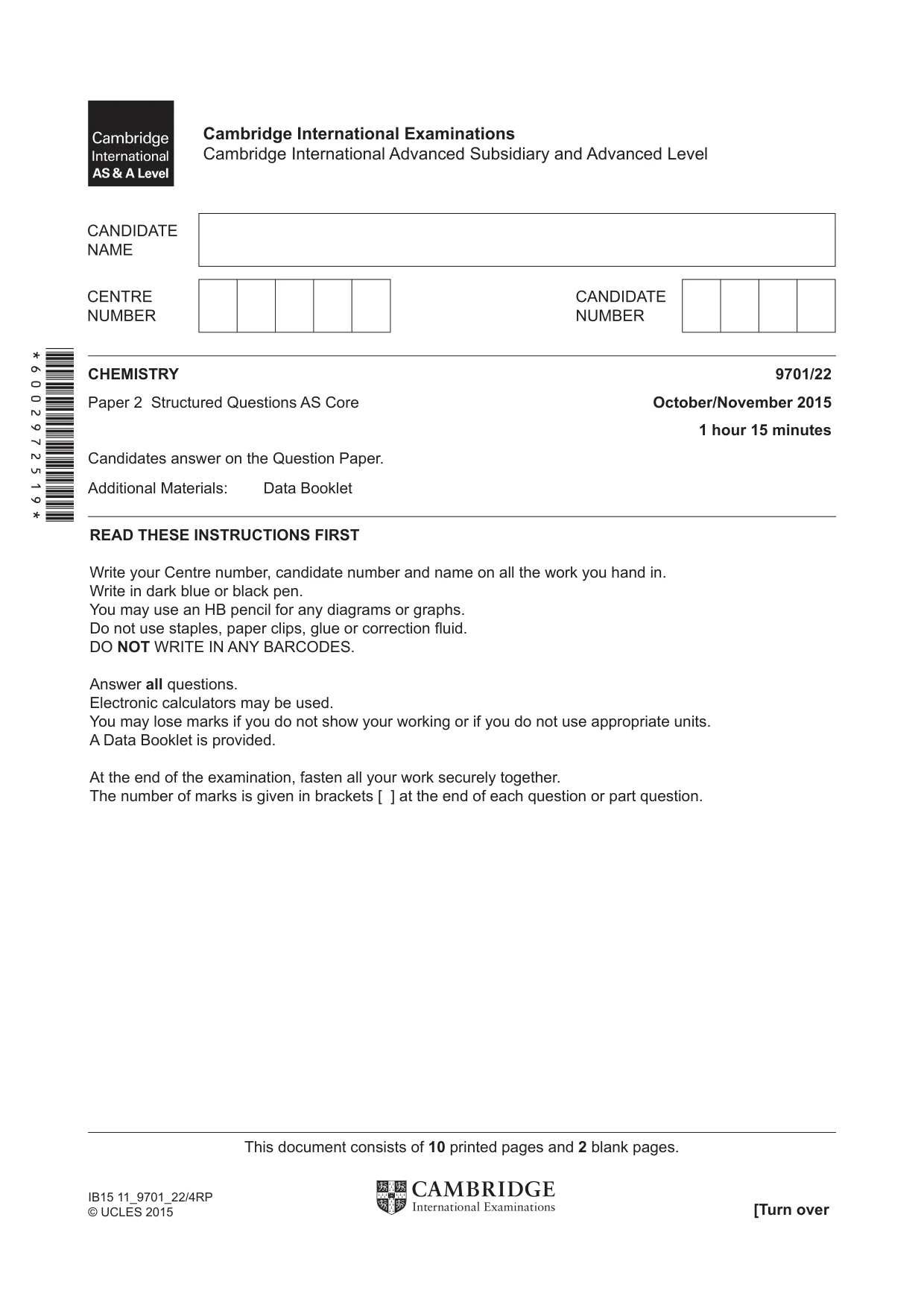
READ THESE INSTRUCTIONS FIRST Write your Centre number, candidate number and name on all the work you hand in. Write in dark blue or black pen. You may use an HB pencil for any diagrams or graphs. Do not use staples, paper clips, glue or correction fl uid. DO NOT WRITE IN ANY BARCODES. Answer all questions. Electronic calculators may be used. You may lose marks if you do not show your working or if you do not use appropriate units. A Data Booklet is provided. At the end of the examination, fasten all your work securely together. The number of marks is given in brackets [ ] at the end of each question or part question. CHEMISTRY 9701/22 Paper 2 Structured Questions AS Core October/November 2015 1 hour 15 minutes Candidates answer on the Question Paper. Additional Materials: Data Booklet Cambridge International Examinations Cambridge International Advanced Subsidiary and Advanced Level This document consists of 10 printed pages and 2 blank pages. [Turn over IB15 11_9701_22/4RP © UCLES 2015 *6002972519*
Question paper, page 2
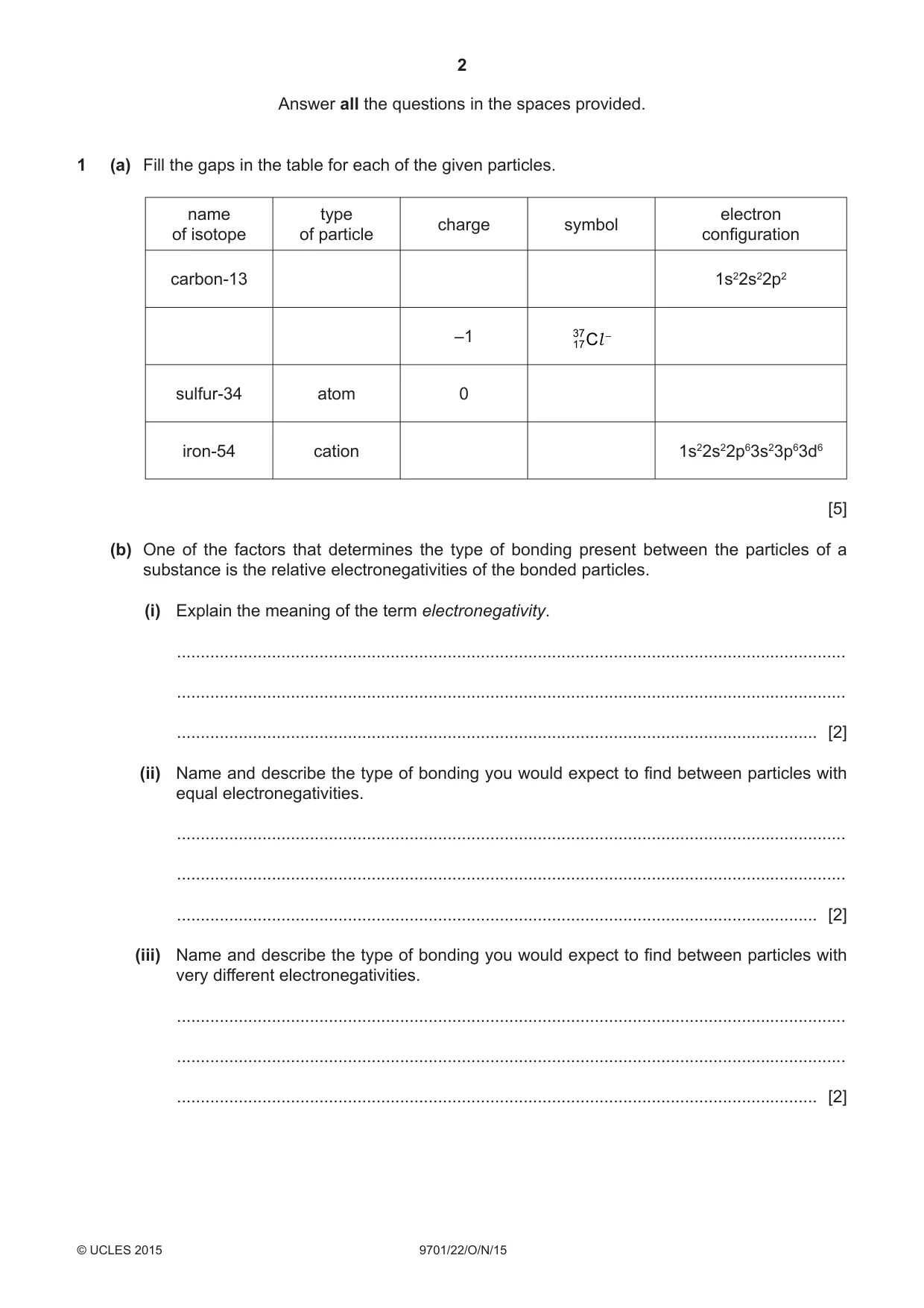
2 9701/22/O/N/15 © UCLES 2015 Answer all the questions in the spaces provided. 1 (a) Fill the gaps in the table for each of the given particles. name of isotope type of particle charge symbol electron confi guration carbon-13 1s22s22p2 –1 Cl 37 17 – sulfur-34 atom 0 iron-54 cation 1s22s22p63s23p63d6 [5] (b) One of the factors that determines the type of bonding present between the particles of a substance is the relative electronegativities of the bonded particles. (i) Explain the meaning of the term electronegativity. … … … [2] (ii) Name and describe the type of bonding you would expect to fi nd between particles with equal electronegativities. … … … [2] (iii) Name and describe the type of bonding you would expect to fi nd between particles with very different electronegativities. … … … [2]
Question paper, page 3
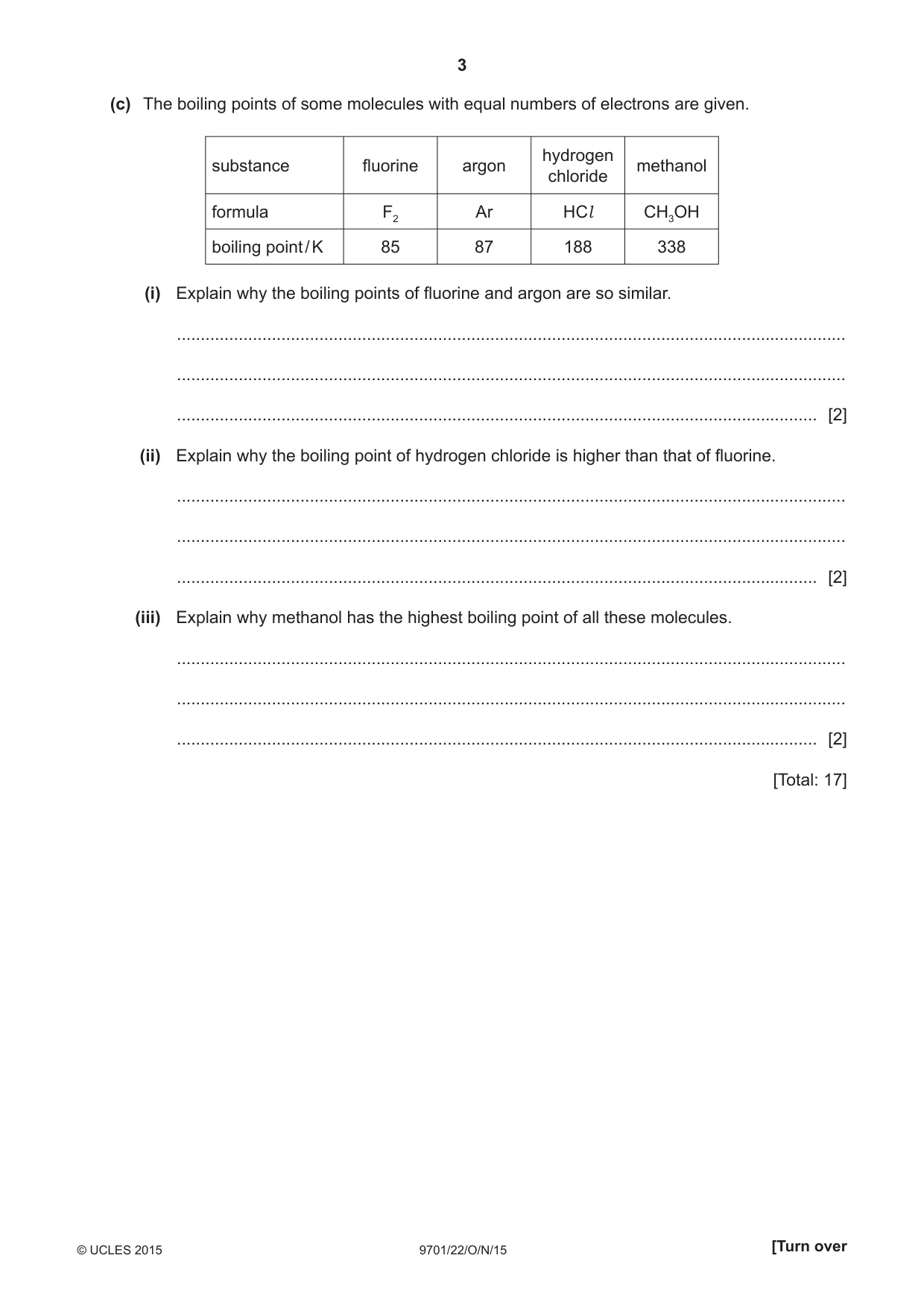
3 9701/22/O/N/15 © UCLES 2015 [Turn over (c) The boiling points of some molecules with equal numbers of electrons are given. substance fl uorine argon hydrogen chloride methanol formula F2 Ar HCl CH3OH boiling point / K 85 87 188 338 (i) Explain why the boiling points of fl uorine and argon are so similar. … … … [2] (ii) Explain why the boiling point of hydrogen chloride is higher than that of fl uorine. … … … [2] (iii) Explain why methanol has the highest boiling point of all these molecules. … … … [2] [Total: 17]
Question paper, page 4
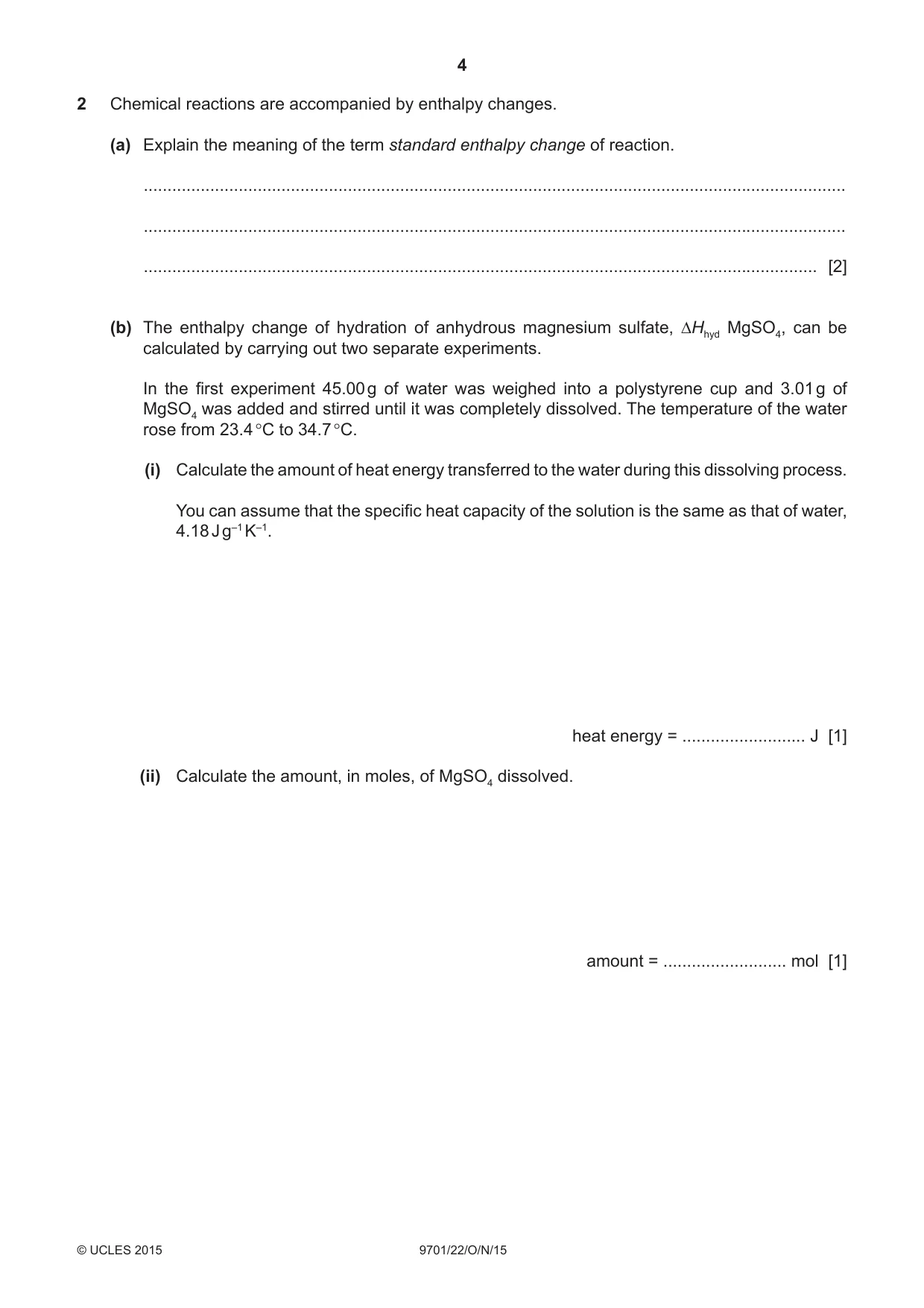
4 9701/22/O/N/15 © UCLES 2015 2 Chemical reactions are accompanied by enthalpy changes. (a) Explain the meaning of the term standard enthalpy change of reaction. … … … [2] (b) The enthalpy change of hydration of anhydrous magnesium sulfate, ∆Hhyd MgSO4, can be calculated by carrying out two separate experiments. In the fi rst experiment 45.00 g of water was weighed into a polystyrene cup and 3.01 g of MgSO4 was added and stirred until it was completely dissolved. The temperature of the water rose from 23.4 °C to 34.7 °C. (i) Calculate the amount of heat energy transferred to the water during this dissolving process. You can assume that the specifi c heat capacity of the solution is the same as that of water, 4.18 J g–1 K–1. heat energy = … J [1] (ii) Calculate the amount, in moles, of MgSO4 dissolved. amount = … mol [1]
Question paper, page 5
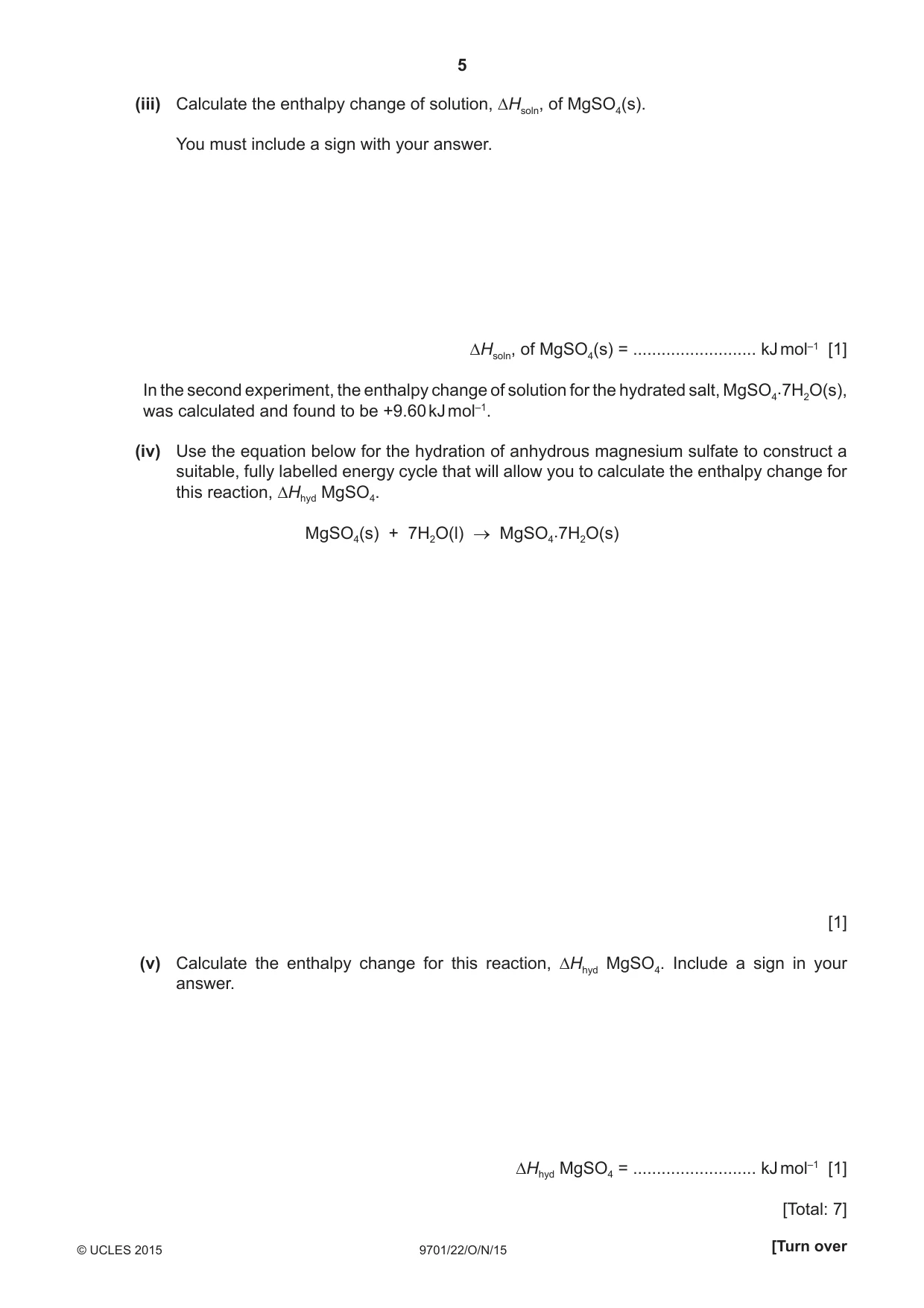
5 9701/22/O/N/15 © UCLES 2015 [Turn over (iii) Calculate the enthalpy change of solution, ∆Hsoln, of MgSO4(s). You must include a sign with your answer. ∆Hsoln, of MgSO4(s) = … kJ mol–1 [1] In the second experiment, the enthalpy change of solution for the hydrated salt, MgSO4.7H2O(s), was calculated and found to be +9.60 kJ mol–1. (iv) Use the equation below for the hydration of anhydrous magnesium sulfate to construct a suitable, fully labelled energy cycle that will allow you to calculate the enthalpy change for this reaction, ∆Hhyd MgSO4. MgSO4(s) + 7H2O(l) → MgSO4.7H2O(s) [1] (v) Calculate the enthalpy change for this reaction, ∆Hhyd MgSO4. Include a sign in your answer. ∆Hhyd MgSO4 = … kJ mol–1 [1] [Total: 7]
Question paper, page 6
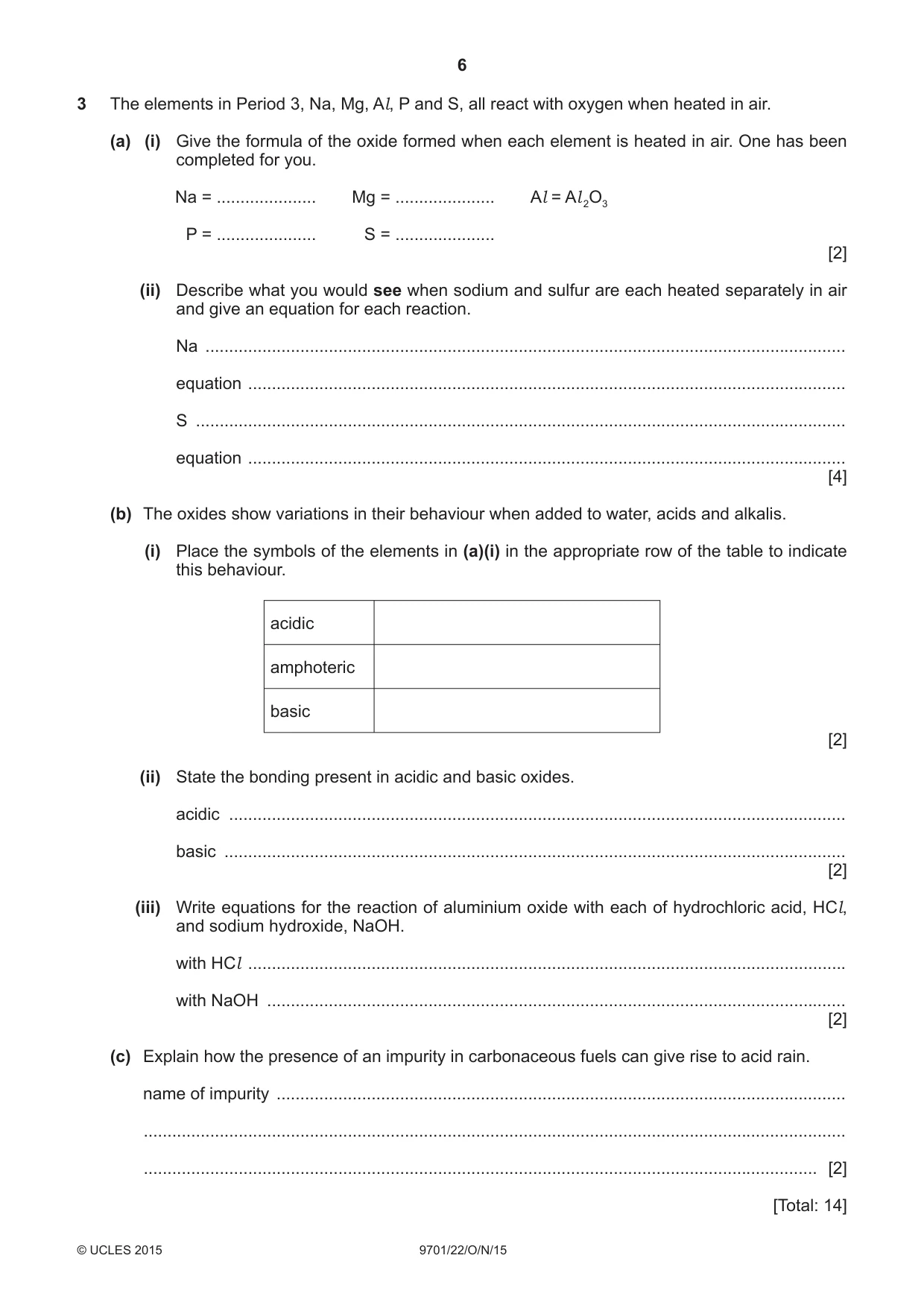
6 9701/22/O/N/15 © UCLES 2015 3 The elements in Period 3, Na, Mg, Al, P and S, all react with oxygen when heated in air. (a) (i) Give the formula of the oxide formed when each element is heated in air. One has been completed for you. Na = … Mg = … Al = Al 2O3 P = … S = … [2] (ii) Describe what you would see when sodium and sulfur are each heated separately in air and give an equation for each reaction. Na … equation … S … equation … [4] (b) The oxides show variations in their behaviour when added to water, acids and alkalis. (i) Place the symbols of the elements in (a)(i) in the appropriate row of the table to indicate this behaviour. acidic amphoteric basic [2] (ii) State the bonding present in acidic and basic oxides. acidic … basic … [2] (iii) Write equations for the reaction of aluminium oxide with each of hydrochloric acid, HCl, and sodium hydroxide, NaOH. with HCl … with NaOH … [2] (c) Explain how the presence of an impurity in carbonaceous fuels can give rise to acid rain. name of impurity … … … [2] [Total: 14]
Question paper, page 7
7 9701/22/O/N/15 © UCLES 2015 BLANK PAGE [Turn over
Question paper, page 8
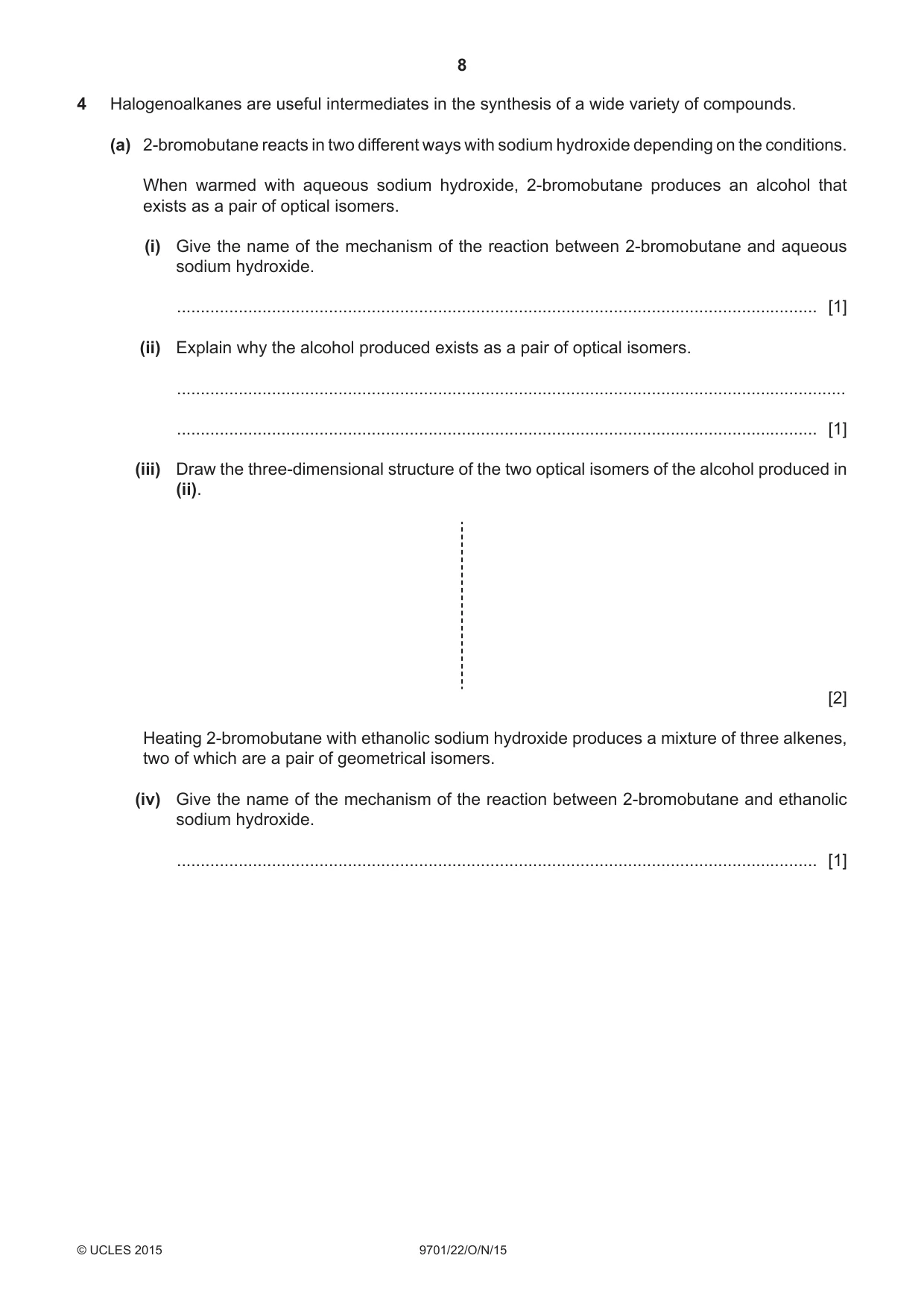
8 9701/22/O/N/15 © UCLES 2015 4 Halogenoalkanes are useful intermediates in the synthesis of a wide variety of compounds. (a) 2-bromobutane reacts in two different ways with sodium hydroxide depending on the conditions. When warmed with aqueous sodium hydroxide, 2-bromobutane produces an alcohol that exists as a pair of optical isomers. (i) Give the name of the mechanism of the reaction between 2-bromobutane and aqueous sodium hydroxide. … [1] (ii) Explain why the alcohol produced exists as a pair of optical isomers. … … [1] (iii) Draw the three-dimensional structure of the two optical isomers of the alcohol produced in (ii). [2] Heating 2-bromobutane with ethanolic sodium hydroxide produces a mixture of three alkenes, two of which are a pair of geometrical isomers. (iv) Give the name of the mechanism of the reaction between 2-bromobutane and ethanolic sodium hydroxide. … [1]
Question paper, page 9
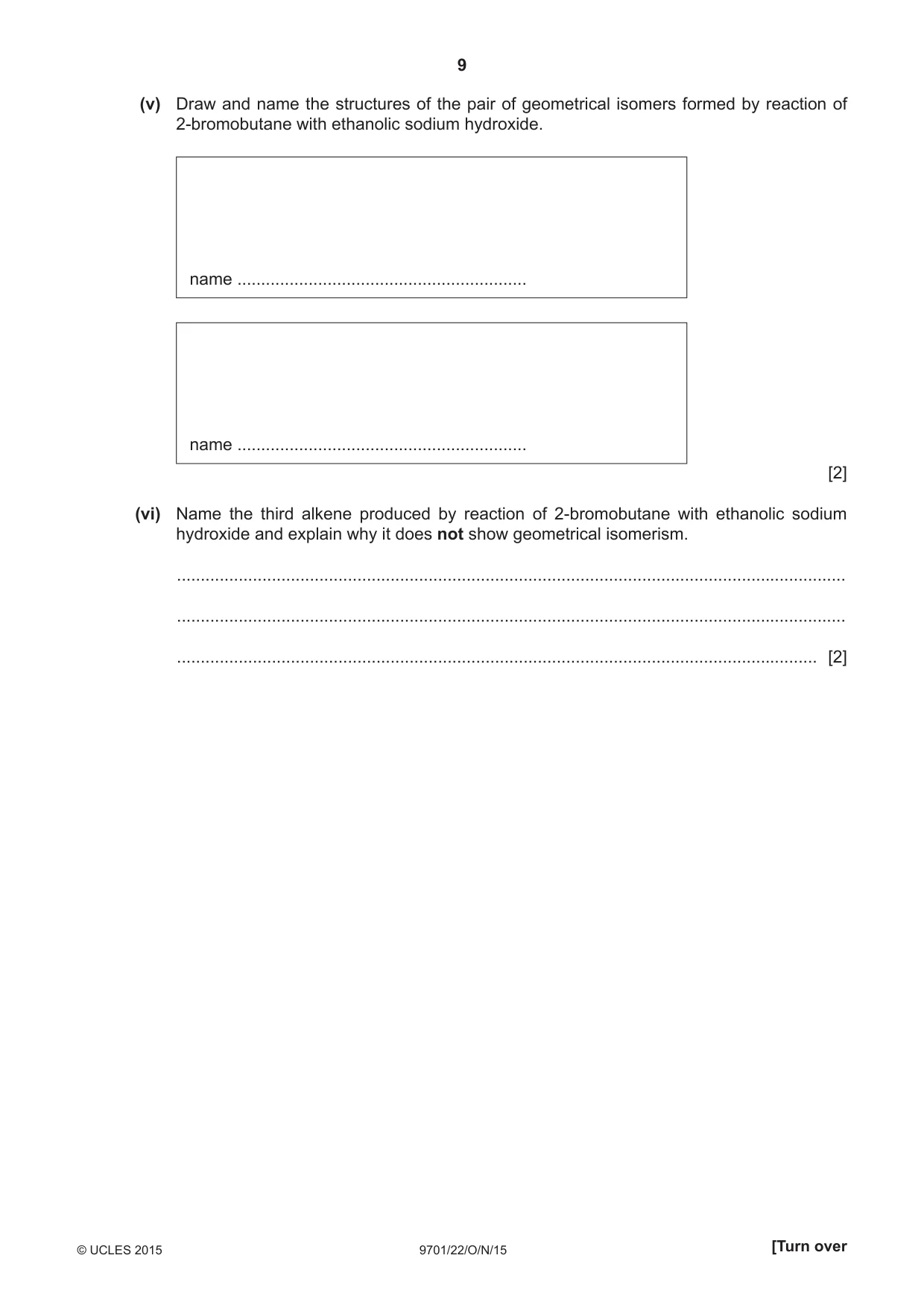
9 9701/22/O/N/15 © UCLES 2015 [Turn over (v) Draw and name the structures of the pair of geometrical isomers formed by reaction of 2-bromobutane with ethanolic sodium hydroxide. name … name … [2] (vi) Name the third alkene produced by reaction of 2-bromobutane with ethanolic sodium hydroxide and explain why it does not show geometrical isomerism. … … … [2]
Question paper, page 10
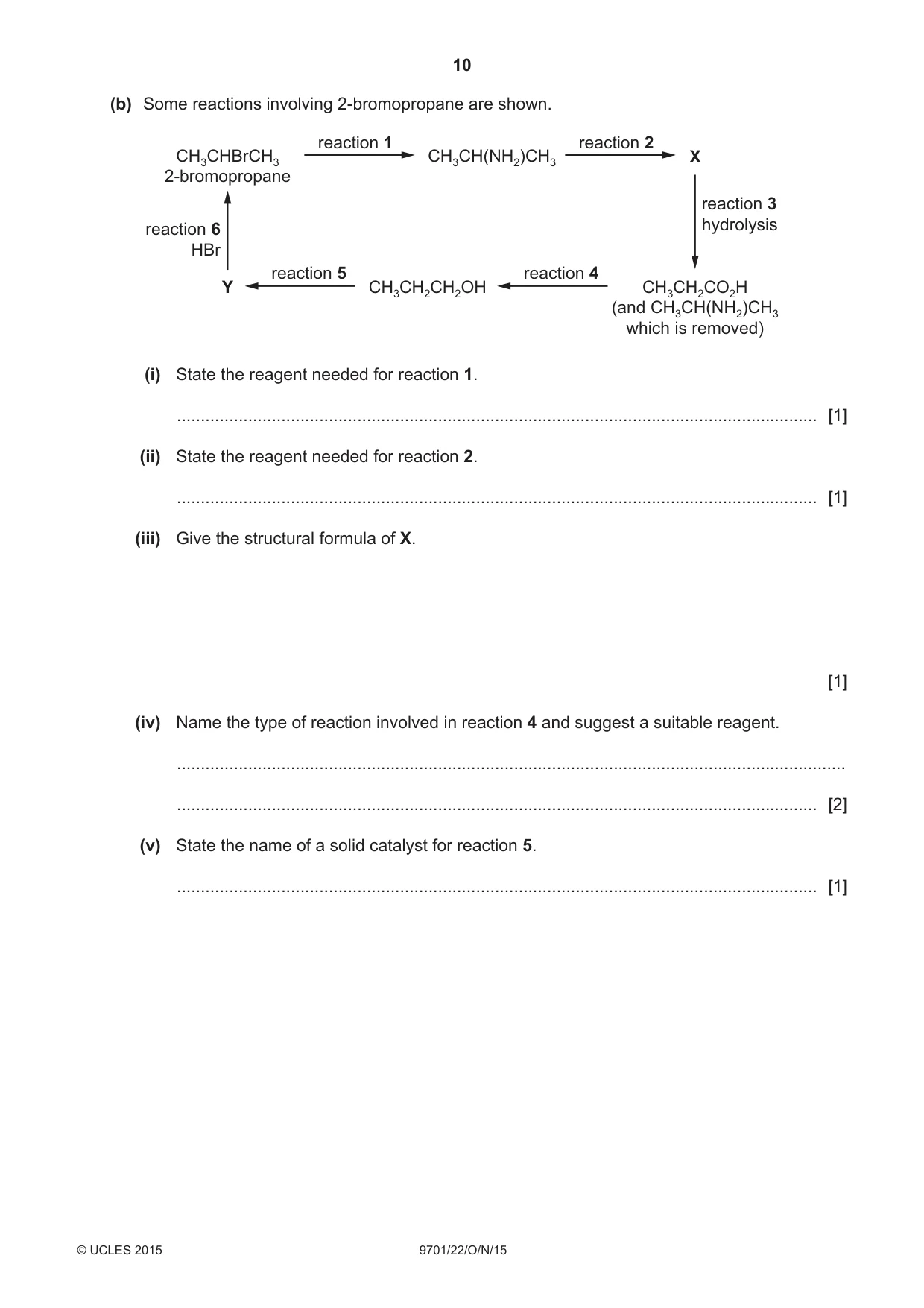
10 9701/22/O/N/15 © UCLES 2015 (b) Some reactions involving 2-bromopropane are shown. CH3CHBrCH3 2-bromopropane CH3CH2CO2H (and CH3CH(NH2)CH3 which is removed) CH3CH2CH2OH CH3CH(NH2)CH3 X Y reaction 1 reaction 2 reaction 5 reaction 4 reaction 3 hydrolysis reaction 6 HBr (i) State the reagent needed for reaction 1. … [1] (ii) State the reagent needed for reaction 2. … [1] (iii) Give the structural formula of X. [1] (iv) Name the type of reaction involved in reaction 4 and suggest a suitable reagent. … … [2] (v) State the name of a solid catalyst for reaction 5. … [1]
Question paper, page 11
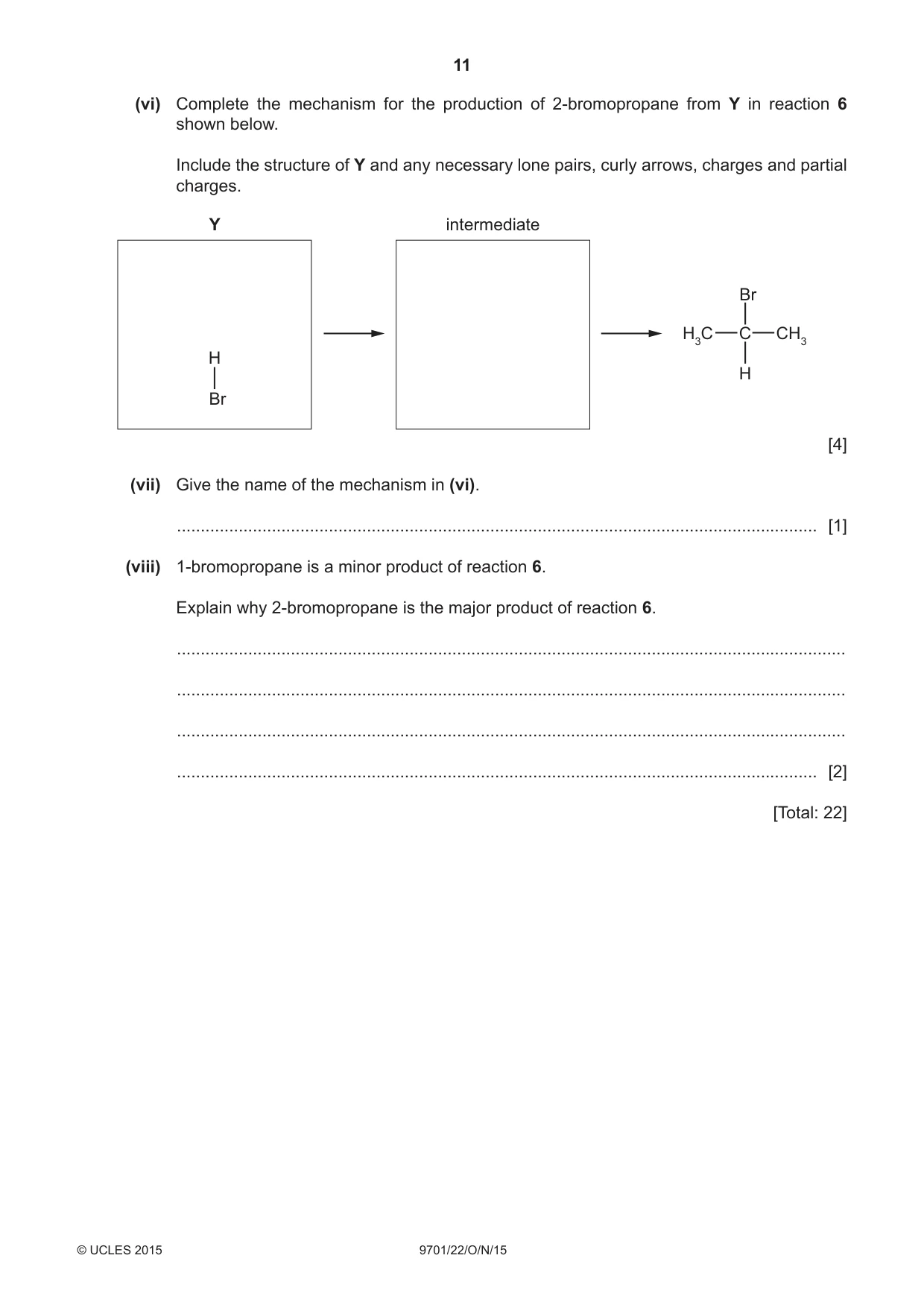
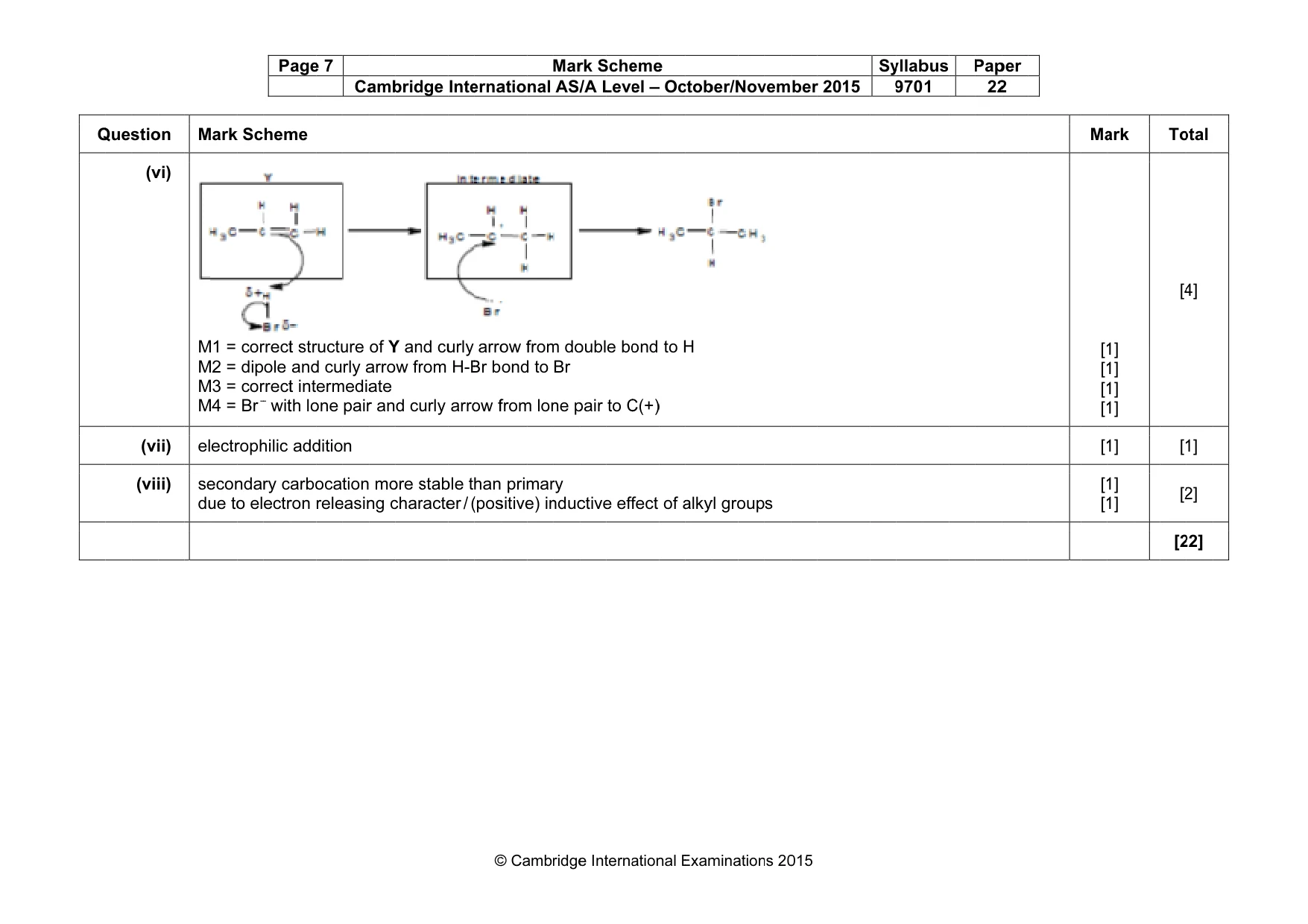
11 9701/22/O/N/15 © UCLES 2015 [Turn over (vi) Complete the mechanism for the production of 2-bromopropane from Y in reaction 6 shown below. Include the structure of Y and any necessary lone pairs, curly arrows, charges and partial charges. Y H Br intermediate H3C CH3 C H Br [4] (vii) Give the name of the mechanism in (vi). … [1] (viii) 1-bromopropane is a minor product of reaction 6. Explain why 2-bromopropane is the major product of reaction 6. … … … … [2] [Total: 22]
Question paper, page 12
12 9701/22/O/N/15 © UCLES 2015 BLANK PAGE Permission to reproduce items where third-party owned material protected by copyright is included has been sought and cleared where possible. Every reasonable effort has been made by the publisher (UCLES) to trace copyright holders, but if any items requiring clearance have unwittingly been included, the publisher will be pleased to make amends at the earliest possible opportunity. To avoid the issue of disclosure of answer-related information to candidates, all copyright acknowledgements are reproduced online in the Cambridge International Examinations Copyright Acknowledgements Booklet. This is produced for each series of examinations and is freely available to download at www.cie.org.uk after the live examination series. Cambridge International Examinations is part of the Cambridge Assessment Group. Cambridge Assessment is the brand name of University of Cambridge Local Examinations Syndicate (UCLES), which is itself a department of the University of Cambridge.
Mark scheme, page 1
® IGCSE is the registered trademark of Cambridge International Examinations. CAMBRIDGE INTERNATIONAL EXAMINATIONS Cambridge International Advanced Subsidiary and Advanced Level MARK SCHEME for the October/November 2015 series 9701 CHEMISTRY 9701/22 Paper 2 (AS Structured Questions), maximum raw mark 60 This mark scheme is published as an aid to teachers and candidates, to indicate the requirements of the examination. It shows the basis on which Examiners were instructed to award marks. It does not indicate the details of the discussions that took place at an Examiners’ meeting before marking began, which would have considered the acceptability of alternative answers. Mark schemes should be read in conjunction with the question paper and the Principal Examiner Report for Teachers. Cambridge will not enter into discussions about these mark schemes. Cambridge is publishing the mark schemes for the October/November 2015 series for most Cambridge IGCSE®, Cambridge International A and AS Level components and some Cambridge O Level components.
Mark scheme, page 2
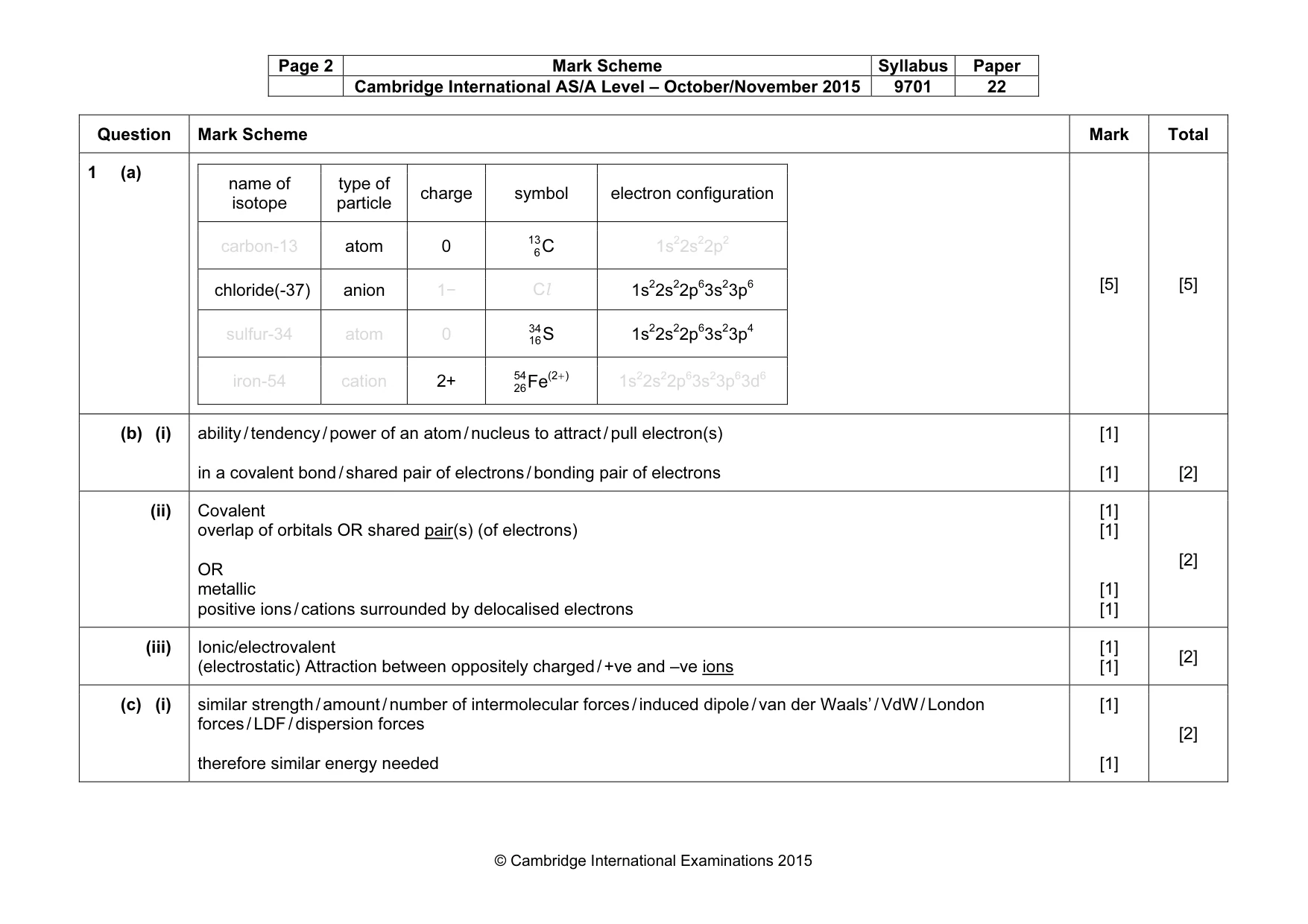
Page 2 Mark Scheme Syllabus Paper Cambridge International AS/A Level – October/November 2015 9701 22 © Cambridge International Examinations 2015 Question Mark Scheme Mark Total 1 (a) name of isotope type of particle charge symbol electron configuration carbon-13 atom 0 C 13 6 1s22s22p2 chloride(-37) anion 1− Cl 1s22s22p63s23p6 sulfur-34 atom 0 S 34 16 1s22s22p63s23p4 iron-54 cation 2+ ) (2 54 26Fe + 1s22s22p63s23p63d6 [5] [5] (b) (i) ability / tendency / power of an atom / nucleus to attract / pull electron(s) in a covalent bond / shared pair of electrons / bonding pair of electrons [1] [1] [2] (ii) Covalent overlap of orbitals OR shared pair(s) (of electrons) OR metallic positive ions / cations surrounded by delocalised electrons [1] [1] [1] [1] [2] (iii) Ionic/electrovalent (electrostatic) Attraction between oppositely charged / +ve and –ve ions [1] [1] [2] (c) (i) similar strength / amount / number of intermolecular forces / induced dipole / van der Waals’ / VdW / London forces / LDF / dispersion forces therefore similar energy needed [1] [1] [2]
Mark scheme, page 3
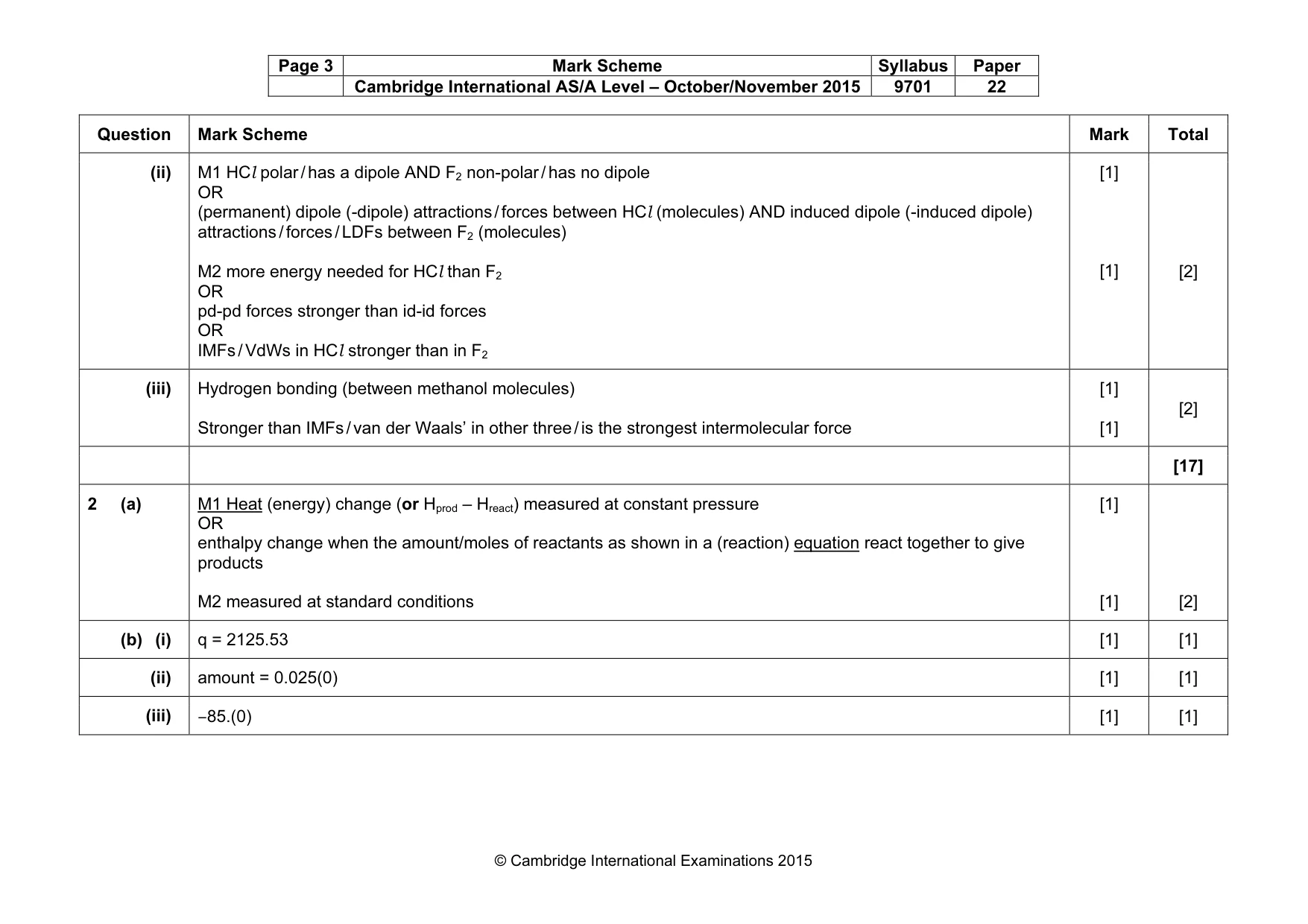
Page 3 Mark Scheme Syllabus Paper Cambridge International AS/A Level – October/November 2015 9701 22 © Cambridge International Examinations 2015 Question Mark Scheme Mark Total (ii) M1 HCl polar / has a dipole AND F2 non-polar / has no dipole OR (permanent) dipole (-dipole) attractions / forces between HCl (molecules) AND induced dipole (-induced dipole) attractions / forces / LDFs between F2 (molecules) M2 more energy needed for HCl than F2 OR pd-pd forces stronger than id-id forces OR IMFs / VdWs in HCl stronger than in F2 [1] [1] [2] (iii) Hydrogen bonding (between methanol molecules) Stronger than IMFs / van der Waals’ in other three / is the strongest intermolecular force [1] [1] [2] [17] 2 (a) M1 Heat (energy) change (or Hprod – Hreact) measured at constant pressure OR enthalpy change when the amount/moles of reactants as shown in a (reaction) equation react together to give products M2 measured at standard conditions [1] [1] [2] (b) (i) q = 2125.53 [1] [1] (ii) amount = 0.025(0) [1] [1] (iii) ‒85.(0) [1] [1]
Mark scheme, page 4
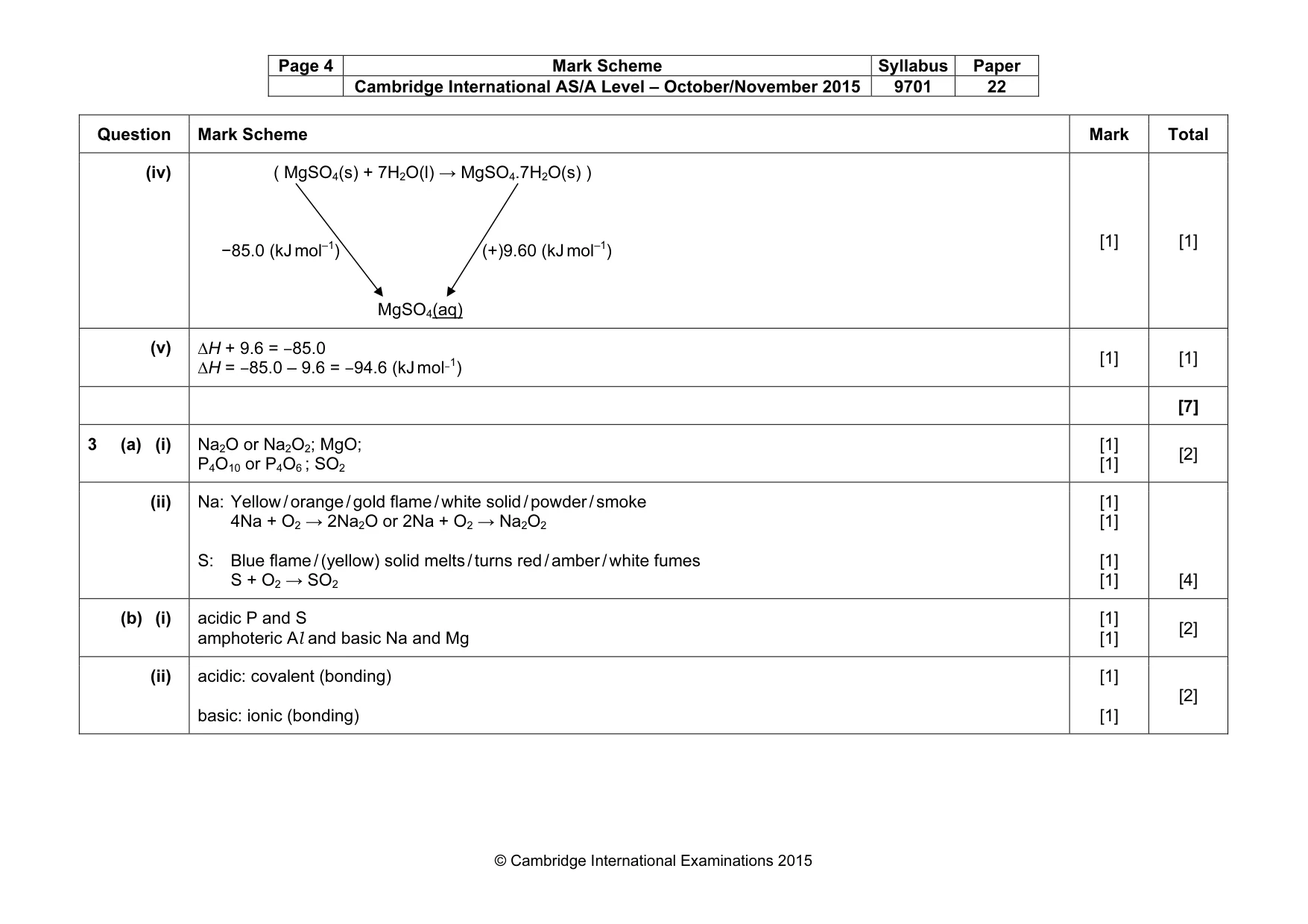
Page 4 Mark Scheme Syllabus Paper Cambridge International AS/A Level – October/November 2015 9701 22 © Cambridge International Examinations 2015 Question Mark Scheme Mark Total (iv) ( MgSO4(s) + 7H2O(l) → MgSO4.7H2O(s) ) −85.0 (kJ mol–1) (+)9.60 (kJ mol–1) MgSO4(aq) [1] [1] (v) ∆H + 9.6 = ‒85.0 ∆H = ‒85.0 – 9.6 = ‒94.6 (kJ mol–1) [1] [1] [7] 3 (a) (i) Na2O or Na2O2; MgO; P4O10 or P4O6 ; SO2 [1] [1] [2] (ii) Na: Yellow / orange / gold flame / white solid / powder / smoke 4Na + O2 → 2Na2O or 2Na + O2 → Na2O2 S: Blue flame / (yellow) solid melts / turns red / amber / white fumes S + O2 → SO2 [1] [1] [1] [1] [4] (b) (i) acidic P and S amphoteric Al and basic Na and Mg [1] [1] [2] (ii) acidic: covalent (bonding) basic: ionic (bonding) [1] [1] [2]
Mark scheme, page 5
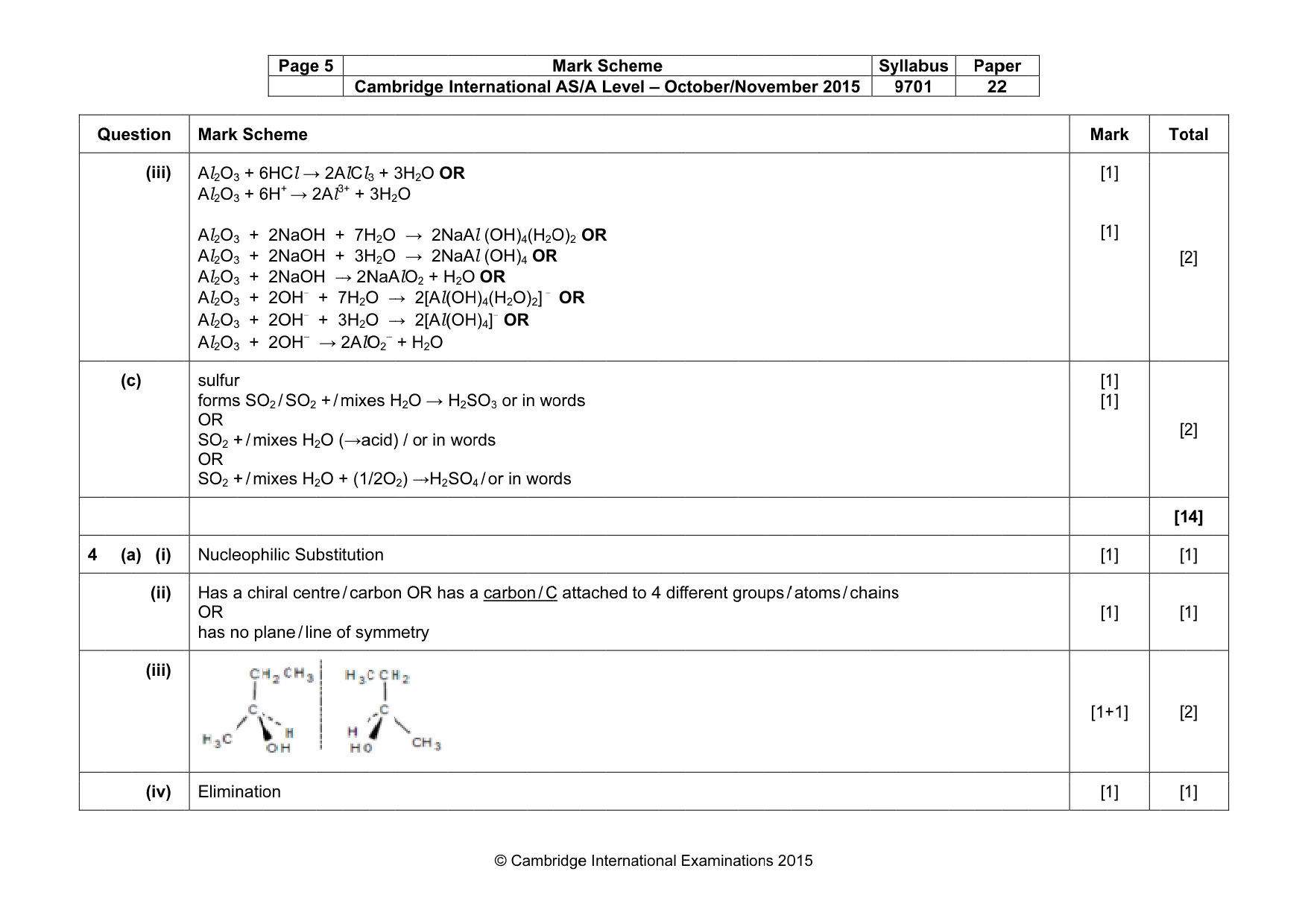
Q 4 Ques (c (a stio (ii c) a) ( (i (ii (iv on ii) (i) ii) ii) v) M A A A A A A A A su fo O SO O SO N Ha O ha El ark l2O3 l2O3 l2O3 l2O3 l2O3 l2O3 l2O3 l2O3 ulfur orms R O2 + R O2 + ucle as a R as n limin k Sc 3 + 6 3 + 6 3 + 3 + 3 + 3 + 3 + 3 + r s SO + / m + / m eoph a ch no p natio P hem 6HC 6H+ 2N 2N 2N 2O 2O 2O O2 / S mixes mixes hilic hiral lane on age me Cl → → 2 aOH aOH aOH OH‒ OH‒ OH− SO2 s H2 s H2 Su cen e / lin e 5 → 2A 2Al3 H + H + H → + 7 + 3 → 2 + / m 2O ( 2O + bstit ntre / ne o Ca AlCl3 3+ + + 7H + 3H → 2N 7H2O 3H2O 2AlO mixe (→a + (1/ tutio / car of sy amb l3 + 3 3H2 H2O H2O NaA O → O → O2 − es H acid) /2O on rbon ymm brid 3H2 2O → → AlO2 → 2 → 2 + H H2O ) / o 2) → n OR metry dge O O 2N 2N 2 + H 2[Al( 2[Al( H2O → r in →H2 R ha y Inte OR NaA NaA H2O (OH (OH H2S wor SO4 as a erna © l (O l (O OR H)4(H H)4]‒ SO3 rds 4 / or a ca atio © Ca OH)4 OH)4 R H2O) OR or in r in w arbo nal ambr (H2O OR )2] ‒ R n wo wor n / C Mar AS/ ridge O)2 R OR ords rds C att rk S /A L e Int OR R s tach Sche Leve terna R hed eme el – ation to 4 e – Oc nal E 4 diff ctob Exam fere ber/N mina ent g Nov ation grou vem ns 20 ups / ber 015 / ato r 201 oms / 15 / cha Sy 9 ains yllab 970 s bus 1 Pap 22 per 2 Ma [1 [1 [1 [1 [1 [1 [1+ [1 ark 1] 1] 1] 1] 1] 1] +1] 1] To [2 [2 [1 [1 [1 [2 [1 otal 2] 2] 4] 1] 1] 2] 1]
Mark scheme, page 6
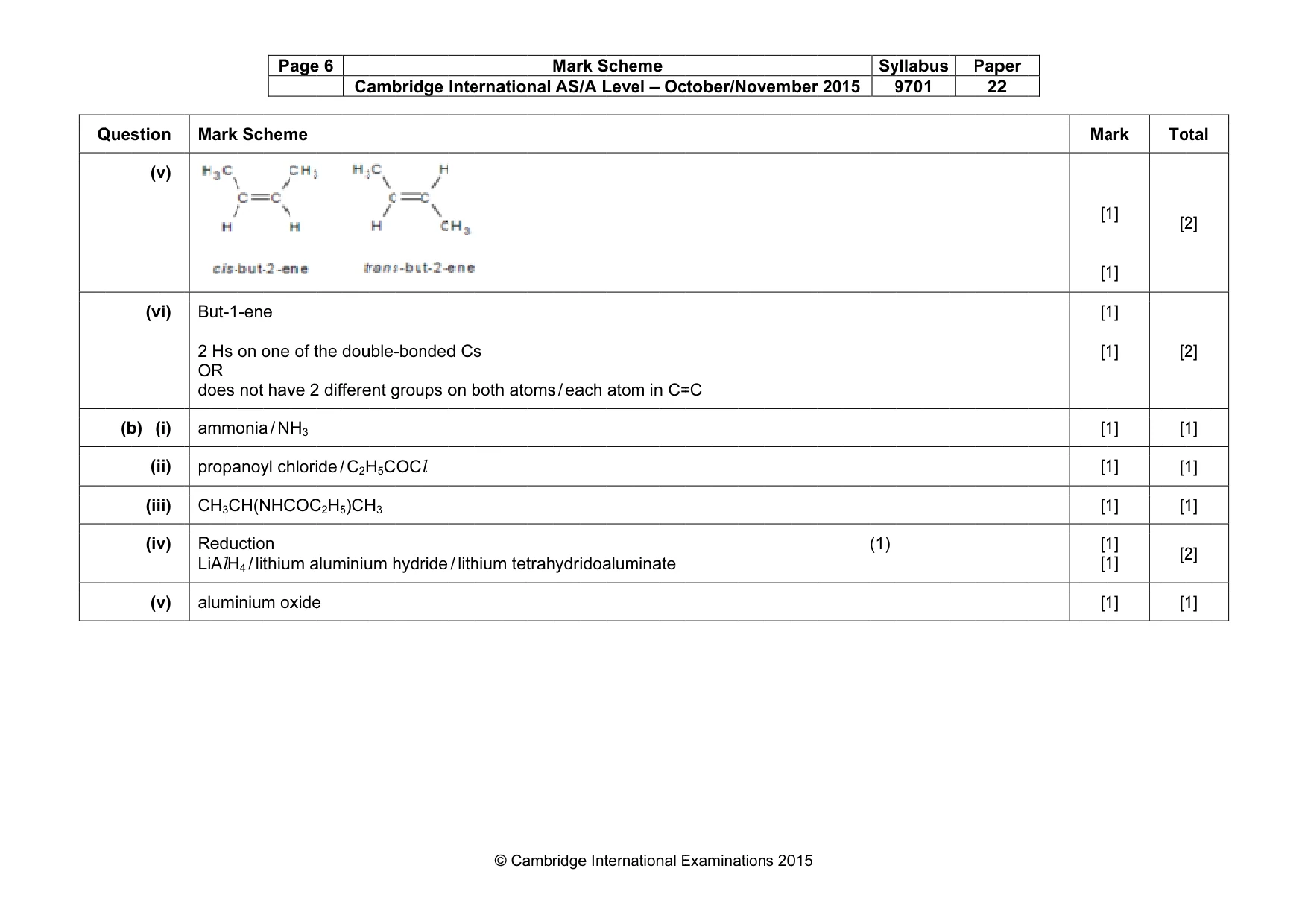
Q Ques (b stio (v (v b) ( (i (ii (iv (v on v) vi) (i) ii) ii) v) v) M Bu 2 O do am pr C Re Li al ark ut-1 Hs R oes mmo ropa H3C edu AlH umi k Sc -en on o not onia anoy CH(N uctio H4 / lit inium P hem e one hav a / N yl ch NHC on thiu m ox age me of t ve 2 H3 hlori COC m a xide e 6 the 2 diff ide / C2H5 alum e Ca dou fere / C2H 5)CH miniu amb uble- ent g H5C H3 um h brid -bon grou OC hydr dge nded ups o l ride Inte d Cs on b / lith erna © s both hium atio © Ca h ato m tet nal ambr oms trah Mar AS/ ridge s / ea hydr rk S /A L e Int ach idoa Sche Leve terna atom alum eme el – ation m in mina e – Oc nal E n C= ate ctob Exam =C ber/N mina Nov ation vem ns 20 ber 015 r 2015 Sy 9 (1) yllab 970 bus 1 Pap 22 per 2 Ma [1 [1 [1 [1 [1 [1 [1 [1 [1 [1 ark 1] 1] 1] 1] 1] 1] 1] 1] 1] 1] To [2 [2 [1 [1 [1 [2 [1 otal 2] 2] 1] 1] 1] 2] 1]
Mark scheme, page 7
Q Ques stio (v (vi (vii on vi) ii) ii) M M M M M el se du ark 1 = 2 = 3 = 4 = ectr econ ue to k Sc cor dip cor Br – roph ndar o el P hem rrect ole rrect – wit hilic ry c ectr age me t str and t int th lo add arbo ron e 7 ructu d cu erm one ditio ocat rele Ca ure rly a media pair n tion easin amb of Y arro ate r an mo ng c brid Y an w fr d cu ore s char dge nd cu rom urly stab racte Inte urly H-B arro ble t er / ( erna © arro Br b ow f han (pos atio © Ca ow f ond from prim sitive nal ambr from d to m lon mar e) in Mar AS/ ridge m do Br ne p ry nduc rk S /A L e Int oubl pair ctive Sche Leve terna e bo to C e eff eme el – ation ond C(+) fect e – Oc nal E to H ) of a ctob Exam H alky ber/N mina yl gro Nov ation oup vem ns 20 s ber 015 r 2015 Sy 9 yllab 970 bus 1 Pap 22 per 2 Ma [1 [1 [1 [1 [1 [1 [1 ark 1] 1] 1] 1] 1] 1] 1] To [4 [1 [2 [2 otal 4] 1] 2] 22]
What you needed in this session
Cambridge’s own grade thresholds for 2015 Oct/Nov, Paper 2 · Variant 2. A higher threshold means an easier paper — the bar moves with how the cohort did.