Cambridge A Level Chemistry 9701 — 2015 Oct/Nov Paper 2 · Variant 3
9701/23/O/N/15 · 60 marks · ≈68 min
The question paper and its mark scheme, free to read here and free to download. This is Cambridge’s own paper, exactly as it was sat.
Question paper8 pages
Mark scheme6 pages
Answers below. Sit the paper first if you are practising.
Paper as text
Question paper, page 1
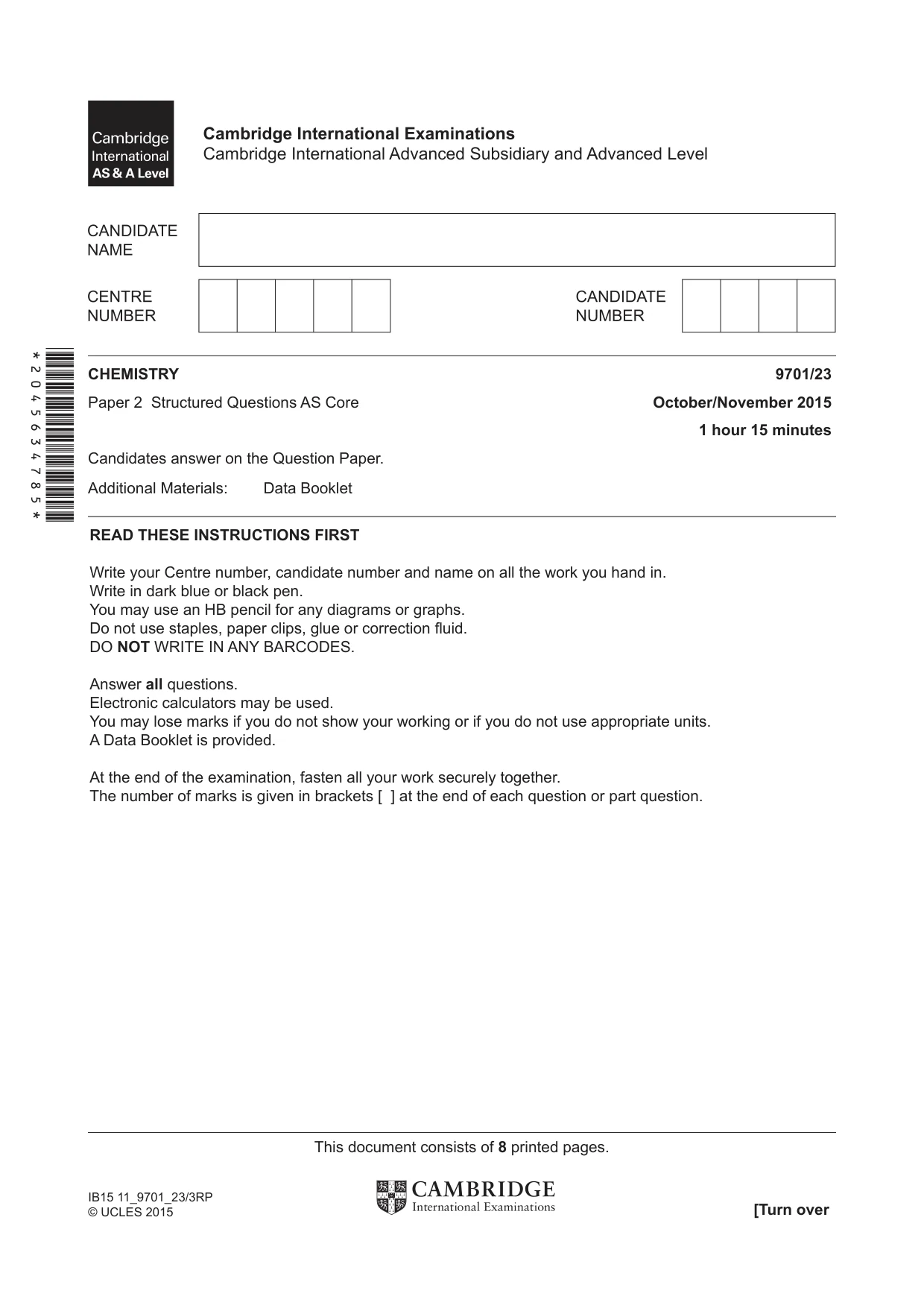
READ THESE INSTRUCTIONS FIRST Write your Centre number, candidate number and name on all the work you hand in. Write in dark blue or black pen. You may use an HB pencil for any diagrams or graphs. Do not use staples, paper clips, glue or correction fl uid. DO NOT WRITE IN ANY BARCODES. Answer all questions. Electronic calculators may be used. You may lose marks if you do not show your working or if you do not use appropriate units. A Data Booklet is provided. At the end of the examination, fasten all your work securely together. The number of marks is given in brackets [ ] at the end of each question or part question. CHEMISTRY 9701/23 Paper 2 Structured Questions AS Core October/November 2015 1 hour 15 minutes Candidates answer on the Question Paper. Additional Materials: Data Booklet Cambridge International Examinations Cambridge International Advanced Subsidiary and Advanced Level This document consists of 8 printed pages. [Turn over IB15 11_9701_23/3RP © UCLES 2015 *2045634785*
Question paper, page 2
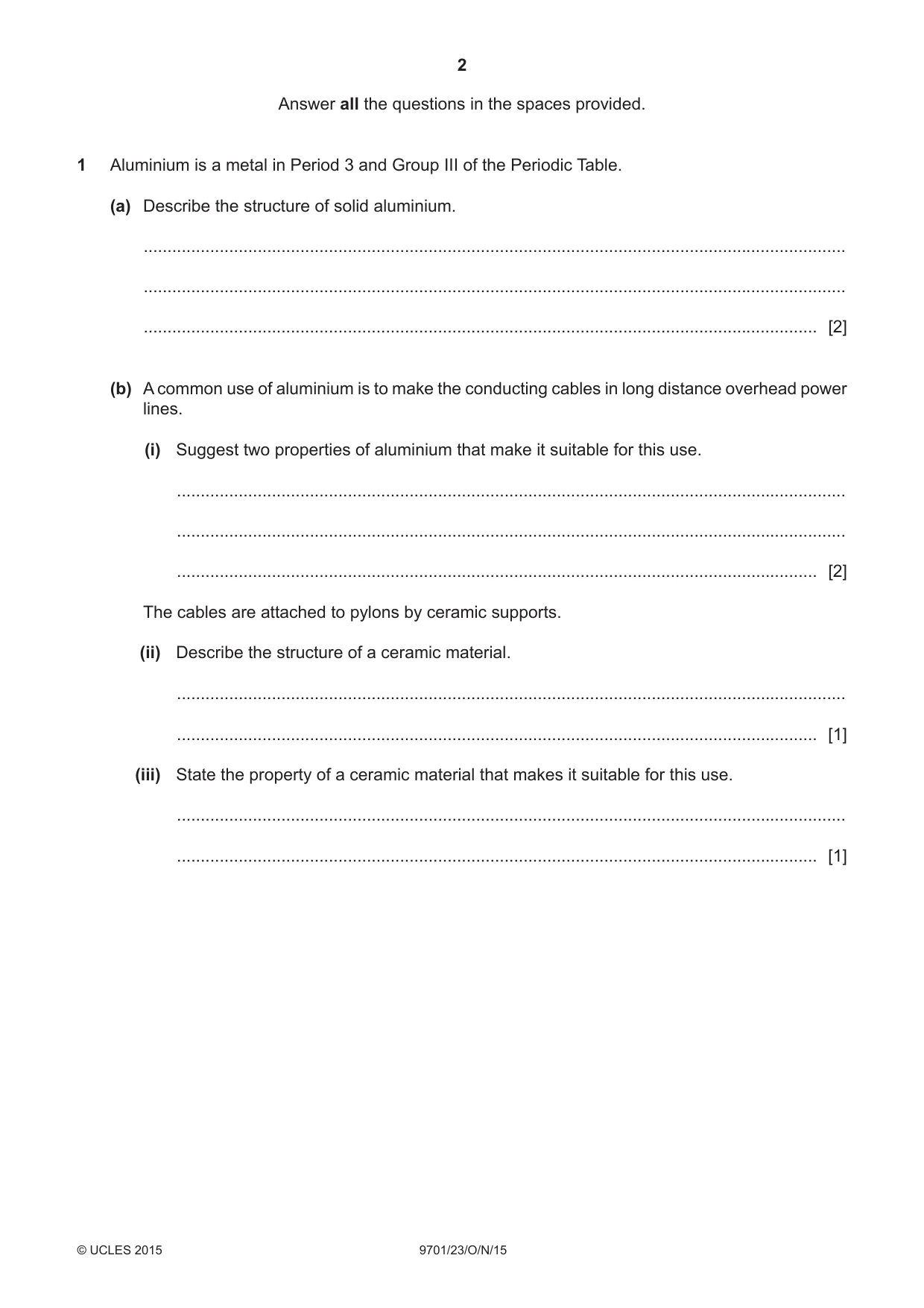
2 9701/23/O/N/15 © UCLES 2015 Answer all the questions in the spaces provided. 1 Aluminium is a metal in Period 3 and Group III of the Periodic Table. (a) Describe the structure of solid aluminium. … … … [2] (b) A common use of aluminium is to make the conducting cables in long distance overhead power lines. (i) Suggest two properties of aluminium that make it suitable for this use. … … … [2] The cables are attached to pylons by ceramic supports. (ii) Describe the structure of a ceramic material. … … [1] (iii) State the property of a ceramic material that makes it suitable for this use. … … [1]
Question paper, page 3
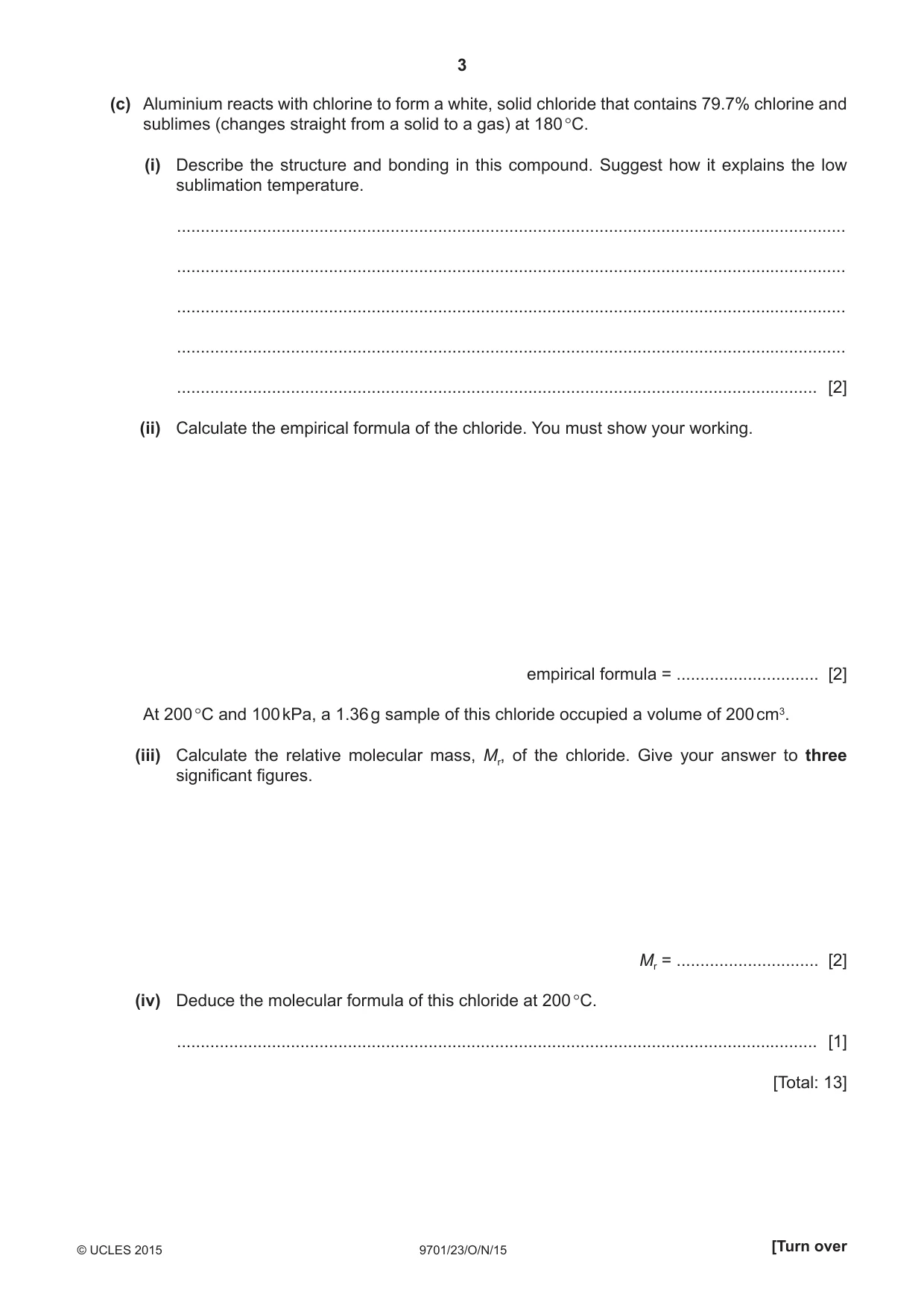
3 9701/23/O/N/15 © UCLES 2015 [Turn over (c) Aluminium reacts with chlorine to form a white, solid chloride that contains 79.7% chlorine and sublimes (changes straight from a solid to a gas) at 180 °C. (i) Describe the structure and bonding in this compound. Suggest how it explains the low sublimation temperature. … … … … … [2] (ii) Calculate the empirical formula of the chloride. You must show your working. empirical formula = … [2] At 200 °C and 100 kPa, a 1.36 g sample of this chloride occupied a volume of 200 cm3. (iii) Calculate the relative molecular mass, Mr, of the chloride. Give your answer to three signifi cant fi gures. Mr = … [2] (iv) Deduce the molecular formula of this chloride at 200 °C. … [1] [Total: 13]
Question paper, page 4
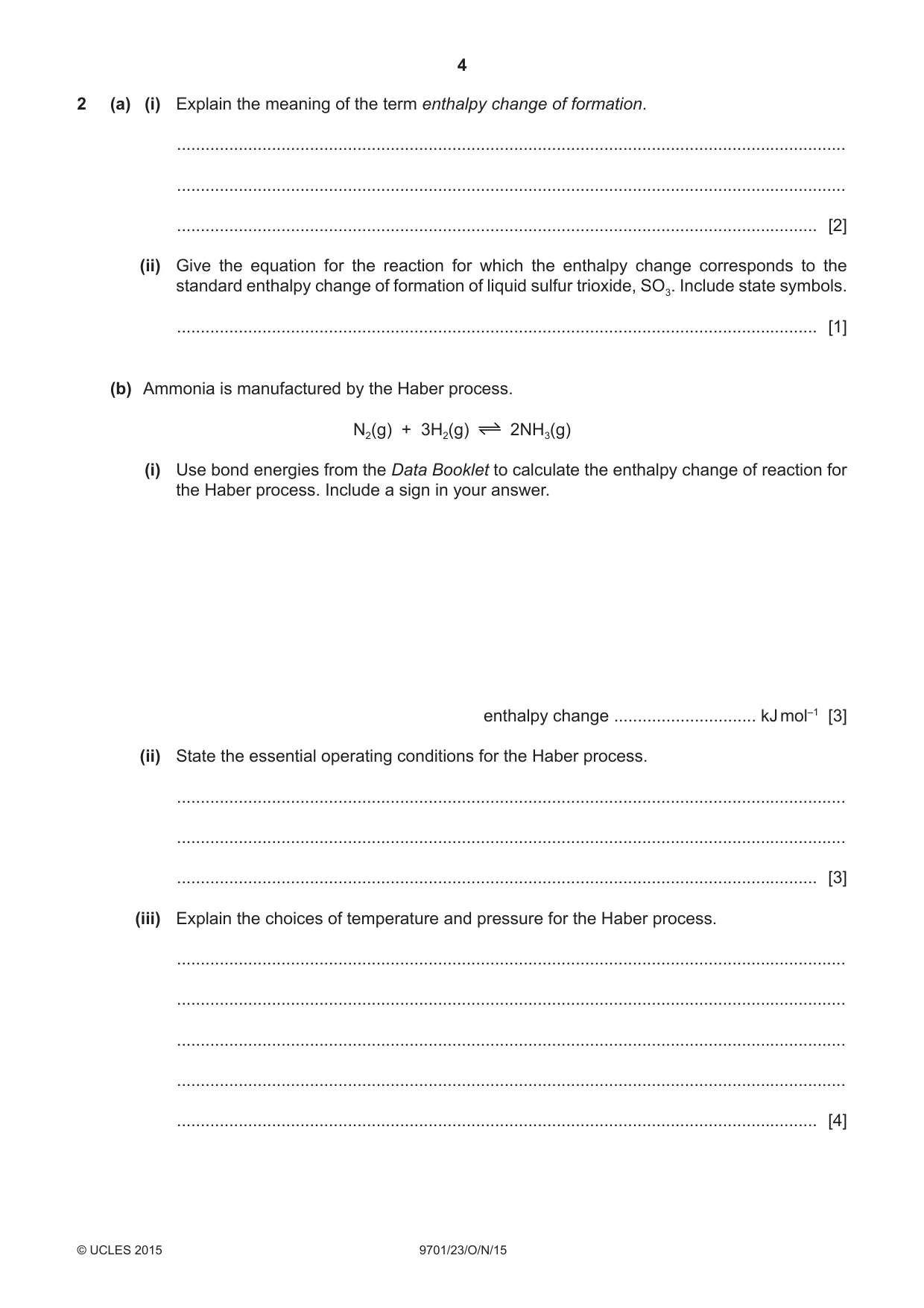
4 9701/23/O/N/15 © UCLES 2015 2 (a) (i) Explain the meaning of the term enthalpy change of formation. … … … [2] (ii) Give the equation for the reaction for which the enthalpy change corresponds to the standard enthalpy change of formation of liquid sulfur trioxide, SO3. Include state symbols. … [1] (b) Ammonia is manufactured by the Haber process. N2(g) + 3H2(g) 2NH3(g) (i) Use bond energies from the Data Booklet to calculate the enthalpy change of reaction for the Haber process. Include a sign in your answer. enthalpy change … kJ mol–1 [3] (ii) State the essential operating conditions for the Haber process. … … … [3] (iii) Explain the choices of temperature and pressure for the Haber process. … … … … … [4]
Question paper, page 5
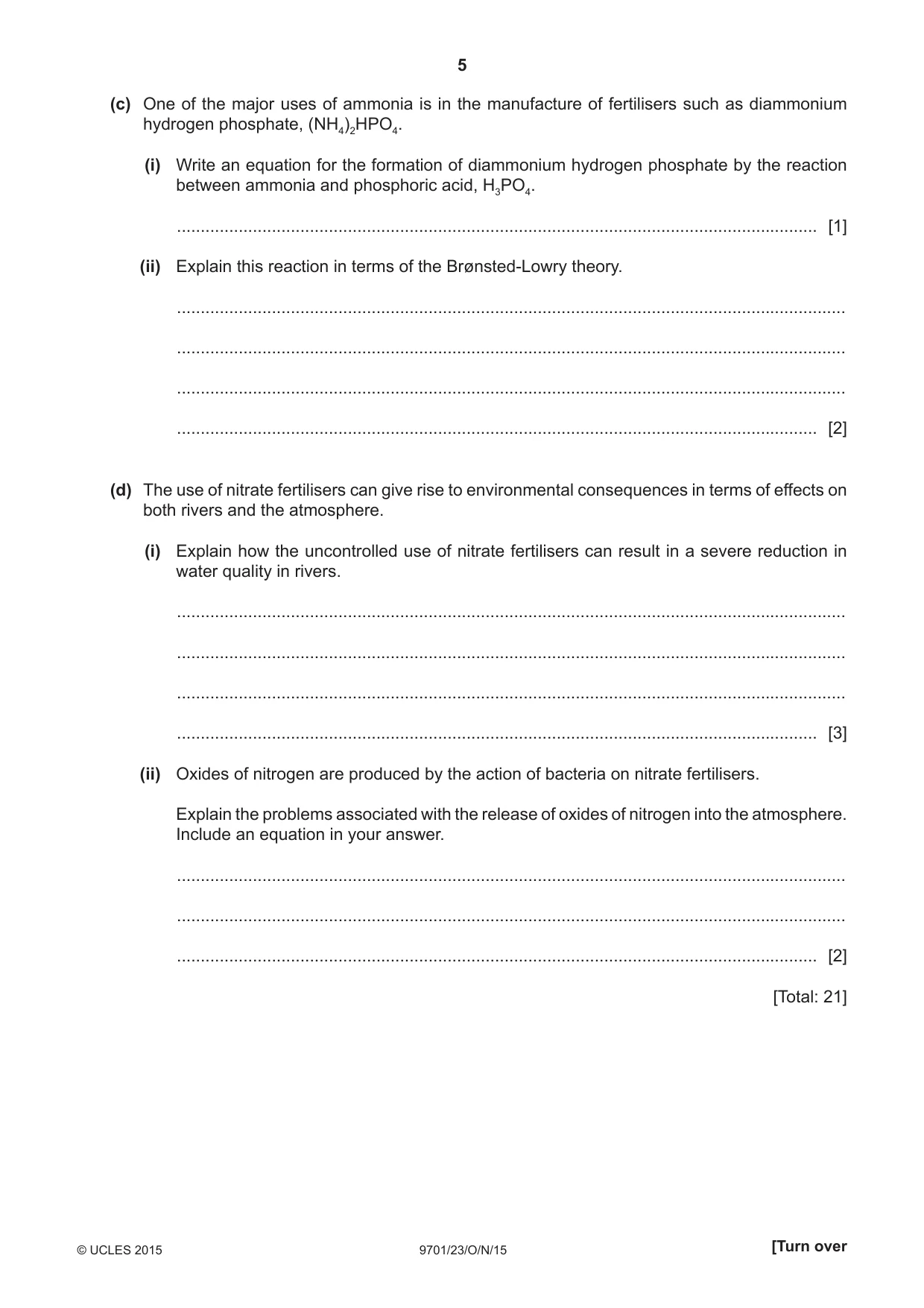
5 9701/23/O/N/15 © UCLES 2015 [Turn over (c) One of the major uses of ammonia is in the manufacture of fertilisers such as diammonium hydrogen phosphate, (NH4)2HPO4. (i) Write an equation for the formation of diammonium hydrogen phosphate by the reaction between ammonia and phosphoric acid, H3PO4. … [1] (ii) Explain this reaction in terms of the Brønsted-Lowry theory. … … … … [2] (d) The use of nitrate fertilisers can give rise to environmental consequences in terms of effects on both rivers and the atmosphere. (i) Explain how the uncontrolled use of nitrate fertilisers can result in a severe reduction in water quality in rivers. … … … … [3] (ii) Oxides of nitrogen are produced by the action of bacteria on nitrate fertilisers. Explain the problems associated with the release of oxides of nitrogen into the atmosphere. Include an equation in your answer. … … … [2] [Total: 21]
Question paper, page 6
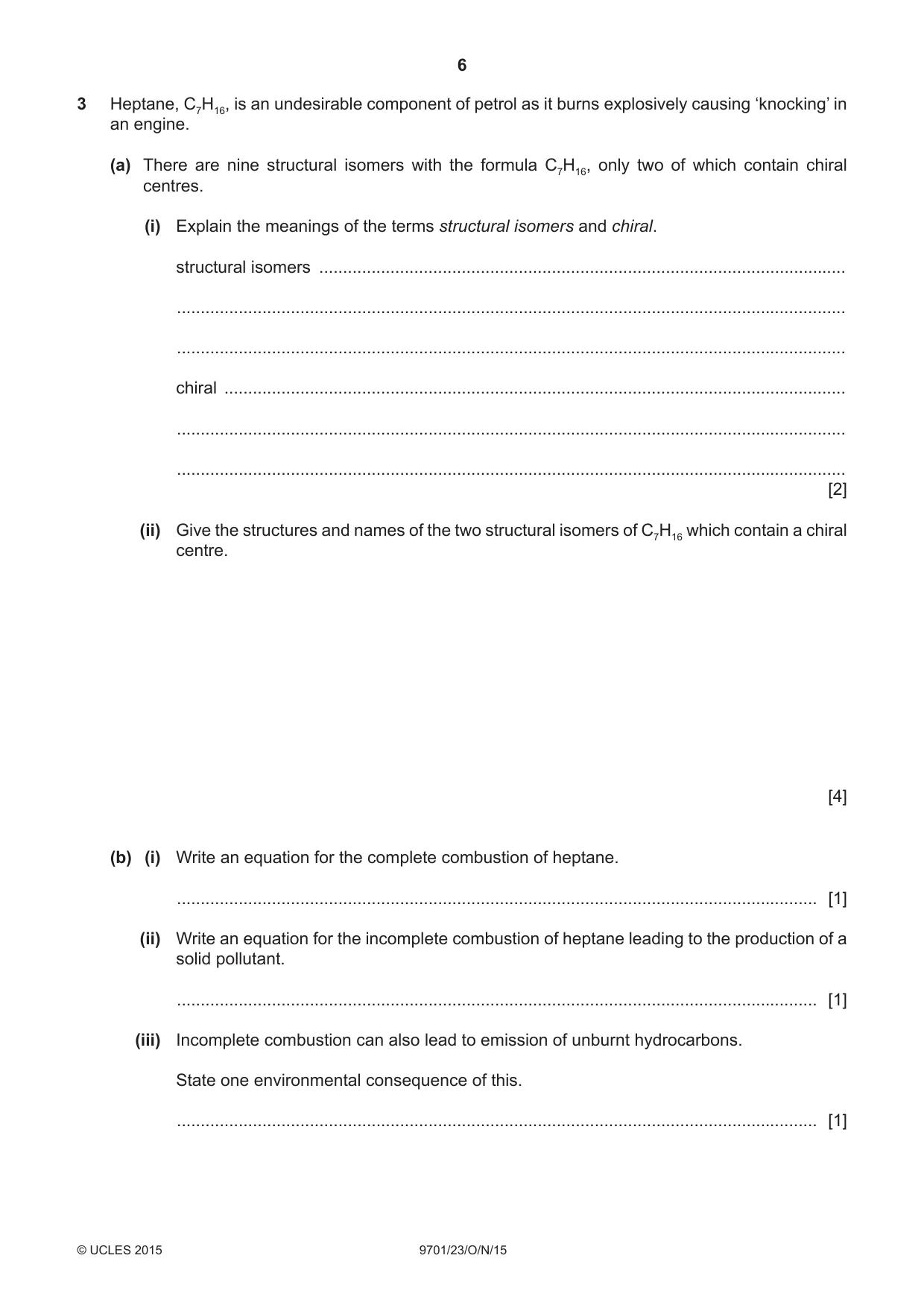
6 9701/23/O/N/15 © UCLES 2015 3 Heptane, C7H16, is an undesirable component of petrol as it burns explosively causing ‘knocking’ in an engine. (a) There are nine structural isomers with the formula C7H16, only two of which contain chiral centres. (i) Explain the meanings of the terms structural isomers and chiral. structural isomers … … … chiral … … … [2] (ii) Give the structures and names of the two structural isomers of C7H16 which contain a chiral centre. [4] (b) (i) Write an equation for the complete combustion of heptane. … [1] (ii) Write an equation for the incomplete combustion of heptane leading to the production of a solid pollutant. … [1] (iii) Incomplete combustion can also lead to emission of unburnt hydrocarbons. State one environmental consequence of this. … [1]
Question paper, page 7
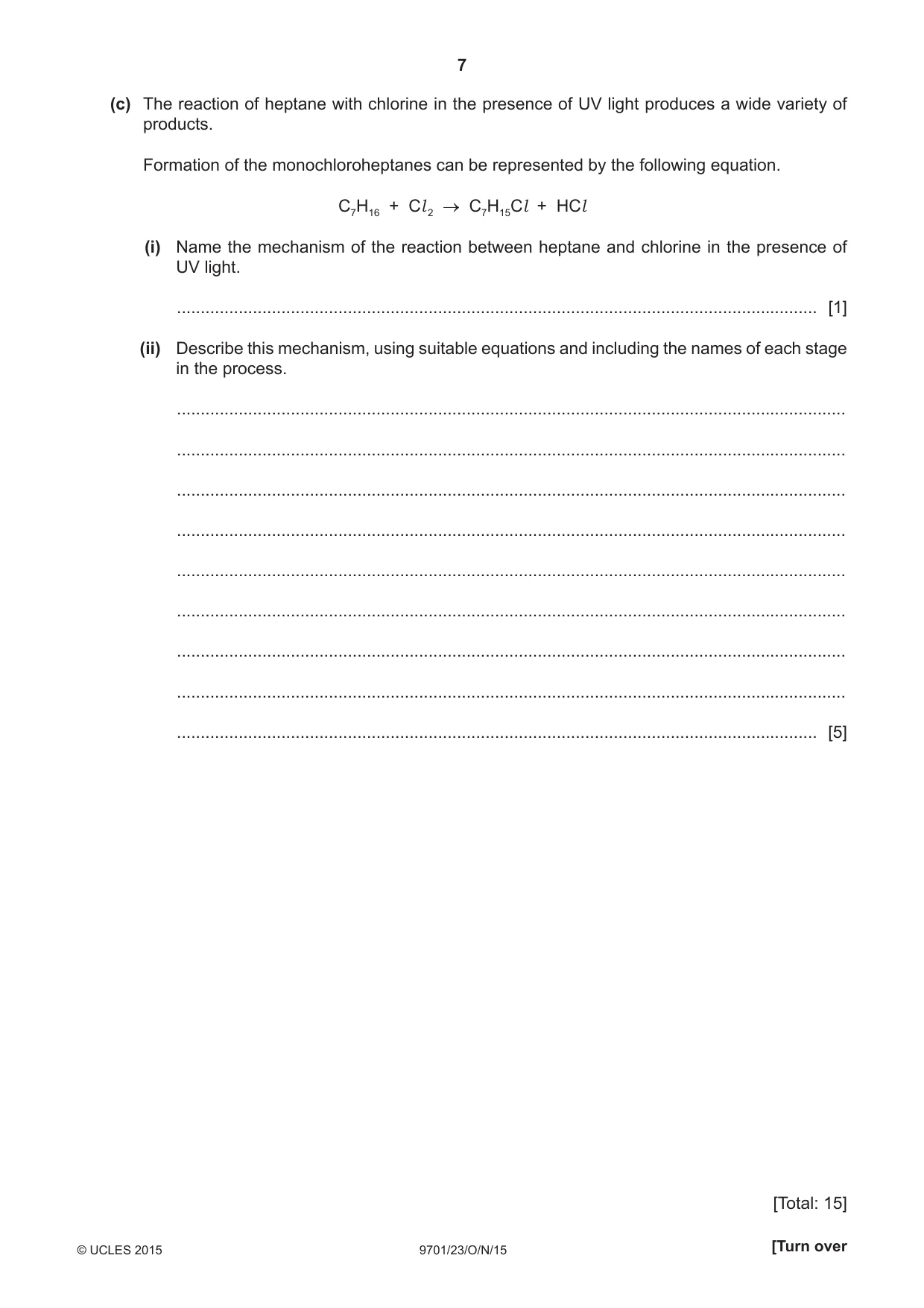
7 9701/23/O/N/15 © UCLES 2015 [Turn over (c) The reaction of heptane with chlorine in the presence of UV light produces a wide variety of products. Formation of the monochloroheptanes can be represented by the following equation. C7H16 + Cl 2 → C7H15Cl + HCl (i) Name the mechanism of the reaction between heptane and chlorine in the presence of UV light. … [1] (ii) Describe this mechanism, using suitable equations and including the names of each stage in the process. … … … … … … … … … [5] [Total: 15]
Question paper, page 8
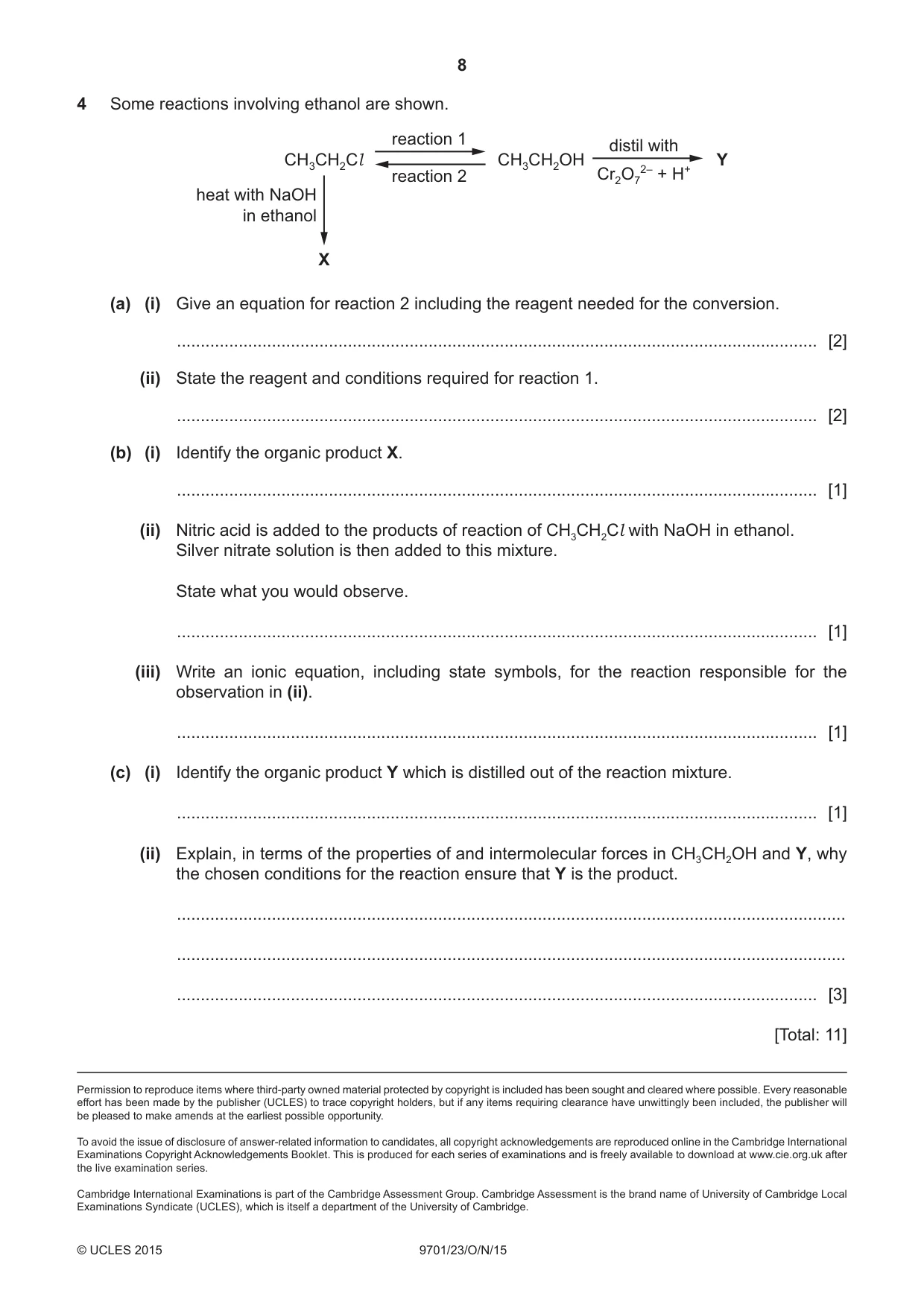
8 9701/23/O/N/15 © UCLES 2015 Permission to reproduce items where third-party owned material protected by copyright is included has been sought and cleared where possible. Every reasonable effort has been made by the publisher (UCLES) to trace copyright holders, but if any items requiring clearance have unwittingly been included, the publisher will be pleased to make amends at the earliest possible opportunity. To avoid the issue of disclosure of answer-related information to candidates, all copyright acknowledgements are reproduced online in the Cambridge International Examinations Copyright Acknowledgements Booklet. This is produced for each series of examinations and is freely available to download at www.cie.org.uk after the live examination series. Cambridge International Examinations is part of the Cambridge Assessment Group. Cambridge Assessment is the brand name of University of Cambridge Local Examinations Syndicate (UCLES), which is itself a department of the University of Cambridge. 4 Some reactions involving ethanol are shown. CH3CH2Cl CH3CH2OH Y X distil with Cr2O7 2– + H+ reaction 1 reaction 2 heat with NaOH in ethanol (a) (i) Give an equation for reaction 2 including the reagent needed for the conversion. … [2] (ii) State the reagent and conditions required for reaction 1. … [2] (b) (i) Identify the organic product X. … [1] (ii) Nitric acid is added to the products of reaction of CH3CH2Cl with NaOH in ethanol. Silver nitrate solution is then added to this mixture. State what you would observe. … [1] (iii) Write an ionic equation, including state symbols, for the reaction responsible for the observation in (ii). … [1] (c) (i) Identify the organic product Y which is distilled out of the reaction mixture. … [1] (ii) Explain, in terms of the properties of and intermolecular forces in CH3CH2OH and Y, why the chosen conditions for the reaction ensure that Y is the product. … … … [3] [Total: 11]
Mark scheme, page 1
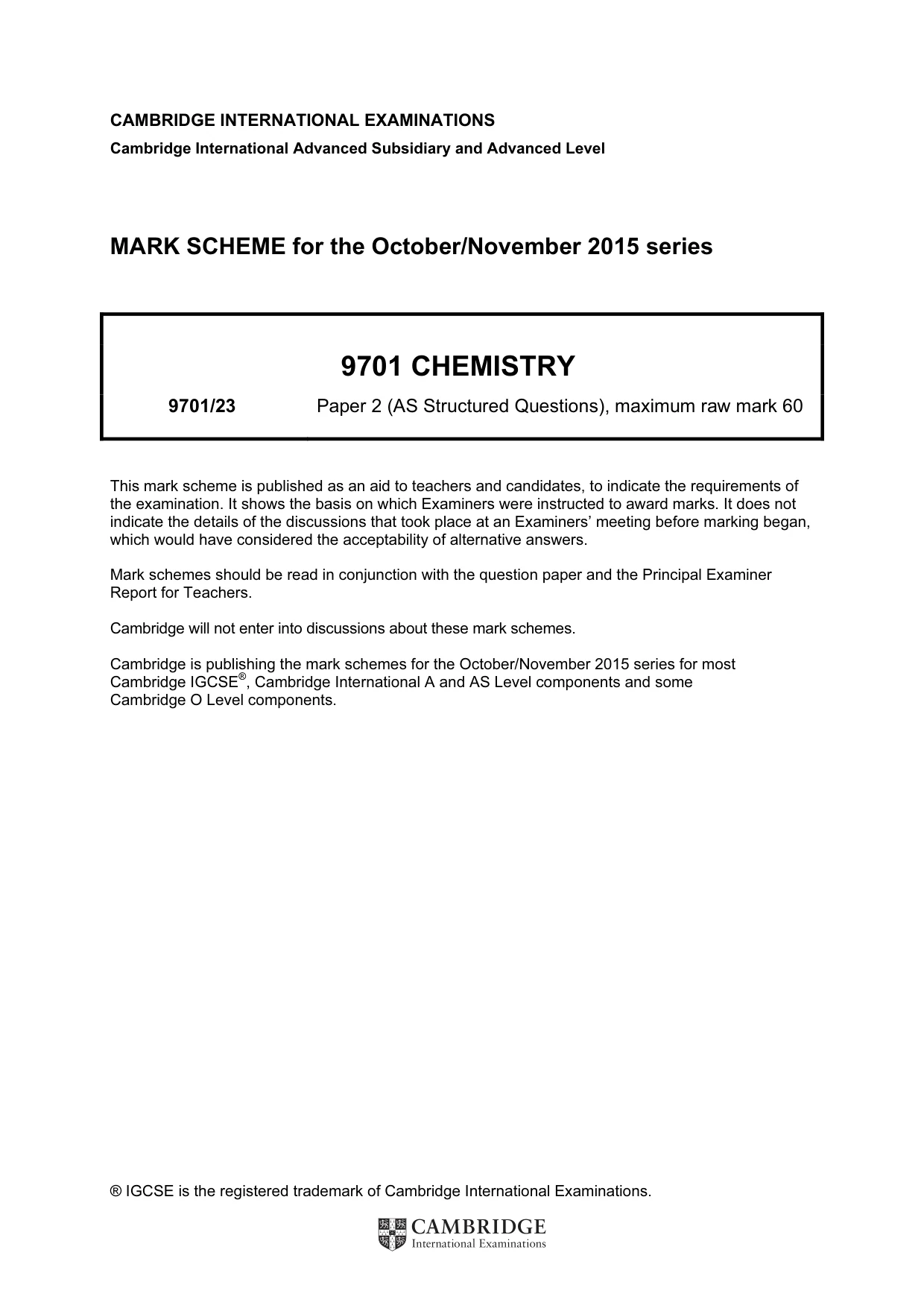
® IGCSE is the registered trademark of Cambridge International Examinations. CAMBRIDGE INTERNATIONAL EXAMINATIONS Cambridge International Advanced Subsidiary and Advanced Level MARK SCHEME for the October/November 2015 series 9701 CHEMISTRY 9701/23 Paper 2 (AS Structured Questions), maximum raw mark 60 This mark scheme is published as an aid to teachers and candidates, to indicate the requirements of the examination. It shows the basis on which Examiners were instructed to award marks. It does not indicate the details of the discussions that took place at an Examiners’ meeting before marking began, which would have considered the acceptability of alternative answers. Mark schemes should be read in conjunction with the question paper and the Principal Examiner Report for Teachers. Cambridge will not enter into discussions about these mark schemes. Cambridge is publishing the mark schemes for the October/November 2015 series for most Cambridge IGCSE®, Cambridge International A and AS Level components and some Cambridge O Level components.
Mark scheme, page 2
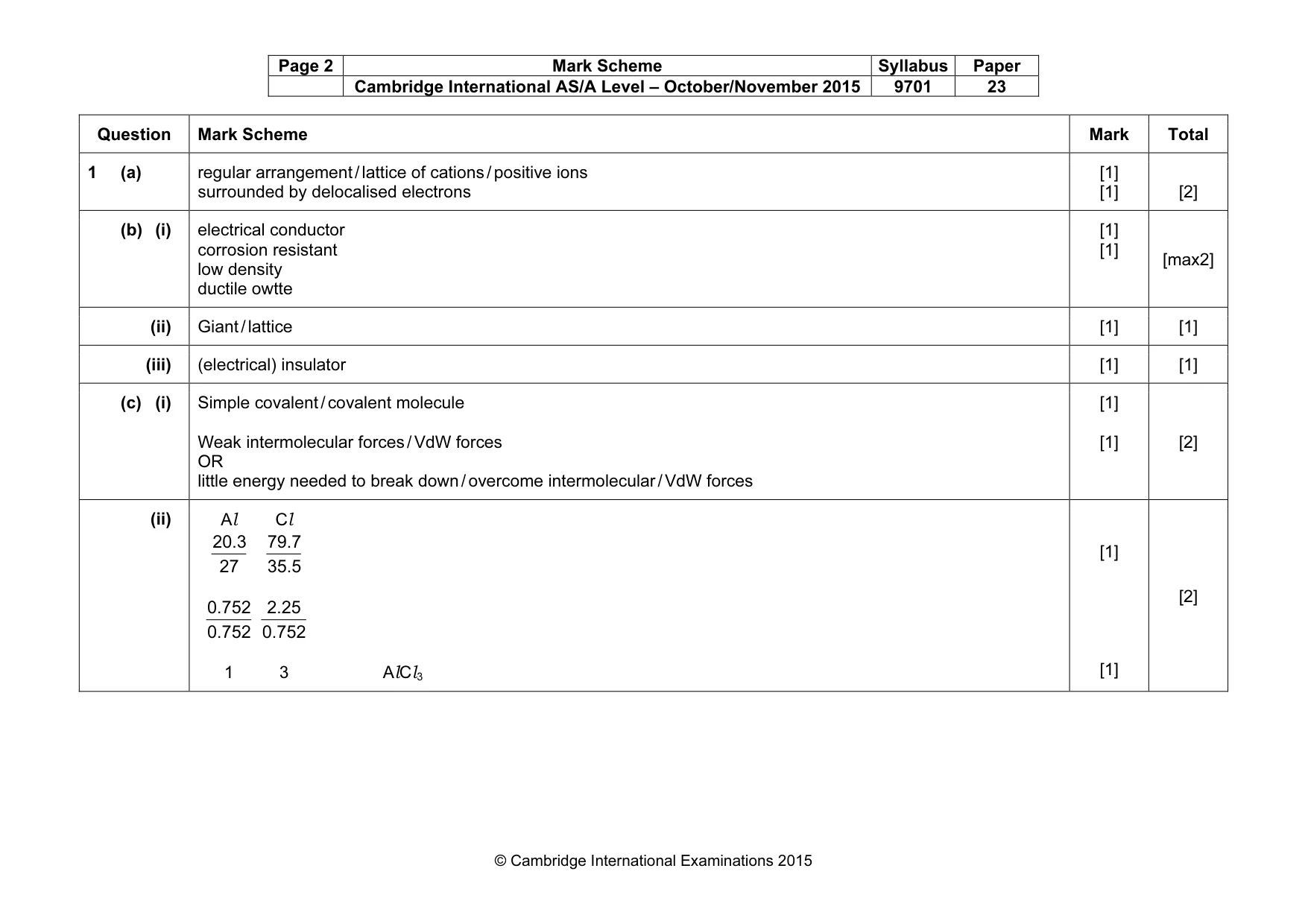
Page 2 Mark Scheme Syllabus Paper Cambridge International AS/A Level – October/November 2015 9701 23 © Cambridge International Examinations 2015 Question Mark Scheme Mark Total 1 (a) regular arrangement / lattice of cations / positive ions surrounded by delocalised electrons [1] [1] [2] (b) (i) electrical conductor corrosion resistant low density ductile owtte [1] [1] [max2] (ii) Giant / lattice [1] [1] (iii) (electrical) insulator [1] [1] (c) (i) Simple covalent / covalent molecule Weak intermolecular forces / VdW forces OR little energy needed to break down / overcome intermolecular / VdW forces [1] [1] [2] (ii) Al Cl 27 20.3 35.5 79.7 0.752 0.752 0.752 2.25 1 3 AlCl3 [1] [1] [2]
Mark scheme, page 3
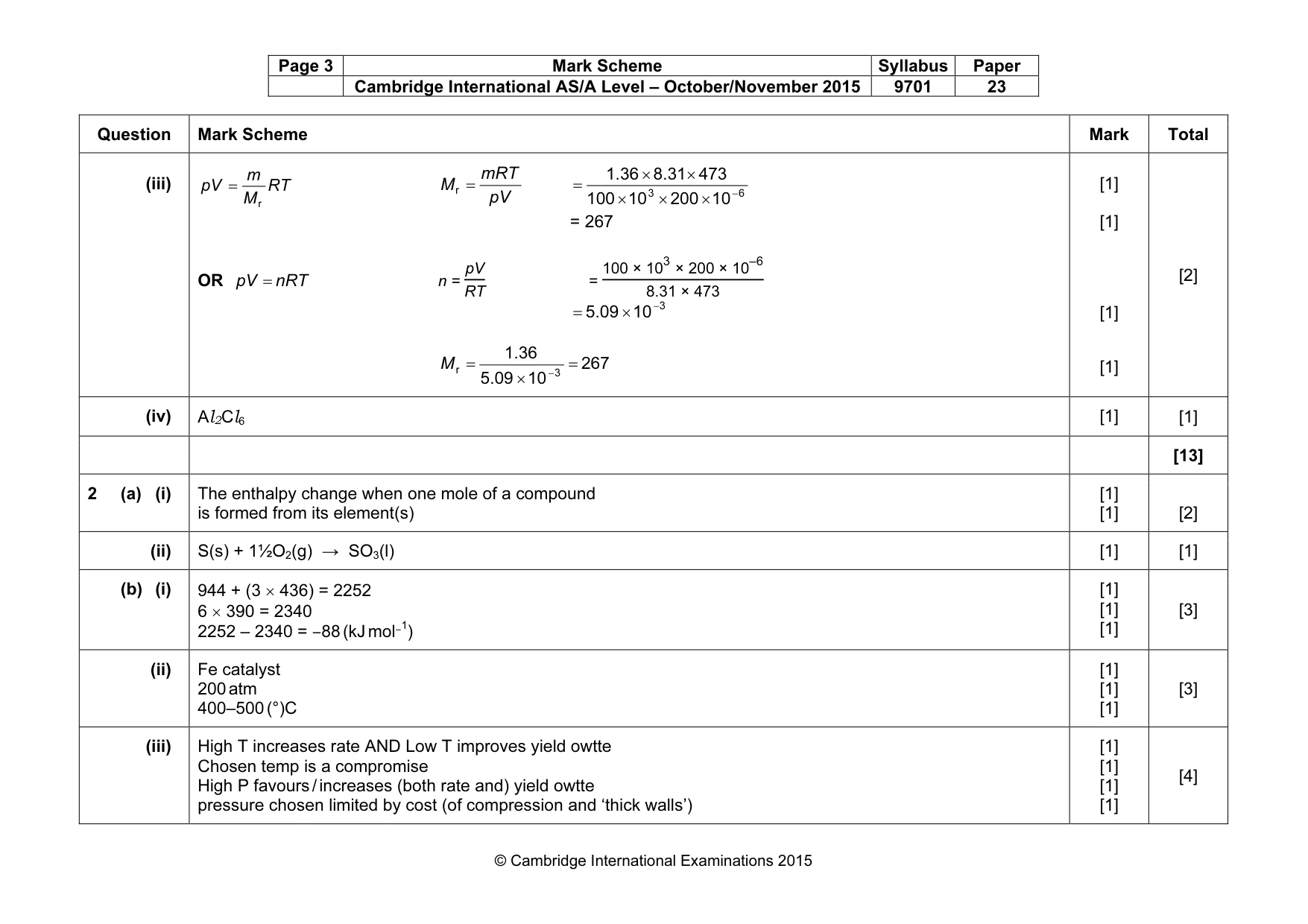
Page 3 Mark Scheme Syllabus Paper Cambridge International AS/A Level – October/November 2015 9701 23 © Cambridge International Examinations 2015 Question Mark Scheme Mark Total (iii) RT M m pV r = pV mRT M = r 6 3 10 200 10 100 473 8.31 1.36 − × × × × × = = 267 OR nRT pV = n = pV RT = 100 × 103 × 200 × 10–6 8.31 × 473 3 10 5.09 − × = 267 10 5.09 1.36 3 r = × = − M [1] [1] [1] [1] [2] (iv) Al2Cl6 [1] [1] [13] 2 (a) (i) The enthalpy change when one mole of a compound is formed from its element(s) [1] [1] [2] (ii) S(s) + 1½O2(g) → SO3(l) [1] [1] (b) (i) 944 + (3 × 436) = 2252 6 × 390 = 2340 2252 – 2340 = ‒88 (kJ mol‒1) [1] [1] [1] [3] (ii) Fe catalyst 200 atm 400–500 (°)C [1] [1] [1] [3] (iii) High T increases rate AND Low T improves yield owtte Chosen temp is a compromise High P favours / increases (both rate and) yield owtte pressure chosen limited by cost (of compression and ‘thick walls’) [1] [1] [1] [1] [4]
Mark scheme, page 4
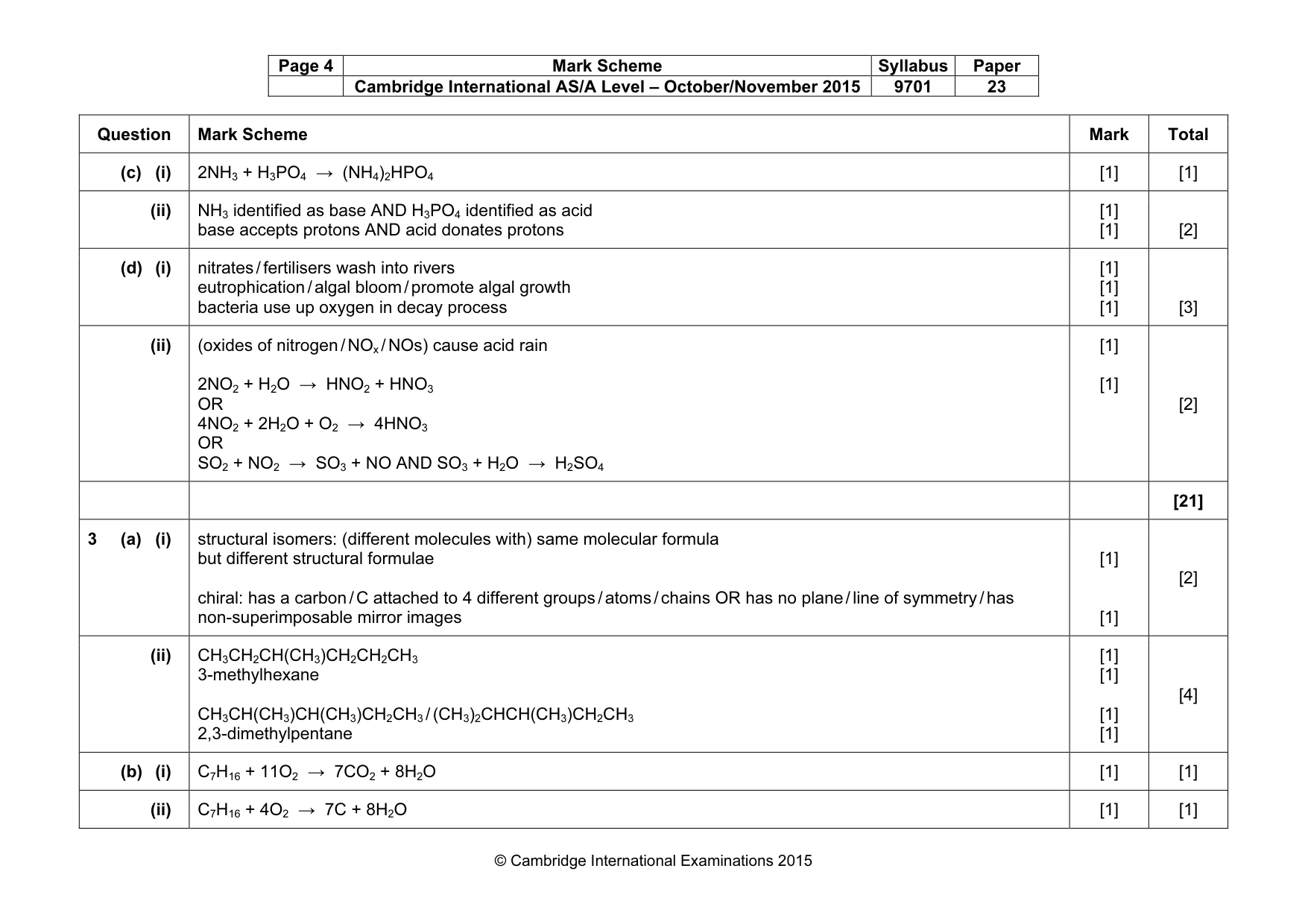
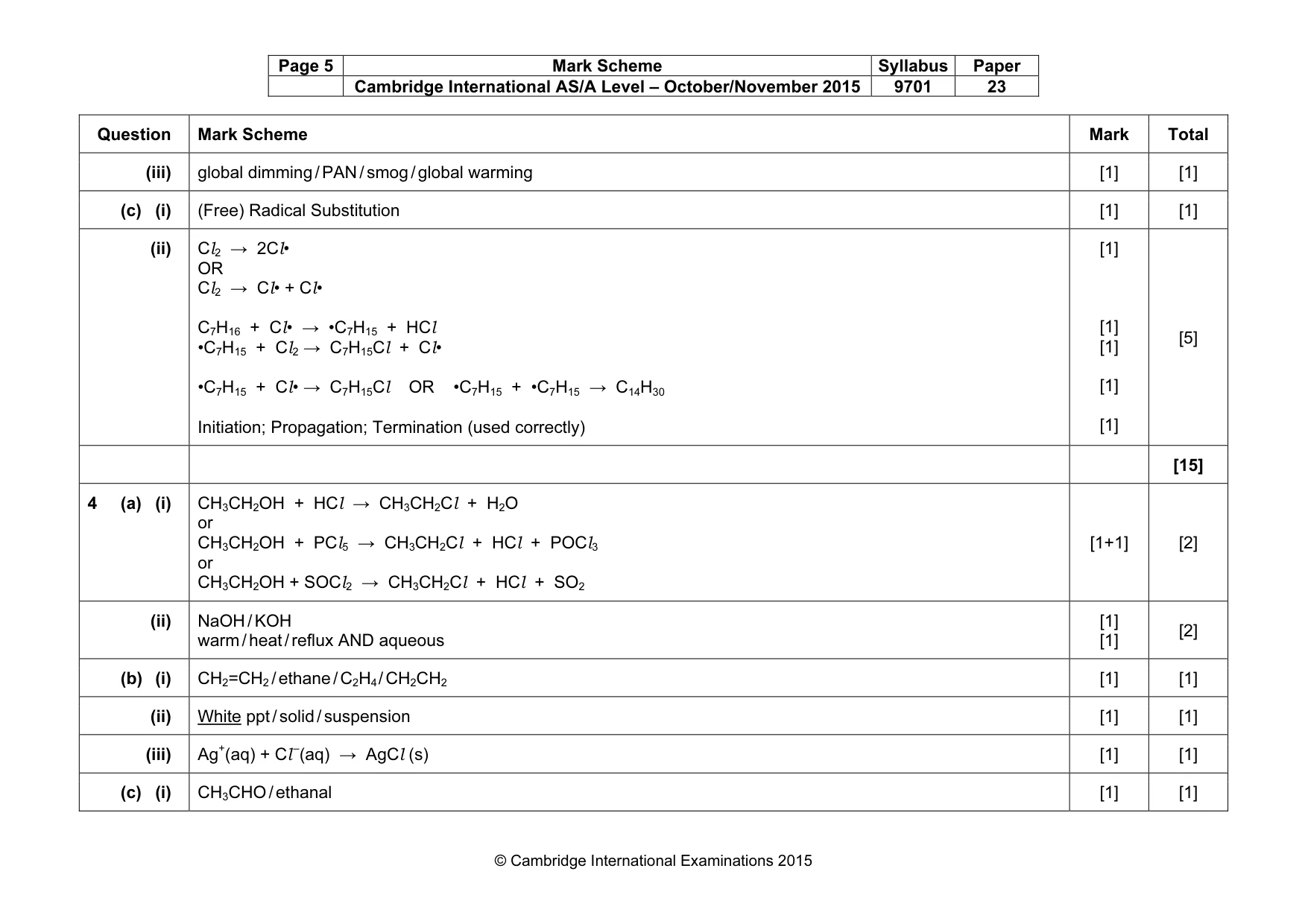
Page 4 Mark Scheme Syllabus Paper Cambridge International AS/A Level – October/November 2015 9701 23 © Cambridge International Examinations 2015 Question Mark Scheme Mark Total (c) (i) 2NH3 + H3PO4 → (NH4)2HPO4 [1] [1] (ii) NH3 identified as base AND H3PO4 identified as acid base accepts protons AND acid donates protons [1] [1] [2] (d) (i) nitrates / fertilisers wash into rivers eutrophication / algal bloom / promote algal growth bacteria use up oxygen in decay process [1] [1] [1] [3] (ii) (oxides of nitrogen / NOx / NOs) cause acid rain 2NO2 + H2O → HNO2 + HNO3 OR 4NO2 + 2H2O + O2 → 4HNO3 OR SO2 + NO2 → SO3 + NO AND SO3 + H2O → H2SO4 [1] [1] [2] [21] 3 (a) (i) structural isomers: (different molecules with) same molecular formula but different structural formulae chiral: has a carbon / C attached to 4 different groups / atoms / chains OR has no plane / line of symmetry / has non-superimposable mirror images [1] [1] [2] (ii) CH3CH2CH(CH3)CH2CH2CH3 3-methylhexane CH3CH(CH3)CH(CH3)CH2CH3 / (CH3)2CHCH(CH3)CH2CH3 2,3-dimethylpentane [1] [1] [1] [1] [4] (b) (i) C7H16 + 11O2 → 7CO2 + 8H2O [1] [1] (ii) C7H16 + 4O2 → 7C + 8H2O [1] [1]
Mark scheme, page 5
Page 5 Mark Scheme Syllabus Paper Cambridge International AS/A Level – October/November 2015 9701 23 © Cambridge International Examinations 2015 Question Mark Scheme Mark Total (iii) global dimming / PAN / smog / global warming [1] [1] (c) (i) (Free) Radical Substitution [1] [1] (ii) Cl2 → 2Cl• OR Cl2 → Cl• + Cl• C7H16 + Cl• → •C7H15 + HCl •C7H15 + Cl2 → C7H15Cl + Cl• •C7H15 + Cl• → C7H15Cl OR •C7H15 + •C7H15 → C14H30 Initiation; Propagation; Termination (used correctly) [1] [1] [1] [1] [1] [5] [15] 4 (a) (i) CH3CH2OH + HCl → CH3CH2Cl + H2O or CH3CH2OH + PCl5 → CH3CH2Cl + HCl + POCl3 or CH3CH2OH + SOCl2 → CH3CH2Cl + HCl + SO2 [1+1] [2] (ii) NaOH / KOH warm / heat / reflux AND aqueous [1] [1] [2] (b) (i) CH2=CH2 / ethane / C2H4 / CH2CH2 [1] [1] (ii) White ppt / solid / suspension [1] [1] (iii) Ag+(aq) + Cl –(aq) → AgCl (s) [1] [1] (c) (i) CH3CHO / ethanal [1] [1]
Mark scheme, page 6
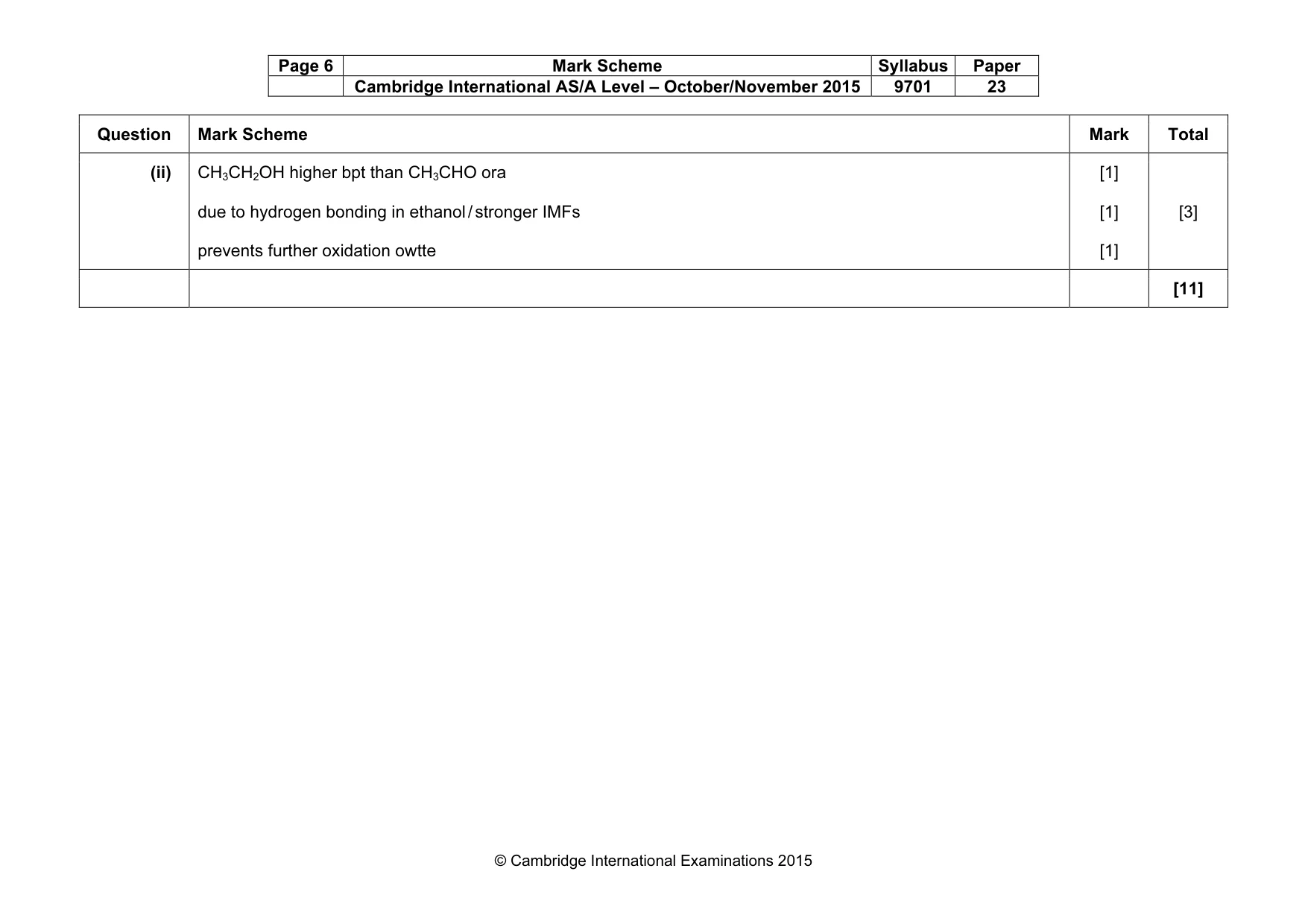
Page 6 Mark Scheme Syllabus Paper Cambridge International AS/A Level – October/November 2015 9701 23 © Cambridge International Examinations 2015 Question Mark Scheme Mark Total (ii) CH3CH2OH higher bpt than CH3CHO ora due to hydrogen bonding in ethanol / stronger IMFs prevents further oxidation owtte [1] [1] [1] [3] [11]
What you needed in this session
Cambridge’s own grade thresholds for 2015 Oct/Nov, Paper 2 · Variant 3. A higher threshold means an easier paper — the bar moves with how the cohort did.