Cambridge A Level Chemistry 9701 — 2014 May/June Paper 5 · Variant 2
9701/52/M/J/14 · 30 marks · ≈34 min
The question paper and its mark scheme, free to read here and free to download. This is Cambridge’s own paper, exactly as it was sat.
Question paper12 pages



Mark scheme3 pages
Answers below. Sit the paper first if you are practising.
Paper as text
Question paper, page 1
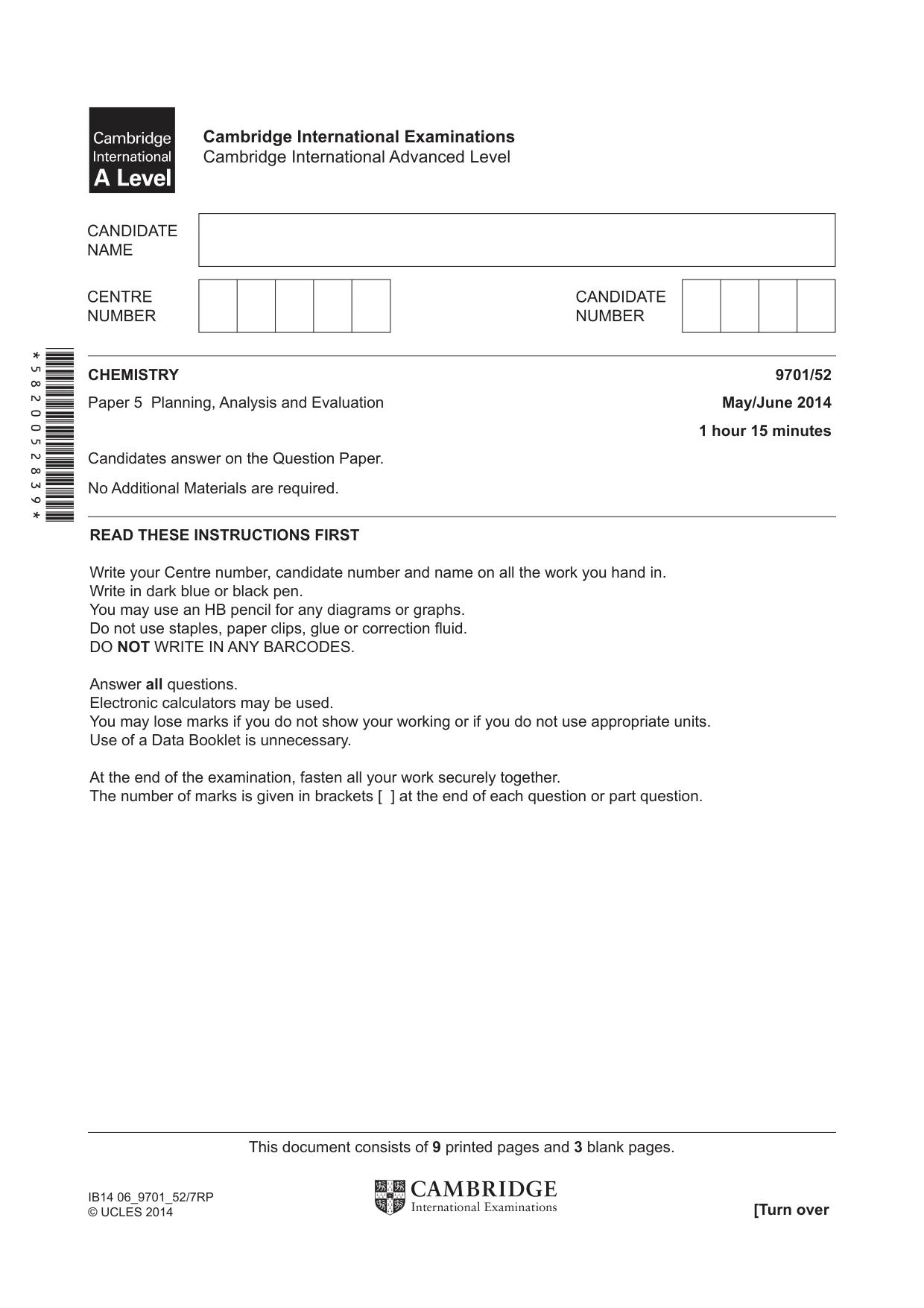
This document consists of 9 printed pages and 3 blank pages. [Turn over IB14 06_9701_52/7RP © UCLES 2014 *5820052839* READ THESE INSTRUCTIONS FIRST Write your Centre number, candidate number and name on all the work you hand in. Write in dark blue or black pen. You may use an HB pencil for any diagrams or graphs. Do not use staples, paper clips, glue or correction fl uid. DO NOT WRITE IN ANY BARCODES. Answer all questions. Electronic calculators may be used. You may lose marks if you do not show your working or if you do not use appropriate units. Use of a Data Booklet is unnecessary. At the end of the examination, fasten all your work securely together. The number of marks is given in brackets [ ] at the end of each question or part question. CHEMISTRY 9701/52 Paper 5 Planning, Analysis and Evaluation May/June 2014 1 hour 15 minutes Candidates answer on the Question Paper. No Additional Materials are required. Cambridge International Examinations Cambridge International Advanced Level
Question paper, page 2
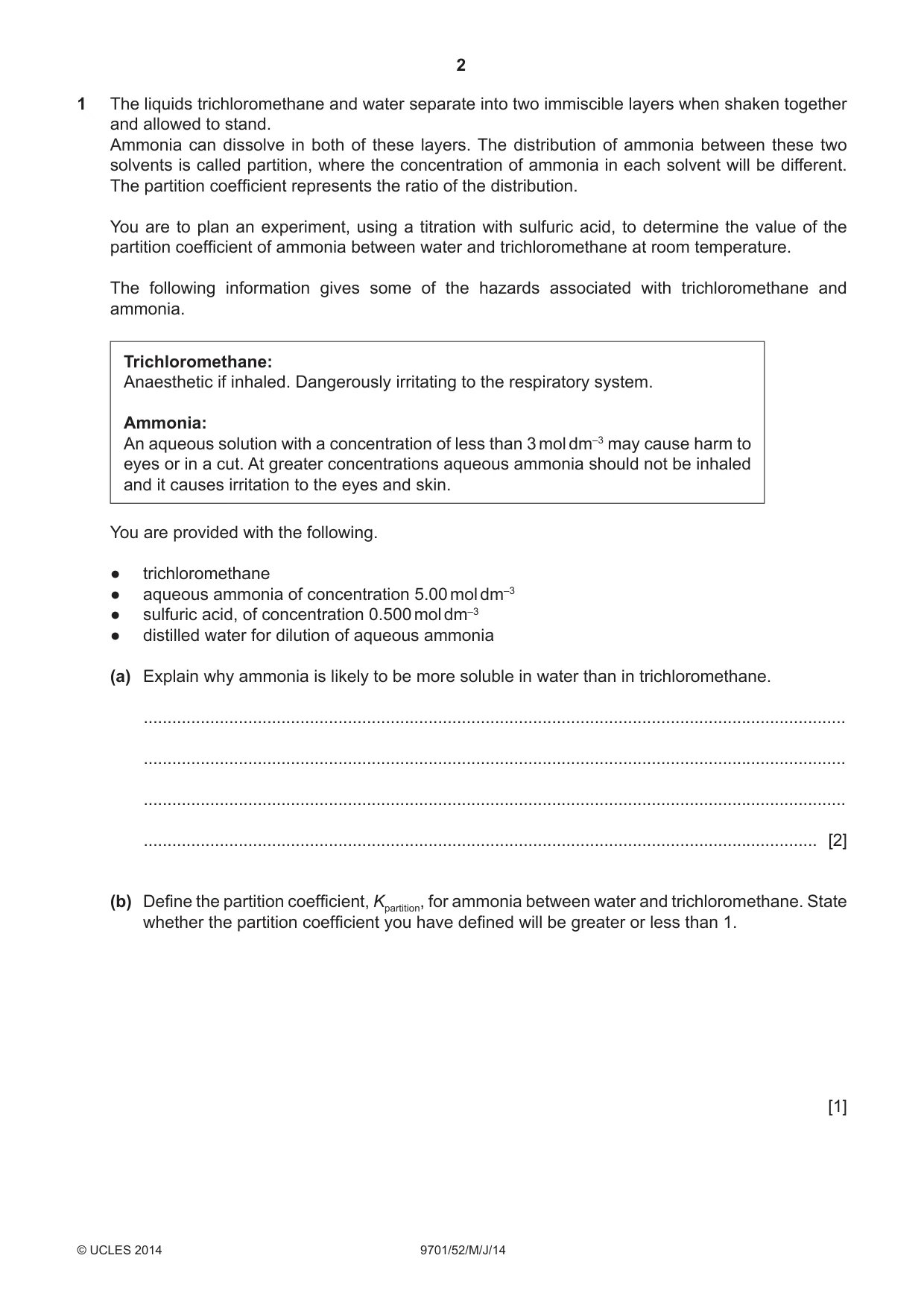
2 9701/52/M/J/14 © UCLES 2014 1 The liquids trichloromethane and water separate into two immiscible layers when shaken together and allowed to stand. Ammonia can dissolve in both of these layers. The distribution of ammonia between these two solvents is called partition, where the concentration of ammonia in each solvent will be different. The partition coeffi cient represents the ratio of the distribution. You are to plan an experiment, using a titration with sulfuric acid, to determine the value of the partition coeffi cient of ammonia between water and trichloromethane at room temperature. The following information gives some of the hazards associated with trichloromethane and ammonia. Trichloromethane: Anaesthetic if inhaled. Dangerously irritating to the respiratory system. Ammonia: An aqueous solution with a concentration of less than 3 mol dm–3 may cause harm to eyes or in a cut. At greater concentrations aqueous ammonia should not be inhaled and it causes irritation to the eyes and skin. You are provided with the following. ● trichloromethane ● aqueous ammonia of concentration 5.00 mol dm–3 ● sulfuric acid, of concentration 0.500 mol dm–3 ● distilled water for dilution of aqueous ammonia (a) Explain why ammonia is likely to be more soluble in water than in trichloromethane. … … … … [2] (b) Defi ne the partition coeffi cient, Kpartition, for ammonia between water and trichloromethane. State whether the partition coeffi cient you have defi ned will be greater or less than 1. [1]
Question paper, page 3
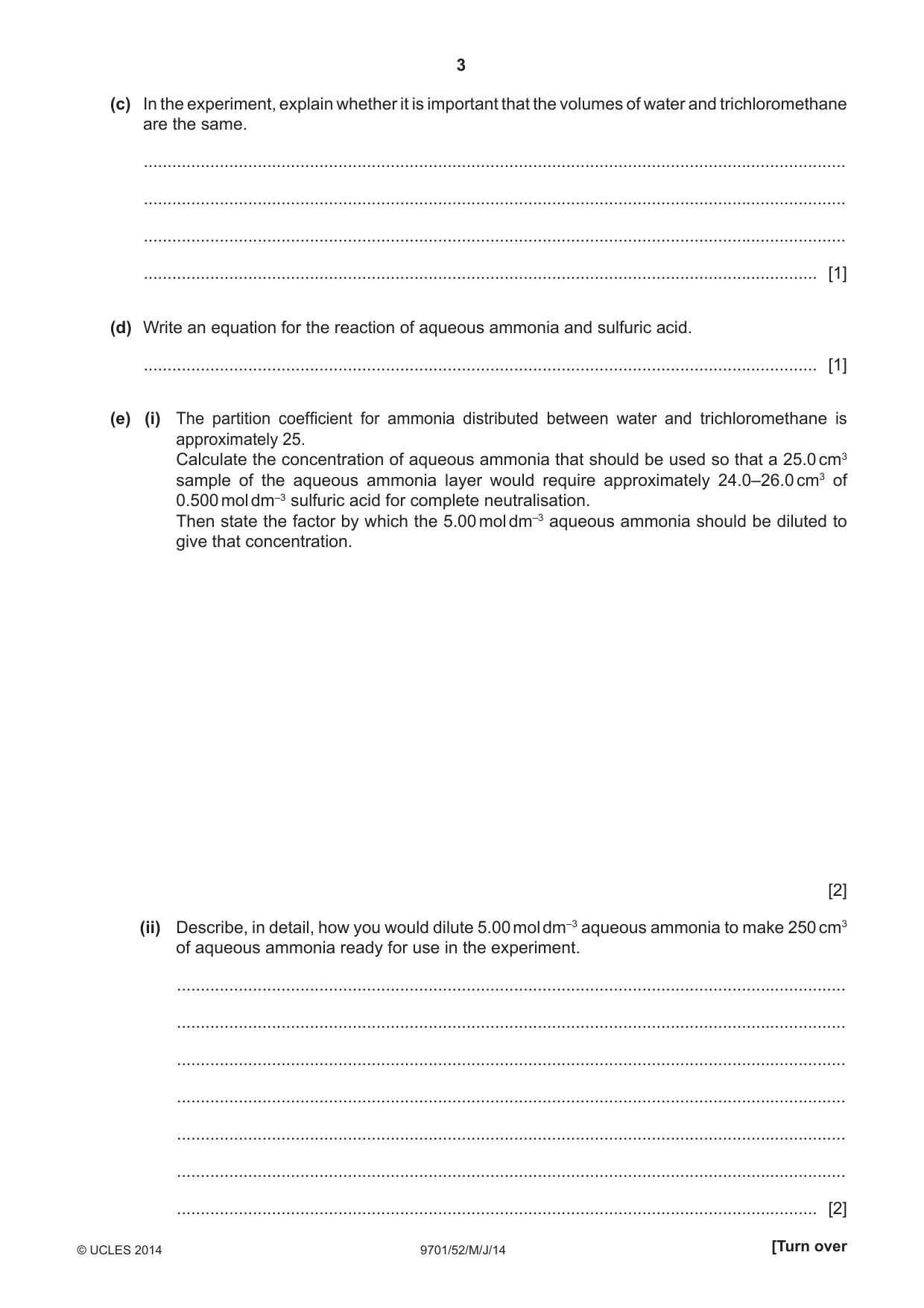
3 9701/52/M/J/14 © UCLES 2014 [Turn over (c) In the experiment, explain whether it is important that the volumes of water and trichloromethane are the same. … … … … [1] (d) Write an equation for the reaction of aqueous ammonia and sulfuric acid. … [1] (e) (i) The partition coeffi cient for ammonia distributed between water and trichloromethane is approximately 25. Calculate the concentration of aqueous ammonia that should be used so that a 25.0 cm3 sample of the aqueous ammonia layer would require approximately 24.0–26.0 cm3 of 0.500 mol dm–3 sulfuric acid for complete neutralisation. Then state the factor by which the 5.00 mol dm–3 aqueous ammonia should be diluted to give that concentration. [2] (ii) Describe, in detail, how you would dilute 5.00 mol dm–3 aqueous ammonia to make 250 cm3 of aqueous ammonia ready for use in the experiment. … … … … … … … [2]
Question paper, page 4
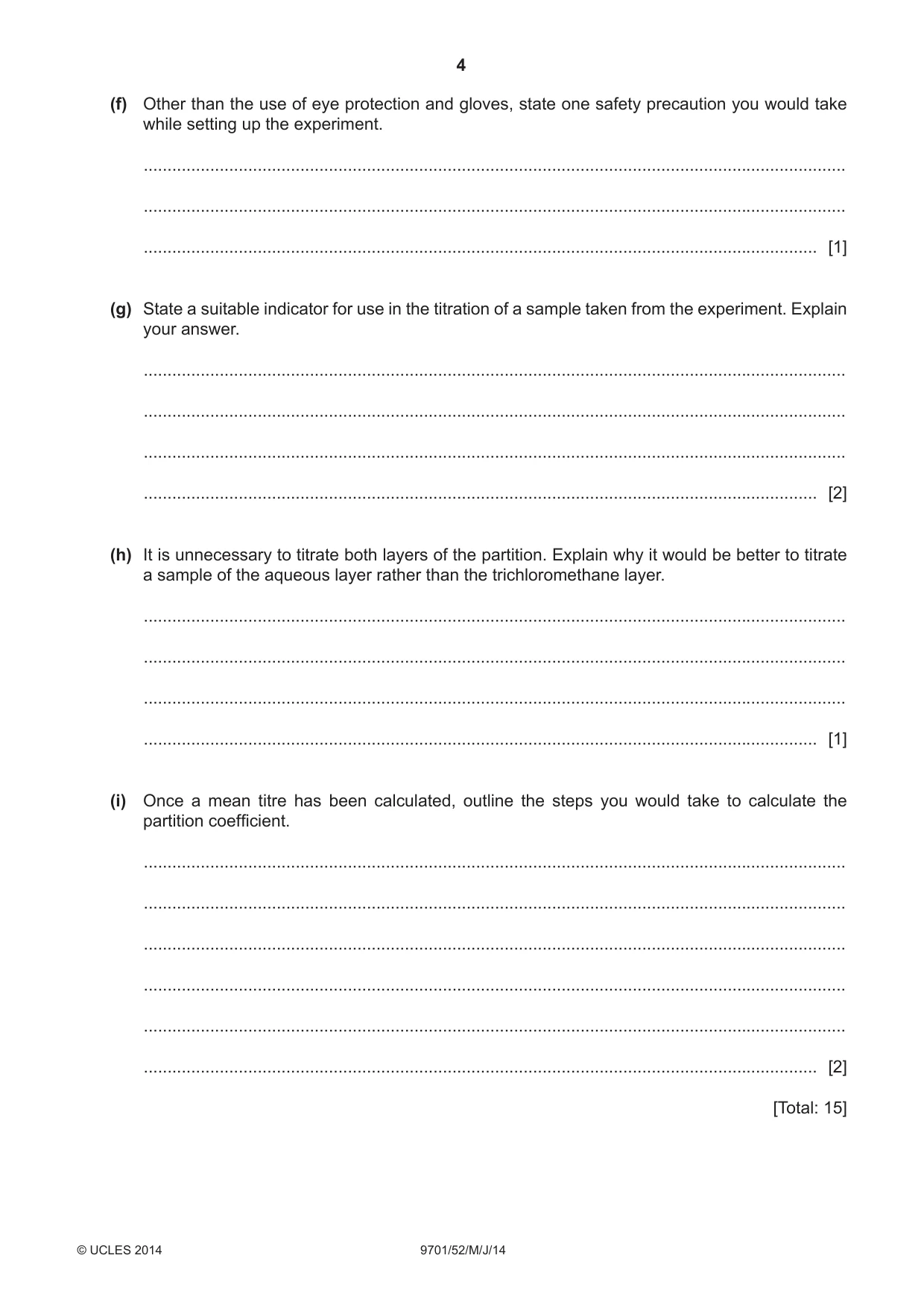
4 9701/52/M/J/14 © UCLES 2014 (f) Other than the use of eye protection and gloves, state one safety precaution you would take while setting up the experiment. … … … [1] (g) State a suitable indicator for use in the titration of a sample taken from the experiment. Explain your answer. … … … … [2] (h) It is unnecessary to titrate both layers of the partition. Explain why it would be better to titrate a sample of the aqueous layer rather than the trichloromethane layer. … … … … [1] (i) Once a mean titre has been calculated, outline the steps you would take to calculate the partition coeffi cient. … … … … … … [2] [Total: 15]
Question paper, page 5
5 9701/52/M/J/14 © UCLES 2014 [Turn over QUESTION 2 STARTS ON THE NEXT PAGE.
Question paper, page 6
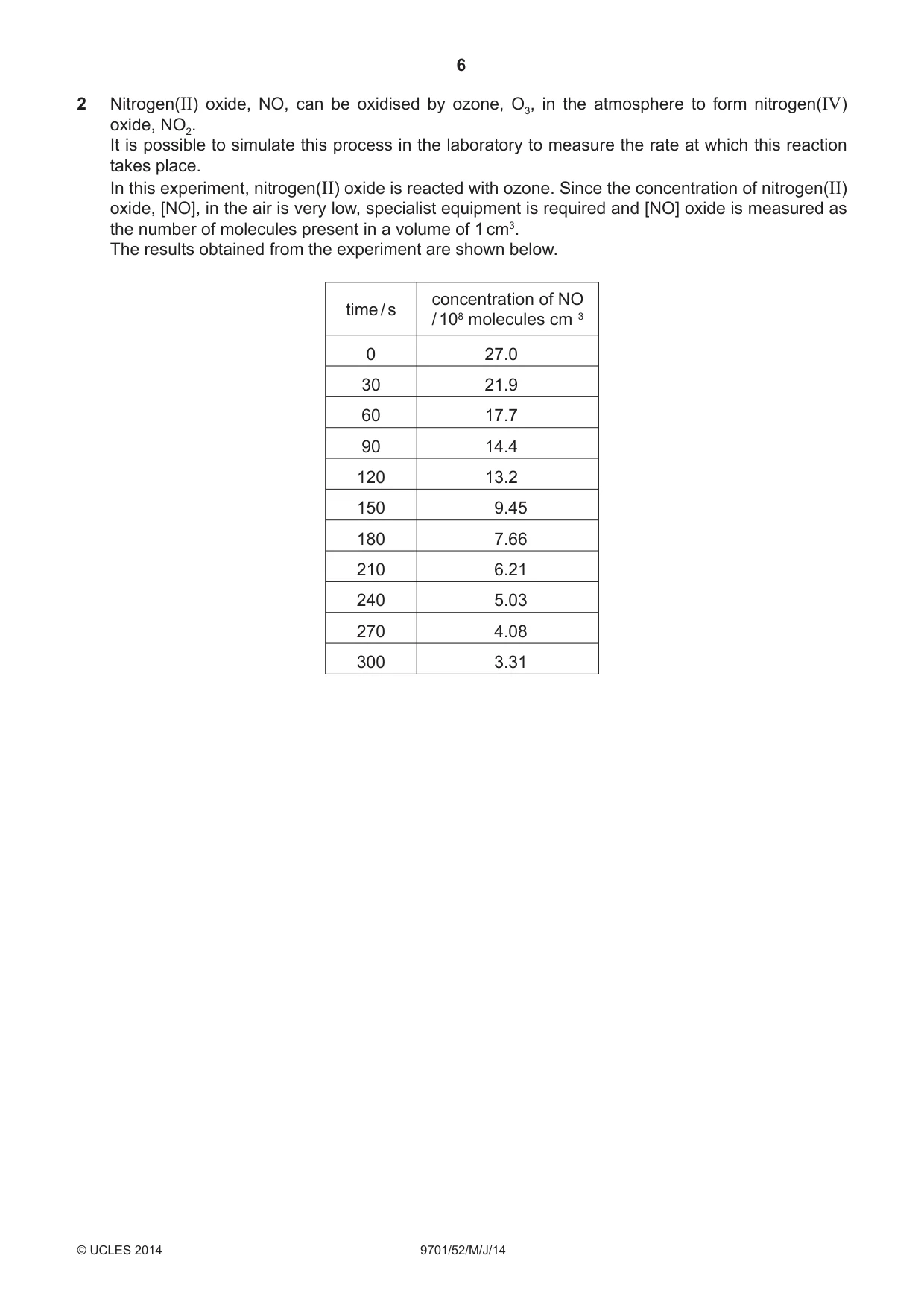
6 9701/52/M/J/14 © UCLES 2014 2 Nitrogen(II) oxide, NO, can be oxidised by ozone, O3, in the atmosphere to form nitrogen(IV) oxide, NO2. It is possible to simulate this process in the laboratory to measure the rate at which this reaction takes place. In this experiment, nitrogen(II) oxide is reacted with ozone. Since the concentration of nitrogen(II) oxide, [NO], in the air is very low, specialist equipment is required and [NO] oxide is measured as the number of molecules present in a volume of 1 cm3. The results obtained from the experiment are shown below. time / s concentration of NO / 108 molecules cm–3 0 27.0 30 21.9 60 17.7 90 14.4 120 13.2 150 9.45 180 7.66 210 6.21 240 5.03 270 4.08 300 3.31
Question paper, page 7
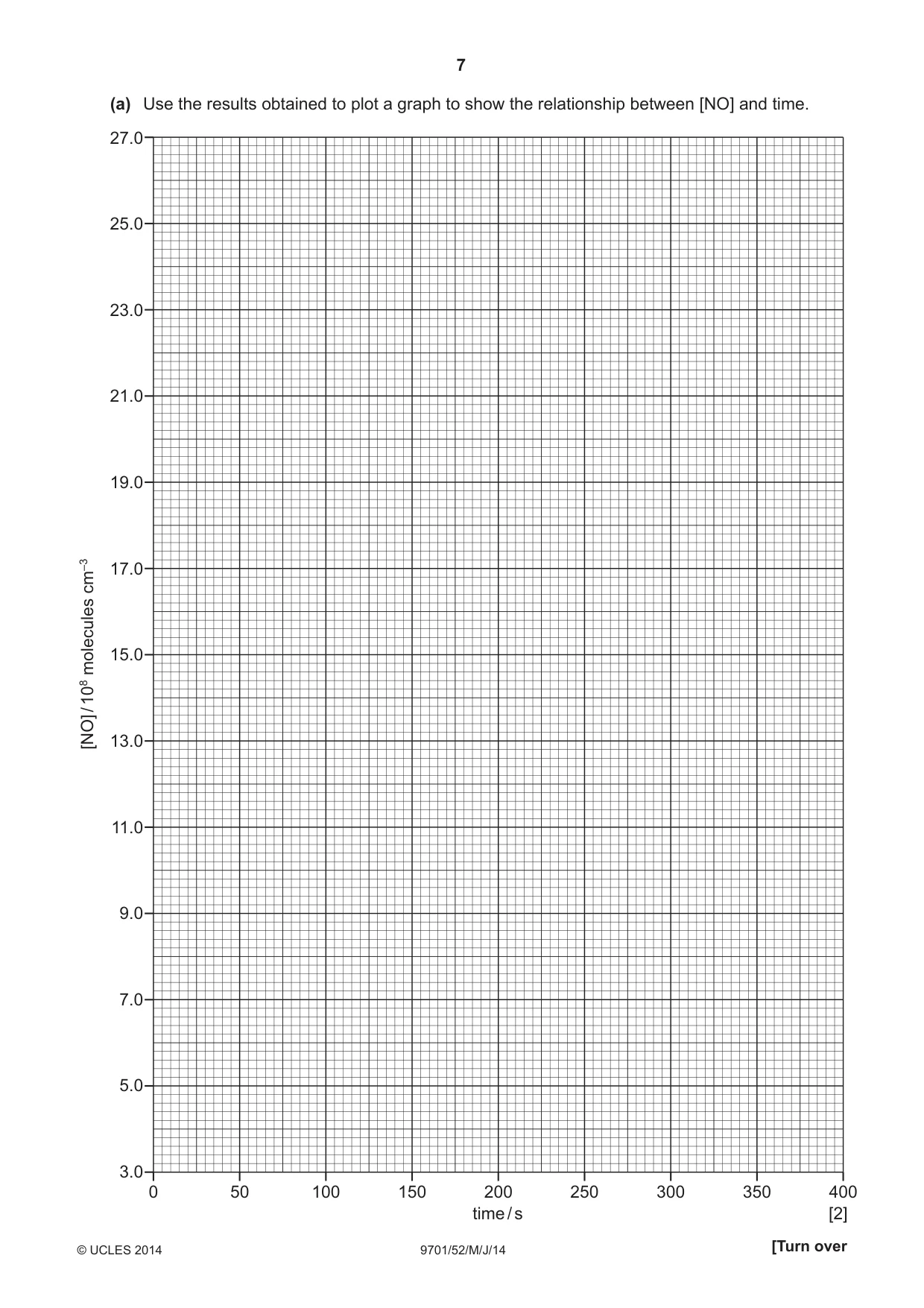
7 9701/52/M/J/14 © UCLES 2014 [Turn over (a) Use the results obtained to plot a graph to show the relationship between [NO] and time. 27.0 25.0 23.0 21.0 19.0 17.0 15.0 13.0 11.0 9.0 7.0 5.0 3.0 0 50 100 150 200 250 300 350 400 [NO] / 108 molecules cm–3
Question paper, page 8
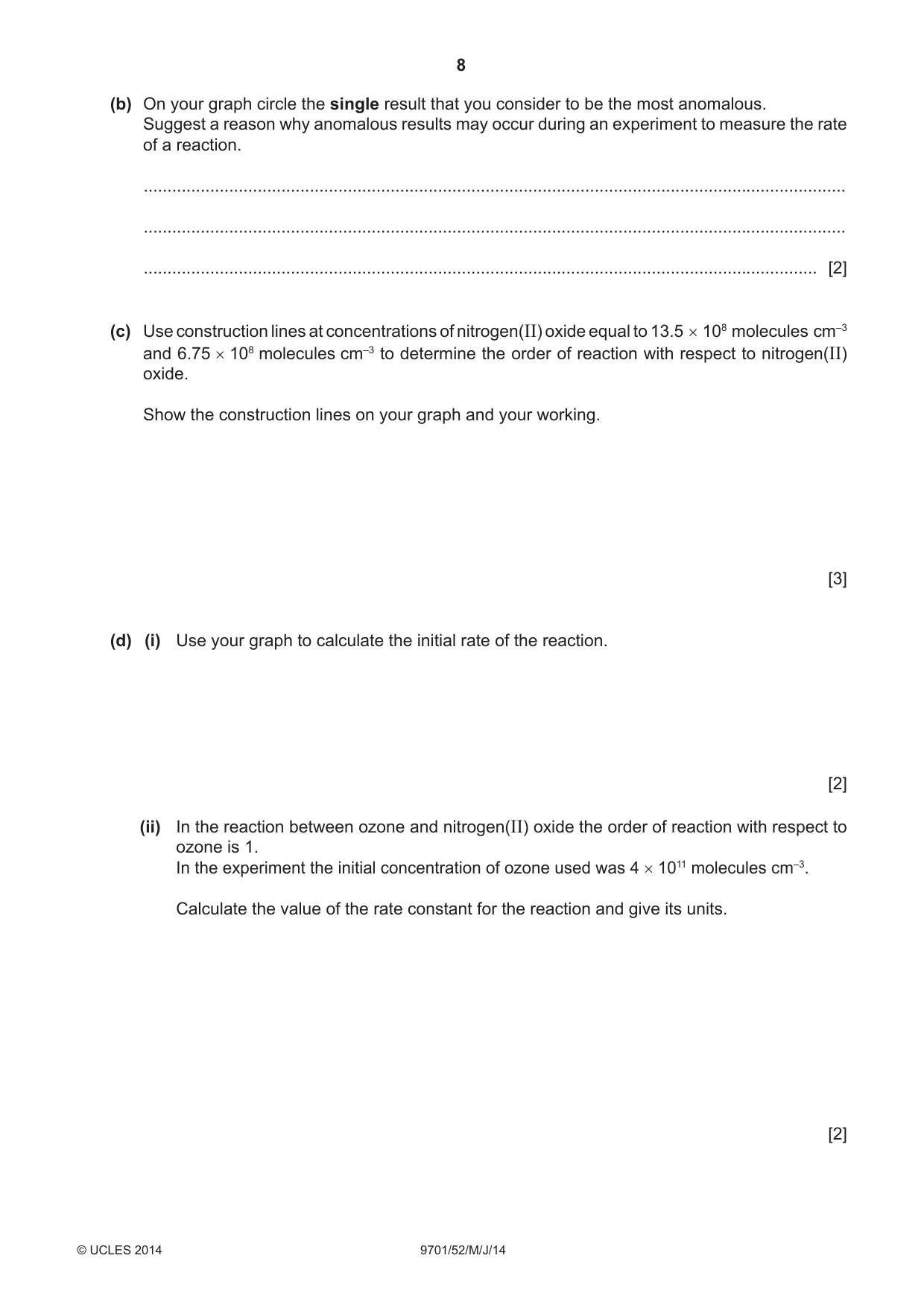
8 9701/52/M/J/14 © UCLES 2014 (b) On your graph circle the single result that you consider to be the most anomalous. Suggest a reason why anomalous results may occur during an experiment to measure the rate of a reaction. … … … [2] (c) Use construction lines at concentrations of nitrogen(II) oxide equal to 13.5 × 10⁸ molecules cm–3 and 6.75 × 10⁸ molecules cm–3 to determine the order of reaction with respect to nitrogen(II) oxide. Show the construction lines on your graph and your working. [3] (d) (i) Use your graph to calculate the initial rate of the reaction. [2] (ii) In the reaction between ozone and nitrogen(II) oxide the order of reaction with respect to ozone is 1. In the experiment the initial concentration of ozone used was 4 × 10¹¹ molecules cm–3. Calculate the value of the rate constant for the reaction and give its units. [2]
Question paper, page 9
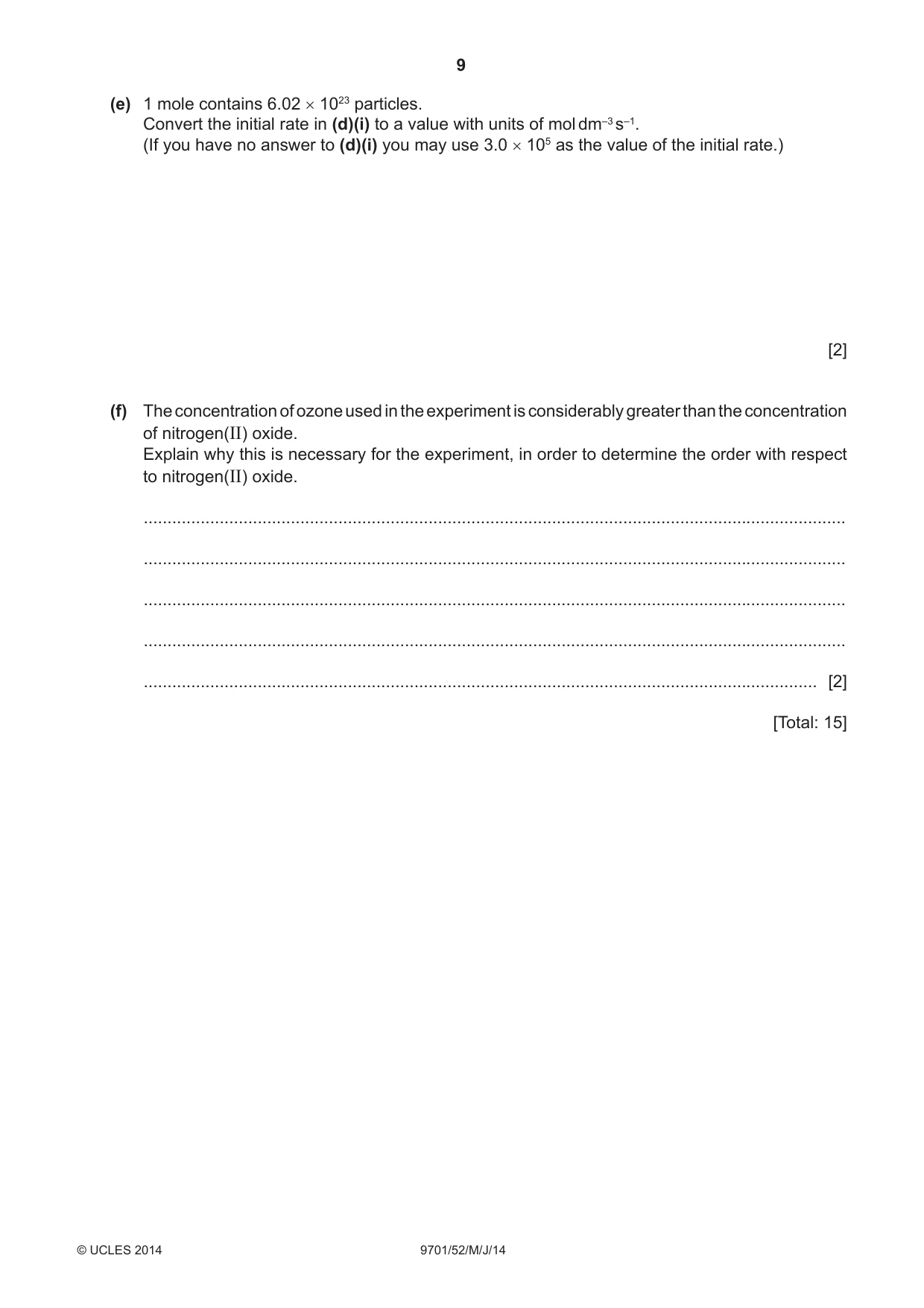
9 9701/52/M/J/14 © UCLES 2014 [Turn over (e) 1 mole contains 6.02 × 10²³ particles. Convert the initial rate in (d)(i) to a value with units of mol dm–3 s–1. (If you have no answer to (d)(i) you may use 3.0 × 10⁵ as the value of the initial rate.) [2] (f) The concentration of ozone used in the experiment is considerably greater than the concentration of nitrogen(II) oxide. Explain why this is necessary for the experiment, in order to determine the order with respect to nitrogen(II) oxide. … … … … … [2] [Total: 15]
Question paper, page 10
10 9701/52/M/J/14 BLANK PAGE © UCLES 2014
Question paper, page 11
11 9701/52/M/J/14 BLANK PAGE © UCLES 2014
Question paper, page 12
12 9701/52/M/J/14 BLANK PAGE © UCLES 2014 Permission to reproduce items where third-party owned material protected by copyright is included has been sought and cleared where possible. Every reasonable effort has been made by the publisher (UCLES) to trace copyright holders, but if any items requiring clearance have unwittingly been included the publisher will be pleased to make amends at the earliest possible opportunity. Cambridge International Examinations is part of the Cambridge Assessment Group. Cambridge Assessment is the brand name of University of Cambridge Local Examinations Syndicate (UCLES), which is itself a department of the University of Cambridge.
Mark scheme, page 1
CAMBRIDGE INTERNATIONAL EXAMINATIONS GCE Advanced Level MARK SCHEME for the May/June 2014 series 9701 CHEMISTRY 9701/52 Paper 5 (Planning, Analysis, and Evaluation), maximum raw mark 30 This mark scheme is published as an aid to teachers and candidates, to indicate the requirements of the examination. It shows the basis on which Examiners were instructed to award marks. It does not indicate the details of the discussions that took place at an Examiners’ meeting before marking began, which would have considered the acceptability of alternative answers. Mark schemes should be read in conjunction with the question paper and the Principal Examiner Report for Teachers. Cambridge will not enter into discussions about these mark schemes. Cambridge is publishing the mark schemes for the May/June 2014 series for most IGCSE, GCE Advanced Level and Advanced Subsidiary Level components and some Ordinary Level components.
Mark scheme, page 2
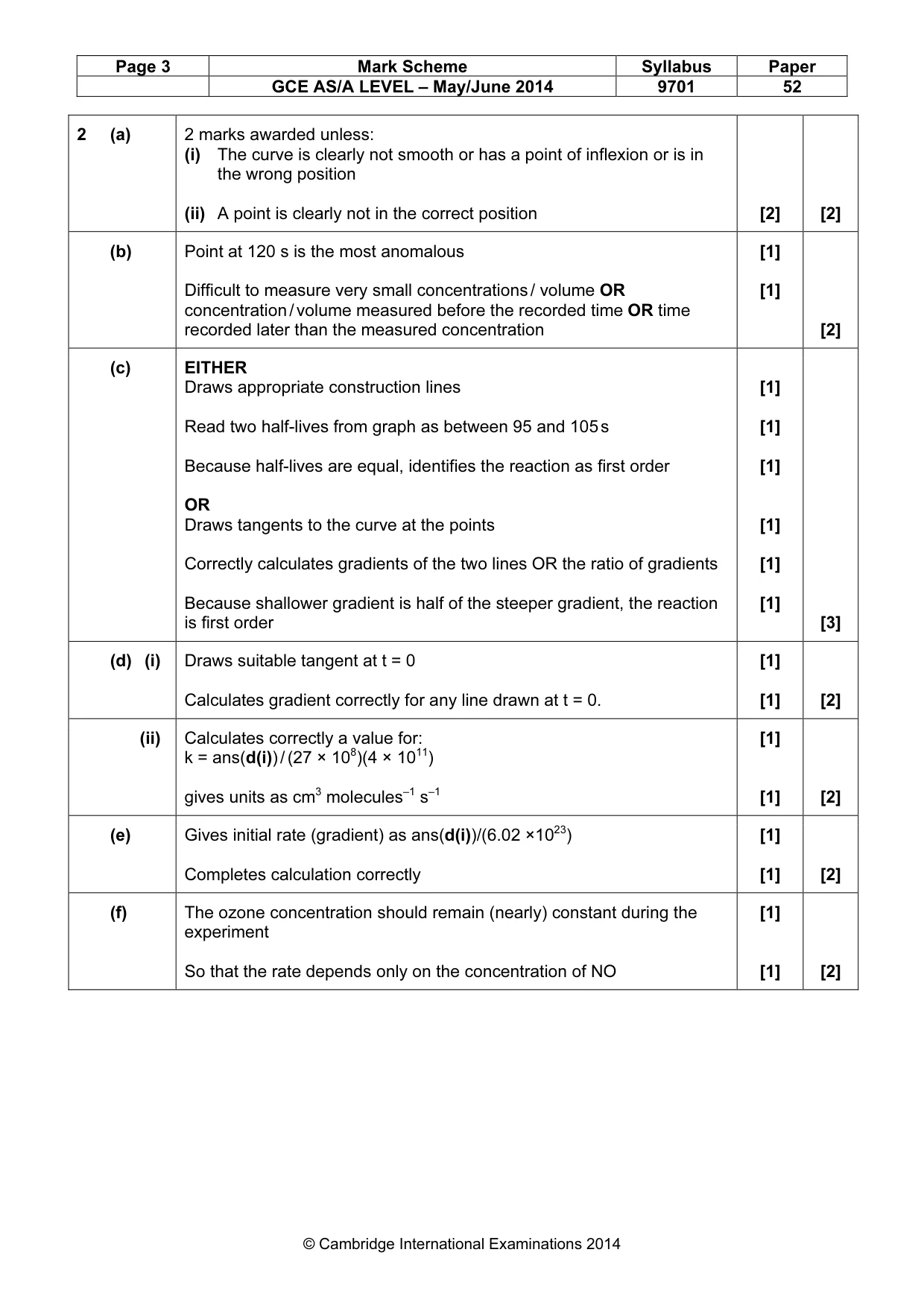
Page 2 Mark Scheme Syllabus Paper GCE AS/A LEVEL – May/June 2014 9701 52 © Cambridge International Examinations 2014 Question Expected Answer Mark 1 (a) Water can hydrogen bond with ammonia (ORA for trichloromethane) Water / oxygen / ammonia / nitrogen has a lone pair (of electrons) (ORA for trichloromethane) OR trichloromethane has dipole-dipole interactions only [1] [1] [2] (b) (Kpartition =) [NH3(water)] [NH3(trichloromethane)] AND (Kpartition) > 1 ORA [1] [1] (c) It is not important as the concentration is independent of volume [1] [1] (d) 2NH3 + H2SO4 → (NH4)2SO4 [1] [1] (e) (i) Calculates the concentration of ammonia (in the aqueous layer) is (approximately) 1 mol dm–3 OR between 0.96 mol dm–3 and 1.04 mol dm–3 ecf from (d) Should be diluted by 5 [1] [1] [2] (e) (ii) Pipette 50 cm3 of the 5.00 mol dm–3 aqueous ammonia into a 250 cm3 volumetric (graduated) flask ecf from (e)(i) other flask sizes and methods of accurate volume measurement allowed Make up to the mark with water. Shake OR invert the flask OR mix. [1] [1] [2] (f) Allow suitable methods for avoiding the inhalation of ammonia AND/OR trichloromethane fumes [1] [1] (g) methyl orange / screened methyl orange Allow other indicators with suitable pH range As it is weak base-strong acid titration [1] [1] [2] (h) The concentration / solubility in the aqueous layer is much larger so determination of its concentration would be less prone to error Allow sulfuric acid immiscible with trichloromethane layer [1] [1] (i) Calculates the moles of ammonia in the aqueous layer ecf from (d) Subtracts from the original to obtain moles in the trichloromethane [1] [1] [2]
Mark scheme, page 3
Page 3 Mark Scheme Syllabus Paper GCE AS/A LEVEL – May/June 2014 9701 52 © Cambridge International Examinations 2014 2 (a) 2 marks awarded unless: (i) The curve is clearly not smooth or has a point of inflexion or is in the wrong position (ii) A point is clearly not in the correct position [2] [2] (b) Point at 120 s is the most anomalous Difficult to measure very small concentrations / volume OR concentration / volume measured before the recorded time OR time recorded later than the measured concentration [1] [1] [2] (c) EITHER Draws appropriate construction lines Read two half-lives from graph as between 95 and 105 s Because half-lives are equal, identifies the reaction as first order OR Draws tangents to the curve at the points Correctly calculates gradients of the two lines OR the ratio of gradients Because shallower gradient is half of the steeper gradient, the reaction is first order [1] [1] [1] [1] [1] [1] [3] (d) (i) Draws suitable tangent at t = 0 Calculates gradient correctly for any line drawn at t = 0. [1] [1] [2] (ii) Calculates correctly a value for: k = ans(d(i)) / (27 × 108)(4 × 10¹¹) gives units as cm3 molecules–1 s–1 [1] [1] [2] (e) Gives initial rate (gradient) as ans(d(i))/(6.02 ×1023) Completes calculation correctly [1] [1] [2] (f) The ozone concentration should remain (nearly) constant during the experiment So that the rate depends only on the concentration of NO [1] [1] [2]
What you needed in this session
Cambridge’s own grade thresholds for 2014 May/June, Paper 5 · Variant 2. A higher threshold means an easier paper — the bar moves with how the cohort did.