Cambridge A Level Chemistry 9701 — 2014 May/June Paper 5 · Variant 1
9701/51/M/J/14 · 30 marks · ≈34 min
The question paper and its mark scheme, free to read here and free to download. This is Cambridge’s own paper, exactly as it was sat.
Question paper12 pages



Mark scheme4 pages
Answers below. Sit the paper first if you are practising.
Paper as text
Question paper, page 1
This document consists of 10 printed pages and 2 blank pages. [Turn over IB14 06_9701_51/6RP © UCLES 2014 *0139125346* READ THESE INSTRUCTIONS FIRST Write your Centre number, candidate number and name on all the work you hand in. Write in dark blue or black pen. You may use an HB pencil for any diagrams or graphs. Do not use staples, paper clips, glue or correction fl uid. DO NOT WRITE IN ANY BARCODES. Answer all questions. Electronic calculators may be used. You may lose marks if you do not show your working or if you do not use appropriate units. Use of a Data Booklet is unnecessary. At the end of the examination, fasten all your work securely together. The number of marks is given in brackets [ ] at the end of each question or part question. CHEMISTRY 9701/51 Paper 5 Planning, Analysis and Evaluation May/June 2014 1 hour 15 minutes Candidates answer on the Question Paper. No Additional Materials are required. Cambridge International Examinations Cambridge International Advanced Level
Question paper, page 2
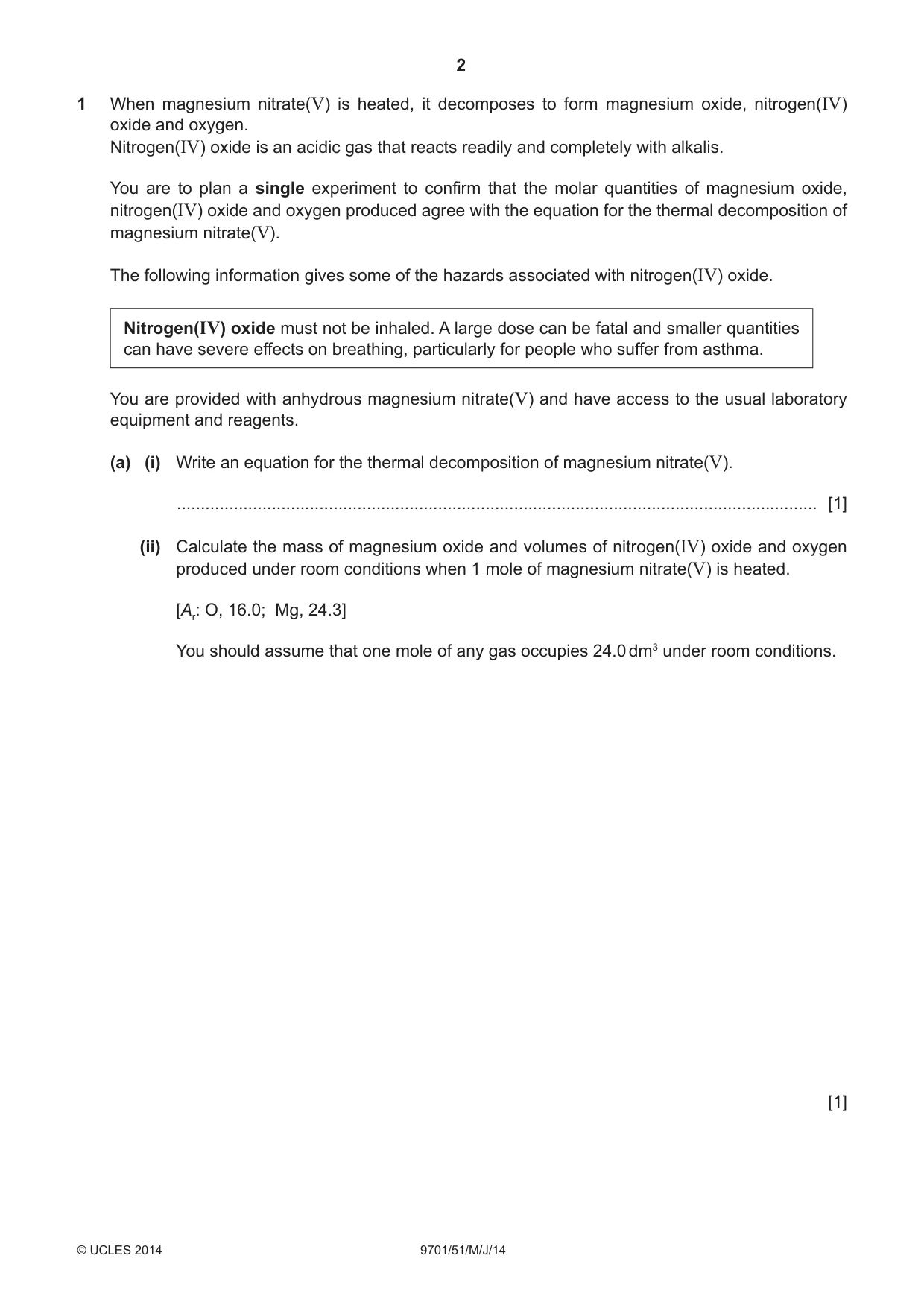
2 9701/51/M/J/14 © UCLES 2014 1 When magnesium nitrate(V) is heated, it decomposes to form magnesium oxide, nitrogen(IV) oxide and oxygen. Nitrogen(IV) oxide is an acidic gas that reacts readily and completely with alkalis. You are to plan a single experiment to confi rm that the molar quantities of magnesium oxide, nitrogen(IV) oxide and oxygen produced agree with the equation for the thermal decomposition of magnesium nitrate(V). The following information gives some of the hazards associated with nitrogen(IV) oxide. Nitrogen(IV) oxide must not be inhaled. A large dose can be fatal and smaller quantities can have severe effects on breathing, particularly for people who suffer from asthma. You are provided with anhydrous magnesium nitrate(V) and have access to the usual laboratory equipment and reagents. (a) (i) Write an equation for the thermal decomposition of magnesium nitrate(V). … [1] (ii) Calculate the mass of magnesium oxide and volumes of nitrogen(IV) oxide and oxygen produced under room conditions when 1 mole of magnesium nitrate(V) is heated. [Ar: O, 16.0; Mg, 24.3] You should assume that one mole of any gas occupies 24.0 dm3 under room conditions. [1]
Question paper, page 3
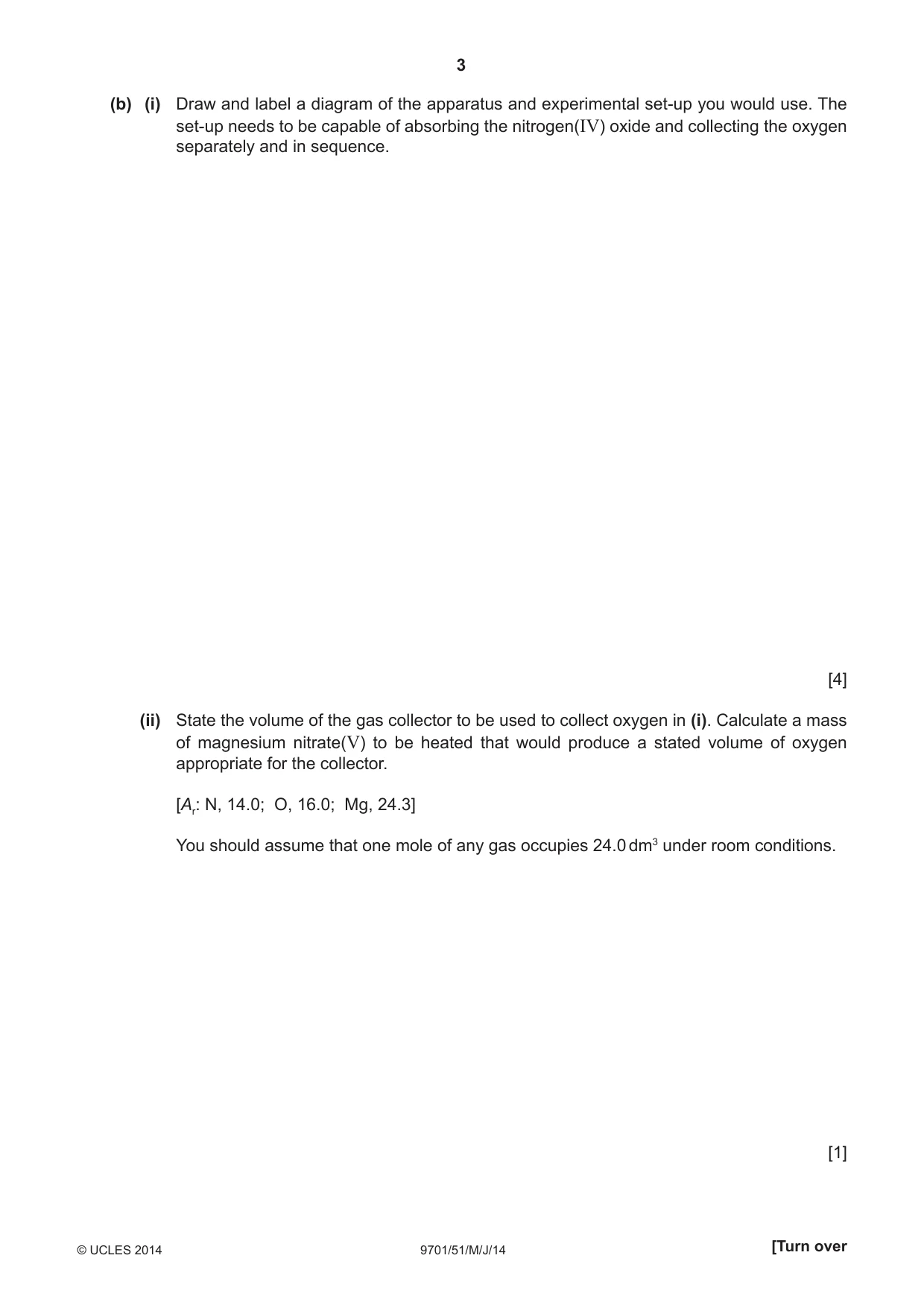
3 9701/51/M/J/14 © UCLES 2014 [Turn over (b) (i) Draw and label a diagram of the apparatus and experimental set-up you would use. The set-up needs to be capable of absorbing the nitrogen(IV) oxide and collecting the oxygen separately and in sequence. [4] (ii) State the volume of the gas collector to be used to collect oxygen in (i). Calculate a mass of magnesium nitrate(V) to be heated that would produce a stated volume of oxygen appropriate for the collector. [Ar: N, 14.0; O, 16.0; Mg, 24.3] You should assume that one mole of any gas occupies 24.0 dm3 under room conditions. [1]
Question paper, page 4
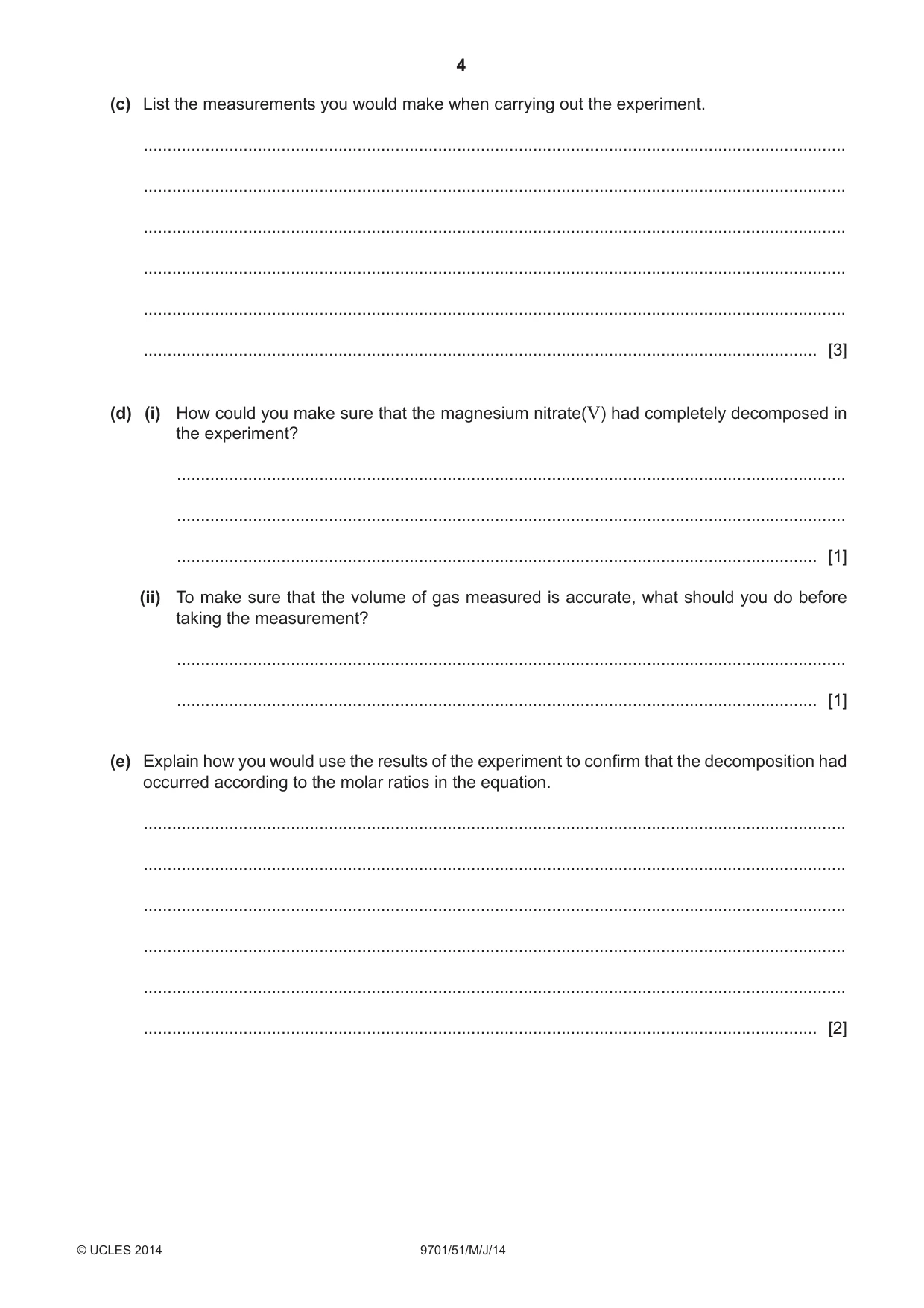
4 9701/51/M/J/14 © UCLES 2014 (c) List the measurements you would make when carrying out the experiment. … … … … … … [3] (d) (i) How could you make sure that the magnesium nitrate(V) had completely decomposed in the experiment? … … … [1] (ii) To make sure that the volume of gas measured is accurate, what should you do before taking the measurement? … … [1] (e) Explain how you would use the results of the experiment to confi rm that the decomposition had occurred according to the molar ratios in the equation. … … … … … … [2]
Question paper, page 5
5 9701/51/M/J/14 © UCLES 2014 [Turn over (f) What precautions would you take to make sure that the experiment could be performed safely? … … … … [1] [Total: 15]
Question paper, page 6
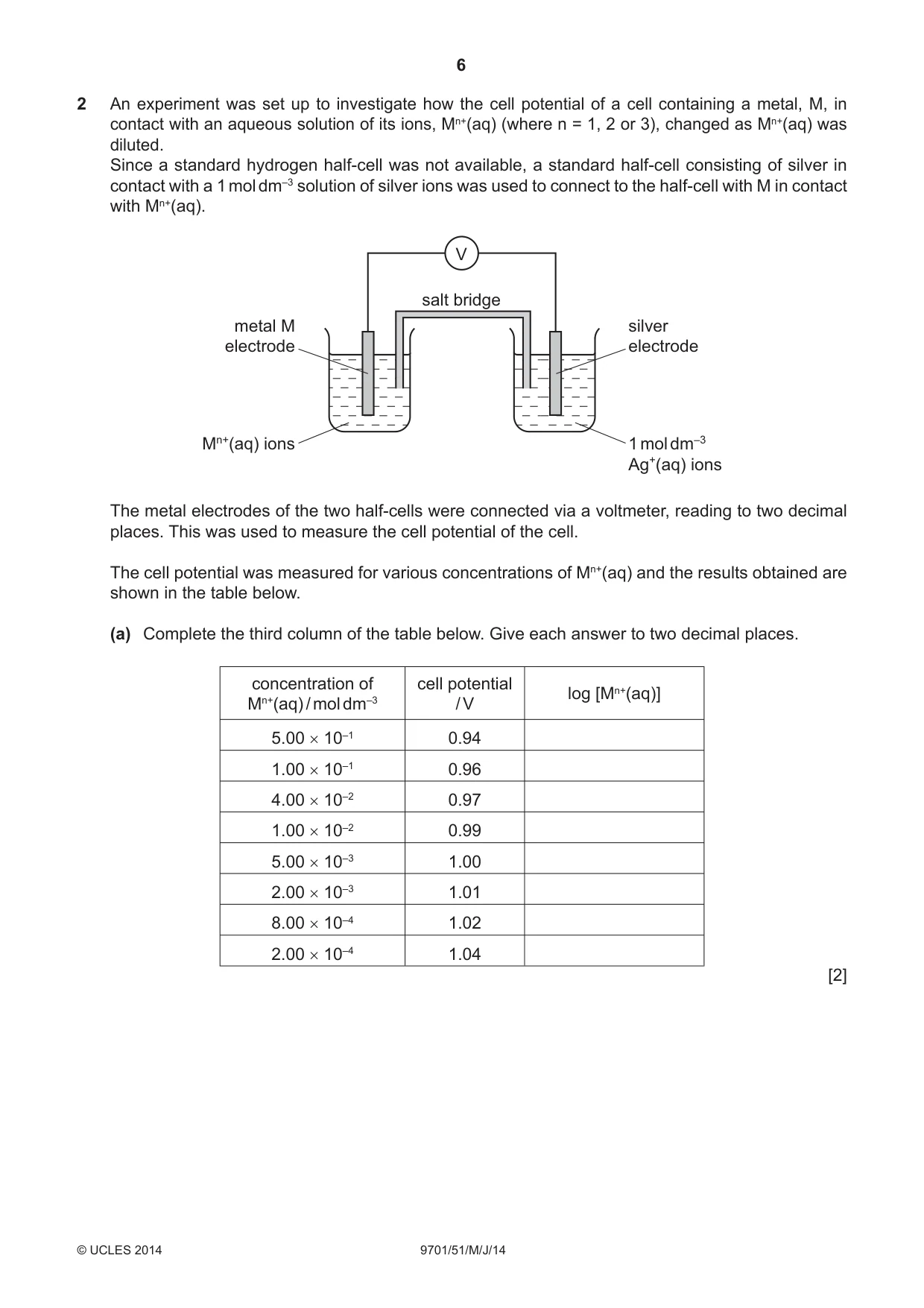
6 9701/51/M/J/14 © UCLES 2014 2 An experiment was set up to investigate how the cell potential of a cell containing a metal, M, in contact with an aqueous solution of its ions, Mn+(aq) (where n = 1, 2 or 3), changed as Mn+(aq) was diluted. Since a standard hydrogen half-cell was not available, a standard half-cell consisting of silver in contact with a 1 mol dm–3 solution of silver ions was used to connect to the half-cell with M in contact with Mn+(aq). V salt bridge metal M electrode Mn+(aq) ions 1 mol dm–3 Ag+(aq) ions silver electrode The metal electrodes of the two half-cells were connected via a voltmeter, reading to two decimal places. This was used to measure the cell potential of the cell. The cell potential was measured for various concentrations of Mn+(aq) and the results obtained are shown in the table below. (a) Complete the third column of the table below. Give each answer to two decimal places. concentration of Mn+(aq) / mol dm–3 cell potential / V log [Mn+(aq)] 5.00 × 10⁻¹ 0.94 1.00 × 10⁻¹ 0.96 4.00 × 10⁻² 0.97 1.00 × 10⁻² 0.99 5.00 × 10⁻³ 1.00 2.00 × 10⁻³ 1.01 8.00 × 10⁻⁴ 1.02 2.00 × 10⁻⁴ 1.04 [2]
Question paper, page 7
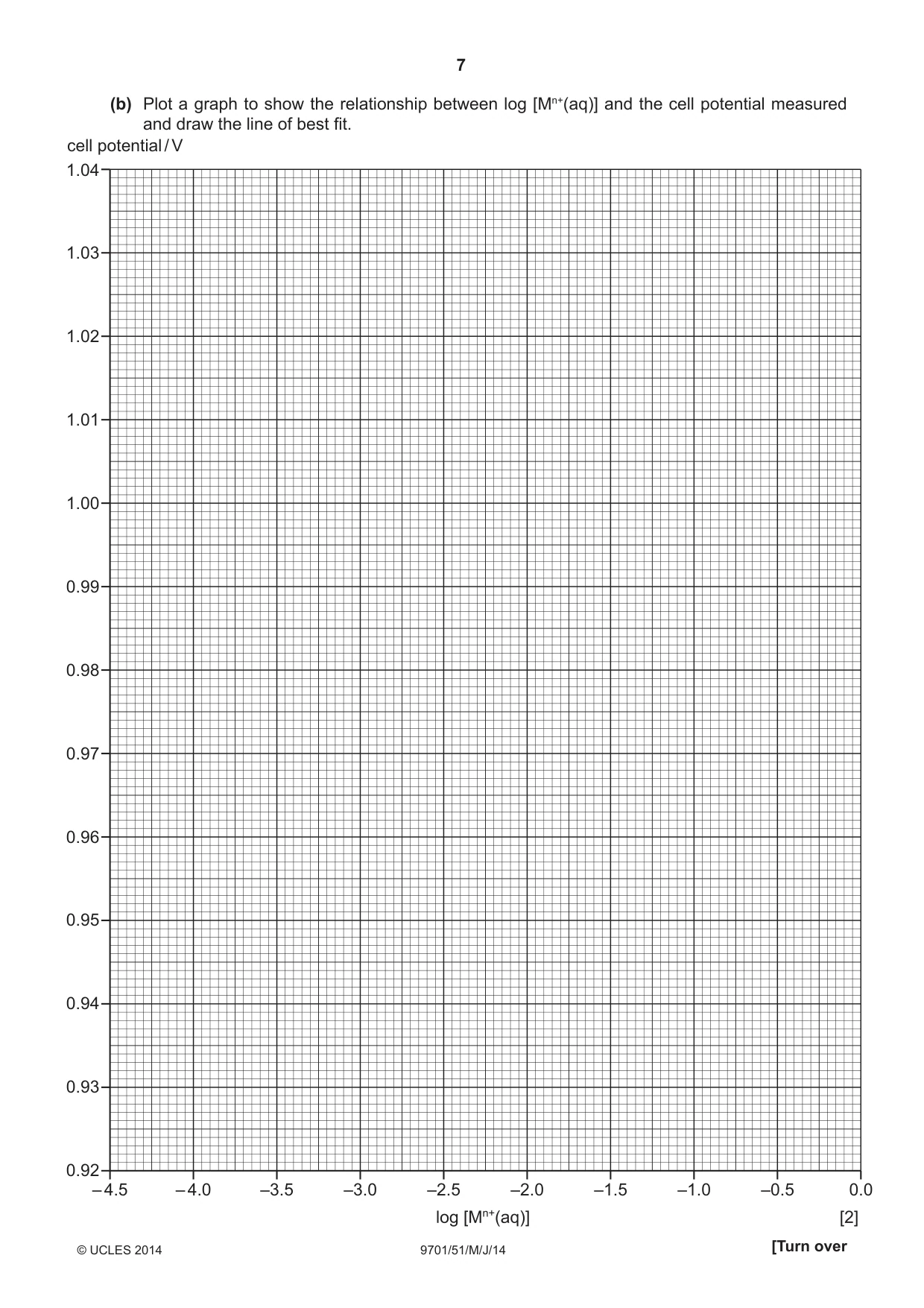
7 9701/51/M/J/14 © UCLES 2014 [Turn over (b) Plot a graph to show the relationship between log [Mn+(aq)] and the cell potential measured and draw the line of best fi t. 1.04 1.03 1.02 1.01 1.00 0.99 0.98 0.97 0.96 0.95 0.94 0.93 0.92 – 4.5 – 4.0 –3.5 –3.0 –2.5 –2.0 –1.5 –1.0 –0.5 0.0 cell potential / V
Question paper, page 8
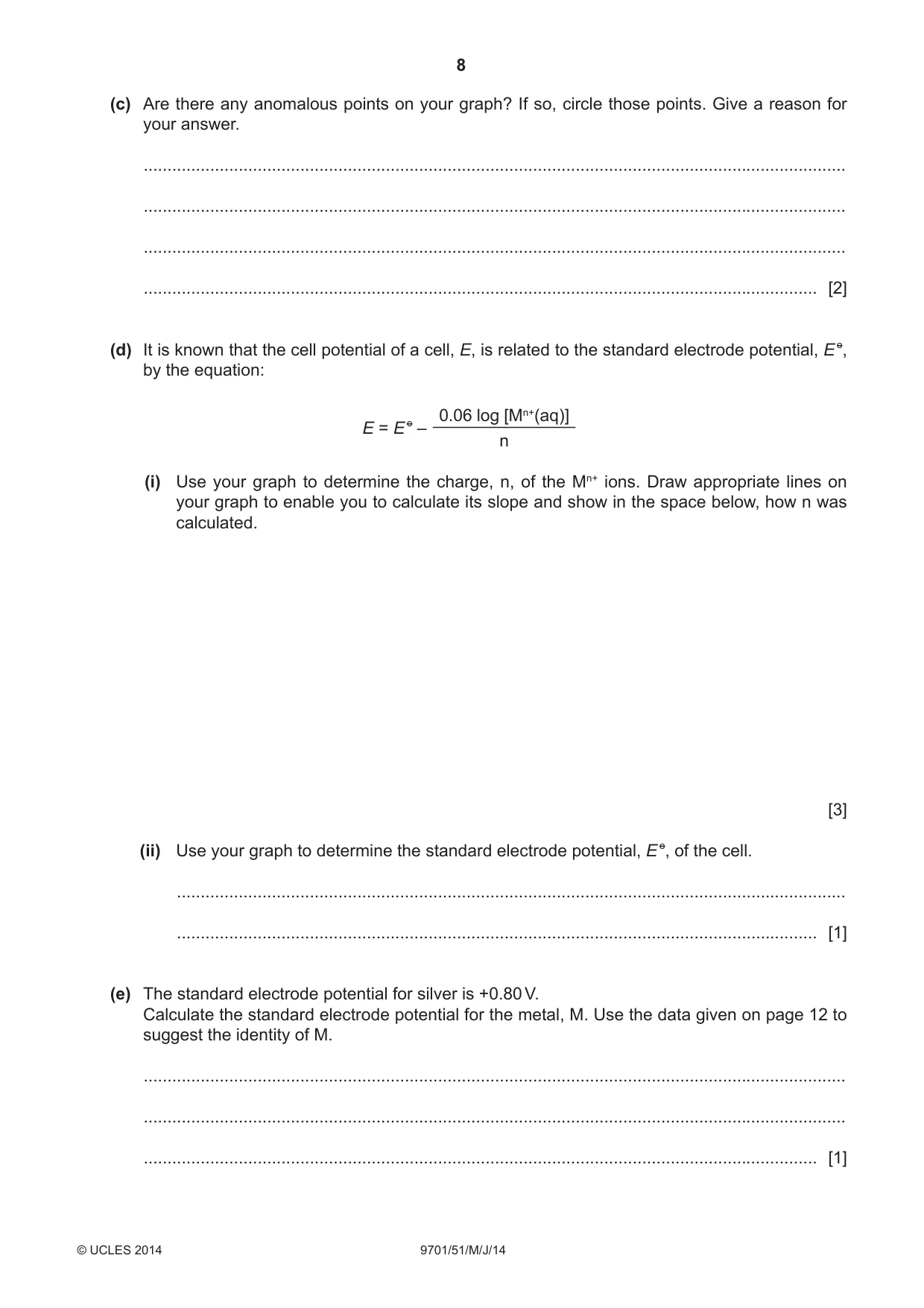
8 9701/51/M/J/14 © UCLES 2014 (c) Are there any anomalous points on your graph? If so, circle those points. Give a reason for your answer. … … … … [2] (d) It is known that the cell potential of a cell, E, is related to the standard electrode potential, E o, by the equation: E = E o – 0.06 log [Mn+(aq)] n (i) Use your graph to determine the charge, n, of the Mn+ ions. Draw appropriate lines on your graph to enable you to calculate its slope and show in the space below, how n was calculated. [3] (ii) Use your graph to determine the standard electrode potential, E o, of the cell. … … [1] (e) The standard electrode potential for silver is +0.80 V. Calculate the standard electrode potential for the metal, M. Use the data given on page 12 to suggest the identity of M. … … … [1]
Question paper, page 9
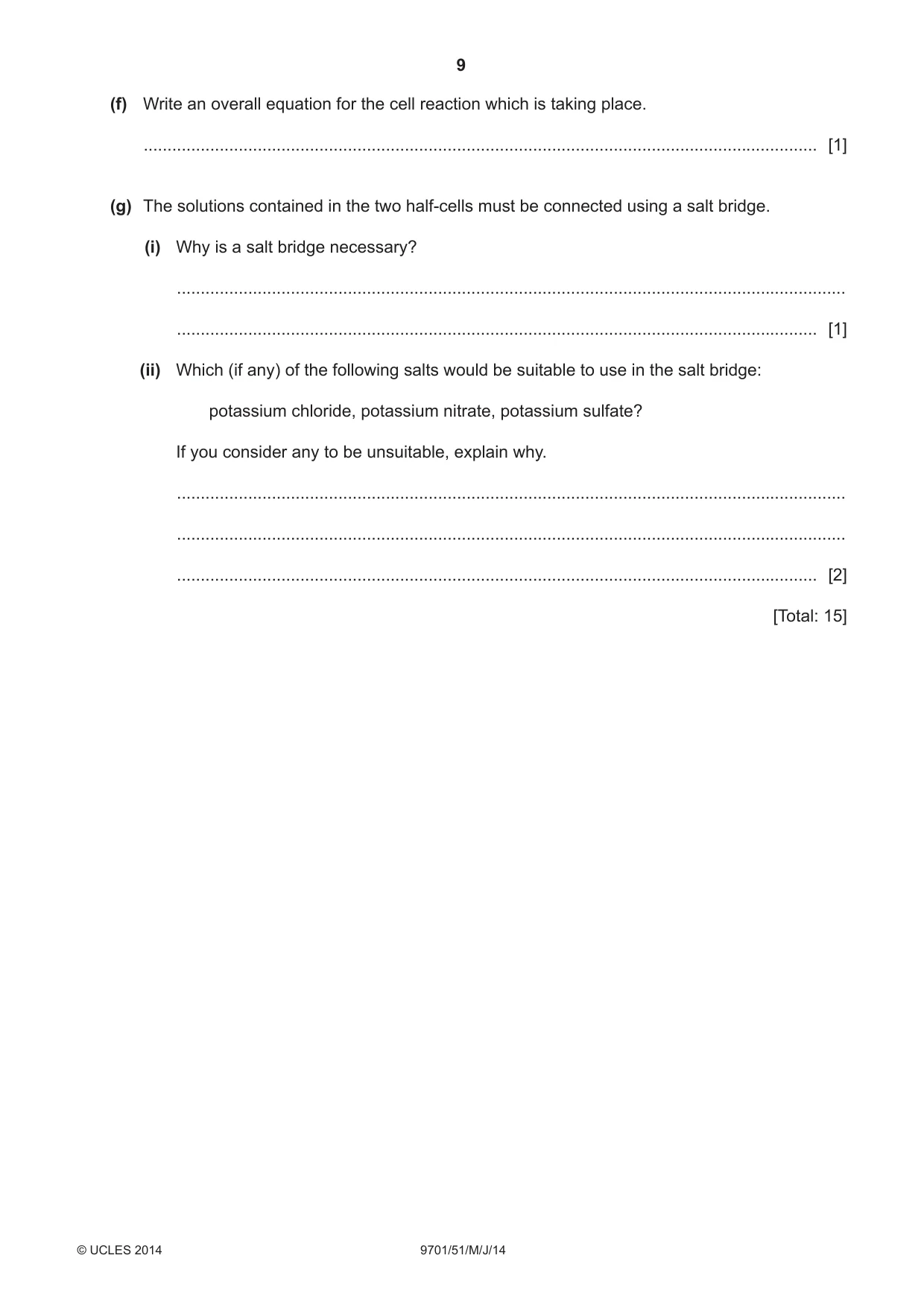
9 9701/51/M/J/14 © UCLES 2014 [Turn over (f) Write an overall equation for the cell reaction which is taking place. … [1] (g) The solutions contained in the two half-cells must be connected using a salt bridge. (i) Why is a salt bridge necessary? … … [1] (ii) Which (if any) of the following salts would be suitable to use in the salt bridge: potassium chloride, potassium nitrate, potassium sulfate? If you consider any to be unsuitable, explain why. … … … [2] [Total: 15]
Question paper, page 10
10 9701/51/M/J/14 BLANK PAGE © UCLES 2014
Question paper, page 11
11 9701/51/M/J/14 BLANK PAGE © UCLES 2014
Question paper, page 12
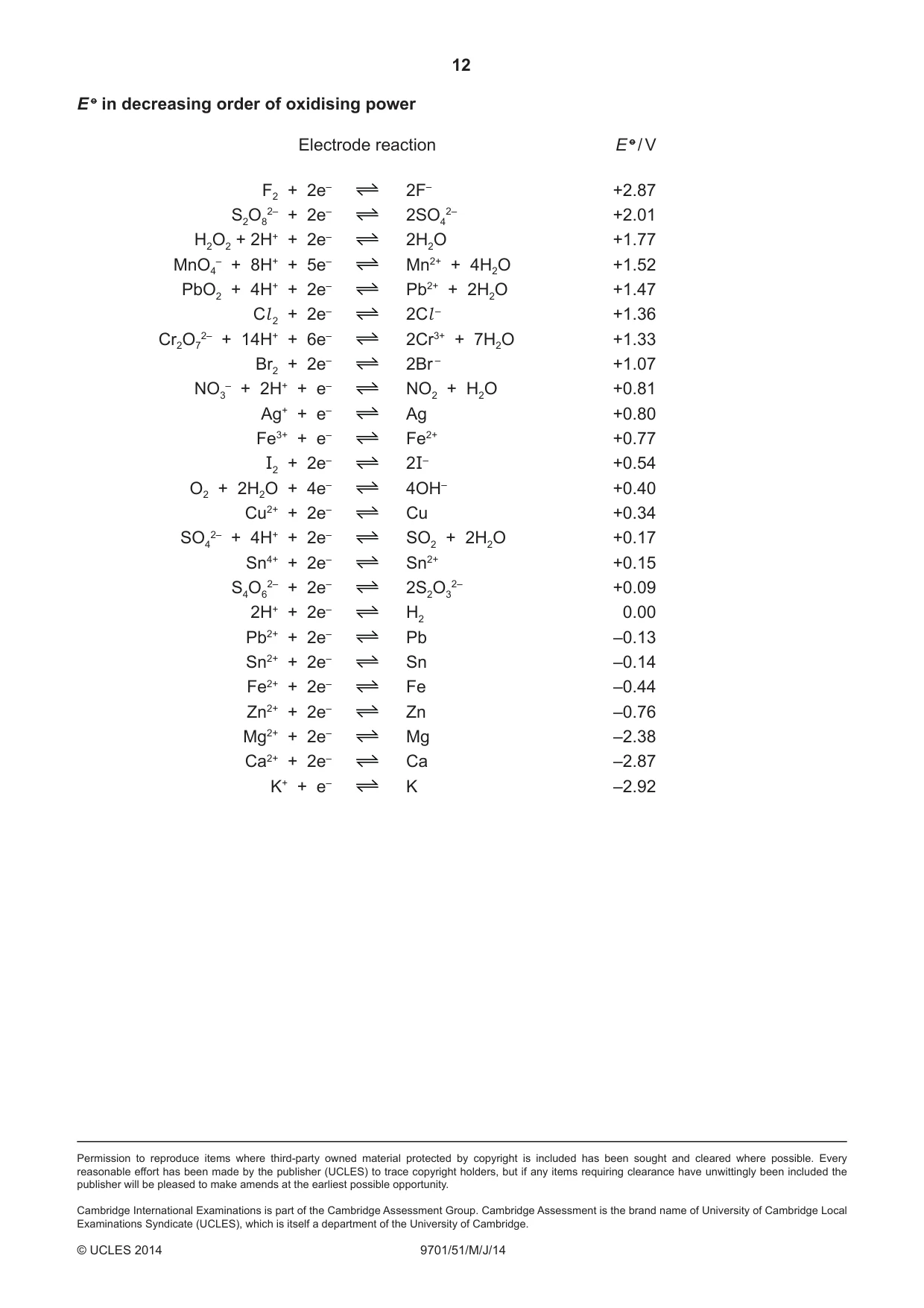
12 9701/51/M/J/14 © UCLES 2014 Permission to reproduce items where third-party owned material protected by copyright is included has been sought and cleared where possible. Every reasonable effort has been made by the publisher (UCLES) to trace copyright holders, but if any items requiring clearance have unwittingly been included the publisher will be pleased to make amends at the earliest possible opportunity. Cambridge International Examinations is part of the Cambridge Assessment Group. Cambridge Assessment is the brand name of University of Cambridge Local Examinations Syndicate (UCLES), which is itself a department of the University of Cambridge. E o in decreasing order of oxidising power Electrode reaction E o / V F2 + 2e– 2F– +2.87 S2O8 2– + 2e– 2SO4 2– +2.01 H2O2 + 2H+ + 2e– 2H2O +1.77 MnO4 – + 8H+ + 5e– Mn2+ + 4H2O +1.52 PbO2 + 4H+ + 2e– Pb2+ + 2H2O +1.47 Cl 2 + 2e– 2Cl – +1.36 Cr2O7 2– + 14H+ + 6e– 2Cr3+ + 7H2O +1.33 Br2 + 2e– 2Br – +1.07 NO3 – + 2H+ + e– NO2 + H2O +0.81 Ag+ + e– Ag +0.80 Fe3+ + e– Fe2+ +0.77 I2 + 2e– 2I– +0.54 O2 + 2H2O + 4e– 4OH– +0.40 Cu2+ + 2e– Cu +0.34 SO4 2– + 4H+ + 2e– SO2 + 2H2O +0.17 Sn4+ + 2e– Sn2+ +0.15 S4O6 2– + 2e– 2S2O3 2– +0.09 2H+ + 2e– H2 0.00 Pb2+ + 2e– Pb –0.13 Sn2+ + 2e– Sn –0.14 Fe2+ + 2e– Fe –0.44 Zn2+ + 2e– Zn –0.76 Mg2+ + 2e– Mg –2.38 Ca2+ + 2e– Ca –2.87 K+ + e– K –2.92
Mark scheme, page 1
CAMBRIDGE INTERNATIONAL EXAMINATIONS GCE Advanced Level MARK SCHEME for the May/June 2014 series 9701 CHEMISTRY 9701/51 Paper 5 (Planning Analysis and Evaluation), maximum raw mark 30 This mark scheme is published as an aid to teachers and candidates, to indicate the requirements of the examination. It shows the basis on which Examiners were instructed to award marks. It does not indicate the details of the discussions that took place at an Examiners’ meeting before marking began, which would have considered the acceptability of alternative answers. Mark schemes should be read in conjunction with the question paper and the Principal Examiner Report for Teachers. Cambridge will not enter into discussions about these mark schemes. Cambridge is publishing the mark schemes for the May/June 2014 series for most IGCSE, GCE Advanced Level and Advanced Subsidiary Level components and some Ordinary Level components.
Mark scheme, page 2
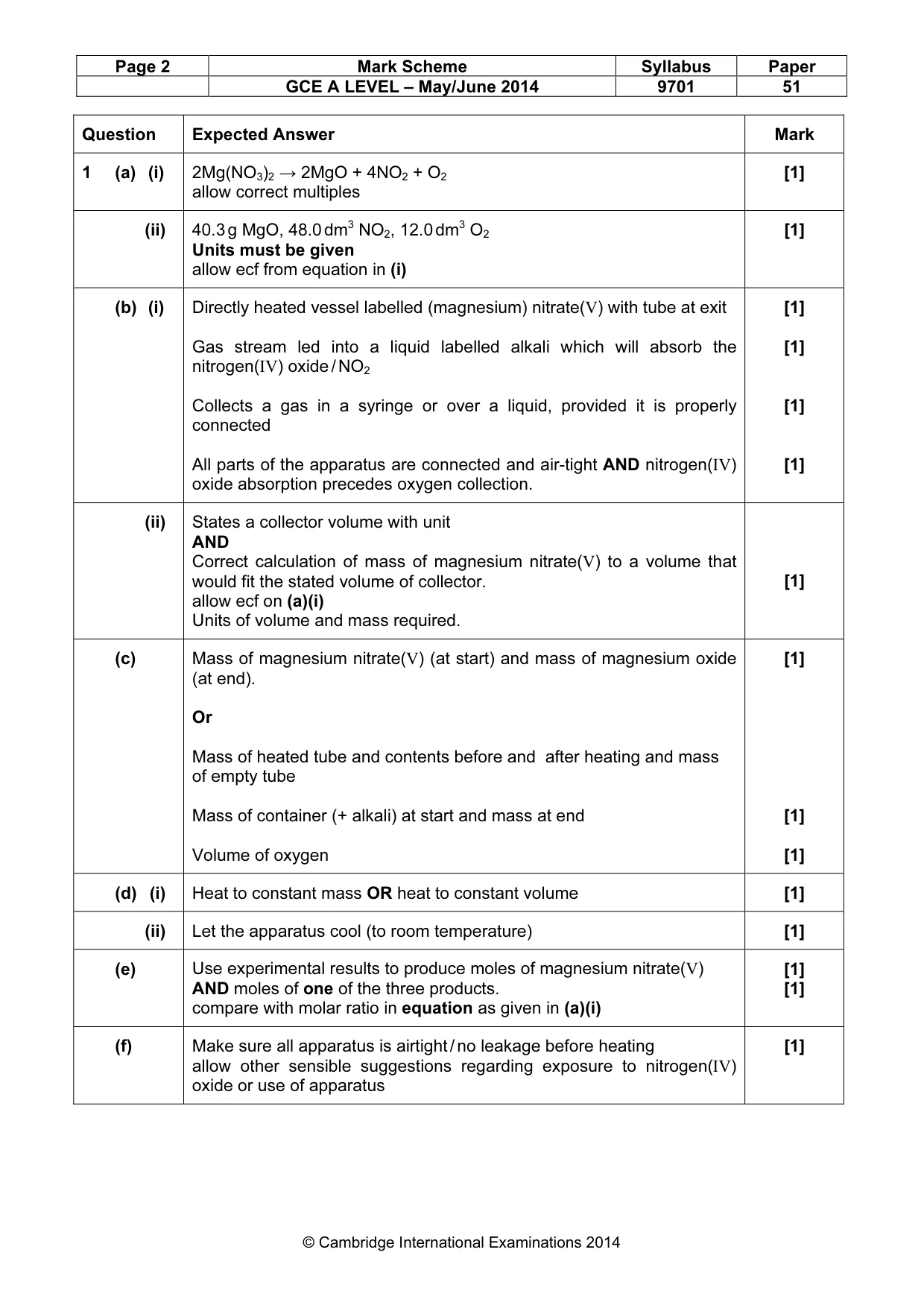
Page 2 Mark Scheme Syllabus Paper GCE A LEVEL – May/June 2014 9701 51 © Cambridge International Examinations 2014 Question Expected Answer Mark 1 (a) (i) 2Mg(NO3)2 → 2MgO + 4NO2 + O2 allow correct multiples [1] (ii) 40.3 g MgO, 48.0 dm3 NO2, 12.0 dm3 O2 Units must be given allow ecf from equation in (i) [1] (b) (i) Directly heated vessel labelled (magnesium) nitrate(V) with tube at exit Gas stream led into a liquid labelled alkali which will absorb the nitrogen(IV) oxide / NO2 Collects a gas in a syringe or over a liquid, provided it is properly connected All parts of the apparatus are connected and air-tight AND nitrogen(IV) oxide absorption precedes oxygen collection. [1] [1] [1] [1] (ii) States a collector volume with unit AND Correct calculation of mass of magnesium nitrate(V) to a volume that would fit the stated volume of collector. allow ecf on (a)(i) Units of volume and mass required. [1] (c) Mass of magnesium nitrate(V) (at start) and mass of magnesium oxide (at end). Or Mass of heated tube and contents before and after heating and mass of empty tube Mass of container (+ alkali) at start and mass at end Volume of oxygen [1] [1] [1] (d) (i) Heat to constant mass OR heat to constant volume [1] (ii) Let the apparatus cool (to room temperature) [1] (e) Use experimental results to produce moles of magnesium nitrate(V) AND moles of one of the three products. compare with molar ratio in equation as given in (a)(i) [1] [1] (f) Make sure all apparatus is airtight / no leakage before heating allow other sensible suggestions regarding exposure to nitrogen(IV) oxide or use of apparatus [1]
Mark scheme, page 3
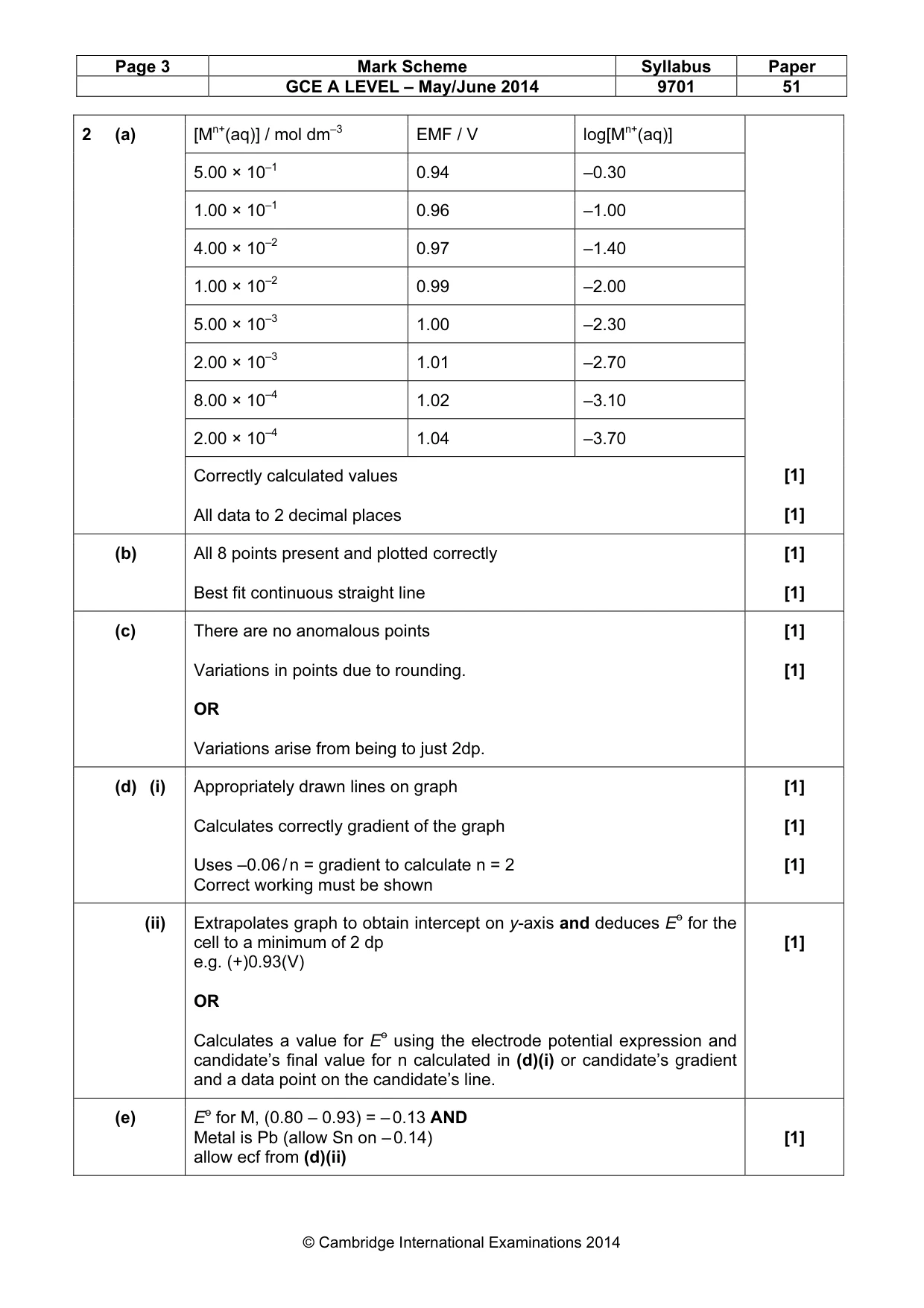
Page 3 Mark Scheme Syllabus Paper GCE A LEVEL – May/June 2014 9701 51 © Cambridge International Examinations 2014 2 (a) [Mn+(aq)] / mol dm–3 EMF / V log[Mn+(aq)] [1] [1] 5.00 × 10⁻¹ 0.94 –0.30 1.00 × 10⁻¹ 0.96 –1.00 4.00 × 10⁻² 0.97 –1.40 1.00 × 10⁻² 0.99 –2.00 5.00 × 10⁻³ 1.00 –2.30 2.00 × 10⁻³ 1.01 –2.70 8.00 × 10⁻⁴ 1.02 –3.10 2.00 × 10⁻⁴ 1.04 –3.70 Correctly calculated values All data to 2 decimal places (b) All 8 points present and plotted correctly Best fit continuous straight line [1] [1] (c) There are no anomalous points Variations in points due to rounding. OR Variations arise from being to just 2dp. [1] [1] (d) (i) Appropriately drawn lines on graph Calculates correctly gradient of the graph Uses –0.06 / n = gradient to calculate n = 2 Correct working must be shown [1] [1] [1] (ii) Extrapolates graph to obtain intercept on y-axis and deduces Eo for the cell to a minimum of 2 dp e.g. (+)0.93(V) OR Calculates a value for Eo using the electrode potential expression and candidate’s final value for n calculated in (d)(i) or candidate’s gradient and a data point on the candidate’s line. [1] (e) Eo for M, (0.80 – 0.93) = – 0.13 AND Metal is Pb (allow Sn on – 0.14) allow ecf from (d)(ii) [1]
Mark scheme, page 4
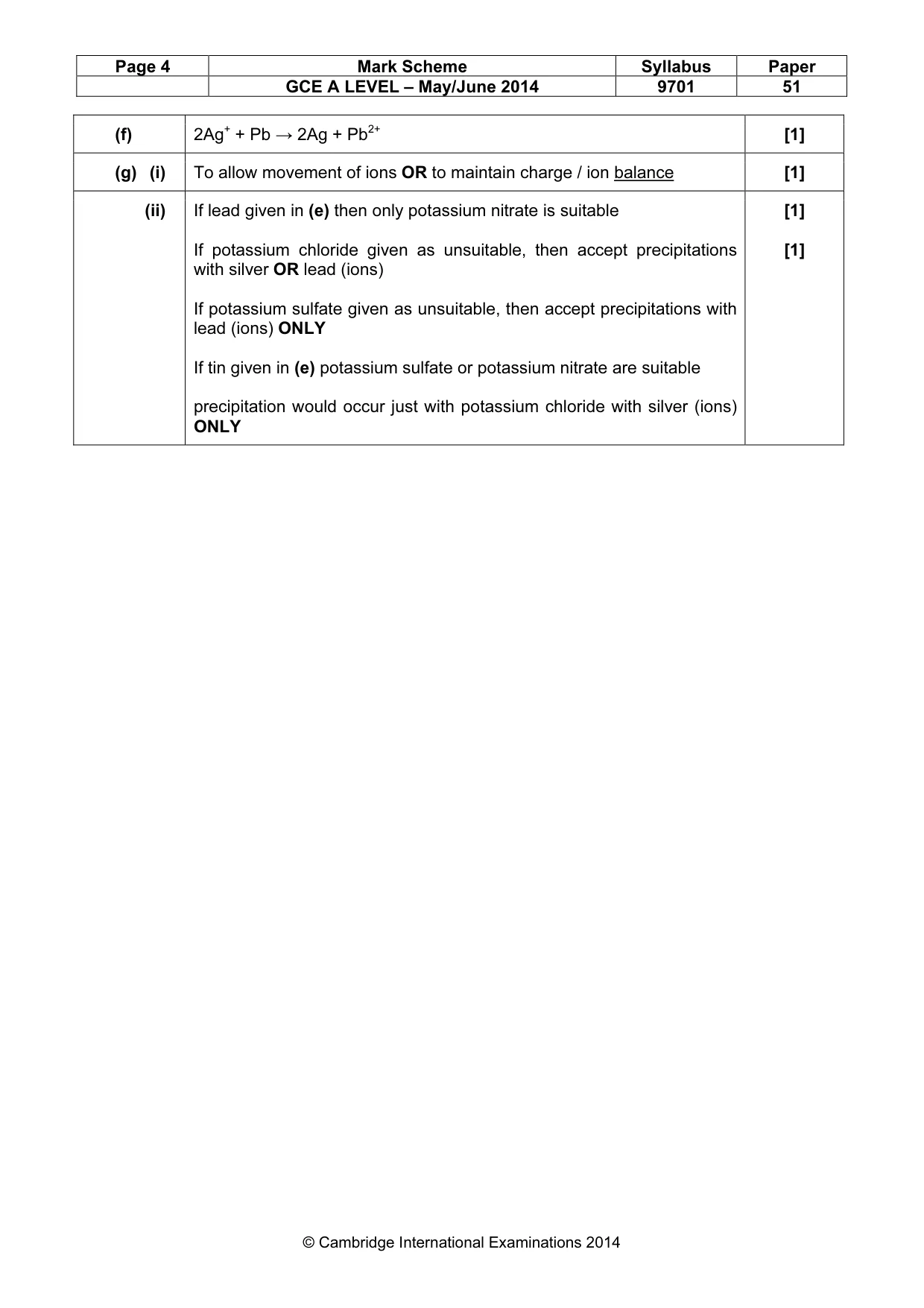
Page 4 Mark Scheme Syllabus Paper GCE A LEVEL – May/June 2014 9701 51 © Cambridge International Examinations 2014 (f) 2Ag+ + Pb → 2Ag + Pb2+ [1] (g) (i) To allow movement of ions OR to maintain charge / ion balance [1] (ii) If lead given in (e) then only potassium nitrate is suitable If potassium chloride given as unsuitable, then accept precipitations with silver OR lead (ions) If potassium sulfate given as unsuitable, then accept precipitations with lead (ions) ONLY If tin given in (e) potassium sulfate or potassium nitrate are suitable precipitation would occur just with potassium chloride with silver (ions) ONLY [1] [1]
What you needed in this session
Cambridge’s own grade thresholds for 2014 May/June, Paper 5 · Variant 1. A higher threshold means an easier paper — the bar moves with how the cohort did.