Cambridge A Level Chemistry 9701 — 2013 Oct/Nov Paper 2 · Variant 2
9701/22/O/N/13 · 60 marks · ≈68 min
The question paper and its mark scheme, free to read here and free to download. This is Cambridge’s own paper, exactly as it was sat.
Question paper12 pages
Mark scheme7 pages
Answers below. Sit the paper first if you are practising.
Paper as text
Question paper, page 1
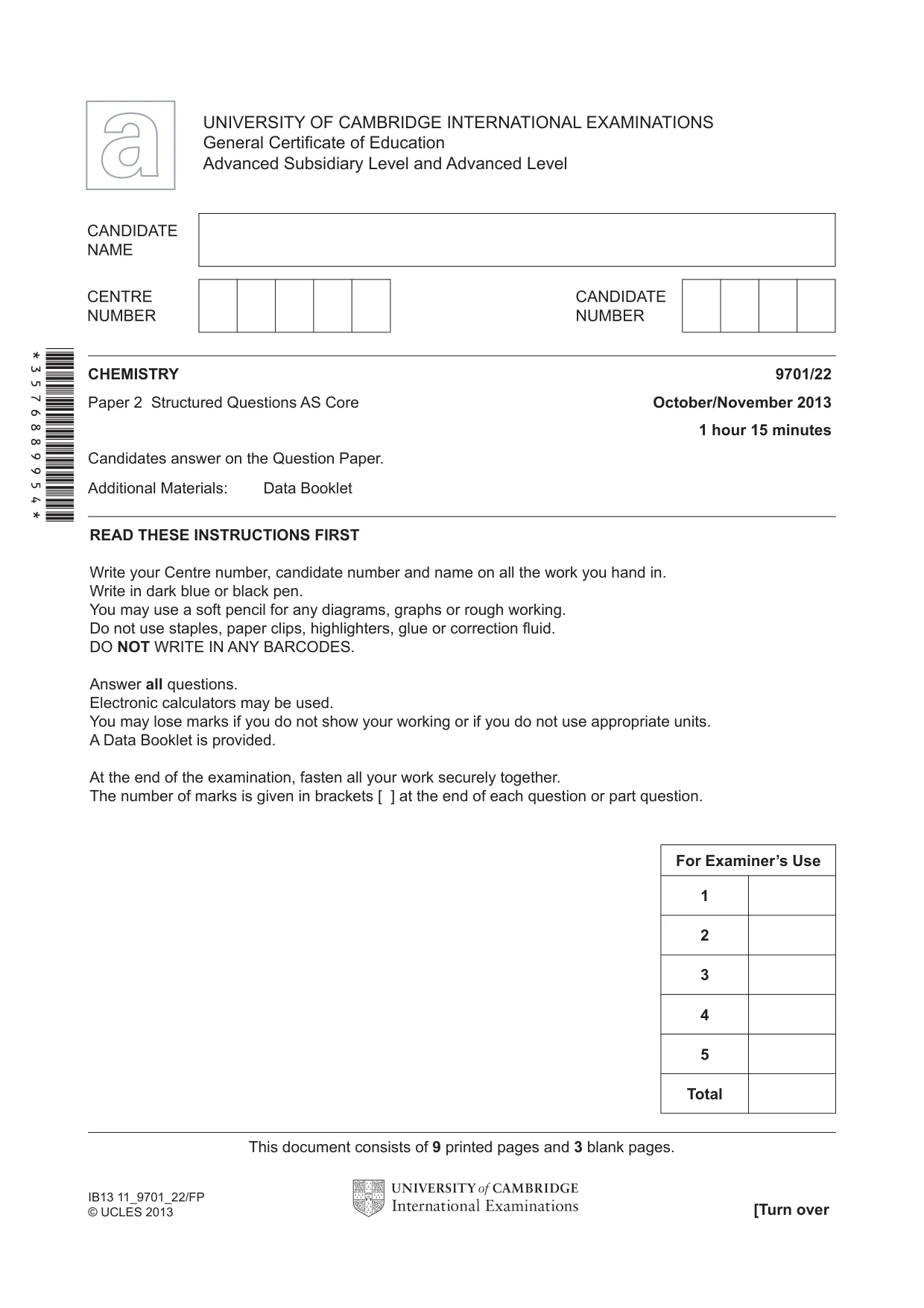
READ THESE INSTRUCTIONS FIRST Write your Centre number, candidate number and name on all the work you hand in. Write in dark blue or black pen. You may use a soft pencil for any diagrams, graphs or rough working. Do not use staples, paper clips, highlighters, glue or correction fl uid. DO NOT WRITE IN ANY BARCODES. Answer all questions. Electronic calculators may be used. You may lose marks if you do not show your working or if you do not use appropriate units. A Data Booklet is provided. At the end of the examination, fasten all your work securely together. The number of marks is given in brackets [ ] at the end of each question or part question. CHEMISTRY 9701/22 Paper 2 Structured Questions AS Core October/November 2013 1 hour 15 minutes Candidates answer on the Question Paper. Additional Materials: Data Booklet UNIVERSITY OF CAMBRIDGE INTERNATIONAL EXAMINATIONS General Certifi cate of Education Advanced Subsidiary Level and Advanced Level This document consists of 9 printed pages and 3 blank pages. [Turn over IB13 11_9701_22/FP © UCLES 2013 *3576889954* For Examiner’s Use 1 2 3 4 5 Total
Question paper, page 2
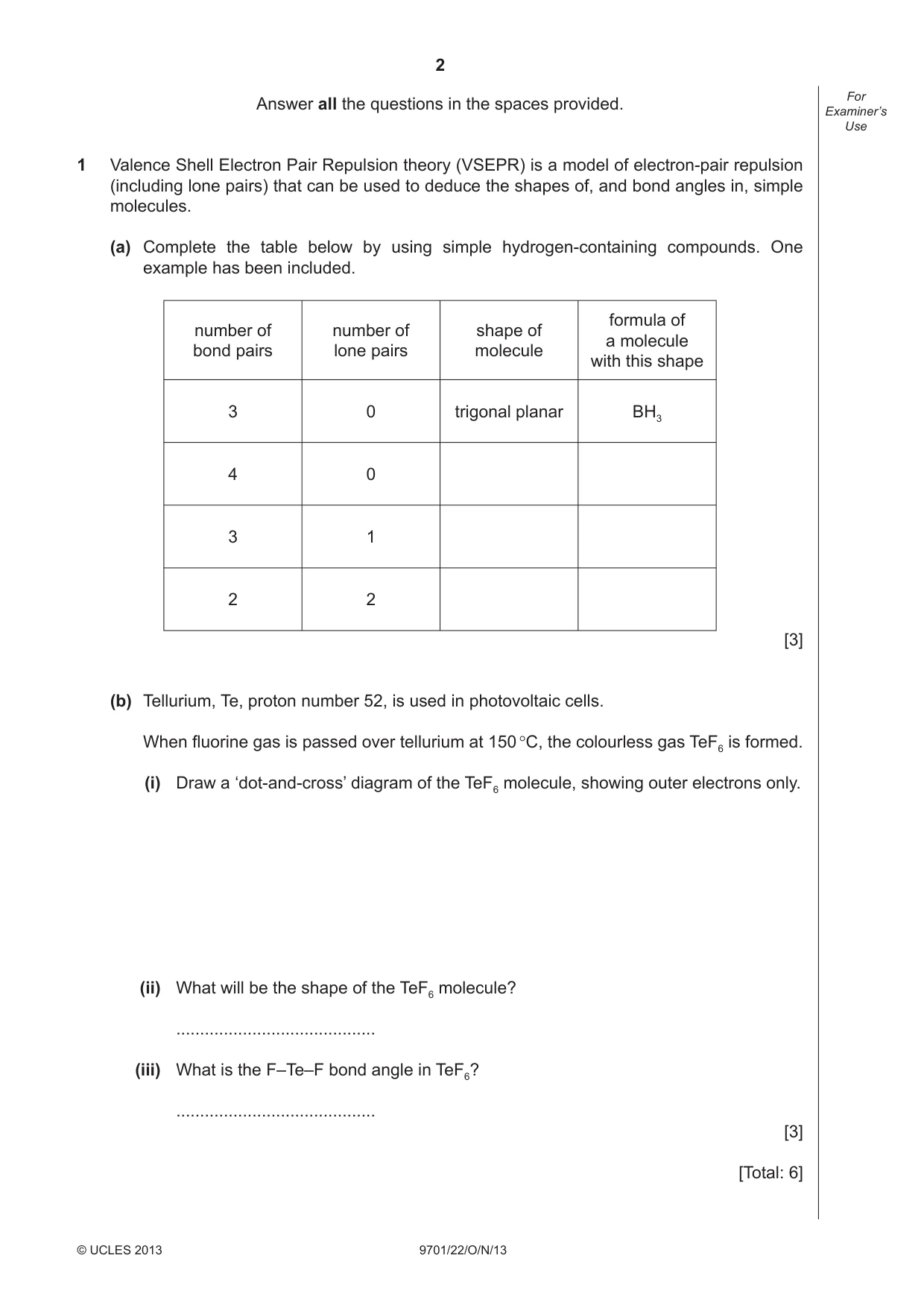
2 9701/22/O/N/13 © UCLES 2013 For Examiner’s Use Answer all the questions in the spaces provided. 1 Valence Shell Electron Pair Repulsion theory (VSEPR) is a model of electron-pair repulsion (including lone pairs) that can be used to deduce the shapes of, and bond angles in, simple molecules. (a) Complete the table below by using simple hydrogen-containing compounds. One example has been included. number of bond pairs number of lone pairs shape of molecule formula of a molecule with this shape 3 0 trigonal planar BH3 4 0 3 1 2 2 [3] (b) Tellurium, Te, proton number 52, is used in photovoltaic cells. When fl uorine gas is passed over tellurium at 150 °C, the colourless gas TeF6 is formed. (i) Draw a ‘dot-and-cross’ diagram of the TeF6 molecule, showing outer electrons only. (ii) What will be the shape of the TeF6 molecule? … (iii) What is the F–Te–F bond angle in TeF6? … [3] [Total: 6]
Question paper, page 3
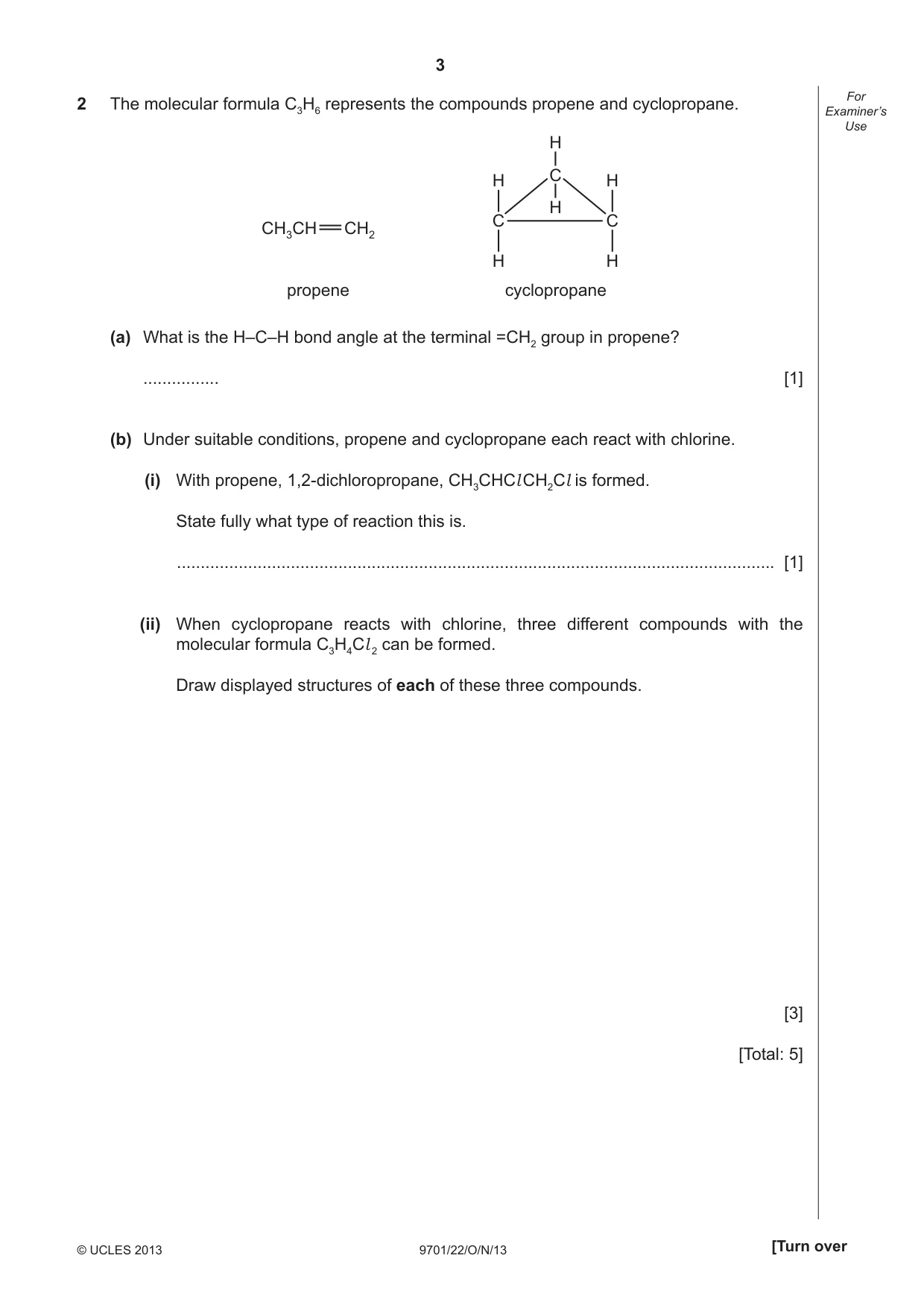
3 9701/22/O/N/13 © UCLES 2013 [Turn over For Examiner’s Use 2 The molecular formula C3H6 represents the compounds propene and cyclopropane. CH3CH CH2 propene cyclopropane C H H C H H C H H (a) What is the H–C–H bond angle at the terminal =CH2 group in propene? … [1] (b) Under suitable conditions, propene and cyclopropane each react with chlorine. (i) With propene, 1,2-dichloropropane, CH3CHCl CH2Cl is formed. State fully what type of reaction this is. … [1] (ii) When cyclopropane reacts with chlorine, three different compounds with the molecular formula C3H4Cl 2 can be formed. Draw displayed structures of each of these three compounds. [3] [Total: 5]
Question paper, page 4
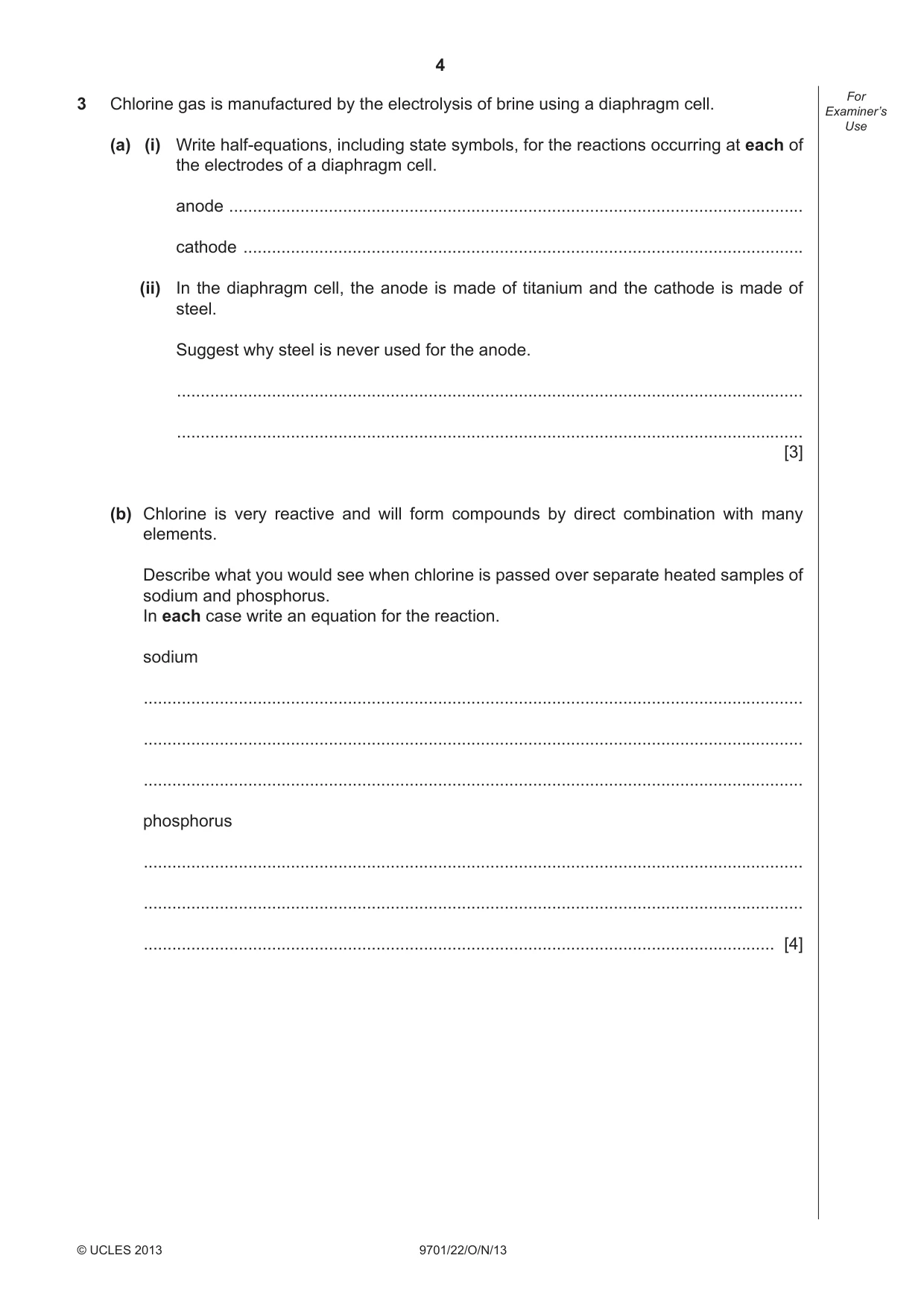
4 9701/22/O/N/13 © UCLES 2013 For Examiner’s Use 3 Chlorine gas is manufactured by the electrolysis of brine using a diaphragm cell. (a) (i) Write half-equations, including state symbols, for the reactions occurring at each of the electrodes of a diaphragm cell. anode … cathode … (ii) In the diaphragm cell, the anode is made of titanium and the cathode is made of steel. Suggest why steel is never used for the anode. … … [3] (b) Chlorine is very reactive and will form compounds by direct combination with many elements. Describe what you would see when chlorine is passed over separate heated samples of sodium and phosphorus. In each case write an equation for the reaction. sodium … … … phosphorus … … … [4]
Question paper, page 5
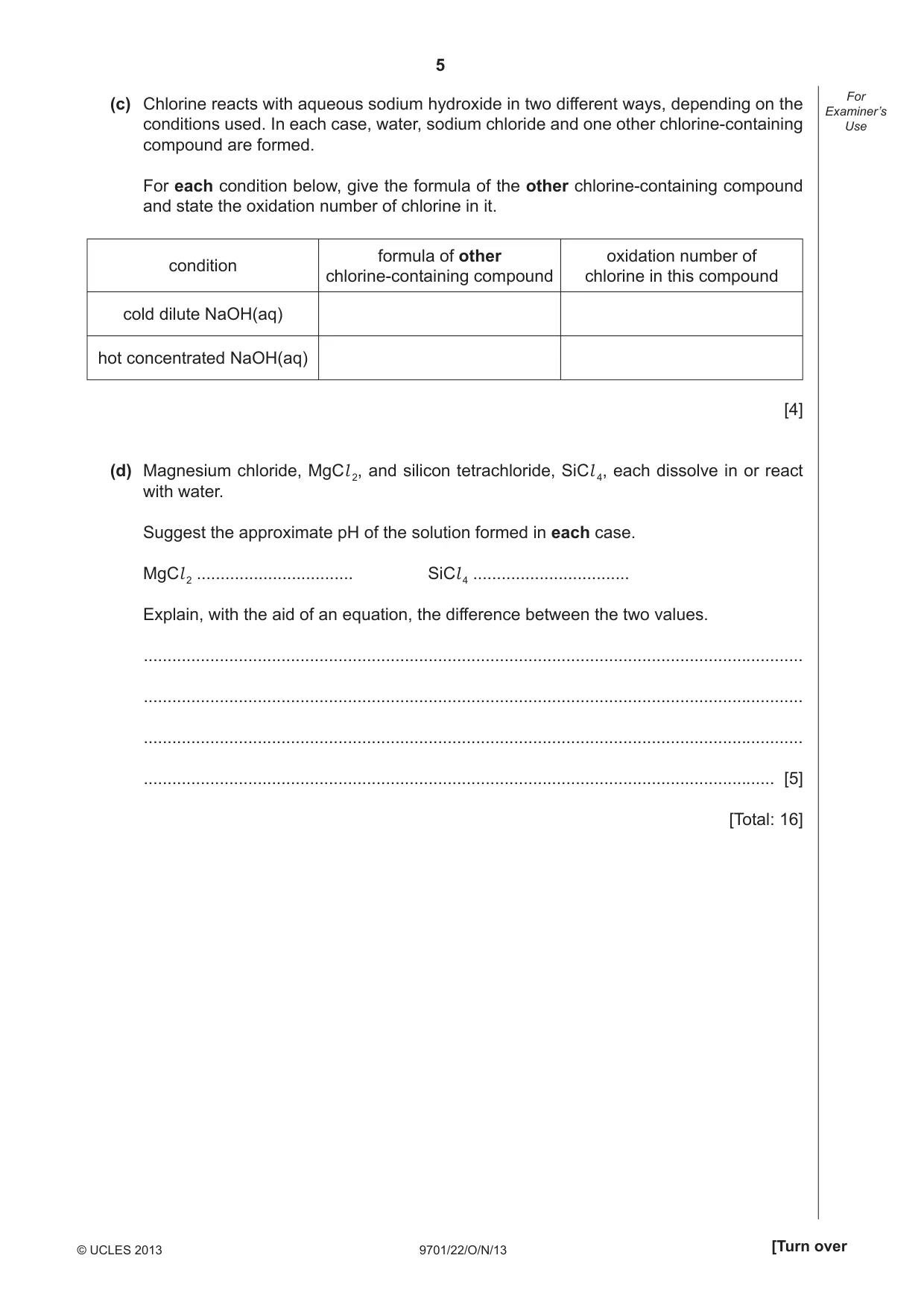
5 9701/22/O/N/13 © UCLES 2013 [Turn over For Examiner’s Use (c) Chlorine reacts with aqueous sodium hydroxide in two different ways, depending on the conditions used. In each case, water, sodium chloride and one other chlorine-containing compound are formed. For each condition below, give the formula of the other chlorine-containing compound and state the oxidation number of chlorine in it. condition formula of other chlorine-containing compound oxidation number of chlorine in this compound cold dilute NaOH(aq) hot concentrated NaOH(aq) [4] (d) Magnesium chloride, MgCl 2, and silicon tetrachloride, SiCl 4, each dissolve in or react with water. Suggest the approximate pH of the solution formed in each case. MgCl 2 … SiCl 4 … Explain, with the aid of an equation, the difference between the two values. … … … … [5] [Total: 16]
Question paper, page 6
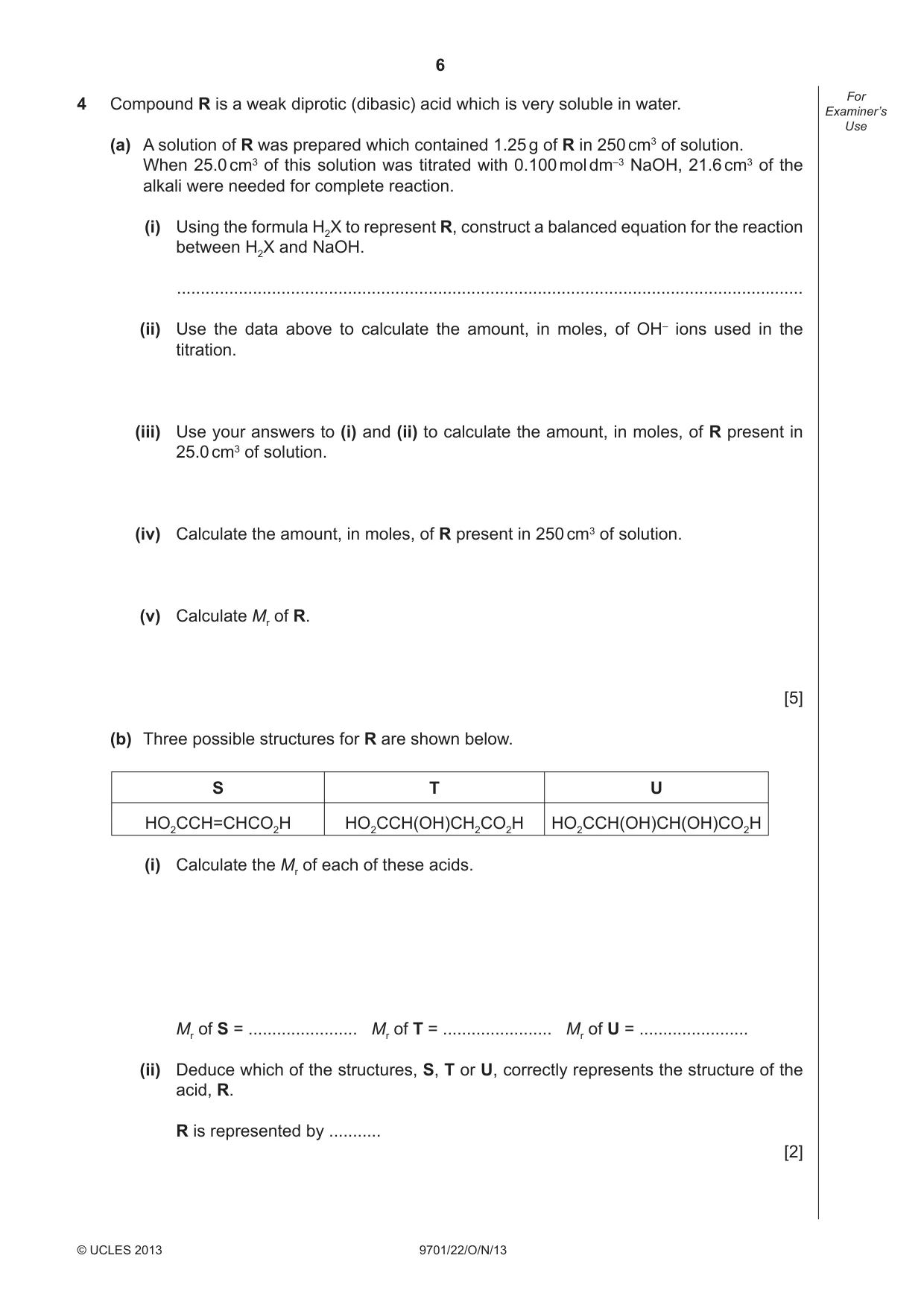
6 9701/22/O/N/13 © UCLES 2013 For Examiner’s Use 4 Compound R is a weak diprotic (dibasic) acid which is very soluble in water. (a) A solution of R was prepared which contained 1.25 g of R in 250 cm3 of solution. When 25.0 cm3 of this solution was titrated with 0.100 mol dm–3 NaOH, 21.6 cm3 of the alkali were needed for complete reaction. (i) Using the formula H2X to represent R, construct a balanced equation for the reaction between H2X and NaOH. … (ii) Use the data above to calculate the amount, in moles, of OH– ions used in the titration. (iii) Use your answers to (i) and (ii) to calculate the amount, in moles, of R present in 25.0 cm3 of solution. (iv) Calculate the amount, in moles, of R present in 250 cm3 of solution. (v) Calculate Mr of R. [5] (b) Three possible structures for R are shown below. S T U HO2CCH=CHCO2H HO2CCH(OH)CH2CO2H HO2CCH(OH)CH(OH)CO2H (i) Calculate the Mr of each of these acids. Mr of S = … Mr of T = … Mr of U = … (ii) Deduce which of the structures, S, T or U, correctly represents the structure of the acid, R. R is represented by … [2]
Question paper, page 7
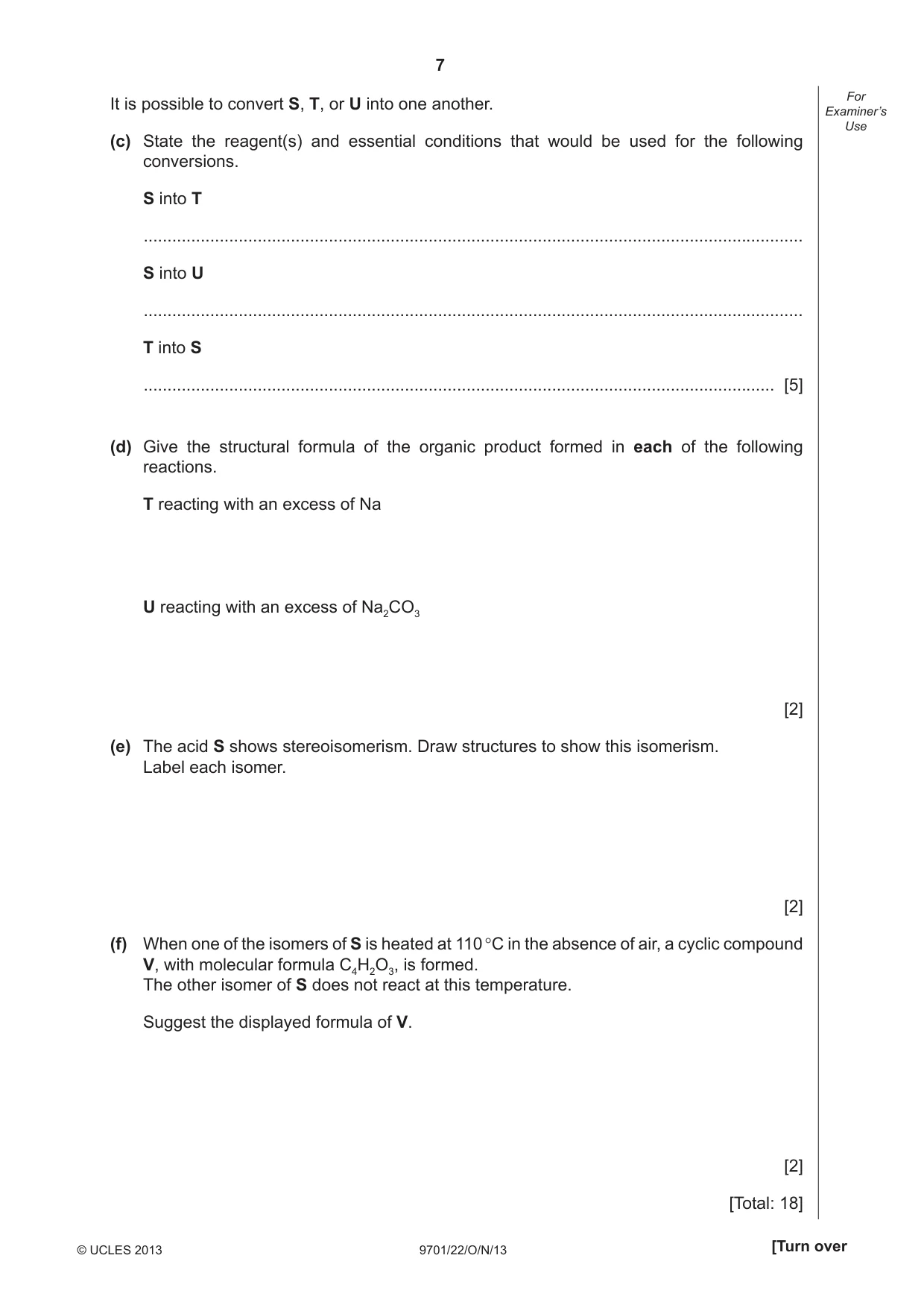
7 9701/22/O/N/13 © UCLES 2013 [Turn over For Examiner’s Use It is possible to convert S, T, or U into one another. (c) State the reagent(s) and essential conditions that would be used for the following conversions. S into T … S into U … T into S … [5] (d) Give the structural formula of the organic product formed in each of the following reactions. T reacting with an excess of Na U reacting with an excess of Na2CO3 [2] (e) The acid S shows stereoisomerism. Draw structures to show this isomerism. Label each isomer. [2] (f) When one of the isomers of S is heated at 110 °C in the absence of air, a cyclic compound V, with molecular formula C4H2O3, is formed. The other isomer of S does not react at this temperature. Suggest the displayed formula of V. [2] [Total: 18]
Question paper, page 8
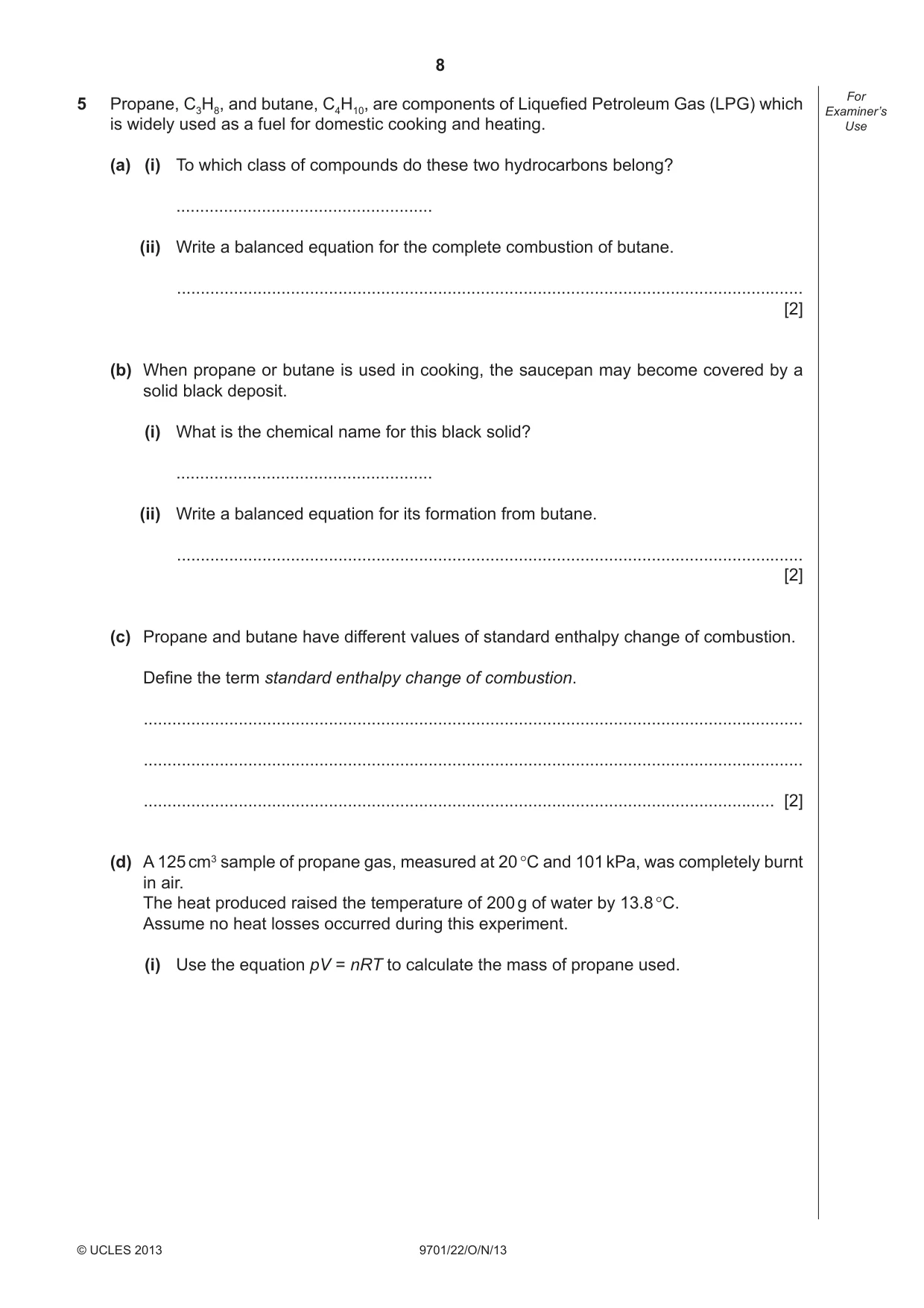
8 9701/22/O/N/13 © UCLES 2013 For Examiner’s Use 5 Propane, C3H8, and butane, C4H10, are components of Liquefi ed Petroleum Gas (LPG) which is widely used as a fuel for domestic cooking and heating. (a) (i) To which class of compounds do these two hydrocarbons belong? … (ii) Write a balanced equation for the complete combustion of butane. … [2] (b) When propane or butane is used in cooking, the saucepan may become covered by a solid black deposit. (i) What is the chemical name for this black solid? … (ii) Write a balanced equation for its formation from butane. … [2] (c) Propane and butane have different values of standard enthalpy change of combustion. Defi ne the term standard enthalpy change of combustion. … … … [2] (d) A 125 cm3 sample of propane gas, measured at 20 °C and 101 kPa, was completely burnt in air. The heat produced raised the temperature of 200 g of water by 13.8 °C. Assume no heat losses occurred during this experiment. (i) Use the equation pV = nRT to calculate the mass of propane used.
Question paper, page 9
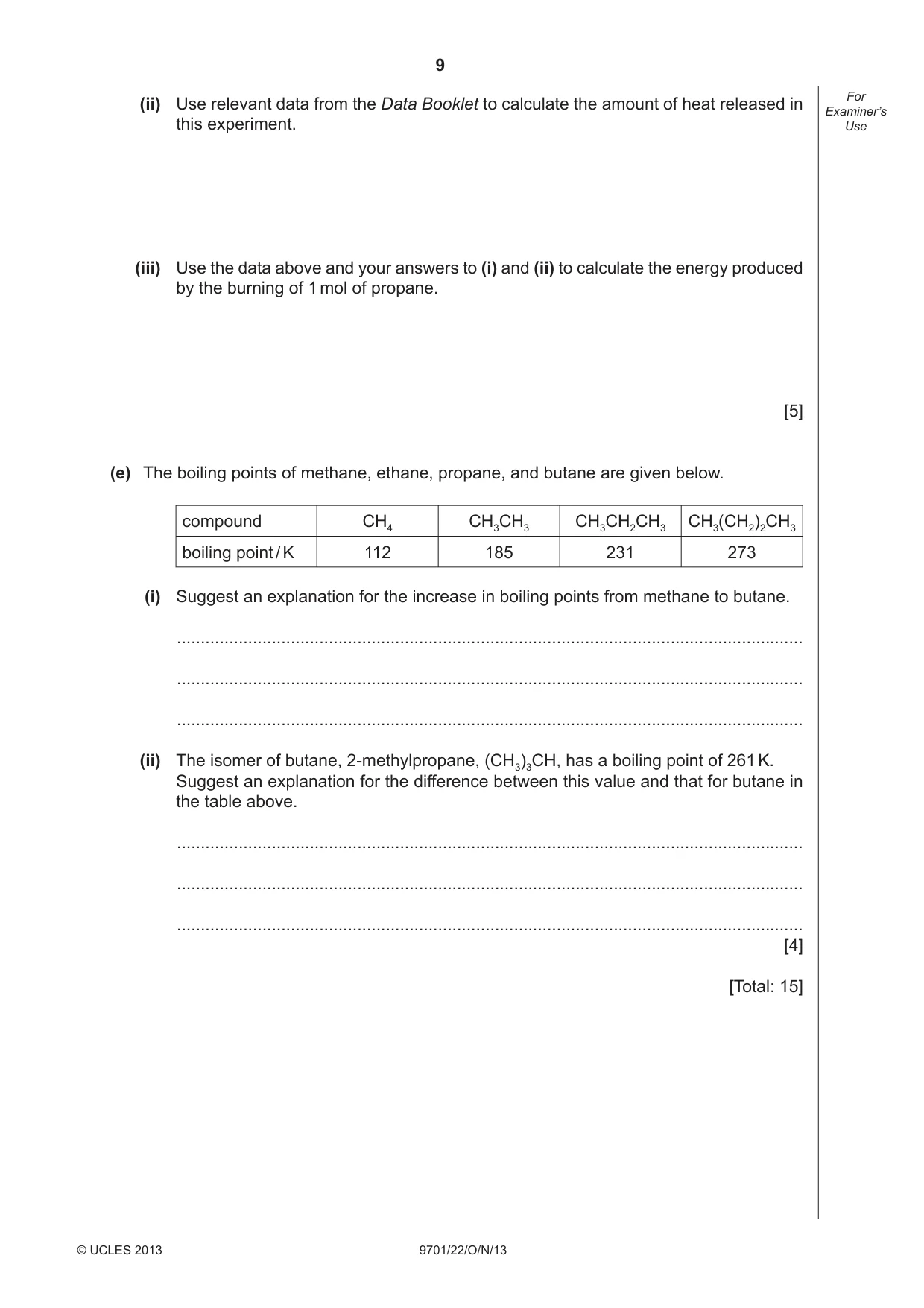
9 9701/22/O/N/13 © UCLES 2013 [Turn over For Examiner’s Use (ii) Use relevant data from the Data Booklet to calculate the amount of heat released in this experiment. (iii) Use the data above and your answers to (i) and (ii) to calculate the energy produced by the burning of 1 mol of propane. [5] (e) The boiling points of methane, ethane, propane, and butane are given below. compound CH4 CH3CH3 CH3CH2CH3 CH3(CH2)2CH3 boiling point / K 112 185 231 273 (i) Suggest an explanation for the increase in boiling points from methane to butane. … … … (ii) The isomer of butane, 2-methylpropane, (CH3)3CH, has a boiling point of 261 K. Suggest an explanation for the difference between this value and that for butane in the table above. … … … [4] [Total: 15]
Question paper, page 10
10 9701/22/O/N/13 BLANK PAGE © UCLES 2013
Question paper, page 11
11 9701/22/O/N/13 BLANK PAGE © UCLES 2013
Question paper, page 12
12 Permission to reproduce items where third-party owned material protected by copyright is included has been sought and cleared where possible. Every reasonable effort has been made by the publisher (UCLES) to trace copyright holders, but if any items requiring clearance have unwittingly been included the publisher will be pleased to make amends at the earliest possible opportunity. University of Cambridge International Examinations is part of the Cambridge Assessment Group. Cambridge Assessment is the brand name of University of Cambridge Local Examinations Syndicate (UCLES), which is itself a department of the University of Cambridge. 9701/22/O/N/13 © UCLES 2013 BLANK PAGE
Mark scheme, page 1
CAMBRIDGE INTERNATIONAL EXAMINATIONS GCE Advanced Subsidiary Level and GCE Advanced Level MARK SCHEME for the October/November 2013 series 9701 CHEMISTRY 9701/22 Paper 2 (AS Structured Questions), maximum raw mark 60 This mark scheme is published as an aid to teachers and candidates, to indicate the requirements of the examination. It shows the basis on which Examiners were instructed to award marks. It does not indicate the details of the discussions that took place at an Examiners’ meeting before marking began, which would have considered the acceptability of alternative answers. Mark schemes should be read in conjunction with the question paper and the Principal Examiner Report for Teachers. Cambridge will not enter into discussions about these mark schemes. Cambridge is publishing the mark schemes for the October/November 2013 series for most IGCSE, GCE Advanced Level and Advanced Subsidiary Level components and some Ordinary Level components.
Mark scheme, page 2
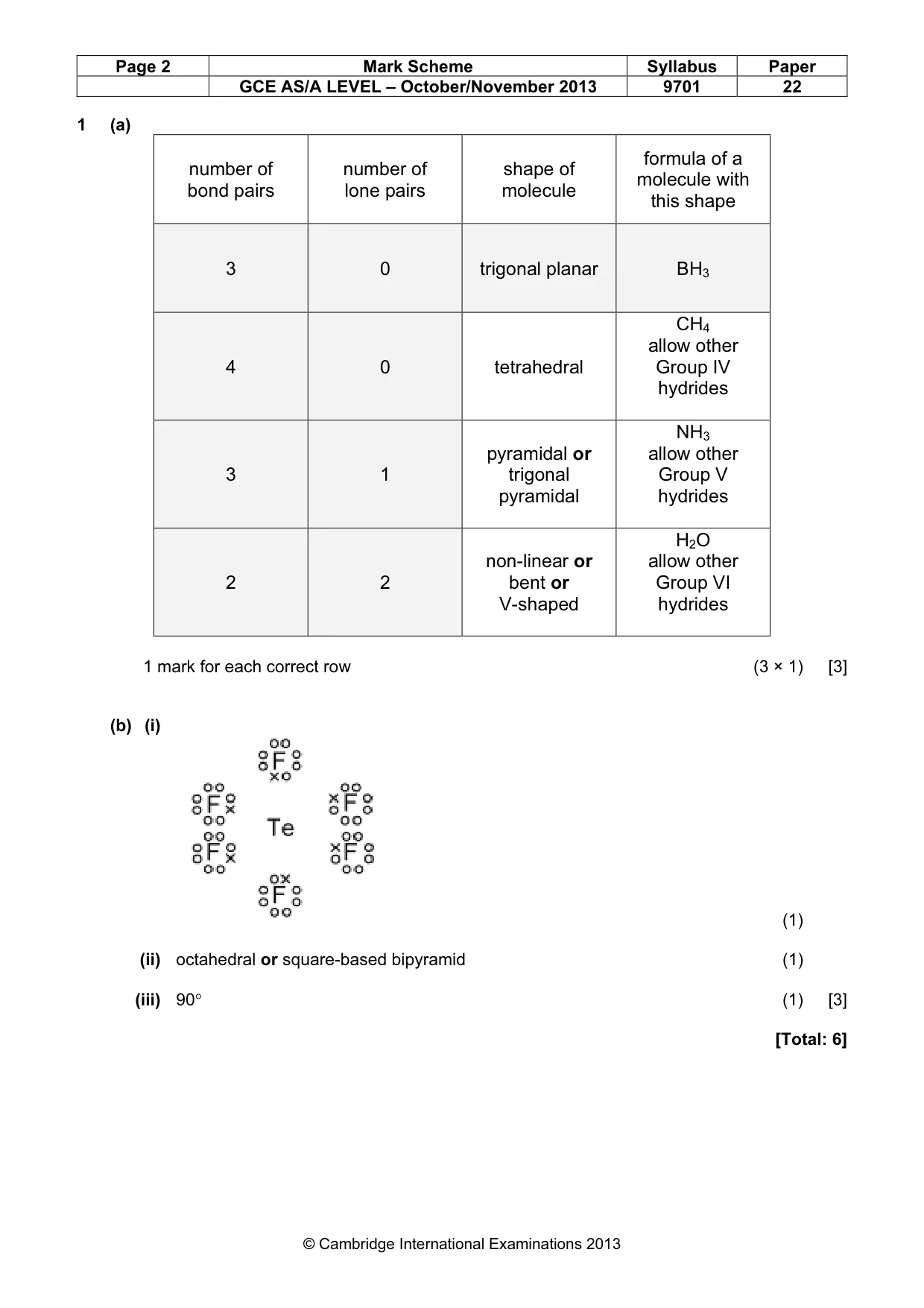
Page 2 Mark Scheme Syllabus Paper GCE AS/A LEVEL – October/November 2013 9701 22 © Cambridge International Examinations 2013 1 (a) number of bond pairs number of lone pairs shape of molecule formula of a molecule with this shape 3 0 trigonal planar BH3 4 0 tetrahedral CH4 allow other Group IV hydrides 3 1 pyramidal or trigonal pyramidal NH3 allow other Group V hydrides 2 2 non-linear or bent or V-shaped H2O allow other Group VI hydrides 1 mark for each correct row (3 × 1) [3] (b) (i) (1) (ii) octahedral or square-based bipyramid (1) (iii) 90° (1) [3] [Total: 6]
Mark scheme, page 3
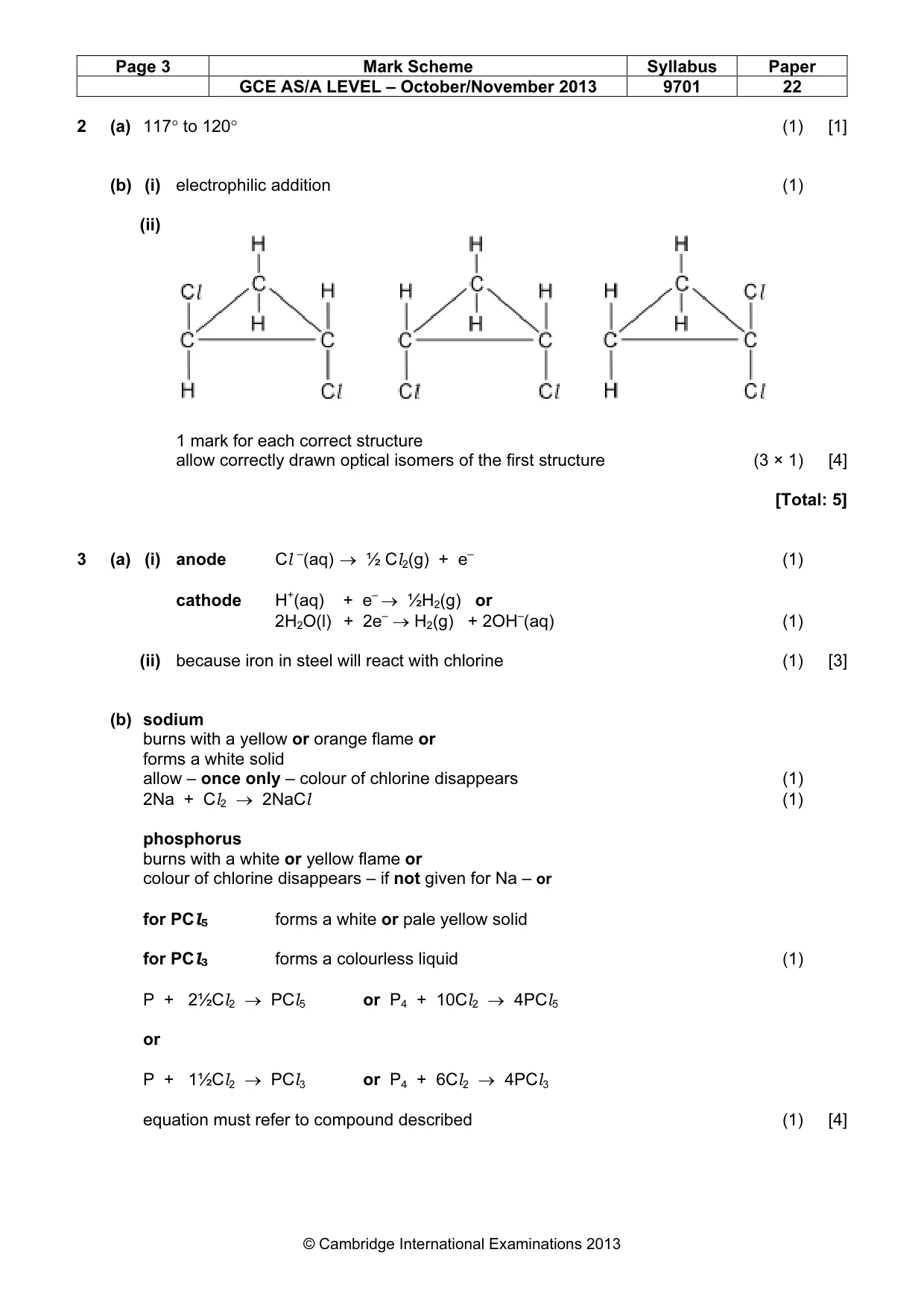
Page 3 Mark Scheme Syllabus Paper GCE AS/A LEVEL – October/November 2013 9701 22 © Cambridge International Examinations 2013 2 (a) 117° to 120° (1) [1] (b) (i) electrophilic addition (1) (ii) 1 mark for each correct structure allow correctly drawn optical isomers of the first structure (3 × 1) [4] [Total: 5] 3 (a) (i) anode Cl –(aq) → ½ Cl2(g) + e– (1) cathode H+(aq) + e– → ½H2(g) or 2H2O(l) + 2e– → H2(g) + 2OH–(aq) (1) (ii) because iron in steel will react with chlorine (1) [3] (b) sodium burns with a yellow or orange flame or forms a white solid allow – once only – colour of chlorine disappears (1) 2Na + Cl2 → 2NaCl (1) phosphorus burns with a white or yellow flame or colour of chlorine disappears – if not given for Na – or for PCl5 forms a white or pale yellow solid for PCl3 forms a colourless liquid (1) P + 2½Cl2 → PCl5 or P4 + 10Cl2 → 4PCl5 or P + 1½Cl2 → PCl3 or P4 + 6Cl2 → 4PCl3 equation must refer to compound described (1) [4]
Mark scheme, page 4
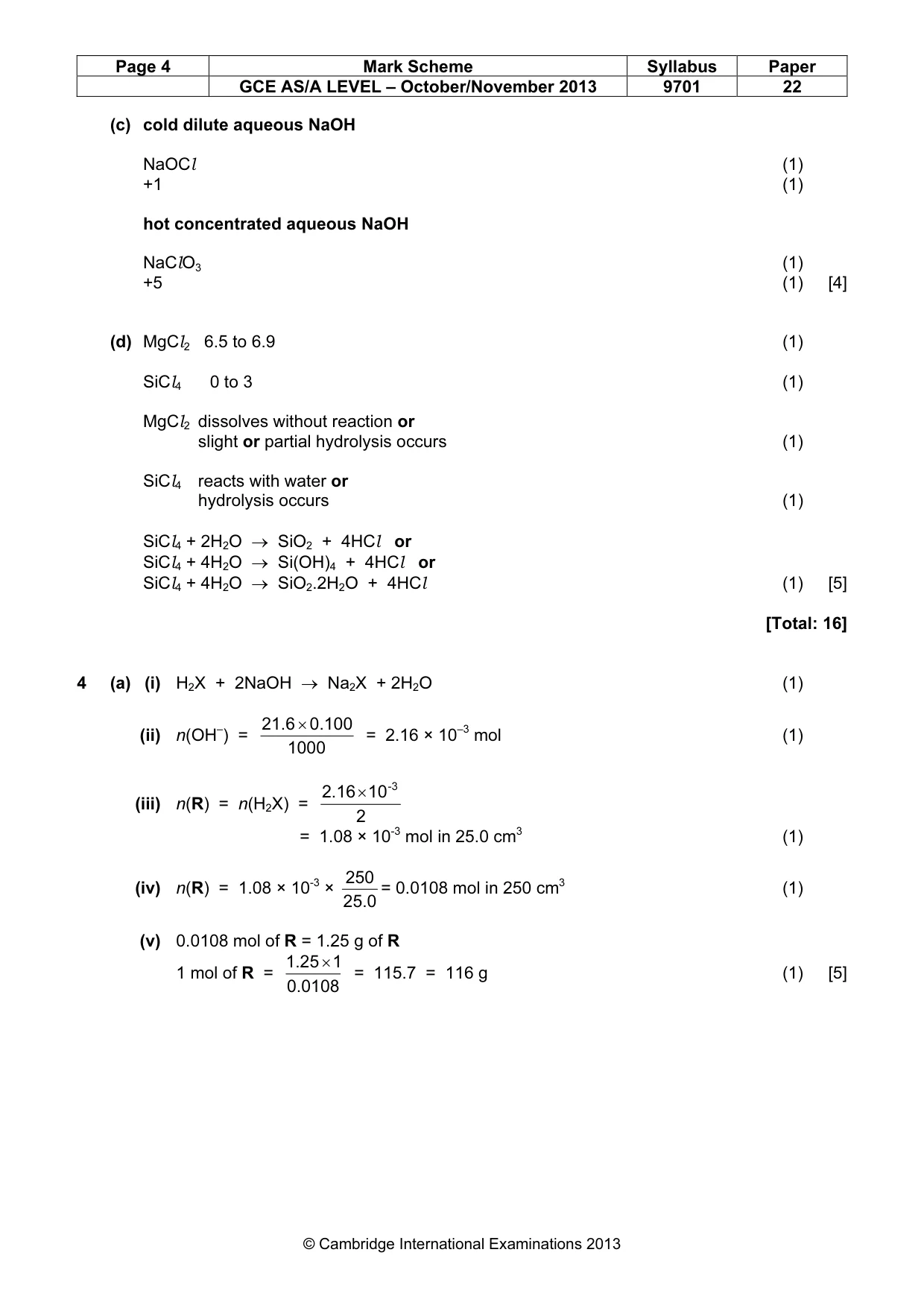
Page 4 Mark Scheme Syllabus Paper GCE AS/A LEVEL – October/November 2013 9701 22 © Cambridge International Examinations 2013 (c) cold dilute aqueous NaOH NaOCl (1) +1 (1) hot concentrated aqueous NaOH NaClO3 (1) +5 (1) [4] (d) MgCl2 6.5 to 6.9 (1) SiCl4 0 to 3 (1) MgCl2 dissolves without reaction or slight or partial hydrolysis occurs (1) SiCl4 reacts with water or hydrolysis occurs (1) SiCl4 + 2H2O → SiO2 + 4HCl or SiCl4 + 4H2O → Si(OH)4 + 4HCl or SiCl4 + 4H2O → SiO2.2H2O + 4HCl (1) [5] [Total: 16] 4 (a) (i) H2X + 2NaOH → Na2X + 2H2O (1) (ii) n(OH–) = 1000 0.100 21.6× = 2.16 × 10⁻³ mol (1) (iii) n(R) = n(H2X) = 2 10 2.16 -3 × = 1.08 × 10⁻³ mol in 25.0 cm3 (1) (iv) n(R) = 1.08 × 10-3 × 25.0 250 = 0.0108 mol in 250 cm3 (1) (v) 0.0108 mol of R = 1.25 g of R 1 mol of R = 0.0108 1 1.25× = 115.7 = 116 g (1) [5]
Mark scheme, page 5
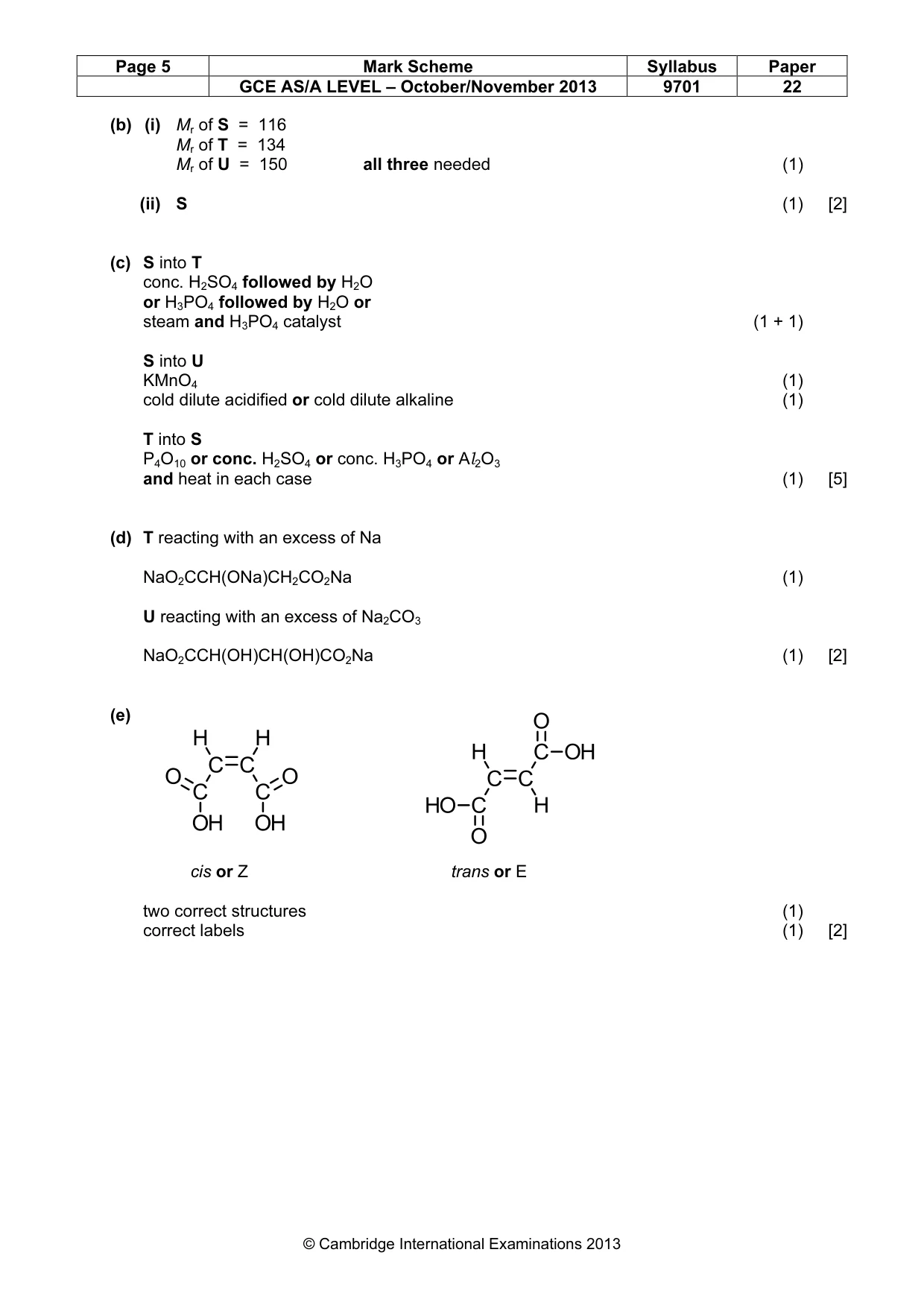
Page 5 Mark Scheme Syllabus Paper GCE AS/A LEVEL – October/November 2013 9701 22 © Cambridge International Examinations 2013 (b) (i) Mr of S = 116 Mr of T = 134 Mr of U = 150 all three needed (1) (ii) S (1) [2] (c) S into T conc. H2SO4 followed by H2O or H3PO4 followed by H2O or steam and H3PO4 catalyst (1 + 1) S into U KMnO4 (1) cold dilute acidified or cold dilute alkaline (1) T into S P4O10 or conc. H2SO4 or conc. H3PO4 or Al2O3 and heat in each case (1) [5] (d) T reacting with an excess of Na NaO2CCH(ONa)CH2CO2Na (1) U reacting with an excess of Na2CO3 NaO2CCH(OH)CH(OH)CO2Na (1) [2] (e) cis or Z trans or E two correct structures (1) correct labels (1) [2]
Mark scheme, page 6
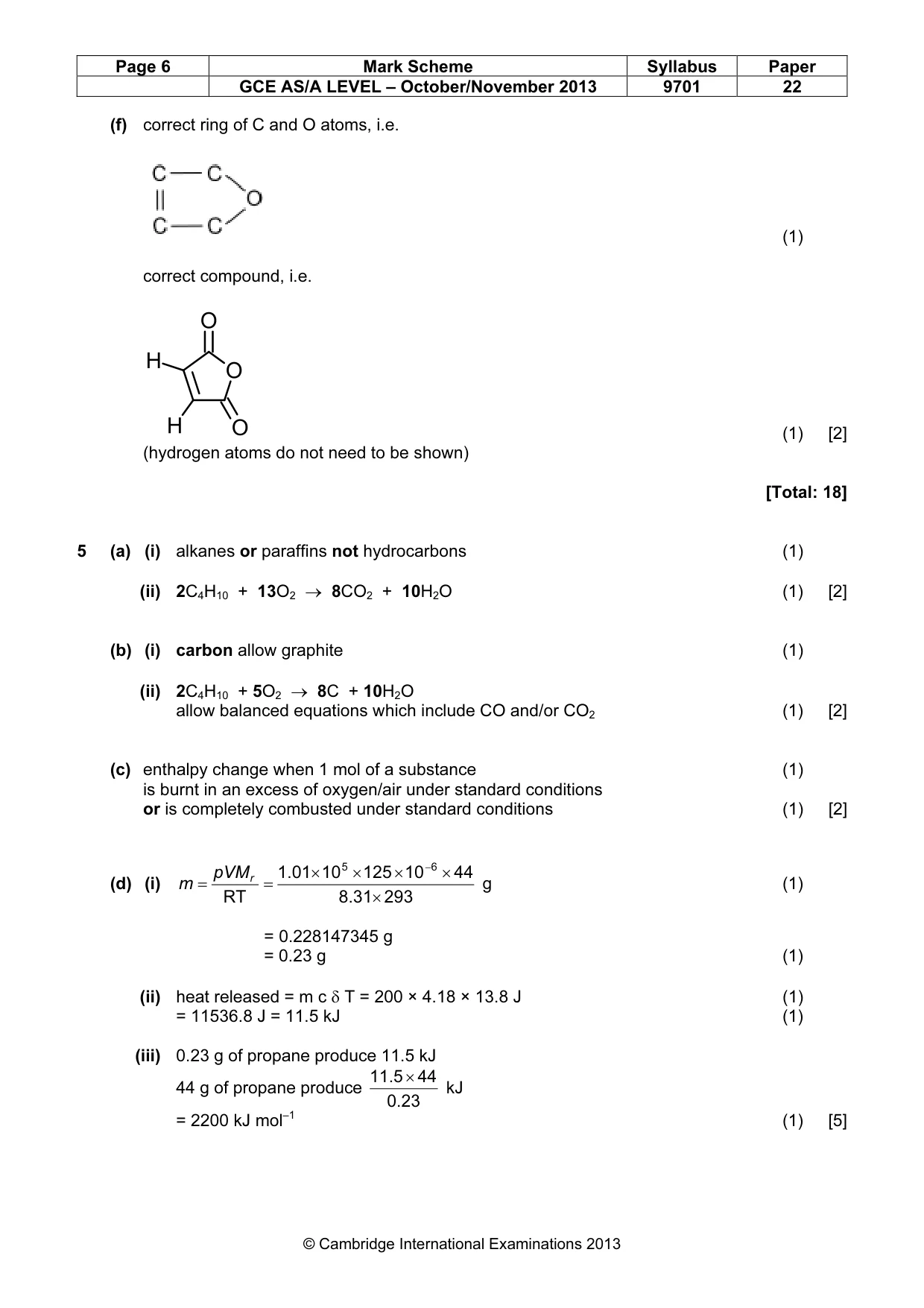
Page 6 Mark Scheme Syllabus Paper GCE AS/A LEVEL – October/November 2013 9701 22 © Cambridge International Examinations 2013 (f) correct ring of C and O atoms, i.e. (1) correct compound, i.e. (1) [2] (hydrogen atoms do not need to be shown) [Total: 18] 5 (a) (i) alkanes or paraffins not hydrocarbons (1) (ii) 2C4H10 + 13O2 → 8CO2 + 10H2O (1) [2] (b) (i) carbon allow graphite (1) (ii) 2C4H10 + 5O2 → 8C + 10H2O allow balanced equations which include CO and/or CO2 (1) [2] (c) enthalpy change when 1 mol of a substance (1) is burnt in an excess of oxygen/air under standard conditions or is completely combusted under standard conditions (1) [2] (d) (i) 293 8.31 44 10 125 10 1.01 RT 6 5 × × × × × = = − r pVM m g (1) = 0.228147345 g = 0.23 g (1) (ii) heat released = m c δ T = 200 × 4.18 × 13.8 J (1) = 11536.8 J = 11.5 kJ (1) (iii) 0.23 g of propane produce 11.5 kJ 44 g of propane produce 0.23 44 11.5× kJ = 2200 kJ mol–1 (1) [5]
Mark scheme, page 7
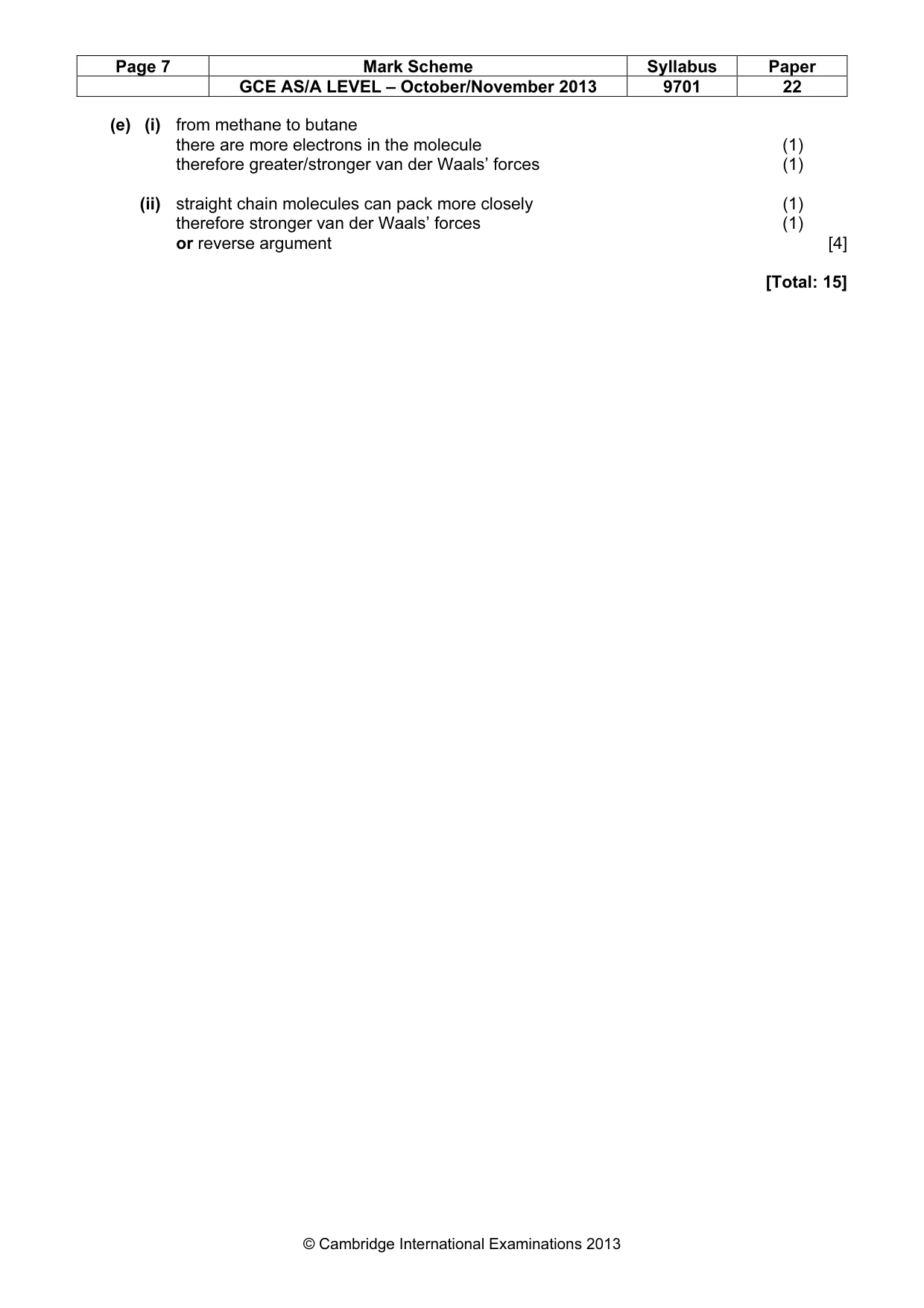
Page 7 Mark Scheme Syllabus Paper GCE AS/A LEVEL – October/November 2013 9701 22 © Cambridge International Examinations 2013 (e) (i) from methane to butane there are more electrons in the molecule (1) therefore greater/stronger van der Waals’ forces (1) (ii) straight chain molecules can pack more closely (1) therefore stronger van der Waals’ forces (1) or reverse argument [4] [Total: 15]
What you needed in this session
Cambridge’s own grade thresholds for 2013 Oct/Nov, Paper 2 · Variant 2. A higher threshold means an easier paper — the bar moves with how the cohort did.