Cambridge A Level Chemistry 9701 — 2013 Oct/Nov Paper 2 · Variant 3
9701/23/O/N/13 · 60 marks · ≈68 min
The question paper and its mark scheme, free to read here and free to download. This is Cambridge’s own paper, exactly as it was sat.
Question paper12 pages
Mark scheme6 pages
Answers below. Sit the paper first if you are practising.
Paper as text
Question paper, page 1
READ THESE INSTRUCTIONS FIRST Write your Centre number, candidate number and name on all the work you hand in. Write in dark blue or black pen. You may use a soft pencil for any diagrams, graphs or rough working. Do not use staples, paper clips, highlighters, glue or correction fl uid. DO NOT WRITE IN ANY BARCODES. Answer all questions. Electronic calculators may be used. You may lose marks if you do not show your working or if you do not use appropriate units. A Data Booklet is provided. At the end of the examination, fasten all your work securely together. The number of marks is given in brackets [ ] at the end of each question or part question. CHEMISTRY 9701/23 Paper 2 Structured Questions AS Core October/November 2013 1 hour 15 minutes Candidates answer on the Question Paper. Additional Materials: Data Booklet UNIVERSITY OF CAMBRIDGE INTERNATIONAL EXAMINATIONS General Certifi cate of Education Advanced Subsidiary Level and Advanced Level This document consists of 11 printed pages and 1 blank page. [Turn over IB13 11_9701_23/3RP © UCLES 2013 *6138594413* For Examiner’s Use 1 2 3 4 5 Total
Question paper, page 2
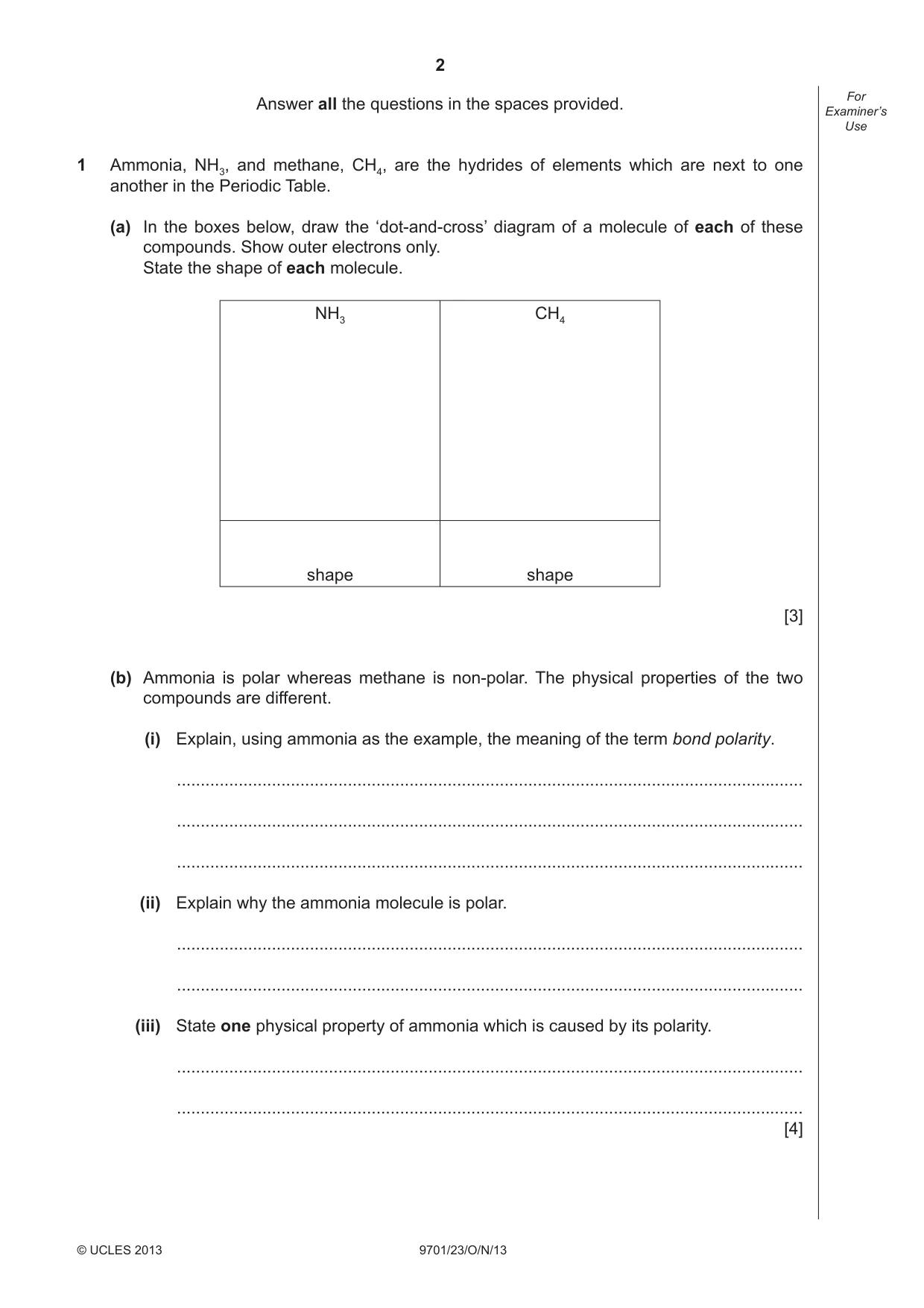
2 9701/23/O/N/13 © UCLES 2013 For Examiner’s Use Answer all the questions in the spaces provided. 1 Ammonia, NH3, and methane, CH4, are the hydrides of elements which are next to one another in the Periodic Table. (a) In the boxes below, draw the ‘dot-and-cross’ diagram of a molecule of each of these compounds. Show outer electrons only. State the shape of each molecule. NH3 CH4 shape shape [3] (b) Ammonia is polar whereas methane is non-polar. The physical properties of the two compounds are different. (i) Explain, using ammonia as the example, the meaning of the term bond polarity. … … … (ii) Explain why the ammonia molecule is polar. … … (iii) State one physical property of ammonia which is caused by its polarity. … … [4]
Question paper, page 3
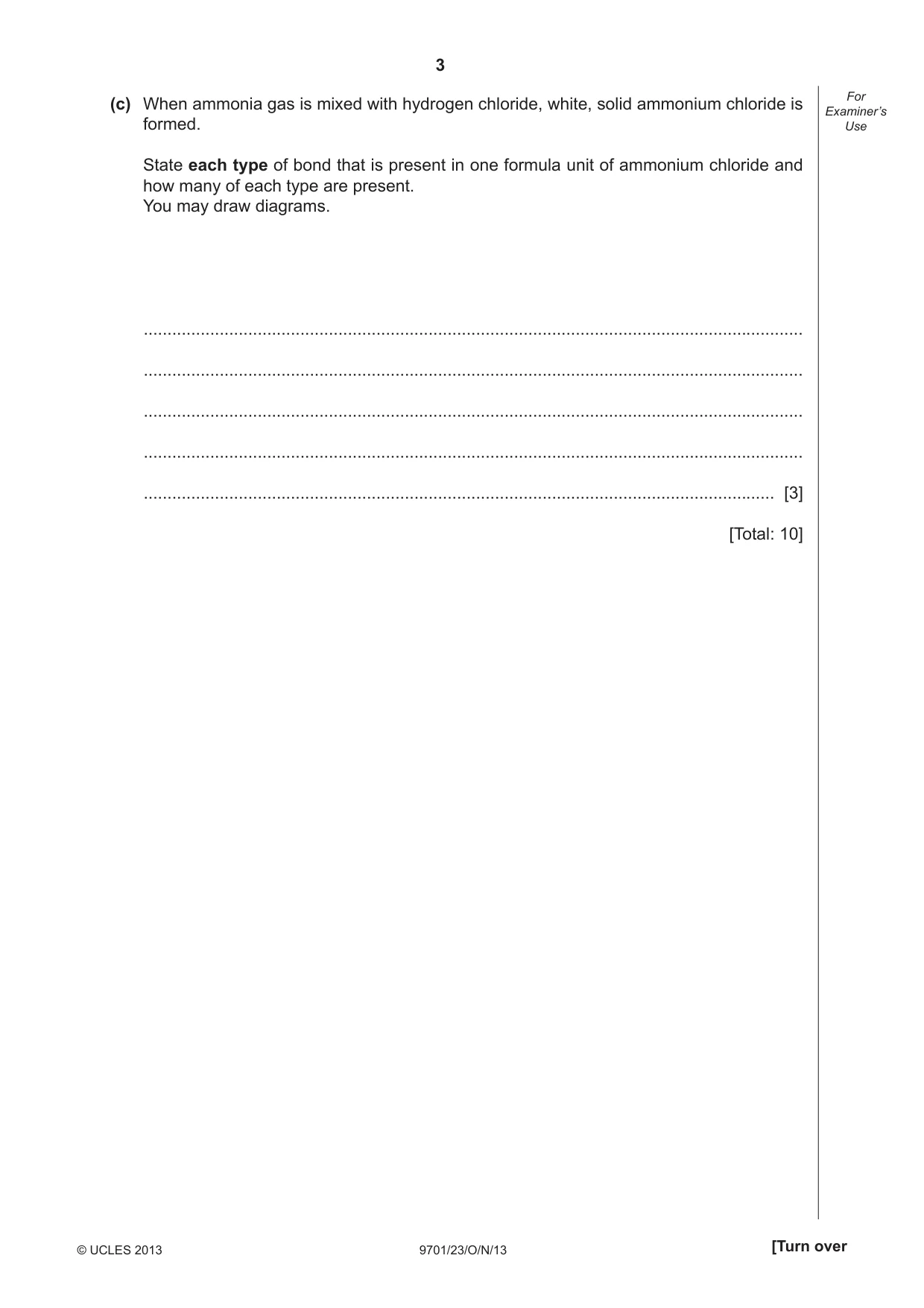
3 9701/23/O/N/13 © UCLES 2013 [Turn over For Examiner’s Use (c) When ammonia gas is mixed with hydrogen chloride, white, solid ammonium chloride is formed. State each type of bond that is present in one formula unit of ammonium chloride and how many of each type are present. You may draw diagrams. … … … … … [3] [Total: 10]
Question paper, page 4
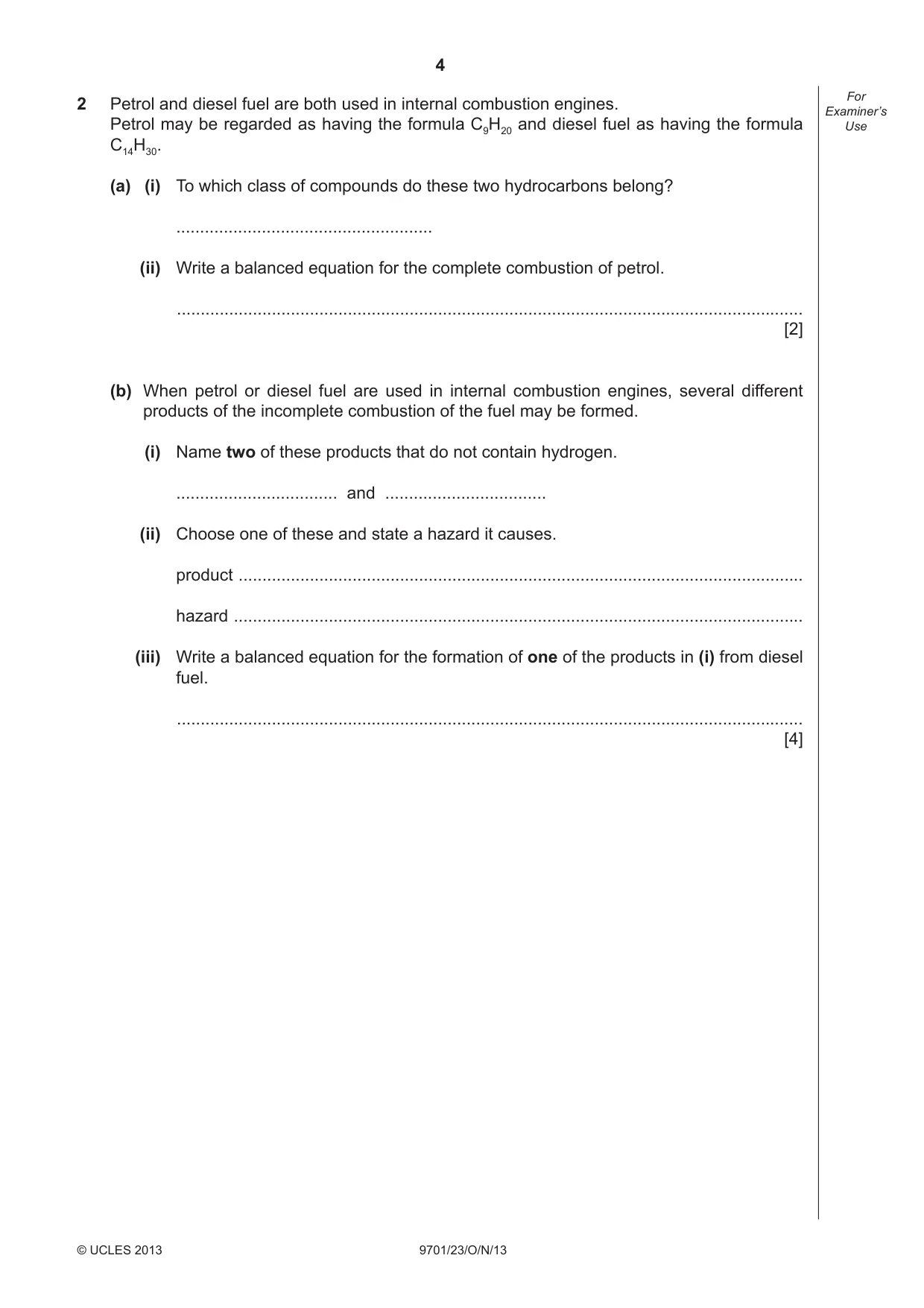
4 9701/23/O/N/13 © UCLES 2013 For Examiner’s Use 2 Petrol and diesel fuel are both used in internal combustion engines. Petrol may be regarded as having the formula C9H20 and diesel fuel as having the formula C14H30. (a) (i) To which class of compounds do these two hydrocarbons belong? … (ii) Write a balanced equation for the complete combustion of petrol. … [2] (b) When petrol or diesel fuel are used in internal combustion engines, several different products of the incomplete combustion of the fuel may be formed. (i) Name two of these products that do not contain hydrogen. … and … (ii) Choose one of these and state a hazard it causes. product … hazard … (iii) Write a balanced equation for the formation of one of the products in (i) from diesel fuel. … [4]
Question paper, page 5
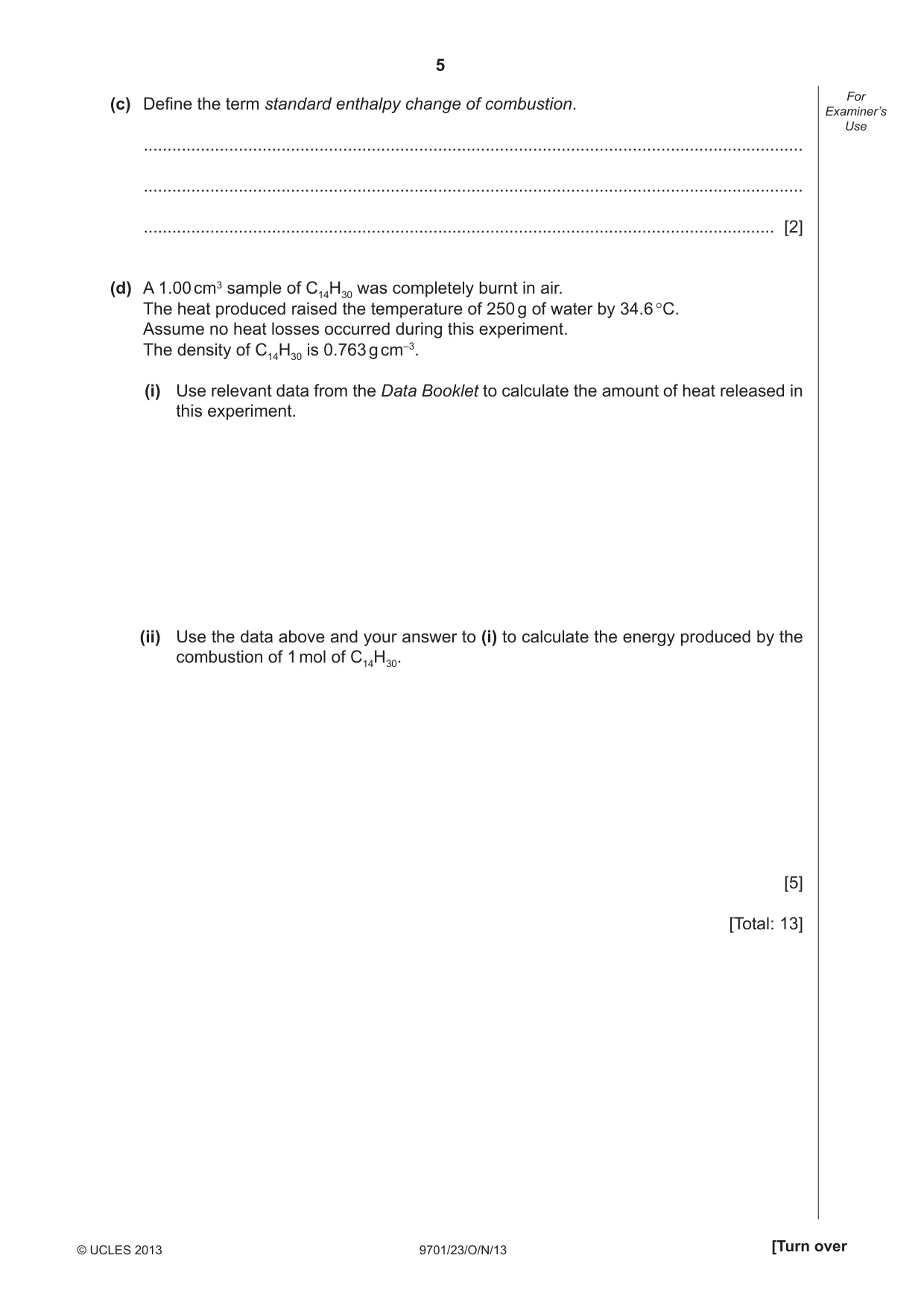
5 9701/23/O/N/13 © UCLES 2013 [Turn over For Examiner’s Use (c) Defi ne the term standard enthalpy change of combustion. … … … [2] (d) A 1.00 cm3 sample of C14H30 was completely burnt in air. The heat produced raised the temperature of 250 g of water by 34.6 °C. Assume no heat losses occurred during this experiment. The density of C14H30 is 0.763 g cm–3. (i) Use relevant data from the Data Booklet to calculate the amount of heat released in this experiment. (ii) Use the data above and your answer to (i) to calculate the energy produced by the combustion of 1 mol of C14H30. [5] [Total: 13]
Question paper, page 6
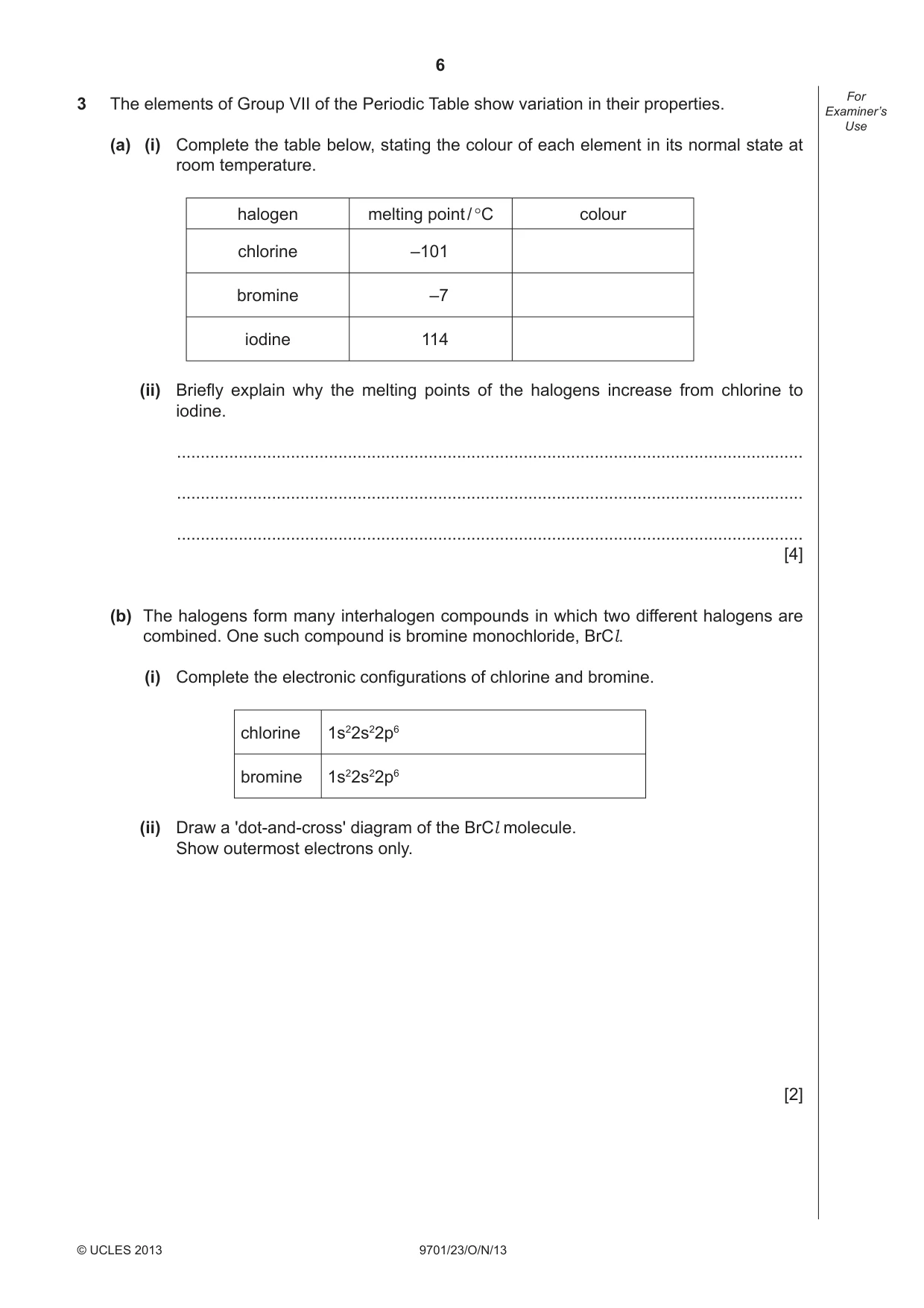
6 9701/23/O/N/13 © UCLES 2013 For Examiner’s Use 3 The elements of Group VII of the Periodic Table show variation in their properties. (a) (i) Complete the table below, stating the colour of each element in its normal state at room temperature. halogen melting point / °C colour chlorine –101 bromine –7 iodine 114 (ii) Briefl y explain why the melting points of the halogens increase from chlorine to iodine. … … … [4] (b) The halogens form many interhalogen compounds in which two different halogens are combined. One such compound is bromine monochloride, BrCl. (i) Complete the electronic confi gurations of chlorine and bromine. chlorine 1s22s22p6 bromine 1s22s22p6 (ii) Draw a 'dot-and-cross' diagram of the BrCl molecule. Show outermost electrons only. [2]
Question paper, page 7
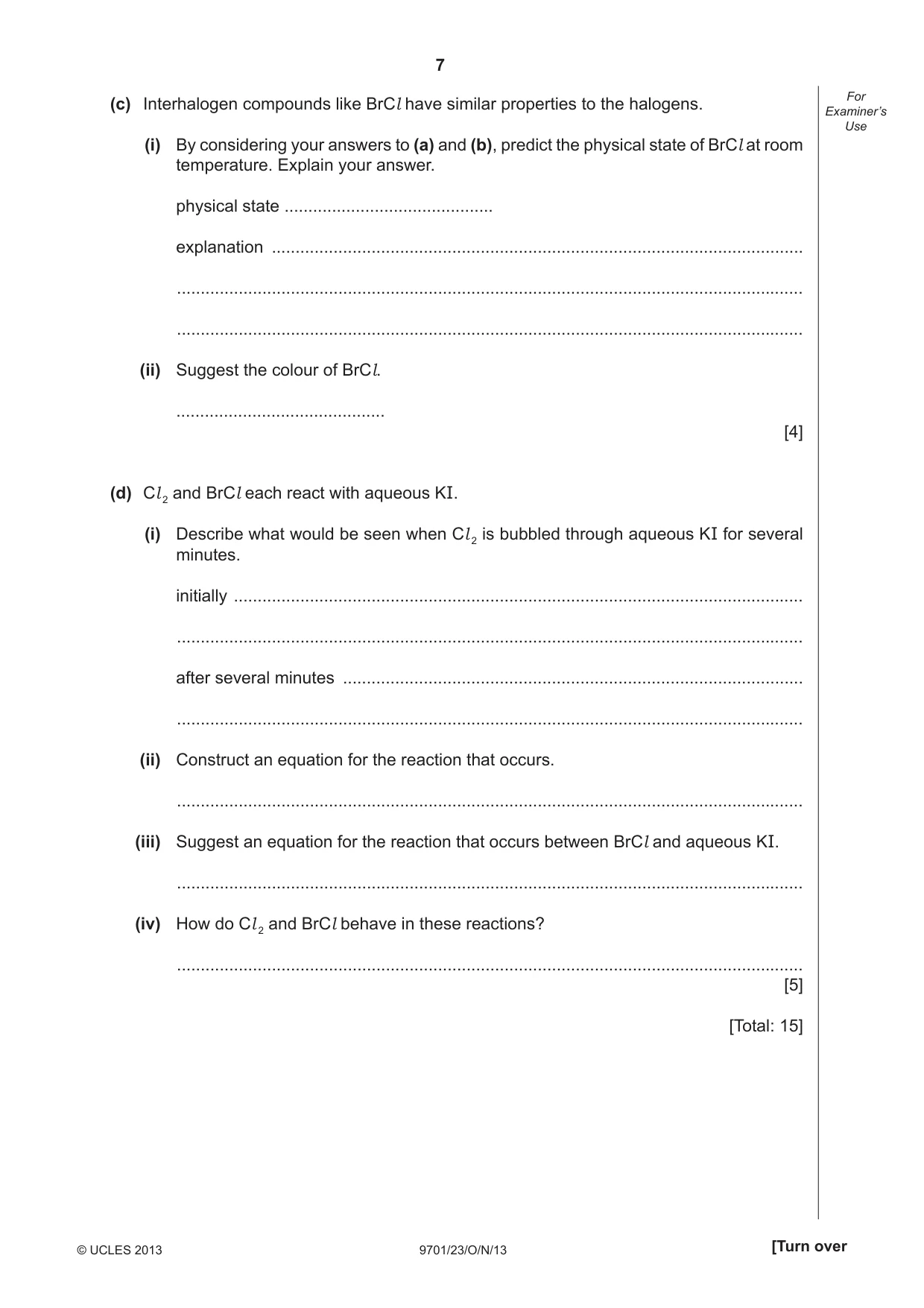
7 9701/23/O/N/13 © UCLES 2013 [Turn over For Examiner’s Use (c) Interhalogen compounds like BrCl have similar properties to the halogens. (i) By considering your answers to (a) and (b), predict the physical state of BrCl at room temperature. Explain your answer. physical state … explanation … … … (ii) Suggest the colour of BrCl. … [4] (d) Cl 2 and BrCl each react with aqueous KI. (i) Describe what would be seen when Cl 2 is bubbled through aqueous KI for several minutes. initially … … after several minutes … … (ii) Construct an equation for the reaction that occurs. … (iii) Suggest an equation for the reaction that occurs between BrCl and aqueous KI. … (iv) How do Cl 2 and BrCl behave in these reactions? … [5] [Total: 15]
Question paper, page 8
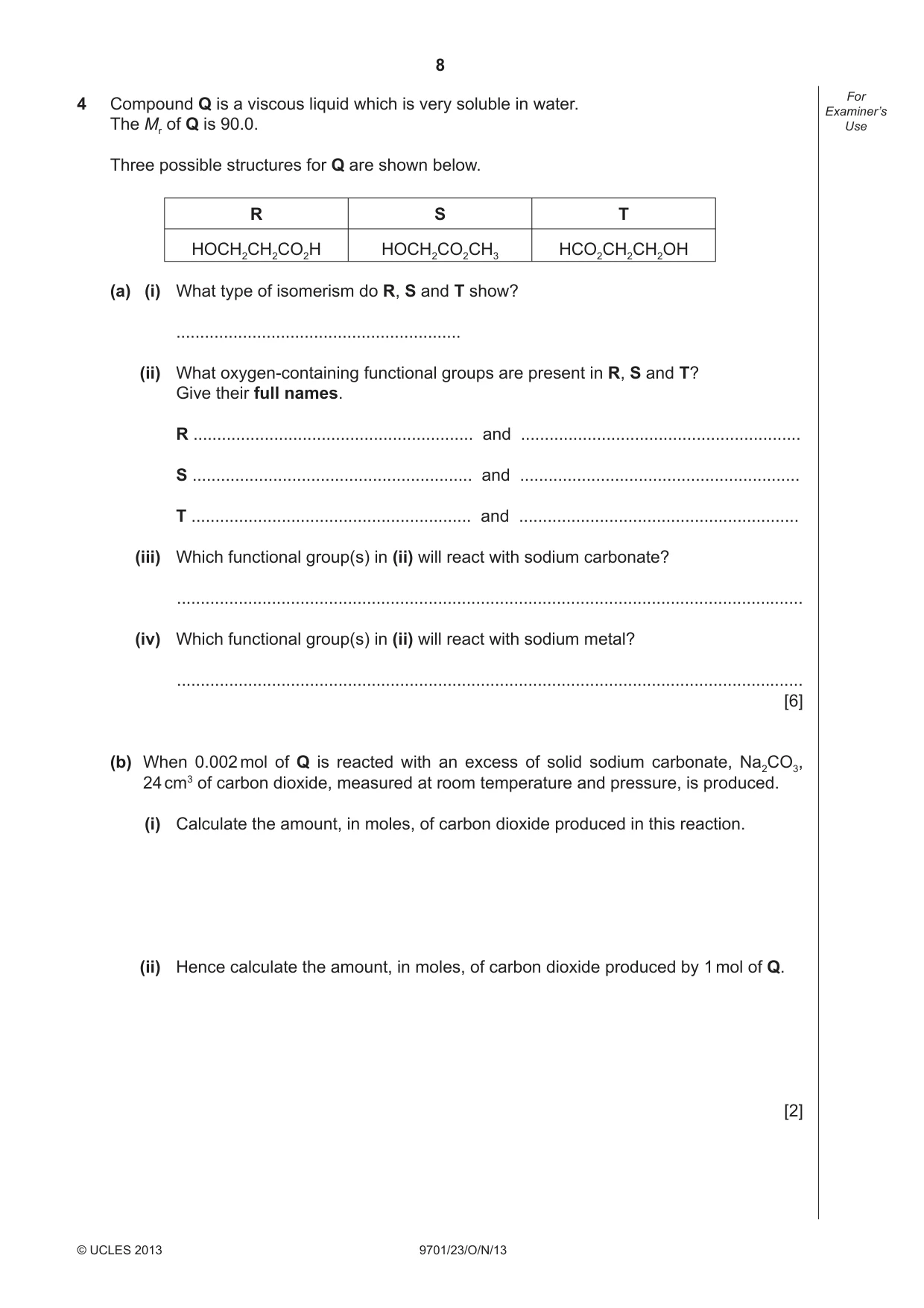
8 9701/23/O/N/13 © UCLES 2013 For Examiner’s Use 4 Compound Q is a viscous liquid which is very soluble in water. The Mr of Q is 90.0. Three possible structures for Q are shown below. R S T HOCH2CH2CO2H HOCH2CO2CH3 HCO2CH2CH2OH (a) (i) What type of isomerism do R, S and T show? … (ii) What oxygen-containing functional groups are present in R, S and T? Give their full names. R … and … S … and … T … and … (iii) Which functional group(s) in (ii) will react with sodium carbonate? … (iv) Which functional group(s) in (ii) will react with sodium metal? … [6] (b) When 0.002 mol of Q is reacted with an excess of solid sodium carbonate, Na2CO3, 24 cm3 of carbon dioxide, measured at room temperature and pressure, is produced. (i) Calculate the amount, in moles, of carbon dioxide produced in this reaction. (ii) Hence calculate the amount, in moles, of carbon dioxide produced by 1 mol of Q. [2]
Question paper, page 9
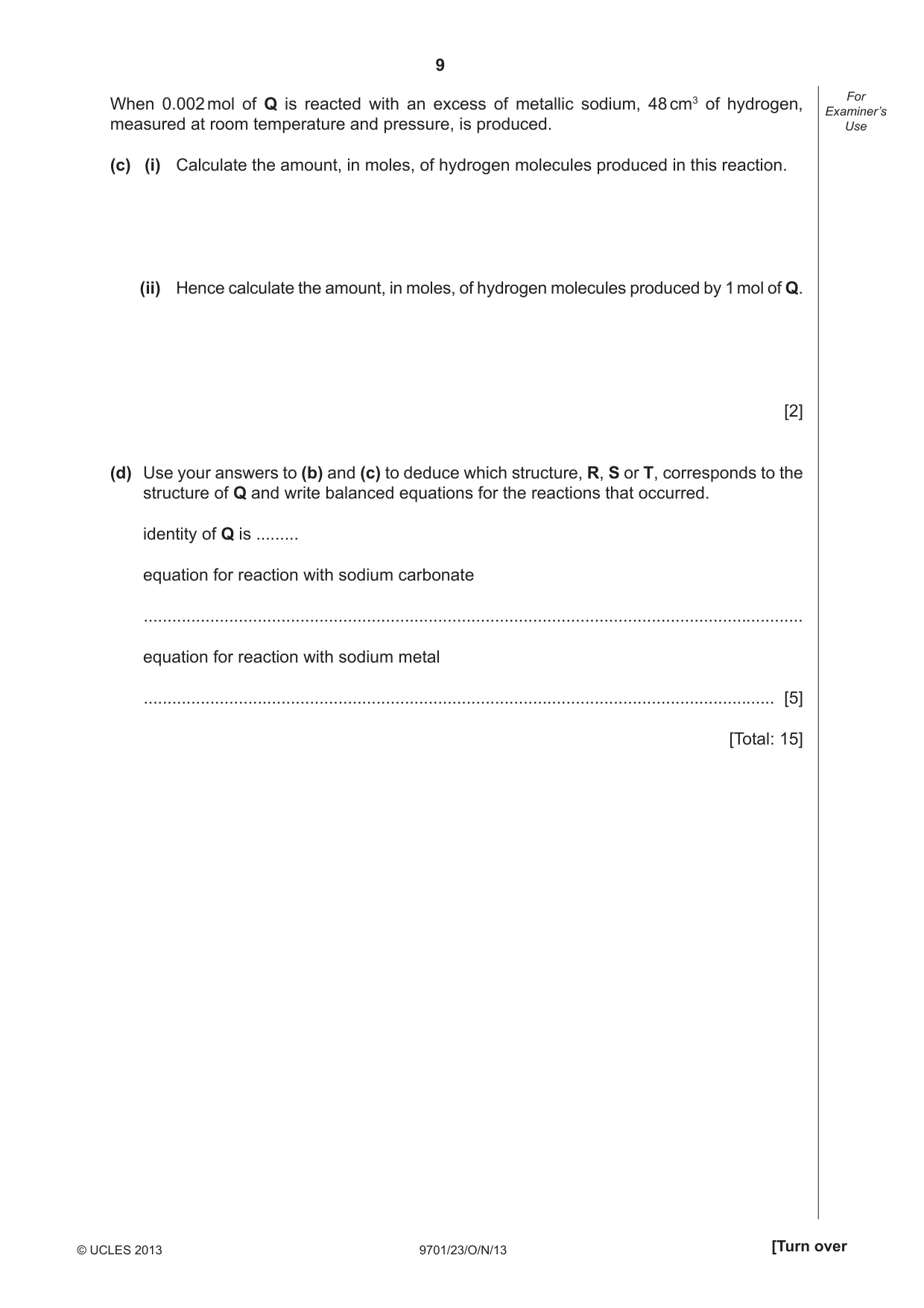
9 9701/23/O/N/13 © UCLES 2013 [Turn over For Examiner’s Use When 0.002 mol of Q is reacted with an excess of metallic sodium, 48 cm3 of hydrogen, measured at room temperature and pressure, is produced. (c) (i) Calculate the amount, in moles, of hydrogen molecules produced in this reaction. (ii) Hence calculate the amount, in moles, of hydrogen molecules produced by 1 mol of Q. [2] (d) Use your answers to (b) and (c) to deduce which structure, R, S or T, corresponds to the structure of Q and write balanced equations for the reactions that occurred. identity of Q is … equation for reaction with sodium carbonate … equation for reaction with sodium metal … [5] [Total: 15]
Question paper, page 10
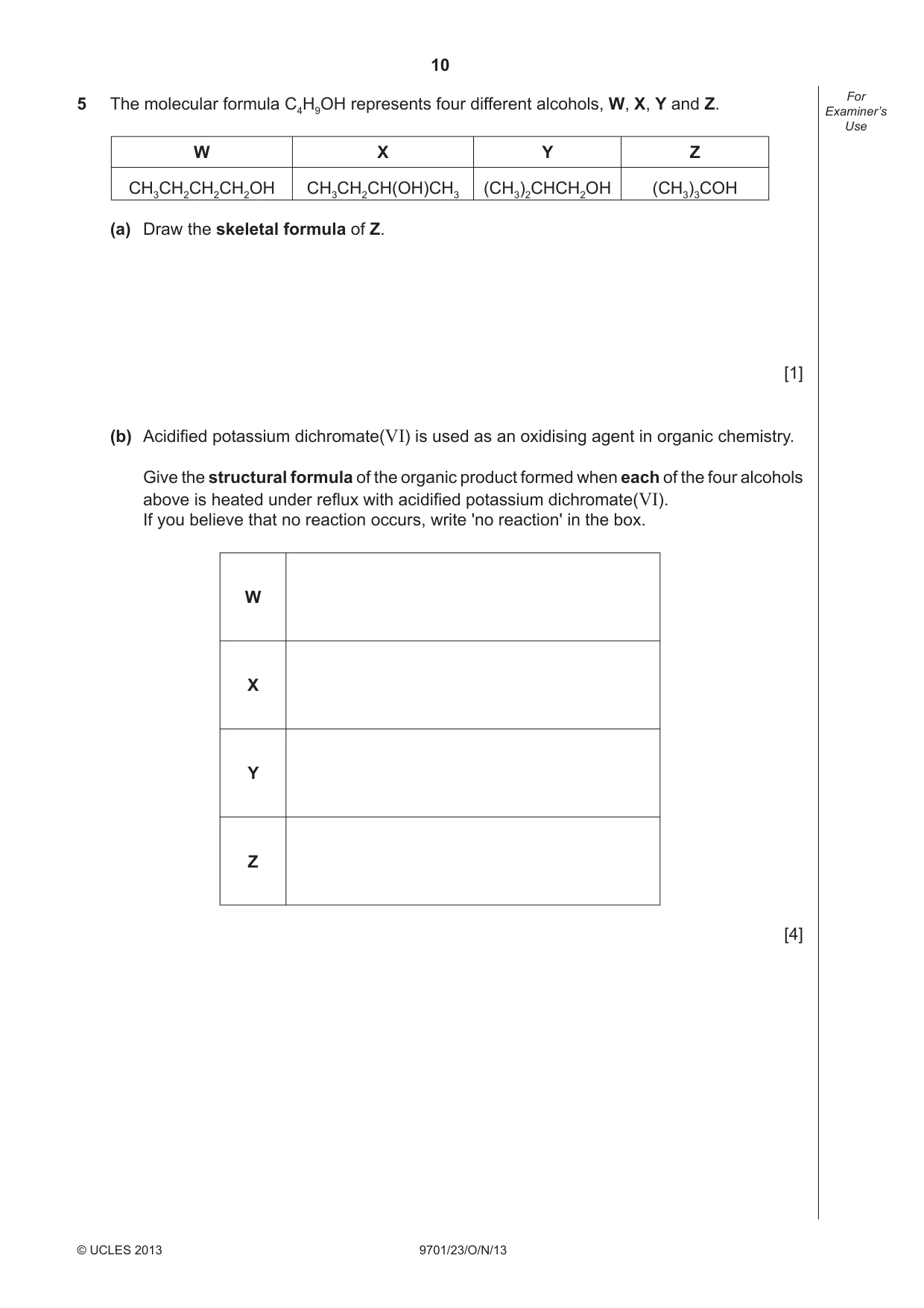
10 9701/23/O/N/13 © UCLES 2013 For Examiner’s Use 5 The molecular formula C4H9OH represents four different alcohols, W, X, Y and Z. W X Y Z CH3CH2CH2CH2OH CH3CH2CH(OH)CH3 (CH3)2CHCH2OH (CH3)3COH (a) Draw the skeletal formula of Z. [1] (b) Acidifi ed potassium dichromate(VI) is used as an oxidising agent in organic chemistry. Give the structural formula of the organic product formed when each of the four alcohols above is heated under refl ux with acidifi ed potassium dichromate(VI). If you believe that no reaction occurs, write 'no reaction' in the box. W X Y Z [4]
Question paper, page 11
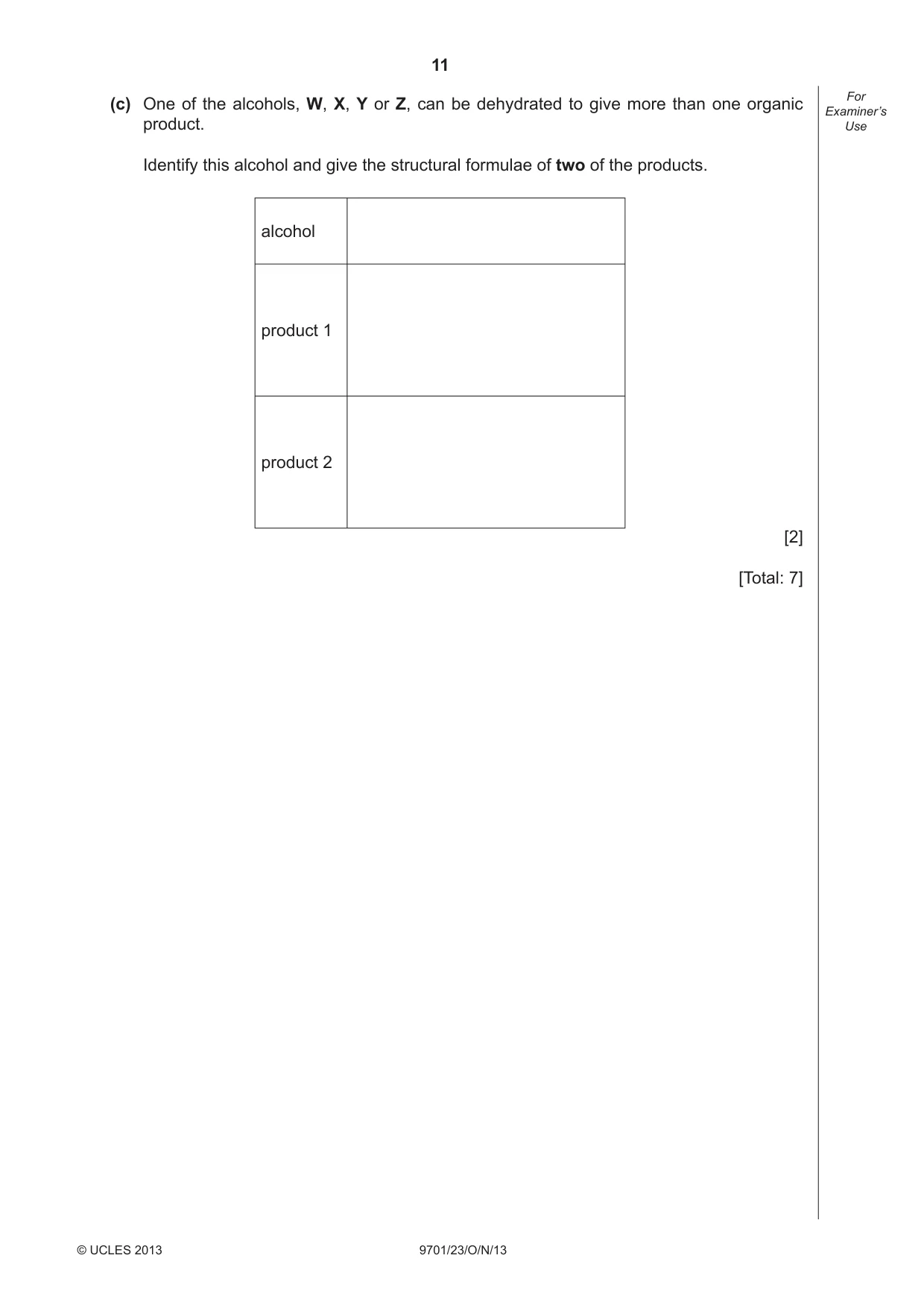
11 9701/23/O/N/13 © UCLES 2013 [Turn over For Examiner’s Use (c) One of the alcohols, W, X, Y or Z, can be dehydrated to give more than one organic product. Identify this alcohol and give the structural formulae of two of the products. alcohol product 1 product 2 [2] [Total: 7]
Question paper, page 12
12 Permission to reproduce items where third-party owned material protected by copyright is included has been sought and cleared where possible. Every reasonable effort has been made by the publisher (UCLES) to trace copyright holders, but if any items requiring clearance have unwittingly been included the publisher will be pleased to make amends at the earliest possible opportunity. University of Cambridge International Examinations is part of the Cambridge Assessment Group. Cambridge Assessment is the brand name of University of Cambridge Local Examinations Syndicate (UCLES), which is itself a department of the University of Cambridge. 9701/23/O/N/13 © UCLES 2013 BLANK PAGE
Mark scheme, page 1
CAMBRIDGE INTERNATIONAL EXAMINATIONS GCE Advanced Subsidiary Level and GCE Advanced Level MARK SCHEME for the October/November 2013 series 9701 CHEMISTRY 9701/23 Paper 2 (AS Structured Questions), maximum raw mark 60 This mark scheme is published as an aid to teachers and candidates, to indicate the requirements of the examination. It shows the basis on which Examiners were instructed to award marks. It does not indicate the details of the discussions that took place at an Examiners’ meeting before marking began, which would have considered the acceptability of alternative answers. Mark schemes should be read in conjunction with the question paper and the Principal Examiner Report for Teachers. Cambridge will not enter into discussions about these mark schemes. Cambridge is publishing the mark schemes for the October/November 2013 series for most IGCSE, GCE Advanced Level and Advanced Subsidiary Level components and some Ordinary Level components.
Mark scheme, page 2
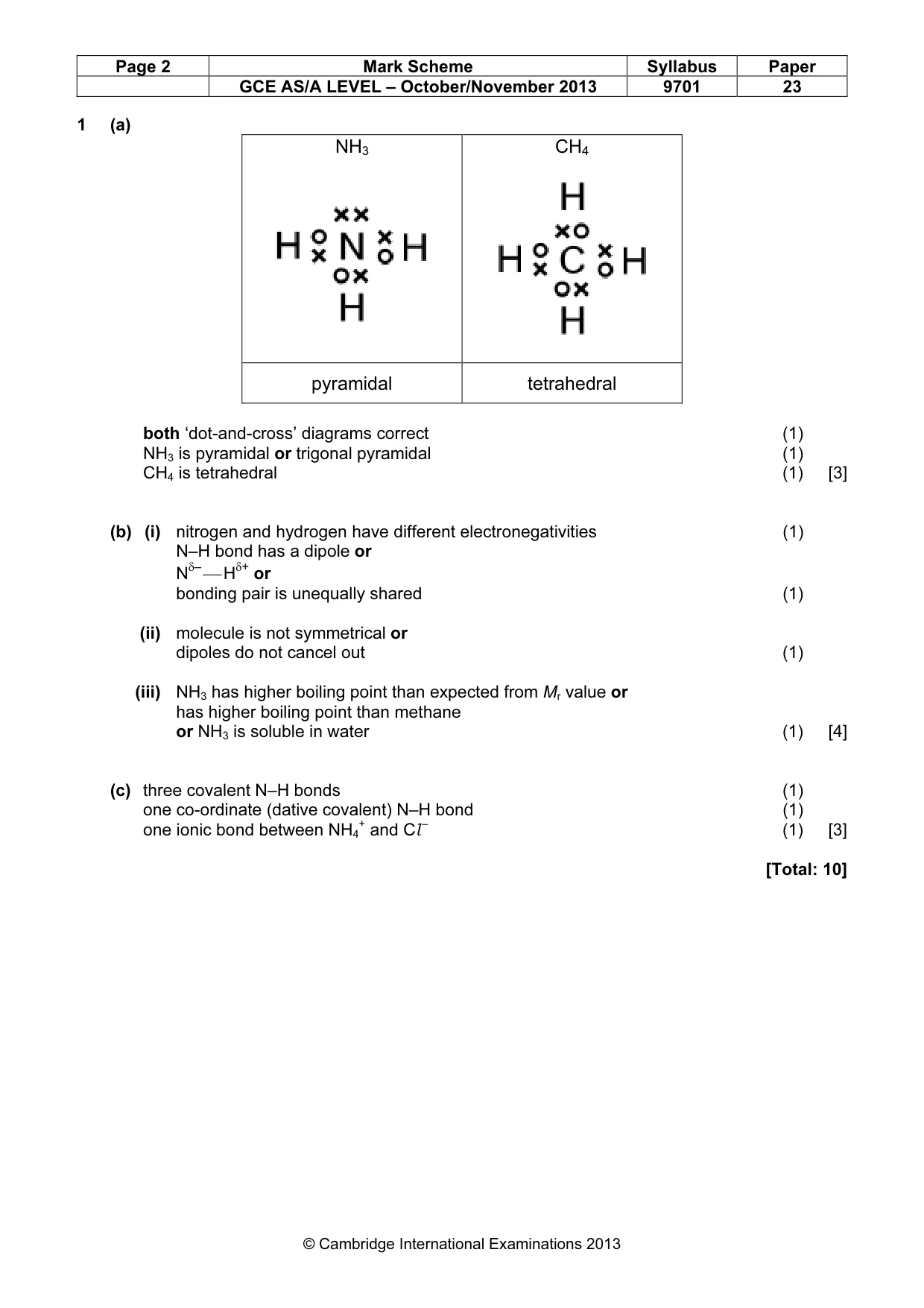
Page 2 Mark Scheme Syllabus Paper GCE AS/A LEVEL – October/November 2013 9701 23 © Cambridge International Examinations 2013 1 (a) NH3 CH4 pyramidal tetrahedral both ‘dot-and-cross’ diagrams correct (1) NH3 is pyramidal or trigonal pyramidal (1) CH4 is tetrahedral (1) [3] (b) (i) nitrogen and hydrogen have different electronegativities (1) N–H bond has a dipole or Nδ– Hδ+ or bonding pair is unequally shared (1) (ii) molecule is not symmetrical or dipoles do not cancel out (1) (iii) NH3 has higher boiling point than expected from Mr value or has higher boiling point than methane or NH3 is soluble in water (1) [4] (c) three covalent N–H bonds (1) one co-ordinate (dative covalent) N–H bond (1) one ionic bond between NH4 + and Cl – (1) [3] [Total: 10]
Mark scheme, page 3
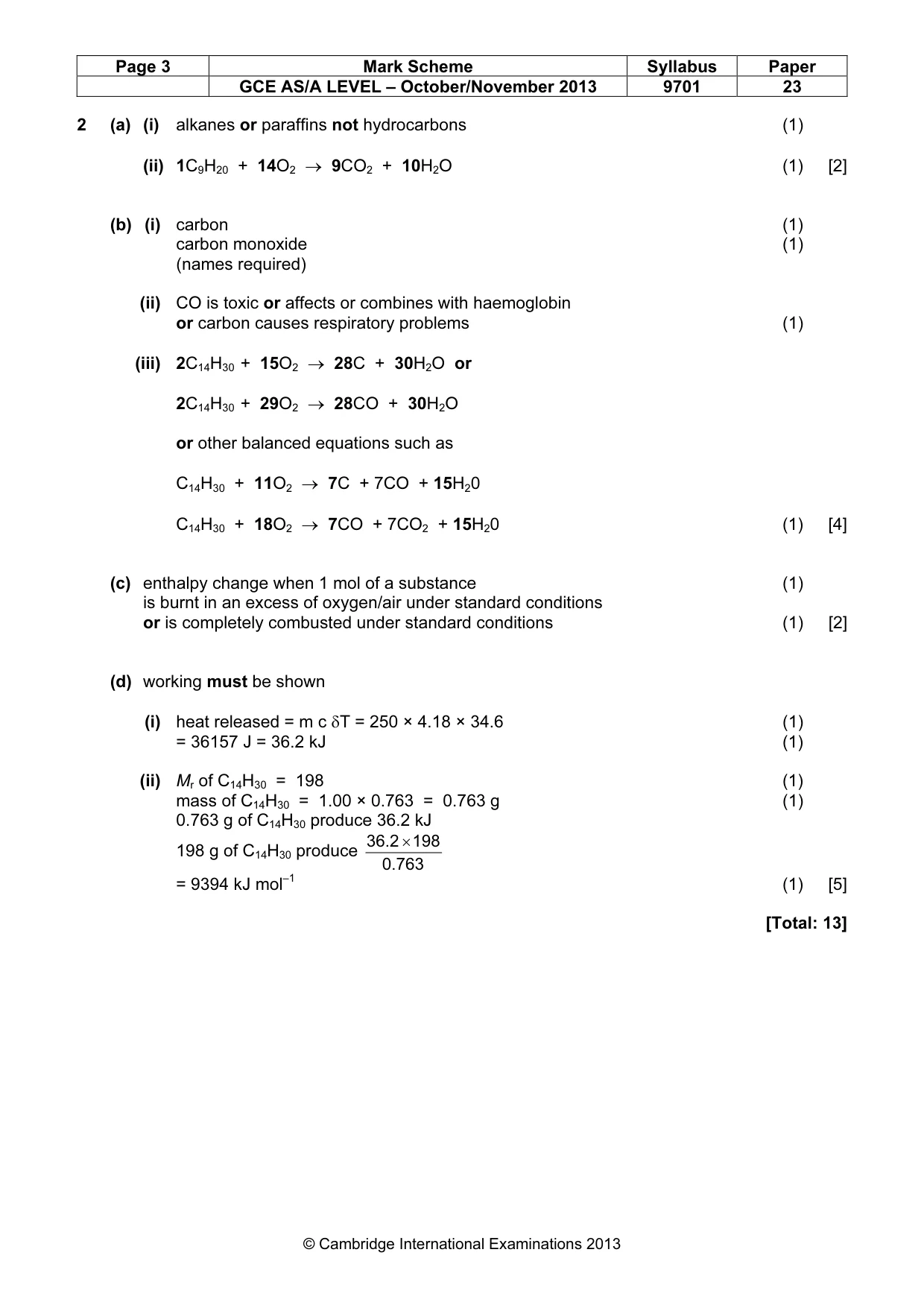
Page 3 Mark Scheme Syllabus Paper GCE AS/A LEVEL – October/November 2013 9701 23 © Cambridge International Examinations 2013 2 (a) (i) alkanes or paraffins not hydrocarbons (1) (ii) 1C9H20 + 14O2 → 9CO2 + 10H2O (1) [2] (b) (i) carbon (1) carbon monoxide (1) (names required) (ii) CO is toxic or affects or combines with haemoglobin or carbon causes respiratory problems (1) (iii) 2C14H30 + 15O2 → 28C + 30H2O or 2C14H30 + 29O2 → 28CO + 30H2O or other balanced equations such as C14H30 + 11O2 → 7C + 7CO + 15H20 C14H30 + 18O2 → 7CO + 7CO2 + 15H20 (1) [4] (c) enthalpy change when 1 mol of a substance (1) is burnt in an excess of oxygen/air under standard conditions or is completely combusted under standard conditions (1) [2] (d) working must be shown (i) heat released = m c δT = 250 × 4.18 × 34.6 (1) = 36157 J = 36.2 kJ (1) (ii) Mr of C14H30 = 198 (1) mass of C14H30 = 1.00 × 0.763 = 0.763 g (1) 0.763 g of C14H30 produce 36.2 kJ 198 g of C14H30 produce 0.763 198 36.2 × = 9394 kJ mol–1 (1) [5] [Total: 13]
Mark scheme, page 4
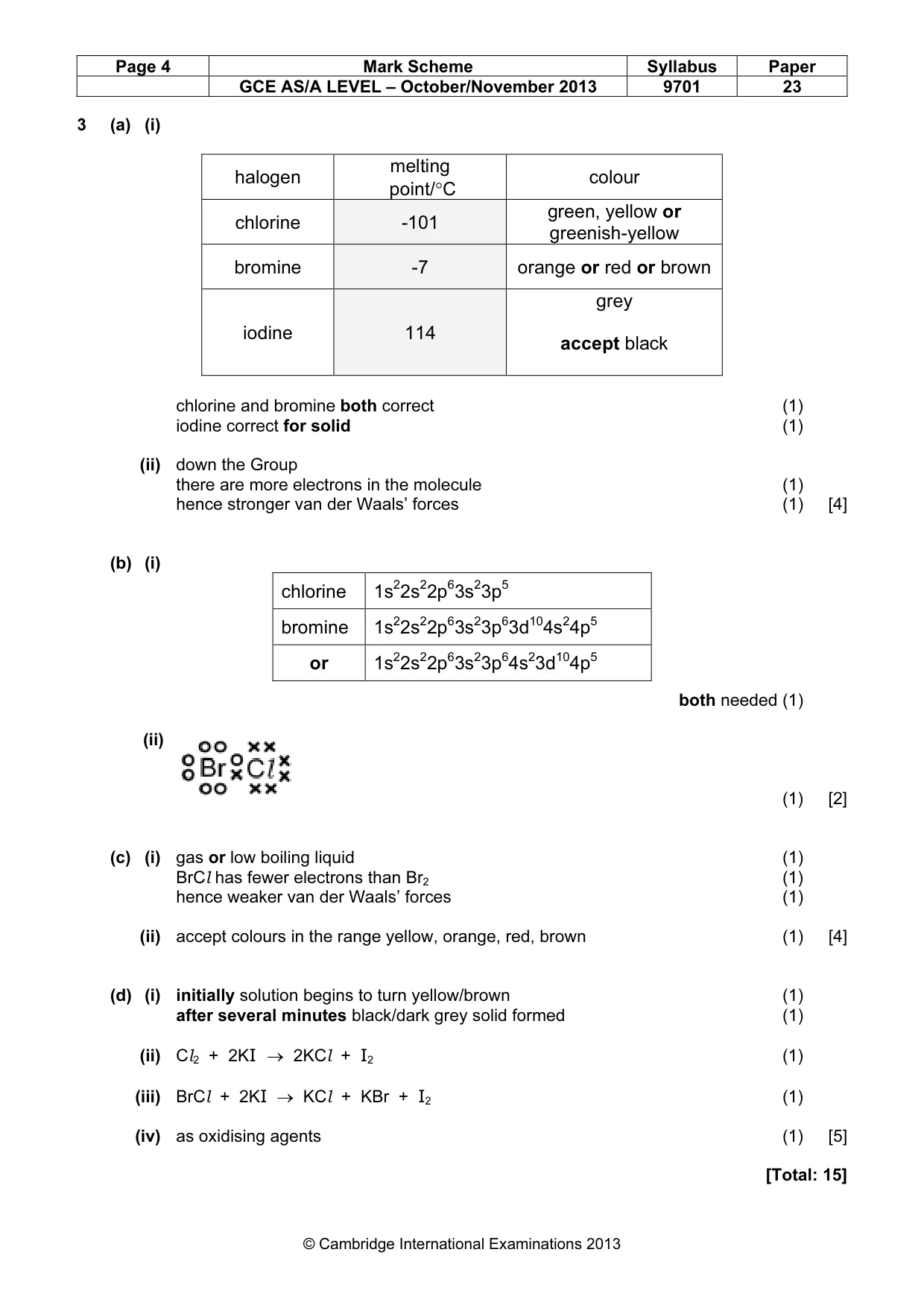
Page 4 Mark Scheme Syllabus Paper GCE AS/A LEVEL – October/November 2013 9701 23 © Cambridge International Examinations 2013 3 (a) (i) halogen melting point/°C colour chlorine -101 green, yellow or greenish-yellow bromine -7 orange or red or brown iodine 114 grey accept black chlorine and bromine both correct (1) iodine correct for solid (1) (ii) down the Group there are more electrons in the molecule (1) hence stronger van der Waals’ forces (1) [4] (b) (i) both needed (1) (ii) (1) [2] (c) (i) gas or low boiling liquid (1) BrCl has fewer electrons than Br2 (1) hence weaker van der Waals’ forces (1) (ii) accept colours in the range yellow, orange, red, brown (1) [4] (d) (i) initially solution begins to turn yellow/brown (1) after several minutes black/dark grey solid formed (1) (ii) Cl2 + 2KI → 2KCl + I2 (1) (iii) BrCl + 2KI → KCl + KBr + I2 (1) (iv) as oxidising agents (1) [5] [Total: 15] chlorine 1s22s22p63s23p5 bromine 1s22s22p63s23p63d104s24p5 or 1s22s22p63s23p64s23d104p5
Mark scheme, page 5
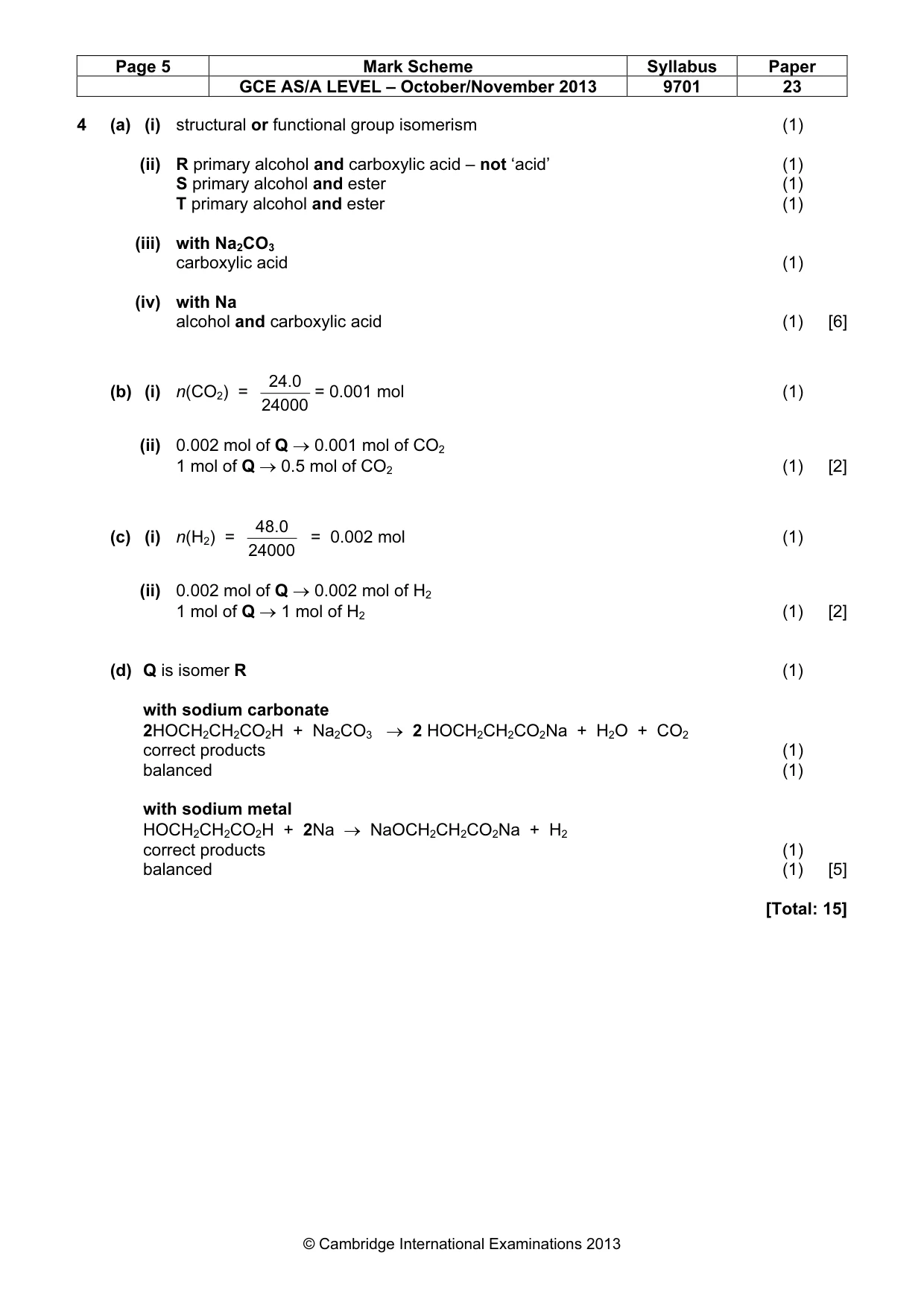
Page 5 Mark Scheme Syllabus Paper GCE AS/A LEVEL – October/November 2013 9701 23 © Cambridge International Examinations 2013 4 (a) (i) structural or functional group isomerism (1) (ii) R primary alcohol and carboxylic acid – not ‘acid’ (1) S primary alcohol and ester (1) T primary alcohol and ester (1) (iii) with Na2CO3 carboxylic acid (1) (iv) with Na alcohol and carboxylic acid (1) [6] (b) (i) n(CO2) = 24000 24.0 = 0.001 mol (1) (ii) 0.002 mol of Q → 0.001 mol of CO2 1 mol of Q → 0.5 mol of CO2 (1) [2] (c) (i) n(H2) = 24000 48.0 = 0.002 mol (1) (ii) 0.002 mol of Q → 0.002 mol of H2 1 mol of Q → 1 mol of H2 (1) [2] (d) Q is isomer R (1) with sodium carbonate 2HOCH2CH2CO2H + Na2CO3 → 2 HOCH2CH2CO2Na + H2O + CO2 correct products (1) balanced (1) with sodium metal HOCH2CH2CO2H + 2Na → NaOCH2CH2CO2Na + H2 correct products (1) balanced (1) [5] [Total: 15]
Mark scheme, page 6
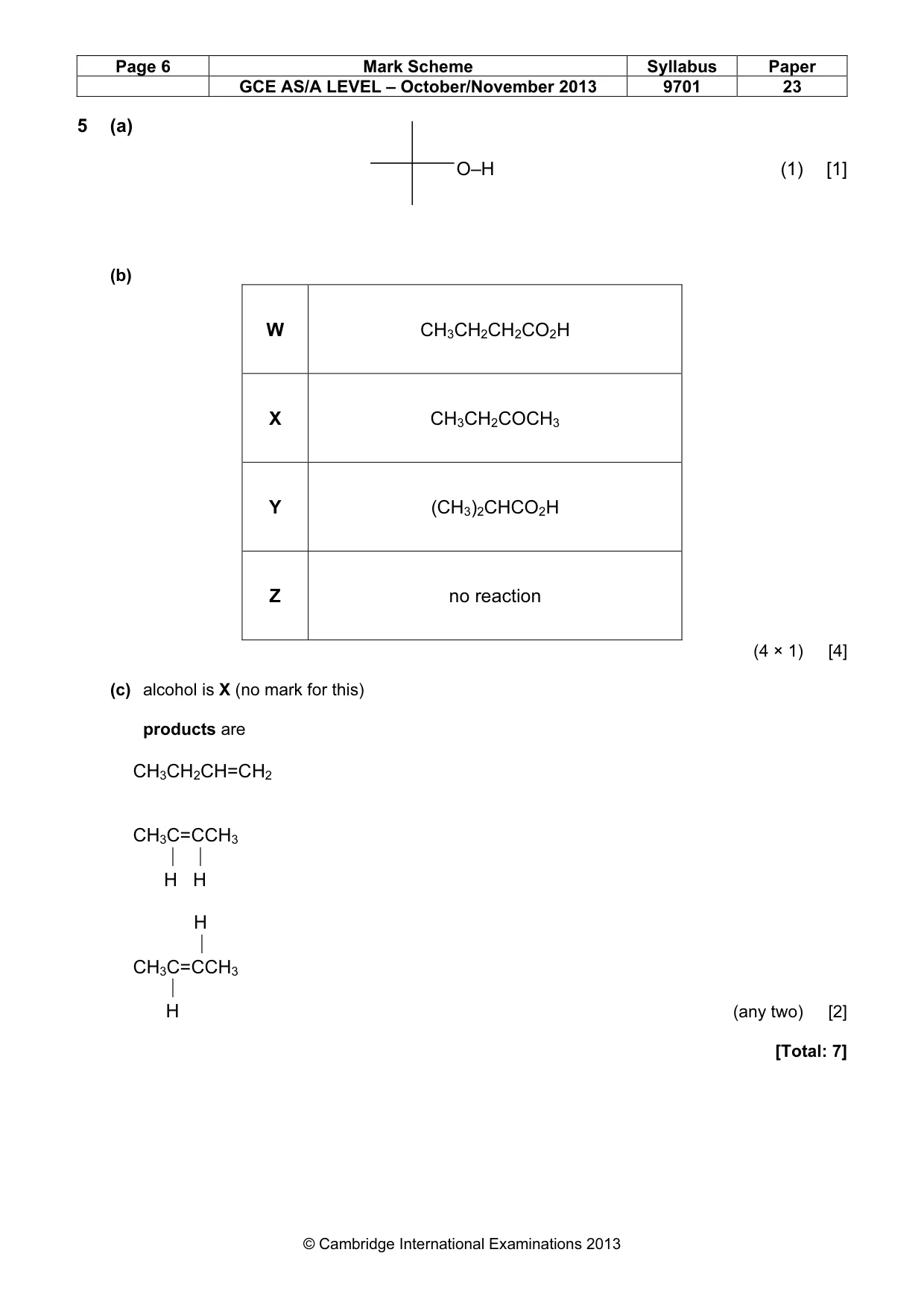
Page 6 Mark Scheme Syllabus Paper GCE AS/A LEVEL – October/November 2013 9701 23 © Cambridge International Examinations 2013 5 (a) O–H (1) [1] (b) W CH3CH2CH2CO2H X CH3CH2COCH3 Y (CH3)2CHCO2H Z no reaction (4 × 1) [4] (c) alcohol is X (no mark for this) products are CH3CH2CH=CH2 CH3C=CCH3 H H H CH3C=CCH3 H (any two) [2] [Total: 7]
What you needed in this session
Cambridge’s own grade thresholds for 2013 Oct/Nov, Paper 2 · Variant 3. A higher threshold means an easier paper — the bar moves with how the cohort did.