Cambridge A Level Chemistry 9701 — 2010 May/June Paper 2 · Variant 2
9701/22/M/J/10 · 60 marks · ≈68 min
The question paper and its mark scheme, free to read here and free to download. This is Cambridge’s own paper, exactly as it was sat.
Question paper12 pages
Mark scheme6 pages
Answers below. Sit the paper first if you are practising.
Paper as text
Question paper, page 1
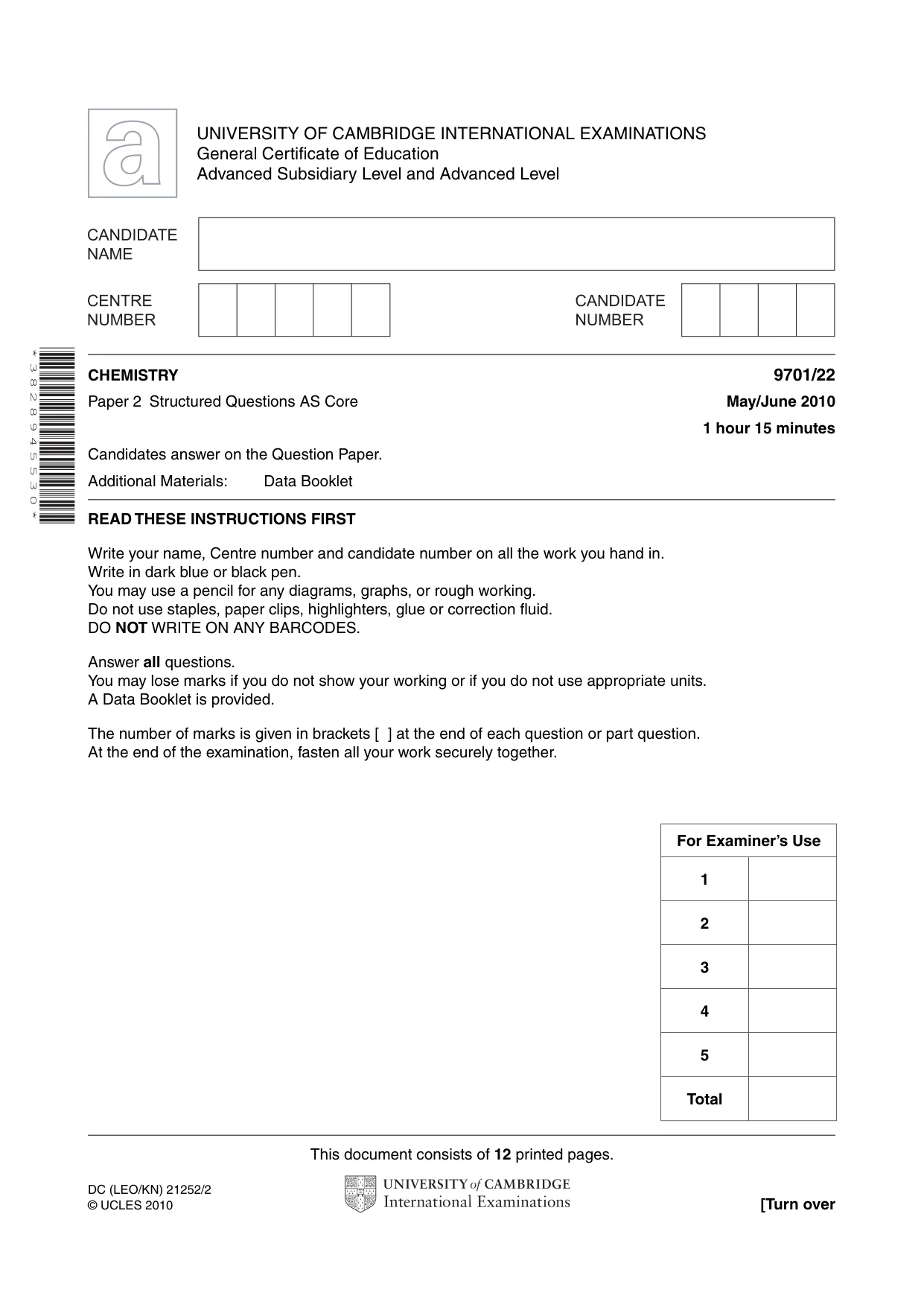
This document consists of 12 printed pages. DC (LEO/KN) 21252/2 © UCLES 2010 [Turn over UNIVERSITY OF CAMBRIDGE INTERNATIONAL EXAMINATIONS General Certificate of Education Advanced Subsidiary Level and Advanced Level READ THESE INSTRUCTIONS FIRST Write your name, Centre number and candidate number on all the work you hand in. Write in dark blue or black pen. You may use a pencil for any diagrams, graphs, or rough working. Do not use staples, paper clips, highlighters, glue or correction fluid. DO NOT WRITE ON ANY BARCODES. Answer all questions. You may lose marks if you do not show your working or if you do not use appropriate units. A Data Booklet is provided. The number of marks is given in brackets [ ] at the end of each question or part question. At the end of the examination, fasten all your work securely together. * 3 8 2 8 9 4 5 5 3 0 * CHEMISTRY 9701/22 Paper 2 Structured Questions AS Core May/June 2010 1 hour 15 minutes Candidates answer on the Question Paper. Additional Materials: Data Booklet For Examiner’s Use 1 2 3 4 5 Total
Question paper, page 2
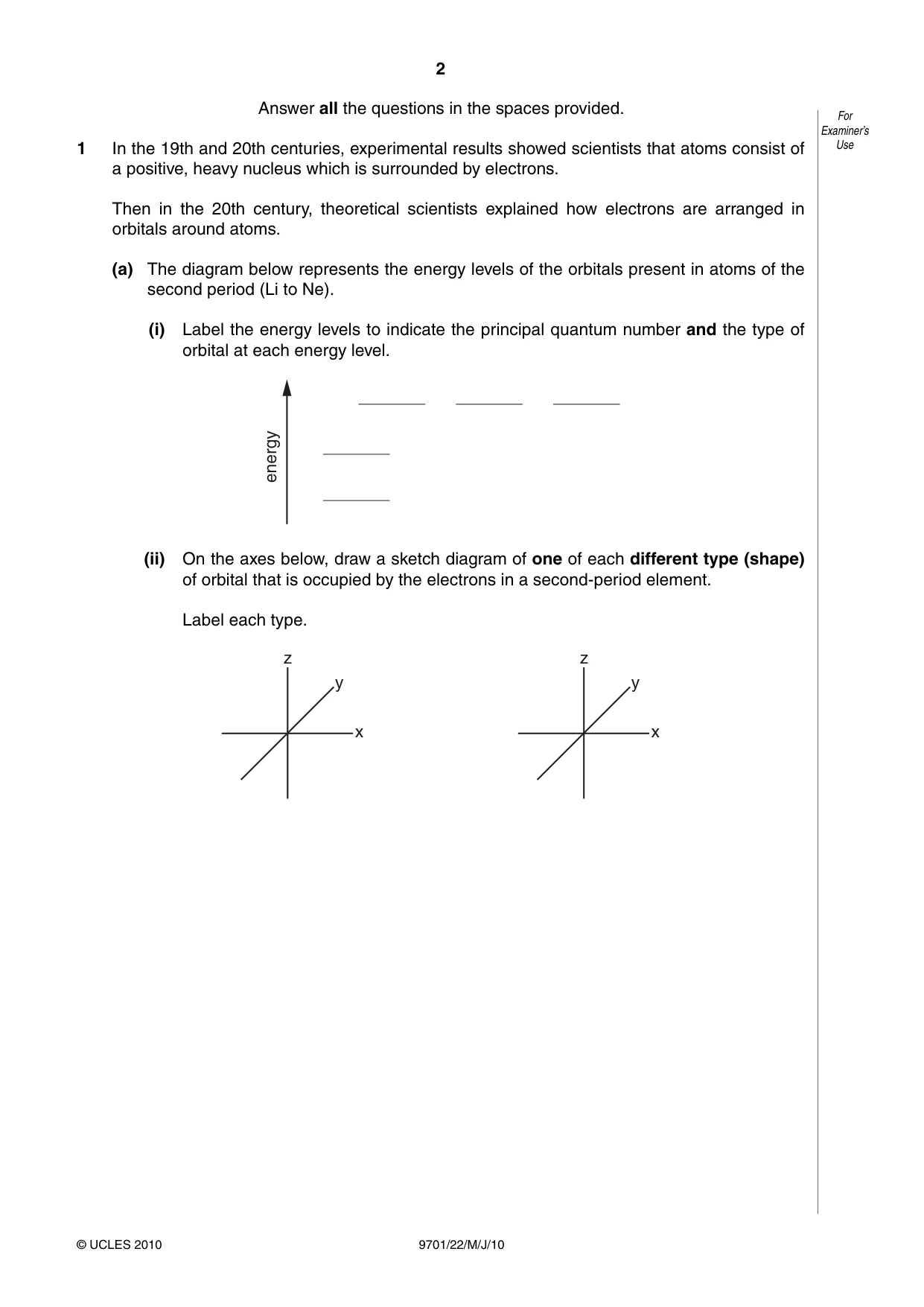
9701/22/M/J/10 © UCLES 2010 For Examiner’s Use Answer all the questions in the spaces provided. 1 In the 19th and 20th centuries, experimental results showed scientists that atoms consist of a positive, heavy nucleus which is surrounded by electrons. Then in the 20th century, theoretical scientists explained how electrons are arranged in orbitals around atoms. (a) The diagram below represents the energy levels of the orbitals present in atoms of the second period (Li to Ne). (i) Label the energy levels to indicate the principal quantum number and the type of orbital at each energy level. energy (ii) On the axes below, draw a sketch diagram of one of each different type (shape) of orbital that is occupied by the electrons in a second-period element. Label each type. z y x z y x 2
Question paper, page 3
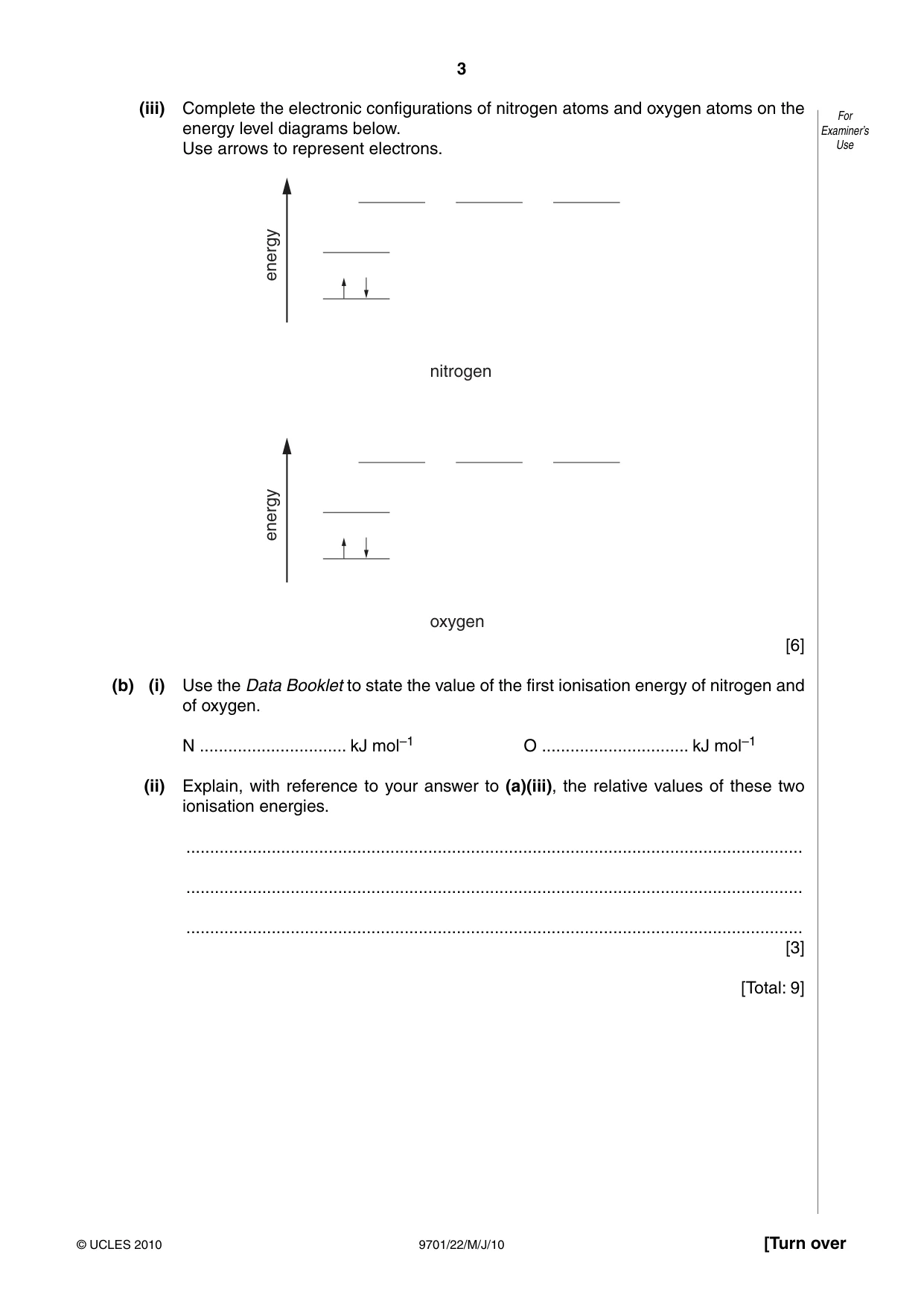
3 9701/22/M/J/10 © UCLES 2010 [Turn over For Examiner’s Use (iii) Complete the electronic configurations of nitrogen atoms and oxygen atoms on the energy level diagrams below. Use arrows to represent electrons. energy energy nitrogen oxygen [6] (b) (i) Use the Data Booklet to state the value of the first ionisation energy of nitrogen and of oxygen. N … kJ mol–1 O … kJ mol–1 (ii) Explain, with reference to your answer to (a)(iii), the relative values of these two ionisation energies. … … … [3] [Total: 9]
Question paper, page 4
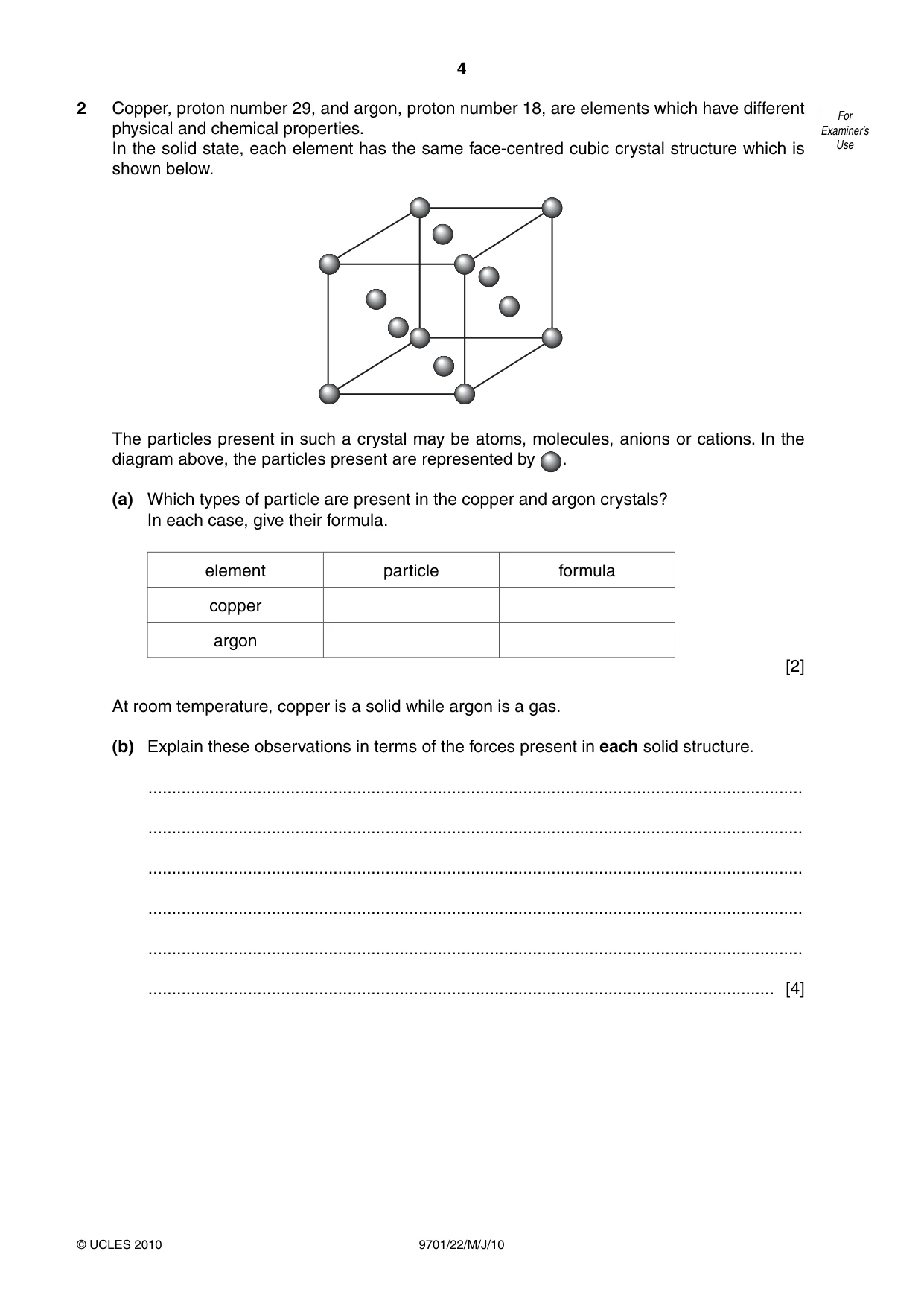
4 9701/22/M/J/10 © UCLES 2010 For Examiner’s Use 2 Copper, proton number 29, and argon, proton number 18, are elements which have different physical and chemical properties. In the solid state, each element has the same face-centred cubic crystal structure which is shown below. The particles present in such a crystal may be atoms, molecules, anions or cations. In the diagram above, the particles present are represented by . (a) Which types of particle are present in the copper and argon crystals? In each case, give their formula. element particle formula copper argon [2] At room temperature, copper is a solid while argon is a gas. (b) Explain these observations in terms of the forces present in each solid structure. … … … … … … [4]
Question paper, page 5
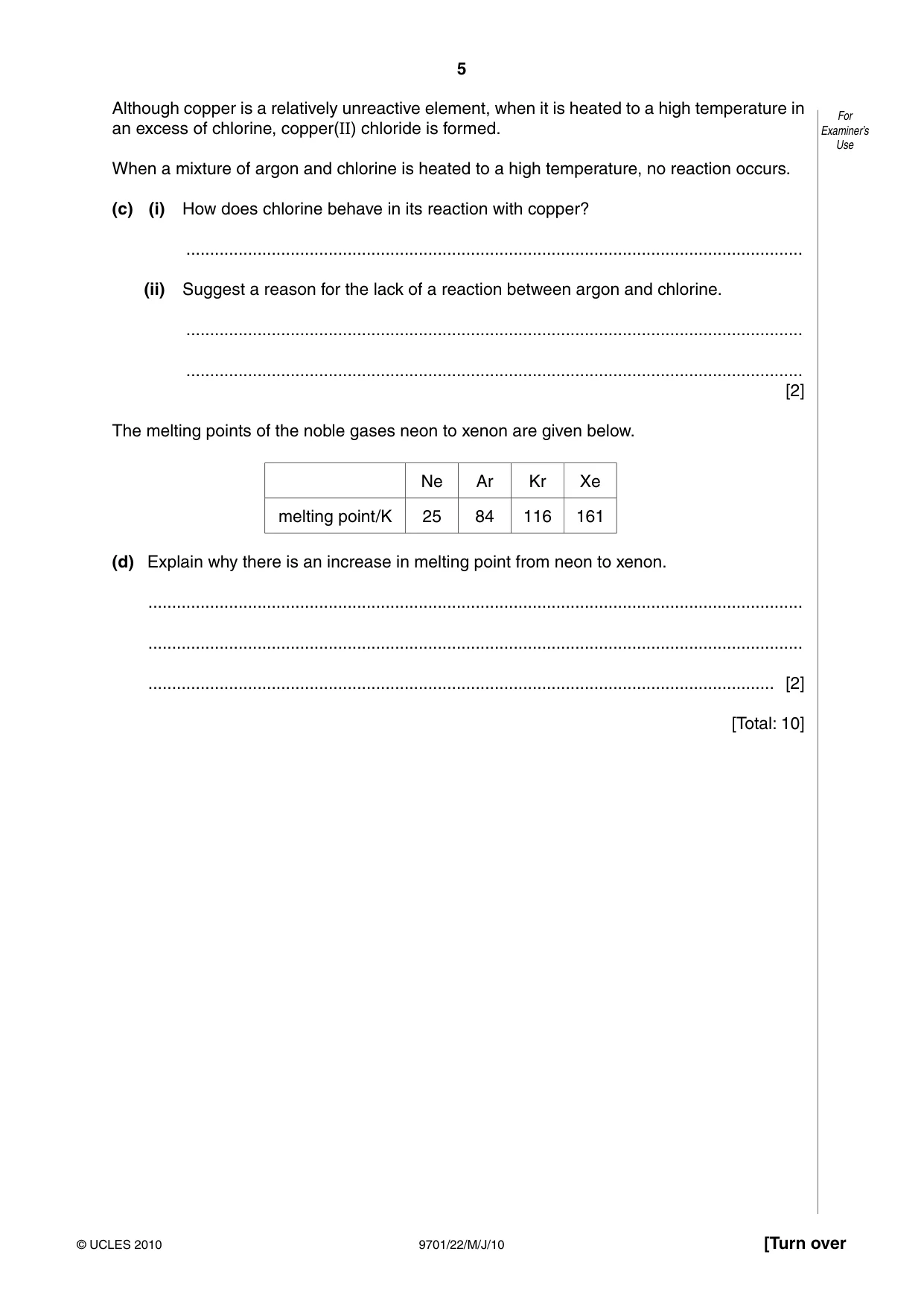
5 9701/22/M/J/10 © UCLES 2010 [Turn over For Examiner’s Use Although copper is a relatively unreactive element, when it is heated to a high temperature in an excess of chlorine, copper(II) chloride is formed. When a mixture of argon and chlorine is heated to a high temperature, no reaction occurs. (c) (i) How does chlorine behave in its reaction with copper? … (ii) Suggest a reason for the lack of a reaction between argon and chlorine. … … [2] The melting points of the noble gases neon to xenon are given below. Ne Ar Kr Xe melting point /K 25 84 116 161 (d) Explain why there is an increase in melting point from neon to xenon. … … … [2] [Total: 10]
Question paper, page 6
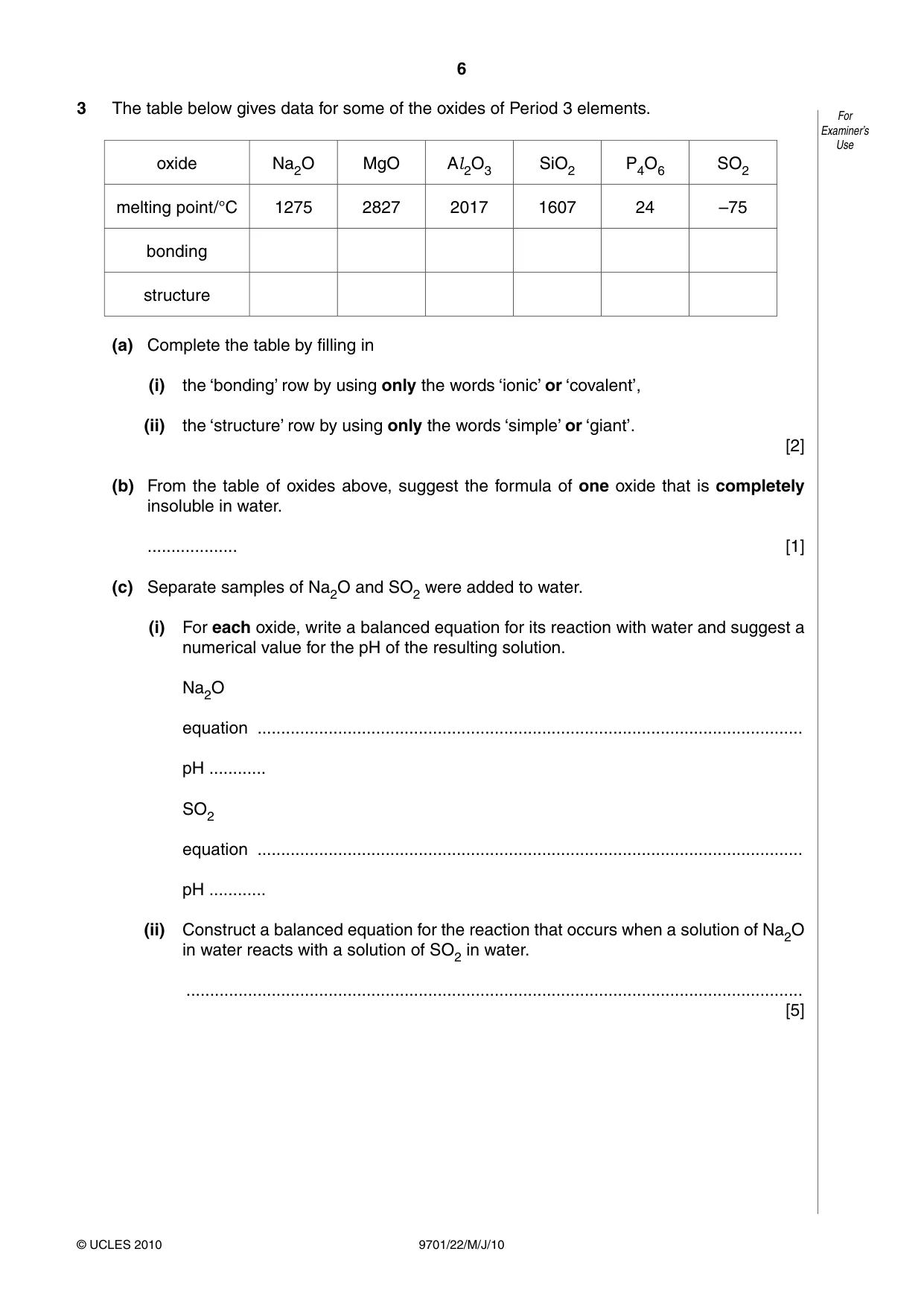
6 9701/22/M/J/10 © UCLES 2010 For Examiner’s Use 3 The table below gives data for some of the oxides of Period 3 elements. oxide Na2O MgO Al 2O3 SiO2 P4O6 SO2 melting point /°C 1275 2827 2017 1607 24 –75 bonding structure (a) Complete the table by filling in (i) the ‘bonding’ row by using only the words ‘ionic’ or ‘covalent’, (ii) the ‘structure’ row by using only the words ‘simple’ or ‘giant’. [2] (b) From the table of oxides above, suggest the formula of one oxide that is completely insoluble in water. … [1] (c) Separate samples of Na2O and SO2 were added to water. (i) For each oxide, write a balanced equation for its reaction with water and suggest a numerical value for the pH of the resulting solution. Na2O equation … pH … SO2 equation … pH … (ii) Construct a balanced equation for the reaction that occurs when a solution of Na2O in water reacts with a solution of SO2 in water. … [5]
Question paper, page 7
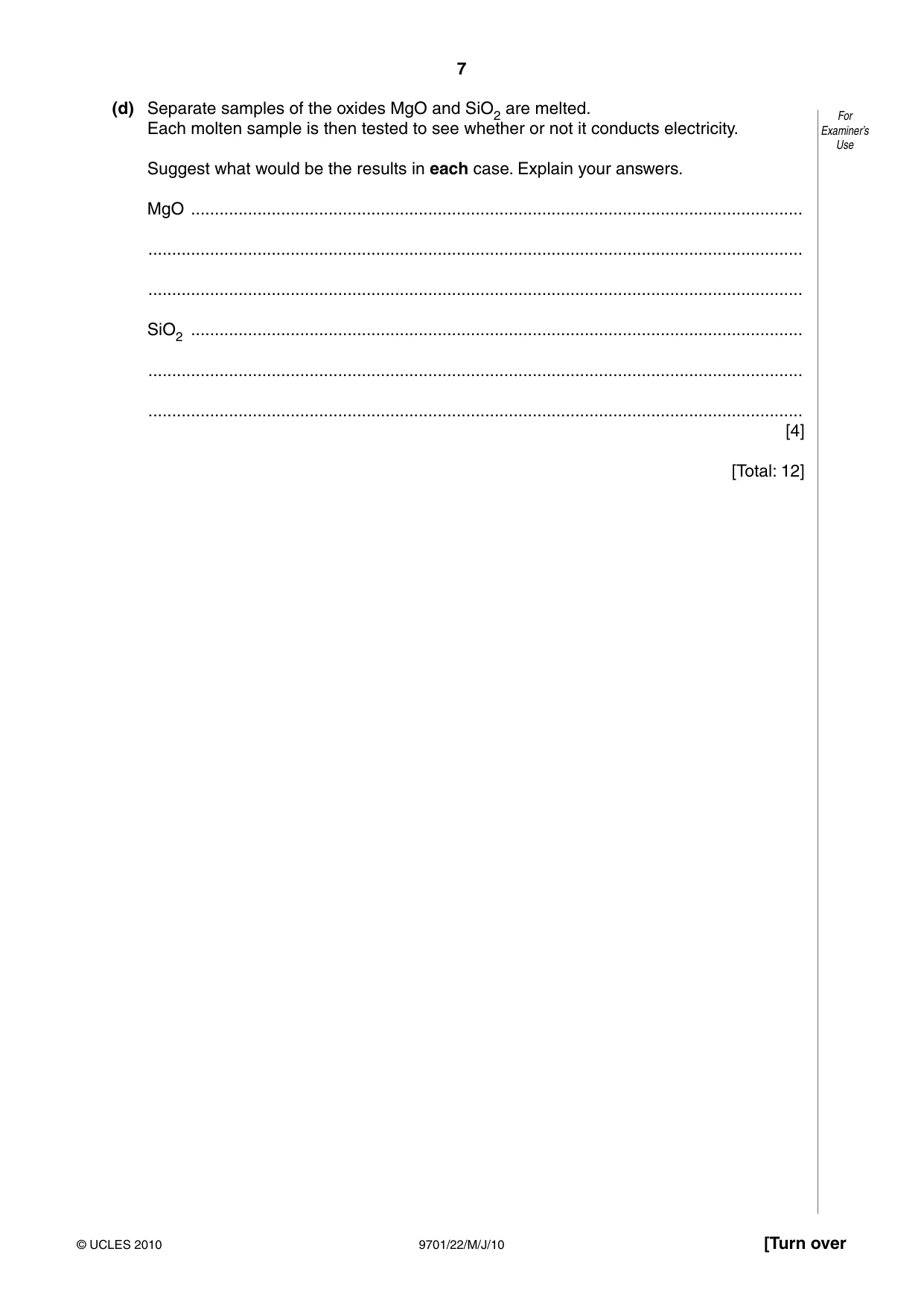
7 9701/22/M/J/10 © UCLES 2010 [Turn over For Examiner’s Use (d) Separate samples of the oxides MgO and SiO2 are melted. Each molten sample is then tested to see whether or not it conducts electricity. Suggest what would be the results in each case. Explain your answers. MgO … … … SiO2 … … … [4] [Total: 12]
Question paper, page 8
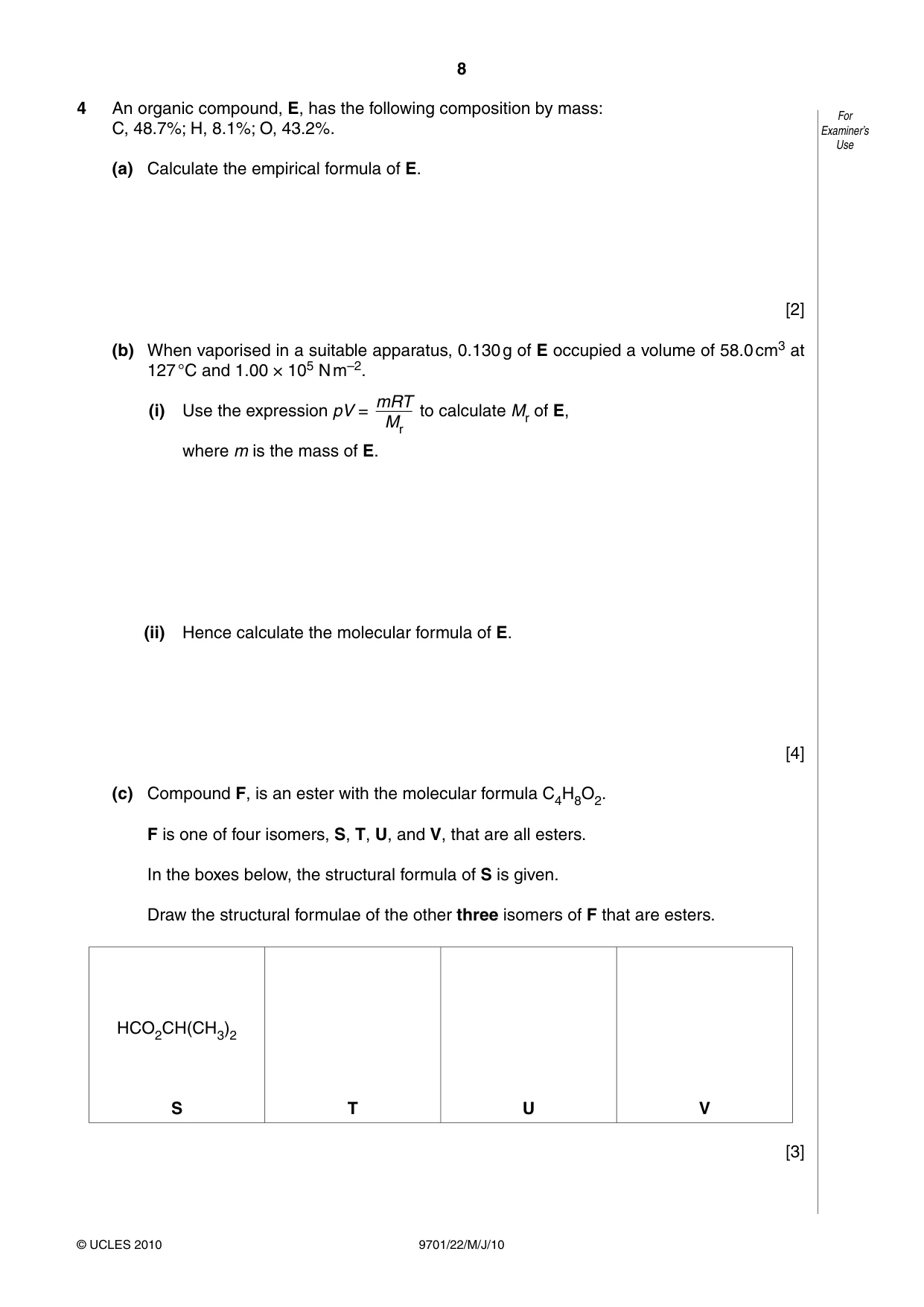
8 9701/22/M/J/10 © UCLES 2010 For Examiner’s Use 4 An organic compound, E, has the following composition by mass: C, 48.7%; H, 8.1%; O, 43.2%. (a) Calculate the empirical formula of E. [2] (b) When vaporised in a suitable apparatus, 0.130 g of E occupied a volume of 58.0 cm3 at 127 °C and 1.00 × 10⁵ N m–2. (i) Use the expression pV = mRT Mr to calculate Mr of E, where m is the mass of E. (ii) Hence calculate the molecular formula of E. [4] (c) Compound F, is an ester with the molecular formula C4H8O2. F is one of four isomers, S, T, U, and V, that are all esters. In the boxes below, the structural formula of S is given. Draw the structural formulae of the other three isomers of F that are esters. HCO2CH(CH3)2 S T U V [3]
Question paper, page 9
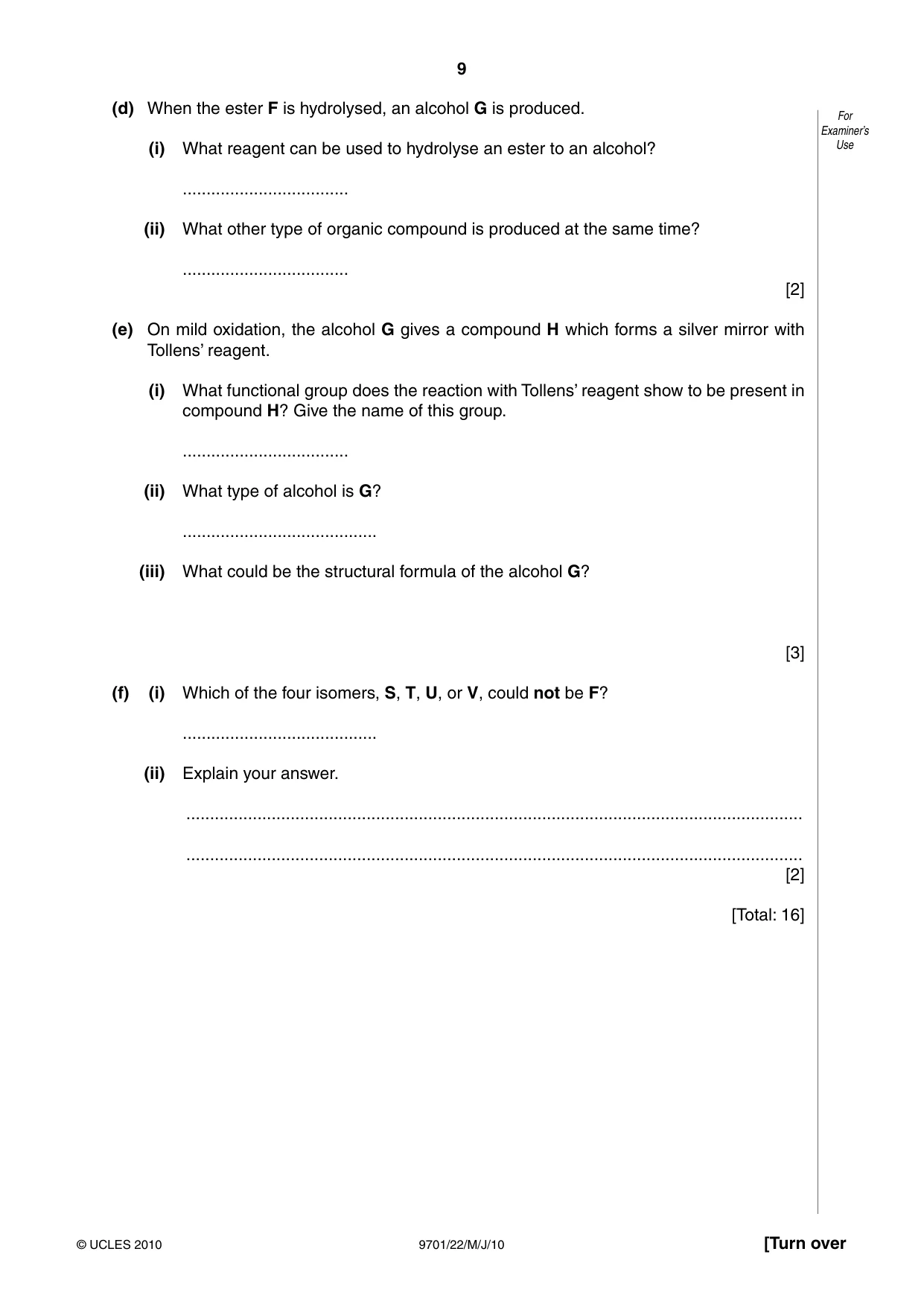
9 9701/22/M/J/10 © UCLES 2010 [Turn over For Examiner’s Use (d) When the ester F is hydrolysed, an alcohol G is produced. (i) What reagent can be used to hydrolyse an ester to an alcohol? … (ii) What other type of organic compound is produced at the same time? … [2] (e) On mild oxidation, the alcohol G gives a compound H which forms a silver mirror with Tollens’ reagent. (i) What functional group does the reaction with Tollens’ reagent show to be present in compound H? Give the name of this group. … (ii) What type of alcohol is G? … (iii) What could be the structural formula of the alcohol G? [3] (f) (i) Which of the four isomers, S, T, U, or V, could not be F? … (ii) Explain your answer. … … [2] [Total: 16]
Question paper, page 10
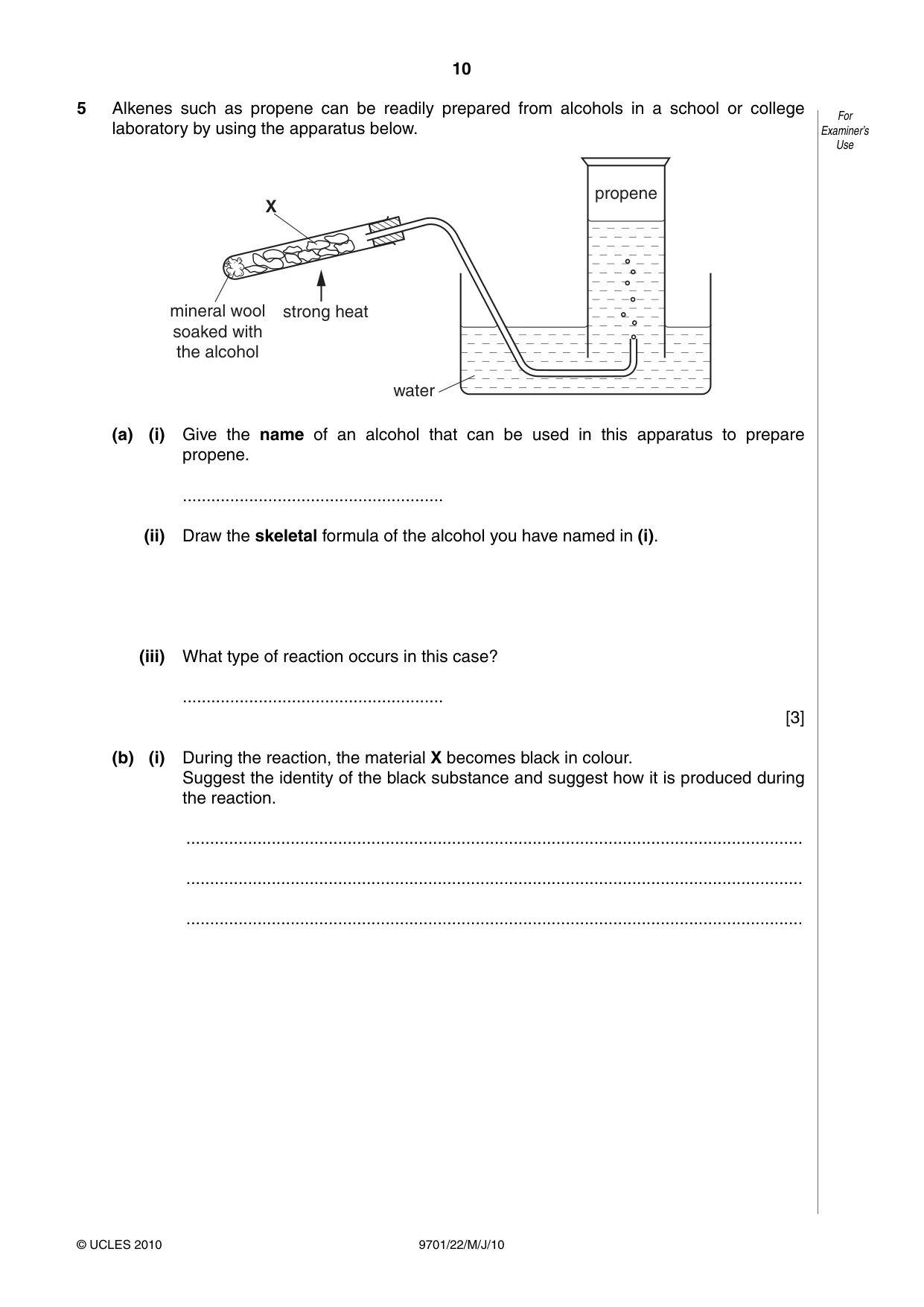
10 9701/22/M/J/10 © UCLES 2010 For Examiner’s Use 5 Alkenes such as propene can be readily prepared from alcohols in a school or college laboratory by using the apparatus below. mineral wool soaked with the alcohol strong heat X propene water (a) (i) Give the name of an alcohol that can be used in this apparatus to prepare propene. … (ii) Draw the skeletal formula of the alcohol you have named in (i). (iii) What type of reaction occurs in this case? … [3] (b) (i) During the reaction, the material X becomes black in colour. Suggest the identity of the black substance and suggest how it is produced during the reaction. … … …
Question paper, page 11
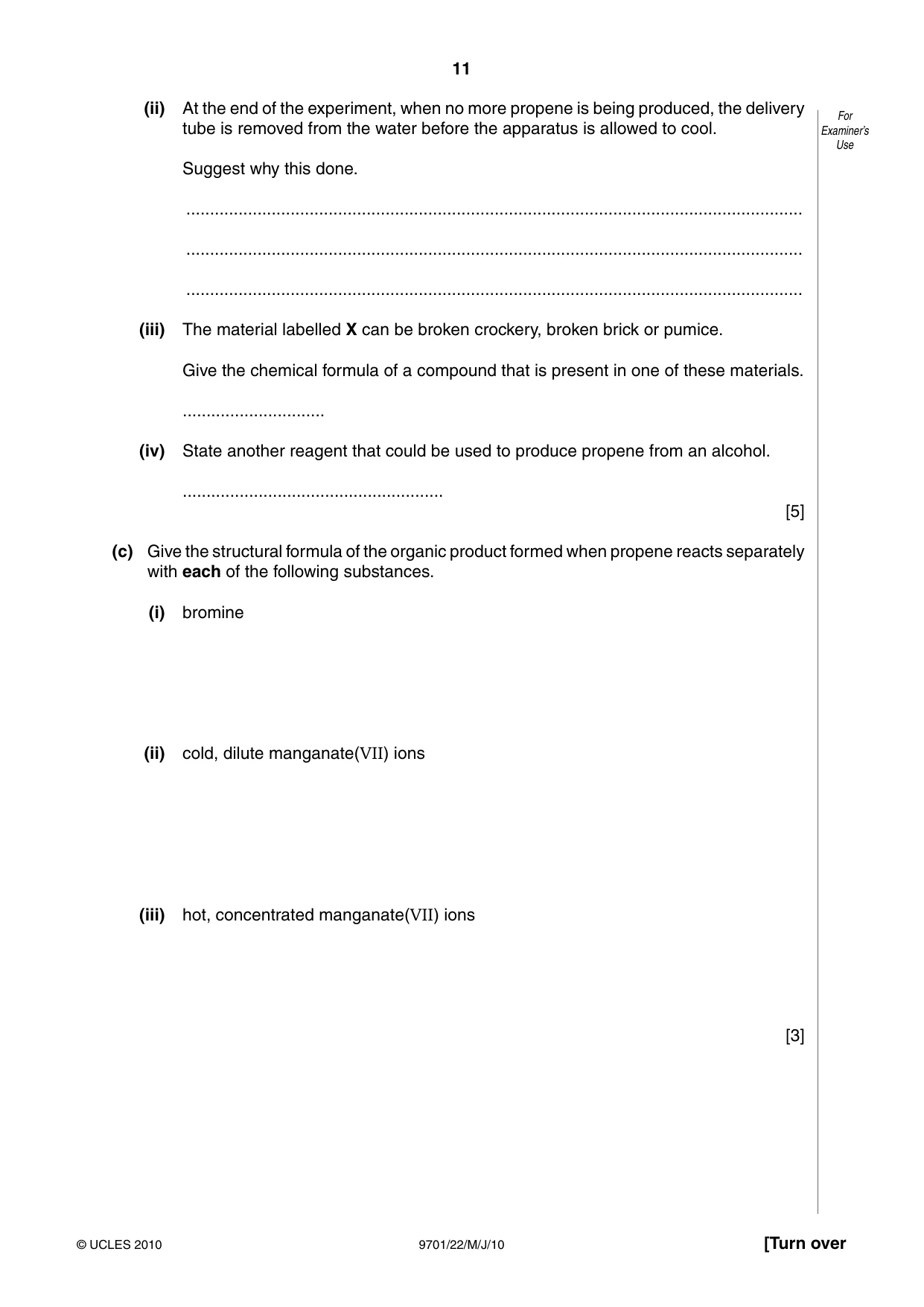
11 9701/22/M/J/10 © UCLES 2010 [Turn over For Examiner’s Use (ii) At the end of the experiment, when no more propene is being produced, the delivery tube is removed from the water before the apparatus is allowed to cool. Suggest why this done. … … … (iii) The material labelled X can be broken crockery, broken brick or pumice. Give the chemical formula of a compound that is present in one of these materials. … (iv) State another reagent that could be used to produce propene from an alcohol. … [5] (c) Give the structural formula of the organic product formed when propene reacts separately with each of the following substances. (i) bromine (ii) cold, dilute manganate(VII) ions (iii) hot, concentrated manganate(VII) ions [3]
Question paper, page 12
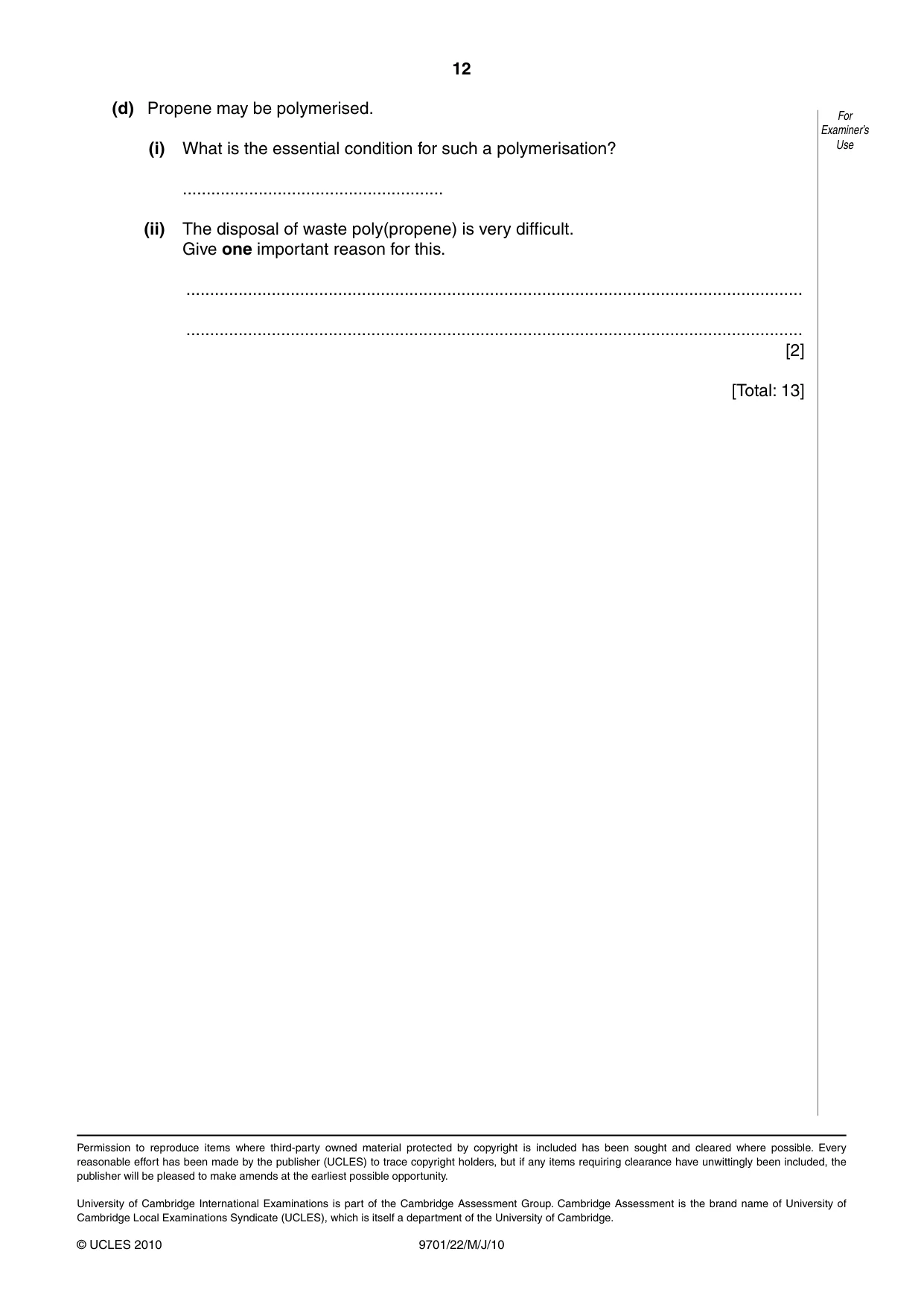
12 9701/22/M/J/10 © UCLES 2010 For Examiner’s Use (d) Propene may be polymerised. (i) What is the essential condition for such a polymerisation? … (ii) The disposal of waste poly(propene) is very difficult. Give one important reason for this. … … [2] [Total: 13] Permission to reproduce items where third-party owned material protected by copyright is included has been sought and cleared where possible. Every reasonable effort has been made by the publisher (UCLES) to trace copyright holders, but if any items requiring clearance have unwittingly been included, the publisher will be pleased to make amends at the earliest possible opportunity. University of Cambridge International Examinations is part of the Cambridge Assessment Group. Cambridge Assessment is the brand name of University of Cambridge Local Examinations Syndicate (UCLES), which is itself a department of the University of Cambridge.
Mark scheme, page 1
UNIVERSITY OF CAMBRIDGE INTERNATIONAL EXAMINATIONS GCE Advanced Subsidiary Level and GCE Advanced Level MARK SCHEME for the May/June 2010 question paper for the guidance of teachers 9701 CHEMISTRY 9701/22 Paper 2 (AS Structured Questions), maximum raw mark 60 This mark scheme is published as an aid to teachers and candidates, to indicate the requirements of the examination. It shows the basis on which Examiners were instructed to award marks. It does not indicate the details of the discussions that took place at an Examiners’ meeting before marking began, which would have considered the acceptability of alternative answers. Mark schemes must be read in conjunction with the question papers and the report on the examination. • CIE will not enter into discussions or correspondence in connection with these mark schemes. CIE is publishing the mark schemes for the May/June 2010 question papers for most IGCSE, GCE Advanced Level and Advanced Subsidiary Level syllabuses and some Ordinary Level syllabuses.
Mark scheme, page 2
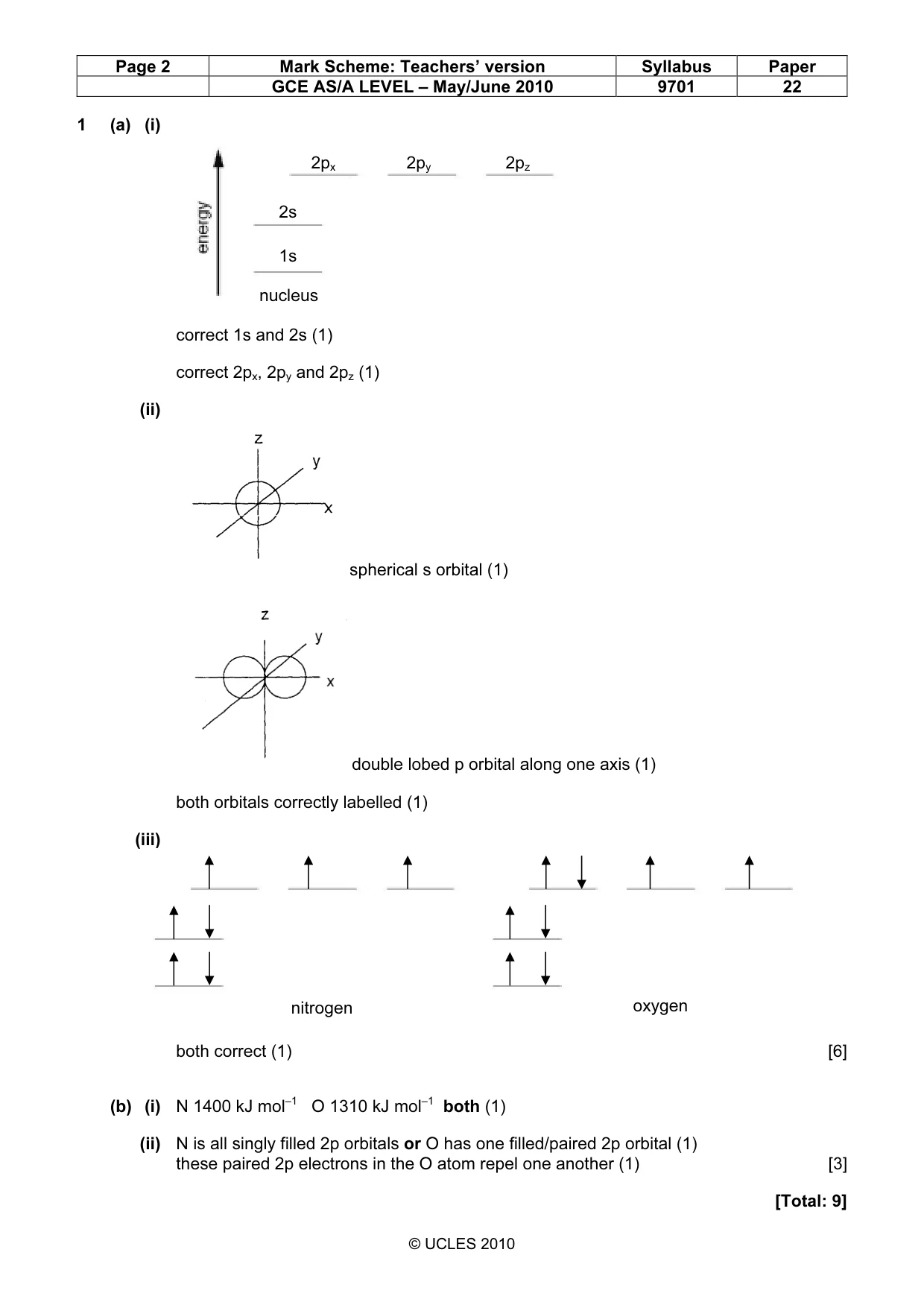
Page 2 Mark Scheme: Teachers’ version Syllabus Paper GCE AS/A LEVEL – May/June 2010 9701 22 © UCLES 2010 1 (a) (i) correct 1s and 2s (1) correct 2px, 2py and 2pz (1) (ii) spherical s orbital (1) double lobed p orbital along one axis (1) both orbitals correctly labelled (1) (iii) both correct (1) [6] (b) (i) N 1400 kJ mol–1 O 1310 kJ mol–1 both (1) (ii) N is all singly filled 2p orbitals or O has one filled/paired 2p orbital (1) these paired 2p electrons in the O atom repel one another (1) [3] [Total: 9] 2px 2py 2pz 2s 1s nucleus nitrogen oxygen
Mark scheme, page 3
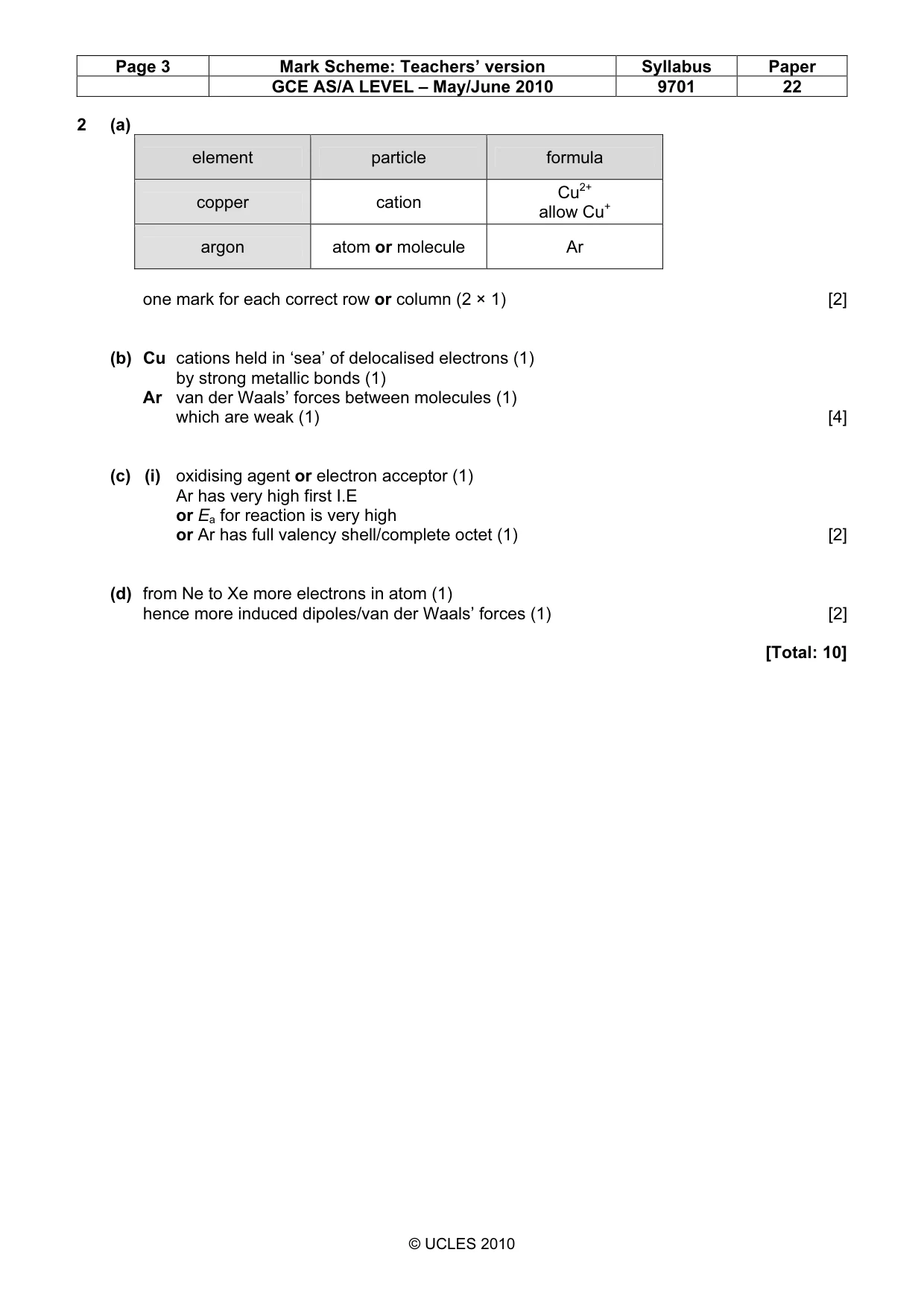
Page 3 Mark Scheme: Teachers’ version Syllabus Paper GCE AS/A LEVEL – May/June 2010 9701 22 © UCLES 2010 2 (a) element particle formula copper cation Cu2+ allow Cu+ argon atom or molecule Ar one mark for each correct row or column (2 × 1) [2] (b) Cu cations held in ‘sea’ of delocalised electrons (1) by strong metallic bonds (1) Ar van der Waals’ forces between molecules (1) which are weak (1) [4] (c) (i) oxidising agent or electron acceptor (1) Ar has very high first I.E or Ea for reaction is very high or Ar has full valency shell/complete octet (1) [2] (d) from Ne to Xe more electrons in atom (1) hence more induced dipoles/van der Waals’ forces (1) [2] [Total: 10]
Mark scheme, page 4
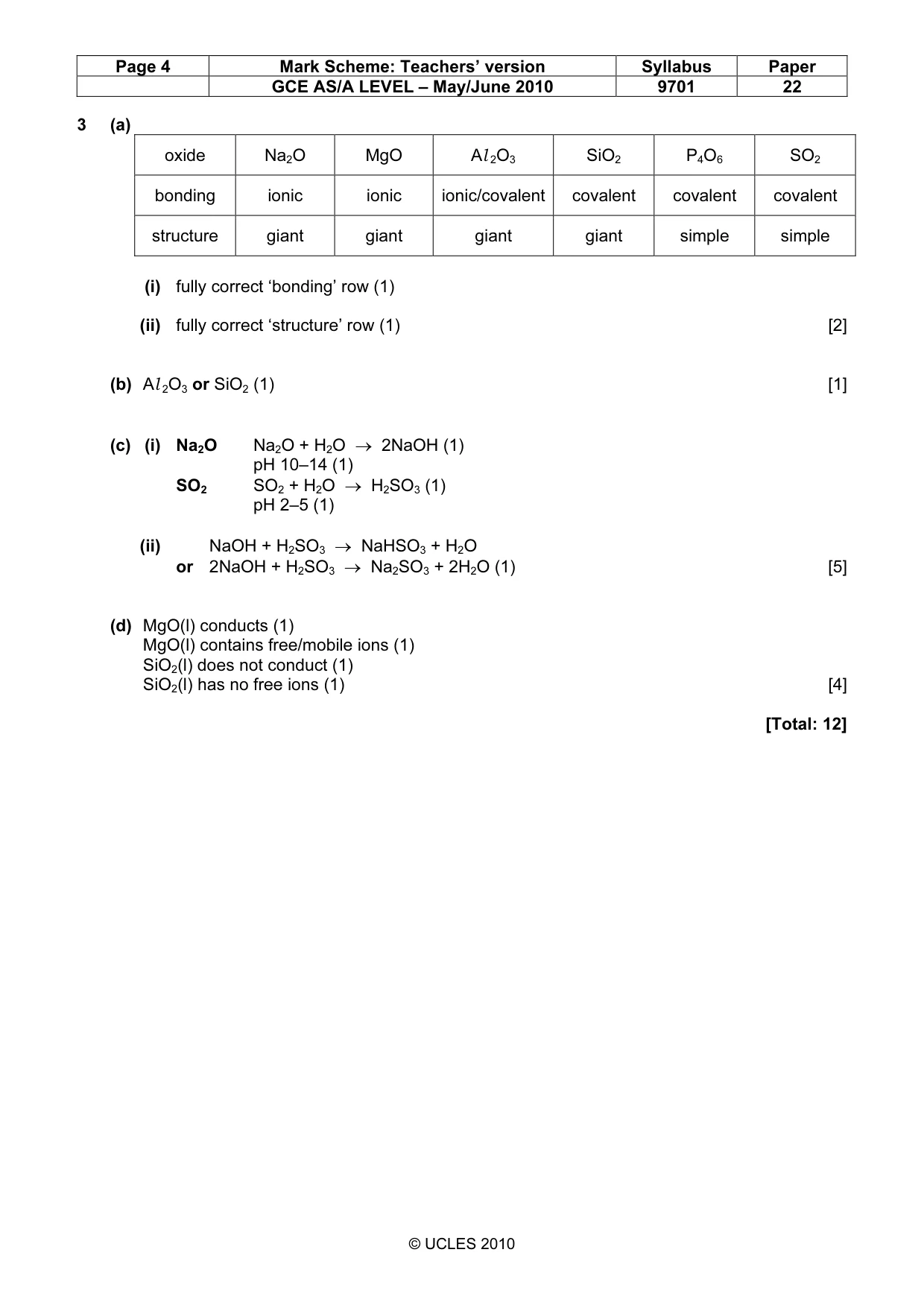
Page 4 Mark Scheme: Teachers’ version Syllabus Paper GCE AS/A LEVEL – May/June 2010 9701 22 © UCLES 2010 3 (a) oxide Na2O MgO Al 2O3 SiO2 P4O6 SO2 bonding ionic ionic ionic/covalent covalent covalent covalent structure giant giant giant giant simple simple (i) fully correct ‘bonding’ row (1) (ii) fully correct ‘structure’ row (1) [2] (b) Al 2O3 or SiO2 (1) [1] (c) (i) Na2O Na2O + H2O → 2NaOH (1) pH 10–14 (1) SO2 SO2 + H2O → H2SO3 (1) pH 2–5 (1) (ii) NaOH + H2SO3 → NaHSO3 + H2O or 2NaOH + H2SO3 → Na2SO3 + 2H2O (1) [5] (d) MgO(l) conducts (1) MgO(l) contains free/mobile ions (1) SiO2(l) does not conduct (1) SiO2(l) has no free ions (1) [4] [Total: 12]
Mark scheme, page 5
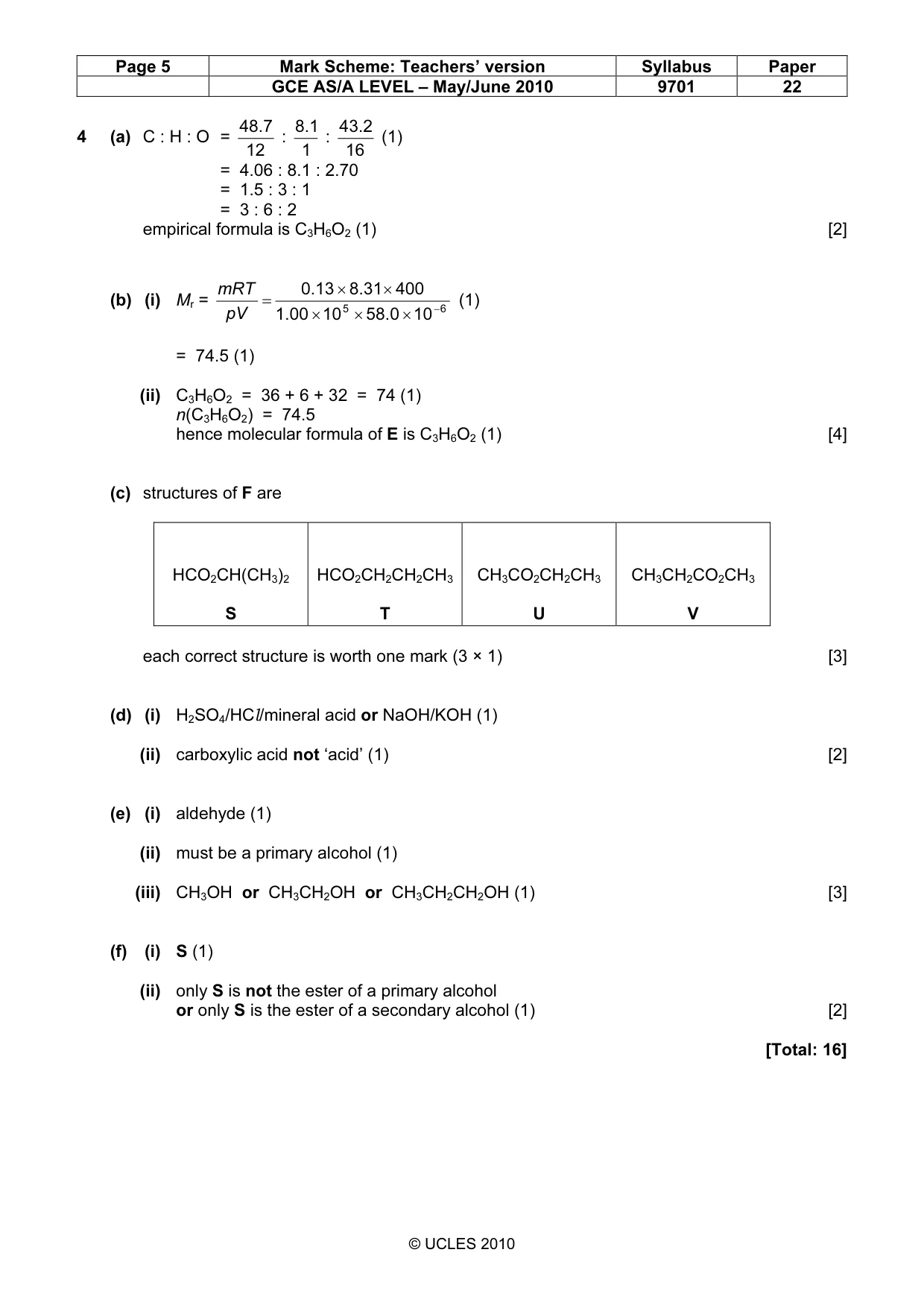
Page 5 Mark Scheme: Teachers’ version Syllabus Paper GCE AS/A LEVEL – May/June 2010 9701 22 © UCLES 2010 4 (a) C : H : O = 12 48.7 : 1 8.1 : 16 43.2 (1) = 4.06 : 8.1 : 2.70 = 1.5 : 3 : 1 = 3 : 6 : 2 empirical formula is C3H6O2 (1) [2] (b) (i) Mr = 6 5 10 58.0 10 1.00 400 8.31 0.13 − × × × × × = pV mRT (1) = 74.5 (1) (ii) C3H6O2 = 36 + 6 + 32 = 74 (1) n(C3H6O2) = 74.5 hence molecular formula of E is C3H6O2 (1) [4] (c) structures of F are HCO2CH(CH3)2 S HCO2CH2CH2CH3 T CH3CO2CH2CH3 U CH3CH2CO2CH3 V each correct structure is worth one mark (3 × 1) [3] (d) (i) H2SO4/HCl/mineral acid or NaOH/KOH (1) (ii) carboxylic acid not ‘acid’ (1) [2] (e) (i) aldehyde (1) (ii) must be a primary alcohol (1) (iii) CH3OH or CH3CH2OH or CH3CH2CH2OH (1) [3] (f) (i) S (1) (ii) only S is not the ester of a primary alcohol or only S is the ester of a secondary alcohol (1) [2] [Total: 16]
Mark scheme, page 6
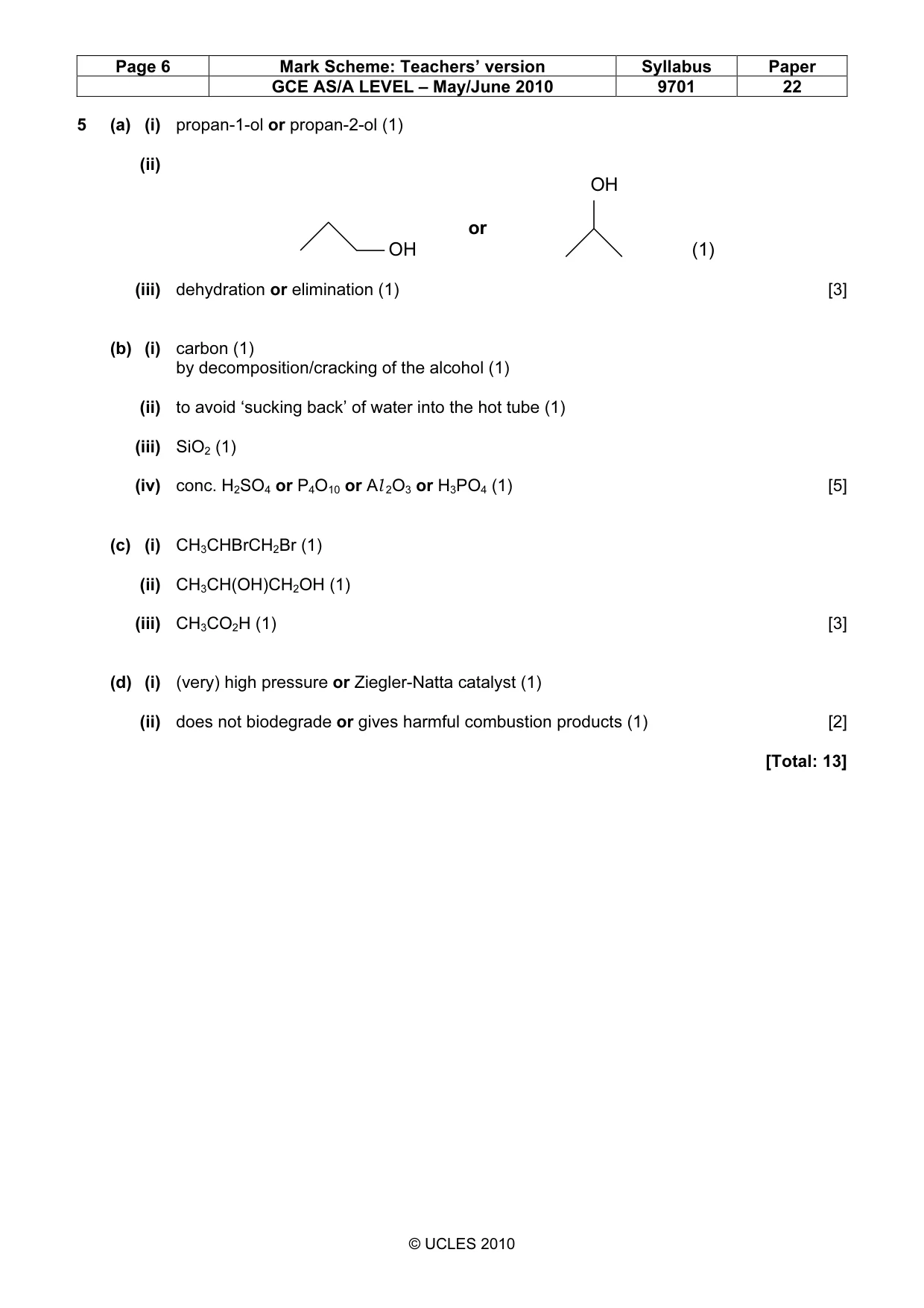
Page 6 Mark Scheme: Teachers’ version Syllabus Paper GCE AS/A LEVEL – May/June 2010 9701 22 © UCLES 2010 5 (a) (i) propan-1-ol or propan-2-ol (1) (ii) OH or OH (1) (iii) dehydration or elimination (1) [3] (b) (i) carbon (1) by decomposition/cracking of the alcohol (1) (ii) to avoid ‘sucking back’ of water into the hot tube (1) (iii) SiO2 (1) (iv) conc. H2SO4 or P4O10 or Al 2O3 or H3PO4 (1) [5] (c) (i) CH3CHBrCH2Br (1) (ii) CH3CH(OH)CH2OH (1) (iii) CH3CO2H (1) [3] (d) (i) (very) high pressure or Ziegler-Natta catalyst (1) (ii) does not biodegrade or gives harmful combustion products (1) [2] [Total: 13]
What you needed in this session
Cambridge’s own grade thresholds for 2010 May/June, Paper 2 · Variant 2. A higher threshold means an easier paper — the bar moves with how the cohort did.